Article

Ag–TiO2 Nanoparticle-Enriched Engine Oil as Lubricant for LPBF Ti6Al4V-ELI: Tribological Behavior and ANOVA-Based Parameter Analysis


1
Micro Nano Systems Laboratory, Mechanical Systems Engineering Department, EUt+—Institute for Nanoscience and Nanotechnology of the European University of Technology (EUTINN), Technical University from Cluj-Napoca, Blvd. Muncii No. 103-105, 400641 Cluj-Napoca, Romania
2
Manufacturing Engineering Department, Transilvania University of Brasov, Blv. Eroilor Nr. 29, 500036 Brașov, Romania
3
National Institute for Research and Development of Isotopic and Molecular Technologies, 67-103 Donat, 400293 Cluj-Napoca, Romania
*
Authors to whom correspondence should be addressed.
Lubricants 2026, 14(4), 175; https://doi.org/10.3390/lubricants14040175
Submission received: 20 March 2026 / Revised: 14 April 2026 / Accepted: 15 April 2026 / Published: 18 April 2026
(This article belongs to the Special Issue Recent Advances in Automotive Powertrain Lubrication, 2nd Edition)

Abstract

Despite the growing adoption of Ti6Al4V-ELI made by Laser Powder Bed Fusion (LPBF) in tribologically demanding applications, the influence of hybrid nanoparticle additives on its lubrication behavior under starved contact conditions remains insufficiently explored. The tribological performance of Ti6Al4V was investigated under starved boundary-to-mixed lubrication conditions using engine oil modified with Ag-doped TiO2 nanoparticles. Double-scan LPBF-fabricated discs were tested in a ball-on-disc configuration against AISI 52100 bearing steel using a TRB3 tribometer. Nanolubricants were prepared by dispersing TiO2 and Ag–TiO2 nanopowders with different Ag+/Ti4+ ratios (0.5%, 1.5%, and 2.5%) in SAE 10W-40 engine oil at a constant nanoparticle concentration of 0.05 wt%. Comprehensive physicochemical characterization of the nanopowders and nanolubricants was performed through structural, chemical, optical, morphological, rheological, and stability analyses. Tribological experiments were conducted following a full-factorial design combining three normal loads (5–15 N), three sliding speeds (0.10–0.20 m·s−1), and four lubricant formulations. The steady-state coefficient of friction ranged between 0.281 and 0.359, while the specific wear rate varied from 2.81 × 10⁻⁴ to 4.83 × 10⁻⁴ mm3·N−1·m−1. The contact temperature rise remained relatively moderate, within the interval of 1.9–9.4 °C. Among the investigated formulations, the lubricant containing 1.5% Ag–TiO2 exhibited the lowest friction coefficient, whereas the formulation with the highest Ag content showed improved stability of tribological performance across the investigated operating domain. These results indicate that Ag-modified TiO2 nanoparticles are consistent with the formation of protective tribofilms and contribute to the stabilization of friction, wear, and thermal behavior under starved lubrication conditions. ANOVA confirmed that sliding speed and the load–lubricant interaction are the dominant factors governing friction and wear, while normal load controls the thermal response. These findings support the use of Ag–TiO2 nanolubricants as a viable strategy for stabilizing interfacial behavior in LPBF-fabricated titanium components operating under starved lubrication conditions.

1. Introduction

Laser Powder Bed Fusion (LPBF), commonly referred to as Selective Laser Melting (SLM), has become one of the most important additive manufacturing technologies for producing high-performance metallic components with near-net-shape geometry. Among the materials processed using LPBF, Ti6Al4V Extra Low Interstitial (ELI) alloy is widely used due to its excellent combination of high specific strength, corrosion resistance, fracture toughness, and biocompatibility [1]. These characteristics make it particularly suitable for demanding applications such as orthopedic and dental implants, aerospace structural elements, and high-precision mechanical systems. In addition, the capability of LPBF to fabricate complex geometries, including patient-specific or topology-optimized structures, while minimizing material waste has further accelerated the adoption of Ti6Al4V-ELI in advanced engineering fields [2].
An important modification of the conventional LPBF process is the double-scan (or double-pass) strategy. In this approach, each deposited powder layer is re-melted by a second laser pass before the next layer is applied. This additional thermal cycle influences the solidification behavior of the material and often leads to reduced porosity, improved microstructural homogeneity, and refined grain morphology [3]. As a result, double-scan processing can enhance the mechanical properties of LPBF-fabricated components. Nevertheless, the surface integrity and tribological behavior of Ti6Al4V-ELI produced by this method—particularly under lubricated sliding conditions—have not yet been thoroughly investigated. LPBF surfaces typically retain characteristic roughness features such as partially melted particles, re-solidified spatter, and scan-track irregularities, which can strongly influence friction and wear behavior in boundary or mixed lubrication regimes [4].
Despite its favorable mechanical performance, Ti6Al4V-ELI exhibits relatively poor tribological properties when subjected to sliding contact. The alloy is prone to adhesive wear and galling, and it often displays high and unstable friction coefficients, especially under boundary and mixed lubrication conditions where the lubricant film is incomplete [5]. These limitations are particularly critical for components operating in tribological interfaces, where both friction and wear must be carefully controlled. Consequently, improving lubrication strategies for titanium alloys fabricated by additive manufacturing has become an important research direction.
One promising approach involves the incorporation of nanoparticles into conventional lubricating oils to form so-called nanolubricants. The presence of nanoparticles can enhance tribological performance through several mechanisms. They may form protective tribofilms on worn surfaces, fill surface asperities and smooth the contact region through a nano-polishing effect, or act as micro-rolling elements that reduce direct asperity interaction [6]. These effects become particularly significant under starved lubrication conditions, where the available lubricant is insufficient to maintain a fully separated contact and surface protection becomes increasingly important [7].
Among the various nanoparticle additives investigated for lubrication applications, titanium dioxide (TiO2) has received considerable attention. Its chemical stability, low toxicity, photostability, and favorable interaction with metallic surfaces make it an attractive candidate for tribological applications [8]. Previous studies have shown that dispersing TiO2 nanoparticles in lubricating oils can reduce friction and wear. For example, Laad and Jatti [8] reported measurable improvements in tribological performance when TiO2 nanoparticles were added to multigrade mineral oil, attributing the effect to the formation of a protective tribofilm. Ilie and Covaliu [9] demonstrated that surface-modified TiO2 particles provide better anti-wear behavior than unmodified nanoparticles, highlighting the importance of surface chemistry in lubricant formulations. Other studies have identified optimal concentration ranges for achieving the best performance, since excessive nanoparticle content may lead to agglomeration and reduced efficiency [10]. Particle size and morphology also influence performance, as nanoscale spherical particles can simultaneously fill surface asperities and act as rolling elements that reduce friction [11]. Other oxide nanoparticles, notably zinc oxide (ZnO), have also been investigated as lubricant additives and provide a useful point of comparison. Studies have reported friction and wear reductions attributable to ZnO tribofilm formation and rolling mechanisms, though performance is strongly dependent on surface functionalization and base fluid polarity [12,13].
Silver nanoparticles represent another class of additives with promising tribological properties. Due to their low shear strength and high ductility, silver particles can deform easily under shear and form thin, adherent tribofilms that reduce friction between contacting surfaces [14]. Experimental studies have shown that lubricants containing Ag nanoparticles can significantly decrease both friction coefficients and wear rates under boundary lubrication conditions. Surface analyses after testing frequently reveal the formation of silver-rich layers within wear tracks, confirming their role in tribofilm formation [15]. In addition to their tribological benefits, silver nanoparticles are well known for their antimicrobial properties, which makes them particularly interesting for biomedical applications involving lubricated titanium components [16].
Combining these two materials in the form of Ag-doped TiO2 composite nanoparticles offers the possibility of exploiting the advantages of both additives simultaneously. Silver doping can modify the crystal structure and surface characteristics of TiO2, potentially improving tribofilm adhesion and altering surface energy interactions [17]. From a tribological perspective, the hard TiO2 phase contributes to load-bearing capacity and asperity filling, while the softer silver phase facilitates low-friction sliding by forming deformable surface layers. The Ag+/Ti4+ molar ratio plays an important role in determining the balance between these effects, as it controls the amount of silver incorporated into the TiO2 structure and the degree of silver segregation at the particle surface [18]. Despite increasing interest in TiO2-based nanolubricants, systematic investigations of Ag-TiO2 nanoparticles at different silver doping levels, particularly in contact with LPBF-fabricated titanium alloy, remain limited. The combined influence of Ag+/Ti4+ doping ratio, operating load, and sliding speed on the tribological response of LPBF-fabricated Ti6Al4V-ELI under starved lubrication conditions has not been systematically addressed in the studies reviewed, highlighting a gap that the present work aims to fill.
Comprehensive physicochemical characterization of the nanopowders and lubricant formulations, encompassing structural, chemical, optical, rheological, and stability analyses, was performed to validate the prepared systems prior to tribological evaluation [19,20,21].
The tribological regime in which a lubricant operates strongly influences the dominant friction and wear mechanisms. In the present work, experiments were conducted under starved boundary-to-mixed lubrication conditions using a ball-on-disc configuration with AISI 52100 bearing steel as the counterface. This configuration simulates contact conditions commonly encountered in rolling bearings, joint components, and cam–follower systems. Under boundary lubrication, the load is largely supported by surface-adsorbed films rather than by a continuous hydrodynamic layer, making the role of lubricant additives particularly critical [22]. A full-factorial experimental design involving different normal loads and sliding speeds was used to evaluate the combined influence of operating parameters and lubricant composition. Statistical analysis using analysis of variance (ANOVA) allows the relative contribution of these factors to be quantified with greater reliability [23].
A significant challenge in nanolubricant development is maintaining long-term dispersion stability. Nanoparticles tend to agglomerate and sediment over time due to van der Waals attractive forces, which can lead to non-uniform additive distribution and inconsistent tribological performance during operation [24]. Previous studies have highlighted the importance of appropriate dispersion techniques and surface functionalisation in maintaining stable nanoparticle suspensions [24,25]. For this reason, the nanolubricants investigated in the present study—containing TiO2 and Ag-doped TiO2 nanoparticles with Ag+/Ti4+ ratios of 0.5%, 1.5%, and 2.5%, dispersed in SAE 10W-40 engine oil at a concentration of 0.05 wt%—were subjected to detailed stability evaluation as part of their overall physicochemical characterisation. The novelty of the present work lies in the simultaneous investigation of three Ag+/Ti4+ doping levels in contact with a double-scan LPBF-fabricated Ti6Al4V-ELI surface under starved boundary-to-mixed lubrication, combined with a full-factorial ANOVA-based evaluation of the individual and interaction effects of operating parameters and lubricant composition.
Based on these considerations, the objective of this study is to investigate the tribological performance of double-scan LPBF-fabricated Ti6Al4V-ELI alloy under starved boundary-to-mixed lubrication conditions using Ag-doped TiO2 nanolubricants with different silver doping ratios. Tribological experiments are carried out to evaluate the coefficient of friction, specific wear rate, and contact temperature rise across the investigated operating domain, with ANOVA applied to quantify the relative influence of each factor. The results are expected to provide insight into the synergistic mechanisms by which Ag-TiO2 nanoparticles influence tribofilm formation and friction stabilization on LPBF-fabricated titanium surfaces, contributing to the development of advanced nanolubricant formulations for additively manufactured titanium alloy components.

2. Materials and Methods

2.1. Fabrication of Ti6Al4V Discs

Disc-shaped specimens manufactured from Ti6Al4V ELI (Grade 23) alloy were employed as the stationary counterparts in ball-on-disc tribological experiments. The discs were fabricated by Laser Powder Bed Fusion (LPBF) using an SLM Realizer 250 system developed by Realizer GmbH (Borchen, Germany). Processing was conducted in a high-purity argon atmosphere with oxygen levels maintained below 1% to prevent excessive oxidation. The build platform was preheated to 250 °C to reduce thermal gradients and limit residual stress development. The selected processing parameters (120 W laser power, 500 mm/s scan speed, 120 µm hatch spacing, 50 µm layer thickness, 30 J/mm3 volumetric energy density) ensured stable melt pool behavior and high densification. An alternating X/Y scanning strategy was employed. All discs were produced within the same building job to ensure identical processing conditions. The specimens had a nominal diameter of 32 mm and a thickness of 4 mm and were built at a 20° inclination relative to the build plate to reduce support-induced surface irregularities. Following fabrication, stress-relief heat treatment was applied at 600 °C for 2 h, followed by air cooling. Approximately 0.5 mm of material was removed from both disc faces by machining, and final polishing was performed to ensure comparable surface roughness prior to testing. The hardness of the stress-relieved and polished discs was measured at 409 HV (approximately 41 HRC).
The present lubricated tribological investigation was focused on the double-scan (DS) configuration, consisting of double laser scan of each powder layer.

2.2. Preparation and Characterization of Nano Additives

Four nanoparticle-enhanced lubricants were prepared. In all formulations, the TiO2 nanoparticle concentration was kept constant at 0.05 wt%, while the Ag nanoparticle concentration was systematically varied to evaluate its dose-dependent effect on friction and wear behavior. The investigated lubricant formulations are presented in Table 1. The resulting suspensions appeared visually homogeneous and stable prior to tribological testing. The selected Ag+/Ti4+ ratios were chosen based on preliminary screening tests and literature data, ensuring an appropriate balance between dispersion stability and tribological efficiency. The Ag+/Ti4+ ratios of 0.5%, 1.5%, and 2.5% were selected to investigate the progressive influence of silver modification while preserving the structural integrity of the TiO2 matrix. Ratios exceeding this range were avoided to prevent excessive agglomeration. This formulation strategy allows capturing the transition from a purely ceramic tribological response (L1) to a hybrid ceramic–metal response (L2–L4), in which TiO2 contributes rolling, polishing, and load-bearing effects, while Ag promotes low-shear tribofilm formation.
The synthesis method for silver-modified TiO2 nanopowders with different Ag+/Ti4+ ratios was previously described by Suciu et al. [26]. To reduce soft agglomerates and ensure a more uniform particle size distribution, 40 mg of TiO2 or Ag-modified TiO2 nanopowder were pre-processed using a Fritsch vibratory ball mill (FRITSCH GmbH, Weimar, Germany) for 1 min at 40 oscillations per second, employing ZrO2 beads. The nanolubricants were prepared using the so-called one-step preparation method [27], consisting of the direct dispersion of the nanopowder into 100 mL of SAE 10W-40 fully synthetic engine oil (Castrol Magnatec, Castrol Germany GmbH, Hamburg, Germany). The physicochemical properties of oil are the kinematic viscosity (~99.2 mm2·s−1 at 40 °C), density (~0.8507 g·cm−3) and viscosity index (~169) [28]. The dispersion was performed under magnetic stirring for 30 min, followed by ultrasonic agitation for 1 h to enhance dispersion stability. This approach avoids issues associated with nanoparticle collection, storage, and transportation, minimizes nanoparticle aggregation, and reduces the risk of oxidation in air [27,29]. A small quantity of Triton X-100 surfactant (1.2 μL per 100 mL lubricant) was added to prevent particle agglomeration and sedimentation. Although Triton X-100 is known to exhibit hemotoxic and cytotoxic properties at concentrations approaching its critical micelle concentration in aqueous biological systems [30], its use as a dispersant in tribological nanolubricant formulations at low concentrations is well-established in the literature [10]. The quantity employed in the present study (1.2 µL per 100 mL lubricant, 0.0012% v/v) is consistent with standard nanolubricant preparation practice. The scope of this work is strictly limited to tribological characterization under controlled laboratory conditions.
Structural (XRD, Raman), chemical (FT-IR), optical (PL and UV–Vis), and morphological (SEM/EDX) analyses of the Ag-modified TiO2 nanopowders were performed.
To determine the effective crystallite, mean crystallite size, D_eff, Warren–Averbach X-ray profile Fourier analysis was applied to the anatase reflections (101) (2θ = 23.31°), (200) (2θ = 48.05°), and (215) (2θ = 75.058°), using the XR-LINE software [31]. The crystallite size distribution function was obtained from the second derivative of the strain-corrected Fourier coefficients [32]. An alternative analysis was also performed to separate size and strain broadening contributions, allowing calculation of the root mean square (RMS) microstrain averaged along the real-space distance, ⟨ε2⟩ₕₖₗ1/2 [33]. The unit cell parameters were refined by Rietveld-type analysis using the PowderCell software (version 2.4) [31], developed by Werner Kraus and Gert Nolze (BAM, Berlin, Germany).
Fourier-transform infrared (FT-IR) spectroscopy was employed to investigate the chemical interactions and structural modifications induced by silver incorporation into the TiO2 matrix. Raman spectroscopy was employed to investigate structural modifications and lattice disorder induced by silver incorporation into TiO2. Photoluminescence (PL) spectroscopy was performed to evaluate the recombination behavior of photogenerated charge carriers in Ag-modified TiO2 nanopowders.
The morphology of Ag-modified TiO2 nanopowders with different Ag+/Ti4+ ratios was investigated by scanning electron microscopy (SEM).

2.3. Tribological Testing Under Starved Boundary-to-Mixed Lubrication

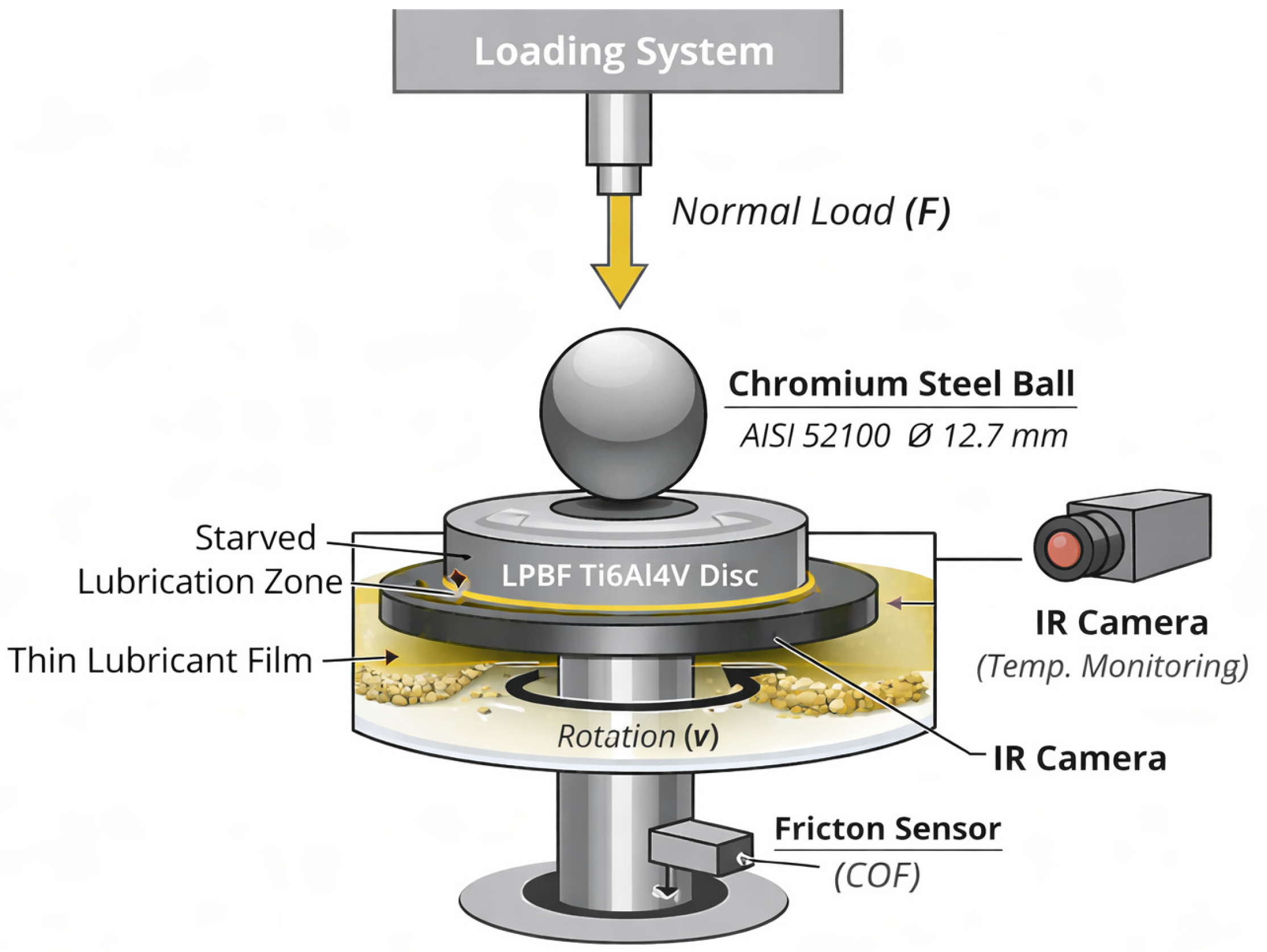
Tribological tests were performed using a TRB3 ball-on-disc tribometer (Anton Paar, Graz, Austria), where the Ti6Al4V disc acted as the rotating specimen and the counter-body consisted of a bearing steel ball manufactured from AISI 52100 chromium-alloyed high-carbon steel (Figure 1). This material pairing (Ti6Al4V disc–AISI 52100 ball) was selected to simulate practical engineering contacts where relatively soft titanium alloys operate against hardened steel components.
The LPBF-fabricated Ti6Al4V ELI disc (double laser scan configuration) is mechanically fixed within the test holder and rotated at a prescribed sliding speed (v), while an AISI 52100 steel ball (RKB Bearing Industries Group, Balerna, Switzerland) is pressed vertically against the disc surface under a controlled normal load (F). Friction force and contact temperature were continuously monitored throughout the experiments. The limited lubricant supply prevents full film development, promoting asperity-dominated contact conditions. The disc was rotated at a prescribed sliding speed v, continuously monitored by the tribometer drive system. For each test, the new ball was used to ensure repeatability and eliminate surface history effects. Before each test, the bearing ball was carefully cleaned using an isoparaffinic solvent and subsequently dried with lint-free laboratory wipes to eliminate any surface contaminants.
The friction force was recorded continuously by a dedicated friction sensor, from which the coefficient of friction (COF) was derived in real time. Contact temperature was monitored throughout each test using a thermal imaging system (IR camera), enabling steady-state thermal characterization of the sliding interface under the imposed lubrication conditions.
All tribological tests were conducted without light exposure, to prevent any photocatalytic activation of TiO2 and Ag nanoparticles during sliding. The geometrical characteristics of the tribological contact pair are summarized in Table 2. All tribological experiments were conducted at ambient laboratory conditions: temperature: 23 ± 2 °C and relative humidity: 40 ± 5%. Testing was performed in an enclosed chamber to prevent external contamination and eliminate possible photocatalytic activation of TiO2 nanoparticles.
All lubricated tests were conducted in an open configuration, with the disc fully exposed and without the use of a liquid bath or immersion chamber. A deliberately limited lubricant supply was adopted to avoid full flooding of the contact zone and to promote starved boundary-to-mixed lubrication conditions throughout the experiments.
Prior to each test, the nanolubricant formulation was subjected to ultrasonication for 10 min to ensure full rehomogenization of the nanoparticle suspension and to restore a uniform dispersion state, thereby eliminating any sedimentation effects that may have occurred during storage between tests. A total initial lubricant volume of 100 µL was applied directly onto the wear track using a calibrated adjustable air-displacement micropipette (Labopette, single-channel, maximum capacity 50 µL, Eberstadt, Germany). The micropipette operates within a nominal volumetric accuracy of ±1% of the set volume according to manufacturer specifications. To ensure volumetric accuracy within the working range of the device, the initial volume was delivered as two consecutive 50 µL doses. The lubricant was deposited circumferentially along the sliding path, after which the disc was manually rotated for 2–3 revolutions under no applied load to achieve uniform spreading across the entire contact track prior to test initiation.
During sliding, lubricant redistribution and gradual depletion occurred due to centrifugal forces and shear-induced migration away from the contact region. To compensate for this redistribution while maintaining non-immersed contact conditions, controlled replenishment was performed using the same micropipette. A fixed volume of 30 µL was applied at predefined time intervals dependent on the selected sliding speed: every 8 min at 0.10 m·s−1, every 6 min at 0.15 m·s−1, and every 4 min at 0.20 m·s−1. The lubricant was carefully deposited upstream relative to the sliding direction without interrupting the test, thereby minimizing disturbance to the friction signal. The applied normal load (5–15 N) did not influence the replenishment protocol. Consequently, the total lubricant volume per run was 160 µL, 190 µL, and 220 µL for sliding speeds of 0.10, 0.15, and 0.20 m·s−1, respectively—volumes selected to ensure continuous wetting of the wear track while preventing specimen immersion.
Under the selected combinations of normal load and sliding speed, the establishment of a fully developed hydrodynamic film was not expected, given the limited lubricant supply and the moderate operating conditions employed. The tribological response was therefore governed primarily by asperity interactions and nanoparticle-assisted tribofilm formation within the boundary-to-mixed lubrication regime, consistent with the experimental objectives of the present study.
To ensure quantitative evaluation under stabilized sliding conditions, only the final 50% of the recorded friction and temperature signals were used for data analysis. This approach eliminates the transient run-in period, during which friction evolves toward a steady state, and ensures that the reported values are representative of stabilized tribological behavior. Prior to averaging, transient spikes and non-representative extreme values were removed from the filtered signals using the interquartile range (IQR) method. The steady-state coefficient of friction (COF) and the steady-state contact temperature rise (ΔT) were subsequently calculated as the arithmetic mean of the processed data over the final 50% of each test. Wear of the Ti6Al4V discs was quantified by profilometric measurement of the wear track cross-section using the integrated wear module of the TRB3 tribometer. Eight equally spaced profiles (45° angular spacing) were acquired along the circumference of each wear track to ensure accurate and representative volumetric determination. The specific wear rate K was calculated according to Equation (1):
K d i s k = V d i s k L s l i d i n g F
where Vdisk is the wear volume of the disc (mm3), F is normal load (N), Lsliding is total sliding distance (m), and Kdisk is wear rate of the disc (mm3·N−1·m−1).
Wear of the AISI 52100 counter-body was assessed by measuring the wear scar diameter (WSD) on the ball surface using optical microscopy at a fixed magnification. The WSD was used as a qualitative indicator of counter-body wear severity under the investigated lubrication conditions.

2.4. Design of Experiments and Statistical Analysis

A structured full-factorial design of experiments (DOE) was adopted to evaluate the individual and combined effects of material processing parameters and lubricant composition on tribological performance (Table 3). The resulting full-factorial design comprised 36 unique experimental conditions, obtained from the combination of three normal loads, three sliding speeds, and four lubricant formulations. Each experimental condition was repeated three times to ensure reproducibility and statistical reliability.
The sliding distance was fixed at 180 m for all tests to ensure comparable mechanical work input across experimental conditions. This distance was selected to ensure consistent mechanical work input across the full-factorial experimental matrix of 36 conditions tested in triplicate (108 individual runs), and is sufficient for the attainment of a stabilized tribological response. The present study is therefore focused on comparative steady-state characterization of nanolubricant formulations rather than long-term durability assessment. Depending on the selected sliding speed, the corresponding test durations were 30 min at 0.10 m·s−1, 20 min at 0.15 m·s−1 and 15 min at 0.20 m·s−1.
The reported results represent mean values together with the corresponding standard deviations. The run order was randomized to minimize systematic bias. Experimental blocks, including testing day, lubricant batch, and ball identification number, were recorded to account for potential nuisance variability.
To quantitatively evaluate the influence of operating parameters and lubricant formulation on the tribological response, experimental data were analyzed using analysis of variance (ANOVA). The dependent response variables considered in the analysis were the steady-state coefficient of friction (COF), the specific wear rate (K), and the steady-state contact temperature rise (ΔT). A significance level of α = 0.05 was adopted for all statistical tests. Both main effects and two-factor interaction effects (F * v, F * L, and v * L) were included in the model to capture potential combined influences of the operating parameters on tribological performance. The relative contribution of each factor to the total variance was expressed as a percentage of the total sum of squares, allowing a direct comparison of the importance of load, speed, and lubricant formulation on each response variable. Prior to statistical interpretation, the assumptions underlying ANOVA—namely normality of residuals and homogeneity of variance across factor levels—were verified using the Shapiro–Wilk test and Levene’s test, respectively. In addition, graphical representations including main effects plots and interaction plots were employed to facilitate the interpretation of the statistical results and to highlight the relative contribution of each factor to the overall tribological performance of the system.

3. Results and Discussions

3.1. Nanoparticles Characterization Results

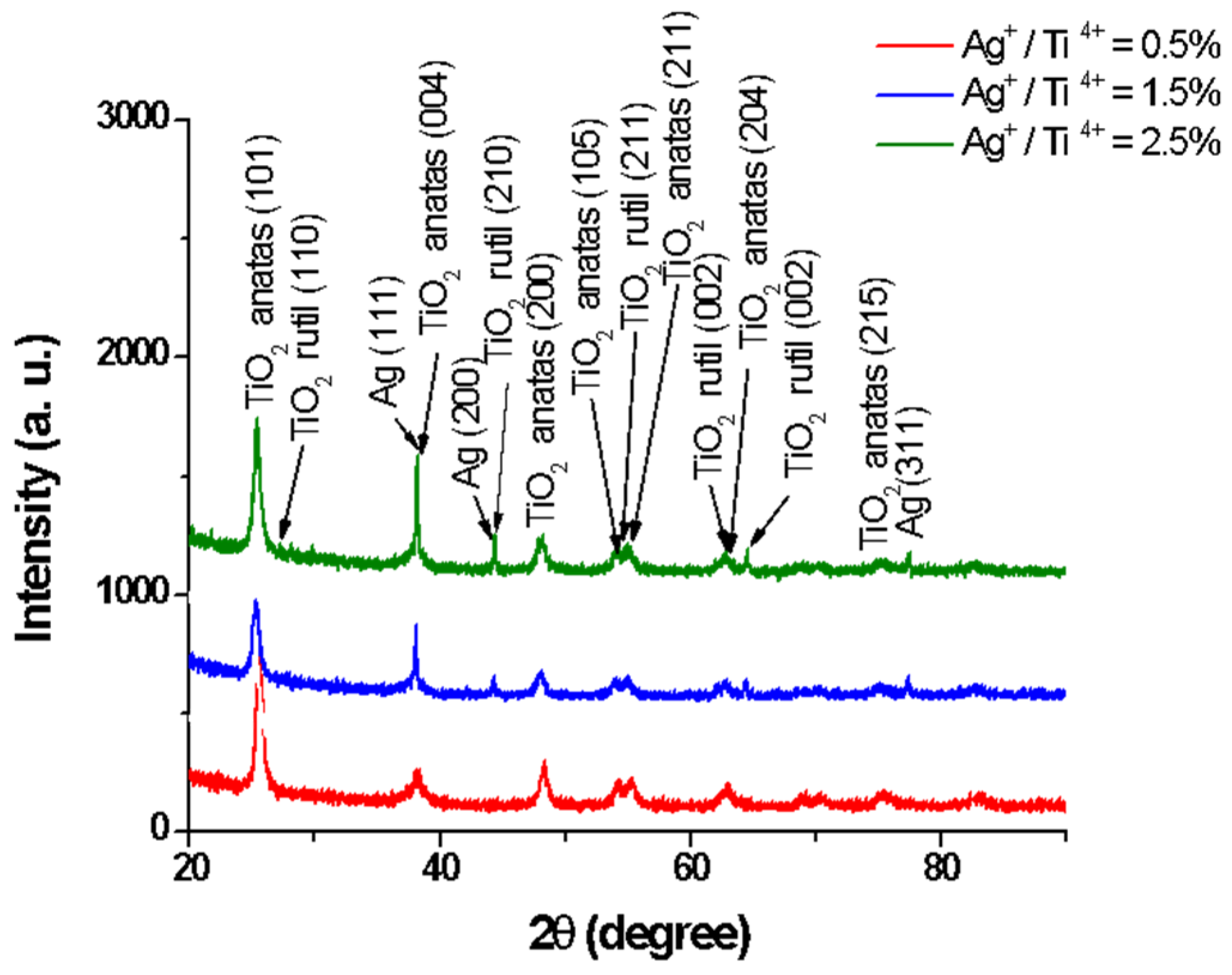
X-ray diffraction (XRD) patterns of the Ag-modified TiO2 nanopowders are presented in Figure 2.
The diffraction peaks correspond predominantly to the tetragonal anatase phase (PDF card 01-089-4921) together with metallic silver (PDF card 00-002-1098), with no detectable secondary phases such as silver oxide [34]. A minor contribution of the rutile phase was identified, indicating partial anatase-to-rutile transformation during processing. The absence of distinct Ag oxide reflections may be attributed to the low silver content and its high dispersion within the TiO2 matrix [35].
The resulting microstructural parameters of Ag-modified TiO2 are summarized in Table 4. An increase in the Ag+/Ti4+ ratio led to a progressive rise in the crystalline Ag phase fraction. Simultaneously, a slight reduction in lattice parameters, unit cell volume, effective crystallite size, and microstrain values was observed, suggesting structural relaxation and modification of the TiO2 lattice due to silver incorporation.
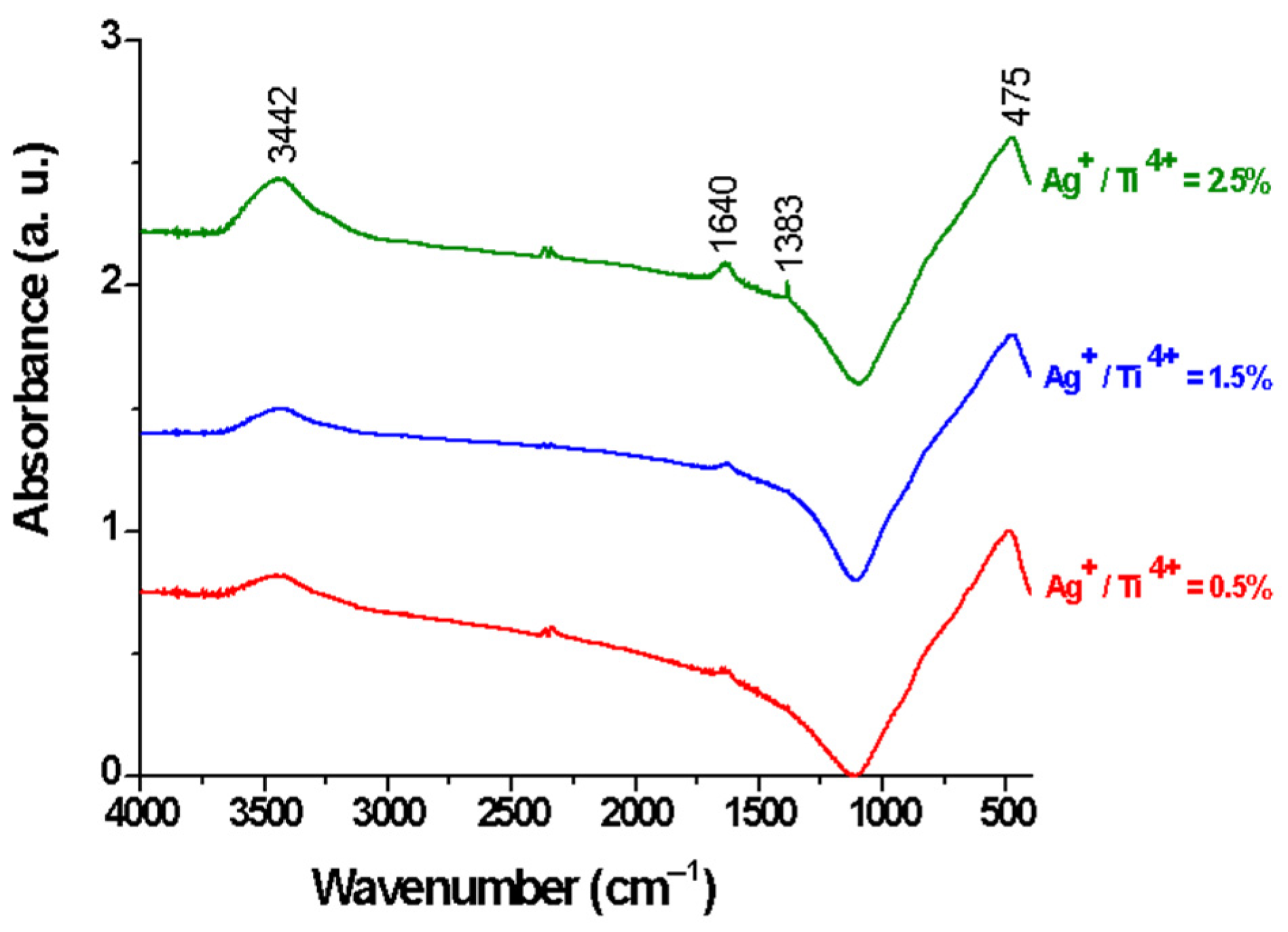
The FT-IR spectra of Ag-modified TiO2 nanopowders are presented in Figure 3. A broad absorption band centered around 3442 cm−1 is attributed to the stretching vibrations of hydroxyl (–OH) groups, associated with surface-adsorbed water molecules and residual hydroxyl groups on the nanoparticle surface. The band at approximately 1640 cm−1 corresponds to the bending vibration of molecular water adsorbed on the nanopowder surface [36]. The absorption feature observed near 1383 cm−1 can be associated with COO groups and Ti–O–OC bonds formed during the preparation process [37]. In the low-frequency region, the shift of the Ti–O vibration band from approximately 522 cm−1 to 449 cm−1 suggests modification of the TiO2 lattice and can be attributed to asymmetric stretching vibrations of Ti–O–Ag bonds, confirming silver incorporation into the TiO2 structure [38]. These spectral modifications indicate successful interaction between silver species and the TiO2 framework, supporting the structural observations obtained from XRD analysis.
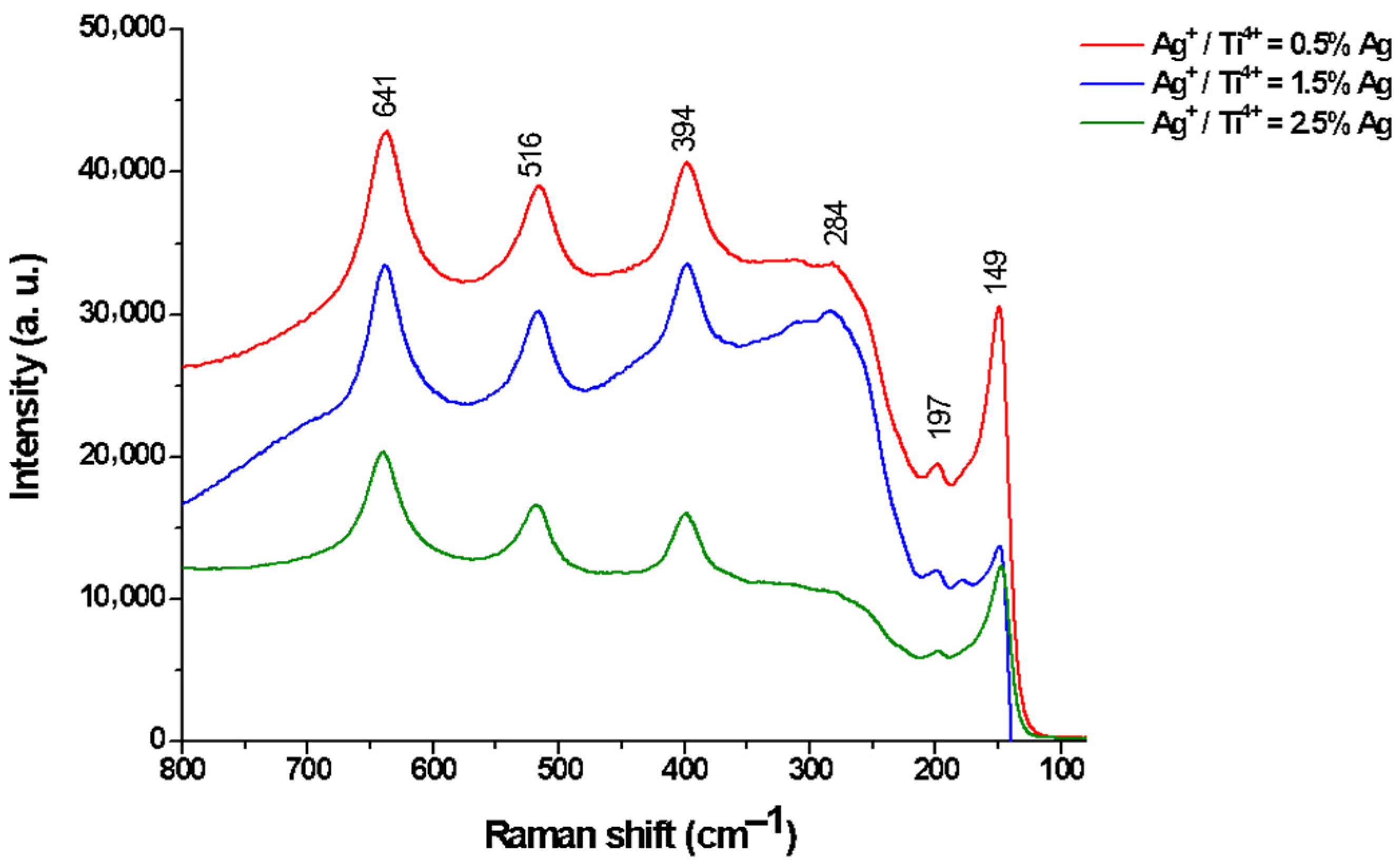
The Raman spectra of Ag-modified TiO2 nanopowders are presented in Figure 4. The spectra exhibit the characteristic Raman-active modes of anatase TiO2. The bands located at approximately 149, 197, and 641 cm−1 correspond to the Eg vibrational modes [36]. Additional bands observed at 394 and 516 cm−1 are attributed to the B1g and A1g + B1g symmetry modes, respectively. The B1g mode is associated with O–Ti–O bending vibrations, while the higher-frequency modes correspond to Ti–O stretching vibrations within the TiO2 lattice [39]. A noticeable shift and broadening of the anatase Eg modes (around 141–149 cm−1 and ~637–641 cm−1) were observed with increasing Ag+/Ti4+ ratio. These modifications can be attributed to phonon confinement effects associated with nanoscale crystallite dimensions, as well as lattice disorder induced by silver incorporation. Peak broadening and frequency shifts may also arise from oxygen vacancies, internal stress, and structural defects generated during nanoparticle synthesis.
The progressive spectral changes support the microstructural trends identified by XRD analysis, indicating that silver incorporation affects lattice symmetry and defect density without inducing secondary crystalline phases.
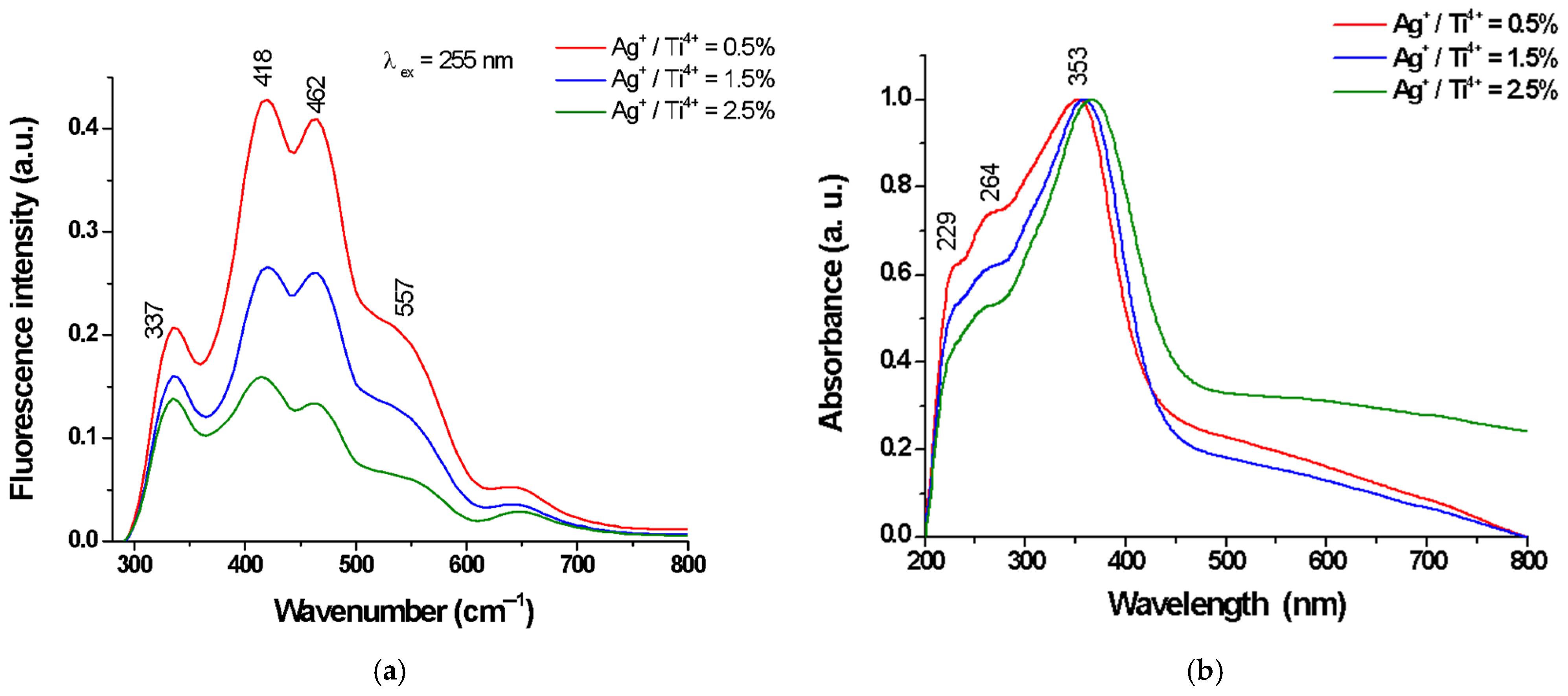
The photoluminescence spectra are presented in Figure 5a. A progressive decrease in PL intensity was observed with increasing Ag+/Ti4+ ratio, indicating reduced electron–hole recombination. This behavior can be attributed to the role of silver nanoparticles as electron traps, facilitating charge separation and suppressing recombination processes. The emission band centered around ~470 nm is associated with defect-related states within the TiO2 lattice [40], while the emission observed near ~330 nm corresponds to near band-edge transitions of TiO2 [41]. Additional emission features around ~550–560 nm may be related to defect states and possible Ag-related electronic transitions. Similar emissions have been reported for Ag2O-related states with a band gap of approximately 2.25 eV [42]. The observed reduction in emission intensity suggests enhanced charge carrier separation upon silver incorporation. The PL results suggest that silver incorporation modifies the electronic structure of TiO2 through the introduction of sub-bandgap defect states. To further characterise these electronic modifications, complementary information was obtained from UV–Vis absorption spectroscopy (Figure 5b). The absorption bands observed in the UV region (below 400 nm) are characteristic of TiO2 and correspond to valence-to-conduction band transitions. The absorption features located at approximately 228 and 263 nm can be associated with electronic transitions related to silver species [43], while the band near ~353 nm has been attributed to Ag clusters of nanometric dimensions (~1 nm) [44]. The combined PL and UV–Vis results indicate that silver incorporation modifies the electronic structure of TiO2 by introducing defect states and enhancing charge separation, which may influence surface reactivity and interfacial processes relevant for tribological applications.
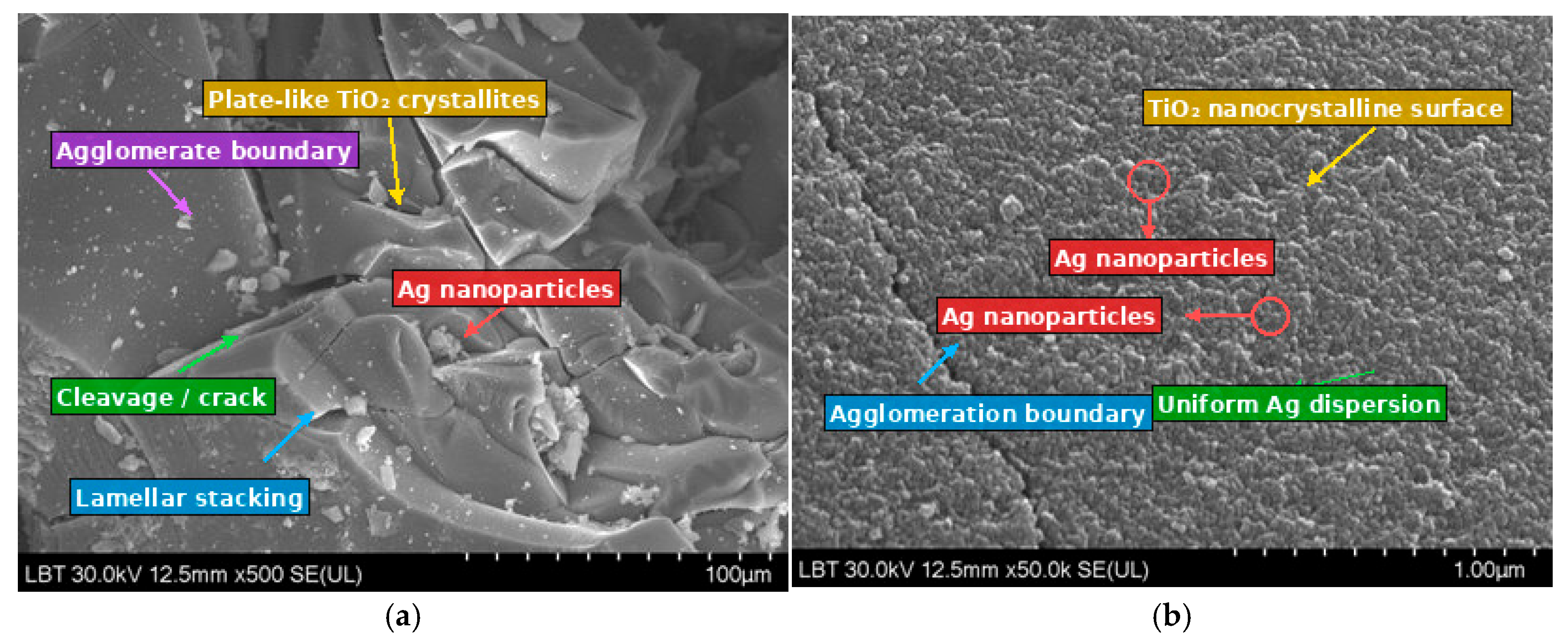
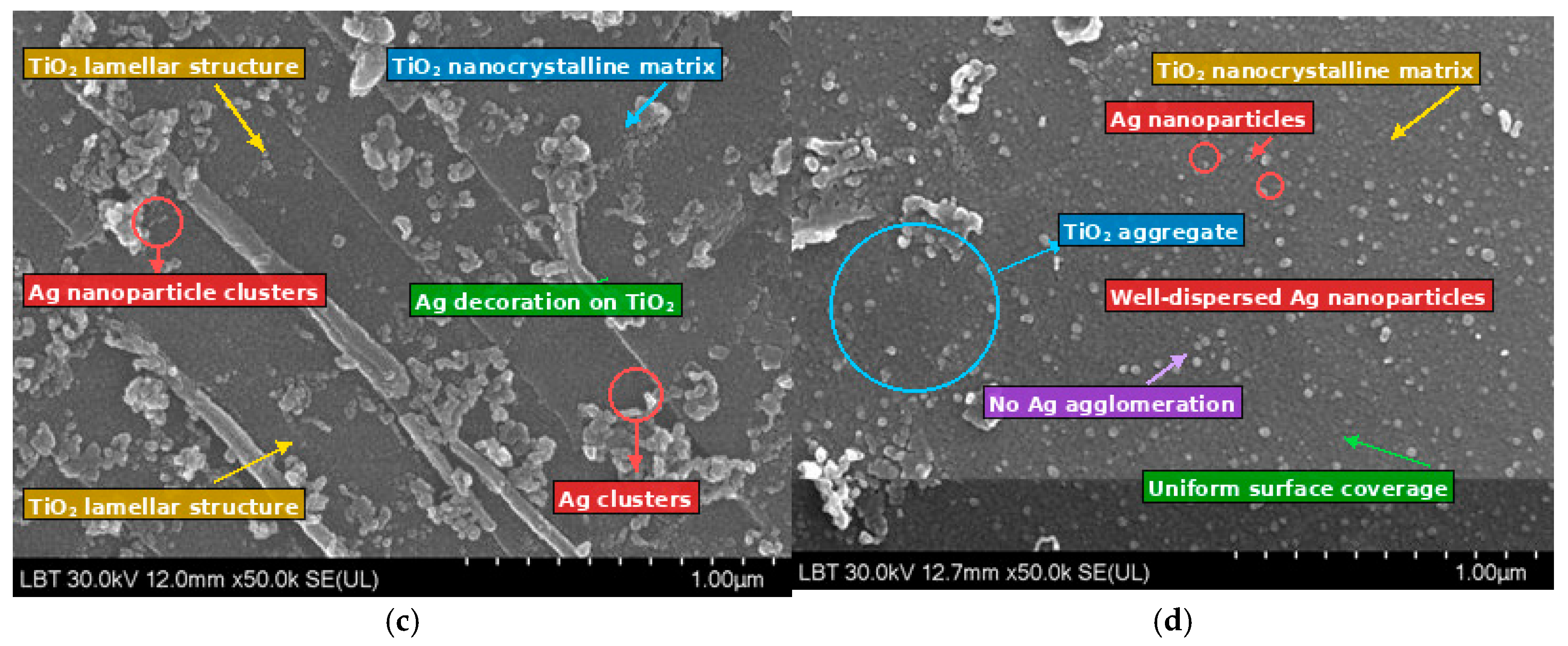
Representative micrographs of scanning electron microscopy (SEM) investigations of Ag-modified TiO2 nanopowders with different Ag+/Ti4+ ratios are presented in Figure 6. At low magnifications, the characteristic flower-like (rosette-type) morphology typical of TiO2 nanostructures can be observed (Figure 6a). These hierarchical structures are formed by the aggregation of nanoscale crystallites, consistent with the crystallite sizes determined from XRD analysis. At higher magnifications, the distribution of nearly spherical Ag nanoparticles on the TiO2 surface becomes evident (Figure 6b–d), indicating successful surface decoration without significant particle agglomeration. No major morphological distortions were observed with increasing silver content, suggesting that Ag incorporation does not significantly alter the overall structural framework of TiO2 at the investigated ratios.
At low magnification (×500, Figure 6a), the 0.5% sample displays a pronounced lamellar or plate-like structure, formed by the aggregation of nanoscale crystallites arranged in a radial configuration, representing the precursor architecture of the rosette-like hierarchical morphology more clearly observable at higher magnifications. Cleavage features and separations between adjacent lamellar structures are clearly visible, and microscale agglomeration of the lamellar plates is evident, consistent with the natural tendency of oxide nanopowders to form larger aggregates.
At higher magnification (×50,000, Figure 6b), the nanocrystalline surface texture of the TiO2 matrix is clearly resolved for the 0.5% sample, with crystallite dimensions consistent with D_eff ≈ 16.75 nm (Table 4). Brighter nanoscale features distributed across the TiO2 surface correspond to Ag nanoparticles, which appear relatively uniformly dispersed without evidence of significant clustering. Some degree of soft agglomeration persists at larger length scales, as indicated by the aggregate boundary visible on the left portion of the image.
At the intermediate doping ratio of Ag+/Ti4+ = 1.5% (Figure 6c), the micrograph shows elongated lamellar TiO2 structures oriented diagonally across the field of view, with a background nanocrystalline matrix exhibiting individual crystallite dimensions consistent with D_eff ≈ 15.84 nm (Table 4). Ag nanoparticles are visible both as isolated surface features and as small clusters concentrated along the lamellar structures, suggesting that at this doping level silver nanoparticles begin to preferentially nucleate at the TiO2 lamellar surfaces rather than distributing uniformly across the matrix.
At the highest doping ratio of Ag+/Ti4+ = 2.5% (Figure 6d), numerous well-individualized, nearly spherical bright particles are uniformly distributed across the TiO2 nanocrystalline matrix, with individual crystallite dimensions consistent with D_eff ≈ 14.29 nm, the smallest value in the series (Table 4). Unlike the 1.5% sample, the Ag nanoparticles appear more homogeneously dispersed across the entire surface, indicating a transition toward a uniform surface decoration regime at higher silver loadings. No significant Ag agglomeration or formation of large silver clusters was detected.
The progressive increase in Ag particle density across the series is consistent with the XRD phase fraction data (Table 4) and collectively supports the structural integrity of the TiO2 matrix across the entire investigated doping range.
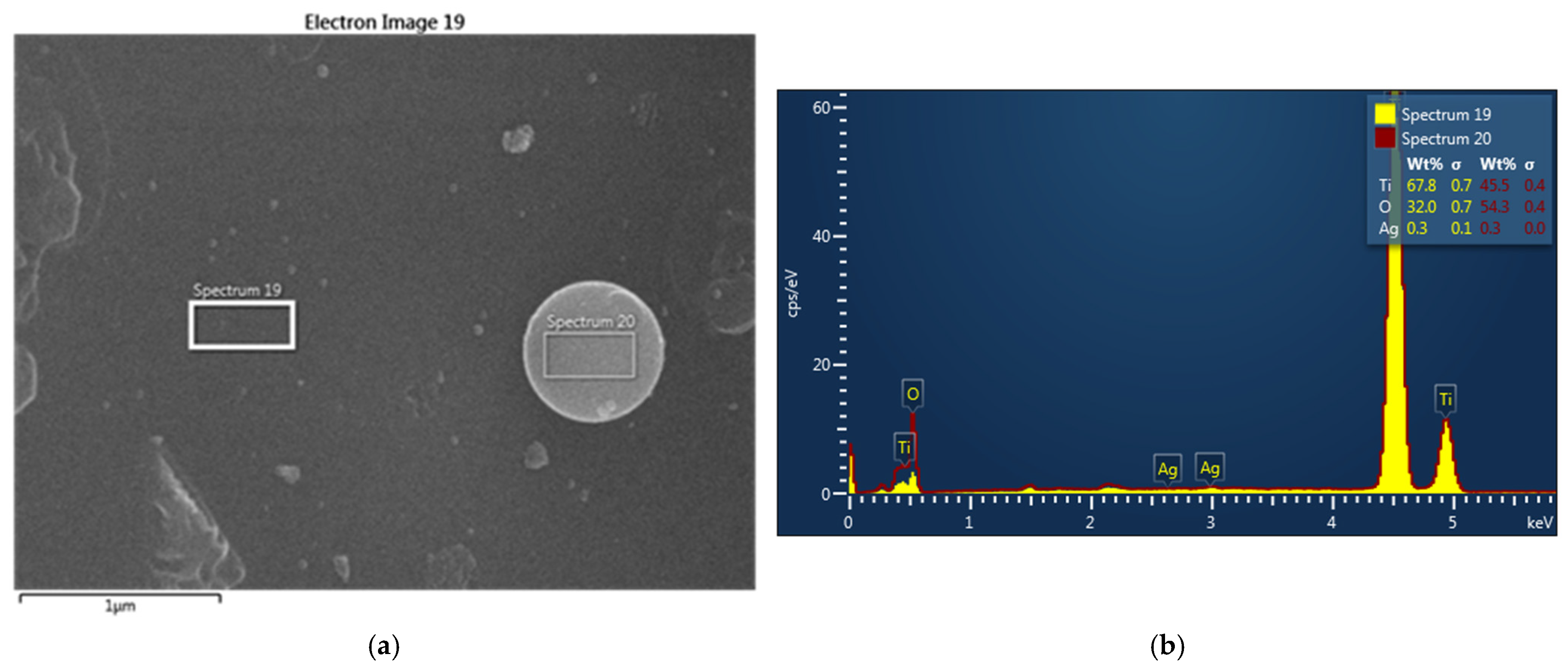
Elemental composition was confirmed by energy-dispersive X-ray spectroscopy (EDX), as shown in Figure 7. The spectra reveal the presence of Ti, O, and Ag, confirming successful silver incorporation into the nanopowders. The absence of additional impurity peaks indicates good compositional purity of the synthesized materials.
Figure 7a presents a representative SEM micrograph of the Ag–TiO2 nanopowder with Ag+/Ti4+ = 2.5%, acquired at intermediate magnification. Two distinct EDX acquisition areas are visible in the image: Spectrum 19, positioned over a relatively flat and featureless region of the TiO2 nanocrystalline matrix, and Spectrum 20, acquired over a larger, nearly spherical bright particle characteristic of an Ag-rich feature or a TiO2 aggregate decorated with silver nanoparticles. The contrast difference between the two acquisition zones is consistent with compositional variation, as brighter regions in backscattered-like contrast typically indicate heavier elements such as silver.
Figure 7b presents the corresponding EDX spectra for both acquisition areas. The spectra confirm the presence of titanium (Ti), oxygen (O), and silver (Ag) as the only detectable elements, with no additional impurity peaks, indicating high compositional purity of the synthesized nanopowder.
The quantitative EDX data reveal a clear compositional difference between the two analyzed zones. In Spectrum 19 (TiO2 matrix region), the elemental composition is Ti = 67.8 wt%, O = 32.0 wt%, and Ag = 0.3 wt%, closely approaching the theoretical stoichiometry of TiO2 (Ti ≈ 59.9 wt%, O ≈ 40.1 wt%) with a minor silver contribution consistent with the overall low doping level. In Spectrum 20 (Ag-rich particle), the composition shifts to Ti = 45.5 wt%, O = 54.3 wt%, and Ag = 0.3 wt%, suggesting a region with higher oxygen content and slightly different Ti/O ratio, which may reflect a locally different TiO2 phase or hydrated surface layer on the aggregate.
The detection of silver in both spectra, albeit at low concentrations (0.3 wt%), is consistent with the Ag phase fraction of 3.7% determined from XRD analysis and confirms successful incorporation of silver into the TiO2 matrix without the formation of detectable secondary phases such as Ag2O. The uniform distribution of the Ag signal across both acquisition zones further supports the conclusion that silver is homogeneously dispersed within the TiO2 framework rather than segregated into large isolated clusters, in agreement with the morphological observations from Figure 6d.

3.2. Nanolubricant Characterization Results

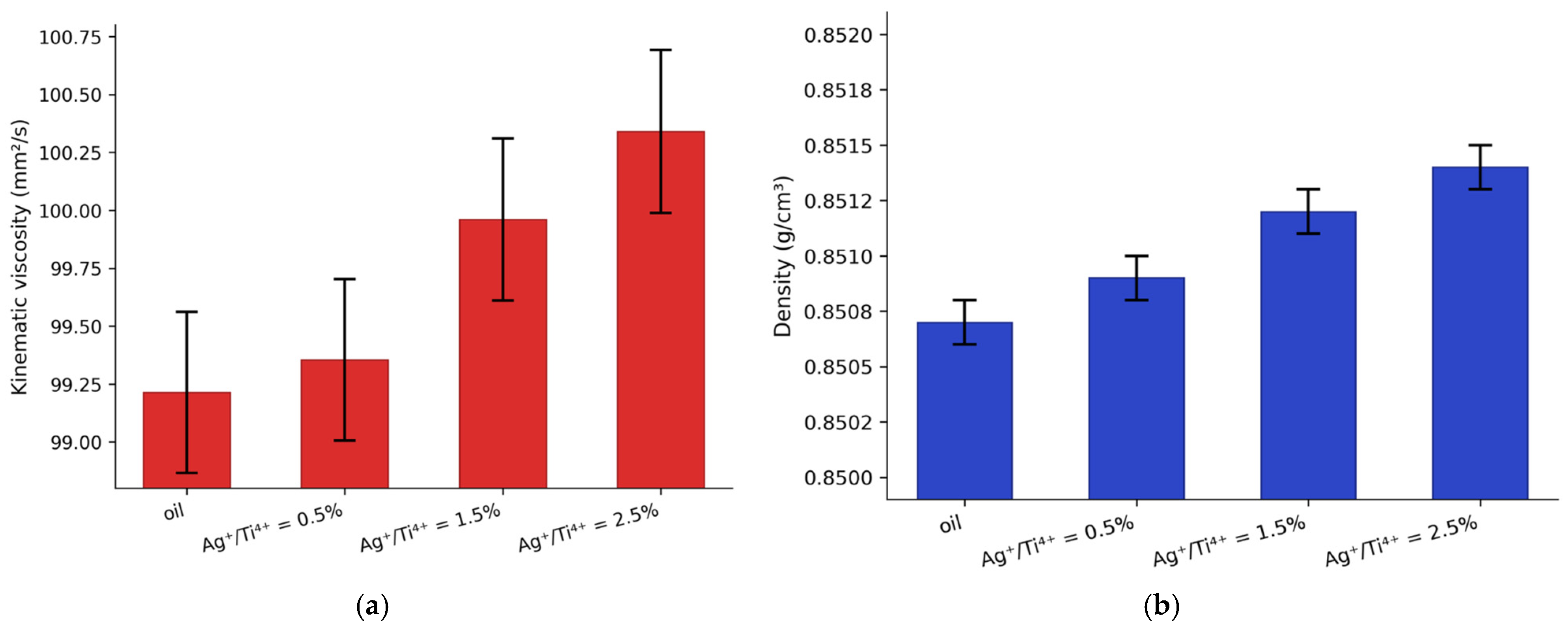
Figure 8 presents the rheological properties of Ag-modified TiO2 nanolubricants, namely kinematic viscosity at 40 °C (Figure 8a) and density (Figure 8b), as a function of increasing Ag+/Ti4+ doping ratio. As shown in Figure 8a, the kinematic viscosity of the base oil (SAE 10W-40, ~99.2 mm2/s) increases progressively with increasing silver content, reaching approximately 99.35 mm2/s for Ag+/Ti4+ = 0.5%, ~99.95 mm2/s for Ag+/Ti4+ = 1.5%, and ~100.35 mm2/s for Ag+/Ti4+ = 2.5%. This gradual increase can be attributed to the presence of dispersed solid nanoparticles within the oil matrix, which enhance intermolecular interactions and slightly increase the internal resistance to flow. The observed trend is consistent with previously reported behavior of TiO2-based nanolubricants, where nanoparticle incorporation leads to a moderate viscosity increase proportional to particle content.
A similar monotonically increasing trend is observed for density (Figure 8b), rising from ~0.8507 g/cm3 for the base oil to ~0.8509 g/cm3, ~0.8512 g/cm3, and ~0.8514 g/cm3 for the 0.5%, 1.5%, and 2.5% formulations, respectively. The density increase reflects the compositional modification introduced by the incorporation of Ag–TiO2 nanoparticles, which are denser than the base oil matrix.
Importantly, both the viscosity and density variations remain within narrow and acceptable limits across all investigated formulations. The total viscosity increase relative to the base oil does not exceed ~1.2%, and the density variation remains below 0.1%, indicating that nanoparticle addition at the selected concentration of 0.05 wt% does not significantly alter the rheological regime of the lubricant. These findings confirm that the prepared nanolubricants preserve the flow characteristics of the base oil while potentially enhancing interfacial performance under tribological contact conditions.
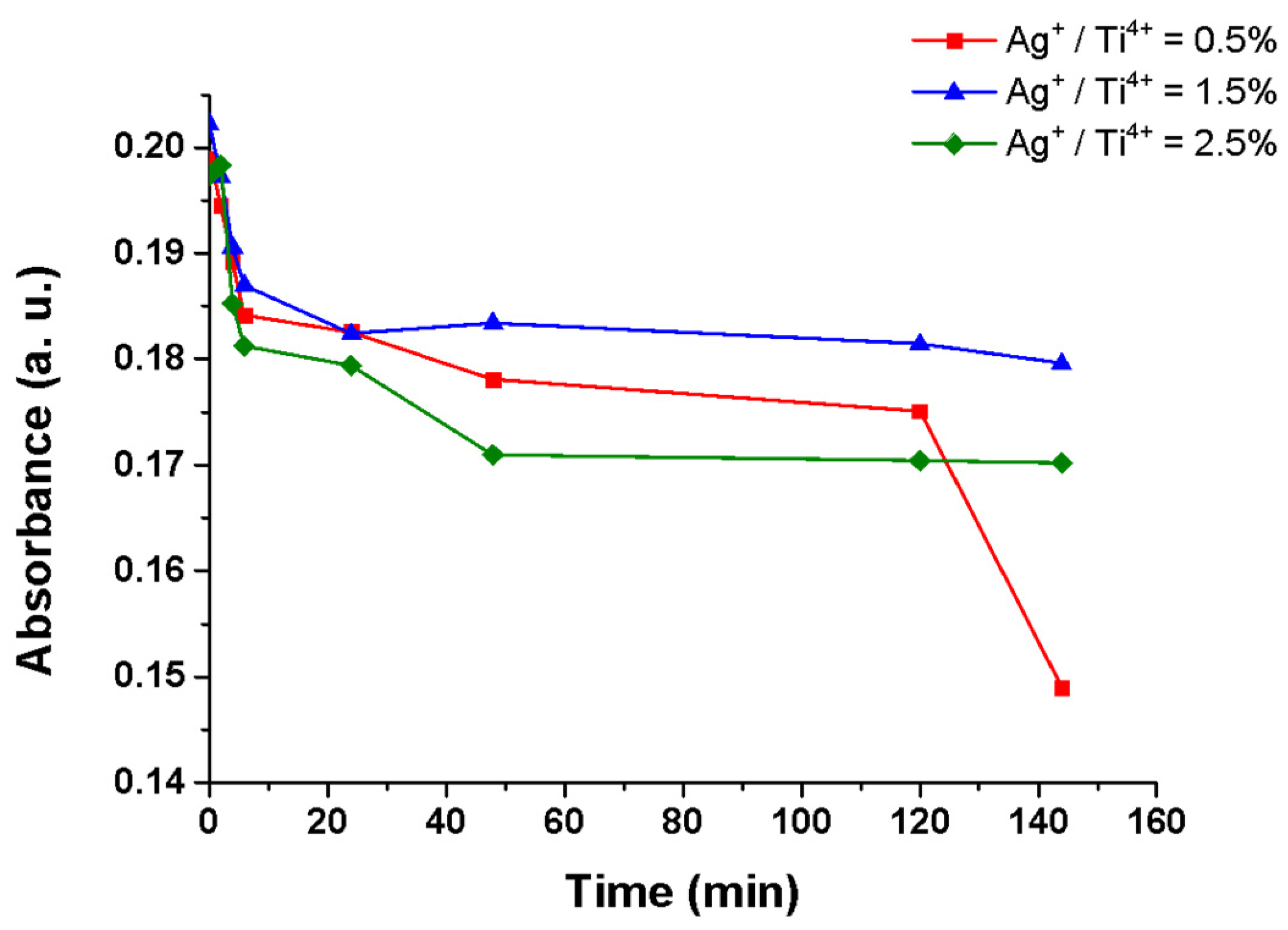
Figure 9 presents the temporal evolution of UV–Vis absorbance at 264 nm for the three Ag–TiO2 nanolubricant formulations over a monitoring period of approximately 150 min, used as an indicator of dispersion stability and sedimentation behavior. All three formulations exhibit an initial rapid decrease in absorbance within the first 5–10 min following preparation, indicating a fast early-stage sedimentation of the largest or most agglomerated nanoparticle fractions. This behavior is commonly observed in nanoparticle suspensions and reflects the natural tendency of heavier aggregates to settle rapidly under gravity immediately after dispersion.
Beyond this initial transient period, the three formulations display distinctly different stability behaviors. The 1.5% formulation (blue curve) exhibits the best long-term stability, maintaining a near-plateau absorbance of approximately 0.182–0.183 a.u. between 25 and 120 min, with only a minor decrease to ~0.180 a.u. at 150 min. The 2.5% formulation (green curve) stabilizes at a somewhat lower absolute absorbance (~0.170 a.u. after 25 min), possibly reflecting partial early sedimentation, but maintains this level with minimal variation up to 150 min, indicating adequate dispersion uniformity within the timeframe required for tribological testing. In contrast, the 0.5% formulation (red curve) displays a progressive and more pronounced decline throughout the monitoring period, dropping from ~0.178 a.u. at 50 min to ~0.149 a.u. at 145 min, suggesting that the lowest silver doping level provides insufficient surface modification to stabilize the nanoparticle dispersion.
Overall, the stability results demonstrate that increasing the Ag+/Ti4+ ratio from 0.5% to 1.5% significantly improves the long-term dispersion stability of the nanolubricant. The enhanced stability at higher Ag content may be attributed to improved surface charge interactions and reduced van der Waals attractive forces between nanoparticles, both promoted by silver modification of the TiO2 surface. All formulations remained sufficiently stable within the time frame required for tribological testing, validating their suitability for subsequent friction and wear experiments. A fully developed hydrodynamic film was not expected due to the limited lubricant supply (non-immersed configuration) and the applied load/speed range. Since film thickness was not directly measured or calculated, the lubrication regime is referred to as boundary-to-mixed based on the experimental configuration and friction response.
Overall, structural (XRD, Raman), chemical (FT-IR), optical (PL and UV–Vis), and morphological (SEM/EDX) analyses confirm successful silver incorporation into the TiO2 matrix without the formation of secondary crystalline phases. The progressive decrease in crystallite size, slight lattice contraction, and reduced PL intensity suggest enhanced defect density and improved charge carrier separation induced by silver modification. Rheological and stability assessments further demonstrate that the selected nanoparticle concentration (0.05 wt%) preserves lubricant flow characteristics while ensuring adequate dispersion stability. Collectively, these results validate the suitability of the prepared nanolubricants for subsequent tribological evaluation under boundary-to-mixed lubrication (starved) regime.

3.3. Overview of Tribological Results

The complete experimental matrix and corresponding mean steady-state results are presented in Table 5; detailed interpretation of friction, wear, and thermal responses is provided in the following subsections.

3.3.1. Coefficient of Friction Behavior

The steady-state coefficient of friction (COF) obtained under starved boundary-to-mixed lubrication conditions ranged between 0.281 and 0.359 across the investigated operating domain (Table 5). These values are characteristic of a boundary-dominated lubrication regime with a partial transition toward mixed lubrication, which is consistent with the limited lubricant supply imposed by the experimental configuration.
A general tendency of COF reduction with increasing sliding speed can be observed for most lubricants and load levels. For example, in the case of lubricant L1, the COF decreases from 0.3589 at 0.10 m·s−1 to 0.3352 at 0.20 m·s−1 under 5 N, indicating that higher sliding velocities promote improved lubricant entrainment and a more effective separation of asperity contacts. Similar tendencies are observed for L2 and L3, particularly at moderate and high sliding speeds, suggesting that the increase in entrainment velocity contributes to a partial transition toward a mixed lubrication regime. Under these conditions, the lubricant film can partially accommodate the applied shear stresses, thereby reducing friction.
The influence of the normal load on COF appears less pronounced compared with the effect of sliding speed. In several cases, the friction coefficient remains relatively stable with increasing load, indicating that the tribological response is governed primarily by interfacial phenomena such as asperity interactions, lubricant film stability, and tribochemical processes rather than by load alone. This behavior is typical for boundary-to-mixed lubrication regimes, where the formation of protective tribofilms can partially mitigate the effect of increasing mechanical load.
A comparison between lubricants reveals distinct frictional behaviors associated with the different formulations. Lubricant L3 exhibits the lowest friction levels at low load conditions, reaching a minimum COF of 0.2808 at 5 N and 0.10 m·s−1, indicating an enhanced capability to reduce interfacial shear stresses. This reduction may be associated with the formation of a lubricating tribofilm promoted by the dispersed TiO2–Ag nanoparticles, which can facilitate shear accommodation at the sliding interface.
In contrast, lubricant L4 demonstrates a highly stable frictional response across the investigated parameter space, with relatively small variations in COF as a function of both load and sliding speed. Such stability suggests the formation of a robust interfacial layer capable of maintaining consistent shear conditions even under increased mechanical severity. This behavior indicates that the lubricant formulation can sustain effective lubrication over a wide range of operating conditions.
Overall, the friction results indicate that the investigated nanolubricants contribute not only to friction reduction, particularly in the case of L3, but also to friction stabilization, as observed for L4. These effects are likely associated with the combined action of nanoparticle-induced tribofilm formation, enhanced lubricant shear accommodation, and improved interfacial lubrication under starved boundary-to-mixed lubrication conditions.

3.3.2. Wear Behavior: Specific Wear Rate (K)

The specific wear rate (K) measured for the LPBF-fabricated Ti6Al4V ELI specimens under starved boundary-to-mixed lubrication conditions ranged between approximately 2.81 × 10⁻⁴ and 4.83 × 10⁻⁴ mm3·N−1·m−1 (Table 5). These values are consistent with wear rates typically reported for titanium alloys operating under boundary-dominated lubrication regimes, where direct asperity interactions and adhesive wear mechanisms play a significant role in the material removal process.
An examination of the experimental matrix indicates that the specific wear rate exhibits a moderate dependence on both sliding speed and normal load, although the variations remain within a relatively narrow range. In general, a slight increase in wear rate can be observed with increasing sliding speed, particularly at higher loads. This behavior may be attributed to the higher frictional energy input and elevated contact temperatures associated with increased sliding velocity, which can intensify adhesive and abrasive wear processes at the interface.
For lubricant L1, the wear rate tends to increase gradually with sliding speed, particularly at moderate and high loads. This trend suggests that, under starved lubrication conditions, the lubricant film is insufficient to fully prevent asperity interactions, leading to progressive material removal as the sliding velocity increases. Similar behavior is observed for L2, where the wear rate values remain within the same order of magnitude but show a slight increase at higher sliding speeds, indicating a comparable wear mechanism governed primarily by boundary lubrication effects.
A different behavior can be observed for L3 and L4, where the wear rates remain relatively stable across the investigated operating conditions. Lubricant L4 exhibits comparatively stable wear performance over the entire load–speed domain, with limited fluctuations in K. This stability suggests that the lubricant formulation may promote the formation of a more persistent protective tribofilm on the contact surfaces. Such tribofilms can reduce direct metal-to-metal interactions and thereby limit material removal despite increasing mechanical severity.
The overall wear behavior indicates that the investigated lubricants can maintain moderate and relatively stable wear rates even under starved lubrication conditions, where the lubricant supply is insufficient to generate a fully developed hydrodynamic film. The relatively narrow dispersion of K values across the experimental matrix further suggests that the wear mechanisms are governed primarily by boundary lubrication processes combined with the formation of protective tribochemical layers, which can mitigate severe adhesive wear and stabilize the tribological response of the system.

3.3.3. Contact Temperature Rise (ΔT)

The temperature rise at the contact interface (ΔT) measured during the tribological tests provides important insight into the thermal response of the sliding system under starved boundary-to-mixed lubrication conditions. As shown in Table 5, the contact temperature increase ranged between approximately 1.9 and 9.4 °C across the investigated load and sliding speed combinations.
A clear and systematic trend can be observed with respect to the normal load and sliding speed, both of which significantly influence the thermal behavior of the tribological contact. In general, the contact temperature rise increases progressively with increasing mechanical severity, defined by the combined effect of load and sliding velocity. This behavior is expected, as higher loads increase the real area of asperity contact, while higher sliding speeds lead to greater frictional energy dissipation at the interface. Consequently, the conversion of frictional work into heat results in elevated contact temperatures.
For lubricant L1, the temperature rise exhibits a particularly pronounced dependence on both load and sliding speed. For example, ΔT increases from 2.2 °C at 5 N and 0.10 m·s−1 to 9.4 °C at 15 N and 0.20 m·s−1, indicating a progressive accumulation of frictional heat as the operating severity increases. This trend reflects the increasing contribution of asperity interactions and frictional shear processes in the absence of a fully developed lubricant film. A similar, although slightly moderated, behavior is observed for L2, where the temperature increase remains within a comparable range but shows somewhat smaller variations at lower loads. This suggests that the lubricant may provide a slightly improved capacity for heat dissipation or interfacial shear accommodation under moderate operating conditions. For L3 and L4, the temperature rise remains relatively stable at lower loads and sliding speeds but increases gradually as the operating severity increases. In particular, the maximum ΔT values are observed at 15 N and 0.20 m·s−1, indicating that the thermal response of the system is primarily governed by the energy input associated with the sliding contact rather than by lubricant chemistry alone.
Overall, the relatively moderate temperature increases observed throughout the experimental matrix suggest that, despite the starved lubrication conditions, the lubricants can maintain acceptable thermal stability at the sliding interface. The limited magnitude of ΔT further indicates that the frictional heat generated during the experiments is effectively dissipated through the contacting bodies and surrounding environment. This thermal behavior is consistent with the boundary-to-mixed lubrication regime identified from the friction results and supports the presence of interfacial mechanisms such as tribofilm formation and shear accommodation, which contribute to the stabilization of the tribological system.
The friction, wear, and thermal results support a mechanistic interpretation involving two complementary roles of the Ag–TiO2 nanoparticles, a load-bearing and surface-smoothing contribution from the harder TiO2 phase, and the formation of a low-shear interfacial layer facilitated by the ductile Ag phase that accommodates shear stresses under limited lubricant supply. The progressive stabilisation of tribological responses with increasing Ag content suggests more persistent interfacial coverage at higher doping levels. This behaviour distinguishes the Ag–TiO2 system from pure TiO2 nanolubricants, where tribological benefits are attributed primarily to rolling and polishing mechanisms, and represents the principal advance of the present work under starved lubrication conditions, where surface protection relies more heavily on additive-derived interfacial layers than on hydrodynamic film support.

3.4. Statistical Analysis of Tribological Responses

The statistical analysis was conducted for the three tribological response variables measured in the experiments, namely the steady-state coefficient of friction (COF), the specific wear rate (K), and the contact temperature rise (ΔT). This approach enables the identification of the dominant parameters controlling friction, wear, and thermal behavior, as well as possible interaction effects between the operating variables.
In addition to the ANOVA analysis, graphical representations such as main effects plots and interaction plots were used to facilitate the interpretation of the statistical results and to highlight the relative contribution of each parameter to the overall tribological performance of the system. For each response variable, both contour plots and three-dimensional surface plots are presented, as they serve complementary functions. Contour plots enable precise quantitative identification of optimal operating regions. Surface plots provide an intuitive representation of response topology, including non-linear curvature and interaction-driven structures.

3.4.1. Analysis of Variance

The analysis of variance was applied to quantify the individual and combined contributions of the three operating parameters—normal load (F), sliding speed (v), and lubricant formulation (L)—to the variability of each tribological response.
The results, summarized in Table 6, include the F-value, the p-value, and the percentage contribution (PC) for each source of variation, along with the coefficient of determination R2 for each model. The percentage contribution provides a direct measure of the relative importance of each source relative to the total variance, allowing a straightforward comparison of the dominant controlling parameters across the three response variables.
The ANOVA results presented in Table 6 reveal that all three main factors—normal load (F), sliding speed (v), and lubricant formulation (L)—exert a statistically significant influence on the tribological responses (p ≤ 0.013 in all cases). For the coefficient of friction (COF), the sliding speed is the dominant factor (PC = 26.28%, F-value = 23.36), followed by the lubricant formulation (PC = 21.33%) and the normal load (PC = 14.14%). The F * L interaction contributes the largest share among interaction terms (PC = 27.63%, p = 0.001), indicating that the effect of normal load on friction is strongly dependent on the lubricant type. The model achieves a good fit with R2 = 93.25%.
For the specific wear rate (K), the sliding speed again represents the most influential factor (PC = 38.14%, F-value = 45.25), followed by the F * L interaction (PC = 24.72%) and the lubricant formulation (PC = 13.17%). The F * v interaction also reaches statistical significance (p = 0.017, PC = 7.84%), suggesting a moderate coupled effect between load and speed on wear. The R2 value of 94.94% confirms the high predictive capability of the model.
For the contact temperature rise (ΔT), the normal load is by far the dominant factor (PC = 59.02%, F-value = 145.6), followed by the sliding speed (PC = 20.64%) and the F * L interaction (PC = 9.03%). The lubricant formulation has a comparatively modest contribution (PC = 3.35%), while the v * L interaction is not statistically significant (p = 0.402) across all three responses. The model explains 97.57% of the total variance, representing the best fit among the three responses.
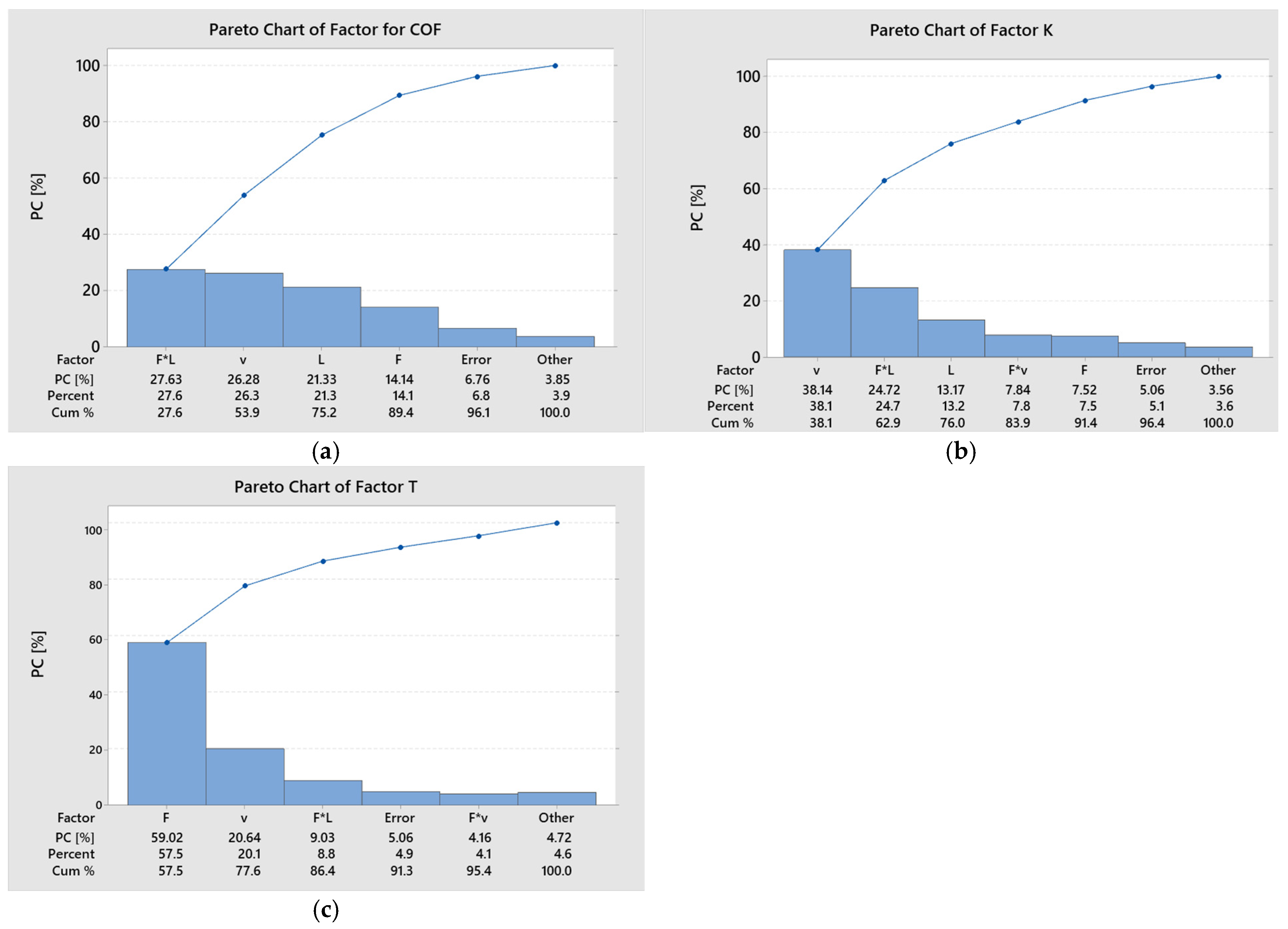
The relative importance of each factor and their interactions is further illustrated by the Pareto charts of standardized effects presented in Figure 10. For the COF (Figure 10a), the F * L interaction and the sliding speed (v) emerge as the most influential terms, exceeding the reference line for statistical significance (α = 0.05). For the specific wear rate K (Figure 10b), the sliding speed (v) and the F * L interaction are again dominant, consistent with the ANOVA percentage contributions. For the contact temperature rise ΔT (Figure 10c), the normal load (F) and sliding speed (v) are the leading factors, reflecting the strong thermomechanical dependence on these operating parameters. In all three cases, the v * L interaction falls below the significance threshold, confirming its negligible contribution to the tribological responses.

3.4.2. Statistical Analysis of the Coefficient of Friction (COF)

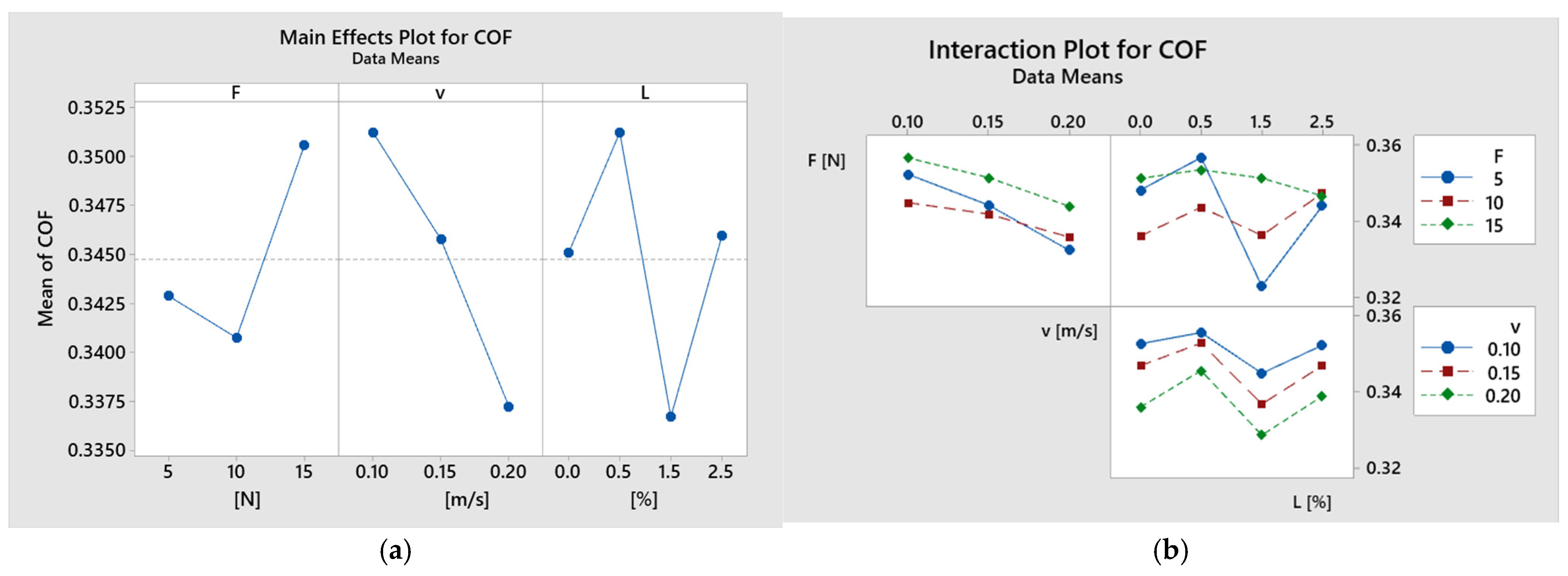
The main effects plot (Figure 11a) reveals that the COF follows a non-monotonic trend with respect to normal load, exhibiting a local maximum at F = 10 N, while the sliding speed shows a pronounced decrease in COF from v = 0.10 m/s to v = 0.15 m/s, followed by a slight recovery at v = 0.20 m/s. The lubricant concentration displays a clear minimum at L = 1.5%, suggesting an optimal nanoparticle addition level for friction reduction. The interaction plot (Figure 11b) confirms the significance of the F * L interaction, as the response curves for different load levels are non-parallel, particularly in the lubricant concentration range of 0.5–1.5%. The v * L interaction lines remain largely parallel, consistent with its statistically negligible contribution identified in the ANOVA.
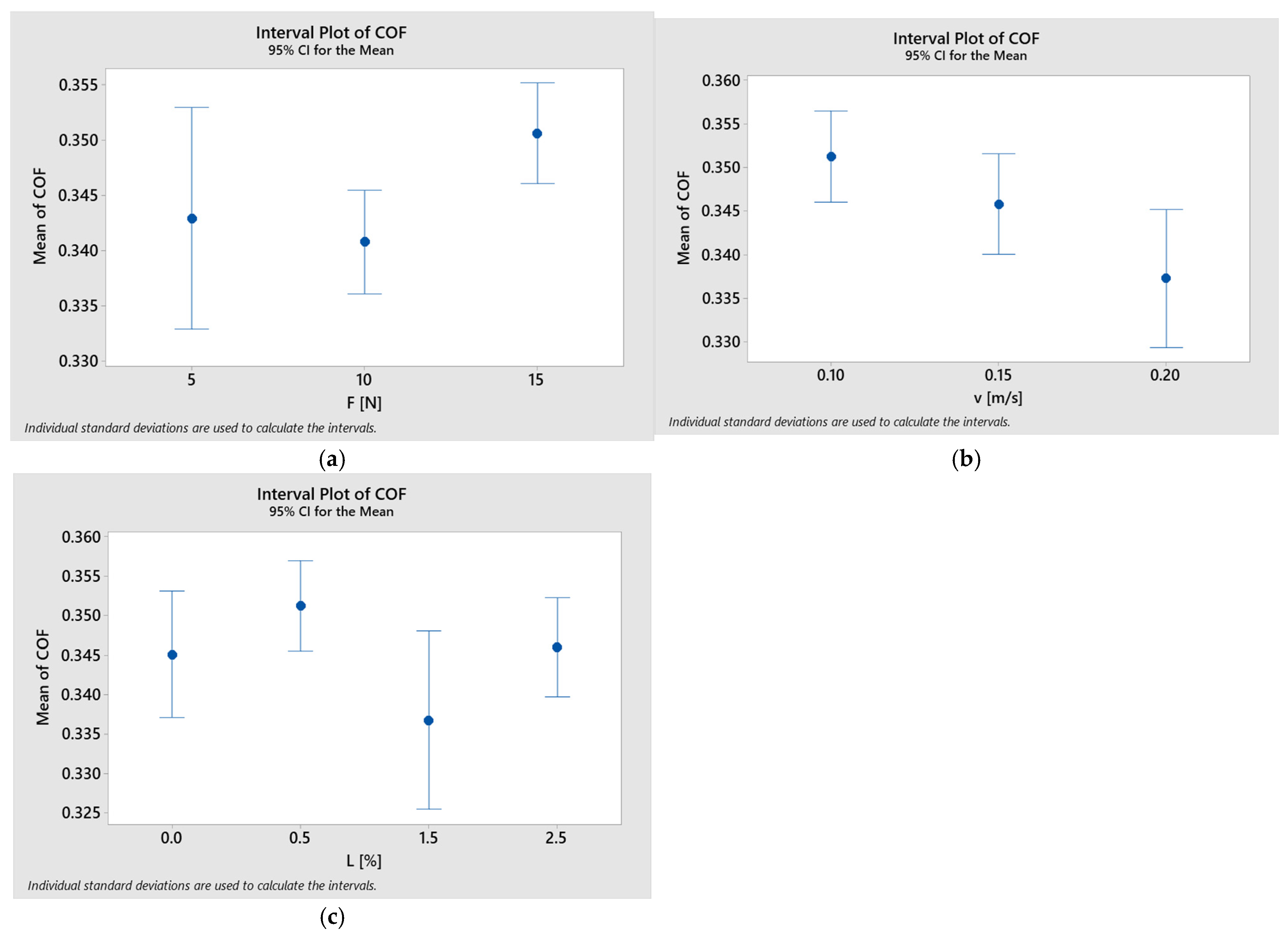
The interval plots presented in Figure 12 provide additional insight into the variability of the COF measurements at each factor level. For the normal load (Figure 12a), the mean COF increases from 5 N to 15 N, with overlapping confidence intervals between 5 N and 10 N, suggesting no statistically significant difference between these two levels. The sliding speed (Figure 12b) shows a consistent decrease in mean COF with increasing v, with the lowest value recorded at v = 0.20 m/s (≈0.337). For the lubricant concentration (Figure 12c), the minimum mean COF is observed at L = 1.5% (≈0.335), while both lower and higher concentrations result in slightly elevated friction, indicating that excessive nanoparticle concentration does not further improve lubrication performance.
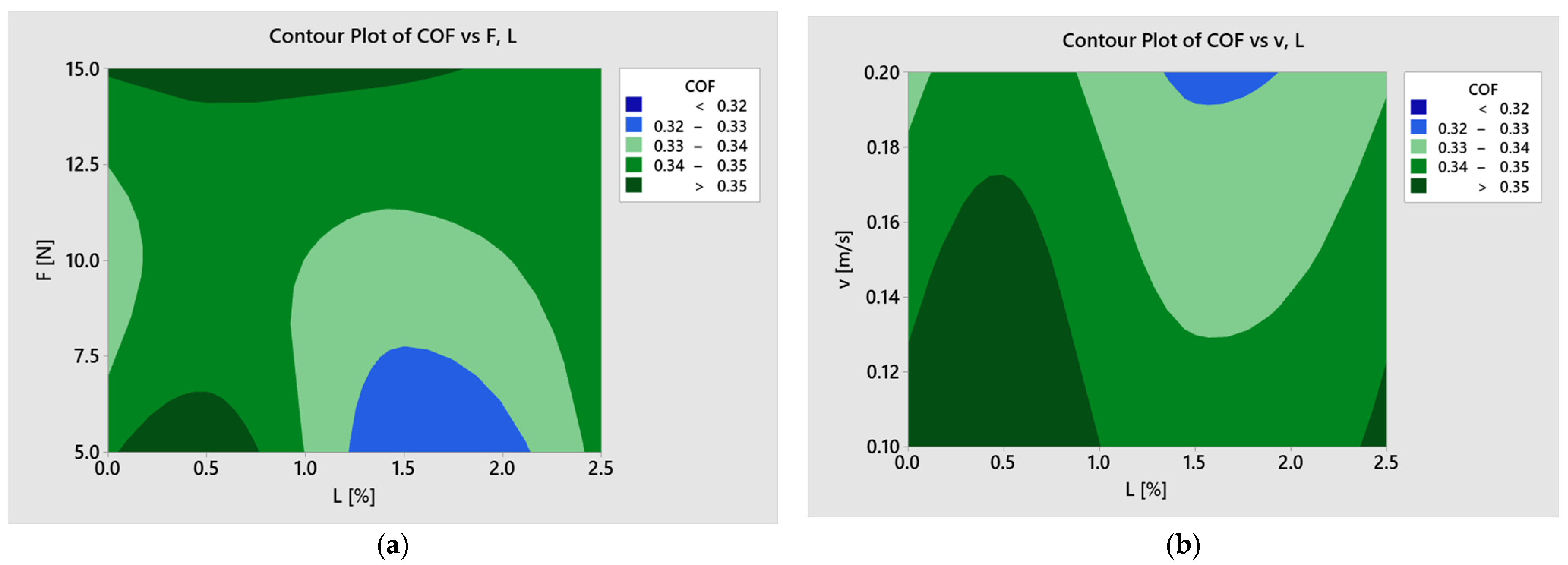
The contour plots in Figure 13 illustrate the combined influence of two operating parameters on the COF response surface. In Figure 13a, the lowest COF values (<0.32, dark blue region) are concentrated in the range F = 5–8 N and L = 1.0–2.0%, indicating that the combination of low load and optimal lubricant concentration is most favorable for friction reduction. At higher loads (F > 12 N), the COF increases regardless of lubricant concentration. Figure 13b shows that the minimum COF region is achieved at intermediate sliding speeds (v ≈ 0.13–0.16 m/s) combined with L = 1.0–2.0%, further confirming the existence of an optimal operating window for the investigated nanolubricants.
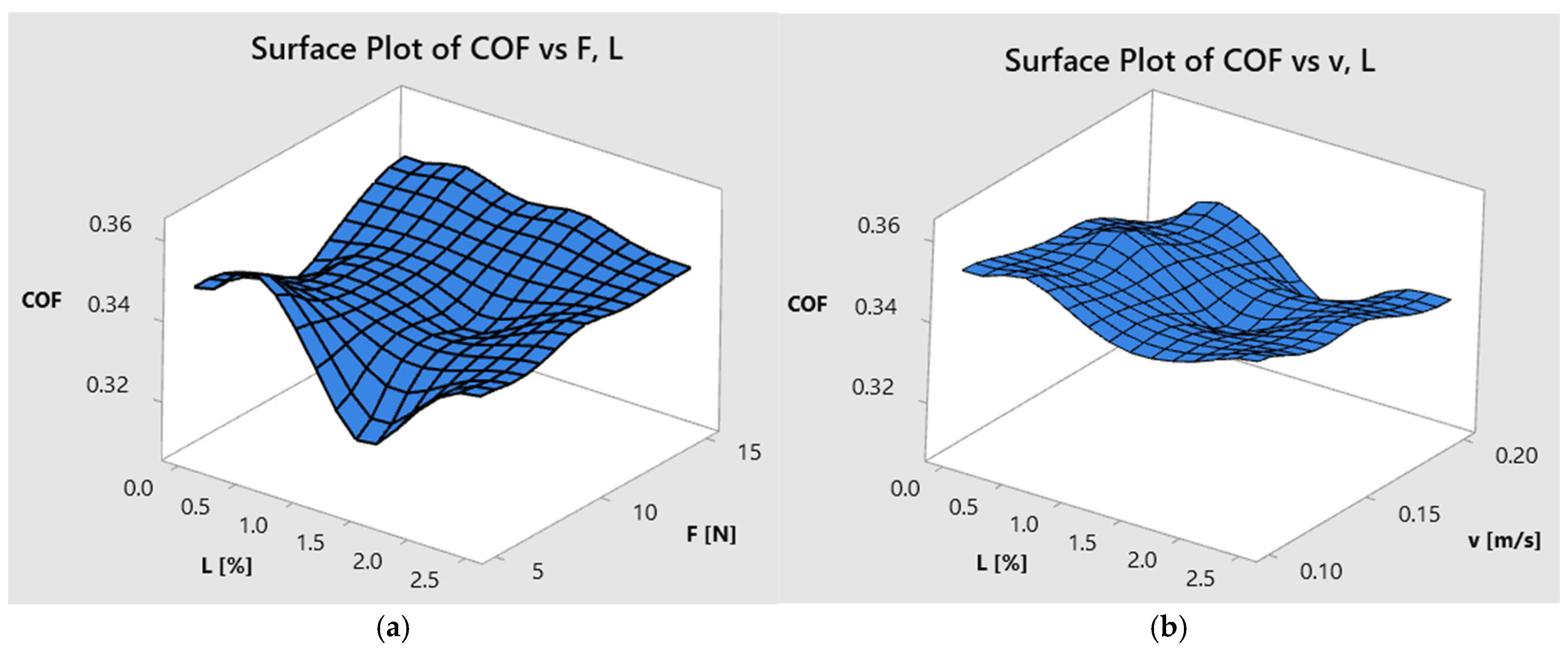
The three-dimensional surface plots presented in Figure 14 provide a comprehensive visualization of the COF response as a function of the two most significant factor pairs. Figure 14a reveals a distinct valley in the COF surface at intermediate lubricant concentrations (L ≈ 1.5%) across the entire load range, with the surface rising steeply at both lower and higher concentrations. Figure 14b shows a similar valley-shaped response with respect to lubricant concentration, while the effect of sliding speed produces a gradual decline in COF with increasing v. Both surface plots are consistent with the ANOVA findings and confirm that the lubricant concentration and its interaction with the operating parameters play a critical role in determining the frictional behavior of the system.

3.4.3. Statistical Analysis of the Specific Wear Rate (K)

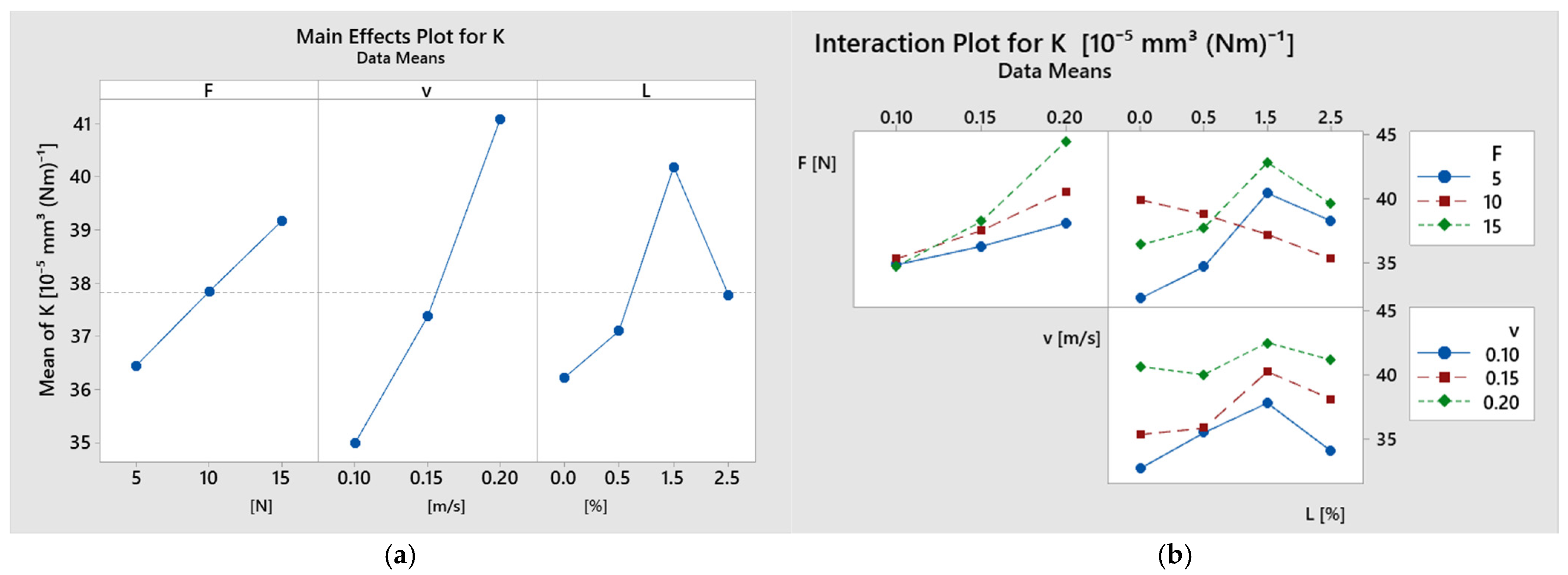
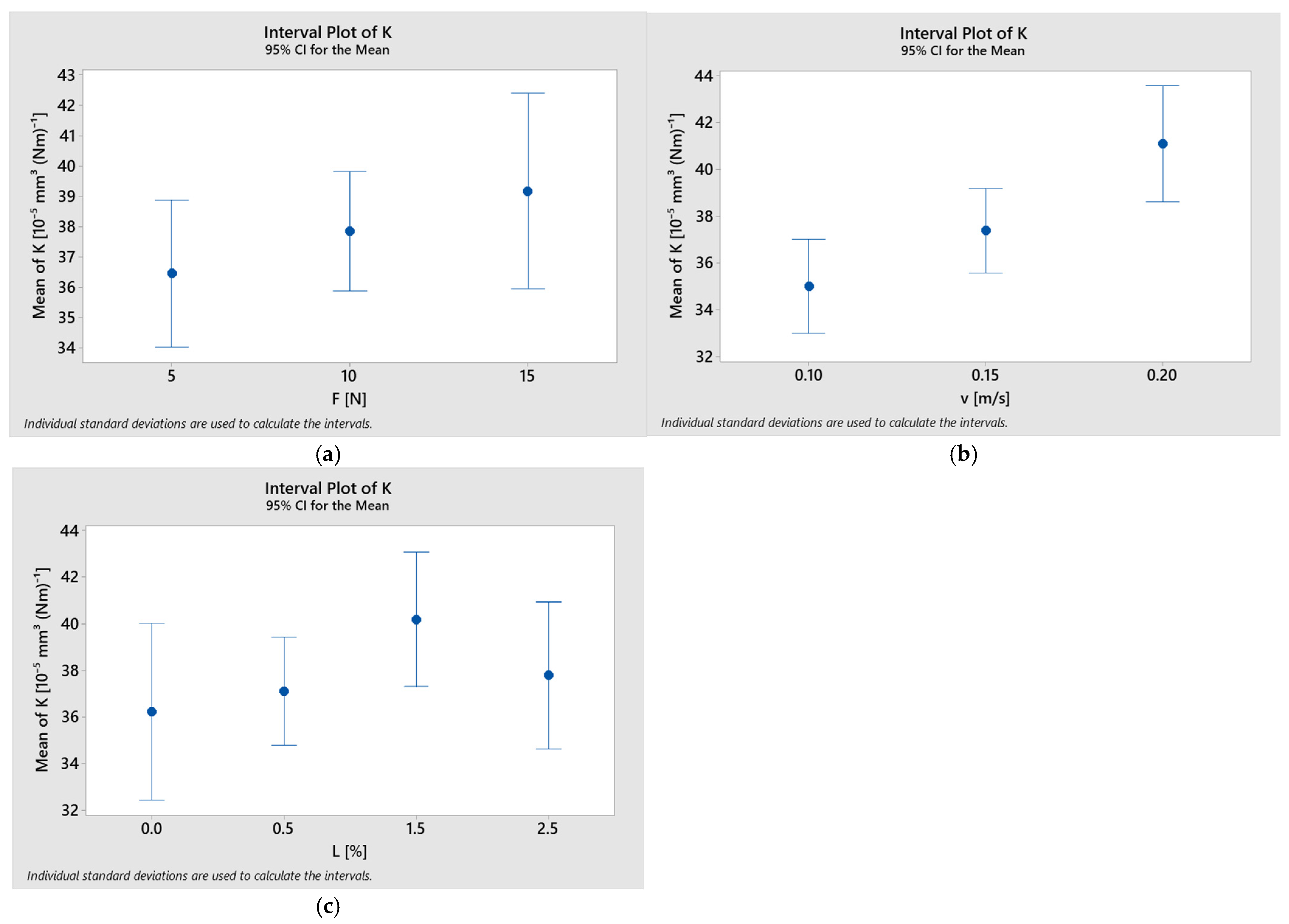
The main effects plot for the specific wear rate (Figure 15a) shows a monotonic increase in K with both normal load and sliding speed, indicating that higher mechanical and kinetic energy inputs consistently promote material removal. The wear rate increases from approximately 36.5 × 10⁻⁵ mm3 (Nm)−1 at F = 5 N to 41 × 10−5 mm3 (Nm)−1 at F = 15 N, and from approximately 35.5 × 10⁻⁵ mm3 (Nm)−1 at v = 0.10 m/s to 41 × 10−5 mm3 (Nm)−1 at v = 0.20 m/s. The lubricant concentration exhibits a non-monotonic trend, with a minimum wear rate observed at L = 0.5%, followed by a gradual increase at higher concentrations, suggesting that excessive nanoparticle loading may promote abrasive wear mechanisms. The interaction plot (Figure 15b) reveals non-parallel response curves for the F * L interaction, particularly at higher lubricant concentrations, confirming the statistical significance of this interaction term identified in the ANOVA. The v * L interaction lines remain largely parallel, consistent with its negligible contribution
The interval plots for the specific wear rate (Figure 16) provide additional insight into the variability associated with each factor level. For the normal load (Figure 16a), the mean K increases progressively from F = 5 N to F = 15 N, with non-overlapping confidence intervals between the extreme levels, confirming a statistically significant effect. The sliding speed (Figure 16b) shows a similar monotonically increasing trend, with the lowest mean wear rate recorded at v = 0.10 m/s (≈35 × 10−5 mm3 (Nm)−1) and the highest at v = 0.20 m/s (≈41 × 10−5 mm3 (Nm)−1). For the lubricant concentration (Figure 16c), the minimum mean K is observed at L = 0.5%, while both the base oil (L = 0.0%) and higher concentrations (L = 1.5% and L = 2.5%) result in elevated wear rates, with overlapping confidence intervals suggesting less pronounced differentiation between these levels.
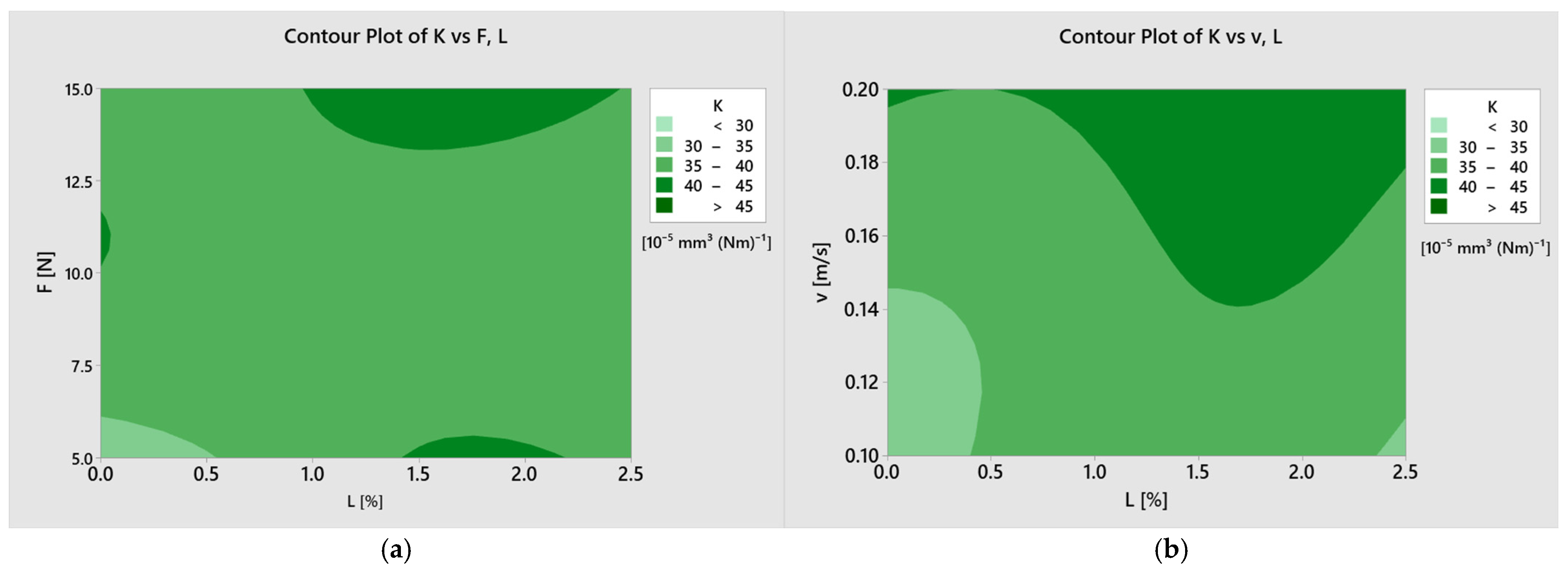
The contour plots in Figure 17 highlight the regions of minimum specific wear rate as a function of two operating parameters simultaneously. In Figure 17a, the lowest K values (<30 × 10−5 mm3 (Nm)−1, light region) are concentrated at low normal loads (F = 5–7 N) and intermediate lubricant concentrations (L = 0.5–1.5%), confirming that the combination of reduced contact stress and optimal nanoparticle addition is most effective in limiting wear. At high loads (F > 12 N), the wear rate increases substantially regardless of lubricant concentration. Figure 17b shows that the minimum K region is achieved at low sliding speeds (v ≈ 0.10–0.12 m/s) combined with L = 0.5–1.5%, while higher speeds consistently produce elevated wear rates across all lubricant concentrations.
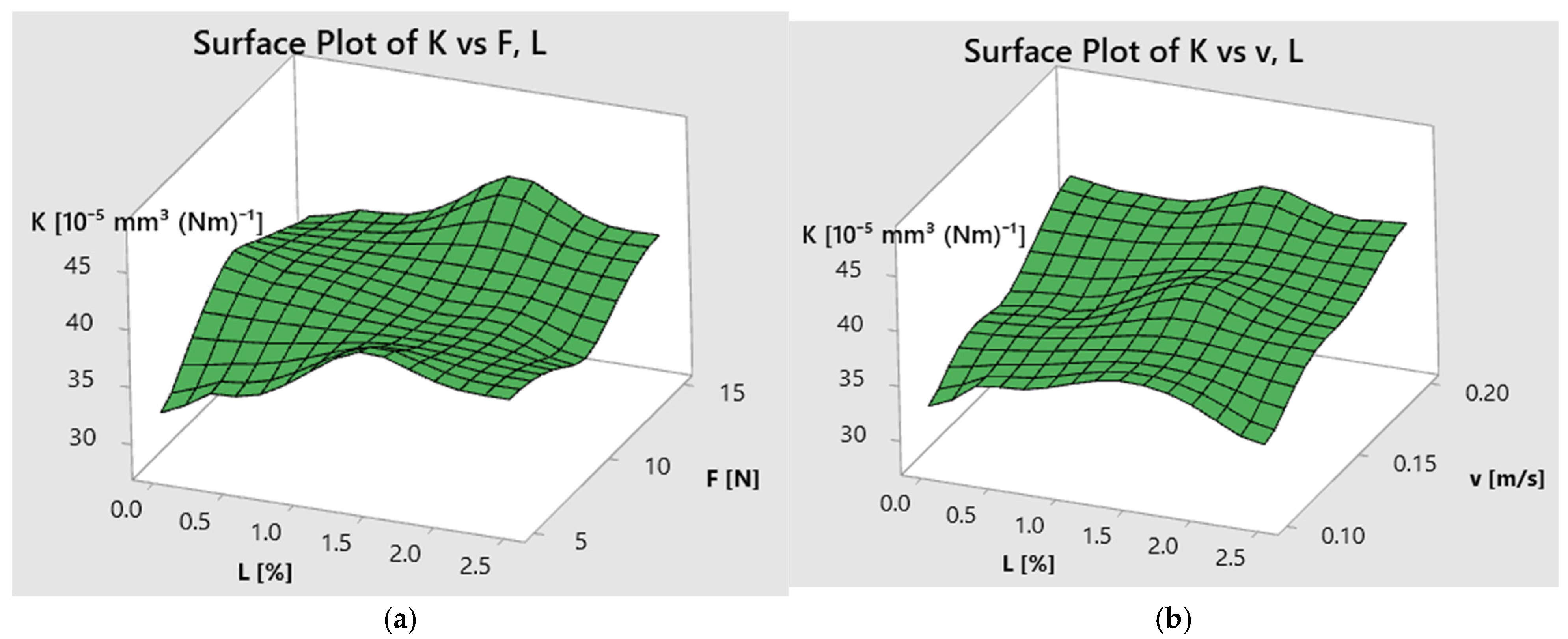
The three-dimensional surface plots presented in Figure 18 confirm the trends observed in the contour plots and provide a clearer visualization of the response topology. Figure 18a shows a surface that rises steeply with increasing normal load, with a shallow minimum at intermediate lubricant concentrations, reflecting the dominant role of the F * L interaction on wear behavior. Figure 18b reveals a similar surface morphology with respect to sliding speed and lubricant concentration, where the wear rate increases progressively with v and reaches a local minimum at L ≈ 0.5–1.0%. Both surface plots are consistent with the ANOVA results and reinforce the conclusion that while lubricant concentration can partially mitigate wear, the mechanical operating conditions—particularly normal load and sliding speed—remain the primary drivers of material removal in the investigated tribological system.

3.4.4. Statistical Analysis of the Contact Temperature Rise (ΔT)

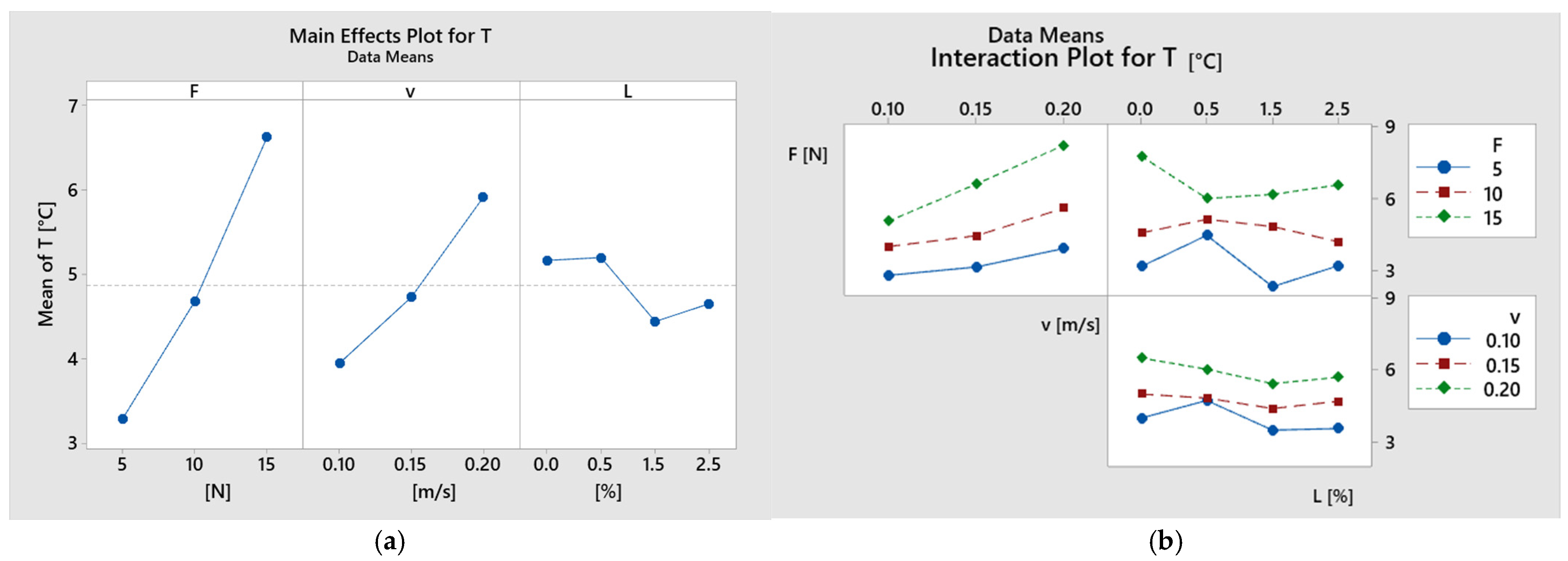
The main effects plot for the contact temperature rise (Figure 19a) reveals that the normal load exerts the strongest individual influence on ΔT, with the mean temperature increasing sharply from approximately 3.2 °C at F = 5 N to 6.7 °C at F = 15 N, consistent with the dominant percentage contribution identified in the ANOVA (PC = 59.02%). The sliding speed shows a similar monotonically increasing trend, with ΔT rising from approximately 4.0 °C at v = 0.10 m/s to 6.0 °C at v = 0.20 m/s, reflecting the greater frictional heat generation at higher sliding velocities. The lubricant concentration exhibits a comparatively modest effect, with a slight decrease in mean temperature observed in the range L = 0.5–1.5%, followed by a marginal increase at L = 2.5%, in agreement with its low percentage contribution (PC = 3.35%). The interaction plot (Figure 19b) shows moderately non-parallel curves for the F * L interaction, confirming its statistical significance (p = 0.002), while the v * L interaction lines remain largely parallel, consistent with its negligible contribution (p = 0.402).
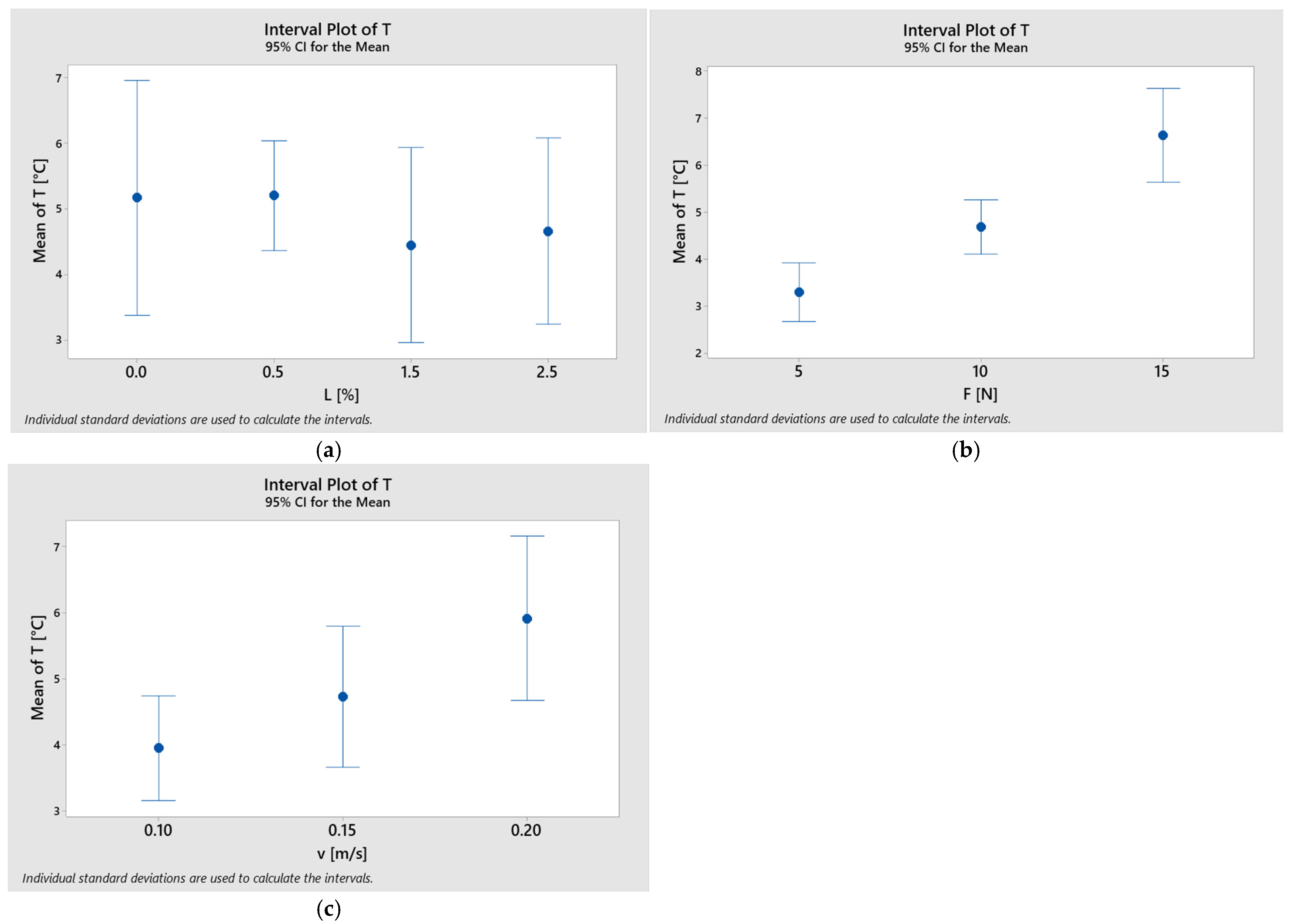
The interval plots for ΔT (Figure 20) further illustrate the relative influence of each factor on the thermal response. For the lubricant concentration (Figure 20a), the confidence intervals overlap substantially across all levels, reflecting the limited and statistically modest effect of nanoparticle addition on contact temperature, as confirmed by the ANOVA. For the normal load (Figure 20b), the mean ΔT increases markedly and progressively from F = 5 N to F = 15 N, with non-overlapping confidence intervals between the extreme levels, confirming the dominant and statistically significant role of load in driving frictional heat generation. The sliding speed (Figure 20c) shows a consistent and significant increase in mean ΔT from v = 0.10 m/s (≈4.0 °C) to v = 0.20 m/s (≈6.2 °C), with non-overlapping intervals between the lowest and highest speed levels, further corroborating the strong thermomechanical dependence on sliding velocity.
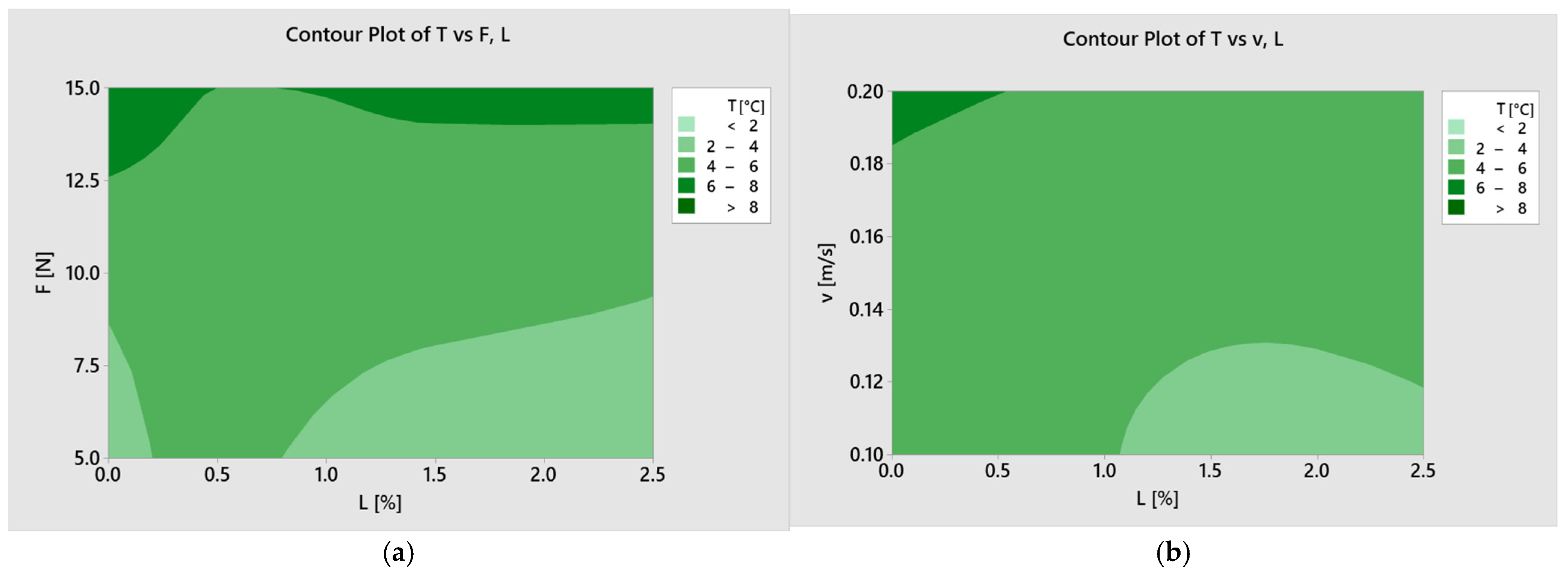
The contour plots in Figure 21 provide a simultaneous visualization of the combined influence of operating parameters on the contact temperature rise. In Figure 21a, the lowest ΔT values (<2 °C, lightest region) are confined to a narrow zone at low normal loads (F = 5–7 N) and across the full range of lubricant concentrations, confirming that load reduction is the most effective strategy for minimizing frictional heating. At F > 10 N, the temperature rises substantially and becomes largely insensitive to lubricant concentration, suggesting that the thermal management capability of the nanolubricants is limited under high contact stress conditions. Figure 21b shows that the minimum ΔT region is concentrated at low sliding speeds (v ≈ 0.10–0.12 m/s) and intermediate lubricant concentrations (L = 0.5–1.5%), while higher sliding velocities produce elevated temperatures regardless of the lubricant formulation, reflecting the predominant role of frictional power input in determining the thermal behavior of the contact.

4. Conclusions

The present study investigated the tribological behavior of LPBF-fabricated Ti6Al4V ELI alloy lubricated with Ag-modified TiO2 nanolubricants under starved boundary-to-mixed lubrication conditions. Based on the experimental results, the following conclusions can be drawn:
  • Ag-modified TiO2 nanopowders were successfully synthesized and incorporated into SAE 10W-40 engine oil, forming stable nanolubricant suspensions with suitable rheological properties for tribological applications.
  • Tribological testing performed using a full-factorial experimental design demonstrated stable sliding behavior across the entire investigated operating domain, confirming that the nanolubricant formulations maintain consistent tribological performance over the range of applied loads, sliding speeds, and lubricant compositions examined.
  • The nanolubricant containing Ag–TiO2 with an Ag+/Ti4+ ratio of 1.5% exhibited the lowest friction coefficient (0.2808), suggesting enhanced tribofilm formation and improved shear accommodation at the sliding interface. This finding advances the understanding of Ag+/Ti4+ ratio optimisation as a design parameter for hybrid ceramic–metallic nanolubricant formulations.
  • The formulation with the highest Ag content (2.5%) showed the most stable wear behavior across the investigated load–speed domain, indicating improved interfacial protection under increasing mechanical severity.
  • The relatively moderate contact temperature rise (1.9–9.4 °C) indicates efficient dissipation of frictional heat and confirms that the tribological system operates predominantly within a boundary-to-mixed lubrication regime.
  • Statistical analysis based on ANOVA confirmed that sliding speed and the F * L interaction are the dominant factors governing friction and wear, while normal load is the primary driver of contact temperature rise, with all models exhibiting high predictive accuracy (R2 = 93.25–97.57%).
  • The present investigation is subject to inherent limitations. The tribological tests were conducted over a fixed sliding distance of 180 m, sufficient for steady-state characterization. Similarly, dispersion stability was monitored over approximately 150 min, which covers the time frame relevant to tribological testing. Future investigations should incorporate longer sliding distances, extended stability monitoring, and post-test surface analyses, such as XPS or Raman spectroscopy on the wear tracks, to provide deeper mechanistic insight into tribofilm composition, longevity, and the synergistic roles of TiO2 and Ag nanoparticles under prolonged contact.
Overall, the results demonstrate that Ag-modified TiO2 nanolubricants can enhance tribological performance and stabilize interfacial processes in LPBF-fabricated titanium alloys operating under starved lubrication conditions. These results have practical implications for the lubrication of additively manufactured titanium components operating under starved conditions in aerospace structural systems and high-precision mechanical interfaces where controlled lubricant delivery is a design constraint.

Author Contributions

C.B., H.S.G., R.U. and F.P.: conceptualization, visualization, writing—original draft, experiment design; R.-C.S., R.U., M.P. and C.B.: writing—review and editing, investigation; M.C., H.S.G., R.-C.S., R.U., P.P. and F.P.: formal analysis. C.B., F.P., H.S.G., R.-C.S., R.U. and M.P.: reviewed the manuscript. All authors have read and agreed to the published version of the manuscript.

Funding

This research received no external funding.

Data Availability Statement

Original contributions presented in this study are included in this article; further inquiries can be directed to the corresponding authors.

Conflicts of Interest

The authors declare no conflicts of interest.

References

  1. Herzog, D.; Seyda, V.; Wycisk, E.; Emmelmann, C. Additive manufacturing of metals. Acta Mater. 2016, 117, 371–392. [Google Scholar] [CrossRef]
  2. Bartolomeu, F.; Buciumeanu, M.; Pinto, E.; Alves, N.; Carvalho, O.; Silva, F.S.; Miranda, G. Ti6Al4V wear behaviour in dry, synovial fluid and PBS: A comparative study between SLM and conventional Ti6Al4V. Tribol. Int. 2017, 115, 256–264. [Google Scholar] [CrossRef]
  3. Yasa, E.; Kruth, J.P. Microstructural investigation of Selective Laser Melting 316L stainless steel parts exposed to laser re-melting. Procedia Eng. 2011, 19, 389–395. [Google Scholar] [CrossRef]
  4. Gu, D.D.; Meiners, W.; Wissenbach, K.; Poprawe, R. Laser additive manufacturing of metallic components: Materials, processes and mechanisms. Int. Mater. Rev. 2012, 57, 133–164. [Google Scholar] [CrossRef]
  5. Molaei, M.; Milner, J.L.; Nouri, A. Tribological performance of titanium alloys fabricated by selective laser melting: A review. Tribol. Int. 2023, 179, 108126. [Google Scholar] [CrossRef]
  6. Singh, A.; Chauhan, P.; Mamatha, T.G. A review on tribological performance of lubricants with nanoparticles additives. Mater. Today Proc. 2020, 25, 586–591. [Google Scholar] [CrossRef]
  7. Ali, M.K.A.; Hou, X. Improving the tribological behavior of internal combustion engines via the addition of nanoparticles to engine oils. Nanotechnol. Rev. 2015, 4, 347–358. [Google Scholar] [CrossRef]
  8. Laad, M.; Jatti, V.K.S. Titanium oxide nanoparticles as additives in engine oil. J. King Saud Univ. Eng. Sci. 2018, 30, 116–122. [Google Scholar] [CrossRef]
  9. Ilie, F.; Covaliu, C. Tribological properties of the lubricant containing titanium dioxide nanoparticles as an additive. Lubricants 2016, 4, 12. [Google Scholar] [CrossRef]
  10. Birleanu, C.; Pustan, M.; Cioaza, M.; Molea, A.; Popa, F.; Contiu, G. Effect of TiO2 nanoparticles on the tribological properties of lubricating oil: An experimental investigation. Sci. Rep. 2022, 12, 5201. [Google Scholar] [CrossRef]
  11. Patil, H.H.; Pawar, G.B.; Mali, P.V.; Ballal, Y.P.; Gondkar, V.S. Enhancement of tribological properties by adding TiO2 nanoparticles in mineral based SN-500 oil. Mater. Today Proc. 2022, 59, 128–133. [Google Scholar] [CrossRef]
  12. Mariño, F.; López, E.R.; Arnosa, Á.; González Gómez, M.A.; Piñeiro, Y.; Rivas, J.; Alvarez-Lorenzo, C.; Fernández, J. ZnO nanoparticles coated with oleic acid as additives for a polyalphaolefin lubricant. J. Mol. Liq. 2022, 348, 118401. [Google Scholar] [CrossRef]
  13. Vardhaman, B.S.A.; Amarnath, M.; Ramkumar, J.; Mondal, K. Enhanced tribological performances of zinc oxide/MWCNTs hybrid nanomaterials as the effective lubricant additive in engine oil. Mater. Chem. Phys. 2020, 253, 123447. [Google Scholar] [CrossRef]
  14. Saini, V.; Bijwe, J.; Seth, S.; Ramakumar, S.S.V. Unexplored solid lubricity of Titanium nanoparticles in oil to modify the metallic interfaces. Appl. Surf. Sci. 2022, 580, 152127. [Google Scholar] [CrossRef]
  15. Ali, M.K.A.; Xianjun, H.; Elagouz, A.; Essa, F.A.; Abdelkareem, M.A. Minimizing of the boundary friction coefficient in automotive engines using Al2O3 and TiO2 nanoparticles. J. Nanopart. Res. 2016, 18, 377. [Google Scholar] [CrossRef]
  16. Wozniak, M.; Batory, D.; Siczek, K.; Ozuna, G. Changes in total friction in the engine, friction in timing chain transmissions and engine emissions due to adding TiO2 nanoparticles to engine oil. Emiss. Control Sci. Technol. 2020, 6, 358–379. [Google Scholar] [CrossRef]
  17. Rosu, M.C.; Suciu, R.C.; Dreve, S.V.; Silipas, T.D.; Bratu, I.; Indrea, E. The influence of PEG/PPG and annealing temperature on TiO2-based layers properties. Rev. Roum. Chim. 2012, 57, 15–21. [Google Scholar]
  18. Nabhan, A.; Ghazaly, N.M.; Mousa, H.M.; Rashed, A. Influence of TiO2 and SiO2 nanoparticles additives on the engine oil tribological properties. Int. J. Adv. Sci. Technol. 2020, 29, 845–855. [Google Scholar]
  19. Alghani, W.; Ab Karim, M.S.; Bagheri, S.; Amran, N.A.M.; Gulzar, M. Enhancing the tribological behavior of lubricating oil by adding TiO2, graphene, and TiO2/graphene nanoparticles. Tribol. Trans. 2019, 62, 452–463. [Google Scholar] [CrossRef]
  20. Srivastava, S.; Ranjan, N.; Muthusamy, K.; Sundara, R. TiO2 nanoparticles coated with nitrogen-doped amorphous carbon as lubricant additives in engine oil. ACS Appl. Nano Mater. 2023, 6, 16442–16452. [Google Scholar] [CrossRef]
  21. Marino Fernandez, F.; Lopez Iglesias, E.; Fernandez Perez, J.; Lineira del Rio, J.M. Chemically modified nanomaterials as lubricant additive: Time stability, friction, and wear. J. Mol. Liq. 2023, 382, 121913. [Google Scholar] [CrossRef]
  22. ShashaVali, S.; Patil, A. Experimental investigation of tribological properties of TiO2 nanoparticles in engine oil. Mater. Today Proc. 2021, 46, 883–889. [Google Scholar] [CrossRef]
  23. Cortes, V.; Sanchez, K.; Gonzalez, R.; Alcoutlabi, M.; Ortega, J.A. The performance of SiO2 and TiO2 nanoparticles as lubricant additives in sunflower oil. Lubricants 2020, 8, 10. [Google Scholar] [CrossRef]
  24. Azman, N.F.; Samion, S. Dispersion stability and lubrication mechanism of nanolubricants: A review. Int. J. Precis. Eng. Manuf.-Green Technol. 2019, 6, 393–414. [Google Scholar] [CrossRef]
  25. Chen, Y.; Renner, P.; Liang, H. Dispersion of nanoparticles in lubricating oil: A critical review. Lubricants 2019, 7, 7. [Google Scholar] [CrossRef]
  26. Suciu, R.C.; Zagrai, M.; Popa, A.; Toloman, D.; Berghian-Grosan, C.; Tudoran, C.; Stefan, M. The influence of Ag+/Ti4+ ratio on structural, optical and photocatalytic properties of MWCNT–TiO2–Ag nanocomposites. Inorganics 2023, 11, 249. [Google Scholar] [CrossRef]
  27. Patel, J.; Soni, A.; Barai, D.P.; Bhanvase, B.A. A minireview on nanofluids for automotive applications: Current status and future perspectives. Appl. Therm. Eng. 2023, 219, 119428. [Google Scholar] [CrossRef]
  28. Birleanu, C.; Cioaza, M.; Suciu, R.C.; Molea, A.; Pustan, M.; Contiu, G.; Popa, F. Tribological Performance of SAE 10W-40 Engine Oil Enhanced with Thermally Treated TiO2 Nanoparticles. Lubricants 2025, 13, 466. [Google Scholar] [CrossRef]
  29. Song, Y.X.; Li, C.H.; Zhou, Z.M.; Liu, B.; Sharma, S.; Dambatta, Y.S.; Zhang, Y.B.; Yang, M.; Gao, T.; Liu, M.Z.; et al. Nanobiolubricant grinding: A comprehensive review. Adv. Manuf. 2025, 13, 1–42. [Google Scholar] [CrossRef]
  30. Koley, D.; Bard, A.J. Triton X-100 concentration effects on membrane permeability of a single HeLa cell by scanning electrochemical microscopy (SECM). Proc. Natl. Acad. Sci. USA 2010, 107, 16783–16787. [Google Scholar] [CrossRef]
  31. Kraus, W.; Nolze, G. POWDER CELL—A program for the representation and manipulation of crystal structures and calculation of the resulting X-ray powder patterns. J. Appl. Crystallogr. 1996, 29, 301–303. [Google Scholar] [CrossRef]
  32. Indrea, E.; Barbu, A. Indirect photon interaction in PbS photodetectors. Appl. Surf. Sci. 1996, 106, 498–501. [Google Scholar] [CrossRef]
  33. Van Berkum, J.G.M.; Vermeulen, A.C.; Delhez, R.; De Keijser, T.H.; Mittemeijer, E.J. Applicabilities of the Warren–Averbach analysis and an alternative analysis for separation of size and strain broadening. J. Appl. Crystallogr. 1994, 27, 345–357. [Google Scholar] [CrossRef]
  34. Thiel, J.; Pakstis, L.; Buzby, S.; Raffi, M.; Ni, C.; Pochan, D.E.; Shah, S.I. Antibacterial properties of silver-doped titania. Small 2007, 3, 799–803. [Google Scholar] [CrossRef] [PubMed]
  35. Li, Y.; Ma, M.; Chen, W.; Li, L.; Zeng, M. Preparation of Ag-doped TiO2 nanoparticles by a miniemulsion method and their photoactivity in visible light illuminations. Mater. Chem. Phys. 2011, 129, 501–505. [Google Scholar] [CrossRef]
  36. Abbasi, S.; Zebarjad, S.M.; Baghban, S.N.; Youssefi, A. Synthesis of TiO2 nanoparticles and decorated multiwalled carbon nanotubes with various content of rutile titania. Synth. React. Inorg. Met.-Org. Nano-Met. Chem. 2015, 45, 1539–1548. [Google Scholar] [CrossRef]
  37. Barboux-Doeuff, S.; Sanchez, C. Synthesis and characterization of titanium oxide-based gels synthesized from acetate modified titanium butoxide precursors. Mater. Res. Bull. 1994, 29, 1065–1072. [Google Scholar] [CrossRef]
  38. Alsharaeh, E.H.; Bora, T.; Soliman, A.; Ahmed, F.; Bharath, G.; Ghoniem, M.G.; Dutta, J. Sol-gel-assisted microwave-derived synthesis of anatase Ag/TiO2/GO nanohybrids toward efficient visible light phenol degradation. Catalysts 2017, 7, 133. [Google Scholar] [CrossRef]
  39. Boudechiche, N.; Morante, N.; Sannino, D.; Monzillo, K.; Trari, M.; Sadaoui, Z. Enhanced visible-light photocatalysis activity of TiO2/Ag nanocomposites prepared by the ultrasound-assisted sol–gel method: Characterization and degradation–mineralization of cationic and anionic dyes. Catalysts 2024, 14, 883. [Google Scholar] [CrossRef]
  40. Behera, D.; Bag, B.; Sakthivel, R. Synthesis, characterization and photoluminescence study of modified titania. Indian J. Pure Appl. Phys. 2011, 49, 754–758. [Google Scholar]
  41. Chen, X.; Luo, W. Optical spectroscopy of rare earth ion-doped TiO2 nanophosphors. J. Nanosci. Nanotechnol. 2010, 10, 1482–1494. [Google Scholar] [CrossRef]
  42. Selvam, K.; Swaminathan, M. Cost effective one-pot photocatalytic synthesis of quinaldines from nitroarenes by silver loaded TiO2. J. Mol. Catal. A Chem. 2011, 351, 52–61. [Google Scholar] [CrossRef]
  43. Siwach, O.P.; Sen, P. Fluorescence properties of Ag nanoparticles in water, methanol and hexane. J. Lumin. 2009, 129, 6–11. [Google Scholar] [CrossRef]
  44. Castro, C.A.; Jurado, A.; Sissa, D.; Giraldo, S.A. Performance of Ag–TiO2 photocatalysts towards the photocatalytic disinfection of water under interior-lighting and solar-simulated light irradiations. Int. J. Photoenergy 2012, 2012, 261045. [Google Scholar] [CrossRef]
Figure 1. Schematic representation of the starved boundary-to-mixed lubrication ball-on-disc configuration employed in this study.
Lubricants 14 00175 g001
Figure 2. XRD patterns of Ag-modified TiO2 nanopowders with different Ag+/Ti4+ ratios.
Lubricants 14 00175 g002
Figure 3. FT-IR spectra of Ag-modified TiO2 nanopowders.
Lubricants 14 00175 g003
Figure 4. Raman spectra of Ag-modified TiO2 nanopowders.
Lubricants 14 00175 g004
Figure 5. (a) Photoluminescence spectra of Ag modification on TiO2; (b) UV–VIS spectrum of Ag modification on TiO2.
Lubricants 14 00175 g005
Figure 6. Representative SEM micrographs of Ag-modified TiO2 nanopowders at different Ag+/Ti4+ doping ratios: (a) low-magnification overview (×500) showing lamellar TiO2 microstructure and microscale agglomeration (Ag+/Ti4+ = 0.5%); (bd) high-magnification images (×50,000) revealing nanocrystalline TiO2 surface texture and progressive evolution of Ag nanoparticle dispersion with increasing silver content: (b) Ag+/Ti4+ = 0.5%, (c) Ag+/Ti4+ = 1.5%, (d) Ag+/Ti4+ = 2.5%.
Lubricants 14 00175 g006aLubricants 14 00175 g006b
Figure 7. (a) SEM image showing EDX acquisition areas on Ag–TiO2 nanopowder (Ag+/Ti4+ = 2.5%): Spectrum 19 acquired on the TiO2 matrix region and Spectrum 20 acquired on a spherical Ag nanoparticle; (b) corresponding EDX spectra confirming the elemental composition (Ti, O, Ag) and the localized enrichment of Ag in the nanoparticle region.
Lubricants 14 00175 g007
Figure 8. Rheological properties of Ag-modified TiO2 nanolubricants: (a) kinematic viscosity at 40 °C and (b) density.
Lubricants 14 00175 g008
Figure 9. Stability evaluation of Ag-modified TiO2 nanolubricants based on UV–Vis absorbance at 264 nm as a function of time.
Lubricants 14 00175 g009
Figure 10. Pareto charts of standardized effects for the tribological responses: (a) coefficient of friction (COF); (b) specific wear rate (K); (c) contact temperature rise (ΔT). Note: “*” signifies the interaction between factors.
Lubricants 14 00175 g010
Figure 11. Main effects plot (a) and interaction plot (b) for the coefficient of friction (COF).
Lubricants 14 00175 g011
Figure 12. Interval plots (95% CI for the mean) of COF as a function of: (a) normal load F; (b) sliding speed v; (c) lubricant concentration L.
Lubricants 14 00175 g012
Figure 13. Contour plots of COF as a function of: (a) normal load F and lubricant concentration L; (b) sliding speed v and lubricant concentration L.
Lubricants 14 00175 g013
Figure 14. Surface plots of COF as a function of: (a) normal load F and lubricant concentration L; (b) sliding speed v and lubricant concentration L.
Lubricants 14 00175 g014
Figure 15. Main effects plot (a) and interaction plot (b) for the specific wear rate (K).
Lubricants 14 00175 g015
Figure 16. Interval plots (95% CI for the mean) of the specific wear rate (K) as a function of: (a) normal load F; (b) sliding speed v; (c) lubricant concentration L.
Lubricants 14 00175 g016
Figure 17. Contour plots of the specific wear rate (K) as a function of: (a) normal load F and lubricant concentration L; (b) sliding speed v and lubricant concentration L.
Lubricants 14 00175 g017
Figure 18. Surface plots of the specific wear rate (K) as a function of: (a) normal load F and lubricant concentration L; (b) sliding speed v and lubricant concentration L.
Lubricants 14 00175 g018
Figure 19. Main effects plot (a) and interaction plot (b) for the contact temperature rise (ΔT).
Lubricants 14 00175 g019
Figure 20. Interval plots (95% CI for the mean) of the contact temperature rise (ΔT) as a function of: (a) lubricant concentration L; (b) normal load F; (c) sliding speed v.
Lubricants 14 00175 g020
Figure 21. Contour plots of the contact temperature rise (ΔT) as a function of: (a) normal load F and lubricant concentration L; (b) sliding speed v and lubricant concentration L.
Lubricants 14 00175 g021
Table 1. Chemical composition and description of the investigated nanolubricant formulations.
Sample IDBase OilNanoparticle Content (wt%)Description
L110W400.05 wt% TiO2Reference
L210W400.05 wt% Ag–TiO2 (Ag+/Ti4+ = 0.5%)Low Ag Ratio
L310W400.05 wt% Ag–TiO2 (Ag+/Ti4+ = 1.5%)Intermediate Ag Ratio
L410W400.05 wt% Ag–TiO2 (Ag+/Ti4+ = 2.5%)High Ag Ratio
Table 2. Geometrical characteristics of the tribological contact pair.
ComponentParameterValueRemarks
DiscMaterialTi6Al4V ELI (Grade 23)LPBF-fabricated
Scan strategyDSDouble laser pass
Outer diameter32 mmNominal
Thickness4 mmNominal
Hardness409 HV (≈41 HRC)Measured
Central hole diameter4 mmFor mechanical fixation
Counter-bodyMaterialAISI 52100 bearing steelChromium-alloyed
Diameter12.7 mmGrade 25
Hardness54–58 HRCManufacturer data
Initial roughnessRa ≈ 0.03 µmAFM measurement
Table 3. Factors and corresponding levels used in the experimental design.
FactorTypeLevelsDescription
Normal load (F)Numerical (3-level)5; 10; 15 NApplied normal force
Sliding speed (v)Numerical (3-level)0.10; 0.15; 0.20 m·s−1Linear sliding speed
Lubricant (L)Categorical (4-level)L1; L2; L3; L4Nanoparticle-modified oil
Table 4. Microstructural parameters of Ag-modified TiO2 nanopowders: phase composition, latticeparameters, unit cell volume, effective crystallite size (Deff), and RMS microstrain ⟨ε2⟩ₕₖₗ12.
SamplePercentage [%]Unit Cell ParameterCell Volume [Å3]Effective Crystalline Mean Size, Deff (nm)Microstrains Averaged Along the Real Space Distance, ϵ 2 h k l 1 / 2 · 10 3
TiO2 AnataseAg a [Å] c [Å]
Ag+/Ti4+ = 0.5%99.10.93.79549.5185137.11516.7529.225
Ag+/Ti4+ = 1.5%97.62.43.78539.4766136.22815.8419.24
Ag+/Ti4+ = 2.5%96.33.73.77849.4574135.01614.2912.11
Table 5. Experimental design matrix and corresponding tribological results obtained under starved boundary-to-mixed lubrication conditions (DS configuration, n = 3).
Exp. No.Normal Load F (N)Sliding Speed v (m·s−1)LubricantSteady State COFSpecific Wear Rate, K [×10−4 mm3·(N·m)−1]Contact Temperature Rise, ΔT (°C)
150.10L10.35892.8112.2
250.15L10.35023.2763
350.20L10.33523.5994.3
4100.10L10.3443.7453.7
5100.15L10.33683.8724.2
6100.20L10.32724.3655.8
7150.10L10.35473.2496.1
8150.15L10.35333.4527.8
9150.20L10.34554.2329.4
1050.10L20.36243.4544.2
1150.15L20.35753.3594.2
1250.20L20.353.6085
13100.10L20.34663.6365.1
14100.15L20.34653.7045.1
15100.20L20.33764.3045.2
16150.10L20.35733.554.9
17150.15L20.35413.6865.2
18150.20L20.34894.0917.9
1950.10L30.33524.0421.9
2050.15L30.32444.0442.1
2150.20L30.30884.0523
22100.10L30.34173.5574.2
23100.15L30.33873.7484.7
24100.20L30.32813.8725.6
25150.10L30.35753.7394.4
26150.15L30.34724.2816.4
27150.20L30.3494.8347.7
2850.10L40.35273.6492.9
2950.15L40.34453.8533.3
3050.20L40.33493.9943.4
31100.10L40.34693.2033
32100.15L40.34513.6963.8
33100.20L40.34993.715.8
34150.10L40.35693.3644.8
35150.15L40.35093.8867
36150.20L40.33184.6477.9
Note: All reported values represent the mean of three independent tests (n = 3). The steady-state coefficient of friction (COF) and the contact temperature rise (ΔT = Tcontact − Tambient) were calculated as the average values recorded during the final 10 min of the test. The specific wear rate K was determined as the average value obtained from six wear-track cross-sectional measurements performed at different angular positions along the wear track.
Table 6. ANOVA results for the coefficient of friction (COF), specific wear rate (K), and contact temperature rise (ΔT).
COF K T
SourceF-Valuep-ValuePC [%]F-Valuep-ValuePC [%]F-Valuep-ValuePC [%]
F12.570.00114.148.920.0047.52145.6<0.00159.02
v23.36<0.00126.2845.25<0.00138.1450.92<0.00120.64
L12.630.00121.3310.410.00113.175.510.0133.35
F * v1.230.352.754.650.0177.845.130.0124.16
F * L8.180.00127.639.77024.727.430.0029.03
v * L0.330.9111.11.410.2893.561.130.4021.37
Error 6.76 5.06 2.43
Total 100 100 100
R2 93.25% 94.94% 97.57%
Note: “*” signifies the interaction between factors.
Disclaimer/Publisher’s Note: The statements, opinions and data contained in all publications are solely those of the individual author(s) and contributor(s) and not of MDPI and/or the editor(s). MDPI and/or the editor(s) disclaim responsibility for any injury to people or property resulting from any ideas, methods, instructions or products referred to in the content.