


Abstract
Recent innovations with the aid of nanotechnology are more frequently seen in the industrial sectors. Lubricants are a high-end commodity resource used in many manufacturing processes; unfortunately, most of these lubricants are petroleum-based, which come with certain drawbacks, such as environmental aspects, handling issues and high costs. With the incorporation of nanostructures within fluids and lubricants, novel material alternatives are replacing conventional lubrication systems, maintaining the required thermophysical and tribological characteristics. This research provides an analysis of vegetable lubricant, castor oil (CO), and the effects of the incorporation of WS2 nanofiller at diverse filler fractions. A TEMPOS thermal analyzer device and a four-ball tribotester are used for the analysis of thermal conductivity and tribological assessments, respectively. Results showed the enhancement of thermal conductivity as the filler concentration and the evaluation temperature of the nanolubricants increased. The best thermal conductivity improvement was 27%, at 60 °C with merely 0.20 wt.% of nanofillers. For tribological performance, a decrease of 6% in the coefficient of friction (COF) and 31% in the wear scar diameter (WSD) was observed at 0.10 wt.% and 0.20 wt.%, respectively. Adhesion of the nanostructures to the steel surfaces creates a protective layer, preventing direct contact of the friction pairs. These results are an outcome of applied theoretical concepts such as Brownian motion and nano-layering of the lubricant–nanostructure interface.
1. Introduction
The industrial sector is growing fast with innovative and technological developments in fluids and lubricants’ properties and performance. Mineral oil (MO) is a derivative of crude petroleum; it is one of the primary forms of lubricants available in a wide range of fluids with appropriate characteristics and properties. Petroleum-based lubricants have been extensively used in many applications in diverse sectors, comprising approximately 85% of worldwide consumption [1]. In general, lubricants can be found in a wide variety of forms, including greases, synthetic, semi-synthetic, dry lubricants, mineral, biodegradable, etc.
Petroleum-based fluids and lubricants pose diverse challenges due to their limited and finite availability, being a non-renewable resource, and their significant impact on ecological contamination. Therefore, natural gas and oil extraction processes have become increasingly costly and complex over time, resulting in higher prices and potential future reductions in availability. Moreover, the processing of fossil fuels results in the emission of carbon dioxide (CO2) and other greenhouse gases. This contributes greatly to climate change and global warming. Also, during these fuel extraction and handling processes, leaks and spills result in water and soil contamination. Hence, sustainability and environmental concerns are raised by the eco-toxicity, poor biodegradability, and most likely carcinogenic features that these types of lubricants display [2,3].
Lubricants remove heat from tooling, working pieces, and components, which makes machining and processing operations more efficient. The primary objective of using these lubricants is to minimize the contact surface on the tool-working piece and tool-chip interfaces, aiming to decrease friction and subsequently the wear of components. Another very important function of lubricants is to flush away the debris and chips, contributing to heat dissipation and the integrity of tooling and working pieces [3,4,5,6,7]. Large quantities or flood-type applications of lubricants/coolants are used in diverse industrial processes, which is not convenient economically and is also very harmful to people and the environment.
In many industrial processes, such as plastic deformation manufacturing in the metal-mechanical field, lubricants have a significant role in diverse aspects, for instance, the safe operation and handling of raw materials, equipment, and machinery, primarily for maintenance and cleaning [8,9,10], minimization of wear and friction [11,12], thermal transport [13,14,15,16], inhibiting oxidation and corrosion [11,17], and improving operations efficiency [11,18], among others. Applying theoretical concepts of tribology, thermal management, etc., has been found to diminish these effects. Furthermore, addressing environmental concerns can be aided by finding an alternative source material. Extreme operating conditions, including high speeds and loads, as well as elevated temperatures, also contribute to accelerated tooling and component wear or damage, more frequent maintenance and tooling changes, severe impact on working elements’ surface finish, and dimensional deviations, among others, all of which are reflected in an increase in product cost. Nevertheless, by the incorporation of various sorts of reinforcements and blending additives, traditional fluids and lubricants have been engineered and improved, which may be a viable innovative technology alternative.
As previously mentioned, finding a different material’s source can help with environmental issues as well. Using vegetable fluids as alternative options to petroleum-based lubricants has gained interest and significant attention from the scientific and industrial realms, aiming to decrease the industrial carbon footprint [19]. The emerging implementation of biolubricants or natural fluids stems from globalized regulations that prioritize sustainable chemical processes and regenerative economies [19,20]. Vegetable oils not only showed considerable good lubrication capabilities and characteristics, but more significantly, their biodegradable nature resulted in a high reduction in toxicity and environmental damage [21,22,23]. They are also distinguished by their renewable composition and non-hazardous nature. Additionally, they possess other advantages and benefits, including a high flash point, very low volatility, detergency, and dispersancy, higher lubricity and shear stability, and viscosity index [24,25,26]. Hence, vegetable oils are becoming a viable sustainable alternative for a large variety of technological applications as they are gradually being integrated into industrial processes [15,24,27,28,29].
Castor oil (CO) stands out among diverse common vegetable oils such as rapeseed, soybean, palm, sunflower, and coconut. CO is a non-drying, non-edible, and non-volatile oil that possesses high kinematic viscosity and good lubrication performance. The composition of CO offers suitable lubricity, primarily since the hydroxyl groups in its fatty acid molecules form thick and viscous lubricant layers or films by van der Waals and intermolecular hydrogen bonding, inhibiting peroxide formation. Due to the significant amount of monounsaturated fatty acid content, it gives the lubricant high oxidative stability and a longer shelf life compared to other vegetable lubricants [30,31,32,33,34,35,36], making it widely used in industries with high temperature conditions, for instance [33,37].
Beyond the development of alternative industrial solutions using vegetable oils, advances in nanotechnology have opened novel pathways for improving lubrication performance. Solid powder nanostructures can be incorporated as effective reinforcing elements to conventional vegetable fluids and lubricants, which, due to their surface characteristics, can adsorb friction interfaces, offering different roles in the lubrication process, producing more resistant protective films in contact surfaces [7], and having mending, rolling, and polishing effects, as well as preventing friction in the direct solid-to-solid surface interaction and providing better heat dissipation in these areas, which results in great improvements [30,38,39].
Among the various nanostructures investigated to date, our research group focuses on the effects of tungsten disulfide (WS2), a nanomaterial whose versatile characteristics allow it to be applied extensively. WS2 exhibits electrocatalytic, energy conversion, antibacterial, and lubricating properties, which have led to its growing use across multiple fields, such as biomedical, environmental, high-tech, and more [40,41,42,43,44,45]. Despite this versatility, its applications as a reinforcing filler in lubricants remain relatively limited and continue to develop. For example, Zhang et al. [46] examined the effects of incorporating WS2 nanostructures into PAO4 lubricant and observed that the solid reinforcements adhered to the worn surfaces, forming a tribo-film that effectively reduced wear and friction. Similarly, other studies reported that adding nano-spherical WS2 to lubricating oil decreased friction by approximately 30% [47]. Sabri et al. [48] evaluated calophyllum inophyllum and jatropha natural oils and found that incorporating 0.025 wt.% WS2 nanofillers lowered the friction coefficient by 15% and 9%, respectively. Additional research has also explored the use of WS2 to enhance anti-wear behavior and thermal conductivity [47,48,49,50].
This research has the objective to evaluate the effects of WS2 solid nanostructures reinforcing vegetable castor oil on heat transfer and tribological performance, i.e., thermal conductivity, wear resistance, and coefficient of friction.
2. Materials and Methods
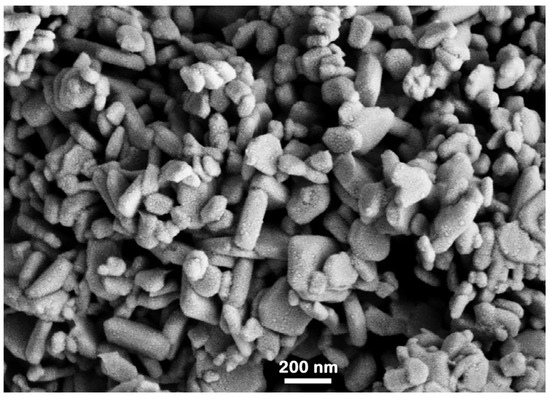
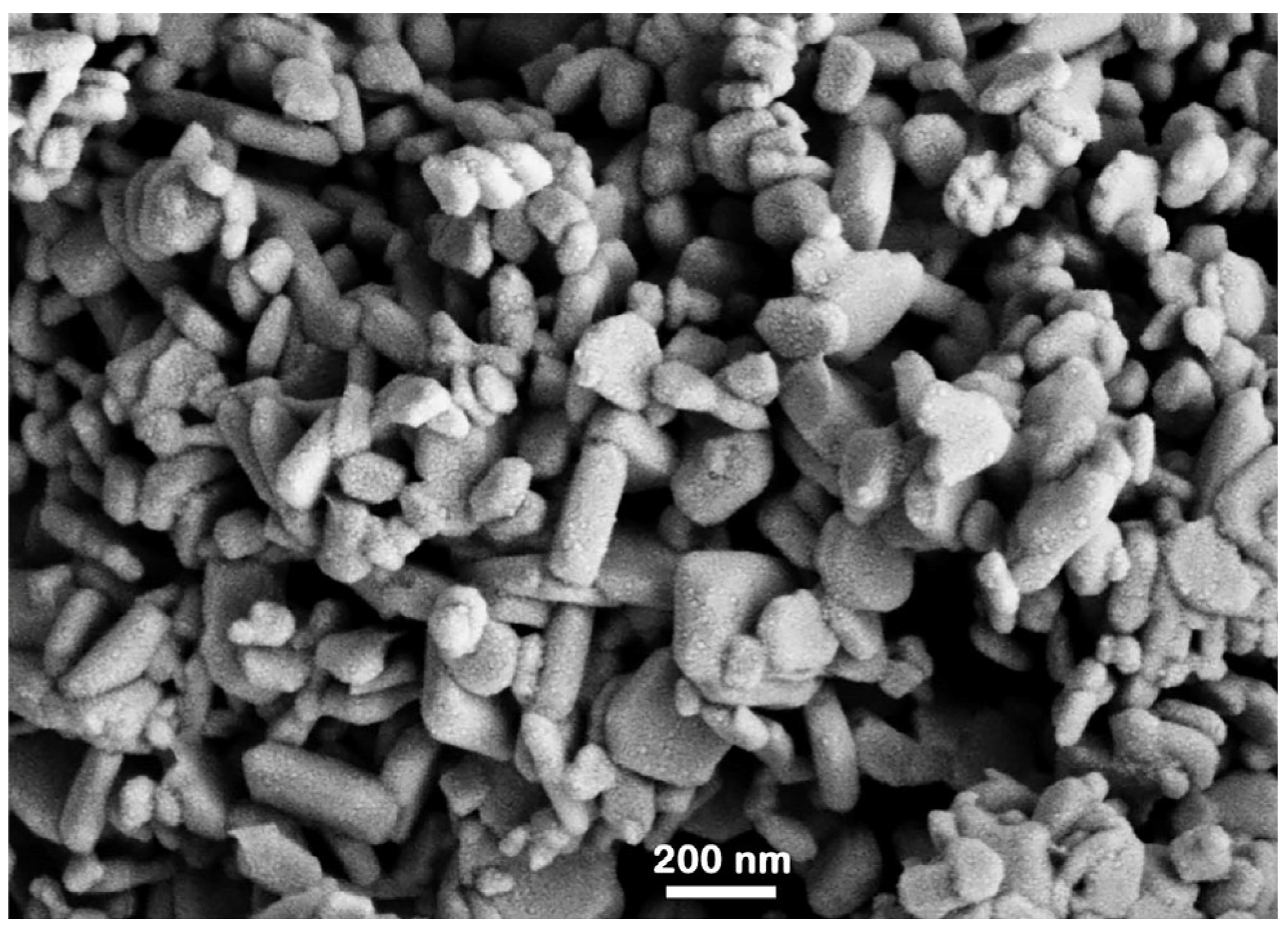
For our research, castor oil (CO) is used as a base material. It was obtained from US Healthcare Products LLC (Milford, CT, USA) (Table 1). Nanolubricants reinforced with sphere-shaped tungsten disulfide (WS2) nanostructures were developed at diverse weight fractions. Figure 1 shows the scanning electron microscopy analysis of WS2 morphology and size (Carl Zeiss, Sigma VP, New York, NY, USA). The characteristics of tungsten disulfide (WS2) nanostructures are shown in Table 2. Dynamic light scattering (DLS) (Malvern Zetasizer Nano ZS, Almelo, The Netherlands) was employed to analyze the nanostructures, having an average filler size of 90 ± 5 nm. The 0.05 wt.% sample showed a value of −34.5 mV for zeta potential, which reflects a moderate stability range for the nanolubricant. WS2 nanostructures are obtained from Sigma Aldrich (CAS # 790583).
Table 1.
Physico-chemical properties of castor oil.
Figure 1.
Morphology of WS2 nanostructures at 35 KX magnifications.
Table 2.
WS2 Nanostructures characteristics [51,52].
Preparation of CO/WS2 Nanolubricants
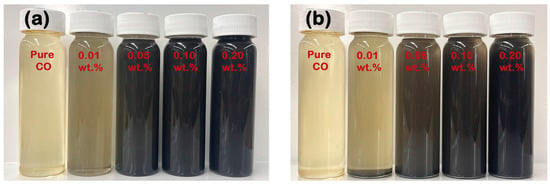
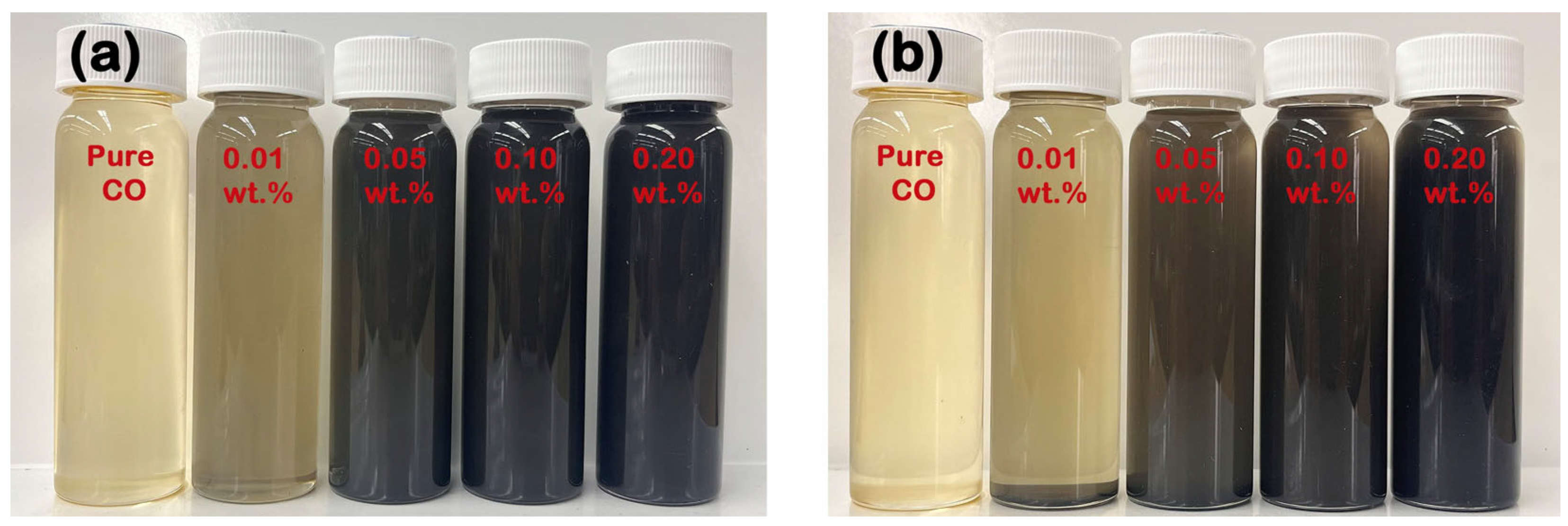
Nanolubricants preparation involves careful attention to homogeneous dispersion of WS2 nanostructures within CO following a two-step preparation method. First, CO was poured into 120 mL glass containers. Considering the density of CO, four concentrations of nanolubricants were prepared at 0.01, 0.05, 0.10 and 0.20 weight percent (wt.%). Nanostructures were weighed using a Mettler-Toledo precision balance and then incorporated into the oil. Subsequently, the containers were placed in a water bath ultrasonicator (Branson Model 5510—Danbury, CT, USA) to create homogeneous dispersions of the nanostructures within the CO. This process was performed for 8 to 12 h; the sonicator water bath was drained and changed every hour for fresh water to maintain a constant room temperature (~24 °C) to ensure that all nanostructures were uniformly mixed without visible fast agglomeration, which could cause quick nanostructure sedimentation. Once the samples were prepared, the containers were kept on a shelf for 25 days. Samples were observed daily during this time without significant nanostructure sedimentation (Figure 2). Additionally, samples were obtained for the thermal conductivity measurements by transferring nanolubricants to 42 mL glass vials.
Figure 2.
WS2 nanolubricants: (a) 1 h after sonication process and (b) 25 days after sitting on a shelf.
3. Experimental Details
3.1. Thermal Conductivity Evaluations
Thermal conductivity is one of the most crucial characteristics of nanolubricants when they are used as heat transfer fluids in machinery, devices and thermal management systems. In our research, nanolubricants’ thermal conductivity was evaluated following the transient hot-wire (THW) methodology using a TEMPOS thermal analyzer (METER GROUP, Inc., Pullman, WA, USA). Measurements were conducted at 10 °C intervals from room temperature up to 60 °C. To ensure a thermal equilibrium for each sample measured above 30 °C, the glass vial was maintained immersed in a flask with water on a hot plate for 5–10 min before thermal conductivity measurements. With this process stable, homogenous nanolubricants are produced, which are subsequently evaluated. The effective thermal conductivity (keff) is compared to pure CO (k0). A minimum of seven thermal conductivity measurements were obtained for each set of nanolubricants; results were reported as average values with error bars as standard deviation.
3.2. Tribological Evaluations
A tribological study was performed utilizing a four-ball tribotester (Ducom Instruments FBT-3, Bohemia, NY, USA) based on the ASTM D 4172-A standard [53]. Both the coefficient of friction (COF) and the wear scar diameter (WSD) on the steel spheres were analyzed. The four-ball tribosystem consists of three bottom-stationary steel balls (AISI 52100 steel, 60 HRC, diameter = 12.7 mm) that are fully covered by nanolubricant on a cylindrical container (fluid cup) and are loaded over them with a top steel ball. Through this top ball, a load of 392 N is applied while it rotates at an angular velocity (n) of 1200 rpm for 30 min. After each evaluation, the fixture containing the stationary balls was removed from the instrument and placed on a flat metal plate to cool for 3–5 min at room temperature. The remaining nanolubricant is then drained. The fixture was subsequently transferred to the image acquisition system (IAS—Ducom Instruments, Bohemia, NY, USA), where the worn scars of the steel balls were analyzed.
4. Results and Discussion
The thermal conductivity of fluids and lubricants indicates their capacity to absorb and/or dissipate heat. Thermal dissipation promotes better tribological performance, reducing friction and improving wear resistance of contacts or pairs in diverse manufacturing processes [42,54,55,56].
4.1. Thermophysical Properties
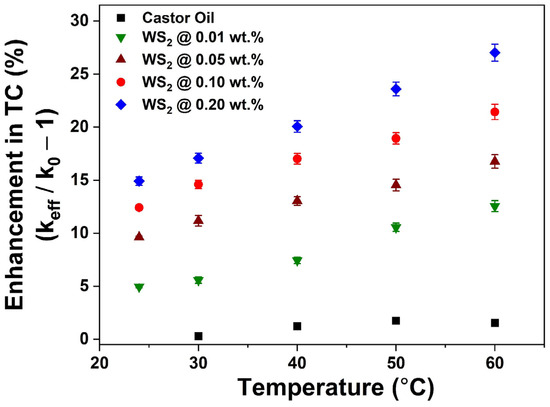
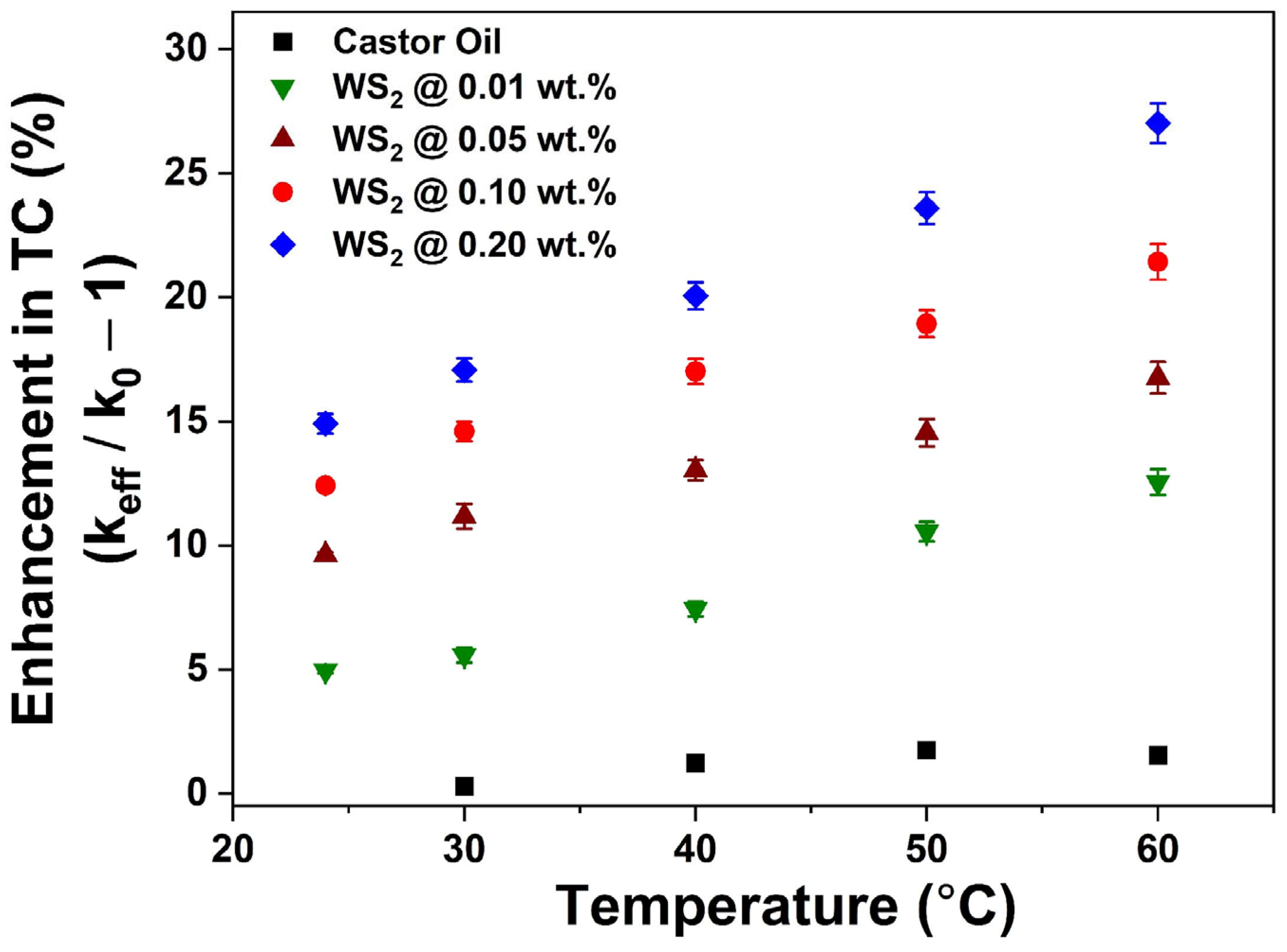
In our experiments, significant improvements were observed in the thermal conductivity performance of nanolubricants as filler fraction and evaluating temperature were increased (Figure 3). This effect is directly associated with the thermal conductivity and filler fraction of the reinforcing solid nanostructures. Thermal conductivity results demonstrated that the incorporation of merely 0.01 wt.% WS2 increased the thermal conductivity of the nanolubricant by 5% and 12% at room temperature and 60 °C, respectively. During the temperature scan evaluations we performed, significant enhancement was observed, with the greatest improvement being 27% at 0.20 wt.% at 60 °C.
Figure 3.
Thermal conductivity performance of WS2 nanolubricants under temperature-dependent evaluation; error bars included for standard deviation.
The thermal transport performance is highly affected by temperature, as was also observed in our evaluations. This energy transfer effect is caused by the Brownian motion of homogeneously dispersed nanostructures within the lubricant, resulting from their excitation, fast movement, and eventual collisions in the fluid. Brownian motion is the arbitrary movement or displacement of suspended structures within a fluid. At smaller reinforcement concentrations, Brownian motion is prompted with ease, which is likely due to the decrease in agglomerations that disturb Brownian behavior [57].
Additionally, molecular layering of the CO molecules will result from the application of the sonication process. With this interfacial layer and the increase in filler concentration, these nanostructures come closer and closer, allowing the phonons to easily move from one structure to the closest ones; thus, this well-organized liquid layering effect serves as an efficient thermal transport means to transfer and distribute more heat energy over the interfaces and therefore enhances the thermal conductivity [32,57,58,59,60].
4.2. Tribological Tests
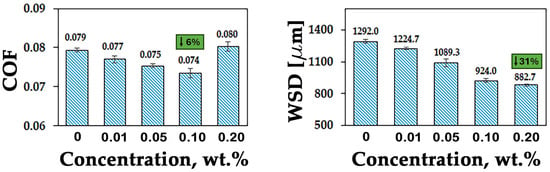
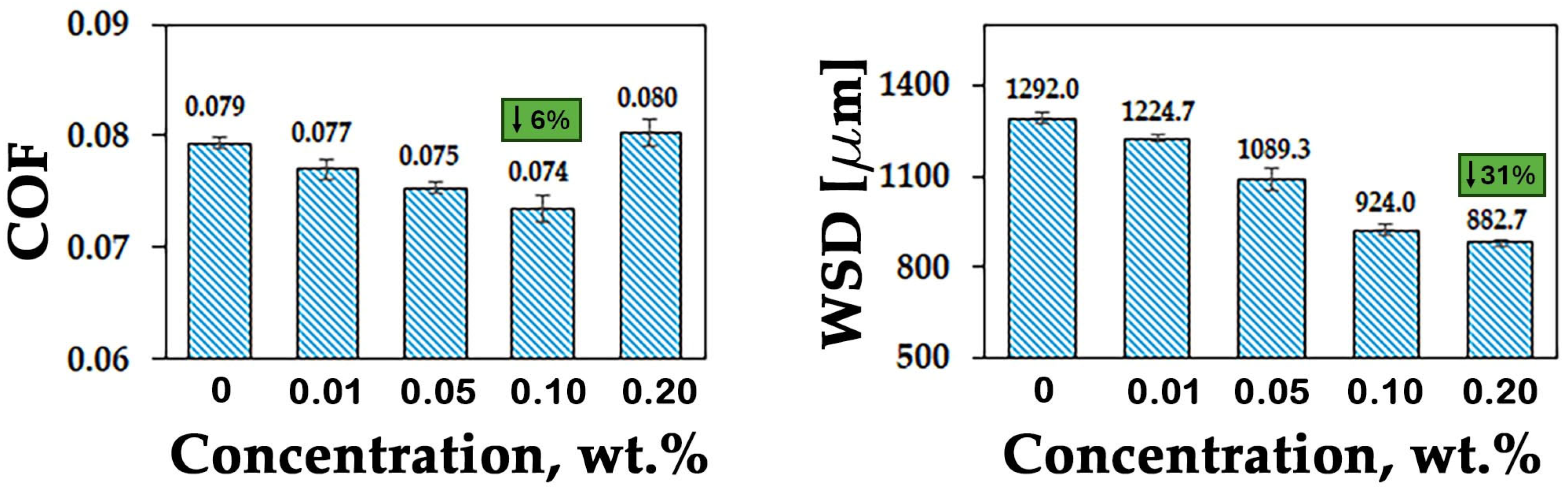
Figure 4 depicts the results for COF and WSD of steel balls for nanolubricants compared to base CO. The WSD is depicted for the studied concentrations. WSD was calculated using the average diameters of the worn scars of the three stationary steel spheres. A green box on top of the best performing nanolubricant is placed with the % of reduction in COF and WSD. Also, it is important to mention that during the homogeneous dispersion process and evaluation set-up preparation, a thin tribofilm was formed within the fluid and the components’ surfaces. This tribofilm between the contact surfaces increases the wear resistance and reduces friction.
Figure 4.
Tribological performance of castor oil vs. WS2 filler fraction, in wt.%. The first data point represents the base oil.
The addition of WS2 nanofillers reduces the COF, with the highest impact of 6% observed at 0.10 wt.%. It is also noted that at 0.20 wt.%, the COF becomes nearly identical to that of pure castor oil. This behavior of the nanolubricants was addressed by Zhang et al. [61] by a proposed mechanism, which claims that at low filler fractions, a protective layer forms over the interacting structures’ contacts, minimizing wear and friction; however, at higher filler fractions, those nanostructures could overlap and slide past each other, minimizing the friction. However, once the filler concentration surpasses an optimal threshold, the nanostructures tend to pile up and agglomerate, causing the protective layer to become discontinuous. This discontinuity diminishes the lubricant’s effectiveness as agglomeration restricts both the base oil and the nanostructures from adequately reaching the contact surfaces, reducing their ability to prevent wear and lower friction.
A similar trend was observed for the WSD as filler content increased, illustrating that adhesion of WS2 nanostructures to the surfaces of the steel spheres forms a protective layer, preventing the direct contact of friction pairs, thereby minimizing the friction. This mechanism continues until a specific nanofiller fraction is exceeded, which causes the lubrication layer to become discontinuous, thus leading to the degradation of the lubricant [43,55,62].
5. Conclusions
The thermal transport and tribological performance of WS2 nanolubricants were investigated in this research. It is observed that all nanolubricants showed remarkable improvements in thermal conductivity. The most remarkable improvement was 27% at 0.20 wt.% WS2 content and 60 °C, compared to the base CO. This enhancement is mainly because of the nanostructures’ thermal conductivity and the Brownian motion effect of these nanostructures. This effect is attributed to diverse factors; for instance, the nanostructures’ size, the temperature at which the nanolubricants are evaluated, the nano-layering of the castor oil at the interface of the lubricant and the nanostructures, etc., which contributed to the increment in the thermal transport performance.
We observed, through the four-ball tribotesting, that COF and WSD of CO are improved by the addition of WS2 nanofillers. Results showed that the incorporation of 0.10 wt.% led to a reduction in COF of up to 6%. On the other hand, a significant reduction in WSD of 31% was obtained for the 0.20 wt.% nanolubricant.
This research reveals that WS2 nanostructure-based CO is a multi-functional lubricant with improved thermal and tribological performances. It could provide similar or better results than petroleum-based lubricants applied in industry, with the superb benefit of being environmentally friendly, showing relatively high biocompatibility. Nevertheless, additional studies and evaluations are needed to develop efficient additives that could inhibit the carbonization and oxidation of the natural lubricants when these are taken to extremely high-temperature and high-pressure operative conditions.
Author Contributions
Conceptualization, J.J.T.-T.; methodology, J.J.T.-T., D.D.L.-E., J.M. and L.T.-S.; software, J.J.T.-T.; validation, J.J.T.-T., D.D.L.-E., J.M. and L.T.-S.; formal analysis, J.J.T.-T. and D.D.L.-E.; investigation, J.J.T.-T., D.D.L.-E., J.M. and L.T.-S.; resources, J.J.T.-T.; data curation, J.J.T.-T.; writing—original draft preparation, J.J.T.-T.; writing—review and editing, J.J.T.-T. and D.D.L.-E.; visualization, J.J.T.-T.; supervision, J.J.T.-T.; project administration, J.J.T.-T.; funding acquisition, J.J.T.-T. All authors have read and agreed to the published version of the manuscript.
Funding
This research received no external funding.
Data Availability Statement
The original contributions presented in this study are included in the article. Further inquiries can be directed to the corresponding author.
Acknowledgments
The authors would like to acknowledge the support of Antonio Suarez and Robert Jones.
Conflicts of Interest
The authors declare no conflicts of interest.
References
- Basiron, J.; Abdollah, M.F.B.; Abdullah, M.I.C.; Amiruddin, H. Lubricant Mechanisms of Eco-Friendly Lubricant Blended with Mineral Oil for Steel-Steel Contact. Tribol. Int. 2023, 186, 108653. [Google Scholar] [CrossRef] [Scilit]
- Nowak, P.; Kucharska, K.; Kamiński, M. Ecological and Health Effects of Lubricant Oils Emitted into the Environment. Int. J. Environ. Res. Public Health 2019, 16, 3002. [Google Scholar] [CrossRef] [Scilit]
- Taha-Tijerina, J.J.; Aviña, K.; Padilla-Gainza, V.; Akundi, A. Halloysite Reinforced Natural Esters for Energy Applications. Lubricants 2023, 11, 65. [Google Scholar] [CrossRef] [Scilit]
- Zaman, P.B.; Dhar, N.R. Current Research Trends in Coolant Application for Machining Ti-6Al-4V Alloy: A State-of-the-Art Review. Adv. Mater. Process. Technol. 2024, 11, 2299–2369. [Google Scholar] [CrossRef] [Scilit]
- Taha-Tijerina, J.J.; Aviña, K.; Ulloa-Castillo, N.A.; Melo-Maximo, D.V. Thermal Transport and Physical Characteristics of Silver-Reinforced Biodegradable Nanolubricant. Sustainability 2023, 15, 8795. [Google Scholar] [CrossRef] [Scilit]
- Granja, V.; Jogesh, K.; Taha-Tijerina, J.; Higgs, C.F. Tribological Properties of H-BN, Ag and MgO Nanostructures as Lubricant Additives in Vegetable Oils. Lubricants 2024, 12, 66. [Google Scholar] [CrossRef] [Scilit]
- Chen, J.; Yu, J.; Liu, D.; He, K.; Liu, Z.; Liang, L.; Tian, Z.Q. Tribological Properties and Synergistic Lubrication Mechanism of 3D Graphene/Nano-TiO2 (G@TiO2) Composite Castor Oil: A Microscopic View and Molecular Dynamics Perspective. Tribol. Int. 2023, 188, 108821. [Google Scholar] [CrossRef] [Scilit]
- Wilson, H.W. Fluid Cleanliness and Contamination. Tribol. Lubr. Technol. 2025, 81, 74–77. [Google Scholar]
- Dombek, G.; Nadolny, Z.; Marcinkowska, A. Thermal Properties of Natural Ester and Low Viscosity Natural Ester in the Aspect of the Reliable Operation of the Transformer Cooling System. Eksploat. I Niezawodn.-Maint. Reliab. 2019, 21, 384–391. [Google Scholar] [CrossRef] [Scilit]
- Liang, Z.H.; Wu, S.L.; Liu, C.; Yang, H.C.; Darling, S.B.; Xu, Z.K. When SLIPS Meets TIPS: An Endogenous Lubricant-Infused Surface by Taking the Diluent as the Lubricant. Chem. Eng. J. 2021, 425, 130600. [Google Scholar] [CrossRef] [Scilit]
- Li, J.; Chen, D.; Zhang, H.; Jiang, Z.; Sun, K.; Fan, J.; Tang, Y. The Tribological Properties of Nano-Lubricants and Their Application on Bearings: Recent Research Progress. Int. J. Adv. Manuf. Technol. 2024, 134, 3051–3082. [Google Scholar] [CrossRef] [Scilit]
- Pownraj, C.; Valan Arasu, A. Effect of Dispersing Single and Hybrid Nanoparticles on Tribological, Thermo-Physical, and Stability Characteristics of Lubricants: A Review. J. Therm. Anal. Calorim. 2021, 143, 1773–1809. [Google Scholar] [CrossRef] [Scilit]
- Rashidi, S.; Hormozi, F.; Karimi, N.; Ahmed, W. Applications of Nanofluids in Thermal Energy Transport. In Emerging Nanotechnologies for Renewable Energy; Elsevier: Amsterdam, The Netherlands, 2021; pp. 345–368. [Google Scholar]
- Markandan, K.; Nagarajan, T.; Peter, A.P.; Vignesan, P.; Ananthan, L.S.; Sankaran, R.; Khalid, M. Recent Progress in Tribological and Thermophysical Behaviour of Bio-Based Nanolubricant: A Review. Emergent Mater. 2025, 8, 113–140. [Google Scholar] [CrossRef] [Scilit]
- Cardoso, B.D.; Souza, A.; Nobrega, G.; Afonso, I.S.; Neves, L.B.; Faria, C.; Ribeiro, J.; Lima, R.A. Progress in Nanofluid Technology: From Conventional to Green Nanofluids for Biomedical, Heat Transfer, and Machining Applications. Nanomaterials 2025, 15, 1242. [Google Scholar] [CrossRef] [Scilit]
- Song, Y.X.; Li, C.H.; Zhou, Z.M.; Liu, B.; Sharma, S.; Dambatta, Y.S.; Zhang, Y.B.; Yang, M.; Gao, T.; Liu, M.Z.; et al. Nanobiolubricant Grinding: A Comprehensive Review. Adv. Manuf. 2025, 13, 1–42. [Google Scholar] [CrossRef] [Scilit]
- Huang, Z.; Chen, S.; Lin, Q.; Shen, B. Improved Anticorrosive and Tribological Performance of Ti-6Al-4V Alloys via a Mussel-Inspired Graphene/Phenol-Formaldehyde Resin Nanocomposite Coating. Prog. Org. Coat. 2022, 173, 107142. [Google Scholar] [CrossRef] [Scilit]
- Abellán-Nebot, J.V.; Vila Pastor, C.; Siller, H.R. A Review of the Factors Influencing Surface Roughness in Machining and Their Impact on Sustainability. Sustainability 2024, 16, 1917. [Google Scholar] [CrossRef] [Scilit]
- Nogales-Delgado, S.; Encinar, J.M.; González, J.F. A Review on Biolubricants Based on Vegetable Oils through Transesterification and the Role of Catalysts: Current Status and Future Trends. Catalysts 2023, 13, 1299. [Google Scholar] [CrossRef] [Scilit]
- Hamnas, A.; Unnikrishnan, G. Bio-Lubricants from Vegetable Oils: Characterization, Modifications, Applications and Challenges—Review. Renew. Sustain. Energy Rev. 2023, 182, 113413. [Google Scholar] [CrossRef] [Scilit]
- Nassef, B.G.; Pape, F.; Poll, G. Enhancing the Performance of Rapeseed Oil Lubricant for Machinery Component Applications through Hybrid Blends of Nanoadditives. Lubricants 2023, 11, 479. [Google Scholar] [CrossRef] [Scilit]
- Seyedzavvar, M.; Abbasi, H.; Kiyasatfar, M.; Ilkhchi, R.N. Investigation on Tribological Performance of CuO Vegetable-Oil Based Nanofluids for Grinding Operations. Adv. Manuf. 2020, 8, 344–360. [Google Scholar] [CrossRef] [Scilit]
- Kazeem, R.A.; Fadare, D.A.; Ikumapayi, O.M.; Adediran, A.A.; Aliyu, S.J.; Akinlabi, S.A.; Jen, T.C.; Akinlabi, E.T. Advances in the Application of Vegetable-Oil-Based Cutting Fluids to Sustainable Machining Operations: A Review. Lubricants 2022, 10, 69. [Google Scholar] [CrossRef] [Scilit]
- Mahapatra, A.; Vats, P.; Bambam, A.K.; Kumar, A.; Gajrani, K.K. Sustainable Green Lubricants. In Performance Characterization of Lubricants; CRC Press: Boca Raton, FL, USA, 2024; pp. 33–47. [Google Scholar] [CrossRef] [Scilit]
- Flores Cuautle, J.d.J.A. Thermal Properties of Vegetable Oils Used in Lubricants. Discov. Chem. Eng. 2025, 5, 17. [Google Scholar] [CrossRef] [Scilit]
- Raghuvanshi, N.S.; Johari, A.; Saxena, M.; Gupta, A.K.; Kumar, A.; Kumar, A.; Kumar, A.; Gupta, A. Eco-Friendly Lubricants. Performance Characterization of Lubricants; CRC Press: Boca Raton, FL, USA, 2025; pp. 70–96. [Google Scholar] [CrossRef] [Scilit]
- Shah, R.; Woydt, M.; Zhang, S. The Economic and Environmental Significance of Sustainable Lubricants. Lubricants 2021, 9, 21. [Google Scholar] [CrossRef] [Scilit]
- Diabb Zavala, J.M.; Martínez-Romero, O.; Elías-Zúñiga, A.; Leija Gutiérrez, H.M.; Estrada-De La Vega, A.; Taha-Tijerina, J.; Zavala, J.M.D.; Martínez-Romero, O.; Elías-Zúñiga, A.; Gutiérrez, H.M.L.; et al. Study of Friction and Wear Effects in Aluminum Parts Manufactured via Single Point Incremental Forming Process Using Petroleum and Vegetable Oil-Based Lubricants. Materials 2021, 14, 3973. [Google Scholar] [CrossRef] [Scilit]
- Afonso, I.S.; Nobrega, G.; Lima, R.; Gomes, J.R.; Ribeiro, J.E. Conventional and Recent Advances of Vegetable Oils as Metalworking Fluids (MWFs): A Review. Lubricants 2023, 11, 160. [Google Scholar] [CrossRef] [Scilit]
- Fernández-Silva, S.D.; García-Morales, M.; Ruffel, C.; Delgado, M.A. Influence of the Nanoclay Concentration and Oil Viscosity on the Rheological and Tribological Properties of Nanoclay-Based Ecolubricants. Lubricants 2021, 9, 8. [Google Scholar] [CrossRef] [Scilit]
- Hassan, M.U.; Usman, M.; Bashir, R.; Naeem Shah, A.; Ijaz Malik, M.A.; Mujtaba, M.A.; Elkhatib, S.E.; Kalam, M.A. Tribological Analysis of Molybdenum Disulfide (MOS2) Additivated in the Castor and Mineral Oil Used in Diesel Engine. Sustainability 2022, 14, 10485. [Google Scholar] [CrossRef] [Scilit]
- Karthikeyan, K.M.B.; Vijayanand, J.; Arun, K.; Rao, V.S. Thermophysical and Wear Properties of Eco-Friendly Nano Lubricants. Mater. Today Proc. 2021, 39, 285–291. [Google Scholar] [CrossRef] [Scilit]
- Zeng, Q. The Lubrication Performance and Viscosity Behavior of Castor Oil under High Temperature. Green Mater. 2022, 10, 51–58. [Google Scholar] [CrossRef] [Scilit]
- Bhaumik, S.; Datta, S.; Pathak, S.D. Analyses of Tribological Properties of Castor Oil With Various Carbonaceous Micro- and Nano-Friction Modifiers. J. Tribol. 2017, 139, 061802. [Google Scholar] [CrossRef] [Scilit]
- Ahmad, U.; Raza Naqvi, S.; Ali, I.; Saleem, F.; Taqi Mehran, M.; Sikandar, U.; Juchelková, D. Biolubricant Production from Castor Oil Using Iron Oxide Nanoparticles as an Additive: Experimental, Modelling and Tribological Assessment. Fuel 2022, 324, 124565. [Google Scholar] [CrossRef] [Scilit]
- Campos Flexa Ribeiro Filho, P.R.; Rocha do Nascimento, M.; Otaviano da Silva, S.S.; Tavares de Luna, F.M.; Rodríguez-Castellón, E.; Loureiro Cavalcante, C. Synthesis and Frictional Characteristics of Bio-Based Lubricants Obtained from Fatty Acids of Castor Oil. Lubricants 2023, 11, 57. [Google Scholar] [CrossRef] [Scilit]
- Singh, S.; Sharma, S.; Sarma, S.J.; Brar, S.K. A Comprehensive Review of Castor Oil-Derived Renewable and Sustainable Industrial Products. Environ. Prog. Sustain. Energy 2023, 42, e14008. [Google Scholar] [CrossRef] [Scilit]
- Ghaednia, H.J.R.L. The Role of Nanoparticles in Lubricants; Performing Lubricated and Dry Friction Tests. Tribol. Lubric. Technol. 2015, 71, 20–24. [Google Scholar]
- Taha-Tijerina, J.J.; Edinbarough, I.A. Comparative Cutting Fluid Study on Optimum Grinding Parameters of Ti-6Al-4V Alloy Using Flood, Minimum Quantity Lubrication (MQL), and Nanofluid MQL (NMQL). Lubricants 2023, 11, 250. [Google Scholar] [CrossRef] [Scilit]
- Bahri, M.; Yu, D.; Zhang, C.Y.; Chen, Z.; Yang, C.; Douadji, L.; Qin, P. Unleashing the Potential of Tungsten Disulfide: Current Trends in Biosensing and Nanomedicine Applications. Heliyon 2024, 10, e24427. [Google Scholar] [CrossRef] [Scilit]
- Yousef, A.; Thiehmed, Z.; Abdul Shakoor, R.; Altahtamouni, T. Recent Progress in WS2-Based Nanomaterials Employed for Photocatalytic Water Treatment. Catalysts 2022, 12, 1138. [Google Scholar] [CrossRef] [Scilit]
- Guo, J.; Barber, G.C.; Schall, D.J.; Zou, Q.; Jacob, S.B. Tribological Properties of ZnO and WS2 Nanofluids Using Different Surfactants. Wear 2017, 382–383, 8–14. [Google Scholar] [CrossRef] [Scilit]
- Liñeira del Río, J.M.; Fernandes, C.M.C.G.; Seabra, J.H.O. Tribological Improvement of Low-Viscosity Nanolubricants: MoO3, MoS2, WS2 and WC Nanoparticles as Additives. Lubricants 2024, 12, 87. [Google Scholar] [CrossRef] [Scilit]
- Bhowmick, S.; Eskandari, B.; Krishnamurthy, G.; Alpas, A.T. Effect of WS2 Particles in Cutting Fluid on Tribological Behaviour of Ti–6Al–4V and on Its Machining Performance. Tribol.-Mater. Surf. Interfaces 2021, 15, 229–242. [Google Scholar] [CrossRef] [Scilit]
- Martínez-Merino, P.; Estellé, P.; Alcántara, R.; Carrillo-Berdugo, I.; Navas, J. Thermal Performance of Nanofluids Based on Tungsten Disulphide Nanosheets as Heat Transfer Fluids in Parabolic Trough Solar Collectors. Sol. Energy Mater. Sol. Cells 2022, 247, 111937. [Google Scholar] [CrossRef] [Scilit]
- Zhang, Y.; Wang, B.; Cui, W.; Barber, G.C.; Hu, M. Assessment of Tribological Properties of Oil-Based Flake WS2-Oleic Acid Lubricant on Steel-Brass Sliding Contact. Tribol. Online 2020, 15, 293–299. [Google Scholar] [CrossRef] [Scilit]
- Hu, N.; Zhang, X.; Wang, X.; Wu, N.; Wang, S. Study on Tribological Properties and Mechanisms of Different Morphology WS2 as Lubricant Additives. Materials 2020, 13, 1522. [Google Scholar] [CrossRef] [Scilit] [PubMed]
- Sabri, A.M.; Talib, N.; Sani, A.S.A.; Kunar, S. Investigation on the Performance of Modified Vegetable Oil Lubricants with Single and Hybrid Nanoparticle Additives for MQL Applications. Tribol. Int. 2026, 214, 111314. [Google Scholar] [CrossRef] [Scilit]
- Kumar, D.; Singh, B.; Kumar, P.; Balakrishnan, V.; Kumar, P. Thermal Expansion Coefficient and Phonon Dynamics in Coexisting Allotropes of Monolayer WS2 Probed by Raman Scattering. J. Phys. Condens. Matter 2019, 31, 505403. [Google Scholar] [CrossRef] [Scilit] [PubMed]
- Peimyoo, N.; Shang, J.; Yang, W.; Wang, Y.; Cong, C.; Yu, T. Thermal Conductivity Determination of Suspended Mono- and Bilayer WS2 by Raman Spectroscopy. Nano Res. 2014, 8, 1210–1221. [Google Scholar] [CrossRef] [Scilit]
- Sigma Aldrich. Tungsten(IV) Sulfide Nanopowder; Sigma Aldrich: St. Louis, MO, USA, 2024. [Google Scholar]
- Peng, B.; Zhang, H.; Shao, H.; Xu, Y.; Zhang, X.; Zhu, H. Thermal Conductivity of Monolayer MoS2, MoSe2, and WS2: Interplay of Mass Effect, Interatomic Bonding and Anharmonicity. RSC Adv. 2016, 6, 5767–5773. [Google Scholar] [CrossRef] [Scilit]
- ASTM D4172-21; Standard Test Method for Wear Preventive Characteristics of Lubricating Fluid (Four-Ball Method). ASTM International: West Conshohocken, PA, USA, 2021.
- Ribeiro, H.; Taha-Tijerina, J.J.; Gomez, O.; Acosta, E.; Pinto, G.M.; Moraes, L.R.C.; Fechine, G.J.M.; Andrade, R.J.E.; Reinoza, J.; Padilla, V.; et al. Thermal Transport and Rheological Properties of Hybrid Nanofluids Based on Vegetable Lubricants. Nanomaterials 2023, 13, 2739. [Google Scholar] [CrossRef] [Scilit]
- Liu, C.; Yu, J.; Lv, J.; Liu, S. The Spherical WS2 Nano Lubricating Additive Designed to Reduce the Frictional Fluctuations on the Onset of Friction. Mater. Today Commun. 2025, 42, 111588. [Google Scholar] [CrossRef] [Scilit]
- Ahmed Abdalglil Mustafa, W.; Dassenoy, F.; Sarno, M.; Senatore, A. A Review on Potentials and Challenges of Nanolubricants as Promising Lubricants for Electric Vehicles. Lubr. Sci. 2022, 34, 1–29. [Google Scholar] [CrossRef] [Scilit]
- Taha-Tijerina, J. Thermal Transport and Challenges on Nanofluids Performance. In Microfluidics and Nanofluidics; Kandelousi, M.S., Ed.; InTech: Singapore, 2018; pp. 215–256. [Google Scholar]
- Taha-Tijerina, J.J.; Martínez, J.M.; Euresti, D.; Arquieta-Guillén, P.Y. Carbon Nanotori Reinforced Lubricants in Plastic Deformation Processes. Lubricants 2022, 10, 74. [Google Scholar] [CrossRef] [Scilit]
- Minakov, A.V.; Rudyak, V.Y.; Pryazhnikov, M.I. Systematic Experimental Study of the Viscosity of Nanofluids. Heat Transf. Eng. 2020, 42, 1024–1040. [Google Scholar] [CrossRef] [Scilit]
- Sabar, S.K.; Ghosh, S.K. Nanolubrication and Tribological Behaviour of the Rolling Process—A Review. Surf. Eng. 2023, 39, 6–24. [Google Scholar] [CrossRef] [Scilit]
- Zhang, W.; Zhou, M.; Zhu, H.; Tian, Y.; Wang, K.; Wei, J.; Ji, F.; Li, X.; Li, Z.; Zhang, P.; et al. Tribological Properties of Oleic Acid-Modified Graphene as Lubricant Oil Additives. J. Phys. D Appl. Phys. 2011, 44, 205303. [Google Scholar] [CrossRef] [Scilit]
- Liu, H.; Xu, Y.; Hu, E.; Hu, K. Synthesis and Tribological Properties of WS2/MoS2 Micro-Nano Composite Lubricant. Tribol. Int. 2025, 204, 110506. [Google Scholar] [CrossRef] [Scilit]

Disclaimer/Publisher’s Note: The statements, opinions and data contained in all publications are solely those of the individual author(s) and contributor(s) and not of MDPI and/or the editor(s). MDPI and/or the editor(s) disclaim responsibility for any injury to people or property resulting from any ideas, methods, instructions or products referred to in the content. |
© 2026 by the authors. Licensee MDPI, Basel, Switzerland. This article is an open access article distributed under the terms and conditions of the Creative Commons Attribution (CC BY) license.