


Abstract
Molybdenum disulfide (MoS2)-based composite systems are widely used as solid lubricating coatings. However, further optimization towards lower friction and higher wear resistance remains necessary to meet the extreme operating conditions and high reliability requirements of next-generation aerospace equipment. This study investigated the tribological performance of MoS2/epoxy composite coatings by comparing the effects of individual and combined additions of nano nickel (Ni) and magnesium silicate hydroxide (MSH). The coating preparation process adopted in this study is the bonding method. Experimental results showed that, under a load of 2 N and a rotational speed of 500 r/min, the coating containing 0.3 g Ni and 0.1 g MSH (labeled W03Ni01MSH) achieved a 22% reduction in wear scar width compared to the coating with only Ni, demonstrating a distinct synergistic effect. This is attributed to the complementary roles of the two additives: Ni promotes the formation of flaky wear debris, facilitating rapid formation and stabilization of a transfer film, thereby reducing friction; MSH enhances the load carrying capacity of the coating and suppresses wear propagation, thereby improving wear resistance. Furthermore, this composite coating exhibited optimal performance under the conditions of 500 r/min and 2 N. The results of this study significantly improved the friction-reducing and wear-resistant properties of the MoS2/epoxy composite coating. This provides a new strategy for the formulation design of high-performance solid lubricating coatings.
1. Introduction
Solid lubricating coatings are essential for moving components in extreme environments such as aerospace and vacuum systems where liquid lubricants fail [1,2,3,4,5]. Molybdenum disulfide (MoS2), with its lamellar crystal structure where layers are held by weak van der Waals forces and its low friction coefficient, is a widely used solid lubricant [6,7,8]. However, pure MoS2 coatings suffer from limitations such as oxidation susceptibility in humid environments, poor load-bearing capacity, and limited wear life [9,10]. To overcome these drawbacks, extensive research has been conducted on composite modification by adding various secondary phases including metals, ceramics, and polymers [11,12,13].
Among metallic additives, nickel nanoparticles show promise [14,15,16]. Ni can enhance coating compactness [17,18], and its surface oxide (NiO) may inhibit the oxidation of MoS2 [19,20]. MSH, a synthetic layered silicate, has demonstrated excellent anti-wear and friction-reducing properties in lubricating oils, attributed to its ability to form protective films on friction surfaces [21,22]. Previous work by our research group has also confirmed the positive effect of MSH on wear resistance [23].
Research focusing on the synergistic interactions between different functional additives, particularly between a soft metal (Ni) and a layered silicate (MSH), remains scarce [24,25,26]. Synergistic effect, where the combined performance exceeds the sum of contributions from individual components, is a powerful concept for designing advanced materials with tailored properties [27,28,29].
Therefore, this work systematically investigates the influence of nano-Ni and MSH, both individually and in combination, on the tribological performance of epoxy-bonded MoS2 composite coatings. The specific objectives are, first, to determine the optimal addition amounts for Ni and MSH separately via single-factor experiments; second, to verify the existence of a synergistic effect between Ni and MSH and to identify the optimal composite ratio; and third, to elucidate the underlying micro-mechanisms of this synergy through comprehensive characterization of wear scars. The findings aim to provide new insights and a material design strategy for high-performance solid lubricating coatings, defined herein as coatings with a coefficient of friction (COF) below 0.15 and a wear scar width below 600 μm under the test conditions.
2. Experimental Method
2.1. Materials for Solid Lubricating Coatings
The composite solid lubricant coating system is primarily composed of four types of components: solvent, binder, solid lubricants, and functional fillers [30]. Solid lubricants function by adhering to the surfaces of friction pairs to form a lubricating layer with low shear strength, thereby reducing the friction coefficient and delaying the wear process. This study employs three types of layered-structure solid lubricants: nano-graphite (purity: 99.95%, Aladdin Biochemical Technology Co., Ltd., Shanghai, China), synthetic magnesium silicate hydroxide (MSH), and nano-molybdenum disulfide (purity: 99.5%, Macklin Biochemical Technology Co., Ltd., Shanghai, China). The MSH powder used in this study is synthesized via a hydrothermal method (200 °C, 12 h) in the laboratory, whose purity is 99.5%. The binder serves as the structural support phase of the coating, directly influencing the coating’s adhesion, hardness, heat resistance, and overall mechanical behavior. This study selects bisphenol A-type epoxy resin E51 as the primary binder (Kunshan Jiulimeidian New Material Co., Ltd., Kunshan, Jiangsu, China). Pure epoxy resin tends to soften and melt upon heating, necessitating the use of a curing agent to achieve cross-linking and curing. This study employs a binder system composed of E51 and W93 curing agent in a mass ratio of 10:3. W93 is a modified amine curing agent (Shanghai Resin Factory Co., Ltd., Shanghai, China) obtained through the addition reaction of diethylenetriamine and butyl glycidyl ether. During curing, the primary and secondary amine groups in W93 undergo ring-opening addition reactions with the epoxy groups in E51, forming a three-dimensional cross-linked network structure. This system can complete curing under moderate temperature conditions (80–120 °C), resulting in a dense coating structure. Epoxy resin E51 requires the use of a solvent to adjust the fluidity of the system to meet spraying process requirements. This study employs the reactive solvent butyl glycidyl ether (660A, Changzhou Runxiang Chemical Co., Ltd., Changzhou, Jiangsu, China). Its molecular terminal contains an epoxy group, allowing it to participate in the curing reaction and become part of the cross-linked network. The introduction of functional fillers aims to further enhance the coating’s oxidation resistance, wear resistance, and load-bearing capacity. This study employs the following three types of functional fillers: rare earth compound cerium fluoride (CeF3, purity: 99.99%, Aladdin Biochemical Technology Co., Ltd., Shanghai, China), nano-alumina (Al2O3, purity: 99.99%, Macklin Biochemical Technology Co., Ltd., Shanghai, China), and nano-nickel powder (Ni, purity: 99.9%, Macklin Biochemical Technology Co., Ltd., Shanghai, China). The specific proportions of each component in the coating are listed in Table 1.
Table 1.
Information about solid lubricating coating.
2.2. The Methood of Preparing Coating
This study employed the bonding method in wet film-forming processes to prepare composite solid lubricant coatings. The overall fabrication process consisted of four principal stages: substrate surface pretreatment, ingredient mixing, spray coating formation, and surface drying and curing.
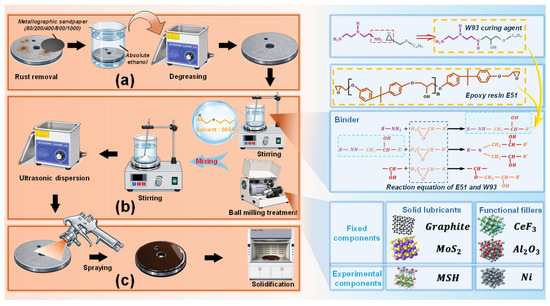
Untreated metal surfaces typically contain contaminants such as processing residues, dust, grease, and oxide layers, which severely weaken interfacial bonding strength. To ensure optimal coating adhesion, systematic surface pretreatment was performed on the 45# steel substrate. As shown in Figure 1a, the substrate surface was ground using metallographic sandpaper to remove the oxide layer. Subsequently, the ground specimens were fully immersed in anhydrous ethanol and ultrasonically cleaned for 15 min to eliminate adsorbed oil and fine particles. After treatment, the specimens were removed, residual liquid was absorbed with clean filter paper, and they were air-dried at low temperature to obtain a clean and activated substrate surface for subsequent coating application.
Figure 1.
Coating preparation method. (a) Pretreating substrate surface; (b) Mixing ingredient; (c) Coating spraying.
Secondly, as depicted in Figure 1b, solid components such as MoS2, graphite, MSH, CeF3, Al2O3, and nano-nickel powder were weighed proportionally. These were placed in a QM-3B high-speed ball mill and processed for 30 min, with manual stirring every 10 min to ensure particle refinement and uniform dispersion. Simultaneously, epoxy resin E51, curing agent W93, and active solvent 660A were placed in a beaker and preliminarily mixed for 10 min under constant-temperature magnetic stirring at 25 °C. After ball milling, the powder mixture was gradually added to the resin system, followed by an additional 10 min of stirring. Subsequently, the mixture was ultrasonically dispersed for 10 min to obtain a homogeneous and stable sprayable slurry.
Afterward, as shown in Figure 1c, the spray gun pressure was adjusted to 0.8 MPa, and test spraying was conducted to optimize atomization. During formal deposition, the spray gun was kept perpendicular to the substrate surface.
After spraying, the specimen was allowed to level at room temperature for 20 min to achieve initial solidification and surface smoothing. Subsequently, the specimen was transferred to an air-circulating oven preheated to 240 °C and cured for 30 min. Finally, it was cooled to room temperature along with the oven, resulting in a uniform solid lubricating coating.
2.3. Experimental Procedure Translation
Coating thickness is a critical indicator for evaluating coating quality. As the thickness increases, the wear resistance of the coating will improve. However, an excessively thick coating tends to blister after curing, leading to degraded quality. Therefore, after the coating preparation, the XCT280 coating thickness gauge manufactured by Beijing Saiborui Xin Technology Co., Ltd., Beijing, China, was used for thickness measurement. This instrument adopts magnetic and eddy current methods to test the coating on the specimen surface, enabling non-destructive measurement of non-magnetic material coatings on magnetic metal substrates. After connecting the coating thickness gauge properly, 6 measuring points were uniformly selected on the coating surface to ensure the points could represent the thickness at various positions of the coating. The values displayed by the gauge were recorded and averaged. Following the above measurement method, the average coating thickness was 25–35 μm, which meets the coating thickness requirements.
After the coating preparation was completed, the specimens were placed into an MFT-5000 ball-on-disk tribometer (manufactured by CETR, Inc., Campbell, CA, USA) to systematically evaluate the tribological performance of the prepared coatings. Subsequently, the morphology and dimensions of the wear scars were characterized using a Zygo NewView 9000 3D optical profilometer (manufactured by Zygo Corporation, Middlefield, CT, USA) based on white light interferometry. Precise measurements were taken of wear scar width, depth, and cross-sectional profile parameters.
The friction tests were conducted for 1 h (3600 s) to ensure that the frictional behavior reached a steady state under the applied test conditions. This duration was determined based on preliminary experiments showing that the COF stabilized within this timeframe for the coatings studied.
To quantitatively evaluate the wear resistance of solid lubricating coatings, the specific wear rate k is introduced as an evaluation index in this paper. The specific wear rate is defined as the volume wear loss of the material per unit load and per unit sliding distance, and a smaller value indicates better wear resistance of the material. The calculation formula is as follows:
where k is the specific wear rate (mm3/(N·m)), V is the wear volume (mm3), F is the normal load (N), and S is the sliding distance (m). The sliding distance S is determined by the motion parameters of the testing machine. For the rotary ball-on-disk friction and wear test adopted in this paper, the sliding distance is calculated by the formula:
where r is the rotating radius (m), n is the rotating speed (rpm), and t is the test duration (s). The wear volume V is obtained by the product of the cross-sectional area of the wear track A and the circumference of the wear track L:
where w is the wear track width (mm) and h is the wear track depth (mm).
High-resolution observation of the worn surfaces was conducted using a field emission scanning electron microscope (SEM, model EVO18, manufactured by Carl Zeiss AG, Oberkochen, Baden-Württemberg, Germany), systematically examining features such as crack propagation, delamination phenomena, and wear debris morphology at various magnifications. Qualitative and semi-quantitative elemental analysis was performed through the coupled Oxford INCA X-MAX energy dispersive spectrometer (EDS, manufactured by Oxford Instruments plc, Abingdon, Oxfordshire, UK), with a focus on tracking the distribution and migration patterns of lubricating phases (Mo, S, C) and functional additives (Ni, Mg, Si, Al, Ce) during the friction process, providing crucial evidence for elucidating the synergistic lubrication mechanism.
3. Result and Discussion
3.1. Effect of Nano-Nickel Content
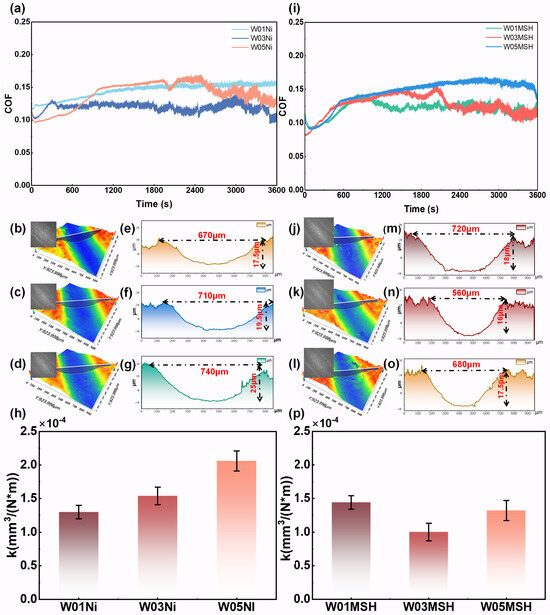
The variation in the coefficient of friction (COF) over time for coatings with different nano-Ni addition amounts under standard test conditions (2 N load, 500 rpm, 25 °C, 1 atm) is shown in Figure 2a. For the coating with 0.1 g nano-Ni addition (W01Ni), the initial COF was approximately 0.12. Over the subsequent 50 min of testing, the COF continued to rise slowly, eventually stabilizing around 0.165, indicating a relatively high steady-state friction coefficient.
Figure 2.
(a) Coefficient of Friction (COF) of nano Ni powder coating with different content at 2 N 500 rpm. (b) Wear scar characteristics of W01Ni. (c) Wear scar characteristics of W03Ni. (d) Wear scar characteristics of W05Ni. (e) Wear scar profile image of the W01Ni coating. (f) Wear scar profile image of the W03Ni coating. (g) Wear scar profile image of the W05Ni coating. (h) Bar chart of specific wear rates for the coatings with different Ni contents at 2 N 500 rpm. Error bars indicate the measurement error. (i) Coefficient of Friction (COF) of nano MSH powder coating with different content at 2 N 500 rpm. (j) Wear scar characteristics of W01MSH. (k) Wear scar characteristics of W03MSH. (l) Wear scar characteristics of W05MSH. (m) Wear scar profile image of the W01MSH coating. (n) Wear scar profile image of the W03MSH coating. (o) Wear scar profile image of the W05MSH coating. (p) Bar chart of specific wear rates for the coatings with different MSH contents at 2 N 500 rpm. Error bars indicate the measurement error.
The coating with 0.3 g nano-Ni addition (W03Ni) demonstrated the most excellent friction-reducing performance. Its COF briefly rose to 0.13 in the initial stage, then rapidly decreased to 0.125 at around 200 s. After a short adjustment period, it steadily declined within the 400–800 s interval. In the latter and main part of the test, the COF stabilized and was maintained at a relatively low level of approximately 0.12, with minimal curve fluctuations, showcasing excellent frictional stability.
The coating with 0.5 g nano-Ni addition (W05Ni) exhibited more complex frictional behavior. The initial COF was approximately 0.165, which dropped rapidly to 0.115 within 100 s. Subsequently, over a period of about 1000 s, it slowly climbed back to 0.155 and remained stable briefly. Notably, at around 2400 s into the test, the COF underwent a significant abrupt transition, decreasing continuously to about 0.135 until the test concluded. This suggests possible changes in the coating structure.
Observing the overall trend, the transition point where the coating’s COF shifted from increasing to decreasing occurred significantly earlier as the nano-Ni addition amount increased. This phenomenon is likely related to the softening effect of nano-Ni: higher Ni content results in lower overall coating hardness, allowing surface asperities to be flattened more quickly under contact stress [31,32]. The material removed during this process forms a continuous transfer lubricating film on the counterface, thereby promoting a reduction in the coefficient of friction. Particularly for the high-Ni-content coating (W05Ni), its lower hardness facilitates easier extrusion of internal lubricating phases (such as MoS2 and graphite) under contact pressure to participate in transfer film formation, leading to an earlier onset of COF reduction during the test.
The corresponding wear scar morphology was examined using white light interferometry. Figure 2b–g show the optical images of the wear scars and the corresponding 3D surface profiles. Visually, the wear scar widens as the Ni content increases. Quantitative analysis from the wear scar profiles confirms this trend: the wear scar width increases from 670 μm (W01Ni) to 700 μm (W03Ni) and further to 710 μm (W05Ni). Similarly, the wear depth increases from 17.5 μm to 19.5 μm and then to 25 μm. Figure 2h shows the specific wear rates of coatings with different Ni contents. The specific wear rate of W01Ni is 1.3 × 10⁻⁴ mm3/(N·m), that of W03Ni increases slightly to 1.54 × 10⁻⁴ mm3/(N·m), and W05Ni exhibits the highest value with a relatively large increase, reaching 2.06 × 10⁻⁴ mm3/(N·m).
This indicates that while adding 0.3 g Ni is optimal for achieving a low friction coefficient, the wear resistance of the coating deteriorates with increasing Ni content. This is attributed to the softening effect of the soft metal Ni, which reduces the overall hardness of the coating, leading to greater penetration by the counterpart ball and more severe wear.
3.2. Effect of MSH Content
The evolution of the coefficient of friction (COF) for coatings with different MSH additions is shown in Figure 2i.
For the coating with 0.1 g MSH addition (W01MSH), within the initial approximately 300 s, the COF rapidly decreased from about 0.115 to a low point of 0.095, then entered a rising phase, reaching a peak of about 0.140 at around 1500 s. Subsequently, the COF entered an adjustment period and stabilized near 0.120 during the middle and later stages of the test.
The coating with 0.3 g MSH addition (W03MSH) presented a completely different frictional behavior. Its initial COF was the lowest, approximately 0.080. During the first half of the test, the COF showed a steady and slow upward trend, eventually reaching a plateau of about 0.145. At around 2100 s, a clear turning point occurred as the COF began to decrease to 0.115 and maintained at this level until the end of the test.
In contrast, the coating with 0.5 g MSH addition (W05MSH) demonstrated the most unstable frictional state. During the initial stage, the COF rapidly decreased from 0.110 to 0.095. However, in the subsequent 200 s, the COF exhibited a monotonic and continuous increase, ultimately climbing to a high value of about 0.160 by the end of the test. Although the curve showed a downward trend toward 0.140 at the very end, its final stabilized value could not be observed due to the limited test duration. Overall, the COF of this coating remained in a fluctuating and rising state throughout the entire test cycle, failing to reach a stable stage.
From a macroscopic comparison of the curve shapes, it is evident that as the MSH addition amount increased, the time point at which the COF curve entered a stable or declining phase was significantly delayed. This phenomenon aligns with the characteristics of MSH as a hard, layered silicate: an appropriate amount of MSH can effectively strengthen the coating matrix, enhance load-bearing capacity, and delay the wear process of surface asperities. This results in the COF being maintained in a run-in and adjustment state for a longer period, ultimately achieving a lower steady-state friction through the formation of a stable transfer film. Conversely, excessive addition may introduce too many hard particles, which not only interferes with the continuous formation of the transfer film but may also act as abrasives to exacerbate three-body wear in the friction pair, leading to a persistently high and unstable COF.
The analysis of wear scar morphology and dimensions reveals significant differences in the wear resistance of coatings with varying MSH addition levels. As shown in Figure 2j–l, the W03MSH coating exhibits the most regular and narrowest wear scar, with uniform wear debris accumulation along its edges, and the most uniform worn surface. In contrast, the wear scars of the W01MSH and W05MSH coatings are relatively wider. The W01MSH coating shows deeper groove-like wear features, and the W05MSH coating exhibits localized spalling at the wear scar edges, indicating compromised surface integrity.
According to the quantitative wear scar profile data shown in Figure 2m–o, these results demonstrate that adding 0.3 g of MSH significantly improves the coating’s wear resistance, reducing the wear scar width and depth compared to W01MSH. This enhancement is attributed to the effective load-bearing role of MSH as a hard lamellar silicate within the epoxy matrix, which mitigates plastic deformation during friction. However, increasing the MSH addition to 0.5 g slightly reduces the wear depth and at the same time reduces the width of the wear scar. This suggests that excessive MSH may introduce an abundance of hard particles that act as abrasives, disrupting the continuity of the lubricating film.
Figure 2p presents the specific wear rates of coatings with different MSH contents. The specific wear rate of W0MSH is the lowest at 1 × 10⁻⁴ mm3/(N·m). Both W01MSH and W05MSH show an increase with little difference between them, which are 1.44 × 10⁻⁴ mm3/(N·m) and 1.32 × 10⁻⁴ mm3/(N·m), respectively.
In summary, there exists an optimal dosage range for MSH addition, where an appropriate amount effectively enhances wear resistance, whereas excessive addition may result in performance saturation or even adverse effects, providing important guidance for optimizing the formulation of solid lubricant coatings.
3.3. Synergistic Effect Between Ni and MSH
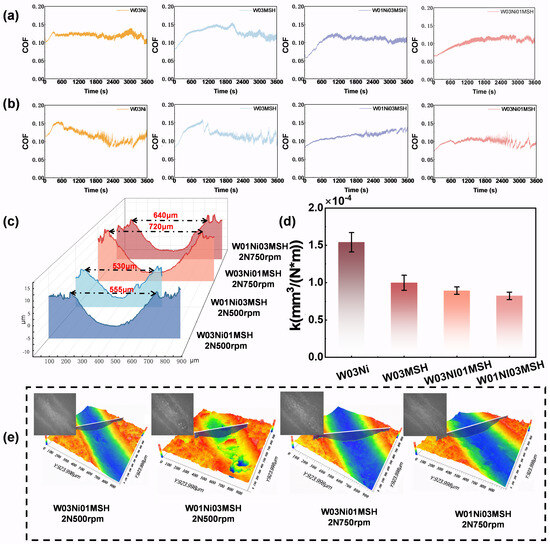
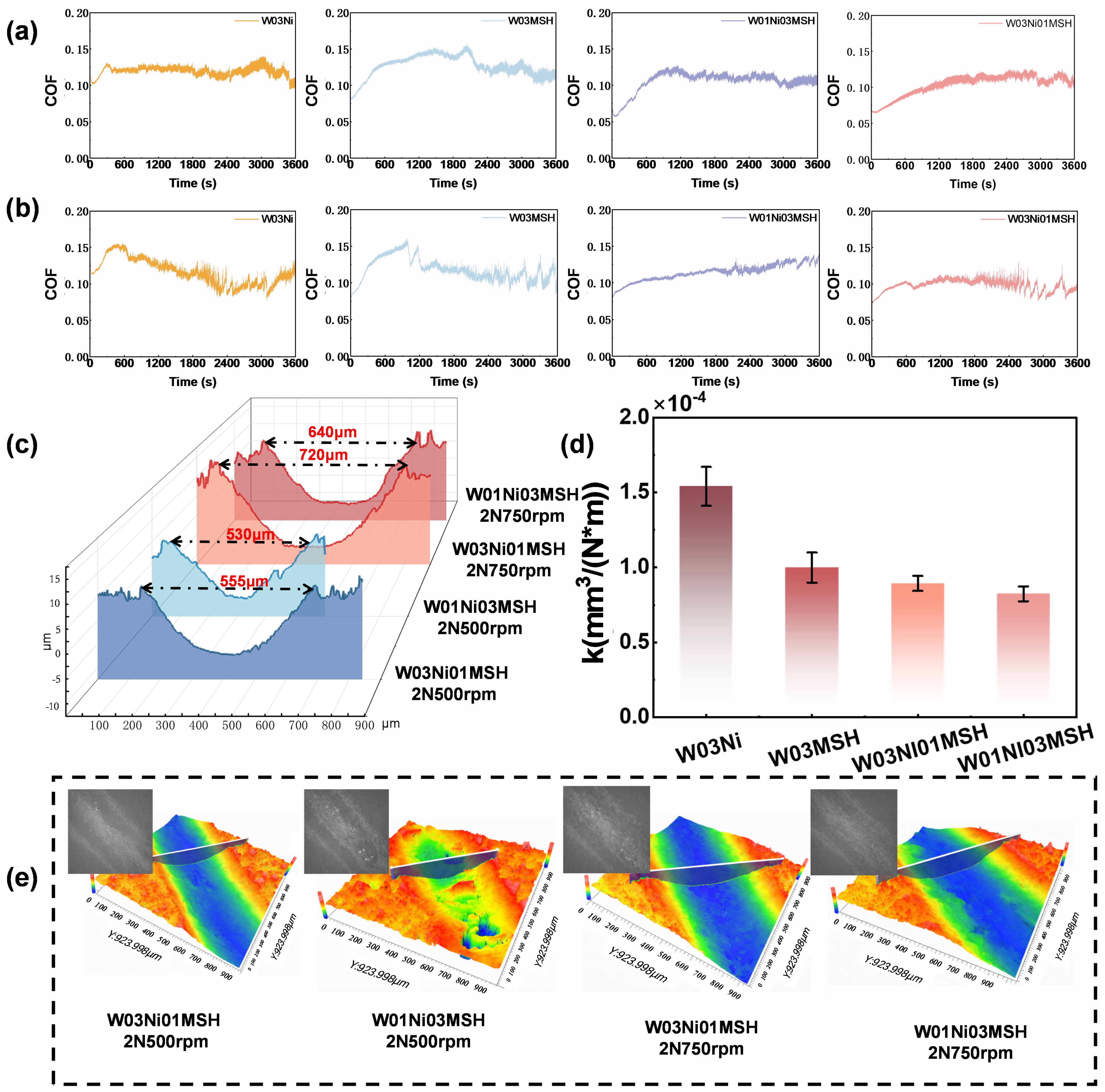
Based on the single-factor results, 0.3 g was identified as the optimal individual addition amount for both Ni and MSH. To investigate their interaction, two composite coatings were prepared: W03Ni01MSH (0.3 g Ni + 0.1 g MSH) and W01Ni03MSH (0.1 g Ni + 0.3 g MSH), and compared with the best single-component coatings, W03Ni and W03MSH. Two operating conditions, 2 N 500 rpm and 2 N 750 rpm, were designed.
The COF of the four coatings in the 2 N 500 rmp and 2 N 750 rpm are shown in Figure 3a,b. Under the 2 N 500 rpm condition, the final friction coefficients were relatively close, ranging between 0.120 and 0.125. The friction coefficient of the W03Ni01MSH specimen slowly increased from 0.080, rising to approximately 0.120 around 2300 s and then stabilizing. The friction coefficient of the W01Ni03MSH specimen slowly increased from 0.075, stabilizing around 0.120 at approximately 1700 s and remaining steady. The friction coefficients of the composite powder specimens maintained low values with minimal fluctuations throughout the test, and no noise was observed during the entire process.
Figure 3.
(a) Coefficient of Friction of Four Coatings at 2 N 500 rpm. (b) Coefficient of Friction of Four Coatings at 2 N 750 rpm. (c) Wear scar profiles of the composite powder coatings at 2 N 500 rpm and 2 N 750 rpm. (d) Bar chart of specific wear rates for the four coatings under 2 N 500 rpm and 2 N 750 rpm test conditions. Error bars indicate the measurement error. (e) The three-dimensional surface topography and wear scar morphology of the composite powder coatings at 2 N 500 rpm and 2 N 750 rpm.
Under the 2 N 750 rpm condition, the friction coefficient of the W03Ni specimen rapidly dropped from 0.13 to around 0.117, then reached 0.15 at 500 s. It continued to decline to approximately 0.090 thereafter, but at this point, the testing machine emitted noise. It is speculated that part of the coating’s wear track had worn through, exposing the substrate. The noise was likely caused by direct contact between the mating part and the substrate. During this period, the friction coefficient exhibited significant fluctuations. After remaining in this state for some time, the friction coefficient began to rise at 3000 s and ended at 0.120.
The friction coefficient of the W03MSH specimen increased from 0.080 to 0.150, with two sharp drops at 1000 s and 1200 s. Afterward, the friction coefficient continued to decline to 0.115 and began to show significant fluctuations at 2500 s. The friction coefficient of the W03Ni01MSH specimen gradually increased from 0.075. Before 2000 s, it remained around 0.110, after which it began to fluctuate but mostly stayed below 0.1 until the end of the test. The friction coefficient of the W01Ni03MSH specimen gradually increased from the initial 0.080 to around 0.130, remaining relatively stable throughout the entire test.
The surface profile characterization of the wear scars is shown in Figure 3e. Under the 2 N 750 rpm condition, the wear scars are significantly wider and darker compared to those under the 2 N 500 rpm condition. According to the wear scar profile data (Figure 3c): at 2 N 500 rpm, the W03Ni01MSH coating exhibits a wear scar width of 555 μm and a depth of 14.5 μm, while the W01Ni03MSH coating shows a width of 530 μm and a depth of 14 μm. At 2 N 750 rpm, the wear scar width of W03Ni01MSH increases to 720 μm with a depth of 22 μm, whereas W01Ni03MSH displays a width of 640 μm and a depth of 17.5 μm.
W01Ni03MSH demonstrates better wear resistance than W03Ni01MSH. This indicates that the formulation containing 0.3 g MSH and 0.1 g Ni exhibits stronger synergistic effectiveness within this system. This is because the addition of nano-Ni improves lubrication by softening the coating matrix and promoting the formation of flake-like wear debris and transfer films, while the incorporation of MSH enhances load-bearing capacity through its hard layered structure, suppressing plastic deformation and crack propagation. The two components work synergistically in the composite system, significantly improving wear resistance while maintaining good anti-friction properties.
The most direct evidence of the synergistic effect comes from systematic quantitative analysis of wear scar dimensions. In this section, the more common working condition of 2 N 500 rpm is selected for discussion. Figure 3d presents a comparative bar chart of the specific wear rates of the four coatings under the standard test condition of 2 N 500 rpm. It can be seen from the figure that the specific wear rate of the W01Ni03MSH coating is significantly lower than those of the W03Ni coating and the W03MSH coating, and also slightly lower than that of the W03Ni01MSH coating, showing the best performance.
In summary, the synergistic effect between Ni and MSH effectively enhances the coating’s load-bearing capacity, lubrication continuity, and fatigue resistance. The W01Ni03MSH composite coating system possesses excellent operational robustness and engineering application potential, offering a reliable solution for surface protection of mechanical components operating in high-speed and high-load environment.
4. Effects of Different Working Conditions on the Tribological Properties
After obtaining the composite formulation, we designed experiments to conduct tribological tests on the optimized coating to investigate the effects of different operating conditions on its tribological performance. This section uses W01Ni03MSH for the experiments.
4.1. Influence of Rotational Speed on Tribological Properties
This section employs the W01Ni03MSH formulation and conducts comparative studies under three experimental conditions: 250 rpm, 500 rpm, and 750 rpm, to systematically investigate the effects of different rotational speeds on the tribological properties of the solid lubricant coating.
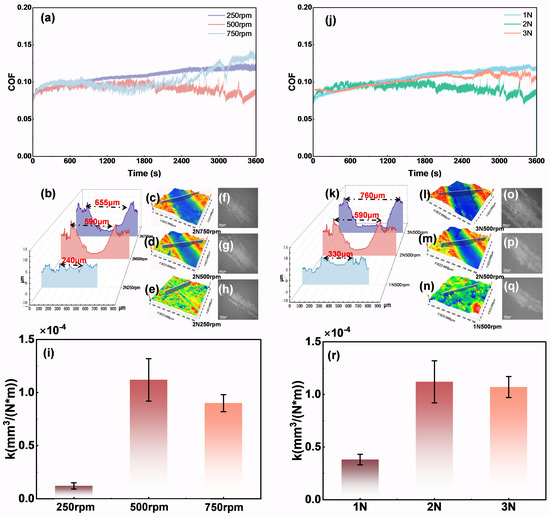
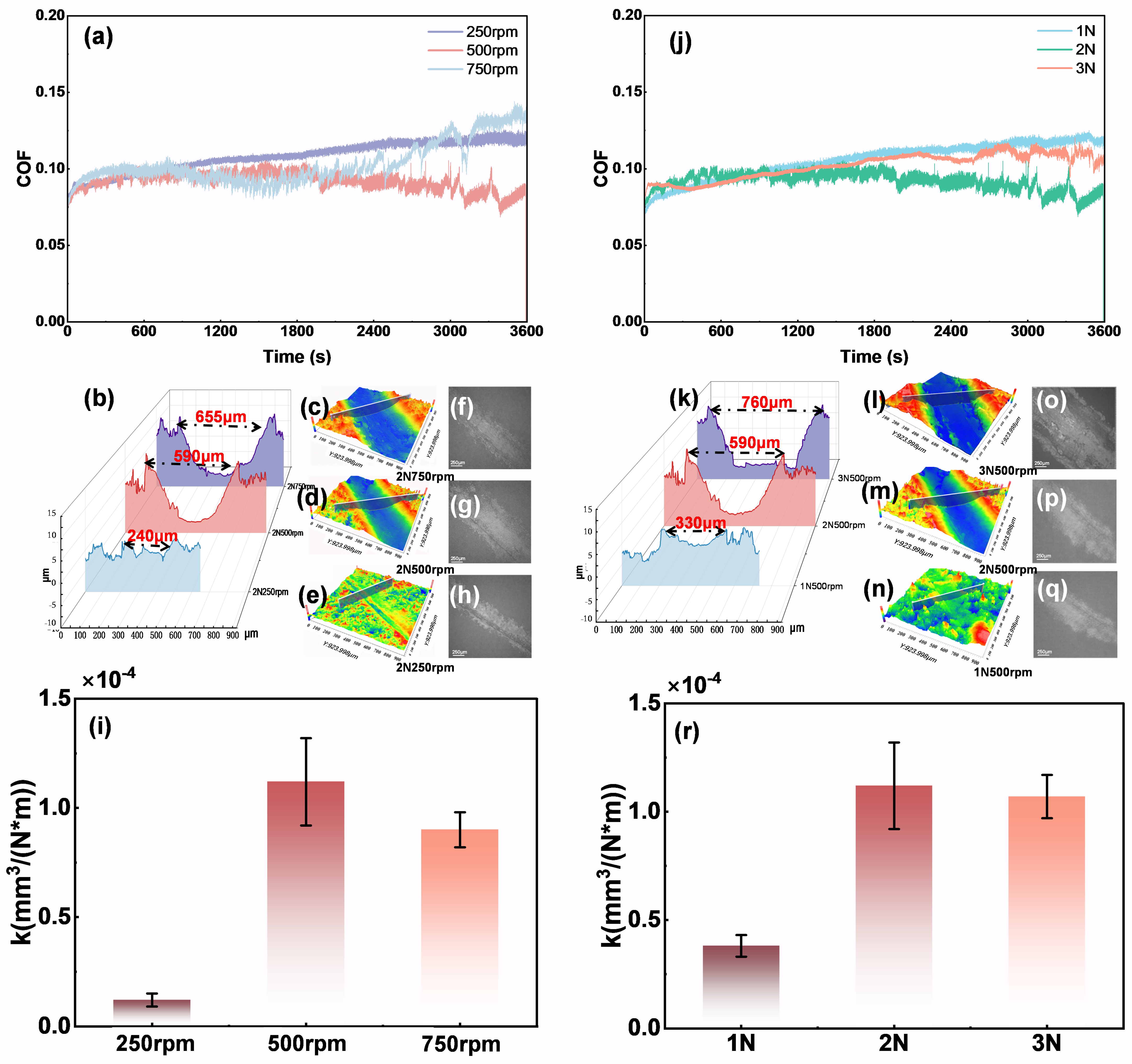
The obtained friction coefficient curves are shown in Figure 4a. Under the condition of 2 N 250 rpm, the friction coefficient rapidly increases from the initial value of 0.075 to 0.090, followed by a slow and steady upward trend, eventually stabilizing around 0.120. At 2 N 500 rpm, the friction coefficient rises from 0.075 to 0.090 within 400 s and remains relatively stable; after approximately 1900 s, it begins to decline and continues to decrease in the subsequent stage, although with significant fluctuations. Under the condition of 2 N 750 rpm, the friction coefficient increases from 0.075 to 0.1 within 250 s and remains at this level for a period; thereafter, it shows a trend of first decreasing and then increasing, primarily due to excessive rotational speed leading to accelerated coating wear and consequently a decline in lubrication performance.
Figure 4.
(a) Coefficient of Friction of Four Coatings at different rotational speeds. (b) Wear scar profile of coatings at different rotational speeds. (c–e) Three-dimensional surface profile of coatings at different speeds. (f–h) The wear scar of coatings at different speeds. (i) Bar chart of specific wear rates for the coatings at different rotational speeds. Error bars indicate the measurement error. (j) Coefficient of Friction of Four Coatings at different rotational loads. (k) Wear scar profile of coatings at different loads. (l–n) Three-dimensional surface profile of coatings at different loads. (o–q) The wear scar of coatings at different loads. (r) Bar chart of specific wear rates for the coatings at different loads. Error bars indicate the measurement error.
The surface morphology of wear scars under different rotational speed conditions was systematically characterized and quantitatively analyzed, with the corresponding results shown in Figure 4c–h. Observations revealed that as the rotational speed increased, the wear scar width exhibited a significant increasing trend. Under the low-speed condition of 250 rpm, the wear behavior was mainly characterized by slight removal of the surface roughness peaks, resulting in relatively shallow wear scars. When the rotational speed increased to 500 rpm, the wear scar width became more uniformly distributed, with obvious debris accumulation observed at the edges. Upon further increasing the speed to 750 rpm, the wear scar width expanded notably, and localized depression morphology appeared at the edge regions.
Quantitative measurements of the wear scar profiles (Figure 4b) further elucidated the influence of rotational speed on wear dimensions: under the 250 rpm condition, the wear scar width was 240 μm, and the depth was 3 μm. When the speed was increased to 500 rpm, the wear scar width increased to 590 μm and the depth reached 17 μm. As the rotational speed was further raised to 750 rpm, the wear scar width increased to 655 μm and the depth was 18.5 μm. These data indicate that higher rotational speeds not only significantly intensify the overall wear of the coating but also promote the evolution of wear morphology from uniform wear to localized concentrated wear.
4.2. Influence of Load on Tribological Properties
Under a constant rotational speed of 500 rpm, tribological tests were conducted on the W01Ni03MSH composite coating system at different stress levels. Figure 4j shows the variation in the friction coefficient over time under each stress level.
Under a load of 1 N, the friction coefficient gradually increased from an initial value of 0.070 and eventually stabilized around 0.120. Under a load of 2 N, the friction coefficient rose from 0.075 to 0.090 within the first 400 s and remained relatively stable; after approximately 1900 s, it began to decline and showed a continuous decreasing trend in the subsequent stage, accompanied by significant fluctuations, with values ranging between 0.075 and 0.1. Under a load of 3 N, the friction coefficient increased rapidly from the initial value of 0.080 to 0.090, then gradually rose to 0.115 and remained stable; minor fluctuations were observed in the later stage of the test, with the overall value maintained around 0.110.
The systematic characterization and quantitative analysis results of the wear morphologies under different load conditions are shown in Figure 4l–q. Under the 1 N condition, the wear behavior was mainly characterized by slight removal of the protruding parts of the coating surface, with relatively shallow wear scar depth and visible debris accumulation at the edges. When the load increased to 2 N, the wear scar width became more uniformly distributed, with obvious debris accumulation features on both sides. Upon further increasing the load to 3 N, the wear scar width increased significantly, local depression morphology appeared at the edge regions, and partial substrate exposure could be observed.
Quantitative measurements of the wear scar profile (Figure 4k) further elucidated the influence of contact stress on wear dimensions: under the 1 N condition, the wear scar width was 330 μm and the depth was 5 μm. When the load increased to 2 N, the wear scar width increased to 590 μm and the depth reached 17 μm. When the load further increased to 3 N, the wear scar width increased to 760 μm and the depth was 19 μm. These data indicate that increasing contact stress not only significantly intensifies the overall wear of the coating but also promotes the evolution of wear morphology from slight surface wear to severe wear with substrate exposure.
When the load is 1 N, the interfacial pressure in the friction pair is relatively low, and the primary wear mechanism involves the progressive removal of surface asperities, resulting in a consistently high friction coefficient. Upon increasing the load to 2 N, the coating surface gradually becomes smoother, and the wear depth increases; however, due to the synergistic effect of layered lubricating phases such as graphite and molybdenum disulfide, the interfacial shear stress is effectively reduced, maintaining the friction coefficient at a relatively favorable level. When the load is further raised to 3 N, the friction conditions become more severe, the wear process intensifies significantly, and the coating undergoes rapid degradation accompanied by an increase in the friction coefficient.
In summary, the W01Ni03MSH solid lubricant coating exhibits optimal friction-reducing performance under a normal load of 2 N.
5. Tribological Mechanism Analysis
5.1. Wear Surface Morphology by SEM
To uncover the physical origins of the synergistic effect at the microstructural level, we observed the worn surfaces using scanning electron microscopy (SEM), focusing on the differences in wear morphology among various composite formulations.
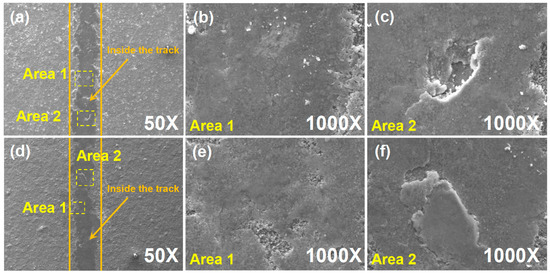
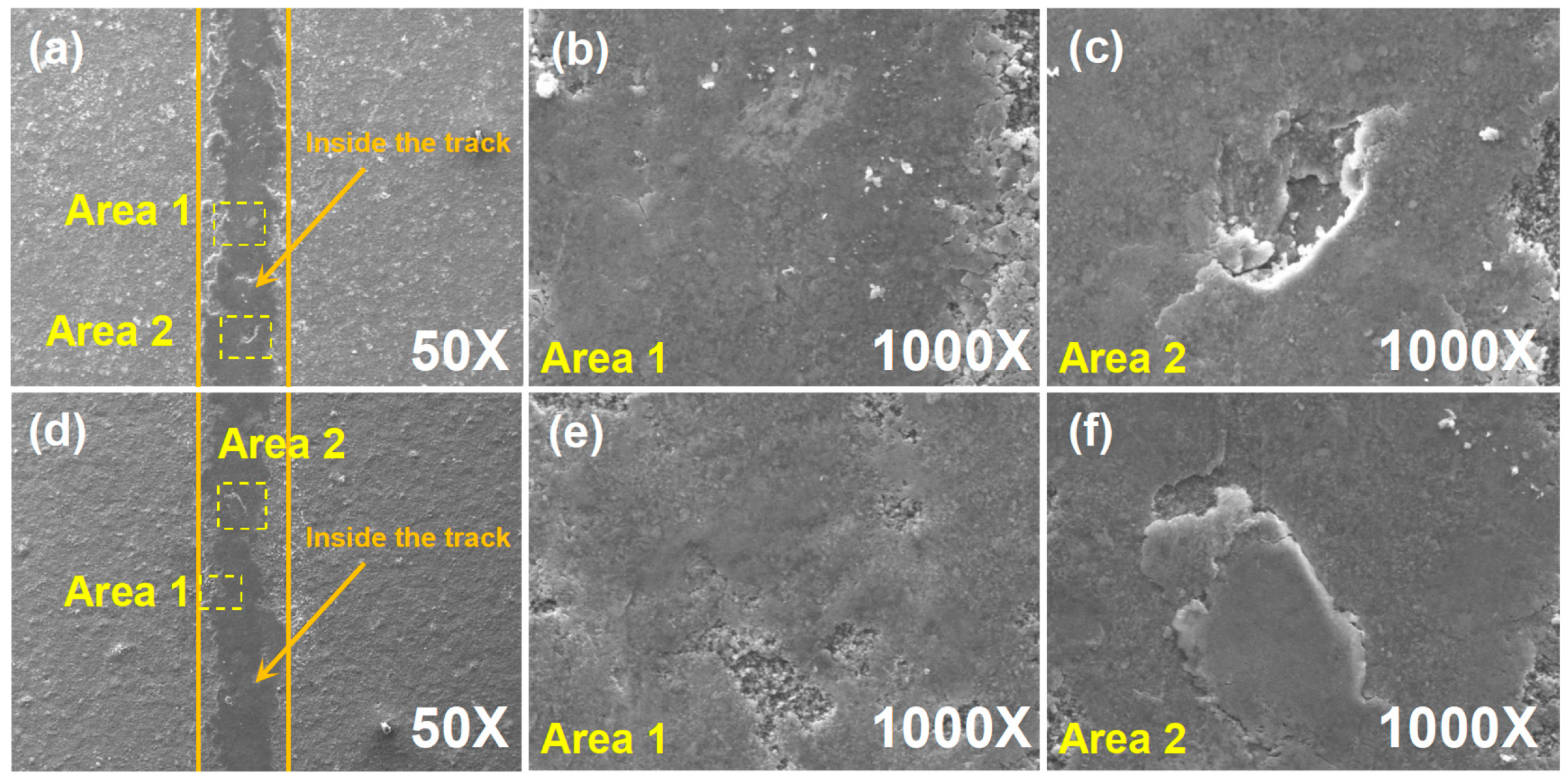
For the coating W03Ni01MSH, SEM images of its worn surface reveal characteristic microstructural features. At low magnifications (Figure 5a), a certain accumulation of wear debris can be observed at the edges of the wear scar, which is typical of sliding friction. At higher magnifications (Figure 5b,c), numerous microvoids of varying sizes are present on the worn surface. These are traces left behind after material spalling due to cyclic stress fatigue. Within these pits and on the surrounding worn surface, a significant amount of flake-like or lamellar wear debris is visible. This morphology of debris, characterized by a high specific surface area and good ductility, facilitates spreading and adhesion onto the surface of the counterface, thereby forming a continuous and stable solid lubricant transfer film.
Figure 5.
(a–c) White light interferometry image of the W03Ni01MSH coating. The area within the orange lines represents the scratch region. (d–f) White light interferometry image of the W01Ni03MSH coating. The area within the orange lines represents the scratch region.
In contrast, the coating W01Ni03MSH exhibits different morphological features. In low-magnification images (Figure 5d), the worn surface appears relatively flat, yet it is also dotted with pits of various sizes. In higher-resolution images (Figure 5e,f), the surface shows more characteristics of adhesive wear, while the pronounced lamellar delamination observed in W03Ni01MSH is less evident. This morphological difference indicates that the ratio of Ni to MSH significantly influences the microscopic wear mechanism of the coating. When the MSH proportion is too high, the increased hardness and brittleness of the coating may make it more prone to micro-fracture or adhesive damage at stress concentration points, thereby altering the dominant failure mode.
5.2. Elemental Analysis by EDS
To understand the distribution and changes in the chemical composition of the coatings before and after wear, we performed elemental analysis on the wear scar areas using energy-dispersive X-ray spectroscopy (EDS).
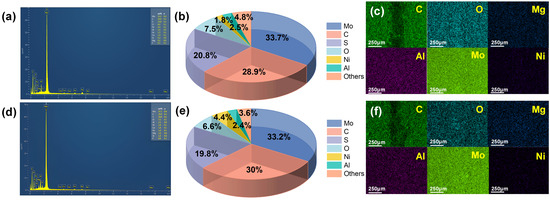
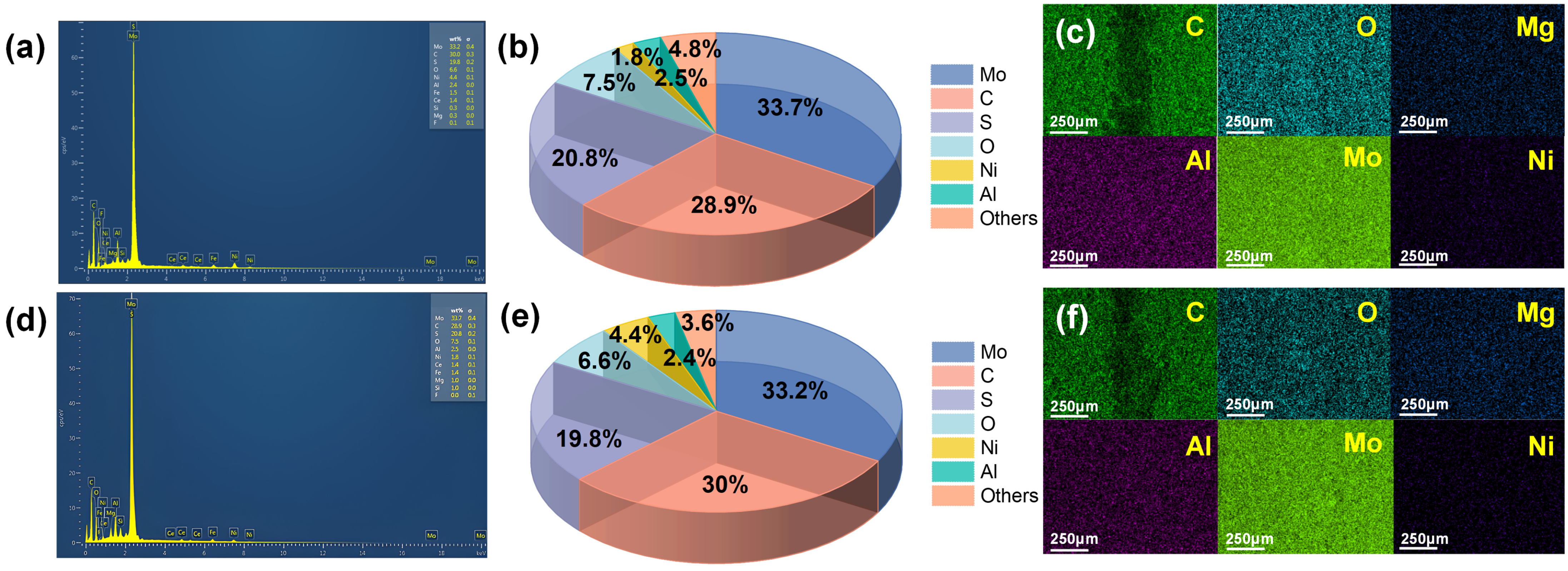
The EDS analysis results for the wear scar of the W03Ni01MSH coating (Figure 6a,b) confirm the presence of elements including Mo, O, among others, in the coating. Elemental mapping (Figure 6c) shows that these elements exhibit a relatively uniform and dispersed distribution within the analyzed area, indicating that no severe segregation or phase separation of the coating components occurred during friction, and good microstructural stability was maintained. The carbon signal intensity in the central region of the wear scar is slightly weaker than in the surrounding unworn areas. This indirectly supports the inference that graphite in the coating transferred to the surface of the counterpart ball during sliding friction, thereby forming a graphite lubricating film on the counterface [33]. This transfer is one of the important contributors to the low friction coefficient achieved by this coating.
Figure 6.
(a,b) EDS element analysis of W03Ni01MSH coating. (c) Scanning image of EDS element area of W03Ni01MSH coating. (d,e) EDS element analysis of W01Ni03MSH coating. (f) Scanning image of EDS element area of W01Ni03MSH coating.
Similar EDS analysis conducted on the wear scar of the W01Ni03MSH coating (Figure 6d–f) also shows uniform distribution of all elements, with no significant changes in chemical composition observed before and after friction. This further confirms the chemical stability of the composite coatings during the friction process.
5.3. Proposed Synergistic Lubrication Mechanism
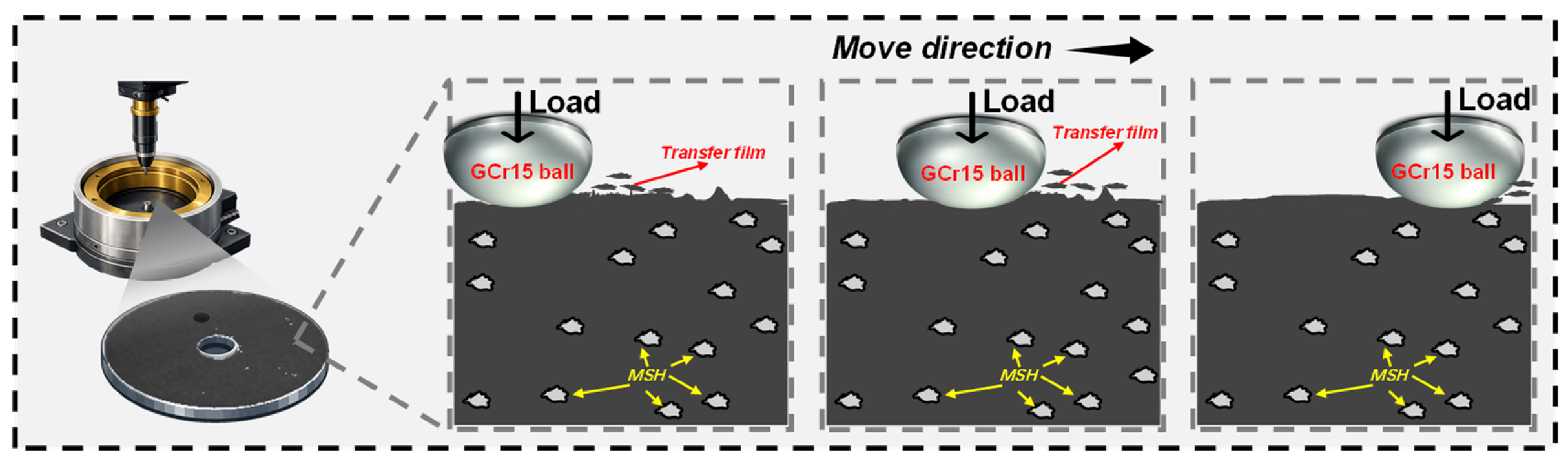
The addition of nano-nickel particles, particularly at the optimal content (0.3 g), promotes the formation of flake-like, easily deformable wear debris. This morphology provides a larger surface area and better adhesion, enabling more effective spreading and compaction on the counterpart ball surface, thereby facilitating the formation of a continuous and firmly adherent solid lubricant transfer film rich in MoS2 and graphite. This transfer film is key to maintaining low interfacial shear strength and a stable, low friction coefficient. Therefore, the primary function of Ni is to optimize the generation and maintenance of the lubricating film.
Magnesium silicate hydroxide (MSH), as a hard, layered silicate mineral, primarily functions as a reinforcing phase, significantly enhancing the mechanical load-bearing capacity, hardness, and modulus of the epoxy coating. It effectively hinders the initiation and propagation of microcracks under cyclic alternating loads, inhibiting plastic deformation and large-scale material spalling of the coating. Thus, the main contribution of MSH is to strengthen the coating matrix, resist wear, and ensure its structural integrity, leading to a marked improvement in wear resistance.
When compounded at a specific optimal ratio (the W01Ni03MSH formulation), the functions of Ni and MSH achieve perfect complementarity and synergy. On one hand, Ni ensures efficient lubrication. On the other hand, MSH provides robust mechanical support. Under the synergistic effect, the wear mechanism of the coating shifts from severe adhesive or abrasive wear to one dominated by controlled contact fatigue and mild delamination, achieving the best balance between low friction and high wear resistance. The mechanism of synergistic action is illustrated in Figure 7.
Figure 7.
Microstructural analysis of wear scars and mechanism exploration.
6. Conclusions
Based on the comprehensive results of this study, the following conclusions are drawn:
The optimal individual dosage of both nano-nickel (Ni) and magnesium silicate hydroxide (MSH) in an epoxy/MoS2 matrix is 0.3 g each. While the addition of 0.3 g Ni alone effectively reduces the steady-state friction coefficient, it simultaneously impairs wear resistance due to coating softening. In contrast, adding 0.3 g MSH alone significantly enhances wear resistance by improving the hardness and load-bearing capacity of the coating, and this dosage represents the best individual performance for each additive.
A clear synergistic effect between Ni and MSH has been experimentally confirmed. The composite coating containing 0.3 g Ni and 0.1 g MSH (W03Ni01MSH) exhibits the most favorable overall performance. Under standard test conditions of 2 N load and 500 rpm, its wear scar width is reduced by 22.5% compared to the coating containing only 0.3 g Ni, while maintaining a similarly low friction coefficient of approximately 0.12. Furthermore, experiments identified 2 N and 500 rpm as the optimal operating conditions for the composite coating. This synergy remains evident and stable under more severe high-speed conditions (750 rpm), demonstrating good operational adaptability.
Microstructural analysis has elucidated the underlying mechanism of this synergy. Nickel primarily functions as a lubrication enhancer by promoting the formation of flake-like debris and a high-quality transfer film, thereby reducing friction. MSH mainly acts as a structural reinforcer, inhibiting crack propagation and excessive wear to improve durability. When combined at the optimal ratio, their complementary functions shift the dominant wear mechanism from severe adhesive or abrasive wear to controlled fatigue and delamination, achieving an optimal balance between low friction and high wear resistance.
In summary, this study demonstrates that the strategic combination of a soft metal (Ni) and a hard layered silicate (MSH) can effectively tailor the tribological properties of MoS2-based coatings through synergistic interactions. The identified optimal formulation, along with the understanding of the complementary roles played by each additive, provides a valuable design strategy for developing advanced solid lubricant coatings capable of meeting demanding engineering applications with customizable performance profiles.
Future work will focus on exploring the synergistic effects of other soft metals (e.g., Cu, Ag) and layered silicates (e.g., hexagonal boron nitride, graphite) with MoS2-based coatings to further optimize the tribological performance and expand the application scope of solid lubricating coatings.
Author Contributions
H.Y. and Y.Z. were responsible for conceptualization, methodology, formal analysis, and investigation, and prepared the original draft. R.L. and T.G. participated in methodology, validation, and data curation. X.L. contributed to formal analysis and data processing. X.G. was involved in investigation and visualization. Z.W. provided resources, supervision, project administration, and funding acquisition. Q.C. assisted with data curation, visualization, and funding acquisition. All authors contributed to the writing, review, and editing of the manuscript. All authors have read and agreed to the published version of the manuscript.
Funding
This research used resources of the Talent Fund of Beijing Jiaotong University (Contract No. M23XKRC00020), the National Natural Science Foundation of China (Grant No. 52005284), the Financial Program of BJAST (Contract No. 24CB011-01), the Tribology Science Fund of State Key Laboratory of Tribology (Grant No. SKLTKF21A02), the Research Institute of Petroleum Processing, Sinopec (Contract No. 3360000-22-ZC0699-0079) and National Key Research and Development Program of China (Contract No. 2022YFB3402904).
Data Availability Statement
All data presented in this study were obtained from original experiments.
Conflicts of Interest
The authors declare no conflicts of interest.
References
- Wu, S.; Tang, Y.; Gu, J.; Li, R.; Liang, Y.; Liu, P.; Wang, H.; An, C.; Deng, Q.; Zhao, L.; et al. Controllable preparation of metal-based lubrication coatings in extreme environmental applications. Mater. Des. 2024, 241, 112922. [Google Scholar] [CrossRef] [Scilit]
- Zhang, L.; Wang, H.; Li, J.; Chen, Y.; Zhao, P.; Liu, S. Numerical calculation and experimental study of the influence of solid lubrication coatings on the lubricating performance of moving components in extreme environments. Tribol. Trans. 2024, 67, 512–528. [Google Scholar]
- Sun, Q.; Song, J.; Li, J.; Lin, P.; Dong, Y.; Su, Y.; Fan, H.; Hu, L.; Zhang, Y. Tribological behavior of h-BN/Al2O3 self-lubricating composites in extreme environments–Part I: Lubricating behavior and ultra-low friction coefficient mechanism in air environments from room temperature to 1200 °C. Tribol. Int. 2025, 201, 110251. [Google Scholar] [CrossRef] [Scilit]
- Sun, Q.; Dong, Y.J.; Song, J.J.; Li, T.; You, X.; Su, Y.F.; Fan, H.Z.; Hu, L.T.; Zhang, Y.S. Tribological behavior of h-BN/Al2O3 self-lubricating composites in extreme environment—Part II: Self-lubrication and mechanism in water-oxygen environment from 300 °C to 1200 °C. Tribol. Int. 2025, 201, 110269. [Google Scholar] [CrossRef] [Scilit]
- Dong, N.; Tong, R.T.; Zhang, C.; Li, S.Y.; Li, Y.W.; Wan, S.J. An improved model of dynamic wear prediction for solid-lubricated planetary gear sets considering thermal effects. Wear 2026, 584–585, 206415. [Google Scholar] [CrossRef] [Scilit]
- Zhu, M.H.; Zhou, Z.R. An investigation of molybdenum disulfide bonded solid lubricant coatings in fretting conditions–Lubricating mechanism based on lamellar crystal structure and weak van der Waals forces. Surf. Coat. Technol. 2001, 141, 240–245. [Google Scholar] [CrossRef] [Scilit]
- Yang, Y.; Fan, X.; Yue, Z.; Li, W.; Li, H.; Zhu, M. Synergistic lubrication mechanisms of molybdenum disulfide film under graphene-oil lubricated conditions–Tribological contribution from lamellar crystal structure and weak van der Waals forces. Appl. Surf. Sci. 2022, 598, 153845. [Google Scholar] [CrossRef] [Scilit]
- Babuska, T.F.; Krick, B.A.; Argibay, N.; Dugger, M.T.; Chandross, M.; Curry, J.F. Revisiting the dwell effect on friction behavior of molybdenum disulfide–Tribological mechanism based on lamellar crystal structure and weak van der Waals forces. Wear 2023, 526–527, 204876. [Google Scholar]
- Ju, H.; Wang, R.; Ding, N.; Yu, L.; Xu, J.; Ahmed, F.; Zuo, B.; Geng, Y. Improvement on the oxidation resistance and tribological properties of molybdenum disulfide film by doping nitrogen–Limitations of pure MoS2 coatings: Oxidation in humid environments, poor load-bearing capacity, and limited wear life. Mater. Des. 2020, 186, 108300. [Google Scholar] [CrossRef] [Scilit]
- Samarasinghe, L.V.; Muthukumaran, S.; Baskaran, K. Engineering MoS2/Fe2O3/graphene oxide–coated PVDF membranes for enhanced self-cleaning and antifouling performance under simulated solar light in dye wastewater treatment. J. Water Process Eng. 2026, 81, 109243. [Google Scholar] [CrossRef] [Scilit]
- Pei, J.M.; Nong, Z.S.; Li, L.; Cui, X.; Zhang, H.L.; Akhmad, A. Enhanced of friction and wear properties for TiC/TC4 coating based on the precipitation of the lubricating and strengthening phases through laser cladding of Cr-WS2-Ni60 powder. J. Mater. Res. Technol. 2025, 39, 8758–8772. [Google Scholar] [CrossRef] [Scilit]
- Gao, M.Y.; Pei, Z.L.; Gong, J.; Song, G.H. The improved wear resistance of Ni-based composite coatings by the synergistic effect of diamond and self-lubricating particles. Colloids Surf. A Physicochem. Eng. Asp. 2026, 730, 138983. [Google Scholar] [CrossRef] [Scilit]
- Zheng, C.J.; Huang, K.P.; Chen, Z.X.; Wu, D.Y.; Cui, W.B.; Wang, H.K.; Yi, X.M. From wear to lubrication: Mechanistic insights into multi-stage wear evolution in Ni-WC/MoS2 composite coatings. Mater. Des. 2025, 260, 115040. [Google Scholar] [CrossRef] [Scilit]
- Do, Q.Q.; An, H.Z.; Meng, G.Z.; Li, W.H.; Zhang, L.C.; Wang, Y.Q.; Liu, B.; Wang, J.Y.; Wang, F.H. Low-valence ion addition induced more compact passive films on nickel-copper nano-coatings. J. Mater. Sci. Technol. 2019, 35, 2144–2155. [Google Scholar] [CrossRef] [Scilit]
- Suhas, V.S.; Shanmugapriya, T. Synergistic ZnO–Ni/PVDF-epoxy nanocomposite coatings for enhanced corrosion resistance and mechanical performance of steel reinforcements in concrete structures. Results Eng. 2025, 28, 107296. [Google Scholar] [CrossRef] [Scilit]
- Arroyo, A.; Vásquez, F.A.; Calderón, J.A. Structural modification of electrodeposited nickel coatings by ceramic particles incorporation to enhance corrosion-erosion resistance. J. Mater. Res. Technol. 2025, 35, 7332–7345. [Google Scholar] [CrossRef] [Scilit]
- Li, H.J.; Huang, H.F.; Cai, D.Q.; Xiao, J.; Yuan, X.; Zhu, W.X.; Lv, L.C. ZrB2-reinforced electroless Ni-W-P composite coating with enhanced corrosion and wear resistance in 3.5 wt% NaCl solution. Int. J. Electrochem. Sci. 2026, 21, 101293. [Google Scholar] [CrossRef] [Scilit]
- Wei, S.J.; Qi, Z.T.; Liu, H.; Yan, F.Y.; Wang, J.Z.; Li, H.C. Tribological performance of journal bearings for fuel oil lubrication based on Ni-coated graphite hybrid microparticle and carbon fiber reinforced polytetrafluoroethylene composites. J. Mater. Res. Technol. 2025, 36, 7410–7421. [Google Scholar] [CrossRef] [Scilit]
- Zhao, Y.T.; Liu, S.Q.; Guo, H.; Li, H.X.; Zhang, J.N.; Ma, Z.; Zhong, N.; Li, W.G.; Ji, V. Mechanistic insights on the microstructural evolution and tribological performance of the Ni–MoS2 composite coatings electrodeposited under different current densities. J. Mater. Res. Technol. 2025, 36, 8325–8336. [Google Scholar] [CrossRef] [Scilit]
- Thakur, S.; Thakur, I.; Kumar, R. A review on synthesized NiO nanoparticles and their utilization for environmental remediation–Nickel as metallic additive: Improving coating compactness and NiO inhibiting MoS2 oxidation. Inorg. Chem. Commun. 2025, 172, 113758. [Google Scholar] [CrossRef] [Scilit]
- Nishiki, Y.; Cama, J.; Otake, T.; Kikuchi, R.; Shimbashi, M.; Sato, T. Formation of magnesium silicate hydrate (M-S-H) at pH 10 and 50 °C in open-flow systems. Appl. Geochem 2023, 148, 105544. [Google Scholar] [CrossRef] [Scilit]
- Cai, X.F.; Li, S.J.; Zeng, W.; Huang, K.; Zhao, L.; Zeng, D.H.; Tu, X.H. Improving dispersion and tribological performance of MoS2 lubricant additive with the synergistic effects of MSH and amorphous carbon. J. Mater. Res. Technol. 2024, 29, 2509–2519. [Google Scholar] [CrossRef] [Scilit]
- Wang, B.; Gao, K.; Wang, Y.; Chang, Q.; Yang, H. Synergistic dispersion, adsorption, and anti-wear effects of magnesium silicate hydroxide nanomaterials and carboxylic acid. Appl. Surf. Sci. 2024, 665, 160373. [Google Scholar] [CrossRef] [Scilit]
- Sathishkumar, S.R.; Durairasan, M. Enhancing the capabilities of Mg–4Zn-1RE-0.7Zr alloy through synergistic integration of ceramic (ZrO2) & solid lubricant (BN/MoS2) reinforcements: A Taguchi-GRA optimization approach–Scarcity of research on synergistic interactions between soft metals (Ni) and layered silicates (MSH) in MoS2 coatings. Ceram. Int. 2024, 50, 21710–21725. [Google Scholar]
- Anand, T.; Ranganathan, L.; Prabaharan, G.; Srithar, A. Mechanical behaviour of Al6061 hybrid nanocomposites reinforced with nano alumina and molybdenum disulfide. Mater. Today Proc. 2023. [Google Scholar] [CrossRef] [Scilit]
- Liu, C.; Chen, L.; Zhou, J.; Zhou, H.; Chen, J. Tribological properties of adaptive phosphate composite coatings with addition of silver and molybdenum disulfide. Appl. Surf. Sci. 2014, 300, 111–116. [Google Scholar] [CrossRef] [Scilit]
- Yin, Y.L.; Yu, H.L.; Wang, H.M.; Ji, X.C.; Song, Z.Y.; Zhou, X.Y.; Wei, M.; Shi, P.J.; Zhang, W.; Zhao, C.F. Tribological behaviors of AZ91D magnesium alloy under the lubrication of oil suspended synthetic magnesium silicate hydroxide nanotubes. J. Magnes. Alloys 2025, 13, 379–397. [Google Scholar] [CrossRef] [Scilit]
- Zhu, Z.X.; Chen, W.B.; Bian, Z.; Sun, Q.C.; Zheng, M.; Zhu, S.Y.; Cheng, J.; Yang, J. Self-lubrication of high-entropy carbide matrix composites over a wide temperature range: The synergistic effect of silver and molybdenum component. Wear 2024, 546–547, 205341. [Google Scholar] [CrossRef] [Scilit]
- Zhang, W.Y.; Wang, J.W.; Yang, Q.S.; Zhai, Y.; Qiao, Y.Y.; He, J.P.; Feng, Y.B.; Gong, W.B.; Li, Q.L. Synergistic effect of Co-Mn co-doping on enhancing the stability and electrochemical performance of nickel-based layered double hydroxides. J. Energy Storage 2026, 152, 120678. [Google Scholar] [CrossRef] [Scilit]
- Fazel, M.; Jazi, M.R.G.; Bahramzadeh, S.; Bakhshi, S.R.; Ramazani, M. Effect of solid lubricant particles on room and elevated temperature tribological properties of Ni–SiC composite coating. Surf. Coat. Technol. 2014, 254, 252–259. [Google Scholar] [CrossRef] [Scilit]
- Sharma, A.; Mendelsohn, O.; Bisht, A.; Michler, J.; Koju, R.K.; Mishin, Y.; Rabkin, E. Solid-solution and precipitation softening effects in defect-free faceted Nickel-Iron nanoparticles. Acta Mater. 2023, 243, 118527. [Google Scholar] [CrossRef] [Scilit]
- Ni, S.; Wang, Y.B.; Liao, X.Z.; Alhajeri, S.N.; Li, H.Q.; Zhao, Y.H.; Lavernia, E.J.; Ringer, S.P.; Langdon, T.G.; Zhu, Y.T. Strain hardening and softening in a nanocrystalline Ni-Fe alloy induced by severe plastic deformation. Mater. Sci. Eng. A 2011, 528, 3398–3403. [Google Scholar] [CrossRef] [Scilit]
- Liu, J.L.; Wang, Y.S.; Yu, C.B. Few-layer MoS2 modified epoxy/MoS2-graphite coating: Robust solid lubrication enabling sustained tribological performance during oil lubrication failure. Surf. Interfaces 2025, 72, 107346. [Google Scholar] [CrossRef] [Scilit]

Disclaimer/Publisher’s Note: The statements, opinions and data contained in all publications are solely those of the individual author(s) and contributor(s) and not of MDPI and/or the editor(s). MDPI and/or the editor(s) disclaim responsibility for any injury to people or property resulting from any ideas, methods, instructions or products referred to in the content. |
© 2026 by the authors. Licensee MDPI, Basel, Switzerland. This article is an open access article distributed under the terms and conditions of the Creative Commons Attribution (CC BY) license.