


Abstract
Limestone habitats in Southeast Asia often harbour narrowly distributed plant diversity, and several limestone-associated taxa of Boesenbergia require further taxonomic documentation. Field surveys and ex situ observations of living material from Loei Province, northeastern Thailand, revealed a distinctive Boesenbergia population associated with shaded limestone microhabitats. This study evaluates this population using comparative morphology, herbarium and literature comparisons, phenetic analyses based on 25 selected morphological characters, and a preliminary conservation assessment. Boesenbergia lamudiae Boonma, Saensouk & P.Saensouk, sp. nov., is described and illustrated. The species is morphologically most similar to B. burmanica Boonma, P.Saensouk & Saensouk, and resembles B. rotunda sensu lato in having a terminal inflorescence enclosed within the leaf sheaths and lacking an androecial cup. It differs by its broadly elliptic to ovate-elliptic laminae with an arachnoid abaxial surface, maroon lanceolate bracts, longer pubescent calyx with an acute to acuminate apex, non-saccate obovate labellum with a sharply delimited maroon transverse colour zone, larger anther crest, longer epigynous glands, and pubescent ovary. Principal coordinates analysis (PCoA) and unweighted pair group method with arithmetic mean (UPGMA) clustering based on Gower distance separated B. lamudiae from all compared operational units, supporting its morphological distinctiveness. The species is currently known only from Nong Hin District and is provisionally assessed as Critically Endangered (CR) under criterion D.
1. Introduction
The genus Boesenbergia Kuntze, belonging to the family Zingiberaceae and placed within the tribe Zingibereae, comprises 102 accepted species [1] distributed mainly throughout tropical Asia, from India across southern China and mainland Southeast Asia to the Malesian region, extending further south to the Lesser Sunda Islands and east to the Philippines [1,2,3,4,5,6,7,8,9]. Members of the genus are typically found in forest understorey habitats, although several species also occur in more specialized environments, including limestone areas, seasonal forest margins, and open plateaux [7,8,9,10,11]. Limestone habitats are of particular interest because they often form isolated ecological units with shallow soils, exposed rock surfaces, and heterogeneous shaded microhabitats. In Thailand, limestone areas have repeatedly yielded narrowly distributed and previously overlooked plant taxa, including several limestone-associated species of Zingiberaceae [12,13,14,15]. These findings indicate that limestone habitats may function as microhabitats for rare, localized, and endemic plant diversity, and emphasize the need for continued floristic and taxonomic surveys.
The circumscription of Boesenbergia has undergone considerable taxonomic revision over time, including the transfer of species from genera such as Caulokaempferia and Haplochorema, as well as the synonymization of Jirawongsea based on combined morphological and molecular evidence [16]. These changes have broadened the morphological limits of the genus, particularly with respect to floral structure, including variation in labellum shape, anther crest morphology, and the presence or absence of an androecial cup [16,17]. As a result, species delimitation within Boesenbergia remains challenging, especially in groups exhibiting overlapping vegetative characters or variable floral coloration.
One such problematic complex centres around Boesenbergia rotunda (L.) Mansf., a widely distributed and morphologically variable species [1,2,3,4,7,9,11]. Across its range, B. rotunda shows considerable variation in plant size, leaf morphology, indumentum, flower length, labellum shape, and floral coloration, particularly in the labellum, which may display diverse combinations of white, pink, red, or violet tones [2,4,9,11,17]. The colour pattern of the labellum is often diffuse, spotted, striped, or radiating, and the presence or intensity of markings may vary among regional descriptions. This high degree of variation has led to a broad species concept, under which several morphologically distinct taxa have been placed in synonymy.
However, recent re-examination of morphological characters, especially floral traits, suggests that this broad circumscription may obscure distinct species-level diversity. Characters such as labellum shape and colour pattern, indumentum of vegetative and floral parts, calyx length and apex morphology, ovary indumentum, and androecial features, including filament pigmentation and anther crest morphology, appear to be more stable and taxonomically informative than previously recognized [2,11]. In addition, the absence of an androecial cup defines a morphologically coherent group within Boesenbergia, within which several superficially similar species occur. Delimitation of species in this group requires careful evaluation of floral morphology based primarily on living material, because herbarium specimens alone may not adequately preserve critical characters such as colour pattern, floral orientation, labellum texture, indumentum, and fine structural details.
Living material of Boesenbergia cultivated at Brio Botanical Research Garden, Nakhon Nayok, Thailand, has flowered regularly since 2019, allowing for detailed observation of floral morphology over multiple seasons. Among these collections, plants derived from material originally collected from Nong Hin District, Loei Province, northeastern Thailand, were found to possess a distinctive and stable combination of morphological characters. The same diagnostic characters were also observed in the natural population again in 2025, indicating that they are not transient abnormalities or characters induced only under cultivation. The Loei material is morphologically most similar to B. burmanica Boonma, P.Saensouk & Saensouk and also resembles B. rotunda sensu lato in its terminal inflorescence enclosed within the leaf sheaths and absence of an androecial cup. Nevertheless, it differs from these and other related taxa by its unusually long pubescent calyx with an acute to acuminate apex, non-saccate obovate labellum with a sharply delimited deep reddish to maroon transverse band across the throat, larger recurved anther crest, and pubescent ovary.
This study hypothesizes that the limestone-associated Boesenbergia population from Loei Province represents a distinct species rather than an environmentally induced form or an extreme variant of B. rotunda sensu lato. Therefore, the present study evaluates the limestone-associated Boesenbergia population from Loei Province as a morphology-based taxonomic hypothesis, using repeated observations of living material, herbarium and literature comparisons, and focused phenetic analyses of morphologically similar taxa. In addition, a diagnostic character matrix and a focused phenetic similarity analysis of selected morphologically similar taxa lacking an androecial cup were used to evaluate the morphological distinctiveness of the Loei population. The aims of this study are to describe and illustrate the new species, assess its diagnostic characters using comparative morphological and phenetic evidence, and discuss its limestone microhabitat and preliminary conservation status.
2. Materials and Methods
2.1. Field Observations, Living Material, and Ex Situ Cultivation
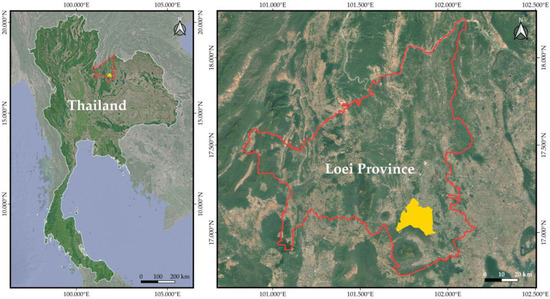
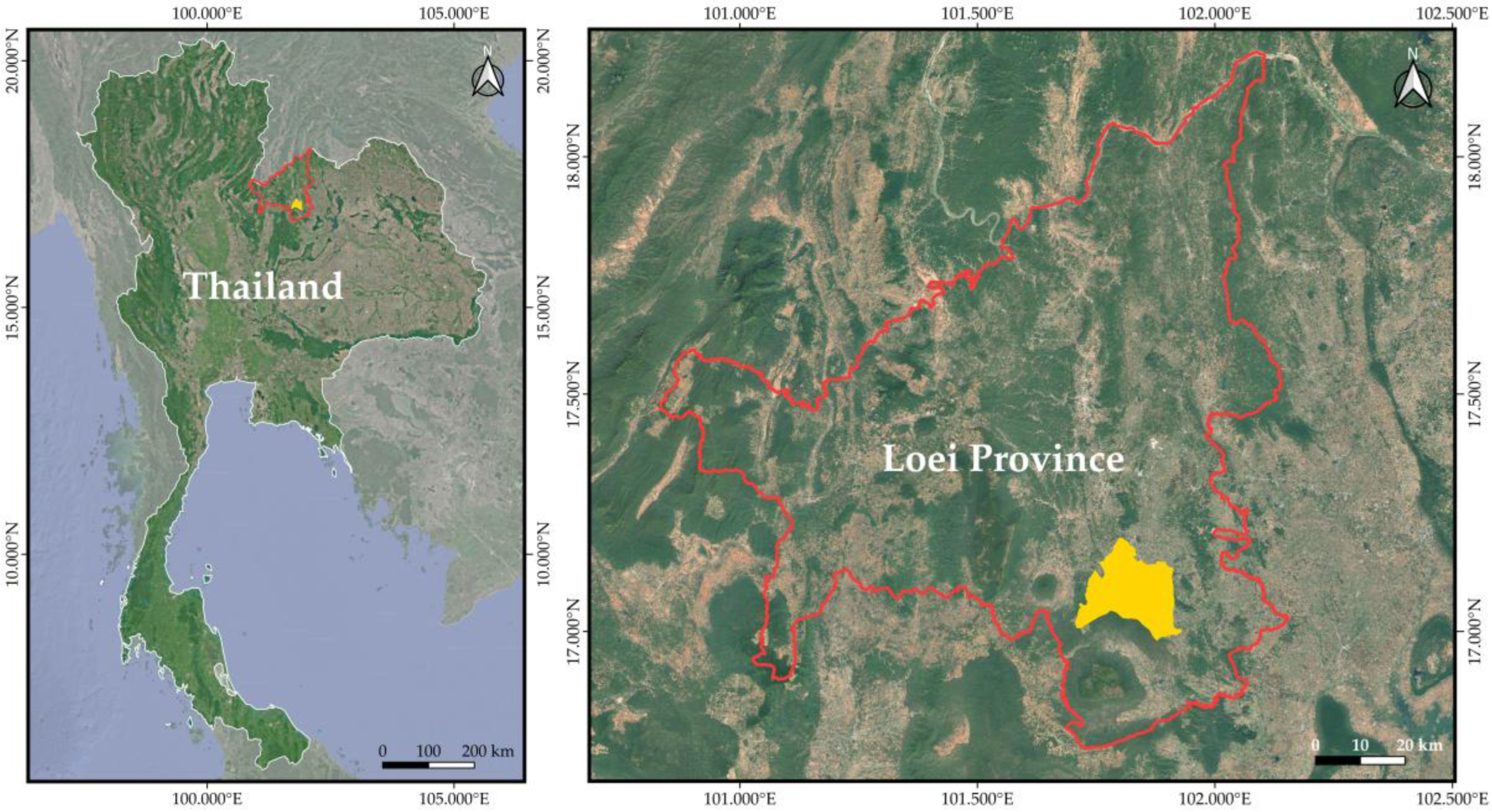
The morphological description of the new species was based primarily on living flowering plants observed in a natural population in a limestone-associated habitat in Loei Province, northeastern Thailand (Figure 1).
Figure 1.
Location of the study area of Boesenbergia lamudiae Boonma, Saensouk & P.Saensouk sp. nov. in Nong Hin District, Loei Province, northeastern Thailand. The left map indicates the position of Loei Province within Thailand, with the yellow area representing the study district. The right map shows the boundary of Loei Province in red and the study area in Nong Hin District in yellow (map created with QGIS program ver. 3.34, geographic system ID: WGS 84, EPSG 4326).
The population was first documented in 2019, and additional field observations were made to confirm the persistence of diagnostic characters in the natural habitat. Measurements were obtained from 20 mature flowering individuals observed in situ to ensure consistency in character assessment. Because the population at the study site was estimated to comprise fewer than 50 individuals, collection was kept to a minimum. Only five rhizomes were collected for ex situ cultivation to avoid excessive disturbance to the natural population.
The collected rhizomes were cultivated at Brio Botanical Research Garden, Nakhon Nayok, Thailand. Flowering plants derived from the type locality were monitored under cultivation to evaluate whether diagnostic characters remained stable outside the natural habitat. Attention was given to the persistence of floral characters, including calyx length and indumentum, calyx apex shape, labellum shape and colour pattern, anther crest morphology, and ovary indumentum. These observations were used to assess character stability but were not treated as separate morphometric samples from the natural population. The study site is located outside a protected area, and no specific permits were required for plant collection under local regulations. Voucher specimens of the studied material were deposited at the Vascular Plant Herbarium, Mahasarakham University (VMSU).
2.2. Herbarium Study and Comparative Taxonomic Sources
Herbarium specimens were studied through a combination of direct examination and digital resources. Accessible collections were investigated in person, whereas additional material was examined using high-resolution images from online repositories, including the Chinese Virtual Herbarium [18]. Specimens examined on-site were from the following herbaria: B, BK, BKF, BM, C, CAL, DMSC, E, HN, HNPM, HNU, IBK, IMDY, KKU, L, P, QBG, SGN, SING, VMSU, VNM, and VNMN. Specimens examined exclusively through digital images were from A, AAU, BR, HITBC, K, NY, RAF, TNS, and US. Herbarium acronyms follow the Index Herbariorum [19].
Type material, protologues, and published descriptions were consulted where available. Comparative assessments were conducted using published descriptions [2,5,6,7,8,9,10,11,12,20,21,22,23,24,25,26,27,28,29,30,31,32,33,34,35,36,37,38,39], herbarium specimens, and field observations of morphologically similar taxa within Boesenbergia. Particular emphasis was placed on taxa lacking an androecial cup and on species or previously described forms morphologically similar to the Loei population, including B. burmanica, B. rotunda sensu lato, B. meghalayensis, B. baimaii and B. isanensis.
These taxa and published regional descriptions were selected because they share key features relevant to the delimitation of the Loei population, especially the terminal inflorescence enclosed within the leaf sheaths, absence of an androecial cup, and overall similarity to the B. rotunda sensu lato complex. The comparison was therefore designed as a focused taxonomic assessment rather than a genus-wide revision of Boesenbergia.
2.3. Morphological Measurements and Terminology
Measurements of vegetative and reproductive structures were taken from fresh material using a standard ruler and a digital vernier caliper (Mitutoyo Corporation, Kawasaki, Japan). Fine morphological features, including surface indumentum, calyx structure, labellum morphology, anther crest, stigma, ovary indumentum, and inflorescence structure, were examined using a stereomicroscope (Stemi 2000-C; Carl Zeiss, Oberkochen, Germany). Morphological terminology follows Beentje [40]. Nomenclature was verified using Plants of the World Online [1] and the International Plant Names Index [41].
2.4. Comparative Morphological Analysis
A comparative morphological analysis was conducted using both quantitative and qualitative characters. Quantitative characters, such as flower length, calyx length, floral tube length, labellum size, lateral staminode size, anther crest size, ovary size, and epigynous gland length, were summarized as measurement ranges. Qualitative characters, such as calyx indumentum, calyx apex shape, labellum saccation, labellum colour pattern, anther crest shape, stigma morphology, ovary indumentum, and habitat, were evaluated as diagnostic character states. Because measurements of related taxa were mostly available as ranges from protologues and published descriptions rather than as individual-level raw data, multivariate analyses requiring raw individual measurements, such as PCA, were not performed. Instead, comparative evidence was summarized using a diagnostic character matrix and selected range comparisons. This approach allowed for direct comparison between the newly collected living material and published taxonomic evidence without treating literature ranges as individual observations.
2.5. Phenetic Analysis
To evaluate overall morphological similarity among Boesenbergia lamudiae and relevant related taxa, a focused phenetic similarity analysis was performed using 25 selected vegetative and floral characters. The analysis was not designed as a genus-wide assessment of Boesenbergia. Instead, it was restricted to selected morphologically similar taxa lacking an androecial cup, with particular emphasis on taxa associated with the B. rotunda sensu lato complex and species relevant to the delimitation of B. lamudiae. Published regional descriptions of B. rotunda sensu lato were treated as separate operational units to avoid obscuring regional morphological variation within a single polymorphic taxon. This treatment was used only for comparative phenetic purposes and does not imply taxonomic recognition of these operational units as separate taxa.
Habitat and distributional characters were excluded from the phenetic matrix to avoid ecological or geographical bias in the clustering. Quantitative characters were converted into discrete character states, whereas qualitative characters were coded as categorical states. A similarity dendrogram was generated using unweighted pair group method with arithmetic mean (UPGMA) [42] based on Gower distance [43]. Principal coordinates analysis (PCoA) was also performed using the same Gower distance matrix to visualize overall morphological separation among the operational units. The analysis was conducted using PAST software version 4.15 [44]. The resulting dendrogram and PCoA were interpreted only as phenetic summaries of morphological similarity and were not used as evidence of phylogenetic relationships or evolutionary independence. The character definitions and coded character-state matrix are provided in Table A1 and Table A2, respectively.
2.6. Microhabitat and Population Observations
Microhabitat observations were recorded at the type locality, including substrate, elevation, shading, limestone association, and the approximate number of observed individuals. The habitat was characterized by shaded limestone-associated conditions with sandy loam soil mixed with limestone rocks at approximately 420–450 m above sea level (a.s.l.). The observed population size was estimated to be fewer than 50 individuals. These field observations were used to provide ecological context for the new species and to support discussion of limestone microhabitats as potential reservoirs of localized Zingiberaceae diversity.
2.7. Preliminary Conservation Assessment
The conservation status of the new species was preliminarily assessed following the IUCN Red List Categories and Criteria [45]. Because the species is currently known only from the type locality, and because adjacent limestone habitats have not yet been sufficiently surveyed, the extent of occurrence, area of occupancy, number of locations, population trend, and continuing threats remain insufficiently known. The assessment is therefore treated as provisional.
2.8. Figure Preparation
All photographic plates and figure compositions were prepared using Pixelmator Pro (version 3.6.5, “Archipelago”; Pixelmator Team, Vilnius, Lithuania) on a MacBook Pro (13-inch, M1, 2020; Apple Inc., Cupertino, CA, USA). Scientific illustrations were digitally created using an iPad Air (5th generation; Apple Inc.) running iPadOS 17.5.1. All figures were prepared and drawn by the first author.
3. Results
Field observations, ex situ cultivation, and comparative morphological assessment support the recognition of the limestone-associated Boesenbergia population from Loei Province as a distinct species. The plants consistently exhibited a stable combination of vegetative and floral characters in both the natural population and cultivated material derived from the type locality. Among the taxa examined, the Loei population is morphologically most similar to B. burmanica and resembles B. rotunda sensu lato in having a terminal inflorescence enclosed within the leaf sheaths and lacking an androecial cup. However, it differs from these and other morphologically similar taxa by its unusually long pubescent calyx with an acute to acuminate apex, non-saccate obovate labellum with a sharply delimited deep reddish to maroon transverse band across the throat, larger recurved anther crest, and pubescent ovary. The diagnostic characters observed in living flowering material remained stable under ex situ cultivation and did not correspond to any previously described species. Therefore, the Loei population is described here as a new species, B. lamudiae Boonma, Saensouk & P.Saensouk.
3.1. Taxonomic Treatment of New Species
Boesenbergia lamudiae Boonma, Saensouk & P.Saensouk, sp. nov.
Type: THAILAND, Northeastern, Loei Province, Nong Hin District, c. 425 m elevation, 7 July 2019, T.Boonma 77 (holotype VMSU).
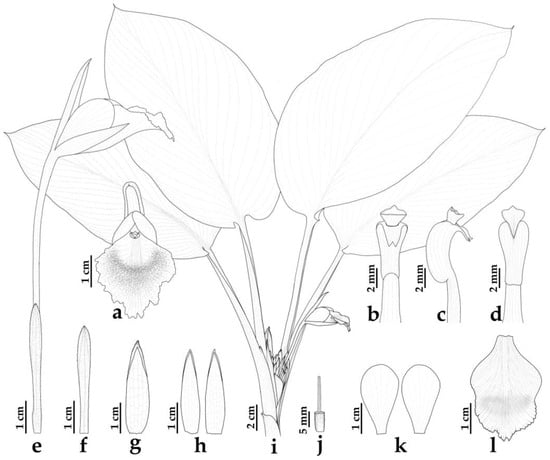
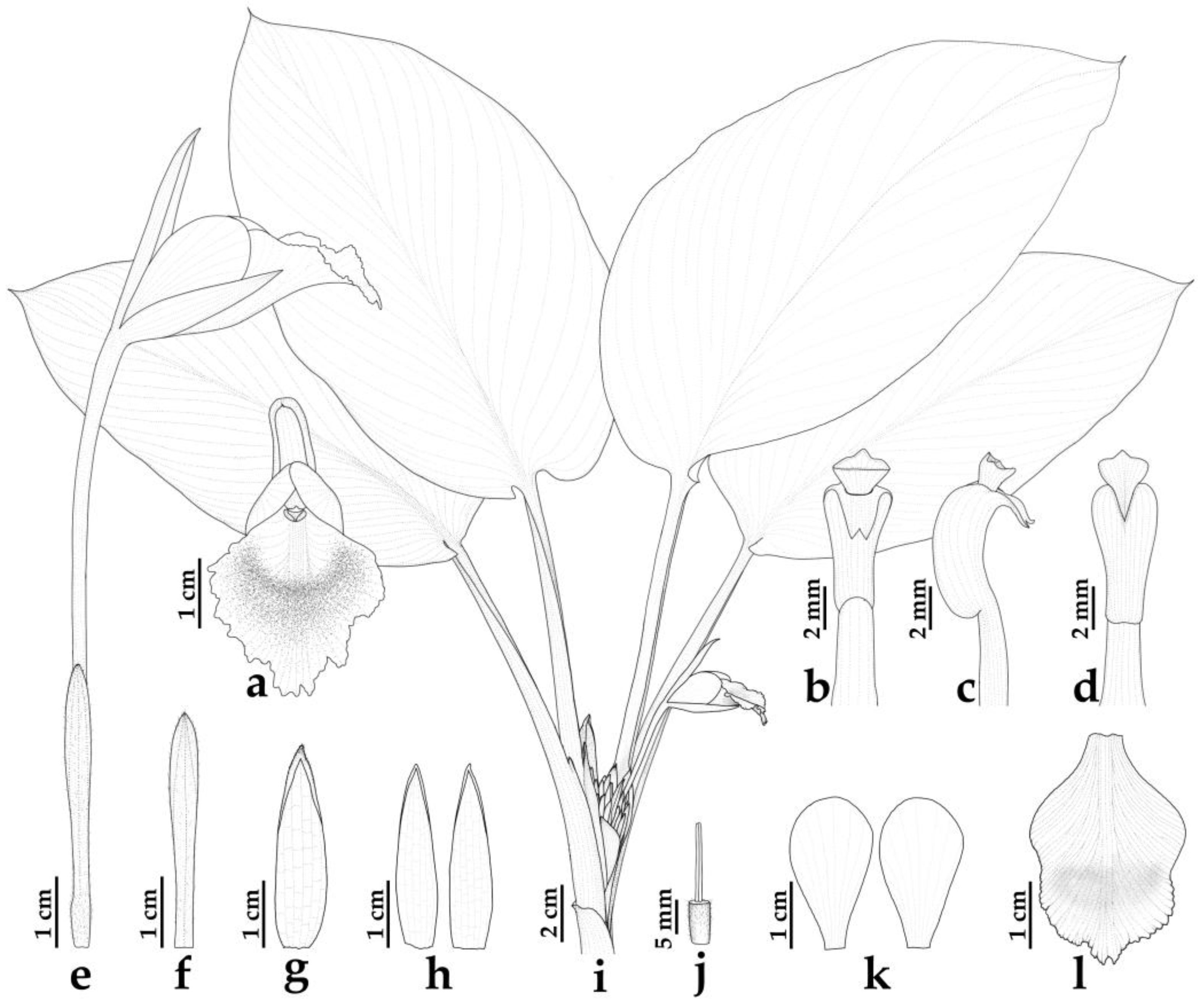
Diagnosis. Boesenbergia lamudiae is morphologically most similar to B. burmanica Boonma, P.Saensouk & Saensouk in having a terminal inflorescence enclosed within the leaf sheaths, pubescent to puberulous vegetative parts, puberulent to pubescent calyx, absence of an androecial cup, non-saccate labellum, recurved anther crest, and cup-shaped stigma, but differs by its larger laminae, mostly 30–42 × 8–15 cm, broadly elliptic to ovate-elliptic or sometimes slightly oblong-elliptic (vs. 10–34 × 4–7.5 cm, narrowly elliptic), more flowers per spike (15–20 vs. 9–10), maroon narrowly lanceolate to lanceolate bracts (vs. pale green oblong bracts), longer flowers (10.5–12 cm vs. 8–9 cm), longer calyx with an acute to acuminate apex (3.2–3.6 cm long vs. 2.2–2.5 cm long and bifid), longer floral tube (7.8–8.5 cm vs. 5.5–5.8 cm), larger white glabrous lateral staminodes (2.2–2.5 × 1.2–1.4 cm vs. 1.4–1.5 × 0.8–0.9 cm, sparsely puberulous), obovate labellum with a distinct zonal colour pattern, the basal portion white to creamy white with a very pale pinkish tint along the central basal region and midline, the throat with a sharply delimited deep reddish to maroon transverse band, and the distal portion pinkish purple to pale pink, darker toward the centre and apex, with conspicuously darker veins, rarely with small reddish spots (vs. oblanceolate labellum, white with bright red towards the apex and reddish spots in the midlobe), larger anther crest (ca. 3 × 2.5 mm vs. ca. 1 × 1 mm), longer epigynous glands (10–12 mm vs. 7.4–8 mm), and larger pubescent ovary (5–7 × 2.5–3 mm vs. ca. 3 × 2 mm, glabrous). It is also distinguished from B. rotunda sensu lato by its abaxially arachnoid laminae, longer pubescent calyx with an acute to acuminate apex, non-saccate obovate labellum with a sharply delimited transverse colour band, longer epigynous glands, pubescent ovary, and apparently restricted limestone-associated habitat in Loei Province, northeastern Thailand (Table 1, Figure 2 and Figure 3).
Table 1.
Diagnostic morphological comparison of Boesenbergia lamudiae, B. burmanica, and B. rotunda sensu lato.
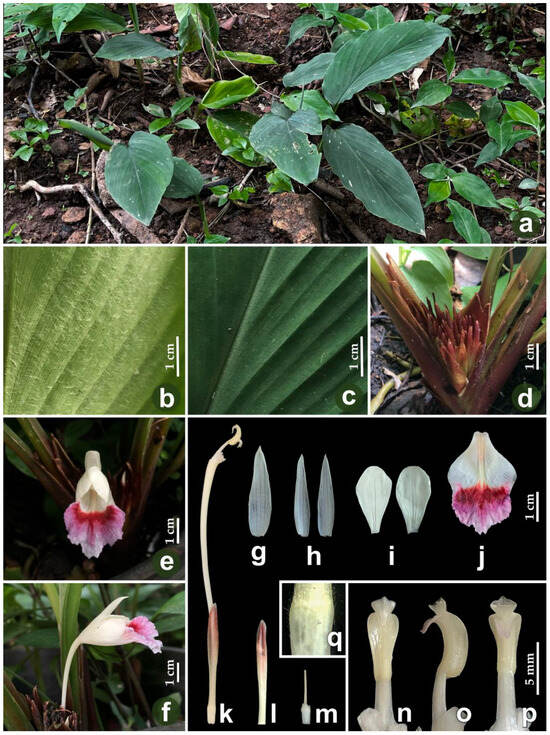
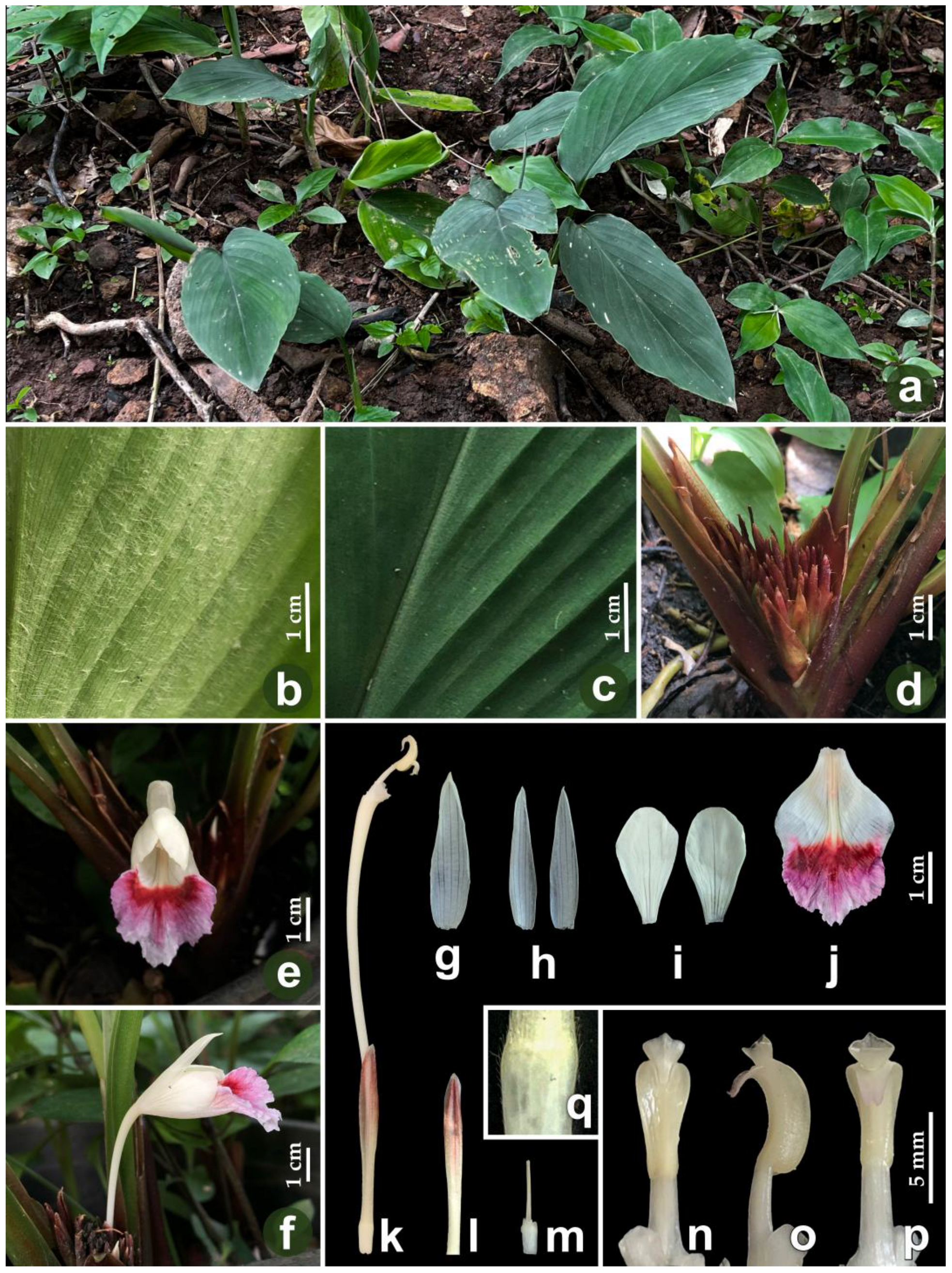
Figure 2.
Boesenbergia lamudiae Boonma, Saensouk & P.Saensouk, sp. nov.: (a) Habit in natural habitat. (b) Abaxial leaf surface. (c) Adaxial leaf surface. (d) Terminal inflorescence enclosed within the leaf sheaths. (e) Front view of flower. (f) Side view of flower. (g) Dorsal corolla lobe. (h) Lateral corolla lobes. (i) Lateral staminodes. (j) Labellum. (k) Floral tube with stamen, calyx, and ovary. (l) Calyx. (m) Ovary with epigynous glands. (n–p) Front, lateral, and back views of stamen. (q) Close up of pubescent ovary. Photographs by Thawatphong Boonma.
Figure 3.
Boesenbergia lamudiae Boonma, Saensouk & P.Saensouk, sp. nov.: (a) Front view of flower. (b–d) Back, lateral, and front views of stamen. (e) Side view of flower. (f) Calyx. (g) Dorsal corolla lobe. (h) Lateral corolla lobes. (i) Habit. (j) Ovary with epigynous glands. (k) Lateral staminodes. (l) Labellum. Drawn by Thawatphong Boonma.
Description: Perennial rhizomatous herb, 35–50 cm tall. Primary rhizome ovoid, 1.5–2 cm in diameter, externally brown, internally yellow, aromatic; branches opposite, producing new shoots and forming a loose clump. Roots fibrous with ovoid to ellipsoid tubers, tapering distally. Pseudostem 10–18 cm tall; sheath distichous, maroon to russet, sometimes green distally, pubescent. Leaves (3–)4–6 per pseudostem; ligule bilobed, 1.5–1.7 cm long, lobes triangular, apex acute, russet; petiole 8–20 cm long, canaliculate, green, puberulous; lamina broadly elliptic to ovate-elliptic, sometimes slightly oblong-elliptic, subcoriaceous, (15–)30–42 × (6–)8–15 cm, green, adaxially glabrous, minutely punctate, slightly glossy, veins prominent; abaxially arachnoid, base attenuate to narrowly cuneate, slightly decurrent onto the petiole, apex acute to shortly acuminate, often minutely mucronulate, margin undulate. Inflorescence terminal, 5–9 cm long, peduncle 1–3 cm long, cylindrical, whitish tinged maroon distally, puberulous, enclosed within the innermost leaf sheaths; spike 4–6 cm long, with 15–20 flowers, opening successively, usually one at a time, rarely two. Bracts narrowly lanceolate to lanceolate, 2.5–4.2 × 0.5–1 cm, apex acute to acuminate, densely imbricate, maroon, puberulent. Bracteoles lanceolate, 2.0–3.8 × 0.4–0.8 cm, similar in colour to bracts but more translucent, apex acute to acuminate, puberulent. Flowers 10.5–12.0 cm long. Calyx tubular 3.2–3.6 cm long, 3.0–3.5 mm in diameter, membranous, apex acute to acuminate, white with a reddish tinge distally, pubescent, with a unilateral slit up to 8 mm long. Floral tube cylindrical, 7.8–8.5 cm long, white, puberulous; dorsal corolla lobe lanceolate, 2.8–3.0 × 0.6–0.7 cm, apex acuminate with mucronate tip, hooded, white, sparsely puberulent at the tip; lateral corolla lobes lanceolate, 2.5–2.6 × 0.50–0.52 cm, apex acute, slightly hooded, white, sparsely puberulous. Lateral staminodes 2, obovate, 2.2–2.5 × 1.2–1.4 cm, white, apex rounded, margin entire, glabrous. Labellum obovate, not saccate, 3.2–3.5 × 2.0–2.2 cm, forming a distinct zonal colour pattern; basal portion white to creamy white, with a very pale pinkish tint along the central basal region and midline; throat with a sharply delimited deep reddish to maroon transverse band, extending laterally across the blade; distal portion pink to pale pink, darker toward the centre and apex, with veins conspicuously darker, rarely with small reddish spots; apex distinctly emarginate; margins strongly undulate to crisped. Stamen 1, 11–12 mm long; filament 6.2–6.5 × 2 mm, white, glabrous; anther 6.5–7.2 × 2–3 mm, cream; anther crest triangular, c. 3 mm long, c. 2.5 mm wide at base, recurved backwards, cream at base with a pinkish tinge distally, apex emarginate. Style filiform, 8.5–8.7 cm long, white; stigma cup-shaped, ciliate, white. Epigynous glands two, 10–12 mm long, linear, pale cream-colored. Ovary cylindrical, 5–7 × 2.5–3 mm, axile placentation, trilocular, pubescent. Fruit not seen.
Distribution and habitat: Boesenbergia lamudiae is currently known only from its type locality in Loei Province, Thailand. It grows on sandy loam soil mixed with limestone rocks in a shady area, at an elevation of approximately 420–450 m above sea level.
Phenology: Flowering in June to September, fruit not seen.
Etymology: The specific epithet “lamudiae” honors the late Lamud Boonma (3 April 1969–29 March 2026), in recognition of her valuable contributions and support to the first author in studying the diversity of Zingiberaceae in Thailand.
Additional specimens examined (paratype): THAILAND, Northeastern, Loei Province, Nong Hin District, c. 430 m elevation, 7 July 2020, T.Boonma 2078 (VMSU).
Utilization: Occasionally cultivated as an ornamental; no other uses recorded.
Key to Boesenbergia lamudiae and selected morphologically similar taxa lacking an androecial cup
| 1a. | Epigynous glands > 10 mm long; Calyx 3.2–3.6 cm long | B. lamudiae |
| 1b. | Epigynous glands < 10 mm long; Calyx ≤ 2.5 cm long | 2 |
| 2a. | Leaves narrowly elliptic, adaxial surface puberulent | B. burmanica |
| 2b. | Leaves elliptic-oblong, adaxial surface glabrous | 3 |
| 3a. | Calyx sparsely hairy or pubescent | 4 |
| 3b. | Calyx glabrous | 5 |
| 4a. | Leaf midrib green; Labellum pale pink in the apical part with deep pink to magenta patches around the throat, and cream in the basal half | B. baimaii |
| 4b. | Leaf midrib dark red; Labellum red in the apical half and cream in the basal half | B. isanensis |
| 5a. | Staminodes white; Labellum white with maroon towards tip and maroon spots in the throat | B. meghalayensis |
| 5b. | Staminodes pale pink to pink; Labellum deep pink towards tip and white with crimson spots and bands radiating laterally in the throat | B. rotunda |
3.2. Phenetic Similarity Analysis
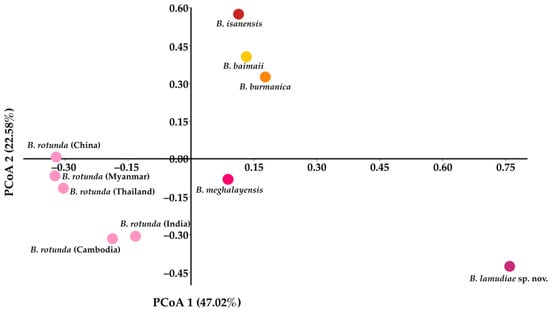
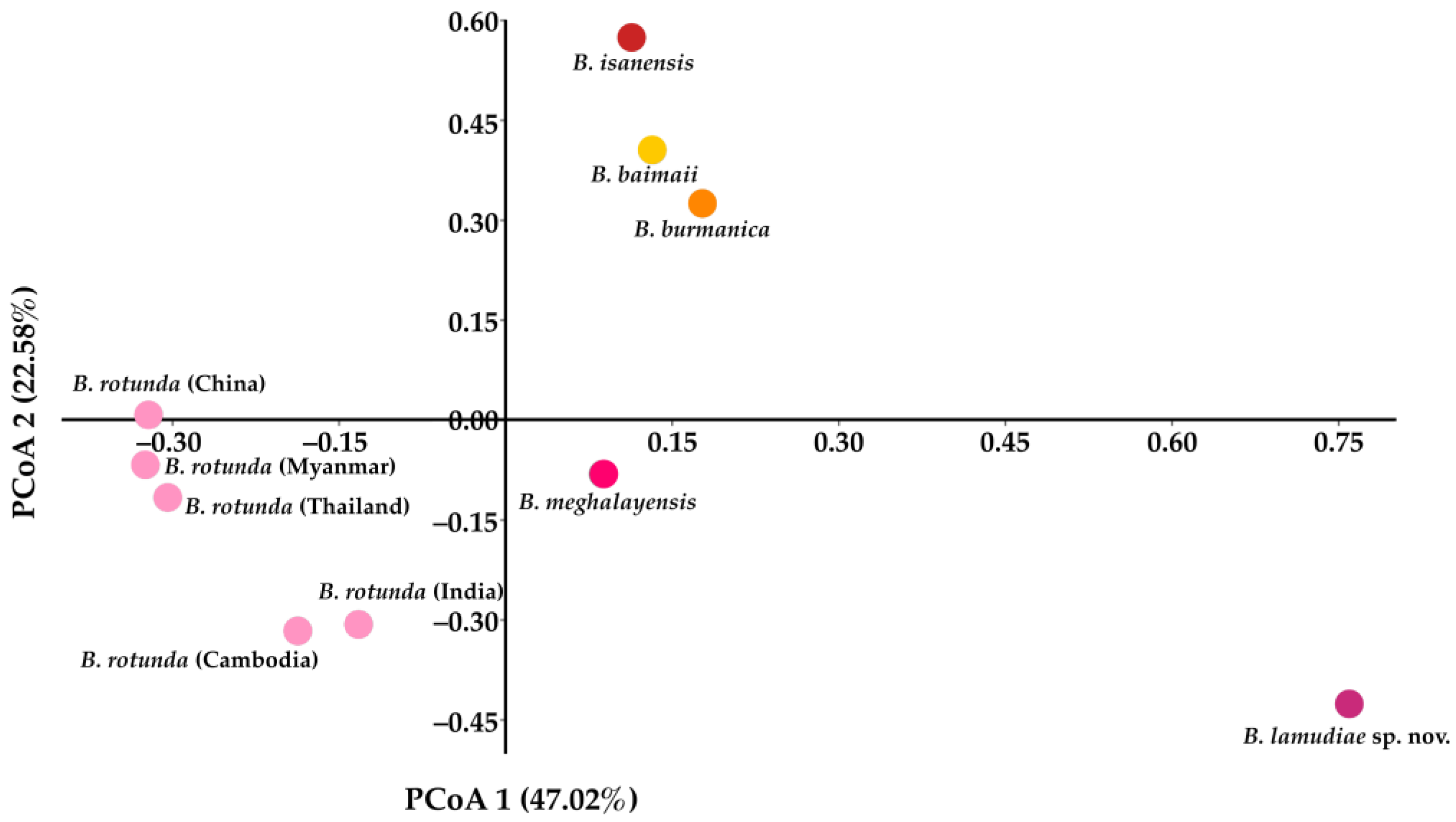
The PCoA based on Gower distance separated Boesenbergia lamudiae from all compared operational units (Figure 4). The first two coordinate axes explained 69.60% of the total morphological variation, with PCoA 1 accounting for 47.02% and PCoA 2 for 22.58%. Boesenbergia lamudiae was positioned as an isolated point on the positive side of PCoA 1, clearly apart from B. burmanica, B. meghalayensis, and all regional operational units of B. rotunda sensu lato.
Figure 4.
Principal coordinates analysis (PCoA) scatter plot based on Gower distance calculated from 25 selected morphological characters of Boesenbergia lamudiae and selected morphologically similar taxa lacking an androecial cup. The first two coordinate axes explain 69.60% of the total morphological variation, with PCoA 1 accounting for 47.02% and PCoA 2 for 22.58%.
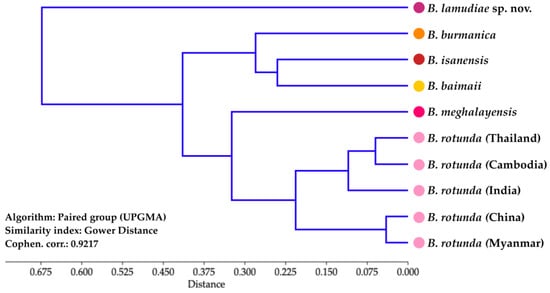
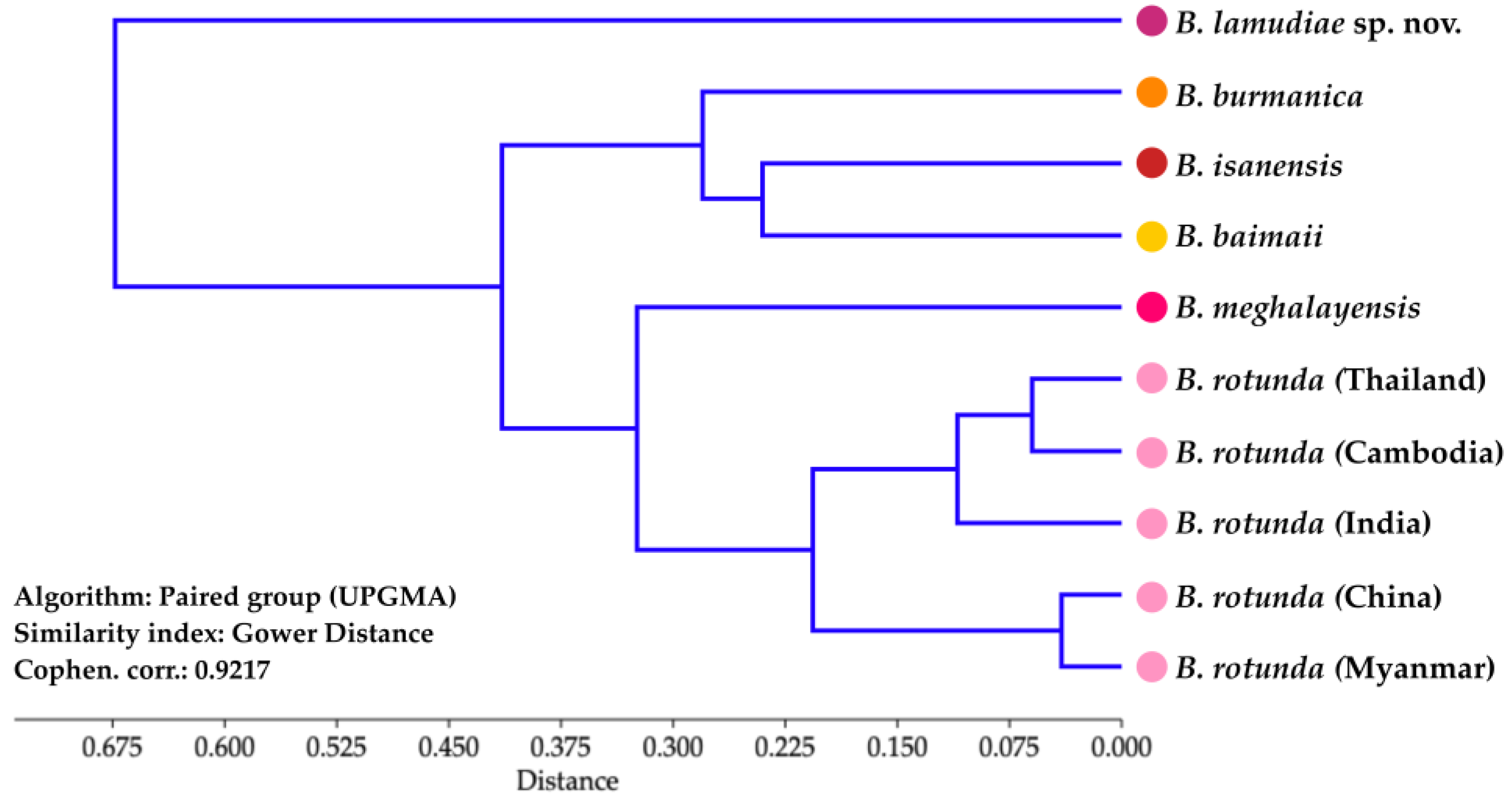
The UPGMA dendrogram based on the same Gower distance matrix also separated B. lamudiae from the remaining operational units (Figure 5). The dendrogram showed a high cophenetic correlation coefficient of 0.9217, indicating that the clustering pattern represented the original distance matrix well. The remaining operational units were arranged into subgroups corresponding broadly to B. burmanica, the protologue-based operational units of B. baimaii and B. isanensis, B. meghalayensis, and the regional operational units of B. rotunda sensu lato. These results support the morphological distinctiveness of B. lamudiae from the selected comparable taxa.
Figure 5.
UPGMA dendrogram based on Gower distance calculated from 25 selected morphological characters of Boesenbergia lamudiae and selected morphologically similar taxa lacking an androecial cup. The cophenetic correlation coefficient is 0.9217. The dendrogram is interpreted as a phenetic summary of morphological similarity and not as a phylogenetic hypothesis.
3.3. Microhabitat and Preliminary Conservation Status
Boesenbergia lamudiae was observed in a shaded limestone-associated habitat in Nong Hin District, Loei Province, northeastern Thailand. Plants grew in sandy loam soil mixed with limestone rocks at approximately 420–450 m above sea level, in a microhabitat characterized by partial shade and limestone-derived substrate. The species was found growing in a small and localized population, and fewer than 50 mature individuals were observed at the only currently known locality.
The known population was first observed in 2019 and revisited in 2020 and 2025. During these revisits, no marked decline in the natural population was observed; however, the population also did not show a notable increase and remains very small. At present, there is no evidence of collection for trade or local harvesting pressure, probably because the species is not yet widely known or commonly used when compared with other economically important species of Boesenbergia. Nevertheless, the known population remains highly restricted, and adjacent limestone habitats have not yet been sufficiently surveyed.
Based on the currently known population, B. lamudiae is provisionally assessed as Critically Endangered (CR) under criterion D, following the IUCN Red List Categories and Criteria [45], as fewer than 50 mature individuals were observed at the only known locality. The species does not currently have sufficient data for assessment under criterion A, because population reduction has not been documented during repeated observations. Criteria B and C are also not applied here because the extent of occurrence (EOO), area of occupancy (AOO), number of locations, and evidence of continuing decline remain inadequately known or have not been demonstrated. Criterion E is not applicable, as no quantitative extinction-risk analysis has been conducted. Therefore, this assessment should be regarded as preliminary pending further field surveys in the surrounding limestone areas.
4. Discussion
4.1. Taxonomic Significance of Boesenbergia lamudiae
The recognition of Boesenbergia lamudiae as a new species is supported by a combination of vegetative and floral characters that is not found in the selected morphologically similar taxa. The species shares with B. rotunda sensu lato and several related taxa a terminal inflorescence enclosed within the leaf sheaths and the absence of an androecial cup, a character combination that can make species delimitation difficult when incomplete material is available [2,4,9,17,20,21,28,39]. However, B. lamudiae differs consistently in having broadly elliptic to ovate-elliptic laminae with an arachnoid abaxial surface, maroon lanceolate bracts, a long pubescent calyx with an acute to acuminate apex, a non-saccate obovate labellum with a sharply delimited maroon transverse colour zone, a larger anther crest, longer epigynous glands, and a pubescent ovary. Among these characters, the arachnoid abaxial lamina surface, calyx exceeding 3.0 cm in length, and pubescent ovary are particularly useful for separating B. lamudiae from the compared taxa.
The closest morphological comparison is with B. burmanica, which also has relatively large flowers and lacks an androecial cup [11]. Nevertheless, B. lamudiae differs from B. burmanica by its broader laminae, arachnoid abaxial lamina surface, maroon rather than pale green to whitish bracts, higher number of flowers per spike, longer calyx, acute to acuminate rather than bifid calyx apex, longer floral tube, larger anther crest, longer epigynous glands, and pubescent ovary. These differences involve several independent vegetative and floral structures and are therefore unlikely to represent only minor intraspecific variation.
The comparison with B. rotunda sensu lato is also important because this species has been interpreted broadly in regional floristic treatments and taxonomic accounts [2,4,9,17,28,39]. Across the compared descriptions of B. rotunda sensu lato, the lamina is usually glabrous, glabrescent, or only finely hairy beneath, the calyx is shorter and glabrous, the labellum is slightly concave or slightly saccate, and the ovary is glabrous or nearly glabrous [2,4,9,17,28,39]. In contrast, B. lamudiae has an arachnoid abaxial lamina surface, a markedly longer pubescent calyx, a non-saccate obovate labellum with a sharply defined transverse colour zone, and a pubescent ovary. These features place B. lamudiae outside the observed morphological range of the selected regional operational units of B. rotunda sensu lato.
Boesenbergia rotunda sensu lato is treated here conservatively and only as a comparative framework. The present study does not attempt to revise the B. rotunda complex, because the taxonomic limits of some previously described taxa and regional forms require further reassessment based on well-documented living material, dissected floral characters, and broader population-level sampling. Therefore, the use of B. rotunda sensu lato in this study should not be interpreted as a taxonomic decision on those names, but as a broad comparative context for evaluating the distinctiveness of B. lamudiae. Although several vegetative indumentum characters partly overlap within this broad circumscription, B. lamudiae is not distinguished by any single variable character alone. Rather, it is diagnosed by a stable combination of independent vegetative and floral characters, especially the arachnoid abaxial lamina surface, markedly longer pubescent calyx, acute to acuminate calyx apex, non-saccate obovate labellum with a sharply delimited transverse colour zone, longer epigynous glands, and pubescent ovary.
The protologue-based operational units corresponding to B. isanensis and B. baimaii are also useful for comparison because they represent morphologically differentiated elements that have previously been associated with the broader B. rotunda complex. The material described as B. isanensis differs from B. lamudiae by its shorter calyx, different leaf indumentum, green bracts, shorter epigynous glands, and glabrous ovary [20]. The material described as B. baimaii differs by its smaller habit, narrower laminae, glabrous to glabrescent vegetative parts, shorter calyx, different labellum colour pattern, smaller anther crest, shorter epigynous glands, and glabrous ovary [21]. Therefore, the diagnostic characters of B. lamudiae are not limited to labellum colour but involve a broader set of stable morphological differences.
4.2. Phenetic Evidence and Interpretation
The phenetic analyses provide additional support for the morphological separation of B. lamudiae. Both the PCoA and UPGMA analyses, based on Gower distance calculated from 25 selected morphological characters, separated B. lamudiae from all compared operational units. This separation is consistent with the diagnostic discontinuities observed in the morphology, particularly in lamina indumentum, calyx length and indumentum, labellum structure and colour pattern, epigynous gland length, and ovary indumentum.
The use of Gower distance is appropriate for the present dataset because the character matrix includes categorical and multistate morphological data rather than only continuous measurements [43,46]. The resulting ordination and clustering should not be interpreted as a phylogenetic hypothesis, but as a phenetic summary of morphological similarity among the selected taxa. In this context, the isolated position of B. lamudiae is taxonomically meaningful because it agrees with the qualitative morphological comparisons and the diagnostic key.
The scope of the phenetic analysis was deliberately restricted to selected morphologically similar taxa lacking an androecial cup, especially taxa relevant to the delimitation of B. lamudiae and taxa associated with the B. rotunda sensu lato complex. This restricted sampling avoids the overinterpretation that would result from treating the analysis as a genus-wide assessment. It also allows regional descriptions of B. rotunda sensu lato to be compared separately, which is useful because the name has been applied to morphologically variable material across different parts of its range [2,4,9,17,20,21,28,39]. The results indicate that B. lamudiae does not fall within the morphological space occupied by these selected comparable taxa.
4.3. Value of Living Material in Species Delimitation
The present study reinforces the importance of living material in the taxonomy of Boesenbergia. Several diagnostic characters in the genus are difficult to interpret from dried specimens alone, including labellum colour pattern, floral texture, bract colour, indumentum, anther crest morphology, and the three-dimensional form of the labellum [17,23,25,31,39]. In B. lamudiae, the sharply delimited maroon transverse colour zone of the labellum, the arachnoid abaxial lamina surface, and the pubescent ovary were confirmed from living plants and supported by repeated observations. These characters may become obscure, distorted, or partly lost in herbarium specimens.
The interpretation of lateral staminode colour in regional accounts of B. rotunda provides a clear example of this difficulty. In some treatments, the lateral staminodes are described as white; however, the accompanying illustrations show them as pale pink to pink, sometimes with a white basal portion and a pink distal portion [4,28]. For this reason, the staminode colour state in the present analysis was coded according to the condition clearly visible in the published illustrations when it conflicted with the written description. This approach reduces the risk of underestimating colour variation caused by inconsistencies between descriptions and illustrations.
This issue is particularly relevant to the B. rotunda sensu lato complex, in which taxonomic interpretation has often relied on regional descriptions, herbarium material, illustrations, and cultivated or wild-collected plants [2,4,9,17,28,39]. Differences in preservation, flowering stage, colour documentation, and descriptive emphasis can affect the interpretation of floral characters. For this reason, the present study integrates living observations, herbarium comparisons, published descriptions, illustrations, and a coded morphological matrix. Such an approach provides a more reliable basis for evaluating whether the Loei population represents a distinct taxon.
4.4. Limestone Microhabitat and Conservation Implications
Boesenbergia lamudiae is currently known only from a shaded limestone-associated habitat in Nong Hin District, Loei Province, northeastern Thailand. The plants grow in sandy loam soil mixed with limestone rocks at approximately 420–450 m above sea level. Limestone landscapes in mainland Southeast Asia are known to support localized plant diversity because discontinuous outcrops create small habitat islands with distinct substrate, moisture, and shade conditions [47,48,49]. Such habitats may provide suitable microenvironments for narrowly distributed Zingiberaceae, but they are also vulnerable to disturbance because populations are often small and spatially restricted [10,17].
The only known population of B. lamudiae contains fewer than 50 mature individuals. Repeated observations did not show a marked decline, and there is currently no evidence of collection for trade or local harvesting. Nevertheless, the species remains conservation-relevant because its known population is extremely small and its distribution is highly restricted. The absence of observed decline should not be interpreted as evidence of security, because adjacent limestone habitats have not yet been sufficiently surveyed. Although the minimum AOO can be estimated as 4 km2 based on a single occupied 2 × 2 km grid cell, the full distribution, EOO, number of occupied grid cells, population trend, and potential threats remain insufficiently known.
Based on the available data, B. lamudiae is provisionally assessed as Critically Endangered (CR) under criterion D, following the IUCN Red List Categories and Criteria [45], because fewer than 50 mature individuals were observed at the only currently known locality. Recent population-based assessments of narrowly distributed threatened plants have highlighted the value of combining mature-individual counts, locality information, AOO/EOO estimation, habitat observations, and threat documentation [50]. In the present case, the minimum AOO is estimated as 4 km2 based on a single occupied 2 × 2 km grid cell. However, Criterion B2 is not applied here because a continuing decline in AOO, EOO, habitat quality, number of locations or subpopulations, or number of mature individuals has not yet been demonstrated. Therefore, the present assessment should be regarded as provisional, and further surveys and population monitoring in surrounding limestone areas are needed to determine whether additional populations exist, whether any continuing decline can be inferred or projected, and whether Criterion B2 may become applicable in the future.
The discovery of B. lamudiae demonstrates that limestone-associated habitats in northeastern Thailand remain underexplored for seasonal and localized Zingiberaceae. Continued field surveys, especially during the flowering season, are necessary for documenting narrowly distributed taxa, clarifying species limits, and supporting conservation planning. In this context, the description of B. lamudiae contributes not only to the taxonomy of Boesenbergia, but also to the broader documentation of plant diversity in limestone landscapes of Thailand.
4.5. Limitations and Future Perspectives
The present study is based on comparative morphology, repeated observations of living material, herbarium and literature comparisons, and phenetic analyses. Molecular phylogenetic data were not generated; therefore, the recognition of B. lamudiae should be regarded as a morphology-based taxonomic hypothesis rather than direct evidence of evolutionary independence. This limitation is important in Boesenbergia, particularly because B. rotunda sensu lato has been broadly circumscribed and shows considerable morphological variation across its range. Nevertheless, B. lamudiae is separated from the selected comparable taxa by a stable combination of independent characters, including the arachnoid abaxial lamina surface, maroon lanceolate bracts, long pubescent calyx with an acute to acuminate apex, non-saccate obovate labellum with a sharply delimited transverse colour zone, larger anther crest, longer epigynous glands, and pubescent ovary. Future molecular phylogenetic studies with broader sampling of B. lamudiae, B. burmanica, B. rotunda sensu lato, B. baimaii, B. isanensis, and other related taxa lacking an androecial cup will be necessary to test the phylogenetic placement and evolutionary independence of this species.
5. Conclusions
This study describes Boesenbergia lamudiae as a new limestone-associated species from Loei Province, northeastern Thailand. The species is clearly distinguished from morphologically similar taxa, especially B. burmanica and the selected operational units of B. rotunda sensu lato, by a unique combination of characters, including abaxially arachnoid laminae, maroon lanceolate bracts, longer pubescent calyx with an acute to acuminate apex, non-saccate obovate labellum with a sharply delimited transverse colour zone, larger anther crest, longer epigynous glands, and pubescent ovary. The phenetic analyses based on 25 selected morphological characters further supported its morphological distinctiveness, with B. lamudiae separated from all compared operational units in the PCoA and UPGMA analyses.
The discovery of B. lamudiae highlights the importance of detailed field observations, living material, and microhabitat-based surveys in the taxonomy of Boesenbergia. Several diagnostic floral characters, particularly labellum colour pattern, indumentum, anther crest morphology, and floral form, are difficult to interpret from dried material alone. The occurrence of this species in a limestone-associated habitat also emphasizes the potential of underexplored limestone landscapes in northeastern Thailand to harbour localized and previously overlooked plant diversity.
Although fewer than 50 mature individuals were observed at the only known locality, adjacent limestone areas remain insufficiently surveyed. Therefore, B. lamudiae is provisionally assessed as Critically Endangered (CR) under criterion D, pending additional field surveys to clarify its full distribution, population size, habitat specificity, and potential threats. Further exploration of limestone habitats in Loei and nearby provinces is likely to improve understanding of species diversity, endemism, and conservation priorities within Thai Boesenbergia. This taxonomic recognition is based on morphological and phenetic evidence, and molecular phylogenetic data will be needed in future studies to test the phylogenetic placement and evolutionary independence of B. lamudiae.
Author Contributions
Conceptualization, T.B., S.S., P.S., C.M., S.P., P.R. and W.P.O.; methodology, T.B., S.S., P.S., C.M., S.P., P.R. and W.P.O.; software, T.B.; validation, T.B., S.S., P.S. and C.M.; formal analysis, T.B. and P.R.; investigation, T.B. and S.P.; resources, T.B. and S.P.; data curation, T.B.; writing—original draft preparation, T.B.; writing—review and editing, T.B., S.S., P.S., C.M., S.P., P.R. and W.P.O.; visualization, T.B.; supervision, S.S., P.S. and C.M.; project administration, T.B.; funding acquisition, S.S. and P.S. All authors have read and agreed to the published version of the manuscript.
Funding
This research was funded by Mahasarakham University.
Institutional Review Board Statement
Not applicable.
Informed Consent Statement
Not applicable.
Data Availability Statement
Acknowledgments
The authors are profoundly grateful to the Walai Rukhavej Botanical Research Institute, Mahasarakham University, for providing laboratory facilities and access to a light microscope. We are grateful to Kamonwan Koompoot for preparing the distribution map using QGIS. We are deeply grateful to the late Lamud Boonma for her support of this study and for her assistance in collecting living specimens from the natural habitat and cultivated plants at Brio Botanical Research Garden for preservation in 70% ethyl alcohol. We also thank the curators and staff of all herbaria visited for their kind cooperation.
Conflicts of Interest
The authors declare no conflicts of interest.
Abbreviations
The following abbreviations are used in this manuscript:
| A | Harvard University, Cambridge, Massachusetts, U.S.A. |
| AAU | Aarhus University, Denmark |
| B | Botanic Garden and Botanical Museum Berlin-Dahlem, Germany |
| BK | Bangkok Herbarium, Department of Agriculture, Thailand |
| BKF | Department of National Parks, Wildlife and Plant Conservation, Thailand |
| BM | The Natural History Museum, London, England, U.K. |
| C | University of Copenhagen, Copenhagen, Denmark |
| CAL | Botanical Survey of India, Howrah, West Bengal, India |
| DMSC | Medicinal Plants Research Institute, Thailand |
| E | Royal Botanic Garden Edinburgh, Edinburgh, United Kingdom |
| HITBC | Xishuangbanna Tropical Botanical Garden, Academia Sinica, Yunnan, China |
| HN | Vietnam Academy of Science and Technology (VAST), Hanoi, Vietnam |
| HNPM | National Institute of Medicinal Materials, Vietnam |
| HNU | VNU University of Science, Hanoi, Vietnam |
| IBK | Guangxi Institute of Botany, China |
| IMDY | Chinese Academy of Medical Sciences, China |
| K | Royal Botanic Gardens, United Kingdom |
| KKU | Khon Kaen University Herbarium, Thailand |
| L | Naturalis Biodiversity Center, Leiden, Netherlands |
| NY | The New York Botanical Garden, New York, U.S.A. |
| P | Muséum National d’Histoire Naturelle, Paris, France |
| QBG | Queen Sirikit Botanic Garden, The Botanical Garden Organization, Thailand |
| SGN | Southern Institute of Ecology, Ho Chi Minh City, Vietnam |
| SING | Singapore Botanic Gardens, National Parks Board, Singapore |
| TNS | National Museum of Nature and Science, Tokyo, Japan |
| VMSU | Vascular Plant Herbarium, Mahasarakham University, Thailand |
| VNM | Institute of Life Science, Ho Chi Minh City, Vietnam |
| VNMN | Vietnam National Museum of Nature, Hanoi, Vietnam |
Appendix A
Table A1.
Morphological characters and character states used in the phenetic similarity analysis of selected Boesenbergia taxa lacking an androecial cup.
Table A2.
Character-state matrix used for the phenetic similarity analysis of selected Boesenbergia taxa lacking an androecial cup.
References
- POWO. Plants of the World Online, Facilitated by the Royal Botanic Gardens, Kew. Available online: http://www.plantsoftheworldonline.org/ (accessed on 29 March 2026).
- Aishwarya, K.; Vinitha, M.R.; Thomas, G.; Sabu, M. A new species of Boesenbergia and rediscovery of B. rotunda (Zingiberaceae) from India. Phytotaxa 2015, 197, 186–196. [Google Scholar] [CrossRef] [Scilit]
- Larsen, K.; Ibrahim, H.; Khaw, S.H.; Saw, L.G. Gingers of Peninsular Malaysia and Singapore; Natural History Publications (Borneo): Kota Kinabalu, Malaysia, 1999. [Google Scholar]
- Chen, J.; Xia, N.-H. A taxonomic revision of Chinese Boesenbergia (Zingiberaceae), with a new record. Phytotaxa 2019, 424, 217–231. [Google Scholar] [CrossRef] [Scilit]
- Mood, J.D.; Trần, H.Đ.; Veldkamp, J.-F.; Prince, L.M. Boesenbergia siphonantha (Zingiberaceae)—A new record for Thailand and Vietnam with notes on molecular phylogeny. Gard. Bull. Singap. 2016, 68, 125–137. [Google Scholar] [CrossRef] [Scilit]
- Yongco, J.E.; Amparado, O.A.; Naive, M.A.K. Rediscovery of the Zamboanga Peninsula endemic Boesenbergia longipetiolata (Ridl.) Merr. (Zingiberaceae) after over a century, including an amended description and an updated distribution. Biodiversitas J. Biol. Divers. 2023, 24, 6305–6309. [Google Scholar] [CrossRef] [Scilit]
- Saensouk, P.; Saensouk, S.; Boonma, T.; Oo, W.P.; Htet, N.M.; Maknoi, C.; Bongcheewin, B.; Htway, N.N.; Minn, H.M. Two new records of Boesenbergia Kuntze (Zingibereae: Zingiberaceae) for the flora of Myanmar. Biodiversitas J. Biol. Divers. 2025, 26, 480–489. [Google Scholar] [CrossRef] [Scilit]
- Tad-o, R.V.B.; Alafag, J.I.; Napaldet, J.T. Boesenbergia igorota (Zingiberaceae), a new species from the Cordillera Central Range, northern Philippines. Taiwania 2022, 67, 311–317. [Google Scholar] [CrossRef]
- Saensouk, P.; Saensouk, S.; Boonma, T.; Song, D.; Maknoi, C.; Setyawan, A.D. Boesenbergia Kuntze (Zingiberaceae) in Cambodia: Four new records with notes on their potential horticultural significance, cultivation guidelines, and lectotypification of B. xiphostachya (Gagnep.) Loes. Horticulturae 2025, 11, 178. [Google Scholar] [CrossRef] [Scilit]
- Larsen, K. Boesenbergia tenuispicata (Zingiberaceae): A new species from Thailand. Nord. J. Bot. 1993, 13, 281–283. [Google Scholar] [CrossRef] [Scilit]
- Saensouk, P.; Saensouk, S.; Boonma, T.; Htway, N.N.; Oo, W.P.; Naing, M.K.; Junsongduang, A. A New Species of Boesenbergia Kuntze (Zingiberaceae) from Myanmar, with Notes on Diversity, Utilization, Conservation, and Horticultural Potential. Taxonomy 2025, 5, 70. [Google Scholar] [CrossRef] [Scilit]
- Boonma, T.; Saensouk, S. Curcuma saraburiensis (Zingiberaceae), a new species from Thailand. Taiwania 2019, 64, 245–248. [Google Scholar]
- Boonma, T.; Saensouk, S.; Saensouk, P. Two new species of Kaempferia L. (Zingiberaceae) from Thailand. Taiwania 2020, 65, 371–381. [Google Scholar]
- Boonma, T.; Saensouk, S.; Saensouk, P. Biogeography, conservation status, and traditional uses of Zingiberaceae in Saraburi Province, Thailand, with Kaempferia chaveerachiae sp. nov. Horticulturae 2024, 10, 934. [Google Scholar] [CrossRef] [Scilit]
- Triboun, P.; Keeratikiet, K. Zingiber sirindhorniae, a remarkable new species in Zingiber section Dymczewiczia (Zingiberaceae) from Thailand. Thail. Nat. Hist. Mus. J. 2016, 10, 1–6. [Google Scholar]
- Mood, J.D.; Veldkamp, J.-F.; Dey, S.; Prince, L.M. Nomenclatural changes in Zingiberaceae: Caulokaempferia is a superfluous name for Monolophus and Jirawongsea is reduced to Boesenbergia. Gard. Bull. Singap. 2014, 66, 215–231. [Google Scholar]
- Mood, J.D.; Veldkamp, J.-F. Boesenbergia. In Flora of Thailand; Newman, M.F., Barfod, A.S., Esser, H.J., Simpson, D., Parnell, J.A.N., Eds.; The Forest Herbarium: Bangkok, Thailand, 2023; Volume 16, pp. 378–402. [Google Scholar]
- Chinese Virtual Herbarium (CVH). Institute of Botany, Chinese Academy of Sciences. Available online: http://www.cvh.ac.cn (accessed on 8 April 2026).
- Index Herbariorum. A Worldwide Index of Herbaria and Associated Staff Where Plant and Fungal Specimens are Permanently Housed; The William & Lynda Steere Herbarium, New York Botanical Garden: New York, NY, USA, 2026; Available online: https://sweetgum.nybg.org/science/ih/ (accessed on 8 April 2026).
- Saensouk, S.; Saensouk, P. Boesenbergia isanensis (Zingiberaceae), a new species from Thailand. Jpn. J. Bot. 2020, 95, 65–68. [Google Scholar]
- Saensouk, S.; Larsen, K. Boesenbergia baimaii, a new species of Zingiberaceae from Thailand. Nord. J. Bot. 2001, 21, 595–598. [Google Scholar] [CrossRef] [Scilit]
- Sabu, M.; Prasanthkumar, M.G.; Škorničková, J.; Jayasree, S. Transfer of Kaempferia siphonantha Baker to Boesenbergia Kuntze (Zingiberaceae). Rheedea 2004, 14, 55–59. [Google Scholar] [CrossRef] [Scilit]
- Mood, J.D.; Prince, L.M.; Veldkamp, J.-F.; Dey, S. The history and identity of Boesenbergia longiflora (Zingiberaceae) and descriptions of five related new taxa. Gard. Bull. Singap. 2013, 65, 47–95. [Google Scholar]
- Meekiong, K.; Lim, C.K. The unusual branching Boesenbergia from Belum, Perak, and notes on the genus in Peninsular Malaysia. Folia Malays. 2014, 15, 41–50. [Google Scholar]
- Mood, J.D.; Veldkamp, J.-F.; Prince, L.M. A new species and a new record of Boesenbergia (Zingiberaceae) for Thailand. Gard. Bull. Singap. 2014, 66, 207–214. [Google Scholar]
- Izzaty, M.M.; Tawan, C.S.; Meekiong, K. Boesenbergia atropurpurea, a new Boesenbergia species from Sarawak, Malaysia. Folia Malays. 2015, 16, 45–50. [Google Scholar]
- Aishwarya, K.; Sabu, M. Boesenbergia pulcherrima and B. tiliifolia (Zingiberaceae) in India: Notes on the identity, variability and typification. Rheedea 2015, 25, 59–68. [Google Scholar] [CrossRef] [Scilit]
- Mood, J.D.; Tanaka, N.; Aung, M.M.; Murata, J. The genus Boesenbergia (Zingiberaceae) in Myanmar with two new records. Gard. Bull. Singap. 2016, 68, 299–318. [Google Scholar] [CrossRef] [Scilit]
- Lý, N.-S. Boesenbergia quangngaiensis (Zingiberaceae), a new species from Central Vietnam. Phytotaxa 2017, 324, 83–88. [Google Scholar] [CrossRef] [Scilit]
- Mood, J.D.; Trần, H.Đ.; Veldkamp, J.-F.; Prince, L.M. Taxonomy of Boesenbergia parvula (Zingiberaceae) with new synonymy. Thai For. Bull. Bot. 2018, 46, 10–24. [Google Scholar] [CrossRef] [Scilit]
- Mood, J.D.; Veldkamp, J.-F.; Mandáková, T.; Prince, L.M.; de Boer, H.J. Three new species of Boesenbergia (Zingiberaceae) from Thailand and Lao P.D.R. Gard. Bull. Singap. 2019, 71, 473–495. [Google Scholar] [CrossRef] [Scilit]
- Mood, J.D.; Ardiyani, M.; Veldkamp, J.-F.; Mandáková, T.; Prince, L.M.; de Boer, H.J. Nomenclature changes in Zingiberaceae: Haplochorema is reduced to Boesenbergia. Gard. Bull. Singap. 2020, 72, 77–95. [Google Scholar] [CrossRef] [Scilit]
- Docot, R.V.A.; Santiago, L.C.P.; Funakoshi, H.; Lam, N.F. Two new species of Boesenbergia (Zingiberaceae) from Palawan, Philippines. Edinb. J. Bot. 2020, 77, 377–390. [Google Scholar] [CrossRef] [Scilit]
- Aishwarya, K.; Sabu, M. On the IUCN status of Boesenbergia albolutea and B. rubrolutea (Zingiberaceae) and typification of B. rubrolutea. J. Threat. Taxa 2021, 13, 20133–20135. [Google Scholar] [CrossRef] [Scilit]
- Lam, N.F.; Ibrahim, H.; Sam, Y.Y.; Zakaria, R.M.; Poulsen, A.D. Two new species of Boesenbergia (Zingiberaceae) from Sabah, Malaysia. PhytoKeys 2022, 211, 81–92. [Google Scholar] [CrossRef] [Scilit] [PubMed]
- Tanaka, N.; Paing, C.S.; Aung, M.M. Taxonomic studies of Zingiberaceae in Myanmar V: A new species of Boesenbergia from Rakhine State. Bull. Natl. Mus. Nat. Sci. Ser. B Bot. 2024, 50, 149–152. [Google Scholar]
- Santharam, S.T.; Kaliamoorthy, S. Boesenbergia kalakadensis sp. nov. (Zingiberaceae) from Southern Western Ghats, India. Nord. J. Bot. 2024, 2024, e04445. [Google Scholar] [CrossRef] [Scilit]
- Debnath, S.; Patil, S.; Vijayan, D. Boesenbergia ashihoi (Zingiberaceae), a new species from northeast India. Nord. J. Bot. 2024, 2024, e04319. [Google Scholar] [CrossRef] [Scilit]
- Sirirugsa, P. A revision of the genus Boesenbergia Kuntze (Zingiberaceae) in Thailand. Nat. Hist. Bull. Siam Soc. 1992, 40, 67–90. [Google Scholar]
- Beentje, H. The Kew Plant Glossary, an Illustrated Dictionary of Plant Terms, 2nd ed.; Royal Botanic Gardens, Kew: London, UK, 2016. [Google Scholar]
- International Plant Names Index. Available online: https://www.ipni.org/ (accessed on 9 April 2026).
- Sneath, P.H.A.; Sokal, R.R. Numerical Taxonomy; W.H. Freeman: San Francisco, CA, USA, 1973. [Google Scholar]
- Gower, J.C. A general coefficient of similarity and some of its properties. Biometrics 1971, 27, 857–871. [Google Scholar] [CrossRef] [Scilit]
- Hammer, Ø.; Harper, D.A.T.; Ryan, P.D. PAST: Paleontological Statistics Software Package for Education and Data Analysis. Palaeontol. Electron. 2001, 4, 1–9. Available online: https://palaeo-electronica.org/2001_1/past/past.pdf (accessed on 7 May 2026).
- IUCN. Guidelines for Using the IUCN Red List Categories and Criteria, 16th ed.; IUCN: Gland, Switzerland, 2024; Available online: https://nc.iucnredlist.org/redlist/content/attachment_files/RedListGuidelines.pdf (accessed on 9 April 2026).
- Kaufman, L.; Rousseeuw, P.J. Finding Groups in Data: An Introduction to Cluster Analysis; John Wiley & Sons: New York, NY, USA, 1990. [Google Scholar]
- Clements, R.; Sodhi, N.S.; Schilthuizen, M.; Ng, P.K.L. Limestone karsts of Southeast Asia: Imperiled arks of biodiversity. BioScience 2006, 56, 733–742. [Google Scholar] [CrossRef] [Scilit]
- Kiew, R.; Rahman, R.A. Plant diversity assessment of karst limestone, a case study of Malaysia’s Batu Caves. Nat. Conserv. 2021, 44, 21–49. [Google Scholar] [CrossRef] [Scilit]
- Tan, J.P.C.; Kiew, R.; Darbyshire, I. Prioritising Important Plant Areas (IPAs) among the limestone karsts of Perak, Malaysia. Kew Bull. 2024, 79, 107–132. [Google Scholar] [CrossRef] [Scilit]
- Tiwari, H.; Arya, D.; Sekar, K.C. Population status, threats, and conservation of Trachycarpus takil: An endemic and threatened plant species in western Himalaya, India. J. Threat. Taxa 2025, 17, 26648–26654. [Google Scholar] [CrossRef] [Scilit]

Disclaimer/Publisher’s Note: The statements, opinions and data contained in all publications are solely those of the individual author(s) and contributor(s) and not of MDPI and/or the editor(s). MDPI and/or the editor(s) disclaim responsibility for any injury to people or property resulting from any ideas, methods, instructions or products referred to in the content. |
© 2026 by the authors. Licensee MDPI, Basel, Switzerland. This article is an open access article distributed under the terms and conditions of the Creative Commons Attribution (CC BY) license.