


Abstract
In this retrospective cross-sectional study, we examined associations between hair element concentrations and recorded height-percentile status in 1000 Mongolian children and adolescents aged 1–18 years. Concentrations of 26 elements were measured by inductively coupled plasma mass spectrometry. Ordinal models used 998 available outcomes, adjusted for age group and sex, with false-discovery-rate (FDR) correction. Twelve elements met FDR q < 0.05. Lead (adjusted odds ratio [aOR] 0.80, 95% confidence interval [CI] 0.70–0.92; q = 0.0046) and aluminum (aOR 0.84, 95% CI 0.73–0.96; q = 0.0317) were inversely associated with height-percentile status. With additional recorded covariates, lead remained associated (q = 0.0179), whereas aluminum did not meet the FDR criterion (q = 0.0975). Global proportional-odds assumptions were not supported; threshold-specific estimates were therefore reported. Sensitivity analyses examined age specification, measured height, age restriction, and zero-value handling. These exploratory associations in a selected clinical cohort do not establish independent elemental effects, systemic toxicant burden, or causality. Interpretation is limited by selection, residual confounding, non-harmonized growth references, and unavailable element-specific analytical validation records.
1. Introduction
Child growth reflects genetic potential, parental stature, nutrition, endocrine function, chronic disease, socioeconomic conditions, and environmental exposures [1,2]. Toxic elements may affect cellular metabolism, oxidative homeostasis, and skeletal development, whereas essential elements support normal enzymatic and growth-related functions [3,4,5,6,7]. Associations between an elemental biomarker and attained stature must therefore be interpreted in relation to the clinical setting and the available confounder information.
Lead exposure remains a pediatric environmental-health concern. Potential pathways include contaminated soil and household dust, drinking water, food, industrial emissions, and tobacco smoke [8,9,10]. Arsenic may arise from geogenic groundwater or soil contamination, mining, industrial activity, and food. Environmental studies from Hashtroud County and elsewhere in Iran illustrate contamination pathways and modeled risks, but do not establish exposure among Mongolian children or connect environmental concentrations directly to hair measurements [11,12]. Research on multiple metals and metalloids also indicates that single-element associations should be considered within a broader co-exposure context [13,14,15].
Hair permits non-invasive collection and multielement measurement, but external deposition, washing, cosmetic treatment, biological variability, and laboratory methodology affect the measured concentrations [16,17,18,19,20]. Pediatric reference distributions vary with age and study setting [21,22,23]. A study including hair samples from smokers and non-smokers illustrates the influence of exposure context on hair measurements, without establishing hair as a diagnostic measure of systemic toxicity [24]. The relatively recent period represented by a proximal hair segment also differs from the cumulative growth history reflected in height.
Mongolia faces substantial environmental and nutritional-health challenges [25,26]. Pediatric hair studies and related surveillance protocols support further investigation of elemental measurements and anthropometry, while also highlighting the need for careful interpretation [23,27,28]. We therefore evaluated associations between each of 26 hair elements and recorded height-percentile status in a single-center clinical cohort. No element, including lead or aluminum, was prespecified as the principal exposure. The analysis was an exploratory single-element screen with multiplicity control, not a mixture model or an assessment of mutually independent effects.
2. Materials and Methods
2.1. Study Design, Participants, and Data Verification
This retrospective cross-sectional study included clinical and laboratory records for 1000 Mongolian children and adolescents aged 1–18 years who underwent hair elemental analysis at Third Age Children’s Hospital, Mongolia, between January 2017 and December 2022. All children who underwent testing during this period and had an available record were included; no random sampling was performed. The database did not contain a standardized variable specifying why hair analysis was ordered. Diagnosis and symptom fields were used to describe the clinical context, not to infer an unrecorded referral indication. Reporting followed the Strengthening the Reporting of Observational Studies in Epidemiology (STROBE) guidance [29].
The author-supplied corrected master dataset was used for the revised analyses. Study identifiers were matched across versions, and the supplied corrections were incorporated before all analyses were rerun. The dataset contained 1000 records, including two without height-percentile data. Concentrations and percentile bands were used as supplied, without additional numerical corrections by the analysts. The supplied sulfur corrections resolved the previously identified scale discrepancies, and sulfur was retained in the complete 26-element exploratory analysis. This correction was distinguished from validation of the analytical method. Laboratory-reference classifications and element-ratio analyses were removed because pediatric clinical validity and the provenance of all classification rules could not be established.
2.2. Anthropometric Assessment and Outcome Definition
For children aged 1–2 years, the clinical team reported recumbent-length measurement with pediatric measuring equipment and assessment using the World Health Organization (WHO) Child Growth Standards [30]. Participants aged ≥3 years were assessed using the InBody J50 system (InBody Co., Ltd., Seoul, Republic of Korea), and the device-generated percentile bands were recorded [31]. WHO guidance distinguishes recumbent length from standing height; however, measurement-position correction could not be independently reconstructed from this export. The database did not contain birth dates, measurement dates, exact age in months, or the InBody reference population and percentile algorithm. Consequently, recorded percentiles were not recalculated, and a valid harmonized individual-level height-for-age z score was not derived.
The outcome was formed directly from the recorded bands: ≤3rd percentile, >3rd–50th percentile, and >50th percentile. The corrected file explicitly included three records in the 97th–100th percentile band; all were retained in the highest outcome category. Thus, the revised highest category has no 97th-percentile upper limit. The two missing outcomes were excluded only from percentile-based models. Combining categories preserved their ordering but did not make the WHO and InBody references equivalent; age adjustment and age restriction cannot fully resolve this measurement difference.
Two age–height combinations remained inconsistent in the corrected export (145.4 cm at age 2 years and 173 cm at age 6 years). Their numerical values were not altered. Their recorded percentile categories were retained in the primary analysis, and an additional sensitivity analysis excluded both records. The continuous-height sensitivity analysis was restricted to participants aged ≥3 years and excluded the latter record and missing height measurements. A previously zero-valued height had been corrected to 109 cm in the supplied master file and was retained.
2.3. Hair Sample Collection and Elemental Analysis
Approximately 2–3 cm of proximal scalp hair was collected from the occipital region as close to the scalp as possible using stainless-steel scissors and stored in clean polyethylene containers. Samples were submitted through Medinex Laboratory, Republic of Korea, for analysis. Before digestion, samples were washed with deionized water to reduce surface contamination and dried at 50 °C for 30 min. The laboratory restricted disclosure of detailed internal washing conditions; wash counts, durations, liquid volumes, and agitation settings are therefore not reported. Hair cosmetic status was recorded as untreated or dyed, but treatment timing, bleaching, perming, product use, and detailed dust exposure were unavailable.
Sample digestion and elemental analysis followed an in-house method of the YS Institute of Environmental Technology (YSIET), accredited under the Korea Laboratory Accreditation Scheme (KOLAS; ISO/IEC 17025:2017 [32], Accreditation No. KT364). A 50-mg aliquot of dried hair was placed in a digestion vessel with 5 mL of ultrapure nitric acid (69–71%, electronic grade; Duksan Pure Chemicals Co., Ltd., Ansan, Republic of Korea) and subjected to microwave-assisted digestion at a maximum power of 1500 W and a maximum temperature of 180 °C for approximately 10 min. The digest was diluted to 50 mL with deionized water. A method blank and a hair reference material (RM-YSIET-Human hair-01, YSIET) were processed under identical conditions for quality control.
Element concentrations were measured using an Agilent 7700x inductively coupled plasma mass spectrometer (ICP-MS; Agilent Technologies, Santa Clara, CA, USA), with rhodium (500 μg/L as specified in the method summary) as an online internal standard. The laboratory method summary reported element-specific calibration ranges within 0.01–5000 μg/L, coefficients of determination (R2) > 0.999, method detection limits (MDLs) of 0.002–6.607 μg/L, relative standard deviations (RSDs) < 8% (n = 7), and reference-material recoveries of 85–115%. MDLs were calculated as 3.14 times the standard deviation of seven replicate measurements of spiked method blanks. These values describe the available method-level summary, not independently verified element-specific or study-batch performance. Results were reported as μg/g of dried hair.
Element-specific MDLs and limits of quantification (LOQs), blank results, reference-material assigned and measured values, and records of additional dilution or remeasurement were unavailable. Therefore, the compatibility of very low reported concentrations and high sulfur values with the applicable analytical ranges could not be independently verified. No assumption was made that a recorded zero was below a detection limit or that an out-of-range result had been diluted and remeasured. Available method information and its limits are summarized in Supplementary Table S11. All 26 elements were treated as laboratory-reported exploratory measurements, not as diagnostic indicators of toxicity, deficiency, or systemic body burden.
2.4. Statistical Analysis
Continuous variables were summarized using mean and standard deviation (SD), or median and interquartile range (IQR), as appropriate. For each element, only recorded zeros were replaced with one-half of the smallest positive concentration in the corrected cohort; positive observations were unchanged. This numerical substitution was not treated as an estimate of the MDL or a statement about the analytical origin of zero values. Concentrations were natural-log transformed and standardized using the mean and sample SD among the 998 participants with an observed percentile outcome. The resulting exposure scale was held fixed in subset and alternative-covariate analyses. Zero frequencies and transformation parameters are reported in Supplementary Table S3.
A separate proportional-odds ordinal logistic regression model was fitted for each of 26 elements, adjusting for age group (1–4, 5–9, 10–14, and 15–18 years) and sex. The adjusted odds ratio (aOR) summarizes the odds of a higher rather than lower recorded height-percentile category per 1-SD higher log concentration. Benjamini–Hochberg false-discovery-rate (FDR) correction was applied across the 26 primary element tests; q < 0.05 identified screening associations. Confidence intervals (CIs) were nominal 95% intervals rather than multiplicity-adjusted intervals. No element was selected for modeling on the basis of its association with the outcome.
Proportional-odds diagnostics used stacked cumulative binary logistic models for the >3rd and >50th percentile cut points, with threshold interactions for the element and every covariate. Participant-clustered sandwich standard errors accounted for the two outcomes contributed by each participant. Wald tests assessed the element-by-threshold term and all threshold-varying slopes jointly; corresponding FDR adjustments were performed separately across 26 tests. Because global proportionality was not supported, both threshold-specific element estimates are reported alongside the common-odds summaries. Failure to reject an element-specific test after FDR correction was not considered proof of proportionality.
Sensitivity analyses replaced age groups with a cubic B-spline for recorded age, comprising four basis terms with one internal knot at 11 years and boundary knots at 1 and 18 years; added residence, diagnosed-disease status, paternal smoking, maternal smoking, selective eating, and dyed-hair status to the age-group/sex model; restricted the sample to ages ≥3 years; and excluded the two unresolved age–height records. The spline basis was constructed using the full cohort and held fixed for subset analyses. Additional-covariate models used explicit missing/invalid categories for residence and the three household/diet fields. This approach retained the cohort but was not assumed to eliminate missing-data bias. Complete dietary assessment, supplementation, parental height, socioeconomic status, pubertal stage, and quantitative environmental exposure were unavailable.
Continuous measured height was analyzed among eligible participants aged ≥3 years using linear regression with cubic age B-spline terms, sex, age-by-sex spline interactions, and heteroscedasticity-consistent type 3 (HC3) standard errors. This was a within-sample analysis in centimeters, not a WHO-standardized growth metric. An alternative transformation added one-half of the smallest positive concentration to every observation before log transformation and standardization, reproducing the original preprocessing strategy. FDR correction was applied separately within each 26-element sensitivity-model family, and separately at each outcome threshold. These analyses assessed sensitivity to modeling choices and were not independent replications.
Spearman correlations characterized the 26-element dependence structure. Partial rank correlations were also calculated after regressing element ranks on sex and the continuous-age spline terms. These correlation summaries do not identify exposure sources or constitute a mixture-effect analysis. All tests were two-sided. Analyses were performed using Python 3.13.5, NumPy 2.3.5, SciPy 1.17.0, patsy 1.0.2, and statsmodels 0.14.6.
2.5. Ethical Considerations
The study protocol was reviewed and approved by the Ethics Review Committee of Etugen University, Ulaanbaatar, Mongolia (Approval No. 2209-C/2802; 28 September 2022). The approval covered retrospective research use of clinical and laboratory records collected before the approval date. Written informed consent for research use of the data was obtained from participants’ parents or legal guardians. Clinical data-collection dates are distinguished from the date of approval for their retrospective research use. The study was conducted in accordance with the Declaration of Helsinki.
3. Results
3.1. Cohort and Clinical Context
The corrected cohort included 1000 participants (584 male and 416 female), with a mean age of 10.31 ± 4.43 years. Height-percentile data were available for 998: 154 (15.4%) were in the ≤3rd category, 499 (50.0%) in the >3rd–50th category, and 345 (34.6%) in the >50th category. The latter included all three records above the 97th percentile. Participant characteristics are summarized in Table 1.
Table 1.
Participant characteristics in the corrected cohort.
The source recorded 139 E34.3 short-stature codes, 90 F84.0 codes, and 10 E66 codes; a total of 761 records had no diagnosis code. The E34.3 code was present in 136/154 (88.3%) participants in the lowest percentile category, compared with 3/499 (0.6%) in the intermediate category and none in the highest category. A separate diagnosed-disease field was positive in 454 participants, and a growth-delay/short-stature symptom flag in 97. These fields describe clinical enrichment but cannot establish the indication for ordering hair analysis. Detailed clinical and missing-data counts are provided in Supplementary Table S1.
3.2. Element Distributions and Primary Associations
All 26 concentrations were available for all 1000 records (Table 2). Recorded zeros occurred for cadmium (10; 1.0%), thallium (163; 16.3%), and cesium (169; 16.9%). In the corrected export, sulfur ranged from 30,851 to 49,885 μg/g; the eight values previously flagged for scale discordance were replaced by corrected source values. This resolved the internal numerical discontinuity but not the absence of element-specific validation and dilution records.
Table 2.
Hair element concentrations in the corrected cohort (N = 1000).
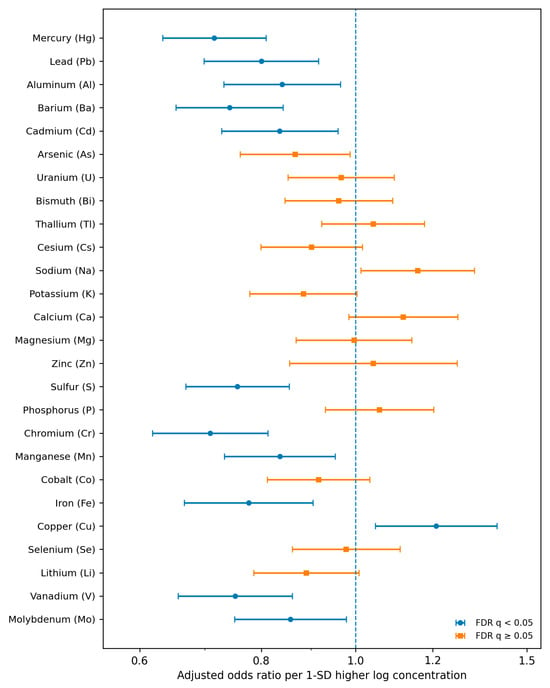
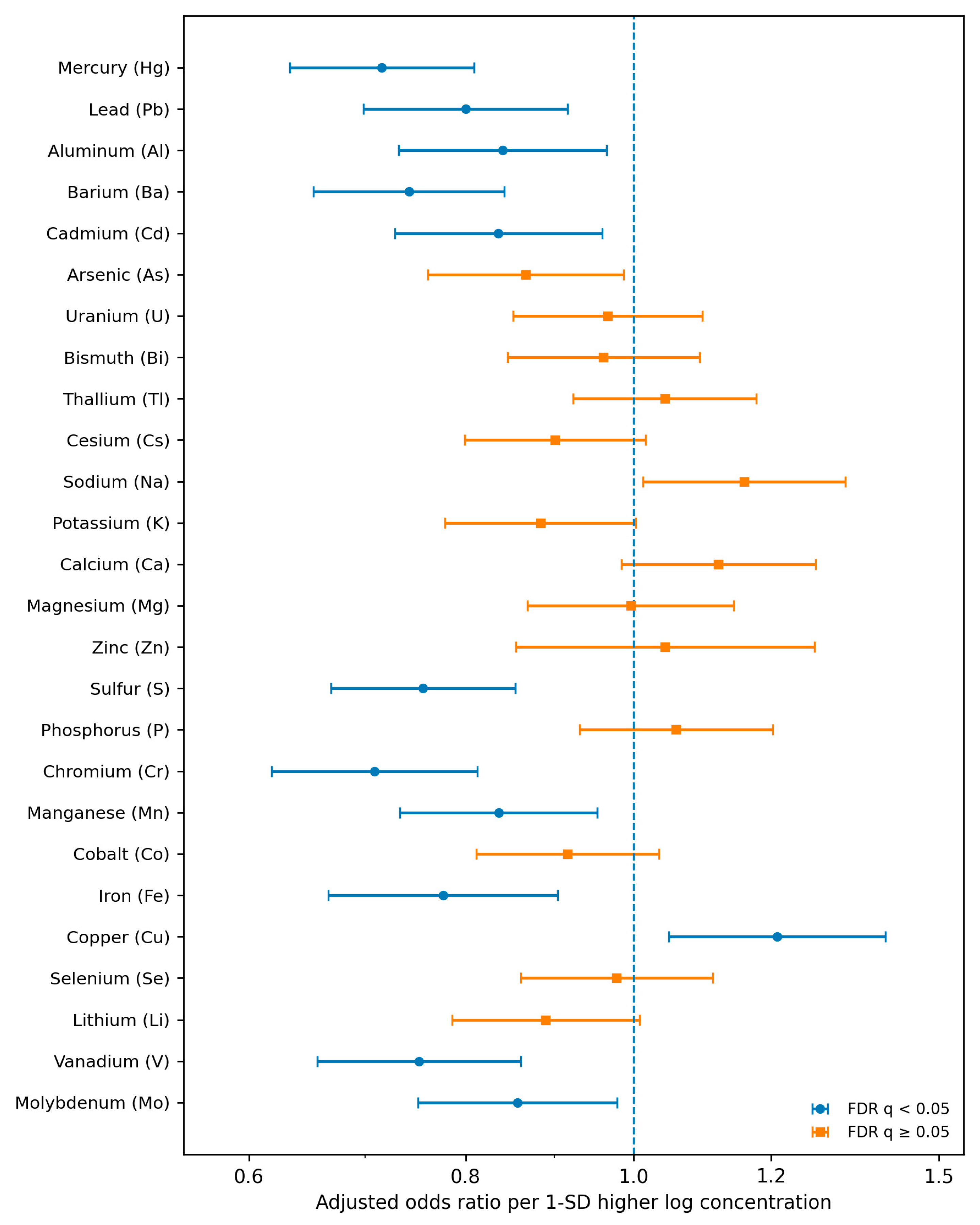
A total of 12 of 26 primary models met FDR q < 0.05: mercury, lead, aluminum, barium, cadmium, sulfur, chromium, manganese, iron, vanadium, and molybdenum had inverse associations, whereas copper had a positive association (Figure 1; Supplementary Table S2). The three smallest p values were for mercury, chromium, and barium; lead and aluminum were not singled out on statistical grounds.
Figure 1.
Element-specific associations with recorded height-percentile status (n = 998). Points show adjusted odds ratios (aORs), and bars show nominal 95% confidence intervals (CIs) from separate ordinal logistic models adjusted for age group and sex. Each estimate corresponds to a one-standard-deviation (SD) increase in log concentration after zero-only substitution. Circular markers indicate Benjamini–Hochberg false-discovery-rate (FDR) q < 0.05 across 26 tests; square markers indicate q ≥ 0.05. Values < 1 indicate lower odds of a higher recorded percentile category. Global proportional-odds violations mean these are screening summaries; threshold-specific estimates are reported in Supplementary Table S6B. The blue dashed vertical line denotes the null value (aOR = 1). Corrected sulfur values remain subject to the analytical limitations described in Section 2.3.
For lead, the common-odds estimate was 0.80 (95% CI, 0.70–0.92; q = 0.0046); for aluminum, it was 0.84 (95% CI, 0.73–0.96; q = 0.0317). Zinc (aOR, 1.04; 95% CI, 0.85–1.27; q = 0.7371) and phosphorus (aOR, 1.06; 95% CI, 0.93–1.20; q = 0.5063) were not associated after adjustment for age group and sex and FDR correction. Sulfur showed an inverse statistical association (aOR, 0.76; 95% CI, 0.67–0.85; q < 0.001), which requires particular caution because correction of the reported concentration scale does not establish analytical validity at that range.
3.3. Model Diagnostics and Sensitivity Analyses
Element-by-threshold interactions had nominal p < 0.05 for lead, bismuth, and chromium, but none met the element-diagnostic FDR criterion (minimum q = 0.267). Global tests of all slopes rejected proportionality in every model (all q < 0.001). The common aORs were therefore treated as exploratory summaries rather than evidence of threshold-invariant effects. Diagnostic tests and threshold-specific estimates are reported in Supplementary Tables S6A and S6B, respectively. For lead, the aOR was 0.70 (95% CI, 0.58–0.85; q = 0.0013) at the >3rd cut point and 0.86 (95% CI, 0.74–1.00; q = 0.1106) at the >50th cut point. The corresponding aluminum estimates were 0.76 (95% CI, 0.58–0.98; q = 0.0628) and 0.86 (95% CI, 0.75–0.98; q = 0.0828); neither met the threshold-specific FDR criterion.
With continuous-age spline adjustment, the aOR was 0.81 (95% CI, 0.70–0.92; q = 0.0069) for lead and 0.84 (95% CI, 0.73–0.97; q = 0.0430) for aluminum (Supplementary Table S4). After adjustment for the additional recorded covariates, lead remained associated (aOR, 0.82; 95% CI, 0.71–0.94; q = 0.0179), whereas aluminum did not meet the FDR criterion (aOR, 0.86; 95% CI, 0.75–0.99; q = 0.0975; Supplementary Table S5). Household smoking and selective-eating fields had 32.1–32.7% missing or invalid values, limiting interpretation of this additional adjustment.
The age-restricted ordinal analysis included 980 participants. The aOR was 0.80 (95% CI, 0.69–0.91; q = 0.0042) for lead and 0.83 (95% CI, 0.73–0.96; q = 0.0264) for aluminum (Supplementary Table S7). Arsenic met the FDR criterion only in some models: q = 0.0603 in the primary analysis, q = 0.0293 after age restriction, and q = 0.0275 in the continuous-height analysis. In the latter analysis (n = 979), each 1-SD higher log lead concentration was associated with 1.10 cm lower measured height (β = −1.10 cm; 95% CI, −1.75 to −0.44; q = 0.0048). Corresponding results for all elements are reported in Supplementary Table S8.
The original add-to-all transformation and the revised zero-only transformation produced the same FDR-significance classification for all 26 elements in the corrected dataset (Supplementary Table S9). Potassium did not meet the FDR criterion under either approach (zero-only, q = 0.0948; add-to-all, q = 0.0918), superseding the borderline result in the original submission. Excluding both unresolved age–height records left 996 participants and did not change any primary FDR classification (Supplementary Table S10). These comparisons address sensitivity to preprocessing and model specification but cannot verify the analytical meaning of low concentrations or recorded zeros.
3.4. Interelement Correlations
Several concentrations were correlated. The strongest positive pairs were manganese–iron (Spearman ρ = 0.703), calcium–magnesium (ρ = 0.701), barium–manganese (ρ = 0.688), iron–vanadium (ρ = 0.679), and manganese–vanadium (ρ = 0.656). Correlations persisted after adjusting ranks for continuous age and sex; for example, the partial rank correlation for manganese–iron was 0.669. Supplementary Figures S1 and S2 display the raw and adjusted correlation matrices, and the complete numerical coefficients are supplied in Supplementary Data S1. Correlation does not identify a shared exposure source or distinguish biological co-regulation from common confounding.
4. Discussion
The analysis identified associations between several hair element concentrations and recorded height-percentile status rather than a pattern specific to lead or aluminum. Twelve elements met the primary FDR criterion. Lead retained an association after additional covariate adjustment, whereas aluminum did not. However, lead met the threshold-specific FDR criterion only at the lower cut point, and aluminum did not meet it at either cut point. These differences, together with global proportional-odds violations, interelement correlations, and incomplete analytical documentation, support interpretation as exploratory associations rather than independent elemental effects.
Selection is a central limitation. The cohort comprised children tested in one pediatric hospital, and 15.4% were recorded at or below the 3rd percentile. The concentration of short-stature diagnosis codes in this category is consistent with clinical enrichment, although the precise test-ordering indications were not documented. Selection into testing could depend jointly on growth, symptoms, family concerns, nutrition, or exposure history; this may distort associations as well as prevalence estimates. The results cannot be generalized to Mongolian children as a population, and absence of a diagnosis code should not be interpreted as absence of disease or a screening indication.
The growth endpoint also remains imperfect. WHO-based assessment in the youngest children and InBody-derived bands in older participants are not a harmonized reference system. Retaining the three records above the 97th percentile corrected the previous upper-category restriction but did not resolve uncertainty about the InBody reference. Age restriction showed similar lead and aluminum estimates, and the centimeter-based sensitivity analysis avoided percentile categorization. Neither analysis supplies an externally standardized height-for-age z score, compensates for the lack of exact age, or measures growth velocity. The global proportional-odds findings further justify reporting threshold-specific estimates rather than treating each common odds ratio as a universal effect across the height distribution.
Lead has established toxicological and pediatric-health relevance [8,9,10,13]. A study using blood-based exposure biomarkers examined bone mineral density in children and adolescents [33], but those matrices and endpoints differ from the present hair–height association. Blood lead remains the established clinical exposure biomarker; hair lead is more sensitive to external deposition and collection and preparation procedures [16,19,20]. The observed association is therefore a reason for targeted confirmatory work, not evidence that hair lead represents systemic dose or caused reduced stature. Aluminum likewise has toxicological relevance [34], but its attenuation after additional adjustment and susceptibility to external contamination limit any mechanistic interpretation.
Arsenic illustrates dependence on analytic choices. It did not meet the primary FDR criterion but did in the age-restricted and continuous-height models. These analyses use overlapping participants and cannot be treated as independent confirmations. Hair arsenic may include external contamination, and no arsenic speciation or complementary blood or urine measurements were available. Environmental soil and water studies establish possible pathways in their own settings, not exposure sources for this cohort [11,12]. The arsenic finding is accordingly considered model-sensitive and hypothesis-generating.
Interelement correlations may partly explain the multiple associations. Shared sources, diet, physiology, age, and measurement conditions can contribute to correlated concentrations, as suggested by mother–child hair studies and other pediatric biomonitoring work [23,27]. Mixture-oriented analyses address joint-exposure questions that differ from the present single-element models [35,36]. No joint mixture-effect model was fitted, and the individual coefficients should not be interpreted as mutually adjusted or causal effects. These findings may inform a prespecified mixture analysis with more complete exposure characterization and confounder measurement.
Zinc and phosphorus were not associated with the outcome after age-group/sex adjustment and FDR correction. The null association for hair zinc does not contradict the established role of zinc in growth [5,6]. Neither result validates laboratory-specific hair thresholds as diagnostic indicators of nutritional status. Pediatric reference-value studies describe method- and age-dependent distributions [21,22]. We removed laboratory classification and ratio results from the revised inferential presentation to avoid conflating these descriptive laboratory labels with clinical deficiency or toxicity.
The basic collection, washing, digestion, instrumentation, and method-level quality-control summary are reported, but transparency remains incomplete. The laboratory requested that detailed internal washing conditions not be disclosed; complete removal of external contamination cannot be assumed. Element-specific MDL/LOQ values, calibration and dilution records, blank results, and reference-material results for the study batches were unavailable. Low reported values and high sulfur concentrations therefore cannot be fully reconciled with the aggregate method limits. The corrected master file resolves the previously discrepant sulfur scale but does not validate sulfur quantification. Precision, recovery, and accreditation summaries do not replace element- and batch-specific evidence [17,18,19,20]. Numerical substitution and sensitivity analyses cannot remedy these analytical limitations.
The temporal mismatch is equally important. A 2–3 cm proximal hair segment reflects a relatively recent and individually variable period of incorporation and surface exposure, whereas attained height reflects cumulative growth over years [16]. We cannot determine whether the measured concentrations preceded lower height status; prenatal-exposure studies address a different temporal question [37]. Reverse causation, growth-related changes in incorporation, and clinical interventions before testing remain possible.
Further limitations include absent parental height, detailed diet and supplementation, socioeconomic measures, pubertal status, and quantitative household exposure data. Available smoking and eating fields were incomplete, and missing-category adjustment does not ensure unbiased confounder control. Two age–height inconsistencies persisted; their exclusion did not alter FDR classifications, but this does not establish that all records are error-free. The retrospective cross-sectional design, non-harmonized percentiles, and correlated exposures preclude a causal interpretation. Strengths include the broad elemental panel, multiplicity control, explicit model diagnostics, and reporting of sensitivity to additional adjustment. These features improve transparency but do not remove selection or measurement bias.
5. Conclusions
Several hair element concentrations were associated with recorded height-percentile status in this clinic-based Mongolian pediatric cohort. Lead retained an association after adjustment for additional recorded variables, whereas aluminum did not meet the FDR criterion in that model; results also depended on the percentile threshold. These are not independent elemental effects or evidence of causation, systemic toxicant burden, or nutritional deficiency. Confirmation requires harmonized age-specific anthropometry, documented analytical performance, complementary biomarkers, better confounder measurement, and longitudinal assessment.
Supplementary Materials
The following supporting information can be downloaded at https://www.mdpi.com/article/10.3390/life16111821/s1: Table S1. Clinical context and available covariates (N = 1000); Table S2. Primary age-group- and sex-adjusted ordinal models (n = 998); Table S3. Recorded zeros and element-specific preprocessing parameters (N = 1000); Table S4. Sensitivity analysis with continuous age modeled using cubic B-splines (n = 998); Table S5. Sensitivity analysis with additional recorded covariates (n = 998); Table S6A. Proportional-odds diagnostics for the corrected dataset (n = 998); Table S6B. Threshold-specific associations allowing all slopes to differ (n = 998); Table S7. Age-restricted sensitivity analysis among participants aged ≥3 years (n = 980); Table S8. Continuous measured-height sensitivity analysis among participants aged ≥3 years (n = 979); Table S9. Alternative handling of zero-valued observations (n = 998); Table S10. Sensitivity analysis excluding two unresolved age–height inconsistencies (n = 996); Table S11. Available analytical information and explicit reporting limitations; Figure S1. Spearman rank correlations among all 26 hair elements (N = 1000); Figure S2. Partial rank correlations after adjustment for sex and continuous age represented by four cubic B-spline terms (N = 1000); Supplementary Data S1. Numerical correlation matrices.
Author Contributions
Conceptualization, T.D. and A.A.; methodology, T.D., A.A. and Y.Y.; investigation, T.D., O.D., T.M. and A.A.; data curation, T.D.; formal analysis, Y.Y.; validation, A.A. and Y.Y.; writing—original draft preparation, T.D. and Y.Y.; writing—review and editing, T.D., O.D., T.M., A.A. and Y.Y.; visualization, Y.Y.; supervision, A.A.; project administration, T.D. and A.A. All authors have read and agreed to the published version of the manuscript.
Funding
This research received no external funding.
Institutional Review Board Statement
The study was conducted in accordance with the Declaration of Helsinki and approved by the Ethics Review Committee of Etugen University, Ulaanbaatar, Mongolia (Approval No. 2209-C/2802; 28 September 2022). The approval included retrospective research use of clinical and laboratory records collected before approval.
Informed Consent Statement
Written informed consent for research use of the data was obtained from the participants’ parents or legal guardians.
Data Availability Statement
The de-identified participant-level data are not publicly available because of clinical privacy and institutional requirements. They are available from the corresponding authors on reasonable request and subject to applicable ethical and institutional requirements. Aggregate interelement correlation matrices are provided in Supplementary Data S1.
Acknowledgments
The authors acknowledge Medinex Laboratory, Republic of Korea, for coordinating the hair elemental analyses. During manuscript preparation, the authors used ChatGPT (GPT-5.6 Sol Pro; OpenAI, San Francisco, CA, USA) to assist with manuscript organization, scientific language editing, reference checking, and development of statistical analysis code. All analyses reported in the revised manuscript were performed on the author-supplied corrected participant-level dataset using the software specified in Section 2.4. The authors reviewed and verified the statistical outputs, interpretations, references, and manuscript revisions and take full responsibility for the content of this publication.
Conflicts of Interest
The authors declare no conflicts of interest.
Abbreviations
aOR, adjusted odds ratio; CI, confidence interval; FDR, false discovery rate; HC3, heteroscedasticity-consistent covariance estimator, type 3; ICP-MS, inductively coupled plasma mass spectrometry; IQR, interquartile range; KOLAS, Korea Laboratory Accreditation Scheme; LOQ, limit of quantification; MDL, method detection limit; RSD, relative standard deviation; SD, standard deviation; STROBE, Strengthening the Reporting of Observational Studies in Epidemiology; WHO, World Health Organization; YSIET, YS Institute of Environmental Technology.
References
- Black, R.E.; Victora, C.G.; Walker, S.P.; Bhutta, Z.A.; Christian, P.; de Onis, M.; Ezzati, M.; Grantham-McGregor, S.; Katz, J.; Martorell, R.; et al. Maternal and child undernutrition and overweight in low-income and middle-income countries. Lancet 2013, 382, 427–451. [Google Scholar] [CrossRef] [Scilit]
- Victora, C.G.; Adair, L.; Fall, C.; Hallal, P.C.; Martorell, R.; Richter, L.; Sachdev, H.S. Maternal and child undernutrition: Consequences for adult health and human capital. Lancet 2008, 371, 340–357. [Google Scholar] [CrossRef] [Scilit]
- Jaishankar, M.; Tseten, T.; Anbalagan, N.; Mathew, B.B.; Beeregowda, K.N. Toxicity, mechanism and health effects of some heavy metals. Interdiscip. Toxicol. 2014, 7, 60–72. [Google Scholar] [CrossRef] [Scilit]
- Tchounwou, P.B.; Yedjou, C.G.; Patlolla, A.K.; Sutton, D.J. Heavy Metal Toxicity and the Environment. In Molecular, Clinical and Environmental Toxicology; Luch, A., Ed.; Experientia Supplementum, Vol. 101; Springer: Basel, Switzerland, 2012; pp. 133–164. [Google Scholar] [CrossRef] [Scilit]
- Prasad, A.S. Discovery of human zinc deficiency: Its impact on human health and disease. Adv. Nutr. 2013, 4, 176–190. [Google Scholar] [CrossRef] [Scilit]
- Hambidge, K.M.; Krebs, N.F. Zinc deficiency: A special challenge. J. Nutr. 2007, 137, 1101–1105. [Google Scholar] [CrossRef] [Scilit]
- Rayman, M.P. Selenium and human health. Lancet 2012, 379, 1256–1268. [Google Scholar] [CrossRef] [Scilit]
- Agency for Toxic Substances and Disease Registry (ATSDR). Toxicological Profile for Lead; U.S. Department of Health and Human Services: Atlanta, GA, USA, 2020. [Google Scholar] [CrossRef] [Scilit]
- Sanders, T.; Liu, Y.; Buchner, V.; Tchounwou, P.B. Neurotoxic effects and biomarkers of lead exposure: A review. Rev. Environ. Health 2009, 24, 15–45. [Google Scholar] [CrossRef] [Scilit]
- UNICEF; Pure Earth. The Toxic Truth: Children’s Exposure to Lead Pollution Undermines a Generation of Future Potential; UNICEF: New York, NY, USA, 2020. [Google Scholar]
- Nemati-Mansour, S.; Mohammadi, A.; Babazadeh, B.; Asgari Lajayer, B.; Babaie, J.; Nikniaz, L.; Mosaferi, M. Explore of High Arsenic Levels in Agricultural Soils: Observations from Hashtroud County, Northwest of Iran. Soil Sediment Contam. Int. J. 2025, 34, 1068–1089. [Google Scholar] [CrossRef] [Scilit]
- Nemati-Mansour, S.; Hudson-Edwards, K.A.; Mohammadi, A.; Asghari Jafarabadi, M.; Mosaferi, M. Environmental occurrence and health risk assessment of arsenic in Iran: A systematic review and meta-analysis. Hum. Ecol. Risk Assess. Int. J. 2022, 28, 683–710. [Google Scholar] [CrossRef] [Scilit]
- Heng, Y.Y.; Asad, I.; Coleman, B.; Menard, L.; Benki-Nugent, S.; Were, F.H.; Karr, C.J.; McHenry, M.S. Heavy metals and neurodevelopment of children in low- and middle-income countries: A systematic review. PLoS ONE 2022, 17, e0265536. [Google Scholar] [CrossRef] [Scilit]
- Liu, C.; Huang, L.; Huang, S.; Wei, L.; Cao, D.; Zan, G.; Tan, Y.; Wang, S.; Yang, M.; Tian, L.; et al. Association of both prenatal and early childhood multiple metals exposure with neurodevelopment in infant: A prospective cohort study. Environ. Res. 2022, 205, 112450. [Google Scholar] [CrossRef] [Scilit]
- Ding, M.; Shi, S.; Qie, S.; Li, J.; Xi, X. Association between heavy metals exposure (cadmium, lead, arsenic, mercury) and child autistic disorder: A systematic review and meta-analysis. Front. Pediatr. 2023, 11, 1169733. [Google Scholar] [CrossRef] [Scilit]
- Kempson, I.M.; Lombi, E. Hair analysis as a biomonitor for toxicology, disease and health status. Chem. Soc. Rev. 2011, 40, 3915–3940. [Google Scholar] [CrossRef] [Scilit]
- Silva, J.; Marguí, E.; Guillemaut, R.; Jablan, J.; Migliori, A.; Kasprzyk, P.; Ferreira, J.J.; Pessanha, S. Evaluation of the quantitative performance of different spectroscopic techniques for multielemental analysis of nail and hair samples: A comparative study. J. Trace Elem. Med. Biol. 2025, 92, 127751. [Google Scholar] [CrossRef] [Scilit]
- Bass, D.A.; Hickock, D.; Quig, D.; Urek, K. Trace element analysis in hair: Factors determining accuracy, precision, and reliability. Altern. Med. Rev. 2001, 6, 472–481. [Google Scholar]
- Seidel, S.; Kreutzer, R.; Smith, D.; McNeel, S.; Gilliss, D. Assessment of commercial laboratories performing hair mineral analysis. JAMA 2001, 285, 67–72. [Google Scholar] [CrossRef] [Scilit]
- Poon, W.T.; Ling, S.C.; Chan, A.Y.W.; Mak, T.W.L. Use of hair analysis in the diagnosis of heavy metal poisoning: Report of three cases. Hong Kong Med. J. 2004, 10, 197–200. [Google Scholar]
- Ruiz, R.; Estevan, C.; Estévez, J.; Alcaide, C.; Sogorb, M.A.; Vilanova, E. Reference values on children’s hair for 28 elements (heavy metals and essential elements) based on a pilot study in a representative non-contaminated local area. Int. J. Mol. Sci. 2023, 24, 8127. [Google Scholar] [CrossRef] [Scilit]
- Kwon, J.W.; Kim, B.E.; Park, M.J.; Kim, S.W. Trace element concentration profiles in the hair of normal children living in the northern area of Seoul. Korean J. Pediatr. 2006, 49, 18–23. [Google Scholar] [CrossRef] [Scilit]
- Batyrova, G.; Kononets, V.; Umarova, G.; Taskozhina, G.; Umarov, Y.; Issanguzhina, Z.; Kudabayeva, K.; Batyrov, R. Trace metal and metalloid profiles in hair samples from children in the oil-producing region of Kazakhstan. Toxics 2025, 13, 522. [Google Scholar] [CrossRef] [Scilit]
- Rajfur, M.; Świsłowski, P.; Nowainski, F.; Śmiechowicz, B. Mosses as biomonitor of air pollution with analytes originating from tobacco smoke. Chemistry-Didactics-Ecology-Metrology 2018, 23, 127–136. [Google Scholar] [CrossRef] [Scilit]
- Allen, R.W.; Gombojav, E.; Barkhasragchaa, B.; Byambaa, T.; Lkhasuren, O.; Amram, O.; Takaro, T.K.; Janes, C.R. An assessment of air pollution and its attributable mortality in Ulaanbaatar, Mongolia. Air Qual. Atmos. Health 2013, 6, 137–150. [Google Scholar] [CrossRef] [Scilit]
- Government of Mongolia, Ministry of Health; Mongolia National Center for Public Health; UNICEF. Nutrition Status of the Population of Mongolia: Sixth National Nutrition Survey Key Indicators Report; UNICEF: Ulaanbaatar, Mongolia, 2024. [Google Scholar]
- Hashimoto, A.; Shinohara, K.; Inoue, H.; Kuwano, T. Mother-child correlations in hair mineral profiles in Japan: Insights from a cross-sectional study. J. Trace Elem. Med. Biol. 2026, 95, 127877. [Google Scholar] [CrossRef] [Scilit]
- Batyrova, G.; Umarova, G.; Umarov, Y.; Taskozhina, G.; Kononets, V.; Batyrov, R. Association between hair trace element content and children’s growth and development: Protocol for a cross-sectional surveillance study. JMIR Res. Protoc. 2025, 14, e72207. [Google Scholar] [CrossRef] [Scilit]
- von Elm, E.; Altman, D.G.; Egger, M.; Pocock, S.J.; Gøtzsche, P.C.; Vandenbroucke, J.P.; Kuller, L.H. The Strengthening the Reporting of Observational Studies in Epidemiology (STROBE) statement: Guidelines for reporting observational studies. Lancet 2007, 370, 1453–1457. [Google Scholar] [CrossRef] [Scilit]
- World Health Organization. WHO Child Growth Standards: Length/Height-For-Age, Weight-For-Age, Weight-For-Length, Weight-For-Height and Body Mass Index-For-Age: Methods and Development; World Health Organization: Geneva, Switzerland, 2006. [Google Scholar]
- InBody Co., Ltd. InBody J50: Product Information. Available online: https://inbody.com/kr/en/products/category/body-composition/1 (accessed on 25 October 2026).
- ISO/IEC 17025:2017; General Requirements for the Competence of Testing and Calibration Laboratories. International Organization for Standardization: Geneva, Switzerland, 2017.
- Li, C.; Niu, Z.; Du, Y.; Yang, L.; Wu, F.; Hu, X.; Meng, X.; Feng, Z.; Niu, S.; Sun, Q.; et al. Low-dose fluoride and lead co-exposure alters bone mineral density in youth: A nationally representative cross-sectional study. J. Trace Elem. Med. Biol. 2026, 95, 127889. [Google Scholar] [CrossRef] [Scilit]
- Agency for Toxic Substances and Disease Registry (ATSDR). Toxicological Profile for Aluminum; U.S. Department of Health and Human Services: Atlanta, GA, USA, 2008.
- Fang, P.; Wang, Y.; Chen, N.; Gao, K.; Gong, W.; Yang, L.; Sun, Q.; Wang, X.; Cai, T.; Li, T.; et al. Association of blood trace metals with anemia in children aged 6–17 years old. J. Trace Elem. Med. Biol. 2025, 89, 127655. [Google Scholar] [CrossRef] [Scilit]
- Long, J.; Huang, H.; Tang, P.; Liang, J.; Liao, Q.; Chen, J.; Pang, L.; Yang, K.; Wei, H.; Chen, M.; et al. Associations between maternal exposure to multiple metals and metalloids and blood pressure in preschool children: A mixture-based approach. J. Trace Elem. Med. Biol. 2024, 84, 127460. [Google Scholar] [CrossRef] [Scilit]
- Li, C.; Wu, C.; Zhang, J.; Li, Y.; Zhang, B.; Zhou, A.; Liu, W.; Chen, Z.; Li, R.; Cao, Z.; et al. Associations of prenatal exposure to vanadium with early-childhood growth: A prospective prenatal cohort study. J. Hazard. Mater. 2021, 411, 125102. [Google Scholar] [CrossRef] [Scilit]

Disclaimer/Publisher’s Note: The statements, opinions and data contained in all publications are solely those of the individual author(s) and contributor(s) and not of MDPI and/or the editor(s). MDPI and/or the editor(s) disclaim responsibility for any injury to people or property resulting from any ideas, methods, instructions or products referred to in the content. |
© 2026 by the authors. Licensee MDPI, Basel, Switzerland. This article is an open access article distributed under the terms and conditions of the Creative Commons Attribution (CC BY) license.