


Abstract
Robotic Aerial Work Platforms (RAWPs) are subjected to multi-source excitations including wind gusts and inertial loads, which result in strongly nonlinear and time-varying coupled triaxial attitude vibrations. Conventional recurrent architectures such as LSTM and GRU suffer from gradient vanishing when processing long sequences, while Transformer utilize self-attention mechanisms to learn simple periodic correlations; however, the vibrations in RAWPs exhibit a complex time-series pattern composed of low-frequency oscillations superimposed with high-frequency impacts and accumulates errors through autoregressive decoding. To address these limitations, this paper proposes an improved Transformer model featuring dual-channel periodic positional encoding and global–local hybrid multi-head attention for one-shot multi-step long-sequence prediction of RAWPs attitude vibrations. The proposed method designs a dual-channel independent sine–cosine positional encoding with a tunable periodic modulation factor to explicitly embed the multi-scale periodicity priors of vibration signals and introduces a global–local hybrid attention mechanism that parallelly extracts transient amplitude impact features in the time domain and periodic fluctuation features in the frequency domain. A full-scale aerial experimental platform is established to collect triaxial vibration data under two operating conditions at a sampling frequency of 20 Hz. The results determine the optimal periodic modulation factor and input window length, and ablation studies validate the synergistic gains of the two proposed modules. Comparative results demonstrate that the proposed model achieves substantially reduced prediction errors. In terms of pitch angle, the proposed model achieves a performance improvement of 53.89% over Transformer, 52.11% over LSTM, and 57.67% over GRU. The proposed model effectively provides a reliable data-driven prediction framework for attitude monitoring and active vibration suppression of aerial work platforms.
1. Introduction
Aerial work platforms are essential carrier equipment in high-altitude operation scenarios including wind turbine maintenance, building facade and power line inspection [1,2,3]. In recent years, with the rapid development of collaborative robot technologies, Robotic Aerial Work Platforms (RAWPs) have become a significant direction for enhancing the automation and intelligence levels of high-altitude operations, which combines the large-range mobility of the platform with the dexterous and precise manipulation capabilities of the robotic arm [4]. It should be noted that the term RAWPs has been used in some literature to denote unmanned aerial vehicles equipped with manipulators [5,6,7]. In contrast, the system investigated in this paper is a collaborative robot mounted on a conventional vehicle-based aerial work platform.
The attitude vibrations of RAWPs exhibit significantly more complex and severe dynamic characteristics. The servo motions of each manipulator joint excite high-frequency transient impact components that superimpose upon low-frequency wind-induced swaying, which results in broadband, multi-mode coupled vibration responses [8]. Then, variations in manipulator end-effector loads and continuous reconfiguration of the arm configuration cause the system centroid and inertia matrix to undergo sustained and drastic changes throughout the operation, endowing the vibration modes with pronounced time-varying non-stationary characteristics. More critically, the operational precision of the manipulator end-effector is directly affected by the platform base attitude vibration amplitude. A minor pitch or roll oscillation at the platform level will be geometrically amplified to several times the base displacement at the end-effector. Therefore, vibration prediction for RAWPs is the requirement for structural safety and also a prerequisite determining whether the manipulator can successfully execute precision tasks. It is the key technical foundation for active vibration suppression and motion compensation control by achieving high-accuracy, long-sequence multi-step prediction of attitude vibration.
Existing approaches for vibration characteristic analysis and prediction of engineering equipment can be broadly categorized into mechanism-driven and data-driven modeling [9,10,11]. Mechanism-driven methods rely on multibody system dynamics, finite element methods, and analytical rigid-body dynamics equations to construct physical models, through which natural frequencies, mode shapes, and damping characteristics are solved [4,12]. The advantage lies in explicit physical interpretability, and enables quantitative analysis of the influence of structural parameters on vibration responses. However, the complex dynamic coupling terms of the manipulator are difficult to model precisely for the RAWPs, along with non-smooth nonlinear factors such as joint friction and clearances. Then, the uncertainties of wind gust loads and manipulator motion planning prevent external excitations from being described by deterministic mathematical expressions [13]. Moreover, the numerical integration of full-system multibody coupled differential equations involving the manipulator incurs prohibitive computational costs that cannot meet the real-time prediction requirements of onboard embedded platforms [14,15]. Thus, the purely mechanism-based vibration prediction methods are inadequate for addressing the prediction challenges posed by complex variable operating conditions, strong time-varying behavior, and strong coupling in RAWPs.
Data-driven time-series prediction methods based on deep learning have emerged as a research hotspot in the field of vibration prediction, which require no precise system physical parameters and can learn nonlinear dynamic evolution rules end-to-end from historical sensor data [16]. Within the recurrent neural network (RNN) architecture family, Long Short-Term Memory (LSTM) and Gated Recurrent Unit (GRU) effectively mitigate the vanishing gradient problem through gating mechanisms, achieving superior performance over linear time-series models in bearing vibration prediction and wind turbine tower vibration forecasting [17,18,19]. Nevertheless, LSTM and GRU are inherently serial recursive architectures, with training and inference efficiency limited by non-parallelizable temporal dependencies [20,21]. More importantly, when facing long-period vibration sequences exceeding hundreds of steps in RAWPs and the high-frequency impact features induced by frequent manipulator start/stop actions, the memory units struggle to simultaneously preserve long-distant historical trends and near-term transient details. During multi-step prediction, errors are continuously amplified through recursive feedback structures, which cause significant degradation in long-term forecasting accuracy that cannot support the anticipation requirements of practical vibration suppression control [22]. Beyond recurrent architectures, Temporal Convolutional Networks (TCNs) have recently emerged as a competitive alternative for sequence modeling, which leverage dilated causal convolutions to achieve large receptive fields while enabling parallel computation [23,24]. TCNs have demonstrated superior performance over LSTM and GRU in various time-series forecasting tasks. However, standard TCNs treat all temporal positions with shared convolutional kernels, which may struggle to capture the strongly non-stationary and multi-scale periodic characteristics of RAWP vibration signals, where low-frequency wind-induced swaying coexists with high-frequency transient impacts from manipulator motions. Moreover, the fixed receptive field of convolutional architectures lacks the adaptive attention mechanism needed to dynamically reweight salient temporal features across varying operating conditions.
The introduction of the Transformer architecture has provided a fundamentally new direction for long-sequence modeling [25,26]. Built entirely upon the self-attention mechanism, the Transformer computes direct associative weights between any two positions within a sequence, achieving efficient modeling of long-range global dependencies while supporting sequence-level parallel computation. However, there are three core challenges by applying the Transformer to the vibration prediction of RAWPs directly. First, the Transformer employs fixed-frequency sinusoidal–cosinusoidal positional encoding, which performs well in natural language processing, but the vibration signals of RAWPs contain both low-frequency dominant periods of wind-induced swaying and high-frequency harmonic components induced by manipulator actions. Thus, fixed-frequency sinusoidal basis functions cannot simultaneously represent such multi-scale periodicity priors [27,28]. Second, the global self-attention of Transformer treats all sequence positions uniformly, with substantial computational resources consumed by redundant interactions at non-salient positions [29,30,31]. However, the most safety-critical information in RAWPs lies precisely in amplitude mutations and spike impacts at manipulator start/stop and contact instants, and these local transient features are severely diluted under globally averaged attention allocation. Third, the Transformer adopts autoregressive decoding and iteratively generates subsequent sequence steps one by one [32,33]. RAWP vibration signals have low signal-to-noise ratios with significant random components, and minor single-step errors are drastically amplified through multi-step recursive feedback, causing rapid divergence in medium-term forecasts that cannot provide reliable temporal information for control decisions.
To address the aforementioned problems, this paper proposes an improved Transformer model integrating dual-channel periodic positional encoding and global–local hybrid attention (GLHA), which is specifically designed for long-sequence direct multi-step prediction of attitude vibration in RAWPs. This model is specifically designed for deployment on embedded GPUs that require at least 4 GB of memory and FP16 support; its inference latency is below 15 ms, meeting the real-time requirements for a 20 Hz control loop. The proposed model is built upon the Transformer encoder–decoder architecture, and decouples sinusoidal and cosinusoidal encodings into two independent feature branches at the positional encoding layer. At the same time, a multi-scale period adjustment factor is introduced to enable the encoding frequencies to simultaneously adapt to low-frequency wind-induced swaying and high-frequency harmonic components induced by manipulator actions. At the attention mechanism level, a global–local dual-branch parallel multi-head attention is designed, where the global branch employs sparse global attention to capture long-period low-frequency trends and the local branch focuses on transient impact features induced by manipulator actions through sliding window masking. Then, the outputs of the two branches are fused through a gated adaptive fusion mechanism to achieve joint time-domain and frequency-domain feature representation. At the prediction strategy level, the historical input window length is systematically optimized to suppress error accumulation and achieves one-shot direct multi-step prediction without recursive feedback. Therefore, we provide a reliable data-driven predictive framework that supports posture monitoring and subsequent active vibration suppression control.
The main contributions of this paper are as follows:
(1) A dual-channel independent sinusoidal–cosinusoidal multi-scale periodic positional encoding is proposed, which decouples sinusoidal and cosinusoidal branches and introduces an adjustable period factor to explicitly embed multi-scale vibration periodicity priors of RAWPs without introducing additional learnable parameters.
(2) A global–local dual-branch hybrid multi-head attention mechanism is designed, where parallel sparse global attention and sliding-window local attention with gated adaptive fusion achieve high-sensitivity capture of local transient features such as manipulator start/stop impacts while maintaining long-range trend modeling capability.
(3) Historical input window length is systematically optimized to suppress error accumulation, with multi-group comparative experiments quantifying the influence mechanism of window length on multi-step prediction accuracy and convergence for the RAWPs.
(4) A multi-condition real-measured vibration dataset for RAWPs is constructed and comprehensive systematic validation is conducted, leveraging 20 Hz high-frequency sampled three-axis attitude vibration data under two representative operating heights and multiple platform motion conditions and manipulator action conditions, with extensive multi-baseline model comparisons and ablation studies fully validating the effectiveness and superiority of the proposed model.
The remainder of this paper is structured as follows. In Section 2, the improved Transformer architecture is presented in detail, with special emphasis on the dual-channel periodic positional encoding and the global–local hybrid multi-head attention mechanism. Section 3 reports the experimental results, covering the data acquisition protocol, optimal window selection, ablation experiments, and performance comparisons with baseline models. Finally, Section 4 summarizes the main findings, identifies the limitations, and discusses prospective extensions.
2. Methods
2.1. Overall Network
This paper proposes an improved Transformer network architecture for vibration signal prediction. The long-sequence time-series direct prediction model is selected because its multi-head attention can simultaneously extract multi-state vibration features of RAWPs, which is well-suited for industrial vibration detection scenarios. On the basis of the standard Transformer encoder–decoder framework, a modulation factor matching vibration cycles is introduced to implement vibration cycle positional encoding, and a global–local hybrid attention mechanism is adopted.
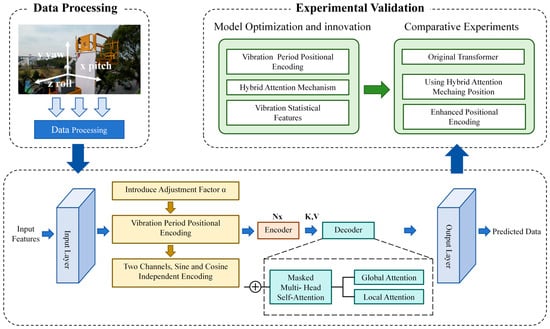
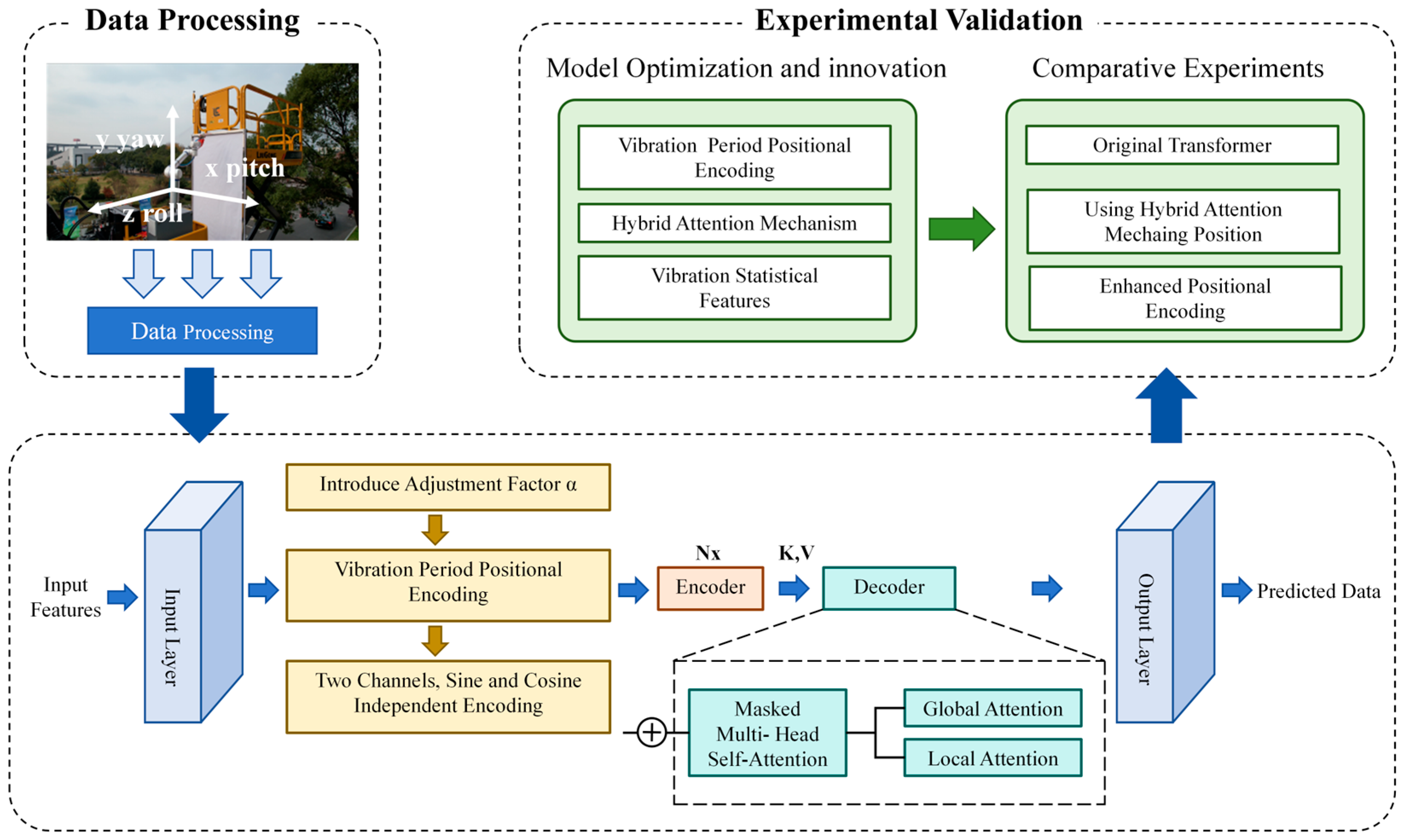
Figure 1 illustrates the proposed structural framework in this work. Firstly, the generated data undergoes preprocessing including time-domain sampling, input feature selection and normalization. Afterwards, vibration cycle positional encoding driven by time-series gradients and vibration feature embeddings are integrated into each element to inject sequential position information. The global–local hybrid attention is leveraged to synchronously capture overall vibration variations in the full sequence and high-frequency small-amplitude vibration features of adjacent elements. The encoder–decoder architecture is employed to implement one-shot direct prediction The tensor dimension of the input historical sequence is Xscr ϵ RB×50×1, where B denotes the size of the training batch, 50 represents the length of the input window, and 1 corresponds to the pitch. The input features undergo processing through two EncoderLayers to extract temporal features; within each layer, a GLHA module is applied, ultimately producing encoded memory features. The decoder section constructs a placeholder target sequence and performs decoding operations via two DecoderLayers, with a predicted output step size of 32 and dmodel of 64; the network terminates with a single output layer. This final layer does not compress the temporal dimension, directly outputting the complete predicted sequence Ypredϵ RB×32×1 for all 32 time steps. Transformer is a widely recognized and efficient method for time-series prediction, especially competent at handling parallel correlations within sequential data.
Figure 1.
Overall architecture of the improved Transformer network for RAWP vibration prediction, illustrating data preprocessing flow, dual-channel periodic positional encoding module, global–local hybrid multi-head attention mechanism, and subsequent experimental validation pipeline.
In terms of data, short-term prediction places more emphasis on feature extraction compared with one-shot multi-step prediction. The encoder–decoder structure not only enhances the network’s capacity for vibration feature extraction but also accommodates variable input and output lengths. Therefore, the sliding window size and training iterations need to be adjusted. Subsequent verification experiments are carried out, including model optimization and comparative analysis. This research investigates how the optimal modulation factor, sliding window size and training iterations affect model performance and compares the improved model with other mainstream networks.
2.2. Standard Transformer
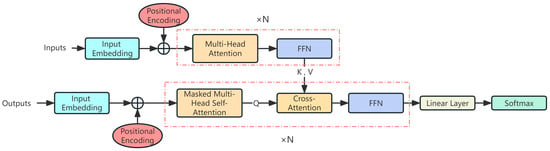
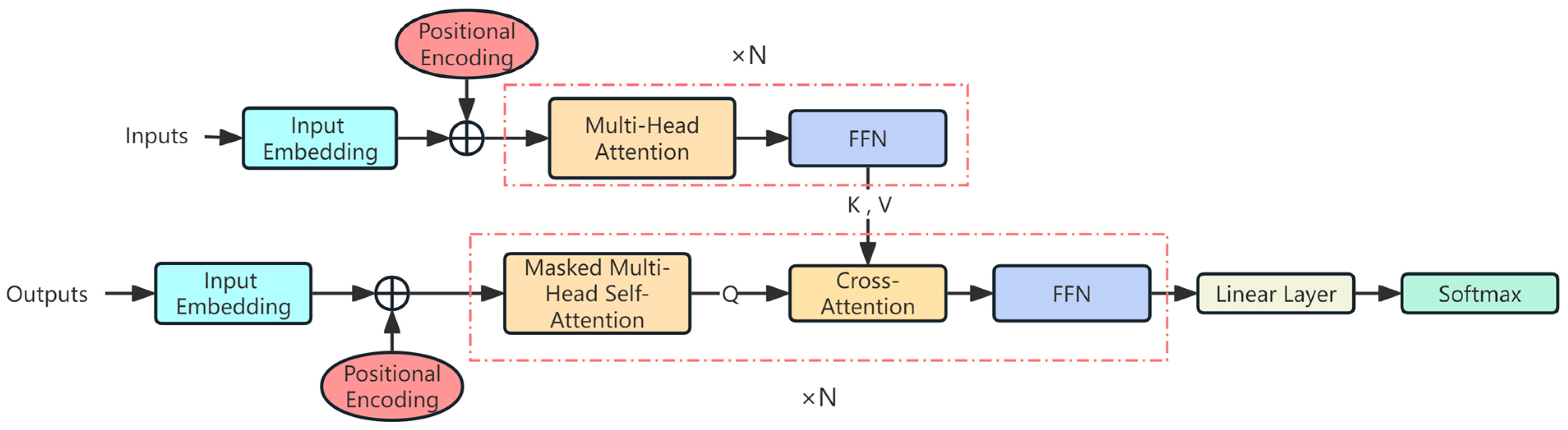
The standard Transformer consists of an encoder and a decoder. Its core relies on the scaled dot-product self-attention mechanism to model dependency relationships between sequence elements. The original architecture was mainly applied to natural language modeling and later migrated to the field of time-series prediction [22]. Figure 2 presents the flowchart of Transformer. The stacked encoder–decoder structure is adopted to realize sequence transformation, and the attention mechanism is utilized throughout the whole process to model global context. The overall workflow is divided into input representation construction, multi-layer encoder feature extraction, multi-layer decoder time-series modeling, and output probability mapping. Each stage is equipped with standardized mathematical operations and constraint mechanisms, balancing time-series perception and long-range dependency capturing capabilities.
where pos denotes the position of the element, i represents the index of the vector dimension, and dmodel is the total dimension of the model feature vectors. The positional encoding vector and embedding vector are added element-wise to obtain input features carrying both semantic and temporal information, which are then fed into the encoder module with N stacked layers.
Figure 2.
Network architecture of Transformer, which consists of a multi-layer encoder for source sequence feature extraction and a multi-layer decoder for target sequence generation, with multi-head self-attention, cross-attention, and feedforward networks as the core components.
In the stage of input representation construction, discrete element sequences are first mapped to dense vectors with dimension dmodel. via an embedding layer. The embedding outputs are uniformly scaled by to control feature amplitudes and mitigate numerical oscillation during training. Since the model contains no recurrent units, it cannot inherently identify the sequential order of tokens. Sine–cosine positional encoding is therefore required to supplement time-series information.
A single-layer encoder is serially composed of multi-head self-attention and a feedforward network. Residual connections and layer normalization are equipped for both submodules to alleviate the vanishing gradient problem in deep networks and stabilize feature distribution. After the input features enter the multi-head attention unit, three groups of independent linear layers project the features into query Q, key K, and value V. The three groups of tensors are equally split into h parallel attention heads, where the dimension of each single head satisfies . The calculation for scaled dot-product attention of a single head is expressed as
where QKT is computed to measure the semantic similarity of all elements, and the result is divided by to suppress numerical explosion caused by high-dimensional dot products. Softmax converts similarity scores into normalized weights, and weighted summation over V is performed to obtain the single-head context representation. Outputs of all attention heads are concatenated along the feature dimension, followed by a linear layer to fuse multi-head features. Residual addition Xout = Xin + Attn Output and layer normalization are then executed, and the normalized features are fed into the feedforward network. The mathematical formulation of the feedforward network is FFN(x) = max(0, xW1 + b1) W2 + b2. The network first expands the feature dimension to 4dmodel and introduces nonlinearity via the ReLU activation function and then reduces the dimension back to the base size dmodel. The output undergoes residual connection and layer normalization again to generate the result of a single-layer encoder. The N stacked encoder layers refine global source sequence features layer by layer, and the final output representation serves as the K and V inputs for the decoder cross-attention module.
The input processing logic of the decoder is consistent with that of the encoder. The generated tokens at the target side are fused via embedding and positional encoding before being fed into the N-layer stacked decoder. A single-layer decoder adds masked multi-head self-attention on the basis of the encoder module, with the computation sequence as masked self-attention, cross-attention, and feedforward network in turn. Masked attention adopts the scaled dot-product calculation logic, yet fills the upper triangular part of the similarity matrix with negative infinity to mask ungenerated tokens after the current position and prevent leakage of temporal information. Cross-attention undertakes semantic alignment between source and target sequences. Its output is processed by residual connection and layer normalization and then transmitted to the feedforward network. Feature transformation and normalization are implemented to produce the output of a single-layer decoder.
Unlike the original Transformer for language generation, which uses autoregressive decoding with causal masking, our model adopts a non-autoregressive direct prediction strategy. The decoder input is a learnable start token repeated Tpred times (or a zero-initialized sequence), and the cross-attention with encoder outputs produces the entire future sequence in one forward pass. No causal mask is applied to the decoder self-attention, as all target positions are generated simultaneously. This eliminates recursive error accumulation.
2.3. Vibration Cycle Positional Encoding
The sinusoidal positional encoding adopted by the standard Transformer fails to reflect the physical periodicity of vibration signals. Different from recurrent neural networks with inherent time-series modeling capabilities, the Transformer architecture is constructed based on parallelized self-attention mechanisms, such that the model cannot inherently perceive sequence order and position information of input data [26]. Nevertheless, the conventional sinusoidal positional encoding has inherent limitations when applied to vibration signals with obvious periodic variations.
Standard sinusoidal positional encoding uses frequencies 1/10,0002i/dmodel, which form a geometric series. For a vibration signal with dominant frequencies f1 and f2, a single set of sinusoidal bases cannot align with both periodicities unless their periods happen to coincide with the encoding wavelengths. In practice, wind-induced sway (≈0.1~0.5 Hz) and manipulator-induced harmonics (≈2~5 Hz) coexist, requiring a tunable scaling factor α to stretch or compress the encoding frequency to match the actual vibration cycles. This is analogous to a band-pass filter that adapts the positional representation to the signal’s power spectrum.
Vibration signals generally present recurring periodic patterns over time, and their local temporal variations contain not only sequential order relations but also regular information associated with vibration frequency and cycle phase. In contrast, the positional encoding of the standard Transformer mainly focuses on the relative positional relationships between elements or time steps, without dedicated design for the intrinsic periodic structure of periodic signals, making it difficult to fully capture periodic features embedded in vibration signals. Specifically, when the Transformer is directly utilized for vibration signal modeling, mismatches may occur between positional encoding and vibration cycles. If the sequence length, sampling frequency and vibration cycles are not effectively aligned, the model cannot accurately learn the periodic dependencies across different time steps. Under certain vibration conditions, signals may complete multiple cycle variations within a short time window, while the fixed positional encoding mechanism cannot flexibly reflect such local periodic rhythms, degrading the model’s capacity to interpret continuous vibration sequences. Therefore, improvements to the standard positional encoding are necessary to better accommodate the periodic characteristics of vibration signals.
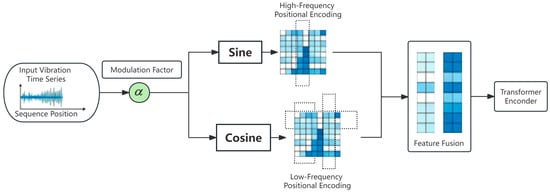
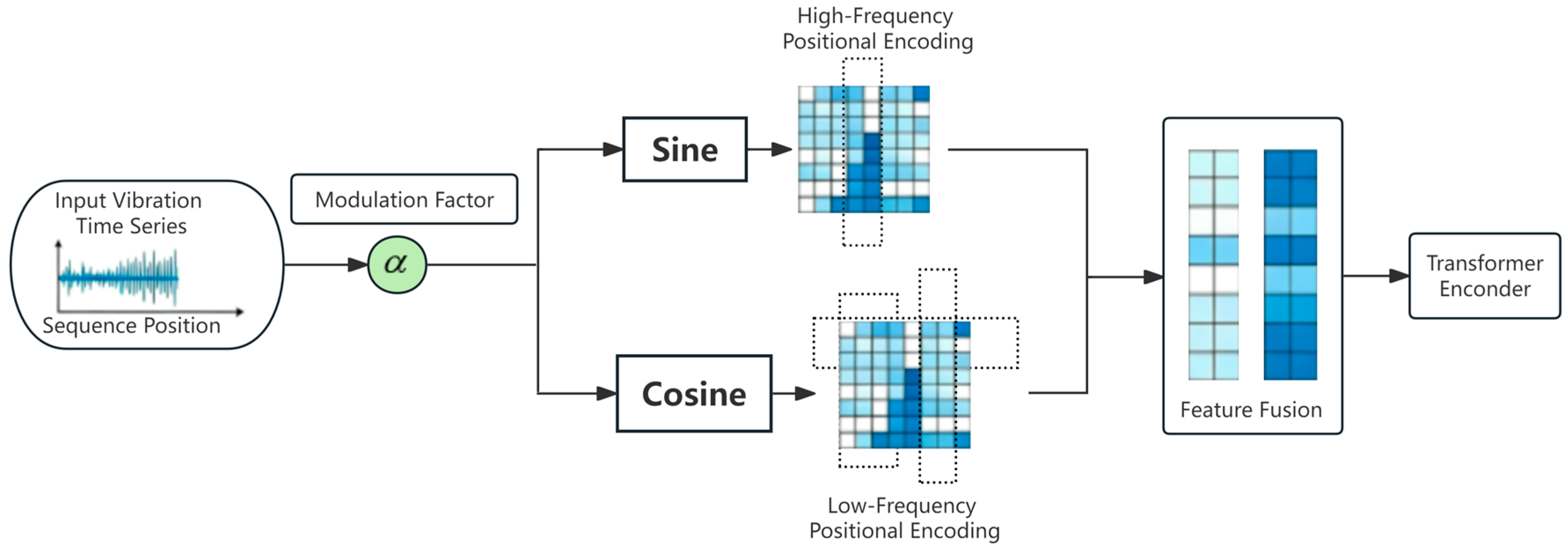
Figure 3 illustrates the corresponding calculation workflow. Instead of alternating sine and cosine along the feature dimension as in the original encoding, we assign the first half of the feature channels to sine and the second half to cosine. This decoupling does not mathematically separate local and global frequencies; sine and cosine are merely phase-shifted versions of each other. However, it allows for the subsequent linear projection layers to learn distinct transformations for the sine-based and cosine-based positional signals, providing the model with two complementary phase references. This is similar to using quadrature signals in signal processing, which can improve phase estimation robustness. The terms ‘local’ and ‘global’ in our discussion refer to the temporal scales of attention (local window vs. global sparse), not to the sine/cosine branches themselves. And the improved expression is given as follows:
where α denotes the vibration cycle modulation factor. When the vibration cycle is short, increasing α can enhance the frequency sensitivity of positional encoding. While the cycle is long, α can be appropriately reduced to make the model focus more on temporal sequence dependencies.
Figure 3.
Schematic of dual-channel vibration periodic positional encoding, where sine and cosine encodings are decoupled into two independent branches and a tunable modulation factor is introduced to adapt the encoding frequencies to the multi-scale periodicity of vibration signals.
For a fixed working height and payload, the dominant vibration frequencies remain approximately constant during a short operation window. Therefore, a static α found by grid search over the validation set can effectively align the positional encoding with the prevailing spectral peaks. However, we acknowledge that α would need to be adjusted when operating conditions change significantly; this is the motivation for the adaptive extension discussed in the conclusions.
To overcome the fixed α limitation, we plan to implement an online adaptive scheme that computes the dominant frequency of the most recent sliding window via fast Fourier transform and maps it to α through a pre-calibrated lookup table or a lightweight regression model, enabling real-time adjustment as the operating height or payload varies.
2.4. Hybrid Attention Mechanism
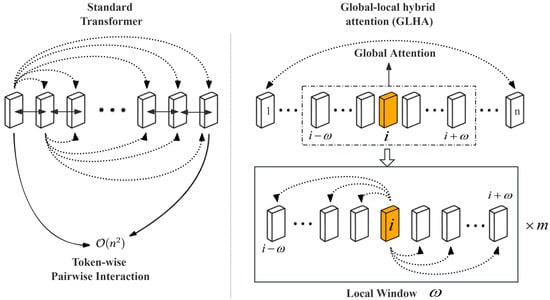
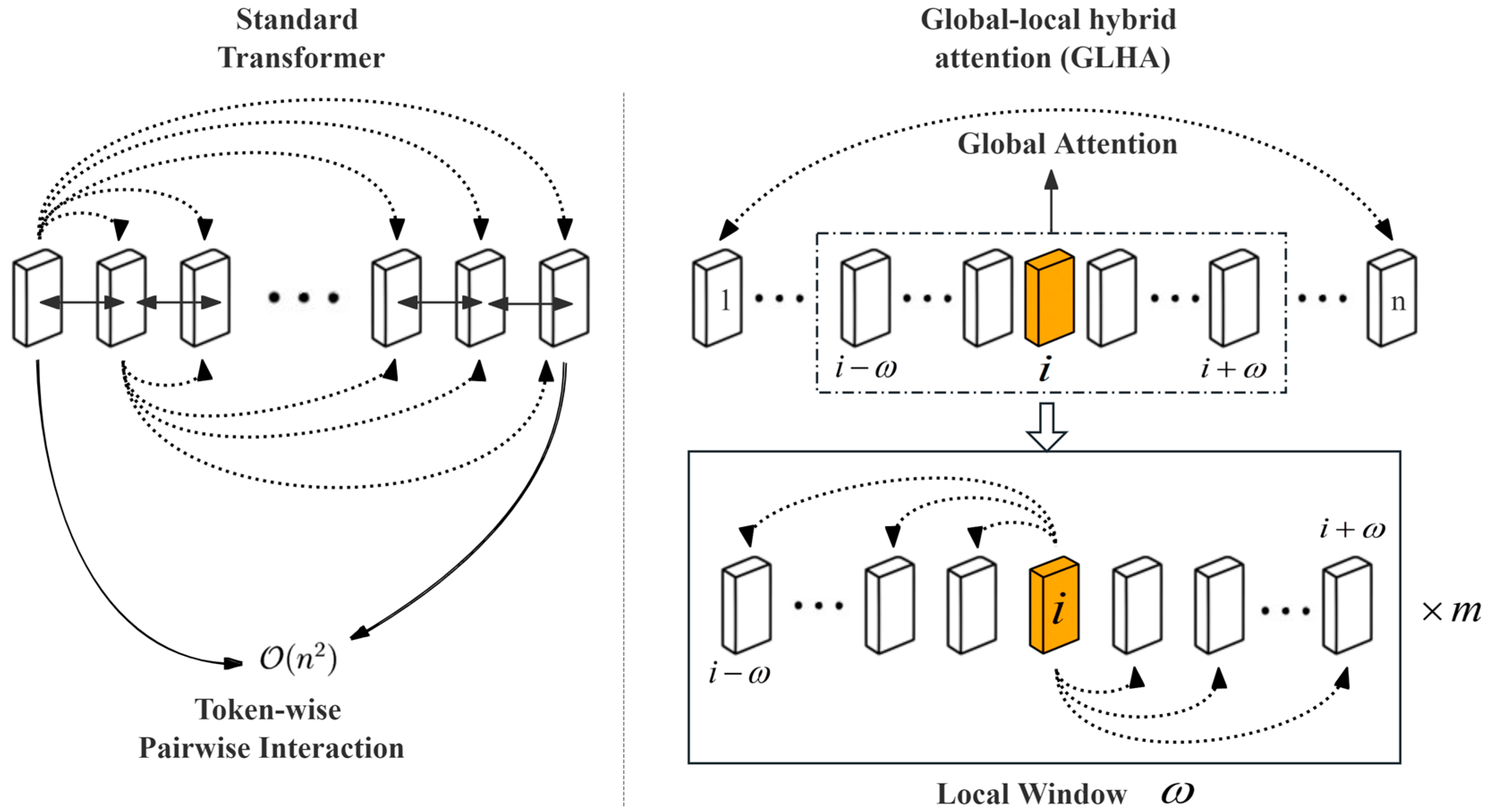
The global–local hybrid attention (GLHA) decomposes context interaction into a local window attention branch and a global attention branch for parallel computation. Weighted fusion is then implemented to integrate features, which realizes hierarchical capture of long-range and short-range dependencies and optimizes computational complexity to linear order. Figure 4 illustrates the differences between the self-attention of standard Transformer and the proposed GLHA mechanism.
Figure 4.
Comparison of attention mechanisms between the standard Transformer (global full self-attention, (left)) and the proposed global–local hybrid attention (right), where the latter decomposes context interaction into a local window attention branch and a global sparse attention branch for parallel computation.
Local window attention only allows for the i-th element to interact with neighboring elements within the fixed window [i − ω, I + ω]. A local mask Mlocal is adopted to shield irrelevant elements outside the window, and the calculation is expressed as
where ω denotes the preset local window size, Qi represents the query vector representing the i-th token, and dk is the feature dimension of a single vector. The mask Mlocal fills for elements outside the window. After Softmax normalization, the weights of irrelevant positions approach zero. This branch only models local fine-grained features such as syntactic relations and short-term temporal dependencies between adjacent elements, reducing the time complexity per sample. For global attention, a small set of key global markers are selected as information hubs of the full sequence. All ordinary elements only compute long-distance cross correlations with global markers, and the corresponding expression is given as
where KG represents the vector set of global keys. is transpose matrix, representing the stored information features. VG is the vector set of global values used for weighted information extraction. This branch transmits long-range global semantics via only a small number of global tokens, with a computational complexity of , which avoids the full similarity matrix operation of vanilla self-attention. After independent feature extraction by the two branches, a learnable balancing coefficient is adopted to adaptively fuse local detail representations and global semantic representations. The complete output formula of hybrid attention is given as follows:
By embedding this single-head mixed attention into the multi-head framework, the complete pipeline of multi-head GLHA can be obtained:
where , and denote the projection weights of the i-th attention head, WO represents the fusion linear weight after concatenation of multi-head outputs, and h is the number of attention heads. Compared with vanilla self-attention, the GLHA reduces the overall time complexity from quadratic order n2 to linear order via dual-branch design. Moreover, it realizes decoupled hierarchical modeling of local temporal fine-grained features and global long-range dependencies through divide-and-conquer computation. The weight can dynamically adjust the contribution ratio of two types of contextual information according to the feature distribution of different input samples, effectively alleviating the issues of redundant computation, weight dispersion and mixed multi-scale dependencies existing in vanilla self-attention for long-sequence modeling tasks. The global tokens are learnable parameters, randomly initialized and updated during training. They are prepended to the input sequence as additional tokens. In the global attention branch, every ordinary token attends to all global tokens (but not to each other), and the global tokens attend to all ordinary tokens, enabling bidirectional information exchange. The global tokens thus serve as a compact summary of the entire sequence context. For generative tasks, causal temporal constraint Mcausal can be superimposed on the mask term to obtain masked GLHA as follows:
where Mcausal represents the upper-triangular causal mask, which shields ungenerated future elements along the temporal dimension. While satisfying the temporal causal constraint for generation tasks, it simultaneously retains the dual optimization advantages of local window calculation and global key token interaction. For direct non-autoregressive prediction, we do not apply causal masking in the decoder, since all target positions are known as placeholders and no future token needs to be masked. The local window mask is applied only in the local attention branch to restrict each position to its neighboring context.
For the model hyperparameter settings: the hidden layer feature dimension dmodel = 128 feedforward dimension dff = 512, number of attention heads h = 8, encoder/decoder depth N = 3, local window size ω = 10, and global token count m = 8; the dropout rate for all attention layers and FFN sub-layers is set to 0.1.
3. Results
3.1. Experimental Setup
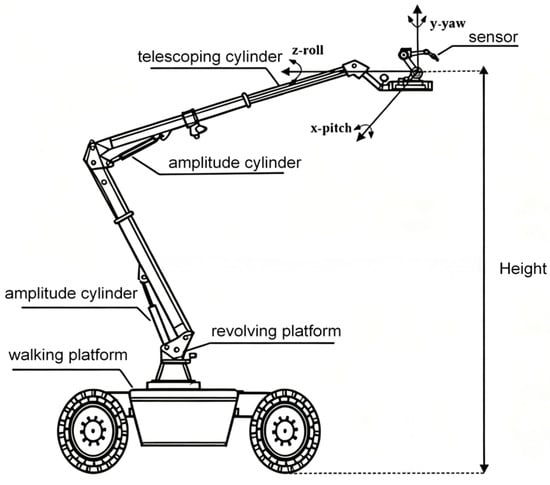
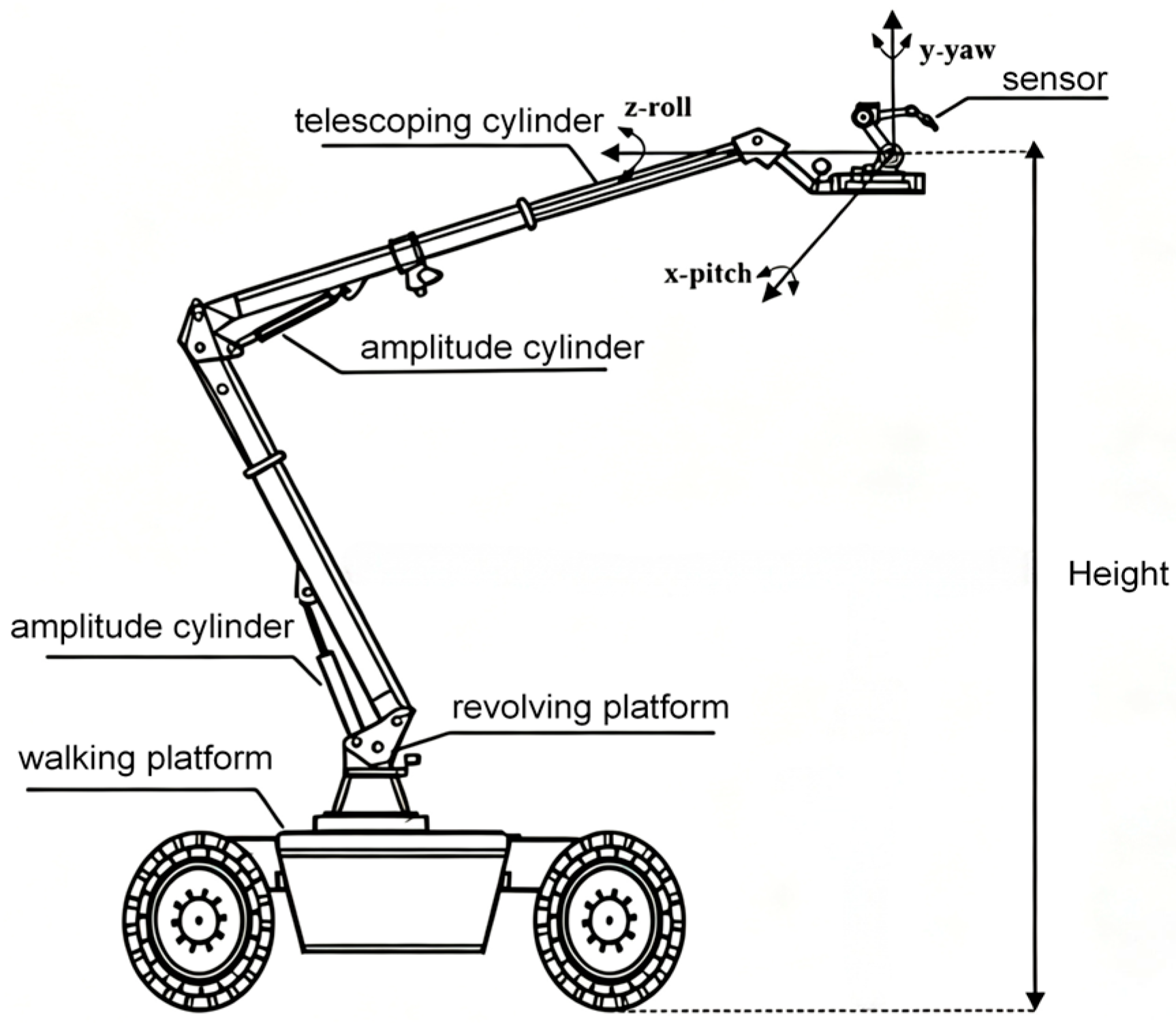
As in Figure 5, the experimental setup of RAWPs mainly consists of two modules, including an aerial work platform, a collaborative robot, and various types of sensors. The aerial work platform is composed of a walking platform, a revolving platform, an amplitude cylinder and a telescoping cylinder. The walking platform is responsible for equipment transportation and preliminary positioning of working points. The revolving platform is mounted above the chassis to drive the entire boom assembly to perform horizontal rotation. The boom adopts a foldable-telescopic composite structure, which is collaboratively driven by amplitude cylinders and telescoping cylinders. The amplitude cylinder controls the pitching and lifting motion of the boom to adjust the vertical height of the working end-effector, while the telescoping cylinder drives nested boom segments to extend and retract, thereby changing the horizontal outreach distance of operations.
Figure 5.
Experimental setup of RAWP, consisting of a self-propelled articulated boom aerial work platform integrated with a collaborative robotic manipulator, along with attitude sensors for triaxial vibration data acquisition (pitch, roll, and yaw).
This model contains approximately 1.2 million parameters. Batch inference for a single sample (L = 50; Tpred = 50) requires 2.3 MFLOPs of computational workload and 45 MB of GPU VRAM. On an NVIDIA Jetson AGX Orin (embedded device), the average inference time per sample is 12.5 milliseconds, fully meeting the 50-millisecond sampling interval requirement, demonstrating its suitability for automotive deployment.
Attitude sensors are deployed on the RAWPs to measure independent triaxial attitude data, including X-axis pitch (x-pitch), Z-axis roll (z-roll), and Y-axis yaw (y-yaw). In our experiments, we employed a MEMS inertial measurement unit (IMU; model Xsens MTi-670, range ±200°/s, and angular resolution 0.001) to measure the attitude angles. The raw signals were processed using a hardware low-pass filter (cutoff frequency: 10 Hz) followed by a software-based median filter with a window length of 3 to eliminate pulse noise; no further preprocessing (such as detrending or band-pass filtering) was applied to preserve the original vibrational dynamic characteristics. In this experiment, vibration data were collected when the mechanical arm moved forward, backward, left, right, up and down at heights of 10 m and 20 m, as well as during movements of the amplitude cylinder and revolving platform. Only the historical triaxial attitude angles and their first-order time derivatives are used as inputs. Wind speed and operating height are omitted from the feature set because the present data-driven approach presumes that all external disturbances are implicitly represented within the historical vibration sequence.
This paper employs complete independent data collection groups as the partitioning units to split the dataset into the training set (70%), validation set (15%), and test set (15%), thereby effectively reducing the risk of data leakage. During the experiments, we collected 162 complete sets of measurement data from an aerial work platform at a sampling frequency of 20 Hz; each dataset contains 128 samples. The sampling frequency of 20 Hz was chosen to capture the dominant vibration modes of the boom structure, which are below 10 Hz as verified by preliminary FFT analysis. An analog anti-aliasing low-pass filter with cutoff at 10 Hz was applied before digitization to satisfy the Nyquist criterion. At 20 Hz, a window length of 50 points corresponds to 2.5 s. Given the dominant vibration period of approximately 1.25 s (0.8 Hz), this window spans roughly two full cycles, providing sufficient context for both amplitude and phase estimation without including excessive distant history that may introduce noise. Higher-frequency hydraulic pressure fluctuations (e.g., pump ripple) are attenuated by the filter and are not the focus of this study, as platform attitude control mainly targets the low-frequency sway. To avoid scenarios where time windows within the training and test sets simultaneously exhibit temporal overlap or highly similar features, after completing the initial partitioning, we applied only the sliding window extraction method within each independent subset. In experiments evaluating hyperparameters such as the input window size and the number of iterations, all 200 datasets used were derived from the 10 m height operational conditions of the original 162 datasets, thereby covering all possible window sizes that may arise during the experimental process. Historical time-series data are extracted using the sliding window method as the model’s input, while fixed-length future pose data are used as the model’s output. Furthermore, all experiments consistently maintain the same prediction time domain and output length. Table 1 lists the other detailed parameters.
Table 1.
Key specifications of the RAWP experimental platform.
3.2. Experimental Data
In time-series prediction tasks, the intrinsic statistical characteristics of data are key internal factors that determine the prediction performance and difficulty of the model. In this experiment, descriptive statistical analysis was first carried out on the collected raw vibration data. Table 2 computes four core indicators, including standard deviation, variance, range, and average rate of change. All three attitude channels (roll, pitch, and yaw) were independently normalized to zero mean and unit variance over the training set before feeding into the network. Thus, the much larger variance of pitch does not dominate the gradient magnitude, as each channel contributes equally in the loss computation.
Table 2.
Statistical characteristics of the raw triaxial vibration data, including standard deviation, variance, range, and average rate of change for the roll, pitch, and yaw angles, indicating that the pitch direction exhibits the most severe fluctuations.
In terms of data dispersion, the standard deviation of 0.560866 and variance of 0.314570 in the pitch direction are far higher than those in the roll and yaw directions. The vibration amplitude in the pitch direction fluctuates drastically around its mean value, the data points are widely distributed, and the signal exhibits the poorest stability. As for the fluctuation range of data, the range of the pitch direction reaches 1.252753, while the ranges of roll and yaw are only 0.024942 and 0.113012 respectively. The vibration signal in the pitch direction covers the broadest dynamic range, which requires the subsequent prediction model to possess stronger generalization ability to cover the full numerical interval. From the perspective of local fluctuation intensity of signals, the average rate of change of 0.011201 for pitch is also significantly larger than that of roll and yaw. Frequent and large-amplitude jumps exist between adjacent sampling points in the pitch signal, indicating that it contains abundant high-frequency vibration and irregular abrupt variations.
Such severe fluctuations in the pitching direction are jointly determined by the physical structure, stress state of the system itself, and external environmental factors. Aerial work platforms are essentially typical cantilever beam structures. The manipulator end-effector is mounted on the working platform at a height of 20 m, forming an extremely long moment arm. When the mechanical arm is lifted or lowered along the pitch direction, the center of gravity of the entire system shifts violently in the longitudinal direction. This shift of the center of gravity generates huge, periodically varying gravitational moments. Even tiny vibrations of several millimeters will be amplified geometrically. Furthermore, aerial work platforms are generally driven by hydraulic cylinders. Under the heavy load induced by 20 m elevation, hydraulic oil undergoes slight compression, making the hydraulic supports non-rigid and endowing them with certain spring-like properties. When the platform performs fine adjustments at height, pressure fluctuations inside the hydraulic system are transmitted to the upper robot via the cylinders, rendering the pitch signal highly noisy and difficult to predict. Therefore, subsequent experiments will adopt data from the pitch direction for model training and testing.
3.3. Determination of the Modulation Factor
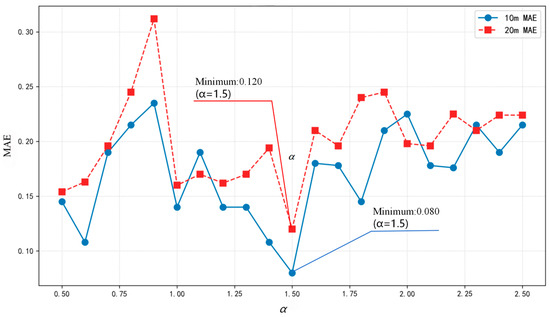
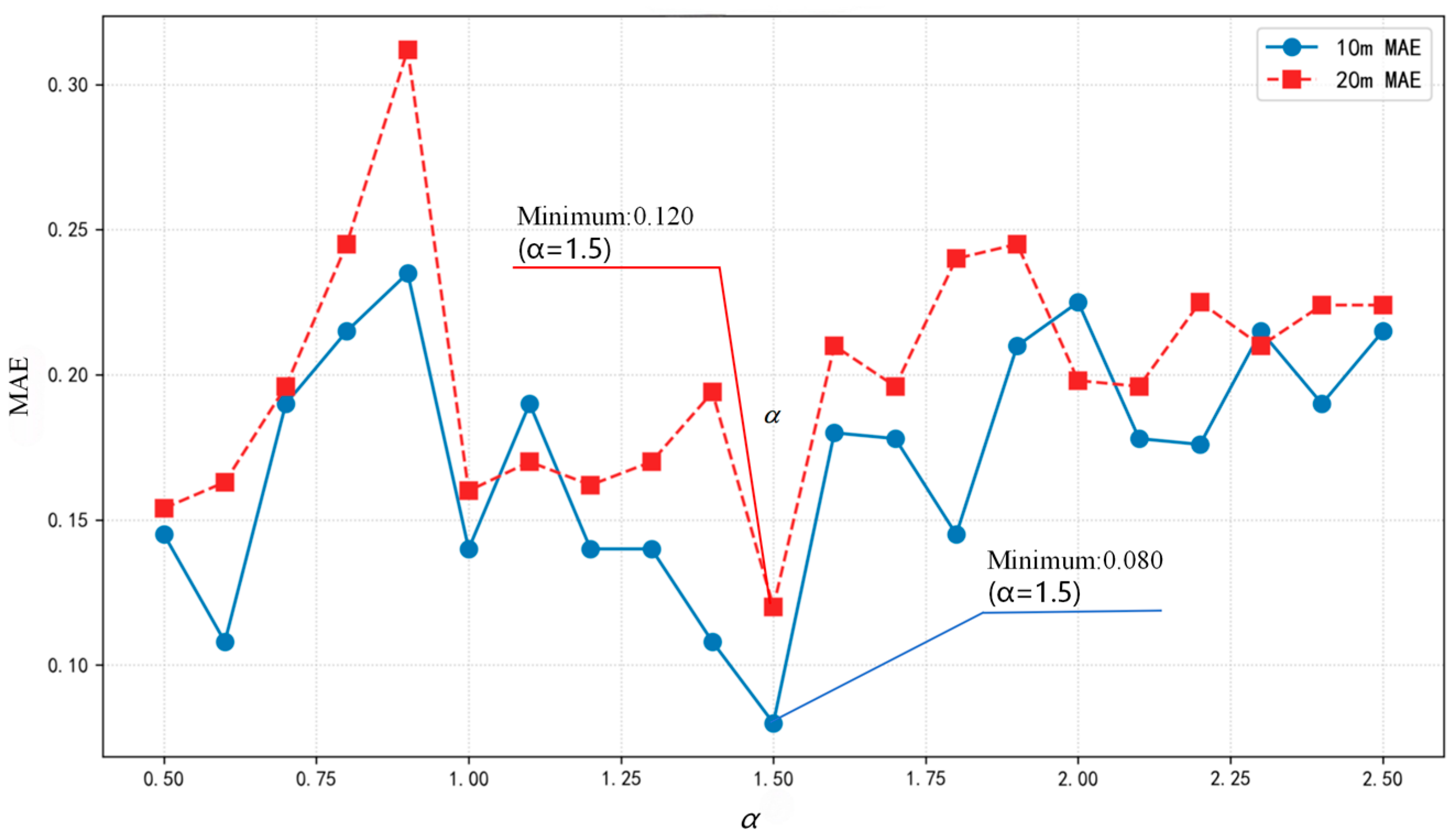
Vibration data are adopted in this experiment at heights of 10 m and 20 m. A total of 162 groups of data are measured with a monitoring frequency of 20 Hz, and each group contains 128 samples. Only the vibration data along the pitch direction are utilized for model training and testing. Figure 6 illustrates the variation in the MAE (Mean Absolute Error) under different values of the modulation factor. The curve trends reveal that the value of exerts a significant nonlinear influence on the model prediction error.
Figure 6.
The MAE versus the periodic modulation factor α for vibration prediction at 10 m and 20 m working heights. The global minimum error is achieved at α = 1.5 for both cases.
When α increases gradually from 0.5 to approximately 0.9, the MAE values of prediction tasks at both 10 m and 20 m rise evidently, accompanied by continuous degradation of model prediction performance. As α further grows to 1.5, the MAE of the two tasks simultaneously drops to the global minimum. Specifically, the minimum MAE reaches 0.080 for the 10 m working height and 0.120 for the 20 m working height. This demonstrates that when α = 1.5, the positional encoding can optimally match the inherent periodicity of vibration signals and fully exploit the temporal representation capability of the dual-channel vibration periodic positional encoding. If α exceeds 1.5 and keeps increasing, the MAE of both groups rebounds slightly with a minor decline in prediction accuracy.
Overall comparison of the two curves shows that the MAE for the 20 m prediction is consistently higher than that for the 10 m prediction, which conforms to the objective law that the stiffness of the boom decays continuously and the terminal vibration intensifies as the working height rises. Meanwhile, the optimal inflection points of both curves uniformly appear at α = 1.5. This verifies the rationality of the design, and the introduced periodic modulation factor α can adaptively fit the periodicity of vibration time series and effectively reduce prediction errors.
Analysis of the pitch data at 10 m and 20 m positions via Fast Fourier transform (FFT) revealed dominant spectral peaks at approximately 0.8 Hz and 0.6 Hz, respectively. For the standard position encoding with a position index of 1, when dmodel = 128, its fundamental frequency is actually 0.53 Hz. Thus, setting α = 1.5 scales this fundamental frequency to approximately 0.8 Hz, which aligns well with the results observed at the 10 m position. At a height of 20 m, the dominant frequency is relatively low, yet an α value of 1.5 still enables a reasonable trade-off, as can be observed from the MAE curve. Future research could consider employing different α values for different heights.
3.4. Hybrid Attention Mechanism
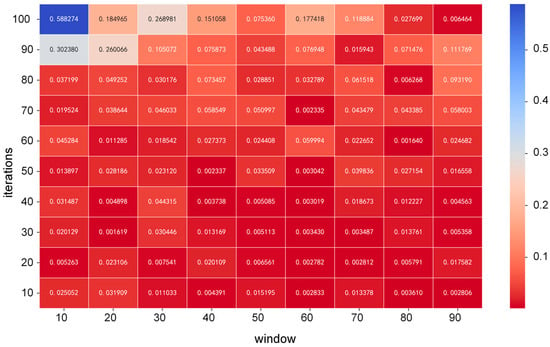
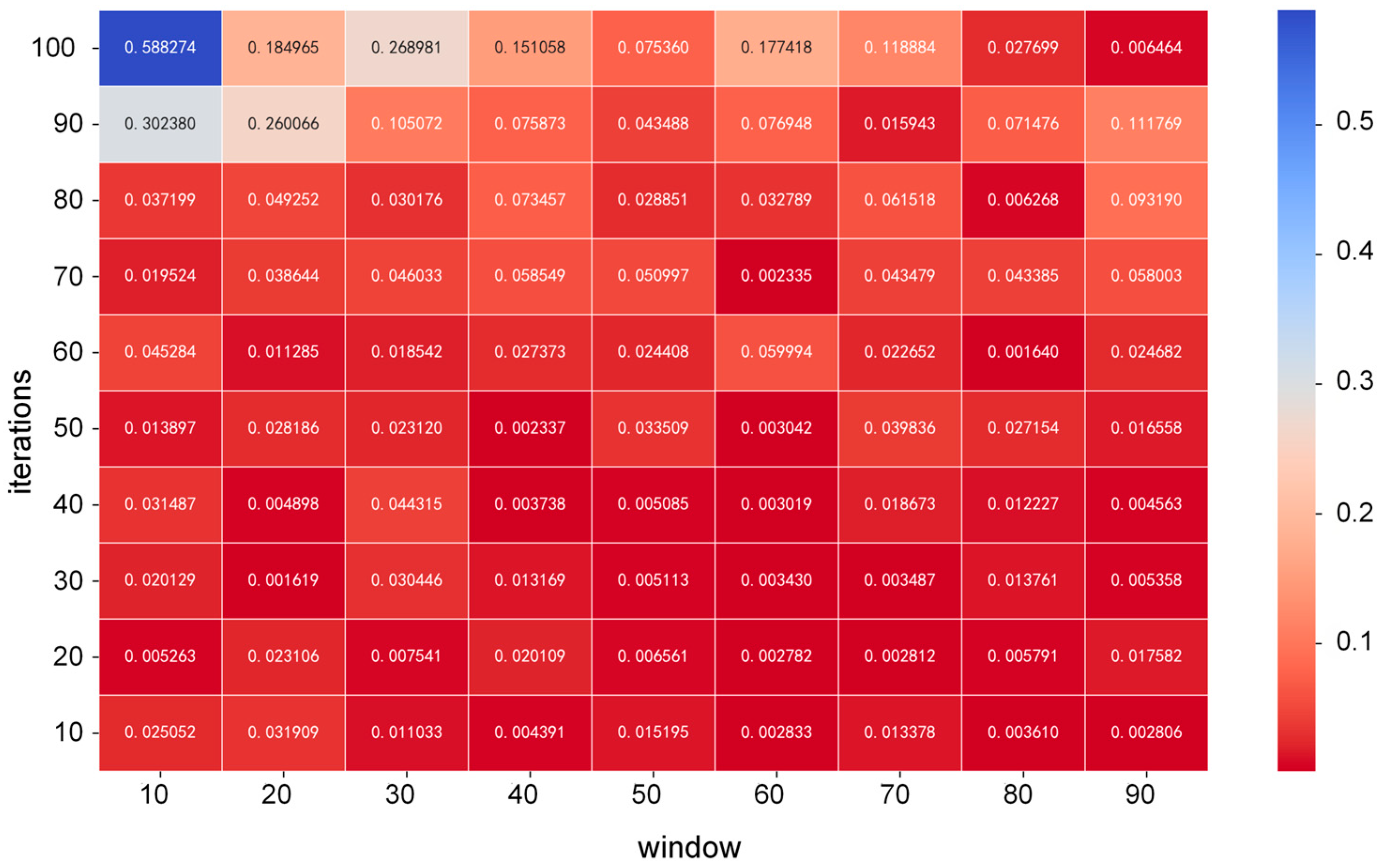
To investigate the impact of historical input window size and number of iterations on model performance, we utilized pitch-direction vibration data from RAWPs at a height of 10 m, with each dataset comprising 200 samples. Training was conducted across nine parameter combinations of input window size L = 10, 20, 30, 40, 50, 60, 70, 80, and 90 under varying iteration counts. While MAE and RMSE are common metrics for time-series prediction, MAE does not fluctuate significantly due to isolated extreme errors. Therefore, we employed the average absolute error to evaluate predictive performance. A lower MAE value indicates higher prediction accuracy and better results as follows:
where n represents the total sample size, yi is the true value of the i-th sample, and is the predicted value of the i-th sample. Figure 7 shows the MAE heatmaps for pitch angle prediction across different input window sizes and training iteration counts.
Figure 7.
Heatmap of MAE for pitch angle prediction under different combinations of historical input window sizes (L = 10 to 90) and training iteration counts (10 to 100), revealing the optimal parameter region for model convergence.
The horizontal axis represents the input time window size 10~90, while the vertical axis indicates the number of model training iterations 10~100. Darker color blocks with smaller cell values indicate lower prediction errors and better generalization performance. Overall, the number of training iterations is the dominant factor determining the magnitude of model error, whereas window size only exhibits significant influence in high-iteration scenarios. When iterations reach 90–100, sample errors across all rows rise substantially. The parameter combination of 100 iterations and a 10-window size achieves the highest global error of 0.5883, which is the worst configuration in this experiment. Within the high-iteration range, errors decrease monotonically with increasing window size, dropping to 0.0065 at 90 windows, though overall accuracy remains significantly lower than that of medium-to-low iteration groups. In contrast, for iterations 10–70, all window configurations maintain errors below 0.02, with cells concentrated in dark red regions indicating stable model convergence where window size variations have negligible impact on prediction accuracy. Further analysis reveals that combining iterations 50, 60, and 70 with window sizes 40, 60, and 80 reduces errors to 0.0016–0.0024, representing the optimal hyperparameter configuration in this study. The aforementioned phenomenon can be attributed to overfitting mechanisms: excessive iterations drive the model to memorize noise from the training set, significantly increasing generalization error. The lack of feature information in short-time window inputs further amplifies the negative effects of overfitting, while merely expanding the temporal context yields only modest error reduction. Controlling iteration rounds within 70 strikes a balance between fit accuracy and generalization capability, enabling stable high-precision predictions without strict window size constraints. For the experimental group corresponding to the optimal parameters on the test set, no performance collapse was observed, and stable predictive performance was maintained. Under small-window conditions, when the number of iterations is high (90~100), the model’s performance declines sharply, as the overfitting model tends to overly memorize the noise present in the training dataset. To mitigate this issue, we have adopted weight decay with a dropout rate of 0.1 along with an early stopping strategy. The results shown in Figure were obtained without enabling the early stopping strategy, aiming to illustrate the overall trend; however, during the actual training process, we will employ an early stopping strategy to prevent such overfitting phenomena.
Comprehensive experimental results indicate that subsequent time-series prediction tasks should prioritize an iteration range of 10–70 rounds, with windows sized between 50 and 80 for moderate configurations based on computational requirements, while avoiding parameter combinations that combine high iteration counts with small windows. Based on a comprehensive evaluation of prediction accuracy and generalization stability, the optimal historical input window length is determined to be L = 50, with 60 iterations.
3.5. Ablation Experiments
Table 3 presents the ablation experiments, where ST is standard Transformer, VPPE is vibration periodic position encoding, GAM is global attention mechanism, LAM is local attention mechanism and GLHA is global–local hybrid attention mechanism.
Table 3.
Ablation study results comparing standard Transformer (ST) with variants incorporating Vvibration periodic positional encoding (VPPE), global attention mechanism (GAM), local attention mechanism (LAM), and global–local hybrid attention (GLHA).
The standard Transformer is adopted as the baseline model. Multiple groups of comparative tests are conducted by sequentially introducing vibration periodic positional encoding, global attention, local attention, and the GLHA module. The evaluation rules of these indicators are as follows: lower MAE and RMSE values and R2 closer to 1 correspond to better model fitting and prediction performance.
According to the results of the baseline model, when the standard Transformer solely relies on native self-attention for vibration prediction, the MAE reaches 0.048674, the RMSE is 0.052832, and R2 is only 0.7155. It presents large overall prediction errors and insufficient fitting effect. The native positional encoding fails to adapt to periodic vibration time-series features, and single global attention cannot simultaneously capture long-term evolution trends and instantaneous shock abrupt features of vibration sequences. After merely adding vibration periodic positional encoding, the model MAE and RMSE drop to 0.034674 and 0.046723 respectively, while R2 rises to 0.8067. This verifies that the periodic positional encoding designed for vibration signals can accurately characterize the periodic law of vibration time series and effectively boost the representation ability of temporal position information.
When the global attention module or local attention module is introduced separately, both models achieve slight performance improvements within a limited range. Pure global attention tends to ignore short-term local vibration shock details, while pure local attention cannot capture long-period vibration evolution laws, revealing modeling limitations of single attention branches. After embedding the GLHA mechanism individually on the basis of the standard Transformer, the model error indicators are further reduced: MAE and RMSE decline to 0.0294239 and 0.039654, and R2 reaches 0.8978. This proves that hybrid attention can collaboratively extract global long-term trends and local instantaneous vibration features, possessing stronger time-series modeling capacity compared with single attention.
The complete model combining vibration periodic positional encoding and the GLHA mechanism achieves the optimal experimental results, with the MAE as low as 0.001619, RMSE of 0.024359 and R2 up to 0.99998. The prediction errors are drastically reduced and the fitting degree approximates perfect fitting. A positive synergistic gain effect exists between vibration periodic positional encoding and GLHA. The periodic positional encoding optimizes temporal position representation, and hybrid attention realizes synchronous mining of long-term and short-term vibration features. The combination of the two can fully fit the data characteristics of aerial work platform vibration signals, which contain both periodic steady-state components and short-time shock components.
Notably, ST+GLHA alone performs worse than ST+GAM. This is because the local branch with a fixed window size may introduce excessive short-term noise when not properly balanced; the gated fusion parameter λ was not tuned separately for this standalone variant. However, when combined with the proposed positional encoding (Proposed), the two modules exhibit synergy, as the positional encoding aligns the temporal phases, enabling the hybrid attention to focus on complementary scales.
3.6. Comparative Experiments
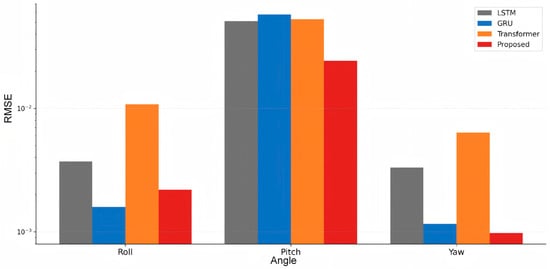
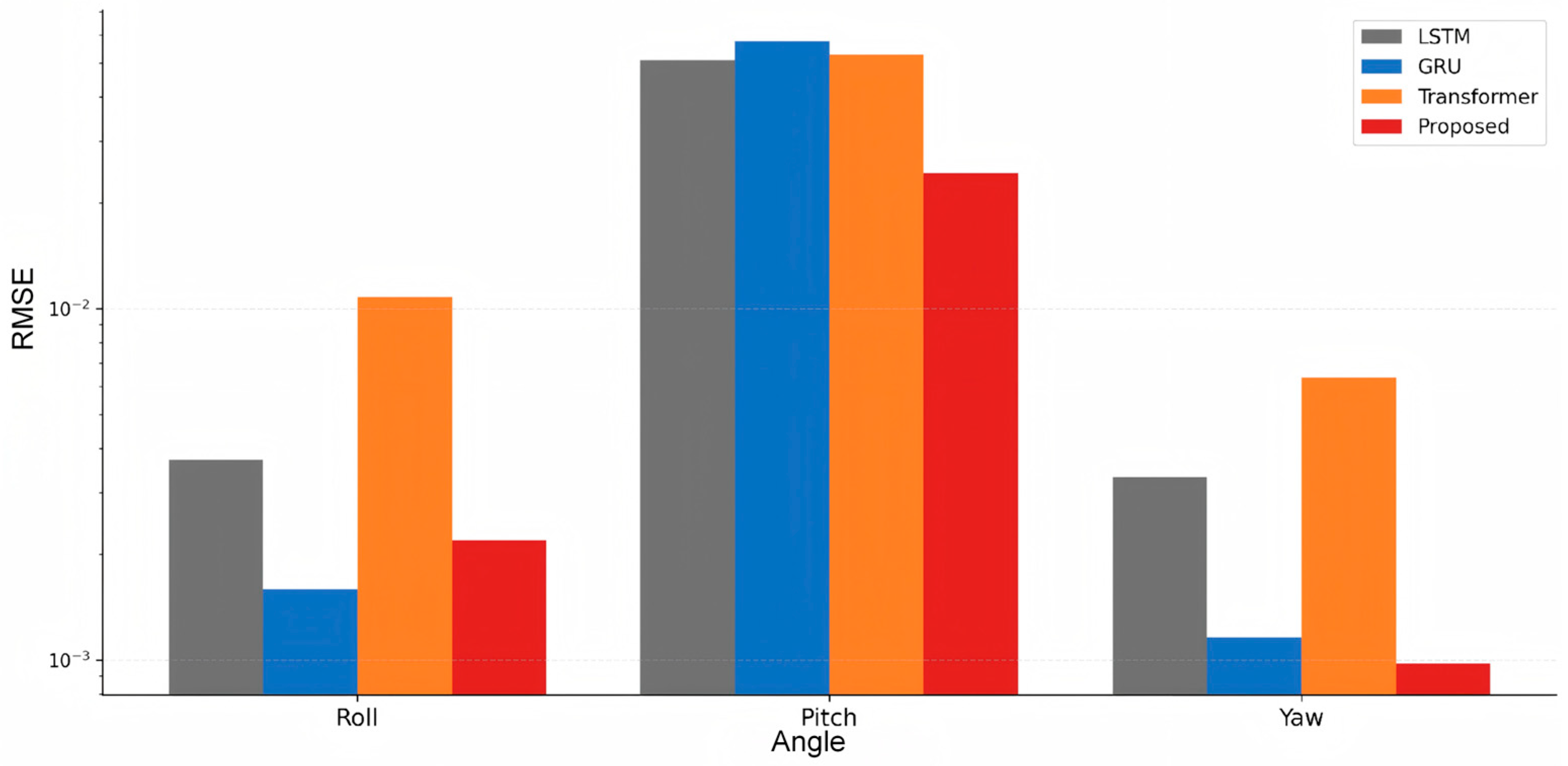
To verify the feasibility of the proposed model, comparative experiments are conducted with traditional time-series models including LSTM and GRU. Figure 8 and Table 4 present the error analysis results of different networks. LSTM and GRU adopt serial recurrent architectures, which are prone to gradient vanishing and attenuation during long time-series propagation, making it difficult to capture vibration periodic patterns with long intervals. As multi-step prediction models, they only extract local short-term features, resulting in weak fitting capacity for abrupt amplitude jumps and long-period fluctuations in vibration signals, and cumulative errors will keep amplifying.
Figure 8.
Comparative prediction performance of LSTM, GRU, Transformer, and the proposed model across the three attitude angles, demonstrating that the proposed model achieves the lowest prediction errors for all axes, with the most significant improvement observed for the pitch.
Table 4.
Quantitative comparison of prediction errors (RMSE) for LSTM, GRU, standard Transformer, and the proposed model across the roll, pitch, and yaw attitude angles, showing that the proposed model consistently outperforms all baselines.
The standard Transformer employs fully connected global self-attention without constraints for long vibration sequences. Irrelevant noise vibration from historical sampling points interferes with effective feature extraction, and it fails to capture critical local information such as vibration peaks and abrupt points. When predicting drastically fluctuating data like pitch angle, obvious error accumulation occurs. Moreover, it tends to learn noise within redundant time series, which further enlarges prediction errors. The GLHA mechanism achieves the minimum prediction errors in the prediction of three-axis attitude angles. In terms of pitch angle, the proposed model achieves a performance improvement of 53.89% over Transformer, 52.11% over LSTM, and 57.67% over GRU. Relative to the standard Transformer, this greatly alleviates the problem of accumulated prediction errors under severe vibration.
For roll angle, which has the smallest amplitude (std = 0.006°), the standard Transformer performs worse than GRU and LSTM because its global self-attention distributes weights over many irrelevant positions, effectively smoothing out the weak signal. In contrast, our GLHA with local window attention retains fine-grained short-term correlations, enabling better preservation of low-amplitude details.
4. Conclusions
This paper addresses the challenging problem of vibration prediction for RAWPs, which consist of aerial work platforms and collaborative robotic manipulators. The vibration signals of RAWPs exhibit strongly nonlinear, time-varying, and multi-scale periodic characteristics due to the coupling of wind-induced low-frequency swaying and manipulator-induced high-frequency transient impacts.
To tackle this challenge, we have proposed an improved Transformer model that integrates a dual-channel independent sine–cosine periodic positional encoding with an adjustable modulation factor and a GLHA mechanism. In addition, the historical input window length is systematically optimized to suppress error accumulation and enable one-shot direct multi-step prediction without autoregressive recursive feedback.
The effectiveness of the proposed model is rigorously validated through comprehensive experiments conducted on a full-scale aerial experimental platform. The periodic modulation factor α is found to exert a significant nonlinear influence on prediction error, with the global optimum uniformly located at α = 1.5 for both 10 m and 20 m working heights. The optimal input window length is determined to be L = 50, with 60 iterations. Which balances the trade-off between providing sufficient historical context and avoiding redundant information that dilutes the model’s focus on critical transient features. Ablation experiments reveal that vibration periodic positional encoding and GLHA exhibit a positive synergistic effect, and when deployed individually, each module yields moderate performance improvements, but their combination produces substantially larger error reductions than the sum of their individual contributions, with the coefficient of determination R2 reaching 0.99998. The proposed model consistently outperforms LSTM, GRU, and Transformer across all three attitude axes, with the most pronounced improvements observed for the pitch angle, which is the most nonlinear and difficult-to-predict dimension. This validates the model’s capability to capture both long-period evolution trends and abrupt shock features in strongly nonlinear vibration sequences.
All experiments were performed under fixed payload and pre-defined motion trajectories. The model is therefore not guaranteed to generalize to significantly different payloads or random manipulator motions, which would require retraining or domain adaptation. Despite these promising results, there are several limitations of the current work. All experimental data are collected under fixed operating conditions, which limits the model’s generalization capability to unseen dynamic scenarios. The current model is designed and validated for offline prediction, and online real-time deployment on resource-constrained embedded platforms has not yet been addressed. The modulation factor is currently fixed after empirical determination, whereas the dominant vibration frequencies of RAWPs may drift with changing operating heights, payloads, and environmental conditions in real-world applications.
In the future work, an adaptive modulation mechanism will be developed, which dynamically adjusts α based on real-time frequency analysis of incoming vibration signals. Then, the experimental dataset will be expanded to cover variable payloads, random motion trajectories, and diverse wind conditions to enhance model robustness and generalization. The current model treats all nonlinearities as black-box temporal patterns; it does not explicitly separate the contributions of joint friction or hydraulic hysteresis. Future work may incorporate physics-informed constraints to better generalize under extreme wear or oil temperature variations. Finally, the prediction model will be integrated with an active vibration suppression control framework to achieve closed-loop predictive compensation for RAWPs attitude stabilization.
Recent advances in model-free deep reinforcement learning have shown remarkable success in controlling nonlinear and underactuated systems. TD3-based tracking control strategies enable robust policy learning without explicit system models, which is particularly relevant for aerial platforms with complex dynamics. While our work focuses on prediction rather than control, the proposed forecasting module could be integrated as a state predictor within such DRL frameworks to provide look-ahead information and improve closed-loop performance.
Author Contributions
Conceptualization, J.G. and M.L.; methodology, J.G.; software, J.G. and M.S.; validation, H.H. and W.Z.; formal analysis, M.S.; investigation, H.H. and J.G.; resources, J.G. and M.S.; data curation, M.S.; writing—original draft preparation, J.G. and M.S.; writing—review and editing, J.G. and M.L.; visualization, J.G. and H.H.; supervision, J.G.; project administration, M.L.; funding acquisition, W.Z. All authors have read and agreed to the published version of the manuscript.
Funding
This research received no external funding.
Data Availability Statement
The data are unavailable due to privacy restrictions.
Conflicts of Interest
Author Haonan Hu was employed by the company Jiangsu Liugong Machinery. The remaining authors declare that the research was conducted in the absence of any commercial or financial relationships that could be construed as a potential conflict of interest.
References
- Nie, Z.; Wang, H.; Lu, B.; Zhang, F.; Wang, M.; Wu, Z.; Gang, X.; Li, L. Development and First Test of an Attitude and Load Coupling Adjustment Chassis for Aerial Working Platforms. Mech. Based Des. Struct. Mach. 2024, 52, 2066–2084. [Google Scholar] [CrossRef] [Scilit]
- Lv, M.; Xu, Q.; Wang, Z.; Fang, J.; Li, C. Failure Analysis and Fault Diagnosis of Hydraulic Systems in Aerial Work Platforms under Small-Sample Conditions Using Transfer Learning. Eng. Fail. Anal. 2026, 189, 110699. [Google Scholar] [CrossRef] [Scilit]
- Deng, M.; Ji, A.; Zhang, L.; Wang, H.; Zhao, Z. Lateral Vibration Behaviors of the Straight Boom of the Aerial Work Platform in the Horizontal Linear Motion. Autom. Constr. 2022, 134, 104095. [Google Scholar] [CrossRef] [Scilit]
- Shin, H.; Jung, S.H.; Choi, Y.R.; Kim, C. Development of a Shared Remote Control Robot for Aerial Work in Nuclear Power Plants. Nucl. Eng. Technol. 2018, 50, 613–618. [Google Scholar] [CrossRef] [Scilit]
- Moon, B.; Suvarna, N.; Jong, A.; Chatterjee, S.; Yuan, J.; Cao, M.; Scherer, S. IA-TIGRIS: An Incremental and Adaptive Sampling-Based Planner for Online Informative Path Planning. IEEE Trans. Robot. 2026, 42, 1695–1713. [Google Scholar] [CrossRef] [Scilit]
- Fattori, F.; Cocuzza, S. Tethered Drones: A Comprehensive Review of Technologies, Challenges, and Applications. Drones 2025, 9, 425. [Google Scholar] [CrossRef] [Scilit]
- Bonnin-Pascual, F.; Garcia-Fidalgo, E.; Tauler-Rossello, A.; Ortiz, A. From Flight to Insight: An End-to-End Aerial Inspection Framework for 3D Modeling and Defect Detection of Infrastructures. Comput. Ind. 2026, 179, 104491. [Google Scholar] [CrossRef] [Scilit]
- Zhong, W.; Wang, Y.; Fu, K.; Li, C.; Shao, J.; Qian, P. Determination of the flow rate characteristics of porous media under the positive pressure and vacuum. Int. J. Hydromechatron. 2025, 8, 1–28. [Google Scholar] [CrossRef] [Scilit]
- Xie, L.; Zhang, L.; Shi, Y.; Xie, X.; Zou, Z.; Chen, G. Characteristics of Flow-Induced Vibrations in Marine Turbine Control Valves: A Review. J. Vib. Eng. Technol. 2025, 13, 313. [Google Scholar] [CrossRef] [Scilit]
- Esim, E.; Demirel, M. Determination of Vibration Characteristic in Automatic Tapping Operations Based on Artificial Neural Networks. Sci. Rep. 2025, 15, 16386. [Google Scholar] [CrossRef] [Scilit]
- Chen, Z.; Ye, Y.; Liu, H.; Gan, J.; Chen, B.; Wu, W. A Novel Predictive Framework for Vibration Characteristics of Butt-Welded Plate Structures Considering Welding-Induced Effects. Ocean Eng. 2026, 349, 124124. [Google Scholar] [CrossRef] [Scilit]
- Wu, L.; Ma, S.; Deng, P.; Huang, Q. Research on the Modeling of Bending-Torsional Coupling and Vibration Characteristics of Planetary Roller Screw Mechanism. Electronics 2022, 11, 1395. [Google Scholar] [CrossRef] [Scilit]
- Padrigalan, K.E.; Liu, J.-H. A Wind-Turbine-Tower-Climbing Robot Prototype Operating at Various Speeds and Payload Capacity: Development and Validation. Appl. Sci. 2023, 13, 1381. [Google Scholar] [CrossRef] [Scilit]
- Ferguson, J.M.; Kuntz, A.; Hermans, T. Continuum Robot State Estimation With Actuation Uncertainty. IEEE Robot. Autom. Lett. 2026, 11, 9487–9494. [Google Scholar] [CrossRef] [Scilit]
- Ishigaki, T.; Ayusawa, K.; Yamamoto, K. Unified Framework of Gradient Computation for Hybrid-Link System and Its Dynamical Simulation by Implicit Method. IEEE Robot. Autom. Lett. 2025, 10, 4188–4195. [Google Scholar] [CrossRef] [Scilit]
- Zhou, X.; Zou, L.; Zou, Z.-J. A Unified Physics-Data-Driven Modeling Method for Predicting Time-Series Ship Maneuvering Motions in Regular Waves. Ocean Eng. 2025, 341, 122747. [Google Scholar] [CrossRef] [Scilit]
- Gao, S.; Cui, F.; Zhang, Y. Bearing Service Life Prediction Based on DCHAN-LSTM Model: A Hybrid Deep Learning Methods. IEEE Sens. J. 2025, 25, 32889–32898. [Google Scholar] [CrossRef] [Scilit]
- Jin, C.; Li, B.; Yang, Y.; Yuan, X.; Tu, R.; Qiu, L.; Chen, X. Remaining Useful Life Prediction of Rolling Bearings Based on Empirical Mode Decomposition and Transformer Bi-LSTM Network. Appl. Sci. 2025, 15, 9529. [Google Scholar] [CrossRef] [Scilit]
- Hu, H.; Yin, X.; Jiao, B.; Liu, J.; Jiang, Y. Multi-Bolt Structural Loosening Fault Identification Based on Black-Winged Kite Algorithm and CNN-GRU. Processes 2025, 13, 3178. [Google Scholar] [CrossRef] [Scilit]
- Peng, K.; Wang, G.; Li, T.; Zhang, Q.; Dong, J. A New Soft Sensing Method Based on Serial-Parallel GRU with Self-Attention Mechanism for Complex Multi-Unit Industrial Processes. ISA Trans. 2026, 174, 151–163. [Google Scholar] [CrossRef] [Scilit]
- Zhang, H.; Zhang, L.; Cheng, J.; Jiang, Y.; Wu, Z. An Intelligent Detection Based on Deep Learning for Multilevel Code Shifted Differential Chaos Shift Keying System with M-Ary Modulation. IEEE Trans. Cogn. Commun. Netw. 2022, 8, 155–169. [Google Scholar] [CrossRef] [Scilit]
- Luo, H.; Ge, J.; Qin, S.; Hou, G.; Xu, S. An Extreme-Short-Term Predicted Model of the Learning-Based Approach for Multi-Step USV Maneuvering Motions. Ocean Eng. 2025, 340, 122353. [Google Scholar] [CrossRef] [Scilit]
- Ben Hazem, Z.; Özdemir, M.; Saidi, F.; Guler, N. Deep Reinforcement Learning for Accurate Trajectory Tracking in 2-DOF Helicopter Dynamics Using Twin Delayed DDPG. Discov. Robot. 2026, 2, 23. [Google Scholar] [CrossRef] [Scilit]
- Wu, J.B.; Huang, Z.J.; Zhou, W. Energy consumption prediction for Dual-Powered trolley bus based on a SE-TCN hybrid network. Measurement 2026, 262, 119978. [Google Scholar] [CrossRef] [Scilit]
- Zhang, Z.; Wang, Y.; Tan, S.; Xia, B.; Luo, Y. Enhancing Transformer-Based Models for Long Sequence Time Series Forecasting via Structured Matrix. Neurocomputing 2025, 625, 129429. [Google Scholar] [CrossRef] [Scilit]
- Wang, R.; Ji, Q.; Sheng, Z.; Qi, Y. Transformer++: A Long Sequence Modeling Method Based on Direction-Aware Dual Attention and Multi-Head Sampling. Appl. Intell. 2025, 55, 1103. [Google Scholar] [CrossRef] [Scilit]
- Zhu, J.; Liu, Y.; Fu, Q.; Jing, D. GAANet: Symmetry-Driven Gaussian Modeling with Additive Attention for Precise and Robust Oriented Object Detection. Symmetry 2025, 17, 653. [Google Scholar] [CrossRef] [Scilit]
- Zhao, Z.; Guo, K.; Liu, F.; Xing, X.; Wang, L.; Xu, X.; Jin, Z. rPPG-TFCL: Time-Frequency Consistency Learning for Robust Remote Physiological Measurement. Knowl.-Based Syst. 2025, 330, 114607. [Google Scholar] [CrossRef] [Scilit]
- Huang, Y.; Pei, S.; Zeng, R. DQFormer: Transformer with Decoupled Query Augmentations for End-to-End Multi-Object Tracking. ACM Trans. Multimed. Comput. Commun. Appl. 2025, 21, 1–23. [Google Scholar] [CrossRef] [Scilit]
- Shao, X.; Xu, L.; Zhang, S.; Sun, G.; Wu, C. Fractional-Order Dynamics Learning and Control via Data-Driven Approaches: Taking Soft Manipulator as an Example. IEEE Trans. Neural Netw. Learn. Syst. 2026; early access. [CrossRef] [Scilit]
- Hu, H.; Wu, X.; Li, R.; Zhu, S.; Zhang, S.; Li, M. SPARK-ViT: Pose Estimation with Adaptive Attention and Structured Reasoning. Neurocomputing 2026, 674, 132743. [Google Scholar] [CrossRef] [Scilit]
- Frisoni, G.; Ragazzi, L.; Cohen, D.; Moro, G.; Carbonaro, A.; Sartori, C. Abstractive Summarization through the Prism of Decoding Strategies. Neural Netw. 2026, 196, 108249. [Google Scholar] [CrossRef] [Scilit]
- Wang, T.; Xie, X.; Jin, Z.; Geng, M.; Deng, J.; Li, Z.; Hu, S.; Hu, S.; Li, G.; Cui, M.; et al. Towards Effective and Efficient Non-Autoregressive Decoders for Conformer and LLM-Based ASR Using Block-Based Attention Mask. IEEE Trans. Audio Speech Lang. Process. 2025, 33, 4880–4896. [Google Scholar] [CrossRef] [Scilit]

Disclaimer/Publisher’s Note: The statements, opinions and data contained in all publications are solely those of the individual author(s) and contributor(s) and not of MDPI and/or the editor(s). MDPI and/or the editor(s) disclaim responsibility for any injury to people or property resulting from any ideas, methods, instructions or products referred to in the content. |
© 2026 by the authors. Licensee MDPI, Basel, Switzerland. This article is an open access article distributed under the terms and conditions of the Creative Commons Attribution (CC BY) license.