


Abstract
As complex system engineering involving multiple stakeholders, multi-objective collaboration, and multi-spatiotemporal scales, the components, logical structure, and functional mechanisms of production equipment operation management and control (PEOMC) can be generalized through functional modelling to support dynamic analysis and intelligent decision-making of PEOMC in the industrial internet environment. To address the diversity of scenarios and objectives of PEOMC, a hierarchical construction method for the functional model of PEOMC based on IDEF0 is proposed. By analysing relevant international standards, such as ISO 55010, ISO/IEC 62264, and OSA-CBM, the generic functional modules for the first and second layers of the functional model are identified and defined. On the basis of semi-supervised machine learning, topic clustering is used to extract the components, functional mechanisms, and logical relationships of production equipment operation management and control from approximately 200 standard texts and to construct a reference resource pool for the third-layer functional module. On this basis, an interface matching and recursive traversal algorithm for functional modules is designed, and a composition and orchestration strategy of functional modules for specific scenarios is provided to support the flexible construction of diversified and personalized PEOMC scenarios. The proposed construction and application method was validated through an engineering case study in an aero-engine transmission unit manufacturing workshop: the average process capability index of the enterprise’s production equipment steadily increased from 1.28 to approximately 1.60, the mean time to repair (MTTR) of production equipment failures significantly decreased from 8 h to 3 h, and the average overall equipment effectiveness (OEE) increased from 56.43% to a stable 68.57%, demonstrating its effectiveness and practicality.
1. Introduction
Production equipment operation management and control (PEOMC) refers to the systematic planning, organization, coordination, and control of various aspects of production equipment, including operation, monitoring, maintenance, and repair, through a series of management methods. Currently, China is accelerating the implementation of digital transformation in the manufacturing industry and promoting large-scale equipment renewal projects. Strategic deployments have been made around high-end development, digital management, and the intelligent application of production equipment. Guided by various policies and driven by emerging technologies, manufacturing enterprises generally promote the use of cloud services for industrial equipment based on industrial internet platforms. These platforms facilitate ubiquitous connectivity, dynamic management and control, and capacity sharing of production equipment, allowing for the construction of diversified and personalized operation management and control scenarios. Ultimately, this improves quality, reduces costs, increases efficiency, and reduces emissions in the manufacturing industry.
In recent years, with the large-scale introduction of advanced, multifunction, and high-value intelligent equipment, traditional PEOMC faces new requirements and challenges in terms of control objects [1], scope [2], methods [3], and subjects [4]. Control objects have evolved from outdated single-function equipment to intelligent equipment with complex functions capable of handling multiple manufacturing tasks. The control scope has expanded from single teams, single workshops, and specific time periods to cross-regional, full-time-domain, and scaled collaborative management. Control methods have shifted from decentralized and closed hierarchical management to “end-to-end” open flat management. The control subjects have transitioned from single professional talent to multidisciplinary composite talent. This evolutionary trend requires new operation management and control models for production equipment to possess greater flexibility, intelligence, and adaptability to support cross-time and cross-space resource sharing, capacity balancing, and coordinated control of production equipment.
In the context of large-scale equipment renewal, the convergence and access of massive equipment have imposed a heavy burden on the underlying operation management and control of production equipment. Moreover, new applications, such as flexible production [5], predictive maintenance [6], and networked collaboration [7,8], have posed severe challenges to the business logic orchestration of PEOMC. It is necessary to connect relevant functional modules for coordinated execution according to business logic to meet the functional requirements of PEOMC in specific scenarios. Under the traditional ISA95-based production equipment operation management and control paradigm, functions related to equipment operation management and control are scattered across different layers of the five-layer ISA95 architecture, forming various independently operating systems associated with equipment operation control, resulting in difficult collaboration and interaction between layers. In view of this, this study proposes a functional model construction and dynamic orchestration mechanism based on standard text topic clustering. By integrating NLP semantic extraction and the IDEF0 interface specification, an automated mapping pipeline from unstructured standard knowledge to structured functional modules is established to guide the flexible construction and implementation of diversified and personalized business scenarios for production equipment operation management and control.
The remainder of this paper is organized as follows: Section 2 reviews the related literature; Section 3 presents design method of the PEOMC functional reference model; Section 4 describes combination method for PEOMC functional modules in specific scenarios; Section 5 reports the practical application, implementation process, and comparison analysis; and Section 6 concludes the paper and discusses implications and future directions.
2. Related Works
2.1. Functional Architecture for PEOMC
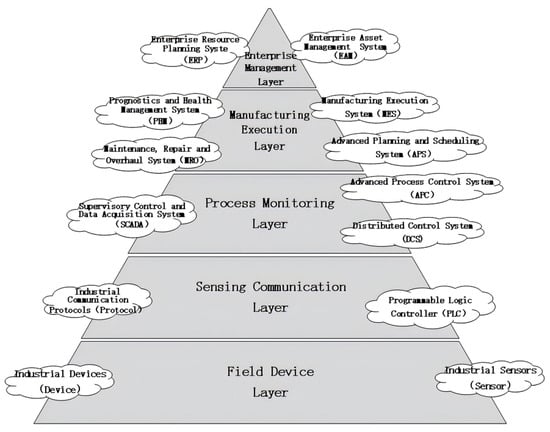
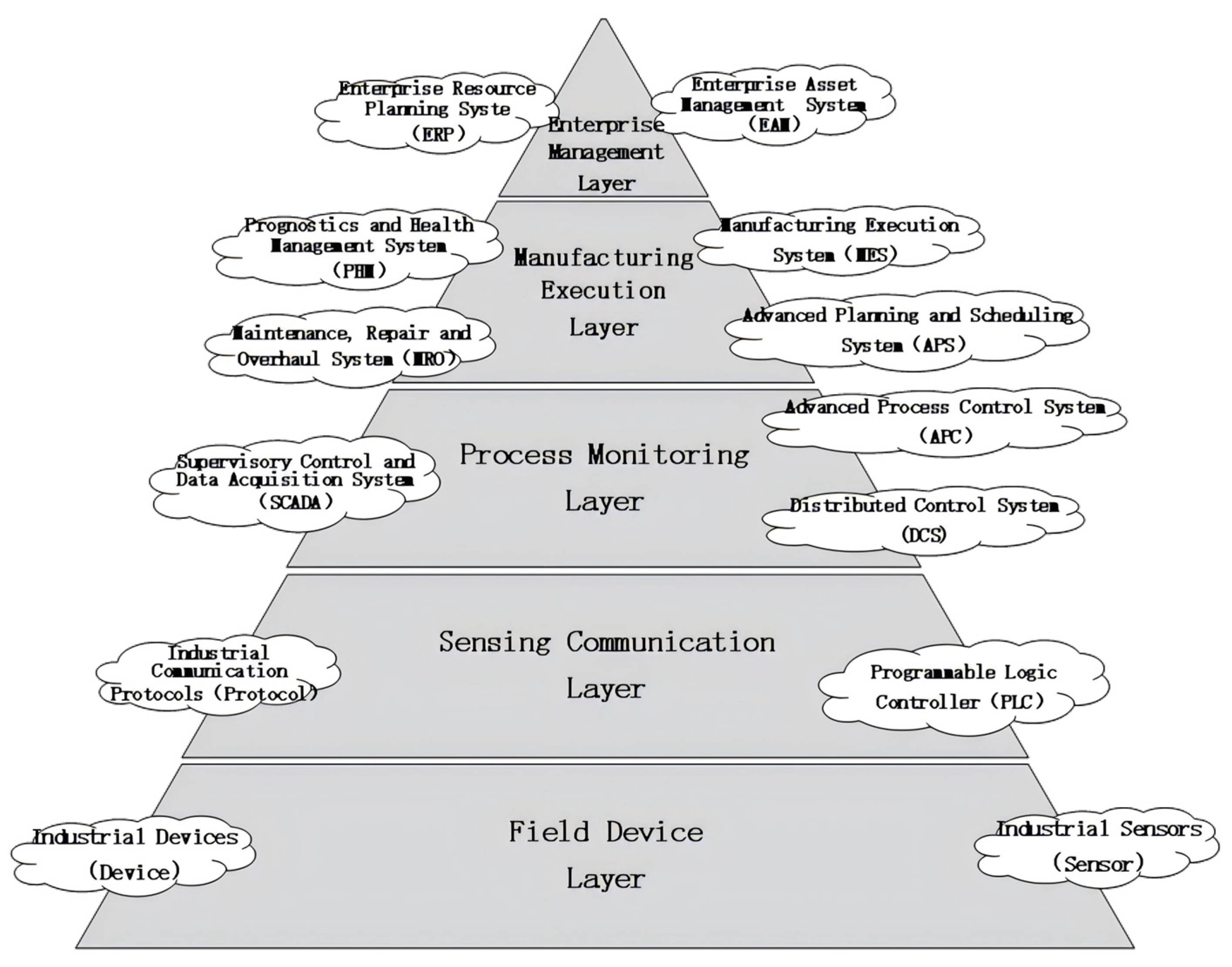
PEOMC is an integral component of manufacturing operations and plays a crucial role in the actual manufacturing process. In the late 1990s, academic and industrial communities conducted significant theoretical research and practical explorations to promote effective integration between enterprise business management and manufacturing processes. This led to the formation of the ISA95 reference architecture for the integration of enterprise and control systems [9], as shown in Figure 1. ISA95 divides manufacturing operation management and control activities into five layers: field operation, perception and transmission, process monitoring, manufacturing execution, and business management. Each layer involves business activities related to PEOMC [10,11,12,13,14,15], which can be used to support the implementation of a hierarchical PEOMC model.
Figure 1.
ISA95 layers and associated PEOMC systems complying with international standards.
The PEOMC mode based on ISA95 has deficiencies, such as control decision delays, inadequate cross-layer collaboration, and poor interoperability, when dealing with massive equipment control. Therefore, exploring a new type of PEOMC mode that is more efficient and flexible and can adapt to the needs of massive equipment access and complex control to maximize the effectiveness of the collaborative operation management and control of production equipment is necessary.
2.2. Construction Method for the PEOMC Functional Model
At present, for the description, construction, and application of PEOMC, both academia and industry mainly adopt the IDEF0 functional modelling language to construct graphical descriptions and comprehensive analyses of PEOMC function models. In terms of functional modelling, the IDEF0 functional modelling method is predominantly applied in the field of structured design for complex systems [16]. It typically adopts a top-down, step-by-step decomposition approach. Through graphical means, it provides a standardized expression of the specific operations and content elements of functional activities, as well as the interaction relationships between various detailed functional activities, thereby constructing a functional model of complex systems. This model serves as a tool for system decision-making, organization, and activity modelling. The United States National Institute of Standards and Technology (NIST) constructed the System Integration for Manufacturing Application (SIMA) [17] using the IDEF0 functional modelling language. In this architecture, production equipment is regarded as a manufacturing capability unit, and a universal functional activity model is provided. Therefore, this study uses the IDEF0 functional modelling method to construct a functional reference model for PEOMC to support the dynamic collaboration and lean control of various heterogeneous production equipment in manufacturing workshops.
2.3. Challenges for PEOMC in Industrial Internet Environment
Production equipment is evolving toward intelligent equipment characterized by advanced technology, integrated functions, and high value [18]. In the industrial internet environment, frequent interactions occur between the underlying production equipment and upper-layer control systems. Currently, three main theoretical innovation strategies and application practice paths have emerged, which aim to overcome the constraints imposed by the traditional hierarchical control mode based on the ISA95 five-layer architecture.
One is to comprehensively consider the integration of equipment into the entire production system from the bottom up and to revise and develop relevant standards for equipment communication and automatic control with the goal of business collaboration and system interconnection [19,20,21,22]. However, overcoming the challenges of integrating equipment control with business processes, system integration, and business logic processing, as well as the shortcomings in compatibility and adaptability, is necessary.
Second, it incorporates cross-regional heterogeneous production equipment into a unified resource allocation system from top to bottom, supporting the realization of capacity balance in equipment clusters and the precise configuration of equipment resources in flexible and complex scenarios [23]. However, in practical applications, the collection of multi-source heterogeneous data from equipment, over-abstraction of business ontologies, and significant differences between business logic and industrial control data models still face difficulties.
The third is based on the bidirectional expansion of the manufacturing execution layer, which deeply explores and integrates the functional elements originally scattered in various equipment operation management and control-related systems, encapsulates them into standardized, modular, and widely reusable service units, and publishes them on a unified manufacturing service platform. This can empower the efficient integration and interactive sharing of supporting functional services and support ubiquitous access to and precise control of equipment.
In summary, Strategy 3 starts from the manufacturing execution layer to construct a unified manufacturing service platform compatible with various functional services and adaptable to diverse equipment types, thereby enabling two-way penetration from top-level PEOMC scenarios to the connection and control of underlying heterogeneous equipment. Therefore, guided by Strategy 3 and aiming at the rigid limitation of the preset control logic in the traditional ISA95 architecture, this study adopts the IDEF0 modelling method and NLP topic clustering technology to construct a functional reference model for production equipment operation management and control and proposes a functional module composition method for specific scenarios to bridge the semantic gap between high-level business logic and underlying control systems. This approach transforms the construction mode of the equipment control model from manual customization to knowledge-driven automatic orchestration. Finally, the effectiveness of the proposed method in supporting functional interactions, business collaboration, and resource sharing among heterogeneous equipment in specific scenarios is verified through PEOMC engineering practices in an aero-engine transmission unit manufacturing workshop.
3. Design of the PEOMC Functional Reference Model from the Perspective of Standard Text
3.1. Framework Construction of the PEOMC Functional Model Based on IDEF0
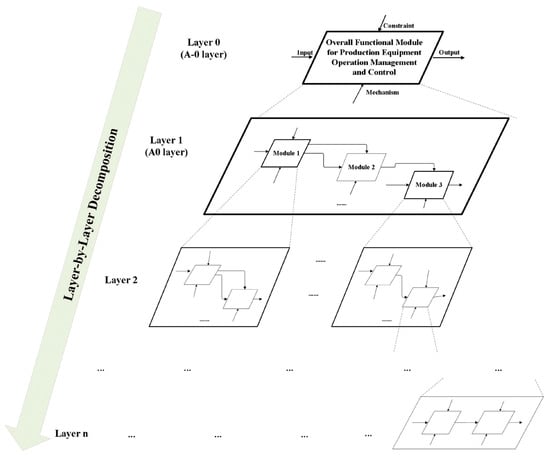
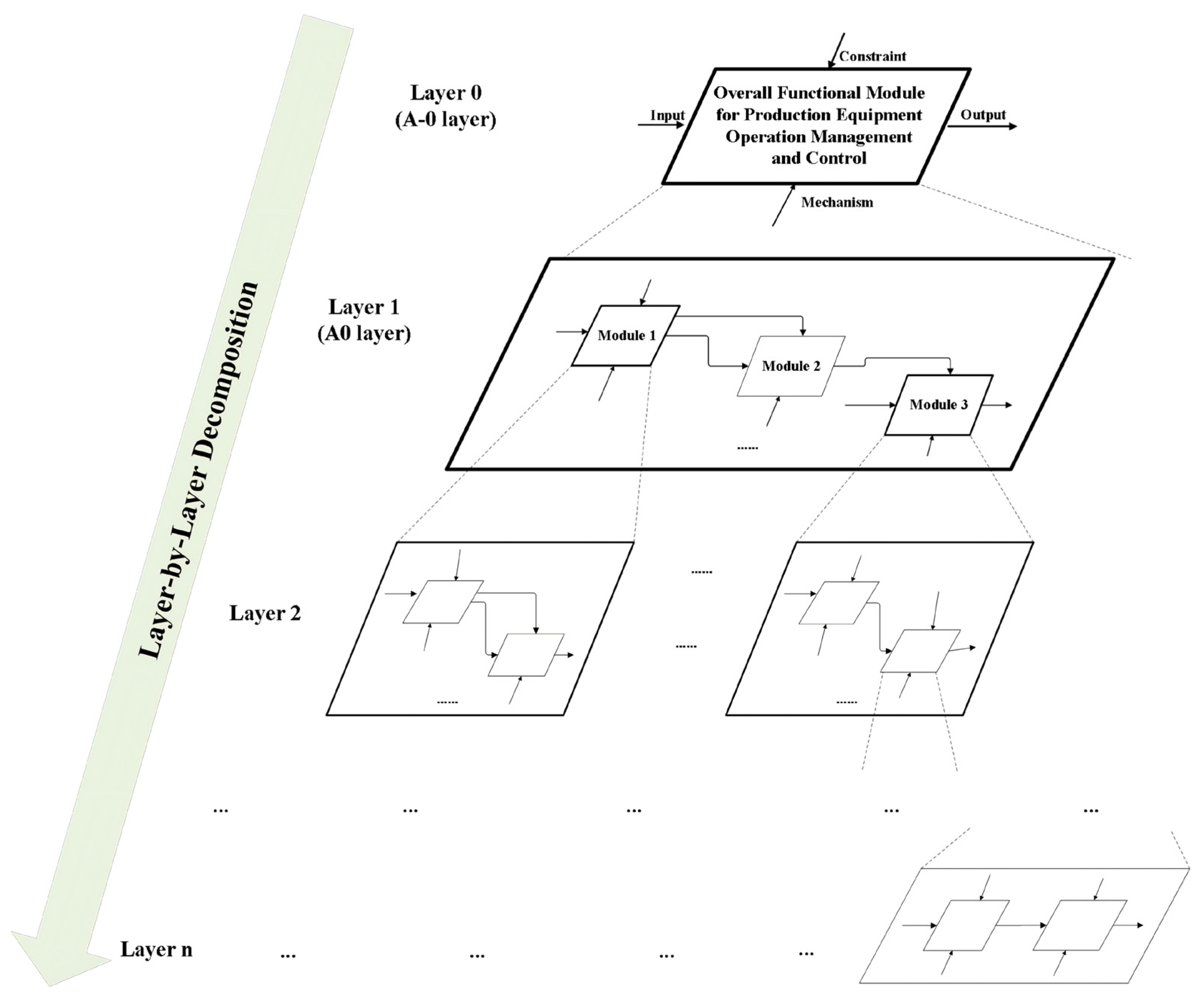
On the basis of the IDEF0 modelling method, the PEOMC functional model is decomposed layer by layer in a top-down manner. Each upper-layer functional module is described by several lower-layer functional modules, along with their inputs, outputs, support, and constraints. This hierarchical approach facilitates precise descriptions and standardized representations of the PEOMC functional model, as shown in Figure 2. Layer 0 is used to describe the overall functional module in the most abstract way; layer 1 is used to describe the main functional modules and their interactive relationships; layer 2 is used to further subdivide each main functional module to display its internal functional modules and interaction relationships; and layer n formally expresses various meta-functional modules, supporting carriers, constraints, and inputs and outputs during the execution of PEOMC.
Figure 2.
Schematic diagram of the overall framework of the PEOMC functional model.
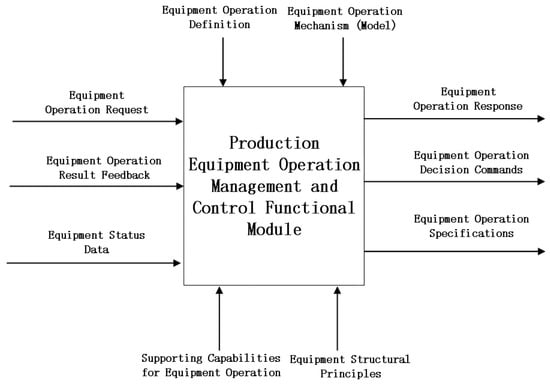
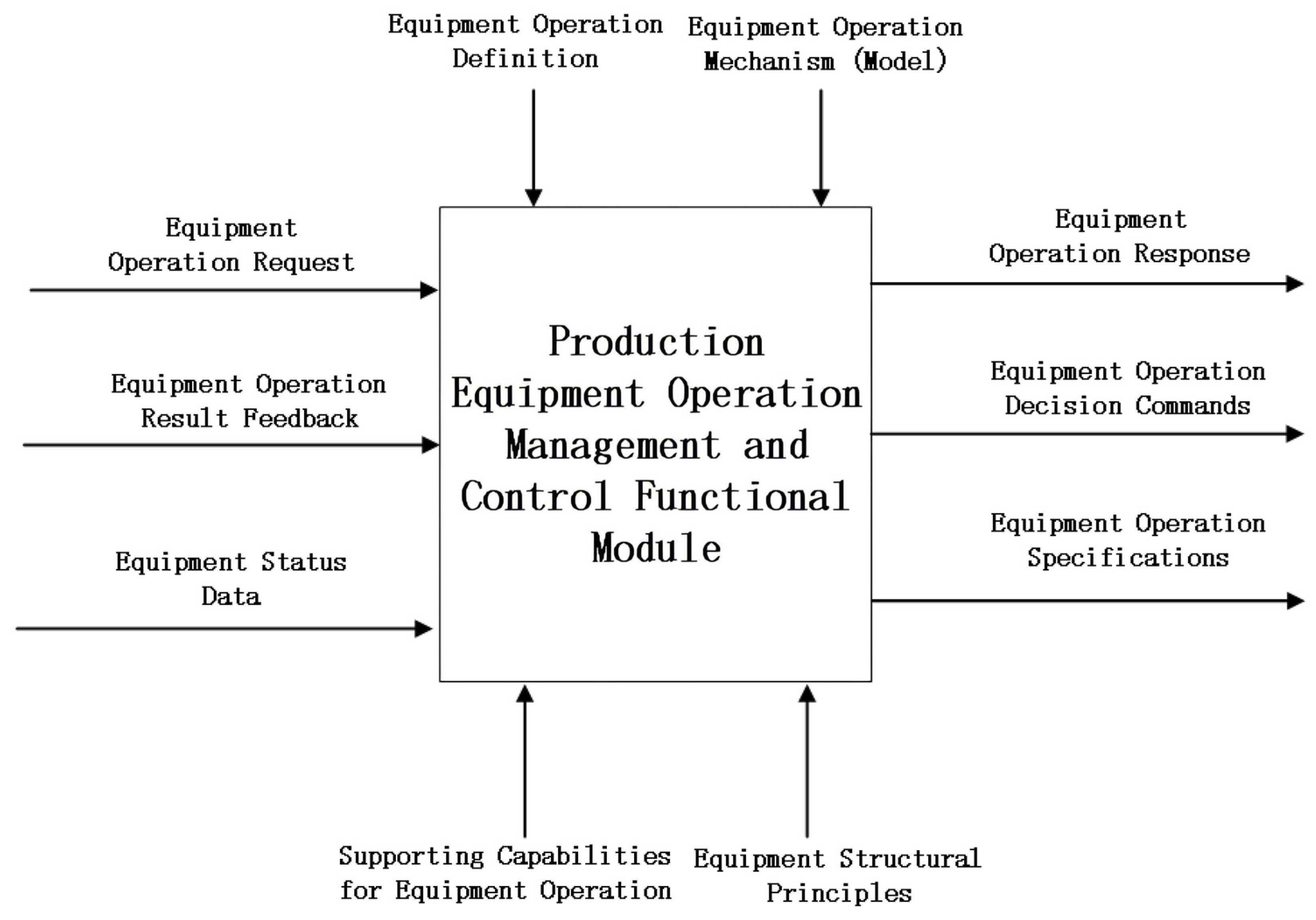
In the PEOMC functional model, the functional modules are connected and interact on the basis of the interfaces. In this section, these common characteristics of PEOMC activities defined in ISA95 are integrated to analyse the interfaces of the PEOMC functional modules. On the basis of the results of the analysis of the activities and external business, the bottom-layer equipment interaction interfaces in Li et al. [24] are derived, as are the interfaces of the functional modules, as well as the corresponding input, output, constraint, and support types, which are divided and formed. On the basis of the IDEF0 syntax rules, the interfaces were designed in a standardized manner, as shown in Figure 3.
Figure 3.
Standardized design of the interface for the PEOMC functional module based on IDEF0.
3.2. Identification of General Functional Modules in the First and Second Layers of the PEOMC
3.2.1. Identification of Functional Modules in the First Layer and Analysis of Their Interactive Relationships
Industrial and academic communities have conducted extensive research on production equipment and its related management activities, resulting in the formation of a series of international standards or reference architectures, which are categorized into three main types:
The first type focuses on the asset management of production equipment, such as IEC 63278 [22], ISO 55001 [25], and ISO 55010 [26]. These standards provide specifications for the relevant functional activities of production equipment asset management.
The second type focuses primarily on the application management of production equipment, involving the scheduling, allocation, and execution of tasks based on production equipment. Examples include international standards and reference architectures, such as IEC 62264 [9], IEC 61512 [27], and SIMA Reference Architecture [17], which provide specifications for functional activities related to production equipment application management.
The third type focuses on the maintenance management of production equipment. International standards, such as IEC 62264 [9], IEC 63082-1 [28], and ISO 13374 [29,30], mainly provide specifications for the relevant functional activities of production equipment maintenance management.
Accordingly, the first-layer PEOMC functional module is divided into three modules: equipment asset management, equipment application management, and equipment maintenance management.
3.2.2. Identification of Second-Layer Functional Modules and Analysis of Their Interaction Relationships
On the basis of relevant international standards or reference architectures, an in-depth analysis is conducted on the boundary scope, operating mechanism, and internal logical relationships of each functional module, including asset management, application management, and maintenance management of production equipment. Furthermore, the sub-functional modules of each functional module in the second layer are identified and acquired.
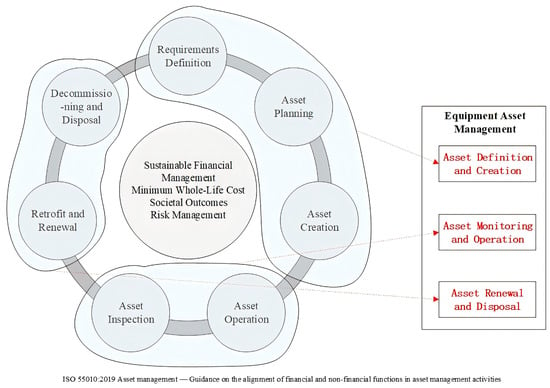
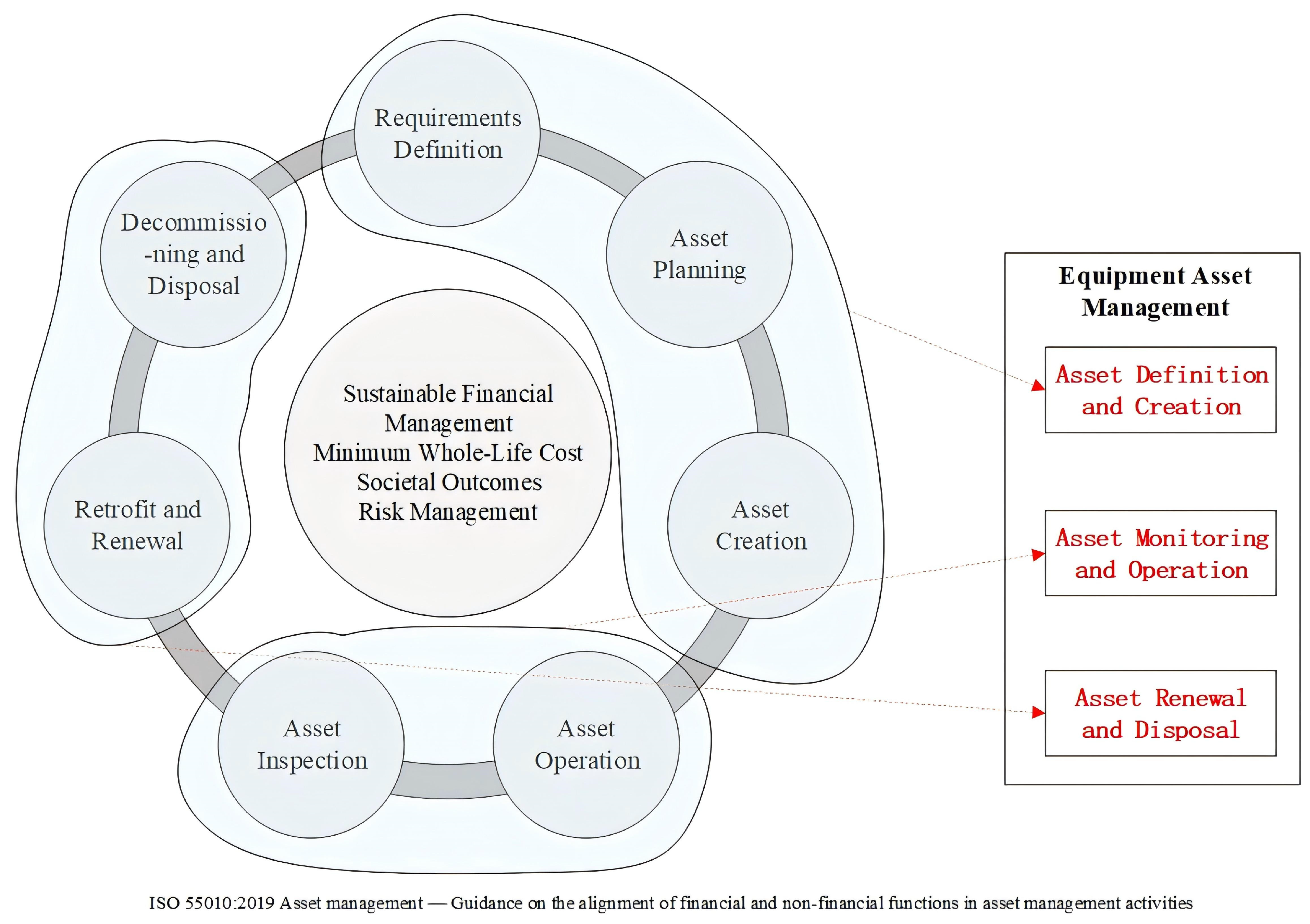
Identification of sub-functional modules for the management of production equipment assets. ISO 55010-2019 outlines a series of activities undertaken in the asset management life cycle, as shown in Figure 4. Specifically, the activities of “requirements definition,” “asset planning,” and “asset creation” involve primarily the definition and creation of production equipment. The activities of “operation and maintenance” and “asset monitoring” involve mainly the monitoring and operation of production equipment. The activities of “renewal/rehabilitation” and “disposal” primarily involve the renewal and disposal of production equipment. On the basis of the above analysis, the first-layer production equipment asset management functional module can be decomposed into three sub-functional modules: asset definition and creation, asset monitoring and operation, and asset renewal and disposal.
Figure 4.
Identification of sub-functional modules for asset management of production equipment [26].
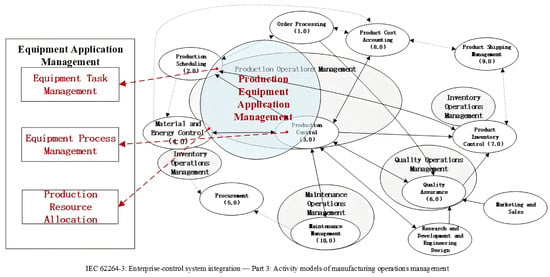
Identification of sub-functional modules for production equipment application management. ISO/IEC 62264 defines four major types of manufacturing operation management activities: production operation management, maintenance operation management, quality operation activities, and inventory operation management (identified by shaded areas), as shown in Figure 5. Production equipment application management is an important component of manufacturing operation management activities and involves three main functional modules related to production operation management activities: production scheduling, production control, and material and energy control. Production scheduling involves mainly the task management activities of production equipment. Production control involves mainly the process management activities of production equipment. Material and energy control involves mainly allocating the supporting resources required for the operation of production equipment. On the basis of the above analysis, the first-layer production equipment application management functional module can be decomposed into three sub-functional modules: equipment task management, equipment process management, and production resource allocation.
Figure 5.
Identification of the sub-functional module for production equipment application management [9].
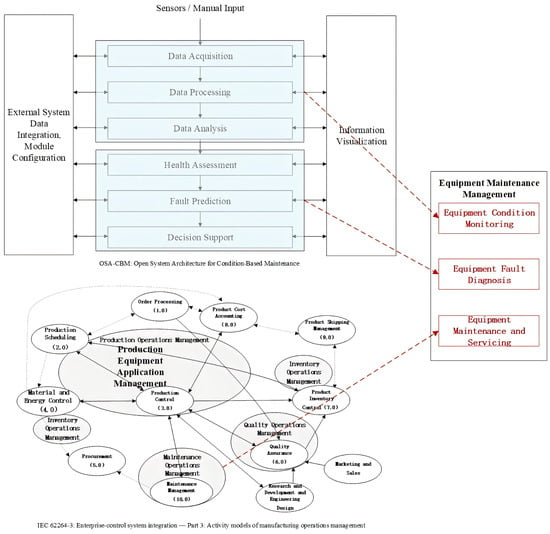
Identification of sub-functional modules for production equipment maintenance management. In addition to PEOMC activities, ISO/IEC 62264 defines maintenance operation management activities, which involve receiving maintenance requests for equipment, tools, and related assets; developing maintenance plans; and carrying out corresponding maintenance operations. This mainly refers to the daily maintenance function of equipment. In OSA-CBM, two additional functions are specified for equipment maintenance management: equipment condition monitoring and equipment fault diagnosis. Therefore, in this study, the first-layer production equipment maintenance management functional module is decomposed into three sub-functional modules: equipment condition monitoring, equipment fault diagnosis, and equipment maintenance, as shown in Figure 6.
Figure 6.
Identification of the sub-functional module for production equipment maintenance management [9].
The classification above is mainly based on relevant international standards that describe a certain aspect of PEOMC. It is a summary of the practical experience of experts during a specific historical period. It is difficult to further refine the cognitive framework, division logic, and expression methods of PEOMC in the current situation. Therefore, it is urgent to conduct in-depth exploration on the basis of a vast amount of practical engineering experience, focusing on the functional modules summarized and condensed in the second layer, and propose more reasonable division and expression methods.
3.3. Reference Resource Pool Construction for the Third Layer Functional Module of the PEOMC Functional Model
Domain knowledge, practical experience, rules, and conventions related to the operation management and control of production equipment are generally accumulated in massive amounts of standard text. To this end, this study adopts natural language processing (NLP) methods to conduct an in-depth analysis of standard texts concerning the operation management and control of production equipment. Specifically, through vector transformation, topic clustering, and thematic semantic extraction of standard texts for production equipment operation management and control, the functional modules at the third layer of the production equipment operation management and control functional model are identified, and a reference resource pool of production equipment operation management and control functional modules comprising atomic functional modules is constructed.
The BERT-pretrained semantic model [31] possesses bidirectional encoding, deep contextual understanding, and transfer learning capabilities and exhibits significant advantages in high-dimensional semantic feature vector extraction tasks. Therefore, considering the application scenarios of textual semantic mining and resource constraints under conventional environments, this study adopts the BERT-based pretrained semantic model to mine standard texts in the field of production equipment operation management and control.
For the selected BERT pre-trained semantic model, general-domain semantic knowledge, such as semantic information, syntactic structure, and contextual logical relations, learned from massive texts is transferred to the standard text training set in the field of production equipment operation management and control. An extended training approach is employed to obtain a semantic model suitable for the semantic representation of standard texts in the equipment operation management and control domain, and the subdivided functional modules required for production equipment operation management and control are mined and extracted using the standard text topic clustering method.
- (1)
- Construction of a standard sample pool for PEOMC
A search was conducted on the standards related to the PEOMC at the National Library of Standard (https://www.ndls.org.cn/, accessed on 24 March 2026), from which 180 international, national, and industry standards in the field of the PEOMC were obtained. The retrieved standard texts were processed through word segmentation, stop word removal, text cleaning, and feature extraction, and a word term sequence set for the clauses of PEOMC standards was constructed, which served as the benchmark sample pool for the text mining of PEOMC-related standards.
- (2)
- Text vector conversion for PEOMC-related standards based on BERT
Considering words as the minimum unit, the standard text corpus in the field of PEOMC is encoded as the training sample set for the BERT pre-trained semantic model. Low-rank adaptation (LoRA) [32] was adopted for model fine-tuning to iteratively optimize the network structure and connection weights of the pre-trained model. The domain knowledge of PEOMC was embedded to generate a semantic model adapted to the function clustering tasks of equipment operation management and control, which provides technical support for the sentence vector conversion of standard texts in the PEOMC field.
In this study, the general-domain BERT semantic model released by Technische Universität Darmstadt is adopted. For the constructed standard sample pool of production equipment operation management and control, the five-fold cross-validation method is used to sequentially extract part of the standard texts as training samples for supervised learning. Furthermore, the LoRA model fine-tuning method is employed to update the network structure and connection weights of the BERT pre-trained model to generate a semantic model suitable for the functional clustering task of equipment operation management and control.
On the basis of the fine-tuned BERT semantic model, the multi-head attention mechanism is adopted to process different parts of standard clause sentences for equipment operation management and control and capture the semantic relationships between different sentences combined with context, thereby converting the standard texts of production equipment operation management and control into fixed-length vector representations that can characterize the semantic information of the entire text.
The text vector transformation method based on the multi-head attention mechanism is expressed as follows:
where Q, K, and V denote the target word matrix, keyword matrix, and standard text, respectively, and is the normalization parameter.
- (3)
- Topic clustering of PEOMC-related standards based on HDBSCAN
Aiming at the sentence vectors of standard clauses related to the production equipment management function constructed above, this study employs the HDBSCAN density clustering algorithm integrated with domain knowledge [33] for topic clustering analysis. The core principle of this algorithm assumes that a densely distributed sample set in the sample space forms a topic cluster; different types of topics are identified by quantifying the density of the sample space, thereby completing the clustering operation on the feature data of standard text sentence vectors. The specific method design is as follows:
Step 1: Domain knowledge loading. With respect to the nine functional modules of the second layer of the PEOMC functional model, namely, asset definition and creation, asset monitoring and operation, asset renewal and disposal, equipment task management, equipment process management, production resource allocation, equipment status monitoring, equipment fault diagnosis, and equipment maintenance, this study combines expert experience to set up a guide word set for each functional module, as shown in Table 1.
Table 1.
Setting of guiding words for the PEOMC functional modules.
Step 2: Similarity calculation. The similarity between the standard sentence vector of the device management function and the vector of the guiding word was calculated on the basis of the mutual reach distance, which guides the direction of topic clustering. The calculation method for the mutual reach distance is as follows:
represents the kth nearest neighbour point of the current sentence vector x, and d(a,b) represents the distance between sentence vectors a and b.
Step 3: Cluster tree construction. A minimum spanning tree is constructed on the basis of the weighted distance graph, a hierarchical cluster structure is built on this basis, and the hierarchical cluster tree is compressed with the minimum cluster size.
Step 4: Generate the clustering results. Each sentence vector is labelled with a topic type by calculating node stability. The node stability is calculated as follows:
represents the reciprocal of the length of the disconnected edge when sample point p is split away from the node, and represents the reciprocal of the length of the disconnected edge when the current node is split into two sub-nodes.
- (4)
- Semantic extraction of the standard text for PEOMC
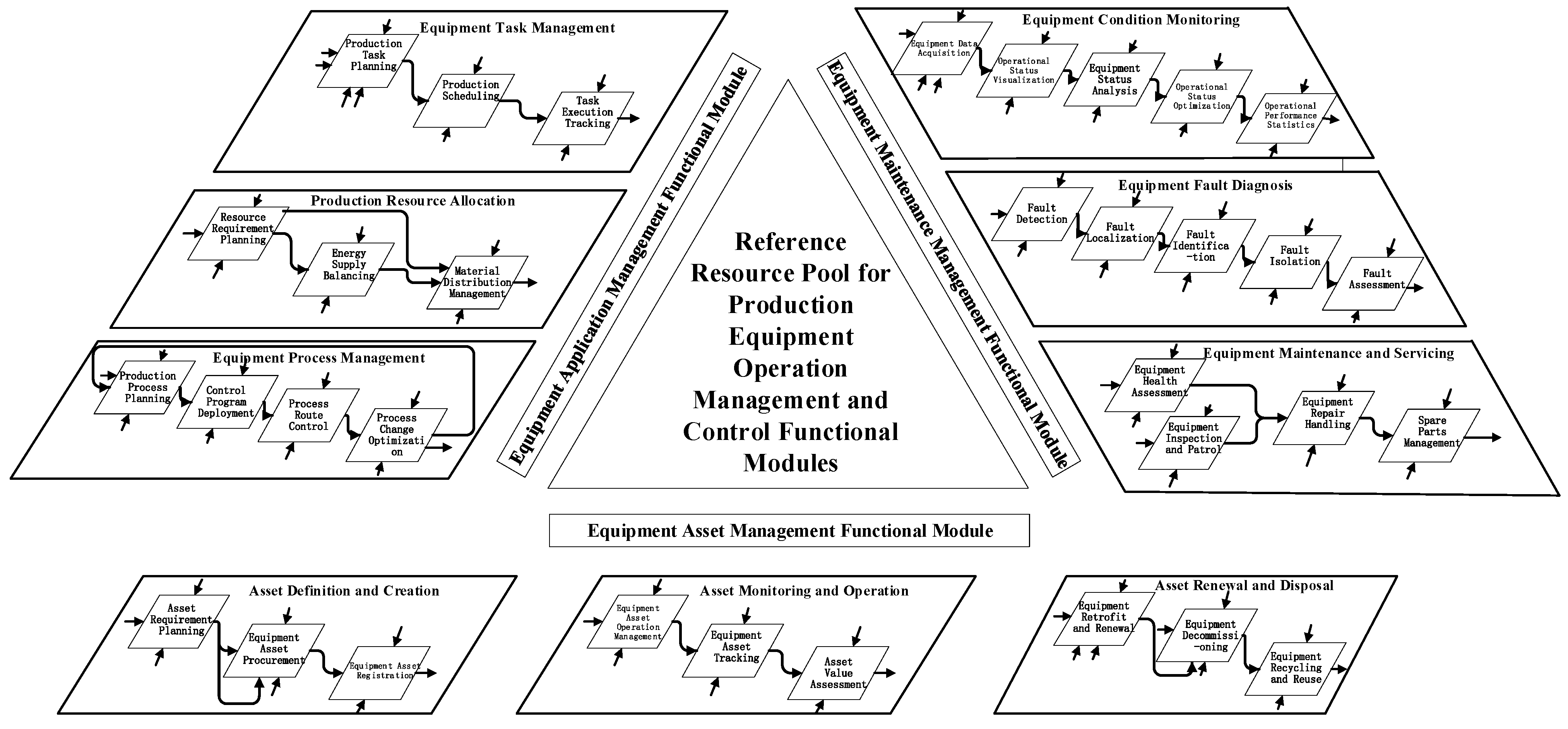
For the refined functional topics under different management function types of equipment obtained by clustering, the C-TF-IDF algorithm was applied to condense the topic semantics [34], and the maximal marginal relevance (MMR) algorithm was adopted to control the diversity of topic terms. A total of 33 categories of standard text topics for production equipment operation management and control were mined, which exhibited an obvious mapping relationship with the nine second-layer functional modules identified in Section 3.2. These topics are the refined decomposition and constituent units of the second-layer functional modules. Combined with expert experience, the 33 mined third-layer functional modules were matched with the nine second-layer functional modules. A reference resource pool for production equipment operation management and control functional modules, consisting of nine groups and 33 sub-functional modules, was constructed for the third layer. It can support the matching, extraction, and combined invocation of production equipment operation management and control functional modules in specific scenarios, as shown in Figure 7.
Figure 7.
The reference resource pool of the third layer of the PEOMC functional module.
4. Combination Method for PEOMC Functional Modules in Specific Scenarios
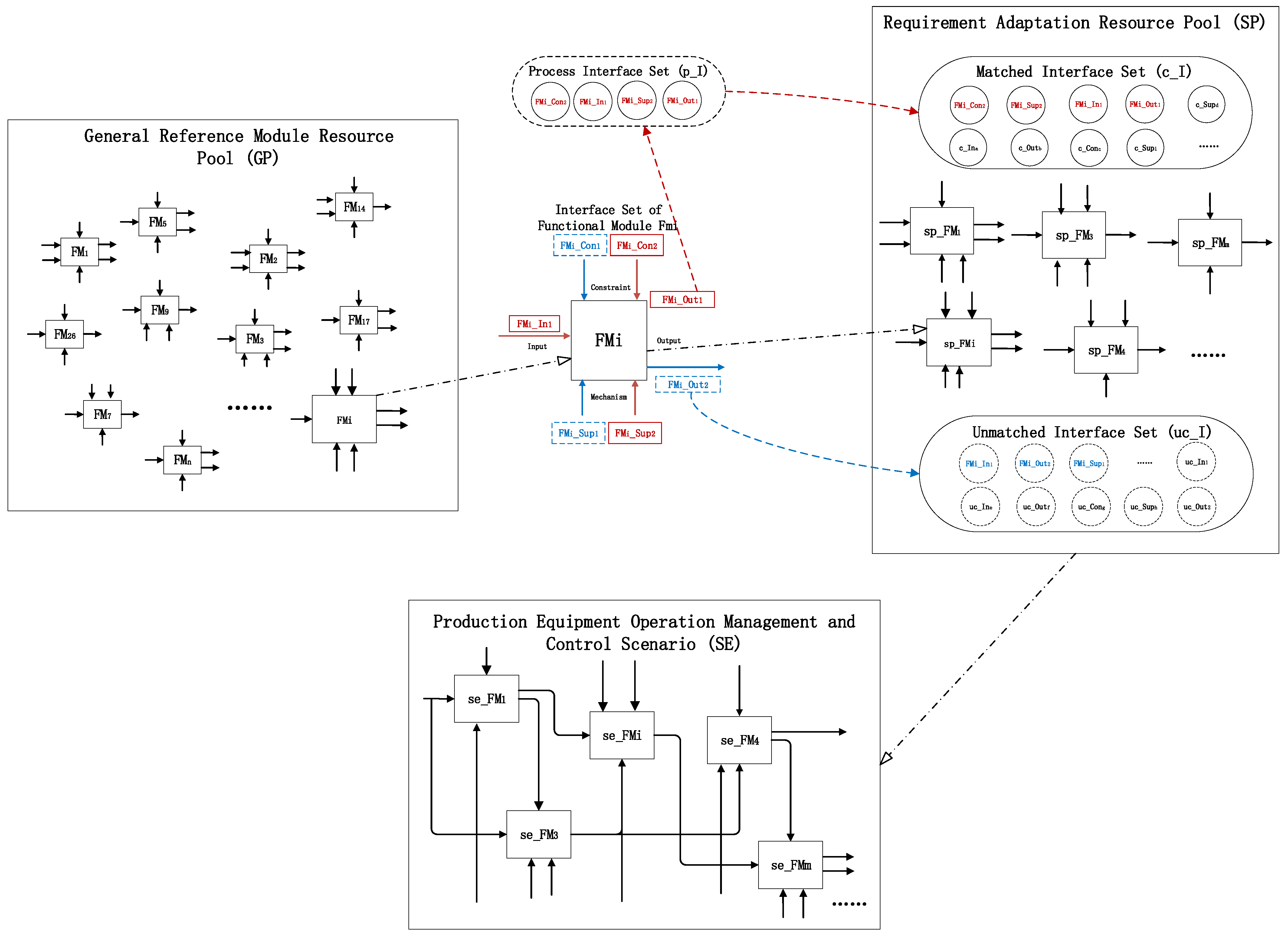
The element definitions are as follows:
FM, PEOMC is a functional module F where is the set of input interfaces, is the set of output interfaces, is the set of constraint interfaces, and FM_ is the set of support interfaces.
SE: PEOMC scenario SE = {se_sFM, e_I}, where is the set of scenario-related functional modules and e_I = {e, e} is the set of external interfaces.
GP: The functional module reference resource pool GP = , where n is the number of functional modules in the GP.
SP: The requirement adaptation resource pool SP = {sp_sFM, c_I, uc_I}, where is the set of functional modules adapted to the scenario SE requirements; c_I = {, c_} is the set of paired interfaces, which is mainly used for saving the interfaces in the scenario-related functional modules sp_sFM that have a clear connection object; uc_I = {, } is the set of unpaired interfaces, which is mainly used for saving the interfaces in the scenario-related functional modules sp_sFM that do not yet have a clear connection object.
p_I: The process interface set p_I = {, p_}, which is mainly used to temporarily store the set of interfaces generated during each matching process.
4.1. Initial State Configuration
The set of external interfaces, e_I = {e, e}, in the PEOMC scenario SE is known; in contrast, the set of scenario-related functional modules, se_sFM, is unknown.
The functional module reference resource pool GP is known.
In the requirement adaptation resource pool SP, the set of scenario-associated functional modules sp_sFM is set to empty, the set of paired interfaces c_I is set to empty, and the set of unpaired interfaces uc_I is set to the external interface set of the scenario; that is, uc_I = e_I;
The process interface set p_I is set to empty.
4.2. Module Selection and Combination Strategy Design
Step 1: Adapt the unpaired interface set uc_I = {, } from the resource pool SP to the requirement. In accordance with the identification order of specific functional modules in the functional module GP =, each interface in the unpaired interface set uc_I is matched with the interface set {_, } of a specific functional module by interface type. That is, the intersection between the unpaired interface set uc_I and the interface set of the functional module is calculated, and the matching results are assigned to the process interface set:
Step 2: If the process interface set p_I generated in Step 1 is nonempty, then
- (a)
- Add the functional modules that are successfully matched in the GP to the SP; that is, sp_sFM = sp_sFM{}.
- (b)
- Add the process interface set p_I to the paired interface set c_I according to the interface type; that is, c_I = {p c c};
- (c)
- For the newly added functional modules that successfully matched in SP, add their interfaces that did not match with c_I to the unpaired interface set uc_I in the SP, according to the interface type, and remove the paired interfaces p_I generated in Step 1 from uc_I = , , }.
- (d)
- After completing steps (a), (b), and (c), the process interface set p_I.
Step 3: If the process interface set p_I generated in Step 1 is empty, indicating that the matching was not successful, then return to Step 1 and continue to match the interface set of the functional modules according to the identification order of the functional module collection in the GP.
Step 4: Repeat Steps 1–3 by continuously adding the functional modules FM that satisfy the matching conditions from the GP to in the SP until the number of interface elements in the unpaired interface set uc_I of the SP reaches zero.
Step 5: Assign the scenario-related functional module set generated in step 4 from SP to the functional module set in the PEOMC scenario; that is, = . At this point, the matching selection of the functional module set in the PEOMC scenario is completed.
Step 6: For the set of functional modules related to the PEOMC scenario obtained in Step 5, it is necessary to establish corresponding interactive connections between the input, output, constraint, and support interfaces of each functional module in on the basis of expert domain knowledge, according to the interface type and content. This completes the matching selection and logical combination of the PEOMC functional modules in specific scenarios.
The selection and combination strategies for the PEOMC functional model in specific scenarios are presented in Figure 8.
Figure 8.
Schematic diagram of selection and combination strategy principles for PEOMC functional modules.
5. Practical Application in an Aero-Engine Transmission Unit Manufacturing Workshop
5.1. Problem Overview
A company introduced a set of high-performance, high-value CNC equipment with composite machining functions for the production of aero-engine transmission units, including more than 20 key pieces of equipment, such as 5-axis vertical turning-mill machining centres, CNC worm wheel grinders, CNCs from grinders, CNC cylindrical grinders, CNC internal grinders, CNC surface grinders, CNC gear hobbing lathes, and CNC gear hobbing machines, as well as auxiliary equipment, including robots, stackers, and automated warehouses. An analysis reveals that although these machines are equipped with intelligent functions such as remote control, data transmission, and performance analysis, and warning signals are issued prior to failures, there is a delay in the platform’s reception and response to these early warnings. However, no effective measures are taken in a timely manner, resulting in the interruption and stagnation of the production line. Currently, key performance indicators, such as the equipment load rate, raw material utilization rate, and equipment cloud connectivity rate in the workshop, have all met the targets. However, the OEE has been hovering at approximately 55%, significantly below the preset target of 70%. Further investigation revealed the following issues:
- (1)
- The current process capability index of the workshop equipment is only 1.28, which falls short of expectations, indicating insufficient stability and consistency in the processing performance of the production equipment.
- (2)
- The fault warning function of intelligent equipment is not effectively utilized; the industrial internet platform fails to receive warning signals before equipment failure and takes timely response measures.
- (3)
- Unified expression standards for the operation and maintenance information of various types of heterogeneous equipment are lacking. Significant differences in the expression formats and interaction methods of operation and maintenance information across multiple models and brands of equipment prevent unified management and interactive analysis on the industrial internet platform.
5.2. Design and Implementation of Equipment Predictive Maintenance Solutions Based on Industrial Internet Platforms
The engineering issues of PEOMC reveal deficiencies in current enterprise equipment maintenance management. Although the current workshop equipment is fully loaded and fully connected to the cloud, timely detection and disposal have not been achieved because of frequent unexpected shutdowns of equipment, such as five-axis vertical turning-milling compound machining centres and CNC gear hobbing machines. To address these issues, an overall solution for the predictive maintenance of production equipment in an engine transmission unit manufacturing workshop is designed in accordance with the technical route of “scenario external interface design-functional module extraction and combination arrangement-information model design-industrial APP development and deployment” to realize condition monitoring, fault early warning, and predictive maintenance of workshop equipment.
5.2.1. Standardized Definition of Interfaces for Predictive Maintenance Scenarios of Production Equipment
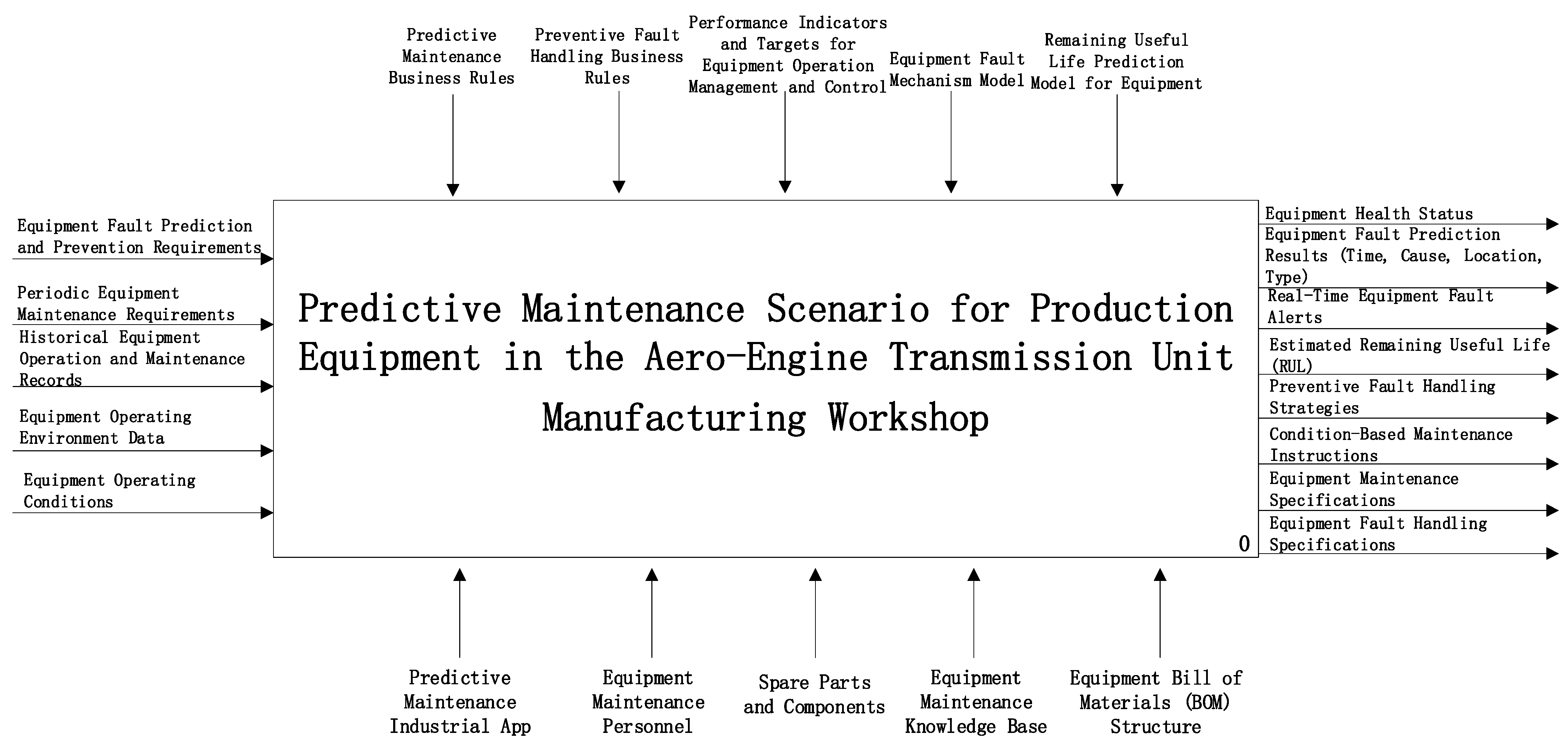
With respect to the predictive maintenance scenario of production equipment in the manufacturing workshop of aeroengine transmission units, in accordance with the engineering practice requirements for the predictive maintenance of equipment in the enterprise’s shaft and gear processing workshop, on the basis of the common elements of the interfaces of the PEOMC functional modules given in Section 3.1 and with reference to the syntax specifications of IDEF0, this study standardizes the definition and description of the supporting carriers, constraint conditions, input–output, and other external interfaces of the equipment predictive maintenance scenario. These serve as the basis for the subsequent extraction and combination of equipment operation management and control functional modules, as shown in Figure 9.
Figure 9.
A-0 diagram of the predictive maintenance scenario for production equipment in the aero-engine transmission unit manufacturing workshop.
5.2.2. Construction of a Functional Model for Predictive Maintenance Scenario of Production Equipment
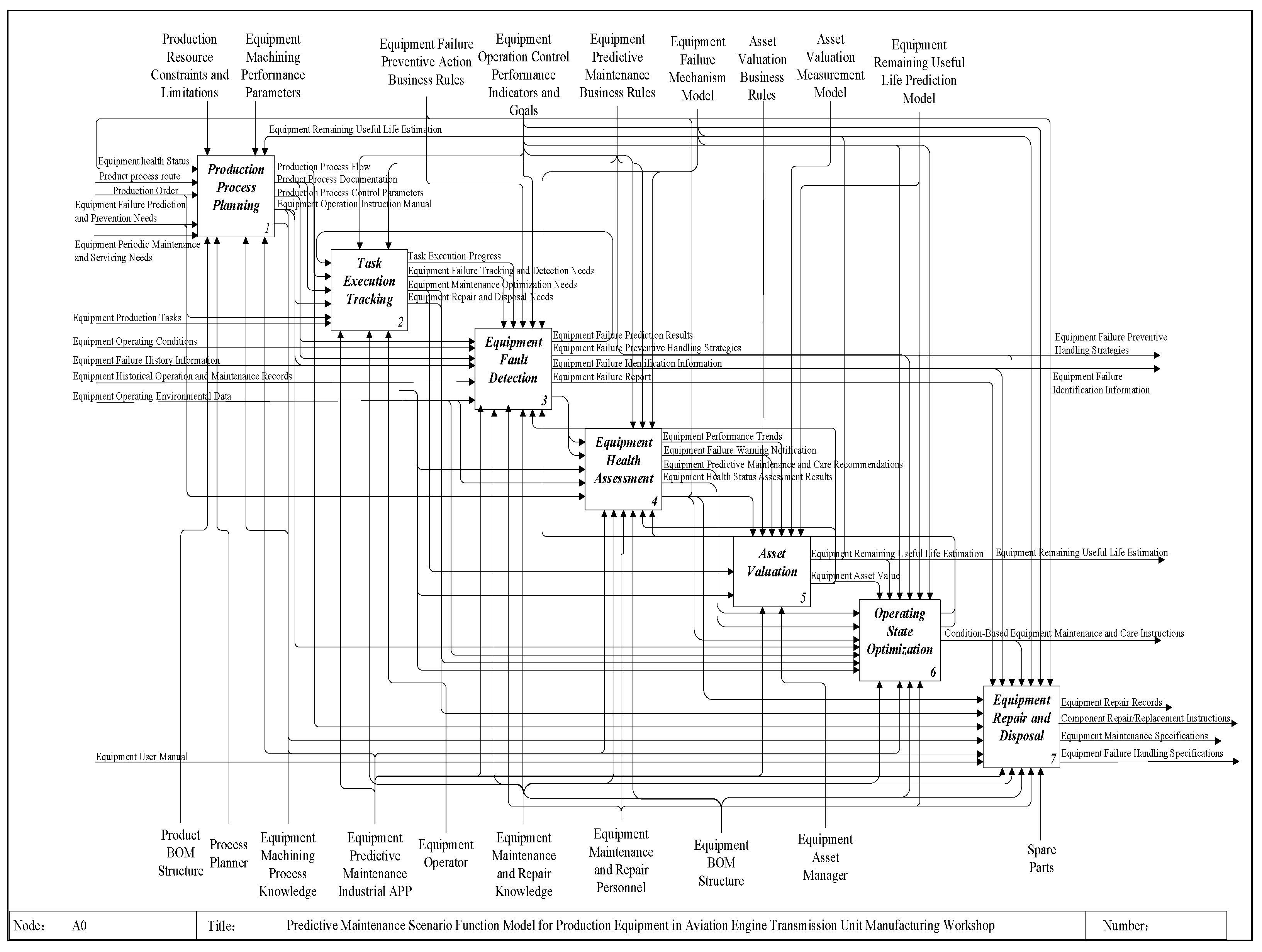
On the basis of the combination method of PEOMC functional blocks for specific scenarios given in Section 4 and on the basis of the known external interfaces of the predictive maintenance scenario for production equipment in the manufacturing workshop of aero-engine transmission units, functional modules that match the predictive maintenance scenario are selected from the reference resource pool of production equipment operation management and control functional modules provided in Section 3.3 of this study. Specifically, these include seven functional modules: asset value evaluation, task execution tracking, production process planning, operation status optimization, equipment fault detection, equipment health assessment, and equipment maintenance disposal. These modules are combined and arranged according to the business logic interaction relationships between them to further complete the construction and function realization of the equipment predictive maintenance scenario, as shown in Figure 10.
Figure 10.
Functional model for predictive maintenance scenarios of production equipment in aero-engine transmission unit manufacturing workshops.
5.2.3. Construction of an Information Model for the Predictive Maintenance Scenario of Production Equipment
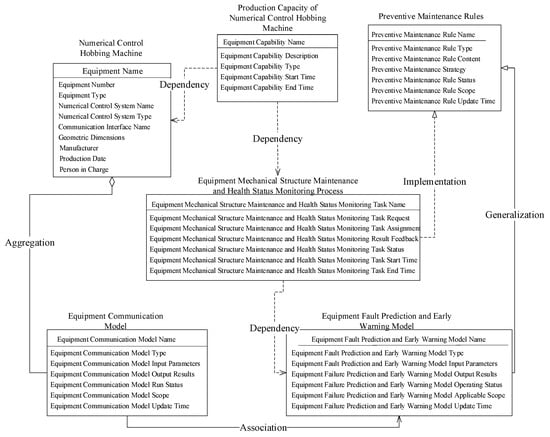
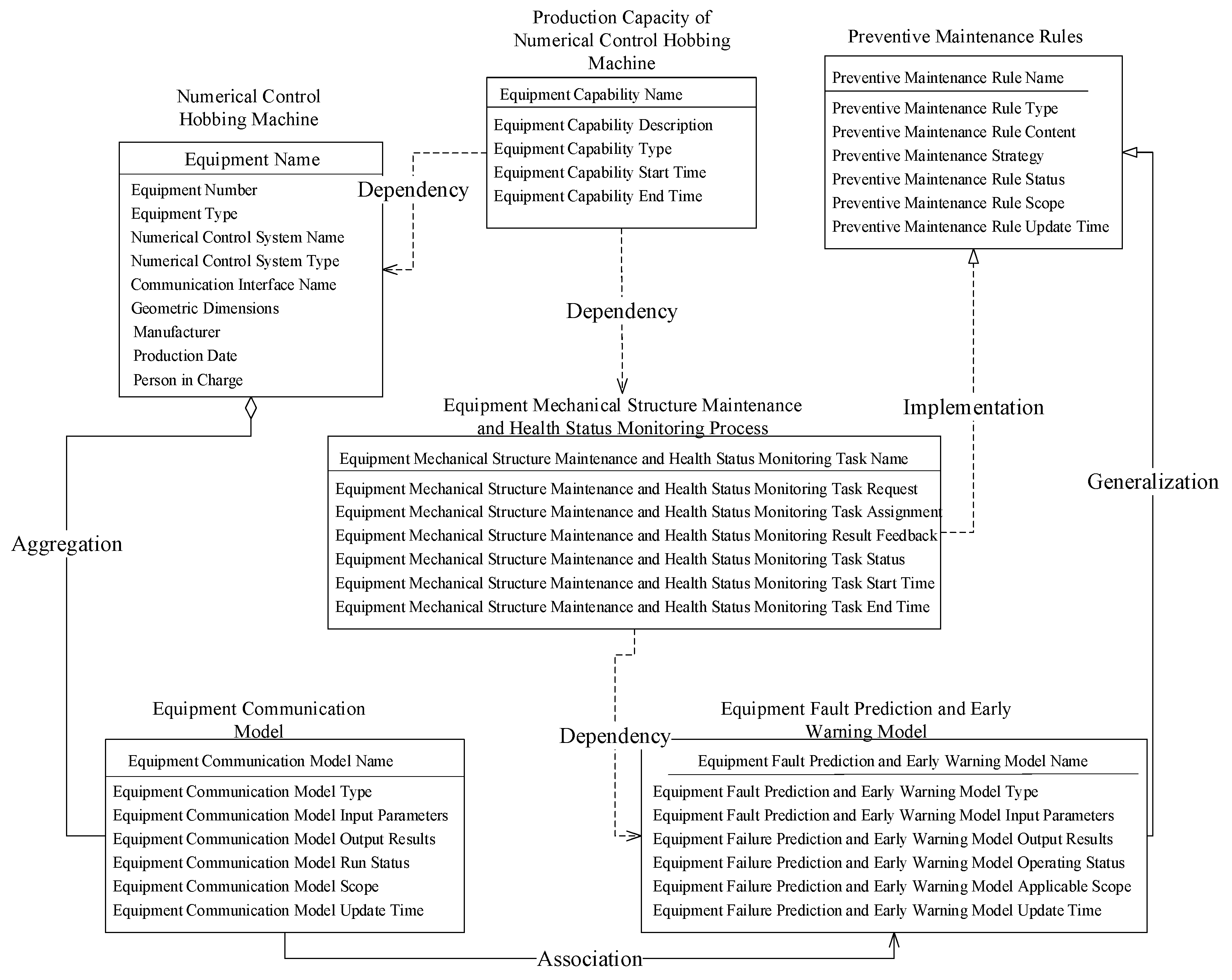
On the basis of the idea of constructing an information model for production equipment operation management and control in [24], we constructed information models for each functional module in the scenario of predictive maintenance of production equipment in a targeted manner. We then combined, deduplicated, and merged the seven constructed information models of functional modules and finally constructed the overall information model for the scenario of predictive maintenance of production equipment. Taking the “CNC gear hobbing lathe” as an example, the constructed information–entity relationship network is shown in Figure 11.
Figure 11.
Information entity attributes of the equipment health assessment functional module (partial).
5.3. Deployment and Performance Comparison Analysis of a Predictive Maintenance APP for Production Equipment
On the basis of the results of the logical combination design of the functional model for production equipment predictive maintenance scenarios described above, the enterprise developed a predictive maintenance application (APP) for production equipment in an aero-engine transmission unit manufacturing workshop and deployed it on the enterprise’s industrial internet platform, realizing online monitoring of operation status, fault prediction and early warning, as well as predictive maintenance of the production equipment in the workshop.
To objectively evaluate the effectiveness of the aforementioned predictive maintenance solution and clarify the attributes of performance improvement, this study designed a rigorous comparative verification procedure. In terms of the comparison method, the workshop management mode based on “traditional manual inspection and passive response” prior to the application of the app was taken as the baseline method for before-and-after comparison. In terms of experimental control, external environmental variables were strictly controlled to ensure that conditions such as processing tasks, equipment scheduling schemes, core process parameter requirements, and operator allocation in the workshop were consistent during the comparative statistical period, thereby eliminating the interference of other external factors.
Under the above strict experimental control, in this study, a definite time window for statistical verification with respect to three key indicators, namely, the production equipment process capability index, MTTR, and OEE, was selected, and an attribution analysis combined with the operation mechanism of the functional model was conducted.
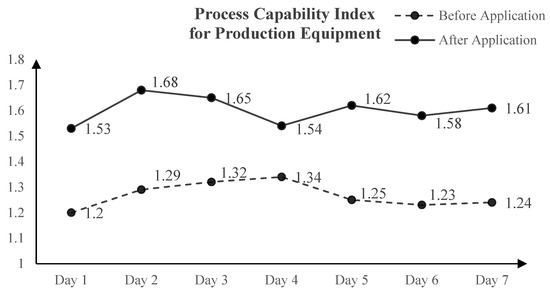
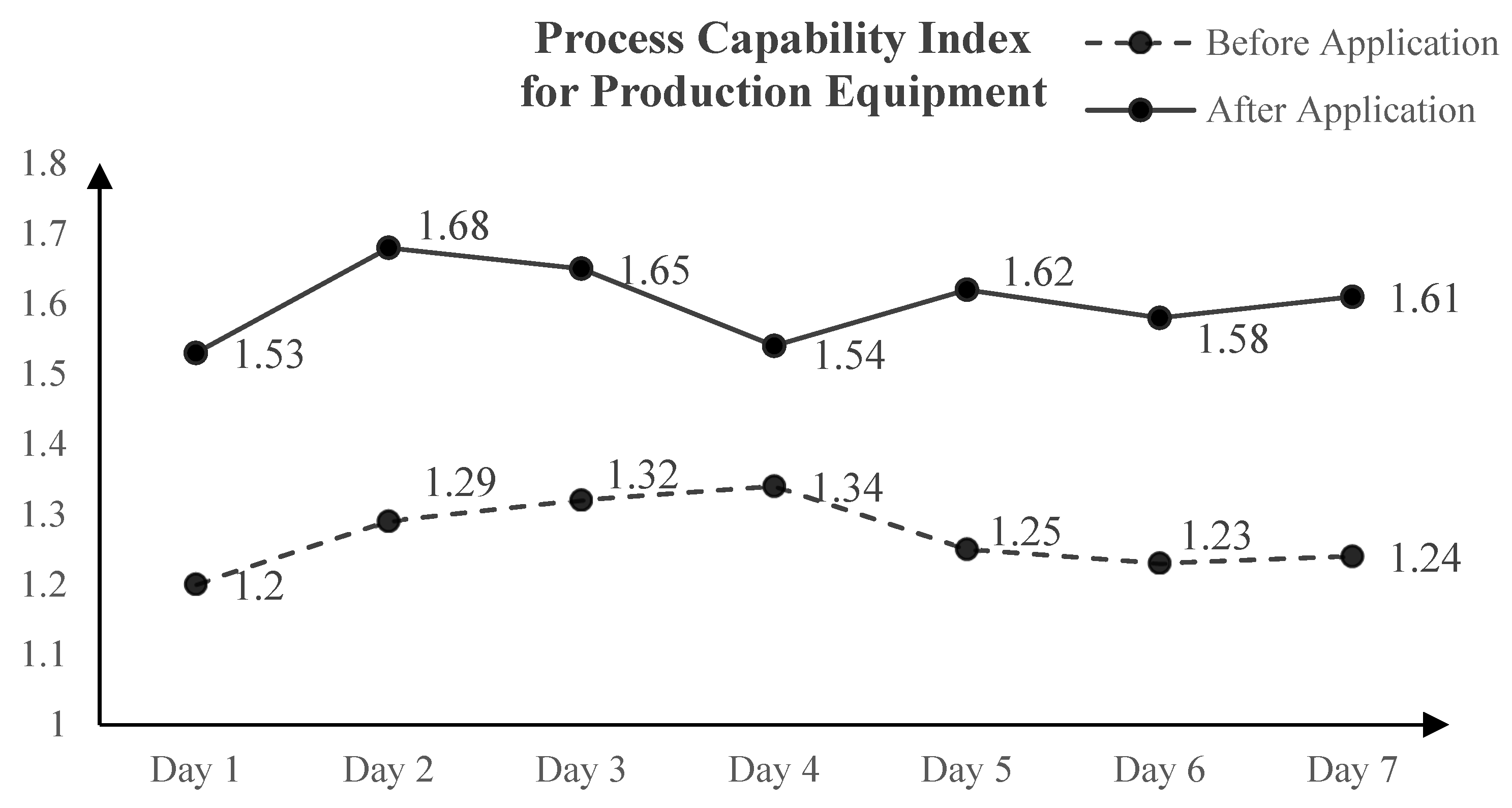
Comparison of the production equipment process capability index: Based on the production characteristics of the aero-engine transmission unit manufacturing workshop, “day” is generally adopted as the statistical cycle to calculate the production equipment process capability index, a key performance indicator. Seven consecutive working days before and after app deployment were selected for statistical comparison. The data show that the average value of the production equipment process capability index in the workshop increased steadily from 1.28 to approximately 1.60 after deployment. As shown in Figure 12 and supported by the functional model for equipment predictive maintenance scenarios, especially the “equipment fault detection” functional module, the enterprise identified abnormal equipment states in advance, which effectively improved the continuity and stability of the production process.
Figure 12.
Comparison of the process capability index of production equipment before and after the implementation of the industrial APP for equipment predictive maintenance.
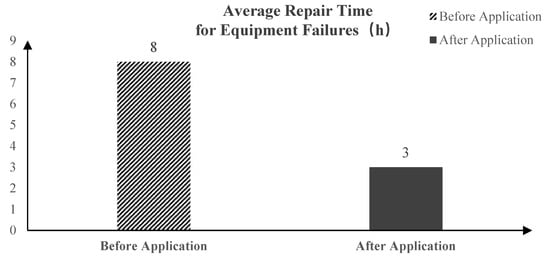
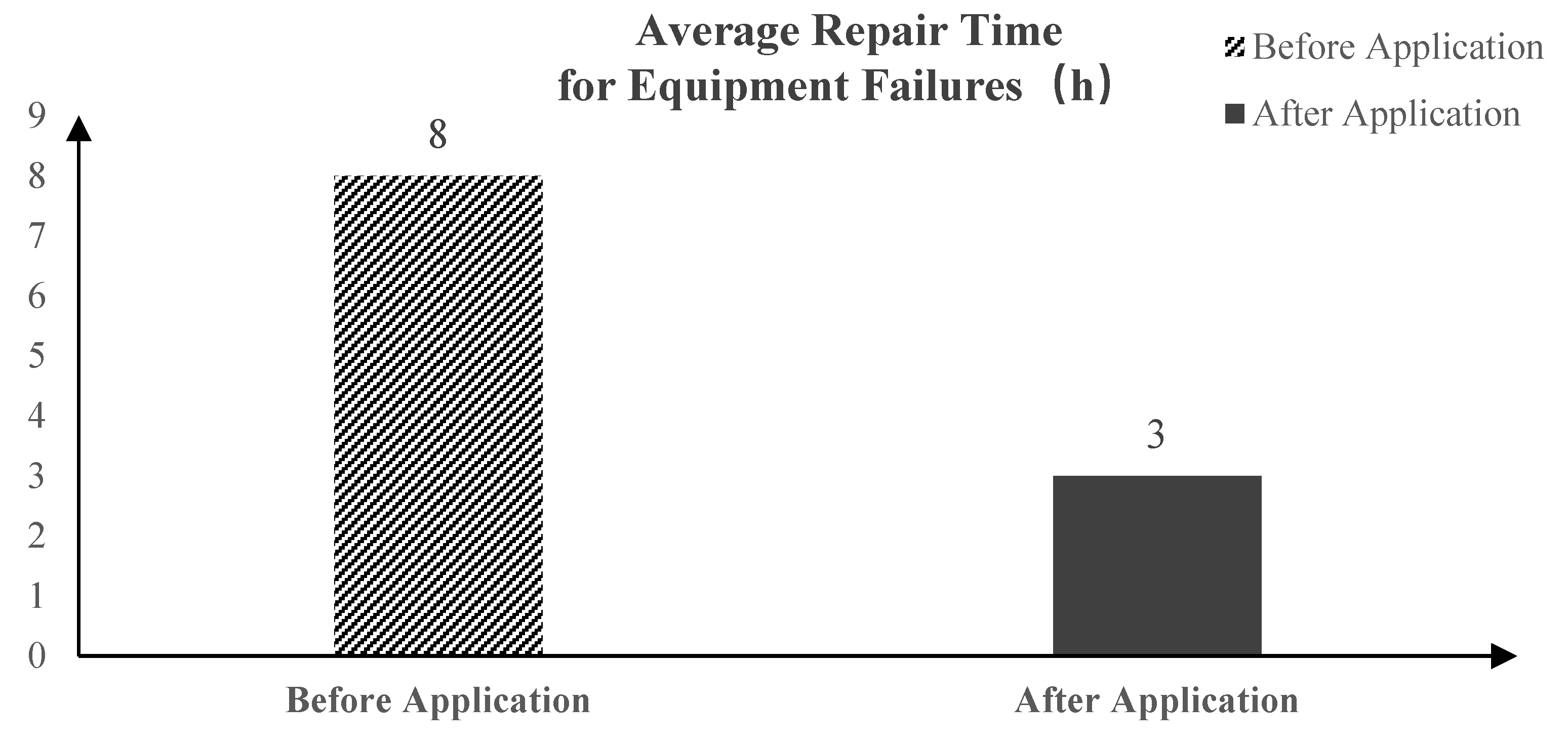
Comparison of the MTTR of Production Equipment: To eliminate the impact of short-term fluctuations, three-month periods before and after APP deployment were selected as long-term statistical windows. As shown in Figure 13, the mean time to repair of production equipment decreased significantly from 8 to 3 h. This is directly attributed to the system-level linkage of the “equipment health assessment” and “equipment maintenance disposal” functional modules in the functional model for equipment predictive maintenance scenarios, which eliminates the previous pain points of isolated early warnings and delayed platform response.
Figure 13.
Comparison of the average repair time for equipment failures before and after the implementation of the industrial APP for equipment predictive maintenance.
Comparison of the OEE of Production Equipment: OEE refers to the product of the equipment availability rate, performance rate, and product qualification rate during the statistical period and is the ratio of the actual production capacity to the theoretical production capacity of the production equipment. The production equipment process capability index is positively correlated with the equipment performance rate and product qualification rate. An increase in the equipment process capability index indicates that the processing stability of the production equipment is continuously improved. The MTTR of production equipment is inversely correlated with the equipment availability rate and performance rate. A reduction in MTTR indicates that the equipment fault repair capability is continuously enhanced.
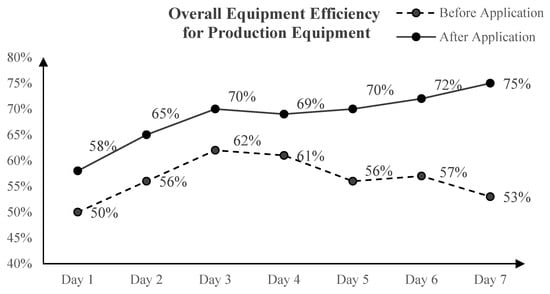
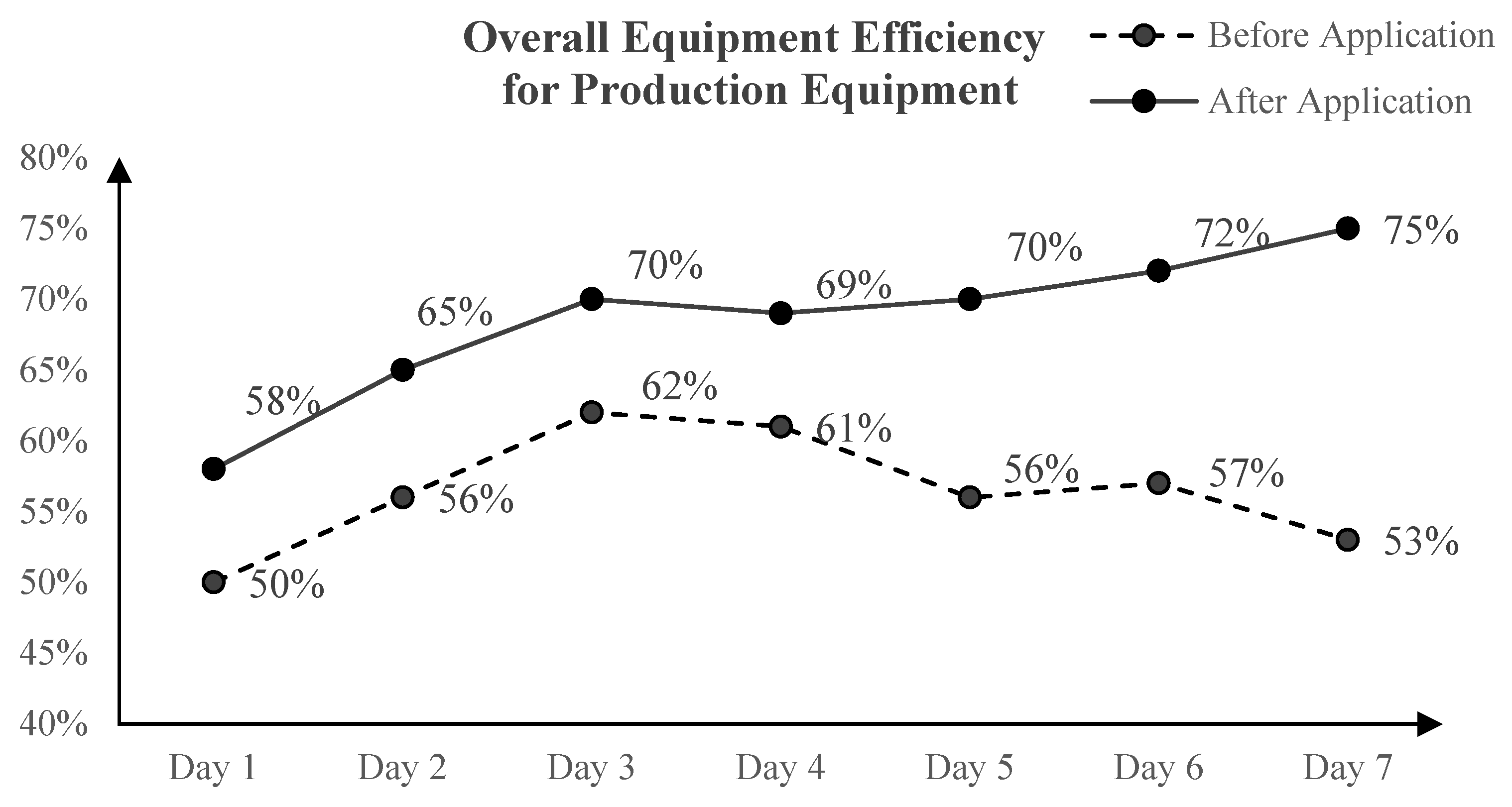
The enterprise monitors the outcome-oriented performance indicator of “overall equipment effectiveness” (OEE) on a daily basis to guide the optimal scheduling of workshop processing tasks and equipment production arrangements. The OEE values of seven consecutive working days before and after the deployment of the app were selected for comparison, as shown in Figure 14. After the deployment and application of the equipment predictive maintenance app, the average OEE of production equipment in the workshop increased from 56.43% to 68.57%. These results demonstrate that the application of the functional model for equipment predictive maintenance scenarios significantly improved the two key indicators, namely, the production equipment process capability index and mean time to repair (MTTR), and contributed to a substantial increase in the OEE of production equipment in the workshop.
Figure 14.
Comparison of the OEE before and after the implementation of the industrial APP for equipment predictive maintenance.
In summary, the significant improvement in the performance of equipment operation management and control in the workshop is not accidental but is directly attributed to the functional model construction method proposed in this study. In particular, the precise coupling of the four core modules—fault detection, health assessment, maintenance disposal, and state optimization—at the underlying business logic level has successfully driven the efficient operation of the predictive maintenance mechanism, thereby effectively enhancing the continuity and stability of the production process in complex environments.
6. Conclusions and Future Works
To address the problems of poor collaboration, insufficient interaction, and inadequate performance arising from the fact that the traditional operation management and control functions of production equipment are scattered across all levels of the ISA95 five-layer architecture, this study proposes an IDEF0-based hierarchical construction method for the operation management and control functional model of production equipment, a functional module combination and orchestration method for specific scenarios, and a predictive maintenance scenario scheme design based on the industrial Internet platform to support the flexible construction of diversified and personalized scenarios for production equipment operation management and control. The main contributions of this study are as follows:
- (1)
- To address the limitation that traditional operation management and control models of production equipment rely heavily on manual experience, a knowledge-driven adaptive construction idea for functional models is proposed. Guided by the IDEF0 method, this paper innovatively constructs an integrated reference framework for the operation management and control functional model of production equipment, covering equipment asset management, application management, and maintenance management. Through an in-depth analysis of international standards related to production equipment operation management and control, layer 1 and layer 2 functional modules are identified and obtained layer by layer in a top-down and hierarchical decomposition manner. Standard texts are used as engineering practice resources for domain knowledge mining of production equipment operation management and control, and a systematic and comprehensive reference resource pool for layer 3 functional modules is constructed through text topic clustering, which can guide the generalized, standardized, and service-oriented encapsulation of functional activities for production equipment operation management and control.
- (2)
- Based on the constructed reference resource pool for the operation management and control functional model of production equipment, in this study, interface matching, traversal screening, and logical combination strategies for functional modules around the operation management and control requirements of production equipment in specific scenarios are designed to support the scenario construction and function realization of production equipment operation and control and to effectively address the challenges posed by the diversity of scenarios and control objectives of production equipment operation and control.
- (3)
- To address low OEE in the aero-engine transmission unit manufacturing workshop of an enterprise, this study applies the proposed construction and implementation method of the equipment operation management and control functional model and designs an overall solution for workshop equipment predictive maintenance based on an industrial Internet of Things platform. The results of the rigorous empirical comparison demonstrate that the research findings significantly improve the production equipment process capability index and OEE of the enterprise and reduce the MTTR. These detailed quantitative engineering indicators not only verify the effectiveness and rationality of the proposed method but also fully demonstrate the great application potential and extensive value of the research findings in solving pain points in complex industrial scenarios and enabling manufacturing enterprises to reduce costs and increase efficiency.
Because the research method proposed in this study has primarily been applied in engineering practice within the discrete manufacturing industry, its application value has not been fully demonstrated. In future work, the method will be extended and applied to process manufacturing industries such as metallurgy, iron and steel, and petrochemical engineering, and extensive practical verification will be conducted in more complex scenarios, including cross-regional equipment collaborative scheduling, remote equipment operation and maintenance, and shared manufacturing.
In addition, with respect to the general functional model construction and application method for production equipment operation management and control proposed in this study, a set of semantic specifications for production equipment operation management and control functional models is summarized and refined, which is conducive to large-scale application, promotion, and supporting modelling tools are developed accordingly.
Author Contributions
Conceptualization, J.L. (Jun Li); Methodology, J.L. (Jun Li); Writing, K.D. and J.L. (Jinsong Liu); Reviewing and Editing, J.L. (Jun Li), K.D., and J.L. (Jinsong Liu); Formal analysis, J.L. (Jun Li), K.D., and J.L. (Jinsong Liu); Software, K.D. and Y.Z.; Funding acquisition and Project administration, J.L. (Jun Li); Visualization, Y.Z.; Reviewing, Q.L.; Supervision, Q.L.; Resources, Q.L. All authors have read and agreed to the published version of the manuscript.
Funding
This research was supported in part by the National Key R&D Program of China (2021YFB1715300) and the National Natural Science Foundation of China (62172425).
Data Availability Statement
The data presented in this study are available on request from the corresponding author. The data are not publicly available due to the confidential data related to the enterprise that have not been released to the public.
Conflicts of Interest
The authors declare no conflicts of interest.
References
- Joen, B.; Yoon, J.S.; Um, J.; Suh, S.-H. The architecture development of Industry 4.0 compliant smart machine tool system (SMTS). J. Intell. Manuf. 2020, 31, 1837–1859. [Google Scholar] [CrossRef] [Scilit]
- Guo, L.; He, Y.; Wan, C.; Li, Y.; Luo, L. From cloud manufacturing to cloud–edge collaborative manufacturing. Robot. Comput.-Integr. Manuf. 2024, 90, 102790. [Google Scholar] [CrossRef] [Scilit]
- Tao, F.; Zhang, C.Y.; Zhang, H. Exploration of future equipment: Digital twin equipment. Comput. Integr. Manuf. Syst. 2022, 28, 1–16. [Google Scholar]
- Wang, K.Y.; Zhang, L.; Jia, Z.D.; Cheng, H.; Lu, H.; Cui, J. A framework and method for equipment digital twin dynamic evolution based on IExATCN. J. Intell. Manuf. 2024, 35, 1571–1583. [Google Scholar] [CrossRef] [Scilit]
- von Haartman, R.; Prester, J.; Bengtsson, L.; Niss, C. Matching Digital Technologies with Lean Practices in Production. Oper. Supply Chain. Manag. Int. J. 2025, 18, 19–31. [Google Scholar] [CrossRef] [Scilit]
- Liang, H.; Xie, J.; Huang, B.; Li, Y.; Sun, B.; Yang, C. A novel sim2real reinforcement learning algorithm for process control. Reliab. Eng. Syst. Saf. 2025, 254, 110639. [Google Scholar] [CrossRef] [Scilit]
- Li, Y.; Wang, Y.; Li, H.; Liu, H. Risk-aware decision making for human–robot collaboration with effective communication. IEEE Trans. Autom. Sci. Eng. 2023, 22, 691–700. [Google Scholar] [CrossRef] [Scilit]
- Xinyu, L.; Bingkun, Y.; Pengchao, W.; Ning, D.; Jianjie, C. An approach based on hybrid-augmented intelligence for the combination and optimization of human-machine teams. J. Manuf. Syst. 2025, 83, 306–321. [Google Scholar] [CrossRef] [Scilit]
- IEC 62264-3; Enterprise Control System Integration-Part 3: Activity Models of Manufacturing Operations Management. International Electrotechnical Commission: Geneva, Switzerland, 2016.
- Bratukhin, A.; Sauter, T. Functional Analysis of Manufacturing Execution System Distribution. IEEE Trans. Ind. Inform. 2011, 7, 740–749. [Google Scholar] [CrossRef] [Scilit]
- Ahakonye, L.A.C.; Zainudin, A.; Shanto, M.J.A.; Lee, J.M.; Kim, D.S.; Jun, T. A multi-MLP prediction for inventory management in manufacturing execution system. Internet Things 2024, 26, 101156. [Google Scholar] [CrossRef] [Scilit]
- Wang, S.; Bu, S.; He, Z. Achieving Predictive and Proactive Maintenance for High-Speed Railway Power Equipment With LSTM-RNN. IEEE Trans. Ind. Inform. 2020, 16, 6509–6517. [Google Scholar] [CrossRef] [Scilit]
- Ito, T.; Wang, X.T.; Oomuro, Y.; Nagashima, K. Advanced process control system for trench shape of power devices. IEEE Trans. Semicond. Manuf. 2023, 36, 501–505. [Google Scholar] [CrossRef] [Scilit]
- Zhang, T.; Yu, L.; Yue, D.; Dou, C.; Xie, X.; Hancke, G.P. Two-Timescale Coordinated Voltage Regulation for High Renewable-Penetrated Active Distribution Networks Considering Hybrid Devices. IEEE Trans. Ind. Inform. 2024, 20, 3456–3467. [Google Scholar] [CrossRef] [Scilit]
- Busboom, A. Automated generation of OPC UA information models—A review and outlook. J. Ind. Inf. Integr. 2024, 39, 100602. [Google Scholar] [CrossRef] [Scilit]
- IEEE 1320.1-1998; IEEE Standard for Functional Modeling Language-Syntax and Semantics for IDEF0. Institute of Electrical and Electronics Engineers: New York, NY, USA, 1998.
- Barkmeyer, E.J.; Christopher, N.; Feng, S.C.; Fowler, J.E.; Frechette, S.P.; Jones, A.T.; Jurrens, K.K.; McLean, C.R.; Pratt, M.; Scott, H.A.; et al. SIMA Reference Architecture Part 1: Activity Models; National Institute of Standards & Technology: Gaithersburg, MD, USA, 1998.
- Liu, C.; Zheng, P.; Xu, X. Digitalisation and servitisation of machine tools in the era of Industry 4.0: A review. Int. J. Prod. Res. 2023, 61, 4069–4101. [Google Scholar] [CrossRef] [Scilit]
- IEC 62769-1; Field Device Integration-Part 1: Overview. International Electrotechnical Commission: Geneva, Switzerland, 2023.
- IEC 62714-1; Engineering Data Exchange Format for Use in Industrial Automation Systems Engineering-Automation Markup Language-Part 1: Architecture and General Requirements. International Electrotechnical Commission: Geneva, Switzerland, 2018.
- IEC TR 62541-1; OPC Unified Architecture-Part 1: Overview and Concepts. International Electrotechnical Commission: Geneva, Switzerland, 2020.
- IEC 63278-1; Asset Administration Shell for Industrial Applications-Part 1: Asset Administration Shell Structure. International Electrotechnical Commission: Geneva, Switzerland, 2023.
- Tao, F.; Cheng, Y.; Xu, L.D.; Zhang, L.; Li, B.H. CCIoT-CMfg: Cloud Computing and Internet of Things-Based Cloud Manufacturing Service System. IEEE Trans. Ind. Inform. 2014, 10, 1435–1442. [Google Scholar]
- Li, J.; Dou, K.; Liu, J.S.; Xu, S.; Li, Q.; Zhou, Y. Research on the Construction Method of Production Equipment Operation Management and Control Information Model Based on Knowledge Graph. In Proceedings of the 5th International Conference on Innovative Intelligent Industrial Production and Logistics, Porto, Portugal, 21–22 November 2024. [Google Scholar]
- ISO 55001; Asset Management-Management Systems-Requirements. International Organization for Standardization: Geneva, Switzerland, 2014.
- ISO 55010; Asset Management-Guidance on the Alignment of Financial and Non-Financial Functions in Asset Management. International Organization for Standardization: Geneva, Switzerland, 2019.
- IEC 61512-1; Batch Control-Part 1: Models and Terminology. International Electrotechnical Commission: Geneva, Switzerland, 1997.
- IEC 63082-1; Intelligent Device Management-Part 1: Concepts and Terminology. International Electrotechnical Commission: Geneva, Switzerland, 2020.
- ISO 13374-1; Condition Monitoring and Diagnostics of Machines-Data Processing, Communication and Presentation-Part 1: General Guidelines. International Organization for Standardization: Geneva, Switzerland, 2003.
- ISO 13374-2; Condition Monitoring and Diagnostics of Machines-Data Processing, Communication and Presentation-Part 2: Data Processing. International Organization for Standardization: Geneva, Switzerland, 2007.
- Devlin, J.; Chang, M.W.; Lee, K.; Toutanova, K. BERT: Pre-training of deep bidirectional transformers for language understanding. In Proceedings of the Conference of the North-American-Chapter of the Association-for-Computational-Linguistics-Human Language Technologies, Minneapolis, MN, USA, 2–7 June 2019; pp. 4171–4186. [Google Scholar]
- Qiu, X.H.; Hao, T.Q.; Shi, S.J.; Tan, X.; Xiong, Y.-J. Chain-of-LoRA: Enhancing the Instruction Fine-Tuning Performance of Low-Rank Adaptation on Diverse Instruction Set. IEEE Signal Process. Lett. 2024, 31, 875–879. [Google Scholar] [CrossRef] [Scilit]
- Neto, A.C.A.; Sander, J.; Campello, R.J.G.B.; Nascimento, M.A. Efficient computation and visualization of multiple density-based clustering hierarchies. IEEE Trans. Knowl. Data Eng. 2019, 33, 3075–3089. [Google Scholar] [CrossRef] [Scilit]
- Kwon, N.; Yoo, Y.; Lee, B. Novel curriculum learning strategy using class-based TF-IDF for enhancing personality detection in text. IEEE Access 2024, 12, 87873–87882. [Google Scholar] [CrossRef] [Scilit]

Disclaimer/Publisher’s Note: The statements, opinions and data contained in all publications are solely those of the individual author(s) and contributor(s) and not of MDPI and/or the editor(s). MDPI and/or the editor(s) disclaim responsibility for any injury to people or property resulting from any ideas, methods, instructions or products referred to in the content. |
© 2026 by the authors. Licensee MDPI, Basel, Switzerland. This article is an open access article distributed under the terms and conditions of the Creative Commons Attribution (CC BY) license.