Article

Quantitative Microstructure Characterization in Additively Manufactured Nickel Alloy 625 Using Image Segmentation and Deep Learning


1
Manufacturing and Automation Research Laboratory, Department of Industrial & Systems Engineering, Rutgers University—New Brunswick, Piscataway, NJ 08854, USA
2
Department of Computer Science, Rutgers University—New Brunswick, Piscataway, NJ 08854, USA
*
Author to whom correspondence should be addressed.
Machines 2026, 14(4), 366; https://doi.org/10.3390/machines14040366
Submission received: 30 January 2026 / Revised: 20 March 2026 / Accepted: 24 March 2026 / Published: 26 March 2026
(This article belongs to the Special Issue Artificial Intelligence in Mechanical Engineering Applications)

Abstract

Laser Powder Bed Fusion for metals (PBF-LB/M) is a complex additive manufacturing process in which metal powder is selectively melted layer-by-layer to fabricate 3D parts. Process parameters critically influence the resulting microstructure in nickel alloys, with features such as melt pool marks, grain size and orientation, porosity, and cracks serving as key process signatures. These features are typically analyzed post-process to identify suboptimal conditions. This research aims to develop automated post-process measurement and analysis techniques using image processing, pattern recognition, and statistical learning to correlate process parameters with part quality. Optical microscopy images of build surfaces are analyzed using machine learning algorithms to evaluate porosity, grain size, and relative density in fabricated test coupons. Effect plots are generated to identify trends related to increasing energy density. A novel deep learning approach based on Mask R-CNN is used to detect and segment melt pool regions in optical microscopy images. From the segmented regions, melt pool dimensions—such as width, depth, and area—are extracted using bounding geometry coordinates. Manually labeled images (Type I and Type II) are used to train the model. A comparison between ResNet-50 and ResNet-101 backbones shows that the ResNet-50-based model (Model 2) achieves superior performance, with lower training loss (0.1781 vs. 0.1907) and validation loss (8.6140 vs. 9.4228). Quantitative evaluation using the Jaccard index, precision, and recall metrics shows that the ResNet-101 backbone outperforms ResNet-50, achieving about 4% higher mean Intersection-over-Union, with values of 0.85 for Type I and 0.82 for Type II melt pools, where Type I is detected more accurately due to its more regular morphology and clearer boundaries. By extending Faster R-CNNs with a mask prediction branch, the method allows for precise melt pool measurements, providing valuable insights into process quality and dimensional accuracy, and aiding in the detection of defects in PBF-LB-fabricated parts.

1. Introduction

Laser Powder Bed Fusion for metals (PBF-LB/M) offers revolutionary premises in parts and components manufacturing from 3D geometries with complex and intricate features. The majority of parts and components built via additive manufacturing (AM) technologies for metals involve laser-based processing of powder materials in PBF-LB/M. Despite the advanced in process monitoring and control techniques developed, existing PBF-LB/M technologies often produce 3D builds that require further post-processing, heat treatment, machining, and polishing to improve the structural integrity and surface finish. To achieve defect-free and high-quality 3D builds, further knowledge is necessary about how process parameters, e.g., laser power, laser scanning path plan and scan velocity, and powder spreadability in PBF-LB/M, influence melt pool shape, size and dynamic behavior.
PBF-LB/M is a complex process, since powder has to be melted and cooled in each layer to produce a part or component. Many parameters influence fusion-based processing; however, defects resulting from suboptimal parameter settings are usually detected after the part is built in the post-processing stage [1]. To detect these defects during the PBF-LB/M process, different process monitoring techniques are proposed for in situ characterization of melt pool conditions [2]. The condition of the melt pool in the powder bed is affected by PBF-LB/M operational parameters. To obtain a fully dense build with no anomalies, the melt pool condition should remain consistent so that each track is processed with the same energy density absorbed and each layer is fused and bonded with the previous layer by a deep enough melt pool [3].
During the PBF-LB/M process, when the volumetric energy density ( E d ) (see Equation (1)) is at relatively low levels, the induced heat is low, and powder particles are melted without evaporation. Laser energy is absorbed by the upper surface of the powdered material, resulting in a shallow melt pool that is referred to as the conduction mode.
E d = P v s h   t l a y e r
When the laser-induced volumetric energy density ( E d ) exceeds a certain value, evaporation occurs in the region of the laser–material interaction, leading to the formation of keyhole mode power transition where laser heat penetrates deeply into the material through a keyhole/cone shape [4].
In addition, if the energy density received by the powder material during the PBF-LB/M process is insufficient or disproportionate, anomalies related to incomplete fusion or extreme melting (keyhole effects) can be incurred, which then lead to numerous defects in the final build obtained. These manufacturability-related issues in the PBF-LB/M process, and their causes and effects on the build quality are outlined in a review paper by Özel [5].
It was shown that process signatures such as melt pool shape and condition are a viable way of monitoring the PBF-LB/M process and the resultant build quality [6]. For this purpose, images collected from melt pool monitoring can be used in PBF-LB/M to detect the condition of the melt pool and defects that occur around the vicinity of the melt pool using computer vision methods. Furthermore, deep learning with convolutional neural networks (CNNs) using various types of kernels for dimension reduction and pooling can be used for binary or multiclass classification of melt pool conditions, such as acceptable, unacceptable, or other cases [7,8,9,10]. However, such anomalies during processing can be detected and mitigated with a proper adjustment of energy density. Scime and Beuth [11] used the AlexNet CNN for defect classification in PBF-LB/M. Others also used 3D CNN models to predict the mass or density of the build components [12], to predict the level of manufacturability using design for manufacturing rules and 3D CNN models [13], to predict part build error using 3D CNN models [14], and to classify fabrication defects using CNN models [15], among other studies. Physics-based models are also used as an alternative to purely data-driven deep learning models. Among those studies, the use of physics-based models to simulate the accuracy in the AM process and the use of CNN models by Qi et al. [16], the generation of more training data for CNN models by employing physics-based models and neural networks [17], and the development of domain knowledge using physic-based models as well as recurrent neural networks (RNNs) [18] can be highlighted. Physics-informed models such as physics-informed machine learning (PIML) methods that utilize underlying physics laws to reduce the negative impacts of assumptions, approximations and simplifications are also explored [19]. Peles et al. [20] studied the application of DL for quantitative structural characterization in metal AM by using Scanning Electron Microscopy (SEM) images. Their research focused on using ML techniques, particularly Generative Adversarial Networks (GANs), to analyze melt pool properties such as width and height. They highlighted the advantages of Image-to-Image translation GANs in addressing the challenge of small datasets for melt pool detection. Additionally, they emphasized the importance of expert input in image processing, including thresholding and edge detection techniques, to accurately define melt pool boundaries. Their approach utilized paired image inputs—raw images and annotated images—to enhance the effectiveness of DL models in characterizing melt pool structures. Their findings demonstrated a nonlinear relationship between hatch distance and melt pool shape, as evidenced in the graphical representations. Additionally, the study confirmed a strong correlation between laser energy density and melt pool characteristics.
PBF-LB/M requires measurement and characterization of process signatures with geometric parameters, characteristics of powder material particle distribution, and the pores and defects from the digital optical microscopy techniques. This paper utilizes post-process measurements from 3D-fabricated test coupons to correlate process parameters to structural attributes, such as melt pool geometry and porosity defects, by using image processing, pattern recognition and deep learning methods. For this purpose, image processing and analysis codes developed with MATLAB (R2024b) were utilized to compute melt pool width and depth, porosity and defect sizes, with distributions from the optical images obtained from additively fabricated and polished metal surfaces.

2. Materials and Methods

2.1. PBF-LB/M of Nickel Alloy 625

The PBF-LB/M process has been used for building super alloy Inconel 625 workpiece samples. During sample building by using an EOS M270 type PBF-LB/M machine (EOS GmbH, Munich, Germany), square layers with a constant surface area of 256 mm2 were processed track-by-track in a powder bed that contained gas-atomized Inconel 625 with 35 μm average particle size (Carpenter, Altoona, PA, USA). The machine was equipped with Nitrogen gas ambiance, filtering, and a laser cooling system. The Yb-fiber laser beam in the machine had a maximum power of 200 W and a focal spot size of 100 μm. During laser scanning, the system was operated at a laser energy density level of E = 113.75 J/mm3 (laser power of P = 182 W, scan velocity of vs = 800 mm/s, hatch distance of h = 0.10 mm, and a layer thickness of s = 0.02 mm). Also, the stainless-steel build platform was heated up to 80 °C for thermal consistency. The powder was spread on the platform, where each layer with its stripe pattern was processed with a scan strategy, in a way that was rotated orthogonally by 90° from layer to layer. Each stripe on a particular layer was scanned to melt and fuse the powder material by following a hatching strategy that begins and ends on 4 mm-wide stripe patterns. Each stripe consists of laser-scanned tracks separated by a hatch distance, where each one of them is processed with the laser scanner moving at a constant velocity. At the end of each track, the laser is turned off (laser-off condition) for about 0.042 ms and the laser scan direction is reversed by realigning scanning mirrors, and the processing of the next unprocessed track begins.

2.2. Characterization of Test Coupons for Relative Density and Melt Pool Size

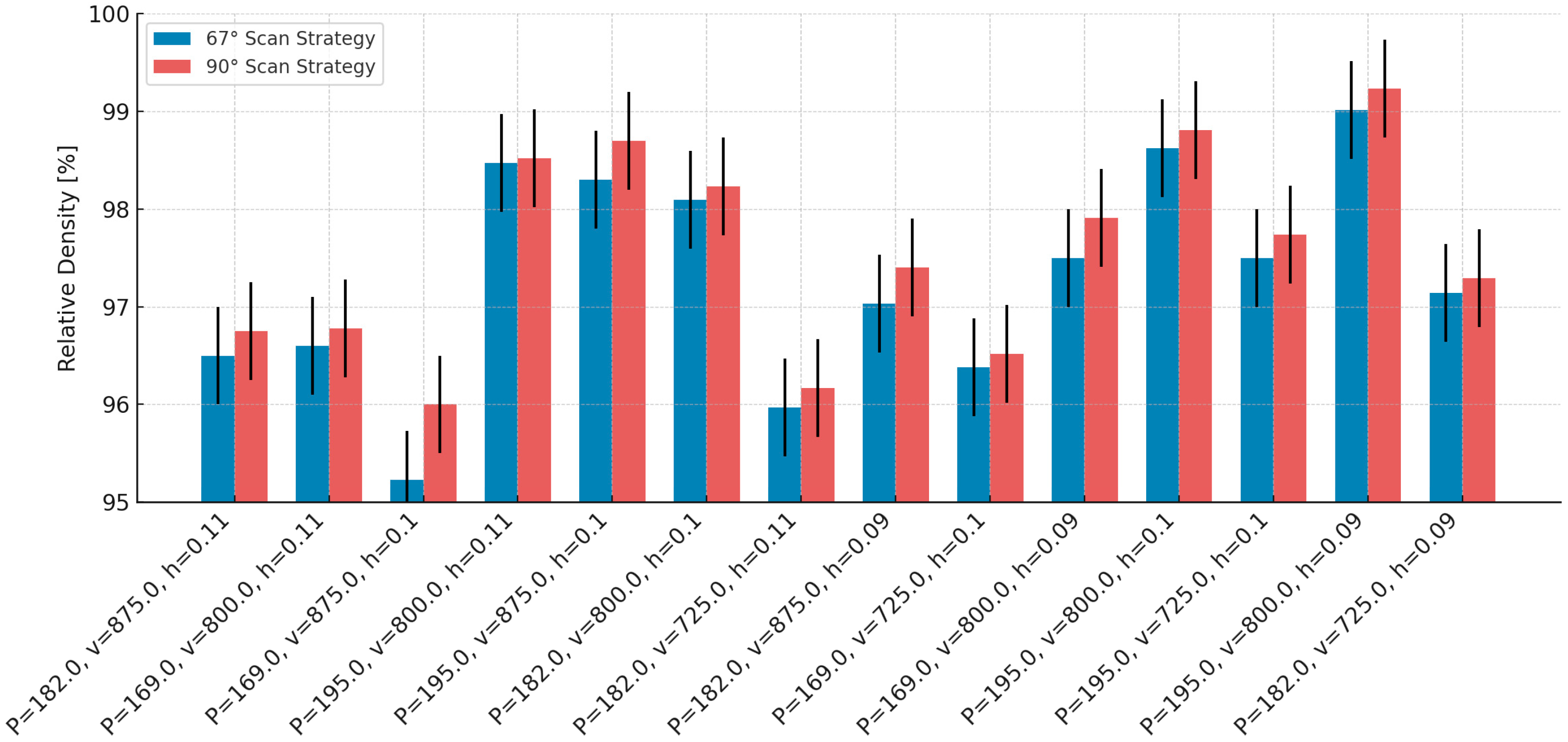
This section discusses the structural characterization for the microstructural segmentation of melt pools and defects in optical images of additively built parts of nickel alloy 625 based on statistical analysis. The data comes from the research articles Criales et al. [21] and Arisoy et al. [22] that analyzed PBF-LB/M-fabricated nickel alloy 625 test coupons. Relative density analysis was carried out using the mass of the coupons, bulk density of the material, and measured weight of the coupons, as summarized in Table 1, and trends with respect to varying process parameters are represented as a bar chart in Figure 1.
To assess the quality of the additively manufactured coupons in terms of densification, relative density measurements were performed following a procedure similar to that described by Criales et al. [21]. Test coupons produced with two scanning strategies—90° and 67° rotation (SSR) between layers—were analyzed by measuring their mass and volume to determine their relative density. Relative density was computed using the following equation:
ρ r e l = m / V o l . ρ b u l k
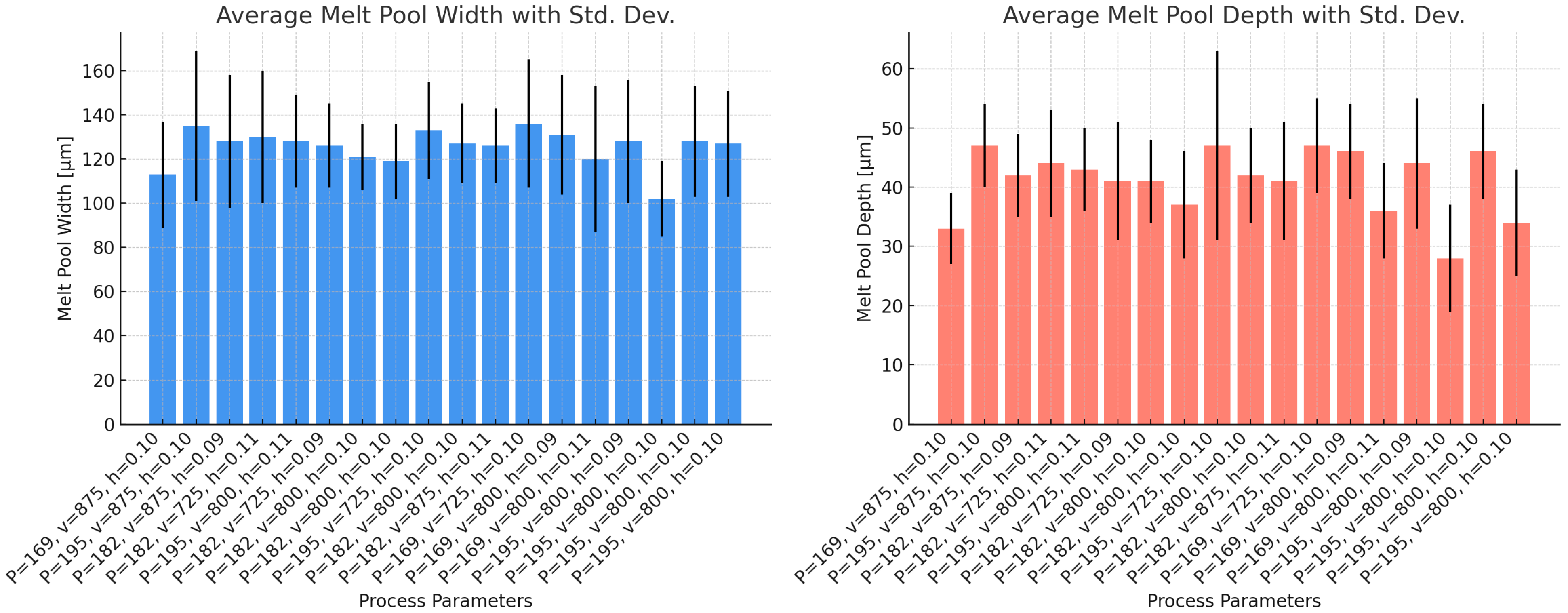
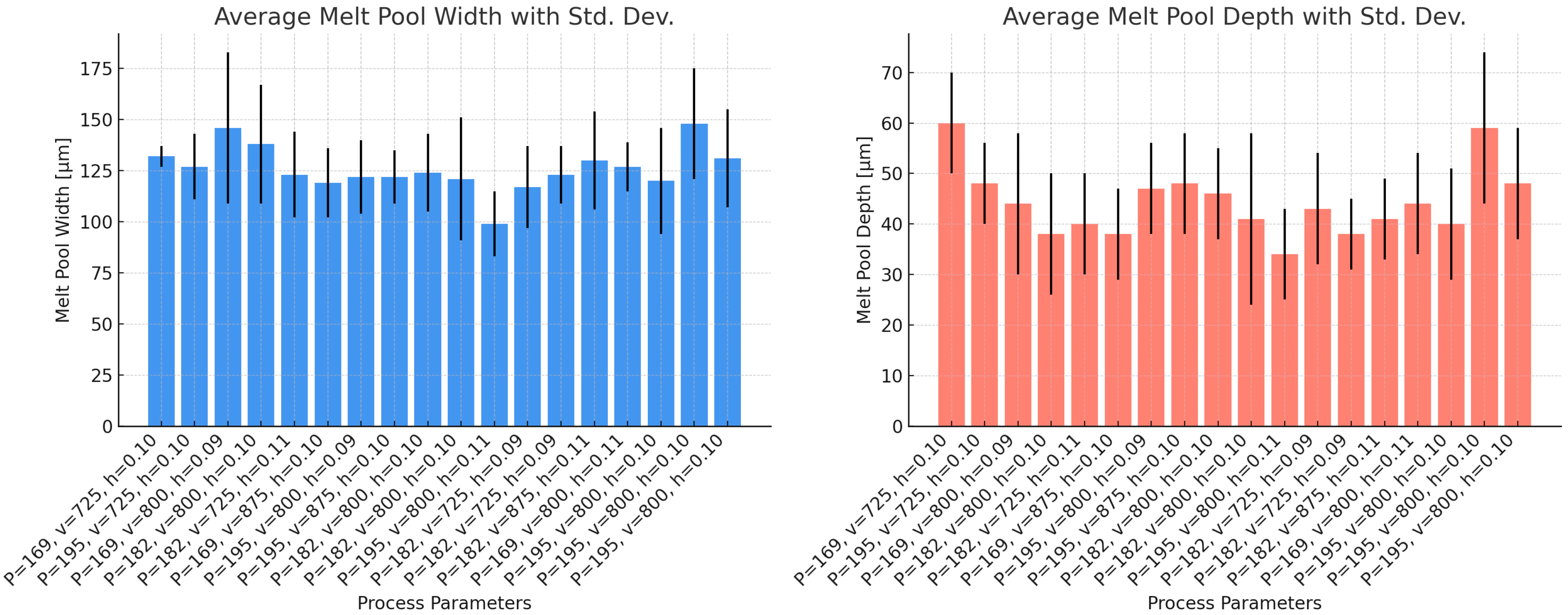
where m is the mass, V o l . is the volume of the coupon, and ρ b u l k = 8.440 g/cm3 is the theoretical density of solid nickel alloy 625. Mass measurements were performed using a precision scale with a resolution of 0.001 g. Each coupon was weighed five times, yielding an average mass in the range of 29.623–30.255 g with a standard deviation between 0.004 and 0.008 g. Volume was determined from the average dimensions—length, width, and height—measured using a Coordinate Measuring Machine (CMM) (Brown and Sharpe Reflex 343, Brown and Sharpe, Lincoln, RI, USA) with 5 µm accuracy, 0.25 µm resolution, and 2.5 µm uncertainty. Multiple measurements were taken to obtain an average volume between 3592.16 and 3643.65 mm3. This approach provided a reliable estimate of relative density and allowed evaluation of how close each coupon was to achieving full densification, with the results directly comparable to methods and analyses used in earlier studies, such as that of Criales et al. [21]. Optical image analysis was carried out (Keyence VHX500 microscope, Keyence America, Itasca, IL, USA) to measure the average melt pool width and depth on the test coupons fabricated with 90° SSR and 67° SSR, as given in Table 2 and Table 3, respectively. For each coupon, approximately 30 melt pool measurements are collected, and the corresponding mean and standard deviation are reported. Figure 2 and Figure 3 show bar charts for the average melt pool width (left) and depth (right) for coupons fabricated under various laser processing parameters at 90° SSR, and 67° SSR respectively.
At a fixed cross-section during hatch scanning, the elapsed time between consecutive laser passes varies along the stripe, producing two characteristic melt pool geometries, as described by Criales et al. [21]. Near the beginning of a hatch, the material remains within the heat-affected zone (HAZ) of the previous scan, whereas near the end of a hatch, it has cooled more substantially. This difference in local thermal history gives rise to Type I and Type II melt pools. A Type I melt pool forms in regions still thermally influenced by the previous hatch. It is larger and more asymmetric, with typical widths of approximately 130–170 µm and depths of approximately 40–52 µm. The width is often 40–60 µm greater than that of adjacent pools, resulting in a higher width-to-depth aspect ratio and a shape skewed toward the previously processed track. A Type II melt pool forms in regions that are no longer affected by residual heat. They are smaller and more symmetric, with typical widths of approximately 90–115 µm and depths of approximately 30–45 µm. While depth differences between the two types are modest, the reduction in width is pronounced. In summary, Type I melt pools reflect thermally assisted re-melting within the HAZ, whereas Type II melt pools represent melting of relatively cooled material, leading to smaller and more symmetric profiles.

2.3. Microstructural Characterization of Test Coupons for Grain Size

The microstructure of additively manufactured components exhibits characteristic features that reflect the thermal history and process parameter settings employed during fabrication. In particular, melt pool morphology, grain structure and orientation, porosity, and the presence of cracks or other defects provide insights into process-induced anomalies and material performance. Suboptimal process parameters often manifest in the form of irregular melt pool shapes, excessive porosity, or heterogeneous grain structures, which are typically evaluated through post-process microstructural analysis. In this study, we performed microstructural characterization on test coupons fabricated from nickel alloy 625 using optical microscopy. The focus was on segmenting and quantifying melt pool features, porosity, and grain size distributions in two-dimensional (2D) micrographs. High-resolution black-and-white images were acquired from polished and etched cross-sections of the fabricated parts to facilitate detailed analysis.
For the evaluation of grain size distribution, we employed a watershed segmentation algorithm [23] implemented in MATLAB (R2024b). This algorithm is designed to process binary 2D images of porous media by distinguishing individual grains through image segmentation techniques. The method enables the extraction of quantitative metrics, including the relative frequency, mean, and standard deviation of grain sizes. Prior to segmentation, image resolution was calibrated in microns per pixel to ensure accurate scaling of grain size measurements.
The segmentation process involves identifying contiguous grain boundaries and applying watershed transformations to separate overlapping grains. The outcome is a labeled grain map from which statistical descriptors of the grain size distribution are computed. This approach offers an efficient and reproducible means of assessing microstructural features that are critical for understanding the effects of process parameters on the resulting material quality.
To quantitatively evaluate the microstructural features of additively manufactured Ni-based superalloy components, we conducted image-based analysis on polished and etched cross-sections of test coupons. Optical micrographs were obtained at 300× magnification and processed to extract metrics related to porosity and equivalent grain size distribution. Initially, each optical image was loaded and, if in RGB format, converted to grayscale and binarized using Otsu’s thresholding method [24]. The resulting binary image distinguishes pores (black) from solid grains (white). A morphological majority operation was applied to suppress noise and eliminate isolated pixels. The porosity ϕ was then computed as the ratio of pore pixels to the total number of pixels in the image, as shown in Equation (3):
ϕ = i , j 1 A i , j s 1 × s 2
where A i , j denotes the binary pixel value (1 for solid and 0 for pore) and s 1 × s 2 is the image size in pixels. To extract individual grain features, we employed a watershed segmentation approach [23]. First, a negative city-block distance transform of the binary image was computed (Equation (4)), which assigns higher values to the centers of solid regions:
D = b w d i s t   ( A , c i t y b l o c k )
The distance map was smoothed using a 3 × 3 median filter to reduce segmentation artifacts. Watershed segmentation was then applied to the smoothed distance image (Equation (5)), yielding segmented regions corresponding to individual grains:
W = w a t e r s h e d   ( B )
To isolate grains, a mask was constructed to exclude the watershed ridges and background. Only pixels belonging to grain interiors and not on watershed boundaries were retained. Small grain-like regions below a user-defined area threshold were removed, and the remaining objects were labeled to enable further analysis.
For each labeled grain k , the area A k was determined by counting the number of pixels associated with that label (Equation (6)):
A k = i , j δ L i , j = k
Assuming each grain to be approximately circular, we computed the equivalent grain radius r k   using Equation (7), where R r e s is the image resolution in microns per pixel:
r k = R r e s A k π
The equivalent grain size distribution was characterized by calculating the mean r ¯ g and standard deviation σ g r of the grain radii:
r g ¯ = 1 N k = 1 N r k
σ r = 1 N 1 k = 1 N r k r g ¯ 2
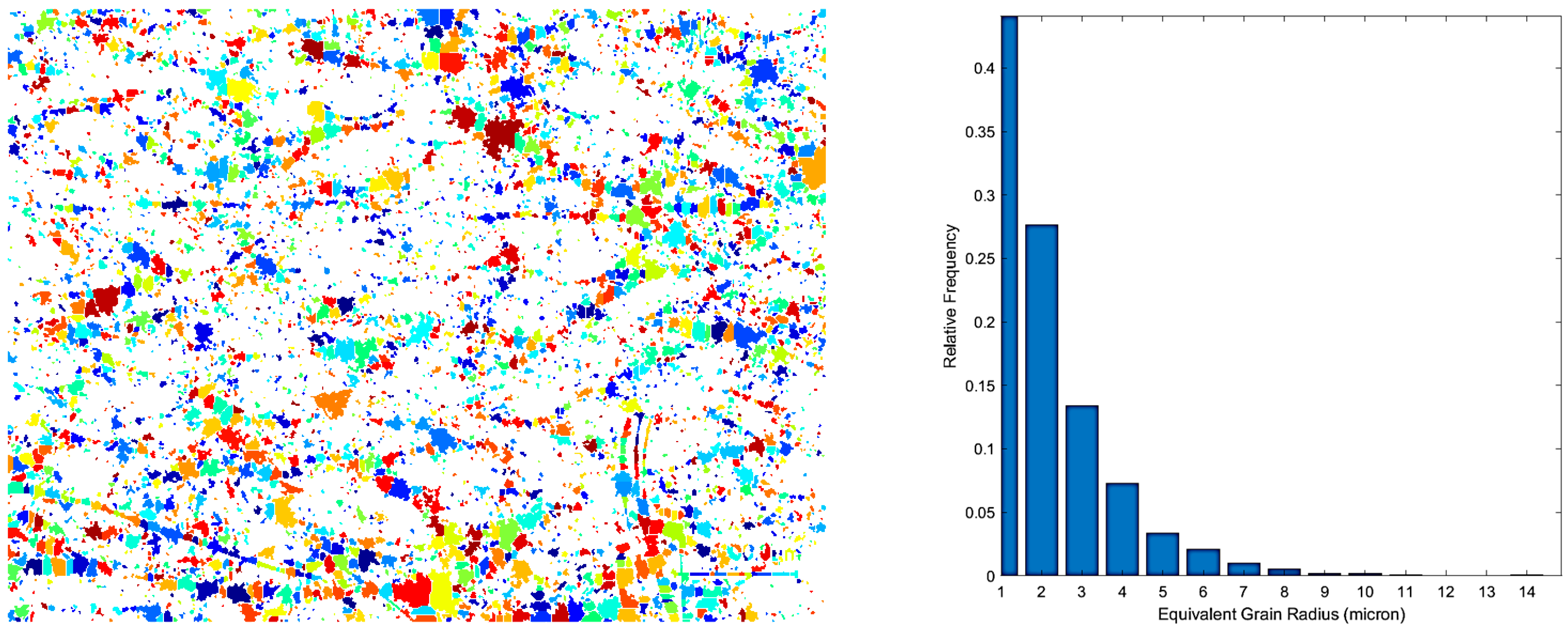
where N is the total number of segmented grains. A histogram was then generated to visualize the relative frequency distribution of grain radii, with bin widths determined based on the maximum radius and a predefined number of categories. Finally, a color-coded map of the segmented grains was created to visualize the grain morphology, and the histogram was annotated with the calculated mean grain radius (see Figure 4). These outputs provide quantitative insight into the microstructural characteristics of the fabricated alloy, facilitating correlations with process parameters and mechanical properties.

2.4. Microstructural Characterization of Test Coupons for Porosity

To characterize the pore size distribution in 2D porous media, we employed an image-based analysis technique developed by Rabbani et al. [25]. This method is designed to extract hydrodynamic properties from black-and-white images that represent the pore and grain structure of the medium. The analysis is based on a watershed segmentation algorithm, which is used to detect and separate individual pores from the binary microstructure image.
The algorithm operates by processing high-contrast binary images where the pore spaces and solid matrix are distinctly labeled. Once segmentation is complete, the algorithm calculates key statistical descriptors of the pore size distribution, including the relative frequency, mean pore size, and standard deviation. The process requires an input image and the resolution value (in microns per pixel) to convert pixel-based measurements into physical dimensions.
The output includes both quantitative metrics and a color-labeled segmentation map, enabling visual inspection of the identified pores. This approach provides a simple yet realistic approximation of pore structures and is particularly effective for evaluating flow-related properties in porous media.
To quantitatively evaluate the pore size distribution in the microstructure of additively manufactured components, we implemented a 2D image processing algorithm based on the watershed segmentation technique, originally developed by Rabbani et al. [25]. The method is designed to process high-resolution black-and-white images to isolate and quantify individual pores, providing insight into the hydrodynamic characteristics of the porous microstructure.
First, high-magnification optical images of polished cross-sections were converted to binary format using Otsu’s thresholding method to distinguish solid and pore regions. The binary image was then denoised using a majority morphological filter to reduce isolated noise pixels and smooth the pore boundaries. The porosity ϕ of the sample was calculated as the ratio of pore pixels to the total number of pixels in the image, using Equation (3).
To segment individual pores, a city-block distance transform was applied to the binary image, followed by a 3 × 3 median filter to smooth the distance map. The negative of the distance transformation was then subjected to a watershed segmentation algorithm to delineate pore boundaries. Pixels belonging to the background or watershed ridges were excluded, and only connected pore regions were retained. Regions smaller than a threshold of 9 pixels were removed to eliminate artifacts. Each remaining pore was labeled, and the number of pixels V k each pore k was calculated as follows:
V k = i , j δ L i , j = k
Assuming each pore to be approximately circular, we computed the equivalent pore radius r k   using Equation (11), where R r e s is the image resolution in microns per pixel:
r k = R r e s V k π
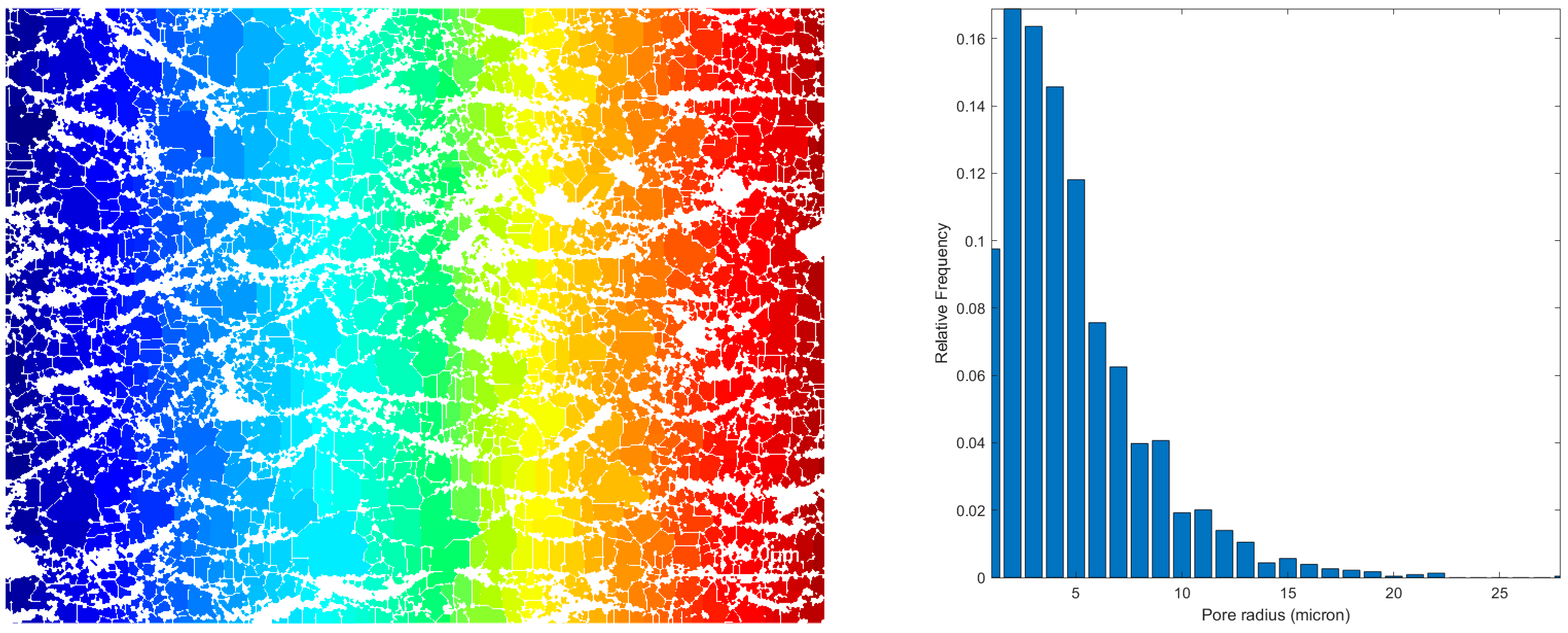
The equivalent pore size distribution was characterized by calculating the mean r p ¯ and standard deviation σ p r of the pore radii using Equations (8) and (9), where N is the total number of segmented pores. A histogram was generated to visualize the relative frequency distribution of pore radii, using bin widths based on the maximum radius and a set number of categories. A color-coded map of the segmented pores was also produced, providing quantitative insight into pore morphology for correlating microstructure with process parameters (see Figure 5).

2.5. Deep Learning-Based Characterization of Microstructure

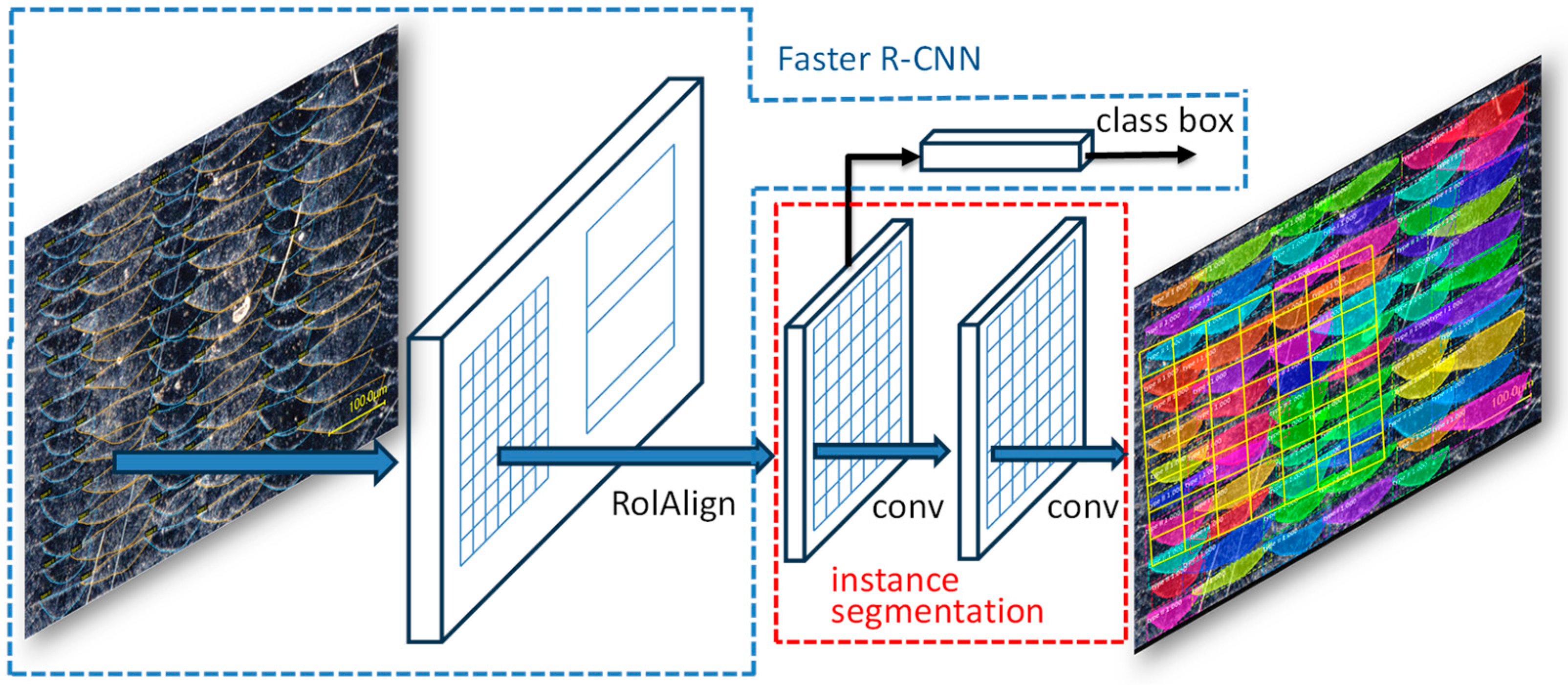
In recent years, rapid advances in deep neural network (DNN) architectures have driven significant progress in computer vision, particularly in object detection, semantic segmentation, and instance segmentation tasks [26,27,28]. Among the most influential developments is Mask R-CNN, proposed by He et al. [27,29,30], which extends Faster R-CNNs by adding a parallel branch for predicting pixel-level segmentation masks on each Region of Interest (RoI), alongside the existing branches for classification and bounding box regression. A common backbone in such frameworks is a pretrained network ResNet, a DNN architecture in which layers learn residual functions with reference to their inputs, enabling stable training across hundreds of layers while mitigating the vanishing gradient problem [29]. ResNet architectures are built from variants of residual blocks, with 224 × 224 input image size, including the basic block (two sequential 3 × 3 convolutions), the bottleneck block (1 × 1 and 3 × 3 convolutions for dimensionality reduction and restoration, used in ResNet-50 and ResNet-101), and the pre-activation residual block (activation applied prior to the residual mapping). These backbones efficiently extract hierarchical image features while preserving the spatial information necessary for accurate object localization and mask prediction.
Formally, the computation of a pre-activation residual block can be written as follows:
x l + 1 = F ϕ x l + x l
where ϕ can be any activation (e.g., ReLU) or normalization (e.g., LayerNorm) operation. The pre-activation residual block reduces the number of non-identity mappings between residual blocks and was employed to train models ranging from 200 to over 1000 layers [30]. Mask R-CNN extends the Faster R-CNN by incorporating a parallel branch for pixel-level mask prediction alongside bounding box regression and classification [27]. In the present work, the framework is adapted to detect and segment melt pools in PBF-LB/M process images, enabling precise characterization of their geometry, a critical indicator of melt track quality and material integrity. The architecture comprises three main components: a backbone network (ResNet) for hierarchical feature extraction, a region proposal network (RPN) for candidate region localization, and an RoI head for object classification and binary mask generation. This integration of detection and segmentation capabilities makes the Mask R-CNN particularly suited for quantitative melt pool analysis, where accurate boundary delineation is essential for process monitoring and quality control in PBF-LB/M [31,32]. CNNs learn hierarchical feature representations directly from input images through optimized weights and biases, substantially reducing the preprocessing overhead associated with conventional classification approaches. Unlike traditional methods that rely on hand-engineered filters, CNNs acquire these representations autonomously through training. Each layer of the network consists of a convolutional layer paired with a pooling layer (Figure 6), progressively extracting and compressing spatial features relevant to the task.

2.5.1. Dependencies and Required Libraries

The implementation of the Mask R-CNN model for melt pool detection relies on several key dependencies. The Python (v3.10) libraries NumPy (v2.4) and Matplotlib (v3.10) are used for numerical computation and visualization tasks, respectively. NumPy supports processing of image data, feature maps, and model outputs, while Matplotlib is used for visualizing model predictions. The dataset comprises optical images of polished and electropolished cross-sections from test cubes fabricated across a range of processing parameters. The model is implemented in Python library TensorFlow (v2.16) and trained using combined classification and mask loss to jointly optimize object detection and segmentation performance.

2.5.2. Training Process

Model training involves three key stages. Input images are first preprocessed through resizing and normalization, with data augmentation techniques, including random cropping, rotation, and flipping, applied to improve generalization. The model is initialized from a pretrained Mask R-CNN backbone, with transfer learning employed to fine-tune weights on the melt pool dataset. During training, the model jointly minimizes three loss terms: classification loss for distinguishing melt pools from background, bounding box regression loss for refining RPN proposals, and mask loss for pixel-level segmentation accuracy. The total loss ( L t o t a l ) in the Mask R-CNN is a weighted sum of classification loss, bounding box regression loss, and mask loss.
L t o t a l = L c l s + L b b o x + L m a s k
The classification loss ( L c l s ) is typically a cross-entropy loss over two classes: melt pool vs. background.
L c l s = i = 1 N y i log ( p ^ i )
where y i is the ground truth class label and p ^ i is the predicted class probability. The bounding box regression loss ( L b b o x ) uses Smooth L1 (Huber) loss between the predicted box t ^ i and the ground truth box t i .
L b b o x = i = 1 N S m o o t h L 1 ( t ^ i t i )
The mask loss ( L m a s k ) is a binary cross-entropy loss applied pixel-wise over the predicted mask M ^ i and the ground truth mask M i .
L m a s k = 1 m 2 i = 1 m 2 M i log M ^ i + ( 1 M i ) log 1 M ^ i
where m × m is the resolution of the mask.
The final step is the model evaluation, which is performed after training. The model is evaluated on a separate validation set, and metrics such as Intersection-over-Union (IoU), precision (P), recall (R), and mask accuracy are used to assess how well the model is detecting and segmenting melt pools.
I o U = P r e d i c t i o n G r o u n d   T r u t h P r e d i c t i o n G r o u n d   T r u t h
P = T P T P + F P
R = T P T P + F N
where TP represents true positives (correct melt pool detections), FP represents false positives (incorrectly predicted melt pools), and FN represents false negatives (missed melt pools).

2.5.3. Melt Pool Dataset and Methodology

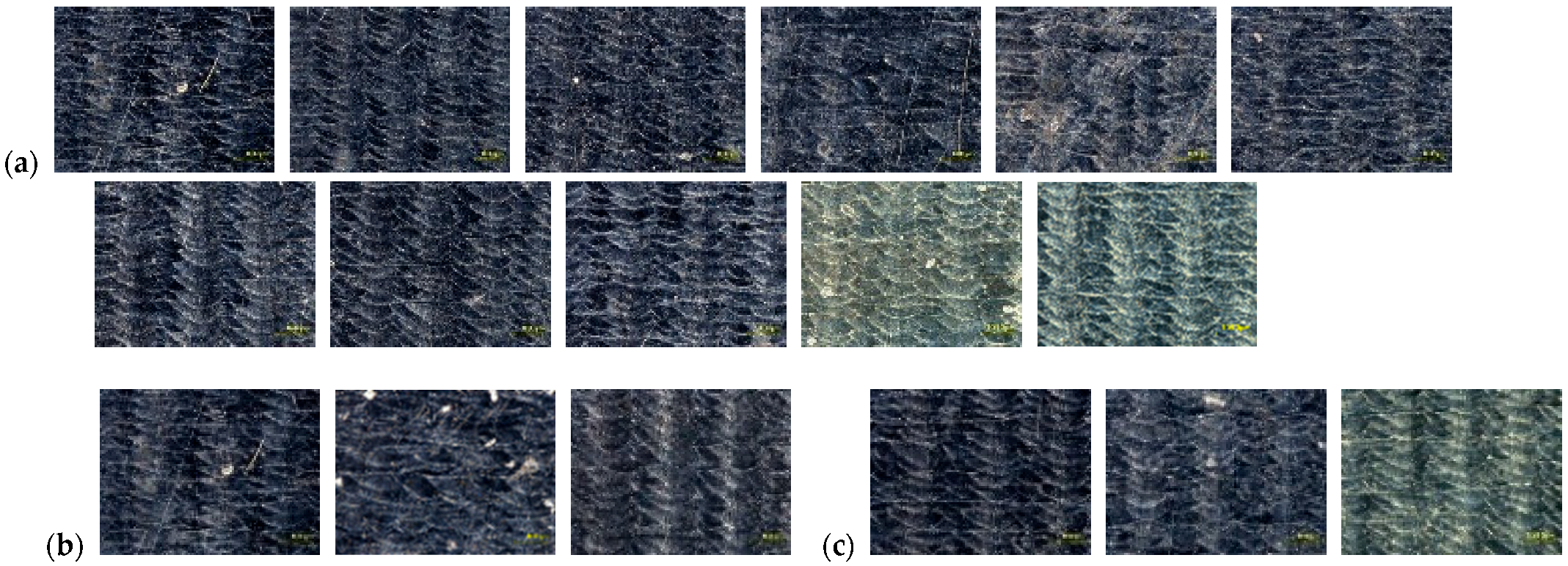
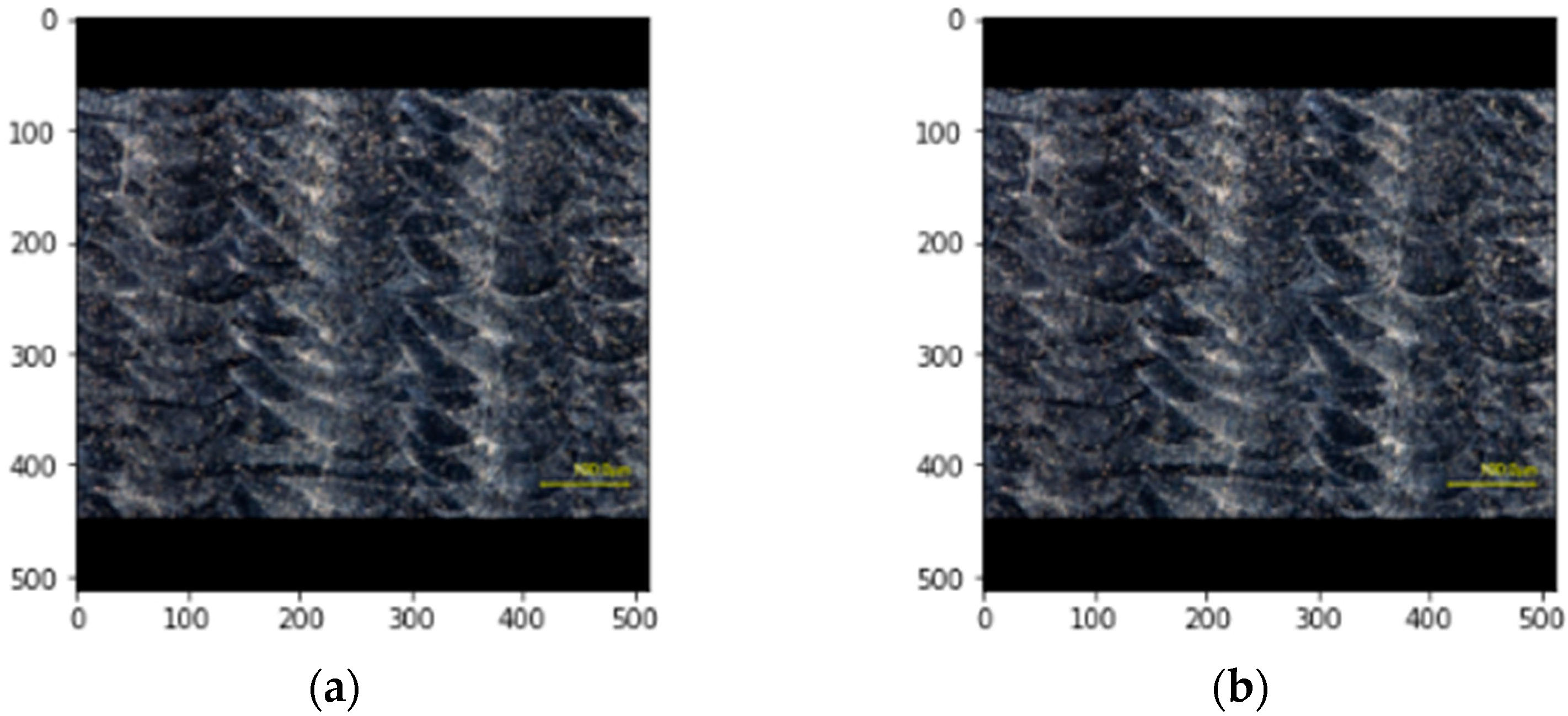
In this section, the original training dataset, consisting of cross-sectional OM images taken from test cubes fabricated using 90° SSR during PBF-LB, is shown in Figure 7a, followed by the test dataset and validation dataset images shown in Figure 7b and Figure 7c, respectively. The other dataset incorporates a 67° SSR, a technique that is more commonly used than the 90° SSR. The images within our training dataset correspond to the XZ-plane and YZ-plane, providing a diverse representation of the data. To accelerate training, the goal is to increase the batch size, which would enable the model to process more data at once. However, to accommodate this larger batch size and stay within the constraints of the model, the size of the images was reduced to ensure that each batch contains an optimal number of images while maintaining the model’s efficiency. It should be noted that the ground truth melt pool boundary in is defined based on high-resolution experimental imaging. The trained model can generalize to other datasets to some extent, but its performance may vary due to differences in material properties and laser parameters. To improve generalization, diverse training data, data augmentation, and transfer learning can be used.

3. Results

3.1. Effects of Process Parameters and Energy Density on Relative Density and Melt Pool Size

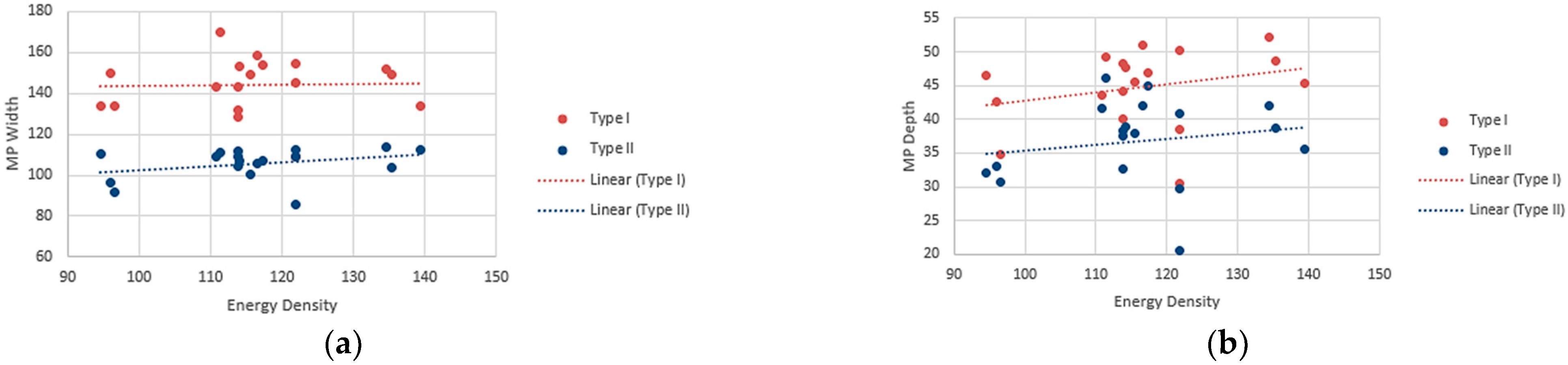
The effects of process parameters on melt pool width and depth can be analyzed via main effect plots. The data and analysis include two rotation strategies: 90° and 67°. The effects of process parameters on melt pool width and depth can be analyzed with the energy density, as shown in Figure 8. Both width and depth increase with increasing energy density. Additionally, the melt pool width and depth measurements indicate that there is a large difference between Type I and Type II melt pool widths (approx. 40 μm). This is in contrast with the difference between Type I and Type II melt pool depths, which does not appear to vary significantly (approx. 8 μm).
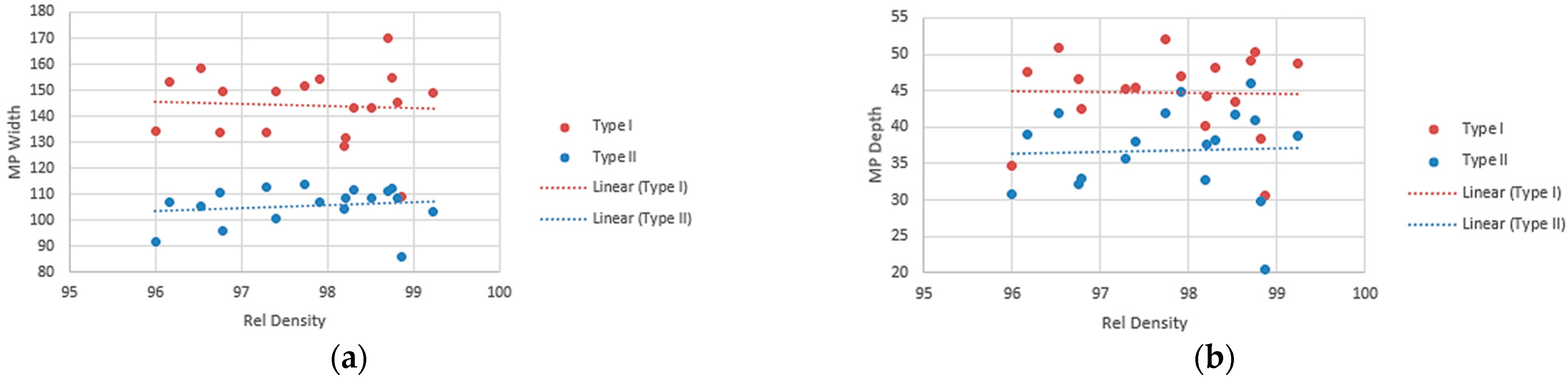
Another way to analyze these results is to consider the behavior of melt pool depth and width as a function of relative density, as shown in Figure 9. The melt pool width and depth measurements indicate that there is a difference between Type I and Type II. For Type I, the melt pool width and depth decrease with increasing relative density. For Type II, the melt pool width and depth increase with increasing relative density. The difference between Type I and Type II decreases with the increasing relative density.
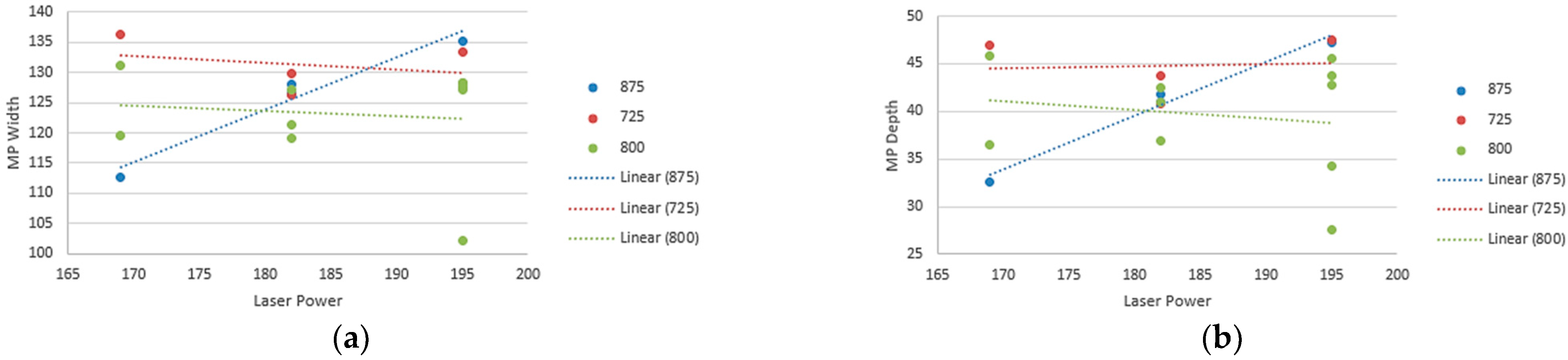
Considering the behavior of melt pool depth and width (not considering Type I or Type II) vs. laser power for constant velocity is another way to analyze these results, as shown in Figure 10. The melt pool width and depth measurements taken indicate that there is a difference among the situations of different velocities. When the velocity is 725 and 800 mm/s, both the melt pool width and depth change slightly with the increasing laser power. When the velocity is 875 mm/s, melt pool width and depth rise rapidly. Additionally, the melt pool width and depth measurements indicate that the trendline of the melt pool width and depth at a velocity of 725 mm/s remains higher than that at a velocity of 800 mm/s (approx. 8 μm for width and approx. 5 μm for depth).
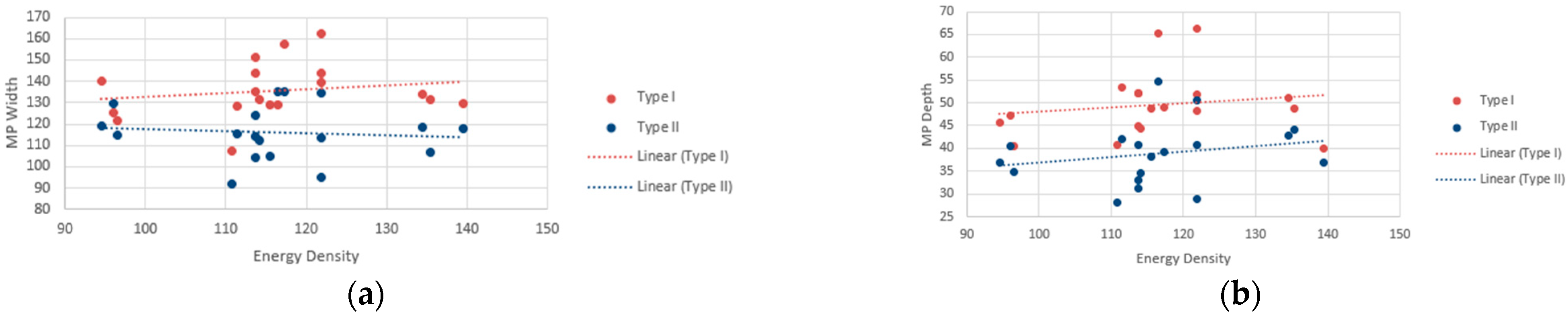
The effect of process parameters on melt pool width and depth can be analyzed with the energy density, Ed [J/mm3], as shown in Figure 11. Type I melt pool width increases with increasing energy density, while Type II melt pool width decreases with increasing energy density. Both Type I and Type II melt pool depth increase with the increase in energy density. Additionally, the melt pool width and depth measurements indicate that the difference between Type I and Type II melt pool widths increases with increasing energy density (from approx. 10 μm to approx. 30 μm), while the difference between Type I and Type II melt pool depths remains constant (approx. 10 μm).
A further analysis of these results involves considering the behavior of melt pool depth and width as a function of relative density, as shown in Figure 12. The melt pool width and depth measurements indicate that there is a difference between Type I and Type II. For Type I, the melt pool width and depth increase with increasing relative density. For Type II, the melt pool width and depth decrease with increasing relative density. Additionally, the melt pool width and depth measurements indicate that the difference between Type I and Type II melt pool widths becomes larger with increasing relative density for both width (from approx. 2 μm to approx. 30 μm) and depth (from approx. 6 μm to approx. 15 μm). This is a significate difference from the situation of 90° SSR. The effect of increasing laser power on melt pool width and melt pool depth is shown in Figure 13.
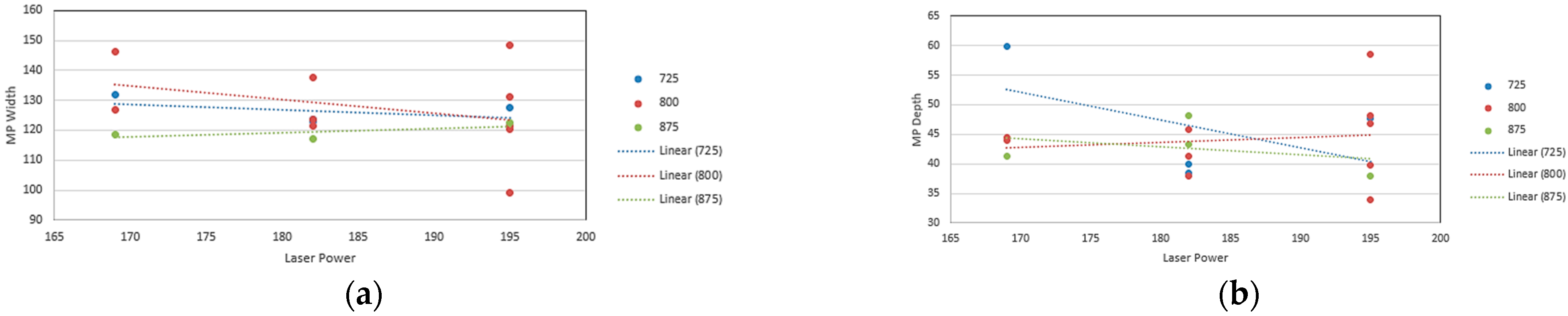
Considering the behavior of melt pool depth and width (not considering Type I or Type II) vs. laser power for constant velocity is another way to analyze these results, as shown in Figure 14. The melt pool width and depth measurements indicate that both width and depth change slightly with increasing laser power and constant velocity. Additionally, the difference between the width and depth of the trend lines under different velocities becomes closer with increasing laser power.

3.2. Effects of Process Parameters and Energy Density on Grain Size and Porosity

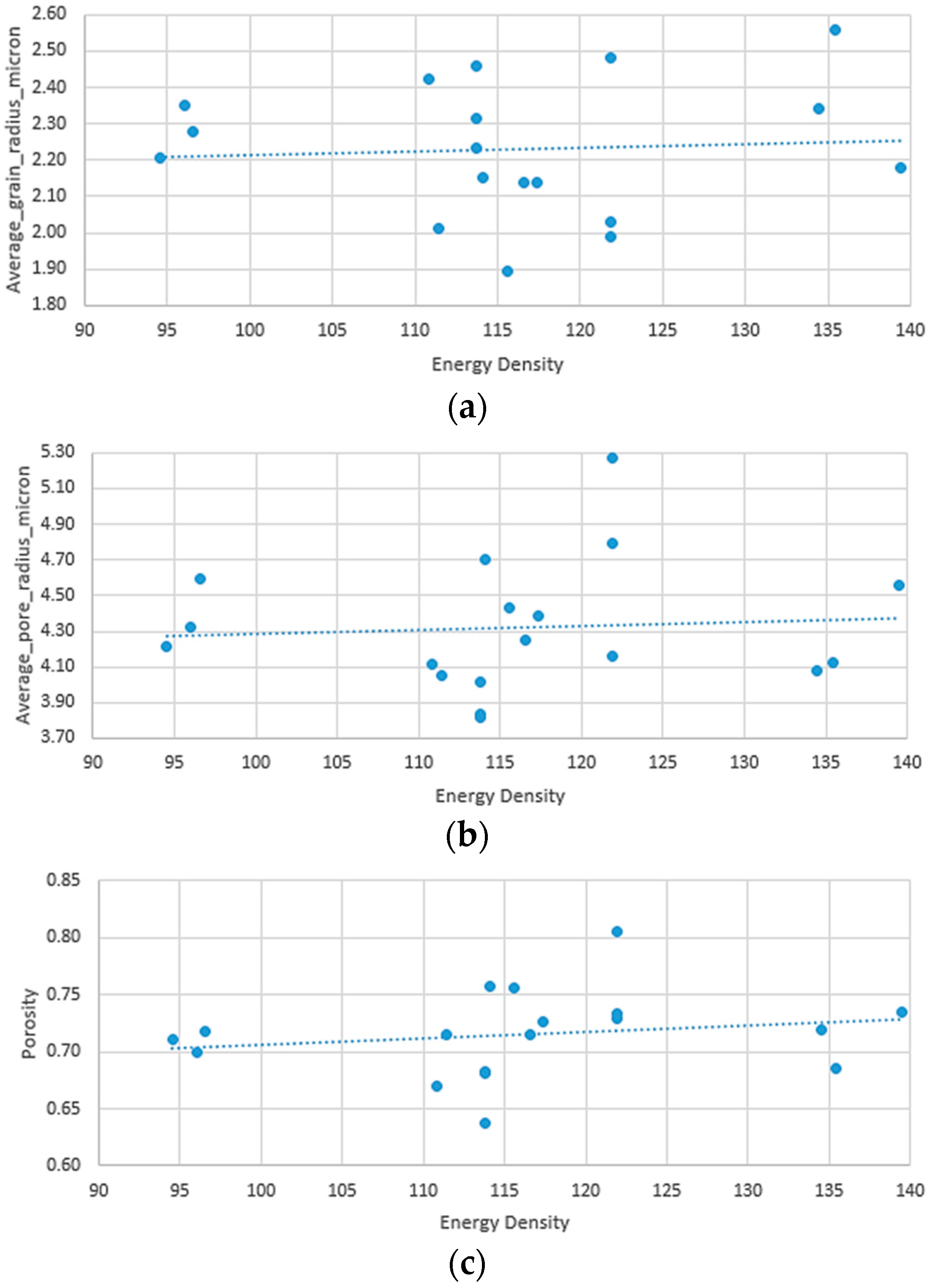
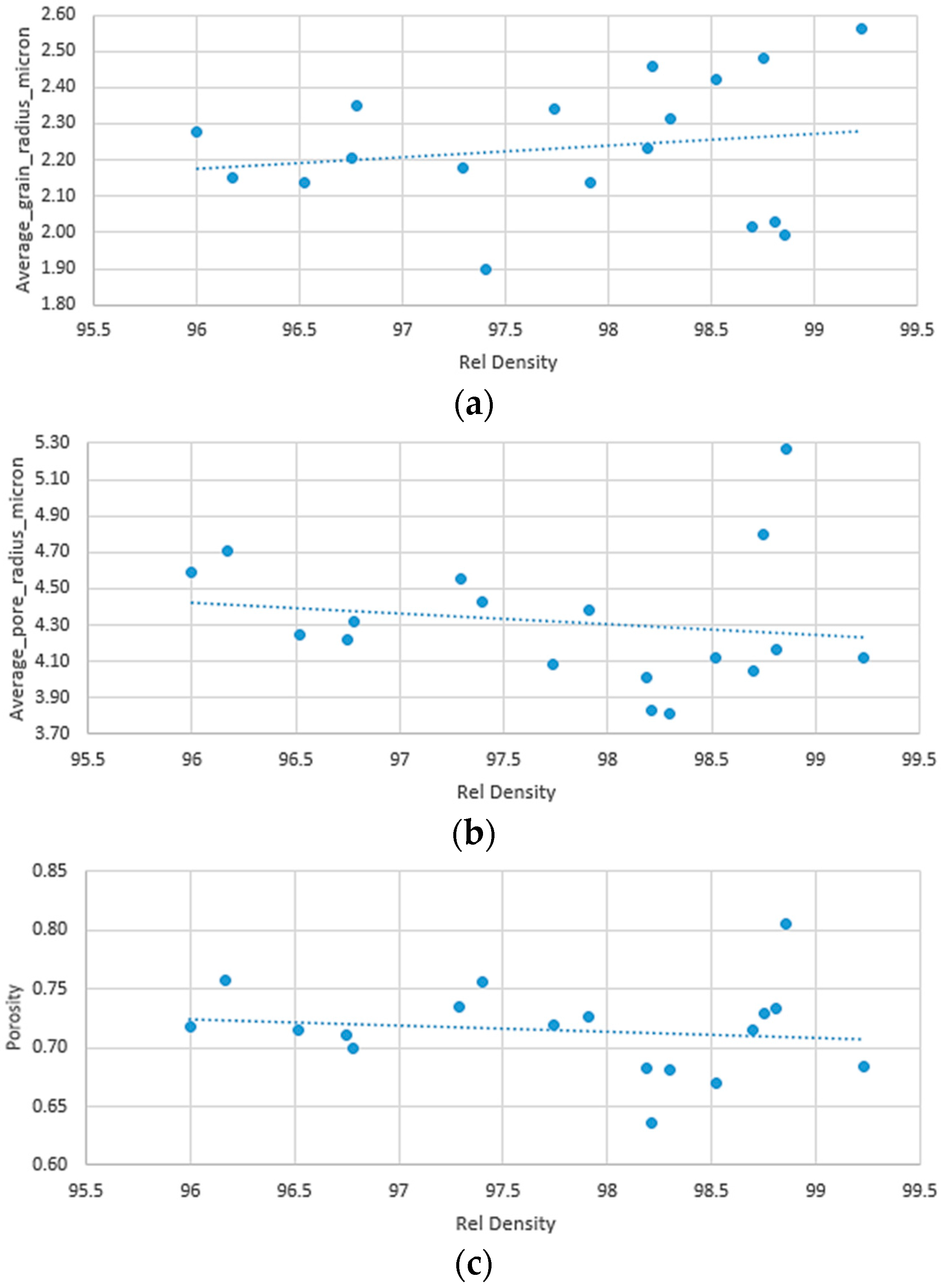
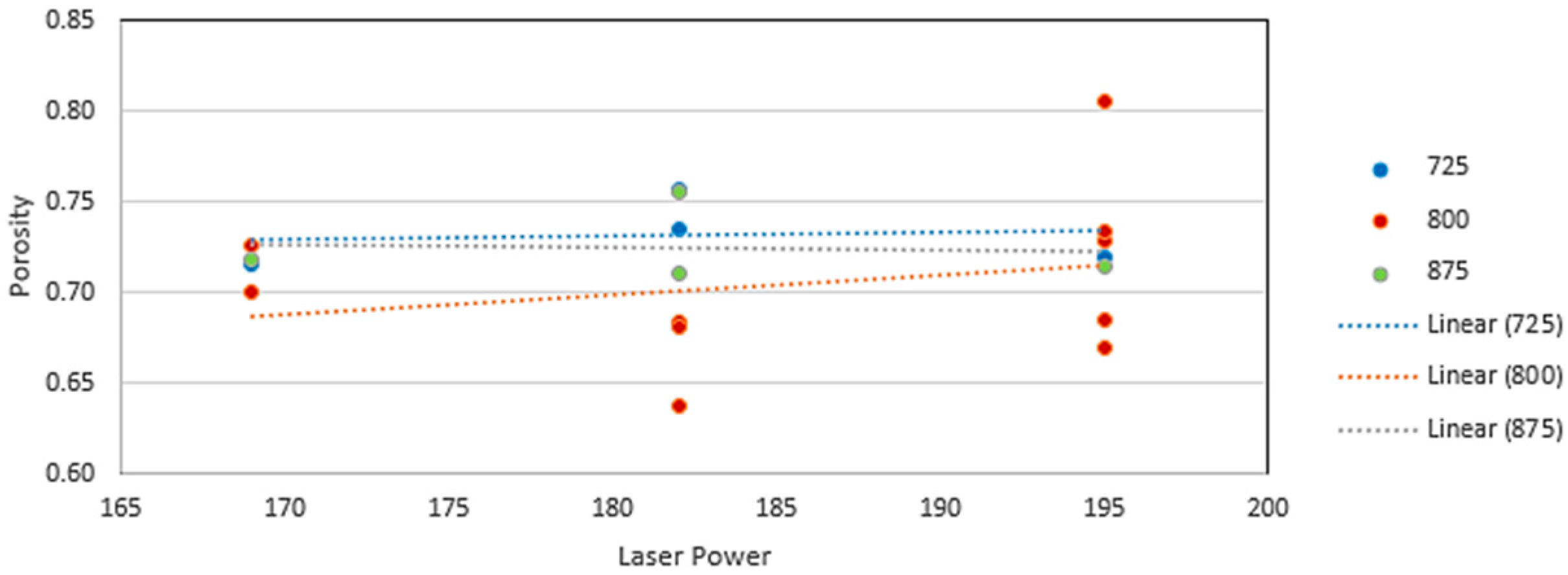
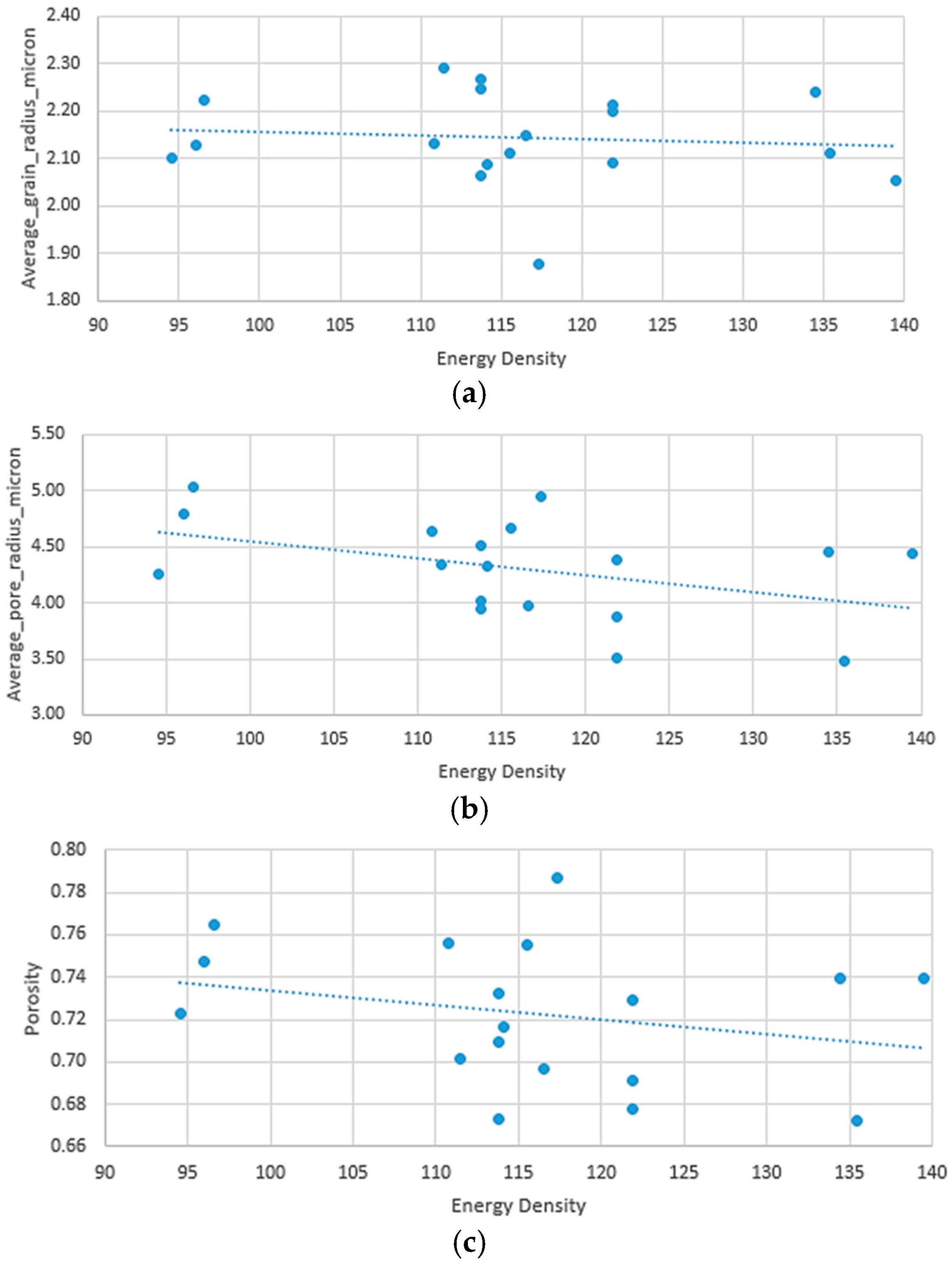
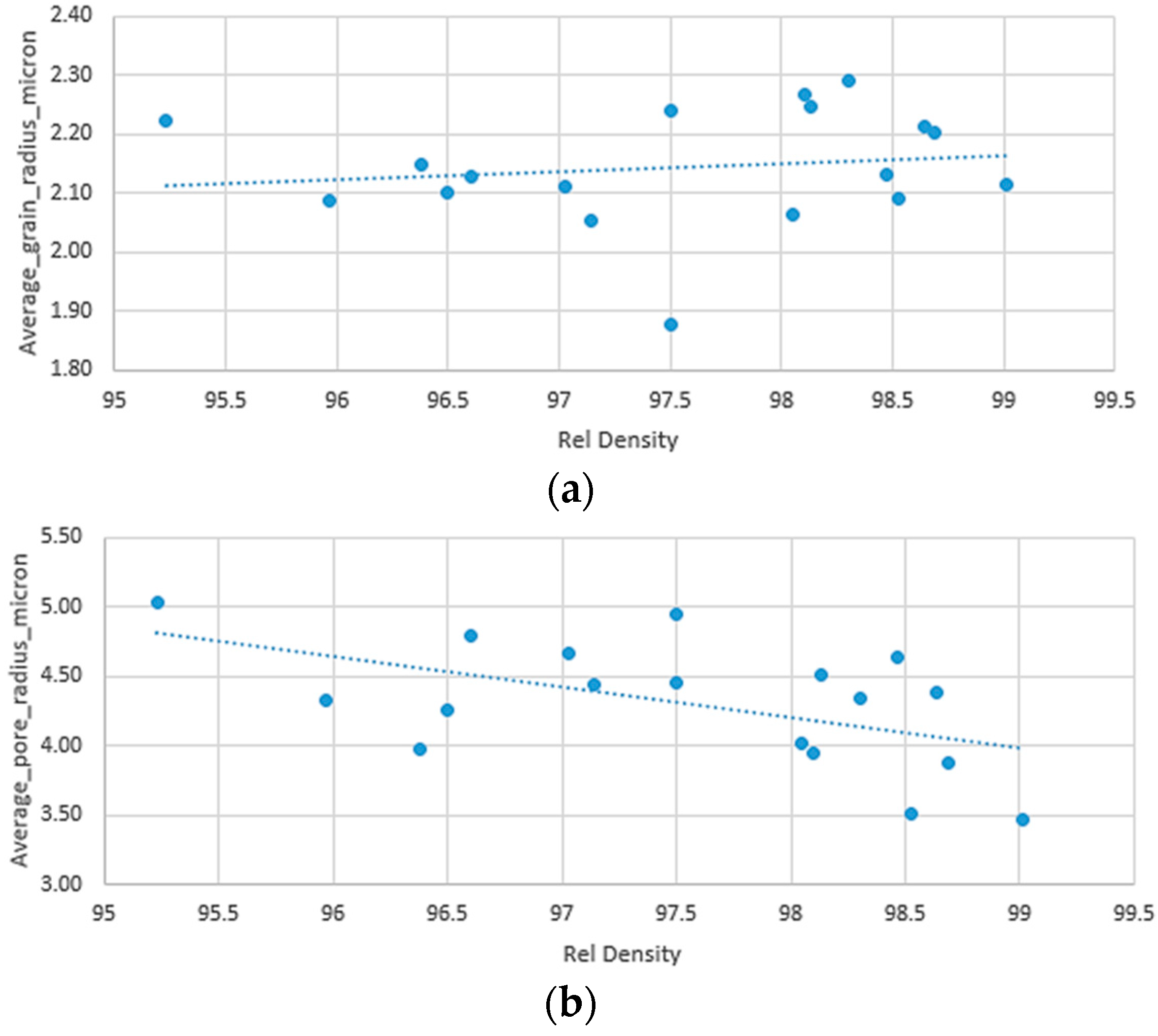
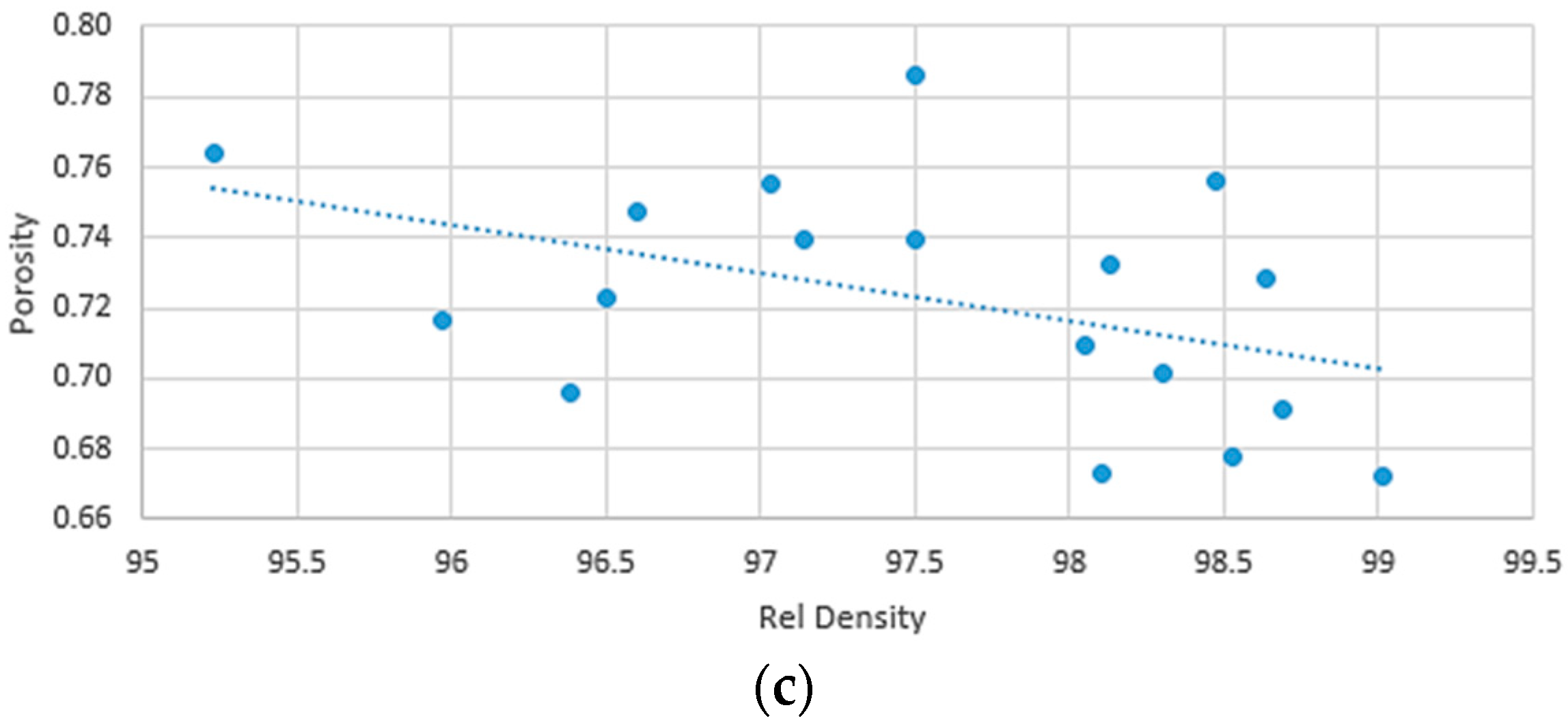
The effect of process parameters on microstructure and porosity measurements was analyzed using main effect plots. The data and analysis cover two scan rotation strategies—90° and 67°—as presented in Table 4 and Table 5, respectively. This section discusses the effects of process parameters on the average grain radius under a 90° SSR. The influence of process parameters on melt pool porosity (SSR = 90°) is analyzed using main effect plots, as shown in Figure 14, Figure 15 and Figure 16. The results indicate that average grain radius, average pore radius, and porosity all increase with rising energy density. Moreover, the average grain radius increases with increasing relative density, whereas both the average pore radius and porosity decrease as relative density increases. For a constant scan velocity (vs [mm/s]), porosity shows only slight variation with increasing laser power.
Next, the effects of process parameters on melt pool porosity under the 67° SSR are analyzed using main effect plots, as shown in Figure 17, Figure 18 and Figure 19. The porosity measurements reveal a significant difference between the 90° and 67° SSRs. In contrast to the 90° SSR, the average grain radius, average pore radius, and porosity decrease with increasing energy density. Additionally, the average grain radius increases with rising relative density, while both the average pore radius and porosity decrease—consistent with the trend observed under the 90° SSR.
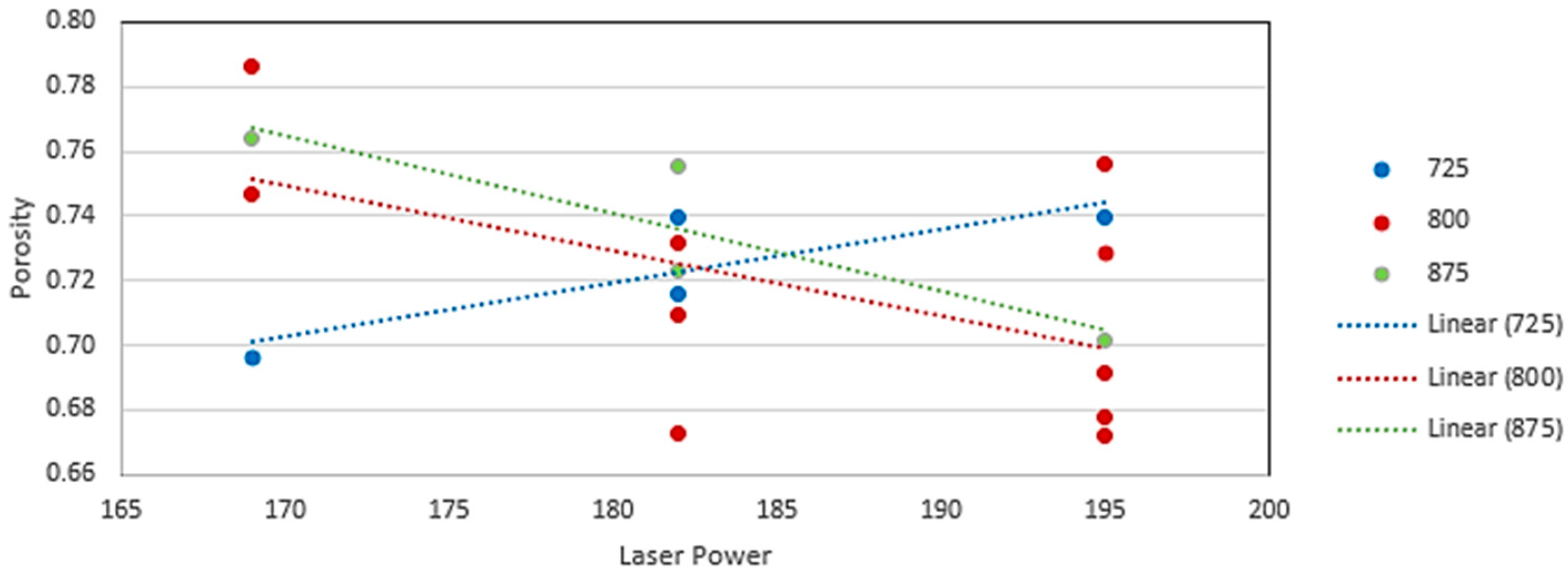
Notably, the changes in average pore radius and porosity with respect to relative density are slightly more pronounced under the 67° SSR. The influence of laser power also differs for constant scan velocities of 800 mm/s and 875 mm/s: porosity decreases with increasing laser power, whereas at 725 mm/s, porosity increases with increasing laser power.

3.3. Results on Automatically Characterized Melt Pool Regions and Types

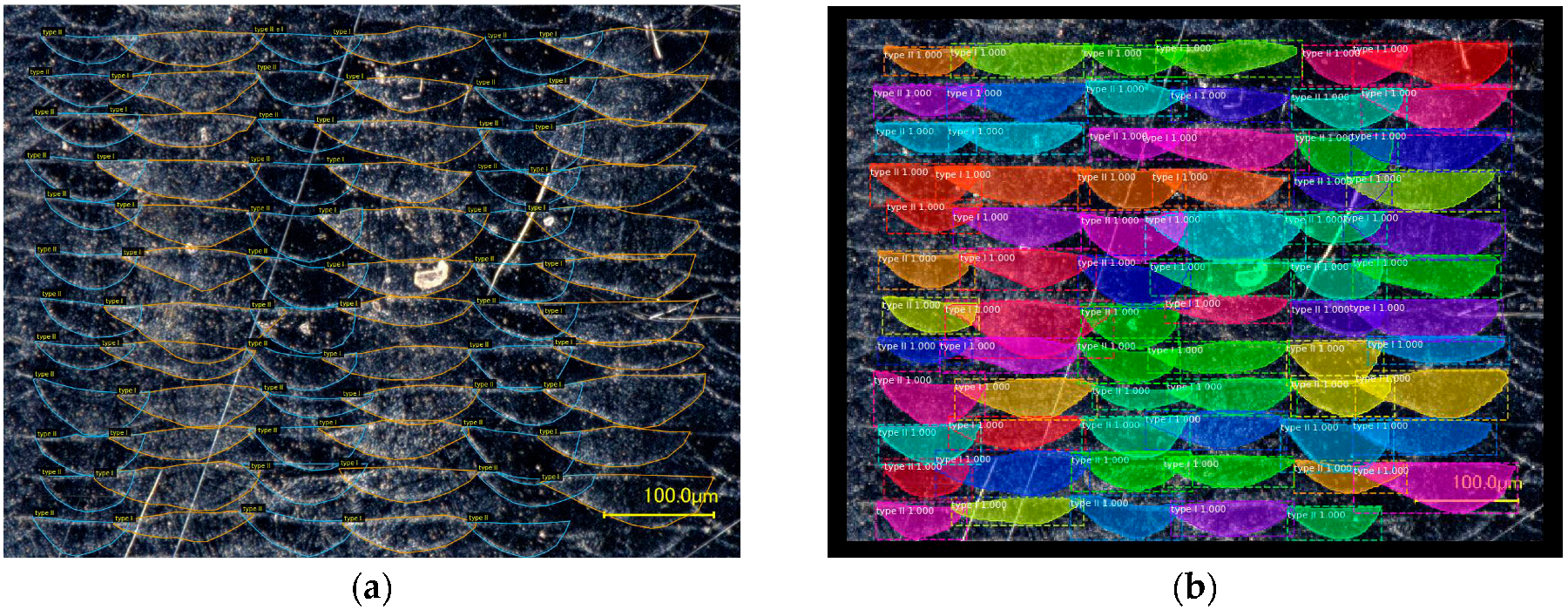
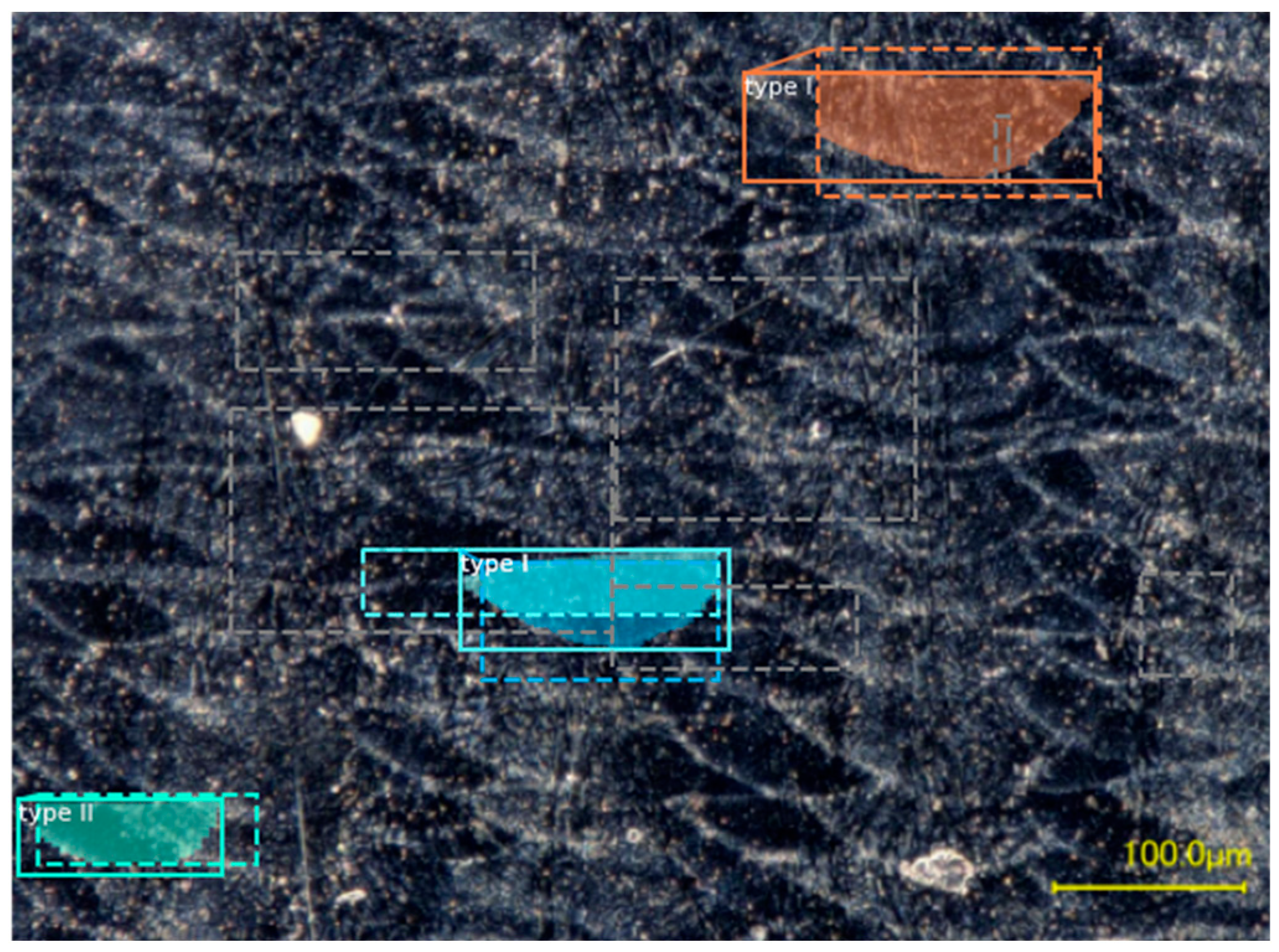
The close agreement between manual and automatic annotations highlights the effectiveness of the deep learning approach in capturing key geometric features necessary for post-process evaluation of microstructures in PBF-LB/M additive manufacturing of nickel alloy 625 test coupons. Figure 20 illustrates the comparison between manually labeled melt pool shapes and the results obtained from the Mask R-CNN-based automatic detection model. In Figure 20a, melt pool regions are manually marked on the original high-resolution image (1600 × 1200) to serve as ground truth annotations. Figure 20b shows the corresponding detection results from the trained model on a resized version of the same image (512 × 512), demonstrating the model’s capability to accurately identify and segment different melt pool types.
The primary changes to the original Mask-R-CNN model involved the modification of the backbone architecture and tuning hyperparameters for melt pool classification. When tuning these hyperparameters and experimenting with different backbone architectures, the adjustments that led to the most optimal loss metrics measured were associated with Model 2. In testing, the ResNet-50 architecture led to significantly quicker training times compared to the ResNet-101 counterpart. Notably, the tradeoff in accuracy between the two architectures was minimal. The hyperparameters were found through repeated experimentation and comparisons of training and validation loss across models. In this procedure, Model 1 was used as a benchmark, whereas Model 2 performed the best across the models tested. The ResNet-50-based model (Model 2) demonstrated superior overall performance, achieving a lower total training loss (0.1781 vs. 0.1907) and validation loss (8.6140 vs. 9.4228) compared to the ResNet-101 variant (Model 1). It also outperformed in key classification metrics, with significantly reduced MRCNN class loss during both training (0.0031 vs. 0.0167) and validation (0.7806 vs. 1.2525), indicating better segmentation accuracy. While ResNet-101 showed marginally better results in bounding box and mask localization—evident from slightly lower MRCNN BBox Loss (0.2142 vs. 0.2723) and Mask Loss (0.7922 vs. 0.8566) during validation—ResNet-50’s more consistent and balanced loss profile suggests stronger generalization capability for melt pool geometry detection.
The performance of the proposed Mask-R-CNN framework for melt pool classification and segmentation was evaluated using IoU, precision, and recall metrics. IoU values were calculated between predicted masks and ground truth annotations to measure the spatial overlap between detected melt pools and reference labels. Two melt pool classes were considered, Type I and Type II. The predictions were matched with ground truth instances using an IoU threshold of 0.5, and the numbers of true positives (TPs), false positives (FPs), and false negatives (FNs) were computed to obtain precision (TP/(TP + FP)) and recall (TP/(TP + FN)) values. The results, as shown in Table 6, indicate that the ResNet-101 backbone achieves higher detection accuracy compared to ResNet-50, with mean IoU improvements of approximately 4%. In particular, the model achieved a mean IoU of 0.85 for Type I melt pools and 0.82 for Type II melt pools when using the deeper backbone network. Type I melt pools were detected with slightly higher accuracy due to their relatively regular morphology and clearer boundaries. In contrast, Type II melt pools often exhibit irregular shapes and lower contrast with surrounding material, leading to slightly lower recall values. Overall, the results demonstrate that the DNN model combined with instance segmentation can effectively distinguish between different melt pool morphologies and provide accurate spatial localization of melt pool types.
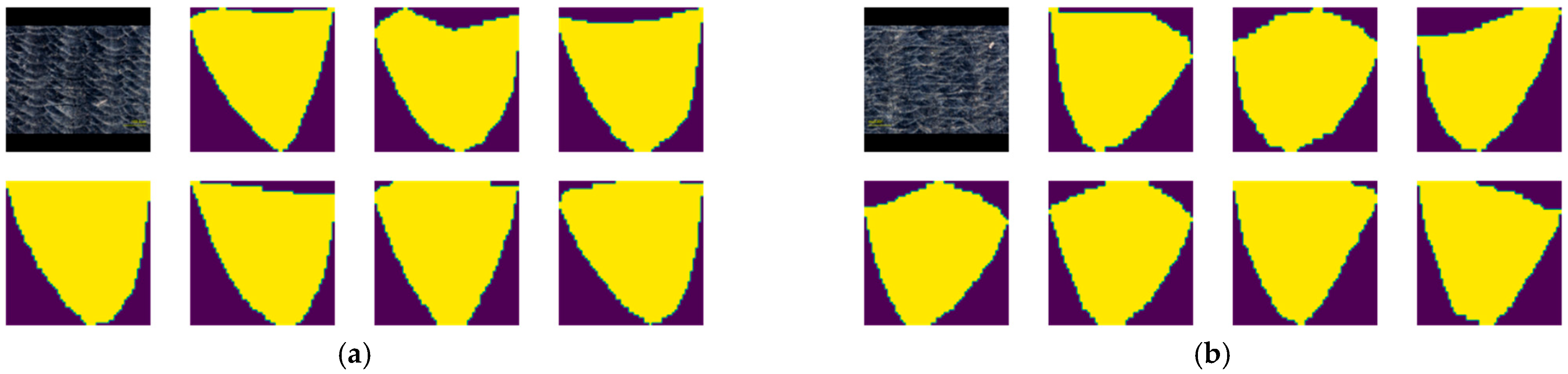
To validate the performance of the trained Mask R-CNN model for melt pool boundary detection, we used a separate test dataset comprising annotated images not included in the training set (see Figure 21). The model’s predictions were compared against ground truth masks using standard metrics such as IoU, precision, and recall [27]. The model achieved an average IoU ≤ 0.7, indicating acceptable agreement with manually annotated boundaries.

3.3.1. Melt Pool Dataset and Approach

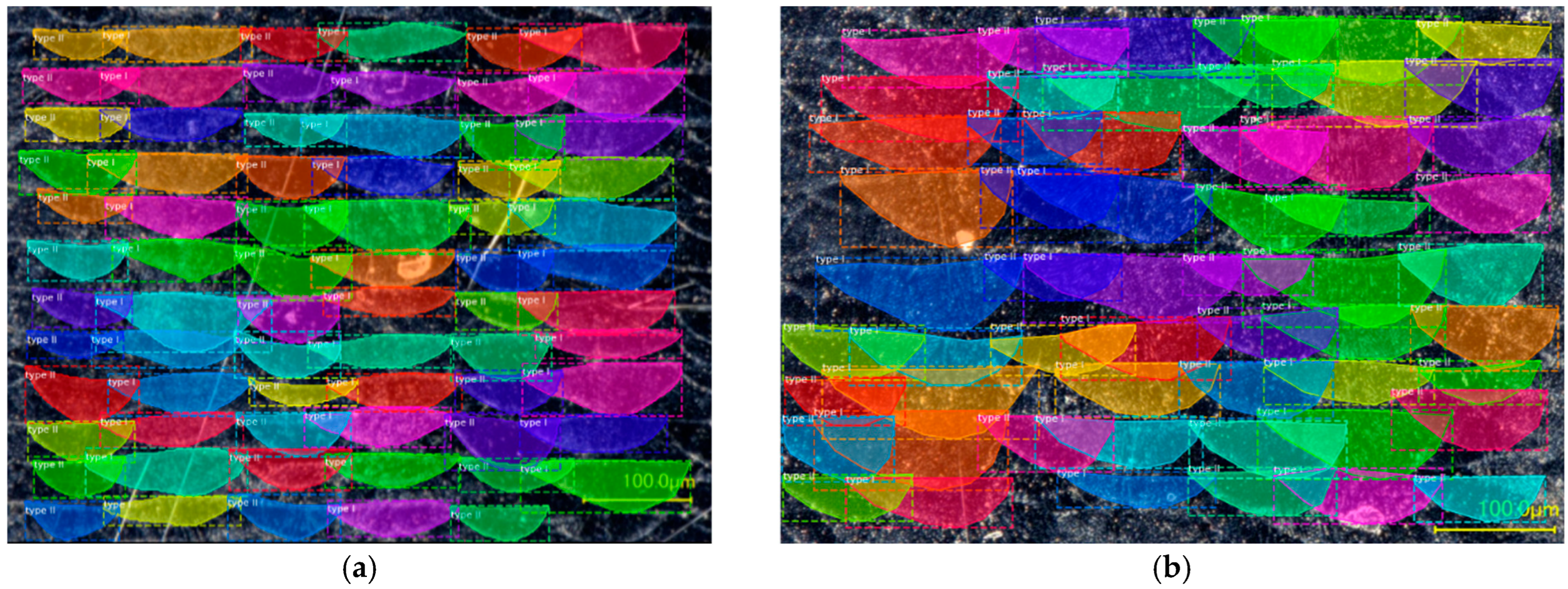
To optimize both training and mask prediction efficiency for 90° and 67° SSR Type I and Type II melt pools, the goal was to reduce the storage requirements for the masks. Instead of storing each mask as part of a large image with padding or zero-filled spaces, a more efficient approach was adopted. By only storing the mask pixels within the bounding box of the melt pool, unnecessary padding and zeros were eliminated. However, the bounding boxes efficiently and effectively encapsulate the relevant mask data. The bounding boxes and masks shown in Figure 22 highlight the specific areas of interest for analysis and measurement of melt pools.
The mini mask augmentation introduces variability in object configurations, improving model generalization across variations in melt pool orientation, size, and position. Generating mini masks from full-resolution masks also reduces computational and memory overhead while providing consistent input dimensions during training. The augmented mini masks were subsequently applied to bounding boxes (Figure 23), where differences in mask prediction between the two models are apparent. The anchor boxes of predefined sizes and aspect ratios enable the model to localize and classify melt pools across a range of scales, with subtle differences in anchor configurations reflecting differing model assumptions about melt pool geometry.
In FPNs, anchors are distributed across multiple pyramid levels, with their ordering determined by the convolutional processing sequence at each level, a consistency that must be preserved across both training and inference. An anchor stride of two is adopted, reducing the total number of anchors by 75% and balancing computational efficiency with detection accuracy. The anchors are classified based on their overlap with ground truth: positive anchors correspond to melt pool regions and are used for refinement and classification, neutral anchors are ignored in loss computation, and negative anchors represent background regions that help the model distinguish melt pools from non-relevant areas. The RoIs generated by the RPN represent candidate object regions extracted from feature maps. Each RoI is refined to produce classified bounding boxes and segmentation masks. It is important to maintain a balanced ratio of positive and negative RoIs for effective training. In the comparison, Model 1 detects a Type I melt pool while Model 2 identifies a Type II melt pool, with visualizations showing differences in localization and segmentation detail between the models (Figure 24).

3.3.2. DNN Model Execution

The model inference follows the standard DNN evaluation procedure, beginning with loading the saved model weights and applying the Python/TensorFlow detect() function to the test dataset. The resulting RoIs, segmentation masks, class types, and confidence scores are visualized on the test images, facilitating direct comparison of bounding box localization and class predictions between the two models. The inference pipeline consists of four stages: (i) a region proposal network for generating candidate object regions; (ii) proposal classification and bounding box refinement; (iii) instance mask generation for each detected object; and (iv) final detection output, where the refined bounding boxes, class labels, confidence scores, and segmentation masks are produced after filtering overlapping detections.

3.3.3. Stage 1—Region Proposal Network

The RPN aims to generate anchor boxes and refine their sizes and positions to better fit the objects in the image. During this stage, the RPN logs target matches for anchors, classifying them into positive, neutral, or negative categories based on their overlap with the ground truth bounding boxes. In order to evaluate the overlap between the predicted and ground truth bounding boxes, the IoU metric is used. The positive anchors have an IoU ≥ 0.7, indicating high overlap with the ground truth. The neutral anchors have an IoU between 0.3 and 0.7, indicating moderate overlap. The negative anchors have an IoU < 0.3, showing little to no overlap with the ground truth [33]. The model then applies refinement deltas to the positive anchors, improving their alignment with the true object locations. This process of refining anchor box locations and sizes is a key step in improving the overall object detection performance. The RPN subgraph is executed to predict refined anchors, clipped anchors, and proposals for object detection. Once the anchors are generated, non-maximum suppression (NMS) is applied to remove redundant bounding boxes. NMS helps retain only the most confident bounding boxes for each class by comparing their confidence scores and eliminating overlapping boxes with lower scores [34]. This reduces the number of redundant predictions and ensures that each object is detected with the most accurate bounding box. The visualizations are provided to show the top anchors both before and after NMS is applied. These visualizations highlight how redundant bounding boxes are filtered out, leaving only the best predictions based on their confidence scores. This refinement process helps improve both the accuracy and efficiency of the model’s object detection capabilities. These RoIs represent the initial potential object locations proposed by the RPN (Figure 24).

3.3.4. Stage 2—Proposal Classification

In this stage, the model’s classifier is run to obtain class probabilities, bounding box regressions, and masks for each proposed region. The final detections are then displayed, with bounding boxes, class IDs, and confidence scores clearly shown. The refinement of proposals is performed by applying bounding box transformations specific to the detected class, improving the accuracy of the bounding box placement. Positive ROIs are visualized both before and after this refinement to highlight how the bounding boxes are adjusted to better fit the detected objects. Next, low-confidence detections are filtered out. Any detections with low confidence scores or those classified as background are removed, ensuring that only the melt pools, which are of interest, are retained for further analysis. Bounding box refinement further adjusts the positions of the bounding boxes, using class-specific shifts to ensure the boxes are accurately aligned with the detected objects. Finally, per-class NMS is applied to reduce the number of overlapping bounding boxes for objects of the same class. The purpose of NMS is to retain the most confident bounding boxes and eliminate redundant ones, ensuring that each object is represented by only the best possible detection.

3.3.5. Stage 3—Generating Masks

In this stage, the mask-head of the model is run to generate masks for every detected instance. These masks are visualized for each predicted Type I melt pool, as shown in Figure 25.
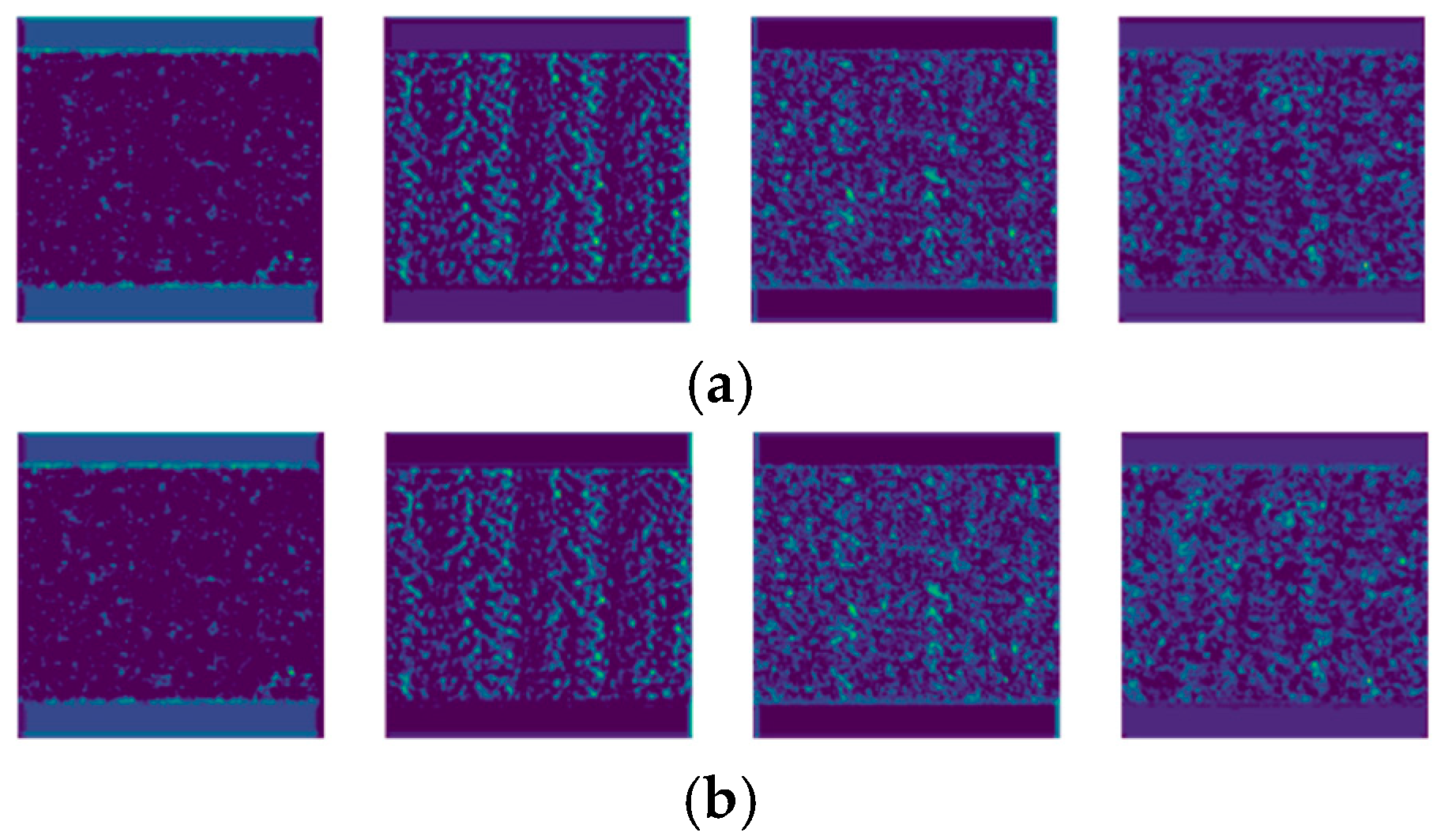
The masks of Model 1 seem to be noisy compared to the ones of Model 2, which are smoother and more refined. This process is essential for segmenting objects accurately within the image and is a key feature of the Mask R-CNN framework, which integrates both object detection and segmentation [27,29,30]. During this process, examining the activation functions between the neural network layers can reveal patterns or potential issues. By analyzing these activations, it is possible to gain insight into the model’s behavior and identify areas for improvement. Activation visualization techniques have been widely discussed for understanding and improving DNN models [35]. Image normalization is a standard preprocessing step in computer vision to improve model convergence and performance [36]. There is no noticeable difference as the same image is normalized for both models. Figure 26 illustrates the backbone feature maps from the initial convolutional layer, highlighting the features learned by the network. Feature maps from convolutional layers are central to understanding hierarchical feature learning in CNNs [37].
Figure 27 presents histograms of the RPN bounding box deltas, which show the shifts applied to the bounding boxes during refinement. The RPN is a critical component for generating high-quality proposals in object detection [33]. By comparing the distributions of these deltas, we can gain insight into how each model refines the initial anchor boxes to better fit the predicted objects. Differences can imply how each model learns to adjust the anchor boxes for optimal predictions of objects.
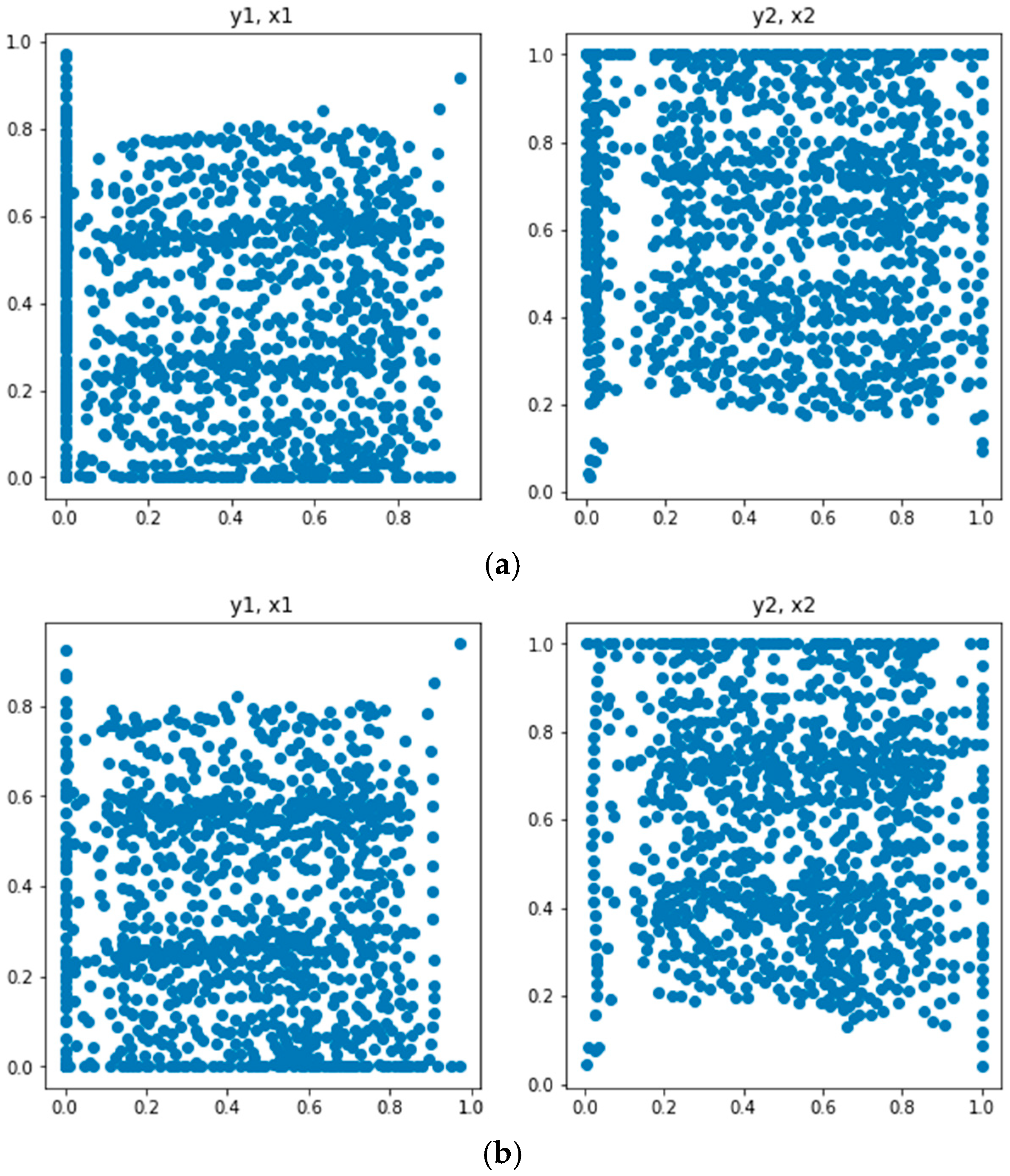
Figure 28 displays the distribution of the y and x coordinates of the generated proposals, providing insight into where the model is proposing potential object locations. Proposal distribution analysis has been used to evaluate and improve the proposal quality in object detection tasks [34].
By examining these visualizations and data distributions, the model’s performance and accuracy in generating masks can be further understood and fine-tuned. Visualizing and analyzing intermediate layers and outputs has become a valuable method for improving the interpretability and robustness of DNN models [38]. By observing the differences in point density and distribution, we can analyze how the region proposal generation strategies are different, especially with respect to the x and y dimensions. By analyzing areas of the image, we can gain an understanding of where each model focuses its attention and the effects of data augmentation during the initial stages of object detection.

3.3.6. Performance Comparison with Confusion Matrices

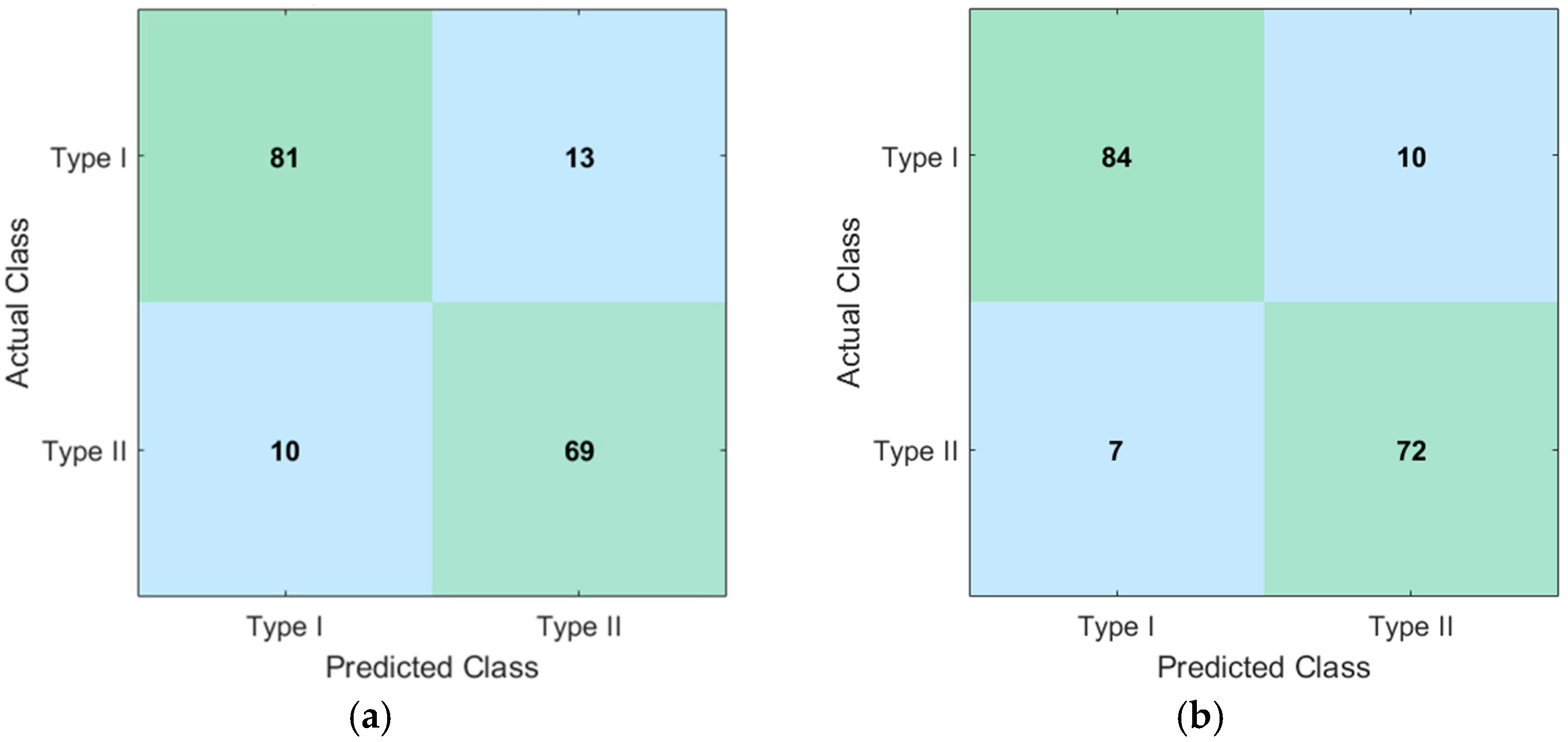
The model results indicate that there are 94 ground truth Type I and 83 ground truth Type II melt pool instances in the test image set. After non-maximum suppression, Model 1 (ResNet-50) kept 150 detections: 81 matched to Type I melt pool ground truths and 69 matched to Type II melt pool ground truths. In a slightly better performance, Model 2 (ResNet-101) kept 156 detections: 84 matched to Type I melt pool ground truths and 72 matched to Type II melt pool ground truths.
Figure 29a,b present the confusion matrices for the two classification models (Model 1 and Model 2) used to identify Type I and Type II melt pool features. The results demonstrate strong classification performance, with most predictions correctly assigned to their corresponding ground truth classes. For both models, precision values remain high, indicating that the majority of predicted melt pool instances correspond to the correct class. The recall values are also relatively high, suggesting that most ground truth melt pool features are successfully detected by the models. A limited number of cross-class misclassifications are observed, where a small portion of Type I melt pools are labeled as Type II and vice versa. These errors remain relatively minor compared with the total number of correctly classified instances. Overall, the confusion matrices show that both models achieve reliable performance, while the deeper architecture in Model 2 provides a modest improvement in classification accuracy and detection completeness compared with Model 1.

4. Discussions

From the results, key post-process signatures such as melt pool length, width, area, and overlaps can be extracted from the masks and bounding boxes. Although the model performs well, training time is relatively long. Performance can be further improved by using a faster GPU, enabling higher-resolution training, expanding the dataset, or optimizing training parameters.
To enhance detection accuracy for the 67° SSR images, additional images from various scan strategies should be labeled and incorporated into the training dataset. This will improve the model’s ability to identify melt pool shapes and types under different scan conditions.
Furthermore, combining the current measurement data and model predictions with manual filtering techniques can help reduce false detections and improve reliability. The model can also be applied to measure track-to-track fusion overlaps and layer-to-layer overlaps in builds using 67° rotation strategies.
Model adjustments can be made to expand classification beyond just “Type I” and “Type II” melt pools to include other process signatures such as track-to-track overlap and rotated fused tracks, by appropriately labeling them in the training set. With proper training parameters, the model can be adapted accordingly.
Finally, with a per-image inference time of approximately 150 ms, the model shows potential for real-time or near-real-time in situ process monitoring applications.
Data-driven approaches for process monitoring and defect detection are rapidly expanding across multiple sensing modalities in AM [39,40,41]. While the present study focuses on image-based melt pool classification, complementary approaches have been explored using acoustic emission and vibration signals in PBF-LB/M processes [42]. Integrating vision-based monitoring with acoustic or vibration sensing [43] therefore represents a promising direction for developing more comprehensive and robust machine learning frameworks for real-time process monitoring and control in AM systems.

5. Conclusions

Microstructural characterization of nickel alloy 625 test coupons fabricated via PBF/LB was conducted using optical microscopy. High-resolution black-and-white images of polished and etched cross-sections were analyzed to segment and quantify melt pool features, porosity, and grain size distributions. Comparative analysis of coupons built with 90° and 67° scan rotation strategies revealed distinct differences in melt pool geometry, pore characteristics, and their evolution with process parameters.
For the 67° scan strategy, changes in average pore radius and porosity with respect to relative density were slightly more pronounced compared to the 90° strategy. Melt pool width and depth measurements indicated contrasting trends between Type I and Type II coupons: for Type I, both width and depth increased with relative density, whereas for Type II, they decreased. Furthermore, the difference in melt pool width between the two types increased with energy density.
A watershed segmentation algorithm was applied to binary 2D images of the porous microstructure, enabling the extraction of quantitative metrics such as relative frequency, mean, and standard deviation of grain and pore sizes. These results provide a comprehensive quantitative basis for correlating process parameters with microstructural features, offering insights into optimizing scan strategies for improved part quality.
In parallel, a deep learning-based method employing Mask R-CNN was developed to automate melt pool geometry analysis from optical microscopy images in PBF/LB. The CNN models demonstrated effective performance in automatic detection and measurement of process signatures in PBF-LB/M AM. Using ResNet-50 and ResNet-101 backbones, segmentation efficacy was compared through visualizations and loss-based metrics. ResNet-50 achieved lower total training loss (0.1781 vs. 0.1907) and validation loss (8.6140 vs. 9.4228), along with better classification accuracy (MRCNN class loss: 0.7806 vs. 1.2525), indicating superior generalization and segmentation performance over ResNet-101.
The proposed Mask-R-CNN framework demonstrated strong capability for melt pool classification and segmentation. Evaluation using IoU, precision, and recall metrics showed that the ResNet-101 backbone provided improved performance compared with ResNet-50, yielding an approximately 4% higher mean IoU. The model achieved mean IoU values of 0.85 for Type I melt pools and 0.82 for Type II melt pools. Detection accuracy was slightly higher for Type I melt pools due to their more regular morphology and clearer boundaries, whereas Type II melt pools exhibited irregular shapes and lower contrast, resulting in slightly lower recall.
The Mask R-CNN framework, leveraging a region proposal network, refined anchors, non-maximum suppression, and high-quality mask generation, enabled accurate localization and segmentation of melt pool features in complex optical micrographs. Visualization and analysis of intermediate activations provided valuable insights into the model’s learning process, guiding performance enhancements. These results demonstrate that the proposed approach represents a significant advancement in automated melt pool detection and segmentation, with strong potential for integration into real-time quality monitoring systems in metal AM. Future work will focus on optimizing the model architecture, exploring alternative deep learning frameworks, and improving computational efficiency for industrial deployment.

Author Contributions

Conceptualization, T.Ö.; methodology, T.Ö., S.D. and A.R.; software, T.Ö., S.D. and A.R.; validation, T.Ö., S.D., A.R., F.P. and D.E.; formal analysis, T.Ö., S.D., A.R., F.P. and D.E.; investigation, T.Ö., S.D. and A.R.; resources, T.Ö.; data curation, T.Ö., S.D., A.R., F.P. and D.E.; writing—original draft preparation, T.Ö. writing—review and editing, T.Ö., visualization, T.Ö., S.D. and A.R.; supervision T.Ö. All authors have read and agreed to the published version of the manuscript.

Funding

This research received no external funding.

Data Availability Statement

Data are contained within the article.

Acknowledgments

Support for S. Ding, A. Ramasubramanian, D. Eskicorapci, and F. Pieri from the Aresty Research Center at Rutgers University is gratefully acknowledged. During the preparation of this work, the authors used ChatGPT 4o in order to improve language and readability with caution. After using this tool, the authors reviewed and edited the content as needed and take full responsibility for the content of the publication.

Conflicts of Interest

The authors declare that they have no known competing financial interests or personal relationships that could have appeared to influence the work reported in this paper.

References

  1. Kladovasilakis, N.; Charalampous, P.; Kostavelis, I.; Tzetzis, D.; Tzovaras, D. Impact of metal additive manufacturing parameters on the powder bed fusion and direct energy deposition processes: A comprehensive review. Prog. Addit. Manuf. 2021, 6, 349–365. [Google Scholar] [CrossRef]
  2. Zhang, Z.; Sahu, C.K.; Singh, S.K.; Rai, R.; Yang, Z.; Lu, Y. Machine learning based prediction of melt pool morphology in a laser-based powder bed fusion additive manufacturing process. Int. J. Prod. Res. 2024, 62, 1803–1817. [Google Scholar] [CrossRef]
  3. Smoqi, Z.; Gaikwad, A.; Bevans, B.; Kobir, M.H.; Craig, J.; Abul-Haj, A.; Peralta, A.; Rao, P. Monitoring and prediction of porosity in laser powder bed fusion using physics-informed meltpool signatures and machine learning. J. Mater. Process. Technol. 2022, 304, 117550. [Google Scholar] [CrossRef]
  4. Thanki, A.; Goossens, L.; Ompusunggu, A.P.; Bayat, M.; Bey-Temsamani, A.; Van Hooreweder, B.; Kruth, J.-P.; Witvrouw, A. Melt pool feature analysis using a high-speed coaxial monitoring system for laser powder bed fusion of Ti-6Al-4 V grade 23. Int. J. Adv. Manuf. Technol. 2022, 120, 6497–6514. [Google Scholar] [CrossRef]
  5. Özel, T. A review on in-situ process sensing and monitoring systems for fusion-based additive manufacturing. Int. J. Mechatron. Manuf. Syst. 2023, 16, 115–154. [Google Scholar] [CrossRef]
  6. Caggiano, A.; Zhang, J.; Alfieri, V.; Caiazzo, F.; Gao, R.; Teti, R. Machine learning-based image processing for on-line defect recognition in additive manufacturing. CIRP Ann. 2019, 68, 451–454. [Google Scholar] [CrossRef]
  7. Zhang, B.; Jaiswal, P.; Rai, R.; Guerrier, P.; Baggs, G. Convolutional neural network-based inspection of metal additive manufacturing parts. Rapid Prototyp. J. 2019, 25, 530–540. [Google Scholar] [CrossRef]
  8. Yuan, B.; Giera, B.; Guss, G.; Matthews, I.; Mcmains, S. Semi-supervised convolutional neural networks for in-situ video monitoring of selective laser melting. In Proceedings of the 2019 IEEE Winter Conference on Applications of Computer Vision, WACV; IEEE: New York, NY, USA, 2019; pp. 744–753. [Google Scholar]
  9. Li, L.; McGuan, R.; Isaac, R.; Kavehpour, P.; Candler, R. Improving precision of material extrusion 3D printing by in-situ monitoring & predicting 3D geometric deviation using conditional adversarial networks. Addit. Manuf. 2021, 38, 101695. [Google Scholar] [CrossRef]
  10. Parsazadeh, M.; Sharma, S.; Dahotre, N. Towards the next Generation of Machine Learning Models in Additive Manufacturing: A Review of Process De-pendent Material Evolution. Prog. Mater. Sci. 2023, 135, 101102. [Google Scholar] [CrossRef]
  11. Scime, L.; Beuth, J. A multi-scale convolutional neural network for autonomous anomaly detection and classification in a laser powder bed fusion additive manufacturing process. Addit. Manuf. 2018, 24, 273–286. [Google Scholar] [CrossRef]
  12. Williams, G.; Meisel, N.A.; Simpson, T.W.; McComb, C. Design repository effectiveness for 3D convolutional neural networks: Application to additive manufacturing. J. Mech. Des. 2019, 141, 111701. [Google Scholar] [CrossRef]
  13. Balu, A.; Lore, K.G.; Young, G.; Krishnamurthy, A.; Sarkar, S. A deep 3d convolutional neural network based design for manufacturability framework. arXiv 2016, arXiv:1612.02141. [Google Scholar]
  14. Qin, J.; Hu, F.; Liu, Y.; Witherell, P.; Wang, C.C.; Rosen, D.W.; Simpson, T.W.; Lu, Y.; Tang, Q. Research and application of machine learning for additive manufacturing. Addit. Manuf. 2022, 52, 102691. [Google Scholar] [CrossRef]
  15. Lee, K.-H.; Lee, H.W.; Yun, G.J. A defect detection framework using three-dimensional convolutional neural network (3D-CNN) with in-situ monitoring data in laser powder bed fusion process. Opt. Laser Technol. 2023, 165, 109571. [Google Scholar] [CrossRef]
  16. Qi, X.; Chen, G.; Li, Y.; Cheng, X.; Li, C. Applying neural-network-based machine learning to additive manufacturing: Current applications, challenges, and future perspectives. Engineering 2019, 5, 721–729. [Google Scholar] [CrossRef]
  17. Sun, C.; Shi, V.G. PhysiNet: A combination of physics-based model and neural network model for digital twins. Int. J. Intell. Syst. 2021, 37, 5443–5456. [Google Scholar] [CrossRef]
  18. Eshkevari, S.S.; Takáč, M.; Pakzad, S.N.; Jahani, M. DynNet: Physics-based neural architecture design for linear and nonlinear structural response modeling and prediction. arXiv 2020, arXiv:2007.01814. [Google Scholar]
  19. Guo, S.; Agarwal, M.; Cooper, C.; Tian, Q.; Gao, R.X.; Guo, W.; Guo, Y. Machine learning for metal additive manufacturing: Towards a physics-informed data-driven paradigm. J. Manuf. Syst. 2022, 62, 145–163. [Google Scholar] [CrossRef]
  20. Peles, A.; Paquit, V.C.; Dehoff, R.R. Deep-learning quantitative structural characterization in additive manufacturing. arXiv 2023, arXiv:2302.06389. [Google Scholar] [CrossRef]
  21. Criales, L.E.; Arısoy, Y.M.; Lane, B.; Moylan, S.; Donmez, A.; Özel, T. Laser powder bed fusion of nickel alloy 625: Experimental investigations of effects of process parameters on melt pool size and shape with spatter analysis. Int. J. Mach. Tools Manuf. 2017, 121, 22–36. [Google Scholar] [CrossRef]
  22. Arısoy, Y.M.; Criales, L.E.; Özel, T.; Lane, B.; Moylan, S.; Donmez, A. Influence of scan strategy and process parameters on microstructure and its optimization in additively manufactured nickel alloy 625 via laser powder bed fusion. Int. J. Adv. Manuf. Technol. 2017, 90, 1393–1417. [Google Scholar] [CrossRef] [PubMed]
  23. Seal, A.; Das, A.; Sen, P. Watershed: An image segmentation approach. Int. J. Comput. Sci. Inf. Technol. 2015, 6, 2295–2297. [Google Scholar]
  24. Otsu, N. A threshold selection method from gray-level histograms. IEEE Trans. Syst. Man Cybern. 1979, 9, 62–66. [Google Scholar] [CrossRef]
  25. Rabbani, A.; Jamshidi, S.; Salehi, S. An automated simple algorithm for realistic pore network extraction from micro-tomography images. J. Pet. Sci. Eng. 2014, 123, 164–171. [Google Scholar] [CrossRef]
  26. Krizhevsky, A.; Sutskever, I.; Hinton, G.E. Imagenet classification with deep convolutional neural networks. Adv. Neural Inf. Process. Syst. 2012, 25. [Google Scholar] [CrossRef]
  27. He, K.; Gkioxari, G.; Dollár, P.; Girshick, R. Mask R-CNN. In Proceedings of the IEEE International Conference on Computer Vision; IEEE: New York, NY, USA, 2017; pp. 2961–2969. [Google Scholar]
  28. Bharati, P.; Pramanik, A. Deep learning techniques—R-CNN to mask R-CNN: A survey. In Computational Intelligence in Pattern Recognition: Proceedings of the CIPR 2019; Springer Nature: London, UK, 2019; pp. 657–668. [Google Scholar]
  29. He, K.; Zhang, X.; Ren, S.; Sun, J. Deep residual learning for image recognition. In Proceedings of the IEEE Conference on Computer Vision and Pattern Recognition; IEEE: New York, NY, USA, 2016; pp. 770–778. [Google Scholar]
  30. He, K.; Zhang, X.; Ren, S.; Sun, J. Identity mappings in deep residual networks. In Computer Vision–ECCV 2016: Proceedings of the 14th European Conference, Amsterdam, The Netherlands, 11–14 October 2016; Part IV 14; Springer Nature: London, UK, 2016; pp. 630–645. [Google Scholar]
  31. Özel, T. Deep Learning-Based Applications in Metal Additive Manufacturing Processes: Challenges and Opportunities—A Re-view. Int. J. Light. Mater. Manuf. 2025, 8, 453–468. [Google Scholar] [CrossRef]
  32. Gadde, D.; Elwany, A.; Du, Y. Deep learning to analyze spatter and melt pool behavior during additive manufacturing. Metals 2025, 15, 840. [Google Scholar] [CrossRef]
  33. Ren, S.; He, K.; Girshick, R.; Sun, J. Faster R-CNN: Towards real-time object detection with region proposal networks. IEEE Trans. Pattern Anal. Mach. Intell. 2016, 39, 1137–1149. [Google Scholar] [CrossRef] [PubMed]
  34. Girshick, R.; Donahue, J.; Darrell, T.; Malik, J. Rich feature hierarchies for accurate object detection and semantic segmentation. In Proceedings of the IEEE Conference on Computer Vision and Pattern Recognition; IEEE: New York, NY, USA, 2014; pp. 580–587. [Google Scholar]
  35. Zeiler, M.D.; Fergus, R. Visualizing and understanding convolutional networks. In Computer Vision–ECCV 2014: Proceedings of the 13th European Conference, Zurich, Switzerland, 6–12 September 2014; Part I 13; Springer International Publishing: Cham, Switzerland, 2014; pp. 818–833. [Google Scholar]
  36. Ioffe, S. Batch normalization: Accelerating deep network training by reducing internal covariate shift. arXiv 2015, arXiv:1502.03167. [Google Scholar] [CrossRef]
  37. LeCun, Y.; Bengio, Y.; Hinton, G. Deep learning. Nature 2015, 521, 436–444. [Google Scholar] [CrossRef] [PubMed]
  38. Bau, D.; Zhou, B.; Khosla, A.; Oliva, A.; Torralba, A. Network dissection: Quantifying interpretability of deep visual representations. In Proceedings of the IEEE Conference on Computer Vision and Pattern Recognition; IEEE: New York, NY, USA, 2017; pp. 6541–6549. [Google Scholar]
  39. Scime, L.; Siddel, D.; Baird, S.; Paquit, V. Layer-wise anomaly detection and classification for powder bed additive manufacturing processes: A machine-agnostic algorithm for real-time pixel-wise semantic segmentation. Addit. Manuf. 2020, 36, 101453. [Google Scholar] [CrossRef]
  40. Herzog, T.; Brandt, M.; Trinchi, A.; Sola, A.; Molotnikov, A. Process monitoring and machine learning for defect detection in laser-based metal additive manufacturing. J. Intell. Manuf. 2023, 35, 1407–1437. [Google Scholar] [CrossRef]
  41. Scime, L.R.; Paquit, V.C.; Goldsby, D.J.; Halsey, W.H.; Joslin, C.B.; Richardson, M.D.; Rose, D.C.; Siddel, D.H.; UT Battelle LLC. Systems and Methods for Powder Bed Additive Manufacturing Anomaly Detection. U.S. Patent 12,533,731, 4 October 2026. [Google Scholar]
  42. Rahmati, M.; Rahmati, N. A multimodal deep learning framework for real-time defect recognition in industrial components using visual, acoustic and vibration signals. J. Intell. Manuf. Spec. Equip. 2025, 6, 273–292. [Google Scholar] [CrossRef]
  43. Xu, K.; Vallabh, C.K.P.; Manoochehri, S. Integrating machine learning with multimodal monitoring system utilizing acoustic and vision sensing to evaluate geometric variations in laser directed energy deposition. Int. J. Adv. Manuf. Technol. 2025, 141, 4335–4359. [Google Scholar] [CrossRef]
Figure 1. Relative density of additively manufactured nickel alloy 625 coupons fabricated using 67° and 90° scan strategies, plotted against process parameter sets ordered by increasing volumetric energy density. Each group represents a unique combination of laser power (P), scan speed (v), and hatch distance (h). Uncertainty bars represent a ±0.5% uncertainty in relative density measurements.
Machines 14 00366 g001
Figure 2. Bar charts showing the average melt pool width (left) and depth (right) for coupons fabricated under various laser processing parameters. Each bar represents a unique combination of laser power (P), scan speed (v), and hatch distance (h), with uncertainty bars indicating one standard deviation. This visualization highlights the influence of process parameters on melt pool geometry in nickel alloy 625 components produced via PBF-LB using 90° SSR.
Machines 14 00366 g002
Figure 3. Bar charts showing the average melt pool width (left) and depth (right) for coupons fabricated under various laser processing parameters. Each bar represents a unique combination of laser power (P), scan speed (v), and hatch distance (h), with uncertainty bars indicating one standard deviation. This visualization highlights the influence of process parameters on melt pool geometry in nickel alloy 625 components produced via PBF-LB using 67° SSR.
Machines 14 00366 g003
Figure 4. Color-coded segmentation map of individual grains showing grain morphology, alongside a histogram of equivalent grain radius distribution annotated with the calculated mean grain radius ( r g ¯ = 2.1483 μm).
Machines 14 00366 g004
Figure 5. Color-coded segmentation map of individual pores showing pore morphology, alongside a histogram of equivalent pore radius distribution annotated with the calculated mean pore radius ( r p ¯ = 4.793 μm).
Machines 14 00366 g005
Figure 6. Mask R-CNN as a deep learning model used for melt pool shapes and types in PBF-LB/M.
Machines 14 00366 g006
Figure 7. Selected melt pool dataset obtained from Criales et al. [21]: (a) sample training dataset, (b) sample test dataset, (c) sample validation dataset. (Yellow scale bar is 100 μm.)
Machines 14 00366 g007
Figure 8. Effect of energy density, Ed [J/mm3], on melt pool (SSR = 90°) (a) width [μm] and (b) depth [μm].
Machines 14 00366 g008
Figure 9. Effect of relative density, ρrel [%], on melt pool (SSR = 90°) (a) width [μm] and (b) depth [μm].
Machines 14 00366 g009
Figure 10. Effect of laser power, P [W], for constant scan velocity, vs [mm/s], on melt pool (SSR = 90°) (a) width [μm] and (b) depth [μm].
Machines 14 00366 g010
Figure 11. Effect of energy density, Ed [J/mm3], on melt pool (SSR = 67°) (a) width [μm] and (b) depth [μm].
Machines 14 00366 g011
Figure 12. Effect of relative density, ρrel [%], on melt pool (SSR = 67°) (a) width [μm] and (b) depth [μm].
Machines 14 00366 g012
Figure 13. Effect of laser power, P [W], for constant scan velocity, vs [mm/s], on melt pool (SSR = 67°) (a) width [μm] and (b) depth [μm].
Machines 14 00366 g013
Figure 14. Effect of energy density, Ed [J/mm3], on microstructure (SSR = 90°) porosity measurements of (a) average grain radius, r g ¯ [μm], (b) average pore radius, r p ¯ [μm], and (c) porosity.
Machines 14 00366 g014
Figure 15. Effect of relative density, ρrel [%], on microstructure (SSR = 90°) porosity measurements of (a) average grain radius, r g ¯ [μm], (b) average pore radius, r p ¯ [μm], and (c) porosity.
Machines 14 00366 g015
Figure 16. Effect of laser power, P [W], for constant scan velocity, vs [mm/s], on porosity measured (SSR = 90°).
Machines 14 00366 g016
Figure 17. Effect of energy density, Ed [J/mm3], on microstructure (SSR = 67°) porosity measurements of (a) average grain radius, r g ¯ [μm], (b) average pore radius, r p ¯ [μm], and (c) porosity.
Machines 14 00366 g017
Figure 18. Effect of relative density, ρrel [%], on microstructure (SSR = 67°) porosity measurements of (a) average grain radius, r g ¯ [μm], (b) average pore radius, r p ¯ [μm], and (c) porosity.
Machines 14 00366 g018aMachines 14 00366 g018b
Figure 19. Effect of laser power, P [W], for constant scan velocity, vs [mm/s], on porosity measured (SSR = 67°).
Machines 14 00366 g019
Figure 20. (a) Manually marked and labeled melt pool shapes (original image size: 1600 × 1200); (b) automatically detected melt pool types using the Mask R-CNN model on Coupon01_YZ_500X_01.png (resized to 512 × 512). Colors indicate manually segmented regions.
Machines 14 00366 g020
Figure 21. Sample annotated images normalized (224 × 224 pixels) and used for validation. (a) Model 1 and (b) Model 2.
Machines 14 00366 g021
Figure 22. The bounding boxes and masks placed on the melt pool on a section-wise image: (a) 90° SSR and (b) 67° SSR. (Yellow scale bar is 100 μm.). Colors indicated segmented regions.
Machines 14 00366 g022
Figure 23. The augmented mini masks without the bounding boxes. (a) Model 1 and (b) Model 2. (Yellow scale bar is 100 μm).
Machines 14 00366 g023
Figure 24. The image illustrates 10 random RoIs out of 128. (Yellow scale bar is 100 μm.) The colored boxes indicate melt pool shapes and RoIs.
Machines 14 00366 g024
Figure 25. Generated masks for predicted Type I melt pools. (a) Model 1 and (b) Model 2.
Machines 14 00366 g025
Figure 26. Backbone feature maps from the initial convolutional layer. (a) Model 1 and (b) Model 2.
Machines 14 00366 g026
Figure 27. Histograms of RPN bounding box deltas. (a) Model 1 and (b) Model 2.
Machines 14 00366 g027
Figure 28. Distribution of y and x coordinates of generated proposals. (a) Model 1 and (b) Model 2.
Machines 14 00366 g028
Figure 29. Confusion matrices illustrating the false positive and false negative rates between Type I and Type II melt pool classifications for (a) Model 1 and (b) Model 2.
Machines 14 00366 g029
Table 1. PBF-LB/M Process parameters, energy density, and measured relative density.
Laser Power,
P [W]
Scan Velocity,
vs [mm/s]
Hatch Distance,
h [mm]
Energy
Density,
Ed [J/mm3]
Coupon
No.
Relative Density
(SSR = 67°), ρrel [%]
Coupon
No.
Relative Density
(SSR = 90°),
ρrel [%]
1698750.1096.57#1195.23#196.00
1958750.10111.43#1998.30#498.70
1828750.09115.56#2697.03#697.40
1827250.11114.11#1095.97#896.17
1958000.11110.80#2598.47#998.52
1827250.09139.46#2797.14#1297.29
1828000.10113.75#798.10#1498.21
1828000.10113.75#2298.05#1598.19
1957250.10134.48#397.50#1697.74
1828000.10113.75#2498.13#1798.30
1828750.1194.55#2896.50#1896.75
1697250.10116.55#296.38#2096.52
1698000.09117.36#597.50#2197.91
1698000.1196.02#3096.60#2396.78
1958000.09135.42#1399.01#2999.23
1958000.10121.88#3198.64#3498.86
1958000.10121.88#3298.53#3598.75
1958000.10121.88#3398.69#3698.81
Table 2. Optical image analysis of coupons fabricated using 90° SSR.
MP Width Avg
[μm]
MP Width Std Dev. [μm]MP Depth Avg
[μm]
MP Depth St. Dev. [μm]
Coupon No.Type IType IITotalType IType IITotalType IType IITotalType IType IITotal
011349211312924353133656
0417011113525734494647787
06149101128171630453842757
08153107130251230483944899
0914310912813921444243777
1213411312618111945364171010
14132109121111015443841767
15128105119121117403337969
16152114133131122524247181016
1714311212710718483842678
181341101261315174732417710
2015910613613829514247868
2115410713114927474546898
2315096120281133433336668
2914910312815162849394471211
3410986102151117312128869
35155112128111525504146678
36145109127181124383034789
Table 3. Optical image analysis of coupons fabricated using 67° SSR.
MP Width Avg
[μm]
MP Width Std Dev. [μm]MP Depth Avg
[μm]
MP Depth St. Dev. [μm]
Coupon No.Type IType IITotalType IType IITotalType IType IITotalType IType IITotal
0212913513252565556011810
0313411912791916514348868
05157135146373537493944131314
0715112413824282945313811812
101321121231424214435409910
11122115119132117403538899
13131107122172184944479119
1912811612213111353424851210
22135114124141919524146979
2414410512134113052334122917
251089299111816412834869
2612910511716182049384311711
27129118123101614403738787
28140119130251924463741678
3012512912710161247404412510
31139951201211264829406411
32162134148192827665159141115
3314411413116232452414811511
Table 4. Porosity determination results for test coupons fabricated with SSR = 90°.
Coupon No.Mean Grain Radius
r g ¯ [μm]
Std. Dev.
ρ g r [μm]
Mean Pore Radius
r p ¯ [μm]
Std Dev.
ρ p r [μm]
Porosity, ϕ
012.27941.55104.59173.19610.7178
042.01321.34184.04922.87060.7147
061.89561.23514.42772.97870.7559
082.15051.43804.70663.45610.7567
092.42131.76684.11783.07850.6699
122.17871.52504.55363.32370.7348
142.46011.85653.83102.90460.6367
152.23171.48964.01322.70450.6829
162.33981.68794.08303.23770.7194
172.31361.60813.81392.84700.6805
182.20481.58354.21863.04820.7107
202.13721.51674.24653.10710.7152
212.13841.48164.38563.17420.7259
232.35051.71184.32263.38430.6998
292.55961.92174.12213.16640.6846
341.99081.25785.27113.55200.8059
352.48211.85904.79383.74230.7289
362.02771.38454.16133.06490.7335
Table 5. Porosity determination results for test coupons fabricated with SSR = 67°.
Coupon No.Mean Grain Radius
r g ¯ [μm]
Std. Dev.
ρ g r [μm]
Mean Pore Radius
r p ¯ [μm]
Std Dev.
ρ p r [μm]
Porosity, ϕ
022.14831.51343.97912.86000.6964
032.24041.61664.44913.54980.7396
051.87591.24744.95033.26350.7864
072.26661.60923.94262.84980.6728
102.08641.48254.32852.96310.7162
112.22321.44235.02863.61960.7643
132.11291.40823.47282.48350.6721
192.29131.63134.34153.20390.7012
222.06321.37074.01252.78930.7092
242.24581.72244.50793.67080.7319
252.13041.54044.63213.53580.7560
262.11131.43124.66613.56300.7553
272.05321.40894.43413.10090.7394
282.09961.44594.25133.00840.7227
302.12721.50164.79303.33130.7470
312.21211.57084.38803.31250.7287
322.09161.45883.50672.64580.6775
332.20091.50023.87822.81200.6912
Table 6. A comparison of quantitative per-class performance of models.
Model BackboneMelt Pool ClassMean IoUPrecisionRecall
ResNet-50Type I0.810.890.86
ResNet-50Type II0.780.870.83
ResNet-101Type I0.850.920.89
ResNet-101Type II0.820.900.87
Disclaimer/Publisher’s Note: The statements, opinions and data contained in all publications are solely those of the individual author(s) and contributor(s) and not of MDPI and/or the editor(s). MDPI and/or the editor(s) disclaim responsibility for any injury to people or property resulting from any ideas, methods, instructions or products referred to in the content.