


Abstract
High-temperature sodium heat pipes are promising passive heat-transfer components, yet numerical redesign is often disconnected from manufactured and power-tested hardware. This study develops a reference-anchored constrained bi-objective optimization framework based on the common nominal configuration shared by 139 manufactured and power-tested sodium heat pipes at 700 °C and a 4 kW total heat load. Five structural variables determine total mass and thermal resistance under a fixed rated cooling boundary, while eight nonlinear constraints represent wick geometry, five heat-transfer limits, hoop stress, and guide-contact/heat-leak feasibility. A staged workflow separates lexicographic sequential quadratic programming (SQP) endpoint construction, genetic algorithm (GA)-based global candidate generation, augmented-Tchebycheff scalarization, multistart SQP refinement, and independent ε-constraint verification. The scan retained 134 of 420 designs as feasible. The minimum-mass and minimum-resistance endpoints were 1.4837 kg at 0.1280 K/W and 0.0699 K/W at 2.4528 kg, respectively. The endpoint-seeded original GA produced 40 nondominated points, whereas the proposed hybrid method produced 119 nondominated points and recovered 23 of 27 unsupported points identified by the dense ε-constraint reference. The framework delivers numerical design candidates for prototype manufacture and rated power testing; its engineering value is to narrow prototype choices, identify constraint-controlled trade-offs, and connect batch-tested hardware with subsequent redesign and power-test validation.
1. Introduction
High-temperature sodium heat pipes provide high axial heat-transfer capacity, temperature uniformity, and passive operation, making them suitable for nuclear heat removal and other high-heat-flux applications [1,2]. Recent reviews describe thermal-performance enhancement and the development of heat-pipe-cooled reactors [3,4], while microreactor studies connect component experiments with engineering models [5,6].
Heat-pipe performance is constrained by its capillary, sonic, entrainment, boiling, and viscous limits [7]. Experiments on sodium screen-wick heat pipes have examined overall transport limits and capillary performance [8,9], while scaling studies have quantified the effects of geometry, working fluid, and temperature on transport capacity [10]. Recent studies extend this evidence to long-duration operation and prototype-scale sodium heat pipes [11,12], as well as large length-to-diameter-ratio startup and high-temperature operating characteristics [13,14]. These studies establish the main physical constraints but generally focus on fixed configurations or a limited number of factors rather than coupled production dimensions.
Existing optimization studies have considered thermal resistance, mass, conductance, transport capacity, and thermal robustness. Rao and More investigated single- and multi-objective heat-pipe design [15]. Patel minimized mass and thermal resistance for satellite heat pipes [16], Jeong et al. balanced thermal robustness and system mass [17], and Tian et al. jointly optimized thermal resistance, mass, and wick transport capacity for liquid-metal heat pipes [18]. Although the mass–thermal-resistance trade-off is therefore recognized, most design spaces rely on idealized cases or generic baseline parameters. Measured information from manufactured and power-tested sodium heat pipes are rarely used consistently for model formulation, constraint definition, sensitivity analysis, and Pareto assessment, limiting continuity between experimental hardware and numerical redesign.
Non-condensable gas (NCG) can alter the effective condenser length, axial temperature distribution, sonic behavior, and startup response [19,20]. Recent X-ray-based investigations have strengthened the experimental basis for interpreting internal operating states in sodium heat pipes [21,22]. Structural deformation may increase thermal resistance and reduce transport capacity [23], while reactor-scale models have coupled heat-pipe behavior with structural response [24]. However, gas effects, structural response, and dimensional optimization are usually treated separately. For repeated production, stable operation alone does not establish Pareto efficiency because outer diameter, vapor-core diameter, evaporator length, condenser length, and wick porosity jointly affect mass, radial conduction, vapor transport, capillary return, and condenser resistance. The present formulation therefore retains a bounded NCG surrogate in the resistance objective and introduces self-weight deflection, unilateral guide contact, guide reaction, and contact-induced heat leakage as installation-related constraints. Contact-induced heat leakage is not added as an equivalent thermal-resistance term. The resulting constrained, piecewise nonlinear design space requires methods able to identify feasible trade-offs and distinguish front structure from incomplete search coverage.
Gradient-based local optimization is efficient for smooth constrained problems but depends on the starting point and may converge to a local optimum [25,26]. A genetic algorithm (GA) can explore a broader region and preserve population diversity, although evolutionary search requires more evaluations and may benefit from local refinement [27]. Linear weighted-sum methods are efficient but recover only supported Pareto solutions [28], whereas the ε-constraint method can obtain unsupported solutions and control front density at the cost of repeated constrained solves [29]. This study therefore combines globally distributed GA candidates, augmented-Tchebycheff scalarization, and multistart sequential quadratic programming (SQP) refinement. Weighted-sum SQP provides the supported-front baseline, while a dense ε-constraint front and its lower convex envelope provide the independent numerical reference for unsupported-point classification [30].
Accordingly, the design space is anchored to the common nominal configuration of 139 valid, manufactured and power-tested sodium heat pipes at the 700 °C condition under a 4 kW total heat load. Five structural variables are optimized under a fixed rated cooling boundary. Total mass and total thermal resistance are minimized subject to wick-thickness, five heat-transfer-limit, thin-wall hoop-stress, and unified guide-contact/heat-leak constraints. The resulting contribution is a reference-anchored five-variable, eight-constraint engineering formulation together with a transparent numerical verification hierarchy. The 139 tests establish the physical baseline and operating envelope; feasible-domain sampling, endpoint optimization, four-method Pareto comparison, unsupported-region verification, and reference-centered sensitivity analysis then identify candidate geometries for subsequent manufacture and power testing.
The study’s originality lies in the engineering integration of four elements that are rarely combined in a single heat-pipe redesign study: (i) a common nominal geometry shared by 139 manufactured and power-tested sodium heat pipes as the physical reference anchor; (ii) five coupled production dimensions evaluated under eight thermal, structural, and installation constraints; (iii) a staged global-to-local search in which each numerical component has a distinct role; and (iv) an independent ε-constraint reference used to verify Pareto topology and unsupported regions. The resulting framework produces numerical design candidates for subsequent manufacture and rated power testing. A comparison with representative literature and the specific gap addressed by the present work is summarized in Table 1.
Table 1.
Representative literature and the specific gap addressed by the present reference-anchored engineering formulation.
2. Problem Formulation
2.1. Reference Configuration and Design Space
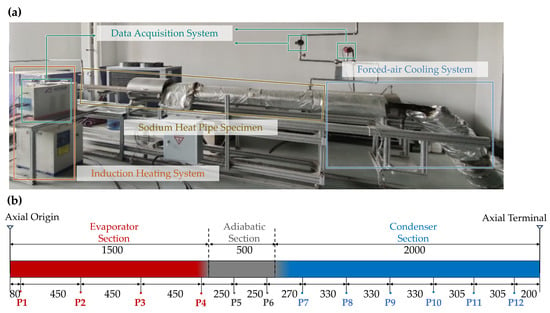
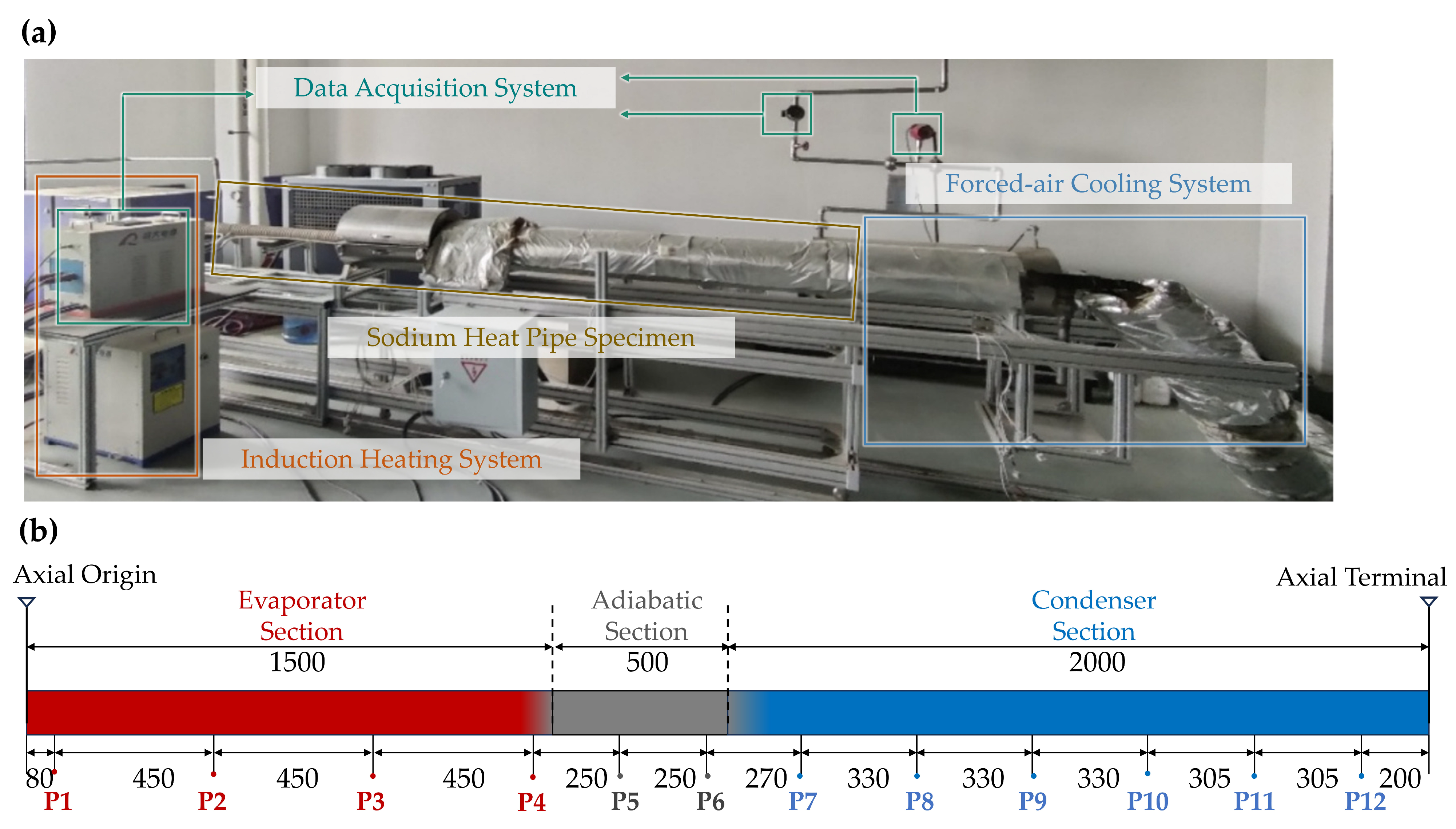
The optimization model is based on a companion steady-state power-test campaign of 183 high-temperature sodium heat pipes manufactured by the Shanghai Nuclear Engineering Research and Design Institute (SNERDI), of which 139 satisfied the screening criteria. All 139 valid heat pipes shared the same common nominal geometry and wick specification. The rated test condition was an adiabatic-section temperature of 700 °C with a total heat load of 4 kW. Figure 1a documents the batch-test facility and its principal subsystems, including induction heating, forced-air cooling, and data acquisition. Figure 1b gives the common nominal axial section lengths and the P1–P12 measurement locations used to establish the engineering reference.
Figure 1.
Experimental anchor and common nominal sodium heat-pipe configuration. (a) Batch-test apparatus with induction heating, forced-air cooling, data acquisition, and the sodium heat-pipe specimen; (b) common nominal axial section lengths and P1–P12 measurement locations. Dimensions are in mm.
The common nominal 316-stainless-steel configuration has a total length of 4.0 m, an outer diameter of 19 mm, and an inner wall diameter of 17 mm. The 1.5 m evaporator, 0.5 m adiabatic section, and 2.0 m condenser correspond directly to the axial geometry used in the model. The composite screen wick has a nominal porosity of 0.70, and the 1.2 mm radial wick allowance gives the 14.6 mm reference vapor-core diameter. These common construction data define the structural reference and optimization bounds. The manufactured batch fixes the nominal geometry, rated boundary condition, and reference resistance scale; subsequent prototype manufacture and power testing will evaluate the redesigned geometries.
The design vector comprises outer diameter , vapor-core diameter , evaporator length , condenser length , and wick porosity :
As detailed in Table 2, only these five structural parameters are varied within the design bounds, while their nominal reference values anchor the normalization, sensitivity analysis, feasibility sampling, and candidate assessment. Both the reference configuration and feasible scan points seed the endpoint and Pareto searches. Table 3 summarizes the constant material and model parameters together with the rated operating and cooling boundaries, including the fixed 4 kW total heat load, that remain outside the optimization vector.
Table 2.
Common nominal structural reference and optimization bounds.
Table 3.
Primary model parameters and rated operating/cooling boundary conditions.
2.2. Mass and Thermal-Resistance Objectives
The first objective, total structural mass , is the sum of the container wall, solid-wick matrix, and original working fluid masses. Rather than detailing fundamental geometric derivations, the component masses can be directly expressed as a function of the primary design variables, the fixed adiabatic length , and their respective material densities:
Within this reduced mass model, increasing porosity replaces part of the dense solid-wick matrix with lower-density liquid sodium. At the common nominal configuration, the calculated structural components yield a total mass of 2.4728 kg.
The second objective is the total thermal resistance , defined as the sum of the evaporator (), vapor (), condenser-internal (), condenser-external (), and bounded NCG components ():
Rather than relying on free empirical power-law extrapolations, the thermal model is anchored component by component to the common nominal configuration at the rated test condition. Candidate designs are evaluated using geometry-based and transport-based scaling relations. Using the subscript ref to denote the reference state, the equivalent radial resistances ( and ) are mapped via the radial path, equivalent conductivity , and active section lengths:
The vapor resistance relies on the effective flow length and scales with the fifth power of the vapor-core diameter ratio, while the condenser-external resistance scales with the external convection coefficient and area :
For a fixed retained amount of NCG, reducing the available condenser vapor volume increases the mean gas concentration. The inverse condenser-vapor-volume ratio is therefore used as a surrogate for NCG severity. To limit extrapolation beyond the response envelope supported by the experimental regime, the bounded NCG severity factor is clamped to an experimentally constrained interval of 0.70–1.35:
This reference-anchored formulation provides a consistent resistance scale throughout the design bounds.
2.3. Eight-Constraint Feasible Domain
The feasibility domain is defined using a standard non-positive formulation , where the aggregate residual must satisfy a numerical tolerance of . The final formulation incorporates eight nonlinear constraints detailed in Table 4: minimum wick thickness, five heat-transfer limits, thin-wall hoop stress, and a unified guide-contact/heat-leak constraint.
Table 4.
Nonlinear physical constraints used in the final formulation.
Consistent with the thermal-resistance model, the five heat-transfer limits are mapped from the rated reference capacities (summarized in Table 5) using geometric and transport scales. For the capillary branch, the porosity-dependent wick properties are coupled to the vapor- and liquid-pressure drops:
Table 5.
Calculated reference heat-transfer capacities of the common nominal configuration at the rated test condition.
Here, the vapor-core and wick flow areas are obtained from the candidate section geometry, and the capillary transport scale is the positive solution of the pressure balance. The candidate capillary capacity and the other four transport limits are then reference-normalized as follows:
For structural integrity and installation compatibility, the thin-wall hoop stress is evaluated together with a unilateral mid-span guide-contact model. Under uniformly distributed self-weight, contact is activated only when the free deflection exceeds the guide clearance:
The same relations evaluated at the nominal reference define the reference reaction. The adopted installation parameters are a hot-state modulus of 130 GPa, a guide clearance of 0.012 m, an allowable reaction of 9.25595 N, reference and allowable heat-leak fractions of 0.025 and 0.0275, and a contact exponent of 1/3. The resulting guide reaction and heat leakage are combined through the eighth constraint reported in Table 4. Contact-induced heat leakage enters only this constraint and is not added to the total thermal resistance. The fixed-airflow reformulation and adopted contact heat-leak-fraction bracket are documented in Supplementary Section S1.
2.4. Uncertainty, Error Sources, and Validation Hierarchy
The experimental reference inherits the measurement uncertainty of the companion batch-test platform. K-type wall-temperature measurements have an accuracy limit of ±1.5 °C, and the cooling-flow measurement has an accuracy limit of ±1.0%. These quantities characterize the rated reference state. Numerical optimization error and model-form uncertainty are evaluated separately.
Model-parameter uncertainty is examined through 300 simultaneous front-conditioned perturbation trials. In each trial, independent multipliers are sampled uniformly from 0.95 to 1.05 and applied to the NCG reference resistance, guide-contact heat-leak coefficient, air-side heat-transfer coefficient, liquid-sodium conductivity, solid-wick conductivity, reference radial-resistance components, and reference vapor resistance. The saved dense ε-constraint designs are then re-evaluated, after which feasibility, nondominance, and lower-convex-envelope gaps are recomputed. This procedure quantifies the local sensitivity of the verified front to simultaneous coefficient changes in the prescribed model.
Numerical error is controlled independently by a nonlinear feasibility tolerance of 1 × 10⁻⁵, common re-evaluation of all method outputs with the same model, duplicate and dominance filtering, and a dense 121-level ε-constraint reference. Unsupported status is determined from the ε-constraint front and its lower convex envelope. Additional NCG bound, exponent, and response-form sensitivity reported in Supplementary Section S4 quantifies the model-form dependence of the reported topology.
3. Hybrid Optimization Framework
3.1. Proposed GA-Globalized Augmented-Tchebycheff SQP
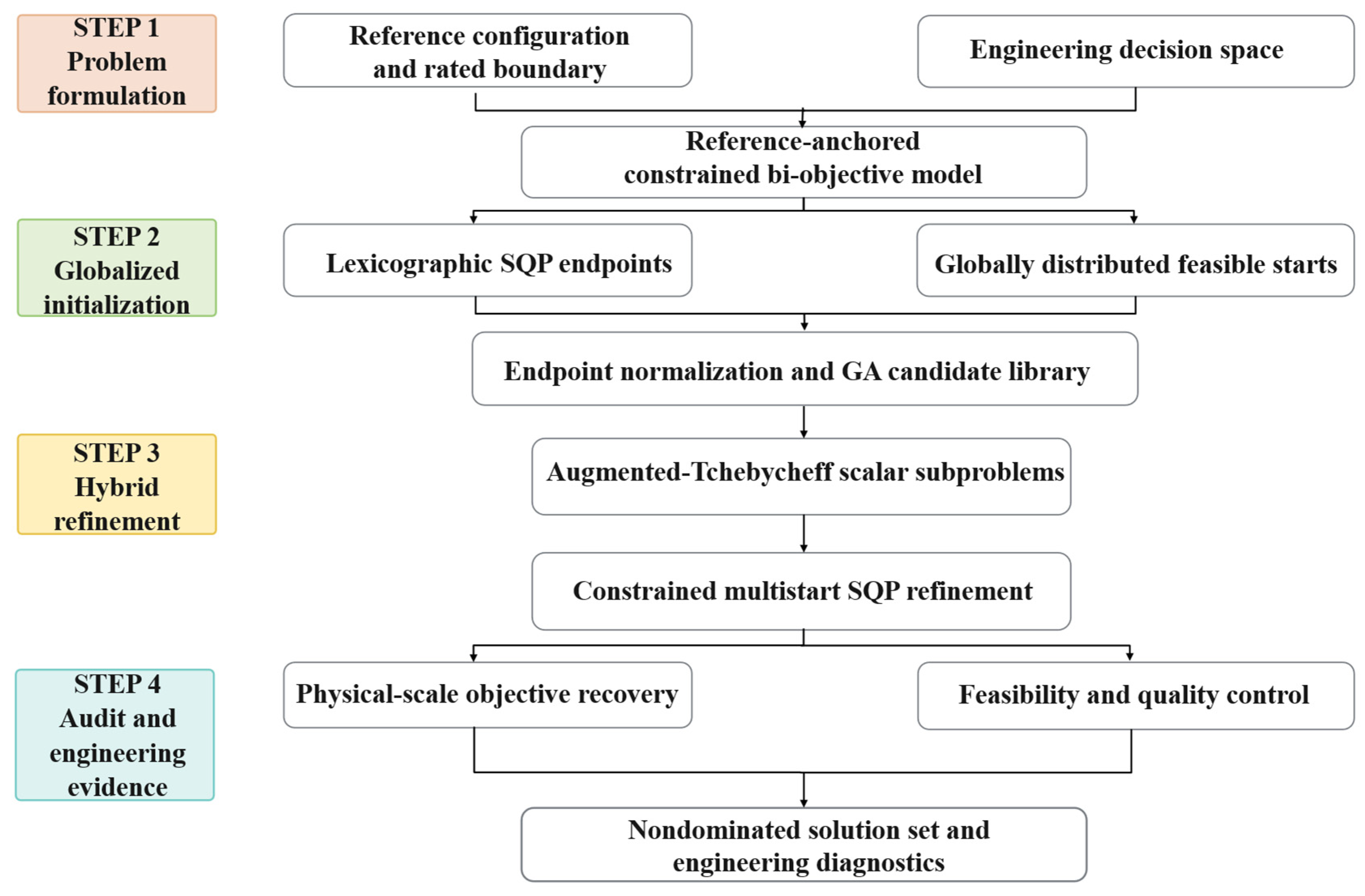
The computational workflow comprises six operations with distinct inputs and outputs. (1) Reference-centered sampling diagnoses feasibility and supplies physically distributed starting points. (2) Lexicographic SQP constructs the two single-objective endpoints and defines objective normalization. (3) The original GA explores the feasible domain and returns a global candidate library; its unrefined nondominated set is retained as a comparison. (4) Augmented-Tchebycheff scalarization formulates subproblems that can access nonconvex Pareto regions beyond the linear weighted-sum front. (5) Multistart SQP refines each scalarized subproblem to a common constrained tolerance and returns the proposed hybrid front. (6) A dense ε-constraint calculation independently benchmarks coverage and classifies unsupported points.
The two endpoint problems use the same bounds and eight-constraint feasible set. Lexicographic SQP fixes the primary optimum before minimizing the other objective. The lightweight endpoint minimizes total mass :
The low-resistance endpoint minimizes total thermal resistance :
The bi-objective vector combines total mass and total thermal resistance:
The feasible set uses lower- and upper-bound vectors and ; is nonlinear constraint :
Each endpoint is obtained in two SQP stages. The first stage minimizes the designated primary objective over the common bounded feasible set. The second stage constrains that primary value within the numerical tolerance and minimizes the other objective, eliminating a weak endpoint that could be improved without sacrificing the primary optimum. The resulting minimum-mass and minimum-resistance designs define the ideal and endpoint-based scaling ranges used by the augmented-Tchebycheff objectives, supply the two extreme target solutions, and provide common anchors for the original GA, weighted-sum, hybrid, and ε-constraint comparisons.
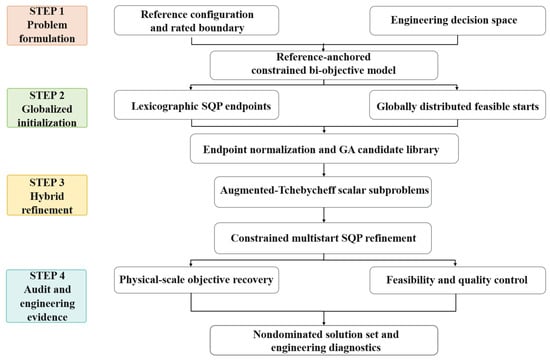
Figure 2 organizes these six operations into four connected blocks: problem formulation; globalized initialization through reference-centered sampling, endpoint construction, and GA candidate generation; hybrid refinement through augmented-Tchebycheff subproblems and multistart SQP; and audit and engineering interpretation through common filtering and candidate recovery. The ε-constraint calculation is an independent benchmark and does not generate candidates for the proposed hybrid front.
Figure 2.
Proposed genetic-algorithm (GA)-globalized augmented-Tchebycheff sequential quadratic programming (SQP) workflow.
The 420 reference-centered scan supports feasibility diagnosis and candidate initialization, after which the endpoint and hybrid optimization stages construct the Pareto sets. The hybrid GA stage uses independent random seeds. The original-GA comparison uses 120 members, at most 1500 generations, seed 6203, and the two SQP endpoints in its initial and audited candidate sets. Its initial population combines the endpoint designs with feasible scan seeds and random designs, allowing simultaneous exploration of all five design variables under the common nonlinear constraints. After common re-evaluation, duplicate removal, and nondominance filtering, the direct GA front is retained as the unrefined global-search baseline. Feasible GA designs also supply spatially distributed candidate rows for the subsequent scalarized refinement. The same endpoints anchor the hybrid set, so all four methods span a common endpoint interval.
Let and denote endpoint-normalized mass and resistance deviations. For weight vector = (, ) with and small augmentation coefficient , the scalar hybrid subproblem is
Each augmented-Tchebycheff target is solved as a constrained local problem. The feasible candidate library is ranked by endpoint-normalized augmented-Tchebycheff merit for the current target, and the best-ranked designs are used as SQP starts. When available, the previously accepted feasible solution is added as a continuation start to improve continuity between neighboring targets. Every start is optimized under the same bounds, eight nonlinear constraints, and feasibility tolerance, and the feasible result with the lowest scalar merit is retained. The two endpoints are inserted directly from the lexicographic SQP stage instead of being re-estimated by interior target solves. Thus, the original GA supplies distributed global candidates, whereas multistart SQP performs the constraint-accurate local refinement that constructs the hybrid front. The dense ε-constraint calculation remains an independent coverage and unsupported-point benchmark.
For comparison, normalized weighted-sum SQP uses scalar weight ; , , , and are endpoint-derived normalization limits:
The hybrid search produced 119 feasible nondominated solutions after re-evaluation, duplicate removal, and global nondominance filtering. It recovered 23 of the 27 ε-constraint-confirmed unsupported points, including 7/11 points in Segment 1 and 16/16 in Segment 2.
3.2. Comparison Methods and Quality Control
The four-point sets serve different evidence roles. The endpoint-seeded original GA supplies global candidates, and its direct interior front measures the value of local refinement. Weighted-sum SQP provides the supported-front baseline. The proposed hybrid method performs the final nonconvex exploration. The dense ε-constraint front and its lower convex envelope provide the independent numerical reference. Every set is re-evaluated with the common model and passes the same feasibility, duplicate, endpoint-range, and global nondominance filters. Dominance leakage—the presence of an ε-constraint point dominated by another audited set—is checked as a reference-consistency diagnostic.
4. Results and Discussion
4.1. Feasible Domain and Endpoint Designs
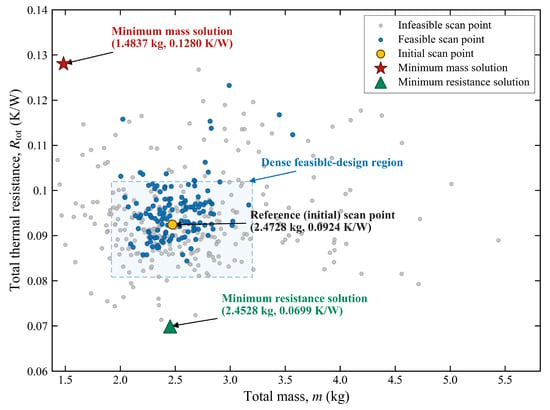
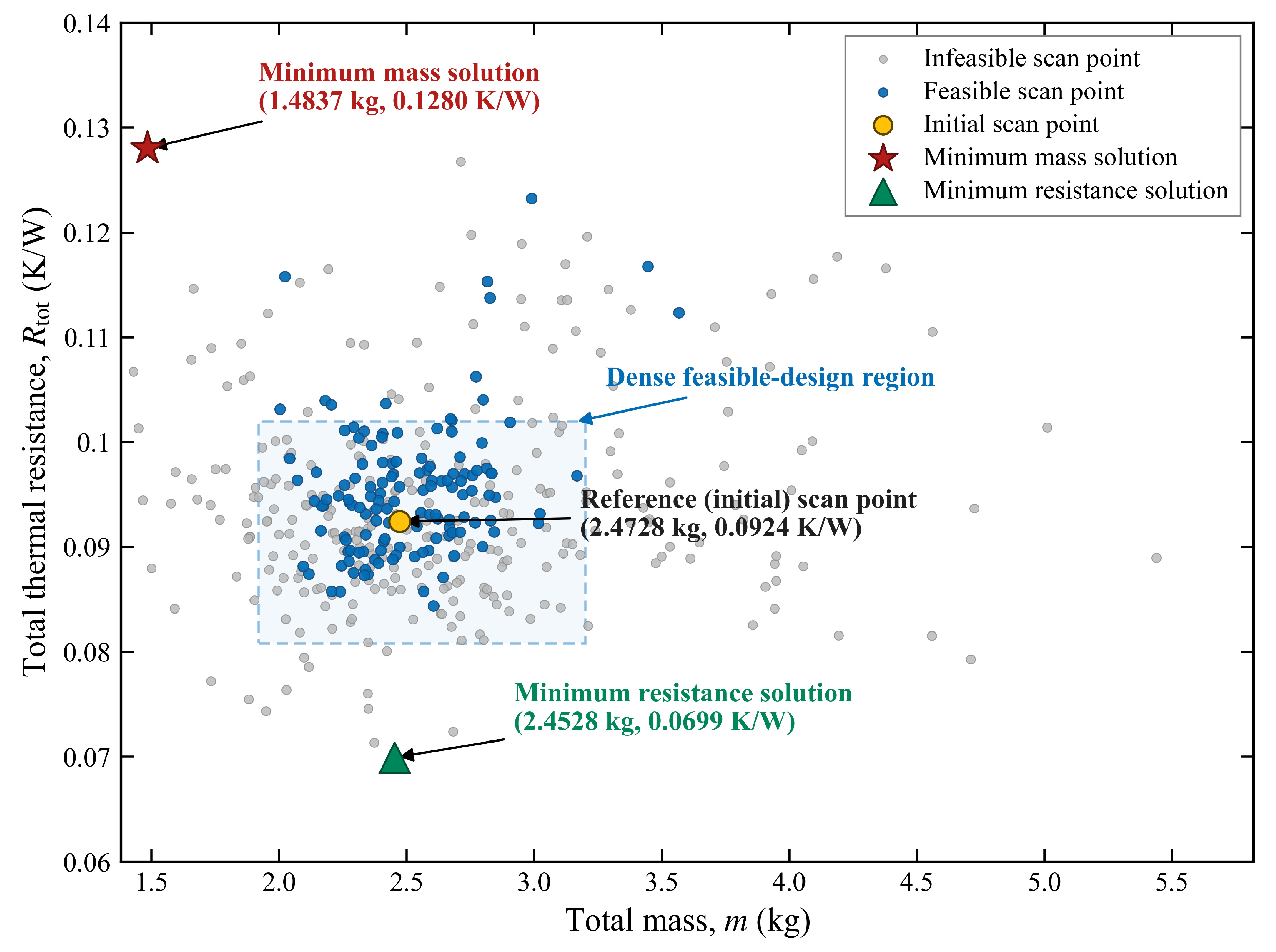
The reference-anchored 420 sample scan identified 134 feasible designs (31.9%). The eighth constraint reduces the feasible domain for long, low-resistance designs, while compact designs remain governed mainly by wick geometry, capillary return, and entrainment. Figure 3 shows the feasible landscape, the reference (initial) scan point, the dense feasible-design region, and the two lexicographic SQP endpoints.
Figure 3.
Reference-centered feasibility scan in the mass–resistance objective space. Gray circles denote infeasible scan points, blue circles denote feasible scan points, the yellow circle marks the reference (initial) scan point, and the red star and green triangle mark the minimum-mass and minimum-resistance lexicographic SQP endpoints, respectively. The dashed rectangle indicates the dense feasible-design region.
The common nominal reference is feasible under all eight constraints, with maximum normalized constraint . Its calculated mass and total resistance are 2.4728 kg and 0.0924 K/W.
Table 6 compares the reference with the two SQP endpoints. The minimum-mass endpoint is 1.4837 kg at 0.1280 K/W, whereas the minimum-resistance endpoint is 0.0699 K/W at 2.4528 kg.
Table 6.
Reference design and SQP single-objective endpoint designs.
At the minimum-mass endpoint, the geometry, capillary, and entrainment constraints are nearly active, while the guide remains disengaged. At the minimum-resistance endpoint, the geometry, entrainment, and eighth guide-contact/heat-leak constraints are nearly active. The contrast shows that compactness is transport-limited, whereas the low-resistance extreme is also installation-limited.
Relative to the common nominal reference, the minimum-mass endpoint reduces mass by 40.0% but increases resistance by 38.5%. The minimum-resistance endpoint lowers resistance by 24.4% and reduces mass by 0.8%.
The lexicographic SQP endpoints converged in 48 and 54 function evaluations for the minimum-mass and minimum-resistance problems, respectively. The secondary lexicographic stage removes solutions that share the primary optimum but are dominated in the secondary objective, yielding well-defined endpoints for normalization and front anchoring.
The minimum-mass endpoint is obtained by shortening both active sections and approaching compact radial geometry, but its resistance rises to 0.1280 K/W and the guide remains disengaged. The minimum-resistance endpoint reaches 0.0699 K/W at 2.4528 kg, with the guide-reaction branch of the eighth constraint controlling the installation limit. These endpoint mechanisms explain why neither extreme is an obvious general design choice.
The common nominal configuration establishes batch-level operability. As reported in Table 6, the minimum-resistance endpoint has a slightly lower mass than the reference design (2.4528 versus 2.4728 kg) while reducing the modeled total thermal resistance from 0.0924 to 0.0699 K/W. Under the prescribed model and constraints, this endpoint therefore dominates the reference design, indicating that coordinated dimensional changes may improve both modeled objectives. This model-based screening result identifies a coordinated low-resistance geometry for targeted prototype manufacture and rated power testing.
4.2. Four-Method Pareto Comparison and Unsupported Regions
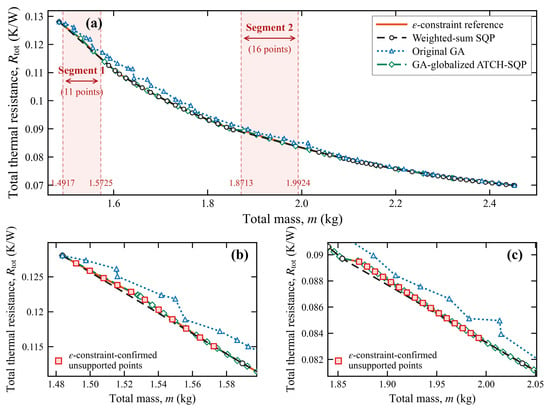
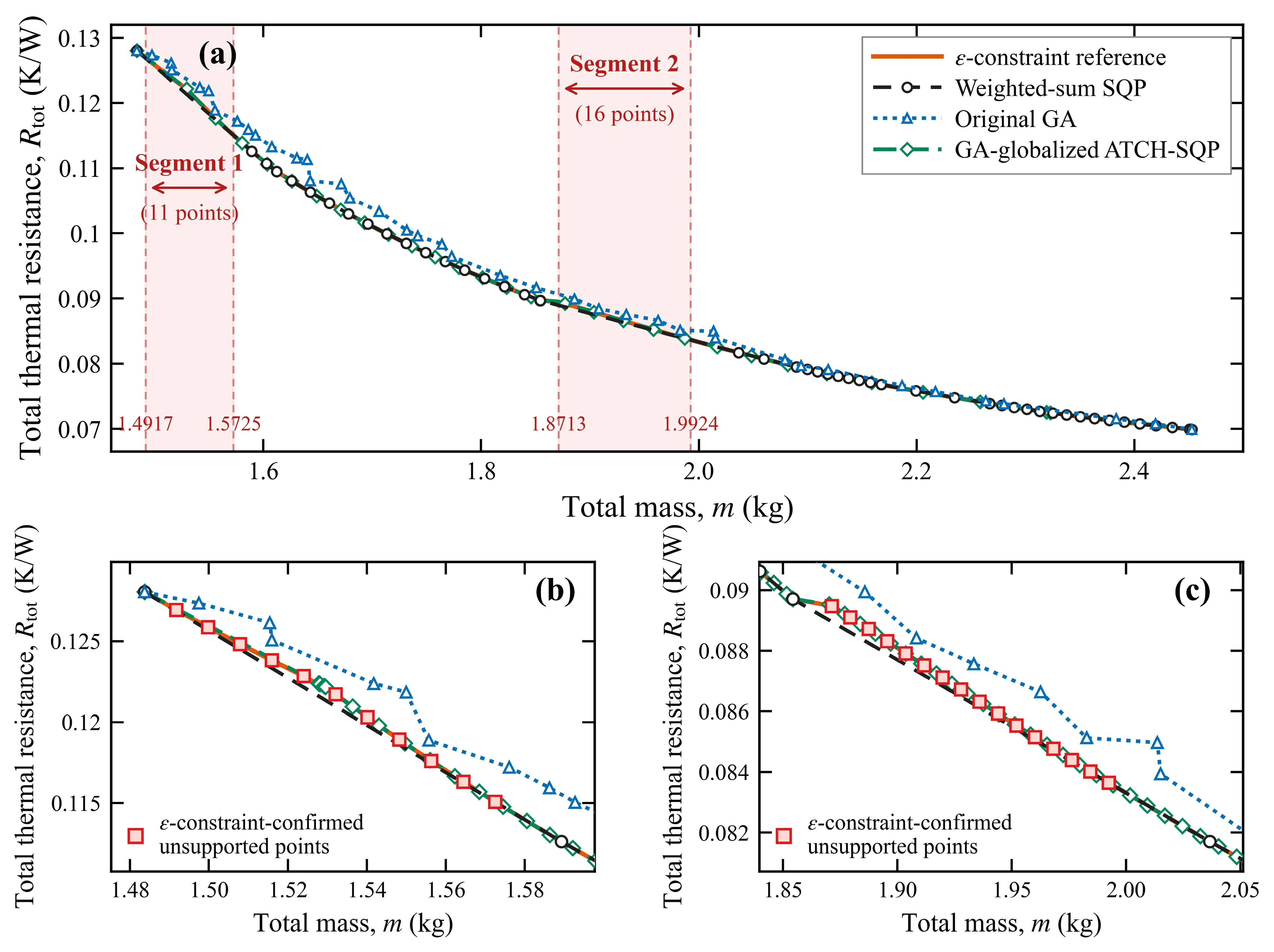
Figure 4 compares the endpoint-seeded original GA, the proposed hybrid method, weighted-sum SQP, and the high-resolution ε-constraint numerical reference. Panel (a) shows the complete objective range, highlights the two unsupported mass intervals, and thins only hybrid markers for legibility. Panels (b) and (c) enlarge Segment 1 and Segment 2, respectively, and display every available point; red squares mark the ε-constraint-confirmed unsupported reference points.
Figure 4.
Four-method Pareto comparison: (a) complete objective range; (b) ε-constraint-confirmed unsupported Segment 1; and (c) ε-constraint-confirmed unsupported Segment 2. The original GA uses a 120-member population and at most 1500 generations, yielding 40 audited points including the two SQP endpoints. High-resolution datasets contain 50 unique points from 121 weighted-sum levels, 119 hybrid points, and 120 unique points from 121 ε-constraint levels. Panel (a) draws complete curves but thins hybrid markers; panels (b,c) show every point. Red squares identify unsupported ε-constraint reference points.
The 40-point original-GA set represents both SQP endpoints to numerical tolerance (absolute discrepancies ≤3.2 × 10⁻⁷ kg and ≤6.2 × 10⁻¹¹ K/W). Across the interior, its direct approximation is less accurate than weighted-sum SQP over much of the supported front and contains uneven, displaced points. Isolated original-GA points are therefore insufficient to establish reliable nonconvex-front identification.
The high-resolution ε-constraint front identified 27 unsupported points: Segment 1 contains 11 points over 1.4917–1.5725 kg, and Segment 2 contains 16 points over 1.8713–1.9924 kg. The endpoint-seeded original GA solutions were retained as globally distributed starting candidates for augmented-Tchebycheff SQP subproblems. The resulting hybrid method generated 119 nondominated solutions, closely followed the ε-constraint reference, and recovered 23 of the 27 ε-constraint-confirmed unsupported points, whereas weighted-sum SQP omitted the interiors of both unsupported mass bands. The complete hybrid workflow provides the nonconvex exploration capability by combining distributed GA starts with constrained SQP refinement. Table 7 summarizes the distinct evidence roles and retained point-set metrics of the four methods. High-resolution verification of the two unsupported segments and the retained method-coverage audit are provided in Supplementary Sections S2 and S5, respectively.
Table 7.
Evidence roles and retained point-set metrics for the four methods.
The dense ε-constraint front and its lower convex envelope numerically verify two unsupported segments within the prescribed engineering model. The original GA and weighted-sum results establish comparison baselines, while the proposed hybrid result recovers the same regions through non-weighted-sum scalarization and globalized starts.
Pointwise attribution separates the mechanisms. Segment 1 contains 11 non-contacting points across the bounded-NCG transition. Segment 2 begins with activation of the unilateral guide-contact constraint, and all 16 points engage the guide; contact-induced heat leakage contributes only through the eighth constraint. Thus, the second unsupported region is associated with constraint activation rather than an added contact-resistance objective.
A front-conditioned perturbation screen applied 300 independent simultaneous ±5% input changes to the verified ε-constraint designs. The seven perturbed input groups were NCG reference resistance, guide-contact heat-leak coefficient, air-side heat-transfer coefficient, liquid conductivity, solid-wick conductivity, reference radial-resistance components, and reference vapor resistance; each multiplier was sampled from U(0.95, 1.05). Both unsupported mass bands persisted in 100% of the trials. The median maximum lower-convex-envelope gaps were 7.46 × 10⁻⁴ K/W for Segment 1 and 5.16 × 10⁻⁴ K/W for Segment 2. These results quantify the local coefficient sensitivity of the saved reference designs, while the reference-platform instrument limits characterize experimental measurement accuracy.
4.3. Parametric Sensitivity, Engineering Interpretation, and Model Scope
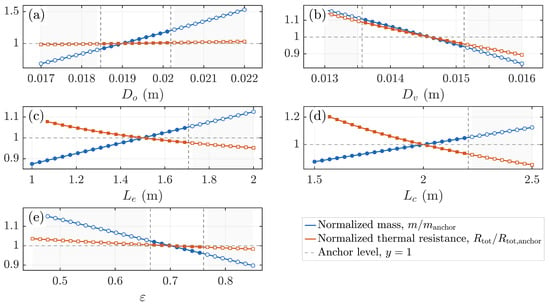
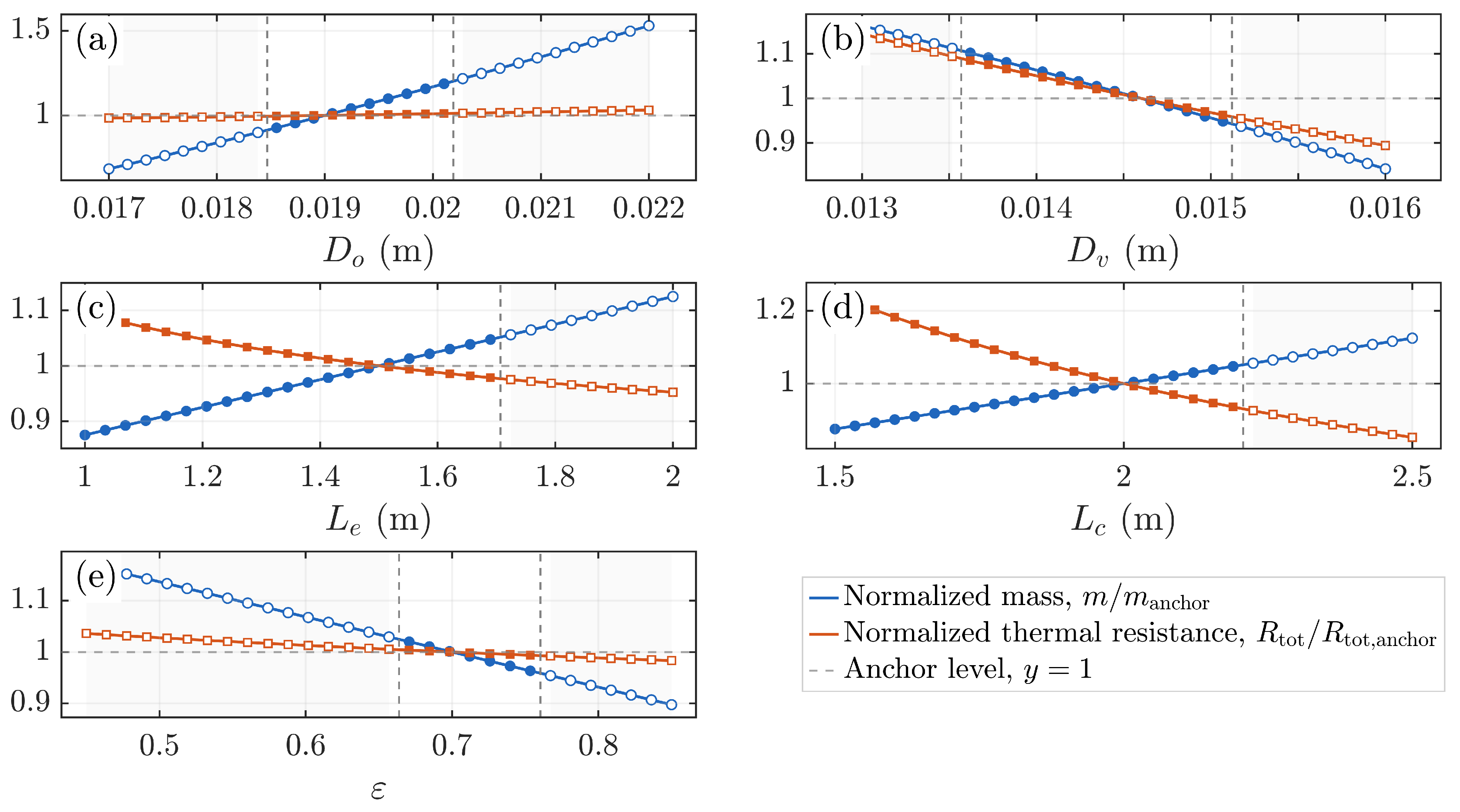
Each of the five structural variables is varied over 30 equally spaced values while the other four remain at the common nominal reference. The 150 evaluations quantify conditional local trends around the nominal design. Figure 5 reports the objective responses, and Table 8 summarizes the feasible intervals and dominant constraints.
Figure 5.
Reference-centered one-factor effects on normalized mass and resistance: (a) outer diameter; (b) vapor-core diameter; (c) evaporator length; (d) condenser length; and (e) wick porosity.
Table 8.
Reference-centered parametric-sensitivity summary.
At the common nominal configuration, total mass is 2.4728 kg and total resistance is 0.0924 K/W. Vertical reference markers distinguish downward and upward structural range expansion. The corresponding numerical ranges and dominant feasibility effects are summarized in Table 8.
Outer diameter, vapor-core diameter, and porosity primarily control feasibility, while evaporator and especially condenser lengths provide the strongest mass–resistance leverage. The one-factor trends provide local design guidance within the coupled five-variable selection process.
Outer and vapor-core diameters jointly determine wall, wick, and vapor-passage geometry; porosity controls wick transport and mass partition. Condenser length offers the strongest resistance lever with a mass cost, whereas evaporator length provides a smaller evaporator-side improvement. Candidate selection therefore evaluates the five variables jointly.
Stress remains a safety screen, while the eighth constraint limits installation load and contact-induced heat leakage. Candidate selection therefore combines the complete structural vector, its minimum constraint margin, and its position on the mass–resistance front.
Recent long-duration and prototype-scale studies [11,12] and startup and operating-characteristic studies [13,14] provide complementary evidence for fixed high-temperature heat-pipe configurations. The resulting mass–thermal-resistance trade-off is qualitatively consistent with previous optimization studies: Patel [16] examined the mass–resistance balance for satellite heat pipes, Jeong et al. [17] emphasized system-level trade-offs, and Tian et al. [18] jointly optimized thermal resistance, mass, and wick transport capacity. X-ray-based studies [21,22] add internal-state evidence for interpreting those fixed configurations. The present study extends this engineering line to coupled dimensional screening around a manufactured and power-tested sodium-heat-pipe batch, with an installation-related guide-contact constraint at the low-resistance extreme. The minimum-resistance endpoint slightly reduces both modeled mass and resistance relative to the nominal reference because the five dimensions change cooperatively. Together, these studies show that mass–resistance design must be interpreted within the working fluid, scale, boundary conditions, and constraint set used.
For engineering screening, each retained candidate should carry its complete five-variable specification and minimum constraint margin.
A focused set of candidates then advances to the same rated power-test screening used for the common nominal configuration. Optimization narrows prototype selection and guides dimensional refinement, and the rated test provides the final engineering decision basis.
The inverse-volume NCG term is a first-order fixed-inventory surrogate: smaller condenser vapor volume raises gas concentration and blanketing severity, while the prescribed bounds limit extrapolation. Alternative NCG forms can change the number and allocation of unsupported segments. Contact clearance, hot stiffness, guide reaction, and heat-leak budgets also require calibration. Fine-scale inter-method differences are therefore subject to the uncertainty of the surrogate contact model and should not be treated as final physical predictions until these inputs are calibrated and experimentally validated. The NCG model-form sensitivity is reported in Supplementary Section S4.
5. Conclusions
This study reframed heat-pipe redesign around the common nominal configuration of a power-tested batch. The main conclusions are:
- The common nominal configuration of 139 valid heat pipes anchors the model at 700 °C and 4 kW total heat load. Five structural variables are optimized within reference-centered bounds.
- The eight-constraint scan retained 134/420 feasible designs. SQP produced a 1.4837 kg minimum-mass design at 0.1280 K/W and a 0.0699 K/W minimum-resistance design at 2.4528 kg. Contact-induced heat leakage enters only the eighth constraint.
- The proposed GA-globalized augmented-Tchebycheff SQP method converts original GA solutions into globally distributed starts for non-weighted-sum scalar subproblems and refines them with constrained SQP. It produced 119 nondominated points and recovered 23/27 ε-constraint-confirmed unsupported points.
- The four-method comparison shows that the endpoint-seeded original GA provides global candidates but has lower direct interior-front accuracy, weighted-sum SQP is effective on the supported front but omits the unsupported interiors, and the hybrid method closely follows the ε-constraint numerical reference.
- Two unsupported regions arise from the bounded-NCG response and unilateral guide-contact activation in the prescribed model. Their persistence under the reported coefficient perturbations supports their use as targeted engineering hypotheses for prototype evaluation. The practical output is a reduced set of fully specified candidate geometries and active-constraint information that guides prototype manufacture, calibration of the NCG/contact submodels, and subsequent rated power-test validation.
Supplementary Materials
The following supporting information can be downloaded at: https://www.mdpi.com/article/10.3390/machines14101092/s1, The Supplementary Materials include the following tables: Table S1: Fixed-airflow guide-contact heat-leak-fraction bracket at 12 mm guide clearance; Table S2: Two numerically verified unsupported segments of the prescribed scenario model; Table S3: Pointwise evidence in the contact-induced segment; Table S4: Results of the front-conditioned perturbation screen under simultaneous ±5% input changes; Table S5: NCG bounds, exponent, and response-form sensitivity on the saved ε-constraint designs; Table S6: Retained method-comparison metrics relative to the 27-point ε-constraint reference.
Author Contributions
Conceptualization, H.W., S.J. and M.L.; methodology, H.W., Q.M., J.G. and P.Z.; software, H.W., Q.M. and Y.Z.; validation, H.W., J.G. and P.Z.; formal analysis, H.W. and Y.Z.; investigation, H.W., P.Z. and Y.Z.; resources, Q.M., J.G., and Q.Z.; data curation, H.W., P.Z. and Y.Z.; writing—original draft preparation, H.W.; writing—review and editing, H.W., P.Z., Y.Z. and M.L.; visualization, H.W., Y.Z.; supervision, M.L., Q.Z. and S.J.; project administration, M.L., S.J. and Q.Z.; funding acquisition, S.J. and M.L. All authors have read and agreed to the published version of the manuscript.
Funding
This research was financially supported by the Shanghai Basic Research “Explorer Program” (Grant No. 24TS1413300), administered by the Science and Technology Commission of Shanghai Municipality.
Data Availability Statement
The data presented in this study are available from the corresponding author upon reasonable request.
Conflicts of Interest
Authors Qiming Men and Jiale Gu were employed by company Shanghai Nuclear Engineering Research and Design Institute Co., Ltd., The remaining authors declare that the research was conducted in the absence of any commercial or financial relationships that could be construed as a potential conflict of interest.
Nomenclature
| Symbol | Definition/unit | Symbol | Definition/unit |
| Outer diameter (m) | Inner wall diameter (m) | ||
| Vapor-core diameter (m) | Evaporator length (m) | ||
| Adiabatic-section length (m) | Condenser length (m) | ||
| Effective vapor-flow length (m) | Wick porosity (-) | ||
| Wall thickness (m) | Wick thickness (m) | ||
| Vapor-core area (m2) | Wick flow area (m2) | ||
| External condenser area (m2) | Condenser vapor volume (m3) | ||
| Total structural mass (kg) | Cooling-air mass flow (kg/s) | ||
| Total heat load (W) | Total thermal resistance (K/W) | ||
| Evaporator resistance (K/W) | Vapor-flow resistance (K/W) | ||
| Internal condenser resistance (K/W) | External condenser resistance (K/W) | ||
| NCG-associated resistance (K/W) | External convection coefficient (W/m2K) | ||
| Liquid-sodium conductivity (W/mK) | Solid-wick conductivity (W/mK) | ||
| Equivalent radial conductivity (W/mK) | Sodium saturation pressure (Pa) | ||
| Latent heat of vaporization (J/kg) | Liquid viscosity (Pa·s) | ||
| Liquid surface tension (N/m) | Liquid/vapor density (kg/m3) | ||
| Wick permeability (m2) | Effective pore radius (m) | ||
| Hot-state Young’s modulus (Pa) | Second moment of area (m4) | ||
| Mid-span deflection (m) | Guide clearance (m) | ||
| Guide reaction (N) | Normalized inequality constraint (-) | ||
| Objective weight (-) | Augmentation coefficient (-) | ||
| ε-constraint level | Reference-state subscript | ||
| Wall density (kg/m3) | Solid-wick density (kg/m3) | ||
| Container-wall volume (m3) | Wick-region volume (m3) | ||
| Capillary heat-transfer limit (W) | Sonic heat-transfer limit (W) | ||
| Entrainment heat-transfer limit (W) | Boiling heat-transfer limit (W) | ||
| Viscous heat-transfer limit (W) | Bounded NCG resistance scaling factor (-) | ||
| Rated operating temperature (K) | Cooling-air inlet temperature (K) | ||
| Cooling-air specific heat capacity (J/(kg·K)) | Reference external convection coefficient (W/(m2·K)) | ||
| Thin-wall hoop stress (Pa) | Allowable stress (Pa) | ||
| Endpoint-normalized objective deviation (-) | Lower and upper design-bound vectors | ||
| Endpoint mass limits used for normalization (kg) | Endpoint resistance limits used for normalization (K/W) |
References
- Faghri, A. Review and Advances in Heat Pipe Science and Technology. J. Heat Transf. 2012, 134, 123001. [Google Scholar] [CrossRef] [Scilit]
- Jouhara, H.; Chauhan, A.; Nannou, T.; Almahmoud, S.; Delpech, B.; Wrobel, L.C. Heat Pipe Based Systems—Advances and Applications. Energy 2017, 128, 729–754. [Google Scholar] [CrossRef] [Scilit]
- Zhang, Z.; Zhang, Z.; Wang, C.; Guo, K.; Tian, W.; Su, G.; Qiu, S. Heat Pipe-Cooled Reactors: A Comprehensive Review of Evolution, Challenges, Research Status, and Outlook. Renew. Sustain. Energy Rev. 2025, 213, 115486. [Google Scholar] [CrossRef] [Scilit]
- Chen, Q.; Zhou, J.; Zhou, G.; Cheng, K.; Huai, X.; Wei, G. A Comprehensive Review of Thermal Performance Improvement of High-Temperature Heat Pipes. J. Therm. Sci. 2024, 33, 625–647. [Google Scholar] [CrossRef] [Scilit]
- Yilgor, I.; Sellers, Z.D.; Hartvigsen, J.L.; Sweetland, K.M.; Huang, P.-H.; Ahn, T.; Seo, J.; Manera, A.; Petrov, V.; Anderson, M.; et al. Recent Developments and Findings of Heat Pipe Experiments for Microreactor Applications. Nucl. Technol. 2025, 211, 905–939. [Google Scholar] [CrossRef] [Scilit]
- Wahlquist, S.; Hansel, J.; Sabharwall, P.; Ali, A. A Critical Review of Heat Pipe Experiments in Nuclear Energy Applications. Nucl. Sci. Eng. 2023, 197, 719–752. [Google Scholar] [CrossRef] [Scilit]
- Busse, C.A. Theory of the Ultimate Heat Transfer Limit of Cylindrical Heat Pipes. Int. J. Heat Mass Transf. 1973, 16, 169–186. [Google Scholar] [CrossRef] [Scilit]
- Tian, Z.; Zhang, J.; Wang, C.; Guo, K.; Liu, Y.; Zhang, D.; Tian, W.; Qiu, S.; Su, G.H. Experimental Evaluation on Heat Transfer Limits of Sodium Heat Pipe with Screen Mesh for Nuclear Reactor System. Appl. Therm. Eng. 2022, 209, 118296. [Google Scholar] [CrossRef] [Scilit]
- Ma, Y.; Yu, H.; Wang, X.; Zhang, Y.; Huang, S.; Wang, C.; Su, G.H.; He, X.; Zhong, R.; Deng, J.; et al. Experimental Study on Sodium Screen-Wick Heat Pipe Capillary Limit. Appl. Therm. Eng. 2023, 227, 120397. [Google Scholar] [CrossRef] [Scilit]
- Yilgor, I.; Shi, S. Scaling Laws for Two-Phase Flow and Heat Transfer in High-Temperature Heat Pipes. Int. J. Heat Mass Transf. 2022, 189, 122688. [Google Scholar] [CrossRef] [Scilit]
- Su, Z.; Kuang, Y.; Li, Z.; Wang, K.; Wang, H. Experimental Study on 100 Hour-Term Performance of High-Temperature Sodium Heat Pipes. Ann. Nucl. Energy 2024, 209, 110799. [Google Scholar] [CrossRef] [Scilit]
- Tian, Z.; Zhang, J.; Wang, C.; Guo, K.; Tian, W.; Qiu, S.; Su, G. Design, Fabrication, and Comparative Analysis of Prototype High-Temperature Heat Pipes Charged with Sodium for Heat Pipe Cooled Reactor NUSTER-100. Appl. Therm. Eng. 2025, 258, 124731. [Google Scholar] [CrossRef] [Scilit]
- Xu, H.; Zheng, Y.; Wei, Z.; Zhu, Y.; Gao, Y.; Qian, J.; Wang, J.; Xu, S.; Zhang, H. Startup Characteristics of the Large Length–Diameter Ratio High-Temperature Heat Pipe. Appl. Therm. Eng. 2024, 248, 123237. [Google Scholar] [CrossRef] [Scilit]
- Zhao, H.; Zhang, Z.; Wang, C.; Qiu, S.; Tian, W.; Su, G. Operation Characteristics Analysis of High Temperature Alkali Metal Heat Pipe Based on OpenFOAM. Appl. Therm. Eng. 2025, 258, 124552. [Google Scholar] [CrossRef] [Scilit]
- Rao, R.V.; More, K.C. Optimal Design of the Heat Pipe Using TLBO (Teaching–Learning-Based Optimization) Algorithm. Energy 2015, 80, 535–544. [Google Scholar] [CrossRef] [Scilit]
- Patel, V.K. An Efficient Optimization and Comparative Analysis of Ammonia and Methanol Heat Pipe for Satellite Application. Energy Convers. Manag. 2018, 165, 382–395. [Google Scholar] [CrossRef] [Scilit]
- Jeong, M.J.; Kobayashi, T.; Yoshimura, S. Multidimensional Visualization and Clustering for Multiobjective Optimization of Artificial Satellite Heat Pipe Design. J. Mech. Sci. Technol. 2007, 21, 1964–1972. [Google Scholar] [CrossRef] [Scilit]
- Tian, Z.; Liu, Y.; Wang, C.; Guo, K.; Zhang, D.; Tian, W.; Qiu, S.; Su, G.H. Single/Multi-Objective Optimization and Comparative Analysis of Liquid-Metal Heat Pipe. Int. J. Energy Res. 2022, 46, 17521–17539. [Google Scholar] [CrossRef] [Scilit]
- Zhang, M.; Miao, Q.; Zhang, S.; Ma, Y.; Ding, S.; Zhang, Z.; Gu, Z. Experimental Study of Non-Condensable Gas Effects on Sonic Limit of Sodium Heat Pipe. Appl. Therm. Eng. 2023, 232, 120970. [Google Scholar] [CrossRef] [Scilit]
- Kim, H.; Seo, J.; Hassan, Y.A.; Moon, C.; Jeong, S.; Melsheimer, T. Sodium Heat Pipe Startup and Non-Condensable Gas Interactions. Phys. Fluids 2025, 37, 027126. [Google Scholar] [CrossRef] [Scilit]
- Huang, P.-H.; Ahn, T.; Manera, A.; Petrov, V. Investigation of Key Parameters for the Operation of a Sodium Heat Pipe with Visualization Using X-ray Radiography. Appl. Therm. Eng. 2024, 236, 121867. [Google Scholar] [CrossRef] [Scilit]
- Tillman, E.M.; Moreira, T.A.; Nellis, G.F.; Anderson, M.H. High-Resolution Internal Temperature Measurements and X-ray Imaging of Sodium Heat Pipes. Appl. Therm. Eng. 2025, 271, 126296. [Google Scholar] [CrossRef] [Scilit]
- Jiang, L.; Tang, Y.; Pan, M. Effects of Bending on Heat Transfer Performance of Axial Micro-Grooved Heat Pipe. J. Cent. South Univ. Technol. 2011, 18, 580–586. [Google Scholar] [CrossRef] [Scilit]
- Jeong, M.J.; Im, J.; Lee, S.; Cho, H.K. Multiphysics Analysis of Heat Pipe Cooled Microreactor Core with Adjusted Heat Sink Temperature for Thermal Stress Reduction Using OpenFOAM Coupled with Neutronics and Heat Pipe Code. Front. Energy Res. 2023, 11, 1213000. [Google Scholar] [CrossRef] [Scilit]
- Marler, R.T.; Arora, J.S. Survey of Multi-Objective Optimization Methods for Engineering. Struct. Multidiscip. Optim. 2004, 26, 369–395. [Google Scholar] [CrossRef] [Scilit]
- Boggs, P.T.; Tolle, J.W. Sequential Quadratic Programming. Acta Numer. 1995, 4, 1–51. [Google Scholar] [CrossRef] [Scilit]
- Deb, K.; Pratap, A.; Agarwal, S.; Meyarivan, T. A Fast and Elitist Multiobjective Genetic Algorithm: NSGA-II. IEEE Trans. Evol. Comput. 2002, 6, 182–197. [Google Scholar] [CrossRef] [Scilit]
- Marler, R.T.; Arora, J.S. The Weighted Sum Method for Multi-Objective Optimization: New Insights. Struct. Multidiscip. Optim. 2010, 41, 853–862. [Google Scholar] [CrossRef] [Scilit]
- Mavrotas, G. Effective Implementation of the ε-Constraint Method in Multi-Objective Mathematical Programming Problems. Appl. Math. Comput. 2009, 213, 455–465. [Google Scholar] [CrossRef] [Scilit]
- Steuer, R.E.; Choo, E.U. An Interactive Weighted Tchebycheff Procedure for Multiple Objective Programming. Math. Program. 1983, 26, 326–344. [Google Scholar] [CrossRef] [Scilit]

Disclaimer/Publisher’s Note: The statements, opinions and data contained in all publications are solely those of the individual author(s) and contributor(s) and not of MDPI and/or the editor(s). MDPI and/or the editor(s) disclaim responsibility for any injury to people or property resulting from any ideas, methods, instructions or products referred to in the content. |
© 2026 by the authors. Licensee MDPI, Basel, Switzerland. This article is an open access article distributed under the terms and conditions of the Creative Commons Attribution (CC BY) license.