


Abstract
Cooperative control of multi-agent systems (MASs) is essential in engineering applications. However, malicious attacks and uncertainties can drive MASs to failure. Regrettably, prior work on resilient control of MASs rarely addresses uncertainties and malicious attacks concurrently. In this article, the resilient leader–follower consensus control problem is studied for non-linear MASs with cyber-physical attacks and uncertainties, and a novel resilient model reference adaptive sliding mode control (MRASMC) strategy is proposed. The stability of the MASs is proven via the Lyapunov theory, and the effectiveness of the proposed control framework is validated by numerical simulations.
1. Introduction
Cooperative control for MASs addresses a spectrum of fundamental problems, including consensus [1,2], tracking [3], containment [4], and formation control [5,6,7]. MASs have garnered considerable research interest due to their wide applicability in various industrial domains [8,9]. However, as distributed control systems, MASs are inherently vulnerable to cyber–physical attacks in adversarial or high-interference environments. Such attacks have become a prevalent threat, capable of severely degrading the performance and compromising the security of distributed systems [10,11,12,13]. In response, resilient control has emerged as a critical paradigm to ensure the operational integrity of MASs under multiple attack scenarios. Resilient control strategies have been developed to counteract a wide range of threats, including actuator faults [11], sensor faults [10], false data injection (FDI) attacks [14], denial-of-service (DoS) attacks [15,16], attacks involving malicious agents [17], and hybrid attack vectors.
Adaptive control methods have been widely employed to address the resilient control problem in MASs, demonstrating significant effectiveness in this domain. Chen et al. [11] addressed concurrent sensor and actuator faults in MASs by proposing a composite strategy integrating an adaptive compensation protocol with an control design. For uncertain non-linear MASs under DoS attacks, Zhou and Tong [18] achieved resilient formation control using a fuzzy adaptive control approach. Furthermore, Jiang et al. [19] developed an adaptive observer-based control framework to solve the flexible output containment control problem for semi-Markov jump for fully heterogeneous MASs subject to DoS attacks. Model reference adaptive control (MRAC) is a well-established adaptive control methodology designed for systems with parametric uncertainties. In this framework, a reference model defines the desired closed-loop dynamics, and adaptive laws adjust the controller parameters to drive the plant output to track the reference model’s response to an external command [20]. MRAC has proven effective for uncertain MASs, demonstrating success in scenarios such as consensus among leaderless heterogeneous agents [21]. Then, Yue et al. [22] formulated the leader-following problem by treating the leader agent as a reference model for the followers. Other works have leveraged MRAC’s ability to improve transient and steady-state performance to achieve consensus under various model uncertainties [23,24]. However, conventional adaptive control schemes exhibit certain limitations. Their performance is sensitive to the initial values of the adaptive parameters, and the design of the adaptation gain involves a fundamental trade-off between convergence rate and steady-state error. Furthermore, the aforementioned studies predominantly assume linear agent dynamics. This simplification, coupled with the common practice of not incorporating the leader’s dynamic information in leader-following consensus formulations, can lead to significant steady-state errors, or even consensus failure, in practical MASs. To solve this problem, we need to introduce other robust control methods on the basis of handling heterogeneous MASs through MRAC. Sliding mode control (SMC) is a prominent robust control technique, which is well-suited to handle system uncertainties and non-linearities. Its primary drawback, however, is the control chattering phenomenon. As analyzed in [25], chattering fundamentally stems from the discontinuous nature of the control law and the inevitable switching dynamics in the vicinity of the sliding surface, which also points to potential mitigation strategies. One common approach is to smooth the control discontinuity, for instance, by replacing the signum function with a continuous approximation [26]. Alternatively, reducing the sliding mode gain can alleviate chattering [27], albeit at the cost of increased reaching time to the sliding surface. Achieving an optimal trade-off between robustness and chattering suppression remains a pivotal research challenge in SMC. To the best of our knowledge, research combining MRAC and SMC in MASs remains limited. For instance, the decentralized controller proposed in [28] for interconnected non-linear systems employs Takagi–Sugeno fuzzy systems within an MRAC-SMC framework. However, that work neither considers the effects of cyber–physical attacks nor provides a system-level analysis from a distributed systems perspective.
While MRAC performance declines when large discrepancies exist between the reference model and the actual system, and SMC may induce severe chattering when sliding gains are raised for complex faults, combining both methods can enhance system resilience. By employing MRAC to mitigate uncertainties and SMC to eliminate residual errors, MASs achieve significantly improved resilience. Motivated by these findings, this paper investigates resilient control for MASs under cyber–physical attacks and parametric uncertainties, and designs a novel control scheme integrating SMC and MRAC. The designed sliding surface incorporates both the cooperative error and the reference model tracking error, ensuring their simultaneous convergence via the SMC action. The adaptation laws are derived through Lyapunov stability analysis which synthesize information from the reference model states, the cooperative error, and the sliding surface variable. Furthermore, the cyber–physical attacks considered in this work—encompassing FDI attacks and actuator faults—are modeled as an additive disturbance superimposed on the nominal control input. This unified mathematical representation simplifies the subsequent control design and analysis. In contrast to the existing studies on MRAC plus SMC, the proposed control protocol ensures controlled performance for MASs under cyber–physical attacks. Furthermore, unlike existing resilient control strategies for MASs based on adaptive control, our approach does not require followers to have knowledge of the leader’s reference control input, which better reflects practical constraints. This article is organized as follows. Section 2 gives the preliminaries and system description. The controller design process and stability analysis are given in Section 3. Section 4 presents the simulations. Section 5 concludes this article.
Notation 1.
, and represent the set of real number, dimensional Euclidean space and the set of real matrices, respectively. represents the 2-norm of vector . ⊗ represents Kronecker product. represents the n-dimensional identify matrix. represents the signal function. represents the trace of a matrix. represents the matrix negative definiteness in the usual quadratic form sense.
2. Preliminaries
2.1. Graph Theory
The communication topology of MAS comprising N followers is represented by a directed graph , where indicates the node set and describes the edge set. An edge signifies that nodes i and j are neighbors, implying that agent i can obtain information from agent j. The neighbor set of node i is defined as . The adjacency matrix of the graph is given by . Each element in if and ; otherwise, where , the in-degree matrix of the graph is denoted by , where represents the in-degree of node i. The Laplacian matrix of the graph is defined as . A directed topological graph qualifies as a directed spanning tree if all but one node—referred to as the root, which has no neighbors—have exactly one neighbor. A directed spanning forest is composed of one or more such directed spanning trees that share no common nodes. To describe the communication topology of MAS that includes a leader agent and N follower agents, we denote that refers to the graph of the MAS with a leader, where is defined as the leader adjacency matrix. The augmented Laplacian matrix is given as .
Assumption 1.
The topology graph contains a directed spanning forest, and that each spanning tree includes at least one leader and one follower.
2.2. System Description and Reformulation
Consider an uncertain heterogeneous multi-agent system comprising N followers and one leader as follows:
where is the state vector of leader agent, is the control input of leader agent, which is unknown to the followers, are the state vectors of follower agent i, are the control inputs of follower agent i with actuator faults, the matrix pairs for have compatible dimensions but contain uncertain parameters for the controller designer, is the unknown continuous non-linearity of agent i, and are the unknown bounded disturbances of agent i.
Assumption 2.
The matrix pair is unknown but controllable and is Hurwitz.
Assumption 3.
There exists a positive constant and , such that control input of leader satisfies and unknown disturbance satisfies .
The cyber–physical attack model in this work, which incorporates both actuator faults and FDI attacks, is formulated as follows:
where are the control input computed by controller of agent i, is the actuator gain fault, and is the aggregate malicious signal encapsulating the actuator bias fault and FDI attacks. Note that these actuator faults are unknown to any agents.
Assumption 4.
There exist positive constants and , such that the actuator gain fault satisfies that .
Assumption 5.
There exist positive constants , such that the signal satisfies that .
For analytical purposes, the matrix and is decomposed into and , where the matrix pair represents the nominal part that can be determined accurately (e.g., via measurement or from specifications), and denotes the uncertain or imprecise part.
Assumption 6.
The matrix pair is controllable and A is Hurwitz.
To decouple the effects of faults, disturbances and uncertainties on the system, the system model is reformulated as follows:
where denotes the auxiliary variable of non-linearity, disturbance and faults of agent i. Note that the is bounded when the Assumptions 3–6 are satisfied.
3. MRASMC for Resilent Consensus
In this section, we present a novel model reference adaptive sliding mode control protocol to achieve resilient consensus in heterogeneous multi-agent systems, and the stability conditions of the proposed protocol are analyzed.
3.1. Reference Model Consensus Analysis
Consider the reference model of agent i as follows:
where is the state vector of reference model of agent i, the matrix pair has compatible dimensions, is the cooperative gain matrix for reference model i, and the cooperative error for reference model i is defined as .
Assumption 7.
The matrix pair is controllable and is Hurwitz.
Since the reference model is independent of the actual system, we need to demonstrate the leader–follower consensus of the reference model. The following theorem ensures the leader–follower consensus of the reference models.
Theorem 1.
Consider the reference model i (4) in MAS. Suppose that Assumption 7 is satisfied. There exists matrix such that is Hurwitz, then the leader–follower consensus of the reference models is achieved.
Proof of Theorem 1.
From (1) and (4), the tracking error of the reference model i is given as . The dynamics of tracking error yields
where . Note that , , and are associated solely with the leader. Accordingly, we define . Under Assumptions 2 and 3, is bounded.
Define ; then, the dynamics (5) can be reformulated as
where and .
Under the definitions of cooperative error and augmented Laplacian matrix , relates to via .
The dynamics of cooperative error of reference model yields from (6):
Therefore, the leader–follower consensus is guaranteed when matrix is Hurwitz. The proof is complete. □
Remark 1.
In traditional MRAC, the reference model defines the desired performance specification, and the adaptive controller is designed to drive the actual system to track this model. In this paper, a linear reference model is assigned to each agent, and leader-following consensus among these reference models is enforced through cooperative control implemented in the digital domain. This architecture yields two principal benefits: on the one hand, the leader-following consensus of the reference models inherently abstracts away the heterogeneity and non-linearities present in the practical MASs, thereby specifying the ideal collective behavior for the MAS. On the other hand, the dynamics governing the reference model consensus are decoupled from the actual agent dynamics. As established in Theorem 1, the boundedness of the reference model states that is guaranteed independently of the actual system’s behavior. This decoupling significantly simplifies the ensuing stability and performance analysis.
Remark 2.
In this paper, the leader–follower consensus control problem with unknown smooth non-linearity and unknown bounded control input of leader is addressed. Consequently, even under the assumption that , a steady-state error persists in the reference model’s leader-following consensus, as influenced by . This inherent challenge, arising from the leader’s Uncertainty, also complicates the linear multi-agent leader-following consensus problem. To address this gap, the proposed protocol not only employs MRAC to handle agent heterogeneity but also integrates SMC in the subsequent control design to actively suppress the disturbance term
3.2. Sliding Mode Surface Design
In this paper, the sliding mode variables are defined as a weighted sum of the reference model error and cooperative error. Accordingly, this subsection first formulates these two error terms and then derives the dynamics of the resulting sliding surface.
3.2.1. Reference Model Convergence Analysis
In order to analyze the convergence of agents and their reference models, we define the reference model error for . Let ; the dynamics of reference model error yields
Define , , , , and . The dynamics (8) can be reformulated as
Remark 3.
The analysis in Section 3.1 indicates that and in (9) depend solely on the cooperative motion among the reference models. Theorem 1 ensures that and are bounded, and this boundedness is independent of . Therefore, regulating the control input u and the auxiliary variable φ is crucial for governing the convergence of . This consideration provides a key motivation for incorporating SMC into the MRAC framework.
3.2.2. Leader–Follower Consensus Analysis
In order to discuss the leader–follower consensus of MASs (1), the tracking error and cooperative error are defined as and . The dynamics of the tracking error yields
where and . Let , and . With , the dynamics of cooperative error are given by
where .
Remark 4.
The traditional cooperative control law for MASs is typically formulated as , where denotes a cooperative gain matrix with compatible dimensions. Based on (11), while capable of achieving leader consensus, this conventional law cannot fully reject the effect of the additional term χ. Consequently, obtaining a smaller steady-state error necessitates the use of a relatively high-gain cooperative feedback matrix. The incorporation of SMC addresses this limitation by leveraging its inherent robustness to explicitly reject the influence of χ. This constitutes a primary rationale for integrating SMC into the multi-agent resilient consensus control scheme.
3.2.3. Sliding Mode Surface for MASs
3.3. Controller Design and Consensus Analysis
The control input of agent i can be designed as
where and are gain matrices, and and are adaptive matrices.
Similarly, the (13) can be reformulated as
where and .
To derive the adaptive parameter error matrices, we have the following assumption:
Assumption 8.
There exist matrices and , such that and .
Assumption 8 represents the standard matching condition within the MRAC framework. The rationale for this common assumption is detailed in established texts, such as Chapter 5 of [29] and Chapter 6 of [30]. For this assumption to hold, certain knowledge of the system is typically required. In the most ideal case, where the system matrices are fully known, one can set and , trivially satisfying the assumption. Further evidence supporting this assumption can be found in several existing works [21,22,23,24,31,32,33], collectively attesting to its broad applicability. By considering Assumption 8, the dynamic of the sliding mode surface (15) can be rewritten as
where and .
The adaptive laws are designed as
where and are the adaptation gain parameters, and is a switching parameter defined as if and if . The main result of this section is given as follows.
Theorem 2.
Suppose that Assumptions 6 and 8 and Theorem 1 hold. Consider the MASs (1), reference model (4), control input (13), and adaptive laws (17) if there exist control gain matrices and , such that is Hurwitz and , where represents the 2-norm of the vector. Then the cooperative errors of MASs (1), sliding mode surface and adaptive matrices , are bounded.
Proof of Theorem 2.
First, we need to demonstrate that (1) can achieve the sliding mode surface. Consider a Lyapunov function as follows:
where . The derivative of Lyapunov V yields
Note that
By introducing adaptive laws (17) and Equations (20) and (21), the derivative of V can be reformulated into
where and . By applying the Triangle Inequality, Cauchy’s Inequality and the conditions is Hurwitz and , one can obtain
According to (23), this yields the result that the sliding variable s converges to a compact set around zero, and the adaptive parameters estimation errors and are uniformly ultimately bounded.
Remark 5.
As noted, the chattering phenomenon inherent to SMC remains a primary factor limiting its broader application. This phenomenon typically arises from the discontinuous control law, where a high sliding mode controller gain is often required to guarantee robustness against significant uncertainties, and from the non-ideal switching dynamics in practical systems. Current research efforts to mitigate chattering are therefore predominantly focused on two avenues: designing continuous or higher-order sliding mode controllers to soften the control discontinuity, and developing gain adaptation schemes to balance robustness and chattering without compromising performance. In this paper, SMC and MRAC exhibit a complementary synergy: SMC attenuates the disturbance components within the MRAC framework, while MRAC, in turn, facilitates chattering suppression in the SMC action. SMC is a widely adopted robust control strategy [25,26,27]. A well-known design trade-off exists in its gain selection: a low sliding mode controller gain increases the reaching time to the sliding surface, while a high gain tends to induce control chattering. Conventional higher-order sliding mode techniques offer a classical pathway for chattering attenuation. However, the effectiveness of these high-order methods in fully suppressing chattering has been debated [34]. The method proposed in this work addresses this trade-off by integrating MRAC. Stability analysis using the Lyapunov function V in (18) and its derivative (19) reveals that, in the absence of the MRAC component, the sliding mode controller gain must be increased by at least to satisfy the stability condition. This necessity implies that, without MRAC, SMC alone must forcibly counteract the uncertainties otherwise handled by MRAC. The consequent higher gain inevitably exacerbates control chattering. With the sliding mode controller gain maintained at a low value, MRAC is leveraged to indirectly accelerate the convergence to the sliding surface, thereby mitigating the reaching time penalty without exacerbating chattering.
However, convergence to the sliding surface does not guarantee that leader-following consensus is achieved. This is because the relationship between and is mediated solely by the control input u, which does not preclude the scenario . Therefore, a separate convergence analysis for (or equivalently, ) remains essential.
Once the MAS states reach the sliding surface, the following properties hold:
Condition (24) indicates that upon reaching the sliding surface, the reference model tracking error and the cooperative error are related by . Consequently, proving the boundedness of directly implies the boundedness of . For the ensuing analysis, we therefore focus on . Substituting the control input in (24) into the dynamic of cooperative error (11) yields
Theorem 1 establishes that the term is bounded, and, moreover, its boundedness is independent of MASs. Consequently, we introduce . With this definition, the dynamic in (25) can be expressed as
Under Assumption 6, it can be guaranteed that converges to a compact set around zero, which means the leader–follower consensus can be achieved. The proof is complete. □
Remark 6.
The performance of MRAC can degrade significantly when a substantial mismatch exists between the reference model and the actual plant dynamics. Conversely, while increasing the sliding gain in SMC can improve robustness against complex faults, it often exacerbates the chattering problem. Integrating these two methodologies, however, can create a synergistic control architecture that enhances the overall system resilience by leveraging their complementary strengths. Therefore, the resilient consensus control scheme proposed in this paper concurrently addresses two key challenges in MASs: the inherent non-linearity and heterogeneity among agents, and the detrimental impact of disturbances on leader-following consensus. The developed MRASMC framework synthesizes the strengths of both constituent methods. It employs SMC to enforce rapid convergence to a prescribed sliding surface, thereby enhancing robustness and accelerating parameter adaptation. Concurrently, the MRAC component is leveraged to significantly mitigate the chattering phenomenon typically associated with SMC.
4. Simulation and Analysis
In this section, to verify the effectiveness of the proposed control protocol, two numerical simulations are designed and conducted. The simulation platform utilizes MATLAB R2022a.
Example 1.
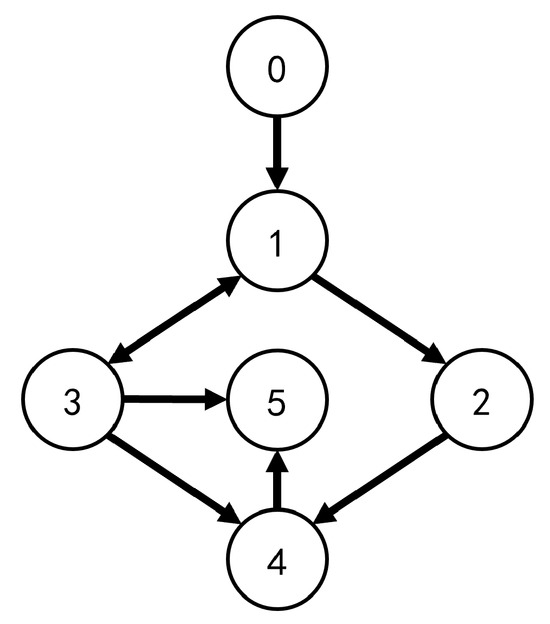
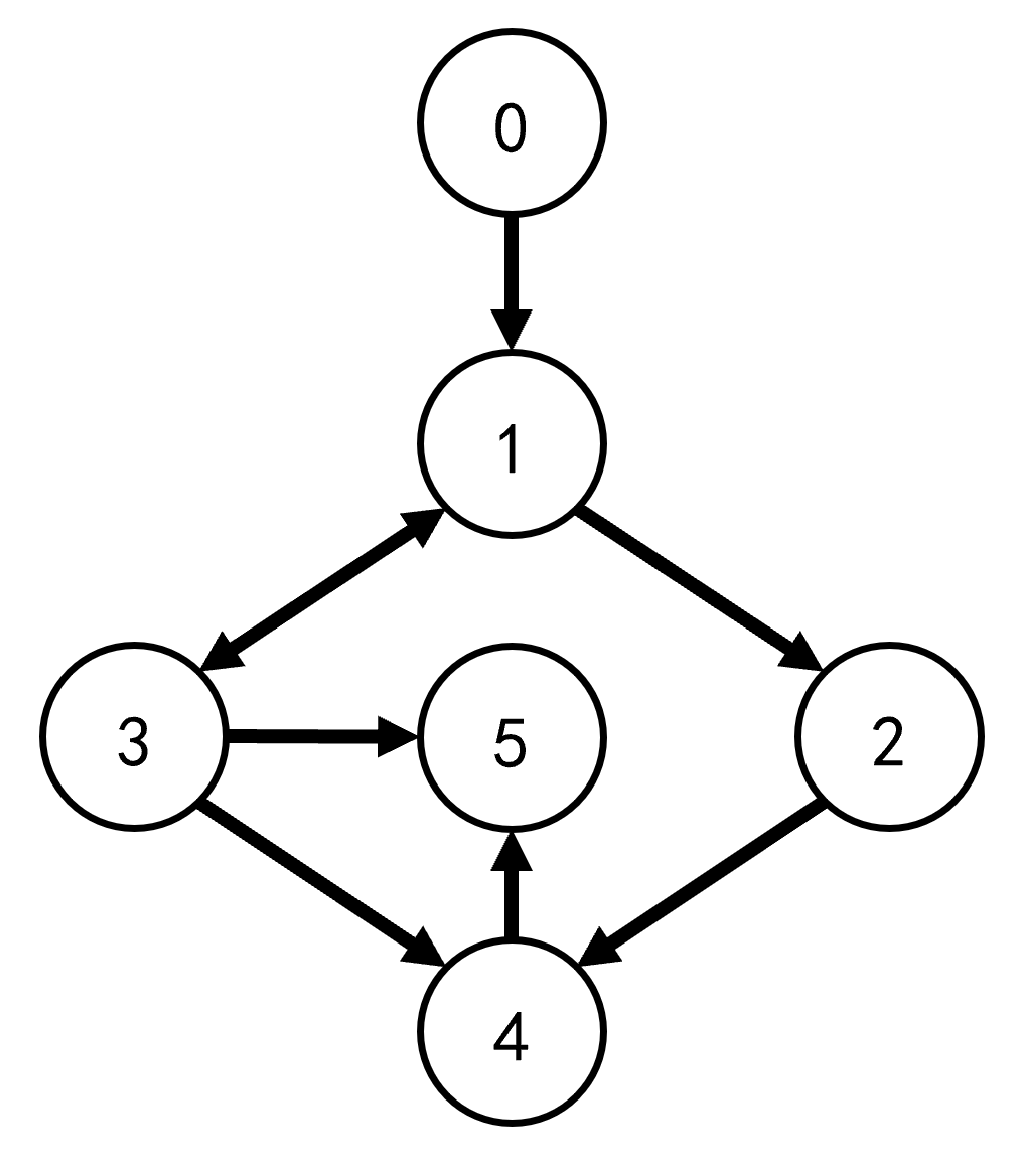
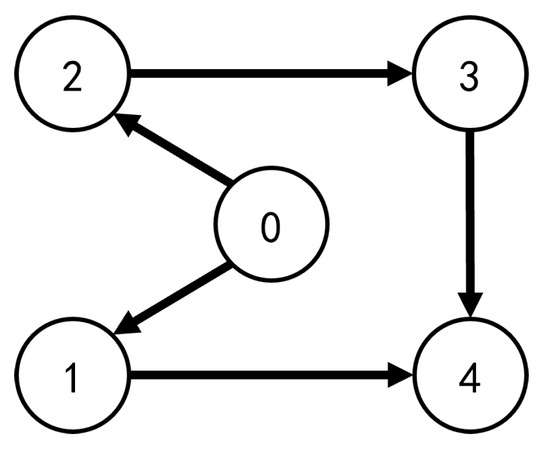
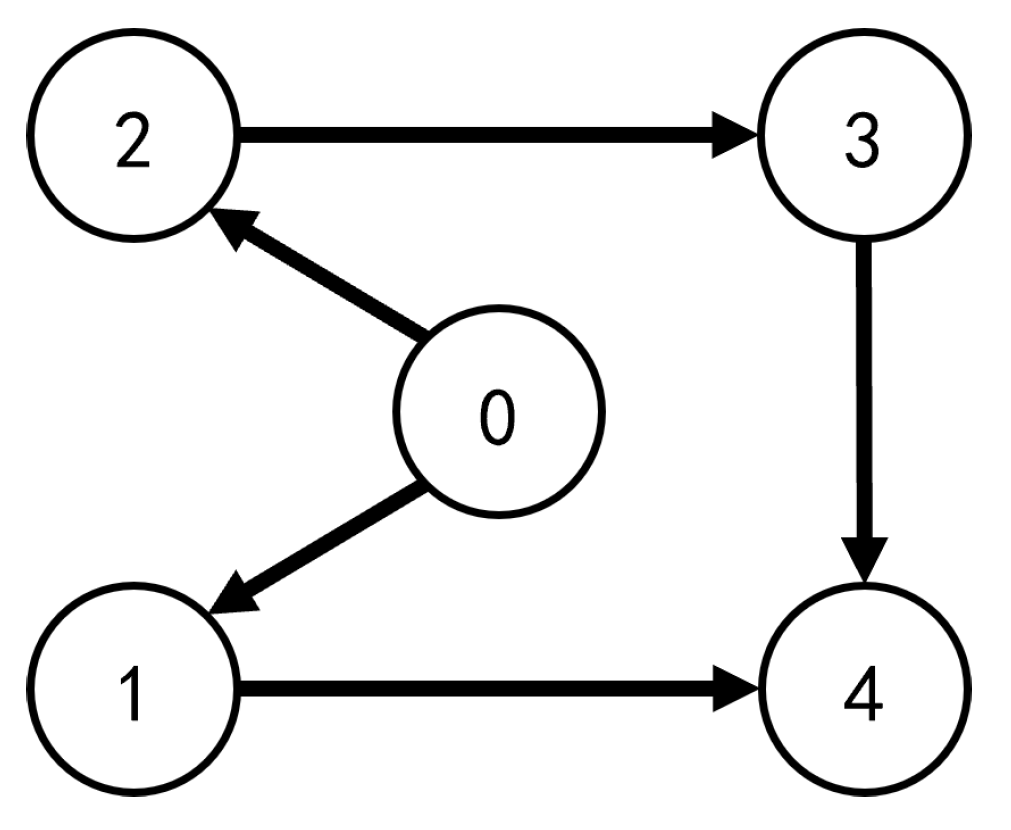
Consider the communication topology of heterogeneous MASs as Figure 1.
Figure 1.
Communication topology.
The system considered in the simulation is a single-link robotic manipulator, following the dynamical model in [35,36]:
where the states and for represent the joint angle and angular velocity, respectively. The parameter is the total rotational inertia of the link and motor, and is the damping coefficient. Furthermore, , g and denote the link mass, gravitational acceleration, and distance from the joint axis to the link center of mass, respectively. The control input is denoted by . The parameters are selected as and For , we select that and , values that may account for variations due to wear and changes in electromagnetic characteristics. The initial state of manipulators is selected as and . The control input for the leader is step input with an amplitude of 10 at .
The control parameters are specified next to achieve leader-following consensus in the heterogeneous MASs. The naming conventions remain consistent with those defined earlier. For the reference model (4), the following parameters are selected:
and , . For the sliding mode surface, . For controller (13), and .
To validate the selection of control parameters, a series of simulations was conducted, assessing and individually. In this simulation, the entire time span is 0 to 10 s, and the time step is given as 0.001 s. Table 1, Table 2, Table 3, Table 4 and Table 5 illustrate the performance index of different parameters for the trajectory tracking error based on mean squared error (MSE), which is given as MSE . The parameter tuning was performed via a systematic sensitivity analysis, where each parameter was varied independently while holding all others constant.
Table 1.
list.
Table 2.
list.
Table 3.
c list.
Table 4.
list.
Table 5.
list.
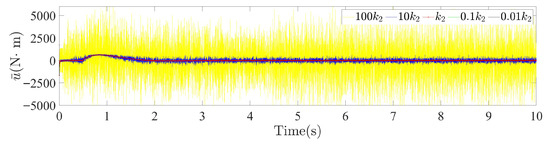
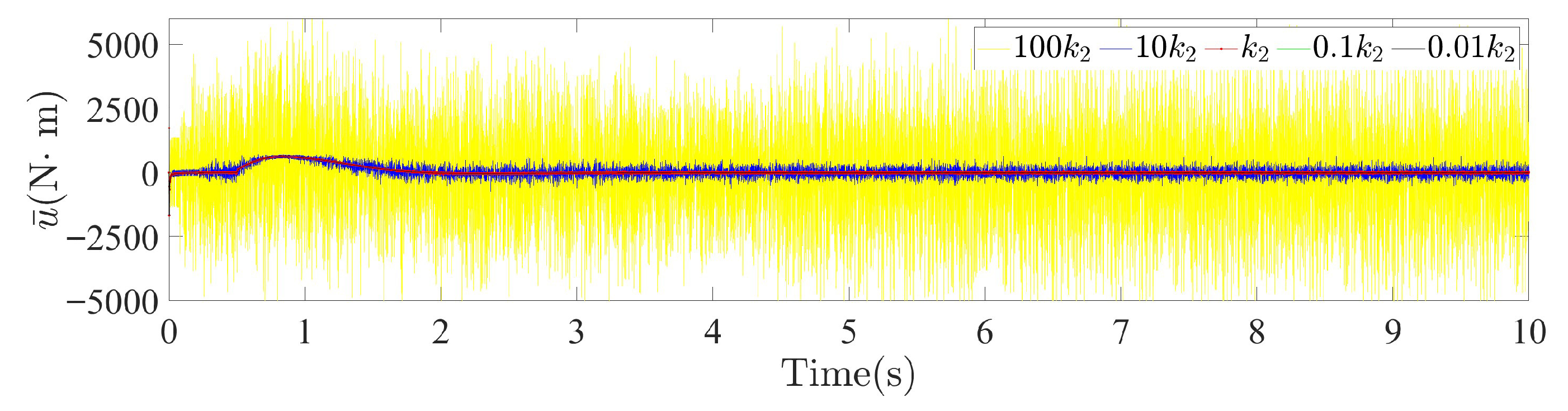
The selection of and is provided in Table 1 and Table 2, respectively. The results indicate that the overall tracking error of the multi-agent system decreases as the adaptation and are reduced. However, when and , the benefit of further reducing and becomes negligible. The selection of c is provided in Table 3. It can be shown through Table 3 that as the value of c decreases, the MSE also decreases. However, similarly to the trend observed for and , a clear point of diminishing returns is reached for the coefficient c when . At same time, according to Theorem 2, the term grows with increasing , which means that for sufficiently large , this term can dominate and violate the stability conditions derived in Theorem 2, potentially leading to a loss of consensus. The selection of and is provided in Table 4 and Table 5, respectively. exhibits a trend similar to that of the previously discussed parameters. However, its admissible range is bounded by the stability conditions in Theorem 2, leading to the final selection . For the sliding gain , while increasing its value reduces the tracking error, it also drastically amplifies control chattering. As shown in Figure 2, increasing from [40,3.2] to [4000,320] results in a 504.6-fold increase in the average chattering amplitude of the average control input . This highlights a critical trade-off, necessitating a careful selection of in practical applications with input constraints.
Figure 2.
Control inputs with different sliding mode control gains.
Then, we provided a comparison of different methods with the proposed MRASMC under attack conditions. In this simulation, the entire time span is 0 to = 30 s, and time step is given as 0.001 s. The proposed MRASMC is compared with the traditional MRAC framework. The two are distinguished solely by the incorporation of the sliding mode component in MRASMC. Specifically, the traditional MRAC is obtained as a special case of the MRASMC by setting the sliding surface coefficient to and the sliding gain to . The proposed MRASMC is also compared with the SMC. The parameters of the SMC used for comparison are the same as proposed MRASMC. The sliding surface is designed as , and the sliding mode controller is . The comparative results demonstrate that integrating SMC into the MRAC framework significantly enhances its performance in achieving resilient consensus for MASs. As an additional benchmark, the vMRAC method from [22] is included in the comparison. This method was specifically designed for achieving leader–follower consensus in heterogeneous MASs.
The actuator gain fault in (2) varies across agents that , , , and . The signal in (2) is applied to the system during two intervals: and . Furthermore, the magnitude of the disturbance acting on each agent varies over time. Specifically, the fault signals for each agent are defined in Table 6:
where % denotes the modulo operator. It should be mentioned that the periodic square-wave fault applied to Agent 4 in Table 6 is generated by performing a modulo operation on the time variable t. Specifically, during the time interval , the FDI signal is described as if , then ; otherwise, . This means that the square wave has a period of 6, with the high-level signal lasting for three time units and the low-level signal lasting for three time units. Correspondingly, during the time interval , the FDI signal is described as if , then ; otherwise, . This means that the square wave has a period of 17, with the high-level signal lasting for 5 time units and the low-level signal lasting for 12 time units. The above design can be uniformly expressed as
Table 6.
Fault list of agents.
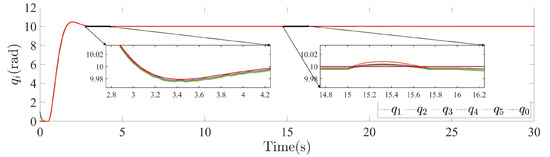
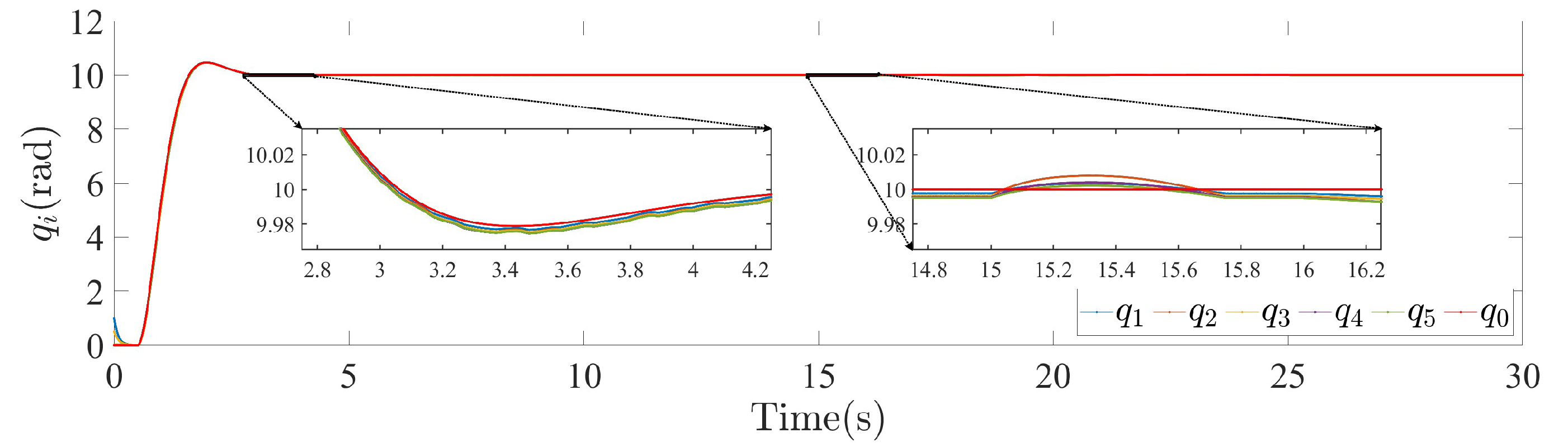
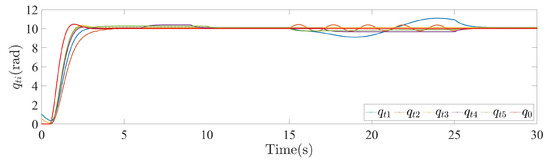
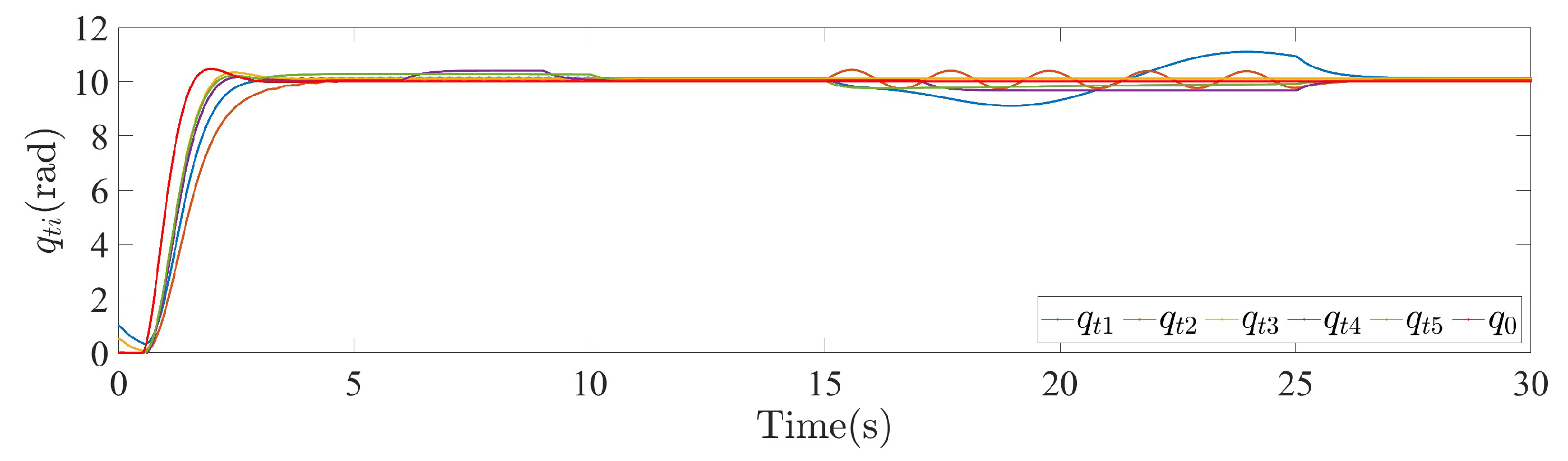
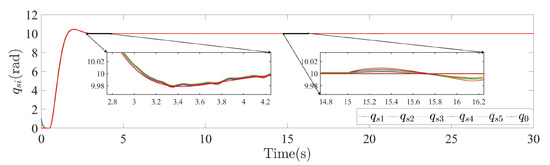
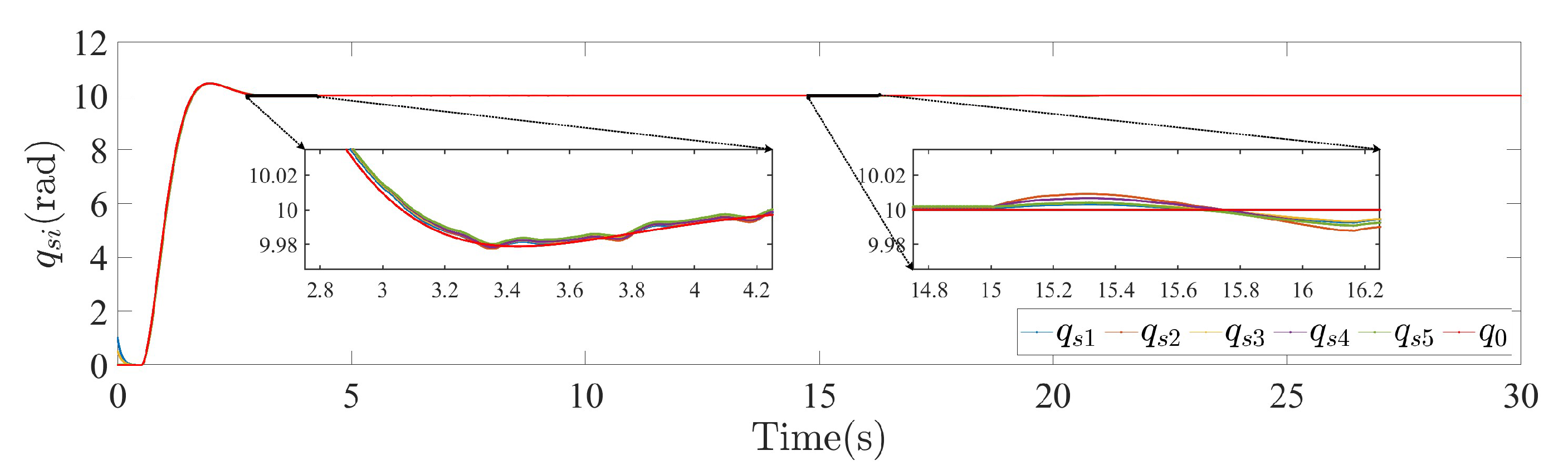
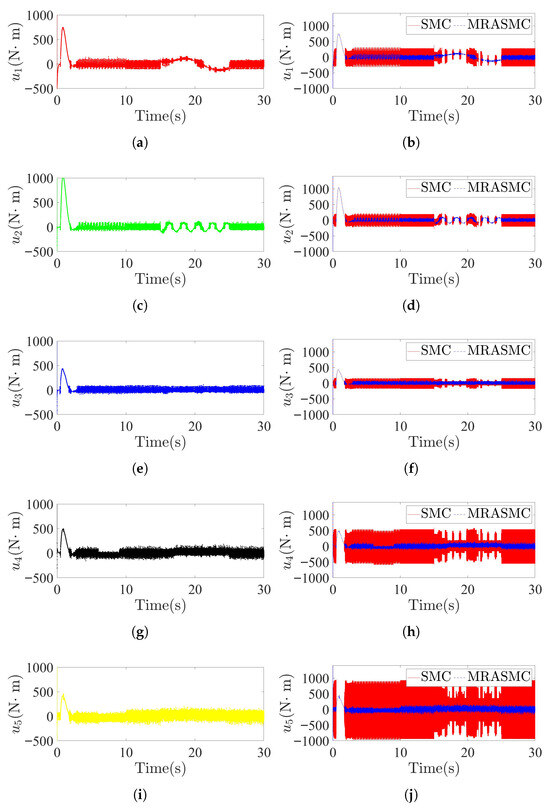
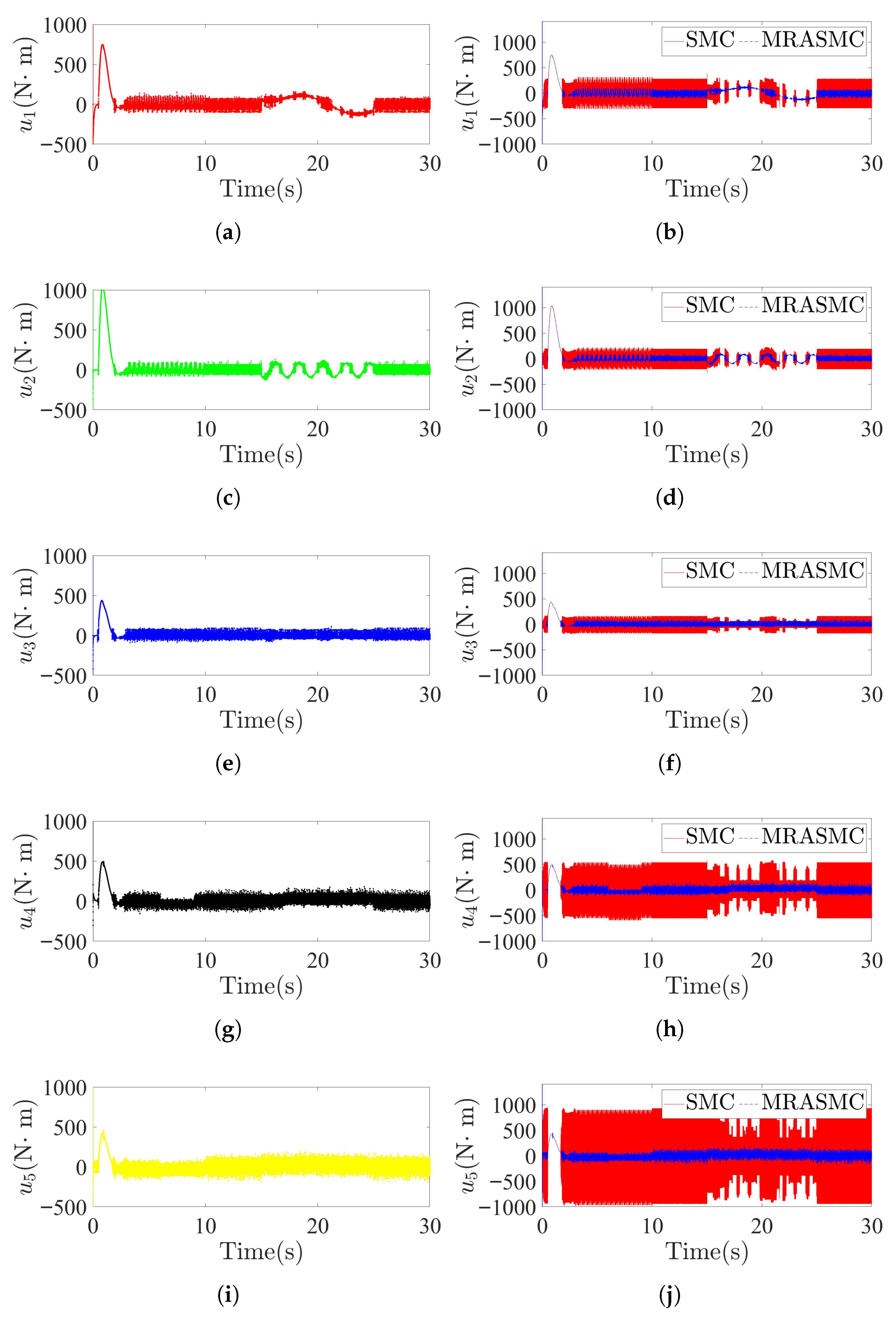
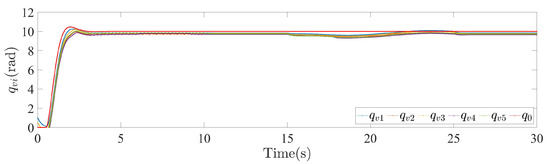
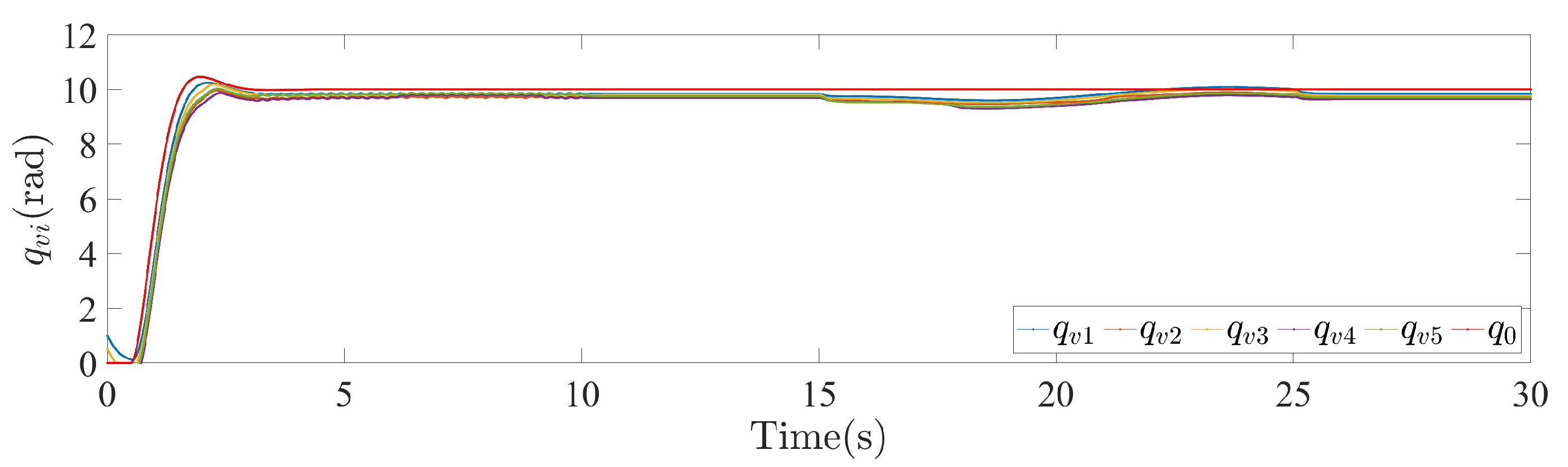
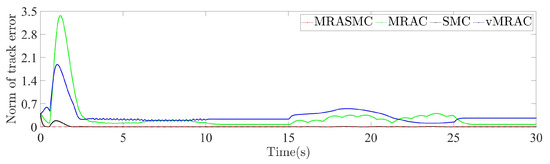
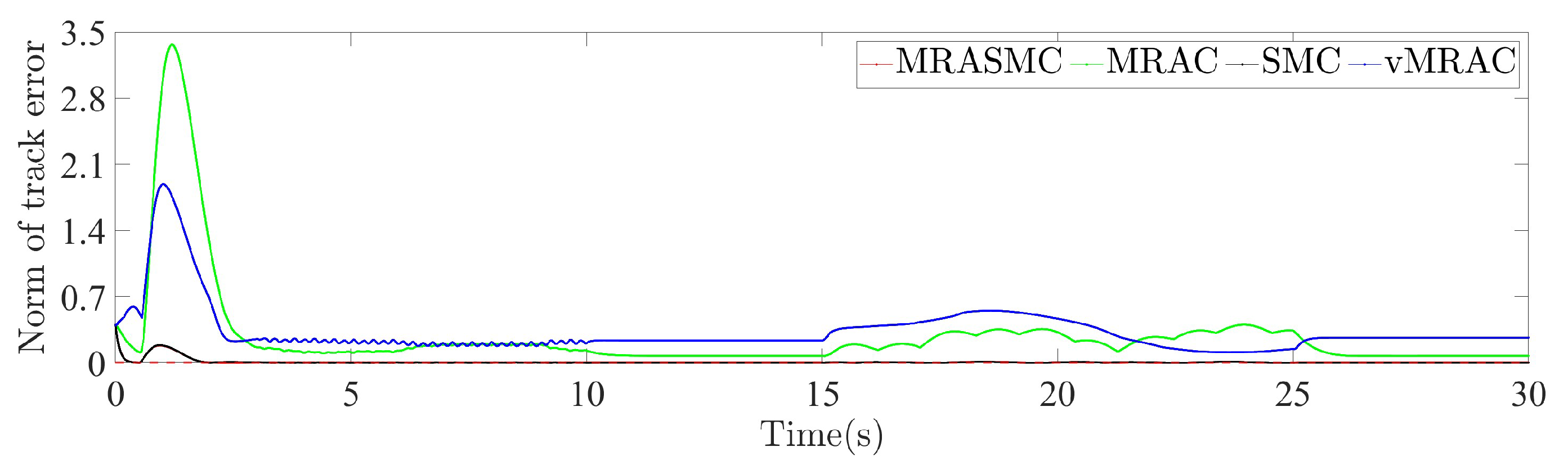
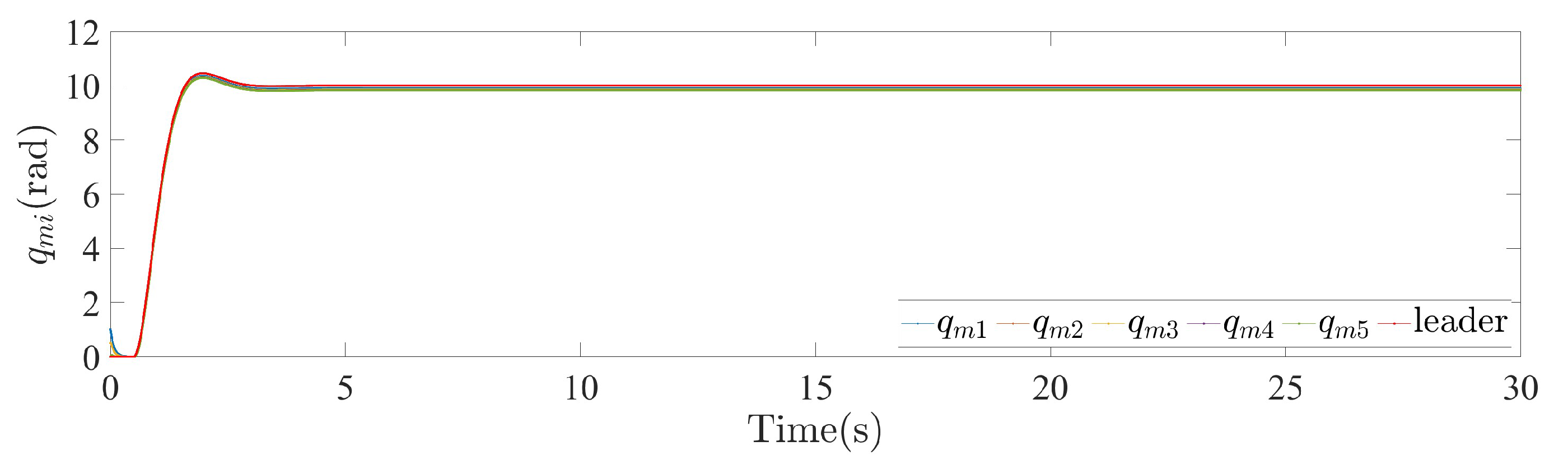
The Figure 3 shows the trajectories of MASs under MRASMC. The Figure 4 shows the trajectories of MASs under MRAC. The Figure 5 shows the trajectories of MASs under SMC. The control input is shown in Figure 6. The trajectories of MASs under vMRAC is shown in Figure 7. The norm of tracking errors is shown in Figure 8. Table 7 illustrates the performance index of different methods for tracking error based on MSE. Specifically, the performance comparison reveals distinct behaviors among the three methods under fault versus non-fault conditions. Table 7 demonstrates that the proposed MRASMC achieves significantly superior control performance compared to the other methods.
Figure 3.
Trajectory under MRASMC.
Figure 4.
Trajectory under MRAC.
Figure 5.
Trajectory under SMC.
Figure 6.
Control input. Subfigures (a,c,e,g,i) are the control inputs with MRASMC. Subfigures (b,d,f,h,j) are the control inputs with MRASMC and SMC.
Figure 7.
Trajectory under vMRAC.
Figure 8.
Norm of tracking errors under different methods.
Table 7.
MSE of different control methods.
By explicitly accounting for the uncertainties inherent in heterogeneous MASs and the effects of unknown faults, the proposed MRASMC achieves superior performance across all simulated environments.
In contrast to the proposed MRASMC, the traditional MRAC lacks the sliding mode control component. Consequently, in the absence of faults, the tracking errors for both methods are comparable, as evidenced by the results in Figure 8. However, Figure 4 reveals that traditional MRAC, due to its lack of explicit fault suppression capability, experiences more significant performance degradation in the presence of actuator faults compared to the other methods.
Table 7 and Figure 5 demonstrate that the sliding mode component effectively suppresses faults and reduces tracking errors, contributing to the superior performance of MRASMC over the compared MRAC-based methods. However, the SMC law with the designed control parameters induces severe chattering in the control input, as shown in Figure 6.
Figure 6 shows that the control inputs of different agents. Specifically, Figure 6a,c,e,g,i present the control signals generated by the proposed MRASMC method for each agent. The control input exhibits a clear compensatory response when the actuator fault is active, directly countering its effect. This behavior validates the designed control protocol’s inherent fault-tolerance mechanism. Furthermore, it is observed that the chattering in the control input is more severe for certain agents, such as agent 4 and 5. This phenomenon can be attributed to the propagation and accumulation of tracking errors along the network topology, a process exacerbated in the presence of faults or attacks. At the individual agent level, this manifests as a more complex composite fault signal. To counteract such aggravated disturbances, it is manifested at the control input as more intense chattering in sliding mode control. Figure 6b,d,f,h,j provide a direct comparison, comparing the control inputs from the SMC method against those from the MRASMC method for each agent. The results demonstrate a reduction in control input chattering for MRASMC compared to SMC, especially during the periods from 4 to 12 and from 25 to 30. Theoretically, this improvement stems from the MRAC component’s compensation for terms . This theoretical analysis is directly validated by the simulation setup, where the only difference between the compared SMC and the MRASMC is the presence of the adaptive part. Consequently, the simulations confirm that the adaptive control component within the MRASMC framework is responsible for the effective suppression of sliding-mode-induced chattering.
The vMRAC method treats the leader agent directly as the reference model for all followers, which enables consensus under its control framework. However, this approach relies on several simplifying assumptions that leader agent features a linear, disturbance-free dynamics with a known reference input. Consequently, compared to the proposed MRASMC, vMRAC exhibits higher sensitivity to the modeling inaccuracies of the leader, leading to greater performance degradation in consensus under realistic perturbed conditions.
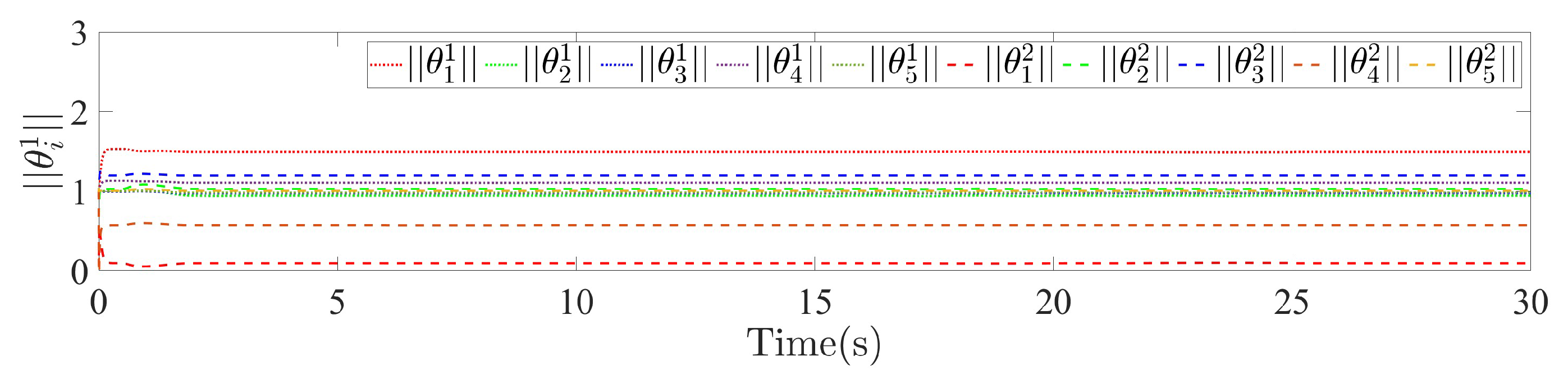
Furthermore, in addition to the tracking error discussed previously, the following elements of the MRASMC scheme are also examined: the reference model in Figure 9, adaptive parameters in Figure 10, control inputs in Figure 6, and sliding mode surface in Figure 11.
Figure 9.
Trajectory of reference model.
Figure 10.
Norm of adaptive matrices.
Figure 11.
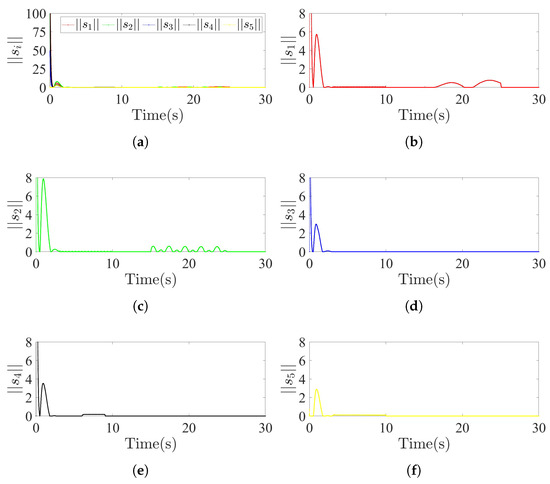
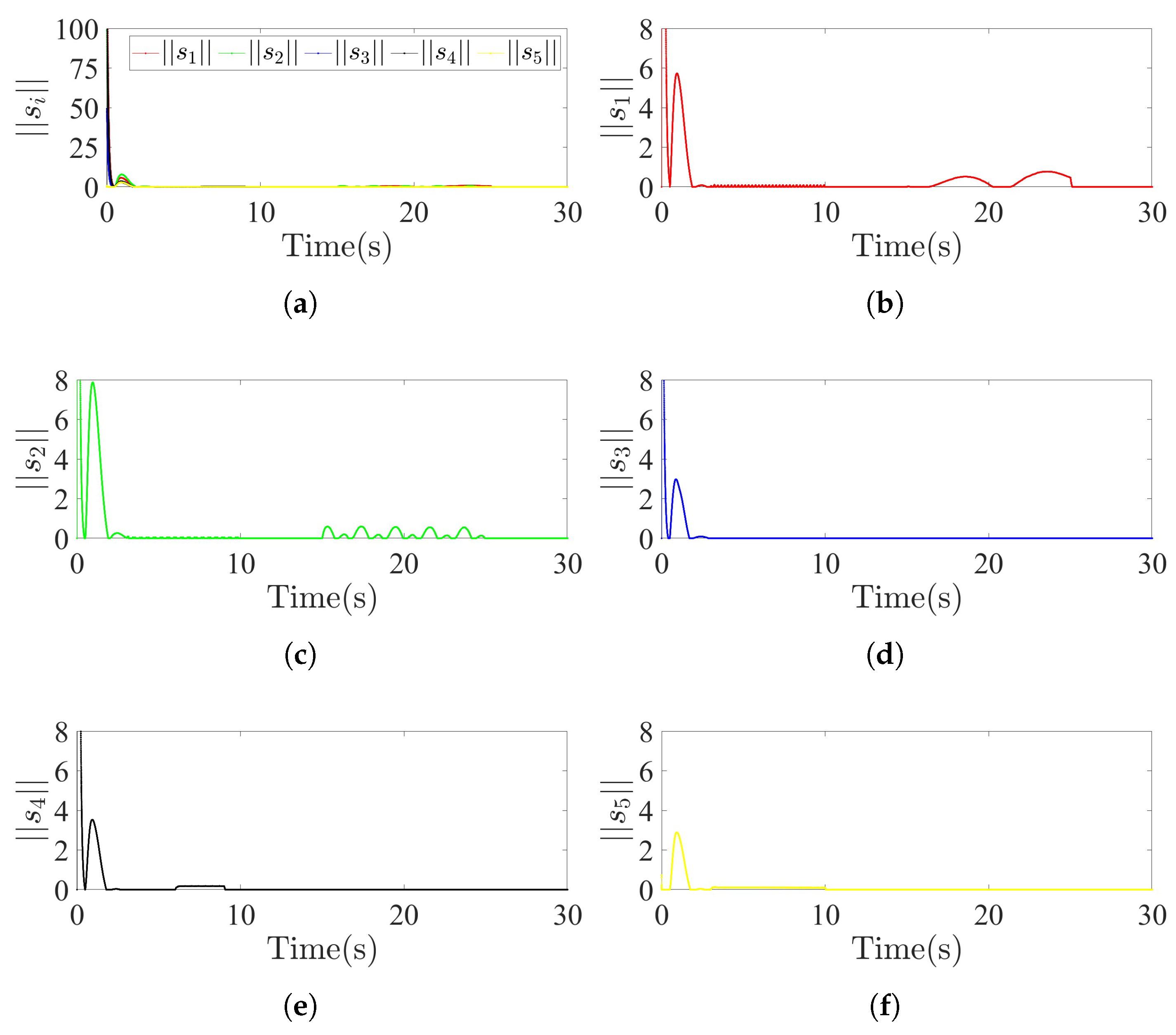
Norm of sliding mode surface. Subfigure (a) is the norm of sliding mode surface of all agents. Subfigure (b–f) are the sliding mode surface of agent 1, 2, 3, 4, and 5, respectively.
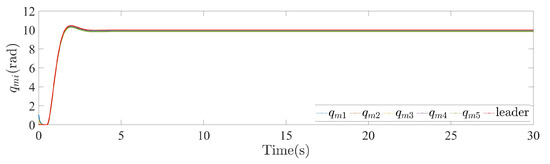
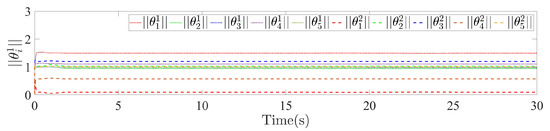
Figure 9 illustrates the reference models achieve consensus through the cooperative controller . At the same time, it cannot be ignored that the steady-state error caused by the leader predicted in Theorem 1 is also reflected in the figure. Figure 10 shows that the adaptive parameters designed by (13) and (17) converge quickly into place.
Figure 11 illustrates the convergence of the sliding surface. Upon activation of the controller, MRASMC drives each agent rapidly from its initial state toward the leader’s initial state. During the ensuing process, the agents occasionally exhibit deviations from the sliding surface. This behavior is inherent to the sliding surface design, which incorporates both the cooperative error and the reference model tracking error. The case of Agent 3 illustrates this mechanism. Since Agent 3 is not subjected to any external attack in the simulation, its state remains on the sliding surface for most of process. The only observed deviation occurs at t = 0.5 s, which is triggered solely by the change in the leader’s state.
Example 2.
To verify the universality of the advantages of MRASMC, we conducted simulations on a multi-flexible single-link manipulator systems. In this simulation, the entire time span is 0 to 50 s, and time step is given as 0.0005 s. Consider the communication topology of heterogeneous MASs in Figure 12.
Figure 12.
Communication topology.
The system considered in the simulation is a single-link flexible manipulator, following the dynamical model in [37,38]:
where , , and for represent the motor rotor rotation angles, motor rotor angular velocity, link rotation angles, and link angular velocity, respectively. The system parameter and represent the motor rotor inertia, link inertia, joint elastic constant, viscous friction, mass, gravitational acceleration, and length, respectively. The control input is denoted by . The parameters are selected as and . For , we select that and . For , we select that and . The initial state of manipulators is selected as and . The control input for the leader is . The naming conventions of the controller remain consistent with those defined earlier. For the reference model, the following parameters are selected as
and , . For the sliding mode surface, . For the controller, and . For the comparison control protocols, the method for selecting the controller parameters is similar to that in Example 1. The actuator fault and FDI attack are defined in Table 8 and Table 9.
Table 8.
Actuator gain faults list.
Table 9.
FDI attacks list.
The periodic square-wave actuator gain fault applied to Agent 3 in Table 8 is defined in Table 6, represents the uniform random noise with mean of 0 and variance of 0.1, and represents the uniform random noise with mean of 0 and variance of 0.25.
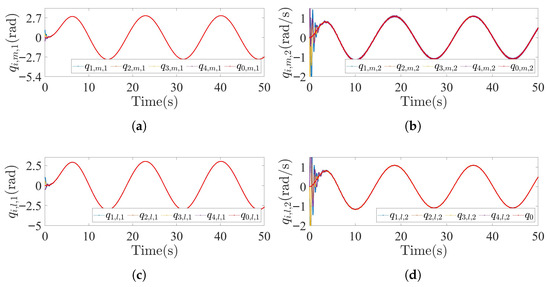
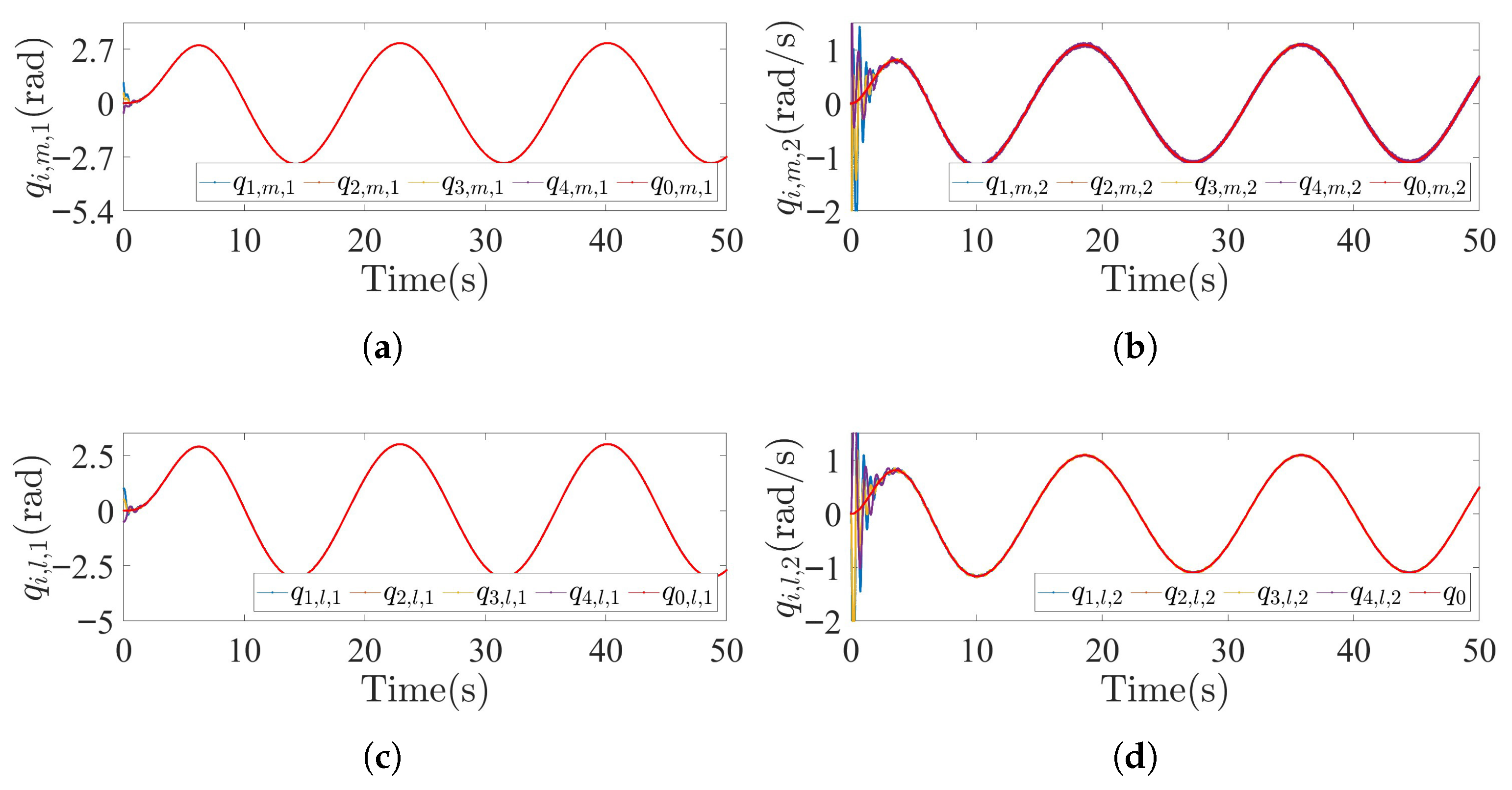
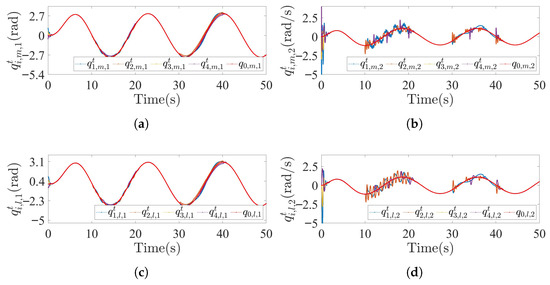
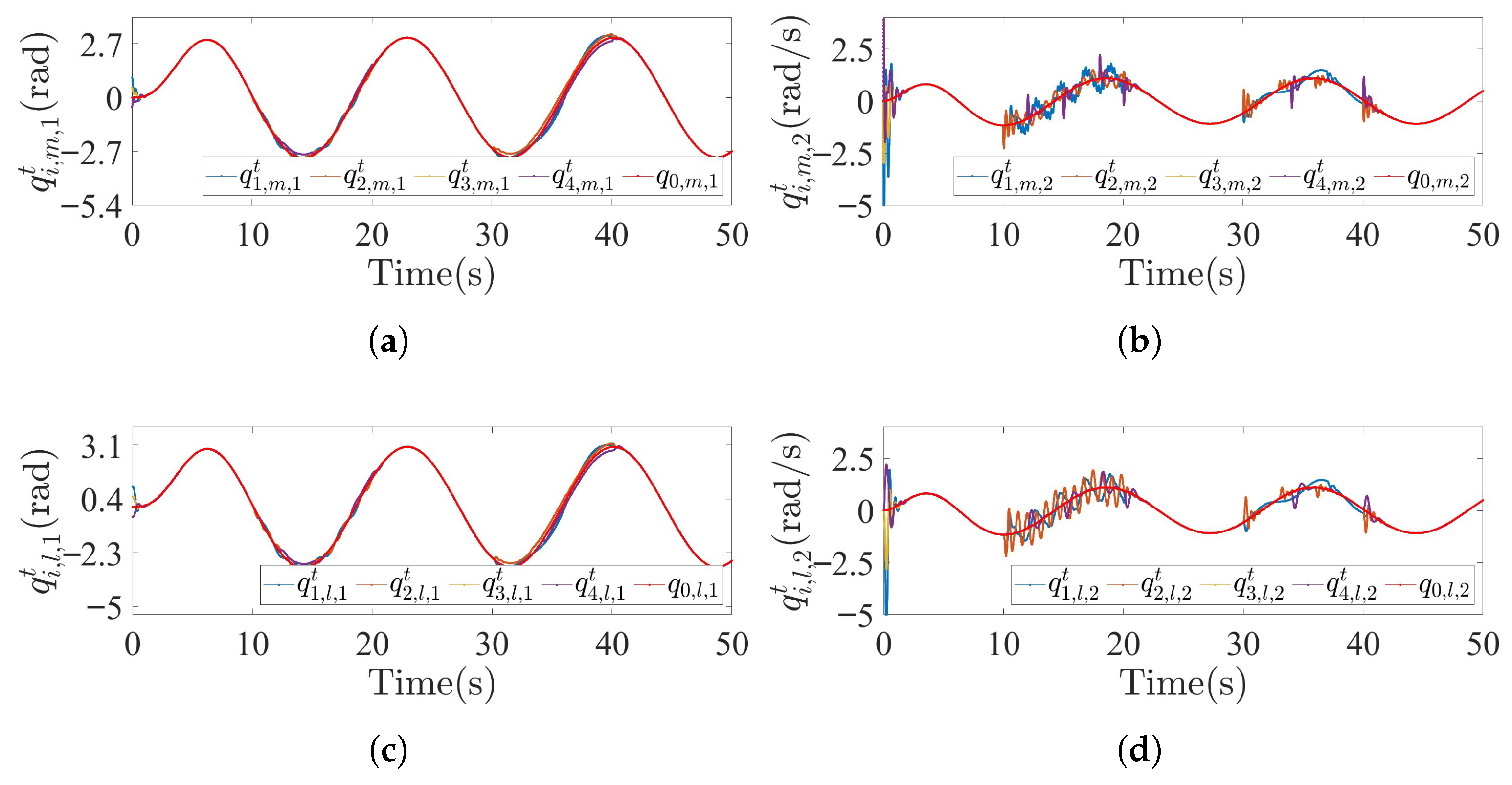
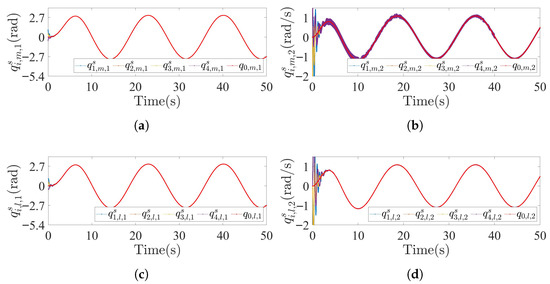
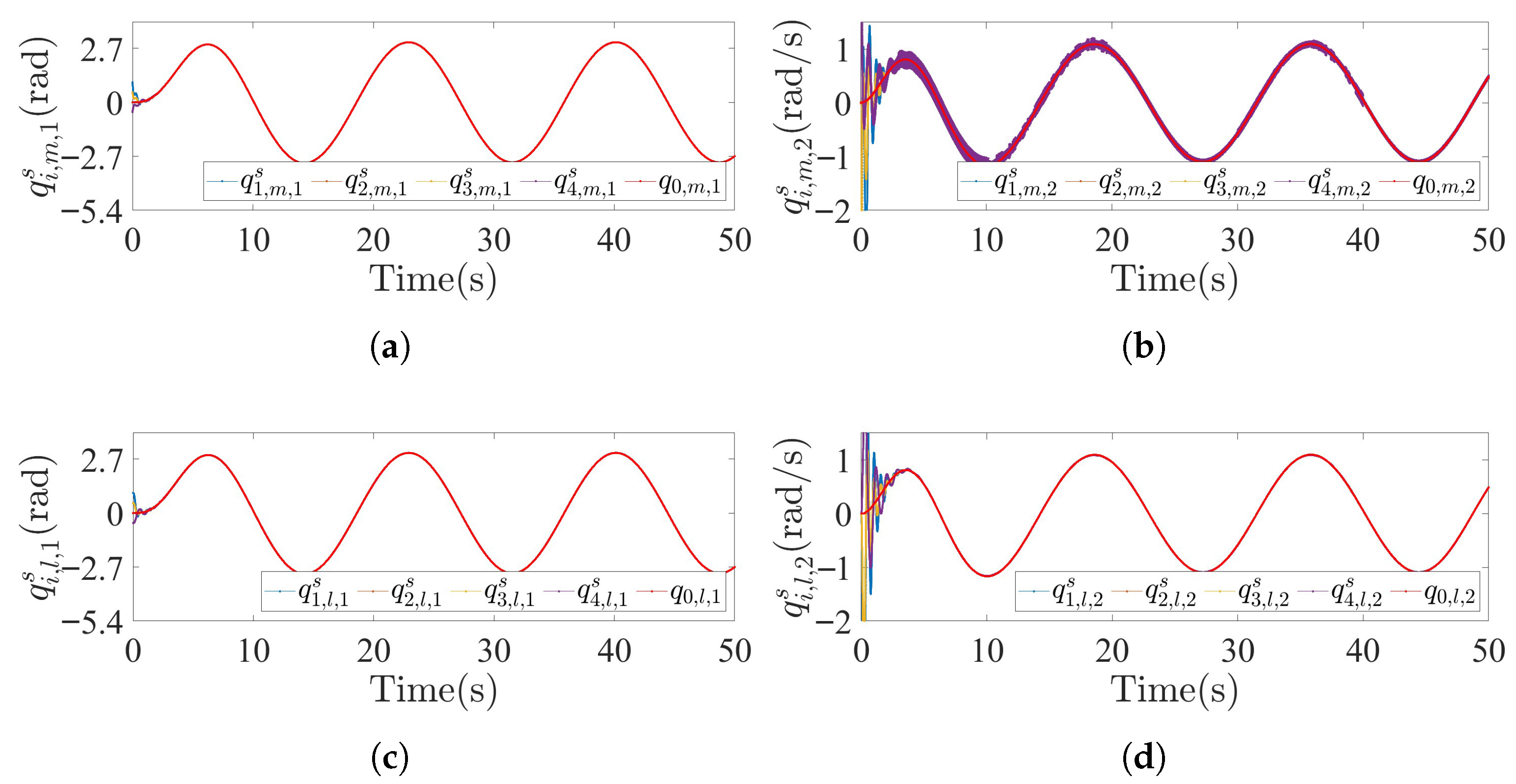
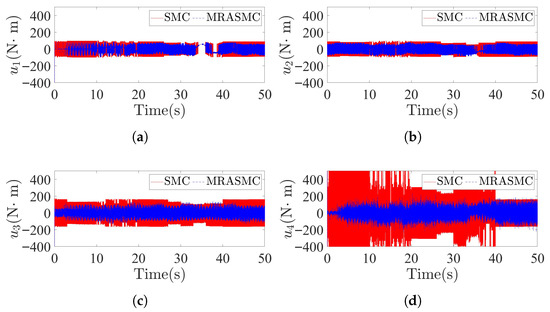
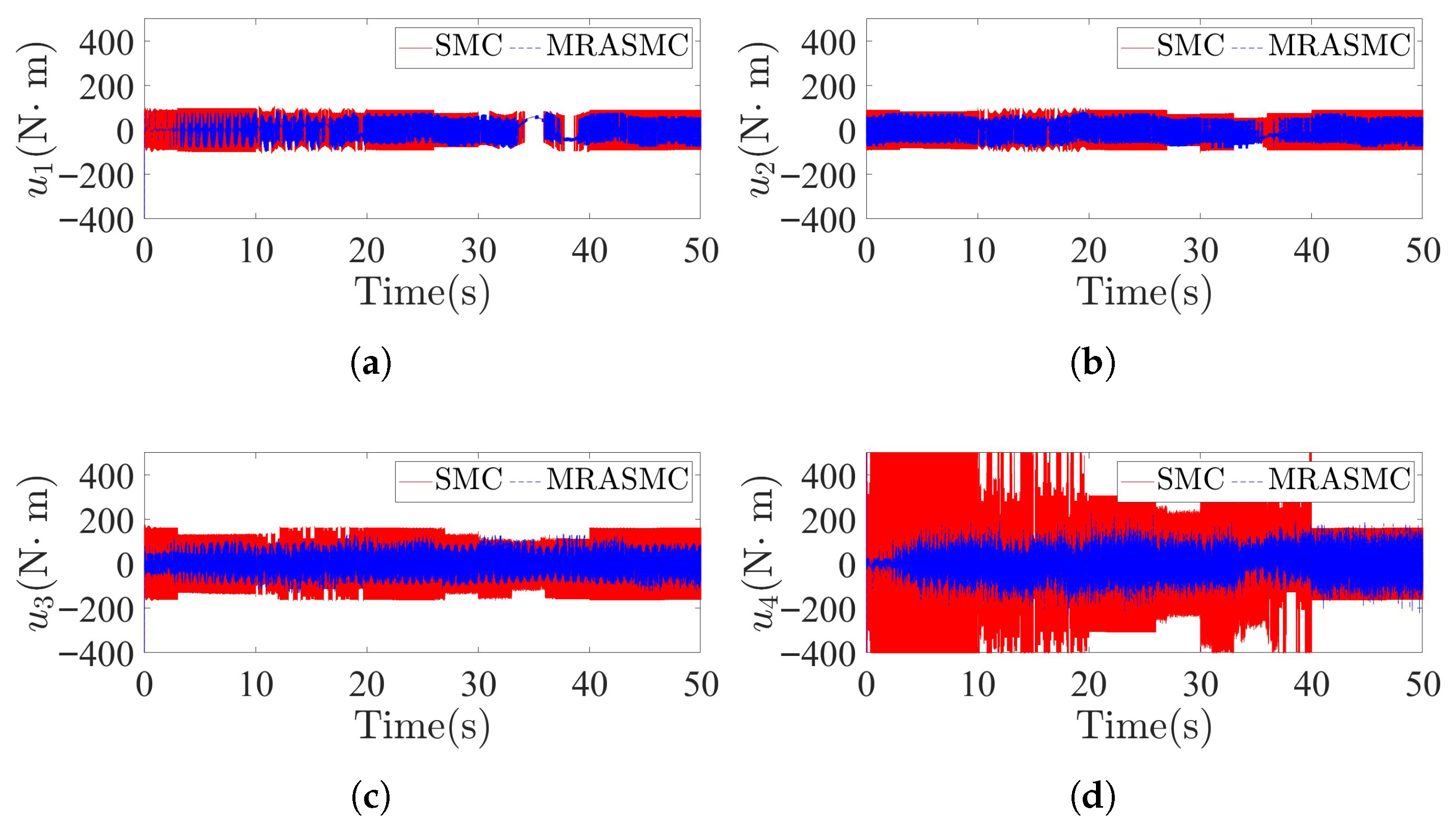
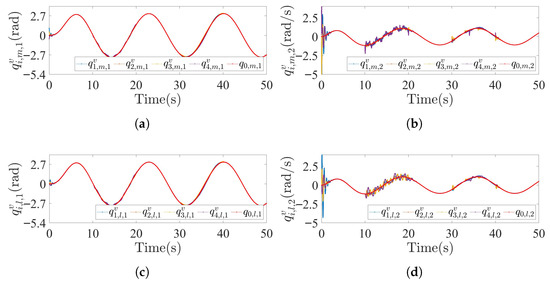
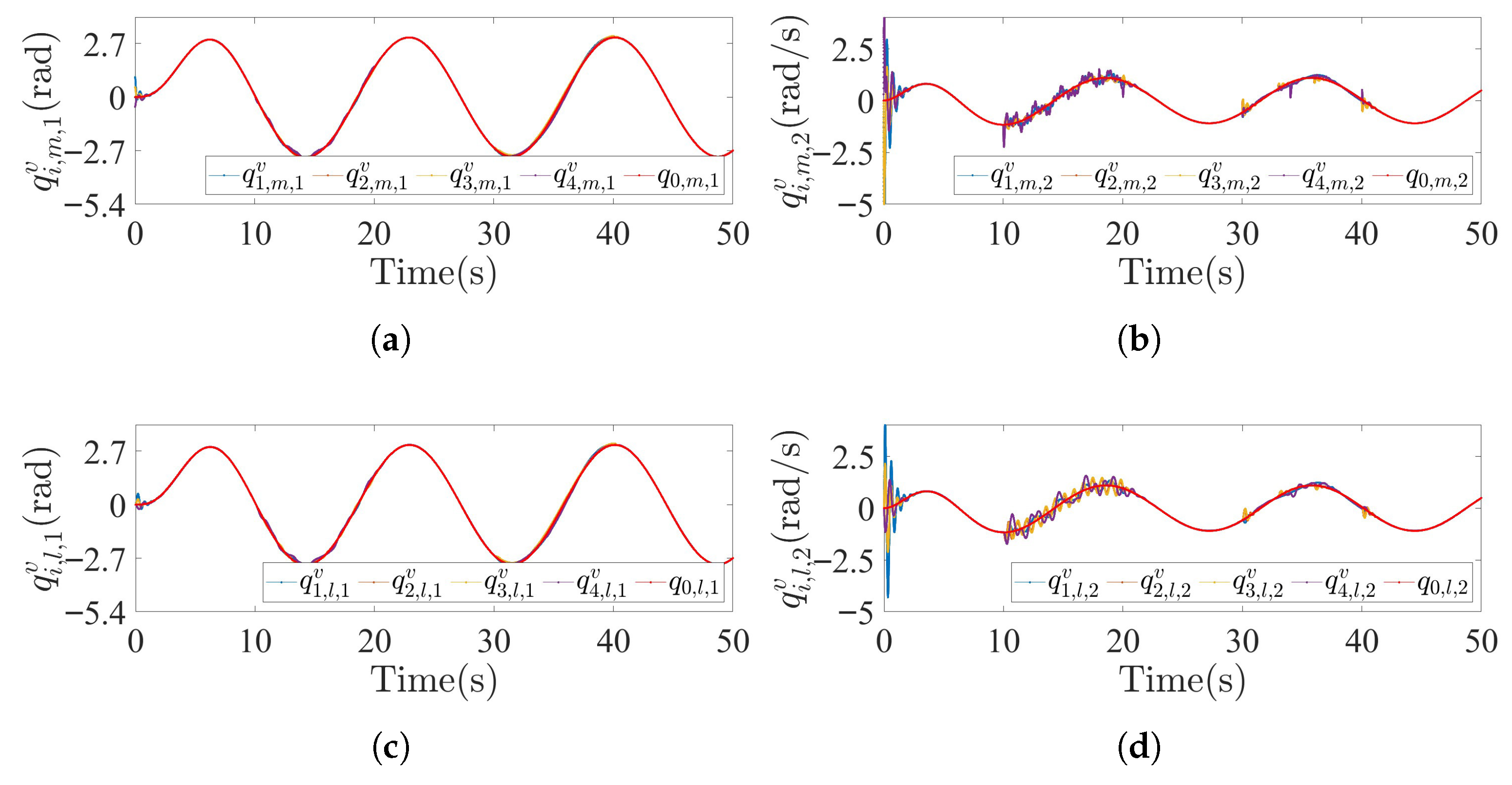
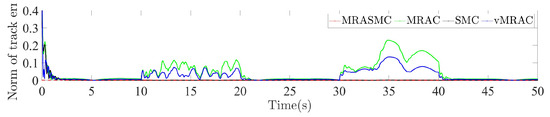
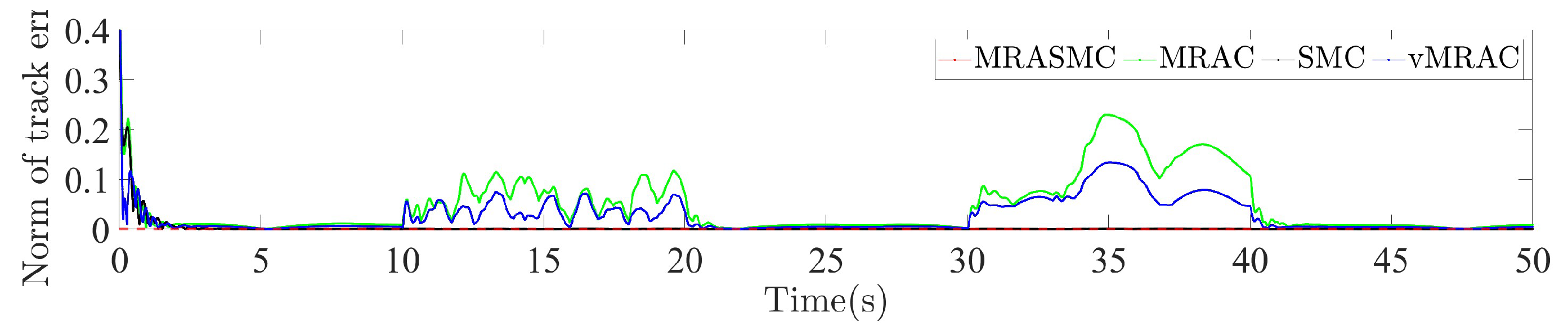
The periodic square-wave FDI attack applied to Agent 4 in Table 9 is defined in Table 6. Similarly, we present Table 10 as the control results of different methods in the case of Example 2. Table 10 illustrates that the proposed control method still maintains its advantages over other control methods under different topologies, which indicates the robustness of the proposed method to communication topologies and different control gains. Figure 13, Figure 14 and Figure 15 illustrate the trajectories of multi-flexible manipulator systems under MRASMC, MRAC, SMC, respectively. Figure 16 represents the control inputs of multi-flexible manipulator systems under MRASMC and SMC, and Figure 17 illustrate the trajectories of multi-flexible manipulator systems under vMRAC. Figure 18 shows the norm of tracking errors of multi-flexible manipulator systems under different control methods. The simulation results from Example 2 further validate the efficacy of the MRASMC framework. As shown in Figure 14 and Figure 17, MRASMC delivers superior robustness and lower tracking error compared to both the baseline MRAC and the vMRAC methods, owing to its integrated sliding mode control module. Concurrently, by leveraging its adaptive control component, MRASMC effectively mitigates the chattering in the control signal, representing an improvement over conventional SMC, as evidenced in Figure 16.
Table 10.
MSE of different control methods.
Figure 13.
Trajectory under MRASMC.Subfigures (a–d) are the trajectories of agent 1, 2, 3 and 4 under MRASMC.
Figure 14.
Trajectory under MRAC.Subfigures (a–d) are the trajectories of agent 1, 2, 3 and 4 under MRAC.
Figure 15.
Trajectory under SMC. Subfigures (a–d) are the trajectories of agent 1, 2, 3 and 4 under SMC.
Figure 16.
Control input.Subfigures (a–d) are the control inputs of agent 1, 2, 3 and 4 under MRASMC and SMC.
Figure 17.
Trajectory under vMRAC.Subfigures (a–d) are the trajectories of agent 1, 2, 3 and 4 under vMRAC.
Figure 18.
Norm of tracking errors under different methods.
In general, through the above simulation analysis, it can be determined that the proposed MRASMC strategy can achieve the desired control objectives.
5. Conclusions
This paper addresses the resilient leader–follower consensus problem for non-linear heterogeneous MASs subject to multiple faults. A novel integrated framework, termed MRASMC, is proposed. First, a rigorous stability analysis demonstrates that the closed-loop signals of the MAS remain uniformly ultimately bounded. Subsequently, numerical simulations validate the effectiveness and robustness of the proposed approach, confirming its superior control performance compared to existing MRAC-based methods. The present study primarily considers bounded actuator faults, which, while practically relevant, limits the scope of immediate application to other fault types. Future work will extend the framework to handle more complex fault scenarios, including sensor faults and hybrid cyber–physical attacks.
Author Contributions
Conceptualization, F.W. and H.T.; methodology, H.T.; software, W.H.; validation, H.T., W.H. and M.X.; formal analysis, M.X.; investigation, F.W.; resources, W.H.; data curation, F.W.; writing—original draft preparation, H.T.; writing—review and editing, F.W.; visualization, M.X.; supervision, W.H.; project administration, W.H.; funding acquisition, F.W. and M.X. All authors have read and agreed to the published version of the manuscript.
Funding
This work was funded by the Foundation of Key Laboratory of Chinese Academy of Sciences under Grant J22-121-III and the Leading Talent Project of the Sanqin Scholars Special Support Program of Shaanxi Province.
Data Availability Statement
The data presented in this study are available on request from the corresponding author.
Acknowledgments
The authors wish to thank to Hua Su, Yansheng Gao and Sensen Guo for their help in method design and suggestions on paper writing.
Conflicts of Interest
The authors declare no conflicts of interest.
References
- Yan, S.; Shi, L.; Zhang, H.; Yao, S.; Zhou, Y. Safety-Critical Model-Free Adaptive Iterative Learning Control for Multi-Agent Consensus Using Control Barrier Functions. IEEE Trans. Circuits Syst. II Express Briefs 2024, 71, 221–225. [Google Scholar] [CrossRef] [Scilit]
- Sharafian, A.; Ali, A.; Ullah, I.; Khalifa, T.R.; Bai, X.; Qiu, L. Fuzzy adaptive control for consensus tracking in multiagent systems with incommensurate fractional-order dynamics: Application to power systems. Inf. Sci. 2025, 689, 121455. [Google Scholar] [CrossRef] [Scilit]
- Yuan, T.; Li, L. Admissible consensus tracking control for nonlinear singular multi-agent systems via sampled-data event-triggered mechanisms. ISA Trans. 2025, 159, 92–102. [Google Scholar] [CrossRef] [Scilit] [PubMed]
- Gong, X.; Cui, Y.; Shen, J.; Feng, Z.; Huang, T. Necessary and Sufficient Conditions of Formation-Containment Control of High-Order Multiagent Systems with Observer-Type Protocols. IEEE Trans. Cybern. 2022, 52, 7002–7016. [Google Scholar] [CrossRef] [Scilit]
- Yang, Q.; Xiao, F.; Lyu, J.; Zhou, B.; Fang, H. Self-Organized Polygon Formation Control Based on Distributed Estimation. IEEE Trans. Ind. Electron. 2024, 71, 1958–1967. [Google Scholar] [CrossRef] [Scilit]
- Liang, X.; Wang, N. Adaptive Leader-Follower Formation for Unmanned Surface Vehicles Subject to Output Constraints. Int. J. Fuzzy Syst. 2020, 22, 2493–2503. [Google Scholar]
- Meng, Q.; Kasis, A.; Polycarpou, M.M. Integrated Attitude–Position Formation Control of Multiple Vehicles on SE(3) with Individual Objectives. IEEE Trans. Aerosp. Electron. Syst. 2025, 61, 7710–7724. [Google Scholar] [CrossRef] [Scilit]
- Li, K.; Hua, C.; You, X.; Ahn, C.K. Leader-Following Consensus Control for Uncertain Feedforward Stochastic Nonlinear Multiagent Systems. IEEE Trans. Neural Netw. Learn. Syst. 2023, 34, 1049–1057. [Google Scholar] [CrossRef] [Scilit]
- Adderson, R.; Pan, Y.J. Continuously Varying Formation for Heterogeneous Multi-Agent Systems with Novel Potential Field Avoidance. IEEE Trans. Ind. Electron. 2025, 72, 1774–1783. [Google Scholar] [CrossRef] [Scilit]
- Moghadam, R.; Modares, H. Resilient Autonomous Control of Distributed Multiagent Systems in Contested Environments. IEEE Trans. Cybern. 2019, 49, 3957–3967. [Google Scholar] [CrossRef] [Scilit]
- Chen, C.; Lewis, F.L.; Xie, S.; Modares, H.; Liu, Z.; Zuo, S.; Davoudi, A. Resilient adaptive and H∞ controls of multi-agent systems under sensor and actuator faults. Automatica 2019, 102, 19–26. [Google Scholar] [CrossRef] [Scilit]
- Zhang, D.; Tang, Y.; Ding, Z.; Qian, F. Event-Based Resilient Formation Control of Multiagent Systems. IEEE Trans. Cybern. 2021, 51, 2490–2503. [Google Scholar] [CrossRef] [Scilit]
- Ullah, I.; Adhikari, D.; Ali, F.; Ali, A.; Khan, H.; Sharafian, A.; Manic Kesavan, S.; Bai, X. Revolutionizing E-Commerce with Consumer-Driven Energy-Efficient WSNs: A Multi-Characteristics Approach. IEEE Trans. Consum. Electron. 2024, 70, 6871–6882. [Google Scholar] [CrossRef] [Scilit]
- Huo, S.; Zhang, Y.; Lewis, F.L.; Sun, C. Observer-Based Resilient Consensus Control for Heterogeneous Multiagent Systems Against Cyberattacks. IEEE Trans. Control Netw. Syst. 2023, 10, 647–658. [Google Scholar] [CrossRef] [Scilit]
- Fang, F.; Li, J.; Liu, Y.; Park, J.H. Resilient Control for Multiagent Systems with a Sampled-Data Model Against DoS Attacks. IEEE Trans. Ind. Inform. 2023, 19, 780–789. [Google Scholar] [CrossRef] [Scilit]
- Sharafian, A.; Ullah, I.; Singh, S.K.; Ali, A.; Khan, H.; Bai, X. Adaptive fuzzy backstepping secure control for incommensurate fractional order cyber-physical power systems under intermittent denial of service attacks. Chaos Solitons Fractals 2024, 186, 115288. [Google Scholar] [CrossRef] [Scilit]
- Mustafa, A.; Panagou, D. Adversary Detection and Resilient Control for Multiagent Systems. IEEE Trans. Control Netw. Syst. 2023, 10, 355–367. [Google Scholar] [CrossRef] [Scilit]
- Zhou, H.; Tong, S. Fuzzy Adaptive Resilient Formation Control for Nonlinear Multiagent Systems Subject to DoS Attacks. IEEE Trans. Fuzzy Syst. 2024, 32, 1446–1454. [Google Scholar] [CrossRef] [Scilit]
- Jiang, D.; Wen, G.; Rahmani, A.; Ifqir, S.; Sueur, C.; Huang, T. Adaptive Resilient Flexible-Containment Control for Fully Heterogeneous MASs Subject to DoS Attacks and Asynchronous Semi-Markov Chains. IEEE Trans. Cybern. 2025, 55, 4943–4955. [Google Scholar] [CrossRef] [Scilit]
- Åström, K.J.; Wittenmark, B. Adaptive Control: Second Edition; Courier Corporation: Chelmsford, MA, USA, 2013. [Google Scholar]
- Yue, D.; Baldi, S.; Cao, J.; Schutter, B.D. Model Reference Adaptive Stabilizing Control with Application to Leaderless Consensus. IEEE Trans. Autom. Control 2024, 69, 2052–2059. [Google Scholar] [CrossRef] [Scilit]
- Yue, D.; Shi, J.; Shi, L.; Frasca, P.; Baldi, S. Model Reference Adaptive Stabilizing Control for Leader-Following Consensus. IEEE Trans. Autom. Control 2025, 70, 6861–6868. [Google Scholar] [CrossRef] [Scilit]
- Goel, R.; Garg, T.; Roy, S.B. Closed-Loop Reference Model Based Distributed MRAC Using Cooperative Initial Excitation and Distributed Reference Input Estimation. IEEE Trans. Control Netw. Syst. 2022, 9, 37–49. [Google Scholar] [CrossRef] [Scilit]
- Yue, D.; Baldi, S.; Cao, J. D-MRACO: Decentralized Model Reference Adaptive Controller and Observer. IFAC-Pap. 2023, 56, 2044–2049. [Google Scholar] [CrossRef] [Scilit]
- Zhang, Z.; Yang, X.; Wang, W.; Chen, K.; Cheung, N.C.; Pan, J. Enhanced Sliding Mode Control for PMSM Speed Drive Systems Using a Novel Adaptive Sliding Mode Reaching Law Based on Exponential Function. IEEE Trans. Ind. Electron. 2024, 71, 11978–11988. [Google Scholar] [CrossRef] [Scilit]
- Xu, B.; Zhang, L.; Ji, W. Improved Non-Singular Fast Terminal Sliding Mode Control with Disturbance Observer for PMSM Drives. IEEE Trans. Transp. Electrif. 2021, 7, 2753–2762. [Google Scholar] [CrossRef] [Scilit]
- Tian, D.; Xu, R.; Sariyildiz, E.; Gao, H. An Adaptive Switching-Gain Sliding-Mode-Assisted Disturbance Observer for High-Precision Servo Control. IEEE Trans. Ind. Electron. 2022, 69, 1762–1772. [Google Scholar] [CrossRef] [Scilit]
- Hajiun, G.; Tianping, Z.; Qikun, S. Decentralized model reference adaptive sliding mode control based on fuzzy model. J. Syst. Eng. Electron. 2006, 17, 182–186. [Google Scholar] [CrossRef] [Scilit]
- Tao, G. Adaptive Control Design and Analysis; John Wiley & Sons: Hoboken, NJ, USA, 2003. [Google Scholar]
- Ioannou, P.; Sun, J. Robust Adaptive Control; Prentice Hall: Upper Saddle River, NJ, USA, 1996. [Google Scholar]
- Yuan, C.; Zeng, W.; Dai, S.L. Distributed model reference adaptive containment control of heterogeneous uncertain multi-agent systems. ISA Trans. 2019, 86, 73–86. [Google Scholar] [CrossRef] [Scilit]
- Azzollini, I.A.; Yu, W.; Yuan, S.; Baldi, S. Adaptive Leader-Follower Synchronization Over Heterogeneous and Uncertain Networks of Linear Systems Without Distributed Observer. IEEE Trans. Autom. Control 2021, 66, 1925–1931. [Google Scholar] [CrossRef] [Scilit]
- Lovi, A.; Fidan, B.; Nielsen, C. Multiple Model Reference Adaptive Control with Blending for Nonsquare Multivariable Systems. IEEE Trans. Autom. Control 2025, 70, 5780–5791. [Google Scholar] [CrossRef] [Scilit]
- Utkin, V. Discussion Aspects of High-Order Sliding Mode Control. IEEE Trans. Autom. Control 2016, 61, 829–833. [Google Scholar] [CrossRef] [Scilit]
- Zhang, H.; Lewis, F.L.; Qu, Z. Lyapunov, Adaptive, and Optimal Design Techniques for Cooperative Systems on Directed Communication Graphs. IEEE Trans. Ind. Electron. 2012, 59, 3026–3041. [Google Scholar] [CrossRef] [Scilit]
- Spong, M.W.; Hutchinson, S.; Vidyasagar, M. Robot Modeling and Control; John Wiley & Sons: Hoboken, NJ, USA, 2020. [Google Scholar]
- Li, Z.; Xu, H.; Lin, Z.; Dong, L.; Chen, Y. Event-triggered robust distributed output feedback model predictive control for nonlinear MASs against false data injection attacks. ISA Trans. 2023, 141, 197–211. [Google Scholar] [CrossRef] [Scilit]
- Jiang, B.; Staroswiecki, M.; Cocquempot, V. Fault Accommodation for Nonlinear Dynamic Systems. IEEE Trans. Autom. Control 2006, 51, 1578–1583. [Google Scholar] [CrossRef] [Scilit]

Disclaimer/Publisher’s Note: The statements, opinions and data contained in all publications are solely those of the individual author(s) and contributor(s) and not of MDPI and/or the editor(s). MDPI and/or the editor(s) disclaim responsibility for any injury to people or property resulting from any ideas, methods, instructions or products referred to in the content. |
© 2026 by the authors. Licensee MDPI, Basel, Switzerland. This article is an open access article distributed under the terms and conditions of the Creative Commons Attribution (CC BY) license.