
A Comprehensive Performance Evaluation of YOLO Series Algorithms in Automatic Inspection of Printed Circuit Boards


Abstract
1. Introduction
- (1)
- A dual-cycle benchmark testing framework for industrial decision-making has been built. For the first time, this paper empirically evaluates cutting-edge YOLO series algorithms from YOLOv8 to YOLOv13 on a unified standardized PCB defect dataset, and innovatively introduces a dual comparative experimental design with a limited training period (100 rounds) and complete training period (500 rounds). This framework not only evaluates the ultimate performance limit of the algorithm, but also simulates the actual needs of the industry in resource-constrained and rapidly deployable scenarios, accurately quantifying the trade-off between convergence speed and final accuracy of each algorithm, providing detailed insights for industrial algorithm selection.
- (2)
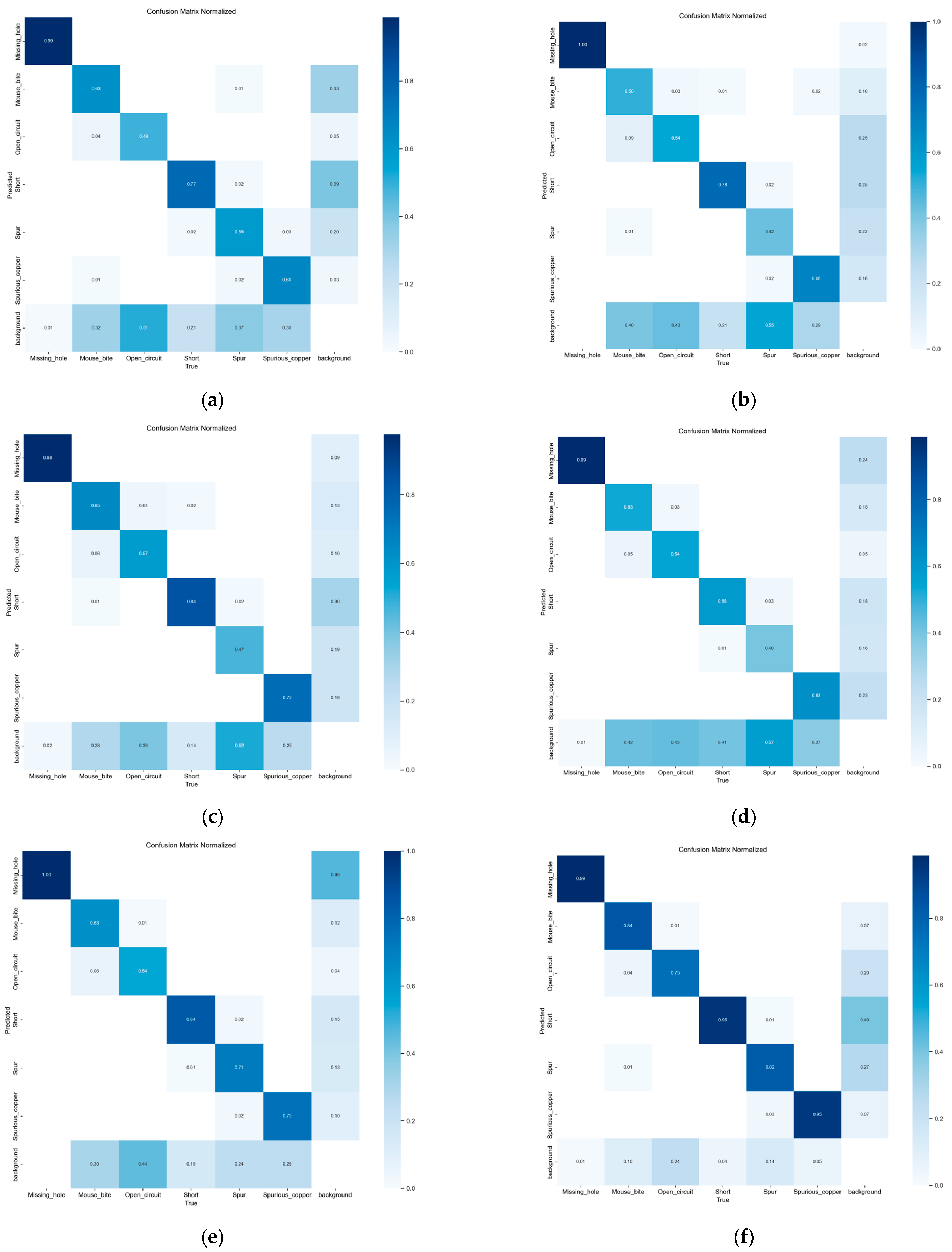
- The specificity sensitivity of different algorithms to defect types has been revealed. The evaluation exceeds the average accuracy of generalization, providing a comprehensive analysis from multiple dimensions such as average accuracy (mAP50, mAP50-95, and mAP75), precision, recall, parameter count, computational complexity, and inference speed. The research results clearly indicate that there is no single omnipotent algorithm: YOLOv10 has shown the highest comprehensive accuracy (94.6% mAP50) after long-term training, while YOLOv13 has shown excellent convergence and parameter efficiency in short-term training. More importantly, “open circuit” and “spur” have been quantitatively identified as the most difficult categories to realize defect detection across algorithm consistency, which points out a key direction for future research.
- (3)
- An algorithm roadmap for specific industrial application scenarios has been proposed. Based on detailed experimental data, this paper abandons empty theoretical discussions and instead proposes a highly operational decision guideline. It is strongly recommended via experiment that YOLOv10 should be preferred in offline analysis scenarios that pursue ultimate detection accuracy; YOLOv13 should be chosen in applications where training time is tight and rapid iterations are required; and YOLOv11 should be employed for high-throughput online detection production lines so as to provide optimal speed accuracy balance. This guideline based on strict benchmarking can provide a crucial practical basis and theoretical support for PCB manufacturing enterprises to efficiently and reliably integrate advanced DL models into their quality assurance systems, promoting the industrial application process of automated inspection for PCBs.
2. Literature Review
2.1. Defect Detection for PCBs
2.2. YOLO Series Algorithms and Their Applications
2.3. Insights from Literature Review and Contribution of This Paper
3. Experiment Design
3.1. Algorithms Chosen for Empirical Evaluation
3.2. Framework Design of the Experiment
4. Experiment Results and Analysis
4.1. Data Acquisition and Experiment Environment Setup
- (1)
- Authenticity of data sources: The images in this dataset were collected from real PCB production lines and scrapped boards, and defects were confirmed and labeled by process engineers to ensure the authenticity of their morphology. The physical forms corresponding to the six typical defects included in it (such as abnormal holes, conductor gaps, spur, spurious copper, etc.) have targeted visual acceptance condition judgment diagrams in the authoritative industry-standard IPC-A-600K with the title “Acceptability of Printed Boards” [50]. Therefore, this dataset is suitable for appearance acceptance research based on IPC standards. IPC-A-600K is the latest version of the standard released by IPC in July 2020. It specifies the observable targets, specifies the acceptable and non-compliant conditions of printed circuit boards (bare boards) without assembled components in both internal and external aspects through detailed illustrations, and is an authoritative acceptance guide widely used in the industry.
- (2)
- Authenticity of imaging conditions: The images are collected in a controlled industrial optical inspection system environment, with uniform and stable photo contrast; this precisely simulates the internal imaging conditions of professional AOI equipment. Actually, the industrial AOI system just pursues a stable and controllable imaging environment through built-in light sources and enclosed structures, in order to minimize external light interference.
4.2. 100 Rounds Experiment Results and Analysis
4.3. 500 Rounds Experiment Results and Analysis
4.4. Discussion
4.4.1. Dataset and Evaluation Scenarios
4.4.2. Algorithm Evaluation and Comparison Framework
4.4.3. Algorithm Version Timeliness
5. Conclusions and Future Prospects
5.1. Conclusions
5.2. Future Prospects
Author Contributions
Funding
Data Availability Statement
Conflicts of Interest
Abbreviations
| ADAM | Adaptive moment estimation |
| AI | Artificial Intelligence |
| AOI | Automatic optical inspection |
| CDA | Consistent dual allocation |
| CIB | Compact inverted block |
| CNN | Convolutional neural network |
| DL | Deep learning |
| DNN | Deep neural network |
| FP | False positive |
| FN | False negative |
| GPU | Graph processing unit |
| NN | Neural network |
| PCB | Printed circuit board |
| PGI | Programmable gradient information |
| TP | True positive |
| YOLO | You-only-look-once |
References
- Wang, Y.; Wang, J.; Cao, Y.; Li, S.; Kwan, O. Integrated inspection of PCB manufacturing in cyber-physical-social systems. IEEE Trans. Syst. Man Cybern. Syst. 2023, 53, 2098–2106. [Google Scholar] [CrossRef] [Scilit]
- Wang, W.C.; Chen, S.L.; Chen, L.B.; Chang, W.J. A machine vision based automatic optical inspection system for measuring drilling quality of printed circuit boards. IEEE Access 2017, 5, 10817–10833. [Google Scholar] [CrossRef] [Scilit]
- Wu, H.; Lei, R.; Peng, Y. PCBNet: A lightweight convolutional neural network for defect inspection in surface mount technology. IEEE Trans. Instrum. Meas. 2022, 71, 3518314. [Google Scholar] [CrossRef] [Scilit]
- Cao, Y.; Wang, Y.; Wang, J.; Tian, Y.; Wang, X.; Wang, F.Y. Parameter identification and refinement for parallel PCB inspection in cyber-physical-social systems. IEEE Trans. Comput. Soc. Syst. 2024, 11, 3978–3987. [Google Scholar] [CrossRef] [Scilit]
- Deng, L.; Meng, X.; Guo, X.; Chen, Y.; Shan, H.; Wu, S.; Lin, J.; Dong, M.; Zhu, L. Learned optical flow-based defect detection with coarse-to-fine nonrigid image alignment. IEEE Sens. J. 2025, 25, 8684–8696. [Google Scholar] [CrossRef] [Scilit]
- Zhou, W.; Li, C.; Ye, Z.; He, Q.; Ming, Z.; Chen, J. An efficient tiny defect detection method for PCB with improved YOLO through a compression training strategy. IEEE Trans. Instrum. Meas. 2024, 73, 2003514. [Google Scholar] [CrossRef] [Scilit]
- Mo, C.; Hu, Z.; Wang, J.; Xiao, X. SGT-YOLO: A lightweight method for PCB defect detection. IEEE Trans. Instrum. Meas. 2025, 74, 3543911. [Google Scholar] [CrossRef] [Scilit]
- Li, K.; Zhong, X.; Han, Y. A high-performance small target defect detection method for PCB boards based on a novel YOLO-DFA algorithm. IEEE Trans. Instrum. Meas. 2025, 74, 2008312. [Google Scholar] [CrossRef] [Scilit]
- He, X.; Xie, M. ABF-YOLO: A fine-grained PCB defect detection framework integrating axial attention and bidirectional feature fusion. IEEE Trans. Consum. Electron. 2025, 71, 8562–8570. [Google Scholar] [CrossRef] [Scilit]
- Wu, H.; Lin, Y. A high-performance and enhanced generalization small target defect detection method for PCB boards based on YOLO-EMAC. IEEE Trans. Instrum. Meas. 2025, 74, 5042513. [Google Scholar] [CrossRef] [Scilit]
- Redmon, J.; Divvala, S.; Girshick, R.; Farhadi, A. You only look once: Unified, real-time object detection. In Proceedings of the IEEE Conference on Computer Vision and Pattern Recognition (CVPR), Las Vegas, NV, USA, 27–30 June 2016. [Google Scholar] [CrossRef] [Scilit]
- Redmon, J.; Farhadi, A. YOLO9000: Better, faster, stronger. In Proceedings of the IEEE Conference on Computer Vision and Pattern Recognition (CVPR), Honolulu, HI, USA, 21–26 July 2017. [Google Scholar] [CrossRef] [Scilit]
- Redmon, J.; Farhadi, A. Yolov3: An incremental improvement. arXiv 2018, arXiv:1804.02767. [Google Scholar] [CrossRef] [Scilit]
- Bochkovskiy, A.; Wang, C.Y.; Liao, H.Y.M. Yolov4: Optimal speed and accuracy of object detection. arXiv 2020, arXiv:2004.10934. [Google Scholar] [CrossRef] [Scilit]
- Jocher, G.; Liu, C.; Hogan, A.; Yu, L.; Rai, P.; Sullivan, T. Ultralytics/Yolov5: Initial Release, version 1.0; Zenodo: Geneva, Switzerland, 2020.
- Li, C.; Li, L.; Jiang, H.; Weng, K.; Geng, Y.; Li, L.; Ke, Z.; Li, Q.; Cheng, M.; Nie, W.; et al. YOLOv6: A single-stage object detection framework for industrial applications. arXiv 2022, arXiv:2209.02976. [Google Scholar] [CrossRef] [Scilit]
- Wang, C.Y.; Bochkovskiy, A.; Liao, H.Y.M. YOLOv7: Trainable bag-of-freebies sets new state-of-the-art for real-time object detectors. In Proceedings of the IEEE/CVF Conference on Computer Vision and Pattern Recognition (CVPR), Vancouver, BC, Canada, 17–24 June 2023. [Google Scholar] [CrossRef] [Scilit]
- YOLOv8. Available online: https://github.com/dme-compunet/YoloSharp (accessed on 6 December 2025).
- Wang, C.Y.; Yeh, I.H.; Liao, H.Y.M. YOLOv9: Learning what you want to learn using programmable gradient information. arXiv 2024, arXiv:2402.13616. [Google Scholar] [CrossRef] [Scilit]
- Wang, A.; Chen, H.; Liu, L.; Chen, K.; Lin, Z.; Han, J.; Ding, G. YOLOv10: Real-time end-to-end object detection. arXiv 2024, arXiv:2405.14458. [Google Scholar]
- YOLOv11. Available online: https://github.com/yt7589/yolov11 (accessed on 6 December 2025).
- Tian, Y.; Ye, Q.; Doermann, D. YOLOv12: Attention-centric real-time object detectors. arXiv 2025, arXiv:2502.12524. [Google Scholar]
- Lei, M.; Li, S.; Wu, Y.; Hu, H.; Zhou, Y.; Zheng, X.; Ding, G.; Du, S.; Wu, Z.; Gao, Y. YOLOv13: Real-time object detection with hypergraph-enhanced adaptive visual perception. arXiv 2025, arXiv:2506.17733. [Google Scholar]
- Sapkota, R.; Cheppally, R.H.; Sharda, A.; Karkee, M. YOLO26: Key architectural enhancements and performance benchmarking for real-time object detection. arXiv 2025, arXiv:2509.25164. [Google Scholar] [CrossRef] [Scilit]
- Bhavana, N.; Kodabagi, M.M.; Kumar, B.M.; Ajay, P.; Muthukumaran, N.; Ahilan, A. POT-YOLO: Real-time road potholes detection using edge segmentation-based Yolo V8 network. IEEE Sens. J. 2024, 24, 24802–24809. [Google Scholar] [CrossRef] [Scilit]
- Zhong, J.; Kong, D.; Wei, Y.; Pan, B. YOLOv8 and point cloud fusion for enhanced road pothole detection and quantification. Sci. Rep. 2025, 15, 11260. [Google Scholar] [CrossRef] [Scilit]
- Moussaoui, H.; Akkad, N.E.; Benslimane, M.; El-Shafai, W.; Baihan, A.; Hewage, C.; Rathore, R.S. Enhancing automated vehicle identification by integrating YOLO v8 and OCR techniques for high-precision license plate detection and recognition. Sci. Rep. 2024, 14, 14389. [Google Scholar] [CrossRef] [Scilit] [PubMed]
- Yi, H.; Liu, B.; Zhao, B.; Liu, E. Small object detection algorithm based on improved YOLOv8 for remote sensing. IEEE J. Sel. Top. Appl. Earth Obs. Remote Sens. 2024, 17, 1734–1747. [Google Scholar] [CrossRef] [Scilit]
- Bakirci, M.; Bayraktar, I. Transforming aircraft detection through LEO satellite imagery and YOLOv9 for improved aviation safety. In Proceedings of the 26th International Conference on Digital Signal Processing and its Applications (DSPA), Moscow, Russia, 27–29 March 2024. [Google Scholar] [CrossRef] [Scilit]
- Ma, R.; Yu, H.; Liu, X.; Yuan, X.; Geng, T.; Li, P. InSAR-YOLOv8 for wide-area landslide detection in InSAR measurements. Sci. Rep. 2025, 15, 1595. [Google Scholar] [CrossRef] [Scilit] [PubMed]
- Ma, C.; Chi, G.; Ju, X.; Zhang, J.; Yan, C. YOLO-CWD: A novel model for crop and weed detection based on improved YOLOv8. Crop Prot. 2025, 192, 107169. [Google Scholar] [CrossRef] [Scilit]
- Regotra, R.; Kumar, R. YOLOv8-based early blight and late blight disease detection in potato. In Proceedings of the 15th International Conference on Computing Communication and Networking Technologies (ICCCNT), Kamand, India, 24–28 June 2024. [Google Scholar] [CrossRef] [Scilit]
- Srivastava, A.; Singh, G.; Bhatnagar, V.; Shrivastava, V.; Grag, N. Method for detecting potato leaf disease using the YOLOv8 model. In Proceedings of the International Conference on Signal Processing and Advance Research in Computing (SPARC), Lucknow, India, 12–13 September 2024. [Google Scholar] [CrossRef] [Scilit]
- Safre, A.L.S.; Torres-Rua, A.; Black, B.L.; Young, S. Deep learning framework for fruit counting and yield mapping in tart cherry using YOLOv8 and YOLO11. Smart Agric. Technol. 2025, 11, 100948. [Google Scholar] [CrossRef] [Scilit]
- Dai, Q.; Liang, S.; Li, Z.; Lyu, S.; Xue, X.; Song, S.; Huang, Y.; Zhang, S.; Fu, J. YOLOv11-RDTNet: A lightweight model for citrus pest and disease identification based on an improved YOLOv11n. Agronomy 2025, 15, 1252. [Google Scholar] [CrossRef] [Scilit]
- Sapkota, R.; Cheppally, R.H.; Sharda, A.; Karkee, M. RF-DETR object detection vs YOLOv12: A study of Transformer-based CNN-based architectures for single-class and multi-class greenfruit detection in complex orchard environments under label ambiguity. arXiv 2025, arXiv:2504.13099. [Google Scholar] [CrossRef] [Scilit]
- Sapkota, R.; Ahmed, D.; Karkee, M. Comparing YOLOv8 and mask R-CNN for instance segmentation in complex orchard environments. Artif. Intell. Agric. 2024, 13, 84–99. [Google Scholar] [CrossRef] [Scilit]
- Zhu, W.; Niu, S.; Yue, J.; Zhou, Y. Multiscale wildfire and smoke detection in complex drone forest environments based on YOLOv8. Sci. Rep. 2025, 15, 2399. [Google Scholar] [CrossRef] [Scilit]
- Wang, H.; Fu, X.; Yu, Z.; Zeng, Z. DSS-YOLO: An improved lightweight real-time fire detection model based on YOLOv8. Sci. Rep. 2025, 15, 8963. [Google Scholar] [CrossRef] [Scilit]
- Ramos, L.; Casas, E.; Bendek, E.; Romero, C.; Rivas-Echeverriia, F. Hyperparameter optimization of YOLOv8 for smoke and wildlife detection: Implications for agricultural and environmental safety. Artif. Intell. Agric. 2024, 12, 109–126. [Google Scholar] [CrossRef] [Scilit]
- Cai, Y.; Chen, L.; Zhuang, X.; Zhang, B. Automated marine oil spill detection algorithm based on single-image generative adversarial network and YOLO-v8 under small samples. Mar. Pollut. Bull. 2024, 203, 116475. [Google Scholar] [CrossRef] [Scilit] [PubMed]
- Shankar, G.; Geetha, M.K.; Ezhumalai, P. Disaster management systems: Utilizing YOLOv9 for precise monitoring of river flood flow levels using video surveillance. SN Comput. Sci. 2025, 6, 288. [Google Scholar] [CrossRef] [Scilit]
- Liu, B.; Li, Y.; Feng, X.; Lian, P. BEW-YOLOv8: A deep learning model for multi-scene and multi-scale flood depth estimation. J. Hydrol. 2024, 645, 132139. [Google Scholar] [CrossRef] [Scilit]
- Chen, L.; Li, G.; Zhang, S.; Mao, W.; Zhang, M. YOLO-SAG: An improved wildlife object detection algorithm based on YOLOv8n. Ecol. Inform. 2024, 83, 102791. [Google Scholar] [CrossRef] [Scilit]
- Pan, W.; Chen, J.; Lv, B.; Peng, L. Lightweight marine biodetection model based on improved YOLOv10. Alex. Eng. J. 2025, 119, 379–390. [Google Scholar] [CrossRef] [Scilit]
- Wang, X.; Song, X.; Li, Z.; Wang, H. YOLO-DBS: Efficient target detection in complex underwater scene images based on improved YOLOv8. J. Ocean Univ. China 2025, 24, 979–992. [Google Scholar] [CrossRef] [Scilit]
- Gui, H.; Su, T.; Jiang, X.; Li, L.; Xiong, L.; Zhou, J.; Pang, Z. FS-YOLOv9: A frequency and spatial feature-based YOLOv9 for real-time breast cancer detection. Acad. Radiol. 2025, 32, 1228–1240. [Google Scholar] [CrossRef] [Scilit]
- Liu, Z.; Wei, L.; Song, T. Optimized YOLOv11 model for lung nodule detection. Biomed. Signal Process. Control 2025, 107, 107830. [Google Scholar] [CrossRef] [Scilit]
- Srinivasu, P.N.; Kumari, G.L.A.; Narahari, S.C.; Ahmed, S.; Alhumam, A. Exploring the impact of hyperparameter and data augmentation in YOLO V10 for accurate bone fracture detection from X-ray images. Sci. Rep. 2025, 15, 9828. [Google Scholar] [CrossRef] [Scilit]
- IPC-A-600 Acceptability of Printed Boards (in Chinese), the Current Latest Edition IPC-A-600K. Available online: https://www.ipc.org.cn/productinfo/1307827.html (accessed on 9 January 2026).












| Specific Algorithms | Literature No. | Tasks Can Be Realized | ||||||
|---|---|---|---|---|---|---|---|---|
| Object Detection | Classification | Multi Scale Detection | Target Tracking | Instance segmentation | Pose Estimation | Directional Object Detection | ||
| YOLOv1 | [11] | √ | √ | |||||
| YOLOv2 | [12] | √ | √ | |||||
| YOLOv3 | [13] | √ | √ | |||||
| YOLOv4 | [14] | √ | √ | |||||
| YOLOv5 | [15] | √ | √ | |||||
| YOLOv6 | [16] | √ | √ | |||||
| YOLOv7 | [17] | √ | √ | √ | ||||
| YOLOv8 | [18] | √ | √ | √ | ||||
| YOLOv9 | [19] | √ | √ | |||||
| YOLOv10 | [20] | √ | ||||||
| YOLOv11 | [21] | √ | √ | √ | √ | |||
| YOLOv12 | [22] | √ | ||||||
| YOLOv13 | [23] | √ | ||||||
| YOLO26 | [24] | √ | √ | √ | √ | √ | ||
| Specific Algorithms | Literature No. | Year Published | YOLO Series Algorithms Employed | ||||
|---|---|---|---|---|---|---|---|
| YOLOv8 | YOLOv9 | YOLOv10 | YOLOv11 | YOLOv12 | |||
| Autonomous driving | [25] | 2024 | √ | ||||
| [26] | 2025 | √ | |||||
| [27] | 2024 | √ | |||||
| Remote sensing | [28] | 2024 | √ | ||||
| [29] | 2024 | √ | |||||
| [30] | 2025 | √ | |||||
| Smart agriculture | [31] | 2025 | √ | ||||
| [32] | 2024 | √ | |||||
| [33] | 2024 | √ | |||||
| [34] | 2025 | √ | √ | ||||
| [35] | 2025 | √ | |||||
| [36] | 2025 | √ | |||||
| [37] | 2024 | √ | |||||
| Natural environment monitoring | [38] | 2025 | √ | ||||
| [39] | 2025 | √ | |||||
| [40] | 2024 | √ | |||||
| [41] | 2024 | √ | |||||
| [42] | 2025 | √ | |||||
| [43] | 2024 | √ | |||||
| [44] | 2024 | √ | |||||
| [45] | 2025 | √ | |||||
| [46] | 2025 | √ | |||||
| Medical image diagnosis | [47] | 2025 | √ | ||||
| [48] | 2025 | √ | |||||
| [49] | 2025 | √ | |||||
| PCB defect detection | [8] | 2025 | √ | ||||
| [9] | 2025 | √ | |||||
| [10] | 2025 | √ | |||||
| Defect Name | Formation Mechanism | Functional Hazards | Inspection Challenge |
|---|---|---|---|
| Missing hole | It is a serious abnormality in the drilling process, which means complete loss of through holes/boreholes due to incorrect paths, mechanical failures, or drill bit damage. | Lose vertical interconnection function, cause electrical open circuits between circuit layers, prevent power, ground, or signal transmission, and result in complete failure of the entire PCB or specific modules. It is a catastrophic process failure. | (1) Small object detection: Holes account for a very small proportion in the entire image. (2) Negative sample detection: It is necessary to identify objects that should exist but do not actually exist. (3) Distinguishing from imaging artifacts: Visual “holes” caused by lighting, shadows, etc., need to be excluded. |
| Mouse bite | It is an abnormal etching process. Due to mask defects, improper exposure, or uneven etching solution, the edges of the circuit are abnormally corroded, forming irregular serrated/wavy contours. | Reduce the cross-sectional area of wires, easily cause local overheating, accelerate aging or melting (open circuit), affect high-frequency performance, exacerbate skin effect, and reduce mechanical strength. | (1) Fine feature extraction: It is necessary to capture sub-pixel-level contour distortions. (2) Morphological complexity: Defects have irregular shapes and no fixed patterns. (3) High difficulty in defining: It is necessary to accurately distinguish between defects and allowable process fluctuations. |
| Open circuit | The continuous wires in the design are physically disconnected. It is mainly due to excessive etching, mechanical scratching, electric migration forming voids, or substrate crack propagation. | Interrupt signal or power path, and cause complete loss of downstream circuit functionality. It is one of the most fundamental and harmful defects. | (1) Multi scale perception: The size of the disconnect gap varies. (2) Connectivity analysis: It is necessary to understand the route direction at the semantic level and determine its continuity. (3) Background interference: The fracture may be located in a dense wiring area, which is easily concealed. |
| Short circuit | Unexpectedly connected wires that should have been insulated. It is mainly due to incomplete etching resulting in copper foil residue, or improper ink coverage of the isolation gap during the production of the solder mask layer. | Cause signal crosstalk and logic errors, and generate high current paths, which may cause component burnout due to overcurrent and even trigger fires, with great destructive power. | (1) Inspection of slender structures: Bridge copper wires are often small linear or mesh-like. (2) Low contrast issue: Residual thin copper foil may result in extremely low contrast between the defect area and the background. (3) Gap measurement accuracy: It is necessary to accurately measure the distance between the lines and determine whether it is below the safety standard. |
| Spur | After etching, isolated small copper particles or copper spikes (often referred to as copper slag) remain on the surface of the PCB or in the isolation groove and are not required by the design. It is mainly due to poor etching solution flushing or poor copper foil quality. | Have potential short circuit risk, displace and bridge critical circuits due to external influences, disrupt signal integrity, act as a miniature antenna in high-frequency circuits, and radiate or receive interference. | (1) Random detection of small targets: Micro sized particles with irregular shape and position. (2) High false positive rate: Easily confused with image noise, dust, scratches, etc. (3) Weak feature saliency: Isolated existence, lacking contextual information for judgment. |
| Spurious copper | A larger and irregularly shaped redundant copper foil area. It is usually due to damage or contamination of the photomask, large areas of copper foil that should have been etched away are not completely removed. | Have bridge risk, cause a short circuit in isolated circuit areas, have an impact on circuit performance such as changing local characteristic impedance, and pose a serious threat to high-speed digital and RF circuits. | (1) Irregular shape segmentation: The forms vary greatly and there is no fixed paradigm. (2) High segmentation accuracy requirements: Accurate pixel-level segmentation is required for areas with copper impurities. (3) Distinguish from legal copper areas: It is necessary to avoid mistaking design features such as tears and copper coating as defects. |
| Names of the Evaluation Indicators | Principle | Function |
|---|---|---|
| mAP50 | The average accuracy mean of all categories under relaxed positioning requirements (if the overlap area between the predicted box and the real box exceeds 50%, it is considered correct) | Provide basic performance benchmarks. Reflect the comprehensive detection capability of the algorithm under conventional positioning accuracy requirements. |
| mAP75 | The average accuracy mean for all categories under strict positioning requirements (if the overlap area between the predicted box and the real box exceeds 75%, it is considered correct) | Evaluate the positioning precision of the algorithm. The higher the value, the more accurate the position and size of the predicted box are. |
| mAP50-95 | Change the intersection over union (IoU) threshold from 0.5 to 0.95 with a step size of 0.05, calculate mAP at multiple different strictness levels, and then take the average. | Provide the most comprehensive and rigorous performance evaluation. It is the golden indicator for measuring the comprehensive performance of an algorithm. |
| P (precision) | The proportion of true targets among all the “targets” predicted by the algorithm. It pays attention to the accuracy of the predicted results. | Evaluate the level of “false detections” in the algorithm. The higher the value, the more reliable the algorithm is, and the fewer false alarms. |
| R (recall) | The proportion of all real targets successfully detected by the algorithm. It pays attention to the ability of the algorithm to discover all targets. | Evaluate the level of “missed detections” in the algorithm. The higher the value, the more comprehensive the coverage. |
| M (parameter count, in millions) | The total number of weights and biases that need to be learned in the algorithm. It represents the scale and capacity of the algorithm. | Indirectly measure the complexity and memory usage of the algorithm. Algorithms with a large number of parameters have high potential, but deployment requires more storage space. |
| GFLOPs (computational complexity) | The number of floating-point operations required for an algorithm to complete one forward inference, measured in billions of times. It represents the computational complexity of the algorithm. | Evaluate the inference speed potential and hardware requirements of the algorithm. The lower the value, the faster the inference speed and the easier it is to deploy at the edge. |
| inference (inference speed) | The actual time required for the algorithm to process a single input image (or a batch) on specific hardware. | Directly measure the actual operational efficiency of the algorithm. |
| Defect Class | Title 2 | Percentage |
|---|---|---|
| Missing hole | 230 | 16.6% |
| Mouse bite | 230 | 16.6% |
| Open circuit | 232 | 16.7% |
| Short circuit | 232 | 16.7% |
| Spur | 230 | 16.6% |
| Spurious copper | 232 | 16.7% |
| Total | 1386 | 100% |
| Specific Algorithms | Official Code Libraries in GitHub 1 | Release Tag |
|---|---|---|
| YOLOv8 | ultralytics/ultralytics | V8.3.176 |
| YOLOv9 | WongKinYiu/yolov9 | V0.1 |
| YOLOv10 | THU-MIG/yolov10 | V1.1 |
| YOLOv11 | ultralytics/ultralytics | V8.3.176 |
| YOLOv12 | sunsmarterjie/yolov12 | V1.0 |
| YOLOv13 | iMoonLab/yolov13 | yolov13 |
| Hyperparameters | Full Name | Values |
|---|---|---|
| epochs | Training rounds | 100 or 500 |
| batch | Batch size | 32 |
| imgsz | Input size | 640 |
| optimizer | Optimizer | Adaptive moment estimation (ADAM) |
| close_mosaic | The number of cycles for mosaic enhancement has been turned off | 10 or 20 |
| lr0 | Initial learning rate | 0.01 |
| lrf | Final learning rate factor | 0.01 |
| momentum | Momentum | 0.937 |
| weight_decay | Weight decay | 0.0005 |
| Names of the Evaluation Indicators | Principle | Function |
|---|---|---|
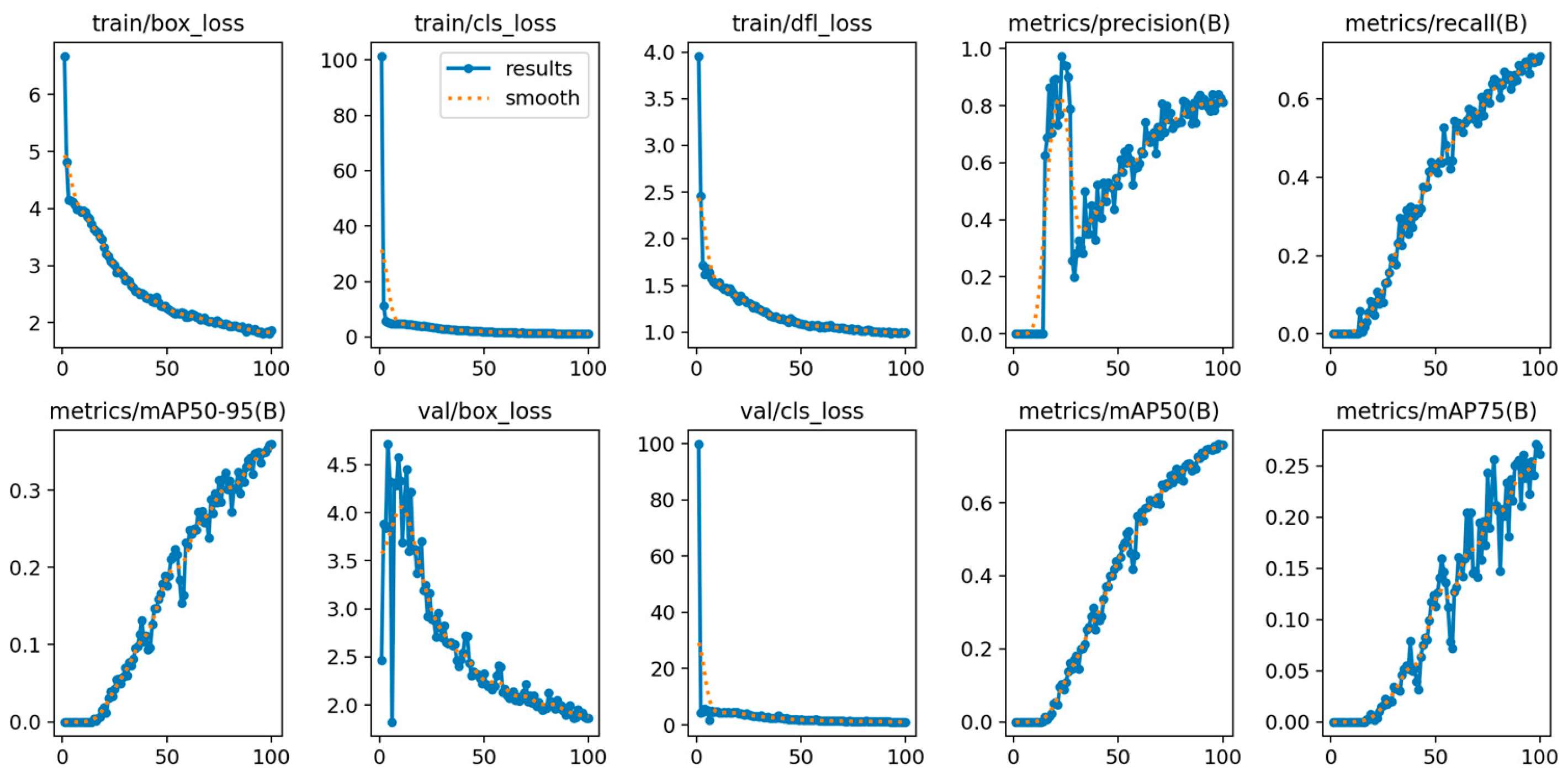
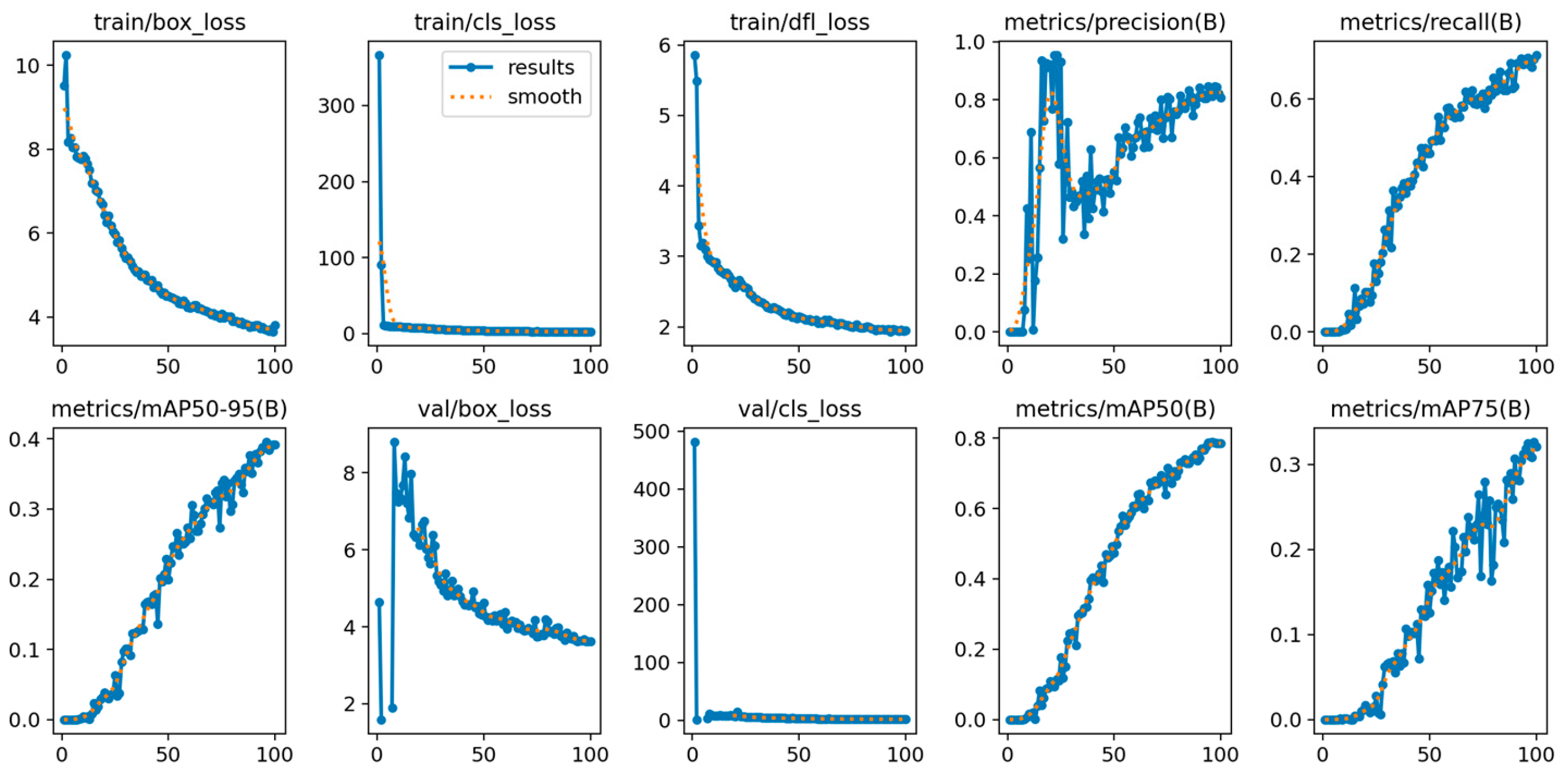
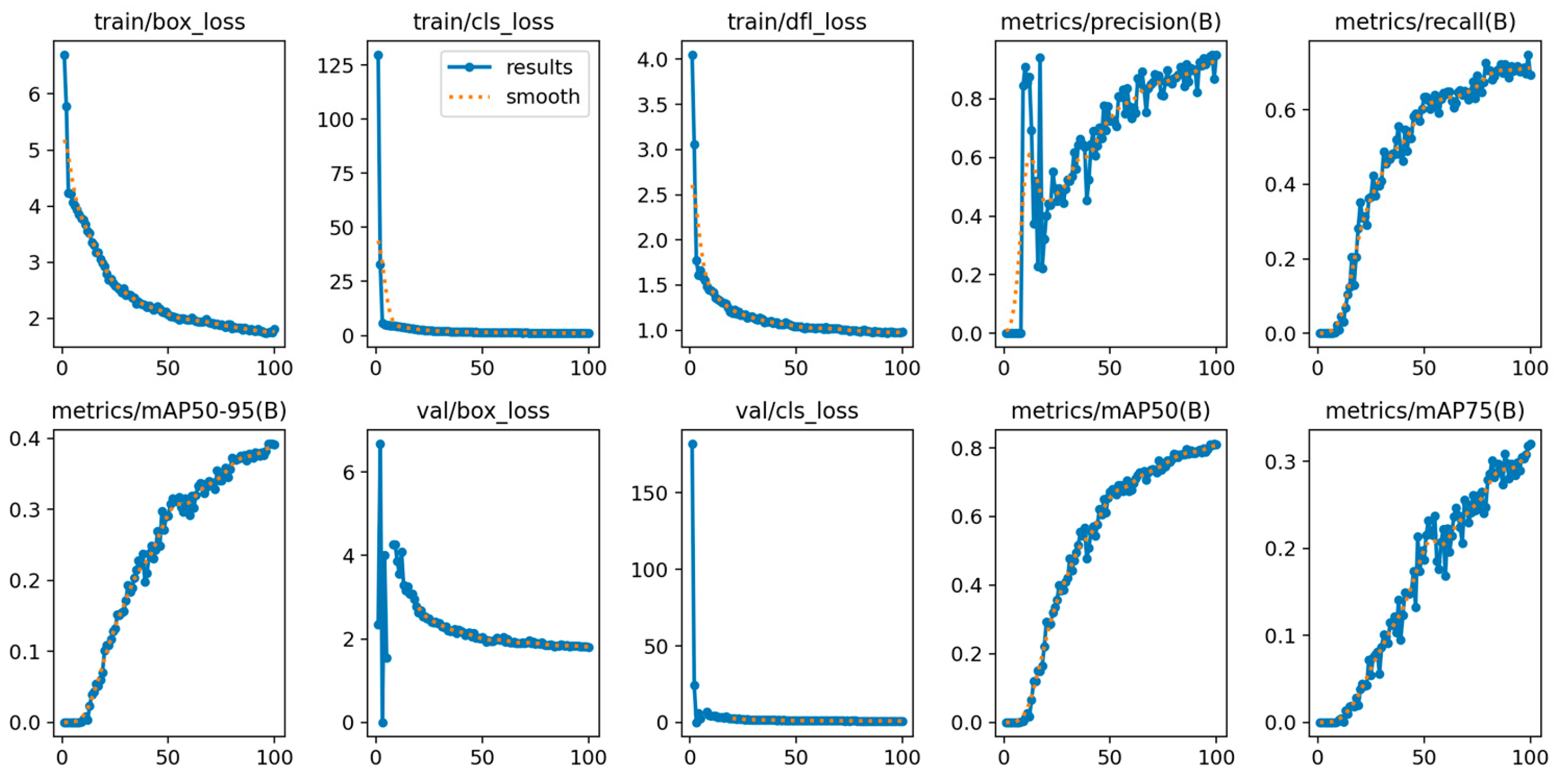
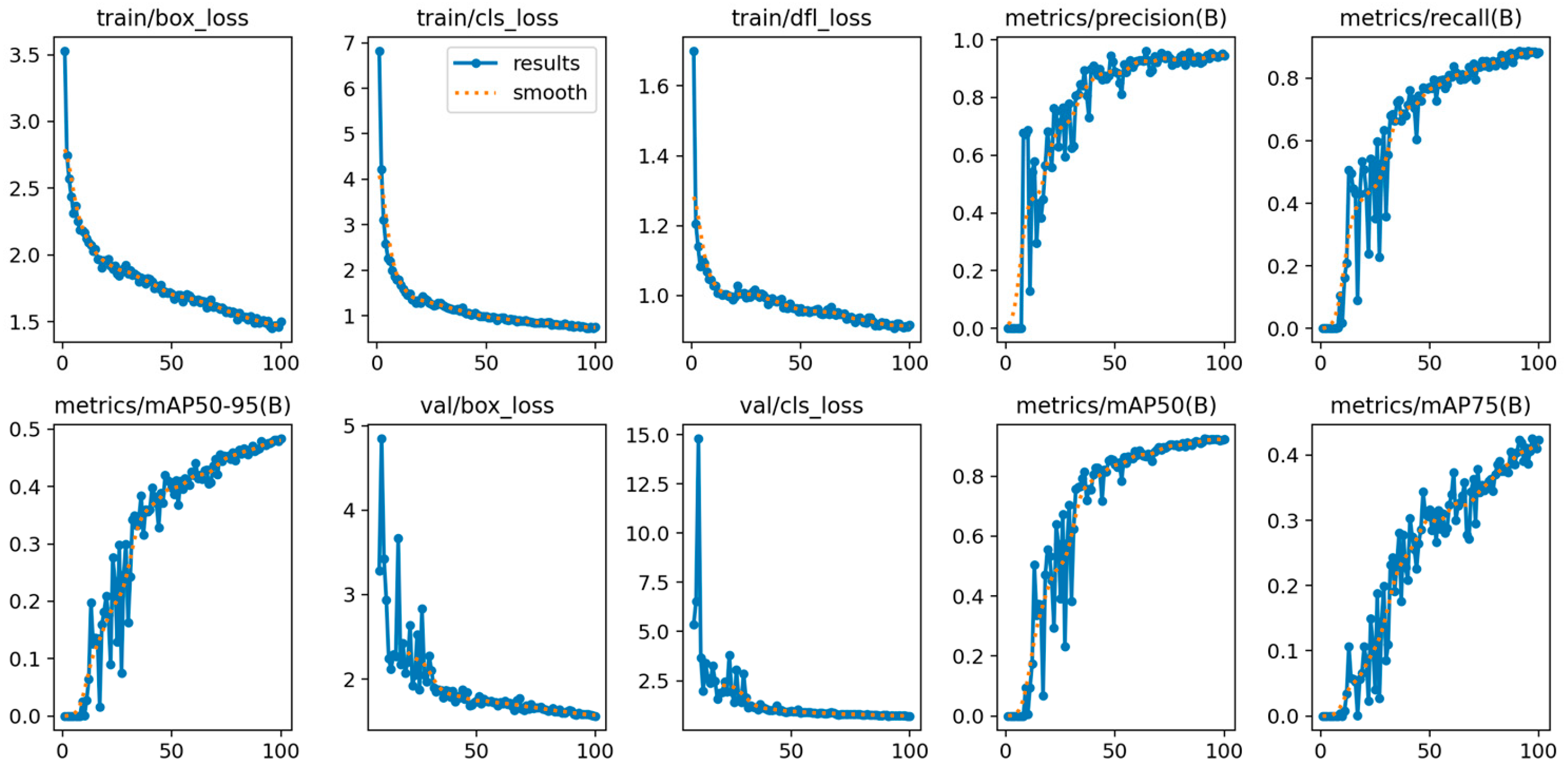
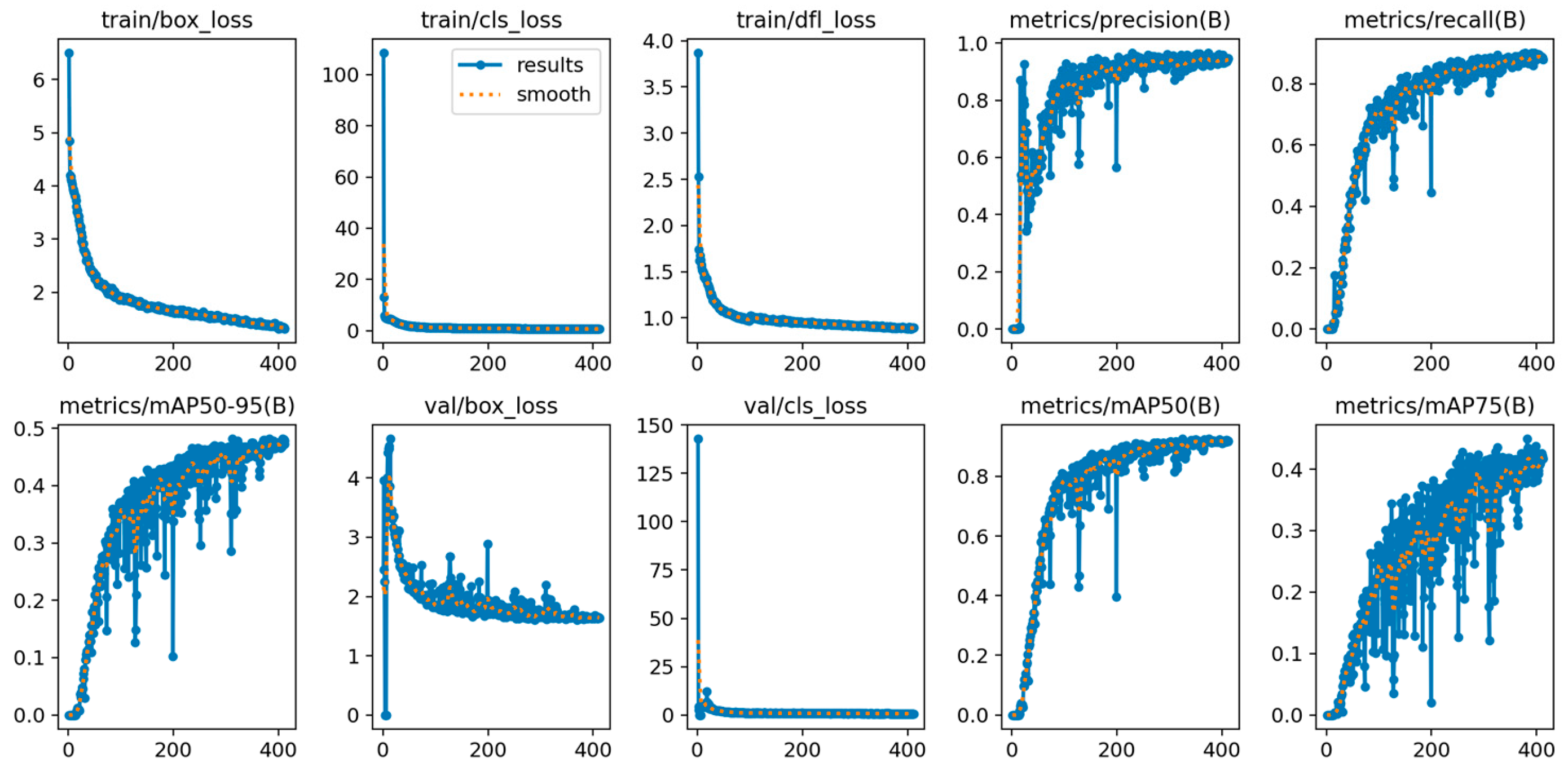
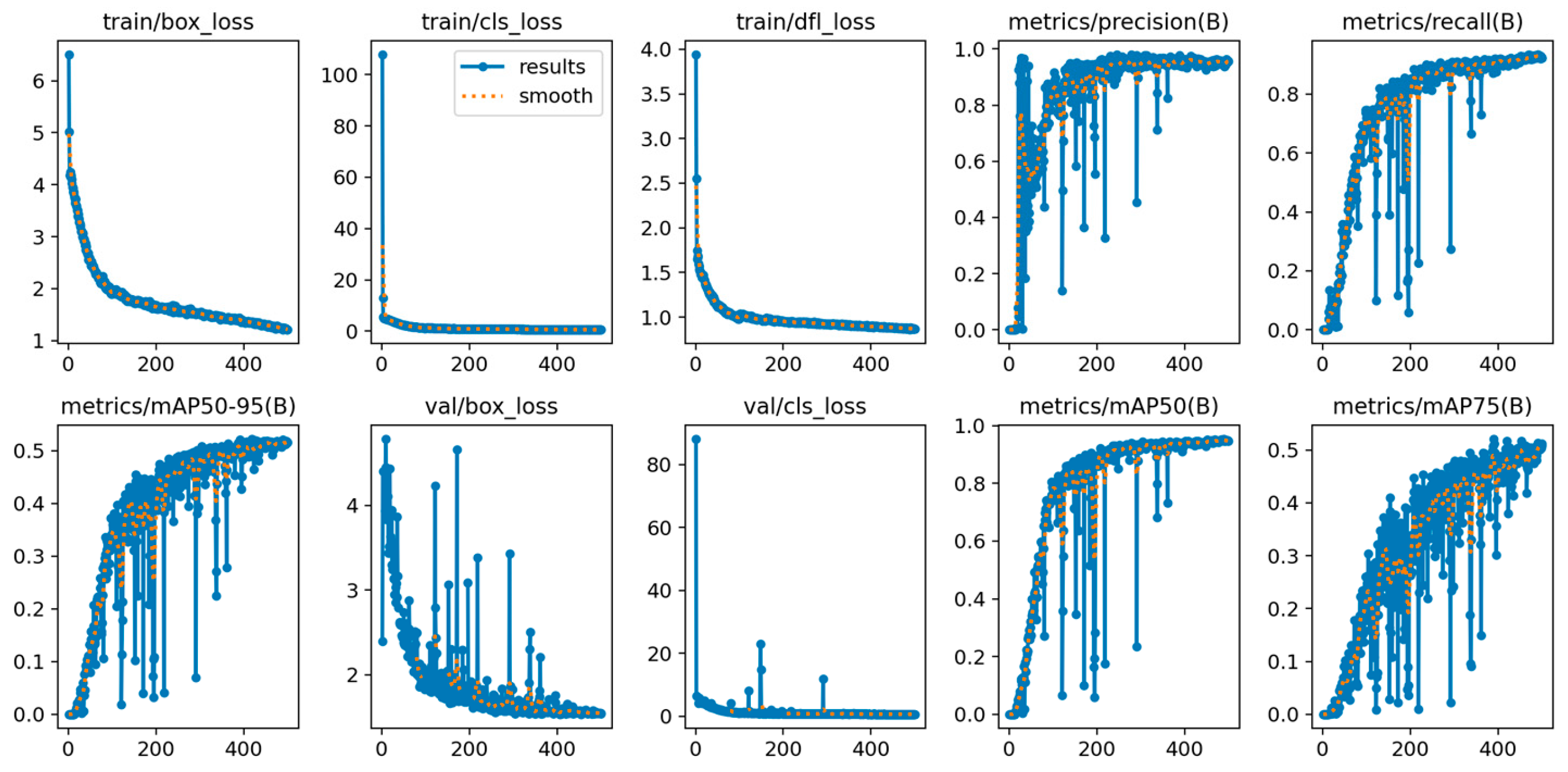
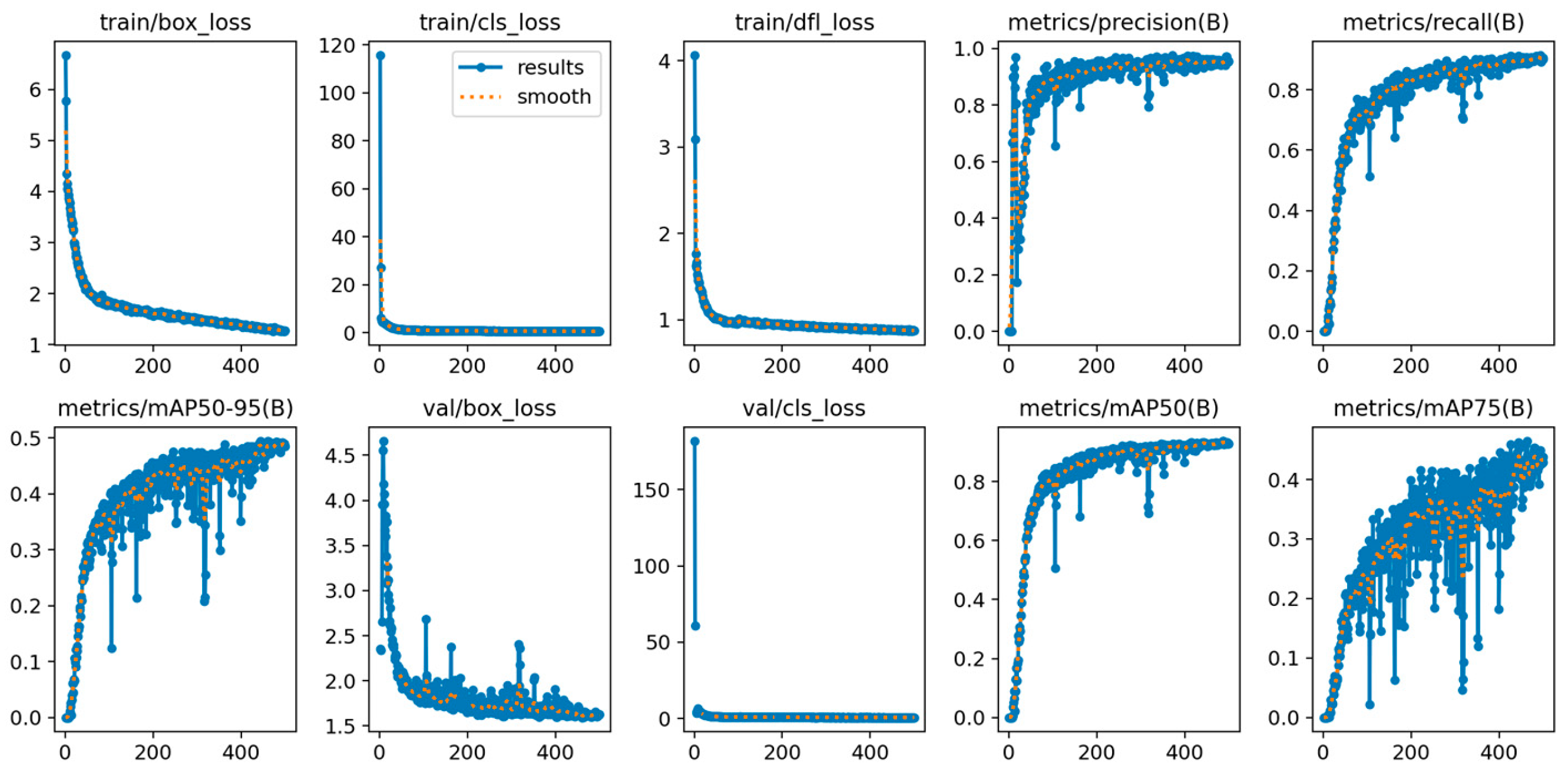
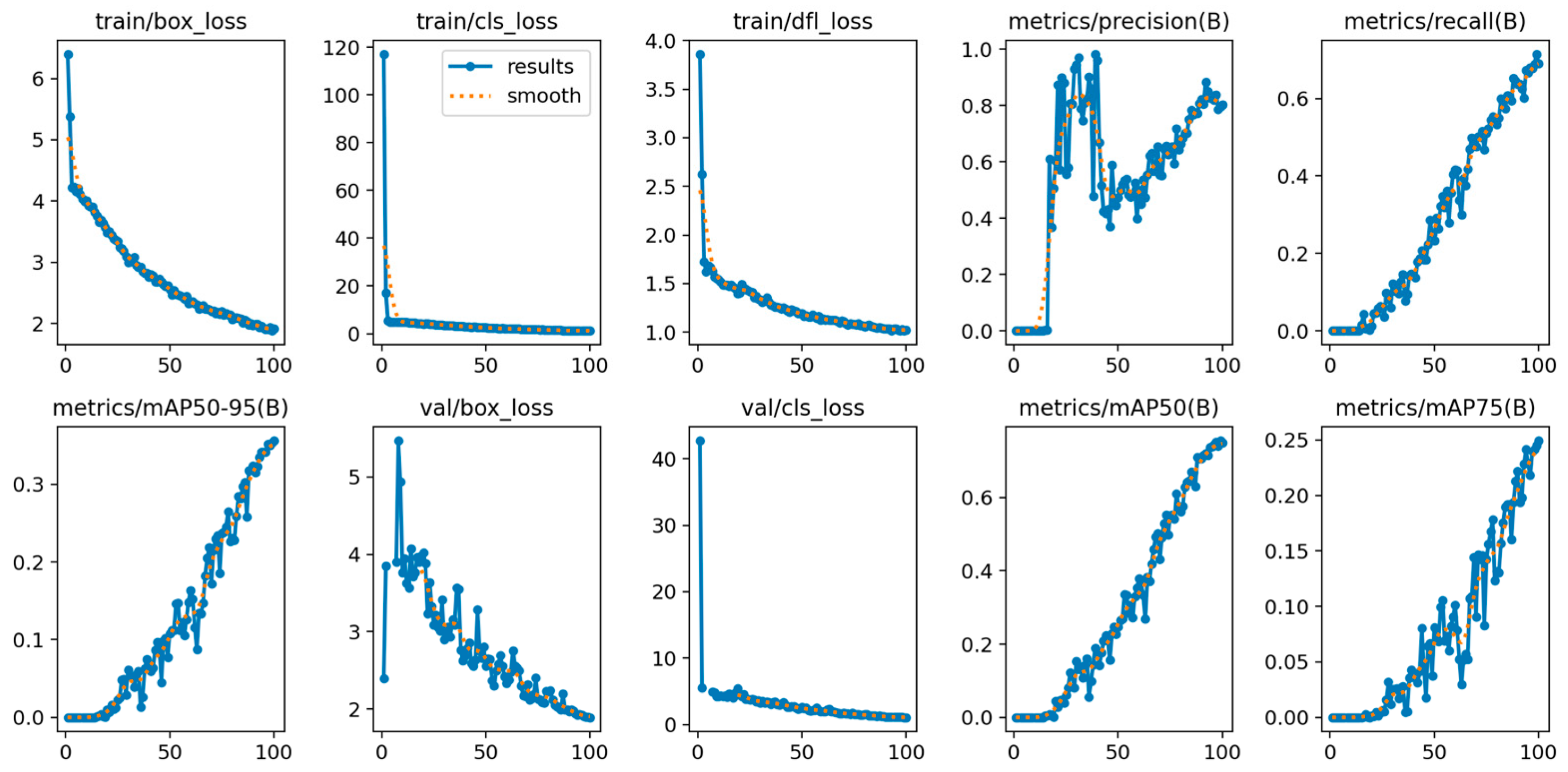
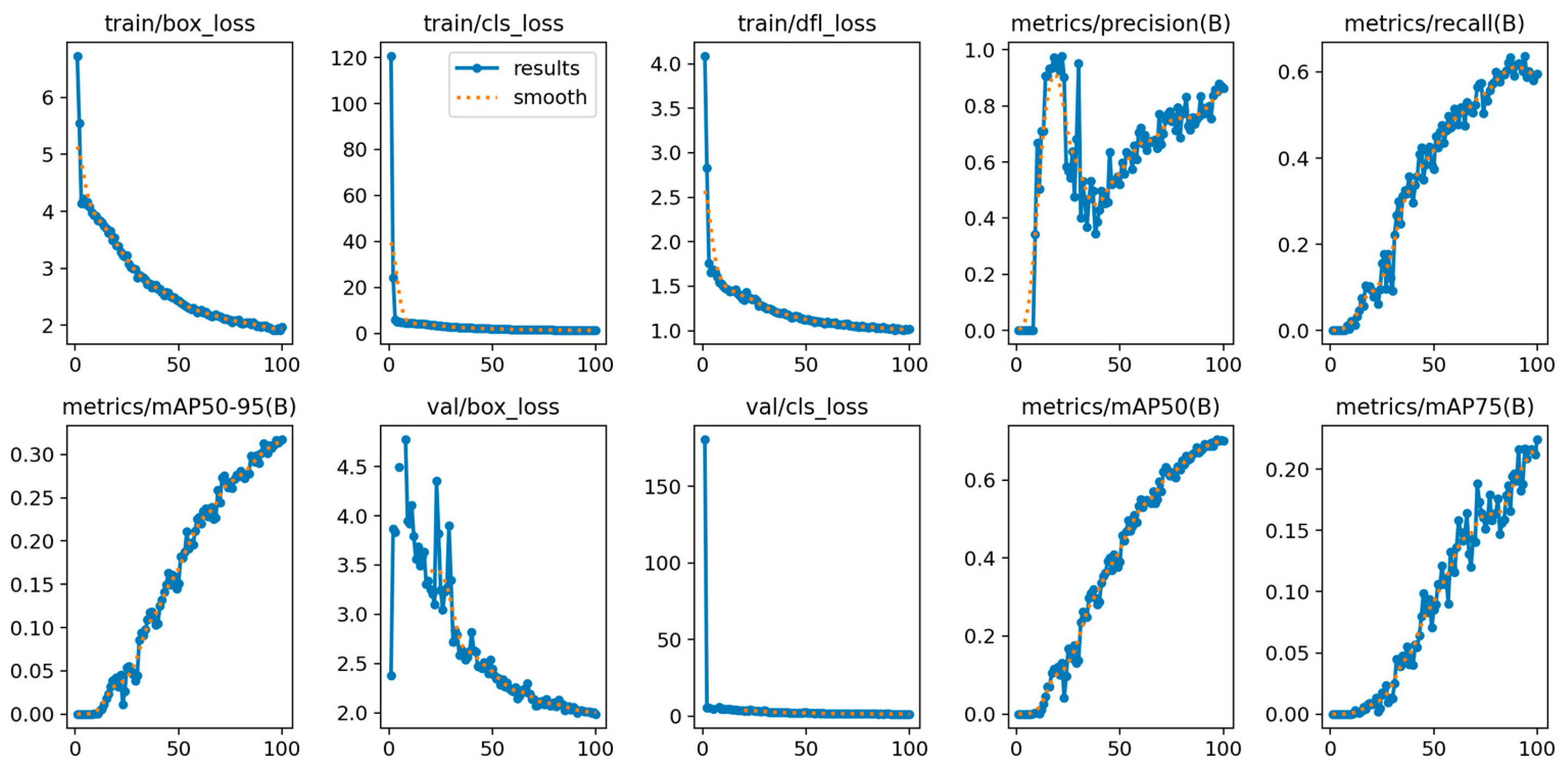
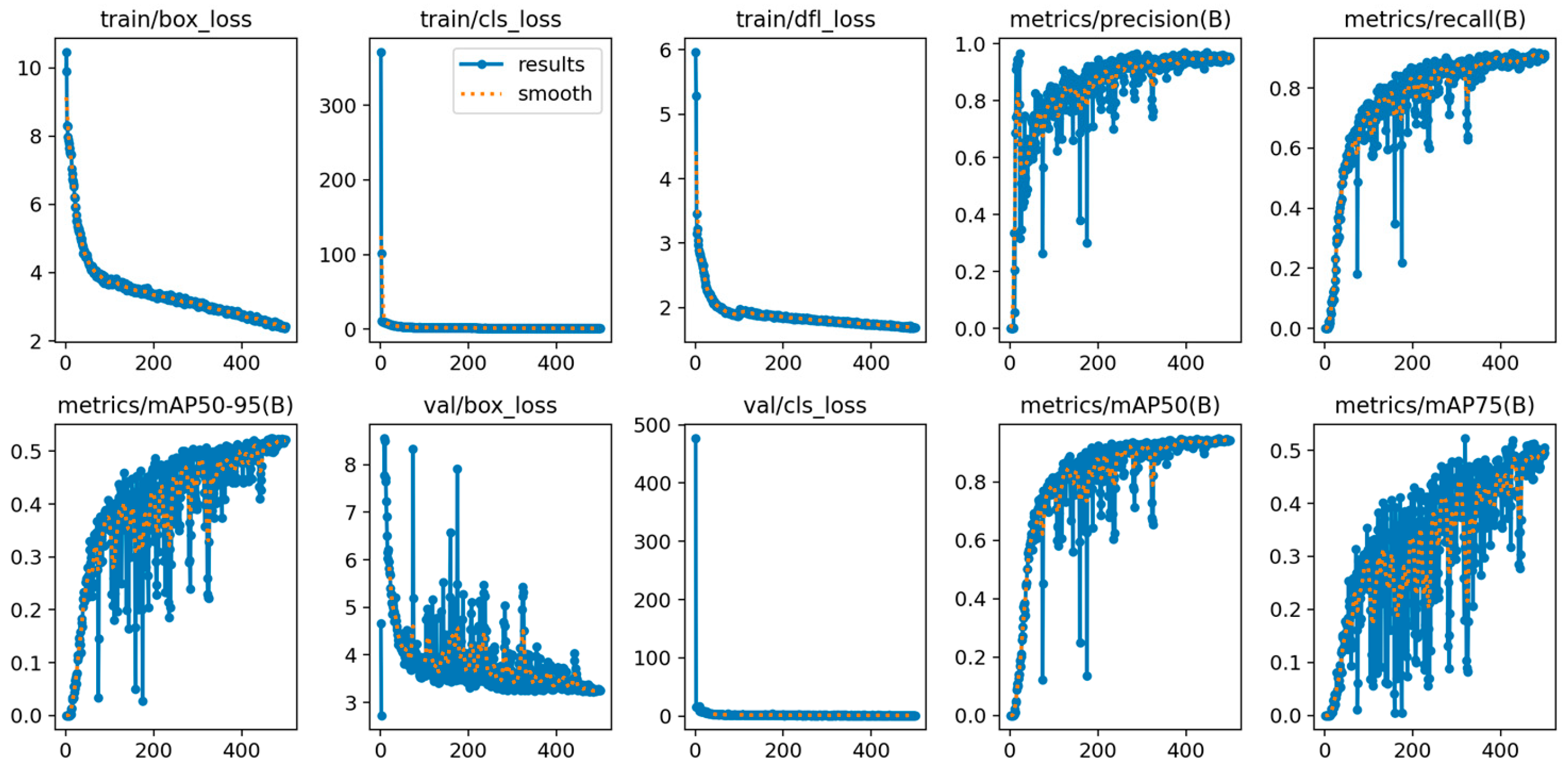
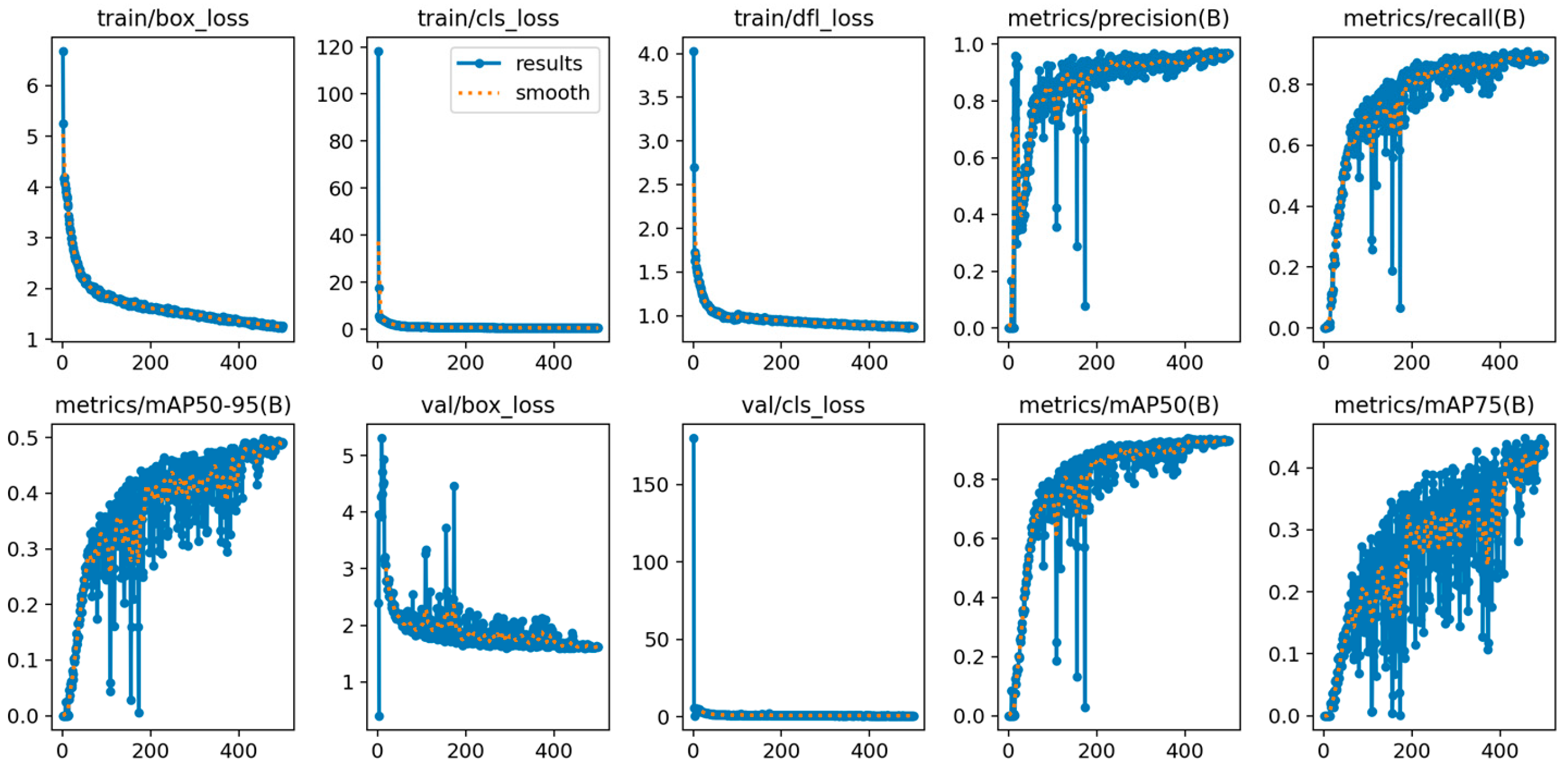
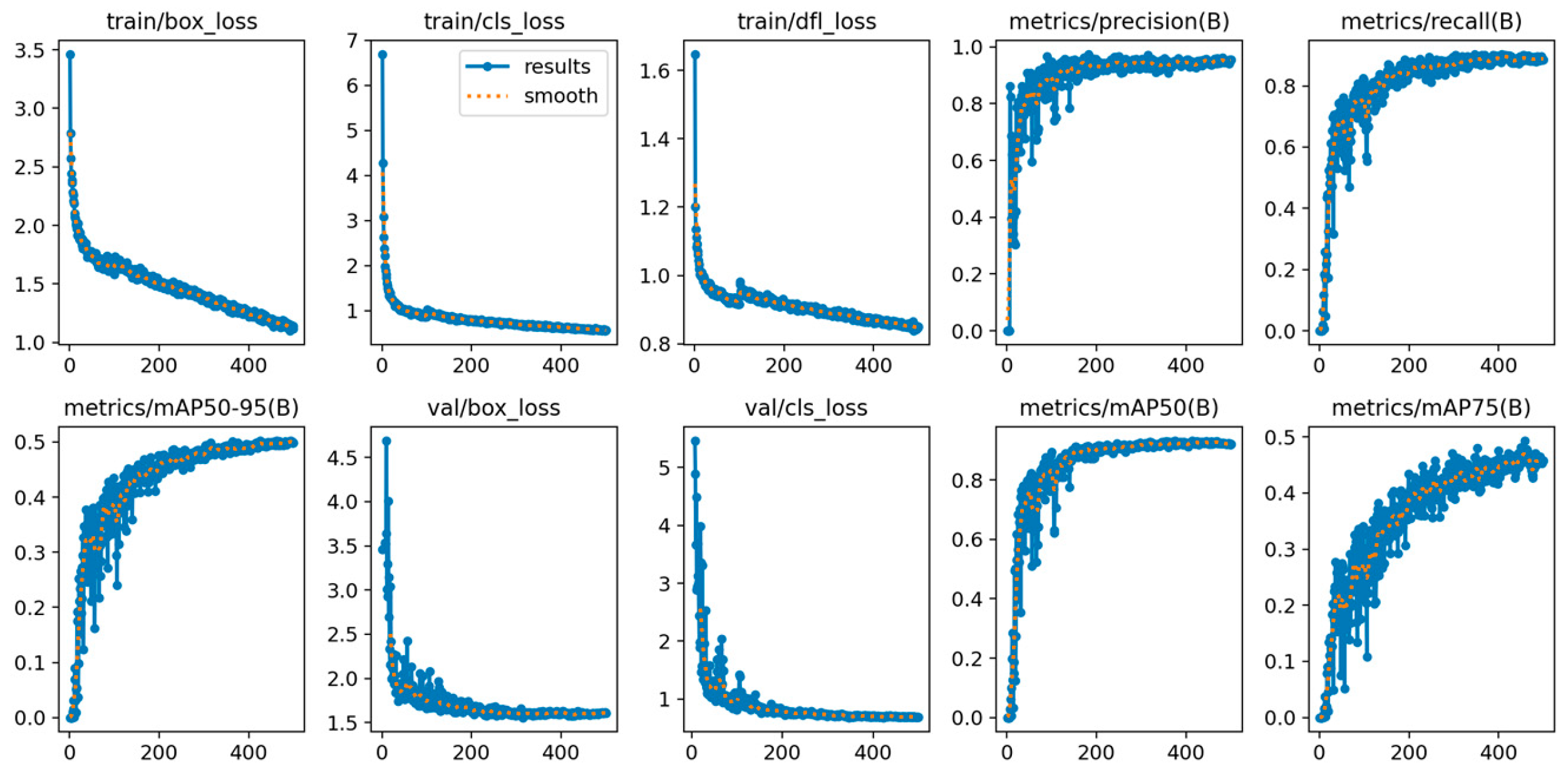
| train/box_loss (Training set bounding box regression loss) | Calculated during the forward propagation process of algorithm training, specifically to supervise and quantify the accuracy of the algorithm in predicting the spatial position and range of objects on the training set samples. Its core is to measure the geometric differences between the predicted bounding box and the real annotated box. | The decreasing trajectory of this loss value directly reflects the ability of the algorithm to learn the geometric distribution of objects from the training data. It is a key driving signal for optimizing algorithm parameters and mastering basic positioning capabilities. Continuous decline and convergence are the primary indicators of an effective training process. |
| train/cls_loss (Training set classification loss) | Calculated during the forward propagation process of algorithm training, specifically to supervise and quantify the accuracy of the classification of detected objects in the training set samples. | The optimization process of this loss value directly drives the algorithm to learn discriminative semantic features that distinguish different object categories. Its convergence trend reflects the establishment and consolidation of the classification and recognition ability of the algorithm. |
| train/dfl_loss (Training set distribution focusing loss) | Used in YOLOv8 and subsequent versions and calculated during the training phase. It represents an advanced bounding box regression paradigm, whose core is not to directly regress the determined values of boundary coordinates, but to guide the algorithm to predict a discrete probability distribution of coordinate values. | This indicator reflects the modeling ability and regression robustness for fuzzy object boundaries. Its effective reduction is the inherent mechanism for achieving sub-pixel-level high-precision positioning in the algorithm, representing an important innovation in the positioning accuracy of modern object detection algorithms. |
| val/box_loss (Verification set bounding box regression loss) | Calculated during the evaluation phase of algorithm training, specifically measuring the accuracy of the algorithm in predicting the spatial position and range of objects on independent validation set samples. | This indicator is the core criterion for evaluating the generalization of the localization ability of a certain algorithm. If its numerical stability is lower than or close to the training bounding box loss, it means that the algorithm has learned universal localization rules; if it is significantly higher than the training value, it suggests that the algorithm may have overfitting to the training data, and its localization ability cannot be transferred to the new scene. |
| val/cls_loss (Verification set classification loss) | Calculated during the evaluation phase of algorithm training, specifically measuring the discrimination accuracy of the algorithm for object categories in independent validation set samples. | This indicator is the gold standard for testing the algorithm’s generalization ability of semantic recognition. An algorithm with strong generalization ability should demonstrate an excellent level on this metric that is similar to the training classification loss. It is a key forward-looking indicator for predicting whether the algorithm can reliably identify various objects in actual deployment. |
| Specific Algorithms | M | GFLOPs | Inference (ms) | Other Indcators | All | Missing Hole | Mouse Bite | Open Circuit | Short Circuit | Spur | Spurious Copper |
|---|---|---|---|---|---|---|---|---|---|---|---|
| YOLOv8 | 3.01 | 8.1 | 0.5 | P | 0.810 | 0.994 | 0.752 | 0.804 | 0.688 | 0.783 | 0.836 |
| R | 0.710 | 0.988 | 0.652 | 0.514 | 0.801 | 0.619 | 0.685 | ||||
| mAP50 | 0.760 | 0.994 | 0.702 | 0.585 | 0.819 | 0.711 | 0.746 | ||||
| mAP75 | 0.258 | 0.612 | 0.192 | 0.094 | 0.322 | 0.128 | 0.201 | ||||
| mAP50-95 | 0.359 | 0.568 | 0.321 | 0.248 | 0.398 | 0.287 | 0.332 | ||||
| YOLOv9 | 7.17 | 26.7 | 2.1 | P | 0.796 | 0.971 | 0.806 | 0.597 | 0.818 | 0.746 | 0.837 |
| R | 0.692 | 1.000 | 0.574 | 0.583 | 0.814 | 0.484 | 0.696 | ||||
| mAP50 | 0.748 | 0.995 | 0.735 | 0.584 | 0.838 | 0.565 | 0.773 | ||||
| mAP75 | 0.249 | 0.579 | 0.130 | 0.122 | 0.292 | 0.145 | 0.228 | ||||
| mAP50-95 | 0.357 | 0.577 | 0.321 | 0.265 | 0.395 | 0.234 | 0.347 | ||||
| YOLOv10 | 8.04 | 24.5 | 1.5 | P | 0.813 | 0.940 | 0.850 | 0.715 | 0.762 | 0.790 | 0.818 |
| R | 0.706 | 0.977 | 0.652 | 0.556 | 0.832 | 0.471 | 0.750 | ||||
| mAP50 | 0.789 | 0.991 | 0.821 | 0.638 | 0.855 | 0.606 | 0.823 | ||||
| mAP75 | 0.324 | 0.641 | 0.267 | 0.226 | 0.377 | 0.123 | 0.309 | ||||
| mAP50-95 | 0.396 | 0.597 | 0.381 | 0.302 | 0.446 | 0.250 | 0.398 | ||||
| YOLOv11 | 2.58 | 6.3 | 0.6 | P | 0.864 | 0.981 | 0.879 | 0.827 | 0.834 | 0.856 | 0.805 |
| R | 0.594 | 0.988 | 0.507 | 0.514 | 0.578 | 0.391 | 0.585 | ||||
| mAP50 | 0.702 | 0.993 | 0.694 | 0.579 | 0.744 | 0.539 | 0.661 | ||||
| mAP75 | 0.226 | 0.593 | 0.145 | 0.115 | 0.244 | 0.106 | 0.153 | ||||
| mAP50-95 | 0.316 | 0.559 | 0.283 | 0.244 | 0.333 | 0.214 | 0.266 | ||||
| YOLOv12 | 2.51 | 5.8 | 0.9 | P | 0.869 | 0.778 | 0.919 | 0.813 | 0.897 | 0.925 | 0.884 |
| R | 0.748 | 1.000 | 0.643 | 0.542 | 0.844 | 0.719 | 0.742 | ||||
| mAP50 | 0.812 | 0.995 | 0.799 | 0.640 | 0.865 | 0.789 | 0.785 | ||||
| mAP75 | 0.318 | 0.595 | 0.252 | 0.244 | 0.359 | 0.199 | 0.261 | ||||
| mAP50-95 | 0.392 | 0.576 | 0.358 | 0.299 | 0.420 | 0.339 | 0.362 | ||||
| YOLOv13 | 2.45 | 6.2 | 1.1 | P | 0.945 | 0.992 | 0.985 | 0.872 | 0.939 | 0.955 | 0.926 |
| R | 0.884 | 0.988 | 0.843 | 0.759 | 0.956 | 0.821 | 0.935 | ||||
| mAP50 | 0.924 | 0.995 | 0.939 | 0.801 | 0.972 | 0.885 | 0.950 | ||||
| mAP75 | 0.425 | 0.645 | 0.363 | 0.338 | 0.354 | 0.358 | 0.490 | ||||
| mAP50-95 | 0.484 | 0.598 | 0.479 | 0.381 | 0.487 | 0.445 | 0.513 |
| Specific Algorithms | M | GFLOPs | Inference (ms) | Other Indcators | All | Missing Hole | Mouse Bite | Open Circuit | Short Circuit | Spur | Spurious Copper |
|---|---|---|---|---|---|---|---|---|---|---|---|
| YOLOv8 | 3.01 | 8.1 | 0.6 | P | 0.934 | 0.994 | 0.920 | 0.961 | 0.939 | 0.871 | 0.922 |
| R | 0.885 | 1.000 | 0.861 | 0.736 | 0.952 | 0.836 | 0.924 | ||||
| mAP50 | 0.918 | 0.995 | 0.922 | 0.819 | 0.939 | 0.874 | 0.957 | ||||
| mAP75 | 0.418 | 0.638 | 0.424 | 0.352 | 0.396 | 0.312 | 0.384 | ||||
| mAP50-95 | 0.482 | 0.588 | 0.467 | 0.423 | 0.483 | 0.427 | 0.501 | ||||
| YOLOv9 | 7.17 | 26.7 | 1.5 | P | 0.950 | 0.993 | 0.947 | 0.965 | 0.930 | 0.972 | 0.892 |
| R | 0.916 | 1.000 | 0.930 | 0.806 | 0.973 | 0.820 | 0.967 | ||||
| mAP50 | 0.939 | 0.995 | 0.969 | 0.862 | 0.954 | 0.881 | 0.971 | ||||
| mAP75 | 0.514 | 0.656 | 0.494 | 0.444 | 0.528 | 0.415 | 0.550 | ||||
| mAP50-95 | 0.520 | 0.588 | 0.531 | 0.459 | 0.531 | 0.462 | 0.551 | ||||
| YOLOv10 | 8.04 | 24.5 | 2.2 | P | 0.948 | 0.980 | 0.963 | 0.903 | 0.941 | 0.947 | 0.955 |
| R | 0.909 | 1.000 | 0.902 | 0.792 | 0.947 | 0.867 | 0.946 | ||||
| mAP50 | 0.946 | 0.995 | 0.967 | 0.840 | 0.971 | 0.924 | 0.977 | ||||
| mAP75 | 0.508 | 0.779 | 0.489 | 0.332 | 0.487 | 0.433 | 0.526 | ||||
| mAP50-95 | 0.526 | 0.623 | 0.522 | 0.443 | 0.544 | 0.478 | 0.543 | ||||
| YOLOv11 | 2.58 | 6.3 | 0.7 | P | 0.973 | 0.997 | 0.975 | 0.950 | 0.963 | 0.990 | 0.964 |
| R | 0.884 | 1.000 | 0.843 | 0.806 | 0.927 | 0.803 | 0.924 | ||||
| mAP50 | 0.939 | 0.995 | 0.936 | 0.852 | 0.963 | 0.913 | 0.973 | ||||
| mAP75 | 0.447 | 0.741 | 0.427 | 0.274 | 0.376 | 0.420 | 0.446 | ||||
| mAP50-95 | 0.498 | 0.633 | 0.489 | 0.391 | 0.496 | 0.466 | 0.515 | ||||
| YOLOv12 | 2.51 | 5.8 | 2.4 | P | 0.956 | 0.995 | 0.953 | 0.917 | 0.945 | 0.948 | 0.978 |
| R | 0.896 | 1.000 | 0.872 | 0.750 | 0.947 | 0.860 | 0.948 | ||||
| mAP50 | 0.931 | 0.995 | 0.953 | 0.803 | 0.944 | 0.914 | 0.976 | ||||
| mAP75 | 0.463 | 0.740 | 0.468 | 0.297 | 0.514 | 0.334 | 0.422 | ||||
| mAP50-95 | 0.495 | 0.617 | 0.492 | 0.388 | 0.521 | 0.436 | 0.514 | ||||
| YOLOv13 | 2.45 | 6.2 | 1.1 | P | 0.957 | 1.000 | 0.972 | 0.900 | 0.956 | 0.981 | 0.933 |
| R | 0.886 | 0.999 | 0.894 | 0.747 | 0.960 | 0.810 | 0.904 | ||||
| mAP50 | 0.928 | 0.995 | 0.951 | 0.791 | 0.978 | 0.891 | 0.961 | ||||
| mAP75 | 0.478 | 0.765 | 0.512 | 0.274 | 0.406 | 0.433 | 0.478 | ||||
| mAP50-95 | 0.502 | 0.625 | 0.521 | 0.384 | 0.510 | 0.466 | 0.508 |
Disclaimer/Publisher’s Note: The statements, opinions and data contained in all publications are solely those of the individual author(s) and contributor(s) and not of MDPI and/or the editor(s). MDPI and/or the editor(s) disclaim responsibility for any injury to people or property resulting from any ideas, methods, instructions or products referred to in the content. |
© 2026 by the authors. Licensee MDPI, Basel, Switzerland. This article is an open access article distributed under the terms and conditions of the Creative Commons Attribution (CC BY) license.
Share and Cite
Yang, Z.; Li, D.; Hou, L.; Nai, W. A Comprehensive Performance Evaluation of YOLO Series Algorithms in Automatic Inspection of Printed Circuit Boards. Machines 2026, 14, 94. https://doi.org/10.3390/machines14010094
Yang Z, Li D, Hou L, Nai W. A Comprehensive Performance Evaluation of YOLO Series Algorithms in Automatic Inspection of Printed Circuit Boards. Machines. 2026; 14(1):94. https://doi.org/10.3390/machines14010094
Chicago/Turabian StyleYang, Zan, Dan Li, Longhui Hou, and Wei Nai. 2026. "A Comprehensive Performance Evaluation of YOLO Series Algorithms in Automatic Inspection of Printed Circuit Boards" Machines 14, no. 1: 94. https://doi.org/10.3390/machines14010094
APA StyleYang, Z., Li, D., Hou, L., & Nai, W. (2026). A Comprehensive Performance Evaluation of YOLO Series Algorithms in Automatic Inspection of Printed Circuit Boards. Machines, 14(1), 94. https://doi.org/10.3390/machines14010094