


Abstract
Zagreb-type indices are topological indices derived from the degrees of nodes. The first Zagreb index, the F-index, and the Y-index represent the sum of the squares, cubes, and fourth powers of all node degrees, respectively. These indices are valuable for understanding the chemical reactions, physical characteristics, and biological activities of various substances. In this study, we explore the connection between Y-index and the graph Laplacian spectrum. Additionally, we introduce the fractal graphs based on star graphs, a class of extended Vicsek graphs, and derive the rules for eigenvalue evolution between two generations of the graph. Ultimately, we provide exact closed-form expressions for the first Zagreb index, F-index, and Y-index of the fractal graphs based on star graphs by using spectral graph theory.
MSC:
05C09
1. Introduction
Over the past few decades, the study of complex graphs has attracted increasing attention from researchers in various disciplines [1,2,3]. This field is of great significance, since topological indices provide a quantitative description of molecular structures and are widely used to predict the physical and chemical properties of chemical compounds. They can be mainly divided into degree-based indices and distance-based indices [4,5]. In this paper, we focus on Zagreb-type indices, which form an important class of topological indices constructed from node degrees.
Let G be a graph with n nodes, which is composed of the node set and the edge set . The notation is employed to denote the cardinality of a set. Thus, and signify the total number of nodes and edges in the graph, respectively. If i and j are two nodes that are adjacent in G, the edge that connects them is represented as . The degree of node i in the graph G, which represents the number of its adjacent nodes, is denoted by .
As mentioned in [6], the original Zagreb indices include the first Zagreb index and the second Zagreb index . Their definitions are as follows:
In 1972, Gutman and Trinajstić introduced these indices while investigating the complete -electron energy of molecular structures. These indices mirror the branching degree within the molecular framework and are associated with the molecule’s energy. A detailed description of these concepts can be found in the literature [6]. As time has elapsed, these two indices have gradually assumed greater significance as a means of characterizing molecular structure and have been cited in numerous books and reviews [7,8,9,10]. Moreover, certain papers have delved into the mathematical properties of these two indices [11,12,13].
In numerous prior studies, Zagreb indices and their derivatives have been employed to investigate molecular complexity [14,15,16,17], chirality [18], ZE-isomerism [19], and heterosystems [20]. Moreover, these indices have been widely utilized in research related to Quantitative Structure–Activity Relationships (QSAR) and Quantitative Structure–Property Relationships (QSPR) [21].
In 2015, Furtula and Gutman reintroduced a previously forgotten index (F-index) [22,23], which is defined as
The F-index first appeared in the paper by [6]. However, it failed to attract any attention, both in reference [6] and in the many publications that followed. Consequently, this index is called the forgotten index. In 2014, a surprising use of the F-index in chemistry was found, showing that this neglected topological index can greatly improve the physicochemical relevance of the first Zagreb index [23].
In 2020, Alameri A et al. presented the Y-index [24], which is defined as
At present, Y-index is mainly applied to the research of nanotubes [25,26]. The above four indices can be collectively referred to as Zagreb-type indices.
The Vicsek fractal represents one of the representative paradigms for fractal networks, and has found widespread applications in a broad spectrum of scientific and engineering fields [27,28,29,30]. The fractal graphs based on star graphs investigated in this work constitute a class of extended Vicsek fractals, which are characterized as regular, hyperbranched macromolecules. Consequently, they belong to the same category as dendritic polymers and do not suffer from the growth issues associated with the latter [31]. Currently, extensive research is focused on their dynamic properties such as mechanical and dielectric performance, as well as physical properties including boiling point, enthalpy of vaporization, and entropy.
While spectral analysis is widely utilized to study the dynamic characteristics of graphs and calculate diverse topological indices [31,32,33,34], its application to Zagreb-type indices remains scarce. Zagreb-type indices are typical degree-based topological indices that heavily depend on local structural information, whereas the Laplacian spectrum of a graph characterizes its global connectivity, vibration, diffusion, and algebraic structure. The two types of descriptors represent the local structural features and global algebraic properties of graphs, respectively. Establishing an exact relationship between them can fill the theoretical gap between local and global quantities, and provide further insights into the physical meaning and mathematical nature of topological indices. In this work, we aim to unify various Zagreb-type indices for characterizing dynamic and physical properties through spectral analysis.
In this paper, we explore the connection between these Zagreb-type indices and the Laplacian spectrum, and then compute the Laplacian spectrum to obtain explicit formulas for the Zagreb-type indices of the fractal graphs based on star graphs . We obtain the following main results:
Theorem 1.
The general expression of the first Zagreb index is
Theorem 2.
The general expression of the F-index is
Theorem 3.
The general expression of the Y-index is
Extended Vicsek graphs are frequently employed to model macromolecules or dendrimers. By Theorems 1–3, researchers can predict physicochemical properties—such as boiling points, melting points, bioactivity, and energy—without resorting to costly experiments. Particularly in the realms of combinatorial chemistry and pharmaceuticals, understanding these indices facilitates the screening of molecular structures with specific biological activities.
This paper is structured in the following manner. Section 2 outlines the key lemmas that will be invoked in the subsequent analysis. Section 3 elaborates on the construction of the fractal graphs based on star graphs. In Section 4, we derive recursive formulas governing the Laplacian spectra of consecutive generations. Section 5 presents step-by-step proofs of Theorems 1–3. Finally, we conclude in Section 6 by summarizing the principal findings of this work.
2. Preliminaries
Let stand for the degree matrix of the graph G and be the adjacency matrix of the graph G. The elements of the adjacency matrix are defined as follows:
The Laplacian matrix of the graph G, denoted as , can be expressed using the formula: . In addition, denote the spectrum of .
In this paper, for any square matrix X of power k and order q, let denote its -entry with . Let denote the set of nodes at distance 1 from node i, i.e., the set of neighbor nodes of i, and denote the set of nodes at distance 2 from node i.
The spectra of , , and the degree matrix of the graph G have the following relationship:
Theorem 4 ([35]).
Let G be a graph on n nodes with Laplacian L. Then
where t is the number of triangles in G.
Similarly, we derive the relationship between the spectrum of and the degree matrix of the graph G.
Definition 1.
A graph G is triangle-free if it has no triangles.
Theorem 5.
Let G be a triangle-free graph on n nodes with Laplacian L. Then
where s is the number of quadrilaterals in G.
Proof.
We firstly compute to get the following equation:
Let t and s be the numbers of triangles and quadrilaterals in the figure, while and denote the number of triangles and quadrilaterals containing node i, respectively. According to the rules of matrix operation, we calculate each of the terms’ diagonal elements in the above equation to obtain
In addition, the diagonal elements of are
So we get
As G is triangle-free, for all i, so we obtain
where s is the number of quadrilaterals in G. □
3. The Structure of the Fractal Graphs Based on Star Graphs
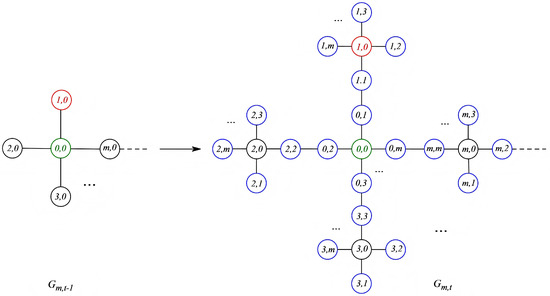
Let for denote the fractal graphs based on star graphs, where and represent the node set and edge set, respectively. Accordingly, and denote the total number of nodes and edges in the t-th generation graph. We define the initial graph as a star graph comprising nodes and m edges. Following the construction methodology of Vicsek polygons, we define an Iterated Function System (IFS) on to generate the fractal graphs based on star graphs [36]. The transformations are given by
Let be the self-similar probability measure supported on . It follows that . For any sequence , we simplify the notation by writing . Consequently, represents an n-th stage copy of and satisfies the measure condition .
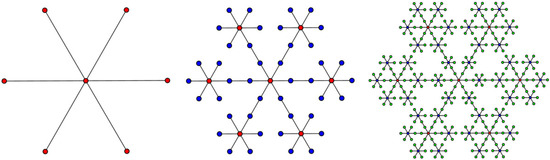
The classical Vicsek graph corresponds to the specific case where . Using as an illustrative example, we present schematic diagrams of the graph for the first three generations in Figure 1, along with its pertinent features.
Figure 1.
The initial three phases of the fractal graphs characterized by .
Based on the iterative construction of the graph , the formulas for the number of nodes and edges are given by the following equations:
and
Definition 2.
The Laplacian matrix of the fractal graphs based on star graphs is
where and denote the degree matrix and the adjacency matrix of , respectively.
4. Laplacian Spectrum of the Fractal Graphs Based on Star Graphs
Let denote the spectrum of , and let represent the multiplicity of the eigenvalue . In what follows, we derive the explicit expression for the spectrum of the Laplacian matrix by exploiting the spectral decimation technique.
Theorem 6.
Define , , and as the solutions to the equation
where λ represent any eigenvalue of the Laplacian matrix for . Thus λ is the value for which , , and are the eigenvalues of . In addition, the multiplicities represented by , , and are identical to the multiplicity of the eigenvalue associated with .
Proof.
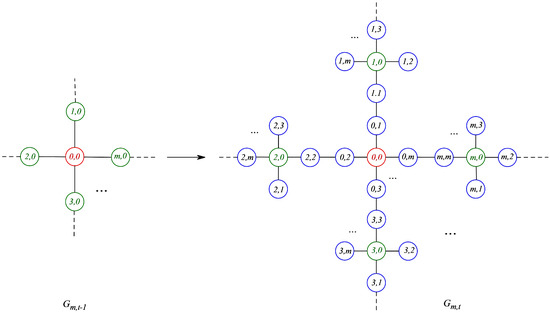
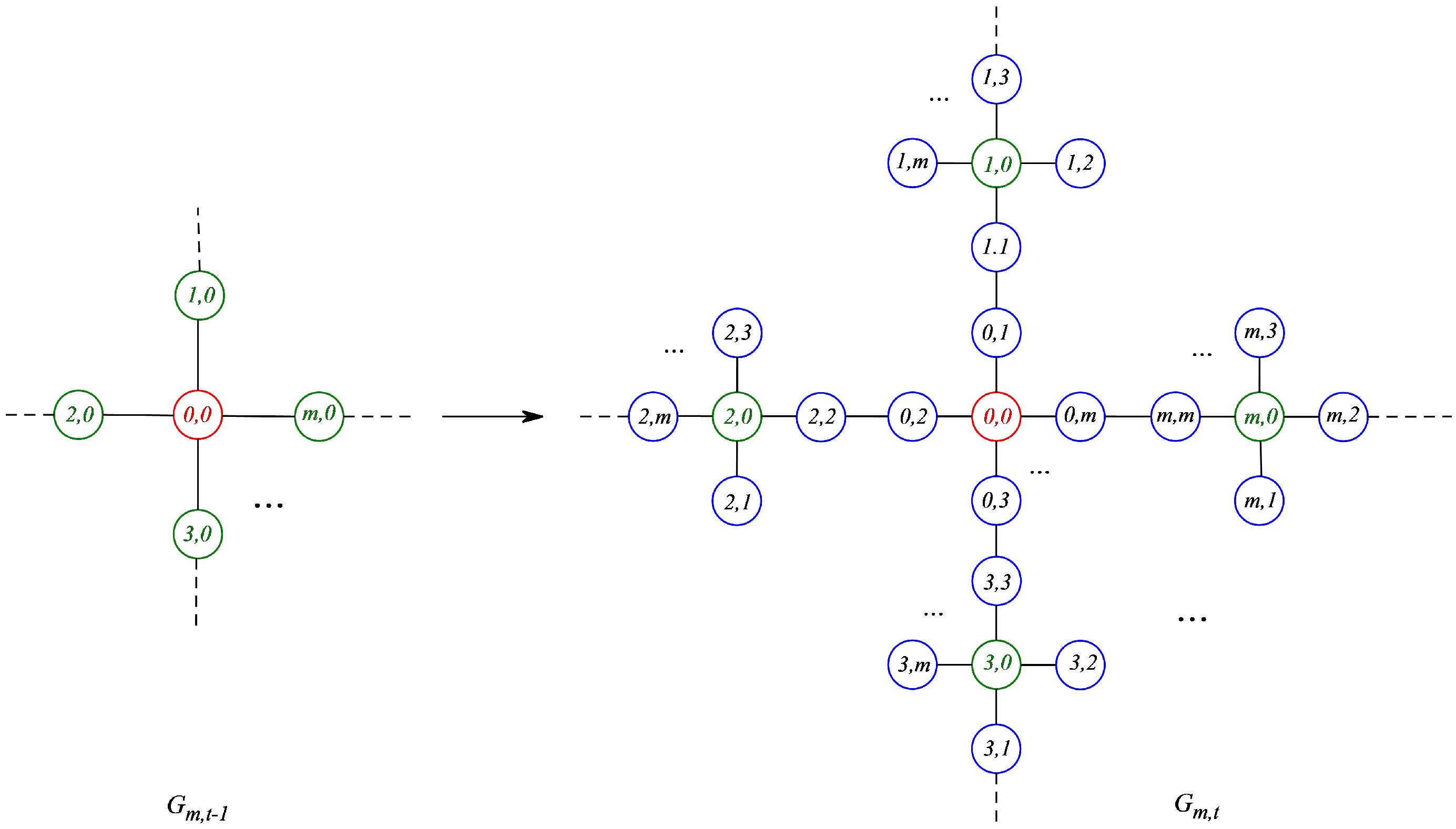
To facilitate future calculations, we categorize the nodes of into two sets: and . Here, represents the collection of all the nodes that have been newly added to , while includes all the nodes that have been carried over from . Then we have .
In addition, , , and represent the sets of nodes with degrees of 1, 2, and m in graph , respectively. Given that there are only three possible Situations for the node degree in the graph: 1, 2 and m, we divide the set into three disjoint sets, that is . Clearly, all nodes in and are new nodes, whereas those in are old nodes. Hence, we get .
In accordance with the evolutionary mechanism of nodes, we categorize any given node into one of three distinct Situations: Situation A, where ; Situation B, where ; and Situation C, where . Next, we will examine the issue in the framework of these three Situations.
Based on the evolutionary mechanism of nodes, we classify any given node into one of the following three distinct Situations: Situation A, where ; Situation B, where ; and Situation C, where . Furthermore, from the perspective of the graph , these three Situations correspond sequentially to nodes of degrees 1, 2, and m in graph , respectively.
Let be an eigenvalue of the Laplacian matrix , and let be the associated eigenvector, where represents the component related to node i in . According to the definition , we have the following results:
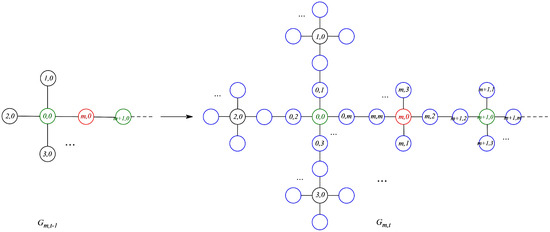
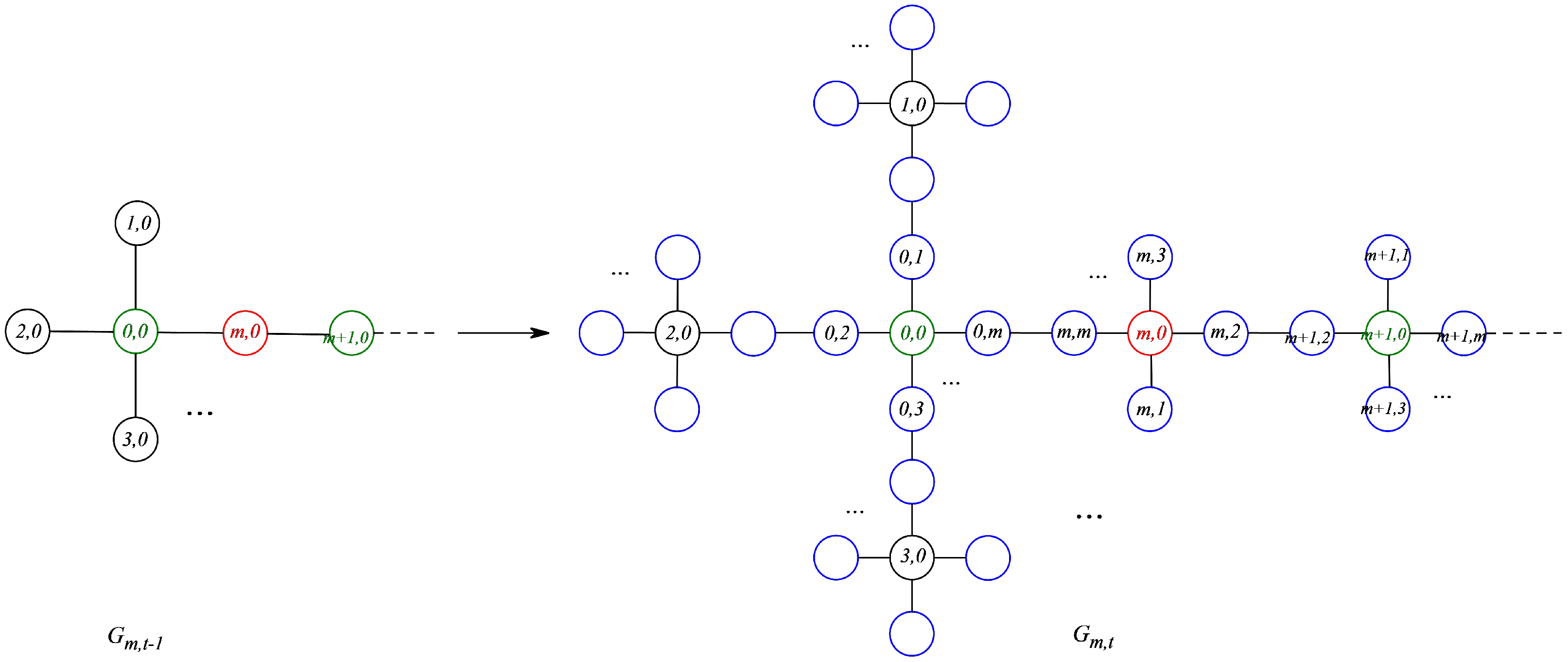
Situation A: Consider any old node that is connected to precisely one neighboring node belonging to within the graph , as illustrated in Figure 2.
Figure 2.
The depiction of the evolutionary mechanism for Situation A. The red node signifies node i, while the green node is a neighbor of the red node in .
For the purposes of this analysis, we will focus on the specific instance where the old node is designated as , while acknowledging that analogous reasoning applies to other Situations. Let and . Based on Equation (1) and the representation in Figure 2, the following relationship must be established:
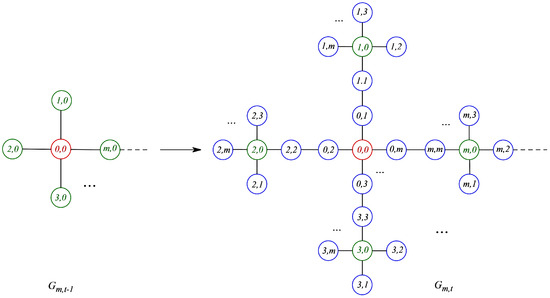
Situation B: Consider any node that is connected to precisely one neighboring node in and exactly one neighboring node in within the graph , as illustrated in Figure 3. For further details, please refer to Appendix A, which contains a partial proof of this assertion.
Figure 3.
The depiction of the evolutionary mechanism for Situation B. The red node signifies node i, while the green nodes are neighbors of the red node in .
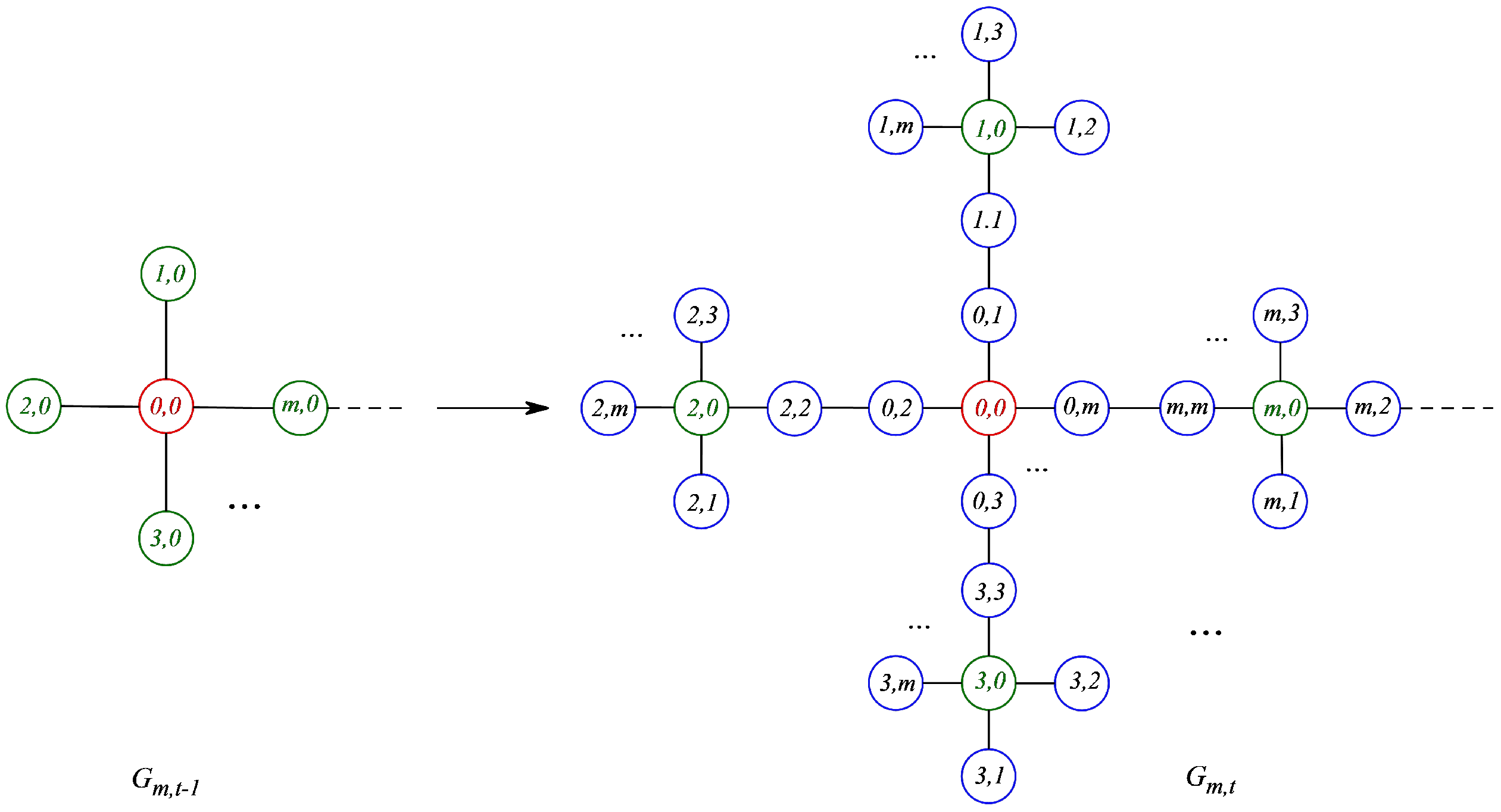
Situation C: For any node , there are two distinct categories of neighboring nodes. In Part 1, node i is adjacent to a single node from and has exactly neighboring nodes from within the graph , as illustrated in Figure 4. In Part 2, all m neighboring nodes of node i are members of in , as depicted in Figure 5. For a detailed proof of Situation C, please refer to Appendix B.
Figure 4.
The depiction of the evolutionary mechanism for Part 1 of Situation C. The red node signifies node i, while the green nodes are neighbors of the red node in .
Figure 5.
The depiction of the evolutionary mechanism for Part 2 of Situation C. The red node signifies node i, while the green nodes are neighbors of the red node in .
The results presented above allow us to conclude that is an eigenvalue of corresponding to its associated eigenvector. The eigenvalue relationship between two successive generations clearly illustrates a bijection between and , thereby fully determining . Furthermore, it follows that .
Assuming leads to the conclusion that there exists an additional eigenvector associated with that lacks a corresponding eigenvector in . This scenario would imply that this extra eigenvector would then possess an associated eigenvector in , which contradicts our initial assumption. Consequently, we can assert that is indeed valid.
Finally, the proof of Theorem 6 is complete. □
Theorem 6 demonstrates that most eigenvalues of the matrix originate from specific components of its spectral structure. Specifically, the eigenvalues of are primarily derived from the spectrum of through a transformational relationship: each non-zero eigenvalue of corresponds to three eigenvalues of . This correspondence is further reflected in the linear independence of eigenvectors, where the number of linearly independent eigenvectors generated by the functions , , and corresponds one-to-one with the number of linearly independent eigenvectors of . Moreover, since is a real symmetric matrix, all its eigenvalues correspond to linearly independent eigenvectors—a property guaranteed by the spectral theorem for real symmetric matrices, which further enhances the clarity and orthogonality of the eigenvalue structure.
Definition 3.
Let represent a finite multiset of real numbers. The multiset is defined as
Theorem 7.
The Laplacian spectrum of the graphs is
where .
Proof.
By the construction of , we get the Laplace matrix :
Therefore we calculate . So we have
We now turn our attention to Theorem 6. It reveals that for generations , with the exception of the eigenvalue 0, a subset of the eigenvalues at any generation is determined by the spectrum of the preceding generation, following a pattern where each eigenvalue generates three distinct eigenvalues. Consequently, we define for . By exploiting the graph structure and the relationship between consecutive generations, we obtain
where .
Since
the theorem is true. □
5. Proof of Theorems 1–3
Now, by using the previously obtained eigenvalues and combining Theorems 4 and 5, we will sequentially prove Theorems 1–3. The fractal graphs based on star graphs are formed through iterative growth from a tree structure. By the self-similarity of fractals, they remain tree structures at any generation stage, and are therefore triangle-free. According to the meanings of Theorems 4 and 5, we reach the following expression:
where are the eigenvalues of .
Based on Theorem 6 and the work of Girolamo Cardano [37], it can be concluded that
By Equations (8)–(10), we can obtain
Similarly, we get
- First Zagreb index
We employ Equation (11) in conjunction with Theorem 7 to derive the following results:
when . When , then .
- B.
- F-index
By Equation (12) and Theorem 7, we get
when . And in the Situation of , we have .
- C.
- Y-index
According to the configuration of the graph, for , it can be readily deduced that
6. Conclusions
In this study, we derive the mathematical expression that connects the Y-index to the Laplace spectrum. Subsequently, we construct a class of fractal graphs derived from Vicsek graphs and compute their corresponding Laplace spectrum. We then employ the Laplacian spectrum to formulate general expressions for the first Zagreb index, the F-index, and the Y-index. All three indices grow exponentially with the iteration number t, which perfectly matches the self-similar construction of the graph. As the order of the indices increases, their sensitivity to highly central nodes becomes stronger, further reflecting the core–periphery hierarchical structure of the graph. The constant terms reveal that the influence of the initial structure decays rapidly with iterations, and the graph structure tends to become uniform after sufficient iterations.
However, the investigation into the expression of the Laplacian spectrum pertaining to the second Zagreb index remains unaddressed. Furthermore, establishing a relationship between the Laplace spectrum or the normalized Laplace spectrum of a specific graph continues to be an unresolved research issue. Given the widespread applicability of fractal graphs, it is imperative to explore the Zagreb-type indices of additional graphs to better understand their diverse structural and dynamic properties.
Author Contributions
All authors contributed equally to the writing of this paper. All authors read and approved the final manuscript.
Funding
This paper was supported by the project from the Self-Financing Project of Scientific Research and Development Plan of the Langfang Science and Technology Bureau (Grant No. 2025013121) and the Fundamental Research Funds for the Central Universities (Grant No. ZY20250212).
Data Availability Statement
No new data were created or analyzed in this study. Data sharing is not applicable to this article.
Acknowledgments
We acknowledge the support of high-performance computing resources provided by the Basic Courses Department, Institute of Disaster Prevention.
Conflicts of Interest
The authors declare that they have no known competing financial interests or personal relationships that could have appeared to influence the work reported in this paper.
Appendix A. Proof of Situation B
References
- Albert, R.; Barabási, A.L. Statistical mechanics of complex networks. Rev. Mod. Phys. 2002, 74, 47. [Google Scholar] [CrossRef] [Scilit]
- Boccaletti, S.; Latora, V.; Moreno, Y.; Chavez, M.; Hwang, D.-U. Complex networks: Structure and dynamics. Phys. Rep. 2006, 424, 175–308. [Google Scholar] [CrossRef] [Scilit]
- Newman, M.E.J. The structure and function of complex networks. SIREV 2003, 45, 167–256. [Google Scholar] [CrossRef] [Scilit]
- Nadeem, M.; Shaker, H. Inequalities between degree and distance based graph invariants. Inequal. Appl. 2018, 2018, 39. [Google Scholar] [CrossRef] [Scilit]
- Gutman, I.; Das, K.C. Zagreb indices. MATCH Commun. Math. Comput. Chem. 2004, 50, 83–92. [Google Scholar]
- Gutman, I.; Trinajstić, N. Graph theory and molecular orbitals. Total φ-electron energy of alternant hydrocarbons. Chem. Phys. Lett. 1972, 17, 535–538. [Google Scholar] [CrossRef] [Scilit]
- Pogliani, L. From molecular connectivity indices to semiempirical connectivity terms: Recent trends in graph theoretical descriptors. Chem. Rev. 2000, 100, 3827–3858. [Google Scholar] [CrossRef] [Scilit]
- Randić, M. The connectivity index 25 years after. J. Mol. Graph. Model. 2001, 20, 19–35. [Google Scholar] [CrossRef] [Scilit] [PubMed]
- Kier, L.B.; Hall, L.H. Molecular Connectivity in Chemistry and Drug Research; Academic Press: Cambridge, MA, USA, 1976. [Google Scholar]
- Kier, L.B.; Hall, L.H. Molecular Connectivity in Structure-Activity Analysis; Academic Press: Cambridge, MA, USA, 1986. [Google Scholar]
- Yan, Z.; Liu, H.; Liu, H. Sharp bounds for the second Zagreb index of unicyclic graphs. J. Math. Chem. 2007, 42, 565–574. [Google Scholar] [CrossRef] [Scilit]
- Eliasi, M. Unicyclic and bicyclic graphs with maximum exponential second Zagreb index. Discr. Appl. Math. 2022, 307, 172–179. [Google Scholar] [CrossRef] [Scilit]
- de Caen, D. An upper bound on the sum of squares of degrees in a graph. Discret. Math. 1998, 185, 245–248. [Google Scholar] [CrossRef] [Scilit]
- Miličević, A.; Nikolić, S. On variable Zagreb indices. Croat. Chem. Aata 2004, 77, 97–101. [Google Scholar]
- Bonchev, D.G.; Rouvray, D.H. Complexity: Introduction and Fundamentals; CRC Press: Boca Raton, FL, USA, 2003. [Google Scholar]
- New York Academy of Sciences. Mathematics Section. In Graph Theory Notes of New York: Volume 30; New York Academy of Sciences: New York, NY, USA, 1996. [Google Scholar]
- Nikolić, S.; Tolić, I.M.; Trinajstić, N.; Baučić, I. On the Zagreb indices as complexity indices. Croat. Chem. Aata 2000, 73, 909–921. [Google Scholar]
- Golbraikh, A.; Bonchev, D.; Tropsha, A. Novel chirality descriptors derived from molecular topology. J. Chem. Inf. Comput. Sci. 2001, 41, 147–158. [Google Scholar] [CrossRef] [Scilit]
- Golbraikh, A.; Bonchev, D.; Tropsha, A. Novel ZE-isomerism descriptors derived from molecular topology and their application to QSAR analysis. J. Chem. Inf. Comput. Sci. 2002, 42, 769–787. [Google Scholar] [CrossRef] [Scilit] [PubMed]
- Miličević, A.; Raos, N. Procjena konstanti stabilnosti bakrovih (II) i niklovih (II) kelata s 1,2-diaminoetanima metodom preklapanja kugli. Croat. Chem. Aata 2005, 78, 525–534. [Google Scholar]
- Varmuza, K.; Dehmer, M.; Bonchev, D. Statistical Modelling of Molecular Descriptors in QSAR/QSPR; Wiley Online Library: Hoboken, NJ, USA, 2012. [Google Scholar]
- Furtula, B.; Gutman, I. A forgotten topological index. J. Math. Chem. 2015, 53, 1184–1190. [Google Scholar] [CrossRef] [Scilit]
- Gao, W.; Siddiqui, M.K.; Imran, M.; Jamil, M.K.; Farahani, M.R. Forgotten topological index of chemical structure in drugs. Saudi Pharm. J. 2016, 24, 258–264. [Google Scholar] [CrossRef] [Scilit] [PubMed]
- Alameri, A.; Al-Naggar, N.; Al-Rumaima, M.; Alsharafi, M. Y-index of some graph operations. Int. J. Appl. Eng. Res. 2020, 15, 173–179. [Google Scholar]
- Alsharafi, M.; Alameri, A.; Zeren, Y.; Shubatah, M.; Alwardi, A. The Y-index of some complement graph structures and their applications of nanotubes and nanotorus. Mathematics 2024, 2024, 4269325. [Google Scholar] [CrossRef] [Scilit]
- Al-Sharaf, M.S.Y.; Alameri, A.Q.; Zeren, Y. The Y-index and coindex of VC5C7[p, q] and HC5C7[p, q] nanotubes. TWMS J. Appl. Eng. Math. 2024, 14, 433–445. [Google Scholar]
- Markelov, D.A.; Fürstenberg, F.; Dolgushev, M. NMR relaxation in semiflexible Vicsek fractals. Polymer 2018, 144, 65–71. [Google Scholar] [CrossRef] [Scilit]
- Jurjiu, A.; Koslowski, T.; von Ferber, C.; Blumen, A. Dynamics and scaling of polymer networks: Vicsek fractals and hydrodynamic interactions. Chem. Phys. 2003, 294, 187–199. [Google Scholar] [CrossRef] [Scilit]
- Dolgushev, M.; Markelov, D.A.; Fürstenberg, F.; Guérin, T. Local orientational mobility in regular hyperbranched polymers. Phys. Rev. E 2016, 94, 012502. [Google Scholar] [CrossRef] [Scilit]
- Zhang, Z.; Wu, B.; Zhang, H.; Zhou, S.; Guan, J.; Wang, Z. Determining global mean-first-passage time of random walks on vicsek fractals using eigenvalues of laplacian matrices. Phys. Rev. E 2010, 81, 031118. [Google Scholar] [CrossRef] [Scilit]
- Blumen, A.; Ferber, C.V.; Jurjiu, A.; Koslowski, T. Generalized vicsek fractals: Regular hyperbranched polymers. Macromolecules 2004, 37, 638–650. [Google Scholar] [CrossRef] [Scilit]
- Chen, H.; Zhang, F. Resistance distance and the normalized Laplacian spectrum. Discret. Appl. Math. 2007, 155, 654–661. [Google Scholar] [CrossRef] [Scilit]
- Li, D.; Hou, Y. The normalized Laplacian spectrum of quadrilateral graphs and its applications. Appl. Math. Comput. 2017, 297, 180–188. [Google Scholar] [CrossRef] [Scilit]
- Wang, D.; Zeng, C.; Zhao, Z.; Wu, Z.; Xue, Y. Kirchhoff index of a class of polygon networks. Chaos Solitons Fractals 2023, 168, 113–149. [Google Scholar] [CrossRef] [Scilit]
- Zumstein, P. Comparison of Spectral Methods Through the Adjacency Matrix and the Laplacian of a Graph. Diploma Thesis, ETH Zürich, Zürich, Switzerland, 2005. [Google Scholar]
- Wang, W.; Liang, X.; Zeng, C.; Xue, Y.; Peng, L. Fermat eccentric distance sum of extended vicsek networks. Fractals 2023, 31, 2350100. [Google Scholar] [CrossRef] [Scilit]
- Kline, M. Mathematical Thought from Ancient to Modern Times: Volume 1; Oxford University Press: Oxford, UK, 1990. [Google Scholar]
Disclaimer/Publisher’s Note: The statements, opinions and data contained in all publications are solely those of the individual author(s) and contributor(s) and not of MDPI and/or the editor(s). MDPI and/or the editor(s) disclaim responsibility for any injury to people or property resulting from any ideas, methods, instructions or products referred to in the content. |
© 2026 by the authors. Licensee MDPI, Basel, Switzerland. This article is an open access article distributed under the terms and conditions of the Creative Commons Attribution (CC BY) license.