Article

Time-Fractional Shallow-Water Model for Atmospheric Fluid Layers: Analysis and Semi-Analytical Solution

by
Priti V. Tandel
1,
Anant Patel
1,† and
Trushitkumar Patel
2,*,†
1
Department of Mathematics, Veer Narmad South Gujarat University, Surat 395007, Gujarat, India
2
Department of General Studies, University of the People, Pasadena, CA 91101, USA
*
Author to whom correspondence should be addressed.
These authors contributed equally to this work.
Axioms 2026, 15(4), 290; https://doi.org/10.3390/axioms15040290
Submission received: 23 January 2026 / Revised: 5 April 2026 / Accepted: 10 April 2026 / Published: 15 April 2026
(This article belongs to the Section Mathematical Analysis)

Abstract

Oscillatory motions in stratified atmospheric fluid layers significantly influence weather and climate dynamics. Shallow-water equations effectively describe these motions. This study extends the shallow-water model to the time-fractional domain using the conformable fractional derivative. This derivative preserves the local differential structure while introducing tunable time scaling in the dynamics. Approximate analytical solutions were obtained using the conformable Laplace Adomian Decomposition Method (CLADM). This method combines the conformable Laplace transform with Adomian decomposition. Numerical results for fractional orders  ϑ ( 0 ,   1 ]  demonstrate that the fractional parameter systematically modulates the system dynamics. The solutions at  ϑ = 1  align well with the established Elzaki Adomian Decomposition Method (EADM), Homotopy Analysis Method (HAM), Fractional Reduced Differential Transform Method (FRDTM), and reference numerical solutions (NUM). This fractional framework offers a flexible approach to modeling atmospheric fluid-layer dynamics.

1. Introduction

Stratified atmospheric fluid layers exhibit complex dynamics as distinct air layers, separated by temperature and density differences, interacting through various mechanisms. These dynamics result from gravitational restoring forces, planetary rotation through the Coriolis effect, and pressure gradients that drive winds. Together, these factors generate oscillatory motions that move horizontally through the atmosphere, affecting weather and climate. Nappo and Sutherland have extensively documented the impact of these oscillations at multiple scales [1,2,3]. Meteorological and oceanographic systems share key similarities, with turbulent convection and stratified oscillations occurring across scales due to vertical density variations. Chakrabarti identifies stable stratification as a natural driver for generating and propagating fluid layer oscillations [4]. Wind forcing, topography, and large-scale circulation further contribute to these oscillations, where fluid density increases with depth.
Building on these foundational dynamics, the shallow-water equations provide an effective depth-averaged framework for describing horizontal propagation in stratified fluid layers, particularly when characteristic wavelengths are much larger than the vertical extent of the domain, as detailed by Warner [5]. This system of nonlinear partial differential equations captures a range of phenomena, including Rossby-type motions and Coriolis-affected wave patterns such as Kelvin waves. Duba and McKenzie emphasize the key role of Rossby waves in atmospheric circulation [6], while Clancy and Lynch demonstrate that Kelvin waves contribute to balancing the Earth’s Coriolis and topographic boundary conditions [7].
To investigate the solutions and physical implications of these nonlinear, depth-averaged models arising from the shallow-water equations, a variety of classical analytical and numerical approaches have been developed. For example, Bulatov and Vladimirov addressed boundary-value problems for stratified fluid oscillations using special-function expansions, such as Whittaker functions [8]. Clancy and Lynch, through Laplace transform integration of the shallow-water equations, identified cnoidal wave solutions under small-amplitude conditions [7]. Conrick, Mass, and Zhong investigated the influence of topography by examining shear instabilities and Kelvin–Helmholtz wave formation over terrain [9]. In terms of numerical methods, Safari utilized Adomian decomposition methods (ADM), while Busrah, Uddin, and Bakhtiar applied homotopy analysis methods (HAM) to shallow-water wave equations [10,11]. Karunakar and Chakraverty further extended these techniques via employing the Homotopy Perturbation Method (HPM) to predict wave propagation [12]. Darbani also developed meshless numerical schemes for simulating free-surface flows in shallow-water models [13].
Expanding beyond traditional approaches, fractional-order differential equations have recently emerged as an effective mathematical framework for describing complex phenomena occurring in science and engineering. Atangana advanced the use of fractional-order models to capture memory effects and hereditary properties in physical systems [14], permitting more accurate and efficient descriptions of non-local temporal behavior. Owolabi and Atangana developed numerical methods for fractional differentiation with broad applicability [15]. Kumar showed the effectiveness of fractional approaches in solving nonlinear shallow-water equations in oceanic contexts [16]. Srivastava and Dubey [17], as well as Veeresha and Prakasha [18], applied fractional-order models to biological and intricate physical systems, highlighting the versatility of fractional calculus. Sweilam, Al-Mekhlafi, and Baleanu [19], together with Ziliang, Gang, and Jing [20], specifically addressed atmospheric applications using fractional approaches.
Within fractional calculus, the conformable fractional derivative introduced by Khalil [21] is notably important due to its structural simplicity and compatibility with standard calculus operations. These characteristics simplify the manipulation of fractional operators. When combined with the Laplace transform, conformable derivatives allow fractional time derivatives to be expressed algebraically at the outset of the solution procedure. This procedure enables a systematic decomposition of nonlinear spatial terms using Adomian polynomials, thereby increasing both analytical feasibility and computational effectiveness. Ayata and Ozkan showed the effectiveness of the Conformable Laplace Adomian Decomposition Method (CLADM) for fractional Newell–Whitehead–Segel equations [22], while Tandel applied conformable fractional approaches to higher-order KdV models [23]. These features make conformable fractional derivatives a strong choice for extending shallow-water models to capture anomalous temporal dynamics in atmospheric fluid layers.
Building on recent advancements, this study develops and investigates a time-fractional shallow-water model for atmospheric internal waves. The model uses the conformable fractional calculus framework. The analysis studies the impact of fractional-order modifications on inertia–gravity dynamics. The Conformable Laplace Adomian Decomposition Method (CLADM) is used to obtain semi-analytical series solutions for all prognostic variables. The CLADM integrates the conformable Laplace transform by Abdeljawad [24] with the Adomian decomposition procedure by Adomian [25]. The approach reproduces classical integer-order solutions. It is validated against the Elzaki Adomian Decomposition Method (EADM) [26], the Homotopy Analysis Method (HAM) [10], the Fractional Reduced Differential Transform Method (FRDTM) [27], and a reference numerical scheme (NUM) [27]. The study analyzes the effects of fractional-order on the horizontal and vertical velocity components and the layer depth. It demonstrates the reliability and advantages of the proposed method for modeling time-fractional dynamics in atmospheric fluid layers.
To guide the reader through these developments, the remainder of this article is organized as follows: Section 2 presents the formulation of the shallow-water model for atmospheric fluid layers. Section 3 introduces the fundamental definitions of the conformable Laplace transform and describes the CLADM framework. Section 4 applies CLADM to solve the governing system with the prescribed initial conditions. Section 5 presents numerical results, illustrates solution response over different fractional orders, and compares CLADM solutions with standard methods. Finally, Section 6 discusses the findings and effects on atmospheric science applications.

2. Formulation of the Model

The shallow-water equations, also called shallow-fluid equations, provide a fundamental framework for modeling large-scale motion phenomena in geophysical fluids. These phenomena include Rossby waves, advective motions, and Coriolis-affected oscillations. The shallow-water theory assumes that the horizontal wavelength is much greater than the fluid layer’s vertical extent. Although various formulations of shallow-water equations exist, this study focuses on a specific fluid system. The theory assumes the system is inviscid, autobarotropic, hydrostatic, incompressible, and homogeneous. These properties are defined as being frictionless, being density-dependent only on pressure, having negligible vertical momentum, having a constant density over time, and having uniform density in space, respectively. These assumptions reduce the full three-dimensional fluid equations to a more tractable two-dimensional depth-averaged system [5].
The fundamental conservation laws govern fluid motion in a stratified atmosphere. Building directly from the foundational shallow-water assumptions described earlier, we express the general system of equations governing momentum and mass conservation as:
Φ τ + Φ Φ ξ + Ψ Φ σ + η Φ ρ f Ψ + 1 μ Θ ξ = 0 ,  
Ψ τ + Φ Ψ ξ + Ψ Ψ σ + η Ψ ρ + f Φ + 1 μ Θ σ = 0 ,  
Θ ρ = μ g ,   and
μ τ + μ Φ ξ + Ψ σ + η ρ = 0 ,  
where  Φ  and  Ψ  represent the horizontal and vertical wind speed components,  Θ  shows pressure,  η  denotes vertical displacement,  μ  is the fluid density, g represents the gravitational acceleration, f represents the Coriolis parameter,  τ  represents time, and  ξ σ ρ  are spatial coordinates.
Next, we consider density constraints. Since the density of an incompressible and homogeneous fluid is constant in both space and time, it follows that
μ τ = 0 .
This implies  μ = μ 0 , a constant reference density. Consequently, the continuity Equation (4) reduces to
Φ ξ + Ψ σ + η ρ = 0 ,  
The next step is to incorporate the hydrostatic assumption. For a hydrostatic fluid, gravity balances the vertical pressure gradient:
Θ ρ + μ 0 g = 0 ,  
Taking the differentiation of Equation (7) w.r.t.  ξ  yields
Θ ρ ξ = Θ ξ ρ = 0 ,  
This indicates that the pressure gradient and its derivatives exhibit a barotropic structure. Therefore, the pressure gradients are independent of depth. Under barotropic conditions, wind-driven motions respond to the Coriolis force and horizontal pressure gradient, which remain invariant with depth.
To determine the relationship between pressure and depth, we next integrate Equation (7) over the fluid’s vertical extent, from bottom to top:
ρ ( Θ B ) ρ ( Θ T ) Θ ρ d ρ = μ 0 g ρ ( Θ B ) ρ ( Θ T ) d ρ ,  
where  Θ T  indicating the fluid’s pressure at the top and  Θ B  indicating at the bottom, respectively, yields
Θ B Θ T = μ 0 g Ω ,  
where  Ω  is the fluid depth. If  Θ T = 0  or  Θ T Θ B ,
Θ B = μ 0 g Ω ,   and
( Θ B ) ξ = μ 0 g Ω ξ ,  
This means the fluid depth gradient equals the horizontal pressure gradient at the bottom. Therefore, Equations (1) and (2) can be rewritten using this pressure–depth relationship.
On integrating Equation (6) w.r.t.  ρ , it becomes
0 ρ η ρ d ρ = η ( ρ ) η ( 0 ) = 0 ρ Φ ξ + Ψ σ d ρ ,  
This gives:
η ( ρ ) η ( 0 ) = Φ ξ + Ψ σ Ω ,  
To continue, we assume that  Φ  and  Ψ  are independent of  ρ , meaning they remain depth-independent. We also set the boundary condition  η ( 0 ) = 0  at the lower surface. The upper boundary satisfies the kinematic condition  η ( ρ ) = d Ω d τ , where the vertical motion at the top of the layer represents the changes in the layer depth. Collectively, these conditions yield the following equations:
d Ω d τ = Ω Φ ξ + Ψ σ ,   for ρ = Ω
Combining the above results yields the system governing atmospheric fluid layer dynamics in terms of the velocity components  Φ Ψ , and fluid depth  Ω .
Φ τ + Φ Φ ξ + Ψ Φ σ f Ψ + g Ω ξ = 0 ,   Ψ τ + Φ Ψ ξ + Ψ Ψ σ + f Φ + g Ω σ = 0 ,   Ω τ + Φ Ω ξ + Ψ Ω σ + Ω Φ ξ + Ψ σ = 0 .
For the specific case of atmospheric inertia-wave motion in a stratified layer, we consider the dynamics effectively one-dimensional in the  ξ  direction. We assume a constant mean geostrophic speed component  V ˜  with perturbations superimposed upon it. This assumption reduces the system to
Φ τ + Φ Φ ξ f Ψ + g Ω ξ = 0 ,   Ψ τ + Φ Ψ ξ + f Φ + g h ˜ = 0 ,   Ω τ + Φ Ω ξ + Ψ h ˜ + Ω Φ ξ = 0 ,  
where  h ˜ = f g V ˜  a mean depth of the fluid.
In this reduced system, the total fluid depth is decomposed into a constant mean component  h ˜ , representing the background geostrophic state, and a perturbation  Ω ( ξ ,   τ )  superimposed upon it. As a result, the coefficient  g h ˜  in the second equation of (17) arises from the hydrostatic pressure–depth relationship, representing the contribution of the uniform mean layer depth to the horizontal pressure gradient. Importantly, this term does not correspond to external forcing but rather supplies a steady contribution from the fluid layer at the reference depth. Accordingly, this approach is standard in linearized shallow-water and inertia–gravity wave models, which assume hydrostatic balance, small-amplitude perturbations, and a horizontally uniform mean state.
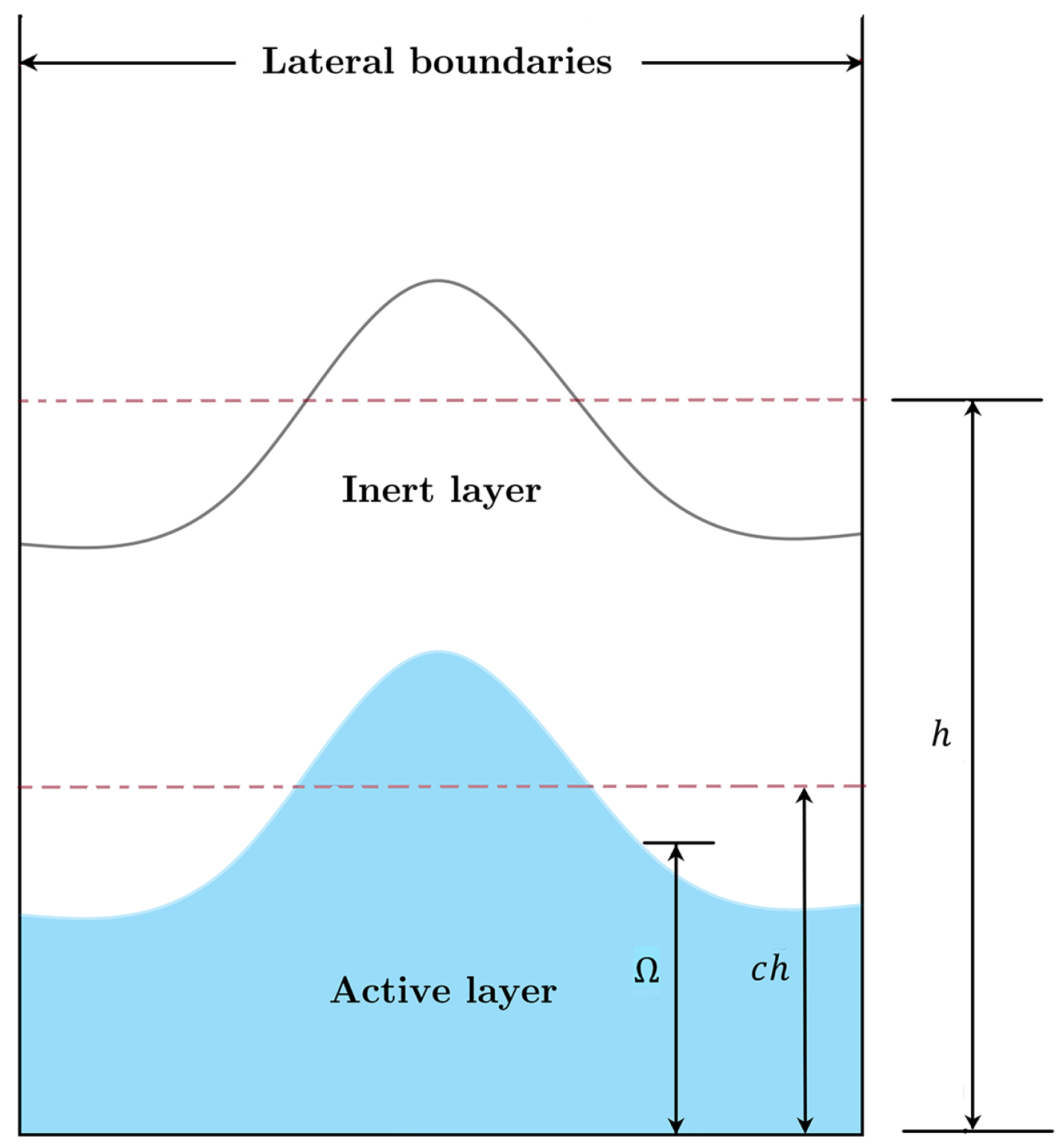
A wave ridge is centered in the computational domain, as shown in Figure 1. Here, the active fluid appears as the shaded bottom layer, simulating the wind components and depth ( Ω ). The scale height of the atmosphere is h. The factor c accounts for the buoyancy of an inert layer by reducing the effective depth.

3. CLADM Concept for FPDEs

We begin by recalling the principal definitions and properties of conformable fractional calculus and its Laplace transform.
Definition 1.
For a function  Ψ : [ 0 ,   ) R , the conformable fractional derivative  ϑ ( 0 ,   1 ]  at  τ > 0  is defined by [21]
T ϑ Ψ ( τ ) = lim ε 0 Ψ ( τ + ε τ 1 ϑ ) Ψ ( τ ) ε ,  
Definition 2.
If  Ψ  is n-times continuously differentiable and  ϑ  (n, n+1] with  [ ϑ ]  denoting the ceiling of  ϑ , the conformable fractional derivative is defined by [24]
T ϑ Ψ ( τ ) = lim ε 0 Ψ [ ϑ ] 1 τ + ε τ [ ϑ ] ϑ Ψ [ ϑ ] 1 ( τ ) ε ,  
for all  τ > 0 .
Definition 3.
The conformable Laplace transform of order  ϑ ( 0 ,   1 ]  is given by [24,28]
L ϑ [ Ψ ( τ ) ] ( s ) = 0 E ϑ ( s ,   τ ) Ψ ( τ ) d ϑ τ ,  
where  E ϑ ( s ,   τ ) = e x p s τ ϑ ϑ .
Remark 1.
The conformable Laplace transform, when applied to the fractional derivative, gives
L ϑ [ D τ ( ϑ ) Ψ ( τ ) ] = s L ϑ [ Ψ ( τ ) ] Ψ ( 0 ) ,  
Theorem 1
 (see [28]). If  L ϑ Ψ ( τ ) ( s ) = Θ ϑ ( s )  exists, then the usual Laplace transform of the stretched function  Ψ ( τ 1 / ϑ )  satisfies
Θ ϑ ( s ) = L Ψ ( ϑ τ ) 1 / ϑ ( s ) ,  
Theorem 2
 (see [23]). If  Ψ ( ξ ,   τ ) = k = 0 Ψ k ( ξ ) τ k  is a given series;
1. 
If  0 δ < 1  such that  Ψ k + 1 Ψ k δ , then the given series solution is convergent.
2. 
If  δ > 1  such that  Ψ k + 1 Ψ k δ , then the given series solution is divergent.
Next, the general conformable fractional PDE is considered
D τ ϑ Ψ ( ξ ,   τ ) + D ξ n Ψ ( ξ ,   τ ) + R Ψ ( ξ ,   τ ) + N Ψ ( ξ ,   τ ) = g ( ξ ,   τ ) ,  
where  ξ > 0 ,   τ > 0 ,   0 < ϑ 1 .
Note that  D τ ϑ  in Equation (23) is the conformable time derivative,  D ξ n  denotes the highest-order spatial derivative,  R  collects lower-order spatial operators, and  N  encapsulates nonlinearity.
Ψ ( ξ ,   0 ) = f ( ξ ) ,  
The conformable Laplace transform  L ϑ , applied with respect to the variable  τ  to Equation (23), produces
L ϑ [ D τ ϑ Ψ ] + L ϑ [ D ξ n Ψ ] + L ϑ [ R ( Ψ ) + N ( Ψ ) ] = L ϑ [ g ( ξ ,   τ ) ] ,  
To proceed, we utilize the property from Equation (21) to manipulate Equation (25) as follows:
s L ϑ [ Ψ ] Ψ ( ξ ,   0 ) + L ϑ [ D ξ n Ψ ] + L ϑ [ R ( Ψ ) + N ( Ψ ) ] = L ϑ [ g ( ξ ,   τ ) ] ,  
By rearranging,
L ϑ [ Ψ ] = 1 s Ψ ( ξ ,   0 ) + L ϑ [ g ( ξ ,   τ ) 1 s L ϑ [ D ξ n Ψ ] 1 s L ϑ [ R ( Ψ ) + N ( Ψ ) ] ,  
Subsequently, by applying the inverse transform to Equation (27), we obtain the integral form
Ψ ( ξ ,   τ ) = L ϑ 1 1 s Ψ ( ξ ,   0 ) + L ϑ [ g ( ξ ,   τ ) L ϑ 1 1 s L ϑ [ D ξ n Ψ ]     L ϑ 1 1 s L ϑ [ R ( Ψ ) + N ( Ψ ) ] ,  
We decompose the solution as a sum of series and nonlinearity  N ( Ψ )  via Adomian series
Ψ ( ξ ,   τ ) = k = 0 Ψ k ( ξ ,   τ ) ,  
N Ψ ( ξ ,   τ ) = k = 0 A k ,  
where  A k , the Adomian polynomials, are defined by
A k = 1 k ! d k d β k N j = 0 k β j Ψ j | β = 0 ,   k = 0 ,   1 ,   2 ,   3 ,  
Substituting Equations (29) and (30) into Equation (28), the following form is obtained:
k = 0 Ψ k = L ϑ 1 1 s Ψ ( ξ ,   0 ) + L ϑ [ g ( ξ ,   τ ) L ϑ 1 1 s L ϑ D ξ n k = 0 Ψ k     L ϑ 1 1 s L ϑ R k = 0 Ψ k + k = 0 A k ,  
Matching terms order by order in Equation (32) produces the following recursive scheme:
Ψ 0 = L ϑ 1 1 s Ψ ( ξ ,   0 ) + L ϑ [ g ( ξ ,   τ ) ,  
Ψ k + 1 = L ϑ 1 1 s L ϑ D ξ n Ψ k L ϑ 1 1 s L ϑ R Ψ k + A k ,  
For  k = 0 ,   1 ,   2 ,   3 ,  
From Equation (29), the complete series solution  Ψ ( ξ ,   τ )  is obtained.

4. Application of the CLADM

In this section, the time-fractional shallow-water system derived earlier is reformulated and solved using the Conformable Laplace Adomian Decomposition Method (CLADM). The aim is to construct approximate analytical series solutions for the velocity components and fluid depth within the conformable fractional framework. To proceed, we first express the governing equations in their fractional form.
In fractional form, the one-dimensional shallow-water system takes the following set of fractional partial differential equations (FPDEs):
D τ ϑ Φ + Φ Φ ξ f Ψ + g Ω ξ = 0 ,   D τ ϑ Ψ + Φ Ψ ξ + f Φ + g h ˜ = 0 ,   D τ ϑ Ω + Φ Ω ξ + Ψ h ˜ + Ω Φ ξ = 0 ,  
where  ϑ ( 0 ,   1 ] , and  D τ ϑ = ϑ τ .
The system is supplemented with the following initial conditions:
Φ ( ξ ,   0 ) = e ξ sech 2 ( ξ ) ,   Ψ ( ξ ,   0 ) = 2 ξ sech 2 ( 2 ξ ) ,   Ω ( ξ ,   0 ) = ξ 2 sech 2 ( 2 ξ ) ,  
These initial profiles represent a localized wave ridge embedded in an otherwise quiescent stratified atmospheric layer, corresponding to the schematic in Figure 1. The squared hyperbolic secant functional form ensures rapid spatial decay, finite-energy perturbations, and physically realistic far-field behavior. Such forms serve as standard test cases in shallow-water, internal-wave, and solitary-wave modeling. The primary objective of this study is methodological, focusing on developing and validating a conformable fractional framework for the time-fractional shallow-water equations. The chosen initial conditions provide an analytically tractable and physically admissible benchmark for assessing CLADM performance.
With the initial conditions and fractional forms established, the next step is to apply the conformable Laplace transform  L ϑ  with respect to  τ  to each equation. Utilizing its properties, the system becomes:
s L ϑ [ Φ ( ξ ,   τ ) ] Φ ( ξ ,   0 ) = L ϑ [ Φ Φ ξ ] + L ϑ [ f Ψ g Ω ξ ] ,   s L ϑ [ Ψ ( ξ ,   τ ) ] Ψ ( ξ ,   0 ) = L ϑ [ Φ Ψ ξ ] L ϑ [ f Φ + g h ˜ ] ,   s L ϑ [ Ω ( ξ ,   τ ) ] Ω ( ξ ,   0 ) = L ϑ [ Φ Ω ξ + Ω Φ ξ ] L ϑ [ Ψ h ˜ ] .
Rearranging yields:
L ϑ [ Φ ( ξ ,   τ ) ] = 1 s Φ ( ξ ,   0 ) 1 s L ϑ [ Φ Φ ξ ] + 1 s L ϑ [ f Ψ g Ω ξ ] ,   L ϑ [ Ψ ( ξ ,   τ ) ] = 1 s Ψ ( ξ ,   0 ) 1 s L ϑ [ Φ Ψ ξ ] 1 s L ϑ [ f Φ + g h ˜ ] ,   L ϑ [ Ω ( ξ ,   τ ) ] = 1 s Ω ( ξ ,   0 ) 1 s L ϑ [ Φ Ω ξ + Ω Φ ξ ] 1 s L ϑ [ Ψ h ˜ ] .
Substituting the series expansions and the Adomian polynomials into the transformed system (38) yields recursive relations. These relations are obtained by applying the inverse conformable Laplace transform as follows:
n = 0 Φ n = L ϑ 1 1 s e ξ sech 2 ( ξ ) L ϑ 1 1 s L ϑ n = 0 A n     + L ϑ 1 1 s L ϑ f n = 0 Ψ n g n = 0 Ω n ξ ,   n = 0 Ψ n = L ϑ 1 1 s 2 ξ sech 2 ( 2 ξ ) L ϑ 1 1 s L ϑ n = 0 B n     L ϑ 1 1 s L ϑ f n = 0 Φ n + g h ˜ ,   n = 0 Ω n = L ϑ 1 1 s ξ 2 sech 2 ( 2 ξ ) L ϑ 1 1 s L ϑ n = 0 C n     L ϑ 1 1 s L ϑ n = 0 Ψ n h ˜ ,  
where the nonlinear terms are decomposed using Adomian polynomials  A n ,   B n , and  C n .
The mathematical calculation of the solution can be found in Appendix A.

5. Results and Discussion

For the numerical simulations, three-term truncated series solutions obtained by CLADM were evaluated and compared with EADM [26], HAM [10], FRDTM [27], and NUM [27] for the classical case  ϑ = 1 . The computations were performed in MATLAB R2020a using the physical parameter values  f = 2 ω sin θ  where  ω = 7.29 × 10 5 rad / s 1 θ = π 3 g = 9.8 m / s 2 , and  h ˜ = f g V ˜ , where  V ˜ = 2.5 m / s 1 .
To complement the empirical observation of rapid decay in higher-order CLADM correction terms, we provide a quantitative convergence assessment through norm ratios of successive series components (Theorem 2). In this context, the values for the horizontal velocity component  Φ ( ξ ,   τ )  are  Φ 1 Φ 0 = 0.1006 < 1 Φ 2 Φ 1 = 0.3975 < 1 Φ 3 Φ 2 = 0.3564 < 1 Φ 4 Φ 3 = 0.4855 < 1 .
The values for the vertical velocity component  Ψ ( ξ ,   τ )  are  Ψ 1 Ψ 0 = 0.2046 < 1 Ψ 2 Ψ 1 = 0.1598 < 1 Ψ 3 Ψ 2 = 0.3482 < 1 Ψ 4 Ψ 3 = 0.4695 < 1 .
The values for the depth component  Ω ( ξ ,   τ )  are  Ω 1 Ω 0 = 0.1672 < 1 Ω 2 Ω 1 = 0.3544 < 1 Ω 3 Ω 2 = 0.4219 < 1 Ω 4 Ω 3 = 0.5372 < 1 .
All ratios remain well below unity, confirming series convergence and providing a foundation for the further analysis presented below.
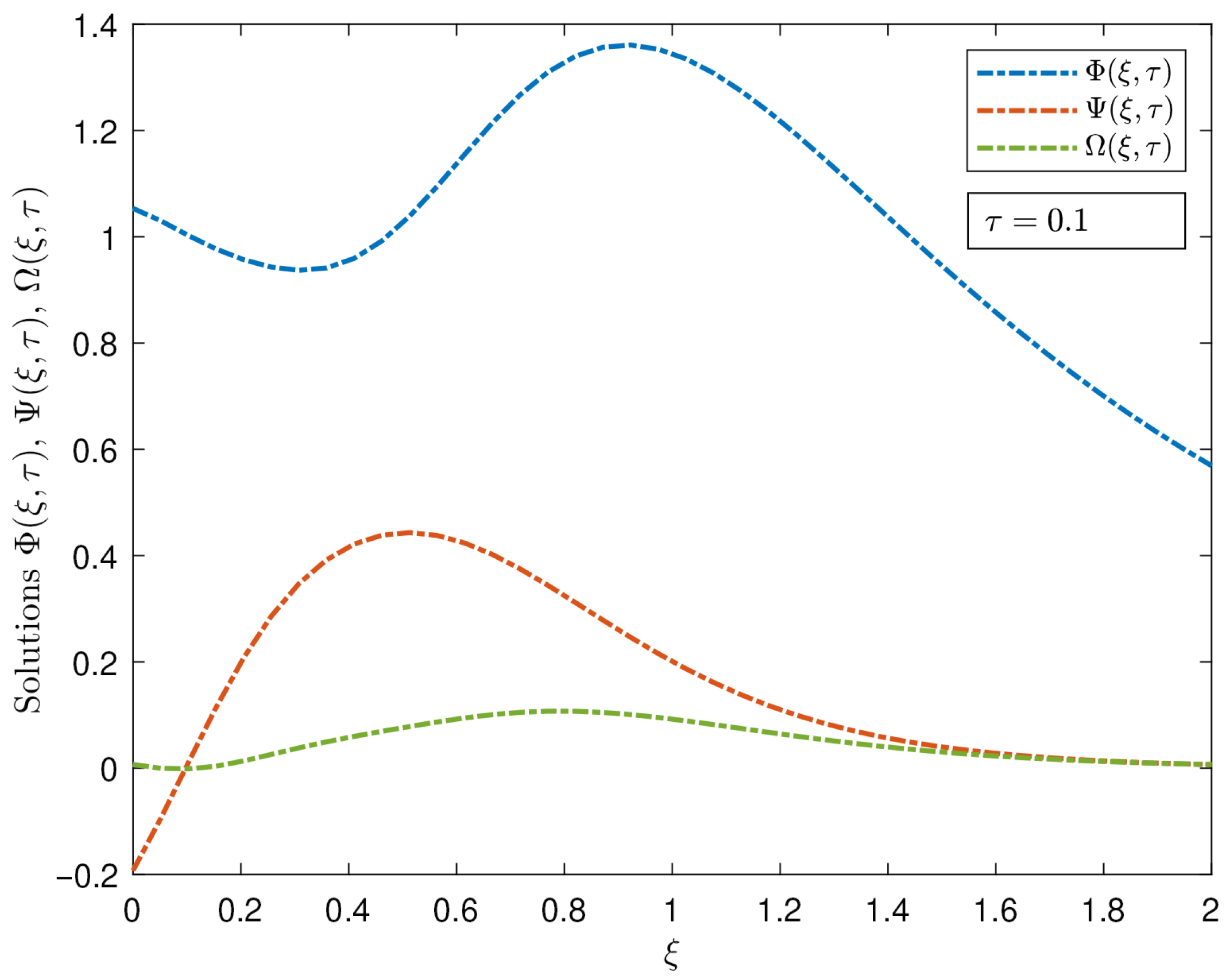
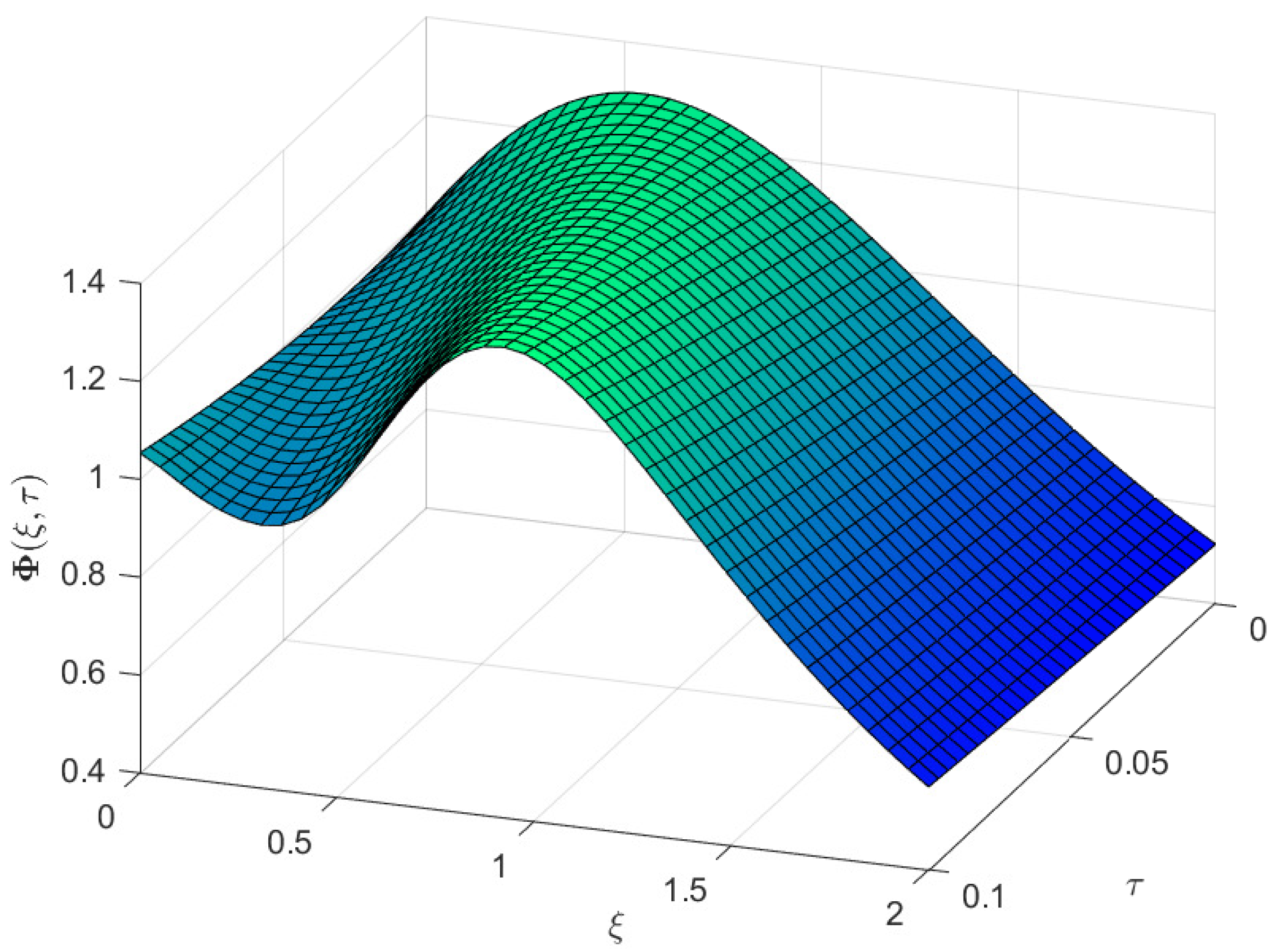
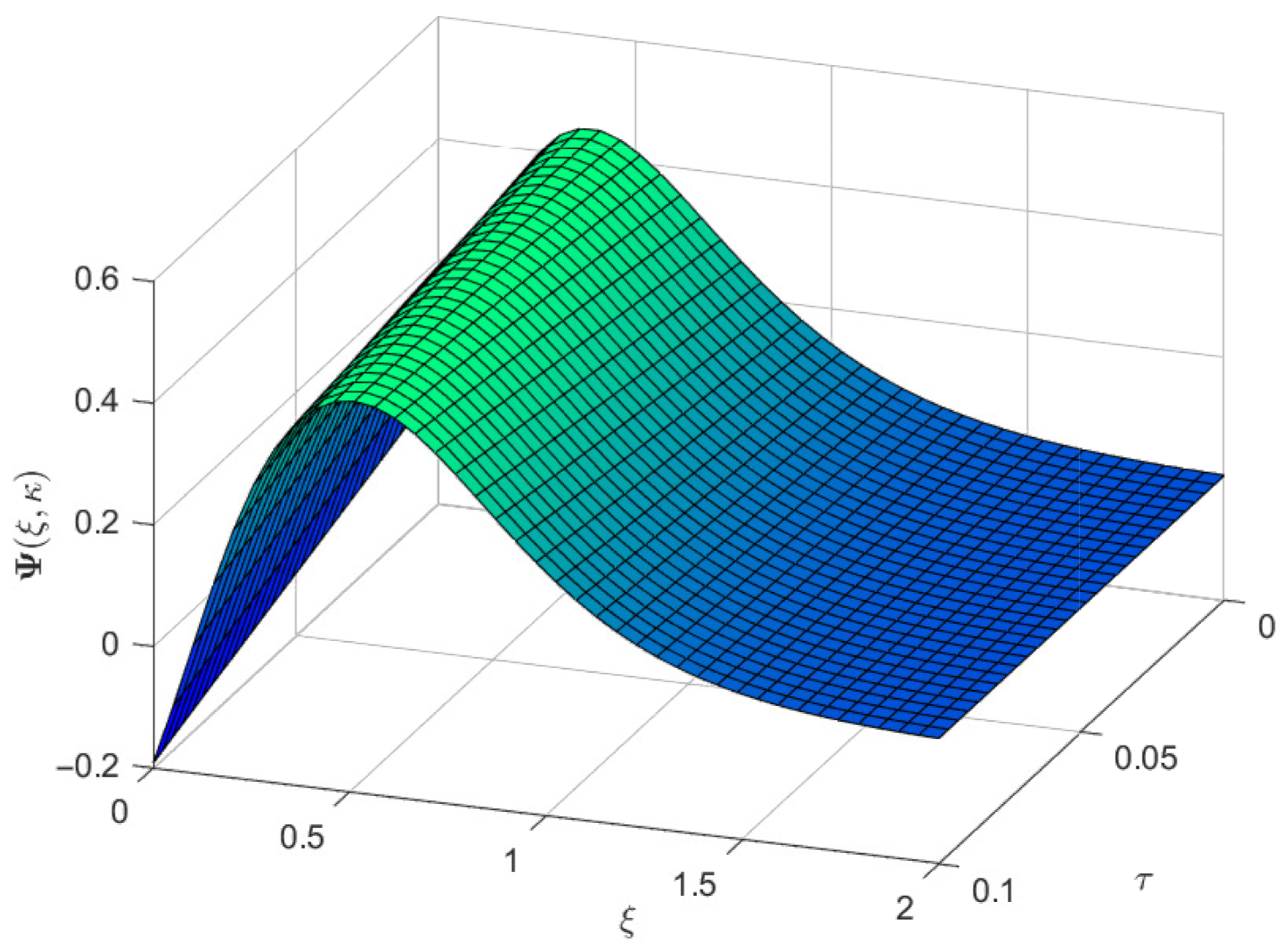
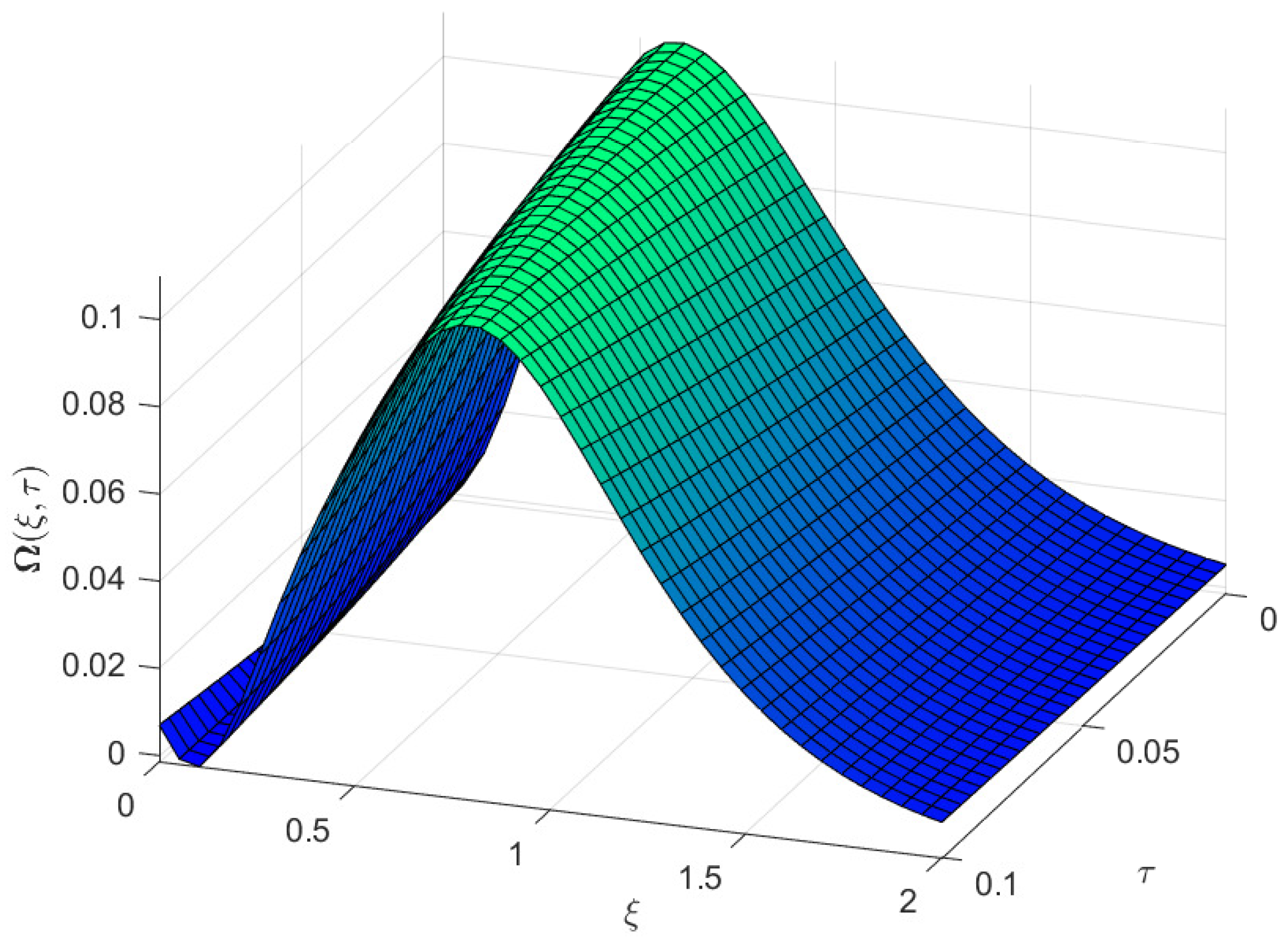
For  ϑ = 1 , Figure 2, Figure 3, Figure 4 and Figure 5 show the behavior of the horizontal velocity  Φ ( ξ ,   τ ) , vertical velocity  Ψ ( ξ ,   τ ) , and layer depth  Ω ( ξ ,   τ )  over  0 ξ 2  and small times  τ . At  τ = 0.1 Ω ( ξ ,   τ )  attains markedly smaller values than  Φ  and  Ψ . This result aligns with the physical interpretation that horizontal wavelengths exceed the fluid depth in the atmospheric setting.
Figure 2, Figure 3, Figure 4 and Figure 5 further illustrate the evolution of  Φ Ψ , and  Ω  in the  ( ξ ,   τ )  plane for  ϑ = 1 . The horizontal velocity  Φ  retains a smooth, wave-like structure that changes slowly over time. In contrast,  Ψ  and  Ω  exhibit lower amplitudes and gentler spatial gradients. These features reflect the dominance of horizontal motion in the stratified modeled layer.
Table 1, Table 2 and Table 3 validate CLADM solutions for  Φ ( ξ ,   τ ) Ψ ( ξ ,   τ ) , and  Ω ( ξ ,   τ )  against EADM [26], HAM [10], FRDTM [27], and NUM [27]. The validation occurs at times  τ = 0 0.02 , and  0.04  across  0 ξ 2  for  ϑ = 1 . These tables show excellent agreement. At  ξ = 0.6 , the horizontal velocity  Φ ( ξ ,   τ )  maintains peak amplitudes near  1.3 . The vertical velocity  Ψ ( ξ ,   τ )  and layer depth  Ω ( ξ ,   τ )  decay rapidly toward domain boundaries. These patterns confirm the dominance of horizontal flow in shallow-water atmospheric dynamics. The temporal evolution shows wave propagation with 2 to 3 percent amplitude reduction from  τ = 0.02  to  τ = 0.04 . This reduction aligns with the physics of inertia–gravity oscillations in the stratified layers.
Table 4, Table 5 and Table 6 show that CLADM and FRDTM reproduce identical qualitative fractional-order behavior. The numerical values from both methods converge as the fractional order  ϑ  approaches unity. The CLADM uses the conformable fractional derivative. The FRDTM employs a Caputo-type fractional operator. Despite these different temporal operators, both methods capture identical fractional trends across the tested parameter range. The CLADM and FRDTM results show qualitative agreement, which supports the internal consistency of the numerical computations, although this agreement should be interpreted as a consistency check rather than a full validation of the fractional model.
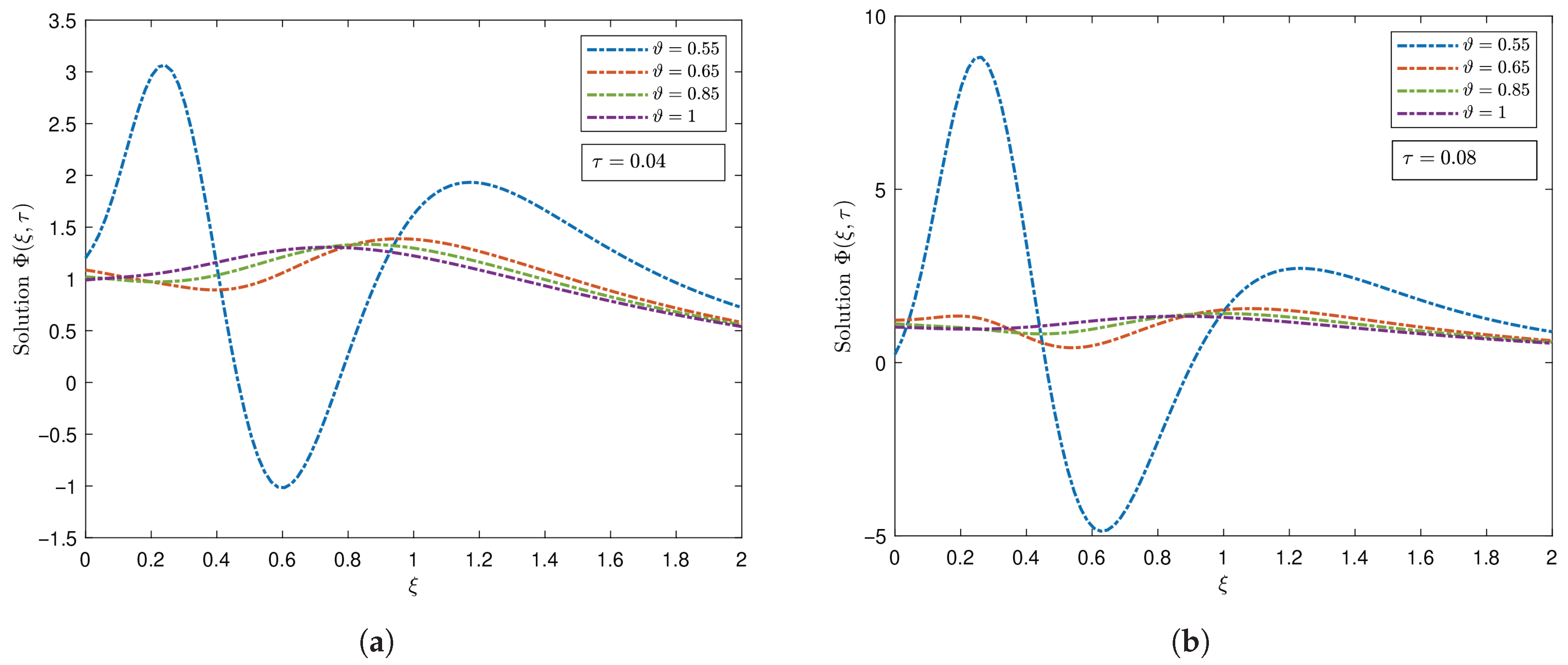
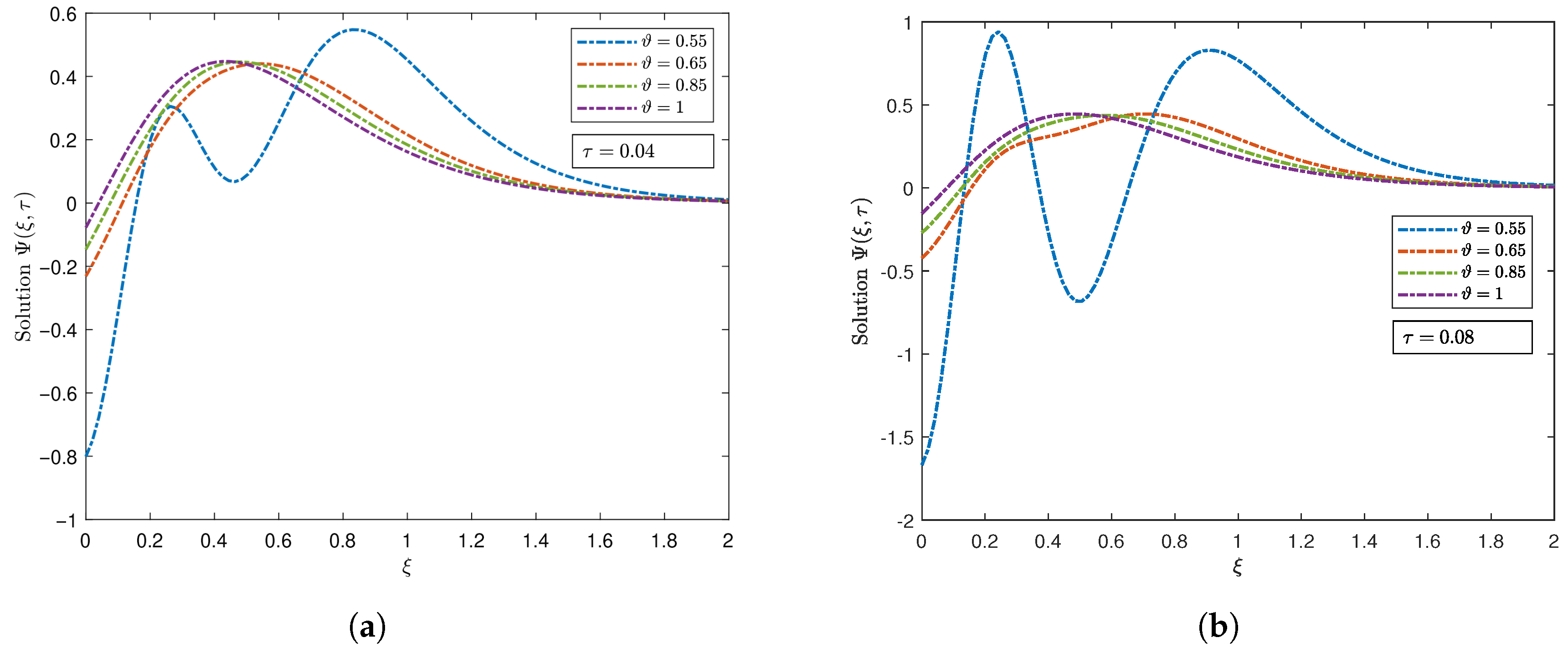
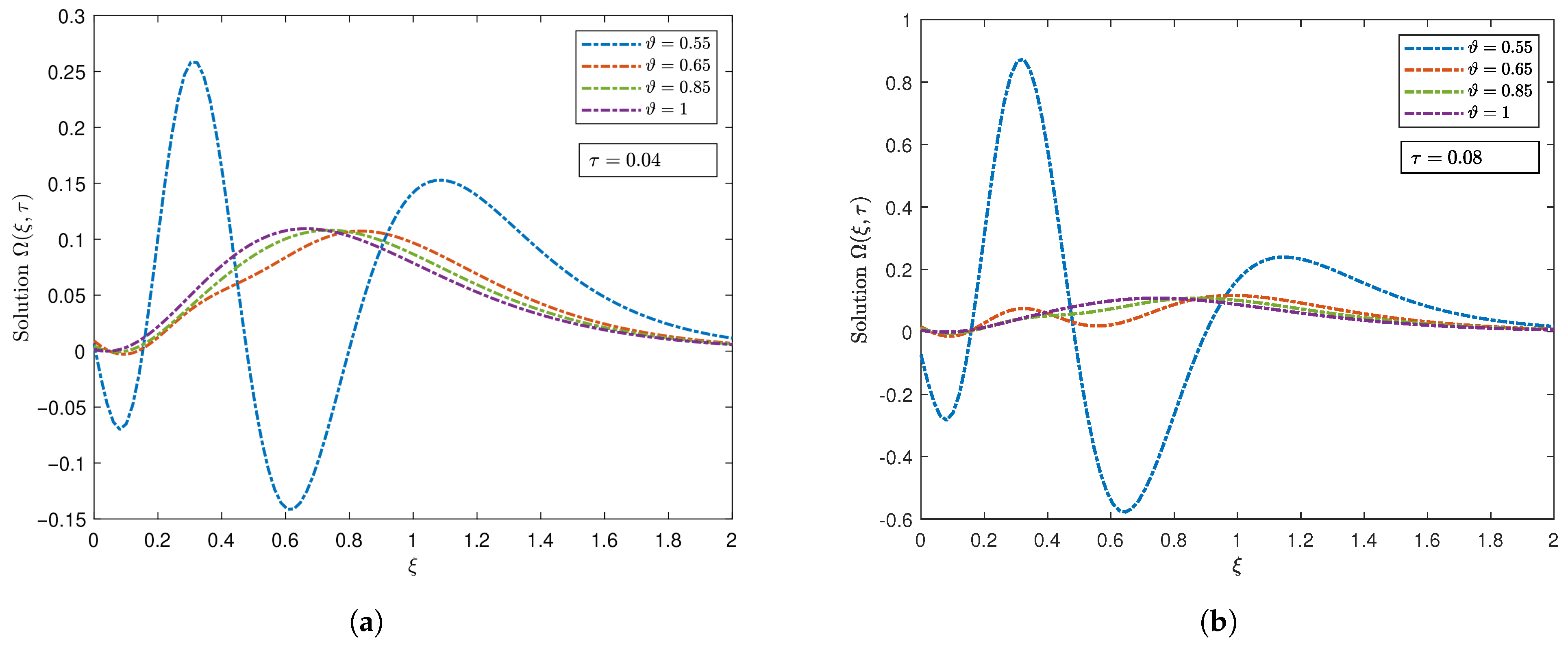
Figure 6, Figure 7 and Figure 8 display the influence of the fractional order  ϑ  on  Φ Ψ , and  Ω  for  ϑ = 0.55 ,   0.65 ,   0.85 ,   1  at fixed times  τ = 0.04  and  τ = 0.08 . As the fractional order  ϑ  decreases from unity, the peak amplitudes of all three dependent variables systematically amplify. This amplification is most dramatic for the horizontal velocity  Φ . The spatial profiles become smoother, and wave propagation becomes more regular. These effects indicate a slower inertia–gravity adjustment process within the stratified atmospheric layer. Thus, the depth perturbation  Ω  remains closer to its initial state over a fixed time interval. Within the conformable fractional framework,  ϑ < 1  acts as a temporal scaling factor. This factor retards dissipation while amplifying the peak responses. The proposed framework recovers classical shallow-water dynamics as  ϑ 1 .
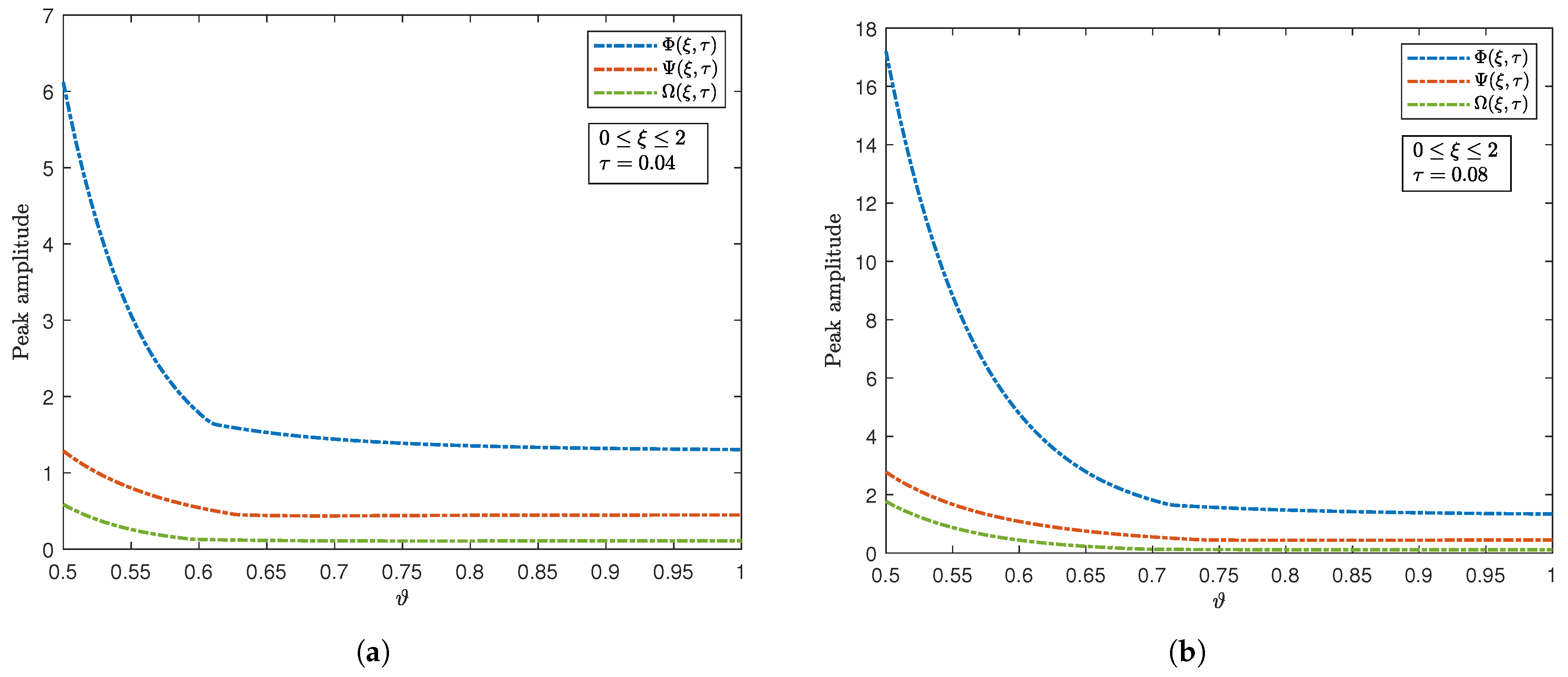
To quantitatively assess the influence of the fractional parameter  ϑ , we examine the spatial peak amplitudes of the solution profiles for different  ϑ  values. Figure 9 shows that increasing  ϑ  systematically reduces the spatial maximum amplitudes of the horizontal velocity, vertical velocity, and layer depth. This increase is accompanied by smoother spatial profiles and a more regular wave structure. This behavior aligns with the interpretation of  ϑ  as a temporal scaling parameter in the conformable framework. This parameter modulates the effective rate of system evolution. Thus, smaller values of  ϑ  produce amplified dynamic responses and regularized propagation compared with the classic case  ϑ = 1 .
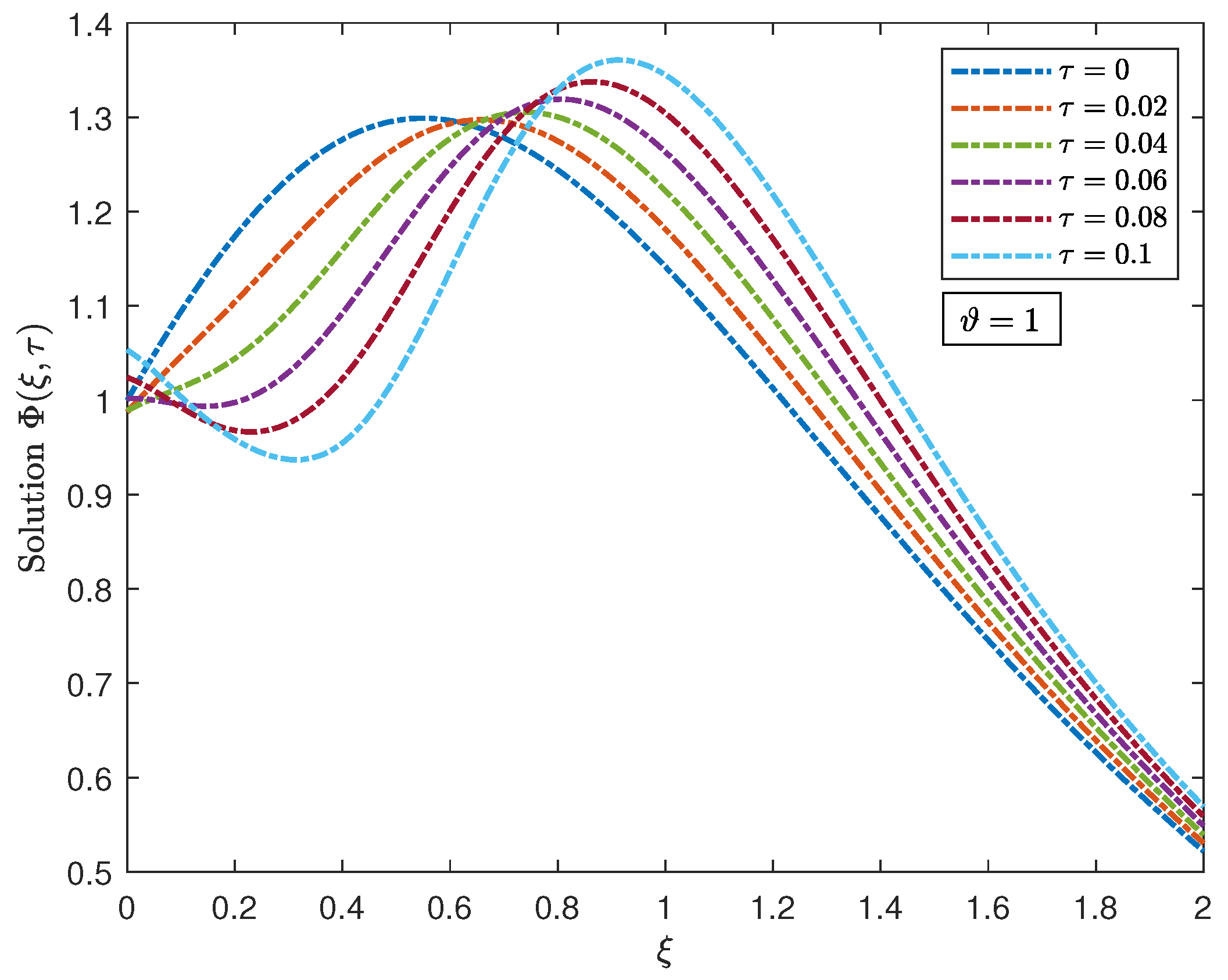
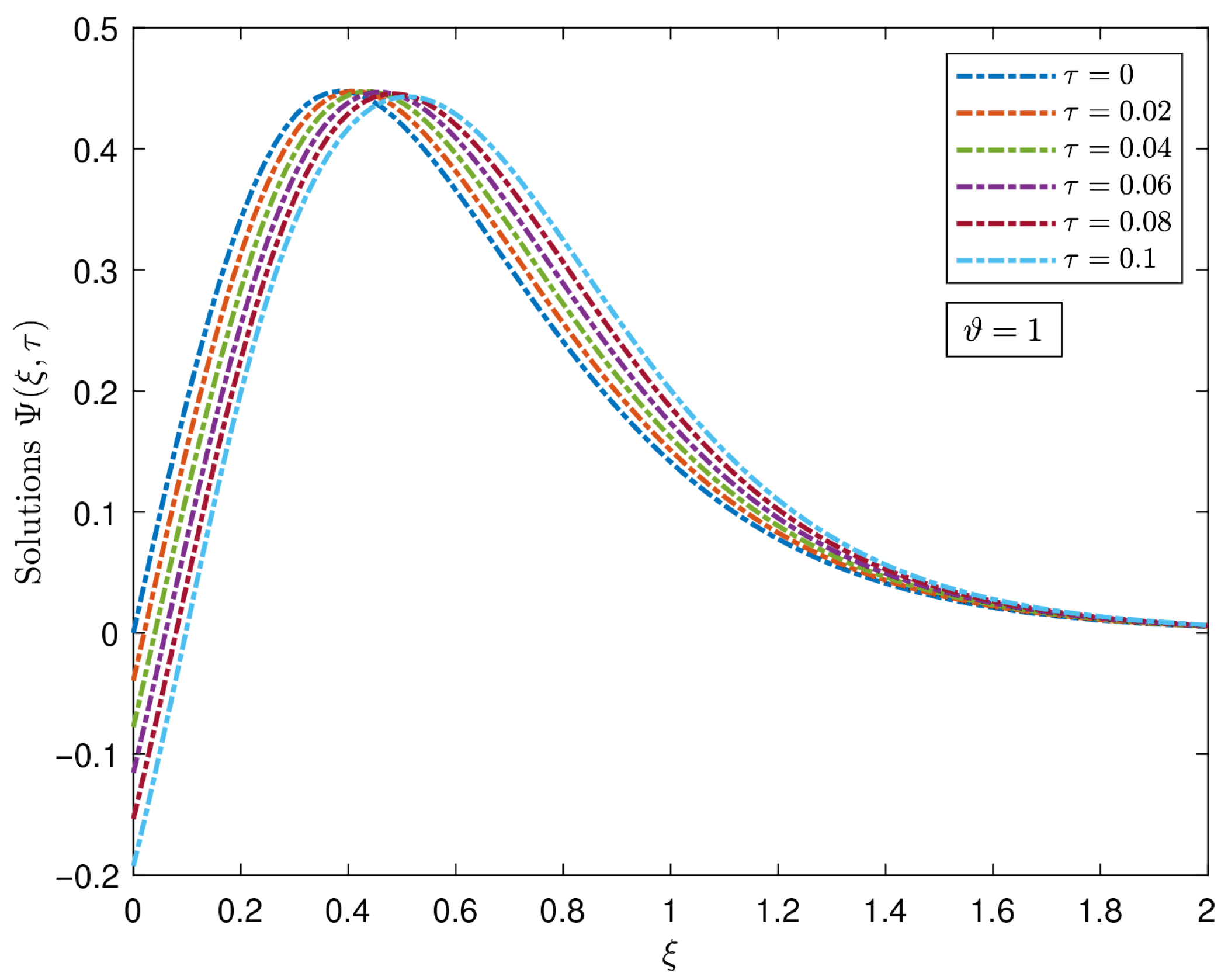
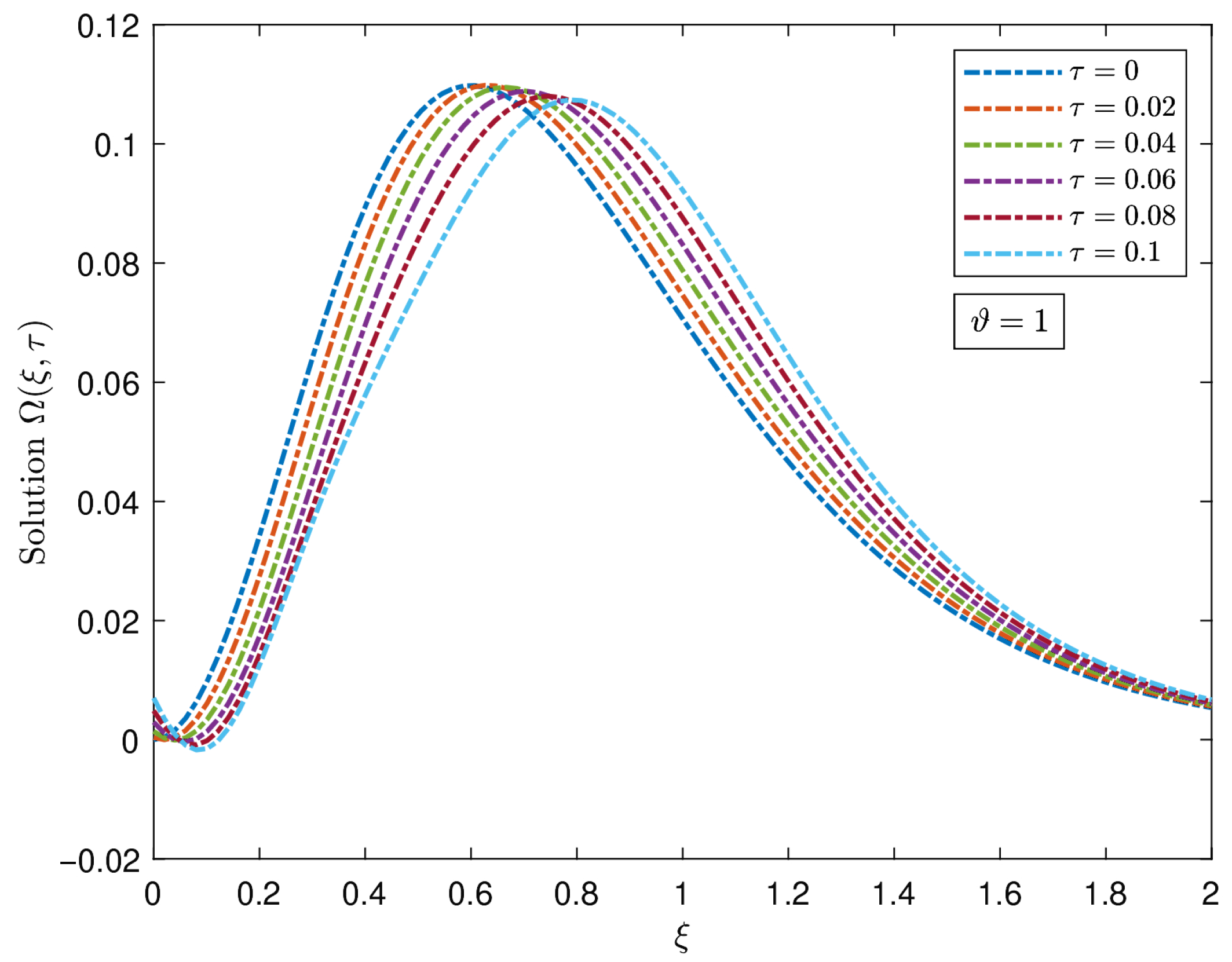
Figure 10, Figure 11 and Figure 12 summarize the temporal evolution of  Φ Ψ , and  Ω  for  ϑ = 1  as  τ  increases from 0 to 0.1 in steps of 0.02. The horizontal velocity  Φ  exhibits a propagating and slightly decaying structure. The vertical velocity  Ψ  remains smaller in magnitude and shows weaker variation in space and time. The depth field  Ω  displays only modest changes throughout the interval. These patterns align with shallow-water dynamics in an atmospheric context and the inertia-oscillation interpretation of the model.

6. Conclusions

This study uses the Conformable Laplace Adomian Decomposition Method (CLADM) to obtain approximate analytical solutions of a time-fractional shallow-water model for atmospheric fluid layers. The method rapidly yields convergent series solutions. In the classical case where  ϑ = 1 , numerical simulations show that CLADM solutions match those from the Elzaki Adomian Decomposition Method (EADM) [26], Homotopy Analysis Method (HAM) [10], Fractional Reduced Differential Transform Method (FRDTM) [27], and Numerical method (NUM) [27]. This agreement confirms the accuracy and reliability of CLADM in the integer-order limit. Furthermore, graphical results show that the horizontal velocity components dominate the dynamics, and the depth variations remain relatively small, which aligns with shallow-water assumptions and the physical nature of atmospheric motions. Figure 2, Figure 3, Figure 4 and Figure 5 illustrate the classic case  ϑ = 1  in both two- and three-dimensional views. In addition, Table 4, Table 5 and Table 6 and Figure 6, Figure 7 and Figure 8 show the influence of the fractional order on the model variables. Notably, lowering  ϑ  systematically amplifies peak amplitudes of horizontal and vertical velocities and layer-depth perturbation, while also smoothing the spatial structure of the internal-wave packet. These effects identify  ϑ  as an effective temporal-scaling parameter that retards dissipation in the conformable framework. The qualitative agreement between CLADM and FRDTM provides an internal consistency check for the fractional-order solutions. However, rigorous validation requires comparison with an independent benchmark solver, residual analysis, or error quantification. This lack of external validation limits the certainty of the results. Within this limitation, CLADM accurately simulates time-fractional shallow-water dynamics in atmospheric fluid layers and offers a comprehensive, practical description of their behavior.

Author Contributions

Methodology, P.V.T. and A.P.; software, A.P.; validation, P.V.T. and A.P.; formal analysis, P.V.T. and T.P.; investigation, A.P. and T.P.; writing—original draft, A.P.; writing—review & editing, T.P.; and supervision, P.V.T. All authors have read and agreed to the published version of the manuscript.

Funding

This research received no external funding.

Data Availability Statement

The original contributions presented in this study are included in the article. Further inquiries can be directed to the corresponding author.

Conflicts of Interest

The authors declare no conflicts of interest.

Nomenclature

  η Vertical displacement
  μ Fluid density
  Ω Depth of fluid
  Φ Horizontal wind component
  Ψ Vertical wind component
  τ Time
  Θ Pressure
  h ˜ Mean depth of the fluid
  V ˜ Constant mean geostrophic speed component
ξ σ ρ Spatial coordinates
fCoriolis parameter
gGravity constant

Appendix A. Solution of the Model

By equating terms of equal order in the Equation (39);
Φ 0 = e ξ cosh ( ξ ) 2 ,   Φ 1 = τ ϑ 19.5997 ξ + 39.2 ξ 2 tanh 2 ξ sech 2 ξ 2 + 1 + 2 tanh ξ sech ξ 4 e 2 ξ ϑ ,   Φ 2 = τ 2 ϑ ϑ 2 e 2 ξ + 1 8 e 4 ξ + 1 4 6.0368 × 10 3 2.6410 × 10 11 e 2 ξ + 8.6883 ξ 2 + 8.6493 ξ + 0.7453 e 11 ξ + ξ + 0.5559 ξ + 0.0935 e 7 ξ + 1.4545 ξ 2 + 12.0519 ξ + 2.2507 e 13 ξ + 31.7403 ξ 2 + 4.0519 ξ + 3.6236 e 17 ξ + 4.6852 × 10 5 ξ 1.5059 × 10 5 e 22 ξ + 4.6852 × 10 5 ξ 1.5059 × 10 5 e 10 ξ + 18.4156 ξ 2 + 10.3376 ξ + 1.8383 e 15 ξ + 2.6753 ξ 2 2.6493 ξ + 0.5184 e 25 ξ + 1.6730 × 10 6 6.6932 × 10 6 ξ e 6 ξ + 2.3426 × 10 5 ξ 6.2742 × 10 6 e 8 ξ + 5.7729 × 10 5 ξ 2.6562 × 10 5 e 12 ξ + 2.3426 × 10 5 ξ 6.2742 × 10 6 e 24 ξ + 6.6932 × 10 6 ξ 1.6730 × 10 6 e 26 ξ + 8.3665 × 10 7 ξ 2.0906 × 10 7 e 28 ξ + 4.9610 ξ 2 + 3.5844 ξ + 0.4548 e 9 ξ + 4.0159 × 10 5 ξ 3.6810 × 10 5 e 14 ξ + 0.4935 ξ + 0.5844 ξ 2 0.0859 e 27 ξ + 5.6104 ξ 2 7.0649 ξ + 2.3302 e 21 ξ + 4.0159 × 10 5 ξ 3.6810 × 10 5 e 18 ξ + 5.7729 × 10 5 ξ 2.6561 × 10 5 e 20 ξ + 6 ξ + 3.2857 ξ 2 + 0.3318 e 23 ξ + 2.0906 × 10 7 8.3665 × 10 7 ξ e 4 ξ + 23.4026 ξ 2 3.1688 ξ + 1.5627 e 19 ξ 5.2820 × 10 12 e 31 ξ + 0.0159 e 29 ξ 5.2820 × 10 12 e 3 ξ + 3.3013 × 10 12 + 2.6410 × 10 11 e 30 ξ 4.0994 × 10 5 e 16 ξ 3.1692 × 10 11 e 5 ξ + 3.3013 × 10 12 e 32 ξ ,  
and
Ψ 0 = 2 ξ cosh ( 2 ξ ) 2 ,   Ψ 1 = τ ϑ e ξ + e 3 ξ + 4 ξ e ξ 4 ξ e 3 ξ 3.1567 × 10 4 cosh 2 ξ 3 cosh ξ 2 + 1.2627 × 10 4 cosh 2 ξ 3 e ξ ϑ cosh 2 ξ 3 cosh ξ 2 ,   Ψ 2 = 1 ϑ 2 cosh 2 ξ 6 cosh ξ 5 2.5253 × 10 4 sinh ξ cosh 6 2 ξ e 2 ξ + 1.2627 × 10 4 cosh ξ cosh 6 2 ξ e 2 ξ + 2 sinh ξ + 1 cosh ξ e 2 ξ + 1.2374 × 10 3 ξ cosh 5 ξ cosh 4 2 ξ + 8 sinh ξ 4 cosh ξ ξ e 2 ξ 2.4748 × 10 3 ξ 2 cosh 5 ξ sinh 2 ξ + 0.5 6 ξ cosh ξ e 4 ξ + 1 + 4 ξ sinh ξ e 4 ξ + 2 ξ + 1.5 cosh ξ + 4 ξ 1 sinh ξ cosh 3 2 ξ + 12 ξ 3 cosh ξ sinh 2 ξ e 4 ξ + 19.5998 cosh 5 ξ ξ + 6 24 ξ sinh 3 ξ + 6 24 ξ sinh ξ cosh 2 2 ξ 117.5990 ξ 2 cosh 2 ξ sinh 2 ξ cosh 5 ξ + 627.2 ξ 3 cosh 9 ξ 627.2 ξ 3 cosh 7 ξ τ 2 ϑ + 3.1567 × 10 4 ϑ cosh 6 2 ξ cosh 5 ξ τ ϑ ,  
and
Ω 0 = ξ 2 cosh ( 2 ξ ) 2 ,   Ω 1 = 5 ξ τ ϑ 0.4 0.8 cosh 2 ξ 1.2 ξ cosh 2 ξ + ξ e 4 ξ 0.4 e 4 ξ + 1.0308 × 10 4 cosh ξ 5 5.1537 × 10 5 cosh ξ 3 + 1.6 ξ sinh 2 ξ 0.6 ξ 4 ϑ cosh ( 2 ξ ) 3 cosh ( ξ ) 3 ,   Ω 2 = 7.35 τ 2 ϑ ϑ 2 cosh 2 ξ 6 cosh ξ 6 2.1259 × 10 2 + 1.5306 × 10 1 ξ 4 ξ 4 + 8.8902 × 10 1 ξ 2 + ξ + 1.0070 ξ + 1.3260 × 10 1 ξ 2 + 1.1035 × 10 1 ξ + 3.1839 × 10 2 e 6 ξ + 3.8265 × 10 2 ξ 2 2.5510 × 10 2 ξ + 2.1259 × 10 3 e 12 ξ + 1.7007 × 10 2 ξ + 4.4047 × 10 1 ξ 2 + 1.6667 × 10 1 ξ 4 1.6667 ξ 3 + 2.1259 × 10 2 e 4 ξ + 1.8831 × 10 7 ξ 3.4241 × 10 8 e 11 ξ + 5 × 10 1 ξ 4 5 × 10 1 ξ 3 5.9524 × 10 2 ξ + 1.1501 × 10 1 ξ 2 + 1.0629 × 10 2 e 8 ξ + 1.0204 × 10 1 ξ 2.4167 ξ 4 1.1667 ξ 3 + 2.5956 × 10 1 ξ 2 + 2.5510 × 10 2 e 2 ξ + 2.4167 ξ 4 + 1.1667 ξ 3 + 5.4867 × 10 1 ξ 2 + 1.3605 × 10 1 ξ + 1.7007 × 10 2 e 2 ξ + 1.5625 × 10 2 ξ 2 + 8.3333 × 10 2 ξ 4 + 8.3333 × 10 2 ξ 3 + 2.0264 × 10 11 e 10 ξ + 1.0614 × 10 6 ξ 3.4239 × 10 7 e 9 ξ + 7.5323 × 10 7 ξ 1.5065 × 10 6 e ξ + 1.4209 × 10 6 ξ 1.0614 × 10 6 e 5 ξ + 1.5065 × 10 6 ξ 6.8478 × 10 7 e 7 ξ + 1.9173 × 10 6 ξ 1.3695 × 10 6 e ξ + 5.4780 × 10 7 ξ 1.3695 × 10 6 e 3 ξ + 2.1912 × 10 6 ξ 6.8478 × 10 7 e 5 ξ + 2.4822 × 10 6 ξ 1.0614 × 10 6 e 3 ξ + 6.8475 × 10 7 ξ 1.3696 × 10 7 e 9 ξ + 1.4037 × 10 6 ξ 3.4239 × 10 7 e 7 ξ + 5.4780 × 10 7 ξ 1.3696 × 10 7 e 11 ξ + 1.5407 × 10 7 ξ 3.4241 × 10 8 e 13 ξ + ξ 4 1.2500 ξ 3 4.0501 × 10 2 ξ 2 + 1.7007 × 10 2 e 6 ξ + 5 × 10 1 ξ 4 + 5 × 10 1 ξ 3 + 2 × 10 1 ξ 2 + 4.2517 × 10 2 ξ + 2.1259 × 10 3 e 8 ξ + 8.3333 × 10 2 ξ 3 2.6892 × 10 2 ξ 2 + 8.3333 × 10 2 ξ 4 1.7 × 10 2 ξ + 4.2517 × 10 3 e 10 ξ + 1.6667 × 10 1 ξ 4 + 1.6667 ξ 3 + 7.2533 × 10 1 ξ 2 + 1.4456 × 10 1 ξ + 1.0629 × 10 2 e 4 ξ + 1.6887 × 10 13 e 18 ξ + 1.6887 × 10 13 e 18 ξ 2.7019 × 10 13 e 17 ξ + 1.0132 × 10 12 e 16 ξ + 1.0132 × 10 12 e 16 ξ 1.0808 × 10 12 e 15 ξ 2.7019 × 10 13 e 15 ξ + 3.5463 × 10 12 e 14 ξ + 3.5463 × 10 12 e 14 ξ 1.0808 × 10 12 e 13 ξ + 9.4567 × 10 12 e 12 ξ ,  
The approximate solution of the time-fractional shallow-water system is then obtained by truncating the series after three terms:
Φ ( ξ ,   τ ) k = 0 3 Φ k ( ξ ,   τ ) ,   Ψ ( ξ ,   τ ) k = 0 3 Ψ k ( ξ ,   τ ) ,   Ω ( ξ ,   τ ) k = 0 3 Ω k ( ξ ,   τ ) .

References

  1. Nappo, C.J. Gravity Wave Analyses. In An Introduction to Atmospheric Gravity Waves; Elsevier: Amsterdam, The Netherlands, 2012; pp. 279–307. [Google Scholar] [CrossRef]
  2. Nappo, C.J. Fundamentals. In An Introduction to Atmospheric Gravity Waves; Elsevier: Amsterdam, The Netherlands, 2012; pp. 1–28. [Google Scholar] [CrossRef]
  3. Sutherland, B.R. Internal Waves in the Atmosphere and Ocean: Instability Mechanisms. In Fluid Mechanics of Planets and Stars; Springer International Publishing: Berlin/Heidelberg, Germany, 2019; pp. 71–89. [Google Scholar] [CrossRef]
  4. Chakrabarti, S.K. Ocean Environment. In Handbook of Offshore Engineering; Elsevier: Amsterdam, The Netherlands, 2005; pp. 79–131. [Google Scholar] [CrossRef]
  5. Warner, T.T. Numerical Weather and Climate Prediction; Cambridge University Press: Cambridge, UK, 2010. [Google Scholar] [CrossRef]
  6. Duba, C.T.; McKenzie, J.F. Propagation properties of Rossby waves for latitudinal β-plane variations of f and zonal variations of the shallow water speed. Ann. Geophys. 2012, 30, 849–855. [Google Scholar] [CrossRef][Green Version]
  7. Clancy, C.; Lynch, P. Laplace transform integration of the shallow-water equations. Part I: Eulerian formulation and Kelvin waves. Q. J. R. Meteorol. Soc. 2011, 137, 792–799. [Google Scholar] [CrossRef]
  8. Bulatov, V.V.; Vladimirov, Y.V. Analytical Solutions of the Internal Gravity Wave Equation for a Semi-Infinite Stratified Layer of Variable Buoyancy. Comput. Math. Math. Phys. 2019, 59, 747–750. [Google Scholar] [CrossRef]
  9. Conrick, R.; Mass, C.F.; Zhong, Q. Simulated Kelvin–Helmholtz Waves over Terrain and Their Microphysical Implications. J. Atmos. Sci. 2018, 75, 2787–2800. [Google Scholar] [CrossRef]
  10. Busrah, Z.; Jaharuddin; Bakhtiar, T. Application of Homotopy and Variational Iteration Methods to the Atmospheric Internal Waves Model. IOSR J. Math. 2014, 10, 46–53. [Google Scholar] [CrossRef]
  11. Safari, M. Analytical Solution of Two Extended Model Equations for Shallow Water Waves By Adomian’S Decomposition Method. Adv. Pure Math. 2011, 1, 238–242. [Google Scholar] [CrossRef][Green Version]
  12. Karunakar, P.; Chakraverty, S. Homotopy perturbation method for predicting tsunami wave propagation with crisp and uncertain parameters. Int. J. Numer. Methods Heat Fluid Flow 2020, 31, 92–105. [Google Scholar] [CrossRef]
  13. Darbani, M.; Ouahsine, A.; Villon, P.; Naceur, H.; Smaoui, H. Meshless method for shallow water equations with free surface flow. Appl. Math. Comput. 2011, 217, 5113–5124. [Google Scholar] [CrossRef]
  14. Atangana, A. Modelling the spread of COVID-19 with new fractal-fractional operators: Can the lockdown save mankind before vaccination? Chaos Solitons Fractals 2020, 136, 109860. [Google Scholar] [CrossRef]
  15. Owolabi, K.M.; Atangana, A. Numerical Methods for Fractional Differentiation; Springer: Singapore, 2019. [Google Scholar] [CrossRef]
  16. Kumar, S. A Numerical Study for the Solution of Time Fractional Nonlinear Shallow Water Equation in Oceans. Z. Naturforsch. A 2013, 68, 547–553. [Google Scholar] [CrossRef]
  17. Srivastava, H.; Dubey, V.; Kumar, R.; Singh, J.; Kumar, D.; Baleanu, D. An efficient computational approach for a fractional-order biological population model with carrying capacity. Chaos Solitons Fractals 2020, 138, 109880. [Google Scholar] [CrossRef]
  18. Veeresha, P.; Prakasha, D.; Kumar, D. An efficient technique for nonlinear time-fractional Klein–Fock–Gordon equation. Appl. Math. Comput. 2020, 364, 124637. [Google Scholar] [CrossRef]
  19. Sweilam, N.; AL Mekhlafi, S.; Baleanu, D. A hybrid stochastic fractional order Coronavirus (2019-nCov) mathematical model. Chaos Solitons Fractals 2021, 145, 110762. [Google Scholar] [CrossRef] [PubMed]
  20. Ziliang, L.; Gang, F.; Jing, C. Periodic structures of atmospheric internal gravity wave under the influence of air-sea interaction. Chaos Solitons Fractals 2009, 40, 530–537. [Google Scholar] [CrossRef]
  21. Khalil, R.; Al Horani, M.; Yousef, A.; Sababheh, M. A new definition of fractional derivative. J. Comput. Appl. Math. 2014, 264, 65–70. [Google Scholar] [CrossRef]
  22. Ayata, M.; Ozkan, O. A new application of conformable Laplace decomposition method for fractional Newell-Whitehead-Segel equation. AIMS Math. 2020, 5, 4702–4712. [Google Scholar] [CrossRef]
  23. Tandel, P.V.; Patel, A.; Patel, T. A Novel Computational Framework for Time-Fractional Higher-Order KdV Models: CLADM-Based Solutions and Comparative Analysis. Axioms 2025, 14, 511. [Google Scholar] [CrossRef]
  24. Abdeljawad, T. On conformable fractional calculus. J. Comput. Appl. Math. 2015, 279, 57–66. [Google Scholar] [CrossRef]
  25. Adomian, G. Solution of physical problems by decomposition. Comput. Math. Appl. 1994, 27, 145–154. [Google Scholar] [CrossRef]
  26. Varsoliwala, A.C.; Singh, T.R. Mathematical modeling of atmospheric internal waves phenomenon and its solution by Elzaki Adomian decomposition method. J. Ocean Eng. Sci. 2022, 7, 203–212. [Google Scholar] [CrossRef]
  27. Patel, T.; Patel, H.; Meher, R. Analytical study of atmospheric internal waves model with fractional approach. J. Ocean Eng. Sci. 2024, 9, 326–337. [Google Scholar] [CrossRef]
  28. Silva, F.S.; Moreira, D.M.; Moret, M.A. Conformable Laplace Transform of Fractional Differential Equations. Axioms 2018, 7, 55. [Google Scholar] [CrossRef]
Figure 1. Schematic of vertical structure of a shallow fluid model.
Axioms 15 00290 g001
Figure 2. Numerical solutions of the horizontal velocity  Φ ( ξ ,   τ ) , vertical velocity  Ψ ( ξ ,   τ ) , and layer depth  Ω ( ξ ,   τ )  at  τ = 0.1  for  0 ξ 2  and  ϑ = 1 .
Axioms 15 00290 g002
Figure 3. Surface plot of the horizontal velocity component  Φ ( ξ ,   τ )  for  0 ξ 2 0 τ 0.1 , and  ϑ = 1 .
Axioms 15 00290 g003
Figure 4. Surface plot of the vertical velocity component  Ψ ( ξ ,   τ )  for  0 ξ 2 0 τ 0.1 , and  ϑ = 1 .
Axioms 15 00290 g004
Figure 5. Surface plot of the layer depth  Ω ( ξ ,   τ )  for  0 ξ 2 0 τ 0.1 , and  ϑ = 1 .
Axioms 15 00290 g005
Figure 6. Profiles of the horizontal velocity  Φ ( ξ ,   τ )  for  0 ξ 2  at (a τ = 0.04  and (b τ = 0.08 , for fractional orders  ϑ = 0.55 ,   0.65 ,   0.85 ,   1 .
Axioms 15 00290 g006
Figure 7. Profiles of the vertical velocity  Ψ ( ξ ,   τ )  for  0 ξ 2  at (a τ = 0.04  and (b τ = 0.08 , for fractional orders  ϑ = 0.55 ,   0.65 ,   0.85 ,   1 .
Axioms 15 00290 g007
Figure 8. Profiles of the layer depth  Ω ( ξ ,   τ )  for  0 ξ 2  at (a τ = 0.04  and (b τ = 0.08 , for fractional orders  ϑ = 0.55 ,   0.65 ,   0.85 ,   1 .
Axioms 15 00290 g008
Figure 9. Profiles of peak amplitudes versus fractional order  ϑ  for  0 ξ 2  at (a τ = 0.04  and (b τ = 0.08 .
Axioms 15 00290 g009
Figure 10. Horizontal velocity  Φ ( ξ ,   τ )  versus  ξ  for  τ = 0 ,   0.02 ,   0.04 ,   0.06 ,   0.08 ,   0.1  and  ϑ = 1 .
Axioms 15 00290 g010
Figure 11. Vertical velocity  Ψ ( ξ ,   τ )  versus  ξ  for  τ = 0 ,   0.02 ,   0.04 ,   0.06 ,   0.08 ,   0.1  and  ϑ = 1 .
Axioms 15 00290 g011
Figure 12. Layer depth  Ω ( ξ ,   τ )  versus  ξ  for  τ = 0 ,   0.02 ,   0.04 ,   0.06 ,   0.08 ,   0.1  and  ϑ = 1 .
Axioms 15 00290 g012
Table 1. Numerical comparison of the horizontal velocity  Φ ( ξ ,   τ )  obtained by CLADM, EADM, HAM, FRDTM, and NUM for  0 ξ 2 τ = 0 ,   0.02 ,   0.04  and  ϑ = 1 .
  ξ   τ = 0   τ = 0.02   τ = 0.04
CLADMEADM [26]HAM [10]FRDTM [27]NUM [27]CLADMEADM [26]HAM [10]FRDTM [27]NUM [27]CLADMEADM [26]HAM [10]FRDTM [27]NUM [27]
0.01.000001.000001.000001.000001.000000.987660.980000.983500.987660.972260.989110.960000.967000.989110.98792
0.21.173821.173821.173821.173821.173821.104031.100261.113131.104031.109341.044121.026691.052441.044121.05275
0.41.276461.276461.276461.276461.276461.222311.227551.236111.222311.217771.159841.178631.195751.159841.15837
0.61.296581.296581.296581.296581.296581.293351.299101.298661.293351.286811.277481.301621.300741.277481.27049
0.81.244201.244201.244201.244201.244201.274831.276771.271071.274831.275701.300421.309331.297931.300421.29907
1.01.141611.141611.141611.141611.141611.181521.180951.174061.181521.187421.222261.220291.206521.222261.22837
1.21.012701.012701.012701.012701.012701.048351.047121.041101.048351.052521.086551.081541.069491.086551.09214
1.40.876540.876540.876540.876540.876540.903770.902720.898140.903770.903940.933230.928900.919740.933230.93390
1.60.745570.745570.745570.745570.745570.764730.764040.760810.764730.763250.785370.782510.776040.785370.78358
1.80.626490.626490.626490.626490.626490.639370.638970.636780.639370.638350.653100.651440.647070.653100.65179
2.00.522040.522040.522040.522040.522040.530470.530250.528820.530470.530050.539360.538460.535590.539360.53882
Table 2. Numerical comparison of the vertical velocity  Ψ ( ξ ,   τ )  obtained by CLADM, EADM, HAM, FRDTM, and NUM for  0 ξ 2 τ = 0 ,   0.02 ,   0.04 , and  ϑ = 1 .
  ξ   τ = 0   τ = 0.02   τ = 0.04
CLADMEADM [26]HAM [10]FRDTM [27]NUM [27]CLADMEADM [26]HAM [10]FRDTM [27]NUM [27]CLADMEADM [26]HAM [10]FRDTM [27]NUM [27]
0.00.000000.000000.000000.000000.00000−0.03928−0.04000−0.03300−0.03930−0.03954−0.07757−0.07999−0.06599−0.07760−0.07829
0.20.342260.342260.342260.342260.342260.313650.314300.319190.313640.311820.284240.286340.296120.284220.28101
0.40.447240.447240.447240.447240.447240.447450.449030.448720.447440.445360.444490.450820.450190.444460.44185
0.60.366020.366020.366020.366020.366020.381520.381860.379090.381510.381760.396010.397690.392150.395990.39581
0.80.240840.240840.240840.240840.240840.255940.255450.252900.255930.257190.271940.270060.264950.271910.27324
1.00.141300.141300.141300.141300.141300.151000.150520.148910.150990.151330.161710.159740.156520.161690.16213
1.20.077720.077720.077720.077720.077720.082890.082610.081750.082870.082470.088630.087490.085790.088600.08810
1.40.041110.041110.041110.041110.041110.043590.043460.043050.043580.043190.046340.045810.044990.046310.04578
1.60.021200.021200.021200.021200.021200.022320.022260.022080.022310.022140.023550.023330.022960.023530.02329
1.80.010730.010730.010730.010730.010730.011230.011200.011120.011220.011170.011770.011670.011510.011740.01167
2.00.005360.005360.005360.005360.005360.005580.005560.005530.005570.005560.005820.005770.005700.005790.00577
Table 3. Numerical comparison of the layer depth  Ω ( ξ ,   τ )  obtained by CLADM, EADM, HAM, FRDTM, and NUM for  0 ξ 2 τ = 0 ,   0.02 ,   0.04 , and  ϑ = 1 .
  ξ   τ = 0   τ = 0.02   τ = 0.04
CLADMEADM [26]HAM [10]FRDTM [27]NUM [27]CLADMEADM [26]HAM [10]FRDTM [27]NUM [27]CLADMEADM [26]HAM [10]FRDTM [27]NUM [27]
0.00.000000.000000.000000.000000.000000.000380.000000.000000.000000.000000.001410.000000.000000.000000.00000
0.20.034230.034230.034230.034230.034230.027450.026930.028200.027450.027690.021800.019630.022180.021800.02185
0.40.089450.089450.089450.089450.089450.083170.083550.084580.083170.082430.076420.077650.079710.076420.07580
0.60.109810.109810.109810.109810.109810.109400.110020.109980.109400.108330.107640.110240.110160.107640.10638
0.80.096340.096340.096340.096340.096340.099810.099970.099330.099810.099920.102850.103600.102330.102850.10269
1.00.070650.070650.070650.070650.070650.074600.074490.073820.074600.075290.078770.078330.076980.078770.07954
1.20.046630.046630.046630.046630.046630.049540.049410.048920.049540.049840.052750.052180.051210.052750.05317
1.40.028780.028780.028780.028780.028780.030540.030450.030160.030540.030430.032490.032120.031540.032490.03236
1.60.016960.016960.016960.016960.016960.017910.017860.017700.017910.017750.018950.018770.018450.018950.01875
1.80.009660.009660.009660.009660.009660.010140.010120.010040.010140.010070.010660.010580.010420.010660.01057
2.00.005360.005360.005360.005360.005360.005590.005580.005550.005590.005570.005840.005800.005730.005840.00581
Table 4. Numerical comparison of the horizontal velocity  Φ ( ξ ,   τ )  obtained by CLADM and FRDTM for  0 ξ 2 τ = 0.02 ,   0.04  and various fractional orders  ϑ .
  ξ   τ = 0.02   τ = 0.04
CLADMFRDTMCLADMFRDTM
  ϑ = 0 . 55   ϑ = 0 . 65   ϑ = 0 . 85   ϑ = 0 . 55   ϑ = 0 . 65   ϑ = 0 . 85   ϑ = 0 . 55   ϑ = 0 . 65   ϑ = 0 . 85   ϑ = 0 . 55   ϑ = 0 . 65   ϑ = 0 . 85
01.2365751.0888180.9900611.0998341.0557200.9919121.2024991.2084381.0194981.0155411.1171161.019047
0.21.4398210.9743801.0379961.3695141.0498721.0531222.9553361.2604500.9719882.3882131.3135880.999190
0.40.7470560.8879161.1522250.9867051.0076381.1644901.1224120.7501551.0357201.2737610.9424541.060789
0.60.3790081.0492671.2747580.7369061.1090191.275674−1.0193200.5866621.211021−0.1357600.7498721.214451
0.81.0585091.3162091.3029701.1231071.2879341.2963670.2675601.1545851.3282500.6130331.1477301.316584
11.5400261.3863991.2269991.3801161.3160151.2183621.6240461.5083111.2967881.4178661.3972121.280801
1.21.5407281.2705021.0911361.3332241.1992781.0834271.9268421.4693161.1628321.5643131.3438931.148433
1.41.3107561.0801810.9367951.1410911.0244640.9309111.6638791.2482890.9931241.3553141.1482390.982130
1.61.0452590.8872610.7878560.9284620.8485060.7837191.2853581.0025950.8270721.0745880.9334910.819363
1.80.8176980.7191480.6547470.7433210.6937370.6519700.9625830.7914230.6804520.8315580.7468470.675298
20.6399700.5808630.5404200.5941860.5646790.5386040.7232190.6244640.5567830.6448900.5965980.553427
Table 5. Numerical comparison of the vertical velocity  Ψ ( ξ ,   τ )  obtained by CLADM and FRDTM for  0 ξ 2 τ = 0.02 ,   0.04  and various fractional orders  ϑ .
  ξ   τ = 0.02   τ = 0.04
CLADMFRDTMCLADMFRDTM
  ϑ = 0 . 55   ϑ = 0 . 65   ϑ = 0 . 85   ϑ = 0 . 55   ϑ = 0 . 65   ϑ = 0 . 85   ϑ = 0 . 55   ϑ = 0 . 65   ϑ = 0 . 85   ϑ = 0 . 55   ϑ = 0 . 65   ϑ = 0 . 85
0−0.452424−0.234923−0.081962−0.288583−0.172480−0.073703−0.801074−0.393695−0.146426−0.519041−0.295218−0.132033
0.20.1103860.1727940.2808270.1917260.2200340.2869730.1966720.1157620.2313600.2266090.1794930.242627
0.40.2937490.4007750.4439430.3490580.4115350.4439450.1114580.3247300.4311450.2223110.3507560.431607
0.60.4103150.4345870.3975990.3897010.4130330.3942270.2544480.4247620.4181680.2842000.3989260.412058
0.80.4363860.3445870.2738430.3574430.3151150.2705390.5415900.4137690.3030420.4154760.3632960.296834
10.3085530.2173410.1630220.2417980.1963180.1608900.4520420.2835540.1840130.3263810.2445090.179972
1.20.1720480.1193010.0893340.1345690.1078780.0881900.2587970.1573510.1007580.1862840.1358250.098590
1.40.0851710.0607660.0466720.0676950.0553420.0461100.1248850.0784010.0520780.0914670.0682980.051019
1.60.0399680.0298180.0237030.0325060.0274040.0234350.0559480.0371890.0260820.0420800.0327930.025581
1.80.0184200.0143910.0118310.0153300.0133330.0117000.0244840.0173350.0128440.0189510.0154620.012601
20.0085040.0069140.0058440.0072000.0064340.0057730.0107760.0080850.0062750.0085400.0072600.006145
Table 6. Numerical comparison of the layer depth  Ω ( ξ ,   τ )  obtained by CLADM and FRDTM for  0 ξ 2 τ = 0.02 ,   0.04  and various fractional orders  ϑ .
  ξ   τ = 0.02   τ = 0.04
CLADMFRDTMCLADMFRDTM
  ϑ = 0 . 55   ϑ = 0 . 65   ϑ = 0 . 85   ϑ = 0 . 55   ϑ = 0 . 65   ϑ = 0 . 85   ϑ = 0 . 55   ϑ = 0 . 65   ϑ = 0 . 85   ϑ = 0 . 55   ϑ = 0 . 65   ϑ = 0 . 85
00.0163470.0093250.0015630.0082150.0063050.0014430.0068270.0155130.0044850.0000690.0095020.004087
0.20.0325700.0122450.0212240.0352460.0195490.0226610.1012010.0243180.0147020.0844040.0316370.017177
0.40.0637430.0534880.0756280.0752200.0647360.0770310.1639070.0557910.0644320.1387230.0700470.067186
0.60.0104860.0828610.1073410.0493170.0894030.107452−0.1402720.0328920.100389−0.0445600.0506730.100783
0.80.0824400.1065980.1031640.0872100.1029180.1024120.0020130.0918350.1065970.0357630.0898940.105252
10.1192160.0972340.0792620.0995870.0896590.0784030.1418630.1139650.0867710.1117550.1011880.085158
1.20.0964720.0693420.0531410.0766070.0630780.0525080.1391200.0890390.0594100.1017510.0774210.058212
1.40.0605120.0428390.0327270.0479350.0389920.0323450.0894460.0555970.0365920.0651940.0483690.035869
1.60.0335290.0244060.0190800.0269890.0223690.0188740.0482520.0310070.0211300.0358130.0272250.020743
1.80.0174810.0132790.0107190.0144060.0122870.0106160.0240330.0163340.0117180.0183440.0145310.011525
20.0088550.0070320.0058660.0074870.0065730.0058160.0115790.0083660.0063280.0091280.0075500.006236
Disclaimer/Publisher’s Note: The statements, opinions and data contained in all publications are solely those of the individual author(s) and contributor(s) and not of MDPI and/or the editor(s). MDPI and/or the editor(s) disclaim responsibility for any injury to people or property resulting from any ideas, methods, instructions or products referred to in the content.