


Abstract
For the first time, the structure of natural hexacelsian, BaAl2Si2O8, a polymorph of celsian and paracelsian, has been refined. Hexacelsian was found in rankinite-bearing paralava near Mount Ye’elim in the northern part of the large Hatrurim Complex pyrometamorphic rock area (Hatrurim Basin) in the Negev Desert, Israel. It associates with Ba-bearing minerals such as barioferrite, walstromite, gurimite and the potentially new mineral BaCa2Mg(SiO4)2, forming small isolated aggregates between the rock-forming minerals. These rock-forming minerals are represented by gehlenite, rankinite, wollastonite and schorlomite. The structure was refined for a hexacelsian grain measuring 0.039 × 0.026 × 0.016 mm with the composition (Ba1.01K0.05Na0.01Ca0.01)Σ1.08(Si1.96Al1.91Fe3+0.11)Σ3.98O8 to R1 = 3%. Natural hexacelsian with P63/mcm symmetry and unit cell parameters of a = 5.2973(4) Å, c = 15.6068(10) Å, γ = 120°, and V = 379.28(6) Å3 is an analogue of synthetic low-temperature α-hexacelsian. The hexacelsian structure (polytype 2H) is formed by double layers of tetrahedra linked by their tops and bases, which are parallel to (001). Each layer is built from hexagonal (ditrigonal) rings of tetrahedra. The tetrahedra in rings with a disordered Al/Si distribution are rotated by approximately 14.5° compared to the position of the tetrahedra in ideal hexagonal rings in the high-temperature γ-hexacelsian. Every second layer in the structure of the studied hexacelsian is rotated through 180°. The hexacelsian crystallised at temperatures above 1100 °C as a disordered, metastable γ-hexacelsian (1H). A decrease in temperature leads to the ordering of O2 sites and the formation of partially ordered α-hexacelsian (2H), which preserves the disordered distribution of Al/Si at the tetrahedra. Some of the γ-hexacelsian grains in paralava were replaced by celsian under high-temperature conditions. Under low-temperature conditions, α-hexacelsian is replaced by cymrite during the zeolitisation of pyrometamorphic rocks of the Hatrurim Complex.
1. Introduction
The name ‘hexacelsian’ (BaAl2Si2O8) has been used in the literature since the 1950s to refer to a synthetic polymorph of celsian and paracelsian [1]. In 2017, a new mineral was described from rankinite-bearing paralava of the Hatrurim Complex in the Negev Desert, Israel. It was found to have a composition and structure similar to those of hexacelsian [2]. Due to the small grain size of natural hexacelsian, its structure could not be determined using standard methods. Therefore, the EBSD method was employed, for which a structural model of the disordered α-hexacelsian with space group P63/mcm (a = 5.2920(4) Å, c = 15.557(2) Å, α = β = 90°, γ = 120°) was adapted [3].
The layered structure of hexacelsian is characterised by three distinct structural modifications: α, β, and γ [4]. The structure of hexacelsian is considered to be a two-dimensional feldspar. Its symmetry is determined by the Si/Al arrangement at the tetrahedral sites, the rotation of the tetrahedra that defines the geometry of the six-membered rings forming the double layer, and the splitting of the oxygen sites. The sequence of double layers with different orientations also influences symmetry, determining the appearance of polytypes [4,5,6]. Based on the investigation of synthetic hexacelsian data, two phase transition schemes can be distinguished: the “commonly-accepted” scheme: α-hexacelsian (P63/mcm, polytype 2H) ⟶ ~300 °C ⟶ β-hexacelsian (Immm, O2) ⟶ ~700 °C ⟶ γ-hexacelsian (P6/mmm, 1H) [7,8] and the recently proposed scheme: α-hexacelsian (I2/a, 2H) ⟶ ~300 °C ⟶ β-hexacelsian (Fmm, O2) ⟶ ~700 °C ⟶ γ-hexacelsian (P-62m, 1H) [4]. In addition, the P-3 and P-3c1 space groups have been proposed for Al/Si ordered hexacelsian [9,10]. Hexacelsian is the most high-temperature polymorph of BaAl2Si2O8 and remains stable above 1590 °C [11]. Studies of the kinetics of synthetic polymorph formation suggest that hexacelsian may form metastable in systems doped with various impurities at temperatures above 1000 °C. Repeatedly heating and slowly cooling the synthesis products results in hexacelsian being replaced by celsian [12].
Hexacelsian is regarded as a two-dimensional (2D) feldspar analogue [13]. Structurally related compounds exhibiting a similar topology include the silicates dmisteinbergite, Ca(Al2Si2)O8 [14], kokchetavite, K(AlSi3)O8 [15], wodegongjieite, KCa3(Al7Si9)O32 [16], and pfaffenbergite, KNa3(Al4Si12)O32 [17], as well as the phosphate analogue minjiangite, BaBe2P2O8 [18]. This article presents the results of the first ever determination of the structure of natural hexacelsian and considers questions relating to its origin.
2. Materials and Methods
More than 600 thin sections prepared from thin veins of paralava from gehlenite hornfels of various localities within the pyrometamorphic rocks of the Hatrurim Basin were examined using Phenom XL and Quanta 250 scanning electron microscopes (ThermoFisher Scientific, Eindhoven, The Netherlands) at the Institute of Earth Sciences, University of Silesia, Poland.
The BaAl2Si2O8 grains detected were analysed using a WITec Alpha 300R confocal Raman microscope (WITec, Ulm, Germany) at the Institute of Earth Sciences, University of Silesia, Poland. The microscope is equipped with an air-cooled, solid-state laser that operated at 488 and 532 nm, and a CCD camera operating at −61 °C. The laser power at the sample position was approximately 25 mW. Fifteen scans with an integration time of 3 s were collected and averaged, with a resolution of 3.5 cm−1.
The composition of the hexacelsian grains, as identified using SEM/EDS and Raman spectroscopy, was analysed using a Cameca SX100 (CAMECA, Gennevilliers, France) with an accelerating voltage of 15 kV, a beam current of 20 nA, and a spot size of 1–2 μm. The following analytical lines and standards were used: NaKα (albite); CaKα, SiKα (wollastonite); MgKα (diopside); KKα, AlKα (orthoclase); MnKα (rhodonite); TiKα (titanite); FeKα (hematite) and BaMα (baryte).
Several of the largest hexacelsian grains were analysed using a SuperNova single-crystal diffractometer (formerly Agilent Technologies, currently Rigaku Oxford Diffraction, Abingdon, UK) equipped with an Atlas detector (Institute of Physics, Faculty of Science and Technology, University of Silesia, Poland). Measurements were performed at room temperature (290 K) using MoKα radiation (λ = 0.71073 Å). The structure was solved and refined using the SHELXL-2018/3 programme [19].
Hardness measurements were performed using a semi-automatic InnovaTest Series 400 (413A) microhardness tester (Maastricht, The Netherlands) at loads of 25 and 50 g, depending on the grain size. A standard micro Vickers hardness block (No. Z119608, 441 kg/mm2) was used to verify the tester’s calibration.
3. Geological Background
The pyrometamorphic rocks of the Hatrurim Complex can be found in a series of outcrops along the Dead Sea Rift. The largest outcrop of these rocks in Israel is located in the Negev Desert and is known as the Hatrurim Basin. This area boasts the greatest variety of rock types that can be observed, among which are spurrite marbles, larnite pseudoconglomerates, and gehlenite hornfelses [20,21,22,23,24]. The last type of rock forms characteristic ridges in the desert landscape and is associated with the formation of thin veins of paralava containing hexacelsian. Only celsian is found in other types of paralavas that form rounded bodies, such as the olive series and basalt-like paralava, which can cover areas of hundreds of square metres [25,26].
Despite the relatively high level of research that has been conducted into the mineralogy of the pyrometamorphic rocks of the Hatrurim Complex, where over 70 new minerals were recently described, the genesis of these rocks remains a mystery. There are two main hypotheses. The classical hypothesis posits that pyrometamorphic rocks formed as a result of the combustion of organic matter dispersed within the protolith rocks [27,28]. The ‘mud volcano’ hypothesis suggests that methane entering the pyrometamorphic zone from small gas pockets in the Dead Sea rift region is combusted. According to the authors, this could significantly intensify the thermal transformation process of the protolith rocks [23,29]. Unfortunately, neither hypothesis can explain the formation of layers of pyrometamorphic rocks that form fields covering tens of square kilometres and reaching a thickness of up to 100 m [23].
4. Occurrence and Description of Hexacelsian
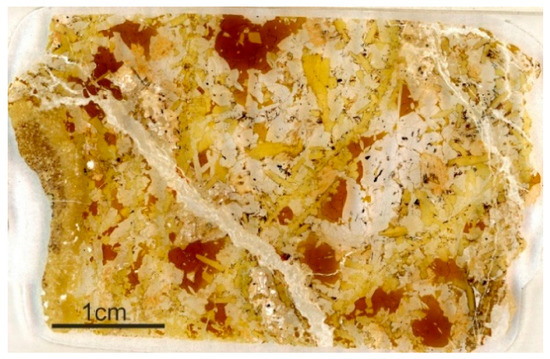
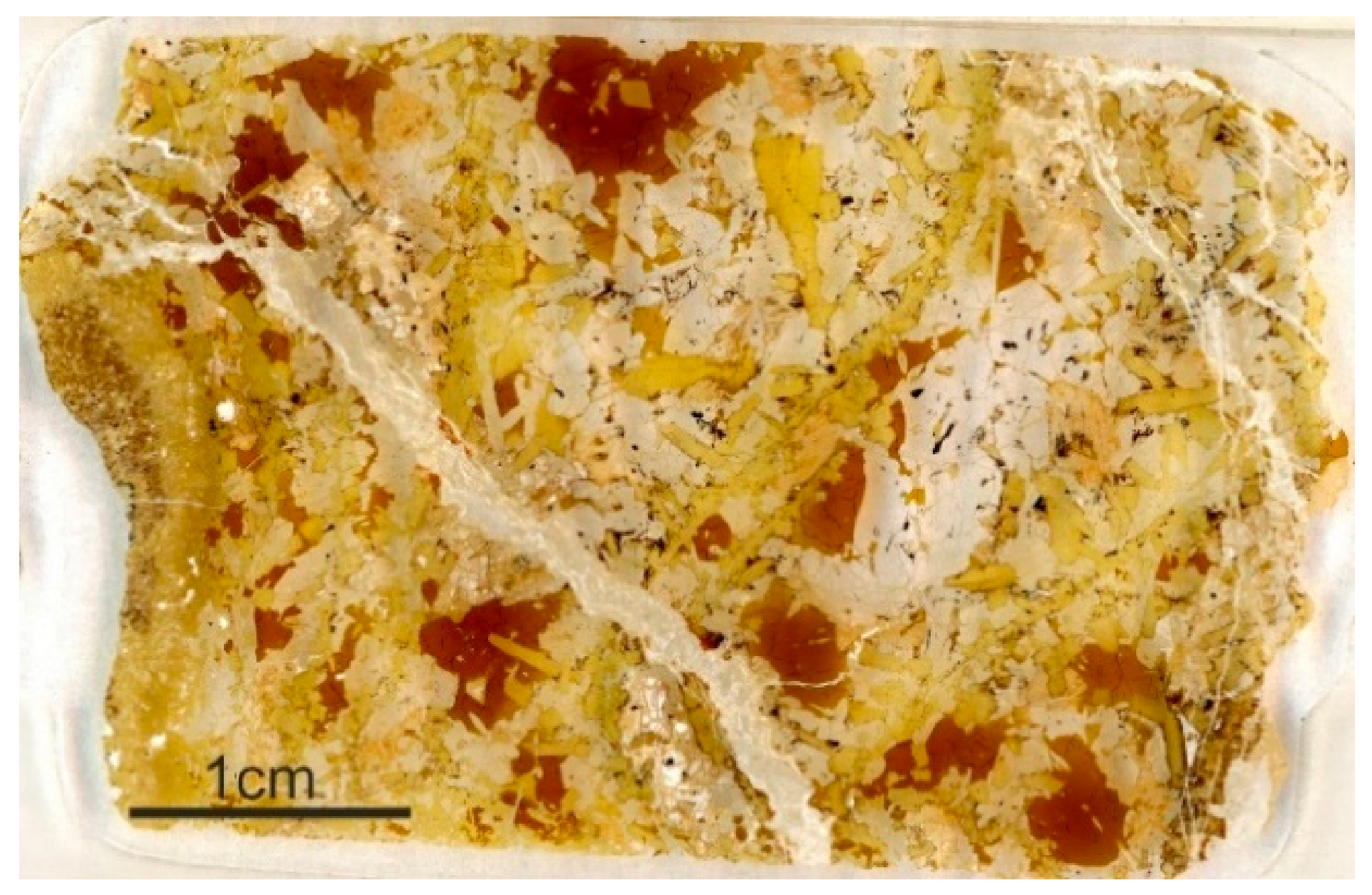
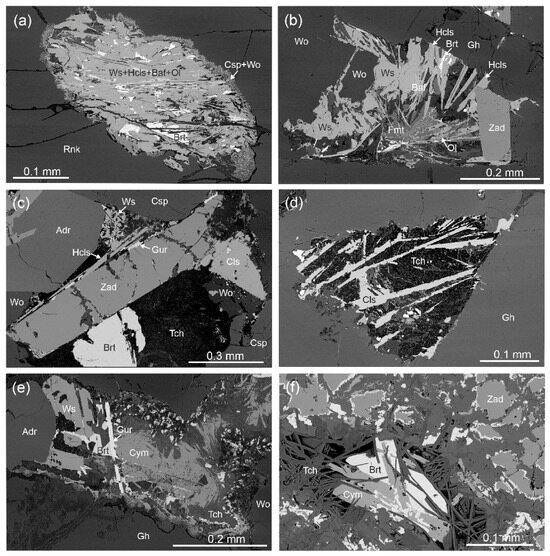
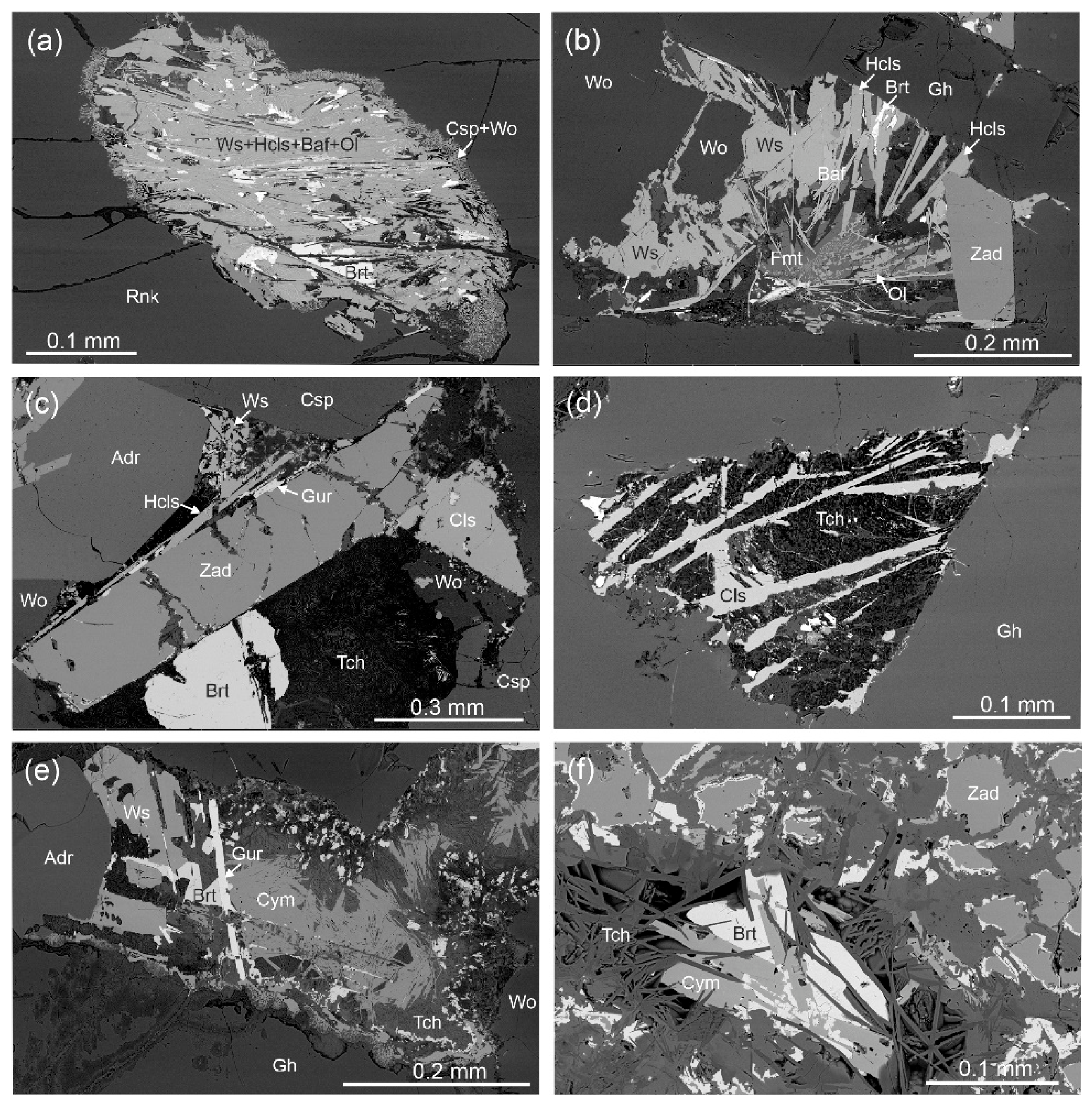
Hexacelsian is a rare accessory mineral of the rankinite-gehlenite-schorlomite-bearing paralava that is widespread in hornfels at the Hatrurim Basin. Hexacelsian, in the form of plate crystals less than 10 µm thick, was first described from a paralava discovered in the Gurim Anticline area in the southern part of the Hatrurim Basin [2]. Following systematic studies of paralava samples from various outcrops, we discovered the richest mineralisation containing hexacelsian in paralava in the northern part of the Hatrurim Basin, samples of which were collected near Mount Ye’elim. These paralava veins up to 3 cm thick occur within gehlenite hornfels and consist of wollastonite, gehlenite, andradite-schorlomite garnet, rankinite, cuspidine, and minor fluorapatite, flamite and zadovite (Figure 1). Small, isolated aggregates of Ba-bearing minerals are observed in the paralava located between the rock-forming minerals or within the rankinite crystals (Figure 2a–e). These aggregates are either rounded or angular in shape and consist of lamellar aggregates of walstromite, hexacelsian, barioferrite, zadovite, gurimite and a potentially new mineral with the formula BaCa2Mg(SiO4)2 (Figure 2a,b). Kalsilite, baryte, wollastonite, barium-bearing flamite, fluoralforsite and an unidentified Na-Ca silicate have also been determined within these aggregates. In several instances, xenomorphic celsian was found alongside plate crystals of hexacelsian (Figure 2c). Celsian also forms pseudomorphs after hexacelsian in altered aggregates of Ba-bearing minerals, where walstromite and BaCa2Mg(SiO4)2 are replaced by Ca-hydrosilicates (Figure 2d). Ba-bearing minerals in isolated aggregates may be replaced by spherule-like cymrite (Figure 2e). In addition, cymrite forms crystals within leaching voids alongside tacharanite and baryte. Less frequently, the Ba-bearing Ca-gismondine appears in association (Figure 2f).
Figure 1.
Paralava of gehlenite hornfels near Mount Ye’elim containing hexacelsian. Brown—andradite-schorlomite garnet series; yellow—gehlenite-åkermanite series of minerals; colourless—rankinite, wollastonite and cuspidine. A late vein cutting through the paralava is filled with zeolites, tacharanite and calcite.
Figure 2.
Rankinite-bearing paralava collected near Mount Ye’elim containing diverse Ba-minerals. BSE images. (a) Oval aggregate in rankinite composed of thin intergrowths of hexacelsian, walstromite, barioferrite and potentially a new mineral, BaCaMg(SiO4)2, with stoichiometry of olivine. (b) Aggregates of angular form, trapped between rock-forming minerals, in which hexacelsian forms characteristic plate crystals. (c) Simultaneously present in rock are plate crystals of hexacelsian and angular celsian crystals. (d) Lamellar celsian crystals—paramorphs after hexacelsian. (e) Cymrite replaces Ba-bearing silicates, including hexacelsian, forming spherule-like aggregates. (f) Cymrite crystallised in a void together with tacharanite and baryte in the area, where zadovite was partially replaced by baryte. Adr = andradite, Baf = barioferrite, Brt = baryte, Csp = cuspidine, Cym = cymrite, Fmt = flamite, Gh = gehlenite, Gur = gurimite, Hcls = hexacelsian, Ol = olivine-like BaCa2Mg(SiO4)2, Rnk = rankinite, Tch = tacharanite, Wo = wollastonite, Ws = walstromite.
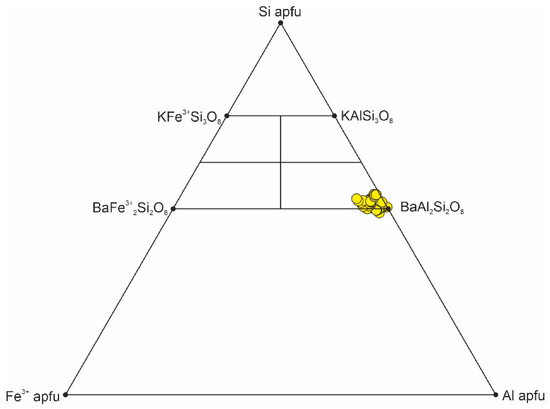
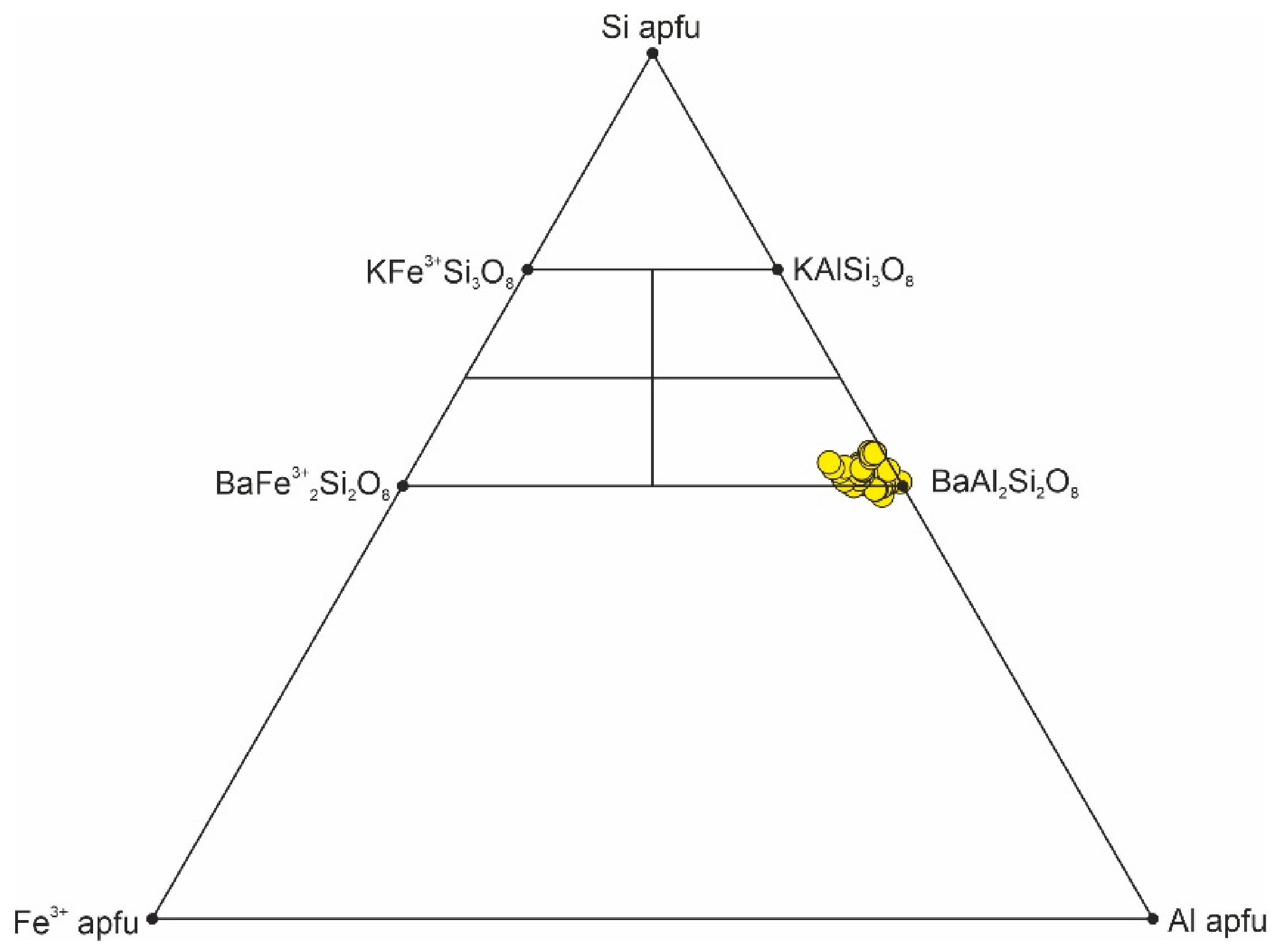
The composition of hexacelsian from the paralava near Ye’elim, used to refine the structure (Table 1, analysis 1), as well as the composition of hexacelsian from various types of paralavas in the Hatrurim Basin, was investigated (Table 1, analysis 2). The chemical composition of hexacelsian varies slightly, approaching stoichiometry. The main impurities are K (≈0.05 apfu = atom per formula unit) and Fe (≈0.14 apfu) (Table 1). On the classification diagram, the analyses of hexacelsian form a small, compact area (Figure 3).
Table 1.
Chemical composition of hexacelsian: 1—crystal used for the structural study; 2—average composition of hexacelsian from various paralava localities within gehlenite rocks in the Hatrurim Basin area.
Figure 3.
Analyses of hexacelsian in the ternary Al-Si-Fe3+ diagram.
5. Raman Studies and Hardness
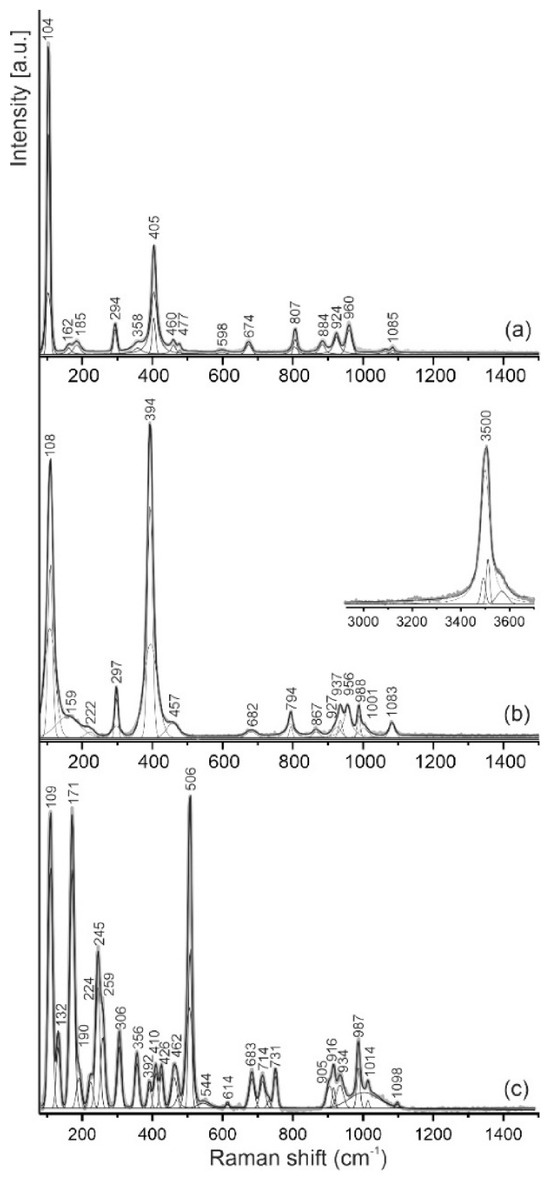
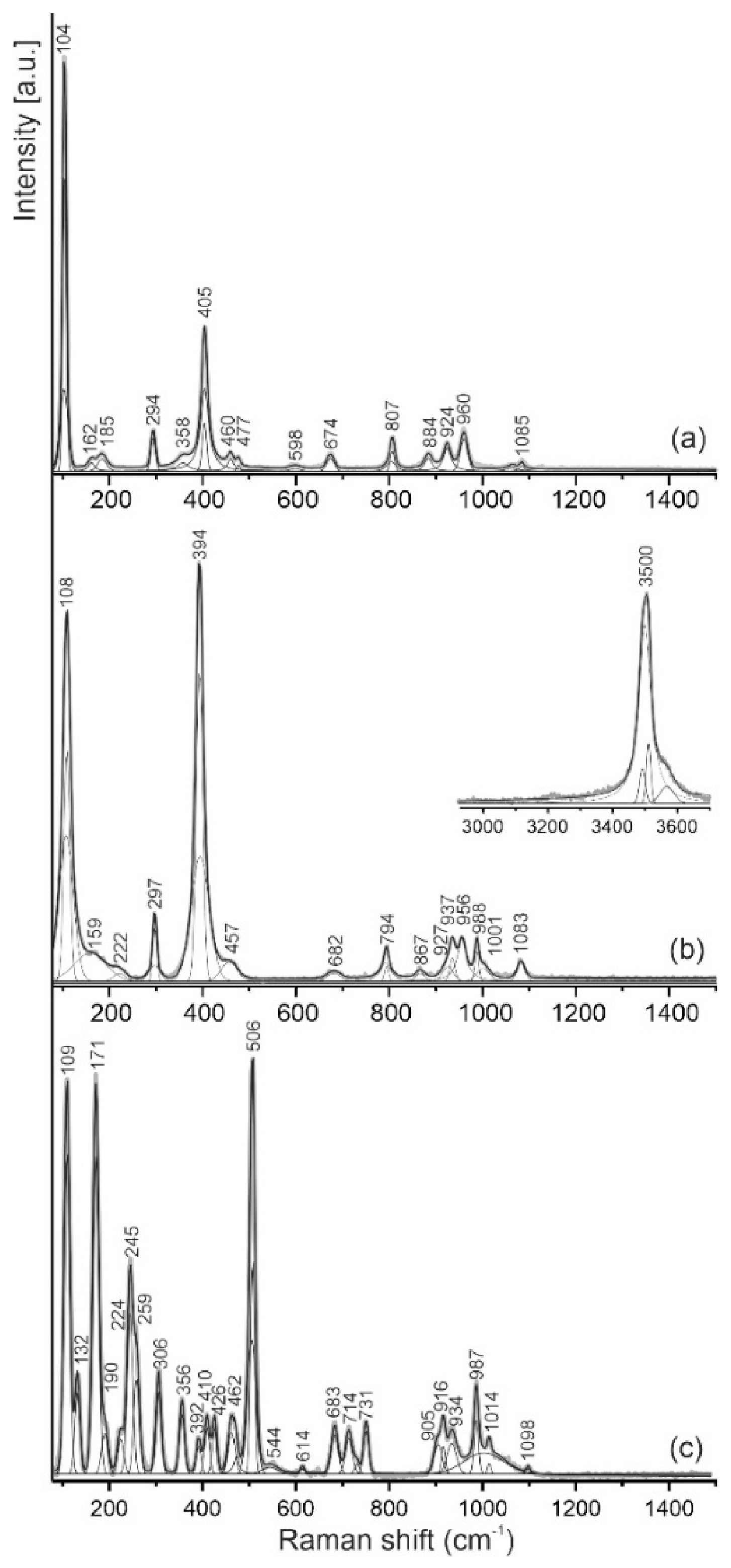
Studies of the composition and morphology of phases corresponding to the formula BaAl2Si2O8 using SEM/EDS do not permit their precise identification. Therefore, Raman spectroscopy was used to rapidly identify hexacelsian. Hexacelsian has a distinctive spectrum with a strong line at around 405 cm−1, the shape of which depends only slightly on crystal orientation [2] (Figure 4a). The spectrum of low-temperature cymrite is similar in shape to that of hexacelsian, reflecting the similarity of their structures. The main differences are the shift in the strong line to 394 cm−1 and the presence of a broad strong line from water at around 3500 cm−1 (Figure 4b). The spectrum of low-symmetry celsian differs radically from that of hexacelsian due to the presence of a large number of lines (Figure 4c).
Figure 4.
Raman spectra of hexacelsian (a), cymrite (b) and celsian (c).
The hardness of celsian, hexacelsian and cymrite differs markedly. The measured microhardness of celsian VHN50 = 722(27) kg/mm2 (n = 10, range 680–771 kg/mm2) corresponds to a Mohs hardness of 6–6.5. Strong anisotropy in hardness has been determined for hexacelsian, as measured on a plate crystal in a section perpendicular to (001). Along the plate, VHN25 = 492 (17) kg/mm2 (n = 14, range 453–519 kg/mm2) corresponds to a Mohs hardness of 4.5–5, while across the plane, VHN25 = 653 (21) (n = 12, range 616–694 kg/mm2) corresponds to a Mohs hardness of 5.5–6. The ingress of water into the chert sharply reduces its hardness: VHN25 = 166(7) (n = 16, range 154–179 kg/mm2), corresponding to a Mohs hardness of 3–3.5.
6. Structure of Hexacelsian
The structure of natural hexacelsian was first determined using single-crystal diffraction data obtained from a crystal measuring 0.039 × 0.026 × 0.016 mm with an average composition of (Ba1.01K0.05Na0.01Ca0.01)Σ1.08(Si1.96Al1.91Fe3+0.11)Σ3.98O8 (Table 1 and Table 2).
Table 2.
Crystal data and structure refinement details for natural hexacelsian.
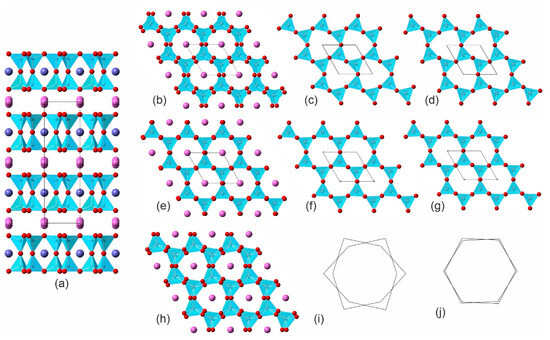
The experimental details and refinement data are summarised in Table 2, Table 3 and Table 4. Having tested all the hexacelsian models known from the literature, we accepted the model with P63/mcm symmetry and the lowest R1 parameter of 3%, corresponding to α-hexacelsian (Figure 5a–d). The ideal structure of hexacelsian P6/mmm comprises double layers of tetrahedra forming hexagonal rings [6]. The Al/Si order–disorder processes within the tetrahedra, as well as the thermal history of hexacelsian, lead to ring deformation due to tetrahedral rotation and displacement within the layer plane. This results in the splitting and disorder of oxygen sites, as well as the formation of polytypes with different sequences of differently oriented double layers [4,5,6,7,30].
Table 3.
Atomic coordinates, site occupancy (Occ) and equivalent-isotropic displacement parameters (Å2) for hexacelsian.
Table 4.
Anisotropic displacement parameters (Å2) for hexacelsian.
Figure 5.
Structure of natural α-hexacelsian (space group P63/mcm), projections on (010) (a) and (001) (b). Orientation of double layers in the unit cell of hexacelsian: “upper” (c) and “lower” (d). (e) Structure of synthetic α-hexacelsian (space group P63/mcm), projection on (001). Orientation of double layers in the unit cell of synthetic hexacelsian: “upper” (f) and “lower” (g) [3]. (h) The structure of synthetic γ-hexacelsian (space group P-62m), projection on (001) [4]. The geometry of the channels in natural (i) and synthetic α-hexacelsian (j), which is determined by the rotation of the tetrahedra in the (001) plane by ~14.5° and ~2°, respectively, from the ideal position for the P6/mmm symmetry. Blue tetrahedra—Si/Al; red balls—oxygen, pink balls—Ba, blue balls—K.
The structures of natural and synthetic α-hexacelsian are similar. They are characterised by the rotation angle of tetrahedra of approximately 14.5° and 2°, respectively, from the ideal position, and are represented by 2H polytypes, in which every second layer is rotated through 180° (Figure 5b–g). In the 1H-hexacelsian P-62m polytype, deformation of the sixfold rings at high temperature is accompanied by disorder of the O2 sites at the base of the tetrahedral plane (Figure 5h).
No Al and Si ordering is observed at the tetrahedra in natural hexacelsian, as reflected in mean interatomic distances of 1.681 Å (Table 5). Unlike synthetic phases, natural hexacelsian has an incomplete occupied site within the tetrahedral layer. Based on its size and geometry, it most likely contains K and has an occupancy of 0.036(14). Microprobe analyses of natural hexacelsian confirm this and indicate a slight increase in the content of extra-framework cations compared to the ideal hexacelsian formula (Table 1). While water is present within the double layer in cymrite [31], it is unlikely to be present in high-temperature natural hexacelsian. Furthermore, no bands characteristic of cymrite in the OH region are observed in the Raman spectra (Figure 4).
Table 5.
Selected bond lengths (Å) and bond valence sum (BVS) for hexacelsian.
7. Discussion
In the holotype specimen of paralava from the Gurim Anticline, hexacelsian associates with pseudowollastonite, which is stable at temperatures above 1125 °C [2]. In the studied specimen from Mount Ye’elim, hexacelsian is associated with wollastonite (Figure 2b), which suggests that its crystallisation is slightly below 1100 °C. In the reaction of pure ВаСО3 and kaolinite, metastable hexacelsian is formed in the temperature range of 1000–1100 °C. Above this temperature, it is replaced by celsian, which in turn is replaced by hexacelsian above 1300 °C. Above 1600 °C, only hexacelsian is found in the products of synthesis [12]. Considering that hexacelsian is stable at 1560 °C, we can conclude that it forms metastable in the Hatrurim paralava and that its preservation is connected with the specific thermal history of the rock. Disordered γ-celsian crystallised in paralava located in host rocks that cooled relatively slowly. This led to the ordering of O2 sites in the hexacelsian structure and the formation of the 2H polytype of α-hexacelsian with an ordered sequence of layers (Figure 5b–d). During this process, the distribution of Al and Si at the tetrahedra remained disordered. Pyrometamorphic processes determining local melting and paralava formation are followed by high-activity hot gases, which cause defined, significant fluctuations in temperature. It is likely that temperature fluctuations during mineral crystallisation in paralava led to the formation of celsian pseudomorphs after hexacelsian (Figure 2d). At the low temperatures and high alkalinity conditions, α-hexacelsian is replaced by cymrite (Figure 2e).
8. Conclusions
- The structure of natural hexacelsian (space group P63/mcm) was first refined to correspond with the symmetry of synthetic α-hexacelsian.
- Natural hexacelsian crystallises metastable at temperatures below 1100 °C as disordered γ-hexacelsian.
- The phase transition of the γ-hexacelsian to α-hexacelsian during cooling below 300 °C is determined by the ordering of the O2 oxygen sites.
- At high temperatures, natural hexacelsian can be replaced by celsian with a complete rearrangement of the structure, and at low temperatures by cymrite with the preservation of the hexagonal 2D motifs of the structure.
Supplementary Materials
The following supporting information can be downloaded at: https://www.mdpi.com/article/10.3390/min16080815/s1, CIF of hexacelsian.
Author Contributions
E.G. and I.G. contributed to the writing of the draft manuscript; Y.V., I.G. and E.G. participated in the fieldwork which led to the discovery of hexacelsian; E.G., I.G. and Y.V. conducted the petrological investigations, measured the composition of hexacelsian and associated minerals, performed the Raman and optical studies and selected grains for the structural investigations; J.K. and M.K. performed the SC XRD investigation and refined the structure of hexacelsian. All authors have read and agreed to the published version of the manuscript.
Funding
This research received no external funding.
Data Availability Statement
The original contributions presented in this study are included in the article/Supplementary Materials. Further inquiries can be directed to the corresponding author.
Acknowledgments
The authors would like to thank the reviewers. The authors thank Lyudmila Gorelova for providing the CIF files for the hexacelsian polymorphs.
Conflicts of Interest
The authors declare no conflicts of interest.
References
- Takéuchi, Y. A detailed investigation of the structure of hexagonal BaAl2Si2O8 with reference to its α-β inversion. Mineral. J. 1958, 2, 311–332. [Google Scholar] [CrossRef] [Scilit]
- Galuskina, I.O.; Galuskin, E.V.; Vapnik, Y.; Prusik, K.; Stasiak, M.; Dzierżanowski, P.; Murashko, M. Gurimite, Ba3(VO4)2 and hexacelsian, BaAl2Si2O8—Two new minerals from schorlomite-rich paralava of the Hatrurim Complex, Negev Desert, Israel. Mineral. Mag. 2017, 81, 1009–1019. [Google Scholar] [CrossRef] [Scilit]
- Kremenović, A.; Colomban, P.; Piriou, B.; Massiot, D.; Florian, P. Structural and spectroscopic characterization of the quenched hexacelsian. J. Phys. Chem. Solids 2003, 64, 2253–2268. [Google Scholar] [CrossRef] [Scilit]
- Gorelova, L.; Britvin, S.; Vereshchagin, O.; Pankin, D.; Bocharov, V.; Silyukov, O.; Kasatkin, A. Structural anatomy and thermal transitions of barium feldspars, BaAl2Si2O8. J. Eur. Cer. Soc. 2024, 44, 6402–6412. [Google Scholar] [CrossRef] [Scilit]
- Tabira, Y.; Withers, R.L.; Takéuchi, Y.; Marumo, F. Structured diffuse scattering, displacive flexibility and polymorphism in Ba-hexacelsian. Phys. Chem. Miner. 2000, 27, 194–202. [Google Scholar] [CrossRef] [Scilit]
- Withers, R.L.; Tabira, Y.; Valgoma, J.A.; Aroyo, M.; Dove, M.T. The inherent displacive flexibility of the hexacelsian tetrahedral framework and its relationship to polymorphism in Ba-hexacelsian. Phys. Chem. Miner. 2000, 27, 747–756. [Google Scholar] [CrossRef] [Scilit]
- Müller, W.F. Phase transitions and associated domains in hexacelsian (BaAl2Si2O8). Phys. Chem. Miner. 1977, 1, 71–82. [Google Scholar] [CrossRef] [Scilit]
- Xu, Z.; Shull, J.L.; Kriven, W.M. Hot-stage transmission electron microscopy study of phase transformations in hexacelsian (BaAl2Si2O8). J. Mater. Res. 2002, 17, 1287–1297. [Google Scholar] [CrossRef] [Scilit]
- Kremenović, A. Time-temperature resolved synchrotron XRPD study of the hexacelsian α↔β polymorph inversion. Solid-State Ion. 1997, 101–103, 611–618. [Google Scholar] [CrossRef] [Scilit]
- Radosavljevic-Mihajlovic, A.; Radosavljevic, S.; Stojanovic, J. The Crystal Structure of the Ba-Hexacelsian Phases Doped with Ca2+ and Pb2+. Iran. J. Sci. Technol. Trans. A Sci. 2017, 41, 599–607. [Google Scholar] [CrossRef] [Scilit]
- Lin, H.C.; Foster, W.R. Studies in the system BaO-Al2O3-SiO2: I. The polymorphism of celsian. Am. Miner. 1968, 53, 134–144. [Google Scholar]
- Machida, S. Pseudo-reversal phase transformation of hexacelsian to celsian in a purified kaolinite system. J. Solid State Chem. 2025, 348, 125379. [Google Scholar] [CrossRef] [Scilit]
- Krivovichev, S.V. Feldspar polymorphs: Diversity, complexity, stability. Proc. Russ. Mineral. Soc. 2020, 149, 16–66. [Google Scholar] [CrossRef] [Scilit]
- Chesnokov, B.V.; Lotova, E.V.; Nigmatullina, E.N.; Pavlutchenko, V.S.; Bushmakin, A.F. Dmishteinbergit, CaAl2Si2O8, (hexagonal), a new mineral. Proc. Russ. Mineral. Soc. 1990, 119, 43–46. [Google Scholar]
- Hwang, S.-L.; Shen, P.; Chu, H.-T.; Yui, T.-F.; Liou, J.G.; Sobolev, N.V.; Zhang, R.-Y. Kokchetavite: A new potassium-feldspar polymorph from the Kokchetav ultrahigh-pressure terrane. Contrib. Mineral. Petrol. 2004, 148, 380–389. [Google Scholar] [CrossRef] [Scilit]
- Mugnaioli, E.; Xiong, F.; Xu, X.; Gemmi, M.; Wirth, R.; Yang, J.; Grew, E. Wodegongjieite, ideally KCa3(Al7Si9)O32, a new sheet silicate isostructural with the feldspar polymorph kokchetavite, KAlSi3O8. Mineral. Mag. 2022, 86, 975–987. [Google Scholar] [CrossRef] [Scilit]
- Ferrero, S.; Lorenzon, S.; Borriello, R.; Borghini, A.; Wirth, R.; Schreiber, A.; Fuchs, R.; O’Brien, P.J.; Grew, E.S.; Mugnaioli, E. Pfaffenbergite, KNa3(Al4Si12)O32, a polymorph of sodic feldspar isostructural with kokchetavite and wodegongjieite, found in crystallized melt inclusions in metamorphic garnet. Am. Mineral. 2026, 111, 60–72. [Google Scholar] [CrossRef] [Scilit]
- Rao, C.; Hatert, F.; Wang, R.C.; Gu, X.P.F.; Dal, B.; Dong, C.W. Minjiangite, BaBe2(PO4)2, a new mineral from Nanping No. 31 pegmatite, Fujian Province, southeastern China. Mineral. Mag. 2015, 79, 1195–1202. [Google Scholar] [CrossRef] [Scilit]
- Sheldrick, G.M. A short history of SHELX. Acta Crystallogr. A 2008, A64, 112–122. [Google Scholar] [CrossRef] [Scilit] [PubMed]
- Bentor, Y.K. (Ed.) Lexique Stratigraphique International, Asie; Centre National de la Recherche Scientifique: Paris, France, 1960; Volume III, 80p. [Google Scholar]
- Gross, S. The mineralogy of the Hatrurim Formation, Israel. Geol. Surv. Isr. 1977, 70, 1–80. [Google Scholar]
- Vapnik, Y.; Sharygin, V.V.; Sokol, E.V.; Shagam, R. Paralavas in a combustion metamorphic complex: Hatrurim Basin, Israel. Rev. Eng. Geol. 2007, 18, 1–21. [Google Scholar] [CrossRef] [Scilit]
- Novikov, I.; Vapnik, Y.; Safonova, I. Mud volcano origin of the Mottled Zone, South Levant. Geosci. Front. 2013, 4, 597–619. [Google Scholar] [CrossRef] [Scilit]
- Galuskina, I.O.; Vapnik, Y.; Lazic, B.; Armbruster, T.; Murashko, M.; Galuskin, E.V. Harmunite, CaFe2O4: A new mineral from the Jabel Harmun, West Bank, Palestinian Autonomy, Israel. Am. Mineral. 2014, 99, 965–975. [Google Scholar] [CrossRef] [Scilit]
- Galuskin, E.V.; Krüger, B.; Galuskina, I.O.; Krüger, H.; Nejbert, K.; Vapnik, Y. Gorerite, CaAlFe11O19, a new mineral of the magnetoplumbite group from the Negev Desert, Israel. Mineral. Mag. 2024, 88, 451–460. [Google Scholar] [CrossRef] [Scilit]
- Galuskina, I.O.; Kruger, B.; Galuskin, E.V.; Kruger, H.; Vapnik, Y.; Murashko, M.; Banasik, K.; Agakhanov, A.A. Zoharite, (Ba,K)6(Fe,Cu,Ni)25S27, and Gmalimite,K6□Fe2+24S27—New djerfisherite group minerals from gehlenite-wollastonite paralava, Hatrurim Complex, Israel. Minerals 2025, 15, 564. [Google Scholar] [CrossRef] [Scilit]
- Burg, A.; Starinsky, A.; Bartov, Y.; Kolodny, Y. Geology of the Hatrurim formation (“Mottled zone”) in the Hatrurim basin. Isr. J. Earth Sci. 1991, 40, 107–124. [Google Scholar]
- Burg, A.; Kolodny, Y.; Lyakhowsky, V. Hatrurim-2000: The “Mottled Zone” revisited, forty years later. Isr. J. Earth Sci. 1999, 48, 209–223. [Google Scholar]
- Sokol, E.; Novikov, I.; Zateeva, S.; Vapnik, Y.; Shagam, R.; Kozmenko, O. Combustion metamorphism in the Nabi Musa dome: New implications for a mud volcanic origin of the Mottled Zone, Dead Sea area. Basin Res. 2010, 22, 414–438. [Google Scholar] [CrossRef] [Scilit]
- Müller, W.F. On Polymorphism of BaAl2Si2O8. In Electron Microscopy in Mineralogy; Wenk, H.-R., Ed.; Springer: Berlin/Heidelberg, Germany, 1976; pp. 354–360. [Google Scholar]
- Hsu, L.C. Cymrite: New occurrence and stability. Contrib. Mineral. Petrol. 1994, 118, 314–320. [Google Scholar] [CrossRef] [Scilit]

Disclaimer/Publisher’s Note: The statements, opinions and data contained in all publications are solely those of the individual author(s) and contributor(s) and not of MDPI and/or the editor(s). MDPI and/or the editor(s) disclaim responsibility for any injury to people or property resulting from any ideas, methods, instructions or products referred to in the content. |
© 2026 by the authors. Licensee MDPI, Basel, Switzerland. This article is an open access article distributed under the terms and conditions of the Creative Commons Attribution (CC BY) license.