


Abstract
The Taiyuan Formation in the Daniudi Gas Field of the Ordos Basin was formed in a tidal flat mixed sedimentary environment. It represents a typical tight sandstone reservoir with significant exploration and development potential. However, current research on the reservoir evaluation of the Taiyuan Formation is relatively limited. This study focuses on the Taiyuan Formation in the Da 17 well area of the Daniudi Gas Field, employing methods such as petrographic analysis, X-ray diffraction, porosity/permeability measurements, mercury injection capillary pressure, and scanning electron microscopy to conduct a detailed investigation of sand dams in the tidal flat environment. By combining reservoir characteristics with detailed sedimentary microfacies classification, and on the basis of discussing the relationship between reservoir heterogeneity and natural gas production capacity, this study performs reservoir classification and evaluation. The characteristics and distribution patterns of relatively high-quality reservoirs are clarified. Through the analysis of lithological characteristics and sedimentary markers, it is determined that the Taiyuan Formation in the Da 17 well area represents a typical tidal flat sedimentary environment, with sand dams serving as the primary development sites for sand bodies. The Taiyuan Formation sandstone is mainly composed of medium- to fine-grained lithic quartz sandstone and lithic sandstone. The predominant pore types include primary pores, secondary pores, and fractures. The porosity of the reservoir ranges from 0.3% to 14.2%, while the permeability varies from 0.006 to 29.7 × 10⁻³ μm2, classifying it as a typical tight sandstone reservoir. Using the gas testing method, the lower limit of the physical properties of the Taiyuan Formation reservoir has been determined to be 3.9%. Considering the heterogeneity characteristics and productivity information of the sand layers, the reservoirs of the Taiyuan Formation are classified into three types: Type I reservoirs are predominantly composed of pebbly coarse sandstone and coarse sandstone, with porosity > 10%, permeability > 0.8 × 10⁻³ μm2, mainly developed in the center of sand dams, exhibiting medium heterogeneity; Type II reservoirs consist of coarse sandstone with porosity ranging from 4% to 10% and permeability from 0.1 to 0.8 × 10⁻³ μm2, with the main body of the sand dams belonging to this reservoir type, also showing medium heterogeneity; Type III reservoirs are composed of medium to fine sandstone, with porosity < 4% and permeability < 0.1 × 10⁻³ μm2, mainly developed at the edges of sand dams, exhibiting strong heterogeneity. By integrating the distribution characteristics of sedimentary facies sand bodies, the planar distribution characteristics of the various reservoir types are clarified.
1. Introduction
China is one of the richest countries in the world in terms of tight sandstone gas resources, with about 265 × 1012 m3, of which 58% is concentrated in the Ordos Basin with about 13.3 × 10¹² m3 [1,2,3,4,5,6]. At present, the annual natural gas production in the Ordos Basin has exceeded 60 billion cubic meters, mainly produced from four tight Gas Fields with proven reserves of more than 100 billion cubic meters, namely, Sulige, Wushenqi, Daniudi, and Shenmu [7,8]. In contrast, studies focusing specifically on the Daniudi Gas Field remain relatively limited. With the deepening exploration and development, in recent years, the Upper Paleozoic in the Ordos Basin has received extensive attention due to its shallow burial, favorable source-reservoir configuration, and abundant reserves [9,10,11]. A large number of scholars have clarified that parameters such as grain size, shale content, and clastic composition of sandstone reservoirs control reservoir quality, and have demonstrated that the Upper Paleozoic tight sandstone belongs to a typical low-porosity and low-permeability reservoir [12,13,14,15]. However, there are many strata in the Upper Paleozoic of the Ordos Basin, and the degree of study of each stratum varies significantly, which still needs to be further explored in depth.
The Daniudi gas field in the northern part of the Ordos Basin, with the Taiyuan Formation as the main gas-producing layer, shows good exploration potential. Among them, the test gas of Shen 58 well obtained an industrial gas flow of 4.63 × 10⁴ m3/d. In recent years, mixed deposition has become an emerging hot field of sedimentological research, and the Taiyuan Formation is a typical mixed deposition system [16,17,18]. A large number of scholars have carried out systematic studies around the coal seam characteristics [19,20,21], paleomorphology [22], fissure development [23], mineral composition [24], storm rocks [25], and bauxites [26] in the Taiyuan Formation. The abundant paleontological fossils in the Taiyuan Formation have provided favorable evidence for stratigraphic division and sedimentary environment reconstruction. In contrast, studies focusing specifically on the Daniudi Gas Field remain relatively limited, and there is a notable lack of reservoir classification studies, particularly those integrated with sedimentary facies analysis. In previous sedimentological studies, the tidal flat environment has not been fully understood, the sedimentary microfacies classification of sand dam bodies within this environment has been insufficiently precise, and reservoir studies have been poorly integrated with sedimentological research. With the continuous advancement of research techniques and methods, new understanding about sedimentary facies and sandstone sequence reservoirs has achieved many results in the exploration of tight sandstone gas [27,28,29,30,31,32]. A growing number of scholars have gradually recognized the controlling role of sedimentary facies on reservoir quality, particularly the importance of sedimentary factors in reservoir classification schemes. The objective of this study is to establish a reservoir classification framework grounded in detailed sedimentary facies analysis of the Upper Paleozoic Taiyuan Formation in the Da 17 well area of the Daniudi Gas Field, in order to provide theoretical guidance for natural gas distribution prediction and to support the exploration and development of Upper Paleozoic tight gas resources in the Daniudi Gas Field.
2. Geologic Setting
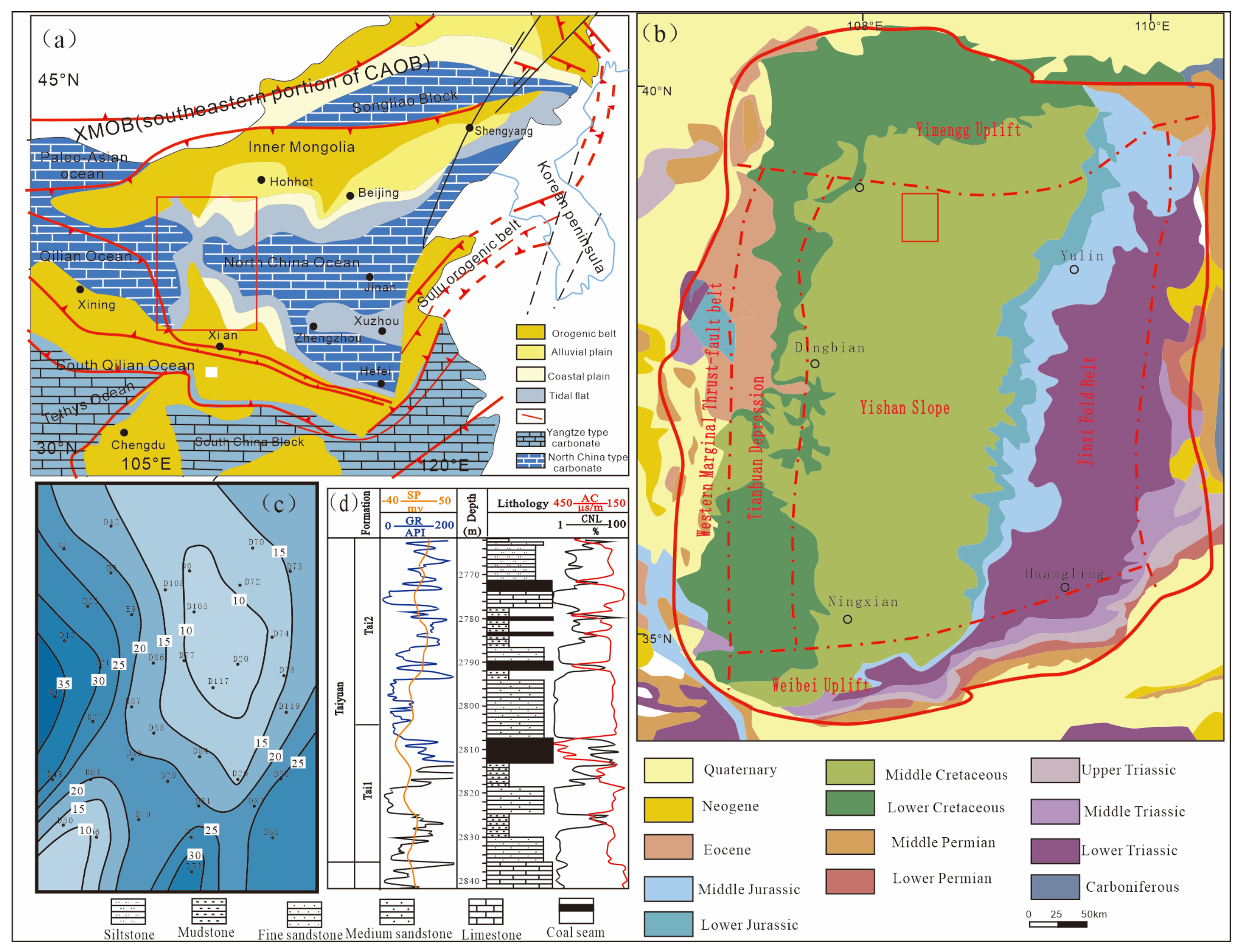
The Ordos Basin is rich in oil and gas resources. The Daniudi Gas Field is located in the northeastern part of the basin and tectonically belongs to the Yi-Shaan slope (Figure 1a,b) [33,34,35]. The overall tectonic morphology is a gentle monocline dipping toward the southwest, with a stratigraphic dip angle of less than 1° and a total sedimentary thickness of approximately 3000 m. The study area is situated in the northeastern part of the Daniudi Gas field, covering an area of about 650 km2, and focuses on the Taiyuan Formation, which serves as the primary gas-producing interval in this region. The Taiyuan Formation is characterized by multiple sets of coal seams that act as important regional marker beds. The lithology mainly consists of gray-white or gray medium-to thick-bedded gravel-bearing quartz sandstone, lithic quartz sandstone, black or dark-gray mudstone, carbonaceous mudstone, bauxite mudstone, and coal seams of variable thickness, with minor amounts of dark-gray microcrystalline limestone, bioclastic limestone, and coal stringers. The mudstone is rich in terrestrial plant fossils. On well logs, the gamma-ray log signature is characterized by a combination of high and low values, and the resistivity is generally high to extremely high, with some carbonaceous mudstone intervals exhibiting higher resistivity than the adjacent sandy rocks. Based on lithological characteristics and log responses, the Taiyuan Formation is divided into the Tai1 and Tai2 Members (Figure 1c). Stratigraphic division and correlation based on 86 wells in the study area (Figure 1d) reveal that the thickness of the Tai1 Member ranges from 24 to 54 m, with an average of 35.2 m; whereas the thickness of the Tai2 Member ranges from 6.5 to 34 m, with an average of 18.2 m.
Figure 1.
Location of the study area and division of the stratigraphic units of the Taiyuan formation. (a) Location of the study area; (b) stratigraphic units of the Taiyuan formation; (c) stratigraphic thickness plan of the Taiyuan Formation in the study area; (d) stratigraphic bar chart of the Taiyuan Formation in the study area.
3. Sampling and Methods
In this study, the Taiyuan Formation in Da 17 well area of Daniudi Gas Field in Ordos Basin was taken as the research object. Through the interpretation of 86 drilling data, 30 key wells with relatively abundant sampling and suitable for analysis were selected for detailed study. Microscopic section analysis, X-ray diffraction analysis, and determination of porosity and permeability were used to study the petrological characteristics, pore type characteristics, porosity and permeability characteristics.
(1) Microscopic section analysis
The 120 rock samples were selected, ground into 0.03 mm thick slices, and the pores were filled with red and blue epoxy resin to facilitate the observation of pore features. Samples were observed using a Nikon Eclipse LV100N POL polarizing microscope (Nikon Instruments Inc., Melville, NY, USA). For each thin section, at least five representative fields of view were captured under both plane-polarized light and cross-polarized light. Grain size, sorting, roundness, and detrital composition were quantitatively determined by point counting (minimum 300 points per thin section). Pore types and pore-filling characteristics were identified and documented based on color differentiation of the epoxy resin impregnation.
(2) X-ray diffraction analysis
Twenty-six samples were selected for whole-rock and clay mineral composition analysis using a DX-2700 X-ray diffractometer (Haoyuan Instrument, Dandong, China) at the State Key Laboratory of Oil and Gas Reservoir Geology and Exploitation (Chengdu University of Technology). Samples were crushed and ground to <200 mesh powder. Whole-rock mineral analysis was performed on randomly oriented powder mounts, scanned from 3° to 60° 2θ at a step size of 0.02°, following the analytical standard of JY/T 0587-2020 [36] (General Rules for Polycrystalline X-ray Diffraction). Clay mineral analysis was conducted on oriented mounts prepared by sedimentation, followed by three successive treatments: air-dried, ethylene glycol-solvated, and heated to 550 °C, in accordance with SY/T 5163-2018 [37] (Analysis Method for Clay Minerals and Common Non-Clay Minerals in Sedimentary Rocks by X-ray Diffraction). Mineral identification and semi-quantitative quantification were performed using MDI Jade 6.5 software.
(3) Porosity and permeability
A total of 360 samples were selected and made into cylindrical plugs with a diameter of 2.5 cm and a length of 5 cm. Prior to measurement, all plugs were cleaned by Soxhlet extraction using a toluene-methanol mixture to remove residual hydrocarbons, then dried at 105 °C for 24 h. Helium porosity was measured using a gas expansion porosimeter at a confining pressure of 400 psi. Klinkenberg-corrected permeability was determined by the unsteady-state pressure decay method using nitrogen as the test gas. Mercury injection capillary pressure (MICP) analysis was performed on selected representative samples using an AutoPore V mercury porosimeter (Micromeritics, Norcross, GA, USA), with injection pressures up to 200 MPa. Pore-throat size distributions were derived from the mercury intrusion curves using the Washburn equation, assuming a mercury surface tension of 485 dynes/cm and a contact angle of 140°.
(4) Scanning electron microscope (SEM) analysis
Eleven samples were selected for micro-morphological observation and mineral characterization using a Quanta 250 FEG scanning electron microscope (Thermo Fisher Scientific, Waltham, MA, USA) at the State Key Laboratory of Oil and Gas Reservoir Geology and Exploitation (Chengdu University of Technology). Freshly broken surfaces were prepared and coated with gold to enhance conductivity. Secondary electron (SE) imaging was performed at an accelerating voltage of 15–20 kV. For each sample, representative areas were systematically examined at magnifications ranging from 100× to 10,000× to document pore morphology, clay mineral occurrence, and grain-pore relationships. Semi-quantitative elemental analysis was performed using an attached energy-dispersive X-ray spectrometer (EDS) on selected mineral phases to aid in mineral identification.
4. Results
The study of sedimentary facies is the basis of reservoir characteristics. In this study area, through the fine description of 30 drilling cores, the sedimentary facies were systematically studied from three aspects: sedimentary facies markers, sedimentary structures, and paleontology.
4.1. Sedimentary Characteristics
(1) Color
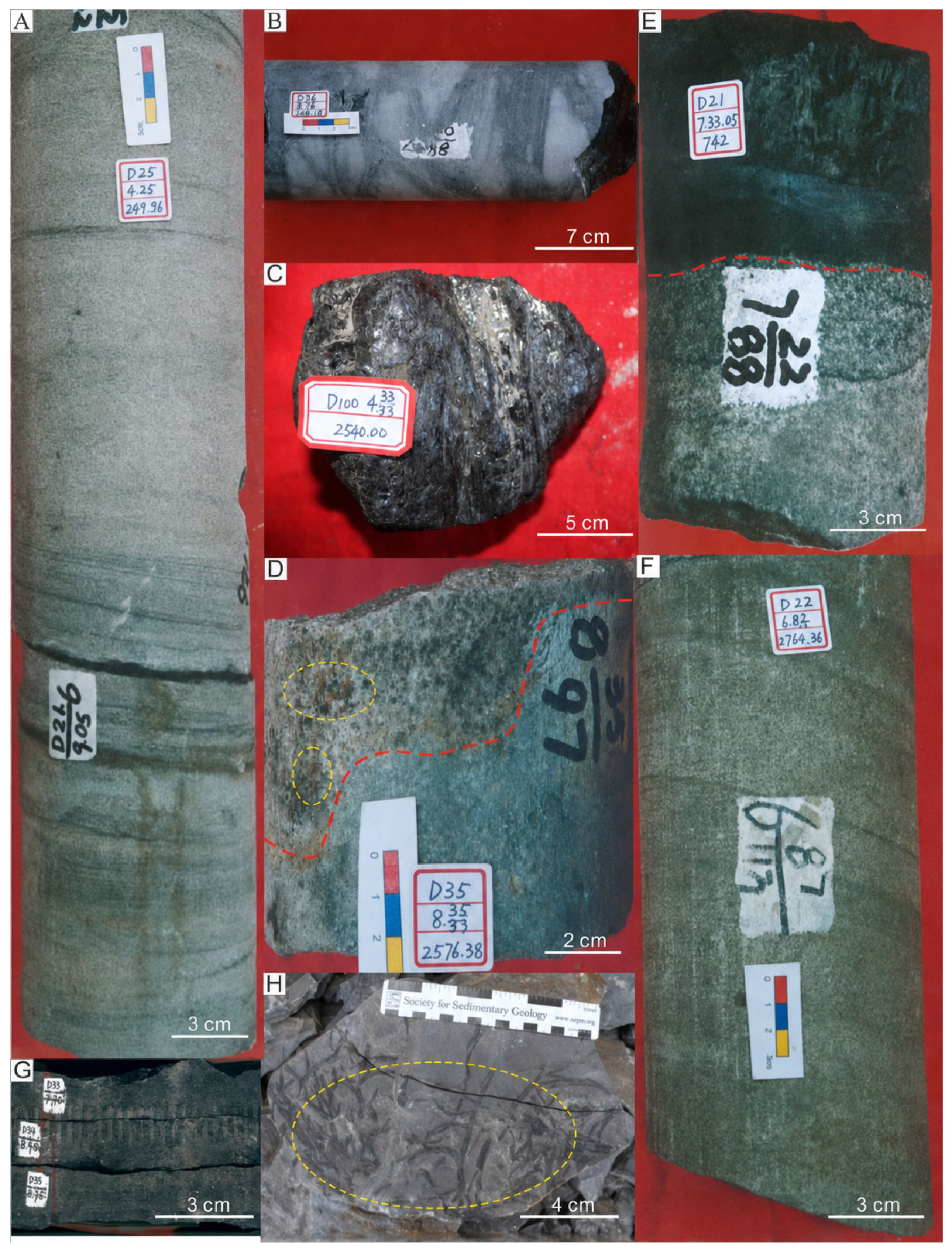
The color of the sediments can be divided into weathered color and primary color. Since the drill core samples are relatively fresh in this study, the observations are all primary colors. In the profile observation, the removal of the weathering surface of the rock layer was used to observe the primary color. The sandstones in the Taiyuan Formation in the study area are mainly grayish-white (Figure 2A,B) and dark gray (Figure 2C–F), while the mudstones are mainly gray-black (Figure 2G) and brownish-gray (Figure 2H).
Figure 2.
Sedimentary structure characteristics of Taiyuan Formation in the study area. (A) Da 25 Well, 2684.95 m, Tai2 Member, positive grain sequence; (B) Da 29 Well, 2740.65 m, Tai2 Member, argillaceous limestone; (C) Da 100 well 2540.00 m, coal; (D) Da 35 well, 2576.38 m, Tai2 Member, scour surface, pyrite; (E) Da 21 well, 2733.35 m, Tai2 Member, scour surface; (F) Da 22 well, 2764.34 m, Tai2 Member, plate bedding; (G) Da 89 well, 2774.30 m, Tai1 Member, black mudstone; (F–H) Qiaotou section, Taiyuan Formation, plant leaves.
(2) sedimentary structures
Sedimentary structures are various tectonic phenomena formed by flowing water transporting materials under different hydrodynamic conditions. The typical sedimentary structures in the study area include graded bedding (Figure 2A), scour surface (Figure 2D,E), plate bedding (Figure 2F), parallel bedding, horizontal bedding, and sandy bedding. The scour surface is a sharp contact marking an abrupt change from mudstone to sandstone, typically developed at the base of sand dam deposits. Normal graded bedding is a phenomenon in which grain size progressively changes from coarse to fine. Parallel bedding occurs in fine- to medium-grained sandstone, characterized by parallel lamination. Horizontal bedding refers to thinly layered horizontal deposition in mudstone or argillaceous siltstone. Sand-streaked bedding and planar cross-bedding are commonly developed in medium- to fine-grained sandstone, where thin sandstone layers exhibit streaked or planar lamination.
(3) Plant fossil
Animal fossils are relatively rare in the Upper Paleozoic strata in the study area, but abundant carbon debris, plant stems, or plant leaf fossil impressions are common on the sandstone cross-bedding surface or mudstone (Figure 2H). The local enrichment of plant fossils can form coal lines or coal seams.
4.2. Sedimentary Facies Type
The Taiyuan Formation is characterized by barrier coast tidal flat deposition, developed sand dam, mud flat, sand flat, peat swamp, and lime flat microfacies [38,39,40].
4.2.1. Barrier Sand Dam Microfacies
The development of the barrier sand dam is controlled by the coastal morphology, which is usually distributed as elongate bodies parallel to the shoreline, forming an underwater positive landform. Subject to wave reworking, the overall rock grain size is coarse, dominated by coarse sandstone with a small amount of conglomerate. Its structural maturity is medium, while its compositional maturity is low. Barrier sand dams develop a variety of sedimentary structures, including scour surfaces, normal graded bedding, and cross-bedding. Between barrier sand dams, mudstone deposition is common. In the observation of the core, a large number of sand dams were found to be vertically stacked.
4.2.2. Lime Flat Sedimentary Micro
The lime flat zone refers to the area located between the mean low-tide line and the wave base. Under the influence of a deep carbonate platform, limestone deposits are developed, accompanied by terrigenous mudstone deposition. The shoal microfacies is composed of bioclastic microcrystalline limestone.
4.2.3. Mud Flat and Peat Swamp Microfacies
The supratidal subfacies is mainly composed of two microfacies of mud flat and swamp, with mud flat deposition being predominant. Vegetation is well developed in the shallow water area of the mud flat, readily forming coal seams, accompanied by horizontal bedding and bioturbation structures. In peat swamps, abundant plant growth provides the primary sites of coal seam formation (Figure 2G).
4.3. Reservoir Characteristics
4.3.1. Petrological Characteristics
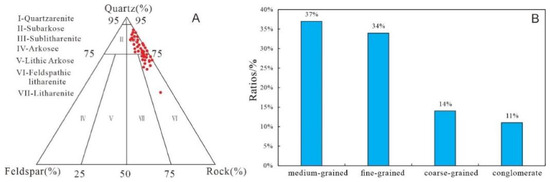
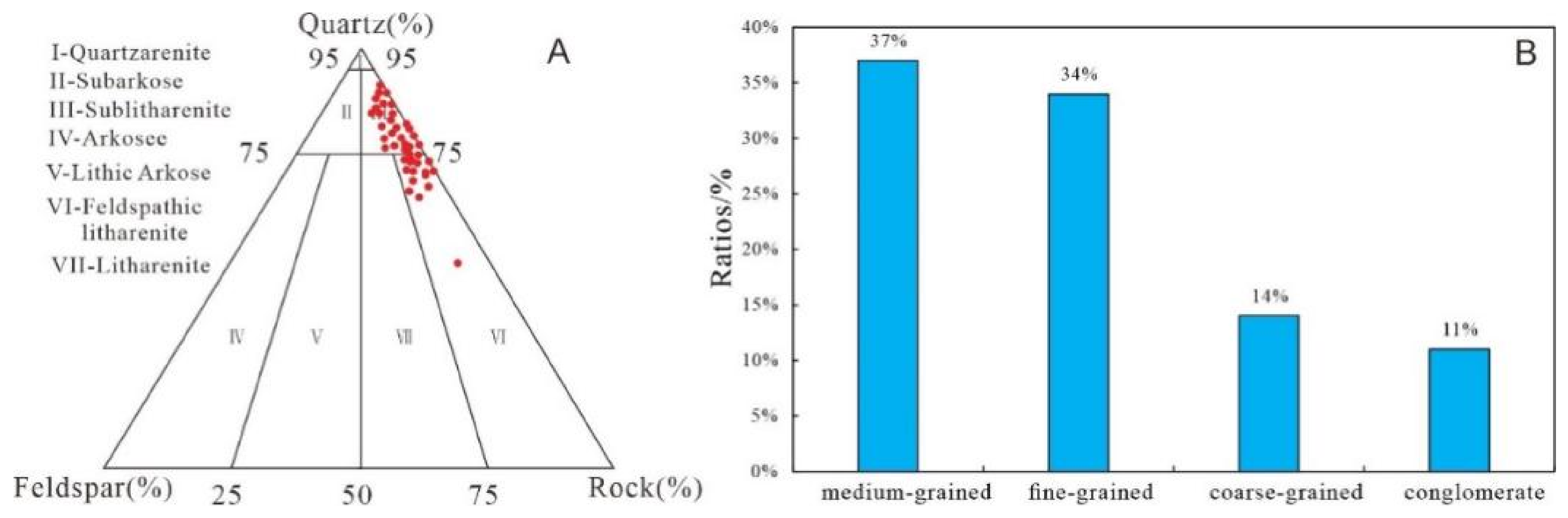
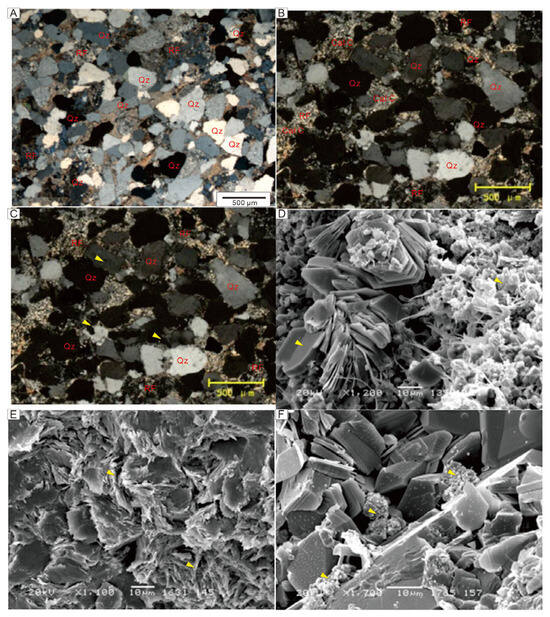
Through statistical analysis of the core fine description and thin section identification data from 32 coring wells in the study area, the results indicate that the rock types in the study area are mainly lithic quartz sandstone and lithic sandstone (Figure 3A). The average content of quartz is 72.3%, feldspar is 4.2%, and rock chip is 23.5%. The grain size of the sandstone is mainly medium sandstone and fine sandstone, followed by gravelly coarse sandstone and conglomerate, with minor amounts of siltstone and mudstone (Figure 3B). The debris in the sandstone is mainly metamorphic quartzite, argillaceous slate and phyllite, containing a small amount of siliceous rock and volcanic debris (Figure 4A–C). The sorting of sandstone debris is medium, and the roundness is sub-circular to sub-angular, and the overall performance is characterized by a high compositional maturity and medium structural maturity. The interstitial content in sandstone ranges from 6 to 28%, mainly including kaolinite, illite, chlorite, authigenic clay membranes, calcite and siliceous substances (Figure 4D–F).
Figure 3.
(A) Distribution of three-unit components of the Taiyuan Formation in the study area; (B) histogram of grain size distribution of Taiyuan Formation sandstone.
Figure 4.
Material composition characteristics of sand dam and sand body in Taiyuan Formation. (A) Lithic quartz sandstone, Da 100 well, Tai2 Member, 2532.88 m; (B) lithic quartz sandstone, Da 80 well, Tai1 Member, 2593.49 m; (C) lithic sandstone, Da 83 well, Taiyuan Formation, 2613.47 m; (D) kaolinite crystal pseudo-hexagonal flake crystal is intact, mixed with filiform and hairy illite, Da 7 well, Tai1 Member, 2550.40 m; (E) kaolinite aggregates in intergranular pores are dissolved and the edges are filamentous, Da 78 well, Tai2 Member, 2504.79 m; (F) pyrite aggregate seen in intergranular pores of kaolinite crystals, Da 79 well, Tai1 Member, 2744.59 m. Qz = quartz; Rf = rock fragment.
4.3.2. Pore Type
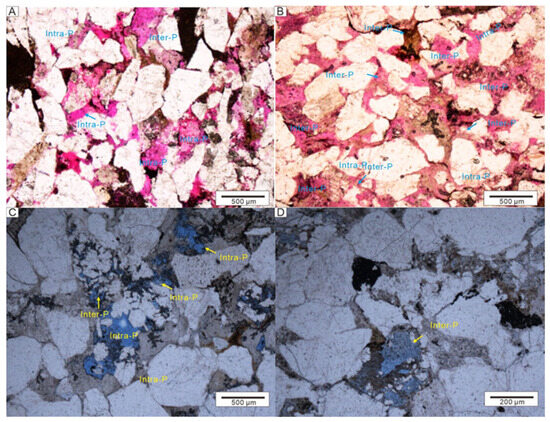
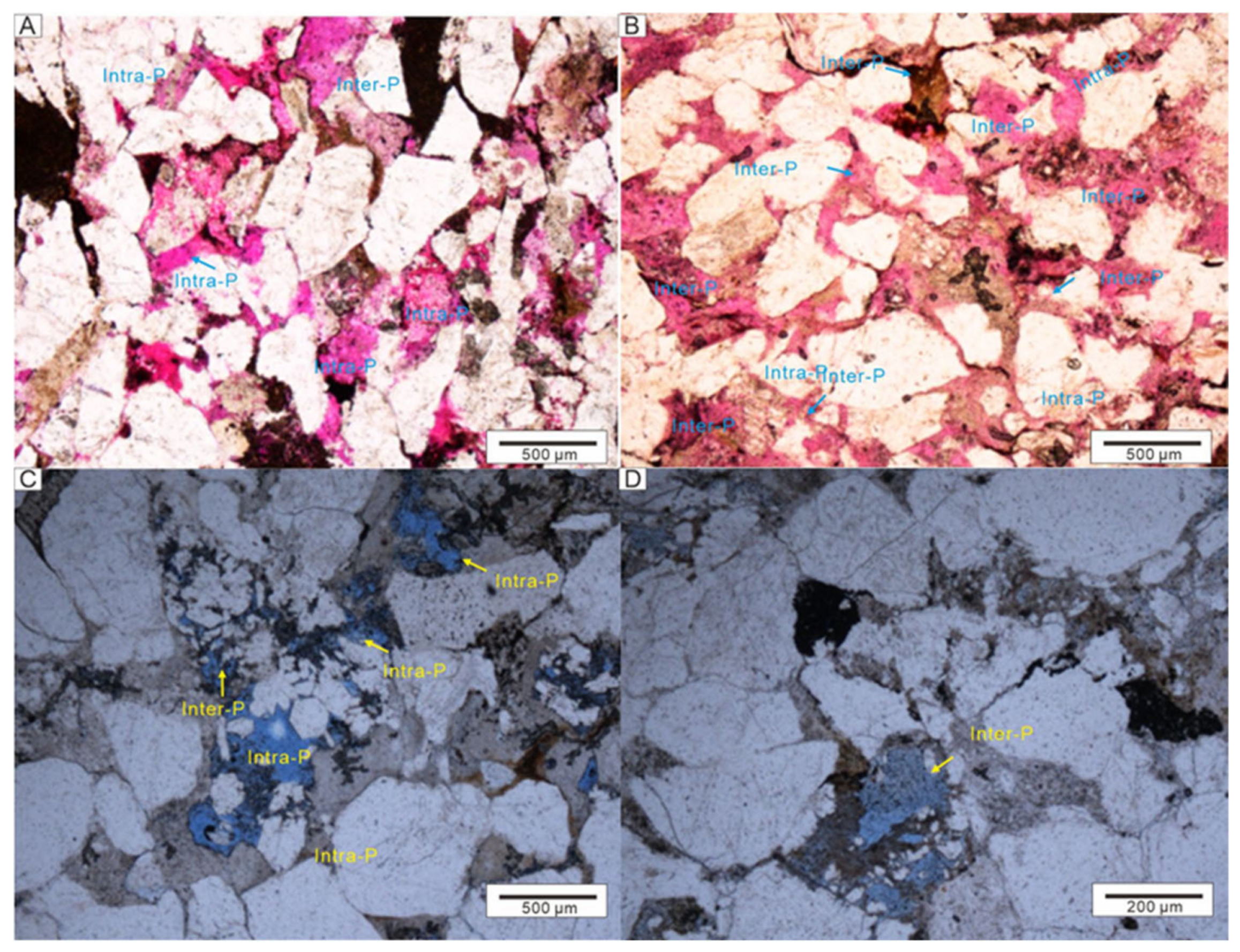
Through the observation of 86 thin section samples in the study area, the pore types of Taiyuan Formation sandstone are mainly primary pores, secondary pores, and cracks. There are mainly the following pore types in the study area [41].
(1) Residual intergranular pores
It is the remaining intergranular pore of debris particles under mechanical compaction and cementation, which belongs to the primary pore and is more developed in the study area (Figure 5A,B). The primary pores between the clastic particles in the sediments will be continuously filled by cementation [13].
Figure 5.
Characterization of pore types in the Taiyuan Formation. (A) Fine-grained lithic quartz sandstone, Da 55 well, 2462.82 m, Tai2 Member, 4 × 10 (plane polars); (B) fine-grained lithic quartz sandstone, Da 80 well, 2594.39 m, Tai1 Member, 4 × 10 (plane polars); (C) intergranular dissolved pore and intragranular dissolved pore, lithic quartz sandstone, Da 108 well, 2640.25 m, Tai2 Member, 10 × 10 (plane polars); (D) intergranular dissolved pores and intragranular dissolved pores, lithic quartz sandstone, Da 108 well, 2614.37 m, Tai2 Member, 10 × 10 (plane polars).
(2) Intragranular dissolved pores
The intragranular dissolution pores have a variety of morphologies and are mainly formed by the partial dissolution of feldspar and rock debris particles (Figure 5A–D). After complete dissolution of the particles, the pore morphology is similar to that of the particles, which is called a mold hole. Due to the low content of feldspar in Taiyuan Formation, it was observed that most of the intragranular dissolved pores were lithic dissolved pores (Figure 5C). In sedimentary rock debris, feldspar and hydromica components are often dissolved, while in volcanic rock debris, minerals such as porphyritic crystals and mica flakes are also prone to dissolution, resulting in the formation of pores. In addition, micropores form between clay minerals such as kaolinite and montmorillonite formed by aluminosilicates [14].
(3) Intergranular dissolution pores
Dissolution intergranular pores refer to the pores formed on the basis of primary pores by dissolution of intergranular fillings such as calcite, dolomite, kaolinite, and so on, under the condition of an acidic medium (Figure 5A,B,D). Intergranular dissolved pores include intergranular dissolution enlarged pores, intergranular dissolved pores, and matrix micro-dissolved pores. This type of dissolution hole is one of the main pore types in sandstone reservoirs in the study area.
4.3.3. Porosity and Permeability
(1) Physical Characteristics of Tai1 Member
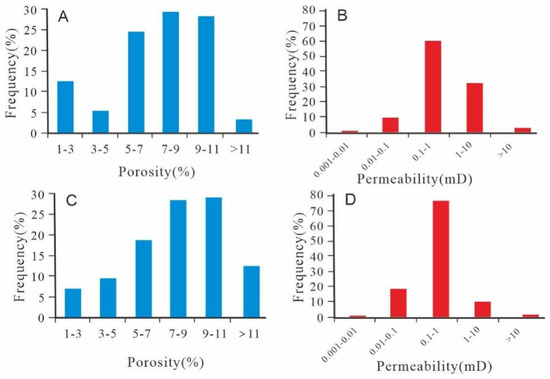
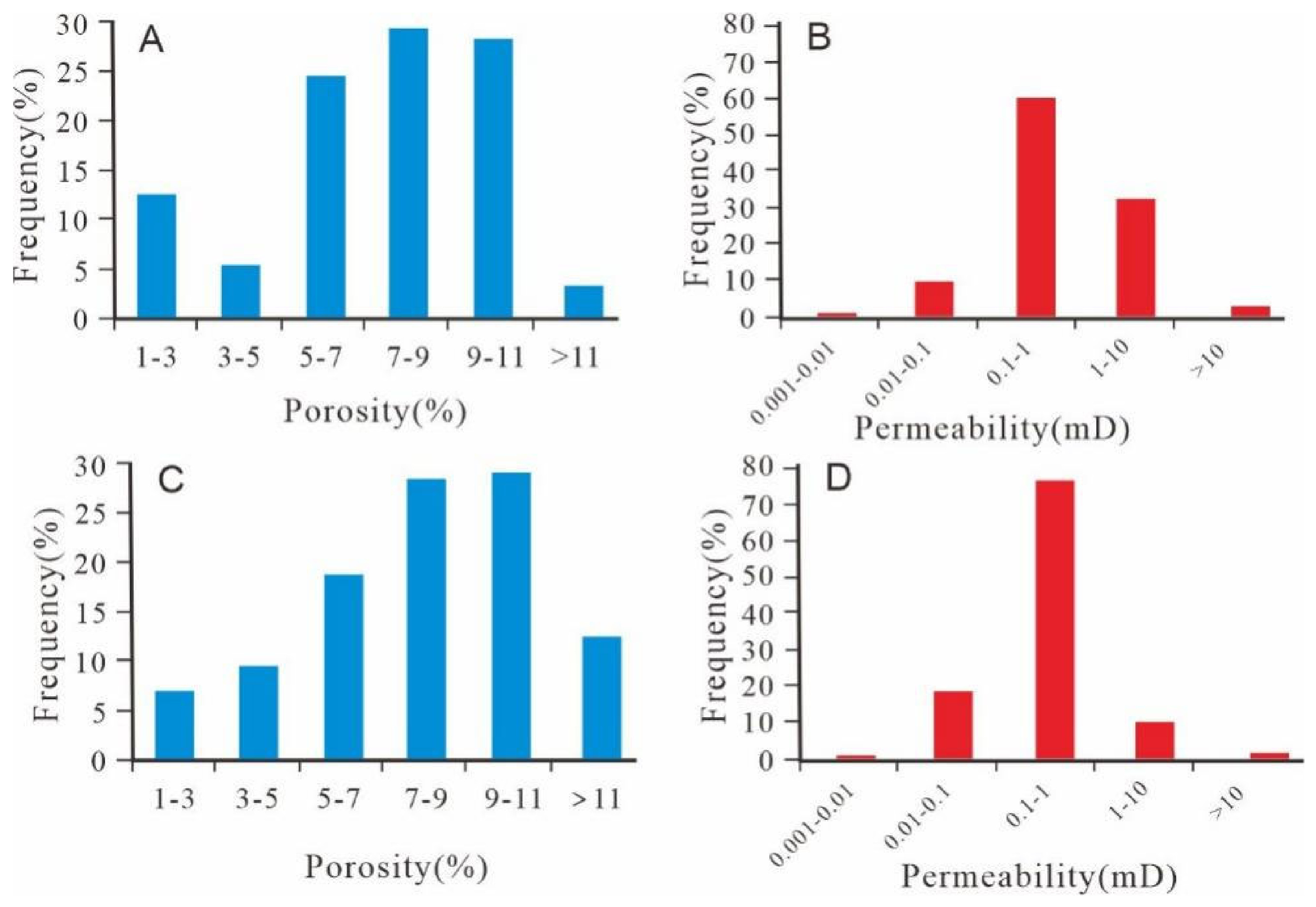
Through the analysis of porosity and permeability of 101 samples in the Tai1 Member of the study area, it is found that the statistical data show a single peak distribution. The porosity range is 0.3%~11.6%, and the average porosity is 7.09%. The porosity of most samples is concentrated in 5%~11%, and the samples with porosity greater than 7% account for 58% of the total samples (Figure 6A). The permeability range is 0.03~29.7 × 103 μm2, and the average permeability is 1.06 × 103 μm2. The permeability of most samples is concentrated in 0.1~1 × 103 μm2, accounting for 63% of the total number of samples (Figure 6B).
Figure 6.
Frequency distribution histogram of porosity and permeability of sandstone in Tai1 and Tai2 Members. (A) Reservoir porosity frequency distribution map of Tai1 Member in Da 17 well area; (B) the frequency distribution map of reservoir permeability in Tai1 Member of Da 17 well area; (C) reservoir porosity frequency distribution map of Tai2 Member in Da 17 well area; (D) the frequency distribution map of reservoir permeability in Tai2 Member of Da 17 well area.
(2) Physical Characteristics of Tai2 Member
Through the analysis of porosity and permeability of 162 samples in the Tai2 Member of the study area, it is found that the statistical data are similar to those of the Tai1 Member, showing a single peak distribution. The porosity range is 0.4%~14.2%, the average porosity is 7.84%, and the peak value is concentrated in 5%~11%. The samples with porosity greater than 7% account for 58% of the total samples (Figure 6C). The permeability range is 0.006~20.8 × 103 μm2, and the average permeability is 0.54 × 103 μm2, showing a unimodal distribution. The peak value is concentrated in 0.1~1 × 103 μm2, accounting for 74% of the total sample (Figure 6D). On the whole, the sandstone of Taiyuan Formation is a typical ultra-low porosity and low permeability reservoir.
5. Discussion
5.1. Determination of the Lower Limit of Reservoir Physical Properties
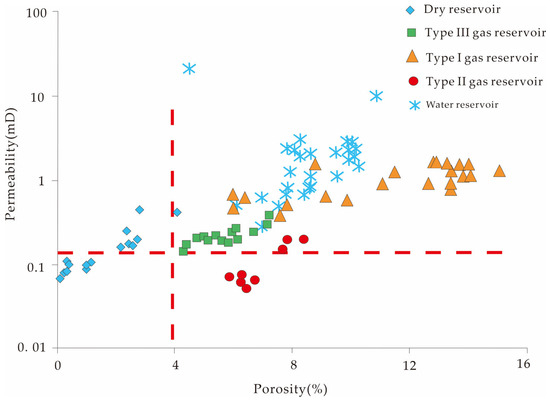
The gas test method is a simple method for delineating the lower limit values of porosity and permeability by counting the average porosity and permeability values obtained from core analysis or well logging interpretation of the gas test section and casting the points on the pore-permeability rendezvous chart in conjunction with the conclusion of the gas test [17,42].
However, in practical application, due to the influence of factors such as the gas testing process, randomness of sampling, and physical property testing error, there is a certain degree of intersection between the effective reservoir and the non-effective reservoir, resulting in the boundary between the two not being very obvious. In this case, the middle value of the transition zone between effective and non-effective reservoirs is usually selected as the lower limit value of physical properties. Figure 7 shows that the gas layer and water layer are distributed in the interval with better physical properties, while the dry layer is located in the interval with poorer physical properties. The physical property value corresponding to the transition point between the dry layer and the distribution zone of the gas-bearing layer is the lower limit value of the reservoir. The lower limit value of the reservoir determined by this method is 3.9%.
Figure 7.
Porosity-permeability relationship diagram of test interval in Da 17 well area.
5.2. Discussion on Reservoir Formation
5.2.1. Reservoir Heterogeneity and Productivity
The study area is a typical low-permeability tight sandstone gas reservoir, and the production is closely related to the heterogeneity of the reservoir. In this paper, the controlling effect of each sedimentary microphase on the heterogeneity characteristics of the sand layer within the sand dam body is investigated from a macroscopic perspective. Its evaluation parameters include the coefficient of variation, the impulse coefficient, the grade difference, and the mean coefficient. The coefficient of variation represents the degree of dispersion of statistical values relative to their average values. The impulse coefficient, grade difference, and mean coefficient reflect the relationship among the maximum value, minimum value, and average value [43,44,45]. The specific evaluation criteria are shown in the table below (Table 1).
Table 1.
Criteria for evaluating reservoir inhomogeneity.
The physical characterization data of more than 300 samples from 10 core sections of 6 wells in the Da 35 Well, Da 21 Well, and Da 49 Well sand body belt were selected. These samples reflect the physical characteristics, heterogeneity, and gas test results of various types of reservoirs. The analysis results show that Type I and Type II reservoirs have moderate heterogeneity and good gas test results, while Type III reservoirs show strong heterogeneity and poor gas test results (Table 2).
Table 2.
Heterogeneity and productivity of different types of reservoirs.
5.2.2. Interpretation of Sedimentary Genesis
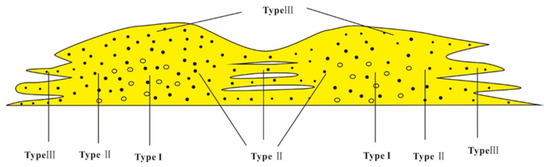
From the preceding sedimentological analysis, it can be identified that the study area belongs to the tidal flat environment within the barrier coastal system. In the subtidal zone, lime flats are developed, where hydrodynamic energy is relatively low and thus effective reservoirs cannot form. Landward from the barrier, seawater modifies the sediments through tidal action, forming sand dams. Sand dams can serve as effective reservoirs. Its development pattern is affected by the sea–land pattern. It is usually distributed in strips parallel to the coastline and can form multiple parallel sand dam belts [46,47,48,49]. In this study, different types of reservoirs are considered to develop at different locations in the sand dam; for example, Type I is mainly located in the center of the sand dam, Type II is located in the main body of the sand dam, while Type III is located at the edge of the sand dam (Figure 8). At the same time, Type I (the center of the sand dam) is mainly gravelly coarse sandstone and coarse sandstone, Type II (the main body of the sand dam) is mainly medium-fine sandstone, while Type III (the edge of the sand dam) is mainly medium-fine sandstone. The relatively coarse grain size of the reservoir provides favorable conditions for dissolution. In addition, both Type I and Type II are developed in high sand areas on the plane, and the sand bodies are developed continuously in the longitudinal direction. In addition, both Type I and Type II are developed in high sand zones on the planar surface, and the sand bodies are developed continuously in the longitudinal direction. Compared with Type II, although Type I exhibits multiple stacked sand bodies and shows weaker heterogeneity, its reservoir physical properties are better characterized. Type II (sand dam edge superposition area) has thicker bodies, but vertical development is discontinuous and obvious interlayers are present. Type III (sand dam edge) mainly consists of fine sandstone: the upper and lower are mudstone or marl deposits, and the reservoir physical properties are relatively poor.
Figure 8.
Development patterns of various reservoirs within the sand bar deposits of the Taiyuan Formation in the study area.
5.2.3. Reservoir Evaluation
Previous studies on the reservoirs in this area have mostly focused on petrophysical properties such as porosity and permeability, as well as pore types and diagenetic evolution [13,15,17,29], with insufficient attention paid to the constraining role of sedimentary context. In contrast, this study, based on systematic observations of a large number of thin sections, has identified the main pore types in the study area. On this basis, the reservoir classification scheme highlights the control of sedimentary environment on reservoir development, clarifies the spatial distribution patterns of different reservoir types within the barrier sand dam system, and thereby provides a more reliable geological basis for favorable reservoir prediction.
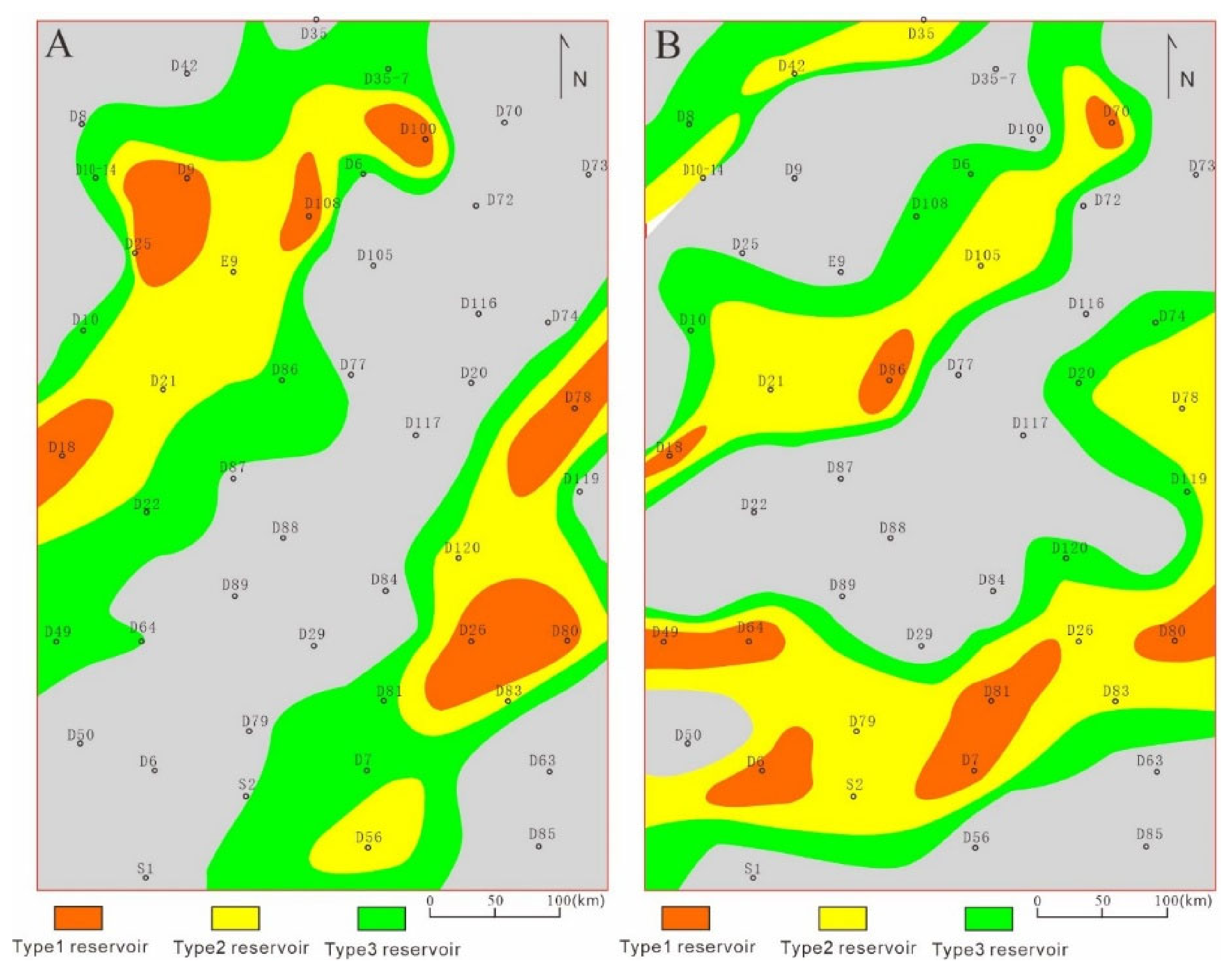
Type I reservoir: The lithology is pebbly coarse sandstone and coarse sandstone, mainly developed at the center of the sand dam. It is the depositional product of a relatively strong hydrodynamic environment, with significant tidal reworking of the sand bodies and prominent multi-phase sand body stacking. Porosity > 10%, permeability (mD) > 0.8, mercury injection pressure at 10% saturation < 0.5 MPa, median saturation pressure < 2 MPa, maximum throat radius > 0.5 μm, mean radius > 0.3 μm (Figure 9, Table 3).
Figure 9.
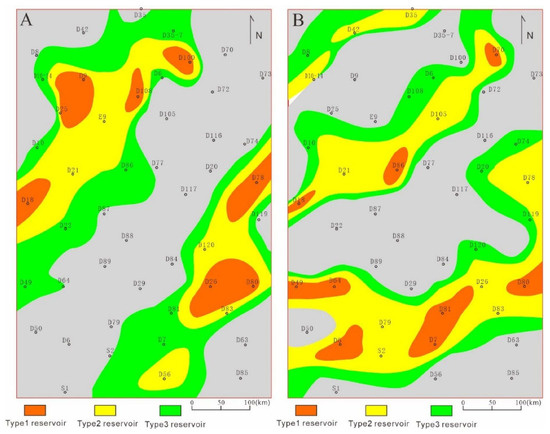
Reservoir evaluation map of the Taiyuan Formation in the study area. (A) Tai2 Member reservoir classification evaluation map; (B) Tai1 Member reservoir classification evaluation map.
Table 3.
Characteristics of different types of reservoirs.
Type II reservoir: The lithology is coarse sandstone, and the main body of the sand dam belongs to this reservoir type. Compared with Type I reservoirs, the hydrodynamic conditions during deposition were weaker, tidal reworking was less intense, and the grain size of the sand bodies changed significantly relative to those of Type I reservoirs. Porosity 10–4%, permeability (mD) 0.1–0.8, mercury injection pressure at 10% saturation 0.5–3 MPa, median saturation pressure 2–20 MPa, maximum throat radius 0.5–0.3 μm, mean radius 0.1–0.3 μm (Figure 9, Table 3).
Type III reservoir: The lithology is medium to fine sandstone, mainly developed at the edge of the sand dam. Hydrodynamic conditions were significantly weaker, tidal reworking was not evident, and these reservoirs generally formed as isolated sand dams. Porosity < 4%, permeability (mD) < 0.1, mercury injection pressure at 10% saturation > 3 MPa, median saturation pressure > 20 MPa, maximum throat radius < 0.3 μm, mean radius < 0.1 μm (Figure 9, Table 3).
Based on the reservoir classification, a comparative analysis of the spatial distribution of the three reservoir types in the Tai1 and Tai2 Members was conducted. In the Tai1 Member, all three reservoir types (Types I, II, and III) are more widely distributed. The favorable hydrodynamic conditions during the deposition of the Tai1 Member promoted the development of thick sand dam bodies, providing a substantial material foundation for reservoir formation. In contrast, the Tai2 Member is characterized by thinner sand dam bodies. Type I reservoirs are sparsely developed and predominantly localized in the southern part of the study area, whereas the northern part is dominated by Type II and Type III reservoirs.
6. Conclusions
(1) Taking the Taiyuan Formation in the Da 17 well area of the Daniudi Gas Field in the Ordos Basin as a case study, this work reveals the microscopic pore structure characteristics of tight sandstone reservoirs, establishes a classification standard for tight sandstone reservoirs, and provides a detailed description of various reservoir types.
(2) Based on lithological characteristics and sedimentary markers, the Taiyuan Formation is interpreted as a typical tidal flat sedimentary environment, developing sand dam, mud flat, sand flat, peat swamp, and lime flat microfacies. The sand dam is the main site for sand body development and serves as the primary target for reservoir evaluation.
(3) Reservoir characteristics were investigated using petrographic analysis, X-ray diffraction, porosity/permeability measurements, mercury injection capillary pressure, and scanning electron microscopy. The results show that the reservoir is mainly composed of medium- to fine-grained lithic quartz sandstone and lithic sandstone. The main pore types include primary pores, secondary pores, and fractures. Reservoir porosity ranges from 0.3% to 14.2%, and permeability ranges from 0.006 to 29.7 × 10⁻³ μm2, classifying it as a typical tight sandstone reservoir.
(4) Based on the assessment of the lower limit of reservoir physical properties, and considering lithological characteristics, spatial occurrence, physical properties, and mercury injection test results, the reservoirs are classified into three types. Type I reservoirs are characterized by gravelly coarse sandstone and coarse sandstone, with porosity > 10% and permeability > 0.8 × 10⁻³ μm2; they are mainly developed in the center of sand dams and represent the most promising areas for exploration and development. Type II reservoirs consist of coarse sandstone, with porosity ranging from 4% to 10% and permeability ranging from 0.1 to 0.8 × 10⁻³ μm2; they constitute the main component of the sand dams. Type III reservoirs are characterized by medium to fine sandstone, with porosity < 4% and permeability < 0.1 × 10⁻³ μm2; they are mainly developed at the edges of sand dams.
(5) The reservoir classification scheme proposed in this study focuses on the control of sedimentary environment on reservoir development and clarifies the spatial distribution patterns of different reservoir types within the barrier sand dam system, thus providing a reliable geological basis for favorable reservoir prediction and offering theoretical support for natural gas distribution prediction as well as for the exploration and development of Upper Paleozoic tight gas resources in the Daniudi Gas Field.
Author Contributions
Conceptualization, C.Y., Y.L. and B.Z.; Methodology, C.Y., T.L., X.W., H.X. and B.Z.; Software, T.L., H.X. and Y.L.; Validation, Y.L. and B.Z.; Formal analysis, C.Y. and X.W.; Investigation, X.W., H.X. and B.Z.; Resources, T.L., H.X., Y.L. and B.Z.; Data curation, C.Y., X.W. and B.Z.; Writing—original draft, C.Y.; Writing—review & editing, B.Z.; Visualization, T.L., H.X., Y.L. and B.Z.; Supervision, T.L., H.X. and Y.L.; Project administration, C.Y., T.L. and B.Z.; Funding acquisition, X.W. and Y.L. All authors have read and agreed to the published version of the manuscript.
Funding
This research was funded by Qian Education Technology (2024) No. 207 and Zunyi Municipal Science and Technology Cooperation HZ Project (2025) No. 169 and Xichang Subsag shale gas resources investigation (DD20242402) and Sichuan Basin and peripheral shale gas investigation (DD20240046).
Data Availability Statement
The raw data supporting the findings of this study are available from the corresponding author upon reasonable request.
Conflicts of Interest
The authors declare no conflict of interest.
References
- Zou, C.N.; Yang, Z.; Zhu, R.K.; Zhang, G.S.; Hou, L.H.; Wu, S.T. Progress in China’s unconventional oil & gas exploration and development and theoretical technologies. Acta Geol. Sin.-Engl. Ed. 2015, 89, 979–1007. [Google Scholar] [CrossRef] [Scilit]
- Dai, J.X.; Ni, Y.Y.; Wu, X.Q. Tight gas in China and its significance in exploration and exploitation. Pet. Explor. Dev. 2012, 39, 257–264. [Google Scholar] [CrossRef] [Scilit]
- Zhu, X.M.; Pan, R.; Zhu, S.F.; Wei, W.; Ye, L. Research progress and core issues in tight reservoir exploration. Earth Sci. Front. 2018, 25, 141–146. [Google Scholar]
- Sun, L.D.; Zou, C.N.; Jia, A.L.; Wei, Y.S.; Zhu, R.K.; Wu, S.K. Development characteristics and orientation of tight oil and gas in China. Pet. Explor. Dev. 2019, 46, 1015–1026. [Google Scholar] [CrossRef] [Scilit]
- Wei, G.Q.; Zhang, F.D.; Li, J.; Yang, S.; Huang, C.Y.; She, Y.Q. New progress of tight sand gas accumulation theory and favorable exploration zones in China. Nat. Gas Geosci. 2016, 27, 199–210. [Google Scholar] [CrossRef] [Scilit]
- Dong, G.D.; Liu, X.S.; Pei, W.C.; Fu, X.X.; Zeng, X.; Zhang, D.F. Characteristics and main controlling factors of tight limestone reservoir in Taiyuan Formation of Ordos Basin. Nat. Gas Geosci. 2023, 34, 1018–1027. [Google Scholar]
- Qiu, L.; Yang, S.; Qu, C.; Xu, N.; Gao, Q.; Zhang, X.; Liu, X.; Wang, D. A Comprehensive Porosity Prediction Model for the Upper Paleozoic Tight Sandstone Reservoir in the Daniudi Gas Field, Ordos Basin. J. Earth Sci. 2017, 28, 1086–1096. [Google Scholar] [CrossRef] [Scilit]
- Liu, G.; Sun, M.; Zhao, Z.; Wang, X.; Wu, S. Characteristics and Accumulation Mechanism of Tight Sandstone Gas Reservoirs in the Upper Paleozoic, Northern Ordos Basin, China. Pet. Sci. 2013, 10, 442–449. [Google Scholar] [CrossRef] [Scilit]
- Zhang, Q.; Xiong, W.; Li, X.; Feng, C.; Qiu, Z.; Liu, W.; Li, X.; Xiao, Y.; Liu, D.; Yang, H. Discussion on Transitional Shale Gas Accumulation Conditions from the Perspective of Source-Reservoir-Caprock Controlling Hydrocarbon: Examples from Permian Shanxi Formation and Taiyuan Formation in the Eastern Margin of Ordos Basin, NW China. Energies 2023, 16, 3710. [Google Scholar] [CrossRef] [Scilit]
- He, Z.; Yang, M.; Wang, L.; Lu, J.; Wang, Y.; Peng, X.; Shao, L. Enrichment Mechanism of Organic Matter in the Marine–Continental Transitional Shale of the Taiyuan Formation in Ordos Basin, China: Control of the Paleoenvironment. ACS Omega 2025, 10, 21674–21692. [Google Scholar] [CrossRef] [Scilit] [PubMed]
- Shuichang, Z.; Jingkui, M.; Liuhong, L.; Shizhen, T. Geological Features and Formation of Coal-Formed Tight Sandstone Gas Pools in China: Cases from Upper Paleozoic Gas Pools, Ordos Basin and Xujiahe Formation Gas Pools, Sichuan Basin. Pet. Explor. Dev. 2009, 36, 320–330. [Google Scholar] [CrossRef] [Scilit]
- Lan, C.; Yang, M.; Zhang, Y. Impact of Sequence Stratigraphy, Depositional Facies and Diagenesis on Reservoir Quality: A Case Study on the Pennsylvanian Taiyuan Sandstones, Northeastern Ordos Basin, China. Mar. Pet. Geol. 2016, 69, 216–230. [Google Scholar] [CrossRef] [Scilit]
- Jiu, B.; Huang, W.; Li, Y.; He, M. Influence of Clay Minerals and Cementation on Pore Throat of Tight Sandstone Gas Reservoir in the Eastern Ordos Basin, China. J. Nat. Gas Sci. Eng. 2021, 87, 103762. [Google Scholar] [CrossRef] [Scilit]
- Song, Z.; Liu, G.; Yang, W.; Zou, H.; Sun, M.; Wang, X. Multi-Fractal Distribution Analysis for Pore Structure Characterization of Tight Sandstone—A Case Study of the Upper Paleozoic Tight Formations in the Longdong District, Ordos Basin. Mar. Pet. Geol. 2018, 92, 842–854. [Google Scholar] [CrossRef] [Scilit]
- Cui, J.; Li, S.; Mao, Z. Oil-Bearing Heterogeneity and Threshold of Tight Sandstone Reservoirs: A Case Study on Triassic Chang7 Member, Ordos Basin. Mar. Pet. Geol. 2019, 104, 180–189. [Google Scholar] [CrossRef] [Scilit]
- Yin, J.; Hu, P.; Guo, Y.; Li, Y.; Luo, S. Petrological Characteristics and Hydrocarbon Generation of Carbonate Source Rocks of the Permian Taiyuan Formation in Central and Eastern Ordos Basin, China. Minerals 2023, 13, 1058. [Google Scholar] [CrossRef] [Scilit]
- Ren, J.; Zhang, L.; Ezekiel, J.; Ren, S.; Meng, S. Reservoir Characteristics and Productivity Analysis of Tight Sand Gas in Upper Paleozoic Ordos Basin China. J. Nat. Gas Sci. Eng. 2014, 19, 244–250. [Google Scholar] [CrossRef] [Scilit]
- Shen, Y.L.; Guo, Y.H.; Jing, H.X.; Tao, X.; Gao, Z.J.; Zhang, X.B. Study on Sequence Stratigraphy from Benxi to Taiyuan Formation in Northeastern Ordos Basin. Procedia Earth Planet. Sci. 2009, 1, 995–1001. [Google Scholar] [CrossRef] [Scilit]
- Huang, Y.Q.; Xiao, K.H.; Wang, A.; Lin, T.; Wang, R.Y. Study on distribution characteristics of high-quality reservoirs in the second member of Xujiahe Formation, western Yuanba, northeastern Sichuan Basin. Sediment. Geol. Tethyan Geol. 2023, 43, 489–500. [Google Scholar]
- Li, F.L.; Jiang, B.; Cheng, G.X.; Song, Y.; Tang, Z. Structural and evolutionary characteristics of pores-microfractures and their influence on coalbed methane exploitation in high-rank brittle tectonically deformed coals of the Yangquan mining area, northeastern Qinshui basin, China. J. Pet. Sci. Eng. 2019, 174, 1290–1302. [Google Scholar] [CrossRef] [Scilit]
- Wang, Z.L.; Li, D.L.; Zhao, X.C.; Chen, Y.T.; Gao, J.W.; Tao, W.X.; He, L.; Li, H.B.; Qu, W.Q.; Wang, X.Z. Differences in coal-accumulation regularity between northern and southern Yan’an Formation, Ordos Basin: Evidence from geochemistry. J. Palaeogeogr. 2026, 15, 100325. [Google Scholar] [CrossRef] [Scilit]
- Shao, C.Y.; Song, F.; Qiu, L.W.; Zhang, S.Q.; Kong, Q.Y. The role of windfield, sedimentary sources, and basin structure in the formation of beach-bar deposition systems: A case study in Paleogene Shahejie formation in the Zhanhua Sag of the Bohai Bay Basin, China. J. Asian Earth Sci. 2025, 291, 106713. [Google Scholar] [CrossRef] [Scilit]
- Xu, L.; Cao, B.B. Effects of secondary pores within K-feldspar and laumontite on the reservoir quality of tight sandstone from the Upper Triassic succession, Ordos Basin, China. J. Asian Earth Sci. 2025, 294, 106817. [Google Scholar] [CrossRef] [Scilit]
- Rudmin, M.; López-Quirós, A.; Banerjee, S.; Ruban, A.; Shaldybin, M.; Bernatonis, P.; Singh, O.; Dauletova, A.; Maximov, P. Origin of Fe-rich clay minerals in Early Devonian volcanic rocks of the Northern Minusa basin, Eastern Siberia. Appl. Clay Sci. 2023, 241, 107014. [Google Scholar] [CrossRef] [Scilit]
- Li, F.J.; Chen, Z.A.; Sanem, A.; James, G.O.; Shannon, F.; Liu, G.C.; Zhang, P.F.; Wang, J.; Chen, A.Q.; Hou, M.C. Storm deposit characteristics and orbital cyclicity of the Early Devonian Xiejiawan Formation in the Longmenshan area, Sichuan Province, China. Palaeogeogr. Palaeoclimatol. Palaeoecol. 2025, 664, 112792. [Google Scholar] [CrossRef] [Scilit]
- Zhu, Q.; Li, J.G.; Li, G.Y.; Wen, S.B.; Yu, R.G.; Tang, C.; Feng, X.X.; Liu, X.X. Characteristics of sandstone-type uranium mineralization in the Hangjinqi region of the northeastern Ordos Basin: Clues from clay mineral studies. Ore Geol. Rev. 2022, 141, 104642. [Google Scholar] [CrossRef] [Scilit]
- Cui, H.; Zhong, N.; Li, J.; Wang, D.; Li, Z.; Hao, A.; Liang, F. Study on the Lower Limits of Petrophysical Parameters of the Upper Paleozoic Tight Sandstone Gas Reservoirs in the Ordos Basin, China. J. Nat. Gas Geosci. 2017, 2, 21–28. [Google Scholar] [CrossRef] [Scilit]
- Guo, Y.; Pang, X.; Li, Z.; Guo, F.; Song, L. The Critical Buoyancy Threshold for Tight Sandstone Gas Entrapment: Physical Simulation, Interpretation, and Implications to the Upper Paleozoic Ordos Basin. J. Pet. Sci. Eng. 2017, 149, 88–97. [Google Scholar] [CrossRef] [Scilit]
- Chen, Z.; Zhang, J.; Yong, Z.; Ma, H. Tight Sandstone Reservoir Characteristics and Sand Body Distribution of the Eighth Member of Permian Shihezi Formation in the Longdong Area, Ordos Basin. Minerals 2025, 15, 463. [Google Scholar] [CrossRef] [Scilit]
- Tang, X.; Zhang, J.; Shan, Y.; Xiong, J. Upper Paleozoic Coal Measures and Unconventional Natural Gas Systems of the Ordos Basin, China. Geosci. Front. 2012, 3, 863–873. [Google Scholar] [CrossRef] [Scilit]
- Xiao, X.M.; Zhao, B.Q.; Thu, Z.L.; Song, Z.G.; Wilkins, R.W.T. Upper Paleozoic Petroleum System, Ordos Basin, China. Mar. Pet. Geol. 2005, 22, 945–963. [Google Scholar] [CrossRef] [Scilit]
- Jiang, F.; Jia, C.; Pang, X.; Jiang, L.; Zhang, C.; Ma, X.; Qi, Z.; Chen, J.; Pang, H.; Hu, T.; et al. Upper Paleozoic Total Petroleum System and Geological Model of Natural Gas Enrichment in Ordos Basin, NW China. Pet. Explor. Dev. 2023, 50, 281–292. [Google Scholar] [CrossRef] [Scilit]
- Zhang, L.; Bai, G.; Luo, X.; Ma, X.; Chen, M.; Wu, M.; Yang, W. Diagenetic History of Tight Sandstones and Gas Entrapment in the Yulin Gas Field in the Central Area of the Ordos Basin, China. Mar. Pet. Geol. 2009, 26, 974–989. [Google Scholar] [CrossRef] [Scilit]
- Yang, Z.; He, S.; Guo, X.; Li, Q.; Chen, Z.; Zhao, Y. Formation of Low Permeability Reservoirs and Gas Accumulation Process in the Daniudi Gas Field, Northeast Ordos Basin, China. Mar. Pet. Geol. 2016, 70, 222–236. [Google Scholar] [CrossRef] [Scilit]
- Liu, Q.; Jin, Z.; Meng, Q.; Wu, X.; Jia, H. Genetic Types of Natural Gas and Filling Patterns in Daniudi Gas Field, Ordos Basin, China. J. Asian Earth Sci. 2015, 107, 1–11. [Google Scholar] [CrossRef] [Scilit]
- JY/T 0587-2020; General Rules for X-ray Polycrystalline Diffractometry. Ministry of Education of the People’s Republic of China: Beijing, China, 2020.
- SY/T 5163-2018; Analysis Method for Clay Minerals and Ordinary Non-Clay Minerals in Sedimentary Rocks by the X-ray Diffraction. Petroleum Industry Press: Beijing, China, 2018.
- Shang, X.F.; Hou, J.G.; Cheng, Y.Z.; An, Z.Y.; Yao, R.X.; Li, Y. Formation mechanism of the thick layer lacustrine beach-bar and its geological implications: An example of the second Member of the Shahejie Formation in Banqiao Sag. Acta Geol. Sin. 2014, 88, 1705–1718. [Google Scholar]
- Li, X.; Qiu, L.W.; Fu, J.; Dong, D.T.; Yang, Y.Q.; Khan, D.; Wu, Z.J.; Song, F.; Wen, X.; Liu, X.B. Architectural characteristics, evolutionary stages, and sedimentary models of clastic beach bars. Mar. Pet. Geol. 2022, 146, 105976. [Google Scholar] [CrossRef] [Scilit]
- Ma, C.F.; Song, H.W.; Wu, Y.Q.; Cao, X.P.; Liu, H.C.; Zhang, H.F.; Fu, Y.; Wan, W.G.; Huang, C.; Fang, X.X. Differential diagenetic controls on petrophysical heterogeneity of lacustrine beach-bar tight sandstones: Insights from the Boxing Sag, eastern China. Mar. Pet. Geol. 2025, 181, 107537. [Google Scholar] [CrossRef] [Scilit]
- Pszonka, J.; Wendorff, M. Cathodoluminescence-Revealed Diagenesis of Carbonates and Feldspars in Cergowa Sandstones (Oligocene), Outer Carpathians. Gospod. Surowcami Miner. 2014, 30, 21–36. [Google Scholar] [CrossRef] [Scilit]
- Shang, X.F.; Hou, J.G.; Dong, Y. Genesis of reservoir heterogeneity and its impacts on petroleum exploitation in beach-bar sandstone reservoirs: A case study from the Bohai Bay Basin, China. Energy Geosci. 2014, 3, 35–48. [Google Scholar]
- Zhou, Y.; Ji, Y.; Xu, L.; Che, S.; Niu, X.; Wan, L.; Zhou, Y.; Li, Z.; You, Y. Controls on Reservoir Heterogeneity of Tight Sand Oil Reservoirs in Upper Triassic Yanchang Formation in Longdong Area, Southwest Ordos Basin, China: Implications for Reservoir Quality Prediction and Oil Accumulation. Mar. Pet. Geol. 2016, 78, 110–135. [Google Scholar] [CrossRef] [Scilit]
- Alabert, F.G.; Aquitaine, E.; Modot, V. Stochastic Models of Reservoir Heterogeneity: Impact on Connectivity and Average Permeabilities. In Proceedings of the SPE Annual Technical Conference and Exhibition, Washington, WA, USA, 4–7 October 1992. [Google Scholar]
- Wang, X.; Hou, J.; Liu, Y.; Ji, L.; Sun, J. Studying Reservoir Heterogeneity by Analytic Hierarchy Process and Fuzzy Logic, Case Study of Es1x Formation of the Wang Guan Tun Oilfield, China. J. Pet. Sci. Eng. 2017, 156, 858–867. [Google Scholar] [CrossRef] [Scilit]
- Chen, S.Y.; Yang, J.P.; Cao, Y.C. Sedimentary characteristics of two kinds of beach-bars of Oligocene Shahejie Formation in western Huimin Depression, China. Coal Geol. Explor. 2000, 28, 1–4. [Google Scholar]
- Ji, Y.L.; Liu, J.L.; Wang, T.Y.; Liu, D.W.; Cheng, T.R. Distributing pattern and mapping method of delta and beach-bar composite sandbodies in continental lacustrine basin. J. Palaeogeogr. 2016, 18, 615–630. [Google Scholar]
- Yang, Y.Q.; Qiu, L.W.; Jiang, Z.X.; Yin, X.L. A depositional pattern of beach bar in continental rift lake basins: A case study on the upper part of the Fourth Member of the Shahejie Formation in the Dongying Sag. Acta Pet. Sin. 2011, 32, 417–423. [Google Scholar]
- Li, A.X.; Wang, G.M.; Pang, X.J.; Wang, X.Z.; Ren, Y.J. Structural features of lacustrine shoal-bar sandstone under intermittent wave: A case of Sha 4 Member of Shahejie Formation of Well Wang 73, southern slope zone, Dongying Depression. Pet. Geol. Recovery Effic. 2010, 17, 12–14. [Google Scholar]

Disclaimer/Publisher’s Note: The statements, opinions and data contained in all publications are solely those of the individual author(s) and contributor(s) and not of MDPI and/or the editor(s). MDPI and/or the editor(s) disclaim responsibility for any injury to people or property resulting from any ideas, methods, instructions or products referred to in the content. |
© 2026 by the authors. Licensee MDPI, Basel, Switzerland. This article is an open access article distributed under the terms and conditions of the Creative Commons Attribution (CC BY) license.