


Abstract
The Duolong porphyry copper–gold district, located in the northwestern segment of the Bangongco–Nujiang metallogenic belt on the southern margin of the South Qiangtang terrane (Tibet), hosts typical porphyry-style Cu-Au mineralization with well-defined alteration zoning from potassic through chlorite–sericite to propylitic assemblages. Based on integrated in situ major/trace element and sulfur isotope analyses of pyrite and chalcopyrite from different alteration zones, we identify two discrete episodes of magmatic-hydrothermal activity that exerted distinct controls on metal endowment. Sulfur isotope signatures define a systematic evolution from the earliest, high-temperature potassic stage (δ34S: Py-I −3.70 to −1.16‰, mean −2.14‰; Cp-I −4.92 to −0.90‰, mean −2.54‰) through propylitic alteration (Py-II: 1.20‰–5.16‰, mean 3.06‰) to the later chlorite–sericite stage (Py-III: −2.00 to 1.86‰, mean 0.06‰; Cp-II: −2.50 to 0.58‰, mean −0.77‰), tracking progressive fluid cooling and changing fluid sources. Trace element systematics further discriminate these episodes: sulfides from potassic and chlorite–sericite zones are enriched in trace elements, whereas propylitic pyrite is depleted, with potassic pyrite recording the highest Cu concentrations (559–7256 ppm, mean 2302 ppm) and chlorite–sericite pyrite containing the lowest Au contents (0.01–0.59 ppm, mean 0.10 ppm). Gold mineralization occurs as native gold exsolved from chalcopyrite, and the markedly low Au concentrations in chlorite–sericite pyrite (0.01–0.59 ppm, mean 0.10 ppm) demonstrate that gold exsolution was largely completed during the first, high-temperature magmatic-hydrothermal stage. Collectively, these results establish a detailed geochemical framework linking sulfide composition to specific hydrothermal stages, providing new constraints on the processes of porphyry copper–gold mineralization in a collisional setting.
1. Introduction
Porphyry copper–gold deposits represent one of the most significant types of porphyry deposits, accounting for approximately 80% of global copper resources and about 20% of gold resources. They typically form in magmatic arc settings at convergent plate boundaries [1,2]. The characteristic alteration zoning of these deposits results from interactions between ore-forming fluids and wall rocks during fluid migration. Typical porphyry deposits exhibit a potassic alteration zone at the core, enveloped by broadly contemporaneous propylitic alteration shells. Slightly later-stage chlorite–sericite, argillic, and advanced argillic alteration zones overprint the earlier alteration assemblages [2,3,4]. Alteration zoning records the evolutionary path of the mineralizing fluids [5,6,7,8]. The trace element compositions and sulfur isotopic signatures of sulfides—particularly pyrite and chalcopyrite—within these alteration zones serve as key geochemical probes for revealing ore-forming material sources, fluid evolution processes, and metal precipitation mechanisms [9,10].
The Duolong porphyry–epithermal copper–gold district, situated along the northwestern segment of the Bangonghu–Nujiang metallogenic belt and on the southern margin of the South Qiangtang terrane in Tibet, currently hosts discovered copper resources exceeding 25 Mt, with accompanying gold and silver resources of more than 520 t and 3900 t, respectively [11]. To date, exploration has delineated one super-large porphyry–epithermal copper–gold deposit (Tiegelongnan), four large porphyry copper–gold deposits (Duobuza, Naruo, Bolong, and Duobuzaxi), and six porphyry copper–gold prospects within this district. However, systematic in situ major/trace element and sulfur isotope compositions of pyrite and chalcopyrite, which are widely developed in porphyry deposits of this district, remain lacking. In particular, the detailed characterization of sulfide geochemical signatures across different alteration zones and their coupling with multistage magmatic-hydrothermal fluid evolution remain poorly constrained.
Here we present systematic major and trace element and sulfur isotope analyses of pyrite and chalcopyrite widely developed in representative porphyry deposits of the district, which, together with previously published data from the Tiegelongnan deposit, allow us to establish a typomorphic mineralogical characterization of pyrite and chalcopyrite in relation to porphyry mineralization processes, constrain the copper–gold mineralization history, and refine the genetic model for subduction-related porphyry copper–gold deposits in Tibet.
2. Tectonic Setting
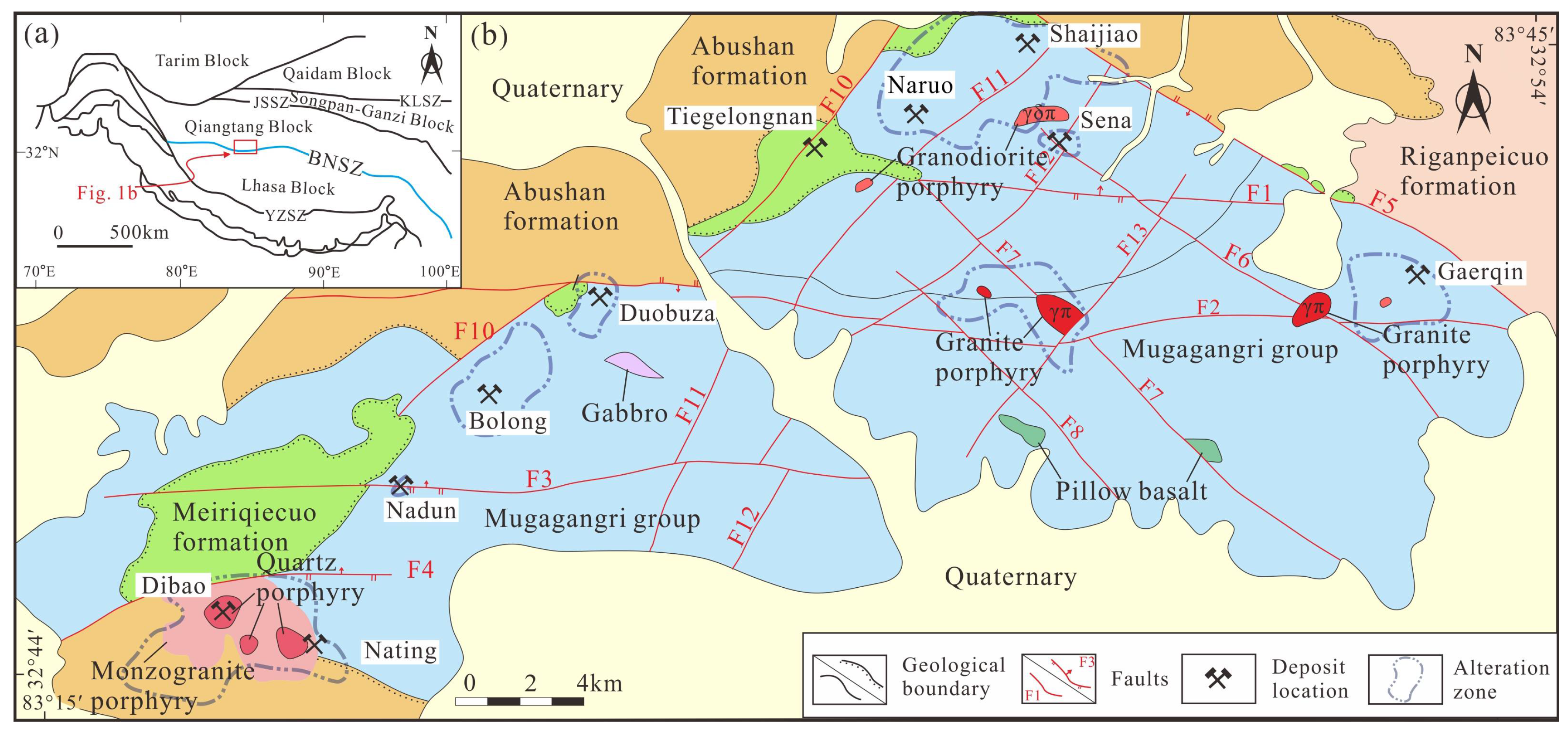
The Bangong–Nujiang metallogenic belt, traversing the central Tibetan Plateau, hosts several ophiolitic mélange belts. Extending over 2200 km from the Bangongco in the west, eastward through Gerze-Amdo-Dengqen, and along the Nujiang River into western Yunnan [12], it constitutes the suture between the Lhasa and Qiangtang terraces [13,14,15,16]. The belt extends northward to the southern margin of the Qiangtang terrane and southward into the northern part of the Lhasa terrane (Figure 1a). It hosts numerous porphyry, skarn, and orogenic-type Cu-Au-Fe deposits (occurrences), whose mineralization spans the entire evolutionary stages from the opening to the closure of the Bangong–Nujiang Ocean [17].
The Duolong Ore District, located in the western segment of the Bangong–Nujiang metallogenic belt, is situated on the southern margin of the Qiangtang-Sanjiang Composite Plate and the northern margin of the Bangong–Nujiang Suture Zone. It stands as one of the most significant ore districts within the belt. The stratigraphic sequence in the Duolong district primarily includes: the Upper Triassic Rigainpeico Formation (T3r), consisting of shallow-marine carbonate rocks intercalated with clastic sediments; the Jurassic Mugagangri Formation (JM), composed of flysch deposits; the Lower Cretaceous Meiriqiecuo Formation (K1m), featuring volcanic rocks such as basalt, basaltic andesite, and andesite; the Upper Cretaceous Abushan Formation (K2a), characterized by molasse deposits; the Oligocene Kangtuo Formation (E3k); and Quaternary (Q) sediments (Figure 1b).
Based on the dominant trends of major fault structures, the tectonic framework of the district can be subdivided into NE-SW-trending faults, NW-SE-trending faults, E-W-trending faults, and south-vergent thrust nappe structures. The earliest developed E-W-trending faults were subsequently offset by NE- and NW-trending faults, forming a rhombic block structural pattern. Most deposits are located at the intersections of these structural faults.
The magmatic rocks in the area predominantly include dismembered ophiolitic mélange fragments, Early Cretaceous gabbro, Early Cretaceous diorite porphyry, quartz monzodiorite, granodiorite porphyry, and granite porphyry, as well as basaltic andesite, andesite, and dacite. Among these, the diorite porphyry and granodiorite porphyry represent the primary ore-forming intrusions. Post-mineralization andesite covers the ore bodies, playing a crucial role in their preservation [18].
Figure 1.
(a) Simplified tectonic map of the Duolong ore district and (b) Simplified geological, structural, and mineral deposit map (modified from Li et al., 2024) [19].
3. Deposit Geology
Porphyry-style mineralization constitutes the dominant mineralization type in the Duolong district, with the Duobuza and Tiegelongnan deposits being the most representative examples. However, given that the shallow portion of the Tiegelongnan deposit is overprinted by high-sulfidation epithermal mineralization, this study focuses specifically on the geological characteristics of the Duobuza deposit.
3.1. Regional Geology
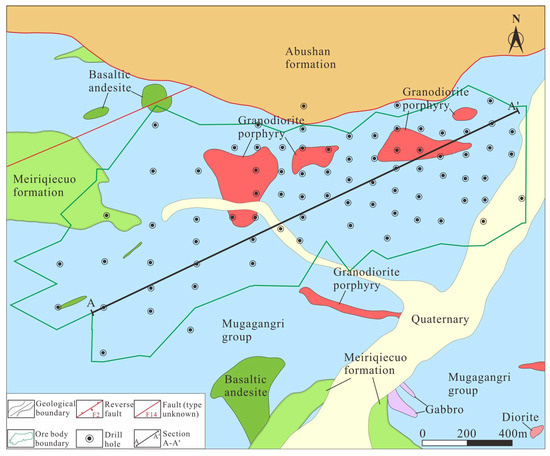
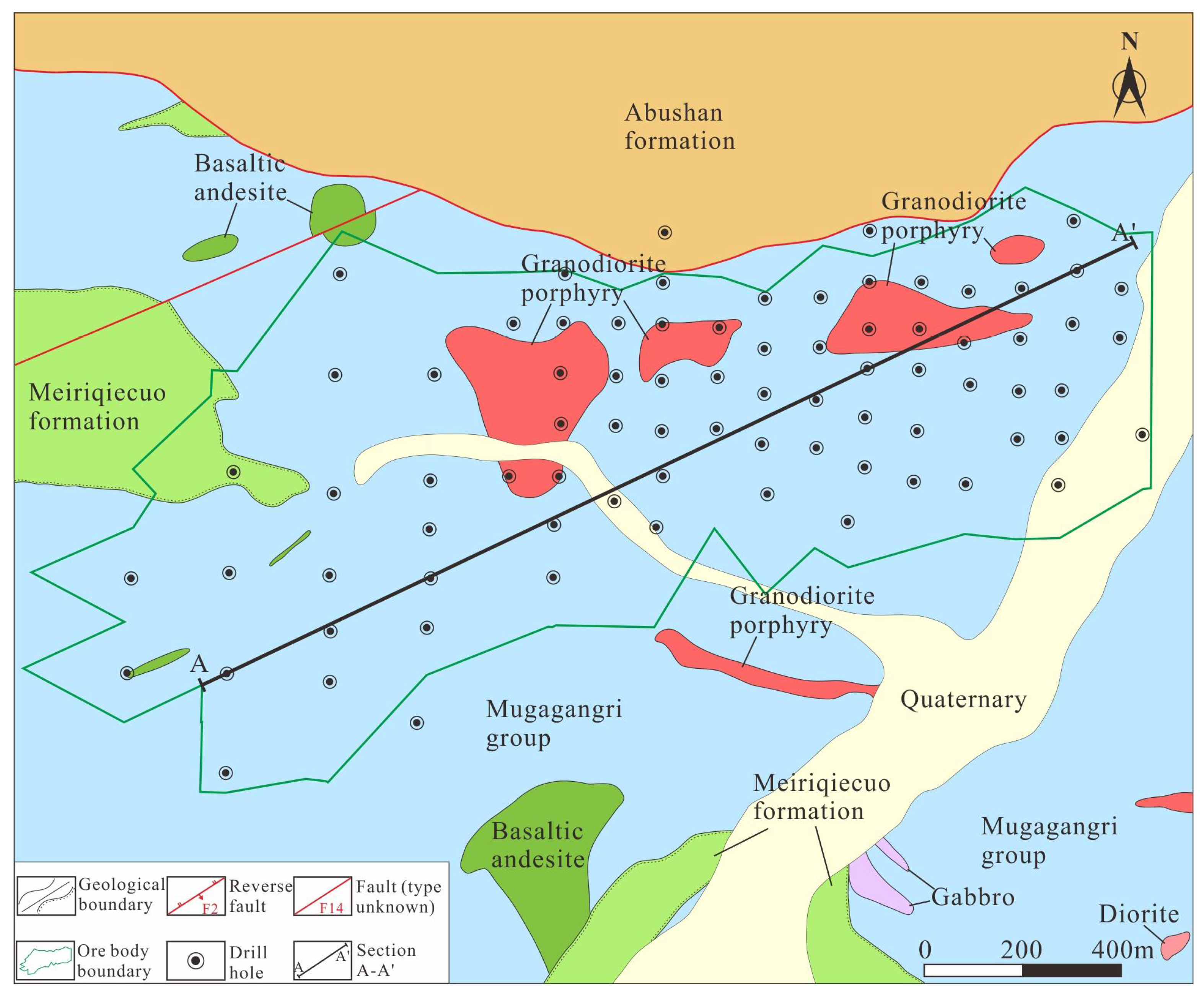
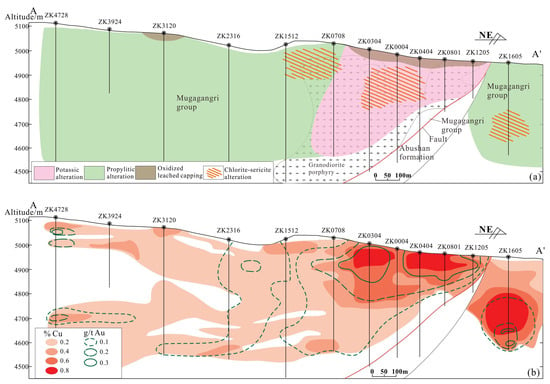
The stratigraphy of the Duobuza mining area primarily consists of the Upper Cretaceous Abushan Formation (K2a), Lower Cretaceous Meiriqie Formation (K1m), Mugagangri Formation (JM), and Quaternary (Q) deposits. The area has experienced intense tectonic activity, with secondary fracture structures widely developed around the major faults [20,21]. Magmatic activity in the mining area is complex and multi-stage, comprising granodiorite porphyry, diabase, gabbro, basaltic andesite, and other magmatic rocks, primarily occurring as stocks and dikes (Figure 2). Following ore formation, the deposit underwent intense uplift and erosion, resulting in the development of a supergene oxidation-leached zone (Figure 3a).
Figure 2.
Geological map of the Duobuza porphyry Cu-Au deposit.
Figure 3.
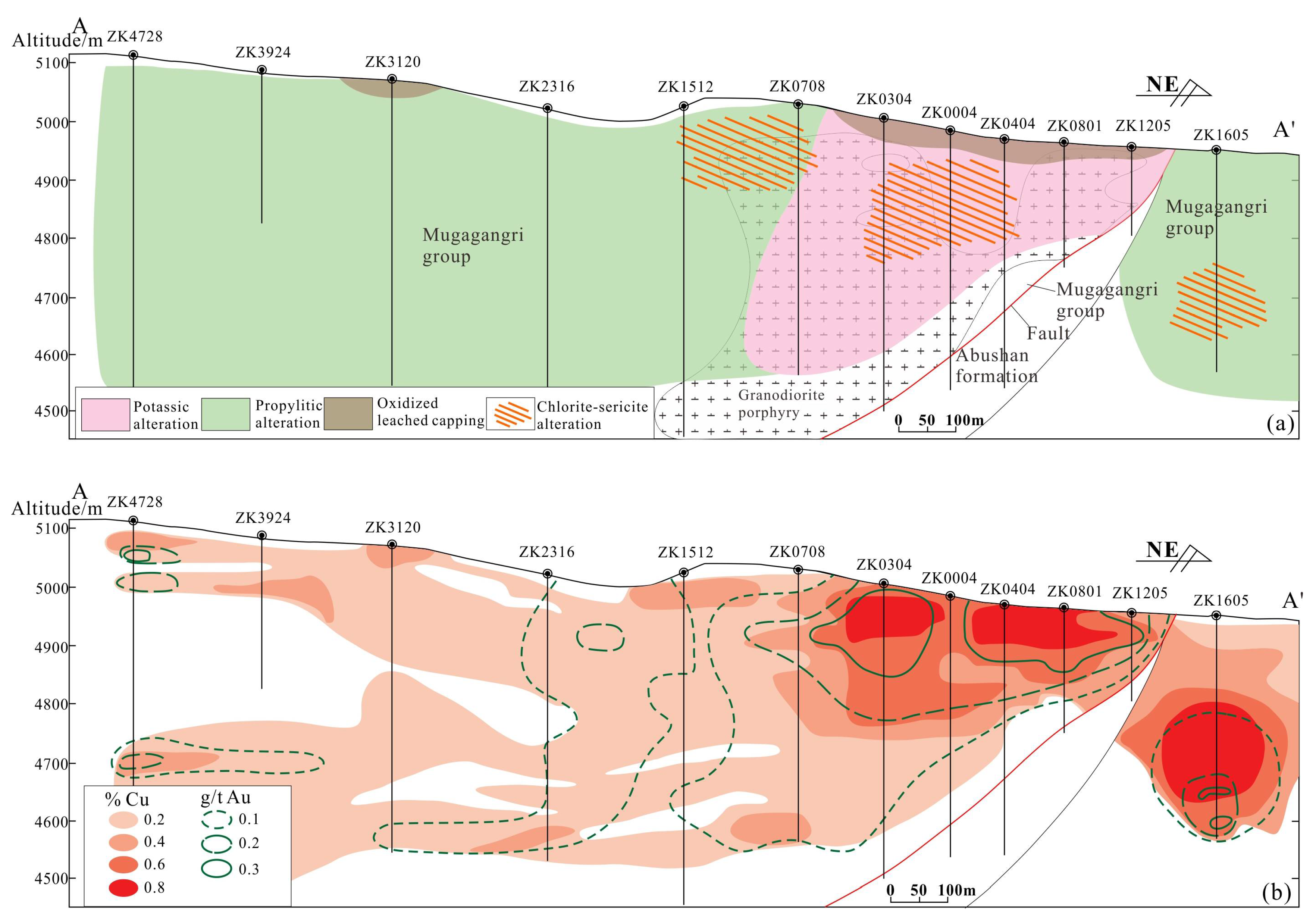
(a) Alteration zoning profile along section A-A’ and (b) Copper and gold grade distribution in the Duobuza deposit.
The ore-bearing intrusion is a granodiorite porphyry, characterized by high potassium and low sodium contents, with a small surface exposure. It is mainly distributed at the intersections of east–west and northeast-trending faults [21,22,23]. Zircon U-Pb dating of the ore-forming intrusion yields ages of 119.32 ± 0.74 Ma to 127.8 ± 2.6 Ma, with a concentration around 120 Ma [24,25,26,27]. A molybdenite Re-Os age of 118.0 ± 1.5 Ma has also been obtained [25].
3.2. Alteration Zoning and Sulfide Characteristics
The porphyry deposits in the Duolong district are characterized by potassic alteration in the core, surrounded by a roughly coeval propylitic halo, with subsequent chlorite–sericite alteration overprinting the earlier assemblages [2]. In the northern part of the district, a post-mineralization reverse fault (F2) has thrust the ore-bearing porphyry complex over the Upper Cretaceous Abushan Formation (Figure 3b).
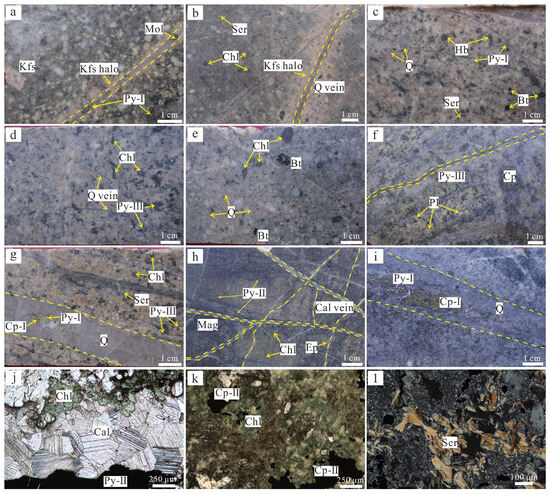
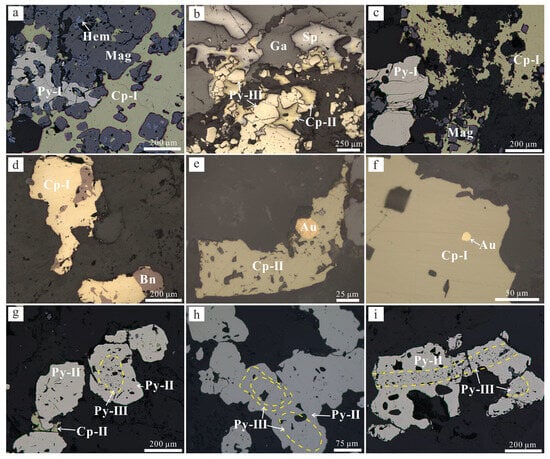
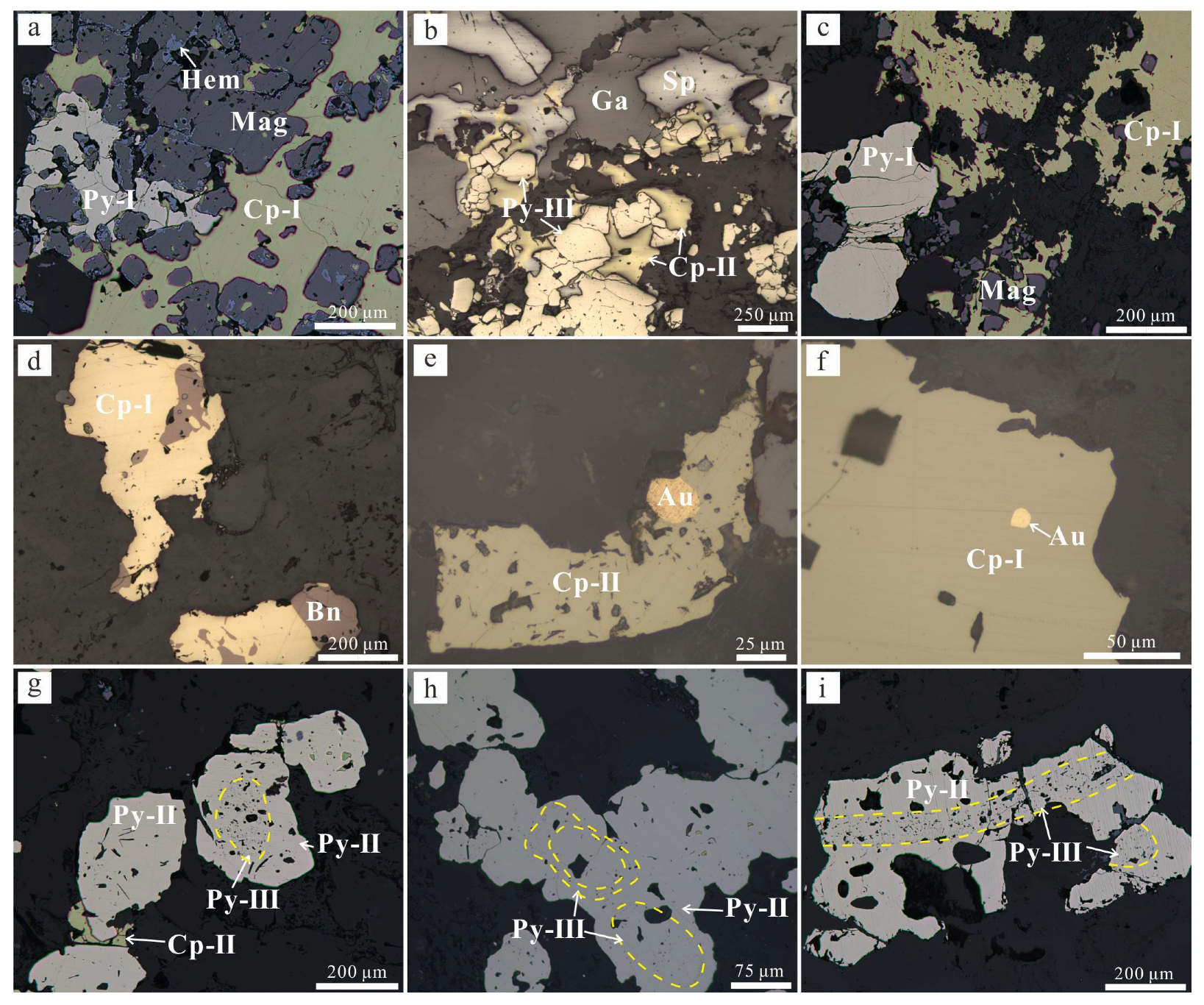
Potassic Alteration: As the earliest alteration type in the Duolong porphyry deposits, directly related to high-temperature magmatic-hydrothermal fluids, it is primarily distributed at the apex of the ore-forming intrusion and in the wall rocks contacting the intrusion. The early magmatic-hydrothermal transition stage represents a critical period for the extraction of ore-forming metals and sulfur from the silicate melt. The mineral assemblage in this zone includes potassium feldspar, biotite, quartz, anhydrite, magnetite, and Cu-Fe sulfides. Potassium feldspar alteration is manifested by the replacement of plagioclase phenocrysts by secondary potassium feldspar, accompanied by abundant irregular quartz-potassium feldspar veins and potassium feldspar stringers (Figure 4a,b) [28]. Co-existing pyrite-I and chalcopyrite-I are observed in this zone (Figure 4g,i). Pyrite-I grains are euhedral to anhedral, with the anhedral varieties containing inclusions of magnetite, chalcopyrite, and biotite (Figure 5a,c). Chalcopyrite-I typically occurs in veins associated with pyrite-I and is partially replaced by bornite (Figure 5d).
Figure 4.
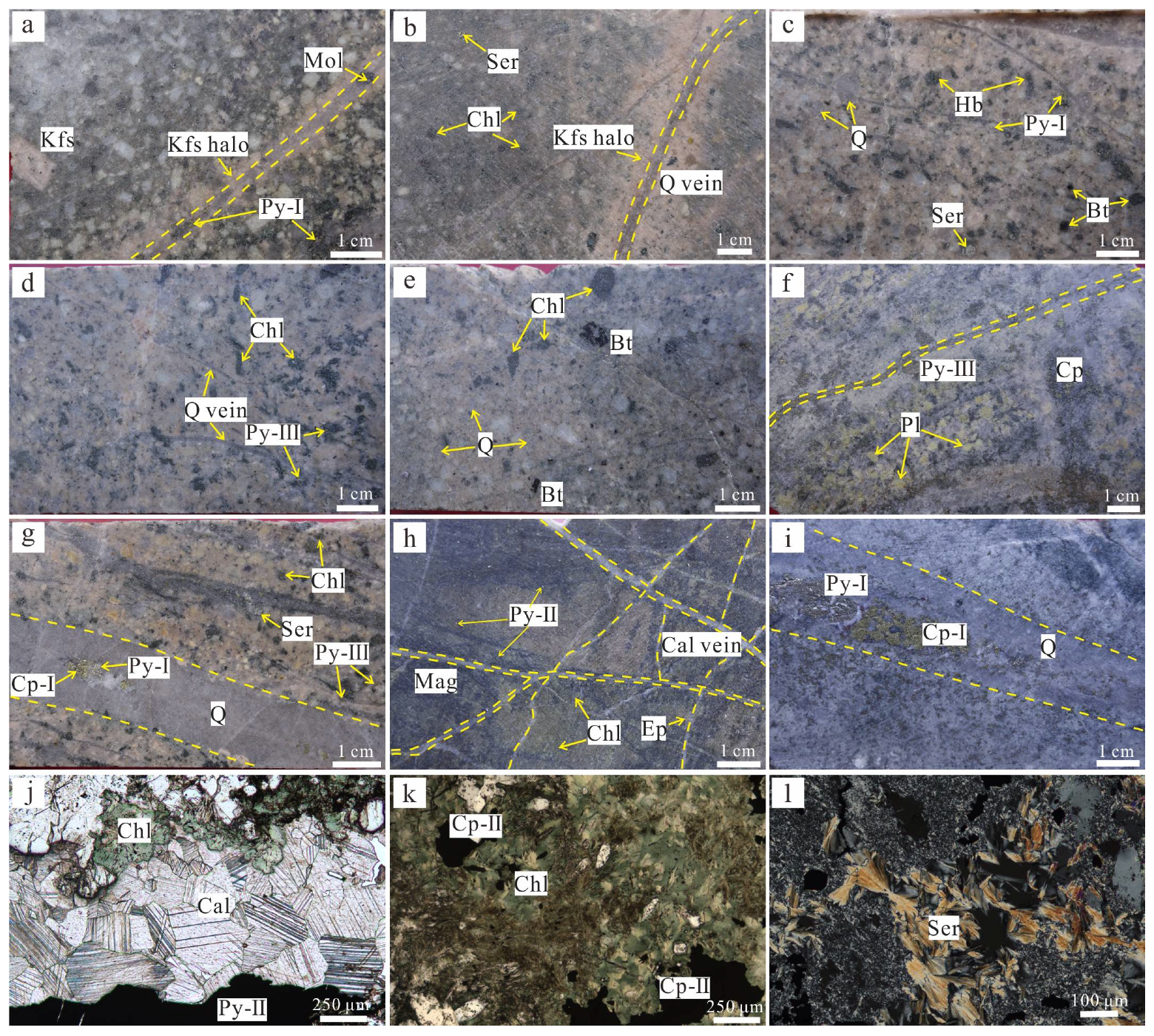
Representative hand specimens and photomicrographs from the Duolong porphyry deposits, Tibet. (a) Granodiorite porphyry exhibiting K-feldspar alteration of feldspar phenocrysts and a K-feldspar alteration halo surrounding a quartz + molybdenite vein, with disseminated pyrite-I. (b) Granodiorite porphyry with a quartz vein displaying a K-feldspar alteration halo, sericitization of feldspar phenocrysts, and chloritization of amphibole phenocrysts. (c) Granodiorite porphyry showing biotitization and sericitization, with disseminated pyrite-I. (d) Granodiorite porphyry with chloritization of amphibole phenocrysts and disseminated pyrite-III. (e) Granodiorite porphyry exhibiting chloritization and biotitization of amphibole phenocrysts. (f) Granodiorite porphyry containing pyrite-III veinlets and patchy chalcopyrite. (g) Granodiorite porphyry with sericite and K-feldspar alteration, showing quartz + pyrite + chalcopyrite veins and disseminated pyrite-III. (h) Feldspathic quartz sandstone with propylitic alteration and calcite veinlets. (i) Feldspathic quartz sandstone containing quartz + pyrite + chalcopyrite veins. (j) Calcite + chlorite vein. (k) Chalcopyrite-II within a chlorite vein. (l) Flaky sericite. Abbreviations: Hb—hornblende, Bt—biotite, Kfs—K-feldspar, Ser—sericite, Chl—chlorite, Ep—epidote, Cal—calcite, Mol—molybdenite, Py—pyrite, Cp—chalcopyrite.
Figure 5.
Photomicrographs of major ore minerals from the Duolong porphyry deposits, Tibet. Abbreviations: Mag—magnetite, Hem—hematite, Ga—galena, Sp—sphalerite, Bn—bornite, Cp—chalcopyrite, Py—pyrite, Au—native gold. (a) Hematite replaces magnetite, associated with Py-I and Cp-I; (b) Sphalerite and galena veins, hosting Cp-II and Py-III; (c) Py-I and Cp-I, with disseminated magnetite; (d) Bornite replaces Cp-I; (e,f) Native gold occurs in Cp-I and Cp-II, respectively; (g) Py-II is altered to Py-III, with minor Cp-II; (h,i) Part of Py-II is altered to Py-III.
Propylitic Alteration: Formed nearly synchronously with potassic alteration, resulting from the mixing of early magmatic brines and circulated meteoric water heated by the intrusion [6]. The propylitic zone surrounds the potassic zone, extending several kilometers outward (Figure 3a). The main alteration minerals are chlorite, epidote, calcite, and quartz (Figure 4d,e,h). Core samples show patchy and veinlet chlorite, with biotite, amphibole, and feldspar phenocrysts being chloritized while largely retaining their original crystal shapes. Mineralization in this alteration zone is weak, manifested only by sporadic pyrite-II; and minor chalcopyrite-II associated with chlorite (Figure 4j).
Chlorite–sericite Alteration: Formed from lower-temperature fluids directly exsolved from late-stage magmatic differentiates and overprinted on the earlier potassic and propylitic alteration zones (Figure 3a). The main mineral assemblage comprises quartz, sericite, chlorite, muscovite, pyrite, and chalcopyrite (Figure 4b,g,k,l). Quartz–pyrite veins, quartz–pyrite–chalcopyrite veins, and quartz–chalcopyrite–bornite veins are developed. This zone contains pyrite-III and chalcopyrite-II. Pyrite-III commonly replaces pyrite-II, exhibiting surface pits and fractures surrounded by fine-grained chalcopyrite-II. Some pyrite-III is associated with galena and sphalerite. Chalcopyrite-II; occurs mainly in disseminated form, partially replacing pyrite-II, and also shows fine pits and fractures under reflected light (Figure 5g–i).
3.3. Mineralization Features
Mineralization in the Duolong porphyry deposits is primarily hosted within the ore-bearing porphyry and its contact zone with the wall rock. High-grade copper–gold mineralization is associated with potassic alteration, while large-scale lower-grade copper–gold mineralization is linked to both potassic and chlorite–sericite alterations (Figure 3b). The metallic minerals are dominated by chalcopyrite, followed by pyrite, magnetite, bornite, sphalerite, and hematite. The non-metallic minerals mainly include quartz, plagioclase, potassium feldspar, biotite, chlorite, amphibole, gypsum, sericite, calcite, and muscovite. The ore textures are predominantly vein-type and disseminated. Previous studies have established two major episodes and four hydrothermal stages for the Duolong porphyry deposits, namely the magmatic episode and the hydrothermal episode, with the latter subdivided into the potassic alteration stage, chlorite–sericite alteration stage, propylitic alteration stage, and sulfide-bearing vein stage [29].
4. Analytical Methods
Samples for in situ chemical composition and sulfur isotope analysis of pyrite and chalcopyrite were collected from drill cores intersecting different alteration zones of the Duolong porphyry deposits. Analyses were performed on polished thin sections with a thickness of 30 μm, which were prepared by Guangzhou Tuoyan Testing Service Co., Ltd. Guangzhou, China. This study involved electron probe microanalysis (EPMA) of pyrite, alongside LA-ICP-MS trace element analysis and in situ sulfur isotope analysis for both pyrite and chalcopyrite.
The EPMA work was conducted at the EPMA laboratory of the Institute of Mineral Resources, Chinese Academy of Geological Sciences, using a JXA-8230 instrument (JEOL Ltd., Tokyo, Japan). Operating conditions were set at an accelerating voltage of 15 kV, a beam current of 20 nA, and a spot size of 1–5 μm, with peak counting times of 10 s.
Laser Ablation Inductively Coupled Plasma Mass Spectrometry (LA-ICP-MS) analysis was performed at the National Research Center for Geoanalysis. The system comprised a Thermo Element II ICP-MS (Thermo Fisher Scientific, Waltham, MA, USA) coupled with a New Wave UP-213 laser ablation system. Analysis used a 213 nm wavelength laser with a 40 μm spot size, operating at a pulse frequency of 10 Hz and an energy of 0.176 mJ (energy density of 23–25 J/cm2). Helium was used as the carrier gas. The analysis sequence involved a 15 s background measurement with the laser blocked, followed by a 45 s sample ablation data acquisition, and a final 15 s washout period, resulting in a total analysis time of 75 s per spot. ICP-MS parameters included a cool gas (Ar) flow of 15.55 L/min, an auxiliary gas (Ar) flow of 0.67 L/min, a carrier gas (He) flow of 0.58 L/min, a sample gas flow of 0.819 L/min, and an RF power of 1205 W. Data calibration employed external standards, specifically NIST-612 and MASS-1.
In situ sulfur isotope analysis was conducted by Laser Ablation Multi-Collector Inductively Coupled Plasma Mass Spectrometry (LA-MC-ICP-MS) at the MNR Key Laboratory of Metallogeny and Mineral Assessment, Institute of Mineral Resources, Chinese Academy of Geological Sciences. The system consists of a Resolution S155 laser ablation system coupled with a Neptune Plus MC-ICP-MS (Thermo Fisher Scientific, Bremen, Germany). Helium was used as the carrier gas during ablation. Analyses were performed in single-spot mode with a fixed laser energy density of 5.0 J/cm2. Laser conditions, typically a medium spot size (32 μm) and low frequency (4 Hz), were selected based on grain size to ensure a stable signal. The Neptune Plus mass spectrometer, equipped with nine Faraday cups and one 1011 Ω resistor amplifier, was operated in medium-resolution mode (approximately 7000) to avoid isobaric interferences. The signals for 32S, 33S, and 34S were simultaneously collected statically in Faraday cups L3, C, and H3, respectively. Mass bias correction for sulfur isotopes was applied using the SSB method. The pyrite standards Balmat [30] and YP136 [31], and the chalcopyrite standard HTS4-6 [31] were used for calibration. The analytical precision (1σ) for δ34S values is better than 0.5‰.
5. Results
5.1. Major Elements in Pyrite
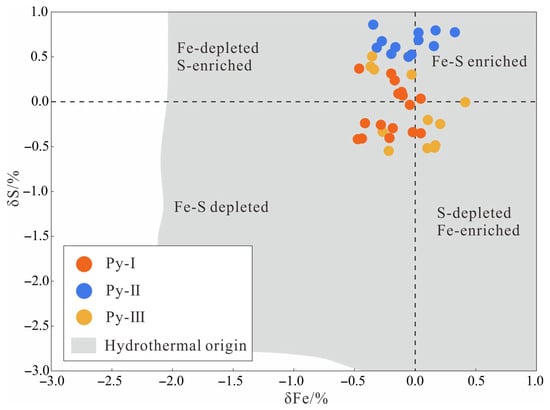
The major element contents of different types of hydrothermal pyrite (Figure 6) from the mineralization stage of the Duolong porphyry deposits in Tibet are presented in Table S1. The theoretical chemical formula for pyrite is FeS2, with ideal S and Fe contents of 53.45 wt.% and 46.55 wt.%, respectively, resulting in a mass ratio S/Fe = 1.148 and an atomic ratio S/Fe = 2. The analytical results show that Py-I contains 46.08–46.60 wt.% Fe (mean 46.35) and 53.04–53.82 wt.% S (mean 53.35). Py-II contains 46.20–46.88 wt.% Fe (mean 46.49) and 53.95–54.31 wt.% S (mean 54.11). Py-III contains 46.18–46.96 wt.% Fe (mean 46.51) and 52.90–53.96 wt.% S (mean 53.39). Overall, Py-I and Py-III show a depletion in Fe, whereas Py-II is distinctly S-enriched.
Figure 6.
δFe–δS diagram for pyrite from the Duolong porphyry deposits, Tibet (modified from Yan et al., 2012) [32]. Note: δFe and δS represent the difference between the Fe and S contents measured by electron probe microanalysis in pyrite and the standard Fe and S contents of pyrite.
5.2. Trace Elements in Pyrite and Chalcopyrite
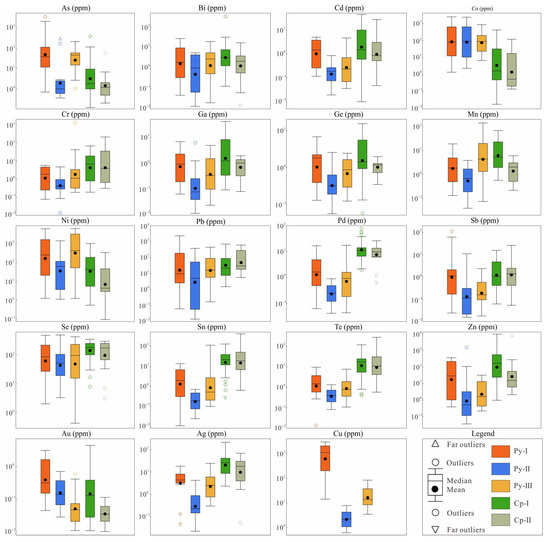
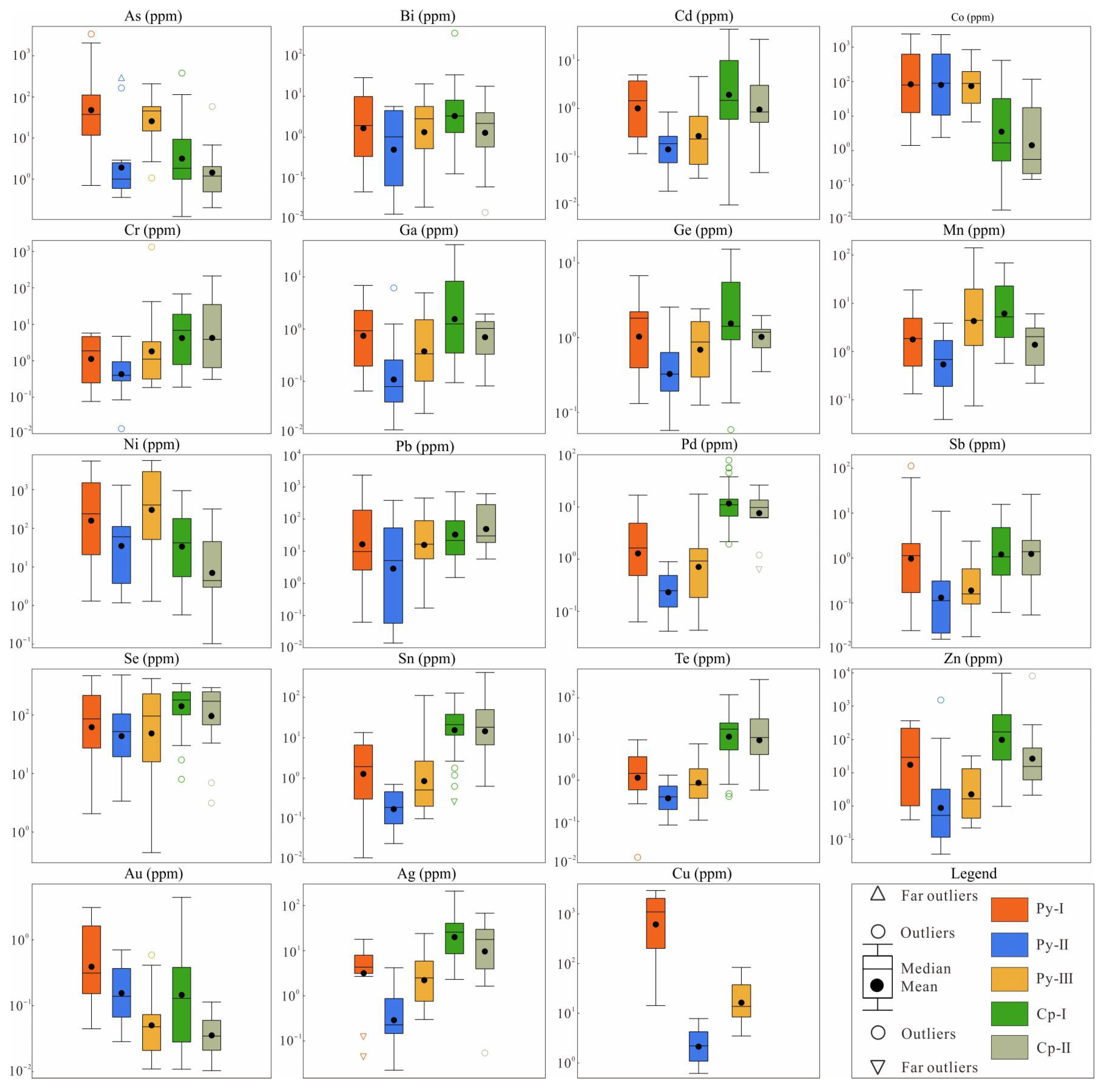
Trace element analyses of pyrite and chalcopyrite from different stages in the Duolong porphyry deposits are presented in Table S2 and Figure 7, comprising 14 analytical spots on Py-I, 16 on Py-II, 13 on Py-III, 31 on Cp-I, and 15 on Cp-II. In addition, during the mapping process, some pyrite data were cited from Lin, 2018 [33], which have been marked in Table S2. For trace element data falling below the detection limit, this study employed a random forest regression model for data imputation. This approach constructs predictive models based on the co-existing or antagonistic relationships among detectable elements (e.g., using Cu, As, Co to predict Se and Te). Given that the trace elements in different types of pyrite and chalcopyrite analyzed in this study do not exhibit linear relationships, the use of a random forest regression model for imputing data below the detection limit enables ensemble learning to capture complex nonlinear correlations, thereby effectively reducing the bias associated with conventional imputation methods (e.g., LOD/2).
Figure 7.
Box plots of trace element concentrations in pyrite and chalcopyrite from the Duolong porphyry deposits, Tibet.
Py-I is characterized by high concentrations of Cu (14.31 ppm to 2953.53 ppm, mean 1149.14 ppm), Au (0.04 ppm to 3.09 ppm, mean 0.87 ppm), Ag (0.04 ppm to 17.88 ppm, mean 6.28 ppm), As (0.70 ppm to 3400.49 ppm, mean 465.57 ppm), Cd (0.19 ppm to 4.96 ppm, mean 1.85 ppm), and Sb (0.02 ppm to 112.40 ppm, mean 13.27 ppm).
Py-II exhibits low concentrations of Cu (0.62 ppm to 7.83 ppm, mean 2.79 ppm), Ag (0.05 ppm to 4.19 ppm, mean 0.71 ppm), As (0.36 ppm to 294.46 ppm, mean 29.78 ppm), Ga (0.04 ppm to 6.17 ppm, mean 0.55 ppm), Ge (0.06 ppm to 2.56 ppm, mean 0.51 ppm), Sn (0.02 ppm to 0.58 ppm, mean 0.26 ppm), Te (0.08 ppm to 1.33 ppm, mean 0.48 ppm), and Zn (0.04 ppm to 1518.92 ppm, mean 102.84 ppm). However, its Au content (0.03 ppm to 0.70 ppm, mean 0.23 ppm) is relatively enriched compared to Py-III.
Py-III shows concentrations of As (1.07 ppm to 208.79 ppm, mean 48.94 ppm), Bi (0.02 ppm to 19.95 ppm, mean 4.12 ppm), Co (6.75 ppm to 847.66 ppm, mean 174.04 ppm), Cr (0.20 ppm to 1323.05 ppm, mean 106.03 ppm), Pb (0.17 ppm to 449.10 ppm, mean 75.85 ppm), Se (0.45 ppm to 412.73 ppm, mean 124.81 ppm), Te (0.11 ppm to 7.68 ppm, mean 1.74 ppm), and Ag (0.30 ppm to 23.99 ppm, mean 4.54 ppm) that are nearly comparable to those in Py-I. Nevertheless, the Au content in Py-III (0.01 ppm to 0.41 ppm, mean 0.11 ppm) is the lowest among the three types of pyrite.
Cp-I is significantly enriched in Au (0.01 ppm to 4.40 ppm, mean 0.59 ppm), Zn (0.98 ppm to 9716.33 ppm, mean 841.33 ppm), Ni (0.57 ppm to 940.89 ppm, mean 165.07 ppm), and Mn (0.57 ppm to 68.57 ppm, mean 16.59 ppm), and slightly enriched in Bi (0.13 ppm to 342.83 ppm, mean 16.77 ppm), Cd (0.01 ppm to 43.82 ppm, mean 6.63 ppm), and Co (0.02 ppm to 413.71 ppm, mean 54.53 ppm) compared to Cp-II. The concentrations of elements such as Ag, Te, Sn, Se, Sb, Pd, and Pb are nearly equivalent in both Cp-I and Cp-II.
5.3. Sulfur Isotopes of Pyrite and Chalcopyrite
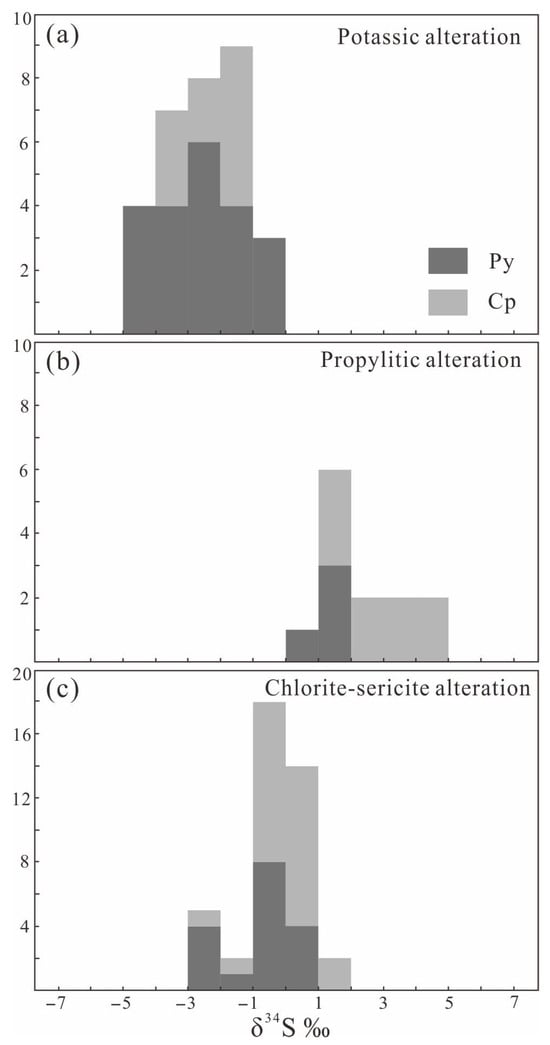
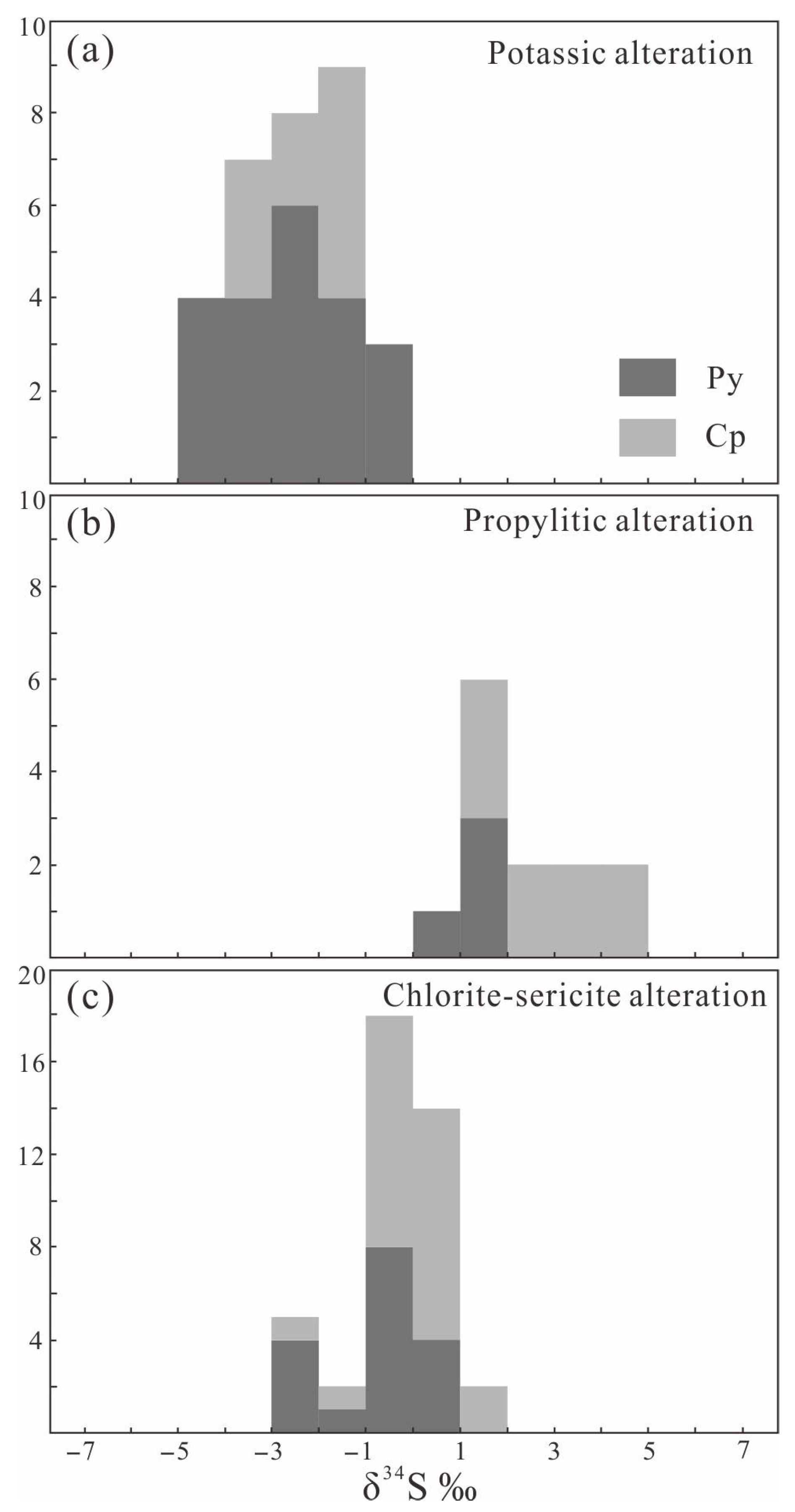
The sulfur isotope results for pyrite and chalcopyrite associated with porphyry mineralization in the Duolong district, Tibet, are presented in Table S3 and Figure 8, comprising analyses of two Py-I, four Py-II, nine Py-III, eight Cp-I, and thirteen Cp-II samples. Pyrite (−3.70‰ to −1.16‰, mean −2.14‰) and chalcopyrite (−4.92‰ to −0.90‰, mean −2.54‰) from the potassic alteration zone are characterized by distinctly low δ34S values (Figure 8a). In contrast, pyrite (1.20‰ to 5.16‰, mean 3.06‰) from the propylitic alteration zone exhibits significantly enriched δ34S signatures (Figure 8b). Pyrite (−2.00‰ to 1.86‰, mean −0.06‰) from the chlorite–sericite alteration zone shows slightly enriched δ34S values, whereas coexisting chalcopyrite (−2.50‰ to 0.58‰, mean −0.77‰) is characterized by slightly depleted δ34S values (Figure 8c).
Figure 8.
Frequency histograms of δ34S values for pyrite and chalcopyrite from different alteration zones in the Duolong porphyry deposits, Tibet. (a) potassic alteration; (b) propylitic alteration; (c) chlorite-sericite alteration.
6. Discussion
6.1. Gold Occurrence
In porphyry Cu-Au deposits, gold primarily occurs as native gold or electrum (AgAu) associated with Cu-Fe sulfides (bornite or chalcopyrite), with minor amounts present as discrete phases within or adjacent to quartz grains [4,34]. In some porphyry Cu-Au deposits, gold is hosted within pyrite (e.g., Assarel, Batu Hijau) [35,36] or marcasite (e.g., Ok Tedi) [4]. Many porphyry Cu-Au deposits exhibit significant magnetite enrichment (comprising 3%–10% of the altered rock) [4], where Cu and Au show a close spatial association with magnetite [37,38,39].
The Duolong porphyry deposits in Tibet display a typical porphyry alteration zoning pattern, progressing outward from the porphyry center through potassic, chlorite–sericite, and propylitic alteration zones. Mineralization is predominantly developed within the potassic and chlorite–sericite zones, where copper mineralization occurs mainly as disseminated and vein-type chalcopyrite accompanied by abundant magnetite [28,29]. The distribution of copper and gold grades at the Duolong porphyry deposits shows a strong correlation, indicating a close genetic relationship between Cu and Au mineralization. Experimental studies have demonstrated that bornite solid solutions in the Au–Cu–Fe–S system can contain at least one order of magnitude higher gold concentrations than chalcopyrite [40,41], making bornite the preferred host for gold in most porphyry deposits [34,36]. However, at the Duolong porphyry deposits, bornite is rare and copper sulfides are dominated by chalcopyrite, suggesting that gold mineralization is mainly associated with chalcopyrite. Detailed microscopic observations reveal that gold occurs as native gold within chalcopyrite (Figure 5e,f). Although gold concentrations in chalcopyrite are generally low due to its exsolution from solid solution, variations exist between chalcopyrite from different alteration zones. Chalcopyrite from the potassic zone (Cp-I) contains higher gold concentrations than Cp-II from the chlorite–sericite zone. Furthermore, pyrite from different alteration zones shows significant differences in gold content, with Py-I from the potassic zone containing the highest gold values and Py-III from the chlorite–sericite zone containing the lowest. Previous research indicates two primary modes of gold occurrence in pyrite: incorporation into the crystal lattice as solid solution (Au+), or presence as micron-sized native gold (Au0) particles [42].
The current study relies primarily on petrographic observations and trace element geochemistry of pyrite to constrain the occurrence of gold, which is insufficient to fully characterize the precise gold speciation in the Duolong porphyry deposit. Systematic scanning electron microscope and transmission electron microscope analyses are therefore required in future work to address this issue.
6.2. Controls on Pyrite Composition
Pyrite, as one of the most common sulfide minerals in hydrothermal deposits, possesses the capacity to incorporate high concentrations of various trace elements (e.g., As, Cu, Tl) [43,44,45]. Thermodynamic calculations indicate that arsenic can be stably incorporated into the pyrite lattice at concentrations up to 6 wt.% [46].
The compositional variations of trace elements in pyrite can be attributed to several mechanisms, including temperature fluctuations, adsorption capacity of pyrite, grain size, fluid chemistry, and the availability of iron and/or sulfur [47]. At elevated temperatures, where pyrite crystallization rates are relatively slow, many trace elements remain in solution and are less readily incorporated into the pyrite lattice. However, studies have shown that Co and Ni can substitute for Fe in a stoichiometric manner at temperatures up to 400 °C [48], while Se and Te may similarly replace S [45]. Electron microprobe analyses of pyrite-I and pyrite-III reveal an overall Fe-deficient composition and enrichment in trace elements such as Co, Sn, Cr, Mn, Ni, and As. This suggests that pyrite-I and pyrite-III crystallized slowly from a high-temperature, trace element-enriched magmatic-hydrothermal fluid, facilitating the incorporation of these elements. In contrast, pyrite formed at lower temperatures crystallizes rapidly, promoting the incorporation of trace elements through adsorption onto crystal surfaces [43]. During rapid growth, adsorbed atoms on the crystal surface may be encapsulated by newly precipitated pyrite layers [49]. Although pyrite-II formed at lower temperatures, it does not exhibit trace element enrichment but is notably depleted in elements such as As, Ga, Ge, Mn, Ni, Pd, Sn, and Zn. This is likely attributable to the formation of pyrite-II from a fluid resulting from the mixing of magmatic-hydrothermal fluid and meteoric water, wherein the meteoric component diluted the trace element concentrations of the magmatic fluid, leading to the depletion of most trace elements in pyrite-II. Although Pyrite-II is depleted in most trace elements, it exhibits a slight enrichment in S compared to Pyrite-I and Pyrite-III. This is likely attributable to the fact that Pyrite-II formed in a relatively open system at lower temperatures (<300 °C) with extensive fluid–rock interaction, conditions under which sulfur activity in the fluid was elevated, thereby facilitating sulfur enrichment in pyrite. However, whether fluid mixing directly caused the trace element depletion in Pyrite-II remains to be tested by future fluid inclusion studies aimed at obtaining direct evidence.
It is worth noting that, although the trace element compositions of pyrite from the potassic and chlorite–sericite alteration zones differ in certain aspects—reflecting distinct fluid characteristics between the two hydrothermal stages—the trace element signatures of chalcopyrite from these two stages show relatively minor differences. This phenomenon may be attributed to the contrasting crystal chemical properties of chalcopyrite and pyrite: pyrite has a more open crystal structure and is therefore more sensitive to changes in fluid composition, whereas chalcopyrite possesses a more compact structure with limited trace element incorporation capacity. Moreover, the physicochemical conditions (sulfur fugacity, copper activity) governing chalcopyrite precipitation may have been similar during both stages, resulting in a strong inheritance in its trace element composition.
6.3. Metallogenic Process of the Duolong Porphyry Deposits
In porphyry deposits, the high-temperature and highly oxidized nature of the mineralizing fluids at the ore center allows for the coexistence of sulfate minerals such as anhydrite and barite during the precipitation of copper–iron sulfides (e.g., bornite, chalcopyrite). The preferential incorporation of 34S follows the sequence: SO42− ≥ HSO4− > SO32− > SO2 > S > H2S ≥ HS− ≥ S2− [50]. Consequently, heavy sulfur (34S) is preferentially sequestered into sulfate minerals in the central zone, resulting in 34S-depleted residual fluids and consequently negative δ34S values in coeval metallic sulfides. Towards the periphery, water–rock interactions in the propylitic alteration zone reduce magmatic sulfates to generate oxidized iron minerals (e.g., magnetite) and S2−, leading to progressively higher δ34S values in pyrite formed at this stage. Sulfur isotope data from the Duolong porphyry deposits indicate that pyrite and chalcopyrite from the potassic alteration zone are distinctly depleted in 34S, whereas their counterparts in the propylitic zone are significantly enriched in 34S, reflecting substantial evolution of the hydrothermal fluid from early to late stages. The elevated δ34S values of Py-II in the propylitic alteration zone (1.20‰–5.16‰) can be attributed to the combined effects of meteoric water mixing. On the one hand, the low-temperature, oxidized mixed fluids promoted sulfate reduction, during which the H2S generated inherited a heavy sulfur signature. On the other hand, the meteoric water may have carried high-δ34S sulfate derived from shallow crustal sources, directly modifying the sulfur isotope composition of the mixed fluid.
The Duolong porphyry deposits are a typical porphyry Cu-Au system, with mineralization related to a highly oxidized granodiorite porphyry [28,51,52,53]. High-grade Cu-Au mineralization is associated with potassic alteration, while large-scale mineralization is linked to both potassic and chlorite–sericite alteration, highlighting the critical role of early potassic alteration. Although cooling is recognized as one of the most effective metal precipitation mechanisms in porphyry deposits, fluid inclusion data from the propylitic zone at the Duolong porphyry deposits (homogenization temperatures of 250–450 °C) [54] indicate significant cooling without widespread sulfide precipitation, suggesting that cooling alone is insufficient to explain the mineralization. Instead, cooling induced by fluid boiling is proposed as the dominant mechanism for metal precipitation at Duobuza, as rapid heat loss during boiling efficiently drives ore deposition [55,56].
7. Conclusions
(1). High-grade copper–gold mineralization in the Duolong porphyry deposits is primarily hosted within the potassic alteration zone, while large-scale lower-grade copper–gold mineralization is mainly associated with both potassic and chlorite–sericite alteration. Gold mineralization predominantly occurs as native gold, exsolved from solid solution and hosted within chalcopyrite. The specific chemical composition of gold minerals and their coupling relationship with the mineralization process remain to be further investigated.
(2). In porphyry deposits of the Duolong district, the trace element compositions of pyrite from different alteration zones show marked variations that sensitively record multistage fluid evolution. Pyrite from the potassic zone (Py-I) is enriched in Cu, indicating efficient copper transport by early-stage, high-temperature magmatic fluids. Pyrite from the chlorite–sericite zone (Py-III) is depleted in Au, which, together with the occurrence of gold as native gold exsolved from chalcopyrite, suggests that gold was predominantly precipitated during the early hydrothermal stage. Pyrite from the propylitic zone (Py-II) is depleted in trace elements, reflecting fluid cooling and dilution due to mixing with meteoric water.
(3). Sulfur isotop compositions provide further constraints on the fluid evolution process. Sulfides from the potassic zone (Py-I, Cp-I) exhibit the lowest δ34S values, representing the initial magmatic sulfur signature. The significantly elevated δ34S values of pyrite from the propylitic zone (Py-II) indicate meteoric water mixing and associated sulfate reduction. Sulfides from the chlorite–sericite zone (Py-III, Cp-II) show intermediate δ34S values, reflecting transitional characteristics between magmatic and mixed fluids. Collectively, these two fluid episodes define a complete hydrothermal evolution sequence for the porphyry metallogenic system.
Supplementary Materials
The following supporting information can be downloaded at: https://www.mdpi.com/article/10.3390/min16050478/s1, Table S1: Electron probe microanalyses (EPMA) of various pyrite types from porphyry deposits in the Duolong ore district, Tibet; Table S2: Trace element compositions of different types of pyrite and chalcopyrite from porphyry deposits in the Duolong ore district, Tibet; Table S3: Sulfur isotopic compositions of pyrite and chalcopyrite from different alteration types in porphyry deposits of the Duolong ore district, Tibet.
Author Contributions
Conceptualization, Q.Z. and H.Y.; Methodology, S.L. and Q.W.; Validation, Y.D. and H.L.; Formal analysis, C.Y. and C.G.; Investigation, R.Z., X.F. and X.L.; Original draft writing, Q.Z.; Review and editing, H.Y. and S.L. Project administration, H.Y. All authors have read and agreed to the published version of the manuscript.
Funding
National Natural Science Foundation of China (Grant No. 42472140, 42230813), Central Government Guided Local Scientific and Technological Development Funding Project (Grant No. XZ202401YD0006) and the China Geological Survey Project (Grant No. DD20230362 and DD20230054).
Data Availability Statement
The original contributions presented in this study are included in the article/Supplementary Material. Further inquiries can be directed to the corresponding author(s).
Acknowledgments
We are grateful to Linghao Zhao of the National Research Center for analysis, to Chao Duan and candidate Jiaxin Zhang of the Institute of Mineral Resources, Chinese Academy of Geological Sciences (CAGS), for their guidance during experimental analysis, and to the Tibet Jinlong Mining Company, Sichuan Hongda Mining Company, and the No. 5 Geological Party of the Tibet Bureau of Geology and Mineral Exploration and Development for their assistance with fieldwork. We thank the three anonymous reviewers for their valuable comments on this manuscript.
Conflicts of Interest
She Li was employed by the Tibet Jinlong Mining Co., Ltd., Lhasa 859200, China. The remaining authors declare that the research was conducted in the absence of any commercial or financial relationships that could be construed as a potential conflict of interest.
References
- Sun, W.; Huang, R.; Li, H.; Hu, Y.; Zhang, C.; Sun, S.; Zhang, L.; Ding, X.; Li, C.; Zartman, R.E.; et al. Porphyry Deposits and Oxidized Magmas. Ore Geol. Rev. 2015, 65, 97–131. [Google Scholar] [CrossRef] [Scilit]
- Sillitoe, R.H. Porphyry Copper Systems. Econ. Geol. 2010, 105, 3–41. [Google Scholar] [CrossRef] [Scilit]
- Lowell, J.D.; Guilbert, J.M. Lateral and Vertical Alteration-Mineralization Zoning in Porphyry Ore Deposits. Econ. Geol. 1970, 65, 373–408. [Google Scholar] [CrossRef] [Scilit]
- Sillitoe, R.H. Gold-Rich Porphyry Deposits: Descriptive and Genetic Models and Their Role in Exploration and Discovery. Econ. Geol. 2000, 13, 315–345. [Google Scholar] [CrossRef] [Scilit]
- Xu, X.W.; Zhang, B.L.; Liang, G.H.; Qin, K.Z. Zoning of Mineralization in Hypogene Porphyry Copper Deposits: Insight from Comb Microfractures within Quartz–Chalcopyrite Veins in the Hongshan Porphyry Cu Deposit, Western Yunnan, SW China. J. Asian Earth Sci. 2012, 56, 218–228. [Google Scholar] [CrossRef] [Scilit]
- Cooke, D.R.; Hollings, P.; Wilkinson, J.J.; Tosdal, R.M. Geochemistry of Porphyry Deposits. In Treatise on Geochemistry; Elsevier: Oxford, UK, 2014; pp. 357–381. [Google Scholar] [CrossRef] [Scilit]
- Li, J.; Chen, H.; Su, L.; Xiao, B.; Wang, Y. Experimental study of high to intermediate temperature alteration in porphyry copper systems and geological implications. Sci. China Earth Sci. 2019, 49, 611–634, (In Chinese with English abstract). [Google Scholar] [CrossRef] [Scilit]
- Zhang, X.N.; Li, G.M.; Qin, K.Z.; Lehmann, B.; Li, J.X.; Zhao, J.X. Porphyry to Epithermal Transition at the Rongna Cu-(Au) Deposit, Tibet: Insights from H-O Isotopes and Fluid Inclusion Analysis. Ore Geol. Rev. 2020, 123, 103585. [Google Scholar] [CrossRef] [Scilit]
- Large, R.R.; Danyushevsky, L.; Hollit, C.; Maslennikov, V.; Meffre, S.; Gilbert, S.; Bull, S.; Scott, R.; Emsbo, P.; Thomas, H.; et al. Gold and Trace Element Zonation in Pyrite Using a Laser Imaging Technique: Implications for the Timing of Gold in Orogenic and Carlin-Style Sediment-Hosted Deposits. Econ. Geol. 2009, 104, 635–668. [Google Scholar] [CrossRef] [Scilit]
- Gregory, D.; Mukherjee, I.; Olson, S.L.; Large, R.R.; Danyushevsky, L.V.; Stepanov, A.S.; Avila, J.N.; Cliff, J.; Ireland, T.R.; Raiswell, R.; et al. The Formation Mechanisms of Sedimentary Pyrite Nodules Determined by Trace Element and Sulfur Isotope Microanalysis. Geochim. Cosmochim. Acta 2019, 259, 53–68. [Google Scholar] [CrossRef] [Scilit]
- Tang, J.; Yang, H.; Li, H.; Wang, Q.; Li, Y.; Li, S.; Lin, B.; Li, F.; Zhai, J.; Tang, X.; et al. Geological characteristics and prospecting potential analysis of Duolong porphyry-epithermal copper (gold) ore district in Tibet. China Min. Mag. 2024, 33, 1–13, (In Chinese with English abstract). [Google Scholar]
- Shi, R. SHRIMP Dating of the Bangong Lake SSZ-Type Ophiolite: Constraints on the Closure Time of Ocean in the Bangong Lake-Nujiang River, Northwestern Tibet. Chin. Sci. Bull. 2007, 52, 936–941. [Google Scholar] [CrossRef] [Scilit]
- Metcalfe, I. Gondwana Dispersion and Asian Accretion: Tectonic and Palaeogeographic Evolution of Eastern Tethys. J. Asian Earth Sci. 2013, 66, 1–33. [Google Scholar] [CrossRef] [Scilit]
- Pan, G.; Wang, L.; Li, R.; Yuan, S.; Ji, W.; Yin, F.; Zhang, W.; Wang, B. Tectonic Evolution of the Qinghai-Tibet Plateau. J. Asian Earth Sci. 2012, 53, 3–14. [Google Scholar] [CrossRef] [Scilit]
- Yin, A.; Harrison, T.M. Geologic Evolution of the Himalayan-Tibetan Orogen. Annu. Rev. Earth Planet. Sci. 2000, 28, 211–280. [Google Scholar] [CrossRef] [Scilit]
- Girardeau, J.; Marcoux, J.; Allègre, C.J.; Bassoullet, J.P.; Tang, Y.; Xiao, X.; Zao, Y.; Wang, X. Tectonic Environment and Geodynamic Significance of the Neo-Cimmerian Donqiao Ophiolite, Bangong-Nujiang Suture Zone, Tibet. Nature 1984, 307, 27–31. [Google Scholar] [CrossRef] [Scilit]
- Song, Y.; Tang, J.; Qu, X.; Wang, D.; Xin, H.; Lin, B.; Fan, S. Progress in the study of mineralization in the Bangongco-Nujiang metallogenic belt and some new recognition. Adv. Earth Sci. 2014, 29, 795–809, (In Chinese with English abstract). [Google Scholar]
- Wang, Q.; Tang, J.; Fang, X.; Lin, B.; Song, Y.; Wang, Y.; Yang, H.; Yang, C.; Li, Y.; Wei, L.; et al. Petrogenetic setting of andsites in Rongna ore block, Tiegelong Cu (Au-Ag) deposit, Duolong ore concentration area, Tibet: Evidence from zircon U-Pb LA-ICP-MS dating and petrogeochemistry of andsite. Geol. China 2015, 42, 1324–1336, (In Chinese with English abstract). [Google Scholar]
- Li, F.; Tang, J.; Zhang, J.; Song, Y.; Li, H.; Lin, B.; Wang, N. Discovery of late Early Cretaceous diorite porphyrite from the Shamuluo Formation in the Gaize area, Tibet: Response to the northward subduction plate rollback event of Bangongco-Nujiang Tethys Ocean. Acta Petrol. Sin. 2019, 38, 185–208, (In Chinese with English abstract). [Google Scholar]
- Li, Y.; Duo, J.; Zhong, W.; Li, Y.; Qiangba, W.; Chen, H.; Liu, H.; Zhang, J.; Zhang, T.; Xu, Z.; et al. An exploration model of the Duobuza porphyry Cu—Au deposit in Gaize Country, northern Tibet. Geol. Explor. 2012, 48, 274–287, (In Chinese with English abstract). [Google Scholar]
- Zhu, X.; Chen, H.; Ma, D.; Huang, H.; Li, G.; Wei, L.; Liu, C. Geology and Alteration of the Duobuza Porphyry Copper-Gold Deposit in Tibet. Geol. Explor. 2012, 48, 199–206, (In Chinese with English abstract). [Google Scholar]
- Song, Y.; Tang, J.; Liu, Z.; Li, F.; Wang, Q.; Xiao, Y.; Wang, Y. Mechanism of Tiegelongnan-Duobuza ramp style ore-controlling structure, Tibet: Evidence from geophysical exploration. Miner. Depos. 2019, 38, 1263–1277, (In Chinese with English abstract). [Google Scholar]
- Yang, H.; Li, Y.; Wang, Q. Characteristics of Ore-Controlling Structures in the Duobuza Porphyry Copper-Gold Deposit, Gaize County, Tibet. Acta Miner. Sin. 2013, 33, 360–361, (In Chinese with English abstract). [Google Scholar]
- Zhu, S.; Xu, L.; Wang, C.; Wang, H.; Huang, T. Zircon Geochronology of Ore-Forming Porphyries in the Duobuza Copper Mining Area, Tibet and Its Geological Significance. Resour. Inf. Eng. 2019, 34, 48–50, 53, (In Chinese with English abstract). [Google Scholar]
- She, H.; Li, J.; Ma, D.; Li, G.; Zhang, D.; Feng, C.; Qu, W.; Pan, G. Molybdenite Re-Os and SHRIMP zircon U-Pb dating of Duobuza porphyry copper deposit i n Ti bet and its geological implications. Miner. Depos. 2009, 28, 737–746, (In Chinese with English abstract). [Google Scholar]
- Li, J.; Li, G.; Qin, K.; Xiao, B. Geochemistry of porphyries and volcanic rocks and ore-forming geochronology of Duobuza gold-rich porphyry copper deposit in Bangonghu belt, Tibet: Constraints on metallogenic tectonic settings. Acta Petrol. Sin. 2008, 24, 531–543, (In Chinese with English abstract). [Google Scholar]
- Qu, X.; Xin, H. Ages and tectonic environment of the Bangong porphyry copper belt in western Tibet, China. Geol. Bull. China 2006, 7, 792–799, (In Chinese with English abstract). [Google Scholar]
- Zhang, Z.; Chen, Y.; Tang, J.; Li, Y.; Gao, K.; Wang, Q.; Li, Z.; Li, J. Alteration and Vein Systems of Duobuza Gold-Rich Porphyry Copper Deposit, Tibet. Miner. Depos. 2014, 33, 1268–1286, (In Chinese with English abstract). [Google Scholar]
- Fu, X.; Tang, J.; Yang, H.; Wang, Q.; Liang, X.; Zhang, Q.; Dong, Y.; Song, J.; Li, J.; Wang, J.; et al. Elemental Geochemical Characteristics of Magnetite and Its Indication of Mineralization Process in the Duobuza Porphyry Copper (Gold) Deposit, Tibet. Acta Geosci. Sin. 2023, 44, 498–510, (In Chinese with English abstract). [Google Scholar]
- Crowe, D.E.; Vaughan, R.G. Characterization and Use of Isotopically Homogeneous Standards for in Situ Laser Microprobe Analysis of 34S/32S Ratios. Am. Miner. 1996, 81, 187–193. [Google Scholar] [CrossRef] [Scilit]
- Li, R.; Xia, X.; Chen, H.; Wu, N.; Zhao, T.; Lai, C.; Yang, Q.; Zhang, Y. A Potential New Chalcopyrite Reference Material for Secondary Ion Mass Spectrometry Sulfur Isotope Ratio Analysis. Geostand. Geoanalytical Res. 2020, 44, 485–500. [Google Scholar] [CrossRef] [Scilit]
- Yan, Y.; Li, S.; Jia, B.; Zhang, N.; Yan, L. Composition typomorphic characteristics and statistic analysis of pyrite in gold deposits of different genetic type. Earth Sci. Front. 2012, 19, 214–226, (In Chinese with English abstract). [Google Scholar]
- Lin, B. Alteration and Mineralization of Tiegelongnan Giant Cu (Au, Ag) Deposit in Tibet. Ph.D. Thesis, Chinese Academy of Geological Sciences, Beijing, China, 2018. [Google Scholar]
- Aird, H.M.; Purcell, C.K.; DeWitt, N.; Matthews, J.; Capurro, T.; Claiborne, J.; Bermudez, J.; Meisel, Z. Gold-and Silver-Bearing Assemblages in the Ann-Mason Copper Porphyry Deposit, Yerington, Nevada. Ore Geol. Rev. 2021, 138, 104339. [Google Scholar] [CrossRef] [Scilit]
- Cioacă, M.E.; Munteanu, M.; Lynch, E.P.; Arvanitidis, N.; Bergqvist, M.; Costin, G.; Ivanov, D.; Milu, V.; Arvidsson, R.; Iorga-Pavel, A.; et al. Mineralogical Setting of Precious Metals at the Assarel Porphyry Copper-Gold Deposit, Bulgaria, as Supporting Information for the Development of New Drill Core 3D XCT-XRF Scanning Technology. Minerals 2020, 10, 946. [Google Scholar] [CrossRef] [Scilit]
- Arif, J.; Baker, T. Gold Paragenesis and Chemistry at Batu Hijau, Indoneisa: Implications for Gold-Rich Porphyry Copper Deposits. Miner. Depos. 2004, 39, 523–535. [Google Scholar] [CrossRef] [Scilit]
- Zhou, H.; Sun, X.; Cook, N.J.; Lin, H.; Fu, Y.; Zhong, R.; Brugger, J. Nano-to Micron-Particulate Gold Hosted by Magnetite in the Giant Beiya Gold Deposit: A Product of Gold Scavenging by Bismuth Melts. Econ. Geol. 2017, 112, 993–1010. [Google Scholar] [CrossRef] [Scilit]
- Palacios, C.; Herail, G.; Townley, B.; Maksaev, V.; Sepulveda, F.; De Parseval, P.; Rivas, P.; Lahsen, A.; Parada, M.A. The Composition of Gold in the Cerro Casale Gold-Rich Porphyry Deposit, Maricunga Belt, Northern Chile. Can. Miner. 2001, 39, 907–915. [Google Scholar] [CrossRef] [Scilit]
- Li, J.; Qin, K.; Li, G. Basic characteristics of gold-rich porphyry copper deposits and their ore sources and evolving processes of high oxidation magma and ore-forming fluid. Acta Petrol. Sin. 2006, 3, 678–688, (In Chinese with English abstract). [Google Scholar]
- Kesler, S.E.; Chryssoulis, S.L.; Simon, G. Gold in Porphyry Copper Deposits: Its Abundance and Fate. Ore Geol. Rev. 2002, 21, 103–124. [Google Scholar] [CrossRef] [Scilit]
- Simon, G.; Kesler, S.E.; Essene, E.J. Gold in Porphyry Copper Deposits: Experimental Determination of the Distribution of Gold in the Cu-Fe-S System at 400° to 700 °C. Econ. Geol. 2000, 95, 259–270. [Google Scholar] [CrossRef]
- Nigel, J.C.; Stephen, L.C. Concentrations of Invisible Gold in the Common Sulfides. Can. Miner. 1990, 28, 1–16. [Google Scholar]
- Abraitis, P.K.; Pattrick, R.A.D.; Vaughan, D.J. Variations in the Compositional, Textural and Electrical Properties of Natural Pyrite: A Review. Int. J. Miner. Process. 2004, 74, 41–59. [Google Scholar] [CrossRef] [Scilit]
- Ballantyne, J.M.; Moore, J.N. Arsenic Geochemistry in Geothermal Systems. Geochim. Cosmochim. Acta 1988, 52, 475–483. [Google Scholar] [CrossRef] [Scilit]
- Huston, D.L.; Sie, S.H.; Suter, G.F.; Cooke, D.R.; Both, R.A. Trace Elements in Sulfide Minerals from Eastern Australian Volcanic-Hosted Massive Sulfide Deposits; Part I, Proton Microprobe Analyses of Pyrite, Chalcopyrite, and Sphalerite, and Part II, Selenium Levels in Pyrite; Comparison with Delta 34 S Values and Implications for the Source of Sulfur in Volcanogenic Hydrothermal Systems. Econ. Geol. 1995, 90, 1167–1196. [Google Scholar] [CrossRef] [Scilit]
- Reich, M.; Becker, U. First-Principles Calculations of the Thermodynamic Mixing Properties of Arsenic Incorporation into Pyrite and Marcasite. Chem. Geol. 2006, 225, 278–290. [Google Scholar] [CrossRef] [Scilit]
- Sykora, S.; Cooke, D.R.; Meffre, S.; Stephanov, A.S.; Gardner, K.; Scott, R.; Selley, D.; Harris, A.C. Evolution of Pyrite Trace Element Compositions from Porphyry-Style and Epithermal Conditions at the Lihir Gold Deposit: Implications for Ore Genesis and Mineral Processing. Econ. Geol. 2018, 113, 193–208. [Google Scholar] [CrossRef] [Scilit]
- Klemm, D.D. Syntheses and analyses in the ternary diagrams FeAsS-CoAsS-NiAsS and FeS2-CoS2-NiS2. N. Jahrb. Miner. Abh. 1965, 103, 205–255. [Google Scholar] [CrossRef] [Scilit]
- Watson, E.B. Surface Enrichment and Trace-Element Uptake during Crystal Growth. Geochim. Cosmochim. Acta 1996, 60, 5013–5020. [Google Scholar] [CrossRef] [Scilit]
- Ohmoto, H. Systematics of Sulfur and Carbon Isotopes in Hydrothermal Ore Deposits. Econ. Geol. 1972, 67, 551–578. [Google Scholar] [CrossRef] [Scilit]
- Li, J.X.; Li, G.M.; Evans, N.J.; Zhao, J.X.; Qin, K.Z.; Xie, J. Primary Fluid Exsolution in Porphyry Copper Systems: Evidence from Magmatic Apatite and Anhydrite Inclusions in Zircon. Miner. Depos. 2021, 56, 407–415. [Google Scholar] [CrossRef] [Scilit]
- Li, J.X.; Qin, K.Z.; Li, G.M.; Evans, N.J.; Huang, F.; Zhao, J.X. Iron Isotope Fractionation during Magmatic-Hydrothermal Evolution: A Case Study from the Duolong Porphyry Cu-Au Deposit, Tibet. Geochim. Cosmochim. Acta 2018, 238, 1–15. [Google Scholar] [CrossRef] [Scilit]
- Sun, J.; Mao, J.; Beaudoin, G.; Duan, X.; Yao, F.; Ouyang, H.; Wu, Y.; Li, Y.; Meng, X. Geochronology and Geochemistry of Porphyritic Intrusions in the Duolong Porphyry and Epithermal Cu-Au District, Central Tibet: Implications for the Genesis and Exploration of Porphyry Copper Deposits. Ore Geol. Rev. 2017, 80, 1004–1019. [Google Scholar] [CrossRef] [Scilit]
- Sun, J.; Mao, J.; Beaudoin, G.; Mathur, R.; Duan, X.; Li, Y. The Sulfur Isotope Evolution of the Duobuza Cu-Au Porphyry Deposit in the Duolong District, Central Tibet, China. Miner. Depos. 2025, 60, 1261–1275. [Google Scholar] [CrossRef] [Scilit]
- Hezarkhani, A.; Williams-Jones, A.E.; Gammons, C.H. Factors Controlling Copper Solubility and Chalcopyrite Deposition in the Sungun Porphyry Copper Deposit, Iran. Miner. Depos. 1999, 34, 770–783. [Google Scholar] [CrossRef] [Scilit]
- Drummond, S.E.; Ohmoto, H. Chemical Evolution and Mineral Deposition in Boiling Hydrothermal Systems. Econ. Geol. 1985, 80, 126–147. [Google Scholar] [CrossRef] [Scilit]
Disclaimer/Publisher’s Note: The statements, opinions and data contained in all publications are solely those of the individual author(s) and contributor(s) and not of MDPI and/or the editor(s). MDPI and/or the editor(s) disclaim responsibility for any injury to people or property resulting from any ideas, methods, instructions or products referred to in the content. |
© 2026 by the authors. Licensee MDPI, Basel, Switzerland. This article is an open access article distributed under the terms and conditions of the Creative Commons Attribution (CC BY) license.