


Abstract
Deep brines represent important sources of strategic resources such as lithium and potassium, characterized by low exploration costs and high utilization rates. The Triassic strata in the Sichuan Basin contain abundant lithium- and potassium-rich brines, and understanding their origin is essential for exploring similar deposits. This study integrated field sampling and published data to systematically analyze the brines through hydrochemical testing, statistical methods, and water–rock reaction experiments, providing a comprehensive genetic interpretation based on hydrochemical features, element correlations, and characteristic coefficients. The results indicated that the brines are of the Cl–Na type, and both the sodium–chloride and chloride–bromide coefficients are consistent with a marine origin. Evapo-concentration was identified as the main controlling factor for ion enrichment, with subordinate influence from atmospheric precipitation. The common source of Ca2+ and Mg2+ likely includes the widespread marine carbonate rocks and/or the alteration of Ca–Mg-bearing silicate minerals (e.g., in green bean rocks or detrital layers) during brine–rock interaction. The desulfation coefficient indicated that lithium enrichment depends on a closed reducing environment, while potassium enrichment shows minimal correlation with brine confinement. Leaching experiments confirmed that green bean rocks serve as a key effective source rock for lithium and potassium, with elemental leaching efficiency positively correlated with fluid salinity. Based on these findings, a “dual-recharge” genetic model is proposed: paleo-marine brines undergoing deep circulation and meteoric water infiltrating along tectonic fractures collectively leached lithium and potassium from the green bean rocks, providing abundant lithium and potassium to the deep brines. This study refines the metallogenic mechanism of lithium- and potassium-rich brines in the Triassic Sichuan Basin and provides guidance for regional brine mineral exploration.
1. Introduction
The global energy transition and rapid development of strategic emerging industries have increasingly highlighted the strategic importance of lithium (Li) and potassium (K) as core resources for new energy batteries and modern agriculture [1,2]. China’s mineral supply is characterized by a high external dependence on Li and substantial potash consumption. However, the domestic proven reserves of both Li and K are seriously insufficient. This situation has thus created an urgent need to explore new directions for deep resource exploration [3]. Deep brines represent a unique liquid mineral resource of substantial economic importance. Not only are they enriched with valuable trace elements like K, Li, strontium (Sr), boron (B), rubidium (Rb), iodine (I), and bromine (Br), but they are also notably cost-effective to explore and highly efficient to utilize. Consequently, they have become indispensable raw material for key industries such as agricultural potash, lithium-ion batteries, and pharmaceutical synthesis [4,5].
Significant brine reserves are found in China, among which the deep brine resources are primarily concentrated in sedimentary basins such as the Sichuan, Qaidam, Jianghan, Tarim, and Jitai basins [6,7,8]. Among these, the Triassic brine-bearing reservoirs in the Sichuan Basin are particularly noteworthy for their resource endowment. The total brine resource volume is exceptionally high, approximately 1.93 × 10¹² m3, significantly surpassing other basins. The Middle–Lower Triassic reservoirs alone contain approximately 2.2 × 10¹¹ m3 of brine, which is commonly enriched with components like Br, I, B, K, and Li, often reaching the grade for comprehensive industrial utilization, indicating substantial development potential [9,10,11].
Considerable foundational research exists regarding the origin and material sources of brines in this region. Early studies often attributed K enrichment directly to the dissolution of solid potash salt layers. For instance, Lin (1994) [12] and Li et al. (1998) [13] emphasized the close relationship between K enrichment and dissolution of ancient solid potash layers. Subsequently, the prevailing understanding expanded to include the leaching of the broader marine evaporite sequence. Huang et al. (1997) [14] suggested that K could be derived from generalized marine evaporites. In recent years, with deeper investigation, the concepts of “multiple sources” and “volcanic-hydrothermal contributions” for K and Li have gained increasing attention. Researchers, including Wang et al. (2011) [15], Zhang et al. (2012) [16], and Wang et al. (2021) [17] have proposed that the green bean rocks (a volcanic-origin clay stone rich in Li and K) distributed at the base of the Leikoupo Formation serve as an important potential source rock, providing significant amounts of mineral-forming substances to the brines through water–rock reactions. Zhao et al. (2015) [18] also indicated that Early–Middle Triassic volcanic activities provided abundant potassium sources for the brines. Recently, Su et al. (2025) [19] further proposed a “dual-source re-charge, proximal release” metallogenic model, identifying both halite-type polyhalite and green bean rocks as the material basis for K and Li enrichment.
Despite these advances, key scientific questions remain. First, the intrinsic relationship and dominant mechanisms governing the co-enrichment of Li and K, specifically, are not yet clearly understood. Second, a simple evaporite dissolution model struggles to adequately explain the phenomenon of Li–K co-enrichment. Finally, green bean rocks are considered one of the common sources for lithium and potassium in the brines, yet experimental simulation evidence remains lacking.
This study integrated a regional hydrochemical dataset that was compiled from field samples and published literature, with experimental constraints from green bean rock leaching, to: (1) reveal the hydrochemical characteristics and spatial distribution patterns of Li- and K-rich brines; (2) identify the potential sources and enrichment pathways of Li and K; (3) ultimately establish a comprehensive genetic model that reasonably explains the co-enrichment of Li and K. This research will advance the understanding of the metallogeny governing deep brines in the Sichuan Basin and provide a scientific basis for the exploration and evaluation of analogous brine resources.
2. Geological Background
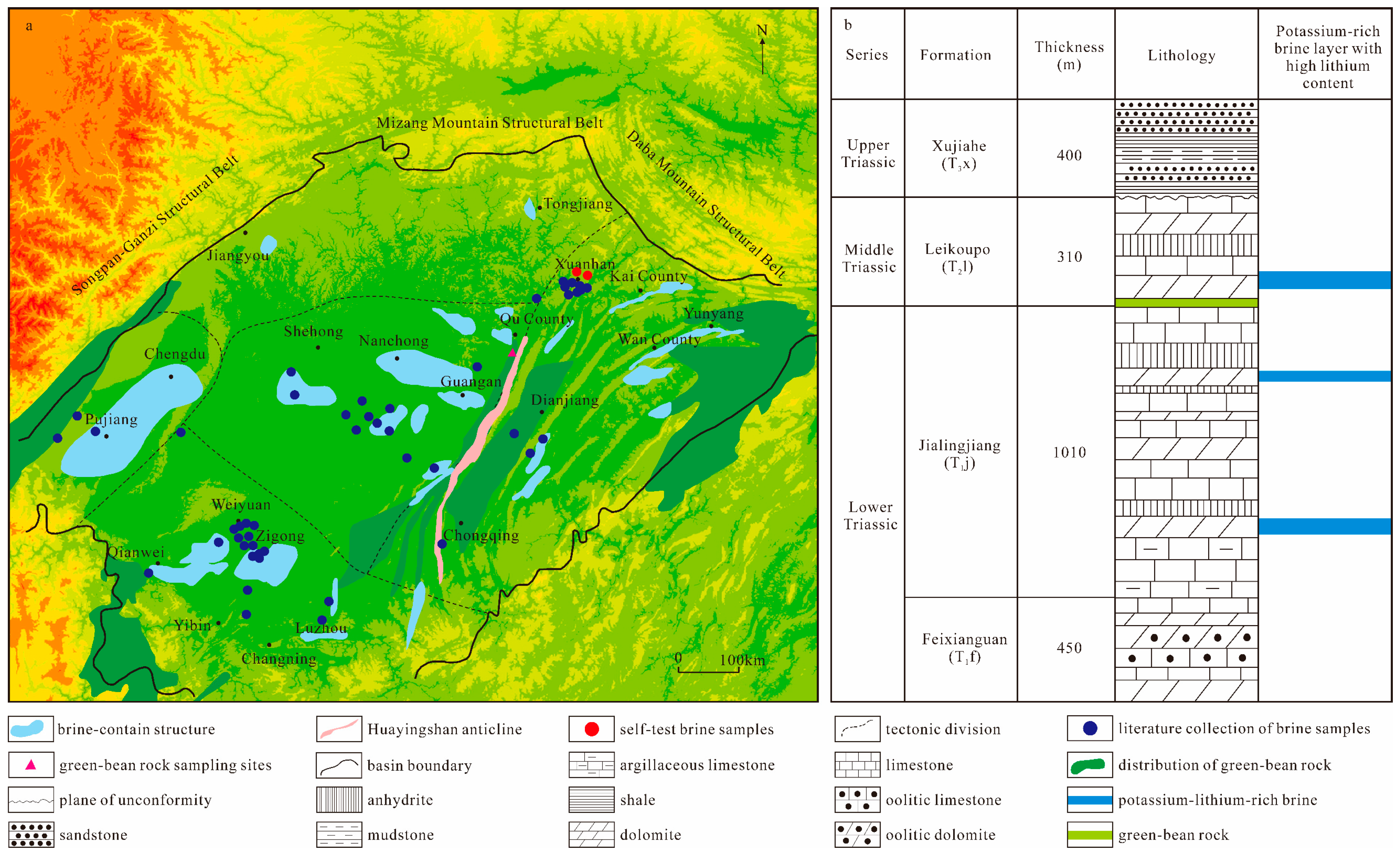
The Sichuan Basin is a typical composite basin located on the northwestern margin of the Yangtze Block (Figure 1a) [20]. It is bounded by the Qinling Orogenic Belt, the Dabashan Fault Zone, the Kangdian Uplift, and the Qian’e Fold Belt, which collectively formed a closed to semi-closed paleo-geographic environment. The geological setting provided advantageous tectonic conditions for the deposition of evaporites and the subsequent preservation of brines.
During the Triassic, the Sichuan Basin was the only salt-forming basin within the Yangtze Platform to develop extensive halite and potential potash salt deposits, indicating unique paleo-geographic and paleo-climatic conditions. The primary paleo-seawater influx channel was located in the southeastern part of the basin. Its position far from the open ocean, coupled with restricted water exchange and a persistently arid and hot paleo-climate [21], promoted intense evapo-concentration of seawater within the basin. Under these conditions, the subsidence center and the evaporation center were coupled, leading to the development of an extensive gypsum depositional area. This marks the basin’s evolution into a typical “pre-salt-forming basin”, establishing a solid foundation for the subsequent large-scale precipitation of saline minerals [22].
The Triassic strata in the Sichuan Basin (Figure 1b) consist of, in ascending order, the Lower Triassic Feixianguan and Jialingjiang Formations, the Middle Triassic Leikoupo Formation, and the Upper Triassic Xujiahe Formation. The Middle–Lower Triassic series is predominantly composed of marine carbonates and evaporites, constituting a major brine-bearing horizon in the basin. Meanwhile, the Upper Triassic Xujiahe Formation comprises continental clastic rocks, forming an effective regional seal [18]. The Indosinian Orogeny played a decisive role in the formation and subsequent modification of the Triassic strata in this area. The multiphase fault and fracture systems generated by this tectonic event not only controlled the stratigraphic framework but also provided crucial pathways for the later infiltration of meteoric water and the migration of deep fluids [23]. The Triassic brines in the Sichuan Basin are hosted in two main types of reservoirs: pore-fissure spaces in clastic rocks and karst-fissure systems in carbonates.
Green bean rocks, the key source rock of interest in this study, consist of green, granular claystone formed from the alteration of acidic volcanic ash [24]. Their mineral composition is primarily feldspar, quartz, and clay minerals. The clay fraction is characterized by illite-smectite mixed-layer minerals, containing minor amounts of disordered corrensite-montmorillonite mixed-layer minerals or illite, which serve as important hosts for ore-forming elements such as Li and K [24,25]. This rock unit is widely distributed across the Sichuan Basin, with an areal extent of approximately 7 × 10⁴ km2, and generally exhibits Li- and K-rich geochemical characteristics [26]. The green bean rocks are primarily hosted at the top of the Lower Triassic Jialingjiang Formation, acting as a key marker bed between the underlying marine carbonates and the overlying Middle Triassic Leikoupo Formation. Their spatial distribution is strictly controlled by the paleo-topography of the Top–Lower Triassic surface [27,28]. The unit typically occurs as bedded, sub-bedded, or discontinuous lenticular bodies, with significant lateral thickness variations ranging from 10 cm to several meters [29]. For instance, in the western basin areas such as Emei and Yibin, it usually appears as a single layer, 1–1.5 m thick [30,31], whereas in the Wenquan town of Kaizhou (northeastern basin) and the Tongliang area (eastern basin), its thickness can reach 2–3 m [32]. The locations, lithologies, and petrographic characteristics of the green bean rock samples from this region are detailed in Supplementary Table S2.
Figure 1.
(a) Digital Elevation Model (DEM) and (b) Triassic stratigraphic column of the Sichuan Basin [27,33,34].
3. Samples and Methods
3.1. Brine Sample Collection and Data Compilation
To comprehensively investigate the hydrogeochemical characteristics of the Triassic deep brines in the Sichuan Basin, a systematic literature review and data compilation were conducted. Literature published up to December 2024 was retrieved from the China National Knowledge Infrastructure and Web of Science databases using the search query “TS = (Sichuan Basin and Brine)”. Through manual screening, 10 studies were identified as relevant. From these, key hydrochemical data, including concentrations of Na+, K+, Li+, Ca2+, Mg2+, Cl−, SO42−, HCO3−, TDS, B3+, and Br−, were extracted and integrated, resulting in a dataset comprising 83 brine samples from the Triassic strata (Table S1 in Supplementary Materials), with sampling locations in Figure 1a.
Given that previous studies have identified the northeastern Sichuan Basin as a region enriched with lithium and potassium in its deep brines [7,19], supplementary brine samples were collected from wells Chuanxuan-1 and Chuanxuan-2 in this area (Figure 1a). The raw samples were filtered, and the concentrations of major and minor ions were determined using established methodologies consistent with prior work. By integrating these newly acquired data with the compiled literature data, a consolidated dataset of Triassic deep brines from 85 observation points was established for subsequent analysis (Table S1).
3.2. Water–Rock Reaction Experiments
During the late T1j5-2 stage on the northeastern margin of the Sichuan Basin, widespread volcanic activity led to the deposition of volcanic ash across the region and the subsequent formation of the green bean rocks in the sedimentary basin [34]. Notably, the distribution of these rocks shows a clear spatial coincidence with modern Li- and K-rich brines in the northeastern Sichuan Basin. Previous research has suggested that the leaching of these green bean rocks is a key process contributing to the enrichment of Li and K in the Triassic deep brines [7,19]. To test this hypothesis, three green bean rock samples were collected from their typical outcrops in this northeastern distribution area (Figure 1a) for water–rock reaction experiments. The concentrations of major elements (C, Si, Al, Fe, MgO, CaO, Na, K, MnO, Ti, P, FeO, Li) in these samples are provided in Table 1. All three samples were subjected to water–rock reaction experiments, and the reported leaching results represent the average of the triplicate tests.
Table 1.
Elemental composition of the green bean rock samples.
Batch static laboratory experiments were designed to simulate water–rock interactions under different salinity conditions. First, the three green bean rock samples were crushed, ground, and sieved through a 60-mesh screen to obtain a homogenized powder. Precisely 8.00 g of the rock powder was weighed and placed into a 250 mL conical flask. Then, 200 mL of reaction solution was added to each flask. The solutions comprised four different salinity levels: distilled water (control), 1 mol L−1 NaCl, 2 mol L−1 NaCl, and 3 mol L−1 NaCl solutions. The flasks were covered with glass slides to minimize evaporation and incubated in a constant-temperature chamber at 25 °C for 100 days. During the reaction period, 2 mL of supernatant was extracted from each system on days 10, 20, 30, 50, 70, and 100. These ambient-condition experiments were designed primarily to provide a first-order, qualitative test of the leaching potential under conditions relevant to near-surface meteoric water interaction. The concentrations of Li+ and K+ in the leachates were measured using inductively coupled plasma optical emission spectrometry (iCAP 7200, Thermo Fisher Scientific, Waltham, MA, USA). The leaching rate of Li+ and K+ was calculated based on their original total mass in the solid rock sample using the following formula:
Leaching Rate (%) = (C × V)/S × 100%
C is the mass concentration of the target element (e.g., Li+ or K+) in the leachate (mg L−1);
V is the volume of the leachate (L);
S is the original total mass of the target element in the solid rock sample subjected to reaction (mg).
3.3. Statistical and Spatial Analysis
Hydrochemical facies of the brine samples were classified and visualized using Piper trilinear diagrams [35]. Spatial distribution maps of Li+ and K+ concentrations were generated based on sampling coordinates using the Kriging interpolation method.
To quantitatively investigate the relationship between elemental enrichment and hydrochemical characteristics, brine samples were categorized into different grades based on their Li+ and K+ concentrations (ρ(Li+) and ρ(K+)), following the classification standards for cutoff grade and minimum industrial grade outlined in the People’s Republic of China Geological and Mineral Industry Standard (DZ/T 0212.2-2020 [36]). The groupings were de-fined as follows: for Li+ concentration, High-Li group (ρ(Li+) ≥ 50 mg L−1), Medium-Li group (25 < ρ(Li+) < 50 mg L−1), Low-Li group (ρ(Li+) ≤ 25 mg L−1); for K+ concentration, High-K group (ρ(K+) ≥ 2.6 g L−1), Medium-K group (1.6 < ρ(K+) < 2.6 g L−1), Low-K group (ρ(K+) ≤ 1.6 g L−1).
Principal coordinates analysis (PCoA) was employed to assess the overall heterogeneity in hydrochemical composition among the different Li and K enrichment groups. The input dataset for PCoA comprised the hydrochemical parameters of all brine samples, including: Li+ (mg/L), Na+ (g/L), K+ (g/L), Ca2+ (g/L), Mg2+ (g/L), Cl− (g/L), SO42− (g/L), HCO32− (g/L), B3+ (mg/L), Br− (mg/L), and total dissolved solids (TDS, g/L). All variables were standardized (z-score normalization) prior to analysis to ensure equal weighting, given the different units and concentration ranges of the measured ions. The PCoA was performed using a Bray–Curtis distance matrix to visualize the similarities and dissimilarities among brine samples based on their overall hydrochemical composition, with group distances further quantified using Bray–Curtis distance. The Kruskal–Wallis rank sum test was used to determine the significance of differences in ion concentrations across these groups. Relationships among major ions were examined using Pearson correlation analysis [37]. Furthermore, to elucidate the genesis and evolution of the brines, several characteristic coefficients were calculated, including the Sodium-Chloride coefficient (Na–Cl coefficient, γ(Na+)/γ(Cl−), where γ denotes equivalent concentration in meq/L) [38]; the Chloride-Bromide coefficient (Cl–Br coefficient, ρ(Cl−)/ρ(Br−), where ρ denotes mass concentration in mg/L) [39]; the Desulfation coefficient, (100 × n(SO42−)/2n(Cl−), where n denotes molar concentration in mol/L) [40]; and the Calcium-Magnesium coefficient (Ca–Mg coefficient, n(Ca2+)/n(Mg2+), where n denotes molar concentration in mol/L) [41]. These coefficients are dimensionless ratios and serve as classic hydrochemical indicators for brine genesis, distinct from statistical correlation coefficients. All data processing, statistical analyses, and visualizations were performed using R (version 4.5.1).
4. Results and Discussion
4.1. Spatial Distribution and Enrichment Characteristics of Brines
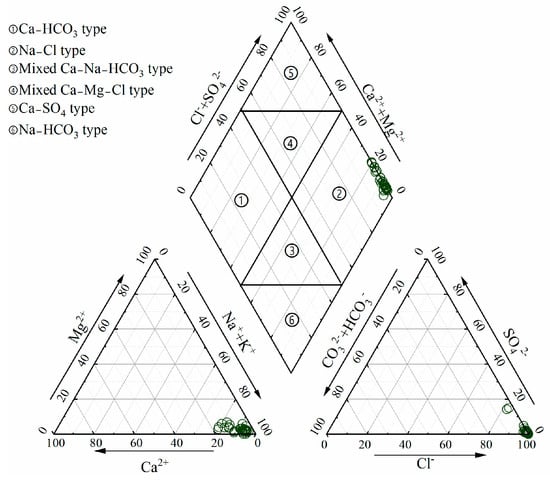
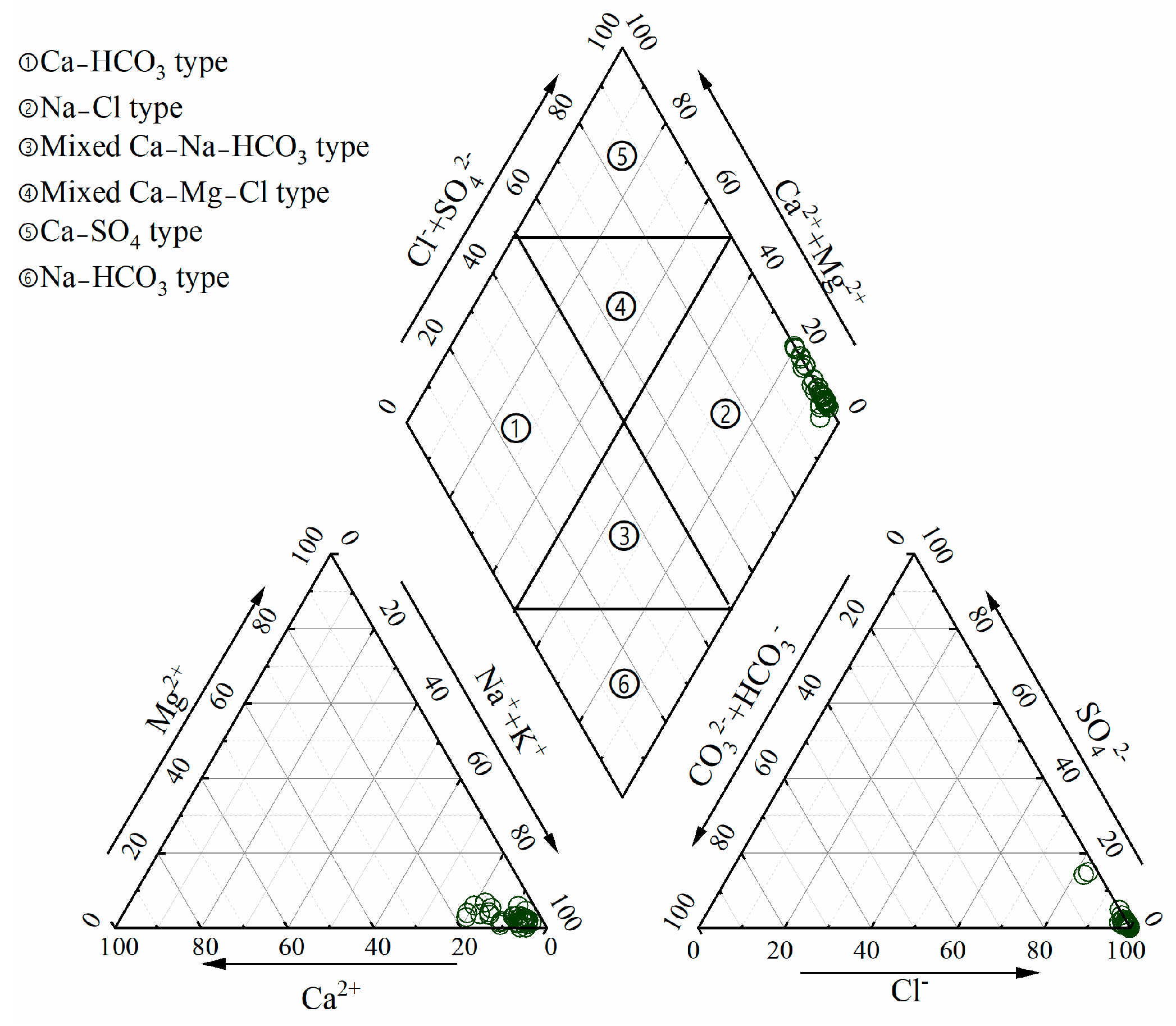
A Piper diagram (Figure 2) revealed that all studied brines in the region are of the Cl–Na type. The major ions in the brines include Na+, K+, Ca2+, Mg2+, Cl−, SO42−, and HCO3−. Among the cations, Na+ is overwhelmingly dominant, while Cl− is the predominant anion.
Figure 2.
Piper diagram illustrating the hydrochemical facies of Triassic deep brines in the Sichuan Basin.
The total dissolved solids (TDS) concentrations range from 4.00 to 396.50 g L−1, with a high mean value of 174.40 g L−1 (Table 2). According to the People’s Republic of China Geological and Mineral Industry Standard (DZ/T 0212.2-2020 [36]), where TDS > 250 g L−1 defines highly mineralized brine), 13 samples in this study are classified as highly mineralized brines. The coefficient of variation (CV = 0.56) for TDS indicates a moderate degree of spatial variability.
Table 2.
Major and trace element concentrations in Triassic deep brines of the Sichuan Basin.
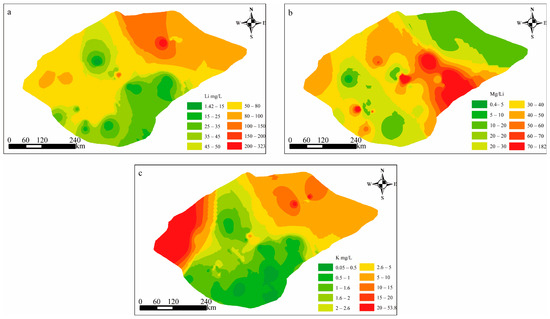
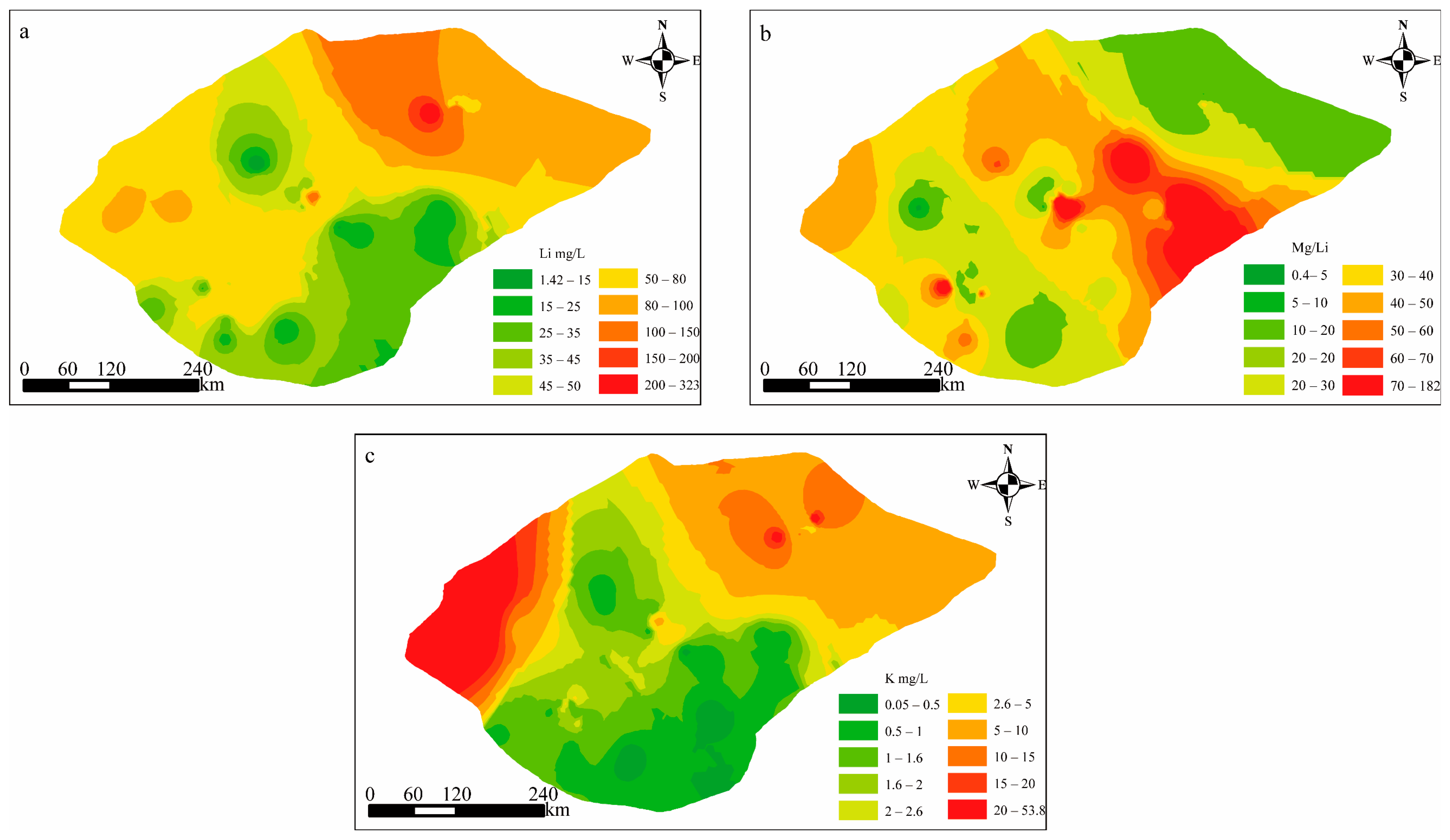
The ρ(K+) varies widely from 0.063 to 53.80 g L−1, with a mean of 5.12 g L−1, which exceeds the industrial utilization grade (2.6 g L−1). The exceptionally high coefficient of variation (CV = 2.2) for ρ(K+) suggests extreme spatial heterogeneity in its distribution. Spatial mapping of ρ(K+) (Figure 3c) showed that K-rich brines are primarily distributed in the western and northeastern Sichuan Basin.
Figure 3.
Spatial distribution of (a) lithium (Li+), (b) Mg2+/Li+ ratio, and (c) potassium (K+) in Triassic deep brines across the Sichuan Basin.
The average ρ(Li+) was 63.58 mg L−1, equivalent to approximately 388.30 mg L−1 of lithium chloride, surpassing the industrial mining grade (300 mg L−1). Similar to ρ(K+), ρ(Li+) also exhibits considerable spatial heterogeneity (CV = 0.84). Li-rich brines are mainly located in western and northeastern parts of the basin (Figure 3a), showing a certain spatial correlation with the distribution of K-rich brines.
The Mg2+/Li+ ratio spans from 0.37 to 182.42, with a mean of 28.2. Notably, 30% of the samples have an Mg2+/Li+ ratio below 10, indicating that these represent lithium resources that are relatively easier to extract. Spatially, brines with low Mg2+/Li+ ratios are predominantly found in the northeastern Sichuan Basin (Figure 3b). Consequently, brines that are rich in both Li and K and possess low Mg2+/Li+ ratios are primarily concentrated in the northeastern region. Interestingly, the spatial distribution of these Li- and K-rich brines (Figure 3) largely coincides with the outcrop distribution of green bean rocks in the Sichuan Basin (Figure 1a), potentially suggesting that leaching of green bean rocks is a significant source for these elements.
4.2. Hydrochemical Differences Between Li-Rich and K-Rich Brines
Analyzing the hydrochemical composition of Li-rich and K-rich brine groups, and their distinctions from medium- and low-concentration groups, aids in inferring material sources and enrichment processes.
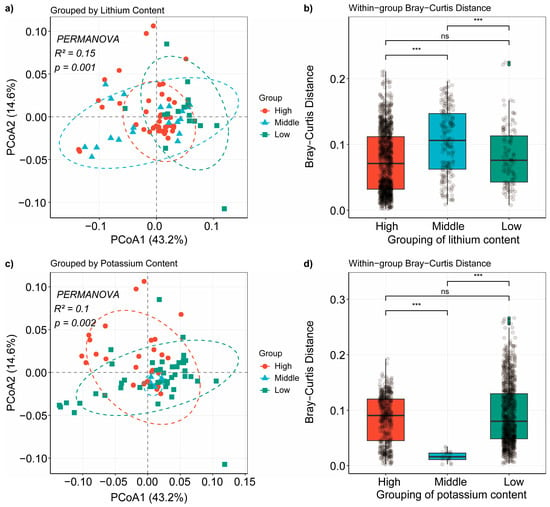
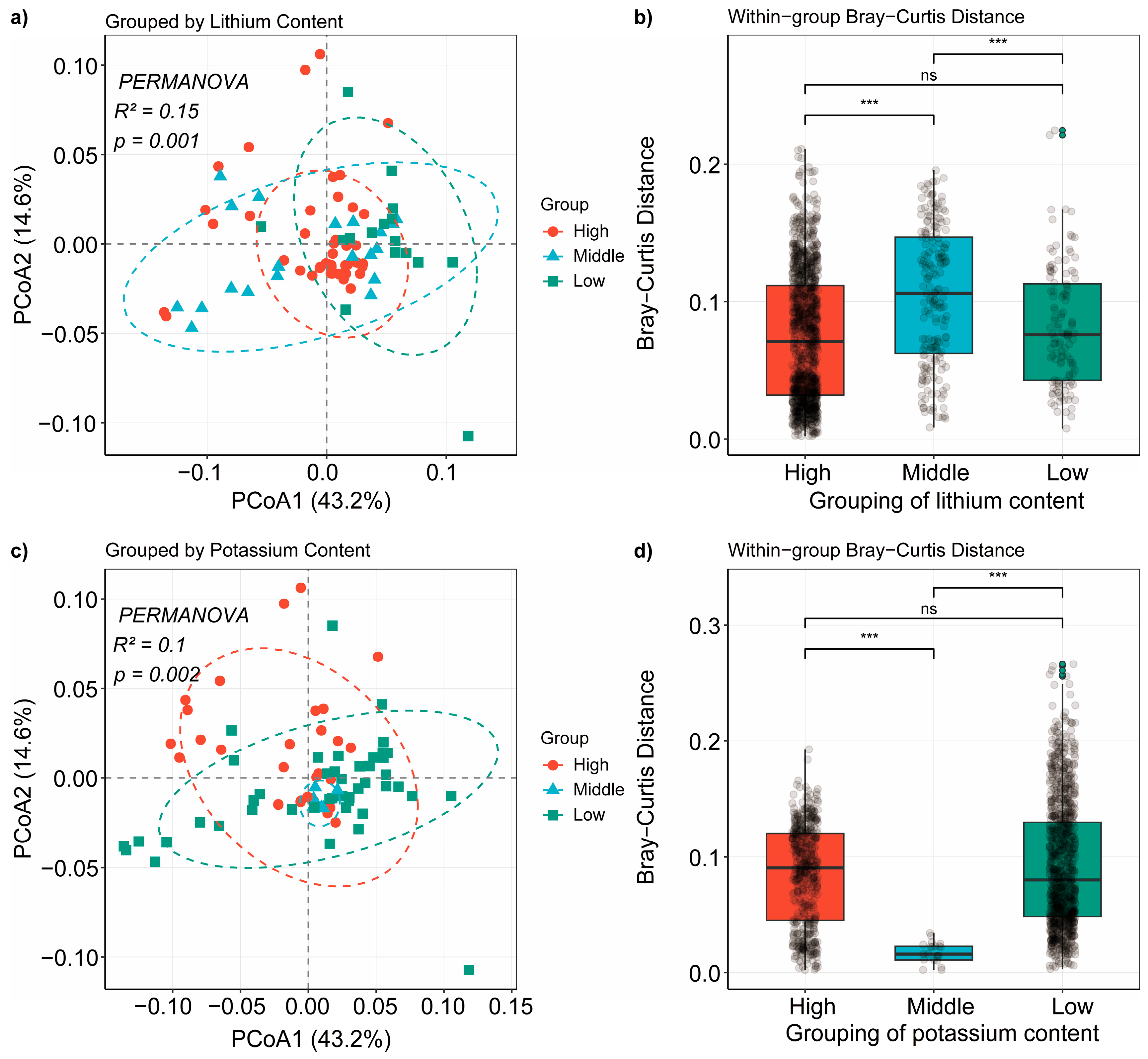
PCoA results (Figure 4a,c) indicated significant differences in hydrochemical characteristics among groups classified by Li and K concentrations (PERMANOVA, p < 0.01). Based on Bray–Curtis distance (Figure 4b,d), the hydrochemical features of the medium Li–K group differ markedly from those of the high and low Li–K groups (p < 0.01).
Figure 4.
Principal coordinates analysis (PCoA) of hydrochemical composition for brines grouped by (a) lithium and (c) potassium enrichment levels in the Sichuan Basin Triassic brines (Asterisks indicate statistical significance: ***, p < 0.001; ns, not significant). (b,d) show the Bray–Curtis distances between groups. High-Li group (ρ(Li+) ≥ 50 mg L−1), Medium-Li group (25 < ρ(Li+) < 50 mg L−1), Low-Li group (ρ(Li+) ≤ 25 mg L−1); High-K group (ρ(K+) ≥ 2.6 g L−1), Medium-K group (1.6 g L−1 < ρ(K+) < 2.6 g L−1), Low-K group (ρ(K+) ≤ 1.6 g L−1) (The dashed ellipses represent the 95% confidence intervals for each group).
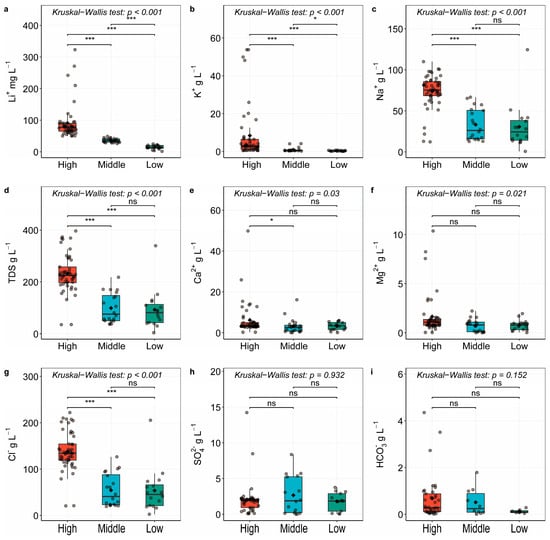
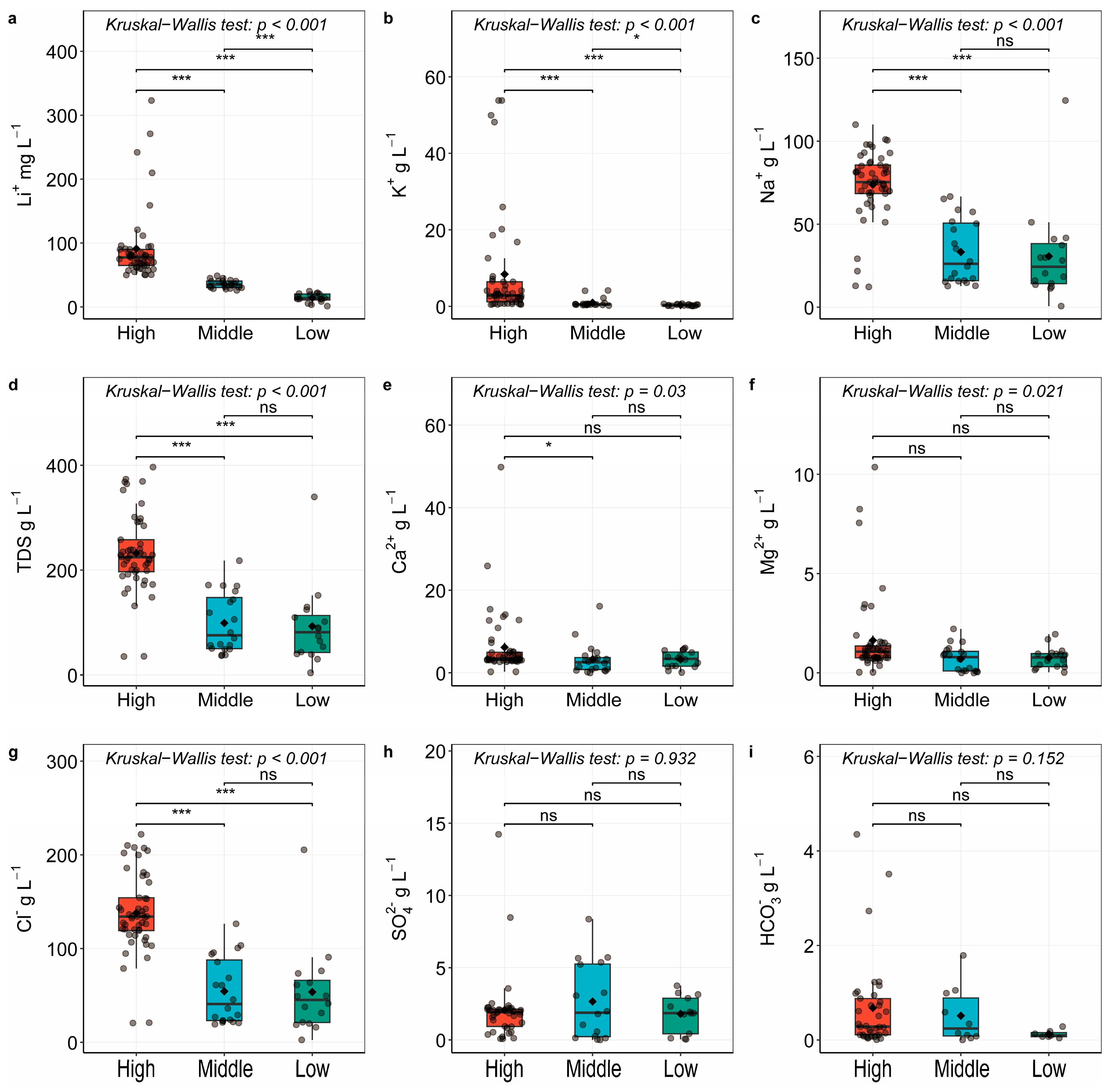
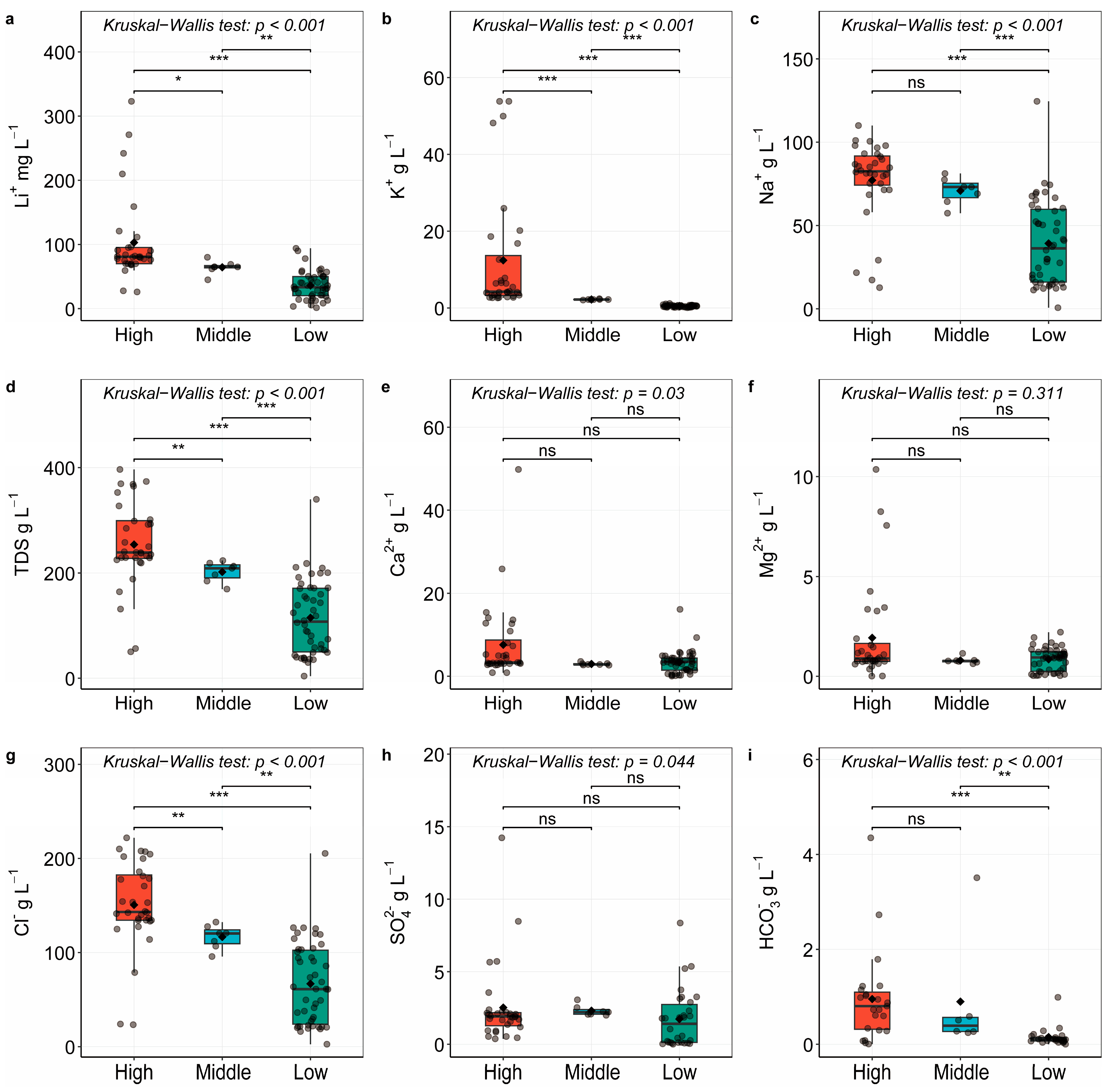
Analysis of specific ion concentrations across different Li enrichment groups (Figure 5) revealed significant differences (p < 0.01) in Li+, K+, Na+, TDS, and Cl− concentrations. The high-Li group exhibits K+ concentrations 7.46 and 23.68 times higher than the medium- and low-Li groups, respectively, while its TDS is 1.35 and 1.5 times greater. In contrast, SO42− and HCO3− showed no significant intergroup differences. For groups classified by K enrichment (Figure 6), significant differences (p < 0.01) are observed in TDS, Na+, K+, Cl−, and Li+. Specifically, the high-K group showed Li+ concentrations 59.92% and 186.02% higher, and TDS values 25.44% and 120.56% greater than the medium- and low-K groups, respectively.
Figure 5.
Ion concentrations (Li+, K+, Na+, TDS, Ca2+, Mg2+, Cl−, SO42−, HCO3−) in Triassic brines from the Sichuan Basin, categorized by lithium enrichment level. (a) Li+; (b) K+; (c) Na+; (d) TDS; (e) Ca2+; (f) Mg2+; (g) Cl−; (h) SO42−; (i) HCO3−. High-Li group (ρ(Li+) ≥ 50 mg L−1), Medium-Li group (25 < ρ(Li+) < 50 mg L−1), Low-Li group (ρ(Li+) ≤ 25 mg L−1); High-K group (ρ(K+) ≥ 2.6 g L−1), Medium-K group (1.6 g L−1 < ρ(K+) < 2.6 g L−1), Low-K group (ρ(K+) ≤ 1.6 g L−1). (Asterisks indicate statistical significance: *, p < 0.05; *** p < 0.001; ns, not significant).
Figure 6.
Ion concentrations (Li+, K+, Na+, TDS, Ca2+, Mg2+, Cl−, SO42−, HCO3−) in Triassic brines from the Sichuan Basin, categorized by potassium enrichment level. (a) Li+; (b) K+; (c) Na+; (d) TDS; (e) Ca2+; (f) Mg2+; (g) Cl−; (h) SO42−; (i) HCO3−. High-Li group (ρ(Li+) ≥ 50 mg L−1), Medium-Li group (25 < ρ(Li+) < 50 mg L−1), Low-Li group (ρ(Li+) ≤ 25 mg L−1); High-K group (ρ(K+) ≥ 2.6 g L−1), Medium-K group (1.6 g L−1 < ρ(K+) < 2.6 g L−1), Low-K group (ρ(K+) ≤ 1.6 g L−1). (Asterisks indicate statistical significance: *, p < 0.05; **, p < 0.01; ***, p < 0.001; ns, not significant).
The relatively clustered distribution of the Li-rich brine group near the coordinate origin in the PCoA plot (Figure 4a) suggests similar compositional proportions, potentially indicating shared material sources or analogous geological processes. Conversely, the more dispersed distribution of the K-rich brine group (Figure 4c) implies contributions from diverse sources. The association of Li-rich brines with elevated TDS and K+ levels (Figure 5b,d), and K-rich brines with higher TDS and Li+ concentrations (Figure 6a,d), indicates that Li and K in the brines may share common sources or have undergone similar enrichment processes.
4.3. Ion Correlations and Source Implications
The Triassic deep brines in the Sichuan Basin can be conceptually characterized as a mixture of three potential endmembers [42,43,44]: (1) evaporated paleo-seawater, which provides the baseline salinity and marine-derived ionic ratios; (2) meteoric water, which introduces dilution effects and may carry components leached from surface or shallow-level rocks; and (3) fluids modified by water–rock interactions, particularly those that have interacted with source rocks such as green bean rocks, evaporites, and carbonates, thereby acquiring enriched concentrations of elements like Li, K, Ca, and Mg. The relative contributions of these endmembers govern the observed hydrochemical variations and spatial heterogeneity in the brine system. In the following sections, ion correlations and characteristic coefficients are employed to deconvolve these endmember contributions and to elucidate the sources, mixing processes, and water–rock interactions that control brine chemistry.
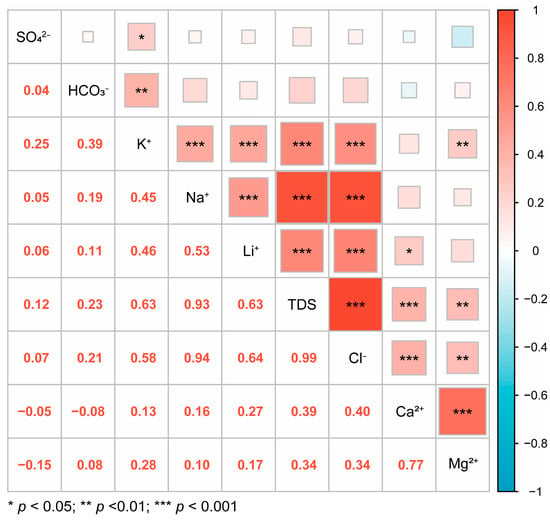
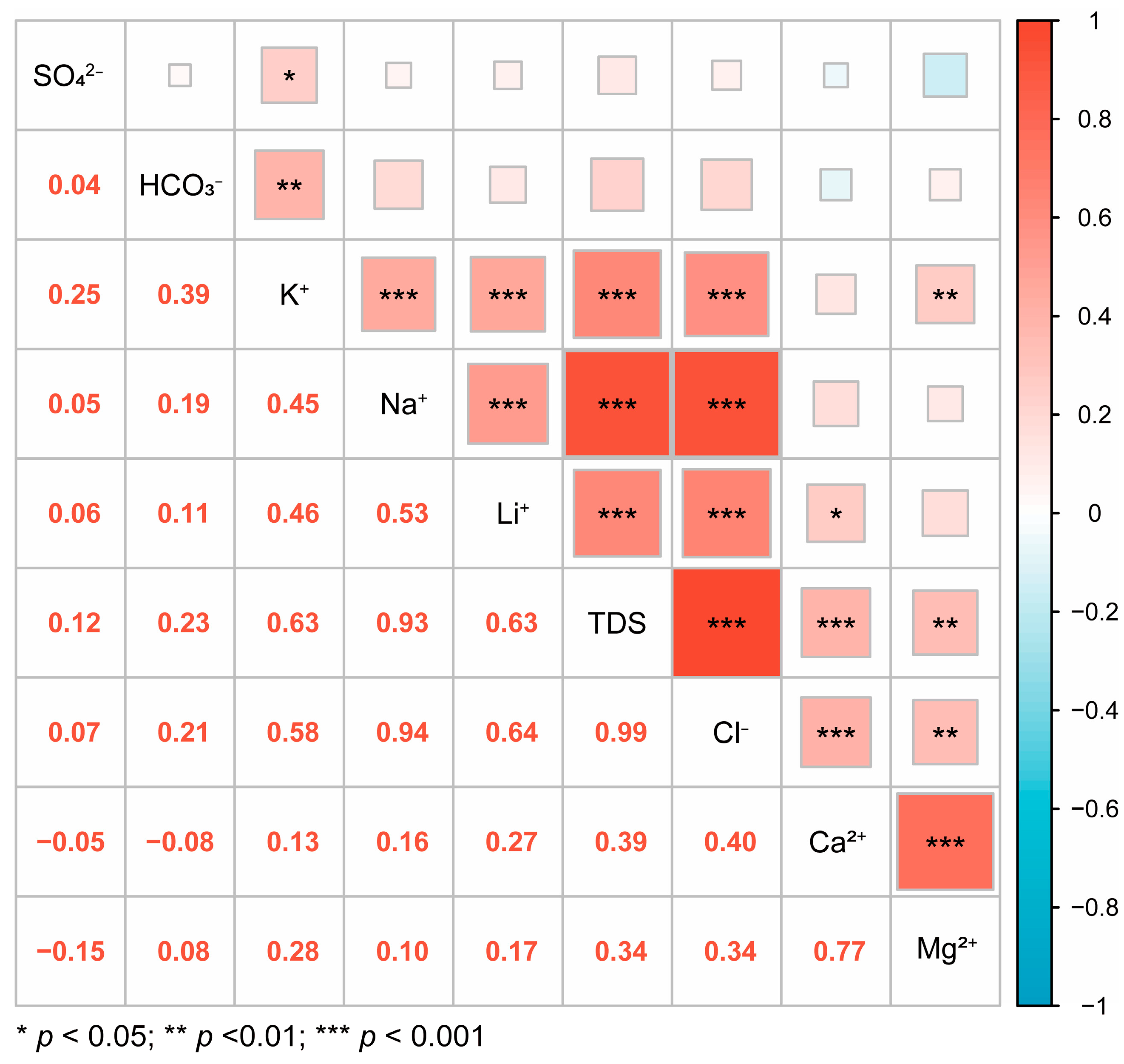
Pearson correlation analysis of major and trace ion concentrations in the deep brines (Figure 7) provides insights into their sources, mixing processes, and water–rock interactions, offering critical constraints on brine genesis. The Triassic deep brines in the Sichuan Basin showed significant positive correlations between TDS and Cl− (r = 0.99, p < 0.001), Na+ (r = 0.945, p < 0.001), K+ (r = 0.654, p < 0.001), and Li+ (r = 0.627, p < 0.001) (Figure 8), indicating that the chemical composition is strongly controlled by evaporative concentration. The significant positive correlation between Li+ and K+ (r = 0.45, p < 0.01) suggests similar origins, enrichment mechanisms, or source inputs for these two elements. Furthermore, the strong positive correlation between Ca2+ and Mg2+ (r = 0.77, p < 0.001), coupled with significant positive correlations of TDS with Ca2+ (r = 0.39, p < 0.001) and Mg2+ (r = 0.34, p < 0.01), implies a common source for these ions. Crucially, their covariance is uncorrelated with SO42−, indicating that the source is not primarily sulfate evaporite dissolution. Instead, it likely includes the widespread marine carbonate rocks and/or the alteration of Ca–Mg-bearing silicate minerals (e.g., in green bean rocks) during brine–rock interaction.
Figure 7.
Pearson correlation matrix of major and trace ion concentrations in the Triassic deep brines of the Sichuan Basin.
Figure 8.
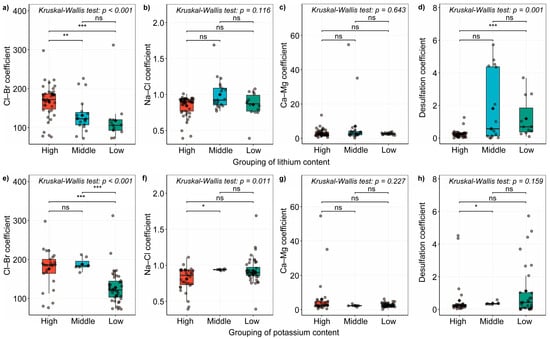
Characteristic coefficients (Chloride–Bromide coefficient (Cl–Br coefficient); Sodium–Chloride coefficient (Na–Cl coefficient); Calcium–Magnesium coefficient (Ca–Mg coefficient); Desulfation coefficient) of Triassic brines in the Sichuan Basin, grouped by (a–d) lithium and (e–h) potassium enrichment levels. High-Li group (ρ(Li+) ≥ 50 mg L−1), Medium-Li group (25 < ρ(Li+) < 50 mg L−1), Low-Li group (ρ(Li+) ≤ 25 mg L−1); High-K group (ρ(K+) ≥ 2.6 g L−1), Medium-K group (1.6 g L−1 < ρ(K+) < 2.6 g L−1), Low-K group (ρ(K+) ≤ 1.6 g L−1). (Asterisks indicate statistical significance: *, p < 0.05; **, p < 0.01; ***, p < 0.001; ns, not significant).
Characteristic coefficients effectively reveal the source and evolution of the deep brines [8]. The Na–Cl coefficient is a key indicator of Na salt enrichment, evaporative concentration, and evaporite dissolution, with a value greater than 1.0 typically indicating non-marine sources [45]. The average Na–Cl coefficient in the study area was 0.88 (Table 3), close to the value for normal seawater (0.87). However, the average coefficients for the high-Li and high-K brine groups were 0.84 and 0.81, respectively (Figure 8b,f), both lower than 0.87. This indicates that the enrichment processes for Li and K are closely associated with Na depletion or Cl enrichment. At the base of the Leikoupo Formation, the presence of 1–3 m thick green bean rocks (hydromica claystone), which are clay minerals rich in lithium and potassium [34], provides a plausible explanation. The Na–Cl coefficient may have been lowered by the preferential adsorption of Na+ onto clay minerals during water–rock interactions with the green bean rock [46,47], which reduced the Na+ concentration while Cl− remained relatively stable. The medium- and low-Li/K groups had average Na–Cl coefficients between 0.87 and 1.00, potentially reflecting some replenishment from meteoric water leaching. The potential for meteoric water to leach Li and K from outcrop green bean rocks and make an ongoing contribution to the brines remains to be confirmed by simulation experiments.
Table 3.
Characteristic coefficients of the Triassic deep brines in the Sichuan Basin.
The Cl–Br coefficient serves as a key tracer for constraining the genetic processes of brines. Bromide acts as a conservative ion during progressive evaporation and concentration of seawater; it is neither significantly incorporated into evaporite minerals nor lost through other reactions, causing its concentration to increase linearly with the degree of evaporation [48,49]. Given that the coefficient for modern seawater is approximately 287, values generally below 400 indicate sedimentary paleo-brines, while a value exceeding 1000 suggests halite-dissolution brines [50]. The Cl–Br coefficients in the study area range from 72.41 to 311.97, with a mean of 149.70, all below 400. Although significant differences exist between the high-Li/K groups and the medium-/low-Li/K groups (Figure 8a,e), all values are below 400, identifying them as typical sedimentary brines. Combined with the Na–Cl coefficient, this suggests that the initial parent brine was likely derived from evaporatively concentrated paleo-seawater, while the final hydrochemical signature (including the enrichment of Li and K) has been significantly overprinted by subsequent water–rock interactions, notably with potash-bearing evaporites and green bean rocks.
The desulfation coefficient and the Ca–Mg coefficient (nCa2+/nMg2+) can be used to infer the formation environment of deep brines. The desulfation coefficient reflects reservoir confinement. Under good confinement and reducing conditions, sulfate is reduced, decreasing the sulfate concentration. A coefficient closer to 0 indicates stronger reduction and better confinement [51,52]. The desulfation coefficient in the study area ranges from 0.00 to 5.73 (mean = 0.78), indicating variable confinement. Figure 8d shows a significant difference in the desulfation coefficient between Li-rich brines and the other groups, suggesting that Li enrichment requires specific, highly confined conditions. In contrast, no significant difference exists between K-rich brines and the medium-/low-K groups (Figure 8h), indicating no direct link between K enrichment and environmental confinement.
The Ca–Mg coefficient reflects the metamorphic degree of the deep brine environment. Better confinement and longer duration typically result in a higher metamorphic degree, often yielding coefficients greater than 3 [53,54]. The coefficient in the study area ranges from 0.61 to 54.61 (mean = 3.91). No significant differences were observed among the high-/medium-/low-Li or high-/medium-/low-K groups (Figure 8c,g), suggesting an overall high degree of metamorphism.
4.4. Leaching Experiments on Green Bean Rocks: Evidence for Element Supply
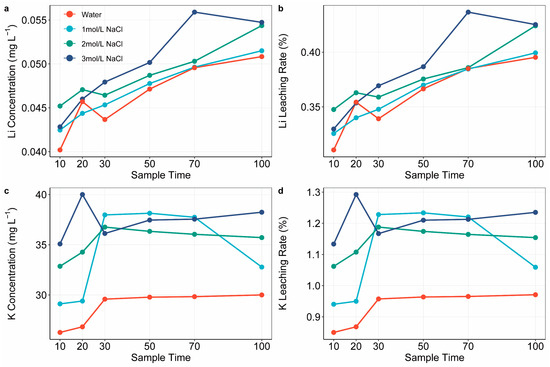
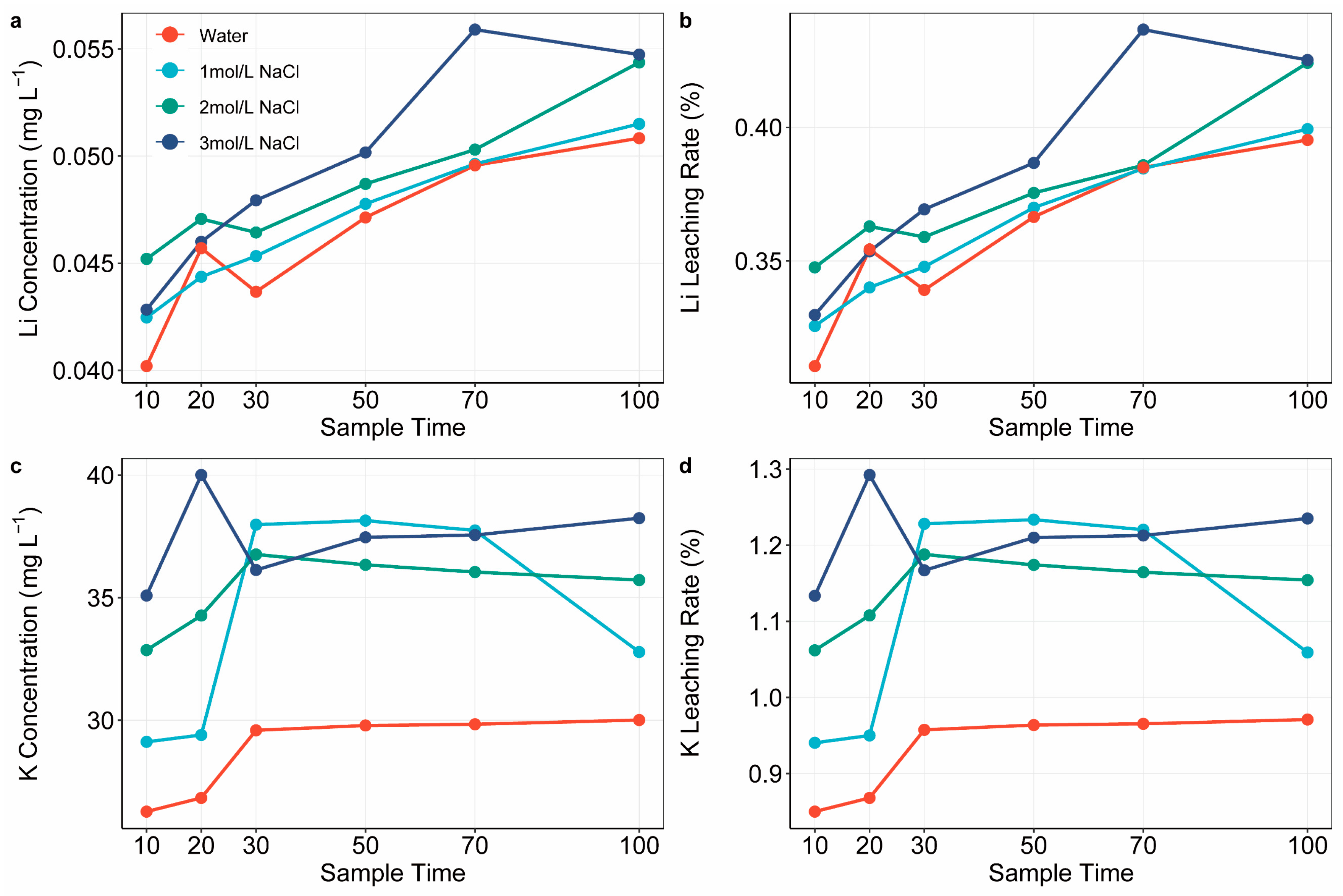
To clarify the role of the meteoric water leaching of green bean rocks in supplying materials to the Triassic deep brines in the Sichuan Basin, water–rock reaction experiments were conducted on green bean rock samples from the northeastern basin under ambient temperature conditions. The results (Figure 9) showed that, over the same duration, the leaching efficiencies of Li and K varied significantly across different NaCl solutions, in the order of: 3 mol L−1 NaCl solution > 2 mol L−1 NaCl solution > 1 mol L−1 NaCl solution > distilled water. The leaching amounts of both lithium and potassium exhibited a rapid initial increase followed by stabilization in later stages. These experiments demonstrated that increased salinity promotes the leaching of Li and K from green bean rocks under ambient temperature conditions and that this process remains stable over the long term. This confirms that green bean rocks can serve as a potential source for Li and K leached by meteoric water. While these experiments validate the fundamental process, the kinetics and yields under deep-burial temperature, pressure, and chemical conditions represent an important target for future quantitative modeling and experimental studies.
Figure 9.
Results of ambient temperature water–rock reaction experiments: Temporal variations in leaching concentrations of (a,b) lithium and (c,d) potassium from green bean rocks under ambient temperature conditions, using distilled water and NaCl solutions with salinities of 1 to 3 mol L−1.
Building on this experimental confirmation and integrating these findings with the regional geological background, a comprehensive interpretation can be made. Previous research suggests that the Indosinian Orogeny, through multiple phases of tectonic activity, established the fundamental foundation for the metallogenic setting of the Triassic brine system [55]. First, tectonic compression, differential compaction, and subsequent paleo-karstification extensively modified pre-existing strata, developing large-scale faults, fracture zones, and fissure networks [56,57]. These structures serve as the primary migration pathways for infiltrating meteoric water [58]. As mineralized fluids migrate through this network, they fully interact with the source rock (green bean rocks), leaching ore-forming elements such as Li and K. Second, regional uplift during the late Middle Triassic (post-deposition of the Leikoupo Formation) exposed carbonates to surface weathering and denudation [59]. This process significantly increased the specific surface area of green bean rocks along the key unconformity, greatly expanding the reaction interface between the rock and percolating meteoric water, thereby further enhancing the leaching efficiency of elements such as Li and K. Synthesizing previous research, the transport pathway network established by the Indosinian Orogeny, combined with the enhanced element activation mechanism from subsequent modification, collectively supports a continuous material supply model where meteoric water leaching of green bean rocks contributes to the deep Triassic brines.
4.5. Genetic Model of Deep Brines: A Dual-Recharge Mechanism
Based on systematic hydrochemical analysis and experimental simulations, this study proposes a comprehensive genetic model for the origin and metallogenic mechanism of the Triassic deep brines in the Sichuan Basin.
Brine origin: The brines are predominantly of the Cl–Na type. The Na–Cl coefficient (mean = 0.88) and Cl–Br coefficient (mean = 149.70) collectively indicate a marine sedimentary origin, with their formation and evolution primarily controlled by evaporative concentration. Elevated Na–Cl coefficients (0.87–1.00) in some samples suggest mixing with and recharge by meteoric water, which locally modified the brine chemistry.
Key water–rock interactions: The strong Ca2+–Mg2+ covariance, uncorrelated with SO42−, indicates that these ions are not primarily derived from sulfate evaporite dissolution. Their common source likely includes the widespread marine carbonate rocks and/or the alteration of Ca–Mg-bearing silicate minerals (e.g., in green bean rocks or detrital layers) during brine–rock interaction. Beyond cation sourcing, water–rock interaction also drives significant cation exchange. This is evidenced by the notably lower Na–Cl coefficients in high-Li and high-K brines (mean 0.84 and 0.81, respectively), which indicate that such exchange processes have consumed a portion of Na+.
Sources and enrichment mechanisms of ore-forming elements: Based on hydrochemical data, although both lithium and potassium are enriched through shared primary processes such as evaporative concentration and leaching of common source rocks like green bean rocks, their enrichment thresholds differ markedly. The correlation between Li and K, coupled with the low desulfation coefficient observed in Li-rich brines, indicates that lithium enrichment critically requires a relatively confined reducing environment for effective preservation, which acts as a stringent filter and implies a more singular source closely linked to specific water–rock interactions. In contrast, potassium enrichment does not depend on such strict confinement and exhibits multi-source recharge characteristics, with potential contributions extending beyond paleo-seawater evaporation and evaporite dissolution. Ambient temperature water–rock experiments confirm that green bean rocks serve as an effective common source rock for both elements. Furthermore, higher salinity significantly enhances leaching efficiency and sustains a long-term, stable release of Li and K, reinforcing the role of evaporative concentration as a key driving mechanism in their enrichment processes.
Genetic model of deep brines: a dual-recharge mechanism. Hydrodynamically, the Triassic deep brines in the Sichuan Basin occur under deeply buried, closed conditions and are characterized by near-stagnant flow, driven primarily by geostatic pressure rather than regional hydraulic gradients [9,60]. Superimposed on this generally stagnant background, localized brine migration and enrichment are controlled by tectonic features: faults serve as primary pathways, while anticline cores, with well-developed fractures, are the main sites of brine accumulation [19,44]. This pattern, summarized as “pore-fracture storage, fault transport, and anticline enrichment” provides the structural framework for the proposed genetic model [61]. Synthesizing the above evidence, this study proposes a “Dual-Recharge Genetic Model” for the mineralization of Triassic deep brines in the Sichuan Basin. Model 1 (deep circulating leachate): Evaporative concentration of paleo-seawater under arid climatic conditions led to the primary enrichment of Li and K in the brines. During subsequent deep burial, these brines circulated within the strata and, owing to their high salinity, efficiently leached lithium, potassium, and other ore-forming elements from the green bean rocks. Model 2 (lateral meteoric water recharge): Fracture systems generated by the Indosinian orogeny provided pathways for meteoric water infiltration. These fluids leached Li, K, and other ore-forming elements from the exposed or shallow-level green bean rocks and subsequently transported the extracted ore-forming elements into the deep brine system, thereby supplementing and enriching it.
Synthesizing previous research and the findings of this study, the metallogenic process of the Triassic deep brines in the Sichuan Basin is reconstructed as follows: During the Triassic, the Sichuan Basin was a shallow marine environment continuously replenished by paleo-seawater. Under arid and hot climatic conditions, intense evaporation led to significant water loss and progressive concentration of seawater, during which Li and K were progressively enriched, establishing the material foundation for the deep brines. With ongoing sedimentation, the strata thickened, and the early-formed saline waters were buried to great depths. During burial, compaction due to overlying pressure reduced rock porosity, expelling and converging pore waters into relatively concentrated brines. The diverse lithologies in the Triassic strata facilitated extensive water–rock interactions during brine migration and storage. These brines leached mineral components from source rocks such as halite and green bean rocks, incorporating them into the fluid and resulting in more complex and diversified chemical compositions. Fracture systems developed during the Indosinian tectonism provided pathways for meteoric water infiltration, which leached Li and K from surface- or shallow-level green bean rocks and contributed to the recharge of the deep brine system. Under the coupled effects of compaction-driven fluid migration, water–rock interaction, and evaporative concentration, and through prolonged geological evolution, the rich potassium- and lithium-bearing deep brine deposits in the Triassic strata of the Sichuan Basin were ultimately formed.
5. Conclusions
Based on integrated hydrochemical analysis and experimental simulation, the following conclusions are drawn regarding the origin and enrichment mechanisms of Li and K in the Triassic deep brines of the Sichuan Basin:
- (1)
- The brines are exclusively of the Cl–Na type. The characteristic coefficients, including the Na–Cl coefficient and Cl–Br coefficient, consistently indicate that they originated from paleo-seawater through evaporative concentration. Slightly elevated Na–Cl coefficients in some samples suggest localized mixing with meteoric water.
- (2)
- The principal enrichment mechanisms for Li and K are fundamentally distinct. Li enrichment is strongly dependent on a confined reducing environment, as evidenced by its correlation with low desulfation coefficients. Its source is relatively singular, primarily controlled by evaporative concentration and specific water–rock interactions. In contrast, K demonstrates multi-source characteristics. Its enrichment shows no necessary link to formation confinement, indicating a more complex origin beyond simple evaporite dissolution.
- (3)
- Leaching experiments confirm that green bean rocks can stably release Li and K over prolonged periods under ambient temperature conditions. The leaching efficiency of these critical elements increases significantly with higher fluid salinity. This provides direct experimental evidence explaining the marked spatial coincidence between Li–K-rich brines and the distribution of green bean rocks.
- (4)
- A “Dual-Recharge Genetic Model” is proposed to explain the ore-forming material supply. Deep Circulating Leachate: Pre-concentrated paleo-seawater brines, circulating within deep strata, efficiently leach Li and K from green bean rocks, facilitated by their high salinity. Lateral Meteoric Water Recharge: Meteoric water, infiltrating along Indosinian tectonic fractures, leaches Li and K from green bean rocks at shallow depths or surface exposures, subsequently transporting the extracted elements into the deep brine system. This model comprehensively elucidates the metallogenic mechanism forming the rich lithium–potassium brines in the Sichuan Basin.
Supplementary Materials
The following supporting information can be downloaded at: https://www.mdpi.com/article/10.3390/min16040372/s1, Table S1: dataset of Triassic deep brines from 85 observation points in the Sichuan Basin [62,63,64,65,66,67,68,69,70,71]; Table S2: Summary of location, lithology, and petrographic characteristics of green bean rock samples [72,73,74].
Author Contributions
Conceptualization, Y.X. and Y.Z.; methodology, Y.X. and Y.Z.; visualization, R.X.; writing—original draft, Y.X.; writing—review and editing, R.X., F.Z., K.S., B.G. and W.S.; resources, Y.Z. All authors have read and agreed to the published version of the manuscript.
Funding
This research was funded by the National Key Research and Development Program of China (Grant No. 2023YFC2906503).
Data Availability Statement
Data are available based on request.
Conflicts of Interest
The authors declare no conflicts of interest.
References
- Dugamin, E.J.M.; Richard, A.; Cathelineau, M.; Boiron, M.C.; Despinois, F.; Brisset, A. Groundwater in sedimentary basins as potential lithium resource: A global prospective study. Sci. Rep. 2021, 11, 21091. [Google Scholar] [CrossRef] [Scilit]
- Zhang, B.; Zhang, W.S. Uncovering the endogenous features of potassium salts’ global transfer: A complex network perspective. PLoS ONE 2024, 19, e0295139. [Google Scholar] [CrossRef] [Scilit]
- Zhao, Y.J.; Long, P.Y.; Zhang, H.; Hu, Y.F.; Cui, Z.H.; Zhang, Y.M.; Zhang, M.L.; Wang, Q.; Hu, S.Z. The occurrence characteristic and dissolution mechanism of lithium-rich sediments in Salt Lake Mahai of Qaidam Basin, NW China. Sci. Rep. 2025, 15, 4291. [Google Scholar] [CrossRef] [Scilit]
- Cioce, S.; Artoni, A.; Boschetti, T.; Montanini, A.; Segadelli, S.; de Nardo, M.T.; Chizzini, N.; Lambertini, L.; Qadir, A. Understanding the Geology of Mountain Foothills Through Hydrogeochemistry: Evaluating Critical Raw Materials’ Potential for the Energy Transition in the Salsomaggiore Structure (Northwestern Apennines, Italy). Minerals 2025, 15, 936. [Google Scholar] [CrossRef] [Scilit]
- Zhang, Y.H.; Chen, X.Y.; Chen, M.M.; Yan, W.Y.; Zhang, X.H.; Zhang, C.L.; Sun, Z. Criticality assessment and material flow analysis of raw materials for power lithium-ion batteries in China: Towards sustainable supply and recycling. Resour. Conserv. Recycl. 2025, 217, 108189. [Google Scholar] [CrossRef] [Scilit]
- Li, J.S.; Chen, F.K.; Ling, Z.Y.; Li, T.W. Lithium sources in oilfield waters from the Qaidam Basin, Tibetan Plateau: Geo-chemical and Li isotopic evidence. Ore Geol. Rev. 2021, 139, 104481. [Google Scholar] [CrossRef] [Scilit]
- Zhong, J.A.; Lin, Y.J.; Wang, F.M.; Su, K.L.; Liu, Z.; Sheng, D.B.; Li, H.B.; Pang, B. Origin and Formation Mechanisms of Potassium- and Lithium-Rich Brines in the Triassic Strata of Northeastern Sichuan Basin, South China. Aquat. Geochem. 2024, 30, 163–178. [Google Scholar] [CrossRef] [Scilit]
- Zhou, X.; Wang, X.C.; Han, J.J.; Cao, Q.; Jiang, C.L.; Guo, J.; Zhou, H.Y. Evolution of the Subsurface K-Rich Brines in the Triassic Carbonates in the Sichuan Basin of China. Groundwater 2018, 56, 832–843. [Google Scholar] [CrossRef] [Scilit]
- Zhou, X.; Jiang, C.L.; Zhao, J.B.; Cao, Q.; Han, J.J.; Wang, X.C. Occurrence and resource evaluation of the subsurface high-K brines in the Pingluoba brine-bearing structure in western Sichuan Basin. Environ. Earth Sci. 2015, 73, 8565–8574. [Google Scholar] [CrossRef] [Scilit]
- Cen, Y.Q.; Sang, S.H.; Li, T.; Feng, Z.H.; Wang, L.X.; Luo, W.F. Crystallization-based recovery of potassium-boron rich triassic brine from Sichuan Basin: Modeling and experimental analysis at 348.2 K. Sep. Purif. Technol. 2025, 362, 131813. [Google Scholar] [CrossRef] [Scilit]
- Cui, R.Z.; Wang, Z.C.; Xu, J.S.; Sang, S.H. Measurements and calculations of solid-liquid equilibria in the quaternary system KBr–CaBr2–MgBr2–H2O at (298 and 323) K. Fluid Phase Equilibria 2017, 450, 140–148. [Google Scholar] [CrossRef] [Scilit]
- Lin, Y.T. Formation of the liquid potash resources associated with Triassic sequences in Sichuan Basin. Geol. Chem. Miner. 1994, 16, 17–21, (In Chinese with English Abstract). [Google Scholar]
- Li, Y.W.; Cai, K.Q.; Han, W.T. Origin of potassium-rich brine and the metamorphism of Triassic evaporites in Sichuan Basin. Geoscience 1998, 12, 73–79, (In Chinese with English Abstract). [Google Scholar]
- Huang, S.J.; Zeng, Y.F. Geochemical characteristics of deep formation brine, Leikoupo Formation of middle Triassic Sichuan Province. Acta Sedimentol. Sin. 1997, 15, 69–73, (In Chinese with English Abstract). [Google Scholar]
- Wang, J.S.; Xu, Z.Q.; Yu, X.; Yang, Z.; Liu, W. Discussion of the source of rich potassium element and its precipitation characteristics form green-bean rock. Guangdong Trace Elem. Sci. 2011, 18, 53–58, (In Chinese with English Abstract). [Google Scholar]
- Zhang, C.J.; Xu, Z.Q.; Ni, S.J.; Yin, G. Genesis of potassium-bearing brine in Pingluoba structure region, western Sichuan depression. Adv. Earth Sci. 2012, 27, 1054–1060, (In Chinese with English Abstract). [Google Scholar]
- Wang, D.H.; Sun, Y.; Zhou, S.C.; Liang, T.; Fu, Y.; Fu, X.F.; Hao, X.F.; San, J.Z.; Liu, X.F.; Hou, K.J.; et al. Progress of the deep exploration technology demonstration project for lithium energy metal mineral base. Miner. Depos. 2021, 40, 641–654, (In Chinese with English Abstract). [Google Scholar]
- Zhao, Y.J.; Liu, C.L.; Gong, D.X.; Zhou, J.Y.; Ding, T.; Wang, M.Q.; Wang, L.C. The Luzhou-Kaijiang paleouplift control on the formation environments of Triassic salt and potassium of deposits in eastern Sichuan. Acta Geol. Sin. 2015, 89, 1983–1989, (In Chinese with English Abstract). [Google Scholar]
- Su, K.L.; Zhong, J.A.; Shi, W.B.; Chen, Z.Q.; Li, Y.P.; Fan, Z.W.; Wang, J.B.; Liu, Y.; Pan, B.; Liu, Z.C.; et al. Enrichment conditions and metallogenic model of potassium and lithium resources in the Lower–Middle Triassic, northeastern Sichuan Basin, SW China. Pet. Explor. Dev. 2025, 52, 241–252. [Google Scholar] [CrossRef] [Scilit]
- Xia, M.L.; Zhang, B.J.; Jia, S.; Zhao, C.N.; Feng, M.Y.; Shang, J.X.; Zhang, C.; Li, Y.; Li, Y.W. Retrogradation of carbonate platforms on a rifted margin: The late Ediacaran record of the northwestern Yangtze Craton (SW China). Front. Earth Sci. 2024, 12, 1401426. [Google Scholar] [CrossRef] [Scilit]
- Zhang, B.; Yang, K.; Wang, X.B.; Xu, Z.Q.; Yang, H.Y.; Zhang, S.M.; Chen, J.C.; Zhang, M.M.; Liu, W. Salt-Gathering and Potassium Formation of Potassium-Rich Brine during the Triassic in the Sichuan Basin, China. Acta Geol. Sin.-Engl. Ed. 2018, 92, 2233–2250, (In Chinese with English Abstract). [Google Scholar]
- Liu, S.G.; Yang, Y.; Deng, B.; Zhong, Y.; Wen, L.; Sun, W.; Li, Z.W.; Jansa, L.B.; Li, J.X.; Song, J.M.; et al. Tectonic evolution of the Sichuan Basin, Southwest China. Earth-Sci. Rev. 2021, 213, 103470. [Google Scholar] [CrossRef] [Scilit]
- Guan, S.W.; Zhang, Y.Q.; Jiang, H.; Lu, X.S.; Liang, H.; Huang, S.P.; Zhu, G.Y.; Ren, R.; Su, N. Cratonic strike-slip fault systems in the central Sichuan Basin, China. Earth-Sci. Rev. 2024, 254, 104800. [Google Scholar] [CrossRef] [Scilit]
- Zhang, B.; Feng, M.S.; Peng, Y.W.; Yang, K.; Zhang, Y.; Wen, S.Y.; Lin, X.Y. Geology, geochronology, geochemistry and Hf-Sr-Nd isotopes of the ‘green-bean rocks’ (felsic tuffs) in the western Yangtze Block, China: Implications for genesis and enrichment mechanism of Li. Ore Geol. Rev. 2023, 162, 105729. [Google Scholar] [CrossRef] [Scilit]
- Lin, Y.J.; Zheng, M.P.; Zhang, Y.S.; Xing, E.Y.; Redfern, S.A.T.; Xu, J.M.; Zhong, J.A.; Niu, X.S. Mineralogical and Geochemical Characteristics of Triassic Lithium-Rich K-Bentonite Deposits in Xiejiacao Section, South China. Minerals 2019, 10, 69. [Google Scholar] [CrossRef] [Scilit]
- Li, C.; Chen, H.H.; Lang, X.H.; Deng, Y.L.; Wang, Y.T. Volcanic activity during the Early–Middle Triassic transition in the Sichuan Basin, South China: Duration, evolution and implications. Geol. J. 2024, 59, 2118–2135. [Google Scholar] [CrossRef] [Scilit]
- Wang, K.M.; Wang, Z.Q.; Zhang, Y.L.; Ma, X.S.; Chen, L.; Xu, G. The magmatic constraint for Early Triassic lithiumrich green bean rocks in Sichuan Basin and adjacent area. Acta Petrol. Sin. 2023, 39, 2167–2184, (In Chinese with English Abstract). [Google Scholar]
- Peng, Y.; Zheng, M.P.; Zhang, Y.S.; Xing, E.Y.; Gui, B.L.; Zuo, F.F. Geochronology and geochemistry of lithium-rich tuffs in the Sichuan basin, western Yangtze: Implication for the magmatic origin and final closure of eastern Paleo-Tethys. Geosci. Front. 2023, 14, 101480. [Google Scholar] [CrossRef] [Scilit]
- Su, R.; Lin, Y.J.; Huang, W.H.; Jowitt, S.M.; Putzolu, F. Machine learning uncovers provenance of source rocks for volcano-sedimentary lithium mineralization in South China. Ore Geol. Rev. 2025, 186, 106808. [Google Scholar] [CrossRef] [Scilit]
- Feng, M.S.; Meng, W.B.; Zhang, C.G.; Qing, H.R.; Chi, G.X.; Wang, J.; Peng, Y.W.; Wen, H.G.; Huang, H. Geochronology and geochemistry of the ‘green-bean rock’ (GBR, a potassium-rich felsic tuff) in the western margin of the Yangtze platform, SW China: Significance for the Olenekian-Anisian boundary and the Paleo-Tethys tectonics. Lithos 2021, 382–383, 105922. [Google Scholar] [CrossRef] [Scilit]
- Liu, J.Q.; He, L.; Chen, F.L.; Ran, J.; He, P.; He, J.W. Studies on the chronology and geochemistry of the green pisolites at the bottom of the Middle Triassic Guanling Formation in Yanjin area, northeastern Yunnan Province. Acta Petrol. Sin. 2021, 27, 445–453, (In Chinese with English Abstract). [Google Scholar]
- Sun, Y.; Wang, D.H.; Gao, Y.; Han, J.Y.; Ma, A.C.; Fan, X.T.; Gu, W.S.; Zhang, L.H. Geochemical characteristics of lithium-rich mung bean rocks in Tongliang County, Chongqing. Acta Petrol. Mineral. 2018, 37, 445–453, (In Chinese with English Abstract). [Google Scholar]
- Lv, G.S.; Zhang, Y.H.; Liu, J.W.; Yang, M.F.; Wang, S. Geochemical characteristics, Li source and genesis mechanism of thermal mineral water in Sichuan Basin, SW China. Geothermics 2016, 122, 103079. [Google Scholar] [CrossRef] [Scilit]
- Meng, Y.Z. The Lithofacies-Paleogeographic and Natural Gas Accumulation of Jialingjiang Formation in Sichuan Basin. Master’s Thesis, Chengdu University of Technology, Chengdu, China, 2012. [Google Scholar]
- Tajwar, M.; Rahman, M.; Hasan, M.; Sakib, N.; Shreya, S.S.; Alam, M.M.T.; Gazi, M.Y.; Hoque, S.A.; Zahid, A. Interpreting hydrogeochemical interactions and controlling processes in groundwater using advanced statistical techniques in the Southeast Asian megacity: Dhaka, Bangladesh. Clean. Water 2025, 3, 100084. [Google Scholar] [CrossRef] [Scilit]
- DZ/T 0212.2-2020; Specifications for Salt Mineral Exploration—Part 2: Present Saline Lake Mineral. Ministry of Natural Resources of the People’s Republic of China: Beijing, China, 2020.
- Xue, Y.; Niu, X.S.; Hou, X.H.; Nie, Z.; Su, K. Study on hydrochemical characteristics and genesis of deep brines in Shizigou structure, Qaidam basin. Miner. Depos. 2025, 44, 1114–1126, (In Chinese with English Abstract). [Google Scholar]
- Xue, Y.; Wang, C.L.; Liu, D.H.; Wang, J.Y.; Yan, K.; Peng, Y.C.; Gao, X.F. Hydrochemical characteristics and genesis of deep brines in Wangchang Area, Qianjiang Depression, Jianghan Basin. Acta Geosci. Sin. 2022, 43, 347–358, (In Chinese with English Abstract). [Google Scholar]
- Ngombe, O.G.D.; Walter, J.; Chesnaux, R.; Molson, J. Application of hierarchical cluster analysis and principal component analysis to identify compositional trends of brine in crystalline basements and sedimentary basins. Appl. Geochem. 2024, 169, 106030. [Google Scholar] [CrossRef] [Scilit]
- Zheng, Z.L.; Xie, B.; Wu, C.M.; Zhou, L.; Zhang, K.; Zhang, B.C.; Yang, P.H. Geochemical Characteristics and Genesis of Brine Chemical Composition in Cambrian Carbonate-Dominated Succession in the Northeastern Region of Chongqing, Southwestern China. Water 2024, 16, 2859. [Google Scholar] [CrossRef] [Scilit]
- Bai, H.K.; Pan, T.; Han, G.; Fan, Q.S.; Miao, Q.; Bu, H.Y. Hydrochemical Characteristics and Genesis of Sand–Gravel Brine Deposits in the Mahai Basin of the Northern Qinghai–Tibetan Plateau. Water 2024, 16, 3562. [Google Scholar] [CrossRef] [Scilit]
- Gong, D.X.; Xiao, B.; Bagas, L.; Li, D.; Zhou, J.Y.; Zou, H. Origin of the Early to Middle Triassic polyhalite minerals in the Sichuan Basin, SW China: New evidence from calcium and sulphur isotopes and microfabrics. Ore Geol. Rev. 2021, 139, 104439. [Google Scholar] [CrossRef] [Scilit]
- Zhang, Y.S.; Xing, E.Y.; Zheng, M.P.; Su, K.L.; Gui, B.L.; Zhong, J.A.; Zuo, F.F.; Shang, W.J.; Shen, G.Q.; Tang, B.; et al. Discovery, breakthrough and prospect of “new type polyhalite potash deposit” in the Puguang area, northeastern Sichuan basin. Acta Geol. Sin. 2024, 98, 2823–2846, (In Chinese with English Abstract). [Google Scholar]
- Zou, Q.; Huang, K.K.; Ye, L.M.; Lan, Y.F.; Zhong, Y.J. Origin and evolution of Sr-enriched hydrothermal brines: Insights from vein mineralization of Lower Triassic marine carbonates in the Eastern Sichuan Basin, South China. Sediment. Geol. 2022, 428, 106058. [Google Scholar] [CrossRef] [Scilit]
- Vengosh, A.; Helvaci, C.; Karamanderesi, I.H. Geochemical constraints for the origin of thermal waters from western Turkey. Appl. Geochem. 2002, 17, 163–183. [Google Scholar] [CrossRef] [Scilit]
- Xia, Q. Charateristics and Evaluation of Brine in Lower Liaohe Plain, China. Master’s Thesis, China University of Geosciences, Beijing, China, 2007. [Google Scholar]
- Li, C.Y. Study on the Adsorption Method for Desalination of Saline Soil Washing Wastewater. Master’s Thesis, Sichuan Normal University, Chengdu, China, 2015. [Google Scholar]
- Souza, F.P.D.; Dalal, V.N.K. A study of bromide in the Mandovi-Zuari river system of Goa. Estuar. Coast. Shelf Sci. 1985, 21, 601–606. [Google Scholar] [CrossRef] [Scilit]
- Ullman, W.J. The fate and accumulation of bromide during playa salt deposition: An example from Lake Frome, South Australia. Geochim. Cosmochim. Acta 1995, 59, 2175–2186. [Google Scholar] [CrossRef] [Scilit]
- Davis, S.N.; Whittemore, D.O.; Fabryka-Martin, J. Uses of chloride/bromide ratios in studies of potable water. Ground Water 2010, 36, 338–350. [Google Scholar] [CrossRef] [Scilit]
- Bottrell, S.H.; Moncaster, S.J.; Tellam, J.H.; Lloyd, J.W.; Fisher, Q.J.; Newton, R.J. Controls on bacterial sulphate reduction in a dual porosity aquifer system: The Lincolnshire Limestone aquifer, England. Chem. Geol. 2000, 169, 461–470. [Google Scholar] [CrossRef] [Scilit]
- Yamanaka, M.; Nakano, T.; Tase, N. Sulfate reduction and sulfide oxidation in anoxic confined aquifers in the northeastern Osaka Basin, Japan. J. Hydrol. 2007, 335, 55–67. [Google Scholar] [CrossRef] [Scilit]
- Yu, X.C.; Wang, C.L.; Huang, H.; Wang, J.Y.; Yan, K. Lithium and brine geochemistry in the Qianjiang Formation of the Jianghan Basin, central China. Sci. Rep. 2023, 13, 4445. [Google Scholar] [CrossRef] [Scilit]
- Novikov, D.A.; Ilin, A.V.; Kashirtsev, V.A.; Chernykh, A.V. Geochemistry of Brines and Oil Occurrences in the Udachnaya Kimberlite Pipe (Siberian Platform). Russ. Geol. Geophys. 2022, 63, 165–183. [Google Scholar] [CrossRef] [Scilit]
- Wei, C.; Huang, Z.L.; Ye, L.; Hu, Y.S.; Santosh, M.; Wu, T.; He, L.L.; Zhang, J.W.; He, Z.W.; Xiang, Z.Z.; et al. Genesis of Carbonate-Hosted Zn-Pb Deposits in the Late Indosinian Thrust and Fold Systems: An Example of the Newly Discovered Giant Zhugongtang. J. Asian Earth Sci. 2021, 220, 104914. [Google Scholar] [CrossRef] [Scilit]
- Deng, B.; Liu, S.G.; Jansa, L.B.; Cao, J.X.; Cheng, Y.; Li, Z.W.; Liu, S. Sedimentary record of Late Triassic transpressional tectonics of the Longmenshan thrust belt, SW China. J. Asian Earth Sci. 2012, 48, 43–55. [Google Scholar] [CrossRef] [Scilit]
- Zhang, L.; Li, Y.; Duan, Q.B.; Deng, S.J.; Yang, N.F.; Zuo, H.Y.; Chen, J.Y.; Liao, Z.H. Deep permeability architecture of a detachment fault: Constraints from in situ borehole samples in Triassic evaporite-carbonate sequences beneath the frontal Longmen Shan, China. Tectonophysics 2026, 918, 230970. [Google Scholar] [CrossRef] [Scilit]
- Guo, J.; Zhou, X.; Zhang, Y.Q.; Ta, M.M.; Wang, Y. Occurrence and Hydrochemical Characteristics of Saline and Salty Springs in the Sichuan Basin of China. Geofluids 2019, 2019, 8671973. [Google Scholar] [CrossRef] [Scilit]
- Chen, A.Q.; Wang, L.C.; Ji, G.J.; Cao, K.; Xu, S.L.; Tang, W.B. Evaporatic environment and the concentration model of potash in the Early-Middle Triassic, northeastern Sichuan basin. Acta Petrol. Sin. 2015, 31, 2757–2769, (In Chinese with English Abstract). [Google Scholar]
- Zhou, X.; Li, C.J. Hydrogeochemistry of deep formation brines in the central Sichuan Basin, China. J. Hydrol. 1992, 138, 1–15. [Google Scholar] [CrossRef] [Scilit]
- Zhang, B.; Wang, X.B.; Zheng, M.P.; Yang, K.; Zhang, Y.S.; Li, Q.; Zhang, S.M.; Wen, S.Y.; Lin, X.Y. Exploration Process, Progress, and the Prospect of Deep Potassium-rich Lithium-rich Brine in Triassic Gas Field of Sichuan Basin. Acta Geosci. Sin. 2024, 45, 665–677, (In Chinese with English Abstract). [Google Scholar]
- Wu, S.; Wang, J.; Zhang, C.G.; Zhao, Q.; Huang, S.T.; Zhang, C.H.; Wang, Z.G.; Hao, X.L.; Ren, H. Genesis and distribution law of rich lithium-potassium brine in the Lower Triassic of Puguang area. Fault-Block Oil Gas Field 2024, 31, 96–105, (In Chinese with English Abstract). [Google Scholar]
- Zhan, H.Y.; Ma, H.M.; Wu, W.H.; Qin, Y.L.; Wu, H.; Yi, S.L. Mineralization charateristics and target area prediction of underground brine lithium mine in Zigong Area, Sichuan Province. Geol. Surv. China 2018, 5, 17–24, (In Chinese with English Abstract). [Google Scholar]
- Cui, Q.C. A Research on the Geochemistry Characteristics of Triassic Salt-Bearing Series in the East of Sichuan Basin and Triassic Brine in Sichuan Basin. Master’s Degree, China University of Geosciences, Beijing, China, 2015. [Google Scholar]
- He, Y. A Study on Hydrogeochemical Characteristics and the Origin of Brine in Lower Triassic of Sichuan Basin. Master’s Thesis, Chengdu University of Technology, Chengdu, China, 2015. [Google Scholar]
- Lin, Y.T.; He, Y.H. On liquid potash in the Sichuan Basin and its formation mechanism. China Well Rock Salt 1996, 22–26, (In Chinese with English Abstract). [Google Scholar]
- Cao, Q.; Zhou, X.; Zhang, H.; Chen, T.; Zhang, Y.S.; Wang, L.D.; Huang, X.; Shen, Y. Hydrochemical characteristics and genesis of the subsurface brines in the Wolonghe brine-bearing structure of Sichuan Basin. Geol. Bull. China 2015, 34, 990–997, (In Chinese with English Abstract). [Google Scholar]
- Zhou, Y. Study of Potassium-Rich Brine Resources Evaluation Methods in Sichuan Basin. Ph.D. Thesis, Chengdu University of Technology, Chengdu, China, 2014. [Google Scholar]
- Yin, F. A Study of the Hydrochemistry of the Subsurface Brines in the Southwestern Sichuan Basin. Master’s Thesis, China University of Geosciences, Beijing, China, 2016. [Google Scholar]
- Zhang, Y.S. Characteristics of Enrichment and Resources of the Subsurface Brines in the Deep-Seated Aquifers in the Ziliujing Brine-Beaing Structure of the Sichuan Basin. Master’s Thesis, China University of Geosciences, Beijing, China, 2015. [Google Scholar]
- Jiang, C.L. Hydrochemical Characteristics and Resource Evaluation of the K-Rich Brines in the Pingluoba Structure of the Sichuan Basin. Master’s Thesis, China University of Geosciences, Beijing, China, 2013. [Google Scholar]
- Yang, Q.M.; Fu, Y.; Luo, M.H.; Tang, B.; Liu, G.D.; Yang, L.; Yang, Y.; Li, Z.; Chen, L.H. Lithium enrichment mechanism of Green Bean Rocks in the central guizhou region of the yangtze plate. Acta Geosci. Sin. 2025, 1–15, (In Chinese with English Abstract). [Google Scholar]
- Xie, J.S.; Yu, W.X.; Ling, K.Y.; Zhao, H.N.; Yan, Y.F.; Wen, H.J. A study on the occurrence state and enrichment mechanism of lithium within the lithium-rich metatuff (green-bean rocks) in the Tongliang- Beibei region, Chongqing, China. Acta Miner. Sin. 2025, 45, 1–13, (In Chinese with English Abstract). [Google Scholar] [CrossRef] [Scilit]
- He, C.Z.; Zhang, C.; Meng, X.Z.; Zhou, Z.Q. Analysis of geochemical characteristics and sedimentary environment of mung bean rocks at the bottom of the Middle Triassic Guanling formation in Panzhou area, Guizhou. Guizhou Geol. 2023, 40, 224–232, (In Chinese with English Abstract). [Google Scholar]

Disclaimer/Publisher’s Note: The statements, opinions and data contained in all publications are solely those of the individual author(s) and contributor(s) and not of MDPI and/or the editor(s). MDPI and/or the editor(s) disclaim responsibility for any injury to people or property resulting from any ideas, methods, instructions or products referred to in the content. |
© 2026 by the authors. Licensee MDPI, Basel, Switzerland. This article is an open access article distributed under the terms and conditions of the Creative Commons Attribution (CC BY) license.