


Abstract
The West Kunlun represents one of the largest and most economically significant rare metal metallogenic belts in NW China. The newly discovered Dahongliutandong Li deposit is the first Li deposit identified within the Permian Huangyangling Group in this region, and its discovery has important implications for regional lithium exploration. In this study, whole-rock major and trace-element geochemistry and cassiterite U–Pb isotope data from both Li-poor and Li-rich pegmatites of the Dahongliutandong deposit were analyzed to constrain the mineralization age and tectonic setting. Geochemically, the pegmatites are characterized by high SiO2 (70.57–78.50 wt%), low TiO2, MnO, and MgO (<0.2 wt%), and strongly peraluminous signatures (A/CNK = 1.45–1.95). They exhibit coherent chondrite-normalized REE patterns with LREE enrichment and negative Eu anomalies (Eu/Eu* = 0.03–0.77), along with consistent enrichment in LILEs (e.g., Rb, U, K) and depletion in HFSEs (e.g., Nb, Ti) on primitive mantle-normalized spider diagrams, suggesting a common magmatic source or evolutionary path. Cassiterite U–Pb dating yielded consistent lower-intercept ages of 208 ± 11 Ma (MSWD = 0.86) for Li-poor pegmatites and 206 ± 5 Ma (MSWD = 1.7) for Li-rich pegmatites, both indicating Late Triassic mineralization. Combined with regional geology, these data suggest that Li mineralization was likely related to post-collisional extension following the closure of the Paleo-Tethys Ocean. This study provides new insights into regional rare metal mineralization in the West Kunlun orogenic belt.
1. Introduction
Lithium is a strategic metal widely used in high-tech industries such as lithium-ion batteries, electric vehicles, nuclear applications, and other green sectors [1,2]. Rare metal pegmatites are key sources of Li, Be, Ta, Nb, and gem-quality minerals [3]. The West Kunlun in NW China is a significant pegmatite-type Li–Be metallogenic belt. In recent years, numerous large-scale Li–Be rare metal deposits have been discovered in this region [4,5], including Bailongshan (3.45 Mt Li2O) and West 509-Daoban (3.48 Mt Li2O). These deposits are temporally and spatially associated with Late Mesozoic peraluminous granites and flysch sedimentary rocks [6,7]. In contrast, the recently discovered Dahongliutandong Li deposit represents one of the few pegmatite-type Li mineralizations hosted in Permian Huangyangling Group strata in this area [8], where limited understanding of its metallogenic characteristics hinders exploration.
Establishing precise geochronology for pegmatite-type deposits is critical to understanding regional tectono-metallogenic evolution [9,10]. In this context, determining a reliable mineralization age for the Dahongliutandong Li deposit is a crucial step, as it will elucidate the ore genesis and provide key constraints for regional metallogenic models. While zircon U–Pb dating is a long-established geochronological method, cassiterite and other ore-forming minerals in rare metal pegmatites have become increasingly common in recent geochronological studies [11,12]. Cassiterite (SnO2) is not only a common accessory mineral in pegmatites but also the primary ore mineral for tin deposits [13,14]. It is an ideal mineral for U–Pb geochronology due to its low U content, high U–Pb isotopic closure temperature (560 °C to 860 °C), and structural stability [13,15]. Its crystal structure can incorporate various trace elements (e.g., Fe, Nb, Ta, U, Pb), and owing to its resistance to alteration and weathering, cassiterite is also well-suited for trace-element analysis to constrain ore-forming conditions [16].
In this study, whole-rock major and trace element compositions and cassiterite U–Pb isotope data from both Li-poor and Li-rich and pegmatites in the newly discovered Dahongliutandong Li deposit (West Kunlun, NW China) were analyzed to constrain the mineralization age and possible tectonic setting of the deposit. This study presents the first cassiterite U–Pb ages for the Dahongliutandong Li deposit and provides a detailed comparative characterization of Li-poor and Li-rich pegmatites within the same vein system. The results also provide insights into regional rare metal mineralization in the West Kunlun orogenic belt.
2. Geologic Setting
2.1. Regional Geology
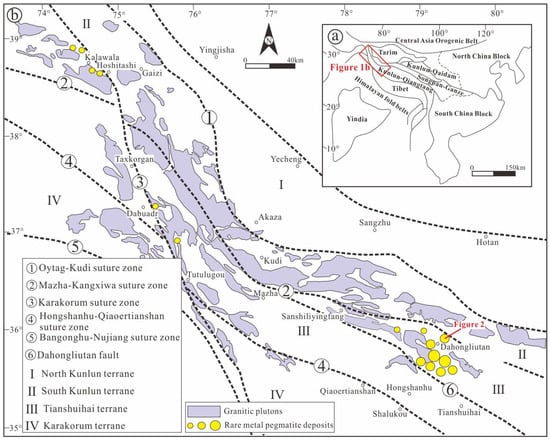
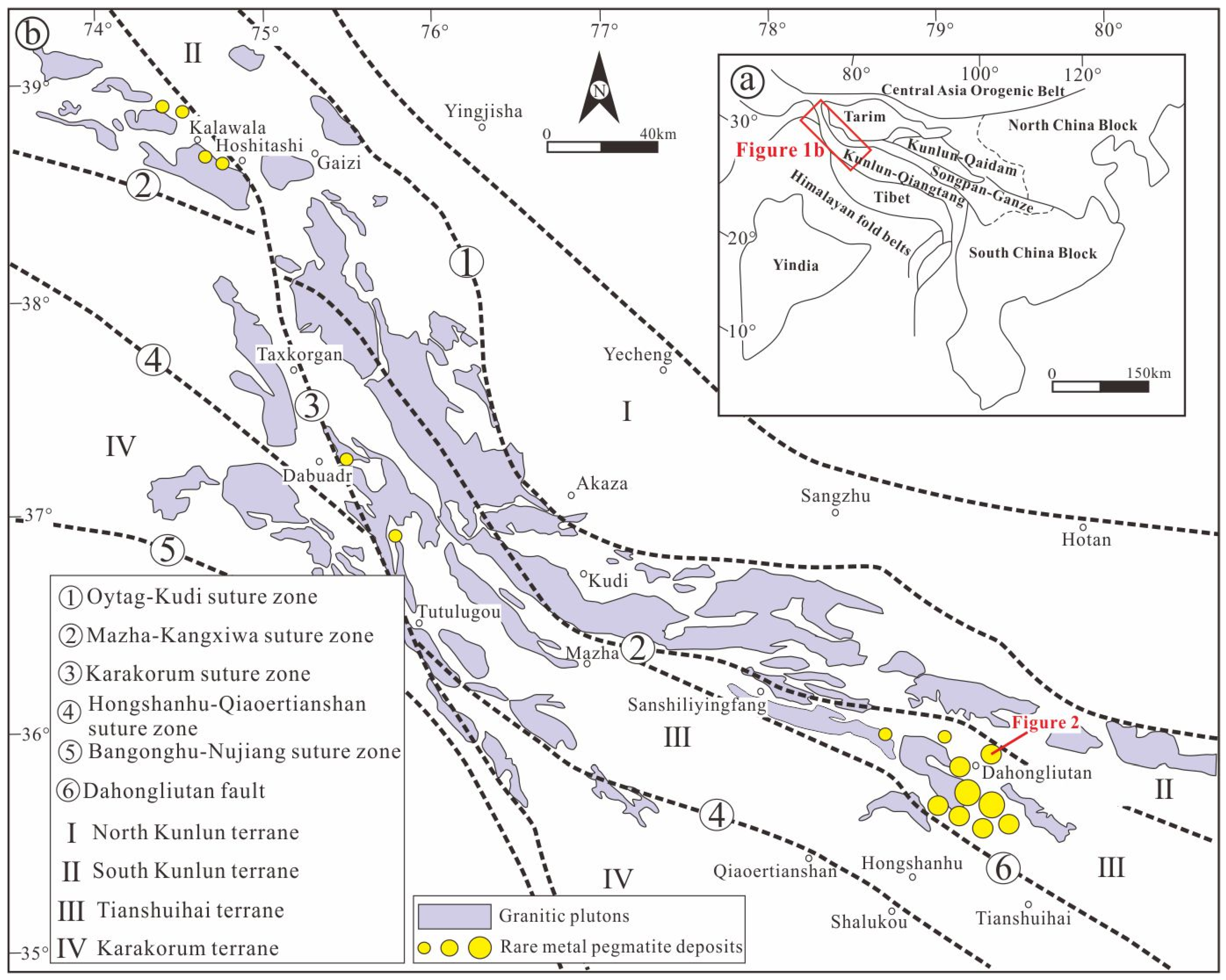
The West Kunlun orogenic belt (WKOB) is located on the Tibetan Plateau to the south and the Tarim Basin to the north (Figure 1a) [17,18]. The tectonic evolution of the WKOB was primarily controlled by Proto- and Paleo-Tethyan subduction and subsequent terrane collision from the early Paleozoic to early Mesozoic [17,19,20]. The belt comprises, from north to south, the North Kunlun, South Kunlun, Tianshuihai, and Karakorum terranes. The Tianshuihai terrane, which hosts numerous Li–Rb–(Be–Nb–Ta) rare metal deposits, extends NW–SE between the Mazha–Kangxiwa suture zone to the north and the Hongshanhu–Qiaoertianshan suture zone to the south (Figure 1b) [4,19,21].
Figure 1.
(a) Regional map of eastern Asia [18]; (b) tectonic map of the West Kunlun orogenic belt in NW China showing the major rare metal pegmatite deposits [22,23].
The rare metal pegmatites in the Dahongliutan ore field are primarily hosted within the Triassic Bayanharshan Group, the main lithostratigraphic unit in this terrane, which is composed of metasandstones, sericite–quartz schist, and two-mica schist [4,6]. Minor occurrences are also observed within the Permian Huangyangling Group (Figure 2). These pegmatites, predominantly trending NW–SE and spanning from tens of meters to over a kilometer in length and several to over a hundred meters in width, formed during mineralization ages of ca. 220–205 Ma [6,22,23,24]. The ore field is spatially associated with the composite Dahongliutan Mesozoic granite batholith (220–205 Ma), which consists of biotite monzogranite and garnet (tourmaline)-bearing monzogranite in the east and two-mica granite, biotite granite, and granodiorite in the southwest [7,25,26,27,28]. The spatial proximity (typically 2–3 km) and consistent Late Triassic ages (ca. 205–220 Ma) between the pegmatites and the Dahongliutan batholith suggest a genetic link between the rare metal pegmatites and the granitic system. This interpretation is further supported by regional geophysical data, which reveal the subsurface extent of the batholith and indicate a large-scale felsic magma reservoir at depth [29].
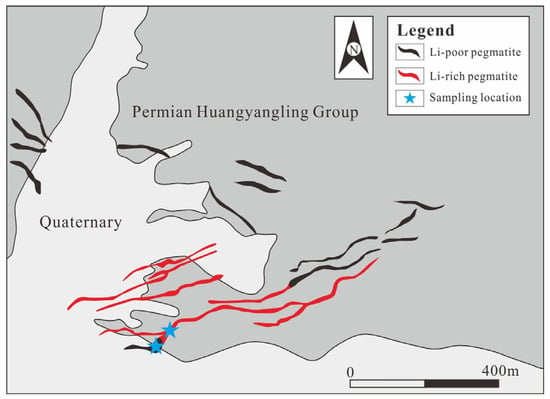
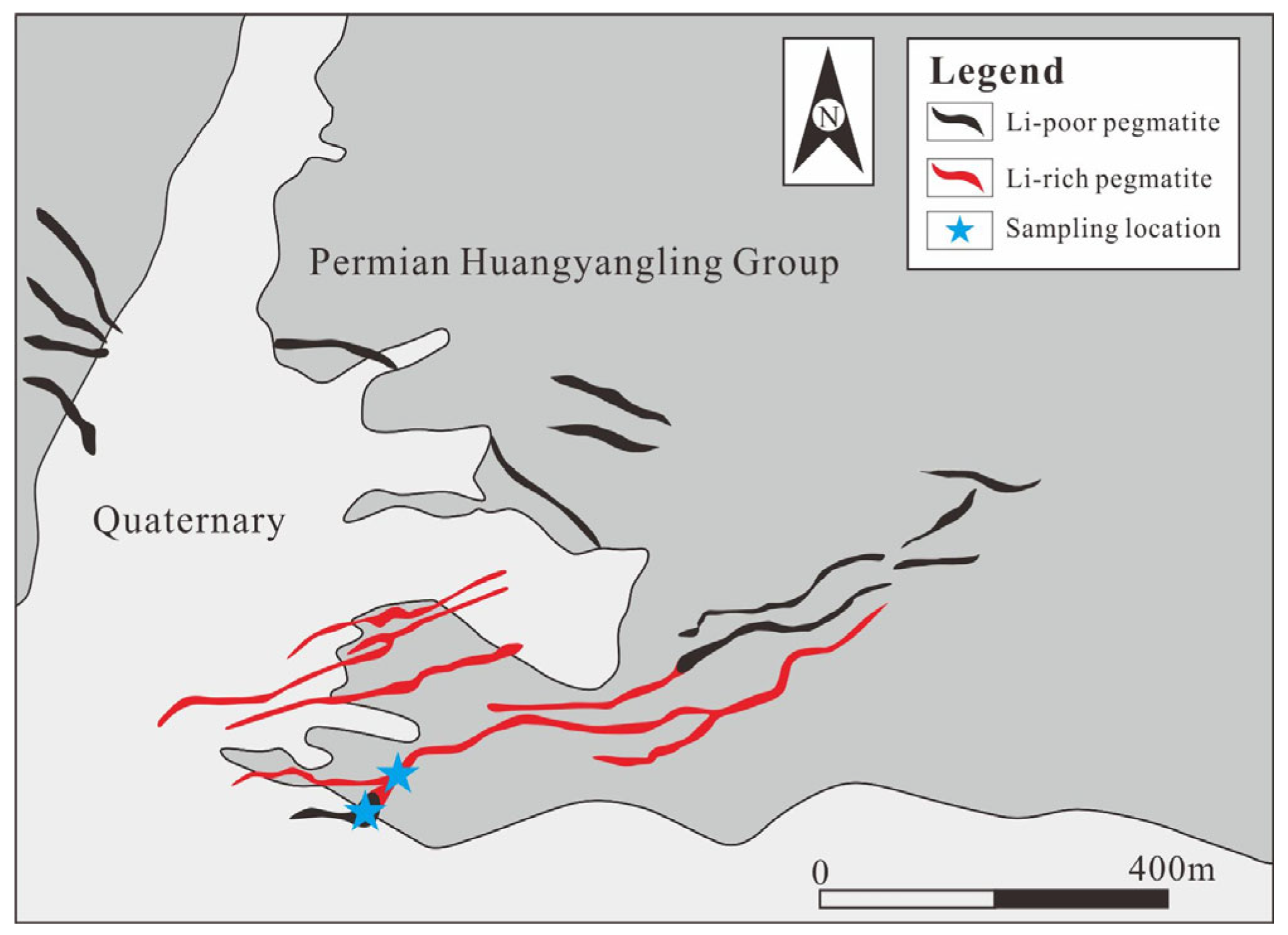
Figure 2.
Geological sketch map of the Dahongliutandong Li deposit [30].
2.2. Deposit Geology
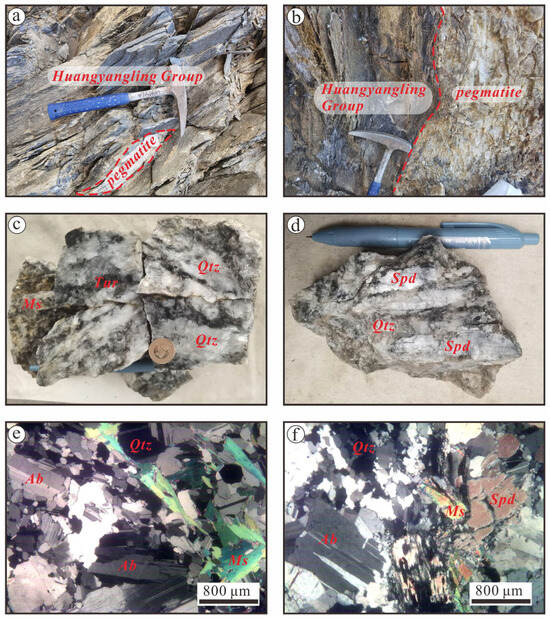
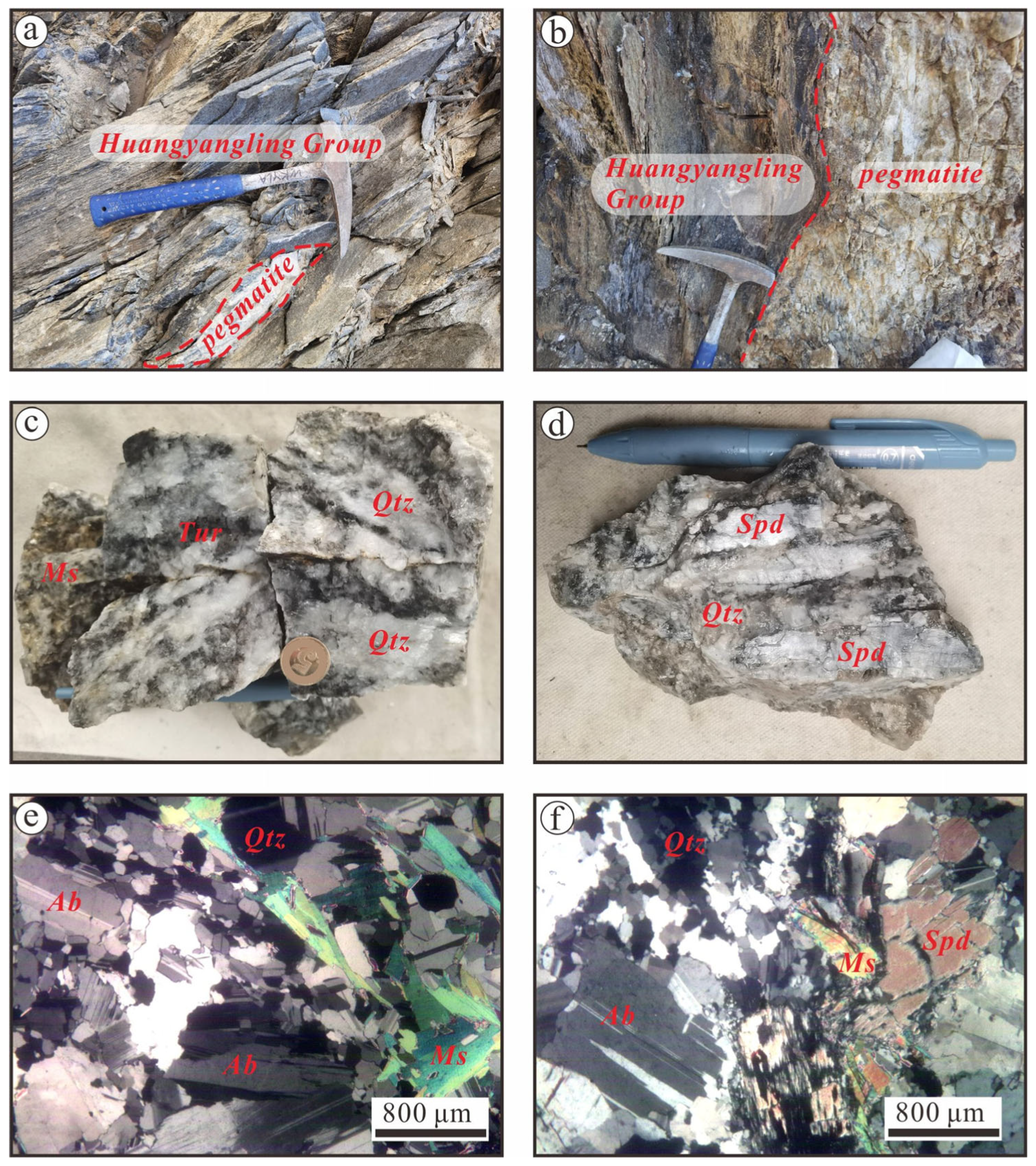
The newly discovered Dahongliutandong Li deposit (35°56′50″ N, 79°17′16″ E; West Kunlun, NW China) is one of the few pegmatite-type Li deposits hosted within Permian strata (Figure 2). The geological characteristics of the Dahongliutandong deposit have been well documented in previous studies [8] and are briefly summarized as follows. Mineralized pegmatite veins occur in the lower section of the Permian Huangyangling Group, which consists of weakly metamorphosed fine-clastic rocks that have reached greenschist-facies conditions (Figure 3a,b). The dominant lithology includes metamorphic feldspathic quartz siltstone, with minor slate and leptynite.
Figure 3.
(a,b) Field photographs showing the contact relationships between the Huangyangling Group and pegmatites at the Dahongliutandong Li deposit; (c,d) hand specimens of Li-poor and Li-rich pegmatites from the Dahongliutandong Li deposit; (e,f) photomicrographs of Li-poor and Li-rich pegmatites from the Dahongliutandong Li deposit. Mineral abbreviations: Qtz, quartz; Spd, spodumene; Ms, muscovite; Tur, tourmaline; Ab, albite.
The pegmatite veins in the area can be classified into two distinct types: Li-poor and Li-rich varieties, which differ notably in their geological features. The Li-poor pegmatites are significantly smaller, with lengths of 1.5–65 m and widths of 0.5–0.8 m. These veins occur obliquely within the same Permian strata and consist predominantly of quartz, feldspar, muscovite, and tourmaline, lacking spodumene. They typically display a medium- to coarse-grained granitic pegmatitic texture and massive structure, with local limonitization observed. In contrast, the Li-rich pegmatites are relatively large, measuring 10–450 m in length and 1.5–21 m in width, and extend in a NW–SE direction, generally parallel to or slightly crosscutting the bedding of the Permian Huangyangling Group. Their contact zones exhibit strong schistosity, along with silicification and tourmalinization. Mineralogically, spodumene is the characteristic ore mineral, accompanied by feldspar, quartz, muscovite, and tourmaline. Structurally, both vein types are controlled by NW–SE-trending fractures. The Li-poor pegmatites strike 320–340° and dip 50–70° NE, while the Li-rich pegmatites strike 315–335° with steeper dips of 60–80° NE.
3. Sampling and Analytical Methods
3.1. Sampling
This study focuses on analyzed samples from the No. 1 veins of both Li-poor and Li-rich pegmatites in the newly discovered Dahongliutandong Li deposit (Figure 2; Table 1). No significant alteration is observed in these samples. The pegmatite veins at Dahongliutandong are generally homogeneous in hand specimens and lack well-developed internal zoning, although subtle variations in mineral assemblages and grain sizes are observed locally. The Li-poor pegmatites typically display a medium- to coarse-grained granitic pegmatitic texture and massive structure. The Li-poor pegmatites (samples DD-1-1 to DD-1-4) consist mainly of quartz (20%–25%), albite (20%–30%), muscovite (5%–10%), and minor tourmaline (~5%), with apatite and rare zircon as accessory minerals (Figure 3c,e); they exhibit relatively uniform mineral distribution throughout the veins. In contrast, the Li-rich pegmatites (samples DD-2-1 to DD-2-4) are primarily composed of albite (55%–60%), quartz (25%–30%), spodumene (15%–20%), and minor muscovite (~5%), with zircon, columbite-tantalite (coltan), cassiterite, and apatite as accessory minerals (Figure 3d,f). The Li-rich pegmatites typically display a coarse-grained pegmatitic texture and massive to weakly banded structure. The Li-rich pegmatites show heterogeneity, with spodumene concentrated in aggregates or bands (Figure 3d) and spodumene-rich zones occurring in the central parts of thicker veins. Accessory cassiterite and columbite-tantalite are also irregularly distributed and mainly associated with spodumene-rich areas.
Table 1.
Summary of sample information for the No. 1 vein of the Dahongliutandong Li deposit.
3.2. Analytical Methods
The detailed analytical procedures for whole-rock major and trace element compositions and cassiterite U–Pb isotope data from both Li-poor and Li-rich pegmatites in the newly discovered Dahongliutandong Li deposit are described below.
3.2.1. Whole-Rock Major and Trace Element Analysis
Whole-rock major and trace element analyses were conducted at Wuhan Sample Solution Analytical Technology Co., Ltd. (Wuhan, China). Major element compositions were determined by X-ray fluorescence (XRF) spectroscopy (Primus II, Rigaku Corporation, Tokyo, Japan) using fused glass beads. The international standards GSR-1, GSR-3, and GSR-9 were used for calibration, and analytical uncertainties were better than 5%. Trace element concentrations were measured using an Agilent 7700e inductively coupled plasma mass spectrometer (ICP-MS) (Agilent Technologies, Santa Clara, CA, USA). The international standards AGV-2, BCR-2, and RGM-2 were used for calibration, and the analytical precision was generally better than 5% for most trace elements. Powdered samples were completely dissolved in a mixed HF–HNO3 solution in sealed Teflon bombs and heated for 48 h. The analytical procedures followed those described by Liu et al. (2008) [31].
3.2.2. Cassiterite U–Pb Dating
Cassiterite U–Pb dating and trace element analyses were conducted at the State Key Laboratory of Critical Earth Material Cycling and Mineral Deposits, Nanjing University, China. Measurements were performed using an ASI Resolution S-155 193 nm ArF excimer laser ablation system (Applied Spectra, Inc., West Sacramento, CA, USA) coupled to a Thermo Scientific iCAP Qc quadrupole ICP–MS (Thermo Fisher Scientific, Waltham, MA, USA). Analytical procedures generally followed those described by Li et al. (2016) [32] and Zhang et al. (2017) [33,34]. A laser beam diameter of 74 μm, an energy density of 4 J/cm2, and a repetition rate of 5 Hz were typically used. For samples zz50-1 and zz57-1, which contain smaller cassiterite grains, the beam diameter was reduced to 43 μm with an increased energy density of 6 J/cm2. NIST SRM 614 glass served as the primary external standard for correcting 206Pb/207Pb ratios and trace element concentrations. The Cligga Head (CLGH) cassiterite from Cornwall, UK, with an ID-TIMS U–Pb age of 285.14 ± 0.25 Ma [35], was used to calibrate 206Pb/238U ratios. Cassiterite XHL from the Xianghualing deposit (South China), with a reference age of 156 ± 4 Ma (ID-TIMS age) [36], was employed as a secondary monitoring standard. Standard analyses were interspersed at regular intervals: NIST SRM 614 was measured twice after every 12 unknowns, CLGH twice after every 6 unknowns, and XHL once after every 6 unknowns. Each analysis comprised 20 s of background acquisition, 50 s of ablation signal collection, and up to 20 s of gas-blank measurement. Dwell times were set to 8 ms for 204Pb, 15 ms for 206Pb and 208Pb, 20 ms for 238U, 232Th, and 207Pb, and 8 ms for other elements. Raw data were processed offline using ICPMSDataCal 9.9 [37]. Cassiterite typically has extremely low Th/U ratios (<0.01), making 208Pb predominantly common Pb. To correct for common Pb, we applied the Tera–Wasserburg diagram lower-intercept approach. U–Pb ages were calculated, and Tera–Wasserburg concordia diagrams were generated using Isoplot 4.15 [38]. Data reduction accounted for variable common Pb contents following the methods of Chew et al. (2014) [39] and Zhang et al. (2022) [40].
4. Results
4.1. Whole–Rock Major and Trace Element Compositions
The whole–rock major and trace element compositions from both Li-poor and Li-rich pegmatites in the newly discovered Dahongliutandong Li deposit are presented in Table A1.
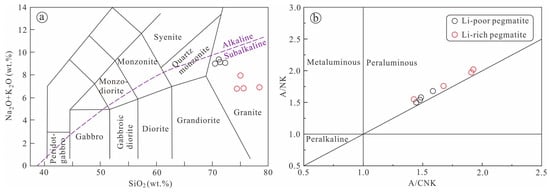
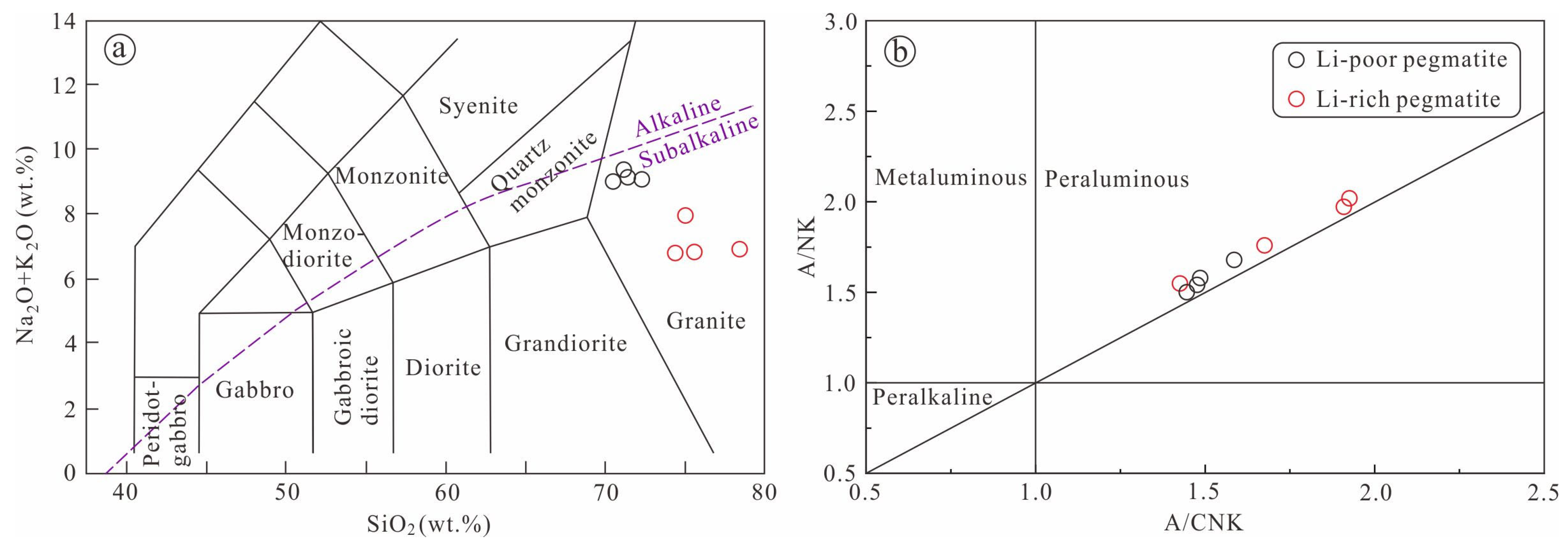
The studied samples show high and variable SiO2 contents ranging from 70.57 wt% to 78.50 wt% and low loss on ignition (LOI) varying between 0.01 wt% and 0.06 wt%. All the samples exhibit extremely low contents (<0.2 wt%) of TiO2, MnO, and MgO. The Li-poor pegmatites contain 70.57–72.37 wt% SiO2, 16.76–18.24 wt% Al2O3, 0.01–0.08 wt% TFe2O3, 8.65–9.29 wt% Na2O, 0.08–0.49 wt% K2O, and 0.17–0.21 wt% CaO. All the Li-poor pegmatites in this study plot in the granite field of the TAS diagram (Figure 4a) [41]. The molar [Al2O3/(CaO + NaO2 + K2O)] (i.e., A/CNK) values range from 1.47 to 1.61, suggesting a strongly peraluminous affinity (Figure 4b) [42]. Compared to Li-poor pegmatites, the Li-rich varieties are characterized by higher contents of SiO2 (74.46–78.50 wt%), K2O (0.41–0.55 wt%), and CaO (0.11–0.33 wt%) but lower contents of Al2O3 (14.98–16.93 wt%) and Na2O (6.32–7.55 wt%). In the SiO2 versus Na2O + K2O diagram (Figure 4a) [41], all samples plot within the granite field. Their A/CNK and A/NK values range from 1.45 to 1.95 and 1.52 to 1.99, respectively, indicating a strongly peraluminous affinity (Figure 4b) [42].
Figure 4.
Chemical classification diagrams for both Li-poor and Li-rich pegmatites in the Dahongliutandong Li deposit. (a) TAS (total alkali silica) diagram [41]; (b) A/NK versus A/CNK diagram [42].
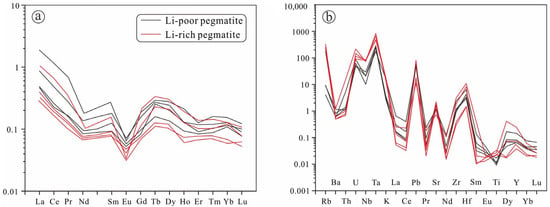
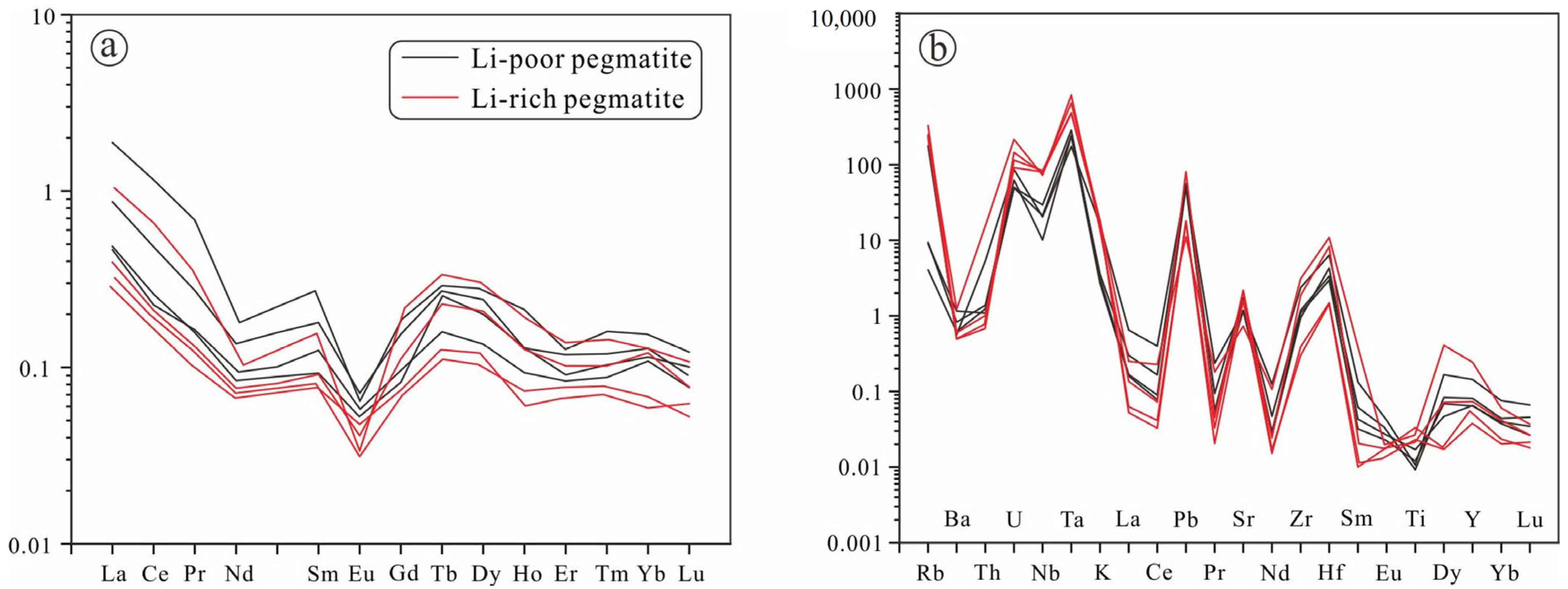
In terms of trace elements, both the Li-poor and Li-rich pegmatites in this study exhibit similar patterns of incompatible element enrichment and depletion. Their chondrite-normalized rare earth element (REE) patterns are coherent (Figure 5a) [43], characterized by light REE (LREE) enrichment and a gradual decrease in heavy REEs (HREEs), with (La/Yb)N ratios ranging from 3.99 to 8.02 in the Li-poor group and from 2.51 to 3.90 in the Li-rich group. The Li-poor pegmatites generally have higher total REE concentrations than the Li-rich pegmatites. Except for a few samples, both groups display predominantly negative Eu anomalies (Eu/Eu* = 0.03–0.77), consistent with significant plagioclase fractionation under relatively oxidizing conditions. The primitive mantle-normalized trace element spider diagram (Figure 5b) [43] shows consistent enrichment in large-ion lithophile elements (LILEs; e.g., Rb, U, K, and Pb) and depletion in high-field-strength elements (HFSEs; e.g., Nb and Ti). Negative Ba and Ce anomalies, together with positive Ta and Hf anomalies, are also observed in both groups of pegmatites. These geochemical features suggest that although the Li-poor and Li-rich pegmatites differ in Li and rare earth element (REE) concentrations, they likely originated from a similar source or underwent common early magmatic evolution.
Figure 5.
(a) Chondrite-normalized rare earth element (REE) patterns and (b) primitive mantle-normalized multi-element diagrams for both Li-poor and Li-rich pegmatites in the Dahongliutandong Li deposit. The chondrite and primitive mantle normalization values are from [43].
4.2. Cassiterite U–Pb Age
The cassiterite U–Pb isotope dating results for both Li-poor and Li-rich pegmatites in the newly discovered Dahongliutandong Li deposit are provided in Table A2.
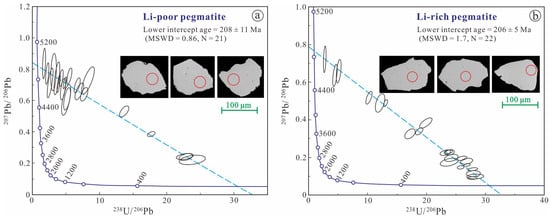
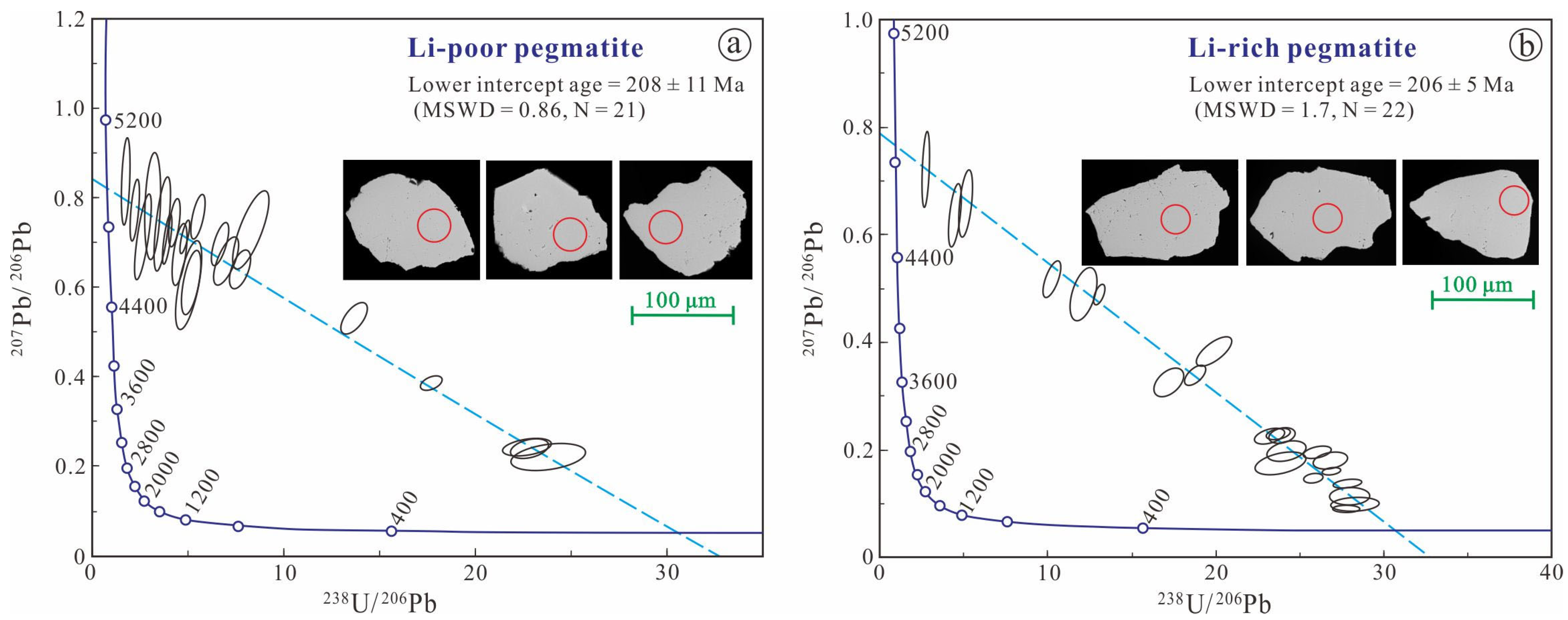
Cathodoluminescence (CL) images reveal that cassiterite grains from both Li-poor and Li-rich pegmatites are predominantly gray in color, exhibit euhedral to subhedral shapes, range from 100 to 200 µm in length and 50–100 µm in width, and show no zoning (Figure 6a,b). Clean grain boundaries with minimal fractures or alteration and intergrowth relationships with albite and quartz indicate primary magmatic crystallization. U—Pb dating of cassiterite from the Li-poor and Li-rich pegmatites yields consistent Tera–Wasserburg lower-intercept ages of 208 ± 11 Ma (MSWD = 0.86; n = 21) and 206 ± 5 Ma (MSWD = 1.7; n = 22), respectively (Figure 6a,b).
Figure 6.
Representative cathodoluminescence (CL) images and cassiterite U–Pb Tera–Wasserburg lower-intercept ages for the pegmatites from the Dahongliutandong Li deposit. (a) Li-poor pegmatites; (b) Li-rich pegmatites. Red circles indicate the locations of U–Pb analyses.
5. Discussion
5.1. Age of the Dahongliutandong Li Deposit
Precise determination of mineralization age is fundamental for constraining the genesis of rare metal pegmatite deposits. Although zircon U–Pb dating is a commonly employed geochronological method, direct dating of ore-forming minerals such as cassiterite and columbite-group minerals (CGMs) provides more direct and robust constraints on the timing of rare metal mineralization [11,12,44]. Despite challenges associated with high common Pb and low U contents in cassiterite [45], methodological advances have demonstrated that Tera–Wasserburg lower-intercept ages are more reliable than conventional 206Pb/207Pb–238U/207Pb isochron methods for high-common-Pb systems [32].
In this study, cassiterite grains from both Li-poor and Li-rich pegmatites at Dahongliutandong exhibit euhedral to subhedral morphology, an absence of internal zoning in cathodoluminescence (CL) images (Figure 6a,b), and magmatic intergrowths with albite and quartz, supporting a primary magmatic origin. U–Pb dating yields consistent Tera–Wasserburg lower-intercept ages of 208 ± 11 Ma (MSWD = 0.86; n = 21) for Li-poor pegmatites and 206 ± 5 Ma (MSWD = 1.7; n = 22) for Li-rich pegmatites. These cassiterite U–Pb ages are further corroborated by recent zircon U–Pb geochronology conducted on pegmatites from the same area. Kong et al. (2023) [8] reported LA—ICP—MS zircon U–Pb ages of 205.0 ± 2.6 Ma and 205.2 ± 1.4 Ma for Li-rich and Li-poor pegmatites, respectively, at Dahongliutandong. These ages overlap within analytical uncertainty, constraining the Li mineralization at Dahongliutandong to a Late Triassic (~205–208 Ma) magmatic–hydrothermal event.
This metallogenic age framework is consistent with published geochronological data from West Kunlun and the adjacent Songpan–Ganzi rare metal metallogenic belts. For instance, within the same Dahongliutan ore field, Yan et al. (2018) [22] reported a columbite U–Pb age of 211.9 ± 2.4 Ma and a cassiterite U–Pb age of 218 ± 12 Ma. The nearby Bailongshan deposit yields a columbite U–Pb age of 208.1–213.9 Ma [6,46], which is coeval with the emplacement of the ca. 205–220 Ma Dahongliutan batholith [7,25,26,27,28]. Pegmatites in the West Kunlun rare metal metallogenic belt, such as those at Xiaorubulong, Huoshitashi, Mulinchang, and Xuefengling, also record concentrated mineralization ages of ~205–208 Ma [23,27]. Extending eastward to the Songpan–Ganzi rare metal metallogenic belt, major deposits such as Jiajika, Zhawulong, and Lijiaqou exhibit principal metallogenic epochs during the Late Triassic to Early Jurassic (~192–217 Ma) [46,47,48,49]. This extensive spectrum of mineralization ages (~200–220 Ma) across different tectonic units reveals a regional-scale rare metal mineralization event in the Late Triassic within the Tethyan tectonic domain of southwestern China.
In summary, geochronological evidence constrains the mineralization age of the Dahongliutandong Li deposit to ~205–208 Ma, which is coeval with regional Late Triassic rare metal events in the West Kunlun–Songpan–Ganzi orogenic belt.
5.2. Implications for Regional Mineralization
Based on the mineralization age (~205–208 Ma) of the Dahongliutandong Li deposit, integrated with published geochemical and geochronological data, this study provides important insights into the tectonic setting and Li metallogenic potential in this region. The Dahongliutandong pegmatites are characterized by enrichment in spodumene as the primary Li-rich mineral and are classified within the LCT (Li–Cs–Ta) family [50]. Pegmatites of this family are generally interpreted as resulting from extreme fractional crystallization of peraluminous granitic melts, typically derived from partial melting of metasedimentary crustal sources [51,52,53]. Consequently, most LCT pegmatites exhibit a strong compositional affinity and spatial–genetic relationship with S-type granites [54,55].
In this context, the Dahongliutandong pegmatites are situated within the newly recognized >2000 km long rare metal metallogenic belt of the West Kunlun–Songpan–Ganzi orogenic belt, which hosts several world-class rare metal deposits, including Bailongshan, West 509-Daoban, Jiajika, and Zawulong [6,23,56,57,58]. Like other major deposits in this belt, the Dahongliutandong pegmatites are hosted by granites and low- to medium-grade metasedimentary rocks of the Tianshuihai–Songpan–Ganzi Terrane, reflecting a clear temporal, spatial, and paragenetic link to Late Triassic granites [6,7,23,28,56]. The Li-poor and Li-rich pegmatites in Dahongliutandong exhibit similar REE patterns, consistent trace element signatures, and strongly peraluminous compositions, suggesting derivation from a common magmatic source. Systematic geochemical trends—such as the enrichment of Li, Rb, Cs, Nb, and Ta from Li-poor to Li-rich pegmatites, decreasing K/Rb ratios, and negative Eu anomalies—further indicate progressive fractional crystallization as a key petrogenetic process. The contrasting geochemical signatures of the two pegmatite types reflect different stages of fractional crystallization. The Li-rich pegmatites are enriched in Li, Rb, Cs, Nb, Ta, and Sn, consistent with the progressive fractionation of feldspar and mica and the saturation of Nb-Ta oxides and cassiterite at the magmatic–hydrothermal transition [53,59]. In contrast, the Li-poor pegmatites are enriched in Be and Zr, suggesting control by early-crystallizing accessory minerals such as beryl and zircon. Their genetic link to the spatially associated two-mica granites is supported by consistent emplacement ages: 206–205 Ma for the West 509-Daoban two-mica granites [28] and 208–205 Ma for the Dahongliutandong pegmatites. In addition, the West 509-Daoban and Bailongshan pegmatites display Sr–Nd isotopic compositions comparable to those of the West 509-Daoban two-mica granites, which are characterized by high initial 87Sr/86Sr ratios (0.71532–0.71661) and low εNd(t) values (−9.96 to −9.52) [7,60]. These lines of evidence collectively reinforce a cogenetic relationship between the pegmatites and the granitic magmatic system.
The formation of LCT pegmatites is closely linked to the fluid-magmatic differentiation of peraluminous granitic magmas [59,61]. As highly fractionated granitic melts evolve, they become enriched in fluxes (H2O, F, B, P) and incompatible elements (Li, Rb, Cs, Nb, Ta), ultimately leading to the exsolution of a volatile-rich phase that promotes the crystallization of rare-metal minerals [62,63]. The Nb-Ta fractionation observed in peraluminous granites serves as a key marker of the magmatic–hydrothermal transition, with decreasing Nb/Ta ratios indicating progressive fluid exsolution and interaction [59]. Similar processes have been documented in rare-metal pegmatite provinces worldwide. In the Kalba region of Eastern Kazakhstan, Khromykh et al. (2020) [64] demonstrated that Li–Ta–Nb mineralization resulted from extreme fractional crystallization of rare-metal granite melts, with fluid saturation playing a critical role in ore formation. The Koktokay No. 3 pegmatite in the Chinese Altai is another classic example, where Shen et al. (2022) [65] showed that the parental highly fractionated leucogranite underwent extensive magmatic–hydrothermal evolution, leading to world-class rare-metal mineralization. More recently, Fanka and Tadthai (2023) [66] documented Li-bearing pegmatites in southern Thailand that formed through progressive fractionation of peraluminous granitic magmas, with fluid-magmatic processes controlling the distribution of rare elements. Oitseva et al. (2025) [67] further emphasized the importance of fluid saturation and volatile transfer in the formation of Li–Ta–Nb mineralization in the Kvartsevoye pegmatite deposit, Eastern Kazakhstan. These geochemical features are also consistent with fluid-magmatic differentiation of the parental granitic magma, a process widely recognized in the formation of LCT pegmatites [57,59]. The presence of tourmaline in Li-poor pegmatite types further supports the involvement of a boron-rich fluid phase during magmatic evolution, highlighting the role of volatile components in promoting rare metal enrichment. These lines of evidence collectively suggest that the Dahongliutandong Li pegmatites formed through advanced fluid-magmatic differentiation of peraluminous granitic melts, analogous to other major LCT pegmatite systems worldwide that are typically associated with post-collisional extensional environments following crustal thickening [51,68,69]. The mineralization is interpreted as the result of extreme fractional crystallization from a highly evolved, volatile-rich residual melt derived from the parental Dahongliutan pluton. This pluton constitutes a NW-trending, Late Triassic post-collisional complex extending for over 150 km along strike, represents the dominant intrusive unit in the Tianshuihai terrane, and was emplaced ca. 205–220 Ma [7,22,25,26,27,28,70]. The spatial proximity, overlapping ages, consistent compositions, and comparable isotopic signatures further support a cogenetic relationship between the Dahongliutan granites and the Dahongliutandong pegmatites, both of which formed in a post-collisional extensional setting following Paleo-Tethys closure.
During the Late Triassic, the gradual closure of the Paleo-Tethys Ocean from northwest to southeast in the WKOB led to intense collisional orogeny, crustal thickening, and syn-collisional magmatism, followed by a tectonic transition from compression to extension that triggered decompression melting of the thickened crust and widespread post-collisional magmatism [27,71,72,73,74]. The emplacement of the Dahongliutan pluton and the crystallization of its associated pegmatites represent a key response to this post-collisional extensional phase, with their formation age precisely recording the timing of the tectonic transition. This genetic linkage is supported by their spatial association and similar Late Triassic ages, consistent with regional magmatic and metallogenic events during the post-collisional stage of the Paleo-Tethys closure in the WKOB [6,22,23,24,28,71]. Notably, this tectonic setting is not only analogous to that of other major global pegmatite deposits (e.g., Koktokay in China and Kenticha in Ethiopia) but also establishes a clear genetic and spatial linkage between rare metal mineralization in West Kunlun and that in the Songpan–Ganzi metallogenic belt, highlighting the significant exploration potential in this region.
6. Conclusions
- 1.
- Cassiterite U–Pb dating indicates that the mineralization of the Dahongliutandong Li deposit occurred during the Late Triassic (~206–208 Ma), contemporaneous with a post-collisional extensional setting following the closure of the Paleo-Tethys Ocean.
- 2.
- Geochemical analyses reveal that both Li-poor and Li-rich pegmatites exhibit strongly peraluminous signatures, consistent trace-element patterns, and negative Eu anomalies, suggesting a common magmatic source.
- 3.
- As the first Li deposit discovered within the Permian Huangyangling Group, this finding extends the metallogenic framework of the West Kunlun orogenic belt and offers new guidance for regional rare metal exploration.
Author Contributions
Conceptualization, W.Y., W.W. and Y.G.; investigation, W.Y.; writing—original draft preparation, W.Y.; writing—review and editing, W.W. and Y.G.; data curation, H.S. and S.W. All authors have read and agreed to the published version of the manuscript.
Funding
This study was jointly supported by the Program of China Geological Survey (DD20242747 and DD202602109701), the Natural Science Foundation of Xinjiang Uygur Autonomous Region (2024D03020), the Tianchi Talent Program of Xinjiang Uygur Autonomous Region (awarded to Wukeyila Wutiepu), and the Tianshan Talent Program of Xinjiang Uygur Autonomous Region (2023TSYCCX0008).
Data Availability Statement
The original contributions presented in this study are included in the article. Further inquiries can be directed to the corresponding author.
Acknowledgments
We sincerely appreciate the constructive comments from the editors and anonymous reviewers, which have significantly improved the manuscript. We also thank Wuhan Sample Solution Analytical Technology Co., Ltd. for the whole-rock geochemical analyses and the State Key Laboratory of Critical Earth Material Cycling and Mineral Deposits at Nanjing University for the cassiterite U–Pb dating.
Conflicts of Interest
The authors declare no conflicts of interest.
Appendix A
Table A1.
Whole-rock major and trace element compositions of the Li-poor and Li-rich pegmatites in the newly discovered Dahongliutandong Li deposit.
Table A2.
In situ LA–MC–ICP–MS U–Pb dates of cassiterite from the Li-poor and Li-rich pegmatites in the newly discovered Dahongliutandong Li deposit.
References
- Kesler, S.E.; Gruber, P.W.; Medina, P.A.; Keoleian, G.A.; Everson, M.P.; Wallington, T.J. Global lithium resources: Relative importance of pegmatite, brine and other deposits. Ore Geol. Rev. 2012, 48, 55–69. [Google Scholar] [CrossRef] [Scilit]
- Gil-Alana, L.A.; Monge, M. Lithium: Production and estimated consumption, Evidence of persistence. Resour. Policy 2019, 60, 198–202. [Google Scholar] [CrossRef] [Scilit]
- Simmons, W.B.; Pezzotta, F.; Shigley, J.E.; Beurlen, H. Granitic pegmatites as sources of colored gemstones. Elements 2012, 8, 281–287. [Google Scholar] [CrossRef] [Scilit]
- Wang, H.; Li, P.; Ma, H.; Zhu, B.; Qiu, L.; Zhang, X.; Dong, R.; Zhou, K.; Wang, M.; Wang, Q.; et al. Discovery of the bailongshan superlarge lithium-rubidium deposit in karakorum, hetian, xinjiang, and its prospecting implication. Geotecton. Metallog. 2017, 41, 1053–1062. [Google Scholar]
- Peng, H.L.; He, N.Q.; Wang, M.C.; Du, B.; Li, W.J.; Liu, Y.Q. Geological characteristics and metallogenic regularity of West Track 509 rare polymetallic deposit in Dahongliutan region, Hetian, Xinjiang. Northwest. Geol. 2018, 51, 146–154, (In Chinese with English abstract). [Google Scholar]
- Wang, H.; Gao, H.; Zhang, X.Y.; Yan, Q.H.; Xu, Y.; Zhou, K.; Dong, R.; Li, P. Geology and geochronology of the superlarge Bailongshan Li-Rb-(Be) rare-metal pegmatite deposit, West Kunlun orogenic belt, NW China. Lithos 2020, 360–361, 105449. [Google Scholar] [CrossRef] [Scilit]
- Yan, Q.H.; Chi, G.X.; Wang, H.; Chen, C.; Zhou, K.L.; Liu, M.F. Sediment-derived granites as the precursor of rare-metal pegmatites in the Paleo-Tethys tectonic zone—Evidence from the Bailongshan Li-Rb-Be pegmatite ore field and factors controlling mineralization. Miner. Depos. 2024, 60, 743–764. [Google Scholar] [CrossRef] [Scilit]
- Kong, H.L.; Ren, G.L.; Li, W.Y.; Li, K.; Zhao, X.J.; Zhang, J.W.; Li, W. Geochronology, Geochemistry and Their Geological Significances of Spodumene Pegmatite Veins in the Dahongliutandong Deposit, Western Kunlun, China. Northwestern Geol. 2023, 56, 61–79, (In Chinese with English abstract). [Google Scholar]
- Selway, J.B.; Breaks, F.W.; Tindle, A.G. A review of rare-element (Li-Cs-Ta) pegmatite exploration techniques for the Superior Province, Canada, and large worldwide tantalum deposits. Explor. Min. Geol. 2005, 14, 1–30. [Google Scholar] [CrossRef] [Scilit]
- Melcher, F.; Graupner, T.; Gäbler, H.E.; Sitnikova, M.; Henjes-Kunst, F.; Oberthür, T.; Gerdes, A.; Dewaele, S. Tantalum-(niobium-tin) mineralisation in African pegmatites and rare metal granites: Constraints from Ta-Nb oxide mineralogy, geochemistry and U-Pb geochronology. Ore Geol. Rev. 2015, 64, 667–719. [Google Scholar] [CrossRef] [Scilit]
- Černý, P.; Ercit, T.S. Mineralogy of niobium and tantalum: Crystal chemical relationships, paragenetic aspects and their economic implications. In Lanthanides, Tantalum and Niobium; Möller, P., Černý, F., Saupé, F., Eds.; Springer: Berlin, Germany, 1989; pp. 27–79. [Google Scholar]
- Melleton, J.; Gloaguen, E.; Frei, D.; Milan, N.; Breiter, K. How are the emplacement of the rare-element pegmatites, regional metamorphism and magmatism interrelated in the Moldanubian domain of the Variscan Bohemian Massif, Czech Republic? Can. Mineral. 2013, 50, 1751–1773. [Google Scholar] [CrossRef] [Scilit]
- Gulson, B.L.; Jones, M.T. Cassiterite: Potential for direct dating of mineral deposits and a precise age for the bushveld complex granites. Geology 1992, 20, 355–358. [Google Scholar] [CrossRef] [Scilit]
- Černý, P.; Lenton, P.G. The Buck and Pegli lithium deposits, southeastern Manitoba: The problem of updip fractionation in subhorizontal pegmatite sheets. Econ. Geol. 1995, 90, 658–675. [Google Scholar] [CrossRef] [Scilit]
- Neymark, L.A.; Holm-Denoma, C.S.; Moscati, R.J. In situ LA-ICPMS U-Pb dating of cassiterite without a known-age matrix-matched reference material: Examples from worldwide tin deposits spanning the Proterozoic to the Tertiary. Chem. Geol. 2018, 483, 410–425. [Google Scholar] [CrossRef] [Scilit]
- Gemmrich, L.; Torró, L.; Melgarejo, J.C.; Laurent, O.; Vallance, J.; Chelle-Michou, C.; Sempere, T.P.A. Trace element composition and U-Pb ages of cassiterite from the Bolivian tin belt. Miner. Depos. 2021, 56, 1491–1520. [Google Scholar] [CrossRef] [Scilit]
- Xiao, W.J.; Windley, B.F.; Chen, H.L.; Zhang, G.C.; Li, J.L. Carboniferous-triassic subduction and accretion in the western kunlun, China: Implications for the collisional and accretionary tectonics of the northern tibetan plateau. Geology 2002, 30, 295–298. [Google Scholar] [CrossRef] [Scilit]
- Xiao, W.J.; Windley, B.F.; Liu, D.Y.; Jian, P.; Liu, C.Z.; Yuan, C.; Sun, M. Accretionary tectonics of the Western Kunlun Orogen, China: A Paleozoic–early Mesozoic, long-lived active continental margin with implications for the growth of Southern Eurasia. J. Geol. 2005, 113, 687–705. [Google Scholar] [CrossRef] [Scilit]
- Mattern, F.; Schneider, W. Suturing of the Proto- and Paleo-Tethys oceans in the Western Kunlun (Xinjiang, China). J. Asian Earth Sci. 2000, 18, 637–650. [Google Scholar] [CrossRef] [Scilit]
- Xiao, W.; Han, F.; Windley, B.F.; Yuan, C.; Zhou, H.; Li, J. Multiple accretionary orogenesis and episodic growth of continents: Insights from the Western Kunlun Range, Central Asia. Int. Geol. Rev. 2003, 45, 303–328. [Google Scholar] [CrossRef] [Scilit]
- Hu, J.; Wang, H.; Huang, C.; Tong, L.; Mu, S.; Qiu, Z. Geological characteristics and age of the Dahongliutan Fe-ore deposit in the Western Kunlun orogenic belt, Xinjiang, northwestern China. J. Asian Earth Sci. 2016, 116, 1–25. [Google Scholar] [CrossRef] [Scilit]
- Yan, Q.H.; Qiu, Z.W.; Wang, H.; Wang, M.; Wei, X.P.; Li, P.; Zhang, R.Q.; Li, C.Y.; Liu, J.P. Age of the Dahongliutan rare metal pegmatite deposit, West Kunlun, Xinjiang (NW China): Constraints from LA–ICP–MS U–Pb dating of columbite-(Fe) and cassiterite. Ore Geol. Rev. 2018, 100, 561–573. [Google Scholar] [CrossRef] [Scilit]
- Yan, Q.H.; Wang, H.; Chi, G.; Wang, Q.; Hu, H.; Zhou, K.; Zhang, X.Y. Recognition of a 600-km-long late triassic rare metal (Li-Rb-Be-Nb-Ta) pegmatite belt in the western kunlun orogenic belt, western China. Econ. Geol. 2022, 117, 213–236. [Google Scholar] [CrossRef] [Scilit]
- Zhao, H.; Chen, B.; Zheng, B.Q.; Yang, Q. Petrogenesis of Mesozoic pegmatites in the Dahongliutan Li-mineralized belt (Western Kunlun, NW China). J. Asian Earth Sci. 2024, 264, 106076. [Google Scholar] [CrossRef] [Scilit]
- Wei, X.P.; Wang, H.; Hu, J.; Mu, S.L.; Qiu, Z.W.; Yan, Q.H.; Li, P. Geochemistry and geochronology of the Dahongliutan two-mica granite pluton in western Kunlun orogen: Geotectonic implications. Geochim. 2017, 46, 66–80, (In Chinese with English abstract). [Google Scholar]
- Ding, K.; Liang, T.; Yang, X.Q.; Zhou, Y.; Feng, Y.G.; Li, K.; Teng, J.X.; Wang, R.T. Geochronology, petrogenesis and tectonic significance of Dahongliutan pluton in Western Kunlun orogenic belt, NW China. J. Cent. South Univ. 2019, 26, 3420–3435. [Google Scholar] [CrossRef] [Scilit]
- Zhang, Q.; Liu, Y.; Wu, Z.; Huang, H.; Li, K.; Zhou, Q. Late Triassic granites from the northwestern margin of the Tibetan Plateau, the Dahongliutan example: Petrogenesis and tectonic implications for the evolution of the Kangxiwa Palaeo-Tethys. Int. Geol. Rev. 2019, 61, 175–194. [Google Scholar] [CrossRef] [Scilit]
- Wutiepu, W.; Xiao, W.J.; Wang, S.S.; Mao, Q.G.; Yao, J.M.; Zhou, S.G.; An, S.L.; Hu, J.; Yang, W.G. Petrogenesis of Mesozoic ore-related granites in the West 509-Daoban Li-Be rare metal deposit, West Kunlun Orogenic Belt, NW China: Implications for magmatic evolution and associated Li mineralization. Ore Geol. Rev. 2025, 184, 106769. [Google Scholar] [CrossRef] [Scilit]
- Li, W.Y.; Gao, Y.B.; Ren, G.L.; Liu, C.; Li, K.; Kong, H.L. Deep Structure and Interpretation of Regional Metallogenic Model of the Dahongliutan Pegmatite Lithium Ore Deposit in Xinjiang, Western China. Acta Geol. Sin. 2024. [Google Scholar] [CrossRef]
- XBGMR (Xinjiang Bureau of Geology and Mineral Resources). Third Geological Brigade. In Exploration Report of the Dahongliutandong Li–Be Deposit; XBGMR (Xinjiang Bureau of Geology and Mineral Resources): Urumqi, China, 2023. (In Chinese) [Google Scholar]
- Liu, Y.S.; Hu, Z.C.; Gao, S.; Günther, D.; Xu, J.; Gao, C.G.; Chen, H.H. In situ analysis of major and trace elements of anhydrous minerals by LA-ICP-MS without applying an internal standard. Chem. Geol. 2008, 257, 34–43. [Google Scholar] [CrossRef] [Scilit]
- Li, C.Y.; Zhang, R.Q.; Ding, X.; Ling, M.X.; Fan, W.M.; Sun, W.D. Dating cassiterite using laser ablation ICP-MS. Ore Geol. Rev. 2016, 72, 313–322. [Google Scholar] [CrossRef] [Scilit]
- Zhang, R.Q.; Lehmann, B.; Seltmann, R.; Sun, W.D.; Li, C.Y. Cassiterite U–Pb geochronology constrains magmatic–hydrothermal evolution in complex evolved granite systems: The classic Erzgebirge tin province (Saxony and Bohemia). Geology 2017, 45, 1095–1098. [Google Scholar] [CrossRef] [Scilit]
- Zhang, R.Q.; Lu, J.J.; Lehmann, B.; Li, C.Y.; Li, G.L.; Zhang, L.P.; Guo, J.; Sun, W.D. Combined zircon and cassiterite U-Pb dating of the Piaotang granite-related tungsten-tin deposit, southern Jiangxi tungsten district, China. Ore Geol. Rev. 2017, 82, 268–284. [Google Scholar] [CrossRef] [Scilit]
- Tapster, S.R.; Bright, J.W.G. High-precision ID-TIMS cassiterite U–Pb systematics using a low-contamination hydrothermal decomposition: Implications for LA–ICP–MS and ore deposit geochronology. Geochronology 2020, 2, 425–441. [Google Scholar] [CrossRef] [Scilit]
- Yuan, S.; Peng, J.; Hu, R.; Li, H.; Shen, N.; Zhang, D. A precise U–Pb age on cassiterite from the Xianghualing tin-polymetallic deposit, Hunan, South China. Miner. Depos. 2008, 43, 375–382. [Google Scholar] [CrossRef] [Scilit]
- Liu, Y.S.; Hu, Z.C.; Zong, K.Q.; Gao, C.G.; Gao, S.; Xu, J.; Chen, H.H. Reappraisement and refinement of zircon U–Pb isotope and trace element analyses by LA–ICP–MS. Chin. Sci. Bull. 2010, 55, 1535–1546. [Google Scholar] [CrossRef] [Scilit]
- Ludwig, K.R. Isoplot: A Geochronological Toolkit for Microsoft Excel; Berkeley Geochronology Center: Berkeley, CA, USA, 2012; Volume 5, p. 70. [Google Scholar]
- Chew, D.M.; Petrus, J.A.; Kamber, B.S. U–Pb LA–ICPMS dating using accessory mineral standards with variable common Pb. Chem. Geol. 2014, 363, 185–199. [Google Scholar] [CrossRef] [Scilit]
- Zhang, R.Q.; Lu, J.J.; Hu, H.; Gao, J.F.; Zhou, M.Z. LA–ICPMS U–Pb dating of cassiterite using matrix-matched standards with variable common Pb. Minerals 2022, 12, 123. [Google Scholar]
- Middlemost, E.A.K. Naming materials in the magma/igneous rock system. Earth-Sci. Rev. 1994, 37, 215–224. [Google Scholar] [CrossRef] [Scilit]
- Maniar, P.D.; Piccoli, P.M. Tectonic discrimination of granitoids. Geol. Soc. Am. Bull. 1989, 101, 635–643. [Google Scholar] [CrossRef] [Scilit]
- Sun, S.S.; McDonough, W.F. Chemical and isotopic systematics of oceanic basalts: Implications for mantle composition and processes. In Magmatism in the Ocean Basins; Saunders, A.D., Norry, M.J., Eds.; Geological Society, London, Special Publications: London, UK, 1989; Volume 42, pp. 313–345. [Google Scholar]
- Melleton, J.; Gloaguen, E.; Frei, D.; Lima, A.; Vieira, R.; Martins, T.; Marcoux, E. Polyphased rare-element magmatism during late orogenic evolution: Geochronological constraints from NW Variscan Iberia. BSGF—Earth Sci. Bull. 2022, 193, 7. [Google Scholar] [CrossRef] [Scilit]
- Clayton, R.E.; Rojkovic, I. Experimental Pb isotope studies of cassiterite from Hnilec granite, Slovakia. In Mineral Deposits: Processes to Processing; Balkema: Rotterdam, The Netherlands, 1999; pp. 329–332. [Google Scholar]
- Zhou, J.S.; Wang, Q.; Xu, Y.G.; Cempírek, J.; Wang, H.; Ma, J.L.; Wei, G.J.; Huang, T.Y.; Zhu, G.H.; Zhang, L. Geochronology, petrology, and lithium isotope geochemistry of the Bailongshan granite-pegmatite system, northern Tibet: Implications for the ore-forming potential of pegmatites. Chem. Geol. 2021, 584, 120484. [Google Scholar] [CrossRef] [Scilit]
- Hao, X.F.; Fu, X.F.; Liang, B.; Yuan, L.P.; Pan, M.; Tang, Y. Formation ages of granite and X03 pegmatite vein in Jiajika, western Sichuan, and their geological significance. Miner. Depos. 2015, 34, 1199–1208, (In Chinese with English abstract). [Google Scholar]
- Dai, H.Z.; Wu, F.Y.; Wang, J.G.; Liu, X.C.; Liu, Z.C.; Zhang, C. Geochronology and petrogenesis of the granitic pegmatite in the Jiajika lithium deposit, western Sichuan, China. Lithos 2019, 350–351, 105277. [Google Scholar]
- Zhu, J.Y.; Zhu, W.B.; Xu, Z.Q.; Zhang, R.Q.; Che, X.D.; Zheng, B.H. The geochronology of pegmatites in the Jiajika lithium deposit, western Sichuan, China: Implications for multi-stage magmatic-hydrothermal events in the Songpan-Ganze rare metal metallogenic belt. Ore Geol. Rev. 2023, 159, 105582. [Google Scholar] [CrossRef] [Scilit]
- Černý, P.; Ercit, T.S. The classification of granitic pegmatites revisited. Can. Mineral. 2005, 43, 2005–2026. [Google Scholar] [CrossRef] [Scilit]
- Černý, P. Rare-element granitic pegmatites. Part II: Regional to global environments and petrogenesis. Geosci. Can. 1991, 18, 68–81. [Google Scholar]
- Koester, E.; Pawley, A.R.; Fernandes, L.A.D.; Porcher, C.C.; Soliani, E. Experimental melting of cordierite gneiss and the petrogenesis of syntranscurrent peraluminous granites in southern Brazil. J. Petrol. 2002, 43, 1595–1616. [Google Scholar] [CrossRef] [Scilit]
- London, D. Pegmatites; Canadian Mineralogist Special Publication 10; Canadian Mineralogist: Québec, QC, Canada, 2008; 368p. [Google Scholar]
- Černý, P.; London, D.; Novak, M. Granitic pegmatites as reflections of their sources. Elements 2012, 8, 289–294. [Google Scholar] [CrossRef] [Scilit]
- London, D. Ore-forming processes within granitic pegmatites. Ore Geol. Rev. 2018, 101, 349–383. [Google Scholar] [CrossRef] [Scilit]
- Xu, Z.Q.; Fu, X.F.; Wang, R.C.; Li, G.W.; Zheng, Y.L.; Zhao, Z.B.; Lian, D.Y. Generation of lithium-bearing pegmatite deposits within the Songpan-Ganze orogenic belt, East Tibet. Lithos 2020, 354, 105507. [Google Scholar] [CrossRef] [Scilit]
- Wang, H.; Huang, L.; Ma, H.D.; Li, Y.; Wang, W.; Xiao, F.; Bai, H.Y.; Wang, K.Y. Geological characteristics and metallogenic regularity of lithium deposits in Dahongliutan-Bailongshan area, West Kunlun, China. Acta Petrol. Sin. 2023, 39, 1934–1949, (In Chinese with English abstract). [Google Scholar] [CrossRef] [Scilit]
- Li, J.K.; Yan, Q.G.; Li, P.; Jacobson, I. Formation of granitic pegmatites during orogenies: Indications from a case study of the pegmatites in China. Ore Geol. Rev. 2023, 156, 105391. [Google Scholar] [CrossRef] [Scilit]
- Ballouard, C.; Poujol, M.; Boulvais, P.; Branquet, Y.; Tartèse, R.; Vigneresse, J.L. Nb-Ta fractionation in peraluminous granites: A marker of the magmatic-hydrothermal transition. Geology 2016, 44, 231–234. [Google Scholar] [CrossRef] [Scilit]
- Tang, G.J.; Wyman, D.A.; Wang, Q.; Dan, W.; Ma, L.; Yang, Y.N. Large-scale rare-metal pegmatite deposit formation driven by supercontinent assembly. Geology 2023, 51, 880–884. [Google Scholar] [CrossRef] [Scilit]
- Smirnov, S.Z. The fluid regime of crystallization of water-saturated granitic and pegmatitic magmas: A physicochemical analysis. Russ. Geol. Geophys. 2015, 56, 1292–1307. [Google Scholar] [CrossRef] [Scilit]
- Canosa, F.; Martin-Izard, A.; Fuertes-Fuente, M. Evolved granitic systems as a source of rare-element deposits: The Ponte Segade case (Galicia, NW Spain). Lithos 2012, 153, 165–176. [Google Scholar] [CrossRef] [Scilit]
- Hien-Dinh, T.T.; Dao, D.A.; Tran, T.; Wahl, M.; Stein, E.; Giere, R. Lithium-rich albite-topaz-lepidolite granite from central Vietnam: A mineralogical and geochemical characterization. Eur. J. Mineral. 2017, 29, 35–52. [Google Scholar] [CrossRef] [Scilit]
- Khromykh, S.V.; Oitseva, T.A.; Kotler, P.D.; D’yachkov, B.A.; Smirnov, S.Z.; Travin, A.V.; Vladimirov, A.G.; Sokolova, E.N.; Kuzmina, O.N.; Mizernaya, M.A.; et al. Rare-Metal Pegmatite Deposits of the Kalba Region, Eastern Kazakhstan: Age, Composition and Petrogenetic Implications. Minerals 2020, 10, 1017. [Google Scholar] [CrossRef] [Scilit]
- Shen, P.; Pan, H.; Li, C.; Feng, H.; He, L.; Bai, Y.; Luo, Y.Q.; Suo, Q.Y.; Cao, C. Newly-recognized Triassic highly fractionated leucogranite in the Koktokay deposit (Altai, China): Rare metal fertility and connection with the No. 3 pegmatite. Gondwana Res. 2022, 112, 24–51. [Google Scholar] [CrossRef] [Scilit]
- Fanka, A.; Tadthai, J. Petrology and geochemistry of Li-bearing pegmatites and related granitic rocks in southern Thailand: Implications for petrogenesis and lithium potential in Thailand. Front. Earth Sci. 2023, 11, 1221485. [Google Scholar] [CrossRef] [Scilit]
- Oitseva, T.A.; Khromykh, S.V.; Naryzhnova, A.V.; Kotler, P.D.; Mizernaya, M.A.; Kuzmina, O.N.; Dremov, A.K. Rare Metal (Li–Ta–Nb) Mineralization and Age of the Kvartsevoye Pegmatite Deposit (Eastern Kazakhstan). Minerals 2025, 15, 737. [Google Scholar] [CrossRef] [Scilit]
- Sylvester, P.J. Post-collisional strongly peraluminous granites. Lithos 1998, 45, 29–44. [Google Scholar] [CrossRef] [Scilit]
- Tkachev, A.V. Evolution of metallogeny of granitic pegmatites associated with orogens throughout geological time. In Granitic Pegmatites: The State of the Art; Special Publication; Geological Society: London, UK, 2011; Volume 350, pp. 7–23. [Google Scholar]
- Qiao, G.B.; Zhang, H.D.; Wu, Y.Z.; Jin, M.S.; Du, W.; Zhao, X.J.; Chen, D.H. Petrogenesis of the Dahongliutan monzogranite in western Kunlun: Constraints from SHRIMP zircon U—Pb geochronology and geochemical characteristics. Acta Geol. Sin. 2015, 89, 1180–1194. (In Chinese) [Google Scholar]
- Jiang, Y.H.; Jia, R.Y.; Liu, Z.; Liao, S.Y.; Zhao, P.; Zhou, Q. Origin of Middle Triassic high-K calc-alkaline granitoids and their potassic microgranular enclaves from the western Kunlun orogen, Northwest China: A record of the closure of Paleo-Tethys. Lithos 2013, 156, 13–30. [Google Scholar] [CrossRef] [Scilit]
- de Sigoyer, J.; Vanderhaeghe, O.; Duchêne, S.; Billerot, A. Generation and emplacement of Triassic granitoids within the Songpan Ganze accretionary-orogenic wedge in a context of slab retreat accommodated by tear faulting, Eastern Tibetan plateau, China. J. Asian Earth Sci. 2014, 88, 192–216. [Google Scholar] [CrossRef] [Scilit]
- Wang, K.Y.; Wang, H.; Bai, H.Y.; Gao, H.; Zhang, X.Y.; Zhu, B.Z.; Wang, Z.H.; Huang, L.; Zhang, S. Petrogenesis of the Late Triassic Habake granitic pluton, the West Kunlun Orogen, Western China: Tectonic implications for the evolution of the Paleo-Tethys. J. Asian Earth Sci. 2024, 266, 106130. [Google Scholar] [CrossRef] [Scilit]
- Xu, X.Y.; Zhang, L.Y.; Li, J.X.; Yue, Y.H.; Zeng, D.; Liu, L.; Xu, F.; Ding, W.Q.; Xie, J.; Wang, C.; et al. Insights into the genetic diversity and metallogenic environment of rare-metal pegmatites in Bailongshan, Karakorum (western China). Geol. Soc. Am. Bull. 2026, 1–21. [Google Scholar] [CrossRef] [Scilit]

Disclaimer/Publisher’s Note: The statements, opinions and data contained in all publications are solely those of the individual author(s) and contributor(s) and not of MDPI and/or the editor(s). MDPI and/or the editor(s) disclaim responsibility for any injury to people or property resulting from any ideas, methods, instructions or products referred to in the content. |
© 2026 by the authors. Licensee MDPI, Basel, Switzerland. This article is an open access article distributed under the terms and conditions of the Creative Commons Attribution (CC BY) license.