


Abstract
The transitional shale of the Upper Permian Longtan Formation in the Sichuan Basin is characterized by high organic matter abundance, wide distribution, and significant resource potential. This study systematically analyzes the sedimentary environment and geochemical characteristics of the Longtan Formation, clarifying the evolutionary patterns of its sedimentary environment, detrital influx, paleoclimate, paleosalinity, and paleoredox conditions. The results indicate that the Longtan Formation can be divided into five Members. The Long 1 to Long 4 Members were predominantly deposited in littoral-marsh facies, whereas the Long 5 Member represents tidal flat–lagoon facies. Geochemical analyses indicate that the Long 4 Member exhibits the highest TOC content (3.37%–11.50%, avg. 6.39%), characterized by black shale interbedded with thin coal seams and pyrite bands. This interval corresponds to relatively low detrital input (Zr: 103–1124 ppm, avg. 697 ppm; Ti: 2589–3909 ppm, avg. 3408 ppm), a warm and humid paleoclimate (CIA: 88.4–96.8, avg. 93.6; Sr/Cu: 1.6–6.8, avg. 3.5), moderately elevated paleosalinity (Sr/Ba: 0.36–2.46, avg. 1.59), and oxic to intermittently reducing water conditions (U/Th: 0.21–0.68, avg. 0.37), making it the main interval for organic matter enrichment. From the Long 1 to Long 5 Members, the depositional environment evolved with progressively shallower water, decreasing terrigenous input, and increasingly oxic conditions. These changes, combined with high productivity and intermittently reducing conditions, collectively governed the accumulation and preservation of organic matter across the formation.
1. Introduction
China is rich in shale gas resources, with geological resources amounting to 105.72 × 10¹² m3, which can be categorized into three types according to depositional environments: marine facies, transitional facies and terrestrial facies [1,2,3]. China’s transitional shale is mainly distributed in the upper Carboniferous Benxi Formation, the lower Permian Taiyuan Formation and Shanxi Formation in the Ordos and Qinshui Basins [4,5], and in the upper Permian Longtan Formation in the southern Yangtze Region [6,7]. The transitional shale of the upper Permian Longtan Formation in the Sichuan Basin is widely distributed and has high resource potential, which has attracted extensive attention from scholars and the industry [8,9,10].
Transitional shale represents a critical frontier in unconventional hydrocarbon exploration [5,10]. It exhibits substantial heterogeneity and spatial–temporal variability in its mechanisms of organic matter enrichment, which are influenced by various factors, including paleoclimate, sedimentary environment, and geochemical processes [4,8]. The Longtan Formation in the Sichuan Basin is a typical transitional sequence that contains multiple organic-rich shale layers [4,11]. However, a systematic understanding of its sedimentary environmental evolution, paleoclimate response, and the dominant controls on organic matter enrichment remains insufficient [8,12]. Although existing studies have focused on lithofacies characteristics or localized geochemical indicators of this formation, there is still a lack of in-depth investigation into the coupled relationships among paleoclimate, sedimentary environment, and geochemical responses throughout the entire depositional process [6,7,13]. This gap constrains the accuracy of "sweet spot" prediction for shale oil and gas in this region.
This study focuses on the Longtan Formation in southern Sichuan and investigates its sedimentological characteristics, geochemical features, and mineralogical composition using laboratory analyses, including X-ray diffraction (XRD), total organic carbon (TOC) measurements, and geochemical elemental analyses. Through a comprehensive analysis of geochemical, mineralogical, and sedimentological data spanning the Long 1–5 Members, the study systematically examines differences in the reservoir characteristics of organic-rich shale formed under various depositional environments within the transitional facies. The research aims to reveal the main controlling factors of organic matter enrichment in transitional shale, the formation conditions of high-quality shale, and its spatial distribution patterns, thereby providing theoretical support for the exploration and development of transitional shale gas.
2. Geological Setting
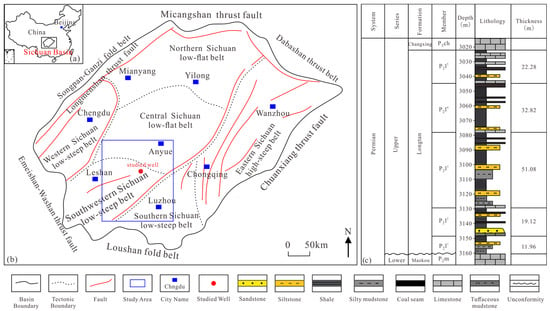
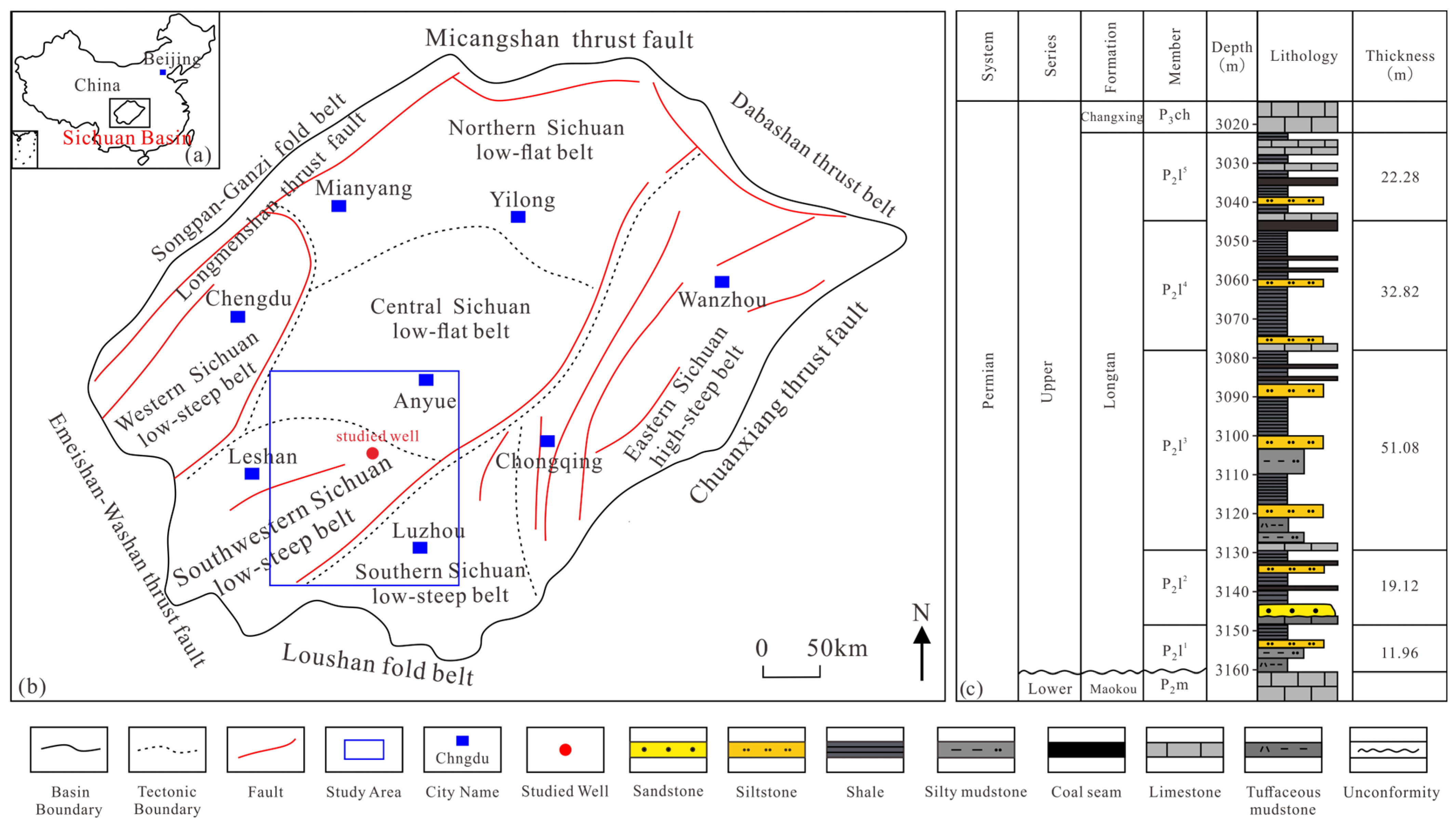
The Sichuan Basin, with an area of 260,000 km2, is a typical cratonic basin that has undergone multiple phases of tectonic evolution [14,15]. The Sichuan Basin can be divided into six secondary structural units: western Sichuan low-steep belt, southwestern Sichuan low-steep belt, southern Sichuan low-steep belt, central Sichuan low-flat belt, eastern Sichuan high-steep belt and northern Sichuan low-flat belt [16,17] (Figure 1a,b). According to previous research, the Sichuan Basin has undergone five evolutionary stages: Sinian faulted basin evolution, Cambrian–Silurian faulted basin evolution and inversion, Carboniferous–Permian–Middle Triassic basin evolution, Late Triassic foreland basin and Jurassic–Early Cretaceous large intra-continental basin evolution and the Late Cretaceous–Cenozoic uplift evolution [18]. During the Early Permian, widespread denudation occurred, resulting in the absence of Lower Permian strata throughout the Sichuan Basin and its neighboring areas [19]. After a prolonged hiatus, a large-scale transgression occurred in the early Middle Permian, flooding the entire area of pre-existing uplift and erosion, with Middle Permian strata overlying Carboniferous, Silurian, Ordovician, and Cambrian strata. A suite of drape layers was developed, ranging from marine and continental coal clastic rocks to marine carbonate rocks [20]. The depositional environment of the Longtan Formation in southern Sichuan changed rapidly, with fluvial, littoral, and carbonate-platform facies predominating.
Figure 1.
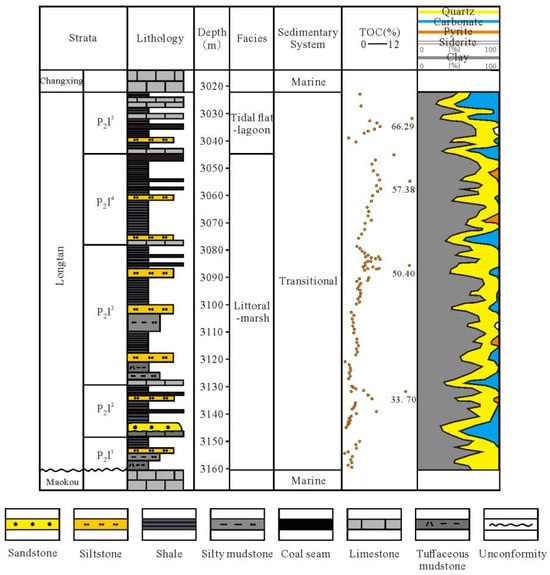
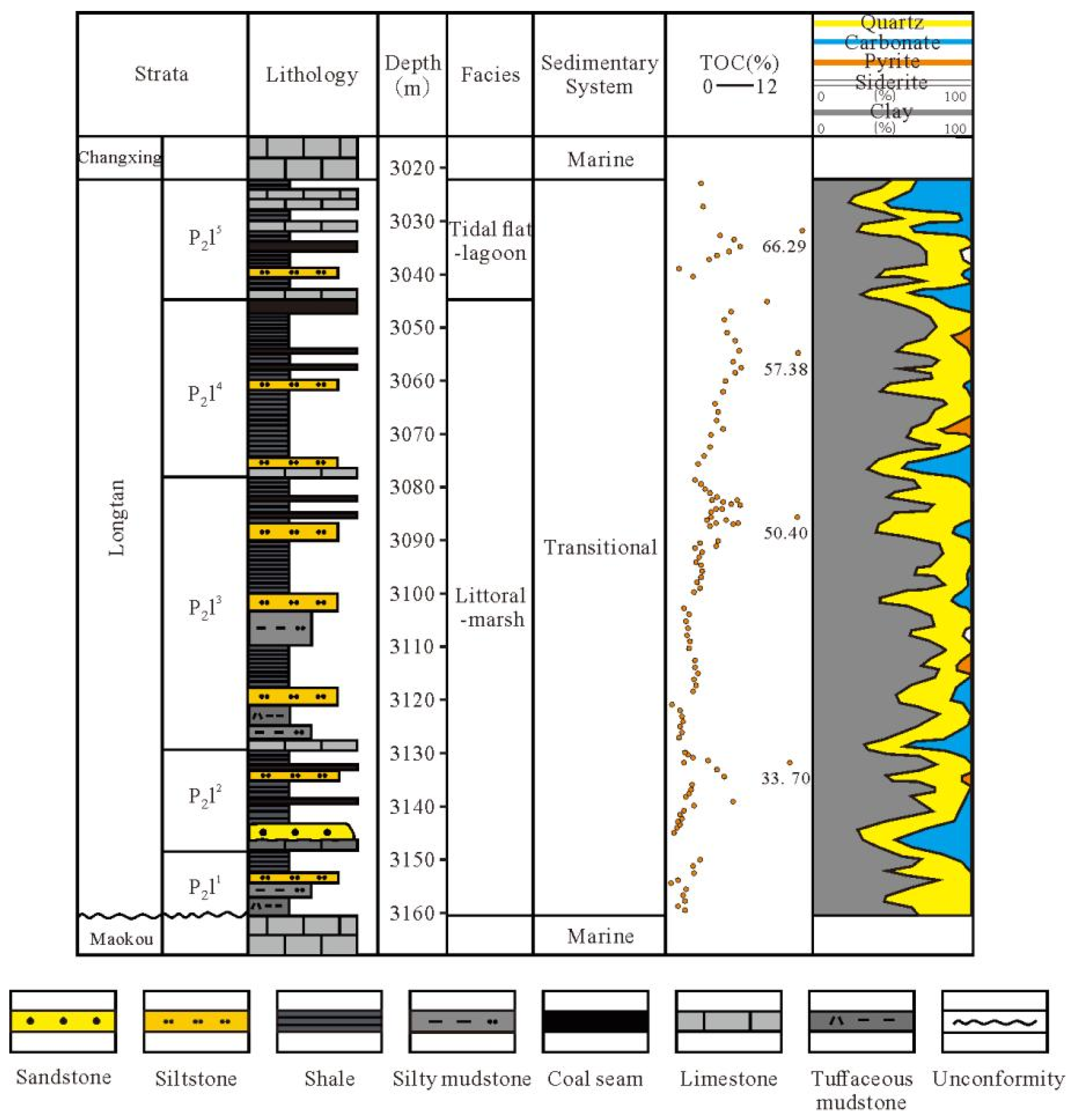
(a) Geological map showing the location and tectonic units of the study area. (b) Location of study area, Southwest China. (c) The stratigraphic histogram of the Longtan Formation of the study area.
The study area, with an area of 4.4 × 10⁴ km2, is in the Luzhou–Neijiang region in the southern Sichuan Basin, China (Figure 1b). Based on the sedimentological features and lithology, the Permian Longtan Formation of southern Sichuan is divided into the Long 1 Member (P3l1), Long 2 Member (P3l2), Long 3 Member (P3l3), Long 4 Member (P3l4) and Long 5 Member (P3l5) (Figure 1c). During the deposition of the Long 4 and Long 5 Members, thick layers of organic-rich black shale were deposited in the littoral-marsh and tidal flat–lagoon environments, respectively, and these are the main layers for the breakthrough of transitional-phase shale in the South Sichuan (Figure 1c).
3. Samples and Experimental Methods
3.1. Samples
In this study, a total of 110 samples were selected from the studied well in the Longtan Formation in the Luzhou region in the southern Sichuan Basin, including 10 samples in the Long 1 Member, 20 samples in the Long 2 Member, 50 samples in the Long 3 Member, 20 samples in the Long 4 Member and 10 samples in the Long 5 Member. Core observation, total organic content test, mineralogical composition analysis, major element composition analysis and trace element composition analysis were conducted to characterize the sedimentological characteristics and sedimentary environment of the transitional shale in each Member of the Longtan Formation.
3.2. Experimental Methods
3.2.1. Carbon/Sulfur Determinator
TOC was determined using a Leco Carbon/Sulfur Determinator (LECO Corporation, Joseph, MI, USA). Briefly, 1 g of the sample was weighed in a ceramic crucible, then hydrochloric acid solution was added to dissolve it, and the solution was washed with distilled water until neutral. The sample was dried in an oven at 60 °C–80 °C, and then the dried sample was added to the co-solvent and fully combusted in a high-temperature oxygen flow. The content of total organic carbon was detected by using an infrared detector.
3.2.2. X-Ray Diffraction
The samples were analyzed for mineralogical composition via X-ray diffraction using a Rigaku Ultima IV X-ray Diffractometer (Rigaku Holdings Corporation, Tokyo, Japan). Clay mineral samples with particle sizes less than 10 μm and less than 2 μm were extracted by aqueous suspension separation or centrifugation, respectively, in order to determine the total relative content of clay minerals in the original rock and the relative content of various clay minerals. The K-value method was then used to determine the mineral content by measuring the intensities of its characteristic peaks in the samples.
3.2.3. Inductively Coupled Plasma–Optical Emission Spectroscopy
The Major elements, such as Al, Fe, Mg, Ca, Na, and K, in the specimens were determined using a PE 5300V Inductively Coupled Plasma–Optical Emission Spectroscopy (ICP-OES) instrument (PerkinElmer, Waltham, MA, USA). Sodium peroxide was added to 0.25 g of the sample, and it was mixed well. It was then placed in the muffle furnace at 650–700 °C to melt. The mixed extract was cooled slightly, then filtered through filter paper, and the elemental content was determined by ICP-OES.
3.2.4. Inductively Coupled Plasma Mass Spectrometry
Trace element content was determined using Agilent Technologies 7700 Series Inductively Coupled Plasma Mass Spectrometry (Santa Clara, CA, USA). A 50 mg sample was prepared in the dissolver, after which hydrofluoric acid and nitric acid were added. The mixture was subsequently placed in an oven set to 185 °C for drying. Subsequently, the inner canister was detached and placed on a hot plate to evaporate excess moisture. Following this, nitric acid was added to dissolve the sample. The inner canister was then heated in an oven at 130 °C for 3 h. After cooling, it was diluted with water, and the trace element content was determined using ICP analysis.
4. Results
4.1. Sedimentological Characteristics
4.1.1. Long 1 Member
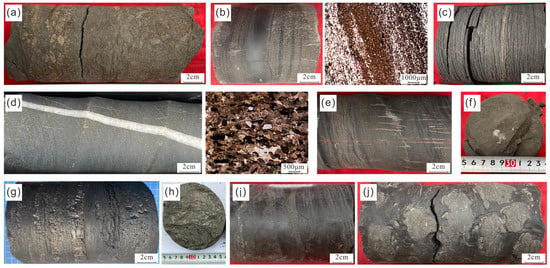
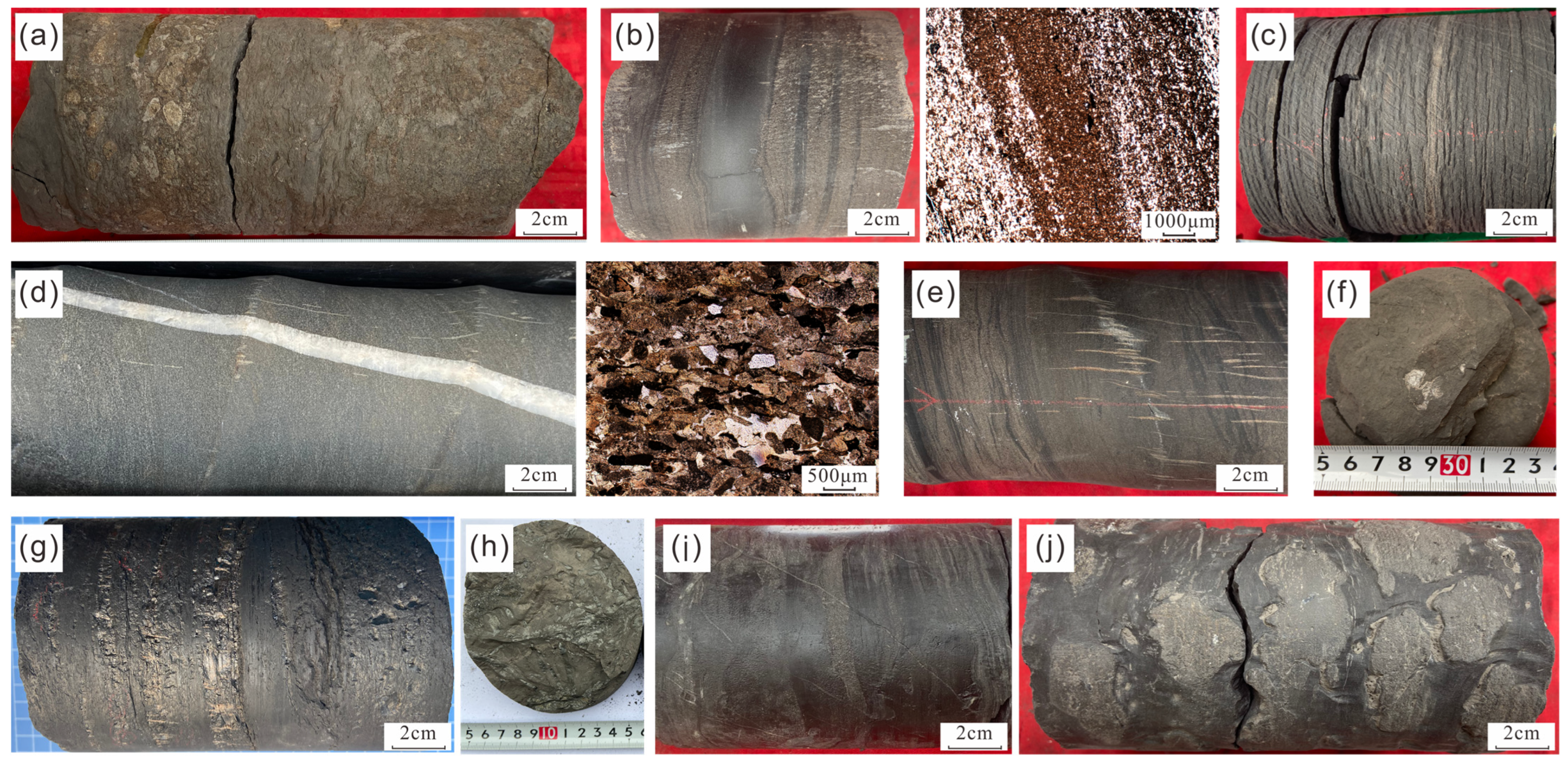
The lower part of the Long 1 Member consists primarily of tuffaceous mudstone and silty mudstone (Figure 2a), with occasional iron-rich nodules. Upward, siltstone (Figure 2b) and grayish-black shale (Figure 2c) gradually increase, indicating a gradual shallowing of the water body and reflecting a peat-swamp environment within the littoral-marsh facies.
Figure 2.
Sedimentary and petrological characteristics of Long 1 Member ~ Long 3 Member in the studied well. (a) Silty mudstone, showing breccia in the lower portion, Long 1 Member, 3158.68 m. (b) Macroscopic and microscopic photographs of gray siltstone with black argillaceous bands, Long 1 Member, 3156.79 m. (c) Shale, Long 1 Member, 3152.24 m. (d) Macroscopic and microscopic photographs of gray medium-to fine-grained sandstone, exhibiting vertical fractures filled with calcite, Long 2 Member, 3148.16 m. (e) Grayish-black silty mudstone with intercalated siltstone bands, Long 2 Member, 3147.22 m. (f) Gray bioclastic limestone containing brachiopod fossil, Long 2 Member, 3145.72 m. (g) Coal, with cleats filled by calcite, Long 2 Member, 3136.47 m. (h) Gray ferruginous tuffaceous mudstone, exhibiting carbonized plant fragments on the fracture surface, Long 2 Member, 3133.85 m. (i) Black shale with intercalated siltstone bands, Long 3 Member, 3115.85 m. (j) Black shale containing pyrite nodules, Long 3 Member, 3090.43 m.
4.1.2. Long 2 Member
The lower part of the Long 2 Member consists of gray medium-to-fine-grained sandstone (Figure 2d), while the upper part comprises thinly interbedded grayish-black silty mudstone and shale, with siltstone bands (Figure 2e), occasional bioclastic limestone (Figure 2f) and coal seams (Figure 2g). Plant debris is observed within the upper part (Figure 2h). The upward coarsening and increased occurrence of siltstone and plant-bearing layers indicate further shallowing of the water body, characteristic of swamp conditions within the littoral-marsh facies.
4.1.3. Long 3 Member
The Long 3 Member primarily consists of silty mudstone and thin-bedded argillaceous fine siltstone interbedded with black shale in varying thicknesses (Figure 2i), with occasional coal seams and iron-rich nodules (Figure 2j). The fine-to-medium upward grain size trend and the presence of coal layers suggest stabilized shallow water conditions within a littoral-marsh swamp environment.
4.1.4. Long 4 Member
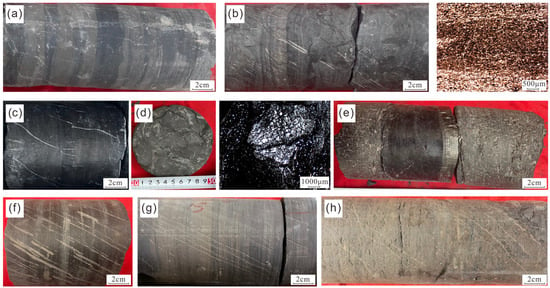
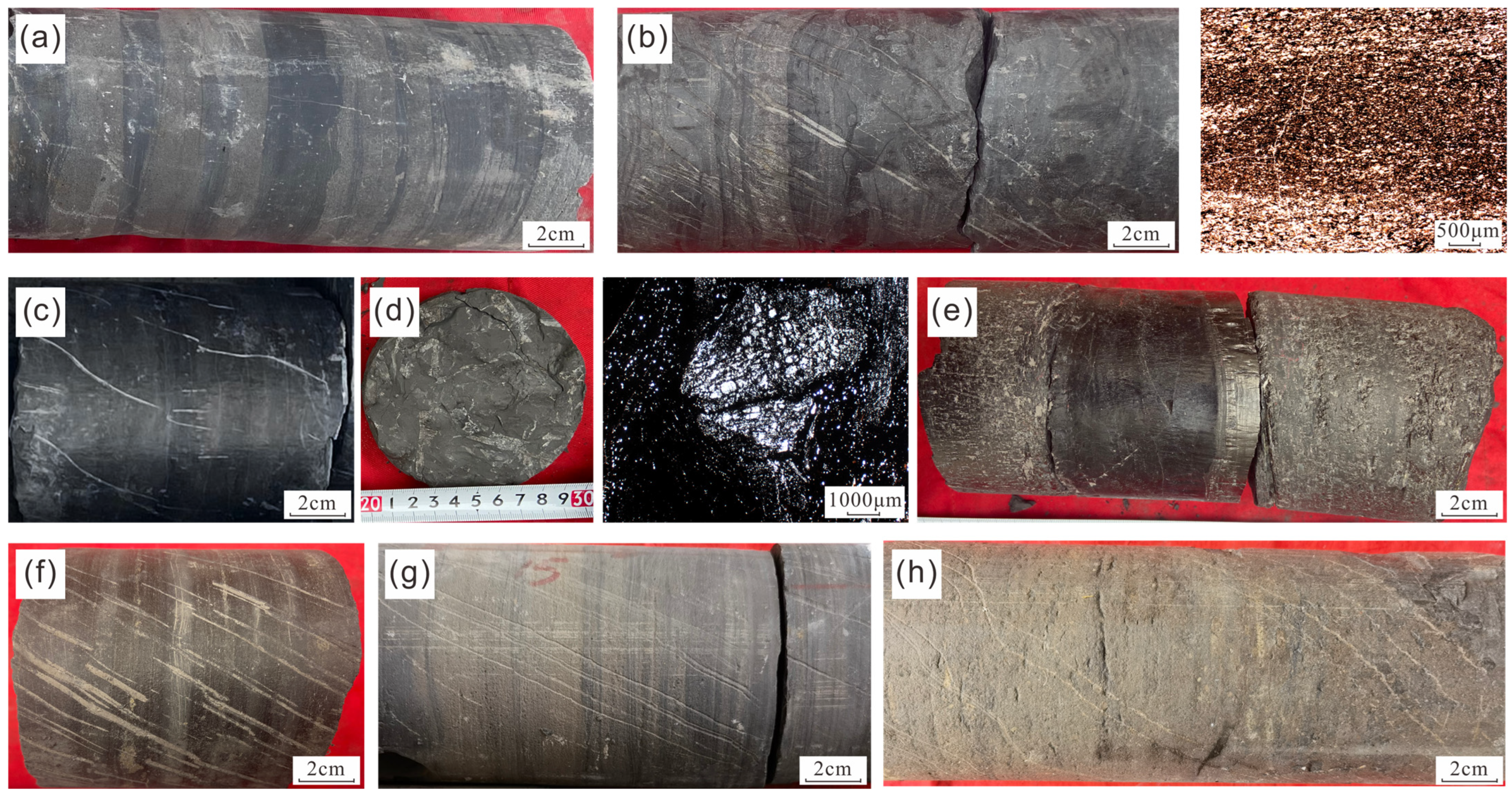
The lower part of the Long 4 Member is dominated by siltstone with argillaceous bands (Figure 3a). The middle part is characterized by shale intercalated with silty bands (Figure 3b), while the upper part mainly comprises black shale with occasional plant stems, coal interlayers, and pyrite nodules (Figure 3c–f). Overall, the lithological sequence indicates the shallowest water conditions within the Longtan Formation, favoring the maximum accumulation of organic matter in a peat-swamp setting.
Figure 3.
Sedimentary and petrological characteristics of Long 4 Member and Long 5 Member from the studied well. (a) Siltstone with argillaceous bands, Long 4 Member, 3082.85 m. (b) Black shale intercalated with silty bands, Long 4 Member, 3078.75 m. (c) Black shale, Long 4 Member, 3064.89 m. (d) Black shale containing plant debris, Long 4 Member, 3058.54 m. (e) Coal seam with intercalated black shale, Long 4 Member, 3052.49 m. (f) Black shale with pyrite bands, Long 4 Member, 3050.49 m. (g) Black shale and siltstone interbedded with variable thicknesses, Long 5 Member, 3032.98 m. (h) Shelly limestone, Long 5 Member, 3024.65 m.
4.1.5. Long 5 Member
The lithology of the Long 5 Member comprises gray and black shale interbedded with siltstone bands (Figure 3g) and limestone interlayers (Figure 3h), with occasional minor pyrite occurrences. Upward, the limestone interlayers gradually increase in frequency, and iron-rich and bioclastic components are observed within the limestone. This upward lithological change reflects a relative increase in water depth compared with the Long 4 Member, corresponding to deposition under tidal flat–lagoon facies.
4.2. TOC Content Characteristics
Based on TOC test results for transitional shale of the Longtan Formation in the study area, the variation in TOC from the Long 1 Member to the Long 5 Member was systematically summarized (Figure 4). The Long 1 Member shows no coal seams. The TOC content of its transitional shale aviaries was relatively narrow, from 0.57% to 4.05%, with an average of 2.38% (n = 10). The Long 2 Member contains coal seams, with TOC values reaching up to 33.70%, while its transitional shale exhibits TOC contents ranging from 0.44% to 8.32%, averaging 2.77% (n = 20). The Long 3 Member also shows coal-seam development, with TOC values up to 50.40%; its transitional shale ranges from 0.57% to 9.88%, with an average of 4.04% (n = 50). In the Long 4 Member, coal seams are well developed, and TOC in transitional shale is the highest among all Members, ranging from 3.37% to 11.50%, with an average of 6.39% (n = 20). Finally, the Long 5 Member contains coal seams with TOC values up to 66.29%, and its transitional shale exhibits TOC contents ranging from 1.58% to 9.45%, averaging 5.16% (n = 10).
Figure 4.
Stratigraphic column, vertical distribution of TOC content, and sedimentary environment of the Longtan Formation transitional shale from the studied well.
4.3. Major Element Geochemistry
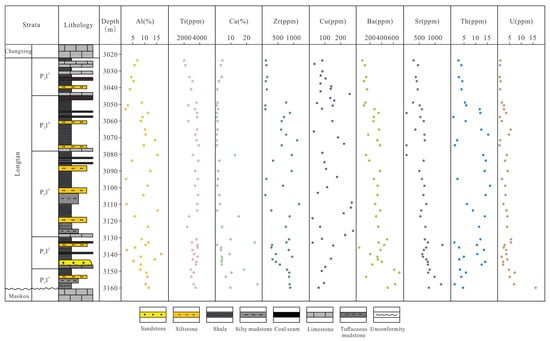
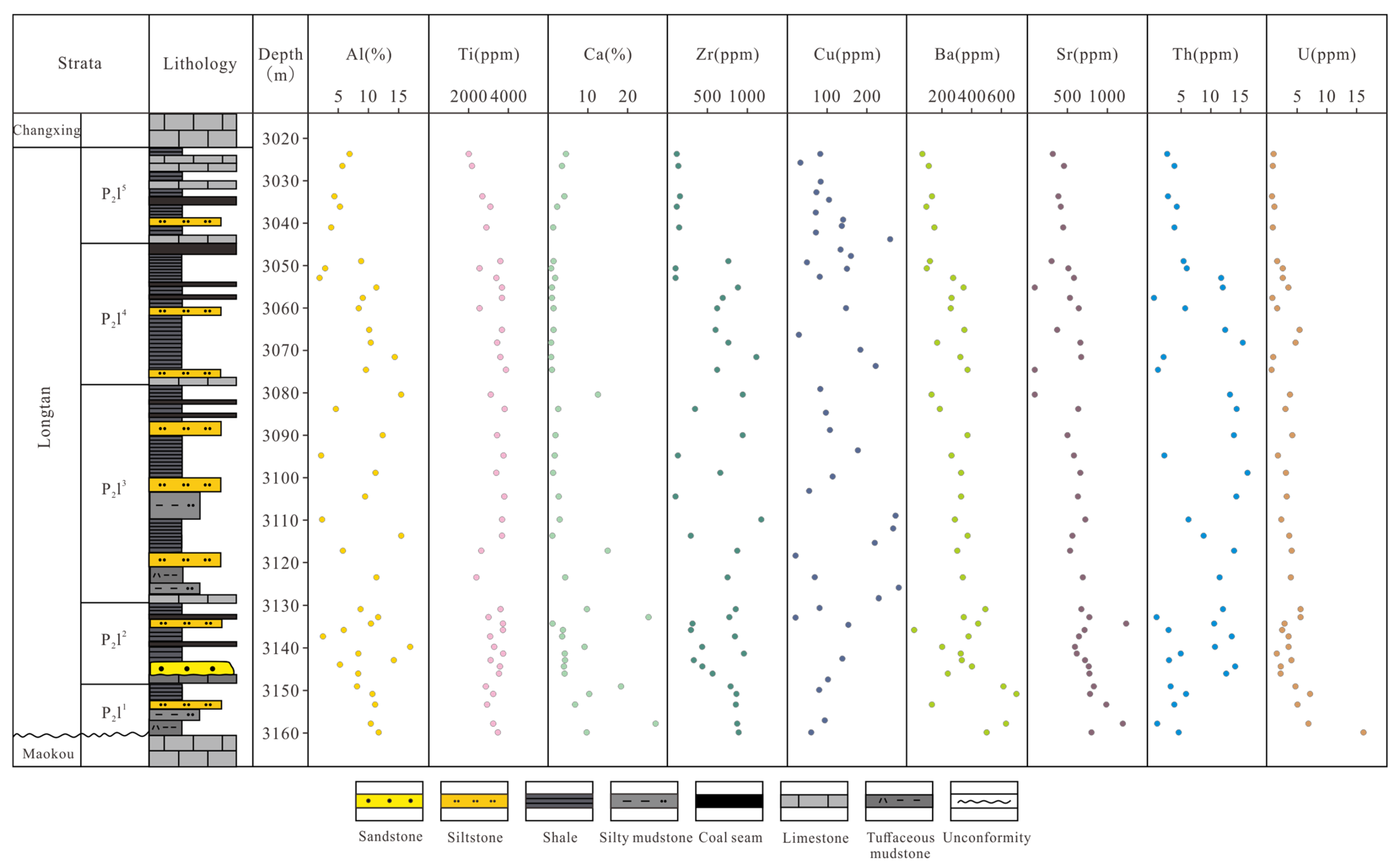
The major element concentrations of the Longtan Formation show pronounced variation trends from the Long 1 Member to the Long 5 Member (Table 1, Figure 5). The major element data presented in this study are reported as elemental concentrations. Among the five Members, the Long 1 Member exhibits the highest Ca concentrations, significantly higher than those of the other Members. The Ca concentration ranges from 6.71% to 27.56%, with an average of 14.61% (n = 5). In the Long 2 Member, the Ca concentration ranges from 0.93% to 9.82%, with an average of 4.57% (n = 10). The Long 3 Member shows a Ca concentration ranging from 0.35% to 15.24%, with an average of 4.33% (n = 10). For the Long 4 Member, the Ca concentration varies between 0.21% and 1.63%, with an average of 0.62% (n = 10). The Ca concentration in the Long 5 Member ranges from 1.13% to 4.54%, with an average of 3.03% (n = 5).
Table 1.
Statistical summary of major elements for the Longtan Formation Members.
Figure 5.
Major and trace elements concentrations for Longtan Formation transitional shale from the studied well in the Sichuan Basin.
The Al concentration in the Long 1 Member is the highest, significantly exceeding that of the other Members. The Al concentration ranges from 8.18% to 11.89%, with an average of 10.54% (n = 5). In the Long 2 Member, the Al concentration ranges from 2.46% to 17.22%, with an average of 9.32% (n = 10). The Long 3 Member shows an Al concentration ranging from 2.35% to 15.64%, with an average of 9.13% (n = 10). For the Long 4 Member, Al concentration ranges from 1.75% to14.67%, with an average of 8.69% (n = 10). The Al concentration is the lowest in the Long 5 Member, ranging from 3.64% to 6.86%, with an average of 5.11% (n = 5).
The average Ti and Zr concentrations in the Long 1 Member are 3197.78 ppm (2927.29–3529.57 ppm, n = 5) and 795.16 ppm (561.69–886.91 ppm, n = 5), respectively. In the Long 2 Member, the average Ti and Zr concentrations are 3512.25 ppm (3064.37–3836.16 ppm, n = 10) and 639.03 ppm (294.70–973.19 ppm, n = 10), respectively. For the Long 3 Member, the average Ti and Zr concentrations are 3406.07 ppm (2445.92–3863.77 ppm, n = 10) and 704.38 ppm (108.95–1163.61 ppm, n=10), respectively. In the Long 4 Member, the average Ti and Zr concentrations are 3422.94 ppm (2588.88–3908.73 ppm, n = 10) and 696.52 ppm (103.40–1123.85 ppm, n = 10), respectively. The Long 5 Member shows average Ti and Zr concentrations of 2617.91 ppm (2081.25–3121.88 ppm, n = 5) and 136.84 ppm (125.83–153.22 ppm, n = 5), respectively.
4.4. Trace Element Geochemistry
Trace elements, owing to their pronounced sensitivity to variations in sedimentary settings, are widely employed as geochemical proxies for reconstructing paleoenvironmental conditions. Variations in trace-element contents and geochemical indicators of depositional environment across the Members of the Longtan Formation are presented in Table 2, Figure 5 and Figure 6.
Table 2.
Statistical summary of trace elements for the Longtan Formation Members.
Figure 6.
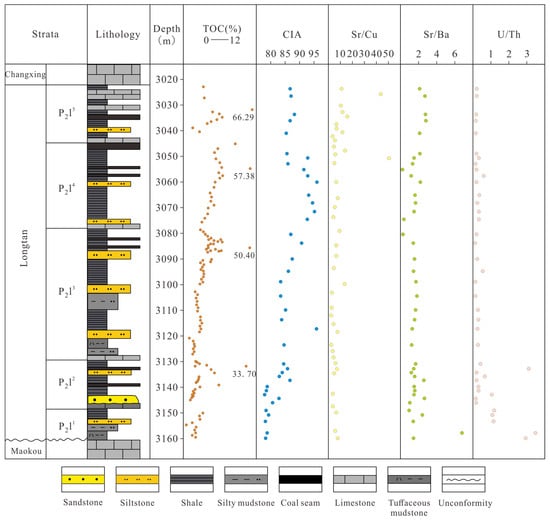
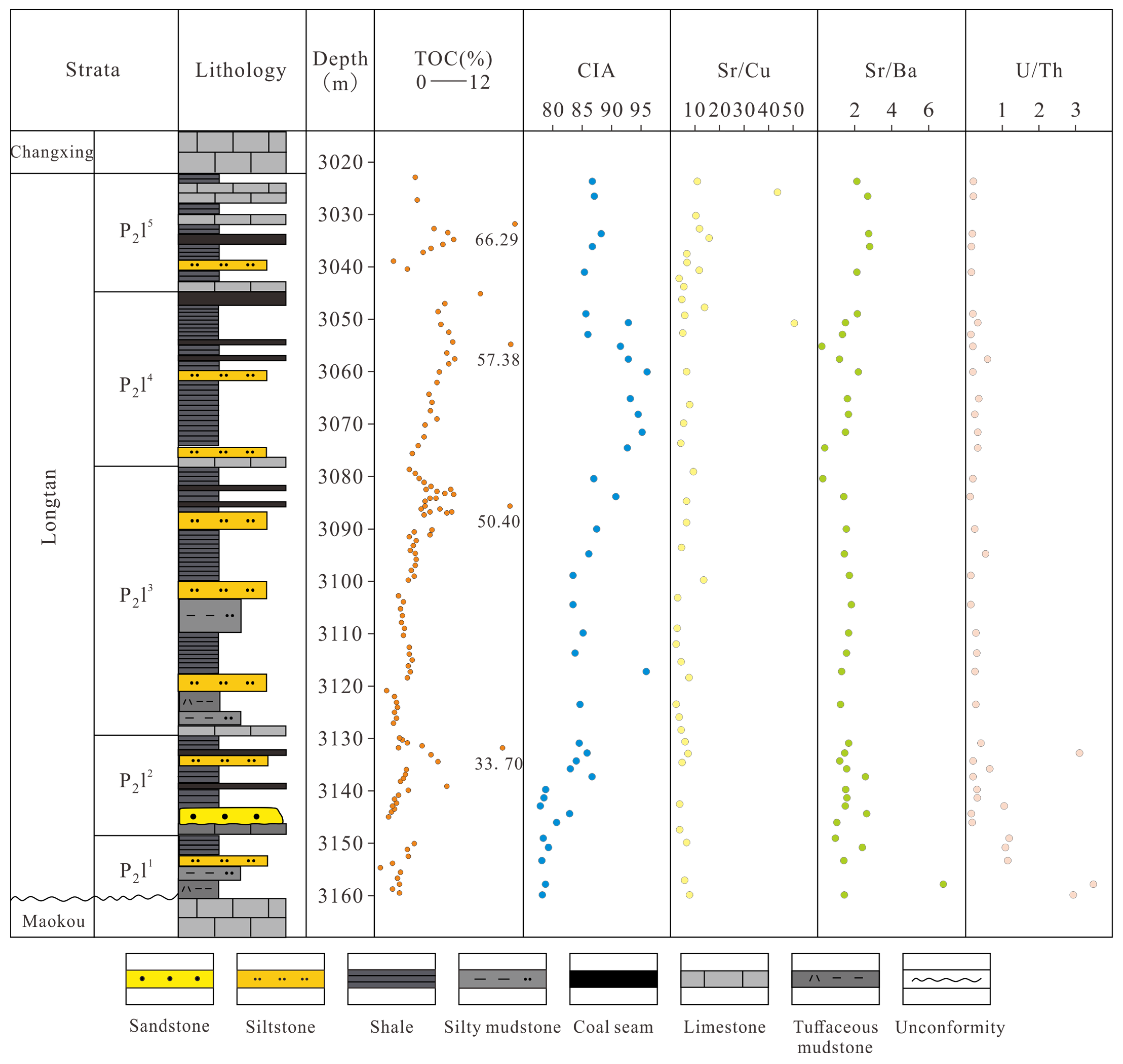
TOC and trace element ratios for Longtan Formation transitional shale from the studied well in the Sichuan Basin.
The CIA of the Long 1 Member is the lowest, ranging from 82.60 to 83.42, with an average of 82.90 (n = 5). The CIA of Long 2 Member ranges from 82.37 to 89.30, with a mean of 85.79 (n = 10). The CIA of Long 3 Member ranges from 86.65 to 96.72, with an average of 89.21 (n = 10). The CIA of Long 4 Member is the highest, ranging from 88.41 to 96.75, with an average of 93.56 (n = 10). The CIA of the Long 5 Member ranges from 88.20 to 90.48, with a mean of 89.34 (n = 5).
The Sr/Cu value of the Long 1 Member ranges from 3.23 to 7.09, with an average of 4.97 (n = 5). The Sr/Cu value of the Long 2 Member is the lowest, ranging from 1.58 to 6.76, with an average of 3.52 (n = 10). The Sr/Cu value of the Long 3 Member ranges from 3.12 to 13.54, with an average of 6.51 (n = 10). The Sr/Cu value of the Long 4 Member ranges from 2.80 to 50.23, with an average of 11.90 (n = 10). The Sr/Cu value of the Long 5 Member is the highest, ranging from 9.56 to 43.41, with an average of 17.88 (n = 5).
The variation trends of Sr/Ba and U/Th are opposite to those of CIA (Figure 6). The Sr/Ba value of Long 1 Member is the highest, ranging from 1.20 to 6.75, with an average of 2.73 (n = 5). The Sr/Ba value of Long 2 Member ranges from 1.27 to 2.79, with an average of 1.86 (n = 10). The Sr/Ba value for the Long 3 Member ranges from 0.50 to 2.00, with a mean of 1.60 (n = 10). The Sr/Ba value of Long 4 Member is the lowest, ranging from 0.36 to 2.46, with an average of 1.59 (n = 10). The Sr/Ba value of Long 5 Member ranges from 2.27 to 2.99, with a mean of 2.66 (n = 5). The U/Th value of Long 1 Member is the highest, ranging from 1.11 to 3.49, with an average of 1.97 (n = 5) (Table 3). The U/Th value of Long 2 Member ranges from 0.17 to 3.07, with an average of 0.69 (n = 10). The U/Th value of Long 3 Member ranges from 0.21 to 0.62, with an average of 0.33 (n = 10). The U/Th value of Long 4 Member ranges from 0.22 to 0.68, with an average of 0.37 (n = 10) (Table 3). The U/Th value of Long 5 Member is the lowest, ranging from 0.24 to 0.29, with an average of 0.26 (n = 5).
Table 3.
Major and trace element concentrations and geochemical proxies for the Longtan Formation transitional shale from the southern Sichuan Basin.
5. Discussion
5.1. Detrital Influx Proxies
Al, Ti, and Zr are generally considered to be minimally affected by later diagenesis and weathering during transport and deposition [21]. Variations in these elements are commonly used to evaluate the intensity of terrigenous input [22]. High Ti and Al values are generally interpreted as indicating relatively high detrital input [21,23]. Similarly, Zr/Al values are widely used as effective indicators for quantifying the flux of non-aluminosilicate detrital material, with higher Zr/Al ratios reflecting coarser grains and relatively high sedimentation rates [24,25].
For the transitional facies shales of the Longtan Formation, frequent marine transgressions drove landward migration of the estuarine shoreline, facilitating the transport of fine-grained terrigenous material into relatively deeper-water settings. Consequently, enhanced terrigenous input likely reflects relatively higher water levels and repeated marine incursions. In addition, the positive correlation between terrigenous detrital input and sedimentation rate suggests that elevated water levels and frequent transgressions promoted the delivery of basin-margin sediments into the depositional system.
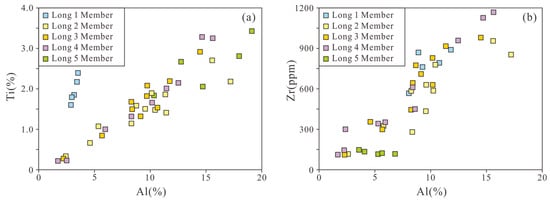
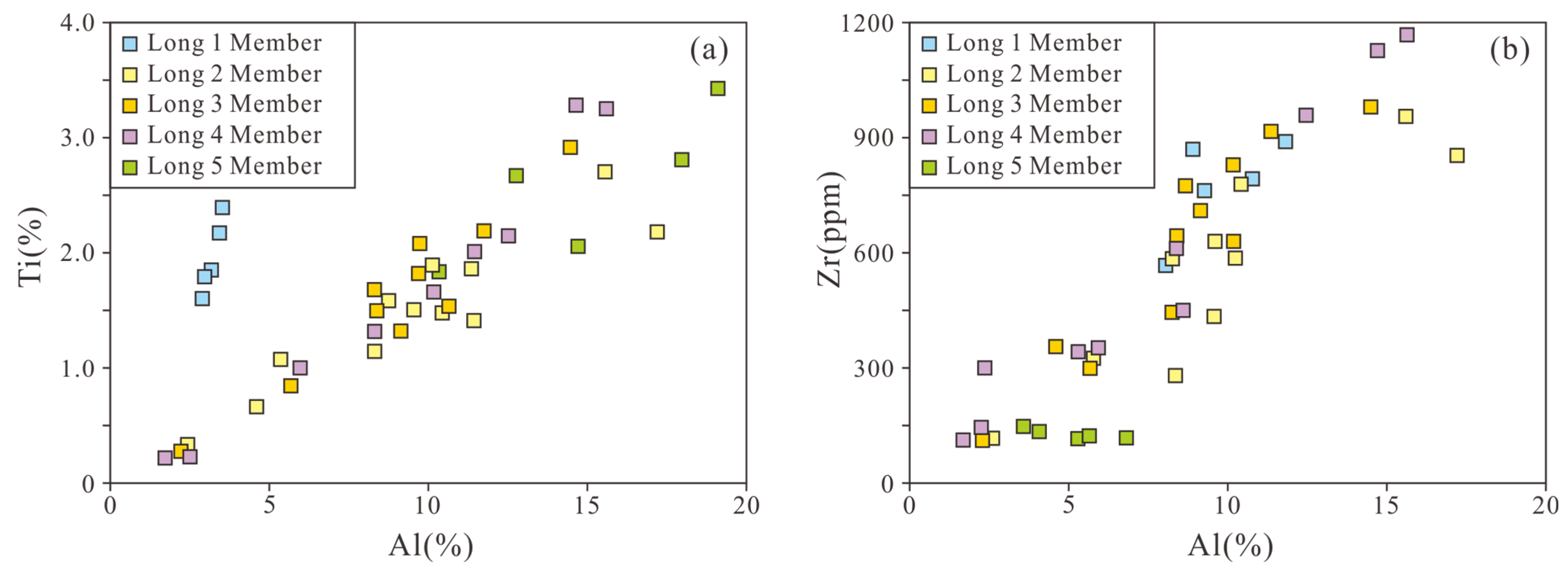
The Long 1 Member shows the highest concentrations of Al, Ti, and Zr, indicating strong terrigenous input and high sediment supply. This enhanced detrital influx suggests relatively deeper-water conditions with stronger hydrodynamic energy during deposition. In the Long 2 to the Long 4 Members, these elements remain at moderate levels, implying relatively stable sedimentary conditions with moderate terrigenous supply. In contrast, the Long 5 Member displays markedly lower concentrations of Al, Ti, and Zr, reflecting reduced detrital input and a decline in sediment supply (Figure 7a,b).
Figure 7.
(a) Cross-plots of Ti-Al for Longtan Formation transitional shale. (b) Cross-plots of Zr-Al for Longtan Formation transitional shale.
The Zr/Al ratio further records systematic variations among the Members, with the highest value in the Long 1 Member (0.75), followed by the Long 2 Member (0.70), and the lowest in the Long 5 Member (0.29). Because Zr is mainly hosted in heavy-resistance minerals such as zircon and is relatively insensitive to post-depositional alteration, higher Zr/Al ratios generally indicate higher sedimentation rates. Accordingly, sedimentation rates were highest during deposition of the Long 1 Member and lowest during the Long 5 Member (Figure 7b), supporting the interpretation that stronger terrigenous influx and higher sediment supply characterized the earlier depositional stage. Overall, these geochemical trends indicate a progressive shallowing of the depositional environment during the deposition of the Longtan Formation, with relatively deep-water conditions during the Long 1 and Long 2 Members.
5.2. Paleoclimate Conditions
Paleoclimate controls ocean currents, water-column stratification, source-rock weathering, and sediment transport, and also affects the abundance and population density of organisms [26,27]. A warm and humid climate intensifies the hydrological cycle and chemical weathering, increasing nutrient input to basins and stimulating microbial productivity. Enhanced water-column stratification may further induce bottom-water anoxia, thereby promoting the enrichment and preservation of organic matter [28,29].
Under intense chemical weathering conditions, the more mobile Sr is preferentially leached relative to Cu, resulting in a lower Sr/Cu ratio in weathering residues and their derived sediments [30]. In contrast, under arid, hot climatic conditions, chemical weathering is weak, and Sr loss is limited, allowing more Sr to be retained in detrital minerals, resulting in a relatively higher Sr/Cu ratio in the sedimentary record. Therefore, the Sr/Cu ratio can serve as an effective paleoclimatic proxy: a lower Sr/Cu ratio (typically <5) indicates warm and humid climates with intense chemical weathering, while a higher Sr/Cu ratio (typically >5) reflects arid and hot climates with limited chemical weathering [29,31].
The Chemical Index of Alteration (CIA) is widely used to evaluate paleoclimate change [32]. In this study, CIA was used to evaluate the paleoclimate of the Longtan Formation in the depositional period in southern Sichuan, and its calculation formula is as follows:
CaO* = CaO − P2O5 × 10/3
M(Na2O) ≤ m(CaO*), m(CaO*) = m(Na2O),
M(Na2O) > m(CaO*), m(CaO*) = m(CaO).
In general, high CIA values reflect a warm and humid paleoclimate, while low CIA values reflect a dry and cold paleoclimate. A CIA of 50–65 reflects a dry and cold paleoclimate in the context of low chemical weathering, a CIA of 65–85 reflects a warm and humid paleoclimate in the context of moderate chemical weathering, and a CIA of 85–100 reflects a hot and humid paleoclimate in the context of strong chemical weathering [33,34].
In the Longtan Formation, the average Sr/Cu values of the Long 1 and Long 2 Members are 4.97 and 3.52, respectively. These relatively low values fall near or below the threshold for arid–hot climates and, together with their relatively high CIA values (82.90 and 85.79), indicate that the climate during this stage was predominantly warm and humid, accompanied by moderate to strong chemical weathering. In contrast, the Sr/Cu ratios for the Long 3 to Long 5 Members increase to 6.51, 11.90, and 17.88, respectively. The elevated Sr/Cu values in the Long 4 and Long 5 Members, particularly the peak in the Long 5 Member, suggest a tendency toward warmer and relatively drier conditions or increased climatic variability during the later stage.
Despite these fluctuations, the CIA values of the Longtan Formation remain consistently high, ranging from 82.37 to 96.75. The relatively lower CIA values of the Long 1 and Long 2 Members (82.37–89.30) indicate warm and humid conditions with slightly weaker weathering intensity. From the Long 3 to the Long 4 Members, CIA values increase progressively and reach a maximum of 96.75, suggesting the most humid phase with the strongest chemical weathering. Although the CIA value of the Long 5 Member slightly decreases to 88.20, it still falls within the range of intense weathering, indicating only minor fluctuations in humidity during the late depositional stage. Overall, the combined CIA and Sr/Cu records indicate that the Longtan Formation was deposited under a generally warm and humid climatic background, with relatively stable humid conditions during the early stage and increased climatic variability during the later stage (Figure 6).
5.3. Paleowater Salinity
Sr and Ba exhibit distinct behaviors in different depositional environments [35,36]. Compared to Sr, Ba has a larger ionic radius and lower hydration energy, making it more readily adsorbed by clay minerals, colloids, and organic matter, which reduces the amount of Ba entering seawater. In addition, Ba is easily removed from seawater through precipitation as barite (BaSO4), resulting in lower Ba concentrations relative to Sr. Consequently, marine sediments typically display Sr enrichment and Ba depletion, whereas freshwater sediments are characterized by Ba enrichment and Sr depletion [36,37]. Based on this behavior, the Sr/Ba ratio has been widely used for the qualitative evaluation of paleosalinity.
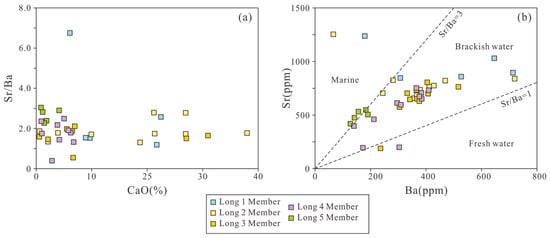
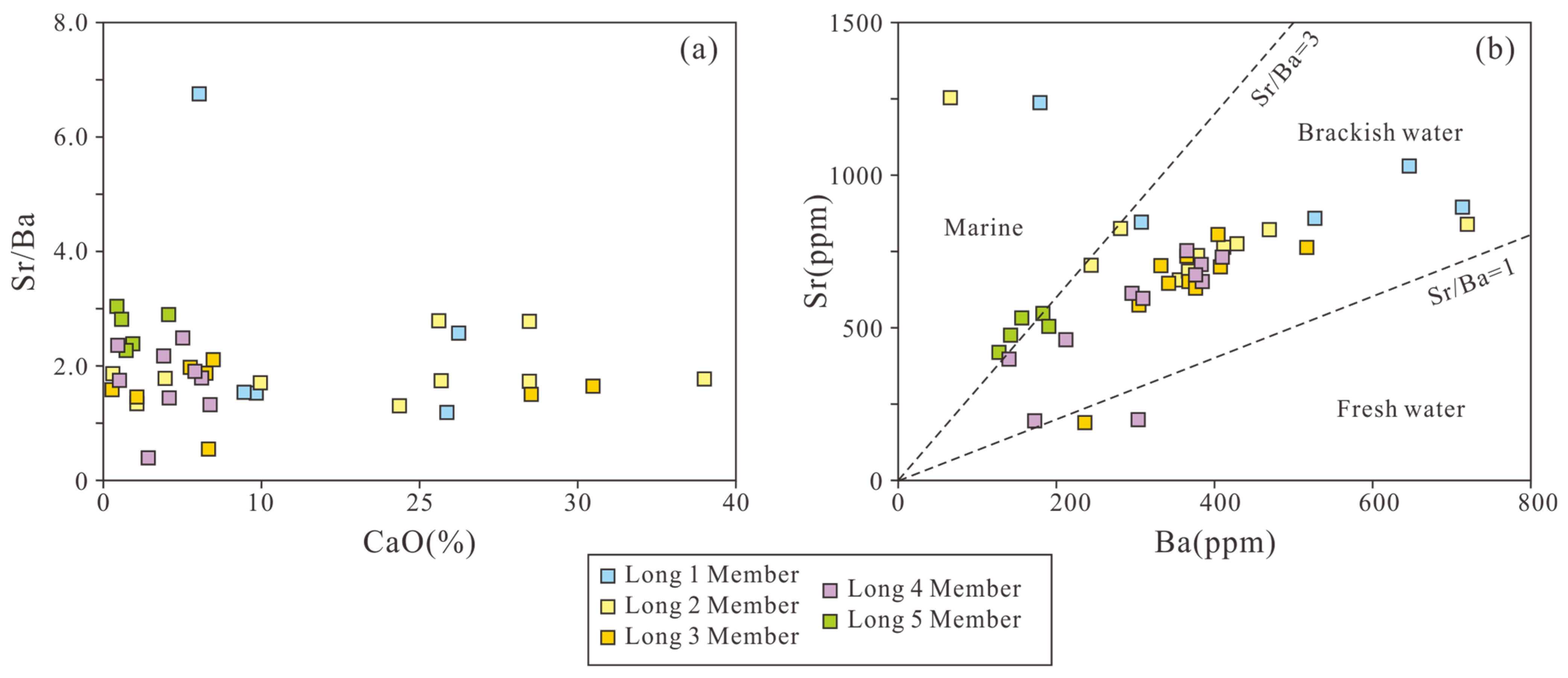
However, Sr2+ can substitute for Ca2+ in CaCO3 through isomorphism, which may lead to anomalously high Sr concentrations in carbonate-rich sediments. To ensure the reliability of the Sr/Ba ratio as a paleosalinity proxy [36,37], the potential influence of carbonate minerals on Sr content must be considered. In this study, no significant correlation was observed between CaO content and Sr/Ba ratios across different stratigraphic intervals (Figure 8a), indicating that variations in the Sr/Ba ratio are primarily controlled by paleosalinity rather than by dilution or enrichment effects of carbonate minerals.
Figure 8.
(a) Correlation between Sr/Ba ratios and CaO content for Longtan Formation transitional shale. (b) Paleowater salinity facies in the transitional shale of the Longtan Formation.
According to Wang et al. [38], Sr/Ba ratios in deltaic and estuarine sediments of the Yangtze River vary with salinity: less than 1.0 in freshwater, 1.0–3.0 in brackish water, and 3.0–8.0 in saline water. In the Longtan Formation, Sr/Ba ratios range from 0.36 to 6.75, with an average of 1.92, generally exceeding the freshwater threshold and indicating a predominantly brackish environment. Most samples exhibit Sr/Ba values between 1.20 and 2.99, reflecting micro-brackish to semi-saline conditions influenced by periodic seawater input. Some samples show unusually high or low values, indicating rapid shifts in the transitional marine–terrestrial depositional environment. Higher Sr/Ba ratios suggest substantial seawater incursions, whereas lower values indicate tidal channels or short-term large freshwater inputs (Figure 8b).
Overall, the mean Sr/Ba ratios indicate a gradual decline in paleosalinity from the Long 1 to Long 4 Members, followed by a marked increase in the Long 5 Member. The elevated salinity in the Long 1 Member likely reflects relatively deeper water conditions and the development of salinity stratification, where restricted circulation enhanced the retention of saline waters (Table 1). This pattern suggests that during the early-to-middle depositional stages of the Longtan Formation, the environment evolved from a littoral-marsh to a tidal flat–lagoon system, with increasingly pronounced paleosalinity fluctuations. These variations were jointly controlled by tidal action, water depth, and intermittent freshwater input, consistent with regional sea-level changes and climate-driven wet–dry cycles, and underscore the formation’s characteristic transitional marine–terrestrial depositional settings and frequent facies shifts.
5.4. Paleoredox Conditions
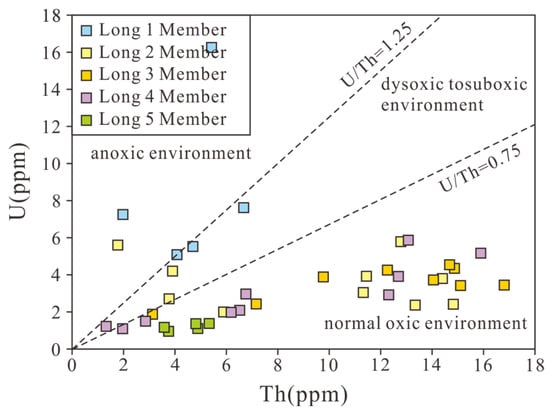
Different redox conditions can lead to distinct occurrence states of Th and U. Uranium is readily oxidized to the more soluble uranyl ion under epigenetic conditions [39,40,41], resulting in relatively high geochemical mobility, whereas Th4+ remains preserved in stable thorium-bearing minerals and is commonly enriched in weathering residues. In contrast, under anoxic conditions, dissolved uranium is reduced and immobilized as U4+, exhibiting relatively stable behavior. Therefore, the contrasting geochemical behaviors of U and Th under varying redox conditions make the U/Th ratio an effective proxy for reconstructing redox conditions in sedimentary environments [40,41,42,43]. In sediments, lower U/Th values indicate higher oxygen availability, whereas higher values reflect more reducing conditions [44,45]. Generally, U/Th > 1.25 indicates an anoxic environment, U/Th values between 0.75 and 1.25 represent dysoxic to suboxic conditions, and U/Th < 0.75 indicates a normal oxic environment [40,46,47].
The redox conditions of the water column during deposition of the Longtan Formation generally correspond to variations in water depth. The Long 1 Member was generally anoxic, with a mean U/Th of 1.97 and pronounced fluctuations (1.11–3.49), reflecting relatively deep, stratified, and reducing waters. The Long 2 Member transitioned to a normal oxic environment, with a mean of 0.69 and strong fluctuations (0.17–3.07), indicating instability in both water depth and redox conditions, likely associated with periodic changes in depth and oxygenation [48]. From the Long 3 to Long 5 Members, conditions remained consistently oxic and stable, with mean U/Th values of 0.33, 0.37, and 0.26, respectively, and narrow fluctuation ranges (e.g., Long 5 Member: 0.24–0.29), suggesting overall shallow, well-circulated, and oxidized waters. Overall, this sequence reveals a complete evolutionary trend for the Longtan Formation: from early, deeper anoxic waters, through a middle stage of pronounced fluctuations in water depth and redox conditions, to late-stage stable, shallow, and oxic waters (Figure 9).
Figure 9.
Cross-plots of U-Th for the Longtan Formation transitional shale.
5.5. Sedimentary Model of Organic-Rich Shale
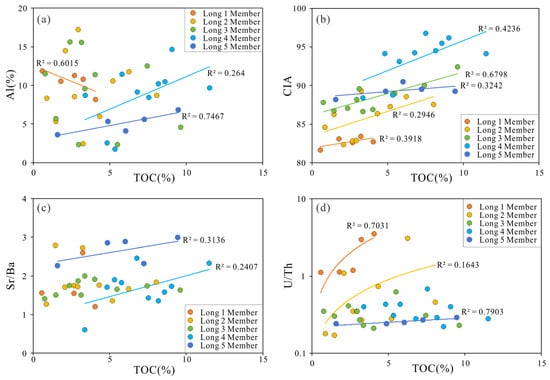
The deposition of organic-rich shale in the Longtan Formation of southern Sichuan was primarily controlled by the coupled evolution of paleoclimate and the sedimentary environment (Figure 10). The relative influence of these factors varied among different Members, resulting in a staged model of organic matter enrichment [49,50,51,52].
Figure 10.
Cross-plots of TOC versus different paleoenvironmental proxies for all Members. (a) TOC vs. Al, indicating terrigenous detrital input; (b) TOC vs. CIA, indicating paleoclimate conditions; (c) TOC vs. Sr/Ba, indicating paleosalinity; (d) TOC vs. U/Th, indicating paleoredox conditions.
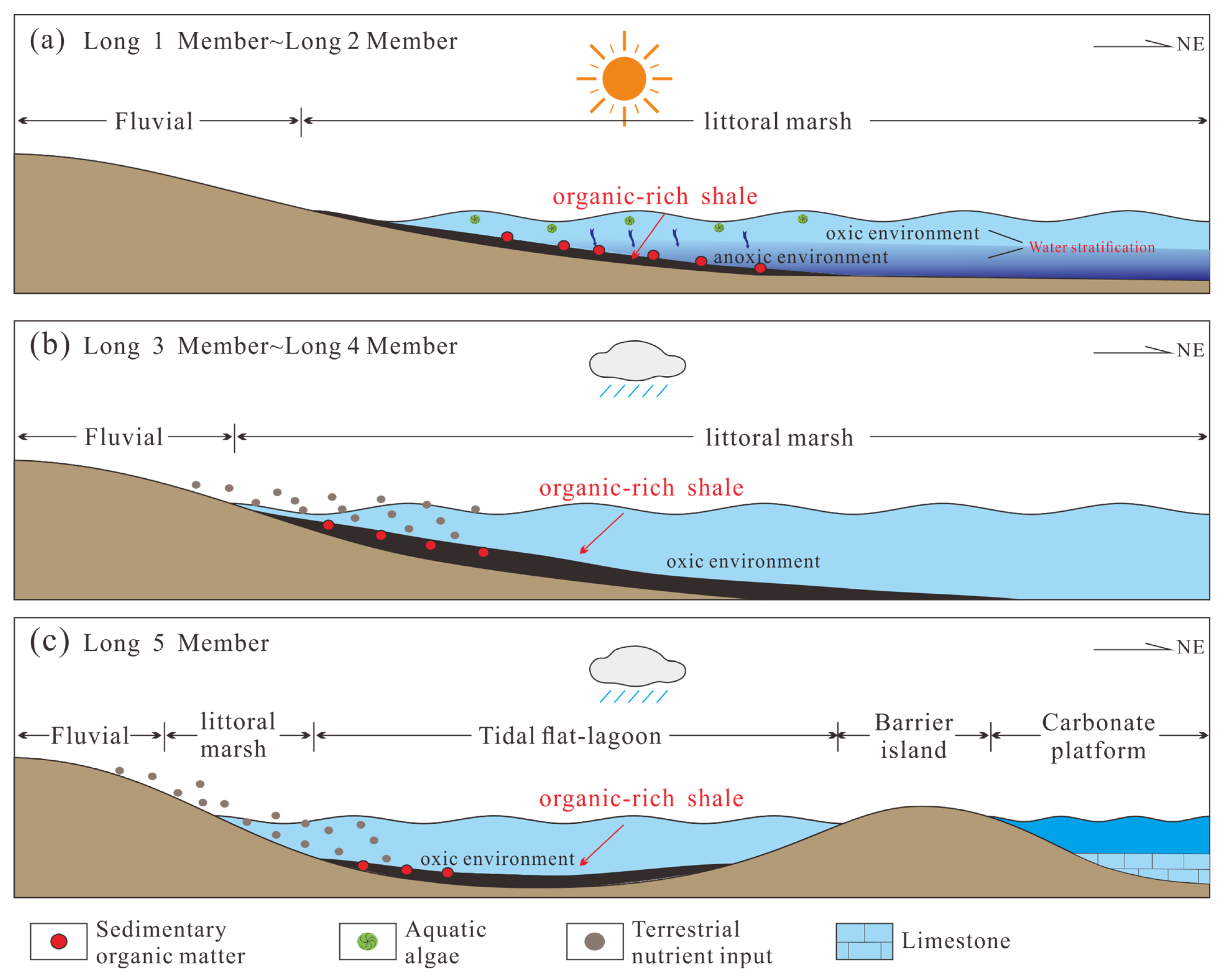
The Long 1 to Long 4 Members were mainly deposited in littoral-marsh facies. During the deposition of the Long 1 Member (Figure 11a), the climate was relatively hot and arid, and chemical weathering was weak. The water column was relatively deep and strongly stratified, forming an anoxic bottom-water environment favorable for organic matter preservation. From the Long 2 Member onward, the climate gradually shifted to warm and humid conditions, which intensified chemical weathering and increased the supply of terrigenous nutrients and organic matter. These processes enhanced water-column productivity and promoted organic matter accumulation. During this stage, organic matter enrichment was mainly controlled by paleoclimate and redox conditions. However, progressive shallowing of the water body, together with increased input of oxygen-bearing terrigenous materials, gradually enhanced water-column oxygenation, marking a transition from the anoxic conditions of the Long 1 Member to relatively oxic conditions during the deposition of the Long 2 Member and the overlying intervals. Nevertheless, abundant terrigenous organic matter input and intermittent reducing conditions still favored organic matter accumulation.
Figure 11.
Sedimentary model of transitional shale for Longtan Formation in Sichuan Basin. (a) Organic matter enrichment model of littoral marsh under arid and hot conditions. (b) Organic matter enrichment model of littoral marsh under warm and humid conditions. (c) Organic matter enrichment model of tidal flat–lagoon under warm and humid conditions.
During the deposition of the Long 4 Member, the climate reached the warmest and most humid stage, accompanied by the strongest chemical weathering (Figure 11b). Intense weathering significantly increased the input of terrigenous organic matter and nutrients, which enhanced primary productivity. Meanwhile, the settling and degradation of abundant organic matter consumed dissolved oxygen in the water column, promoting intermittent anoxic conditions. Under the combined effects of high productivity and relatively favorable preservation conditions, organic matter enrichment reached its maximum during this stage.
The Long 5 Member records a transition to tidal flat–lagoon facies. Although the climate remained generally warm and humid, minor fluctuations occurred. Sedimentation was influenced by both marine transgression and terrigenous input, resulting in pronounced salinity variations and the development of a restricted to semi-restricted depositional environment (Figure 11c). Increased terrigenous input enhanced water-column turbulence and promoted more oxic conditions. Although strong weathering and nutrient supply likely maintained relatively high productivity, intensified oxidation reduced the preservation efficiency of organic matter, leading to slightly lower enrichment compared with the Long 4 Member.
Overall, the enrichment of organic matter in the Longtan Formation reflects a dynamic balance among terrigenous organic matter supply, paleoproductivity, and preservation conditions under climatic control. Climatic warming and humidification enhanced chemical weathering and nutrient supply, thereby stimulating primary productivity, whereas the depth and redox state of the depositional water body controlled the preservation efficiency of organic matter. As the depositional environment evolved from littoral-marsh facies to tidal flat–lagoon facies during the late stage, stronger hydrodynamic conditions and increased oxygenation resulted in corresponding adjustments in the mechanism of organic matter enrichment.
6. Conclusions
- The sedimentary environment of the Longtan Formation exhibits clear stage-wise characteristics. The Long 1 to Long 4 Members were deposited in a littoral-marsh environment, whereas the Long 5 Member records a transition to a tidal flat–lagoon environment.
- The organic-rich interval of the Longtan Formation (TOC = 3.37–11.50%, avg. 6.39%) is mainly developed in the Long 4 Member. This interval is lithologically characterized by black shale interbedded with thin coal seams and pyrite bands, reflecting littoral-marsh facies with favorable conditions for organic matter accumulation and preservation. Geochemical indicators suggest a warm and humid paleoclimate (CIA = 88.41–96.75, avg. 93.57; Sr/Cu = 2.80–50.23, avg. 11.90), intense chemical weathering, relatively low detrital input (Zr = 103.04–1123.85 ppm, avg. 631.15 ppm; Ti = 2588.88–3908.73 ppm, avg. 3407.89 ppm), moderately high paleosalinity (Sr/Ba = 0.36–2.46, avg. 1.59), and generally oxic to intermittently reducing conditions (U/Th = 0.22–0.68, avg. 0.37). These factors collectively enhanced nutrient supply, promoted primary productivity, and facilitated organic matter enrichment.
- From the Long 1 Member to the Long 5 Member, the sedimentary environment evolved from a shallow-water coastal setting to a transitional tidal flat–lagoon system. This evolution was accompanied by decreasing detrital input (declining Zr and Ti contents) and a shift toward a more humid climate (CIA increased from 82.90 to 93.57 and then slightly decreased to 89.34). Redox conditions also changed significantly, from anoxic conditions in the Long 1 Member (U/Th = 1.11–3.49, avg. 1.97) to relatively oxic conditions in the Long 5 Member (U/Th = 0.24–0.29, avg. 0.25). Although the Long 5 Member still contains moderate organic matter (avg. TOC = 5.16%), relatively shallow water depth, fluctuating salinity, and enhanced oxidation reduced preservation efficiency, indicating a shift in the mechanism of organic matter enrichment.
Author Contributions
Conceptualization, Y.J. (Yu Ji) and Y.J. (Yuqiang Jiang); methodology, Z.W.; validation, R.G.; formal analysis, J.Q.; investigation, Y.J. (Yu Ji) and J.Q.; data curation, Z.W.; writing—original draft preparation, Y.J. (Yu Ji) and Y.J. (Yuqiang Jiang); writing—review and editing, Z.W. and R.G.; visualization, J.Q.; supervision, Z.W.; project administration, R.G. All authors have read and agreed to the published version of the manuscript.
Funding
The research was supported by the National Natural Science Foundation of China (No. 42272171) and the National Natural Science Foundation of China (No. 42302166).
Data Availability Statement
Data is contained within the article.
Conflicts of Interest
Author Ruiqi Gao was employed by the PetroChina Southwest Oil & Gasfield Company. Author Jian Qian was employed by the Yanchang Oilfield Co., Ltd. The remaining authors declare that the research was conducted in the absence of any commercial or financial relationships that could be construed as a potential conflict of interest.
References
- Zou, C.; Dong, D.; Wang, S.; Li, J.; Li, X.; Wang, Y.; Li, D.; Cheng, K. Geological Characteristics, Formation Mechanism and Resource Potential of Shale Gas in China. Pet. Explor. Dev. 2010, 37, 641–653. [Google Scholar] [CrossRef] [Scilit]
- Dong, D.; Wang, Y.; Li, X. Breakthrough and Prospect of Shale Gas Exploration and Development in China. Nat. Gas Ind. B 2016, 3, 12–26. [Google Scholar] [CrossRef] [Scilit]
- Zou, C.; Yang, Z.; Pan, S.; Chen, Y.; Lin, S.; Huang, J.; Wu, S.; Dong, D.; Wang, S.; Liang, F.; et al. Shale Gas Formation and Occurrence in China: An Overview of the Current Status and Future Potential. Acta Geol. Sin. (Engl. Ed.) 2016, 90, 1249–1283. [Google Scholar]
- Kuang, L.; Dong, D.; He, W.; Wen, S.; Sun, S.; Li, S.; Qiu, Z.; Liao, X.; Li, Y.; Wu, J.; et al. Geological Characteristics and Development Potential of Transitional Shale Gas in the East Margin of the Ordos Basin, NW China. Pet. Explor. Dev. 2020, 47, 435–446. [Google Scholar] [CrossRef] [Scilit]
- Zou, C.; Dong, D.; Zhang, Q.; Kong, W.; Liu, W.; Zhao, Z.; Yang, Z.; Zhao, Q.; Ding, R.; Cai, G. Formation, Potential, and Challenges of Marine–Continental Transitional Shale Gas in China. Earth Sci. 2025, 50, 4261–4283. [Google Scholar]
- Ning, S.; Xia, P.; Hao, F.; Tian, J.; Fu, Y.; Wang, K. Pore Fractal Characteristics between Marine and Marine–Continental Transitional Black Shales: A Case Study of Niutitang Formation and Longtan Formation. Fractal Fract. 2024, 8, 288. [Google Scholar] [CrossRef] [Scilit]
- Chen, Y.; Yang, K.; Wu, W.; Huang, H.; Wang, X.; Li, C.; He, J. Favorable lithofacies and pore characteristics of the Permian Longtan Formation shale in the southern Sichuan Basin. Energy Geosci. 2023, 4, 100193. [Google Scholar] [CrossRef] [Scilit]
- Chen, Y.; Shi, X.; Xu, H.; Yan, J.; Lu, Z.; Gong, Q.; Tan, J. Study on the Sedimentary Environments and Its Implications of Shale Reservoirs for Permian Longtan Formation in the Southeast Sichuan Basin. Minerals 2023, 13, 689. [Google Scholar] [CrossRef] [Scilit]
- Wen, L.; Ming, Y.; Sun, H.; Zhang, B.; Zhao, Z.; Tang, D.; Zhang, L.; Wang, G.; Chen, Y.; He, Y. Geological characteristics and exploration potential of deep coalbed methane in the Permian Longtan Formation, Sichuan Basin: A case study of well NT1H. Oil Gas Geol. 2024, 45, 1678–1685. [Google Scholar]
- Hu, Z.; Klitzsch, N.; Jin, Y.; Hu, W.; Zhao, J.; He, Z. Assessment of shale gas potential of marine-continental transitional Longtan Formation from southwestern Guizhou Province, China. Energy Fuels 2023, 38, 387–401. [Google Scholar] [CrossRef] [Scilit]
- Zhang, H.; Cao, J.; Lan, B.; Chen, Y.; Zhang, Q.; Men, Y.; Feng, X.; Yu, Q. Organic matter enrichment model of Permian Capitanian-Changhsingian black shale in the intra-platform basin of Nanpanjiang basin. Frontiers in Earth Science 2024, 12, 1403575. [Google Scholar] [CrossRef] [Scilit]
- Tan, J.; Ma, X.; Hua, S.; Guo, J.; Yang, G.; Zhu, C.; Xiao, D. Influence of Sedimentary Environments on Organic Matter Enrichment in Marine-Continental Transitional Shale: A Case Study of the Upper Permian Longtan Formation in the Central Hunan Depression, China. Energy Fuels 2024, 38, 14262–14277. [Google Scholar] [CrossRef] [Scilit]
- Wang, E.; Guo, T.; Liu, B.; Li, M.; Ju, Y.; Dong, X.; Xue, Z.; Zhao, P. Lithofacies and pore features of marine-continental transitional shale and gas enrichment conditions of favorable lithofacies: A case study of Permian Longtan Formation in the Lintanchang area, southeast of Sichuan Basin, SW China. Pet. Explor. Dev. 2022, 49, 1310–1322. [Google Scholar] [CrossRef] [Scilit]
- Wang, Z.; Shi, Y.; Wen, L.; Yang, H.; Xu, A.; Xie, W.; Bi, H.; Guo, X.; Wu, S. Exploring the potential of oil and gas resources in Sichuan Basin with Super Basin Thinking. Pet. Explor. Dev. 2022, 49, 977–990. [Google Scholar] [CrossRef] [Scilit]
- He, D.; Li, D.; Zhang, G.; Zhao, L.; Fan, C.; Lu, R.; Wen, Z. Formation and Evolution of the Sichuan Polycyclic Superimposed Basin. Chin. J. Geol. (Sci. Geol. Sin.) 2011, 46, 589–606. [Google Scholar]
- Pan, H.; Jiang, Y.; Guo, G.; Yang, C.; Deng, H.; Zhu, X.; Zeng, Q.; Song, L.; Cao, J.; Wamg, Z.; et al. Pore-Throat Structure Characteristics and Fluid Mobility Analysis of Tight Sandstone Reservoirs in Shaximiao Formation, Central Sichuan. Geol. J. 2023, 58, 4243–4256. [Google Scholar] [CrossRef] [Scilit]
- Zheng, D.; Pang, X.; Ma, X.; Li, C.; Zheng, T.; Zhou, L. Hydrocarbon Generation and Expulsion Characteristics of the Source Rocks in the Third Member of the Upper Triassic Xujiahe Formation and Its Effect on Conventional and Unconventional Hydrocarbon Resource Potential in the Sichuan Basin. Mar. Pet. Geol. 2019, 109, 175–192. [Google Scholar] [CrossRef] [Scilit]
- He, X.; Chen, G.; Wu, J.; Liu, Y.; Wu, S.; Zhang, J.; Zhang, X. Deep shale gas exploration and development in the southern Sichuan Basin: New progress and challenges. Nat. Gas Ind. B 2023, 10, 32–43. [Google Scholar] [CrossRef] [Scilit]
- Huang, H.; He, D.; Li, Y.; Wang, B. The Prototype and Its Evolution of the Sichuan Sedimentary Basin and Adjacent Areas During Liangshan and Qixia Stages in Permian. Acta Petrol. Sin. 2017, 33, 1317–1337. [Google Scholar]
- Lu, G.; Chen, X.; Zou, H.; Li, S.; Wang, R.; Chen, S.; Liu, C.; Yan, Z. Provenance of the first terrigenous sediments in the western Sichuan Basin during the Late Triassic: Implications for basin evolution from marine to continental. Mar. Pet. Geol. 2023, 147, 105992. [Google Scholar] [CrossRef] [Scilit]
- Wang, X.; Algeo, T.J.; Liu, W.; Lu, G.; Fan, J.; Wei, H. Effects of weathering and fluvial transport on detrital trace metals. Earth-Sci. Rev. 2023, 241, 104420. [Google Scholar] [CrossRef] [Scilit]
- You, S.; Liu, H.; Pang, X.; Cai, P.; Cao, T. Geochemical Characteristics and Sedimentary Environment of the Longtan Formation Shale in Eastern Sichuan Basin: An example of Huayingshan Section. Acta Petrol. Et Mineral. 2025, 44, 803–822. [Google Scholar]
- Gong, Y.; Li, Y.; Yang, P.; Wei, H.; Lu, S.; He, J. Enhanced continental weathering and intense upwelling drove the deposition of organic-rich shales in the late Permian Dalong Formation, South China. J. Mar. Sci. Eng. 2025, 13, 357. [Google Scholar] [CrossRef] [Scilit]
- Zhang, L.F.; Dong, D.Z.; Qiu, Z.; Wu, C.J.; Zhang, Q.; Wang, Y.M.; Wang, S.F.; Huang, Y.Q.; Wang, Z.C.; Liu, D.C. Sedimentology and geochemistry of Carboniferous-Permian marine-continental transitional shales in the eastern Ordos Basin, North China. Palaeogeogr. Palaeoclimatol. Palaeoecol. 2021, 571, 110389. [Google Scholar] [CrossRef] [Scilit]
- Liu, D.; Jia, W.; Zhao, F.; Jia, J.; He, Z.; Wu, Y. Provenance and Paleo-Environment of the Late Carboniferous Bauxite Formations in Southern Shanxi. Appl. Sci. 2024, 14, 10358. [Google Scholar] [CrossRef] [Scilit]
- Deng, T.; Li, Y.; Wang, Z.; Yu, Q.; Dong, S.; Yan, L.; Li, J.; Zhang, H.; Zhang, Y. Geochemical Characteristics and Organic Matter Enrichment Mechanism of Black Shale in the Upper Triassic Xujiahe Formation in the Sichuan Basin: Implications for Paleoweathering, Provenance and Tectonic Setting. Mar. Pet. Geol. 2019, 109, 698–716. [Google Scholar] [CrossRef] [Scilit]
- von Eynatten, H.; Tolosana-Delgado, R.; Karius, V. Sediment Generation in Modern Glacial Settings: Grain-Size and Source-Rock Control on Sediment Composition. Sediment. Geol. 2012, 280, 80–92. [Google Scholar] [CrossRef] [Scilit]
- Borges, J.B.; Huh, Y.; Moon, S.; Noh, H. Provenance and Weathering Control on River Bed Sediments of the Eastern Tibetan Plateau and the Russian Far East. Chem. Geol. 2008, 254, 52–72. [Google Scholar] [CrossRef] [Scilit]
- Wu, Z.Y.; Pu, X.G.; Tao, X.W.; Shi, Z.N.; Sun, Y.Z. Paleoenvironmental Modes and Organic Matter Enrichment Mechanisms of Lacustrine Shale in the Paleogene Shahejie Formation, Qikou Sag, Bohai Bay Basin. Energy Rep. 2021, 7, 9046–9068. [Google Scholar] [CrossRef] [Scilit]
- Vosoughi Moradi, A.; Sarı, A.; Akkaya, P. Geochemistry of the Miocene Oil Shale (Hançili Formation) in the Çankırı-Çorum Basin, Central Turkey: Implications for Paleoclimate Conditions, Source-Area Weathering, Provenance and Tectonic Setting. Sediment. Geol. 2016, 341, 289–303. [Google Scholar] [CrossRef] [Scilit]
- Xie, L.; Shen, L.; Liu, G.; Hao, D. Trace and Rare Earth Element (REE) Characteristics of Mudstones From Eocene Pinghu Formation and Oligocene Huagang Formation in Xihu Sag, East China Sea Basin: Implications for Provenance, Depositional Conditions and Paleoclimate. Mar. Pet. Geol. 2018, 92, 20–36. [Google Scholar] [CrossRef] [Scilit]
- Nesbitt, H.; Young, G. Early Proterozoic Climates and Plate Motions Inferred From Major Element Chemistry of Lutites. Nature 1982, 299, 715–717. [Google Scholar] [CrossRef] [Scilit]
- Liu, S.M.; Liu, B.J.; Tang, S.H.; Zhao, C.L.; Tan, F.R.; Xi, Z.D.; Du, F.P. Palaeoenvironmental and Tectonic Controls on Organic Matter Enrichment in the Middle Jurassic Dameigou Formation (Qaidam Basin, North China). Palaeogeogr. Palaeoclimatol. Palaeoecol. 2022, 586, 110747. [Google Scholar] [CrossRef] [Scilit]
- Liu, H.; Zou, C.; Qiu, Z.; Yin, S.; Yang, Z.; Wu, S.; Zhang, G.; Chen, Y.; Ma, F.; Li, S.; et al. Sedimentary Depositional Environment and Organic Matter Enrichment Mechanism of Lacustrine Black Shales: A Case Study of the Chang 7 Member in the Ordos Basin. Acta Sedimentol. Sin. 2023, 41, 1810–1829. [Google Scholar]
- Chegrouche, S.; Mellah, A.; Barkat, M. Removal of Strontium From Aqueous Solutions by Adsorption Onto Activated Carbon: Kinetic and Thermodynamic Studies. Desalination 2009, 235, 306–318. [Google Scholar] [CrossRef] [Scilit]
- Wei, W.; Algeo, T.J. Elemental proxies for paleosalinity analysis of ancient shales and mudrocks. Geochim. Cosmochim. Acta 2020, 287, 341–366. [Google Scholar] [CrossRef] [Scilit]
- Xia, Z.G.; Cheng, M.; Chen, X.Y.; Jin, S.S.; Wei, H.Y. Paleosalinity Proxy: Progress and Challenges. Acta Sedimentol. Sin. 2025, 43, 1758–1779. [Google Scholar]
- Wang, A.H.; Wang, Z.H.; Liu, J.K.; Kanai, Y.; Wang, J.M. The Sr/Ba Ratio Response to Salinity in Clastic Sediments of the Yangtze River Delta. Chem. Geol. 2021, 559, 119923. [Google Scholar] [CrossRef] [Scilit]
- Morris, N.; Potra, A.; Samuelsen, J.R. Paleoenvironmental constraints on Paleozoic shale deposition in the midcontinent United States. AAPG Bull. 2024, 108, 1119–1147. [Google Scholar] [CrossRef] [Scilit]
- Tribovillard, N.; Algeo, T.J.; Lyons, T.; Riboulleau, A. Trace metals as paleoredox and paleoproductivity proxies: An update. Chem. Geol. 2007, 232, 12–32. [Google Scholar] [CrossRef] [Scilit]
- Algeo, T.J.; Liu, J.S. A Re-Assessment of Elemental Proxies for Paleoredox Analysis. Chem. Geol. 2020, 540, 119549. [Google Scholar] [CrossRef] [Scilit]
- Li, Q.; Wu, S.H.; Xia, D.L.; You, X.L.; Zhang, H.M.; Lu, H. Major and Trace Element Geochemistry of the Lacustrine Organic-Rich Shales from the Upper Triassic Chang 7 Member in the Southwestern Ordos Basin, China: Implications for Paleoenvironment and Organic Matter Accumulation. Mar. Pet. Geol. 2020, 111, 852–867. [Google Scholar] [CrossRef] [Scilit]
- Bryn, J. Comparison of Geochemical Indices Used for the Interpretation of Palaeoredox Conditions in Ancient Mudstones. Chem. Geol. 1994, 111, 111–129. [Google Scholar] [CrossRef] [Scilit]
- Lin, Z.; Chen, D.; Liu, Q. Geochemical Indices for Redox Conditions of Marine Sediments. Bull. Mineralogy. Petrol. Geochem. 2008, 27, 72–80. [Google Scholar]
- Canfield, D.E. Factors Influencing Organic Carbon Preservation in Marine Sediments. Geochim. Cosmochim. Acta 1994, 58, 267–284. [Google Scholar] [CrossRef] [Scilit]
- Ma, K.; Hu, S.Y.; Wang, T.S.; Zhang, B.M.; Qin, S.F.; Shi, S.Y.; Wang, K.; Huang, Q.Y. Sedimentary Environments and Mechanisms of Organic Matter Enrichment in the Mesoproterozoic Hongshuizhuang Formation of Northern China. Palaeogeogr. Palaeoclimatol. Palaeoecol. 2017, 475, 176–187. [Google Scholar] [CrossRef] [Scilit]
- Gu, Y.F.; Li, X.T.; Qi, L.; Li, S.X.; Jiang, Y.Q.; Fu, Y.H.; Yang, X.S. Sedimentology and Geochemistry of the Lower Permian Shanxi Formation Shan 23 Submember Transitional Shale, Eastern Ordos Basin, North China. Front. Earth Sci. 2022, 10, 859845. [Google Scholar] [CrossRef] [Scilit]
- Fathy, D.; Wagreich, M.; Gier, S.; Mohamed, R.S.A.; Zaki, R.; El Nady, M.M. Maastrichtian Oil Shale Deposition on the Southern Tethys Margin, Egypt: Insights into Greenhouse Climate and Paleoceanography. Palaeogeogr. Palaeoclimatol. Palaeoecol. 2018, 505, 18–32. [Google Scholar] [CrossRef] [Scilit]
- Lu, Y.B.; Jiang, S.; Lu, Y.C.; Xu, S.; Shu, Y.; Wang, Y.X. Productivity or Preservation? The Factors Controlling the Organic Matter Accumulation in the Late Katian through Hirnantian Wufeng Organic-Rich Shale, South China. Mar. Pet. Geol. 2019, 109, 22–35. [Google Scholar] [CrossRef] [Scilit]
- Wei, W.; Algeo, T.; Lu, Y. Identifying Marine Incursions Into the Paleogene Bohai Bay Basin Lake System in Northeastern China. Int. J. Coal Geol. 2018, 200, 1–17. [Google Scholar] [CrossRef] [Scilit]
- Peng, J.W.; Hu, Z.Q.; Feng, D.J.; Wang, Q.R. Sedimentology and Sequence Stratigraphy of Lacustrine Deep-Water Fine-Grained Sedimentary Rocks: The Lower Jurassic Dongyuemiao Formation in the Sichuan Basin, Western China. Mar. Pet. Geol. 2022, 145, 105933. [Google Scholar] [CrossRef] [Scilit]
- Qiu, Z.; He, J.L. Depositional Environment Changes and Organic Matter Accumulation of Pliensbachian-Toarcian Lacustrine Shales in the Sichuan Basin, SW China. J. Asian Earth Sci. 2022, 224, 105035. [Google Scholar] [CrossRef] [Scilit]

Disclaimer/Publisher’s Note: The statements, opinions and data contained in all publications are solely those of the individual author(s) and contributor(s) and not of MDPI and/or the editor(s). MDPI and/or the editor(s) disclaim responsibility for any injury to people or property resulting from any ideas, methods, instructions or products referred to in the content. |
© 2026 by the authors. Licensee MDPI, Basel, Switzerland. This article is an open access article distributed under the terms and conditions of the Creative Commons Attribution (CC BY) license.