


Abstract
Synergistic diagenetic evolution of sandstones and shales significantly impacts the quality of associated tight oil and shale oil reservoirs. Using integrated petrographic (thin sections, fluorescence thin sections, scanning electron microscopy with energy dispersive spectroscopy), mineralogical (X-ray diffraction), geochemical (stable carbon–oxygen isotopes, electron microprobe), organic petrologic, and petrophysical analyses, combined with basin burial and thermal history reconstruction, this study investigates the mechanisms and processes of synergistic diagenesis in the tight sandstone-shale assemblages of the 7th and 8th Members of the Yanchang Formation (Middle-Late Triassic) in the western Zhidan area, Ordos Basin, China. Controlled by basin evolution, the interbedded sandstones and shales, under shared burial-thermal conditions, exhibit strong synergy in four coupled processes: compaction, clay mineral evolution, shale fluid expulsion coupled with sandstone carbonate cementation, and shale hydrocarbon expulsion coupled with sandstone secondary porosity generation. This “fluid supply-response modification” relationship strongly influences diagenetic pathways and reservoir space evolution in sandstones, leading to variable reservoir quality among different sandstone-shale assemblages. Thicker-bedded sandstones interbedded with thinner-bedded shales represent potential targets for high-quality tight sandstone reservoirs. These findings provide a possible theoretical and methodological basis for identifying high-quality tight sandstone reservoirs in lacustrine-deltaic sandstone-shale assemblages.
1. Introduction
In continental lacustrine basins, interbedded clastic assemblages comprising sandstone and organic-rich shale (herein used as a broad term encompassing both fissile shales and massive mudstones) typically develop in delta-front to prodelta and gravity-flow settings. Following a process of very high compaction and densification, tight sandstones and organic-rich shales are found vertically as interbeds or as thin layers and laterally adjacent.
Where liquid hydrocarbons generated within the organic-rich shales migrate into the adjacent sandstones, a co-existing tight oil-shale oil reservoir assembly is formed [1,2,3,4,5]. In such co-existing assemblages, pore fluid exchange commonly occurs between shales and sandstones. As the organic matter in shales thermally matures and the composition of pore fluid continuously evolves, the mineral assemblages and pore types also change. Fluids expelled from the shales significantly influence the alteration of detrital minerals, the formation of authigenic mineral assemblages, and the generation and preservation of secondary porosity in the sandstones, that controlling the sandstone reservoir quality [6,7,8,9,10]. Consequently, for the tight oil-shale oil co-existing systems formed by tight sandstone-organic-rich shale (mudstone) assemblages, an in-depth understanding of the dynamic coupling and co-evolutionary mechanisms of tight sandstone and shale, such as diagenetic environment, fluid behavior, and pore evolution, holds theoretical and practical significance. This understanding is essential for investigating tight reservoir densification and heterogeneity as well as integrated assessment and prediction of both tight oil and shale oil reservoirs [8,11,12,13,14].
Conventional studies on tight sandstone-shale assemblages typically carried out a diagenetic evolution test on sandstones or shales, respectively, and mainly focused on either tight oil or shale oil reservoir formation mechanisms. These methods often focus on either the diagenetic evolution sequence of sandstones or the diagenetic process of shales in isolation, rarely considering the integrated sandstones and shales system for analyzing their coupled diagenetic evolution [11,15,16,17]. A diagenetic sequence based solely on sandstone or shale fails to capture the coupling relationships between diagenetic events and the synergistic nature of diagenetic processes in coexisting sandstones and shales. Such an approach is generally suitable for analyzing the densification process and the reservoir-quality controlling factors of a single lithology, but proves inadequate for systematic research on reservoir formation mechanisms in tight sandstone-shale assemblages and for the integrated evaluation and prediction of tight oil and shale oil reservoirs. Since the implementation of “the whole petroleum system” concept about the study of the tight oil-shale oil co-existing system, it has become necessary to clarify the process of the coupled diagenetic evolution of shale and sandstone in the tight sandstone-shale assemblage-formed systems. This means developing a synergistic diagenetic evolution sequence for the two lithologies and studying their impact on reservoir quality [14,18,19].
The Ordos Basin of China boasts a lacustrine-deltaic succession of sandstone and shale assemblages from the 7th Member and 8th Member of the Triassic Yanchang Formation. Sandstones are in direct contact with shales in these clastic sequences, which had a relatively closed diagenetic environment. Fluid exchange between the sandstones and adjacent shales (mudstones) took place in this setting, leading to a combined diagenetic history. As a result, this time span is one of the favorable areas to examine the coupled diagenetic evolution of tight sandstones and shales. As a result, this region has become one of the most favorable areas for researching the coupled diagenesis between tight sandstone and shale [4,10,12].
This study focuses on the western Zhidan area within the Ordos Basin, where tight sandstones and organic-rich shales coexist in the7th Member and 8th Member of the Yanchang Formation (hereinafter referred to as the Chang 7 Member and Chang 8 Member, respectively). Based on a systematic analysis of the sequence of various diagenetic events and their interrelationships within both sandstones and shales, an investigation was conducted on the synergistic diagenetic evolution of tight sandstone and shale, leading to the establishment of a synergistic diagenetic evolutionary sequence. Furthermore, considering the factors influencing reservoir space development in sandstones and shales during diagenesis, the impact of synergistic diagenetic evolution of tight sandstone and shale on reservoir quality in a lacustrine-delta system was explored, using the Chang 7 and Chang 8 Members in the western Zhidan area as a case study.
2. Geological Setting
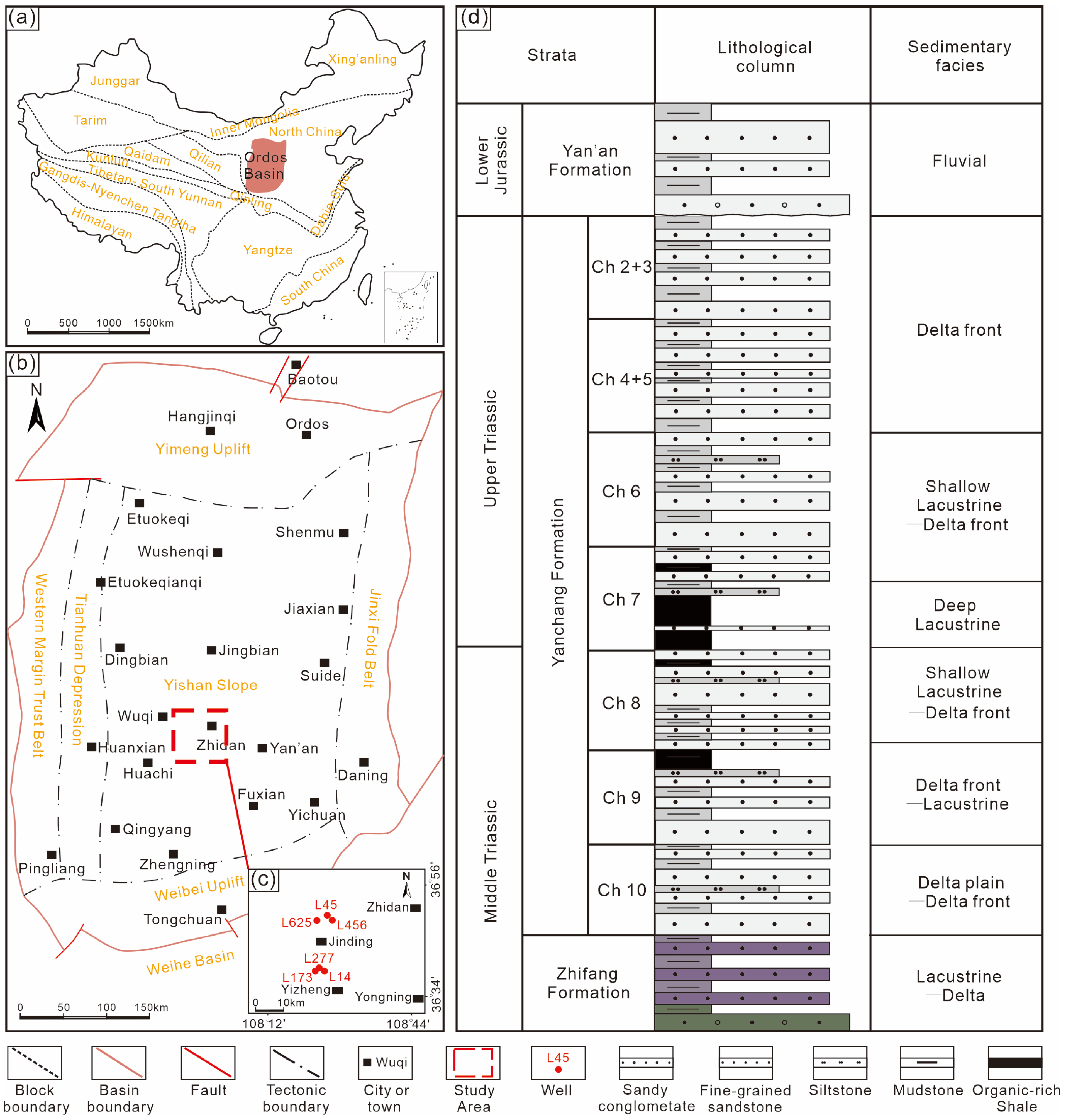
The Ordos Basin, situated in the transitional zone between the western part of the North China Plate and the Qinling-Qilian Caledonian fold belt, covers an area of approximately 3.7 × 10⁵ km2 [14,20]. This large polycyclic basin has developed atop an Archean-Early Proterozoic crystalline basement, initiated and evolved through several successive major tectonic stages, a Meso-Neoproterozoic aulacogen, a Paleozoic cratonic basin, a Mesozoic inland lacustrine basin, and Cenozoic peripheral fault depressions. The Ordos Basin is subdivided into six structural units: the Yimeng Uplift, the Yishan Slope, the Tianhuan Depression, the Jinxi Fold Belt, the Weibei Uplift, and the Western Margin Thrust Belt (Figure 1a,b). The Yishan slope, which displays a gentle structure and has less developed faults and folds, is the main hydrocarbon enrichment area of the Ordos Basin [21,22].
The region under investigation, western Zhidan, is located in the center of the Yishan Slope (Figure 1b,c). The conventional subdivision of the Yanchang Formation based on lithology, paleontological characteristics, and sedimentary evolution comprises 10 oil-bearing members from bottom to top, named Chang 10 to Chang 1 (Figure 1d).
During the Chang 8 depositional period, the Zhidan area was situated on the front of the Zhidan-Jingbian delta, which was supplied by northeastern provenance within the Ordos Basin. During the Chang 8 depositional period, the Zhidan area was situated on the front of the Zhidan-Jingbian delta, which was supplied by northeastern provenance within the Ordos Basin. The depositional system was dominated by deltaic and shallow lacustrine facies, developing a clastic assemblage characterized by medium-to-thick beds of siltstone to fine sandstone interbedded with thin layers of shale. Beginning in the early Chang 7 period (specifically the Chang 73 sub-member), influenced jointly by the Indosinian Movement and a humid climatic event, the paleo-lake in the Ordos Basin rapidly expanded to its maximum areal extent and water depth. The Zhidan area was then in a semi-deep to deep lacustrine environment, resulting in the deposition of organic-rich shale of deep to semi-deep lacustrine origin, intercalated with thin sandstone layers of turbidite origin.
From the late Chang 73 sub-member onward, as the northeast-sourced delta resumed progradation into the paleo-lake, the depositional environment in the Zhidan area gradually transitioned back to a delta-front setting. Throughout the subsequent Chang 72 to Chang 71 sub-members, continued deltaic progradation led to a general increase in sandstone bed thickness and an overall decrease in shale thickness within the clastic assemblage. The lake basin underwent intensified shrinkage from the Chang 6 to Chang 4 + 5 periods. From the Chang 3 period onwards, the setting gradually became more plain-like and swampy [23]. Following the conclusion of Yanchang Formation deposition, regional uplift at the end of the Triassic led to the erosion and absence of the Chang 1 Member in this area (Figure 1d).
The Chang 7 and Chang 8 Members are important intervals for tight oil and shale oil enrichment in the Zhidan area [24,25,26,27,28]. Three main sandstone-shale (mudstone) assemblages are developed: The first is primarily composed of medium-to-thick sandstone beds interbedded with thin to medium mudstone layers, formed in a delta-front environment. The second consists of thin to medium sandstone beds interbedded with thin to medium mudstone layers, also in a delta-front setting. These two assemblages are mainly developed in the Chang 81 sub-member and from the upper Chang 73 to the Chang 71 sub-members. The third assemblage, found within the shale succession of the Chang 73 sub-member, is characterized by thick shale beds intercalated with thin, turbidite-origin sandstone layers [10].
Figure 1.
Study area location and the stratigraphic column of the Yanchang Formation. (a) Geographical and tectonic location of the Ordos Basin (boundaries of some blocks positioned after [29]); (b) Regional geology sketch map of the Ordos Basin and the location of the Zhidan area (basin and tectonic line locations after [30]); (c) Sketch map of the locations of the sampled wells in the Zhidan area; (d) Stratigraphic column of the Yanchang Formation in the Zhidan area, the colors used for lithology in the stratigraphic column represent the actual colors of the rocks. (Ch = Chang).
3. Samples and Methods
3.1. Samples
The samples used in this study were collected from cores of the Chang 7 and Chang 8 Members recovered from five wells in the western Zhidan area, including L14 (1953–1970 m), L173 (1840–1846 m and 1920–1955 m), L277 (1785–1890 m), L456 (1939–1947 m), and L625 (1859–1873 m and 1929–1944 m). Based on detailed core observations and the actual coring conditions of each well, a total of 35 samples of tight sandstones and organic-rich shales were collected from three types of tight sandstone-shale assemblages. These include 23 tight sandstone samples (comprising samples from the margins and central parts of sandstone layers, as well as sandstone samples with fractures) and 12 organic-rich shale samples. These included 23 tight sandstone samples and 12 organic-rich shale samples. Additionally, experimental data from Well L45 in the Chang 8 Member were compiled, including grain size analysis, thin sections, scanning electron microscopy (SEM) images of 14 tight sandstone samples, and porosity test results of 21 tight sandstone samples. These experimental results were completed and provided by the Exploration and Development Research Institute of Shaanxi Yanchang Petroleum (Group) Co., Ltd., located in Yan’an, China.
3.2. Experimental and Analytical Methods
This study employed petrographic, organic petrologic, elemental, stable isotope geochemical, and petrophysical methods to characterize the petrological features, fluid conduit characteristics, and diagenetic attributes of the tight sandstones and shales in the Chang 7 and Chang 8 Members of the western Zhidan area. Following the identification of diagenetic process types and their sequences within the tight sandstones and shales, an integrated analysis of basin burial history, thermal history, and diagenetic history was conducted to reconstruct the coupled diagenetic evolution process of the sandstone-shale assemblages. The integrated strategy aims to develop a unified diagenetic sequence and elucidate the mechanisms controlling the evolution of reservoir quality in this co-existing system.
3.2.1. Petrographic Methods
Petrographic analysis was conducted primarily through core observation, thin section analysis, SEM, and X-ray diffraction (XRD). Thin section observations were performed using an Olympus BX53 polarizing microscope equipped with its imaging system (Olympus, Tokyo, Japan). For sandstones, thin sections were used to observe and quantify the content of detrital grains, cement components, and the proportions of various pore types via point-counting (200 points per thin section). They were also used to measure grain size through image analysis (with no fewer than 400 grains counted per thin section). Before the thin section preparation, the sandstone samples were not subjected to oil washing. After grinding, the thin sections were stained with a solution of Alizarin Red S and potassium ferricyanide to distinguish between different types of carbonate cement. For shales, thin sections were primarily used to observe features of larger felsic grains, authigenic minerals, and organic matter, as well as the types of laminae and the distribution of micro-fractures. Given that most detrital components in shales are extremely fine-grained, mineral composition analysis relied mainly on XRD, with thin section observation serving as a supplementary method.
SEM observations were performed in batches on a high-resolution field emission scanning electron microscope—Thermo Scientific Apro 2 (Thermo Fisher Scientific, Waltham, MA, USA), Hitachi S-4800 (Hitachi, Tokyo, Japan), and TESCAN CLARA GMH (TESCAN, Brno, Czech Republic). These were used mainly to examine the morphological characteristics and paragenetic relationships of minerals in sandstones and shales. Energy-dispersive X-ray spectroscopy (EDS) attached to the respective SEM instruments was employed to analyze the elemental composition of selected minerals for identification.
XRD analysis of sandstones and shales was performed using a Bruker D8 ADVANCE A25 X-ray diffractometer (Bruker, Karlsruhe, Germany, Cu Kα source, 40 kV, 40 mA). For whole-rock mineral analysis, the rock samples were crushed to a particle size of less than 200 mesh (<0.075 mm), soaked in deionized water for 24 h, treated with a 10 mol/L H2O2 solution to remove organic matter, and then subjected to boiling, drying, and subsequent testing. For the analysis of relative clay mineral content, 6 sandstone and 7 shale samples were crushed to less than 200 mesh (<0.075 mm). Carbonate minerals were removed using 3% dilute hydrochloric acid. Subsequently, 5% sodium hexametaphosphate was added to the samples. Clay particles smaller than 2 μm were separated via sedimentation and centrifugation, made into oriented slides, and then subjected to glycol saturation and heating at 450 °C before testing. The clay mineral composition, the percentage of major clay minerals, and the mixed-layer ratio of illite-smectite were determined by analyzing the XRD patterns. The results of whole-rock mineral composition and relative clay mineral content for the sandstones are presented in Figure 2, and those for the shales are presented in Figure 3.
Figure 2.
Composition of whole rock and clay minerals of tight sandstone of the Chang 7 and Chang 8 Members in the western Zhidan area (by X-ray diffraction, XRD).
Figure 3.
Composition of whole rock and clay minerals of shale of the Chang 7 and Chang 8 Members in the western Zhidan area (by X-ray diffraction, XRD).
3.2.2. Organic Petrologic Methods
Organic petrological methods primarily included fluorescence thin section observations of both sandstones and shales, as well as kerogen maceral identification, total organic carbon (TOC) content measurement, vitrinite reflectance (Ro) determination, and maximum pyrolysis temperature (Tmax) measurement for the shales.
Fluorescence thin section observations were conducted using a Zeiss Axio Imager D2m polarizing microscope equipped with a fluorescence system (Zeiss, Göttingen, Germany). Thin sections were prepared from 2 oil-bearing sandstone samples and 3 shale samples to examine the types and distribution characteristics of bituminous organic matter within the sandstones and shales.
Kerogen maceral identification for shales was performed using transmitted light-fluorescence microscopy. Kerogen concentrates were separated from 9 shale samples crushed to 40 mesh (<0.425 mm). After removal of carbonates and neoformed salts, followed by centrifugation and heavy liquid flotation, the floated kerogen was collected, washed, dried, and mounted using a polyvinyl alcohol (PVA) method for microscopic maceral identification.
For TOC measurements, 10 shale samples were ground to 0.15 mm, treated to remove carbonates, washed, and dried. Analysis was then performed using a LECO CS744 carbon-sulfur analyzer (LECO Corporation, St. Joseph, MI, USA). Vitrinite reflectance (Ro) was determined using the oil immersion objective method, with over 50 measurements taken on each of 9 samples. The maximum pyrolysis temperature (Tmax) was measured by rock pyrolysis using a French Rock-Eval 6 instrument (Vinci Technologies, Paris, France). 5 powdered shale samples (0.15 mm) were heated to 300 °C within 3 min, followed by heating to 650 °C at a rate of 25 °C/min. The temperature corresponding to the peak hydrocarbon generation rate (S2 peak) was recorded as Tmax.
3.2.3. Elemental and Stable Isotope Geochemical Analysis
Elemental and stable isotope geochemical analyses included stable carbon and oxygen isotope analysis of carbonate cements in sandstones and electron probe microanalysis (EPMA) of shales. Stable carbon and oxygen isotope analysis of sandstone calcite cements was conducted using the phosphoric acid method. Based on the thin section observations, 4 tight sandstone samples with high (>10%) and monomineralic calcite cement content were selected, ground to below 200 mesh (<0.075 mm), and analyzed using a DELTA V Advantage SN09017D isotope ratio mass spectrometer (Thermo Fisher Scientific, Waltham, MA, USA) to obtain the δ13CPDB and δ18OPDB values of the calcite cements.
EPMA was employed to characterize the distribution of major rock-forming elements within different minerals in the shales. 3 laminated shale samples were prepared into a standard probe section measuring 50 mm × 27 mm. A 4 mm × 4 mm field of view was selected and scanned for 3 h using a JXA-iSP100 electron probe microanalyzer (JEOL Ltd., Akishima, Tokyo, Japan) to obtain the distribution patterns of five elements: Si, Al, Fe, K, and Mg.
3.2.4. Petrophysical Method
Petrophysical analysis was primarily used to analyze the porosity of sandstones and shales. Measurements using a Core Lab PoroPDP-200 overburden porosity-permeability measuring instrument (Core Laboratories, Houston, TX, USA, 220 V, 50 Hz, 25 °C) in accordance with the American Petroleum Institute standard (API RP-40) [31]. Core plugs with a diameter of 25 mm, drilled from sandstone and shale samples, and tested using helium as the injection gas.
3.2.5. Basin Burial-Thermal-Diagenetic History Analysis
To understand the relationship between diagenetic events that happened in tight sandstones and shales, and the burial history of the basin and thermal evolution history of source rocks, basin burial history modelling was carried out using the software PetroMod 2016.2. This analysis was based on the stratigraphic thickness and contact relationships of typical wells in the study area, integrated with previous research on the tectonic-sedimentary evolution, paleo-geothermal gradients of the Ordos Basin, and the hydrocarbon accumulation history of the Chang 7 and Chang 8 Members in Zhidan area [29,32,33,34,35,36,37,38]. Building upon the reconstructed burial history and integrating the basin’s burial history, organic matter thermal evolution history, and diagenetic history, the diagenetic processes of the tight sandstones and shales in the Chang 7 and Chang 8 Members were analyzed. Ultimately, a sequence of synergistic diagenetic evolution for the tight sandstone-shale assemblage with the help of synchronous and synergistic diagenetic events as a linking framework.
4. Results
4.1. Rock Types of Tight Sandstones and Shales
Thin section observations reveal that the tight sandstones in the Chang 7 and Chang 8 Members of the western Zhidan area contain quartz (12.0%–32.0%, avg. 20.9%) and feldspar (42.0%–73.0%, avg. 62.3%). The feldspar is predominantly plagioclase (28.0%–58.0%, avg. 43.3%), with a lower content of K-feldspar (10.0%–29.0%, avg. 18.7%). Lithic fragments are primarily metamorphic, with subordinate igneous and sedimentary types, and are present in low abundance (generally below 5%, up to 8%). Biotite flakes are relatively high (1.0%–10.0%, avg. 4.0%), which often exhibits a preferred orientation forming laminae. Authigenic minerals mainly include clay minerals (1.5%–8.0%, avg. 3.8%), carbonate minerals (0.5%–35.0%, avg. 4.4%), and silica cement (generally below 1.0%). In a few samples, laumontite (with content below 1.0%) and pyrite (with content below 0.5%) are also present. Overall, the mineral composition of the Chang 7 and Chang 8 sandstones in the western Zhidan area is characterized by low quartz, high feldspar, and low lithic fragment contents (Figure 4a). The size of detrital grain ranges from 1.5 μm to 461.6 μm (avg. 113.1 μm), classifying the rocks as feldspathic or feldspathic-lithic siltstone to fine sandstone.
Figure 4.
Rock type identification for tight sandstone and shale of the Chang 7 and Chang 8 Members in the western Zhidan area: (a) sandstone classification ternary diagram (adapted from the classification scheme in [39], data from this study): I—Quartzarenite, II—Subarkose, III—Sublitharenite, IV—Arkose, V—Lithic Arkose, VI;—Feldspathic Litharenite, VII;—Litharenite; (b) shale classification ternary diagram (adapted from the classification scheme in [40], data from this study): I—Clay shale, II—Felsic shale, III—Calcareous shale, IV—Mixed shale.
XRD analysis reveals that the shales of the Chang 7 and Chang 8 Members in the western Zhidan area consist mainly of clay minerals (33.0%–70.1%, avg. 53.4%) and felsic detritus (28.8%–57.7%, avg. 42.6%). The clay minerals are dominated by illite (21.0%–64.3%, avg. 45.1%) and chlorite (5.7%–12.0%, avg. 8.4%). The felsic detritus includes quartz (13.9%–34.0%, avg. 20.4%), plagioclase (4.4%–20.6%, avg. 11.5%), K-feldspar (3.1%–15.0%, avg. 6.2%), and buddingtonite (3.1%–8.9%, avg. 5.2%) (Figure 3a). Within the shales, the clay minerals and felsic detritus are heterogeneously distributed, forming felsic laminae, clay-rich laminae, and clay-organic laminae. Besides clay minerals and felsic detritus, the shales commonly contain minor amounts of framboidal pyrite (1.2%–3.0%, avg. 3.3%), and a few shale samples contain minor carbonate minerals (2.5%–4.0%). According to the mineral content, the shales in the Chang 7 and Chang 8 Members of the western Zhidan area are predominantly felsic shales and clay-rich shales, with mixed shales being less common (Figure 4b).
4.2. Types of Reservoir Space and Diagenetic Fluid Migration Pathways
4.2.1. Types of Reservoir Space
The primary types of reservoir space in the tight sandstones are pores and bedding-parallel fractures. Sandstone porosity ranges from 3.6%–13.9% (avg. 8.1%). Primary pores include intergranular pores, interlayer pores within mica flakes, and intercrystalline micropores among authigenic minerals such as clay and quartz (Figure 5a–c). Secondary pores are mainly intergranular and intragranular dissolution pores formed by feldspar dissolution (Figure 5d,e). Bedding-parallel fractures are relatively common in sandstones with well-developed biotite laminae, formed by the rupture along bedding planes of aligned biotite and clay minerals under tectonic stress (Figure 5g).
Figure 5.
Photomicrographs showing pore types in tight sandstone and shale. (a) Residual intergranular pore, Well L625, 1860.28 m, Chang 7 Member, plane-polarized light (PPL), ×100. (b) Mica cleavage fracture pore and feldspar dissolved pore, Well L456, 1946.30 m, Chang 7 Member, scanning electron microscopy (SEM), ×4000. (c) Intercrystalline pores developed between chlorite and authigenic quartz crystals in sandstone, Well L45, 1865.78 m, Chang 8 Member, SEM, ×1413. (d) Intergranular dissolved pore in sandstone, Well L625, 1860.28 m, Chang 7 Member, PPL, ×200. (e) Feldspar dissolved pore in sandstone, Well L425, 1860.28 m, Chang 7 Member, PPL, ×400. (f) Bedding-parallel fracture developed within a biotite lamina in sandstone, Well L456, 1946.30 m, Chang 7 Member, PPL, ×100. (g) Bedding-parallel fracture within a biotite lamina and adjacent intergranular dissolved pores in sandstone, Well L456, 1940.43 m, Chang 7 Member, PPL, ×100. (h) Mica cleavage fracture pore (interlayer pores formed along mica cleavage planes), clay intercrystalline pores, and intergranular pores developed in shale, Well L625, 1929.40 m, Chang 7 Member, SEM, ×15,000. (i) Pyrite intercrystalline pores, clay intercrystalline pores, intergranular pores, and a bedding-parallel fracture in shale, Well L173, 1953.10 m, Chang 7 Member, SEM, ×8000. (j) Feldspar dissolved pore in shale, Well L277, 1877.00 m, Chang 8 Member, PPL, ×200. (k) Organic matter pores in shale, Well L625, 1953.10 m, Chang 7 Member, PPL, ×5000. (l) Bedding-parallel fracture in shale, Well L625, 1873.00 m, Chang 7 Member, PPL, ×200. Abbreviations: INP = intergranular pore; MCP = mica cleavage plane; FDP = feldspar dissolution pore; IDP = intergranular dissolved pore; BPF = bedding parallel fracture; CIP = clay intercrystalline pore; PIP = pyrite intercrystalline pore; OMP = organic matter pore.
Shale pores are small and poorly developed. Measured porosity of the shale ranging from 1.2%–4.4% (avg. 2.7%). The primary pore types mainly include various intergranular pores, interlayer pores within mica flakes, intercrystalline pores among clay minerals, and intercrystalline pores within pyrite (Figure 5h,i). Secondary pores consist primarily of feldspar dissolution pores and minor organic-matter pores (Figure 5j,k). Bedding-parallel fractures, often formed within laminae rich in clay and organic matter, constitute an important type of reservoir space in shales (Figure 5l).
4.2.2. Types of Diagenetic Fluid Migration Pathways
In the sandstone-shale assemblages of the Chang 7 and Chang 8 Members in the western Zhidan area, diagenetic fluid migration pathways are formed by the interconnection of fractures at various scales, sandy strips within shales, and relatively high-porosity and high-permeability laminae or sand layers within tight sandstones.
The relatively permeable sandy strips (sand layers), micro-fractures, bedding-parallel fractures, and small to medium-sized tectonic fractures are the main conduits for diagenetic fluid migration within the shale or sandstone layers or between the adjacent shale and sandstone layers. The medium to large tectonic fractures, as well as their associated bedding-parallel fractures, are the main pathways for cross-layer fluid migration from shales to sandstones. The sandy strips in shales, as well as the zones of relatively high porosity and high permeability in tight sandstones, are characterized by a greater degree of pore development; their particular characteristics will not be dealt with here.
According to their size, fractures are categorized into three scales: (1) Large-scale vertical or oblique tectonic fractures, with lengths ranging from tens of centimeters to meter-scale (Figure 6a,b). (2) Small-scale tectonic fractures and bedding-parallel fractures, with lengths from tens of micrometers to several centimeters (Figure 5f,l and Figure 6c–e). (3) Micro-fractures formed by the brittle rupture of minerals under stress, with micrometer-scale lengths and low abundance (Figure 6f).
Figure 6.
Characteristics of structural fractures in tight sandstone and shale of the Chang 7 and Chang 8 Members. (a) Large-scale structural fractures in sandstone of Chang 8 Member, Well L14, 1965.00–1965.74 m. (b) Structural fractures in sandstone of Chang 8 Member, Well L625, 1930.00–1930.20 m. (c) Small-scale oblique fractures on a 25 mm diameter sandstone core plug from Chang 8 Member, Well L277, 1889.20 m. (d) Dissolution pores developed adjacent to small-scale oblique fractures in sandstone of Chang 8 Member, Well L277, 1889.20 m, plane-polarized light (PPL), ×200. (e) Microfractures developed within detrital grains in sandstone of Chang 8 Member, Well L625, 1929.40 m, PPL, ×400. (f) Small-scale oblique fractures on a 25 mm diameter sandstone core plug from Chang 7 Member, Well L625, 1860.68 m. (g) Shale from Chang 7 Member, lacking distinct structural fractures, exhibiting slab-like breakage along bedding planes, Well L173, 1924.25–1924.70 m. (h) Small-scale oblique fractures in shale of Chang 7 Member, Well L14, 1953.10 m, PPL, ×40. Abbreviations: DP = dissolution pore; MF = microfracture.
The Chang 7 sandstone has less development of large oblique tectonic fractures, while bedding-parallel and small- to medium-sized tectonic fractures dominate. In contrast, there are more medium with large-sized fractures in the Chang 8 sandstones. In the shales, large tectonic fractures are rare; rather, small- to medium-sized bedding-parallel and oblique fractures are the main types developed (Figure 6g,h).
4.3. Types and Characteristics of Organic Matter
In tight sandstones, the content of organic matter is generally low, occurring primarily as bitumen filling pores and fractures or adsorbed onto mica and clay minerals (Figure 7a). Fluorescence thin sections show the coexistence of oily bitumen and resinous bitumen, distributed within elliptical or irregular polygonal intergranular pores, or adsorbed on mineral surfaces, with oily bitumen being relatively more abundant (Figure 6b–d). In sandstones containing little to no oil, the pore interiors are relatively clean, with organic matter rarely observed (Figure 5d).
Figure 7.
Occurrence characteristics of organic matter in tight sandstone and shale. (a) Organic matter (indicated by arrow) within pores in sandstone, Well L277, 1785.80 m, Chang 7 Member, scanning electron microscopy (SEM), ×10,000. (b) Coexistence of oily bitumen and colloidal bitumen in sandstone; intergranular oily bitumen exhibits bright yellow and medium-to-dark green fluorescence, while colloidal bitumen shows medium-to-bright fluorescence, Well L277, Chang 8 Member, 1885.00 m, fluorescence (FL), ×200. (c) Coexistence of oily bitumen and colloidal bitumen in sandstone; intergranular oily bitumen exhibits bright yellow and medium-to-dark green fluorescence, while colloidal bitumen shows medium-to-bright fluorescence, Well L625, 1868.43 m, Chang 7 Member, FL, ×200. (d) Oily bitumen filling pores in sandstone, displaying medium-intensity orange-yellow to bright yellow fluorescence, Well L45, 1868.79 m, Chang 8 Member, FL, ×200. (e) Carbonized plant fragments (indicated by arrow) in shale, the coin used as a scale bar has a diameter of 19 mm, Well L456, 1943.30 m, Chang 7 Member. (f) Pyritized plant seed fossil (indicated by arrow) in shale, the coin used as a scale bar has a diameter of 19 mm, Well L625, 1873.00 m, Chang 7 Member. (g) Fish bone fragment (indicated by arrow) in shale, Well L625, 1873.00 m, Chang 7 Member, plane-polarized light (PPL), ×200. (h) Fossil of Yanchangparapandorina inornata (indicated by arrow) in shale, Well L625, 1873.00 m, Chang 7 Member, PPL, ×200. (i) Ternary diagram of maceral composition for kerogen in shale. (j) Colloidal bitumen in shale of Chang 8 Member, showing medium-bright yellow-orange fluorescence along bedding fractures and medium-bright orange fluorescence in intergranular pores, Well L277, 1877.00 m, Chang 8 Member, FL, ×200. (k) Coexistence of colloidal bitumen and oily bitumen in shale of Chang 7 Member; colloidal bitumen in pores shows medium-bright orange fluorescence, while oily bitumen along bedding fractures exhibits medium-bright yellow fluorescence, Well L625, 1871.11 m, Chang 7 Member, FL, ×200. (l) Coexistence of colloidal bitumen and oily bitumen in shale of Chang 7 Member; colloidal bitumen in pores and along bedding fractures shows medium-bright orange fluorescence, with a small amount of oily bitumen along bedding fractures exhibiting dark green fluorescence, Well L173, 1921.72 m, Chang 7 Member, FL, ×200. (m) Colloidal bitumen within pores and structural fractures in shale of Chang 7 Member, showing medium-bright orange fluorescence, Well L173, 1921.72 m, Chang 7 Member, FL, ×200.
The shales contain a relatively high amount of organic matter (TOC = 1.2%–9.2%, avg. 4.4%). The modes of occurrence of organic matter include bioclastic debris, kerogen, and bitumen. Bioclastic debris is represented by fish bones and fossils such as Yanchangparapandorina inornata [41]. Plant fragments are also common and are observed in association with these bioclastic components (Figure 7e–h). The kerogen is dominated by amorphous sapropelinite (55.0%–78.0%, avg. 67.9%), with lesser amounts of vitrinite (7.0%–18.0%, avg. 14.0%), liptinite (4.0%–15.0%, avg. 9.1%), and inertinite (7.0%–10.9%, avg. 10.9%). The kerogen type index (TI) ranges from 35.5 to 60.8 (avg. 51.1), classifying it as Type II kerogen (TI calculation follows [42]), which is oil-prone (Figure 7i). Thermal maturation indicators show that the vitrinite reflectance (Ro) of the shales ranges from 0.98% to 1.21% (avg. 1.09%), and the maximum pyrolysis temperature (Tmax) ranges from 436.3 °C to 441.3 °C (avg. 439.3 °C), indicating that the shales are mature and currently in the peak oil generation stage. The generated oil has migrated through pores and fractures, accompanied by the fractionation of light and heavy components within the oil. This has resulted in the predominance of resinous bitumen in elongated pores within the shales, while the proportion of oily bitumen is relatively higher in fractures (Figure 7j–m).
4.4. Types and Characteristics of Diagenesis
4.4.1. Types and Characteristics of Diagenesis in Tight Sandstone
- (1)
- Compaction
The tight sandstones in the Chang 7 and Chang 8 Members of the western Zhidan area have low compositional maturity and high mica content. Detrital grains predominantly display linear contacts, while point contacts are secondary (Figure 8a). Felsic grain-plastic grain contacts, such as mica, are usually concave–convex surfaces. Bent and distorted mica flakes are common, and sometimes they are squeezed between felsic grains forming pseudomatrix (Figure 8b). In some samples, the quartz and feldspar grains are fractured due to intense mechanical compaction or stress, forming micro-fractures (Figure 6f). Sandstone that heavily carbonate-cemented is less compacted, where detrital grains are in point contact mainly. The early carbonate cement presence limited mechanical compaction as indicated (Figure 8c).
Figure 8.
Diagenetic characteristics of sandstone. (a) Predominantly line contacts between detrital grains, where the arrow indicates the linear contact between detrital particles, Well L625, 1859.70 m, Chang 7 Member, plane-polarized light (PPL), ×200. (b) Compactional deformation of biotite with local dolomitization, Well L625, 1935.40 m, Chang 8 Member, PPL, ×200. (c) Early-stage, low-Fe calcite cement, Well L456, 1943.60 m, Chang 7 Member, PPL, ×400. (d) Chlorite coating enveloping detrital grains (indicated by arrow), Well L625, 1929.40 m, Chang 8 Member, PPL, ×200. (e) Authigenic chlorite and quartz, Well L625, 1859.70 m, Chang 7 Member, scanning electron microscopy (SEM), ×1000. (f) Kaolinite growing on chlorite, Well L45, 1865.78 m, Chang 8 Member, SEM, ×1013. (g) Authigenic chlorite growing on the surface of detrital grains, with illite overgrowth on the chlorite, Well L625, 1859.70 m, Chang 7 Member, SEM, ×1200. (h) Filamentous illite, Well L625, 1935.40 m, Chang 7 Member, SEM, ×1000. (i) Late-stage, high-Fe calcite cement replacing quartz grains, Well L14, 1963.60 m, Chang 8 Member, PPL, ×200. (j) Ankerite replacing biotite, Well L625, 1935.40 m, Chang 8 Member, PPL, ×200. (k) Quartz overgrowth, Well L625, 1859.70 m, Chang 7 Member, PPL, ×400. (l) Dissolved laumontite and quartz overgrowth, Well L45, 1869.20 m, Chang 8 Member, PPL, ×520. (m) Solid bitumen, Well L625, 1868.43 m, Chang 7 Member, PPL, ×100. (n) Dissolution of K-feldspar, Well L277, 1885.00 m, Chang 8 Member, PPL, ×200. (o) Dissolution of biotite, Well L625, 1889.20 m, Chang 7 Member, PPL, ×200. (p) Dissolution of calcite (within pore space at lower left), Well L625, 1859.70 m, Chang 7 Member, PPL, ×200. Abbreviations: Bt = biotite; Dol = dolomite; Q = quartz; Chl = chlorite; Ill = illite; Kao = kaolinite; Cal = calcite; Ank = ankerite; Lmt = laumontite; BU = bitumen; Kf = K-feldspar.
- (2)
- Cementation
The two most dominant types of cement in the tight sandstones are authigenic clay and carbonate cements. Based on thin section observations, the majority of tight sandstone samples are predominantly cemented by clay cements (1.5%–8.0%, avg. 4.0%), with a lower content of carbonate cement (0.5%–5.0%, avg. 2.2%). A minority of tight sandstone samples are intensely cemented by carbonate (10.5%–35.0%, avg. 20.8%).
The majority of clay cements consist of illite (3.5%–28.9% in whole-rock XRD, avg. 13.1%) and chlorite (2.7%–16.1% in whole-rock XRD, avg. 6.9%), with some samples containing high proportions of kaolinite (up to 90% of total clay content). The major types of chlorite cement are grain-coating chlorite and pore-lining chlorite, of which the former is more abundant (Figure 8d,e). Grain-coating chlorite typically forms during the syndiagenetic to eodiagenetic stages, developing as outer rims around detrital grains, while pore-lining chlorite forms isopachous rims along pore walls and may continue to grow during later diagenetic stages [43,44,45,46]. Both kaolinite and illite formed after grain-coating chlorite formation. Kaolinite is primarily derived from feldspar dissolution and occurs as pseudo-hexagonal plates growing within intergranular pores (Figure 8f). The genesis of illite is more complicated, it may generate from the evolution of illite-smectite mixed-layer clays and/or from the illitization of kaolinite or dissolution of K-feldspar [47,48]. Illite forms flaky crystals that coat the surface of detrital grain surfaces or overgrow earlier chlorite grain coatings, and as fibrous or filamentous crystals radiating outward or forming “bridges” between adjacent detrital grains (Figure 8g,h).
The carbonate cements consist primarily of Fe-bearing calcite (ferroan calcite), dolomite, and ankerite. Alizarin Red S and potassium ferricyanide solutions stain low-Fe calcite pink (Figure 8c), high-Fe calcite purple-red (Figure 8i), dolomite (unstained), and ankerite blue (Figure 8j). The clay cement in the sandstones is dominant, and carbonate cements comprise mainly of high-Fe calcite (ferroan calcite), dolomite, and ankerite. It fills some intergranular pores. Authigenic illite formed during the mesodiagenetic stage, and its origin is related to the release of Fe from the alteration of Fe-bearing biotite fragments. The origin of the calcite that binds sandstones so that they form a rise was determined in the present study using stable carbon and oxygen. The formation temperature of the calcite cement was calculated using the calcite-water fractionation formula proposed by Friedman and O’Neil [49]:
In Equations (1) and (2), αcalcite-H2O is the calcite-water equilibrium coefficient; T is the thermodynamic temperature in Kelvin (K). Both δ13Ccalcite-H2O and δ18OH2O are reported on the PDB standard (‰). The δ18OSMOW value of pore water is taken as the average of meteoric water (−6.5‰) in the Ordos Basin (palaeolatitude 15° N–30° N), which ranges from −5‰ to −8‰ [50,51,52]. This value is converted to δ18OH2O on the PDB standard using the deviation Equation (3) [53]:
The pore water salinity index Z value for the calcite cement was calculated using the formula proposed by Keith and Weber [54]:
The calculated formation temperatures (Th, in °C, where Th = T – 273.15) and the dimensionless salinities (Z) of calcite cements, derived using the aforementioned formulas, are presented in Table 1. Integrated with the carbon and oxygen isotopic analyses, as well as the calculated formation temperatures and salinities, of calcite cements in the Chang 8 sandstone from the Zhidan area reported by Zhang et al. [55], it is indicated that the intensely cemented sandstones in the Chang 7 and Chang 8 Members of the western Zhidan area primarily formed in a freshwater environment, with most Z values being less than 120 (ranging from 107.1 to 122.9). Low-Fe calcite formed during the eodiagenetic stage, with formation temperatures ranging from 53 °C to 66 °C, and its origin is linked to biogenic gas formation. In comparison, the high-Fe calcite formed in the mesodiagenetic stage at a temperature range of 81–112 °C, originating from decarboxylation of organic matter and hydrocarbon generation (Figure 9). The calcite cements (associated with either eodiagenetic or mesodiagenetic stages) can cause intense cementation of sandstones if present in abundant quantities.
Table 1.
Stable Carbon and Oxygen Isotope Data of Calcite Cement from the Chang 7 and Chang 8 Members, Western Zhidan Area.
Figure 9.
Plot of δ13CPDB-δ18OPDB for interpreting the origin of calcite cements in Chang 7 and Chang 8 Members, western Zhidan area (Data points shown in yellow circles are after [55], the genetic classification criteria for calcite cements are based on [56]).
In addition to clay and carbonate, other cements in the tight sandstones occur in low abundances, such as quartz (Figure 8e,f,k,l), laumontite (Figure 8l), and pyrite. Quartz cement occurs as overgrowths (grade I–II) on detrital quartz grains (Figure 8k,l) and as authigenic crystals growing on grain-coating chlorite (Figure 8e,f), the latter possibly derived from feldspar dissolution and biotite chloritization. In oil-bearing sandstones, solid bitumen also contributes to cementation along bedding-parallel fractures and in adjacent pores (Figure 8m).
- (3)
- Dissolution
In the Chang 7 and Chang 8 Members of the Yanchang Formation in the western Zhidan area, the readily soluble components in tight sandstones are primarily feldspar and biotite (Figure 8n,o). Except for possible minor feldspar dissolution during the syndiagenetic to eogenetic stages, the remaining dissolution phenomena occurred mainly after the influx of organic acids expelled from shales into the sandstones. Among these, feldspar dissolution is the most widespread and pronounced. Most feldspar grains were dissolved along their margins, or dissolution embayments were formed due to the dissolution of carbonates that had previously replaced the feldspar margins [57,58]. In a few cases, feldspar was dissolved along cleavage planes, creating small intragranular dissolution pores; however, larger dissolution pores or moldic pores were rarely developed. Biotite is far less abundant than feldspar and often underwent chloritization under the influence of acidic fluids, resulting in limited dissolution pores. Although the overall degree of dissolution in most sandstones is not intense, dissolution pores (including intergranular and feldspar dissolution pores) account for a relatively high proportion of the porosity, comprising 45% to 90% of the total surface porosity in thin sections. The degree of dissolution varies spatially; near structural fractures, bedding planes, and in relatively high-porosity and high-permeability sandstones connected to these fractures, detrital grains exhibit a higher degree of dissolution. Additionally, in sandstones with strong calcite cementation, dissolution pores can also be observed adjacent to bedding-parallel fractures.
- (4)
- Replacement
In tight sandstones, the most common replacement relationships include the replacement of quartz and feldspar grains by ferroan calcite, and the replacement of biotite fragments by dolomite and ankerite. Replacement of quartz and feldspar by ferroan calcite mainly occurs along grain margins or cleavage planes, and is particularly common in ferroan calcite cements formed during the mesogenetic stage (Figure 8i). Replacement of biotite by ankerite mainly proceeds along the margins and cleavage planes of biotite fragments or from within hydrated biotite, with biotite fragments being partially or nearly completely replaced (Figure 8j).
4.4.2. Types and Characteristics of Diagenesis in Shale
- (1)
- Mechanical Diagenesis
The Chang 7 and Chang 8 shales in the western Zhidan area are also characterized by pronounced mechanical compaction features similar to the sandstones. In areas with a greater percentage of felsic grains, detrital grains have a predominantly linear contact. Compaction causes laminated clay minerals to have preferred orientation and bending characteristics when viewed through SEM. Platy biotite or chlorite flakes are also bent and deformed by compaction, showing linear to concave–convex contacts with felsic grains. Due to the intense compaction, intergranular pores between the clay particles, and between clay and felsic grains are also aligned directionally (Figure 10a,b).
Figure 10.
Diagenetic characteristics of shale. (a) Predominantly line contacts between felsic grains, with dissolution of feldspar, Well L277, 1877.00 m, plane-polarized light (PPL), ×200. (b) Bending and oriented alignment of clay minerals due to compaction, with local authigenic quartz, Well L456, 1943.30 m, scanning electron microscope (SEM), ×3000. (c) Collophane (indicated by arrow), Well L625, 1873.00 m, SEM, ×500. (d) Scanning electron microscope-Energy Dispersive Spectrometer (SEM-EDS) spectrum of the collophane shown in (c). (e) Laminated collophane growing parallel to bedding, Well L173, 1921.72 m, PPL, ×400. (f) Irregularly shaped solid bitumen, Well L456, 1943.30 m, SEM, ×1000. (g) Solid bitumen filling interparticle pores, Well L14, 1953.10 m, SEM, ×8000. (h) Solid bitumen forming complexes with clay minerals, Well L14, 1953.10 m, SEM, ×10,000. (i) Solid bitumen and pyrite filling spaces parallel to bedding, Well L625, 1873.00 m, SEM, ×400. (j) Dissolved feldspar grain and authigenic quartz crystals. (k) XRD pattern of buddingtonite. (l) Buddingtonite, Well L625, 1871.11 m, SEM, ×2000. (m) SEM-EDS spectrum of the buddingtonite shown in (l). (n) Pyrite, Well L173, 1921.72 m, SEM, ×2000. (o) Illite filling interparticle pores, Well L456, 1943.30 m, SEM, ×5000. (p) Clay minerals and organic matter filling interparticle pores, Well L14, 1953.10 m, SEM, ×15,000. Abbreviations: F = feldspar; Q = quartz; Clh = collophane; OM = organic matter; Kf = K-feldspar; Py = pyrite; Ill = illite.
- (2)
- Chemical Diagenesis Involving Organic Matter
The evolution of organic matter during shale diagenesis drives several key chemical processes. These include the cementation of the shale fabric by collophane, the generation of secondary organic porosity within solid bitumen, the subsequent pore-filling cementation by that same bitumen, and the alteration of feldspar grains through reactions with organic acids.
Collophane is one of the common cement types in shales. It often occurs as bedding-parallel, bamboo-leaf-shaped, lenticular, or lamellar aggregates. Under plane-polarized light, it appears dark red and is internally non-porous. Its origin is related to the reprecipitation of phosphorus (mainly calcium phosphate) following the decomposition of phosphorus-rich biological remains, such as fish bones [59,60,61,62,63] (Figure 10c–e).
Solid bitumen normally occurs in shale pores and different fractures in lamellar, banded, massive, irregular, pore-filling, and composite types with clay or pyrite (Figure 10f–i). All the shale samples show the presence of secondary organic pores from solid bitumen. Nevertheless, the lack of significant volumetric shrinkage of the solid bitumen, attributed to the organic matter’s low thermal maturity, accounted for the sparse occurrence of narrow or irregular-shaped organic pores in the sample (Figure 5k). Thus, the effect of solid bitumen on pore formation is low. The main function of this type of clay mineral, which is present in enormous quantities in shale, is cementation, allowing it to effectively resist compaction and helping to preserve pores and microfractures within the shale [64,65].
The alteration of feldspar grains by organic matter involves dissolution and replacement. The organic acids produced during hydrocarbon generation react with the feldspar grains. With the action of organic acids, dissolution embayments are developed at the edges of the feldspar grains, and dissolution pores are also developed within the feldspar grains. This process is one of the creation mechanisms of secondary porosity in shales (Figure 5j and Figure 10j). The replacement of K-feldspar by organic matter is the primary origin of buddingtonite (Figure 10k–m). Considering the context of hydrothermal activity and abundant biological activity during the deposition of the Chang 7 and Chang 8 Members in the Ordos Basin, it is inferred that buddingtonite in the shales formed through the replacement of K+ by NH4+ (derived from the decomposition of biological organic matter) along the edges of K-feldspar grains. This process occurred under the combined influence of hydrothermal activity within the basin and the accumulation of abundant biological organic matter, primarily after the shale entered the main stage of hydrocarbon generation [64,65,66,67,68,69].
- (3)
- Chemical Diagenesis of Inorganic Minerals
Chemical diagenesis related to inorganic minerals primarily includes cementation by inorganic minerals and the infilling of intergranular pores by authigenic clay minerals.
Cementation by inorganic minerals is mainly attributed to pyrite and authigenic quartz (Figure 10j,n), with carbonate cement being less common. Analysis of the relationship between the particle size range (5.8–40.0 μm, avg. 19.3 μm) of individual framboids and their size standard deviation indicates that the shales’ framboidal pyrite formed in a dynamic reducing to weakly oxidizing environment. Pyrite cementation took place from the syndiagenetic to the early eodiagenetic stage (Figure 11). The type of crystalline quartz is microcrystalline and occurs mainly as individual intergrown quartz and clay mineral crystals. The formation occurs at the late eodiagenetic to mesodiagenetic stages due to feldspar dissolution (Figure 10j).
Figure 11.
Plot of the mean versus the standard deviation of the framboid pyrites of the particular diameter, and the genesis of framboid pyrite (Data points shown in blue circles are after [60], the genetic classification criteria for framboid pyrite are based on [70]).
The process of infilling of intergranular pores by authigenic clay minerals is similar to clay cementation in sandstones (Figure 10o,p). Illite is the chief infilling mineral, and chlorite occurs subsequently. Illite is primarily formed from illite smectite mixed-layer clay transformation, K feldspar dissolution, and K feldspar to buddingtonite conversion. Chlorite is partly authigenic from the early diagenetic stage and partly derived from the alteration of minerals such as biotite. The EPMA elemental mapping images show K enrichment around K feldspar grains in felsic laminae caused by illite not growing on the feldspar (Figure 12a–f). Clay-rich laminae exhibit significantly higher concentrations of Al, Fe, and Mg, attributable to the relative enrichment of minerals like chlorite and chloritized biotite (Figure 12a–c,g–o). The presence of clay minerals that fill the original pore space and break it up into small micropores has a negative effect on the preservation of intergranular pores in shales and thus reduces the porosity of the shales.
Figure 12.
Electron Probe Microanalysis (EPMA) elemental mapping of shale showing the distribution of four elements (K, Al, Fe, and Mg). Subfigures (a), (b), and (c) are scanning electron microscope (SEM) images of shale samples from Well L625 at 1871.11 m, Well L456 at 1939.20 m, and Well L456 at 1943.30 m, respectively. Subfigures (d)–(o) are arranged by column corresponding to each sample: (d)–(f) show the abundance distribution of K, (g)–(i) Al, (j)–(l) Fe, and (m)–(o) Mg in the corresponding samples, respectively.
4.5. Diagenetic Stages and Sequences of Tight Sandstone and Shale
XRD analysis of clay minerals in tighter sandstones and shales of the Chang 7 and Chang 8 Members in western Zhidan showed that the mixed-layer illite-smectite clay contained about 15%–20% smectite and 80%–85% illite. In conjunction with the thermal maturation indicators of organic matter in the shales, it is inferred that the tight sandstones and shales have entered the mesogenetic stage [71]. Integrating the previously described paragenetic sequence of authigenic minerals and the timing of diagenetic events recorded in the tight sandstones and shales, the diagenetic sequence for both the sandstones and shales has been established in this study (Figure 13).
Figure 13.
Synergistic diagenetic evolution sequence for the tight sandstone and shale of the Chang 7 and Chang 8 Members of the Yanchang Formation in western Zhidan (geothermal data after [34,37]).
In addition to determining the diagenetic stages and sequences of the tight sandstones and shales, this study also calculated the initial porosity, compactional porosity loss, cementational porosity loss, and porosity increase due to dissolution of the tight sandstones. Therefore, based on this, the porosity evolution curves of diagenesis of the Chang 7 and Chang 8 Members in western Zhidan were constructed for the tight sandstones and shales by combining their diagenetic evolution process. The initial porosity of the sandstone was calculated based on the initial porosity algorithm proposed in reference [72] and the sorting coefficient algorithm proposed in reference [73]:
In Equations (5) and (6), ϕ0 is the initial porosity (%); So denotes the Trask sorting coefficient, which is derived from the grain-size probability cumulative curve where Q25 and Q75 correspond to the grain size (mm) at the 25th and 75th percentiles, respectively. The calculated initial porosity for the tight sandstones in Chang 7 and Chang 8 Members in western Zhidan ranges from 30.9% to 37.1% (avg. 34.7%).
The porosity loss due to compaction during diagenesis was estimated following the method in reference [74], whereas the porosity loss due to cementation was approximated as being equal to the volumetric content of cements:
In Equations (7) and (8), ϕcom is the porosity loss due to compaction (%); ϕ0 is the initial porosity (%); IGV denotes the intergranular volume (%), calculated as the sum of the areal porosity and cement percentage from thin-section analysis. ϕcem is the porosity loss due to cementation (%); Ccem is the total cement content (%). Calculated by Equations (7) and (8), the porosity loss due to compaction in the tight sandstones ranges from 4.3% to 29.3% (avg. 24.0%). Among these, sandstones with lower carbonate cementation (carbonate content < 10% in the thin section) exhibit a compactional porosity loss ranging from 21.2% to 29.3% (avg. 24.9%). The porosity loss due to cementation ranges from 2.0% to 38.0% (avg. 8.2%). For sandstones with lower carbonate cementation, the cementational porosity loss ranges from 2.0% to 10.0% (avg. 6.2%).
The porosity generated by dissolution was calculated using Equation (9):
In Equation (9), ϕd represents the porosity generated by dissolution (%); Pd denotes the dissolution-related areal porosity (%); Pt is the total areal porosity (%); ϕ is the measured porosity (%). Based on Equation (9), the porosity generated by dissolution in the tight sandstone ranges from 0 to 11.6% (avg. 3.8%).
There is no widely accepted method for calculating the initial porosity of shales. Given the high silt content in the Chang 7 and Chang 8 shales of western Zhidan, the initial porosity of the shales was set to 60% in this study. This value is based on empirical ranges for unconsolidated muddy sediments (45%–80%) and their typical central value (~60%) [75,76]. The extent of porosity reduction due to early compaction in shales was assessed with reference to compaction trends for mudstones summarized by the references [77,78]. Porosity losses due to compaction and cementation were calculated using the same algorithms applied to the tight sandstones, except that the measured porosity was used to derive the intergranular volume. The porosity increment resulting from dissolution and hydrocarbon generation from organic matter is referenced to the porosity increment during the immature-mature stage of the Chang 7 shale (TOC = 2.23%) in the Ordos Basin, as determined through thermal simulation experiments conducted by the reference [79], set at 0.5%.
5. Discussion
5.1. Diagenetic Evolution of the Tight Sandstone-Shale Assemblage
The burial history of the basin indicates that following the deposition of the Chang 7 and Chang 8 Members in western Zhidan, the strata experienced continuous rapid deep burial overall, apart from relatively short-term uplift events during the latest Late Triassic and latest Late Jurassic. By the Early Cretaceous, the Chang 7 and Chang 8 Members reached their maximum burial depth. Influenced by the Yanshan Movement, the western Zhidan area began tectonic uplift since the end of the Early Cretaceous after the exhumation, and Chang 7 and Chang 8 clastic rocks were no longer deeply buried for a long time afterwards [30,35,36,37,38] (Figure 13). The Early Cretaceous represented a critical period for both tectonic fracture formation and large-scale hydrocarbon accumulation in the Yanchang Formation within the western Zhidan area. Previous studies indicate that fracture development in the Chang 7 and Chang 8 Members of the Zhidan area occurred no later than the Early Cretaceous [80,81]. Hydrocarbon charging in sandstones of the Chang 7 Member primarily took place during two episodes: 131–122 Ma (corresponding to fluid inclusion homogenization temperatures of 83.8–90.6 °C) and 114–100 Ma (homogenization temperatures of 109.4–137.4 °C) [36,37]. These two charging episodes coincide with the mesogenetic stage of the Chang 7 sandstones and are chronologically constrained to the Early Cretaceous [36,37]. Similarly, hydrocarbon accumulation in the upper Chang 8 Member, which is directly adjacent to the Chang 7 source rocks, also occurred during the Early Cretaceous and corresponds to the mesogenetic stage [82]. By integrating the diagenetic sequences of tight sandstones and shales with previously established fracture timing and hydrocarbon charging histories of the Chang 7 and Chang 8 Members, the diagenetic evolution of these tight sandstones and shales can be reconstructed.
5.1.1. Diagenetic Evolution of the Tight Sandstone
Following the cessation of deposition and the onset of the burial-diagenetic stage, as burial depth progressively increased and compaction proceeded rapidly, the detrital grains in the Chang 7 and Chang 8 sandstones evolved from a floating to a point-to-line contact. The Ca2+ and CO32− ions generated in the shales were transported via expelled pore water into adjacent sandstones and precipitated, forming early low-ferroan calcite cements (Figure 13 and Figure 14). Simultaneously, pyrite formed as the pore water became more reducing. By the end of the eodiagenetic stage, as mixed-layer illite-smectite transformed into illite, feldspars were weakly dissolved [83]. Silica that was released during this dissolution precipitated at the rims of quartz grains, forming quartz overgrowths, while kaolinite began to crystallize in intergranular pores.
Figure 14.
Main diagenetic processes from syndiagenetic to mesodiagenetic stages in the sandstone-shale assemblages of Chang 7 and Chang 8 Members. This figure also illustrates variations in sandstone diagenesis among thick sandstone-thin shale, thick mudstone-thin sandstone, and medium–thin interbedded sandstone-mudstone assemblages.
As the mesodiagenetic stage commenced, deeper burial and higher temperature brought about more compaction of the sandstones, albeit at a reduced rate. Grain contacts have shifted from point-line to line contacts. At the same time, smectite from mixed-layer illite-smectite quickly changed to illite and laumontite started to precipitate [84]. This stage coincided with both the onset of substantial hydrocarbon generation in the shales and a critical period of fracture formation within the Chang 7 and Chang 8 reservoirs. In the early stages of shale hydrocarbon generation, some organic acids were ejected into the sandstones and then instantly soaked up in reactions with detrital minerals like feldspar and biotite. The released ions, including Ca2+, Mg2+, Fe2+, and CO32−, subsequently precipitated as high-Fe calcite cement. The feldspars near fluid migration pathways (e.g., fractures) dissolved more (Figure 6e). Simultaneously, biotite experienced multiple alteration processes (e.g., chloritization, dolomitization), leading to the formation of dolomite, ankerite, and pore-lining chlorite [85]. During this period, there were also authigenic quartz crystals and fibrous illite. When the high-Fe calcite, dolomite, and ankerite cement content was high, the cementation and densification of the sandstones were significant. However, as the shales entered the peak hydrocarbon generation stage, partial dissolution of the earlier-formed high-Fe calcite cement occurred, thereby liberating previously occluded intergranular porosity.
5.1.2. Diagenetic Evolution of the Shale
The fine-grained detrital particles and primary intergranular pores in shales are continuously acted upon by pore fluids of various pH and chemical compositions during the various diagenetic stages. This may result in the complete modification of some detrital grains and early cements. Furthermore, as shales are sources of organic acids, soluble mineral components within them undergo dissolution earlier and to a greater extent than those in sandstones. Some minerals, such as carbonate, may have been entirely dissolved. Consequently, it is challenging to reconstruct the complete diagenetic history based solely on the present-day diagenetic features of shales or to determine the full suite of early cement types and cementation styles from their current mineralogy. Inferred from the present diagenetic characteristics, during the eodiagenetic stage, intergranular porosity in shales decreased rapidly due to compaction (Figure 13 and Figure 14). Simultaneously, with the degradation of organic matter, both pyrite and collophane started forming [86]. Similar to the early calcite cement and chlorite formation in sandstones, comparable early calcite cementation and chlorite growth likely occurred in the shales. In the late eodiagenetic stage, the transformation of smectite to illite within mixed-layer clays commenced, organic matter began to mature, and feldspar dissolution initiated. Upon entering the mesodiagenetic stage, as shales reached peak hydrocarbon generation, the replacement of K-feldspar by organic matter led to the formation of buddingtonite. The precipitation of organic acids was abundant and led to widespread feldspar dissolution and authigenic quartz formation. Illite-filled intergranular pores nearby as a result of the transformation of mixed-layer clay and the alteration/dissolution of feldspar. Simultaneously, chlorite and minor carbonate minerals (e.g., ankerite) crystallized within pores. Following the hydrocarbon expulsion stage, lighter components migrated into sandstones along fluid pathways, while heavier components remained in pores and fractures as solid bitumen, cementing the shale and subsequently generating a limited amount of secondary organic-matter pores during further thermal evolution.
5.2. Differential Diagenesis in Tight Sandstones and Shales and Its Origins
Due to differences in detrital grain size, mineral composition, and organic matter content, as well as variations in the types and onset timing of water-rock reactions during diagenesis, tight sandstones and shales exhibit distinct diagenetic pathways and characteristics. These disparities are primarily manifested as differences in the early compaction process, the intensity of cementation and dissolution, and the extent of organic matter involvement.
5.2.1. Differences in the Early Compaction Process
In the sandstone-shale assemblage, shales have higher initial porosity than sandstones but are less resistant to compaction [87,88]. Consequently, under overburden pressure, the degree and rate of compaction differ significantly. Shales experience a rapid loss of intergranular porosity and undergo faster compaction, whereas compaction in sandstones proceeds more gradually. Compared to adjacent shales, sandstones not cemented by early carbonates retain greater intergranular porosity, resulting in a higher fluid accommodation capacity. This property allows expelled fluids from shales to enter sandstone pores and remain there. In these pores, shale fluids can react with several detrital components and authigenic minerals (Figure 14).
5.2.2. Differences in the Intensity of Cementation and Dissolution
An analysis of the hydrocarbon generation-expulsion history of shales and the porosity evolution curves of sandstones and shales during diagenesis indicates that shales underwent large-scale hydrocarbon generation before the expulsion stage, and the densification of sandstones began before the stage of large-scale hydrocarbon charging (Figure 13). The dissolution of the different minerals was initiated by the acidic fluids generated during the generation of hydrocarbons. These events happened earlier in the shales than in the sandstones. Furthermore, due to the high abundance and fine grain size of felsic particles in shales, much of the organic acids were used internally for feldspar dissolution, along with possible early carbonate dissolution. This led to a high degree of feldspar dissolution and a relatively low level of carbonate cementation in the shales. Consequently, only a limited amount of organic acids reached the sandstones after being partially consumed within the shales. In addition, biotite in sandstones readily reacts with organic acids, further depleting the acidic fluids [89,90]. As a result, the extent of dissolution in sandstones is highly heterogeneous. In areas adjacent to tectonic fractures or bedding parallel fractures, where acidic fluids are readily accessible, significant dissolution of feldspar and biotite occurs, leading to a higher macroscopic dissolution intensity. Conversely, detrital grains that are situated distant from these fluid pathways have limited access to the acidic fluids, which lowers their macroscopic dissolution. If they contain abundant carbonate cements and are distant from fractures, cements that are resistant to dissolution lead to high macroscopic cementation and poorly developed porosity.
5.2.3. Differences in the Degree of Organic Matter Involvement
In organic-rich shales that have entered the peak hydrocarbon generation stage, organic matter is a profound participant in diagenesis, influencing the diagenetic fabric in multiple ways. For example, NH4+ released from the decomposition of nitrogen-bearing organic matter replaces ions in feldspar grains to form buddingtonite. Solid bitumen, left after the migration of lighter components, directly contributes to cementation. Acidic fluids generated during the thermal evolution of organic matter also cause pervasive dissolution of feldspar grains. In contrast, sandstones are low in organic matter, and the involvement of organic matter in diagenesis is also limited. The most influential organic substance during sandstone diagenesis is organic acid that results from the pyrolysis of shales after gas and oil generation, which would drive dissolution. Some organic matter (e.g., solid bitumen) fills in pores and fractures and causes cementation, but sandstone lacks such chemical diagenetic processes involving such organic matter. Sandstone grain contacts and pore waters are generally restricted to intervals adjacent to diagenetic fluid migration pathways, where organic acids and other organic matter expelled from the shales can access and participate in the diagenetic processes of the sandstones.
5.3. Synergy and Mechanisms of Diagenetic Evolution in Tight Sandstone-Shale Assemblages
Although there are many differences in diagenetic evolution in tight sandstones and shales, many of the diagenetic events in the sandstones correlate closely with those in the shales, including diagenetic evolution and thermal evolution. This is due to the pore fluid exchange and material transfer between sandstones and shales during burial diagenesis, during processes such as early carbonate cementation, mesodiagenetic clay mineral transformation, organic acid charging, and feldspar dissolution. By integrating the basin’s burial history, thermal history, and organic matter thermal maturation history as a framework, and linking the timing and sequence of diagenetic events in both tight sandstones and shales, a synergistic relationship in their diagenetic evolution becomes evident. This synergy is primarily manifested in four key aspects:
5.3.1. Synergy in Later Compaction
The tight sandstones and shales of the Chang 7 and Chang 8 Members in western Zhidan are laterally adjacent and vertically interbedded. Guided by the basin’s subsidence and burial history, adjacent sandstone and mudstone layers within these members underwent identical burial processes. Following the deposition of the Chang 7 Member, both the Chang 7 and Chang 8 Members underwent a prolonged period of co-burial. During the eodiagenetic stage, differences in plasticity and compaction rate between sandstones and shales led to a synergistic effect. The plastic rheology of pore fluids within the shales offset part of the overburden pressure, thereby providing a buffering effect for the more compaction-resistant sandstones. Following the rapid compaction at first, the sandstones and shales together entered a long, sustained phase of slow, continuous compaction. It was largely due to the rise in overburden pressure. The volume of rocks was further compressed, resulting in a gradual decline in porosity. Consequently, shales and sandstones were already densified before the charging of a massive hydrocarbon.
5.3.2. Pore Fluid Expulsion from Shales and Carbonate Cementation in Sandstones
Based on the origin of calcite cements in sandstones of the Chang 7 and Chang 8 Members in the western Zhidan area, fluids expelled from shales influenced the formation of calcite cements in sandstones during both the eodiagenetic and mesogenetic stages, but through different mechanisms (Figure 9). During the eodiagenetic stage, due to the higher compaction rate of shales compared to the slower compaction of sandstones, ions such as Ca2+, Fe2+, and CO32− were transported via expelled pore water into the sandstones. These ions, generated in shales through processes including organic matter evolution, smectite-to-illite transformation, bioclast decomposition, and carbonate mineral dissolution, precipitated at the sandstone-shale interfaces, forming early calcite cements that intensely cemented the sandstone margins. In the mesogenetic stage, the formation of calcite cements in sandstones was closely related to hydrocarbon generation and expulsion from the shales. During the initial stage of mesodiagenesis, not only did fluids expelled from shales supply ions (e.g., Ca2+, Mg2+, Fe2+, CO32−) to the sandstones, but dissolution of feldspar and biotite within the sandstones themselves also contributed these ions. However, the limited concentration of organic acids supplied from the shales to the sandstones was depleted as H+ was consumed. When H+ was consumed to a certain extent, precipitation occurred, forming ferroan calcite cements. Meanwhile, these ions also contributed to the formation of other cements such as dolomite and ankerite.
5.3.3. Synchronism of Clay Mineral Evolution Stages
The evolution of clay minerals is primarily controlled by the composition of detrital materials, as well as temperature and pore fluid chemistry during diagenesis. The Chang 7 and Chang 8 sandstones and shales in western Zhidan were both deposited in an estuarine-deltaic environment and possess similar detrital compositions. The early clay mineral assemblage in these two types of rocks primarily consists of montmorillonite formed by the alteration of volcanic rock fragments, and chlorite formed from iron and magnesium elements supplied by minerals such as biotite. During burial diagenesis, adjacent sandstones and shales underwent clay mineral transformations under comparable geothermal gradients and similar pore fluid conditions. Consequently, the dominant clay mineral types in both sandstones and shales were similar at each diagenetic stage. Ultimately, both lithologies developed clay mineral assemblages dominated by illite and chlorite, with these post-diagenetic illite and chlorite cements exhibiting comparable types and habits between detrital grains.
5.3.4. Hydrocarbon Expulsion from Shales and Secondary Porosity Formation in Sandstones
After entering the eodiagenetic stage, the sandstone-shale assemblage gradually became isolated from overlying water columns. Consequently, the dissolution of mineral components by meteoric and surface waters progressively weakened. As burial depth increases and thermal maturity develops, the shales eventually become the primary producer of dissolution fluids. In the early mesogenetic stage, the shales underwent weak hydrocarbon generation, expelling fluids containing minor organic acids that caused limited dissolution in adjacent sandstones. At this point, the synergy between hydrocarbon expulsion from shales and the formation of secondary pores in sandstones began to emerge. From the Late Jurassic to the Early Cretaceous, following the development of fractures in the Chang 7 and Chang 8 Members and as the shales entered the peak hydrocarbon generation stage, this synergistic effect became more pronounced. Large amounts of organic acids generated in the shales migrated through fluid conduits into adjacent sandstone layers, dissolving components such as feldspar, mica, and carbonates, leading to a peak in secondary pore formation in the sandstones. Meanwhile, hydrocarbons generated in the shales entered the sandstones and occupied the newly formed pore spaces, which to some extent inhibited later destructive cementation and helped preserve the porosity (Figure 7a).
5.3.5. Synergistic Diagenetic Evolution of Tight Sandstone and Shale
From the perspective of diagenetic synergy, the co-compaction, clay mineral evolution, and hydrocarbon generation processes in the sandstones and shales are primarily governed by the burial-thermal evolution history of the clastic rocks in the Chang 7 and Chang 8 Members. In contrast, two synergistic diagenetic pairs are directly driven by the generation and release of fluids from the shales. These pairs include early shale compaction coupled with early calcite formation in sandstones, and shale hydrocarbon expulsion coupled with secondary porosity formation in sandstones. Their root cause, however, still lies in the burial-thermal evolution of the Chang 7 and Chang 8 clastic sequences, which is ultimately controlled by the tectonic-sedimentary evolution of the basin. Therefore, within the tectonic-sedimentary framework of the Ordos Basin since the Middle-Late Triassic, the key mechanism for the synergistic diagenetic evolution of the tight sandstone-shale assemblage in the Chang 7 and Chang 8 Members of the western Zhidan area is the modification of sandstones by fluids expelled from shales, a process dictated by the clastic burial-thermal evolution. Macroscopically, the synergistic diagenetic processes are constrained by the basin’s evolutionary history. Microscopically, they are controlled by fluid migration processes between shales and sandstones. Shales act as suppliers, providing mineral ions (e.g., Ca2+, Fe2+, CO32−) to sandstones during the eodiagenetic stage and hydrocarbon-bearing organic acid fluids during the mesodiagenetic stage. Sandstones, in turn, primarily function as recipients of these diagenetic fluids. Together, they constitute a synergistic “fluid supply–response modification” diagenetic system.
5.4. Impact of Synergistic Diagenetic Evolution on Reservoir Quality in the Tight Sandstone-Shale Assemblage
From the fluid supply-recipient relationship within the Chang 7 and Chang 8 sandstone-shale assemblage, synergistic diagenesis exerts a limited impact on the reservoir quality of the shales. The development of storage space in shales is controlled mainly by factors such as mineral composition, mechanical compaction intensity, cementation strength, thermal maturity of organic matter, hydrocarbon generation intensity, and fracture density, with minimal influence from adjacent sandstones. In contrast, the impact of synergistic diagenesis on reservoir quality within the tight sandstone-shale assemblage is predominantly manifested in its effect on porosity development in the tight sandstones. Fluids released from the shales, containing both mineral ions and organic acid components, shape the diagenetic pathways and final characteristics of the sandstones adjacent to the shales. This process crucially controls the preservation of primary porosity and the formation of secondary porosity in the sandstone reservoirs.
During the eodiagenesis, shale fluids rich in ions such as Ca2+, Fe2+, and CO32− were expelled into adjacent sandstone layers that experienced weaker compaction and less porosity reduction. Precipitation occurred at the sandstone boundaries near the shale contacts, leading to intense calcite cementation at the inner edges of medium-to-thick sandstone beds. In contrast, the central portions of these beds retained a greater amount of intergranular porosity, resulting in significant heterogeneity of porosity development within individual sandstone beds. For thinly bedded sandstones, particularly those intercalated within thick shale sequences, the entire interval may have been within the influence of such cementation, resulting in intense filling of intergranular pores within these thin sandstone layers (Figure 14).
By the mesogenetic stage, acidic fluids generated in the shales were injected through fractures into the sandstone layers, dissolving carbonate cements formed during the eodiagenetic stage as well as soluble components in the sandstones. This process effectively improved the development of reservoir space in the sandstones, particularly near fluid conduits. However, the precipitation of carbonate cements such as ferroan calcite, dolomite, and ankerite in the sandstones during the early mesogenetic stage may also have caused significant cementation in some sandstones.
The shales produced a significant volume of organic acids as they reached their peak hydrocarbon generation, these acids were subsequently injected into the sandstones, aiding the further dissolution of soluble detrital material and carbonate cements. Nevertheless, due to the heterogeneous distribution of fluid migration pathways, sandstones located distal from these pathways had limited access to the acidic fluids expelled from shales. These distal sandstones remained pervasively cemented by earlier calcite cements. Similarly, sandstones immediately adjacent to shale boundaries, having often become densely cemented before hydrocarbon charging, were also less susceptible to dissolution by the acidic fluids. Consequently, the reservoir quality of these sandstones is predominantly controlled by the porosity developed before the shales entered the stage of substantial hydrocarbon generation and expulsion (Figure 14).
In summary, within the tight sandstone-shale reservoir assemblage, the quality of tight sandstone reservoirs, modified by fluids expelled from shales, is significantly influenced by sandstone bed thickness and the spatial configuration relative to organic-rich shales.
In thick shale-thin sandstone assemblages, intense calcite cementation during the eodiagenetic stage resulted in severe filling of intergranular pores within the sandstones. Subsequently, due to the limited development of fractures in such sandstone-shale assemblages, the sandstones could hardly be modified by organic acids expelled from the shales to form secondary pores, consequently leading to poor porosity development (Figure 15a).
Figure 15.
Distribution of tight sandstone reservoir quality within different sandstone-shale associations of the Chang 7 and Chang 8 Members of the Yanchang Formation in the western Zhidan area (the hollow six-pointed red star marks the sampling site): (a) Thick shale-thin sandstone associations, where sandstone intervals often exhibit extremely low porosity due to intense calcite cementation. (b) Medium-/thick-bedded sandstone-thin silty shale associations, characterized by relatively higher porosity in the central parts of sandstone beds. (c) Lower part: thin sandstone interbedded with thin shale and silty shale, with sandstones having low porosity from strong calcite cementation. Upper part: thick sandstone-thin shale association, where sandstone bed edges have lower porosity, and the central part exhibits relatively higher porosity. (d) Medium-/thin-bedded sandstone interbedded with medium-/thin-bedded silty mudstone; the central parts of thin sandstone beds show relatively higher porosity, whereas the edges have lower porosity.
In thick sandstone beds intercalated with thin shales, the sandstone margins adjacent to shales may also be intensely cemented by calcite, resulting in poor porosity development. By the time the mesogenetic stage commenced, these sandstones had already undergone densification, making it difficult for parts far from the dissolution-related fluid conduits to be modified by dissolution. Only positions close to these conduits could develop limited secondary pores, which contributed little to enhancing storage capacity. In contrast, the central parts of thick-bedded sandstones farther from shale contacts escaped intense early calcite cementation and retained relatively abundant intergranular pores. If organic acids expelled from shales could migrate through conduits such as fractures into these central parts, they could subsequently be affected by dissolution, forming relatively high-quality reservoirs (Figure 15b,c).
In medium- to thin-bedded sandstone intervals intercalated with shale layers, intergranular pores in the sandstones may have been extensively filled by calcite cementation during the eodiagenetic and early mesogenetic stages. However, after the main phase of hydrocarbon generation in the shales, dissolution fluids derived either from adjacent shales or transported across layers through conduits such as fractures could extensively dissolve the calcite cements, thereby reopening the intergranular pores. Under such conditions, the quality of tight sandstone reservoirs was largely controlled by the relative intensity of carbonate cementation versus dissolution. If carbonate cementation before the peak hydrocarbon generation stage did not severely occlude porosity and dissolution was relatively intense, relatively high-quality reservoirs could still develop. (Figure 15d).
6. Conclusions
This study details the processes and mechanisms of synergistic diagenetic evolution of a tight sandstone-shale reservoir assemblage in the lacustrine-delta system of the Chang 7 and Chang 8 Members, western Zhidan area, Ordos Basin, and its effect on reservoir quality, particularly in tight sandstones. The main conclusions are as follows:
- (1)
- The Chang 7 and Chang 8 Members in the western Zhidan area comprise a tight sandstone-shale assemblage consisting of feldspathic sandstones and feldspathic lithic sandstones interbedded with organic-rich felsic shales, clayey shales, and minor mixed shales. The assemblage has reached the mesodiagenetic stage, and the shales are mature, having entered the peak hydrocarbon generation window. A fluid conduit system, composed of sandy laminae within shales, permeable layers in sandstones, and various fractures in both lithologies, provided favorable pathways for fluid migration within the tight sandstone-shale assemblage.
- (2)
- Controlled by the evolution of the Ordos Basin, the interbedded shales and tight sandstones of the Chang 7 and Chang 8 Members, under shared burial-thermal conditions, exhibit both contrasts and synergy. Contrasts are manifested in three aspects: early compaction behavior, the intensity of cementation and dissolution, and the degree of organic matter involvement. Synergy is evident in four coupled processes: compaction, clay mineral evolution, shale fluid expulsion coupled with sandstone carbonate cementation, and shale hydrocarbon expulsion coupled with sandstone secondary porosity generation. The shales and tight sandstones in this synergistic diagenetic system exhibit a “fluid supply-response modification” relationship, which controls carbonate cementation and dissolution in tight sandstones, thereby influencing the formation and preservation of reservoir space.
- (3)
- Controlled by synergistic diagenetic evolution, the reservoir quality of tight sandstones interbedded with organic-rich shales is jointly governed by sandstone and shale thickness, their spatial configuration, and the development of fluid conduit systems. In “thick shale-thin sandstone” assemblages, sandstones are unlikely to form effective reservoirs due to extensive early carbonate cementation and weak later dissolution. In “thick sandstone-thin shale” assemblages, the interiors of thick sandstones may retain primary porosity and be subject to later dissolution, forming high-quality reservoirs. In “interbedded medium-thin sandstone and shale” assemblages, reservoir quality depends on the balance between mesodiagenetic cementation and dissolution, with favorable reservoirs developing where cementation is weak or dissolution is intense. These findings, derived from a synergistic diagenetic perspective, provide a possible predictive framework for identifying high-quality tight sandstone reservoirs in analogous lacustrine-deltaic sandstone-shale assemblages.
Author Contributions
Conceptualization, Z.M. and H.W.; methodology, Z.M.; software, Z.M.; validation, H.W., F.L. and H.G.; formal analysis, Z.M., F.L. and H.G.; investigation, Z.M., H.W., F.L. and H.G.; resources, H.W. and H.Y.; data curation, Z.M., F.L. and H.G.; writing—original draft preparation, Z.M.; writing—review and editing, Z.M. and H.W.; visualization, Z.M.; supervision, H.W.; project administration, Z.Y.; funding Acquisition, H.W. and Z.Y. All authors have read and agreed to the published version of the manuscript.
Funding
This work was supported by the research projects of Shaanxi Yanchang Oilfield Co., Ltd. [Contract numbers: ycsy2023ky-B-04].
Data Availability Statement
The data that support the findings of this study are available from the corresponding author upon reasonable request. Some data were provided by Shaanxi Yanchang Petroleum (Group) Co., Ltd., and any sharing requires necessary approvals.
Acknowledgments
The authors gratefully acknowledge the experimental assistance provided by Chao Li (Northwest Institute of Eco-Environment and Resources, Chinese Academy of Sciences) and Xuehui Han (School of Geosciences and Technology, China University of Petroleum (East China)).
Conflicts of Interest
Author Hanyun Ge is an employee of the Exploration and Development Research Institute of Liaohe Oilfield Company, China National Petroleum Corporation. Zhengqin Ye and Hailong Yang are employees of Shaanxi Yanchang Oilfield Co., Ltd. The paper reflects the views of the scientists and not the company.
References
- Morad, S.; Al-Ramadan, K.; Ketzer, J.M.; De Ros, L.F. The impact of diagenesis on the heterogeneity of sandstone reservoirs: A review of the role of depositional facies and sequence stratigraphy. AAPG Bull. 2010, 94, 1267–1309. [Google Scholar] [CrossRef] [Scilit]
- Yang, H.; Liang, X.; Liu, X.; Feng, S.; You, Y. Geological conditions for continental tight oil formation and the main controlling factors for enrichment: A case of the Chang 7 member, Triassic Yanchang Formation, Ordos Basin, China. Pet. Explor. Dev. 2017, 44, 11–19. [Google Scholar] [CrossRef] [Scilit]
- Song, Y.; Luo, Q.; Jiang, Z.; Yang, W.; Liu, D. Enrichment of tight oil and its controlling factors in central and western China. Pet. Explor. Dev. 2021, 48, 492–506. [Google Scholar] [CrossRef] [Scilit]
- Wang, F.; Chen, D.; Yao, D.; Cheng, M.; Wang, Q.; Tian, Z.; Du, W.; Wang, C.; Chang, S.; Jiang, M. Disparities in tight sandstone reservoirs in different source–reservoir assemblages and their effect on tight oil accumulation: Triassic Chang 7 member in the Qingcheng area, Ordos Basin. J. Pet. Sci. Eng. 2022, 217, 110914. [Google Scholar] [CrossRef] [Scilit]
- Zhang, S.; Zhang, B.; Wang, X.; Feng, Z.; He, K.; Wang, H.; Fu, X.; Liu, Y.; Yang, C. Gulong shale oil enrichment mechanism and orderly distribution of conventional–unconventional oils in the Cretaceous Qingshankou Formation, Songliao Basin, NE China. Pet. Explor. Dev. 2023, 50, 1045–1059. [Google Scholar] [CrossRef] [Scilit]
- Sullivan, K.B.; Mcbride, E.F. Diagenesis of sandstones at shale contacts and diagenetic heterogeneity, Frio Formation, Texas. AAPG Bull. 1991, 75, 121–138. [Google Scholar] [CrossRef] [Scilit]
- Thyne, G. A model for diagenetic mass transfer between adjacent sandstone and shale. Mar. Pet. Geol. 2001, 18, 743–755. [Google Scholar] [CrossRef] [Scilit]
- Zhang, X.; Lu, X.; Zhang, L.; Liu, Q.; Ma, Y. Diagenesis of source rocks and sandstones of the Shahejie Formation and their petroleum geological significance in the Niuzhuang Sub-sag, Shengli Oilfield. Geol. Rev. 2013, 59, 287–299. [Google Scholar]
- Wang, J.; Cao, Y.; Liu, K.; Wang, X.; Xiao, J.; Xie, N. Mass transfer between mudstone–sandstone interbeds during diagenesis as revealed by carbonate cement types and distribution in Eocene beach-bar sandstones, Bohai Bay Basin. Mar. Pet. Geol. 2019, 110, 21–34. [Google Scholar] [CrossRef] [Scilit]
- Xi, K.; Li, K.; Cao, Y.; Niu, X.; Lin, M.; You, Y.; Feng, S. Synergistic diagenesis of sandstone and mudstone in the Chang 73 sub-member of the Triassic Yanchang Formation, Ordos Basin. J. China Univ. Pet. Ed. Nat. Sci. 2021, 45, 1–11. [Google Scholar]
- Liu, H.; Zhang, S.; Song, G.; Wang, X.; Teng, J.; Wang, M.; Bao, Y.; Yao, S.; Wang, W.; Zhang, S.; et al. Effect of shale diagenesis on pore systems and storage capacity in the Paleogene Shahejie Formation, Dongying Depression, Bohai Bay Basin, east China. Mar. Pet. Geol. 2019, 103, 738–752. [Google Scholar] [CrossRef] [Scilit]
- Zhang, P.; Lee, Y.I.; Zhang, J. Diagenetic controls on the reservoir quality of tight oil-bearing sandstones in the Upper Triassic Yanchang Formation, Ordos Basin, north-central China. J. Pet. Geol. 2020, 43, 225–244. [Google Scholar] [CrossRef] [Scilit]
- Jiang, N.; Wang, X.; Zhou, H.; Luo, L.; Tan, X.; Zhu, Y.; Gluyas, J.; Liu, J.; Gao, X.; Li, Z.; et al. Coevolutionary diagenesis in tight sandstone and shale reservoirs within lacustrine–delta systems: A case study from the Lianggaoshan Formation, eastern Sichuan Basin, southwest China. Minerals 2024, 14, 335. [Google Scholar] [CrossRef] [Scilit]
- Deng, X.; Bai, B. Whole petroleum system and main controlling factors of hydrocarbon accumulation in the Mesozoic of the Ordos Basin, NW China. Pet. Explor. Dev. 2025, 52, 1150–1163. [Google Scholar] [CrossRef] [Scilit]
- Stroker, T.M.; Harris, N.B.; Elliott, W.C.; Wampler, J.M. Diagenesis of a tight gas sand reservoir: Upper Cretaceous Mesaverde Group, Piceance Basin, Colorado. Mar. Pet. Geol. 2013, 40, 48–68. [Google Scholar] [CrossRef] [Scilit]
- Wang, G.; Chang, X.; Yin, W.; Li, Y.; Song, T. Impact of diagenesis on reservoir quality and heterogeneity of Upper Triassic Chang 8 tight oil sandstones in the Zhenjing area, Ordos Basin, China. Mar. Pet. Geol. 2017, 83, 84–96. [Google Scholar] [CrossRef] [Scilit]
- Xi, K.; Cao, Y.; Liu, K.; Wu, S.; Yuan, G.; Zhu, R.; Muhammad, K.; Zhao, Y. Diagenesis of tight sandstone reservoirs in the Upper Triassic Yanchang Formation, southwestern Ordos Basin, China. Mar. Pet. Geol. 2019, 99, 548–562. [Google Scholar] [CrossRef] [Scilit]
- Jia, C.; Pang, X.; Song, Y. Whole petroleum system and ordered distribution pattern of conventional and unconventional oil and gas reservoirs. Pet. Sci. 2023, 20, 1–19. [Google Scholar] [CrossRef] [Scilit]
- Jia, C.; Pang, X.; Song, Y. Basic principles of the whole petroleum system. Pet. Explor. Dev. 2024, 51, 780–794. [Google Scholar] [CrossRef] [Scilit]
- Zhang, M.; Ji, L.; Wu, Y.; He, C. Palynofacies and geochemical analysis of the Triassic Yanchang Formation, Ordos Basin: Implications for hydrocarbon generation potential and the paleoenvironment of continental source rocks. Int. J. Coal Geol. 2015, 152, 159–176. [Google Scholar] [CrossRef] [Scilit]
- Yang, S.; Jin, W.; Li, Z. Multicycle superimposed basin form and evolution of the Ordos Basin. Nat. Gas Geosci. 2006, 17, 494–498. [Google Scholar]
- Yang, M.; Liu, C.; Zheng, M.; Lan, C.; Tang, X. Sequence framework of two different kinds of margins and their response to tectonic activity during the Middle–Late Triassic, Ordos Basin. Sci. China Ser. D Earth Sci. 2007, 50, 203–216. [Google Scholar] [CrossRef] [Scilit]
- Guo, Y.; Li, B.; Li, B.; Li, W.; Cao, H.; Liao, Y.; Wu, Z.; Fei, S.; Zhang, Q.; Chen, Q. Sedimentary system and palaeogeographic evolution of Ordos Basin, northern China. J. Palaeogeogr. 2025, 14, 501–534. [Google Scholar] [CrossRef] [Scilit]
- Bai, Y.; Zhao, J.; Zhao, Z.; Yin, Y.; Tong, J. Accumulation conditions and characteristics of the Chang 7 tight oil reservoir of the Yanchang Formation in the Zhidan area, Ordos Basin. Oil Gas Geol. 2013, 34, 631–639. [Google Scholar]
- Fu, J.; Guo, W.; Li, S.; Liu, X.; Cheng, D.; Zhou, X. Characteristics and exploration potential of multi-type shale oil in the 7th member of Yanchang Formation, Ordos Basin. Nat. Gas Geosci. 2021, 32, 1749–1761. [Google Scholar]
- Shao, X.; Li, Y.; Wang, M.; Chu, M.; Qi, Y.; Zhang, X. Characteristics and controlling factors of the Chang 8 oil reservoir in the Yanchi area of the Ordos Basin: A case study of well G20. Geofluids 2022, 6228834. [Google Scholar] [CrossRef] [Scilit]
- Luan, B.; Zhang, B.; Wang, D.; Deng, C.; Wang, F. Quantitative evaluation of tight oil reservoirs in the Chang 8 Member of the Yanchang Formation in southern Ordos Basin. Front. Earth Sci. 2022, 10, 963316. [Google Scholar] [CrossRef] [Scilit]
- Hu, C.; Han, C.; Tian, J.; Fu, Z.; Ma, J.; Algeo, T.J. Lithofacies and diagenetic controls on tight silty and sandy Upper Triassic reservoirs of the Heshui Oil Field, Ordos Basin, North China. SPE Reserv. Eval. Eng. 2023, 26, 1091–1109. [Google Scholar] [CrossRef] [Scilit]
- Li, X.; Chen, G.; Zhang, H.; Li, X. Mesozoic tectonic events in the Ordos Basin and their sedimentary responses. J. Xi’an Shiyou Univ. (Nat. Sci. Ed.) 2006, 21, 1–4. [Google Scholar]
- Niu, X.; Yu, J.; Xu, W.; Wang, K.; Wen, X.; Sun, Y.; Zhang, J. Reservoir-forming geological conditions and exploration directions of Upper Paleozoic coal-rock gas in the Ordos Basin. Nat. Gas Ind. 2024, 44, 33–50. [Google Scholar]
- American Petroleum Institute. API Recommended Practices 40: Recommended Practices for Core Analysis; API: Washington, DC, USA, 1998. [Google Scholar]
- Luo, J.; Zhang, C.; Yan, S.; Wu, F.; Li, Y. Effect of burial history on physical properties of sandstone reservoirs: A case study of the Yanchang oil region in northern Shaanxi. Oil Gas Geol. 2001, 22, 123–127+136. [Google Scholar]
- Ren, Z.; Zhang, S.; Gao, S.; Cui, J.; Xiao, Y.; Xiao, H. Tectono-thermal evolution history of the Ordos Basin and its implications for hydrocarbon accumulation and metal mineralization. Sci. China Ser. D Earth Sci. 2007, 37, 23–32. [Google Scholar]
- Ma, W.; Wang, Y.; Zhang, S.; Feng, S.; Hao, B.; Cui, X. Microscopic characteristics and controlling factors of Chang 7 Member shale oil reservoir in northern Shaanxi area, Ordos Basin. Nat. Gas Geosci. 2021, 32, 1810–1821. [Google Scholar]
- Wu, Z.; Chen, S.; Li, C.; Yu, J.; Chang, Y.; Lu, Z.; He, X.; Zhang, H.; Han, M. Geochemical characteristics and origin of Chang-9 crude oil of the Triassic Yanchang Formation in the Zhidan area, Ordos Basin, China. Arab. J. Geosci. 2022, 15, 10. [Google Scholar] [CrossRef] [Scilit]
- Chen, Y.; Wu, N.; Feng, Y.; Wang, J. Fluid inclusions and hydrocarbon accumulation stages of the Chang 73 sub-member in the Zhijing–Ansai area, Ordos Basin. Episodes 2024, 47, 265–278. [Google Scholar] [CrossRef] [Scilit]
- Wu, W.; Wang, J.; Wu, N.; Feng, Y.; Liang, Y.; Chen, Y. Characteristics of inclusions in the Chang 7 Member and shale oil accumulation stages in the Zhijing–Ansai area, Ordos Basin. PLoS ONE 2024, 19, e0302468. [Google Scholar] [CrossRef] [Scilit]
- Wu, Y.; Chen, Y.; Xu, Z.; Xi, M. Hydrocarbon accumulation process of the Chang 10 member of the Yanchang Formation in the Zhijing–Ansai area, Ordos Basin. J. Northeast Pet. Univ. 2025, 49, 33–44. [Google Scholar]
- Folk, R.L. Petrology of Sedimentary Rocks; Hemphill Publishing Company: Austin, TX, USA, 1980; pp. 1–182. [Google Scholar]
- Jiang, Z.; Liang, C.; Wu, J.; Zhang, J.; Zhang, W.; Wang, Y.; Liu, H.; Chen, X. Several issues in sedimentological studies of hydrocarbon-bearing fine-grained sedimentary rocks. Acta Pet. Sin. 2013, 34, 1031–1039. [Google Scholar]
- Gan, D.; Dong, J.; Yang, W.; Liu, W.; Gao, T.; Wang, J.; Bian, C.; Xie, L.; Li, Y.; Liu, J.; et al. Phosphatized embryo-like fossils from the Chang 73 sub-member, middle–upper Triassic Yanchang Formation, Ordos Basin, northwest China: Affinity, preservation and paleoecological implications. Mar. Pet. Geol. 2025, 181, 107531. [Google Scholar] [CrossRef] [Scilit]
- Cao, Q. Identification of microcomponents and kerogen types under transmitted light. Pet. Explor. Dev. 1985, 14–23+81–88. [Google Scholar]
- Pittman, E.D.; Larese, R.E.; Heald, M.T. Clay coats: Occurrence and relevance to preservation of porosity in sandstones. In Origin, Diagenesis, and Petrophysics of Clay Minerals in Sandstones; Houseknecht, D.W., Pittman, E.D., Eds.; Society of Economic Paleontologists and Mineralogists: Tulsa, OK, USA, 1992; pp. 241–264. [Google Scholar]
- Baker, J.C.; Havord, P.J.; Martin, K.R.; Ghori, A.R. Diagenesis and petrophysics of the Early Permian Moogooloo sandstone, southern Carnarvon Basin, Western Australia. AAPG Bull. 2000, 84, 250–265. [Google Scholar] [CrossRef] [Scilit]
- Grigsby, J.D. Origin and growth mechanism of authigenic chlorite in sandstones of the Lower Vicksburg Formation, south Texas. J. Sediment. Res. 2001, 71, 27–36. [Google Scholar] [CrossRef] [Scilit]
- Lynch, F.L. Mineral–water interaction, fluid flow, and Frio sandstone diagenesis: Evidence from the rocks. AAPG Bull. 1996, 80, 486–504. [Google Scholar]
- Huang, K.; Huang, S.; Feng, W.; Tong, H.; Liu, L.; Zhang, X. Mass exchanges among feldspar, kaolinite and illite and its influence on secondary porosity during clastic diagenesis: A case study from the Upper Paleozoic of the Ordos Basin and the Xujiahe Formation, western Sichuan Depression. Geochimica 2009, 38, 498–506. [Google Scholar]
- Liu, Y.; Lin, C.; Lin, J.; Huang, X.; Liu, B. Pore structure characteristics and genesis of deep tight sandstones in the Xihu Depression, East China Sea Basin. Nat. Gas Geosci. 2024, 35, 405–422. [Google Scholar]
- Friedman, I.; O’Neil, J.R. Compilation of stable isotope fractionation factors of geochemical interest. In Data of Geochemistry, 6th ed.; Fleischer, M., Ed.; United States Government Printing Office: Washington, DC, USA, 1977; pp. KK1–KK12. [Google Scholar]
- Fu, Q.; Sun, X.; Liu, Y. Geologic significance and re-establishment of basin character in the Late Triassic of the Ordos Basin. J. Tongji Univ. Nat. Sci. 2009, 37, 1537–1540. [Google Scholar]
- Song, K.; Luo, J.; Liu, X.; Hou, Y.; Sheng, W.; Cao, J. Characteristics and genetic mechanism of carbonate cements in Upper Paleozoic tight sandstones, southwestern Ordos Basin. Nat. Gas Geosci. 2020, 31, 1562–1573. [Google Scholar]
- Cui, J.; Zhu, R.; Li, Y.; Zhang, Z.; Liu, G.; Qi, Y.; Hui, X. Discovery and geological significance of black carbon in the Triassic Yanchang Formation, Ordos Basin, and its influence on source rock evaluation, NW China. Pet. Explor. Dev. 2024, 51, 1280–1290. [Google Scholar] [CrossRef] [Scilit]
- O’Neil, J.R. Stable isotope geochemistry of rocks and minerals. In Lectures in Isotope Geology; Jäger, E., Hunziker, J.C., Eds.; Springer: Berlin/Heidelberg, Germany, 1979; pp. 235–263. [Google Scholar]
- Keith, M.L.; Weber, J.N. Carbon and oxygen isotopic composition of selected limestones and fossils. Geochim. Cosmochim. Acta 1964, 28, 1787–1816. [Google Scholar] [CrossRef] [Scilit]
- Zhang, Z.; Xi, K.; Xin, H.; Yang, C.; Zhao, H.; Wang, Y.; Dan, W.; Luo, B. Origin of calcite cements in tight sandstone reservoirs of the Chang 8 Member of the Yanchang Formation in the Zhijing–Ansai area, Ordos Basin, China. Energies 2022, 15, 9544. [Google Scholar] [CrossRef] [Scilit]
- Guo, H.; Wang, D. Stable isotopic composition and origin of carbonate cements in sandstone reservoirs of the Tarim oil–gas bearing area. Pet. Explor. Dev. 1999, 26, 31–33. [Google Scholar]
- Quasim, M.A.; Khan, S.; Srivastava, V.K.; Ghaznavi, A.A.; Ahmad, A.H.M. Role of cementation and compaction in controlling the reservoir quality of the Middle to Late Jurassic Sandstones, Jara dome, Kachchh Basin, western India. Geol. J. 2021, 56, 976–994. [Google Scholar] [CrossRef] [Scilit]
- Javed, A.; Khan, K.F.; Quasim, M.A.; Asjad, S. Diagenetic characteristics and their implications on the reservoir potential of Ba jocian Sandstone, Jaisalmer Basin, western Rajasthan, India. Geosystems Geoenviron. 2023, 2, 100219. [Google Scholar] [CrossRef] [Scilit]
- Yuan, W.; Liu, G.; Luo, W.; Li, C.; Xu, L.; Niu, X.; Ai, J. Species and formation mechanism of apatites in organic-rich shale of the 7th member of Yanchang Formation, Ordos Basin, China. Nat. Gas Geosci. 2016, 27, 1399–1408. [Google Scholar]
- Liu, H.; Zou, C.; Qiu, Z.; Pan, S.; Zhang, W.; Jing, Z.; Hao, J.; Yin, S.; Wu, S.; Li, S.; et al. Sedimentary enrichment factors of extraordinarily high organic matter in sub-member 3 of member 7 of the Yanchang Formation, Ordos Basin. Acta Pet. Sin. 2022, 43, 1520–1541. [Google Scholar]
- Liu, Q.; Li, P.; Jin, Z.; Sun, Y.; Hu, H.; Zhu, D.; Huang, Z.; Liang, X.; Zhang, R.; Liu, J. Organic-rich formation and hydrocarbon enrichment of lacustrine shale strata: A case study of the Chang 7 Member. Sci. China Earth Sci. 2022, 65, 118–138. [Google Scholar] [CrossRef] [Scilit]
- Wang, L.; Li, W.; Liu, Q.; Wang, D.; Zhang, M.; Bai, B. Lithofacies characteristics and sedimentary environment of Chang 7 black shale in the Yanchang Formation, Ordos Basin. J. Palaeogeogr. 2023, 25, 598–613. [Google Scholar]
- You, J.; Zhou, X.; Yang, Y.; Song, S.; Liu, Y.; Liang, Z.; Bai, Y. Biogenic phosphorus effect in terrestrial lakes and its significance for oil shale during the Carnian Stage of the Late Triassic. Int. J. Sediment Res. 2024, 39, 960–970. [Google Scholar] [CrossRef] [Scilit]
- Cardott, B.J.; Landis, C.R.; Curtis, M.E. Post-oil solid bitumen network in the Woodford Shale, USA: A potential primary migration pathway. Int. J. Coal Geol. 2015, 139, 106–113. [Google Scholar] [CrossRef] [Scilit]
- Zhao, D.; Jiao, W.; Wei, Y.; Zhang, H.; Li, L.; Guo, Y. Diagenesis of a shale reservoir and its influence on reservoir brittleness: An example from deep shale of the Wufeng–Longmaxi Formation, western Chongqing. Acta Sedimentol. Sin. 2021, 39, 811–825. [Google Scholar]
- Gulbrandsen, R.A. Buddingtonite, ammonium feldspar, in the Phosphoria Formation, southeastern Idaho. J. Res. US Geol. Surv. 1974, 2, 693–697. [Google Scholar]
- Loughnan, F.C.; Roberts, F.I.; Lindner, A.W. Buddingtonite (NH4-feldspar) in the Condor oil shale deposit, Queensland, Australia. Mineral. Mag. 1983, 47, 327–334. [Google Scholar] [CrossRef] [Scilit]
- Milliken, K.L.; Shen, Y.; Ko, L.T.; Liang, Q. Grain composition and diagenesis of organic-rich lacustrine marls, Triassic Yanchang Formation, Ordos Basin. Interpretation 2017, 5, SF189–SF210. [Google Scholar] [CrossRef] [Scilit]
- Yang, Y.; Liu, Y.; Stojanovic, B.; Zhou, D.; You, J.; Jiao, X.; Meng, Z.; Zhao, M. Origin, transport, and diagenesis of tuffs in organic-rich lacustrine mudstone: An example from the lower part of the Middle–Late Triassic Chang 7 Member, Ordos Basin, NW China. Appl. Clay Sci. 2023, 232, 106790. [Google Scholar] [CrossRef] [Scilit]
- Wilkin, R.T.; Barnes, H.L.; Brantley, S.L. The size distribution of framboidal pyrite in modern sediments: An indicator of redox conditions. Geochim. Cosmochim. Acta 1996, 60, 3897–3912. [Google Scholar] [CrossRef] [Scilit]
- Morad, S.; Ketzer, J.M.; De Ros, L.F. Spatial and temporal distribution of diagenetic alterations in siliciclastic rocks: Implications for mass transfer in sedimentary basins. Sedimentology 2000, 47, 95–120. [Google Scholar] [CrossRef] [Scilit]
- Beard, D.C.; Weyl, P.K. Influence of texture on porosity and permeability of unconsolidated sand. AAPG Bull. 1973, 57, 349–369. [Google Scholar] [CrossRef] [Scilit]
- Scherer, M. Parameters influencing porosity in sandstones: A model for sandstone porosity prediction. AAPG Bull. 1987, 71, 485–491. [Google Scholar] [CrossRef] [Scilit]
- Houseknecht, D.W. Assessing the relative importance of compaction processes and cementation to porosity reduction in sandstones. AAPG Bull. 1987, 71, 633–643. [Google Scholar]
- Giles, M.R.; Indrelid, S.L.; James, D.M.D. Compaction: The great unknown in basin modelling. Geol. Soc. Lond. Spec. Publ. 1998, 141, 15–43. [Google Scholar] [CrossRef] [Scilit]
- Underdown, R.; Redfern, J. Petroleum generation and migration in the Ghadames Basin, North Africa: A two-dimensional basin-modelling study. AAPG Bull. 2008, 92, 53–76. [Google Scholar] [CrossRef] [Scilit]
- Baldwin, B.; Butler, C.O. Compaction curves. AAPG Bull. 1985, 69, 622–626. [Google Scholar] [CrossRef] [Scilit]
- Li, X.; Luo, J.; Luo, X.; Wang, X.; Jiang, C.; Lei, Y.; Gao, C.; Yin, J. Pore characteristics and evolution of the Chang 7 mud shale in the Ordos Basin. Geol. Sci. Technol. Inf. 2017, 36, 19–28. [Google Scholar]
- Wu, S.; Zhu, R.; Cui, J.; Cui, J.; Bai, B.; Zhang, X.; Jin, X.; Zhu, D.; You, J.; Li, X. Characteristics of lacustrine shale porosity evolution in the Triassic Chang 7 Member, Ordos Basin, NW China. Pet. Explor. Dev. 2015, 42, 167–176. [Google Scholar] [CrossRef] [Scilit]
- Yuan, H.; Hao, S.; Zhang, W. Development characteristics of the Yanchang Formation in western Zhidan, Yanchang Oilfield. J. Xi’an Shiyou Univ. (Nat. Sci. Ed.) 2009, 24, 46–49. [Google Scholar]
- Jiang, L.; Qiu, Z.; Guo, Y.; Wu, C.; Wu, Z. Secondary minerals and fracture formation timing of the Yanchang Formation, Ordos Basin. Chin. J. Geol. 2017, 52, 915–930. [Google Scholar]
- Wang, W.; Wang, G.; Hu, J.; Zhang, J.; Wang, Z.; Shi, X. Characteristics of fluid inclusions and hydrocarbon charging periods of the Lower Yanchang Formation in the central Ordos Basin, China. J. Earth Sci. Environ. 2020, 42, 159–171. [Google Scholar]
- Meng, W.; Lyv, Z.; Feng, M.; Zhang, S.; Li, M.; Mai, F. Origin of authigenic illite in tight sandstones and its effect on formation of relatively high-quality reservoirs: A case study of the fourth member of the Xujiahe Formation, western Sichuan Basin. Acta Pet. Sin. 2011, 32, 783–790. [Google Scholar]
- Wang, L.; Deng, X.; Chu, M.; Zhang, Z.; Ren, Z.; Liu, G.; Zhang, W.; Qi, Y. Formation and distribution of laumontite in sedimentary sequences and their exploration significance: A case study of the Middle–Upper Triassic Yanchang Formation in the Ordos Basin. Geol. Rev. 2022, 68, 2188–2206. [Google Scholar]
- Ding, B.; Liu, H.; Xu, D.; Qiu, L.; Zhang, Y.; He, F. Uranium metallogenic effect of hydrothermal fluid transformation in sandstone-type uranium deposits in the northern Ordos Basin: Constraints from biotite chloritization. Earth Sci. 2024, 49, 625–638. [Google Scholar]
- Qin, Y.; Zhang, W.; Peng, P.; Zhou, Z. Occurrence and concentration of uranium in hydrocarbon source rocks of the Chang 7 Member of the Yanchang Formation, Ordos Basin. Acta Petrol. Sin. 2009, 25, 2469–2476. [Google Scholar]
- Marcussen, Ø.; Thyberg, B.I.; Peltonen, C.; Jahren, J.; Bjørlykke, K.; Faleide, J.I. Physical properties of Cenozoic mudstones from the northern North Sea: Impact of clay mineralogy on compaction trends. AAPG Bull. 2009, 93, 127–150. [Google Scholar] [CrossRef] [Scilit]
- Revil, A.; Grauls, D.; Brévart, O. Mechanical compaction of sand/clay mixtures. J. Geophys. Res. Solid Earth 2002, 107, ECV11-1–ECV11-15. [Google Scholar] [CrossRef] [Scilit]
- Song, S.K.; Huang, P.M. Dynamics of potassium release from potassium-bearing minerals as influenced by oxalic and citric acids. Soil Sci. Soc. Am. J. 1988, 52, 383–390. [Google Scholar] [CrossRef] [Scilit]
- Zhu, H.; Zhang, Q.; Dong, G.; Shang, F.; Zhang, F.; Zhao, X.; Zhang, X. Characteristics and controlling factors of feldspar dissolution in gravity-flow sandstones of the Chang 7 member, Triassic Yanchang Formation, Ordos Basin, NW China. Pet. Explor. Dev. 2024, 51, 114–126. [Google Scholar] [CrossRef] [Scilit]
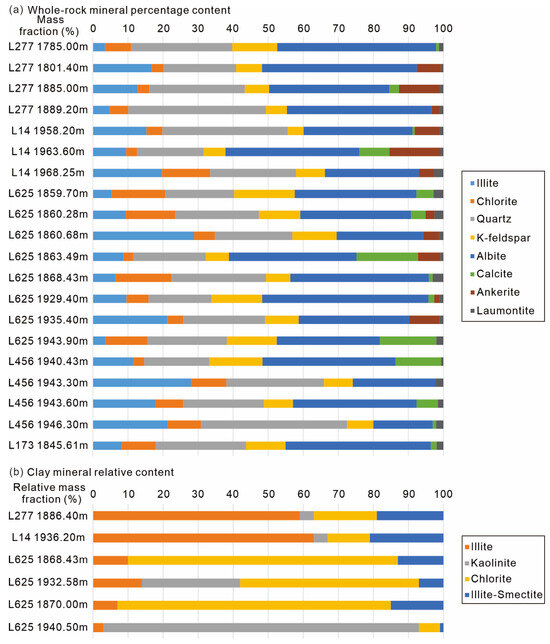
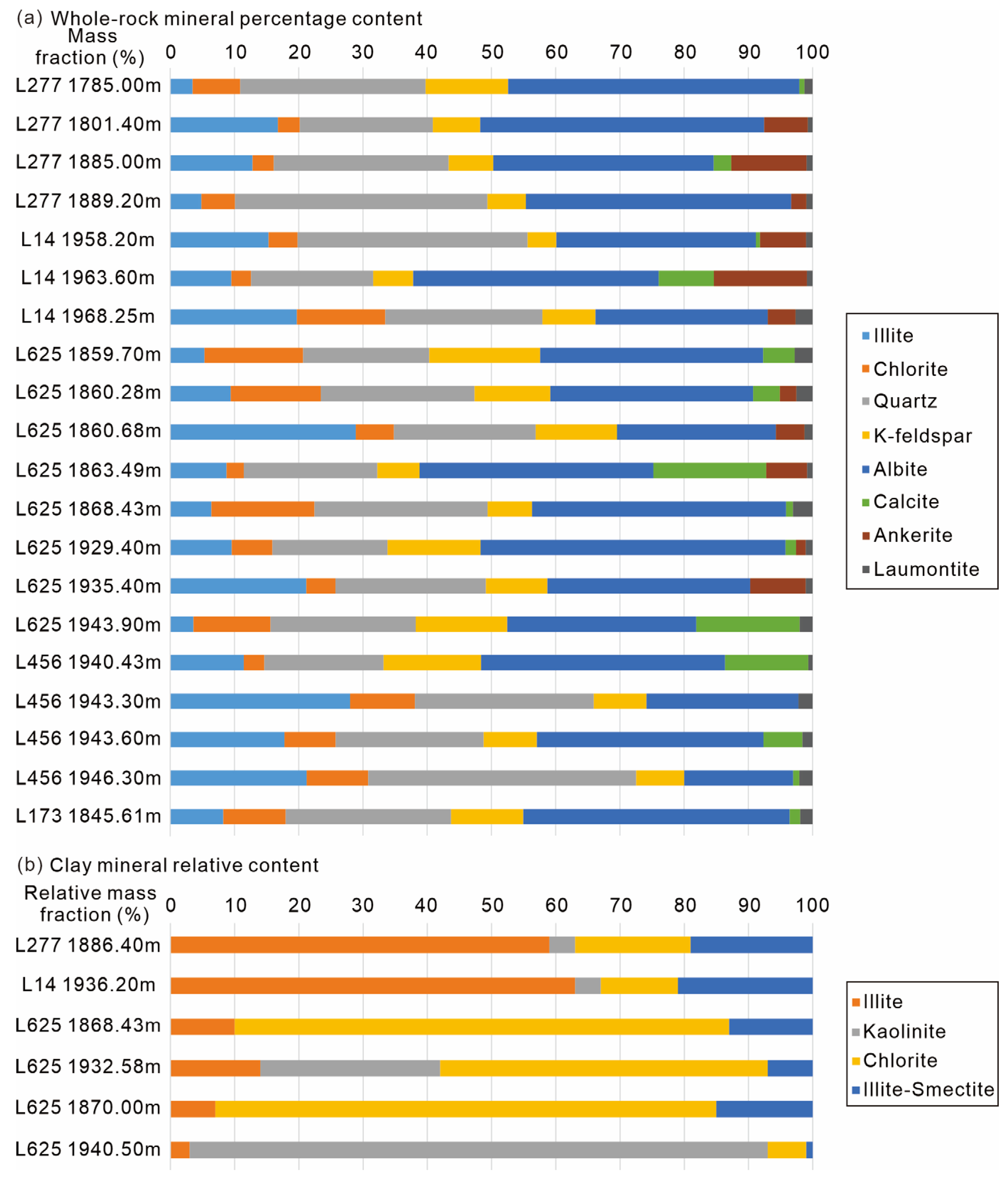
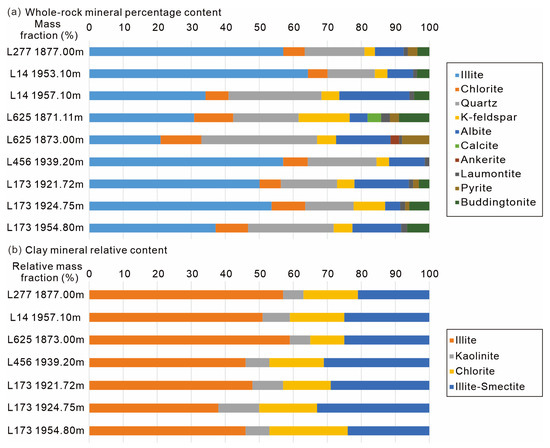
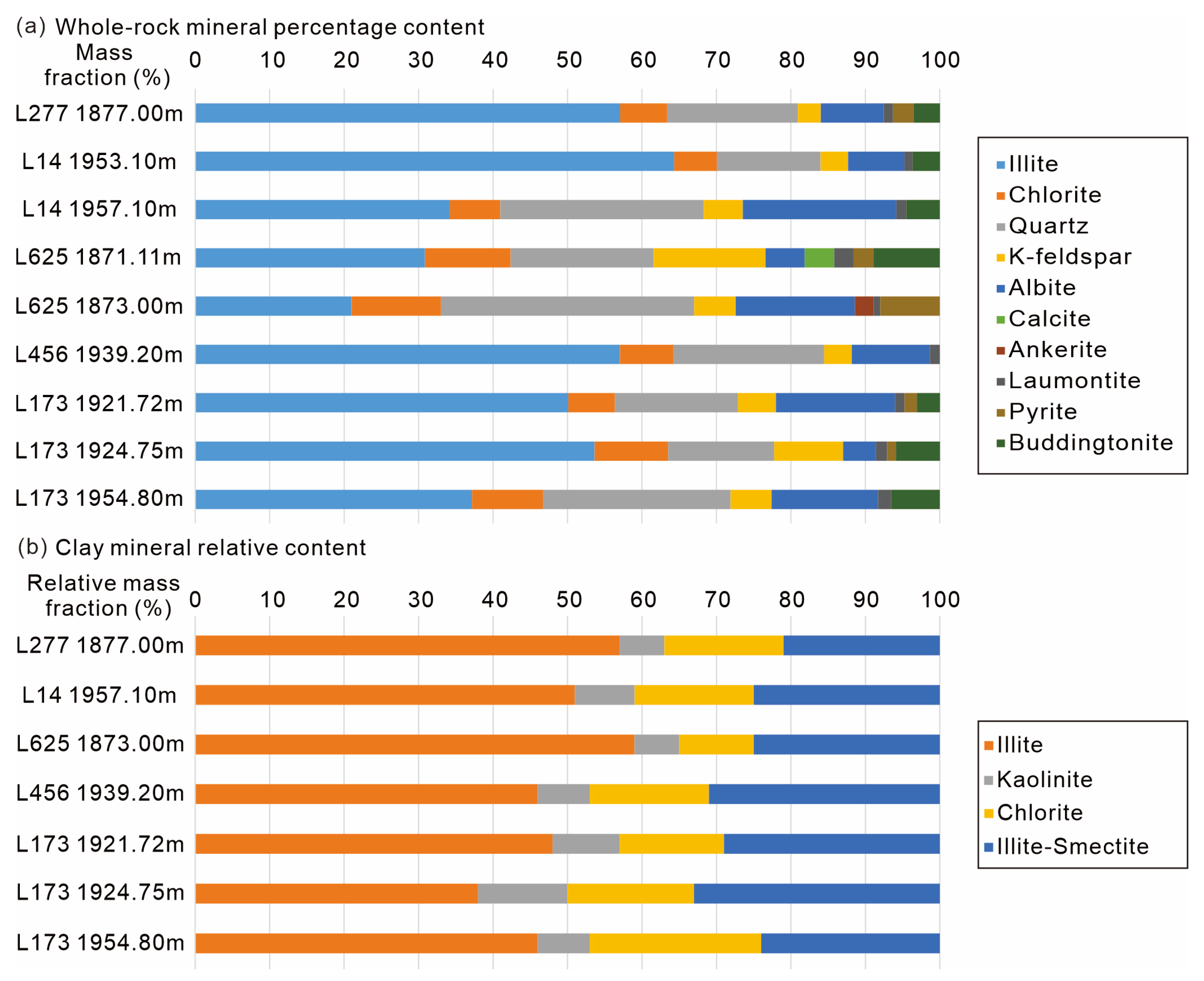
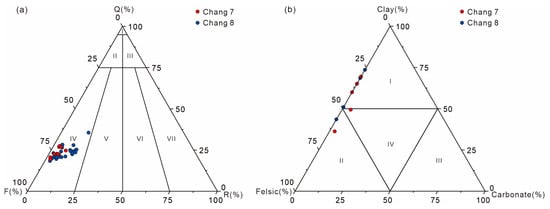
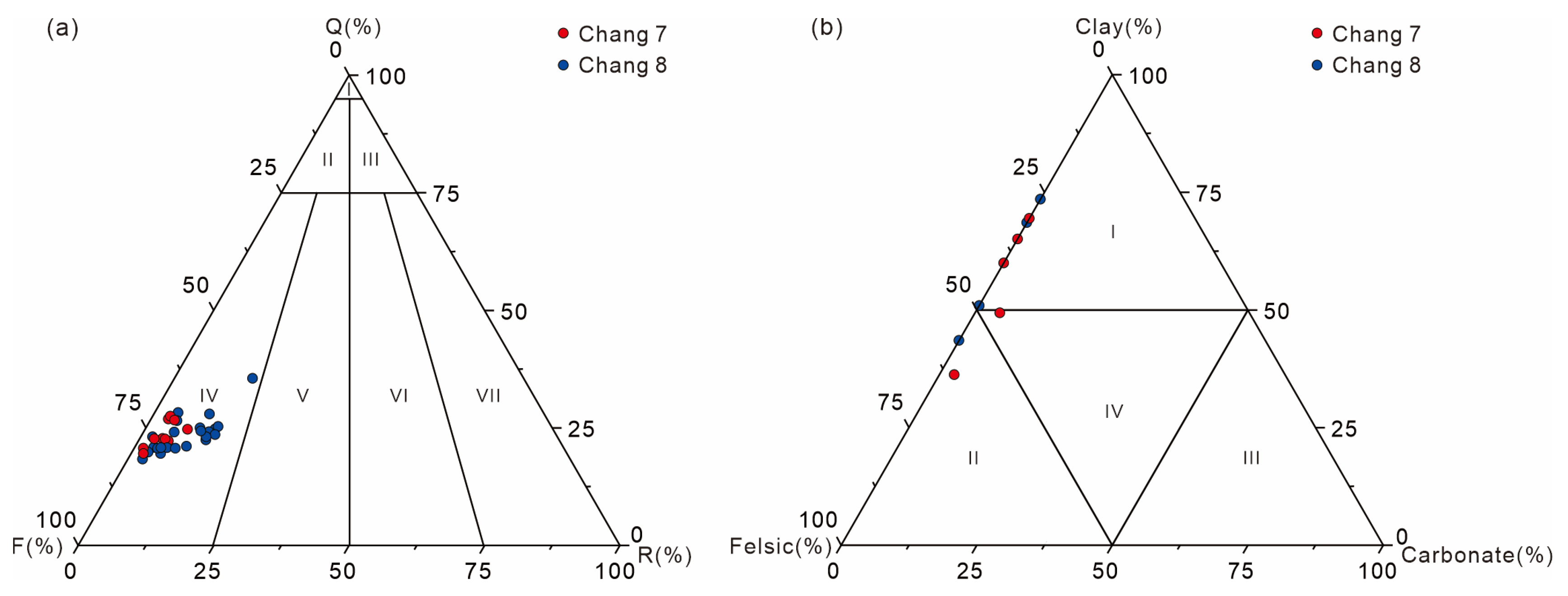
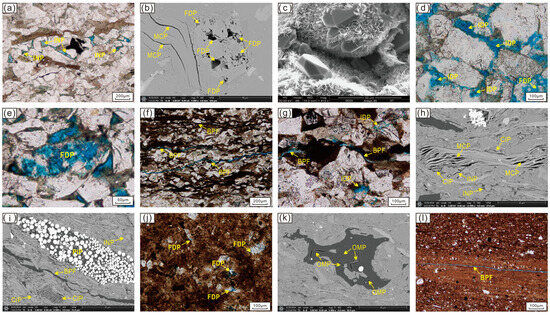
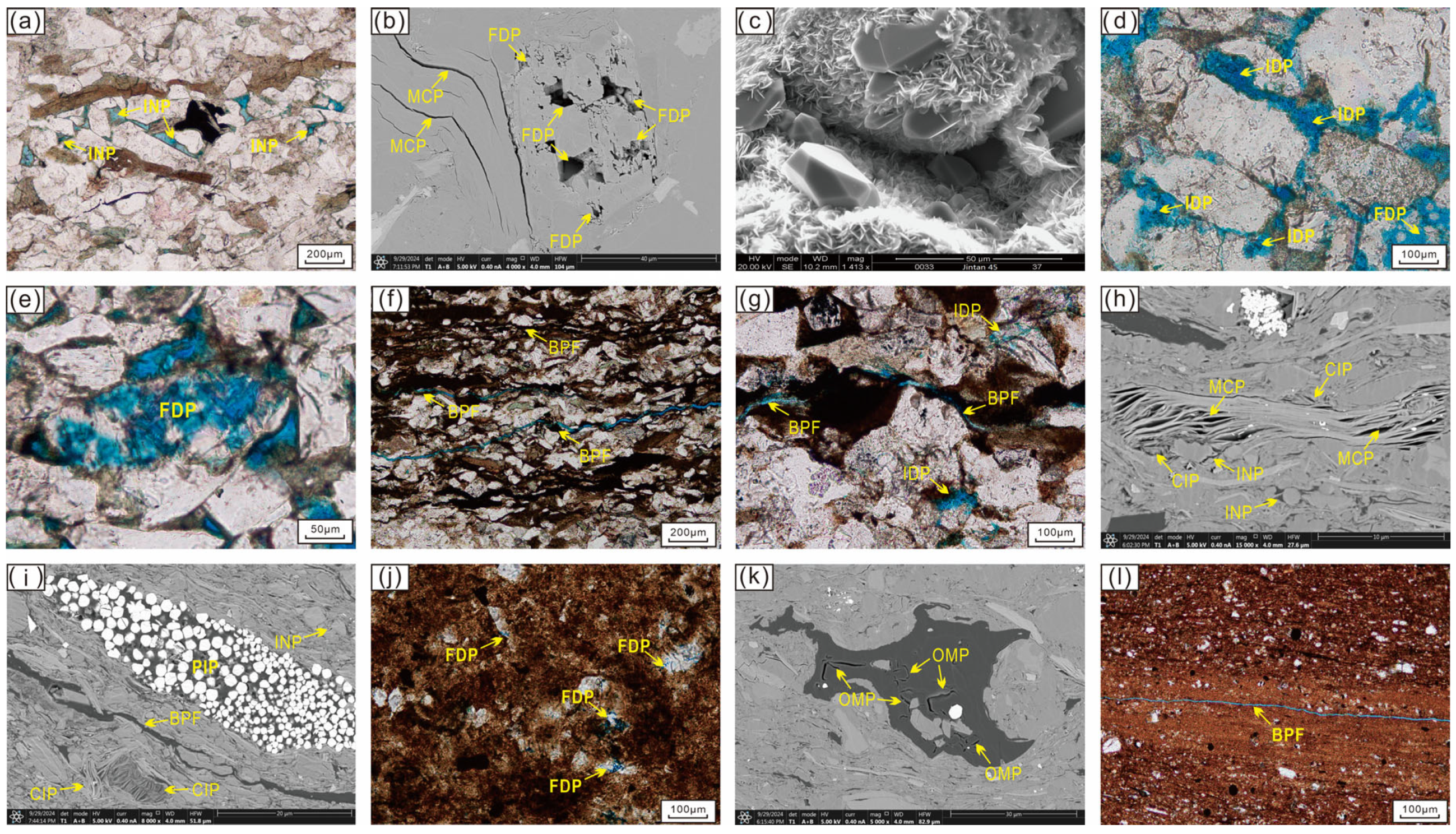
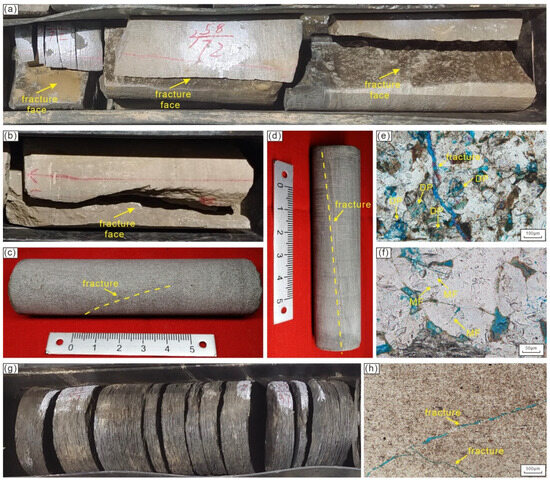
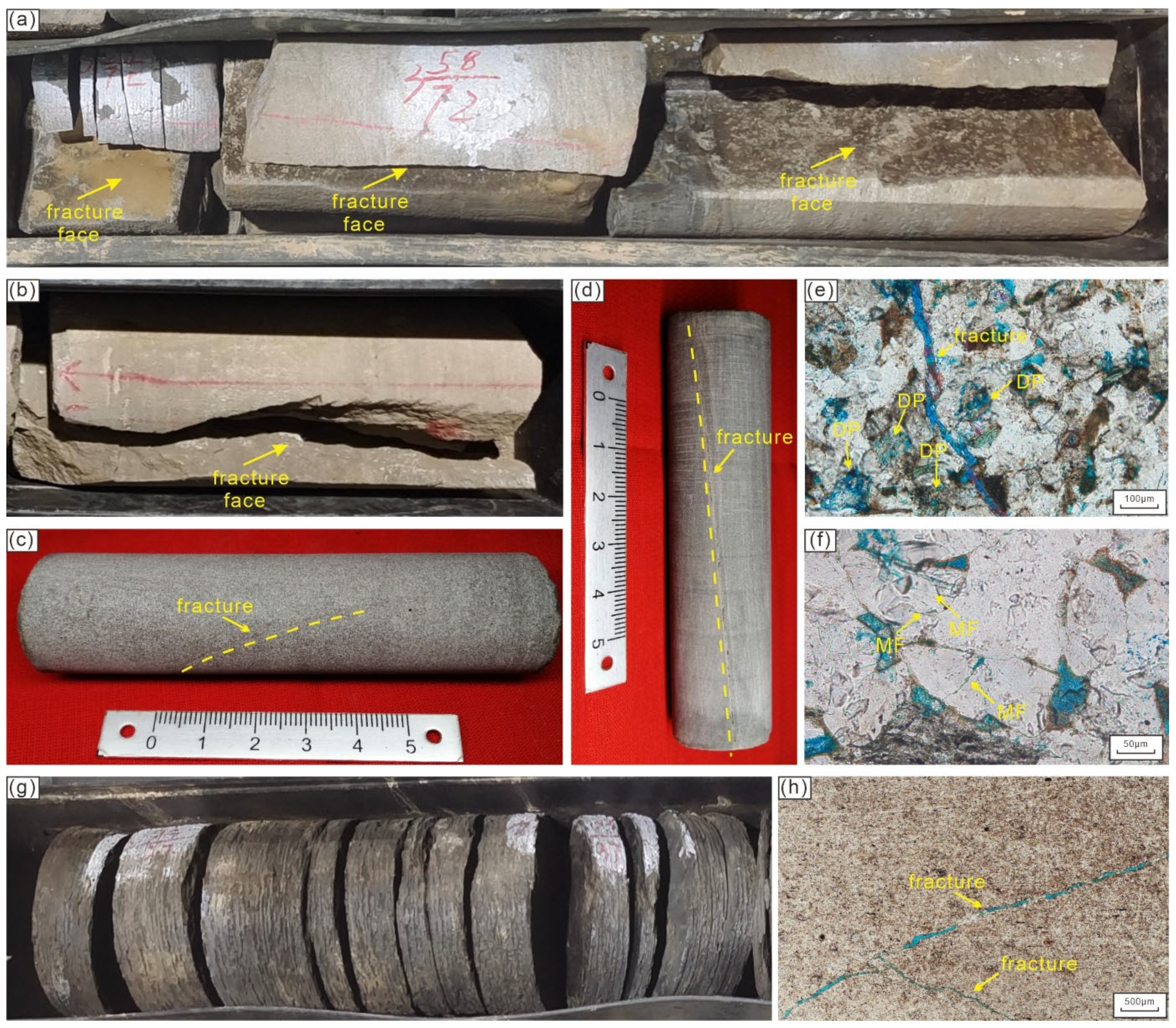
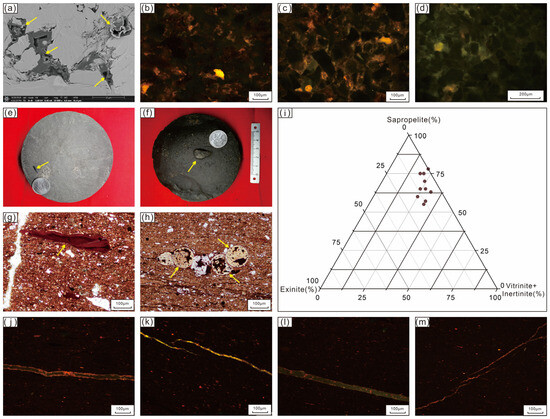
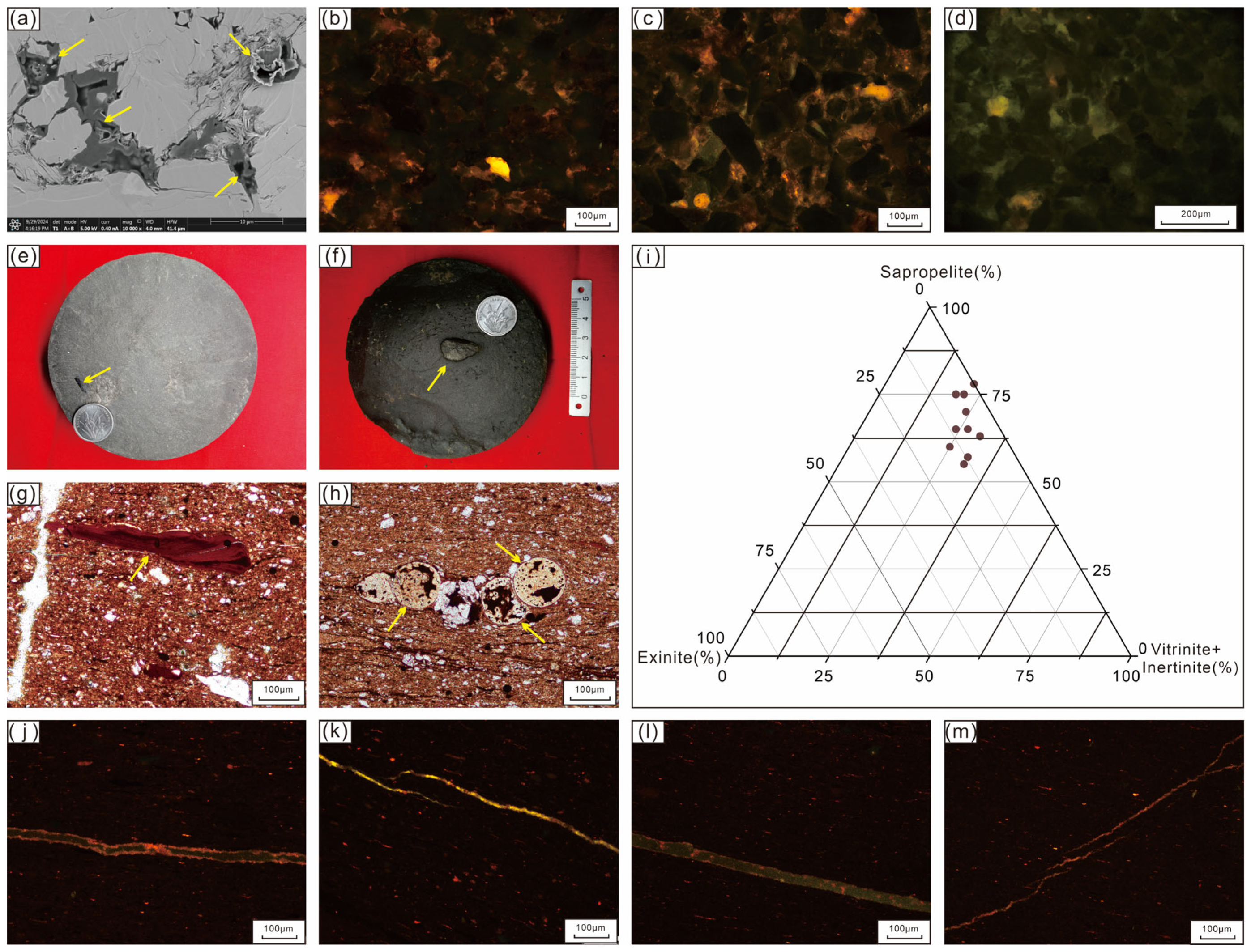
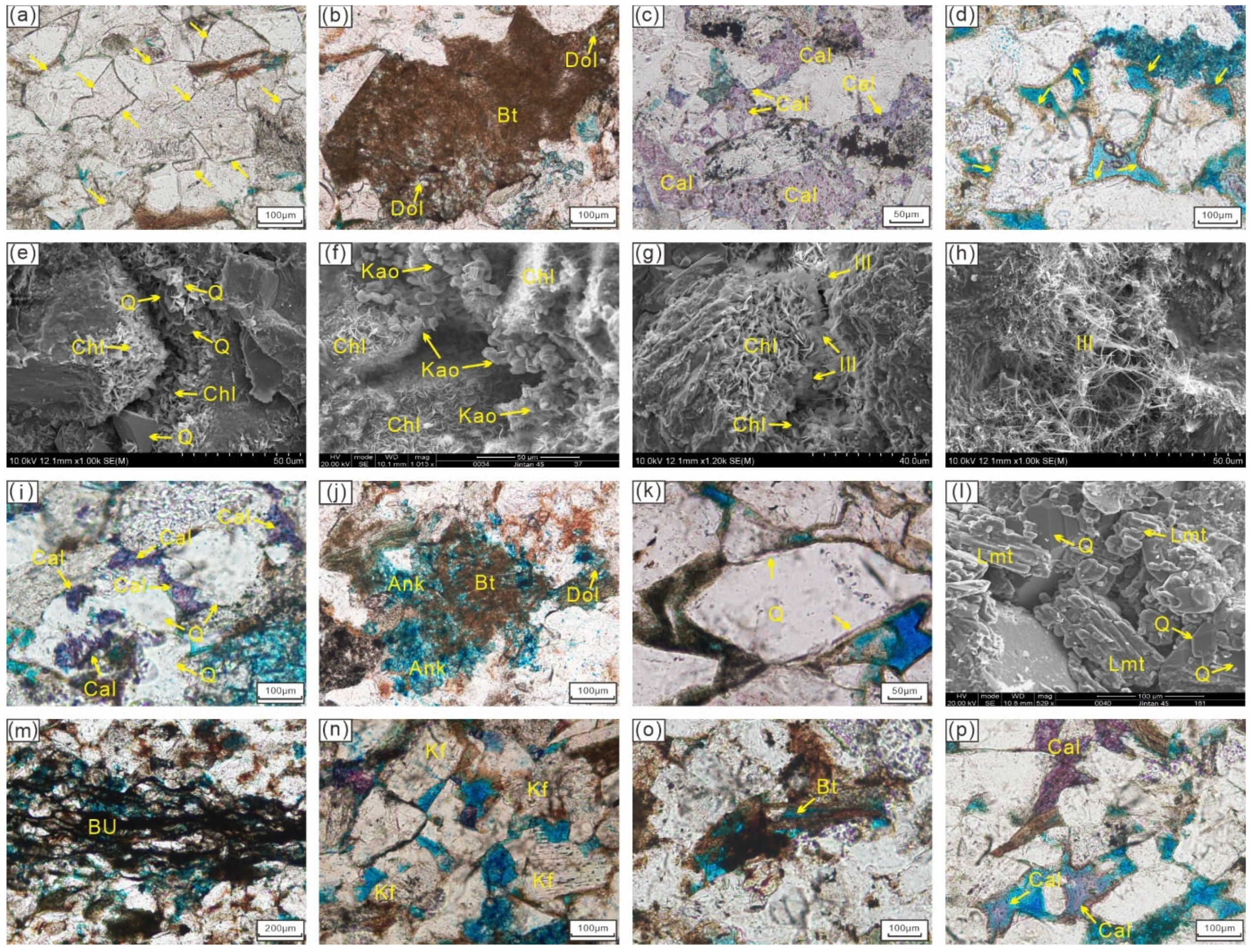
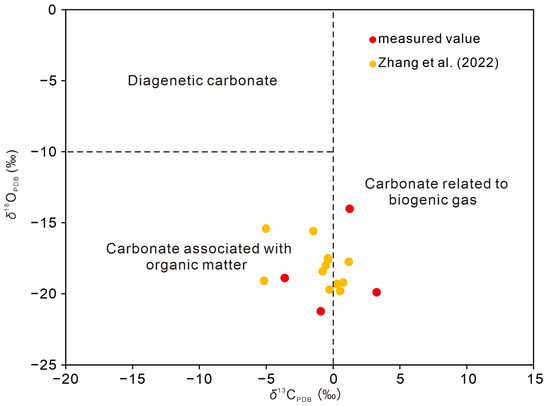
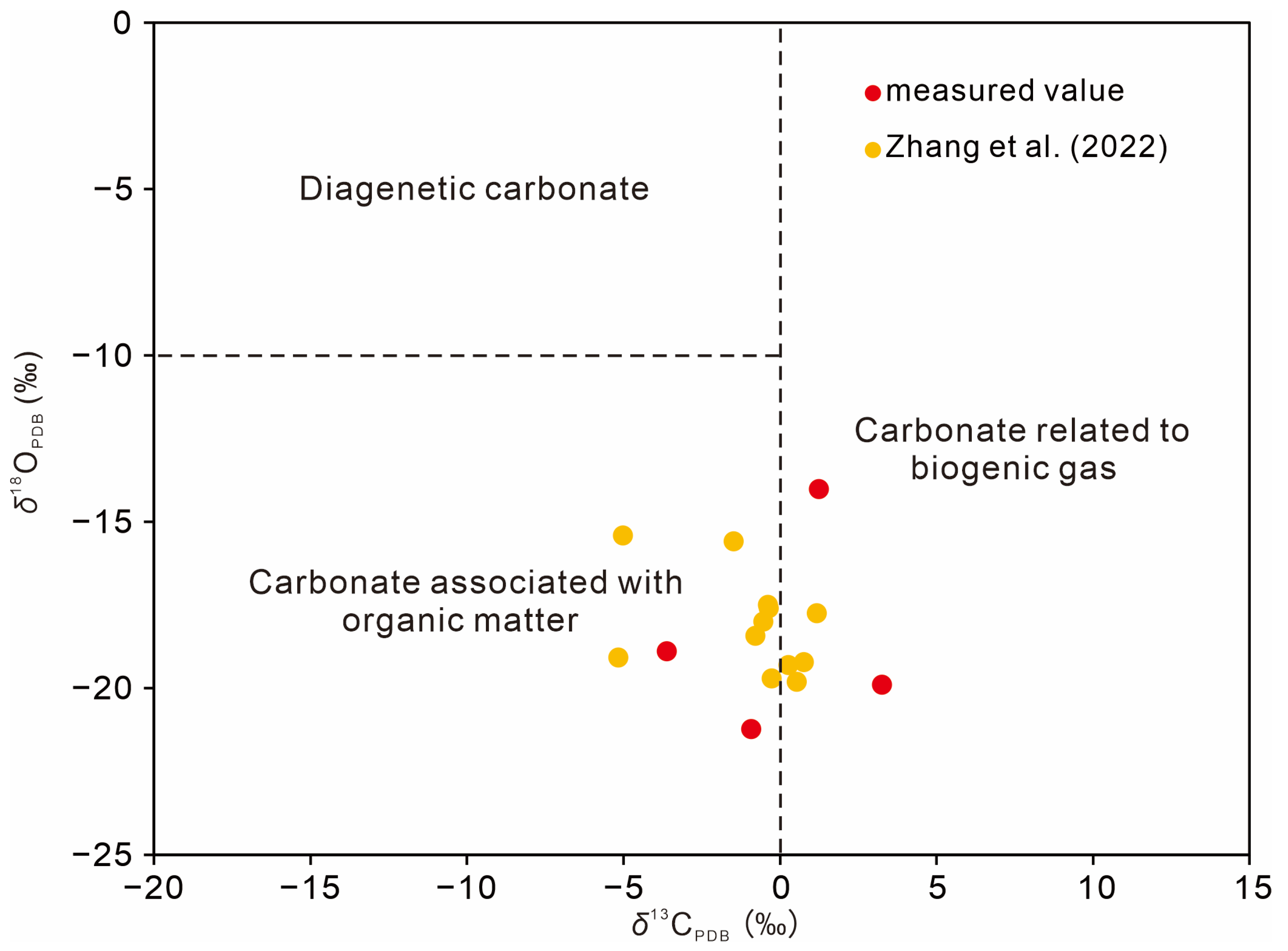
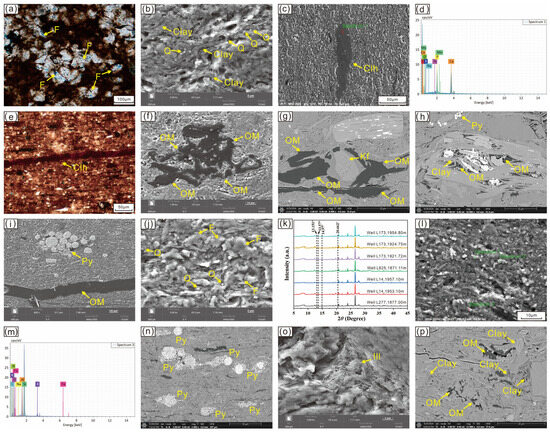
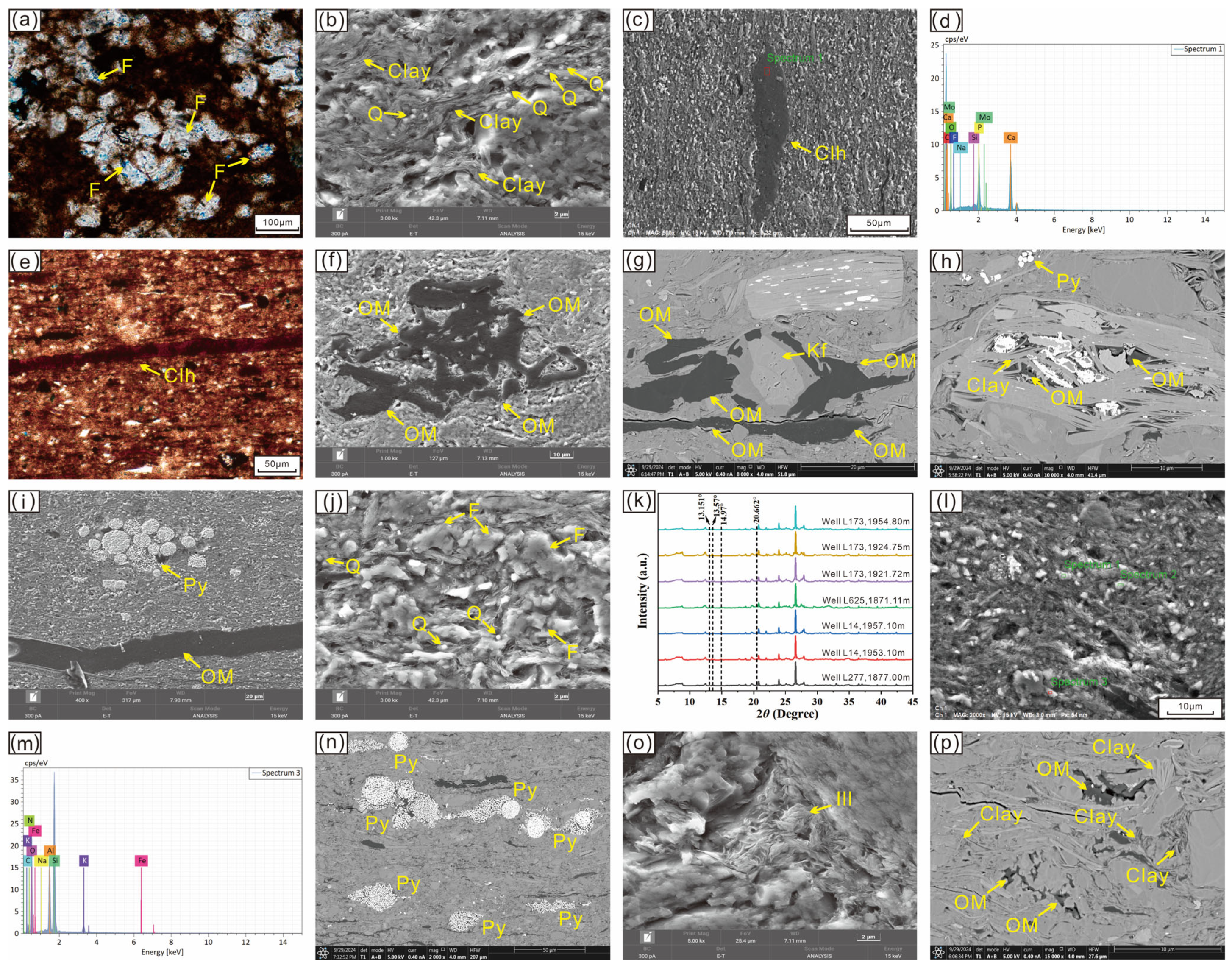
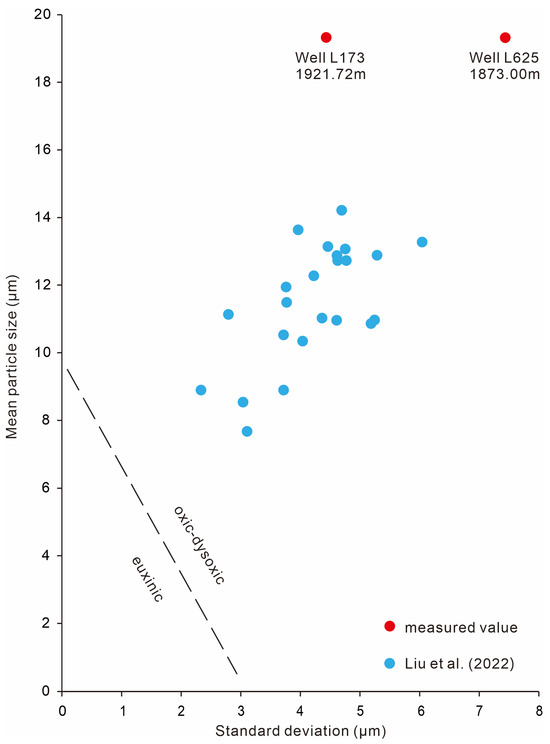
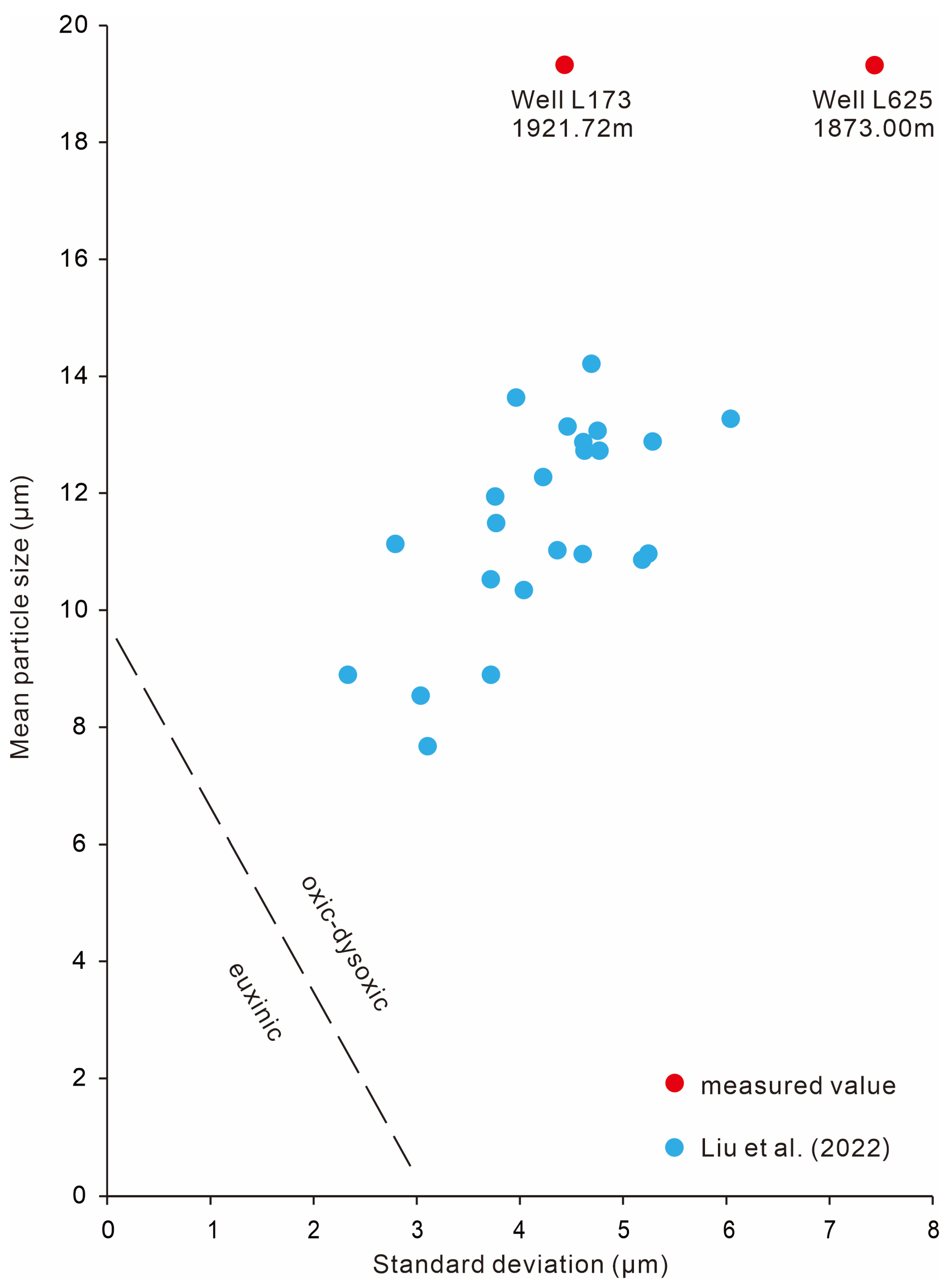
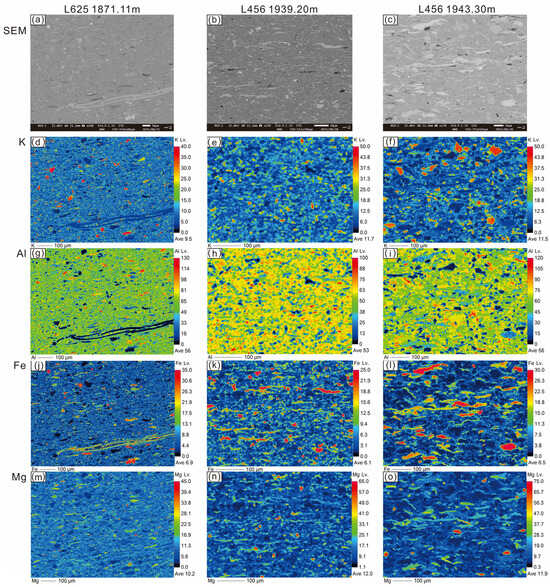
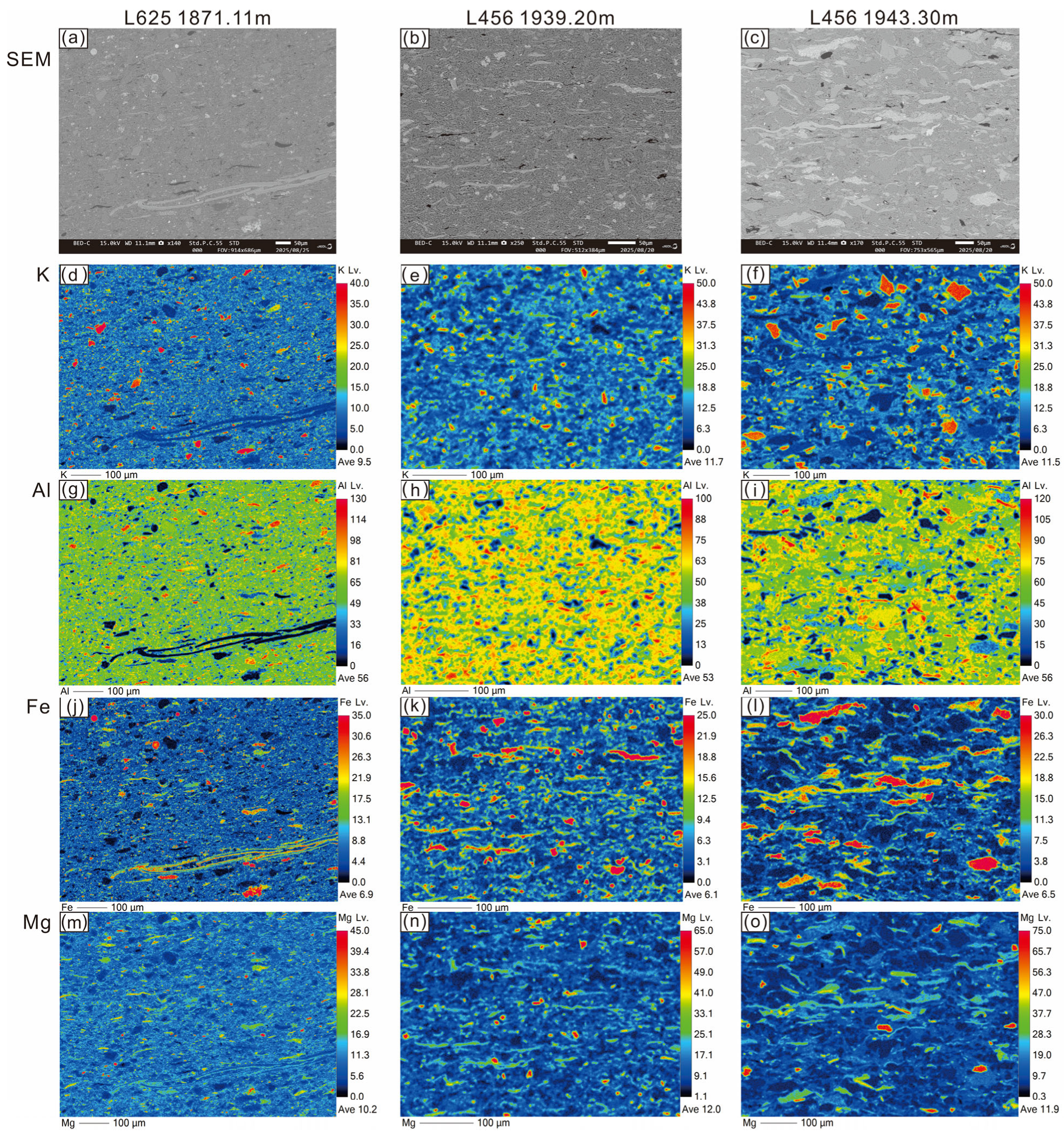
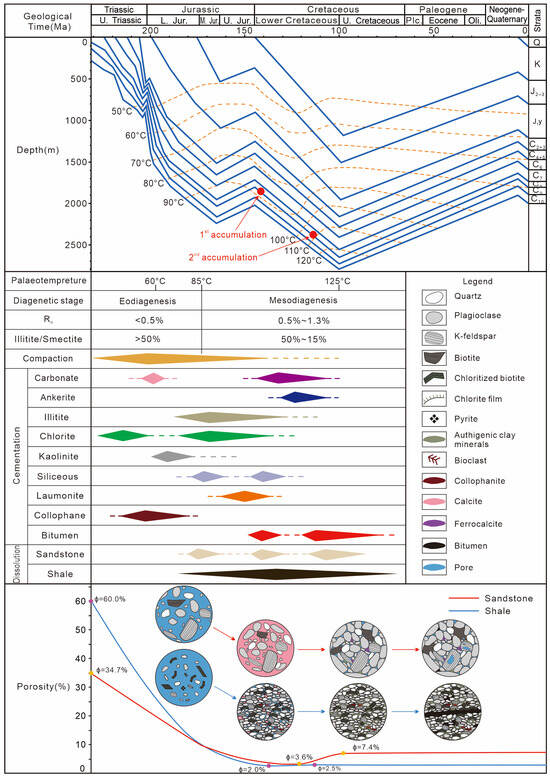
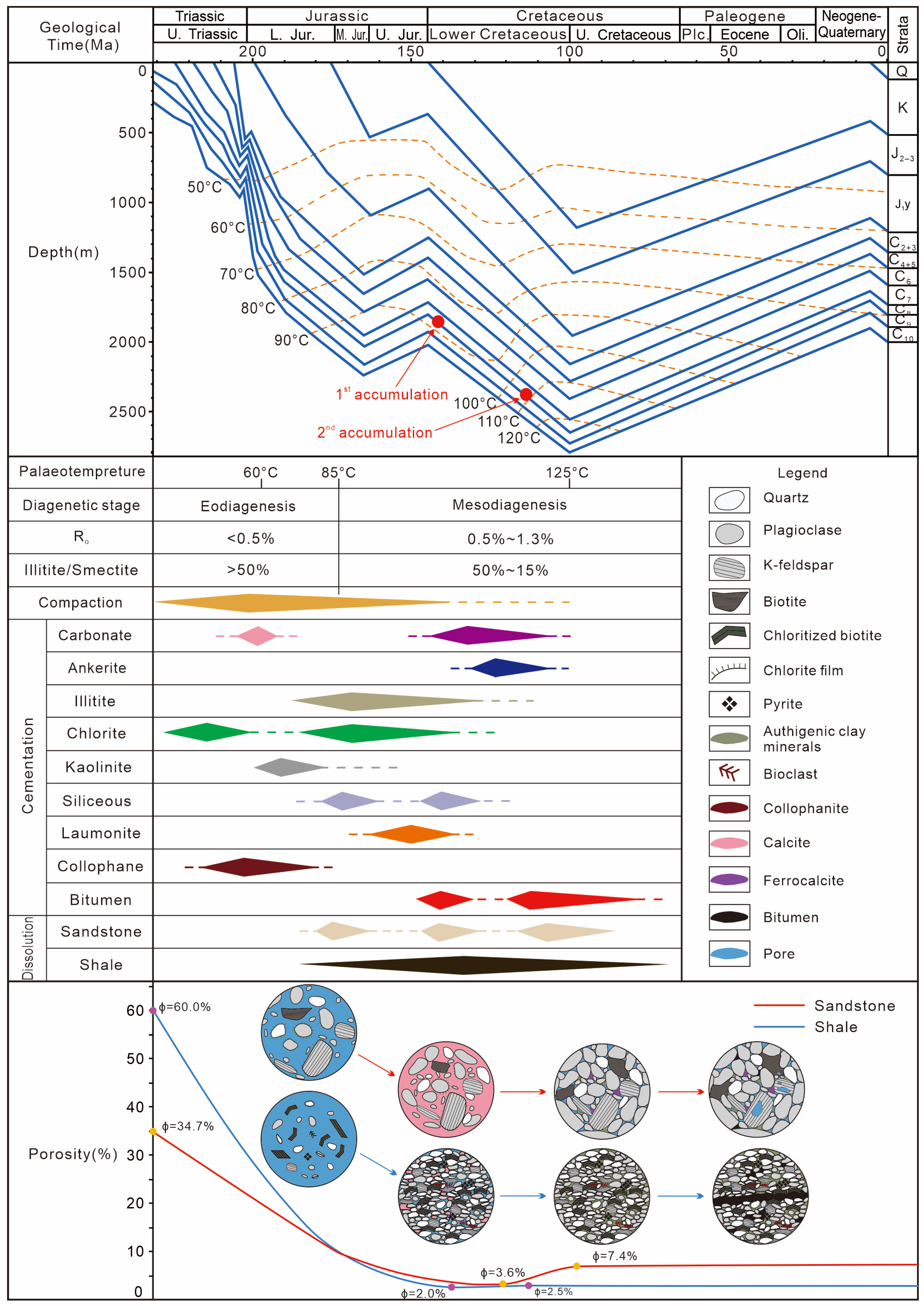
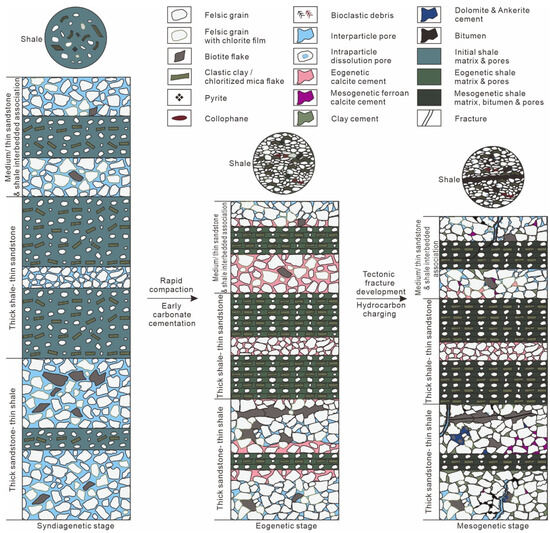
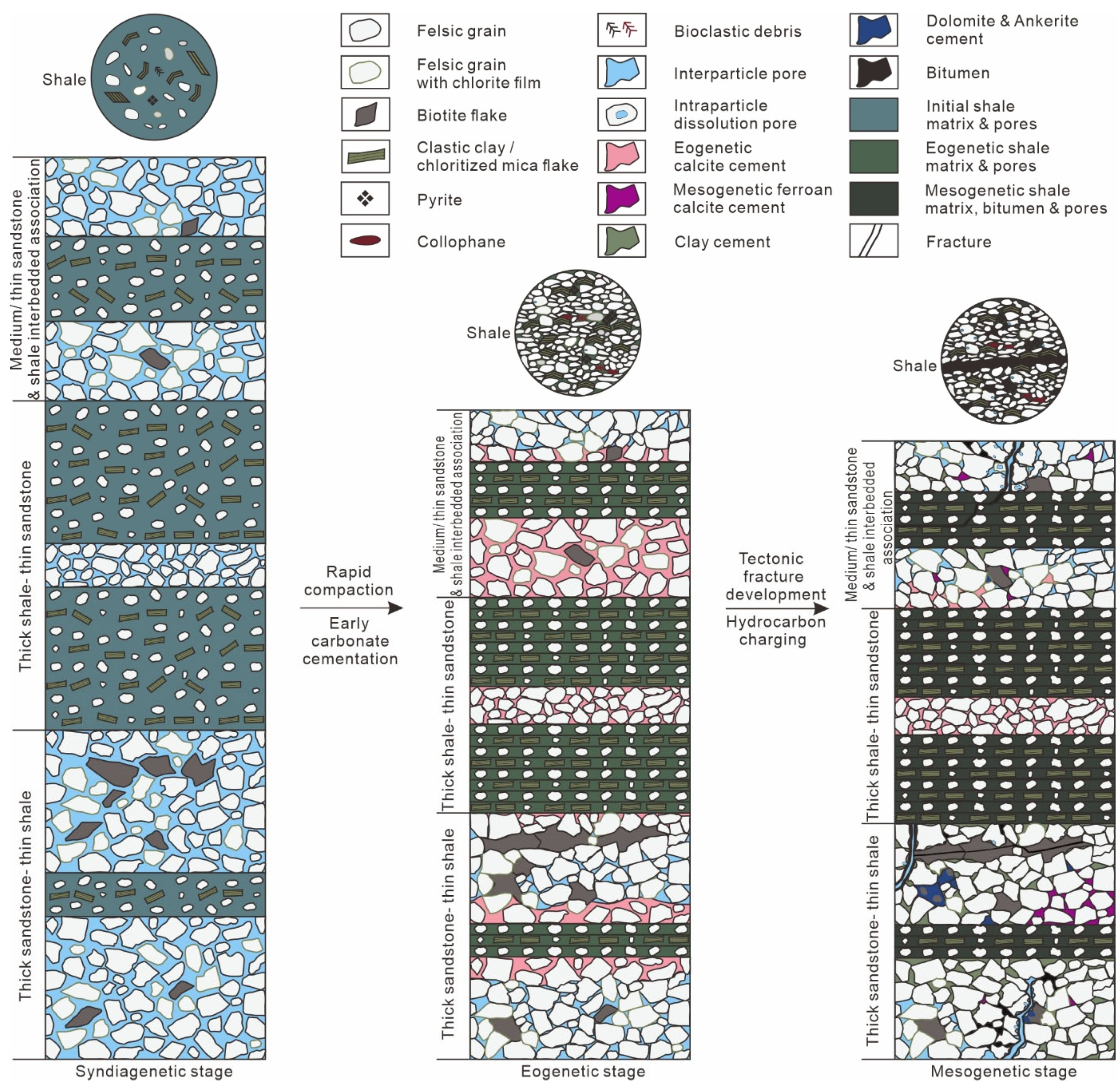
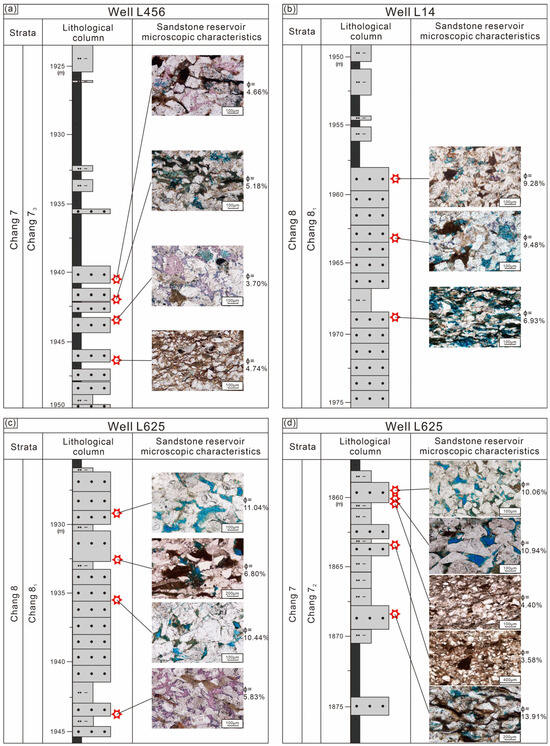
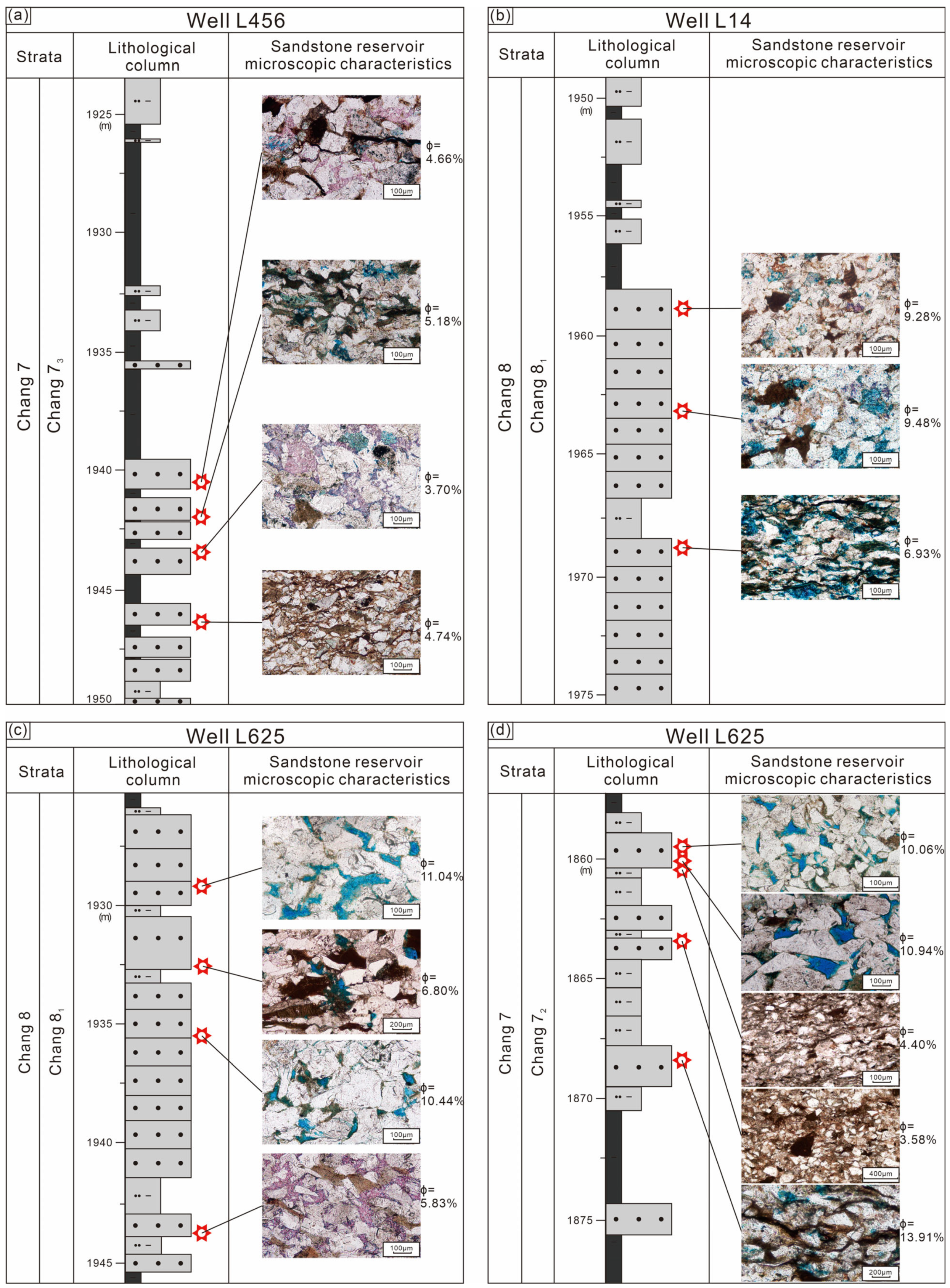

Disclaimer/Publisher’s Note: The statements, opinions and data contained in all publications are solely those of the individual author(s) and contributor(s) and not of MDPI and/or the editor(s). MDPI and/or the editor(s) disclaim responsibility for any injury to people or property resulting from any ideas, methods, instructions or products referred to in the content. |
© 2026 by the authors. Licensee MDPI, Basel, Switzerland. This article is an open access article distributed under the terms and conditions of the Creative Commons Attribution (CC BY) license.