


Abstract
The Felbertal tungsten mineralisation in the Tauern Window (Eastern Alps) is hosted by the Early Paleozoic Habach Complex belonging to the Lower Schieferhülle. In predominantly mafic meta-volcanic rocks, mostly amphibolites, green amphibole crystallised in assemblages with plagioclase, epidote, chlorite, sphene and quartz. Microstructural features and preferential orientation of the amphiboles define planar-linear structures of finite strain and indicate that their crystallisation is coeval to the main deformation event. Amphibole crystals display core-to-rim zonations with increasing IVAl, VIAl, Na and Ti and decreasing Si, covering actinolite over magnesio-hornblende to tschermakite compositions. Amphibole zonations and assemblages are similar to metabasites in the classical Barrovian mineral zones in the Dalradian of Scotland and typical of a prograde metamorphism from the greenschist over epidote-amphibolite to the lower amphibolite facies. Amphibole endmember geothermobarometry defines an early P-T path segment from 400 °C/2 kbar to 540 °C/6 kbar, and a consecutive later P-T path segment from ~500–540 °C/6 kbar to maximal P-T conditions of ~620–640 °C/7–8 kbar. As Carboniferous granitoid intrusions within the Habach Complex underwent penetrative ductile deformation, an Alpine Tertiary age of the lower amphibolite facies metamorphism, as observed in other parts of the Lower Schieferhülle, appears suitable.
Keywords:
amphibolite; metamorphism; geothermobarometry; Tauern Window; Alpine orogeny; Eastern Alps 1. Introduction
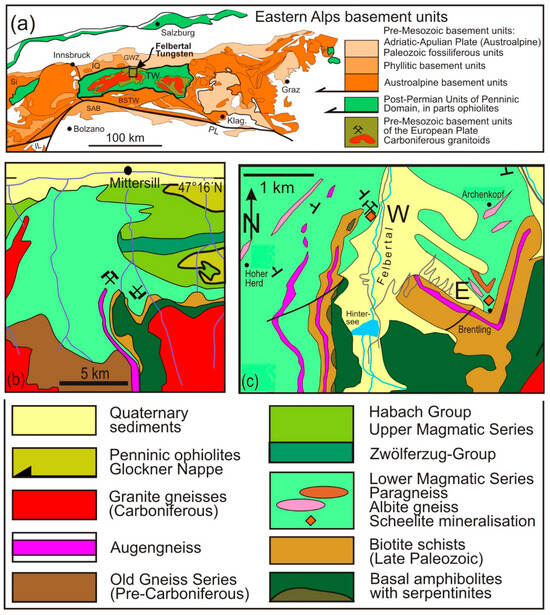
One of the largest active European tungsten mines is Felbertal near Mittersill, Austria, in the Eastern Alps (Figure 1a). The deposit with its four generations of scheelite underwent a complex geological history of orogenic processes with polyphase magmatism, metamorphism, and with mobilisation of magmatic and metamorphic hydrothermal fluids [1,2,3]. Based on structural and geochemical evidence, several multi-stage models for the main tungsten-bearing mineral scheelite have been discussed controversially [4,5,6,7,8,9]. The first scheelite mineralisation was originally postulated to be syn-depositional-exhalative during Early Paleozoic mafic volcanism [10]. This was later revised in sight of ore bodies related to a heavily mineralised, highly fractionated meta-granite of Carboniferous age [7,8,11]. The primary scheelite was further overprinted and redistributed by regional tectonic and metamorphic processes linked to Carboniferous (Variscan, 360–320 Ma) and Tertiary (Alpine, ~30 Ma) orogenies [2,10].
Figure 1.
(a) Basement units in the Eastern Alps and location of the Felbertal tungsten deposit in the Tauern Window (TW). BSTW: Basement South of the Tauern Window; GWZ: Graywacke Zone; IL: Insubric Line; IQ: Innsbruck Quartzphyllite; PL: Periadriatic Lineament; SAB: Southalpine basement. (b) Geological sketch map with locations of the Eastern and Western Ore Zones (E, W) of the Felbertal tungsten deposit, modified after [8]. (c) Detailed lithological map of scheelite mineralisations in the Felbertal with signs of foliation strike and dip. Legend refers to (b,c).
The Felbertal tungsten deposit is hosted by the Early Paleozoic Habach Complex (HC) whose predominantly mafic meta-volcanic rocks, now hornblendites and amphibolites, show the geochemical characteristics of a continental island arc (Figure 1b).
Protoliths of fine-grained amphibolites (meta-basalts) were dated at 547 ± 27 Ma, the coarse-grained variety (meta-gabbros) at 482 ± 5 Ma [12,13]. Conventional U–Pb dating of zircon from the hornblendite (mafic meta-cumulates?) yielded 496 ± 2 Ma [14]. This massive mafic meta-volcanic suite was later intruded by Cambrian and Carboniferous granitoids. Orthogneiss intercalations (calc-alkaline I-type meta-granitoids) gave an age of 529 ± 17 Ma [15]. Carboniferous collision-related I-type granites (Felbertauern augengneiss, 340 ± 4 Ma [16]) and anatexites (Knorrkogel gneiss, 334 ± 8 Ma [17]) form sheet-like intrusions (Figure 1b). Different types of such Carboniferous-to-Permian granitoid orthogneisses (“Central Gneisses”) can be distinguished in the central Tauern Window [8,16,18]. At the Felbertal mine the K1–K3 orthogneiss in the Western Ore Zone (WOZ) recorded Carboniferous magmatic activity. Whole-rock Rb–Sr and U–Pb zircon dating yielded ages of 336 ± 19 Ma and 332 ± 20 Ma [2]. Recent in situ U–Pb analyses on zircon from the two varieties of K1–K3 orthogneiss and the associated aplitic gneiss yielded ages between 341 and 336 Ma [19]. Protoliths are metaluminous to peraluminous magnesian monzogranites [8]. The deformed sheet-like orthogneisses are in contrast to voluminous dome-shaped intrusion of the Granatspitz gneiss, which is a metamorphosed, peraluminous two-mica S-type granite [20] of debated age (271 ± 4 Ma [16], versus 314 ± 1 Ma [21]). Granatspitz gneiss and the Habach Complex were part of the continental European Plate situated to the north of the Mesozoic Penninic Ocean [22]. During the Alpine Orogeny the units were thrusted as parauthochthonous and allochthonous nappes in large recumbent folds (Lower Schieferhülle) beneath the ophiolite remnants of the Penninic oceanic crust (Upper Schieferhülle/Glockner Nappe), both now exposed as the lower units in the tectonic Tauern Window (Figure 1a). They were overthrusted by the southern continental Adriatic-Apulian Plate (Austroalpine Nappe Unit), forming the upper plate in this collisional scenario [23]. The Alpine deformation of the units related to the European Plate is characterised by a first phase with a penetrative foliation accompanied by isoclinal folding on the cm-to-km scale and a second phase with refolding of the earlier structures leading to synformal anticlines wrapped around the Central Gneisses and plunging to the north [16,24].
During the Alpine orogeny the lower units exposed in the Tauern Window were affected by Barrovian-type regional metamorphism (500–590 °C, 4.5–7.0 kbar [12,25,26,27]). Metamorphic temperatures of 600 °C were recorded from Hintersee, ~1 km to the S of the mineralisation [28]. Recent U–Pb apatite ages confirm the Late Alpine (Oligocene) exhumation of the central Tauern Window (~31–29 Ma [29,30]).
The pre-Alpine metamorphic history is less clear. The extent and timing of pre-Alpine metamorphic events in the Habach Complex and related basement units in the Tauern Window are still debated. First evidence of polyphase metamorphism in the Habach Complex and P-T conditions of 420 °C/2 kbar was reported [31,32]. A Sm-Nd isochron age of 336 ± 32 for rocks from the Zwölferzug provided geochronological evidence for Variscan metamorphism in the Tauern Window [14]. A 319 ± 34 Ma Sm–Nd age of metamorphic recrystallized scheelite [10], and Re–Os molybdenite ages at 358 to 336 Ma [7] may indicate a Variscan regional metamorphic event. Also, Permian (265 Ma) and Triassic (~215 Ma) low-temperature thermal events that predate the medium-grade Tertiary Alpine regional metamorphism were stated [33].
It has been demonstrated from numerous metamorphic terrains that metabasite mineral assemblages with growth-zoned Ca-, Ca-Na- and Na-amphiboles have a high potential for pressure–temperature path reconstruction and give considerable insight to the tectonothermal evolution [34,35,36,37]. Related studies in this part of the Tauern Window and concerning the scheelite mineralisation have not yet been performed but are known from the Western Tauern Window [38]. A mineral chemical and thermobarometric study on the exclusively Ca-amphibole bearing mineral assemblages in the metabasite host rocks of the Felbertal tungsten mineralisation then should provide further constraints on the P-T conditions prevailing during the polyphase scheelite formation and distribution.
2. Materials and Methods
2.1. Sample Selection and Description
The Felbertal tungsten deposit is subdivided into an Eastern and a Western Ore Zone, separated by the Felber valley (Figure 1c) abbreviated as E, EOZ and W, WOZ, respectively. The WOZ is currently mined as an underground operation, and the EOZ is an abandoned open pit. Scheelite ore bodies in the WOZ are distinguished as K1 to K8 and SD-gneiss, according to macroscopic and lithological differences (e.g., host-rock, ore grade, and style of mineralization [9]). Structurally the WOZ itself is divided into an upper wedge and a lower wedge, separated by the Basal schist. While the lower wedge consists of the ore bodies K1–K3, K2, K2s, also referred to as K2′, K4 and the SD-gneiss (“scheelite-dotted”), the lower wedge consists of the ore bodies K5, K6, K7 and K8. The mineralised sequence is underlain by rocks belonging to the Basal amphibolite [11]. Samples with cm- to mm-thick layers of which modal mineralogy is dominated by amphiboles were selected for this study. Furthermore, the selected samples bear plagioclase and sometimes garnet. Further minerals typical of metabasites as epidote, chlorite, biotite, sphene and quartz are also present in the samples. The goal was to select samples suitable for the application of different metabasite geothermobarometers from the scheelite-bearing lithologies and also from the non-mineralised metabasites next to the mined ore bodies.
From each of the WOZ and EOZ one sample situated outside the highly scheelite-mineralised zones were selected. For the WOZ this sample WBAS is from the Basal schist (Basisschiefer). The analysed layer contains a few amphibole crystals which are elongated parallel to the foliation; however, the overall modal mineralogy of the Basal schist is not resembling a metabasalt but merely a metapelite with some amphibole-rich layers. For the EOZ the corresponding sample is EBAS from an amphibolite (Basal amphibolite) exposed at the Hintersee, which is situated structurally below the scheelite mineralisation (Figure 1c). Further samples from the actually mined parts of the WOZ are W1110K4, a hornblendite, the amphibolites W680K7 and W776K8, all bearing garnet, and the hornblende schist W1360. The numbers of the sample labels refer to the different mine levels and the related ore bodies. The samples from the abandoned open pit EOZ are the fine-grained amphibolites E107B and E74 with garnet, and the amphibolites E66 and E124B with no garnet. According to the structural restoration [15] and its re-evaluation [9], the EOZ and the WOZ ore bodies K5 to K8 represent a lower structural level, and the WOZ ore bodies K1–K4 an upper structural level, within the metamorphic sequence of the Habach Complex.
2.2. Electron Probe Microanalysis
The targeted approach of the electron probe microanalyser (EPMA) for the study of the mineral chemistry of amphibole, garnet, plagioclase, epidote, biotite, muscovite and further related minerals in the metabasites requires a detailed observation of the mineralogical–microstrucutral relationships in rock thin sections. The polished thin sections underwent an investigation by a scanning electron microscope enhanced with software for automated mineralogical methods (SEM-AM). A scanning electron microscope SEM Quanta 600-FEG-MLA by FEI Company (Hillsboro, OR, USA), equipped with Bruker (Karlsruhe, Germany) Dual X-Flash energy dispersive spectrometers for EDS analyses and the software package for automated mineralogy MLA versions 2.9 and 3.1 (JKTech, Brisbane, Australia) adopted by FEI Company, was used [39]. Electron beam conditions were set at 25 kV acceleration voltage and a 10 nA beam current. The GXMAP measurement routine for generation of energy dispersive spectral maps of this SEM-AM system was applied. For the classification of garnet, amphibole and plagioclase compositions in the SEM-AM measurements, a list of identified reference EDS spectra was established by collecting spectra from defined parts of several garnet, amphibole and plagioclase porphyroblasts (core–mid–rim). In a next step, the amphibole, garnet and plagioclase reference spectra were generically labelled with the corresponding garnet Fe, Mg, Mn, Ca, plagioclase with Na, Ca and amphiboles with Al, Si compositions normalised with oxygen to 100 wt% [39]. The colour scaling of the generically labelled EDS spectra permits the resolution and visualisation of compositional differences and zonation trends in the mineral grains.
A selection of microstructural sites for detailed electron probe microanalysis is based on these EDS spectral maps. Garnet zonations were analysed in detailed traverses composed of numerous single analyses. Similarly, amphibole was studied along traverses along their long axes and passing the cores of the crystals. Compositions of associated plagioclase, epidote and mica are documented by short traverses and several single point analyses by EPMA instrument JEOL-JXA-8530F (Jeol Ltd., Akishima, Tokio, Japan) at 20 kV acceleration voltage, 25 nA beam current, 2 μm beam diameter for Si, Al, Ti, Fe, Mn, Mg, Ca, Na and K. Silicate reference minerals provided by ASTIMEX were used for instrument calibration. The ZAF corrections and subsequently the peak overlap and instrument drift corrections were applied. Calculations of mineral formula and endmembers for minerals are based on normalisation to oxygen, e.g., for garnet (12 oxygen), plagioclase (8 oxygen), mica (22 oxygen) and epidote (12.5 oxygen). The cation formula for amphibole is normalised to 23 oxygens and sum (T1 + T2 + M1 + M2 + M3) = sumMg = 13 (13eCNK), as detailed in [36]. Fe3+ has been estimated as maximum according to [40]. The mineral-chemical data are presented as Supplementary Materials Table S1: Mineral Chemistry.
2.3. Geothermobarometry
The distribution of Si, Al, Ti and Na in amphibole structural sites depends on the physical conditions of crystallisation. The Si4+ decreases and Ti, IVAl and NaA increase with temperature; the VIAl and NaM4 increase with pressure [41,42,43,44]. Thus, systematic intramineral zonations in Ca-amphiboles which crystallised with plagioclase, quartz, epidote, chlorite and sphene should allow a reconstruction of the P-T evolution. Due to the overall occurrence of oligoclase in the Felbertal metabasites, amphibole endmember equilibria requiring albite (An < 10%) in the assemblages and chosen by [35,36,45] cannot be applied here. It has been demonstrated [46] that Si in amphibole does not always correlate with compositions of coexisting plagioclase, which hampers amphibole-plagioclase thermometry [47]. Instead, empirical dependency of Al on pressure and Si on temperature in Ca-amphibole from any assemblage including plagioclase and quartz has been recognised and tested with the experimental data of [48] for the assemblage Ca-amphibole + plagioclase (An >10) + quartz + zoisite + chlorite + calcite. Least-squares approximation of amphibole compositional dependency on temperature and pressure for 48 experimental data points led to the analytical expressions reported in [46]. However, natural Ca-amphiboles have Fe3+ which is involved in pressure- and temperature-dependent substitutions 2IVAl + VI(Al, Fe3+) + NaA = 2Si + (Fe2+, Mg) + vacancy between (ferro)pargasite/hastingsite and tremolite. Therefore, the expressions in [46] have been empirically modified for Fe3+ in amphibole by using the compositional data reported in [34,35]. This gives equivalent temperatures and slightly higher pressures. The modified expressions are reported in [37]. Apart from the general error in P and T (±50 °C/±1 kbar), additional uncertainty in the results arises from estimates of Fe3+ and from microprobe analyses. Pressure estimates from actinolite are possibly afflicted by larger uncertainty, as their compositions are at the limits of the calibration but are still restricted to the range of low pressures and medium temperatures at 350 °C. Comparison of the results from the geothermobarometer by [37] with tentative application of the thermometers of [49,50] yielded mostly similar results within the limits of error.
The garnet-hornblende geothermometers by [51,52,53,54] can also be applied to some of the selected samples. A spreadsheet for all these calibrations as provided by the comparative study by [55] has been used. As criteria of equilibrium are mostly realised in amphibole rims, their high IVAl compositions and highest Mg rim compositions of zoned garnets have been considered. This will provide the estimates of maximal metamorphic temperatures. Correspondingly, IVAl-poor amphibole cores and garnet cores low in Mg should cover minimum temperatures of equilibrium. In a similar way, the garnet-amphibole-plagioclase barometer by [56,57] can be applied to zoned amphiboles and garnet and matrix plagioclase analyses. Published formulations of the garnet-hornblende-plagioclase-quartz (Grt-Amp-Pl-Qtz) barometer [56,57] have been transposed into a spreadsheet by [58]. When actual P and T are slightly shifted throughout the different thermobarometric estimates, relative P-T variations will remain preserved [59].
3. Results
3.1. Mineral Chemistry
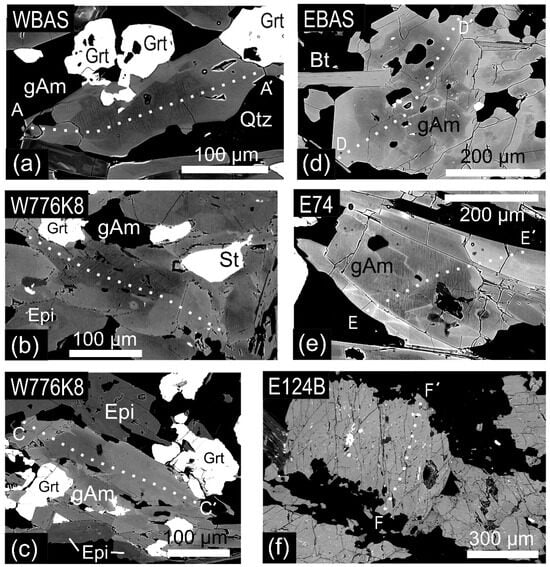
The sample inspection by optical microscopy and the SEM backscattered electrons imaging (BSE) revealed zoned green amphiboles, obvious by darker BSE grey tones in the cores and brighter grey tones in the rims (Figure 2).
Figure 2.
(a–f) Backscattered electron images of zoned (a–e) and unzoned (f) green amphiboles (gAm) in metabasites next to scheelite (St) mineralised zones (a,b), and with scheelite mineralisation (b–f). Profile lines of analyses by electron probe partly shown in Figure 3 are marked. Bt biotite, Grt garnet, Epi epidote, Pl + Qtz plagioclase and quartz are the accompanying minerals.
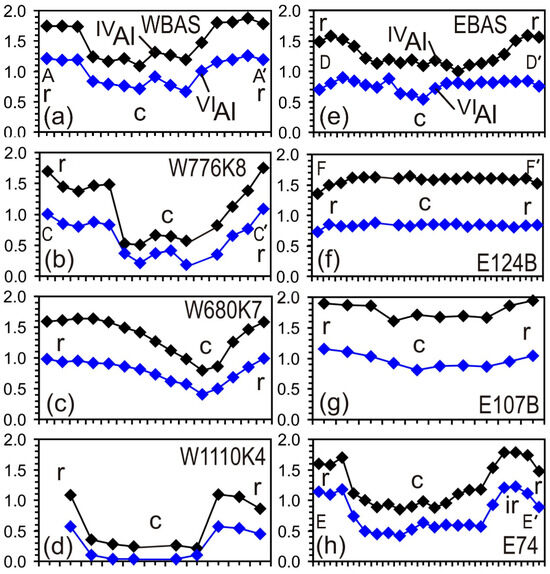
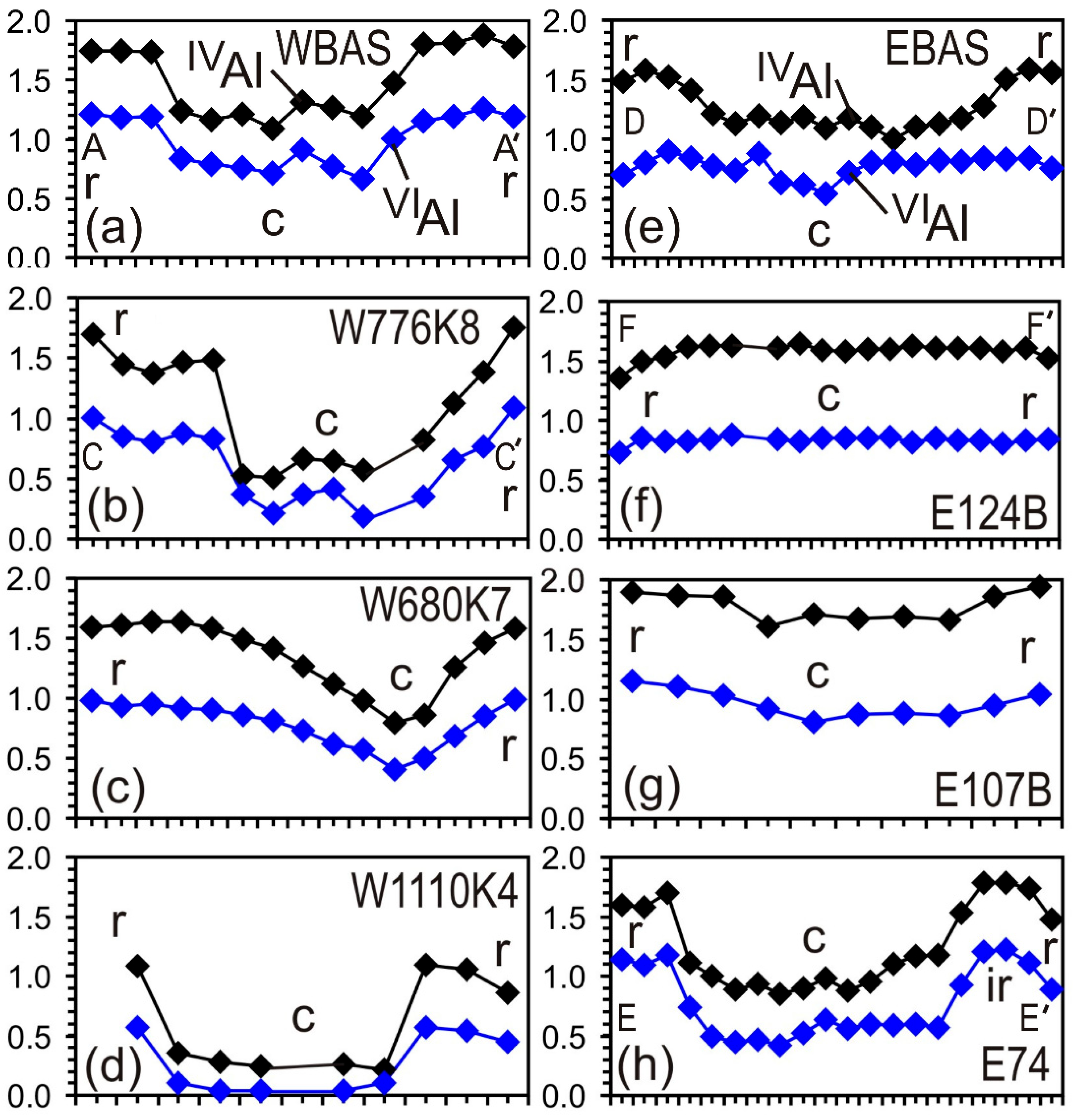
In many cases the amphiboles display elongated shapes at sizes of 250–400 µm (Figure 2a–c). Also, short prismatic grains (Figure 2d,e) as well as unzoned grains occur (Figure 2f). In several cases, the garnet, plagioclase, epidote, biotite and quartz grains are situated next to the amphibole grains. Green amphiboles in sample WBAS display marked rim-core-rim zonations with increasing IVAl from cores to rims (1.09 to 1.81 p.f.u. per formula unit), accompanied by increase in VIAl (0.71 to 1.26 p.f.u.). Toward the outer margins of the rims a slight decrease in IVAl and VIAl is observed (Figure 3a). This zonation is controversially matched by Si which decreases from 6.90 to 6.11 p.f.u. from cores to rims. The Ti increases from cores to rims (0.025 to 0.043 p.f.u.), as well as Fe, Ca and (Na+K)A, while Mg decreases. The other zoned amphiboles in samples W776K8, W680K7 and W1110K4 from the WOZ display similar core-to-rim zonation trends in IVAl and VIAl (Figure 3b–d), as well as equivalent related zonation trends in Si, Ti, Fe, Ca, (Na+K)A and Mg. The green amphibole zonation trend in sample EBAS is not so prominent as observed from the WOZ samples. There, the IVAl increases from 1.00 to 1.59 p.f.u., while VIAl increases from 0.54 to 0.90 p.f.u. (Figure 3e). Sample E124B and E107B display weak amphibole core-to-rim zonations (Figure 3f,g). Sample E74 then again displays quite marked zonation with IVAl from 0.87 to 1.78 p.f.u. and VIAl from 0.52 to 1.26 p.f.u. values. There is a decrease in both IVAl and VIAl observed in the outer margins of the rims (Figure 3h). In this sample the Si decreases from 7.14 to 6.21 and then increase to 6.5 towards the outer rim. The Ti, Fe, Ca, (Na+K)A and Mg display equivalent and similar zonation trends as observed in the WOZ samples.
Figure 3.
(a–h) Zonation profiles (rim– core–inner rim–rim, c, ir, r) through amphibole grains in metabasites hosting scheelite mineralised zones. IVAl and VIAl (per formula unit p.f.u.) are the semiquantitative parameters of relative metamorphic temperature (increase with IVAl) and pressure (increase with VIAl). X-axis is distance, see Figure 2 for scales in µm and positions of profiles.
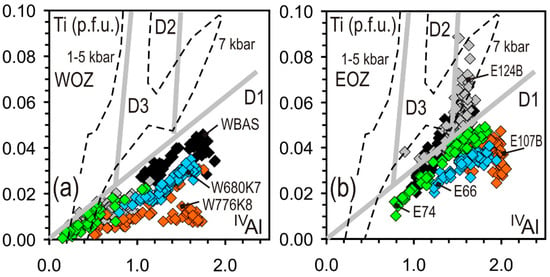
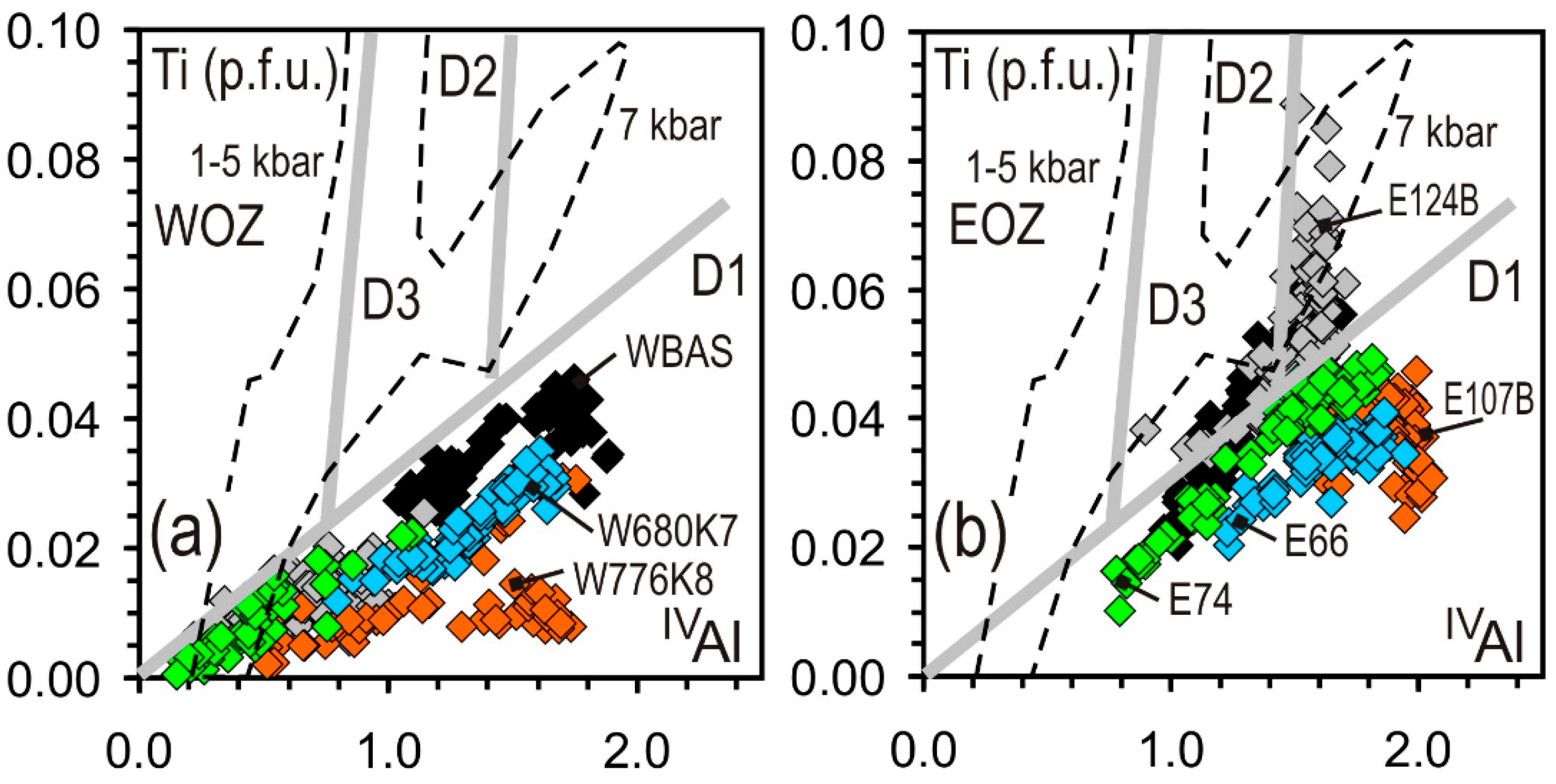
The question if original igneous amphiboles were preserved as magmatic relicts within the metabasites can be addressed by the Ti contents. In the WOZ the maximal recorded Ti in amphibole range at 0.04 p.f.u. at high IVAl of 1.8 p.f.u., as observed in sample WBAS. Low Ti up to 0.02 p.f.u. at low IVAl occurs in sample W1110K4.
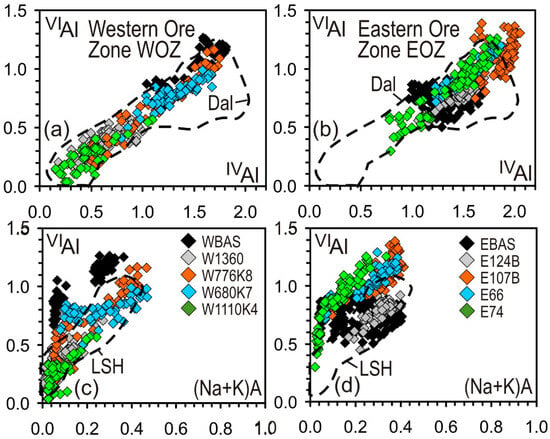
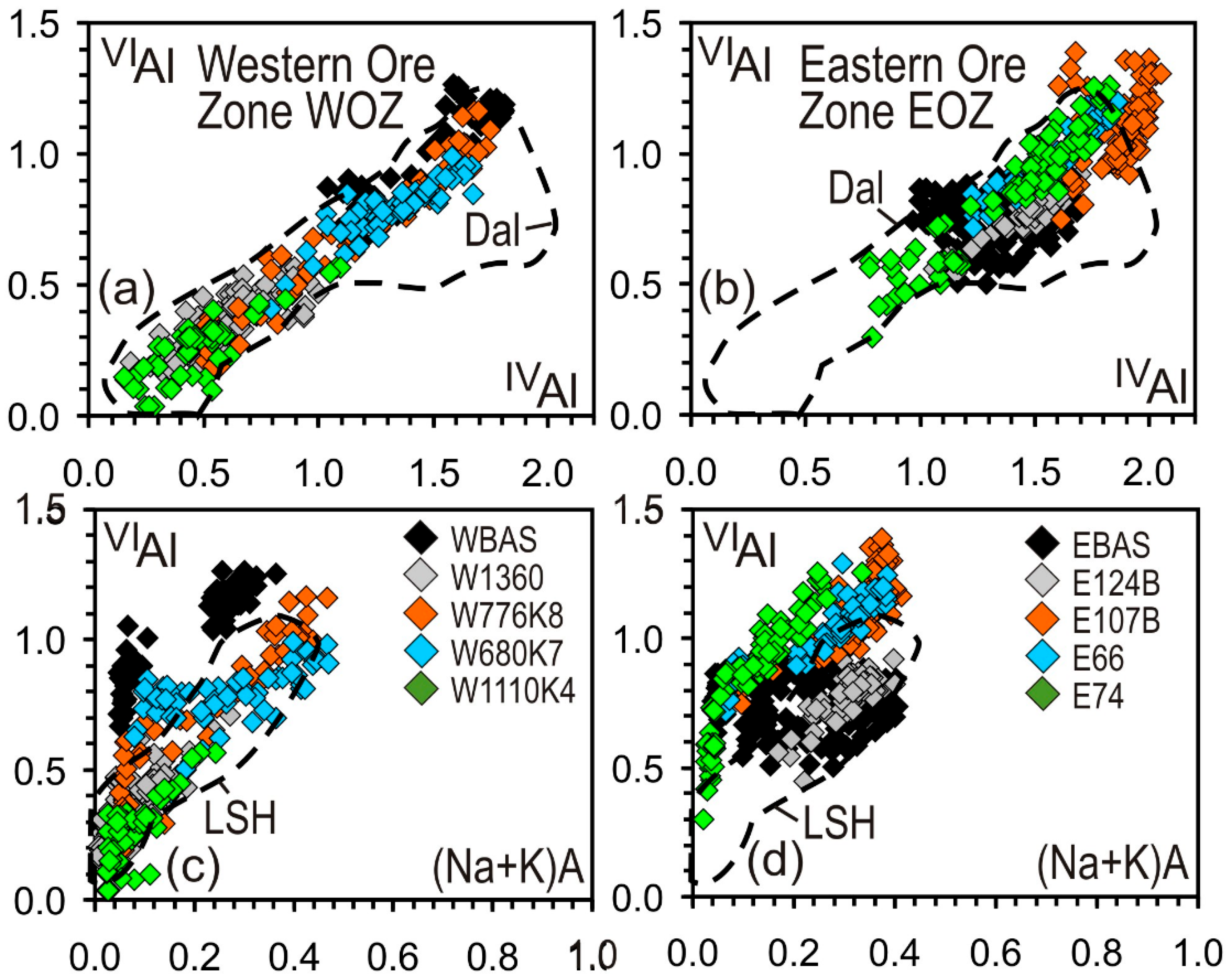
In the EOZ somewhat higher Ti at 0.08 p.f.u. are observed in sample E124B. Low Ti at <0.02 p.f.u. at low IVAl of <1.0 p.f.u. were not recorded there (Figure 4). According to [60] the typical igneous amphiboles should have Ti > 0.1 p.f.u. As this is not observed in the Felbertal amphibolites and as there are no occurrences of brown and brown-green coloured amphiboles in the samples, apparently no igneous amphiboles have been traced. The amphiboles in consequence crystallised during metamorphism. As exemplified in the zonation profiles (Figure 3), the amphiboles display a wide range of compositions in IVAl-VIAl coordinates (Figure 5) which semiquantitatively represent relative temperature (IVAl) versus pressure (VIAl). In the WOZ maximal IVAl of 2.0 p.f.u. at VIAl of 1.3 p.f.u. are found (Figure 5a). In the EOZ, the maximal IVAl at 2.2 p.f.u. at VIAl of 1.4 p.f.u. are slightly higher, and samples with low IVAl-VIAl have not been observed. Also, the (Na+K)A and VIAl coordinates may indicate the relative trends of temperature (Na+K)A versus pressure (VIAl). The maximal (Na+K)A in the WOZ and EOZ are quite similar at 0.5 p.f.u. (Figure 5d).
Figure 4.
(a,b) IVAl versus Ti (in per formula unit p.f.u.) of green amphiboles from metabasites hosting scheelite mineralised zones. See legend in Figure 5 for sample symbols. The lines D1, D2, D3 are the compositional trends observed in amphiboles in metabasites from the Dalradian Barrovian Zones [37]. Hatched lines mark amphibole compositional fields at 1–5 kbar and 7 kbar [49].
Figure 5.
(a,b) IVAl versus VIAl compositions (in per formula unit p.f.u.) of green amphiboles from metabasites hosting scheelite mineralised zones in Western and Eastern Ore Zones. Dal marks the compositional trends observed in amphiboles in metabasites from the Dalradian Barrovian Zones [37]. (c,d) (Na+K)A versus VIAl compositions (in per formula unit p.f.u.) of green amphiboles. LSH marks the compositional field outlined for green amphiboles from the Lower Schieferhülle of the Western Tauern Window [38]. Color legends in (c,d) apply also for (a,b).
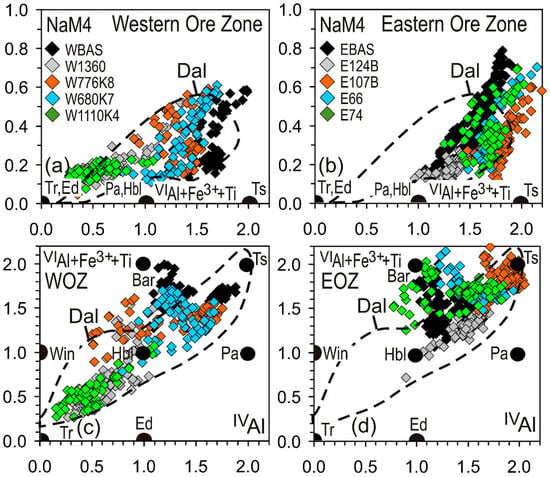
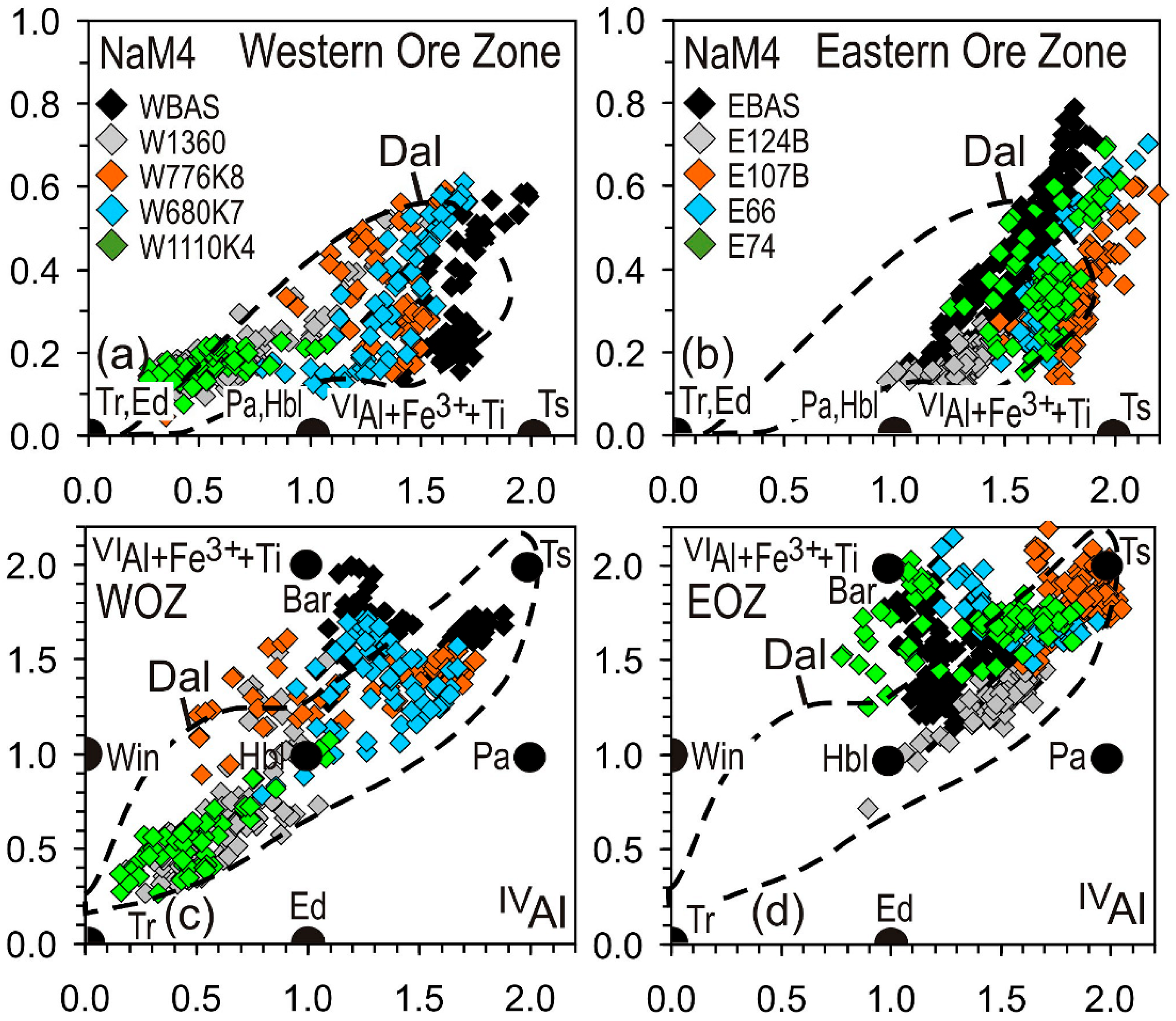
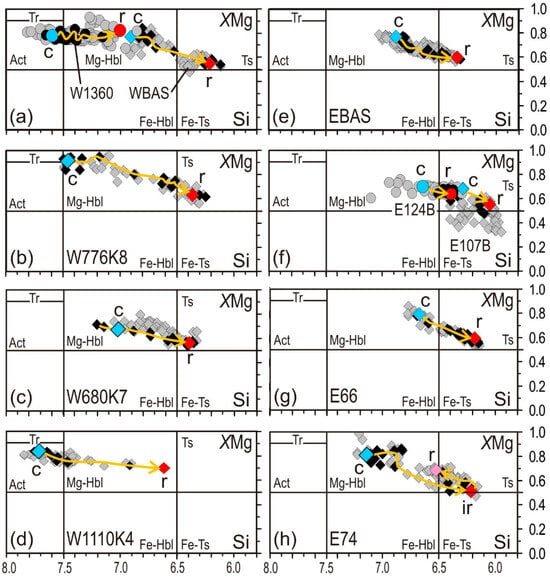
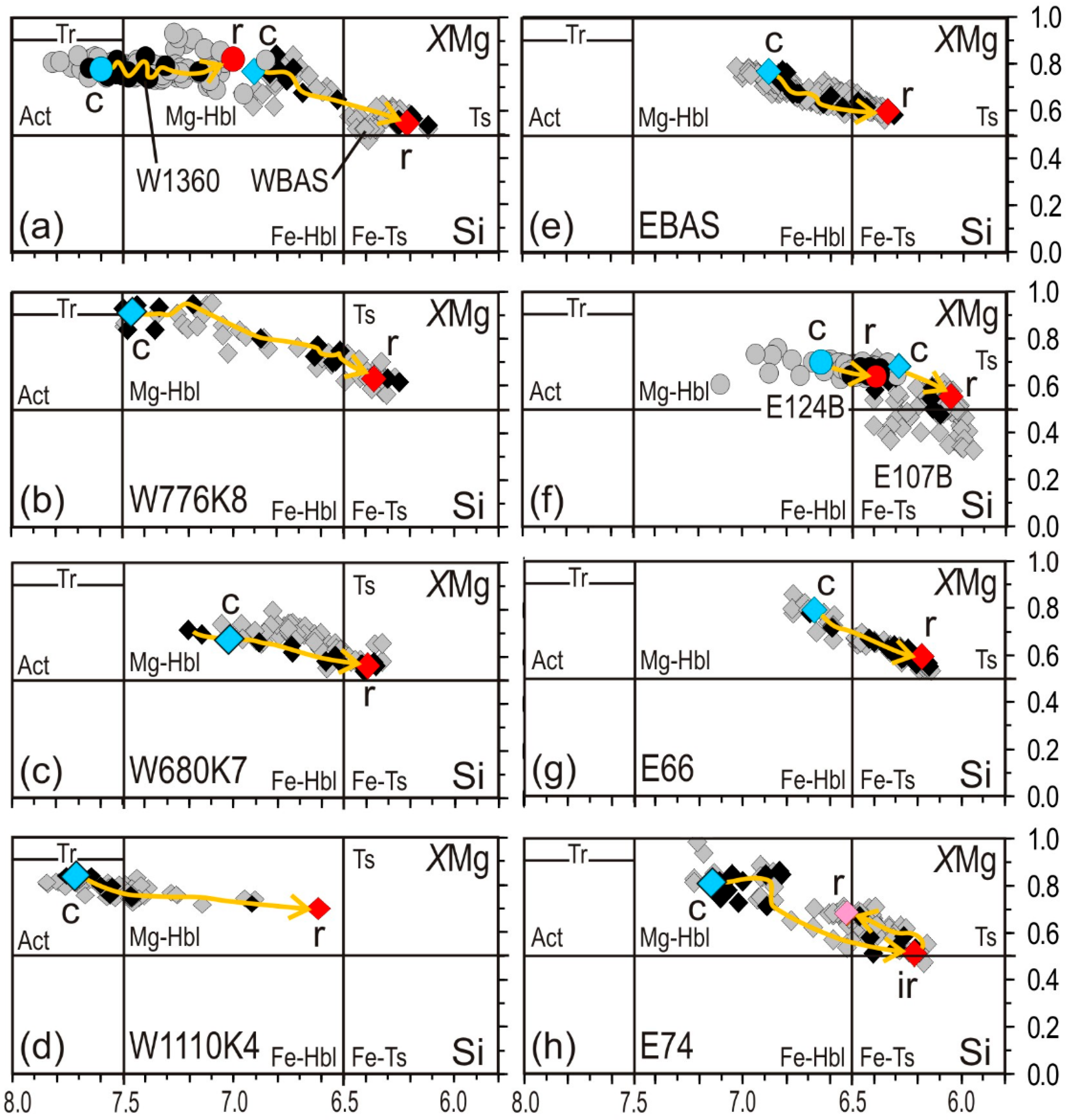
The diagrams VIAl+Fe3++Ti versus NaM4 and IVAl versus VIAl+Fe3++Ti were proposed by [61] to distinguish and classify amphiboles from terrains with different metamorphic gradients. Within this frame, the amphiboles from the WOZ perfectly match the range of the Dalradian amphiboles as outlined by [37,61] and follow a trend between tremolite and edenite over hornblende to tschermakite (Figure 6a,c). Amphiboles from the EOZ display a slightly different trend, but mostly within the Dalradian amphibole trend (Figure 6b,d). In the EOZ samples no amphiboles low in IVAl, NaM4 and VIAl+Fe3++Ti have been found. The maximal IVAl and NaM4 contents are slightly higher as reported from the Dalradian amphiboles. In consequence the zonation trends evolve mainly between the hornblende and tschermakite endmembers (Figure 6b,d). This is supported by the observations in the Si versus XMg amphibole classification diagram proposed by [62]. Amphibole core-to-rim zonations in Si display a crystallisation with magnesio-hornblende compositions in the cores at high XMg of ~0.8 toward tschermakitic compositions at lower XMg of 0.6 in the rims for the WBAS and EBAS samples (Figure 7a,e). The other samples from the WOZ display either amphibole crystallisation from actinolite core to magnesio-hornblende rim compositions (samples W1360, W1110K4, Figure 7a,d) and from actinolite cores to tschermakitic rim compositions (samples W776K8, Figure 7b). The straight actinolite core compositions have not been found in the EOZ amphibole samples. There, the core-to-rim zonations evolve from magnesio-hornblende cores to tschermakite rim compositions (samples E124B, E66, E74). There is also observation of a zonation from tschermakite in the inner rim to magnesio-hornblende in the rim in sample E74 (Figure 7h). Amphibole zonations in sample E107 are weak and within the tschermakite composition field (Figure 7f). To sum up, the compositions and zonations of green amphiboles in the Felbertal metabasites are similar as reported from the Dalradian metabasites in the Barrovian metamorphic zones as reported by [37,61], as shown in Figure 4, Figure 5 and Figure 6. In more detail, the Felbertal green amphibole compositions and zonations correspond to the observations in metabasites in the Dalradian Barrovian garnet, kyanite and sillimanite mineral zones. Sample E107B especially resembles the amphibole compositions from the Dalradian sillimanite zone where magnesio-hornblende and actinolite compositions are lacking [37].
Figure 6.
(a,b) VIAl+Fe3++Ti versus NaM4 compositions (in per formula unit p.f.u.) of green amphiboles from metabasites hosting scheelite mineralised zones in Western and Eastern Ore Zones. (c,d) IVAl versus VIAl+Fe3++Ti compositions (in per formula unit p.f.u.). Dal marks the compositional trends observed in amphiboles from the Dalradian Barrow Zones [37,61]. Bar barroisite, Ed edenite, Hbl hornblende, Pa pargasite, Tr tremolite, Ts tschermakite, Win winchite are amphibole endmember compositions. Color legends in (a,b) apply also for (c,d).
Figure 7.
(a–h) Si versus XMg = Mg/(Mg+Fe2+) of amphibole nomenclature discrimination [62] of green amphiboles in metabasites from Felbertal. Arrows mark core (c) to rim (r) zonation profiles in selected amphibole grains from core (blue) and rim (red). Act actinolite, Fe-Hbl ferro-hornblende, Fe-Ts ferro-tschermakite, Mg-Hbl magnesio-hornblende, Tr tremolite, Ts tschermakite compositional fields of amphibole endmember compositions.
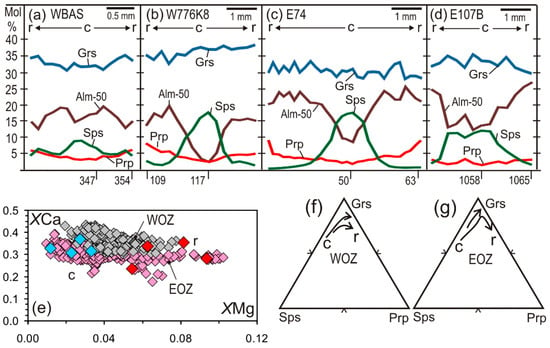
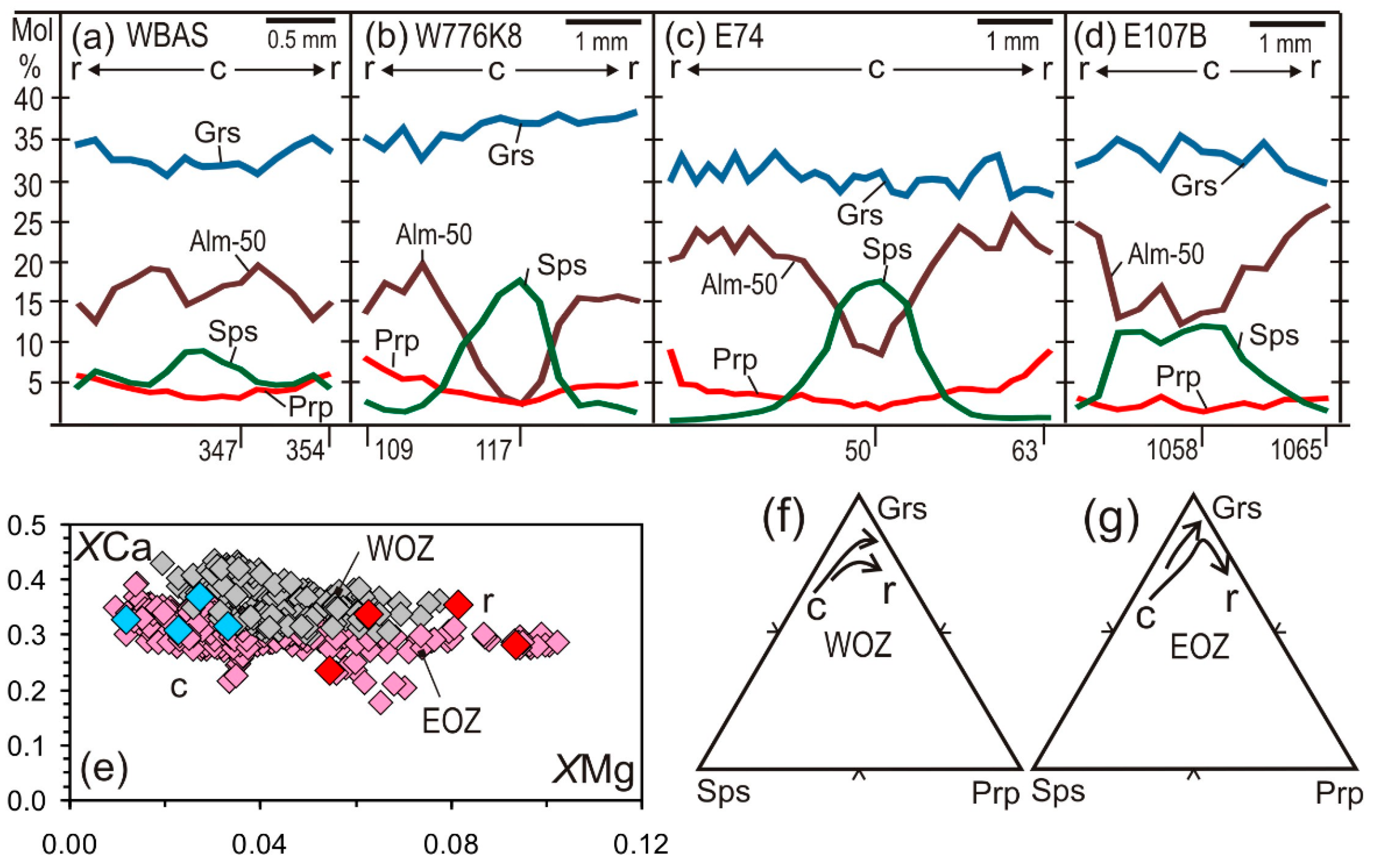
Garnet porphyroblasts at sizes between 1 and 4 mm in diameter appear in samples WBAS, W776K8, W680K7 and W1110K4 in the WOZ and in samples E107B and E74 in the EOZ. Garnet core-to-rim zonations display a decrease in spessartine (Mn) from 18 to 2 Mol%, almost constant high grossular (Ca) contents at 30–35 Mol%, and increasing pyrope (Mg) contents. Almandine (Fe) zonations are contrastive to the spessartine (Mn) zonations (Figure 8a–d). In the XMg versus XCa coordinates (Figure 8e), the garnets in the WOZ display a slightly higher XCa at 0.3–0.45 as the porphyroblasts in the EOZ (XCa 0.25–0.40) at similar ranges of XMg. In the grossular–spessartine–pyrope ternary diagrams, the garnet core-to-rim zonations in WOZ and EOZ are very similar at high grossular compositions (Figure 8f,g).
Figure 8.
(a–d) Zonation profiles rim (r)–core (c)–rim of garnet in metabasites in almandine (Alm-50%, due to scale), pyrope (Prp), grossular (Grs) and spessartine (Sps) components (in Mol %, calculated from mole fraction × 100). Characteristic garnet analyses out of the zonation profiles, representing zonation trends and used for geothermobarometric calculations, are marked by numbers along the baseline. (e) XMg-XCa coordinates of the metabasite garnet analyses in Western and Eastern Ore Zones (WOZ, EOZ), with selected analyses from cores (blue) and rims (red). (f,g) Ternary diagrams of garnet compositions in grossular (Grs), pyrope (Prp) and spessartine (Sps) endmembers, with core-to-rim (c, r) zonation trends.
Plagioclase is abundant in the studied samples. Its core-to-rim zonations are albite in the cores and oligoclase to andesine in the rims. However, the maximal anorthite content of the plagioclases are variable in the samples. Maximal anorthite (An) contents are An34 in sample WBAS, An28 in sample W776K8, An24 in sample W680K7 and An22 in sample W1110K4. Sample W1360 is a hornblende schist with amphibole-rich layers with no plagioclase; however, plagioclase occurs in layers apart as recognised by the EDS spectral mapping. In the EOZ the zoned plagioclases with albitic cores have maximal An34 in sample E107B, An32 in sample E74, An25 in sample E66, An24 in sample E124B and An 18 in sample EBAS.
The metabasite samples also contain epidote-group minerals as epidote and clinozoisite. According to the EDS spectral maps, the modes of the epidote-group minerals range from minimal 0.1–1 wt% (samples W1360, W1110K4, E124B, E107B) over 2.5–6.5 wt% (samples EBAS, E66, W680K7) to maximal 15 wt% (samples W776K8, E74). Significant zonations in Al3+ content occur in some of the samples. In sample W1110K4 where amphibole shows marked core-to-rim zonation, the Al3+ in epidote increase from 2.45 p.f.u. in the core to 2.60 p.f.u. in the rim. Also in sample W680K7 the epidote zonation from core to rim is from 2.58 to 2.66 p.f.u. In sample W776K8 the Al3+ in epidote increases from 2.60 p.f.u. in the core to 2.90 p.f.u. in the rim. In the WBAS, EBAS and E74 samples the epidote Al3+ core-to-rim zonations range from 2.40 to 2.65. In sample W1360 epidote is almost unzoned in Al3+ at 2.50 p.f.u. In the samples E124B and E66 the epidote display inverse zonations with higher Al3+ at 2.8 p.f.u. in the core and 2.5 p.f.u. in the rim.
3.2. Geothermobarometry of Metabasites
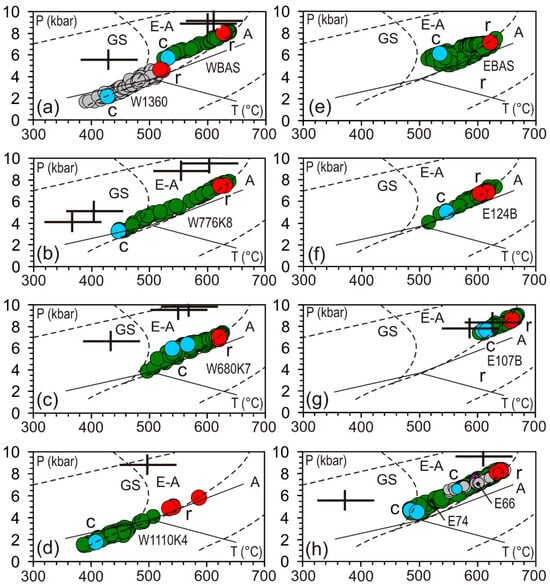
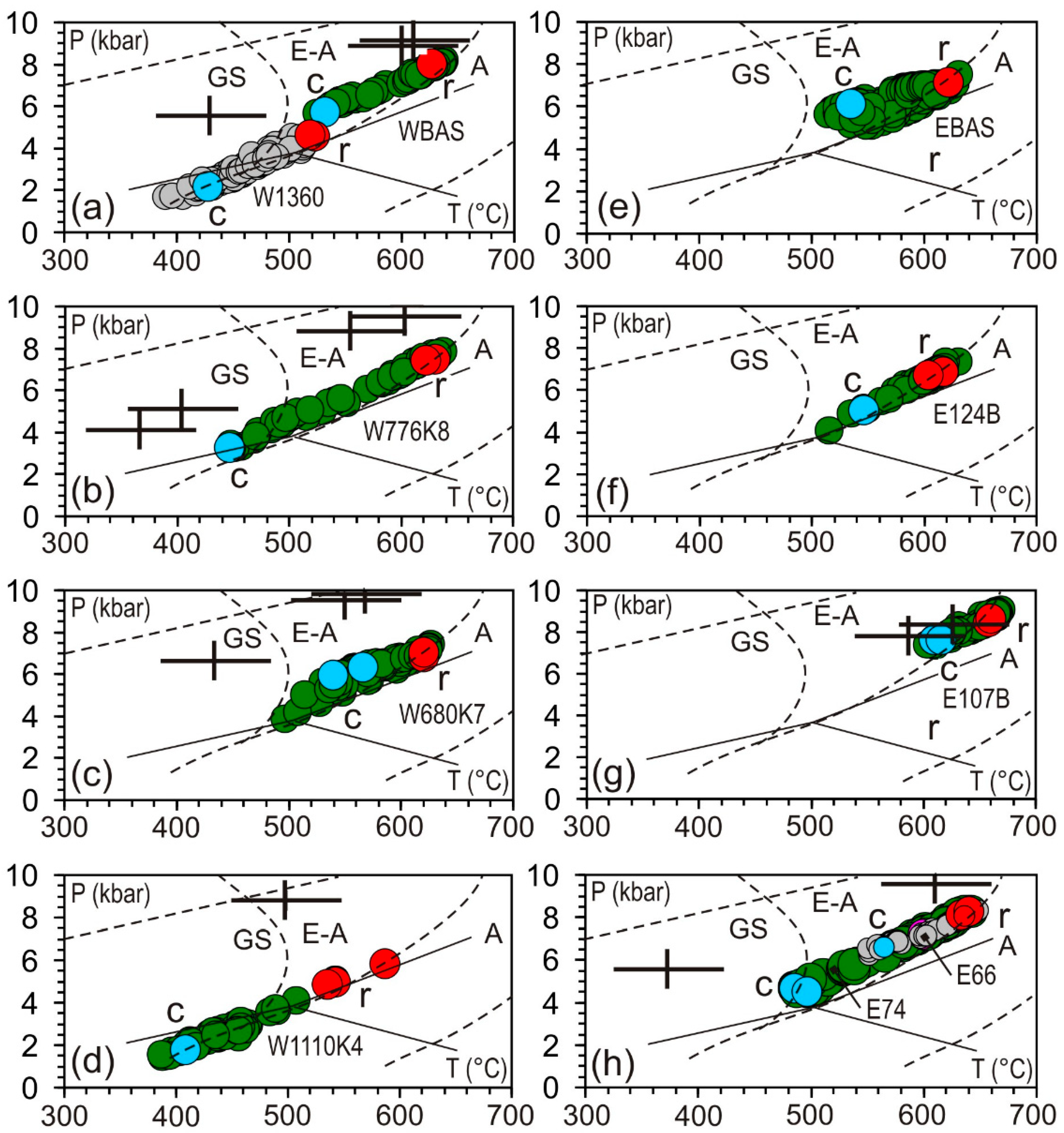
The amphibole zonations in Si, IVAl, VIAl, Ti, Na within the assemblages by plagioclase, epidote/clinozoisite, chlorite, sphene and quartz are typical of a metamorphism prograde in temperature (T) and pressure (P) from the greenschist to the epidote-amphibolite and further to the lower amphibolite facies [59]. This is further supported by the core-to-rim zonations from albite to oligoclase in the plagioclases and towards higher Al3+ in the epidotes. Also, the increasing pyrope contents toward garnet rims give a hint to increasing temperatures in a semiquantitative way. The amphibole endmember geothermobarometry [37] following the experimental premises given by [46,48] allows a P-T estimate with an error of ±50 °C/±1 kbar for each amphibole analysis, respectively, and for amphibole endmember compositions along the zonation profiles. Analyses from amphibole cores and rims were selected for a representative P-T evolution trend. In general, the temperatures estimated by the hornblende-garnet geothermometer of [52] are slightly lower (~20 °C), whereas the corresponding calibrations by [53,54] are about ~100 °C and ~130 °C lower. Therefore, these calibrations are not further considered here. In contrast, the temperature estimates by the hornblende-plagioclase geothermometer [47] exceed the estimates by the amphibole endmember thermobarometry at about 50 °C. However, the relative temperature trends estimated from amphibole cores to rims remain preserved within all these calibrations. For the pressure estimates apart from the amphibole endmember geothermobarometer, the various calibrations with activity models for Fe and Mg of the garnet-amphibole-plagioclase barometer [56,57] as given in the spreadsheet by [58] can be applied. These pressure estimates are in most cases considerably higher (2–4 kbar) than the estimates from the amphibole endmember calibration [37]. Therefore, the most conservative results from the Mg model by [57] are shown (Figure 9). Amphiboles in sample WBAS recorded a prograde metamorphism from 530 °C/5.7 kbar in the cores to ~630 °C/8.0 kbar in the rims. The P-T estimates for maximal pressures and temperatures by the hornblende-garnet geothermometers provided slightly lower temperatures at 610 °C and slightly higher pressures at 9.1 kbar when the calibrations [51,57] are applied (Figure 9a). Geothermobarometry of the hornblende schist sample W1360 led to a quite different result. In this sample the amphiboles compositions range from actinolite in the cores to magnesio-hornblende compositions in the rims (Figure 7a), which crystallised along a prograde P-T path from ~400 °C/2.2 kbar to ~520 °C/4.6 kbar (Figure 9a). This signals two successive prograde metamorphic stages in the Western Ore Zone. This is supported by the garnet-bearing amphibole gneiss layer of sample W776K8. There, the core-to-rim amphibole zonation from actinolite to tschermakite (Figure 2b, Figure 3b and Figure 7b) results in a prograde P-T path passing from ~450 °C/3.3 kbar to 620 °C/7.4 kbar (Figure 9b). The corresponding estimates from the garnet-amphibole-plagioclase geothermobarometers [51,57] span an equivalent range of P and T from 340 °C/4 kbar to 604 °C/9.5 kbar (Figure 9b). The P-T data from sample W680K7 span a similar range of a prograde P-T evolution from 540 °C/6.0 kbar to 620 °C/7.1 kbar as observed from sample WBAS, which is supported by similar amphibole core-to-rim zonation trends (Figure 3a,c, Figure 7a,c and Figure 9a,c). The amphibole zonations are similar in the hornblendite sample W1110K4 as in sample W1360 (Figure 7a,d). In consequence, this sample also documents an early prograde P-T path section from 410 °C/2.0 kbar to maximal 580 °C/6.0 kbar (Figure 9d). For this sample the results from garnet-amphibole-plagioclase geothermobarometry are at maximal 500 °C/8.8 kbar (Figure 9d).
Figure 9.
(a–d) P-T data of metabasites in the Western Ore Zone. (e–h) P-T data of metabasites in the Eastern Ore Zone. Data from amphibole endmember geothermobarometry [37] in green and grey bullets. Selected analyses from amphibole cores (c) in blue and from rim (r) in red bullets, as in Figure 7. Data from garnet-hornblende-plagioclase geothermobarometry [51,57] in crosses, bars represent overall error of ±50 °C/±1 kbar. Hatched metamorphic facies boundaries of Amphibolite (A), Epidote-Amphibolite (E-A), Greenschist (GS) according to [59].
Sample EBAS from the EOZ recorded a prograde P-T evolution from 530 °C/6.0 kbar to 620 °C/7.2 kbar, following the quite equivalent amphibole zonation trend as observed in sample WBAS (Figure 7a,e and Figure 9e). A prograde P-T evolution from 550 °C/5.0 kbar to 620 °C/8.6 kbar was recorded by sample E124B. Some amphiboles with decreasing IVAl-VIAl in the outer rims signal a subsequent minor retrograde P-T trend (Figure 9f). The fine-grained amphibolite sample E107B displays poorly zoned amphiboles (Figure 3g) within the tschermakite discriminative field with the highest IVAl values among all the studied samples. These amphibole cores crystallised at 610 °C/7.6 kbar and the rims at 660 °C/8.6 kbar. For this sample the P-T estimates from the garnet-amphibole-plagioclase geothermobarometers already match the data from the amphibole endmember calibration (Figure 9g). According to the significant amphibole zonations (Figure 2e, Figure 3h and Figure 7h), the prograde P-T path recorded by sample E74 ranges from 500 °C/4.7 kbar to 640 °C/8.3 kbar, with a subsequent retrograde segment to 600 °C/7.2 kbar as documented in the outer rim. P-T data from garnet amphibolite sample E66 from 560 °C/6.6 kbar to 635 °C/8.1 kbar overlaps with the high P-T segment recorded by sample E74 (Figure 9h).
4. Discussion
The amphibole-bearing metabasite assemblages of the scheelite-mineralised host rocks recorded a prograde metamorphic evolution culminating at maximal P-T conditions of ~620–640 °C/7–8 kbar. The maximal P-T conditions are similar within the WOZ and EOZ. One sample in the EOZ (E107B) recorded slightly higher maximal P-T conditions at 660 °C/8.6 kbar. This cannot be considered as an outlier, as the corresponding mineral chemistry of the amphiboles matches the trends from the other samples. The overall prograde P-T evolution appears as segmented into distinctive trends: In a majority of the studied samples the prograde P-T segment starts at 500–530 °C/4.7–6.0 kbar (samples WBAS, W680K7, EBAS, E124B, E74), as recorded by zoned amphibole core compositions. There are two samples in the WOZ (W1360, W1110K4) which recorded an early-stage P-T segment from ~400 °C/2 kbar to 520 °C/4.6 kbar. However, the classification of this P-T segment as an early stage can be derived from the sample W776K8 of which continuously zoned amphiboles crystallised from 450 °C/3.3 kbar to 620 °C/7.4 kbar, covering these two separated early-stage P-T segments. The early stage of the P-T evolution has not been found in the EOZ. The intermediate pressure and temperature are characteristic of a tectonically driven crustal thickening process during a continental collision [59]. A main foliation S2 of oblate-ductile shearing is penetrative in the Felbertal metabasites and gneisses. The zoned amphibole grains display a preferential orientation of their long axes, sometimes defining a linear structure and lineation associated with the principal planar anisotropy. This implicates that the main ductile deformation phase which led to the structures of finite strain is coeval to the prograde P-T evolution recorded by the amphibole mineral-chemical record.
Previous P-T estimates for the Alpine metamorphism in this part of the Tauern Window (500–590 °C/4.5–7 kbar [25,26] are within the range of the data for the prograde P-T paths presented here, except for the maximal P-T conditions, which are slightly higher but still at the transition from epidote-amphibolite facies to the lower amphibolite facies (Figure 9). Metabasites belonging to the Lower Schieferhülle and in an equivalent structural and tectonic level within the Alpine nappe pile as the Habach Complex are exposed in the Western Tauern Window [63,64]. From this western and southern parts of the Lower Schieferhülle up to 600 °C/10 kbar as maximal conditions for the Alpine metamorphism have been reported [65,66,67,68,69,70]. Data from amphibole endmember geothermobarometry from the Lower Schieferhülle in the Western Tauern Window yielded 640 °C/7.5 kbar as maximal metamorphic conditions [38]. K-Ar ages at 42.5 Ma from actinolite cores and at 24 Ma from green amphibole rims have been reported from Upper Schieferhülle in the Western Tauern Window [71]. The range of phengite Rb–Sr, hornblende K–Ar, phengite K–Ar, biotite Rb–Sr and K–Ar and apatite fission track ages in the Western Tauern Window continuously decreases from 20 to 7 Ma in the course of uplift and cooling [29,72,73].
Considerable efforts have been dedicated to the radiometric dating of the Habach Complex magmatic protoliths which host the Felbertal mineralisation and the orthogneisses within, and in consequence to date the formation of the scheelite mineralisation itself [2,6,7,11,34] as reported in [8,9,19,74]. This yielded a diverse range of ages from Early Cambrian (~550 Ma) over Early Carboniferous to the Oligocene. Apparently, the Oligocene ages (~30 Ma) should be related to the metamorphic crystallisation of the amphiboles in the metabasites. However, this still has to be ascertained by future hornblende Ar–Ar dating.
5. Conclusions
Green amphiboles in metabasites hosting the Felbertal scheelite mineralisation crystallised in assemblages with plagioclase, epidote, chlorite, sphene and quartz. Microstructural features and preferential orientation of the amphiboles defining planar-linear structures of finite strain indicate that this crystallisation is coeval to the main deformation event.
Single amphibole crystals display marked core-to-rim zonations with increasing IVAl, VIAl, Na, Ti and decreasing Si covering actinolite over magnesio-hornblende to tschermakite compositions. The overall amphibole mineral chemical evolution and development of mineral assemblages are similar to metabasites in the classical Barrovian garnet to sillimanite zones in the Dalradian of Scotland and typical of a prograde metamorphism from the greenschist over epidote-amphibolite to the lower amphibolite facies.
Amphibole endmember geothermobarometry provides P-T paths with conservative pressure estimates. This defines an early P-T path segment from 400 °C/2 kbar to 540 °C/6 kbar, and a consecutive later P-T path segment from ~500–540 °C/6 kbar to maximal 640 °C/8 kbar. There are samples where the amphibole zonations led to P-T estimates which cover the complete range of the early and late P-T segments.
This syndeformational metamorphism at an intermediate pressure regime should be related to the Alpine Tertiary continental collision of the Austroalpine and European plates, following the subduction-accretion of the Penninic oceanic crust in between. However, the age of the metamorphism has to be still confined by targeted hornblende Ar–Ar geochronology
Supplementary Materials
The following supporting information can be downloaded at: https://www.mdpi.com/article/10.3390/min16020158/s1, Table S1 Mineral Chemistry enclosing the electron probe microanalyses of amphibole, garnet, plagioclase and epidote. Further spreadsheets for amphibole mineral formulae recalculation and amphibole endmember geothermobarometry can be requested from the corresponding author.
Author Contributions
Conceptualization, B.S. and J.K.; methodology, B.S. and J.K.; investigation, J.K. and D.P.; resources, B.S. and J.K.; data curation, B.S., J.K. and D.P.; Writing—Original Draft preparation, B.S., J.K. and D.P.; Writing—Review and Editing, B.S., J.K. and D.P.; visualisation, B.S.; project administration, B.S. and J.K.; funding acquisition, B.S. and J.K.; All authors have read and agreed to the published version of the manuscript.
Funding
The Deutsche Forschungsgemeinschaft DFG supported the studies on the Felbertal tungsten mine by personal grants to B.S. and J.K. (SCHU-676-25, AOBJ: 697508) within the Priority Program SPP 2238 DOME Dynamik der Erzmetallanreicherung, and the EPMA instrument implementation (INST-FUGG 267/156-1).
Data Availability Statement
The original contributions presented in the study are included in the article/Supplementary Material. Further inquiries can be directed to the corresponding author.
Acknowledgments
The authors appreciate the active support during sampling campaigns in the Felbertal mine by K. Aupers and S. Schmid from WOLFRAM Bergbau und Hütten AG, St. Martin i. S., Austria. Numerous rock thin sections were prepared by R. Würkert and M. Stoll at the Helmholtz Institute Freiberg for Resource Technology. Technical support during electron probe microanalyses at the Institute of Materials Science, TU Bergakademie Freiberg/Saxony (INST-FUGG 267/156-1) was provided by S. Memarbashi. Support at the SEM studies in the Laboratory of Geometallurgy at TU Bergakademie Freiberg was accomplished by S. Gilbricht. Two reviewers are acknowledged for their constructive comments.
Conflicts of Interest
The authors declare no conflicts of interest.
References
- Schenk, P.; Höll, R. Evolution of fluids and metamorphic ore remobilization in the Felbertal scheelite deposit, Eastern Alps. Ore Geol. Rev. 1991, 6, 425–434. [Google Scholar] [CrossRef] [Scilit]
- Eichhorn, R.; Schaltegger, U.; Höll, R. Age and evolution of scheelite-hosting rocks in the Felbertal deposit (Eastern Alps): U-Pb geochronology of zircon and titanite. Contrib. Mineral. Petrol. 1995, 119, 377–386. [Google Scholar] [CrossRef]
- Höll, R.; Schenk, P. Metamorphosed hydrothermal eruption breccia (conglomerate) in the Felbertal scheelite deposit, Eastern Alps, Austria. Mar. Geol. 1988, 84, 273–282. [Google Scholar] [CrossRef] [Scilit]
- Höll, R.; Maucher, A.; Westenberger, H. Synsedimentary-diagenetic ore fabrics in the strata-and time-bound scheelite deposits of Kleinarltal and Felbertal in the Eastern Alps. Min. Depos. 1972, 7, 217–226. [Google Scholar] [CrossRef] [Scilit]
- Höck, V. The Habach-Formation and the Zentralgneis—A key in understanding the Palaeozoic evolution of the Tauern Window (Eastern Alps). In Pre-Mesozoic Geology in the Alps; Raumer, J.F., Neubauer, F., Eds.; Springer: Berlin/Heidelberg, Germany; New York, NY, USA, 1993; pp. 361–374. [Google Scholar]
- Eichhorn, R.; Höll, R.; Jagoutz, E.; Schaerer, U. Dating scheelite stages; a strontium, neodymium, lead approach from the Felbertal tungsten deposit, Central Alps, Austria. Geochim. Cosmochim. Acta 1997, 61, 5005–5022. [Google Scholar] [CrossRef] [Scilit]
- Raith, J.G.; Stein, H. Variscan ore formation and metamorphism at the Felbertal scheelite deposit (Austria): Constraining tungsten mineralisation from Re–Os dating of molybdenite. Contrib. Mineral. Petrol. 2006, 152, 505–521. [Google Scholar] [CrossRef] [Scilit]
- Kozlik, M.; Raith, J.G. Variscan metagranitoids in the central Tauern Window (Eastern Alps, Austria) and their role in the formation of the Felbertal scheelite deposit. Lithos 2017, 278–281, 303–320. [Google Scholar] [CrossRef] [Scilit]
- Haupt, P.C.; Krause, J.; Schulz, B.; Götze, J.; Chischi, J.; Berndt, J.; Klemme, S.; Schmidt, S.; Aupers, K.; Reinhardt, N. New insights on the formation of the polymetamorphic Felbertal tungsten deposit (Austria, Eastern Alps) revealed by CL, EPMA, and LA-ICP-MS investigation. Min. Depos. 2025, 60, 631–652. [Google Scholar] [CrossRef] [Scilit]
- Raith, J.G.; Gerdes, A.; Cornell, D. In-situ U-Pb dating of scheelite: Constraints on the age and genesis of the Felbertal tungsten deposit. In Proceedings of the Goldschmidt Conference Abstracts, Prague, Czech Republic, 15 August 2011; Min. Mag. 75. p. 1690. [Google Scholar]
- Raith, J.G.; Schmidt, S.; Aupers, K. Tungsten deposit Felbertal, Salzburg, Austria. In Proceedings of the XXI International Congress of the Carpathian Balkan Geological Association (CBGA 2018) Field Trip PreEX5, Salzburg, Austria, 10–13 September 2018; Ber. Geol. Bundesanst. 126. pp. 7–46. [Google Scholar]
- Höll, R.; Eichhorn, R. Tungsten mineralization and metamorphic remobilization in the Felbertal scheelite deposit, Central Alps, Austria. Rev. Econ. Geol. 2000, 11, 233–264. [Google Scholar]
- Eichhorn, R.; Loth, G.; Kennedy, A. Unravelling the pre-Variscan evolution of the Habach terrane (Tauern Window, Austria) by U-Pb SHRIMP zircon data. Contrib. Mineral. Petrol. 2001, 142, 147–162. [Google Scholar] [CrossRef] [Scilit]
- von Quadt, A. U-Pb zircon and Sm-Nd geochronology of mafic and ultramafic rocks from the central part of the Tauern Window (Eastern Alps). Contrib. Mineral. Petrol. 1992, 110, 57–67. [Google Scholar] [CrossRef] [Scilit]
- Eichhorn, R.; Höll, R.; Loth, G.; Kennedy, A. Implications of U-Pb SHRIMP zircon data on the age and evolution of the Felbertal tungsten deposit (Tauern Window, Austria). Int. J. Earth Sci. 1999, 88, 496–512. [Google Scholar] [CrossRef] [Scilit]
- Eichhorn, R.; Loth, G.; Höll, R.; Finger, F.; Schermaier, A.; Kennedy, A. Multistage Variscan magmatism in the central Tauern Window (Austria) unveiled by U/Pb SHRIMP zircon data. Contrib. Mineral. Petrol. 2000, 139, 418–435. [Google Scholar] [CrossRef] [Scilit]
- Finger, F.; von Quadt, A. Genauere U/Pb Alter für Granite und Granitgneise durch sorgfältige Zirkonselektion unter dem Durchlichtmikroskop—Der Knorrkogelgneis der Hohen Tauern als Beispiel. Ber. Dtsch. Min. Ges. 1993, 5, 118. [Google Scholar]
- Finger, F.; Steyrer, H.P. Granite-types in the Hohe Tauern (Eastern Alps, Austria)—Some aspects on their correlation to Variscan plate tectonic processes. Geodin. Acta 1988, 2, 75–87. [Google Scholar] [CrossRef] [Scilit]
- Kozlik, M.; Raith, J.G.; Gerdes, A. U–Pb, Lu–Hf and trace element characteristics of zircon from the Felbertal scheelite deposit (Austria): New constraints on timing and source of W mineralization. Chem. Geol. 2016, 421, 112–126. [Google Scholar] [CrossRef] [Scilit]
- Finger, F.; Frasl, G.; Haunschmid, B.; Lettner, H.; von Quadt, A.; Schermaier, A.; Schindlmayer, A.O.; Steyrer, H.P. The Zentralgneise of the Tauern Window (Eastern Alps): Insight into an Intra-Alpine Variscan Batholith. In Pre-Mesozoic Geology in the Alps; Raumer, J.F., Neubauer, F., Eds.; Springer: Berlin/Heidelberg, Germany; New York, NY, USA, 1993; pp. 375–391. [Google Scholar]
- Kebede, T.; Klötzli, U.; Kosler, J.; Skiöld, T. Understanding the pre-Variscan and Variscan basement components of the central Tauern Window, Eastern Alps (Austria): Constraints from single zircon U–Pb geochronology. Int. J. Earth Sci. 2005, 94, 336–353. [Google Scholar] [CrossRef] [Scilit]
- von Raumer, J.F.; Bussy, F.; Schaltegger, U.; Schulz, B.; Stampfli, G.M. Pre-Mesozoic Alpine basements—Their place in the European Paleozoic framework. Geol. Soc. Am. Bull. 2013, 125, 89–108. [Google Scholar] [CrossRef] [Scilit]
- Schmid, S.M.; Scharf, A.; Handy, M.R.; Rosenberg, C.L. The Tauern Window (Eastern Alps, Austria): A new tectonic map, with crosssections and a tectonometamorphic synthesis. Swiss J. Geosci. 2013, 106, 1–32. [Google Scholar] [CrossRef] [Scilit]
- Lammerer, B.; Weger, M. Footwall uplift in an orogenic wedge: The Tauern Window in the Eastern Alps of Europe. Tectonophysics 1998, 285, 213–230. [Google Scholar] [CrossRef] [Scilit]
- Grundmann, G. Metamorphic evolution of the Habach Formation; a review. Mitt. Österr. Geol. Ges. 1989, 81, 133–149. [Google Scholar]
- Thalhammer, O.; Stumpfl, E.F.; Jahoda, R. The Mittersill scheelite deposit, Austria. Econ. Geol. 1989, 84, 1153–1171. [Google Scholar] [CrossRef] [Scilit]
- Bousquet, R.; Oberhänsli, R.; Goffé, B.; Wiederkehr, M.; Koller, F.; Schmid, S.M.; Schuster, R.; Engi, M.; Berger, A.; Martinotti, G. Metamorphism of metasediments at the scale of an orogen a key to the Tertiary geodynamic evolution of the Alps. In Tectonic Aspects of the Alpine-Dinaride-Carpathian System; Siegesmund, S., Fügenschuh, B., Froitzheim, N., Eds.; Geological Society Special Publications: Bath, UK, 2008; Volume 298, pp. 393–411. [Google Scholar]
- Hoernes, S.; Friedrichsen, H. Oxygen isotope studies on metamorphic rocks of the Western Hohe Tauern area (Austria). Schweiz. Mineral. Petrogr. Mitt. 1974, 54, 769–788. [Google Scholar]
- Schneider, S.; Hammerschmidt, K.; Rosenberg, C.L.; Gerdes, A.; Frei, D.; Bertrand, A. U–Pb ages of apatite in the western Tauern Window (Eastern Alps): Tracing the onset of collision-related exhumation in the European plate. Earth Planet. Sci. Lett. 2015, 418, 53–65. [Google Scholar] [CrossRef] [Scilit]
- Glodny, J.; Ring, U.; Kühn, A.; Gleissner, P.; Franz, G. Crystallization and very rapid exhumation of the youngest Alpine eclogites (Tauern Window, Eastern Alps) from Rb/Sr mineral assemblage analysis. Contrib. Mineral. Petrol. 2005, 149, 699–712. [Google Scholar] [CrossRef] [Scilit]
- Grundmann, G.; Morteani, G. Die Geologie des Smaragdvorkommens im Habachtal (Land Salzburg, Osterreich). Arch. Lagerstättenforsch Geol. Bundesanst. 1982, 2, 71–107. [Google Scholar]
- Koller, F.; Richter, W. Die Metarodingite der Habachformation Hohe Tauern. Tschermaks Mineral. Petr. Mitt. 1984, 33, 49–67. [Google Scholar] [CrossRef] [Scilit]
- Finger, F.; Waitzinger, M.; Förster, H.J.; Kozlik, M.; Raith, J.G. Identification of discrete low-temperature thermal events in polymetamorphic basement rocks using high spatial resolution FE-SEM-EDX U-Th-Pb dating of uraninite microcrystals. Geology 2017, 45, 991–994. [Google Scholar] [CrossRef] [Scilit]
- Triboulet, C.; Audren, C. Controls on P-T-t deformation path from amphibole zonations during progressive metamorphism of basic rocks (estuary of the River Vilaine, South Brittany, France). J. Metamorph. Geol. 1988, 6, 117–133. [Google Scholar] [CrossRef] [Scilit]
- Triboulet, C. The (Na-Ca)amphibole-albite-chlorite-epidote-quartz geothermobarometer in the system S-A-F-M-C-N-H2O. 1. An empirical calibration. J. Metamorph. Geol. 1992, 10, 545–556. [Google Scholar] [CrossRef] [Scilit]
- Triboulet, C.; Thiéblemont, D.; Audren, C. The (Na-Ca)amphibole-albite-chlorite-epidote-quartz geothermobarometer in the system S-A-F-M-C-N-H2O. 2. Applications to metabasic rocks in different metamorphic settings. J. Metamorph. Geol. 1992, 10, 557–566. [Google Scholar] [CrossRef] [Scilit]
- Zenk, M.; Schulz, B. Zoned Ca-amphiboles and related P–T evolution in metabasites from the classical Barrovian metamorphic zones in Scotland. Min. Mag. 2004, 68, 769–786. [Google Scholar] [CrossRef] [Scilit]
- Schulz, B.; Triboulet, C.; Audren, C. Microstructures and mineral chemistry in amphibolites from the western Tauern Window (Eastern Alps), and P-T-deformation paths of the Alpine greenschist-amphibolite facies metamorphism. Min. Mag. 1995, 59, 641–659. [Google Scholar] [CrossRef] [Scilit]
- Schulz, B.; Sandmann, D.; Gilbricht, S. SEM based automated mineralogy and its application in geo- and material sciences. Minerals 2020, 10, 1004. [Google Scholar] [CrossRef] [Scilit]
- Papike, J.J.; Cameron, K.C.; Baldwin, K. Amphiboles and pyroxenes: Characterisation of other than quadrilateral components and estimate of ferric iron from microprobe data. Geol. Soc. Am. Abstr. Programs 1974, 6, 1053–1054. [Google Scholar]
- Raase, P. Al and Ti contents of hornblende, indicators of pressure and temperature of regional metamorphism. Contrib. Mineral. Petrol. 1974, 45, 231–236. [Google Scholar] [CrossRef] [Scilit]
- Brown, E.H. The crossite content of Ca-amphibole as a guide to pressure of metamorphism. J. Petrol. 1977, 18, 53–72. [Google Scholar] [CrossRef] [Scilit]
- Holland, T.J.B.; Richardson, S.W. Amphibole zonation in metabasites as a guide to the evolution of metamorphic conditions. Contrib. Mineral. Petrol. 1979, 70, 143–148. [Google Scholar] [CrossRef] [Scilit]
- Spear, F.S. NaSi-CaAl exchange equilibrium between plagioclase and amphibole: An empirical model. Contrib. Mineral. Petrol. 1980, 80, 140–146. [Google Scholar] [CrossRef] [Scilit]
- Schulz, B.; Triboulet, C.; Audren, C.; Pfeifer, H.-R.; Gilg, A. Two-stage prograde and retrograde Variscan metamorphism of glaucophane-eclogites, blueschists and greenschists from Ile de Groix (Brittany, France). Int. J. Earth Sci. 2001, 90, 871–889. [Google Scholar] [CrossRef] [Scilit]
- Gerya, T.V.; Perchuk, L.L.; Triboulet, C.; Audren, C.; Sez’ko, A.I. Petrology of the Tumanshet Zonal Metamorphic Complex, Eastern Sayan. Petrology 1997, 5/6, 503–533. [Google Scholar]
- Blundy, J.D.; Holland, T.J.B. Calcic amphibole equilibria and a new amphibole-plagioclase geothermometer. Contrib. Mineral. Petrol. 1990, 104, 208–224. [Google Scholar] [CrossRef] [Scilit]
- Plyusnina, L.P. Geothermometry and geobarometry of plagioclase-hornblende bearing assemblages. Contrib. Mineral. Petrol. 1982, 80, 140–146. [Google Scholar] [CrossRef] [Scilit]
- Colombi, A. Métamorphisme et géochimie des roches mafiques des Alpes oueste-centrales (géoprofil Viège-Domodossola-Locarno). Mémoires Géologie 1989, 4, 1–216. [Google Scholar]
- Holland, T.J.B.; Blundy, J. Non-ideal interactions in calcic amphiboles and their bearing on amphibole-plagioclase thermometry. Contrib. Mineral. Petrol. 1994, 116, 443–447. [Google Scholar] [CrossRef] [Scilit]
- Graham, C.M.; Powell, R. A garnet-hornblende geothermometer: Calibration, testing and application to the Pelona schist, Southern California. J. Metamorph. Geol. 1984, 2, 13–31. [Google Scholar] [CrossRef] [Scilit]
- Powell, R. Regression diagnostics and robust regression in geothermometer/geobarometer calibration: The garnet clinopyroxene geothermometer revisited. J. Metamorph. Geol. 1985, 3, 231–243. [Google Scholar] [CrossRef] [Scilit]
- Ravna, E.K. Distribution of Fe2+ and Mg between coexisting garnet and hornblende in synthetic and natural systems: An empirical calibration of the garnet-hornblende Fe-Mg geothermometer. Lithos 2000, 53, 265–277. [Google Scholar] [CrossRef] [Scilit]
- Perchuk, L.L.; Aranovich, L.Y.; Podlesskii, K.K.; Lavrant’eva, I.V.; Gerasimov, V.Y.; Fed’Kin, V.V.; Berdnikov, N.V. Precambrian granulites of the Aldan shield, eastern Siberia, USSR. J. Metamorph. Geol. 1985, 3, 265–310. [Google Scholar] [CrossRef] [Scilit]
- Thomas, H.; Rana, H. Garnet-Hornblende Geothermometer: A Comparative Study. J. Geol. Soc. India 2020, 96, 591–596. [Google Scholar] [CrossRef] [Scilit]
- Kohn, M.J.; Spear, F.S. Empirical calibration of geobarometers for the assemblage garnet + hornblende + plagioclase + quartz. Am. Mineral. 1989, 74, 77–84. [Google Scholar]
- Kohn, M.J.; Spear, F.S. Two new geobarometers for garnet amphibolites, with applications to southeastern Vermont. Am. Mineral. 1990, 75, 89–96. [Google Scholar]
- Nakamura, D. A new formulation of garnet–clinopyroxene geothermometer based on accumulation and statistical analysis of a large experimental data set. J. Metamorph. Geol. 2009, 27, 495–508. [Google Scholar] [CrossRef] [Scilit]
- Spear, F.S. Metamorphic Phase Equilibria and Pressure-Temperature-Time Paths; Monograph Series 1; Mineralogical Society of America: Washington, DC, USA, 1993; 799p. [Google Scholar]
- Pe-Piper, G. Calcic amphiboles of mafic rocks of the Jeffers Brook plutonic complex, Nova Scotia, Canada. Am. Mineral. 1988, 73, 993–1006. [Google Scholar]
- Laird, J.; Albee, A.L. Pressure, temperature, and time indicators in mafic schist: Their application to reconstructing the polymetamorphic history of Vermont. Am. J. Sci. 1981, 281, 127–175. [Google Scholar] [CrossRef] [Scilit]
- Leake, B.E.; Woolley, A.R.; Arps, C.E.S.; Birch, W.D.; Gilbert, M.C.; Grice, J.D.; Hawthorne, F.C.; Kato, F.C.; Kisch, H.J.; Krichovichev, V.G.; et al. Nomenclature of amphiboles: Report of the subcommittee on amphiboles of the International Mineralogical Association, commission on new minerals and mineral names. Am. Mineral. 1997, 82, 1019–1037. [Google Scholar]
- Schmid, S.M.; Fügenschuh, B.; Kissling, E.; Schuster, R. Tectonic map and overall architecture of the Alpine orogen. Eclog. Geol. Helvet. 2004, 97, 93–117. [Google Scholar] [CrossRef] [Scilit]
- Lammerer, B.; Morteani, G. Exkursionsführer Schlegeis und Pfitscher Joch, Zillertaler Alpen. MINPET 1990 Neukirchen am Großvenediger. Mitt. Österr. Mineral. Ges. 1990, 135, 185–197. [Google Scholar]
- Höck, V. Distribution maps of minerals of the Alpine metamorphism in the Penninic Tauern Window, Austria. Mitt. Österr. Geol. Ges. 1980, 71/72, 119–127. [Google Scholar]
- Höck, V.; Miller, C. Mesozoic ophiolithic sequences and non-ophiolithic metabasites in the Hohe Tauern. In Geodynamics of the Eastern Alps; Flügel, W., Faupl, P., Eds.; Franz Deuticke Verlag: Vienna, Austria, 1987; pp. 16–33. [Google Scholar]
- De Vecchi, G.; Baggio, P. The Pennine Zone of the Vizze region in the western Tauern Window (Italian Eastern Alps). Boll. Soc. Geol. Ital. 1982, 101, 89–116. [Google Scholar]
- Dachs, E.; Proyer, A. Relics of high-pressure metamorphism from the Grossglockner region, Hohe Tauern, Austria: Paragenetic evolution and PT-paths of retrogressed eclogites. Eur. J. Mineral. 2001, 13, 67–86. [Google Scholar] [CrossRef] [Scilit]
- Selverstone, J.; Spear, F.S.; Franz, G.; Morteani, G. High pressure metamorphism in the SW Tauern Window, Austria: P–T paths from hornblende–kyanite–staurolite schists. J. Petrol. 1984, 25, 501–531. [Google Scholar] [CrossRef] [Scilit]
- Selverstone, J.; Spear, F.S. Metamorphic P-T paths from pelitic schists and greenstones from the south-west Tauern Window, Eastern Alps. J. Metamorph. Geol. 1985, 3, 439–465. [Google Scholar] [CrossRef] [Scilit]
- Raith, M.; Raase, P.; Kreuzer, H.; Müller, P. The age of the Alpidic metamorphism in the western Tauern Window. Austrian Alps, according to radiometric dating. In Alps, Apennines, Hellenides; Inter-Union Commission on Geodynamics Scientific Report No. 38; Closs, H., Röder, D., Schmidt, K., Eds.; Schweizerbart’sche Verlagsbuchhandlung: Stuttgart, Germany, 1978; pp. 140–148. [Google Scholar]
- Grundmann, G.; Morteani, G. The young uplift and thermal history of the central Eastern Alps (Austria/Italy), evidence from apatite fission track ages. Jahrb. Geol. Bundesanst. 1985, 128, 197–216. [Google Scholar]
- von Blanckenburg, F.; Villa, I.M.; Baur, H.G.; Morteani, G.; Steiger, R.H. Time calibration of a PT-path from the Western Tauern Window, Eastern Alps: The problem of closure temperatures. Contrib. Mineral. Petrol. 1989, 101, 1–11. [Google Scholar] [CrossRef] [Scilit]
- Kozlik, M.; Gerdes, A.; Raith, J.G. Strontium isotope systematics of scheelite and apatite from the Felbertal tungsten deposit, Austria—Results of in-situ LA-MC-ICP-MS analysis. Min. Petrol. 2016, 110, 11–27. [Google Scholar] [CrossRef] [Scilit]
Disclaimer/Publisher’s Note: The statements, opinions and data contained in all publications are solely those of the individual author(s) and contributor(s) and not of MDPI and/or the editor(s). MDPI and/or the editor(s) disclaim responsibility for any injury to people or property resulting from any ideas, methods, instructions or products referred to in the content. |
© 2026 by the authors. Licensee MDPI, Basel, Switzerland. This article is an open access article distributed under the terms and conditions of the Creative Commons Attribution (CC BY) license.