


Abstract
Recent discoveries of fluorite–barite deposits in the Donghai–Linshu area in northern Jiangsu Province, China, underscore the region’s mineral potential, yet detailed geological investigations remain limited. In this study, we examined monzonite and quartz monzonite from drill cores in the Jiashan mining area using petrography, U–Pb zircon dating, zircon trace element geochemistry, whole-rock geochemistry, and zircon Lu–Hf isotopes. Laser ablation inductively coupled plasma mass spectrometry (LA–ICP–MS) zircon U–Pb analyses were conducted to constrain the crystallization ages of the monzonite (127.06 ± 0.54 Ma and 126.83 ± 0.75 Ma) and quartz monzonite (127.2 ± 0.5 Ma and 128.59 ± 0.62 Ma) to the Early Cretaceous, marking a significant magmatic event. Many of the zircons contain inherited Neoproterozoic cores (718–760 Ma and 800–860 Ma), indicating the assimilation of deep crustal materials of this age. The monzonite is metaluminous, with moderate SiO2 (61.61–62.41 wt.%), high alkalis (Na2O + K2O = 7.48–7.92 wt.%), and A/CNK = 0.72–0.91. The quartz monzonite has higher SiO2 (66.26–68.18 wt.%) and alkalis (8.32–9.33 wt.%). Both rock types exhibit similar trace and rare earth element patterns: enrichment in large-ion lithophile and light rare earth elements, depletions in Nb, Ta, and Ti, no significant Zr-Hf depletion, and weak negative Eu anomalies (δEu ≈ 0.84–1.00). Their low Zr + Nb + Ce + Y contents, Ga/Al ratios, and TFeO/MgO ratios indicate that they have an I-type granite affinity. The Early Cretaceous zircons have highly negative εHf(t) values (−33.7 to −23.5) and ancient two-stage model ages (2622–3247 Ma), which are consistent with derivation from Archean crust. The inherited Neoproterozoic zircons have younger Paleo–Mesoproterozoic TDM2 ages. The evidence suggests that both intrusions were mainly generated by partial melting of ancient Archean basement, with minor mantle input. The magma generation was likely triggered by crustal anatexis induced by the underplating of mantle-derived magmas in an extensional tectonic regime, coeval with Early Cretaceous magmatism in the Sulu orogen.
1. Introduction
Fluorite, distinguished by its characteristic fluorescence under ultraviolet light or cathode ray excitation, holds substantial industrial significance beyond its esthetic value. This mineral and its derivatives are critically important in multiple strategic emerging industries, including advanced materials, information technology, new energy, high-end manufacturing, and energy conservation [1,2]. Its strategic relevance stems from its indispensable applications in areas closely linked to national security, as well as its highly heterogeneous global distribution. High-purity fluorine compounds derived from fluorite are essential in sensitive sectors such as national defense, aerospace, semiconductor technology, and new energy, leading to its designation as a critical strategic non-metallic mineral by major economies, including China, the United States, and the European Union. China hosts abundant fluorite resources, which are mainly distributed in South China, the southern segment of the Greater Khingan Range, the Qinling–Qilian–Kunlun Orogenic Belt, and the Altyn region [3,4,5,6,7]. The eastern China Sulu Orogenic Belt, formed during the Indosinian orogeny through subduction and collision between the North China and South China blocks [8,9], experienced extensive magmatism in the Late Mesozoic, including widespread Early Cretaceous granitic intrusions [10]. Previous research on Mesozoic magmatic rocks in this region has largely centered on the magma sources, petrogenesis, tectonic setting, and their implications for the post-collisional evolution of the orogenic belt [11,12,13,14,15,16].
Recent discoveries of fluorite–barite deposits in the Donghai–Linshu area, located in the southwestern segment of the Sulu Orogenic Belt, have drawn attention to the region’s mineral potential. Early Cretaceous granites are also present within the mining district, providing an opportunity to investigate the relationship between the magmatism and mineralization. A detailed understanding of these granitic rocks is essential for elucidating the evolution of the felsic magmatism and the genesis of the fluorite–barite deposits in this area. In this study, we employed an integrated analytical approach, including field geological surveys, drill core observations, and laboratory analyses of monzonite and quartz monzonite samples from the Jiashan fluorite–barite mining area in Donghai-Linshu area. The analytical methods included laser ablation inductively coupled plasma mass spectrometry (LA–ICP–MS) U–Pb zircon dating, in situ zircon trace element analysis, whole-rock major and trace element geochemistry, and zircon Lu–Hf isotope analysis. The objectives of this study were to precisely determine the emplacement age, classify the genetic type, characterize the magma source, and reconstruct the petrogenetic history of these intrusive rocks. The findings provide a better understanding of their origin and provide important data for assessment of the metallogenic prospects of the Donghai–Linshu area.
2. Geologic Background
The Qinling–Dabie–Sulu Orogenic Belt, extending across central China, is a major tectonic feature formed during the Indosinian orogeny through the collision and amalgamation of the North China and South China blocks. Its easternmost segment, the Sulu Orogenic Belt, is bounded to the west and north by the Yishu Fault—the Shandong segment of the Tancheng–Lujiang Fault Zone—and the Wulian–Weihai Fault, respectively, which separate it from the North China Block. To the south, the Jiashan–Xiangshui Fault demarcates its boundary with the Yangtze Block. The belt exhibits a general NNE-SSW structural trend (Figure 1a). Recognized as a world-class high-pressure (HP) to ultrahigh-pressure (UHP) metamorphic terrane, the Dabie–Sulu Orogenic Belt is distinguished by extensive exposures of HP and UHP metamorphic rocks. Investigations of these units indicate that the continental crust of the South China Block was subducted to mantle depths during the Triassic [17,18]. Based on lithological assemblages and metamorphic grade, the Sulu Orogenic Belt can be subdivided into a southern HP metamorphic zone and a northern UHP metamorphic zone (Figure 1a). The region has experienced multiple magmatic episodes, predominantly during the Precambrian, Indosinian, Jurassic, and Cretaceous. The Precambrian magmatic activity in the Sulu Orogenic Belt is represented by Meso- to Neoproterozoic orthogneisses and eclogites [19,20]. The Indosinian magmatism is characterized by alkali-rich intrusions in the eastern part of the orogen, including the Jiazi Mountain, Xingjia, and Cuoshan plutons, which have emplacement ages of 225 to 205 Ma [13,14,21,22,23,24]. The Late Jurassic magmatic rocks are primarily exposed on the Jiaodong Peninsula and are interpreted as products of partial melting of thickened crust. They are aged 160 to 150 Ma [24,25]. Furthermore, leucocratic bands (156–151 Ma [26]) and pegmatites [27] are extensively developed within the gneisses in the high-pressure to ultrahigh-pressure terrane.
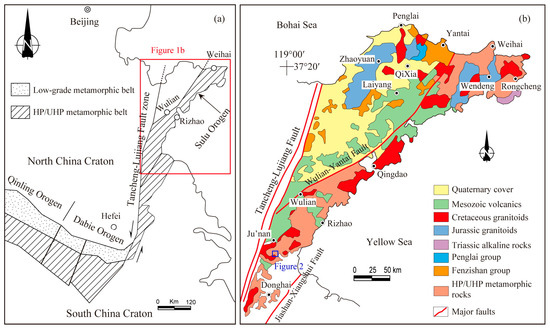
Figure 1.
(a) Simplified tectonic map of the Qinling–Dabie–Sulu Orogenic Belt in eastern China [8]; and (b) Geologic map of the Donghai–Linshu area in northern Jiangsu Province, China [28].
Early Cretaceous magmatic rocks (143–111 Ma [11,12,14,15,16,29,30,31,32,33,34,35,36]) are widely distributed throughout the Dabie–Sulu Orogenic Belt and are generally attributed to post-collisional magmatic activity following the orogeny between the North China and South China blocks. The presence of Neoproterozoic inherited zircon cores in some of the Early Cretaceous granites suggests the incorporation of deeply subducted Neoproterozoic orthogneisses in their magma sources [16,31,37,38].
3. Geology and Samples of the Jiashan Fluorite–Barite Deposit
The study area is situated in the Donghai-Linshu region along the southwestern margin of the Sulu ultrahigh-pressure (UHP) metamorphic belt (Figure 1a). The regional structural framework, influenced by the Tan-Lu Fault Zone, is dominated by NNE-NE and nearly E-W trending faults. These structures not only control the spatial distribution of the Mesozoic intrusive rocks but also function as critical ore-controlling features, and they host a series of non-metallic deposits—including the Jiashan fluorite–barite deposit examined in this study—along the E-W and NNE-NE trending fault zones (Figure 1b). Outcrops in the Donghai–Linshu area predominantly consist of pre-Indosinian metamorphic rocks and Mesozoic sequences. The pre-Indosinian metamorphic basement is mainly composed of various orthogneisses, with subordinate paragneiss, marble, kyanite quartzite, and eclogite [39,40]. Granitic gneisses that have undergone retrograde amphibolite-facies metamorphism constitute over 80% of the pre-Indosinian metamorphic rocks [28]. Previous studies indicate that the protoliths of the eclogites and orthogneisses were primarily Neoproterozoic rift-related bimodal volcanic rocks [41,42], which subsequently experienced UHP metamorphism [28,43,44,45]. The Mesozoic strata are dominated by the Lower Cretaceous Qingshan Formation and the Upper Cretaceous Wangshi Formation. The Qingshan Formation consists of sedimentary volcanic breccias, andesite, and andesitic volcanic breccias, while the Wangshi Formation consists of silty mudstone, sandstone, and conglomeratic sandstone, with localized copper mineralization.
Mesozoic magmatic rocks are extensively distributed in the Donghai–Linshu area, and their emplacement ages are concentrated in the Cretaceous (127–118 Ma [12,30,31,32]). These intrusions generally exhibit NE to NNE trends, collectively forming an NE-striking magmatic belt (Figure 1b). In the contact zone between the Taolin and Jiashan plutons, secondary faults and dense joint systems are well developed and frequently contain cataclasites and mineral veins filled with fluorite and barite. Representative fluorite–barite occurrences (or deposits) include those in Chutuan, Jiashan, Shanzuokou, Luozhuang, and Shuanghu.
The Jiashan fluorite–barite deposit, the focus of this investigation, is located on the eastern margin of the Jiashan pluton (Figure 1b). The Jiashan pluton is primarily composed of medium-grained monzogranite, as well as subordinate medium-grained porphyritic granodiorite, fine-grained porphyritic quartz diorite and monzonite. It predominantly intrudes into biotite monzonitic gneiss and K-feldspar gneiss of the regional metamorphic basement. A network of secondary fractures and densely jointed zones, which are mineralized with barite and fluorite, is developed along the periphery of the pluton. The Jiashan fluorite–barite deposit is specifically hosted within a fault zone along the pluton’s margin (Figure 2a).
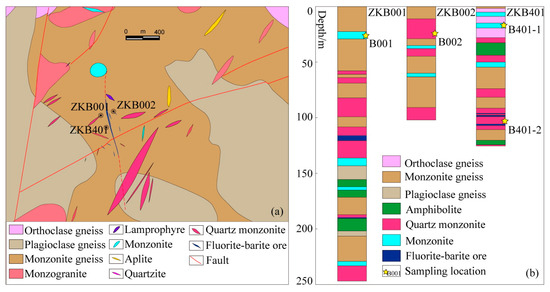
Figure 2.
(a) Geologic map of the Jiashan fluorite–barite deposit mining area; and (b) stratigraphic columns of the drill core samples.
The surface geology in the Jiashan mining area is dominated by the Donghai Group, comprising biotite monzonitic gneiss, biotite plagioclase gneiss, and biotite K-feldspar gneiss. Mesozoic magmatic rocks are extensively exposed within the area, including monzogranite, lamprophyre, (quartz) monzonite, fine-grained aplite dikes, and granite porphyry. With the exception of the monzogranite, which forms stock-like intrusions in the Donghai Group, the other lithologies typically occur as NE-trending dikes (Figure 2a). In contrast to the predominant NE orientation of these dikes, the main orebody of the Jiashan fluorite–barite deposit strikes approximately N-S (Figure 2a). Drill core logging confirms that the subsurface lithology is generally consistent with the surface exposures (Figure 2b), although amphibolite is additionally encountered in drill holes ZKB001 and ZKB401. The Mesozoic magmatic rocks intersected by the drill cores are predominantly monzonite and quartz monzonite (Figure 2b).
According to the mineral geological survey data from the Jiangsu Geological Exploration Institute, eight fluorite–barite mineralized veins has been identified within the Jiashan mining area, including two principal veins (Brt-1 and Brt-2) with widths of >0.5 m. Trenching data indicate that the main orebody (Brt-1) attains a maximum width of 5.4 m, strikes NNW to approximately NS, dips westward at 64°, extends over 600 m along strike, and exhibits gradual southward thinning. The vein is characterized by the coexistence of fluorite and barite, and the average CaF2 and BaSO4 contents are 20.41% and 50.45%, respectively. The immediate host rocks comprise granitic gneiss and biotite-hornblende plagioclase gneiss. The subsidiary Brt-2 vein measures approximately 0.7 m in width, strikes NW at 335°, and dips westward at 70°. This vein also contains associated fluorite and barite mineralization, with CaF2 and BaSO4 contents of 16.01% and 71.25%, respectively. Its wall rocks consist of lamprophyre dikes and biotite plagioclase gneiss.
Due to intense surface weathering in the study area, surface samples are not suitable for whole-rock geochemical analysis; therefore, we selected drill core samples for our analyses. The analyzed samples, obtained from drill cores collected within the mining area, comprise monzonite and quartz monzonite. In the drill core, the monzonite and quartz monzonite is usually cut by fluorite–barite veins, demonstrating that the fluorite–barite veins intruded later than the monzonite and quartz monzonite. The monzonite hand specimens exhibit gray-black to light brown coloration and display either fine-grained monzonitic (Figure 3a) or porphyritic textures (Figure 3b). Mineralogically, they predominantly consist of plagioclase (35%–50%) and alkali feldspar (30%–45%), with subordinate amphibole (2%–7%) and biotite (~5%). Quartz is present in trace amounts in some samples. The accessory minerals mainly include zircon (Figure 3b) and apatite. The plagioclase occurs as euhedral to subhedral crystals ranging from 0.2 to 1.5 mm in size, as well as phenocrysts up to 2 mm, and the composition is predominantly andesine to labradorite. Some of the phenocrysts exhibit distinct zoning (Figure 3b), and partial sericitization can be observed in certain grains. The alkali feldspar occurs as subhedral crystals, mostly measuring 0.2–1.2 mm, ns exhibits varying degrees of argillic alteration. Mafic minerals exhibit different extents of chloritization. The quartz monzonite hand specimens display gray-brown coloration and medium- to fine-grained, locally porphyritic textures (Figure 3c). Their mineral assemblage includes plagioclase (20%–35%), alkali feldspar (40%–50%), quartz (10%–15%), and minor biotite (2%–5%) (Figure 3d). The accessory minerals comprise zircon, sphene (Figure 3d), and apatite. The plagioclase crystals (0.5–2.0 mm) exhibit more developed polysynthetic twinning and greater euhedrality than the alkali feldspar, and some of the grains exhibit sericitization. The alkali feldspar is predominantly orthoclase (0.5–2 mm) with partial kaolinization. The quartz occurs as anhedral interstitial grains (0.3–0.8 mm) between feldspar grains. The biotite forms subhedral flakes (0.5–1 mm) with chloritization alteration.
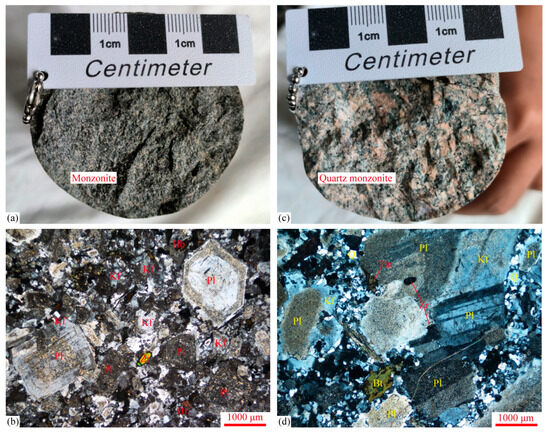
Figure 3.
Hand specimen and micrographic images of the Jiashan (a,b) monzonite and (c,d) quartz monzonite. Mineral abbreviations: Pl—Plagioclase; Kf—K-feldspar; Hb—Hornblende; Q—Quartz; Bt—Biotite; Ttn—titanite; Zr—Zircon.
4. Analytical Procedures
Zircon separation was performed using conventional magnetic separation and heavy liquid techniques to obtain preliminary concentrates of non-magnetic heavy minerals. Representative zircon grains were manually selected under a binocular microscope and mounted in epoxy resin. The mounts were subsequently polished to expose approximately one-third to one-half of each zircon grain for analysis. Transmitted and reflected light microscopy, as well as cathodoluminescence (CL) imaging, were employed to characterize the morphology and internal structures of the zircons.
The U–Pb zircon dating was conducted via laser ablation-inductively coupled plasma-mass spectrometry (LA–ICP–MS) at the Microanalysis Laboratory of Nanjing Hongchuang Exploration Technology Service Co., Ltd. The analytical system comprised a Resolution SE 193 nm deep-ultraviolet laser (Applied Spectra, West Sacramento, CA, USA) coupled with an S155 dual-volume sample cell and an Agilent 8900 ICP–MS instrument (Agilent, Santa Clara, CA, USA). Each analysis spot was pre-ablated with five laser pulses (3 μm depth) to eliminate surface contamination. The analytical conditions included a spot size of 30 μm, a repetition rate of 5 Hz, and a fluence of 3.5 J/cm2. The data reduction was performed using the Iolite software (2010) package [46]. Zircon standard as utilized as the external calibrant, while GJ-1 was analyzed as a quality control reference material. After every 10–12 sample analyses, two analyses of 91500 and one analysis of GJ-1 were conducted. The trace element data were processed using the Iolite program [47].
The whole-rock major and trace element analyses were performed by the ALS Laboratory Group (Guangzhou, China) and Nanjing Hongchuang Exploration Technology Service Co., Ltd., Nanjing, China, respectively. The major element concentrations were determined via X-ray fluorescence (XRF) spectrometry. The sample preparation involved thoroughly mixing 2 g of dried powder with Li2B4O7 flux in a 1:5 ratio and fusing the mixture into glass beads at 1150–1250 °C. The trace element analyses were conducted using ICP–MS. The sample digestion procedure was as follows: 50 mg of dried sample powder were weighed into a Teflon bomb, followed by sequential addition of 1 mL of high-purity HNO3 and 1 mL of high-purity HF. The sealed bomb was placed in a steel jacket and heated at 190 °C for over 24 h. After cooling, the solution was evaporated to dryness on a hotplate at 140 °C. Subsequently, 1 mL of HNO3 was added and the solution was evaporated again. Then, 1 mL of high-purity HNO3, 1 mL of Milli-Q water, and 1 mL of an internal standard solution containing 1 μg/g of In were added. The bomb was resealed and heated at 190 °C for over 12 h. The final solution was transferred to a polyethylene vial and diluted to 100 g with 2% HNO3 for ICP–MS measurement.
The fluoride (F) concentrations were determined using the ion-selective electrode (ISE) method at Nanjing Hongchuang Exploration Technology Service Co., Ltd. A 0.5 g sample aliquot was thoroughly mixed with 4 g of NaOH in a nickel crucible, followed by coverage with an additional 1 g of NaOH. The crucible was heated gradually to 700 °C in a muffle furnace, held at this temperature for 15 min, and then cooled. The fused material was transferred into a 250 mL plastic beaker containing approximately 60 mL of hot water. After rinsing the crucible with hot water, the solution was cooled, transferred to a 100 mL volumetric flask, shaken thoroughly, and filtered or clarified. A 10 mL aliquot of the supernatant was placed in a 50 mL plastic beaker, mixed with 7.5 mL of sodium citrate solution, and treated with two drops of phenol red indicator. The pH was adjusted to a rose-red hue using sodium hydroxide solution (50 g/L) and then was adjusted to an orange-red hue using hydrochloric acid (1 + 1) to achieve a pH of 6.8–7.1. Subsequently, 2.5 mL of triethanolamine buffer solution was added, and the mixture was transferred to a 50 mL volumetric flask, diluted to volume with water, and gently mixed. The fluoride content was measured using the ion-selective electrode method.
The in situ zircon Lu–Hf isotope analyses were performed at Nanjing FocusMS Technology Co., Ltd. Nanjing, China, using a 193 nm ArF excimer laser ablation system (Resolution LR) coupled to a Nu Plasma II multi-collector inductively coupled plasma mass spectrometer (MC–ICP–MS). The deep-ultraviolet laser beam, which was homogenized and focused onto the zircon surface, was operated at an energy density of 4.5 J/cm2. Each analysis consisted of a 20 s gas blank measurement followed by 40 s of ablation using a 44-μm spot size and a repetition rate of 9 Hz. The resulting aerosol was transported by helium from the ablation cell, mixed with argon, and introduced into the MC–ICP–MS for isotope ratio measurement. The data acquisition employed an integration time of 0.3 s per cycle, generating approximately 133 datasets over the 40 s ablation period. The analytical quality was monitored by alternating analyses of three zircon reference materials (including GJ-1, 91500, Plešovice, Mud Tank, and Penglai) after every 15 unknown zircon grains.
5. Results
5.1. Whole-Rock Major and Trace Elements
The whole-rock major and trace element analytical results are presented in Table 1. Due to samples’ elevated loss on ignition (LOI) values (1.42–4.17 wt.%; Table 1), the major element concentrations were recalculated to 100% on an anhydrous basis for petrogenetic discussion. The five monzonite samples exhibit moderate SiO2 contents (61.61%–62.41%), classifying them as intermediate rocks. They are characterized by high Na2O (3.65%–4.11%) and K2O (3.53%–4.17%) concentrations, with K2O/Na2O ratios ranging from 0.86 to 1.11. On the total alkali versus silica (TAS) diagram (Figure 4a), all of the samples plot within the monzonite field, which is consistent with the petrographic observations. On the K2O versus SiO2 diagram (Figure 4b), the samples plot in the transition zone between the high-K calc-alkaline and shoshonitic series. The rocks exhibit moderate Al2O3 contents (14.36–15.54 wt.%) and belong to the metaluminous series (A/CNK = 0.72–0.91). Additionally, they exhibit high MgO (2.92–4.62 wt.%), Mg# (54–66), TiO2 (0.58–0.84 wt.%), P2O5 (0.23–0.37 wt.%), total Fe2O3 (5.36–6.59 wt.%), and CaO (3.37–5.34 wt.%) values. In contrast, the quartz monzonite samples possess higher SiO2 (66.26–68.18 wt.%), Na2O (4.00–5.74 wt.%), and K2O (3.59–4.64 wt.%) contents. On the TAS diagram (Figure 4a), they plot within the quartz monzonite field, while on the K2O versus SiO2 diagram (Figure 4b), they primarily plot within the high-K calc-alkaline series. Their Al2O3 contents (14.39–16.02 wt.%) are slightly high than those of the monzonites, and they are also classified as metaluminous (A/CNK = 0.70–0.95). The quartz monzonites exhibit lower MgO (1.29–1.68 wt.%), Mg# (40–50), TiO2 (0.44–0.63 wt.%), P2O5 (0.18–0.27 wt.%), total FeO* (3.16–4.75 wt.%), and CaO (1.86–5.12 wt.%) contents compared to the monzonite samples.

Table 1.
Whole-rock major and trace element data for the Jiashan monzonite and quartz monzonite.
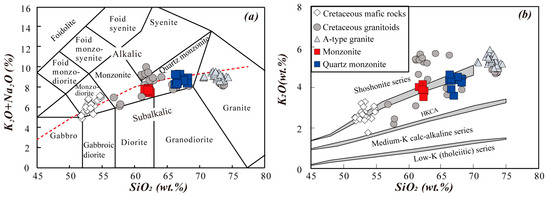
Figure 4.
(a) TAS and (b) SiO2 vs. K2O classification diagrams for the Jiashan monzonite and quartz monzonite. Data sources: Cretaceous mafic rocks [12,33]; Cretaceous granitoids comprising both normal granites [12,30,32] and A-type granites [12,34].
The monzonite and quartz monzonite from the Jiashan area display comparable total rare earth element (REE) contents, ranging from 191 to 226 μg/g and 153 to 230 μg/g, respectively. Their Chondrite-normalized (La/Yb)N ratios are 16.1–22.7 and 20.3–31.8, while their Eu anomalies (Eu/Eu*) are 0.84–1.00 and 0.97–1.02. The Chondrite-normalized REE diagrams (Figure 5a) reveal that the two rock types have consistent REE distribution patterns, but the quartz monzonite exhibits slightly lower light REE concentrations than the monzonite. The primitive mantle-normalized trace element spider diagrams (Figure 5b) indicate enrichment in large-ion lithophile elements (e.g., Rb, Ba, and Th) and light REEs, as well as depletions in high-field-strength elements (e.g., Nb, Ta, and Ti) for both lithologies. Notably, Zr and Hf do not exhibit significant depletion. The pronounced similarity of the trace and rare earth element patterns of the two rock types implies that they have a close genetic relationship. The geochemical characteristics of the quartz monzonite and monzonite include moderately high Sr (381–569 μg/g and 262–619 μg/g) and La (44.8–51.4 μg/g and 34.9–56.4 μg/g) contents, intermediate Y (18.4–21.0 μg/g and 13.1–19.9 μg/g) and Yb (1.62–2.15 μg/g and 1.06–1.86 μg/g) contents, and Sr/Y ratios of 18.0–30.8 and 16.1–47.1, respectively. Their (La/Yb)N values (16.1–22.7 and 20.3–31.8) are marginally lower than those characteristic of typical adakitic rocks (Figure 6).
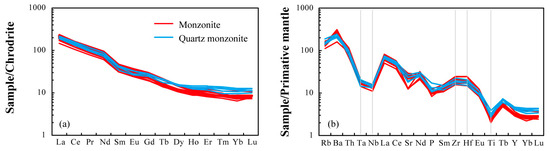
Figure 5.
(a) Chondrite-normalized REE patterns and (b) primitive mantle-normalized trace element spider diagrams for the Jiashan (quartz) monzonite.
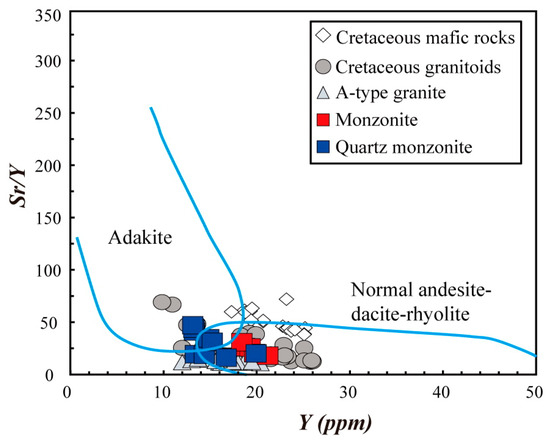
Figure 6.
Y vs. Sr/Y diagram showing the normal none-adakite signature of the Jiashan (quartz) monzonite.
5.2. U–Pb Zircon Ages
For this investigation, four samples from drill cores ZKB001 (B001, monzonite), ZKB002 (B002, quartz monzonite), and ZKB401 (B401-1, monzonite; B401-2, quartz monzonite) were selected for zircon U–Pb isotope and trace element analysis. The results are presented in Table 2. The zircon U–Pb concordia diagrams and weighted mean age calculations were generated using IsoplotR (2018) software [48]. The zircons from all samples are characterized as colorless, transparent, and euhedral short-prismatic crystals. For sample B001, the zircon dimensions typically range from 100 to 200 μm in length and from 70 to 150 μm in width, yielding length-to-width ratios of 2:1–3:1. Cathodoluminescence imaging revealed that the zircons have well-developed oscillatory zoning, which is consistent with a magmatic origin [49]. A minor population of zircons exhibits a rounded morphology with homogeneous, bright CL internal structures and oscillatory-zoned overgrowth rims (insets in Figure 7), suggesting that they are inherited or captured zircons.
Table 2.
U–Pb zircon dating isotopic data for the Jiashan monzonite and quartz monzonite.
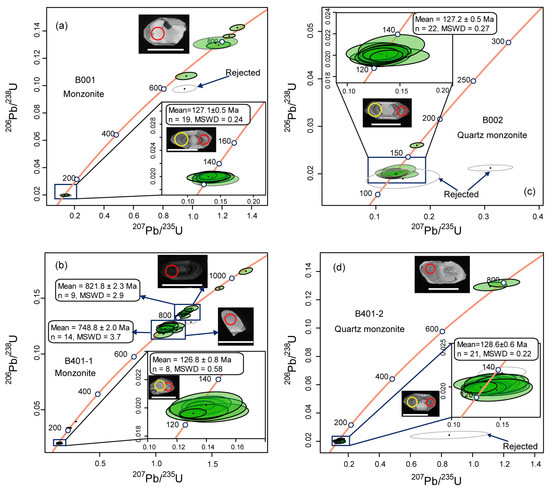
Figure 7.
Zircon U–Pb concordia diagrams for the Jiashan (a,b) monzonite and (c,d) quartz monzonite. The yellow/red circles represent the spot locations of Lu-Hf and U-Pb isotopic analyses. The scale length in the cathodoluminescence images are all 100 μm.
Twenty-five analytical spots yielded Th contents of 44.4–605 μg/g, U contents of 17.7–336 μg/g, and Th/U ratios of 0.15–3.05, which are consistent with the characteristics of magmatic zircon [49]. Five spots on rounded zircons yielded Neoproterozoic 206Pb/238U ages ranging from 604.3 ± 10.6 Ma to 858.6 ± 8.5 Ma. One yielded a discordant age and was therefore excluded from the calculation of the weighted mean age. The remaining 19 spots yielded clustered 206Pb/238U ages, with a weighted mean age of 127.1 ± 0.5 Ma (n = 19, MSWD = 0.24; Figure 7a).
The red circles represent the positions of the spots for the zircon U–Pb ages and trace elements, and the yellow circles are the locations of the zircon in situ Lu–Hf analysis. The scales on the cathodoluminescence images are all 100 μm.
The zircon crystals from monzonite sample B401-1 exhibit dimensions of 80–200 μm in length and 80–100 μm in width, with length-to-width ratios ranging from 3:2 to 3:1. Based on the morphological characteristics, these zircons can be classified into two distinct types: rounded grains, interpreted as inherited or captured zircons, and euhedral short-prismatic crystals displaying well-defined magmatic oscillatory zoning [49]. Analytical results from 34 spots yielded Th contents of 25.6–1802 μg/g, U contents of 66.7–1228 μg/g, and Th/U ratios of 0.15–3.74. Spot B401-1-16, characterized by low Th (26 μg/g) and U (162 μg/g) contents and a low Th/U ratio (0.16), is interpreted to be of metamorphic origin. Its 206Pb/238U age of 213.4 ± 3.4 Ma corresponds to the Indosinian metamorphic event in the Dabie–Sulu Orogenic Belt [18]. Spot B401-1-10 yielded a 207Pb/206Pb age of 1062.4 ± 38.2 Ma, while spot B401-1-21 yielded a 206Pb/238U age of 949.3 ± 6.5 Ma. The remaining 31 analytical spots are predominantly concentrated in three distinct age clusters (Figure 7b): 125.1–129.2 Ma, 718.5–771.6 Ma, and 809.0–845.4 Ma. The corresponding weighted mean ages are 126.8 ± 0.8 Ma (n = 8, MSWD = 0.58), 748.8 ± 2.0 Ma (n = 14, MSWD = 3.7), and 821.8 ± 2.3 Ma (n = 9, MSWD = 2.9).
The zircon crystals from quartz monzonite sample B002 predominantly range from 100 to 250 μm in length and from 70 to 130 μm in width, with length-to-width ratios of 2:1 to 3:1. The cathodoluminescence (CL) images display well-developed oscillatory zoning, characteristic of a magmatic origin [49]. The analytical results for 25 spots yielded Th contents of 26.7–544 μg/g, U contents of 15.3–366 μg/g, and Th/U ratios of 0.63–1.74, consistent with magmatic zircon characteristics [49]. After excluding spot B002-6 (33% concordance), spot B002-3 (206Pb/238U age of 165.9 ± 2.2 Ma), and spot B002-22 (high analytical uncertainty), the remaining 22 spots yielded clustered 206Pb/238U ages ranging from 125.4 ± 2.1 Ma to 132.1 ± 5.6 Ma, with a weighted mean age of 127.2 ± 0.5 Ma (n = 22, MSWD = 0.27; Figure 7c).
The zircon grains from quartz monzonite sample B401-2 range from 100 to 200 μm in length and from 80 to 120 μm in width, with length-to-width ratios of 2:1 to 3:1. Cathodoluminescence imaging revealed that the majority of the grains exhibit well-developed oscillatory zoning, consistent with a magmatic origin. A subordinate population of rounded zircons displays internal magmatic oscillatory zoning with bright, homogeneous overgrowth rims, suggesting an inherited or captured origin. The analytical results of 25 spots yielded Th contents of 33.3–295 μg/g, U contents of 31.5–262 μg/g, and Th/U ratios of 0.69–2.04, all of which are characteristic of magmatic zircons. After excluding spot B401-2-19 (−16% concordance) and spots B401-2-4 (138.2 ± 2.8 Ma), B401-2-17 (786.8 ± 11.4 Ma), and B401-2-24 (799.4 ± 10.5 Ma) due to their discordant ages, the remaining 21 spots yielded clustered 206Pb/238U ages ranging from 127.7 ± 2.7 Ma to 132.2 ± 3.9 Ma, with a weighted mean age of 128.6 ± 0.6 Ma (n = 21, MSWD = 0.22; Figure 7d).
In summary, both the monzonite and quartz monzonite from the Jiashan area were emplaced during the Early Cretaceous and have crystallization ages constrained between 126 and 129 Ma. These intrusions also contain abundant Neoproterozoic inherited or captured zircons, with ages predominantly ranging from 720 to 845 Ma.
5.3. Zircon Geochemistry
Zircons in magmatic rocks exhibit diverse origins; however, only those crystallized directly from the melt during magma solidification (i.e., magmatic zircons) can accurately record the source characteristics and physicochemical conditions of their parental magma. In this study, we focused exclusively on Cretaceous-aged zircons for detailed investigation. The in situ trace element analytical results are presented in Table 3. All of the analyzed zircon spots display Chondrite-normalized rare earth element (REE) patterns characterized by significant heavy rare earth element (HREE) enrichment and light rare earth elements (LREE) depletion. As illustrated on the REE diagrams (Figure 8), all of the zircons exhibit pronounced positive Ce anomalies and weakly negative Eu anomalies, consistent with typical magmatic zircon signatures.
Table 3.
Zircon in situ trace element data for the Jiashan monzonite and quartz monzonite.
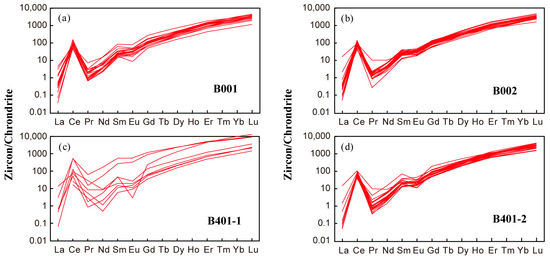
Figure 8.
Chondrite-normalized rare earth element distribution patterns of zircons from the Jiashan (a,c) monzonite and (b,d) quartz monzonite.
5.4. Zircon In Situ Lu–Hf Isotopes
A total of 95 Lu–Hf isotope analyses were performed on zircons from four samples, including 80 Early Cretaceous-aged grains and 15 Neoproterozoic-aged grains. The initial Hf isotope compositions for the Early Cretaceous zircons were calculated using their respective weighted mean ages, while the Neoproterozoic zircons were uniformly referenced to 800 Ma. The analytical results are provided in Table 4 (Supplementary Table S4). The Early Cretaceous zircons exhibit 176Lu/177Hf ratios of 0.000530–0.003585 and 176Hf/177Hf ratios of 0.281759–0.282399, yielding εHf(t) values of −33.7 to −23.5 (Figure 9a). The corresponding two-stage Hf model ages (TDM2) range from 2623 to 3247 Ma (Figure 9b). In contrast, the Neoproterozoic zircons exhibit 176Lu/177Hf ratios of 0.000489–0.003034 and 176Hf/177Hf ratios of 0.282055–0.282399, εHf(t) values of −8.6 to +3.4 (Figure 9a), and TDM2 ages of 1468–2215 Ma (Figure 9b). These results indicate that the two populations of zircons had distinct crustal residence histories. The consistent Hf isotopic signatures of the zircons from both the monzonite and quartz monzonite further support the inference that there is a genetic relationship between these two rock types.
Table 4.
Zircon in situ Lu–Hf isotope data for the Jiashan monzonitic rocks.
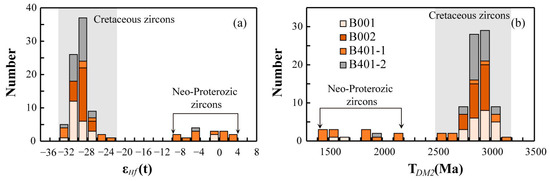
Figure 9.
Zircon (a) εHf(t); (b) two-stage Hf model ages (TDM2) spectrum diagram for the Jiashan (quartz) monzonite.
6. Discussion
6.1. Emplacement Timing of the Monzonite
The Phanerozoic magmatic rocks in the Sulu Orogenic Belt are primarily documented to be within three distinct age intervals: Triassic (225–205 Ma [13,14,21,23,24]), Jurassic (160–150 Ma [24,29]), and Cretaceous (130–118 Ma [12,15,16,30,32]). The Cretaceous magmatism was the most widespread episode and comprised mantle-derived mafic rocks (ca. 120 Ma [12,33]), normal granites (126–118 Ma [12,30,32]), and A-type granites (127–125 Ma [12,34]).
In this study, LA–ICP–MS U–Pb zircon dating of four magmatic rock samples from the Jiashan fluorite–barite mining area yielded Early Cretaceous emplacement ages ranging from 126 to 129 Ma. These results are consistent with previously documented Early Cretaceous magmatic activity in the Sulu Orogenic Belt and are slightly older than the reported crystallization ages of the adjacent Linian pluton (122 ± 5 Ma) and Kangrishan pluton (119 ± 2 Ma, [31]). Consequently, the monzonite and quartz monzonite in the Jiashan mining area represent products of Early Cretaceous magmatism within the Sulu Orogenic Belt.
6.2. Petrogenesis
6.2.1. Petrogenetic Type
Based on their genetic characteristics, granitic rocks are classified into I-type, S-type, and A-type granites [50,51]. The presence of peraluminous minerals such as cordierite is a key mineralogical indicator for S-type granites; however, no such minerals were observed in the Jiashan monzonite and quartz monzonite samples. Furthermore, these rocks exhibit metaluminous geochemical characteristics, contrasting with the strongly peraluminous nature typical of S-type granites (A/CNK > 1.1 [50]). The Ga/Al ratios (2.48–2.85 and 2.45–2.66) and Zr + Nb + Ce + Y values (averages of 338 μg/g and 332 μg/g) of the Jiashan rocks are significantly lower than the lower thresholds for typical A-type granites (≥2.6 and ≥350 μg/g for Ga/Al and Zr + Nb + Ce + Y values, respectively). Additionally, their low TFeO/MgO ratios (2.08–3.02 and 1.08–1.77) contrast markedly with those of A-type granites (TFeO/MgO > 16 [52]). Magmatic zircons, which crystallize directly from parental melts, preserve records of the source characteristics and magmatic evolution [53]. Trace element compositions of the zircons from the Jiashan samples further confirm an I-type affinity (Figure 10). Collectively, these lines of evidence demonstrate that the Jiashan monzonite and quartz monzonite belong to the I-type granite series.
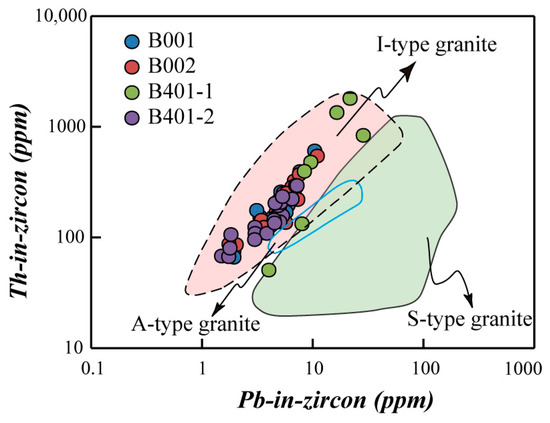
Figure 10.
Discrimination of rock types based on the trace element compositions of zircons from the Jiashan monzonite.
6.2.2. Source Characteristics and Petrogenesis
The Jiashan monzonite and quartz monzonite exhibit elevated fluorine (F) concentrations (801–1199 μg/g and 725–3836 μg/g, respectively), significantly exceeding the average F abundance of the global silicate crust (~557 μg/g [54]), classifying these magmatic rocks as fluorine-rich granitoids. The genesis of such fluorine-enriched granitoids is closely linked to high F concentrations in both the magma source region and during the magmatic evolution. Potential source regions for fluorine-rich granitoids primarily include two origins [55]: (1) partial melting of fluorine-rich crustal materials, such as fluorine-bearing sedimentary rocks or metagranites; and (2) decomposition of fluorine-bearing minerals within the mantle, including apatite, amphibole, and mica, as well as nominally anhydrous minerals such as olivine and pyroxene [56,57,58,59,60]. Partial melting of fluorine-rich metasedimentary or metaigneous source rocks can generate intermediate to felsic magmas enriched in fluorine. Subsequent crystallization differentiation may lead to the formation of lithium- and fluorine-rich rare-metal granites/pegmatites or the exsolution of fluorine-rich hydrothermal fluids [61]. For example, the source of Late Mesozoic granites in the Nanling Range, South China, has been interpreted to be fluorine-enriched Mesoproterozoic crust [62,63,64]. Metasomatism affecting the mantle source in subduction or intraplate settings is a key mechanism for introducing mantle-derived fluorine [65,66]. In subduction zones, slab dehydration releases fluorine-rich fluids that metasomatize the overlying mantle wedge, creating an enriched mantle source. Subsequent mantle melting can then produce fluorine-rich melts [67]. Additionally, the positive correlation between fluorine and K2O observed in intraplate basalts, such as Deccan tholeiites, Hawaiian tholeiites, alkaline basalts, and Atlantic mid-ocean ridge alkaline rocks, suggests magma derivation from phlogopite-bearing mantle sources [68]. Under later tectonic or thermal perturbations, such metasomatically enriched mantle sources may undergo a low degree of partial melting, generating potassium- and fluorine-rich alkaline magmas [69].
The Jiashan monzonite and quartz monzonite are classified as I-type granites, precluding their origin via a low of degree partial melting of metasedimentary rocks. Their elevated fluorine contents are more plausibly attributed to contributions from mantle-derived melts or fluids. This interpretation is supported by multiple lines of evidence. First, the SiO2 contents of the Jiashan monzonite (61.61–62.41 wt.%) and quartz monzonite (66.26–68.18 wt.%) are within the intermediate range. Their compatible element concentrations, such as Cr (87.9–227 μg/g and 9.81–43.1 μg/g) and Ni (27.6–66.5 μg/g and 5.10–13.5 μg/g), are relatively low and significantly lower than those typical of primary magmas derived from melting of mantle peridotite (Cr = 500–600 μg/g, Ni = 250–300 μg/g [70]). Primitive mantle-normalized trace element diagrams reveal that the samples are enriched in large-ion lithophile elements (e.g., Rb, Ba, and Th) and light rare earth elements, as well as depleted in high-field-strength elements (e.g., Nb, Ta, and Ti), indicating an affinity with continental crust [71]. Furthermore, the zircon Hf isotope compositions of the Jiashan rocks are highly enriched (εHf(t) = −33.7 to −23.5), collectively suggesting a predominantly crustal source for the magmas. Second, the substantial variation in the zircon εHf(t) values, spanning approximately 10 epsilon units, cannot be explained by melting of a single crustal source. The elevated Mg# values of the monzonite (54–66) and quartz monzonite (40–50), which exceed those of pure crustal melts (<45 [72]), indicate the involvement of deep mantle-derived components in the parental magmas. The presence of Neoproterozoic-aged zircons further supports the occurrence of mantle contributions. Although previous studies have attributed the presence of Neoproterozoic inherited zircons in Early Cretaceous granites in the Dabie–Sulu Orogenic Belt to deeply subducted orthogneisses [31,37,38,42], the significantly different two-stage Hf model ages of the Neoproterozoic zircons analyzed in this study suggest they are more likely captured grains rather than inherited grains. This implies that the parental magma of the Jiashan monzonite assimilated Neoproterozoic felsic igneous rocks prior to its final consolidation. Given that the SiO2 contents of the monzonite range from 61.61 wt.% to 62.41 wt.%, the primitive magma would have had an even lower SiO2 content before assimilation, indicating a contribution from mantle-derived components.
The zircon εHf(t) values of the Jiashan monzonite and quartz monzonite exhibit limited variation, ranging from −33.7 to −23.5, with corresponding two-stage Hf model ages predominantly between 2623 and 3247 Ma. This indicates that their source materials were primarily ancient crustal components derived from the primitive mantle during the Archean. The Sulu Orogenic Belt hosts numerous granitoids and minor mafic rocks contemporaneous with the Jiashan intrusions. These Cretaceous intrusions include A-type granites [12,34] and normal granites [30,32]. The Cretaceous A-type granites (−26.1 to −19.8 [12]) and mafic rocks (−23.5 to −21.1 [12]) exhibit consistently enriched zircon εHf(t) values. Although zircon Hf isotope data are unavailable for the Cretaceous normal granites, their whole-rock Nd isotope compositions are similar to those of A-type granites [12,31], suggesting that they have comparable Hf isotope characteristics. These findings imply that the Jiashan monzonite and quartz monzonite were derived from a more ancient crustal source than other contemporaneous granitoids in the Sulu Orogenic Belt.
To the south of the Sulu Orogenic Belt, the Middle-Lower Yangtze River Belt also experienced extensive Early Cretaceous magmatism, which can be divided into three stages. The first stage, associated with porphyry Cu–Au mineralization (e.g., granodiorites in the Tongling area, 148–133 Ma), exhibits zircon εHf(t) values of −38.6 to −6.6 [73]. The second stage comprises shoshonitic volcanic rocks in fault-controlled basins (e.g., volcanic rocks in the Ningwu Basin) and were derived from an enriched lithospheric mantle with εHf(t) values of −13.3 to −3.8 [73]. The third stage is represented by A-type granites (e.g., Binjiang, Fushan, and Banshiling plutons in the Fanchang Basin) with εHf(t) values of −7.9 to 0, indicating reworking of Neoproterozoic crustal materials [73]. The low zircon εHf(t) values of the first-stage magmatic rocks in the Tongling area closely resemble those of the Jiashan intrusions, while the second- and third-stage magmas exhibit significantly different Hf isotope signatures. This suggests that the Jiashan magmas share a similar ancient crustal source with the first-stage magmatic rocks in the Middle-Lower Yangtze River Belt.
To the west of the Tancheng–Lujiang Fault Zone, the Dabie Orogenic Belt also hosts Early Cretaceous magmatic rocks, which are predominantly granitic in composition. These granitoids can be subdivided into two groups: earlier ore-barren and later Mo–Pb–Zn-related granitoids (Figure 11) [21,74,75,76,77,78,79,80,81]. The zircon εHf(t) values of the ore-barren granitoids (peaking around −28; [76,79,80,82]) are similar to those of the Jiashan monzonite and quartz monzonite, suggesting a relatively consistent crustal source for both regions. The North Dabie and Central Dabie tectonic units, exposed within the Dabie Orogenic Belt, are composed primarily of Neoproterozoic orthogneisses and paragneisses, respectively. The zircon εHf(t) values of these gneisses are generally greater than −15 (Figure 11) [43,83,84]. Although the Sr–Nd–Pb isotope compositions of Early Cretaceous magmatic rocks in the central Dabie region resemble those of the North Dabie Neoproterozoic gneisses, leading some researchers to propose a genetic link [85], this interpretation faces a significant contradiction. If the North Dabie Neoproterozoic gneisses evolved to 130 Ma with an average crustal Lu/Hf ratio, their calculated εHf(t) values would exceed −20. This contrasts sharply with the observed εHf(t) values of Early Cretaceous magmatic rocks in the Dabie–Sulu Orogenic Belt, including the Jiashan monzonite, most of which are below −20. This discrepancy indicates that the Mesozoic magmatic rocks in the Dabie Orogenic Belt could not have been derived directly from the melting of North Dabie Neoproterozoic gneisses and instead originated from more ancient crustal materials.
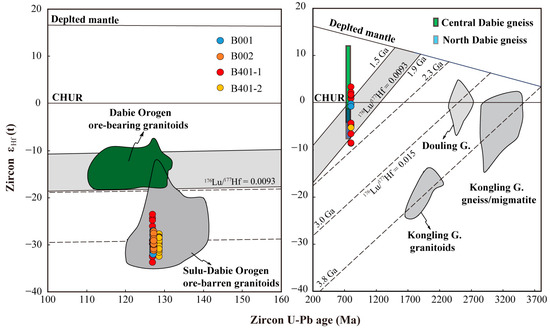
Figure 11.
Zircon U–Pb age versus εHf(t) diagram for the Jiashan monzonite. Data sources: Kongling Complex gneiss/migmatite and granite [86,87]; Douling Group [88]; Northern Dabie gneiss [83]; Central Dabie gneiss; Ore-barren granitoids in the Dabie–Sulu region [21,76,79,80]; and Mo–Pb–Zn-related ore-bearing granitoids [74,75,77,78,81].
Regarding the nature of this ancient crust, some scholars have proposed that it resembles the oldest exposed basement in the Lower Yangtze region, specifically the Kongling Group [86,87]. The Kongling Group comprises Archean gneisses and migmatites (2.7–3.4 Ga) and Paleoproterozoic deformed granites (1.65–2.20 Ga). When the zircon Hf isotope compositions of these rocks are projected to approximately 130 Ma using an average crustal Lu/Hf ratio, their calculated εHf(t) values fall below −35 (Figure 11) [86,87]). This isotopic signature is significantly more ancient than that inferred for the source of the Jiashan monzonite. Alternatively, recently reported dioritic to granitic gneisses in the Douling Group in the South Qinling Orogenic Belt have yielded zircon εHf(t) values ranging from −10.1 to +4.4. When projected to 130 Ma using an average crustal Lu/Hf ratio, these values align closely with the Hf isotope compositions of Early Cretaceous magmatic rocks in the Dabie–Sulu Orogenic Belt, including the Jiashan monzonite (Figure 11) [88]. Crustal materials with similar isotopic characteristics are also minimally exposed within the Dabie Orogenic Belt (e.g., Huangtuling gneiss [89]). Given that the oldest Hf model ages of the Early Cretaceous magmatic rocks in the Dabie–Sulu Orogenic Belt closely match those of the Douling Group granitic gneisses (and the Huangtuling gneiss) and no samples exhibit model ages older than those of the Douling Group, it is plausible that the Mesozoic magmatic rocks in the Dabie–Sulu Orogenic Belt, including the Jiashan monzonite, were generated directly via partial melting of ancient materials similar to the Douling Group [90].
Despite differences in their major element compositions, the Jiashan monzonite and quartz monzonite display highly consistent Chondrite-normalized rare earth element (REE) patterns, primitive mantle-normalized trace element spider diagrams, and zircon εHf(t) values, indicating that they were derived from cogeneric magmas through magmatic evolution. On Harker diagrams (Figure 12), the Jiashan rocks, together with contemporaneous mafic rocks, normal granites, and A-type granites within the Sulu Orogenic Belt, exhibit broadly linear evolutionary trends. There are negative correlations between the SiO2 content and the TiO2, Al2O3, FeO*, MgO, CaO, and P2O5 contents, while there is a positive correlation between the SiO2 content and the K2O content. These trends suggest fractional crystallization of minerals such as Fe-Ti oxides, plagioclase, apatite, and amphibole and/or biotite. However, the absence of pronounced Eu anomalies in the Jiashan samples indicates that the amount of plagioclase fractionation was not significant.
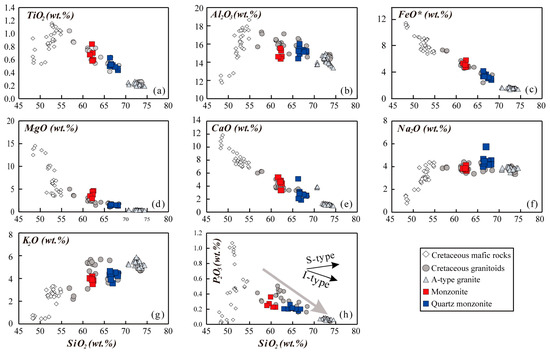
In summary, based on the results of this study, we propose that the Jiashan monzonite and quartz monzonite originated through mixing of felsic magmas derived from partial melting of ancient crustal materials analogous to the Kongling Group and mantle-derived mafic magmas, followed by fractional crystallization of minerals, including ilmenite, apatite, amphibole, and/or biotite.
6.3. Geological Significance
The formation of fluorine-rich granites is closely associated with specific tectonic settings, including (1) subduction zone environments, such as active continental margins or island arcs. For example, the Late Mesozoic W-Sn metallogenic granites in South China are genetically linked to the subduction of the Paleo-Pacific Plate, and their elevated fluorine contents were potentially derived from fluids released by dehydration of the subducted slab. (2) Post-collisional extensional settings: Fluorine-rich granites in such contexts often exhibit A-type affinities, indicative of anorogenic extensional regimes. (3) Intraplate rift or mantle plume environments: These environments are exemplified by fluorine-rich alkaline granites in the East African Rift, which are closely associated with mantle plume activity.
The Dabie–Sulu Orogenic Belt formed through the Indosinian collision between the South China and North China blocks [9]. The extensive Early Cretaceous magmatism in the region postdates the Indosinian collision by approximately 100 Ma, supporting the widely accepted interpretation that its formation was related to post-collisional orogenic collapse. Studies indicate that from the Jurassic to Early Cretaceous, regional tectonic extension and lithospheric thinning occurred in the North China Block and the Lower Yangtze region [91]. This tectonic activity was attributed to the westward subduction of the Paleo-Pacific Plate beneath the Asian continental plate. As part of the Early Cretaceous magmatism within the Dabie–Sulu Orogenic Belt, the Jiashan magmatic rocks are broadly associated with the subduction of the Paleo-Pacific Plate during the Yanshanian. On the Rb–(Y+Nb) tectonic discrimination diagram (Figure 13), all of the Jiashan samples plot within the post-collisional granite field, which is consistent with an extensional tectonic environment.
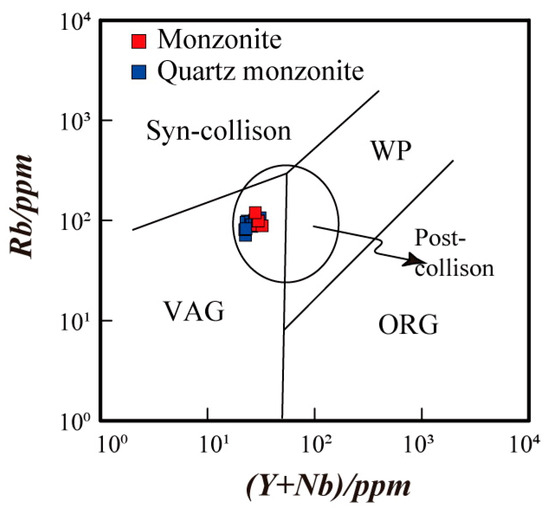
Figure 13.
Tectonic discrimination diagrams for the Jiashan (quartz) monzonite.
Fluorine plays a critical role in magmatic evolution by modifying melt physicochemical properties and directly influencing rare metal enrichment and mineralization processes. Fluorine-rich granites are not only potential sources of fluorine but also hold particular significance for rare metal mineralization [92]. As a volatile component, fluorine significantly reduces the viscosity of the melt during magmatic stages, prolonging differentiation and promoting extreme enrichment of rare metals (e.g., W, Sn, Nb, Ta, and REE) in residual melts [93,94,95]. Furthermore, high fluorine concentrations suppress the crystallization of biotite and amphibole, facilitating the preferential precipitation of rare metal minerals such as wolframite and columbite [55,96], thereby directly controlling the mineralization type and scale. During hydrothermal stages, fluorine forms stable complexes with metal cations (e.g., Nb5+), such as NbF2(OH)3 and [Nb(OH)3F3]− [97,98], enhancing their mobility and ultimately leading to large-scale ore precipitation under abrupt physicochemical changes (e.g., cooling and boiling). Studies indicate that many large to super-large rare metal deposits are consistently fluorine-rich [61,99,100]. Fluorine-rich granites are often associated with tungsten–tin quartz-vein deposits (e.g., the South China W-Sn metallogenic belt [101]) and Nb-Ta-REE deposits (e.g., the Baerzhe deposit in Inner Mongolia [99,102]). Thus, fluorine-rich granites serve as both carriers of rare metals and chemical engines for mineralization, and the fluorine content and magmatic–hydrothermal evolution paths collectively determine efficiency of the enrichment and the economic value of the deposit. Research has demonstrated that fluorine governs the mineralization of high-field-strength elements (e.g., W, Sn, Nb, Ta, REE, and U) by modifying the physicochemical properties of magmatic–hydrothermal fluids [92] and can be associated with fluorite and cryolite deposits [103]. The Jiashan fluorine-rich quartz monzonite exhibits moderate SiO2 content but significantly higher fluorine concentrations than average in the global silicate crust. As a highly incompatible element, fluorine tends to become concentrated in residual melts during magmatic evolution. Therefore, the area may hold potential for rare metal mineralization associated with the Early Cretaceous high-silica granites.
7. Conclusions
In this study, based on integrated isotopic geochronology, petrogeochemistry, and isotopic analyses of monzonite and quartz monzonite from drill cores in the Jiashan fluorite–barite mining area in northern Jiangsu, in conjunction with regional geological data, the following conclusions were drawn:
- (1)
- U–Pb zircon dating constrains the emplacement ages of the Jiashan monzonite (127.1 ± 0.5 Ma and 126.8 ± 0.8 Ma) and quartz monzonite (127.2 ± 0.5 Ma and 128.6 ± 0.6 Ma) to the Early Cretaceous, indicating that they represent products of contemporaneous magmatic activity within the Sulu Orogenic Belt.
- (2)
- The Jiashan monzonite and quartz monzonite are metaluminous, alkali-rich I-type granites. They exhibit highly consistent trace element and rare earth element characteristics, including enrichment in large-ion lithophile elements (Rb, Th, and U) and light rare earth elements and depletion in high-field-strength elements (Nb, Ta, and Ti). Their uniform zircon Hf isotope compositions (εHf(t) = −33.7 to −23.5) indicate that they were primarily derived from partial melting of Archean crustal sources, with minor contributions from mantle-derived materials.
- (3)
- The quartz monzonite formed through fractional crystallization of the parental monzonitic magma, which involved minerals such as ilmenite, apatite, amphibole, and/or biotite. The emplacement of the Jiashan intrusions is associated with localized extension triggered by the westward subduction of the Paleo-Pacific Plate during the Yanshanian. The discovery of fluorine-rich magmatic rocks in the Jiashan area suggests that this area has significant potential for rare metal mineralization related to the Early Cretaceous high-silica granites.
Supplementary Materials
The following supporting information can be downloaded at https://www.mdpi.com/article/10.3390/min16020137/s1. Table S1: U–Pb zircon dating isotopic data for the Jiashan monzonite and quartz monzonite; Table S2: Zircon in situ trace element data for the Jiashan monzonite and quartz monzonite; Table S3: Whole-rock major and trace element data for the Jiashan monzonite and quartz monzonite; and Table S4: Zircon in situ Lu–Hf isotopic data for the Jiashan monzonite and quartz monzonite.
Author Contributions
Conceptualization, T.K. and X.-Q.L.; field investigation, T.K., P.Z. and X.-Q.L., methodology, D.H., W.-G.Z., B.D. and Z.-M.C.; validation, X.-Q.L.; formal analysis, X.-Q.L.; data curation, T.K. and X.-Q.L.; writing—original draft preparation, T.K. and X.-Q.L.; writing—review and editing, T.K. and X.-Q.L.; funding acquisition, T.K. and X.-Q.L. All authors have read and agreed to the published version of the manuscript.
Funding
This research was supported by the Special Fund Projects for Natural Resources Development in Jiangsu Province [grant number SCZH2023-30 and SCZH2024-33].
Data Availability Statement
All of the data are presented in the paper.
Acknowledgments
The authors express their sincere appreciation to the anonymous reviewers for their thorough evaluation of the manuscript and their insightful comments and suggestions.
Conflicts of Interest
The authors declare that there are no conflicts of interest.
References
- Wang, J.; Shang, P.; Xiong, X.; Yang, H.; Tang, Y. The classification of fluorite deposits in China. Geol. China 2014, 41, 315–325. [Google Scholar]
- Zou, H.; Zhang, S.; Fang, Y.; Wang, G.; Cao, H.; Zhang, P.; Huang, F. Current situation and prospect of fluorite deposit researches in China. Sci. Technol. Manag. Land Resour. 2012, 29, 35–42. [Google Scholar]
- Deng, X.; Chen, Y.; Yao, J.; Bagas, L.; Tang, H. Fluorite REE-Y (REY) geochemistry of the ca. 850 Ma Tumen molybdenite–fluorite deposit, eastern Qinling, China: Constraints on ore genesis. Ore Geol. Rev. 2014, 63, 532–543. [Google Scholar] [CrossRef]
- Han, B.; Shang, P.; Gao, Y.; Jiao, S.; Yao, C.; Zou, H.; Li, M.; Wang, L.; Zheng, H. Fluorite deposits in China: Geological features, metallogenic regularity, and research progress. China Geol. 2020, 3, 473–489. [Google Scholar]
- Pei, Q.; Zhang, S.; Santosh, M.; Cao, H.; Zhang, W.; Hu, X.; Wang, L. Geochronology, geochemistry, fluid inclusion and C, O and Hf isotope compositions of the Shuitou fluorite deposit, Inner Mongolia, China. Ore Geol. Rev. 2017, 83, 174–190. [Google Scholar] [CrossRef]
- Zou, H.; Li, M.; Santosh, M.; Zheng, D.; Cao, H.; Jiang, X.; Chen, H.; Li, Z. Fault-controlled carbonate-hosted barite-fluorite mineral systems: The Shuanghe deposit, Yangtze Block, South China. Gondwana Res. 2022, 101, 26–43. [Google Scholar] [CrossRef]
- Wang, J.; Shang, P.; Xiong, X.; Yang, H.; Tang, Y. Metallogenic regularities of fluorite deposits in China. Geol. China 2015, 41, 18–32. [Google Scholar] [CrossRef]
- Zheng, Y.; Wang, Z.; Li, S.; Zhao, Z. Oxygen isotope equilibrium between eclogite minerals and its constraints on mineral Sm-Nd chronometer. Geochim. Cosmochim. Acta 2002, 66, 625–634. [Google Scholar] [CrossRef]
- Suo, S.; Zhong, Z.; Zhou, H.; You, Z. Polyphase tectonometamorphic evolution of UHP metamorphic rocks in the Dabie-Sulu region, east-central China. Acta Petrol. Sin. 2005, 21, 1175–1187. [Google Scholar]
- Wu, F.; Lin, J.; Wilde, S.A.; Zhang, X.; Yang, J. Nature and significance of the Early Cretaceous giant igneous event in eastern China. Earth Planet. Sci. Lett. 2005, 233, 103–119. [Google Scholar] [CrossRef]
- Lan, T.; Fan, H.; Santosh, M.; Hu, F.; Yang, K.; Yang, Y.; Liu, Y. Geochemistry and Sr–Nd–Pb–Hf isotopes of the Mesozoic Dadian alkaline intrusive complex in the Sulu orogenic belt, eastern China: Implications for crust–mantle interaction. Chem. Geol. 2011, 285, 97–114. [Google Scholar] [CrossRef]
- Liu, S.; Hu, R.; Gao, S.; Feng, C.; Qi, Y.; Wang, T.; Feng, G.; Coulson, I.M. U–Pb zircon age, geochemical and Sr–Nd–Pb–Hf isotopic constraints on age and origin of alkaline intrusions and associated mafic dikes from Sulu orogenic belt, Eastern China. Lithos 2008, 106, 365–379. [Google Scholar] [CrossRef]
- Yang, J.; Chung, S.; Wilde, S.A.; Wu, F.; Chu, M.; Lo, C.; Fan, H. Petrogenesis of post-orogenic syenites in the Sulu Orogenic Belt, East China: Geochronological, geochemical and Nd-Sr isotopic evidence. Chem. Geol. 2005, 214, 99–125. [Google Scholar] [CrossRef]
- Yang, J.; Wu, F.; Chung, S.; Wilde, S.A.; Chu, M.; Lo, C.; Song, B. Petrogenesis of Early Cretaceous intrusions in the Sulu ultrahigh-pressure orogenic belt, east China and their relationship to lithospheric thinning. Chem. Geol. 2005, 222, 200–231. [Google Scholar] [CrossRef]
- Zhang, J.; Zhao, Z.; Zheng, Y.; Dai, M. Postcollisional magmatism: Geochemical constraints on the petrogenesis of Mesozoic granitoids in the Sulu orogen, China. Lithos 2010, 119, 512–536. [Google Scholar] [CrossRef]
- Zhang, J.; Zhao, Z.; Zheng, Y.; Liu, X.; Xie, L. Zircon Hf–O isotope and whole-rock geochemical constraints on origin of postcollisional mafic to felsic dykes in the Sulu orogen. Lithos 2012, 136–139, 225–245. [Google Scholar] [CrossRef]
- Okay, A.I.; Xu, S.; Sengor, A.M.C. Coesite form the Dabie Shan eclogites, central China. Eur. J. Mineral. 1989, 1, 595–598. [Google Scholar] [CrossRef]
- Zheng, Y. A perspective view on ultrahigh-pressure metamorphism and continental collision in the Dabie-Sulu Orogenic Belt. Chin. Sci. Bull. 2008, 53, 2129–2152. [Google Scholar] [CrossRef]
- Hu, J.; Qiu, J.; Wang, R.; Jiang, S.; Ni, P.; Yu, H. Geochemistry of gneissic alkaline granites in Donghai County, Jiangsu Province, and its tectonic significances. Acta Geol. Sin. 2006, 80, 1877–1891. [Google Scholar]
- Hu, J.; Qiu, J.; Wang, R.; Jiang, S.; Yu, H.; Ni, P. Earliest response of the Neoproterozoic Rodinia break-up in the northeastern Yangtze Craton: Constraints from zircon U-Pb geochronology and Nd isotopes of the gneissic alkaline granites in Donghai area. Acta Petrol. Sin. 2007, 23, 1321–1333. [Google Scholar]
- Xu, H.; Zhang, J.; Wang, Y.; Liu, W. Late Triassic alkaline complex in the Sulu UHP terrane: Implications for post-collisional magmatism and subsequent fractional crystallization. Gondwana Res. 2016, 35, 390–410. [Google Scholar] [CrossRef]
- Zhao, Z.; Zheng, Y.; Zhang, J.; Dai, L.; Li, Q.; Liu, X. Syn-exhumation magmatism during continental collision: Evidence from alkaline intrusives of Triassic age in the Sulu orogen. Chem. Geol. 2012, 328, 70–88. [Google Scholar] [CrossRef]
- Gao, T.; Chen, J.; Xie, Z.; Yan, J.; Qian, H. Geochemistry of Triassic igneous complex at Shidao in the Sulu UHP metamorphic belt. Acta Petrol. Sin. 2004, 20, 36–49. [Google Scholar]
- Guo, J.; Chen, F.; Zhang, X.; Sieblew, Z.; Zhai, M. Evolution of syn- to post-collisional magmatism from north Sulu UHP belt, eastern China: Zircon U-Pb geochronology. Acta Petrol. Sin. 2005, 21, 1281–1301. [Google Scholar]
- Zhao, Z.; Zheng, Y. Remelting of subducted continental lithosphere: Petrogenesis of Mesozoic magmatic rocks in the Dabie-Sulu orogenic belt. Sci. China Ser. D Earth Sci. 2009, 52, 1295–1318. [Google Scholar] [CrossRef]
- Liu, F.L.; Robinson, P.T.; Liu, P.H. Multiple partial melting events in the Sulu UHP terrane: Zircon U–Pb dating of granitic leucosomes within amphibolite and gneiss. J. Metamorph. Geol. 2012, 30, 887–906. [Google Scholar] [CrossRef]
- Li, W.; Chen, R.; Zheng, Y.; Li, Q.; Hu, Z. Zirconological tracing of transition between aqueous fluid and hydrous melt in the crust: Constraints from pegmatite vein and host gneiss in the Sulu orogen. Lithos 2013, 162–163, 157–174. [Google Scholar] [CrossRef]
- Liu, F.; Xu, Z.; Xue, H. Tracing the protolith, UHP metamorphism, and exhumation ages of orthogneiss from the SW Sulu terrane (eastern China): SHRIMP U–Pb dating of mineral inclusion-bearing zircons. Lithos 2004, 78, 411–429. [Google Scholar] [CrossRef]
- Zhao, Z.; Liu, Z.; Chen, Q. Melting of subducted continental crust: Geochemical evidence from Mesozoic granitoids in the Dabie-Sulu orogenic belt, east-central China. J. Asian Earth Sci. 2017, 145, 260–277. [Google Scholar] [CrossRef]
- Ding, W.; Wang, T.; Li, Y.; Zhang, S. Petrogenesis of the Linshu monzonitic granite in the southern part of the Sulu Orogen. Bull. Mineral. Petrol. Geochem. 2018, 37, 344–354. [Google Scholar]
- Meng, F.; Shi, R.; Li, T.; Liu, F.; Xu, Z. The ages and sources of late Mesozoic granites in Southern Sulu region. Acta Geol. Sin. 2006, 80, 1867–1876. [Google Scholar]
- Meng, F.; Xu, Z.; Zhang, Z.; Liu, F. Geochemistry characteristics of the Mesozoic post-collisional granites in Northern Jiangsu, China and their geologica implications. Acta Geol. Sin. 2003, 77, 566–576. [Google Scholar]
- Meng, F.; Xue, H.; Li, T.; Yang, H.; Li, F. Enriched characteristics of Late Mesozoic mantle under the Sulu Orogenic Belt: Geochemical evidence from gabbro in Rushan. Acta Petrol. Sin. 2005, 21, 1583–1592. [Google Scholar]
- Wang, T.; Liu, S.; Hu, R.; Feng, C.; Qi, Y.; Feng, G.; Wang, C. Elemental geochemistry and petrogenesis of A-type granites in the Sulu Orogen. J. Jilin Univ. (Earth Sci. Ed.) 2009, 39, 676–688. [Google Scholar]
- Wang, T.; Liu, S.; Hu, R.; Feng, C.; Qi, Y.; Feng, G.; Yang, Y. Petrogenesis of alkaline rocks in the Sulu Orogen: Evidence from elemental geochemistry. Acta Mineral. Sin. 2010, 30, 194–206. [Google Scholar]
- Wang, T.; Liu, S.; Ma, R. Elemental geochemistry and petrogenesis of the Yanshanian alkaline syenites in Jiaonan, Shandong Province. J. Mineral. Petrol. 2013, 33, 54–62. [Google Scholar]
- Tang, J.; Zheng, Y.; Gong, B.; Wu, Y.; Gao, T.; Yuan, H.; Wu, F. Extreme oxygen isotope signature of meteoric water in magmatic zircon from metagranite in the Sulu orogen, China: Implications for Neoproterozoic rift magmatism. Geochim. Cosmochim. Acta 2008, 72, 3139–3169. [Google Scholar] [CrossRef]
- Zhao, Z.; Zheng, Y.; Dai, L. Origin of residual zircon and the nature of magma source for postcollisional granite in continental collision zone. Chin. Sci. Bull. 2013, 58, 2285–2289. [Google Scholar]
- Zhao, Z.; Zheng, Y.; Chen, B.; Wu, Y. A geochemical study of element and Sr-Nd isotopes for eclogite and gneiss from CCSD core 734 to 933 m. Acta Petrol. Sin. 2005, 21, 325–338. [Google Scholar]
- Liu, F.; Xu, Z.; Katayama, I.; Yang, J.; Maruyama, S.; Liou, J.G. Mineral inclusions in zircons of para- and orthogneiss from pre-pilot drillhole CCSD-PP1, Chinese Continental Scientific Drilling Project. Lithos 2001, 59, 199–215. [Google Scholar] [CrossRef]
- Jahn, B.M. Sm-Nd isotope tracer study of UHP metamorphic rocks: Implications for continental subduction and collisional tectonics. Int. Geol. Rev. 1999, 41, 859–885. [Google Scholar] [CrossRef]
- Zheng, Y.; Fu, B.; Gong, B.; Li, L. Stable isotope geochemistry of ultrahigh pressure metamorphic rocks from the Dabie–Sulu orogen in China: Implications for geodynamics and fluid regime. Earth Sci. Rev. 2003, 62, 105–161. [Google Scholar] [CrossRef]
- Zheng, Y.; Wu, Y.; Zhao, Z.; Zhang, S.; Xu, P.; Wu, F. Metamorphic effect on zircon Lu–Hf and U–Pb isotope systems in ultrahigh-pressure eclogite-facies metagranite and metabasite. Earth Planet. Sci. Lett. 2005, 240, 378–400. [Google Scholar] [CrossRef]
- Zhang, Z.; Xu, Z.; Xu, H. Metamorphism of the eclogites from the ZK703 drillhole in Donghai, South Sulu (Jiangsu-Shangdong) ultrahigh-pressure. Acta Geol. Sin. 1999, 73, 322–333. [Google Scholar]
- Wallis, S.; Enami, M.; Banno, S. The Sulu UHP Terrane: A review of the petrology and structural geology. Int. Geol. Rev. 1999, 41, 906–920. [Google Scholar] [CrossRef]
- Paton, C.; Woodhead, J.D.; Hellstrom, J.C.; Hergt, J.M.; Greig, A.; Maas, R. Improved laser ablation U-Pb zircon geochronology through robust downhole fractionation correction. Geochem. Geophys. Geosyst. 2010, 11, Q0AA06. [Google Scholar] [CrossRef]
- Paul, B.; Petrus, J.; Savard, D.; Woodhead, J.; Hergt, J.; Greig, A.; Paton, C.; Rayner, P. Time resolved trace element calibration strategies for LA-ICP-MS. J. Anal. Spectrom. 2023, 38, 1995–2006. [Google Scholar] [CrossRef]
- Vermeesch, P. IsoplotR: A free and open toolbox for geochronology. Geosci. Front. 2018, 9, 1479–1493. [Google Scholar] [CrossRef]
- Hoskin, P.W.O.; Schaltegger, U. The composition of zircon and igneous and metamorphic petrogenesis. Rev. Mineral. Geochem. 2003, 53, 27–62. [Google Scholar] [CrossRef]
- Chappell, B.W.; White, A.J.R. Two contrasting granite types. Pac. Geol. 1974, 8, 173–174. [Google Scholar]
- Whalen, J.B.; Currie, K.L.; Chappell, B.W. A-type granites: Geochemical characteristics, discrimination and petrogenesis. Contrib. Mineral. Petrol. 1987, 95, 407–419. [Google Scholar] [CrossRef]
- Bonin, B. A-type granites and related rocks: Evolution of a concept, problems and prospects. Lithos 2007, 97, 1–29. [Google Scholar] [CrossRef]
- Anderson, J.L. Status of thermobarometry in granitic batholiths. Earth Environ. Sci. Trans. R. Soc. Edinb. 1996, 87, 125–138. [Google Scholar]
- Rudnick, R.L.; Gao, S. Composition of the Continental Crust. In Treatise on Geochemistry, 2nd ed.; Holland, H.D., Turekian, K.K., Eds.; Elsevier: Oxford, UK, 2014; pp. 1–51. [Google Scholar]
- Liu, J.; Shu, Q.; Zhang, W.; Zhang, F.; Zhang, Y.; Chen, F.; Wu, H.; Wang, Q.; Deng, J. Fluorine enrichment and mineralization in magmatic-hydrothermal systems. Acta Petrol. Sin. 2024, 40, 1943–1958. [Google Scholar] [CrossRef]
- Mosenfelder, J.L.; Rossman, G.R. Analysis of hydrogen and fluorine in pyroxenes: II. Clinopyroxene. Am. Mineral. 2013, 98, 1042–1054. [Google Scholar] [CrossRef]
- Mosenfelder, J.L.; Rossman, G.R. Analysis of hydrogen and fluorine in pyroxenes: I. Orthopyroxene. Am. Mineral. 2013, 98, 1026–1041. [Google Scholar] [CrossRef]
- Patiño Douce, A.E.; Roden, M.F.; Chaumba, J.; Fleisher, C.; Yogodzinski, G. Compositional variability of terrestrial mantle apatites, thermodynamic modeling of apatite volatile contents, and the halogen and water budgets of planetary mantles. Chem. Geol. 2011, 288, 14–31. [Google Scholar] [CrossRef]
- Casagli, A.; Frezzotti, M.L.; Peccerillo, A.; Tiepolo, M.; De Astis, G. (Garnet)-spinel peridotite xenoliths from Mega (Ethiopia): Evidence for rejuvenation and dynamic thinning of the lithosphere beneath the southern Main Ethiopian Rift. Chem. Geol. 2017, 455, 231–248. [Google Scholar] [CrossRef]
- Beyer, C.; Klemme, S.; Wiedenbeck, M.; Stracke, A.; Vollmer, C. Fluorine in nominally fluorine-free mantle minerals: Experimental partitioning of F between olivine, orthopyroxene and silicate melts with implications for magmatic processes. Earth Planet. Sci. Lett. 2012, 337–338, 1–9. [Google Scholar] [CrossRef]
- Ballouard, C.; Couzinié, S.; Bouilhol, P.; Harlaux, M.; Mercadier, J.; Montel, J. A felsic meta-igneous source for Li-F-rich peraluminous granites: Insights from the Variscan Velay dome (French Massif Central) and implications for rare-metal magmatism. Contrib. Mineral. Petrol. 2023, 178, 75. [Google Scholar] [CrossRef]
- Chen, Y.; Ni, P.; Pan, J.; Xu, Y.; Yang, Q.; Cui, J.; Li, W.; Fang, G. Genetic link between concealed granite and tin mineralization in the Yuling tin deposit, Nanling Range, South China: Constraints from zircon and cassiterite U-Pb dating, geochemistry, and Lu-Hf isotopes. J. Geochem. Explor. 2025, 269, 107627. [Google Scholar] [CrossRef]
- Shu, X.; Wang, X.; Sun, T.; Xu, X.; Dai, M. Trace elements, U–Pb ages and Hf isotopes of zircons from Mesozoic granites in the western Nanling Range, South China: Implications for petrogenesis and W–Sn mineralization. Lithos 2011, 127, 468–482. [Google Scholar] [CrossRef]
- Zhao, Z.; Yang, X.; Li, W.; Zhang, T.; Lu, Y.; Zhang, Z. Petrogenesis of the granite related to the Baishaziling Sn deposit, Dayishan ore field, Southern China. Geochemistry 2022, 82, 125873. [Google Scholar] [CrossRef]
- Zaccarini, F.; Stumpfl, E.F.; Garuti, G. Zirconolite and Zr-Th-U minerals in chromitites of the Finero Complex, Western Alps, Italy; evidence for carbonatite-type metasomatism in a subcontinental mantle plume. Can. Mineral. 2004, 42, 1825–1845. [Google Scholar] [CrossRef]
- Bonadiman, C.; Nazzareni, S.; Coltorti, M.; Comodi, P.; Giuli, G.; Faccini, B. Crystal chemistry of amphiboles: Implications for oxygen fugacity and water activity in lithospheric mantle beneath Victoria Land, Antarctica. Contrib. Mineral. Petrol. 2014, 167, 984. [Google Scholar] [CrossRef]
- Manning, D.A.C. The effect of fluorine on liquidus phase relationships in the system Qz-Ab-Or with excess water at 1 kb. Contrib. Mineral. Petrol. 1981, 76, 206–215. [Google Scholar] [CrossRef]
- Aoki, K.; Ishiwaka, K.; Kanisawa, S. Fluorine geochemistry of basaltic rocks from continental and oceanic regions and petrogenetic application. Contrib. Mineral. Petrol. 1981, 76, 53–59. [Google Scholar] [CrossRef]
- Jiang, X.; Li, H.; Ding, X.; Wu, K.; Guo, J.; Liu, J.; Sun, W. Formation of A-type granites in the Lower Yangtze River Belt: A perspective from apatite geochemistry. Lithos 2018, 304–307, 125–134. [Google Scholar] [CrossRef]
- Wilson, M. Igneous Petrogenesis: A Global Tectonic Approach; Unwin Hyman: London, UK, 1989; pp. 1–466. [Google Scholar]
- Taylor, S.; McLennan, S. The Continental Crust: Its Composition and Evolution; Blackwell: Oxford, UK, 1985. [Google Scholar]
- Rapp, R.P.; Watson, E.B. Dehydration melting of metabasalt at 8–32 kbar: Implications for continental growth and crust-mantle recycling. J. Petrol. 1995, 36, 891–931. [Google Scholar] [CrossRef]
- Yan, J.; Liu, J.; Li, Q.; Xing, G.; Liu, X.; Xie, J.; Chu, X.; Chen, Z. In situ zircon Hf–O isotopic analyses of late Mesozoic magmatic rocks in the Lower Yangtze River Belt, central eastern China: Implications for petrogenesis and geodynamic evolution. Lithos 2015, 227, 57–76. [Google Scholar] [CrossRef]
- Liu, X.; Yan, J.; Wang, A.; Li, Q.; Xie, J. Origin of the Cretaceous ore-bearing granitoids in the Beihuaiyang Zone, northern margin of the Dabie Orogen, Eastern China. Int. Geol. Rev. 2018, 60, 1453–1478. [Google Scholar] [CrossRef]
- Gao, Y.; Mao, J.; Ye, H.; Li, Y.; Luo, Z.; Yang, Z. Petrogenesis of ore-bearing porphyry from the Tangjiaping porphyry Mo deposit, Dabie orogen: Zircon U-Pb geochronology, geochemistry and Sr-Nd-Hf isotopic constraints. Ore Geol. Rev. 2016, 79, 288–300. [Google Scholar] [CrossRef]
- Wang, G.; Ni, P.; Yu, W.; Chen, H.; Jiang, L.; Wang, B.; Zhang, H.; Li, P. Petrogenesis of Early Cretaceous post-collisional granitoids at Shapinggou, Dabie Orogen: Implications for crustal architecture and porphyry Mo mineralization. Lithos 2014, 184–187, 393–415. [Google Scholar] [CrossRef]
- Wang, P.; Wang, Y.; Yang, Y. Zircon U Pb geochronology and isotopic geochemistry of the Tangjiaping Mo deposit, Dabie Shan, eastern China: Implications for ore genesis and tectonic setting. Ore Geol. Rev. 2017, 81, 466–483. [Google Scholar] [CrossRef]
- Yang, L.; Chen, F.; Liu, B.; Hu, Z.; Qi, Y.; Wu, J.; He, J.; Siebel, W. Geochemistry and Sr–Nd–Pb–Hf isotopic composition of the Donggou Mo-bearing granite porphyry, Qinling orogenic belt, central China. Int. Geol. Rev. 2013, 55, 1261–1279. [Google Scholar] [CrossRef]
- Xu, H.; Ye, K.; Ma, C. Early Cretaceous granitoids in the North Dabie and their tectonic implications: Sr-Nd and zircon Hf isotopic evidences. Acta Petrol. Sin. 2008, 24, 87–103. [Google Scholar]
- Zhao, Z.; Zheng, Y.; Wei, C.; Wu, F. Origin of postcollisional magmatic rocks in the Dabie orogen: Implications for crust–mantle interaction and crustal architecture. Lithos 2011, 126, 99–114. [Google Scholar] [CrossRef]
- Wei, Q.; Gao, X.; Zhao, T.; Chen, W.; Yang, Y. Petrogenesis of Tangjiaping granite porphyry in northern Dabie: Evidence from zircon LA-ICPMS U-Pb dating and geochemical characteristics. Acta Petrol. Sin. 2010, 26, 1550–1562. [Google Scholar]
- Xu, H.J.; Ma, C.Q.; Zhang, J.Y.; Ye, K. Early Cretaceous low-Mg adakitic granites from the Dabie orogen, eastern China: Petrogenesis and implications for destruction of the over-thickened lower continental crust. Gondwana Res. 2013, 23, 190–270. [Google Scholar] [CrossRef]
- Zhao, Z.; Zheng, Y.; Wei, C.; Chen, F.; Liu, X.; Wu, F. Zircon U–Pb ages, Hf and O isotopes constrain the crustal architecture of the ultrahigh-pressure Dabie orogen in China. Chem. Geol. 2008, 253, 222–242. [Google Scholar] [CrossRef]
- Zheng, Y.; Zhao, Z.; Wu, Y.; Zhang, S.; Liu, X.; Wu, F. Zircon U–Pb age, Hf and O isotope constraints on protolith origin of ultrahigh-pressure eclogite and gneiss in the Dabie orogen. Chem. Geol. 2006, 231, 135–158. [Google Scholar] [CrossRef]
- Zhang, H.; Gao, S.; Zhong, Z.; Zhang, B.; Zhang, L.; Hu, S. Geochemical and Sr-Nd-Pb isotopic compositions of Cretaceous granitoids: Constraints on tectonic framework and crustal structure of the Dabieshan ultrahigh-pressure metamorphic belt, China. Chem. Geol. 2002, 186, 281–299. [Google Scholar] [CrossRef]
- Zhang, S.; Zheng, Y.; Wu, Y.; Zhao, Z.; Gao, S.; Wu, F. Zircon isotope evidence for ≥3.5 Ga continental crust in the Yangtze craton of China. Precambrian Res. 2006, 146, 16–34. [Google Scholar] [CrossRef]
- Guo, J.; Gao, S.; Wu, Y.; Li, M.; Chen, K.; Hu, Z.; Liang, Z.; Liu, Y.; Zhou, L.; Zong, K.; et al. 3.45 Ga granitic gneisses from the Yangtze Craton, South China: Implications for Early Archean crustal growth. Precambrian Res. 2014, 242, 82–95. [Google Scholar] [CrossRef]
- Hu, J.; Liu, X.; Chen, L.; Qu, W.; Li, H.; Geng, J. A ~2.5 Ga magmatic event at the northern margin of the Yangtze craton: Evidence from U-Pb dating and Hf isotope analysis of zircons from the Douling Complex in the South Qinling orogen. Chin. Sci. Bull. 2013, 58, 3564–3579. [Google Scholar] [CrossRef]
- Lei, N.; Wu, Y. Zircon U-Pb age, trace element, and Hf isotope evidence for Paleoproterozoic granulite-facies metamorphism and Archean crustal remnant in the Dabie Orogen. J. China Univ. Geosci. 2008, 19, 110–134. [Google Scholar]
- Liu, X.; Yan, J. Geochronology and geochemistry of the Sikongshan intrusion in the Dabie Orogen, Central China: Implication for Mesozoic geodynamic background. Geol. J. 2020, 55, 3010–3035. [Google Scholar] [CrossRef]
- Wu, F.; Yang, J.; Xu, Y.; Wilde, S.A.; Walker, R.J. Destruction of the North China Craton in the Mesozoic. Annu. Rev. Earth Planet. Sci. 2019, 47, 173–195. [Google Scholar] [CrossRef]
- Zhang, D.; Zhang, W.; Xu, G. The ore fluid geochemistry of F-rich silicate melt-hydrous fluid system and its metallogeny—The current status and problems. Earth Sci. Front. 2004, 11, 479–490. [Google Scholar]
- Linnen, R.; Cuney, M. Granite-related rare-element deposits and experimental constraints on Ta-Nb-W-Sn-Zr-Hf mineralization. In Rare-Element Geochemistry and Mineral Deposit; Linnen, R., Samson, I., Eds.; Geological Association of Canada Short Course Notes; Geological Association of Canada: Ottawa, ON, Canada, 2005; Volume 17, pp. 45–68. [Google Scholar]
- Michaud, J.A.; Gumiaux, C.; Pichavant, M.; Gloaguen, E.; Marcoux, E. From magmatic to hydrothermal Sn-Li-(Nb-Ta-W) mineralization: The Argemela area (central Portugal). Ore Geol. Rev. 2020, 116, 103215. [Google Scholar] [CrossRef]
- Pollard, P.J. The Yichun Ta-Sn-Li deposit, South China: Evidence for extreme chemical fractionation in F-Li-P-rich magma. Econ. Geol. 2021, 116, 453–469. [Google Scholar] [CrossRef]
- He, H.; Yang, Y.; Ma, L.; Su, X.; Xian, H.; Zhu, J.; Teng, H.H.; Guggenheim, S. Evidence for a two-stage particle attachment mechanism for phyllosilicate crystallization in geological processes. Am. Mineral. 2021, 106, 983–993. [Google Scholar] [CrossRef]
- Pan, R.; Ding, X.; Liu, H.; Yi, Z.; Xu, C.; Huang, X. Experimental Investigation on Niobium Species and Its Thermodynamic Stability in Fluoride-bearing Hydrothermal Fluids. Sci. China Earth Sci. 2025, 68, 3578–3588. [Google Scholar] [CrossRef]
- Zaraisky, G.P.; Korzhinskaya, V.; Kotova, N. Experimental studies of Ta2O5 and columbite–tantalite solubility in fluoride solutions from 300 to 550 °C and 50 to 100 MPa. Mineral. Petrol. 2010, 99, 287–300. [Google Scholar] [CrossRef]
- Su, H.; Jiang, S.; Jin, T.; Che, Y.; Zhu, X. Silicate melt immiscibility as the cause of large-scale rare-metal mineralization in a peralkaline granite system: The case of the Baerzhe deposit in NE China. Lithos 2024, 474–475, 107595. [Google Scholar] [CrossRef]
- Breiter, K.; Ďurišová, J.; Dosbaba, M. Chemical signature of quartz from S- and A-type rare-metal granites—A summary. Ore Geol. Rev. 2020, 125, 103674. [Google Scholar] [CrossRef]
- Zhu, J.; Zhang, P.; Xie, C.; Zhang, H.; Yang, C. The Huasha-Guposhan A-type granitoids belt in the western part of the Nanling Mountains: Petrology, geochemistry and genetic interpretations. Acta Geol. Sin. 2007, 80, 529–542. [Google Scholar]
- Wu, M.; Ma, J.; Deng, J.; Diao, X.; Pei, L.; Qiu, K. A study of the fine Zr-Nb-Be-REE mineralizing processes of the Baerzhe deposit, China. Acta Petrol. Sin. 2024, 40, 1817–1836. [Google Scholar] [CrossRef]
- Bailey, J.C. Fluorine in granitic rocks and melts: A review. Chem. Geol. 1977, 19, 1–42. [Google Scholar] [CrossRef]
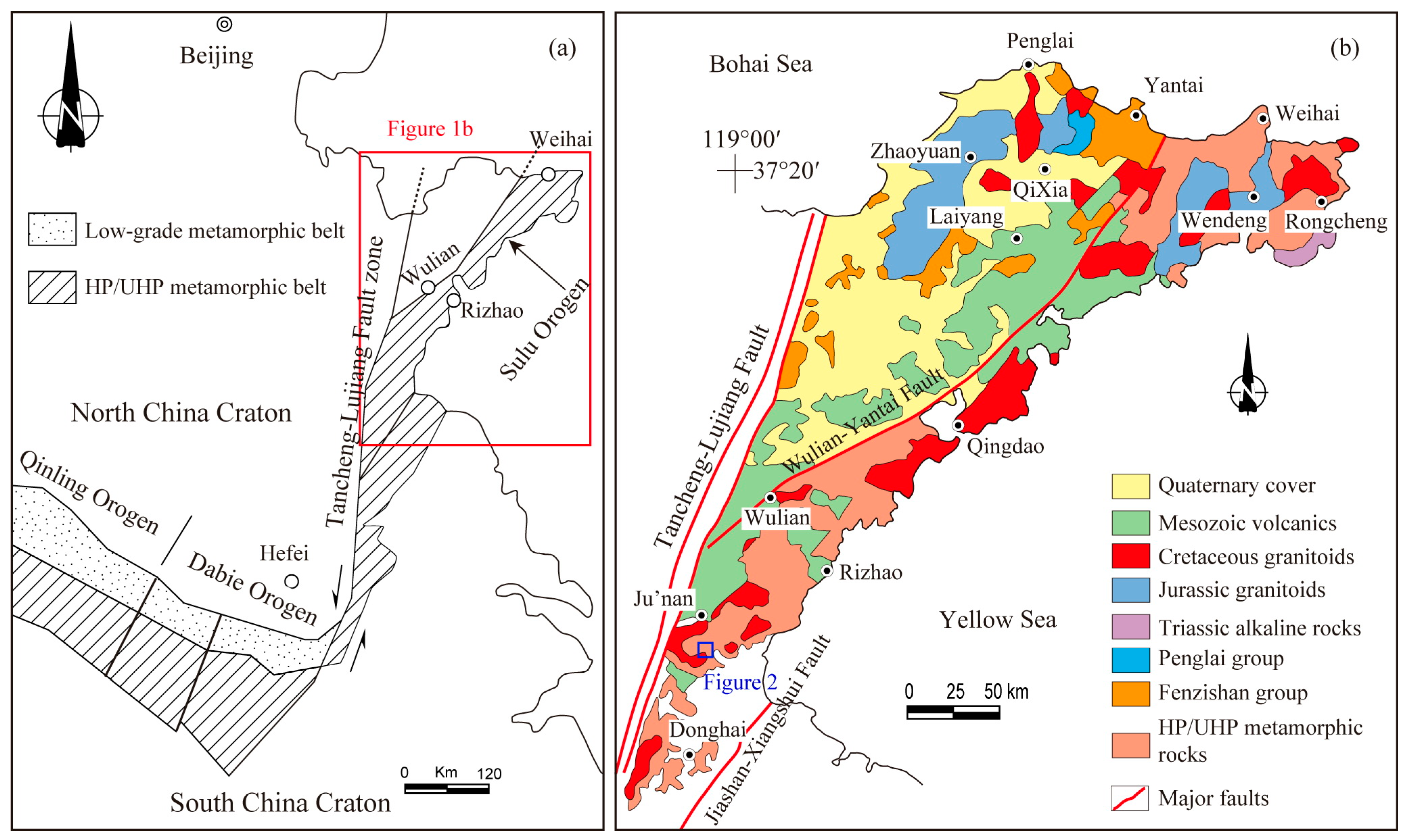
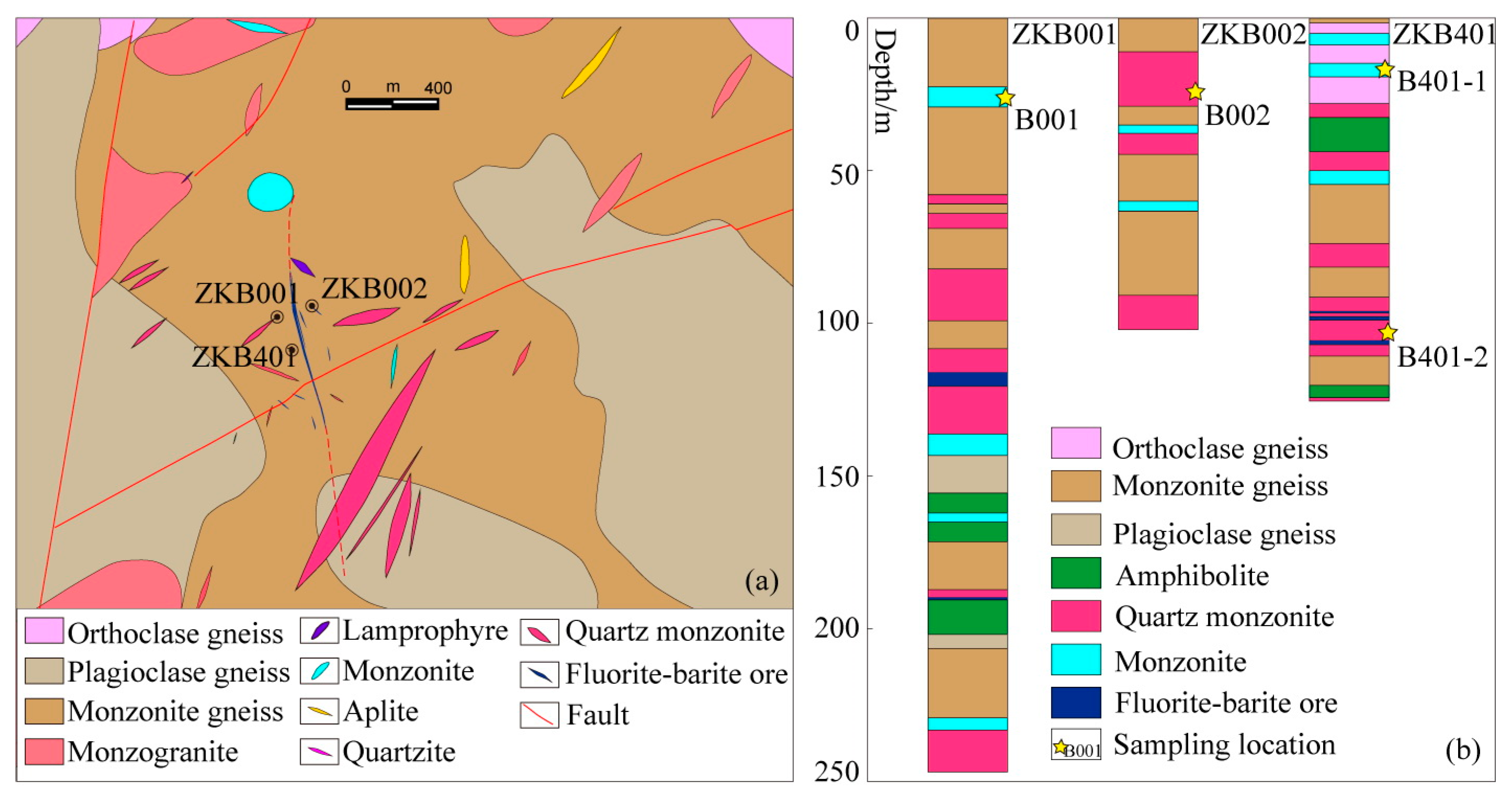
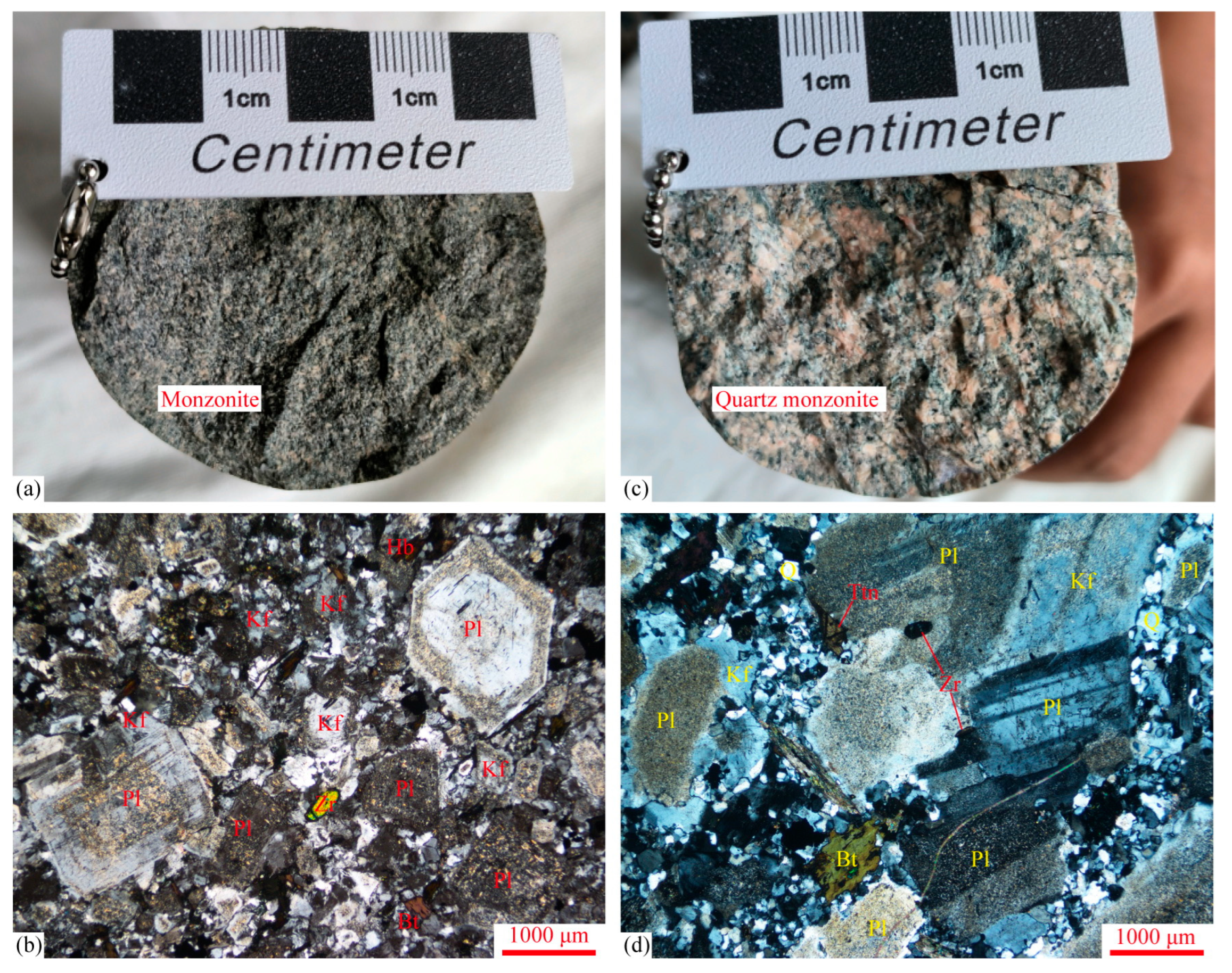
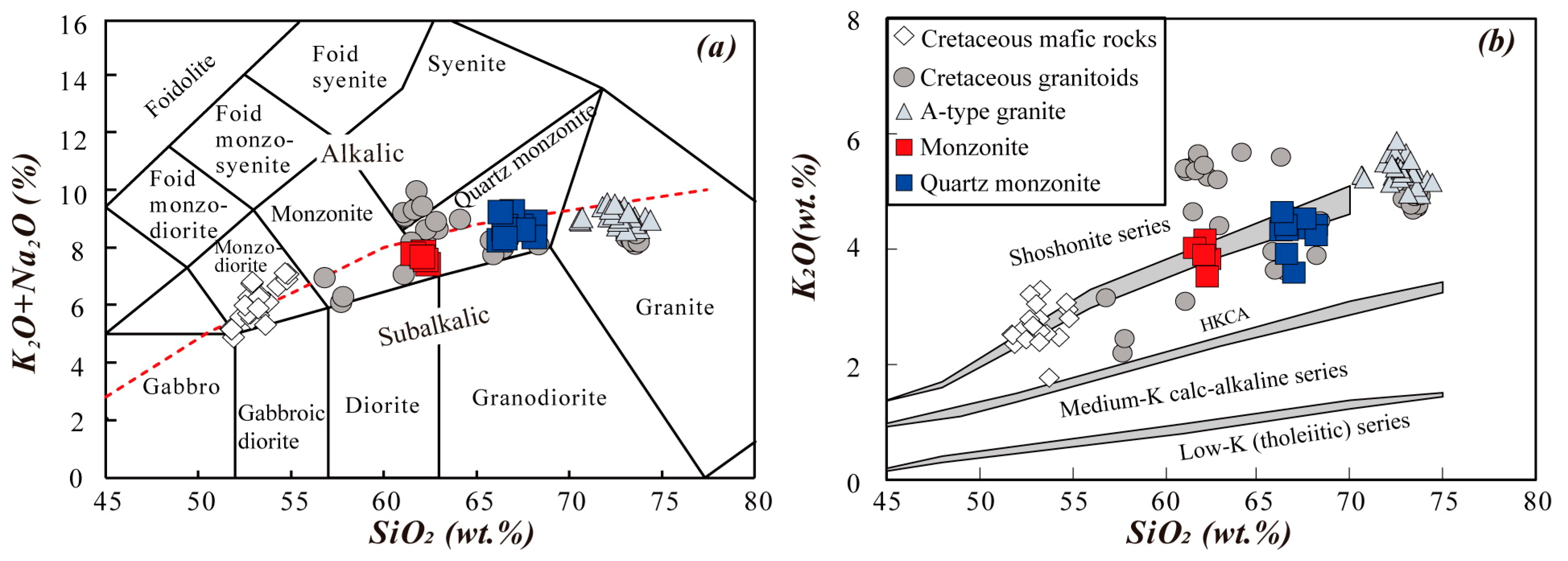
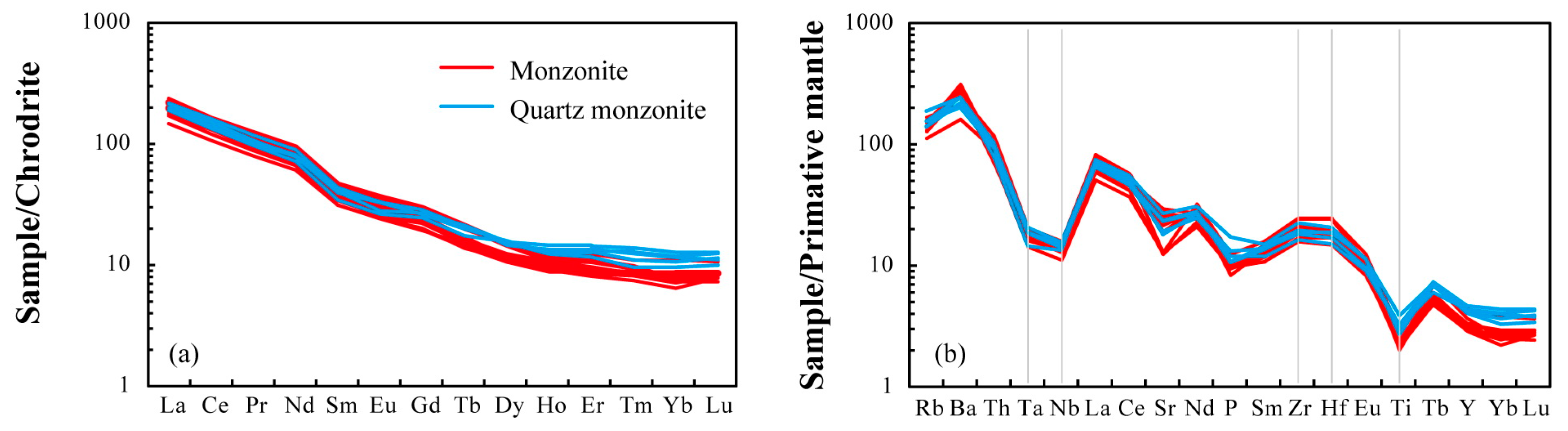
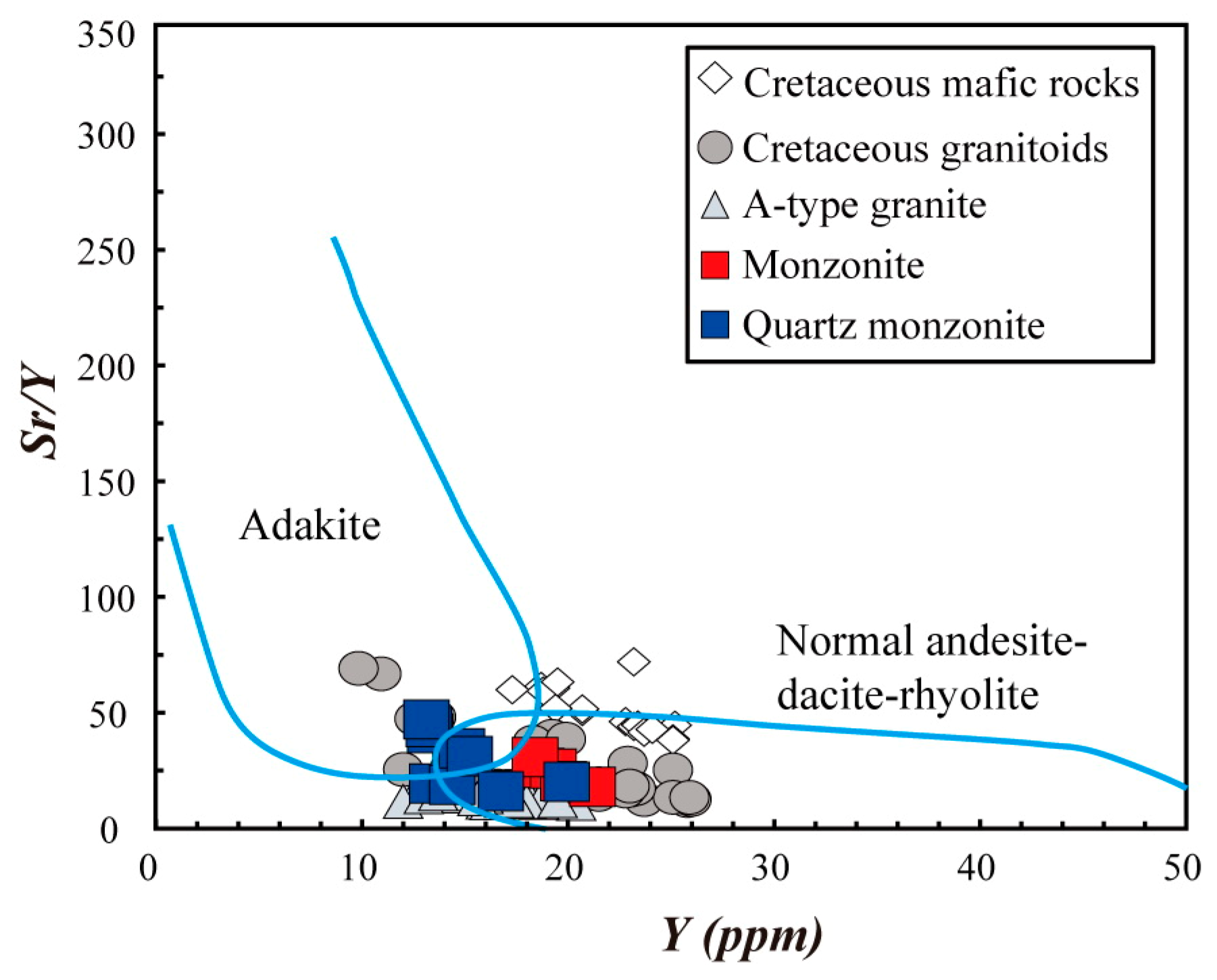
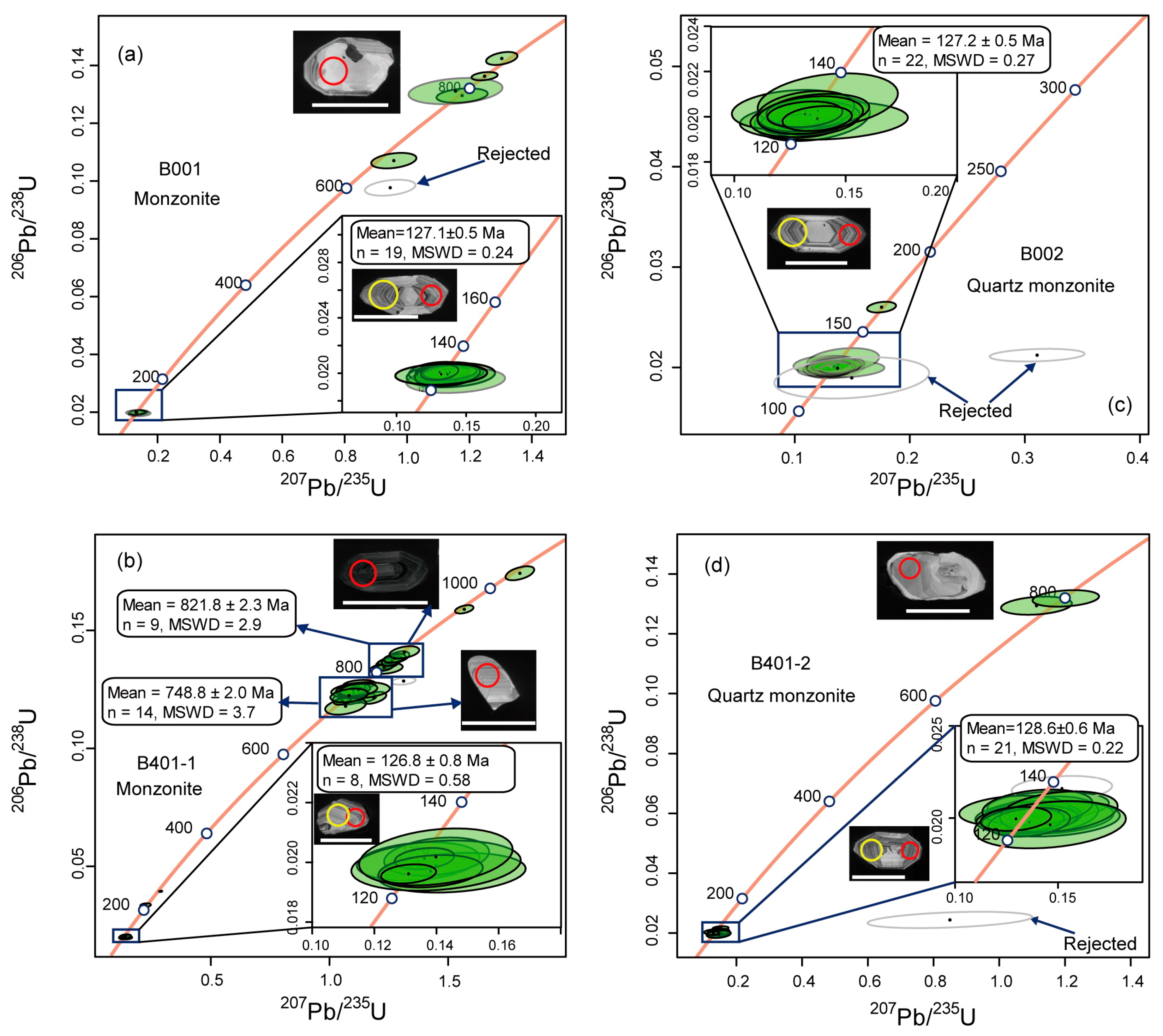
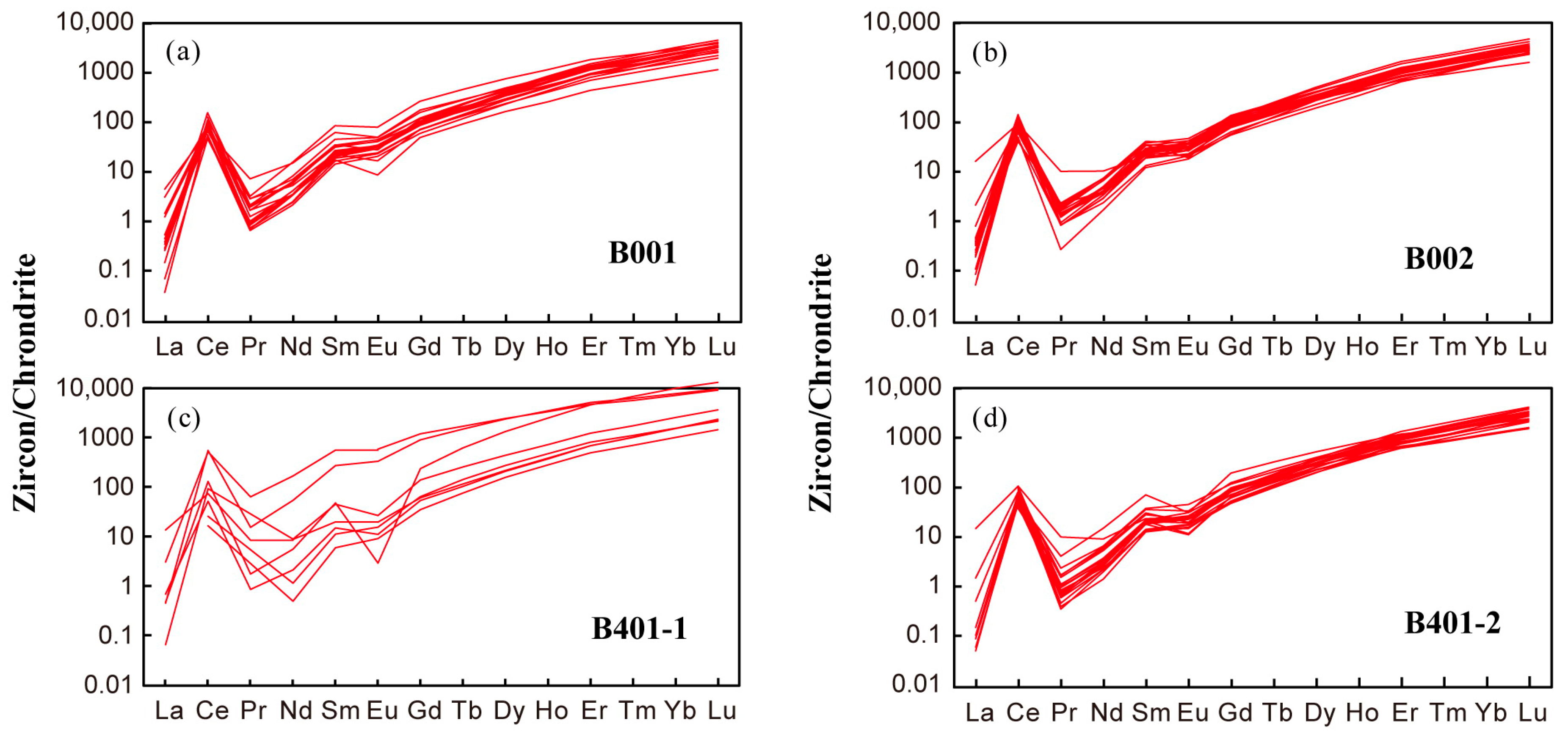
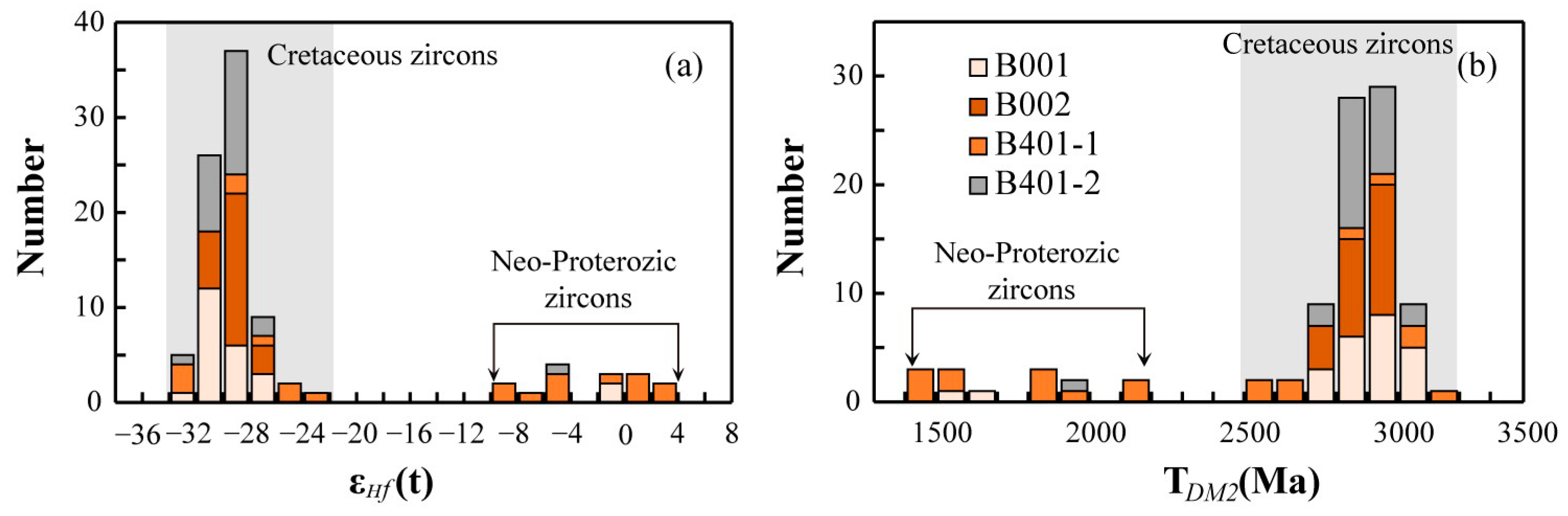
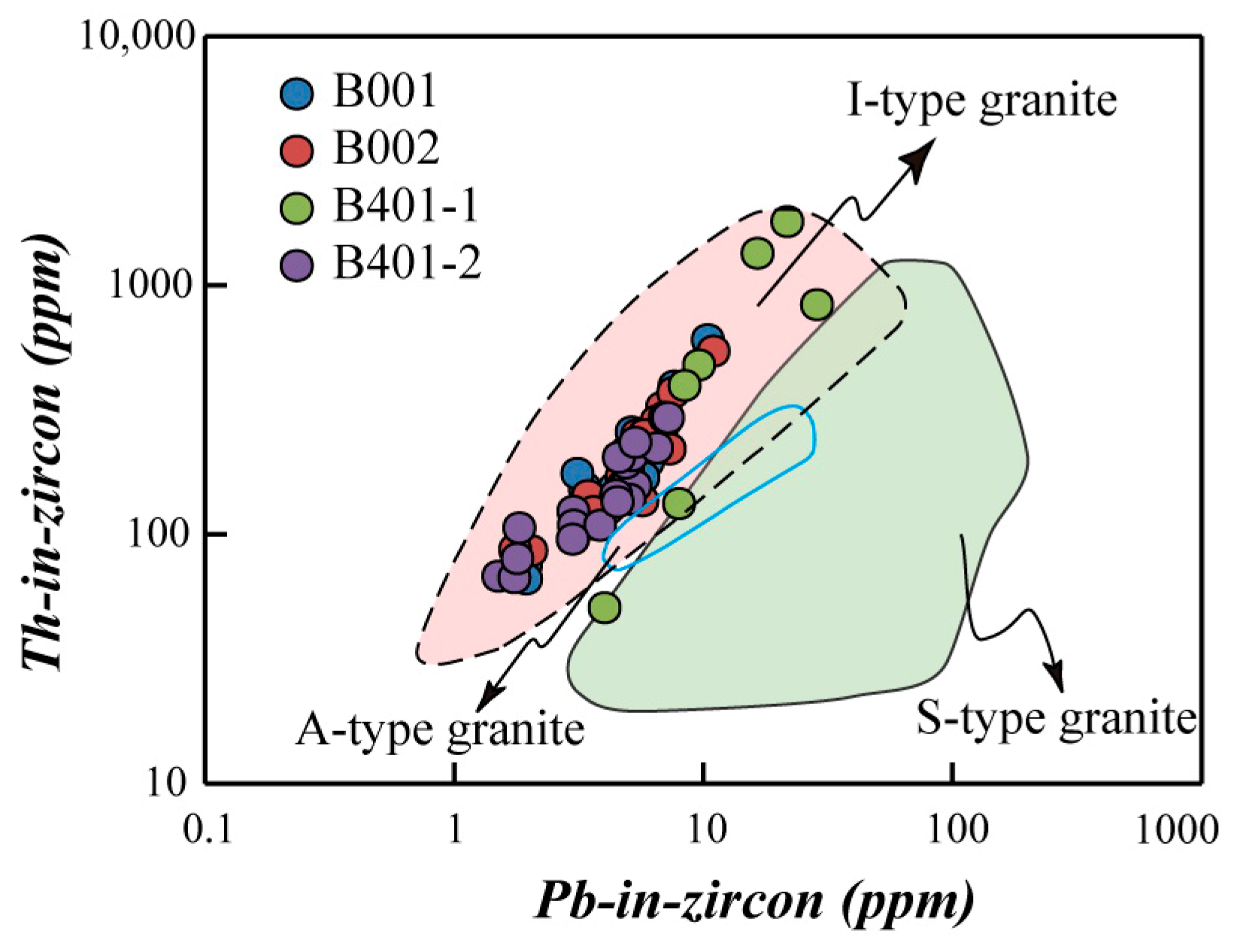
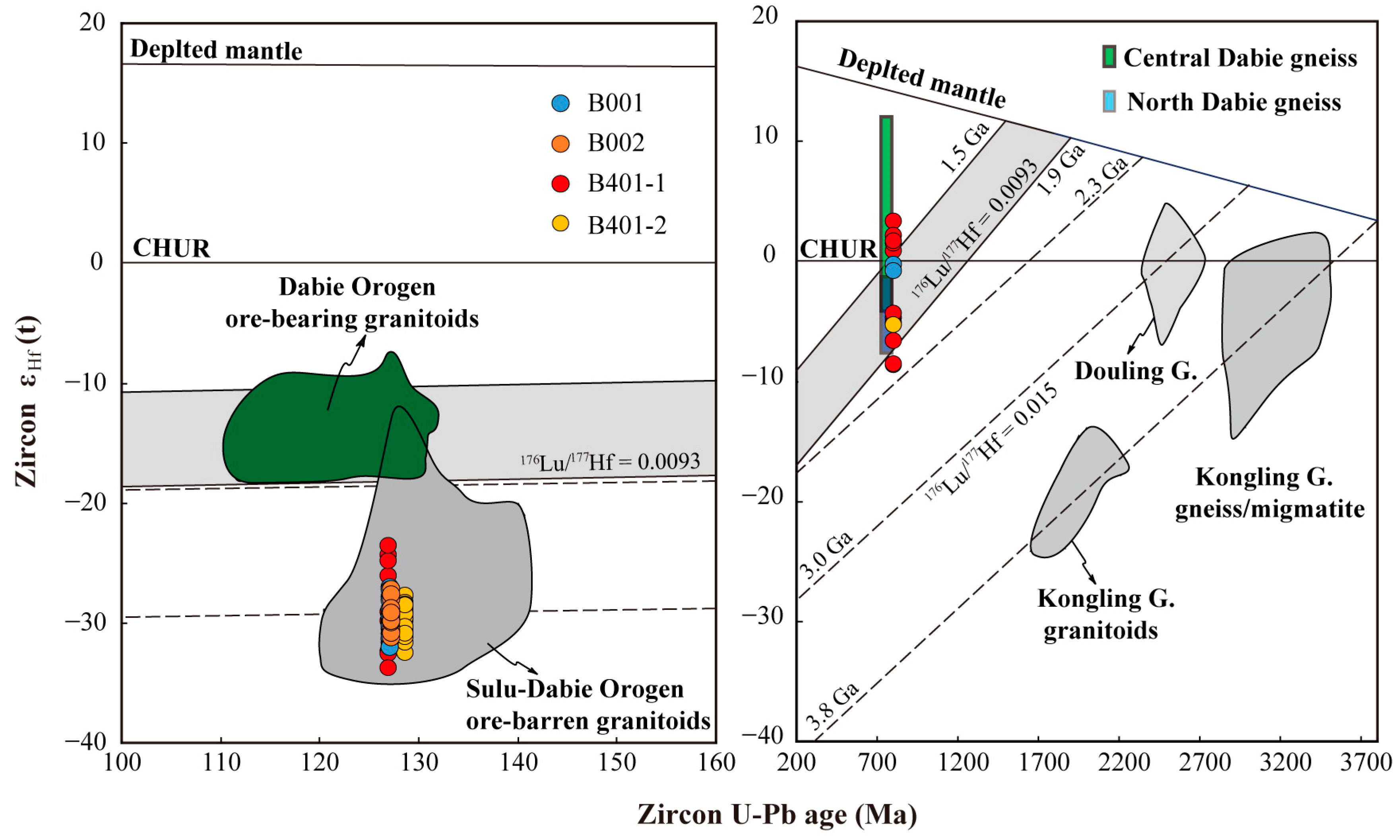
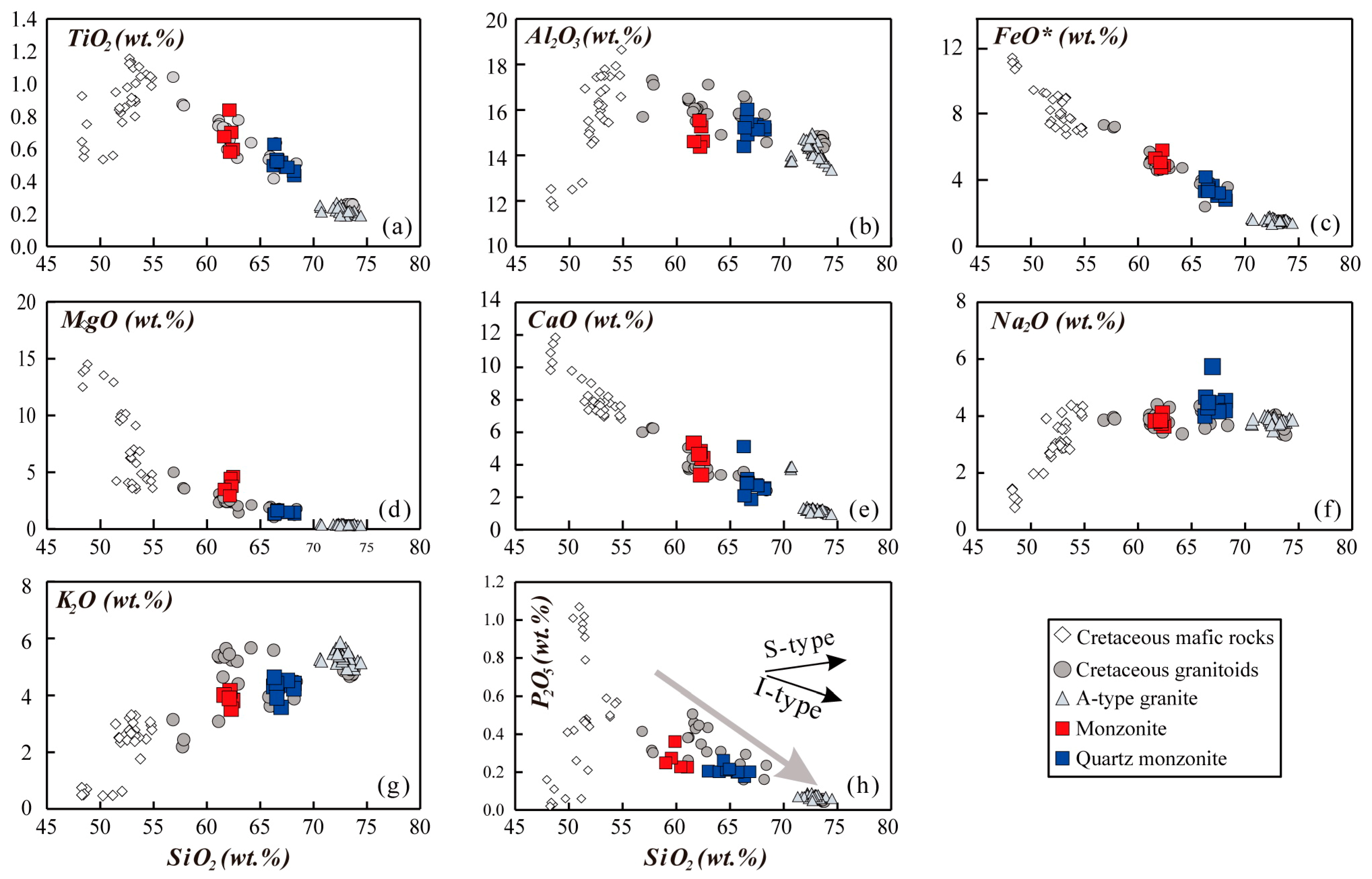
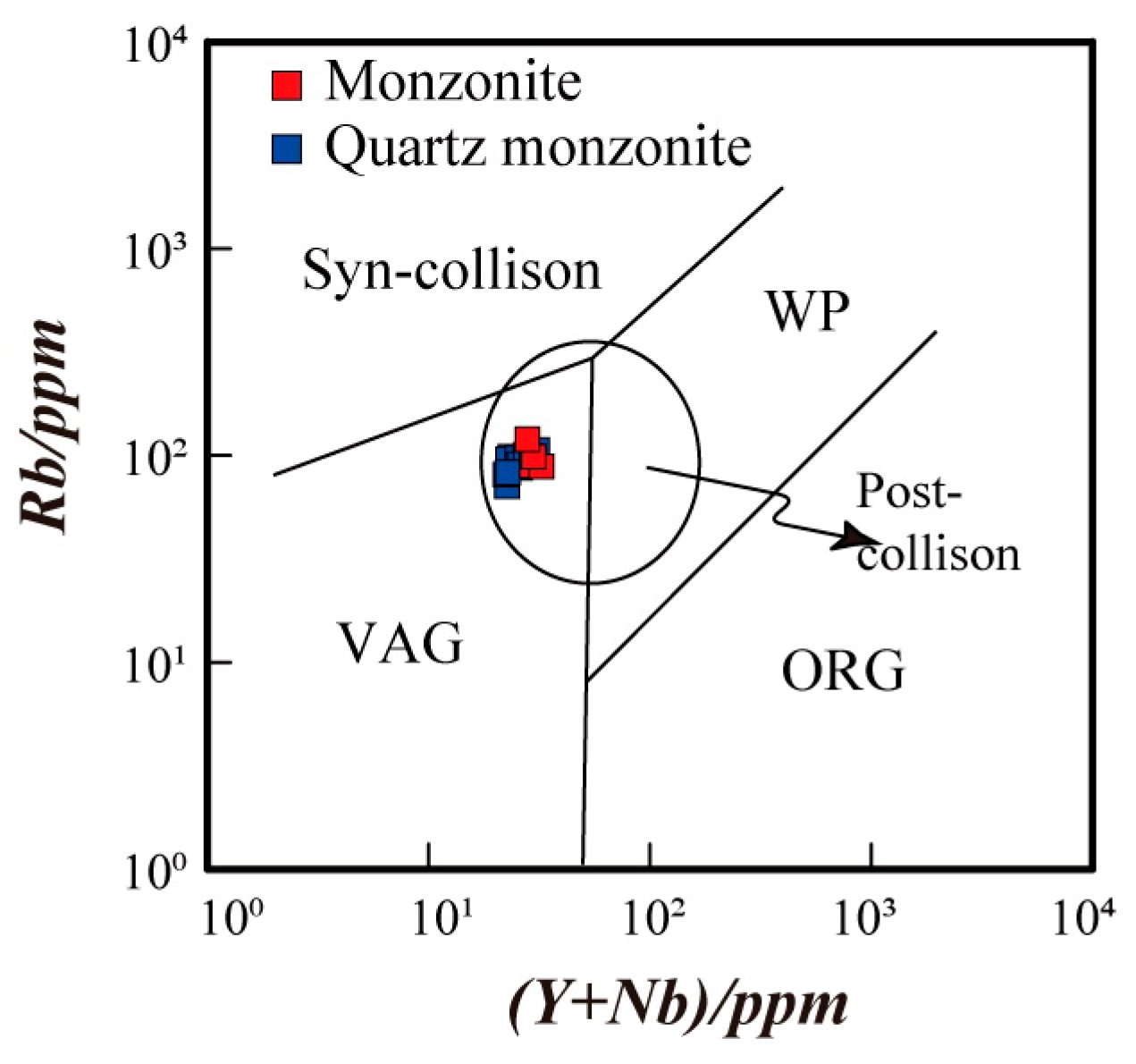
Disclaimer/Publisher’s Note: The statements, opinions and data contained in all publications are solely those of the individual author(s) and contributor(s) and not of MDPI and/or the editor(s). MDPI and/or the editor(s) disclaim responsibility for any injury to people or property resulting from any ideas, methods, instructions or products referred to in the content. |
© 2026 by the authors. Licensee MDPI, Basel, Switzerland. This article is an open access article distributed under the terms and conditions of the Creative Commons Attribution (CC BY) license.