


Abstract
This study evaluates the potential of fine-grained waste gneiss as a soil improver, with particular emphasis on its chemical and grain composition and its effects on plant growth. The experimental material consisted of mixtures of fine-grained waste gneiss with varying proportions (from 0.38% to 7.5% in the pot) supplemented with varying proportions of dolomite (from 0.14% to 0.22% in the pot). Pot experiments were conducted for 57 days under controlled conditions using selected crops. Plant response was assessed based on growth rate, green mass production, and dry mass. For most tested variants, the results demonstrated a dose-dependent enhancement in plant productivity associated with gneiss supplementation. Compared to the control, experiments containing higher proportions of fine-grained gneiss resulted in an increase in green and dry mass from 8.14% to 78.73% and by 12.5% to 96.88%, respectively. Additionally, strong positive correlations between gneiss content and yield parameters (Pearson’s r > 0.8) were observed. In contrast, the dolomite fraction mainly conceptually affected soil chemical properties, including calcium and magnesium availability and pH stabilization. Overall, the findings suggest that fine-grained waste gneiss acts as a growth-promoting soil conditioner, as evidenced by the marked improvement in plant biomass. The findings confirm the high potential of waste gneiss as a functional soil improver, supporting sustainable resource management and aligning with the principles of the circular economy.
1. Introduction
Rock materials have found use in agriculture as an excellent raw material for improving soil fertility. The addition of fine rock fractions enriches the soil with components in chemical compounds that dissociate in the soil. As a result, it improves the physical, chemical, and biological properties of the soil, contributing to increased crop production [1]. Numerous studies have been conducted worldwide and in Poland using inorganic soil improvers, the application of which reduce soil acidification, neutralize the harmful effects of aluminum [2], and contribute to an increase in bacterial flora. Agronomic practices to improve the fertility of acid sulfate soils recommend liming [2], application of basalt [3] or ground basalt in combination with bio-fertilizer [1,4], or application of manganese dioxide [5]. Application of basalt powder led to a notable elevation in soil pH, as well as in calcium and phosphorus concentrations. Nevertheless, the enhanced phosphorus availability in the soil did not translate into increased phosphorus uptake by the plants. Interestingly, despite the absence of a statistically significant rise in soil magnesium levels, the basalt amendment facilitated improved magnesium assimilation in both maize and soybean crops [6]. A more recent study also demonstrated positive effects on both soil quality and plant nutrient dynamics in different soil types. The addition of basalt dust improved the physical properties (such as soil aggregation) and chemical properties (including pH, organic matter content, calcium, magnesium, and potassium levels) of organic soils. An increase in the availability of nutrients for plants was also observed [7].
In addition to agricultural applications, rock materials are also used for soil reclamation. The literature reports the use of mining waste, such as dunite, as soil additives to remediate contaminated soils. It was found that such wastes can improve soil physicochemical properties and promote plant growth. The integrated application of dunite and compost resulted in a more than fourfold decrease in the concentrations of bioavailable copper and nickel in the soil while concurrently improving soil physicochemical properties and significantly enhancing biomass production [8]. The authors of the subsequent publication reviewed natural soil amendments, including mineral ones such as silicate rocks, which can serve both as an alternative to synthetic fertilizers in agriculture and can also be applied for the reclamation of degraded soils. Their effects on improving soil structure and nutrient availability were discussed. The use of mineral amendments has been indicated, which can serve as fertilizers by providing primarily silicon (Si), calcium (Ca), and aluminum (Al) [9]. The subsequent study evaluated the release of nutrients and heavy metals from gneiss and steatite powders after vermicomposting with organic waste. It was found that gneiss powder enhanced the chemical quality of the vermicompost without leading to high concentrations of heavy metals in either plants or soil [10]. In this context, attention has increasingly focused on the reuse of mineral wastes and low-value by-products generated by the mining industry.
Taking into account the above statements, application of waste rock materials from gneiss mining and processing (a materials that is characterized by poor market value), was a topic of a research project (no. POIR.04.01.02-00-0054/17). It was mainly focused on the possibility of producing feldspar raw material by enriching fine-grained waste gneiss in strong magnetic fields. In this process, a magnetically susceptible material is separated and becomes waste. The concept of agricultural use of fine-grained residues of gneiss was presented by Witt [11]. It was inspired by the results of research conducted in China, presented by Wang [12], as well as by research on the agricultural application of basalt rock powder [13]. Therefore, the research direction of the project involved evaluating fine-grained gneiss residues (grain size up to 1.5 mm) as the main component of soil improvers (soil remineralizer). The work carried out in the project included (a) the development of soil improvers based on waste gneiss with mineral and organic additives and (b) assessment of their effects on yield structure parameters, such as the number of germinated seeds per 0.024 m2 of pot surface, green mass, and dry mass, for the selected crop.
In order to clearly position the developed mineral mixtures within the existing regulatory framework and ensure their practical applicability, it is necessary to define their formal classification as soil improvers under both European and national legislation. Therefore, in the project presented above, the soil improver was a mixture consisting only of mineral additives. According to the Regulation of the European Parliament and the Council (EU) No. 2019/1009 [14], such fertilizing product (according to the PFC list Part I, point 3 B) is an inorganic soil improver. According to the Polish National law named Act on Fertilizers and Fertilization of 10 July 2007, consolidated text (Journal of Laws 2024, item 105) [15], such a product is classified as a soil improver (one of the agents supporting plant cultivation, Art. 2.1., item 10)—a substance added to the soil in order to improve its chemical, physical, or physicochemical properties or parameters, as well as acting as a plant growth stimulator. However, functionally, finely ground silicate rock powders are also known as rock dust, rock flour, agrominerals, or remineralizers, with significant agricultural functionality. Due to their slow nutrient release, the use of silicate flours can replace lime, gypsum, and conventional mineral fertilizers in no-till systems, contributing to soil health and soil profile development [16,17]. This can positively impact the agronomic properties and productivity of soybeans and sorghum in sandy soils, as confirmed in research by Rodrigues, L.N.F., et al. [18].
This study presents selected results from research evaluating the suitability of soil improvers derived from fine-grained gneiss residues and their compliance with quality requirements. The work includes analyses of the chemical composition of gneiss residues and bedrock, with particular emphasis on the content of potentially toxic elements and trace elements. Furthermore, pot experiments were conducted to assess the response of spring wheat to different application doses of two soil improver variants. The experimental results were subjected to statistical analysis to determine relationships between soil improver composition and plant productivity.
2. Materials and Methods
2.1. Characteristics of the Sampling Area
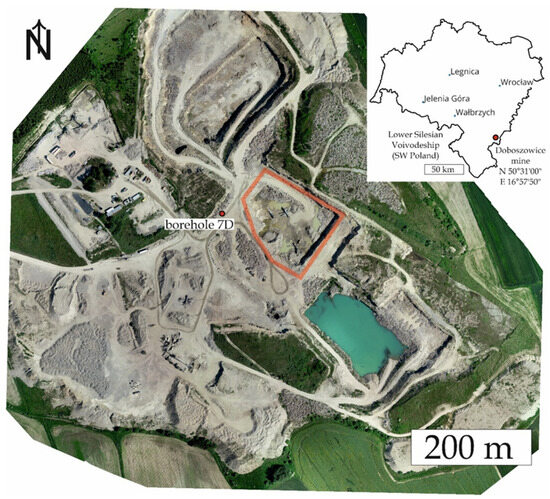
The rock material used in this study was collected from the central part of the active mining excavation at an elevation of +282 m a.s. from the Doboszowice 1 deposit (Figure 1).
Figure 1.
Location of the central opencast pit in the Doboszowice mine (outlined in red).
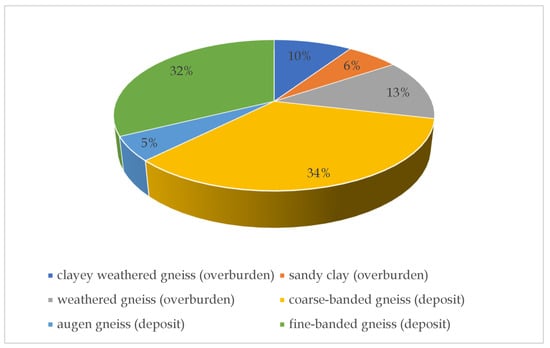
The mining process results in the extraction of rock utilized for the production of construction aggregates. Currently, the mining plant also produces a significant amount of decorative stone (so-called stone bark). In 2022, the extraction of gneiss reached 1095 thousand tons from 16 deposits. The mining of gneiss in 2022 was comparable to that in 2021 [19]. That area is characterized by high lithological and textural variability, as documented in borehole 7D (Figure 2 and Figure 3). During processing, significant quantities of fine-grained residues with particle sizes between 0 and 11 mm are generated, of which only a small proportion is currently utilized for low-value aggregates and mixtures. The limited utilization of these materials underscores the need to explore alternative applications that align with circular economy principles. Fine-grained gneiss waste (<2.0 mm), including mineral fines (<0.063 mm) generated during mineral processing, exhibiting limited marketability, was subjected to magnetic separation. The fraction depleted in magnetically susceptible minerals was further examined as a feldspar semi-product, while the enriched fraction was used as a component of the soil improver.
Figure 2.
Volumetric composition of lithological varieties of the overburden and deposit according to the profile of borehole 7D, from the ground surface down to the bottom of the exploitation level (based on Majkowska [20]).
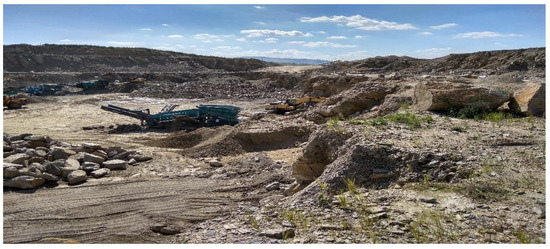
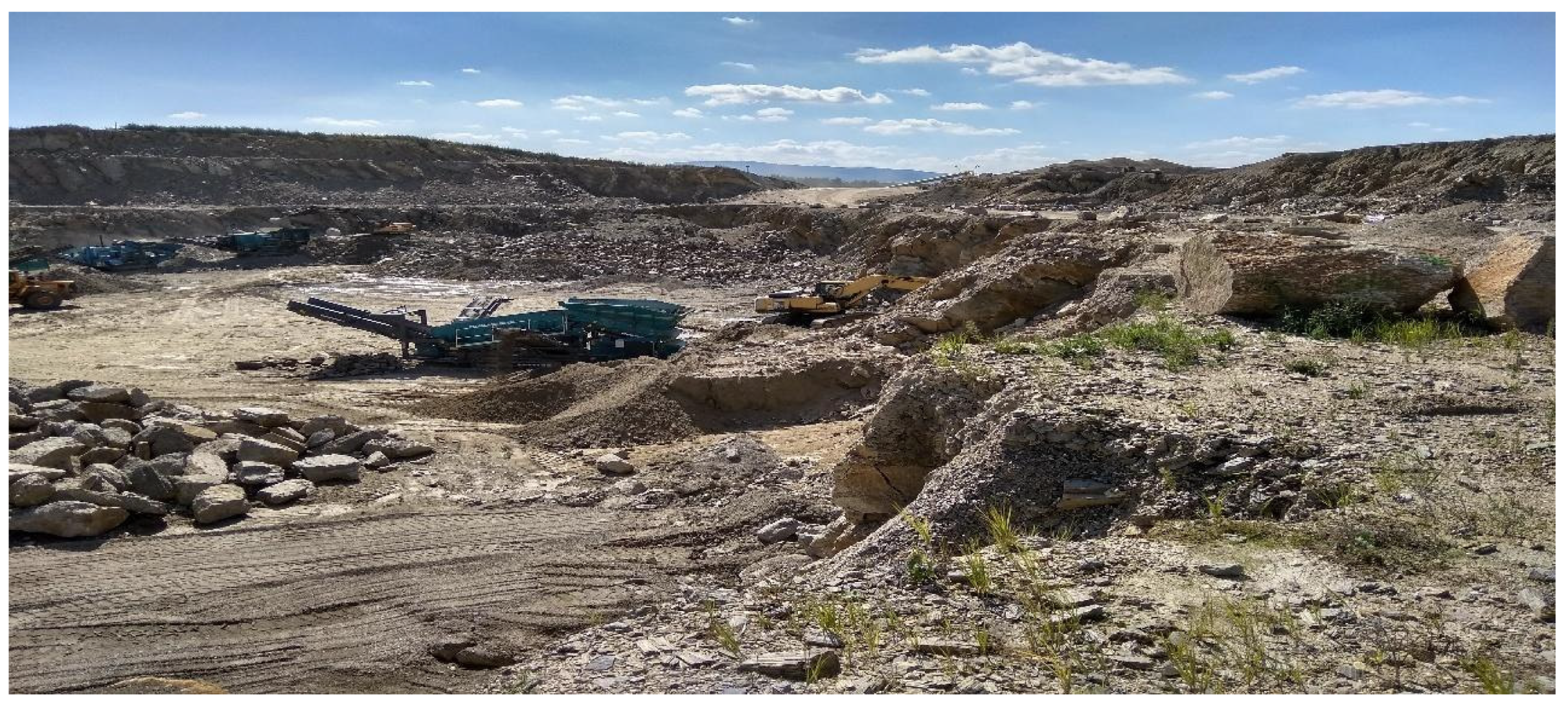
Figure 3.
Exploitation front in the central opencast pit, view in the SE direction.
In line with the project objective of continuous production of a soil improver from mining waste generated by non-selective exploitation, samples representing major lithological varieties of the deposit (fine- and coarse-banded, augen, and migmatitic gneiss [21]) were analyzed. To ensure representativeness, samples were collected from mining excavations, blast hole cuttings, and waste dumps, including material subjected to magnetic separation.
2.2. Chemical Characterization of Fine-Grained Waste Gneiss
The qualitative and quantitative analysis of the elemental composition of various waste gneiss materials (gneiss samples after magnetic separation are shown in Table 1; gneiss samples before magnetic separation are shown in Table 3) was performed with the use of EDX-RF energy dispersive X-ray fluorescence spectrometer (EDX-7000, Shimadzu, Kyoto, Japan). It enables simultaneous quantitative measurement of elements from Na (11) to U (92) with a detection limit for Cd, Pb, Cr, Hg, and Br of up to 1 ppm (1 ppm-99.9%). The collected samples were reduced by quartering, in accordance with the applicable procedure [22], to a weight of approx. 30 g. Then, pellets were prepared using a manual hydraulic press (model: Atlas TM Manual 15Ton, by Specac, Orpington, UK) and subjected to EDX analysis. In order to verify the obtained results, some samples were tested in an external accredited laboratory (Table 1).
Table 1.
The content of elements in the gneiss wastes after magnetic separation (results from the tests of 47 samples).
Soil improvers, for which recipe and production technology were developed under the project, contain only fine-grained residues of gneiss and dolomite and are qualified as agents supporting cultivation of plants [5]. Regarding the fertilizing product of this type, the national requirements for meeting the quality requirements and limit contents of pollutants (heavy metals) apply. According to the applicable national law [23], the content of four elements (As, Cd, Hg, Pb) is limited. The regulation stipulates that the soil conditioner must have an arsenic (As) concentration of less than 50 mg/kg of the agent used to support plant cultivation. Similarly, the concentration of cadmium (Cd) in the soil conditioner must not exceed 50 mg/kg. The mercury (Hg) content must be below 2 mg/kg, and the lead (Pb) concentration must remain under 140 mg/kg of the soil amendment. It also obliges the potential producer of a soil improver applying for its admission to trading to submit a report from tests.
The content of heavy metals in the analyzed samples does not exceed the limit values set out in the applicable national regulation. The rock components of gneiss and dolomite are devoid of excessive amounts of harmful elements. This is clearly visible in the tests carried out in the external laboratory, the equipment of which was characterized by a greater measurement accuracy. Greater precision in the performance of tests will be required in connection with the Regulation (EU) 2019/1009 of the European Parliament and of the Council of 5 June 2019 [24], which determines the contents of selected toxic pollutants in inorganic soil improvers that are permissible starting from 16 July 2022. The regulation stipulates that the concentrations of the following substances must not exceed the specified limits. The concentration of cadmium (Cd) shall not exceed 1.5 mg/kg of dry mass. The concentration of hexavalent chromium (Cr6+) must not exceed 2 mg/kg of dry mass. Mercury (Hg) concentration shall not exceed 1 mg/kg of dry mass, while the concentration of nickel (Ni) must not exceed 100 mg/kg of dry mass. Lead, on the other hand, must not be present in concentrations higher than 120 mg/kg of dry mass. Finally, the concentration of inorganic arsenic (As) must not exceed 40 mg/kg of dry mass. Inorganic soil improvers are also not be allowed to contain microelements such as copper and zinc in an amount greater than 300 mg Cu/kg of dry mass and 800 mg Zn/kg of dry mass. Compared to the national legislation, the EU regulation covers more components, and the content of inorganic improvers is limited. In addition, the permissible content of previously limited impurities has been set at a lower level (e.g., Cd, Pb).
It was considered justified to take into account the new pollution limits in further research, as it is likely that the changes in the law introduced by the EU Regulation will soon be introduced into the national law. The obtained results of the investigated fine-grained gneiss material as the basic component for the inorganic soil improvers meet the permissible limits for analyzed pollutants listed the EU regulation, while hexavalent chromium remains to be quantified in future work.
2.3. Grain Composition of the Fine-Grained Waste Gneiss Material Used in the Pot Experiment
In this research, the grain composition of fine-grained waste gneiss was also characterized. To determine the granulometric composition of the fine-grained gneiss waste, a sieve analysis was performed based on the guidelines contained in the Polish standard PN-EN 933-1 [25]. Its composition is dominated by the fine material (50.36%) of grain sizes up to 0.2 mm. A smaller proportion (29.12%) consists of material from 0.2 to 0.5 mm. In contrast, the next two fractions, with grain sizes of 0.5–0.8 mm and 0.8–1.0 mm, account for 14.35% and 6.16%, respectively.
2.4. Soil Improver Preparation
The gneiss fraction enriched in magnetically susceptible minerals remaining after magnetic separation was used for the preparation of the soil improver. Two experimental versions of the soil improver were produced for the pot experiments. Version 1 of the improver is a mixture of fine-grained gneiss material from the magnetic separation process. Version 2 of the improver is a rock mixture consisting of fine-grained gneiss and silty dolomite residual materials.
The gneiss component of the soil improver is a post-processing fine-grained gneiss material of grain sizes between 0 and 1.5 mm. The second mineral component is a dolomite powder of grain size between 0.002 and 0.05 mm from a dedusting installation of the processing plant.
Nine variants of the improver dosage to the soil—marked with letters from A to I—were developed. Three of them (C, F, and I) contain the version 1 improver. The other dosage variants, i.e., A, B, D, E, G and H, contain the version 2 soil improver. Detailed amounts of rock components used in the developed variants of the soil improver are presented in Table 2.
Table 2.
Proportions of rock components used in the developed variants of the improver dosage in the pot experiment.
The gneiss content ranged from 7.5 g to 112.5 g, while the dolomite content ranged from 3 g to 4.5 g. The applied gneiss dosing levels are as follows:
- -
- From 7.5 to 15 g of gneiss waste material (variants A, B, and C);
- -
- From 37.5 to 75 g of gneiss waste material (variants D, E, F, and G);
- -
- From 75 to 150 g of gneiss waste material (variants H and I).
Six different proportions of dolomite were used as an additional rock component in the version 2 soil improver. A total of 9 variants of mineral mixtures and a control sample that did not contain any improvers were prepared.
2.5. Pot Experiments
The pot experiment was performed in a laboratory room. LED lamps were used to make growth of the studied plants independent of the growing season and natural sunlight. An arrangement of 4 lamps was designed in order to maintain uniform illumination of the tested plants. The lighting time was controlled by a timer set to imitate a summer day. To eliminate the effect of a stone floor in the room (temperature), the pots were placed about 15 cm above it on pallets, while the lamps were hung at a height of about 75 cm above the plants (according to their manufacturer’s recommendations) in order to maintain adequate light intensity.
The aim of the experiment was to determine the response of spring wheat to different dosages of the produced soil improver. The wheat used in the study was Zura-type wheat, a quality variety belonging to group A, useful for milling and baking purposes. The methodology of the pot experiment involved the application of the improver dosage variants to individual pots with the soil and then recording of plant growth and increase in green mass and dry mass. The measured parameters were compared to those of pots where the improver was not applied (control samples).
The pot experiment was carried out in triplicate by the independent series method in pots weighing 2.0 kg. Each pot contained an equal amount of commercially available multi-purpose substrate (Universal Soil by Polkor, Bożenkowo, Poland), characterized by a pH of 7.0 and a humus content exceeding 40%. The substrate, derived from biodegradable waste, compost, peat, and fine bark, had the following chemical parameters: TOC, 0.31%; N, 0.8%; P, 650 mg/kg; K, 1200 mg/kg; and S, 0.15%. The soil surface in the pot was 0.024 m2. A total of 30 pots and 9 improver dosage variants were prepared together with a control sample that did not contain any additives. Five certified grains of wheat were applied to each pot. The experiment was carried out for 57 days, during which the effect of the tested variants of the improver dosage on the growth of wheat stalks was checked. Every 7 days, the plant growth rate was measured and the air humidity and temperature were noted. The quality of the wheat was assessed after the end of the plant growth cycle. On the last day of the experiment, wheat stalks were cut and the obtained green mass was weighed. Then, the plant samples prepared in this way were dried for 17 h at 105 °C. The dry mass was then determined at the end of the experiment.
2.6. Statistical Analysis
Statistical analysis was conducted to compare experimental groups (average dry mass of wheat) with corresponding controls. Pairwise comparisons were performed using one-way ANOVA. Statistical significance was assessed at p < 0.05. The treatment means were compared by Tukey’s test (HSD) at a 5% level of confidence. The relationship between the content of soil improver or gneiss and the plant growth parameters (dry mass, green mass, and average stem growth rate relative to the control) was evaluated using Pearson’s linear correlation coefficient (r). To assess the significance of the observed correlations, a two-tailed test was applied with the significance level set at α = 0.01. Data processing was carried out via Microsoft Excel 2021 (Analysis ToolPak).
3. Results and Discussion
3.1. Material Characteristics
Table 3 presents the results of chemical tests of various textural types of gneiss rock, whereas the average test results for gneiss waste from the magnetic separation process (magnetic fraction) are provided earlier (Table 1, Section 2). Numbers provided in parentheses in Table 3 indicate the number of individual samples analyzed for each gneiss variety. The presented values represent the mean concentrations of metals determined from these replicates.
Table 3.
Chemical composition of different textural types of gneiss rocks (average values).
The chemical composition results for gneiss rock types (Table 3) show that the content of toxic elements (heavy metals) does not exceed the values specified in the regulation [20]. Compared to basalt powders, the gneiss types are characterized by a high potassium content (approx. 4%) and the presence of many trace elements, including Mn, Cu, Zn, Sr, Zr, Ag, S, etc. Oziegbe et al. [26] presented, in their research, the composition of the general rocks of pelitic gneiss. It was shown that the K2O content in the tested samples ranged from 0.04 to 5.23 (% wt), which when converted to K, indicates that the values presented in Table 3 fall within this range. Only the gneiss samples from Doboszowice 1 are depleted in Mn, compared to the gneiss presented by Oziegbe et al. [26], and range from 170 to 457 mg/kg DM (Table 3) to 619.76 to 1860 mg/kg DM, respectively. In the case of comparison of Cu content, they show enriched values of 64–112 mg/kg DM (Table 3) to 7.74–66.95 mg/kg DM [26], respectively.
The next material covered by the research was the magnetically susceptible part formed in the process of magnetic separation of fine-grained residues of gneiss. The test results for 47 samples of the magnetically susceptible material (gneiss waste) were obtained from several dozen separation tests conducted at the laboratory scale. The obtained results and the average and maximum values of heavy metal content in gneiss waste are presented in Table 1. They showed that this waste, as the main component of the inorganic soil improver, meets the requirements of the currently applicable national law in the scope of permissible content of pollutants (heavy metals), i.e., arsenic, cadmium, lead, and mercury.
The selected sample of the magnetically susceptible material from the magnetic separation of gneiss waste was analyzed in an external accredited laboratory. The obtained results did not show any abnormal content of such elements as arsenic, cadmium, lead, and mercury. The analyses were performed with the use of the ICP-OES spectrometer according to PN-EN ISO 11885:2009 (2025) [27] and PN-ISO 11466:2002 (2025) [28] standards (Table 4). These studies were compared with the results from the EDX spectrometer. Conformity was achieved in the amounts of the determined elements such as potassium and silicon. The levels of the remaining analytes (elements) which were determined are comparable. The differences are related to the accuracy of the given measurement method. In the accredited laboratory, the ICP-OES analysis is used with an accuracy of 5–10 ppb, while the EDX analysis determines the elements Cd, Pb, Cr, Hg, and Br with an accuracy of 1 ppm.
Table 4.
Comparison of the content of selected elements in gneiss waste.
3.2. Analysis of the Chemical Composition of Improver Components for Pot Experiments
Further research was carried out on rock components constituting the basis for the production of approximately 10 kg of inorganic soil improvers. Samples of the fine-grained waste of gneiss and dolomite were collected, and their chemical composition was analyzed in two laboratories, including one external lab. The obtained results of the element contents are presented in Table 5.
Table 5.
Comparison of the content of selected heavy metals in soil improver components.
3.3. Pot Experiment Results
The obtained results of the average growth rate, green mass, and dry mass are presented in Table 6.
Table 6.
The pot experiment results—the effect of soil improver on wheat (measurement of average growth rate, green matter, and dry matter).
The results of the pot experiments showed that the addition of fine-grained waste gneiss material as the basic component of the soil improver improves the growth rate of wheat stalks. These conclusions relate to growing conditions under artificial lighting. In a study conducted by De Souza et al. [10], vermicompost enriched with gneiss powder was found to increase plant growth (e.g., maize) and may improve the concentrations of some micronutrients in plants, without dangerous increases in heavy metals. In the case of coffee cultivation, studies on the use of gneiss powder also observed improvements in soil parameters and crop quality, confirming the benefits of using gneiss in agrosystems [29].
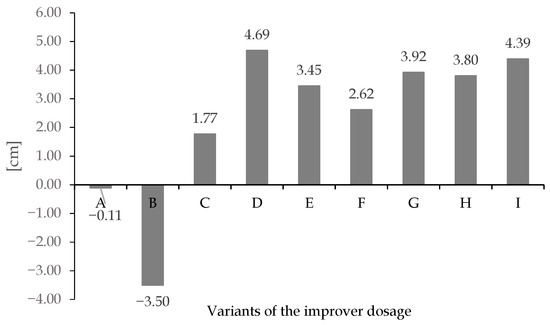
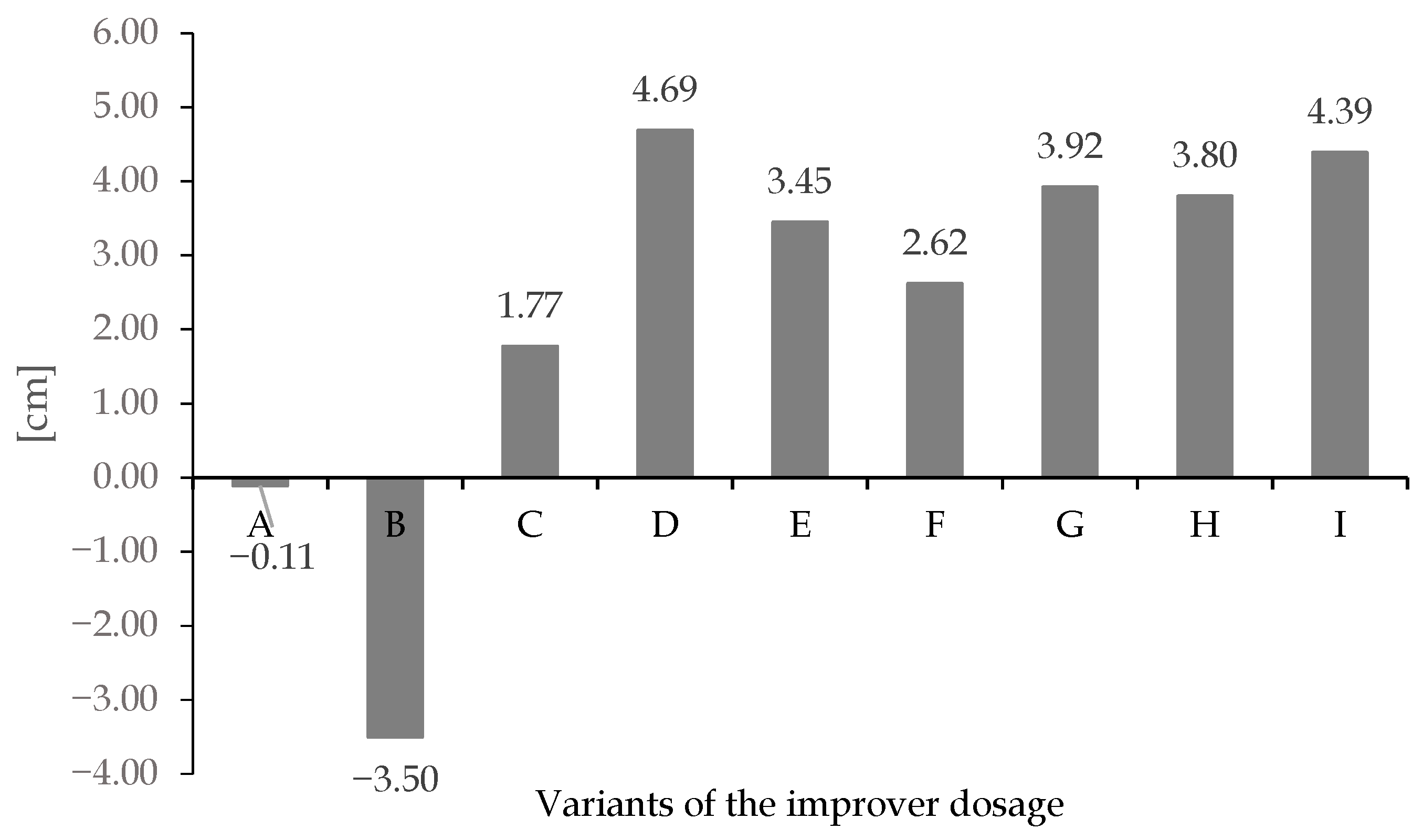
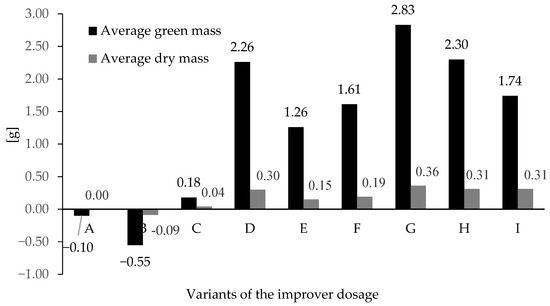
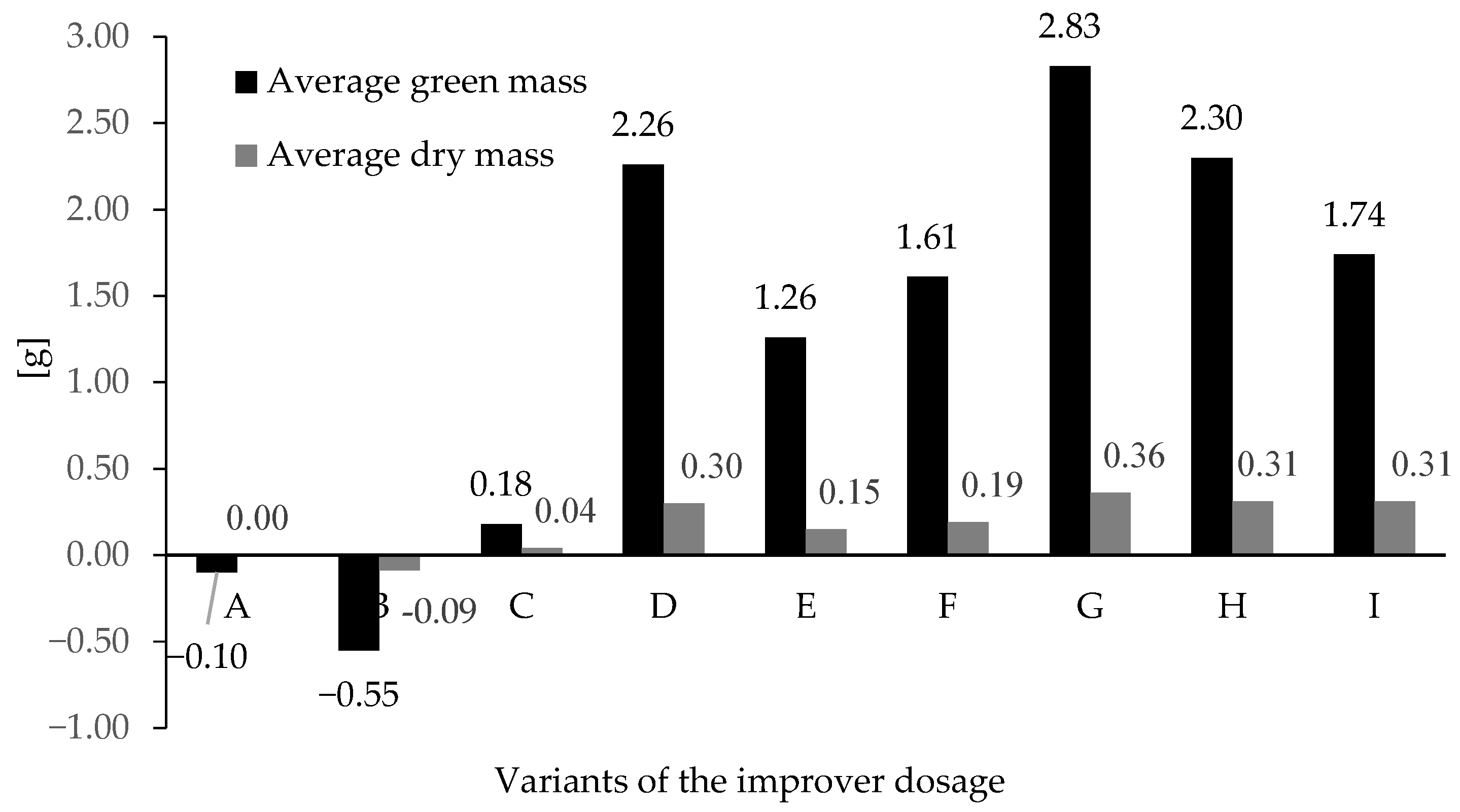
Version 1 of the soil improver, based only on the fine-grained waste gneiss, was used in three dosage variants (marked with letters C, F, and I). Compared to the control, the height of the plant stems increased by 1.77 cm for the C dosage variant and by 4.39 cm for the I dosage variant (Figure 4). An increase in average green mass by 0.18 g for variant C, and by 1.74 g for variant I, compared to the control sample, was noted (Figure 5). An increasing trend was also observed in the case of average dry mass—by 0.04 g for dosage variant C and by 0.31 g for variant I—compared to the control sample (Figure 5).
Figure 4.
Wheat stem growth relative to the control sample, obtained in pot experiments for the different soil improver dosage variants.
Figure 5.
Increases in average green weight and average dry weight of plants obtained in pot experiments for different soil improver dosage variants.
Version 2 of the soil improver is a composition of fine-grained waste gneiss and dolomite material (from 2.7% to 12.0%). Six dosage variants of the improver were developed, marked with letters A, B, D, E, G, and H. Advantageous values in relation to the control samples were noted for the four dosage variants (D, E, G, and H). The following increases were obtained: (a) height of plant stalks by 3.45 cm for dosage variant E and by 4.69 cm for dosage variant D (Figure 4); (b) average green mass of plants by 1.26 g for dosage variant E and by 2.83 g for dosage variant G (Figure 5); (c) average dry mass of plants by 0.15 g for dosage variant E and by 0.36 g for dosage variant G (Figure 5).
Application of improver dosage variants A and B resulted in negative values for nearly all analyzed parameters. This indicates a reduction in stem growth (Figure 4) and fresh and dry matter, as well as in average fresh and average dry matter (Figure 5), compared to the control group. An exception was observed for the average dry matter of variant A, which remained comparable to the control. Among the remaining improver dosage variants, only variant C yielded a negative value for plant dry matter (Table 6). Differences between experimental groups were analyzed using one-way analysis of variance (ANOVA) followed by Tukey’s HSD post hoc test for multiple comparisons. Statistically, variants A, B, and C did not differ significantly from the control samples when compared to the other tested variants. Significantly higher average dry mass of wheat was found in the treatments D, G, H, and I. As shown in Table 6, variant B (soil + medium gneiss dose + dolomite) exhibited lower plant biomass values than both the gneiss-only treatments (C, F, I) and the other dolomite-containing mixtures (D, E, G, H). This reduction is most likely attributable to the specific chemical composition of the mixture and its subsequent impact on nutrient bioavailability. Dolomite provides Ca and Mg and increases soil pH. When combined with only a medium dose of gneiss, which supplies K and micronutrients (Mn, Zn, Cu) but at relatively low amounts, the liming effect of dolomite may have dominated. Elevated pH is known to decrease the availability of micronutrients such as Fe, Mn, Zn, and Cu, which are essential for photosynthesis and plant growth [30,31]. In addition, the Ca/Mg-to-K ratio in variant B was likely unfavorable, as excess Ca and Mg can antagonize the uptake of K and several micronutrients.
In contrast, the highest gneiss dose (variant I) provided sufficient K and micronutrients to offset this effect, resulting in improved growth. The lower performance of variant B can therefore be explained by an imbalance between the liming effect of dolomite and the limited nutrient contribution of the medium gneiss dose, leading to reduced micronutrient bioavailability and, ultimately, lower biomass accumulation.
The content of the soil improver and the content of gneiss were statistically compared with the results of the study on the effect of the soil improver on wheat growth (green mass yield, dry mass yield, and measurement of average growth rate).
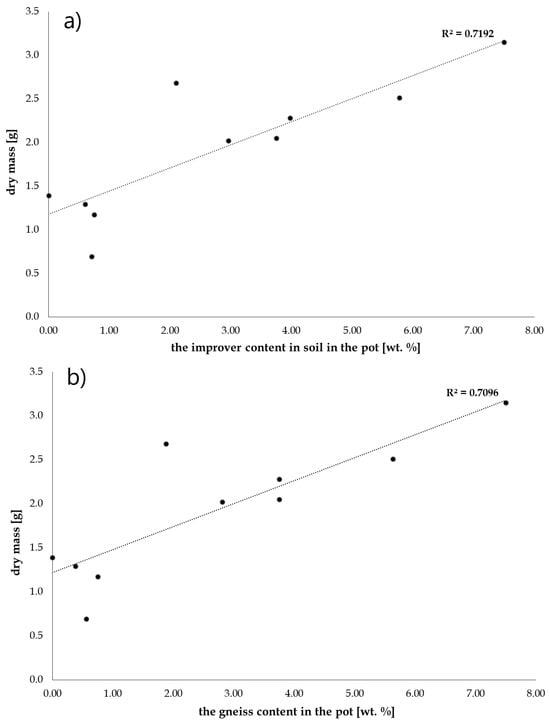
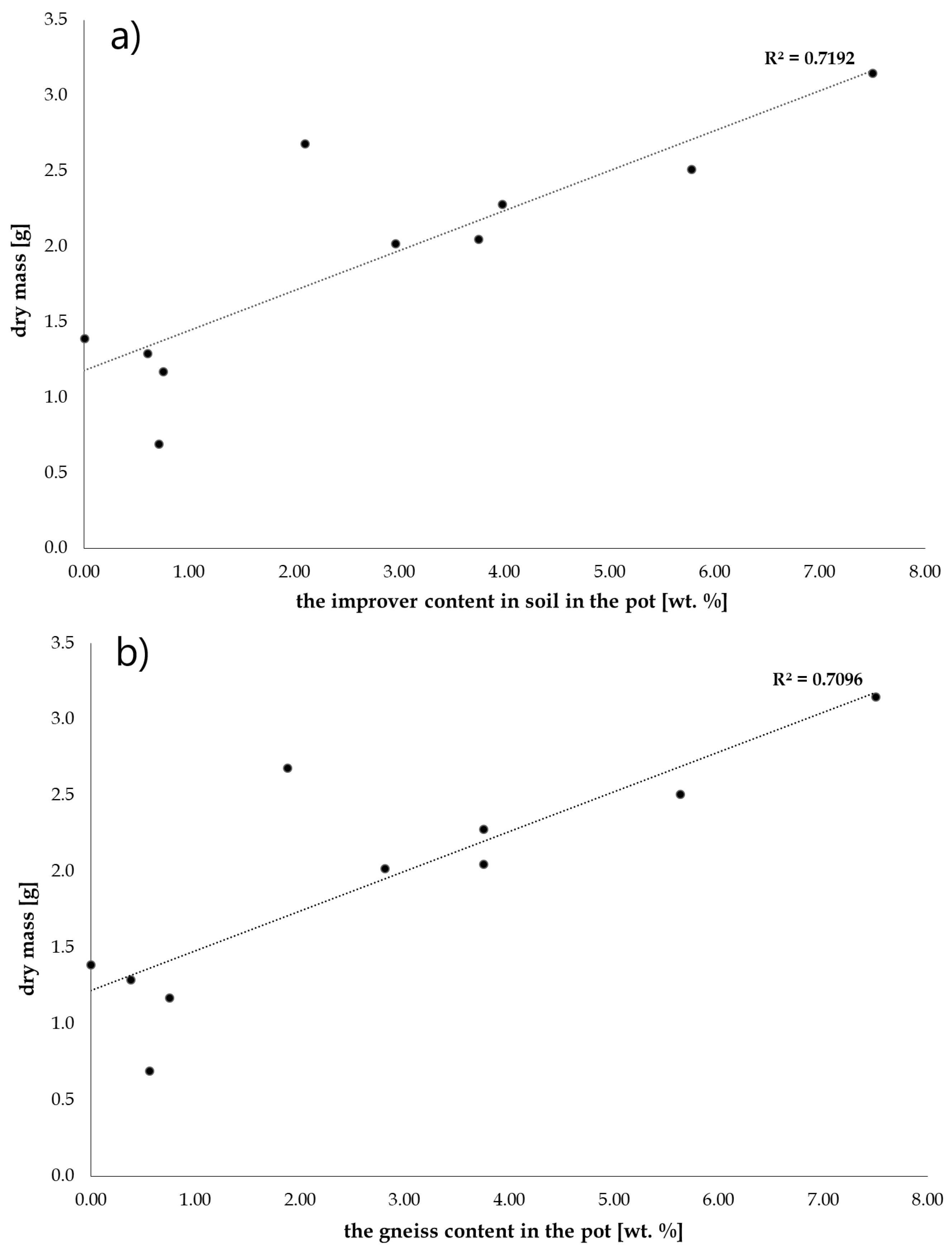
The following pairs of parameters, when compared with each other, showed a high Pearson’s r (Pearson correlation coefficient) value, which proved statistically significant at the 0.01 significance level. The content of the soil improver and the content of gneiss in relation to dry mass provided a correlation coefficient of r = 0.848 and r = 0.842, respectively (Figure 6). The content of the soil improver and the content of gneiss in relation to green mass provided a correlation coefficient of r = 0.813 and r = 0.805, respectively. The last set of parameters is average growth rate of wheat stem relative to the control sample to gneiss content, with a correlation coefficient of r = 0.651.
Figure 6.
Scatter diagrams showing the relationship between the obtained dry mass of plants and selected parameters of the soil improver: (a) relationship between the improver content in soil and dry mass, (b) relationship between the gneiss content in soil and dry mass.
High values of Pearson’s r correlation coefficient indicate a clear, directly proportional relationship between the yield of green mass and the amount of soil improver used in the research. Two of the above-mentioned pairs of parameters with the highest values of the r coefficients are shown in the scatter diagrams (Figure 6).
The gneiss component of the soil improver, its weight, and its proportion to the applied soil weight are of decisive importance for the effectiveness of the soil improver. These statements are consistent with reviews of silicate rock powders (SRPs), which emphasize their ability to enhance soil fertility and crop production while maintaining a safe profile provided that mineral composition and weathering rates are adequately controlled [16,32]. Similar relationships were not observed in the case of the second component of the improver—dolomite. No statistically significant relationships were found between the dolomite content and the tested parameters of the wheat yield. Specifically, the weight of dolomite in relation to the average green mass showed a correlation of r = 0.256; the weight of dolomite with respect to the average dry mass had a correlation of r = 0.186; the weight of dolomite in comparison with the green mass was correlated at r = 0.107; the weight of dolomite in relation to the average growth rate demonstrated a correlation of r = 0.046; and the weight of dolomite concerning the dry mass showed a correlation of r = 0.037. Similar results have been reported in a pot trial with Brachiaria decumbens, where application of dolomite had no significant effect on dry matter yield or forage quality (p > 0.05) despite increasing dose [33]. Another pot experiment with bean crops on acid sandy soil showed that dolomite treatments alone led to changes in soil chemistry but did not significantly increase yield unless combined with other nutrients [34]. These observations are consistent with our results for variant B (Table 6), where the mean dolomite content showed no statistically significant correlation with wheat biomass parameters.
While the high Pearson correlation coefficients (r = 0.805 to 0.848) suggest a strong linear dependency between gneiss content and biomass, the performance of variant D indicates a more complex, non-linear agronomic response. Variant D achieved peak performance in stalk growth (4.69 cm), suggesting a synergistic interaction between dolomite-induced pH optimization and gneiss-derived nutrient supply [35]. This implies that beyond a simple linear increase in mineral dosage, the optimal balance between the liming effect and nutrient bioavailability is the key determinant of plant productivity. Such a synergistic window allows for high yields even with moderate gneiss applications, provided the geochemical conditions are balanced. The observed variations in plant productivity across different treatments can be interpreted through Liebig’s law of the minimum, which states that growth is controlled not by the total amount of resources available but by the scarcest resource (limiting factor). In variant B, although nutrients were supplied, the elevated pH caused by the liming effect of dolomite likely acted as a limiting factor by reducing the bioavailability of essential micronutrients. The performance decline observed in variant B aligns with the nutrient antagonism and bioavailability constraints documented in multi-mineral application studies [36]. Conversely, variant D appears to represent a “synergistic optimum” where the ratio of gneiss to dolomite ensured that no single nutrient or chemical property fell below the critical threshold. This suggests that achieving maximum biomass is not merely a matter of increasing gneiss dosage but of finding the equilibrium where the interplay between soil pH and nutrient solubility satisfies the plant’s physiological demands without triggering nutrient antagonism. The integration of Liebig’s law of the minimum with the observed performance of variant D aligns with the findings of Swoboda et al. (2022) [16] regarding the controlled weathering of silicate rocks. While Pearson’s correlation suggests a general upward trend linked to gneiss content, the success of variant D underscores that plant productivity follows a non-linear optimization path.
Based on the results discussed by Stanisławska-Glubiak E. et al. [37] and Luise L.K. et al. [38], it can be hypothesized that the liming effect of dolomite, resulting in increased soil pH and increased Ca and Mg availability, may improve nutrient uptake efficiency. At moderate gneiss levels, this balance may create favorable chemical conditions for plant growth, whereas excessive Ca and Mg content relative to K may lead to nutrient antagonism, particularly affecting the availability of K and micronutrients (e.g., Mn, Zn, Cu). Such antagonistic effects are well documented in soils with elevated Ca/Mg:K ratios [36,39] and may explain the reduced efficiency observed in some dolomite-containing variants at lower gneiss rates (e.g., variant B). Conversely, higher gneiss proportions appear to compensate for these effects by providing increased amounts of potassium and trace elements, thereby mitigating potential nutrient imbalances induced by dolomite addition. These interpretations remain hypothetical, as detailed soil chemical parameters (e.g., post-treatment pH, exchangeable cations, and micronutrient availability) were not measured in this study. The lack of post-cultivation substrate analysis represents a limitation of this research; therefore, the observed plant responses serve as short-term, plant-based evidence of the improver’s efficacy rather than a definitive soil quality assessment. Nevertheless, the results point toward the existence of an optimal gneiss–dolomite ratio that maximizes agronomic response, warranting further investigation through targeted soil chemistry analyses.
4. Conclusions
Based on the results, it can be concluded that the appropriate proportioning of waste mineral materials—particularly fine-grained waste from the “Doboszowice 1” gneiss deposit—can yield a suitable mineral mixture that favorably influences plant growth parameters, which may suggest an improvement in chemical, physical, physicochemical, and biological properties of the soil. While the plant-based evidence is promising, a comprehensive assessment of the substrate’s chemical composition is warranted in future studies to fully elucidate the long-term effects on soil properties.
The results of the conducted analyses allow for the formulation of the following conclusions:
- The conducted chemical analyses of the samples of the fine-grained waste gneiss material showed that they meet the requirements of the permissible values of heavy metals (pollutants) adopted in the national regulation for agents improving soil properties. This was demonstrated by the chemical tests carried out and in external laboratories. Arsenic, cadmium, lead, and mercury were found in amounts that were significantly below the determined limits. The content limits for other elements (Ni, Cu, and Zn) in the new regulation of the European Parliament and of the Council (EU) for inorganic soil improvers should not restrict the potential use of gneiss in agricultural applications. Based on the observed lack of phytotoxicity in wheat, the material shows potential for safe short-term agricultural application. However, further research is required to evaluate the long-term mobility of heavy metals in the soil profile post-cultivation.
- The pot experiments, conducted on nine dosage variants of the soil improver and carried out under controlled conditions, showed that the application of gneiss-based improvers—especially those with higher proportions of gneiss—resulted in increased growth, green biomass, and dry biomass of spring wheat.
- Pearson’s correlation analysis confirmed statistically significant positive relationships (r > 0.800; p < 0.01) between the content of gneiss-based improver and plant yield parameters, including green and dry biomass, indicating that the fine-grained gneiss fraction may act as active component responsible for the observed increase in productivity.
- The dolomite fraction supplies calcium and magnesium, contributing to pH regulation. However, correlation analysis showed no significant relationship between dolomite content and wheat biomass or growth parameters, in contrast to the gneiss fraction, which exhibited a clear positive influence.
- The results indicate that the plant response to the application of gneiss–dolomite mixtures is non-linear and depends on the mutual proportions of both components. Although an increase in gneiss content generally promoted biomass production, the best effects were obtained at moderate application rates, suggesting the existence of an optimal balance between the liming effect of dolomite and the availability of nutrients supplied by gneiss. This non-linear response does not contradict the observed positive Pearson correlations, which describe the overall trend, but indicates the presence of a compositional optimum resulting from interactions between gneiss- and dolomite-derived effects.
These findings highlight the central role of the gneiss fraction in enhancing the agronomic value of the improver and strongly support its safe and sustainable use as a functional inorganic soil conditioner within the current legal framework. Furthermore, the transformation of mineral waste into a functional soil improver presents a cost-efficient and environmentally responsible strategy, fully consistent with the principles of the circular economy.
Author Contributions
Conceptualization, A.P., D.K. and A.Z.; methodology, A.Z. and D.K.; software, M.K.; validation, D.K., A.Z. and A.S.-T.; formal analysis, D.K., A.C.-P., A.Z. and J.S.-B.; investigation, D.K. and A.Z.; resources, M.K., D.K., A.Z., A.C.-P. and J.S.-B.; data curation, D.K. and A.Z.; writing—original draft preparation, A.Z., D.K. and M.K.; writing—review and editing, D.K., A.C.-P., J.S.-B. and A.P.; visualization, M.K. and A.C.-P.; supervision, D.K., A.Z. and J.S.-B. All authors have read and agreed to the published version of the manuscript.
Funding
This research was funded by the National Centre for Research and Development (NCBR), Poland, under the research project entitled “Technology for the utilization of mining waste with simultaneous reduction of its generation at the stage of exploitation of the Doboszowice 1 gneiss deposit”, co-financed by the European Regional Development Fund under Sub-measure 4.1 of the Smart Growth Operational Programme 2014–2020 (grant number POIR.04.01.02-00-0054/17).
Data Availability Statement
The original contributions presented in this study are included in the article. Further inquiries can be directed to the corresponding author.
Conflicts of Interest
The authors declare no conflicts of interest.
Abbreviation
The following abbreviation is used in this manuscript:
| ICP-OES | Inductively coupled plasma optical emission spectrometry |
References
- Ali, P.Q.; Aminum, N.U.; Jusop, S.; Radziah, O.; Razi, I.M. Applying Limestone or Basalt in combination with bio-fertilizer to sustain rice production on an acid sulfate soil in Malaysia. Sustainability 2016, 8, 700. [Google Scholar] [CrossRef] [Scilit]
- Shamshuddin, J.; Panhwar, Q.A.; Alia, F.J.; Shazana, M.A.R.S.; Radziah, O.; Fauziah, C.I. Formation and Utilisation of Acid Sulfate Soils in Southeast Asia for Sustainable Rice Cultivation. Pertanika J. Trop. Agric. Sci. 2017, 40, 225–246. [Google Scholar]
- Zagożdżon, P. Mączki bazaltowe w zastosowaniach rolniczych i pokrewnych. Pr. Nauk. Inst. Górn. Polit. Wrocł. 2008, 123, 137–146. (In Polish) [Google Scholar]
- Shazana, M.A.R.S.; Shamshuddin, J.; Fauziah, C.I.; Syed, O.S.R. Alleviating the interfertility of an acid sulphate soil by using ground basalt with or without lime and orgasnic fertilizer under submerged condition. Land Degrad. Dev. 2011, 24, 129–140. [Google Scholar] [CrossRef] [Scilit]
- Park, Y.D.; Kim, Y.S. The effect of wollatonite and manganese dioxide on rice grown on a flooded acid sulphate soil. Korean J. Soil Sci. Fert. 1970, 3, 23–28. [Google Scholar]
- Alia, F.J.; Radziah, O.; Shamshuddin, J.; Razi, M.I. Bio-fertilizer, ground magnesium limestone and basalt application may improve chemical properties of Malaysian acid sulfate soils and rice growth. Pedosphere 2014, 24, 827–835. [Google Scholar] [CrossRef] [Scilit]
- Richardson, J.B. Basalt Rock Dust Amendment on Soil Health Properties and Inorganic Nutrients-Laboratory and Field Study at Two Organic Farm Soils in New England, USA. Agriculture 2024, 15, 52. [Google Scholar] [CrossRef] [Scilit]
- Salgado, L.; Aparicio, L.; Afif, E.; Fernández-López, E.; Gallego, J.R.; Forjėn, R. A second life for mining waste as an amendment for soil remediation. J. Mater. Cycles Waste Manag. 2024, 26, 2971–2979. [Google Scholar] [CrossRef] [Scilit]
- Grabowski, T.; Bar-Michalczyk, D.; Charazińska, S.; Grabowska-Polanowska, B.; Kowalczyk, A.; Lochyński, P. An overview of natural soil amendments in agriculture. Soil Tillage Res. 2022, 225, 105462. [Google Scholar] [CrossRef] [Scilit]
- De Souza, M.E.P.; Cardoso, I.M.; De Carvalho, A.M.X.; Lopes, A.P.; Jucksch, I. Gneiss and steatite vermicomposted with organic residues: Release of nutrients and heavy metals. Int. J. Recycl. Org. Waste Agric. 2019, 8, 233–240. [Google Scholar] [CrossRef] [Scilit]
- Witt, A.; Schmidt, Z.; Pomorski, A. Aktualne kierunki wykorzystania gnejsów ze złóż dolnośląskich i opolskich oraz perspektywy zastosowania ich w nowych gałęziach przemysłu. Górn. Odkryw. 2016, 1, 47–57. (In Polish) [Google Scholar]
- Wang, J.G.; Zhang, F.S.; Cao, Y.P.; Zhang, X.L. Effect of types on release of mineral potassium from gneiss. Nutr. Cycl. Agroecosys. 2000, 56, 37–44. [Google Scholar] [CrossRef] [Scilit]
- Kufka, D.; Cichoń, T.; Pomorski, A. Wykorzystanie odpadu gnejsowego do uprawy kukurydzy w warunkach nasłonecznienia naturalnego. Górn. Odkryw. 2019, 6, 25–29. (In Polish) [Google Scholar]
- EUR-LEX, 2025a. Available online: https://op.europa.eu/en/publication-detail/-/publication/5fd4b8e6-e29a-11ec-a534-01aa75ed71a1 (accessed on 8 November 2025).
- ISAP. Available online: https://isap.sejm.gov.pl/isap.nsf/DocDetails.xsp?id=WDU20071471033 (accessed on 14 August 2007).
- Swoboda, P.; Döring, T.F.; Hamer, M. Remineralizing soils? The agricultural usage of silicate rock powders: A review. Sci. Total Environ. 2022, 807, 150976. [Google Scholar] [CrossRef] [Scilit]
- Benevides Filho, P.R.R.; Blaskowski, A.E.; Ramos, M.N.; Lessa, L.G.F.; Filho, A.N.Z.; Abreu-Junior, C.H.; Jani, A.D.; Capra, G.F.; Nogueira, T.A.R. Potential Soil Remineralizers from Silicate Rock Powders (SRP) as Alternative Sources of Nutrients for Agricultural Production (Amazon Region). Minerals 2023, 13, 1255. [Google Scholar] [CrossRef] [Scilit]
- Rodrigues, L.N.F.; Borges, W.L.B.; Modesto, V.C.; Ribeiro, N.A.A.; de Souza, N.C., Jr.; Girardi, V.A.M.; Matos, A.M.S.; Silva, B.P.C.; Galindo, F.S.; Andreotti, M. Use of Soil Remineralizer to Replace Conventional Fertilizers: Effects on Soil Fertility, Enzymatic Parameters, and Soybean and Sorghum Productivity. Agriculture 2024, 14, 2153. [Google Scholar] [CrossRef] [Scilit]
- Szuflicki, M.; Malon, A.; Tymiński, M. Bilans Zasobów Złóż Kopalin w Polsce wg Stanu na 31 December 2022 r; Państwowy Instytut Geologiczny Warszawa: Warszawa, Poland, 2022. [Google Scholar]
- Majkowska, U. Dodatek nr 1 do Dokumentacji Geologicznej Złoża Gnejsu “Doboszowice 1” w kat. C1+C2. w Miejscowości Doboszowice; Nr inw. 6952/2010; CAG PIG-PIB: Warsaw, Poland, 2010. (In Polish) [Google Scholar]
- Kania, M.; Gunia, P.; Zielińska, A.; Pomorski, A.; Majcher, A. Badania mineralogiczno-petrograficzne I chemiczne gnejsu jako klucz do racjonalnej gospodarki złożem. Górnictwo Odkryw. 2021, 3, 4–18. (In Polish) [Google Scholar]
- Nieć, M.; Mucha, J.; Bromowicz, J.; Wasilewska-Błaszczyk, M. Metodyka Dokumentowania Złóż Kopalin Stałych; Tom 3. Opróbowanie złóż; IGSMiE PAN: Kraków, Poland, 2012; 128p, ISBN 978-83-62922-12-3. (In Polish) [Google Scholar]
- ISAP. Available online: https://sip.lex.pl/akty-prawne/dzu-dziennik-ustaw/wykonanie-niektorych-przepisow-ustawy-o-nawozach-i-nawozeniu-17452384 (accessed on 8 November 2025).
- EUR-LEX. Available online: https://eur-lex.europa.eu/legal-content/EN/TXT/?uri=CELEX%3A02019R1009-20241120 (accessed on 20 November 2024).
- PN-EN 933-1:2012; Badanie Właściwości Geometrycznych Kruszyw. Oznaczanie Uziarnienia—Metoda Przesiewania. Testing the Geometric Properties of Aggregates. Determination of Grain Size—Sieving Method. Polish Standardization Committee: Warsaw, Poland, 2012.
- Oziegbe, E.J.; Ocan, O.O.; Costin, G.; Horvath, P. Geochemistry and mineral chemistry of pelitic gneiss of Ikare area, southwestern Nigeria. Heliyon 2021, 7, 12. [Google Scholar] [CrossRef] [Scilit]
- PN-EN ISO 11885:2009; Jakość Wody—Oznaczanie Wybranych Pierwiastków Metodą Optycznej Spektrometrii Emisyjnej z Plazmą Wzbudzaną Indukcyjnie (ICP-OES), Water Quality—Determination of Selected Elements by Inductively Coupled Plasma Optical Emission Spectrometry (ICP-OES). International Organization for Standardization (ISO): Geneva, Switzerland, 2009.
- PN-ISO 11466: 2002; Jakość Gleby—Ekstrakcja Pierwiastków Śladowych Rozpuszczalnych w Wodzie Królewskiej, Soil Quality—Extraction of Trace Elements Soluble in Aqua Regia. International Organization for Standardization (ISO): Geneva, Switzerland, 2002.
- Medeiros, F.D.P.; Carvalho, A.M.X.D.; Gindri Ramos, C.; Dotto, G.L.; Cardoso, I.sM.; Theodoro, S.H. Rock Powder Enhances Soil Nutrition and Coffee Quality in Agroforestry Systems. Sustainability 2024, 16, 354. [Google Scholar] [CrossRef] [Scilit]
- Fageria, N.K.; Baligar, V.C. Ameliorating Soil Acidity of Tropical Oxisols by Liming For Sustainable Crop Production. Adv. Agron. Acad. Press 2008, 99, 345–399. [Google Scholar]
- Marschner, P. Marschner’S Mineral Nutrition of Higher Plants, 3rd ed.; Elsevier: Amsterdam, The Netherlands, 2012; pp. 315–330. [Google Scholar]
- Harley, A.D.; Gilkes, R.J. Factors influencing the release of plant nutrient elements from silicate rock powders: A geochemical overview. Nutr. Cycl. Agroecosys. 2000, 56, 11–36. [Google Scholar] [CrossRef] [Scilit]
- Pholsen, S.; Higgs, D.E.B. Effects of potassium fertiliser and dolomite on the dry matter yield and forage quality of signal grass (Brachiaria decumbens) grown on Korat soil series (Oxic paleustults) in Northeast Thailand. Pensee 2014, 76, 253–260. [Google Scholar]
- Tóth, T. Effect of Zinc and Dolomite Treatments on the Chemical Composition of Acid Sandy Soil and Bean Crop. Commun. Soil Sci. Plant Anal. 2010, 41, 2568–2576. [Google Scholar] [CrossRef] [Scilit]
- Xie, K.; Cakmak, I.; Wang, S.; Zhang, F.; Guo, S. Synergistic and antagonistic interactions between potassium and magnesium in higher plants. Crop J. 2021, 9, 249–256. [Google Scholar] [CrossRef] [Scilit]
- Rietra, R.P.J.J.; Heinen, M.; Dimkpa, C.O.; Bindraban, P.S. Effects of Nutrient Antagonism and Synergism on Yield and Fertilizer Use Efficiency. Commun. Soil Sci. Plant Anal. 2017, 48, 1895–1920. [Google Scholar] [CrossRef] [Scilit]
- Stanisławska-Glubiak, E.; Korzeniowska, J.; Kucharski, M.; Kufka, D. Effects of different variants of basalt-sulphur improver in the fertilisation of spring oilseed rape. Pol. J. Agron. 2023, 52, 62–70. [Google Scholar] [CrossRef]
- Luise, L.K.; Simone, P.A.D.P.; Rômulo, S.A.; Leonardo, F.V.; José, C.S.S.; Giuliano, M.; Éder, D.S.M. Successive off take of elements by maize grown in pure basalt powder. Afr. J. Agric. Res. 2020, 15, 229–239. [Google Scholar] [CrossRef] [Scilit]
- Dölger, J.L.; Henningsen, J.N.; Mühling, K.H. Antagonistic K/Mg ratios: Is foliar application of MgSO4 a superior alternative to root resupply? Plant Soil 2024, 505, 747–761. [Google Scholar] [CrossRef] [Scilit]

Disclaimer/Publisher’s Note: The statements, opinions and data contained in all publications are solely those of the individual author(s) and contributor(s) and not of MDPI and/or the editor(s). MDPI and/or the editor(s) disclaim responsibility for any injury to people or property resulting from any ideas, methods, instructions or products referred to in the content. |
© 2026 by the authors. Licensee MDPI, Basel, Switzerland. This article is an open access article distributed under the terms and conditions of the Creative Commons Attribution (CC BY) license.