Article

Definition of Neotype Material for Simonellite, C19H24

by
Daniela Mauro
1,2,* and
Cristian Biagioni
1,3,*
1
Dipartimento di Scienze della Terra, Università di Pisa, Via Santa Maria 53, I-56126 Pisa, Italy
2
Museo di Storia Naturale, Università di Pisa, Via Roma 79, I-56011 Calci, Italy
3
Centro per l’Integrazione della Strumentazione dell’Università di Pisa, I-56126 Pisa, Italy
*
Authors to whom correspondence should be addressed.
Minerals 2026, 16(2), 138; https://doi.org/10.3390/min16020138
Submission received: 12 January 2026 / Revised: 23 January 2026 / Accepted: 26 January 2026 / Published: 27 January 2026
(This article belongs to the Collection New Minerals)

Abstract

Simonellite, C19H24, was first described from the lignite deposit of Fognano, Montepulciano, Siena Province, Tuscany, Italy, in 1919. Its crystal structure was solved and refined in the 1960s on the basis of recrystallized individuals. Notwithstanding several studies on this species, no type material has ever been reported. Following a new finding of simonellite, its crystal structure was re-examined using a natural crystal. Simonellite is orthorhombic, with space group Pnaa and unit-cell parameters a = 9.2220(5), b = 9.1269(5), c = 35.8907(17) Å, V = 3020.9(3) Å3. Its crystal structure was refined to R1 = 0.0513 for 2721 unique reflections with Fo > 4σ(F) and 244 refined parameters. Since no type material for this species is currently known, the studied material is defined as a neotype specimen for simonellite. It is deposited in the mineralogical collection of the Museo di Storia Naturale of the University of Pisa under catalogue number 20079.

1. Introduction

Polycyclic Aromatic Hydrocarbon (PAH) minerals represent a very small fraction of the total number of the currently known mineral species, with only eleven species described so far (Table 1). Most of them (seven out of eleven) were described before the establishment of the Commission on New Minerals and Mineral Names of the International Mineralogical Association in 1959 and before the routine deposition of type material. As a consequence, five minerals do not have any data about their type material, i.e., carpathite, fichtelite, idrialite, kratochvílite, and simonellite.
The importance of type material in mineralogy has been well known since the seminal work of Embrey and Hey [12]. In order to fill this gap, recently, we were able to obtain a specimen of simonellite from its type locality, the lignite deposit of Fognano, in the Montepulciano municipality (Siena Province, Tuscany, Italy). The specimen was collected by the mineral amateur Mirko Bonechi, who kindly provided the studied material in the summer of 2024. New crystallographic data confirmed its identification and allowed us to deposit it in the mineralogical collection of the Museo di Storia Naturale of the University of Pisa. Owing to the lack of type material for this PAH mineral, the specimen studied in this work was then proposed as neotype material of simonellite, and the proposal was accepted by the Commission on New Minerals, Nomenclature and Classification of the International Mineralogical Association (voting proposal 24-F). The specimen is kept in the mineralogical collection of the Museo di Storia Naturale of the University of Pisa, Via Roma 79, Calci, Pisa Province, Italy, under catalogue number 20079.

2. Previous Studies on Simonellite

At the end of the 1910s, Vittorio Simonelli (1860–1929), Italian geologist and paleontologist, collected some white crystalline crusts within fractures of lignite at Fognano, near Montepulciano (Siena Province, Tuscany, Italy), where a lignite deposit hosted in Pliocene clays was just discovered. Two specimens were given to the mineralogist Giovanni Boeris (1867–1946), who held the chair of Mineralogy at the University of Bologna. The study of this material revealed physical and chemical properties that suggested that this phase could be a new hydrocarbon mineral, probably orthorhombic, which was named simonellite in honour of its discoverer [10]. Further data on simonellite were given by Ciusa and Galizzi [13]. On the basis of their chemical analysis, simonellite was defined as C15H20.
Emiliani and Pellizzer [14,15,16] improved our knowledge on simonellite through morphological, optical, and X-ray diffraction studies. In particular, they were able to measure unit-cell parameters, confirming the orthorhombic symmetry suggested by Boeris [10]: a = 9.12, b = 9.27, c = 35.80 Å. According to Weissenberg photographs, Emiliani and Pellizzer [16] proposed the space group Pnaa after a transformation of the unit-cell in order to point out its pseudotetragonal nature. Ghigi and Fabbri [17] examined simonellite using chemical and spectroscopic techniques, whereas Ghigi et al. [18] were able to synthesize this compound. The chemical formula was revised to C19H24.
The crystal structure of simonellite was solved and refined by Foresti and Riva di Sanseverino [19]. They used a sample recrystallized from benzene after the dissolution of natural samples. The unit-cell parameters of simonellite are a = 9.231(3), b = 9.134(3), c = 36.01(1) Å, space group Pnaa. This latter space group was preferred with respect to the conventional Pccn in order to stress the pseudotetragonality of the cell pointed out by Emiliani and Pellizzer [15,16]. Single-crystal X-ray intensity data were measured using photographic techniques, and the crystal structure refinement converged to R = 12%.

3. Experiment

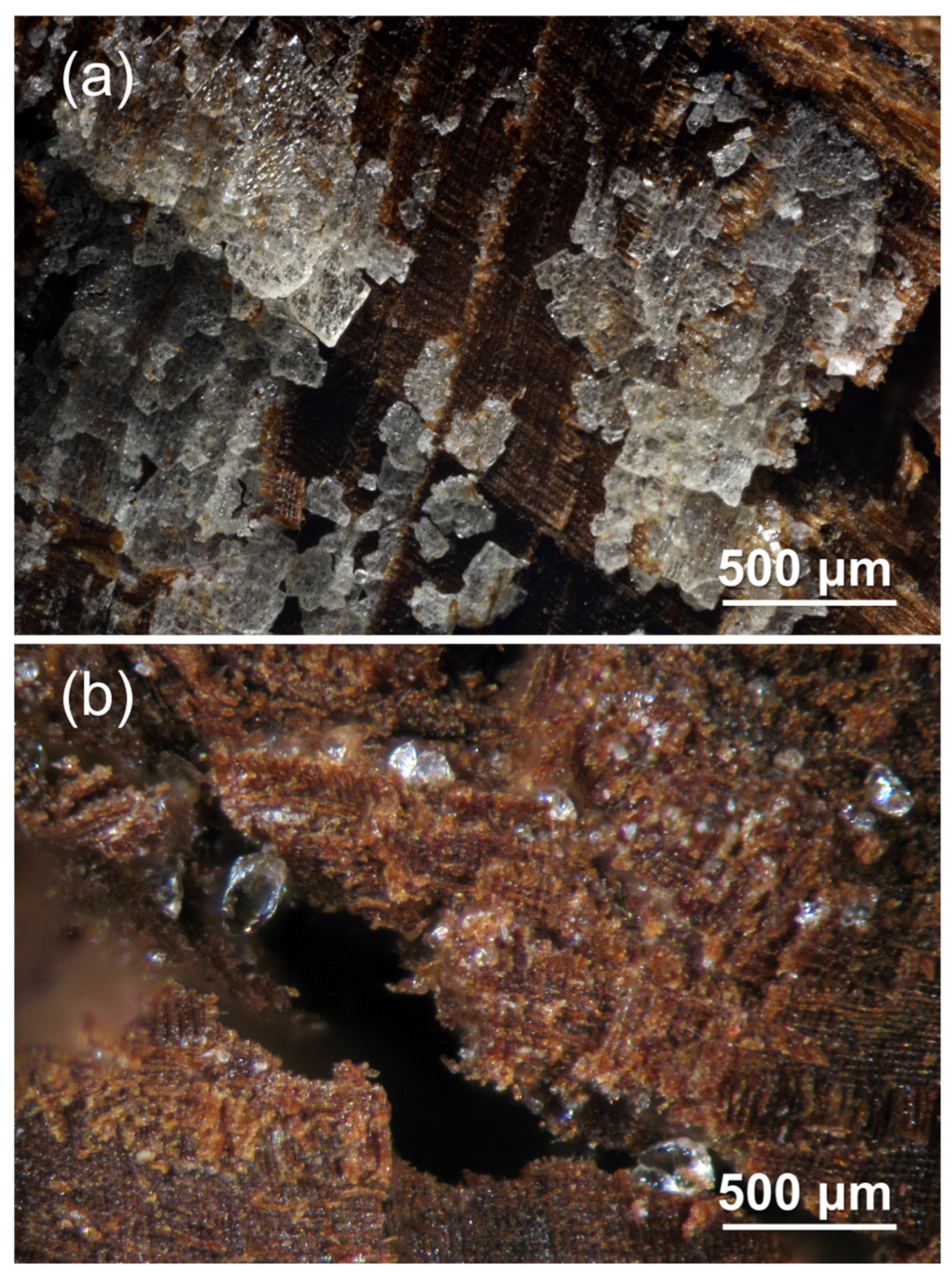
A small bipyramidal crystal of simonellite was sampled from the specimen kindly donated by the mineral collector Mirko Bonechi. Simonellite occurs as colourless tabular crystals with a resinous lustre on the fractures of lignite; rarely, bipyramidal crystals have also been observed (Figure 1). These two morphologies can be compared with those shown in Figures 1 and 2 by Emiliani and Pellizzer [14].
A single-crystal X-ray diffraction study was performed using a Bruker D8 Venture (Bruker AXS Advanced X-ray Solutions SE, Karlsruhe, Germany) diffractometer equipped with an air-cooled Photon III CCD detector (Bruker AXS Inc., Madison, WY, USA) and microfocus MoKα radiation (Centro per l’Integrazione della Strumentazione scientifica dell’Università di Pisa, Pisa, Italy). The detector-to-crystal distance was 52 mm. Data were collected using ω scan mode, in 0.5° slices, with an exposure time of 30 s per frame. A total of 1125 frames was collected. The frames were integrated with the Bruker SAINT software package using a narrow-frame algorithm. Data were corrected for Lorentz polarization, absorption, and background using the Apex4 software package [20]. Unit-cell parameters were refined on the basis of the XYZ centroid of 9993 reflections above 20 σ(I) with 4.604° < 2θ < 53.84°. They are a = 9.2220(5), b = 9.1269(5), c = 35.8907(17) Å, V = 3020.9(3) Å3. The statistical tests on the distribution of |E| values (|E2 − 1| = 0.942) and systematic absences agree with the space group Pnaa.
The crystal structure of simonellite was refined using Shelxl-2018 [21] starting from the coordinates of C atoms given by Foresti and Riva di Sanseverino [19]. An isotropic model refined to R1 = 0.1533, improved to R1 = 0.1173 describing anisotropically the displacement parameters of C atoms. The displacement parameters of H atoms were constrained to be 1.2 times that of the bonded C atoms. The final structural model refined to R1 = 0.0513 for 2721 unique reflections with Fo > 4σ(F) and 244 refined parameters. Details of the data collection and crystal structure refinement are given in Table 2.

4. Crystal Structure Description

Atom coordinates and isotropic or equivalent isotropic displacement parameters are reported in Table 3, whereas Table 4 and Table 5 give selected bond distances. The Crystallographic Information File (CIF) is made available in the Supplementary Materials linked to this article.
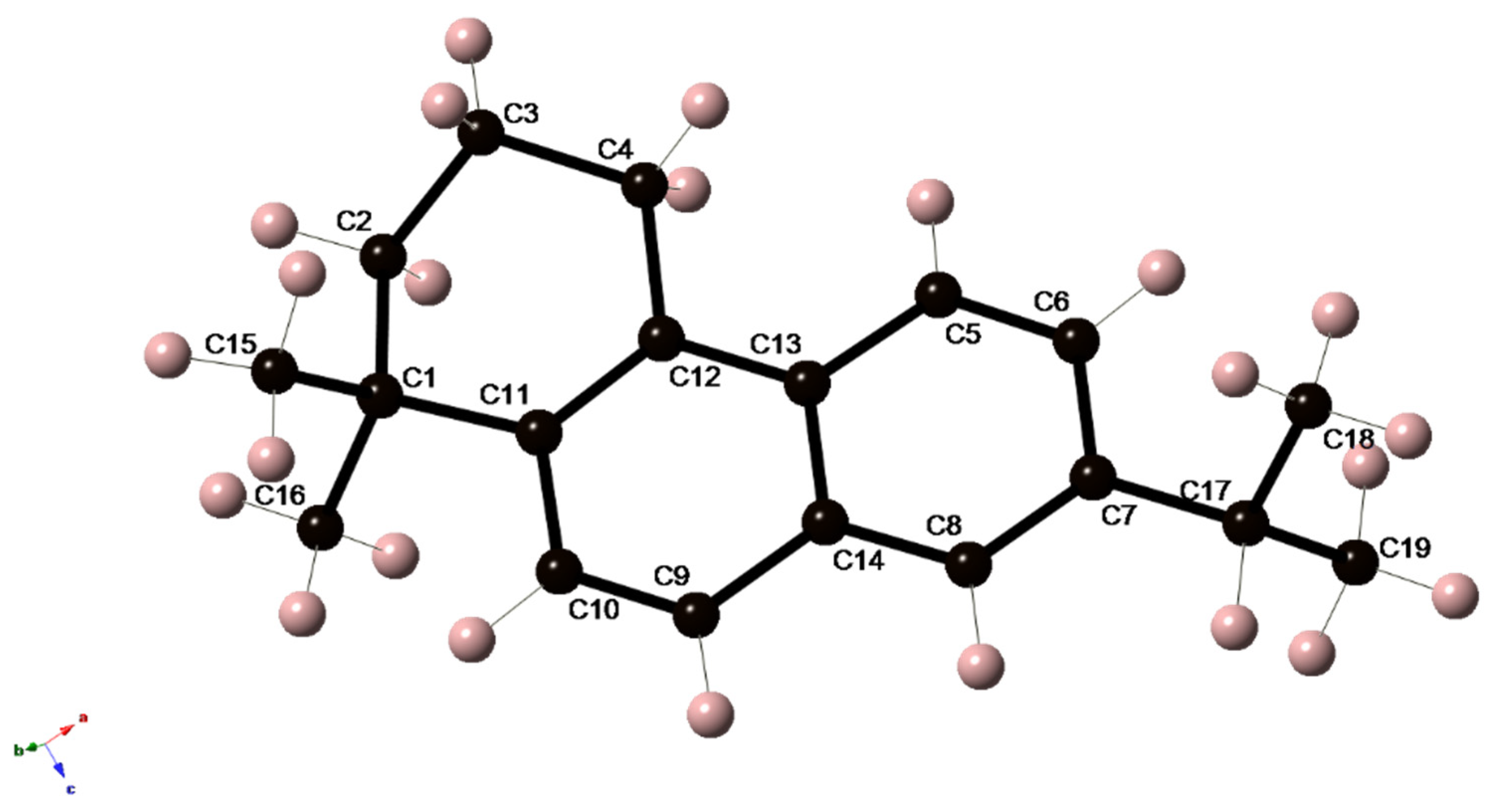
Simonellite is a molecular solid. Its molecule, C19H24, is shown in Figure 2. It corresponds to 1,1-dimethyl-1,2,3,4-tetrahydro-7-isopropylphenantrene, in accord with Ghigi et al. [18].
Figure 2. The C19H24 molecule occurring in simonellite. Black and pink circles are C and H atoms, respectively. C–C and C–H bonds are shown as thick and thin black lines, respectively. Drawn using CrystalMaker v.9.2.8 [22].
Minerals 16 00138 g002
Two different kinds of C atoms can be identified: three-fold (sp2) and four-fold coordinated (sp3). Three-fold coordinated C atoms show two different environments: some C atoms are bonded to three other C atoms (i.e., C7, C11, C12, C13, and C14), whereas others are bonded to two C atoms and one H atom (i.e., C5, C6, C8, C9, and C10). The C–C distance ranges between 1.353(2) and 1.432(2) Å (average value 1.399 Å, to be compared with 1.401 Å given by Foresti and Riva di Sanseverino [19]). Four-fold coordinated C atoms have different neighbours: C at C1 site is bonded to four other C atoms, whereas C at C17 is bonded to three C atoms and one H atom. Two C and two H atoms are bonded to C atoms at C2, C3, and C4, whereas C at the C15, C16, C18, and C19 sites are bonded to one C atom only and three H ones. Carbon atoms in sp3 configuration have C–C distances in the range 1.500(2)–1.543(2) Å (average value 1.523 Å, to be compared with 1.539 Å reported by Foresti and Riva di Sanseverino [19]).
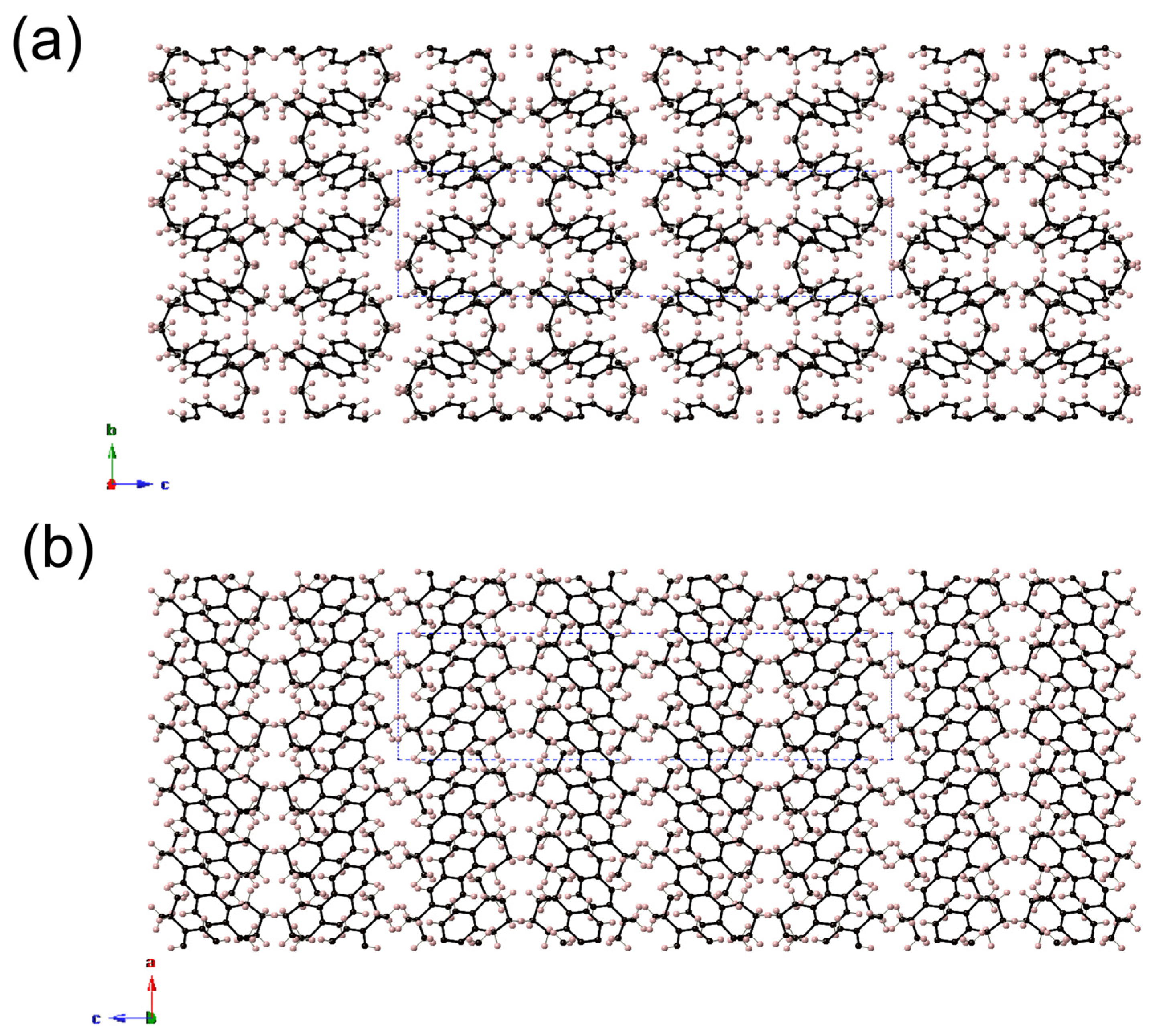
Figure 3 shows the projections of the crystal structure of simonellite. As previously noted by Foresti and Riva di Sanseverino [19], the C19H24 molecules lie almost linearly along a.

5. Conclusions

Modern X-ray diffraction analysis carried on natural crystals of simonellite confirmed the previous crystallographic investigations performed on recrystallized samples (e.g., [19]), also allowing for the deposit of a neotype material in a public mineral collection, i.e., that of the Museo di Storia Naturale of the University of Pisa.
Simonellite is the third well-characterized hydrocarbon mineral from the Tertiary lignite deposits of Tuscany, after dinite [3,23] and branchite [1,24]. Type materials of all these three PAH compounds are currently kept in the mineralogical collections of the Museo di Storia Naturale of the University of Pisa.

Supplementary Materials

The following supporting information can be downloaded at: https://www.mdpi.com/article/10.3390/min16020138/s1, CIF of simonellite.

Author Contributions

D.M. and C.B. conceived and designed the experiments; C.B. collected the single-crystal X-ray diffraction and analyzed the data; D.M. and C.B. wrote the manuscript. All authors have read and agreed to the published version of the manuscript.

Funding

This research received no external funding.

Data Availability Statement

The original contributions presented in this study are included in the article/Supplementary Material. Further inquiries can be directed to the corresponding authors.

Acknowledgments

The Centro per l’Integrazione della Strumentazione dell’Università di Pisa (CISUP) is acknowledged for access to the single-crystal X-ray laboratory. The mineral collector Mirko Bonechi is warmly thanked for making available the neotype material of simonellite. The comments of four anonymous reviewers helped us to improve the paper.

Conflicts of Interest

The authors declare no conflicts of interest.

References

  1. Bonaccorsi, E.; Farina, S.; Biagioni, C.; Pasero, M. ‘Hartite’ renamed branchite. Mineral. Mag. 2022, 86, 405–411. [Google Scholar] [CrossRef]
  2. Piotrovsky, G.L. Karpatite—A new organic mineral from Transcarpathia. Mineral. Sb. 1955, 9, 120–127. (In Russian) [Google Scholar]
  3. Franzini, L.; Pasero, M.; Perchiazzi, N. Re-discovery and re-definition of dinite, C20H36, a forgotten organic mineral from Garfagnana, northern Tuscany, Italy. Eur. J. Mineral. 1991, 3, 855–861. [Google Scholar] [CrossRef]
  4. Bromeis, C. Ueber den Fichtelit. Ann. Chem. Pharm. 1841, 37, 304–306. [Google Scholar]
  5. Witzke, T.; Schreyer, M.; Brandes, B.; Csuk, R.; Pöllmann, H. Freitalite, C14H10, a new aromatic hydrocarbon mineral from Freital, Saxony, Germany. Eur. J. Mineral. 2021, 33, 1–8. [Google Scholar] [CrossRef]
  6. Tanaka, R.; Hagiwara, A.; Ishibashi, T.; Inoue, Y. Hokkaidoite, IMA 2022-104. CNMNC Newsletter 71. Mineral. Mag. 2023, 87, 332–335. [Google Scholar]
  7. Dumas, J. Recherches sur les combinaisons de l’hydrogène et du carbone. Ann. Chim. Phys. 1832, 50, 182–197. [Google Scholar]
  8. Rost, R. Minerály hořících hald na Kladensku. Rozpravy II. Trídy Ceské Akad. 1937, 47, 1–20. [Google Scholar]
  9. Nasdala, L.; Pekov, I.V. Ravatite, C14H10, a new organic mineral species from Ravat, Tadzhikistan. Eur. J. Mineral. 1993, 5, 699–705. [Google Scholar] [CrossRef]
  10. Boeris, G. Sopra un idrocarburo della lignite di Fognano. Nota preliminare. Rend. Accad. Sci. Ist. Bologna 1919, 23, 83–87. [Google Scholar]
  11. Mills, S.J.; Kampf, A.R.; Nestola, F.; Williams, P.A.; Leverett, P.; Hejazi, L.; Hibbs, D.E.; Mrorsko, M.; Alvaro, M.; Kasatkin, A.V. Wampenite, C18H16, a new organic mineral from the fossil conifer locality at Wampen, Bavaria, Germany. Eur. J. Mineral. 2017, 29, 511–515. [Google Scholar] [CrossRef]
  12. Embrey, P.G.; Hey, M.H. Type specimens in mineralogy. Min. Rec. 1970, 1, 102–104. [Google Scholar]
  13. Ciusa, R.; Galizzi, A. Ricerche su alcuni costituenti delle ligniti. Gazz. Chim. Ital. 1921, 51, 55–60. [Google Scholar]
  14. Emiliani, F.; Pellizzer, R. Studio morfologico ed ottico della simonellite. Rend. Lincei Sci. Fis. Nat. 1952, 12, 724–728. [Google Scholar]
  15. Emiliani, F.; Pellizzer, R. Cella elementare e gruppo spaziale della simonellite. Nota I. Rend. Lincei Sci. Fis. Nat. 1953, 14, 652–657. [Google Scholar]
  16. Emiliani, F.; Pellizzer, R. Cella elementare e gruppo spaziale della simonellite. Nota II. Rend. Lincei Sci. Fis. Nat. 1953, 15, 101–107. [Google Scholar]
  17. Ghigi, E.; Fabbri, G. Sulla struttura di un terpenoide fossile. Atti Accad. Sci. Ist. Bologna Cl. Sci. Fis. Rend. 1965, 2, 83–91. [Google Scholar]
  18. Ghigi, E.; Drusiani, A.; Plessi, L.; Cavrini, V. Sulla struttura di un terpenoide fossile—Nota II. Sintesi della simonellite. Gazz. Chim. Ital. 1968, 98, 795–799. [Google Scholar]
  19. Foresti, E.; Riva di Sanseverino, L. The x-ray and molecular structure of an organic mineral: Simonellite, C19H24. Atti Accad. Naz. Lincei Cl. Sci. Fis. Mat. Nat. Rend. 1969, 47, 41–54. [Google Scholar]
  20. Bruker AXS Inc. APEX 4. Bruker Advanced X-Ray Solutions 2022; Bruker AXS Inc.: Madison, WI, USA, 2022. [Google Scholar]
  21. Sheldrick, G.M. Crystal structure refinement with SHELXL. Acta Crystallogr. 2015, C71, 3–8. [Google Scholar]
  22. Palmer, D.C. CrystalMaker; Crystal Software Ltd.: Bergbroke, Oxforshire, UK, 2014. [Google Scholar]
  23. Petri, G. Sulla Dinite, nuovo minerale di origine organica. Gazz. Med. Ital. 1852, 4, 233–234. [Google Scholar]
  24. Savi, P. Sopra la branchite, nuova specie di combustibile fossile trovato in Toscana. Nuovo Giorn. Lett. 1839, 108, 1–8. [Google Scholar]
Figure 1. Simonellite, colourless tabular (a) and bipyramidal (b) crystals on lignite. Fognano, Montepulciano, Siena Province, Tuscany, Italy. Neotype material. Collection Museo di Storia Naturale of the University of Pisa, catalogue number 20079. Photo C. Biagioni.
Minerals 16 00138 g001
Figure 3. Projections of the crystal structure of simonellite down a (a) and b (b). Same symbols as in Figure 2. The unit cell is shown as blue dotted lines. Drawn using CrystalMaker v.9.2.8 [22].
Minerals 16 00138 g003
Table 1. Valid PAH minerals.
SpeciesChemical
Formula
Type LocalityYear of
Description
Type MaterialRef.
BranchiteC20H34Monte Vaso, Tuscany, Italy1839MSN-UniPi[1]
CarpathiteC24H12Olenevo, Zakarpattia Oblast, Ukraine1955No data[2]
DiniteC20H36Castelnuovo Garfagnana, Tuscany, Italy1852MSN-UniPi[3]
FichteliteC19H34Hausellohe, Bavaria, Germany1841No data[4]
FreitaliteC14H10Carola mine, Saxony, Germany2021TU-BA-Freiberg[5]
HokkaidoiteC22H12Aibetsu mine and Shikaribetsu lake, Hokkaido, Japan2022NMNS[6]
IdrialiteC22H14Idria mine, Slovenia1832No data[7]
KratochvíliteC13H10Kladno mine, Central Bohemia, Czech Republic1937No data[8]
RavatiteC14H10Ravat village, Sughd, Tajikistan1993TU-BA-Freiberg[9]
SimonelliteC19H24Fognano, Tuscany, Italy1919No data[10]
WampeniteC18H16Wampen, Bavaria, Germany2017LACMNH[11]
LACMNH = Los Angeles County Museum of Natural History, Los Angeles, U.S.A.; MSN-UniPi = Museo di Storia Naturale of the University of Pisa, Italy; NMNS = National Museum of Nature and Science, Tsukuba, Japan; TU-BA-Freiberg = TU Bergakademie Freiberg, Germany. [1] Bonaccorsi et al. (2022); [2] Piotrovsky (1955); [3] Franzini et al. (1991); [4] Bromeis (1841); [5] Witzke et al. (2021); [6] Tanaka et al. (2023); [7] Dumas (1832); [8] Rost (1937); [9] Nasdala and Pekov (1993); [10] Boeris (1919); [11] Mills et al. (2017).
Table 2. Crystal and experimental details for simonellite.
Crystal Data
Chemical formulaC19H24
Crystal size (mm)0.175 × 0.150 × 0.110
Cell setting, space groupOrthorhombic, Pnaa
a (Å)9.2220(5)
b (Å)9.1269(5)
c (Å)35.8907(17)
V3)3020.9(3)
Z8
Data collection and refinement
Radiation, wavelength (Å)MoKα, 0.71073
Temperature (K)293(3)
max (°)54.94
Measured reflections32,256
Unique reflections3450
Reflections with Fo > 4σ(F)2721
Rint0.0353
Rσ0.0196
Range of h, k, l−11 ≤ h ≤ 11,
−11 ≤ k ≤ 10,
−46 ≤ l ≤ 43
R1 [Fo > 4σ(F)]0.0513
R1 (all data)0.0633
wR (on F2)0.1505
Goof1.068
Number of least-squares parameters244
Maximum and minimum residual peak (e Å−3)+0.31 [at 1.02 Å from C3]
−0.15 [at 1.35 Å from C8]
Table 3. Site, site occupancy (s.o.), fractional atomic coordinates and equivalent isotropic or isotropic (*) displacement parameters (in Å2) for simonellite.
Sites.o.x/ay/bz/cUeq/iso*
C1C1.000.09304(16)0.58044(17)0.18091(4)0.0536(4)
C2C1.000.11399(19)0.4744(2)0.21351(5)0.0629(4)
H21H1.000.046(2)0.509(2)0.2337(5)0.075 *
H22H1.000.082(2)0.364(2)0.2061(5)0.075 *
C3C1.000.26913(19)0.4638(2)0.22583(4)0.0635(4)
H31H1.000.274(2)0.402(2)0.2492(6)0.076 *
H32H1.000.308(2)0.571(2)0.2323(5)0.076 *
C4C1.000.36154(18)0.4011(2)0.19462(4)0.0563(4)
H41H1.000.468(2)0.4100(19)0.2023(5)0.068 *
H42H1.000.3390(18)0.289(2)0.1921(5)0.068 *
C5C1.000.56465(17)0.37044(18)0.13188(4)0.0554(4)
H51H1.000.5799(18)0.320(2)0.1544(5)0.067 *
C6C1.000.66364(18)0.35868(19)0.10373(5)0.0599(4)
H61H1.000.748(2)0.295(2)0.1083(5)0.072 *
C7C1.000.64820(17)0.43693(17)0.07008(4)0.0545(4)
C8C1.000.52816(18)0.52221(17)0.06603(4)0.0537(4)
H81H1.000.5147(19)0.5774(18)0.0410(5)0.064 *
C9C1.000.29681(18)0.62351(19)0.08977(4)0.0590(4)
H91H1.000.2835(19)0.673(2)0.0648(5)0.071 *
C10C1.000.19720(18)0.63498(19)0.11729(4)0.0588(4)
H101H1.000.112(2)0.700(2)0.1127(5)0.071 *
C11C1.000.21297(15)0.56090(15)0.15184(4)0.0471(3)
C12C1.000.33480(15)0.47632(15)0.15767(4)0.0447(3)
C13C1.000.43997(15)0.45995(15)0.12860(4)0.0449(3)
C14C1.000.42185(16)0.53536(16)0.09431(4)0.0488(3)
C15C1.000.0921(2)0.7400(2)0.19460(6)0.0733(5)
H151H1.000.009(2)0.757(2)0.2122(5)0.088 *
H152H1.000.186(2)0.764(2)0.2098(5)0.088 *
H153H1.000.077(2)0.806(2)0.1740(6)0.088 *
C16C1.000.94449(19)0.5443(3)0.16343(6)0.0756(5)
H161H1.000.943(2)0.438(3)0.1512(6)0.091 *
H162H1.000.866(2)0.539(2)0.1840(6)0.091 *
H163H1.000.921(2)0.620(3)0.1450(6)0.091 *
C17C1.000.7618(2)0.4253(2)0.03965(5)0.0636(4)
H171H1.000.7314(19)0.493(2)0.0169(5)0.076 *
C18C1.000.9105(2)0.4704(3)0.05352(7)0.0868(6)
H181H1.000.986(3)0.466(3)0.0335(6)0.104 *
H182H1.000.911(3)0.568(3)0.0663(6)0.104 *
H183H1.000.943(3)0.392(3)0.0716(7)0.104 *
C19C1.000.7630(3)0.2742(3)0.02207(6)0.0877(6)
H191H1.000.660(3)0.254(3)0.0101(6)0.105 *
H192H1.000.837(3)0.271(3)0.0012(6)0.105 *
H193H1.000.788(3)0.206(3)0.0431(7)0.105 *
Table 4. Carbon–C distances (in Å) in simonellite.
C1–C21.530(2)C5–C61.366(2)C9–C141.415(2)
C1–C111.5310(19)C5–C131.415(2)C10–C111.420(2)
C1–C151.536(2)C6–C71.410(2)C11–C121.3792(19)
C1–C161.543(2)C7–C81.361(2)C12–C131.4323(18)
C2–C31.501(2)C7–C171.517(2)C13–C141.4201(19)
C3–C41.519(2)C8–C141.416(2)C17–C181.516(3)
C4–C121.5134(19)C9–C101.353(2)C17–C191.517(3)
Table 5. Carbon–H distances (in Å) in simonellite.
C2–H211.008(19)C8–H811.039(17)C16–H1630.98(2)
C2–H221.09(2)C9–H911.013(17)C17–H1711.062(19)
C3–H311.01(2)C10–H1010.999(19)C18–H1811.00(3)
C3–H321.06(2)C15–H1511.00(2)C18–H1821.00(3)
C4–H411.024(18)C15–H1521.05(2)C18–H1831.01(2)
C4–H421.051(19)C15–H1530.97(2)C19–H1911.06(2)
C5–H510.941(18)C16–H1611.07(2)C19–H1921.01(2)
C6–H610.987(19)C16–H1621.04(2)C19–H1931.01(2)
Disclaimer/Publisher’s Note: The statements, opinions and data contained in all publications are solely those of the individual author(s) and contributor(s) and not of MDPI and/or the editor(s). MDPI and/or the editor(s) disclaim responsibility for any injury to people or property resulting from any ideas, methods, instructions or products referred to in the content.