


Abstract
Coastal sediments around volcanic islands may contain mixed geogenic signals from local lithology and localized non-lithogenic inputs. This study examines heavy metal (HM) patterns, contamination levels, source constraints, and screening-level health risks in coastal sediments from Kudumbul volcanic island in Saudi Arabia’s southeastern Red Sea. Thirty-five surface sediment samples were analyzed for Fe, Cr, Pb, Zn, V, Cu, and Ni using ICP-OES. Concentrations ranged from 1898–19,500 μg/g for Fe, 11.00–65.52 μg/g for Cr, 11.00–22.00 μg/g for Pb, 7.00–40.00 μg/g for Zn, 5.16–48.35 μg/g for V, 2.43–17.31 μg/g for Cu, and 1.00–88.00 μg/g for Ni. Compared with published background concentrations and sediment quality guidelines, most HMs showed generally low contamination levels across the island. However, Ni showed localized exceedance of the ERL at three sites and the ERM at one site. Contamination indices indicated low average contamination at the island scale, although Pb showed the highest relative enrichment and should be interpreted cautiously because of its limited concentration range and sensitivity to Fe normalization. Correlation analysis, HCA, and PCA identified a predominant Cr-Cu-Fe-Ni-V-Zn grouping compatible with basaltic and volcaniclastic sediment inputs, while Pb showed distinct behavior, implying different sediment partitioning or an additional localized source. Screening-level risk calculations identified ingestion as the primary exposure route, with estimates higher for children than adults under conservative assumptions. Non-carcinogenic risk remained below the threshold value of 1. Cancer-risk estimates warrant cautious interpretation because Cr speciation and bioaccessibility were not measured. These results establish a monitoring baseline for volcanic-island coastal sediments and highlight the need for site-specific background data and metal speciation in future evaluations.
1. Introduction
Coastal sediments play a dual role in marine environments by storing heavy metals (HMs) and, under suitable conditions, releasing them back into the surrounding system. These HMs can derive from natural processes and human activities, including rock weathering, urban and industrial discharges, coastal infrastructure, atmospheric deposition, shipping, and navigation. Along coasts, navigation can alter sediment-metal patterns through vessel-driven disturbance, resuspension of fine particles, and localized discharge of metal-containing residues or paint particles [1,2,3]. On remote volcanic islands such as Kudumbul Island, such inputs represent possible localized influences rather than established contamination sources. Once introduced into the marine environment, metals can preferentially accumulate in fine sediment fractions and remain there for extended periods [4,5,6]. Because many HMs are persistent and resistant to degradation, changes in sediment chemistry can promote their remobilization after deposition. Their long-term accumulation may therefore affect benthic organisms and create indirect pathways of human exposure through trophic transfer and consumption of contaminated marine organisms [7,8,9,10].
Human exposure to HMs can occur through multiple routes, including accidental ingestion of contaminated sediment or dust, direct dermal contact, and inhalation of metal-bearing particles [11,12,13]. Depending on dose, exposure duration, and receptor sensitivity, elevated metal intake may be associated with adverse cardiovascular, neurological, renal, and carcinogenic outcomes [14,15]. Children are generally considered more sensitive than adults because of their smaller body mass, more frequent hand-to-mouth behavior, higher intake relative to body weight, and reduced ability to process or eliminate certain toxic substances [16,17,18]. Consequently, sediment-based health-risk screening is useful for estimating potential exposure and identifying vulnerable receptor groups in coastal settings.
Metal concentrations in volcanic-island and basalt-dominated coastal settings require careful interpretation, as natural lithogenic contributions may coincide with localized non-lithogenic signals. Weathering, erosion, and shoreline reworking of mafic volcanic rocks and volcaniclastic deposits can naturally supply Fe, Ni, Cr, V, and other trace elements to nearby sediments. As a result, relatively high concentrations of certain HMs in volcanic coastal settings may reflect the underlying geological composition rather than contamination. By contrast, some elements, particularly Pb, may receive additional inputs from atmospheric fallout, vessel-related activities, fuel-derived residues, or other localized anthropogenic sources [19]. Reliable interpretation thus depends on jointly assessing metal concentrations, contamination indices, sediment quality criteria, and multivariate statistical patterns, while acknowledging constraints arising from unavailable site-specific background values, metal speciation, and bioaccessibility data.
Over the past two decades, considerable attention has been directed toward the occurrence and environmental behavior of HMs in seawater and coastal sediments along the Saudi sector of the Red Sea and neighboring regions [20,21,22,23,24,25]. Collectively, these investigations have provided valuable information on metal distribution, contamination levels, and associated ecological implications under the combined influence of natural processes and human activities. Nevertheless, the existing literature has largely concentrated on mainland shorelines, industrial and urban coastal sectors, lagoons, and other readily accessible environments. Environmental-geochemical research on small volcanic islands in the southeastern Red Sea remains scarce, despite their potential for investigating interactions between volcanic lithology, coastal sediment redistribution, and localized non-lithogenic contributions. Recent work in the Red Sea region has also highlighted the importance of establishing baseline data on metal occurrence, contamination conditions, and potential ecological and exposure-related risks in coastal sediments [26].
Kudumbul is a small Quaternary volcanic island within the southeastern Red Sea rift system, where volcanic, bioclastic, and coastal-process signatures converge in a confined sedimentary setting. Earlier sedimentological and geomorphological studies identified a western volcanic edifice and eastern low-lying sandy shores, with beach, dune, and sand-sheet facies constituting the principal surface deposits. The volcanic cone contains basaltic rocks, phreatomagmatic lapilli tuff, and vesicular basalt/scoria, suggesting interaction between volcanism and shallow marine conditions as the island developed [27]. Wave action, longshore currents, winds, spring tides, and biological processes govern sediment movement, sorting, shoreline changes, and redistribution of bioclastic and volcanically derived material around the island. These features make Kudumbul Island well suited to assessing whether coastal sediment HMs originate from volcanic lithogenic inputs, local sediment sorting, or additional non-lithogenic contributions [27].
Although Kudumbul Island has considerable geological and geomorphological importance, its coastal sediments have not previously been evaluated with respect to HM distribution, contamination status, sediment-quality implications, source constraints, or screening-level health risks. The present study was designed to: (1) characterize the abundance and spatial distribution of selected HMs; (2) evaluate their concentrations relative to published background values, regional datasets, and established sediment quality guidelines; (3) quantify the degree of sediment contamination using the enrichment factor (EF), geoaccumulation index (Igeo), and contamination factor (CF); (4) examine elemental associations and source constraints using correlation analysis, hierarchical cluster analysis, and principal component analysis, emphasizing differentiation between volcanic lithogenic controls and potential localized non-lithogenic signals; and (5) calculate screening-level non-carcinogenic and carcinogenic health risks for adults and children under conservative sediment-contact assumptions, without interpreting them as residential population risk estimates.
2. Materials and Methods
2.1. Study Area
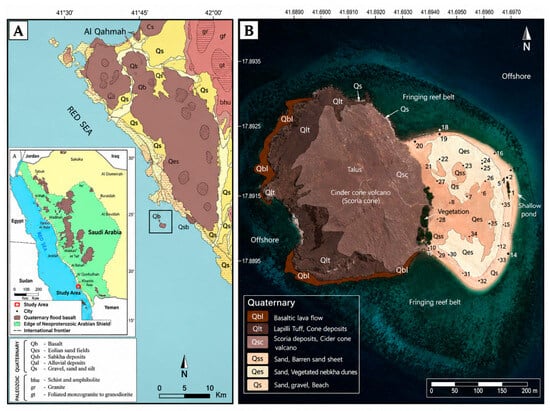
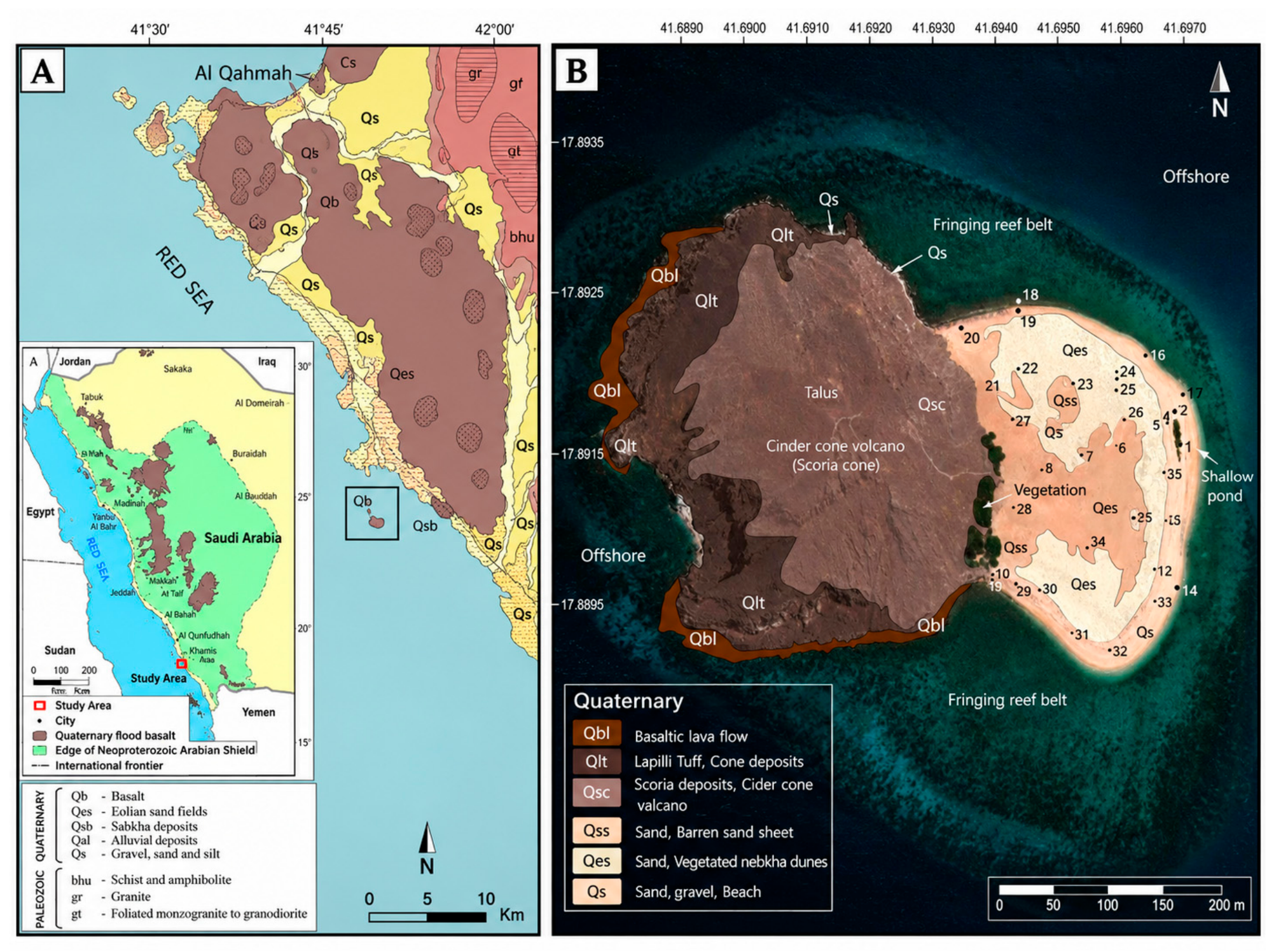
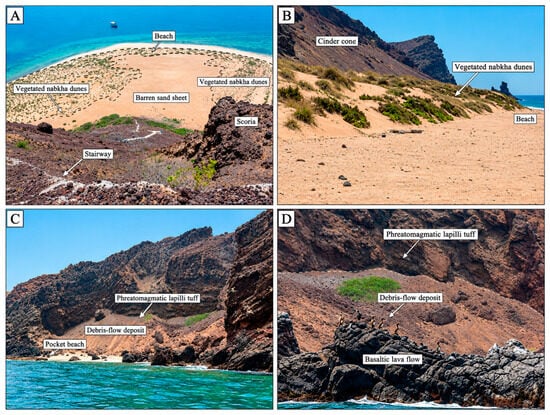
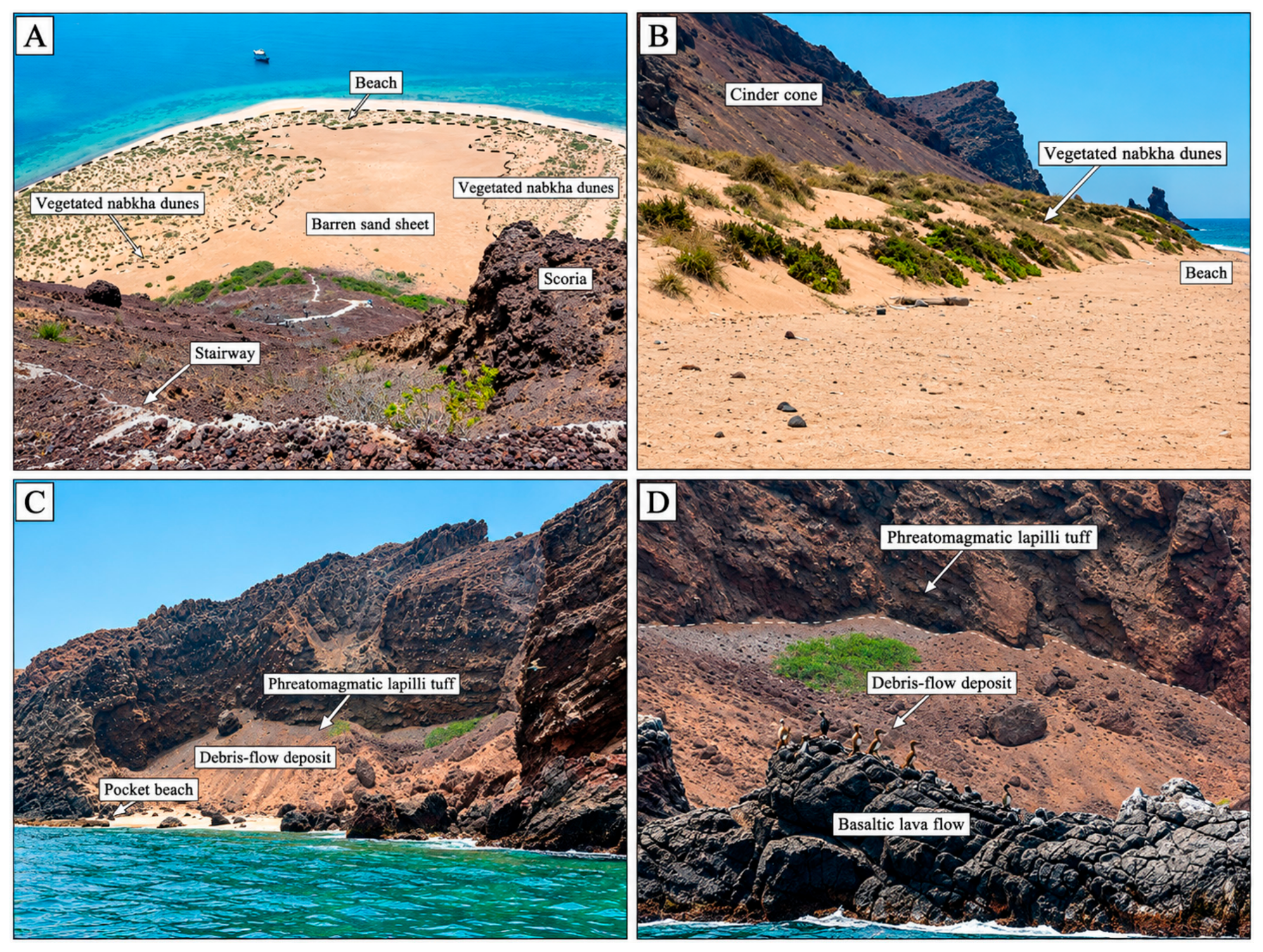
Kudumbul Island is situated offshore along the southeastern sector of the Red Sea rift in Saudi Arabia, at approximately 17°53′19″ N and 41°41′33″ E (Figure 1). It occupies a shallow platform trending NNW and is geologically linked to the Quaternary Al Birk volcanic field of western Saudi Arabia. The island consists of a scoria or cinder cone constructed above a hydrovolcanic tuff-cone foundation and is related to Pleistocene basaltic volcanism represented by the Al Birk basaltic sequence [28,29,30]. In terms of morphology, the western part is dominated by a volcanic high, whereas the eastern margin is characterized by low-relief sandy coastlines. Geological observations (Figure 2) indicate that the volcanic edifice contains basaltic lava, phreatomagmatic lapilli tuff, and vesicular basalt to scoria, features that record magma-water interaction under shallow-marine conditions during the development of the island [27]. By contrast, the sandy coastal deposits contain abundant coral and shell debris, pointing to a substantial bioclastic component that was likely supplied from adjacent reef-associated limestone platforms [31,32].
Figure 1.
Location and geological setting of Kudumbul Island, southeastern Red Sea, Saudi Arabia. (A) Regional geological map showing the position of Kudumbul Island along the southeastern Red Sea coast. (B) Geological map of Kudumbul Island showing the distribution of the main Quaternary units and sediment sampling sites. The base map is a 2022 IKONOS image.
Figure 2.
Representative field photographs of Kudumbul Island showing the main coastal and volcanic geomorphic features. (A) Beach, barren sand sheet, vegetated nabkha dunes, and exposed scoria on the eastern side of the island. (B) Vegetated nabkha dunes adjacent to the cinder cone in the northeastern part of the island. (C) Rocky coastal cliff composed of phreatomagmatic lapilli tuff and debris-flow deposits above a pocket beach. (D) Volcanic coastal succession showing basaltic lava flow, debris-flow deposits, and phreatomagmatic lapilli tuff along the western coast.
Kudumbul Island lies within a hot and arid coastal environment, where mean monthly air temperatures vary from approximately 22 to 38 °C [33]. The area is characterized by intense evaporation, reaching nearly 1200 mm/year, and extremely limited precipitation, with annual rainfall averaging only about 6.6 mm/year [33,34]. Mean sea-surface salinity is approximately 36.5‰ [35]. Sediment transport and shoreline configuration are influenced by a combination of seasonal wind patterns, longshore currents, wave activity, spring tides, and recurrent coastal reworking processes [36]. Collectively, these climatic, oceanographic, and geological conditions play an important role in controlling sediment characteristics and metal distribution and therefore provide essential context for differentiating natural geogenic contributions from additional non-lithogenic inputs within the coastal zone.
2.2. Sampling, Analytical Methods and Data Analysis
A total of 35 coastal sediment samples were obtained from locations distributed around Kudumbul Island using clean plastic sampling equipment (Figure 1). Sampling stations were chosen to achieve broad shoreline coverage and to represent the principal sedimentary environments present around the island. Immediately after collection, the sediments were transferred into pre-cleaned polyethylene bags, appropriately labelled, and transported to the laboratory for preparation and analysis. Coarse debris, including gravel, shell fragments, visible plant material, and other unwanted constituents, was manually removed. The sediments were then air-dried at ambient temperature for seven days before dry sieving, and the <63 μm fraction was retained for geochemical analysis. For digestion, approximately 0.5 g of homogenized fine sediment from each sample was transferred to a Teflon beaker and treated with a mixed-acid procedure involving hydrofluoric acid (HF), aqua regia, and perchloric acid (HClO4). The mixtures were heated for 12 h and subsequently allowed to cool. Hydrochloric acid (HCl) and deionized water were then added, followed by additional heating to promote complete dissolution of the sediment matrix. After digestion, each solution was brought to a defined final volume with deionized water and prepared for subsequent instrumental determination.
Pb, Ni, Zn, V, Fe, Cr, and Cu concentrations were measured using inductively coupled plasma-optical emission spectrometry (ICP-OES; Agilent 5800, Agilent Technologies, Santa Clara, CA, USA) at the Saudi Geological Survey laboratories in Jeddah, Saudi Arabia. The detection limit for each element was 1 ppm. Quality assurance and quality control adhered to standard geochemical procedures routinely applied by the Saudi Geological Survey. Every analytical batch included procedural blanks, calibration-check standards, duplicate samples, and certified or reference materials to evaluate possible contamination, instrument stability, accuracy, and precision. Procedural blanks identified contamination arising during digestion or measurement, whereas duplicate analyses assessed reproducibility and analytical precision.
The contamination status of the studied sediments was evaluated using enrichment factor (EF), geoaccumulation index (Igeo), and contamination factor (CF). These indices were calculated according to the following equations:
where M denotes the target metal concentration; Fe denotes the iron concentration used for normalization; (M/Fe)sample represents the metal-to-Fe ratio of each sediment sample; and (M/Fe)background represents that ratio in the chosen background material. For Igeo, Cn denotes the measured target metal concentration and Bn its background concentration. For CF, Co denotes the measured target metal concentration and Cb the corresponding background concentration. The classification of EF, Igeo, and CF values is presented in Table S1. Sediment quality guidelines, including effects range-low (ERL) and effects range-median (ERM), were used to assess the potential biological significance of metal concentrations in the studied sediments [37,38,39,40].
EF = (M/Fe)sample/(M/Fe)background
Igeo = log2 [Cn/(1.5 × Bn)]
CF = Co/Cb
Igeo = log2 [Cn/(1.5 × Bn)]
CF = Co/Cb
Human health risks were assessed for adults and children through ingestion and dermal contact pathways, which represent the most relevant direct exposure routes during contact with coastal sediments. The calculated risks are interpreted as conservative exposure scenarios rather than continuous residential exposure on the island. Chronic daily intake through ingestion and dermal contact was calculated as follows:
where Csed is the metal concentration in sediment, IngR is the ingestion rate, EFexp is the exposure frequency, ED is the exposure duration, CFconv is the unit conversion factor, BW is body weight, AT is averaging time, SA is the exposed skin surface area, AFsed is the sediment adherence factor, and ABS is the dermal absorption factor. The EFexp was used for exposure frequency to avoid confusion with enrichment factor. For non-carcinogenic risk, AT was calculated as ED × 365 days. For carcinogenic risk, lifetime averaging time was calculated as 70 × 365 days. The exposure parameters and reference dose values used in the calculations are listed in Table S2.
CDIing = (Csed × IngR × EFexp × ED × CFconv)/(BW × AT)
CDIderm = (Csed × SA × AFsed × ABS × EFexp × ED × CFconv)/(BW × AT)
CDIderm = (Csed × SA × AFsed × ABS × EFexp × ED × CFconv)/(BW × AT)
The hazard quotient (HQ) and hazard index (HI) were calculated as:
where RfD is the reference dose of the target metal. HI values below 1 indicate no significant non-carcinogenic risk, whereas values above 1 indicate potential non-carcinogenic concern. THI was calculated as the sum of metal-specific HI values across all investigated metals.
HQ = CDI/RfD
HI = HQing + HQderm (for each element)
HI = HQing + HQderm (for each element)
Carcinogenic risk was calculated for Cr and Pb using:
where CSF is the cancer slope factor and LCR is the total lifetime cancer risk. Cancer risk values between 1 × 10⁻⁶ and 1 × 10⁻⁴ were considered within the commonly accepted or tolerable risk range, whereas values above 1 × 10⁻⁴ were considered to indicate elevated carcinogenic concern under the applied exposure scenario [41,42,43,44].
CR = CDI × CSF
LCR = CRing + CRderm
LCR = CRing + CRderm
Basic descriptive statistics, comprising the minimum, maximum, arithmetic mean, and standard deviation, were determined for each of the investigated metals. To explore relationships within the dataset, a suite of multivariate techniques was subsequently applied, including Pearson correlation, hierarchical cluster analysis (HCA), and principal component analysis (PCA). These approaches were used to assess potential similarities in metal sources, group sampling sites according to comparable concentration patterns, and determine the principal elemental associations and factors governing their distribution. Prior to the multivariate analyses, the dataset was standardized to minimize the effect of differences in absolute concentration scales among the individual elements.
3. Results and Discussion
3.1. Concentration and Distribution of HMs
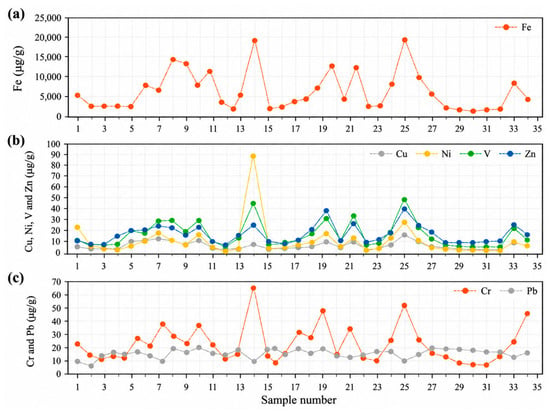
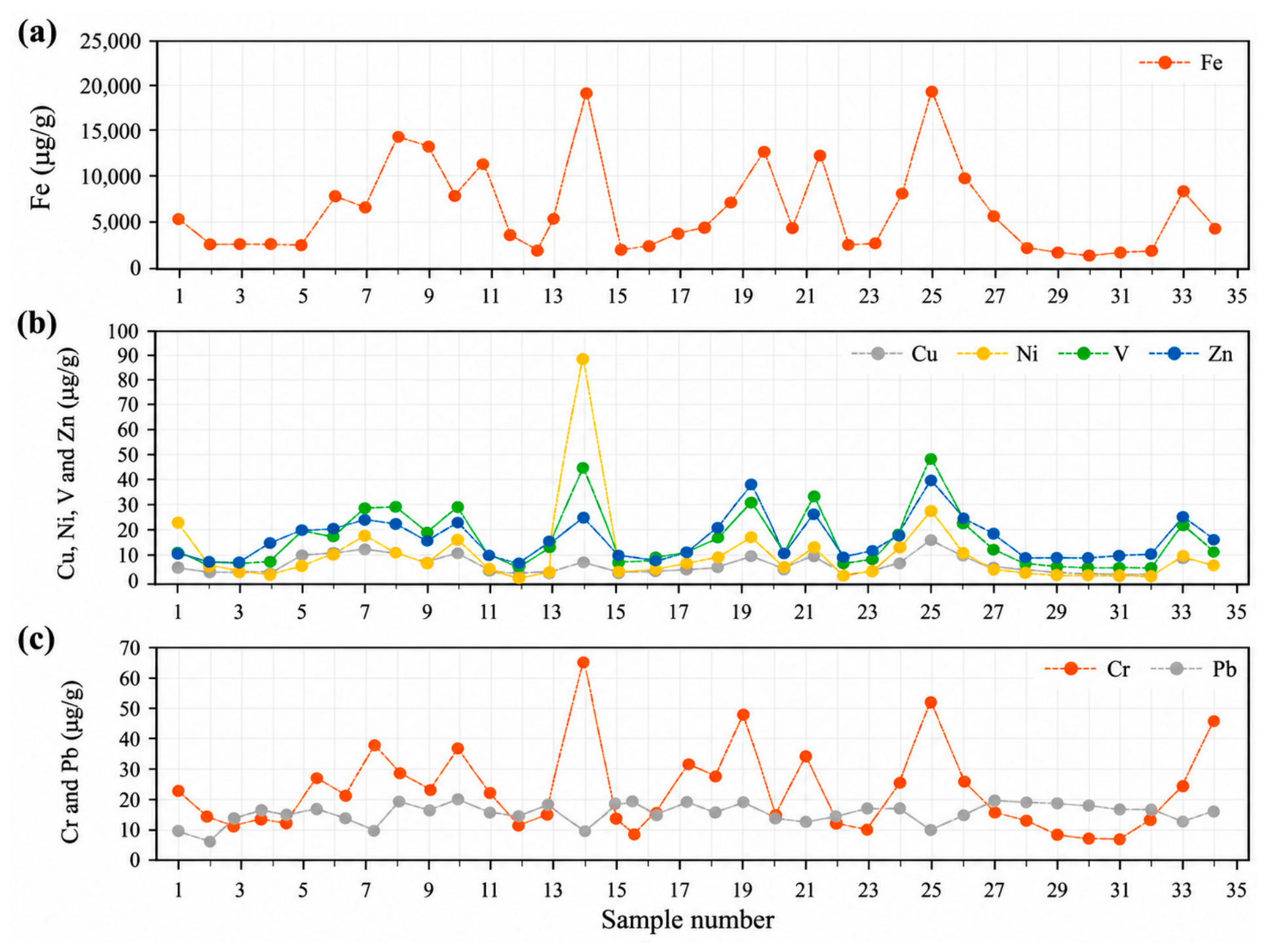
Heavy metal concentrations in the coastal sediments of Kudumbul Island varied markedly among the sampling sites (Table 1; Figure 3). Measured concentrations ranged from 1898 to 19,500 μg/g for Fe, 11.00 to 65.52 μg/g for Cr, 11.00 to 22.00 μg/g for Pb, 7.00 to 40.00 μg/g for Zn, 5.16 to 48.35 μg/g for V, 2.43 to 17.31 μg/g for Cu, and 1.00 to 88.00 μg/g for Ni. Based on the calculated site-level data, mean concentrations were 6403 μg/g for Fe, 24.94 μg/g for Cr, 17.91 μg/g for Pb, 16.03 μg/g for V, 16.00 μg/g for Zn, 10.34 μg/g for Ni, and 6.62 μg/g for Cu. Thus, the mean abundance decreased in the order Fe > Cr > Pb > V ≈ Zn > Ni > Cu. The near-equivalent mean values of V and Zn indicate that their relative order should be interpreted cautiously and reported consistently throughout the manuscript.
Table 1.
Concentrations of HMs (μg/g dry weight) in coastal sediments of Kudumbul Island, Saudi Arabia.
Figure 3.
Site-by-site variation in HM concentrations in coastal sediments of Kudumbul Island: (a) Fe; (b) Cu, Ni, V, and Zn; and (c) Cr and Pb. Lines are used only to improve visual tracking among samples and do not imply continuous spatial interpolation along the coastline.
The addition of median and standard deviation values provides a clearer description of the concentration dataset (Table 1). Median values were 4346 μg/g for Fe, 22.97 μg/g for Cr, 18.00 μg/g for Pb, 11.74 μg/g for V, 15.00 μg/g for Zn, 6.00 μg/g for Ni, and 5.10 μg/g for Cu. Mean concentrations exceeded the corresponding medians for several metals, notably Fe, V, Ni, and Cu, reflecting right-skewed distributions driven by localized sites with elevated concentrations. This pattern supports the use of both mean and median values when interpreting metal distributions in the studied sediments.
The distribution of metals showed clear site-to-site variability around the island. The highest Pb concentration was recorded at S11, whereas the maximum Cr and Ni concentrations occurred at S15. In contrast, Cu, Fe, Zn, and V reached their highest values at S27. Fe was lowest at S33, while minimum concentrations occurred at S2 for Pb, S16 for Cu, and S32 for both Cr and V. Ni reached its minimum at S13, S31, S32, and S33, whereas Zn was lowest at S4 and S13. These maxima and minima indicate that metal distribution is not uniform among the sampling sites, but occurs as localized high and low values around the island.
The localized maxima at S15 and S27 are particularly important for interpreting the concentration pattern. Sample S15 contained the highest Cr and Ni values, suggesting a local concentration of Cr-Ni-bearing phases or mafic volcanic detritus. Sample S27 showed the highest Fe, V, Zn, and Cu values, indicating the local accumulation of Fe-bearing sediment components and associated trace metals. Such associations are consistent with the basaltic and volcaniclastic character of Kudumbul Island, where weathering, wave erosion, and reworking of mafic volcanic materials can supply Fe-, Cr-, Ni-, and V-bearing detritus to nearby coastal sediments [27,45,46,47]. However, these interpretations constrain potential sources rather than establish definitive source apportionment, as local background values and data on sediment texture, carbonate content, mineralogy, and metal speciation remain unavailable.
The relatively narrow range of Pb concentrations compared with the wider variability of Fe, Cr, Ni, and V suggests that Pb behaves differently from the main mafic-metal assemblage. The Pb maximum at S11 did not coincide with the highest Fe, V, Cr, or Ni values, implying that Pb may be influenced by different sediment-binding phases, grain-size effects, carbonate dilution, or localized non-lithogenic inputs. Similar behavior has been reported in coastal sediments where Pb may be associated with fine particles, Fe-Mn oxyhydroxides, organic matter, or anthropogenic emissions rather than only with primary lithogenic sources [48,49].
The observed concentration patterns are consistent with the mixed geological and coastal-process setting of Kudumbul Island. Previous sedimentological and geomorphological work showed that the island includes a western volcanic edifice and eastern low-lying sandy shorelines, and that wave action, longshore currents, wind activity, spring tides, and biological processes control sediment transport, sorting, shoreline change, and redistribution around the island [27]. These processes can concentrate fine volcanic detritus, Fe-bearing phases, heavy-mineral fractions, and bioclastic sediments at selected sites, producing localized metal variability rather than a uniform island-wide enrichment pattern. Comparable coastal-sediment studies have similarly shown that metal distributions may be controlled by interactions among geological background, sediment texture, hydrodynamic sorting, and localized human or non-lithogenic inputs [50,51].
3.2. Metal Levels Relative to Background Values and Sediment Quality Guidelines
Heavy metal levels in the coastal sediments of Kudumbul Island were compared with regional datasets, published global geochemical background values, and sediment quality guideline thresholds (Table S3). Metal concentrations were assessed against regional datasets, published geochemical background values, and sediment quality guidelines to provide screening context rather than a site-specific baseline. In the absence of a local pre-industrial core or uncontaminated reference sediment, average shale and continental crust values in Table S3 serve as provisional references.
Using the statistics in Table 1, the mean concentrations of Fe, Cr, Pb, V, Zn, Ni, and Cu were 6403, 24.94, 17.91, 16.03, 16.00, 10.34, and 6.62 μg/g, respectively. Most elements fell below published continental crust [52] and average shale [53] reference concentrations. Only Pb had a mean concentration marginally above the continental crust value [52], while remaining below the average shale value [53]. Thus, Pb shows a slight elevation against one published background reference, which does not establish contamination. In comparison with sediments from the Rosetta sector of the Egyptian Mediterranean coast, Kudumbul Island sediments generally showed lower metal concentrations, with Cr representing the main exception [54]. Relative to Ras Abu Ali Island, the Kudumbul sediments contained higher mean concentrations of Cr, Fe, V, Zn, Cu, and Pb, whereas Ni was lower [51]. Concentrations of most investigated metals were also higher than those reported from the southern Red Sea coast of Egypt and the Al-Uqair coastline [14,48]. Conversely, sediments from the Red Sea–Gulf of Aqaba region contained higher levels of Cr, Zn, Cu, Pb, and Ni than the present samples [55]. These regional differences may reflect variations in sediment provenance, particle-size distribution, carbonate dilution, hydrodynamic sorting, regional geology, and localized non-lithogenic influences where present [56,57].
Sediment quality guidelines were applied as an initial screening tool to evaluate whether the measured metal concentrations may be associated with potential biological effects. Relative to the effects range-low (ERL) and effects range-median (ERM) values of Long et al. [38], Pb, Zn, Cu, and Cr remained below their corresponding ERL thresholds at all sampling sites. Only Ni exceeded sediment quality guideline thresholds, surpassing the ERL at S1, S15, and S27 and the ERM solely at S15 [38]. This indicates that the sediment-quality signal for Ni is localized rather than broadly distributed around the island [58,59].
The localized Ni exceedance may be consistent with the mafic volcanic character of Kudumbul Island, because basaltic and volcaniclastic materials can contribute Ni-bearing detrital phases to nearby coastal sediments. However, sediment quality guidelines screen for possible biological effects but alone cannot differentiate natural lithogenic enrichment from contamination [50,60,61]. Without local background values or data on grain size, carbonate content, mineralogy, and metal speciation, the Ni exceedance should be described as a site-specific guideline exceedance needing further verification, rather than confirmed pollution.
Pb also requires cautious interpretation. Although its mean concentration slightly exceeded the continental crust reference value, Pb showed a narrow concentration range compared with the stronger variability of Fe and several mafic-associated elements. Pb is thus interpreted as an unresolved relative-enrichment signal rather than established anthropogenic contamination, given its limited concentration range, the lack of a local baseline, and the dependence of Fe-normalized indices on varying Fe concentrations. Identifying a specific Pb source would require speciation, isotopic composition, and local baseline data.
3.3. Sediment Contamination Status
Assessing enrichment factor (EF), geoaccumulation index (Igeo), and contamination factor (CF) together provides a more reliable evaluation of sediment contamination at Kudumbul Island than relying on absolute metal concentrations alone [13,20,62]. EF, Igeo, and CF were computed from the metal concentrations in Table 1 and average shale background values in Table S3. Table 2 summarizes their minimum, maximum, and mean values alongside the associated sampling sites.
Table 2.
Statistical summary of EF, Igeo, and CF values of HMs in Kudumbul Island coastal sediments.
Mean EF values followed the order Pb > Cr > Zn > Cu > Ni > V (Table 2). Based on the EF classification scheme [37], Cr showed moderate average enrichment, whereas Zn, Cu, Ni, and V generally fell within the deficiency-to-minimal enrichment category. Pb had the highest EF values of the metals examined, but caution is warranted because its concentrations spanned a narrow range, while Fe, used for normalization, varied substantially across samples. Elevated Fe-normalized Pb EF values may therefore partly result from low Fe concentrations at certain sites rather than unambiguous Pb enrichment. This caution is particularly important because EF is sensitive to both the selected background value and the behavior of the normalizing element.
The EF results for Cr are more consistent with the mafic volcanic setting of Kudumbul Island. Cr had a mean EF within the moderate enrichment category, and the maximum Cr EF occurred at S35 (Table 2). The localized Cr enrichment may reflect variable contributions from Cr-bearing mafic detritus or heavy-mineral phases derived from volcanic materials, although mineralogical confirmation is still required.
The Igeo values indicate generally uncontaminated conditions for the studied sediments. With the average shale background values also used for CF, all studied metals, including Pb and Ni, had mean Igeo values below zero (Table 2). According to Müller’s classification [63], Igeo values below zero indicate uncontaminated sediments. Thus, Igeo findings neither justify placing Pb in the unpolluted-to-moderately contaminated category nor indicate a positive Igeo-based contamination signal for Ni. This correction is important because the previous positive Pb and Ni Igeo interpretations were not reproducible using a consistent background value.
The CF results also indicate a generally low degree of metal contamination in the investigated sediments. Using the mean concentrations in Table 1 and the average shale background values in Table S3, mean CF values followed the order Pb > Cr > Zn > Ni ≈ Cu > Fe > V. CF values below 1 indicate low contamination [37,40]. All mean CF values were below 1, confirming low average contamination for the investigated metals at the island scale. At the site level, most CF values also remained within the low-contamination category. Ni reached a moderate CF value only at S15, where Ni also exceeded the ERM sediment-quality guideline.
Pb requires more careful wording in the CF interpretation. At several sites, Pb met or marginally surpassed the CF = 1 threshold, within a limited concentration range of approximately 20–22 μg/g. These results therefore represent borderline CF exceedances rather than convincing evidence of moderate contamination. The Pb pattern alone cannot establish its source and could reflect Fe-normalization effects, sediment partitioning, or localized non-lithogenic contributions; it consequently provides no definitive evidence of anthropogenic contamination. This interpretation is consistent with the need for analytical uncertainty, detection or quantification limits, and local background data before assigning a strong contamination status to Pb.
The combined EF, Igeo, and CF results show that the contamination indices do not all respond in the same way. EF highlights Pb and Cr as the strongest relative enrichment signals, whereas Igeo and CF indicate generally low contamination. The apparent discrepancy between indices stems from differing sensitivities to Fe normalization, selected background values, and local sediment composition. Local anomalies may also arise from sediment sorting, variable volcanic-detrital input, Fe-bearing phases, heavy-mineral concentration, or additional non-lithogenic contributions [13,62].
3.4. Source Identification and Metal Associations
Pearson correlation analysis, hierarchical cluster analysis (HCA), and principal component analysis (PCA) were used to evaluate metal associations and to constrain possible controls on heavy metal distribution in the coastal sediments of Kudumbul Island [64,65]. These statistical methods constrain potential sources rather than definitively apportion them, as local background values and data on sediment texture, carbonate content, mineralogical composition, metal speciation, and isotopes remain unavailable. The Pearson correlation matrix (Table 3) reveals a coherent association among Cr, Cu, Fe, Ni, V, and Zn. Strong positive correlations were observed between Fe and V (r = 0.991), Fe and Zn (r = 0.890), Fe and Cr (r = 0.862), Fe and Cu (r = 0.854), and Fe and Ni (r = 0.725). Strong correlations were also recorded between V and Zn (r = 0.907), V and Cr (r = 0.871), V and Cu (r = 0.856), Zn and Cu (r = 0.882), and Zn and Cr (r = 0.775).
Table 3.
Pearson correlation matrix of HMs in Kudumbul Island coastal sediments.
The close association among Cr, Cu, Fe, Ni, V, and Zn is consistent with the mafic volcanic and volcaniclastic character of Kudumbul Island. Basaltic and volcaniclastic materials commonly contain Fe-bearing minerals, ferromagnesian phases, spinel-group minerals, and Fe-Mn oxide coatings that can host or adsorb several trace metals [46,47,49]. Thus, the Cr-Cu-Fe-Ni-V-Zn association suggests predominant lithogenic and sediment-sorting influences rather than providing direct evidence of contamination. This interpretation is compatible with the geological composition of Kudumbul Island, which includes basaltic rocks, phreatomagmatic lapilli tuff, and vesicular basalt/scoria [27].
Pb behaved differently from the main Cr-Cu-Fe-Ni-V-Zn assemblage. In the correlation matrix, Pb showed weak to negative correlations with most of the other metals, including Cr (r = −0.429), Cu (r = −0.279), Fe (r = −0.154), Ni (r = −0.250), V (r = −0.265), and Zn (r = −0.126). This separation indicates that Pb is not governed by exactly the same geochemical or sedimentary controls as the mafic-metal assemblage. Pb concentrations occur within a narrow range, and analytical uncertainty, detection or quantification limits, Pb speciation, isotope data, and local background values are not yet available. Therefore, Pb is interpreted as a distinct geochemical signal requiring further verification rather than as confirmed evidence of external contamination. Previous coastal sediment studies have shown that Pb may be associated with fine particles, Fe-Mn oxyhydroxides, organic matter, or human-derived emissions, but these mechanisms cannot be separated confidently for Kudumbul Island using the present dataset alone [61,66].
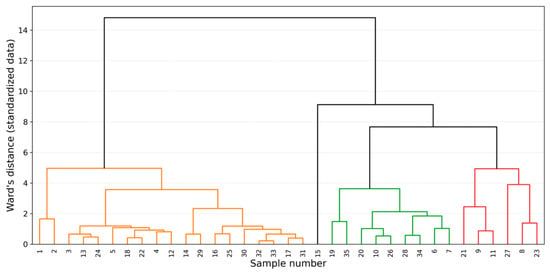
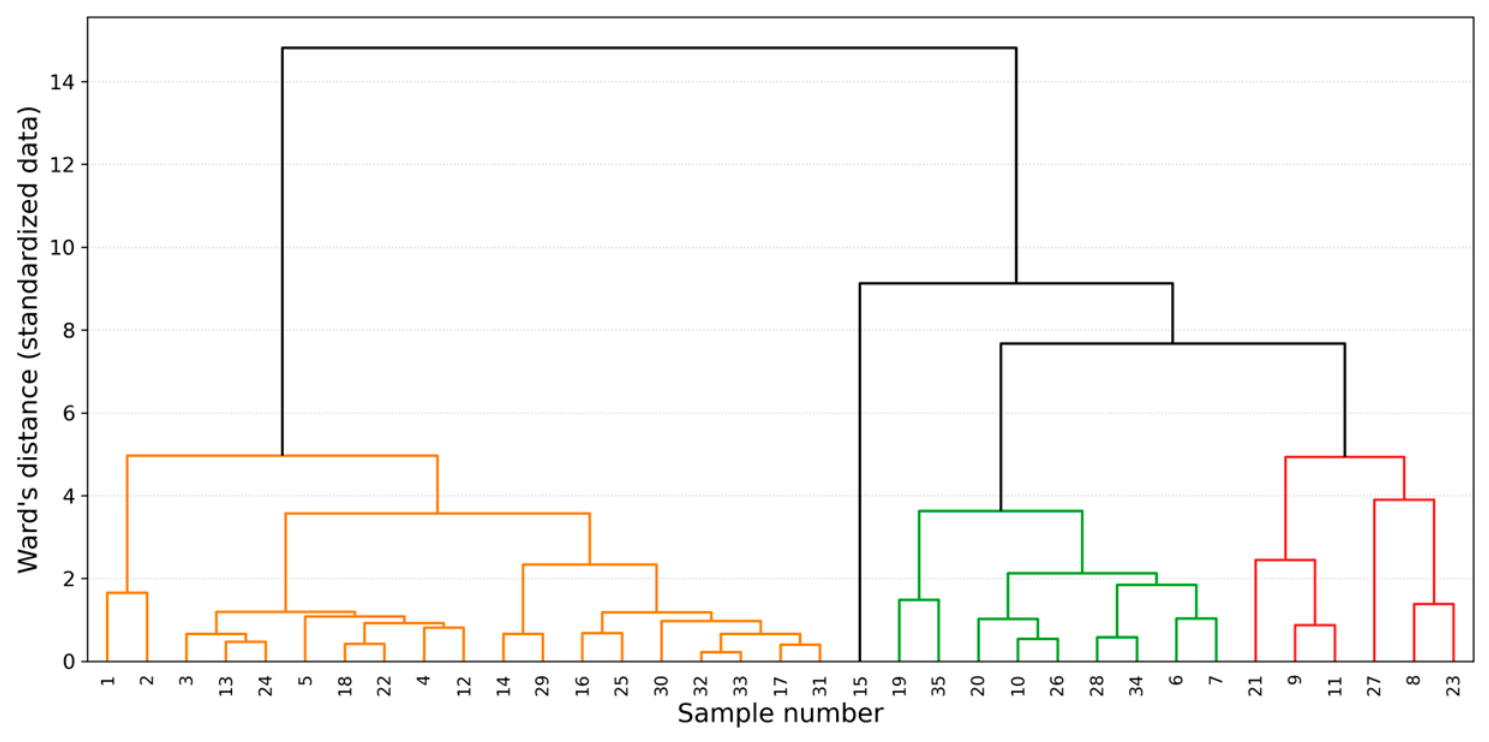
Q-mode HCA was calculated using z-score standardized metal concentrations to reduce the influence of differences in absolute concentration scale among elements. HCA used Ward’s linkage and Euclidean distance with standardized data (Figure 4). This adjustment prevents Fe concentration alone from dominating the clusters and directly accounts for raw concentration scaling effects. The dendrogram separates the samples into groups based on relative similarity in their multi-element composition rather than on absolute metal abundance. The derived clusters capture differences in relative metal associations across samples, particularly variation in Cr-Ni and Fe-V-Zn-Cu signatures. The cluster pattern indicates that some samples are compositionally distinct because of relative enrichment in specific metal associations, especially the Cr-Ni signal at S15 and the Fe-V-Zn-Cu signal at selected sites. Comparable coastal-sediment studies have used HCA to identify groups of samples with similar geochemical behavior and to distinguish broadly background-dominated sediments from localized enrichment patterns [52,65].
Figure 4.
Q-mode hierarchical cluster analysis of sediment samples from Kudumbul Island based on heavy metal concentrations.
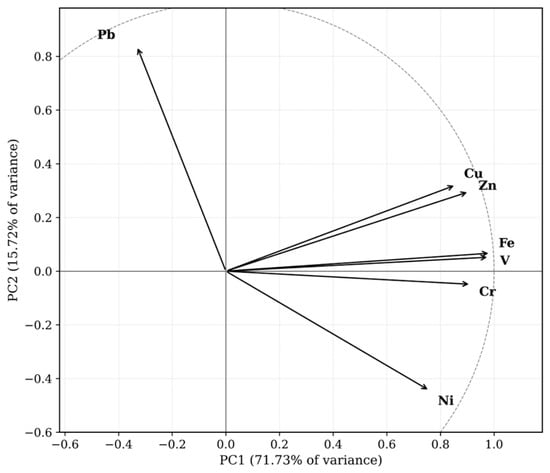
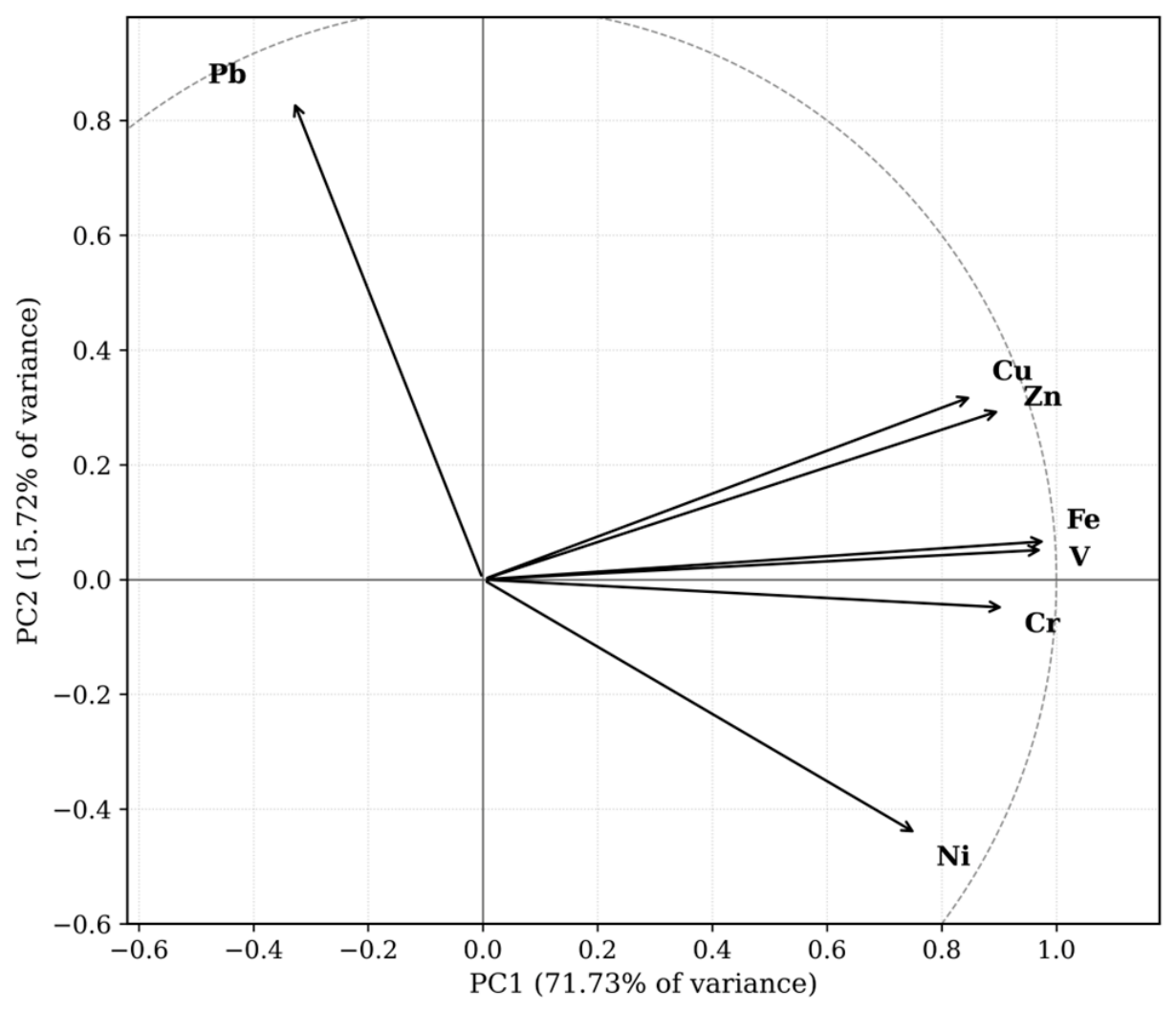
PCA was also calculated using the z-score standardized dataset. The first two principal components explained 87.45% of the total variance (Table 4; Figure 5). PC1 accounted for 71.73% of the variance and showed strong positive loadings for V (0.987), Fe (0.982), Cr (0.914), Zn (0.907), Cu (0.858), and Ni (0.760). This component represents the main Cr–Cu-Fe-Ni-V-Zn association and is interpreted as the dominant lithogenic and sediment-sorting factor in the dataset. The strong Fe and V loadings suggest an important role for Fe-bearing minerals, Fe-Mn oxide phases, and mafic volcanic detritus in controlling the distribution of associated metals [45,46,64]. The positive loadings of Cr and Ni are also compatible with contributions from ferromagnesian minerals, spinel-group phases, and other mafic volcanic components.
Table 4.
Principal component loadings of HMs in Kudumbul Island coastal sediments.
Figure 5.
PCA loading plot of HMs in Kudumbul Island coastal sediments based on the z-score standardized dataset.
PC2 accounted for 15.72% of the variance and was dominated by Pb, with a positive loading of 0.838. Pb plotted separately from the Cr-Cu-Fe-Ni-V-Zn association in the PCA loading plot (Figure 4), confirming its distinct behavior relative to the main mafic-metal group. However, a Pb-dominated component indicates different geochemical behavior or sediment partitioning, not a specific source by itself. Possible explanations include different binding phases, grain-size effects, carbonate dilution, analytical uncertainty near quantification limits, or localized non-lithogenic input [67,68].
3.5. Human Health Risk Assessment
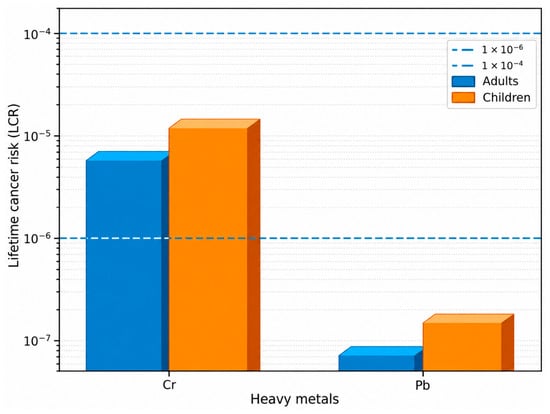
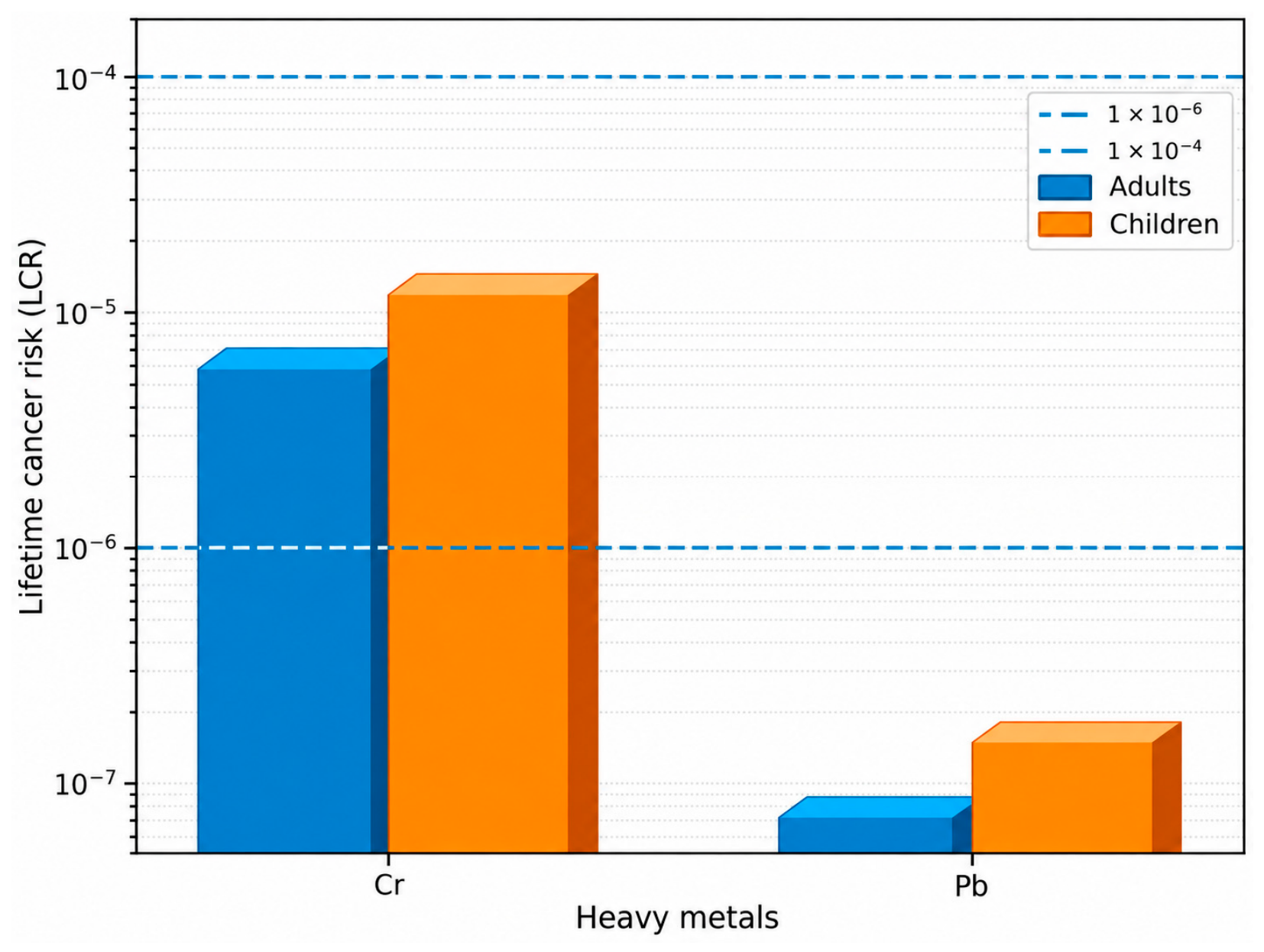
Potential human health risks associated with heavy metal exposure from Kudumbul Island coastal sediments were assessed for adults and children through ingestion and dermal contact pathways (Table 5 and Table 6; Figure 6 and Figure 7; Tables S4 and S5). These exposure routes are commonly used in sediment and soil risk-assessment models because they represent direct contact pathways between humans and metal-bearing particles [69,70]. With no documented permanent population on Kudumbul Island, the health-risk assessment provides a conservative screening-level evaluation of potential direct sediment contact among temporary visitors, field teams, fishermen, or coastal users, if present, rather than estimating risks to island residents. This screening approach is adopted because detailed data on visitation frequency, exposure duration, recreational activities, and local sediment-contact behavior remain unavailable, precluding a site-specific residential exposure assessment. Therefore, the calculated risk values are used to identify relative exposure pathways, receptor groups, and metals requiring closer attention, rather than to predict actual health outcomes.
Table 5.
CDI, HQ, HI, THI values for adults and children exposed to HMs in Kudumbul Island coastal sediments.
Table 6.
Lifetime cancer risk (LCR) values for Cr and Pb in adults and children.
Figure 6.
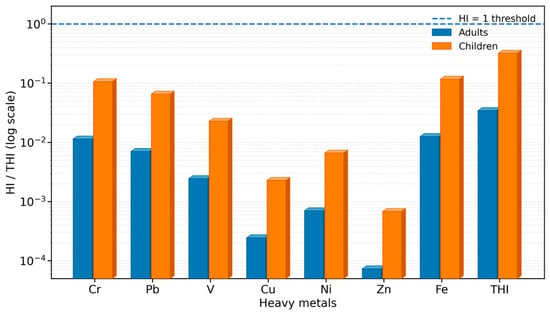
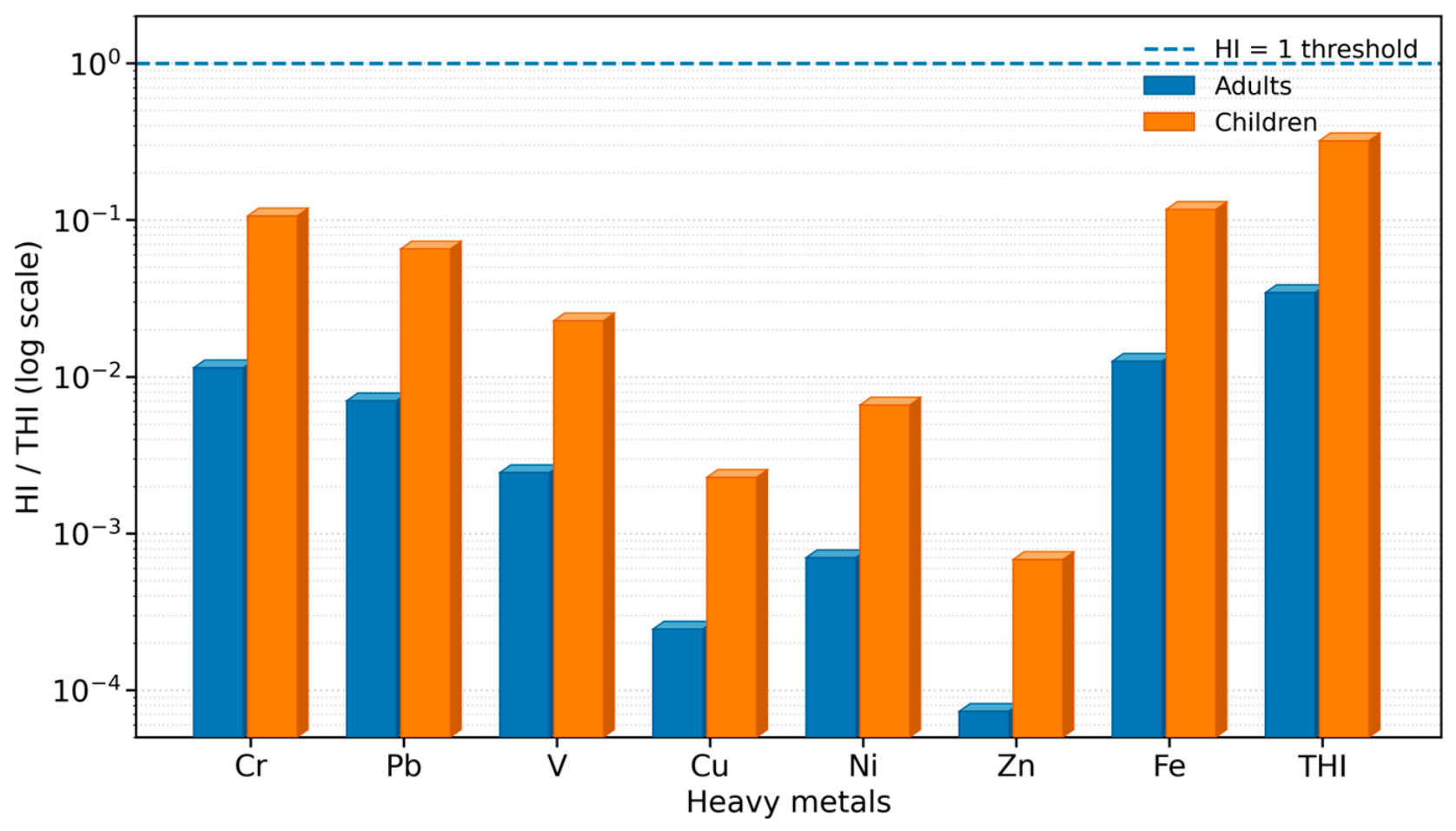
Non-carcinogenic HI values for adults and children exposed to HMs in Kudumbul Island coastal sediments.
Figure 7.
Lifetime cancer risk values for Cr and Pb in adults and children.
For both adults and children, chronic daily intake (CDI) through ingestion was higher than that through dermal contact for all investigated metals (Table 5). This pattern reflects the exposure parameters used in the model, particularly sediment ingestion rate, exposed skin surface area, adherence factor, and body weight. Using the mean concentrations, CDI values were higher in children than in adults. This difference is mainly related to the lower body weight and higher sediment intake relative to body mass assumed for children in standard exposure models [16,17,42]. Thus, ingestion is the primary exposure route in this screening assessment, with dermal contact contributing comparatively less to the total estimated dose.
Non-carcinogenic risk was evaluated using hazard quotient (HQ), metal-specific hazard index (HI), and total hazard index (THI) values. For each element, metal-specific HI was obtained by adding ingestion and dermal HQs, while THI combined the metal-specific HI values for all metals examined. The calculated mean HI values for individual metals remained below the threshold value of 1 for both adults and children (Table 5; Figure 6). For adults, the highest mean metal-specific HI values were associated with Fe, Cr, and Pb, with values of approximately 1.26 × 10⁻², 1.14 × 10⁻², and 6.99 × 10⁻³, respectively. For children, the corresponding values were approximately 1.17 × 10⁻¹ for Fe, 1.07 × 10⁻¹ for Cr, and 6.55 × 10⁻² for Pb.
The calculated THI values were 3.45 × 10⁻² for adults and 3.22 × 10⁻¹ for children, remaining below the threshold value of 1 in both receptor groups. These results indicate that non-carcinogenic risk remains within the acceptable screening range under the adopted exposure assumptions. Children showed higher HI and THI values than adults, consistent with their greater calculated dose per unit body weight [17,42,71]. As an essential element, Fe requires a different toxicological interpretation from potentially toxic trace metals. Its HI values are therefore included for completeness but warrant caution when interpreted as evidence of Fe-related health risk. Excluding Fe, the THI values decrease to approximately 2.19 × 10⁻² for adults and 2.05 × 10⁻¹ for children.
The carcinogenic-risk assessment was performed for Cr and Pb because cancer slope factors were available for these two elements. In the calculation, lifetime cancer risk was calculated using a lifetime averaging time of 70 years × 365 days, rather than the non-carcinogenic averaging time of ED × 365 days. This correction substantially reduced the calculated lifetime cancer risk values compared with the previous version. The calculated mean LCR values were 5.88 × 10⁻⁶ for Cr and 7.15 × 10⁻⁸ for Pb in adults, and 1.37 × 10⁻⁵ for Cr and 1.67 × 10⁻⁷ for Pb in children (Table 6; Figure 7). The calculated Cr LCR values fall within the commonly used screening range of 1 × 10⁻⁶ to 1 × 10⁻⁴, whereas Pb LCR values remained below the lower bound of this range.
Cr contributed more than Pb to the calculated cancer-risk estimates. However, this result requires cautious interpretation because the chemical form of Cr was not determined. The cancer slope factor used for Cr generally pertains to Cr (VI), while this study quantified total Cr in sediments affected by basaltic and volcaniclastic materials. In such geological settings, a substantial fraction of Cr may occur in less mobile or less bioavailable mineral-bound forms, although this cannot be confirmed without speciation analysis [42,72,73]. Thus, Cr-related LCR values represent conservative upper-bound screening estimates rather than directly demonstrating carcinogenic risk governed by Cr (VI).
This assessment offers a conservative screening framework for comparing relative exposure patterns in Kudumbul Island sediments. Refinement requires site-specific exposure frequencies, 95% upper confidence limit concentrations, sediment texture, Cr and Pb speciation, and bioaccessibility tests.
4. Conclusions
This study establishes a first geochemical and screening-level risk baseline for HMs in coastal sediments of Kudumbul volcanic island, southeastern Red Sea, Saudi Arabia. The sediments showed marked site-to-site variability, with mean concentrations decreasing in the order Fe > Cr > Pb > V ≈ Zn > Ni > Cu. Comparisons with published background references and sediment quality guidelines indicated generally low contamination at the island scale, although Ni showed localized guideline exceedance at S1, S15, and S27, with the strongest signal at S15.
The combined contamination indices and multivariate analyses indicate that most investigated metals are mainly influenced by basaltic–volcaniclastic sediment input and coastal sediment sorting. The Cr-Cu-Fe-Ni-V-Zn association identified by correlation analysis, HCA, and PCA supports this interpretation. Pb differed from the main assemblage and exhibited the greatest relative enrichment. However, this signal warrants caution given its limited concentration range, sensitivity to Fe normalization, and lack of local background and speciation data.
The calculated health-risk assessment indicated ingestion as the dominant exposure pathway, with higher calculated values for children than adults. The THI values remained below 1 for both adults and children, indicating no appreciable non-carcinogenic concern under the adopted screening assumptions. Mean Cr LCR values fell within the commonly used screening risk range of 1 × 10⁻⁶ to 1 × 10⁻⁴, whereas Pb LCR values remained below the lower bound of this range. Without measurements of Cr speciation and metal bioaccessibility, Cr-related cancer-risk estimates warrant interpretation as conservative screening values rather than direct evidence of risk governed by Cr (VI).
The findings suggest low contamination across the island, with localized metal anomalies warranting further investigation rather than indicating widespread pollution. Future studies should refine these interpretations through site-specific background values, sedimentological and mineralogical data, metal speciation, bioaccessibility tests, and exposure scenarios reflecting actual island use.
Supplementary Materials
The following supporting information can be downloaded at https://www.mdpi.com/article/10.3390/min16101044/s1, Table S1: Classification of the contamination indices; Table S2: Exposure factors used in chronic daily intake (CDI) estimation for non-carcinogenic risk, and the reference dose (RfD) values of HMs; Table S3: Average HM concentrations (μg/g dry weight) in Kudumbul Island coastal sediments compared with regional and global background values and sediment quality guidelines; Table S4: Hazard index of HMs for non-carcinogenic risk in adults and children in the study area; Table S5: Total lifetime cancer risk for Cr and Pb in the study area.
Author Contributions
Conceptualization, A.N. and M.M.K.; methodology, A.N., M.M.K. and A.S.E.-S.; software, M.A.; validation, A.N. and M.M.K.; writing—original draft preparation, A.N., A.S.E.-S., M.A., T.A., A.A., M.H.A.-H. and M.M.K.; writing—review and editing, A.N., A.S.E.-S., M.A., T.A., A.A., M.H.A.-H. and M.M.K.; supervision, A.N.; project administration, A.N.; funding acquisition, M.H.A.-H. All authors have read and agreed to the published version of the manuscript.
Funding
This research was funded by the Ongoing Research Funding program (ORF-2026-781), King. Saud University, Riyadh, Saudi Arabia.
Data Availability Statement
Data are contained within the article and Supplementary Materials.
Acknowledgments
The authors extend their appreciation to the Ongoing Research Funding program (ORF-2026-781), King Saud University, Riyadh, Saudi Arabia. Sincere thanks are extended to Nawaf Widinly, Adel Jarees, and Ali Tharowi, Survey and Exploration Center at Saudi Geological Survey for their valuable support.
Conflicts of Interest
The authors declare no conflicts of interest.
References
- Gaylarde, C.C.; Baptista Neto, J.A.; da Fonseca, E.M. Paint fragments as polluting microplastics: A brief review. Mar. Pollut. Bull. 2021, 162, 111847. [Google Scholar] [CrossRef] [Scilit] [PubMed]
- Xue, C.; Yang, Y.; Zhao, P.; Wei, D.; Gao, J.; Sun, P.; Huang, Z.; Jia, J. Impact of ship traffic on the characteristics of shelf sediments: An Anthropocene prospective. Front. Mar. Sci. 2021, 8, 678845. [Google Scholar] [CrossRef] [Scilit]
- Liu, Q.; Jia, Z.; Liu, G.; Li, S.; Hu, J. Assessment of heavy metals remobilization and release risks at the sediment-water interface in estuarine environment. Mar. Pollut. Bull. 2023, 187, 114517. [Google Scholar] [CrossRef] [Scilit] [PubMed]
- Silva, M.C.; Monte, C.D.N.; de Souza, J.R.; Selfe, A.C.C.; Ishihara, J.H. Mapping of metals contamination in coastal sediments around the world in the last decades: A bibliometric analysis and systematic review. Mar. Pollut. Bull. 2024, 205, 116572. [Google Scholar] [CrossRef] [Scilit] [PubMed]
- Di Cesare, A.; Pjevac, P.; Eckert, E.; Curkov, N.; Sparica, M.M.; Corno, G.; Orlic, S. The role of metal contamination in shaping microbial communities in heavily polluted marine sediments. Environ. Pollut. 2020, 265, 114823. [Google Scholar] [CrossRef] [Scilit] [PubMed]
- Alharbi, T.; Nour, H.E.; Al-Kahtany, K.; Zumlot, T.; El-Sorogy, A.S. Health risk assessment and contamination of lead and cadmium levels in sediments of the northwestern Arabian Gulf coast. Heliyon 2024, 10, e36447. [Google Scholar] [CrossRef] [Scilit] [PubMed]
- Sanjai Gandhi, K.; Pradhap, D.; Saravanan, P.; Krishnakumar, S.; Kasilingam, K.; Sukanta Patel, H.; Prakash, P.; Muthukumaran, S.; Magesh, N.S. Metal concentration and its ecological risk assessment in the beach sediments of Coromandel Coast, Southern India. Mar. Pollut. Bull. 2020, 160, 111565. [Google Scholar] [CrossRef] [Scilit] [PubMed]
- Rajeshkumar, S.; Liu, Y.; Zhang, X.; Ravikumar, B.; Bai, G.; Li, X. Studies on seasonal pollution of heavy metals in water, sediment, fish and oyster from the Meiliang Bay of Taihu Lake in China. Chemosphere 2018, 191, 626–638. [Google Scholar] [CrossRef] [Scilit] [PubMed]
- Ustaoğlu, F.; Tepe, Y. Water quality and sediment contamination assessment of Pazarsuyu Stream, Turkey using multivariate statistical methods and pollution indicators. Int. Soil Water Conserv. Res. 2019, 7, 47–56. [Google Scholar] [CrossRef] [Scilit]
- Xie, G.; Wang, W.; Sun, Y.; Chen, C.; Cai, L.; Guo, Y.; Saud, S.; Chen, H.; Li, X.; Hu, C. Distribution and potential ecological risks of heavy metals in water, sediments, and fish in the main rivers and reservoirs in Rizhao, China. Environ. Sci. Process. Impacts 2025, 27, 2128–2146. [Google Scholar] [CrossRef] [Scilit] [PubMed]
- Naveedullah; Hashmi, M.Z.; Yu, C.; Shen, H.; Duan, D.; Shen, C.; Lou, L.; Chen, Y. Concentrations and human health risk assessment of selected heavy metals in surface water of the Siling Reservoir Watershed in Zhejiang Province, China. Pol. J. Environ. Stud. 2014, 23, 801–811. [Google Scholar]
- Nazzal, Y.; Bărbulescu, A.; Sharma, M.; Howari, F.; Ben Salem, I.; Dghaim, R.; Kumbhar, P.; Xavier, C.M.; Alghafli, S.; Al-Taani, A.A.; et al. Heavy metal pollution in arid urban environments: Anthropogenic and geogenic insights from road dust in the United Arab Emirates. Arch. Environ. Contam. Toxicol. 2025, 89, 313–314. [Google Scholar] [CrossRef] [Scilit] [PubMed]
- Xu, L.; Hao, G.; Feng, S.; Zhang, Z.; Li, X.; Xiong, X.; Li, S. Contamination and source-oriented health risk assessment of heavy metals in sediments: A case study of the Yixun River Basin, China. Sci. Rep. 2025, 15, 24759. [Google Scholar] [CrossRef] [Scilit] [PubMed]
- Song, Q.; Li, J. A review on human health consequences of metals exposure to e-waste in China. Environ. Pollut. 2015, 196, 450–461. [Google Scholar] [CrossRef] [Scilit] [PubMed]
- Pan, L.B.; Ma, J.; Wang, X.L.; Hou, H. Heavy metals in soils from a typical county in Shanxi Province, China: Levels, sources and spatial distribution. Chemosphere 2016, 148, 248–254. [Google Scholar] [CrossRef] [Scilit] [PubMed]
- Ma, J.; Pan, L.B.; Wang, Q.; Lin, C.Y.; Duan, X.L.; Hou, H. Estimation of the daily soil/dust ingestion rate of children from Gansu Province, China via hand-to-mouth contact using tracer elements. Environ. Geochem. Health 2016, 39, 295–301. [Google Scholar] [CrossRef] [Scilit] [PubMed]
- Rahman, M.S.; Khan, M.D.H.; Jolly, Y.N.; Kabir, J.; Akter, S.; Salam, A. Assessing risk to human health for heavy metal contamination through street dust in the Southeast Asian Megacity: Dhaka, Bangladesh. Sci. Total Environ. 2019, 660, 1610–1622. [Google Scholar] [CrossRef] [Scilit] [PubMed]
- Al-Kahtany, K.; El-Sorogy, A.S.; Alharbi, T.; Giacobbe, S.; Nour, H.E. Health risk assessment and contamination of potentially toxic elements in southwest of the Red Sea coastal sediment. Reg. Stud. Mar. Sci. 2023, 65, 103103. [Google Scholar] [CrossRef] [Scilit]
- Bi, R.; Fu, W.; Fu, X. Heavy metal spatial variation mechanism and ecological health risk assessment in volcanic island soils: A case study of Weizhou Island, China. Land 2025, 14, 35. [Google Scholar] [CrossRef] [Scilit]
- Youssef, M.; Al Otaibi, S.; El-Sorogy, A.S. Distribution, source, and contamination of heavy metals in coastal sediments of Jeddah, Red Sea, Saudi Arabia. Bull. Environ. Contam. Toxicol. 2024, 113, 12. [Google Scholar] [CrossRef] [Scilit] [PubMed]
- Youssef, M.; El-Sorogy, A.S.; Al-Kahtany, K.; Madkour, M. Status of trace metals in surface seawater of Sharm Al-Kharrar Lagoon, Saudi Arabia. Arab. J. Geosci. 2021, 14, 748. [Google Scholar] [CrossRef] [Scilit]
- El-Sorogy, A.S.; Youssef, M. Pollution assessment of the Red Sea-Gulf of Aqaba seawater, northwest Saudi Arabia. Environ. Monit. Assess. 2021, 193, 141. [Google Scholar] [CrossRef] [Scilit] [PubMed]
- Soliman, N.F.; Younis, A.M.; Elkady, E. Chemical speciation and comprehensive risk assessment of metals in sediments from Nabq protectorate, the Red Sea using individual and synergistic indices. Mar. Pollut. Bull. 2024, 201, 116219. [Google Scholar] [CrossRef] [Scilit] [PubMed]
- El-Sorogy, A.S.; Tawfik, M.; Almadani, S.; Zumlot, T. Evaluation of sediment quality for heavy metal(loid)s contamination and health risk assessment in the Gulf of Suez, Egypt. Mar. Pollut. Bull. 2024, 203, 116496. [Google Scholar] [CrossRef] [Scilit] [PubMed]
- Younis, A.M.; Elkady, E.M.; Soliman, N.F. Fractionation, chemometric analysis, and sophisticated risk assessment indices to appraise sediment contamination of a tropical mangrove forests, the Red Sea. Mar. Pollut. Bull. 2025, 214, 117792. [Google Scholar] [CrossRef] [Scilit] [PubMed]
- Saleh, G.M.; Semary, H.E.; Lasheen, E.S.R.; Kamar, M.S.; Elkelish, A.; Sami, M.; Sanislav, I.V.; Abdelaal, A. Metal contamination and radiological risk assessment in the coastal zone of Wadi Ghadir outlet, Red Sea, Egypt. Front. Environ. Sci. 2025, 13, 1667069. [Google Scholar] [CrossRef] [Scilit]
- Nabhan, A.; Widinly, N.; Memesh, A.; Khorsheed, M.; El-Sorogy, A.S.; Tawfik, M. Sedimentological and geomorphological characteristics of Jabal Kudumbul Island, southeast Red Sea, Saudi Arabia. J. Coast. Res. 2023, 39, 1114–1123. [Google Scholar] [CrossRef] [Scilit]
- Coleman, R.G.; Gregory, R.T.; Brown, G.F. Cenozoic Volcanic Rocks of Saudi Arabia; U.S. Geological Survey Open-File Report 83-788; U.S. Geological Survey: Reston, VA, USA, 1983; p. 82.
- Moufti, M.R.; Németh, K. Geoheritage of Volcanic Harrats in Saudi Arabia; Springer: Cham, Switzerland, 2016. [Google Scholar] [CrossRef] [Scilit]
- Bakhsh, R.A. The Harrat Al-Birk basalts in southwest Saudi Arabia: Characteristic alkali mafic magmatism related to Red Sea rifting. Acta Geochim. 2017, 36, 74–88. [Google Scholar] [CrossRef] [Scilit]
- Petrovic, A.; Fuentes, M.A.; Putri, I.; Yahaya, L.N.; Khanna, P.; Purkis, S.J.; Vahrenkamp, V. Holocene sediment distribution in the Al Wajh platform lagoon (northern Red Sea, Saudi Arabia), a modern analogue for large rift basin carbonate platforms. Sedimentology 2022, 69, 1365–1398. [Google Scholar] [CrossRef] [Scilit]
- El-Sorogy, A.S. Contributions to the Pleistocene coral reefs of the Red Sea coast, Egypt. Arab. Gulf J. Sci. Res. 2008, 26, 63–85. [Google Scholar]
- PME. Climate Data Report for the Southern Red Sea Coast, Saudi Arabia, 2002–2012; General Presidency of Meteorology and Environment: Jeddah, Saudi Arabia, 2012.
- Nabhan, A.I.; Yang, W. Modern sedimentary facies, depositional environments, and major controlling processes on an arid siliciclastic coast, Al Qahmah, SE Red Sea, Saudi Arabia. J. Afr. Earth Sci. 2018, 140, 9–28. [Google Scholar] [CrossRef] [Scilit]
- Ali, E.B.; Churchill, J.H.; Barthel, K.; Skjelvan, I.; Omar, A.M.; de Lange, T.; Eltaib, E.B.A. Seasonal variations of hydrographic parameters off the Sudanese coast of the Red Sea, 2009–2015. Reg. Stud. Mar. Sci. 2018, 18, 1–10. [Google Scholar] [CrossRef] [Scilit]
- Hickey, B.; Goudie, A.S. The use of TOMS and MODIS to identify dust storm source areas: The Tokar Delta, Sudan, and the Seistan Basin, southwest Asia. In Geomorphological Variations; Goudie, A.S., Kalvoda, J., Eds.; P3K: Prague, Czech Republic, 2007; pp. 37–57. [Google Scholar]
- Hakanson, L. An ecological risk index for aquatic pollution control: A sedimentological approach. Water Res. 1980, 14, 975–1001. [Google Scholar] [CrossRef] [Scilit]
- Long, E.R.; MacDonald, D.D.; Smith, S.L.; Calder, F.D. Incidence of adverse biological effects within ranges of chemical concentrations in marine and estuarine sediments. Environ. Manag. 1995, 19, 81–97. [Google Scholar] [CrossRef] [Scilit]
- Luo, X.S.; Ding, J.; Xu, B.; Wang, Y.J.; Li, H.B.; Yu, S. Incorporating bioaccessibility into human health risk assessments of heavy metals in urban park soils. Sci. Total Environ. 2012, 424, 88–96. [Google Scholar] [CrossRef] [Scilit] [PubMed]
- Kowalska, J.B.; Mazurek, R.; Gąsiorek, M.; Zaleski, T. Pollution indices as useful tools for the comprehensive evaluation of the degree of soil contamination: A review. Environ. Geochem. Health 2018, 40, 2395–2420. [Google Scholar] [CrossRef] [Scilit] [PubMed]
- USEPA. Supplemental Guidance for Developing Soil Screening Levels for Superfund Sites; United States Environmental Protection Agency, Office of Emergency and Remedial Response: Washington, DC, USA, 2002.
- USEPA. Exposure Factors Handbook: 2011 Edition; EPA/600/R-09/052F; United States Environmental Protection Agency: Washington, DC, USA, 2011.
- IRIS. Integrated Risk Information System. United States Environmental Protection Agency. 2020. Available online: https://cfpub.epa.gov/ncea/iris/search/index.cfm (accessed on 8 October 2026).
- Mondal, P.; Lofrano, G.; Carotenuto, M.; Guida, M.; Trifuoggi, M.; Libralato, G.; Sarkar, S.K. Health risk and geochemical assessment of trace elements in surface sediment along the Hooghly (Ganges) River Estuary, India. Water 2021, 13, 110. [Google Scholar] [CrossRef] [Scilit]
- Kabata-Pendias, A. Trace Elements in Soils and Plants, 4th ed.; CRC Press: Boca Raton, FL, USA, 2011. [Google Scholar]
- Wedepohl, K.H. The composition of the continental crust. Geochim. Cosmochim. Acta 1995, 59, 1217–1232. [Google Scholar] [CrossRef] [Scilit]
- Wu, W.; Guan, Y.; Nel, W.; Xu, C. Heavy metal migration and lithium isotope fractionation under extreme weathering of basalt on tropical Hainan Island, China. Appl. Geochem. 2024, 175, 106163. [Google Scholar] [CrossRef] [Scilit]
- Al-Hashim, M.H.; El-Sorogy, A.S.; Al Qaisi, S.; Alharbi, T. Contamination and ecological risk of heavy metals in Al-Uqair coastal sediments, Saudi Arabia. Mar. Pollut. Bull. 2021, 171, 112748. [Google Scholar] [CrossRef] [Scilit] [PubMed]
- Wu, C.; Bao, J.; Wang, Z.; Chen, Z.; Zheng, Y.; Lu, H. Interplay of natural and anthropogenic factors in source and distribution of heavy metals in Pingtan coastal area, Fujian Province. Front. Mar. Sci. 2025, 12, 1624141. [Google Scholar] [CrossRef] [Scilit]
- Aljahdali, M.H.; El-Kahawy, R.M.; Sayed, M.M.; Heinz, P.; Wagreich, M. Ecological risk assessment and environmental status of heavy metals for the bottom sediments of Sharm El-Luli, Red Sea Coast, Egypt. J. Mar. Sci. Eng. 2026, 14, 409. [Google Scholar] [CrossRef] [Scilit]
- Al-Kahtany, K.; El-Sorogy, A.S. Contamination and health risk assessment of surface sediments along Ras Abu Ali Island, Saudi Arabia. J. King Saud Univ. Sci. 2023, 35, 102509. [Google Scholar] [CrossRef] [Scilit]
- Taylor, S.R. Abundance of chemical elements in the continental crust: A new table. Geochim. Cosmochim. Acta 1964, 28, 1273–1285. [Google Scholar] [CrossRef] [Scilit]
- Turekian, K.K.; Wedepohl, K.H. Distribution of the elements in some major units of the Earth’s crust. Geol. Soc. Am. Bull. 1961, 72, 175–192. [Google Scholar] [CrossRef] [Scilit]
- El-Sorogy, A.S.; Tawfik, M.; Almadani, S.A.; Attiah, A. Assessment of toxic metals in coastal sediments of the Rosetta area, Mediterranean Sea, Egypt. Environ. Earth Sci. 2016, 75, 398. [Google Scholar] [CrossRef] [Scilit]
- El-Sorogy, A.S.; Youssef, M.; Al-Kahtany, K.; Saleh, M.M. Distribution, source, contamination, and ecological risk status of heavy metals in the Red Sea-Gulf of Aqaba coastal sediments, Saudi Arabia. Mar. Pollut. Bull. 2020, 158, 111411. [Google Scholar] [CrossRef] [Scilit] [PubMed]
- Dar, M.A.; Madkour, A.G.; Elgendy, A.R.; Zaghloul, G.Y.; ElDaba, A.S. Risk assessment of heavy metals in coastal sediments of the Red Sea in Egypt. Sci. Rep. 2025, 15, 20330. [Google Scholar] [CrossRef] [Scilit] [PubMed]
- Hassaan, M.A.; Dardeer, A.G.; Said, T.O.; El-Mezayen, M.M.; El Nemr, A. Ecological and human health risks of metal contamination in sediments along Egypt Western Mediterranean coast. Sci. Rep. 2026, 16, 8725. [Google Scholar] [CrossRef] [Scilit] [PubMed]
- Popoola, O.J.P.; Bamidele, S.E.; Adepoju, A.O.; Raphael, E.A. Toxic metal pollution and associated ecological and human health risks in soils and stream sediments of Idanre area, Southwest Nigeria. J. Environ. Sci. Health A Tox. Hazard. Subst. Environ. Eng. 2025, 60, 133–155. [Google Scholar] [CrossRef] [Scilit] [PubMed]
- Valdés Saavedra, J.; Quiroga, E. Metals and metaloid preserved in marine sediments of an industrial complex of central Chile. Environmental assessment using different background values. Environ. Sustain. Indic. 2024, 22, 100373. [Google Scholar] [CrossRef] [Scilit]
- Duman, M.; Eronat, A.H. Metal contamination in the coastal zone of Gökova Gulf including special environmental protection area, western Türkiye: Sediment quality indices and environmental implications. Mar. Pollut. Bull. 2026, 222, 118858. [Google Scholar] [CrossRef] [Scilit] [PubMed]
- Gosai, H.G.; Mankodi, P. Evaluation of coastal sediments for heavy metal contamination, Bhavnagar Coast, Gulf of Khambhat, Gujarat, India. Soil Sediment Contam. 2024, 33, 1549–1574. [Google Scholar] [CrossRef] [Scilit]
- Özşeker, K.; Terzi, Y. Seasonal geochemical analysis of toxic metal contamination and ecological risk assessment in sediments of the Değirmendere River Basin and Estuary, Türkiye. Water Air Soil Pollut. 2025, 236, 252. [Google Scholar] [CrossRef] [Scilit]
- Müller, G. Index of geoaccumulation in sediments of the Rhine River. GeoJournal 1969, 2, 108–118. [Google Scholar]
- Pham, B.L.; Vu, H.T.; Nguyen, V.L.; Nguyen, T.K.T.; Trinh, A.D.; Ta, T.T. Geochemical speciation, pollution assessment, and source identification of heavy metals in sediment cores of the Cau River basin, Hai Duong province, Vietnam. Environ. Sci. Adv. 2025, 4, 676–695. [Google Scholar] [CrossRef] [Scilit]
- Wang, S.; Wang, X.; Wang, Z.; Guo, G.; Chen, L.; Huang, Z.; Fu, D.; Li, P.; Yun, X. Characterization and source analysis of trace metal pollution in coastal shallow marine sediments, Wanning area, Hainan Island, China. Front. Mar. Sci. 2025, 12, 1627805. [Google Scholar] [CrossRef] [Scilit]
- Jiang, J.; Fu, M.; Yang, J.; Song, Y.; Fu, G.; Wang, H.; Lin, C.; Wang, Y. Spatial distribution characteristics, ecological risk assessment, and source analysis of heavy metal(loid)s in surface sediments of the nearshore area of Qionghai. Front. Mar. Sci. 2024, 11, 1491242. [Google Scholar] [CrossRef] [Scilit]
- Chakraborty, S.; Chakraborty, P.; Sarkar, A.; Nath, B.N. Kinetic and equilibrium based fractionation study of Pb in continental shelf sediment of India. Mar. Pollut. Bull. 2017, 123, 188–196. [Google Scholar] [CrossRef] [Scilit] [PubMed]
- Ge, L.; Zhang, S.; Liu, Y.; Xu, Y.; Zhang, Y.; Wang, Q. Using isotopic lead and strontium in sediments to trace natural and anthropogenic sources in the Bohai Sea. Sci. Rep. 2024, 14, 29671. [Google Scholar] [CrossRef] [Scilit] [PubMed]
- Li, G.; Zhang, Y.; Li, X.; Wang, J.; Liu, Y.; Chen, H. Ecological risk and human health assessment of heavy metals in sediments of Datong Lake. Toxics 2025, 13, 560. [Google Scholar] [CrossRef] [Scilit] [PubMed]
- Ossai, C.; Ekhator, O.C.; Patrick-Iwuanyanwu, K.C.; Orisakwe, O.E. Human health risk assessment of metal(loid)s in sediment, water and seafood from Orashi River in Omoku, Rivers State, Nigeria. Discov. Food 2025, 5, 208. [Google Scholar] [CrossRef] [Scilit]
- Siddig, M.M.S.; Brevik, E.C.; Sauer, D. Human health risk assessment from potentially toxic elements in the soils of Sudan: A meta-analysis. Sci. Total Environ. 2025, 958, 178196. [Google Scholar] [CrossRef] [Scilit] [PubMed]
- Tonne, C.; Adair, L.; Adlakha, D.; Anguelovski, I.; Belesova, K.; Berger, M.; Brelsford, C.; Dadvand, P.; Dimitrova, A.; Giles-Corti, B.; et al. Defining pathways to healthy sustainable urban development. Environ. Int. 2021, 146, 106236. [Google Scholar] [CrossRef] [Scilit] [PubMed]
- USEPA. Exposure Factors Handbook: Chapter 5—Soil and Dust Ingestion; United States Environmental Protection Agency: Washington, DC, USA, 2017.

Disclaimer/Publisher’s Note: The statements, opinions and data contained in all publications are solely those of the individual author(s) and contributor(s) and not of MDPI and/or the editor(s). MDPI and/or the editor(s) disclaim responsibility for any injury to people or property resulting from any ideas, methods, instructions or products referred to in the content. |
© 2026 by the authors. Licensee MDPI, Basel, Switzerland. This article is an open access article distributed under the terms and conditions of the Creative Commons Attribution (CC BY) license.