


Abstract
The Honningsvåg Igneous Complex (Magerøya, N Norway) provides a unique window into the syn-tectonic crystallization and deformation of mafic-ultramafic cumulates within the Caledonian orogenic belt. This study integrates High-Resolution Electron Backscatter Diffraction (EBSD) mapping, Single-Crystal X-ray Diffraction (SC-XRD) analysis and refinement of the crystal structure, and Electron Probe Microanalysis (EPMA) to decipher the microstructural and chemical evolution of plagioharzburgites and troctolites. Our EBSD results reveal intense intra-crystalline plastic deformation in olivine, characterized by well-developed subgrain boundaries and translational deformation lamellae resulting from high-temperature dislocation creep. SC-XRD structural refinements substantiate this behavior, demonstrating that tectonic strain was accommodated by structural distortion restricted to the highly anisotropic M2 octahedral site. In contrast, clinopyroxene and plagioclase exhibit strong chemical and structural disequilibrium relative to the olivine framework (apparent olivine–orthopyroxene ≈ 1.08 vs. discordant olivine–clinopyroxene pairs), recording late-stage intercumulus crystallization from fractionated residual melts or episodic magma replenishment in an open system. Furthermore, plagioclase documents a continuous poly-rheological transition, shifting from magmatic alignment and dynamic recrystallization within a dense crystal mush to pervasive brittle micro-fracturing during late-stage tectonic exhumation. Finally, uniform crystallographic orientations of post-magmatic serpentine meshes reveal a strict epitaxial growth mechanism onto the parent olivine, proving that regional ductile deformation had entirely ceased prior to low-temperature H2O–CO2 hydrothermal fluid influx. These findings underscore the role of the Honningsvåg intrusion as a highly dynamic, open magmatic system evolving within an active orogenic environment, effectively bridging the gap between deep-seated magmatic processes and crustal-level tectonic deformation.
1. Introduction
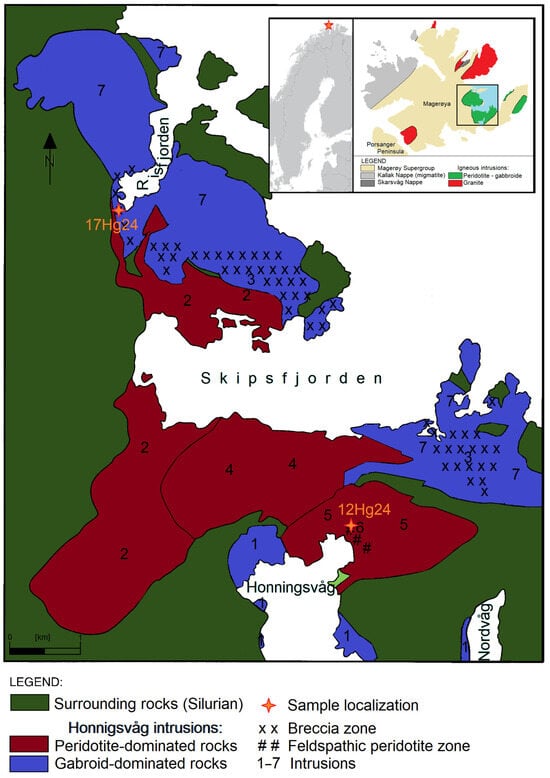
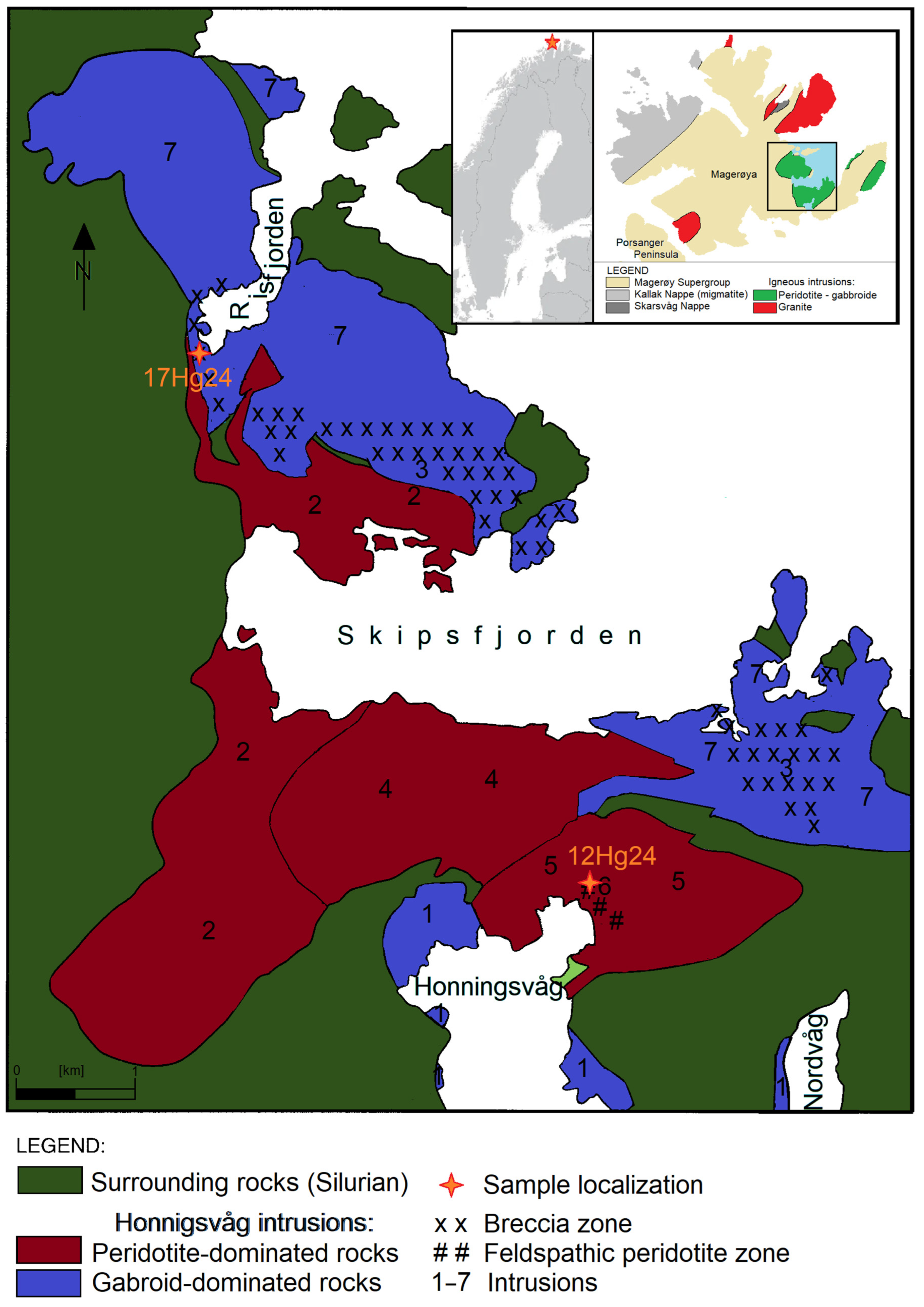
The development of collisional orogens is fundamentally driven by synchronization and feedback mechanisms between intense magmatic activity, tectonic deformation, and fluid–rock interactions. In the Scandinavian Caledonides, this tectonomagmatic evolution culminated in the Late Ordovician and Early Silurian (445–435 Ma), with the formation of major synorogenic mafic complexes and synchronous crustal melting, immediately preceding the final Baltica—Laurentia continental collision. A key geological site revealing the deep roots of this dynamic accretionary system is the Honningsvåg Igneous Complex (HIC) on the island of Magerøya in northern Norway (Figure 1). The HIC complex is one of the most interesting examples of Caledonian synorogenic magmatism. This complex is described as one of the largest layered tholeiitic complexes in the upper allochthon of the Scandinavian Caledonides. The HIC represents a classic, layered tholeiitic intrusion that penetrated an active synorogenic flysch basin (Juldagnes Formation) [1]. This was confirmed by the pioneering studies of Ramsay and Sturt (1976) [2]. Robins (1998) [3] presented the first comprehensive internal architecture of the HIC, mapping its division into seven distinct, vertically oriented magmatic units or reservoirs (Figure 1). Robins proposed that the complex formed by episodic, lobe-like injections of parent magma derived from the mantle into an actively deforming crustal environment. This model took into account the macroscale pseudostratigraphy of the complex, but was limited by bulk geochemistry methods of that time, leaving microscale interactions (between minerals) and potential open-system mass transfers between these reservoirs unexplored. In layered intrusions, such open-system processes—including magma mixing, crustal contamination, and replenishment—fundamentally control the chemical evolution of the melt and the structural development of cumulates (e.g., O’Driscoll and VanTongeren [4]; Namur et al. [5]). Understanding these interactions requires looking, far beyond bulk-rock signatures, into the intra-crystalline records of early-formed minerals.
Figure 1.
Geological map of the Honningsvåg intrusion modified after Robins 1998 [3].
The time frame for the magmatism forming the HIC complex has been determined primarily by the work of Corfu et al. (2006, 2011) [6,7]. Using high-precision U-Pb zircon geochronology, they determined an Early Silurian age for the HIC magmatism (ca. 438–436 Ma) [8], synchronizing it with the intrusion of late-orogenic granitoids and high-grade regional metamorphism [9]. Importantly, Corfu [6] highlighted the presence of synorogenic bimodal magmatism, hypothesizing that the HIC represents an intra-oceanic or active channel system. However, the precise geodynamic provenance of the HIC—in particular, whether it represents a pristine back-arc/island section or a fragment of obducted ophiolitic basement—remains the subject of intense petrological debate. Furthermore, traditional studies have largely ignored the post-magmatic evolution of the complex, in particular the high-temperature crystalline plasticity rheology of its main phases and the role of late hydrothermal systems activated during the final stages of the Scandinavian orogeny. The main lithotypes constituting the complex are harzburgites and plagio-harzburgites, and lherzolites, accompanied by troctolites and gabbronorites [10,11,12]. According to Robins (1998) [3], the Honningsvåg complex represents an exposed, deep-seated analogue of magmatic systems feeding basaltic volcanoes. It formed during the final phase of the closure of the Iapetus Ocean, documenting intense magmatism accompanying continental collision [13].
Despite the wealth of regional microscale data, HIC remains largely unexplored at the microstructural and submicroscopic levels. Previous studies have focused on the overall structure of the massif, but there is a lack of contemporary crystallochemical analyses and microstructural studies conducted directly on olivine crystals. Olivine, as one of the first minerals to crystallize from the parent magma, is a key phase whose analysis can provide information on the original melt composition and physicochemical conditions prevailing in the magma chamber [14,15]. The accompanying pyroxene typically crystallizes somewhat later, similarly to plagioclase, as the melt temperature decreases and elements that contribute to the structure of these minerals are introduced [16]. Tracking the compositional variations and crystal–plastic deformation in these co-existing phases allows for the decoupling of purely magmatic processes from synorogenic tectonic overprints [17].
According to geochronometric studies, these seven vertically oriented magmatic units form synorogenically the HIC [3,6,7,8,9]. Hence, analysis of key rock-forming minerals from two representative rocks (plagioharzburgite and troctolite from intrusions 3 and 6—see Figure 1) may indicate conditions prevailing during the final stages of magmatism in the discussed complex. The aim of this study is to fill this research gap by precisely determining the crystallochemical characteristics and crystallographic orientation of olivine, pyroxene and plagioclase occurring in harzburgites and troctolites. The combination of X-ray microanalysis (EDS), electron microprobe (EMPA), single crystal diffraction (SC-XRD), and crystal orientation mapping (EBSD) provides a unique perspective on the textural and chemical analysis of the ultramafic cumulates of this intrusion. While SC-XRD yields unprecedented insights into the structural constraints and cation ordering of the crystal lattice, EBSD serves as a powerful tool to quantify the lattice preferred orientation (LPO) and dislocation slip systems induced during synorogenic deformation [18,19]. Additionally, integrating these micro- and sub-microscopic techniques is critical to unraveling the interplay between active tectonic strain and magma solidification in dynamic arc settings. This study is the first step in a comprehensive series of analyses aimed at reconstructing the crystallization processes and subsequent deformation of the rocks of the Honningsvåg complex, which is being continued.
2. Materials and Methods
2.1. Preparation of Material for Research
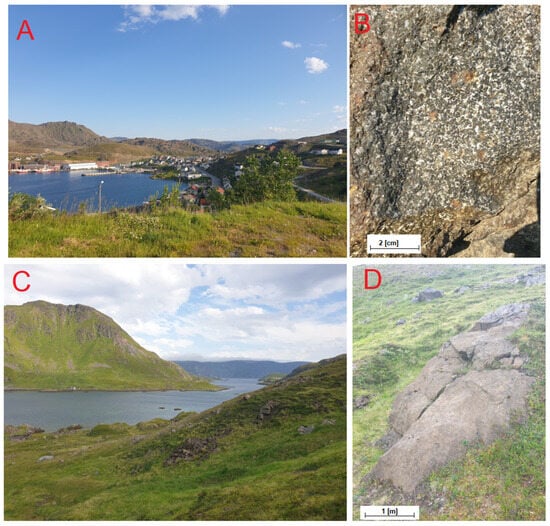
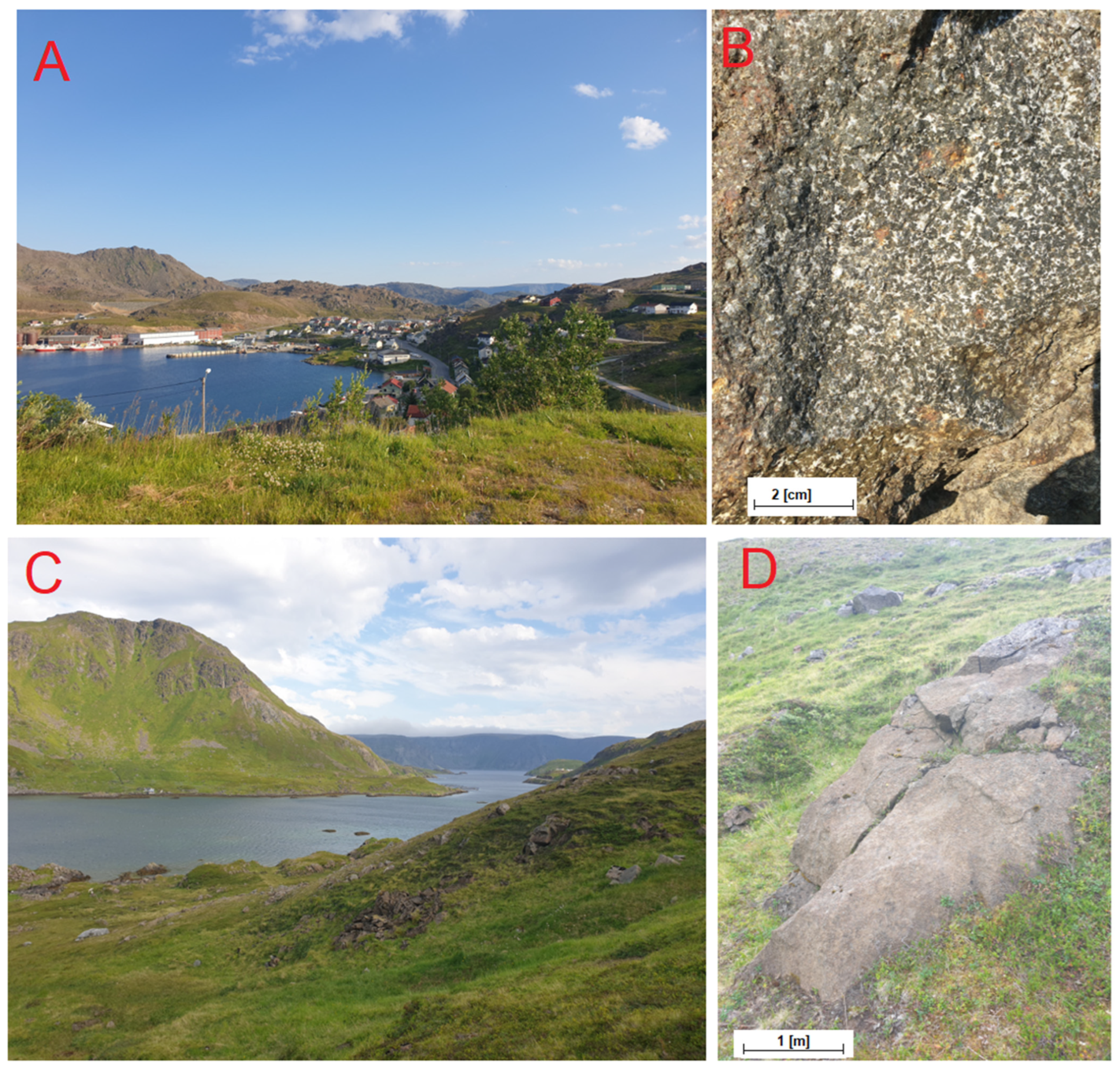
Fieldwork, including documentation and the collection of a comprehensive suite of 25 representative samples across the Honningsvåg Igneous Complex (HIC), was conducted between 2022 and 2026. To unravel the intricate relationship between medium–late-stage magmatic crystallization and synorogenic regional deformation, this study adopts a focused case-study approach based on two highly representative samples from the youngest and most evolved units of the complex (Intrusions 3 and 6; see Figure 2 for field photographs and exact locations). These two end-member samples were selected following initial petrographic screening of the entire sample set to provide a detailed microstructural and crystallographic baseline.
Figure 2.
Illustration of the rock sampling sites: near the airport in Honningsvåg, where the troctolite rock is present (A) and sample 12Hg24 (B) was collected. The vicinity of Risfjorden where plagioharzburgite occurs (C) and sample 17Hg24 was collected (D).
Sample 17Hg24 is a plagioharzburgite (Intrusion 3), selected specifically to evaluate the genetic provenance of plagioclase at the critical transition zone between peridotites and gabbronorites, differentiating between a primary magmatic origin and late-stage hydrothermal/metasomatic overprints. Sample 12Hg24 is a troctolite (Intrusion 6). Investigating these rock types from the late magmatic pulses allows us to trace the fabric development and lattice orientations (EBSD map) of early-crystallizing olivine, pyroxene, and plagioclase in direct response to active Caledonian orogenic movements. Thin sections (30 µm thick) were prepared for petrographic analysis, while polished specimens, in the form of thin sections and rings, were prepared for microscopic examination (EDS, EMPA, EBSD)—see Table 1.
Table 1.
Summary of analyzed rock samples and specific analytical techniques applied.
2.2. Microscopic Analysis
The prepared thin-slab and thin section samples were observed using a Leica DM2500P (Wetzlar, Germany)polarizing optical microscope in transmitted and reflected light to determine the textural properties of the rocks and their mineral composition. The quantitative mineral composition of the rocks was determined by planimetry using photomicrograph analysis software. Measurements were taken on 20 × 20 mm surfaces, summing the proportions of individual phases to classify the rocks according to the IUGS classification system. While EBSD provides highly precise, localized modal and orientation data at the micro- to sub-microscopic scale, larger-scale optical planimetry was fundamentally necessary to ensure a statistically representative bulk-rock mineralogical classification across the entire fabric domain.
2.3. Micro-Area Studies Using EDS, Supported by EMPA
Ring samples containing harzburgite and troctolite were examined in microscale. Microscale analyses were performed using a Hitachi SU6600 Scanning Electron Microscope (Tokyo, Japan) integrated with a Thermo energy-dispersive X-ray spectroscopy (EDS) system and dedicated NSS 3.0 software [20,21,22,23] (Table 1). Measurements were performed under low vacuum conditions (10 Pa) without the need to sputter the samples with a conductive layer. An accelerating voltage of 15 kV was applied at a beam diameter of 0.2 µm, maintaining a single measurement acquisition time of 60 s. Semi-quantitative data were converted to weight fractions (wt%) [24,25]. Quantitative chemical analyses of olivine and pyroxene were conducted using a JEOL Super Probe JXA-8230 (Akishima, Japan). Peak count-time of ca. 20 s and background time of 10 s were used during particular measurements. The system operated in a wavelength-dispersive (WDS) mode under high-vacuum conditions. Electron microprobe operating conditions, standards, and approximate detection limits are presented as follows: Si (albite, K α, TAP, 260 ppm), Ti (rutile, K α, TAPH, 150 ppm), Al (albite, K α, TAPH, 440 ppm), Cr (Cr2O3, K α, LIFH, 270 ppm), Fe (hematite, K α, LIF, 400 ppm), Mn (rhodonite, K α, LIFH, 270 ppm), Ni (NiO, K α, LIF, 500 ppm), Mg (diopside, K α, TAP, 300 ppm), Ca (diopside, K α, PETJ, 200 ppm), andNa (albite, K α, TAPH, 200 ppm). The JEOL ZAF procedure was used for the matrix correction of the raw data. The formulas of olivine and pyroxene were calculated based on 4 and 6 oxygen atoms, respectively. In pyroxene, Fe3+ was calculated from the charge balance, while #Mg = 100 . Mg/(Mg + Fe). The samples were examined with a focused electron beam (with an accelerating voltage of 5–30 keV) and with a beam of 1 to 5 µm in diameter. The microanalysis results were then petrologically interpreted, and data visualizations were performed using Excel software.
The dual use of EDS and EMPA was a deliberate analytical strategy: rapid EDS mapping was utilized to screen a large population of crystals for zoning and homogeneity, providing extensive spatial statistics. Subsequently, high-precision EMPA (WDS mode) was performed on selected spots to serve as an internal calibration standard for the EDS dataset, successfully reconciling and validating the semi-quantitative results. Optical and SEM studies were performed at the Institute of Earth and Environmental Sciences, Maria Curie-Skłodowska University in Lublin. Electron microprobe analyses were performed at the Laboratory of Critical Elements of AGH University of Krakow—KGHM Polska Miedź SA.
2.4. Crystallochemical and Structural Studies of Olivine (SC-XRD)
Structural analysis of selected olivine single crystals with an average size of 0.1–0.2 mm was performed using a Rigaku diffractometer (Tokyo, Japan) [26] with a CuKα emission source (λ = 1.54184 Å) (Table 2). The diffraction experiment was performed at 293 K, with the crystals mounted on nylon loops using immersion oil. The diffraction data were processed, including reduction and acquisition, using CrysAlisPro v42 software [27]. The crystal structures were solved using direct methods (SHELXS-86 program) and refined in SHELXL within the Olex2 platform [28,29,30]. Micro-Raman studies were also performed using a Thermo Scientific Shimadzu Nicolet 8700A FTIR spectrometer (Waltham, MA, USA) [31,32] (Table 1) to identify functional groups and chemical bonds within the individual mineral species. Crystallochemical and structural studies were performed at the Department of Organic Chemistry and Crystallochemistry, Maria Curie-Skłodowska University in Lublin.
Table 2.
Key measurement parameters of measured olivines.
2.5. Crystal Orientation Mapping (EBSD)
Electron backscatter diffraction (EBSD) analysis was performed using an FEI Versa 3D FEG-SEM equipped with an Oxford Instruments Symmetry S2 EBSD camera (Oxford, UK). To minimize specimen charging, variable-pressure mode was employed with a chamber pressure of 10 Pa. EBSD maps were acquired using an accelerating voltage of 20 keV, an acquisition rate of 28 patterns per second, and a step size of 5 µm (Table 2). Diffraction patterns were stored during acquisition, and subsequent phase identification and orientation analysis were carried out using AZtecCrystal 4.0 software. Initial phase and orientation determination was performed using a template-matching approach against dynamically simulated master patterns for all considered phases, followed by orientation refinement (Table 1). No additional map-cleaning procedures were applied. Analyzes of mineral orientation were performed at the Academic Center for Materials and Nanotechnology of the AGH University of Krakow.
3. Results
3.1. Structural and Textural Features of the Rock Samples
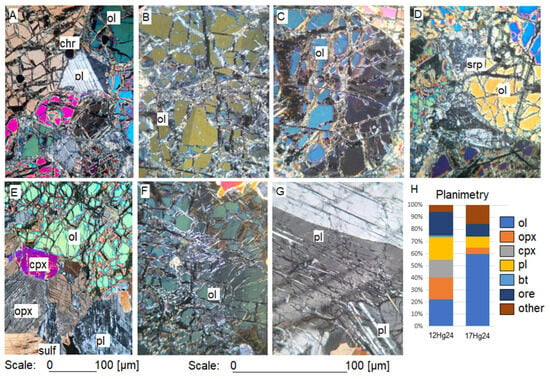
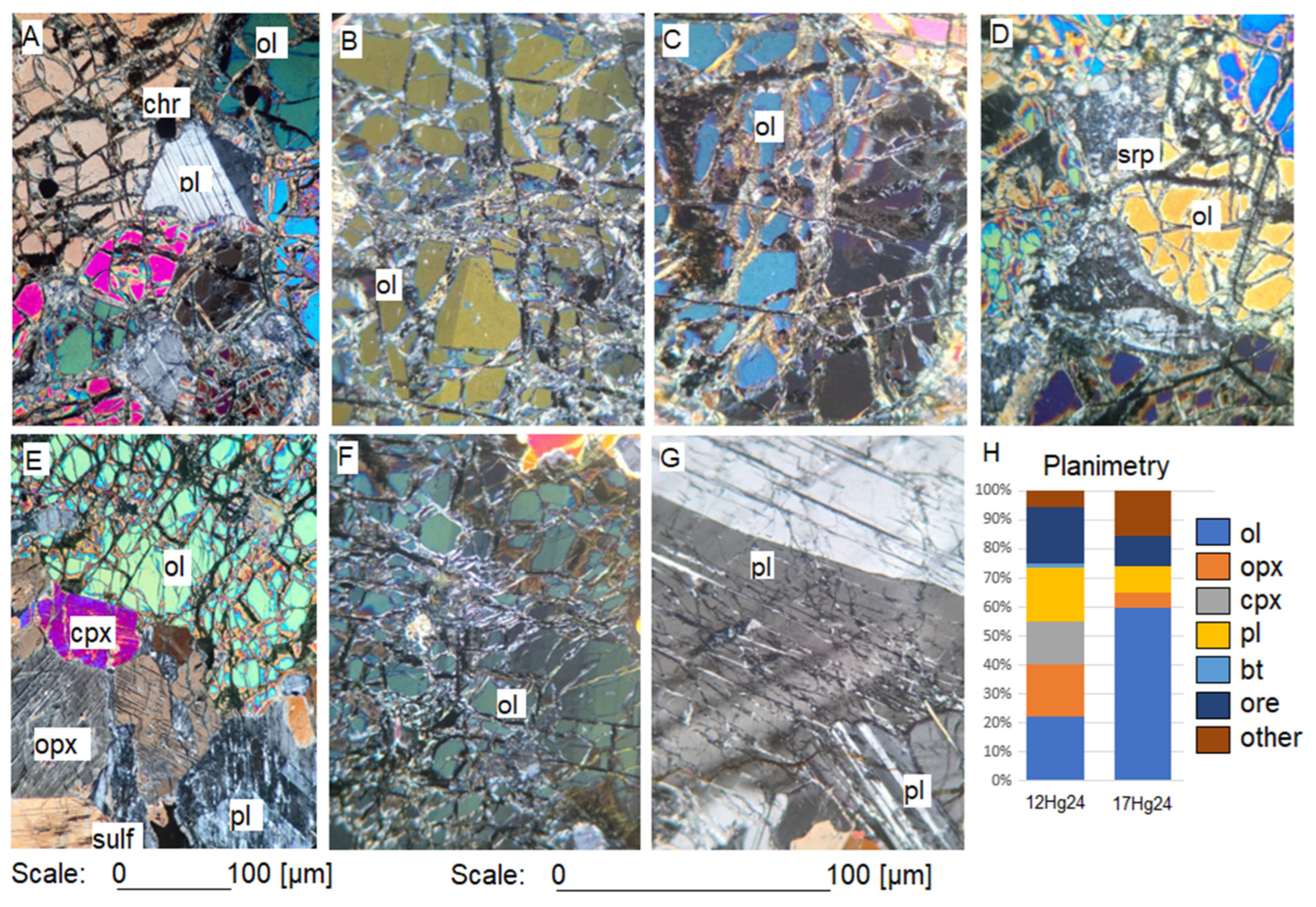
Sample 17Hg24 (intrusion 3; Figure 3A,C) is a holocrystalline, medium-grained rock exhibiting a well-developed adcumulate to orthocumulate texture. The primary magmatic mineralogy is dominated by olivine (~60% based on modal planimetry), followed by clinopyroxene and lesser plagioclase. Olivine forms subhedral to quasi-euhedral cumulus crystals that frequently display mutual, straight-grained boundaries. Clinopyroxene occurs as anhedral, intercumulus post-cumulus phases, occasionally overgrowing pre-existing olivine grains. Plagioclase is present as minor laths situated within the intercumulus spaces. Primary accessory chromite forms small euhedral to subhedral crystals, occurring both as inclusions within olivine and along intergranular boundaries. Opaque sulfide phases are interspersed within the primary silicate matrix.
Figure 3.
Petrographic and quantitative mineralogical characteristics of the studied synorogenic intrusions from the Honningsvåg Igneous Complex. (A–D) Transmitted-light cross-polarized (XPL) microphotographs of plagioharzburgite (Sample 17Hg24, Intrusion 3) displaying an adcumulate texture with subhedral olivine (Ol) crystals surrounded by intercumulus clinopyroxene (Cpx) and minor plagioclase (Pl) laths. Photographs (B,C) show the optical properties of olivine (subgrain boundaries, undulose extinction) which determine its optical properties. Note the prominent reaction coronae at the Ol-Pl boundaries and intersecting fracture networks filled with secondary serpentine-group minerals (D). (E–G) Transmitted-light cross-polarized (XPL) microphotograph of troctolite (Sample 12Hg24, Intrusion 6) showing a poikilitic texture where plagioclase laths with bent twins and fractured, anhedral olivine grains are embedded in a magmatic matrix. Clear undulose extinction and deformation lamellae are visible in the large silicate phases, reflecting syn-tectonic orogenic overprinting (photomicrograph (F) shows undulose extinction in olivine and photo (G) shows deformation twins in plagioclase). (H) Modal mineralogical composition (vol.%) of the samples determined by comprehensive optical planimetry across a 20 × 20 mm surface domain. Mineral abbreviations [33]: ol—olivine, opx—orthopyroxene, cpx—clinopyroxene, pl—plagioclase, bt—biotite/phlogopite, chr—chromites, sulf—sulfides, ore—oxides/sulfides, other—secondary alteration products (antigorite, talc, chlorite, carbonates).
The primary magmatic fabric preserves strong evidence of syn-tectonic orogenic strain. Olivine crystals systematically exhibit well-defined undulose extinction and distinct, parallel deformation lamellae (translational striations). Extensive micro-fracturing networks cut across the olivine cumulates. At the interfaces between intercumulus plagioclase and olivine, well-developed, multi-layer reaction coronae are present, documenting late-magmatic fluid–rock interaction or high-temperature subsolidus re-equilibration.
The sample is overprinted by low-temperature retrogressive alteration, localized predominantly along grain boundaries and within intra-crystalline fracture networks. Olivine breakdown is marked by the development of a mesh-textured alteration matrix composed of fibrous antigorite, talc, bowlingite, and fine-grained secondary mica aggregates. Associated secondary phases include minor epidote, acicular chlorite patches, and fine acicular carbonate precipitates adjacent to altered sulfide domains.
Sample 12Hg24 (intrusion 6; Figure 3B,C) is a holocrystalline, medium-grained rock characterized by a compact, heteradcumulate texture with prominent poikilitic and symplectitic intergrowths. The primary magmatic mineralogy consists of plagioclase, olivine, orthopyroxene, and minor clinopyroxene. Olivine occurs as large, anhedral to highly irregular cumulus crystals that often exhibit scalloped or “bayed” grain boundaries. Large, anhedral orthopyroxene grains poikilitically enclose smaller olivine and chromite inclusions. Clinopyroxene is subordinate, forming smaller interstitial grains between large olivine and plagioclase laths, and characterized by well-developed polysynthetic twinning. Accessory primary phlogopites occur as small magmatic flakes, often nucleating around primary subhedral sulfide and oxide grains.
Superimposed tectonic strain is highly pronounced in all primary phases. Olivine displays intense undulose extinction, deformation bands, and pervasive, intersecting fracture networks. Plagioclase laths show prominent microstructural deformation, including bent twin lamellae, mechanical twinning, and strong undulose extinction. Orthopyroxene grains contain dense zones of fine-grained, oriented opaque acicular inclusions (“spinel rods”) aligned along crystallographic planes, typically associated with high-temperature exsolution or stress.
Late-stage retrogressive alteration is extensive. Pervasive cross-cutting fractures host low-temperature serpentinization traces, dominated by green bowlingite, antigorite, and abundant secondary magnetite dusted along the mesh centers, along with minor hematite stains. Orthopyroxene shows localized destabilization into fine-grained amphibole aggregates (amphibolitization), accompanied by talc, chlorite, and minor patch-like carbonate replacements.
3.2. Mineral Chemistry Using SEM-EDS and EMPA
3.2.1. Olivine and Pyroxene
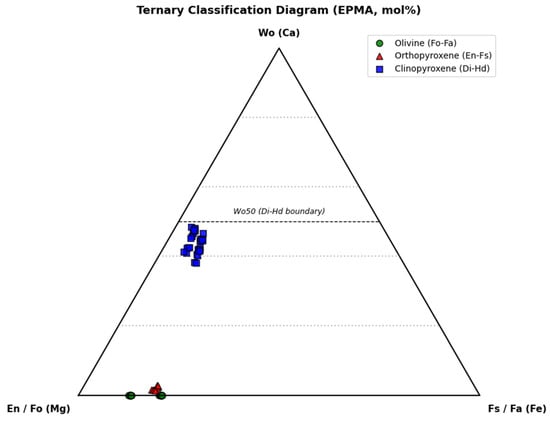
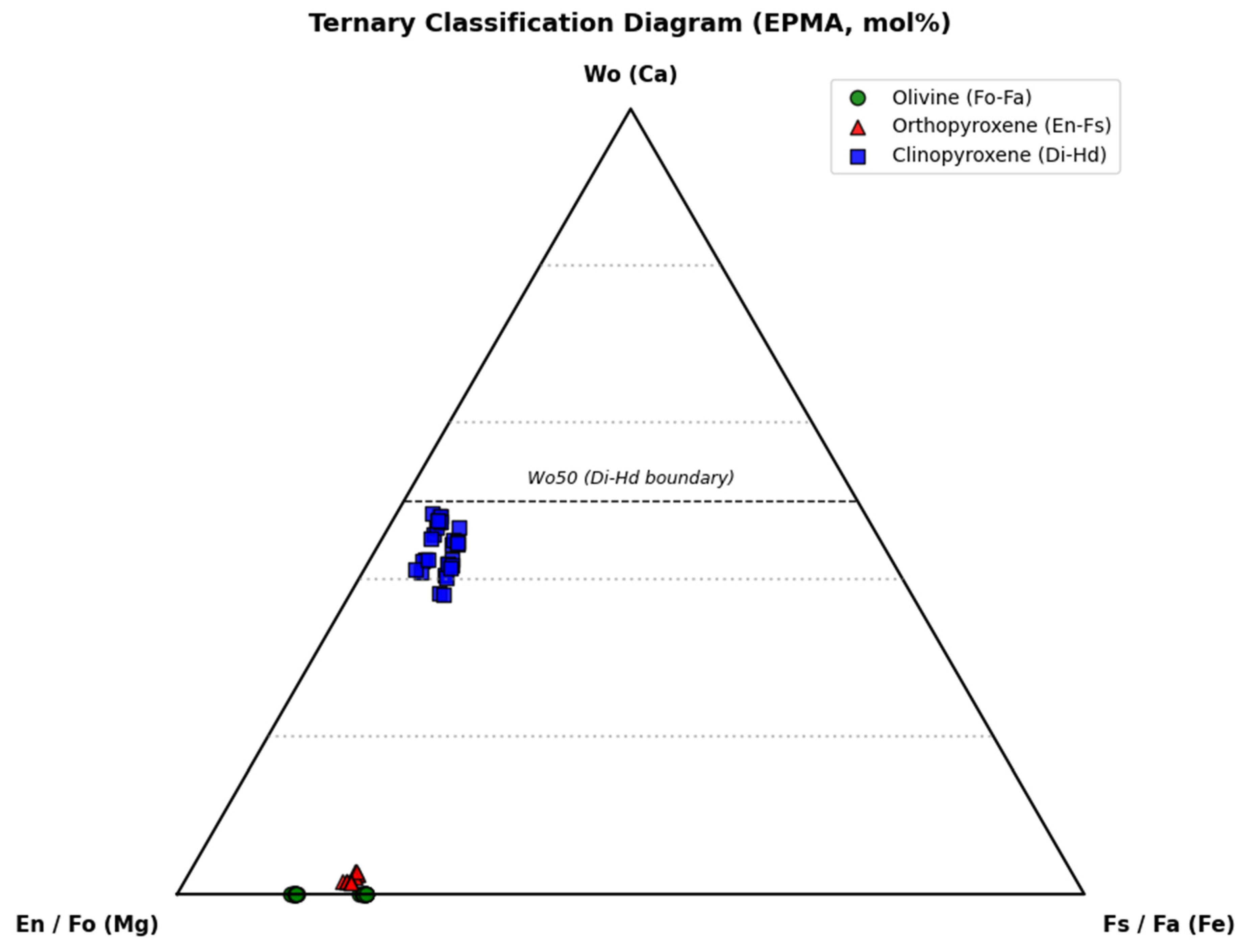
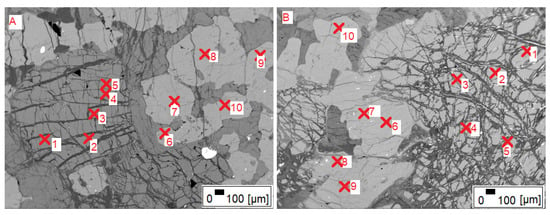
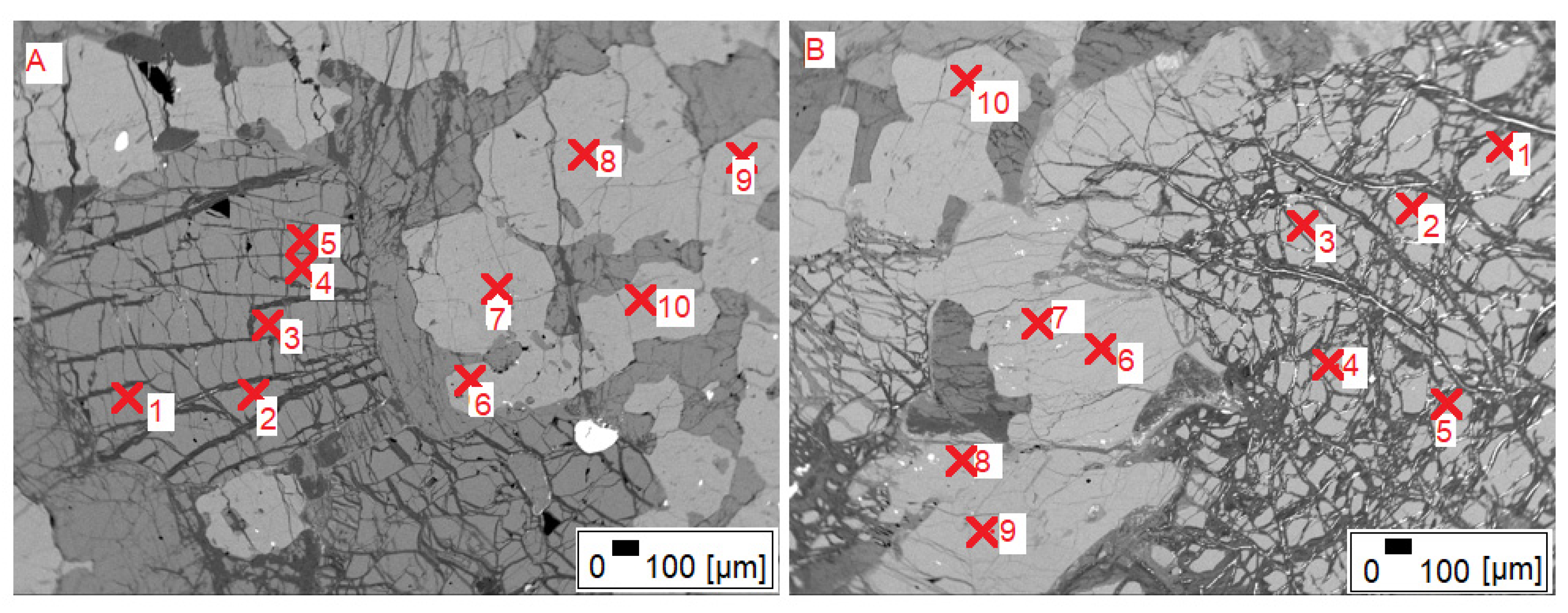
Electron microprobe analysis (EDS and EMPA, Figure 4 and Figure 5) reveals a distinct composition between the olivines of the two studied rock types (Table A2 and Table A3 in Appendix A). In the plagioharzburgite (sample 17Hg24), olivine exhibits a highly magnesian composition with a very narrow range of Fo86.8–87.5 (mean Fo87.10 ± 0.25), accompanied by mean NiO contents of 0.21 wt% and MnO of 0.18 wt%. This high Fo content reflects its primitive, early-cumulate character within Intrusion 3. Conversely, olivine in the troctolite (sample 12HG24, Intrusion 6) displays a consistently more evolved, lower-magnesian character, with values tightly clustered in the range of Fo79.2–80.0 (mean Fo79.41 ± 0.22 Figure 4), accompanied by lower NiO (0.11 wt%) and higher MnO (0.29 wt%) concentrations. Individual grains in both samples are largely homogeneous from core to rim, showing no significant intra-granular zonation. The compositional shift from Fo87.1 to Fo79.4 between Intrusion 3 and Intrusion 6 directly tracks progressive fractional crystallization of the parent magma, without evidence for a distinct bimodal composition within individual samples.
Figure 4.
Ca, Mg, Fe classification triangle for the studied olivine and pyroxene.
Figure 5.
Example of BSE images with point analysis localization (EMPA) in the olivine–pyroxene species for sample 12Hg24 (A) on the left, and 17Hg24 (B). The numbers shown in the photographs indicate the locations of the analyses points.
Primary orthopyroxene occurs predominantly in the plagioharzburgite (sample 17Hg24) as subhedral intercumulus grains and reaction oikocrysts surrounding olivine. EMPA compositions show that orthopyroxene is highly magnesian, classifying consistently as enstatite with a narrow compositional spectrum centered around En80.41 Fs17.66 Wo1.92 (range: En79.5–81.8). The low wollastonite component (Wo < 2.5 mol%) reflects low-calcium pyroxene crystallization under high-temperature magmatic conditions. Concentrations of minor oxides, including Al2O3 (1.45–1.85 wt%) and Cr2O3 (0.15–0.28 wt%), are typical for primitive to moderately differentiated intrusive mafic-ultramafic cumulates. Individual grains exhibit high intra-crystalline homogeneity, showing no core-to-rim zonation in Mg.
Clinopyroxene is present as interstitial phase and oikocrystic grains in both the plagioharzburgite (17Hg24) and troctolite (12Hg24) units. Microprobe analyses classify the primary clinopyroxene predominantly as diopside to augite, with high Wo contents (Wo44.5–47.2 En45.1–48.0 Fs6.2–8.5; mean Mg ≈ 85–88). Minor element abundances show moderate Al2O3 (2.10–3.40 wt%) and Cr2O3 (0.35–0.75 wt%) values, consistent with crystallization from a tholeiitic to mildly alkaline parental melt. Exsolution lamellae of orthopyroxene within clinopyroxene cores are locally observed, reflecting subsolidus re-equilibration and exsolution during slow post-magmatic cooling of the intrusion.
3.2.2. Oxide and Sulfide Accessory Phases
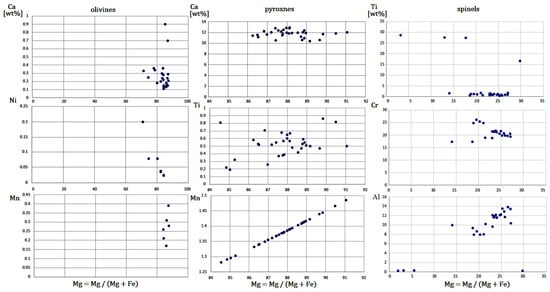
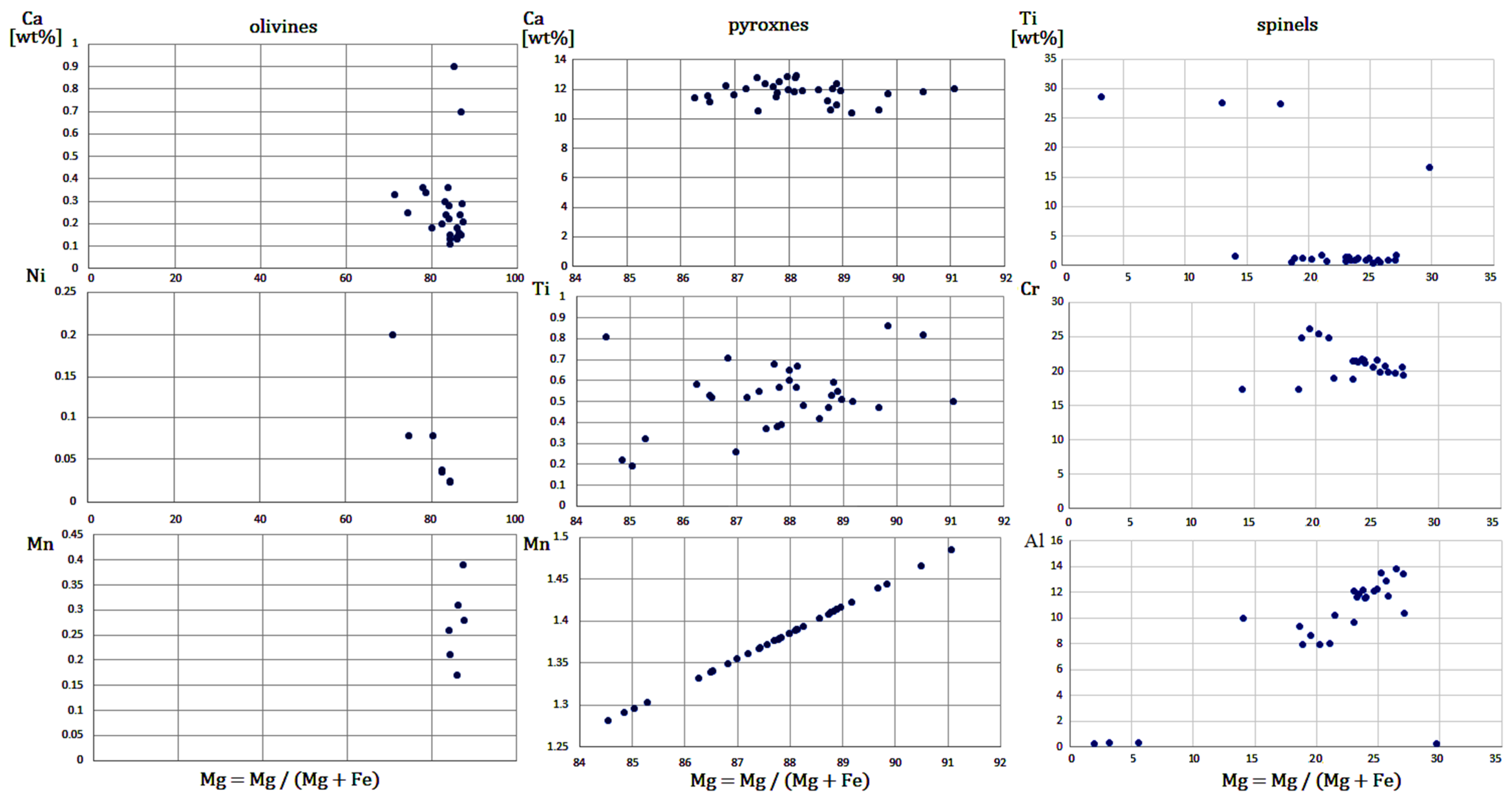
The silicate matrix is accompanied by diverse oxide assemblages, dominated by accessory spinel-group minerals. Chromite occurs primarily as rounded to subhedral inclusions trapped within olivine cores, and less frequently within pyroxenes. The analyzed chromites exhibit variable Mg contents (6–12 wt.%), Al concentrations spanning 13–25 wt.%, and Ti levels between 1.5 and 3.0 wt.%. Late-stage Fe-Ti oxides are represented by interstitial ilmenite and magnetite. Ilmenite is characterized by 37–47 wt.% Ti, 43–51 wt.% Fe, and notable Mn enrichments (1.0–1.5 wt.%), while showing a complete absence of Cr (Figure 6).
Figure 6.
Harker plots [34,35] for the examined mafic minerals from plagioharzburgite and troctolite samples using EDS data.
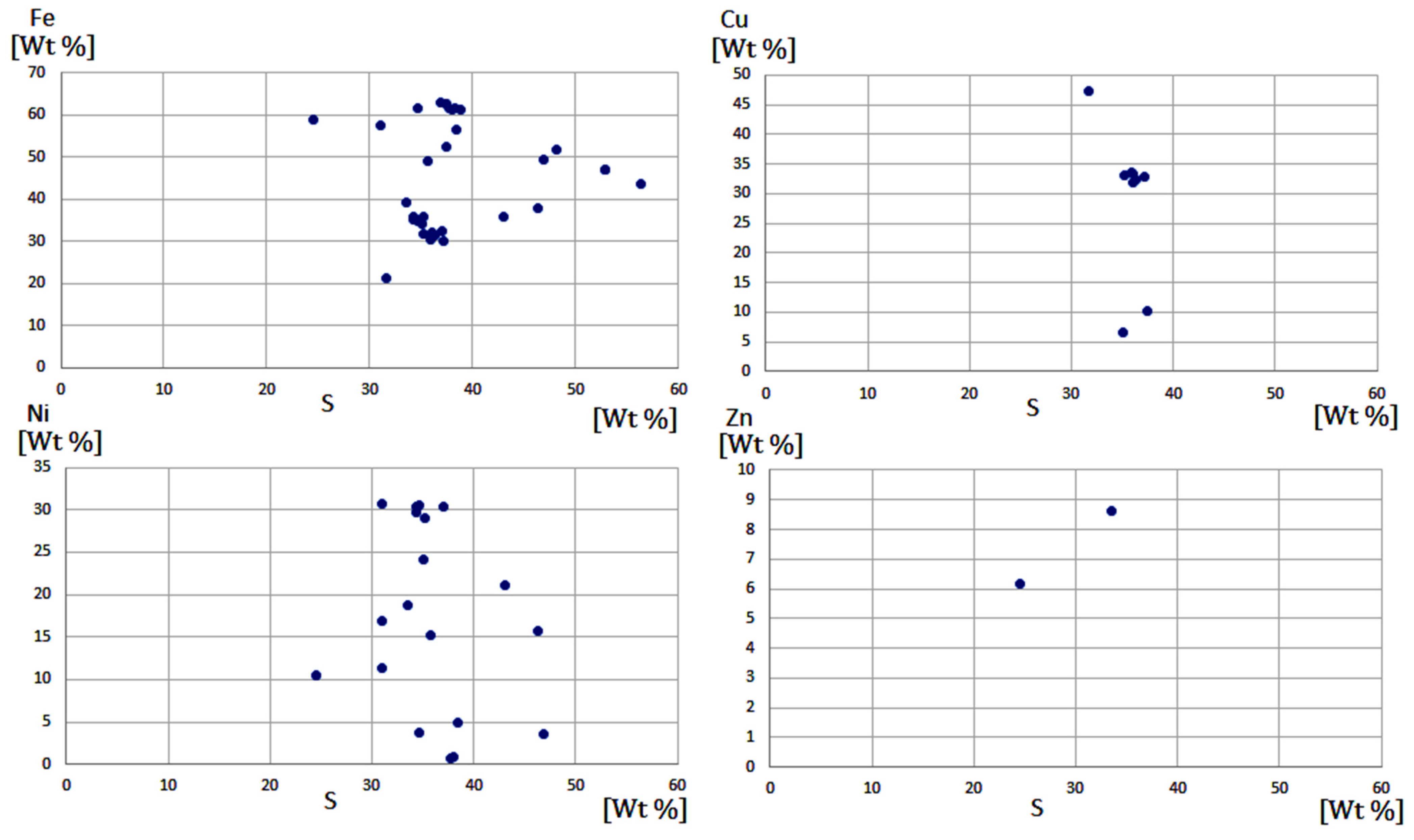
Interstitial magnetite crystals contain minor Mg admixtures (1–2 wt.%) but lack Ti and Cr entirely, occurring strictly within serpentinized fracture meshes and crushed grain boundaries. Primary and secondary base-metal sulfides comprise chalcopyrite (22%), pentlandite (33%), pyrrhotite (28%), and pyrite (17%) of the total sulfide modal population (Figure 7). Secondary mineral phases detected in minor quantities include antigorite, phlogopite/biotite, magnesio-hornblende, fluorapatite, and rare zinc sulfides (sphalerite). Late-stage carbonate patches are structurally restricted to fracture systems and consist of siderite and dolomite.
Figure 7.
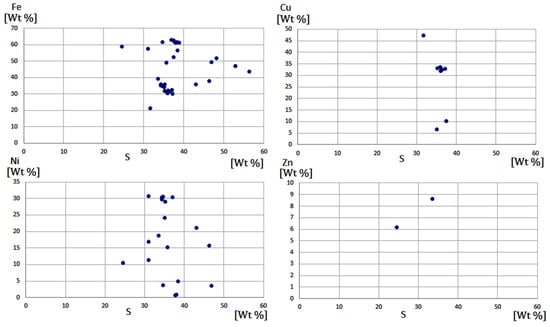
Binary plots for the examined sulphides from plagioharzburgite and troctolite samples. For Zn, only two data points are plotted as the zinc concentrations in all other analyzed sulfide spots were below the EDS limit of detection (LOD).
3.2.3. Plagioclase Composition
Plagioclase compositions vary broadly across both lithotypes. The vast majority (88%) corresponds to calcic plagioclase (Ab70–90, labradorite-bytownite). A subordinate portion consists of secondary albite and oligoclase (8%), while nearly pure anorthite targets account for the remaining 4% of the dataset.
3.2.4. Sulfides
Primary and secondary base-metal sulfides comprise chalcopyrite (22%), pentlandite (33%), pyrrhotite (28%), and pyrite (17%) of the total sulfide modal population. Binary plots for these sulfide phases demonstrate distinct compositional clustering in terms of their major Fe, Ni, and Cu ratios (Figure 7). Associated minor to trace mineral phases detected within or adjacent to the sulfide domains include antigorite, phlogopite/biotite, magnesio-hornblende, fluorapatite, and rare zinc sulfides (sphalerite). The zinc-bearing phases are characterized by localized Zn enrichment, consistently occurring in close spatial association with secondary alteration rims around plagioclase and within serpentinized networks. Consequently, Zn concentrations in the vast majority of analyzed sulfide grains were below the detection limit, resulting in only two representative data points plotted in Figure 7. Additionally, late-stage carbonate patches, structurally restricted to these fracture systems, are compositionally identified as siderite and dolomite.
3.3. Crystallochemical Analyses of Olivine
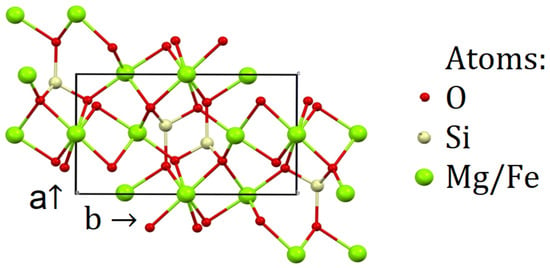
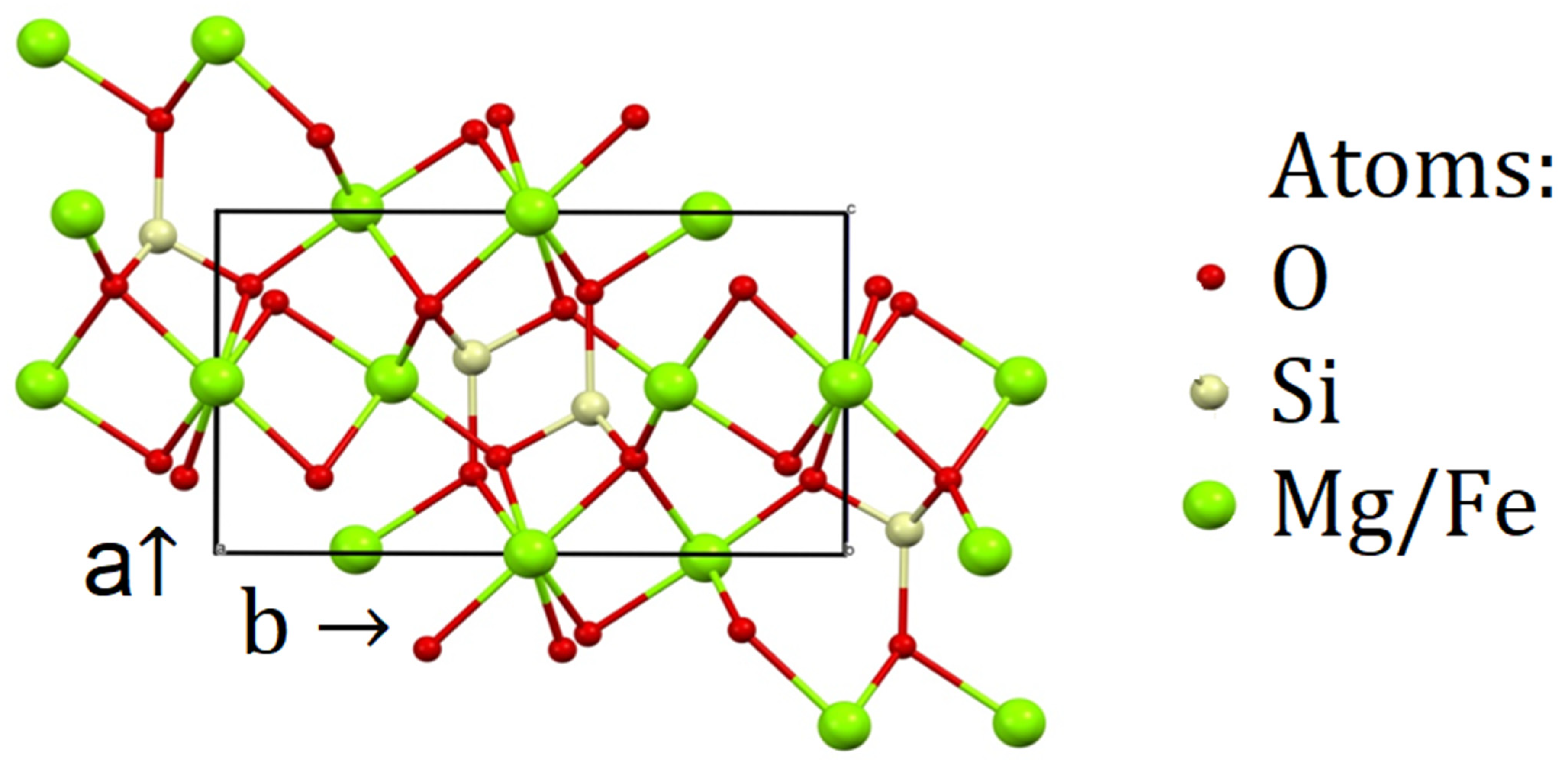
Single-crystal X-ray diffraction (SC-XRD) analysis of the olivine crystal (sample 17HG24) confirmed an orthorhombic structure within the Pnma space group with unit cell dimensions of a = 10.2223(15) Å, b = 5.9868(7) Å, c = 4.7570(6) Å, and V = 291.13 Å3. The refined cell parameters slightly deviate from pure end-member forsterite, reflecting iron substitution in the octahedral sites, which is consistent with the EMPA chemical data (see above and in Table A1 in Appendix A). Structural studies of olivine samples from plagioharzburgite and Honningsvåg troctolite indicate a typical crystal structure (Figure 8). Magnesium ions in the discussed structure occupy positions M1 and M2. Position M1 shows symmetry in all bonds with oxygen. Of particular interest is position M2, where opposite bonds are bent, forming acute or obtuse angles [36,37,38,39,40,41]. The smallest O3-Mg2-O3 angle is 71.5°, and the largest is 110.6°. This specific geometry of the ionic environment causes Mg2+/Fe2+ ions in this position to have a higher vibration amplitude in the direction shown by the arrows in Figure 8.
Figure 8.
Schematic representation of the olivine crystal structure (based on Bragg and Brown [42]; and own data), illustrating the crystallographic axes (a, b).
The overall composition of the olivine studied is . Refining the populations of the and ions at the M1 positions M2 was performed using an integrated solid solution model. The total mole fraction of magnesium () in the structure was determined by fitting a single free atomic scale variable, FVAR 1, which controls the ratio for all cationic octahedral positions ( ).
- Total Fraction ): The value of the fitted variable was .
- 2.
- Total Fraction ): The iron fraction is the remainder to unity, assuming only the substitution .
The individual fractional populations of magnesium () and iron () at positions and are conjugate. Refining typically defines the scattering factor for each site () as:
The total fraction ) is maintained by the constraint . As a result, the final total occupancy at positions and must sum to .
Based on the principles of crystallochemistry, ions, being larger than , preferentially locate in the larger and more distorted octahedron M2 (Table 3). Although the atomic coordinates section gives the nominal population of Mg1 and Mg2 as , the presence of and value clearly indicate that the refinement was performed for solid solution . The value for and in this context means that these positions were matched with the average scattering factor for both conjugated ions (and ), with the final composition being dictated by . This is supported by the difference in bond distances ( vs. ), which indicates a preferential placement of the larger one at position .
Table 3.
Inferred Partitioning (Occupation).
In addition to structural parameters, FTIR spectroscopy provided further insights into the vibrational characteristics and alteration products associated with the studied olivines (Table A1 in Appendix A). The absorption band at 927 cm−1 (present in sample 12Hg24) corresponds to the characteristic υ3 Si–O stretching vibration within the olivine crystal lattice. The remaining spectral bands reflect both intergrown matrix minerals and secondary hydrous phases. Specifically, features at 537 cm−1 and 607 cm−1 are attributed to lattice/deformational vibrations in pyroxenes (clinopyroxene and orthopyroxene, respectively), while the band at 1100 cm−1 confirms T–O–T asymmetric stretching in plagioclase. High-frequency absorption bands in the 3599–3726 cm−1 region, alongside bending modes around 669–670 cm−1 and 937 cm−1, clearly indicate localized hydration and retrogression, marked by OH-group stretching in serpentine, phlogopite (3627 cm−1), and related phyllosilicates.
3.4. Crystal Orientation Analysis
3.4.1. Microstructural and Fabric Analysis of Silicate Phases
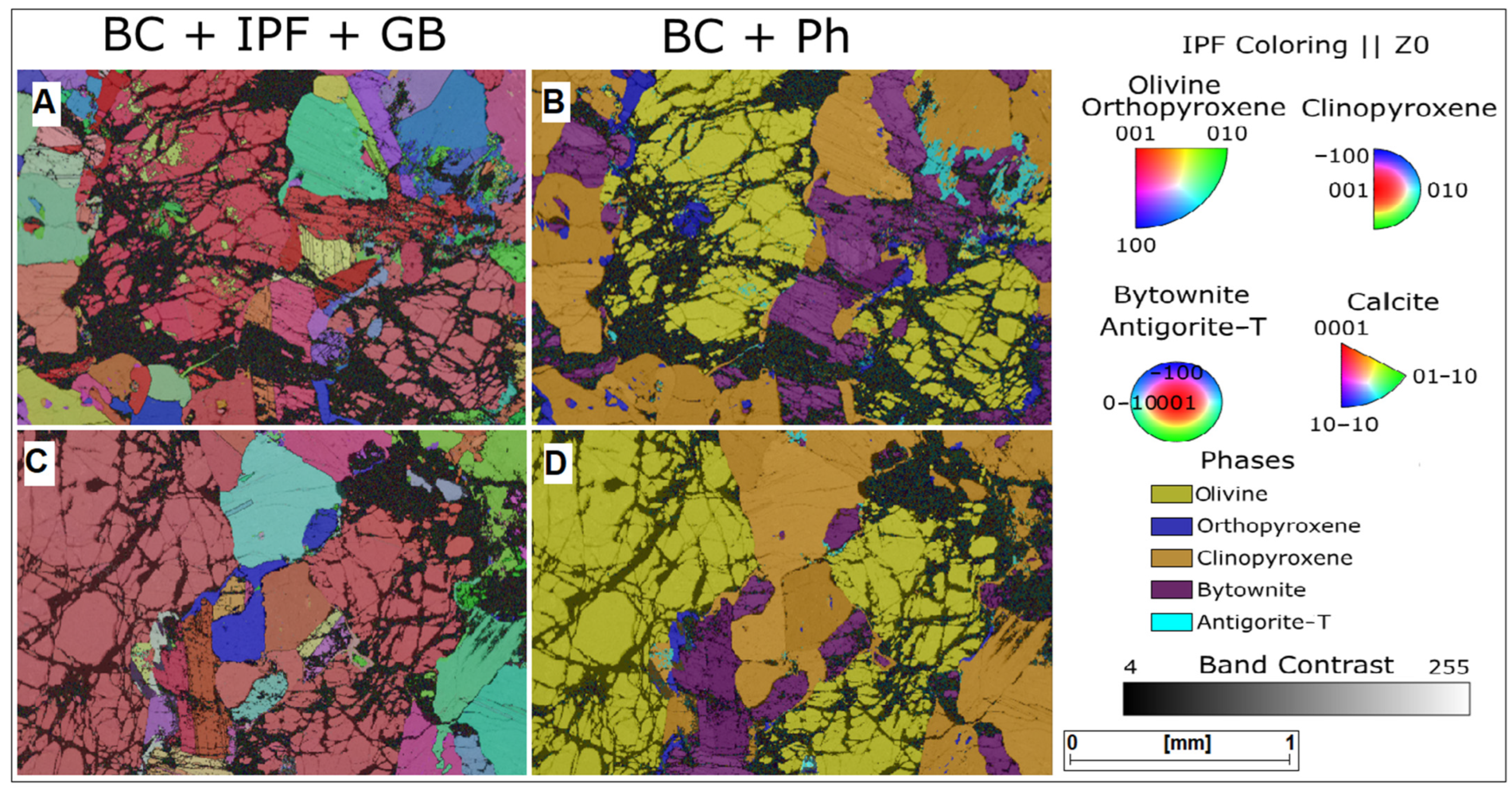
To unravel the intra-crystalline deformation history and tectonic fabric development during late-stage magmatism, high-resolution Electron Backscatter Diffraction (EBSD) mapping was target-focused on the two highly representative, microstructurally overprinted rock samples (Sample 17Hg24 and Sample 12Hg24; Figure 9). Despite the focused sample suite, the micro-area orientation dataset yields robust statistical constraint on the late-stage tectono-magmatic evolution of the Honningsvåg Igneous Complex.
Figure 9.
Crystal orientation map obtained for plagioharzburgite and troctolite samples (A,C), phase map with detailed minerals (B,D), acronyms abbreviations: BC—band contrast; IPF—inverse pole figure (colored according to the crystallographic axes, e.g., [100], [010], [001]), GB—grain boundaries, Ph—phase map.
In plagioharzburgite and troctolite fabric domains, olivine documents a strong crystal–plastic response to synorogenic tectonic strain. Olivine grains are characteristically controlled by high-temperature dislocation slip systems active during the late-magmatic to high-temperature subsolidus framework. Rather than acting as an entirely passive, rigid framework, the olivine generation accommodated significant plastic strain prior to full solidification, as evidenced by consistent subgrain boundary development and systematic lattice tilting.
In contrast, plagioclase displays a polyphase deformation history that records the transition from high-temperature magmatic flow to lower-temperature crystal–plastic and brittle overprinting:
- During the early, syn-magmatic stages, plagioclase laths underwent extensive alignment and crystal-rotation within the crystal mush, adapting to the dynamic stress field alongside the recrystallizing pyroxene matrix.
- As the system cooled below the solidus under sustained orogenic compression, plagioclase accommodated strain via mechanical twinning and localized dynamic recrystallization along high-strain grain boundaries.
- During the final structural stages—associated with late-orogenic tectonic deformation and regional fault-zone activation—the competence of plagioclase increased, shifting its rheological behavior from plastic flow to dominant micro-fracturing and brittle cataclasis, which systematically truncates the pre-existing high-temperature magmatic fabrics.
Pyroxenes (both orthopyroxene and clinopyroxene) accommodated the imposed strain primarily via mechanical twinning, localized bending of twin lamellae, and minor rigid-body rotation within the intercumulus pockets, demonstrating a higher competence relative to the surrounding ductilely deforming olivine and plagioclase matrix during the high-temperature phases.
3.4.2. Epitaxial Relationships Within Secondary Alteration Frameworks
The localized low-temperature hydration zones preserve critical crystallographic links between primary phases and secondary mineral growths. Pervasive serpentine (antigorite) arrays, which systematically nucleated within olivine interstitial boundaries and intra-crystalline fracture networks, exhibit remarkably uniform crystallographic orientations across distinct fabric domains (Figure 9B,D).
4. Discussion
4.1. Magmatic Evolution, Geothermometry, and Thermodynamic Equilibrium (KD Constraints)
The systematic chemical compositions of the primary rock-forming minerals, coupled with intra-crystalline structural parameters, record a complex and polyphase history of magmatic differentiation and subsolidus re-equilibration within the Honningsvåg Igneous Complex (HIC). High-precision electron probe microanalysis (EPMA) data for the co-existing olivine, orthopyroxene, and clinopyroxene grains demonstrate a strong spatial correlation, yet reveal distinct thermodynamic regimes governing different mineral pairs.
A pivotal proxy for evaluating the state of chemical and thermodynamic equilibrium during the solidification of mafic-ultramafic cumulates is the Fe-Mg exchange partition coefficient, defined as Equation (4). For the co-existing olivine–orthopyroxene pairs in the studied plagioharzburgite (Sample 17Hg24) and troctolite (Sample 12Hg24), the calculated (see Table 4) exchange values cluster tightly around an average of ~1.03 ± 0.10 (excluding Couple 4 in Table 4, which is treated as an outlier likely caused by sub-microscopic inclusions or localized secondary alteration). In high-temperature igneous petrology, an olivine–orthopyroxene KD value near unity provides robust empirical evidence for crystallization under conditions close to true thermodynamic equilibrium [14,15], a hallmark of slow cooling within deeper levels of magma chambers. This state of near-equilibrium strongly substantiates the primary, undisturbed cumulate nature of the early-formed harzburgitic and troctolitic frameworks.
Table 4.
Apparent elemental distribution and Fe-Mg exchange coefficients for co-existing silicate pairs.
This stable thermodynamic behavior contrasts sharply with the olivine–clinopyroxene mineral pairs. Across both investigated lithotypes, the olivine–clinopyroxene couples consistently yield values characterized by significant scatter, ranging from 0.90 to 1.66 (Table 4). Although the calculated mean value (~1.16) superficially aligns with the established magmatic equilibrium range of 1.15 ± 0.10 [16], this wide variance indicates a pronounced chemical disequilibrium. Such a departure from equilibrium can be explained via two distinct petrogenetic mechanisms:
- Intercumulus Growth from Residual Melt: The clinopyroxene did not co-crystallize synchronously with the high-temperature olivine matrix, but instead precipitated at lower temperatures as an intercumulus phase from heavily fractionalized residual melt trapped within the interstitial pockets of the olivine framework [17].
- Episodic Magma Replenishment: The disequilibrium marks a dynamic open-system process, wherein a subsequent pulse or injection of a new, primitive batch of parental magma entered the actively deforming crustal reservoir, locally modifying the ambient chemical environment and disrupting the mineral-melt equilibrium before full solidification could occur.
This second scenario aligns seamlessly with the multi-intrusion architecture of seven vertically oriented magmatic units proposed by Robins [12] and the presence of complex structural mosaicism under an active synorogenic tectonic regime.
The chemical variation observed between the olivine populations across the intrusive units provides key insight into the evolving boundary conditions of the HIC plumbing system. The primary olivine population displaying high forsterite contents (Fo86.8–87.5) and exceptionally low calcium levels (CaO < 0.05 wt%) is highly indicative of crystallization under elevated pressure conditions deep within the lower crust or upper mantle boundary [3]. Conversely, the transition to the more evolved olivine population (Fo79.2–80.0) in the younger intrusive unit records crystallization within a shallower, lower-pressure crustal storage reservoir. The systematically low Mn abundances (averaging ~0.18–0.29 wt% MnO) and the drop in Ni content (from 0.21 wt% NiO in Fo87 to 0.11 wt% NiO in Fo79) further constrain the melt kinetics. This rapid depletion of Ni directly demonstrates that the parental magma underwent fractional crystallization during storage and transport, during which Ni was progressively sequestered by early-formed olivine. Furthermore, the absence of sharp compositional core-to-rim zonation across individual grains—despite the presence of internal mosaicism and well-defined subgrains revealed by electron backscatter diffraction (EBSD)—indicates that chemical re-equilibration via intra-crystalline diffusion outpaced structural relaxation during post-magmatic cooling. This decoupling between structural deformation and chemical homogeneity indicates that the rate of chemical lattice diffusion exceeded the rate of mechanical lattice recovery. Such a condition requires a prolonged thermal residence period at elevated, near-solidus temperatures. Given the estimated crystallization temperature of approximately 1200 °C and a slow cooling rate estimated at around 0.1 °C/year, the HIC magma chambers must have experienced a long-term thermal baseline, which allowed internal chemical re-equilibration via diffusion while preserving the subgrain boundary strain induced by ongoing Caledonian orogenic stress. Crystallization temperatures and cooling rates were estimated using the olivine–pyroxene geothermometer of Putirka (2008) [15], and are in good agreement with the regional isotopic constraints and thermal evolution models proposed by Corfu et al. (2006, 2011) [6,7].
4.2. Post-Magmatic Fluid–Rock Interactions, Hydrothermal Alteration, and Crustal Assimilation
The spatial and compositional architecture of accessory phases within the Honningsvåg Igneous Complex provides critical evidence for a dynamic transition from late-stage magmatic crystallization to intense, fluid-driven post-magmatic and hydrothermal regimes. The complex base-metal sulfide assemblage—dominated by chalcopyrite, pentlandite, pyrrhotite, and pyrite—demonstrates systematic binary clustering (Figure 7), reflecting the pristine composition of the immiscible sulfide melt that exsolved during the cooling of the mafic host. However, the ubiquitous overgrowth of secondary hydrous and volatile-bearing silicates, such as antigorite, mica, talc, chlorite, and epidote, immediately adjacent to these sulfide domains and primary pyroxenes documents profound post-crystallization modification.
The systematic presence of secondary biotite, phlogopite, and magnesio-hornblende marks a distinct retrogressive thermal event accompanied by high-velocity fluid circulation. This secondary mineral baseline is indicative of low- to intermediate-temperature retrogressive metamorphism that stabilized under epidote-amphibolite facies conditions (e.g., Brodie, Rutter [43]; Wallace, Edmonds [44]). The infiltration of high-temperature aqueous fluids rich in alkali elements (K and Na) fundamentally modified the crystalline boundaries of pre-existing intercumulus micas and plagioclase laths.
This hydrothermal evolution is further substantiated by the restricted localized occurrence of zinc-rich sulfides (sphalerite) and fluorapatite. The enrichment of zinc within late-stage sulfide rims, closely associated with highly altered plagioclase domains and serpentinized micro-fracture meshes, represents a classic signature of volatile-driven fractionation or late-stage hydrothermal mineralization (e.g., Honour et al. [45]; Kepezhinskas et al. [46]; Milani et al. [47]). As the primary silicate framework solidified, incompatible elements such as Zn, F, and Cl were progressively partitioned and concentrated into the residual volatile phase, promoting the localized precipitation of fluorapatite and sphalerite under active fluid-present conditions.
Concurrently, the detection of secondary carbonate patches—specifically siderite and dolomite—within the cross-cutting fracture networks records a pervasive low-temperature carbonation event controlled by CO2-bearing fluids. This process involved the localized chemical breakdown and mobilization of Mg and Fe from primary olivine and early-formed serpentine structural frameworks (e.g., Kelemen and Matter [48]) by Equation (5):
(Mg,Fe)2SiO4 (olivine) + CO2 + H2O → Serpentine + (Mg,Fe)CO3 (carbonates)
Such intense H2O—CO2 metasomatic fluid regimes are highly characteristic of syn-tectonic shear zones and active contact aureoles where mafic intrusions closely interact with late-orogenic granitoid bodies or metasedimentary basement rocks within active collisional belts (e.g., Groppo et al. [49]). Crucial evidence for open-system magmatic behavior prior to this low-temperature alteration is preserved within the primary olivine lattice itself. High-precision electron probe microanalysis (EPMA) revealed trace but reproducible concentrations of anomalous lithophile elements (e.g., De Hoog et al. [50]). During its ascent through the lithospheric basement, the parental HIC magma actively digested and assimilated the surrounding sialic country rocks of the Magerøy Nappe. This crustal input contaminated the silicate melt, forcing the co-precipitation of trace-element-bearing olivine cores before shallow-level emplacement and final dynamic crystallization occurred.
4.3. Synorogenic Microstructural Evolution, Mineral Rheology, and EBSD-SC-XRD Constraints
The microstructural fabric and lattice orientations determined via high-resolution Electron Backscatter Diffraction (EBSD), integrated with single-crystal X-ray diffraction (SC-XRD) structural refinements, provide an unprecedented benchmark for reconstructing the deformation history of the Honningsvåg Igneous Complex during the active Caledonian orogeny. The data allow for a precise delineation of the mechanical and rheological behaviors of olivine, plagioclase, and pyroxene as the system transitioned through syn-magmatic flow, subsolidus cooling, and late-stage brittle cataclasis.
The crystal lattice of the olivines exhibits internal structural controls that directly influenced their mechanical response to orogenic stress. SC-XRD refinements reveal a highly stable orthorhombic framework (Pnma) where the magnesium and iron ions occupy distinct M1 and M2 crystallographic sites (Table 2). While the M1 site displays isotropic bond symmetry with surrounding oxygen atoms, the M2 site is highly distorted, characterized by bent opposite bonds forming acute and obtuse angles ranging from 71.5° to 110.6° (Figure 8). This specific structural anisotropy induces significantly higher vibration amplitudes for cations residing in the M2 position along preferred crystallographic directions. Under the influence of intense tectonic strain operating during crystallization, this intrinsic lattice elasticity accommodated high-temperature dislocation slip without triggering immediate grain boundary failure or chemical breakdown (e.g., Li et al. [51], Young [52]; Bai et al. [53]; Li et al. [42]; Wallis et al. [54,55]).
EBSD mapping confirms that olivine did not behave as a purely rigid, passive component within the cumulate framework. Instead, the widespread development of internal mosaicism, well-defined subgrain boundaries, and distinct deformation lamellae (translational striations) demonstrates that the olivine framework underwent intensive crystal–plastic deformation. This ductile behavior operated while the intrusion existed as a dense crystal suspension or “crystal mush” [56]. The absence of chemical zonation across these plastically strained grains proves that mechanical lattice recovery and subgrain rotation occurred at near-solidus temperatures (1100–1200 °C), where rapid chemical diffusion continually homogenized the mineral cores while regional strain continuously drove dislocation creep [57].
This continuous high-temperature plastic overprint stands in sharp contrast to the complex, multi-stage rheological evolution recorded by plagioclase. The apparent contradiction regarding plagioclase behavior—acting both as a highly deformed, dynamically recrystallized matrix and a broken, brittle medium—is successfully resolved by tracking the continuous cooling and exhumation path of the complex:
- Syn-magmatic to High-Temperature Subsolidus Stage (>900 °C): In the presence of late-stage interstitial magmatic fluids and residual melts, plagioclase laths exhibited low competence like olivine framework. Strain was accommodated via mechanical rotation, alignment within the magmatic flow paths, dynamic bending, and widespread mechanical deformation twinning (clearly visible in petrographic observations, Figure 3G; e.g., dynamic recrystallization along high-strain intergranular boundaries; Prior et al. [18]).
- Cooling and Post-magmatic Lithospheric Ascent Stage (900° to <600 °C): As the temperature dropped below the solidus under sustained Caledonian orogenic compression, the dynamic rheological threshold of plagioclase shifted. The mineral became progressively more competent and rigid compared to the continuously ductile olivine matrix.
- Late-Tectonic Brittle Stage (Greenschist Facies to Surface Exhumation): During final tectonic uplift along active regional fault zones, plagioclase underwent a complete rheological transition into the brittle regime. Sustained stress could no longer be accommodated via crystal–plastic mechanisms, resulting in intensive micro-fracturing, crushing, and brittle cataclasis that systematically truncates the older, high-temperature magmatic and dynamic recrystallization fabrics (Figure 9). Field evidence indicates that these localized brittle deformation and mylonitization zones subsequently acted as fluid pathways, where secondary base-metal sulfides were preferentially deposited.
Pyroxenes maintained a high relative competence throughout the entire high-to-medium-temperature spectrum, accommodating the synorogenic strain predominantly via mechanical twinning (see Figure 2) and localized rigid-body rotation within the intercumulus channels.
Crucially, the microstructural data demonstrate that the subsequent low-temperature hydrothermal hydration phase occurred under structurally static conditions. The pristine epitaxial (crystallographic) growth of serpentine (antigorite) meshes directly onto the parent olivine lattice indicates that the regional ductile shearing phase had entirely ceased prior to the influx of the H2O—CO2 fluid regime. Because the newly forming antigorite inherited and mimicked the host crystallographic orientation of the olivine without developing its own independent deformation fabric, the serpentinization process effectively locked and preserved the older, high-temperature magmatic-tectonic EBSD signatures from destructive post-magmatic shearing. This structural preservation confirms that the main phase of orogenic deformation was closely synchronized with, and restricted to, the active lifespan of the main synorogenic magmatic plumbing system.
5. Conclusions
Our integrated multi-methodological approach to the mafic-ultramafic rocks from the Honningsvåg Igneous Complex allows for the formulation of the following final conclusions:
- Thermodynamic Equilibrium States: Calculated Fe-Mg exchange partition coefficients ( 1.08) prove that the olivine–orthopyroxene pairs crystallized under stable thermodynamic equilibrium conditions. Conversely, the systematic chemical disequilibrium documented by the olivine–clinopyroxene pairs indicates that clinopyroxene developed either as an intercumulus phase from trapped fractionated residual melt or represents a late-stage magmatic injection pulse.
- Olivine Chemical Homogeneity and Subsolidus Re-equilibration: Primary olivines display a clear differentiation trend between the two intrusive units, ranging from highly magnesian compositions in the plagioharzburgite (Fo86.8–87.5) to more evolved compositions in the troctolite (Fo79.2–80.0). All analyzed grains feature extremely low calcium abundances (CaO < 0.05 wt%) and an absence of core-to-rim compositional zonation. This intra-granular chemical homogeneity reflects long-term thermal residence and complete re-equilibration of divalent cations (Fe, Mg, Ca) via intra-granular diffusion during slow subsolidus cooling at deep crustal levels.
- Crystallographic Lattice Elasticity: Single-crystal X-ray diffraction (SC-XRD) refinements reveal that the orthorhombic olivine structure (Pnma) accommodates structural strain via geometric distortion restricted to the M2 octahedral site, where opposite oxygen bonds form acute and obtuse angles (71.5° to 110.6°). This specific lattice anisotropy accommodated significant high-temperature strain without triggering immediate structural breakdown.
- Polyphase Poly-Rheological Evolution: EBSD orientation mapping reveals that the mechanical response to synorogenic strain was strongly mineral-specific. Olivine accommodated strain via high-temperature crystal–plastic deformation and dislocation creep within a flowing crystal suspension (“crystal mush”). Plagioclase recorded a complex rheological transition, shifting from dynamic recrystallization and mechanical twinning at high subsolidus temperatures to intensive crushing and brittle micro-fracturing during late-stage tectonic uplift along regional fault zones.
- Static Post-Magmatic Hydration: Serpentine (antigorite) meshes grew via strict crystallographic epitaxy directly on the host lattice framework of the parent olivine grains. The highly uniform orientation of this serpentine network demonstrates that the main regional phase of ductile plastic deformation had entirely ceased prior to low-temperature hydrothermal fluid influx, indicating that serpentinization and associated volatile-driven mineralization operated under strictly static, post-kinematic conditions.
Author Contributions
Conceptualization, M.H.; methodology, M.H., T.T., D.K., M.D.-S. and U.M.; software, M.H., T.T., D.K., M.D.-S. and U.M.; validation, M.H. and D.K.; investigation, M.H.; resources, M.H.; data curation, M.H., T.T., D.K., M.D.-S. and U.M.; writing—original draft preparation, M.H., T.T., D.K., M.D.-S. and U.M.; writing—review and editing, M.H. and D.K.; visualization, supervision and project administration, M.H. All authors have read and agreed to the published version of the manuscript.
Funding
This research was partially funded by the subsidy granted to the AGH University of Krakow by the Ministry of Science and Higher Education (M.D.-S.).
Data Availability Statement
The original data presented in the study are included in the article. Further inquiries can be directed to the corresponding author.
Acknowledgments
The authors would like to acknowledge the assistance of Gemini 1.5 Pro (developed by Google) for its support in language polishing, structural refinement, and technical editing during the preparation and revision of the manuscript.
Conflicts of Interest
The authors declare no conflicts of interest.
Appendix A
Table A1.
Results of the FTIR analysis of the rocks samples.
Table A2.
Results of the EMPA analysis of olivine in the rocks samples.
Table A3.
Results of the EMPA analysis of pyroxenes in the rocks samples.
References
- Andersen, T.B. The structure of the Magerøy Nappe, Finnmark, North Norway. In Norges Geologiske Undersøkelse Bulletin; Universitetsforlaget: Oslo, Norway, 1981; Volume 363, pp. 1–23. [Google Scholar]
- Ramsay, D.; Sturt, B. The syn-metamorphic emplacement of the Magerøy Nappe. Nor. Geol. Tidsskr. 1976, 56, 291–307. [Google Scholar]
- Robins, B. The mode of emplacement of the Honningsvåg Intrusive Suite, Magerøya, northern Norway. Geol. Mag. 1998, 135, 231–244. [Google Scholar] [CrossRef] [Scilit]
- O’Driscoll, B.; VanTongeren, J.A. Layered intrusions: From petrological paradigms to precious metal repositories. Elem. Int. Mag. Mineral. Geochem. Petrol. 2017, 13, 383–389. [Google Scholar] [CrossRef] [Scilit]
- Namur, O.; Abily, B.; Boudreau, A.E.; Blanchette, F.; Bush, J.W.; Ceuleneer, G.; Charlier, B.; Donaldson, C.H.; Duchesne, J.-C.; Higgins, M.D.; et al. Igneous layering in basaltic magma chambers. In Layered Intrusions; Springer: Dordrecht, The Netherlands, 2015; pp. 75–152. [Google Scholar] [CrossRef] [Scilit]
- Corfu, F.; Torsvik, T.H.; Andersen, T.B.; Ashwal, L.D.; Ramsay, D.M.; Roberts, R.J. Early Silurian mafic–ultramafic and granitic plutonism in contemporaneous flysch, Magerøy, northern Norway: U–Pb ages and regional significance. J. Geol. Soc. 2006, 163, 291–301. [Google Scholar] [CrossRef] [Scilit]
- Corfu, F.; Gerber, M.; Andersen, T.B.; Torsvik, T.H.; Ashwal, L.D. Age and significance of Grenvillian and Silurian orogenic events in the Finnmarkian Caledonides, northern Norway1. Can. J. Earth Sci. 2011, 48, 419–440. [Google Scholar] [CrossRef] [Scilit]
- Tegner, C.; Robins, B.; Sørensen, H.S. Crystallization from stratified magmas in the Honningsvåg Intrusive Suite, northern Norway: A reappraisal. Mineral. Mag. 1996, 60, 41–51. [Google Scholar] [CrossRef] [Scilit]
- Kirkland, C.L.; Daly, J.S.; Witehouse, R.J. Early Silurian magmatism and the Scandian evolution of the Kalak Nappe Complex, Finnmark, Arctic Norway. J. Geol. Soc. 2005, 162, 985–1003. [Google Scholar] [CrossRef] [Scilit]
- Lundgaard, K.L.; Robins, B.; Tegner, C.; Wilson, J.R. Formation of hybrid cumulates: Melatroctolites in Intrusion 4 of the Honningsvåg Intrusive Suite, northern Norway. Lithos 2002, 61, 1–19. [Google Scholar] [CrossRef] [Scilit]
- Robins, B.; Haukvik, L.; Jansen, S. The organization and internal structure of cyclic units in the Honningsvåg intrusive suite, North Norway: Implications for intrusive mechanisms, double-diffusive convection and pore-magma infiltration. In Origins of Igneous Layering; Springer: Dordrecht, The Netherlands, 1987; pp. 287–312. [Google Scholar] [CrossRef] [Scilit]
- Tegner, C.; Robins, B. Picrite sills and crystal-melt reactions in the Honningsvåg Intrusive Suite, northern Norway. Mineral. Mag. 1996, 60, 53–66. [Google Scholar] [CrossRef] [Scilit]
- Torsvik, T.H.; Olesen, O.; Trench, A.; Andersen, T.B.; Walderhaug, H.J.; Smethurst, M.A. Geophysical investigation of the Honningsvåg igneous complex, Scandinavian Caledonides. J. Geol. Soc. 1992, 149, 373–381. [Google Scholar] [CrossRef] [Scilit]
- Roeder, P.L.; Emslie, R.F. Olivine-liquid equilibrium. Contr. Mineral. Petrol. 1970, 29, 275–289. [Google Scholar] [CrossRef] [Scilit]
- Putirka, K.D. Thermometers and barometers for volcanic systems. Rev. Mineral. Geochem. 2008, 69, 61–120. [Google Scholar] [CrossRef] [Scilit]
- Toplis, M.J.; Carroll, M.R. An experimental study of the influence of oxygen fugacity on Fe-Ti oxide stability, phase relations, and mineral—Melt equilibria in ferro-basaltic systems. J. Petrol. 1995, 36, 1137–1170. [Google Scholar] [CrossRef] [Scilit]
- Higgins, M.D. Quantitative Textural Measurements in Igneous and Metamorphic Petrology; Cambridge University Press: Cambridge, UK, 2006. [Google Scholar] [CrossRef] [Scilit]
- Prior, D.J.; Mariani, E.; Wheeler, J. EBSD in the earth sciences: Applications, common practice, and challenges. In Electron Backscatter Diffraction in Materials Science; Springer: Boston, MA, USA, 2009; pp. 345–360. [Google Scholar] [CrossRef] [Scilit]
- Mainprice, D.; Hielscher, R.; Schaeben, H. Calculating anisotropic physical properties from texture data using the MTEX open-source package. Geol. Soc. Lond. Spec. Publ. 2011, 360, 175–192. [Google Scholar] [CrossRef] [Scilit]
- Huber, M.; Kaminski, D.M.; Maciołek, U. The Optical and Spectroscopic Properties of Fuchsite, Spodumene, and Lepidolite from Northern Scandinavia (Kautokeino, Kaustinen, Kolmozero). Materials 2023, 16, 4894. [Google Scholar] [CrossRef] [Scilit]
- Coombs, M.L.; Gardner, J.E. Reaction rim growth on olivine in silicic melts: Implications for magma mixing. Am. Mineral. 2004, 89, 748–758. [Google Scholar] [CrossRef] [Scilit]
- Gu, Y. Automated scanning electron microscope based mineral liberation analysis. J. Miner. Mater. Character. Eng. 2003, 2, 33–41. [Google Scholar]
- Pirrie, D.; Power, M.R.; Rollinson, G.K.; Wiltshire, P.E.; Newberry, J.; Campbell, H.E. Automated SEM-EDS (QEMSCAN®) mineral analysis in forensic soil investigations: Testing instrumental reproducibility. In Criminal and Environmental Soil Forensics; Springer: Berlin, Germany, 2009; pp. 411–430. [Google Scholar]
- Haberlah, D.; Owen, M.; Botha, P.W.; Gottlieb, P. SEM-EDS-based protocol for subsurface drilling mineral identification and petrological classification. In Proceedings of the 10th International Congress for Applied Mineralogy (ICAM); Broekmans, M., Ed.; Springer: Berlin/Heidelberg, Germany, 2012; pp. 265–273. [Google Scholar] [CrossRef] [Scilit]
- Sharma, R.; Yadav, A.; Ramteke, S.; Patel, K.S.; Lata, L.; Huber, M.; Corns, W.T.; Martín-Ramos, P. Heavy Metal Pollution in Surface Soil of Korba Basin, India. J. Hazard. Toxic Radioact. Waste 2019, 23, 1–7. [Google Scholar] [CrossRef] [Scilit]
- Rigaku. CRYSALIS Software System; Rigaku: Oxford, UK, 2016. [Google Scholar]
- Sheldrick, G.M. A brief history of SHELX. Acta Crystallogr. 2008, A64, 112–122. [Google Scholar] [CrossRef] [Scilit]
- Sheldrick, G.M. SHELXT—Integrated space-group and crystal-structure determination. Acta Crystallogr. 2015, A71, 3–8. [Google Scholar] [CrossRef] [Scilit]
- Sheldrick, G.M. Crystal structure refinement with SHELXL. Acta Crystallogr. 2015, C71, 3–8. [Google Scholar] [CrossRef] [Scilit]
- Dolomanov, O.V.; Bourhis, L.J.; Gildea, R.J.; Howard, J.A.K.; Puschmann, H.J. A Complete Structure Solution, Refinement and Analysis Program. Appl.Cryst. 2009, 42, 339–341. [Google Scholar] [CrossRef] [Scilit]
- Pleshko, N.; Boskey, A.; Mendelsohn, R. Novel infrared spectroscopic method for the determination of crystallinity of hydroxyapatite minerals. Biophys. J. 1991, 60, 786–793. [Google Scholar] [CrossRef] [Scilit]
- Amarie, S.; Zaslansky, P.; Kajihara, Y.; Griesshaber, E.; Schmahl, W.W.; Keilmann, F. Nano-FTIR chemical mapping of minerals in biological materials. Beilstein J. Nanotechnol. 2012, 3, 312–323. [Google Scholar] [CrossRef] [Scilit]
- Warr, L.N. IMA–CNMNC approved mineral symbols. Mineral. Mag. 2021, 85, 291–320. [Google Scholar] [CrossRef] [Scilit]
- Harker, A. The Natural History of Igneous Rocks; Cambridge University Press, UK, 1909. [Google Scholar]
- Rollinson, H.R.; Pease, V. Using Geochemical Data: To Understand Geological Processes, 2nd ed.; Cambridge University Press: Cambridge, UK, 2021. [Google Scholar] [CrossRef] [Scilit]
- King, T.V.; Ridley, W.I. Relation of the spectroscopic reflectance of olivine to mineral chemistry and some remote sensing implications. J. Geophys. Res. Solid Earth 1987, 92, 11457–11469. [Google Scholar] [CrossRef] [Scilit]
- Olivine Mineral Data. Available online: https://webmineral.com/data/Olivine.shtml (accessed on 23 December 2025).
- Birle, J.D.; Gibbs, G.V.; Moore, P.B.; Smith, J.V. Crystal structures of natural olivines. Am. Mineral. J. Earth Planet. Mater. 1968, 53, 807–824. [Google Scholar]
- Sung, C.M.; Burns, R.G. Crystal structural features of the olivine → spinel transition. Phys. Chem. Miner. 1978, 2, 177–197. [Google Scholar] [CrossRef] [Scilit]
- Wentzcovitch, R.M.; Stixrude, L. Crystal chemistry of forsterite: A first-principles study. Am. Mineral. 1997, 82, 663–671. [Google Scholar] [CrossRef] [Scilit]
- Fujino, K.; Sasaki, S.; Takeuchi, Y.; Sadanaga, R. X-ray determination of electron distributions in forsterite, fayalite and tephroite. Struct. Sci. 1981, 37, 513–518. [Google Scholar] [CrossRef] [Scilit]
- Bragg, W.L.; Brown, G.B. The structure of olivine. Philos. Mag. 1926, 1, 886–898. [Google Scholar]
- Brodie, K.H.; Rutter, E.H. On the relationship between deformation and metamorphism, with special reference to the behavior of basic rocks. In Metamorphic Reactions: Kinetics, Textures, and Deformation; Springer: New York, NY, USA, 1985; pp. 138–179. [Google Scholar] [CrossRef] [Scilit]
- Wallace, P.J.; Edmonds, M. The sulfur budget in magmas: Evidence from melt inclusions, submarine glasses, and volcanic gas emissions. Rev. Mineral. Geochem. 2011, 73, 215–246. [Google Scholar] [CrossRef] [Scilit]
- Honour, V.C.; Goodenough, K.M.; Shaw, R.A.; Gabudianu, I.; Hirtopanu, P. REE mineralisation within the Ditrău Alkaline Complex, Romania: Interplay of magmatic and hydrothermal processes. Lithos 2018, 314, 360–381. [Google Scholar] [CrossRef] [Scilit]
- Kepezhinskas, P.; Berdnikov, N.; Kepezhinskas, N.; Krutikova, V.; Astapov, I. Magmatic–hydrothermal transport of metals at arc plutonic roots: Insights from the Ildeus mafic–ultramafic complex, Stanovoy Suture Zone (Russian Far East). Minerals 2023, 13, 878. [Google Scholar] [CrossRef] [Scilit]
- Milani, L.; Oosthuizen, L.; Owen-Smith, T.M.; Bybee, G.M.; Hayes, B.; Lehmann, J.; Jelsma, H.A. Magnetite geochemistry as a proxy for metallogenic processes: A study on sulfide-mineralized mafic–ultramafic intrusions peripheral to the Kunene Complex in Angola and Namibia. Miner. Depos. 2025, 60, 551–580. [Google Scholar] [CrossRef] [Scilit]
- Kelemen, P.B.; Matter, J. In situ carbonation of peridotite for CO2 storage. Proc. Natl. Acad. Sci. USA 2008, 105, 17295–17300. [Google Scholar] [CrossRef] [Scilit]
- Groppo, C.; Rolfo, F.; Castelli, D.; Mosca, P. Metamorphic CO2 production in collisional orogens: Petrological constraints from phase diagram modeling of Himalayan, scapolite-bearing, calc-silicate rocks in the NKC (F) MAS (T)-HC system. J. Petrol. 2017, 58, 53–83. [Google Scholar] [CrossRef] [Scilit]
- De Hoog, J.C.M.; Gall, L.; Cornell, D.H. Trace-element geochemistry of mantle olivine and application to mantle petrogenesis and geothermobarometry. Chem. Geol. 2010, 270, 196–215. [Google Scholar] [CrossRef] [Scilit]
- Li, L.I.; Weidner, D.; Raterron, P.; Chen, J.; Vaughan, M.; Mei, S.; Durham, B. Deformation of olivine at mantle pressure using the D-DIA. Eur. J. Mineral. 2006, 18, 7–19. [Google Scholar] [CrossRef] [Scilit]
- Young, C. Dislocations in the deformation of olivine. Am. J. Sci. 1969, 267, 841–852. [Google Scholar] [CrossRef] [Scilit]
- Bai, Q.; Kohlstedt, D.L. High-temperature creep of olivine single crystals, 2. Dislocation structures. Tectonophysics 1992, 206, 1–29. [Google Scholar] [CrossRef] [Scilit]
- Wallis, D.; Hansen, L.N.; Britton, T.B.; Wilkinson, A.J. Dislocation interactions in olivine revealed by HR-EBSD. J. Geophys. Res. Solid Earth 2017, 122, 7659–7678. [Google Scholar] [CrossRef] [Scilit]
- Wallis, D.; Hansen, L.N.; Wilkinson, A.J.; Lebensohn, R.A. Dislocation interactions in olivine control postseismic creep of the upper mantle. Nat. Commun. 2021, 12, 3496. [Google Scholar] [CrossRef] [Scilit]
- Nicolas, A. Kinematics in magmatic rocks with special reference to gabbros. J. Petrol. 1992, 33, 891–915. [Google Scholar] [CrossRef] [Scilit]
- Passchier, C.W.; Trouw, R.A.J. Microtectonics, 2nd ed.; Springer: New York, NY, USA, 2005. [Google Scholar] [CrossRef] [Scilit]
- Koike, C.; Chihara, H.; Tsuchiyama, A.; Suto, H.; Sogawa, H.; Okuda, H. Compositional dependence of infrared absorption spectra of crystalline silicate-II. Natural and synthetic olivines. Astron. Astrophys. 2003, 399, 1101–1107. [Google Scholar] [CrossRef] [Scilit]
- Bowey, J.E.; Hofmeister, A.M.; Keppel, E. Infrared spectra of pyroxenes (crystalline chain silicates) at room temperature. Mon. Not. R. Astron. Soc. 2020, 497, 3658–3673. [Google Scholar] [CrossRef] [Scilit]
- Nash, D.B.; Salisbury, J.W. Infrared reflectance spectra (2.2–15 μm) of plagioclase feldspars. Geophys. Res. Lett. 1991, 18, 1151–1154. [Google Scholar] [CrossRef] [Scilit]
- Fritsch, E.; Balan, E.; Petit, S.; Juillot, F. Structural, textural, and chemical controls on the OH stretching vibrations in serpentine-group minerals. Eur. J. Mineral. 2021, 33, 447–462. [Google Scholar] [CrossRef] [Scilit]
- Beran, A. Infrared spectroscopy of micas. Rev. Mineral. Geochem. 2002, 46, 351–369. [Google Scholar] [CrossRef] [Scilit]

Disclaimer/Publisher’s Note: The statements, opinions and data contained in all publications are solely those of the individual author(s) and contributor(s) and not of MDPI and/or the editor(s). MDPI and/or the editor(s) disclaim responsibility for any injury to people or property resulting from any ideas, methods, instructions or products referred to in the content. |
© 2026 by the authors. Licensee MDPI, Basel, Switzerland. This article is an open access article distributed under the terms and conditions of the Creative Commons Attribution (CC BY) license.