


Abstract
Large-scale composite equipment manufacturing imposes stringent requirements on the lean management of multi-specification fiber prepreg sheet storage, while existing optimization methods suffer from poor process adaptability, insufficient multi-objective collaborative optimization capability, and low space utilization of static layouts. This study constructs a symmetric optimization framework for multi-objective composite sheet storage to address these critical bottlenecks. Specifically, the multi-dimensional process value of fiber sheets is quantified, and the layered storage optimization problem is transformed into a 0–1 knapsack problem with symmetric constraints. An improved Dynamic Programming–Backtracking (DP-BT) material selection algorithm and an adaptive dynamic programming iterative space optimization algorithm are proposed to achieve a symmetric balance of inter-layer space utilization and global optimization. Experimental validation with actual production data of 17 fiber sheet types verifies that the proposed method enables space optimization for specified layer counts to maximize average space utilization, with the rate rising from 79.4% (initial 4-layer layout) to 95.7% (3-layer) and 99.9% (2-layer), and a peak single-layer utilization of 100%. This framework achieves favorable optimization performance in the target production scenario and provides a referenceable symmetric optimization approach for the lean storage management of similar fiber sheet storage scenarios in composite manufacturing.
1. Introduction
The manufacturing of large-scale composite equipment constitutes a systematic production process characterized by high complexity and stringent requirements for high-precision control, and it is widely applied in high-end manufacturing fields such as aerospace, wind power equipment, and shipbuilding. The performance of these products directly determines the operational reliability and service life of the final equipment [1]. The core load-bearing structures of such equipment are predominantly composed of multiple layers of fiber-reinforced prepreg with varying specifications. These fiber materials must undergo key process steps, such as precise stacking and curing, to ensure that the components possess the required high strength, high durability, and lightweight properties [2]. The stability of the fiber stacking process is highly dependent on the scientific and rational management of raw material storage [3]. As a core process in the manufacturing of composite equipment, fiber layup not only imposes strict requirements on the accuracy of sheet placement but also necessitates the achievement of optimal raw material storage and efficient allocation throughout the production process [4]. The rationality of sheet storage management directly impacts the resin activity and fiber integrity of the prepreg. Improper storage can readily lead to issues such as resin precuring and fiber damage, which in turn cause defects in composite molding and degradation of mechanical properties, resulting in substantial waste of production costs [5]. With the continuous iteration and upgrading of modern manufacturing technologies, and driven by the large-scale application of lightweight and high-strength materials, the workpieces required in the fiber layup process exhibit characteristics of diverse specifications, varying dimensions, and uneven batch sizes. The types and quantities of workpieces have increased significantly, making traditional storage models inadequate to meet the storage demands of multi-category and multi-specification workpieces [6]. This not only results in low storage space utilization but also elevates the risk of workpiece retrieval errors and increases overall management costs. The core of symmetry optimization in the sheet storage system lies in achieving a balanced symmetry between the storage layout structure and multi-objective optimization [7]. Therefore, how to efficiently realize the coordinated optimization of sheet storage and space utilization based on symmetry optimization principles has become a key bottleneck restricting the improvement of lean management levels in composite equipment manufacturing.
In recent years, the synergistic optimization of fiber layup design, manufacturing constraints, and space utilization efficiency has emerged as a prominent research hotspot to meet the extreme performance requirements of advanced manufacturing equipment: Dobrovoczki P et al. [8] proposed a logic-based Benders decomposition method with symmetry breaking strategies, to solve the coupled resource configuration and 2D bin packing layout problem for advanced manufacturing systems, with verified industrial applicability. Richter J et al. [9] focused on performance optimization of aviation-grade 70 MPa ellipsoidal CFRP compressed gaseous hydrogen vessels, and identified that the core bottleneck restricting vessel performance is the lack of an efficient iterative design process integrating reliable mechanical prediction models, practical manufacturing constraints, and precise CFRP laminate layup optimization. Chen L et al. [10] developed a data-driven automatic packing framework to address limitations of existing methods for manufacturing multi-level bin packing, integrating dynamic programming and heuristic algorithms, realizing 80.54% packing success rate and over 30% workload reduction in industrial deployment. Xiong F L et al. [11] investigated the flow shop batch scheduling problem with two-dimensional bin packing constraints in prefabricated component manufacturing, developed two hybrid Bender’s decomposition frameworks, and validated the superior overall performance of the HCBD_LSDR_V framework. These aforementioned studies have verified the practical engineering application value of combinatorial optimization algorithms in advanced composite manufacturing layout and storage optimization, while the synergistic integration of knapsack theory, dynamic programming and symmetric optimization has emerged as the critical research frontier for underlying algorithmic innovation in this field.
Existing research has established two main classes of algorithms integrating the knapsack problem: Dynamic Programming (DP) and symmetric optimization. The DP search space compression algorithm is based on symmetry breaking [12], and the DP framework reconstruction algorithm is based on the utilization of symmetric structures [13]. The former eliminates symmetric redundant feasible solutions in the iterative solving process of the knapsack problem via targeted symmetry breaking strategies, thereby effectively compressing the DP search space and markedly improving the computational efficiency for large-scale storage optimization instances. For instance, Clautiaux F et al. [14] addressed the temporal knapsack problem via an iterative dynamic programming approach named Successive Sublimation Dynamic Programming (SSDP), and demonstrated that direct application of SSDP is ineffective, necessitating further algorithmic improvements to achieve state-of-the-art performance. Debski R et al. [15] presented a dynamic programming-based algorithm for real-time streaming sensor data preprocessing, using cubic splinelet and two-phase pruning. It reduces approximation errors by up to 32% and raises compression ratios by up to 41% at lower computational cost. Rottenstreich O et al. [16] studied the optimal compression problem for two-field entries in fixed-width memories distinct from traditional long coding block setups, developed dynamic programming-based optimal code-design algorithms for separate and unified coding scenarios, and empirically verified their significant superiority over existing compression algorithms. The latter reconstructs the state transfer mechanism and subproblem decomposition paradigm of the DP framework by leveraging the inherent symmetric structural characteristics of material storage layout, which significantly enhances the global optimality and convergence robustness of the algorithm for multi-objective knapsack-based storage scenarios. For instance, Marques L et al. [17] formalized the Storage Cabinet Physical Design problem, integrating two-stage 2D and temporal knapsack problems, developed a decision hyper-graph model with symmetry breaking optimizations, and verified its outperformance over traditional mixed integer programming formulations. Yang L [18] proposed a hybrid symmetry strategy improved binary planet optimization algorithm for 0–1 knapsack problem, which achieved optimal solutions for all 15 benchmarks and significantly outperformed 7 mainstream advanced algorithms with 4.16 times faster solving efficiency. Lu J Y et al. [19] proposed a dynamic programming-driven traversal topology finding method for tensegrity structures combined with a ground structure method, which reduces search space via rod length classification, supports multi-constraint integration, and validated its performance with 4 numerical examples.
While existing studies have explored the engineering applications of combinatorial optimization algorithms in the fields of advanced composite manufacturing layout optimization, multi-specification material bin packing and storage management, and have preliminarily established an algorithm framework system integrating knapsack theory, DP and symmetric optimization, there remain critical research gaps as follows: First, most existing studies focus on layout planning and bin packing problem solving in general manufacturing scenarios, while few have conducted targeted algorithm design tailored to the unique process constraints of composite fiber prepreg sheet storage, the multi-specification and variable-batch characteristics of materials, and the symmetric balance requirements of layered storage, which makes them unable to meet the lean management requirements of high-end composite equipment manufacturing. Second, existing knapsack problem-solving algorithms integrating symmetric optimization and dynamic programming mostly focus solely on search space compression or framework structure reconstruction, failing to achieve the collaborative symmetric optimization of multiple core objectives for material storage, including space utilization efficiency, material process value, and rationality of layered layout, and thus cannot balance solution efficiency and global optimality simultaneously. Furthermore, most existing optimization methods for composite sheet storage scenarios adopt a static space configuration mode, lacking an adaptive iterative optimization mechanism and an engineering-oriented layered collaborative design. Systematic research on multi-objective storage symmetric optimization methods based on knapsack theory and dynamic programming in the composite equipment manufacturing scenario is still quite limited, which cannot satisfy the practical engineering requirements of efficient storage and full-process refined management of large-sized, multi-specification fiber sheets.
To address the above research gaps, this paper constructs an integrated symmetric optimization framework for multi-objective storage of composite sheets based on 0–1 knapsack theory, the improved Dynamic Programming-Backtracking (DP-BT) algorithm and symmetric optimization theory, and conducts a systematic study on the layered storage selection of fiber sheets, iterative optimization of storage space, and multi-objective collaborative symmetric balance. Specifically, a DP-BT material selection algorithm integrating the multi-dimensional process value of materials is first proposed, which realizes the optimal selection and compact layout of materials in a single storage layer. On this basis, an adaptive storage space optimization algorithm based on dynamic programming iteration is designed, which achieves the symmetric balance of space utilization and global optimization of layered storage. Finally, this study conducts systematic verification experiments using real data of 17 types of fiber sheets from a composite production line, which demonstrates the effectiveness and engineering feasibility of the proposed method. Compared with the traditional static storage layout method, the proposed method significantly improves the reliability and long-term operation stability of the space utilization efficiency of composite sheet storage. In addition, compared with the traditional 0–1 knapsack dynamic programming algorithm, it exhibits excellent robustness of iterative optimization and superior adaptability to complex engineering scenarios.
2. Materials and Methods
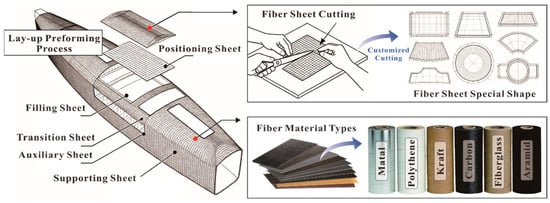
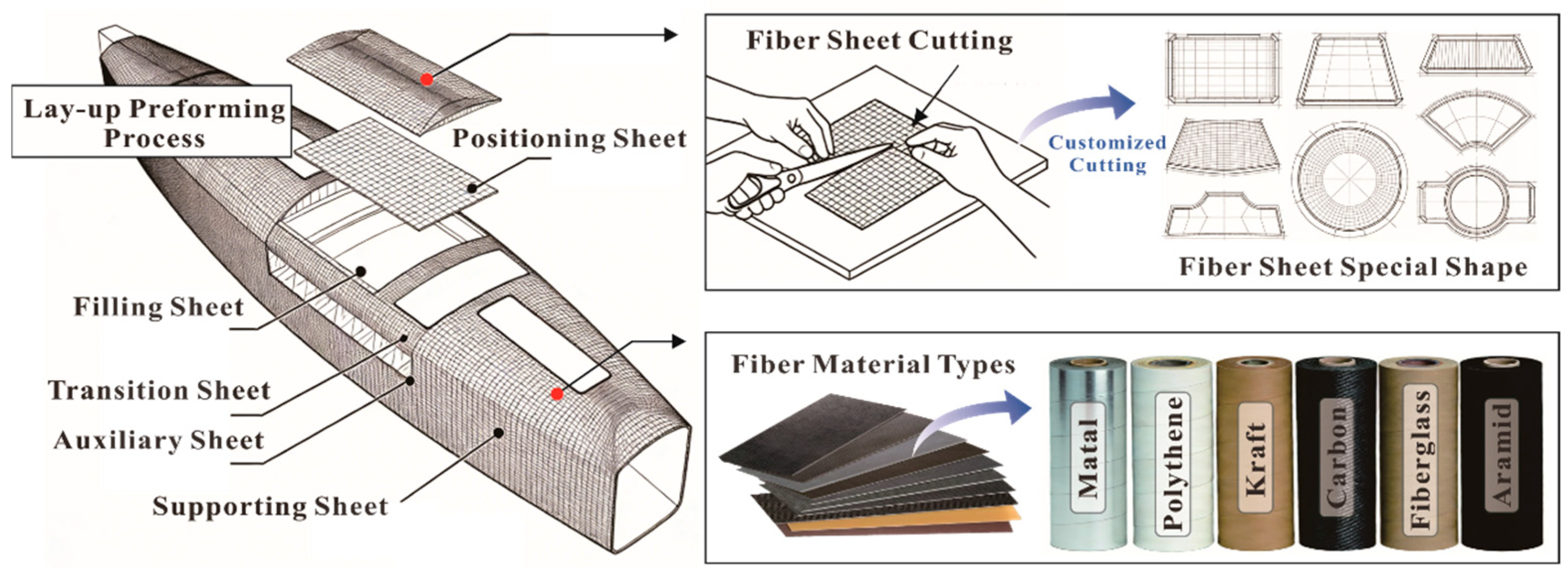
For composite material components fabricated through complex processes, the manufacturing procedures are not only intricate and cumbersome but also demand diverse and sophisticated raw material compositions, as shown in Figure 1. Most composite fiber material sheets feature parallelogram-like geometries with varying dimensions, whereas specially shaped sheets are employed in specific structural regions, with their configurations tailored to the requirements of the application scenario [20]. Notably, certain material sheets and their structural distributions exhibit symmetry in either geometric form or spatial arrangement, which establishes a favorable foundation for the subsequent symmetric optimization of material storage.
Figure 1.
Fiber materials used in the lay-up preforming process of large composite components.
Considering the physical properties, design flexibility, production costs, and other pertinent factors of the finished components, the usable sheet materials and their texture structures are complex and diverse [21]. Therefore, to address the raw material knapsack problem in material storage, the following symmetry-related constraints and basic constraints must be satisfied to ensure the rationality, stability, and symmetry of the storage process:
- The volume of a single material sheet shall not exceed the maximum storage capacity of each layer of the storage bin. This constitutes a fundamental premise for maintaining the symmetric balance of spatial utilization across all storage layers.
- Individual material sheets shall not be cut, extruded, overlapped, or suspended, nor shall they cause spatial interference with other types of material sheets. This constraint ensures that the spatial distribution of materials remains symmetric and orderly, thereby preventing irregular stacking that could compromise the symmetry of the overall storage system.
- Stacking of identical material sheets is permitted, provided that the total volume after stacking does not exceed the maximum storage capacity of each layer of the storage bin. The symmetric stacking principle for homogeneous sheets can effectively enhance storage efficiency while preserving the symmetry of spatial allocation.
- Different types of material sheets possess distinct values, which are defined based on manufacturing process details such as usage quantity, sequence of use, and dimensions. This value definition can be integrated with the symmetric optimization objectives of material storage to achieve a balanced optimization of both storage efficiency and economic benefits [22].
Solving this problem can be regarded as a combination of the selection problem of two-dimensional flat fabric sheets and the storage space optimization problem. In the engineering practice of composite fiber sheet storage, two-dimensional planar layout optimization serves as the core foundation and prerequisite for three-dimensional storage space optimization, with a distinctly higher research priority. Only when the optimal planar layout within a single storage layer is achieved can the space utilization efficiency and long-term operational stability of the overall three-dimensional stacked storage system be effectively guaranteed. First, place the material pieces on any plane of the storage. Since the cut fiber sheets are thin and are stacked and stored by the same category and shape in actual production, the stacking process must strictly comply with key constraints in the height direction, including the upper limit of sheet stacking layers, inter-layer pressure uniformity threshold, and material compression deformation limit. Therefore, the storage symmetric optimization proposed in this article is a two-level engineering symmetric optimization system, including geometric layout space symmetry and inter-layer utilization balance symmetry. The specific mathematical definition and corresponding constraints are as follows:
Geometric layout space symmetry constraints are the basic premise of the entire optimization framework, which refers to the geometric order and spatial non-destructive symmetry of material layout in a single storage layer. The symmetric constraint set Ωgeo is formalized as
where wi is the volume of material i, C is the maximum storage capacity of a single layer, xi ∈ {0,1} is the placement decision variable of material i, Iinterfere(i,j) is the spatial interference indicator function (takes 1 when material i and j have spatial overlap, extrusion or suspension, otherwise 0), and Ni is the stacking quantity of homogeneous material i. This constraint set ensures the symmetric and orderly spatial distribution of materials in a single layer and prevents irregular stacking from damaging the overall symmetry of the storage system.
Inter-layer utilization balance symmetry is the core of the proposed framework, which refers to the balanced symmetry of space utilization between different storage layers, aiming to minimize the fluctuation of inter-layer utilization and achieve global symmetric equilibrium of the storage system. The core symmetric optimization objective is defined as
where M is the total number of storage layers, ηx is the space utilization rate of the x-th layer, and ηavg is the average space utilization rate of all layers. This objective drives the algorithm to achieve a symmetric balance of space utilization across layers, avoiding extreme utilization differences between layers.
On the premise of satisfying the maximum sheet stacking limit and not breaking the mechanical safety boundary of the materials, this study prioritizes the research on two-dimensional planar storage optimization. Since the placement of the material pieces must not be tilted or overlapped, and the value, size, and quantity of different material pieces are fixed, two-dimensional material selection can be carried out in the silo space to calculate the silo utilization rate. Next, continuously optimize the silo space dimensions, calculate the silo utilization rate again, and finally fit the data to determine the optimal storage method. The specific storage optimization methods are as follows:
2.1. Material Selection Algorithm Based on DP-BT
The DP-BT algorithm integrates the advantages of dynamic programming and search algorithms to solve the value maximization problem in 2D material packing [23,24]. As the core research target, material value is a multi-dimensional quantitative indicator that integrates material properties and application requirements. An evaluation Formula (1) is constructed through principal component analysis:
V = αQ + β/S + γD.
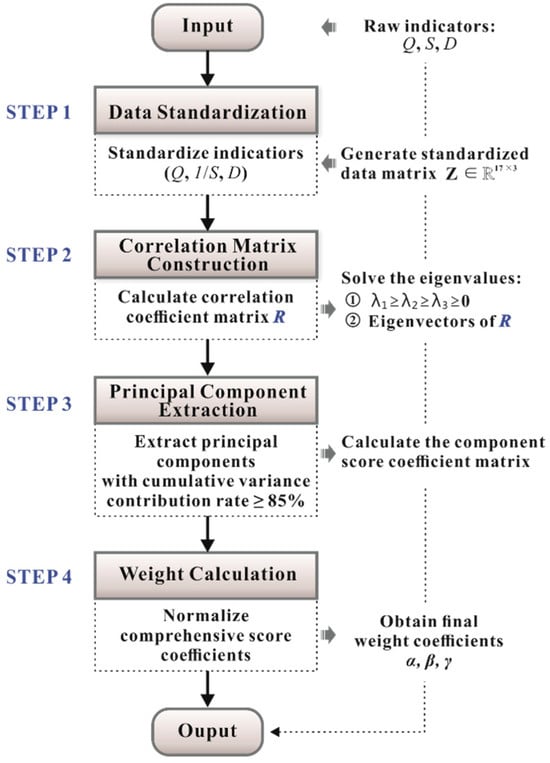
Here, V is the material value; Q is the usage per unit time; S is the process sequence number; D is the material dimension; and α, β, and γ are weight coefficients calibrated through data-driven methods. The final normalized weight coefficients calibrated based on the actual production data in this study are: α = 0.55, β = 0.30, and γ = 0.15. The weight distribution follows the priority of actual composite manufacturing management: material usage frequency (Q), which directly determines inventory turnover and access frequency, is assigned the highest weight; process sequence (S), which dominates the material retrieval order in the layup process, is the secondary weight; material dimension (D) has a relatively low impact on storage scheduling priority, thus assigned the lowest weight. The reproducible PCA-based calibration pipeline is shown in Figure 2.
Figure 2.
Reproducible PCA-based calibration flowchart.
Based on dynamic programming, the problem of maximizing the total utilization value of layered 2D materials is transformed into a 0–1 knapsack problem. In the model setup, the length × width (L × W) orientation of cuboid storages is consistently adopted. Since the height of the storage space is adjustable according to scenario requirements, while at least one layer of materials is stored in practice, this model only considers a planar arrangement. The maximum storage capacity of each storage layer is regarded as the knapsack capacity C, and material i is regarded as an item. Assuming a knapsack with capacity C contains v items, where item i has a corresponding weight wi, a value vi, and is indivisible, a binary variable xi is introduced (xi = 1 for placement, xi = 0 for non-placement). The objective function is expressed as Equation (4):
The constraint conditions are shown in Equation (5):
To solve this problem, the dynamic programming state transition equation dp[i][j] is defined, representing the maximum value of the first i materials under a storage capacity of j. A placement sequence priority queue is introduced during the traversal of materials, and value inheritance or accumulation is determined by the decision of whether it can be placed. The initial boundary condition is set as i = 0 and j = 0, with the state transition equation shown in Equation (6):
Next, the backtracking algorithm is employed to solve the 2D material selection problem [25,26]. It conducts a depth-first search over a binary solution space tree of height n, where each layer corresponds to the decision of whether to place a material. Constraints that ensure the total volume of selected materials does not exceed the storage capacity are incorporated, along with a greedy estimation of the maximum value of the remaining capacity to prune non-optimal branches, thereby optimizing search efficiency. The bounding function is shown in Equations (7) and (8):
Here, k denotes the number of materials considered, vcur is the value of currently selected materials, vbest is the value of the current optimal solution, and Gselect represents the greedy selection ratio of the remaining capacity for the i-th material. By combining the above two models, the total maximum utilization value of 2D materials and the specific 2D materials selected can be quickly determined, thereby deriving the optimal layout solution for the current layer. The pseudocode for the specific implementation process is shown in Algorithm 1.
| Algorithm 1: Hybrid optimization algorithm based on the 0–1 knapsack problem and backtracking pruning |
| Input: Material set S, storage capacity C |
| Output: Maximum utilization value max_value, selected material set selected_items |
|
|
|
|
2.2. Storage Space Optimization Algorithm
To further improve storage utilization, during the layered material loading process, on the premise of ensuring the consistency of placement methods as much as possible, a dynamic programming iterative algorithm is adopted to optimize the storage space. Taking the maximum material size as the initial value and the minimum material size as the increment, repeated iterations are performed to approach the accurate solution, and this setting is suitable for the calculation of the dynamic programming iterative algorithm [27,28,29,30]. In this problem, the iterative model optimizes the bottom storage space based on an arithmetic sequence. The initial space value C1 is set as the product of the maximum material length and volume, and the common difference d is the product of the minimum material length and volume. The ordered expansion of the storage space is achieved through the recurrence relation of CX = C1 + (x − 1) × d. The number of iterations is inversely proportional to the common difference d; in practical engineering, an adaptive d value can be set to balance accuracy and efficiency [31,32]. First, the DP-BT material layout solving algorithm is used to further derive the current layer storage utilization rate as shown in Equation (9); then, the total number of layers is employed to calculate the average storage utilization rate as shown in Equation (10) and the total used storage space as shown in Equation (11):
Here, Σi∈selected(li·wi) represents the total space occupied by the selected materials in the current layer, Ccurr denotes the storage space of the current layer, M is the total number of storage layers, Cx is the storage space value of the x-th layer, and ηx is the storage utilization rate of the x-th layer.
The iteration termination condition is set as the material set being empty and only one layer being required (S = ∅ and M = 1). By continuously updating the storage space and recalculating the above five parameters, the accurate spatial solution is gradually approached, thus forming the storage space optimization algorithm. The algorithm statistically analyzes data such as the average utilization rate, usage area, and number of layers under different storage spaces, fits their functional relationships with the iteration count, value, and overall trends, and finally solves for the optimal storage space to form a loading scheme. The pseudocode for the specific implementation process is shown in Algorithm 2; it gradually approaches the optimal solution by cyclically executing three-step operations: material selection, space adjustment, and data update.
| Algorithm 2 Iterative Storage Space Optimization Algorithm Based on DP |
| Input: Material set S, initial storage space C1 = max{li × wi|∀I ∈ S}, common difference d = MIN(volume) |
| Output: Average storage utilization rate ηavg, total space used Ctotal, total number of layers M |
|
| 1.1 Set current space value: Ccurr ← C1 |
| 1.2 Initialize total layers: M ← 0, cumulative utilization rate: ηsum ← 0 |
| 1.3 Initialize total space used: Ctotal ← 0 |
2.2 //Prioritize checking the termination condition: The material set is empty and necessitates only a single layer. 2.3 If S = ∅ and M = 1 Then Break 2.4 End If 2.5 If S ≠ ∅ Then |
| 2.6 Call Algorithm 1 to compute total volume of current layer materials Vtotal, layer utilization rate η = Vtotal/Ccurr 2.7 End If 2.8 //Update parameters 2.9 M ← M + 1 ηsum ← ηsum + η Ctotal ← Ctotal + Ccurr 2.10 // If the set of material chips is still non-empty, expand the storage space. 2.11 If S ≠ ∅ Then Ccurr ← Ccurr + d 2.12 End If 2.13 End While |
|
| 3.1 Compute average storage utilization rate: ηavg = ηsum/M |
|
2.3. Overall Process Design Algorithm
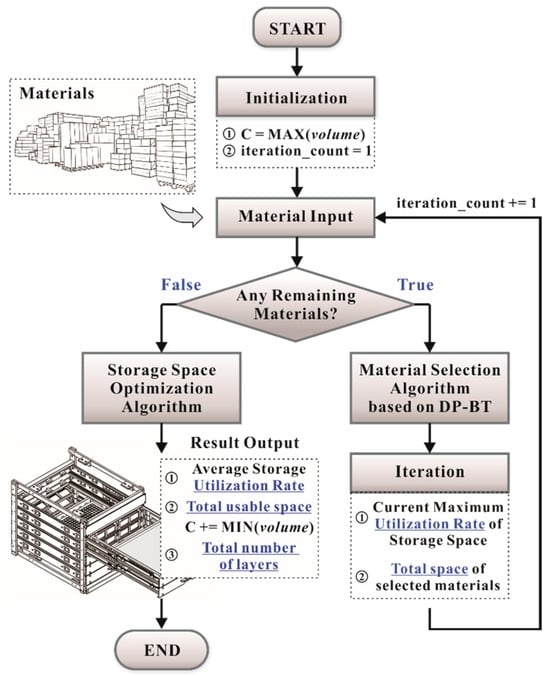
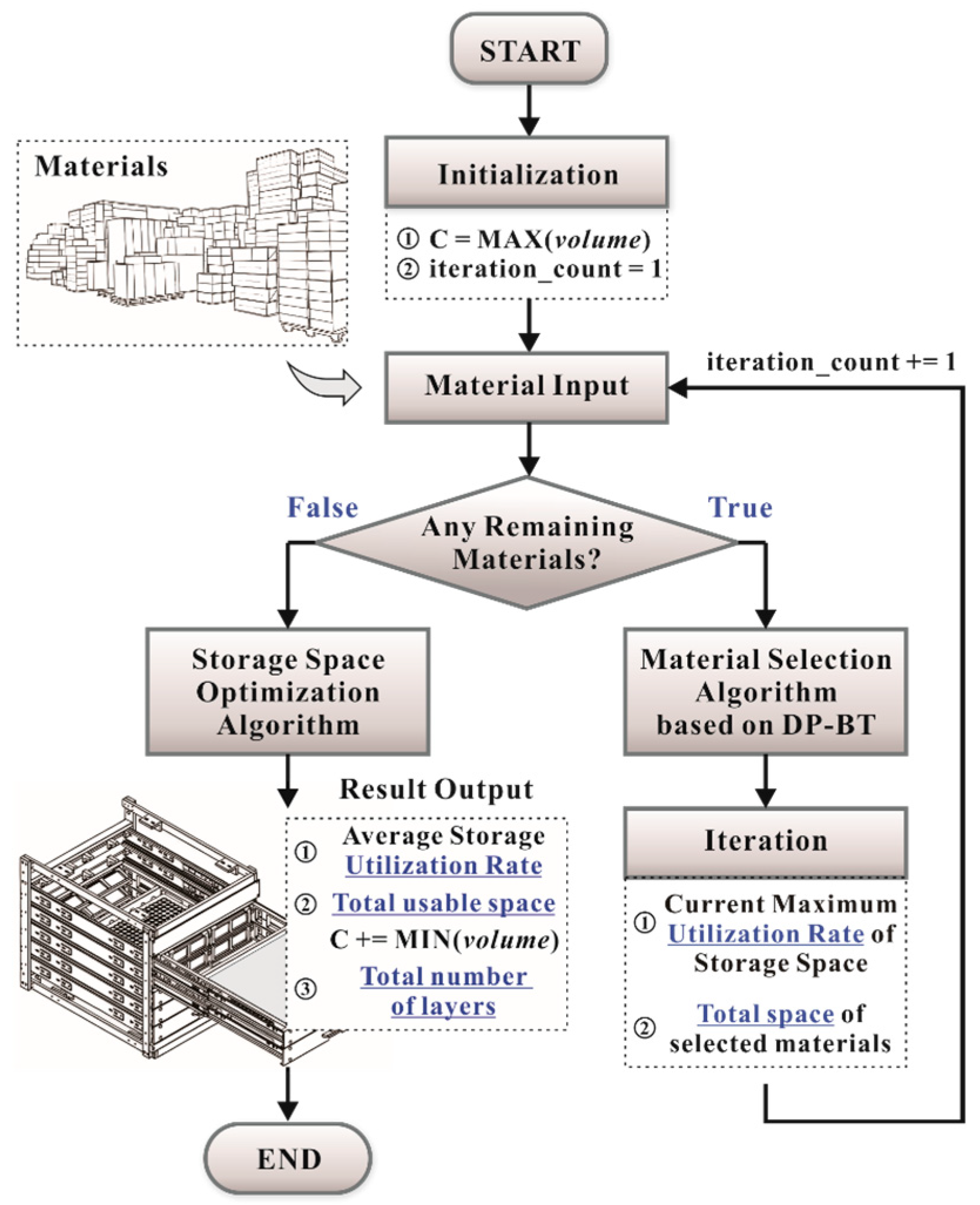
The overall process of the multi-objective material storage symmetric optimization algorithm is shown below in Figure 3:
Figure 3.
Flowchart of the overall optimization algorithm.
- Define and initialize parameters. The parameters include storage space C, material values, material volumes, and iteration layer count iteration_count. Set C = max(volumes) and iteration_count = 1;
- Call the function to read material volumes and values;
- Check if any remaining materials. If False, call the storage space optimization algorithm to output the average storage utilization rate, total storage usage area, and total number of layers under the current number of iterations, update the total space value by increasing C by MIN(volumes), and terminate the iteration and program;
- Otherwise, enter the main layer iteration loop and continue layer iteration. Call the DP-BT material layout solving algorithm to output the current iteration layer number, backtrack-selected materials, maximum value, storage utilization rate, and current storage usage area. Refresh the material inventory data and increase iteration_count by 1, then return to Step 2.
3. Experiments and Discussion
This experiment was conducted using 17 different fiber sheet materials to simulate the raw materials used in the production line storage scenario, as shown in Table 1. During the experimental process, the DP-BT material selection algorithm and the storage space optimization algorithm proposed in this study were used to provide a quantitative basis for storage space optimization through the comparison and calculation of key indicators (storage layers, average utilization rate, and space).
Table 1.
Material Parameters.
3.1. Trend Analysis of Storage Iterative Optimization
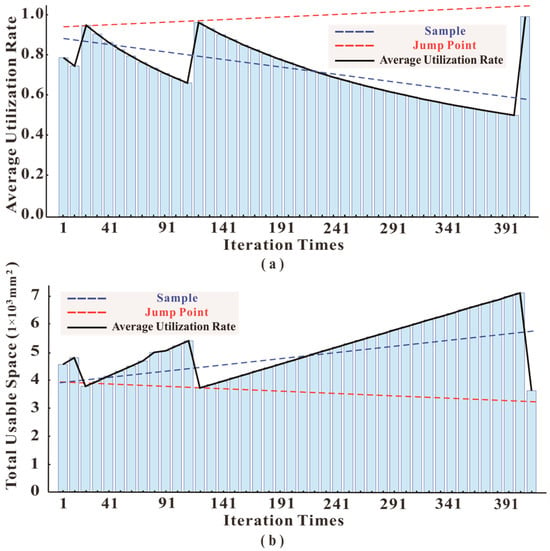
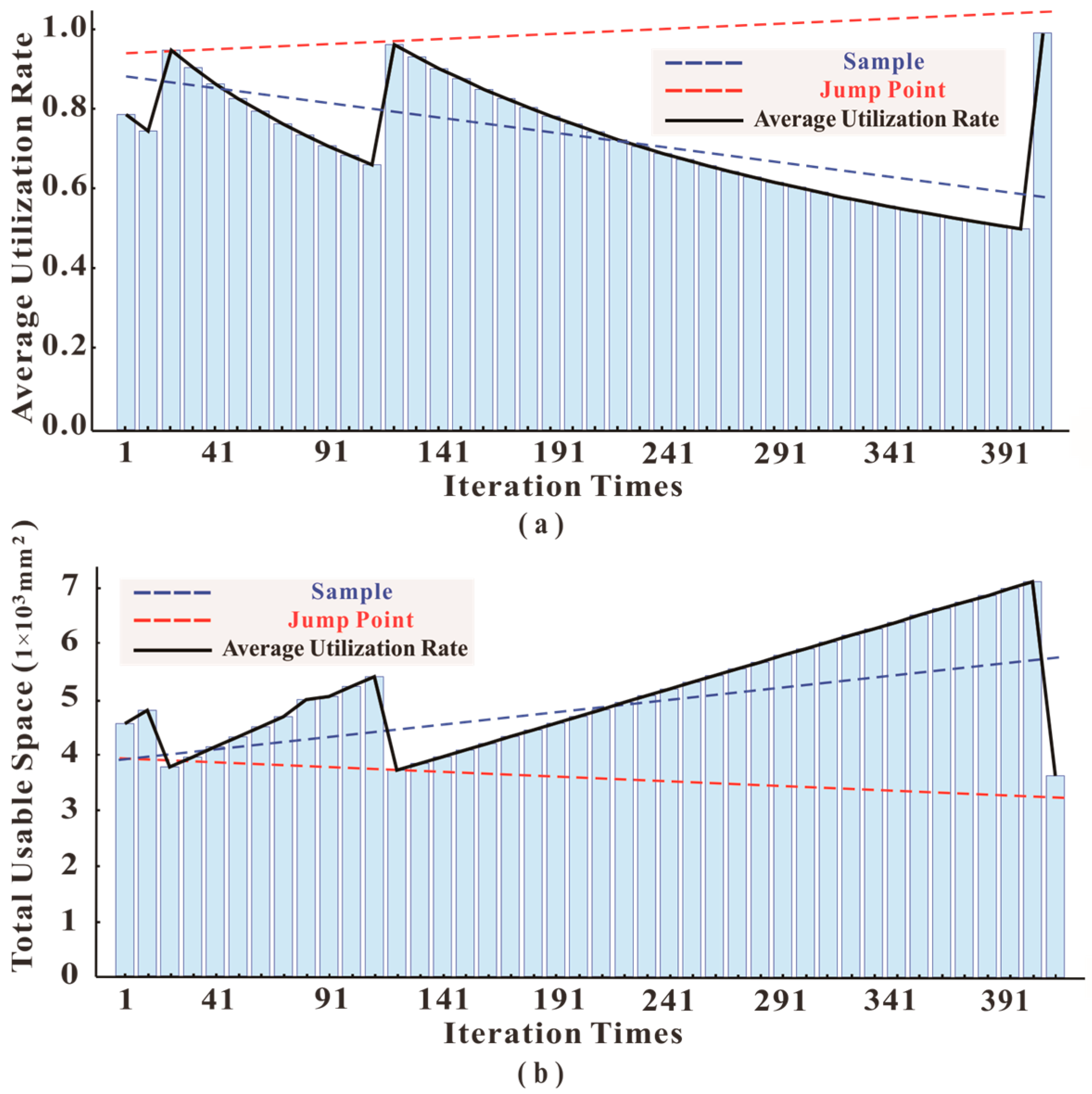
After inputting basic sheet data, two functional trend graphs were obtained through fitting as the number of iterations increased: Figure 4a presents the relationship between the number of iterations and the average storage utilization rate, while Figure 4b shows the relationship between the number of iterations and the total used storage space. The jump point signifies a reduction in the number of storage layers. If a jump occurs alongside an increase in the average utilization rate per layer, this is because sheets originally distributed across multiple layers are centrally arranged, thereby enhancing the efficiency of spatial utilization per layer. When observing the trend line of jump points in Figure 4a, its positive slope indicates that the average utilization rate per layer generally exhibits an upward trend with increasing iterations, which proves that the measures adopted in the storage space optimization process gradually take effect and enable more sufficient utilization of each storage layer. Conversely, if the average utilization rate per layer decreases during a jump, this may be due to the irrational redistribution of sheets during layer reduction, thereby causing space waste in some layers.
Figure 4.
Relationship between the number of iterations, utilization rate, and used space: (a) Effect of the number of iterations on the average utilization rate of each layer; (b) Effect of the number of iterations on the total usable area.
Additionally, the average storage utilization rate fluctuates during the iteration process, with obvious fluctuations occurring in the first 100 iterations. Each rise and fall in utilization corresponds to the verification of different storage configuration schemes, such as adjusting the size of a storage layer, changing the material stacking sequence, or optimizing the space allocation logic. A utilization peak appears at approximately 120 iterations, indicating the successful matching of an efficient parameter combination. For the specified number of layers, the size of each storage layer is precisely adjusted to make material loading more compatible with the spatial structure, thereby reducing void waste. The occurrence of this peak fully validates the effectiveness of the algorithm optimization strategy, which addresses the key factor influencing utilization: the matching between storage dimensions and material specifications. Further observation of Figure 4b shows that the total used storage space exhibits an overall upward trend with iterations, indicating that the algorithm continuously attempts to expand the storage space during global optimization, explores the balance between utilization rate and space, and verifies the loading efficiency of storage spaces at different scales.
3.2. Analysis of Optimization Effects for Each Storage Layer
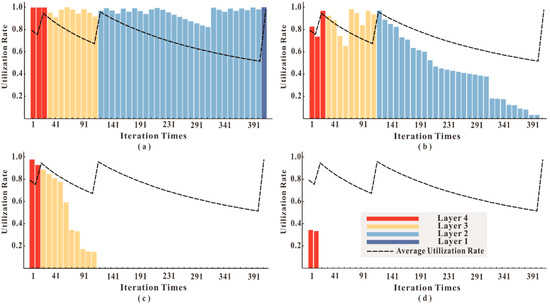
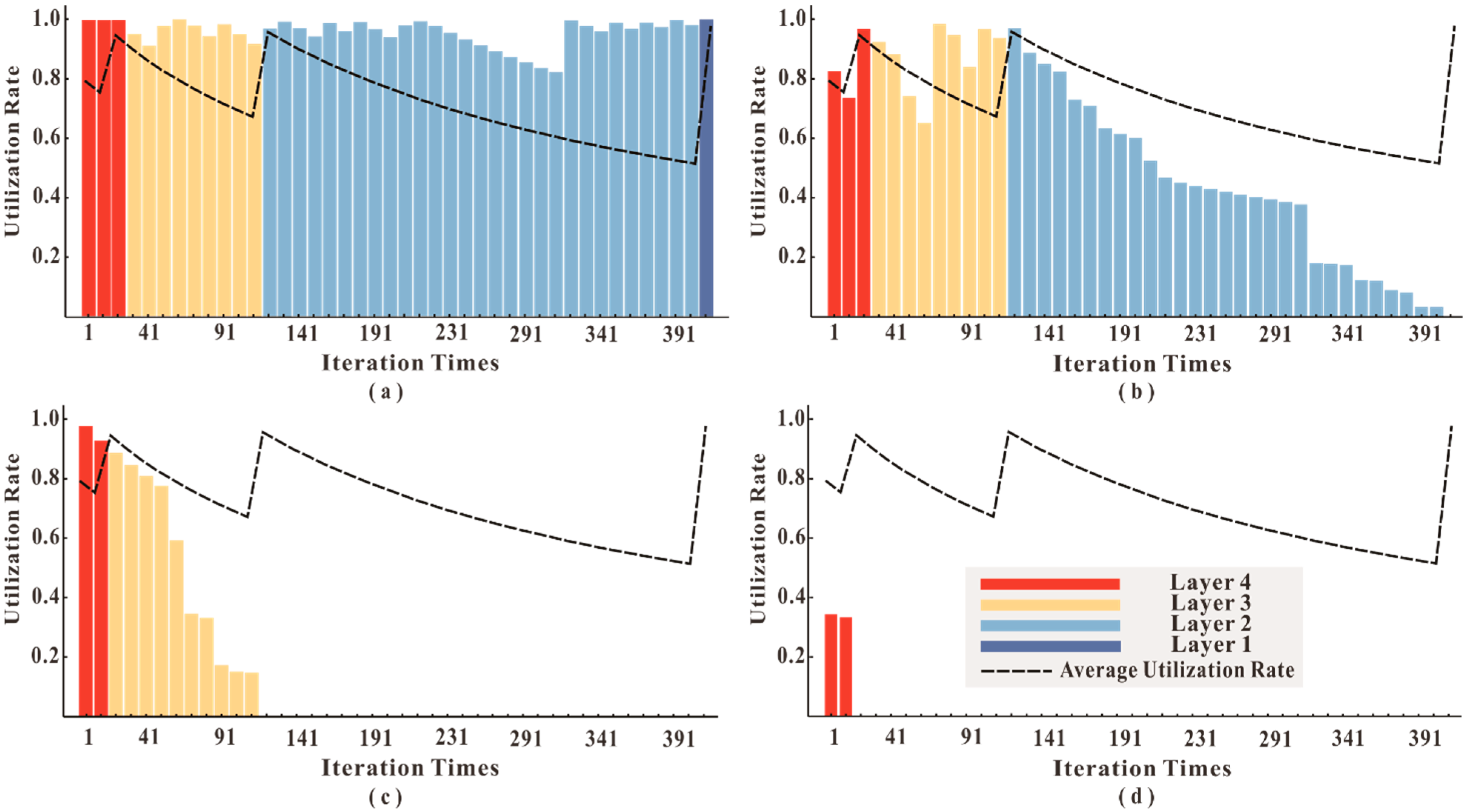
Through the analysis and comparison of the bar chart in Figure 5, which depicts the relationship between iteration count and optimal utilization rate for each storage layer, the optimization effects and spatial utilization potential of different layers can be clearly observed. The utilization rate corresponding to the peak point for each layer represents the optimal storage utilization rate of that layer during the current iteration, thereby quantifying the maximum spatial utilization achievable under the existing optimization strategy. Furthermore, there are significant differences in the spatial utilization potential among layers: Figure 5c shows that the optimal utilization rate of the 3rd layer reaches 98%, achieving extreme spatial efficiency, while Figure 5d reveals that the optimal utilization rate of the 4th layer is only 35%. This disparity indicates that the current optimization method is more effective for the 3rd layer, as it can effectively capture differences in sheet shape, dimensions, and other features to dynamically and flexibly adjust space allocation strategies. When a specific number of layers is specified by the user, the algorithm can rapidly invoke the optimal space scheme verified through multiple iterations, thereby achieving precise matching between storage space and sheet loading requirements and enabling efficient spatial utilization. Meanwhile, when observing the iteration count at which the optimal utilization rate occurs, if a layer’s optimal utilization rate appears in the early iterations, this may indicate that the layer is relatively easy to optimize or that the existing strategy can quickly find a suitable solution for it. For example, the first layer achieved a 100% utilization rate at the 62nd iteration, with its curve remaining consistently high, demonstrating that the algorithm can rapidly match a suitable storage space based on the sheet characteristics of the first layer to achieve compact placement.
Figure 5.
Relationship between the Iteration Times and Utilization in Different Layers: (a) First layer; (b) Second layer; (c) Third layer; (d) Fourth layer.
3.3. Analysis of Value and Hierarchical Optimization in Iteration
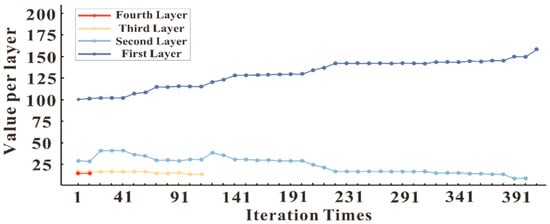
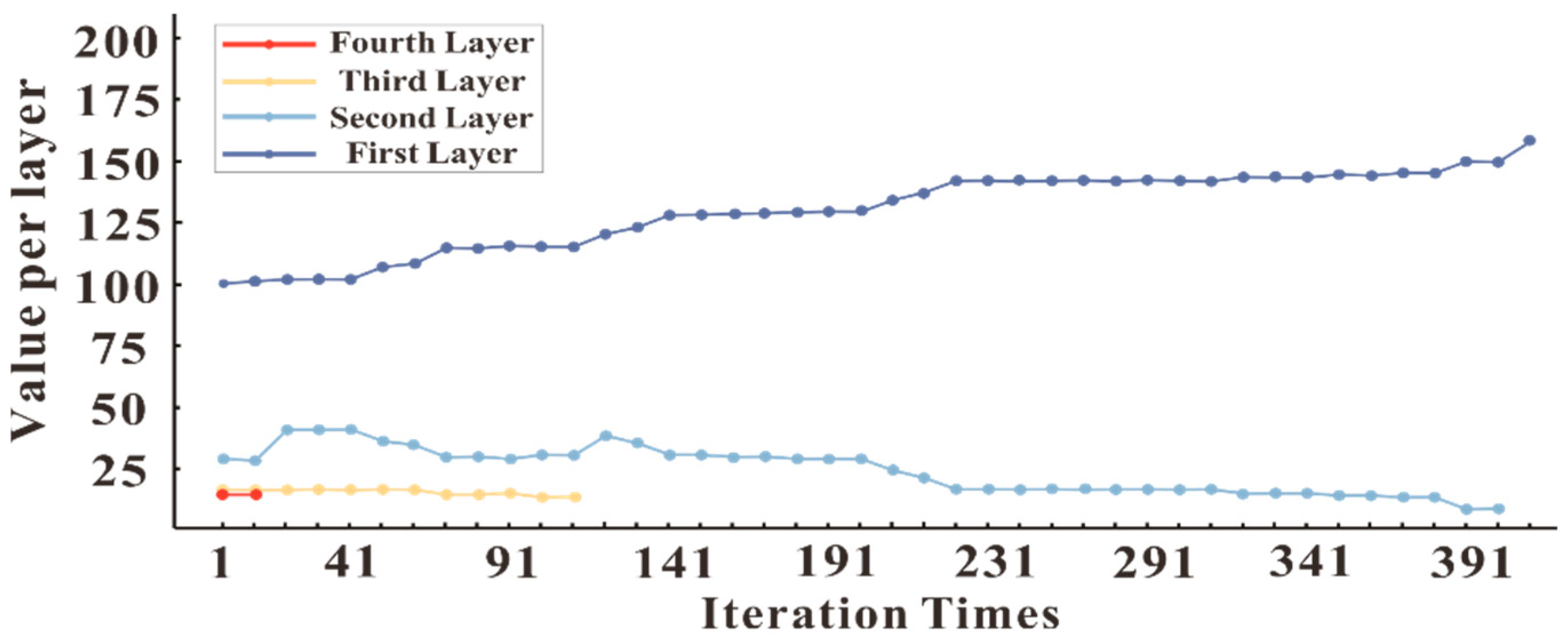
The correlation between the number of iterations and the value is shown in Figure 6. From the overall data, the system value remains constant, whereas the value of the first layer exhibits a significant positive correlation with the accumulation of iterations. This is because, although the total system value is constant, the value of each layer undergoes structural optimization at the micro level during iterations, which confirms that the algorithm achieves local gradient optimization for each layer during iterations, thereby enhancing internal system efficiency and adaptability. In terms of the number of layers, there is a trend of layer reduction as the number of iterations increases. In the early iteration stage, the number of layers is 4, which decreases to 3 when the number of iterations reaches approximately 21. The simplification of the hierarchical structure can improve operational efficiency and comprehensive system performance through spatial recombination. In the dimension of space utilization, the utilization rate of a single layer is positively correlated with the system value. Taking the first layer as an example, its single-layer utilization value increases from approximately 127 at the start of iterations to 200. The improvement in single-layer utilization is often accompanied by an increase in system value, which indicates that improving single-layer utilization plays a crucial role in enhancing the overall system value. In summary, the algorithm can achieve collaborative optimization of parameters between layers during iterations, thereby reaching a quasi-optimal configuration state. Furthermore, the algorithm dynamically adjusts parameters between layers according to the actual conditions of each layer, such as sheet types, quantity, and value, enabling mutual cooperation and complementarity between layers. This fully taps into the maximum potential of the storage space, thereby achieving a good balance between space utilization and value creation.
Figure 6.
Relationship Chart Between Storage Optimization Iterations and Layer Values.
3.4. Optimal Solutions Under Specified Layers
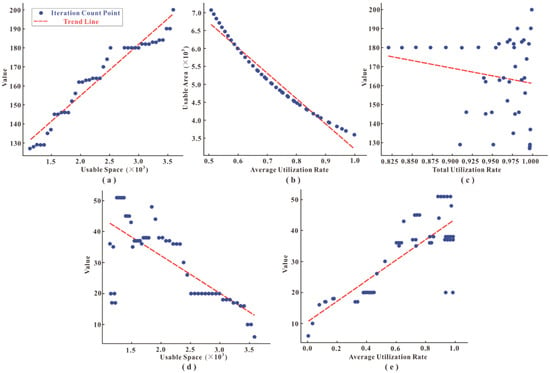
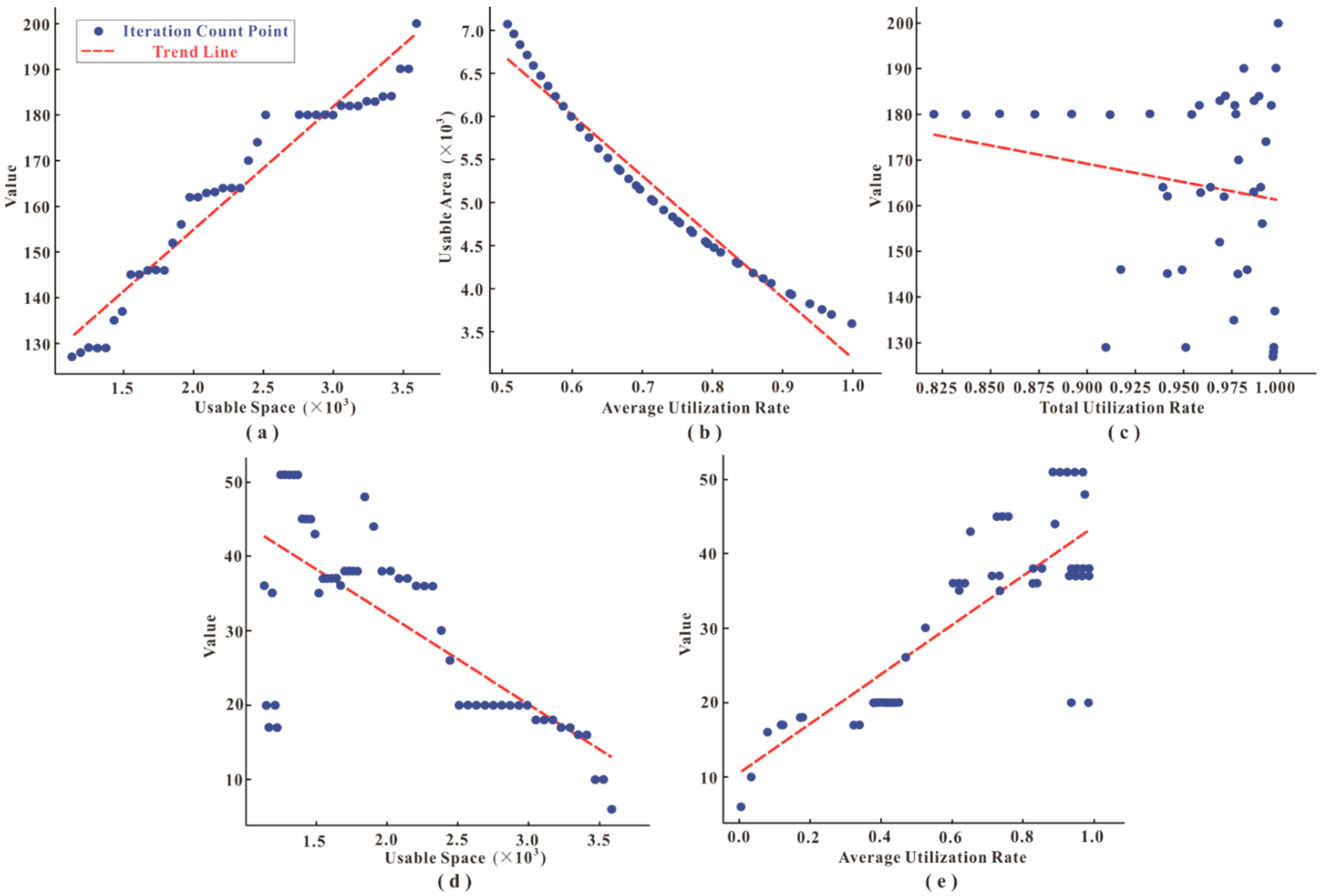
Based on the analysis of key indicators for single-layer and 2–4-layer multi-layer systems, this study reveals significant differences in parameter coupling mechanisms across different hierarchies. In the single-layer storage system, spatial parameters play a dominant role in value accumulation.
As shown in Figure 7a, an extremely strong positive correlation exists between used space and value, confirming that spatial scale acts as the core constraint for value creation in this scenario. Figure 7b indicates that, in both single- and multi-layer systems, the average storage utilization rate and total used space exhibit a strong negative correlation, demonstrating the diminishing marginal utility effect caused by unordered spatial expansion. When total space expands blindly without optimized allocation strategies, the utilization rate of newly added space decreases significantly, resulting in systematic efficiency loss. It is noteworthy that in Figure 7c, the single-layer utilization rate and value display only a weak negative correlation, highlighting the path dependency of single-layer scenarios on spatial scale. In contrast, Figure 7d,e for 2–4-layer multi-layer systems illustrate a structural transformation in the value generation mechanism: the layer utilization rate and value shift to a strong positive correlation, while the influence of spatial scale weakens and exhibits a negative correlation. This phenomenon arises from the complex parameter coupling characteristics of multi-layer architectures, in which hierarchical superposition exacerbates spatial fragmentation.
Figure 7.
Relationship between utilization rate and value of each layer during iterative storage optimization: (a) Effect of usable space of a single layer on its value; (b) Effect of average utilization rate of multi-layer systems on total usable area; (c) Effect of overall utilization rate of a single layer on its value; (d) Effect of usable space of 2–4-layer systems on value; (e) Effect of average utilization rate of 2–4-layer systems on value.
Spatial fragmentation has a strong negative impact on value and a moderate negative impact on the utilization rate of each storage layer, forcing the optimization focus to shift from extensive spatial expansion to refined layout adjustments. Although total space expansion still generally leads to a reduction in average utilization rate, multi-layer systems achieve an efficiency–scale balance via strengthened collaborative optimization between layers, providing a hierarchy-adaptive optimization paradigm for the efficient storage and transportation of materials.
This experiment verified the feasibility of multi-level storage configuration through the construction of inter-layer constraint equations, as shown in Table 2. It should be clarified that the total number of storage layers is preset to 4, and the initial capacity of every single layer is uniformly set to the maximum area of a single fiber sheet in the material set. Under this static configuration, all materials except the No. 14 sheet are optimally stored in the first three layers, leaving only the No. 14 sheet to be placed in the fourth layer separately, which directly leads to the extremely low utilization rate of the fourth layer and the significant inter-layer utilization difference between 35% and 100%. This extreme imbalance is exactly the core bottleneck of traditional static layouts that the proposed symmetric optimization framework aims to solve. Therefore, the core of this configuration in this paper lies in the space-value optimization mechanism. As demonstrated by the experimental results, the algorithm enables adaptive generation of optimal storage schemes tailored to the number of layers specified by the user. For the optimized 3-layer configuration with a uniform single-layer storage capacity of 1251, an average space utilization of 95.7% is achieved, corresponding to a 16.3% improvement relative to the initial 4-layer static baseline; for the 2-layer configuration with a single-layer capacity of 1797, the average space utilization reaches 99.9%, marking a 20.53% enhancement over the baseline. Although both the 1-layer and 2-layer configurations achieve an average utilization rate of 99.9%, the 1-layer scheme is only used as a theoretical benchmark for algorithm performance verification. In practical composite manufacturing scenarios, the 1-layer configuration is rarely adopted in industrial practice, as it completely abandons the utilization of vertical storage space, which will lead to a sharp increase in the floor space of the storage system. The total storage area of the 1-layer configuration is 3594, which is exactly twice the single-layer area of 1797 in the 2-layer configuration. Although the total physical space occupied by the two configurations is the same, the 2-layer scheme greatly saves the precious floor space of the clean workshop in high-end composite manufacturing through vertical layered layout, which is more in line with the actual engineering requirements. In practical engineering applications, designers pay more attention to the optimal layer matching and spatial parameters that can be achieved under the given layer count constraints (with a lower limit of 2 layers and an upper limit of the maximum available vertical space).
Table 2.
Analysis of Space Configuration Following the Optimization of Bin Layer Count.
And then 100 independent repeated experiments were conducted on the proposed DP-BT-based symmetric optimization algorithm, and the mean value, standard deviation (reflecting variance characteristics) of the space utilization rate under different specified layer configurations, and the convergence behavior of the algorithm were counted. The proposed algorithm exhibits extremely high stability and deterministic convergence performance in repeated runs, as shown in Table 3. Under the 2-layer configuration, the mean value of the average space utilization rate is 99.90%, with a standard deviation of only 0.002%; under the 3-layer configuration, the mean value is 95.70%, with a standard deviation of 0.018%; under the 4-layer configuration, the optimized mean value of the average space utilization rate reaches 94.22%, with a standard deviation of 0.031%. The extremely low standard deviation indicates that the algorithm has almost no result fluctuation in 100 independent runs, which is derived from the deterministic state transfer mechanism of dynamic programming and the greedy pruning strategy of the backtracking algorithm, avoiding the randomness of traditional heuristic algorithms. In terms of convergence behavior, the algorithm reaches the optimal utilization rate plateau within 120 iterations on average in 100 repeated runs, and the convergence iteration interval is concentrated between 108 and 122 iterations, with a standard deviation of 3.72 iterations. The algorithm maintains a stable and fast convergence speed in all repeated runs, without premature convergence or falling into a local optimum, which fully verifies the reliability of its global optimization capability.
Table 3.
Performance Comparison of the Proposed Algorithm with GA and PSO.
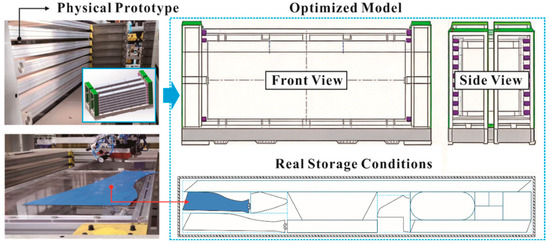
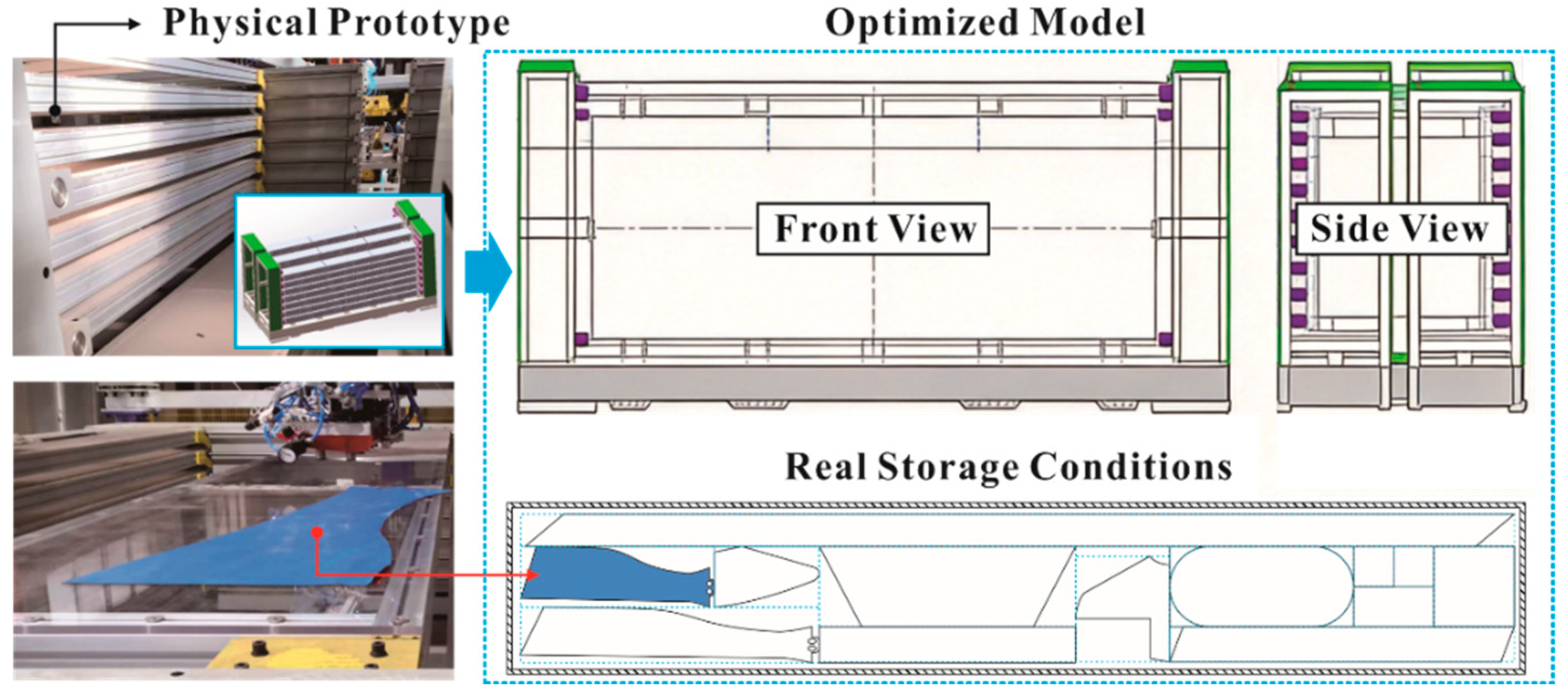
Based on the actual engineering verification of the method proposed in this article, a physical prototype of the optimized storage system was designed, as shown in Figure 8, highlighting its geometric and structural features tailored for efficient storage. The materials were arranged in trays in accordance with the optimized layout strategy. Overall, this method validates the technical adaptability of the framework in practical engineering application scenarios and confirms the feasibility of symmetric optimization for multi-objective material storage methods.
Figure 8.
The physical prototype of the optimized storage system.
4. Conclusions
Aiming at the lean storage management requirements of multi-specification fiber prepreg sheets in high-end composite equipment manufacturing, the core limitations of existing storage optimization methods include poor adaptability to composite-specific process constraints, insufficient multi-objective collaborative optimization capability, and low space utilization of static layouts. An integrated symmetric optimization framework for multi-objective composite sheet storage is constructed based on 0–1 knapsack theory, an improved Dynamic Programming-Backtracking (DP-BT) algorithm, and symmetric optimization theory, to solve the layered storage selection, adaptive space optimization, and multi-objective symmetric balance problems of fiber sheets in the target production scenario.
Specifically, the multi-dimensional process value of fiber sheets integrating usage frequency, process sequence and dimensional specifications is first quantified, and the layered storage optimization problem is transformed into a 0–1 knapsack problem with symmetric constraints. The proposed DP-BT material selection algorithm achieves optimal material selection and compact layout in a single storage layer via dynamic programming state transfer and backtracking greedy pruning, while the adaptive dynamic programming iterative algorithm realizes symmetric balance of inter-layer space utilization and global optimization of the storage system. As an initial case study, experimental validation using real production data of 17 types of fiber sheets shows that the proposed method significantly outperforms traditional static storage layouts: the average space utilization rate is increased from the initial 79.4% (4-layer) to 95.7% (3-layer) and 99.9% (2-layer), with maximum single-layer utilization reaching 100%, and the optimal utilization peak is achieved within 120 iterations. The physical prototype test further verifies the engineering feasibility of the proposed framework in this specific composite manufacturing scenario.
Despite the favorable optimization performance, the proposed method still has non-negligible limitations: the experimental validation is limited to a single production line scenario, and the generalization performance of the framework in diverse composite manufacturing scenarios needs further verification; the weight coefficients of the material value model have limited generalization in extremely customized small-batch production scenarios, and the current two-dimensional optimization model does not fully incorporate three-dimensional storage constraints such as environmental zoning and access path planning. Future research directions are focused on three aspects: first, optimizing the adaptive calibration method of the value model to improve the generalization performance of the algorithm; second, expanding the model to a full-scenario three-dimensional storage optimization framework with multi-dimensional constraints; third, extending the proposed symmetric optimization framework to other key links in composite manufacturing, including layup process scheduling and prepreg cutting nesting, to further promote its engineering application in the field of high-end composite equipment manufacturing.
Author Contributions
Conceptualization, L.L. and X.L.; methodology, L.L. and X.L.; software, L.L.; validation, S.Y. and Z.W.; formal analysis, L.L.; investigation, S.Y.; resources, X.L.; data curation, L.L.; writing—original draft preparation, L.L.; writing—review and editing, L.L. and X.L.; visualization, L.L.; supervision, X.L.; project administration, L.L.; funding acquisition, L.L. All authors have read and agreed to the published version of the manuscript.
Funding
This research was funded by the Open Foundation of Dalian Xinghaiwan Laboratory (Research on Visual Recognition and Guided Grasping Control Methods for Random Shape Products), grant number 2025-5-21-10. and the Liaoning Provincial Doctoral Research Startup Foundation Plan Project (Research on Visual Perception Model of Outer Wall Cracks of Carbon Fiber Hydrogen Storage Tanks), grant number 2024-BS-204. The APC was funded by the authors.
Data Availability Statement
The data are contained within the article.
Conflicts of Interest
Author Lun Li was employed by the Dalian Xinghaiwan Laboratory. The authors declare that this study received funding from the Dalian Xinghaiwan Laboratory. The funder was not involved in the study design, collection, analysis, interpretation of data, the writing of this article, or the decision to submit it for publication.
References
- Aras, N.; Verter, V.; Boyaci, T. Coordination and priority decisions in hybrid manufacturing/remanufacturing systems. Prod. Oper. Manag. 2006, 15, 528–543. [Google Scholar] [CrossRef] [Scilit]
- Assid, M.; Gharbi, A.; Hajji, A. Integrated control policies of production, returns? replenishment and inspection for unreliable hybrid manufacturing-remanufacturing systems with a quality constraint. Comput. Ind. Eng. 2023, 176, 109000. [Google Scholar] [CrossRef] [Scilit]
- Zhang, L.; Wang, X.P.; Pei, J.Y.; Zhou, Y. Review of automated fibre placement and its prospects for advanced composites. J. Mater. Sci. 2020, 55, 7121–7155. [Google Scholar] [CrossRef] [Scilit]
- Yassin, K.; Hojjati, M. Processing of thermoplastic matrix composites through automated fiber placement and tape laying methods: A review. J. Thermoplast. Compos. Mater. 2018, 31, 1676–1725. [Google Scholar] [CrossRef] [Scilit]
- Kukwi, T.; Shan, C.W.; Liu, P.F.; Zhang, B.H.; Guo, L.Y.; Wang, Z.X. Continuous improvement in composite manufacturing: A review of automated fiber placement process evolution and future research prospects. Appl. Compos. Mater. 2025, 32, 1267–1314. [Google Scholar] [CrossRef] [Scilit]
- Wang, Q.; Wang, X.S.; Luo, H.W.; Xiong, J. An improved multi-objective evolutionary approach for aerospace shell production scheduling problem. Symmetry 2020, 12, 509. [Google Scholar] [CrossRef] [Scilit]
- Panagant, N.; Pholdee, N.; Bureerat, S.; Yildiz, A.R.; Mirjalili, S. A Comparative Study of Recent Multi-objective Metaheuristics for Solving Constrained Truss Optimisation Problems. Arch. Comput. Methods Eng. 2021, 28, 4031–4047. [Google Scholar] [CrossRef] [Scilit]
- Dobrovoczki, P.; Kovács, A.; Sakata, H.; Tsutsumi, D. Integrated system configuration and layout planning for flexible manufacturing systems. J. Manuf. Syst. 2024, 77, 384–397. [Google Scholar] [CrossRef] [Scilit]
- Richter, J.; Schlegel, D.; Spitzer, S.; Gude, M. Ellipsoidal compressed gaseous hydrogen CFRP vessels with increased energy storage density: Combined analytical-numerical design methodology. Compos. Struct. 2026, 377, 119887. [Google Scholar] [CrossRef] [Scilit]
- Chen, L.; Tong, X.L.; Yuan, M.X.; Zeng, J.; Chen, L. A data-driven approach for multi-level packing problems in manufacturing industry. In Proceedings of the 25th ACM SIGKDD International Conference on Knowledge Discovery and Data Mining, Anchorage, AK, USA, 4–8 August 2019. [Google Scholar]
- Tsang, Y.P.; Mo, D.Y.; Chung, K.T.; Lee, C.K.M. A deep reinforcement learning approach for online and concurrent 3D bin packing optimisation with bin replacement strategies. Comput. Ind. 2025, 164, 104202. [Google Scholar] [CrossRef] [Scilit]
- Aloul, F.A.; Ramani, A.; Markov, I.L.; Sakallah, K.A. Dynamic symmetry-breaking for Boolean satisfiability. Ann. Math. Artif. Intell. 2009, 57, 59–73. [Google Scholar] [CrossRef] [Scilit]
- Yu, Y.; Dong, B.; Yu, B. Reconstruction of structured models using incomplete measured data. Struct. Eng. Mech. 2017, 62, 303–310. [Google Scholar] [CrossRef] [Scilit]
- Clautiaux, F.; Detienne, B.; Guillot, G. An iterative dynamic programming approach for the temporal knapsack problem. Eur. J. Oper. Res. 2021, 293, 442–456. [Google Scholar] [CrossRef] [Scilit]
- Debski, R.; Drezewski, R. Real-time surrogate-assisted preprocessing of streaming sensor data. Comput. Netw. 2022, 219, 109422. [Google Scholar] [CrossRef] [Scilit]
- Rottenstreich, O.; Cassuto, Y. Optimal compression for two-field entries in fixed-width memories. IEEE Trans. Inf. Theory 2018, 64, 4309–4322. [Google Scholar] [CrossRef] [Scilit]
- Marques, L.; Clautiaux, F.; Froger, A. Mathematical models based on decision hypergraphs for designing a storage cabinet. Eur. J. Oper. Res. 2025, 321, 57–74. [Google Scholar] [CrossRef] [Scilit]
- Yang, Y. A hybrid symmetry strategy improved binary planet optimization algorithm with theoretical interpretability for the 0-1 knapsack problem. Symmetry 2025, 17, 1538. [Google Scholar] [CrossRef] [Scilit]
- Lu, J.Y.; Xu, Z.Y.; Liu, J.L. Traversal topology-finding method of tensegrity structure based on dynamic programming. J. Struct. Eng. 2024, 150, 04024036. [Google Scholar] [CrossRef] [Scilit]
- Zhou, Z.X.; Sun, Z.; Shan, Z.D.; Guo, K.H.; Yang, T.Z.; Yang, H.D.; Deng, Z.Y.; Guo, Z.T. Advanced composite preform forming technology for structures and its digitization: A review. Thin-Walled Struct. 2025, 211, 113053. [Google Scholar] [CrossRef] [Scilit]
- Zhang, Y.F.; You, M.W.; Guo, Q.W.; Li, C.; Zhang, D.J.; Shi, D.J.; Zhang, J.Y.; Sun, Z.; Zhang, P.; Wang, T.Q.; et al. A review of the formability of woven fabrics for composite materials. Polym. Compos. 2024, 45, 14498–14520. [Google Scholar] [CrossRef] [Scilit]
- Wang, S.; Hu, A.Q.; Li, T.; Lin, S.F. Program behavior dynamic trust measurement and evaluation based on data analysis. Symmetry 2024, 16, 249. [Google Scholar] [CrossRef] [Scilit]
- Gawiejnowicz, S.; Halman, N.; Kellerer, H. Knapsack problems with position-dependent item weights or profits. Ann. Oper. Res. 2023, 326, 137–156. [Google Scholar] [CrossRef] [Scilit]
- Weninger, N.; Fukasawa, R. A fast combinatorial algorithm for the bilevel knapsack problem with interdiction constraints. Math. Program. 2025, 210, 847–879. [Google Scholar] [CrossRef] [Scilit]
- Dahmani, I.; Ferroum, M.; Hifi, M. Effect of backtracking strategy in population-based approach: The case of the set-union knapsack problem. Cybern. Syst. 2022, 53, 168–185. [Google Scholar] [CrossRef] [Scilit]
- Chawla, V.K.; Chanda, A.K.; Angra, S.; Rani, S. Effect of nature-inspired algorithms and hybrid dispatching rules on the performance of automatic guided vehicles in the flexible manufacturing system. J. Braz. Soc. Mech. Sci. Eng. 2019, 41, 391. [Google Scholar] [CrossRef] [Scilit]
- Wei, Q.L.; Liao, Z.H.; Yang, Z.Y.; Li, B.K.; Liu, D.R. Continuous-time time-varying policy iteration. IEEE Trans. Cybern. 2020, 50, 4958–4971. [Google Scholar] [CrossRef] [Scilit] [PubMed]
- Sun, W.Q.; Wang, Y.H.; Zhang, F.Y.; Zhao, Y.Q. Dynamic allocation of surplus by-product gas in a steel plant by dynamic programming with a reduced state space algorithm. Eng. Optim. 2018, 50, 1578–1592. [Google Scholar] [CrossRef] [Scilit]
- Wang, T.T.; Ma, H.; Xu, Z.; Xia, J. A new dynamic shape adjustment and placement algorithm for 3D yard allocation problem with time dimension. Comput. Oper. Res. 2022, 138, 105585. [Google Scholar] [CrossRef] [Scilit]
- Xu, L.Q.; Yin, W.S.; Meng, P.C.; Shen, Z.X.; Liu, H.Y. An online interactive physics-informed diffusion-adversarial network for solving mean field games. J. Comput. Phys. 2026, 552, 114700. [Google Scholar] [CrossRef] [Scilit]
- Xiao, Y.; Jiang, Z.X.; Meng, P.C.; Yin, W.S.; Qi, D.Q.; Zhou, L.H. Local manifold approximation of dynamical system based on neural ordinary differential equation. Phys. D Nonlinear Phenom. 2025, 477, 134688. [Google Scholar] [CrossRef] [Scilit]
- Li, Z.H.; Liu, J.P.; Zhou, L.H.; Shan, C.H.; Fan, M. Model formulation and oscillatory patterns in immune-pathogen dynamics during Brucellosis infection. Math. Biosci. 2025, 390, 109543. [Google Scholar] [CrossRef] [Scilit]
- Li, L.; Liu, B.; Wu, Z.; He, X.; Zhao, B. Optimization of storage allocation based on improved ant colony and greedy algorithm in four-way-shuttle based storage and retrieval system. Comput. Integr. Manuf. Syst. 2025, 31, 1446–1460. [Google Scholar]
- Zhang, S.L.; Yan, J.C.; Xie, P.T.; Zhai, P.M.; Tao, Y. Power system loss reduction strategy considering security constraints based on improved particle swarm algorithm and coordinated dispatch of source-grid-load-storage. Processes 2025, 13, 831. [Google Scholar] [CrossRef] [Scilit]

Disclaimer/Publisher’s Note: The statements, opinions and data contained in all publications are solely those of the individual author(s) and contributor(s) and not of MDPI and/or the editor(s). MDPI and/or the editor(s) disclaim responsibility for any injury to people or property resulting from any ideas, methods, instructions or products referred to in the content. |
© 2026 by the authors. Licensee MDPI, Basel, Switzerland. This article is an open access article distributed under the terms and conditions of the Creative Commons Attribution (CC BY) license.