Article

The Bilateral Gamma Process with Drift Switching and Its Applications to Finance
Laboratory of Control Under Incomplete Information, V.A. Trapeznikov Institute of Control Sciences of RAS, Profsoyuznaya 65, 117997 Moscow, Russia
Symmetry 2026, 18(4), 584; https://doi.org/10.3390/sym18040584
Submission received: 27 February 2026 / Revised: 23 March 2026 / Accepted: 25 March 2026 / Published: 29 March 2026
(This article belongs to the Section Mathematics)

Abstract

This paper studies an extension of the bilateral gamma process assuming that the drift coefficient may jump at an exponentially distributed random time. The drift switching can reflect the symmetry between major economic events and moves of financial market indexes. The bilateral gamma distribution has an asymmetric form and fits well with different financial data when there are not external shocks. As the main results, we provide exact formulas for the probability density and incomplete moment-generating functions of the stated process. The expressions found are used for risk measurement and European option pricing. The new formulas are determined in particular by values of the incomplete gamma, Whittaker and confluent hypergeometric functions. Numerical examples of the computations are also afforded. The computation time for the formulas is under 4 s in a compiler compatible with MatLab.

1. Introduction

The bilateral gamma (BG) distribution was first introduced as a noncentral gamma difference in Mathai [1]. In general, the probability density function (pdf) of the BG distribution has an asymmetric form (Küchler and Tappe [2]). Since the BG law is infinitely divisible, it generates the corresponding Lévy process, which was primarily examined in Küchler and Tappe [3]. As it was shown in Theorem 3.3 of Küchler and Tappe [3], the BG distribution can be considered as a generalization of the variance gamma (VG) distribution. For more mathematical properties of the BG law, we refer also to Küchler and Tappe [4]. Studying the BG process with drift switching, this work furthers the direction of research of Ivanov [5], where a VG model with probability of drift jump was discussed.
The VG distribution is very useful in the modeling of financial returns, which are usually asymmetric. Among many works in this area, let us mention the following recent papers. Rathgeber et al. [6] compared various parameter estimation schemes for the VG model with Dow Jones index data. Mozumder et al. [7] showed that the VG distribution is the best approach for the Nikkei and the central part of S&P 500 empirical data. Nakakita and Nakatsuma [8] found that the VG law fits well with the returns of the Tokyo Stock Exchange. Warunasinghe and Swishchuk [9] showed that the VG distribution is superior for analyzing the Alberta electricity market in Canada. Amici et al. [10] calibrated with different multivariate VG models the prices of the worst performance derivatives. However, Madan and Wang [11] and Madan [12] established, examining the US and European financial data with the BG law, that the two estimated shape parameters for many stocks significantly vary from each other. This indicates that the BG distribution fits with those returns better than the VG distribution. The VG and BG models were also weighed through a market-implied moment matching calibration by Zhang and Schoutens [13]. Madan et al. [14] found that the BG-based models slightly outperformed the VG stated ones in the prediction of Bitcoin dynamics. A BG GARCH model was introduced in Bellini and Mercuri [15]. A multivariate BG model was defined and calibrated to various financial data in Madan [16]. Diversification benefits for portfolios with BG-distributed assets were studied in Madan and Wang [17]. Extensions of the BG model through time changes and pricing kernels were introduced by Madan and Wang [18] and De Spiegeleer et al. [19], respectively.
The named above works considered the BG distribution with fixed parameters. But macro- and microeconomic shocks, along with the momentous decisions of regulators, can suddenly shift the means and volatilities of market returns. Among recent works, the hypothesis regarding the symmetry between economic shakes and market drift changes was endorsed for the S&P 500 index by Boniece et al. [20], for the S&P 500 and FTSE 100 indexes by Salman et al. [21] and for the S&P 500 and SSE 50 indexes by Tian et al. [22]. The dependence of loan interest rates on economic breakdowns was examined in Maloney et al. [23]. The nexus between foreign debt and inflation was studied with the Markov switching regression in Sharaf et al. [24]. The detection of synchronous change-points of mean and variance was explored with financial applications by Gao et al. [25] and Yang [26]. The goal of this paper is to study and analytically characterize the BG process with a potential of the mean rate jump.
The moment of drift switching has been modeled with exponential distribution, particularly in Dalang and Shiryaev [27], Bayraktar et al. [28] and Ekström and Milazzo [29], who studied the quickest detection problem of the mean rate change. Assuming that the state holding times are exponentially distributed, Fuh et al. [30] found a semi-analytical formula for the European call price in a Black–Scholes model with Markov switching between two states. A similar formula for a jump-diffusion model with exponential inter-switching times was obtained in Ratanov [31]. Let us note that the insertion of the Markov chain of the general form in a diffusion model leads to systems of ordinary differential equations, which determine the prices of derivatives, and those systems have to be solved numerically (Elliott and Nishide [32] and Elliott et al. [33]). Multiparameter regime switching models with bilinear volatility structures were investigated in Alraddadi [34] and Cavicchioli et al. [35].
The paper is structured as follows. Section 2 recalls key properties of the BG process. Section 3 defines the BG process with drift switching, assuming that the change-point is exponentially distributed, and affords formulas for the characteristic functions and raw moments of the new process. The main results of the work, which provide analytical expressions for the pdf, incomplete moment-generating function (imgf) and cumulative distribution function (cdf) of the BG process with drift jump, are formulated in Section 4. Applications of the new process to risk measurement and option pricing are discussed in Section 5. Examples of computations with respect to the formulas of Section 4 are given in Section 6. Section 7 and Section 8 summarize the accomplishments of the paper. The main and auxiliary results are proved in Appendix A and Appendix B, respectively.

2. Materials and Methods

Let G j , t = G j , t ( a j , b j ) , a j > 0 , b j > 0 , j = 1 , 2 , t 0 , G j , 0 = 0 , be two independent gamma processes. The corresponding distributions have the pdfs
f G j , t ( x ) = b j a j t Γ ( a j t ) x a j t 1 e b j x I x 0 ,
the characteristic functions
φ G j , t ( v ) = E e i v G j , t = b j b j i v a j t
and the raw moments
M G j , t ( ς ) = E G j , t ς = Γ ( a j t + ς ) Γ ( a j t ) b j ς
for ς 0 and t > 0 .
The bilateral gamma process BG t = BG t ( a 1 , b 1 , a 2 , b 2 ) is defined (Küchler and Tappe [3]) as the difference between two independent gamma processes, that is
BG t = G 1 , t G 2 , t .
The BG process has the characteristic function
φ BG t ( v ) = b 1 b 1 i v a 1 t b 2 b 2 + i v a 2 t , t > 0 .
The moment-generating function mgf BG t ( v ) exists for
v ( b 2 , b 1 ) .
The raw moments of the BG process for n N can be found by leveraging the expressions for cumulants (the identity (2.8) in Küchler and Tappe [3]) or by the formula
M BG t ( n ) = E BG t n = l = 0 n C n l ( 1 ) n l M G 1 , t ( l ) M G 2 , t ( n l ) .
If a 1 = a 2 , the BG process becomes the VG one (Theorem 3.3 of Küchler and Tappe [3]). The distribution is symmetric when, in addition, b 1 = b 2 .
Let us consider the process
μ t + BG t , μ R .
In accordance with the formula for the convolution of two distributions, we get for t > 0 that the pdf
f μ t + BG t ( x ) = f μ t + G 1 , t ( x y ) f G 2 , t ( y ) d y = = f μ t + G 1 , t ( x + z ) f G 2 , t ( z ) d z = b 2 a 2 t Γ ( a 2 t ) 0 f μ t + G 1 , t ( x + z ) z a 2 t 1 e b 2 z d z = b 2 a 2 t b 1 a 1 t e b 1 ( μ t x ) Γ ( a 2 t ) Γ ( a 1 t ) 0 ( z + x μ t ) a 1 t 1 z a 2 t 1 e ( b 1 + b 2 ) z I z > μ t x d z .
Formula 3.383.4 of Gradshteyn and Ryzhik [36] includes the identity
ς x ς 1 1 ( x ς ) ς 2 1 e ς 3 x d x = = ς 3 ς 1 + ς 2 2 ς ς 1 + ς 2 2 1 Γ ( ς 2 ) e ς 3 ς 2 W ς 1 ς 2 2 , 1 ς 1 ς 2 2 ( ς 3 ς )
for ς , ς 2 , ς 3 > 0 , where W χ 1 , χ 2 ( χ ) is the Whittaker function (Subsections 9.22–9.23 of Gradshteyn and Ryzhik [36]). If x > μ t , we get from (7) and (8) that
f μ t + BG t ( x ) = b 2 a 2 t b 1 a 1 t e ( b 2 b 1 ) ( x μ t ) 2 ( b 1 + b 2 ) ( a 1 + a 2 ) t 2 Γ ( a 1 t ) ( x μ t ) ( a 1 + a 2 ) t 2 1 × × W ( a 1 a 2 ) t 2 , 1 ( a 1 + a 2 ) t 2 ( b 1 + b 2 ) ( x μ t ) .
When x < μ t , then we have a form of f μ t + BG t ( x ) from the identity
f μ t + BG t ( a 1 , b 1 , a 2 , b 2 ) ( x ) = f μ t + BG t ( a 2 , b 2 , a 1 , b 1 ) ( x ) .
We obtain immediately from (7) that
f μ t + BG t ( μ t ) = b 2 a 2 t b 1 a 1 t Γ ( ( a 1 + a 2 ) t 1 ) I ( a 1 + a 2 ) t > 1 ( b 1 + b 2 ) ( a 1 + a 2 ) t 1 Γ ( a 2 t ) Γ ( a 1 t ) + I ( a 1 + a 2 ) t 1 .
The Formula (9) for μ = 0 can be found, in particular, in Mathai [1] (Theorem 2.1) and Küchler and Tappe [2] (the identity (3.4)).

3. Model

3.1. Definition

Throughout this paper, we consider an extension of the model (6) assuming that the drift coefficient may jump at an interval [ 0 , T ] , T < . The new process is called the bilateral gamma process with drift switching (uncertainty) and denoted as BGU t , t [ 0 , T ] . We have that
BGU t = u t + BG t ,
where BG t is defined in (2) and the drift uncertainty process
u t = 0 t μ ( s ) d s
with
μ ( t ) = μ 1 I { τ > t } + μ 2 I { τ t } ,
where τ is the moment of regime switching.
It is suggested that τ = τ ( λ ) , λ > 0 , independently from the BG process has an truncated exponential distribution with the pdf
f τ ( t ) = λ e λ t 1 e λ T I t [ 0 , T ] .
Then, we have that
u t = μ 1 t I { τ t } + μ 1 τ + μ 2 ( t τ ) I { τ < t }
and
BGU t = BGU t ( μ 1 , μ 2 , λ , a 1 , b 1 , a 2 , b 2 ) .
It is implied that μ 1 , μ 2 R for the simplicity of notes, but the results of the work can be easily generalized to the case when μ 2 has a categorical distribution, which is independent from BG t and τ .

3.2. Basic Properties

The goal of this subsection is to derive formulas for the characteristic function and raw moments of the BG process with drift switching, employing respective expressions of Section 2.
Proposition 1.
Assume that v R and t ( 0 , T ] . Then, the characteristic function
φ BGU t ( v ) = b 1 b 1 i v a 1 t b 2 b 2 + i v a 2 t × × e i v μ 1 t e λ t e λ T 1 e λ T + λ e ( i v μ 1 λ ) t e i v μ 2 t ( i v ( μ 1 μ 2 ) λ ) ( 1 e λ T ) .
Proof. 
Since u t and BG t are independent,
φ BGU t ( v ) = φ BG t ( v ) φ u t ( v ) .
The characteristic function
φ u t ( v ) = E e i v u t = e i v μ 1 t P ( τ t ) + E e i v μ 2 t + ( μ 1 μ 2 ) τ I τ < t = = e i v μ 1 t e λ t e λ T + λ e i v μ 2 t 0 t e i v ( μ 1 μ 2 ) x λ x d x 1 e λ T .
Because of
0 t e i v ( μ 1 μ 2 ) x λ x d x = = 0 t cos v ( μ 1 μ 2 ) x e λ x d x + i 0 t sin v ( μ 1 μ 2 ) x e λ x d x = = 1 λ ( cos v ( μ 1 μ 2 ) t e λ t 1 + v ( μ 1 μ 2 ) 0 t sin v ( μ 1 μ 2 ) x e λ x d x + + i [ sin v ( μ 1 μ 2 ) t e λ t v ( μ 1 μ 2 ) 0 t cos v ( μ 1 μ 2 ) x e λ x d x ] ) = = i λ ( sin v ( μ 1 μ 2 ) t e λ t v ( μ 1 μ 2 ) 0 t cos v ( μ 1 μ 2 ) x e λ x d x + + i [ 1 cos v ( μ 1 μ 2 ) t e λ t v ( μ 1 μ 2 ) 0 t sin v ( μ 1 μ 2 ) x e λ x d x ] ) ,
we get that
0 t e i v ( μ 1 μ 2 ) x λ x d x = i λ ( sin v ( μ 1 μ 2 ) t e λ t + + i [ 1 cos v ( μ 1 μ 2 ) t e λ t ] v ( μ 1 μ 2 ) 0 t e i v ( μ 1 μ 2 ) x λ x d x )
and hence
0 t e i v ( μ 1 μ 2 ) x λ x d x = e i v ( μ 1 μ 2 ) t λ t 1 i v ( μ 1 μ 2 ) λ .
Therefore,
φ u t ( v ) = e i v μ 1 t e λ t e λ T 1 e λ T + λ e ( i v μ 1 λ ) t e i v μ 2 t ( i v ( μ 1 μ 2 ) λ ) ( 1 e λ T ) .
Combining (3), (14) and (15), we obtain (13). □
Obviously, the moment-generating function of BGU t exists if the condition (4) holds.
Next, let us denote by Γ l o ( ς 1 , ς 2 ) and Γ u p ( χ 1 , χ 2 ) the lower and upper incomplete gamma functions (Subsection 8.35 of Gradshteyn and Ryzhik [36]).
Proposition 2.
Let t ( 0 , T ] and n N . Then the raw moments
M BGU t ( n ) = 1 1 e λ T l = 0 n C n l ( ( μ 1 t ) l ( e λ t e λ T ) + + k = 0 l C l k λ k ( μ 1 μ 2 ) k ( μ 2 t ) l k Γ l o ( k + 1 , λ t ) ) × × ( m = 0 n l C n l m ( 1 ) n l m Γ ( a 1 t + m ) Γ ( a 1 t ) b 1 m Γ ( a 2 t + n l m ) Γ ( a 2 t ) b 2 n l m ) .
Proof. 
We have for n N that the moments
M BGU t ( n ) = l = 0 n C n l M u t ( l ) M BG t ( n l ) .
Since
u t n = ( μ 1 t ) n I { τ t } + ( μ 2 t + ( μ 1 μ 2 ) τ ) n I { τ < t } = = ( μ 1 t ) n I { τ t } + k = 0 n C n k ( μ 1 μ 2 ) k τ k ( μ 2 t ) n k I { τ < t } ,
we get that
M u t ( n ) = 1 1 e λ T ( ( μ 1 t ) n ( e λ t e λ T ) + + λ k = 0 n C n k ( μ 1 μ 2 ) k ( μ 2 t ) n k 0 t x k e λ x d x ) = = 1 1 e λ T ( ( μ 1 t ) n ( e λ t e λ T ) + + k = 0 n C n k λ k ( μ 1 μ 2 ) k ( μ 2 t ) n k Γ l o ( k + 1 , λ t ) ) .
Combining together (1), (5), (17) and (18), we get (16). □
Let us notice that if we substitute T with and consider t ( 0 , ) , then the results of Propositions 1 and 2 remain the same by the replacement of e λ T with 0.

4. Main Results

The main results of the paper afford formulas for the pdf, imgf, and cdf of the BG process with drift switching.
Let us introduce following auxiliary functions. Table 1 indicates theorems where these functions determine the obtained formulas.
We define for x R , a 1 t N , k { 1 , 2 } and j Z , j < a 1 t , functions H 1 ( x , j ) , H 2 ( x , j , k ) , H 3 ( x , j ) and H 4 ( x , j , k ) as
H 1 ( x , j ) = = m = 0 a 1 t 1 j C a 1 t 1 j m ( x μ 2 t ) a 1 t 1 j m ( b 1 + b 2 ) a 2 t + m ( Γ l o a 2 t + m , ( μ 1 t x ) ( b 1 + b 2 ) × × I x < μ 1 t Γ l o a 2 t + m , ( μ 2 t x ) ( b 1 + b 2 ) I x < μ 2 t ) ,
H 2 ( x , j , k ) = = m = 0 a 1 t 1 j C a 1 t 1 j m ( x μ k t ) a 1 t 1 j m ( b 1 + b 2 ) a 2 t + m ( Γ a 2 t + m I x μ 1 t + + Γ u p a 2 t + m , ( μ 1 t x ) ( b 1 + b 2 ) I x < μ 1 t ) ,
H 3 ( x , j ) = = m = 0 a 1 t 1 j C a 1 t 1 j m ( x μ 1 t ) a 1 t 1 j m ( b 1 + b 2 ) a 2 t + m ( Γ l o a 2 t + m , ( μ 2 t x ) ( b 1 + b 2 ) × × I x < μ 2 t Γ l o a 2 t + m , ( μ 1 t x ) ( b 1 + b 2 ) I x < μ 1 t ) ,
and
H 4 ( x , j , k ) = = m = 0 a 1 t 1 j C a 1 t 1 j m ( x μ k t ) a 1 t 1 j m ( b 1 + b 2 ) a 2 t + m ( Γ a 2 t + m I x μ 2 t + + Γ u p a 2 t + m , ( μ 2 t x ) ( b 1 + b 2 ) I x < μ 2 t ) .
Furthermore, we set for ς > b 2 and μ 1 > μ 2
H 5 ( x , ς ) = ( ς + b 2 ) a 2 t ( Γ l o a 2 t , ( μ 1 t x ) ( ς + b 2 ) I x < μ 1 t Γ l o a 2 t , ( μ 2 t x ) ( ς + b 2 ) I x < μ 2 t )
and for ς R and μ 1 < μ 2
H 6 ( x , ς ) = ( ς + b 2 ) a 2 t ( Γ l o a 2 t , ( μ 2 t x ) ( ς + b 2 ) I x < μ 2 t Γ l o a 2 t , ( μ 1 t x ) ( ς + b 2 ) I x < μ 1 t ) I ς > b 2 + + ( a 2 t ) 1 ( μ 2 t x ) a 2 t I x < μ 2 t ( μ 1 t x ) a 2 t I x < μ 1 t I ς = b 2 + + ( a 2 t ) 1 ( ( μ 2 t x ) a 2 t Φ ( a 2 t , a 2 t + 1 , ( | ς | b 2 ) ( μ 2 t x ) ) I x < μ 2 t ( μ 1 t x ) a 2 t Φ ( a 2 t , a 2 t + 1 , ( | ς | b 2 ) ( μ 1 t x ) ) I x < μ 1 t ) I ς < b 2 ,
where Φ ( ς 1 , ς 2 , ς ) is a confluent hypergeometric function (Subsection 9.21 of Gradshteyn and Ryzhik [36]). Also, let
h 1 ( j ) = ( 1 ) j λ μ 1 μ 2 b 1 j + 1 ( a 1 t 1 j ) !
for μ 1 μ 2 , b 1 λ μ 1 μ 2 , j N { 0 } , a 1 t N , j < a 1 t .
Theorem 1.
Assume that a 1 t N . Let the functions H 1 , H 2 , H 3 , H 4 , H 5 , H 6 and h 1 be defined by (19)–(24) and (25), respectively. Then the pdf f BGU t ( x ) , t ( 0 , T ] , x R , is computed in accordance with the cases below.
Case 1. μ 1 > μ 2 , b 1 = λ μ 1 μ 2 .
We have that
f BGU t ( x ) = b 2 a 2 t b 1 a 1 t Γ ( a 2 t ) ( 1 e λ T ) Γ ( a 1 t + 1 ) ( λ e b 1 ( μ 2 t x ) μ 1 μ 2 ( H 1 ( x , 1 ) + + H 2 ( x , 1 , 2 ) H 2 ( x , 1 , 1 ) ) + a 1 t e b 1 ( μ 1 t x ) ( e λ t e λ T ) H 2 ( x , 0 , 1 ) ) .
Case 2. μ 1 > μ 2 , b 1 λ μ 1 μ 2 .
Then
f BGU t ( x ) = λ b 2 a 2 t b 1 a 1 t Γ ( a 2 t ) ( μ 1 μ 2 ) ( 1 e λ T ) ( e b 1 ( μ 2 t x ) j = 0 a 1 t 1 h 1 ( j ) H 1 ( x , j ) e λ ( μ 2 t x ) μ 1 μ 2 h 1 ( a 1 t 1 ) H 5 x , λ μ 1 μ 2 + ( e λ t e λ T ) ( μ 1 μ 2 ) H 2 ( x , 0 , 1 ) λ e b 1 ( x μ 1 t ) ( a 1 t 1 ) ! + j = 0 a 1 t 1 h 1 ( j ) ( e b 1 ( μ 2 t x ) H 2 ( x , j , 2 ) e b 1 ( μ 1 t x ) λ t H 2 ( x , j , 1 ) ) ) .
Case 3. μ 1 < μ 2 .
We have that
f BGU t ( x ) = b 2 a 2 t b 1 a 1 t e b 1 ( μ 1 t x ) Γ ( a 2 t ) ( 1 e λ T ) ( ( e λ t e λ T ) H 3 ( x , 0 ) ( a 1 t 1 ) ! λ μ 1 μ 2 [ e λ t j = 0 a 1 t 1 h 1 ( j ) H 3 ( x , j ) e b 1 λ μ 1 μ 2 x + t λ μ 2 μ 1 μ 2 b 1 μ 1 × × h 1 ( a 1 t 1 ) H 6 x , λ μ 1 μ 2 ] + ( e λ t e λ T ) H 4 ( x , 0 , 1 ) ( a 1 t 1 ) ! + λ μ 1 μ 2 [ e b 1 t ( μ 2 μ 1 ) j = 0 a 1 t 1 h 1 ( j ) H 4 ( x , j , 2 ) e λ t j = 0 a 1 t 1 h 1 ( j ) H 4 ( x , j , 1 ) ] ) .
Case 4. μ 1 = μ 2 .
Then
f BGU t ( x ) = b 2 a 2 t b 1 a 1 t e b 1 ( μ 1 t x ) Γ ( a 2 t ) Γ ( a 1 t ) H 2 ( x , 0 , 1 ) .
Proof Sketch. 
The proof consists of three stages.
Stage 1. We prove the existence of the pdf f u t + G 1 , t ( x ) to accomplish an integral representation of f BGU t ( x ) in terms of f u t + G 1 , t ( x ) .
Stage 2. We find formulas for f u t + G 1 , t ( x ) differentiating the expressions of Lemma A1 (Appendix A) with v = 0 .
Stage 3. We obtain analytical expressions for f BGU t ( x ) using the representation of Stage 1, the formulas of Stage 2 and applying Lemma A2 (Appendix A). □
A complete proof of Theorem 1 is set in Appendix A.1.
Next, we pass to the computation of the lower imgf of BGU t , which is defined as
mgf BGU t ( v , x ) = E e v BGU t I BGU t x , v R .
It is easy to see from (4) and (30) that mgf BGU t ( v , x ) exists if and only if
v > b 2 .
Set for j N { 0 } , a 1 t N , j < a 1 t and v b 1
h 2 ( v , j ) = ( 1 ) j ( v b 1 ) j + 1 ( a 1 t 1 j ) !
and for μ 1 μ 2 , v λ μ 1 μ 2
h 3 ( v ) = λ b 1 a 1 t ( 1 e λ T ) ( v ( μ 1 μ 2 ) λ ) .
Let
H 7 ( x , ς ) = Γ ( a 2 t ) I x μ 1 t ( ς + b 2 ) a 2 t + Γ u p a 2 t , ( μ 1 t x ) ( ς + b 2 ) I x < μ 1 t ( ς + b 2 ) a 2 t
for ς > b 2 and
H 8 ( x , ς ) = ( b 1 + b 2 ) ς + 1 + a 2 t 2 e ( b 1 + b 2 ) ( x μ 1 t ) 2 × × ( ( x μ 1 t ) ς + 1 + a 2 t 2 1 Γ ( a 2 t ) W ς + 1 a 2 t 2 , ς + a 2 t 2 ( ( b 1 + b 2 ) ( x μ 1 t ) ) I x > μ 1 t + + ( μ 1 t x ) a 2 t + ς + 1 2 1 Γ ( ς + 1 ) W a 2 t ς 1 2 , a 2 t + ς 2 ( ( b 1 + b 2 ) ( μ 1 t x ) ) I x < μ 1 t ) + + Γ ( a 2 t + ς ) e ( b 1 + b 2 ) ( x μ 1 t ) ( b 1 + b 2 ) a 2 t + ς I x = μ 1 t
for ς > 0 . The result below provides analytical expressions for the lower imgf of the BG process with drift switching. Similar formulas can be derived for other ratios between the parameters and for the upper imgf.
Theorem 2.
Let the condition (31) holds and μ 1 μ 2 . Then, the lower imgf mgf BGU t ( v , x ) , t ( 0 , T ] , x R , is calculated with respect to the next cases.
Case 1. a 1 t N , μ 1 > μ 2 , v λ μ 1 μ 2 b 1 , v b 1 .
We have that
mgf BGU t ( v , x ) = b 2 a 2 t Γ ( a 2 t ) ( h 3 ( v ) [ e b 1 μ 2 t + ( v b 1 ) x × × j = 0 a 1 t 1 h 1 ( j ) h 2 ( v , j ) H 1 ( x , j ) + e v μ 2 t h 2 ( v , a 1 t 1 ) × × H 5 ( x , v ) e λ μ 2 t μ 1 μ 2 + v λ μ 1 μ 2 x h 1 ( a 1 t 1 ) H 5 x , λ μ 1 μ 2 ] + + h 3 ( v ) e v μ 2 t + ( v b 1 ) x [ j = 0 a 1 t 1 h 1 ( j ) ( e ( b 1 v ) μ 2 t H 2 ( x , j , 2 ) e ( b 1 μ 1 v μ 2 λ ) t × × H 2 ( x , j , 1 ) ) j = 0 a 1 t 1 h 2 ( v , j ) ( e ( b 1 v ) μ 2 t H 2 ( x , j , 2 ) e ( b 1 v ) μ 1 t H 2 ( x , j , 1 ) ) ] + mgf u t ( v , μ 1 t ) b 1 a 1 t [ e ( v b 1 ) ( x μ 1 t ) × × j = 0 a 1 t 1 h 2 ( v , j ) H 2 ( x , j , 1 ) h 2 ( v , a 1 t 1 ) H 7 ( x , v ) ] ) ,
where mgf u t ( v , μ 1 t ) = λ e v μ 2 t e ( v ( μ 1 μ 2 ) λ ) t 1 ( 1 e λ T ) ( v ( μ 1 μ 2 ) λ ) + e v μ 1 t ( e λ t e λ T ) 1 e λ T .
Case 2. a 1 t N , μ 1 = μ 2 , v = b 1 .
Then
mgf BGU t ( v , x ) = b 2 a 2 t b 1 a 1 t e b 1 μ 1 t H 2 ( x , 1 , 1 ) Γ ( a 2 t ) Γ ( a 1 t + 1 ) .
Case 3. a 1 t N , μ 1 = μ 2 , v b 1 .
We have that
mgf BGU t ( v , x ) = b 2 a 2 t b 1 a 1 t e v μ 1 t Γ ( a 2 t ) ( e ( v b 1 ) ( x μ 1 t ) × × j = 0 a 1 t 1 h 2 ( v , j ) H 2 ( x , j , 1 ) h 2 ( v , a 1 t 1 ) H 7 ( x , v ) ) .
Case 4. μ 1 = μ 2 , v = b 1 .
Then
mgf BGU t ( v , x ) = b 2 a 2 t b 1 a 1 t e b 1 μ 1 t H 8 ( x , a 1 t ) Γ ( a 2 t ) Γ ( a 1 t + 1 ) .
Proof Sketch. 
The proof consists of two stages.
Stage 1. We represent mgf BGU t ( v , x ) as an integral of the lower imgf of the process u t + G 1 , t because then we can use Lemma A1 (Appendix A).
Stage 2. We employ Lemma A2 (Appendix A) to compute the integral of Stage 1 and then calculate mgf BGU t ( v , x ) . □
A complete proof of Theorem 2 is placed in Appendix A.2. Obviously, if the condition (4) holds, the formulas of Theorem 2 determine the upper imgf as well.
A result below immediately follows from Cases 1 and 3 of Theorem 2 if we set v = 0 . It partially determines the cdf of the BG process with drift switching F BGU t ( x ) .
Corollary 1.
If μ 1 μ 2 and a 1 t N , then the cdf F BGU t ( x ) , t ( 0 , T ] , x R , can be computed according to the following cases.
Case 1. μ 1 > μ 2 , b 1 λ μ 1 μ 2 .
We have that
F BGU t ( x ) = b 2 a 2 t Γ ( a 2 t ) ( h 3 ( 0 ) [ e b 1 ( μ 2 t x ) j = 0 a 1 t 1 h 1 ( j ) h 2 ( 0 , j ) H 1 ( x , j ) + + h 2 ( 0 , a 1 t 1 ) H 5 ( x , 0 ) e λ ( μ 2 t x ) μ 1 μ 2 h 1 ( a 1 t 1 ) H 5 x , λ μ 1 μ 2 ] + + h 3 ( 0 ) e b 1 x [ e b 1 μ 2 t j = 0 a 1 t 1 h 1 ( j ) h 2 ( 0 , j ) H 2 ( x , j , 2 ) + e b 1 μ 1 t × × j = 0 a 1 t 1 h 2 ( 0 , j ) e λ t h 1 ( j ) H 2 ( x , j , 1 ) ] + b 1 a 1 t [ e b 1 ( μ 1 t x ) × × j = 0 a 1 t 1 h 2 ( 0 , j ) H 2 ( x , j , 1 ) h 2 ( 0 , a 1 t 1 ) H 7 ( x , 0 ) ] ) .
Case 2. μ 1 = μ 2 .
Then
F BGU t ( x ) = b 2 a 2 t b 1 a 1 t Γ ( a 2 t ) × × e b 1 ( μ 1 t x ) j = 0 a 1 t 1 h 2 ( 0 , j ) H 2 ( x , j , 1 ) h 2 ( 0 , a 1 t 1 ) H 7 ( x , 0 ) .
Examples of the calculation of formulas found by Theorem 1 and Corollary 1 are given in Section 6. Similarly to Section 3, let us remark that the results of this section hold if we set T = , t ( 0 , ) under the substitute of e λ T with 0.

5. Applications to Finance

5.1. Risk Measurement

We discuss in this subsection aspects of the value at risk (VaR) and expected shortfall (ES) computation in the new model. These two risk measures are the basic monetary risk measures that are recommended to financial institutions by Basel II–IV regulations. From a mathematical point of view, the values of the measures are determined by the cdf and lower tail expectation of portfolio losses (Section 5 of Ivanov [37]).
There are a lot of papers in the financial literature where the basic monetary risk measures are calculated and assessed; let us mention some of them. Bali and Theodossiou [38] estimated the VaR for the extreme value and skewed generalized t distributions, using their pdfs, and calibrated with those laws the tails of S&P500 returns. Armenti et al. [39] considered the ES computation by Fourier transform methods and Monte-Carlo simulations for multivariate Gaussian and Student’s t distributions. Ivanov [5] derived analytical formulas for the VaR and ES of VG distributed portfolios with drift switching. Ignatieva and Landsman [40] and Abudurexiti et al. [41] found the VaR and ES of static portfolios of generalized hyperbolic returns by numerically calculating the related integrals.

5.1.1. Two-Asset Portfolio

We assume in this subsection that we can invest in two assets, namely a risk-free saving
R t = R 0 e r t , R 0 > 0 , r 0 ,
and a risky asset which evolves as
S t = S 0 e BGU t , S 0 > 0 ,
where t T and BGU t is set by (10).
Let the portfolio be determined by ( ς 1 , ς 2 ) R 2 with ς 2 0 . Since the probability
P ς 1 R t + ς 2 S t x = F BGU t log x ς 1 R t ς 2 S 0 I { ς 2 > 0 } + + 1 F BGU t log x ς 1 R t ς 2 S 0 I { ς 2 < 0 } ,
we can apply Corollary 1 for the computation of the portfolio VaR. With a form of the cdf, F BGU t ( x ) in this paper, a p VaR can be computed by solving the equation
F BGU t ( x ) p = 0
with a root-finding algorithm (Drapeu et al. [42]). For a set of the potential algorithms, we refer to Section 9 of Press et al. [43].
Moreover, so far as
E ς 1 R t + ς 2 S t I ς 1 R t + ς 2 S t x = ς 1 R t [ F BGU t log x ς 1 R t ς 2 S 0 I { ς 2 > 0 } + + 1 F BGU t log x ς 1 R t ς 2 S 0 I { ς 2 < 0 } ] + + ς 2 S 0 [ mgf BGU t 1 , log x ς 1 R t ς 2 S 0 I { ς 2 > 0 } + + mgf BGU t ( 1 ) mgf BGU t 1 , log x ς 1 R t ς 2 S 0 I { ς 2 < 0 } ] ,
one may find the portfolio ES using Proposition 1, Theorem 2 and Corollary 1.

5.1.2. Multi-Asset Portfolio

Let us consider a model with n assets whose dynamics satisfy equations
A 0 ( t ) = 0 t r 0 ( s ) d s
and
A l ( t ) = 0 t r l ( s ) d s + BG l , t , l = 1 , 2 , . . . , n 1 ,
where
r l ( t ) = r l , 1 I { τ > t } + r l , 2 I { τ t } , l = 0 , 1 , . . . , n 1 ,
and
BG l , t = σ l Γ t Γ l , t , σ l > 0 ,
with independent gamma processes Γ t = Γ t ( a , b ) and Γ l , t = Γ l , t ( a l , b l ) , l = 1 , 2 , . . . , n 1 . This model is similar to the one discussed in Section 5 of Ivanov [5].
The investment portfolio ( ς 0 , ς 1 , . . . , ς n 1 ) is set to have ς 1 , . . . , ς n 1 > 0 and
b 1 / ς 1 = b 2 / ς 2 = . . . = b n 1 / ς n 1 .
Then
P l = 0 n 1 ς l A l ( t ) x = P 0 t r ^ ( s ) d s + l = 1 n 1 ς l σ l Γ t l = 1 n 1 ς l Γ l , t x = P 0 t r ^ ( s ) d s + Γ ^ t Γ ˜ t x = F BGU ^ t ( x ) ,
where
r ^ ( t ) = l = 0 n 1 ς l r l , 1 I { τ > t } + l = 0 n 1 ς l r l , 2 I { τ t }
and
BG ^ t = Γ ^ t Γ ˜ t
with
Γ ^ t = Γ ^ t a , b l = 1 n 1 ς l σ l , Γ ˜ t = Γ ˜ t l = 1 n 1 a l , b 1 ς 1 .
The process (42) is a BG process since the gamma processes Γ ^ t and Γ ˜ t are independent. Hence, we can employ Corollary 1 for the computation of the portfolio VaR.

5.2. Option Pricing

As shown in Küchler and Tappe [3], the BG model allows for an exact formula for the European call price if the strike matches the initial stock price. That analytical expression issues from the integral representation of formula 7.621.3 of Gradshteyn and Ryzhik [36]. The remaining derivatives are valuated numerically in the BG model. In particular, the Fourier transform method (Eberlein [44]) and Mellin–Barnes representation technique (Aguilar and Kirkby [45]) may be applied.
A special case of the BG model, the VG one, is analytically tractable. The European call price in closed form was derived by Madan et al. [46]. That result was extended to quanto options in Ano and Ivanov [47]. A formula for the European call price in the VG model with drift switching was found in Ivanov [48].
We discuss a two-asset economy ( R t , S t ) t T , where the bank account follows a dynamic
R t = R 0 e 0 t r ( s ) d s
with R 0 > 0 and
r ( t ) = r 1 I { τ > t } + r 2 I { τ t } ,
where τ has the pdf (11). Similarly to (3.1) of Carr et al. [49] and (1) of Klinger et al. [50], we model the risky asset as
S t = S 0 e BGU t E e BGU t 0 t r ( s ) d s
for the scale parameter b 1 > 1 in (12) to have (4) satisfied for v = 1 . So that
E S t / R t = S 0 / R 0 , t T .
Let us assume that
μ 2 μ 1 = r 2 r 1
as is suggested in Section 3 of Ivanov [48]. From an economic point of view, such an assumption indicates that the size of interest rate jump is included in the change of stock drift coefficient. In this sense, the interest rate may be considered as a macroeconomic factor for the stock dynamic, especially because the switches relate to the same major economic event. Then,
S t / R t = S 0 e BG t + 0 t μ ( s ) r ( s ) d s R 0 E e BG t + 0 t μ ( s ) r ( s ) d s = S 0 e BG t R 0 E e BG t
and therefore the discounted stock price is the process with independent increments and constant mean. Hence, ( S t / R t ) t T is a martingale with respect to the initial (physical) probability measure P .
At first, let us discuss a power b 1 asset-or-nothing double digital option, which has the payoff at expiry T 0 T
S T 0 b 1 I K 1 < S T 0 < K 2 .
If μ 1 = μ 2 , we immediately calculate that the physical risk-neutral price of this option
DD ( T 0 , K 1 , K 2 ) = E R T 0 1 S T 0 b 1 I K 1 < S T 0 < K 2 = = h 4 b 1 ( T 0 ) R T 0 E e b 1 BGU T 0 I log K 1 / h 4 ( T 0 ) < BGU T 0 < log K 2 / h 4 ( T 0 ) = h 4 b 1 ( T 0 ) R T 0 mgf BGU T 0 b 1 , log K 2 / h 4 ( T 0 ) mgf BGU T 0 b 1 , log K 1 / h 4 ( T 0 ) ,
where the values of the imgfs can be found from Case 4 of Theorem 2 and
h 4 ( t ) = S 0 e ( r 1 μ 1 ) t E e BG t .
Next, we discuss the physical risk-neutral price P ( T 0 , K ) of the European put option, which is computed as
P ( T 0 , K ) = E R T 0 1 ( K S T 0 ) + .
Set
c 1 = K e r 1 T 0 R 0 ( e λ T 0 e λ T 1 e λ T + λ e λ T 0 r 2 r 1 λ ) , c 2 = K λ e r 2 T 0 ( r 2 r 1 λ ) R 0 ,
c 3 = e λ T ( e λ T 0 1 ) 1 e λ T , c 4 = log K / h 4 ( T 0 )
and
c 5 = ( r 2 r 1 ) h 4 ( T 0 ) e ( μ 1 r 1 ) T 0 + λ ( μ 2 T 0 c 4 ) μ 1 μ 2 R 0 ( r 2 r 1 λ ) , c 6 = h 4 ( T 0 ) R 0 1 e ( r 1 μ 1 ) T 0 .
A corollary below shows how the main results of this work may be applied to the calculation of P ( T 0 , K ) .
Corollary 2.
Let μ 1 μ 2 . Then, the price
P ( T 0 , K ) = c 1 F BG T 0 c 4 μ 1 T 0 c 2 F BG T 0 c 4 μ 2 T 0 c 6 ( c 3 mgf BG T 0 1 , c 4 μ 1 T 0 + mgf BG T 0 1 , c 4 μ 2 T 0 ) + + c 5 ( mgf BG T 0 1 + 1 μ 1 μ 2 , c 4 μ 2 T 0 mgf BG T 0 1 + 1 μ 1 μ 2 , c 4 μ 1 T 0 )
with c 1 , c 2 , c 3 , c 4 , c 5 , c 6 set in (45)–(47), where the values of imgfs can be found employing Cases 2, 3, 4 of Theorem 2.
A proof of Corollary 2 is set in Appendix A.3.
The European call price can be computed from the identity
R T 0 1 ( K S T 0 ) = R T 0 1 ( K S T 0 ) + R T 0 1 ( S T 0 K ) +
and Proposition 1 as
C ( T 0 , K ) = E R T 0 1 ( S T 0 K ) + = P ( T 0 , K ) K E R T 0 1 + R 0 1 S 0
with
E R T 0 1 = R 0 1 e r 1 T 0 e λ T 0 e λ T 1 e λ T + λ e ( r 1 + λ ) T 0 e r 2 T 0 ( r 2 r 1 λ ) ( 1 e λ T ) .
Finally, let us discuss a power ς 0 quanto digital option with the payoff settled by an asset S ψ , t with
log S ψ , t S ψ , 0 = u t + ψ BG t log E e ( μ 1 r 1 ) t + ψ BG t , ψ 0 .
Let μ 1 > μ 2 . Set for the simplicity of notations r 1 = μ 1 . Then, this option has the physical risk-neutral price
QD ( T 0 , K ) = E R T 0 1 S ψ , T 0 ς I S T 0 > K = = h 5 ς ( ψ , T 0 ) R 0 E e ( ς 1 ) u T 0 + ς ψ BG T 0 I u T 0 + BG T 0 > c 7
with
h 5 ( ψ , t ) = S ψ , 0 E e ψ BG t and c 7 = log K / h 5 ( ψ , T 0 ) .
If ψ 1 and ς = ( 1 ψ ) 1 , then ψ = ( ς 1 ) ς 1 and
QD ( T 0 , K ) = h 5 ς ( ψ , T 0 ) R 0 mgf BGU T 0 ς 1 mgf BGU T 0 ς 1 , c 7 ,
where the lower imgf is computed in accordance with Case 1 of Theorem 2.

5.3. Parameter Estimation

The results of Section 4 enable us to use the simplified and ordinary methods of moments, empirical characteristic function method and maximum likelihood estimation for the calibration of the model parameters, including λ , from historical data. Keeping in mind the formulas found, we can see that the first two methods expect relatively simple optimization problems. The optimization problem of the ECF method is more difficult (the identity (17) in Rathgeber et al. [6]). Since the formulas for the pdfs of the studied process is slightly complicated, the MLE becomes a separate problem in the stated model and has to be solved numerically.
As we have the formulas for the option prices in this section, we can estimate the implied model parameters from market data. The goodness of fit may be assessed through the average absolute error, the average relative percentage error and the root mean-square error (Section 1.2 of Schoutens [51]). The implied parameters can be found by the comparison of the model and market prices and solution of the corresponding optimization problem.

6. Numerical Examples

We illustrate in this section how Theorem 1 and Corollary 1 serve. First, we compute f BGU t ( x ) for μ 1 μ 2 . Second, we calculate f BGU t ( x ) for μ 1 μ 2 . Third, we derive F BGU t ( x ) for μ 1 μ 2 . It is assumed that a 1 = t = 1 .

6.1. Probability Density Function f BGU t ( x ) for μ 1 μ 2

If μ 2 = μ 1 , we have from (29) that
f BGU t ( x ) = b 2 a 2 b 1 e b 1 ( μ 1 x ) ( b 1 + b 2 ) a 2 Γ ( a 2 ) H 2 ( x , 0 , 1 ) = = b 2 a 2 b 1 e b 1 ( μ 1 x ) ( b 1 + b 2 ) a 2 Γ ( a 2 ) ( Γ a 2 I x μ 1 + Γ u p a 2 , ( μ 1 x ) ( b 1 + b 2 ) I x < μ 1 ) = = b 2 a 2 b 1 e b 1 ( μ 1 x ) ( b 1 + b 2 ) a 2 ( I x μ 1 + 1 Γ r l o a 2 , ( μ 1 x ) ( b 1 + b 2 ) I x < μ 1 ) ,
where Γ r l o ς 1 , ς 2 is the regularized lower incomplete gamma function.
When μ 1 > μ 2 and b 1 λ μ 1 μ 2 , we get from (27) that
f BGU t ( x ) = λ b 2 a 2 b 1 Γ ( a 2 ) ( μ 1 μ 2 ) ( 1 e λ T ) ( e b 1 ( μ 2 x ) h 1 ( 0 ) H 1 ( x , 0 ) e λ ( μ 2 x ) μ 1 μ 2 h 1 ( 0 ) H 5 λ μ 1 μ 2 + ( e λ e λ T ) ( μ 1 μ 2 ) H 2 ( x , 0 , 1 ) λ e b 1 ( x μ 1 t ) + + h 1 ( 0 ) ( e b 1 ( μ 2 x ) H 2 ( x , 0 , 2 ) e b 1 ( μ 1 x ) λ t H 2 ( x , 0 , 1 ) ) ) ,
where
h 1 ( 0 ) = μ 1 μ 2 λ b 1 ( μ 1 μ 2 ) ,
H 1 ( x , 0 ) = Γ ( a 2 ) ( b 1 + b 2 ) a 2 ( Γ r l o a 2 , ( μ 1 x ) ( b 1 + b 2 ) × × I x < μ 1 Γ r l o a 2 , ( μ 2 x ) ( b 1 + b 2 ) I x < μ 2 ) ,
H 5 ( ς ) = Γ ( a 2 ) ( ς + b 2 ) a 2 ( Γ r l o a 2 , ( μ 1 x ) ( ς + b 2 ) I x < μ 1 Γ r l o a 2 , ( μ 2 x ) ( ς + b 2 ) I x < μ 2 ) , ς = λ μ 1 μ 2 > 0 ,
and
H 2 ( x , 0 , 1 ) = H 2 ( x , 0 , 2 ) = = Γ a 2 ( b 1 + b 2 ) a 2 ( I x μ 1 + 1 Γ r l o a 2 , ( μ 1 x ) ( b 1 + b 2 ) I x < μ 1 ) .
Hence, we have that
f BGU t ( x ) = λ b 2 a 2 b 1 Γ ( a 2 ) ( 1 e λ T ) ( e b 1 ( μ 2 x ) H 1 ( x , 0 ) e λ ( μ 2 x ) μ 1 μ 2 H 5 λ μ 1 μ 2 λ ( μ 1 μ 2 ) b 1 + + [ e λ e λ T λ e b 1 ( x μ 1 ) + e b 1 ( μ 2 x ) e b 1 ( μ 1 x ) λ λ ( μ 1 μ 2 ) b 1 ] H 2 ( x , 0 , 1 ) ) .
The example of computation is made with the parameters
a 2 = 1.5 , b 1 = 2 , b 2 = 1 , μ 1 = 1 , λ = 1 , T = 1.5
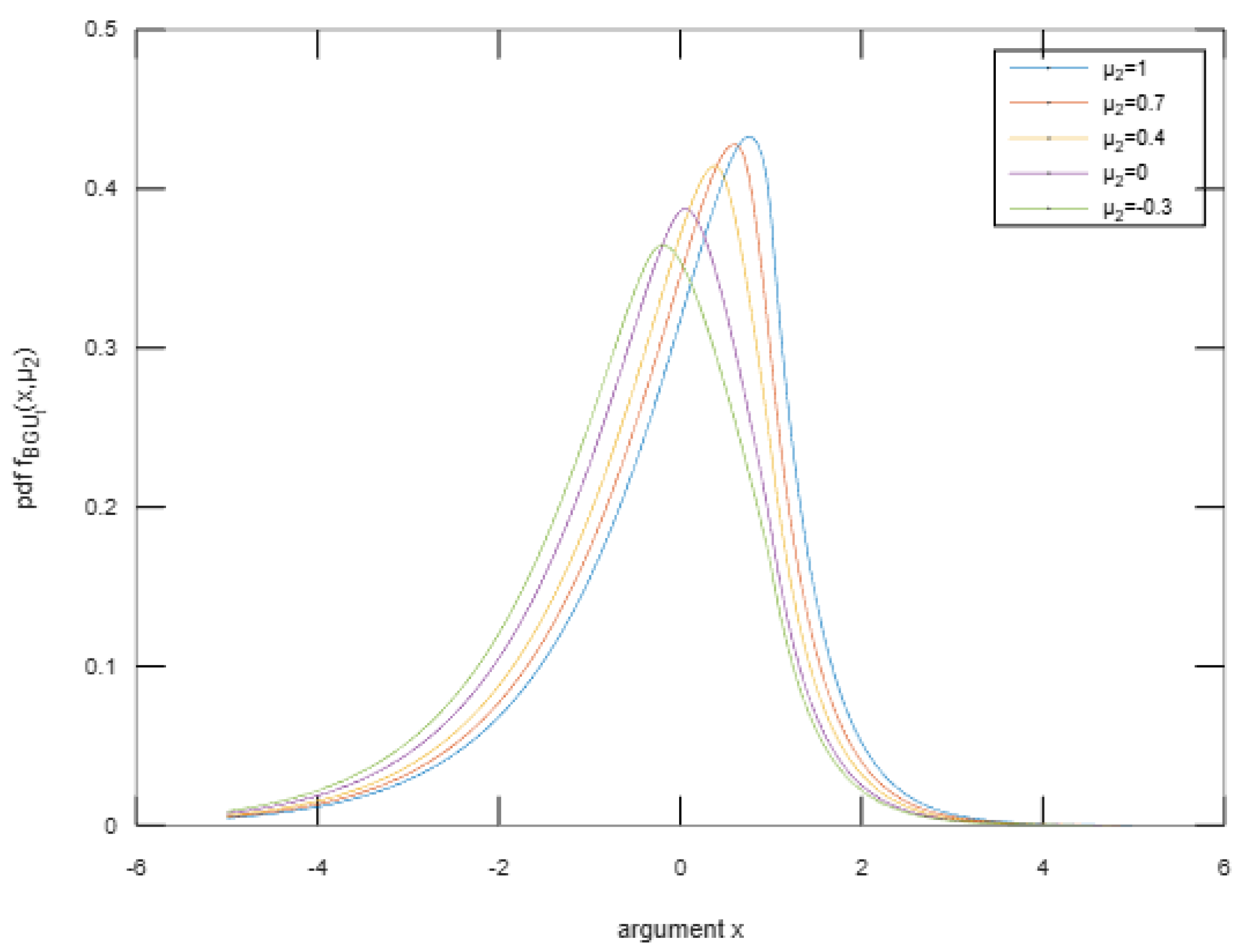
which determine the asymmetric pdf. The plots of the pdfs, calculated at a compatible with MatLab compiler according to (49) and (53) for different μ 2 μ 1 , are given at Figure 1.
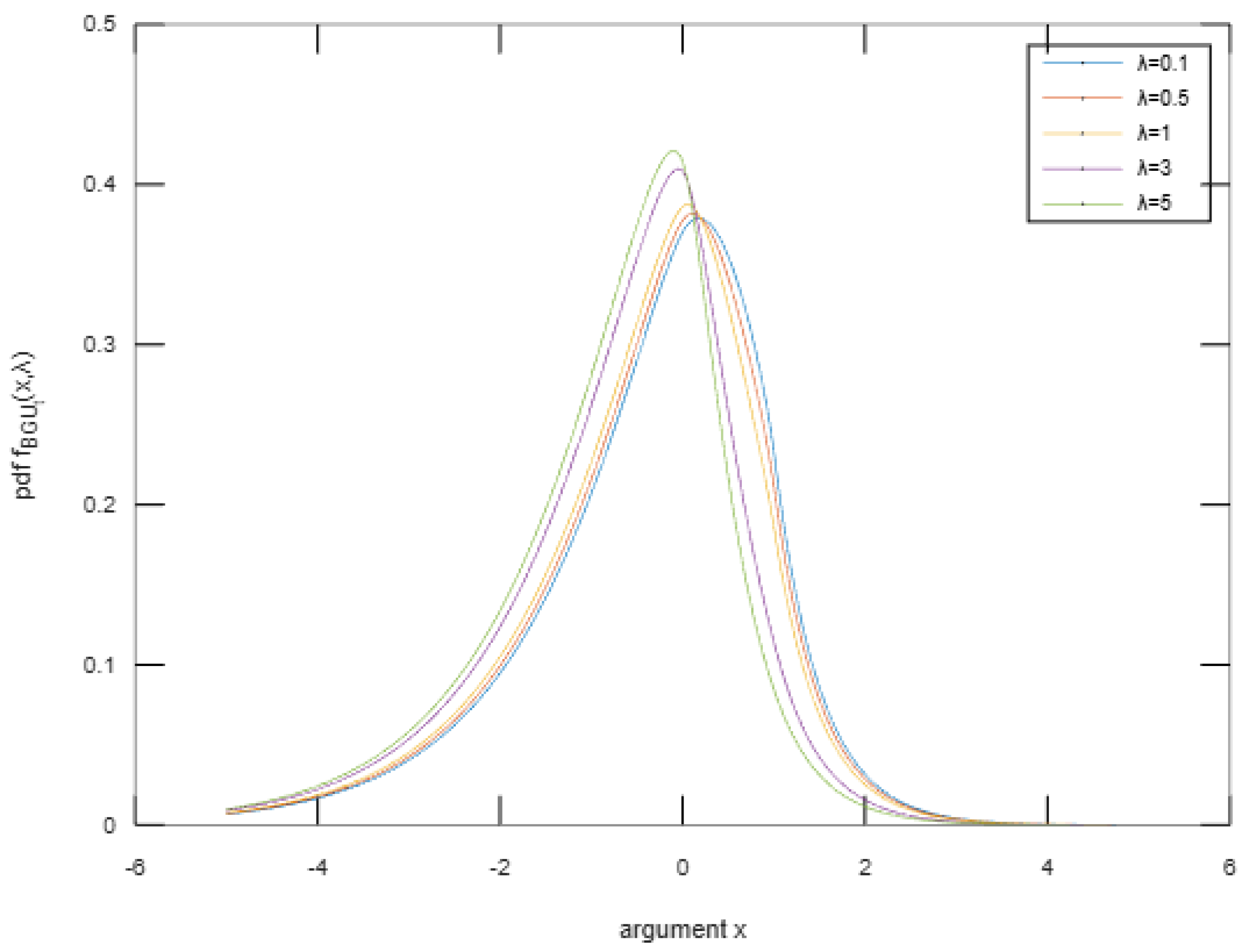
A sensitivity of the formulas for the pdfs to a rate of the jump intensity λ is illustrated at Figure 2. The parameters are
a 2 = 1.5 , b 1 = 2 , b 2 = 1 , μ 1 = 1 , μ 2 = 0 , T = 1.5
there.
The plots of Figure 1 and Figure 2 show that the model is not equally sensory to changes of the mean and intensity parameters. Indeed, the example indicates that the pdf is more sensitive to the value of the mean rate than the intensity one.

6.2. Probability Density Function f BGU t ( x ) for μ 1 μ 2

If μ 1 < μ 2 , we obtain from (28) that
f BGU t ( x ) = b 2 a 2 b 1 e b 1 ( μ 1 x ) Γ ( a 2 ) ( 1 e λ T ) ( ( e λ e λ T ) H 3 ( x , 0 ) λ λ b 1 ( μ 1 μ 2 ) [ e λ H 3 ( x , 0 ) e b 1 λ μ 1 μ 2 x + λ μ 2 μ 1 μ 2 b 1 μ 1 × × H 6 λ μ 1 μ 2 ] + ( e λ e λ T ) H 4 ( x , 0 , 1 ) + + λ λ b 1 ( μ 1 μ 2 ) [ e b 1 ( μ 2 μ 1 ) H 4 ( x , 0 , 2 ) e λ H 4 ( x , 0 , 1 ) ] ) ,
where
H 3 ( x , 0 ) = Γ ( a 2 ) ( b 1 + b 2 ) a 2 ( Γ r l o a 2 , ( μ 2 x ) ( b 1 + b 2 ) I x < μ 2 Γ r l o a 2 , ( μ 1 x ) ( b 1 + b 2 ) I x < μ 1 ) ,
H 6 ( ς ) = Γ ( a 2 ) ( ς + b 2 ) a 2 ( Γ r l o a 2 , ( μ 2 x ) ( ς + b 2 ) I x < μ 2 Γ r l o a 2 , ( μ 1 x ) ( ς + b 2 ) I x < μ 1 ) I ς > b 2 + + ( a 2 ) 1 ( μ 2 x ) a 2 t I x < μ 2 ( μ 1 x ) a 2 I x < μ 1 I ς = b 2 + + ( a 2 ) 1 ( ( μ 2 x ) a 2 Φ ( a 2 , a 2 + 1 , ( | ς | b 2 ) ( μ 2 x ) ) I x < μ 2 ( μ 1 x ) a 2 Φ ( a 2 , a 2 + 1 , ( | ς | b 2 ) ( μ 1 x ) ) I x < μ 1 ) I ς < b 2 ,
and
H 4 ( x , 0 , 1 ) = H 4 ( x , 0 , 2 ) = = Γ ( a 2 ) ( b 1 + b 2 ) a 2 ( I x μ 2 + 1 Γ r l o a 2 , ( μ 2 x ) ( b 1 + b 2 ) I x < μ 2 ) .
Therefore,
f BGU t ( x ) = b 2 a 2 b 1 e b 1 ( μ 1 x ) Γ ( a 2 ) ( 1 e λ T ) ( λ b 1 ( μ 1 μ 2 ) ) × × ( [ b 1 ( μ 2 μ 1 ) ( e λ e λ T ) λ e λ T ] H 3 ( x , 0 ) + + λ e b 1 λ μ 1 μ 2 x + λ μ 2 μ 1 μ 2 b 1 μ 1 H 6 x , λ μ 1 μ 2 + + [ b 1 ( μ 2 μ 1 ) ( e λ e λ T ) + λ e b 1 ( μ 2 μ 1 ) e λ T ] H 4 ( x , 0 , 1 ) ) .
Let us notice that it follows from 9.211.2 of Gradshteyn and Ryzhik [36] that for χ > 0
Φ ( a 2 , a 2 + 1 , χ ) = a 2 χ a 2 L ( a 2 , χ ) , L ( a 2 , χ ) = 0 χ e x x a 2 1 d x .
Hence,
H 6 ( ς ) I ς < b 2 = ( | ς | b 2 ) a 2 ( L ( a 2 , ( | ς | b 2 ) ( μ 2 x ) ) I x < μ 2 L ( a 2 , ( | ς | b 2 ) ( μ 1 x ) ) I x < μ 1 ) I ς < b 2 .
The set of the parameters for the example is afforded in (54). Let us notice that then
L ( a 2 , χ ) = χ 0.5 e χ 0 χ 0.5 e y 2 d y .
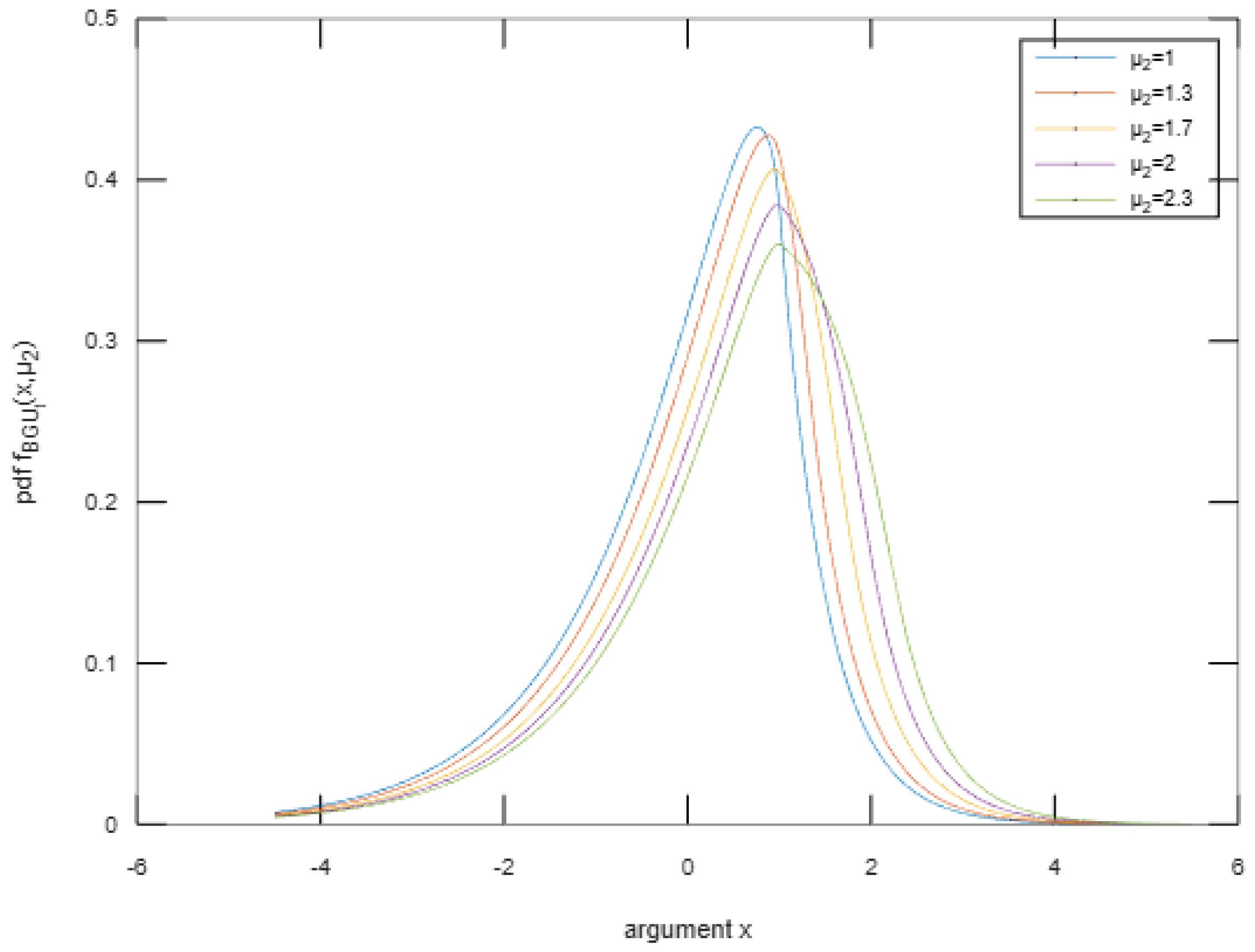
The plots of the pdfs determined by (49) and (56) for varied μ 2 μ 1 are presented at Figure 3.

6.3. Cumulative Distribution Function F BGU t ( x ) for μ 1 μ 2

When μ 2 = μ 1 , we have from (41) that
F BGU t ( x ) = Q ( x ) = b 2 a 2 Γ ( a 2 ) H 7 ( x , 0 ) e b 1 ( μ 1 x ) H 2 ( x , 0 , 1 )
because
h 2 ( 0 , 0 ) = b 1 1 ,
where H 2 ( x , 0 , 1 ) is found in (52) and
H 7 ( x , 0 ) = Γ ( a 2 ) b 2 a 2 I x μ 1 + 1 Γ r l o a 2 , b 2 ( μ 1 x ) I x < μ 1 .
If μ 1 > μ 2 , we get from (40) so far as
h 3 ( 0 ) = b 1 e λ T 1
that
F BGU t ( x ) = Q ( x ) + b 2 a 2 Γ ( a 2 ) ( 1 e λ T ) ( λ e b 1 ( μ 2 x ) H 1 ( x , 0 ) b 1 ( μ 1 μ 2 ) λ + + H 5 ( x , 0 ) + b 1 ( μ 1 μ 2 ) e λ ( μ 2 x ) μ 1 μ 2 H 5 x , λ μ 1 μ 2 λ b 1 ( μ 1 μ 2 ) b 1 e b 1 x ( μ 1 μ 2 ) ( e b 1 μ 2 e b 1 μ 1 λ ) λ b 1 ( μ 1 μ 2 ) + e b 1 μ 2 e b 1 μ 1 b 1 H 2 ( x , 0 , 1 ) ) ,
where Q ( x ) , H 1 ( x , 0 ) , H 5 ( x , ς ) for ς 0 and H 2 ( x , 0 , 1 ) are set by (50), (51), (52) and (57), respectively.
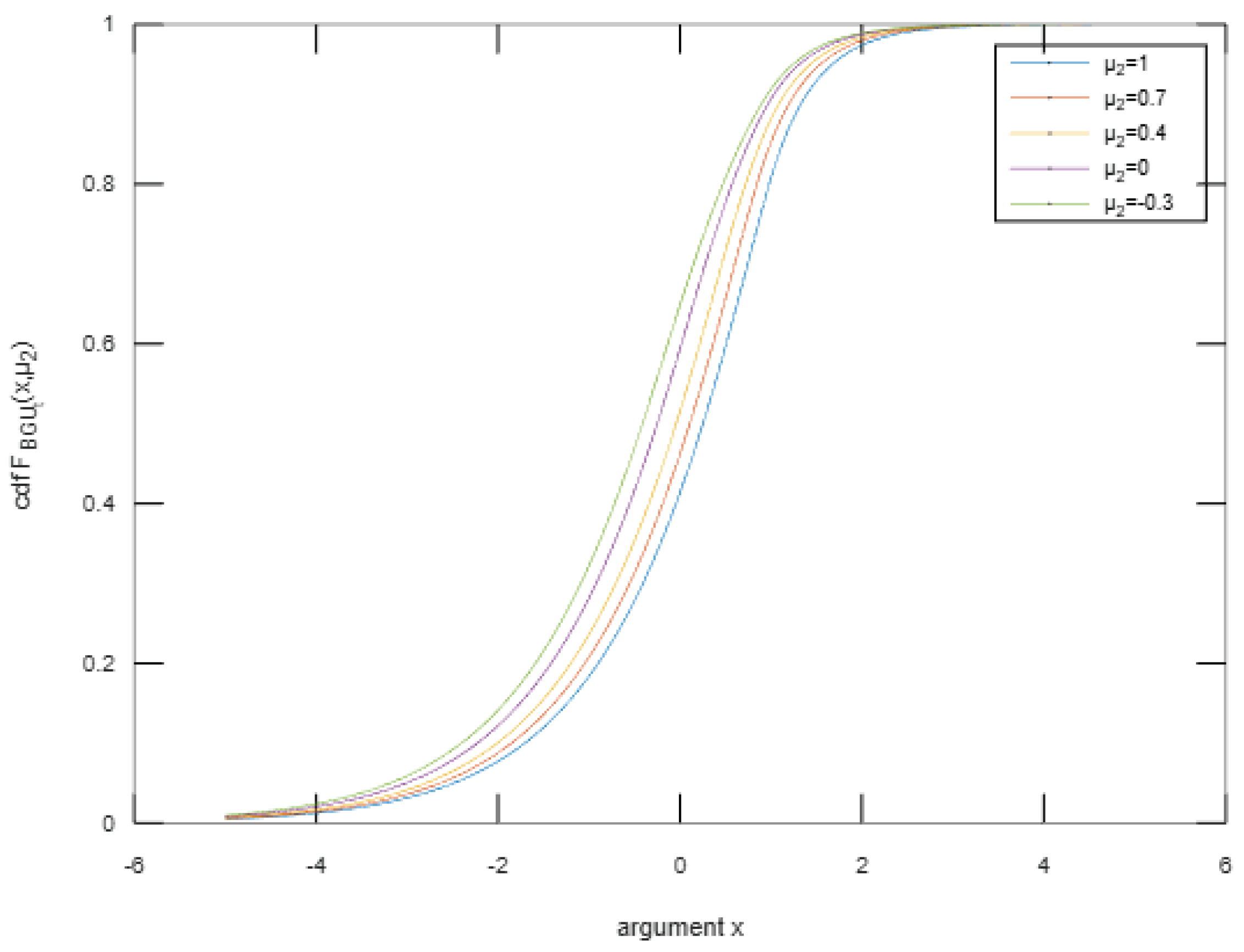
The plots of the cdfs provided by (57) and (58) for the parameters (54) and μ 2 μ 1 are afforded at Figure 4.
The computational time is under 4 s for all the figures.

7. Discussion

We have defined the new stochastic process at a finite time interval as the sum of the bilateral gamma process and drift process, where the drift rate may jump at an exponentially distributed random moment. As mentioned in Section 1, the asymmetric BG distribution properly approaches market stock returns and the symmetry between the drift rate switching and major economic events is statistically confirmed in a number of modern empirical studies of financial data.
The characteristic function and raw moments of the bilateral gamma process with drift switching are computed in Propositions 1 and 2. These formulas enable us to employ the simplified method of moments, ordinary method of moments and empirical characteristic function method for the calibration of the historical parameters of the stated process from time series, as shown in particular by Rathgeber et al. [6]. From a statistical point of view, the analytical expressions for the pdfs of the new process found by Theorem 1 allow us to apply the maximum likelihood estimation method similarly to Küchler and Tappe [3]. The formulas of Theorem 2 and Corollary 1 for the lower imgfs and cdfs of the BG process with drift switching can be applied to the identification of the model implied parameters based on the current market information (Section 1.2 of Schoutens [51] and Madan et al. [52]). The main results of the work are mostly derived for a 1 t N , where a 1 is the first shape parameter of the BG distribution.
As shown in Section 5.1, the results of Theorem 2 and Corollary 1 can be immediately used in the computation of the VaR and ES of two-asset portfolios where one of the assets is low-risk. When multi-asset portfolios are assessed, we provide the formulas that determine the VaR under conditions that are analogous to the ones of Ivanov [5]. In addition, the analytical expressions of Theorem 2 and Corollary 1 provide a number of closed form results for the prices of European digital, put and call options in the BG model with drift switching. In comparison with the exact formula for the option prices in the BG model of Küchler and Tappe [3], our expressions do not impose any condition at the option strike price. The numerical examples of Section 6 illustrate how the pdfs and cdfs of the BG process with drift switching converge to the pdf and cdf of the standard BG model, when the drift coefficient μ 2 converges to the drift rate μ 1 (Figure 1, Figure 3 and Figure 4).
Corresponding future studies could be headed in the following directions. First, it would be interesting to find exact formulas for the pdf and cdf of the BG process with drift jump for a 1 t N , even with extra conditions on the other model parameters. Moreover, a model with simultaneous jumps of the mean, variance rates and probably other model parameters should be examined. More flexible distributions, such as gamma and Weibull distributions, might be leveraged for the modeling of drift rate switching time, and any related statistical studies could be interesting as well. Second, the problems of advanced risk measurement (Ivanov [53,54]) and exotic option pricing (Sections 4.5 and 6.1–6.4 of Musiela and Rutkowski [55]) should be investigated in the new model. Third, the term structure of interest rates and related derivatives (Part V of Brigo and Mercurio [56]) in the stated model should be discussed, furthering the studies of Küchler and Tappe [3] and Ivanov [57] in that direction.

8. Conclusions

The work has introduced the bilateral gamma process with exponentially distributed drift switching. This model incorporates the effects of the both inner and external systemic shakes and, along with the standard BG model, produces frameworks for financial applications. In accordance with the results of the paper, the following conclusions can be made.
-
Analogously to the standard BG model, the stated model affords the exact formulas for the pdf of the law. Moreover, the analytic expressions have been found for the imgf and cdf of the new process. These results allow for the use of standard statistical algorithms for the calibration of the historical and implied parameters of financial data.
-
The formulas found have been applied for the purpose of risk measurement and option pricing in the BG model with drift switching. The correctness of the obtained results has been confirmed by the three numerical experiments, where the general asymmetric case of the pdf has been considered.
-
Future studies may be related to the entire description of the new model, advanced risk measurement, and derivative pricing because of the symmetry between the stated model and the dynamics of real markets. An extension with simultaneous jumps of the mean and volatility coefficients could also be studied. The term structure of interest rates in the proposed model could be studied as well.

Funding

This research received no external funding.

Data Availability Statement

Data are contained within the article.

Acknowledgments

I am grateful to the anonymous referees whose comments and remarks have significantly improved the paper.

Conflicts of Interest

The author declares no conflicts of interest.

Abbreviations

The following abbreviations are used in this manuscript:
BGbilateral gamma
pdfprobability density function
VGvariance gamma
imgfincomplete moment-generating function
cdfcumulative distribution function
VaRvalue at risk
ESexpected shortfall
ECFempirical characteristic function
MLEmaximum likelihood estimation

Appendix A

At first, we formulate two lemma that help us to prove the main results of the work.
Lemma A1.
The lower imgf
mgf u t + G 1 , t ( v , x ) = E e v u t + G 1 , t I u t + G 1 , t x , v , x R ,
is computed with respect to the following cases.
Case 1. μ 1 > μ 2 , v = λ μ 1 μ 2 .
We have that
mgf u t + G 1 , t ( v , x ) = = 0 , x μ 2 t , λ e v μ 2 t b 1 a 1 t ( 1 e λ T ) ( μ 1 μ 2 ) Γ ( a 1 t ) ( ( x μ 2 t ) × × 0 x μ 2 t z a 1 t 1 e ( v b 1 ) z d z 0 x μ 2 t z a 1 t e ( v b 1 ) z d z ) , μ 2 t < x μ 1 t , b 1 a 1 t Γ ( a 1 t ) ( λ e v μ 2 t ( 1 e λ T ) ( μ 1 μ 2 ) [ ( x μ 2 t ) × × x μ 1 t x μ 2 t z a 1 t 1 e ( v b 1 ) z d z x μ 1 t x μ 2 t z a 1 t e ( v b 1 ) z d z ] + mgf u t ( v , μ 1 t ) 0 x μ 1 t z a 1 t 1 e ( v b 1 ) z d z ) , x > μ 1 t ,
where mgf u t λ μ 1 μ 2 , μ 1 t = λ t e λ μ 2 t μ 1 μ 2 + ( e λ t e λ T ) e λ μ 1 t μ 1 μ 2 1 e λ T .
Case 2. μ 1 > μ 2 , v λ μ 1 μ 2 .
Then,
mgf u t + G 1 , t ( v , x ) = = 0 , x μ 2 t , λ e v μ 2 t b 1 a 1 t ( 1 e λ T ) ( v ( μ 1 μ 2 ) λ ) Γ ( a 1 t ) × ( e ( v ( μ 1 μ 2 ) λ ) ( x μ 2 t ) μ 1 μ 2 0 x μ 2 t z a 1 t 1 e λ μ 1 μ 2 b 1 z d z 0 x μ 2 t z a 1 t 1 e v b 1 z d z ) , μ 2 t < x μ 1 t , b 1 a 1 t Γ ( a 1 t ) ( λ e v μ 2 t ( 1 e λ T ) ( v ( μ 1 μ 2 ) λ ) × [ e ( v ( μ 1 μ 2 ) λ ) ( x μ 2 t ) μ 1 μ 2 x μ 1 t x μ 2 t z a 1 t 1 e λ μ 1 μ 2 b 1 z d z x μ 1 t x μ 2 t z a 1 t 1 e v b 1 z d z ] + mgf u t ( v , μ 1 t ) 0 x μ 1 t z a 1 t 1 e ( v b 1 ) z d z ) , x > μ 1 t ,
with mgf u t ( v , μ 1 t ) = λ e v μ 2 t e ( v ( μ 1 μ 2 ) λ ) t 1 ( 1 e λ T ) ( v ( μ 1 μ 2 ) λ ) + e v μ 1 t ( e λ t e λ T ) 1 e λ T .
Case 3. μ 1 < μ 2 , v = λ μ 1 μ 2 .
We have that
mgf u t + G 1 , t ( v , x ) = = 0 , x μ 1 t , b 1 a 1 t Γ ( a 1 t ) ( 1 1 e λ T [ λ ( μ 1 t x ) e v μ 2 t ( μ 1 μ 2 ) + ( e λ t e λ T ) e v μ 1 t ] 0 x μ 1 t z a 1 t 1 e ( v b 1 ) z d z + λ e v μ 2 t ( 1 e λ T ) ( μ 1 μ 2 ) 0 x μ 1 t z a 1 t e ( v b 1 ) z d z ) , μ 1 t < x μ 2 t , b 1 a 1 t Γ ( a 1 t ) ( 1 1 e λ T [ λ ( μ 1 t x ) e v μ 2 t ( μ 1 μ 2 ) + ( e λ t e λ T ) e v μ 1 t ] x μ 2 t x μ 1 t z a 1 t 1 e ( v b 1 ) z d z + λ e v μ 2 t ( 1 e λ T ) ( μ 1 μ 2 ) x μ 2 t x μ 1 t z a 1 t e ( v b 1 ) z d z + mgf u t ( v , μ 2 t ) 0 x μ 2 t z a 1 t 1 e ( v b 1 ) z d z ) , x > μ 2 t ,
where mgf u t λ μ 1 μ 2 , μ 2 t = λ t e λ μ 2 t μ 1 μ 2 + ( e λ t e λ T ) e λ μ 1 t μ 1 μ 2 1 e λ T .
Case 4. μ 1 < μ 2 , v λ μ 1 μ 2 .
Then,
mgf u t + G 1 , t ( v , x ) = = 0 , x μ 1 t , b 1 a 1 t Γ ( a 1 t ) ( 1 1 e λ T [ λ e v μ 2 t e ( v ( μ 1 μ 2 ) λ ) t ( v ( μ 1 μ 2 ) λ ) + e v μ 1 t ( e λ t e λ T ) ] × 0 x μ 1 t z a 1 t 1 e v b 1 z d z λ e v μ 2 t e ( v ( μ 1 μ 2 ) λ ) ( x μ 2 t ) μ 1 μ 2 ( 1 e λ T ) ( v ( μ 1 μ 2 ) λ ) × × 0 x μ 1 t z a 1 t 1 e λ μ 1 μ 2 b 1 z d z ) , μ 1 t < x μ 2 t , b 1 a 1 t Γ ( a 1 ) ( 1 1 e λ T [ λ e v μ 2 t e ( v ( μ 1 μ 2 ) λ ) t ( v ( μ 1 μ 2 ) λ ) + e v μ 1 t ( e λ t e λ T ) ] × x μ 2 t x μ 1 t z a 1 t 1 e v b 1 z d z λ e v μ 2 t e ( v ( μ 1 μ 2 ) λ ) ( x μ 2 t ) μ 1 μ 2 ( 1 e λ T ) ( v ( μ 1 μ 2 ) λ ) × × x μ 2 t x μ 1 t z a 1 t 1 e λ μ 1 μ 2 b 1 z d z + mgf u t ( v , μ 2 t ) × × 0 x μ 2 t z a 1 t 1 e v b 1 z d z ) , x > μ 2 t ,
with mgf u t ( v , μ 2 t ) = λ e v μ 2 t e ( v ( μ 1 μ 2 ) λ ) t 1 ( 1 e λ T ) ( v ( μ 1 μ 2 ) λ ) + e v μ 1 t ( e λ t e λ T ) 1 e λ T .
Case 5. μ 1 = μ 2 .
We have that
mgf u t + G 1 , t ( v , x ) = 0 , x μ 1 t , b 1 a 1 t e v μ 1 t Γ ( a 1 t ) 0 x μ 1 t z a 1 t 1 e ( v b 1 ) z d z , x > μ 1 t .
Lemma A2.
Let x R , a 1 t N , k { 1 , 2 } , j Z and j < a 1 t . Set l = a 1 t 1 j . Then, the integrals
I 1 ( x , l ) = = 0 ( x + y μ 2 t ) l y a 2 t 1 e ( b 1 + b 2 ) y I μ 2 t x < y μ 1 t x d y = H 1 ( x , j ) ,
I 2 ( x , l , k ) = = 0 ( x + y μ k t ) l y a 2 t 1 e ( b 1 + b 2 ) y I y > μ 1 t x d y = H 2 ( x , j , k )
for μ 1 > μ 2 and
I 3 ( x , l ) = = 0 ( x + y μ 1 t ) l y a 2 t 1 e ( b 1 + b 2 ) y I μ 1 t x < y μ 2 t x d y = H 3 ( x , j ) ,
I 4 ( x , l , k ) = = 0 ( x + y μ k t ) l y a 2 t 1 e ( b 1 + b 2 ) y I y > μ 2 t x d y = H 4 ( x , j , k )
for μ 1 < μ 2 , where H 1 ( x , j ) , H 2 ( x , j , k ) , H 3 ( x , j ) and H 4 ( x , j , k ) are defined in (19), (20), (21) and (22) respectively.
Moreover, if ς > b 2 and μ 1 > μ 2 , then
J 1 ( x , ς ) = 0 y a 2 t 1 e ς + b 2 y I μ 2 t x < y μ 1 t x d y = H 5 ( x , ς )
with H 5 ( x , ς ) set by (23). When ς R and μ 1 < μ 2 , we have that
J 2 ( x , ς ) = 0 y a 2 t 1 e ( ς + b 2 ) y I μ 1 t x < y μ 2 t x d y = H 6 ( x , ς ) ,
where H 6 ( x , ς ) is defined in (24). The integral
J 3 ( x , ς ) = 0 y a 2 t 1 e ( ς + b 2 ) y I y > μ 1 t x d y = H 7 ( x , ς )
for ς > b 2 with H 7 ( x , ς ) set by (34). If ς > 0 , then
J 4 ( x , ς ) = 0 ( x + y μ 1 t ) ς y a 2 t 1 e ( b 1 + b 2 ) y I y > μ 1 t x d y = H 8 ( x , ς ) ,
where H 8 ( x , ς ) is defined in (35).
Proofs of these two lemmas are set in Appendix B.1 and Appendix B.2, respectively.

Appendix A.1

Proof of Theorem 1. 
First, we derive an integral representation of f BGU t ( x ) in terms of f u t + G 1 , t ( x ) . Second, we find formulas for f u t + G 1 , t ( x ) leveraging Lemma A1 with v = 0 . Third, we get analytical expressions for f BGU t ( x ) applying Lemma A2.
Stage 1. An integral representation for  f BGU t ( x ) .
We have from (A2) and (A4) immediately that
F u t + G 1 , t ( x ) = = 0 , x μ 2 t , b 1 a 1 t ( 1 e λ T ) Γ ( a 1 t ) ( 0 x μ 2 t z a 1 t 1 e b 1 z d z e λ ( μ 2 t x ) μ 1 μ 2 0 x μ 2 t z a 1 t 1 e λ μ 1 μ 2 b 1 z d z ) , μ 2 t < x μ 1 t , b 1 a 1 t Γ ( a 1 t ) ( 0 x μ 1 t z a 1 t 1 e b 1 z d z + 1 1 e λ T × [ x μ 1 t x μ 2 t z a 1 t 1 e b 1 z d z e λ ( μ 2 t x ) μ 1 μ 2 × × x μ 1 t x μ 2 t z a 1 t 1 e λ μ 1 μ 2 b 1 z d z ] ) , x > μ 1 t ,
if μ 1 > μ 2 and
F u t + G 1 , t ( x ) = = 0 , x μ 1 t , b 1 a 1 t Γ ( a 1 t ) ( e λ T 1 ) ( e λ T 0 x μ 1 t z a 1 t 1 e b 1 z d z e λ ( μ 2 t x ) μ 1 μ 2 0 x μ 1 t z a 1 t 1 e λ μ 1 μ 2 b 1 z d z ) , μ 1 t < x μ 2 t , b 1 a 1 t Γ ( a 1 t ) ( 0 x μ 2 t z a 1 t 1 e b 1 z d z e λ T 1 e λ T × x μ 2 t x μ 1 t z a 1 t 1 e b 1 z d z + e λ ( μ 2 t x ) μ 1 μ 2 ( 1 e λ T ) × × x μ 2 t x μ 1 t z a 1 t 1 e λ μ 1 μ 2 b 1 z d z ) , x > μ 2 t ,
when μ 1 < μ 2 . It follows from (A5) that
F u t + G 1 , t ( x ) = 0 , x μ 1 t , b 1 a 1 t Γ ( a 1 t ) 0 x μ 1 t z a 1 t 1 e b 1 z d z , x > μ 1 t ,
if μ 1 = μ 2 .
One can see from (A14)–(A16) that F u t + G 1 , t ( x ) is the continuous and piecewise differentiable function. Therefore, the pdf f u t + G 1 , t ( x ) exists. Similarly to (7), we have that
f BGU t ( x ) = b 2 a 2 t Γ ( a 2 t ) 0 f u t + G 1 , t ( x + y ) y a 2 t 1 e b 2 y d y .
Stage 2. Formulas for  f u t + G 1 , t ( x ) .
Stage 2.1. μ 1 > μ 2 .
The cdf in (A14) can be written as
F u t + G 1 , t ( x ) = = 0 , x μ 2 t , b 1 a 1 t e b 1 μ 2 t ( 1 e λ T ) Γ ( a 1 t ) ( μ 2 t x ( y μ 2 t ) a 1 t 1 e b 1 y d y e λ x μ 1 μ 2 μ 2 t x ( y μ 2 t ) a 1 t 1 e λ μ 1 μ 2 b 1 y d y ) , μ 2 t < x μ 1 t , b 1 a 1 t Γ ( a 1 t ) ( e b 1 μ 1 t μ 1 t x ( y μ 1 t ) a 1 t 1 e b 1 y d y + 1 1 e λ T × [ e b 1 μ 2 t μ 2 t x ( y μ 2 t ) a 1 t 1 e b 1 y d y e b 1 μ 1 t × μ 1 t x ( y μ 1 t ) a 1 t 1 e b 1 y d y e λ x μ 1 μ 2 { e b 1 μ 2 t μ 2 t x ( y μ 2 t ) a 1 t 1 e λ μ 1 μ 2 b 1 y d y e ( b 1 μ 1 λ ) t μ 1 t x ( y μ 1 t ) a 1 t 1 e λ μ 1 μ 2 b 1 y d y } ] ) , x > μ 1 t .
Taking the derivative, we get that
f u t + G 1 , t ( x ) = = 0 , x μ 2 t , λ b 1 a 1 t e λ ( μ 2 t x ) μ 1 μ 2 ( 1 e λ T ) Γ ( a 1 t ) ( μ 1 μ 2 ) × 0 x μ 2 t z a 1 t 1 e λ μ 1 μ 2 b 1 z d z , μ 2 t < x μ 1 t , b 1 a 1 t Γ ( a 1 t ) ( 1 e λ T ) ( e b 1 μ 1 t ( e λ t e λ T ) ( x μ 1 t ) a 1 t 1 e b 1 x + λ e λ μ 2 t μ 1 μ 2 μ 1 μ 2 e λ x μ 1 μ 2 { 0 x μ 2 t z a 1 t 1 e λ μ 1 μ 2 b 1 z d z 0 x μ 1 t z a 1 t 1 e λ μ 1 μ 2 b 1 z d z } ) , x > μ 1 t .
Stage 2.2. μ 1 < μ 2 .
We have from (A15) that
F u t + G 1 , t ( x ) = = 0 , x μ 1 t , b 1 a 1 t e b 1 μ 1 t Γ ( a 1 t ) ( e λ T 1 ) ( e λ T μ 1 t x ( y μ 1 t ) a 1 t 1 e b 1 y d y e λ t λ x μ 1 μ 2 μ 1 t x ( y μ 1 t ) a 1 t 1 e λ μ 1 μ 2 b 1 y d y ) , μ 1 t < x μ 2 t , b 1 a 1 t Γ ( a 1 t ) ( e b 1 μ 2 t μ 2 t x ( y μ 2 t ) a 1 t 1 e b 1 y d y e λ T 1 e λ T × [ e b 1 μ 1 t μ 1 t x ( y μ 1 t ) a 1 t 1 e b 1 y d y e b 1 μ 2 t × × μ 2 t x ( y μ 2 t ) a 1 t 1 e b 1 y d y ] + e λ x μ 1 μ 2 ( 1 e λ T ) × × [ e b 1 μ 1 λ t μ 1 t x ( y μ 1 t ) a 1 t 1 e λ μ 1 μ 2 b 1 y d y e b 1 μ 2 t μ 2 t x ( y μ 2 t ) a 1 t 1 e λ μ 1 μ 2 b 1 y d y ] ) , x > μ 2 t .
Differentiating, we obtain that
f u t + G 1 , t ( x ) = = 0 , x μ 1 t , b 1 a 1 t e b 1 μ 1 t Γ ( a 1 t ) ( e λ T 1 ) ( λ e λ ( μ 2 t x ) μ 1 μ 2 b 1 μ 1 t μ 1 μ 2 × 0 x μ 1 t z a 1 t 1 e λ μ 1 μ 2 b 1 z d z ( e λ t e λ T ) ( x μ 1 t ) a 1 t 1 e b 1 x ) , μ 1 t < x μ 2 t , b 1 a 1 t Γ ( a 1 t ) ( 1 e λ T ) ( e b 1 μ 1 t ( e λ t e λ T ) × ( x μ 1 t ) a 1 t 1 e b 1 x λ e λ ( μ 2 t x ) μ 1 μ 2 μ 1 μ 2 × [ 0 x μ 1 t z a 1 t 1 e λ μ 1 μ 2 b 1 z d z 0 x μ 2 t z a 1 t 1 e λ μ 1 μ 2 b 1 z d z ] ) , x > μ 2 t .
Stage 2.3. μ 1 = μ 2 .
It follows from (A16) that
F u t + G 1 , t ( x ) = 0 , x μ 1 t , b 1 a 1 t e b 1 μ 1 t Γ ( a 1 t ) μ 1 t x ( y μ 1 t ) a 1 t 1 e b 1 y d y , x > μ 1 t .
Taking the derivative, we obtain that
f u t + G 1 , t ( x ) = 0 , x μ 1 t , b 1 a 1 t e b 1 μ 1 t Γ ( a 1 t ) ( x μ 1 t ) a 1 t 1 e b 1 x , x > μ 1 t .
Stage 3. Formulas for  f BGU t ( x ) .
Stage 3.1. μ 1 > μ 2 .
Stage 3.1.1. μ 1 > μ 2 , b 1 = λ μ 1 μ 2 .
Then, we get from (A18) that
f u t + G 1 , t ( x ) = = 0 , x μ 2 t , λ b 1 a 1 t e b 1 ( μ 2 t x ) ( x μ 2 t ) a 1 t ( 1 e λ T ) Γ ( a 1 t + 1 ) ( μ 1 μ 2 ) , μ 2 t < x μ 1 t , b 1 a 1 t ( 1 e λ T ) Γ ( a 1 t ) ( e b 1 ( μ 1 t x ) ( x μ 1 t ) a 1 t 1 × ( e λ t e λ T ) + λ e b 1 ( μ 2 t x ) a 1 t ( μ 1 μ 2 ) ( ( x μ 2 t ) a 1 t ( x μ 1 t ) a 1 t ) ) , x > μ 1 t .
Therefore, the identity (A17) has the form
f BGU t ( x ) = b 2 a 2 t Γ ( a 2 t ) ( 0 f u t + G 1 , t ( x + y ) y a 2 t 1 e b 2 y I μ 2 t < x + y μ 1 t d y + + 0 f u t + G 1 , t ( x + y ) y a 2 t 1 e b 2 y I x + y > μ 1 t d y )
in this case. Replacing f u t + G 1 , t ( x + y ) in (A22) with (A21), we obtain that
f BGU t ( x ) = b 2 a 2 t b 1 a 1 t Γ ( a 2 t ) ( 1 e λ T ) Γ ( a 1 t + 1 ) ( λ e b 1 ( μ 2 t x ) μ 1 μ 2 ( I 1 ( x , a 1 t ) + + I 2 ( x , a 1 t , 2 ) I 2 ( x , a 1 t , 1 ) ) + a 1 t e b 1 ( μ 1 t x ) ( e λ t e λ T ) I 2 ( x , a 1 t 1 , 1 ) ) ,
where I 1 ( x , l ) and I 2 ( x , l , k ) are defined in Lemma A2. Applying (A6) and (A7) of Lemma A2 to (A23), we obtain (26).
Stage 3.1.2. μ 1 > μ 2 , b 1 λ μ 1 μ 2 .
Let ς > 0 and ς 1 N { 0 } . Then, with respect to formula 2.321.2 of Gradshteyn and Ryzhik [36],
0 ς x ς 1 e ς 2 x d x = ς 1 ! e ς 2 ς j = 0 ς 1 ( 1 ) j ς ς 1 j ς 2 j + 1 ( ς 1 j ) ! ( 1 ) ς 1 ς 2 ς 1 + 1
for ς 2 > 0 . If ς 2 < 0 , then
0 ς x ς 1 e ς 2 x d x = ( 1 ) ς 1 ς 0 x ς 1 e ς 2 x d x = = ( 1 ) ς 1 ς 1 ! ( 1 ) ς 1 ( ς 2 ) ς 1 + 1 e ς 2 ς j = 0 ς 1 ( 1 ) j ( ς ) ς 1 j ( ς 2 ) j + 1 ( ς 1 j ) ! = = ς 1 ! e ς 2 ς j = 0 ς 1 ( 1 ) j ς ς 1 j ς 2 j + 1 ( ς 1 j ) ! ( 1 ) ς 1 ς 2 ς 1 + 1
again as ( 1 ) 2 ς 1 2 j 1 = 1 .
If a 1 t N , then we have from (A18) and (A24) that
f u t + G 1 , t ( x ) = = 0 , x μ 2 t , λ b 1 a 1 t ( 1 e λ T ) ( μ 1 μ 2 ) ( j = 0 a 1 t 1 h 1 ( j ) ( x μ 2 t ) a 1 t 1 j × e b 1 ( μ 2 t x ) h 1 ( a 1 t 1 ) e λ ( μ 2 t x ) μ 1 μ 2 ) , μ 2 t < x μ 1 t , b 1 a 1 t ( 1 e λ T ) ( e b 1 μ 1 t ( e λ t e λ T ) ( x μ 1 t ) a 1 t 1 e b 1 x ( a 1 t 1 ) ! + λ μ 1 μ 2 [ e b 1 ( μ 2 t x ) j = 0 a 1 t 1 h 1 ( j ) ( x μ 2 t ) a 1 t 1 j e ( b 1 μ 1 λ ) t b 1 x j = 0 a 1 t 1 h 1 ( j ) ( x μ 1 t ) a 1 t 1 j ] ) , x > μ 1 t ,
where h 1 ( j ) is defined in (25). Substituting f u t + G 1 , t ( x + y ) in (A22) with (A25), we get (27) using (A6), (A7) and (A10) of Lemma A2 as it is made for (A23).
Stage 3.2. μ 1 < μ 2 .
Applying (A24) to (A19), we get that for a 1 t N
f u t + G 1 , t ( x ) = = 0 , x μ 1 t , b 1 a 1 t e b 1 μ 1 t e λ T 1 ( λ μ 1 μ 2 [ e λ t b 1 x j = 0 a 1 t 1 h 1 ( j ) × ( x μ 1 t ) a 1 t 1 j h 1 ( a 1 t 1 ) e λ ( μ 2 t x ) μ 1 μ 2 b 1 μ 1 t ] ( e λ t e λ T ) ( x μ 1 t ) a 1 t 1 e b 1 x ( a 1 t 1 ) ! ) , μ 1 t < x μ 2 t , b 1 a 1 t 1 e λ T ( e b 1 ( μ 1 t x ) ( e λ t e λ T ) ( x μ 1 t ) a 1 t 1 ( a 1 t 1 ) ! λ μ 1 μ 2 × [ e b 1 ( μ 1 t x ) λ t j = 0 a 1 t 1 h 1 ( j ) ( x μ 1 t ) a 1 t 1 j e b 1 ( μ 2 t x ) j = 0 a 1 t 1 h 1 ( j ) ( x μ 2 t ) a 1 t 1 j ] ) , x > μ 2 t .
Besides, it results from (A17) and (A26) that
f BGU t ( x ) = b 2 a 2 t Γ ( a 2 t ) ( 0 f u t + G 1 , t ( x + y ) y a 2 t 1 e b 2 y I μ 1 t < x + y μ 2 t d y + + 0 f u t + G 1 , t ( x + y ) y a 2 t 1 e b 2 y I x + y > μ 2 t d y ) .
Now, we can replace f u t + G 1 , t ( x + y ) in (A27) with (A26). Employing (A8), (A9) and (A11) of Lemma A2, we obtain (28).
Stage 3.3. μ 1 = μ 2 .
If a 1 t N , then it immediately receives (29) from (7) and (A7). □

Appendix A.2

Proof of Theorem 2. 
First, we represent mgf BGU t ( v , x ) as an integral of the lower imgf of u t + G 1 , t , which is found by Lemma A1. Second, we employ Lemma A2 to compute the integral.
Stage 1. An integral representation for  mgf BGU t ( v , x ) .
By definition, the lower imgf
mgf BGU t ( v , x ) = E e v u t + G 1 , t G 2 , t I u t + G 1 , t G 2 , t x = = R 2 e v ( y z ) I y z x d F u t + G 1 , t ( y ) f G 2 , t ( z ) d z
because the drift and gamma processes are independent. Since the lower imgf exists in accordance with (31), we get that
mgf BGU t ( v , x ) = e v ( y z ) I y z x d F u t + G 1 , t ( y ) f G 2 , t ( z ) d z = = x + z e v y d F u t + G 1 , t ( y ) e v z f G 2 , t ( z ) d z = = mgf u t + G 1 , t ( v , x + z ) e v z f G 2 , t ( z ) d z = = b 2 a 2 t Γ ( a 2 t ) 0 mgf u t + G 1 , t ( v , x + z ) z a 2 t 1 e ( v + b 2 ) z d z .
We find the analytical expression for mgf BGU t ( v , x ) based on the formulas of Lemma A1.
Stage 2. Formulas for  mgf BGU t ( v , x ) .
Stage 2.1. μ 1 > μ 2 .
It is easy to see from (A2) and (A28) that
mgf BGU t ( v , x ) = = b 2 a 2 t Γ ( a 2 t ) ( 0 mgf u t + G 1 , t ( v , x + y ) y a 2 t 1 e ( v + b 2 ) y I μ 2 t < x + y μ 1 t d y + + 0 mgf u t + G 1 , t ( v , x + y ) y a 2 t 1 e ( v + b 2 ) y I x + y > μ 1 t d y )
in this case.
If a 1 t N , so far as v λ μ 1 μ 2 b 1 and v b 1 , we obtain from (A2) leveraging (A24) that
mgf u t + G 1 , t ( v , x ) = = 0 , x μ 2 t , h 3 ( v ) ( e b 1 μ 2 t + ( v b 1 ) x × j = 0 a 1 t 1 ( x μ 2 t ) a 1 t 1 j h 1 ( j ) h 2 ( v , j ) + e v μ 2 t h 2 ( v , a 1 t 1 ) e λ μ 2 t μ 1 μ 2 + v λ μ 1 μ 2 x h 1 ( a 1 t 1 ) ) , μ 2 t < x μ 1 t , h 3 ( v ) e v μ 2 t + ( v b 1 ) x × [ j = 0 a 1 t 1 h 1 ( j ) { ( x μ 2 t ) a 1 t 1 j e ( b 1 v ) μ 2 t ( x μ 1 t ) a 1 t 1 j e ( b 1 μ 1 v μ 2 λ ) t } j = 0 a 1 t 1 h 2 ( v , j ) { ( x μ 2 t ) a 1 t 1 j × e ( b 1 v ) μ 2 t ( x μ 1 t ) a 1 t 1 j e ( b 1 v ) μ 1 t } ] + b 1 a 1 t mgf u t ( v , μ 1 t ) [ j = 0 a 1 t 1 h 2 ( v , j ) ( x μ 1 t ) a 1 t 1 j × e ( v b 1 ) ( x μ 1 t ) h 2 ( v , a 1 t 1 ) ] , x > μ 1 t ,
where h 1 ( j ) , h 2 ( v , j ) and h 3 ( v ) are set by (25), (32) and (33), respectively.
Substituting mgf u t + G 1 , t ( v , x + z ) in (A29) with (A30) and applying (A6), (A7), (A10) and (A12) of Lemma A2 as it is made for (A23), we establish (36).
Stage 2.2. μ 1 = μ 2 .
In this case, we have from (A5) of Lemma A1 and (A28) that
mgf BGU t ( v , x ) = = b 2 a 2 t Γ ( a 2 t ) 0 mgf u t + G 1 , t ( v , x + z ) z a 2 t 1 e ( v + b 2 ) z I x + z > μ 1 t d z .
Stage 2.2.1. μ 1 = μ 2 , v = b 1 .
Then, we receive from (A5) that
mgf u t + G 1 , t ( v , x ) = b 1 a 1 t e b 1 μ 1 t ( x μ 1 t ) a 1 t I x > μ 1 t Γ ( a 1 t + 1 )
and it follows from (A31) that
mgf BGU t ( v , x ) = = b 2 a 2 t b 1 a 1 t e b 1 μ 1 t Γ ( a 2 t ) Γ ( a 1 t + 1 ) 0 ( x + z μ 1 t ) a 1 t z a 2 t 1 e ( b 1 + b 2 ) z I x + z > μ 1 t d z .
Hence, we get (37) if a 1 t N and (39) for arbitrary a 1 and t according to (A7) and (A13) of Lemma A2, respectively.
Stage 2.2.2. μ 1 = μ 2 , v b 1 .
If a 1 t N , we have from (A5) using (A24) that
mgf u t + G 1 , t ( v , x ) = b 1 a 1 t e v μ 1 t × × e ( v b 1 ) ( x μ 1 t ) j = 0 a 1 t 1 h 2 ( v , j ) ( x μ 1 t ) a 1 t 1 j h 2 ( v , a 1 t 1 ) I x > μ 1 t .
We replace (A32) in (A31), apply (A7) and obtain (38). □

Appendix A.3

Proof of Corollary 2. 
We have that
P ( T 0 , K ) = K R 0 E e 0 T 0 r s d s I u T 0 + BG T 0 log K / h 4 ( T 0 ) h 4 ( T 0 ) R 0 E e u T 0 0 T 0 r s d s + BG T 0 I u T 0 + BG T 0 log K / h 4 ( T 0 ) = = K R 0 E CE 1 ( BG T 0 ) h 4 ( T 0 ) R 0 E CE 2 ( BG T 0 ) ,
where the conditional expectations
CE 1 ( BG T 0 ) = E e 0 T 0 r s d s I u T 0 + BG T 0 c 4 | BG T 0 = = e r 1 T 0 E I μ 1 T 0 + BG T 0 c 4 , τ T 0 | BG T 0 + + e r 2 T 0 E e ( r 1 r 2 ) τ I μ 2 T 0 + ( μ 1 μ 2 ) τ + BG T 0 c 4 , τ < T 0 | BG T 0
and
CE 2 ( BG T 0 ) = E e u T 0 0 T 0 r s d s + BG T 0 I u T 0 + BG T 0 c 4 | BG T 0 = = e ( μ 1 r 1 ) T 0 + BG T 0 ( E I μ 1 T 0 + BG T 0 c 4 , τ T 0 | BG T 0 + + E I μ 2 T 0 + ( μ 1 μ 2 ) τ + BG T 0 c 4 , τ < T 0 | BG T 0 ) .
One may observe that for A 1 , A 2 R and A 3 > 0
E ( e A 1 τ I τ min { A 2 , A 3 } ) = = E ( e A 1 τ I τ A 3 , A 2 A 3 ) + E ( e A 1 τ I τ A 2 , 0 < A 2 < A 3 ) = = ( λ 0 A 3 e ( A 1 λ ) x d x ) I A 2 A 3 + ( λ 0 A 2 e ( A 1 λ ) x d x ) I 0 < A 2 < A 3 = λ A 3 I A 2 A 3 , A 1 = λ + A 2 I 0 < A 2 < A 3 , A 1 = λ + + λ A 1 λ ( e ( A 1 λ ) A 3 1 I A 2 A 3 , A 1 λ + + e ( A 1 λ ) A 2 1 I 0 < A 2 < A 3 , A 1 λ ) .
Since μ 1 > μ 2 and
CE 1 ( BG T 0 ) = e r 1 T 0 ( e λ T 0 e λ T ) 1 e λ T I BG T 0 c 4 μ 1 T 0 + + e r 2 T 0 E e ( r 1 r 2 ) τ I τ < min T 0 , c 4 μ 2 T 0 BG T 0 μ 1 μ 2 | BG T 0 ,
we get employing (A34) that
CE 1 ( BG T 0 ) = e r 1 T 0 ( e λ T 0 e λ T ) 1 e λ T I BG T 0 c 4 μ 1 T 0 + + λ e r 2 T 0 r 2 r 1 λ ( e ( r 2 r 1 λ ) T 0 1 I BG T 0 c 4 μ 1 T 0 + + e ( r 2 r 1 λ ) ( c 4 BG T 0 μ 2 T 0 ) μ 1 μ 2 1 I c 4 μ 1 T 0 < BG T 0 < c 4 μ 2 T 0 ) = = e r 1 T 0 ( e λ T 0 e λ T 1 e λ T + λ e λ T 0 r 2 r 1 λ ) I BG T 0 c 4 μ 1 T 0 + + λ e r 2 T 0 + 1 + λ μ 1 μ 2 ( μ 2 T 0 c 4 ) r 2 r 1 λ e 1 + λ μ 1 μ 2 BG T 0 × × I c 4 μ 1 T 0 < BG T 0 < c 4 μ 2 T 0 λ e r 2 T 0 r 2 r 1 λ I BG T 0 < c 4 μ 2 T 0 .
So far as
CE 2 ( BG T 0 ) = e ( μ 1 r 1 ) T 0 + BG T 0 ( e λ T 0 e λ T 1 e λ T I BG T 0 c 4 μ 1 T 0 + + E I τ < min T 0 , c 4 μ 2 T 0 BG T 0 μ 1 μ 2 | BG T 0 ) ,
we obtain leveraging (A34) that
CE 2 ( BG T 0 ) = e ( μ 1 r 1 ) T 0 + BG T 0 ( e λ T 0 e λ T 1 e λ T I BG T 0 c 4 μ 1 T 0 + + 1 e λ T 0 I BG T 0 c 4 μ 1 T 0 + + 1 e λ ( c 4 μ 2 T 0 BG T 0 ) μ 1 μ 2 I c 4 μ 1 T 0 < BG T 0 < c 4 μ 2 T 0 ) = = e ( μ 1 r 1 ) T 0 ( e λ T ( e λ T 0 1 ) 1 e λ T e BG T 0 I BG T 0 c 4 μ 1 T 0 + + e BG T 0 I BG T 0 < c 4 μ 2 T 0 e λ ( μ 2 T 0 c 4 ) μ 1 μ 2 e 1 + λ μ 1 μ 2 BG T 0 I c 4 μ 1 T 0 < BG T 0 < c 4 μ 2 T 0 ) .
Collating (A33), (A35) and (A36), we get (48). □

Appendix B

Appendix B.1

Proof Lemma A1. 
The proof consists of three stages. First, we deduce general formulas for mgf u t + G 1 , t ( v , x ) . Second, we find exact expressions for mgf u t ( v , x ) . Based on them, we find at Stage 3 analytic formulas for mgf u t + G 1 , t ( v , x ) when μ 1 > μ 2 , μ 2 > μ 1 and μ 2 = μ 1 .
Stage 1. General formulas.
So far as the imgf exists, we have applying the Fubini’s theorem that
mgf u t + G 1 , t ( v , x ) = R 2 e v ( y + z ) I y + z x d F u t ( y ) f G 1 , t ( z ) d z = = mgf u t ( v , x z ) e v z f G 1 , t ( z ) d z = = b 1 a 1 t Γ ( a 1 t ) 0 mgf u t ( v , x z ) z a 1 t 1 e ( v b 1 ) z d z .
The lower imgf
mgf u t ( v , x ) = E e v μ 1 t I μ 1 t x , τ t + E e v ( μ 2 t + ( μ 1 μ 2 ) τ ) I ( μ 1 μ 2 ) τ x μ 2 t , τ < t = = e v μ 1 t ( e λ t e λ T ) 1 e λ T I x μ 1 t + e v μ 2 t ( 1 e λ t ) 1 e λ T I μ 1 = μ 2 , x μ 2 t + + e v μ 2 t E 1 ( x ) + E 2 ( x ) ,
where
E 1 ( x ) = E e v ( μ 1 μ 2 ) τ I τ min t , max x μ 2 t μ 1 μ 2 , 0 I μ 1 > μ 2
and
E 2 ( x ) = E e v ( μ 1 μ 2 ) τ I max x μ 2 t μ 1 μ 2 , 0 τ < t I μ 1 < μ 2 .
Now, we should compute E 1 ( x ) , E 2 ( x ) and then substitute mgf u t ( v , x z ) in (A37) applying (A38).
Stage 2. Formulas for  mgf u t ( v , x ) .
Stage 2.1. μ 1 > μ 2 .
We have that
E 1 ( x ) = E e v ( μ 1 μ 2 ) τ I τ min t , max x μ 2 t μ 1 μ 2 , 0 I μ 1 > μ 2 , x > μ 2 t = = λ 1 e λ T ( 0 x μ 2 t μ 1 μ 2 e v ( μ 1 μ 2 ) y λ y d y ) I μ 1 > μ 2 , μ 2 t < x < μ 1 t + + λ 1 e λ T ( 0 t e v ( μ 1 μ 2 ) y λ y d y ) I μ 1 > μ 2 , x μ 1 t = = λ I v = λ μ 1 μ 2 , μ 1 > μ 2 1 e λ T ( x μ 2 t μ 1 μ 2 I μ 2 t < x < μ 1 t + t I x μ 1 t ) + + λ I v λ μ 1 μ 2 , μ 1 > μ 2 ( 1 e λ T ) ( v ( μ 1 μ 2 ) λ ) ( ( e ( v ( μ 1 μ 2 ) λ ) t 1 ) I x μ 1 t + + ( e ( v ( μ 1 μ 2 ) λ ) ( x μ 2 t ) μ 1 μ 2 1 ) I μ 2 t < x < μ 1 t ) .
Deploying (A39) to (A38), we obtain that
mgf u t ( v , x ) = e v μ 1 t ( e λ t e λ T ) 1 e λ T I x μ 1 t + e v μ 2 t E 1 ( x ) = = 1 1 e λ T [ λ e v μ 2 t ( x μ 2 t ) μ 1 μ 2 I μ 2 t < x < μ 1 t + ( e v μ 1 t ( e λ t e λ T ) + + λ t e v μ 2 t ) I x μ 1 t ] I v = λ μ 1 μ 2 + 1 1 e λ T [ λ e v μ 2 t v ( μ 1 μ 2 ) λ × × ( e ( v ( μ 1 μ 2 ) λ ) ( x μ 2 t ) μ 1 μ 2 1 ) I μ 2 t < x < μ 1 t + ( e v μ 1 t ( e λ t e λ T ) + + λ e v μ 2 t v ( μ 1 μ 2 ) λ ( e ( v ( μ 1 μ 2 ) λ ) t 1 ) ) I x μ 1 t ] I v λ μ 1 μ 2 .
If v = λ μ 1 μ 2 , then one can see from (A40) that
mgf u t ( v , x ) = 0 , x μ 2 t , λ ( x μ 2 t ) e v μ 2 t ( 1 e λ T ) ( μ 1 μ 2 ) , μ 2 t < x < μ 1 t , λ t e v μ 2 t + ( e λ t e λ T ) e v μ 1 t 1 e λ T , x μ 1 t .
When v λ μ 1 μ 2 , we get from (A40) that
mgf u t ( v , x ) = 0 , x μ 2 t , λ e v μ 2 t ( e ( v ( μ 1 μ 2 ) λ ) ( x μ 2 t ) μ 1 μ 2 1 ) ( 1 e λ T ) ( v ( μ 1 μ 2 ) λ ) , μ 2 t < x < μ 1 t , λ e v μ 2 t ( e ( v ( μ 1 μ 2 ) λ ) t 1 ) ( 1 e λ T ) ( v ( μ 1 μ 2 ) λ ) + + e v μ 1 t ( e λ t e λ T ) 1 e λ T . x μ 1 t
Stage 2.2. μ 1 < μ 2 .
We have that
E 2 ( x ) = E e v ( μ 1 μ 2 ) τ I max x μ 2 t μ 1 μ 2 , 0 τ < t I μ 1 < μ 2 , x > μ 1 t = = λ 1 e λ T ( x μ 2 t μ 1 μ 2 t e v ( μ 1 μ 2 ) y λ y d y ) I μ 1 < μ 2 , μ 1 t < x < μ 2 t + + λ 1 e λ T ( 0 t e v ( μ 1 μ 2 ) y λ y d y ) I μ 1 < μ 2 , x μ 2 t = = λ I v = λ μ 1 μ 2 , μ 1 < μ 2 1 e λ T ( ( t x μ 2 t μ 1 μ 2 ) I μ 1 t < x < μ 2 t + t I x μ 2 t ) + + λ I v λ μ 1 μ 2 , μ 1 < μ 2 ( 1 e λ T ) ( v ( μ 1 μ 2 ) λ ) ( ( e ( v ( μ 1 μ 2 ) λ ) t 1 ) I x μ 2 t + + ( e ( v ( μ 1 μ 2 ) λ ) t e ( v ( μ 1 μ 2 ) λ ) ( x μ 2 t ) μ 1 μ 2 ) I μ 1 t < x < μ 2 t ) .
Then it follows from (A38) and (A43) that
mgf u t ( v , x ) = e v μ 1 t ( e λ t e λ T ) 1 e λ T I x μ 1 t + e v μ 2 t E 2 ( x ) = = 1 1 e λ T ( [ e v μ 1 t ( e λ t e λ T ) + λ e v μ 2 t ( t x μ 2 t μ 1 μ 2 ) ] I μ 1 t x < μ 2 t + + [ e v μ 1 t ( e λ t e λ T ) + λ t e v μ 2 t ] I x μ 2 t ) I v = λ μ 1 μ 2 + + 1 1 e λ T ( [ e v μ 1 t ( e λ t e λ T ) + λ e v μ 2 t v ( μ 1 μ 2 ) λ × × ( e ( v ( μ 1 μ 2 ) λ ) t e ( v ( μ 1 μ 2 ) λ ) ( x μ 2 t ) μ 1 μ 2 ) ] I μ 1 t x < μ 2 t + + [ e v μ 1 t ( e λ t e λ T ) + λ e v μ 2 t ( e ( v ( μ 1 μ 2 ) λ ) t 1 ) v ( μ 1 μ 2 ) λ ] I x μ 2 t ) I v λ μ 1 μ 2 .
If v = λ μ 1 μ 2 , then one may observe from (A44) that
mgf u t ( v , x ) = = 0 , x < μ 1 t , λ ( μ 1 t x ) e v μ 2 t ( 1 e λ T ) ( μ 1 μ 2 ) + ( e λ t e λ T ) e v μ 1 t 1 e λ T , μ 1 t x < μ 2 t , λ t e v μ 2 t + ( e λ t e λ T ) e v μ 1 t 1 e λ T , x μ 2 t .
When v λ μ 1 μ 2 , we have from (A44) that
mgf u t ( v , x ) = = 0 , x < μ 1 t , λ e v μ 2 t e ( v ( μ 1 μ 2 ) λ ) t e v λ μ 1 μ 2 ( x μ 2 t ) ( 1 e λ T ) ( v ( μ 1 μ 2 ) λ ) + e v μ 1 t ( e λ t e λ T ) 1 e λ T , μ 1 t x < μ 2 t , λ e v μ 2 t e ( v ( μ 1 μ 2 ) λ ) t 1 ( 1 e λ T ) ( v ( μ 1 μ 2 ) λ ) + e v μ 1 t ( e λ t e λ T ) 1 e λ T . x μ 2 t
Stage 3. Formulas for  mgf u t + G 1 , t ( v , x ) .
Stage 3.1. μ 1 > μ 2 .
Stage 3.1.1. μ 1 > μ 2 , v = λ μ 1 μ 2 .
We have from (A37) and (A41) that
mgf u t + G 1 , t ( v , x ) = b 1 a 1 t Γ ( a 1 t ) ( λ e v μ 2 t ( 1 e λ T ) ( μ 1 μ 2 ) × × ( x z μ 2 t ) I μ 2 t < x z < μ 1 t , z > 0 z a 1 t 1 e ( v b 1 ) z d z + mgf u t ( v , μ 1 t ) I x z μ 1 t , z > 0 z a 1 t 1 e ( v b 1 ) z d z ) .
Since
z a 1 t e ( v b 1 ) z I x μ 1 t < z < x μ 2 t , z > 0 d z = = ( z a 1 t e ( v b 1 ) z I x μ 1 t < z < x μ 2 t , z > 0 d z ) I x > μ 2 t = = ( 0 x μ 2 t z a 1 t e ( v b 1 ) z d z ) I μ 2 t < x μ 1 t + + ( x μ 1 t x μ 2 t z a 1 t e ( v b 1 ) z d z ) I x > μ 1 t
and
I z x μ 1 t , z > 0 z a 1 t 1 e ( v b 1 ) z d z = ( 0 x μ 1 t z a 1 t 1 e ( v b 1 ) z d z ) I x > μ 1 t ,
we obtain (A1)
Stage 3.1.2. μ 1 > μ 2 , v λ μ 1 μ 2 .
Using (A37) and (A42), we receive that
mgf u t + G 1 , t ( v , x ) = b 1 a 1 t Γ ( a 1 t ) ( λ e v μ 2 t ( 1 e λ T ) ( v ( μ 1 μ 2 ) λ ) × × ( e ( v ( μ 1 μ 2 ) λ ) ( x z μ 2 t ) μ 1 μ 2 1 ) I μ 2 t < x z < μ 1 t , z > 0 z a 1 t 1 e ( v b 1 ) z d z + + mgf u t ( v , μ 1 t ) I x z μ 1 t , z > 0 z a 1 t 1 e ( v b 1 ) z d z ) .
We have that
z a 1 t 1 e λ μ 1 μ 2 b 1 z I x μ 1 t < z < x μ 2 t , z > 0 d z = = ( z a 1 t 1 e λ μ 1 μ 2 b 1 z I x μ 1 t < z < x μ 2 t , z > 0 d z ) I x > μ 2 t = = ( 0 x μ 2 t z a 1 t 1 e λ μ 1 μ 2 b 1 z d z ) I μ 2 t < x μ 1 t + + ( x μ 1 t x μ 2 t z a 1 t 1 e λ μ 1 μ 2 b 1 z d z ) I x > μ 1 t ,
z a 1 t 1 e ( v b 1 ) z I x μ 1 t < z < x μ 2 t , z > 0 d z = ( 0 x μ 2 t z a 1 t 1 e v b 1 z d z ) I μ 2 t < x μ 1 t + ( x μ 1 t x μ 2 t z a 1 t 1 e v b 1 z d z ) I x > μ 1 t
and
z a 1 t 1 e ( v b 1 ) z I z x μ 1 t , z > 0 d z = ( 0 x μ 1 t z a 1 t 1 e ( v b 1 ) z d z ) I x > μ 1 t .
Hence, we get (A2).
Stage 3.2. μ 1 < μ 2 .
Stage 3.2.1. μ 1 < μ 2 , v = λ μ 1 μ 2 .
We have from (A37) and (A45) that
mgf u t + G 1 , t ( v , x ) = b 1 a 1 t Γ ( a 1 t ) ( 1 1 e λ T [ λ ( μ 1 t x ) e v μ 2 t ( μ 1 μ 2 ) + + ( e λ t e λ T ) e v μ 1 t ] z a 1 t 1 e ( v b 1 ) z I μ 1 t x z < μ 2 t , z > 0 d z + + λ e v μ 2 t ( 1 e λ T ) ( μ 1 μ 2 ) z a 1 t e ( v b 1 ) z I μ 1 t x z < μ 2 t , z > 0 d z + + mgf u t ( v , μ 2 t ) z a 1 t 1 e ( v b 1 ) z I x z μ 2 t , z > 0 d z ) .
So far as
z a 1 t e ( v b 1 ) z I x μ 2 t < z x μ 1 t , z > 0 d z = = ( z a 1 t e ( v b 1 ) z I x μ 2 t < z x μ 1 t , z > 0 d z ) I x > μ 1 t = = ( 0 x μ 1 t z a 1 t e ( v b 1 ) z d z ) I μ 1 t < x μ 2 t + + ( x μ 2 t x μ 1 t z a 1 t e ( v b 1 ) z d z ) I x > μ 2 t
and
z a 1 t 1 e ( v b 1 ) z I z x μ 2 t , z > 0 d z = ( 0 x μ 2 t z a 1 t 1 e ( v b 1 ) z d z ) I x > μ 2 t ,
we establish (A3).
Stage 3.2.2. μ 1 < μ 2 , v λ μ 1 μ 2 .
Applying (A37) and (A46), we get that
mgf u t + G 1 , t ( v , x ) = mgf u t ( v , x z ) e v z f G 1 , t ( z ) d z = = b 1 a 1 t Γ ( a 1 t ) ( 1 1 e λ T [ λ e v μ 2 t e ( v ( μ 1 μ 2 ) λ ) t ( v ( μ 1 μ 2 ) λ ) + e v μ 1 t ( e λ t e λ T ) ] × × z a 1 t 1 e v b 1 z I μ 1 t x z < μ 2 t , z > 0 d z λ e v μ 2 t e ( v ( μ 1 μ 2 ) λ ) ( x μ 2 t ) μ 1 μ 2 ( 1 e λ T ) ( v ( μ 1 μ 2 ) λ ) × × z a 1 t 1 e λ μ 1 μ 2 b 1 z I μ 1 t x z < μ 2 t , z > 0 d z + + mgf u t ( v , μ 2 t ) z a 1 t 1 e v b 1 z I x z μ 2 t , z > 0 d z ) .
Because
z a 1 t 1 e v b 1 z I x μ 2 t < z x μ 1 t , z > 0 d z = = ( z a 1 t 1 e v b 1 z I x μ 2 t < z x μ 1 t , z > 0 d z ) I x > μ 1 t = ( 0 x μ 1 t z a 1 t 1 e v b 1 z d z ) I μ 1 t < x μ 2 t + ( x μ 2 t x μ 1 t z a 1 t 1 e v b 1 z d z ) I x > μ 2 t
and
z a 1 t 1 e v b 1 z I z x μ 2 t , z > 0 d z = ( 0 x μ 2 t z a 1 t 1 e v b 1 z d z ) I x > μ 2 t ,
we obtain (A4).
Stage 3.3. μ 1 = μ 2 .
We have from (A37) that
mgf u t + G 1 , t ( v , x ) = b 1 a 1 t e v μ 1 t Γ ( a 1 t ) 0 z a 1 t 1 e ( v b 1 ) z I z x μ 1 t d z = = b 1 a 1 t e v μ 1 t Γ ( a 1 t ) 0 x μ 1 t z a 1 t 1 e ( v b 1 ) z d z I x > μ 1 t
and receive (A5). □

Appendix B.2

Proof of Lemma A2. 
Since l N { 0 } , we have that
I 1 ( x , l ) = 0 ( x + y μ 2 t ) l y a 2 t 1 e ( b 1 + b 2 ) y I μ 2 t x < y μ 1 t x d y = = m = 0 l C l m ( x μ 2 t ) l m 0 y a 2 t + m 1 e ( b 1 + b 2 ) y I μ 2 t x < y μ 1 t x d z = = m = 0 l C l m ( x μ 2 t ) l m 0 y a 2 t + m 1 e ( b 1 + b 2 ) y I μ 2 t x < y μ 1 t x d y I x < μ 1 t .
Hence
I 1 ( x , l ) = m = 0 l C l m ( x μ 2 t ) l m × × ( 0 μ 1 t x z a 2 t + m 1 e ( b 1 + b 2 ) z d z I μ 2 t x < μ 1 t + + μ 2 t x μ 1 t x z a 2 t + m 1 e ( b 1 + b 2 ) z d z I x < μ 2 t )
and then we get that
I 1 ( x , l ) = m = 0 l C l m ( x μ 2 t ) l m ( b 1 + b 2 ) a 2 t + m × × ( ( 0 ( μ 1 t x ) ( b 1 + b 2 ) y a 2 t + m 1 e y d y ) I μ 2 t x < μ 1 t + + ( ( μ 2 t x ) ( b 1 + b 2 ) ( μ 1 t x ) ( b 1 + b 2 ) y a 2 t + m 1 e y d y ) I x < μ 2 t ) = = m = 0 l C l m ( x μ 2 t ) l m ( b 1 + b 2 ) a 2 t + m × × ( Γ l o a 2 t + m , ( μ 1 t x ) ( b 1 + b 2 ) I x < μ 1 t Γ l o a 2 t + m , ( μ 2 t x ) ( b 1 + b 2 ) I x < μ 2 t ) ,
obtaining (A6). As for I 1 ( x , l ) , we have that
I 3 ( x , l ) = m = 0 l C l m ( x μ 1 t ) l m ( b 1 + b 2 ) a 2 t + m × × ( Γ l o a 2 t + m , ( μ 2 t x ) ( b 1 + b 2 ) I x < μ 2 t Γ l o a 2 t + m , ( μ 1 t x ) ( b 1 + b 2 ) I x < μ 1 t )
and get (A8).
Next,
I 2 ( x , l , k ) = = m = 0 l C l m ( x μ k t ) l m 0 z a 2 t + m 1 e ( b 1 + b 2 ) z I z > μ 1 t x d z = = m = 0 l C l m ( x μ k t ) l m ( 0 z a 2 t + m 1 e ( b 1 + b 2 ) z d z I x μ 1 t + μ 1 t x z a 2 t + m 1 e ( b 1 + b 2 ) z d z I x < μ 1 t ) .
Therefore,
I 2 ( x , l , k ) = = m = 0 l C l m ( x μ k t ) l m ( b 1 + b 2 ) a 2 t + m ( Γ a 2 t + m I x μ 1 t + + ( μ 1 t x ) ( b 1 + b 2 ) y a 2 t + m 1 e y d y I x < μ 1 t ) = = m = 0 l C l m ( x μ k t ) l m ( b 1 + b 2 ) a 2 t + m ( Γ a 2 t + m I x μ 1 t + + Γ u p a 2 t + m , ( μ 1 t x ) ( b 1 + b 2 ) I x < μ 1 t )
and we obtain (A7). Analogously,
I 4 ( x , l , k ) = m = 0 l C l m ( x μ k t ) l m ( b 1 + b 2 ) a 2 t + m ( Γ a 2 t + m I x μ 2 t + + Γ u p a 2 t + m , ( μ 2 t x ) ( b 1 + b 2 ) I x < μ 2 t )
and we have (A9).
Furthermore, we have for ς > b 2 that
J 1 ( x , ς ) = 0 y a 2 t 1 e ( ς + b 2 ) y I μ 2 t x < y μ 1 t x d y I x < μ 1 t = 0 μ 1 t x y a 2 t 1 e ( ς + b 2 ) y d y I μ 2 t x < μ 1 t + + μ 2 t x μ 1 t x y a 2 t 1 e ( ς + b 2 ) y d y I x < μ 2 t = ( ς + b 2 ) a 2 t × × ( ( 0 ( μ 1 t x ) ( ς + b 2 ) z a 2 t 1 e z d z ) I μ 2 t x < μ 1 t + + ( ( μ 2 t x ) ( ς + b 2 ) ( μ 1 t x ) ( ς + b 2 ) z a 2 t 1 e z d z ) I x < μ 2 t ) = ( ς + b 2 ) a 2 t × × ( Γ l o a 2 t , ( μ 1 t x ) ( ς + b 2 ) I x < μ 1 t Γ l o a 2 t , ( μ 2 t x ) ( ς + b 2 ) I x < μ 2 t )
and get (A10).
Similarly to (A47), we obtain that
J 2 ( x , ς ) I ς > b 2 = ( ς + b 2 ) a 2 t ( Γ l o a 2 t , ( μ 2 t x ) ( ς + b 2 ) I x < μ 2 t Γ l o a 2 t , ( μ 1 t x ) ( ς + b 2 ) I x < μ 1 t ) I ς > b 2 .
Next,
J 2 ( x , b 2 ) = 0 μ 2 t x y a 2 t 1 d y I μ 1 t x < μ 2 t + + μ 1 t x μ 2 t x y a 2 t 1 d y I x < μ 1 t = ( a 2 t ) 1 × × ( μ 2 t x ) a 2 t I x < μ 2 t ( μ 1 t x ) a 2 t I x < μ 1 t .
Moreover, if ς < b 2 , then
J 2 ( x , ς ) = 0 μ 2 t x y a 2 t 1 e ( | ς | b 2 ) y d y I x < μ 2 t 0 μ 1 t x y a 2 t 1 e ( | ς | b 2 ) y d y I x < μ 1 t .
Because
0 χ x χ 1 1 e χ 2 x = χ 1 1 χ χ 1 Φ ( χ 1 , χ 1 + 1 , χ 2 χ )
in accordance with formula 3.383.1 of Gradshteyn and Ryzhik [36] if χ 1 > 0 , we get from (A50) that
J 2 ( x , ς ) I ς < b 2 = = ( a 2 t ) 1 ( ( μ 2 t x ) a 2 t Φ ( a 2 t , a 2 t + 1 , ( | ς | b 2 ) ( μ 2 t x ) ) I x < μ 2 t ( μ 1 t x ) a 2 t Φ ( a 2 t , a 2 t + 1 , ( | ς | b 2 ) ( μ 1 t x ) ) I x < μ 1 t ) I ς < b 2 .
Combining (A48), (A49) and (A51), we establish (A11).
Also, we have for ς > b 2 that
J 3 ( x , ς ) = 0 y a 2 t 1 e ( ς + b 2 ) y d y I x μ 1 t + + μ 1 t x y a 2 t 1 e ( ς + b 2 ) y d y I x < μ 1 t = Γ ( a 2 t ) I x μ 1 t ( ς + b 2 ) a 2 t + + Γ u p a 2 t , ( μ 1 t x ) ( ς + b 2 ) I x < μ 1 t ( ς + b 2 ) a 2 t .
and get (A12)
Finally, the integral
J 4 ( x , ς ) = J 41 ( x , ς ) + J 42 ( x , ς ) ,
where
J 41 ( x , ς ) = 0 ( y + x μ 1 t ) ς y a 2 t 1 e ( b 1 + b 2 ) y d y I x μ 1 t
and
J 42 ( x , ς ) = μ 1 t x ( y + x μ 1 t ) ς y a 2 t 1 e ( b 1 + b 2 ) y d y I x < μ 1 t .
Since
J 41 ( x , ς ) = e ( b 1 + b 2 ) ( x μ 1 t ) × × x μ 1 t z ς ( z x + μ 1 t ) a 2 t 1 e ( b 1 + b 2 ) z d z I x μ 1 t ,
we get using (8) that
J 4 ( x , ς ) = ( b 1 + b 2 ) ς + 1 + a 2 t 2 e ( b 1 + b 2 ) ( x μ 1 t ) 2 × × ( ( x μ 1 t ) ς + 1 + a 2 t 2 1 Γ ( a 2 t ) W ς + 1 a 2 t 2 , ς a 2 t 2 ( ( b 1 + b 2 ) ( x μ 1 t ) ) I x > μ 1 t + + ( μ 1 t x ) a 2 t + ς + 1 2 1 Γ ( ς + 1 ) W a 2 t ς 1 2 , a 2 t ς 2 ( ( b 1 + b 2 ) ( μ 1 t x ) ) I x < μ 1 t ) + + Γ ( a 2 t + ς ) e ( b 1 + b 2 ) ( x μ 1 t ) ( b 1 + b 2 ) a 2 t + ς I x = μ 1 t .
So far as
W χ 1 , χ 2 ( χ ) = W χ 1 , χ 2 ( χ )
with respect to 9.232.1 of Gradshteyn and Ryzhik [36], we obtain (A13). □

References

  1. Mathai, A.M. On noncentral generalized Laplacianness of quadratic forms in normal variables. J. Multivar. Anal. 1993, 45, 239–246. [Google Scholar] [CrossRef]
  2. Küchler, U.; Tappe, S. On the shapes of bilateral gamma densities. Stat. Probab. Lett. 2008, 78, 2478–2484. [Google Scholar] [CrossRef]
  3. Küchler, U.; Tappe, S. Bilateral gamma distributions and processes in financial mathematics. Stoch. Proc. Appl. 2008, 8 2, 261–283. [Google Scholar] [CrossRef]
  4. Küchler, U.; Tappe, S. Option pricing in bilateral gamma stock models. Stat. Decis. 2009, 27, 281–307. [Google Scholar] [CrossRef]
  5. Ivanov, R.V. The risk measurement under the variance-gamma process with drift switching. J. Risk Financ. Manag. 2022, 15, 22. [Google Scholar] [CrossRef]
  6. Rathgeber, A.; Stadler, J.; Stöckl, S. Modeling share returns–An empirical study on the variance gamma model. J. Econom. Financ. 2016, 40, 653–682. [Google Scholar] [CrossRef]
  7. Mozumder, S.; Dempsey, M.; Kabir, M.H. Back-testing extreme value and Lévy value-at-risk models: Evidence from international futures markets. J. Risk Financ. 2017, 18, 88–118. [Google Scholar] [CrossRef]
  8. Nakakita, M.; Nakatsuma, T. Bayesian analysis of intraday stochastic volatility models of high frequency stock returns with skew heavy tailed errors. J. Risk Financ. Manag. 2021, 14, 145. [Google Scholar] [CrossRef]
  9. Warunasinghe, S.; Swishchuk, A. Stochastic modeling of wind derivatives with application to the Alberta energy market. Risks 2024, 12, 18. [Google Scholar] [CrossRef]
  10. Amici, G.; Brandimarte, P.; Messeri, F.; Semeraro, P. Multivariate Lévy models: Calibration and pricing. OR Spectrum 2025, 47, 1379–1420. [Google Scholar] [CrossRef]
  11. Madan, D.B.; Wang, K. Asymmetries in financial returns. Int. J. Financ. Eng. 2017, 4, 1750045. [Google Scholar] [CrossRef]
  12. Madan, D.B. Differentiating asset classes. Int. J. Portf. Anal. Manag. 2018, 2, 99–113. [Google Scholar]
  13. Zhang, J.; Schoutens, W. A moment matching calibration under the bilateral gamma model and its application. In Peter Carr Gedenkschrift Research Advances in Mathematical Finance; Jarrow, R.A., Madan, D.B., Eds.; World Scientific Publishing: Singapore, 2023; Chapter 20; pp. 701–724. [Google Scholar]
  14. Madan, D.B.; Reyners, S.; Schoutens, W. Advanced model calibration on bitcoin options. Digit. Financ. 2019, 1, 117–137. [Google Scholar] [CrossRef]
  15. Bellini, F.; Mercuri, L. Option pricing in a conditional bilateral gamma model. Cent. Eur. J. Oper. Res. 2014, 22, 373–390. [Google Scholar] [CrossRef]
  16. Madan, D.B. Multivariate distributions for financial returns. Int. J. Theor. Appl. Financ. 2020, 23, 2050041. [Google Scholar] [CrossRef]
  17. Madan, D.B.; Wang, K. Measuring dependence in a set of asset returns. Asia-Pacific Financ. Mark. 2022, 30, 363–385. [Google Scholar] [CrossRef]
  18. Madan, D.B.; Wang, K. Financial activity time. Front. Math. Financ. 2022, 2, 416–437. [Google Scholar] [CrossRef]
  19. De Spiegeleer, J.; Kerkhofs, R.; Schoutens, W.; van Kruijsdijk, G. Physical returns in a pricing world: Towards forward-looking market risk measures. Front. Math. Financ. 2026, 8, 1–22. [Google Scholar] [CrossRef]
  20. Boniece, B.C.; Horváth, L.; Trapani, L. On changepoint detection in functional data using empirical energy distance. J. Econom. 2025, 250, 106023. [Google Scholar] [CrossRef]
  21. Salman, Y.; Hoayek, A.; Batton-Hubert, M. Detecting mean shifts in a class of time series CHARN models with application to financial data. J. Sci. Res. Rep. 2025, 31, 359–369. [Google Scholar] [CrossRef]
  22. Tian, F.; Qi, Y.; Wang, Y.; Tian, B. Study of change-point detection and applications based on several statistical methods. Symmetry 2025, 17, 302. [Google Scholar] [CrossRef]
  23. Maloney, D.; Hong, S.-C.; Nag, B. Economic disruptions in repayment of peer loans. Int. J. Financ. Stud. 2023, 11, 116. [Google Scholar] [CrossRef]
  24. Sharaf, M.F.; Shahen, A.M.; Binzaid, B.A. Asymmetric and nonlinear foreign debt–inflation nexus in Brazil: Evidence from NARDL and Markov regime switching approaches. Economies 2024, 12, 18. [Google Scholar] [CrossRef]
  25. Gao, M.; Shi, X.; Wang, X.; Yang, W. Combination test for mean shift and variance change. Symmetry 2023, 15, 1975. [Google Scholar] [CrossRef]
  26. Yang, F. Robust procedure for change-point estimation using quantile regression model with asymmetric Laplace distribution. Symmetry 2023, 15, 447. [Google Scholar] [CrossRef]
  27. Dalang, R.C.; Shiryaev, A.N. A quickest detection problem with an observation cost. Ann. Appl. Probab. 2015, 25, 1475–1512. [Google Scholar] [CrossRef]
  28. Bayraktar, E.; Ekström, E.; Guo, J. Disorder detection with costly observations. J. Appl. Probab. 2022, 59, 338–349. [Google Scholar] [CrossRef]
  29. Ekström, E.; Milazzo, A. A detection problem with a monotone observation rate. Stoch. Proc. Appl. 2024, 172, 104337. [Google Scholar] [CrossRef]
  30. Fuh, C.-D.; Ho, K.W.R.; Hu, I.; Wang, R.-H. Option pricing with Markov switching. J. Data Sci. 2012, 10, 483–509. [Google Scholar] [CrossRef]
  31. Ratanov, N. Option pricing under jump-diffusion processes with regime switching. Methodol. Comput. Appl. Probab. 2016, 18, 829–845. [Google Scholar] [CrossRef]
  32. Elliott, R.J.; Nishide, K. Pricing of discount bonds with a Markov switching regime. Ann. Financ. 2014, 10, 509–522. [Google Scholar] [CrossRef]
  33. Elliott, R.J.; Nishide, K.; Osakwe, C.-J.U. Heston-type stochastic volatility with a Markov switching regime. J. Futur. Mark. 2016, 36, 902–919. [Google Scholar] [CrossRef]
  34. Alraddadi, R. The Markov-switching threshold BLGARCH model. AIMS Math. 2025, 10, 18838–18860. [Google Scholar] [CrossRef]
  35. Cavicchioli, M.; Ghezal, A.; Zemmouri, I. (Bi)spectral analysis of Markov switching bilinear time series. Stat. Meth. Appl. 2025. [Google Scholar] [CrossRef]
  36. Gradshteyn, I.S.; Ryzhik, I.M. Table of Integrals, Series and Products, 7th ed.; Academic Press: New York, NY, USA, 2007; pp. 899–902, 1023–1024, 1024–1028. [Google Scholar]
  37. Ivanov, R.V. The semi-hyperbolic distribution and its applications. Stats 2023, 6, 1126–1146. [Google Scholar] [CrossRef]
  38. Bali, T.G.; Theodossiou, P. Risk measurement performance of alternative distribution functions. J. Risk Insur. 2008, 75, 411–437. [Google Scholar] [CrossRef]
  39. Armenti, Y.; Crépey, S.; Drapeau, S.; Papapantoleon, A. Multivariate shortfall risk allocation and systemic risk. SIAM J. Financ. Math. 2018, 9, 90–126. [Google Scholar] [CrossRef]
  40. Ignatieva, K.; Landsman, Z. Conditional tail risk measures for the skewed generalised hyperbolic family. Insur. Math. Econ. 2019, 86, 98–114. [Google Scholar] [CrossRef]
  41. Abudurexiti, N.; He, K.; Hu, D.; Rachev, S.T.; Sayit, H.; Sun, R. Portfolio analysis with mean-CVaR and mean-CVaR-skewness criteria based on mean–variance mixture models. Ann. Operat. Res. 2024, 336, 945–966. [Google Scholar] [CrossRef]
  42. Drapeu, S.; Kupper, M.; Papapantoleon, A. A Fourier approach to the computation of CVaR and optimized certainty equivalents. J. Risk 2014, 16, 3–29. [Google Scholar] [CrossRef]
  43. Press, W.H.; Teukolsky, S.A.; Vetterling, W.T.; Flannery, B.P. Numerical Recipes, 3rd ed.; Cambridge University Press: New York, NY, USA, 2007; pp. 442–486. [Google Scholar]
  44. Eberlein, E. Fourier-based valuation methods in mathematical finance. In Quantitative Energy Finance; Benth, F., Kholodnyi, V., Laurence, P., Eds.; Springer: New York, NY, USA, 2014; pp. 85–114. [Google Scholar]
  45. Aguilar, J.-P.; Kirkby, J. Robust and nearly exact option pricing with bilateral gamma processes. J. Deriv. 2022, 30, 8–31. [Google Scholar] [CrossRef]
  46. Madan, D.B.; Carr, P.; Chang, E. The variance gamma process and option pricing. Eur. Financ. Rev. 1998, 2, 79–105. [Google Scholar] [CrossRef]
  47. Ano, K.; Ivanov, R.V. On exact pricing of FX options in multivariate time-changed Lévy models. Rev. Derivat. Res. 2016, 19, 201–216. [Google Scholar]
  48. Ivanov, R.V. Option pricing in the variance-gamma model under the drift jump. Int. J. Theor. Appl. Financ. 2018, 21, 1850018. [Google Scholar] [CrossRef]
  49. Carr, P.; Geman, H.; Madan, D.; Yor, M. Self-decomposability and option pricing. Math. Financ. 2007, 17, 31–57. [Google Scholar] [CrossRef]
  50. Klingler, S.; Kim, Y.S.; Rachev, S.T.; Fabozzi, F.J. Option pricing with time-changed Lévy processes. Appl. Financ. Econ. 2013, 23, 1231–1238. [Google Scholar] [CrossRef][Green Version]
  51. Schoutens, W. Lévy Processes in Finance; Wiley: Chichester, UK, 2003; p. 7. [Google Scholar]
  52. Madan, D.B.; Schoutens, W.; Wang, K. Measuring and monitoring the efficiency of markets. Int. J. Theor. Appl. Financ. 2017, 20, 1750051. [Google Scholar] [CrossRef]
  53. Ivanov, R.V. The downside and upside beta valuation in the variance-gamma model. Int. J. Anal. Appl. 2021, 19, 319–340. [Google Scholar] [CrossRef]
  54. Ivanov, R.V. On lower partial moments for the investment portfolio with variance-gamma distributed returns. Lith. Math. J. 2022, 62, 10–27. [Google Scholar] [CrossRef]
  55. Musiela, M.; Rutkowski, M. Martingale Methods in Financial Modelling, 2nd ed.; Springer: Berlin, Germany, 2005; pp. 164–170+193–198. [Google Scholar]
  56. Brigo, D.; Mercurio, F. Interest Rate Models–Theory and Practice, 2nd ed.; Springer: Berlin, Germany, 2006; pp. 547–640. [Google Scholar]
  57. Ivanov, R.V. On the generalized inverse Gaussian volatility in the continuous Ho–Lee model. Computation 2025, 13, 100. [Google Scholar] [CrossRef]
Figure 1. The pdfs of the BG process with drift switching for μ 1 μ 2 with the parameters (54).
Symmetry 18 00584 g001
Figure 2. The pdfs of the BG process with drift switching for different λ with the parameters (55).
Symmetry 18 00584 g002
Figure 3. The pdfs of the BG process with drift switching for μ 1 μ 2 with the parameters (54).
Symmetry 18 00584 g003
Figure 4. The cdfs of the BG process with drift switching for μ 1 μ 2 with the parameters (54).
Symmetry 18 00584 g004
Table 1. Results that are established with the auxiliary functions.
Auxiliary FunctionTheorem, Case, Corollary
H 1 Theorem 1 Cases 1, 2; Theorem 2 Case 1; Corollary 1 Case 1
H 2 Theorem 1 Cases 1, 2, 4; Theorem 2 Cases 1, 2, 3; Corollary 1 Cases 1, 2
H 3 Theorem 1 Case 3
H 4 Theorem 1 Case 3
H 5 Theorem 1 Case 2; Theorem 2 Case 1; Corollary 1 Case 1
H 6 Theorem 1 Case 3
H 7 Theorem 2 Case 3; Corollary 1 Case 2
H 8 Theorem 2 Case 4
h 1 Theorem 1 Cases 2, 3; Theorem 2 Case 1; Corollary 1 Case 1
h 2 Theorem 2 Cases 1, 3; Corollary 1 Cases 1, 2
h 3 Theorem 2 Case 1; Corollary 1 Case 1
Disclaimer/Publisher’s Note: The statements, opinions and data contained in all publications are solely those of the individual author(s) and contributor(s) and not of MDPI and/or the editor(s). MDPI and/or the editor(s) disclaim responsibility for any injury to people or property resulting from any ideas, methods, instructions or products referred to in the content.