


Abstract
In the service-oriented modern society, logistics enterprises focusing solely on cost minimization can no longer meet market demands, as customers place greater emphasis on timely delivery and service satisfaction. Therefore, this paper constructs a multi-objective optimization model that simultaneously minimizes distribution costs and hierarchical customer delivery duration. From the perspective of symmetry, the two objectives form a symmetric complementary system, which reflects the mutually restrictive and trade-off relationship between the two objectives, thereby facilitating the achievement of a balance between enterprise benefits and customer satisfaction. An improved multi-objective grey wolf optimizer (IMOGWO) is proposed to solve the model, incorporating a chaotic mapping initialization mechanism, a cosine nonlinear convergence factor, and a learning factor-based hunting mechanism to enhance global optimization capability. The algorithm’s effectiveness is validated through comparisons on benchmark cases. Applied to a Zhengzhou food company, the solution improved distribution efficiency while prioritizing key clients, thereby enhancing service levels and stabilizing important customer relationships, providing a practical reference for logistics enterprises to increase revenue and undergo digital transformation.
1. Introduction
Driven by both the deep integration of the global economy and the digital technology revolution, the modern logistics system is facing unprecedented opportunities and challenges. With the explosive growth of e-commerce, increasing consumer demand for instant delivery, and the growing complexity of global supply chains, traditional logistics models are struggling to meet the multidimensional market demands for efficiency, cost-effectiveness, and sustainability. According to data released by the China Federation of Logistics and Purchasing, the ratio of total social logistics costs to GDP in 2024 decreased by 0.3 percentage points year-on-year to 14.1%, representing a historic low. The ratio declined steadily throughout each quarter of the year. This means the logistics cost per 100 yuan of GDP dropped from 14.4 yuan last year to 14.1 yuan this year. Based on the current GDP scale, this is equivalent to saving over 400 billion yuan in logistics costs, indicating a certain degree of reduction in social logistics costs during economic operations. However, it remains significantly higher than the 8–9% level observed in developed countries, reflecting inefficiencies in logistics resource allocation. Meanwhile, experts predict that the global e-commerce market size will exceed the $7 trillion mark by 2025. The exponentially growing volume of logistics orders is placing tremendous delivery pressure on logistics enterprises, particularly in densely populated urban areas. Issues such as redundant delivery routes, high empty-load rates of delivery vehicles, and traffic congestion inevitably lead to steep increases in logistics distribution costs and decreased customer satisfaction. Against this backdrop, conducting research on logistics and distribution optimization has become crucial to addressing industry pain points as follows: first, the maturity of emerging technologies such as big data, artificial intelligence, and the Internet of Things provides theoretical and technical support for achieving precise path planning and scientific resource scheduling; second, the complexity of multi-objective collaborative optimization problems urgently requires theoretical research and breakthroughs.
Globally, logistics distribution optimization has garnered considerable attention and emerged as a key research area for improving supply chain efficiency and cutting operational costs. Scholars both domestically and internationally have conducted numerous in-depth and productive explorations in logistics distribution optimization, achieving a series of valuable results. Ostrowski, et al. [1] conduct an in-depth analysis of the vehicle routing problem (VRP), clearly pointing out that it is essentially a graph optimization problem. In practical logistics and distribution scenarios, vehicles need to complete the task of visiting a given set of customers under numerous additional constraints, with the core objective of finding the shortest route to minimize transportation costs and time consumption to the greatest extent. To effectively solve this problem, an innovative ant colony optimization metaheuristic algorithm is designed, providing a high-quality solution for the VRP and significantly improving the scientificity of vehicle routing planning in the logistics and distribution process. Jo B, et al. [2] point out that with the increasing ageing of the population, people are paying more attention to their healthcare. This has led to a growing demand for medical products in urban areas. However, the existing logistics centres are located in the suburbs of the metropolitan Seoul area, making it challenging to ensure timely deliveries. To address this issue, a mathematical modelling technique was employed to determine the optimal locations for new logistics centres, and the proposed mathematical model was solved using a genetic algorithm. Compared to the existing logistics network, the new logistics network reduces CO2 emissions by approximately 66.74%. Gschwind, et al. [3] investigate the logistics and distribution problem with time windows (LDPTWs) and propose an exact branch-and-cut-and-price algorithm to solve it. Lagos, et al. [4] investigate the vehicle routing problem with simultaneous pickups and deliveries and time windows. The study aims to minimize the total vehicle travel distance while satisfying customer demands for both delivery and pickup, employing a particle swarm optimization algorithm to solve this combinatorial optimization problem. Highly perishable foods, characterized by short shelf lives and temperature sensitivity, are particularly prone to spoilage during distribution if issues such as transportation delays, temperature control failures, or unreasonable route planning occur. These problems can easily lead to product deterioration, causing direct economic losses and resource waste. To address this industry pain point, Amorim, et al. [5] systematically investigate the optimization problem of perishable goods distribution by constructing a multi-objective optimization model. The model incorporates the following two optimization objectives: minimizing distribution costs and maximizing product freshness, thereby achieving a balanced optimization among timeliness, economy, and product quality. Zheng, et al. [6] introduce multimodal transport and customer satisfaction into the logistics distribution optimization problem. The model is solved using an improved particle swarm optimization algorithm, and a sensitivity analysis is conducted to examine the impact of changes in railway speed and cost on route selection. The results indicate that railway transport holds advantages over road transport for medium- to long-distance transportation. In the field of logistics distribution, the vehicle routing problem with soft time window constraints has consistently been a focus of attention in both academia and industry. Ayough, et al. [7] address this issue by proposing an optimization model based on an improved simulated annealing algorithm, specifically emphasizing that optimization solutions would be infeasible if time window constraints are neglected. Heidari, et al. [8] point out flaws in production systems focusing only on economic factors for carbon reduction, propose a 3D mixed-integer linear model, and highlight the need to balance environmental impact and delivery performance amid dynamic network constraints. Franceschetti, et al. [9] address this challenge by proposing an adaptive large-neighbourhood search heuristic algorithm to optimize departure times and vehicle speeds, achieving the coordinated optimization of time costs and energy consumption costs. Sadati, et al. [10] develop a mixed-integer linear programming model for the multi-depot low-carbon vehicle routing problem considering possible refuelling, and propose a hybrid generalized variable neighbourhood search—tabu search method. This method delivers high-quality solutions within short computation time and explores trade-offs between multi-warehouse operation and different refueling policies, providing valuable insights for researchers and practitioners. Kim, et al. [11] explore the nonlinear cost–carbon emission relationship in truck multi-modal transport, verify low-carbon logistics’ synergy potential, and note that the optimized multi-compartment routing under demand is a key research challenge. Addressing the complex vehicle routing problem, Goodson, et al. [12] proposed a hybrid method fusing probability statistics and precise calculation, solved by an improved cyclic order-simulated annealing algorithm. It is highly applicable to volatile sectors like cold chain and instant delivery, offering an efficient tool for managing demand uncertainty. Focusing on this challenge, Maroof, et al. [13] developed an improved genetic algorithm featuring a novel time window constraint mechanism. This enhancement allows it to effectively manage vehicle arrival time restrictions at customer points, advancing solutions for complex logistics scheduling problems. Bai, et al. [14] innovatively incorporate dynamic traffic into its distribution optimization model, which outperforms static ones in cost and carbon emission evaluation accuracy, offering scientific decision support for logistics enterprises. Gomes, et al. [15] developed a genetic algorithm for vehicle routing with time windows and stochastic service times. This realistic model was validated to effectively optimize routes, reduce costs, and improve service efficiency in logistics. Ali, et al. [16] deeply study inventory management in the cold-chain pharmaceutical supply chain, emphasizing the impact of time-dependent travel time. Ignoring this variable undermines solution effectiveness, especially for time-/temperature-sensitive pharmaceuticals. It proposes an integrated inventory-routing model considering uncertain demand and time-dependent travel time. Cao, et al. [17] address the electric vehicle power limitation in cold-chain logistics, develop a multi-centre time-varying network optimization model with energy cost in the objective function, and solve it via the ant colony algorithm. To achieve energy conservation and emission reduction in urban logistics, Zhou, et al. [18] study the time–location-dependent multi-objective green vehicle routing problem, develop fuel and carbon measurement and optimization models, and solve it with an improved brainstorming algorithm. Cheng, et al. [19] establish a cold-chain logistics model to optimize routes, reduce costs, and ensure freshness and satisfaction, solved by a multi-task symbiotic organisms search algorithm. Considering charging strategies, vehicle load, and customer time windows, Wang, et al. [20] build a cold-chain routing optimization model minimizing total distribution costs, solved via a hybrid algorithm of marine predator and ant colony algorithms. Results show partial charging boosts efficiency, cutting costs by 17.34% vs. full charging. Xu, et al. [21] propose a drone–vehicle collaboration model using mixed-integer programming and a two-phase algorithm to minimize rural last-mile delivery costs. Addressing intra-city order delivery, Gao, et al. [22] propose a strategy for order acceptance and vehicle service assignment. Results show it reduces platform costs, improves customer satisfaction, and ensures service quality. Considering urban restricted zones and mixed fuel-electric vehicles, Liu, et al. [23] build a hybrid VRP model minimizing multiple costs, solved via an improved ant colony algorithm for fast optimal delivery plans. Yu, et al. [24] study multi-agent drug delivery under time windows, building a nonlinear cost-minimization model solved by an improved PSO algorithm for joint multi-subproblem decisions. Considering the COVID-19 pandemic, Peng, et al. [25] propose a truck–drone cooperative delivery model, minimizing total service time via a mathematical model optimized with TSP and neighbourhood search.
In summary, scholars both domestically and internationally have conducted in-depth research on optimizing logistics distribution routes across various scenarios, covering both model construction and solution methods, and have achieved abundant and fruitful results. However, relatively little research has been performed on logistics distribution optimization problems that consider customer hierarchies. This research gap may lead to imbalances in customer service levels, thereby affecting customer stability and even causing customer churn. Therefore, this paper focuses on logistics distribution optimization from the perspective of customer hierarchies, aiming to address this research gap and provide theoretical foundations and practical guidance for logistics enterprises to enhance operational efficiency, reduce operational costs, strengthen market competitiveness, and achieve sustainable development. At the same time, bio-inspired intelligent optimization algorithms possess the following characteristics: significant adaptability, allowing flexible strategy adjustments based on problem characteristics and environmental changes; high parallelism, enabling simultaneous searches using multiple candidate solutions to improve optimization efficiency; strong robustness, with low sensitivity to initial conditions and parameter changes, ensuring good stability; high intelligence, capable of simulating biological intelligent behaviours to solve optimization problems through accumulated experience; and strong generality, not limited by specific domains or mathematical models, making them applicable to a wide range of optimization problems. These characteristics demonstrate their strong application potential in many fields. To better solve the logistics distribution optimization problem considering customer hierarchies, this paper adopts the grey wolf optimizer (GWO), a novel swarm intelligence optimization algorithm proposed by Australian scholar Seyedali Mirjalili in 2014. GWO is characterized by its simple structure and few parameters [26].
The structure of the subsequent sections of this paper is arranged as follows. Section 2 elaborates on the mathematical formulation of the multi-objective optimization problem of logistics distribution considering customer hierarchy. Section 3 provides a detailed overview of the traditional GWO, while Section 4 presents the proposed improved multi-objective grey wolf optimizer (IMOGWO) specifically designed for solving the multi-objective optimization problem of logistics distribution considering customer hierarchy, along with its detailed implementation steps. Section 5 conducts a comprehensive performance evaluation of the proposed IMOGWO through comparative analyses, involving both benchmark test problems and practical logistics distribution scenarios. Finally, the paper concludes with key findings and outlines future research.
2. Problem Statement
The core of the multi-objective optimization problem in logistics distribution with customer hierarchies lies in how customer levels impact distribution efficiency. Specifically, customers of different levels have varying requirements for delivery timeliness. This necessitates a balance among multiple objectives, such as improving customer satisfaction and shortening delivery times. During the optimization process, factors like vehicle scheduling, route planning, and cargo allocation must be considered simultaneously. Different weights should be assigned based on customer hierarchies to construct a complex model for solution. This enables the formulation of the most suitable logistics distribution plan, thereby enhancing the operational efficiency and service quality of the entire logistics system.
2.1. Model Assumptions
To facilitate the study of the problem and ensure the rigour of the modelling, the following assumptions are made:
- (1)
- The starting and ending points of all vehicles involved in the distribution are located at the logistics distribution centre, and there is only one logistics distribution centre. This means that all vehicles start from the logistics distribution centre to deliver goods, complete the delivery tasks for the target customers, and return to the company’s logistics distribution centre.
- (2)
- The distribution information, such as the grade of each customer, their goods demand, the location of the customers, and the location of the logistics distribution centre, is known.
- (3)
- All vehicles involved in the distribution are of the same model, meaning metrics such as activation cost, fuel consumption per kilometre, maximum load capacity, and vehicle speed are identical. The vehicles have sufficient fuel, can directly reach the target customers’ locations, and maintain a constant known speed.
- (4)
- None of the vehicles involved in the distribution are allowed to exceed their maximum load capacity.
- (5)
- The distribution centre has sufficient stock to meet the goods demand of all customers.
2.2. Explanation of Parameters and Symbols
The parameters and symbols involved in this paper are explained in Table 1.
Table 1.
Parameter symbols and their descriptions.
2.3. Model Establishment
2.3.1. Customer Hierarchy Analysis
Through a review of the research status at home and abroad, it is found that scholars have paid little attention to the logistics distribution optimization problem based on customer hierarchy. Consequently, key customers may not receive timely deliveries, which affects customer stability and even leads to customer churn. To better stabilize customers and enhance customer loyalty, this paper incorporates customer hierarchy into the multi-objective optimization model for logistics distribution. Specifically, the timeliness of deliveries to customers of different hierarchy is used to quantify whether customers at each hierarchy receive prompt distribution. The customer hierarchy can be defined as follows:
2.3.2. Cost Composition Analysis
- (1)
- Deployment cost of delivery vehicles
As a component of the fixed costs in the total transportation cost of delivery vehicles, the vehicle deployment cost mainly consists of the following elements: vehicle asset depreciation expenses, regular maintenance and upkeep expenditures, drivers’ salaries, and loaders’ wages. Such costs have a linear positive correlation with the number of delivery vehicles put into operation—specifically, they increase correspondingly with the expansion of the deployed vehicle fleet. The vehicle deployment cost can be expressed as:
- (2)
- Fuel consumption cost
In the composition of vehicle transportation costs, fuel consumption is the core component. Furthermore, as a key variable cost in the total cost, fuel expenses have a positive correlation with the total transportation distance, specifically, the longer the transportation distance, the higher the fuel consumption cost. Concretely, the total fuel consumption cost is calculated by multiplying the sum of the mileage travelled by all vehicles by the fuel consumption per unit distance, which is expressed as:
2.3.3. Multi-Objective Model Formulation
Taking the minimization of customer hierarchy delivery time and the minimization of total delivery cost as the optimization objectives, as can be seen from the above analysis, there exists a coupled symmetry between these two objectives, meaning that optimizing one objective tends to worsen the other. The aim of this paper is to find an acceptable balance point between customer satisfaction and corporate profit, thereby achieving a win-win outcome both for customers and the enterprise. Therefore, this paper constructs a multi-objective optimization model for logistics distribution under the constraints of meeting vehicle load limits and other relevant constraints.
- (1)
- Objective function 1
Customer hierarchy delivery time incorporates customer classification into delivery time calculation to reflect the impact of customer hierarchy on delivery duration, thereby effectively ensuring that high-priority customers receive preferential delivery as much as possible. Therefore, objective function 1 aims to minimize the hierarchy delivery time for different customers, which is defined as shown in Equation (4).
- (2)
- Objective function 2
It is the fundamental profit logic of logistics and distribution enterprises to pursue cost minimization and benefit maximization. For this reason, the second objective function of this paper is introduced, namely the minimization of total logistics and distribution cost. The total logistics cost function consists of the following two components: vehicle deployment cost (F1) and fuel consumption cost (F2). Based on Equations (2) and (3), its model is shown in Equation (5).
- (3)
- Constraint conditions
3. Conventional GWO
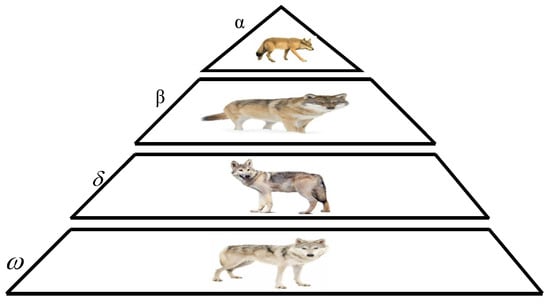
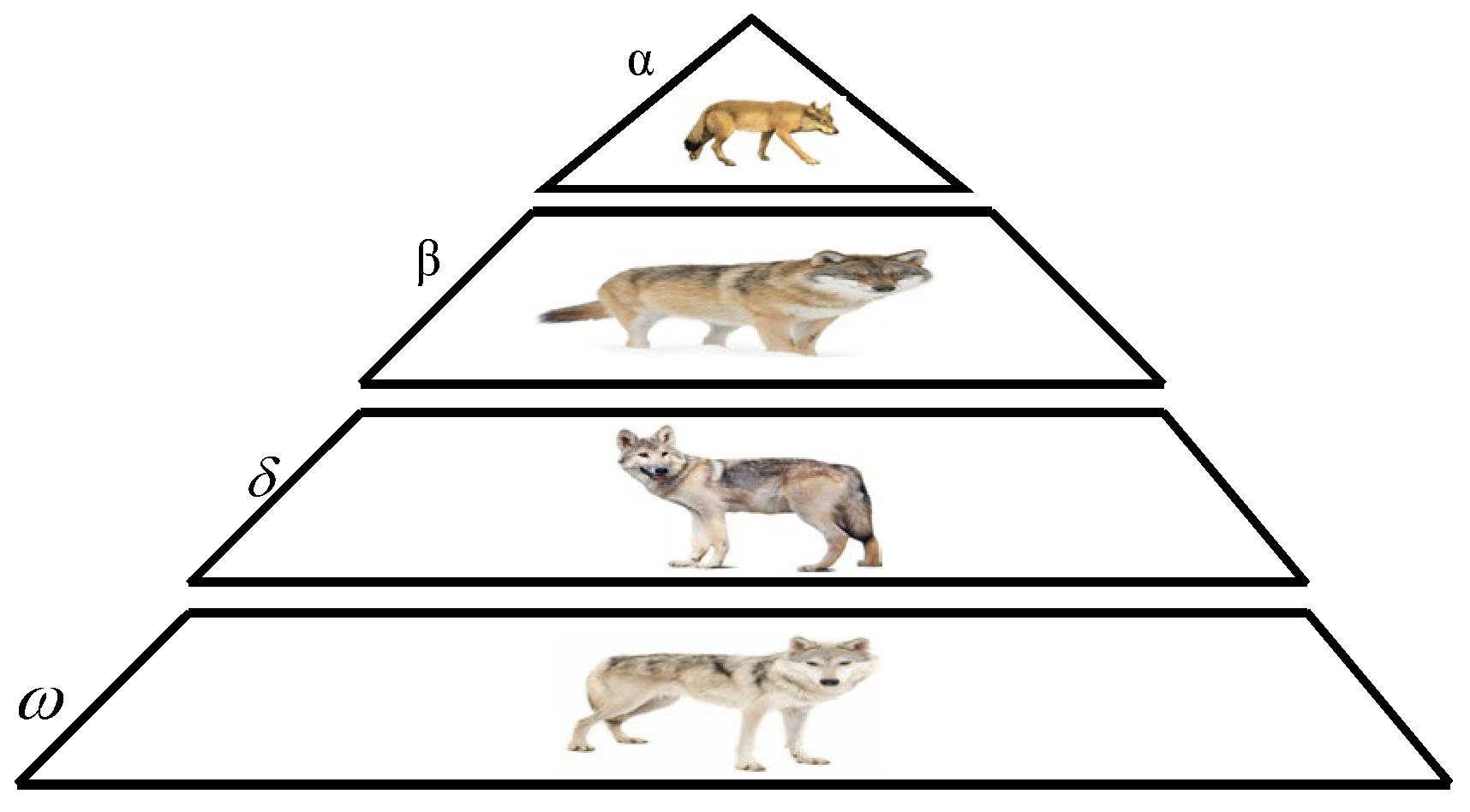
Bio-inspired swarm intelligence algorithms simulate the intelligent behaviours of biological groups in nature, such as self-organization, adaptability, and co-evolution. They provide effective methods for the analysis, modelling, and control of complex systems, as well as a new idea and technology for solving complex optimization problems. This bio-inspired concept indicates that inspiration can be derived from the survival patterns of organisms in nature to develop more innovative technologies and methods. The novel swarm intelligence optimization algorithm, the grey wolf optimizer (GWO), was proposed by Australian scholar Seyedali Mirjalili in 2014. Its inspiration originates from the unique predatory behaviours of grey wolf packs, a social animal species in nature. It achieves optimization primarily by simulating the following three phases of grey wolves’ foraging process: tracking prey, surrounding prey, and ambushing prey, which reflect the cooperative mechanism of grey wolves [26]. In the social system of grey wolves, wolf packs engaged in collective hunting have a clear hierarchical structure, which is divided into the following four ranks from highest to lowest: α, β, δ, and ω wolves, as shown in Figure 1. Specifically, alpha wolves serve as leaders; beta and delta wolves assist alpha wolves in decision-making and direct omega wolves to execute tasks. In other words, alpha, beta, and delta wolves guide the search direction of the grey wolf pack, while omega wolves follow and converge toward the optimal solution. Compared with other metaheuristic algorithms, the GWO algorithm features a simple structure, few parameters, strong global search capability, and excellent optimization performance, thus being widely applied in the field of optimization [27,28,29,30,31,32,33,34,35,36,37,38,39,40,41].
Figure 1.
Schematic diagram of the social hierarchy of grey wolves.
3.1. Encircling Prey
When grey wolf packs hunt, they primarily achieve the goal of surrounding prey (the current optimal solution) by adjusting their individual positions to gradually approach the prey. The mathematical expression for this behaviour is:
where denotes the position of the prey after the tth iterative evolution, i.e., the position of the optimal solution to the problem; represents the position of an individual grey wolf after the th iterative evolution; is the distance between the position of the individual grey wolf and that of the prey; is the iteration counter; and the coefficient vectors and are defined as follows:
where denotes the maximum number of iterative evolutions; and are random vectors within the interval [0, 1]; and is a convergence factor that linearly decreases from 2 to 0.
3.2. Hunting
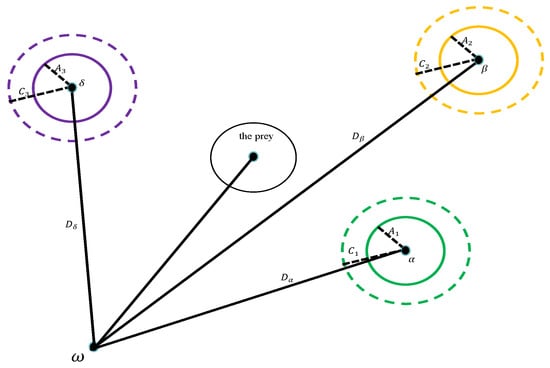
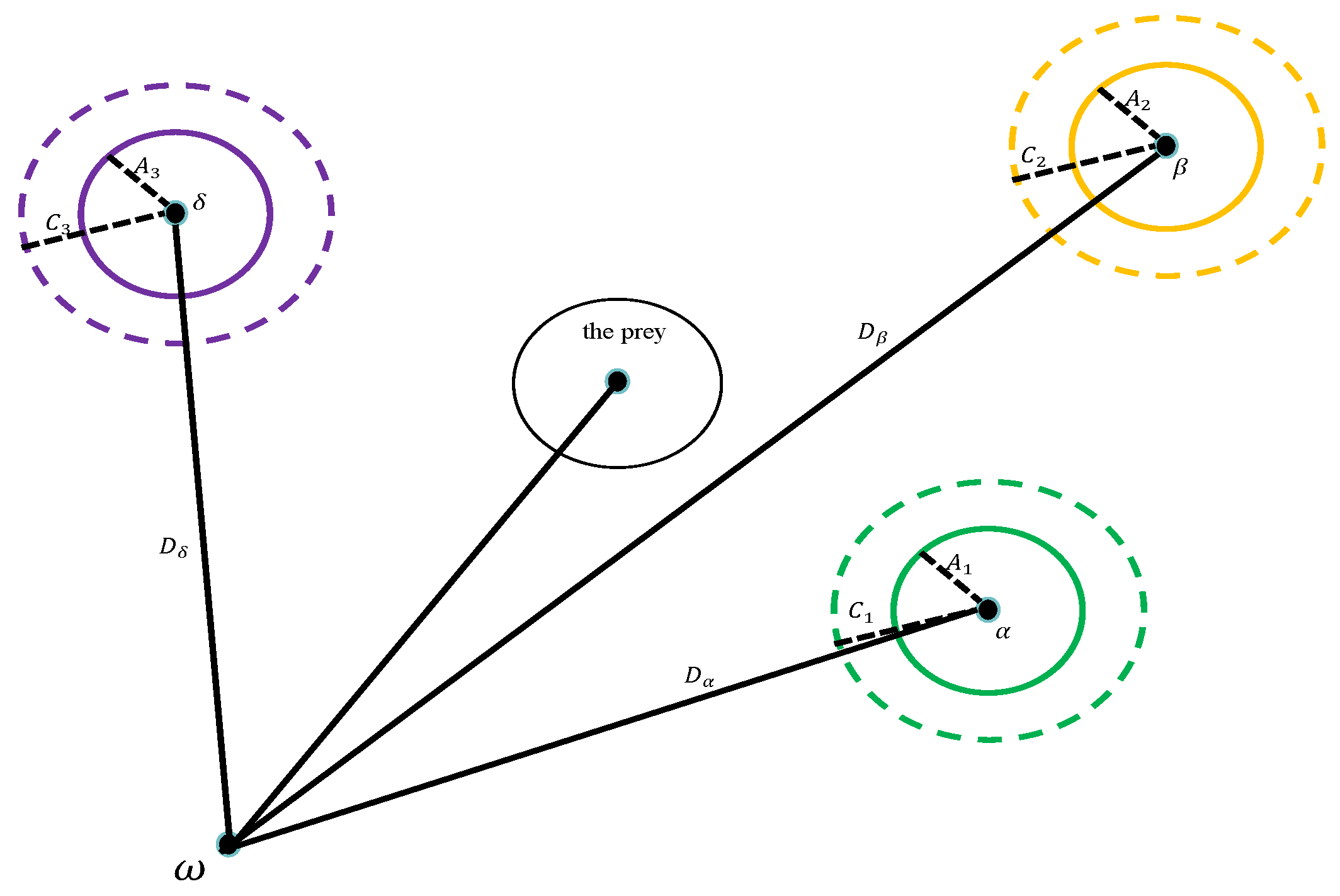
In nature, grey wolf packs exhibit exceptional hunting capabilities: they can keenly identify the prey’s position and subsequently encircle it. During the hunting process of wolf packs, the α wolf typically dominates the entire operation and plays a leading role. β and δ wolves assist the α wolf in managing ω wolves, and they also actively participate in actual hunting when necessary. However, in practical application scenarios, accurately determining the specific position of the prey (target) is an extremely challenging task. If we can more precisely grasp the valuable information about the potential position of the hunting target held by the α wolf (the optimal candidate solution), β wolves, and δ wolves, we can skillfully utilize this information to optimize the search process. Based on this, the grey wolf optimizer (GWO) adopts the following hunting strategy: the positions of the α, β, and δ wolves are regarded as the top three candidate solutions, and other members of the pack (ω wolves) can update and adjust their own positions according to these three optimal candidate solutions to gradually approach the prey. The mathematical model of this mechanism is expressed as Equations (16)–(18).
where , , and denote the positions of the α, β, and δ wolves in the current generation, respectively; , , and represent the distances between the individual wolf and the α, β, and δ wolves in the current generation, respectively; and , and are the weight coefficients for evolutionary search step size, which determine the speed of prey search.
where , , and are convergence factors.
where denotes the updated position of the individual wolf in the th generation, which is updated based on the positions of the α, β, and δ wolves. The schematic diagram of its position update is shown in Figure 2.
Figure 2.
Position updating of the wolves.
3.3. Attacking Prey
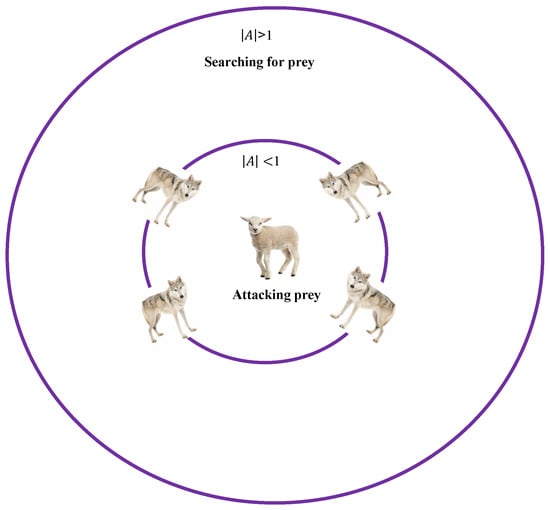
During the grey wolf pack’s hunting process, once the prey stops moving, the pack initiates an attack until the hunt is completed. Herein, the value range of vector A is [−2, 2], and the parameter a gradually decreases from 2 to 0, thereby simulating the pack’s attack on the prey. Overall, in the evolutionary optimization process of the grey wolf optimizer (GWO), the potential position of the prey is first determined based on the locations of the α, β, and δ wolf. Subsequently, other grey wolf individuals ω in the pack update their positions relative to the target prey to be encircled. As the evolutionary iterations progress, the parameter gradually decreases from 2 to 0. This variation characterizes the pack’s processes of extensive search and local exploration for the prey, from the perspective of intelligent algorithms, which embodies the optimization logic of exploitation and exploration. For the GWO, when < 1, the grey wolf pack attacks the prey; when > 1, the pack searches for the prey. Details are illustrated in Figure 3.
Figure 3.
Searching for and attacking prey.
To gain a better understanding of the principles of the standard GWO, the pseudocode of the GWO is presented in Algorithm 1.
| Algorithm 1: Pseudocode of the standard GWO |
|
4. Improved Multi-Objective Grey Wolf Optimizer (IMOGWO)
Although the grey wolf optimizer (GWO) features a simple structure, few parameters, and easy implementation, it still has inherent drawbacks: first, the algorithm relies on the leading wolf mechanism. If the initial population is unevenly distributed or the leading wolves fall into local optima, premature convergence is likely to occur. Second, the imbalance between global exploration and local exploitation capabilities leads to a decrease in population diversity during the algorithm’s evolution, making it more prone to premature convergence; third, the fixed position update formula weakens the ability to explore the solution space of complex problems, resulting in insufficient precision especially when dealing with high-dimensional and multimodal problems. Therefore, to improve the algorithm’s global search efficiency, enhance its ability to jump out of local optima, and adapt to applications in more complex scenarios, it is necessary to modify the GWO to improve its performance and applicability. This enables it to more effectively solve practical optimization problems in logistics distribution and enhance the effectiveness of its applications.
The logistics distribution optimization problem exhibits significant characteristics such as nonlinearity, non-convexity, complex constraints, and a discrete decision space, making it a typical NP-hard problem. Given these constraints, the traditional grey wolf optimizer is inadequate to effectively solve logistics distribution optimization problems. To this end, this paper improves the standard GWO from the following three aspects: first, a chaos-mapping mechanism is introduced for the initialization of the grey wolf population. Utilizing the ergodic property of chaos mapping, uniformly distributed grey wolf individuals are generated in the evolutionary space to ensure the diversity of the initial population. Such an initial population can cover the region where the optimal solution resides, thereby improving the global optimization capability of the GWO; second, a cosine-type nonlinear function is adopted to reconstruct the linearly convergent factor a, which better simulates the hunting behaviour of grey wolves in nature, expands the search range, and helps the algorithm jump out of local optima; and third, a hunting mechanism based on learning factors is introduced to reflect the learning and guiding abilities of the α wolf, β wolf, and δ wolf towards other grey wolf individuals. This achieves the goal of “those who are capable do more” and improves optimization efficiency.
4.1. Population Initialization via Chaos Mapping
The standard GWO initializes its population using a random method, which may result in an uneven distribution of initial solutions. This can lead to over-concentration in certain search areas while leaving others uncovered, thereby reducing population diversity and increasing the risk of falling into local optima. Moreover, as the quality of initial solutions is uncontrollable, the algorithm’s convergence speed may slow down, particularly in high-dimensional problems where random points tend to cluster in edge regions, overlooking potentially superior central solution spaces. Additionally, the results of random initialization are highly sensitive to random seeds, leading to low algorithm stability. Therefore, population initialization is a crucial step influencing both the convergence speed and solution quality of the algorithm. Inappropriate initialization methods may undermine its solving performance.
Aiming at the uneven population distribution caused by the random initialization mechanism of the standard GWO and the consequent tendency to fall into local optima, this paper adopts a chaotic mapping mechanism to initialize the grey wolf population. With its inherent ergodicity and randomness, chaotic mapping can generate more evenly distributed individuals in the search space while maintaining necessary stochasticity. Compared to traditional random methods, chaotic initialization significantly enhances the global exploration capability of intelligent algorithms and enables initial solutions to be closer to potential optimal regions. This paper selects the logistic chaotic mapping mechanism to carry out the initialization of the grey wolf population. This mapping is simple in structure, computationally efficient, and exhibits more uniform ergodicity, which can effectively balance the exploration and exploitation abilities of the algorithm, thereby laying a solid foundation for the subsequent optimization process, as specifically shown in Equation (19).
where is a random number in the interval [0, 1], is a control parameter ranging from 0 to 4, and represents an individual in the population generated via the logistic chaotic mapping.
4.2. Cosine-Based Convergence Factor
In GWO, the convergence factor is a key parameter for balancing global exploration and local exploitation of the algorithm. Since the hunting behaviour of grey wolf populations exhibits highly nonlinear characteristics, the traditional linear convergence factor struggles to accurately simulate their dynamic search process. To more effectively coordinate search strategies, the algorithm requires a larger a value in the early stages to promote broad exploration of the solution space and avoid premature convergence to local optima. In later stages, should gradually decrease to guide the algorithm toward focused fine-scale search within local regions, thereby enhancing convergence efficiency. For this purpose, this paper reconstructs the variation pattern of using a cosine-type function to replace the linear decreasing approach, better simulating the adaptive hunting behaviour of grey wolves in nature, as specified in Equation (20).
where denotes the initial value of , represents the current iteration number, and is the maximum number of iterations.
4.3. Hunting Mechanism Based on Learning Factors
In GWO, the hunting actions are primarily guided by the average positions of the α, β, and δ wolves. To some extent, this approach fails to fully utilize the learning and guidance capabilities of the two superior wolves α and β, which may consequently reduce the efficiency of the hunting process. To address this, this paper introduces the concept of learning factors. When other wolves update their positions by learning from the superior individuals α, β, and δ, learning factors are defined to reflect the varying levels of learning guidance capability that each of these leading wolves provides to the other individuals. This improvement helps other grey wolf individuals to rapidly enhance their prey-hunting ability, thereby boosting the global optimization performance of all wolves. The specific definition is given in Equation (21).
where denotes the number of objective functions. Thus, by introducing the learning factor, Equation (18) can be rewritten as:
4.4. Pareto Optimal
In the framework of standard multi-objective optimization, there exist at least two conflicting targets that need to be subjected to simultaneous optimization; their optimal solutions are derived from a set of feasible alternatives, namely the Pareto-optimal set. In this set, no individual solution is subject to domination by any other member. The specific definitions of domination and Pareto optimality are presented below:
Definition 1.
(Dominance) With respect to minimization-oriented optimization problems, given two feasible solutions, the solution
dominates the solution (written as ). Mathematically, this can be represented as:
Definition 2.
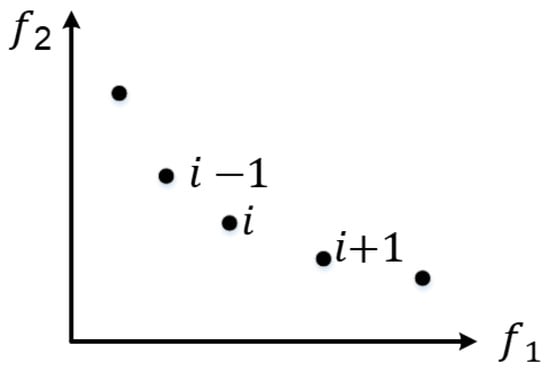
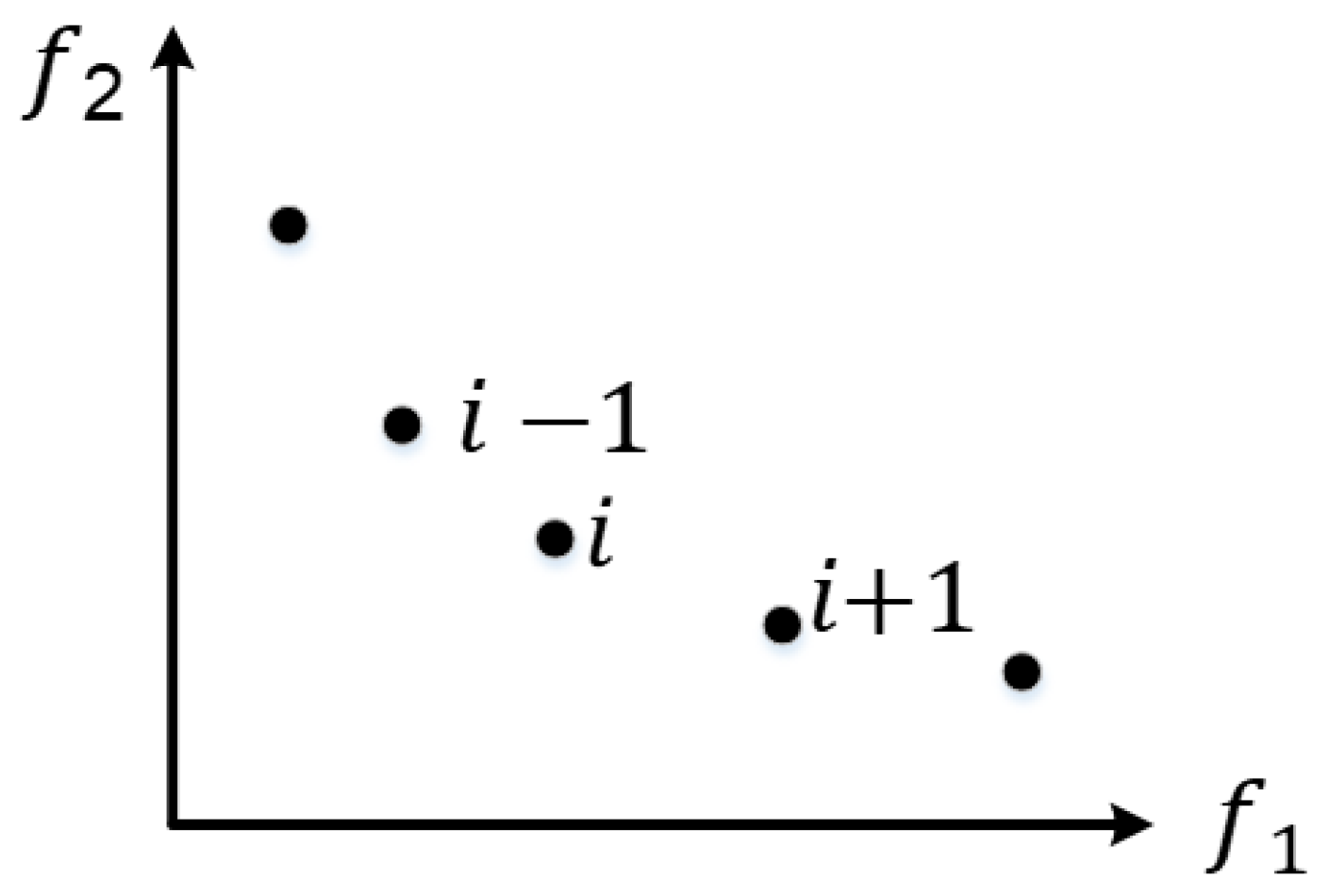
(Crowding distance) During the algorithm evolution process, the number of generated non-dominated solutions may exceed the archive capacity, which necessitates the establishment of optimal solution retention rules. To guide the algorithm toward evolving toward the global optimal solution, it is essential to maintain the diversity of the solution set in the external archive. For this purpose, this paper sorts all non-dominated solutions in the external archive based on the crowding distance to evaluate the sparsity of their distribution in the objective space. Herein, the crowding distance of an individual is illustrated in Figure 4, and its mathematical definition is given in Equation (24).
where denotes the crowding distance of the individual, and represent the th objective function values of the th and th, respectively.
Figure 4.
Representation of the crowding distance.
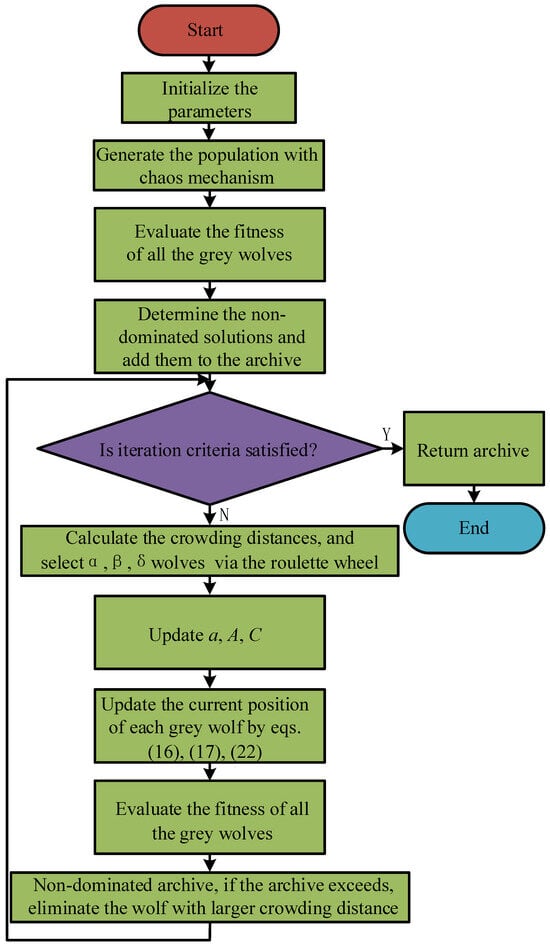
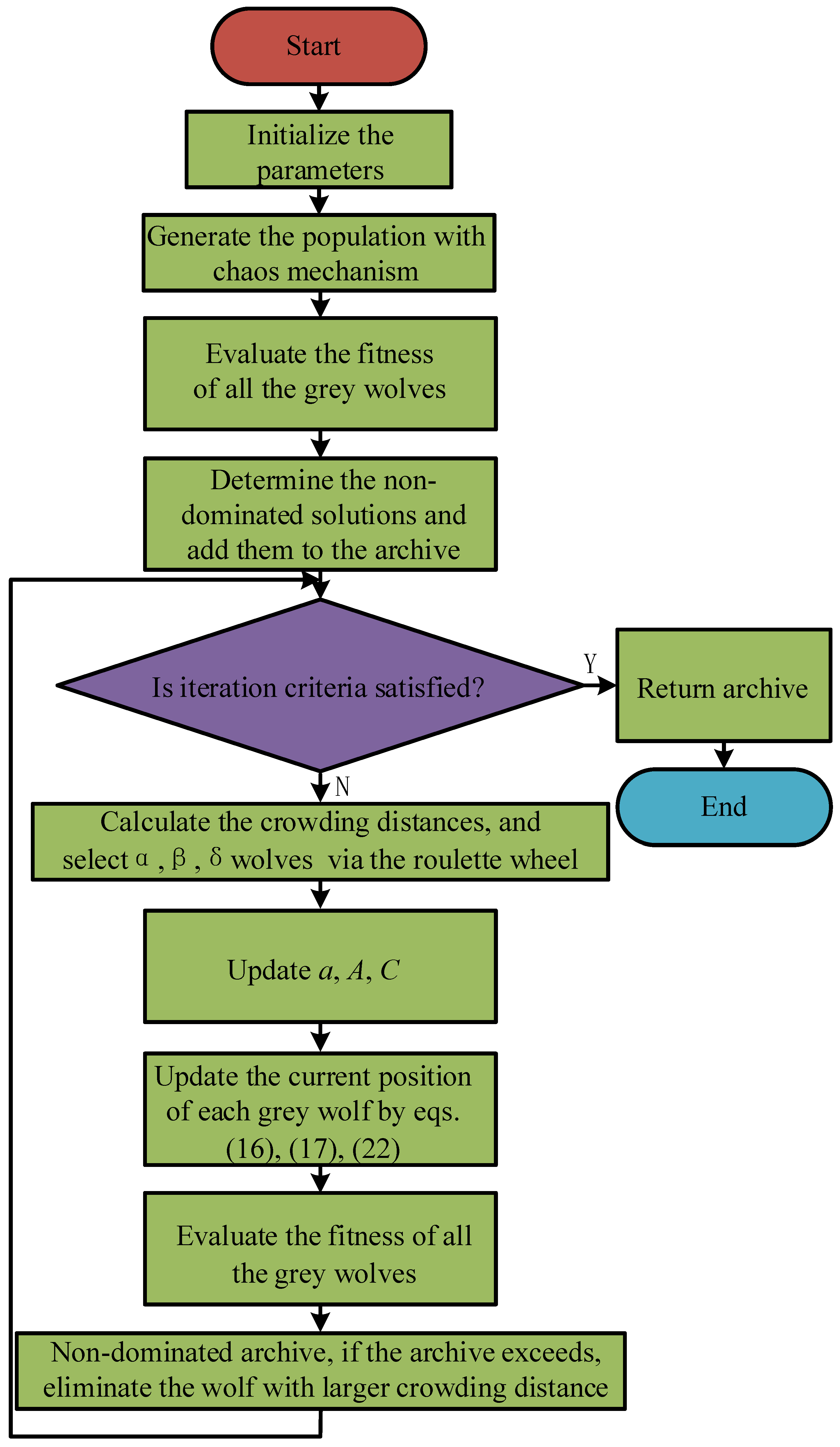
In summary, by integrating the three aforementioned improvements into the iterative process of the GWO, the pseudocode of the improved algorithm can be obtained as shown in Algorithm 2, and the flowchart of the proposed IMOGWO is illustrated in Figure 5.
| Algorithm 2: Pseudocode of the IMOGWO |
| 1. Initialize the population size , the maximum iteration number |
| 2. Based on the chaos mechanism, the grey wolf population () is initialized using Equation (19) |
| 3. Evaluate the fitness of all individuals in the grey wolf population; subsequently, the non-dominated solutions are added to the archive based on Pareto dominance relationships |
| 4. While ) |
| 5. Calculate the crowding distances of all grey wolf individuals in the archive; subsequently, three grey wolves are selected via the roulette wheel selection method and designated as , , and , respectively |
| 6. Update , and by Equations (13)–(15) |
| 7. for each grey wolf |
| 8. Update the current position of each grey wolf by Equations (16), (17) and (22) |
| 9. end for |
| 10. Evaluate the fitness of the newly generated grey wolves; subsequently, the non-dominated solutions are archived based on Pareto dominance relationships. Then, if the archive size exceeds the upper limit, the grey wolf individuals with larger crowding distances are eliminated |
| 11. t = t + 1 |
| 12. end while |
| 13. Return archive |
Figure 5.
Flowchart of the proposed IMOGWO.
4.5. Convergence Proof for the IMOGWO
Theorem 1.
The objective value sequences of α, β, and δ wolves must converge to the optimal Pareto front.
Proof.
Let the sequences of α, β, and δ wolf be denoted as , and , respectively. Define as the distance from to the true Pareto front PF*. Due to the non-dominated archiving performed in each generation of the IMOGWO, is monotonically non-increasing and bounded below by 0. By the monotone convergence theorem, we obtain . Assume that . Then, there exists a point , such that , which contradicts the fact that is a non-dominated solution. Hence, . Similarly, the convergence of and can be proved. Thus, the proposition is established. □
Theorem 2.
The population state sequence of the IMOGWO is a homogeneous finite Markov chain.
Proof.
First, the population size of the multi-objective grey wolves is fixed. The state of each grey wolf individual is represented by its position in the decision space, i.e., the distribution of positions in the decision space. Therefore, all possible combinations of grey wolf population states constitute a finite state space , where M is the number of all possible position distributions of the grey wolves in the population. Second, in the IMOGWO, the position update of a grey wolf individual depends only on α, β, and δ wolves in the current population. That is, the next population state St+1 depends solely on the current state St and is independent of the historical states ,,…. Hence, the population state sequence of the multi-objective grey wolf optimizer possesses the Markov property. Finally, the position update formulas of the grey wolf individuals in IMOGWO remain unchanged throughout the iterative evolution process. Consequently, the state transition probability of the grey wolf population, , is independent of time t; i.e., the state transition probability depends only on the current state i and the next state j, not on the iteration count. This satisfies the homogeneity condition. Thus, the proposition is proved. □
Theorem 3.
The population sequence of the IMOGWO converges to the optimal Pareto front with probability 1.
Proof.
Let denote a solution in the population at iteration t, i.e., it belongs to the optimal Pareto front; then, by Theorem 1 and Theorem 2 it can be shown that
Furthermore, from Equations (21) and (22), it can be derived that
Therefore,
The proposition is thus proved. □
4.6. Performance Analysis of the IMOGWO
To comprehensively and systematically verify the solution performance of the improved multi-objective grey wolf optimizer (IMOGWO), a comparative analysis is conducted against five other state-of-the-art multi-objective optimization algorithms reported in the literature, namely MOFOA [42], MSOMA [43], MOEO [44], MOCOVIDOA [45], and MOMPA [46]. This comparison aims to evaluate the stability and solution quality of IMOGWO in solving optimization problems. A set of representative multi-objective test functions is selected as follows: the ZDT series ZDT1, ZDT2, ZDT3, ZDT4, and ZDT6, whose mathematical expressions are presented in Table 2. These functions exhibit diverse characteristics (unimodal/multimodal), varying decision variable dimensions (10 D, 30 D, and 60 D), and different Pareto front shapes (convex, non-convex, discrete, etc.), enabling a comprehensive assessment of the performance of the IMOGWO across problems of varying complexity. Thus, the selected benchmark functions can effectively evaluate the capabilities of the IMOGWO in escaping local optima, solution efficiency, robustness, and generalization. To ensure fairness, all algorithms are configured with a population size of 100 and a maximum of 100 iterations. Each experiment is independently repeated 30 times under the same computational environment as follows: MATLAB R2016b, Intel(R) Core(TM) i5-7500 3.40 GHz processor, and 16 GB RAM.
Table 2.
Details about benchmark functions.
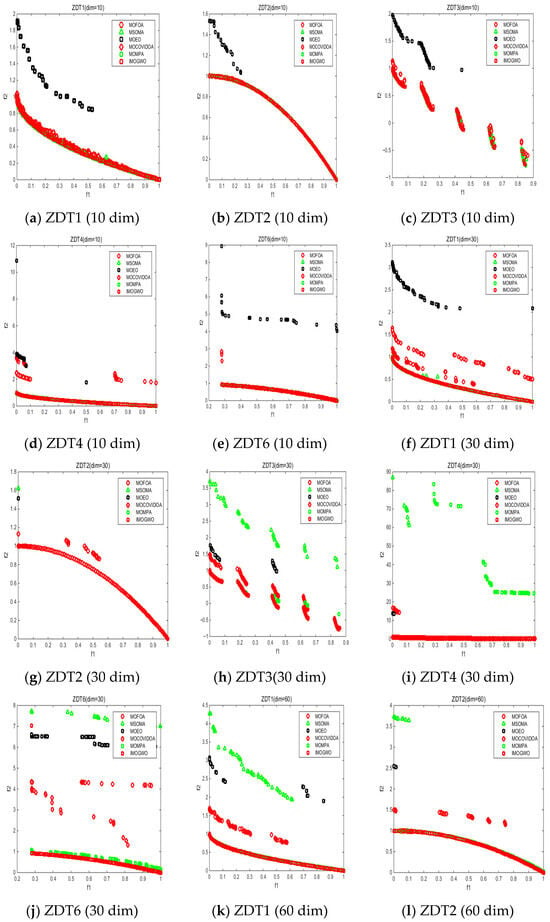
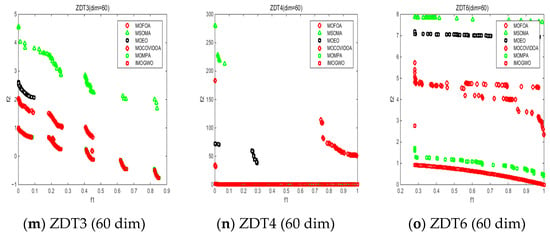
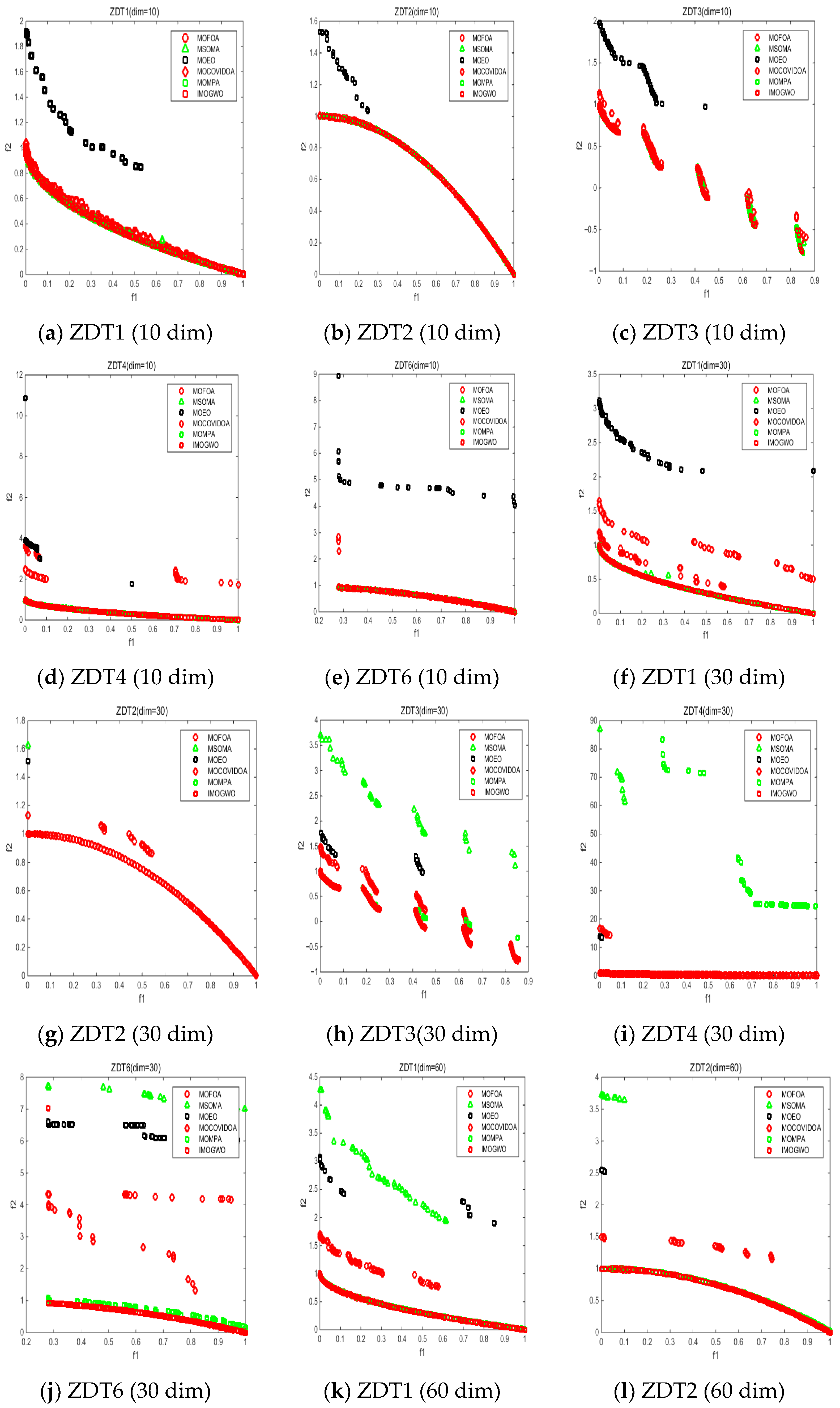
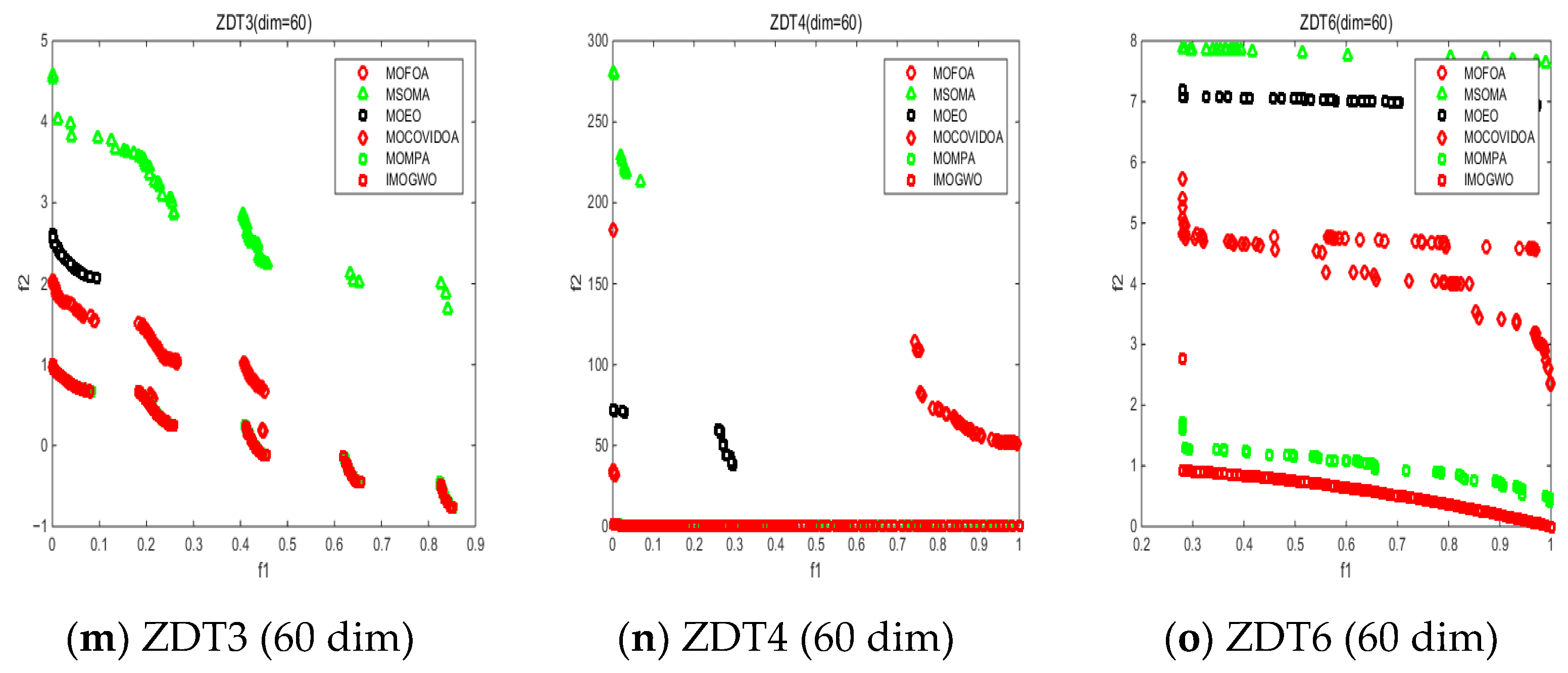
Furthermore, four assessment metrics including IGD, Spacing, Spread, and HV are utilized to gauge the performance of the algorithms [46]. Their average (M) and standard deviation (sd) are computed for the analysis of comparative indices. The corresponding comparison results are tabulated in Table 3, Table 4 and Table 5. Meanwhile, the Pareto frontier obtained are illustrated in Figure 6.
Table 3.
Statistical analysis of the ZDT functions (10 dim).
Table 4.
Statistical analysis of the ZDT functions (30 dim).
Table 5.
Statistical analysis of the ZDT functions (60 dim).
Figure 6.
Comparison of Pareto frontiers obtained by various algorithms.
From Figure 6 and Table 3, Table 4 and Table 5, it can be seen that for the ZDT series of multi-objective benchmark functions, IMOGWO outperforms other algorithms on evaluation metrics GD, HV, Spread, and Spacing across 10, 30, and 60 dimensions. This demonstrates that IMOGWO possesses strong global optimization capability and high robustness. Specifically, IMOGWO exhibits better solving performance than other algorithms even in the low-dimensional case of 10 dimensions. Although its convergence on ZDT4 and ZDT6 becomes comparatively worse than that of MSOMA and MOMPA when the dimensionality increases from 10 to 30 and 60 dimensions, on the whole, IMOGWO shows a more pronounced advantage in solving performance as the dimensionality of the ZDT series benchmark functions increases. The superior global exploration and local exploitation capabilities of IMOGWO are primarily attributed to the following three improvement mechanisms implemented in the grey wolf optimizer in this study: the chaotic mapping strategy for population initialization, the cosine-based convergence factor, and the hunting mechanism based on a learning factor. These enhancements enable it to achieve high solution quality and robustness in both low- and high-dimensional problems.
4.7. Results of the IMOGWO on the Real Logistics Distribution Problem
4.7.1. Overview of X Feed Company
X feed company was founded in 2009 and is located in Zhengzhou City, Henan Province. It primarily produces concentrated feed, compound feed, and premixed feed for livestock and poultry. Through continuous improvement and upgrading of its products, the company has steadily increased its market share year by year, becoming a well-regarded producer of livestock and poultry farming products in Henan. With the annual growth in customer business volume, intensifying market competition, and rising customer demands for delivery timeliness and service quality, the company’s feed distribution operations are facing significant challenges. Therefore, it is imperative for the company to optimize its logistics and distribution services to maintain its market position. This paper focuses on conducting an in-depth study of the actual business scenario in which the feed company distributes live pig feed to its numerous customers, with the aim of exploring the solution performance demonstrated by IMOGWO in addressing the logistics distribution multi-objective optimization problem.
4.7.2. Logistics Distribution Case Test of X Feed Company
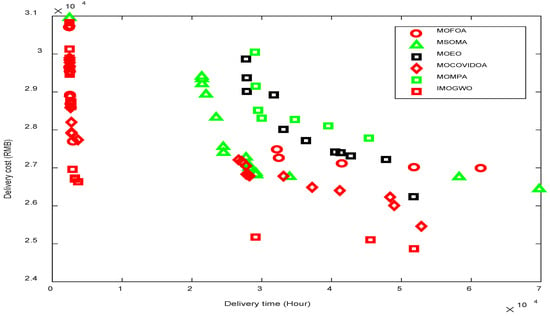
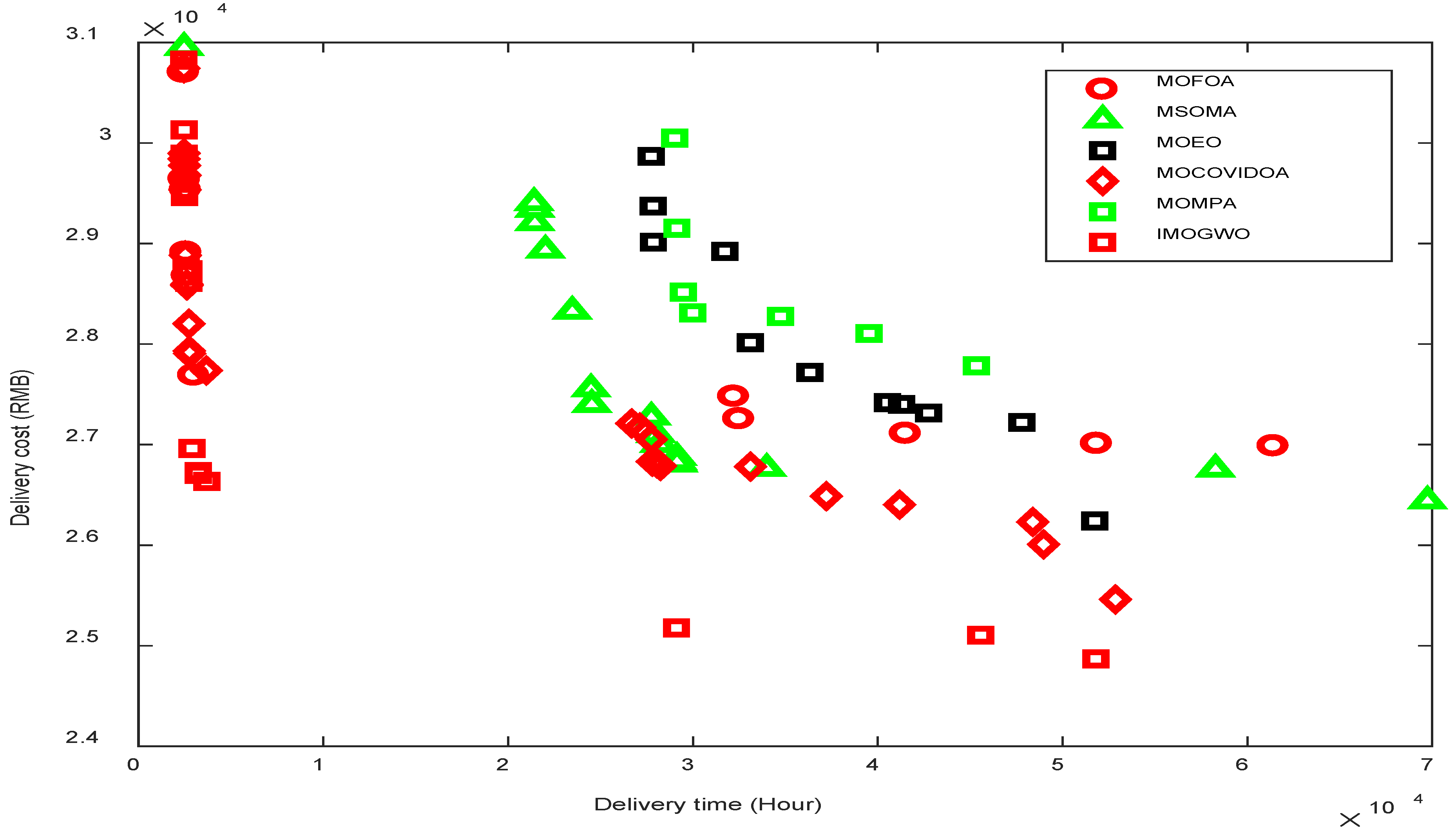
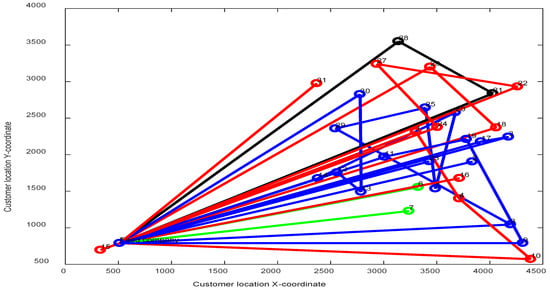
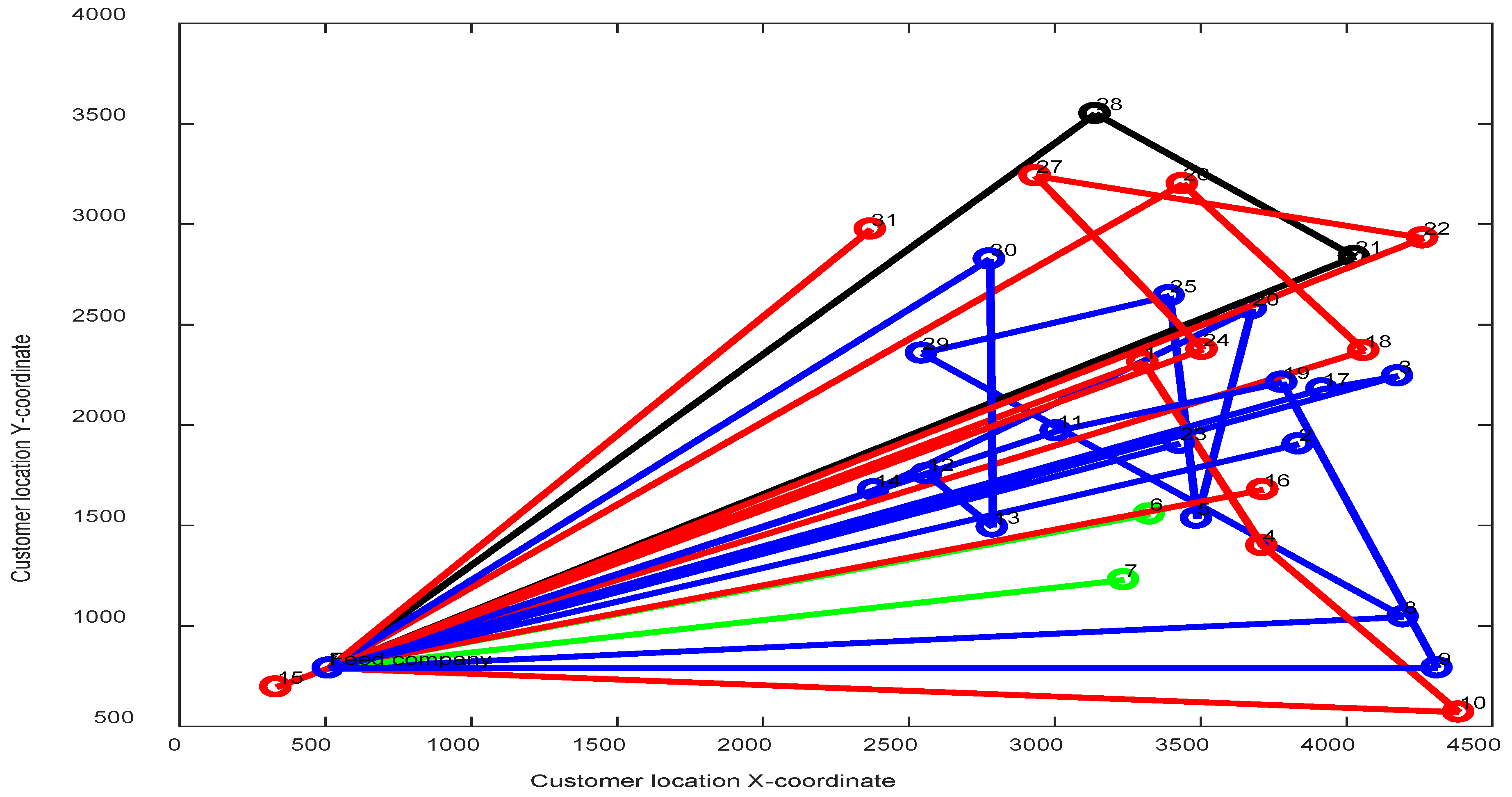
The specific geographic location information of customer delivery points is shown in Table 6. The vehicles participating in the distribution are of the same model, with a maximum load capacity of 40 tons. Each vehicle incurs a dispatch cost of RMB 350, a fuel consumption rate of 0.15 L per kilometre, a fuel cost of RMB 8 per litre, and an average travel speed of 50 km per hour. To verify the performance of the proposed IMOGWO algorithm in solving the multi-objective optimization problem for logistics distribution, a delivery case with a scale of 31 customers was tested. Additionally, each customer’s order must be delivered by exactly one vehicle. The specific test results are presented in Figure 7 and Figure 8, and Table 7.
Table 6.
Customer information.
Figure 7.
Comparison of each algorithm-generated Pareto.
Figure 8.
The distribution solution obtained by IMOGWO.
Table 7.
The specific delivery route of obtained by the IMOGWO.
Figure 7 demonstrates that the Pareto optimal frontier obtained by the improved multi-objective grey wolf optimization algorithm proposed in this paper is of significantly higher quality than those derived from the other five algorithms, providing a better reference for decision-making in feed distribution schemes for the feed production enterprise. This further demonstrates that the chaotic mapping-based population initialization strategy, cosine-type convergence factor, and learning factor-based hunting mechanism enable the grey wolf optimizer to be better adapted to the characteristics of the multi-objective optimization problem for customer hierarchy-based logistics distribution. Specifically, the chaotic mapping realizes uniform population distribution; the cosine-type convergence factor balances the algorithm’s exploration capability in the early iteration stage and exploitation capability in the later stage; and the learning factor-based hunting mechanism accurately matches the differentiated demands of customer hierarchies. Collectively, these improvements contribute to obtaining superior Pareto solutions for the multi-objective optimization of distribution cost, timeliness, and customer satisfaction.
Meanwhile, as shown in Figure 8, when customer hierarchy is considered in feed distribution, the delivery routes of the same vehicle exhibit intersections. From a single-objective distribution optimization perspective, such routes would not be considered optimal. This further confirms that higher hierarchy customers indeed receive prioritized delivery to a certain extent in this study, thereby implicitly enhancing customer satisfaction. This finding offers valuable guidance for feed companies in improving service quality and maintaining customer loyalty. Additionally, based on the delivery routes of each vehicle presented in Table 7, it can be further observed that the routes are not strictly arranged in descending order of customer hierarchy. The reason for this lies in the fact that some higher hierarchy customers are geographically dispersed relative to others. Consequently, if deliveries were strictly prioritized by hierarchy, logistics costs would increase significantly. This clearly demonstrates that the proposed hierarchical delivery strategy is not a simple case of “priority by hierarchy,” but rather a systematic approach that intelligently balances timeliness and service differentiation under cost constraints. It provides actionable decision-making guidance for logistics enterprises to achieve refined management characterized by “service stratification and cost controllability.” This further validates the effectiveness and feasibility of the customer hierarchy-based distribution strategy proposed in this paper.
4.7.3. Managerial Implication for Logistics Enterprises
Based on the improved IMOGWO and the customer hierarchical delivery model proposed in this study, it is recommended that logistics enterprises establish a customer hierarchy dynamic route planning system in their actual operations. Specifically, while ensuring overall delivery costs are controllable, the system can prioritize meeting the timeliness requirements of high hierarchy customers. By dynamically balancing the relationships among customer hierarchy, geographical distribution, and route efficiency through algorithmic optimization, a balance between service quality and operational costs can be achieved. Enterprises can develop an intelligent scheduling decision support system based on this model. This approach not only enhances the satisfaction of key customers but also avoids route redundancy caused by rigid hierarchical prioritization, thereby achieving a scientifically sound and practically feasible management optimization outcome that balances customer relationship maintenance with logistics efficiency improvement.
5. Conclusions
This paper addresses logistics distribution shortcomings by proposing a customer hierarchy-integrated multi-objective optimization model. An improved multi-objective grey wolf optimization (IMOGWO) algorithm is developed to solve it. Tested on standard benchmarks, its three improvement mechanisms effectively balance exploration and exploitation, mitigating premature convergence. A practical case study in feed distribution demonstrates that IMOGWO significantly outperforms five existing algorithms, confirming its feasibility and effectiveness for logistics optimization. Focusing solely on order size to define customer hierarchy in this paper has certain limitations, such as ignoring key factors like timely payment collection and cooperation stability, which can easily lead to overestimating high-order but high-risk customers. The next step will be to gradually refine the customer hierarchy model to better serve logistics and distribution enterprises. Considering China’s dual-carbon goals and the promotion of new energy vehicles, future work should incorporate factors like multimodal transport involving both fuel and electric vehicles. Subsequent research will thus integrate electric vehicles and explore multi-objective optimization for multimodal distribution models to better support these national objectives.
Author Contributions
Conceptualization, J.Z. and Y.C.; methodology, J.Z. and W.Y.; software, J.Z. and G.C.; validation, J.Z., G.C., and W.Y.; formal analysis, J.Z. and W.Y.; investigation, J.Z.; data curation, J.Z.; writing—original draft preparation, J.Z.; writing—review and editing, J.Z., G.C., W.Y., and Y.C.; visualization, J.Z.; supervision, W.Y.; project administration, G.C.; funding acquisition, W.Y. and Y.C. All authors have read and agreed to the published version of the manuscript.
Funding
This research was supported by the National Natural Science Foundation of China (No. 62273132) and the Scientific and Technological Project of Henan Province (No. 252102111023).
Data Availability Statement
The original contributions presented in the study are included in the article, further inquiries can be directed to the corresponding author.
Acknowledgments
Thank you for the strong support provided by the above projects to this research.
Conflicts of Interest
The author declares that there are no conflicts of interest.
References
- Ostrowski, K.; Starzec, G.; Starzec, M. The ant colony opimization algorithm applied in transport logistics. Comput. Sci.-AGH 2024, 25, 6360. [Google Scholar]
- Jo, B.J.; Ko, Y.K.; Oh, Y.; Ko, Y.D. Efficient expansion algorithm of urban logistics network for medical products considering environmental impact. Sustainability 2024, 16, 4195. [Google Scholar] [CrossRef] [Scilit]
- Gschwind, T.; Irnich, S.; Tilk, C.; Emde, S. Branch-cut-and-price for scheduling deliveries with time windows in a direct shipping network. J. Sched. 2020, 23, 363–377. [Google Scholar] [CrossRef] [Scilit]
- Lagos, C.; Guerrero, G.; Cabrera, E.; Moltedo, A.; Johnson, F.; Paredes, F. An improved particle swarm optimization algorithm for the VRP with simultaneous pickup and delivery and time windows. IEEE Lat. Am. Trans. 2018, 16, 1732–1740. [Google Scholar] [CrossRef]
- Amorim, P.; Almada-Lobo, B. The impact of food perishability issues in the vehicle routing problem. Comput. Ind. Eng. 2014, 67, 223–233. [Google Scholar] [CrossRef] [Scilit]
- Zheng, C.J.; Sun, K.; Gu, Y.H.; Shen, J.X.; Du, M.Q. Multimodal transport path selection of cold chain logistics based on improved particle swarm optimization algorithm. J. Adv. Transp. 2022, 2022, 5458760. [Google Scholar] [CrossRef] [Scilit]
- Ayough, A.; Khorshidvand, B.; Massomnedjad, N.; Motameni, A. An integrated approach for three dimensional capacitated vehicle routing problem considering time windows. J. Model. Manag. 2020, 15, 995–1015. [Google Scholar] [CrossRef] [Scilit]
- Heidari, A.; Sheikh-Azadi, A.; Hasan-Zadeh, A.; Kazemzadeh, Y. Optimization of carbon emission in an integrated machine-piece scheduling and vehicle routing problem and its solution using MOPSO and NSGAII metaheuristic algorithms. J. Model. Manag. 2024, 14, 25966. [Google Scholar] [CrossRef] [Scilit]
- Franceschetti, A.; Demir, E.; Honhon, D.; Van Woensel, T.; Laporte, G.; Stobbe, M. A metaheuristic for the time-dependent pollution-routing problem. Eur. J. Oper. Res. 2016, 259, 972–991. [Google Scholar] [CrossRef] [Scilit]
- Sadati, M.E.H.; Çatay, B. A hybrid variable neighborhood search approach for the multi-depot green vehicle routing problem. Logist. Transp. Rev. 2021, 149, 102293. [Google Scholar] [CrossRef] [Scilit]
- Kim, N.S.; Janic, M.; van Wee, B. Trade-off between carbon dioxide emissions and logistics costs based on multi-objective optimization. Transp. Res. Rec. 2009, 2139, 107–116. [Google Scholar] [CrossRef] [Scilit]
- Goodson, J.C. A priori policy evaluation and cyclic-order-based simulated annealing for the multi-compartment vehicle routing problem with stochastic demands. Eur. J. Oper. Res. 2015, 241, 361–369. [Google Scholar] [CrossRef] [Scilit]
- Maroof, A.; Ayvaz, B.; Naeem, K. Logistics optimization using hybrid genetic algorithm: A solution to the vehicle routing problem with time windows (VRPTW). IEEE Access 2024, 12, 36974–36989. [Google Scholar] [CrossRef] [Scilit]
- Bai, Q.Y.; Yin, X.Q.; Lim, M.K.; Dong, C.C. Low-carbon VRP for cold chain logistics considering real-time traffic conditions in the road network. Ind. Manag. Data Syst. 2022, 122, 521–543. [Google Scholar] [CrossRef] [Scilit]
- Gomes, D.E.; Gaspar, P.D. Applying a genetic algorithm to a m-TSP: Case study of a decision support system for optimizing a beverage logistics vehicles routing problem. Electronics 2021, 10, 2298. [Google Scholar] [CrossRef] [Scilit]
- Ali, M.; Ng, M.; Dias, R.; Muda, I.; Al-Obaidi, R.; Abdullaeva, B.; Sharma, H.; Abu Al-Rejal, H.M.E.; Hammid, A.T. Providing a mathematical routing-inventory model for the drug supply chain considering the travel time dependence and perishability on multiple graphs. Discr. Dyn. Nat. Soc. 2022, 2022, 4526641. [Google Scholar] [CrossRef] [Scilit]
- Cao, Q.; Cui, J.; Ren, X. Distribution path optimization of multi-center electric refrigerated vehicles under time-varying network. J. Shanghai Marit. Univ. 2024, 45, 32–38. [Google Scholar]
- Zhou, X.; Zheng, Z.; Yang, K.; Lv, Y. Research on time-and-site dependent multi-objective green vehicle routing problem in urban logistics distribution. Control Decis. 2025, 40, 413–422. [Google Scholar]
- Cheng, M.; Xu, J.; Wang, S. A position transform multitasking symbiotic organisms search algorithm for vehicle routing problem in cold chain logistics. Control Decis. 2025, 40, 765–774. [Google Scholar]
- Wang, J.; Chu, L. Route optimization of cold chain logistics and distribution paths for considering charging strategies. Comput. Eng. Appl. 2024, 60, 282–292. [Google Scholar] [CrossRef] [Scilit]
- Xu, L.; Yang, L.; Zhu, W.; Zhong, S. Study on optimization of cooperative distribution path between UAVs and vehicles under rural e-commerce logistics. Comput. Eng. Appl. 2024, 60, 310–318. [Google Scholar]
- Gao, Z.; Jiang, Y. Requests dispatch strategy with delivery constraints. Control Decis. 2024, 39, 2089–2096. [Google Scholar]
- Liu, C.; Chen, H.; Wu, Z. Programming model and optimization algorithm for the mixed fleet vehicle routing problem in urban logistics distribution. Control Decis. 2023, 38, 759–768. [Google Scholar]
- Yu, M.; Hu, X.; Huang, M. Collaborative delivery optimization method of online pharmacy with multi-item order. Syst. Eng. Theory Pract. 2020, 40, 2658–2668. [Google Scholar]
- Peng, Y.; Li, Y. Optimization of truck-drone collaborative distribution route considering impact of epidemic. China J. Highw. Transp. 2020, 33, 73–82. [Google Scholar]
- Mirjalili, S.; Mirjalili, S.M.; Lewis, A. Grey Wolf Optimizer. Adv. Eng. Softw. 2014, 69, 46–61. [Google Scholar] [CrossRef] [Scilit]
- Premkumar, M.; Sinha, G.; Ramasamy, M.D.; Sahu, S.; Subramanyam, C.B.; Sowmya, R.; Abualigah, L.; Derebew, B. Augmented weighted K-means grey wolf optimizer: An enhanced metaheuristic algorithm for data clustering problems. Sci. Rep. 2024, 14, 5434. [Google Scholar]
- Liu, J.Y.; Wei, X.X.; Huang, H.J. An improved grey wolf optimization algorithm and its application in path planning. IEEE Access 2021, 9, 121944–121956. [Google Scholar] [CrossRef] [Scilit]
- Dereli, S. A new modified grey wolf optimization algorithm proposal for a fundamental engineering problem in robotics. Neural Comput. Appl. 2021, 33, 14119–14131. [Google Scholar] [CrossRef] [Scilit]
- Hao, P.; Sobhani, B. Application of the improved chaotic grey wolf optimization algorithm as a novel and efficient method for parameter estimation of solid oxide fuel cells model. Int. J. Hydrogen Energy 2021, 46, 36454–36465. [Google Scholar] [CrossRef] [Scilit]
- Singh, N.; Singh, S.B. A modified mean gray wolf optimization approach for benchmark and biomedical problems. Evol. Bioinform. 2017, 13, 1176934317729413. [Google Scholar] [CrossRef] [Scilit]
- Liang, J.; Du, Y.K.; Xu, Y.P.; Xie, B.W.; Li, W.B.; Lu, Z.H.; Li, R.H.; Bai, H. Using adaptive chaotic grey wolf optimization for the daily streamflow prediction. Expert Syst. Appl. 2024, 237, 121113. [Google Scholar] [CrossRef] [Scilit]
- Du, X.Z.; Yu, T.; Chen, K. An orthodontic path planning method based on improved gray wolf optimization algorithm. Soft Comput. 2023, 27, 16589–16609. [Google Scholar] [CrossRef] [Scilit]
- Khoja, I.; Majdoub, N.; Ladhari, T.; M’Sahli, F.; Sakly, A. Grey wolf optimizer for parameter identification of an activated sludge process model. Soft Comput. 2023, 27, 15293–15304. [Google Scholar] [CrossRef] [Scilit]
- Kalananda, V.K.R.A.; Komanapalli, V.L.N. A competitive learning-based grey wolf optimizer for engineering problems and its application to multi-layer perceptron training. Multimed. Tools Appl. 2023, 82, 40209–40267. [Google Scholar] [CrossRef] [Scilit]
- Ahmad, I.; Qayum, F.; Rahman, S.U.; Srivastava, G. Using improved hybrid grey wolf algorithm based on artificial bee colony algorithm onlooker and scout bee operators for solving optimization problems. Int. J. Comput. Intell. Syst. 2024, 17, 111. [Google Scholar] [CrossRef] [Scilit]
- Kumar, A. Swap operator-based grey wolf optimiser for materialised view selection problem. Int. J. Bio-Inspired Comput. 2024, 241, 140111. [Google Scholar] [CrossRef] [Scilit]
- Ozturk, T.S.K.; Saplioglu, K. Optimum design of diversion weirs with grey wolf optimization. Phys. Chem. Earth 2025, 139, 103899. [Google Scholar] [CrossRef] [Scilit]
- Rabiei, M.; Fartash, M.; Nazari, S. A hybrid optimization approach for graph embedding: Leveraging Node2Vec and grey wolf optimization. J. Supercomput. 2025, 81, 514. [Google Scholar] [CrossRef] [Scilit]
- Hamadou, A.N.S.; Maina, C.W.; Soidridine, M.M. A grey wolf optimiser (GWO)-based RIS phase shift cesign for a RIS-assisted multi-antenna system. IEEE Commun. Lett. 2024, 28, 2171–2175. [Google Scholar] [CrossRef] [Scilit]
- Tsai, H.C.; Shi, J.Y. Potential corrections to grey wolf optimizer. Appl. Soft Comput. 2024, 161, 111776. [Google Scholar] [CrossRef] [Scilit]
- Rizk-Allah, R.M.; El-Sehiemy, R.A.; Deb, S.; Wang, G.G. A novel fruit fly framework for multi-objective shape design of tubular linear synchronous motor. J. Supercomput. 2016, 73, 1235–1256. [Google Scholar] [CrossRef] [Scilit]
- Houssein, E.H.; Mahdy, M.A.; Shebl, D.; Manzoor, A.; Sarkar, R.; Mohamed, W.M. An efficient slime mould algorithm for solving multi-objective optimization problems. Expert Syst. Appl. 2022, 187, 115870. [Google Scholar] [CrossRef] [Scilit]
- Premkumar, M.; Jangir, P.; Sowmya, R.; Alhelou, H.H.; Mirjalili, S.; Kumar, B.S. Multi-objective equilibrium optimizer: Framework and development for solving multi-objective optimization problems. J. Comput. Des. Eng. 2022, 9, 24–50. [Google Scholar] [CrossRef] [Scilit]
- Khalid, A.M.; Hamza, H.M.; Mirjalili, S.; Hosny, K.M. MOCOVIDOA: A novel multi-objective coronavirus disease optimization algorithm for solving multi-objective optimization problems. Neural Comput. Appl. 2023, 35, 17319–17347. [Google Scholar] [CrossRef] [Scilit] [PubMed]
- Jangir, P.; Buch, H.; Mirjalili, S.; Manoharan, P. MOMPA: Multi-objective marine predator algorithm for solving multi-objective optimization problems. Evol. Intell. 2023, 16, 169–195. [Google Scholar]

Disclaimer/Publisher’s Note: The statements, opinions and data contained in all publications are solely those of the individual author(s) and contributor(s) and not of MDPI and/or the editor(s). MDPI and/or the editor(s) disclaim responsibility for any injury to people or property resulting from any ideas, methods, instructions or products referred to in the content. |
© 2026 by the authors. Licensee MDPI, Basel, Switzerland. This article is an open access article distributed under the terms and conditions of the Creative Commons Attribution (CC BY) license.