


Abstract
Two novel spacetimes are introduced in this work as anisotropic preferred reference frames tailored for applications in relativistic quantum information systems. The resulting anisotropic geometry arises intrinsically from the underlying algebraic structure of spin matrices rather than being imposed through external prescriptions, background fields, or perturbative approximations. The associated Lorentz factors, symmetry group structure and metric-preserving transformations are systematically analyzed within the context of relativistic quantum information theory.
1. Introduction
In vacuum, Lorentz symmetry has been extensively validated across a wide range of experiments. Nevertheless, this symmetry can be broken in systems exhibiting strong anisotropic correlations. Notable examples include phenomena involving nonreciprocal light transport and quantum reference frames commonly used in quantum information theory. In such contexts, adopting the medium’s rest frame as the preferred reference frame (rather than the conventional laboratory frame) can offer a more accurate foundation for theoretical modelling. Advancing research in these directions would greatly benefit from the development of a mathematically rigorous framework for anisotropic preferred reference frames.
One area that particularly benefited from anisotropic preferred reference frames is the field of photonics. When the medium’s preferred frame is shifted relative to the laboratory frame either through temporal modulation or actual motion, nonreciprocal light transport can emerge. For example, Ramezani et al. (2018) [1] demonstrated photon localization in a moving photonic lattice generated by spatial–temporal modulation of the atomic response, where the dispersion spectrum exhibits a Doppler shift relative to the probe’s direction. Within an anisotropic preferred frame, such effects could be modelled as direction-dependent nonreciprocity: isolating one propagation axis while preserving reciprocity alongside others. A related study by Yang et al. (2015) [2] also investigated motion-induced nonreciprocity in photonic systems. Another promising application of anisotropic preferred reference frames lies in the study of nonreciprocity within quantum technologies. Nonreciprocity has become a central theme in this domain, enabling functionalities such as directional amplification, quantum information routing and the realization of topologically protected quantum states. Recent experimental advances have demonstrated nonreciprocal behaviour in low-loss, fully integrated platforms that operate with weak (or even no) magnetic bias, achieved through mechanisms including synthetic gauge fields, optomechanical interactions and chiral light–matter coupling [3,4].
A central and highly debated question in relativistic quantum information is whether entanglement and the degree of Bell inequality violation for massive relativistic particles are truly frame-independent. The framework of quantum reference frames addresses this issue by transforming the description to the particle’s rest frame—even when, from the perspective of the laboratory frame, its state is in a superposition of relativistic momenta [5,6]. In distributed quantum systems, a medium whose optical properties are governed by a non-laboratory preferred frame could provide an experimental platform to probe the relativity of quantum reference frames. Despite these pioneering contributions, a significant gap persists in the literature concerning systematic algebraic constructions of anisotropic preferred reference frames for analyzing relativistic quantum information systems. To address this gap, two novel anisotropic spacetime metrics, and . are introduced in this work—and constructed directly from the Hermitian spin-matrix formalism developed by Ganesan (2024) [7]. Existing treatments of spacetime anisotropy typically introduce directional dependence phenomenologically [8,9], impose it axiomatically at the level of the metric or symmetry assumptions [10,11], or generate it perturbatively as a small deviation from an isotropic background [12,13]. In contrast, the present construction yields anisotropic geometry intrinsically, emerging directly from the algebraic structure of the spin matrices themselves rather than from external prescriptions or approximations.
The two new spacetimes are introduced in this work as anisotropic preferred reference frames for applications in relativistic quantum information systems. These frames naturally introduce direction-dependent scaling into the structure of spacetime. The frames can be interpreted as encoding anisotropic information-processing capabilities along different spatial directions. In quantum information theory, qubits, entanglement and quantum channels are inherently sensitive to reference frames and symmetry properties [14]. Anisotropic metrics suggest a generalized notion of relativistic covariance in which information propagation, gate implementation, or entanglement distribution may depend on orientation in spacetime [15,16]. Unlike standard Lorentz-invariant settings, the novel preferred frames proposed in this work define nontrivial internal symmetries that could manifest as anisotropic dispersion relations or directionally dependent phase accumulation (or modified transformation rules) for spinor and qubit states. In this work, spacetime anisotropy arises intrinsically from the underlying spin matrix structure rather than being imposed phenomenologically. Therefore, these frames offer a principled geometric foundation for exploring relativistic quantum information protocols beyond the isotropic Minkowski paradigm—potentially providing new tools for modelling quantum systems in structured media, engineered quantum simulators or anisotropic spacetime backgrounds.
This paper is organized as follows. Section 2 presents the construction of the anisotropic spacetime metric associated with a preferred reference frame (using Hermitian spin matrices). Section 3 describes the utility of the proposed anisotropic metrics in the context of quantum information theory, while Section 4 introduces the corresponding anisotropic Lorentz factors. In Section 5, the underlying group structure is examined and the class of linear transformations that preserve the metric is presented. Section 6 is devoted to the analysis of the resulting anisotropic Lorentz factors and their physical implications. The paper concludes with a summary of the principal results and an outline of directions for future research.
2. Metric Construction
The spacetime metric for the anisotropic preferred frames is constructed using a set of novel Hermitian spin matrices along with its symmetry relation introduced in Ganesan (2024) [7]. With the exception of the involuntary property, the basis in the form of a parametrized spin matrix representation is as follows:
where and the spin matrices given in Equation (1) contain the following symmetry:
The matrices in the spin basis are Hermitian, where . The symmetry property of each spin matrix is symmetrically weighted in all directions by the factor . Similarly to Ganesan (2024) [7], the Hermitian spin matrices in this work are constructed from the Pauli spin matrices as follows:
where the Pauli spin matrices as quantum operators corresponding to observables for the fermionic spin at each spatial direction are . The spin matrices are then defined within another 16-element cyclic group structure: . For the analogue spin matrices, the commutation relations are
where and .
The generalized commutation relation for the analogue spin matrices is then
where is the Levi–Civita symbol in three-dimensions. The inverse of the spin matrices, , are
where and the spin matrices given in Equation (1) contain the following symmetry:
The parameter introduces equivalent weights into the spin matrices for each direction. This property is key in a physical sense to ensure that the analogue spin basis is isotropic in all directions—similar to the Pauli matrices. Similarly to the Pauli group, the analogue spin matrices could also be defined within a 16-element cyclic group structure: . The following commutation relations hold for the analogue spin matrices:
where and .
The generalized commutation relation for the analogue spin matrices is then
where is the Levi–Civita symbol in three-dimensions.
The matrix forms of the dual Minkowski metrics, and , are then constructed using the Weyl representation. This is performed by defining the action of the special linear group, , on the Minkowski metric. A point of spacetime, , is then represented as a two-dimensional Hermitian matrix:
where is the speed of light and , and are spatial coordinates. In the conventional Weyl representation, the form of the Minkowski spacetime is constructed using the Pauli matrices, : , where . On the other hand, using the analogue spin matrices shown in Equation (1), the analogue hyperbolic Minkowski spacetime is obtained:
A similar construction of the Minkowski metric, , could be carried out using the inverse analogue spin matrices yielding the following results:
The matrix form of the metrics, and are then defined as follows:
It can be shown that both and are Hermitian matrices and flat, similarly to the conventional Minkowski metric. The metric signature for and is , similarly to the Minkowski metric. As given in Ganesan (2024) [7], the metrics and map to the Minkowski metric: .
The metrics contain cross terms on the spatial dimensions: and . These cross terms indicate the existence of anisotropy in the spacetime metrics, making it difficult to interpret spacetime intervals and distances. Thus, in this section, the metrics and are diagonalized to obtain a new form of the metric that does contain the cross terms. For the metrics , the -subspace where the cross terms exist is isolated as follows:
To diagonalize , the eigenvalues of are obtained:
It can be observed that when , the eigenvalues . The corresponding eigenvectors are and . Transforming the spacetime coordinates (column vector form) to the rotated reference frame, , results in
The transformation matrix (orthogonal diagonalization), , depicts a 45° angle rotation with
For the metrics , the -subspace where the cross terms exist is isolated as follows:
To diagonalize , the eigenvalues of are obtained: and . Similarly, it can be observed that when , the eigenvalues are not equivalent: . The corresponding eigenvectors are and . Transforming the spacetime coordinates (column vector form) to the rotated reference frame, , results in
As with the case of the transformation matrix (orthogonal diagonalization), , depicts a 45° angle rotation with
In the coordinate system, and , the cross terms vanish and the metric components directly correspond to the squeezing and stretching of spacetime along the orthogonal axes. This simplifies the form of the metrics (i.e., preferred reference frames), and . The eigenvalues represent the scaling factors for these axes. Since for both metrics the eigenvalues are not equal, these systems exhibit anisotropy. For both metrics in Equations (4) and (5) the scaling coefficients in each dimension are constant and are independent of the dimensional coordinates. Thus, it can be easily deduced that the Christoffel symbols vanish: . The Riemann curvature tensor components would also vanish (, establishing that both metrics given in Equations (4) and (5) are effectively flat everywhere.
It is also important to note that although the metrics and are not related to Minkowski space by constant linear maps, they are not equivalent to mere coordinate transformations. The anisotropy arises intrinsically from the fixed algebraic structure of the underlying Hermitian spin matrices and induces a non-orthonormal realization of Lorentz symmetry. As a result, physical observables such as invariant intervals and Lorentz factors acquire a direction-dependent structure that cannot be removed by a passive change in coordinates.
3. Relativistic Quantum Information Systems
The metrics and are conformally related : . The pair of metrics provide a clear and physically grounded framework for modelling quantum information systems, capturing both (i) the algebraic structure of the system and (ii) the operational limits imposed by distinguishability and interference. Specifically, represents the information capacity metric (which encodes the amount of information the system can in principle store along each spatial and temporal direction). This metric exists on the operator algebra and generator space—reflecting the raw bandwidth of the system to encode information independent of what is practically observable. In contrast, represents the operational or observable metric—which captures the magnitude of that stored information that can be distinguished (or measured) through physical operations. The quadratic suppression of the spatial components in arises naturally from quantum interference phenomena—as amplitudes combine linearly but probabilities and distinguishability scale quadratically. Thus, the accessible information is generally much smaller than the stored capacity (especially along directions where redundancy or correlations dominate).
In a quantum information context, the parameter plays multiple interconnected roles—simultaneously controlling information anisotropy, the relative weighting of spatial directions and the normalization of the non-Pauli operator algebra. As varies, it regulates the effective informational bandwidth and the degree to which certain directions dominate or collapse. This produces a natural anisotropy that defines preferred reference frames. This anisotropy emerges automatically from the relationship between the two metrics, specifically from the ratio . This ratio then selects the optimal encoding axes or pointer bases for distinguishable information (without the need to impose any symmetry breaking externally). From a relativistic standpoint, defines a bare causal structure akin to an idealized information capacity cone. On the other hand, defines the physical causal structure—or the information cone that governs how distinguishable states can propagate. The mismatch between these two metrics produces the effective Lorentz factors and direction-dependent light cones, preserving causality while capturing the anisotropic/information-theoretic character of quantum evolution.
Using only one of these metrics would be insufficient, as alone overestimates accessible information and ignores measurement limitations and decoherence, while alone would fail to preserve the algebraic structure necessary for defining unitary evolution and operator norms. In combination, the pair provides a minimal yet complete framework that separates information capacity from operational accessibility, formalizes the emergence of preferred frames and anisotropy and embeds relativistic-like structure naturally into the informational geometry of the system. This makes them both indispensable for accurately modelling the behaviour of quantum information systems.
4. Lorentz Factors
In the context of the diagonalized anistropic spacetime metric given in Equations (4) and (5), distinct Lorentz factors are obtained for boosts in each direction: x, y and z. The theorems involved for obtaining these factors using the and spacetimes are given in Appendix A and Appendix B. The Lorentz factors obtained for both spacetime metrics are as follows:
Appendix C provides plots for the evolution of the Lorentz factors relative to the parameter and relativistic velocity ratio . The flat anisotropic metrics obtained in Equations (4) and (5) could be readily transformed from the Minkowski metric: . For the metric , the component-wise transformation is given in Table 1.
Table 1.
Component-wise anisotropic transformation for the metric
Similarly, for the metric , the component-wise transformations from the Minkowski metric are given in Table 2.
Table 2.
Component-wise anisotropic transformation for the metric
For the transformation and , the transformation matrices are and , respectively.
5. Group Structure and Metric-Preserving Transformations
The set of linear transformations that preserve the metrics and are investigated further. The notation and is used in the following content to simplify the expressions. In this section, the explicit spatial and spatial–temporal anisotropic rotation operators preserving the metric using the condition are presented. The metric has a Lorentzian signature but with anisotropic spatial scales. Thus, the isometry group is a deformed Lorentz group, . The anisotropy in this case is absorbed by a similarity transform. To explicitly identify this set of transformations, the canonical scaling matrix is defined as follows:
Then, the metric relates to the standard Minkowski metric as , where Any metric-preserving transformation is then , with . The following anisotropic transformations form a deformed subgroup, i.e., :
On the other hand, the temporal–spatial rotations form Euclidean-type rotations (i.e., ), represented explicitly as follows:
Similarly, the metric maintains a Lorentzian structure with intrinsic anisotropic spatial weights. As before, its invariance group is a Lorentz group with similarity-deformation. The canonical decomposition is defined by and is the scaling matrix. Hence all metric-preserving spatial rotations are where and the deformed spatial rotations form :
The temporal–spatial Euclidean-type rotations () are then as follows:
It can be observed that the rotations remain exact symmetries, though they are realized with anisotropic mixing coefficients. Anisotropy enters exclusively through metric weights and does not constitute symmetry breaking. Lorentz symmetry is therefore not violated; rather, the Lorentz group is represented in a non-orthonormal basis. Therefore, neither nor breaks or violates Lorentz symmetry. Instead, Lorentz invariance is preserved but realized anisotropically through a similarity transformation of the Minkowski metric. The resulting spacetimes retain the full six-parameter Lorentz group, though spatial isotropy is explicitly absent. Temporal–spatial rotations (boosts) may be obtained through analytic continuation of the rotation parameter, , recovering the usual hyperbolic structure.
It is also important to emphasize that if the proposed anisotropic metrics arose from a mere coordinate transformation, the invariance group would remain manifestly in its standard form. This is not the case here. Instead, distinct invariance subgroups and emerge, and the corresponding generators acquire direction-dependent structure constants. The resulting representations are therefore inequivalent to the usual orthonormal representation. Consequently, the construction constitutes a change in representation rather than a simple re-parametrization of coordinates.
6. Analysis
As observed in the previous section, the diagonalized anisotropic metrics and obtained in Equations (4) and (5) exhibit spatial isotropy at . For the metric , at very large values (), the scaling coefficients . This causes the metric to become highly anisotropic where the spatial components vanish, leaving only the temporal component . From a quantum information perspective, quantum interference dominates at such large values. The quadratic suppression in the metric reflects the fact that amplitudes interfere, so distinguishable probabilities scale at the squared of the amplitude. The spatial generators correspond to large amplitudes in (increased capacity), but the interference causes almost complete cancellation in the operational metric. Highly entangled or strongly correlated degrees of freedom naturally give rise to large composite amplitudes and many nearly degenerate configurations—and this collective structure leads to an effective inflation of . As , extreme anisotropy occurs where one spatial direction (y−direction) carries huge raw capacity, but almost none of that capacity is accessible without enormous measurement resources. This then causes the distinguishable information along spatial directions to vanish. Then, it can be stated that the metric defines a bare causal cone that becomes infinitely wide in certain directions, while the metric defines the physical causal cone, which collapses.
The Lorentz factors and shown in Equations (6) and (7), respectively, correspond to the spacetime metrics, and . The following proportionality applies up to the anisotropic factors, : . In this framework, velocity, , represents the rate at which a quantum state is driven through information space relative to the system’s ability to distinguish states, not physical motion. The associated speed limits encode quantum distinguishability bounds rather than spacetime causality, and their anisotropy reflects the noncommuting structure of the underlying operator algebra. The rate at which the quantum state is being driven through information space is represented as follows:
where is a coordinate on the operator or state (e.g., a generator amplitude, entanglement weight or control parameter) and corresponds to physical time (or circuit depth/evolution parameter).
Consider the evolution of the Lorentz factors, , for large values:
In the limit , all spatial operational Lorentz factors diverge, indicating that resolving spatial motion requires infinite distinguishability cost. This divergence is the dynamical expression of the collapse of the operational metric to a purely timelike form while preserving causal temporal evolution. The divergence of for any fixed becomes imaginary. Thus, the operational boost becomes undefined unless
This is a direction-dependent causal cutoff, not a violation. It is key to note that the divergence does not translate to infinite energy or speed, but it means infinite information cost.
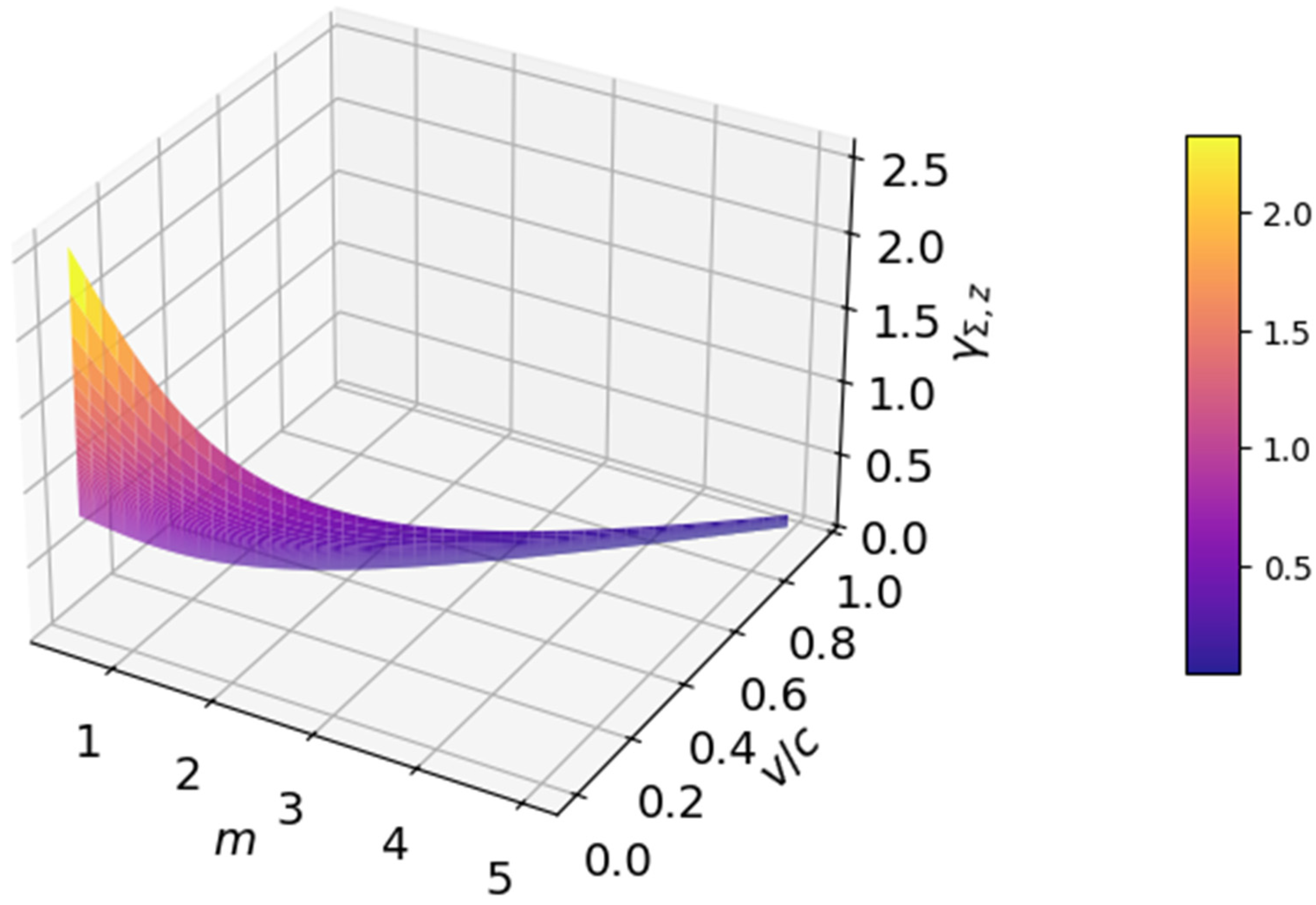
For the case of , it can be observed that at large values, its and components vanish, while the -component remains independent of the evolution of . Since the metric reflects the information capacity, corresponds to a capacity-normalized generator that does not participate in the anisotropic redundancy controlled by . While the and directions acquire infinite degeneracy and their capacity boosts vanish, the -component remains protected and defines the preferred informational axis of the system.
Thus, although the system’s algebraic capacity grows without bound, the effect of any finite informational velocity on capacity becomes negligible in those directions. This is the exact dual of the divergence of , which encodes that spatial distinguishability simultaneously collapses.
7. Key Findings and Potential Research Directions
In this study, two preferred reference frames that realize anisotropic Lorentz symmetry using a set of Hermitian spin matrices were proposed. The framework was specifically designed for applications in relativistic quantum information systems. Analysis of these metrics within this context led to several key findings:
- Mathematical construction of anisotropic preferred reference frames: The spacetimes and are rigorously defined in Equations (4) and (5);
- Identification of anisotropic metric-preserving transformations—where two deformed subgroups, and , were derived;
- Directional Lorentz factors: The study provides explicit expressions for and , characterizing boosts along different spatial directions.
In Figure A2 in Appendix C, sharp spikes are observed in the operational Lorentz factor . These spikes arise from the presence of a direction-dependent causal boundary . As this anisotropic light cone is approached, the Lorentz factor diverges and uniform sampling in the -space intersects the singular surface at isolated points, producing localized spikes. These features reflect the intrinsic anisotropic boost structure of the operational metric and are not numerical artefacts.
The proposed anisotropic spacetimes, characterized by the metrics and , open several promising directions for further research. Since the Lorentz algebra is a subalgebra of the full Poincaré algebra, any anisotropic deformation of the Lorentz sector necessarily propagates to the entire symmetry structure, modifying boost-translation commutators and leading to direction-dependent dispersion relations. Investigating these deformations may yield new insights into relativistic kinematics in settings where symmetry realizations are intrinsically anisotropic. In parallel, it is of considerable interest to explore possible physical realizations of such geometries in application besides relativistic quantum information—e.g., in condensed-matter systems such as anisotropic Weyl semimetals or in suitable effective field theories (where these abstract symmetry structures may admit experimentally accessible analogues).
Author Contributions
Conceptualization, T.G., Z.Y. and M.Z.B.; Methodology, T.G., Z.Y. and M.Z.B.; Software, T.G., Z.Y. and M.Z.B.; Validation, T.G., Z.Y. and M.Z.B.; Formal analysis, T.G., Z.Y. and M.Z.B.; Investigation, T.G., Z.Y. and M.Z.B.; Resources, T.G., Z.Y. and M.Z.B.; Data curation, T.G., Z.Y. and M.Z.B.; Writing—original draft, T.G., Z.Y. and M.Z.B.; Writing—review and editing, T.G., Z.Y. and M.Z.B.; Visualization, T.G., Z.Y. and M.Z.B.; Project administration, T.G., Z.Y. and M.Z.B. All authors have read and agreed to the published version of the manuscript.
Funding
This research received no external funding.
Data Availability Statement
Data is contained within the article.
Acknowledgments
The authors thank the Department of Physics and Astronomy (PHAS) at the University of Calgary and Department of Mathematics, University of the Punjab for their support throughout this research work.
Conflicts of Interest
The author declares no conflicts of interest.
Appendix A. Theorems for the Derivation of Lorentz Factors,
Theorem A1.
Using the metric , the Lorentz factor associated with a boost in the x-direction is .
Proof.
The spacetime coordinates (column vector form) are transformed via a Galilean transformation to the reference frame, :
The coordinate reference frame transformation, , is as follows:
where , , and are the transformation parameters. For , it can readily be seen that if . The relation is then factorized to obtain since . The equivalence between the two reference frames is
Since , and equivalence simplifies to
Expanding the previous equation results in
Grouping the terms gives
where
Solving for the coefficients and gives
Substituting these relations for , gives the following expression for :
The term then vanishes. Rearranging the terms gives the following expression:
the parameters , and could be represented as follows:
□
Theorem A2.
Using the metric
, the Lorentz factor associated with a boost in the y-direction is .
Proof.
The spacetime coordinates (column vector form) are transformed via a Galilean transformation to the reference frame, :
The coordinate reference frame transformation, , is as follows:
where , , and are the transformation parameters. For , it can readily be seen that if . The relation is then factorized to obtain since . The equivalence between the two reference frames is
Since , and equivalence simplifies to
Expanding the previous equation results in
Grouping the terms gives
where
Solving for the coefficients and gives
Substituting these relations for , gives the following expression for
The term then vanishes reducing the expression above to
Rearranging the terms gives the following expression
the parameters , and could be represented as follows:
□
Theorem A3.
Using the metric , the Lorentz factor associated with a boost in the z-direction is .
Proof.
The spacetime coordinates (column vector form) are transformed via a Galilean transformation to the reference frame, :
The coordinate reference frame transformation, , is as follows:
where , , and are the transformation parameters. For , it can readily be seen that if . The relation is then factorized to obtain since . The equivalence between the two reference frames is
Since , and equivalence simplifies to
Expanding the previous equation results in
Grouping the terms gives
where
Solving for the coefficients and gives
Substituting these relations for , gives the following expression for :
here
The term then vanishes:
Rearranging the terms gives the following expression:
the parameters , and could be represented as follows:
□
The results provided by Theorems A1–A3 are the three Lorentz factors for the anisotropic spacetimes:
Appendix B. Theorems for the Derivation of Anisotropic Lorentz Factors,
Theorem A4.
Using the metric
the following Lorentz factor associated with a boost in the x-direction is obtained: .
Proof.
The spacetime coordinates are transformed via a Galilean transformation to the reference frame, :
The coordinate reference frame transformation, , is as follows:
or , if . The relation is then factorized to obtain since . The equivalence between the two reference frames is
Since , and , the relation above becomes
The expansion of equation above results in
Regrouping the terms will then give
where
Substituting and into the relation gives
the parameters , and could be represented as follows:
□
Theorem A5.
Using the metric the following Lorentz factor associated with a boost in the y-direction is obtained: .
Proof.
The spacetime coordinates are transformed via a Galilean transformation to the reference frame, :
The coordinate reference frame transformation, , is as follows:
or , if . The relation is then factorized to obtain since . The equivalence between the two reference frames is
Since , and , the relation above becomes
The expansion of equation above results in
Regrouping the terms will then give
where
Substituting and into the relation gives
The term vanishes resulting in the following expression:
the parameters , and could be represented as follows:
□
Theorem A6.
Using the metric the following Lorentz factor associated with a boost in the z-direction is obtained: .
Proof.
The spacetime coordinates are transformed via a Galilean transformation to the reference frame, :
The coordinate reference frame transformation, , is as follows:
or , if . The relation is then factorized to obtain since . The equivalence between the two reference frames is
Since , and , the relation above becomes
The expansion of equation above results in
Regrouping the terms will then give
where
Substituting and into the relation gives
The term vanishes, resulting in the following expression:
the parameters , and could be represented as follows:
□
The main results presented by Theorems A4–A6 are the three Lorentz factors for the anisotropic spacetimes
Appendix C. Lorentz Factor Evolution
Figure A1.
Lorentz factors versus and .
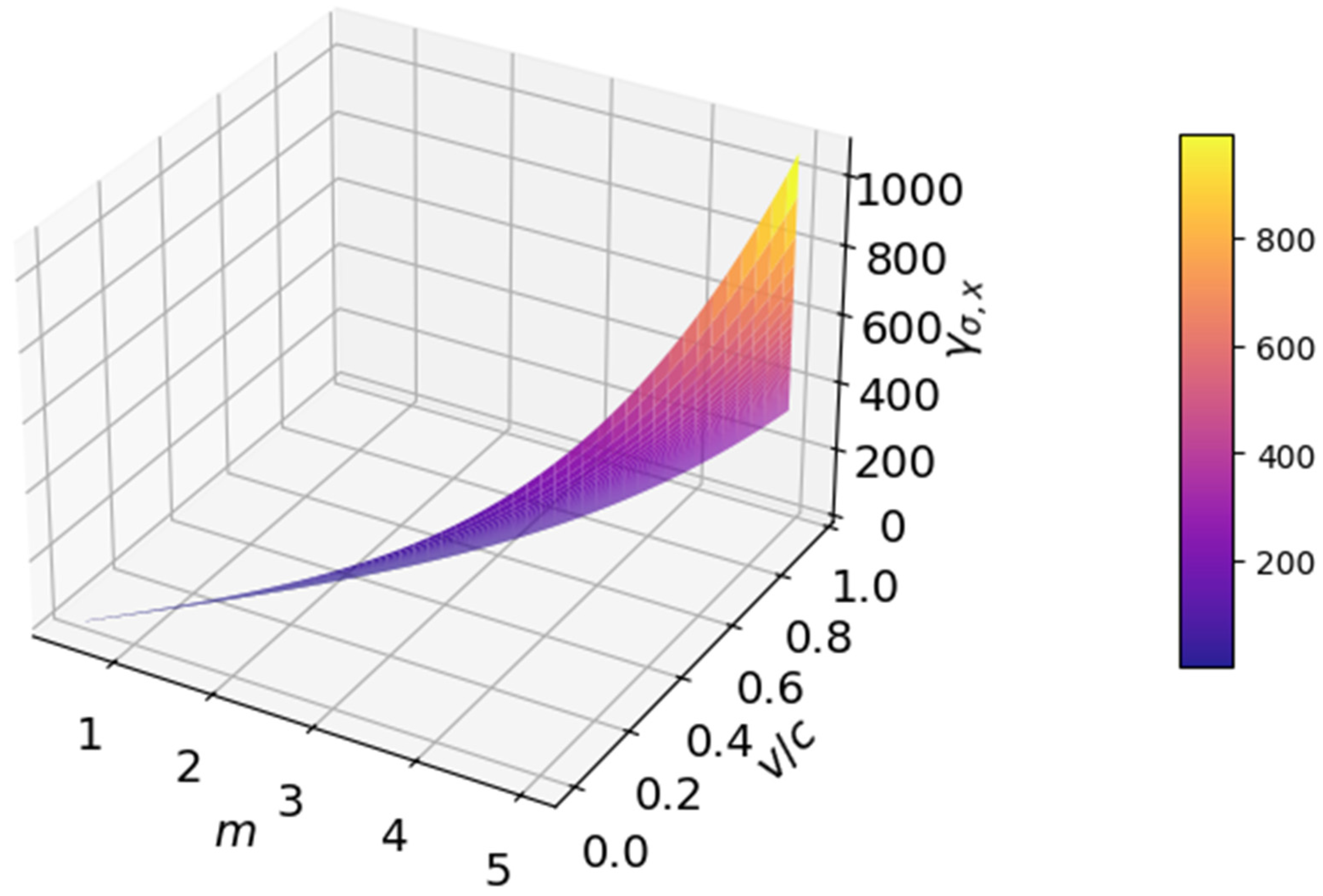
Figure A2.
Lorentz factors versus and .
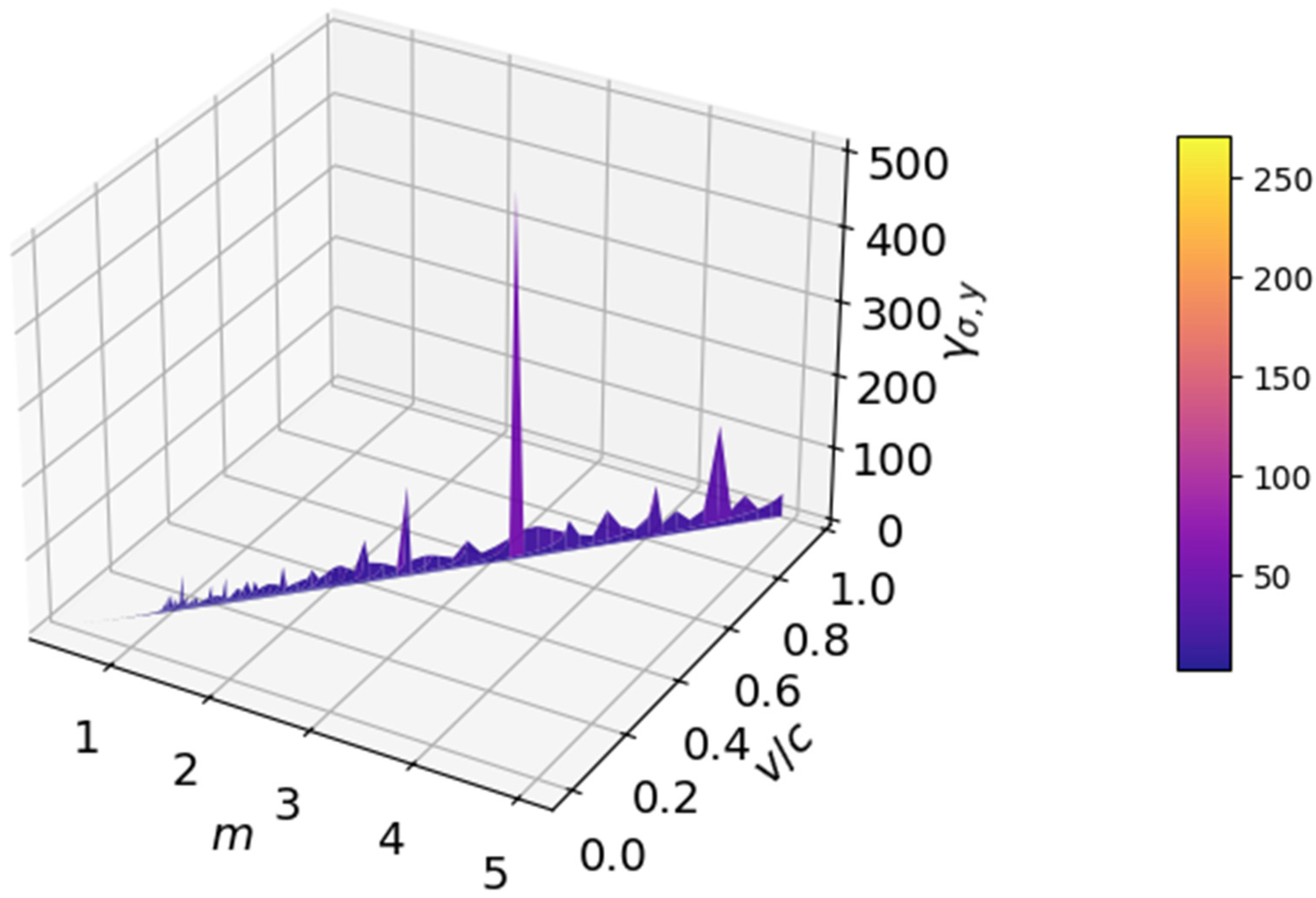
Figure A3.
Lorentz factors versus and .
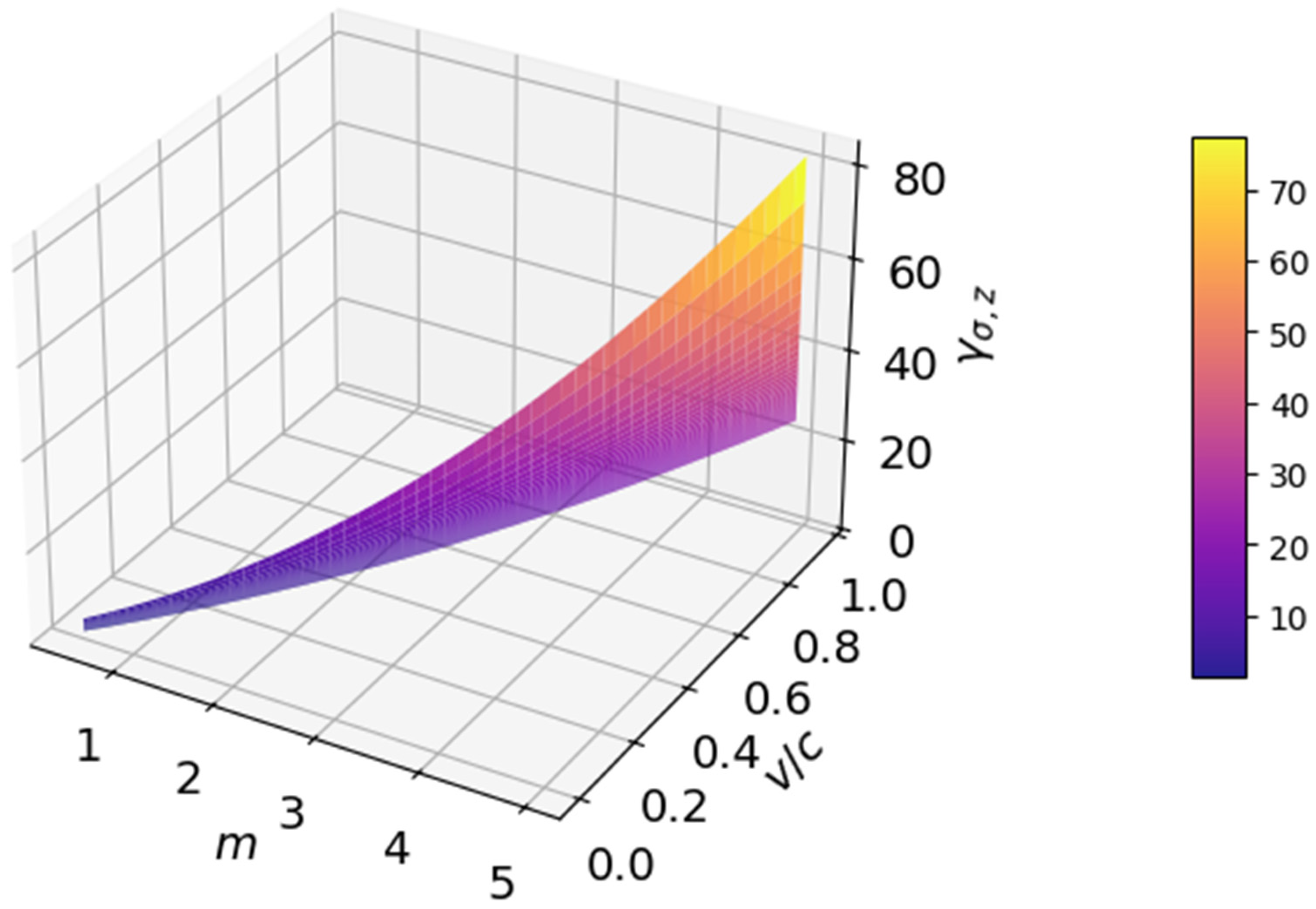
Figure A4.
Lorentz factors versus and .
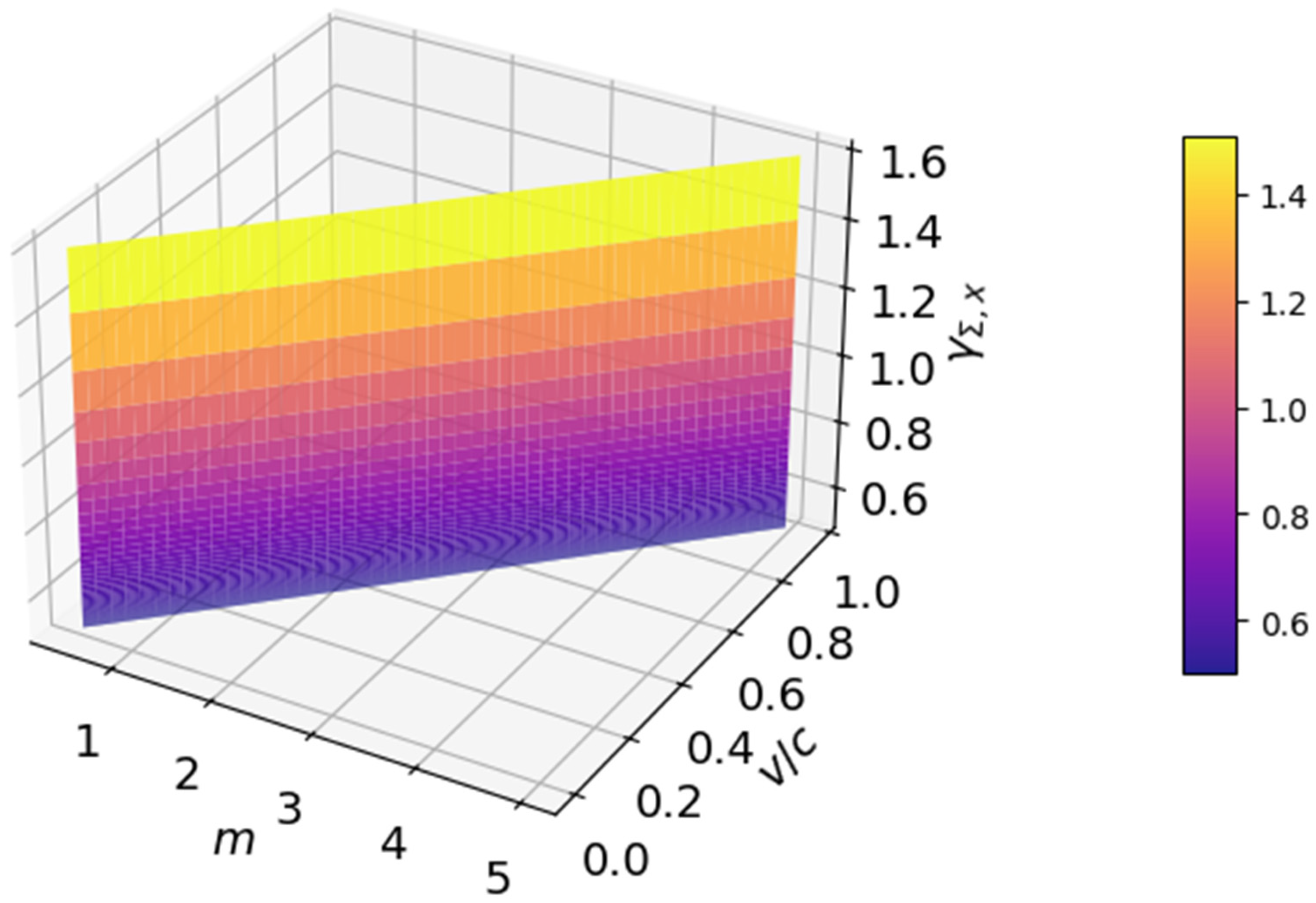
Figure A5.
Lorentz factors versus and .
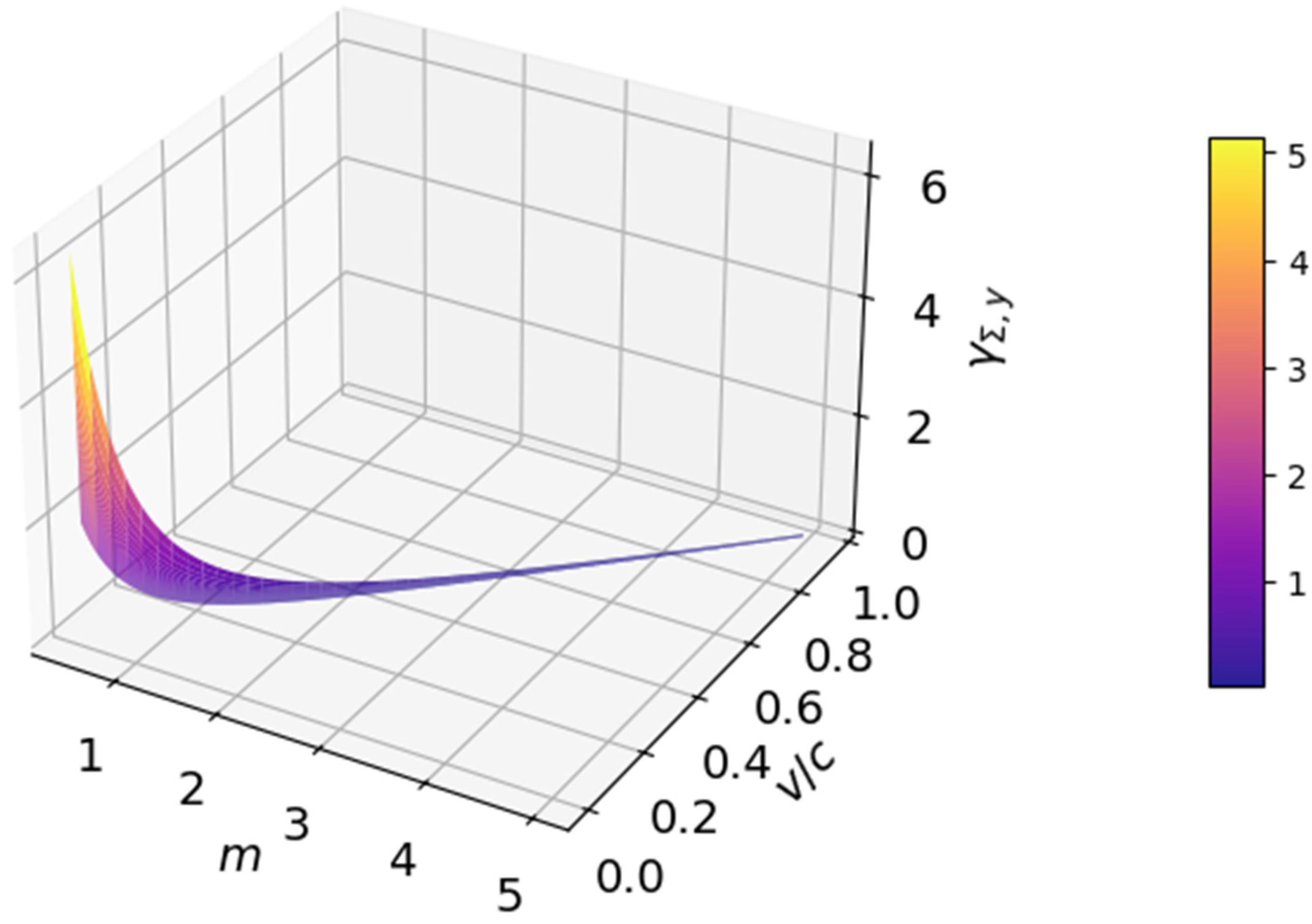
Figure A6.
Lorentz factors versus and .
References
- Ramezani, H.; Jha, P.K.; Wang, Y.; Zhang, X. Nonreciprocal localization of photons. Phys. Rev. Lett. 2018, 120, 043901. [Google Scholar] [CrossRef] [Scilit] [PubMed]
- Yang, L.; Zhang, Y.; Yan, X.B.; Sheng, Y.; Cui, C.L.; Wu, J.H. Dynamically induced two-color nonreciprocity in a tripod system of a moving atomic lattice. Phys. Rev. A 2015, 92, 053859. [Google Scholar] [CrossRef] [Scilit]
- Barzanjeh, S.; Xuereb, A.; Alù, A.; Mann, S.A.; Nefedkin, N.; Peano, V.; Rabl, P. Nonreciprocity in Quantum Technology. arXiv 2025, arXiv:2508.03945. [Google Scholar] [CrossRef] [Scilit]
- Bosco, S. Dissipation in passive non-reciprocal microwave devices. arXiv 2025, arXiv:2509.00874. [Google Scholar] [CrossRef] [Scilit]
- Streiter, L.F.; Giacomini, F.; Brukner, Č. Relativistic Bell test within quantum reference frames. Phys. Rev. Lett. 2021, 126, 230403. [Google Scholar] [CrossRef] [Scilit] [PubMed]
- Giacomini, F.; Castro-Ruiz, E.; Brukner, Č. Relativistic quantum reference frames: The operational meaning of spin. Phys. Rev. Lett. 2019, 123, 090404. [Google Scholar] [CrossRef] [Scilit] [PubMed]
- Ganesan, T. Relativistic Formulation in Dual Minkowski Spacetime. Symmetry 2024, 16, 482. [Google Scholar] [CrossRef] [Scilit]
- Livadiotis, G.; McComas, D.J. The theory of thermodynamic relativity. Sci. Rep. 2024, 14, 22641. [Google Scholar] [CrossRef] [Scilit] [PubMed]
- Livadiotis, G.; McComas, D.J. Thermodynamic and kinematic origins of anisotropic relativity. Sci. Rep. 2025, 15, 25618. [Google Scholar] [CrossRef] [Scilit] [PubMed]
- Kichenassamy, S. Axiomatics of the Observer Manifold and Relativity. Axioms 2023, 12, 205. [Google Scholar] [CrossRef] [Scilit]
- Santoni, A.; Muñoz, E.; Abele, H.; Koch, B. Very special relativity in accelerated frames: Nonrelativistic effects in gravitational spectroscopy of ultracold neutrons. Phys. Rev. D 2025, 111, 116017. [Google Scholar] [CrossRef] [Scilit]
- Mollerach, S.; Matarrese, S. Cosmic microwave background anisotropies from second order gravitational perturbations. Phys. Rev. D 1997, 56, 4494. [Google Scholar] [CrossRef] [Scilit]
- Izabel, D.; Remond, Y.; Ruggiero, M.L. Elastic Medium Analogy of Spacetime: hµv Metric Perturbation Tensor Analysis and Theoretical Implications. Int. J. Theor. Phys. 2025, 64, 186. [Google Scholar] [CrossRef] [Scilit]
- Bartlett, S.D.; Rudolph, T.; Spekkens, R.W. Reference frames, superselection rules, and quantum information. Rev. Mod. Phys. 2007, 79, 555–609. [Google Scholar] [CrossRef] [Scilit]
- Fields, C.; Glazebrook, J.F.; Marciano, A. Reference frame induced symmetry breaking on holographic screens. Symmetry 2021, 13, 408. [Google Scholar] [CrossRef] [Scilit]
- Cheng, S.; Hall, M.J. Anisotropic invariance and the distribution of quantum correlations. Phys. Rev. Lett. 2017, 118, 010401. [Google Scholar] [CrossRef] [Scilit] [PubMed]

Disclaimer/Publisher’s Note: The statements, opinions and data contained in all publications are solely those of the individual author(s) and contributor(s) and not of MDPI and/or the editor(s). MDPI and/or the editor(s) disclaim responsibility for any injury to people or property resulting from any ideas, methods, instructions or products referred to in the content. |
© 2026 by the authors. Licensee MDPI, Basel, Switzerland. This article is an open access article distributed under the terms and conditions of the Creative Commons Attribution (CC BY) license.