Next Article in Journal
Anisotropic Preferred Reference Frames for Relativistic Quantum Information Systems
Previous Article in Journal
Research on Structural Design and Plugging Laws of Knot Temporary Plugging Agent
 
 
Due to scheduled maintenance work on our servers, there may be short service disruptions on this website between 11:00 and 12:00 CEST on March 28th.
Article

A New Hyperchaotic Map and Its Manifold of Conditional Symmetry

1
School of Electronic and Information Engineering, Nanjing University of Information Science & Technology, Nanjing 210044, China
2
School of Artificial Intelligence, Nanjing University of Information Science & Technology, Nanjing 210044, China
3
School of Network Security and Information Technology, Yili Normal University, Yining 835000, China
4
Laboratory of Nonlinear Systems, Circuits and Complexity, Physics Department, Aristotle University of Thessaloniki, 54124 Thessaloniki, Greece
*
Author to whom correspondence should be addressed.
Symmetry 2026, 18(2), 212; https://doi.org/10.3390/sym18020212
Submission received: 18 December 2025 / Revised: 16 January 2026 / Accepted: 21 January 2026 / Published: 23 January 2026
(This article belongs to the Section Engineering and Materials)

Abstract

In this work, the polarity balance of a novel two-dimensional hyperchaotic map is considered, and thus the corresponding manifold of conditional symmetry is coined. The unique map has a simple structure but provides direct 2-D offset boosting, which brings the possibility for the construction of conditional symmetry by introducing an absolute value function. The corresponding evolution of the discrete sequences from the system is verified by the circuit implementation based on the microcontroller of CH32V307. The pseudorandom data from the map increases its adaptability for applications in information security. The hyperchaotic sequence-injected Ant Colony Optimization (ACO), Grey Wolf Optimizer (GWO), and Sparrow Search Algorithm (SSA) show their improved performance in the optimization algorithm. Robot path planning experiments confirm that all three algorithms exhibit superior convergence performance, global search capability, and path smoothness compared with the original algorithms.

1. Introduction

Chaos is ubiquitous in natural and technological systems, as its irregular, unpredictable, and intricate dynamic characteristics serve as a critical theoretical underpinning for studies in diverse scientific domains. Since Lorenz [1] presented the classical three-dimensional chaotic system in the 1960s, chaos theory [2,3,4,5] has progressively emerged as a crucial framework for analyzing complex systems. Recently, hyperchaotic systems—dynamical systems exhibiting greater complexity than classical chaotic systems—have become a focal point of research, owing to their multiple positive Lyapunov exponents and the resulting enhanced dynamic instability and behavioral diversity.
Much research has been conducted in-depth in continuous systems focusing on the exploration of new dynamical properties [6,7,8,9,10], including amplitude control [11,12,13] and offset boosting [14,15,16]. However, with the rapid development of artificial intelligence and powerful calculation, discrete chaotic systems [17,18,19] have gradually emerged as another key focus of contemporary research.
In 1990, Ott, Grebogi, and Yorke [20] first proposed chaos control theory, which is now widely applied to the control of discrete systems, such as the Logistic and Henon maps. Boccaletti [21] systematically reviewed control and synchronization issues in discrete chaotic systems, suggesting the introduction of synchronization control into coupled map lattices, thereby promoting the extension of discrete chaotic systems from single-unit models to networked and coupled frameworks.
To enhance the stability, accuracy, and robustness of discrete chaotic systems in practical applications, increasing attention has been devoted to exploring features, such as offset boosting and conditional symmetry. Kong et al. [22] demonstrated that the polarity balance of discrete chaotic systems can be achieved by introducing periodic functions while simultaneously inverting constant terms. Ostrovskii et al. [23] proposed a novel method to induce multistability in discrete systems, whereby multiple coexisting attractors can be identified in the discrete model by applying numerical integration to a continuous monostable system and determining the corresponding range of symmetric coefficients. Ren et al. [24] constructed a new three-dimensional hyperchaotic map by coupling discrete memristor models and experimentally validated its implementability in circuits. Jin et al. [25] proposed a time-varying fuzzy-parameter zeroing neural network (ZNN) model to address the synchronization of chaotic systems under external noise disturbances. Comparative studies demonstrated that the proposed model exhibits superior performance over existing approaches. Liu et al. [26] developed a noise-tolerant fuzzy-type zeroing neural network by integrating a zeroing neural network with a fuzzy logic system, and comparative analyses verified its enhanced predefined-time convergence and noise-tolerance capability.
Currently, discrete chaotic systems are widely applied in fields such as information security, data encryption, and optimization algorithms. Pourasad et al. [27] combined chaotic sequences with wavelet transforms to design a novel digital image encryption technique. Yang et al. [28] improved a one-dimensional Iterative Map with Infinite Collapses (ICMIC) map to control a two-dimensional Henon map and applied it to image encryption, scrambling pixel positions, and diffusing pixel values, thereby demonstrating the optimization benefits of incorporating chaotic theory into the algorithm. Alhadawi et al. [29] integrated discrete chaotic maps with the Cuckoo Search (CS) algorithm to design an 8 × 8 S-box with specific cryptographic properties, enhancing its resistance to cryptanalysis. Yu et al. [30] conducted a comprehensive analysis of four discrete hyperchaotic systems constructed using dynamic models, confirming their high complexity, and further applied them to image encryption, where their strong security performance was successfully demonstrated. Giuseppe Grassi [31] has explored the practical applications of chaos theory in various real-world scenarios, including but not limited to distributed sensing, hardware implementation of cryptographic systems, and robotic motion. Onder Tutsoy et al. [32] proposed a novel intelligent model-free adaptive control approach based on chaotic theory and applied it to the control of underactuated robotic manipulators. Dayal R. Parhi et al. [33] introduced chaotic dynamics into the RGSA model and, based on this framework, proposed a novel path planning method for humanoid robots.
Although hyperchaotic systems [34] and the integration of chaos theory with artificial intelligence have become one of the current research hotspots, most existing studies focus on continuous hyperchaotic systems or conventional chaotic systems combined with artificial intelligence. Tian et al. [35] proposed a novel four-dimensional chaotic system accompanied by detailed dynamical analysis and circuit implementation, while Chong et al. [36] introduced a dual-memristor-based hyperchaotic map with analog circuit realization. In contrast, discrete hyperchaotic systems and their integration with artificial intelligence remain relatively underexplored and offer substantial potential for further investigation. Therefore, this paper proposes a two-dimensional discrete hyperchaotic system and applies it to robot path optimization as a deterministic, high-complexity sequence generator to enhance the exploration capability of robot path optimization algorithms. Compared with conventional chaotic systems, hyperchaotic systems possess multiple positive Lyapunov exponents, indicating higher dynamical complexity and stronger state-space exploration capability. Introducing such dynamical characteristics into robot path optimization allows the search process to benefit from increased diversity, enhanced global exploration, and reduced sensitivity to local optima. Moreover, the discrete formulation is naturally compatible with iterative optimization algorithms and digital implementations, making it particularly suitable for robot path planning in complex environments.
It should be noted that, in the classical theory of dynamical systems, hyperchaos is strictly defined for systems with phase-space dimensions no less than three and at least two positive Lyapunov exponents. From this strict perspective, the proposed two-dimensional map does not constitute a standard hyperchaotic system. In this work, the term “hyperchaotic” is used in a generalized, application-oriented sense to describe the enhanced chaotic behavior of the proposed map, which exhibits multiple positive Lyapunov exponents and higher dynamical complexity compared with conventional chaotic maps. Similar generalized usages [37,38,39] can be found in engineering and applied studies, where the emphasis is placed on complexity enhancement and ergodicity rather than strict dimensional classification.
In this paper, a two-dimensional discrete hyperchaotic system with a simple structure and complex dynamical behaviors is proposed, which possesses two-dimensional offset boosting and conditional symmetry characteristics. The main innovations and contributions of this work are summarized as follows:
  • The proposed discrete hyperchaotic map has an elegant structure hosting two-dimensional offset boosting, where a single constant rescales the average values of all variables simultaneously.
  • The proposed two-dimensional discrete hyperchaotic system satisfies the polarity balance required for conditional symmetric construction. By introducing an absolute value function, conditional symmetry is coined, and consequently, the derived version generates a pair of coexisting attractors of conditional symmetry.
  • Circuit implementation based on the hardware of CH32 verifies the unique dynamics of the proposed map and confirms its derived version of conditional symmetry.
  • Three classical intelligent optimization algorithms are also enhanced by introducing the hyperchaotic sequences, including Ant Colony Optimization (ACO), Grey Wolf Optimizer (GWO), and Sparrow Search Algorithm (SSA), which are subsequently employed in robot path planning, showing their effectiveness and higher performance.
The rest of this paper is organized as follows. In Section 2, we propose the two-dimensional discrete hyperchaotic system and perform basic dynamical analysis, including the stability of fixed points and bifurcation. In Section 3, the property of offset boosting is analyzed in detail. In Section 4, the conditional symmetric properties of the revised version are comprehensively investigated. In Section 5, the above finding is verified on the CH32 circuit platform. In Section 6, three chaos-enhanced optimization algorithms are proposed for the application in robot path planning. The conclusions and discussion are wrapped up in the Section 7.

2. The Model of a 2-D Hyperchaotic Map and Its Basic Dynamics

2.1. System Model

The new two-dimensional hyperchaotic system is defined as follows:
x n + 1 = b y n + a x n , y n + 1 = y n + c x n 2 + h .
Here, n denotes a natural number, and the n-th states of the map are represented by xn and yn. h is the constant term, and a, b, and c are three nonzero system parameters. When the parameters are set as ℎ = 0.5, a = −0.7, b = 1.7, and c = −1, the system exhibits hyperchaotic behavior, with Lyapunov exponents of LEs = (0.1853, 0.0931). The Kaplan–Yorke dimension can be calculated according to the following formula:
D K Y = j + 1 L E j + 1 i = 1 j L E i .
where j denotes the largest integer that satisfies i = 1 j L E i 0 and i = 1 j + 1 L E i 0 . Consequently, since system (1) exhibits two positive Lyapunov exponents, the corresponding Kaplan–Yorke dimension is determined to be DKY = 2 > 0.
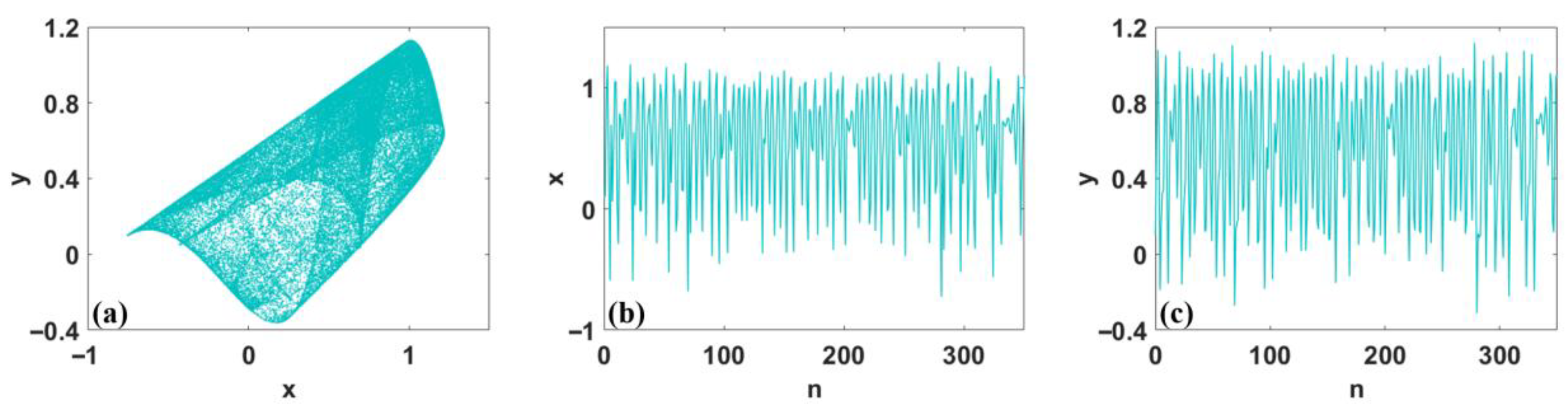
A notable feature of this system is that it contains only a single quadratic nonlinear term. Compared with the two-dimensional Hénon map, the proposed discrete chaotic system has a self-feedback term and an offset constant. In the conventional Hénon map, the coupling is relatively weak, and the system possesses only one positive Lyapunov exponent, exhibiting standard chaotic behavior. In contrast, the proposed system establishes mutual interaction between xn+1 and yn, enabling yn+1 to achieve integral-type self-feedback. As a result, the system exhibits two positive Lyapunov exponents, indicating that it is a hyperchaotic system. Therefore, compared with the traditional two-dimensional Hénon map, the proposed discrete system maintains a simple structural form while exhibiting more complex and diverse dynamical behaviors. Moreover, the introduction of the constant h breaks the system’s symmetry; however, further analysis reveals that the system can still exhibit symmetry under certain specific conditions. In addition, the system possesses a single-parameter two-dimensional offset boosting property, which will be discussed in detail later. Figure 1 shows the typical phase trajectory and the corresponding discrete sequences of the system.

2.2. Fixed Points and Their Stability

Let xn+1 = xn = x and yn+1 = yn = y, then the fixed point (x, y) satisfies
x * = b y + a x , y * = y + c x 2 + h .
When the system parameters are set as h = 0.5, a = −0.7, c = −1, b = 1.7, the fixed points of the discrete system (1) can be calculated as (0.7071, 0.7071) and (−0.7071, −0.7071). The stability of the discrete system can be preliminarily assessed by examining the stability of these fixed points. For the discrete system (1), the corresponding Jacobian matrix is given by
J = 0.7 1.7 2 x * 1 .
Therefore, the characteristic equation can be expressed as
λ E J = ( λ + 0.7 ) ( λ 1 ) + 3.4 x * = 0 .
The eigenvalues at the fixed point (0.7071, 0.7071) can be obtained as
λ 2 0.3 λ + 1.70414 = 0 .
The eigenvalues are calculated as λ1 = 0.15 + 1.2968i; λ2 = 0.15 − 1.2968i. Since |λ1| > 1 and |λ2| > 1, the fixed point (0.7071, 0.7071) is unstable.
Similarly, by substituting the fixed point (−0.7071, −0.7071), we obtain
λ 2 0.3 λ 3.10414 = 0 .
The eigenvalues are calculated as λ1 = 1.9182; λ2 = −1.6182. Since |λ1| > 1, |λ2| > 1, the fixed point (−0.7071, −0.7071) is also unstable. Therefore, the hyperchaotic attractor of this system can be regarded as a self-excited attractor rather than a hidden attractor.

2.3. Basic Dynamics

2.3.1. Bifurcation Analysis Under the Parameter of a

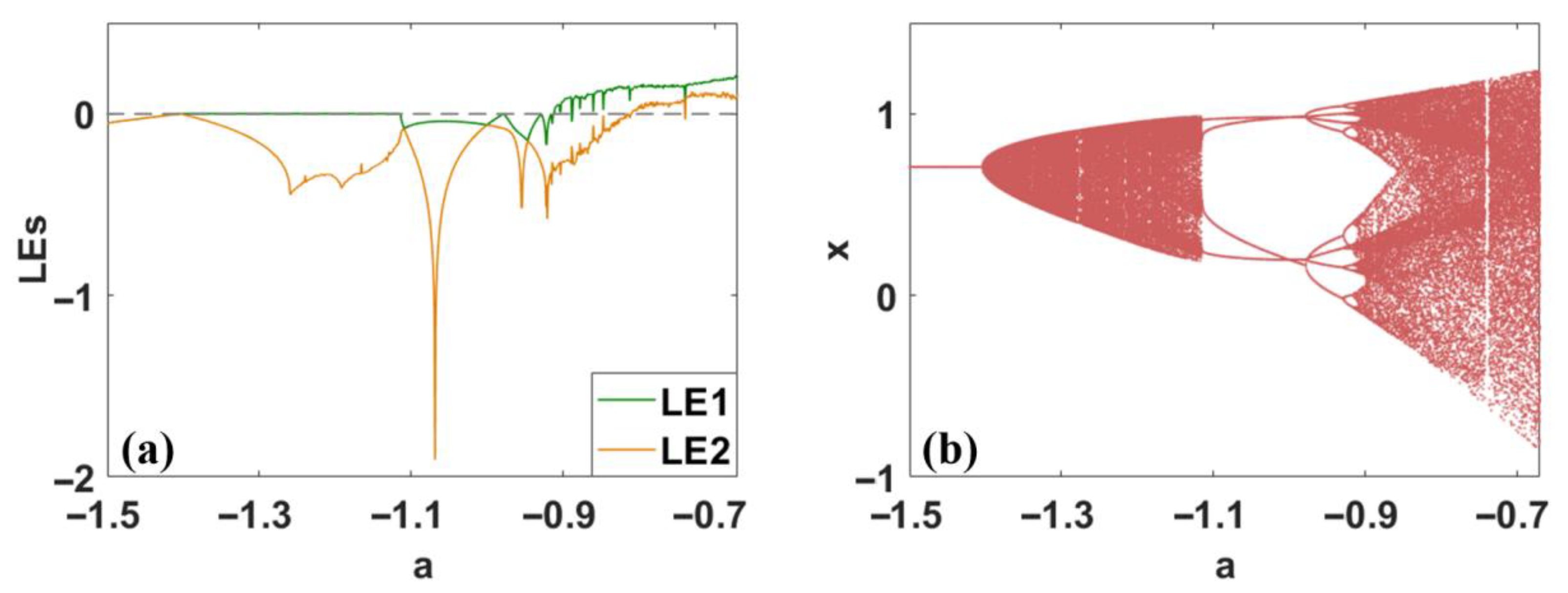
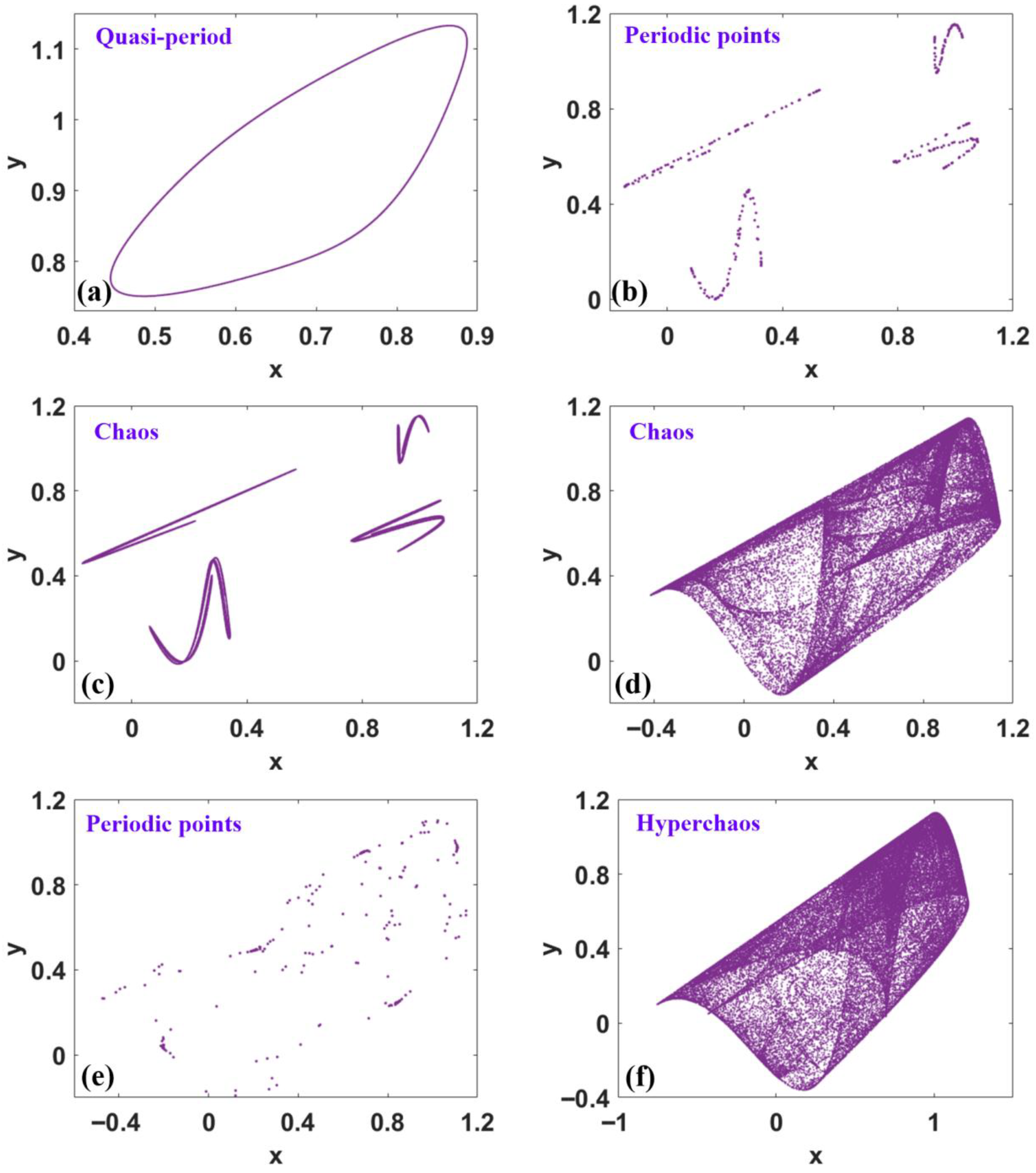
The system exhibits two separate chaotic intervals within the negative range of the parameter a. For the initial condition IC = (0.1, 0.1) and parameters h = 0.5, b = 1.7, and c = −1, as a varies within the range [−1.5, −0.67], the system sequentially displays multiple dynamical behaviors, including periodic, quasiperiodic, chaotic, and hyperchaotic states. Specifically, when a varies within (−0.7370, −0.6700) and (−0.8112, −0.7414), the system exhibits hyperchaotic behavior; within (−0.9122, −0.8113), the system shows chaotic dynamics; within (−1.3989, −1.1138), the system captures a large chaotic interval, intermittently interspersed with small periodic windows; and within (−1.500, −1.3989), (−1.1138, −0.9123) and (−0.7413, −0.7371), the system exhibits periodic windows. Under the same initial condition and parameters, as a varies within [−1.5, −0.67], Figure 2 presents the bifurcation diagram and Lyapunov exponents of the discrete system (1), from which a quasiperiodic route to chaos is observed as the numerical value of parameter a increases along the negative axis. Table 1 summarizes the typical dynamical behaviors of the system, with the corresponding representative trajectories illustrated in Figure 3.

2.3.2. Bifurcation Analysis Under the Parameter of b

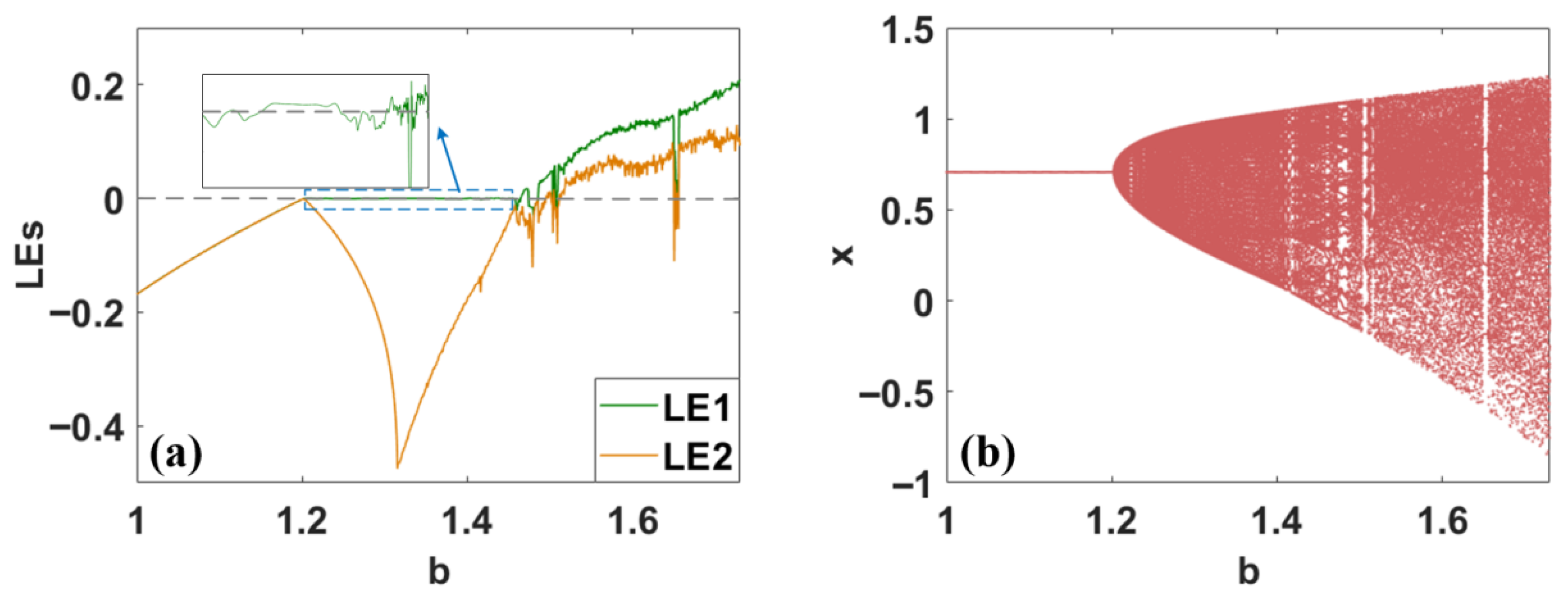
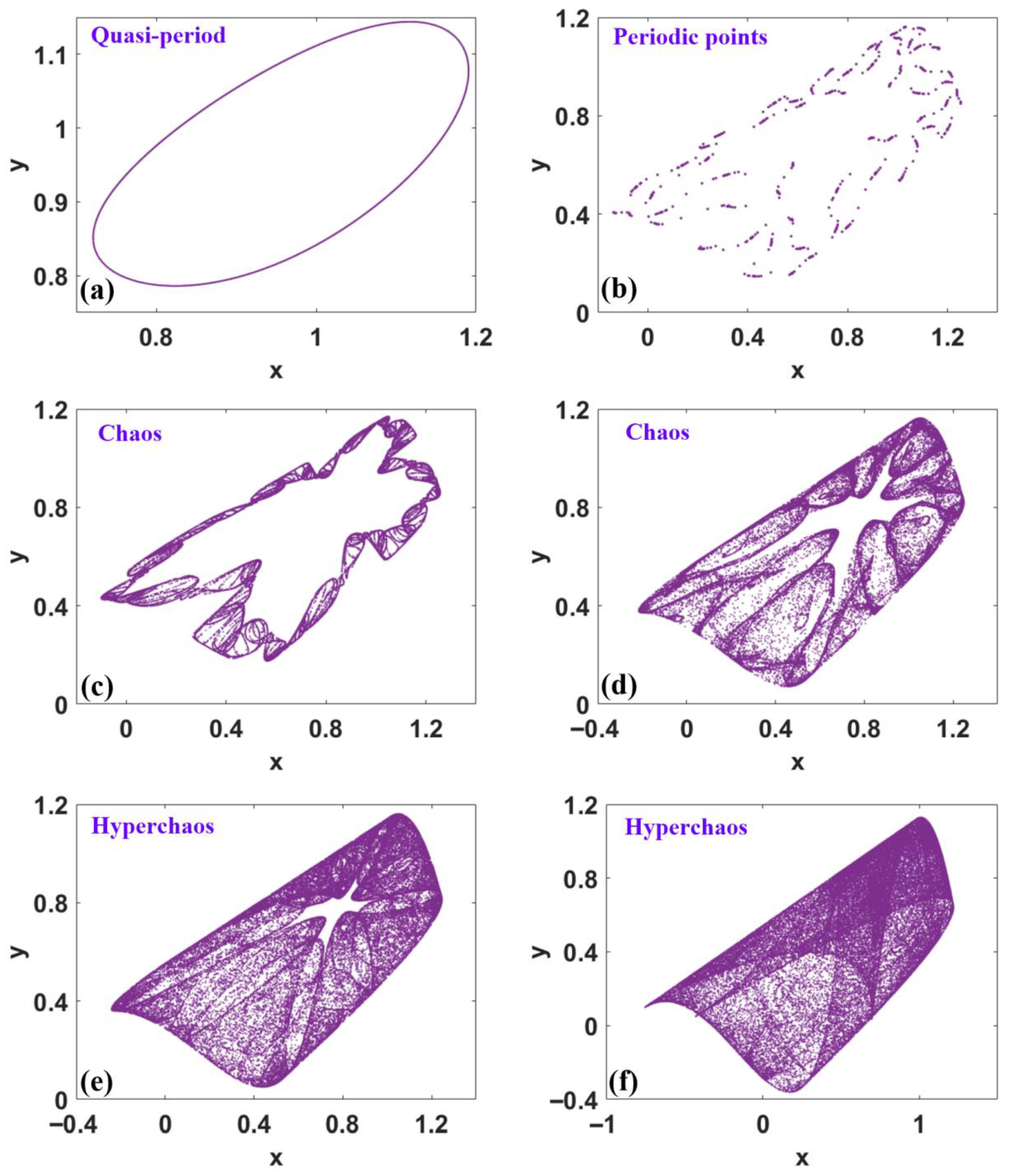
For the initial condition IC = (0.1, 0.1) and parameters h = 0.5, a = −0.7, and c = −1, as b varies within the range [1, 1.73], the system sequentially exhibits multiple dynamical behaviors, including periodic, quasiperiodic, chaotic, and hyperchaotic states. Specifically, when b varies within (1, 1.2051), the system shows periodic behavior; within (1.2051, 1.4577), it captures a large chaotic interval with multiple small periodic windows; within (1.4577, 1.4642), (1.4745, 1.4854), (1.5029, 1.5044), and (1.6497, 1.6555), the system exhibits periodic windows; within (1.4643, 1.4745) and (1.4855, 1.5030), it displays chaotic behavior, with the interval (1.4643, 1.4745) corresponding to hyperchaotic dynamics; and within (1.5117, 1.6497) and (1.6555, 1.7300), the system enters hyperchaotic states. Under the same initial condition and parameters, as b varies within [1, 1.73], Figure 4 presents the bifurcation diagram and Lyapunov exponents of the discrete system (1), from which a quasiperiodic route to chaos is observed as the numerical value of parameter b increases. An enlarged view is provided for the interval (1.25, 1.45). Due to the LE1 values oscillating around zero, the bifurcation diagram exhibits a large chaotic interval interspersed with numerous small periodic windows. Table 2 summarizes the typical dynamical behaviors of the system, and the corresponding representative trajectories are illustrated in Figure 5.

2.3.3. Bifurcation Analysis Under the Parameter of c

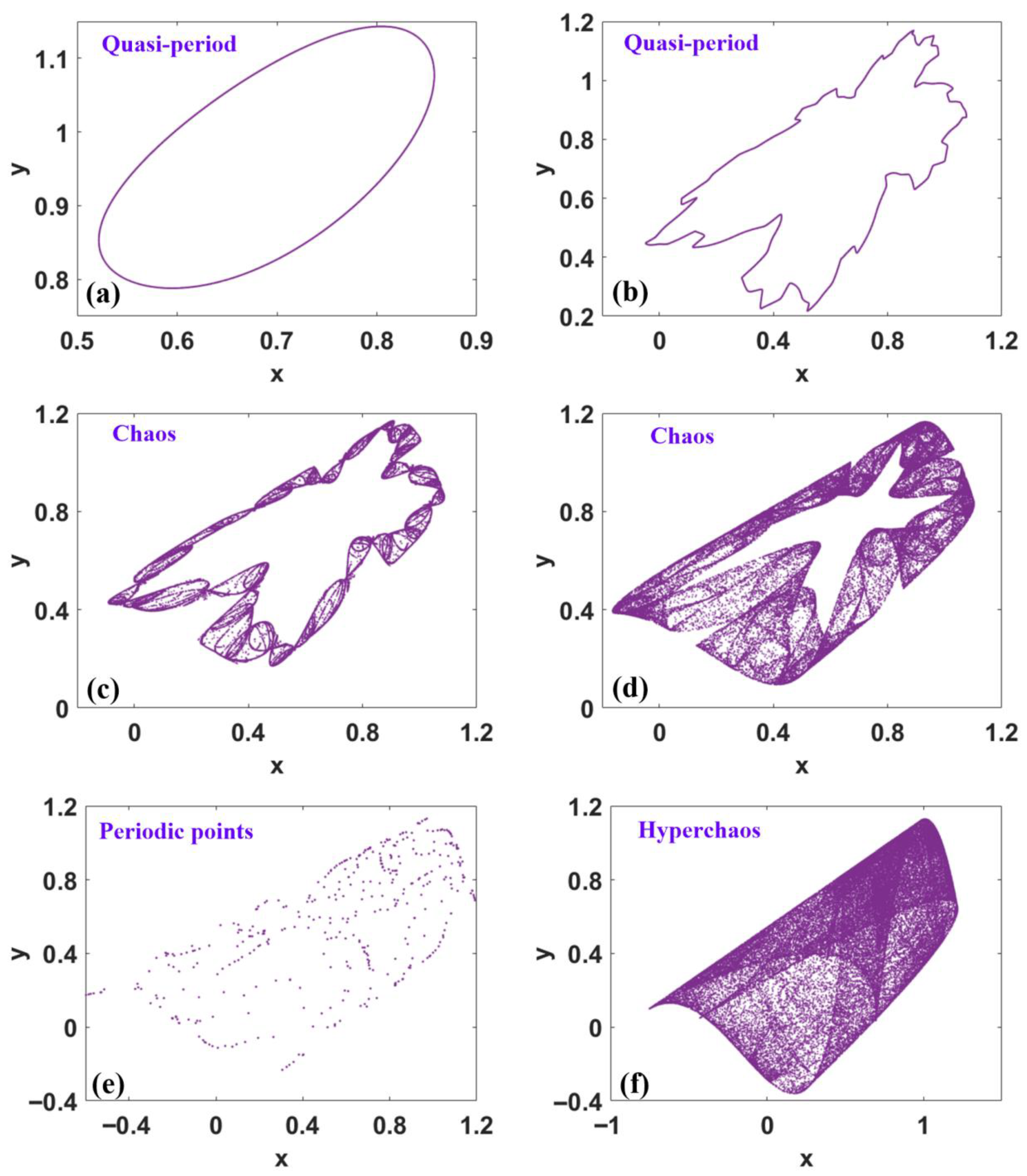
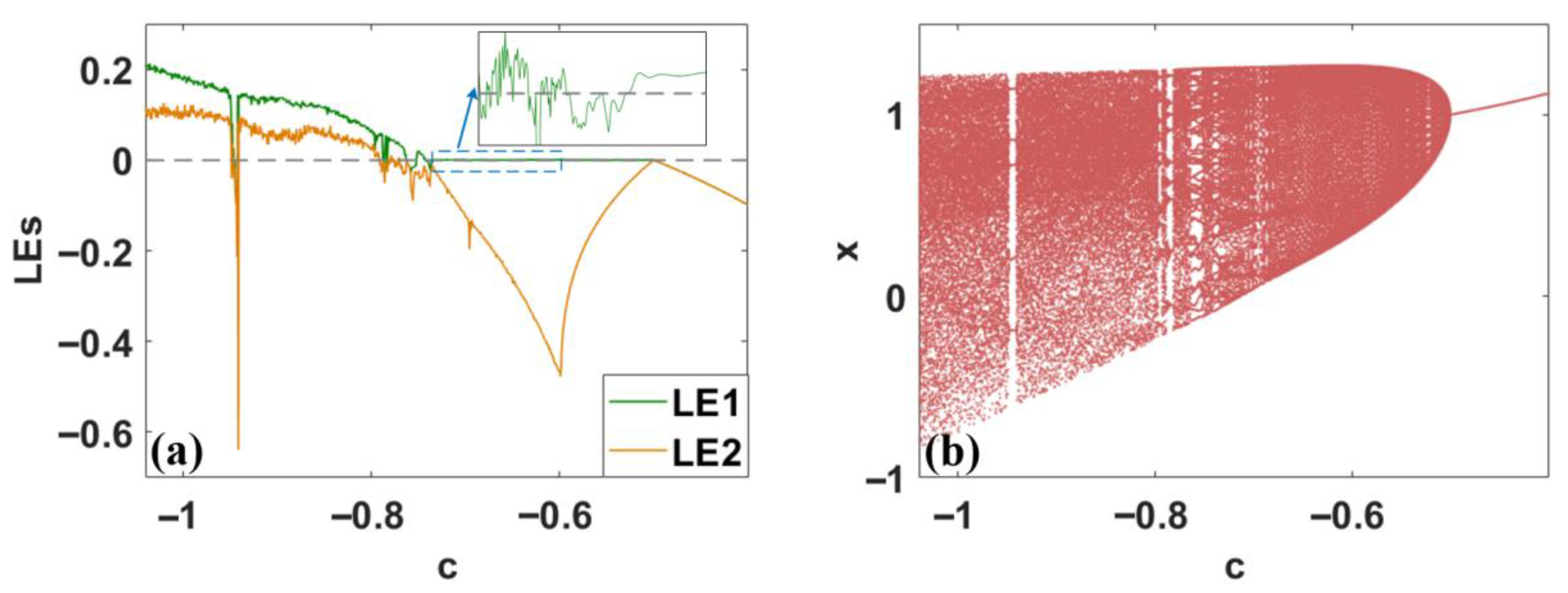
For the initial condition IC = (0.1, 0.1) and parameters h = 0.5, a = −0.7, b = 1.7, as c varies within the range [−1.04, −0.4], the system sequentially exhibits multiple dynamical behaviors, including periodic, quasiperiodic, chaotic, and hyperchaotic states. Specifically, when c varies within (−1.0400, −0.9491) and (−0.9408, −0.7917), the system exhibits hyperchaotic behavior; within (−0.7910, −0.7872) and (−0.7520, −0.7424), it displays chaotic states; and within (−0.7628, −0.7526), (−0.7417, −0.7340) and (−0.4998, −0.400), the system exhibits periodic windows. Under the same initial condition with a = 0.5 and b = 1.7, as c varies within [−1.04, −0.4], Figure 6 presents the bifurcation diagram and Lyapunov exponents of the discrete system (1), from which a quasiperiodic route to chaos is observed as the numerical value of parameter c increases. An enlarged view is provided for the interval (−0.8, −0.6). Since the LE1 are mostly greater than zero, these regions correspond to chaotic dynamics in the bifurcation diagram, occasionally interspersed with short periodic windows. Table 3 summarizes the typical dynamical behaviors of the system, with the corresponding trajectories illustrated in Figure 7. Figure 7c,d shows two distinct chaotic patterns: panel (c) represents outer-envelope evolving chaos, where the system’s phase trajectory undergoes a sequence of bifurcations beyond a critical value of c, losing periodicity and entering to chaotic state; Figure 7d represents inner-envelope evolving chaos, where changes in c cause the phase trajectory to gradually diffuse inward, ultimately forming a hyperchaotic state. The coupling and coexistence of these two chaotic evolution modes contribute to the emergence of more complex and richer hyperchaotic behavior in the system.

3. Two-Dimensional Offset Boosting

In practical engineering and computational applications, chaotic and hyperchaotic attractors are often required to operate around adjustable equilibrium positions rather than being confined to a fixed region of the phase space. The ability to flexibly shift attractor locations without altering the intrinsic dynamical behavior is beneficial for signal modulation, control design, and hardware implementation. Offset boosting provides an effective mechanism to achieve such controllable phase-space translation while preserving the original dynamics of the system.
Similarly to continuous systems, a discrete system can achieve a direct shift in attractor positions, referred to as offset boosting, without altering the original dynamics, only under the changing of an independent external parameter combined with the corresponding initial conditions. In discrete systems, the equations typically relate the new states of variables on the left-hand side to the old states on the right-hand side, lacking the Dimension of Variable Differentiation (DVD) [40]. Based on the discretization formula of continuous systems x = x n + 1 x n Δ t , Δ t = 1 , it can be inferred that to realize offset boosting in a discrete system, an identical constant term should be added to both sides of the equation to cancel the offset parameters. After the offset cancelation, if a constant parameter remains, the attractor position can be adjusted with this parameter, thereby implementing offset boosting in the discrete chaotic system. If the attractor moves along only one direction (either x or y), it is referred to as one-dimensional offset boosting; if the attractor moves along both x and y directions, it is termed two-dimensional offset boosting.
For a dynamical system, the offset parameters influence the two-dimensional offset boosting behavior through the fixed points. Therefore, the offset conditions of the system can be inferred by analyzing its fixed points. Setting the initial condition IC = (0.1, 0.1), h = 0.5, and c = −1, and assuming that the offset constant d is introduced in both the x and y dimensions, the discrete system (1) can be rewritten as
x n + 1 d = b y n d + a x n d , y n + 1 d = y n d + c x n d 2 + h .
Let xnd = vn, ynd = un, then the above equations can be rewritten as
v n + 1 = b u n + a v n , u n + 1 = u n + c v n 2 + h .
Let vn+1 = vn = v*; un+1 = un = u*, then the fixed point (v*, u*) satisfies
v = b u + a v , u = u + c v 2 + h .
It can be calculated that
v = ± h c , u = 1 a b v .
That is
x = ± h c + d , y = 1 a b x d + d .
When a + b = 1, the fixed points (x*, y*) share the same offset constant d, and the system thus exhibits two-dimensional offset boosting. When a + b ≠ 1, the fixed points (x, y) still incorporate the same offset constant d, indicating that the system’s stability is not directly affected by the offset d. However, in the case of a + b ≠ 1, the offset d appears not only inside the nonlinear term of the equation for yn+1 but also in the equation for xn+1, which may distort the system dynamics. The following analysis is therefore divided into two specific cases.

3.1. Case 1: a + b = 1

By setting the initial condition IC = (0.1, 0.1), h = 0.5, c = −1 and varying b within the interval [1, 1.73], while assuming that an offset constant d is introduced in both the x- and y-dimensions such that xn+1xn+1d, xnxnd, yn+1yn+1d and ynynd, the discrete system (1) can be reformulated as follows:
x n + 1 = b y n + a x n , y n + 1 = y n + c x n d 2 + h .
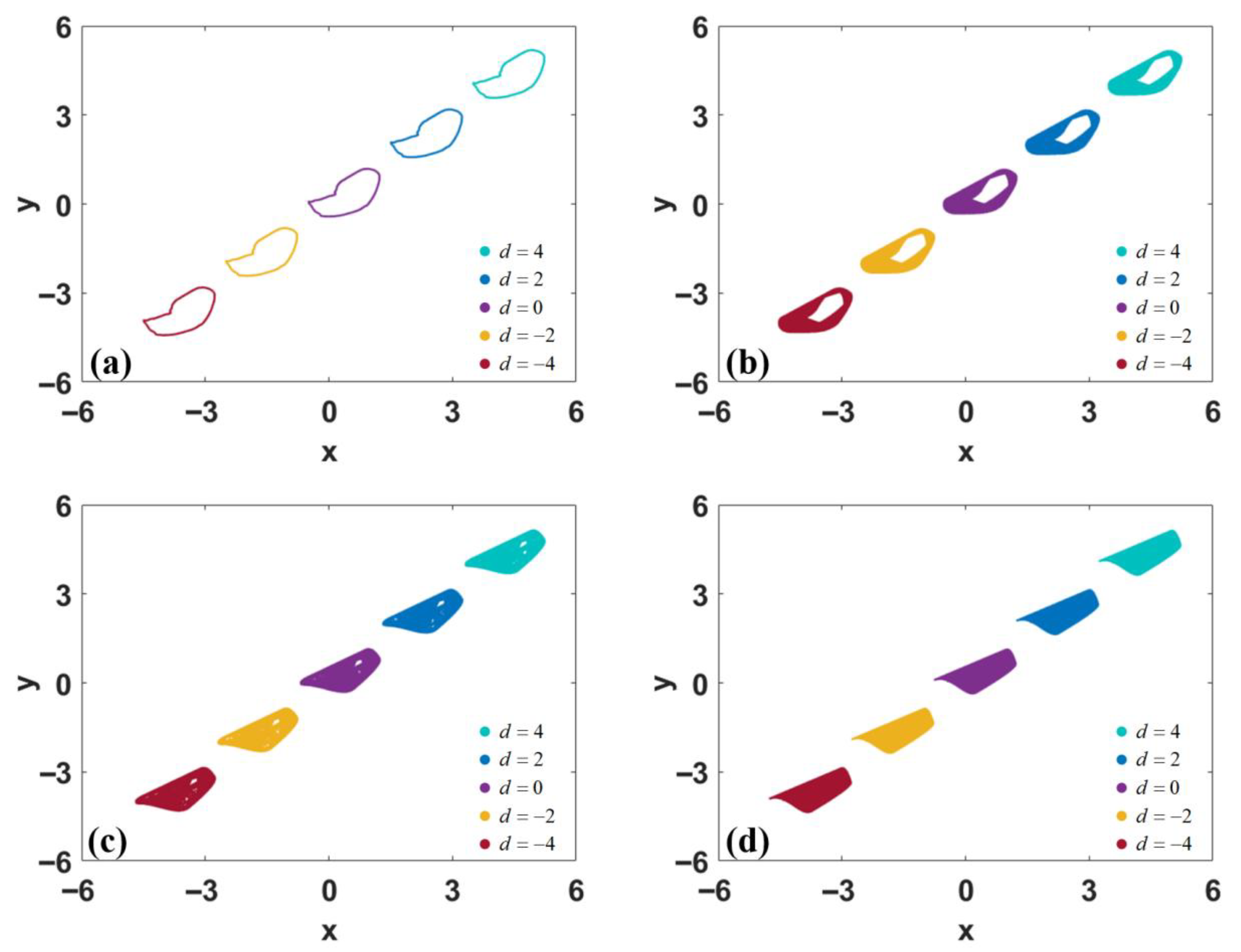
Unlike conventional two-dimensional offset mechanisms, the independent constant d in this system appears within the quadratic term. Nevertheless, it can still realize offset regulation of both the x- and y-variables. In particular, the sum of the coefficients of the x- and y-feedback terms in the first-dimensional difference equation equals unity. Under this condition, if other parameters remain unchanged, while only the bifurcation parameter b is varied, it is observed that introducing different independent constant d results in a corresponding shift in the attractor’s position. This indicates that, across different phase trajectories, the constant d can consistently achieve joint offset regulation in both the x- and y-dimensions, as illustrated in Figure 8. Specifically, Figure 8 presents the offset behavior under four cases: b = 1.1514, b = 1.33, b = 1.52, and b = 1.7, which demonstrates that the offset control remains robust regardless of whether the system is in quasiperiodic, chaotic, or hyperchaotic states.
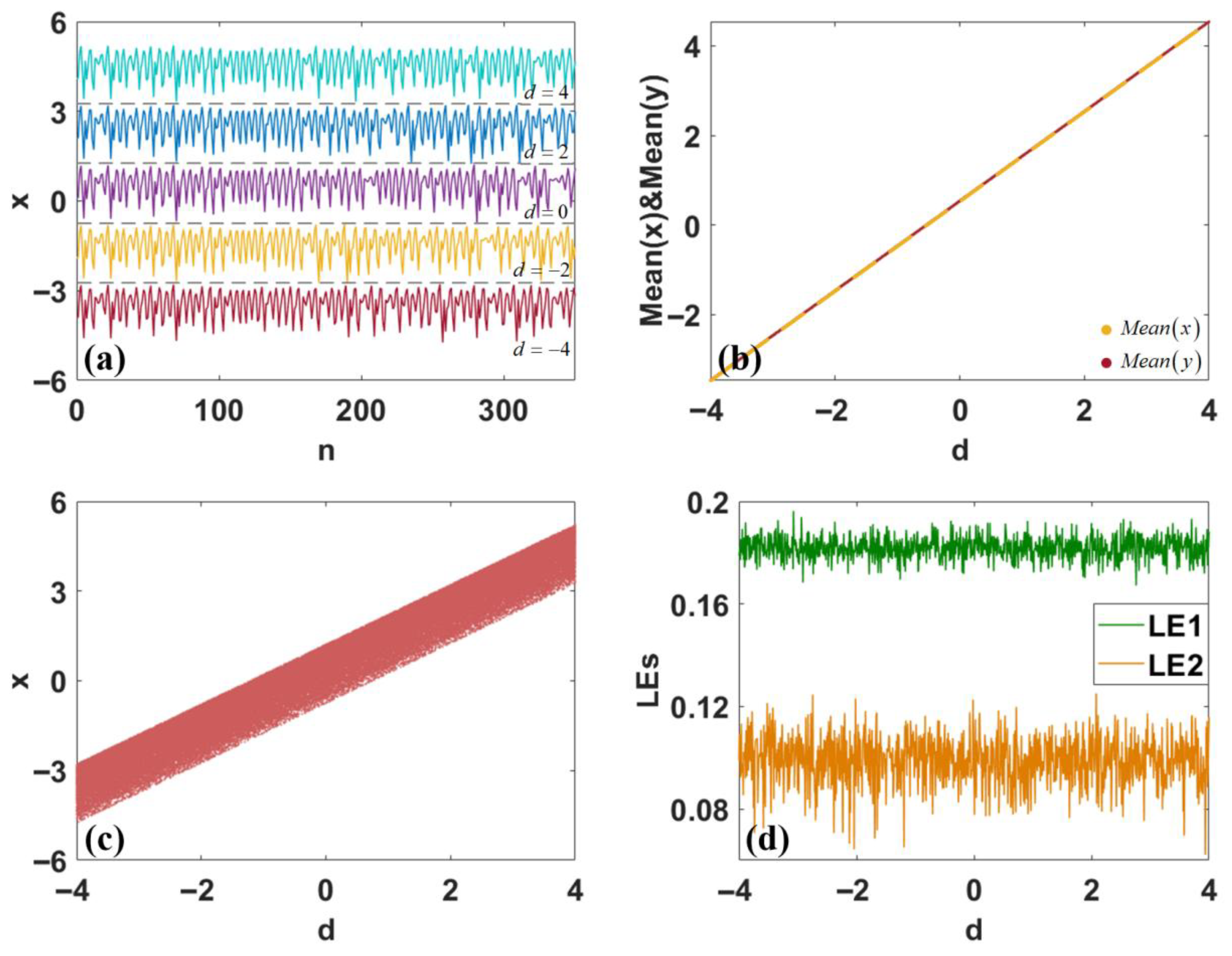
When b = 1.7, the system operates in the hyperchaotic state. Figure 9a illustrates the discrete sequences offsets obtained under different independent constant d. Figure 9b reveals that as d varies, the mean values of variables x and y also shift, with the two mean trajectories coinciding. Furthermore, Figure 9c,d present the bifurcation diagram and Lyapunov exponents of system (13). It can be observed that the bifurcation diagram retains equal-width characteristics and the Lyapunov exponents remain nearly unchanged, indicating that the independent constant d enables the offset of the system while preserving its intrinsic dynamical properties.

3.2. Case 2: a + b ≠ 1

By setting the initial condition IC = (0.1, 0.1), h = 0.5, c = −1, b varies within the range [1, 1.73], and a varies within the range [−1.5, −0.67]. Suppose that an offset constant d is introduced in both the x and y dimensions, such that xn+1xn+1d, xnxnd, yn+1yn+1d and ynynd. Under this modification, the discrete system (1) is transformed into
x n + 1 = b y n + a x n d a + b 1 , y n + 1 = y n + c x n d 2 + h .
It is not difficult to observe that, compared with the previous case, the equation for xn+1 now contains an additional nonzero offset term –d(a + b − 1). Since the offset parameter d simultaneously appears in multiple terms, it is practically difficult to achieve identical offset values in different locations, whether in physical circuit implementation or numerical simulation. Therefore, under this condition, the system is not considered to satisfy the two-dimensional offset property. At this point, the offset behavior of system (13) is influenced by two pathways: the term –d(a + b − 1) and the nonlinear term (xnd)2. When a + b ≈ 1, the term –d(a + b − 1) ≈ 0, meaning its influence is almost negligible, and the system offset is mainly dominated by the nonlinear term (xnd)2. When |a + b − 1| is relatively large, both pathways jointly affect the system’s offset dynamics. If a + b > 1, then –(a + b − 1) < 0, and an increase in d suppresses the growth of xn+1, acting as a negative feedback mechanism. In this case, the offset term –d(a + b − 1) and the nonlinear feedback term (xnd)2 compete with each other: the nonlinear term tends to induce oscillations and chaos, whereas the offset term tends to pull the system back toward stability. Their interaction may lead the system to maintain a more stable state, requiring stronger excitation to trigger bifurcation. Conversely, if a + b < 1, then –(a + b − 1) > 0, and an increase in d facilitates the growth of xn+1, forming a positive feedback mechanism. In this case, the terms –d(a + b − 1) and (xnd)2 act synergistically: the former pushes the system away from equilibrium, while the latter provides a restoring effect. Their combined influence intensifies the system’s instability, making it more likely to undergo bifurcations and enter a chaotic state.

4. Manifold of Conditional Symmetry

Polarity inversion is a common approach for generating symmetric dynamical behaviors; however, in discrete systems, a direct polarity inversion of state variables generally breaks the polarity balance of the system, leading to asymmetric attractor distributions. This imbalance motivates the introduction of an additional mechanism to restore polarity balance. Take xn+1 → –xn+1, xn → –xn, yn+1yn+1 + d and ynyn + d and a transformation ynF(yn) with the following condition: F(yn+1 + d) = –F(yn+1) and F(yn + d) = –F(yn), then the polarity balance of the system can be recovered. To satisfy the above antisymmetric conditions in a simple and structure-preserving manner, the absolute value function is adopted. The absolute value operation naturally provides polarity inversion with respect to a shifted reference point while maintaining continuity and boundedness of the transformed variables. Compared with other nonlinear functions, it offers a minimal and effective way to couple polarity inversion with offset boosting, making the resulting transformation intuitive and robust. Typically, an absolute value function is employed to give the polarity inversion from offset boosting. As in a continuous system, if the polarity balance arises jointly from polarity inversion and offset boosting, the system is said to have conditional symmetry. Therefore, to realize conditional symmetry in a discrete system, after performing a polarity inversion in any of the variables, offset boosting should be applied to the other variables to restore polarity balance.
Let us take xn+1 → –xn+1, xn → –xn, yn+1yn+1 + e and ynyn + e in a discrete system (1). According to the above definition, to maintain the polarity balance of the system, a function F(y) must be introduced such that F(y + e) = –F(y). Therefore, by introducing the function F(y) = |y| − e, the transformed system exhibits conditional symmetry. Accordingly, the conditional symmetric version of the discrete system (1) can be expressed as
x n + 1 = b F y n + a x n , y n + 1 = y n + c x n 2 + h .
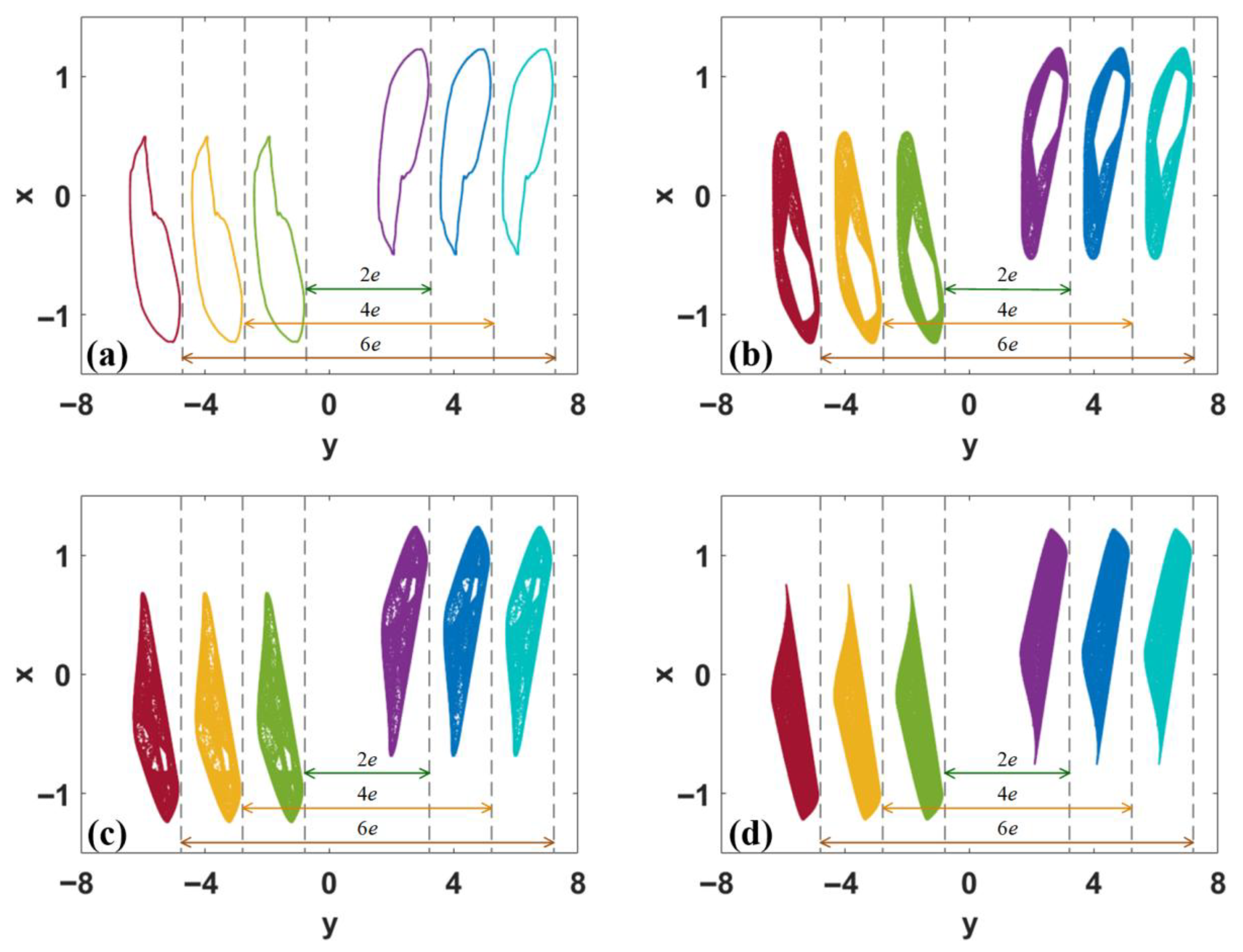
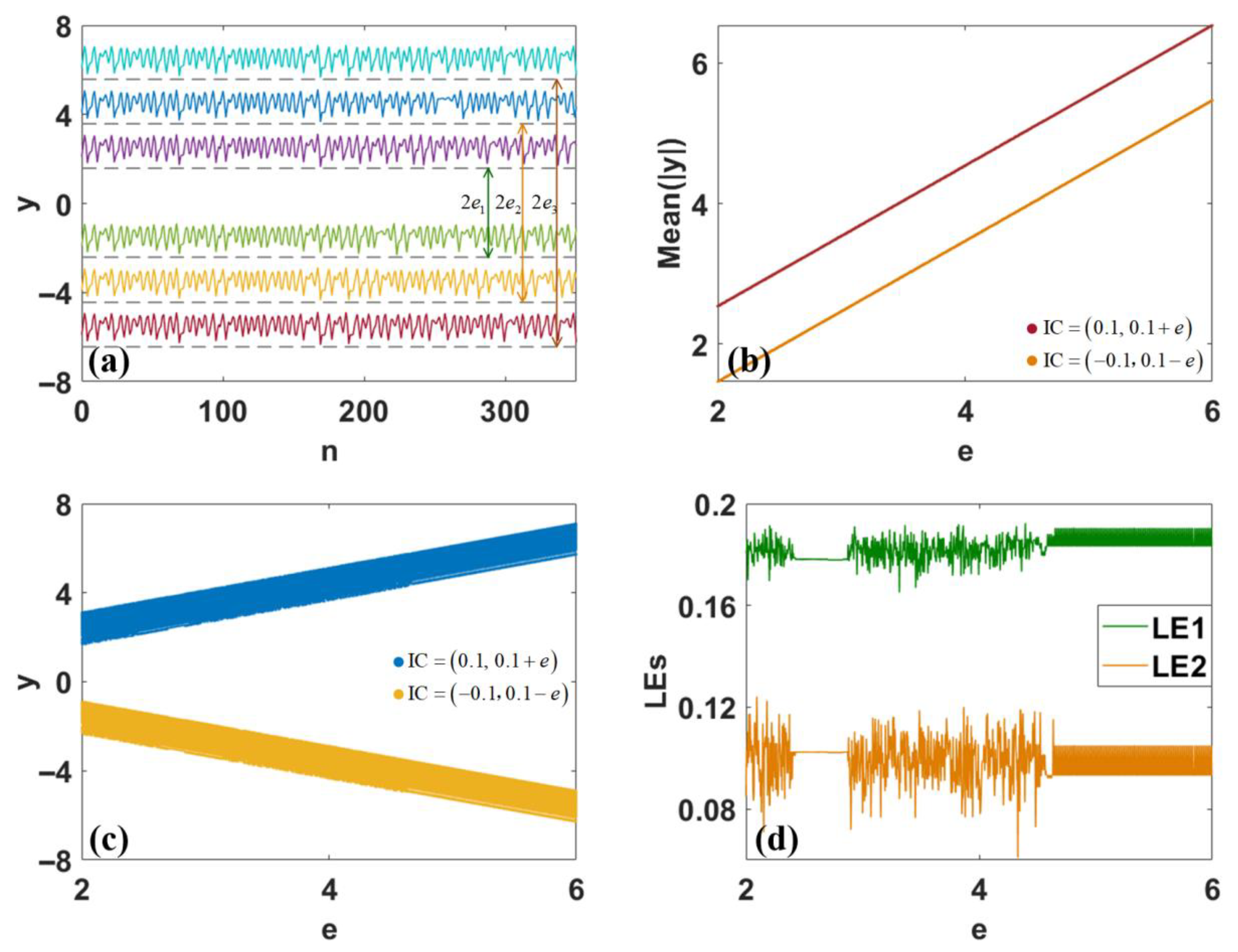
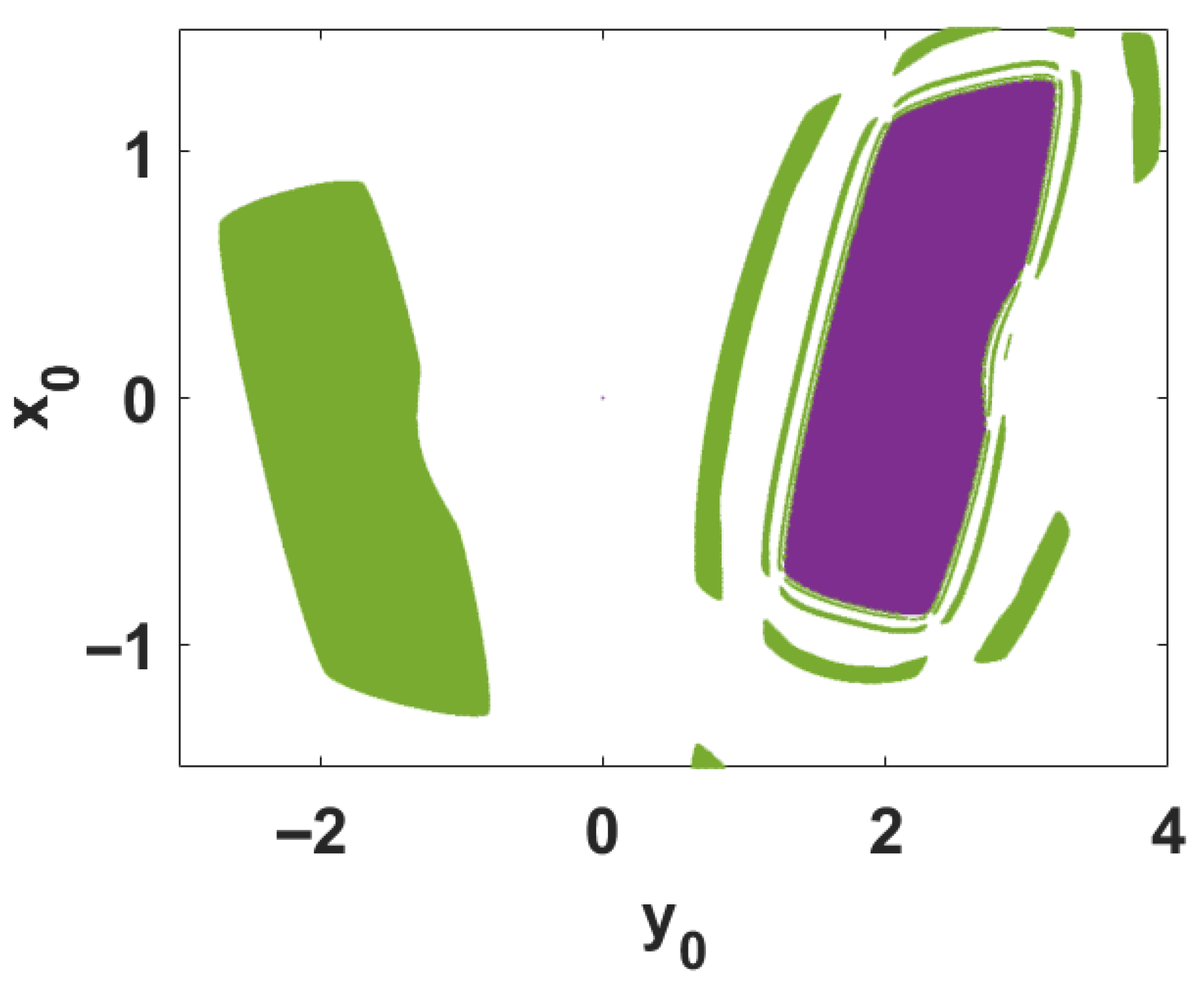
In Case 1, with initial conditions IC = (0.1, 0.1), h = 0.5, c = −1, and a = 1 − b while b varies in the range [1, 1.73], it can be observed that, across different phase trajectories corresponding to various bifurcation parameters b, system (15) consistently exhibits conditional symmetry with respect to x. Moreover, by adjusting the constant e, the attractor positions along the y-dimension can be shifted. The corresponding phase portraits are presented in Figure 10. Figure 11a shows the discrete sequences for b = 1.7 under two sets of initial conditions: IC = (0.1, 0.1 + e) and IC = (−0.1, 0.1 − e). As evidenced by the uniform-width bifurcation diagrams, invariant Lyapunov exponents, and parallel mean lines in Figure 11b–d, system (15) satisfies conditional symmetry. Figure 12 illustrates the basins of attraction for the two coexisting attractors in system (15), where the green region corresponds to the green attractor and the purple region corresponds to the purple attractor. Due to the extreme sensitivity of the hyperchaotic system to initial conditions, a green ring appears around the boundary of the purple region. Nevertheless, this does not affect the conditional symmetry properties of the system.
According to the above definition, to achieve conditional symmetry in a discrete system, it is necessary to introduce an offset boosting to the variable not undergoing polarity inversion, following the incorporation of an absolute value or sign function, in order to restore polarity balance. In contrast, the construction of a two-dimensional offset boosting in a discrete system requires adding the same constant term to both sides of the system equation to achieve offset cancelation, leaving only a constant term on the right-hand side. By adjusting this single constant parameter, offsets along both dimensions can be realized. In this study, the absolute value function is employed. However, after adding or subtracting a constant term within the absolute value function, the sign of the constant cannot be determined, preventing the offset cancelation on both sides of the equation. Consequently, it is not possible to achieve a two-dimensional offset in the discrete system while simultaneously maintaining conditional symmetry.

5. Circuit Implementation Based on CH32

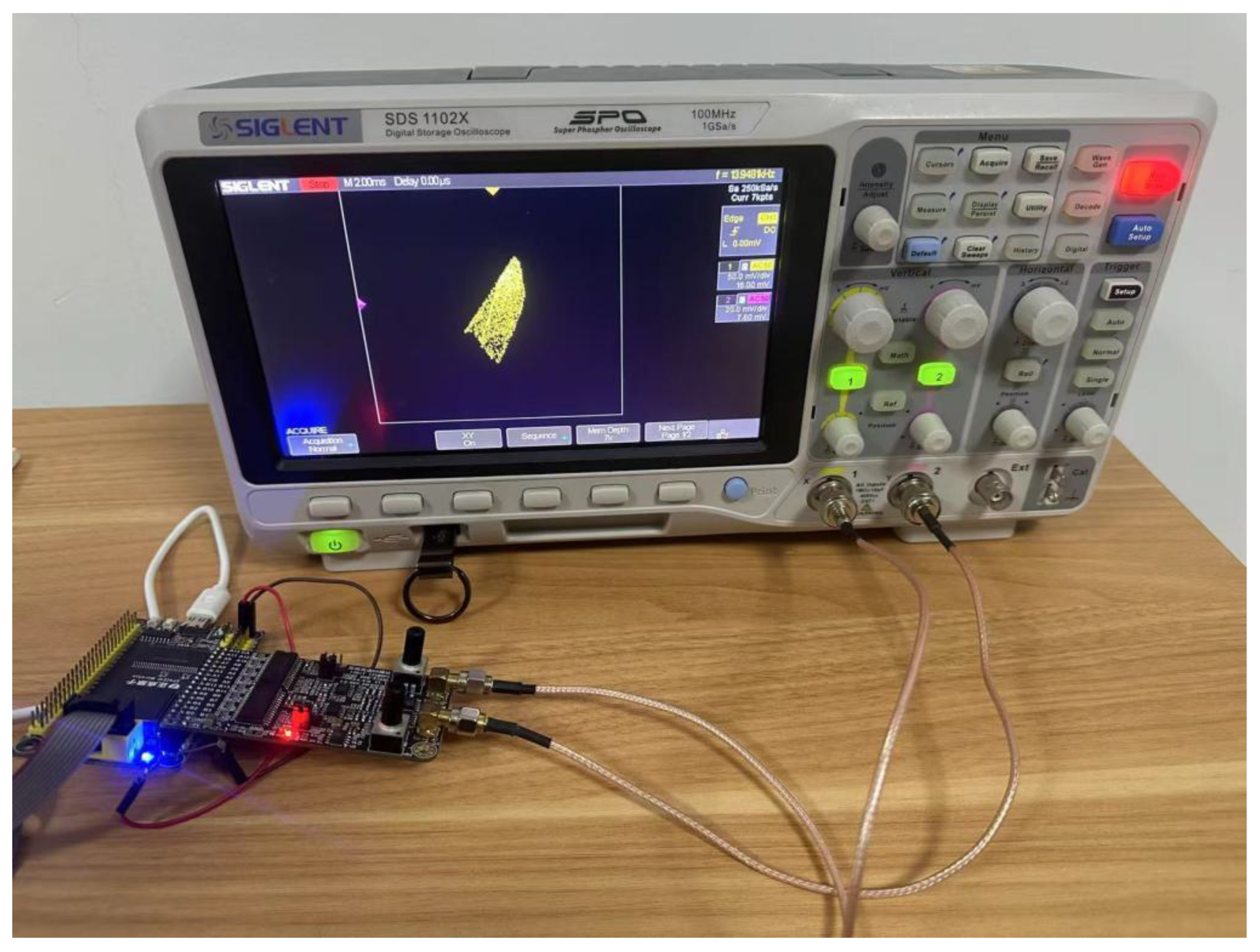
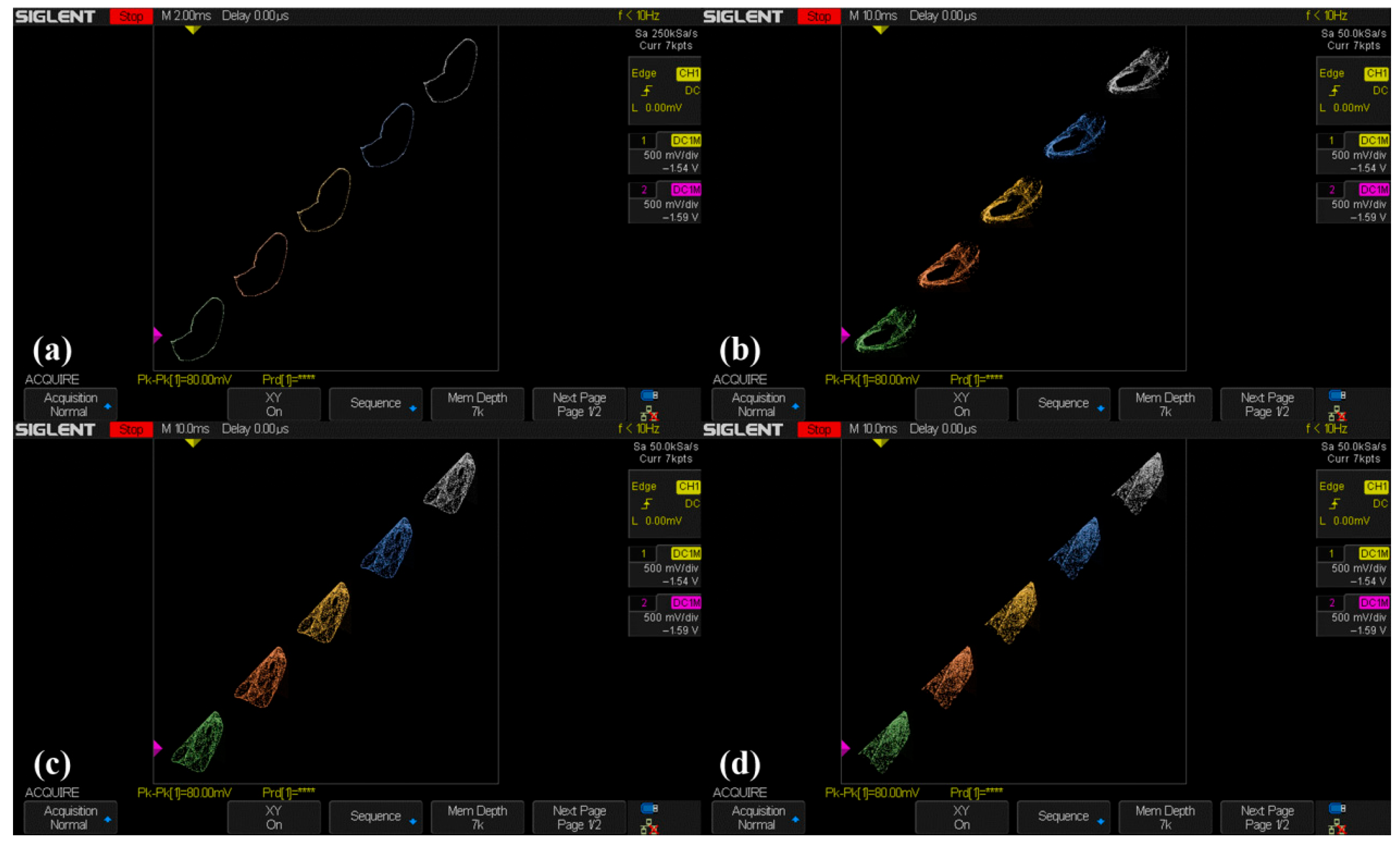
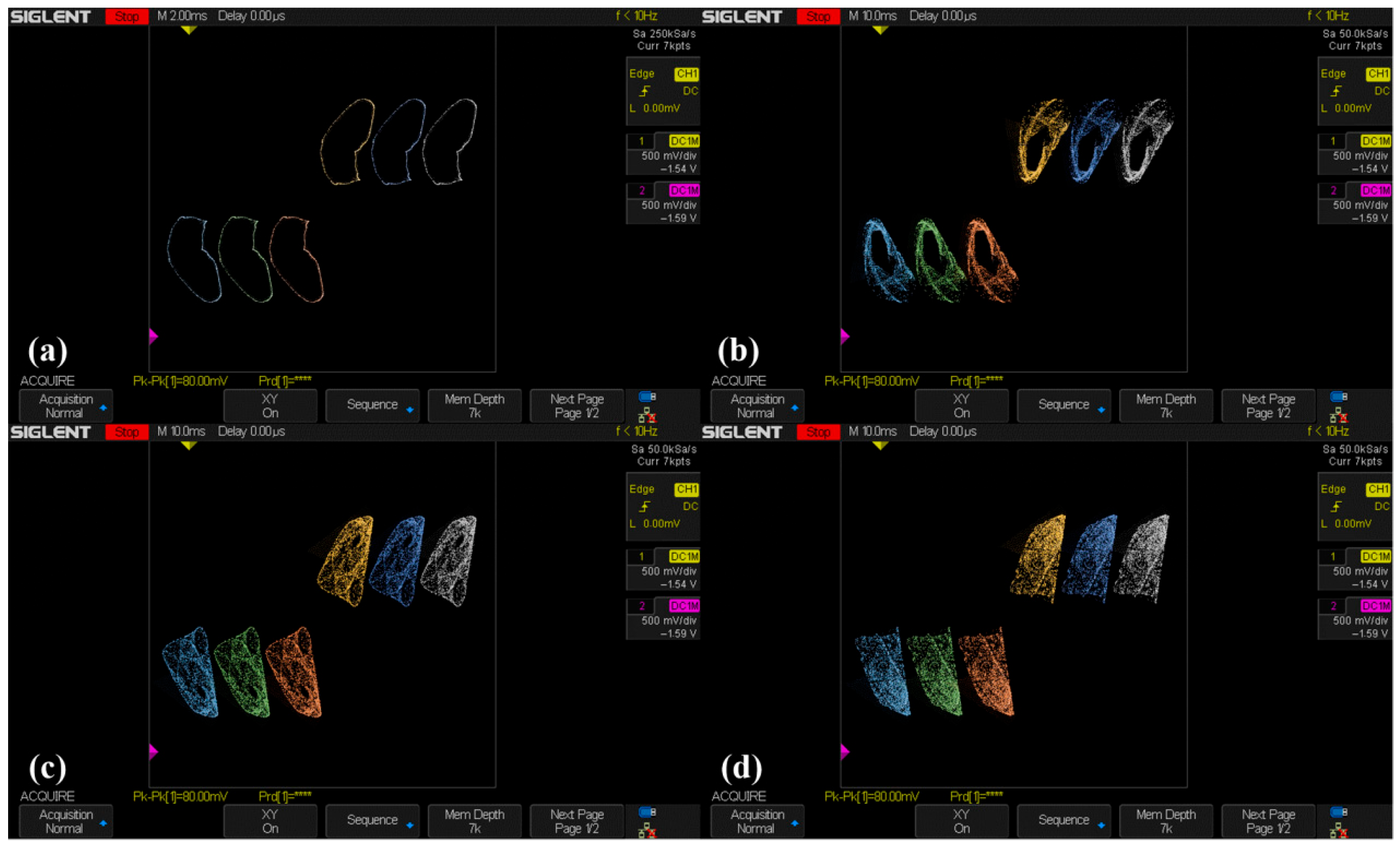
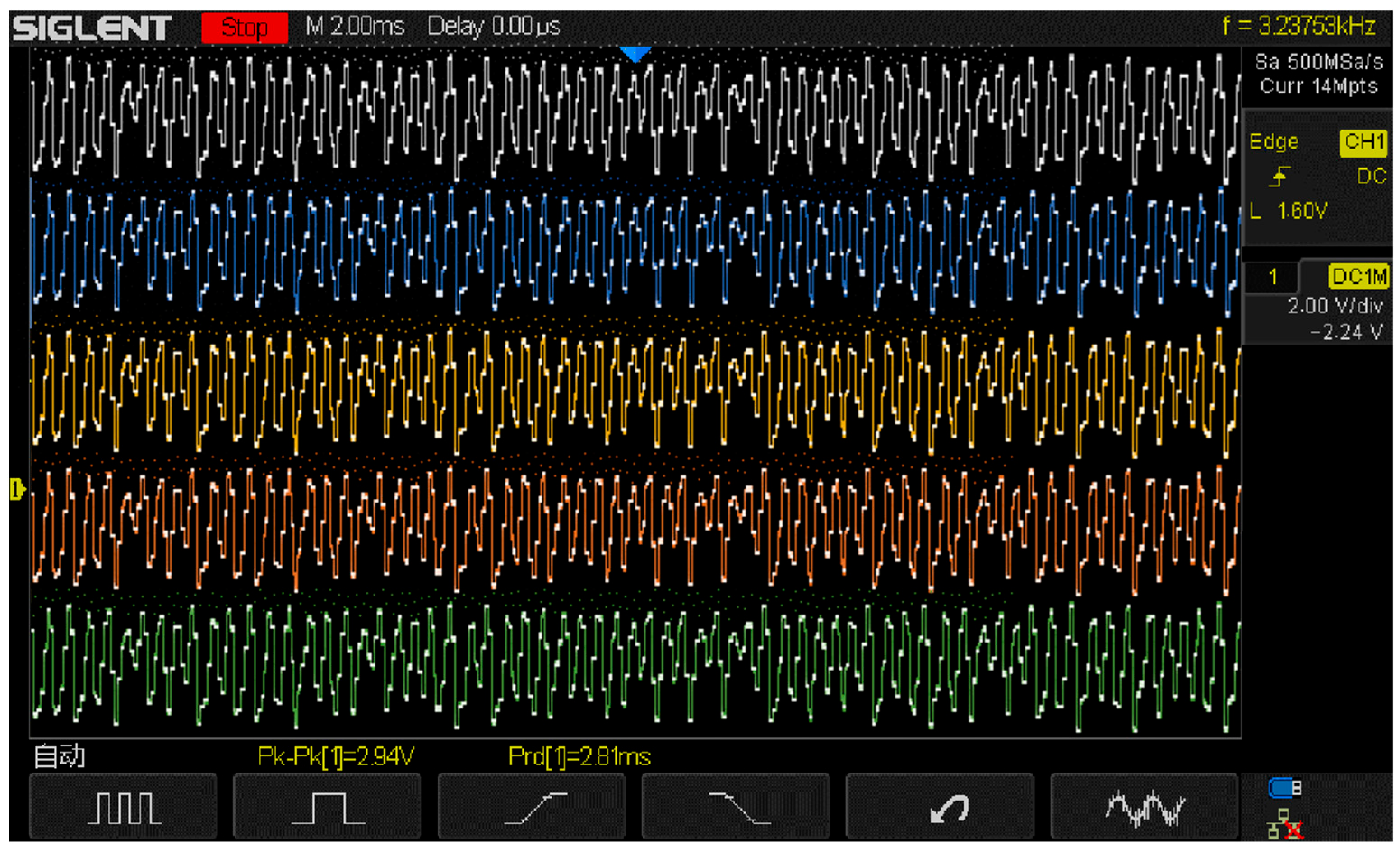
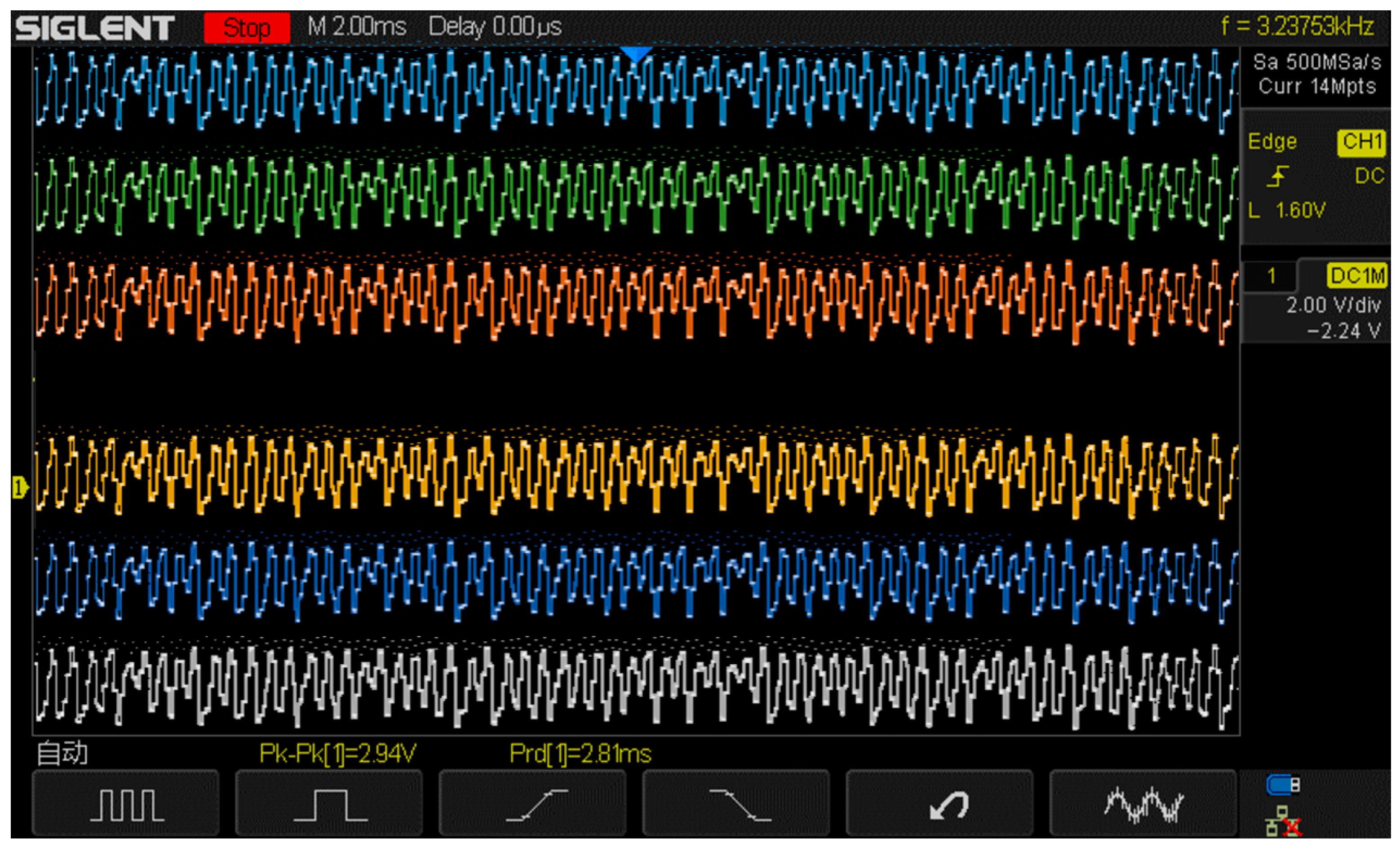
The hardware implementation of the above discrete hyperchaotic map is based on the CH32V307, an interconnected microcontroller designed on a 32-bit RISC-V architecture. This platform features a hardware stack and fast interrupt entry, significantly improving interrupt response speed compared to standard RISC-V implementations. The CH32V307 operates at a maximum frequency of 144 MHz and is equipped with 256 KB of Flash memory and 64 KB of SRAM. It supports single-cycle multiplication, hardware division, and hardware floating-point operations, providing enhanced computational performance. In addition to a 2-unit, 16-channel, 12-bit ADC and 16 TouchKey inputs, the microcontroller is equipped with two 12-bit DAC converters, facilitating analog-to-digital and digital-to-analog signal conversion. The system converts chaotic digital signals into analog voltage signals in the range of 0–4095, which are cyclically written into the DAC_DORx registers via the main program loop. For each iteration, the next cycle uses the previously generated chaotic data as the initial condition. By inputting these analog voltage signals into the X/Y axes of an oscilloscope, the corresponding phase trajectories of the system can be observed. Figure 13 shows the experimental setup. The two-dimensional offset property and conditional symmetry of the discrete system can be visualized on the oscilloscope. Figure 14, Figure 15, Figure 16 and Figure 17 illustrate the offset phase trajectories and discrete sequences of chaotic map (13) and the conditionally symmetric phase trajectories and discrete sequences of chaotic map (15) under four different values of b: 1.1514, 1.33, 1.52, and 1.7.

6. Application in Path Optimization

Existing studies indicate that traditional intelligent optimization algorithms are prone to being trapped in local optima and often exhibit relatively slow convergence. It is well known that chaotic systems possess pseudo-randomness and good ergodicity, which can be leveraged in intelligent optimization algorithms to improve search quality and algorithmic robustness. Using chaotic sequences to generate the initial population, compared with conventional random initialization, produces a more dispersed population and enhances population diversity. In addition, by introducing chaotic perturbations to replace the standard random function in intelligent optimization algorithms, the search strategy of the algorithms can be further optimized.
The physical significance of hyperchaotic dynamics lies in the coexistence of multiple positive Lyapunov exponents, which indicate exponential divergence along more than one independent direction in the phase space. Compared with chaotic systems characterized by a single positive Lyapunov exponent, hyperchaotic systems exhibit stronger ergodicity and higher-dimensional instability, leading to more complex and less predictable trajectories. From an optimization perspective, this enhanced instability translates into improved exploration capability. The presence of two positive Lyapunov exponents enables the generated sequences to traverse the search space more uniformly, thereby increasing the probability of escaping local optima. In robotic path planning, this property is particularly beneficial in complex or cluttered environments, where conventional chaotic sequences may still exhibit limited exploration due to lower-dimensional dynamics.
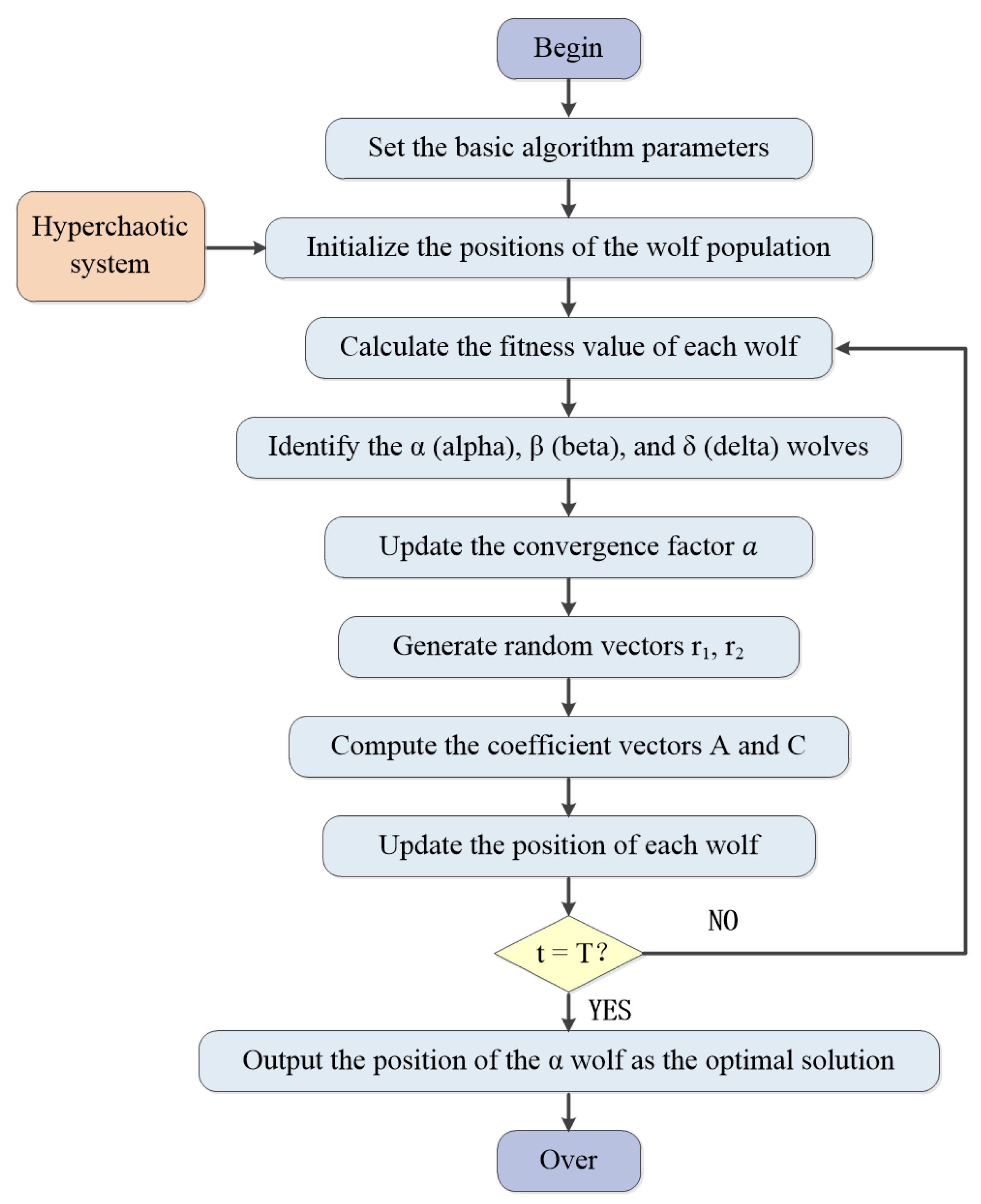
Based on this idea, three classical intelligent optimization algorithms are selected in this work: Ant Colony Optimization (ACO) [41], Grey Wolf Optimization (GWO) [42], and Sparrow Search Algorithm (SSA) [43]. Chaotic map (15) is introduced during the initialization phase of each algorithm, resulting in the Hyperchaotic Ant Colony Optimization (HCACO), Hyperchaotic Grey Wolf Optimization (HCGWO), and Hyperchaotic Sparrow Search Algorithm (HCSSA), which are then applied to robot path planning. The convergence performance and optimality of these six algorithmic variants are investigated to validate the reliability of the algorithms and the feasibility of the system. Taking HCGWO as an example, the algorithm flowchart is illustrated in Figure 18.
The simulation platform used in this study is MATLAB R2021a. On this platform, the convergence performance and optimality of six intelligent optimization algorithms—ACO, HCACO, GWO, HCGWO, SSA, and HCSSA—are tested for solving mobile robot path planning problems. To ensure a consistent experimental environment, all tests are performed on an AMD Ryzen 5 5600X (6-Core) processor. For environment modeling, the grid method is employed, representing the robot’s workspace as a two-dimensional plane composed of uniformly sized grids with binary occupancy information. Considering that most real-world objects are irregularly shaped, a dilation method is applied during modeling: obstacles that occupy less than one grid are expanded to occupy a full grid, ensuring that each obstacle occupies at least one grid. In this study, a 20 × 20 high-density obstacle grid environment is simulated. To guarantee fairness and reliability, each of the six algorithms is independently executed 15 times in the same environment, and the most frequently occurring path among the 15 runs is selected as the final path result. The population size is set to 50, and the maximum number of iterations is 20.
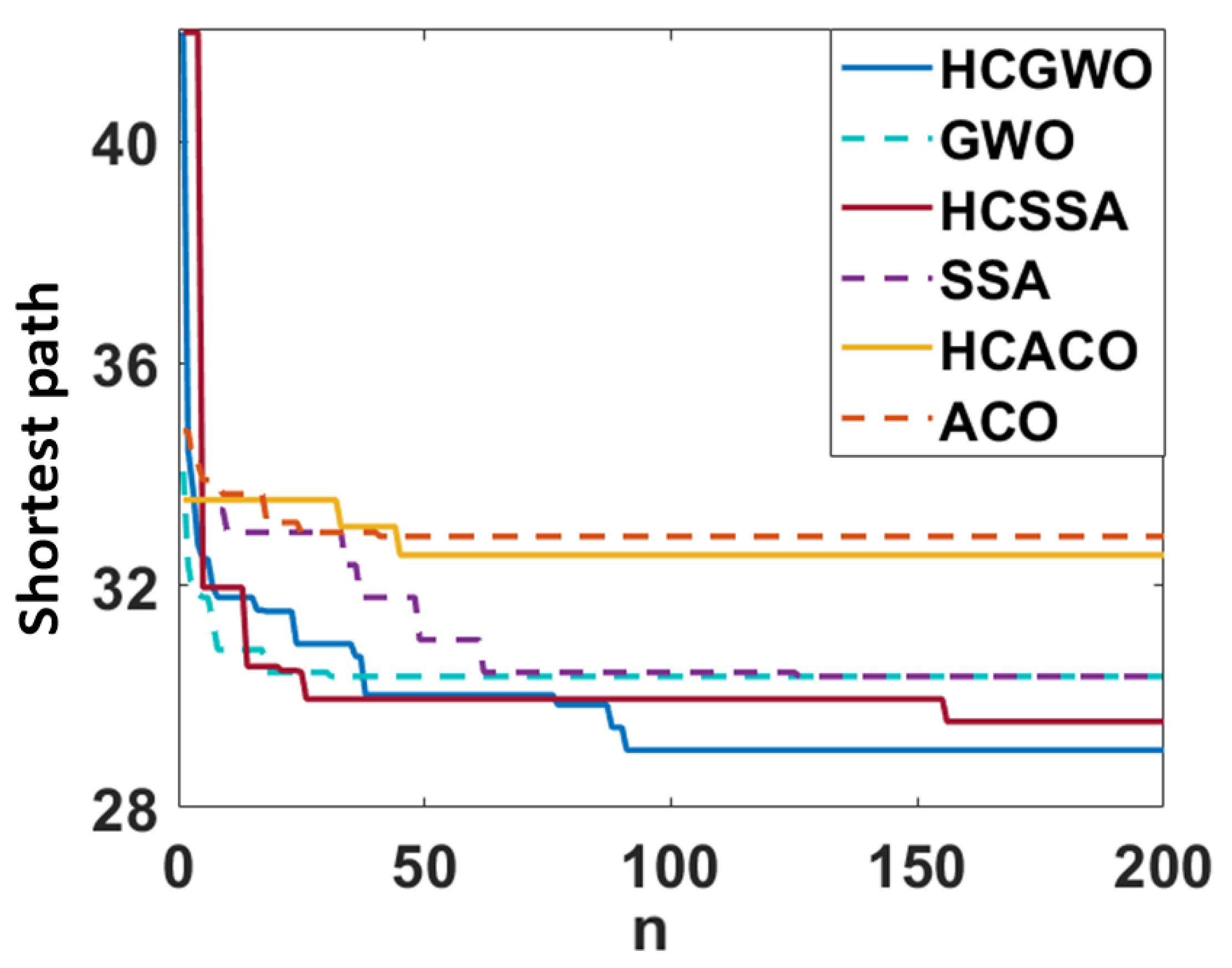
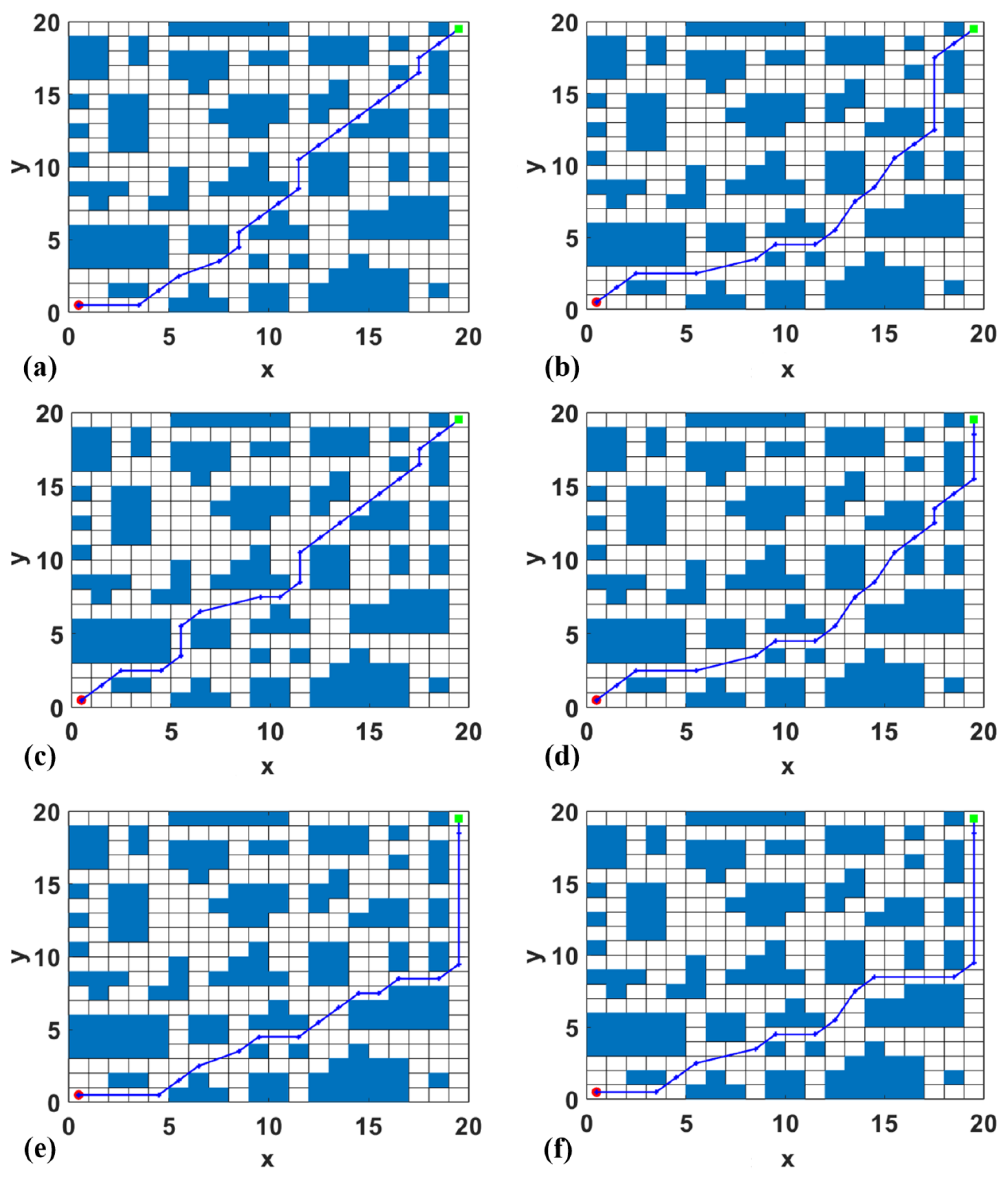
Figure 19 presents the comparison of convergence curves of six intelligent optimization algorithms under the same robotic environment, and the corresponding path maps are shown in Figure 20. When applied to robotic path optimization, the shortest path lengths obtained by HCGWO, GWO, HCSSA, SSA, HCACO, and ACO are 29.0351, 30.3623, 29.9547, 31.0219, 32.5498, and 32.8832, respectively. Analyzing Figure 20, it is evident that the paths generated by the three hyperchaos-enhanced algorithms are smoother than those produced by the original algorithms. It can be concluded that the shortest paths obtained using the chaos-enhanced algorithms designed with the introduced system (15) are shorter than those of the original algorithms. Compared with the original algorithms, the hyperchaos-enhanced algorithms exhibit better convergence performance and stronger global search capability, confirming the reliability of the algorithms and the feasibility of the system. This demonstrates that incorporating hyperchaotic systems into intelligent optimization algorithms can improve robustness, enhance search capability, and increase convergence quality.

7. Conclusions

This paper introduces a novel two-dimensional discrete hyperchaotic system, characterized by a simple formulation yet rich and complex dynamical behaviors. The system exhibits two-dimensional offset boosting and has the polarity balance for conditional symmetry. Its feasibility and theoretical validity were confirmed through circuit implementation based on the CH32 platform. Integrating chaotic theory into intelligent optimization algorithms has been shown to enhance resistance to premature convergence and improve global search performance. Accordingly, three classical algorithms—Ant Colony Optimization (ACO), Grey Wolf Optimization (GWO), and Sparrow Search Algorithm (SSA)—were combined with the proposed hyperchaotic sequences to develop three chaos-enhanced variants: HCACO, HCGWO, and HCSSA. To evaluate both the reliability of these algorithms and the feasibility of the hyperchaotic system, extensive robot path-planning experiments were conducted under identical environments for all six algorithms. The results demonstrate that the hyperchaos-enhanced algorithms outperform their conventional counterparts in convergence speed, global optimization capability, and path smoothness. These findings confirm that embedding hyperchaotic systems into intelligent optimization algorithms can substantially improve performance, highlighting the significant potential of merging chaos theory with intelligent optimization. Future research will further explore the application of diverse hyperchaotic structures in intelligent optimization, as well as potential integrations with deep learning, adaptive control, and other AI techniques, thereby expanding the practical scope of chaos-enhanced methods. In addition, inspired by recent advances in coupled dynamical systems, an important future direction is the development of structure-preserving iterative algorithms [44,45] for hyperchaotic modeling. In coupled systems such as hub–flexible beam systems, structure-preserving iteration methods employ symplectic schemes to handle rigid-body rotational (or planar) motion and generalized multi-symplectic schemes to describe flexible vibrations, thereby preserving the intrinsic coupling structure and stability of the system [46,47]. Incorporating such structure-preserving schemes may enable more faithful reproduction of hyperchaotic features, reduce numerical distortion in long-term iterations, and further enhance the robustness and reliability of hyperchaos-driven path planning and optimization algorithms.

Author Contributions

Z.H.: investigation, data curation, validation, formal analysis, writing—original draft; C.L.: conceptualization, methodology, writing—review and editing, project administration; X.Q.: resources, visualization, writing—review and editing; I.P.A.: supervision, methodology; C.V.: supervision, writing—review and editing. All authors have read and agreed to the published version of the manuscript.

Funding

This work was supported financially by the National Natural Science Foundation of China (Grant No.: 62371242).

Data Availability Statement

The raw data supporting the conclusions of this article will be made available by the authors on request.

Conflicts of Interest

The authors declare no conflicts of interest.

References

  1. Lorenz, E.N. Deterministic nonperiodic flow. J. Atmos. Sci. 1963, 20, 130–141. [Google Scholar] [CrossRef]
  2. Feigenbaum, M.J. Quantitative universality for a class of nonlinear transformations. J. Stat. Phys. 1978, 19, 25–52. [Google Scholar] [CrossRef]
  3. Li, T.Y.; Yorke, J.A. Period three implies chaos. Am. Math. Mon. 1975, 82, 985–992. [Google Scholar] [CrossRef]
  4. Holden, A.V. Chaos; Princeton University Press: Princeton, NJ, USA, 2014. [Google Scholar]
  5. Wiener, N. The homogeneous chaos. Am. J. Math. 1938, 60, 897–936. [Google Scholar] [CrossRef]
  6. Kapitaniak, T. Continuous control and synchronization in chaotic systems. Chaos Solitons Fractals 1995, 6, 237–244. [Google Scholar] [CrossRef]
  7. Wang, Y.W.; Guan, Z.H. Generalized synchronization of continuous chaotic system. Chaos Solitons Fractals 2006, 27, 97–101. [Google Scholar] [CrossRef]
  8. Chen, G.; Dong, X. On feedback control of chaotic continuous-time systems. IEEE Trans. Circuits Syst. I Fundam. Theory Appl. 1993, 40, 591–601. [Google Scholar] [CrossRef]
  9. Boukabou, A.; Chebbah, A.; Mansouri, N. Predictive control of continuous chaotic systems. Int. J. Bifurc. Chaos 2008, 18, 587–592. [Google Scholar] [CrossRef]
  10. Clemente-López, D.; Munoz-Pacheco, J.M.; Rangel-Magdaleno, J.J. A review of the digital implementation of continuous-time fractional-order chaotic systems using FPGAs and embedded hardware. Arch. Comput. Methods Eng. 2023, 30, 951. [Google Scholar] [CrossRef]
  11. Zhang, X.; Li, C.; Dong, E.; Zhao, Y.; Liu, Z. A conservative memristive system with amplitude control and offset boosting. Int. J. Bifurc. Chaos 2022, 32, 2250057. [Google Scholar] [CrossRef]
  12. Li, C.; Gao, Y.; Lei, T.; Li, R.Y.M.; Xu, Y. Two independent offset controllers in a three-dimensional chaotic system. Int. J. Bifurc. Chaos 2024, 34, 2450008. [Google Scholar] [CrossRef]
  13. Johnson, J.M.; Bajaj, A.K. Amplitude modulated and chaotic dynamics in resonant motion of strings. J. Sound Vib. 1989, 128, 87–107. [Google Scholar] [CrossRef]
  14. Li, C.; Jiang, Y.; Ma, X. On offset boosting in chaotic system. Chaos Theory Appl. 2021, 3, 47–54. [Google Scholar] [CrossRef]
  15. Dong, C. Dynamic analysis of a novel 3D chaotic system with hidden and coexisting attractors: Offset boosting, synchronization, and circuit realization. Fractal Fract. 2022, 6, 547. [Google Scholar] [CrossRef]
  16. Ramar, R. Design of a new chaotic system with sine function: Dynamic analysis and offset boosting control. Chaos Theory Appl. 2023, 5, 118–126. [Google Scholar] [CrossRef]
  17. Martelli, M. Introduction to Discrete Dynamical Systems and Chaos; John Wiley & Sons: Hoboken, NJ, USA, 2011. [Google Scholar]
  18. Kocarev, L.; Szczepanski, J.; Amigó, J.M.; Tomovski, I. Discrete chaos-i: Theory. IEEE Trans. Circuits Syst. I Regul. Pap. 2006, 53, 1300–1309. [Google Scholar] [CrossRef]
  19. Elaydi, S.N. Discrete Chaos: With Applications in Science and Engineering; Chapman and Hall/CRC: Boca Raton, FL, USA, 2007. [Google Scholar]
  20. Ott, E.; Grebogi, C.; Yorke, J.A. Controlling chaos. Phys. Rev. Lett. 1990, 64, 1196–1199. [Google Scholar] [CrossRef]
  21. Boccaletti, S.; Kurths, J.; Osipov, G.; Valladares, D.L.; Zhou, C.S. The synchronization of chaotic systems. Phys. Rep. 2002, 366, 1–101. [Google Scholar] [CrossRef]
  22. Kong, S.; Li, C.; Jiang, H.; Lai, Q.; Jiang, X. A 2D hyperchaotic map with conditional symmetry and attractor growth. Chaos Interdiscip. J. Nonlinear Sci. 2021, 31, 043121. [Google Scholar] [CrossRef] [PubMed]
  23. Ostrovskii, V.Y.; Rybin, V.G.; Karimov, A.I.; Butusov, D.N. Inducing multistability in discrete chaotic systems using numerical integration with variable symmetry. Chaos Solitons Fractals 2022, 165, 112794. [Google Scholar] [CrossRef]
  24. Ren, L.; Mou, J.; Banerjee, S.; Zhang, Y. A hyperchaotic map with a new discrete memristor model: Design, dynamical analysis, implementation and application. Chaos Solitons Fractals 2023, 167, 113024. [Google Scholar] [CrossRef]
  25. Jin, J.; Chen, W.; Ouyang, A.; Yu, F.; Liu, H. A time-varying fuzzy parameter zeroing neural network for the synchronization of chaotic systems. IEEE Trans. Emerg. Top. Comput. Intell. 2023, 8, 364–376. [Google Scholar] [CrossRef]
  26. Liu, X.; Zhao, L.; Jin, J. A noise-tolerant fuzzy-type zeroing neural network for robust synchronization of chaotic systems. Concurr. Comput. Pract. Exp. 2024, 36, e8218. [Google Scholar] [CrossRef]
  27. Pourasad, Y.; Ranjbarzadeh, R.; Mardani, A. A new algorithm for digital image encryption based on chaos theory. Entropy 2021, 23, 341. [Google Scholar] [CrossRef]
  28. Yang, F.; An, X. A new discrete chaotic map application in image encryption algorithm. Phys. Scr. 2022, 97, 035202. [Google Scholar] [CrossRef]
  29. Alhadawi, H.S.; Majid, M.A.; Lambić, D.; Ahmad, M. A novel method of S-box design based on discrete chaotic maps and cuckoo search algorithm. Multimed. Tools Appl. 2021, 80, 7333–7350. [Google Scholar] [CrossRef]
  30. Yu, F.; Wang, X.; Guo, R.; Ying, Z.; Cai, S.; Jin, J. Dynamical analysis, hardware implementation, and image encryption application of new 4D discrete hyperchaotic maps based on parallel and cascade memristors. Integration 2025, 104, 102475. [Google Scholar] [CrossRef]
  31. Grassi, G. Chaos in the real world: Recent applications to communications, computing, distributed sensing, robotic motion, bio-impedance modelling and encryption systems. Symmetry 2021, 13, 2151. [Google Scholar] [CrossRef]
  32. Tutsoy, O.; Barkana, D.E. Model free adaptive control of the under-actuated robot manipulator with the chaotic dynamics. ISA Trans. 2021, 118, 106–115. [Google Scholar] [CrossRef]
  33. Parhi, D.R. Chaos-based optimal path planning of humanoid robot using hybridized regression-gravity search algorithm in static and dynamic terrains. Appl. Soft Comput. 2023, 140, 110236. [Google Scholar]
  34. Rossler, O.E. An equation for hyperchaos. Phys. Lett. A 1979, 71, 155–157. [Google Scholar] [CrossRef]
  35. Tian, H.; Yi, X.; Zhang, Y.; Wang, Z.; Xi, X.; Liu, J. Dynamical analysis, feedback control circuit implementation, and fixed-time sliding mode synchronization of a novel 4D chaotic system. Symmetry 2025, 17, 1252. [Google Scholar] [CrossRef]
  36. Chong, Z.; Wang, C.; Zhang, H.; Zhang, S. Sine-Transform-Based Dual-Memristor Hyperchaotic Map and Analog Circuit Implementation. IEEE Trans. Instrum. Meas. 2025, 74, 1–14. [Google Scholar] [CrossRef]
  37. Erkan, U.; Toktas, A.; Lai, Q. 2D hyperchaotic system based on Schaffer function for image encryption. Expert Syst. Appl. 2023, 213, 119076. [Google Scholar] [CrossRef]
  38. Zhou, S.; Qiu, Y.; Wang, X.; Zhang, Y. Novel image cryptosystem based on new 2D hyperchaotic map and dynamical chaotic S-box. Nonlinear Dyn. 2023, 111, 9571–9589. [Google Scholar] [CrossRef]
  39. Teng, L.; Wang, X.; Yang, F.; Xian, Y. Color image encryption based on cross 2D hyperchaotic map using combined cycle shift scrambling and selecting diffusion. Nonlinear Dyn. 2021, 105, 1859–1876. [Google Scholar] [CrossRef]
  40. Farid, H.; Simoncelli, E.P. Differentiation of discrete multidimensional signals. IEEE Trans. Image Process. 2004, 13, 496–508. [Google Scholar] [CrossRef] [PubMed]
  41. Dorigo, M.; Birattari, M.; Stutzle, T. Ant colony optimization. IEEE Comput. Intell. Mag. 2007, 1, 28–39. [Google Scholar] [CrossRef]
  42. Mirjalili, S.; Mirjalili, S.M.; Lewis, A. Grey wolf optimizer. Adv. Eng. Softw. 2014, 69, 46–61. [Google Scholar] [CrossRef]
  43. Xue, J.; Shen, B. A novel swarm intelligence optimization approach: Sparrow search algorithm. Syst. Sci. Control Eng. 2020, 8, 22–34. [Google Scholar] [CrossRef]
  44. Hairer, E.; Lubich, C.; Wanner, G. Structure-preserving algorithms for ordinary differential equations. In Geometric Numerical Integration; Springer: Berlin/Heidelberg, Germany, 2006; Volume 31. [Google Scholar]
  45. Wang, B.; Jiang, Y. Structure-preserving algorithms with uniform error bound and long-time energy conservation for highly oscillatory Hamiltonian systems. J. Sci. Comput. 2023, 95, 66. [Google Scholar] [CrossRef]
  46. Hu, W.; Xu, M.; Zhang, F.; Xiao, C.; Deng, Z. Dynamic analysis on flexible hub-beam with step-variable cross-section. Mech. Syst. Signal Process. 2022, 180, 109423. [Google Scholar] [CrossRef]
  47. Hu, W.; Xiao, C.; Deng, Z. Dynamic Symmetry Breaking and Generalized Multi-symplectic Method for Non-conservative Systems. In Geometric Mechanics and Its Applications; Springer Nature Singapore: Singapore, 2023; pp. 203–275. [Google Scholar]
Figure 1. Typical hyperchaotic oscillation of the map (1), with h = 0.5, a = −0.7, b = 1.7, c = −1 under IC = (x0, y0) = (0.1, 0.1): (a) phase orbit, (b) discrete sequence of xn, (c) discrete sequence of yn.
Symmetry 18 00212 g001
Figure 2. Dynamical evolution of the hyperchaotic map (1), with h = 0.5, b = 1.7, c = −1 when a varies in [−1.5, −0.67] under IC = (x0, y0) = (0.1, 0.1): (a) Lyapunov exponents, (b) bifurcation diagram.
Symmetry 18 00212 g002
Figure 3. Typical phase trajectories of the map (1), with h = 0.5, b = 1.7, c = −1 under IC = (x0, y0) = (0.1, 0.1): (a) a = −1.3079, (b) a = −0.888, (c) a = −0.88, (d) a = −0.8, (e) a = −0.7383, (f) a = −0.7.
Symmetry 18 00212 g003
Figure 4. Dynamical evolution of the hyperchaotic map (1), with h = 0.5, a = −0.7, c = −1 when b varies in [1, 1.73] under IC = (x0, y0) = (0.1, 0.1): (a) Lyapunov exponents, (b) Bifurcation diagram.
Symmetry 18 00212 g004
Figure 5. Typical solutions of the map (1), with h = 0.5, a = −0.7, c = −1 under IC = (x0, y0) = (0.1, 0.1): (a) b = 1.2255, (b) b = 1.4535, (c) b = 1.47, (d) b = 1.5, (e) b = 1.655, (f) b = 1.7.
Symmetry 18 00212 g005
Figure 6. Dynamical evolution of the hyperchaotic map (1), with h = 0.5, a = −0.7, b = 1.7 under IC = (x0, y0) = (0.1, 0.1): (a) Lyapunov exponents, (b) bifurcation diagram.
Symmetry 18 00212 g006
Figure 7. Typical phase trajectories of the map (1), with h = 0.5, a = −0.7, b = 1.7 under IC = (x0, y0) = (0.1, 0.1): (a) c = −0.52, (b) c = −0.7628, (c) c = −0.746, (d) c = −0.79, (e) c = −0.8, (f) c = −1.
Symmetry 18 00212 g007
Figure 8. Two-dimensional offset boosting of the map (13) in the x-y plane, with h = 0.5, c = −1, a + b = 1 and IC = (x0, y0) = (0.1 − d, 0.1 − d): (a) b = 1.1514, (b) b = 1.33, (c) b = 1.52, (d) b = 1.7.
Symmetry 18 00212 g008
Figure 9. Offset boosting of the map (13) in the x-y plane, with h = 0.5, a = −0.7, b = 1.7, and c = −1 under IC = (x0, y0) = (0.1 − d, 0.1 − d): (a) discrete sequences, (b) average values of variable x, y, (c) bifurcation diagram, (d) Lyapunov exponents.
Symmetry 18 00212 g009
Figure 10. The phase trajectories of conditional symmetry of the map (15) in the y-x plane, with h = 0.5, c = −1, a + b = 1 under different initial conditions, where e = 2 and b varies in [1, 1.73], purple: IC = (0.1, 2.1), green: IC = (−0.1, −1.9), dark blue: IC = (0.1, 4.1), yellow: IC = (−0.1, −3.9), light blue: IC = (0.1, 6.1), brown: IC = (−0.1, −5.9): (a) b = 1.1514, (b) b = 1.33, (c) b = 1.52, (d) b = 1.7.
Symmetry 18 00212 g010
Figure 11. Conditional symmetry of the map (15), with h = 0.5, a = −0.7, b = 1.7, c = −1 under different initial conditions, where e = 2, purple: IC = (0.1, 2.1), green: IC = (−0.1, −1.9), dark blue: IC = (0.1, 4.1), yellow: IC = (−0.1, −3.9), light blue: IC = (0.1, 6.1), brown: IC = (−0.1, −5.9): (a) discrete sequences, (b) average value of variable |y|, (c) bifurcation diagram, (d) Lyapunov exponents.
Symmetry 18 00212 g011
Figure 12. Basins of attraction for two coexisting symmetrical attractors of the map (15), with h = 0.5, a = −0.7, b = 1.7, c = −1, e = 2.
Symmetry 18 00212 g012
Figure 13. The hardware implementation based on CH32 for map (15).
Symmetry 18 00212 g013
Figure 14. The phase trajectories of offset boosting of the map (13) in the x-y plane, with h = 0.5, c = −1, a + b = 1 under IC = (x0, y0) = (0.1 − d, 0.1 − d), as b varies in [1, 1.73] and d varies in [−4, 4], where white: d = 4, blue: d = 2, yellow: d = 0, orange: d = −2, green: d = −4: (a) b = 1.1514, (b) b = 1.33, (c) b = 1.52, (d) b = 1.7.
Symmetry 18 00212 g014
Figure 15. The phase trajectories of conditional symmetry of the map (15) in the y-x plane, with h = 0.5, c = −1, a + b = 1 under different initial conditions, where e = 2 and b varies in [1, 1.73], yellow: IC = (0.1, 2.1), orange: IC = (−0.1, −1.9), dark blue: IC = (0.1, 4.1), green: IC = (−0.1, −3.9), white: IC = (0.1, 6.1), light blue: IC = (−0.1, −5.9): (a) b = 1.1514, (b) b = 1.33, (c) b = 1.52, (d) b = 1.7.
Symmetry 18 00212 g015
Figure 16. The discrete sequences of offset boosting of the map (13) in the x-y plane, with h = 0.5, c = −1, a + b = 1 under IC = (x0, y0) = (0.1 − d, 0.1 − d), as b varies in [1, 1.73] and d varies in [−4, 4], where white: d = 4, blue: d = 2, yellow: d = 0, orange: d = −2, green: d = −4.
Symmetry 18 00212 g016
Figure 17. The discrete sequences of conditional symmetry of the map (15) in the y-x plane, with h = 0.5, c = −1, a + b = 1 under different initial conditions, where e = 2 and b varies in [1, 1.73], yellow: IC = (0.1, 2.1), orange: IC = (−0.1, −1.9), dark blue: IC = (0.1, 4.1), green: IC = (−0.1, −3.9), white: IC = (0.1, 6.1), light blue: IC = (−0.1, −5.9).
Symmetry 18 00212 g017
Figure 18. Flowchart of the HCGWO.
Symmetry 18 00212 g018
Figure 19. Obstacle grid environment convergence curve performance.
Symmetry 18 00212 g019
Figure 20. Path planning performance in obstacle grid environment: (a) HCGWO, (b) GWO, (c) HCSSA, (d) SSA, (e) HCACO, (f) ACO.
Symmetry 18 00212 g020
Table 1. Typical solutions of map (1), with h = 0.5, b = 1.7, c = −1 under IC = (x0, y0) = (0.1, 0.1).
aAttractor TypeLyapunov Exponents
−1.3079Quasi-periodicity0, −0.1410
−0.888Periodic points−0.0036, −0.2042
−0.88Chaos0.0913, −0.2100
−0.8Hyperchaos0.1466, 0.0366
−0.7383Periodic points−0.0331, −0.0331
−0.7Hyperchaos0.1853, 0.0931
Table 2. Typical solutions of map (1), with h = 0.5, a = −0.7, c = −1 under IC = (x0, y0) = (0.1, 0.1).
bAttractor TypeLyapunov Exponents
1.2255Quasi-periodicity0, −0.0362
1.4535Quasi-periodicity0, −0.0295
1.47Chaos0.0126, −0.0323
1.5Hyperchaos0.0466, 0.0026
1.655Periodic points−0.0212, −0.0187
1.7Hyperchaos0.1853, 0.0931
Table 3. Typical solutions of map (1), with h = 0.5, a = −0.7, b = 1.7 under IC = (x0, y0) = (0.1, 0.1).
cAttractor TypeLyapunov Exponents
−1Hyperchaos0.1853, 0.0931
−0.945Periodic points−0.0622, −0.0619
−0.8Hyperchaos0.0654, 0.0301
−0.79Chaos0.061, −0.0054
−0.7628Periodic points−0.0024, −0.005
−0.746Chaos0.0109, −0.043
−0.52Quasi-periodicity0, −0.0369
−0.49Periodic points−0.0086, −0.0086
Disclaimer/Publisher’s Note: The statements, opinions and data contained in all publications are solely those of the individual author(s) and contributor(s) and not of MDPI and/or the editor(s). MDPI and/or the editor(s) disclaim responsibility for any injury to people or property resulting from any ideas, methods, instructions or products referred to in the content.