


Abstract
Rail surface defects frequently exhibit arbitrary orientations, elongated geometries, small spatial footprints, and substantial texture-scale variation. Although oriented bounding boxes (OBBs) improve geometric localization, they do not directly address insufficient directional-structure modeling in the backbone or the limited adaptability of fixed-scale feature fusion in the neck. This study proposes OSLTSF-YOLO, a lightweight oriented detector built on YOLO11n-OBB. An orientation-adaptive slender strip receptive field (OSRF) module is inserted at the backbone P4 level to encode elongated structures through horizontal, vertical, and two diagonal strip-convolution branches with pixel-wise directional routing. A local texture-aware scale fusion (LTSF) module is introduced at the neck P4 level to combine multi-dilation depthwise features using global and local texture routing followed by spatial response modulation. Both modules use small-magnitude non-zero bounded residual injection to preserve their input features at initialization. On an in-house dataset with an image-level random split, the complete model achieved a three-seed mean of 88.47% and F1 of 87.91%, compared with 83.91% and 84.94%, while using 3.17 M parameters and 6.86 GFLOPs and achieving 118.0 FPS. These results support structured modeling of directional receptive fields and texture-dependent scales for lightweight oriented rail defect detection.
1. Introduction
Railways are critical transportation infrastructure. Under repeated train loads, wheel–rail friction, wear, and changing environmental conditions, rail surfaces can develop defects such as corrugation, spalling, squat, and wheel burn [1]. If these defects are not detected and maintained promptly, they may evolve into cracks or rail breaks and increase maintenance costs. Conventional inspection relies mainly on manual visual examination and nondestructive techniques such as ultrasonic, magnetic-particle, and eddy-current testing [1]. Manual inspection is labor-intensive, relatively inefficient, and influenced by inspector subjectivity, which limits its ability to meet the growing demands of high-density, high-speed, and safety-critical railway operations. Vision-based automated inspection is non-contact, can operate continuously, and is comparatively convenient to deploy; it has therefore become an important direction for intelligent railway maintenance.
Object detectors provide a practical basis for automated inspection. Two-stage localization [2], feature pyramids [3], and advances in dense prediction, sample assignment, and box regression [4,5,6,7,8] have improved object representation across scales. YOLOv8 [9], YOLO11 [10], and RT-DETR [11] further emphasize efficient inference. Rail surface inspection nevertheless requires attention to the geometry and appearance of defects, particularly their elongated shapes, small footprints, and variable local texture.
For tilted or elongated defects, axis-aligned boxes can contain substantial irrelevant background. Oriented detection represents object position, size, and angle, as investigated on benchmarks such as DOTA [12]. Feature refinement and alignment [13,14], oriented proposals [15], efficient detection architectures [16], and orientation-aware regression objectives [17,18,19,20,21] address complementary aspects of this task. Strip pooling [22] and asymmetric convolution [23] also motivate spatial operators whose sampling geometry differs from a conventional square kernel.
Rail inspection datasets [24,25], lightweight surface analysis networks [26], attention-assisted defect detectors [27], and autonomous railway monitoring systems [28] have advanced visual inspection. Generative image translation [29] and semi-supervised detection [30] provide broader approaches to limited labeled data. The present study focuses on a complementary representation problem: how to combine directional feature extraction with texture-dependent scale fusion in a lightweight oriented detector.
Related railway research also considers dynamic subsystem modeling [31], cross-domain bearing monitoring [32], and machine-vision-driven pantograph–catenary state detection [33]. Their different monitoring targets place surface defect localization within the broader context of intelligent railway inspection; the relevant methodological distinctions are reviewed in Section 2.
OBBs can more tightly represent rail defects and improve box regression; however, rotated-box representation is not equivalent to directional feature modeling. In YOLO11n-OBB, the backbone still relies predominantly on conventional spatial feature extraction, and the neck does not explicitly select feature scales according to local texture. Lightweight oriented rail defect detection therefore faces two related but functionally distinct challenges.
Challenge 1: Mismatch between elongated directional structures and conventional square receptive fields. Rail defect textures often extend along a dominant direction. In the dataset used in this study, the median aspect ratio of corrugation instances is approximately 6.6. A square convolutional kernel that covers a long structure along the defect direction inevitably includes more background in the perpendicular direction, limiting targeted modeling of long-range directional relationships.
Challenge 2: Mismatch between texture-scale variation and fixed-scale feature fusion. Different defect categories exhibit different texture widths, spatial extents, and local morphologies. The median defect-to-image area ratio in the dataset is only approximately 1.4%, leaving background regions dominant. Fixed-scale extraction and fixed fusion cannot readily balance fine local details, broader contextual evidence, and background response suppression at every spatial location.
To address these challenges, this study develops OSLTSF-YOLO on top of YOLO11n-OBB. The name OSLTSF combines orientation-adaptive slender-strip (OS) modeling with local texture-aware scale fusion (LTSF). First, an orientation-adaptive slender strip receptive field (OSRF) module is inserted at the backbone P4 level. Four discrete branches—horizontal, vertical, +45°, and −45°—extract orientation-sensitive features, and pixel-wise routing selects a locally appropriate combination. Second, a local texture-aware scale fusion (LTSF) module is placed at the neck P4 level. Depthwise branches with dilation rates of 1, 2, and 3 provide candidate scales, while global scale routing, local texture routing, and spatial gating perform adaptive scale fusion and response modulation. Both modules use small-magnitude, non-zero bounded residual injection, preserving their input features at initialization and subsequently learning the strength of the additional response.
The contributions of this work are summarized as follows:
- 1.
- An OSRF module is designed to address the mismatch between elongated directional structures and conventional square receptive fields. Four discrete strip branches and pixel-wise routing enhance orientation sensitivity in the backbone.
- 2.
- An LTSF module is developed to address the mismatch between defect texture scales and fixed-scale feature fusion. Multi-dilation candidate features, global–local routing, and spatial gating improve scale adaptability in the neck.
- 3.
- Baseline, single-module, combined-module, multi-detector, multi-seed, efficiency, and visualization results are analyzed on a four-class in-house OBB dataset. The evidence is interpreted conservatively in terms of accuracy, class-wise behavior, variation across seeds, inference efficiency, and qualitative response patterns.
The texture width, spatial extent, and local morphology discussed here are visual cues learned for defect recognition and localization. The predicted classes and oriented boxes can provide candidate regions for early screening, subsequent automated inspection, or manual review. This supporting role motivates the detection task without treating improved image-level accuracy as a measured maintenance or safety benefit.
2. Related Work
2.1. Learning-Based Rail Inspection
Recent rail inspection research addresses both data availability and visual representation. Rail-5k [25] provides real-world railway images for studying surface defects, including challenges associated with class imbalance and domain variation. Liu et al. [26] combine pyramid features with a lightweight convolutional network for pixel-level surface defect inspection. Ni et al. [27] use attention-assisted center-point estimation to address background interference and defect localization. These studies establish multiscale representation and selective feature enhancement as relevant design directions. Pandey et al. [28] subsequently integrate conventional and oriented YOLO11 detectors into a drone-based framework for railway structural anomalies and obstructions. Its system-level inspection targets differ from the local surface defects considered here. In 2026, machine-vision-driven physics-informed modeling further extends railway monitoring to pantograph–catenary state detection [33]. Together with subsystem modeling and cross-domain condition monitoring [31,32], these developments show the breadth of intelligent railway inspection, while leaving task-specific feature design important for oriented surface defect localization.
In railway scene perception, Chen et al. [34] proposed a sparse-to-dense guided fusion framework that uses sparse LiDAR geometry to guide dense image feature processing for efficient three-dimensional object detection in railway corridors. This study highlights the importance of designing fusion mechanisms according to scene structure and sensing characteristics; however, it focuses on multimodal scene-level perception and does not address directional modeling or texture-scale adaptation for elongated rail surface defects.
2.2. Oriented and Real-Time Object Detection
Oriented detection has developed through changes to feature alignment, proposal generation, and regression objectives. R3Det [13] refines rotated boxes and reconstructs aligned features, while S2A-Net [14] combines anchor-guided alignment with orientation-sensitive and orientation-invariant representations. Oriented R-CNN [15] directly generates oriented proposals in a two-stage framework. Gaussian Wasserstein distance [18], Kullback–Leibler divergence [19], and ProbIoU [20] provide distribution-based treatments of oriented geometry. Efficiency-oriented developments include RTMDet [16], which extends to rotated detection, and RT-DETR [11], which combines multiscale processing with end-to-end prediction. The 2026 YOLO26 family [35] introduces inference without non-maximum suppression and task-specific oriented-detection designs. These advances improve localization and deployment options. However, oriented output parameterization alone does not determine the directional sampling geometry of backbone operators or introduce texture-conditioned receptive-field selection in the neck.
2.3. Directional Receptive Fields and Adaptive Context
Receptive-field research provides direct precedents for the present design. The Large Selective Kernel Network (LSKNet) [36] dynamically adjusts large spatial receptive fields to accommodate the contextual ranges required by remote-sensing objects. Strip R-CNN [37] emphasizes anisotropic aggregation: its StripNet backbone applies sequential orthogonal large strip convolutions, while its Strip Head uses strip operations for localization. These methods demonstrate the importance of receptive-field extent and geometry. OSRF shares the motivation of directional feature extraction but uses parallel horizontal, vertical, and two diagonal branches, combined through pixel-wise directional weights at one backbone level. LTSF addresses scale selection in the neck by fusing multi-dilation depthwise features through global and local texture routing before spatial modulation.
Existing research has advanced rail defect representation, oriented localization, and adaptive receptive-field design. However, integrating directional feature extraction with scale-adaptive fusion warrants further investigation for lightweight detection of rail defects with elongated structures, small spatial footprints, and variable texture scales. OSLTSF-YOLO addresses this issue through targeted designs for backbone sampling geometry and neck scale selection. Unlike sequential orthogonal strip aggregation, OSRF uses pixel-wise routing to combine four parallel strip-convolution branches—horizontal, vertical, and two diagonal orientations—adapting directional responses to local structural variations. LTSF generates candidate features using depthwise convolutions with different dilation rates, determines their fusion weights through global scale and local texture routing, and applies spatial gating to modulate the fused responses. Together, these modules form a pipeline of direction-aware feature extraction, texture-aware scale fusion, and oriented detection. By incorporating defect directionality and texture-scale variation into backbone and neck design, the proposed method improves detection performance on the evaluated dataset with modest increases in parameter count and computational cost.
3. Methodology
3.1. Overall Architecture
OSLTSF-YOLO uses the lightweight YOLO11n-OBB detector as its baseline and follows the processing chain orientation-aware feature extraction–texture-aware scale fusion–oriented object detection. The baseline comprises a backbone, a PAN-FPN neck, and an OBB head. The backbone extracts hierarchical features using C3k2 and C2PSA blocks; the neck propagates and fuses multiscale information; and the head predicts categories, box geometry, and orientation. DFL [8] is used to learn boundary distributions, the oriented-box regression loss is based on ProbIoU [20], and the native rotated task-aligned assigner performs label assignment.
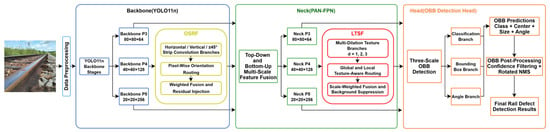
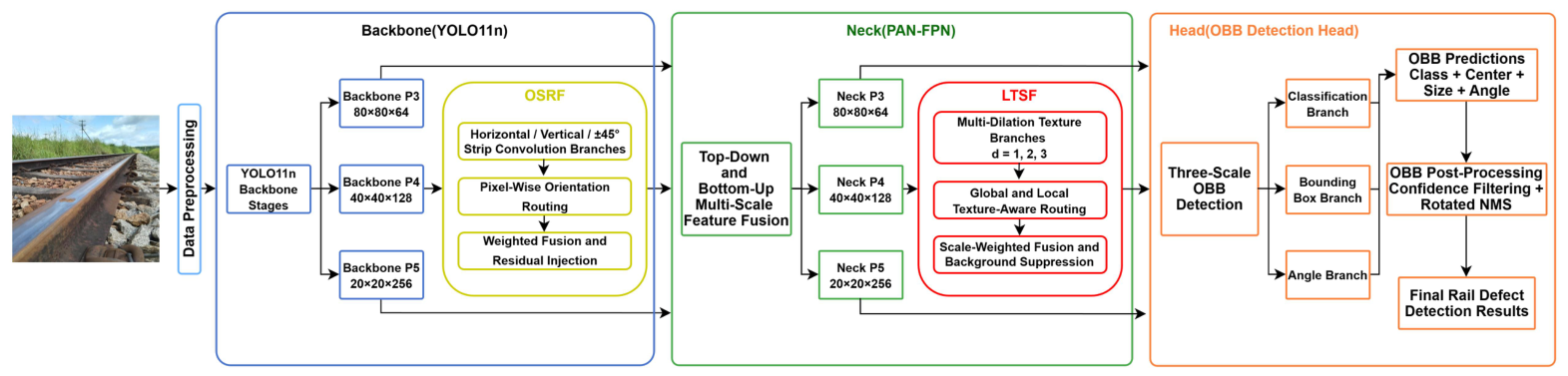
As shown in Figure 1, OSRF is placed after the backbone P4 feature level. Its multidirectional strip convolutions and pixel-wise routing reshape the receptive-field geometry to emphasize elongated directional structures. LTSF is placed at the neck P4 feature level, where multi-dilation candidates, global and local texture routing, and spatial gating adaptively fuse propagated features and modulate their spatial responses. The modules operate at different stages and are sequentially connected along the feature flow.
Figure 1.
Overall architecture of OSLTSF-YOLO. OSRF is inserted at the backbone P4 level, and LTSF is inserted at the PAN-FPN neck P4 level. The solid path denotes the actual propagation from directional feature extraction through scale fusion to OBB prediction.
At an input resolution of , the P3, P4, and P5 feature maps have spatial resolutions of approximately , , and , respectively. P4 provides an intermediate processing scale between the finer P3 grid and the deeper, coarser P5 representation. OSRF operates at backbone P4, whereas LTSF processes neck P4 after multiscale propagation. These positions were selected to balance spatial detail, semantic depth, and computational cost.
Both OSRF and LTSF use small-magnitude non-zero bounded residual gating, which keeps the initial state after injection consistent with the pretrained backbone. During training, a learnable scalar passed through a hyperbolic tangent controls the additional contribution. The bound applies to this multiplier, not to the feature norm or gradient. The single-module experiments evaluate each complete module, and the combined experiment evaluates their use within the same feature-processing chain.
3.2. YOLO11n-OBB Baseline Detector
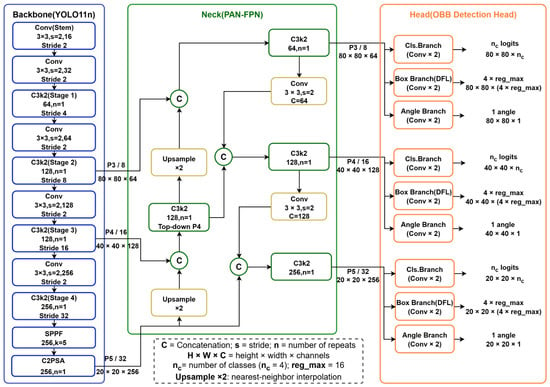
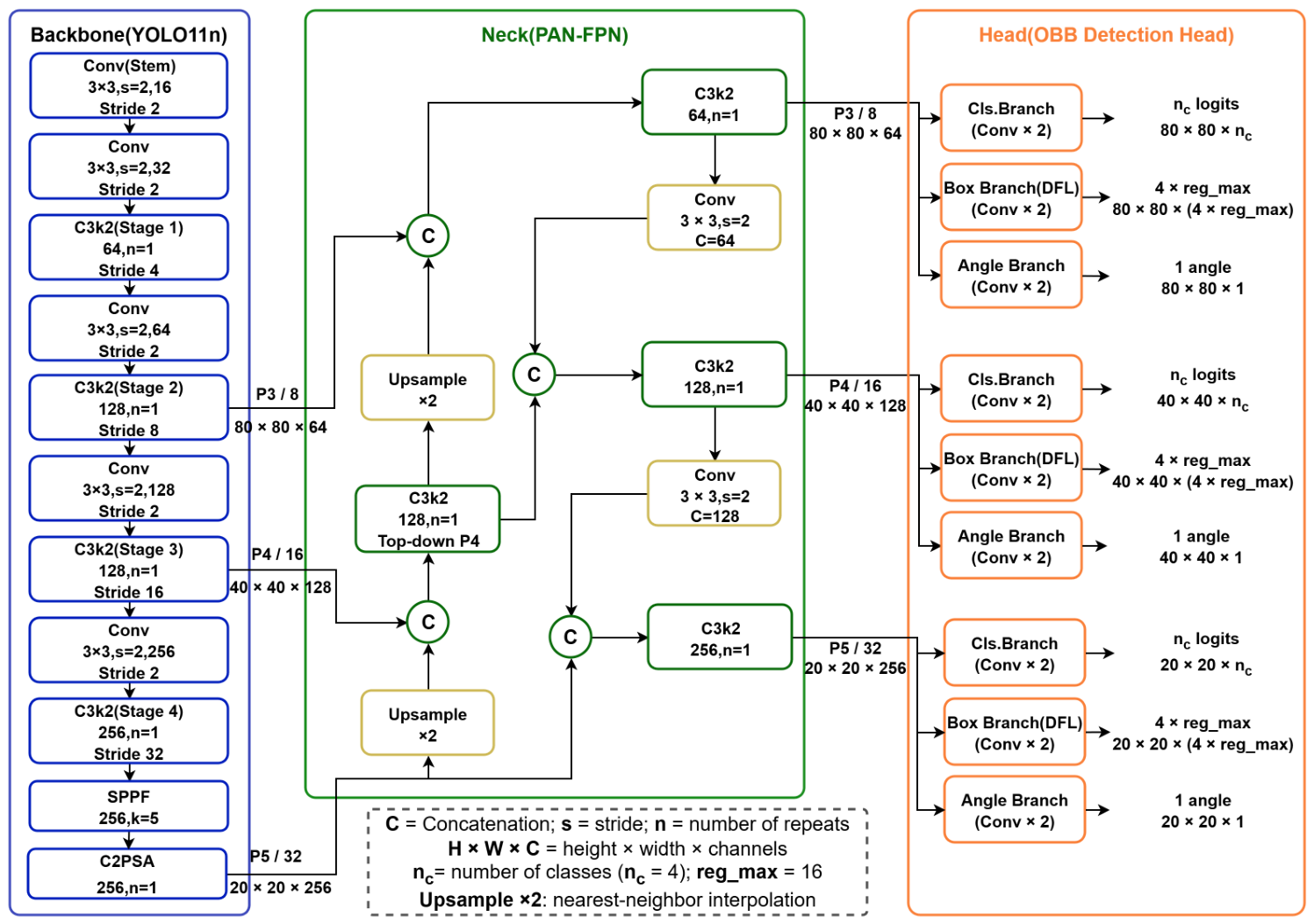
YOLO11 is a real-time object-detection framework, and YOLO11-OBB natively supports oriented detection; YOLO11n-OBB is its lightweight nano variant [10]. As illustrated in Figure 2, the backbone stacks C3k2 and C2PSA blocks to extract P3/P4/P5 features. The PAN-FPN neck propagates features through top-down and bottom-up paths, and the detection head predicts classification scores, box geometry, and orientation at each location. Internally, an oriented box is represented by five parameters,
where denotes the center, w and h denote side lengths, and denotes the encoded rotation angle.
Figure 2.
Architecture of YOLO11n-OBB. The network comprises a backbone, a PAN-FPN neck, and an OBB detection head that produces classification, box regression, and angle regression outputs followed by oriented-box post-processing.
The detection head predicts box orientation separately from OSRF’s directional feature routing. Consequently, its angle predictions are not restricted to the four strip-branch directions. This distinction concerns the output representation and does not imply equal detection accuracy at every orientation.
YOLO11n-OBB was selected because it is lightweight, supports oriented detection natively, and has potential for engineering deployment. The baseline contains approximately 2.66 M parameters and requires 6.80 GFLOPs at input resolution. However, OBB prediction addresses target geometry, angle regression, and oriented localization; it does not automatically change the receptive-field shape of the backbone or introduce texture-driven scale selection into the neck. OSRF and LTSF are therefore added as plug-in components under the same data split, input size, training duration, and optimizer settings to improve directional-structure extraction and texture-aware scale fusion, respectively.
3.3. Orientation-Adaptive Slender Strip Receptive Field
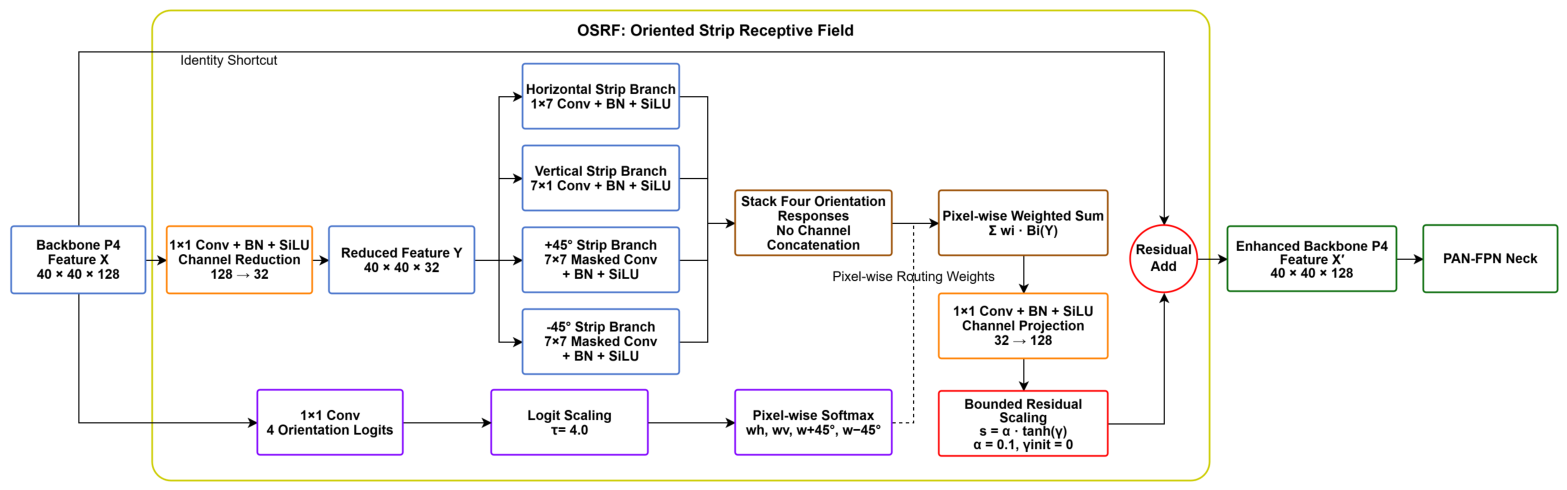
Elongated defects extend primarily along a dominant direction. For example, the median aspect ratio of corrugation instances in the dataset is approximately 6.6. When a square kernel covers a long structure, it also collects background responses perpendicular to that structure. OSRF in Figure 3 addresses this geometric mismatch through horizontal, vertical, +45°, and −45° strip-convolution branches at the backbone P4 level. A lightweight pixel-wise router predicts four weights at every spatial position, allowing locally different combinations of the predefined orientations instead of uniformly averaging the branches. Here, orientation adaptation means location-dependent mixing of four fixed directional responses. It does not continuously rotate the kernels or guarantee rotation equivariance. For structures between the branch directions, the router combines available responses.
Figure 3.
Structure of OSRF. A channel-reduced feature is processed by horizontal, vertical, and two diagonal strip-convolution branches. Pixel-wise routing generates branch weights at every spatial location, and the fused response is projected and injected through a small-magnitude non-zero bounded residual.
Given a backbone feature , a convolution first reduces its channels to obtain , where . The horizontal and vertical branches use and convolutions, respectively, whereas the two diagonal branches use kernels constrained by fixed diagonal masks; in the implemented configuration. Each branch can be written as
where d indexes a direction, is a learnable kernel, is the corresponding fixed main- or anti-diagonal mask for a diagonal branch, ⊙ denotes element-wise multiplication, and is the SiLU activation. For the horizontal and vertical branches, the mask notation reduces to the corresponding and kernels. The four outputs are stacked as .
The router takes the original feature X as input and produces four-channel logits through a convolution. The logits are multiplied by a scale factor before a softmax operation:
For fixed logits, increasing sharpens the branch weight distribution; it is a logit multiplier rather than a conventional softmax temperature. The strip length k controls directional sampling extent, and the reduction ratio r limits the channel width and computational cost of the branches. The routed feature is
After channel restoration by a projection layer consisting of convolution, batch normalization, and SiLU, the result is injected through a small-magnitude non-zero bounded residual:
where is a learnable scalar (initialized to , corresponding to an initial residual amplitude of 0.03), and is the maximum residual amplitude. The small-magnitude non-zero initialization allows the residual gate, the directional router, and the strip branches to obtain non-zero gradients from the start of training; the residual amplitude is gradually adjusted during training, and pixel-wise directional routing enables each location to adaptively weight among the four predefined directions. The reported parameter settings were chosen from prior engineering considerations (lightweight design and coverage of elongated structures) rather than an exhaustive grid search, and their sensitivity is left for future work.
3.4. Local Texture-Aware Scale Fusion
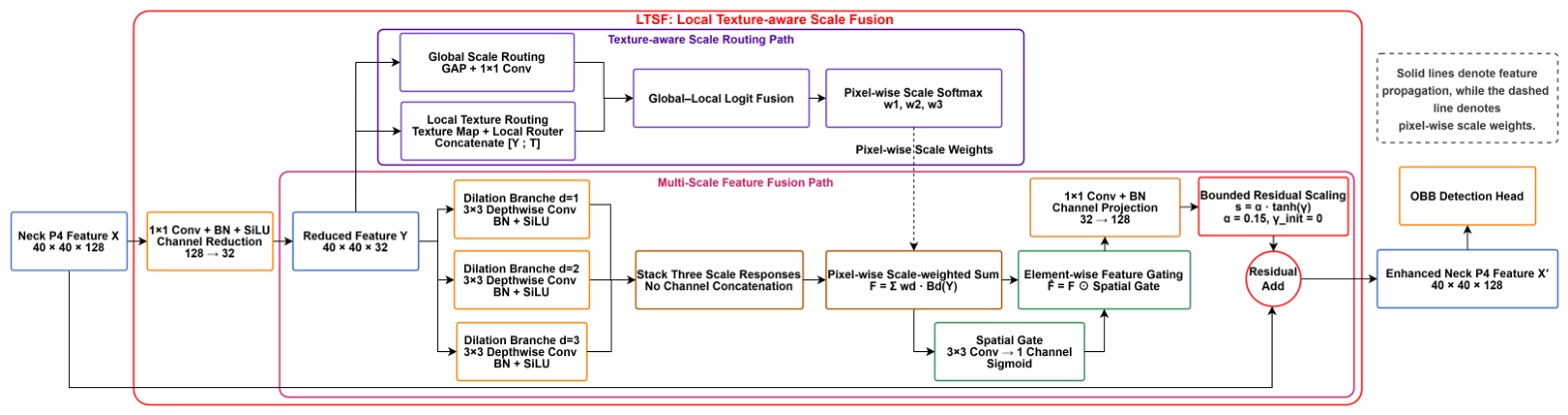
Rail defect categories differ in texture width, spatial extent, and local morphology, whereas the median defect-to-image area ratio is approximately 1.4%. A single receptive-field scale cannot simultaneously preserve fine texture and wider context, and fixed fusion cannot select an appropriate scale at each position. LTSF first generates candidate features using multiple dilation rates, and the architecture is illustrated in Figure 4. Global scale routing and local texture routing then determine the relevant receptive-field range, and a spatial gate modulates the locations that should contribute most strongly. The result is progressively injected into the neck P4 feature through a small-magnitude non-zero bounded residual.
Figure 4.
Structure of LTSF. A channel-reduced feature passes through depthwise branches with dilation rates 1, 2, and 3. Global scale and local texture routes jointly generate fusion weights; the result is spatially gated, projected, and injected through a small-magnitude non-zero bounded residual.
For an input , a convolution produces with . Three depthwise branches use dilation rates :
Global scale preferences are obtained from global average pooling (GAP):
The local route begins with a pixel-wise texture map. The mean absolute deviation between Y and its local average is computed across channels and then normalized and clipped:
Here denotes the average over channels, is the neighborhood average, is the element-wise absolute value, and and denote the per-sample mean and variance computed over the spatial dimensions; is a numerical stability term preventing division by zero, and clips the normalized texture energy to . A lightweight router , composed of pointwise, depthwise, and terminal pointwise convolutions, takes the concatenated feature and combines it with a weak texture prior:
where bounds the local logits, p is linearly distributed from 1 to across the dilation branches so that a positive texture response weakly favors the smaller-dilation branch, and is learnable and initialized to 0.01; the router’s terminal convolution adopts a small-variance non-zero initialization, so that the local logits are non-zero from the start of training. The final scale weights are
where is initialized to 0.01. The routed feature and spatially gated response are
where is the sigmoid function. A projection restores the original channel dimension before small-magnitude non-zero bounded residual injection:
where is initialized to and bounds the absolute residual scaling coefficient. The three dilation rates define different sampling extents; limits the local-routing output, and limits its contribution to the global logits. The learnable coefficient controls the weak texture prior, rather than enforcing a fixed rule for every defect.
Texture awareness is implemented explicitly: the feature-space variation map T conditions the local router through and the weak prior, thereby affecting the scale weights. The subsequent spatial gate modulates where the fused response is emphasized. This separates scale selection from spatial modulation. The map T is not a direct measurement of physical defect size or texture width.
3.5. Cascaded Interaction Between OSRF and LTSF
OSRF and LTSF form a sequential relationship along the feature flow. OSRF first models discrete directional receptive fields at the backbone P4 level. The direction-enhanced feature is propagated through the remaining backbone connection and PAN-FPN, reaches the neck P4 level, and is then processed by LTSF. The complete path is
Functionally, OSRF addresses along which predefined directions features should be extracted, whereas LTSF addresses over what spatial range and at which positions propagated features should be fused. The former changes receptive-field geometry to improve directional sensitivity, and the latter reorganizes multiscale texture through scale routing and spatial gating. This relationship follows from the network architecture and information flow. It should not be interpreted as a statistically proven causal synergy.
All configurations are trained and evaluated with the same random seeds 0, 1, and 2 and summarized by the mean over the three seeds, which reduces reliance on a single run. It is 1.11 percentage points higher in than the OSRF-only result.
4. Experimental Setup and Results
4.1. Experimental Environment
All experiments were conducted on a Linux server equipped with an NVIDIA A10 GPU with 24 GB of memory. The software environment comprised Python 3.12.13, PyTorch 2.10.0+cu128, CUDA 12.8, and Ultralytics 8.4.117. Each model was initialized with its corresponding pretrained weights. YOLOv8n-OBB, YOLO11n-OBB, YOLO26n-OBB, and YOLO11s-OBB used weights matching their respective versions and scales; external oriented detectors used pretrained weights corresponding to their frameworks and backbones. All models used AdamW, input images, batch size 32, and 250 training epochs. Mixed precision and deterministic training settings were enabled. All configurations were trained and evaluated with the same random seeds 0, 1, and 2. Augmentation included random rotations within ±10° and horizontal flipping with probability 0.5. YOLO-family models retained the framework-default scale, translation, and color augmentations, while vertical flipping remained disabled. The main settings are listed in Table 1.
Table 1.
Training hyperparameters.
4.2. Dataset
An in-house rail surface defect dataset was used. The images were acquired from multiple ordinary-speed and high-speed railway lines in China, covering complex field conditions such as strong light, shadow, rain stains, and gravel backgrounds. The inspection images were standardized to resolution and annotated with OBBs for four categories: corrugation, spalling, squat, and wheel burn. The dataset contains 1424 images and 2101 instances and was randomly divided at the image level at an approximate ratio of 8:1:1, as shown in Table 2. The training set contains 1140 images and 1683 instances; validation and test sets each contain 142 images and 209 instances. Spalling and squat are the most frequent categories, whereas wheel burn is the least frequent, so the class distribution is somewhat imbalanced. Each defect was annotated by the four vertices of a rotated rectangle. The label file stores eight corner coordinates and a class identifier, which are converted during training to a center point, width, height, and angle representation.
Table 2.
Dataset split.
Rail targets acquired in real inspection scenes can appear at oblique angles. A horizontal rectangle enclosing such a target also contains regions outside its oriented extent, whereas an OBB represents its direction and elongated geometry more directly. Consequently, a public benchmark with horizontal boxes cannot be used unchanged to evaluate the same oriented-box localization task. The present annotations were selected to match this geometry.
Compared with an axis-aligned box, an OBB more tightly encloses directional defects such as corrugation and reduces irrelevant background within the box. To characterize each category, the aspect ratio, angle distribution (le90, binned at ≤15°, 15–45°, 45–75°, and >75°), size distribution (<32, 32–96, and >96 px), and OBB area saving () were computed over all 2101 instances (Table 3). Corrugation is the most elongated (median aspect ratio 6.54; P25–P90: 4.23–11.21) and most strongly tilted (median long-axis angle 65.3°, with 84.8% beyond 45°), and benefits most from oriented annotation (median area saving 61.0%). Squat is basically axis-aligned (83.4% within ± 15°) and gains almost no area. Wheel burn and spalling have median aspect ratios of 1.88 and 2.13 and median area savings of 28.3% and 21.1%. Overall, the dataset is dominated by medium-sized instances, with a median defect-to-image area ratio of about 1.4% (background about 97%).
Table 3.
Per-class geometric distribution and OBB area saving relative to the minimum enclosing horizontal box.
4.3. Evaluation Metrics
Precision (P), recall (R), F1 score, and average precision (AP/mAP) were used. Let TP, FP, and FN denote true positives, false positives, and false negatives, respectively. Precision, recall, and F1 depend on the selected confidence operating point, whereas AP and mAP are computed from the full precision–recall curve:
Precision, recall, and F1 are reported at the same confidence operating point: at IoU = 0.5, the per-class precision–recall curves are computed point by point over the confidence interval and averaged across classes, and the reported operating point is the maximum of the mean F1 curve after smoothing with a moving window of 0.1. This rule is identical for all models and all evaluation splits. For categories, mAP is
Predictions are matched to ground truth using rotated IoU. and use IoU thresholds of 0.5 and 0.75, respectively, and averages ten thresholds from 0.5 to 0.95 in increments of 0.05. The best weights during training were selected by a validation-set composite score of ; the test set did not participate in model selection and was used only for final reporting. All models were compared under the same data split. Efficiency is evaluated by parameter count, GFLOPs at input and batch size 1, and FPS measured under a common hardware environment.
The baseline, single-module, and complete-model detection metrics are all averaged over the same random seeds 0, 1, and 2. This aggregation reduces dependence on a single run and summarizes the performance of the selected configuration.
4.4. Ablation Study
Table 4 compares the baseline, the two single-module variants, and the combined model. The YOLO11n-OBB baseline obtains 83.91% and 84.94% F1. Adding OSRF yields 87.36% and 86.83% F1, whereas adding LTSF yields 86.78% and 86.53%, respectively. Thus, both complete single-module configurations produce positive changes under the present dataset and training settings.
Table 4.
Ablation results on the test set (%). All rows are the mean ± sample standard deviation over the same random seeds 0, 1, and 2. Best values are shown in bold.
At the class level, the OSRF-only configuration reaches 85.86% for corrugation, and the LTSF-only configuration reaches 84.43% for squat. These changes are consistent with the design motivations of directional-structure modeling and texture-scale adaptation and may be considered supporting evidence, but they do not isolate the causal contribution of an internal branch or router. The complete model has the highest reported overall metrics, with a three-seed mean of 88.47%, 4.56 percentage points above the baseline. However, its spalling is slightly lower than that of the OSRF-only model, and its wheel-burn is also lower than the OSRF-only result, indicating class-specific tradeoffs. The available evidence supports functional compatibility between OSRF and LTSF but is insufficient to establish statistically significant synergy.
To separate mechanism gains from parameter gains and to test the necessity of the internal components, three internal controls were added: a parameter-matched standard residual block at the same level as OSRF, a fixed-routing control that replaces the OSRF directional routing with uniform weights over the four directions, and a no-texture control that changes the LTSF local-router input from to Y only. The three controls obtain of 86.33%, 84.95%, and 86.41%, respectively (Table 4), all lower than the corresponding complete modules. The parameter-matched residual block improves over the baseline by only 1.04 percentage points and remains 2.41 percentage points below OSRF, and its GFLOPs (7.15) are even slightly higher than those of OSRF (6.83); removing the directional routing lowers OSRF by 1.03 percentage points, whereas removing the texture input lowers LTSF by 0.37 percentage points, a more moderate effect. These results suggest that the proposed adaptive directional routing and texture-conditioned scale fusion mechanisms are key contributors to the performance gains.
4.5. Comparative Study
OSLTSF-YOLO was compared with YOLOv8n-OBB, YOLO11n-OBB, YOLO26n-OBB [35], YOLO11s-OBB, RTMDet-R, Oriented R-CNN, and Rotated Faster R-CNN [38]. All models used their corresponding pretrained weights and the AdamW optimizer. Because these frameworks differ in network architecture, losses, sample assignment, oriented-box encoding, and post-processing, the cross-framework results serve as performance references rather than an absolute ranking under perfectly equivalent conditions.
As shown in Table 5, OSLTSF-YOLO achieves 88.47% , the highest among the compared models. It exceeds YOLOv8n-OBB, YOLO11s-OBB, YOLO26n-OBB, RTMDet-R, Oriented R-CNN, and Rotated Faster R-CNN by 3.18, 2.72, 4.86, 10.27, 18.97, and 8.47 percentage points, respectively. OSLTSF-YOLO also has the highest for corrugation, squat, and wheel burn, at 86.72%, 89.01%, and 96.09%. Its spalling is 82.05%, slightly below YOLOv8n-OBB (83.20%) but above the YOLO11n-OBB baseline (81.59%). The method is therefore competitive in overall accuracy, while spalling remains a difficult category.
Table 5.
Comparison with oriented object detectors on the test set (%). OSLTSF-YOLO detection metrics are three-seed means, as detailed in Table 6.
Table 6.
Per-seed test results of the main ablation configurations (%).
4.6. Multi-Seed Study
To examine variation across random initial conditions, OSLTSF-YOLO was trained and evaluated with seeds 0, 1, and 2 under the same configuration, data split, and test set. As listed in Table 6, is 88.12%, 87.06%, and 90.22%, a range of 3.16 percentage points and a mean of 88.47%. Mean precision, recall, and F1 are 88.23%, 87.60%, and 87.91%, with standard deviations of 1.57, 1.15, and 0.91 percentage points. ranges from 67.34% to 67.54%, with a standard deviation of 0.11 points. Spalling has the lowest mean class-wise , while wheel burn exhibits the largest standard deviation. Although all three values exceed the baseline result in Table 4, the baseline is evaluated with the same three seeds, so the comparison is paired. The multi-seed results therefore support stability only descriptively and do not replace a statistical significance test.
The lowest complete-model , 87.06%, exceeds the reported baseline value of 83.91% by 3.15 percentage points. The complete-model range of 67.34–67.54% is also above the baseline result of 62.93%. Thus, the improvement relative to the reported baseline is observed in all three complete-model runs. The mean values in Table 4 and Table 5 summarize these runs. The three internal controls (OSRF (Fixed), Control (Matched), and LTSF (No-Texture)) are also evaluated with the same three seeds; their standard deviations are 0.62, 0.62, and 1.12 percentage points, comparable to those of the main configurations.
4.7. Efficiency Analysis
Table 7 compares parameter count, GFLOPs, and inference speed. YOLO11n-OBB has 2.66 M parameters, requires 6.80 GFLOPs, and achieves 153.6 FPS. OSLTSF-YOLO has 3.17 M parameters and 6.86 GFLOPs, increases of 0.51 M and 0.06 GFLOPs, respectively. The reported throughput decreases to 118.0 FPS despite the small increase in arithmetic operations. Multibranch convolution, routing, and memory access are possible sources of additional runtime overhead, but their individual latency contributions were not measured. These results show why GFLOPs alone do not characterize inference speed. The measurements were obtained on an NVIDIA A10 GPU; the detailed FPS timing settings were not retained. Accordingly, the evidence supports the reported model-level throughput. Migration to, and validation on, a railway inspection platform remains an important direction for future work.
Table 7.
Efficiency comparison at input resolution.
4.8. Training Convergence and Visualization
4.8.1. Training Convergence
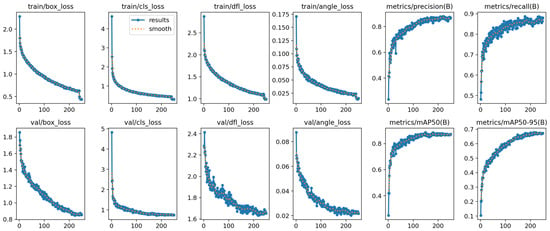
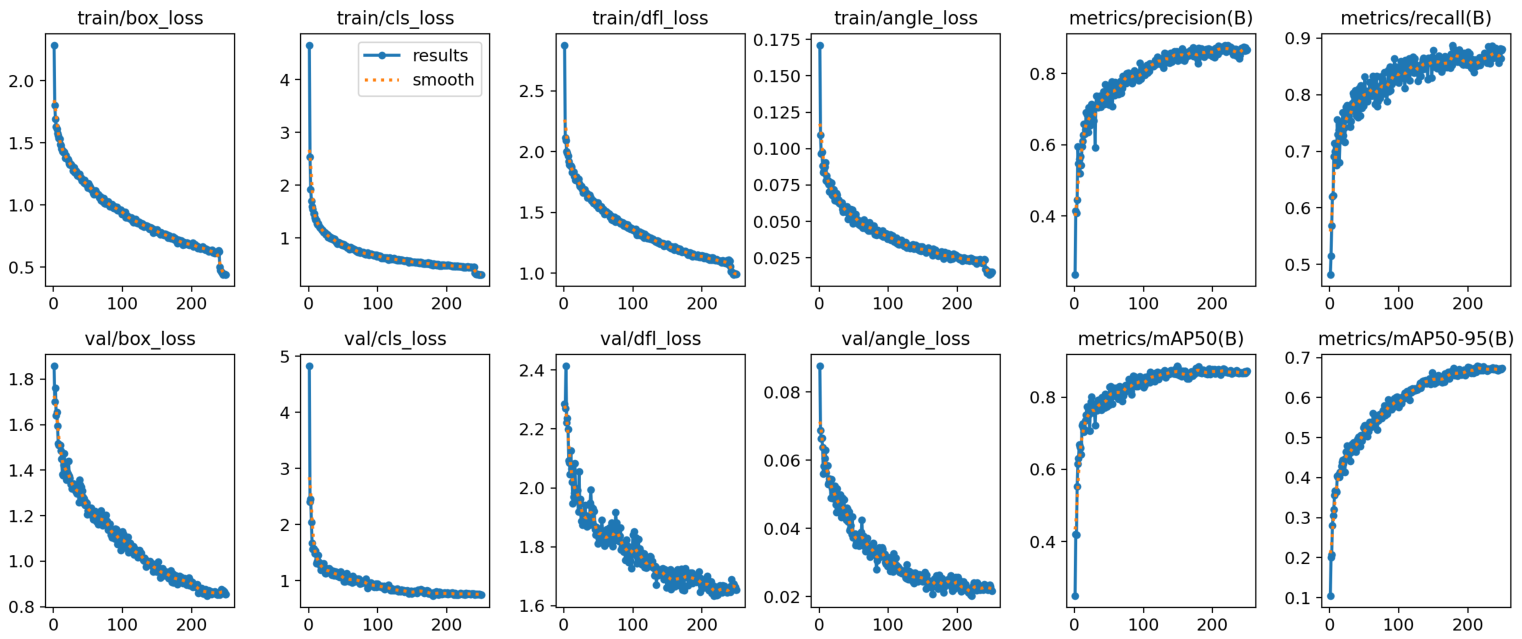
Figure 5 shows the losses and validation metrics over 250 epochs. The top row presents training box regression, classification, DFL, and angle regression losses followed by precision and recall; the bottom row presents the corresponding validation losses, , and . The training losses decrease rapidly during the early epochs, and the validation losses show a similar overall trend before stabilizing with fluctuations. Train/box_loss, train/cls_loss, train/dfl_loss, and train/angle_loss decrease from 2.286, 4.653, 2.877, and 0.171 to 0.439, 0.303, 0.993, and 0.015, respectively. The final validation losses are 0.854, 0.752, 1.653, and 0.022. Precision, recall, , and increase overall and stabilize late in training. These curves show stable optimization under the selected configuration; they do not substitute for cross-domain testing or statistical analysis and cannot alone rule out overfitting.
Figure 5.
Loss and performance curves of OSLTSF-YOLO during 250 training epochs.
4.8.2. Detection Results
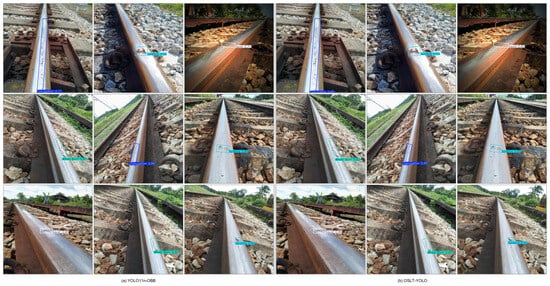
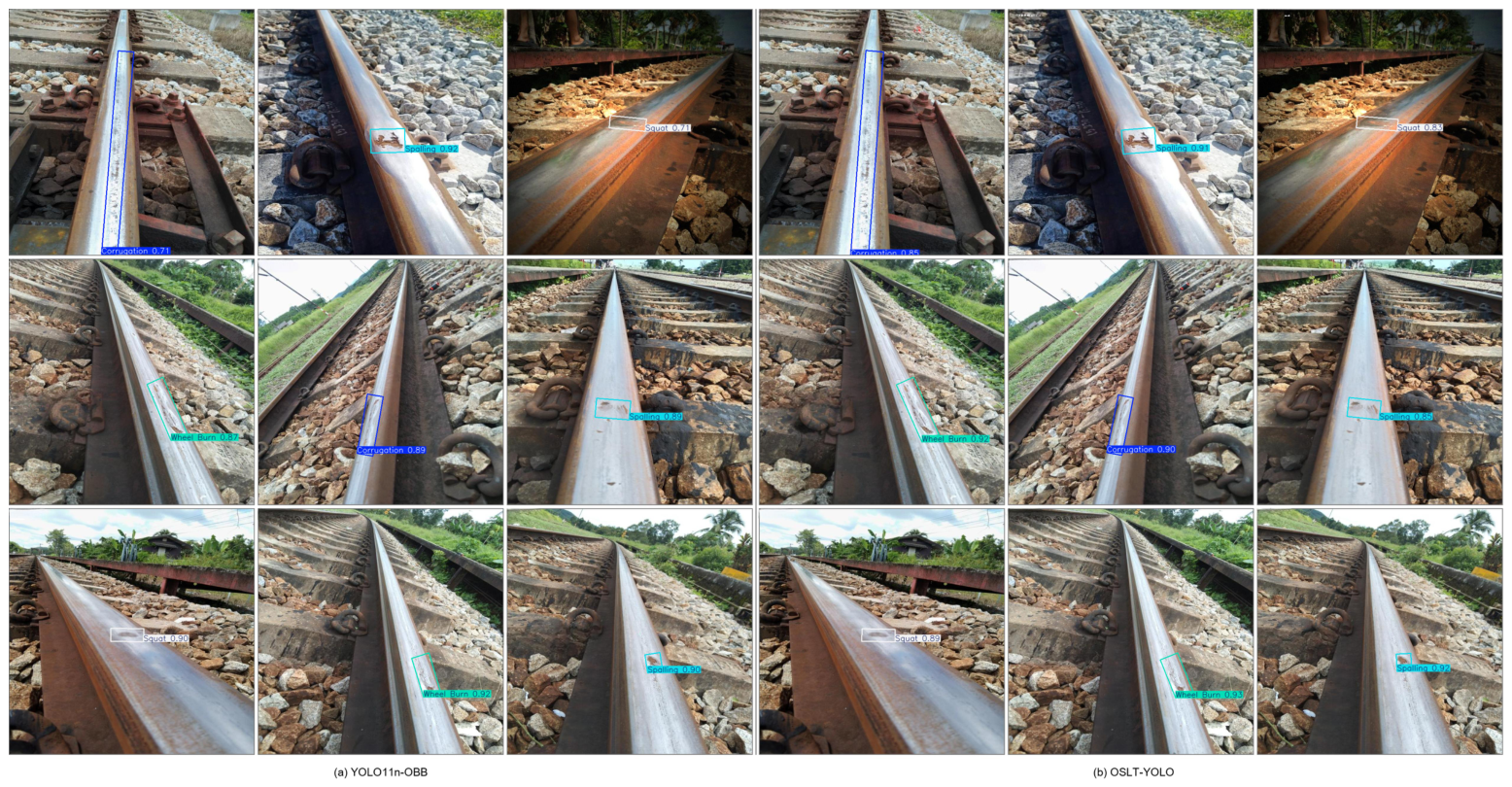
Figure 6 compares YOLO11n-OBB and OSLTSF-YOLO on the same test samples at the same input size and confidence threshold. The examples cover all four categories. Some representative corrugation, squat, and wheel-burn samples show improved confidence or localization, whereas spalling is approximately unchanged or varies slightly, including small decreases in some examples. This pattern broadly agrees with the class-wise results in Table 4 and Table 5. Because only a limited number of examples is shown, the visualization is qualitative and cannot characterize all false positives and false negatives in the test set.
Figure 6.
Qualitative detection comparison between YOLO11n-OBB and OSLTSF-YOLO on representative test images.
4.8.3. Confusion Matrices
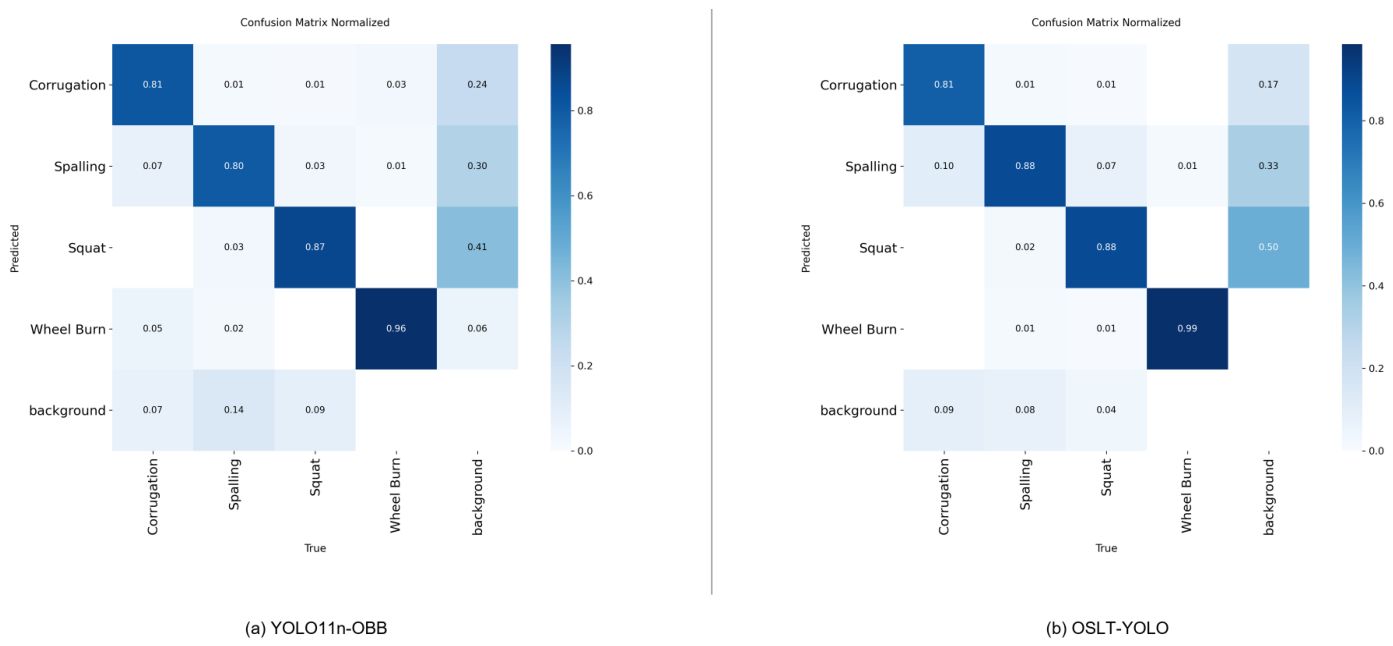
Figure 7 compares normalized confusion matrices. Rows denote predicted classes and columns denote ground-truth classes; each column is normalized by its own total. The diagonal values for corrugation, spalling, squat, and wheel burn are 0.81, 0.80, 0.87, and 0.96 for YOLO11n-OBB and 0.81, 0.88, 0.88, and 0.99 for OSLTSF-YOLO. The correct-identification proportions therefore increase for spalling, squat, and wheel burn and remain unchanged for corrugation. In the background row, the corrugation, spalling, and squat values change from 0.07, 0.14, and 0.09 to 0.09, 0.08, and 0.04, indicating fewer missed spalling and squat instances but a slight increase for corrugation. Confusion-matrix proportions and are different quantities and should be compared only at a trend level.
Figure 7.
Normalized confusion matrices of YOLO11n-OBB and OSLTSF-YOLO. Rows indicate predictions and columns indicate ground truth; normalization is performed within each column.
4.8.4. Precision–Recall Curves
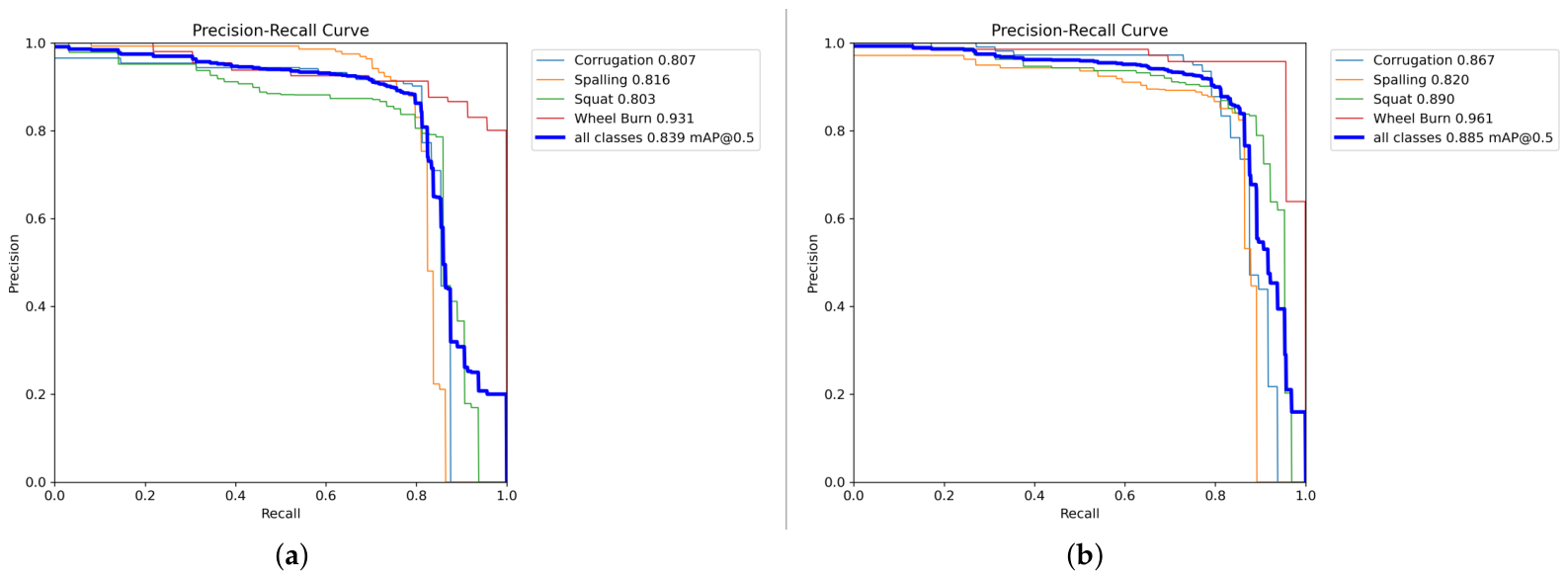
Figure 8 shows the precision–recall curves of YOLO11n-OBB (left) and OSLTSF-YOLO (right). OSLTSF-YOLO maintains higher precision over much of the recall range. The changes for corrugation, squat, and wheel burn are more pronounced than that for spalling, consistent with the class-wise trends. Precision–recall curves characterize the tradeoff across confidence operating points; they do not independently establish a causal contribution from a particular module.
Figure 8.
Precision–recall curves of YOLO11n-OBB (a) and OSLTSF-YOLO (b).
4.8.5. Grad-CAM Visualization
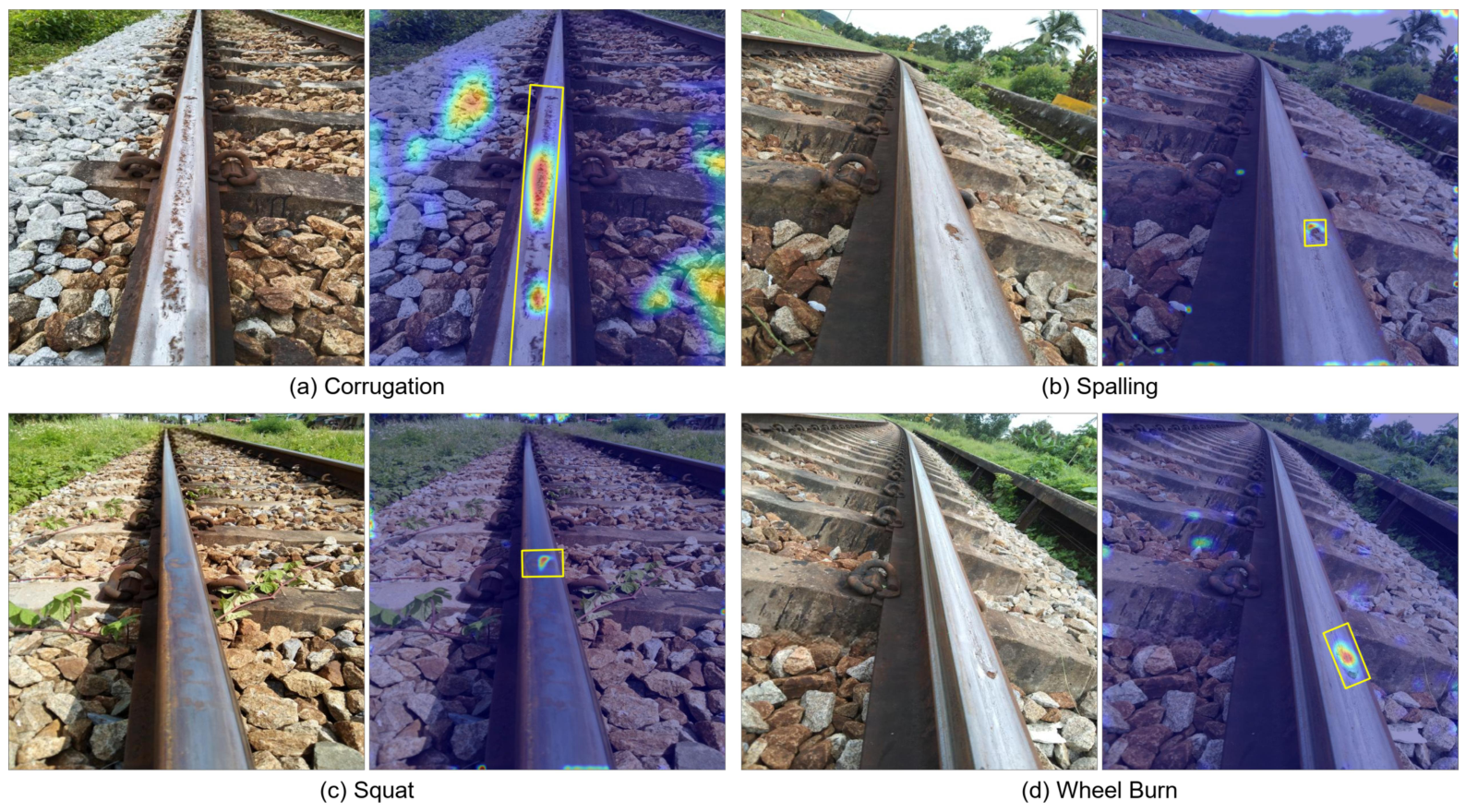
Gradient-weighted class activation mapping (Grad-CAM) was used to inspect spatial responses qualitatively. Warmer colors in Figure 9 indicate stronger responses. In each pair, the original image is shown alongside its heat map, and the yellow OBB denotes the detection region. Several high-response regions correspond spatially to the detected defects: corrugation responses extend along elongated textures, spalling responses concentrate on local exfoliation patterns, and squat and wheel-burn responses cluster around local morphology or surface-texture changes. These observations provide qualitative evidence that the final model attends to defect regions. Grad-CAM depends on the target layer, target class, and normalization procedure, and Figure 9 does not provide baseline or single-module controls. It therefore cannot independently establish the causal effect of OSRF or LTSF.
Figure 9.
Grad-CAM visualizations of OSLTSF-YOLO for the four rail defect categories.
5. Discussion
5.1. Functional Roles and Accuracy–Efficiency Tradeoff
This section uses the ablation and efficiency results to examine the distinct roles of OBB, OSRF, and LTSF in geometric representation, directional modeling, and scale fusion, together with the resulting accuracy–efficiency tradeoff. An OBB describes the geometry of tilted or elongated defects using side lengths and an angle, thereby reducing irrelevant background within the bounding box. However, it operates mainly at the levels of target representation and regression and does not directly make backbone features direction selective. OSRF therefore introduces pixel-wise adaptive mixing of four fixed directional responses during feature extraction, whereas LTSF performs scale selection and spatial response modulation using multiscale candidate features, global scale routing, local texture routing, and spatial gating. The single-module results are consistent with these design motivations: OSRF increases from 83.91% to 87.36% and corrugation from 80.67% to 85.86%, while LTSF achieves an of 86.78% and improves squat from 80.31% to 84.43%. The combined model achieves a three-seed mean of 88.47%, indicating that direction-sensitive feature extraction and texture-aware scale fusion can operate effectively within a shared feature-processing chain. Relative to YOLO11n-OBB, the combined model adds only 0.51 M parameters and 0.06 GFLOPs, while its throughput decreases from 153.6 to 118.0 FPS. This difference indicates that GFLOPs do not fully capture the runtime overhead associated with multibranch convolution, routing operations, and memory access. Overall, the results support the effectiveness and functional compatibility of the complete OSRF and LTSF configurations, but do not isolate the contribution of each internal component or justify interpreting the texture map as a direct measurement of defect size or physical severity.
5.2. Limitations and Future Work
This study has two main limitations. First, OSRF contains only four fixed branches corresponding to the horizontal, vertical, and two diagonal directions. Its pixel-wise router can combine these predefined responses but cannot explicitly extract independent responses for additional discrete orientations or continuously varying angles. Second, LTSF constructs its candidate scales using three fixed dilation rates and employs a feature-space variation map as a local texture cue, which may limit its ability to represent more complex texture-scale variations. Future work will investigate learnable directional sampling and continuous orientation modeling to improve the representation of elongated defects at arbitrary orientations. Dynamic receptive-field generation and adaptive scale expansion will also be explored, together with analyses of how the learned scale-routing weights vary with defect size, texture complexity, and category. These developments are expected to improve the model’s adaptability to defects with diverse orientations and texture scales.
6. Conclusions
This paper proposed OSLTSF-YOLO for lightweight oriented rail surface defect detection. OSRF uses four discrete strip-convolution branches and pixel-wise routing at the backbone P4 level to improve elongated directional representation, while LTSF uses multi-dilation candidate scales, global–local routing, and spatial gating at the neck P4 level to perform texture-aware scale fusion. Together, they form an orientation-aware extraction–texture-aware fusion–oriented detection chain. Under the reported protocol, the complete model achieved three-seed mean and F1 values of 88.47% and 87.91%, compared with 83.91% and 84.94% for the three-seed baseline. It uses 3.17 M parameters and 6.86 GFLOPs, with a reported model-level throughput of 118.0 FPS on NVIDIA A10.
The combination does not improve every category or sample: the reported spalling and wheel-burn values are lower than those of the OSRF-only configuration, and background-related false detections remain. These limitations, together with parameter sensitivity and migration to an actual railway inspection platform, define the next stage of the research. The present findings support the use of directional extraction and texture-aware fusion for the evaluated rail defect detection task.
Author Contributions
Conceptualization, Q.W.; methodology, Q.W.; validation, Q.W. and B.S.; data curation, Q.W.; writing—original draft preparation, Q.W.; writing—review and editing, Q.W. and B.S.; supervision, Q.W. and B.S. All authors have read and agreed to the published version of the manuscript.
Funding
This research received no external funding.
Data Availability Statement
The raw data supporting the conclusions of this article will be made available by the authors on request.
Acknowledgments
During the preparation and proofreading of this manuscript, the authors used OpenAI Codex (OpenAI, San Francisco, CA, USA) to assist with language editing, reference checking, and LaTeX formatting. The authors are responsible for verifying the accuracy of the manuscript and all cited sources, and for the final content of the article.
Conflicts of Interest
The authors declare no conflicts of interest.
Abbreviations
The following abbreviations are used in this manuscript:
| AdamW | Adam optimizer with decoupled weight decay |
| ATSS | Adaptive training sample selection |
| C2PSA | C2 feature block with position-sensitive attention |
| C3k2 | YOLO11 feature block with two outer convolutions and optional configurable-kernel bottlenecks |
| DFL | Distribution focal loss |
| DOTA | Dataset for object detection in aerial images |
| DWConv | Depthwise convolution |
| F1 | Harmonic mean of precision and recall |
| FCOS | Fully convolutional one-stage object detection |
| FPN | Feature pyramid network |
| FPS | Frames per second |
| GAP | Global average pooling |
| GFL | Generalized focal loss |
| Grad-CAM | Gradient-weighted class activation mapping |
| LSKNet | Large selective kernel network |
| LTSF | Local texture-aware scale fusion |
| OBB | Oriented bounding box |
| OS | Orientation-adaptive slender-strip modeling |
| OSLTSF | Orientation-adaptive slender-strip and local texture-aware scale fusion |
| OSLTSF-YOLO | YOLO with orientation-adaptive slender-strip and local texture-aware scale fusion |
| OSRF | Orientation-adaptive slender-strip receptive field |
| P3/P4/P5 | Feature-pyramid levels with strides of 8, 16, and 32, respectively |
| PAN | Path aggregation network |
| PAN-FPN | Path aggregation network–feature pyramid network |
| ProbIoU | Probabilistic intersection over union |
| R3Det | Refined single-stage detector with feature refinement for rotating objects |
| RSDD | Rail surface defect dataset |
| RT-DETR | Real-time detection transformer |
| RTMDet/RTMDet-R | Real-time models for object detection and its rotated variant, respectively |
| S2A-Net | Single-shot alignment network |
| SiLU | Sigmoid linear unit |
| TOOD | Task-aligned one-stage object detection |
| YOLO-OBB | YOLO-based oriented bounding-box detector |
References
- Radosavljevic, S.; Rivero, A.; El Ouardi, A.; Flórez, S.R. Railway track defect detection: From a comprehensive review of methods to new embedded system Modeling perspectives. IEEE Trans. Instrum. Meas. 2025, 75, 1–25. [Google Scholar] [CrossRef] [Scilit]
- Ren, S.; He, K.; Girshick, R.; Sun, J. Faster R-CNN: Towards real-time object detection with region proposal networks. Adv. Neural Inf. Process. Syst. 2015, 28, 1–14. [Google Scholar]
- Lin, T.Y.; Dollár, P.; Girshick, R.; He, K.; Hariharan, B.; Belongie, S. Feature pyramid networks for object detection. In Proceedings of the 2017 IEEE Conference on Computer Vision and Pattern Recognition (CVPR), Honolulu, HI, USA, 21–26 July 2017; pp. 936–944. [Google Scholar]
- Lin, T.Y.; Goyal, P.; Girshick, R.; He, K.; Dollár, P. Focal loss for dense object detection. In Proceedings of the IEEE International Conference on Computer Vision, Venice, Italy, 22–29 October 2017; pp. 2980–2988. [Google Scholar]
- Tian, Z.; Shen, C.; Chen, H.; He, T. FCOS: Fully convolutional one-stage object detection. In Proceedings of the 2019 IEEE/CVF International Conference on Computer Vision (ICCV); IEEE: New York, NY, USA, 2019; pp. 9626–9635. [Google Scholar]
- Zhang, S.; Chi, C.; Yao, Y.; Lei, Z.; Li, S.Z. Bridging the gap between anchor-based and anchor-free detection via adaptive training sample selection. In Proceedings of the 2020 IEEE/CVF Conference on Computer Vision and Pattern Recognition (CVPR); IEEE: New York, NY, USA, 2020; pp. 9756–9765. [Google Scholar]
- Feng, C.; Zhong, Y.; Gao, Y.; Scott, M.R.; Huang, W. TOOD: Task-aligned one-stage object detection. In Proceedings of the 2021 IEEE/CVF International Conference on Computer Vision (ICCV); IEEE: New York, NY, USA, 2021; pp. 3490–3499. [Google Scholar]
- Li, X.; Wang, W.; Wu, L.; Chen, S.; Hu, X.; Li, J.; Tang, J.; Yang, J. Generalized focal loss: Learning qualified and distributed bounding boxes for dense object detection. Adv. Neural Inf. Process. Syst. 2020, 33, 21002–21012. [Google Scholar]
- Khalili, B.; Smyth, A.W. SOD-YOLOv8—Enhancing YOLOv8 for small object detection in aerial imagery and traffic scenes. Sensors 2024, 24, 6209. [Google Scholar] [CrossRef] [Scilit] [PubMed]
- Khanam, R.; Hussain, M. YOLOv11: An overview of the key architectural enhancements. arXiv 2024, arXiv:2410.17725. [Google Scholar]
- Zhao, Y.; Lv, W.; Xu, S.; Wei, J.; Wang, G.; Dang, Q.; Liu, Y.; Chen, J. DETRs beat YOLOs on real-time object detection. In Proceedings of the 2024 IEEE/CVF Conference on Computer Vision and Pattern Recognition (CVPR); IEEE: New York, NY, USA, 2024; pp. 16965–16974. [Google Scholar]
- Xia, G.S.; Bai, X.; Ding, J.; Zhu, Z.; Belongie, S.; Luo, J.; Datcu, M.; Pelillo, M.; Zhang, L. DOTA: A large-scale dataset for object detection in aerial images. In Proceedings of the 2018 IEEE/CVF Conference on Computer Vision and Pattern Recognition; IEEE: New York, NY, USA, 2018; pp. 3974–3983. [Google Scholar]
- Yang, X.; Yan, J.; Feng, Z.; He, T. R3Det: Refined single-stage detector with feature refinement for rotating object. In Proceedings of the AAAI Conference on Artificial Intelligence; Association for the Advancement of Artificial Intelligence: Washington, DC, USA, 2021; Volume 35, pp. 3163–3171. [Google Scholar]
- Han, J.; Ding, J.; Li, J.; Xia, G.S. Align deep features for oriented object detection. IEEE Trans. Geosci. Remote Sens. 2021, 60, 1–11. [Google Scholar] [CrossRef] [Scilit]
- Xie, X.; Cheng, G.; Wang, J.; Yao, X.; Han, J. Oriented R-CNN for object detection. In Proceedings of the 2021 IEEE/CVF International Conference on Computer Vision (ICCV); IEEE: New York, NY, USA, 2021; pp. 3520–3529. [Google Scholar]
- Lyu, C.; Zhang, W.; Huang, H.; Zhou, Y.; Wang, Y.; Liu, Y.; Zhang, S.; Chen, K. RTMDet: An empirical study of designing real-time object detectors. arXiv 2022, arXiv:2212.07784. [Google Scholar]
- Yang, X.; Yan, J. Arbitrary-oriented object detection with circular smooth label. In Proceedings of the European Conference on Computer Vision; Springer: Berlin/Heidelberg, Germany, 2020; pp. 677–694. [Google Scholar]
- Yang, X.; Yan, J.; Ming, Q.; Wang, W.; Zhang, X.; Tian, Q. Rethinking rotated object detection with gaussian wasserstein distance loss. In Proceedings of the International Conference on Machine Learning; PMLR: Birmingham, UK, 2021; pp. 11830–11841. [Google Scholar]
- Yang, X.; Yang, X.; Yang, J.; Ming, Q.; Wang, W.; Tian, Q.; Yan, J. Learning high-precision bounding box for rotated object detection via kullback-leibler divergence. Adv. Neural Inf. Process. Syst. 2021, 34, 18381–18394. [Google Scholar]
- Murrugarra-Llerena, J.; Kirsten, L.N.; Zeni, L.F.; Jung, C.R. Probabilistic intersection-over-union for training and evaluation of oriented object detectors. IEEE Trans. Image Process. 2024, 33, 671–681. [Google Scholar] [CrossRef] [Scilit] [PubMed]
- Zand, M.; Etemad, A.; Greenspan, M. Oriented bounding boxes for small and freely rotated objects. IEEE Trans. Geosci. Remote Sens. 2021, 60, 1–15. [Google Scholar] [CrossRef] [Scilit]
- Hou, Q.; Zhang, L.; Cheng, M.M.; Feng, J. Strip pooling: Rethinking spatial pooling for scene parsing. In Proceedings of the 2020 IEEE/CVF Conference on Computer Vision and Pattern Recognition (CVPR); IEEE: New York, NY, USA, 2020; pp. 4002–4011. [Google Scholar]
- Ding, X.; Guo, Y.; Ding, G.; Han, J. ACNet: Strengthening the kernel skeletons for powerful CNN via asymmetric convolution blocks. In Proceedings of the 2019 IEEE/CVF International Conference on Computer Vision (ICCV); IEEE: New York, NY, USA, 2019; pp. 1911–1920. [Google Scholar]
- Gan, J.; Li, Q.; Wang, J.; Yu, H. A hierarchical extractor-based visual rail surface inspection system. IEEE Sens. J. 2017, 17, 7935–7944. [Google Scholar] [CrossRef] [Scilit]
- Zhang, Z.; Yu, S.; Yang, S.; Zhou, Y.; Zhao, B. Rail-5K: A real-world dataset for rail surface defects detection. arXiv 2021, arXiv:2106.14366. [Google Scholar]
- Liu, Y.; Xiao, H.; Xu, J.; Zhao, J. A rail surface defect detection method based on pyramid feature and lightweight convolutional neural network. IEEE Trans. Instrum. Meas. 2022, 71, 1–10. [Google Scholar] [CrossRef] [Scilit]
- Ni, X.; Ma, Z.; Liu, J.; Shi, B.; Liu, H. Attention network for rail surface defect detection via consistency of intersection-over-union (IoU)-guided center-point estimation. IEEE Trans. Ind. Inform. 2022, 18, 1694–1705. [Google Scholar] [CrossRef] [Scilit]
- Pandey, A.; Yadav, S.; Alladi, T.; Yu, F.R. An autonomous drone-based framework for real-time railway monitoring using YOLO-based defect detection. IEEE Open J. Intell. Transp. Syst. 2025, 6, 1655–1666. [Google Scholar] [CrossRef] [Scilit]
- Zhu, J.Y.; Park, T.; Isola, P.; Efros, A.A. Unpaired image-to-image translation using cycle-consistent adversarial networks. In Proceedings of the 2017 IEEE International Conference on Computer Vision (ICCV); IEEE: New York, NY, USA, 2017; pp. 2242–2251. [Google Scholar]
- Sohn, K.; Zhang, Z.; Li, C.L.; Zhang, H.; Lee, C.Y.; Pfister, T. A simple semi-supervised learning framework for object detection. arXiv 2020, arXiv:2005.04757. [Google Scholar]
- Yan, J.; Chen, B.; Zhang, F.; Cheng, Y.; Wang, H.; Wang, H.; Wang, M.; Li, T.; Zhang, W. Meta-Learning-Based Graph Convolutional Wavelet Network for Intelligent Dynamic Modeling of High-Speed Rail Subsystems. IEEE Trans. Veh. Technol. 2026, 1–16. [Google Scholar] [CrossRef] [Scilit]
- Zhang, F.; Yan, J.; Chen, B.; Li, Z.; Wang, J.; Cheng, Y.; Li, T. Cross-Domain Bearing Condition Monitoring Based on Spectrum Normalization Domain Alignment and Dynamic Fusion. IEEE Trans. Instrum. Meas. 2026, 75, 2513819. [Google Scholar] [CrossRef] [Scilit]
- Yan, J.; Zhou, N.; Cheng, Y.; Zhang, F.; Wang, H.; Wang, M.; Jin, B.; Li, M.; Lu, Q.; Zhang, W. Application of Machine-Vision-Driven Physics-Informed Neural Networks in Pantograph–Catenary System State Detection. Mech. Syst. Signal Process. 2026, 257, 114577. [Google Scholar] [CrossRef] [Scilit]
- Chen, Z.; You, K.; Yang, J.; Chen, L.; Li, F.; Feng, Z.; Jia, L. A Sparse-to-Dense Guided Fusion Framework for Three-Dimensional Object Detection in Railway Environments. Eng. Appl. Artif. Intell. 2026, 178, 115095. [Google Scholar] [CrossRef] [Scilit]
- Jocher, G.; Qiu, J.; Liu, M.; Lyu, S.; Akyon, F.C.; Kalfaoglu, M.E. Ultralytics YOLO26: Unified real-time end-to-end vision models. arXiv 2026, arXiv:2606.03748. [Google Scholar]
- Li, Y.; Hou, Q.; Zheng, Z.; Cheng, M.M.; Yang, J.; Li, X. Large Selective Kernel Network for Remote Sensing Object Detection. In Proceedings of the IEEE/CVF International Conference on Computer Vision (ICCV), Paris, France, 2–6 October 2023; pp. 16794–16805. [Google Scholar]
- Yuan, X.; Zheng, Z.; Li, Y.; Liu, X.; Liu, L.; Li, X.; Hou, Q.; Cheng, M.M. Strip R-CNN: Large Strip Convolution for Remote Sensing Object Detection. Proc. Aaai Conf. Artif. Intell. 2026, 40, 12259–12267. [Google Scholar] [CrossRef] [Scilit]
- Yang, S.; Pei, Z.; Zhou, F.; Wang, G. Rotated Faster R-CNN for oriented object detection in aerial images. In Proceedings of the 2020 3rd International Conference on Robot Systems and Applications, Chengdu, China, 14–16 June 2020; pp. 35–39. [Google Scholar]

Disclaimer/Publisher’s Note: The statements, opinions and data contained in all publications are solely those of the individual author(s) and contributor(s) and not of MDPI and/or the editor(s). MDPI and/or the editor(s) disclaim responsibility for any injury to people or property resulting from any ideas, methods, instructions or products referred to in the content. |
© 2026 by the authors. Licensee MDPI, Basel, Switzerland. This article is an open access article distributed under the terms and conditions of the Creative Commons Attribution (CC BY) license.