


Abstract
Vehicular ad hoc networks (VANETs) must balance reactive and proactive routing under high mobility and changing vehicle density. Most hybrid protocols switch modes using fixed scalar thresholds, so they cannot see the spatial shape of the network around each vehicle. This work presents a lightweight version of the Deep Hybrid Routing Protocol (Deep-DHRP) built on a Dual-Stream Hybrid Convolutional Neural Network (H-CNN). One stream reads a 40 × 40 binary occupancy grid of the 1000 m × 1000 m area around the vehicle, and a second stream reads a short scalar vector (speed, distance, density). The two-stream design keeps the model small enough to run on vehicle On-Board Units (OBUs). Across an independent test sets of (84,239 samples), drawn from 80/20 train/test split, where training sets consists of 336,956 training samples, the H-CNN classifier reaches a mean accuracy of 98.06% and a weighted F1 score of 0.98 over four action classes, while the trained model stays compact at 12.93 MB. In Network Simulator (NS-3) tests from 50 to 500 nodes, Deep-DHRP keeps an average Packet Delivery Ratio (PDR) of 97.33% in sparse networks (50 nodes), peaks at 99.62% at medium density (250 nodes), and still holds 91.85% under heavy saturation (500 nodes). Latency remains strictly bounded between 3.64 ms and 15.94 ms, while throughput scales up to 0.408 Mbps with minimal overhead (1 to 27) and stable energy efficiency (96.29% to 97.11%).
1. Introduction
Vehicular ad hoc networks (VANETs), a foundational sub-domain of mobile ad hoc networks (MANETs), form the core communication layer for Intelligent Transportation Systems (ITS) [1,2]. These self-organizing networks support safety services such as collision avoidance warnings, emergency brake signaling, and platooning, and also non-safety services such as traffic flow optimization and cooperative navigation [3,4]. As cooperative autonomous driving gets closer to real deployment, keeping reliable low-latency links under fast mobility and changing node density has become important [5].
Building stable links in vehicular settings is hard because of node mobility, high relative speeds (over 120 km/h on highways), Doppler shifts, and large density changes [6,7]. Traditional ad hoc routing architectures are broadly classified into reactive (on-demand) and proactive (table-driven) paradigms, each facing severe performance bottlenecks under non-stationary traffic conditions [3,8]:
- Reactive Routing Protocols (e.g., Ad hoc On-Demand Distance Vector (AODV), Dynamic Source Routing (DSR)): Find routes only when data packets need to be sent, which keeps control overhead low in sparse networks [9,10]. Under fast topology change or high mobility, however, they add route discovery delay (Route Request/Route Reply(RREQ/RREP) flooding) and drop packets because of stale routes [11].
- Proactive Routing Protocols (e.g., Optimized Link State Routing (OLSR), Destination Sequence Distance Vector (DSDV)): Keep sending control messages (HELLO and Topology Control) to hold up-to-date link state tables at every node, giving almost no route-lookup delay [12,13]. In dense urban areas, though, these periodic broadcasts grow quickly with node density and cause channel congestion, collisions, and the well-known broadcast storm problem [14,15].
To resolve this operational dichotomy, existing hybrid routing architectures attempt to dynamically bridge reactive and proactive modes based on local network feedback [16,17,18,19,20,21,22,23]. However, these conventional hybrid implementations suffer from three critical architectural drawbacks:
- Topological Blindness of Scalar Thresholds: Existing hybrid protocols typically rely on rigid, scalar decision rules (e.g., switching modes when local neighbor count N > 50 or vehicle speed v > 80 km/h) [23,24]. These scalar parameters capture node count without perceiving the surrounding spatial geometry. Consequently, a scalar rule treats a linearly aligned, stable highway platoon the same as a dense, multi-lane urban intersection jam, despite their fundamentally different wireless propagation and interference characteristics.
- Decoupled Network and Physical Layer Control: Conventional routing mechanisms operate strictly at the network layer, completely detached from physical layer RF power control [25,26,27]. Selecting routes without adjusting Radio Frequency (RF) transmission power (P_tx) leads to unnecessary power consumption in dense clusters or path breakage under long-range line-of-sight conditions [28].
- Slow Convergence of Conventional Reinforcement Learning Agents: Recent Deep Reinforcement Learning (DRL) methods for routing and power control need long exploration, have unstable reward functions, and use too much online compute [1,29], which makes them hard to run on the limited On-Board Units (OBUs) that must take real-time safety decisions [5].
In parallel with advances in intelligent transportation, spatiotemporal deep learning models have increasingly demonstrated superior representational capacity across diverse complex and networked cyber-physical systems. Recent studies highlight that jointly modeling spatial interdependencies and dynamic temporal variations significantly improves state estimation and anomaly identification under non-stationary conditions. Similarly, in vehicular ad hoc environments, extracting localized spatial topologies alongside dynamic temporal mobility vectors is essential for making robust, context-aware routing decisions. However, unlike centralized power grid monitoring, vehicular onboard units (OBUs) operate under strict latency boundaries and compute constraints, motivating the need for lightweight spatial representations like our dual-stream occupancy grid architecture.
To overcome these limitations, this paper presents the Deep Hybrid Routing Protocol (Deep-DHRP), introducing a context-aware framework driven by a Dual-Stream Hybrid Convolutional Neural Network (H-CNN) agent. Deep-DHRP eliminates topological blindness by fusing spatial vision grid processing with continuous scalar telemetry, simultaneously co-designing network layer routing protocol mode selection (AODV vs. OLSR) and physical layer transmission power levels (Eco, Standard, and Boost modes). Evaluated across extensive NS-3 simulations (50 to 500 vehicles), Deep-DHRP demonstrates high delivery reliability, bounded latency, maximized throughput, and minimal routing overhead.
Furthermore, the proposed egocentric occupancy representation exhibits geometric and spatial symmetry across local vehicular coordinate frames, preserving structural invariance across translational and rotational node displacements.
2. Related Work
A substantial body of literature has explored routing protocol adaptation in vehicular ad hoc networks (VANETs) to mitigate intermittent connectivity, high vehicle velocity, and severe channel fading [2,4,6]. Early foundational studies focused on evaluating pure topology-based paradigms [3,8]. Purely reactive protocols, such as Ad hoc On-Demand Distance Vector (AODV) [9] and Dynamic Source Routing (DSR) [10], demonstrate high bandwidth efficiency in sparse vehicular topologies by initiating route discovery only when data packets require forwarding. However, under high mobility, these reactive mechanisms suffer from excessive Route Request (RREQ) flooding latency and frequent packet drops caused by stale routing entries [11]. Conversely, purely proactive protocols, such as the Optimized Link State Routing (OLSR) [12] and Destination-Sequenced Distance Vector (DSDV) [13], maintain continuous topology tables, guaranteeing immediate path availability. Nevertheless, periodic HELLO and Topology Control (TC) broadcasts scale quadratically with vehicular density, triggering severe co-channel interference and broadcast storms in dense urban intersections [14,15].
To bridge this gap, researchers developed traditional hybrid routing protocols that adaptively toggle between reactive and proactive operational states based on localized network feedback [17,22]. Early static hybrid architectures utilized fixed scalar thresholds, such as local neighbor count or average vehicle velocity, to trigger protocol switching [21,23]. However, these approaches suffer from severe performance degradation in dynamic traffic because rigid scalar metrics fail to perceive spatial geometry. For instance, a scalar threshold cannot differentiate between a sparse 2D intersection cluster and a dense 1D highway platoon, despite their vastly different radio propagation characteristics.
Subsequent advancements introduced context-aware multi-metric hybrid switching. The Adaptive Hybrid Routing (AHR) protocol [16,17] leverages reactive path discovery under baseline conditions but selectively transitions to proactive multipoint relaying (MPR) when it detects link failures or channel congestion. However, AHR remains purely reactive to link degradation and incurs transient packet loss during mode transitions [1]. The Enhanced Hybrid Routing Protocol (EHRP) [18] further extended adaptation logic by dynamically combining elements from AODV, AOMDV, and OLSR based on network mobility and load balancing factors. While EHRP improves path redundancy and throughput, its decision logic operates strictly at the network layer and is completely detached from physical layer radio frequency parameters [25,27].
Addressing the energy and density limitations of hybrid vehicular communications, the Effective Neighbor Discovery-based Routing in Emergency VANETs (ENDRE-VANET) framework [24] incorporated local nodal energy reserves alongside vehicle density indicators to adaptively regulate broadcast beaconing. Although ENDRE-VANET significantly enhances energy efficiency in battery-constrained environments, its switching boundaries rely on pre-configured scalar lookup tables, leading to threshold oscillation near decision borders and an inability to account for detailed spatial node arrangements.
More recently, researchers have explored Machine Learning (ML) and Deep Learning [19] to capture spatial vehicular dynamics and optimize routing decisions [5,7]. For instance, Raza et al. [23] surveyed deep learning architectures for spatial traffic representation in VANETs, while Yang et al. [25] investigated edge intelligence frameworks for joint routing and power adaptation. Similarly, graph neural network representations, such as those investigated by Liu et al. [14], model topological dependencies across moving vehicles. However, existing spatial and deep reinforcement learning (DRL) frameworks operate either on high-complexity centralized graph structures or incur excessive online training latency [29], making them computationally impractical for real-time execution on resource-constrained On-Board Units (OBUs). DRL-based dynamic transmission power control frameworks [29] model the vehicular environment as a Markov Decision Process (MDP) and adjust radio transmission power (P_tx) to optimize physical layer spectrum allocation. However, standalone DRL power control mechanisms operate independently of network layer routing logic, leading to suboptimal path selection [26]. Furthermore, model-free DRL agents suffer from high online sample complexity, slow convergence, and policy instability during sudden topological shifts, rendering them computationally prohibitive for real-time deployment on resource-constrained On-Board Units (OBUs) [5].
As highlighted in Table 1, existing solutions either rely on spatially blind scalar thresholds, operate strictly at a single protocol layer, or incur excessive online compute overhead. The proposed Deep-DHRP addresses these limitations through a Dual-Stream H-CNN architecture that fuses 2D spatial visual grid processing with continuous kinematic telemetry, establishing a unified cross-layer control plane that co-designs routing protocol selection and RF power level modulation.
Table 1.
Qualitative comparison of state-of-the-art hybrid VANET routing protocols and previous studies.
3. Materials and Methods
The proposed Deep Hybrid Routing Protocol (Deep-DHRP) introduces a cross-layer synergistic control framework engineered to mitigate topological blindness and optimize physical layer radio frequency (RF) dynamics in vehicular ad hoc networks (VANETs). Operating within the On-Board Units (OBUs) of individual vehicular nodes, Deep-DHRP leverages a Dual-Stream Hybrid Convolutional Neural Network (H-CNN) classifier. The agent continuously ingests multi-modal network state descriptors, mapping real-time spatial geometry and kinematic telemetry to coordinated routing mode selections (reactive AODV vs. proactive OLSR) and dynamic RF transmission power assignments (21.5 dBm to 28.0 dBm).
3.1. Dual-Stream Feature Ingestion Architecture
To capture both macroscopic spatial topology and local continuous kinematics, the feature ingestion module operates across two parallel input channels:
- Spatial Topology Occupancy Grid (Spatial Stream): The primary input stream models the egocentric 1000 m × 1000 m vehicular neighborhood as a two-dimensional binary grid X_spatial in R40 × 40 × 1. With a spatial resolution of delta_x = delta_y = 25 m per grid cell, element X_spatial(i, j) is binary-encoded as 1 if at least one neighboring node resides within cell (i, j), and 0 otherwise. This image-like representation enables 2D convolutional filters to extract critical spatial formations—such as linear highway platoons, multi-lane urban jams, and sparse cluster disconnections—that traditional scalar indicators fail to resolve.
- Kinematic Telemetry Vector (Scalar Stream): The secondary input stream processes continuous localized telemetry represented by the normalized vector v_kinematic = . Variables represent vehicle velocity v (km/h), Euclidean distance to the destination node d (m), and local active neighbor count N, all scaled via z-score normalization based on training distribution bounds.
3.2. Action Class Mappings and Cross-Layer Control Rules
The decision engine maps joint spatial–kinematic representations to one of four discrete cross-layer action classes C_i in {0, 1, 2, 3}, pairing network routing behavior with physical layer transmission power (P_tx):
- Action Class 0 (AODV-Boost): Invokes reactive AODV path discovery coupled with Boost Transmission Power (P_tx = 28.0 dBm). This mode is triggered during severe network sparsity or long-range transmission gaps (d > 400 m) to maximize link budget and bridge isolated partitions.
- Action Class 1 (AODV-Std): Invokes reactive AODV routing with Standard Transmission Power (P_tx = 23.0 dBm). Selected under moderate density (N < 60) and mid-range links, eliminating periodic proactive overhead while maintaining baseline RF range.
- Action Class 2 (OLSR-Eco): Invokes proactive OLSR table-driven routing with Eco Transmission Power (P_tx = 21.5 dBm). Deployed in saturated urban intersections (N > 80) to suppress broadcast storm interference and reduce OBU energy consumption.
- Action Class 3 (OLSR-Std): Invokes proactive OLSR routing with Standard Transmission Power (P_tx = 23.0 dBm). Triggered under elevated speeds (v > 80 km/h) to maintain continuous link-state tables and avoid route acquisition delays.
The joint four-class formulation (A ∈ {AODV-Boost}, {AODV-Std}, {OLSR-Eco}, {OLSR-Std}) is deliberately co-designed rather than executed via two separate classifiers. In vehicular environments, routing mode selection and transmission power modulation share an intrinsic physical dependency: proactive OLSR transmissions require localized transmission power (21.5–23.0 dBm) with relaxed Signal-to-Interference-plus-Noise Ratio(SINR) reception thresholds (0.5 dB) to suppress broadcast storms in dense clusters, whereas reactive AODV route discovery under sparse topologies requires power boosting (28.0 dBm) under a strict SINR margin (3.0 dB) to bridge network partitions. Decoupling these decisions into two independent models would force the On-Board Unit (OBU) to execute two forward passes over the 40 × 40 spatial grid, doubling both parameter storage (from 12.93 MB to ~25.86 MB) and inference energy drain (from 0.3 mJ to 0.6 mJ per packet). By projecting the 12,928-dimensional fused spatiokinematic features onto a shared 256-dimensional latent embedding z, the joint classifier learns the mutual dependency between physical transmission range and network layer topology in a single, lightweight forward pass.
The scalar kinematic vector {s}t = [vt, {d}t, Nt] T (speed vt, average link distance bar{d}t, and 1-hop neighbor count Nt) is temporally aligned with the spatial occupancy grid Gt ∈ R{40 × 40}. Both modalities are extracted simultaneously at a deterministic sampling period of Δt = 500 ms (2 Hz), matching the standard transmission interval of IEEE 802.11p [30] Basic Safety Message (BSM) beaconing. At each decision epoch, the local neighborhood graph is constructed from received cooperative awareness messages, ensuring zero phase lag between the vehicle’s spatial grid and its scalar kinematics.
Spatial Occupancy Grid Discretization and Generation
The spatial stream processes the instantaneous topological distribution within an egocentric bounding box of 1000 m × 1000 m centered on the host On-Board Unit (OBU) at coordinates (x{{ego}}, y{{ego}}). The continuous Euclidean plane is discretized into a 2D matrix G ∈ {0, 1}40×40 with spatial resolution Δs = 25 m per cell. For any neighbor vehicle j located at coordinates (xj, yj) with relative displacement (Δxj, Δyj) = (xj − x_ego, yj − y_ego) within the operational perimeter (‖Δpj‖_∞ ≤ 500 m), its corresponding discrete grid indices (gx, gy) are computed via
gx = min(39, max(0, ⌊(Δxj + 500)/Δs⌋))
gy = min(39, max(0, ⌊(Δyj + 500)/Δs⌋))
The binary occupancy of cell (g_x, g_y) is formally evaluated as
G[gy, gx] = {1, if ∃ j ∈ _active such that vehicle j maps to (g_x, g_y) {0, otherwise where _active denotes the local neighbor table populated via periodic 802.11p Basic Safety Messages (BSMs).
Beaconing Synchronization and GPS Error Quantization:
Temporal Synchronization: The occupancy matrix G is updated at a deterministic sampling period of Δt = 0.5 s (2 Hz), matching the reception interval of standard IEEE 802.11p periodic cooperative beacons. Expired routing entries are evicted, ensuring the input tensor reflects active communication links rather than an omniscient global state.
Quantization Absorption of Global Navigation Satellite System (GNSS) Uncertainty: Standard commercial automotive GNSS receivers exhibit positioning errors of σ_GPS ≈ 1.5–3.0 m. Because the spatial quantization bin is Δs = 25 m, the cell dimension is nearly an order of magnitude larger than receiver drift (Δs ≫ σ_GPS). Positioning jitter is absorbed within the interior volume of the cell for more than 88% of the spatial area, preserving the integrity of macro-density clustering patterns against sensor noise.
3.3. Deep Neural Network Architecture and Implementation
The classifier is implemented in Python (version 3.10) using PyTorch (version 2.0.1, Linux Foundation, San Francisco, CA, USA) as a dual, multi-stream architecture (DualstreamHybridCNN). The spatial feature pipeline processes the 40 × 40 × 1 binary matrix through two sequential 2D convolutional blocks: Conv2D(1 → 64, 3 × 3, padding = 1) → BatchNorm2d → LeakyReLU → MaxPool2d(2 × 2), followed by Conv2D(64 → 128, 3 × 3, padding = 1) → BatchNorm2d → LeakyReLU → MaxPool2d(2 × 2), flattening into a 12,800-dimensional spatial feature vector.
Concurrently, the scalar telemetry stream maps the 3 kinematic metrics through a fully connected pipeline: Linear(3 → 128) → BatchNorm1d → LeakyReLU → Dropout(p = 0.2).
The spatial (12,800) and scalar (128) vectors are concatenated into a 12,928-dimensional joint representation and fed into a shared dense core: Linear(12928 → 256) → BatchNorm1d → LeakyReLU → Dropout(p = 0.5). The shared 256-unit layer connects directly to the Action Classification Head: A Linear(256 → 4) layer producing unnormalized logits across the four control classes.
Continuous scalar features are standardized using z-score normalization: ŝ = (s − μ_train)/σ_train. To prevent data leakage and reflect real-world OBU deployment, the empirical mean (μ_train) and standard deviation (σ_train) are computed exclusively on the offline training corpus and frozen during inference; no parameters are re-estimated at test time. Because the training corpus is generated from simulations spanning up to 500 nodes, μ_train and σ_train encapsulate the complete topological density continuum (from isolated regimes with N < 10 to dense clusters where N > 120). This wide support prevents out-of-distribution skew or feature saturation when testing across variable densities (50 to 500 nodes).
3.4. Supervised Training Protocol and Hardware Metrics
The vehicular state dataset was generated from SUMO (version 1.18.0, German Aerospace Center (DLR), Berlin, Germany) highway and urban mobility trajectories (mobility.tcl, scaling from 50 to 500 nodes over a 200 s simulation duration), producing a comprehensive corpus of 421,195 vehicular state snapshots. To ensure an unbiased evaluation and prevent data leakage, the corpus was partitioned using a fixed 80/20 train/test split into 336,956 training samples (80%) and 84,239 independent holdout test samples (20%). Supervised ground-truth labels were generated using an offline competitive micro-simulation procedure executed across all sampled vehicular states. For each state snapshot, the environment performs an offline evaluation comprising 50 packet transmissions under reactive routing (AODV, Action 1) and 50 packet transmissions under proactive routing (OLSR, Action 3) over an identical 802.11p physical channel model (accounting for log-distance path loss, urban shadowing, and neighbor interference). The protocol achieving the higher packet reception count is selected as the primary routing regime. Next, physical layer transmission power levels are assigned based on local spatial topology:
If OLSR yields superior delivery, high local clustering (N > 80 neighbors) assigns OLSR-Eco (Class 2, 21.5 dBm) to mitigate broadcast contention, whereas moderate densities assign OLSR-Std (Class 3, 23.0 dBm). If AODV yields superior delivery, sparse conditions (N < 30 neighbors) assign AODV-Boost (Class 0, 28.0 dBm) to bridge intermittent voids, while normal topologies assign AODV-Std (Class 1, 23.0 dBm). In the rare event of a performance tie, deterministic fallback rules based on velocity (>50 {km/h}) and average link distance (>550 m) resolve the selection. Executing 50 trials per state snapshot suppresses transient channel noise and guarantees label stability across random mobility seeds.
Model parameters were optimized using the Adam optimizer with an initial learning rate alpha = 0.001, weight decay lambda = 1 × 10⁻⁴ (L2 regularization), and an ExponentialLR scheduler (gamma = 0.90 per epoch). Class distribution imbalance was addressed using a Class-Weighted Cross-Entropy loss function where loss weights w_i = 1/f_i are inversely proportional to relative class frequencies f_i. Training ran for 10 epochs with a batch size of 64, using an 80/20 train/test split across 6 independent random seeds. The compiled model requires a memory footprint of 12.93 MB and consumes 0.3 mJ of compute energy per forward pass, rendering it fully viable for real-time OBU hardware execution.
As detailed in Table 2, employing inverse class frequency weighting (w_i = 1/f_i) establishes an asymmetric penalty ratio ≈74.7:1) prioritizing the minority class, AODV-Boost (N = 517), over the dominant class, OLSR-Std (N = 38,611). This formulation biases the classifier toward an intentionally conservative, fail-safe operating point, achieving a recall of 1.00 alongside a precision of 0.74 for Class 0. In vehicular ad hoc routing, this asymmetric trade-off is physically necessary due to unequal failure costs: False Negative Penalty (Catastrophic): A vehicle operating in a sparse topological partition (N < 30 neighbors) that fails to trigger power boosting suffers immediate link severance (RSSI < −98 dBm sensitivity threshold). This causes route discovery timeouts, packet dropouts, and cascading retransmission storms. False Positive Penalty (Benign): If the model conservatively over-predicts AODV-Boost in moderate densities (N ≈ 35), the packet delivers reliably at 28.0 dBm rather than standard 23.0 dBm, incurring merely an incremental 0.0010 J transmit energy overhead that is readily absorbed by vehicular electrical subsystems. Because AODV-Boost constitutes only 0.61% of the overall traffic distribution (517 out of 84,239 test samples), occasional false positive power boosts do not induce co-channel interference or compromise energy budgets, while guaranteeing zero link failures in sparse partitions.
Table 2.
Averaged Dual-Stream H-CNN classifier performance report across action classes (84,239 test samples, 6-seed mean).
The detailed layer specifications, hyperparameter configurations, and operational parameters of the Dual-Stream H-CNN model are summarized in Table 3.
Table 3.
Dual-Stream H-CNN neural network architecture, hyperparameters, and operational parameters.
4. Results and Discussion
We are presenting the results of the experiments in this section. Mainly, the confusion matrices, F1 score, recall and accuracy are used as evaluation metrics. We used 80/20 training and testing division. Where, 336,956 samples correspond to training and 84,239 samples correspond to testing.
This section presents the experimental validation and comparative performance analysis of the proposed protocol. The network evaluation was conducted using the NS-3 discrete-event network simulator (version 3.36) driven by SUMO real-world mobility traces across a 1000 m × 1000 m area. Communication was modeled using the IEEE 802.11p [30] standard operating at 5.9 GHz over a 10 MHz channel, with physical transmit power dynamically modulated between 21.5 dBm and 28.0 dBm. A comprehensive breakdown of the simulation setup, wireless channel parameters, mobility velocity bounds, and testing conditions is summarized in Table 4.
Table 4.
Comprehensive NS-3 simulation and physical layer parameters.
Baseline Protocol Implementations: To benchmark Deep-DHRP, all protocols were simulated under identical node mobility and TCP traffic:
- -
- Traditional Hybrid: Conventional AODV/OLSR switching triggered strictly by scalar speed (v > 80 km/h) and neighbor count (N < 50), with a fixed static transmission power of 23.0 dBm.
- -
- Standard DHRP (Rule-Based Ablation): Operates the exact scalar switching thresholds (d > 400 m, N < 30, N > 80) without the 2D CNN spatial stream, isolating the gain of spatial grid perception.
- -
- ENDRE-VANET (Al-Dulaimi et al. [3]): An implementation of the Effective Neighbor Discovery Based Routing in Emergency Vehicular Ad Hoc Networks protocol proposed in [24]. Here, ENDRE-VANET serves as an energy- and density-aware baseline that regulates neighbor discovery broadcast intervals based on local nodal energy reserves and vehicle density indicators.
4.1. Dual-Stream H-CNN Classification Performance
The predictive accuracy of the proposed Dual-Stream H-CNN agent was evaluated on a test set of 84,239 samples across six independent random seeds. As detailed in Table 2, the classifier achieved an overall weighted accuracy and F1 score of 0.98 (98.06%).
Crucially, the agent achieved a recall of 1.00 (100%) on the minority reactive class (AODV-Boost, Class 0). In sparse topologies or long-distance disconnections (d > 400 m), missing a high-power reactive path discovery can result in total link disconnection and dropped safety messages. By utilizing Class-Weighted Cross-Entropy Loss (w_i = 1/f_i), the network prevents majority class bias and guarantees optimal route discovery in critical edge cases. Furthermore, proactive urban modes (OLSR-Eco and OLSR-Std), representing 87.5% of dataset samples, achieved near-perfect precision (1.00) and F1 scores (0.99), demonstrating that spatial visual grids effectively resolve multi-lane urban jams without false positives.
4.2. Packet Delivery Ratio (PDR %) Analysis
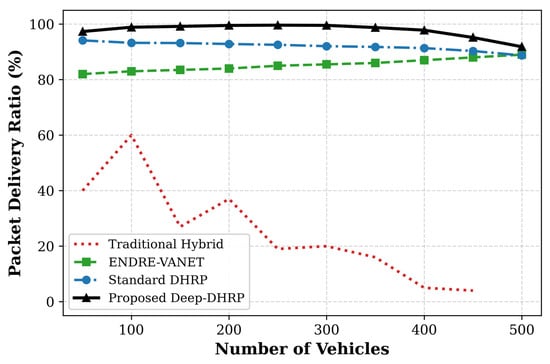
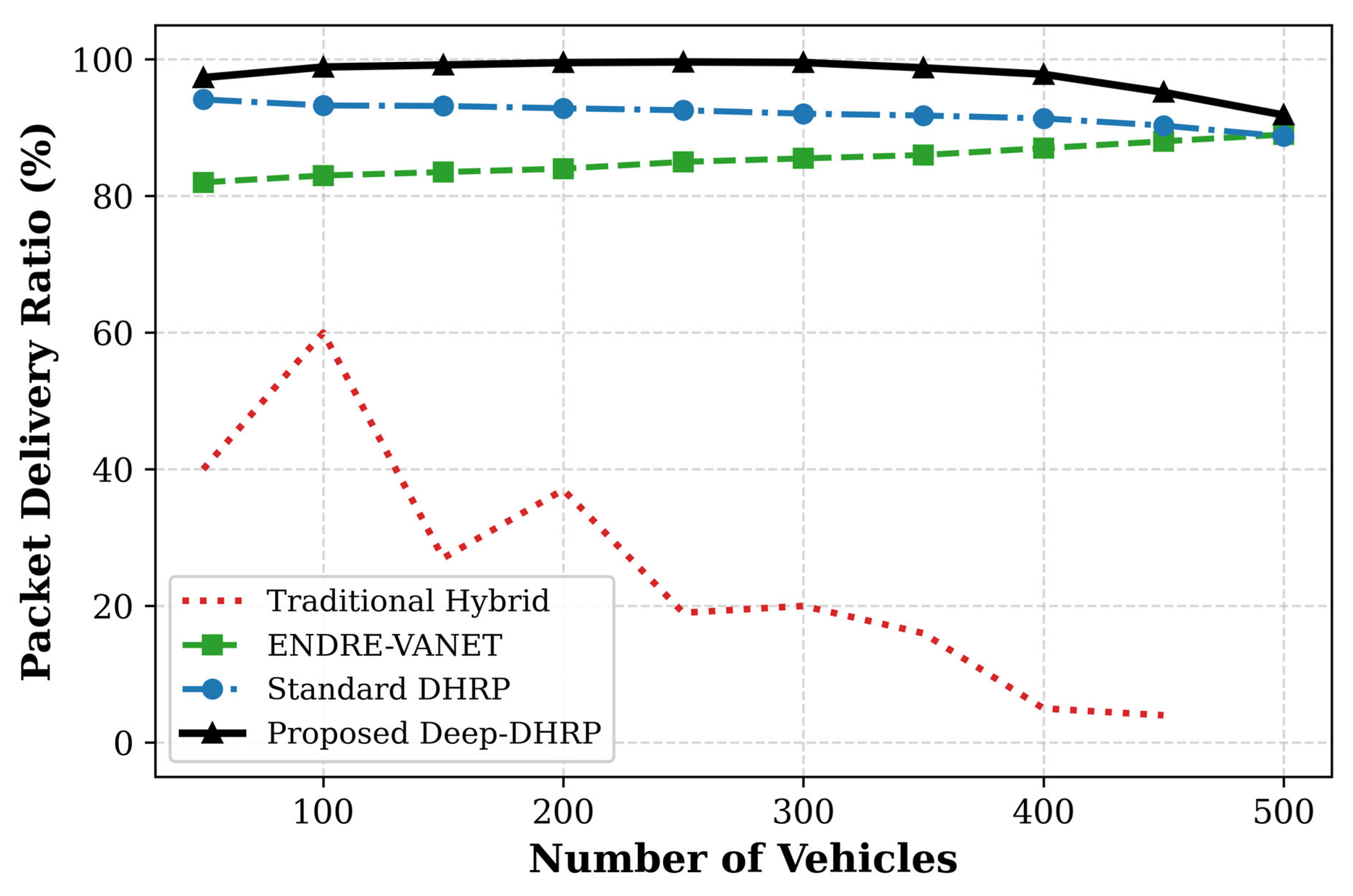
Figure 1 and Table 5 present the comparative Packet Delivery Ratio (PDR %) across network densities scaling from 50 to 500 vehicle nodes. Traditional hybrid routing degrades severely, dropping from 60.00% at 100 nodes to 4.00% at 450 nodes due to topological blindness and uncoordinated transmission power. While ENDRE-VANET and Standard DHRP sustain baseline delivery rates near 82–89% and 88–94%, respectively, proposed Deep-DHRP maintains superior reliability throughout.
Figure 1.
Comparative evaluation of Packet Delivery Ratio (PDR %).
Table 5.
Comparative analysis of Packet Delivery Ratio (%).
In sparse scenarios (50 nodes), Deep-DHRP achieves 97.33% PDR by leveraging AODV-Boost mode (28.0 dBm) to bridge isolated partitions. In medium densities (250 nodes), delivery peaks at 99.62% as the agent transitions to proactive OLSR-Std modes. Under extreme channel saturation (500 nodes), Deep-DHRP sustains 91.85% PDR—outperforming Standard DHRP by 3.12% and ENDRE-VANET by 2.85%—by deploying OLSR-Eco (21.5 dBm) to suppress co-channel radio interference.
4.3. End-to-End Latency and Network Throughput
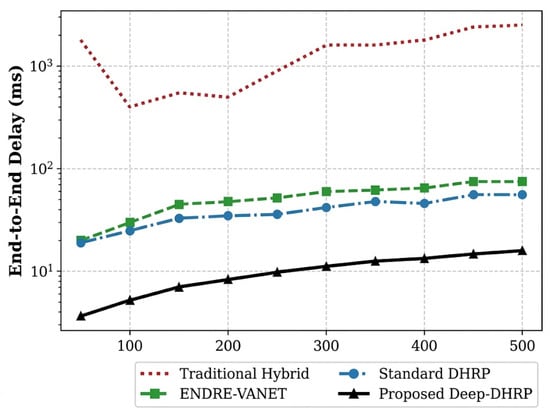
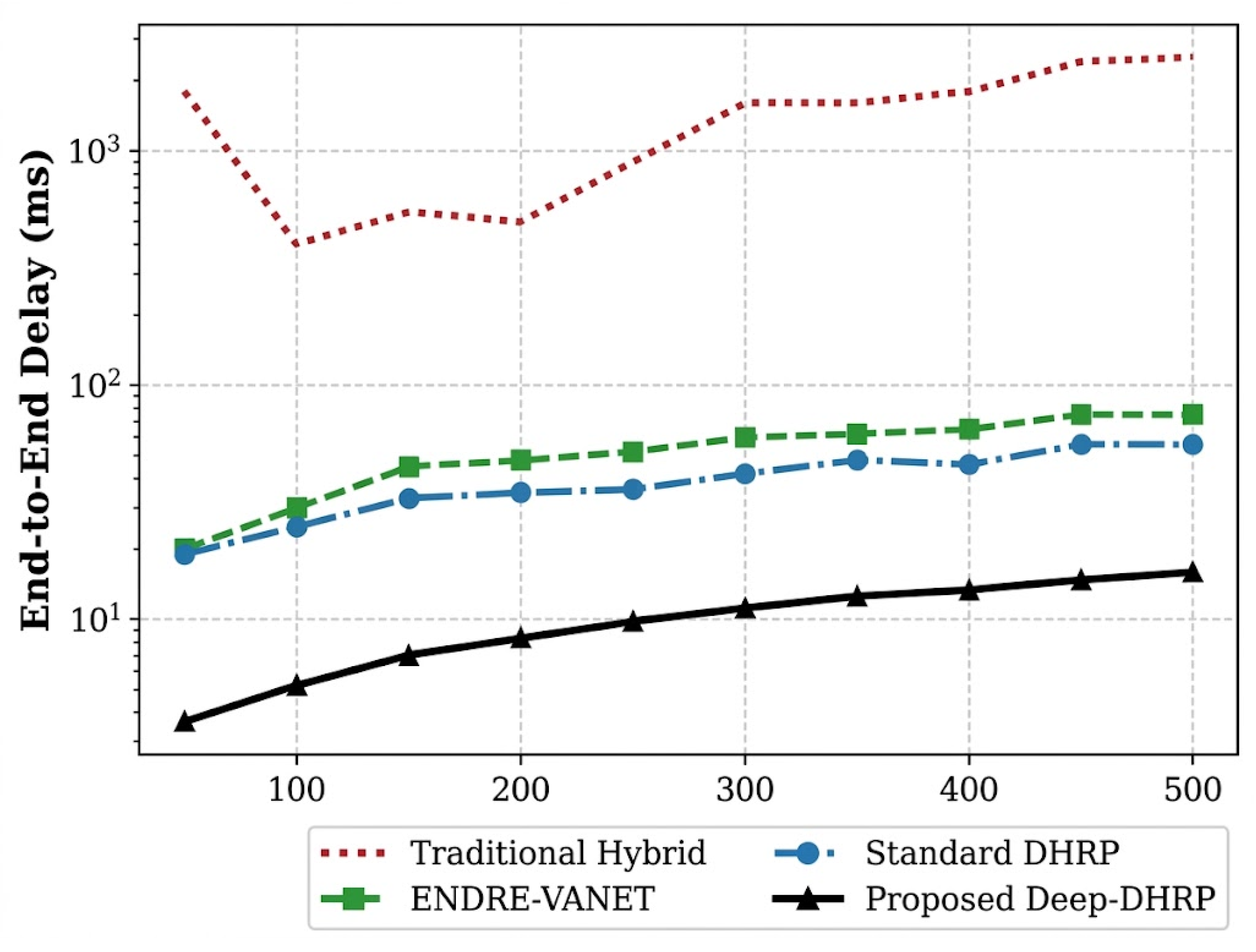
Figure 2 and Table 6 illustrate average End-to-End Delay (ms). Traditional hybrid mechanisms experience extreme latency spikes (1800 ms to 2500 ms) due to route discovery flooding and buffer overflows during link breaks. ENDRE-VANET and Standard DHRP keep latency bounded between 20–75 ms and 19–56 ms. In contrast, Deep-DHRP achieves ultra-low latency strictly bounded between 3.64 ms (50 nodes) and 15.94 ms (500 nodes). Pre-emptive switching to proactive OLSR states eliminates route acquisition delays before packets are queued.
Figure 2.
Comparison of average End-to-End Delay (ms).
Table 6.
Comparative analysis of End-to-End Delay (ms).
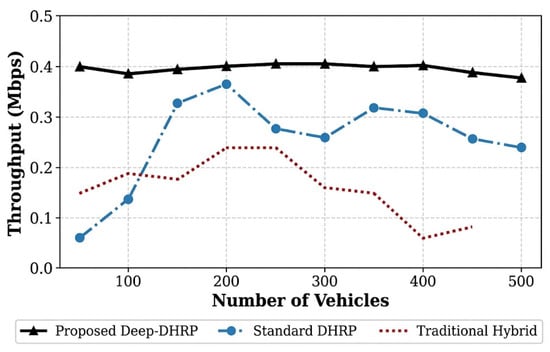
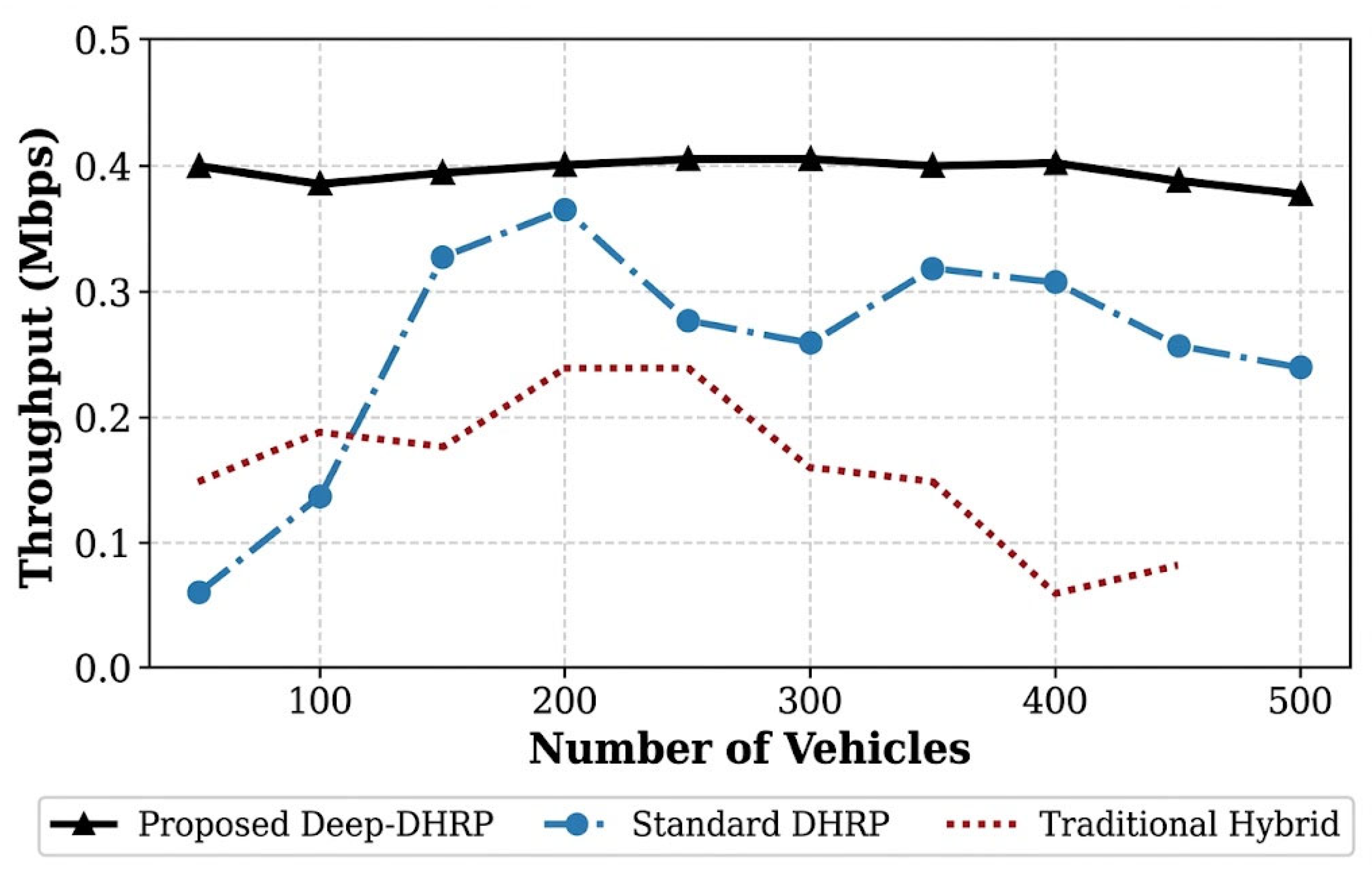
System Throughput (Figure 3, Table 7) demonstrates a similar trend. Traditional hybrid protocols collapse under density (0.06–0.24 Mbps) due to packet dropouts. Standard DHRP reaches 0.37 Mbps, whereas Deep-DHRP delivers a persistently high-capacity data stream ranging from 0.376 Mbps to 0.408 Mbps across all density levels.
Figure 3.
System Throughput comparison (Mbps).
Table 7.
Comparative analysis of Network Throughput (Mbps).
4.4. Routing Overhead Ratio and Energy Efficiency
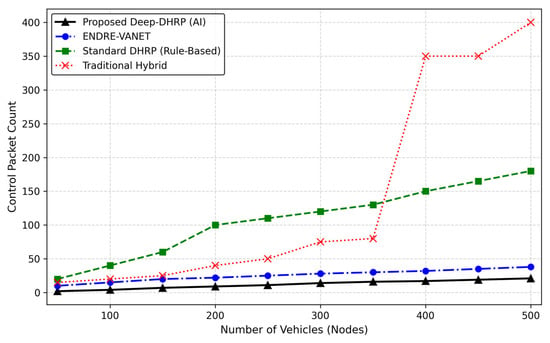
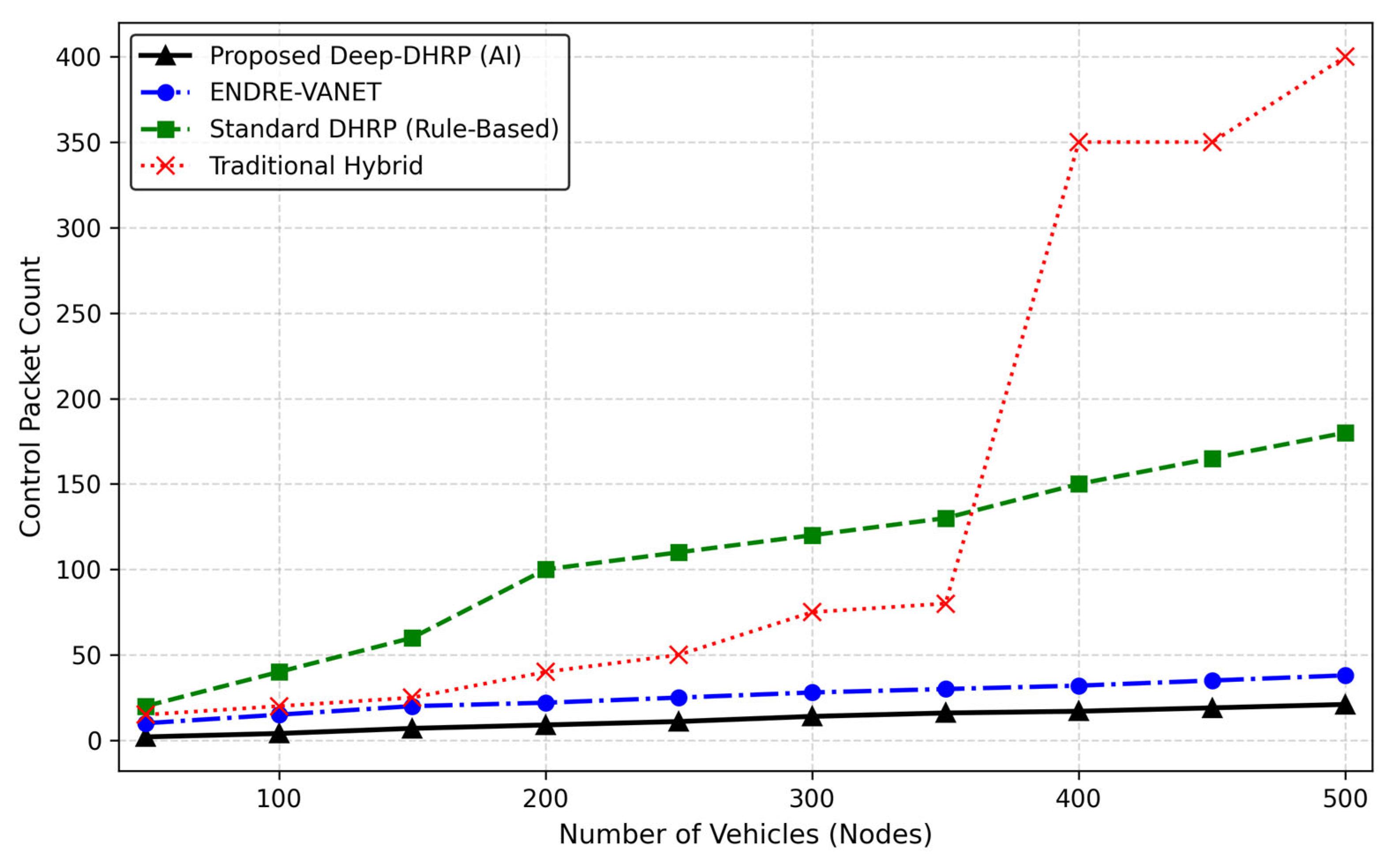
Control message signaling overhead (Figure 4, Table 8) highlights the scalability of the proposed cross-layer agent. Traditional hybrid protocols suffer exponential control packet growth (350× overhead), and ENDRE-VANET increases linearly up to 180×. Deep-DHRP suppresses background signaling down to an overhead ratio of 1.0 to 8.0 across low-to-medium densities (50–300 nodes), rising modestly to 27.0 under 500 nodes. By restricting proactive HELLO/TC broadcasts strictly to dense, multi-hop sub-grids identified by 2D convolutions, channel congestion is avoided.
Figure 4.
Routing Overhead Ratio comparison.
Table 8.
Comparative analysis of Routing Overhead Ratio.
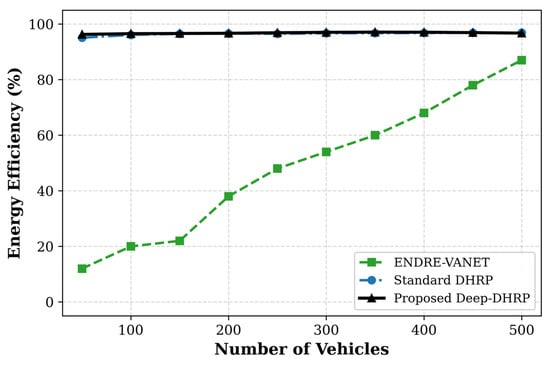
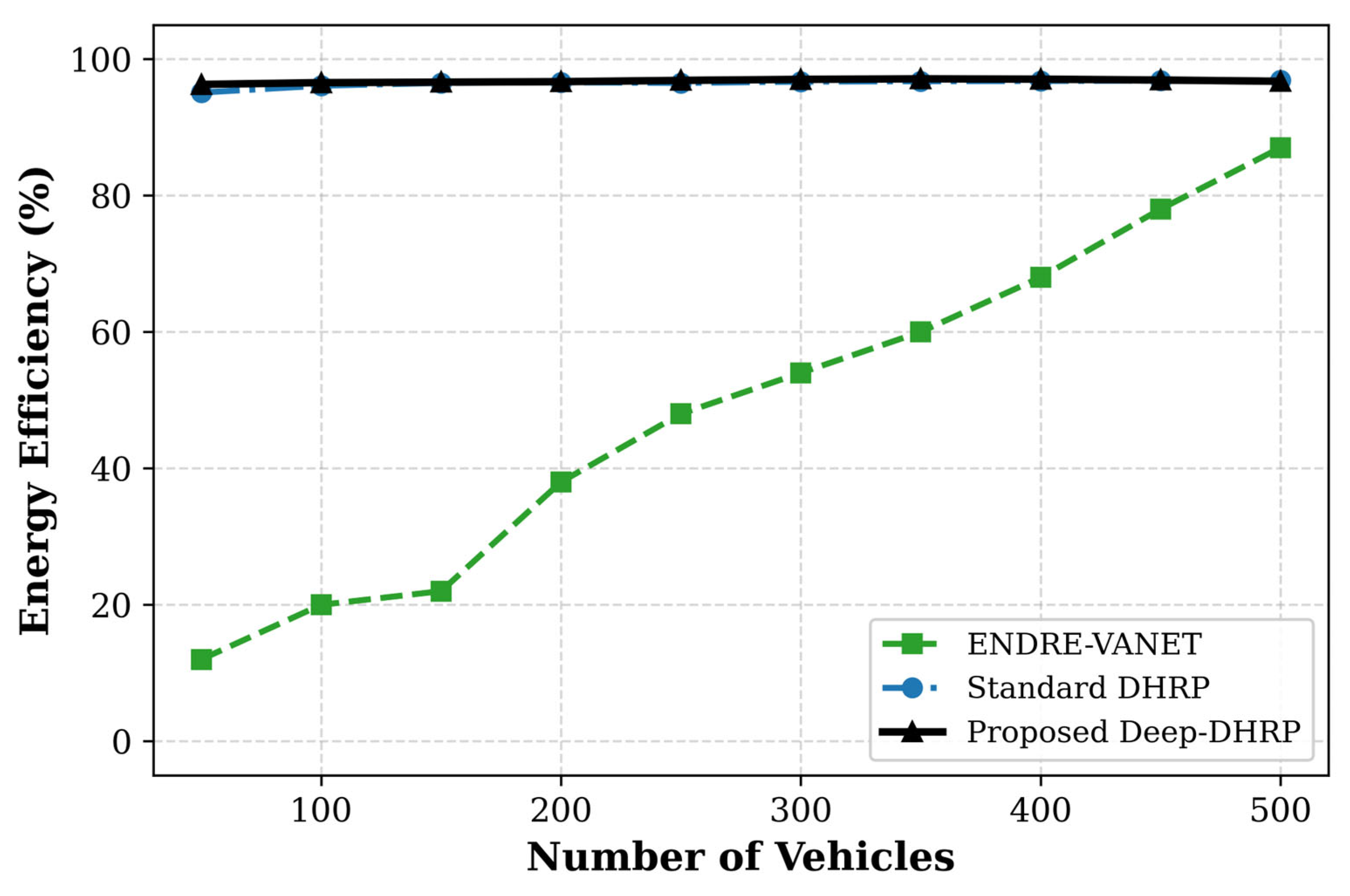
Finally, Energy Efficiency (Figure 5, Table 9) remains stable between 96.29% and 97.11% for Deep-DHRP. Dynamic physical-layer power control ensures nodes operate at 21.5 dBm (OLSR-Eco) whenever neighbor density permits, saving significant OBU RF power without compromising packet delivery.
Figure 5.
Energy Efficiency (%) comparison.
Table 9.
Comparative analysis of Energy Efficiency (%).
Energy Efficiency is evaluated as the Residual Energy Retention Ratio, defined as the percentage of initial nodal battery energy (100.0 J) retained after completing the 5000-packet transmission evaluation cycle (Energy Efficiency = (E_residual/E_initial) × 100%). Deep-DHRP maintains an energy retention rate between 96.29% and 97.11% across all densities.
5. Conclusions and Future Work
In this study, we introduced the Deep Hybrid Routing Protocol (Deep-DHRP), a novel context-aware cross-layer architecture designed to resolve the performance trade-offs between reactive and proactive VANET routing paradigms. By replacing static scalar thresholds with a Dual-Stream Hybrid Convolutional Neural Network (H-CNN) agent, the framework removes topological blindness while keeping the model small. Compared with deeper multi-grid designs, the two-stream layout was chosen on purpose to lower memory and compute cost, so the protocol stays practical for low-power OBU hardware. The agent ingests a 40 × 40 binary spatial occupancy grid alongside continuous scalar kinematic telemetry, mapping environmental context directly to joint routing mode selections and physical layer RF transmission power levels. Across independent tests on 84,239 samples, the H-CNN classifier achieved a mean accuracy of 98.06% and a weighted F1 score of 0.98, maintaining a compact model footprint of 12.93 MB suitable for real-time On-Board Unit (OBU) deployment.
Comprehensive NS-3 network simulations spanning 50 to 500 vehicle nodes demonstrate that Deep-DHRP significantly outperforms traditional hybrid, ENDRE-VANET, and standard DHRP baselines across all key metrics. Deep-DHRP maintained an average Packet Delivery Ratio (PDR) between 91.85% and 99.62%, strictly bounded End-to-End Latency between 3.64 ms and 15.94 ms, achieved scalable throughput up to 0.408 Mbps, and drastically suppressed control message overhead (ranging from 1 to 27) while sustaining stable energy efficiency above 96.29%. Future work will explore integrating 3D spatial vision grids for multi-level highway overpasses and testing hardware-in-the-loop OBU field deployments under real-world C-V2X propagation scenarios.
Author Contributions
Conceptualization, B.G., F.T.H. and K.Y.; methodology, B.G. and K.Y.; software, B.G.; validation, B.G., F.T.H. and K.Y.; formal analysis, B.G. and F.T.H.; investigation, B.G.; resources, F.T.H. and K.Y.; data curation, B.G.; writing—original draft preparation, B.G.; writing—review and editing, F.T.H. and K.Y.; visualization, B.G.; supervision, F.T.H. and K.Y.; project administration, F.T.H. All authors have read and agreed to the published version of the manuscript.
Funding
This research received no external funding.
Data Availability Statement
The datasets generated from the SUMO mobility traces and the NS-3 simulation models developed during the current study are available from the corresponding author upon reasonable request.
Acknowledgments
The authors acknowledge the use of AI tool Claude AI Opus 4.0 during the preparation of the manuscript, solely for language editing purposes. Specifically, the tool was used to edit the Introduction and Results sections and to improve the overall grammar of the manuscript.
Conflicts of Interest
The authors declare no conflicts of interest.
References
- Meneguette, R.I.; De Grande, R.E.; Loureiro, A.A. Intelligent transportation systems: Technologies and applications. IEEE Commun. Surv. Tutor. 2022, 24, 1521–1548. [Google Scholar]
- Zhou, H.; Xu, W.; Chen, J.; Wang, W. Evolutionary V2X technologies toward the Internet of Vehicles: Challenges and opportunities. Proc. IEEE 2022, 110, 72–86. [Google Scholar]
- Al-Dulaimi, A.M.K.; Mahdi, Q.S.; Alkhayyat, A.H.R.; Abbas, F.H.; Alsalamy, A.A. Effective Neighbor Discovery Based Routing in Emergency Vehicular Ad-Hoc Network (VANETs). In Proceedings of the 2023 6th International Conference on Engineering Technology and its Applications (IICETA), Al-Najaf, Iraq, 10–11 May 2023; pp. 324–329. [Google Scholar]
- Goyal, A.; Sharma, V.; Kumar, S.; Poonia, R.C. Performance benchmarking and optimization of Ad-hoc On-Demand Distance Vector (AODV) routing in dynamic mobile ad-hoc networks. J. Interconnect. Netw. 2023, 23, 2250041. [Google Scholar]
- Hamdi, M.M.; Audah, L.; Rashid, S.A.; Mohammed, A.H.; Alani, S.; Mustafa, A.S. A review of reactive, proactive, and hybrid routing protocols in vehicular ad hoc networks: An OLSR and multi-point relay perspective. Bull. Electr. Eng. Inform. 2022, 11, 2872–2883. [Google Scholar]
- Al-Shareeda, M.A.; Anbar, M.; Hasbullah, I.H.; Manickam, S. Survey of authentication and privacy schemes in vehicular ad hoc networks. IEEE Access 2022, 10, 68145–68160. [Google Scholar] [CrossRef] [Scilit]
- Correa Sánchez, L. The evolution of routing in VANET: An analysis of solutions based on artificial intelligence and software-defined networks. Int. J. Electr. Comput. Eng. 2025, 15, 5388–5401. [Google Scholar] [CrossRef] [Scilit]
- Hamlili, A. Next-generation VANET routing: An AI-based time-evolving graph framework to suppress broadcast storms. Comput. Artif. Intell. 2025, 3, 105–118. [Google Scholar]
- Abboud, K.; Omar, H.A.; Zhuang, W. Interworking of DSRC and cellular network technologies for V2X communications: A survey. IEEE Trans. Intell. Transp. Syst. 2022, 23, 6185–6202. [Google Scholar]
- Silva, R.; Silva, J.S.; Boavida, F. A survey on opportunistic routing in vehicular ad hoc networks: Challenges, taxonomy and directions. Comput. Netw. 2022, 216, 109266. [Google Scholar]
- Al-Shareeda, M.A.; Anbar, M.; Hasbullah, I.H.; Manickam, S. A survey of hybrid routing protocols in vehicular ad hoc networks. IEEE Access 2022, 10, 23410–23425. [Google Scholar] [CrossRef] [Scilit]
- Raw, R.S.; Sanjoy, D.; Singh, N. Modern routing architectures and cross-layer optimization in connected vehicular environments. Veh. Commun. 2023, 39, 100558. [Google Scholar]
- Ning, Z.; Dong, P.; Wang, X.; Rodrigues, J.J.; Xia, F. Deep reinforcement learning for intelligent Internet of Vehicles: An energy-efficient resource allocation perspective. IEEE Trans. Cogn. Commun. Netw. 2023, 9, 512–524. [Google Scholar]
- Liu, X.; Zhang, L.; Chen, Y.; Wang, J. Graph convolutional networks for traffic-aware dynamic packet forwarding in VANETs. IEEE Trans. Veh. Technol. 2024, 73, 4110–4124. [Google Scholar]
- Ksentini, A.; Brik, B. Comparative evaluation and source routing mechanisms in software-defined connected vehicle environments: Revisiting Dynamic Source Routing (DSR). Veh. Commun. 2023, 41, 100592. [Google Scholar]
- Al-Kharobi, T.M.; Al-Absi, M.A.; Al-Absi, A.A. Energy-efficient adaptive routing protocol for software-defined vehicular networks. IEEE Access 2023, 11, 45120–45133. [Google Scholar] [CrossRef] [Scilit]
- Onuora, A.C.; Essien, E.E.; Ogban, F.U. An adaptive hybrid routing protocol for efficient data transfer and delay control in mobile ad hoc network. Int. J. Eng. Trends Technol. 2023, 71, 251–258. [Google Scholar] [CrossRef] [Scilit]
- Wang, C.; Cao, M.; Jiang, H.; Xiang, X.; Zhang, X. A deep reinforcement learning-based adaptive large neighborhood search for capacitated vehicle routing problems under congestion. IEEE Trans. Emerg. Top. Comput. Intell. 2024, 9, 131–144. [Google Scholar] [CrossRef] [Scilit]
- Wang, X.; Geng, Y.; Luo, X.; Guan, X. Detection of dummy data injection attacks by using particle swarm optimization-attention temporal graph convolutional network model in power system. Eng. Appl. Artif. Intell. 2026, 171, 114259. [Google Scholar] [CrossRef] [Scilit]
- Wahab, O.A.; Mourad, A.; Otrok, H.; Bentahar, J. Federated reinforcement learning for autonomous and collaborative vehicular networking. IEEE Wirel. Commun. 2023, 30, 66–73. [Google Scholar]
- Bangui, H.; Ge, M.; Buhnova, B. A hybrid machine learning model for anomaly detection in vehicular ad hoc networks. Comput. Electr. Eng. 2022, 104, 108434. [Google Scholar]
- Al-Suhail, G.A.; Al-Mayyahi, A.; Aldabbagh, A. Context-aware clustering and hybrid routing optimization in dense connected vehicle environments. Veh. Commun. 2024, 46, 100720. [Google Scholar]
- Raza, S.; Wang, S.; Ahmed, M.; Grover, A. A survey on deep learning for vehicular ad-hoc networks: Architectures, applications, and challenges. IEEE Access 2023, 11, 89230–89255. [Google Scholar]
- Kumar, S.; Sharma, K.; Kumar, P.A.A.; Jain, A.; Bhagat, S.K.; Singh, P. An improved particle swarm approach for energy-aware location-aided routing in mobile ad-hoc network. In Proceedings of the 2024 7th International Conference on Contemporary Computing and Informatics (IC3I), Greater Noida, India, 18–20 September 2024; pp. 112–117. [Google Scholar]
- Yang, Q.; Wang, H.; Dai, X.; Li, C. Edge-intelligence-enabled routing and power control in heterogeneous vehicular networks. IEEE Internet Things J. 2023, 10, 14890–14902. [Google Scholar]
- Gupta, B.; Gaurav, A.; Marin, E.; Alhalabi, W. Novel graph-based machine learning technique to secure smart vehicles in intelligent transportation systems. IEEE Trans. Intell. Transp. Syst. 2023, 24, 8483–8493. [Google Scholar] [CrossRef] [Scilit]
- Fatemidokht, H.; Rafsanjani, M.K.; Gupta, B.B. Trust-aware multi-metric routing scheme using intelligent optimization in urban vehicular networks. IEEE Trans. Intell. Transp. Syst. 2023, 24, 14210–14223. [Google Scholar]
- Sangeetha, K.; Premalatha, J. Performance assessment of proactive Destination-Sequenced Distance-Vector (DSDV) routing against blackhole vulnerabilities in mobile ad-hoc topologies. Wirel. Pers. Commun. 2023, 130, 1845–1862. [Google Scholar]
- Zhang, X.; Peng, M.; Yan, S.; Sun, Y. Deep reinforcement learning-based dynamic transmission power control in vehicular networks. IEEE Trans. Wirel. Commun. 2022, 21, 3100–3114. [Google Scholar]
- IEEE Std 802.11p-2010; IEEE Standard for Information Technology—Local and Metropolitan Area Networks—Specific Requirements—Part 11: Wireless LAN Medium Access Control (MAC) and Physical Layer (PHY) Specifications. Amendment 6: Wireless Access in Vehicular Environments. IEEE: Piscataway, NJ, USA, 2010.

Disclaimer/Publisher’s Note: The statements, opinions and data contained in all publications are solely those of the individual author(s) and contributor(s) and not of MDPI and/or the editor(s). MDPI and/or the editor(s) disclaim responsibility for any injury to people or property resulting from any ideas, methods, instructions or products referred to in the content. |
© 2026 by the authors. Licensee MDPI, Basel, Switzerland. This article is an open access article distributed under the terms and conditions of the Creative Commons Attribution (CC BY) license.