


Abstract
Effective transportation of heat and mass in nanofluids is vital for enhancing energy transfer and thermal management. In this study, the Cattaneo–Christov double-diffusive MHD flow of a Maxwell ternary hybrid nanofluid through a porous medium is examined, taking into account activation energy and nonlinear thermal effects. The aim of this work is to investigate the effects of the magnetic field, porous medium, thermal and concentration relaxation, radiation, viscous dissipation, chemical reaction, and activation energy on the fluid flow. The momentum, energy, and concentration equations are modeled using nonlinear partial differential equations. Suitable similarity transformations are used to reduce the nonlinear PDEs to nonlinear ODEs. The extra stress is described by the upper-convected Maxwell model, and the similarity transformation is derived from a one-parameter Lie scaling group under which the governing equations and boundary conditions are invariant; the resulting invariants identify the parametric groupings that govern heat transfer and nanoparticle concentration. The resulting nonlinear boundary value problem is then solved numerically using the built-in MATLAB solver bvp4c. The numerical solutions are presented in graphs and tables and are validated against results reported in the literature. The results show that the velocity profile decreases with increasing magnetic field, porous medium parameter, and Maxwell parameter. The temperature profile, on the other hand, increases with the nanoparticle volume fraction, heat generation, Eckert number, and thermal relaxation parameter, but decreases with increasing radiation parameter and Biot number.
1. Introduction
From an industrial perspective, heat transfer efficiency is a critical aspect of modern systems. Conventional cooling fluids cannot meet future industrial demands, and nanofluids are regarded as promising alternatives for enhancing heat transfer. They consist of nanoparticles, usually smaller than 100 nm, dispersed in base liquids such as ethylene glycol, water, oil, or other liquids. Typical nanoparticles include nitrides, carbon-based compounds, metal oxides, metals, carbides, and nanotubes. The thermal performance of nanofluids is enhanced through several mechanisms, including Brownian motion, thermophoresis, and thermal diffusion. Experimental studies have shown that the addition of nanoparticles enhances the thermophysical properties of base fluids. According to Choi and Eastman, one significant improvement is the increase in thermal conductivity [1]. Hybrid nanofluids are formed by dispersing two different types of nanoparticles in a base fluid such as water. Compared with conventional nanofluids, they exhibit higher heat transfer efficiency. Ahmad et al. [2] examined the MHD flow of a hybrid nanofluid (HNF) in a saturated porous medium. Thottempudi et al. [3] provided computational insights into the effects of surface nonlinearity, heat generation, and Newtonian heating on the magnetohydrodynamic flow of an HNF. Ternary hybrid nanofluids (THNFs) are formed when three different types of nanoparticles are dispersed in a base fluid. When conventional constant-temperature models are supplemented with a Newtonian heating boundary condition, noticeable thermal changes arise. Compared with nanofluids and hybrid nanofluids, THNFs transfer heat more efficiently. Manjunatha et al. [4] numerically studied heat transfer in a THNF flowing over a long surface. After the governing PDEs for the flow and temperature of the fluid were transformed into ODEs, the resulting system was solved using the RKF-45 method. Goud et al. [5] examined the dissipative MHD flow of a ternary hybrid nanofluid over an inclined sheet with activation energy. An increase in the Soret number accelerates the flow, whereas larger values of the chemical reaction parameter reduce the fluid motion. The flow also slows down as the first-order slip parameter increases. Abbas et al. [6] analyzed the impact of variable heat rise and fall on the MHD flow of a Maxwell ternary nanofluid over a rotating needle. An increase in the magnetic field parameter raises the fluid temperature and reduces its velocity owing to the stronger Lorentz force. Ahmad [7] numerically investigated heat and mass transfer and examined how MHD and Joule heating affect the dynamics of a THNF. It was found that the Eckert number enhanced the thermal performance by increasing the velocity and temperature profiles. Hayat et al. [8] studied the entropy-induced Darcy–Forchheimer (DF) flow of THNFs with melting and dissipative effects. Radiation and heat generation were shown to have opposite effects on the temperature, and the heat transport rate increased with melting heat and radiation.
Owing to its many industrial and technical applications, fluid flow through porous media has attracted considerable interest. The flow behavior becomes more complicated when non-Newtonian fluids, such as Maxwell fluids, are considered. The flow properties are influenced by thermal radiation, slip effects, chemical reactions, and activation energy, and understanding these factors is essential for predicting and optimizing fluid behavior. MHD effects are widely used in heat transport and industrial systems. The flow behavior becomes even more complicated when MHD flow occurs in a porous medium. Therefore, a detailed analysis of the transport phenomena is required. This article examines Maxwell fluid flow in a porous medium over a stretching sheet. Activation energy, chemical reactions, thermal radiation, and various slip conditions are all considered. Heat exchangers, chemical reactors, and polymer manufacturing are examples of practical applications of the proposed model. The literature reviewed in this study covers several aspects of fluid flow and heat transfer over stretching surfaces. Numerous fluid models and physical effects have been investigated in order to gain a better understanding of the complex behavior of fluids under different conditions. Bilal et al. [9] performed a comparative numerical analysis of the time-dependent thermo-diffusive flow of a Maxwell fluid through a stretching cylinder. The resulting system of ODEs was solved numerically using the PCM. Brownian motion and thermal radiation can significantly raise the fluid’s temperature. Abdollahzadeh et al. [10] employed TiO2 nanotubes to investigate the combined influence of radiation and magnetic parameters on a Maxwell fluid with different blades. Algehyne et al. [11] examined the influence of Brownian and thermal diffusivity on Maxwell nanofluid flow with motile microorganisms and Joule heating. The problem was solved using the homotopy analysis method in Mathematica 12. The solutal profile was found to be less affected by the radiation and chemical reaction parameters. Chu et al. [12] used mathematical modeling and computational analysis to investigate the thermal oblique stagnation-point flow of a Maxwell nanofluid with a nonlinear chemical reaction and non-uniform heat generation. Heat transport was assessed using the Cattaneo–Christov (CC) theory. Mahariq et al. [13] studied heat transfer in Maxwell nanofluid flow with thermal radiation and bioconvection. The bioconvection Lewis number was found to reduce the microorganism profile. The radiation parameter is increased by deterioration at high temperatures. Thirupathi et al. [14] employed a numerical approach to study the MHD flow of an upper-convected Maxwell (UCM) hybrid nanofluid over a stretching sheet. It was predicted that the boundary layer (BL) contracts and the wall skin friction coefficient decreases as the elastic number of the UCM hybrid fluid increases.
Heat transfer and fluid flow depend on thermal radiation, particularly at high temperatures. Thermal radiation is one of the modes by which heat is transferred from one place to another. Radiative heat transfer is involved in numerous technical applications, such as spacecraft re-entry, fossil-fuel combustion, solar energy systems, and astrophysical phenomena. Many researchers have examined the practical implications of nonlinear thermal radiation for fluid flow and heat transfer. Solar collectors, solar ponds, gas turbines, furnaces, photochemical reactors, nuclear power plants, and aerospace propulsion systems all use thermal radiation extensively. In recent years, researchers have focused considerable attention on how thermal radiation affects heat transport in conventional fluids and nanofluids over stretching surfaces. Ibrahim et al. [15] examined the effect of thermal radiation on the unsteady dissipative MHD mixed convection of an HNF over an inclined stretching sheet with chemical reaction. HNFs were found to transfer heat more effectively than conventional fluids owing to the complex interaction between buoyancy and magnetic effects. Faisal et al. [16] examined the unsteady bidirectional hydrothermal transport of a nonlinear radiative nanofluid with thermal and mass convection. Sindhu et al. [17] presented a comparative analysis of the DF radiative flow of a water-based HNF over a Riga plate with a heat source/sink. The velocity decreases as the porosity parameter increases, whereas the temperature profile is enhanced by radiation and the Biot number. The surface shear stress increases with the modified Hartmann number.
In industrial applications, the Cattaneo–Christov heat flux model (CCHFM) is crucial for describing heat transfer and nanofluid motion. Heat conduction was originally examined by Fourier in 1882. Cattaneo introduced a relaxation time to improve Fourier’s law. However, the Cattaneo model has a shortcoming in describing heat conduction behavior. Christov resolved this heat flux issue by introducing a material time derivative into the model. This improved version is called the CCHFM. Magnetized cylinder flows are frequently analyzed using this approach. It aids in understanding fluid behavior under various conditions and in enhancing heat transfer. Additionally, it accounts for the finite speed of thermal propagation, which is crucial when thermal relaxation effects are significant. Shah et al. [18] used the Koo–Kleinstreuer and CC models to theoretically simulate a Ree–Eyring nanofluid containing aluminum alloys over a stretching surface with a magnetic dipole. The HAM was then used to solve the transformed equations. Ahmed et al. [19] investigated Cattaneo–Christov double diffusion (CCDD) in Sutterby nanofluid flow due to a Riga plate, with irreversibility analysis and motile microorganisms. The microorganism profile diminishes as the bioconvection Lewis number and Péclet number increase. Nasir et al. [20] modeled the effectiveness of chemical reactions in magnetized nanofluids under the influence of activation energy (AE) and CC transport phenomena. Loganathan et al. [21] employed the CC model to examine entropy generation in the bioconvective flow of a Maxwell nanofluid past a Riga plate. When the thermal relaxation parameter Γ1 rises, the temperature distribution falls. The thermophoresis parameter enhances the microorganism profile, whereas the bioconvection Lewis number decreases the microorganism concentration.
Magnetohydrodynamics (MHD) is the study of electrically conducting fluids in the presence of a magnetic field. This field combines concepts from fluid dynamics and magnetism to understand how magnetic fields influence the velocity and properties of conducting fluids such as liquid metals, seawater, and plasmas. MHD is useful in a variety of disciplines. It is employed in nuclear fusion research to regulate reactor plasma behavior. In astrophysics, it helps explain cosmic jets and solar flares. Additionally, it is used in energy conversion, metallurgy, MHD generators, pumps, and other industrial operations. In medicine, MHD facilitates improved imaging methods and targeted drug delivery. The interaction between magnetic fields and conducting fluids has produced novel solutions and advances in a variety of sectors. In addition to significant applications such as metallic sensors, cosmology, geothermal energy, aerodynamics, seismology, MHD generators, and plasma experiments, the study of magnetohydrodynamics is essential in the fields of petroleum engineering, mechanical engineering, astrophysics, geology, and the pharmaceutical industry. Consequently, MHD has been widely adopted by researchers in the literature. Bani-Fwaz et al. [22] computationally analyzed the impact of molecular (H2O) and nanoparticle (Al2O3) diameters on the thermal process in a radiated nanofluid. Boujelbene et al. [23] studied the thermal transport and magnetohydrodynamic flow of a generalized Newtonian nanofluid with inherent irreversibility in a conduit with wall slip. The temperature profiles increase with the heat source and Brinkman number. Alharbi et al. [24] examined the MHD and thermal performance of an electrically conducting fluid along a vertical, symmetric magnetic plate with thermal and velocity slip (VS) effects. The Keller-box (KB) technique was used to solve the transformed ODEs numerically. Sarkar et al. [25] analyzed the influence of a chemical reaction on the magnetohydrodynamic non-Darcian mixed convective (MC) nanofluid flow over a stretching sheet with a non-uniform heat source. As the Hartmann number increases, the temperature profiles, concentration profiles, and entropy generation all increase. Li et al. [26] carried out a rheological and computational analysis of the magnetohydrodynamic Buongiorno nanofluid model. The homotopy approach ensured convergence and yielded analytical solutions. Izharul Haq et al. [27] computationally examined the influence of AE and chemical reaction on MHD hybrid nanofluid flow over a stretching surface. Heat absorption and thermal radiation were shown to accelerate energy transfer. Nevertheless, the heat transfer rate of hybrid nanofluids was significantly reduced by the Darcy–Forchheimer effect and suction parameter. Ahmad et al. [28] investigated the impact of DF effects on the 3D MHD rotating flow of a Casson HNF with VS and convective boundary conditions (CBCs).
This work investigates in detail the MHD flow of a Maxwell THNF through a porous medium. The effects of important physical parameters, including heat generation, the magnetic field, the porous medium, the Maxwell fluid parameter, thermal radiation, nanoparticle volume fraction, and various heat and mass transfer parameters, are systematically examined. The governing nonlinear PDEs are transformed via similarity transformations into a system of ODEs, which is subsequently solved numerically. The results reveal significant variations in the velocity, temperature, and concentration profiles under different governing parameters, indicating their strong influence on boundary-layer characteristics. This study provides useful physical insights for enhancing heat and mass transport and regulating flow behavior in engineering and industrial applications.
Similarity transformations for boundary-layer problems are closely connected with the symmetries of the governing equations. Lie group analysis identifies the continuous transformation groups under which the governing partial differential equations and boundary conditions remain invariant, and the absolute invariants of such a group furnish the similarity variables and the dimensionless parameters of the problem [29,30]. In the present work, the scaling group admitted by the Maxwell ternary hybrid nanofluid model with Cattaneo–Christov double diffusion is derived explicitly, and the resulting invariants are used to interpret the governing parametric groupings for heat transfer and nanoparticle concentration.
The main research questions and original contributions of this work are listed below:
- How do the porous medium and magnetic field affect the velocity distribution of the Maxwell ternary hybrid nanofluid flow?
- How do thermal radiation, heat generation, and the Eckert number affect the temperature behavior of the ternary hybrid nanofluid system?
- How does the CC double-diffusion model affect heat and mass transfer compared with the conventional Fourier and Fick laws?
- How do the concentration difference, activation energy, and chemical reaction parameters affect the concentration distribution of ternary hybrid nanoparticles?
- How do ternary hybrid nanoparticles affect the flow and relaxation behavior in the presence of the Maxwell fluid parameter?
- How do the various governing parameters interact to regulate the heat and mass transfer characteristics in a porous medium?
2. Problem Statement
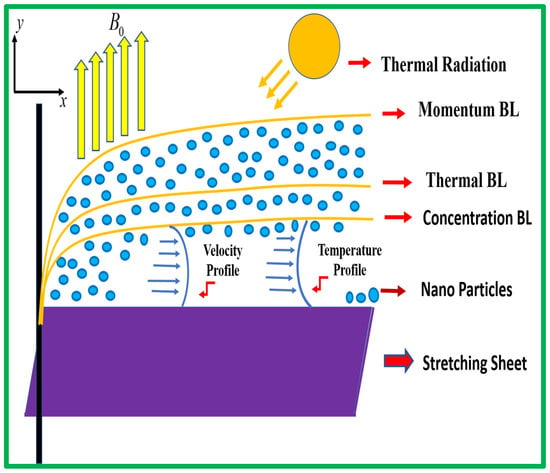
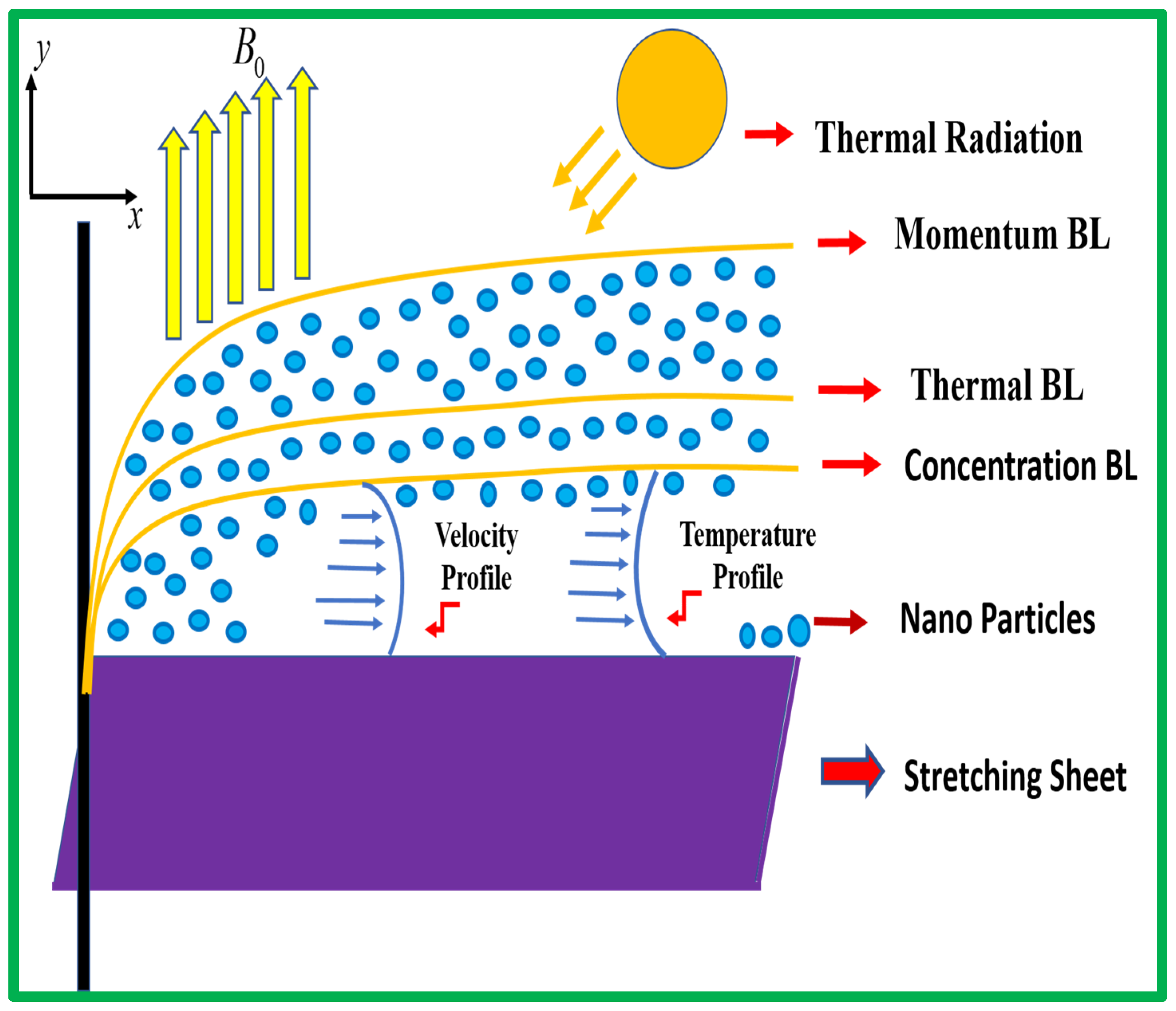
This section considers the steady, incompressible, two-dimensional flow of a THNF. A Maxwell fluid (upper-convected Maxwell model) with the Cattaneo–Christov double-diffusion model is considered, and the flow occurs over a stretching porous surface. TiO2, SiO2, and Al2O3 nanoparticles make up the ternary hybrid nanofluid. The base fluid is blood. The nanoparticles are assumed to be uniformly dispersed and spherical in shape. The velocity components are u and v. They act along the x- and y-directions, respectively. The porous sheet is stretched along the x-direction. The stretching velocity is given by Uw = ax. A transverse magnetic field with strength B0 is applied. The induced magnetic field is neglected, which is justified by the low magnetic Reynolds number. The flow geometry is shown in Figure 1. A heated fluid at temperature Tf convects heat to the sheet. hf is the heat transfer coefficient. Tw is the sheet temperature, where Tw < Tf. Cw represents the surface concentration. T∞ is the ambient temperature. The ambient concentration is C∞, and nonlinear thermal radiation is included in the model. Additionally, an exponential heat source is taken into account. The effect of a chemical reaction is also considered. Convective thermal boundary conditions are imposed, and convective mass boundary conditions are also used. A single-phase nanofluid model is adopted, implying thermal equilibrium and no slip between the nanoparticles and the base fluid. Sedimentation, shape effects, and agglomeration are neglected, and the thermophysical properties are assumed to be constant. In addition, the model does not account for turbulent flow conditions or large particle concentrations that may invalidate the continuum hypothesis. The governing equations are developed on the basis of these assumptions.
Figure 1.
Flow geometry.
The ternary hybrid nanofluid is modeled as a viscoelastic fluid of the upper-convected Maxwell (UCM) type. The Cauchy stress tensor is
Here P is the pressure, I is the identity tensor, and S is the extra stress tensor. For the UCM fluid, S satisfies [31]
in which λ0 denotes the relaxation time, μthnf is the dynamic viscosity of the ternary hybrid nanofluid, A1 is the first Rivlin–Ericksen tensor and L1 is the velocity-gradient tensor with components Lij = ∂Vi/∂xj. The operator D/Dt is the upper-convected (Oldroyd) time derivative, which for a second-order tensor is defined as
The upper-convected derivative is objective (frame-indifferent) and is the derivative employed throughout this work. It differs from the lower-convected derivative, and from the corotational (Jaumann) derivative, with W = (L − LT)/2, which predict different normal-stress responses [31]. The UCM form is the one used for Maxwell fluids over stretching surfaces [7,14,32]. For the steady two-dimensional velocity field V = [u(x,y), v(x,y), 0], the velocity-gradient tensor is
Applying the operator (1 + λ0D/Dt) to the momentum equation, eliminating S through the constitutive relation and invoking the usual boundary-layer approximations (u>>v, ∂/∂y>>∂/∂x), the x-momentum equation reduces to Equation (2), in which the term λ0(u2∂2u/∂x2 + v2∂2u/∂y2 + 2uv∂2u/∂x∂y) is the contribution of the upper-convected derivative. Following [7,14,32], the Lorentz force and Darcy resistance are retained in their conventional form. The same relaxation time λ0 appears in the constitutive relation and in Equation (2).
The governing equations of the system are derived under the above assumptions, which are consistent with earlier studies [32,33,34,35]:
With the boundary conditions:
where,
| T | stands for the fluid temperature, | Qe | for heat source factor, |
| μthnf | dynamic viscosity of the THNF, | ρthnf | density of the THNF, |
| DB | for thermophoresis diffusion coefficient, | for the heat capacity, | |
| B0 | magnetic field strength, | λ | Maxwell parameter, |
| kthnf | for thermal conductivity, and | σthnf | for the ternary hybrid nanofluid’s electrical conductivity. |
The radiative heat flux qr is described as [36]:
This can be simplified as:
| C | stands for the fluid concentration, | kr | the reaction rate parameter, |
| Uw | for the stretching velocity, | hf | heat transfer coefficient, |
| hb | for mass transfer coefficient, | Tf | reference temperature, |
| Cf | reference concentration, | T∞ | far-field temperature, |
| C∞ | far-field concentration. |
The mathematical correlation for thermophysical properties of ternary hybrid nanofluid are given in Table 1 and their corresponding empirical values are given in Table 2.
Table 1.
Thermophysical properties of the ternary hybrid nanofluid [37].
Table 2.
Thermophysical properties of the base fluid and nanoparticles obtained from empirical studies [38].
3. Lie Scaling-Group Analysis of the Governing Problem
The similarity variables are obtained here by Lie group analysis rather than postulated. Consider the one-parameter group of scaling (stretching) transformations [29,30].
where ε is the group parameter and α1, α2, …., α6 are scaling exponents to be determined. Substituting (5a) into Equations (1)–(5) and requiring every term of each equation to acquire the same factor gives the following conditions. Continuity, Equation (1), is
Momentum, Equation (2), taking the terms in order (convection, viscous diffusion, the three upper-convected Maxwell terms, Lorentz force and Darcy drag):
Energy and concentration, Equations (3) and (4): the Brownian and thermophoretic terms (∂C/∂y)(∂T/∂y) and (∂T/∂y)2, the nonlinear Rosseland flux qr ∝ T3∂T/∂y and the Arrhenius factor are invariant only if α5 = α6 = 0. Boundary conditions in Equation (5): u = Uw = ax at y = 0 requires α3 = α1, and the convective conditions with fixed Tf and Cf are consistent with α5 = α6 = 0. Solving these relations gives α2 = α4 = α5 = α6 = 0 and α3 = α1. Normalizing α1 = 1, the governing problem is invariant under
So the scaling components are (α1,α2,α3,α4,α5,α6) = (1,0,1,0,0,0), and the stream function scales as Ψ* = Ψeε. The characteristic equation of Γ,
gives the absolute invariants y, u/x, v, Ψ/x, T and C. Making these dimensionless with the only intrinsic scales of the problem, the stretching rate a and the kinematic viscosity vf yields and ϕ(C). The continuity equation then requires F = f′ and G = −f, which are exactly the similarity variables of Equation (6). Transformation (6) was originally adopted from the literature [32,33,34]; the analysis above shows that it follows from the invariance of the governing problem under Γ.
The viscous-dissipation term μthnf(∂u/∂y)2 and the Joule-heating term in Equation (3) scale with the factor e2ε, whereas all other terms of Equation (3) are invariant. Exact invariance would require Tf − T∞ ∝ x2, which is incompatible with the nonlinear radiation, Brownian, thermophoretic and activation-energy terms. Hence, the Eckert number depends on x, and Equation (8) holds in the local-similarity sense, with Ec, interpreted as a local parameter at a fixed station x, All the other parameters defined below are invariants of Γ.
Employing the following similarity transformations gives
Equation (1) is identically satisfied. Equations (2)–(5) are then transformed into:
The dimensionless variables are defined as:
The Maxwell parameter is λ = (λ0a), the heat source parameter is , the porous medium the concentration Biot number is , the magnetic parameter is the Prandtl number is the thermal relaxation factor is γ1 = (λTa), the radiation parameter is the Eckert number is the Brownian motion parameter is the temperature difference the chemical reaction parameter is the thermophoresis parameter is the dimensionless activation energy is the Schmidt number is the Biot number parameter is and the solutal relaxation factor is
4. Physical Significance of the Similarity Invariants
Because every dimensionless parameter listed above, except the local Eckert number, is built from invariants of Γ, each is independent of x. Each parameter is therefore a flow invariant that characterizes the whole boundary layer, and the reduced profiles f′(η), θ(η) and ϕ(η) are universal. These groupings are not introduced merely as a computational convenience: they identify the minimal set of competing mechanisms that control momentum, heat and nanoparticle transport.
Viscoelastic and relaxation invariants: The parameters λ = λ0a, γ1 = λTa and γ2 = λCa are Deborah numbers: they compare the relaxation times of the stress, the heat flux and the mass flux with the flow time scale 1/a. Since the linearly stretching sheet imposes the uniform rate ∂u/∂x = a, these ratios are the same at every station, so elastic and thermal/solutal memory effects act uniformly along the sheet. The limits γ1 → 0 and γ2 → 0 recover the Fourier and Fick laws, which shows that the Cattaneo–Christov model enters the problem only through these two invariants.
Nanoparticle loading: The volume fractions of TiO2, SiO2 and Al2O3 enter the reduced problem only through the property ratios A1–A5, and they appear in the effective groupings (A1/A2)K, (A4/A2)M and Pr A5/A3. The influence of the ternary composition on momentum is therefore equivalent to modifying the porous and magnetic resistance, and its influence on heat transfer is equivalent to changing the effective Prandtl number of the mixture.
Heat-transfer invariants: Dividing Equation (8) by A3 shows that the temperature field is governed by the effective Prandtl number Pr A5/A3, the radiation group Rd/A5 together with the temperature ratio θw = 1 + δ (radiative enhancement of the effective conductivity), the heat-source parameter Q (internal heat release relative to the advective heat capacity) and, at the wall, the ratio Bi/A3 (convective supply at the surface relative to conduction in the nanofluid). These groupings determine the thermal boundary-layer thickness and the reduced Nusselt number.
Nanoparticle-concentration invariants: Dividing Equation (9) by Nb shows that the concentration field is governed by Sc, by the ratio Nt/Nb, which measures thermophoretic migration relative to Brownian diffusion, and by the dimensionless Arrhenius rate Kr(1 + δθ)mexp[−E/(1 + δθ)], which couples the concentration to the local temperature. A larger E or a smaller δ weakens this coupling and slows the consumption of the species, whereas Bc controls the mass exchange at the wall.
Wall quantities: Under Γ, the reduced quantity and are invariant combinations that do not depend on x. They depend only on the invariants above (and on the local Ec for Nux).
5. Engineering Quantities
The skin friction coefficient, local Nusselt number, and local Sherwood number are defined as:
where τw is shear stress, qw is heat flux, and qm is mass flux, which are defined as: , then
6. Research Methodology
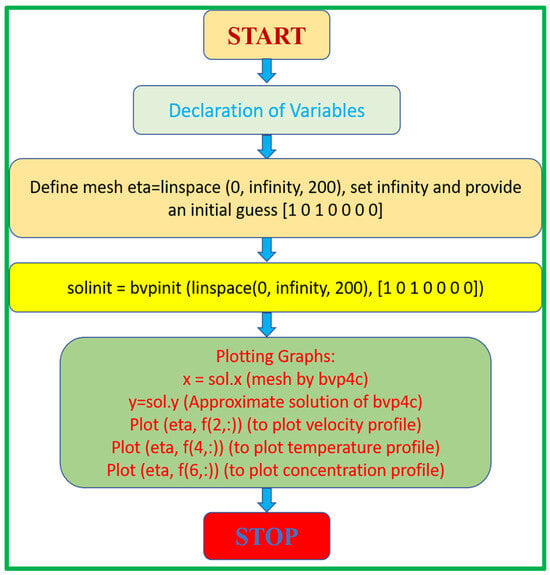
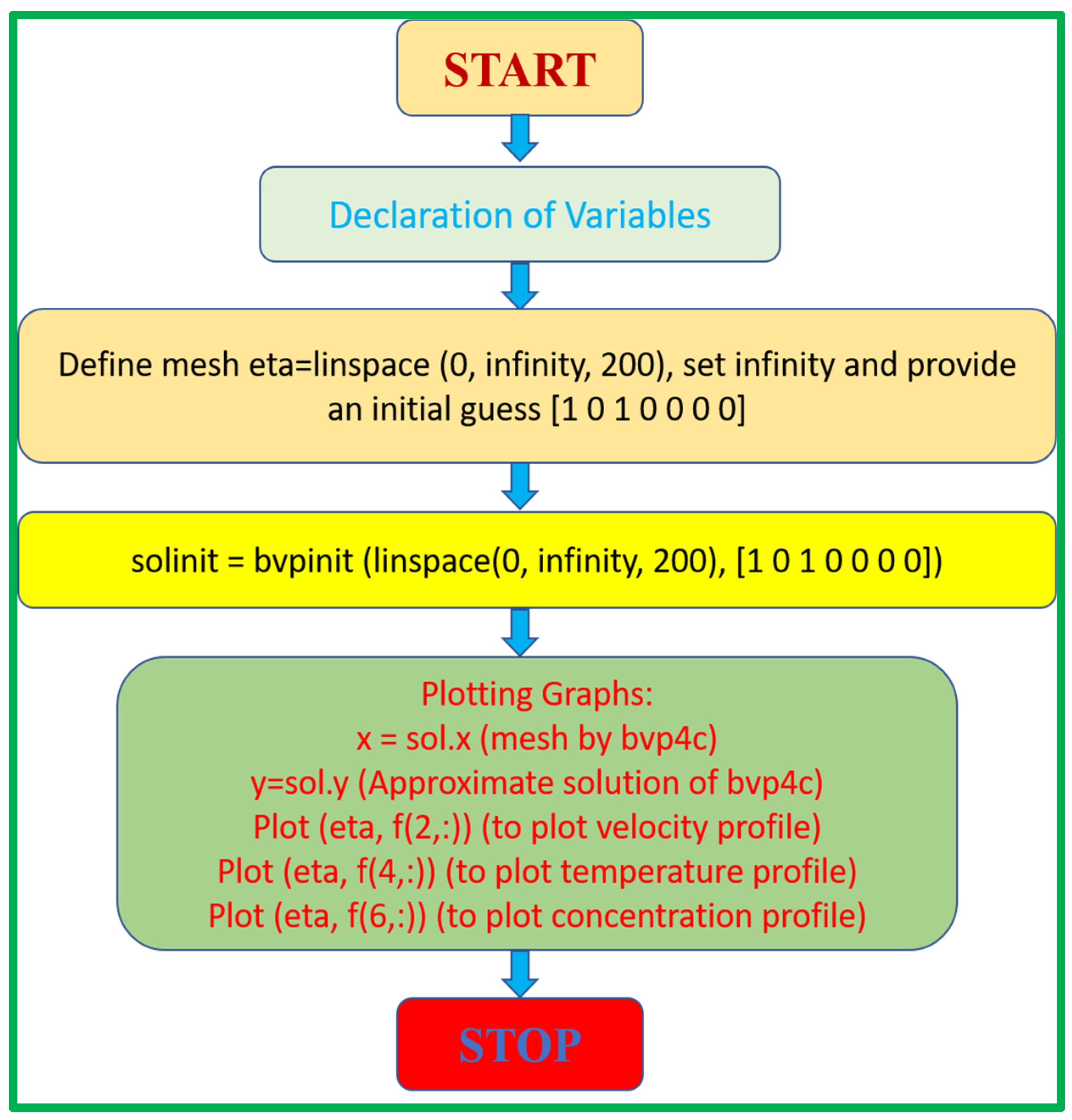
The bvp4c technique in MATLAB-2022b software was used to numerically solve the highly nonlinear ODEs (7)–(9) subject to the boundary conditions (10) as depicted in Figure 2. The approach provides very accurate solutions to problems with well-behaved boundary conditions. The bvp4c package is easy to use and solves such problems with minimal effort. The versatility and efficacy of this method relative to other approaches are demonstrated by its ability to solve problems with different boundary conditions, such as Dirichlet, Neumann, and Robin conditions. The error tolerance of the method is set to 10−5. Furthermore, suitable initial guesses that satisfy the boundary conditions are required to obtain the results. The results obtained by this method are presented both graphically and in tabular form.
Figure 2.
Methodology.
The bvp4c approach provides a numerical solution of the above model. The domain and step size used to solve the modeled ternary hybrid nanofluid flow problem are [0, η max] and 0.001, respectively. The far-field condition is imposed at η max = 5 since no appreciable changes in the dimensionless variables were observed beyond η = 5. Since the modeling described above uses a step size of 0.001, the values of the dimensionless variables f′(η), θ(η), and ϕ(η) are computed at each grid point of the domain with the specified step size [39,40,41].
Introducing the following new variables:
Substituting these variables yields a system of first-order ODEs with the following initial conditions:
7. Results and Discussion
In this mathematical framework, the modified Equations (13)–(16) are used to investigate a nonlinear BVP. The bvp4c approach is employed because it is difficult to obtain an analytical solution for such problems. Figure 3, Figure 4, Figure 5, Figure 6, Figure 7, Figure 8, Figure 9, Figure 10, Figure 11, Figure 12, Figure 13, Figure 14, Figure 15, Figure 16, Figure 17, Figure 18 and Figure 19 illustrate the effects of the relevant physical parameters, including the Prandtl number, porous medium, magnetic field, chemical reaction, temperature difference, Maxwell parameter, Eckert number, Schmidt number, and expansion ratio parameter, on the velocity, temperature, and concentration. Table 1, Table 2 and Table 3 present the numerical influence of certain physical parameters. Table 1 lists the thermophysical properties of THNFs, whereas Table 2 lists the properties of the base fluid (blood) and the different types of nanoparticles. The validation of the methodology used in this study is also presented in this section. A comparison of θ′(0) for various Pr values with the published results of Anwar et al. [42], Hamad et al. [43], and Mahariq et al. [33] is presented in Table 3. The results show excellent agreement and validate the accuracy of the present procedure. The f″(0) and −θ′(0) numerical findings for various values of λ, M, K, and Rd are displayed in Table 4 and Table 5 respectively. As the Maxwell parameter increases, the values of f″(0) increase, whereas the opposite behavior is observed for larger values of M. Table 5 presents the numerical values of the Nusselt number for various Bi, Rd, Q, and thermal relaxation parameter (γ1) values. As the Biot number, heat generation, and thermal relaxation parameters increase, the values of θ′(0) increase, whereas the opposite behavior is observed for the radiation parameter.
Figure 3.
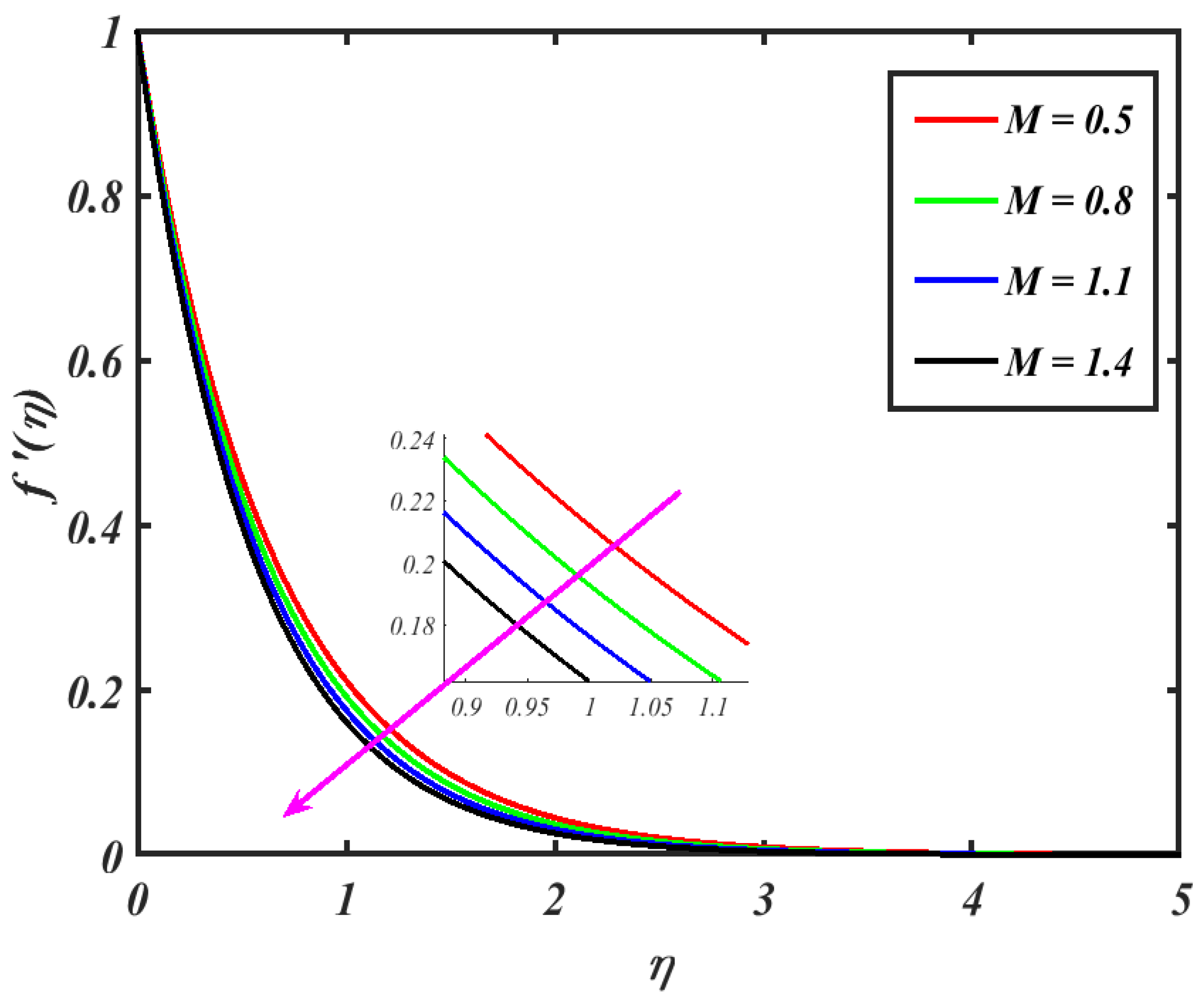
Effect of M on f′(η).
Figure 4.
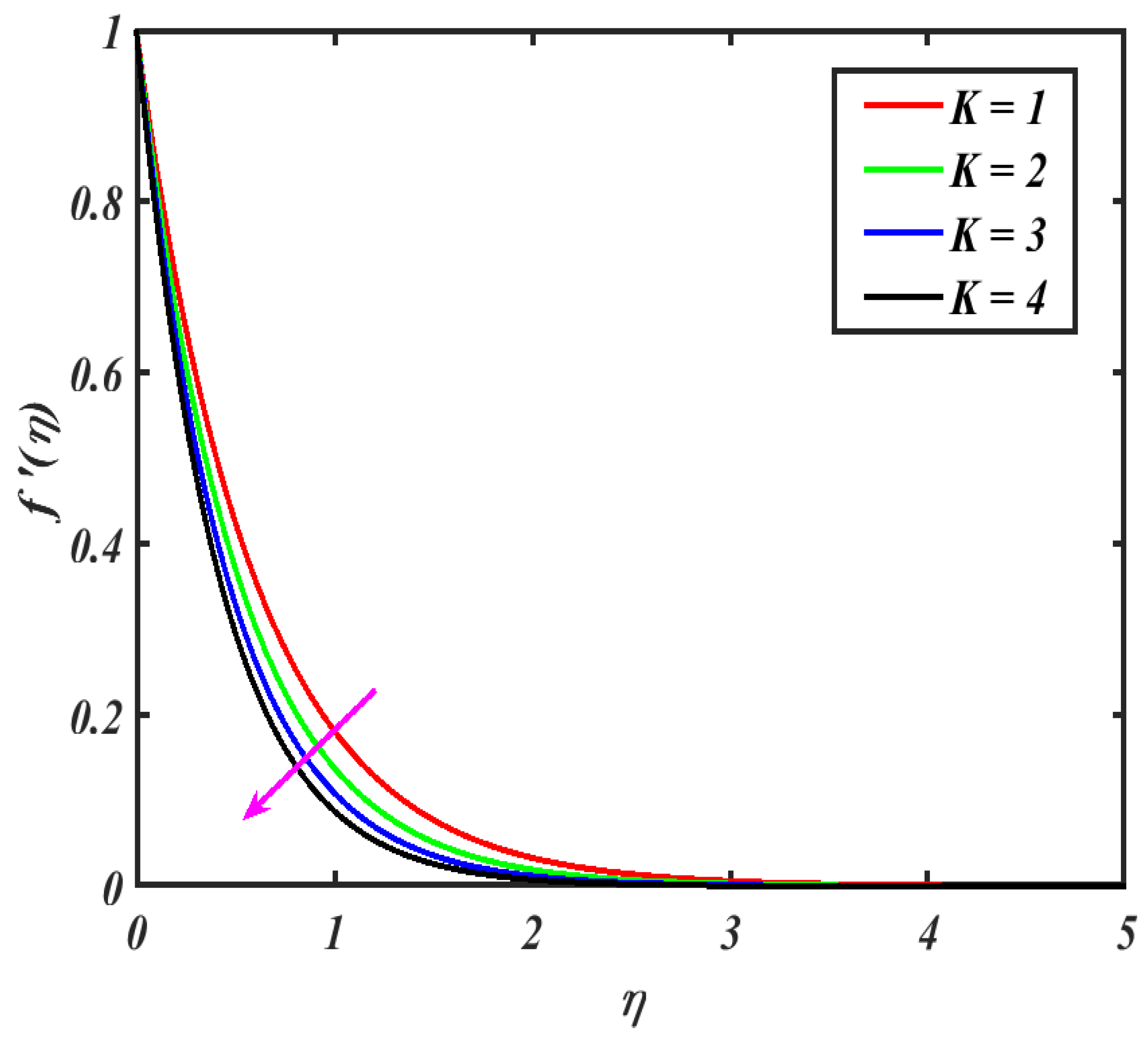
Effect of K on f′(η).
Figure 5.
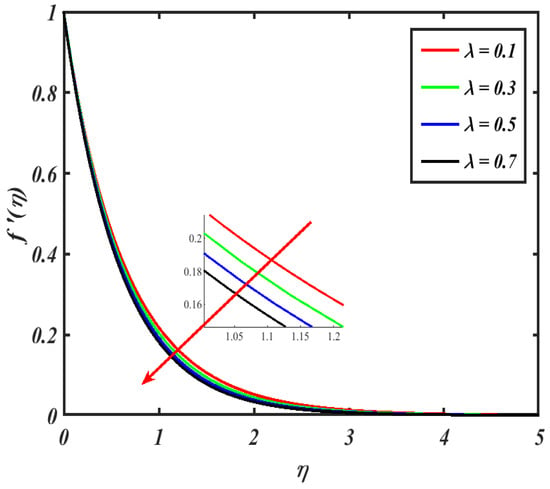
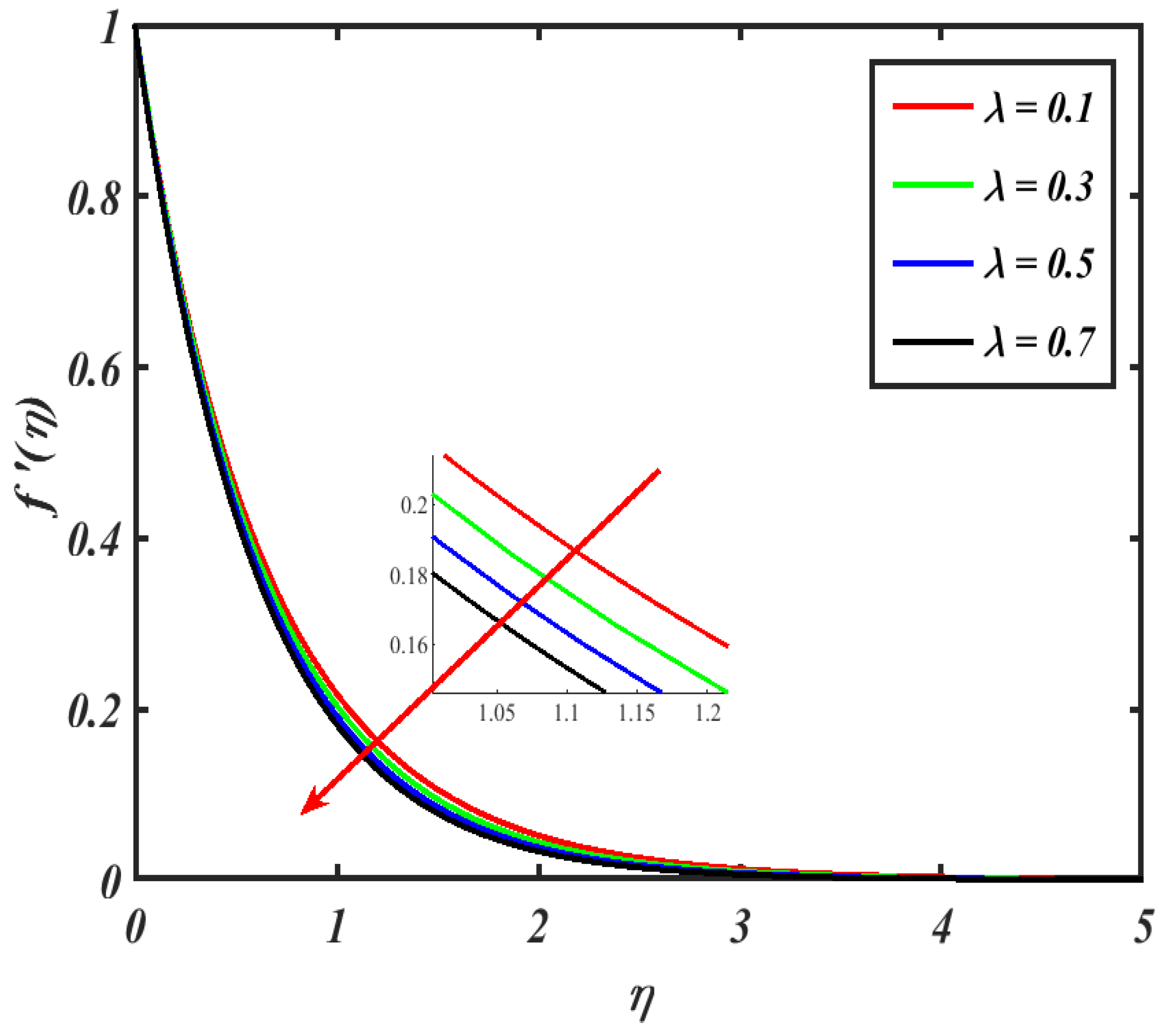
Variation of λ on f′(η).
Figure 6.
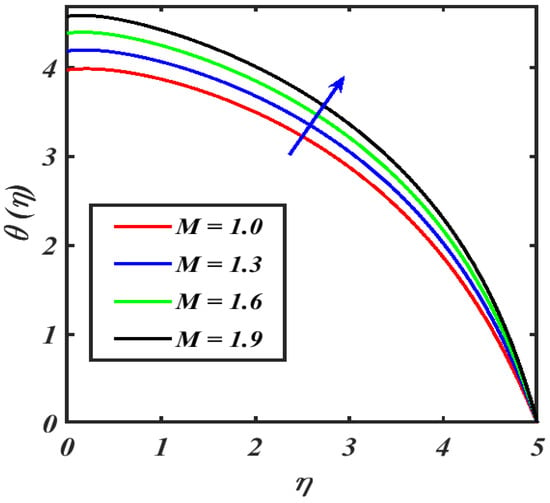
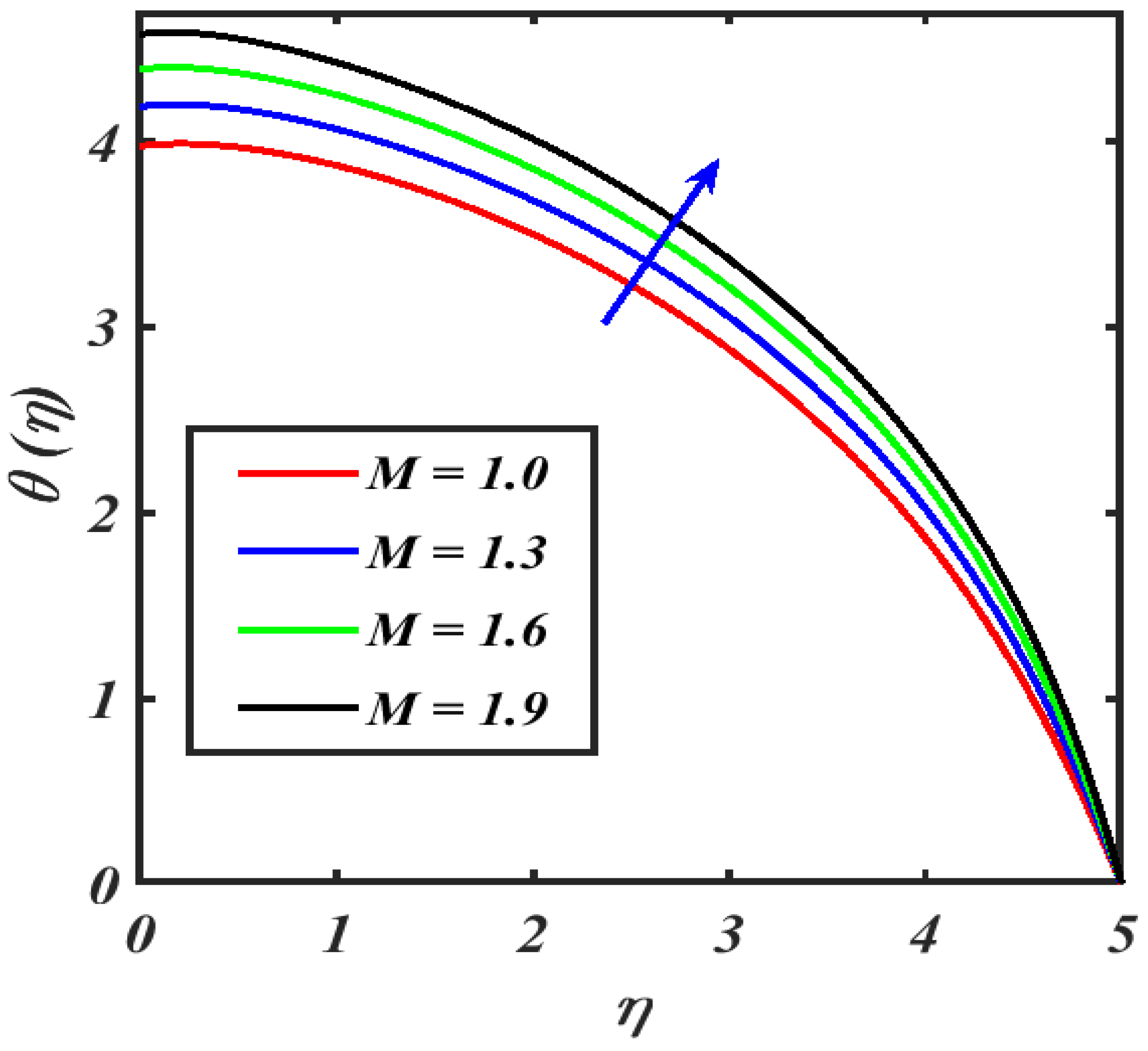
Effect of M on θ(η).
Figure 7.
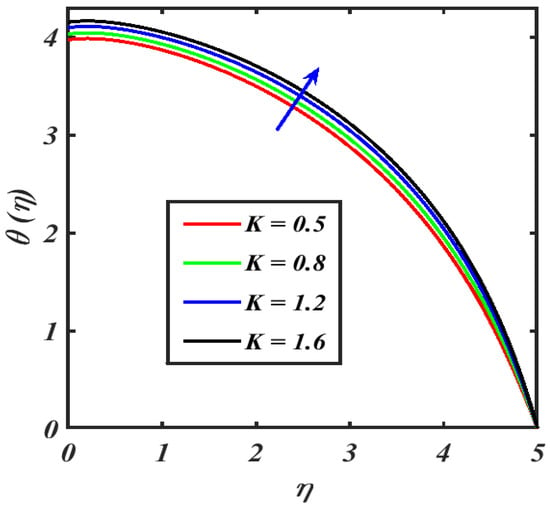
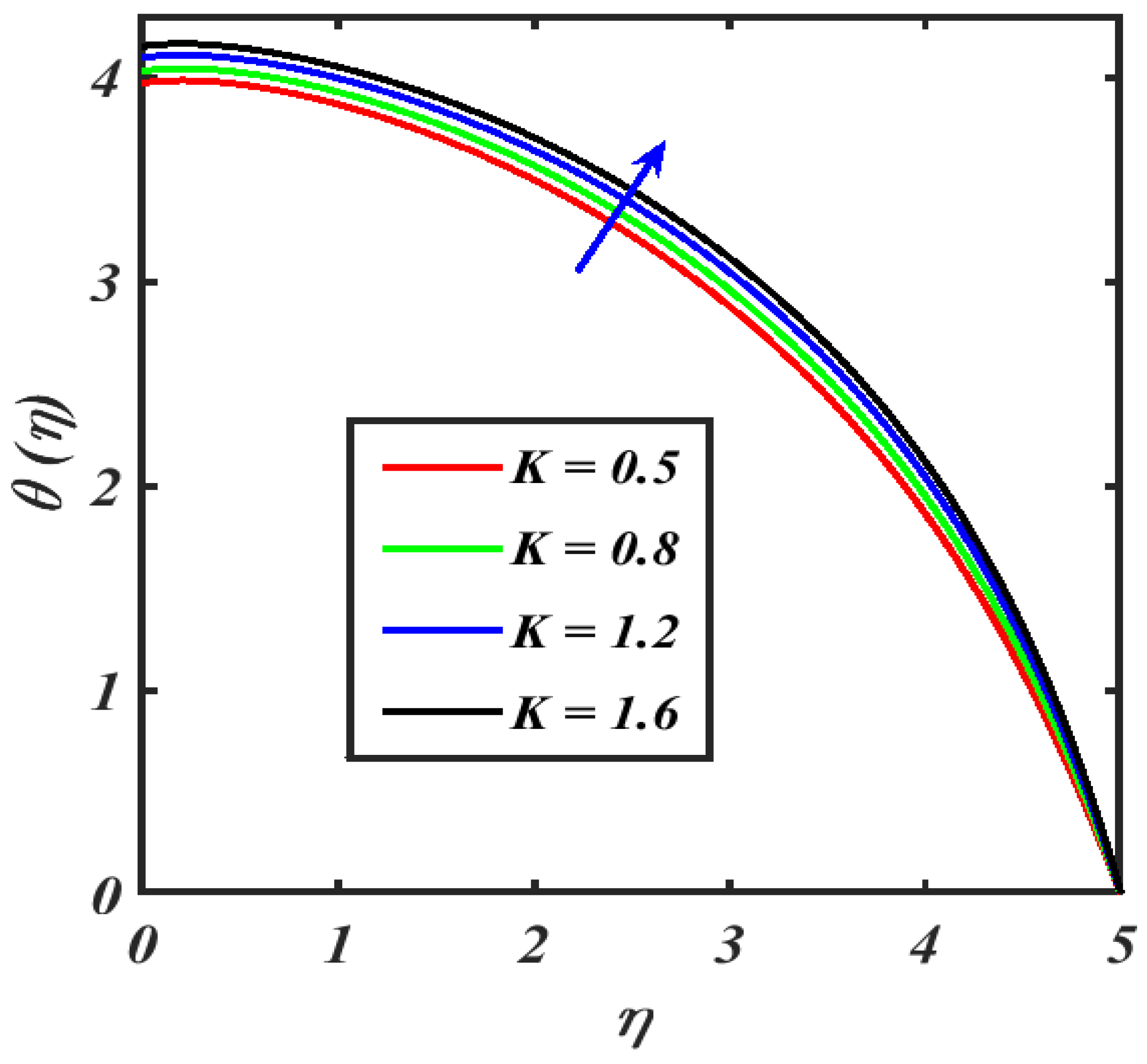
Effect of K on θ(η).
Figure 8.
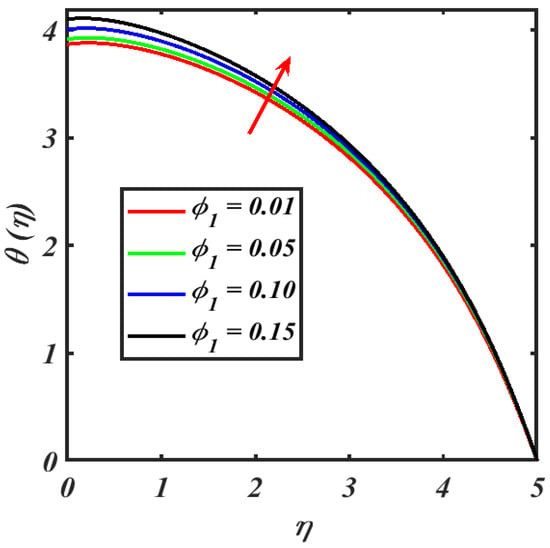
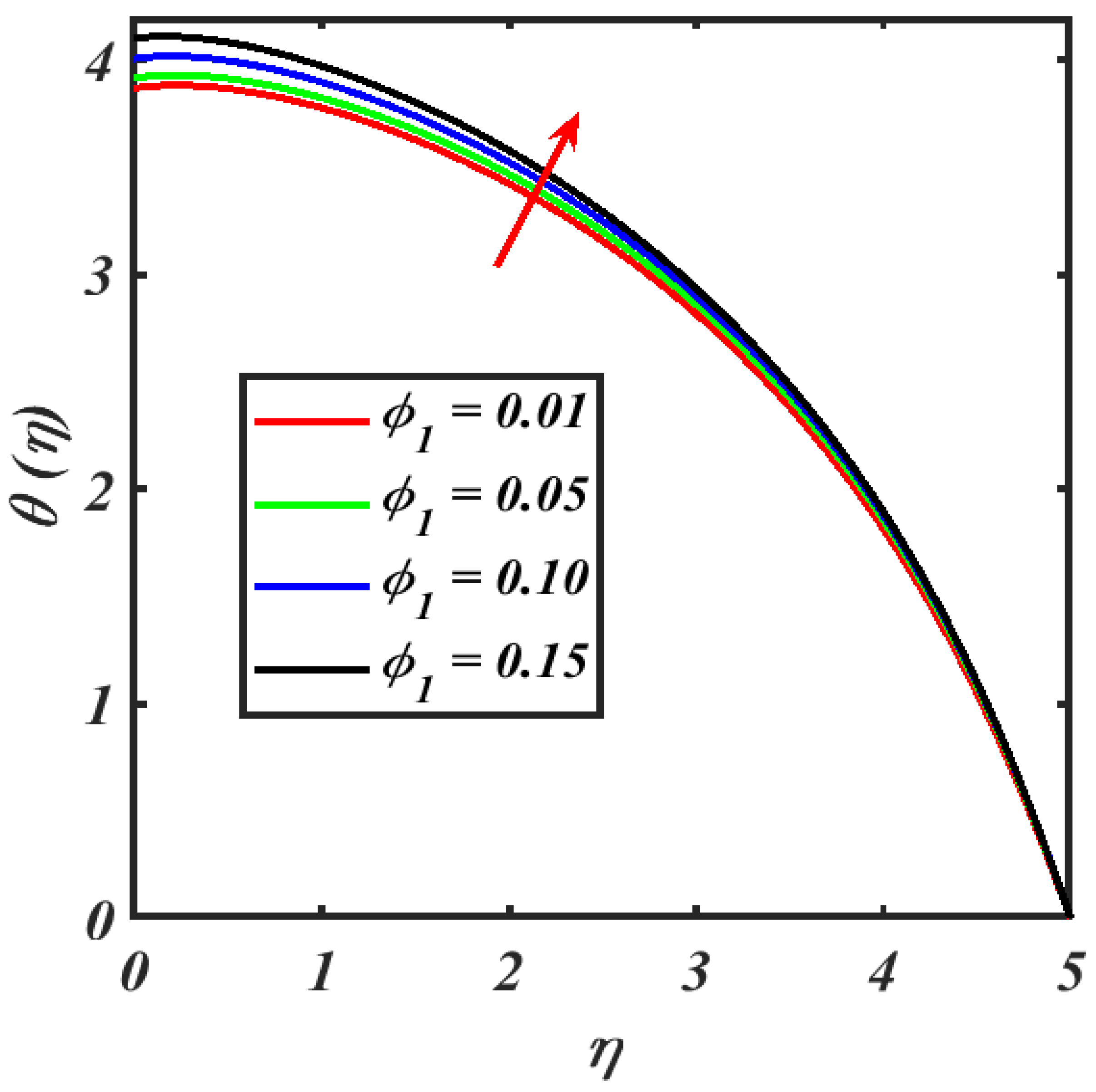
Effect of ϕ1 on θ(η).
Figure 9.
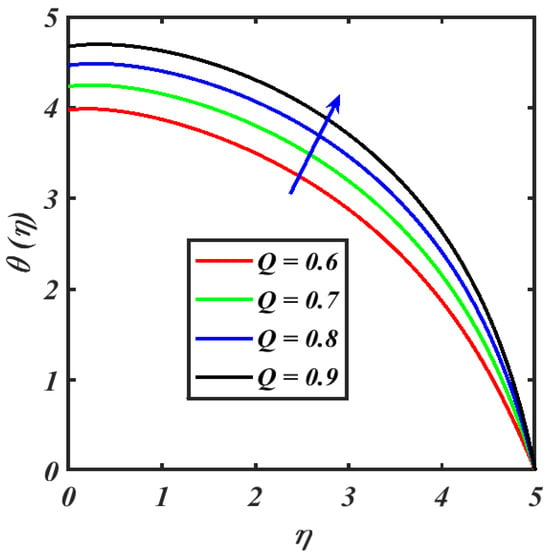
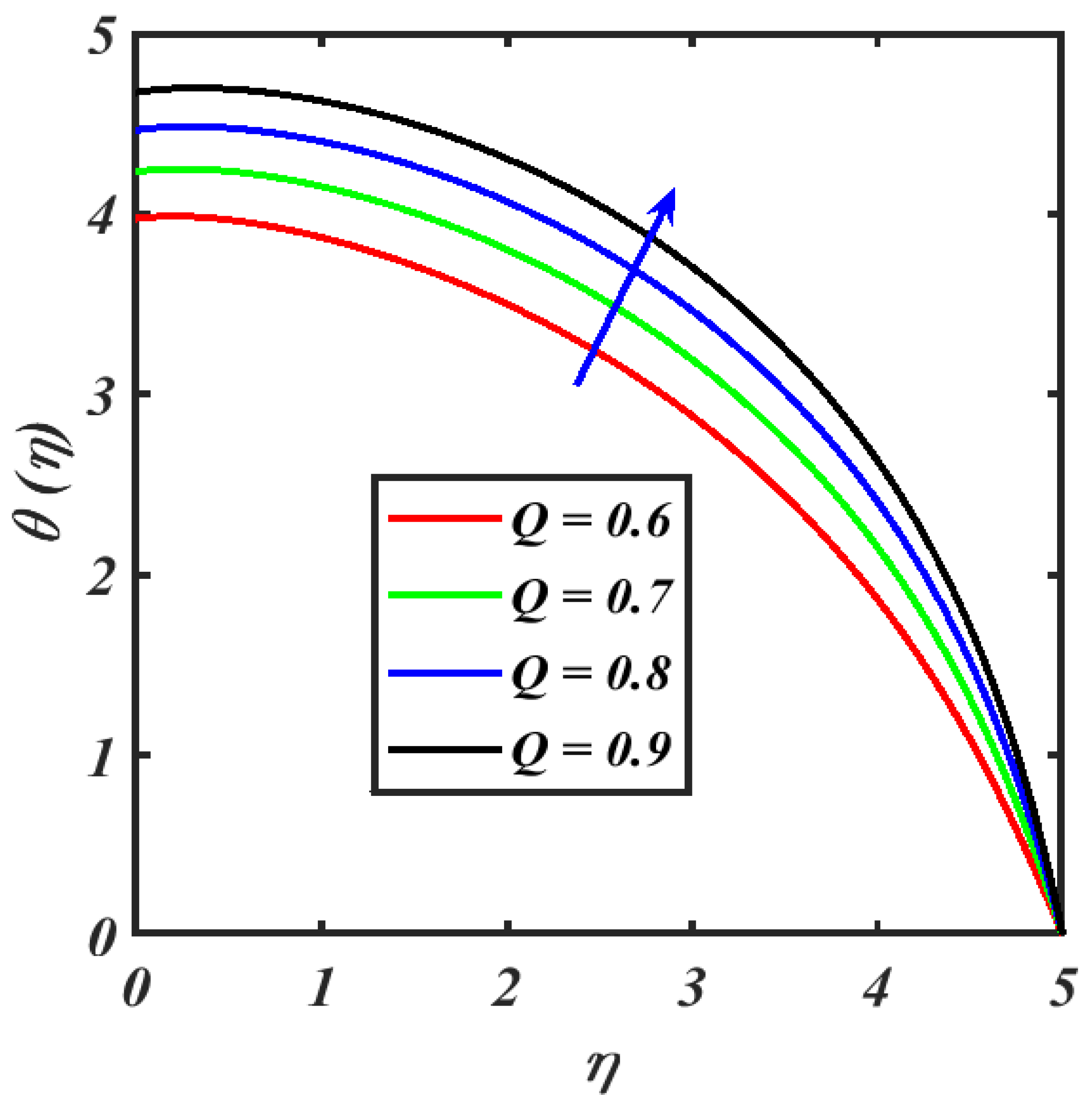
Effect of Q on θ(η).
Figure 10.
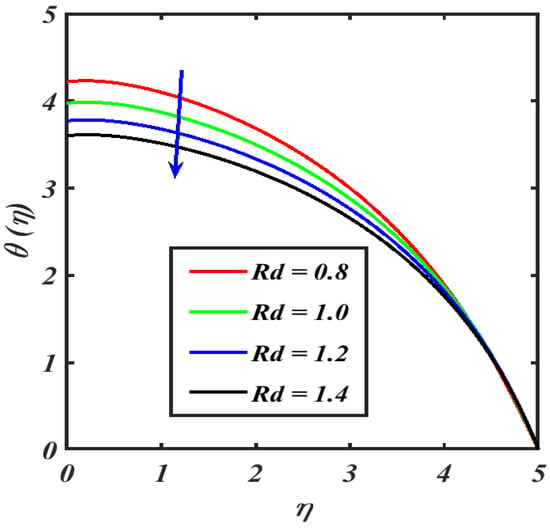
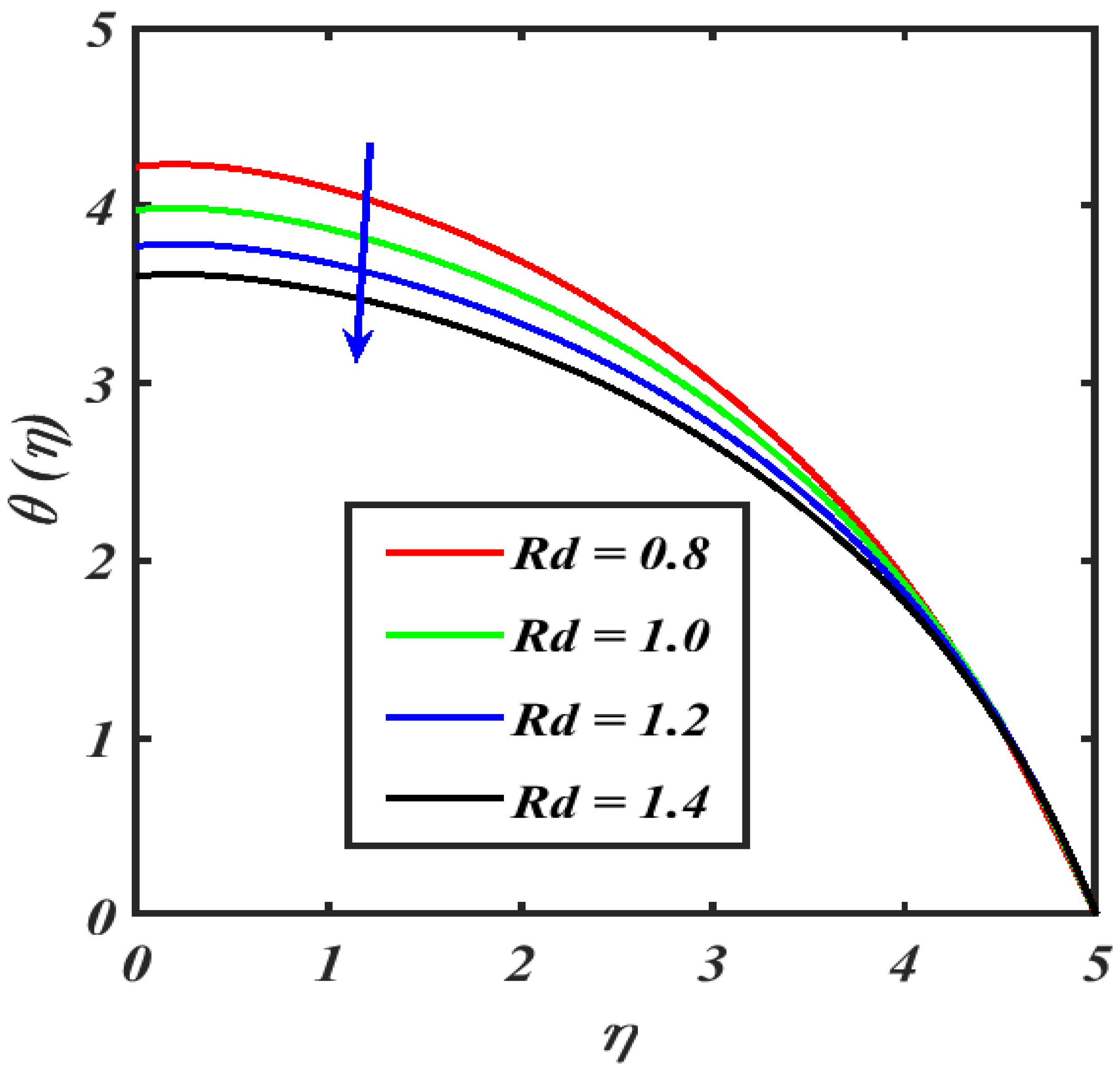
Effect of Rd on θ(η).
Figure 11.
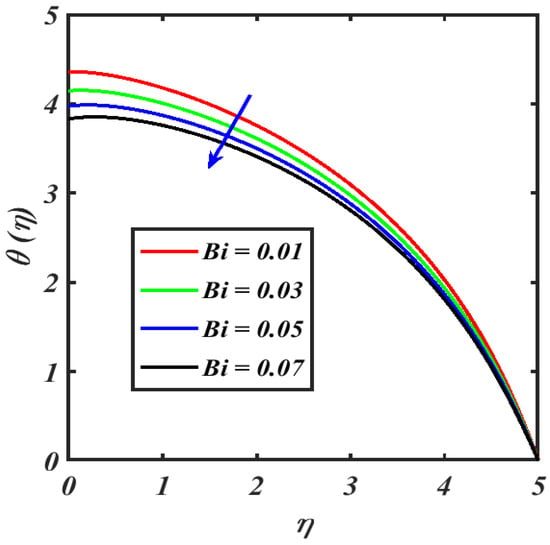
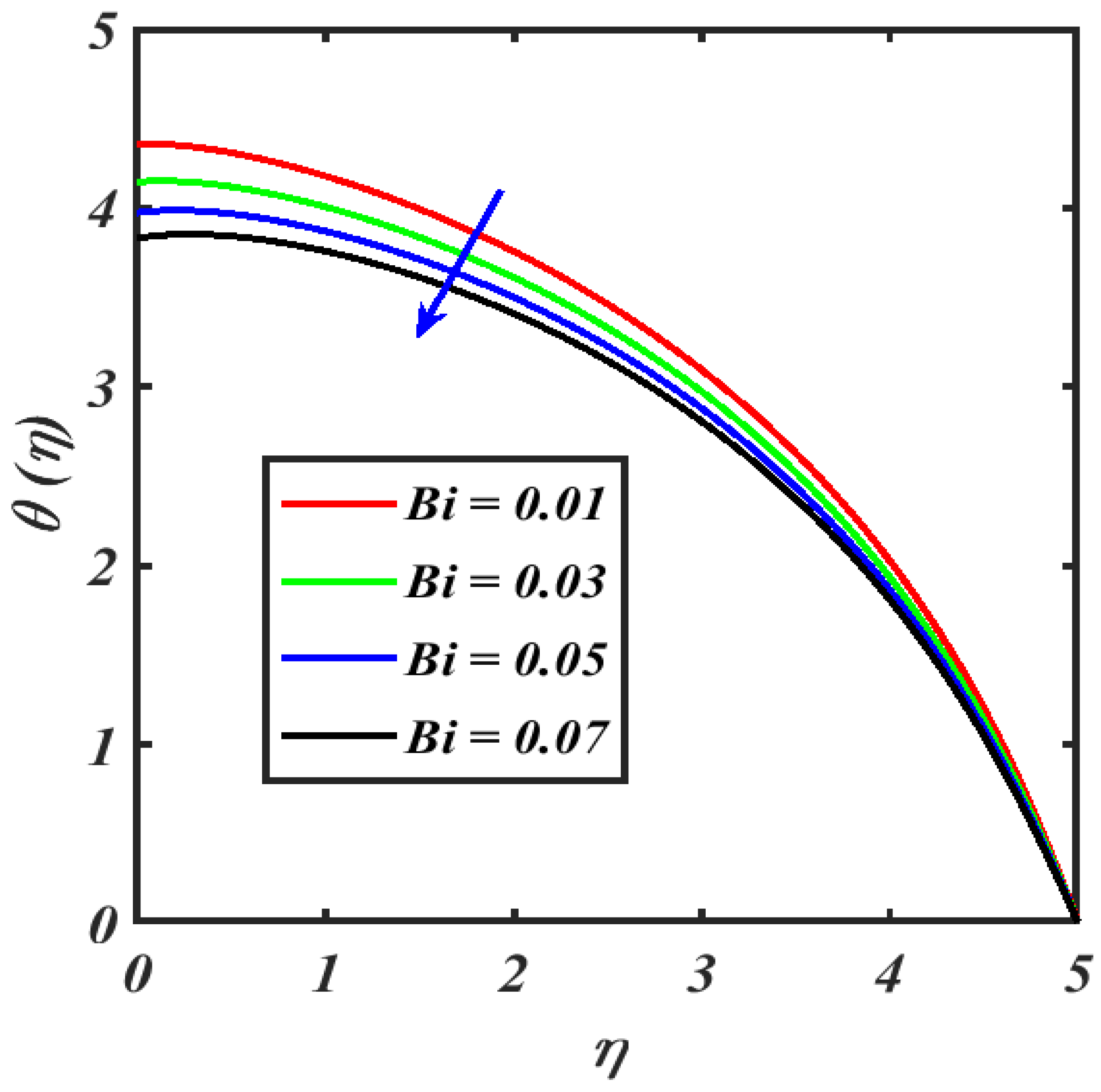
Effect of Bi on θ(η).
Figure 12.
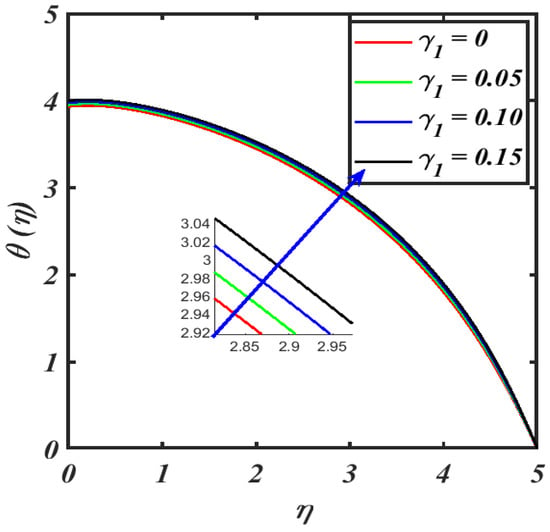
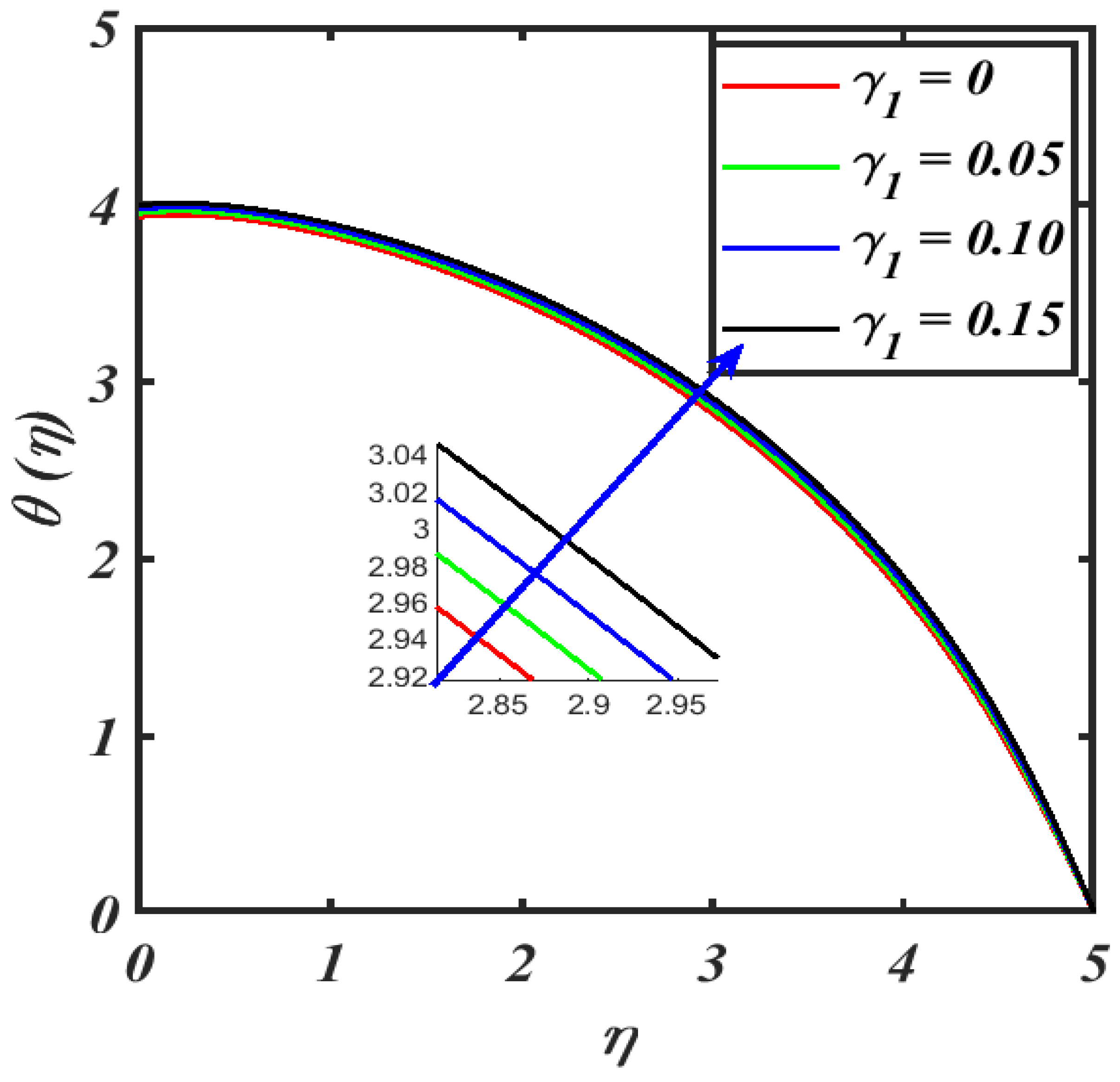
Effect of γ1 on θ(η).
Figure 13.
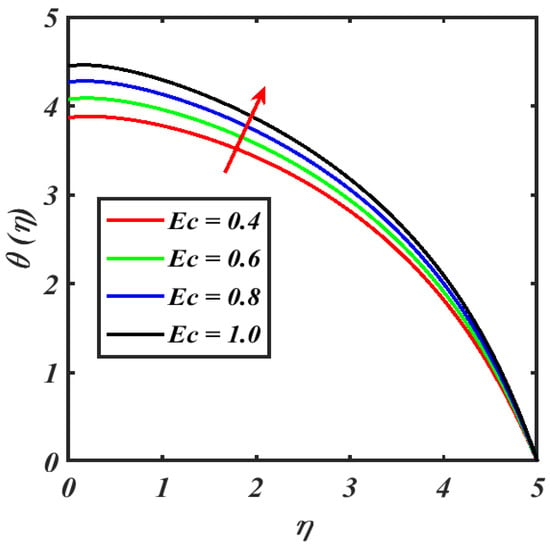
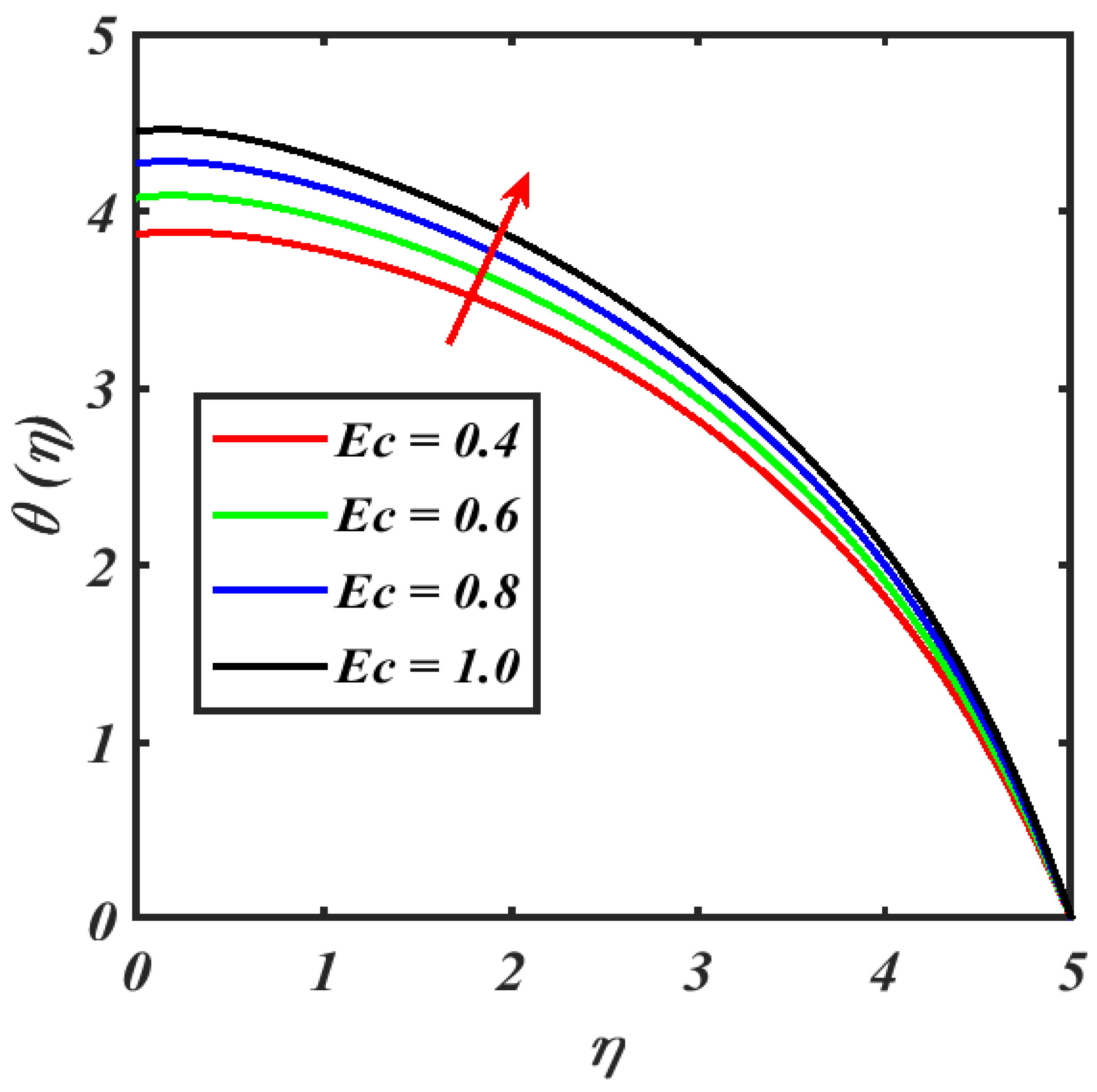
Effect of Ec on θ(η).
Figure 14.
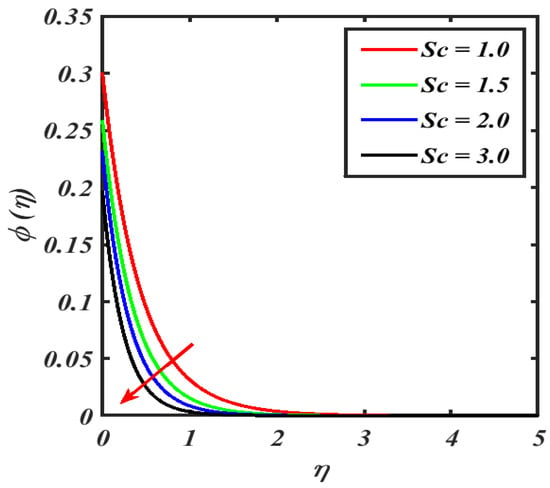
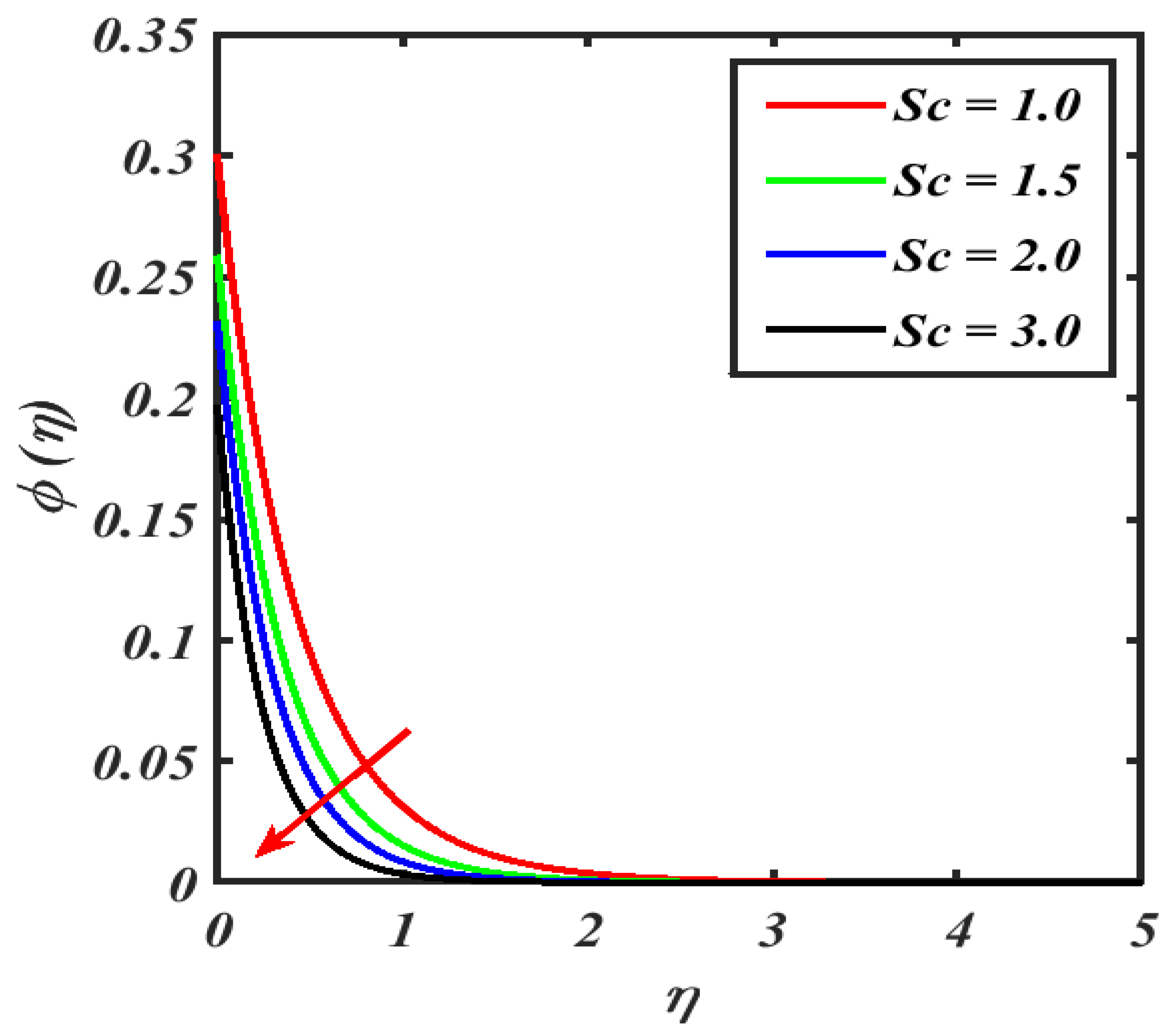
Effect of Sc on ϕ(η).
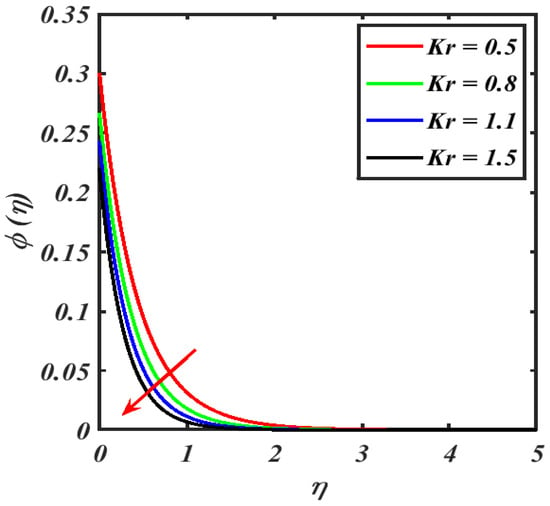
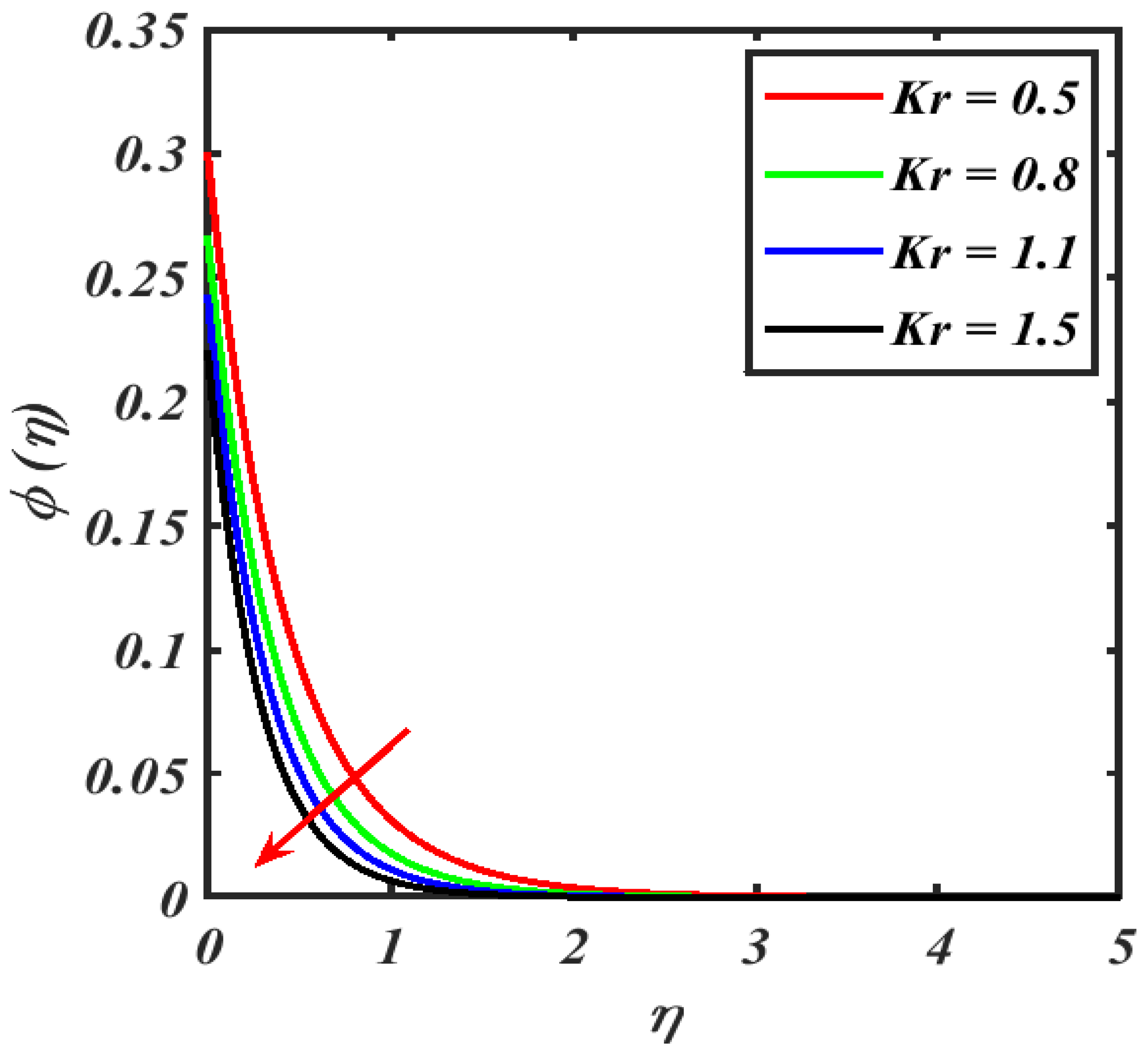
Figure 15.
Effect of Kr on ϕ(η).
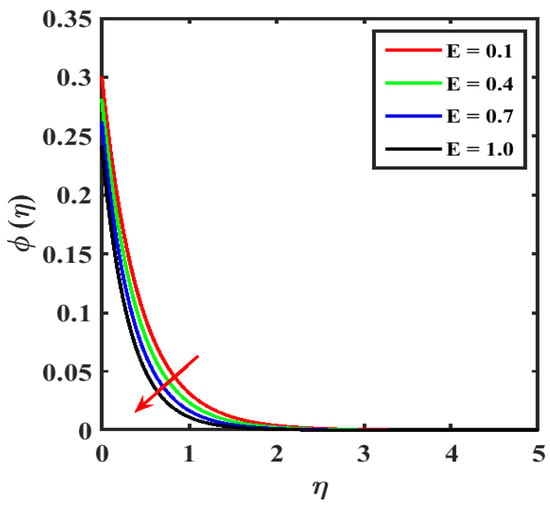
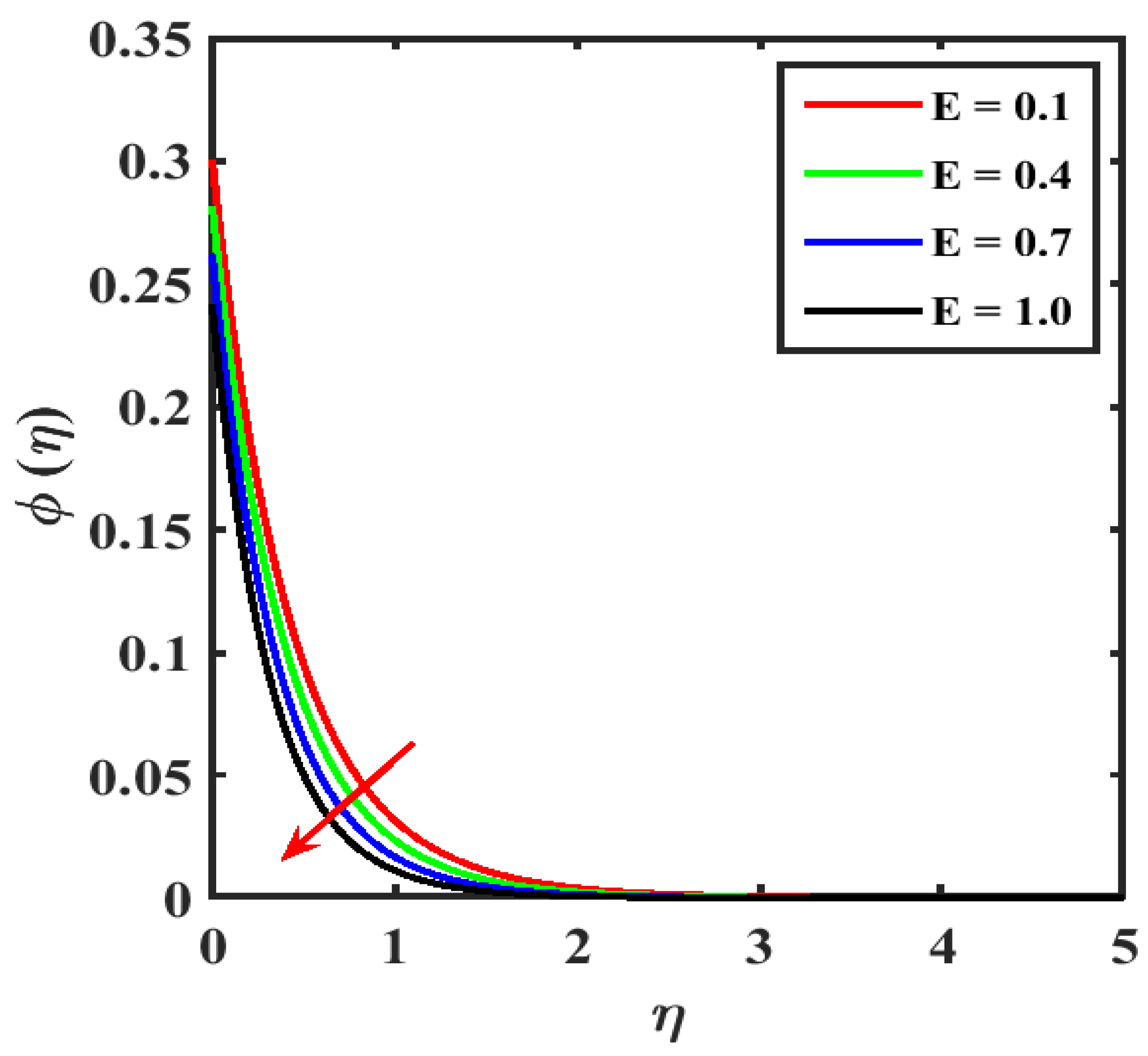
Figure 16.
Effect of E on ϕ(η).
Figure 17.
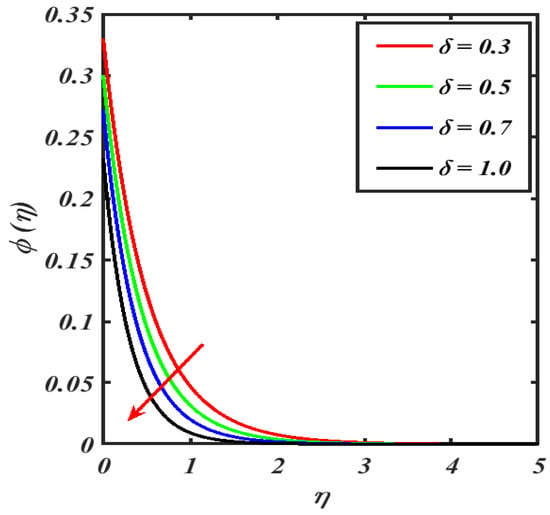
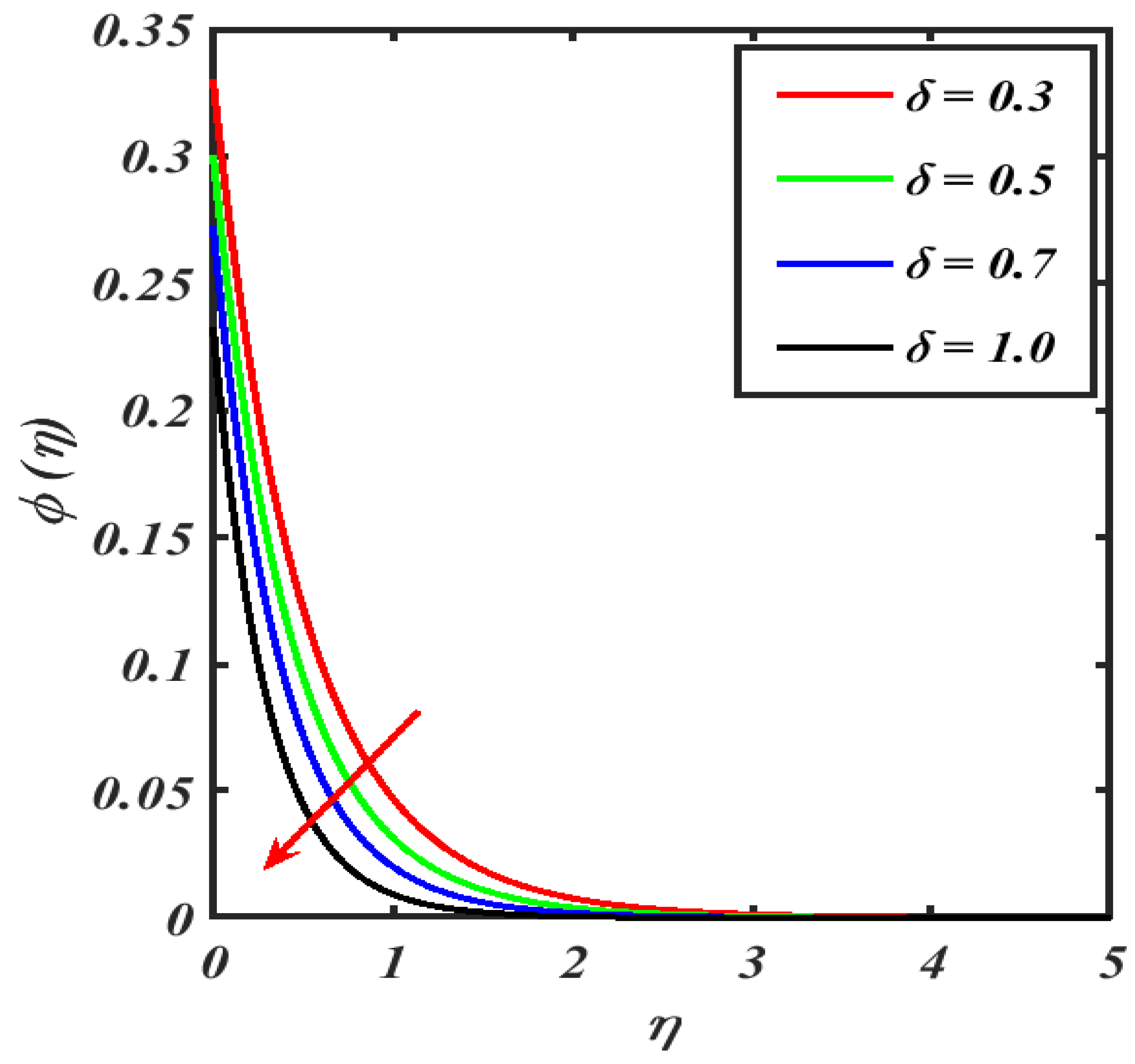
Effect of δ on ϕ(η).
Figure 18.
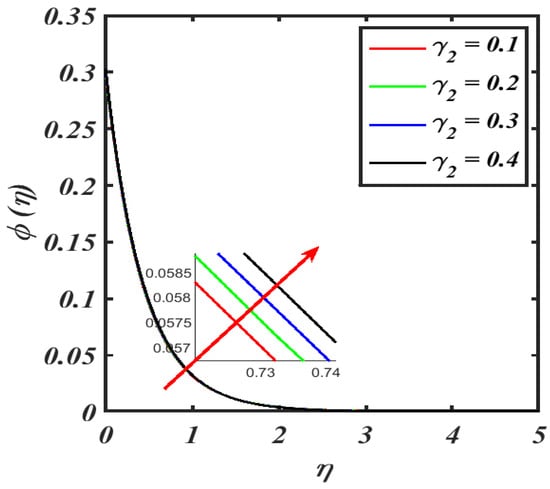
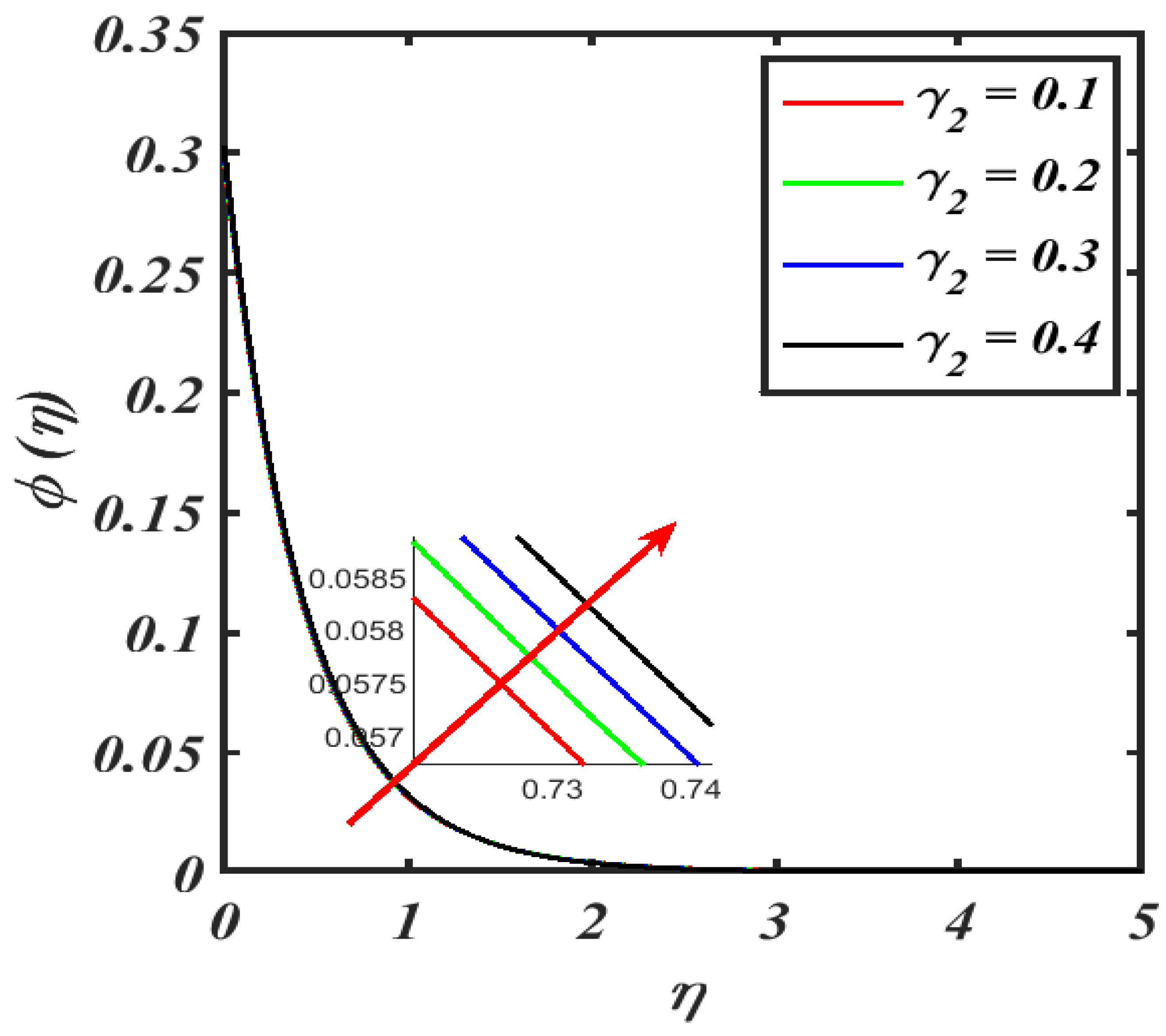
Effect of γ2 on ϕ(η).
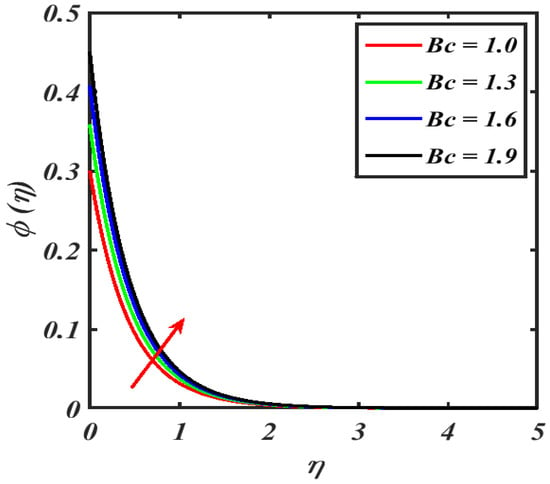
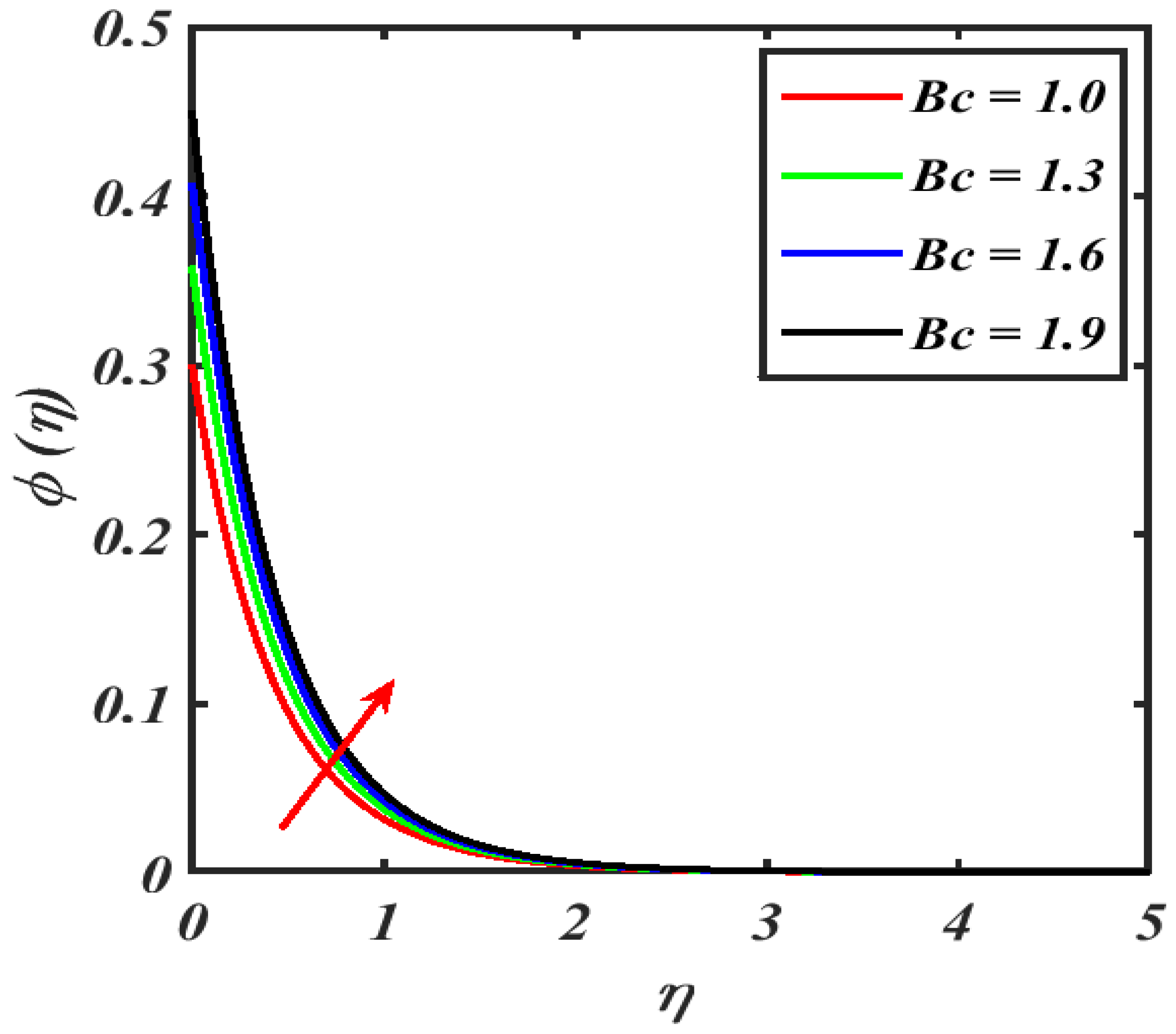
Figure 19.
Effect of Bc on ϕ(η).
Table 3.
θ′(0) Comparison with previously published results.
Table 4.
Numerical values of f″(0).
Table 5.
Numerical values of −θ′(0).
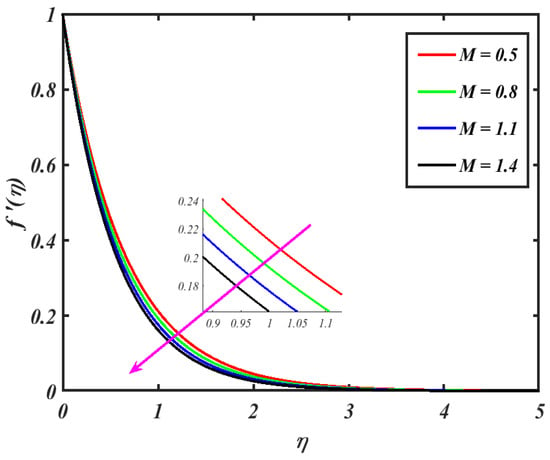
Figure 3 illustrates the effect of the magnetic field parameter (M) on the velocity. The velocity falls as M rises. A decreasing trend is evident in the velocity profile. Physically, the Lorentz force increases with larger M. This force retards the motion by opposing the fluid velocity. Consequently, the velocity decreases. Furthermore, the thickness of the momentum boundary layer (MBL) decreases. Meanwhile, the thermal boundary layer (TBL) becomes thicker. This effect is helpful for managing flow in MHD pumps, industrial heat transfer devices, and magnetic cooling systems.
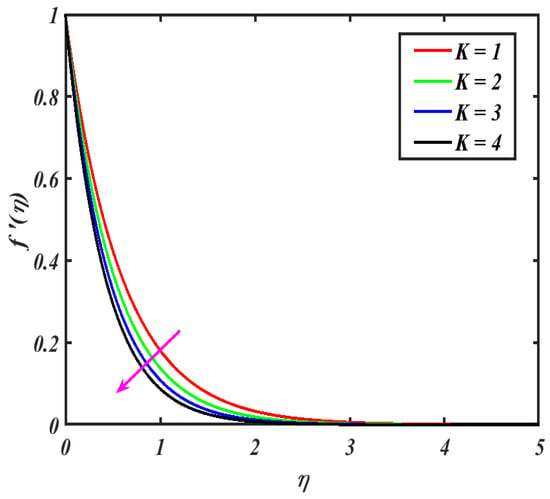
Figure 4 shows how the porous medium parameter (K) affects the velocity profile. When (K) rises, the velocity falls. The resistance of the porous material increases as (K) rises. This resistance opposes the fluid movement, which reduces its momentum. As a result, the radial velocity decreases throughout the flow region, and the momentum boundary layer becomes thinner owing to the increasing resistance. This characteristic is relevant to flow control in porous materials, filtration processes, geothermal energy systems, and petroleum recovery.
Figure 5 demonstrates that the velocity distribution is influenced by the Maxwell parameter λ. When λ rises, the velocity falls. The velocity distribution decreases significantly. The fluid’s elastic and relaxation properties are strengthened by a greater Maxwell parameter. These viscoelastic characteristics increase the resistance to fluid motion and reduce the fluid momentum. As a result, the radial velocity decreases across the flow region. The increased fluid elasticity also makes the momentum boundary layer thinner. This phenomenon is significant in polymer production, coating processes, extrusion systems, and other applications involving viscoelastic fluids.
Figure 6 shows how the magnetic parameter affects the temperature profile θ(η). The temperature increases as the magnetic parameter increases. A greater Lorentz force is produced by a stronger magnetic field. This force converts kinetic energy into thermal energy by means of Joule heating. Consequently, the fluid temperature rises and the TBL thickens. Both electromagnetic flow control and MHD heating systems benefit from this phenomenon. Additionally, it is relevant to the cooling of metallurgical operations and electrical equipment.
Figure 7 shows how the porous medium parameter (K) affects the temperature profile. The temperature rises as the values of (K) increase. An enhancement in the thermal distribution is observed. Owing to the increased resistance in the porous medium, a larger (K) slows the fluid flow. The slower flow remains longer near the heated surface and absorbs more heat. This raises the fluid’s temperature. Additionally, the thermal boundary layer thickens. Packed-bed reactors, geothermal reservoirs, thermal insulation systems, and other porous-medium heat transfer applications can benefit from this phenomenon.
Figure 8 shows how the nanoparticle volume fraction affects the temperature profile θ(η). When ϕ rises, the temperature rises. There is an improvement in the heat distribution. Moreover, the effective thermal conductivity of the fluid increases with the nanoparticle concentration. This enhances the ability of the fluid to transfer and store heat. The greater distribution of thermal energy across the fluid results in higher temperatures, and the thermal boundary layer thickens as a result of the increased heat transfer. This feature benefits cooling technologies, heat exchangers, solar thermal collectors, and complex thermal management systems in which effective heat transfer is required.
Figure 9 shows the effect of the heat generation parameter Q on the temperature profile. The temperature increases as Q increases. The heat distribution within the fluid becomes more pronounced. A larger value of Q represents stronger internal heat generation. This adds more thermal energy to the fluid. As a result, the fluid stores more heat and its temperature rises throughout the flow region. The thermal boundary layer also becomes thicker with increasing Q. This behavior is important in applications involving internal heat production, such as combustion systems, nuclear reactors, and chemical processing equipment.
The temperature profile is affected by the radiation parameter (Rd), as seen in Figure 10. As (Rd) increases, the temperature drops. The heat distribution decreases significantly. A larger radiation parameter enhances radiative heat transfer from the fluid, so that more thermal energy is removed from the fluid and less heat is retained. Consequently, the fluid’s temperature decreases across the flow region. The thermal boundary layer becomes thinner as the radiative heat loss increases. This behavior is significant in high-temperature manufacturing processes, thermal cooling systems, aerospace engineering, and heat transfer devices where radiation effects are critical.
Figure 11 illustrates how the Biot number (Bi) affects the temperature profile. As (Bi) rises, the temperature falls. The heat distribution decreases significantly. Physically, a higher Biot number indicates stronger convective heat transport at the surface. This enhances the capacity of the fluid to dissipate heat to its surroundings, and the reduced thermal energy of the fluid causes the temperature to drop. This feature is crucial for applications requiring efficient heat dissipation, such as convective cooling systems, electronic cooling devices, industrial thermal management, and heat exchangers.
The impact of the thermal relaxation parameter on the temperature profile is seen in Figure 12. When the thermal relaxation parameter increases, the temperature rises. Heat moves through the fluid more efficiently. Heat flow responds to temperature changes more slowly when the thermal relaxation parameter is higher. Consequently, heat dissipation becomes slower. The fluid retains more thermal energy, which raises the temperature. Advanced thermal systems, bioheat transfer, microscale heat transport, and materials with memory effects all depend on this behavior.
The impact of the Eckert number (Ec) on the temperature profile is seen in Figure 13. As the Eckert number rises, so does the temperature. Stronger viscous dissipation, which transforms kinetic energy into thermal energy, is indicated by a higher Eckert number. This additional heat increases the internal energy of the fluid. Consequently, the temperature increases throughout the flow region. Additionally, increased viscous heating causes the TBL to thicken. This behavior is crucial in applications where viscous heating greatly impacts heat transfer, such as high-speed fluid flows, aerodynamic systems, polymer processing, and lubrication technologies.
The impact of the Schmidt number (Sc) on the concentration profile is seen in Figure 14. The concentration decreases as Sc increases. The species distribution weakens throughout the flow region. Lower mass diffusivity relative to momentum diffusivity is indicated by a higher Schmidt number. As a result, the transport of chemical species or nanoparticles is reduced. As one moves away from the surface, the concentration decreases more quickly. Applications involving mass transfer, such as chemical reactors, pollution transport, drying procedures, and separation systems, depend on such behavior.
The impact of the chemical reaction parameter (Kr) on the concentration profile is depicted in Figure 15. As the chemical reaction parameter rises, the concentration falls. A higher chemical reaction rate increases the consumption of reactive species in the fluid. Chemical species or nanoparticles are thus depleted more quickly, resulting in a reduced concentration throughout the flow region. The CBL also becomes thinner due to the increased reaction rate. Reactive transport systems, mass transfer procedures, catalytic reactions, pollution control technologies, and chemical processing industries all benefit from this behavior.
The impact of the activation energy parameter on the concentration profile is seen in Figure 16. As the activation energy parameter rises, the concentration falls. A larger activation energy affects the consumption of reactive species in the fluid and alters the reaction process. Consequently, the concentration level falls throughout the flow region. Additionally, the concentration boundary layer (CBL) becomes thinner as the activation energy increases. This behavior is significant in chemical reactors, fuel processing systems, catalytic processes, and combustion technologies, where reaction kinetics are crucial.
The impact of the concentration difference parameter on the concentration profile is seen in Figure 17. As the concentration difference parameter rises, the concentration falls. The mass diffusion process between the surface and the surrounding fluid is strengthened by a greater concentration difference. As a result, species migrate away from the surface faster, and the concentration within the flow region is reduced. The increased diffusion rate also causes the concentration boundary layer to thin. Chemical separation systems, drying procedures, mass transfer activities, and environmental transport applications all benefit from this phenomenon.
The impact of the concentration relaxation parameter on the concentration profile is seen in Figure 18. As γ2 rises, so does the concentration. The mass diffusion process is slowed by a larger relaxation parameter. As a result, species move away from the surface more slowly. This raises the fluid’s concentration of nanoparticles or reactive species. Consequently, the concentration level increases throughout the flow region and the CBL thickens. Memory effects have a major impact on mass transfer in chemical engineering applications, biological transport systems, and polymer diffusion.
The impact of the concentration Biot number on the concentration profile is seen in Figure 19. As the concentration Biot number rises, so does the concentration. Convective mass transport at the surface is improved by a greater concentration Biot number. It also reduces the resistance to mass diffusion. The concentration level rises as additional nanoparticles are transported into the fluid region. Consequently, the CBL becomes thicker. Drug delivery systems, environmental transport applications, chemical processing, and separation technologies all depend on this behavior.
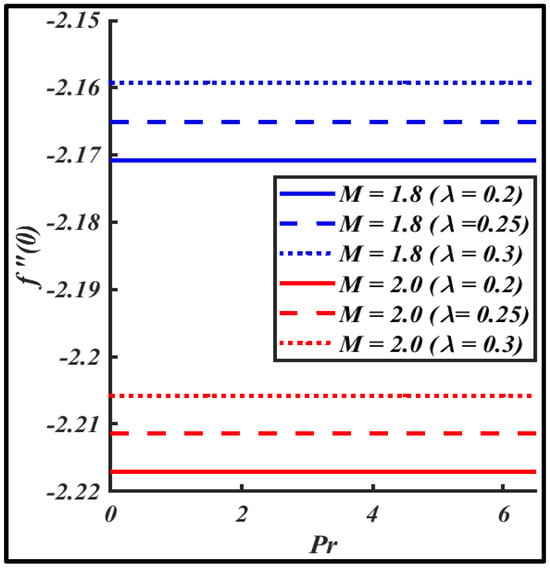
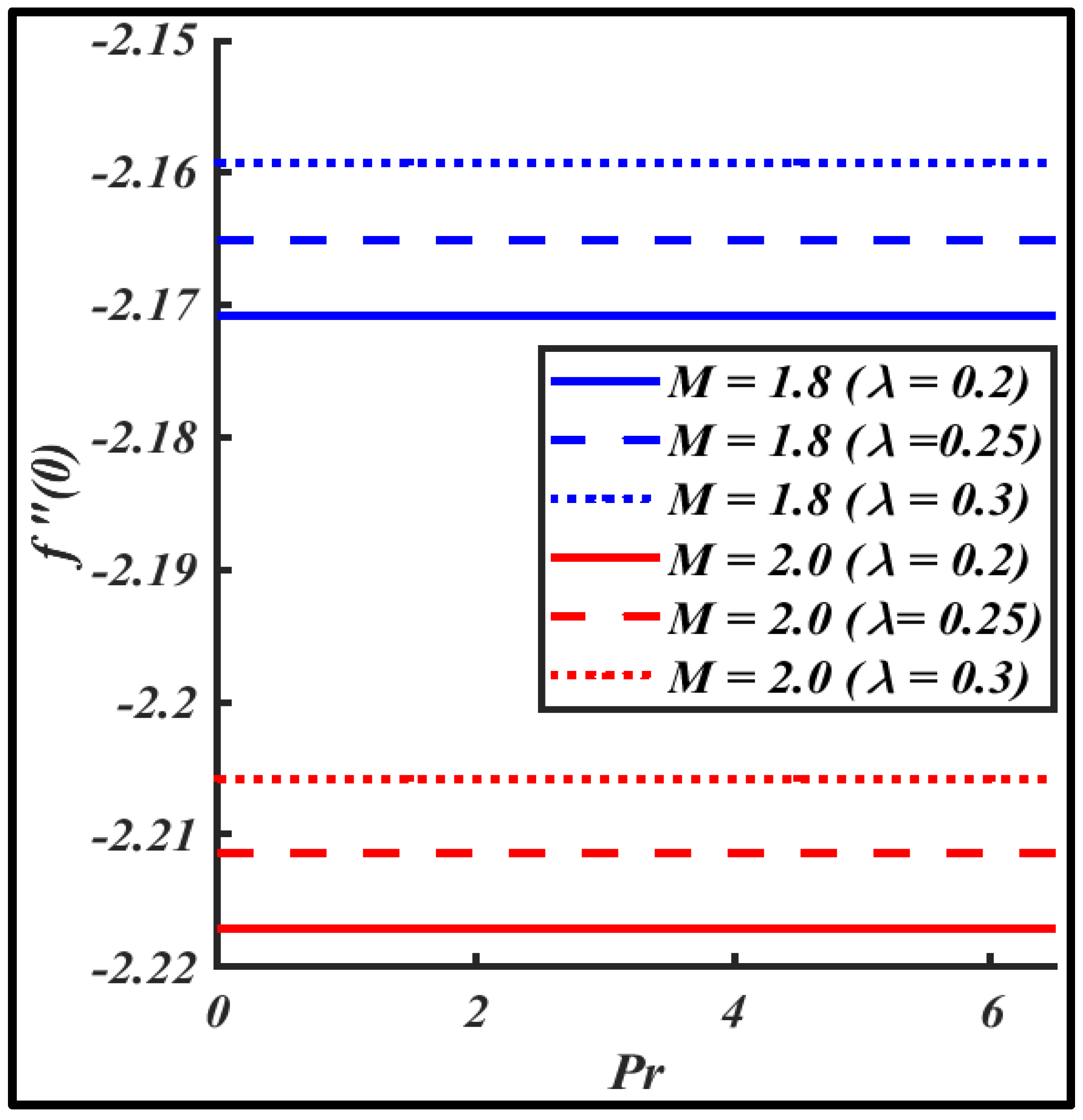
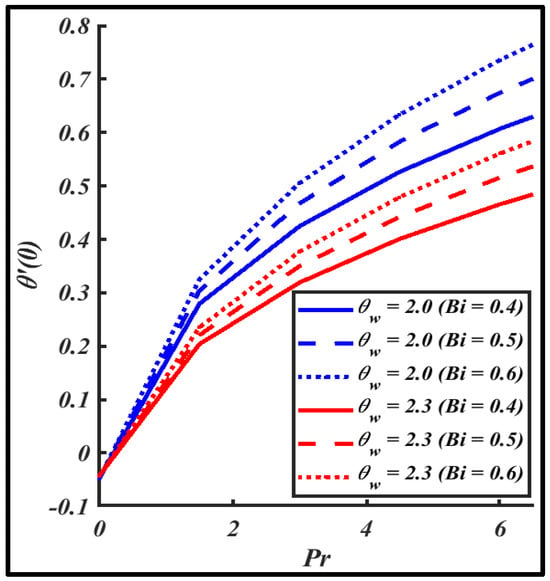
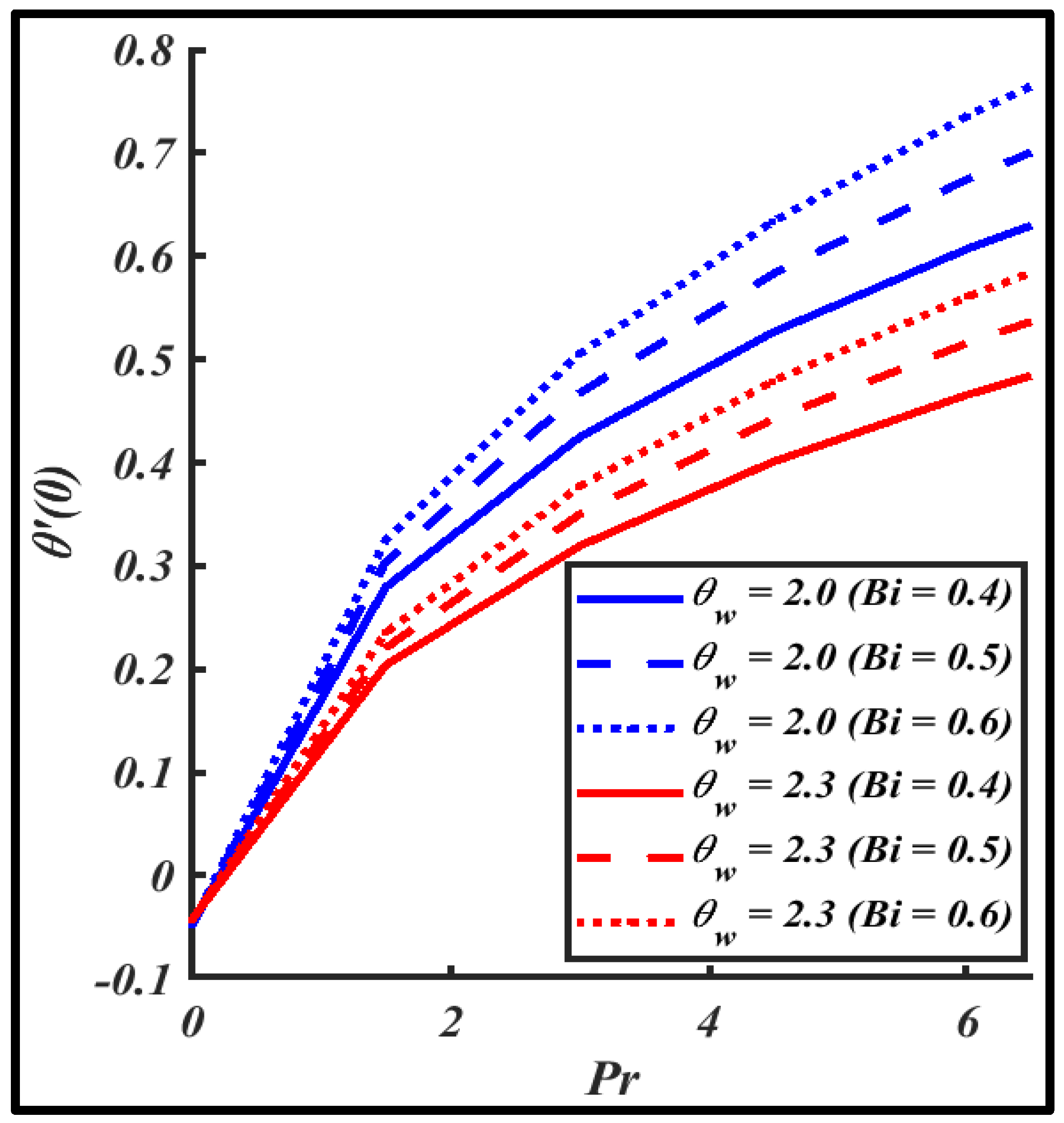
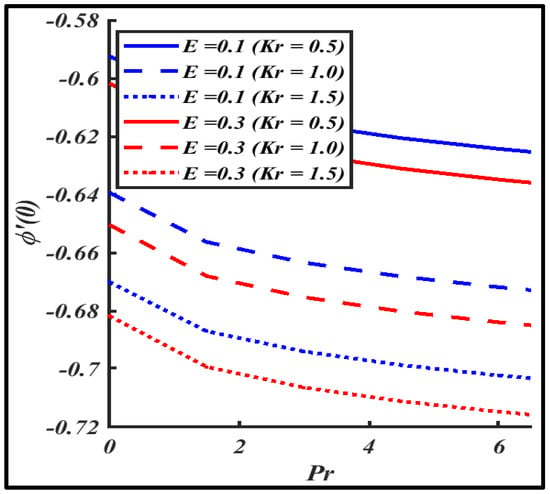
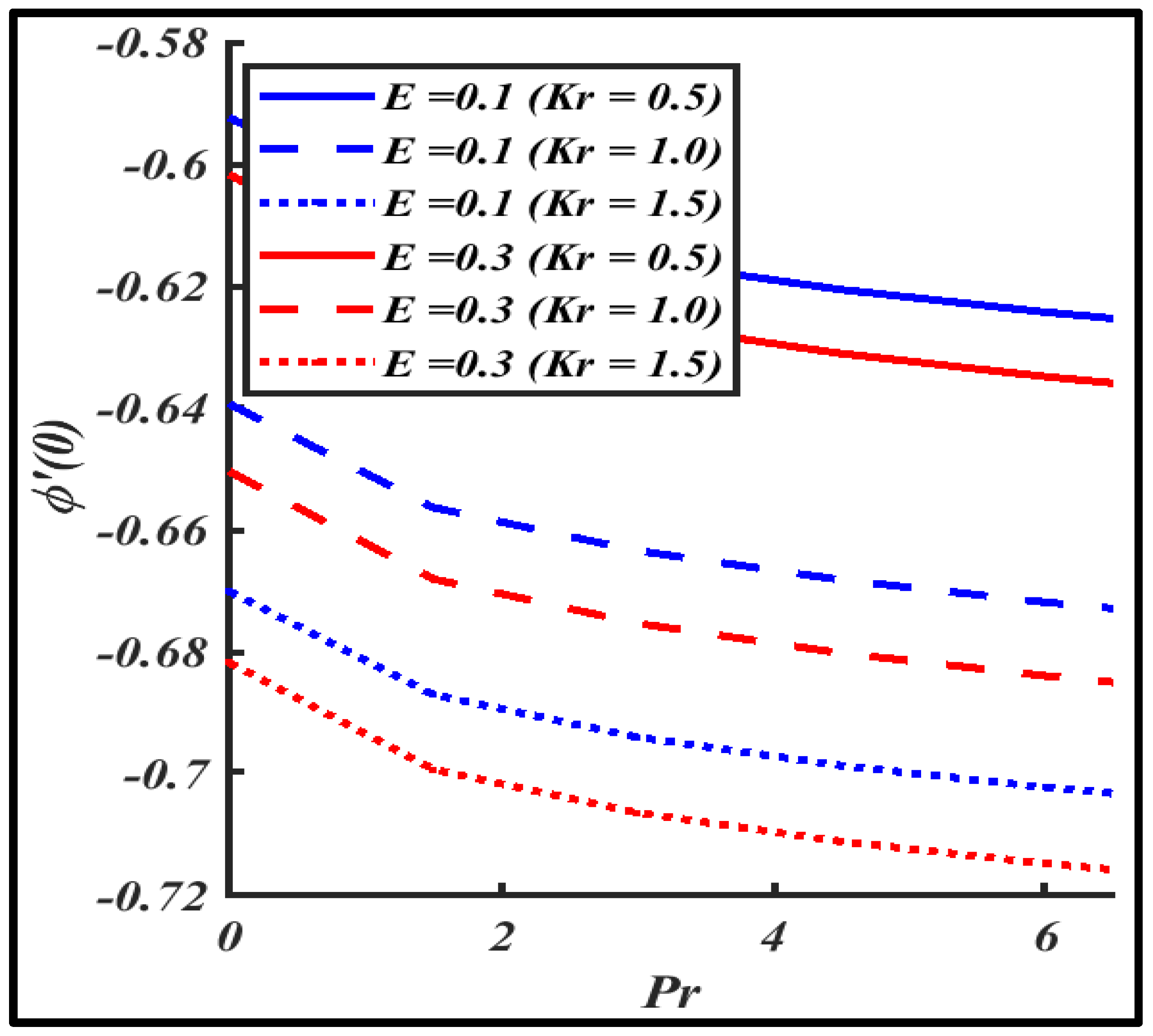
Figure 20, Figure 21 and Figure 22 show the skin friction coefficient, Nusselt number, and Sherwood number for different values of M, λ, θw, Bi, E, and Kr. When M and λ increase, the skin friction coefficient increases. As the temperature difference and Biot number increase, the Nusselt number increases. When E and Kr increase, the Sherwood number decreases.
Figure 20.
Variation of M & λ on f″(0).
Figure 21.
Variation of θw & Bi on θ′(0).
Figure 22.
Variation of E & Kr on ϕ′(0).
8. Conclusions
This work examines the MHD flow of a Maxwell THNF over a stretching sheet with activation energy. Thermal radiation, chemical reactions, heat generation, and Cattaneo–Christov double diffusion are all taken into account. The velocity, temperature, and concentration behaviors are examined by numerically solving the governing nonlinear model. The findings provide a thorough understanding of how various physical parameters regulate heat and mass transfer. This work demonstrates the ability to regulate flow and transport properties in ternary hybrid nanofluid systems.
- ➢
- The velocity profile decreases with increasing porous medium parameter, magnetic field parameter, and Maxwell parameter, indicating that stronger Lorentz force, porous resistance, and fluid elasticity significantly impede fluid motion.
- ➢
- Increasing the nanoparticle volume fraction, heat generation, thermal relaxation, and Eckert number strengthens the temperature field and thickens the thermal boundary layer (TBL).
- ➢
- In addition, the radiation parameter and Biot number reduce the temperature distribution by promoting greater heat loss from the fluid and producing a thinner thermal boundary layer.
- ➢
- The temperature profiles are increased by the magnetic field and porous medium parameters.
- ➢
- On the mass transfer side, the concentration distribution decreases with increasing chemical reaction parameter, Schmidt number, activation energy, and concentration difference parameter.
- ➢
- The concentration relaxation parameter enhances species concentration due to delayed diffusion effects.
- ➢
- The concentration relaxation parameter and concentration Biot number enhance the concentration profile.
- ➢
- The skin friction coefficient and Nusselt number are plotted for selected parameters.
- ➢
- The computational results for Nusselt numbers and skin friction coefficients are presented for the ternary and hybrid nanofluids. The ternary hybrid nanofluid performs better than the hybrid nanofluid in terms of heat transfer enhancement.
- ➢
- The constitutive equation is stated with the upper-convected (Oldroyd) objective derivative. Its boundary-layer form is the momentum equation used in the analysis, so the reported results correspond to the upper-convected Maxwell ternary hybrid nanofluid.
- ➢
- Lie scaling-group analysis shows that the governing problem is invariant under x → xeε, u → ueε, with y, v, T and C remaining unchanged. The similarity variables follow from the absolute invariants of this group, and all governing parameters except the local Eckert number are flow invariants.
- ➢
- The Deborah numbers λ, γ1 and γ2, the effective Prandtl number Pr A5/A3, the ratio Nt/Nb, and the Arrhenius group are the physically meaningful invariants that govern the viscoelastic response, the heat transfer and the nanoparticle concentration.
9. Applications of This Study
This study has important implications for modern industrial and technical systems in which controlled heat and mass transfer are crucial. The analysis of MHD Maxwell THNF flow is useful where improved thermal management is required in high-performance cooling technologies, including electronic cooling devices, microprocessors, and complex heat exchangers. Because the CCDD model facilitates the modeling of realistic heat and mass transport with finite propagation effects, the results are relevant to micro-scale heat transfer systems and biomedical engineering applications such as drug delivery and thermal therapy. Because it accounts for chemical reaction effects, the model may be applied to chemical reactors, catalytic processes, and combustion systems in which the species distribution is significantly affected by reaction rates. Porous medium effects also shed light on filtration processes, geothermal energy systems, and petroleum extraction. In thermal, chemical, and industrial transport processes involving complex nanofluids, this study provides useful recommendations for flow control optimization, energy efficiency improvement, and performance enhancement.
10. Future Suggestions
This study may be extended in several significant ways to increase its accuracy and usefulness. To better reflect actual industrial scenarios, the current model may be improved by taking into account three-dimensional effects and time-dependent (unsteady) flow behavior. Consideration of variable fluid properties, such as temperature-dependent viscosity and thermal conductivity, may improve the accuracy of transport characteristic prediction. To better represent intricate physical interactions, future research may include heterogeneous chemical processes, slip effects, and nonlinear thermal radiation models. To maximize system efficiency from a thermodynamic perspective, irreversibility minimization and entropy generation analysis can also be employed. To increase its technical relevance, the model could be extended to other geometries, such as wavy walls, rotating surfaces, or shrinking sheets. Lastly, the practical use and dependability of the results may be improved by experimental validation and comparison with machine learning-based prediction approaches.
Author Contributions
Methodology, W.A. and M.S.; Software, W.A., M.S. and A.M.M.A.; Validation, A.K. and M.S.; Formal analysis, W.A. and M.S.; Writing—original draft preparation, W.A. and M.S.; Writing—review and editing, A.K., M.S. and A.M.M.A.; Supervision, A.K. and M.S.; Project administration, A.K.; Funding acquisition, A.K. All authors have read and agreed to the published version of the manuscript.
Funding
This research was funded by the Deanship of Scientific Research, Vice Presidency for Graduate Studies and Scientific Research, King Faisal University, Saudi Arabia [Grant No. KFU266163].
Data Availability Statement
The data used to support the findings of this study are included within the article.
Acknowledgments
The authors extend their sincere thanks to King Faisal University for its support and resources that facilitated the completion of this research.
Conflicts of Interest
The authors declare no competing interests.
Nomenclature
| Porous medium | |
| Positive constant | |
| Magnetic parameter | |
| Magnetic field strength (N/Am) | |
| Thermophoresis diffusion coefficient (m2/sK) | |
| Temperature difference parameter | |
| Skin-friction coefficient | |
| Specific heat (JKg−1K−1) | |
| Brownian motion coefficient (m2/s) | |
| Thermal radiation heat flux (Wm−2) | |
| Mean absorption coefficient (1/m) | |
| Stefan–Boltzmann constant (W/m2K4) | |
| Local Reynolds number | |
| Thermal radiation parameter | |
| Prandtl number | |
| Fluid velocity components (m/s) | |
| Reference temperature (K) | |
| Cartesian coordinates | |
| Heat generation/absorption parameter | |
| Maxwell Deborah number | |
| Mass transfer coefficient | |
| Fluid temperature (K) | |
| Nusselt number | |
| Heat transfer coefficient (W/m2k) | |
| Reynolds number | |
| Free-stream temperature (K) | |
| Chemical reaction parameter | |
| Coefficient of heat transfer | |
| Concentration of the fluid (kg/m3) | |
| Greek letters | |
| Dimensionless temperature | |
| Dynamic viscosity (kg/m s) | |
| Kinematic viscosity (m2/s) | |
| Nanoparticle volume fraction | |
| Thermal conductivity | |
| Electrical conductivity | |
| Fluid density | |
| Similarity variable | |
| Heat capacity | |
| Subscripts | |
| o | Reference condition |
| wall | |
| Base fluid | |
| Condition at infinity on the y-axis | |
| Nanofluid | |
| Hybrid nanofluid | |
| Ternary hybrid nanofluid | |
| Abbreviations | |
| ODE | Ordinary differential equation |
| PDE | Partial differential equation |
| MHD | Magnetohydrodynamic |
| IVP | Initial value problem |
| SP | Stagnation point |
| CC | Cattaneo–Christov |
| SPF | Stagnation point flow |
| CCHF | Cattaneo–Christov heat flux |
| BVP | Boundary value problem |
| MC | Mixed convection |
| UCM | Upper-convected Maxwell |
| DF | Darcy–Forchheimer |
References
- Choi, S.U. Enhancing thermal conductivity of fluids with nanoparticles. In Proceedings of the ASME International Mechanical Engineering Congress and Exposition; ASME: New York, NY, USA, 1995; pp. 99–105. [Google Scholar]
- Ahmad, W.; Saqib, M.; Khan, I.; Alqahtani, T.; Bakouri, M.; Yar, M.; Khan, A.; Noor, N. Marangoni convection MHD flow of hybrid nanofluid in a saturated porous medium. Discov. Nano 2026, 21, 347. [Google Scholar] [CrossRef] [Scilit] [PubMed]
- Thottempudi, S.N.R.; Gurejala, J.R.; Pemmaraju, R.S.; Pampera, M. Computational insights into magnetohydrodynamic flow of Cu–Al2O3/H2O hybrid nanofluid: Impact of heat generation, Newtonian heating and surface nonlinearity. Next Mater. 2025, 9, 100965. [Google Scholar] [CrossRef] [Scilit]
- Manjunatha, S.; Puneeth, V.; Gireesha, B.; Chamkha, A. Theoretical study of convective heat transfer in ternary nanofluid flowing past a stretching sheet. J. Appl. Comput. Mech. 2022, 8, 1279–1286. [Google Scholar] [CrossRef] [Scilit]
- Shankar Goud, B.; Das, U.J.; Majumdar, N.M. Dissipative MHD flow of ternary hybrid Ag–TiO2–Al2O3/H2O nanofluid over an inclined sheet with activation energy. Proc. Inst. Mech. Eng. Part E J. Process Mech. Eng. 2024, 240, 2508–2516. [Google Scholar] [CrossRef] [Scilit]
- Abbas, A.; Kiran, L.; Ghachem, K.; Abdennaji, T.S.; Alshammari, B.M.; Kolsi, L.; Khan, I.; Khan, M. Effects of variable heat rise/fall on MHD Maxwell ternary nanofluid (Copper-Alumina-Titanium Dioxide/Water) flow over a moving needle. Sci. Rep. 2025, 15, 25209. [Google Scholar] [CrossRef] [Scilit] [PubMed]
- Ahmad, W. Three Dimensional Maxwell Tetra Hybrid Nanofluids Flow over a Riga Plate: Effect of Couple stress, Thermal Radiation, and Joule Heating. Therm. Adv. 2026, 8, 100201. [Google Scholar] [CrossRef] [Scilit]
- Hayat, T.; Naz, S.; Alsaedi, A.; Momani, S. Melting and dissipative effects about entropy induced Darcy-Forchheimer flow involving ternary-hybrid nanofluids. Case Stud. Therm. Eng. 2024, 55, 104097. [Google Scholar] [CrossRef] [Scilit]
- Bilal, M.; Saeed, A.; Selim, M.M.; Gul, T.; Ali, I.; Kumam, P. Comparative numerical analysis of Maxwell’s time-dependent thermo-diffusive flow through a stretching cylinder. Case Stud. Therm. Eng. 2021, 27, 101301. [Google Scholar] [CrossRef] [Scilit]
- Abdollahzadeh, M.J.; Fathollahi, R.; Pasha, P.; Mahmoudi, M.; Samimi Behbahan, A.; Domiri Ganji, D. Surveying the hybrid of radiation and magnetic parameters on Maxwell liquid with TiO2 nanotube influence of different blades. Heat Transf. 2022, 51, 4858–4881. [Google Scholar] [CrossRef] [Scilit]
- Algehyne, E.A.; Rehman, S.; Ayub, R.; Saeed, A.; Eldin, S.M.; Galal, A.M. Brownian and thermal diffusivity impact due to the Maxwell nanofluid (graphene/engine oil) flow with motile microorganisms and Joule heating. Nanotechnol. Rev. 2023, 12, 20220540. [Google Scholar] [CrossRef] [Scilit]
- Chu, Y.-M.; Abbasi, A.; Al-Khaled, K.; Farooq, W.; Khan, S.U.; Khan, M.I.; Eldin, S.M.; Guedri, K. Mathematical modeling and computational outcomes for the thermal oblique stagnation point investigation for non-uniform heat source and nonlinear chemical reactive flow of Maxwell nanofluid. Case Stud. Therm. Eng. 2023, 41, 102626. [Google Scholar] [CrossRef] [Scilit]
- Mahariq, I.; Shaheen, M.; Fiza, M.; Ullah, H.; Akgul, A.; Elnaggar, G.R.; Khan, I.; Koh, W.S. Unsteady Heat Transfer of Maxwell Nanofluid-Flow with Thermal Radiation and Bioconvection over a Stretching Sheet Modelling and Simulation. Therm. Sci. 2025, 29, 4081–4089. [Google Scholar] [CrossRef] [Scilit]
- Thirupathi, G.; Govardhan, K.; Nagaraju, G.; Misra, S. MHD upper-convected maxwell hybrid nano fluid over a stretching sheet: A numerical approach. Sigma J. Eng. Nat. Sci./Mühendis. VE Fen Bilim. Derg. 2025, 43, 429–440. [Google Scholar] [CrossRef] [Scilit]
- Ibrahim, S.M.; Lakshmi, B.N.; Maheswari, C.; Koten, H. Role of Thermal Radiation Effect on Unsteady Dissipative MHD Mixed Convection of Hybrid Nanofluid over an Inclined Stretching Sheet with Chemical Reaction. Front. Heat Mass Transf. 2025, 23, 1555–1574. [Google Scholar] [CrossRef] [Scilit]
- Faisal, M.; Asogwa, K.K.; Alessa, N.; Loganathan, K. Nonlinear radiative nanofluidic hydrothermal unsteady bidirectional transport with thermal/mass convection aspects. Symmetry 2022, 14, 2609. [Google Scholar] [CrossRef] [Scilit]
- Sindhu, R.; Alessa, N.; Eswaramoorthi, S.; Loganathan, K. Comparative analysis of Darcy–forchheimer radiative flow of a water-based Al2O3-Ag/TiO2 hybrid nanofluid over a riga plate with heat sink/source. Symmetry 2023, 15, 199. [Google Scholar] [CrossRef] [Scilit]
- Shah, Z.; Vrinceanu, N.; Rooman, M.; Deebani, W.; Shutaywi, M. Mathematical modelling of Ree-eyring nanofluid using Koo-kleinstreuer and Cattaneo-Christov models on chemically reactive AA 7072-AA 7075 alloys over a magnetic dipole stretching surface. Coatings 2022, 12, 391. [Google Scholar] [CrossRef] [Scilit]
- Ahmed, M.F.; Zaib, A.; Ali, F.; Bafakeeh, O.T.; Khan, N.B.; Mohamed Tag-ElDin, E.S.; Oreijah, M.; Guedri, K.; Galal, A.M. Cattaneo–Christov Double Diffusion (CCDD) on Sutterby nanofluid with irreversibility analysis and motile microbes due to a RIGA plate. Micromachines 2022, 13, 1497. [Google Scholar] [CrossRef] [Scilit] [PubMed]
- Nasir, S.; Berrouk, A.S.; Aamir, A. Modeling the Effectiveness of Chemical Reactions in Magnetized Nanofluids: The Influence of Activation Energy and Cattaneo–Christov Transport Phenomena. Chem. Eng. J. Adv. 2025, 25, 101005. [Google Scholar] [CrossRef] [Scilit]
- Loganathan, K.; Choudhary, P.; Eswaramoorthi, S.; Senthilvadivu, K.; Thamaraikannan, N.; Jain, R. Implications of entropy generation in bioconvective flow on Maxwell nanofluid past a Riga plate with Cattaneo–Christov model. Partial. Differ. Equ. Appl. Math. 2025, 13, 101077. [Google Scholar] [CrossRef] [Scilit]
- Bani-Fwaz, M.Z.; Mahmood, Z.; Bilal, M.; Ei-Zahhar, A.A.; Khan, I.; Niazai, S. Computational investigation of thermal process in radiated nanofluid modulation influenced by nanoparticles (Al2O3) and molecular (H2O) diameters. J. Comput. Des. Eng. 2024, 11, 22–36. [Google Scholar] [CrossRef] [Scilit]
- Boujelbene, M.; Rehman, S.; Alqahtani, S.; Alshehery, S.; Eldin, S.M. Thermal transport and magnetohydrodynamics flow of generalized Newtonian nanofluid with inherent irreversibility between conduit with slip at the walls. Eng. Appl. Comput. Fluid Mech. 2023, 17, 2182364. [Google Scholar] [CrossRef] [Scilit]
- Alharbi, K.A.M.; Ullah, Z.; Jabeen, N.; Ashraf, M. Magnetohydrodynamic and thermal performance of electrically conducting fluid along the symmetrical and vertical magnetic plate with thermal slip and velocity slip effects. Symmetry 2023, 15, 1148. [Google Scholar] [CrossRef] [Scilit]
- Sarkar, A.; Mondal, H.; Nandkeolyar, R. Impact of chemical reaction on magnetohydrodynamics non-Darcian mixed convective nanofluid flow past over a stretching sheet with non-uniform heat source/sink. Sci. Iranica. Trans. B Mech. Eng. 2025, 32, 7017. [Google Scholar]
- Li, S.; Asghar, Z.; Waqas, M.; Hejazi, H.A.; Zubair, M.; Abduvalieva, D. A rheological and computational analysis on Buongiorno nanofluid model featuring magnetohydrodynamics. Int. J. Mod. Phys. B 2025, 39, 2550008. [Google Scholar] [CrossRef] [Scilit]
- Haq, I.; Yassen, M.F.; Ghoneim, M.E.; Bilal, M.; Ali, A.; Weera, W. Computational study of MHD Darcy–Forchheimer hybrid nanofluid flow under the influence of chemical reaction and activation energy over a stretching surface. Symmetry 2022, 14, 1759. [Google Scholar] [CrossRef] [Scilit]
- Ahmad, W. Influence of Darcy-Forchheimer effects on 3D MHD rotating flow of casson hybrid nanofluid with velocity slip and convective boundary conditions. ICCK J. Appl. Math. 2026, 2, 44–63. [Google Scholar] [CrossRef] [Scilit]
- Bluman, G.W.; Kumei, S.; Bluman, G. Symmetries and Differential Equations; Springer: Berlin/Heidelberg, Germany, 1989; Volume 81. [Google Scholar]
- Bluman, G.W. Applications of Symmetry Methods to Partial Differential Equations; Springer: Berlin/Heidelberg, Germany, 2010. [Google Scholar]
- Bird, R.B.; Armstrong, R.C.; Hassager, O. Dynamics of Polymeric Liquids, Volume 1: Fluid Mechanics; Wiley & Sons Ltd.: Hoboken, NJ, USA, 1987. [Google Scholar]
- Ahmad, W.; Saqib, M.; Khan, I.; Oqilat, O.; Khan, M.S. Significance of Soret Dufour Effects on MHD mixed convective flow of maxwell hybrid nanofluid in porous medium with activation energy. Int. J. Thermofluids 2025, 28, 101278. [Google Scholar] [CrossRef] [Scilit]
- Mahariq, I.; Abas, S.A.; Fiza, M.; Ullah, H.; Akgül, A.; Soliyeva, M.; Aksoy, H.; Al-Mekhlafi, S.M. Computational study to heat and mass transfer analysis of blood-based Maxwell ternary hybrid nanofluid with nonlinear thermal radiation and exponential heat source. Discov. Nano 2026, 21, 121. [Google Scholar] [CrossRef] [Scilit] [PubMed]
- Ahmad, F.; Abdal, S.; Ayed, H.; Hussain, S.; Salim, S.; Almatroud, A.O. The improved thermal efficiency of Maxwell hybrid nanofluid comprising of graphene oxide plus silver/kerosene oil over stretching sheet. Case Stud. Therm. Eng. 2021, 27, 101257. [Google Scholar] [CrossRef] [Scilit]
- Ahmad, W. Impact of Joule Heating and Viscous Dissipation on MHD Slip Flow of Tangent Hyperbolic Aluminum Alloys (AA7072-AA7075/H2O) in a Porous Medium with Activation Energy. ICCK J. Appl. Math. 2026, 2, 251–265. [Google Scholar] [CrossRef] [Scilit]
- Dawar, A.; Islam, S.; Shah, Z.; Mahmuod, S.; Lone, S.A. Dynamics of inter-particle spacing, nanoparticle radius, inclined magnetic field and nonlinear thermal radiation on the water-based copper nanofluid flow past a convectively heated stretching surface with mass flux condition: A strong suction case. Int. Commun. Heat Mass Transf. 2022, 137, 106286. [Google Scholar] [CrossRef] [Scilit]
- Abu Bakar, S.; Pop, I.; Rosca, A.V.; Rosca, N.C. Optimizing a modified Buongiorno model of ternary nanofluid flow with radiation and gyrotactic microorganisms using RSM-Taguchi approaches. Int. J. Numer. Methods Heat Fluid Flow 2025, 35, 4301–4332. [Google Scholar] [CrossRef] [Scilit]
- Lone, S.A.; Khan, A.; Raiza, Z.; Alrabaiah, H.; Shahab, S.; Saeed, A.; Bonyah, E. A semi-analytical solution of the magnetohydrodynamic blood-based ternary hybrid nanofluid flow over a convectively heated bidirectional stretching surface under velocity slip conditions. AIP Adv. 2024, 14, 045013. [Google Scholar] [CrossRef] [Scilit]
- Gladwell, I.; Shampine, L.; Thompson, S. Solving ODEs with MATLAB; Cambridge University Press: Cambridge, UK, 2003. [Google Scholar]
- Hale, N.; Moore, D. A sixth-order extension to the matlab bvp4c software of j. kierzenka and l. shampine. Dep. Math. Imp. Coll. Lond. 2006, 12–60. [Google Scholar]
- Kierzenka, J.; Shampine, L.F. A BVP solver based on residual control and the Maltab PSE. ACM Trans. Math. Softw. (TOMS) 2001, 27, 299–316. [Google Scholar] [CrossRef] [Scilit]
- Anwar, T.; Abas, S.A.; Fiza, M.; Ullah, H.; Al-Melhafi, S.M. Viscous Dissipative Ternary Nanoparticles on Heat Transfer Enhancement in MHD Flow Over a Stretching Surface. Int. J. Thermofluids 2025, 29, 101327. [Google Scholar] [CrossRef] [Scilit]
- Hamad, M. Analytical solution of natural convection flow of a nanofluid over a linearly stretching sheet in the presence of magnetic field. Int. Commun. Heat Mass Transf. 2011, 38, 487–492. [Google Scholar] [CrossRef] [Scilit]

Disclaimer/Publisher’s Note: The statements, opinions and data contained in all publications are solely those of the individual author(s) and contributor(s) and not of MDPI and/or the editor(s). MDPI and/or the editor(s) disclaim responsibility for any injury to people or property resulting from any ideas, methods, instructions or products referred to in the content. |
© 2026 by the authors. Licensee MDPI, Basel, Switzerland. This article is an open access article distributed under the terms and conditions of the Creative Commons Attribution (CC BY) license.