


Abstract
This paper investigates functional identities in superalgebras, building on Wang’s foundational work. We study d-superfree subsets and k-supercommuting maps in prime superalgebras, both with and without superinvolution, introducing new results on symmetric and skew elements. Using SageMath, we computationally verify key properties in the finite-dimensional superalgebra , including supercommutators, superinvolutions, and k-supercommuting maps, thereby providing concrete illustrations of the abstract theory. These computations underscore the practical applicability of functional identities in finite-dimensional settings and offer fresh insights into superalgebra structures.
Keywords:
superalgebra; functional identity; k-supercommuting map; d-superfree subset; superinvolution MSC:
Primary 16W10; 16W25; Secondary 16R50; 15A78
1. Introduction
Superalgebras arise as a natural extension of classical algebraic structures by incorporating a -grading that distinguishes between even and odd elements. Historically, the concept of superalgebras emerged in the 1970s, motivated by developments in theoretical physics, particularly in supersymmetry and quantum field theory. Victor Kac’s seminal work rigorously formalized Lie superalgebras, laying a foundation for the algebraic treatment of symmetry principles that mix commuting and anticommuting variables [1].
A superalgebra over a commutative ring with is an associative algebra equipped with a -grading such that
for . Elements in are called even, and those in are odd. Homogeneous elements have degree . The grading automorphism defined by
satisfies , identifying
Superalgebras have profound applications not only in physics but also in pure mathematics, including representation theory, noncommutative geometry, and homological algebra [2,3,4,5,6,7,8,9,10].
Functional identities, first developed by Brešar for rings were adapted by Wang to the graded setting, leading to the notion of d-superfree subsets, which guarantee the existence of standard solutions to certain functional equations [11].
Building upon this foundation, our paper introduces new theorems concerning superinvolutions and k-supercommuting maps in prime superalgebras. We emphasize computational verification using SageMath [12] in the specific case of , validating theoretical results such as the behavior of supercommutators, superinvolutions, and k-supercommuting maps [13,14]. This approach bridges the gap between abstract theory and explicit finite-dimensional examples, providing novel insights into the structure and applications of superalgebras.
The paper concludes by discussing implications for Lie superalgebras and proposing open problems for further exploration.
2. Preliminaries
Definition 1.
superalgebra over a field with is a -graded associative algebra satisfying
for . Elements in are called homogeneous with degree for [1].
Example 1.
The algebra of matrices over is a superalgebra with
It’s supercenter consists of scalar diagonal matrices
Example 2.
The Clifford algebra over is a superalgebra with basis satisfying
The even part is spanned by , and the odd part by .
Definition 2.
For homogeneous elements , the supercommutator is defined by
Extending bilinearly to all and with , we have
Definition 3.
A superinvolution ‘∗’ on is a graded -linear map satisfying
The set of symmetric elements is
and the set of skew-symmetric elements is
Definition 4.
Let be a graded -submodule of . A map is k-supercommuting if for all ,
where the iterated supercommutators are defined recursively by
3. Functional Identities and -Superfree Subsets
Functional identities in superalgebras extend classical ring theory to the graded setting, capturing -graded behavior. Wang introduced the notion of d-superfree subsets to guarantee uniqueness of standard solutions to functional identities [15].
Definition 5
(d-Superfree Triples). Let be a unital superalgebra with center and grading automorphism σ. Fix an element such that
A triple is called d-superfree if for any subsets with
the functional identity
implies the existence of such that the standard solution
holds. Moreover, if
and the sum in (1) lies in , the same conclusion applies [15].
Example 3.
In , taking and considering the functional identity for , one obtains that lies in the supercenter (cf. computations in Section 6).
Example 4.
In , consider the functional identity
for a homogeneous map E. This forces for all , illustrating a trivial standard solution.
Theorem 1
(Uniqueness of Standard Solutions). For a d-superfree triple , the functional identities
with
and similarly when the sum lies in for
admit unique standard solutions given by (2) (Theorem 3.4, [15]).
Proof.
See (Theorem 3.4, [15]). □
4. Results in Prime Superalgebras
Theorem 2.
Let be a prime superalgebra with grading automorphism σ. If σ is outer, then
where
Proof.
See (Theorem 4.1, [15]). □
Theorem 3.
Let be a semiprime superalgebra with maximal left ring of quotients . For and , if is left independent over relative to , then there exist such that
Proof.
See (Theorem 4.2, [15]). □
Theorem 4.
Let be a prime superalgebra with superinvolution ∗. If
then and are d-superfree [15].
Proof.
See (Theorem 5.10, [15]). □
5. -Supercommuting Maps
Theorem 5.
Let be a unital superalgebra with supercenter . Let be a graded -submodule of . Suppose is -linear and satisfies
and is -superfree. Then
Proof.
See (Theorem 6.1, [15]). □
Corollary 1.
Let be a prime superalgebra with maximal left ring of quotients . If is k-supercommuting and
then
the center of the even part [15].
Corollary 2.
Let be a prime superalgebra with superinvolution ∗. For or , if is k-supercommuting and
then
Theorem 6.
Let be a prime superalgebra with superinvolution ∗. If is k-supercommuting and
then
Proof.
Let . By hypothesis f is k-supercommuting on , so
The degree condition ensures that satisfies the superfreeness hypothesis required to apply Corollary 2. Thus Corollary 2 gives
where denotes the even part of the center of .
In a prime superalgebra equipped with a superinvolution the even central elements are invariant under the involution. Hence every satisfies . Since for all , we obtain for every , as required. □
Theorem 7.
Let be a prime superalgebra with superinvolution ∗. If is k-supercommuting and
then
Proof.
Let . Since f is k-supercommuting on , we have
The degree bound permits application of Corollary 2 to the skew subspace ; hence
Therefore, for each the element lies in , and so .
But every satisfies . If were also skew (i.e., ), then , contradicting unless . Equivalently, since in the prime superalgebra setting, the inclusion forces for every . This completes the proof. □
6. Computational Examples
We verify results in , with grading:
- : diagonal matrices, e.g., .
- : off-diagonal matrices, e.g., .
The supercenter consists of scalar matrices .
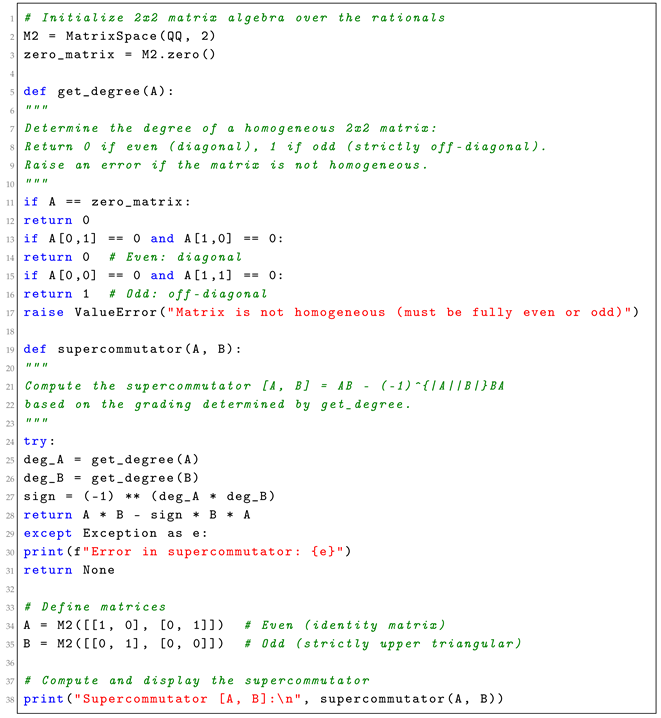
6.1. Supercommutator Implementation
An explicit SageMath implementation of supercommutator is shown in Listing 1.
| Listing 1. SageMath implementation of superalgebra operations. |
 |
6.2. Supercommutator Examples
Example 5.
For (even) and (odd):
SageMath implementation for calculating supercommutator is presented in Listing 2.
| Listing 2. Verification of supercommutator. |
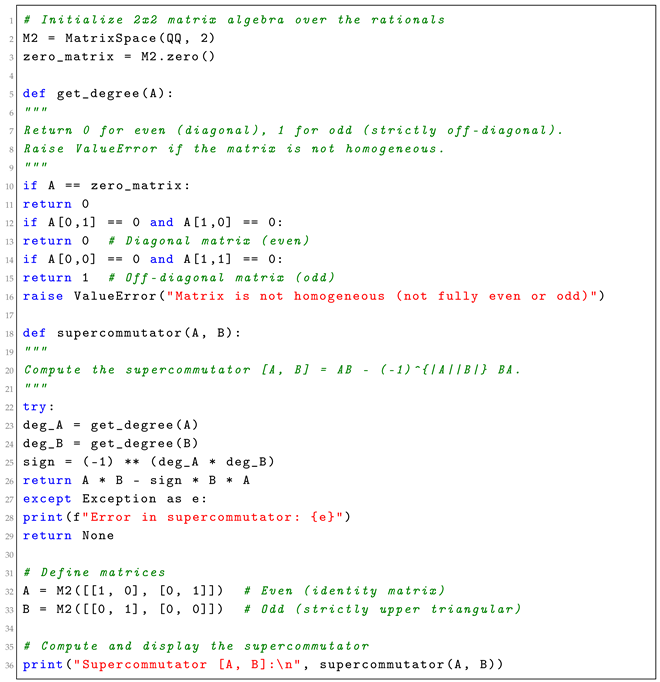 |
Output:
Supercommutator [A,B]:
[0 0]
[0 0]
Example 6.
For (even) and (odd):
SageMath implementation for calculating an additional supercommutator is presented in Listing 3.
| Listing 3. Additional supercommutator verification. |
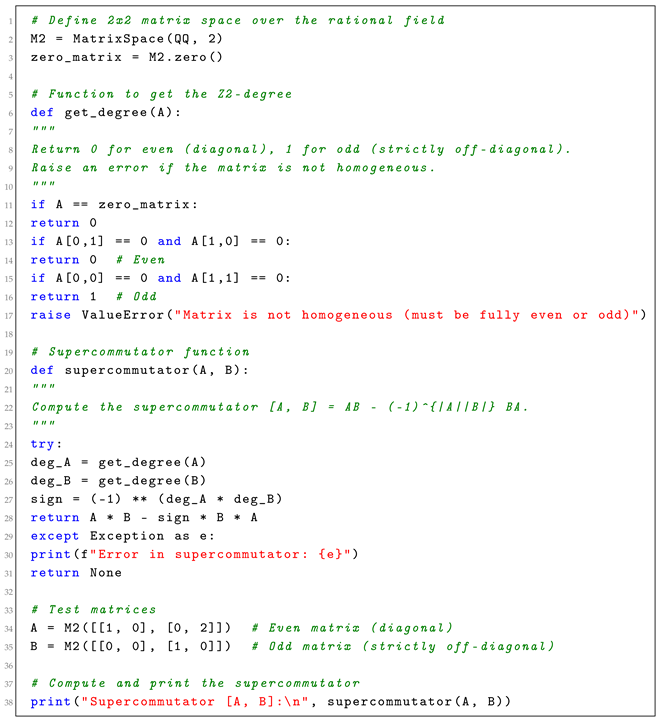 |
Output:
Supercommutator [A,B]:
[0 0]
[1 0]
Example 7.
For (odd) and (odd):
SageMath code for the calculation of a odd supercommutator appears in Listing 4.
| Listing 4. Odd supercommutator verification. |
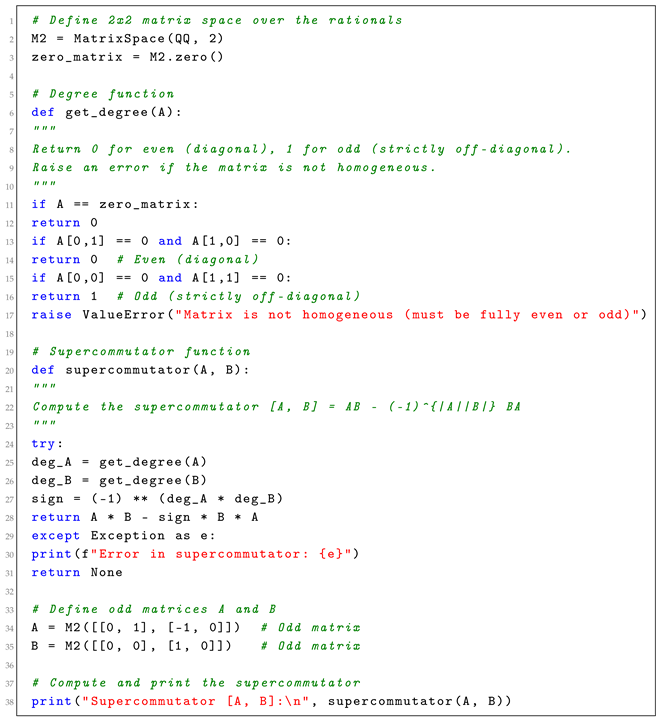 |
Output:
Supercommutator [A,B]:
[1 0]
[0 1]
6.3. Superinvolution Implementation
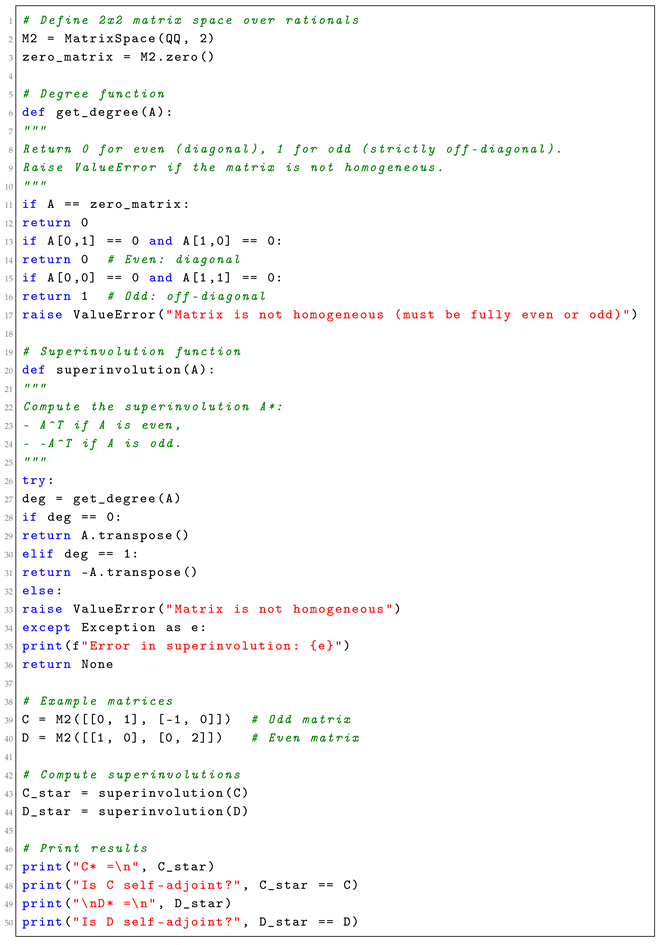
SageMath implementation for calculating superinvolution is presented in Listing 5.
| Listing 5. Superinvolution implementation. |
 |
6.4. Superinvolution Examples
Example 8.
Let , which is an odd matrix. Then the superinvolution is computed as:
Thus, C is self-adjoint under the superinvolution.
SageMath code for the calculation of a superinvolution appears in Listing 6.
| Listing 6. Verification of superinvolution. |
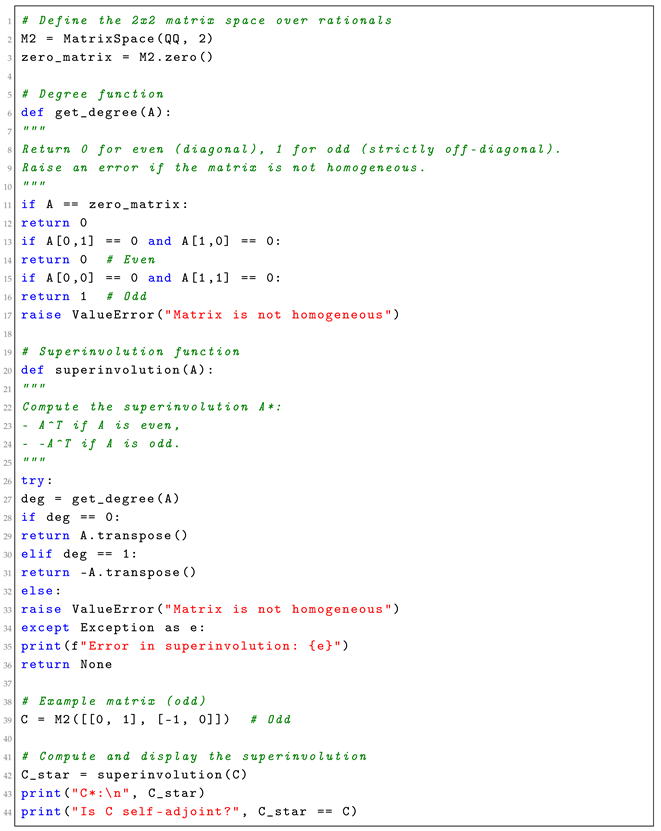 |
C*:
[ 0 1]
[-1 0]
Is C self-adjoint? True
Example 9.
For , which is an even matrix:
Thus, D is self-adjoint under the superinvolution.
SageMath implementation for calculating additional superinvolution is presented in Listing 7.
| Listing 7. Additional superinvolution verification. |
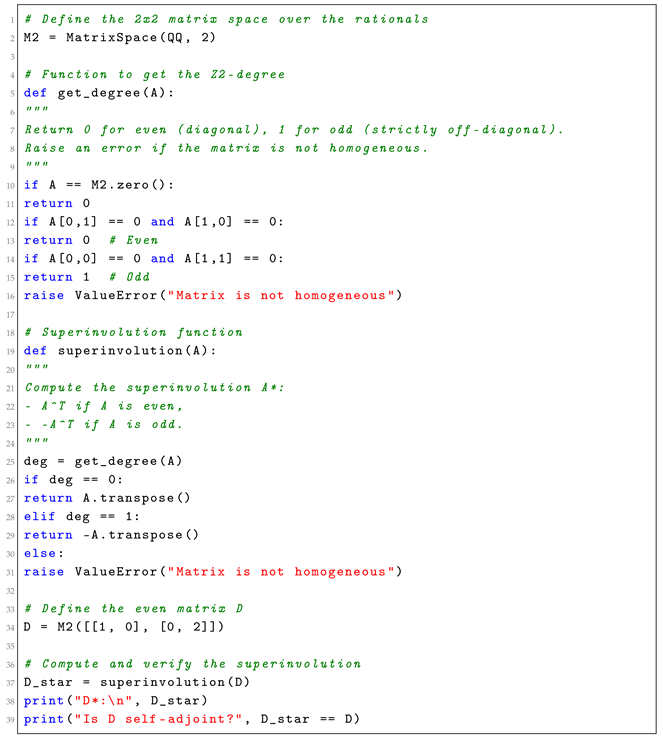 |
D*:
[1 0]
[0 2]
Is D self-adjoint? True
Example 10.
For , which is an odd matrix:
Thus, E is not self-adjoint under the superinvolution.
SageMath implementation for calculating non-selfadjoint superinvolution is presented in Listing 8.
| Listing 8. Non-selfadjoint superinvolution. |
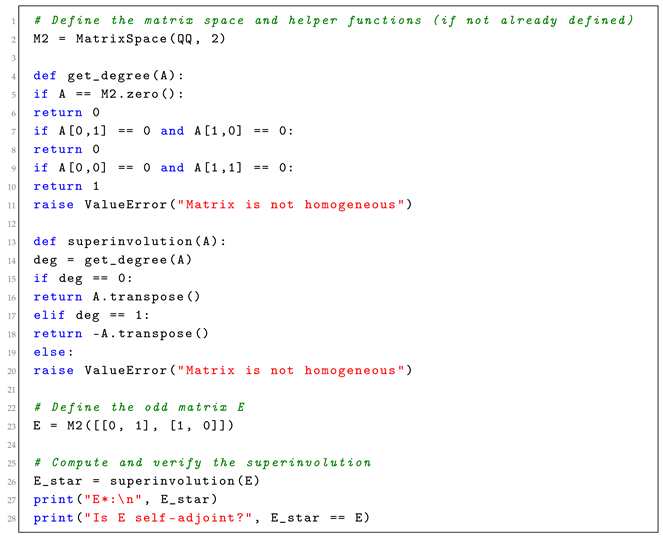 |
E*:
[ 0 -1]
[-1 0]
Is E self-adjoint? False
6.5. k-Supercommuting Maps
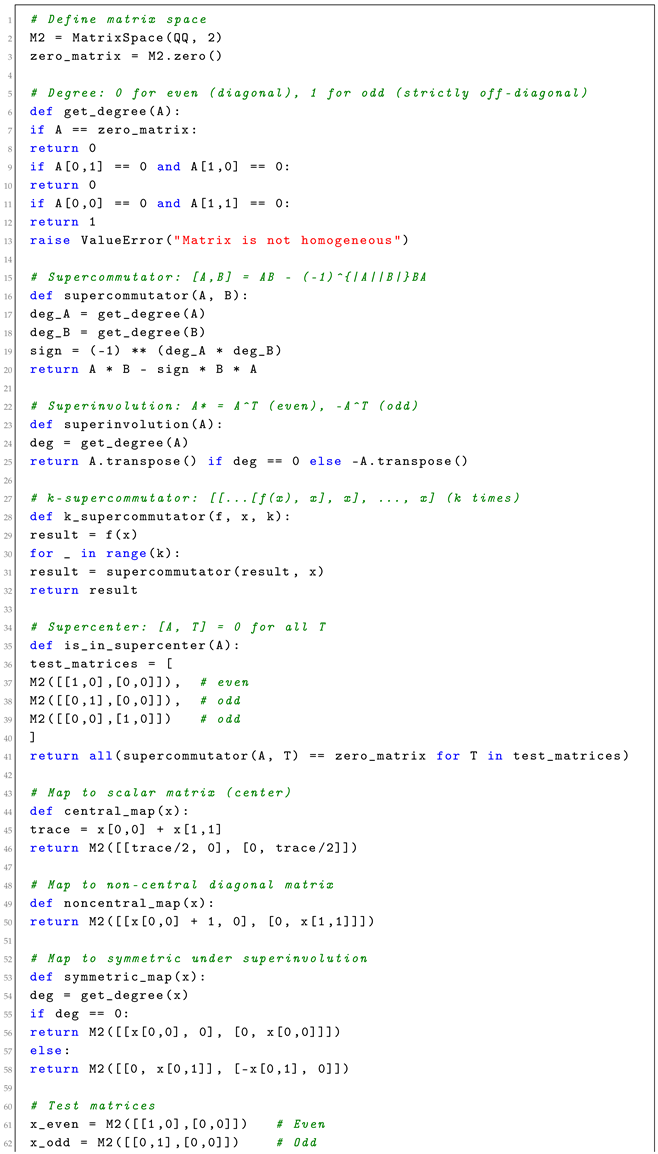
SageMath implementation for calculating k-supercommuting map is presented in Listing 9.
| Listing 9. k-supercommuting map verification. |
 |
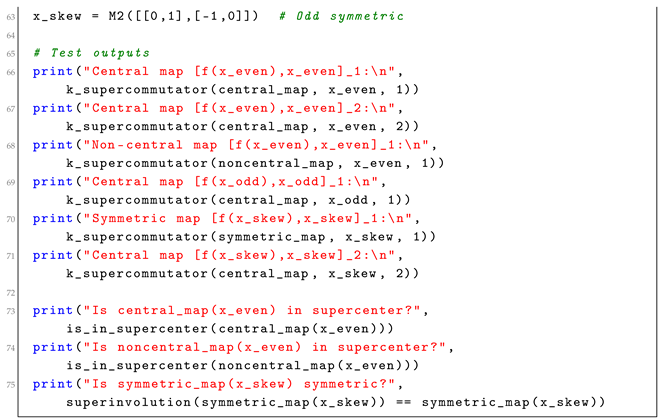 |
Central map [f(x_even),x_even]_1:
[0 0]
[0 0]
Central map [f(x_even),x_even]_2:
[0 0]
[0 0]
Non-central map [f(x_even),x_even]_1:
[0 0]
[0 0]
Central map [f(x_odd),x_odd]_1:
[0 0]
[0 0]
Symmetric map [f(x_skew),x_skew]_1:
[0 0]
[0 0]
Central map [f(x_skew),x_skew]_2:
[0 0]
[0 0]
Is central_map(x_even) in supercenter? True
Is noncentral_map(x_even) in supercenter? False
Is symmetric_map(x_skew) symmetric? True
6.6. Visualization of Supercommutator Norms
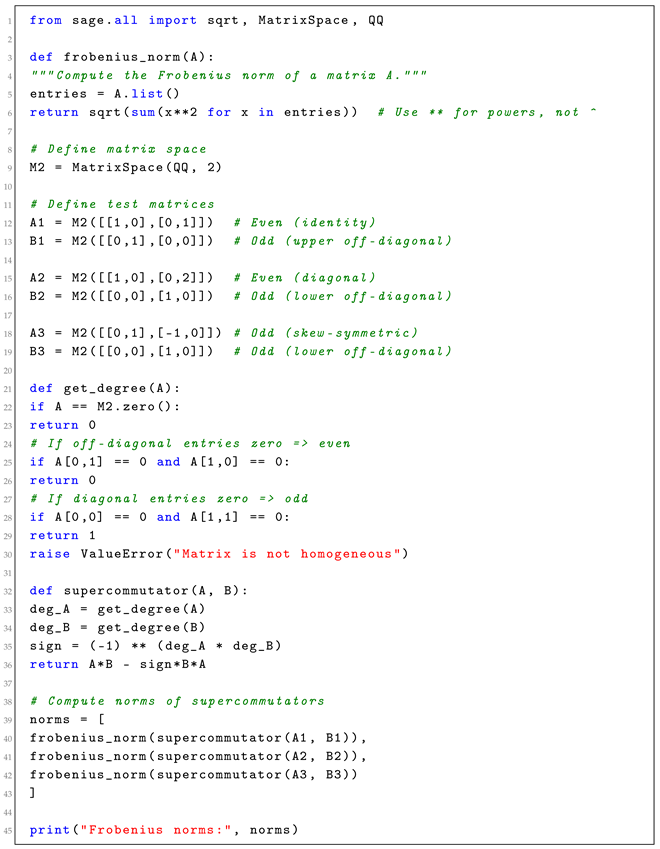
To quantify the behavior of supercommutators, we compute the Frobenius norm for pairs of matrices. SageMath implementation for calculating Frobenius norm of supercommutators is presented in Listing 10.
| Listing 10. Frobenius norm of supercommutators. |
 |
Output:
Frobenius norms = \( [0, 1, \sqrt{2}]\) .
7. Applications to Lie Superalgebras
Functional identities provide deep insights into the structure of Lie superalgebras, where the supercommutator serves as the Lie bracket. The set of skew elements relative to a superinvolution forms a Lie superalgebra. Theorems 6 and 7 indicate that k-supercommuting maps on and produce central elements, which are crucial for constructing central extensions.
Proposition 1.
Let be a prime superalgebra equipped with a superinvolution ‘∗’. Then , the set of skew elements, forms a Lie superalgebra under the supercommutator bracket . Moreover,
Proof.
For homogeneous , we have and . Consider
Hence, . The graded Jacobi identity follows from associativity and the properties of the supercommutator. □
Example 11.
In , the matrix
satisfies and , consistent with the Lie superalgebra structure.
Example 12.
Consider
Since (where ‘∗’ is the superinvolution, here the transpose combined with a sign), the bracket lies in , illustrating the grading in the Lie superalgebra.
8. Open Problems and Future Directions
This study prompts several open questions:
- Can the degree bounds in Theorem 4 be improved specifically for matrix superalgebras?
- Under what conditions do k-supercommuting maps on non-prime superalgebras map into the supercenter?
- How can functional identities be extended to -graded algebras beyond the -graded case?
- Can computational and symbolic methods effectively predict the structure of d-superfree subsets in higher-dimensional superalgebras?
These questions, together with the computational evidence presented, highlight promising directions for further research into superalgebra structures via symbolic computation and functional identities.
9. Conclusions
This study advances the theory of functional identities in superalgebras by extending Wang’s framework. In particular, Theorems 6 and 7 establish that k-supercommuting maps on symmetric elements of prime superalgebras with superinvolution map into the even center, while those on skew elements vanish, under suitable degree conditions. These results highlight the deep interaction between -grading and superinvolutions.
Computational experiments in using SageMath corroborate the theoretical framework, verifying the behavior of supercommutators, superinvolutions, and k-supercommuting maps, and thereby bridging abstract results with explicit finite-dimensional examples. The implications for Lie superalgebras are significant: skew elements form a Lie superalgebra under the supercommutator, offering new insights into symmetry in algebraic structures.
Finally, the open problems posed in Section 8 including sharpening degree bounds and extending the theory to -graded algebras point toward rich directions for further research. By combining rigorous theory with computational validation, this work deepens the understanding of superalgebras and reinforces their role in both mathematics and theoretical physics, in line with the interdisciplinary scope of symmetry-driven research.
Author Contributions
Conceptualization, A.Y.H. and M.S.A.; Methodology, A.Y.H. and M.S.A.; Software, A.Y.H. and M.S.A.; Validation, A.Y.H. and M.S.A.; Formal Analysis, A.Y.H. and M.S.A.; Investigation, A.Y.H. and M.S.A.; Resources, A.Y.H. and M.S.A.; Data Curation, A.Y.H. and M.S.A.; Writing—Original Draft Preparation, A.Y.H. and M.S.A.; Writing—Review and Editing, A.Y.H. and M.S.A.; Visualization, A.Y.H. and M.S.A.; Supervision, A.Y.H.; Project Administration, A.Y.H.; Funding Acquisition, A.Y.H. All authors have read and agreed to the published version of the manuscript.
Funding
This research was funded by The Deanship of Scientific Research at King Khalid University, Abha, Saudi Arabia, grant number RGP.2/340/46.
Data Availability Statement
Data are contained within the article.
Conflicts of Interest
The authors declare no conflicts of interest.
References
- Kac, V.G. Lie superalgebras. Adv. Math. 1977, 26, 8–96. [Google Scholar] [CrossRef] [Scilit]
- Beidar, K.I.; Chebotar, M.A. On functional identities and d-free subsets of rings, I. Commun. Algebra 2000, 28, 3925–3951. [Google Scholar] [CrossRef] [Scilit]
- Brešar, M.; Chebotar, M.A.; Martindale, W.S., III. Functional Identities; Birkhäuser: Basel, Switzerland, 2007. [Google Scholar]
- Elduque, A.; Villa, O. The existence of superinvolution. J. Algebra 2008, 319, 4338–4359. [Google Scholar] [CrossRef] [Scilit]
- Gómez-Ambrosi, C.; Shestakov, I.P. On the Lie structure of skew elements of a simple superalgebra with superinvolution. J. Algebra 1998, 208, 43–71. [Google Scholar] [CrossRef] [Scilit]
- Gómez-Ambrosi, C.; Laliena, J.; Shestakov, I.P. On the Lie structure of skew elements of a prime superalgebra with superinvolution. Commun. Algebra 2000, 28, 3277–3291. [Google Scholar] [CrossRef] [Scilit]
- Kharchenko, V.K. Generalized identities with automorphisms. Algebra Log. 1975, 14, 132–148. [Google Scholar] [CrossRef] [Scilit]
- Montaner, F. On the Lie structure of associative superalgebras. Commun. Algebra 1998, 26, 2337–2349. [Google Scholar] [CrossRef] [Scilit]
- Montgomery, S. Constructing simple Lie superalgebras from associative graded algebras. J. Algebra 1997, 195, 558–579. [Google Scholar] [CrossRef] [Scilit]
- Racine, M.L. Primitive superalgebras with superinvolution. J. Algebra 1998, 206, 588–614. [Google Scholar] [CrossRef] [Scilit]
- Brešar, M. Functional identities of degree two. J. Algebra 1995, 172, 690–720. [Google Scholar] [CrossRef] [Scilit]
- The SageMath Developers. SageMath, the Sage Mathematics Software System (Version 10.3). Available online: https://www.sagemath.org (accessed on 21 May 2025).
- Wang, Y. Skew-supercommuting maps in superalgebras. Bull. Aust. Math. Soc. 2008, 78, 397–409. [Google Scholar] [CrossRef] [Scilit]
- Wang, Y. Functional identities and Lie superhomomorphisms on prime superalgebras. Commun. Algebra 2009, 37, 4193–4226. [Google Scholar] [CrossRef] [Scilit]
- Wang, Y. Functional identities in superalgebras. J. Algebra 2013, 382, 144–176. [Google Scholar] [CrossRef] [Scilit]
Disclaimer/Publisher’s Note: The statements, opinions and data contained in all publications are solely those of the individual author(s) and contributor(s) and not of MDPI and/or the editor(s). MDPI and/or the editor(s) disclaim responsibility for any injury to people or property resulting from any ideas, methods, instructions or products referred to in the content. |
© 2025 by the authors. Licensee MDPI, Basel, Switzerland. This article is an open access article distributed under the terms and conditions of the Creative Commons Attribution (CC BY) license (https://creativecommons.org/licenses/by/4.0/).