


Abstract
This paper introduces a sum-of-squares (S-O-S) approach to Stability Analysis and Stabilization (SAS) of nonlinear dynamical systems described by General Conformable Polynomial Fuzzy (GCPF) models with a time delay. First, we present GCPF models, which are more general compared to the widely recognized Takagi–Sugeno Fuzzy (T-SF) models. Then, we establish SAS conditions for these models using a Lyapunov–Krasovskii functional and the S-O-S approach, making the SAS conditions in this work less conservative than the Linear Matrix Inequalities (LMI)-based approach to the T-SF models. In addition, the SAS conditions are found by satisfying S-O-S conditions dependent on membership functions that are reliant on the polynomial fitting approximation algorithm. These S-O-S conditions can be solved numerically using the recently developed SOSTOOLS. To demonstrate the effectiveness and practicality of our approach, two numerical examples are provided to demonstrate the effectiveness and practicality of our approach.
1. Introduction
Since 1985 [1], there has been growing interest in the T-SF model because of its ability to effectively represent nonlinear systems and generate numerous standard theoretical results. By using LMIs along with the Lyapunov theory, T-SF models have been widely used to analyze and achieve control objectives for nonlinear systems, such as Asymptotic Stability (AS) [2,3], Exponential Stability (ES) [4], Observer-Based Control (O-BC) [5,6], and Fault-Tolerant Control (F-TC) [7]. In 2007, Tanaka and colleagues expanded T-SF models into Polynomial Fuzzy (PF) models [8]. They accomplished this by utilizing a software tool named SOSTOOLS, which had emerged in 2002 [9]. PF models offer two main advantages over T-SF models: they provide better accuracy when it comes to representing complex nonlinear systems and they require fewer fuzzy rules [10]. Furthermore, the method using LMIs is not suitable for dealing with PF models because these models involve polynomials in their matrices. In this scenario, the software tool SOSTOOLS [11] replaces the LMI toolbox [12], providing researchers with the ability to effectively manage polynomial inequalities. Significant research efforts have been directed towards tackling analysis and control issues in PF models. The emphasis has been placed on presenting design solutions using S-O-S conditions. This includes areas such as AS [10,11,12,13], OB-C [14], F-TC [15].
It is important to note that all the results mentioned earlier focused on nonlinear systems without delays and with integer-order derivatives. In the following sections, we will delve into two main topics: the common presence of delays in systems and the use of a General Conformable Derivative (GCD) to describe their dynamics.
On one hand, it is important to include time delay factors when modeling and controlling real-world systems like long transmission lines, mechanical setups, chemical processes, and so on. In this situation, Razumikhin [16] and Krasovskii [17] have put forward key theories to handle equations involving time delays. They have expanded upon Liapunov’s theory, which dates back to 1892. These foundational works, especially the contributions made by Krasovskii, have been widely used to analyze and synthesize control for various models that include time delays.
Various techniques have been used in the literature to investigate the stability analysis problem of delayed Linear Systems (LSs). For instance, by considering multiple time delays, the issue of AS has been studied for a general class of retarded LSs via the bounds of its imaginary spectra [18,19]. By adopting a novel Lyapunov–Krasovskii functional with new double integral terms, the authors of [20] have proposed using relaxed sufficient LMIs to test the AS of a delayed LS with bounded and periodic time-varying delays. Using the Kalman–Yakubovich–Popov lemma, the Strong Delay-Independent Stability (SD-IS) problem is addressed for delayed LSs with a single delay [21]. Recently, the Generalized Dixon resultant theory is adopted to investigate the SD-IS problem for LSs with multiple time delays [22].
In their publication, the authors of [23] present the first attempt to extend T-SF models to include systems with time delays. Since this work was published in 2000, researchers have expressed considerable interest in T-SF models with time delays. This attention has led to many important works, such as those related to AS [24], ES [25], OB-C [26], FTC [27]. Similarly, researchers have enhanced PF models to handle time delays. This has resulted in the discovery of many significant findings in the field in relation to AS [28,29], ES [30], O-BC [31] and FTC [32].
On the other hand, in 2014, Khalil et al. [33] introduced a novel derivative called the Conformable Derivative (CD). This derivative was further developed by T. Abdeljawad in [34], and it is currently being extensively explored in [35,36,37]. A new way of understanding control systems has emerged with the advent of CD (see [38,39]). Alharbi et al. [40] have demonstrated that the CD, which serves as a weighted-time analog of classical derivatives, has applications in physics. The CD is generalized, along with its physical interpretation, by Zhao and Luo in [41]. Furthermore, in their work, Li et al. [42] have demonstrated that the diffusion equation can be solved with a GCD. Recent studies ( [43] and [44]) illustrate how GCD can be used to analyze and understand control systems.
This paper examines the issue of SAS for GCPF models. The principal contributions of this paper are outlined below:
- The PF models are widely used in the literature to represent nonlinear dynamics of systems with integer-order derivative. In this paper, we present the first attempt to apply the PF models to describe delayed systems with GCD. Furthermore, instead of relying on T-SF models, we employ the PF models due to their broader accuracy and generality, as established in prior research [10].
- A new Lyapunov–Krasovskii functional is developed to establish the exponential SAS for GCPF systems. This function is specifically designed to effectively address the challenges of exponential SAS in such systems.
- By utilizing the constructed Lyapunov–Krasovskii functional, S-O-S conditions are derived to ensure the SAS of GCPF systems. In fact, the LMI approach is not applicable in such systems due to the presence of polynomial matrices instead of constant matrices in local models. Furthermore, the SOS approach, as discussed in the literature [10], yields less conservative results compared to the LMI approach.
- In order to take into account the overall behavior of the PF model, the S-O-S conditions contain not only information about the polynomial local models but also information about the Fuzzy Membership Functions (FMFs). Due to their nonlinear dynamics, a polynomial curve fitting method is used to approximate these FMFs as S-O-Ss, enabling these approximations to be incorporated into the S-O-S conditions.
The paper is structured as follows: Section 2 delves into the preliminary concepts, while Section 3 presents the problem formulation. In Section 4, we present our theoretical results. In Section 5, we present numerical examples to showcase the practical applicability of the theoretical results. Section 6 concludes the paper.
Notations: ℑ and denote the sets of polynomial matrices and S-O-Ss, respectively. For a matrix , .
2. Preliminaries
In this section, we begin by revisiting pertinent definitions, lemmas, and theorems, as cited in references [8,33,34,41,42].
Definition 1.
Let the function ϕ be defined on the interval . The General Conformable Derivative (GCD) of ϕ at the initial real value a is defined as follows:
The parameter θ belongs to , and represents a continuous non-negative function that is dependent on t, meeting the following condition:
If exists, for all , for some and exists; therefore,
Remark 1.
The GCD serves as a generalization that encompasses both the classical derivative case, when , and the Conformable Derivative, denoted by (refer to [34] and [33] for the case when ).
Remark 2.
For an in-depth exploration of the properties of the GCD, we make the following assumptions:
- The function is increasing and satisfies for all .
- The function is locally integrable.
- The integral from a to ∞ of diverges, as indicated by .
Definition 2.
For , the Conformable Integral of a function ϕ is defined as follows:
Lemma 1.
Consider a function ϕ defined on . Then, for every t, such that , it follows that
Lemma 2.
If ϕ is an absolutely continuous function defined on the interval , then for all t, such that , the following holds:
Lemma 3.
Let , and the functions such that and exist on . Then,
- ;
- ;
- ;
- , for each , such that .
Remark 3.
Let . If , then and .
Let consider the nonlinear system:
where and
Definition 3.
The system (6) is referred to exponentially stable if we have positive scalars M and δ, such that
where
Definition 4.
Let . If , such that
then , which implies that .
3. Problem Formulation
Consider a nonlinear system with delay described by the delayed PF model, which consists of the following r rules:
Plant Rule : If is and ⋯ and is then,
where the measurable premise variables are represented by , . The fuzzy sets are , and , s and the rules’ number is r. represents the current state vector, represents the delayed state vector, and is the vector for control inputs. The sets belong to the set ℑ. The delay is presumed to remain constant and be known.
After the defuzzication process of model (9), we obtain the following result:
where are the FMFs.
In the remaining equations, and are denoted as and , respectively.
To incorporate the information regarding FMFs, we employ the polynomial curve fitting technique to approximate each FMF as a square of a polynomial . To enhance the precision of this approximation, is partitioned into m sub-segments , in which . Within each of these segments , an approximation by a square of polynomial is employed for every :
4. Main Results
4.1. Stability Analysis
Theorem 1.
For positive scalars and a, the system (10), with , is exponentially stable if there are symmetric matrices P and Q, such that the following S-O-S conditions are satisfied:
where , , and are vectors such that is independent of ξ, , are strictly positive scalars, and is a non-negative polynomial, such that for .
Proof.
Let the Lyapunov–Krasovskii functional candidate presented below,
where
(29) and (13) imply that and .
For , we obtain the following GCD of and
Since is increasing, then
and
Hence,
From (16) and (17), we obtain the following result:
From (15), (18) and (19), we obtain
The GCD of satisfies
By employing the polynomial curve fitting technique, we can approximate the FMF as square polynomials. So, according to (11), we can rewrite the previous inequality as follows:
Therefore, if (14) holds, then
It follows from Theorem 2 in [43] that
We have
where
and
Therefore,
□
4.2. Stabilization via SOS
Since the PDC replicates the structure of the fuzzy model of a system, it is possible to build a fuzzy controller with polynomial rule consequences using the provided PF model (9):
Plant Rule : If is and ⋯ and is then,
We can determine the complete fuzzy controller by
Using (10) and (27), we can express the closed-loop system as
Theorem 2.
For positive scalars and a, the system (28) is exponentially stable if we have symmetric matrices P and , such that the following S-O-Ss are satisfied:
where , and are vectors such that is independent of ξ, , are strictly positive scalars, and is a non-negative polynomial, such that for . In this case, the controller’s gains are as follows:
Proof.
The Lyapunov–Krasovskii functional candidate is presented below:
where and is the same as (16).
By following the same steps as outlined in the proof of Theorem 1, we obtain
The GCD of satisfies
where .
Remark 4.
In [45], we utilized a conformable derivative within the context of LS. In contrast, this work expands upon this by employing a GCD and introducing PF models. These models provide a more general framework, surpassing both LS and T-SF models in terms of applicability and flexibility.
Remark 5.
The use of FP models instead of T-SF models allows a reduction in the number of if–then rules, which in turn decreases the overall system complexity. An example is given in the next section to illustrate this point.
5. Illustrative Examples
5.1. Example 1
Consider the following PF model with GCD and time delay:
where , ,, The FMFs are defined as follows:
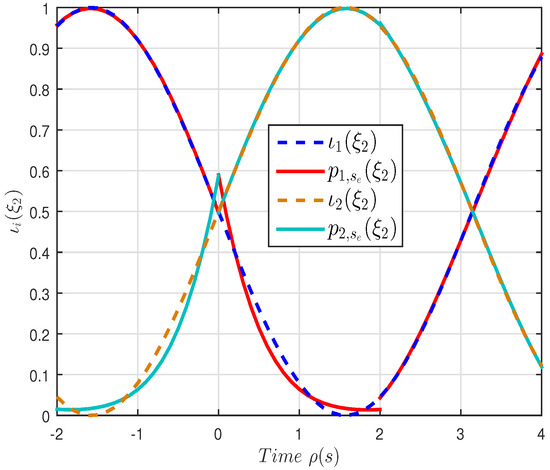
We consider three sub-regions , and . Using the polynomial approximation method, we approximate the FMFs with fourth-degree square polynomials as follows:
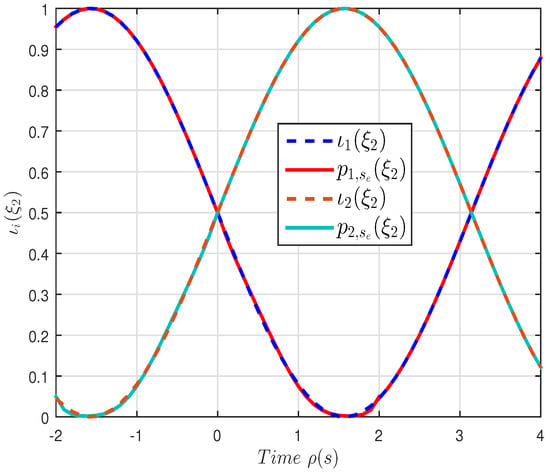
The approximation of FMF by eight-degree square polynomials are given as follows:
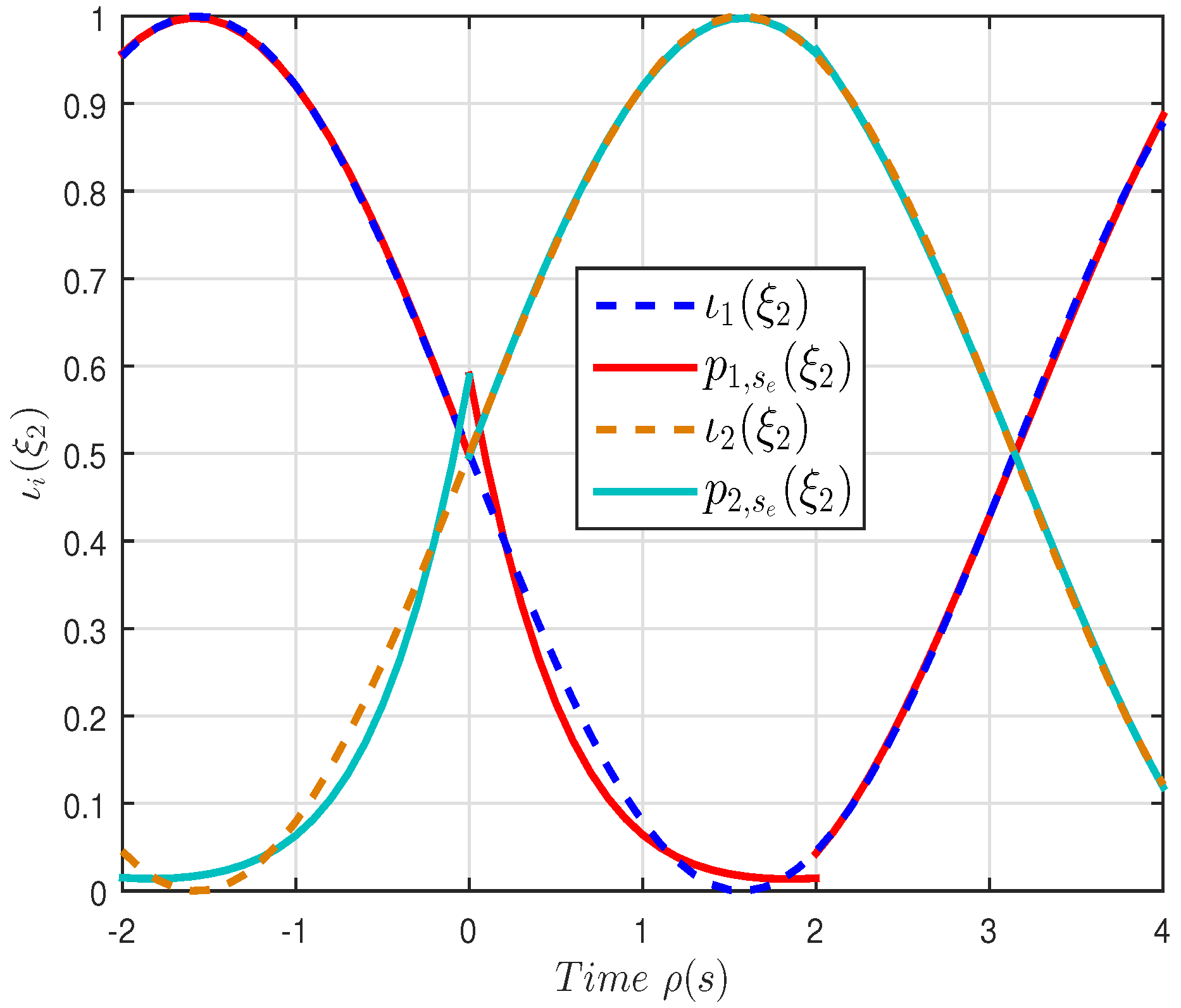
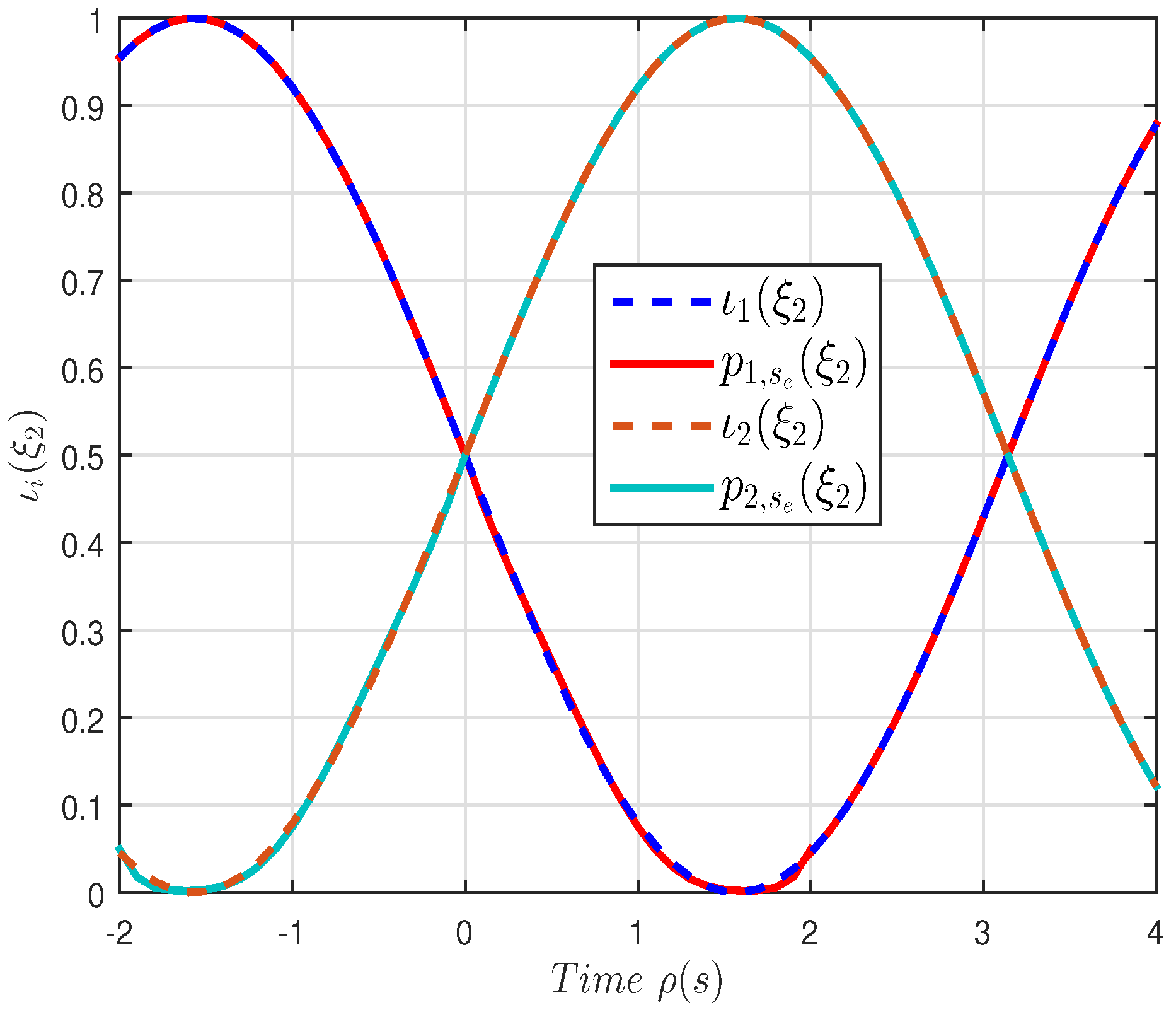
In Figure 1 and Figure 2, we present FMFs and their estimates within the areas labeled , , and . It is clear that when we increase the degree of the polynomial, the accuracy of the polynomial approximation method improves.
Figure 1.
FMF and their fourth-degree square polynomials approximations in .
Figure 2.
FMF and their eighth-degree square polynomials approximations in .
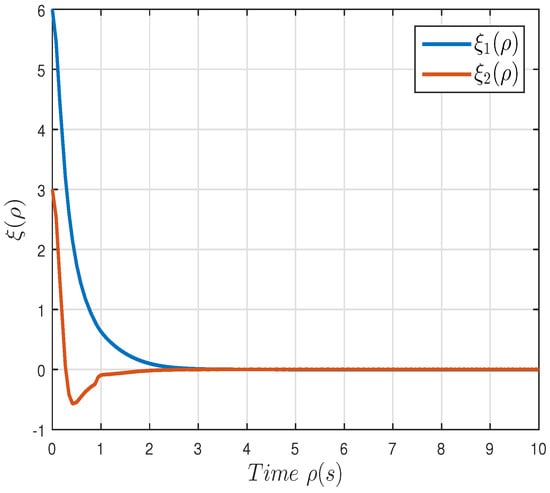
The S-O-S design conditions in Theorem 1 are feasible for , and . Figure 3 illustrates the temporal progression of , for and we can see from this figure that the system becomes stable.
Figure 3.
Temporal progression of .
5.2. Example 2
Consider the following delayed NS:
where , , .
Let and , where .
By using the concept of sector nonlinearity, the NS (40) is represented by the following T-SF model for , :
where , , , , , , .
The FMFs are defined as
In opposition to the T-SF model, the consequence part of the PF model is represented by a polynomial equation rather than a linear one. Then, the NS (40) is represented by the following PF model:
where , , , .
The FMFs are defined as
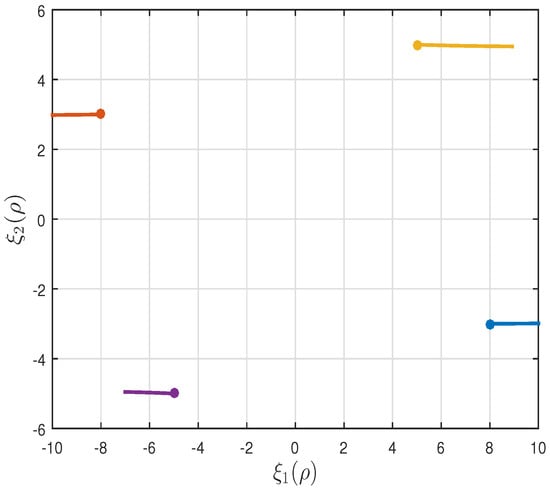
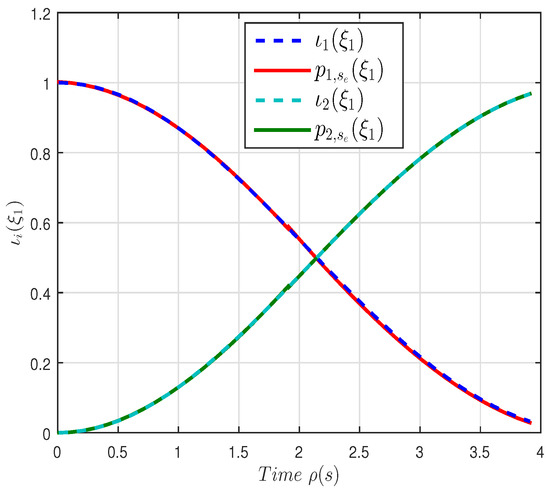
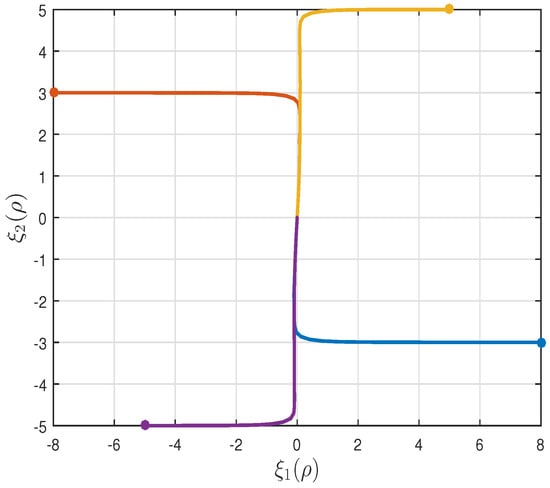
Figure 4 shows the behavior of (42) with for these initial states: , , and for . From this figure, we can see that the system (42) is unstable.
Figure 4.
Behaviors in – plane (without feedback).
We assume that and the interval divides into two segments as and . Using the polynomial approximation method, we approximate the fuzzy MFs using the following fourth-degree square polynomials:
Figure 5 displays the FMFs and their approximations in regions and . From this figure, it is evident that the polynomial approximation method works effectively. This polynomial approximation allows us to include the precise information of the FMFs in the stabilization conditions.
Figure 5.
FMFs and their square polynomials approximations in .
In our example, we solved the S-O-S conditions in Theorem 2 for , and . We obtained the following solution:
Figure 6 shows the behavior of (42) for the same initial states as in Figure 4. It is important to highlight that the proposed controller effectively stabilizes the system’s states across different initial conditions.
Figure 6.
Behaviors in – plane.
6. Conclusions
This paper has focused on the SAS of delayed nonlinear dynamic systems with GCD. We have presented a novel framework for GCPF modeling. PF models have been used extensively in the literature to describe delayed nonlinear systems with integer-order derivatives. However, these models were utilized for the first time in this work, representing the dynamic of delayed nonlinear systems with GCD. We have derived the exponential SAS conditions of these systems using a novel Lyapunov–Krasovskii function. Notably, these conditions are represented in terms of S-O-Ss, allowing for numerical (and partially symbolic) solutions using the recently developed SOSTOOLS. Further improvement is introduced by taking the FMFs into account. In fact, these functions are estimated as square polynomials, through a polynomial approximation method, in order to derive the SAS conditions dependent on FMFs. Two design examples are provided to demonstrate the effectiveness and applicability of our approach.
Author Contributions
I.I.A.: Conceptualization, Investigation. H.G.: Writing—review and editing, Investigation. M.R.: Conceptualization, Writing—review and editing, Investigation. L.M.: Software, Visualization. A.B.M.: Methodology and Validation. All authors have read and agreed to the published version of the manuscript.
Funding
This research was funded by King Saud University through Researchers Supporting Project number (RSPD2024R683), King Saud University, Riyadh, Saudi Arabia.
Data Availability Statement
No underlying data were collected or produced in this study.
Conflicts of Interest
The authors declare no conflicts of interest.
References
- Takagi, T.; Sugeno, M. Fuzzy identification of systems and its applications to modeling and control. IEEE Trans. Syst. Man Cybern. 1985, 15, 116–132. [Google Scholar] [CrossRef] [Scilit]
- Kim, E.; Lee, H. New Approaches to Relaxed Quadratic Stability Condition of Fuzzy Control Systems. IEEE Trans. Fuzzy Syst. 2000, 8, 523–634. [Google Scholar]
- Fang, C.-H.; Liu, Y.-S.; Kau, S.-W.; Hong, L.; Lee, C.-H. A new LMI-based approach to relaxed quadratic stabilization of T-S fuzzy control systems. IEEE Trans. Fuzzy Syst. 2006, 14, 386–397. [Google Scholar] [CrossRef] [Scilit]
- Wang, Y.; Xia, Y.; Ahn, C.K.; Zhu, Y. Exponential Stabilization of Takagi–Sugeno Fuzzy Systems with Aperiodic Sampling: An Aperiodic Adaptive Event-Triggered Method. IEEE Trans. Fuzzy Syst. 2018, 49, 444–454. [Google Scholar] [CrossRef] [Scilit]
- Teixeira, M.C.M.; Assuncao, E.; Avellar, R.G. On relaxed LMI based designs for fuzzy regulators and fuzzy observers. IEEE Trans. Fuzzy Syst. 2003, 11, 613–623. [Google Scholar] [CrossRef] [Scilit]
- Chadli, M.; El Hajjaji, A. Observer-based robust fuzzy control of nonlinear systems with parametric uncertainties. Fuzzy Sets Syst. 2006, 157, 1276–1281. [Google Scholar] [CrossRef] [Scilit]
- Khallouq, A.; Karama, A. Fault tolerant control of Takagi-Sugeno systems: Application to an activated sludge process. J. Water Process Eng. 2024, 61, 105265. [Google Scholar] [CrossRef] [Scilit]
- Tanaka, K.; Yoshida, H.; Ohtake, H.; Wang, H.O. A sum of squares approach to stability analysis of polynomial fuzzy systems. In Proceedings of the 2007 American Control Conference, New York, NY, USA, 9–13 July 2007; pp. 4071–4076. [Google Scholar]
- Prajna, S.; Papachristodoulou, A.; Parrilo, P.A. Introducing SOSTOOLS: A general purpose sum of squares programming solver. In Proceedings of the 41st IEEE Conference on Decision Control, Las Vegas, NV, USA, 10–13 December 2002; pp. 741–746. [Google Scholar]
- Tanaka, K.; Yoshida, H.; Ohtake, H.; Wang, H.O. A sum-of-squares approach to modeling and control of nonlinear dynamical systems with polynomial fuzzy systems. IEEE Trans. Fuzzy Syst. 2009, 17, 911–922. [Google Scholar] [CrossRef] [Scilit]
- Papachristodoulou, A.; Anderson, J.; Valmorbida, G.; Prajna, S.; Seiler, P.; Parrilo, P.; Peet, M.; Jagt, J. SOSTOOLS: Sum of Squares Optimization Toolbox for MATLAB Version 4.00. 2021. Available online: https://par.nsf.gov/biblio/10353822 (accessed on 1 January 2020).
- Erkus, B.; Lee, Y.J. Linear Matrix Inequalities and Matlab lmi Toolbox; University of Southern California Group Meeting Report; University of Southern California: Los Angeles, CA, USA, 2004. [Google Scholar]
- Saenz, J.M.; Tanaka, M.; Tanaka, K. Relaxed stabilization and disturbance attenuation control synthesis conditions for polynomial fuzzy systems. IEEE Trans. Cybern. 2021, 51, 2093–2106. [Google Scholar] [CrossRef] [Scilit]
- Tanaka, K.; Ohtake, H.; Seo, T.; Tanaka, M.; Wang, H.O. Polynomial fuzzy observer designs: A sum-of-squares approach. IEEE Trans. Fuzzy Syst. 2012, 42, 1330–1342. [Google Scholar] [CrossRef] [Scilit]
- Sabbghian-Bidgoli, F.; Farrokhi, M. Polynomial fuzzy observer-based integrated fault estimation and fault-tolerant control with uncertainty and disturbance. IEEE Trans. Fuzzy Syst. 2022, 30, 741–754. [Google Scholar] [CrossRef] [Scilit]
- Razumikhin, B. Applications of Lyapunov’s method to problems in the stability of systems with a delay. Autom. Remote Control 1960, 21, 515–520. [Google Scholar]
- Krasovskii, N.N. On the Application of The Second Method of Lyapunov for Equations with Time Delays. Prikl. Mat. Mekh. 1956, 20, 315–327. [Google Scholar]
- Gao, Q.; Olgac, N. Bounds of imaginary spectra of LTI systems in the domain of two of the multiple time delays. Automatica 2016, 72, 235–241. [Google Scholar] [CrossRef] [Scilit]
- Gao, Q.; Olgac, N. Stability analysis for LTI systems with multiple time delays using the bounds of its imaginary spectra. Syst. Control Lett. 2017, 102, 112–118. [Google Scholar] [CrossRef] [Scilit]
- Liao, W.; Zeng, H.; Lin, H. Stability Analysis of Linear Time-Varying Delay Systems via a Novel Augmented Variable Approach. Mathematics 2024, 12, 1638. [Google Scholar] [CrossRef] [Scilit]
- Oliveiraa, F.S.S.D.; Souza, F.O. Strong delay-independent stability of linear delay systems. J. Frankl. Inst. 2019, 356, 5421–5433. [Google Scholar] [CrossRef] [Scilit]
- Cai, J.; Gao, Q.; Liu, Y.; Wu, A. Generalized Dixon Resultant for Strong Delay-Independent Stability of Linear Systems with Multiple Delays. IEEE Trans. Autom. Control 2023, 69, 2697–2704. [Google Scholar] [CrossRef] [Scilit]
- Cao, Y.Y.; Frank, P.M. Analysis and synthesis of nonlinear time-delay systems via fuzzy control approach. IEEE Trans. Fuzzy Syst. 2000, 8, 200–211. [Google Scholar]
- Sheng, Z.; Lin, C.; Chen, B.; Wang, Q.-G. Stability and Stabilization of T–S Fuzzy Time-Delay Systems Under Sampled-Data Control via New Asymmetric Functional Method. IEEE Trans. Fuzzy Syst. 2023, 31, 3197–3209. [Google Scholar] [CrossRef] [Scilit]
- Ma, Y.; Yan, H. Delay-dependent robust H∞ filter for T-S fuzzy time-delay systems with exponential stability. Adv. Differ. Equ. 2013, 2013, 362. [Google Scholar] [CrossRef] [Scilit]
- Islam, S.I.; Lim, C.-C.; Shi, P. Functional observer based controller for stabilizing Takagi–Sugeno fuzzy systems with time-delays. J. Frankl. Inst. 2018, 355, 3619–3640. [Google Scholar] [CrossRef] [Scilit]
- Kang, Y.; Yao, L.; Wang, H. Fault Isolation and Fault-Tolerant Control for Takagi–Sugeno Fuzzy Time-Varying Delay Stochastic Distribution Systems. IEEE Trans. Fuzzy Syst. 2022, 3, 1185–1195. [Google Scholar] [CrossRef] [Scilit]
- Li, X.; Mehran, K.; Bao, Z. Stability Analysis of Discrete-Time Polynomial Fuzzy-Model-Based Control Systems with Time Delay and Positivity Constraints Through Piecewise Taylor Series Membership Functions. IEEE Trans. Syst. Man Cybern. Syst. 2021, 51, 12. [Google Scholar] [CrossRef]
- Tsai, S.-H.; Jen, C.-Y. stabilization for polynomial fuzzy time delay system: A sum-of-squares approach. IEEE Trans. Fuzzy Syst. 2018, 26, 3630–3644. [Google Scholar] [CrossRef] [Scilit]
- Li, X.; Shan, Y.; Lam, H.-K.; Bao, Z.; Zhao, J. Exponential Stabilization of Polynomial Fuzzy Positive Switched Systems with Time Delay Considering MDADT Switching Signal. IEEE Trans. Fuzzy Syst. 2024, 23, 174–187. [Google Scholar] [CrossRef] [Scilit]
- Han, M.; Lam, H.K.; Li, Y.; Liu, F.; Zhang, C. Observer-based control of positive polynomial fuzzy systems with unknown time delay. Neurocomputing 2019, 349, 77–90. [Google Scholar] [CrossRef] [Scilit]
- Gassara, H.; Boukattaya, M.; El Hajjaji, A. Polynomial Adaptive Observer-Based Fault Tolerant Control for Time Delay Polynomial Fuzzy Systems Subject to Actuator Faults. Int. J. Fuzzy Syst. 2023, 25, 1327–1337. [Google Scholar] [CrossRef] [Scilit]
- Khalil, R.; Al Horani, M.; Yousef, A.; Sababheh, M. A new definition of fractional derivative. J. Comput. Appl. Math. 2014, 264, 65–70. [Google Scholar] [CrossRef] [Scilit]
- Abdeljawad, T. On conformable fractional calculus. J. Comput. Appl. Math. 2015, 279, 57–66. [Google Scholar] [CrossRef] [Scilit]
- Martínez, F.; Martínez, I.; Kaabar MK, A.; Paredes, S. New properties of conformable derivative. J. Math. 2021, 2021, 5528537. [Google Scholar]
- Weberszpil, J.; Godinho CF, L.; Liang, Y. Dual conformable derivative: Variational approach and nonlinear equations. Europhys. Lett. 2019, 128, 31001. [Google Scholar] [CrossRef] [Scilit]
- Rosa, W.; Weberszpil, J. Dual conformable derivative: Definition, simple properties and perspectives for applications. Chaos Solitons Fractals 2018, 117, 137–141. [Google Scholar] [CrossRef] [Scilit]
- Cuchta, T.; Poulsen, D.; Wintz, N. Linear quadratic tracking with continuous conformable derivatives. Eur. J. Control 2023, 72, 100808. [Google Scholar] [CrossRef] [Scilit]
- Huyen NT, T.; Thanh, N.T.; Sau, N.H.; Binh, T.N.; Thuan, M.V. Mixed H∞ and Passivity Performance for Delayed Conformable Fractional-Order Neural Networks. Circuits Syst. Signal Process. 2023, 42, 5142–5160. [Google Scholar] [CrossRef] [Scilit]
- Alharbi, F.M.; Baleanu, D.; Ebaid, A. Physical properties of the projectile motion using the conformable derivative. Chin. J. Phys. 2019, 58, 18–28. [Google Scholar] [CrossRef] [Scilit]
- Zhao, D.; Luo, M. General conformable fractional derivative and its physical interpretation. Calcolo 2015, 54, 903–917. [Google Scholar] [CrossRef] [Scilit]
- Li, S.; Zhang, S.; Liu, R. The Existence of Solution of Diffusion Equation with the General Conformable Derivative. J. Funct. Spaces 2020, 2020, 3965269. [Google Scholar] [CrossRef] [Scilit]
- Meléndez-Vázquez, M.; Fernández-Anaya, G.; Hernández-Martínez, E.G. General conformable estimators with finite-time stability. Adv. Differ. Equ. 2020, 2020, 551. [Google Scholar] [CrossRef] [Scilit]
- Kutahyalioglu, A.; Karakoc, F. Exponential stability of Bam-type neural networks with conformable derivative. Proc. Inst. Math. Mech. 2023, 49, 78–94. [Google Scholar]
- Kharrat, M.; Gassara, H.; Rhaima, M.; Mchiri, L. Ben Makhlouf, Practical Stability for Conformable Time-Delay Systems. Discret. Dyn. Nat. Soc. 2023, 2023, 9375360. [Google Scholar] [CrossRef] [Scilit]
Disclaimer/Publisher’s Note: The statements, opinions and data contained in all publications are solely those of the individual author(s) and contributor(s) and not of MDPI and/or the editor(s). MDPI and/or the editor(s) disclaim responsibility for any injury to people or property resulting from any ideas, methods, instructions or products referred to in the content. |
© 2024 by the authors. Licensee MDPI, Basel, Switzerland. This article is an open access article distributed under the terms and conditions of the Creative Commons Attribution (CC BY) license (https://creativecommons.org/licenses/by/4.0/).