


Abstract
Land use transitions increasingly hinge on how governance arrangements shape resource use efficiency and knowledge diffusion in agricultural systems. Collective irrigation, as a key institutional form of water governance, has been widely promoted to improve irrigation performance, yet its potential linkages with peer effects in agricultural production remain insufficiently understood. Using plot-level panel data from Jiangsu Province, China, for 2015 and 2019, this study examines how peer effects and collective irrigation affect the technical efficiency of rice production. A time-varying stochastic frontier production function is employed to estimate technical efficiency, while a linear-in-means model is used to capture peer effects and compare their effects across different irrigation types. The results indicate that peer effects play a significant role in improving technical efficiency in rice-growing areas. These effects are more pronounced under collective irrigation arrangements. Moreover, peer effects under collective irrigation are stronger in villages without public technology extension services, among farmers with lower grain production capacity or without off-farm employment, and on smaller plots. Mechanism analysis indicates that peer effects under collective irrigation operate partly through input decisions, especially pesticide use. Overall, the findings highlight the importance of considering both peer interactions and irrigation institutions when improving agricultural production efficiency.
1. Introduction
Land use transitions represent a critical interface between human activity and environmental systems, with agricultural land playing a central role in food security, water management, and rural livelihoods. In China, irrigated agriculture—particularly rice production—lies at the core of this interface, as it directly links land use decisions with water resource allocation and governance. Under mounting pressures from climate change, increasing water scarcity, and rising production costs, improving the efficiency and sustainability of irrigated land use has become a key challenge for agricultural development and resource governance [1].
Collective irrigation refers to irrigation practices that are jointly organized, coordinated, and implemented by village collectives, water user associations, or groups of farmers. Compared with private irrigation, collective irrigation is characterized by unified decision-making, shared infrastructure, and coordinated water allocation across plots. These features enable large-scale and standardized irrigation management and have been widely regarded as an effective institutional arrangement for enhancing irrigation efficiency, reducing transaction costs, and improving agricultural productivity [2]. In China, collective irrigation has been promoted in many regions as part of broader efforts to modernize agricultural water management and strengthen collective action at the village level [2,3].
Existing research across different countries on collective irrigation has primarily examined its effects from technical, institutional, or governance perspectives, focusing in particular on aspects such as infrastructure investment, property rights arrangements, and management efficiency [4,5,6,7,8]. However, relatively little attention has been paid to how collective irrigation interacts with farmers’ social behaviors and learning processes. In practice, collective irrigation not only reshapes how water resources are allocated across farmland but also alters farmers’ interaction environments by increasing coordination, communication, and repeated contact among participants. These changes may have important implications for peer effects in agricultural production, defined as the influence of other farmers’ behaviors and outcomes on an individual farmer’s production decisions and performance [9].
A growing literature highlights the importance of peer effects in agricultural production, particularly in developing countries where formal information and extension systems are often limited. Farmers frequently rely on peers as trusted sources of information regarding new technologies, input usage, and production practices [10,11,12,13,14]. Empirical studies have shown that technology adoption, fertilizer and pesticide usage, and crop management decisions are strongly influenced by social networks, kinship ties, and geographic proximity [14,15,16,17]. Peer effects have also been found to affect productivity and income by facilitating learning, imitation, and risk sharing [17,18,19]. Despite this expanding body of research, empirical evidence on peer effects is still relatively limited in terms of identifying their causal impact on farm-level technical efficiency and performance outcomes, particularly in developing and transition economies. In the context of China, peer effects are especially pronounced among smallholders, who often depend heavily on interpersonal networks and informal interactions when making production decisions.
Moreover, the potential linkages between peer effects and irrigation institutions have not been sufficiently explored. Some studies suggest that stronger social connections in collectively managed irrigation systems may enhance learning and coordination among farmers, leading to more similar production practices and efficiency outcomes [19,20]. For example, evidence from rice-growing regions indicates that farmers operating under collective irrigation may exhibit higher spatial correlation in technical efficiency than those relying on rainfed irrigation [21]. However, systematic comparisons between collective and private irrigation regimes, and their role in shaping peer effects and efficiency spillovers, are still scarce.
Collective irrigation should therefore be understood not only as a technical or managerial arrangement, but also as a social and institutional framework embedded in local land use systems. By organizing water use at the group or village level, collective irrigation increases opportunities for observation, interaction, and information exchange among farmers. These features may activate, reinforce, or channel peer effects in production, thereby influencing farm-level technical efficiency and input allocation. Understanding these mechanisms is particularly important for designing land and water management policies that seek to promote sustainable intensification and productivity growth.
Against this background, this study uses plot-level panel data from Jiangsu Province to examine the joint effects of peer interactions and collective irrigation on the efficiency of rice production. Although the data cover only the years 2015 and 2019, this period captures key developments in irrigation institutions and smallholder practices, making the analysis highly relevant for understanding contemporary agricultural production. First, a time-varying stochastic frontier production function is employed to estimate farm-level technical efficiency. To address potential endogeneity arising from the correlation between efficiency and input choices, the correlated random effects approach is adopted. Second, a linear-in-means model is used to identify peer effects and to compare their magnitude under collective and private irrigation systems. Given that peer effects are measured using the average efficiency of neighboring farmers and may be endogenous within the system, the analysis combines plot-level panel data with two-way fixed effects to improve identification. Third, the study examines heterogeneity in peer effects under collective irrigation across villages with and without public technology extension services, among farmers with different grain production capacities or off-farm employment status, and across plots of varying sizes. Finally, the analysis explores whether peer effects under collective irrigation operate through specific input decisions, particularly fertilizer and pesticide use.
This study makes several contributions to the existing literature. First, it provides rigorous empirical evidence on the role of peer effects in enhancing farm-level technical efficiency in China, demonstrating that collective irrigation significantly strengthens these social spillovers. Second, it documents substantial heterogeneity in peer effects under collective irrigation, with stronger effects observed in villages without public technology extension services, among farmers with lower grain production capacity, without off-farm employment, and on smaller plots. By explicitly integrating irrigation institutions, social interaction mechanisms, and production efficiency, the study advances understanding of how governance structures and informal networks jointly shape agricultural outcomes. These findings offer valuable lessons not only for China but also for developing and transition economies worldwide, where improving irrigation governance and leveraging peer learning could enhance productivity, resilience, and sustainability in smallholder farming systems.
2. Theoretical Framework
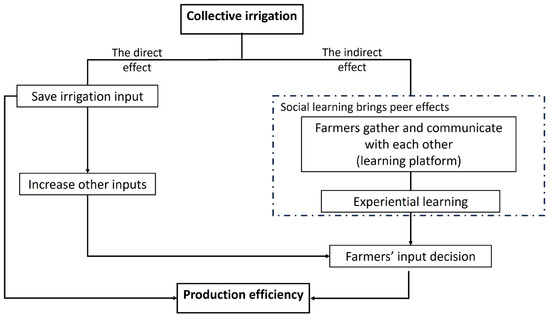
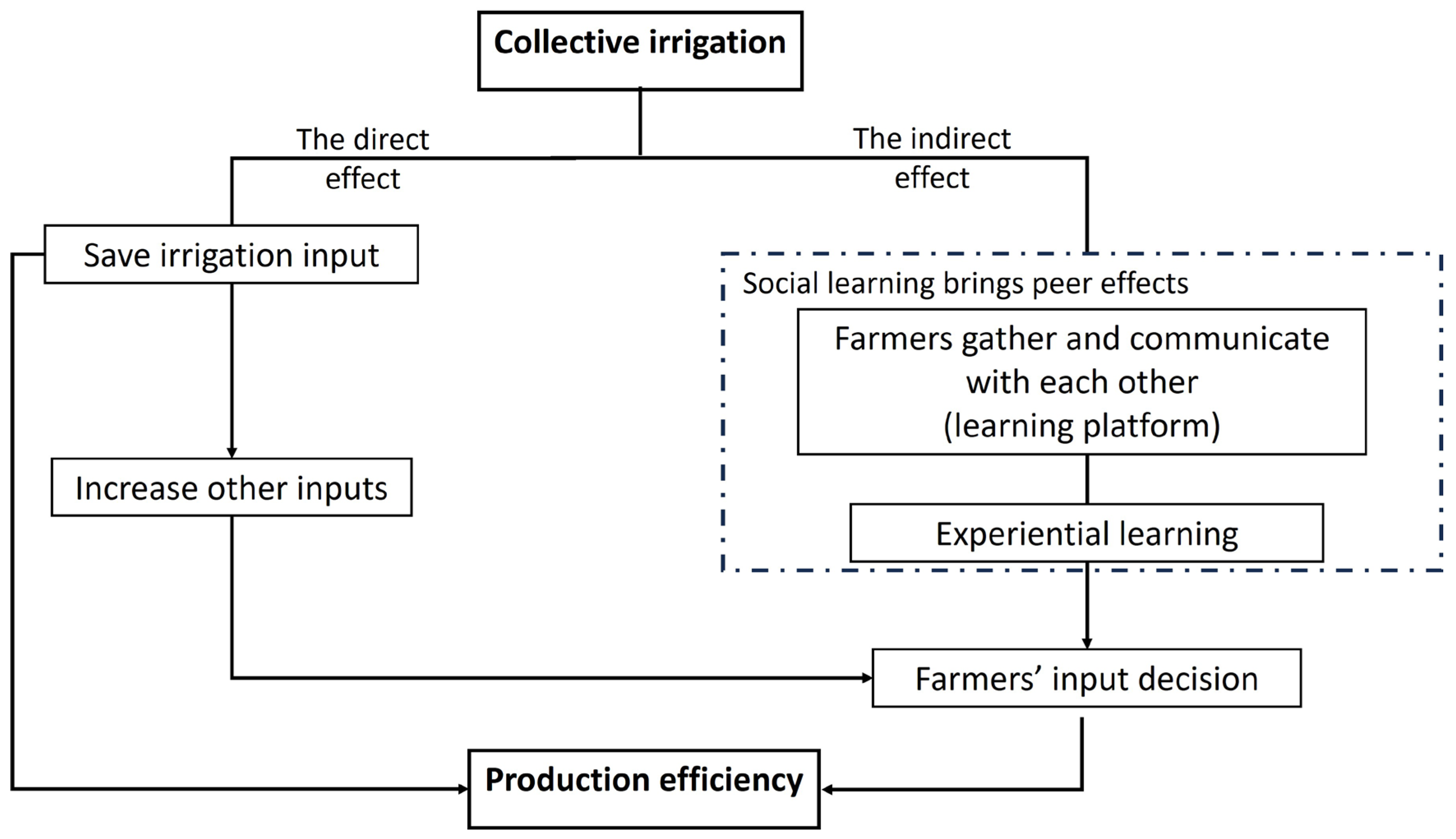
Before proceeding to the empirical analysis, this section outlines the conceptual framework of the study, as illustrated in Figure 1. The framework clarifies how collective irrigation, as a form of collective action, shapes farmers’ social interactions, thus affecting technology choices and production efficiency in rice production.
Figure 1.
Conceptual framework.
In the context examined here, farmers across villages adopt different irrigation arrangements. Under private irrigation systems, farmers independently determine irrigation timing and rely on privately owned equipment, resulting in relatively isolated production decisions and limited interaction with neighbors. In contrast, collective irrigation involves shared infrastructure and synchronized water use. As water allocation is jointly organized, farmers participating in collective irrigation coordinate irrigation schedules and farming activities more closely. This coordination increases both the frequency and intensity of interactions among farmers compared with private irrigation systems. Collective irrigation can influence production efficiency through both direct and indirect channels. The direct effect, although present, is secondary in this study: by pooling water resources and sharing infrastructure, collective irrigation can modestly reduce per-unit irrigation costs and free household labor, allowing some reallocation to other production activities. However, the primary channel of interest is indirect. Collective irrigation creates social interaction platforms in which farmers frequently meet, observe one another, and exchange information. Informal discussions during irrigation activities facilitate the transmission of knowledge on crop management, input usage, and production timing.
Within this social learning environment, information tends to flow from farmers with greater experience or managerial ability to those with less. More knowledgeable farmers share effective practices regarding input selection, application timing, and dosage, while less experienced farmers actively seek guidance from their peers. Over time, repeated interactions under collective irrigation foster convergence in farmers’ perceptions and production decisions. As a result, input choices such as fertilizer and pesticide usage, along with other decisions involving seeds, labor, and machinery services, become more similar across collectively irrigated villages.
This convergence process enhances the efficiency of farmers who initially operate at lower performance levels. By adopting better-informed production practices, these farmers can optimize input allocation and reduce costs. In this sense, collective irrigation functions primarily as a social learning platform that strengthens peer effects through neighborhood interactions, with only secondary contributions from direct cost savings.
Overall, the framework highlights the importance of information, knowledge, and technology as critical resources in agricultural production. Although rarely treated explicitly as production inputs, they play a key role in shaping farmers’ decisions and efficiency outcomes. Recognizing information embedded in social interactions may therefore provide valuable directions for future research.
Based on the above discussion, we propose the following hypothesis:
H1.
Collective irrigation arrangements strengthen peer effects in improving technical efficiency in rice-growing areas.
3. Data and Methods
3.1. Data
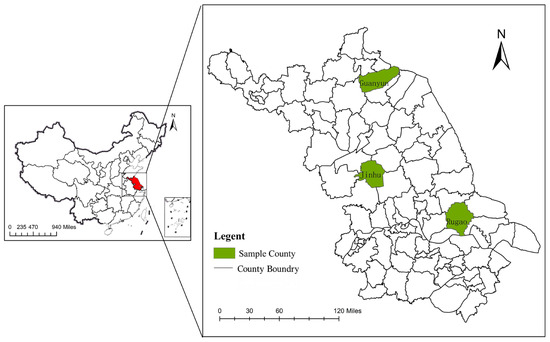
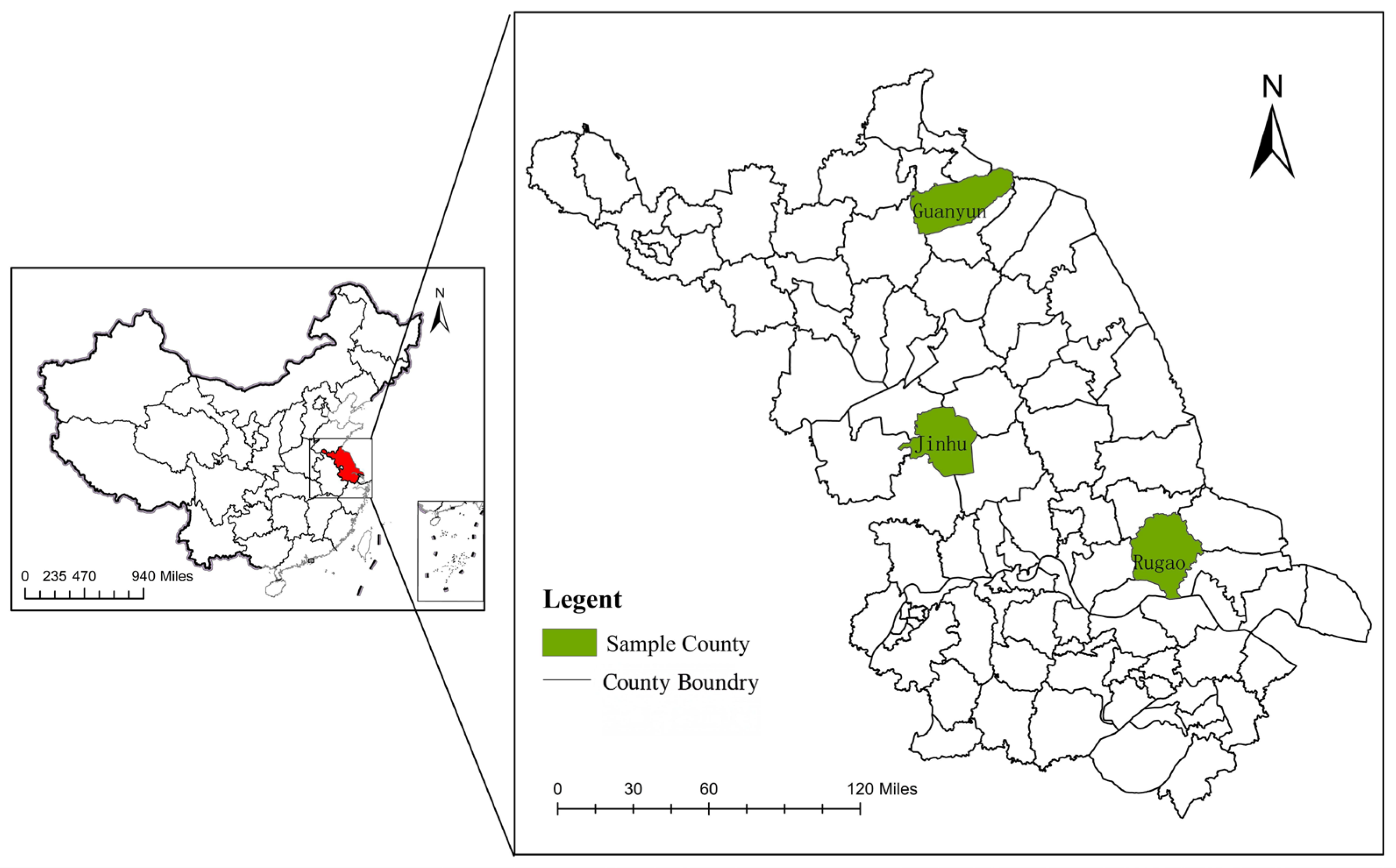
The study focuses on Jiangsu Province (Figure 2), a major rice-producing region characterized by low-lying terrain, dense river networks, and a subtropical warm monsoon climate. Within Jiangsu, three counties, Guanyun, Jinhu, and Rugao, were selected based on their natural conditions, geographic location, and agricultural practices, ensuring both diversity and comparability in soil type, climate, altitude, and hydrology. This careful selection helps isolate the effects of institutional arrangements and social interactions on production efficiency.
Figure 2.
Description of the study area.
The data used in this study were collected in 2019 through a carefully designed multi-stage rural survey. Within each of the three selected counties, six villages were randomly chosen to ensure representation of different local conditions, and from each village, one paddy field was randomly selected for detailed study. Within each selected field, approximately 50 plots were randomly chosen, with each plot managed by a single farmer, ensuring a one-to-one correspondence between plots and respondents. If a selected paddy field contained fewer than 50 plots, an additional field within the same village was selected to ensure that the total number of surveyed plots reached approximately 50. In cases where farmers had migrated, were absent, or otherwise unavailable, information was systematically obtained from relatives, neighbors, or village cadres to maintain the completeness and reliability of the dataset. In total, the survey covered 308 plots, providing comprehensive plot-level data for both 2015 and 2019. The four-year span allows for the observation of meaningful changes in production practices and outcomes, enabling analysis of how institutional arrangements and social interactions influence farm-level efficiency over time. The plot-level resolution is particularly valuable, as it captures heterogeneity in plot size, irrigation methods, and input allocation—features often obscured in aggregated datasets. This panel structure facilitates the analysis of production efficiency dynamics over time and allows for a fine-grained assessment of the effects of irrigation arrangements and peer interactions.
Although the dataset covers only the years 2015 and 2019, it remains highly relevant for understanding contemporary agricultural practices in China. On one hand, the context of the data reflects the current scope of land holdings and the rapid evolution of digital agriculture. The pace of land transfer has slowed substantially in recent years since 2018 and has remained stable [22], and by 2019, the level of digitalization in agricultural production nationwide had reached 23.8%. On the other hand, collective irrigation arrangements in Jiangsu are highly stable, organized at the village level, and rely on shared infrastructure and coordinated labor. These systems are minimally affected by temporary disruptions, such as mobility restrictions, ensuring that the irrigation practices and social interactions captured in the dataset remain reflective of current realities. As a result, the dataset provides a robust foundation for examining how institutional arrangements and social mechanisms—particularly collective irrigation and peer effects—contribute to shaping rice production efficiency in Jiangsu Province.
3.2. Variables and Descriptive Statistics
The variables used in this study are described as follows.
- Output and inputs. Output is measured as rice production value per hectare. Inputs include labor, capital, and land, all expressed in monetary terms to ensure comparability across plots. Labor input is measured by valuing family labor at prevailing market wages and adding expenditures on hired labor. Capital input is calculated as the sum of expenditures on intermediate inputs, including seeds, fertilizers, pesticides, and agricultural electricity, together with fixed costs related to machinery, equipment, and tools. Land input is measured by combining the imputed rental value of owned land, based on rental prices of comparable nearby plots, with actual rental payments for leased land. Descriptive statistics for the variables used to estimate the production function are reported in Table 1. The average output per hectare is 20,676.15 yuan, while the corresponding average unit expenditures on labor, capital, and land are 7202.35, 8830.87, and 4535.29 yuan per hectare, respectively.
Table 1.
Descriptive statistics for production function variables.
- Irrigation type. Rice production in China operates under a dual irrigation system consisting of collective and private arrangements, reflecting institutional diversity in village-level water management. In areas with government-constructed water supply networks, irrigation is coordinated collectively by farmer groups sharing common water intakes. These groups manage irrigation ditches and water conveyance infrastructure, allocate water, regulate abstraction, and coordinate with neighboring groups or villages. Such arrangements require joint planning and cooperative decision-making, which can enhance water use efficiency and the management of shared infrastructure. In contrast, in areas without water supply networks, farmers irrigate independently by drawing water from rivers or groundwater, determining their own irrigation schedules, and relying entirely on privately owned equipment. These differences create distinct operational and social environments that may influence productivity and the diffusion of agricultural knowledge. As shown in Table 2, 72 percent of the sample plots adopt collective irrigation. Notably, irrigation type remains unchanged between 2014 and 2019.
- Farmer characteristics. Control variables capture individual and household characteristics. Following prior studies [22,23,24,25], individual characteristics include the gender, age, education, and farming experience of the household head. Household characteristics include farm size, measured as the total area of arable land operated by the household, and the number of household members engaged in off-farm employment. As reported in Table 2, the average household head is 61.88 years old, and 72 percent are male, indicating an aging and male-dominated farming population. Educational attainment is relatively low, with an average of 5.54 years of schooling, while about 70 percent of household heads are classified as having high farming experience, reflecting long-term involvement in rice production. The average farm size is 0.68 hectares, highlighting the small-scale nature of farming, and households have, on average, 1.48 members engaged in off-farm employment, underscoring the continued importance of non-farm income sources in rural livelihoods.
Table 2.
Descriptive statistics for main variables.
3.3. Empirical Strategies
The empirical analysis proceeds in two stages. In the first stage, farm-level technical efficiency is estimated using a time-varying stochastic frontier production function. To address potential endogeneity arising from correlations between input choices and unobserved efficiency, a correlated random effects approach is employed [26,27]. In the second stage, peer effects are estimated using a linear-in-means framework, and their magnitudes are compared across collective and private irrigation systems. Potential identification challenges, including simultaneity, omitted variable and sample selection bias, are addressed by employing plot-level panel data with a two-way fixed effects specification, which controls for unobserved heterogeneity across plots and over time.
3.3.1. Estimation of Technical Efficiency
Technical efficiency is estimated using stochastic frontier analysis with a translog production function. The translog specification relaxes the restrictive assumption of constant elasticity of substitution and allows flexible interactions among inputs, providing a better fit to the data. The production frontier is specified as:
where Qijt denotes output value, and Lijt, Kijt, Aijt represent labor, capital, and land inputs for plot j in village i at year t. The term ɛijt is a two-sided random error capturing statistical noise, while uijt represents nonnegative technical inefficiency, assumed to follow a half-normal distribution.
lnQijt = γ0 + γ1lnLijt + γ2lnKijt + γ3lnAijt + 0.5γ4(lnLijt)2 + 0.5γ5(lnKijt)2 + 0.5γ6(lnAijt)2
+ γ7(lnLijt × lnKijt) + γ8(lnLijt × lnAijt) + γ9(lnKijt × lnAijt) + ɛijt − uijt,
+ γ7(lnLijt × lnKijt) + γ8(lnLijt × lnAijt) + γ9(lnKijt × lnAijt) + ɛijt − uijt,
Technical efficiency for each plot is defined as TEijt = exp(−uijt) and varies over time. A value of uijt = 0 indicates that production lies on the frontier and achieves full technical efficiency, while uijt > 0 implies technical inefficiency, with efficiency scores bounded between zero and one.
3.3.2. Identification of Peer Effects
Following Manski [28], similar behavioral outcomes within a group may arise from three sources: endogenous effects, where individual behavior responds to peers’ behavior; exogenous effects, where behavior responds to peers’ characteristics; and correlated effects, where similarities are driven by shared environments. Endogenous and exogenous effects stem from social interactions, with endogenous effects interpreted as peer effects. To estimate peer effects on technical efficiency, we adopt the linear in means model of Bramoullé et al. [29], which builds on Manski’s framework. Individual technical efficiency depends on a farmer’s own characteristics as well as the average efficiency and characteristics of peers within the same group.
We construct two alternative definitions of peer groups. The first defines the peer group as sample farmers within the same village. This definition is based on the premise that villages in rural China function as cohesive social and economic units, where frequent communication, mutual observation, and shared institutions, such as collective irrigation, facilitate the diffusion of agricultural practices [30]. However, village-level aggregation may not fully capture localized interactions, particularly when villages are large or spatially dispersed. To address this concern and test the robustness of our findings, we adopt a second definition based on geographic proximity, grouping plots located within the same paddy field. This definition assumes that farmers whose plots are physically adjacent are more likely to interact directly, observe each other’s practices, and experience peer effects through face-to-face communication or visual inspection. By comparing results across these two definitions, we assess whether the estimated peer effects are sensitive to the level of aggregation and gain a more nuanced understanding of how spatial proximity shapes social interactions under different irrigation regimes.
A central challenge is the reflection problem, caused by simultaneity and omitted variable bias, which makes it difficult to distinguish endogenous peer effects from exogenous or contextual effects. To address this, a two-way fixed effects specification is employed, controlling for time-invariant heterogeneity at the plot, household, and village levels, as well as common time-specific shocks.
The peer effects model is specified as:
where i(−j)t is the average technical efficiency of peer plots within the same village or paddy field, excluding plot j. The vector Zijt is a vector of individual farmer characteristics, and i(−j)t represents the mean characteristics of peer farmers. The coefficients a1 and a3 capture endogenous and exogenous effects, respectively. A statistically significant a1 indicates the presence of peer effects. The terms ij and vt denote plot fixed effects and year fixed effects, respectively, and ɛijt is the error term.
3.3.3. The Moderating Role of Collective Irrigation
To examine whether peer effects vary by irrigation systems, an interaction term between peer efficiency and collective irrigation is introduced:
where CIi is a dummy variable indicating whether village i adopts collective irrigation. This variable is time invariant over the study period. The coefficient β1 captures the differential peer effect associated with collective irrigation, allowing for a direct comparison of peer influence under collective and private irrigation regimes.
A potential concern is self-selection into irrigation type. Villages with stronger organizational capacity may be more likely to implement collective irrigation and simultaneously more capable of coordinating other forms of collective action, such as technology adoption. In such cases, enhanced spatial correlation in production behavior under collective irrigation may reflect unobserved social capital, such as trust or cooperation norms, rather than pure social learning effects. To mitigate this concern, the two-way fixed effects specification controls for time-invariant unobservable characteristics at the plot and village levels. Moreover, time-varying unobservables are unlikely to be systematically correlated with irrigation choice. In the study area, the adoption of collective versus individual irrigation primarily depends on geographical conditions. Land reclaimed from swamps and surrounded by dense water networks is suitable for individual irrigation, whereas plots located farther from water sources require collective organization among multiple smallholders. As a result, irrigation methods are largely determined by natural endowments and have remained stable for an extended period. In our study area, irrigation arrangements did not change during the sample period and, according to local knowledge, have remained largely unchanged for more than two decades. Therefore, the choice of irrigation system can be reasonably treated as exogenous in our empirical setting.
4. Results
4.1. Estimation of Farm Efficiency
Table 3 reports the estimated coefficients of the time-varying stochastic frontier production function. The estimated parameters indicate that labor, capital, and land inputs all contribute positively to rice output, although their marginal effects vary. The statistically significant squared term for land input suggests diminishing marginal returns to land, highlighting the nonlinear relationship between land use and output. In contrast, the squared terms for labor and capital are not statistically significant, implying relatively stable marginal productivity within the observed input range. The interaction terms between inputs are generally small and statistically insignificant, suggesting limited complementarity or substitutability effects among labor, capital, and land in rice production. Overall, the translog specification provides sufficient flexibility in capturing production technology and offers an appropriate basis for estimating farm-level technical efficiency.
Table 3.
Estimated results of the stochastic frontier production function.
Using the estimated production frontier, technical efficiency scores are calculated for each plot. These scores measure how close each farm is to the estimated maximum possible output given its input levels. Table 4 presents the average technical efficiency across counties and irrigation types. Across all farms, average technical efficiency ranges from 0.835 to 0.869, suggesting that most rice producers operate relatively close to the production frontier. This indicates that, on average, farms are utilizing their inputs efficiently, but there remains some scope for improvement.
Table 4.
Average farm technical efficiency.
Notable differences emerge between irrigation systems. Collectively irrigated farms consistently exhibit higher technical efficiency than privately irrigated farms across all counties. The largest gap is observed in Jinhu, where collectively irrigated farms have an average efficiency 0.048 higher than privately irrigated farms, a difference that is statistically significant at the 5% level. In Rugao and Guanyun, the differences are smaller and not statistically significant, but the pattern remains consistent, suggesting that collective irrigation generally supports higher efficiency. These results indicate that collective irrigation arrangements may enhance production efficiency through several mechanisms, including improved water allocation, coordinated farm management, and increased opportunities for social learning and peer interaction among farmers.
4.2. Effects of Peers and Collective Irrigation on Farm Efficiency
Table 5 reports the estimated effects of peer influence on farm technical efficiency using the linear in means model with two-way fixed effects. Columns (1) and (3) show that, regardless of the definition of the peer group, the average technical efficiency of neighboring farmers has a positive and statistically significant effect on individual farm efficiency. This result provides clear evidence of peer effects, indicating that farmers benefit from observing and interacting with more efficient peers within the same group. Such interactions may facilitate knowledge transfer, the adoption of improved practices, and the reinforcement of efficient production behaviors.
Table 5.
Peer effects and the impact of collective irrigation on technical efficiency.
Columns (2) and (4) extend the baseline specification by incorporating the interaction between peer efficiency and collective irrigation. The interaction terms are positive and statistically significant, suggesting that peer effects are stronger in villages that adopt collective irrigation. This finding implies that collective irrigation systems may serve as platforms for social interaction, coordination, and information exchange, thereby amplifying the diffusion of efficiency-enhancing practices. In other words, collective irrigation not only organizes water use but also strengthens social learning mechanisms that promote the adoption of improved production techniques.
The estimated coefficients for individual characteristics reveal several noteworthy patterns. Male household heads tend to achieve higher technical efficiency, while age is negatively associated with efficiency, possibly reflecting declines in physical capacity, adaptability, or openness to new practices among older farmers. Education is negatively related to technical efficiency, potentially indicating that more formally educated farmers possess less practical knowledge or experience relevant to agricultural production. Similarly, farming experience is negatively associated with technical efficiency, which may suggest that more experienced farmers rely on established production routines that are less responsive to peer learning or technological change.
Peer characteristics also play an important role in shaping individual technical efficiency. Higher average education and farming experience among peers are positively associated with individual technical efficiency, highlighting the importance of collective human capital in influencing production performance. These findings suggest that peer effects operate not only through the observable efficiency levels of neighboring farmers but also through their attributes, such as knowledge, experience, and skills. Overall, these results emphasize that social interactions and characteristics of peers are critical determinants of farm-level efficiency, particularly when embedded within institutional arrangements such as collective irrigation.
4.3. Heterogeneity Analysis of Peer Effects Under Collective Irrigation
Table 6 presents heterogeneity in peer effects under collective irrigation across different village and farm characteristics. The results reveal substantial variation in both the magnitude and statistical significance of peer effects depending on contextual factors.
Table 6.
Heterogeneity of peer effects under collective irrigation.
First, Columns (1) and (2) show that in villages without public technology extension services, the interaction between collective irrigation and peer efficiency is positive and highly significant, whereas it is statistically insignificant in villages with public extension services. This pattern suggests that formal extension activities or demonstration programs may partially substitute for informal peer learning. Where formal guidance is available, the marginal benefit of observing neighbors’ practices declines. In contrast, in villages lacking such institutional support, farmers rely more heavily on peer interactions to acquire knowledge and improve technical efficiency.
Second, Columns (3) and (4) indicate that peer effects under collective irrigation are significantly stronger among farmers with weaker production capacity than among those with stronger capacity. This finding suggests that less capable farmers rely more heavily on social learning and peer observation to enhance performance, highlighting the inclusive role of collective irrigation in supporting relatively disadvantaged producers. Columns (5) and (6) show that the presence of off-farm employment weakens peer effects, likely because these farmers devote less time and effort to agricultural activities and have fewer opportunities for interaction and knowledge exchange.
Third, Columns (7) and (8) demonstrate that the impact of peer effects is more pronounced for smaller plots, indicating that small-scale farmers benefit disproportionately from peer learning facilitated by collective irrigation arrangements. On smaller plots, farmers may more easily observe neighbors’ practices, exchange knowledge, and coordinate activities, thereby achieving larger relative efficiency gains.
Overall, these findings demonstrate that the benefits of peer interactions under collective irrigation are context dependent. Village-level institutional conditions, farmer production capacity, labor allocation, and plot size all shape the extent to which collective irrigation enhances technical efficiency through social learning mechanisms.
4.4. Mechanism Analysis: Effects of Peers and Collective Irrigation on Chemical Input Use
Table 7 reports the mechanism analysis examining how peer effects and collective irrigation influence farmers’ use of chemical inputs, specifically fertilizer and pesticides. The estimates show that the direct peer effects on both fertilizer and pesticide inputs are statistically insignificant. This suggests that, in the absence of collective institutional arrangements, simply observing the efficiency of neighboring farmers does not directly induce adjustments in chemical input use.
Table 7.
Peer effects and the impact of collective irrigation on chemical input use.
When the interaction between peer effects and collective irrigation is introduced, a distinct pattern emerges for pesticide use. The interaction term is positive and statistically significant in the pesticide equation, indicating that collective irrigation strengthens peer influence on pest management decisions. Under collective irrigation systems, farmers are more likely to coordinate pest control activities, share information about outbreaks, and form common perceptions of pest risks. As a result, pesticide application becomes more aligned across neighboring farmers. This finding is consistent with Aida [16], who emphasizes the role of collective institutions in facilitating coordinated pest management and information sharing.
In contrast, no statistically significant interaction effect is observed for fertilizer input. This suggests that fertilizer decisions are less responsive to peer interactions, even within collectively irrigated settings. Fertilizer application is often relatively standardized and guided by extension recommendations or established nutrient management routines, which may limit the scope for peer-driven adjustments. By comparison, pest control requires timely and context-specific responses to outbreaks, weather conditions, and observable crop damage. These features make pesticide decisions more information sensitive and therefore more susceptible to social learning.
Taken together, these results indicate that collective irrigation enhances technical efficiency not only through improved water management and coordination, but also by amplifying peer effects in specific dimensions of input management, particularly pesticide use. The findings highlight the importance of institutional arrangements in shaping both social interactions and production outcomes, suggesting that collective irrigation serves as an effective platform for reinforcing efficiency-enhancing behaviors beyond basic input allocation.
5. Discussion
This study advances the literature on agricultural productivity, collective action, and social interactions by linking irrigation institutions with peer effects in farm-level technical efficiency. While prior research has emphasized factor inputs, scale economies, and technology adoption in smallholder systems [31,32], our findings highlight the central role of water governance in shaping the diffusion of efficiency-enhancing knowledge. This underscores that institutional arrangements, not just technology or inputs, are critical for sustainable productivity improvements. Consistent with studies on collective action in irrigation [21], stochastic frontier estimates show that farms under collective irrigation achieve higher technical efficiency than those relying on private irrigation. This advantage, previously attributed to better coordination, more efficient water allocation, and lower transaction costs [33,34], is further reinforced through social mechanisms—interaction, learning, and coordinated decision-making—that translate into measurable productivity gains.
This study identifies significant peer effects in technical efficiency, in line with evidence on social learning and spatial spillovers in agricultural production [10,11,12,13,14,15,16,17]. Beyond technology adoption and input choices, efficiency appears to be socially transmitted: farmers surrounded by more efficient peers achieve higher efficiency, suggesting that managerial practices, production timing, and input combinations are learned through observation, repeated interaction, and informal knowledge exchange within local production environments. Policies promoting collective irrigation can therefore strengthen both institutional capacity and peer-based learning, generating broader efficiency gains in smallholder agriculture.
Importantly, the magnitude of peer effects is highly context-dependent. Peer effects are significantly stronger under collective irrigation, indicating that irrigation institutions shape both the intensity and effectiveness of social interactions. This finding aligns with institutional economics arguments that repeated interaction and shared governance structures foster trust, facilitate information exchange, and reinforce cooperative norms [35,36]. By providing regular and structured opportunities for coordination, collective irrigation amplifies learning externalities that might otherwise remain weak, fragmented, or unevenly distributed.
Heterogeneity analyses provide further insight into these dynamics. Peer effects are stronger in villages without public technology extension services, suggesting that informal social learning can partially substitute for formal extension provision [13,30]. Peer effects are also more pronounced among farmers with weaker production capacity, without off-farm employment, and on smaller plots, indicating that less experienced, less capable, agriculture-dependent, or small-scale producers rely more heavily on peer observation and social learning [11,12]. In these contexts, collective irrigation functions as an organizational platform that embeds relatively vulnerable farmers in dense interaction networks, reduces barriers to knowledge acquisition, facilitates the imitation of best practices, and supports performance upgrading. The stronger effects observed on smaller plots further reflect the greater visibility of production practices and the ease of coordination among neighboring farmers, enabling smallholders to achieve relatively larger efficiency gains through social interaction [37].
The extended analysis of chemical input use adds further nuance. Although peer effects alone do not consistently influence fertilizer or pesticide inputs, their interaction with collective irrigation significantly affects pesticide use. This suggests that collective arrangements help synchronize production decisions and shape farmers’ responses to uncertain risks, such as pest outbreaks. Overall, these findings indicate that collective irrigation enhances efficiency not only through improved resource coordination but also through behavioral alignment in input management, with potential implications for environmental sustainability and resource-efficient agriculture.
Taken together, these results demonstrate that collective irrigation enhances technical efficiency through both direct and social channels. By integrating stochastic frontier analysis with peer effects models, this study illustrates how institutional arrangements structure farmers’ interactions, learning, and collective decision-making, ultimately shaping productivity outcomes in smallholder agriculture. The findings underscore that achieving efficiency gains depends not only on technology and factor inputs but also on the social and institutional contexts in which farmers operate, highlighting the importance of designing policies that strengthen both governance structures and peer-based knowledge networks.
6. Conclusions and Policy Implications
6.1. Main Conclusions
This study examines how collective irrigation and peer effects jointly influence rice production efficiency using plot-level panel data from three counties in Jiangsu Province. Technical efficiency is first estimated using a time-varying stochastic frontier production function, and peer effects are subsequently identified through a linear in means model with two-way fixed effects. This integrated framework allows us to jointly assess production technology, social interactions, and institutional arrangements.
The results show that collective irrigation is associated with higher technical efficiency and that significant peer effects exist among rice farmers. More importantly, collective irrigation amplifies these peer effects, suggesting that water governance institutions facilitate the diffusion of efficiency-enhancing practices through social interaction. These effects are particularly pronounced among smallholders, farmers with weaker production capacity and without off-farm employment, and in villages lacking public technology extension services, highlighting the inclusive role of collective irrigation in supporting relatively disadvantaged producers. Mechanism analysis further indicates that peer effects under collective irrigation influence specific managerial decisions, especially pesticide use.
It is important to interpret these findings within the geographic scope of the study. The three sampled counties are located in eastern China, a region characterized by relatively developed infrastructure, stable land tenure arrangements, and well-established collective institutions. The effectiveness of peer-based mechanisms observed in this study is likely conditioned on these institutional and social foundations. In particular, strong village-level social cohesion and mature irrigation organizations may facilitate frequent interaction, trust, and coordinated action among farmers, thereby amplifying peer effects. In regions where land tenure is insecure, collective governance is weak, or social cohesion is limited, similar institutional arrangements may not generate comparable efficiency gains. These contextual factors, therefore, represent important boundary conditions for the generalizability of our results.
6.2. Policy Implications
Several policy implications follow.
First, strengthening agricultural socialized service systems remains essential. Regional technical training, extension services, and capacity building programs can complement collective irrigation by enhancing farmers’ ability to absorb and apply new knowledge. In areas where formal extension is limited, facilitating structured peer learning through collective organizations may serve as an effective alternative channel for technology diffusion.
Second, social networks should be recognized as a critical infrastructure for knowledge transmission. Local governments can leverage existing farmer networks embedded in irrigation groups to promote information exchange and coordinated responses to production risks. Integrating formal extension services with informal peer learning mechanisms can improve the overall effectiveness of agricultural innovation systems.
Third, policy design should account for contextual heterogeneity. The positive interaction between collective irrigation and peer effects is more likely to emerge where stable land tenure, functional collective governance, and sufficient social cohesion are present. In regions with fragmented land rights, weak local institutions, or low trust, strengthening organizational capacity may be a prerequisite for realizing similar benefits. Tailoring irrigation and collective action policies to local institutional environments is therefore critical.
Overall, the findings suggest that collective irrigation can function not only as a water management arrangement but also as a platform for social learning and coordinated decision making. When supported by appropriate institutional and social conditions, such arrangements can enhance efficiency, resilience, and sustainability in smallholder agricultural systems.
6.3. Limitations
This study has several limitations. First, although the empirical strategy addresses potential endogeneity through panel methods and fixed effects, causal identification could be further strengthened using experimental or quasi-experimental designs. Second, the analysis estimates average peer effects but lacks fine-grained spatial information, limiting the ability to examine how peer influence attenuates with geographic distance or varies across micro spatial networks. Incorporating high-resolution spatial data in future research would allow more precise identification of spillover dynamics. Third, the data are regionally concentrated in eastern China and limited to the 2015 to 2019 period, which may constrain the temporal and geographic generalizability of the findings.
6.4. Future Directions
This study also points to several avenues for future research.
First, as this analysis focuses on rice production in China, the external validity of the findings should be tested in other crops, production systems, and institutional environments. Future research could examine whether similar peer amplification effects emerge in regions with different land tenure systems, levels of mechanization, or irrigation governance structures. Comparative studies at the international level would be particularly valuable for assessing the transferability of collective irrigation-based peer mechanisms to other developing and transition economies.
Second, it is important to identify which stages of agricultural production are most suitable for collective action. Although collective irrigation generates clear benefits in many contexts, private irrigation arrangements may be more efficient under certain ecological, economic, or organizational conditions [33,38]. Understanding when collective versus individual governance structures yield the greatest productivity gains remains an important open question.
Third, the rapid expansion of digital technologies presents new opportunities to facilitate learning and cooperation. Online platforms for sharing agricultural knowledge and production experiences are increasingly accessible in rural areas [39]. Future studies should explore how internet-based learning can be integrated with traditional social networks and collective institutions, and how such hybrid mechanisms influence efficiency, technology adoption, and knowledge diffusion.
Author Contributions
Y.J. conceived and designed the study; Z.Y. and Y.Y. collected the data; Z.Y. and Y.Y. analyzed the data. All authors have read and agreed to the published version of the manuscript.
Funding
This study was funded by the National Social Science Foundation of China (Grant number: 21&ZD101).
Data Availability Statement
Data is unavailable due to privacy or ethical restrictions.
Conflicts of Interest
The authors declare no conflicts of interest.
References
- Wang, J.; Huang, J.; Zhang, L.; Huang, Q.; Rozelle, S. Water governance and water use efficiency: The five principles of WUA management and performance in China. J. Am. Water Resour. Assoc. 2010, 46, 665–685. [Google Scholar] [CrossRef] [Scilit]
- Wang, J.; Zhu, Y.; Sun, T.; Huang, J.; Zhang, L.; Guan, B.; Huang, Q. Forty years of irrigation development and reform in China. J. Am. Water Resour. Assoc. 2020, 64, 126–149. [Google Scholar] [CrossRef] [Scilit]
- Qin, H.; Rutgerd, B.; Jan, G.V. The evolution of China’s rural water governance: Water, techno-political development and state legitimacy. J. Peasant Stud. 2024, 51, 717–737. [Google Scholar]
- Ali, J.; Nizami, A.; Hebinck, P. Mismanagement of irrigation water and landslips in Yourjogh, Pakistan. Mt. Res. Dev. 2017, 37, 170–178. [Google Scholar] [CrossRef] [Scilit]
- Wang, Y.; Wang, H. Effects of farmland use rights transfer on collective action in the commons: Evidence from rural China. Land Use Policy 2022, 120, 106262. [Google Scholar] [CrossRef] [Scilit]
- Al-Marshudi, A.S. Traditional irrigated agriculture in Oman: Operation and management of the Aflaj system. Water Int. 2001, 26, 259–264. [Google Scholar] [CrossRef] [Scilit]
- Bastakoti, R.C.; Shivakoti, G.P.; Lebel, L. Local irrigation management institutions mediate changes driven by external policy and market pressures in Nepal and Thailand. Environ. Manag. 2010, 46, 411–423. [Google Scholar] [CrossRef] [Scilit]
- Su, Y.; Li, Y.; Chen, X.; Wang, Y.; Zang, L. Farmland titling, farmland adjustment and rural collective action: Application of institutional analysis and development framework using evidence from China’s irrigation commons. J. Rural Stud. 2023, 102, 103089. [Google Scholar] [CrossRef] [Scilit]
- Conley, T.G.; Udry, C.R. Learning about a new technology: Pineapple in Ghana. Am. Econ. Rev. 2010, 100, 35–69. [Google Scholar] [CrossRef] [Scilit]
- Davis, K.; Nkonya, E.; Kato, E.; Mekonnen, D.A.; Odendo, M.; Miiro, R. Impact of farmer field schools on agricultural productivity and poverty in East Africa. World. Dev. 2010, 40, 402–413. [Google Scholar] [CrossRef] [Scilit]
- Njuguna, M.M. Assessment of the role of social capital in the adoption of agriculture innovation among smallholder farmers: A case of tissue culture banana in Kenya. Adv. Exp. Soc. Psychol. 2012, 46, 237–283. [Google Scholar]
- Ward, P.S.; Pede, V.O. Capturing social network effects in technology adoption: The spatial diffusion of hybrid rice in Bangladesh. Aust. J. Agric. Resour. Econ. 2015, 59, 225–241. [Google Scholar] [CrossRef] [Scilit]
- Nakano, Y.; Tsusaka, T.W.; Aida, T.; Pede, V.O. Is farmer-to-farmer extension effective? The impact of training on technology adoption and rice farming productivity in Tanzania. World Dev. 2018, 105, 336–351. [Google Scholar] [CrossRef] [Scilit]
- Munshi, K. Social learning in a heterogeneous population: Technology diffusion in the Indian Green Revolution. J. Dev. Econ. 2004, 73, 185–213. [Google Scholar] [CrossRef] [Scilit]
- Bandiera, O.; Rasul, I. Social networks and technology adoption in northern Mozambique. Econ. J. 2006, 116, 869–902. [Google Scholar] [CrossRef] [Scilit]
- Aida, T. Neighbourhood effects in pesticide use: Evidence from the Rural Philippines. J. Agric. Econ. 2017, 69, 163–181. [Google Scholar] [CrossRef] [Scilit]
- Songsermsawas, T.; Baylis, K.; Chhatre, A.; Michelson, H. Can peers improve agricultural revenue? World Dev. 2016, 83, 163–178. [Google Scholar] [CrossRef] [Scilit]
- Villanueva, D.B.; Sumalde, Z.M.; Pede, V.O.; Garcia, Y.T.; Rodriguez, U.E. Assessment of neighborhood and spillover effects on technical efficiency of irrigated rice farmers. Asian J. Agric. Dev. 2017, 14, 103–125. [Google Scholar] [CrossRef] [Scilit]
- Tsusaka, T.W.; Kajisa, K.; Pede, V.O.; Aoyagi, K. Neighborhood effects and social behavior: The case of irrigated and rainfed farmers in Bohol, the Philippines. J. Econ. Behav. Organ. 2015, 118, 227–246. [Google Scholar] [CrossRef] [Scilit]
- Min, S.; Kim, K. Do peers and agglomeration affect farm efficiency? Agric. Econ. 2024, 70, 395–405. [Google Scholar] [CrossRef] [Scilit]
- Pede, V.O.; Areal, F.J.; Singbo, A.; Mckinley, J.; Kajisa, K. Spatial dependency and technical efficiency: An application of a bayesian stochastic frontier model to irrigated and rainfed rice farmers in Bohol, Philippines. J. Agric. Econ. 2018, 49, 301–312. [Google Scholar] [CrossRef] [Scilit]
- Xu, G.; Ma, Y.; Qin, G.; Xu, C.; Zhu, Y. Why Chinese farmers are reluctant to transfer their land in the context of non-agricultural employment: Insights from agricultural mechanization. Humanit. Soc. Sci. Commun. 2025, 12, 428. [Google Scholar] [CrossRef] [Scilit]
- Duflo, E.; Kremer, M.; Robinson, J. Nudging farmers to use fertilizer: Theory and experimental evidence from Kenya. Am. Econ. Rev. 2011, 101, 2350–2390. [Google Scholar] [CrossRef] [Scilit]
- Bentley, J. Economic and ecological approaches to land fragmentation: In defence of a much-aligned phenomenon. Annu. Rev. Anthropol. 1987, 16, 31–67. [Google Scholar] [CrossRef]
- Tan, S.H.; Heerink, N.; Kruseman, G.; Qu, F.T. Do fragmented landholdings have higher production costs? Evidence from rice farmers in northeastern Jiangxi province, P.R. China. China Econ. Rev. 2008, 19, 347–358. [Google Scholar] [CrossRef] [Scilit]
- Mundlak, Y. On the pooling of time series and cross section data. Econometrica 1978, 46, 69–85. [Google Scholar] [CrossRef] [Scilit]
- Nguyen, T.T.; Tran, V.T.; Nguyen, T.T.; Grote, U. Farming efficiency, cropland rental market and income effect: Evidence from panel data for rural Central Vietnam. Eur. Rev. Agric. Econ. 2021, 48, 207–248. [Google Scholar] [CrossRef] [Scilit]
- Manski, C.F. Identification of endogenous social effects: The reflection problem. Rev. Econ. Stud. 1993, 60, 531–542. [Google Scholar] [CrossRef] [Scilit]
- Bramoullé, Y.; Djebbari, H.; Fortin, B. Identification of peer effects through social networks. J. Econom. 2008, 150, 41–55. [Google Scholar] [CrossRef] [Scilit]
- Xu, Z.; Zhang, K.; Zhou, L.; Ying, R. Mutual proximity and heterogeneity in peer effects of farmers’ technology adoption: Evidence from China’s soil testing and formulated fertilization program. China Agric. Econ. Rev. 2022, 14, 395–415. [Google Scholar] [CrossRef] [Scilit]
- Wu, Y.; Xi, X.; Tang, X.; Luo, D.; Gu, B.; Lam, S.K.; Vitousek, P.M.; Chen, D. Policy distortions, farm size, and the overuse of agricultural chemicals in China. Proc. Natl. Acad. Sci. USA 2018, 115, 7010–7015. [Google Scholar] [CrossRef] [Scilit]
- Feder, G.; Just, R.E.; Zilberman, D. Adoption of agricultural innovations in developing countries: A survey. Econ. Dev. Cult. Change 1985, 33, 255–298. [Google Scholar] [CrossRef] [Scilit]
- Mirra, L.; de Gennaro, B.C.; Giannoccaro, G. Farmer evaluation of irrigation services. Collective or self-supplied? Land 2021, 10, 415. [Google Scholar] [CrossRef] [Scilit]
- Nagrah, A.; Chaudhry, A.M.; Giordano, M. Collective action in decentralized irrigation systems: Evidence from Pakistan. World Dev. 2016, 84, 282–298. [Google Scholar] [CrossRef] [Scilit]
- Ostrom, E. A behavioral approach to the rational choice theory of collective action. Am. Political Sci. Rev. 1998, 92, 1–22. [Google Scholar] [CrossRef] [Scilit]
- Adhikari, B.; Lovett, J.C. Institutions and collective action: Does heterogeneity matter in community-Based resource management? J. Dev. Stud. 2006, 42, 426–445. [Google Scholar] [CrossRef] [Scilit]
- Yang, Z.; Wu, S.; Ji, Y.; Tan, L. Can large-scale farms lead smallholder agricultural digitalization? Evidence from intelligent machinery use in China. Appl. Econ. 2026, 58, 397–412. [Google Scholar] [CrossRef] [Scilit]
- Charlotte, D.F.; Meredith, G. Small private irrigation: A thriving but overlooked sector. Agric. Water Manag. 2014, 131, 167–174. [Google Scholar] [CrossRef] [Scilit]
- Ning, X.; Chen, Y.; Zhao, M. Do digital agricultural technology extension services promote the adoption of organomineral fertilizer use? Evidence from China. Front. Agric. Sci. Eng. 2025, 12, 670–687. [Google Scholar] [CrossRef] [Scilit]

Disclaimer/Publisher’s Note: The statements, opinions and data contained in all publications are solely those of the individual author(s) and contributor(s) and not of MDPI and/or the editor(s). MDPI and/or the editor(s) disclaim responsibility for any injury to people or property resulting from any ideas, methods, instructions or products referred to in the content. |
© 2026 by the authors. Licensee MDPI, Basel, Switzerland. This article is an open access article distributed under the terms and conditions of the Creative Commons Attribution (CC BY) license.