


Highlights
What are the main findings?
- Extreme events invalidate equilibrium sediment transport laws.
- Multiscale coupling is required for predictive reliability.
- Uncertainty amplifies across grain–reach–basin scales.
- Hybrid physics–AI frameworks enhance forecast robustness.
- Enables probabilistic sediment hazard assessment.
- Supports climate-resilient infrastructure planning.
- Improves extreme-event sediment prediction capability.
Abstract
Extreme hydrological events fundamentally alter sediment transport dynamics across grain, reach, and watershed scales, rendering classical equilibrium-based transport formulations inadequate. This review synthesizes recent advances in multiscale sediment transport modeling under highly unsteady and high-magnitude forcing conditions. At the grain scale, particle-resolved simulations demonstrate that sediment entrainment is governed by turbulence intermittency and transient force exceedance rather than mean bed shear stress thresholds, particularly when the hydrograph rise timescale (Th) becomes comparable to particle response times (Tp). At the reach scale, non-equilibrium transport emerges when the unsteadiness ratio Th/Ta∼O(1), where Ta is the sediment adaptation timescale representing the time required for sediment flux to adjust toward transport capacity. Under these conditions, pronounced hysteresis between discharge and sediment flux is observed, requiring relaxation-based transport formulations instead of instantaneous equilibrium laws. At the watershed scale, the sediment delivery ratio (SDR), defined as the ratio of sediment yield at the basin outlet to total hillslope erosion, becomes highly time-dependent. Extreme precipitation events can activate hillslope-channel connectivity, increasing SDR by orders of magnitude relative to baseline conditions. A unified dimensionless scaling framework is presented based on mobility intensity (θ/θc, where θ is the Shields parameter and θc is its critical value for incipient motion), unsteadiness ratio (Th/Ta), and morphodynamic coupling (Tf/Tm, where Tf is the hydraulic advection timescale and Tm is the morphodynamic adjustment timescale). This framework enables classification of sediment transport regimes ranging from quasi-equilibrium to cascade-dominated states. The synthesis demonstrates that predictive uncertainty increases nonlinearly across scales due to timescale compression, threshold activation, and feedback between flow hydraulics and evolving morphology. Recent developments in hybrid physics-AI approaches show promise in improving predictive capability by enabling dynamic transport closures, surrogate modeling of computationally expensive microscale processes, and data assimilation for real-time forecasting. However, these approaches remain limited by extrapolation uncertainty and the need to enforce physical constraints. Overall, this review concludes that regime-aware multiscale coupling, combined with uncertainty quantification and adaptive modeling strategies, is essential for robust sediment hazard prediction and climate-resilient infrastructure design under intensifying hydrological extremes.
1. Introduction
Extreme hydrological events—including flash floods, tropical cyclones, dam-break waves, and compound rainfall-runoff surges—are increasing in frequency and intensity under climate change [1,2,3,4,5,6,7,8,9,10]. These events generate highly unsteady flow conditions capable of mobilizing sediment across a wide range of spatial and temporal scales. Observations across diverse environments demonstrate that extreme precipitation events disproportionately contribute to annual sediment yield [11,12,13,14,15].
Accurately predicting sediment transport during such events remains a major scientific and engineering challenge due to nonlinear interactions among turbulent flow structures, sediment properties, channel morphology, and slope stability [15,16,17,18]. Under extreme forcing, conventional equilibrium transport assumptions often fail, as rapid hydrograph rise, hysteresis effects, and mass-wasting processes dominate system behavior [10,19].
Recent advances in computational mechanics and high-performance computing have enabled increasingly detailed modeling of sediment transport across scales, ranging from grain-resolved simulations to watershed-scale morphodynamics [20,21,22,23,24,25]. However, bridging these scales remains a central unresolved problem [6,20,26,27,28,29,30,31,32,33].
The objective of this review is to synthesize recent advances in multiscale sediment transport modeling under extreme hydrological events and to identify key challenges limiting predictive capability. The scope of the review is structured around a grain-reach-watershed hierarchy, with particular emphasis on non-equilibrium transport dynamics, transient sediment supply, and cross-scale feedback mechanisms activated under rapidly varying forcing.
This work contributes to the growing body of literature in three important ways. First, it introduces a regime-based dimensionless scaling framework that integrates mobility intensity, hydrograph unsteadiness, and morphodynamic coupling to classify sediment transport behavior under extreme conditions. Second, it formalizes the concept of cross-scale uncertainty propagation, highlighting how timescale compression and threshold activation amplify predictive uncertainty across modeling levels. Third, it synthesizes emerging hybrid physics-artificial intelligence (AI) approaches that enable adaptive multiscale modeling through dynamic transport closures, surrogate modeling, and data assimilation. Together, these contributions provide a unified perspective for advancing sediment transport modeling toward risk-informed prediction under intensifying hydroclimatic extremes.
This work is a review article that focuses on the conceptual synthesis and integration of existing sediment transport modeling approaches across multiple spatial scales. It does not aim to present new model development or validation results, but rather to provide a unified perspective on multiscale processes, modeling challenges, and emerging directions under extreme hydrological conditions. This distinction is important for appropriately positioning the contribution of this work within existing literature.
During the preparation of this manuscript/study, the authors used ChatGPT 5.2 for the purposes of grammar, editing, conceptual figure preparation, and structural refinement of the manuscript.
2. Sediment Dynamics Under Extreme Hydrological Forcing
Extreme hydrological events impose flow conditions that differ fundamentally from those assumed in classical sediment transport formulations. Unlike quasi-steady flows characterized by gradual hydrograph variation and near-equilibrium sediment flux, extreme events exhibit rapid hydrograph rise, spatially heterogeneous shear stress fields, strong turbulence intermittency, and abrupt sediment supply pulses. These features lead to highly nonlinear sediment responses across grain, reach, and basin scales.
2.1. Hydrodynamic Non-Equilibrium and Transient Shear Forcing
Recent studies (2020–2025) have demonstrated that sediment entrainment under extreme hydrological forcing is strongly governed by turbulence intermittency and coherent flow structures rather than time-averaged shear stress alone. High-resolution particle-resolved simulations and laboratory experiments (e.g., [20,34,35]) show that turbulent sweeps, ejections, and pressure fluctuations generate short-duration force peaks capable of exceeding critical entrainment thresholds even when mean shear stress remains below classical Shields-based predictions. These findings reinforce the stochastic nature of sediment motion initiation and highlight the limitations of equilibrium entrainment models under rapidly varying flow conditions.
Under rapidly rising hydrographs typical of flash floods and dam-break waves, turbulence intensity and intermittency increase sharply, leading to burst-driven entrainment and nonlinear scaling between instantaneous shear stress and sediment flux [14,36,37,38,39,40]. These processes are particularly pronounced at high Reynolds numbers, where coherent turbulent structures dominate near-bed dynamics. Direct numerical simulations demonstrate that sediment entrainment under strong turbulence is governed by fluctuating pressure gradients and coherent flow structures rather than mean shear stress alone [11,28,41,42].
These unsteady conditions produce pronounced hysteresis in sediment concentration relative to discharge. Rising limbs of flood hydrographs often mobilize large quantities of previously stored sediment, whereas falling limbs may reflect sediment depletion or deposition dominance [11,12]. Classical equilibrium transport capacity formulas therefore underpredict early-event sediment pulses.
Recent field and modeling studies have provided new insights into hysteresis behavior in sediment transport during extreme hydrological events. Clockwise and anticlockwise hysteresis loops in discharge-sediment concentration relationships are increasingly understood as emergent responses to time-dependent sediment supply and transport capacity [43,44,45]. In particular, recent work highlights the importance of antecedent moisture conditions, sediment storage–release cycles, and hillslope-channel connectivity in controlling hysteresis patterns during flood events [46].
Extreme precipitation events amplify these dynamics by activating threshold-controlled sediment sources such as landslides and debris flows, leading to rapid sediment pulses and complex hysteretic responses that cannot be captured by steady-state formulations. These findings emphasize that hysteresis is not merely a hydrodynamic lag effect but a manifestation of dynamically evolving sediment connectivity and supply under extreme forcing.
Moreover, turbulence-sediment interactions become increasingly important under extreme forcing. Experimental and numerical studies indicate that turbulence modulation by mobile beds alters Reynolds stresses and near-wall suppression mechanisms [36,37,47,48]. Such feedbacks can shift flow resistance and sediment transport regimes dynamically during peak discharge.
Collectively, these recent advances underscore the need for non-equilibrium, stochastic, and connectivity-aware sediment transport formulations capable of capturing turbulence-driven entrainment and transient sediment dynamics during extreme hydrological events.
2.2. Supply-Limited vs. Transport-Limited Transitions
Extreme events frequently trigger transitions between transport-limited and supply-limited regimes. In gravel-bed rivers, large floods can mobilize previously immobile coarse clasts, reorganizing bed structure and altering sediment availability [15,16,49,50]. In contrast, in sediment-starved channels, transport capacity may exceed available supply once surface layers are stripped.
At broader scales, extreme rainfall events mobilize hillslope materials through shallow landslides and debris flows, dramatically increasing sediment supply to channel networks [42,51,52,53,54,55,56]. These sediment pulses may overwhelm channel transport capacity, generating aggradation waves and altering hydraulic geometry downstream. The timing and magnitude of such pulses are critical for predicting infrastructure exposure and reservoir sedimentation.
Field inventories of rainfall-triggered landslides demonstrate strong coupling between precipitation intensity thresholds and sediment flux response [57,58,59,60]. This coupling underscores the necessity of integrating geomorphic mass-wasting processes into fluvial sediment transport models under extreme forcing.
The transition between supply-limited and transport-limited sediment regimes can be further quantified using dimensionless indicators that relate sediment availability to transport capacity. A useful metric is the capacity-supply ratio, defined as:
where is the transport capacity determined by hydraulic forcing, and is the available sediment supply. When , the system is transport-limited, meaning that transport capacity is insufficient to mobilize available sediment. Conversely, when , the system is supply-limited, indicating that sediment availability constrains transport despite high transport capacity. Under extreme hydrological events, can vary rapidly in time due to transient sediment inputs and rapidly evolving flow conditions.
In addition, threshold-based criteria derived from the Shields parameter provide a complementary perspective. Sediment mobility is governed by the ratio , where θ is the instantaneous Shields parameter and θc is the critical value for incipient motion. Under extreme floods, rapid increases in shear stress may drive , resulting in widespread sediment mobilization and a transition toward supply-limited conditions. However, as sediment sources become depleted or disconnected, the system may revert to transport-limited behavior even under high flow intensity.
At larger scales, sediment availability is further controlled by connectivity between hillslopes and channel networks. This can be expressed through dynamic sediment availability or connectivity indices, which regulate the effective sediment supply reaching the channel system. During extreme precipitation events, threshold-controlled activation of hillslope processes (e.g., landslides and debris flows) can abruptly increase qs,sup, thereby shifting the system from transport-limited to supply-limited conditions. These transitions highlight the importance of jointly considering hydraulic forcing, sediment thresholds, and connectivity when characterizing sediment transport regimes under extreme hydrological forcing.
2.3. Morphodynamic Feedbacks and Rapid Channel Adjustment
Under extreme discharge, sediment transport and channel morphology evolve simultaneously. Flood-driven bank erosion can widen channels, increase sediment input, and alter flow distribution [10,61,62,63]. In braided systems, extreme floods reorganize bar complexes and shift dominant flow pathways [64]. At confluences, turbulence intensification modifies sediment sorting and bedform development [48,65].
Coastal and deltaic systems also exhibit strong morphodynamic responses during storm surges and hurricanes. Coupled ocean-wave-sediment transport models show rapid bathymetric adjustment and sediment redistribution under extreme wave-current interactions [19,66].
These real conditions highlight the importance of two-way coupling between hydraulics and morphology. Under extreme forcing caused by flooding, bed evolution modifies local flow depth and velocity fields, which in turn alter shear stress distribution and sediment transport rates. This dynamic feedback loop invalidates fixed-bed assumptions commonly used in simplified modeling frameworks.
2.4. Cohesive Sediment Behavior and Consolidation Effects
While coarse-grained sediment transport during floods has been widely studied, cohesive sediment dynamics under extreme events remain less understood [67,68]. Fine-grained materials exhibit time-dependent consolidation, flocculation, and yield stress behavior. During rapid shear increase, erosion of cohesive beds may occur via block failure rather than individual particle entrainment.
Studies of fine-grained sediment transport in deltaic and estuarine systems demonstrate complex interplay between hydrodynamics and sediment cohesion [69,70]. Extreme rainfall and overbank flooding can resuspend cohesive floodplain deposits, introducing high suspended sediment concentrations and altering deposition patterns [71].
Capturing these processes across scales requires improved representation of rheology and bed strength evolution under transient loading.
Recent advances in cohesive sediment modeling have emphasized the importance of rheology-based approaches that account for yield stress behavior, time-dependent consolidation, and flocculation dynamics. Unlike non-cohesive sediments, cohesive materials exhibit interparticle electrochemical forces that lead to the formation of structured beds with strength evolving over time. This behavior is commonly represented using viscoplastic or thixotropic rheological models, where erosion occurs once applied shear stress exceeds a time-dependent yield stress threshold.
Erosion of cohesive beds is often described using excess shear stress formulations of the form:
where E is the erosion rate, τb is the bed shear stress, τc is the critical shear stress for erosion, M is an empirical erodibility coefficient, and n is a model exponent. Under extreme hydrological forcing, both τc and M can vary significantly due to consolidation state, pore water pressure, and biological or chemical bonding, leading to substantial uncertainty in erosion predictions.
Recent experimental studies [72,73,74,75,76] have demonstrated that cohesive sediment erosion under rapidly varying flows often occurs through mass failure mechanisms, such as block detachment or surface peeling, rather than individual particle entrainment. High shear and rapid pressure fluctuations during extreme events can weaken interparticle bonds and induce localized failure zones, particularly when pore pressure buildup reduces effective stress within the sediment bed. These processes are not well captured by classical erosion models developed for steady or mildly unsteady flows.
In addition, recent numerical approaches have begun to incorporate coupled hydro-mechanical formulations, where fluid flow, pore water pressure evolution, and sediment strength are solved simultaneously [77,78]. Such models provide improved representation of transient erosion processes under extreme events, including rapid drawdown, seepage-induced instability, and erosion of riverbeds under sedimentation processes. However, these models remain computationally demanding and require extensive calibration against laboratory and field data.
Overall, cohesive sediment dynamics under extreme hydrological forcing remain a significant source of uncertainties in multiscale sediment transport modeling. Improved integration of rheology-based models, transient consolidation effects, and hydro-mechanical coupling is necessary to accurately represent erosion thresholds and sediment supply under extreme conditions.
2.5. Scale Interactions and Sediment Cascades
Extreme hydrological events activate sediment cascades across scales. Hillslope failures supply material to channels; channel transport redistributes sediment longitudinally; downstream deposition reshapes floodplains and deltas. This cascade is inherently multiscale and temporally compressed during extreme precipitation events [21,27].
Recent studies emphasize that extreme precipitation events disproportionately control long-term sediment budgets [4,8]. Even if infrequent, such events may account for a large fraction of total sediment export over decadal timescales. Therefore, predictive modeling must prioritize accurate representation of these high-magnitude, low-frequency processes.
2.6. Implications for Modeling Frameworks
The characteristics outlined above impose several implications for sediment transport modeling during extreme events:
- Non-equilibrium transport formulations are required to capture transient entrainment and deposition dynamics.
- Dynamic sediment supply representation must account for hillslope-channel connectivity and mass-wasting contributions.
- Two-way morphodynamic coupling is essential to represent rapid bed and bank adjustment.
- Multiscale integration is necessary to bridge grain-scale turbulence interactions with watershed-scale sediment routing.
These challenges motivate the development of hybrid modeling strategies that combine microscale physics, mesoscale morphodynamics, and macroscale hydrologic coupling.
The multiscale interactions activated during extreme hydrological forcing are conceptually synthesized in Figure 1.
Figure 1.
Conceptual multiscale framework of sediment dynamics during extreme hydrological events.
To illustrate the multiscale cascade depicted in Figure 1, consider a flash flood or dam-break-type event characterized by a rapidly rising hydrograph. At the grain scale, the rapid increase in shear stress and turbulence intensity leads to intermittent entrainment governed by transient force exceedance, particularly when the hydrograph rise timescale (Th) becomes comparable to the particle response timescale (Tp). This results in non-equilibrium particle motion and enhanced sediment mobilization beyond classical threshold predictions.
At the reach scale, the same event produces strong spatial gradients in flow velocity and shear stress, triggering rapid morphodynamic adjustment such as channel widening, bank erosion, and bedform reorganization. Non-equilibrium sediment transport emerges when the unsteadiness ratio (Th/Ta∼O(1), where Ta is the sediment adaptation timescale), leading to hysteresis between discharge and sediment flux and transient sediment storage-release cycles.
At the watershed scale, intense precipitation activates hillslope-channel connectivity, mobilizing sediment through shallow landslides and debris flows. This generates sediment pulses that propagate downstream, with the sediment delivery ratio (SDR) increasing dynamically as connectivity thresholds are exceeded. The resulting cascade links grain-scale entrainment to basin-scale sediment routing through temporally compressed and strongly coupled processes.
This example demonstrates how extreme hydrological events simultaneously activate non-equilibrium dynamics, morphodynamic feedback, and connectivity-driven sediment transport across scales, reinforcing the need for integrated multiscale modeling frameworks.
Extreme precipitation or hydrodynamic forcing (e.g., flash floods, tropical cyclones, dam-break waves) initiates a cascading sequence of sediment processes across interacting temporal and spatial scales as shown in Table 1. This table summarizes the dominant physical controls, characteristic response timescales, and governing dimensionless groups at the grain, reach, and basin scales within the multiscale sediment transport framework. The grain scale is governed primarily by local hydrodynamic forcing and interparticle mechanics (e.g., critical Shields parameter θc, particle Reynolds number Rep, and particle Froude number Frp), which regulate entrainment and transport mode transitions. At the reach scale, sediment flux divergence and channel morphology control morphodynamic evolution, commonly characterized by the Exner number and bulk Froude number (Fr). At the basin scale, hydroclimatic forcing, landscape connectivity, and land-use controls determine sediment yield and delivery efficiency, represented by the sediment delivery ratio (SDR) and connectivity index (CI).
Table 1.
Dimensionless Scaling and Process Controls Across Grain–Reach–Watershed Hierarchy.
At the microscale (grain scale), rapid shear amplification and turbulence bursts induce non-equilibrium entrainment, particle collisions, force-chain reorganization, and transient bed failure. Turbulence-sediment feedback modifies near-wall stresses and sediment flux intermittency.
At the mesoscale (reach scale), intensified transport leads to channel widening, bank collapse, bar reorganization, and bedform transitions. Morphodynamic feedback between evolving bed topography and flow hydraulics redistributes shear stress and sediment supply. Hysteresis effects between discharge and sediment concentration emerge due to supply depletion and storage-release cycles.
At the macroscale (watershed scale), extreme rainfall triggers hillslope failures and debris flows that deliver sediment pulses into channel networks. Basin-scale sediment routing integrates hillslope supply, channel transport capacity, and floodplain deposition, reshaping longitudinal profiles and downstream sediment budgets.
Arrows indicate two-way feedbacks between flow hydraulics, sediment transport, and morphology across scales. Dashed lines represent scale-bridging processes requiring upscaling (grain-to-reach) and downscaling (watershed-to-reach) strategies in multiscale modeling frameworks. The figure highlights the need for integrated physics-based and data-driven approaches to capture transient, non-equilibrium sediment dynamics during extreme events.
Collectively, these processes demonstrate that extreme hydrological events fundamentally reorganize sediment transport regimes across scales, invalidating steady-state assumptions and necessitating multiscale, uncertainty-aware modeling frameworks.
Field observations from major river systems provide strong evidence for the non-equilibrium and multiscale sediment transport processes described in this review. For example, the Yellow River is characterized by extremely high sediment concentrations, where extreme flood events mobilize large quantities of fine sediment, leading to rapid aggradation and channel instability [79]. Observations show pronounced hysteresis between discharge and sediment concentration, reflecting strong coupling between sediment supply and transport capacity under unsteady flow conditions.
Similarly, studies of the Mississippi River have documented flood-driven sediment pulses and floodplain deposition patterns that are highly sensitive to hydrograph shape and antecedent conditions [80]. These observations highlight the importance of basin-scale connectivity and storage-release mechanisms in controlling sediment routing during extreme events.
In steep mountain environments, such as Alpine rivers, flash floods and debris-flow events can transport coarse sediment over short timescales, resulting in rapid channel reorganization and strong morphodynamic feedback [81]. These systems exemplify threshold-driven sediment cascades in which hillslope failures and channel processes are tightly coupled.
In regulated systems such as the Colorado River, controlled flood releases have been used to study sediment transport dynamics and validate morphodynamic models [82]. These studies demonstrate how sediment availability, flow regulation, and channel geometry interact to influence sediment redistribution and deposition patterns.
Across these diverse systems, model-data comparisons reported in the literature consistently show that equilibrium-based sediment transport formulations often fail to capture transient sediment pulses and hysteresis behavior during extreme events. In contrast, models incorporating non-equilibrium transport dynamics and dynamic sediment supply representation provide improved agreement with observed sediment flux variability, although significant uncertainty remains due to limited field data under peak flow conditions.
3. Microscale Modeling Approaches
As conceptually illustrated in Figure 1, the multiscale sediment cascade during extreme hydrological events originates at the grain scale, where rapid shear amplification and turbulence bursts destabilize force chains and trigger transient entrainment. Microscale processes govern the initiation of non-equilibrium transport, granular rheology transitions, and turbulence–particle feedback that ultimately propagate upward to reach- and basin-scale morphodynamic responses. Therefore, resolving grain-scale mechanics provides the foundational physics necessary for constructing physically consistent multiscale sediment transport models under extreme hydrological forcing.
3.1. Discrete Element Method (DEM): Grain-Scale Contact Mechanics
The Discrete Element Method (DEM) explicitly resolves individual sediment particles and their contact interactions. Originally developed for granular mechanics [83], DEM tracks particle translation and rotation by solving Newton’s equations of motion with contact force models accounting for normal, tangential, frictional, and damping interactions.
Under extreme hydrological forcing, DEM simulations reveal several key microscale phenomena:
- Force-chain collapse during rapid shear amplification
- Particle clustering and dilation in dense granular beds
- Transition from static bed to mobile granular layer
- Intermittent entrainment controlled by turbulence bursts
Dense granular rheology studies demonstrate that bedload transport during high shear behaves as a granular flow regime rather than discrete hopping motion [84]. Such findings challenge classical Shields-based formulations and highlight the importance of granular stress transmission.
However, DEM alone does not resolve fluid dynamics; coupling with fluid solvers is required to capture hydrodynamic forcing.
3.2. CFD–DEM Coupling: Two-Way Fluid–Particle Interaction
Coupled CFD–DEM frameworks integrate continuum fluid solvers with discrete particle mechanics, enabling two-way momentum exchange between phases [85,86,87,88,89]. In these models:
- Fluid phase is solved using Navier–Stokes equations (RANS, LES, or DNS)
- Particle phase is resolved individually
- Drag, lift, buoyancy, and added mass forces are exchanged dynamically
Under extreme flow acceleration, CFD–DEM simulations reveal:
- Strong turbulence modulation by mobile particles
- Enhanced lift forces due to pressure fluctuations
- Rapid transition from bedload to sheet flow
- Nonlinear scaling of sediment flux with instantaneous shear
High-resolution simulations show that entrainment during rapidly rising hydrographs is governed more by coherent turbulent structures than by mean bed shear stress [36,90].
Recent studies also demonstrate that erosion under extreme shear can evolve into localized piping or surface instability mechanisms [91]. Such processes are particularly relevant for levee failure and infrastructure scour during floods.
Despite their physical fidelity, CFD–DEM simulations remain computationally expensive. Domain sizes are typically limited to laboratory-scale channels or localized scour problems. Parallel computing and GPU acceleration are increasingly used to extend feasible spatial scales.
Moreover, despite their ability to resolve detailed fluid–particle interactions, CFD-DEM models are subject to several practical limitations related to parameter calibration and validation. A primary challenge lies in the specification of interphase force models, including drag, lift, added mass, and lubrication forces. These forces are typically represented using semi-empirical closures derived from idealized conditions, and their applicability under highly unsteady and turbulent flow regime events remains uncertain.
Model predictions are particularly sensitive to the choice of drag and lift formulations, which influence particle acceleration, suspension, and transport rates. Variations in drag coefficients, turbulence modulation effects, and near-wall corrections can lead to significant differences in predicted sediment flux and entrainment thresholds. In addition, particle to particle contact parameters, such as restitution coefficients and friction angles, require calibration and may vary depending on sediment properties and packing conditions.
Validation of CFD-DEM models is typically performed using laboratory-scale experiments, including flume studies of bedload transport, particle entrainment, and localized scour. While such datasets provide valuable benchmarks, scaling these results to field conditions remains challenging due to differences in Reynolds number, sediment heterogeneity, and boundary complexity. Furthermore, experimental measurements of near-bed turbulence and particle forces are often limited, introducing uncertainty in model validation.
These challenges highlight the need for systematic calibration strategies and uncertainty quantification when applying CFD-DEM models. Recent efforts have focused on integrating high-resolution experimental data, sensitivity analysis, and data-driven approaches to improve parameter estimation and model robustness. Nevertheless, the computational cost and parameter dependence of CFD-DEM remain significant barriers to large-scale applications, reinforcing the importance of hybrid and reduced-order modeling approaches in multiscale sediment transport frameworks.
3.3. Direct Numerical Simulation (DNS) and Interface-Resolved Methods
Direct Numerical Simulation (DNS) resolves all turbulent scales without turbulence closure models. When combined with particle-resolved approaches, DNS provides unparalleled detail on turbulence–sediment coupling.
- Interface-resolved DNS studies have shown:
- Turbulent sweeps and ejections dominate incipient motion
- Interfacial shear stresses vary significantly at grain scale
- Sediment transport intermittency is tied to coherent flow structures
Such simulations [90,92] reveal that sediment entrainment is a stochastic process controlled by instantaneous force exceedance events rather than steady thresholds. This insight has significant implications for modeling extreme events where turbulence intensity is amplified.
However, DNS is computationally prohibitive at Reynolds numbers typical of natural floods, restricting its use to small domains and idealized conditions.
3.4. Smoothed Particle Hydrodynamics (SPH)
Smoothed Particle Hydrodynamics (SPH) is a mesh-free Lagrangian method particularly suited to highly deformable free-surface flows such as dam-break waves and flash floods [17,93].
SPH is advantageous because:
- It naturally captures large surface deformation
- It handles moving boundaries and complex geometries
- It avoids mesh distortion under rapid flow changes
In sediment transport applications, SPH can simulate multiphase liquid-sediment interaction, erosion, and resuspension under transient forcing. GPU-accelerated SPH implementations have significantly improved computational efficiency, enabling event-scale simulations.
Nevertheless, SPH requires careful calibration of smoothing length and kernel functions to maintain numerical stability and physical accuracy, particularly in turbulent regimes.
3.5. Lattice Boltzmann Method (LBM)
The Lattice Boltzmann Method (LBM) offers an alternative kinetic-theory-based approach for simulating fluid flow at fine resolution. LBM is highly parallelizable and efficient for resolving pore-scale flow within sediment beds.
LBM has been applied to:
- Turbulent open-channel sediment transport [92]
- Oscillatory boundary layers [90]
- Coupled LBM–DEM granular-fluid systems [94]
Under extreme hydrodynamic loading, LBM-based simulations provide detailed characterization of local pressure fluctuations and shear stress heterogeneity, improving understanding of erosion initiation and bed instability.
3.6. Grain-Scale Processes Governing Extreme Transport
Microscale models collectively reveal that extreme sediment transport regimes are governed by:
- Transient shear amplification
- Granular rheology transitions
- Intermittent turbulence-driven entrainment
- Force-chain destabilization
- Bed dilation and compaction cycles
Importantly, these processes introduce timescale interactions between:
- Turbulence timescale (Tt)
- Particle response time (Tp)
- Hydrograph rise time (Th)
When Th ≈ Tp or Tt, non-equilibrium transport dominates. This condition is frequently satisfied during flash floods and dam-break waves, explaining why steady-state transport laws fail under extreme forcing.
3.7. Limitations and Computational Challenges
Despite their mechanistic advantages, microscale models face several constraints:
- Computational cost scales poorly with particle number
- Realistic grain size distributions increase complexity
- Cohesive sediment behavior is difficult to parameterize
- Boundary condition representation under extreme events remains challenging
Scaling particle-resolved simulations to watershed-relevant dimensions is currently infeasible without hybrid approaches.
3.8. Role in Multiscale Modeling
Microscale simulations play a critical role in informing higher-scale models. Specifically, they provide:
- Effective transport coefficients
- Granular rheology closures
- Threshold variability characterization
- Turbulence–sediment coupling insights
As emphasized in recent reviews [20], the future of sediment modeling lies not in replacing continuum approaches with microscale simulations, but in systematically extracting physically grounded parameterizations from them.
Thus, microscale modeling forms the foundational layer of the multiscale cascade illustrated in Figure 1, providing the physics necessary to improve predictive capability under extreme hydrological forcing.
While microscale models resolve fundamental entrainment mechanics, predictive sediment hazards during extreme events ultimately depend on reach-scale morphodynamic integration.
The scale-specific uncertainties inherent in these processes are further synthesized within a cross-scale uncertainty propagation framework in Section 8.
From a multiscale modeling perspective, microscale approaches such as DEM, CFD-DEM, and DNS differ significantly in computational requirements, spatial applicability, and their suitability for integration into larger-scale frameworks. DEM simulations, which resolve particle–particle interactions without explicitly modeling the fluid phase, are relatively less computationally demanding than fully coupled approaches and are well suited for investigating granular rheology, force-chain dynamics, and bed structure evolution at small scales. However, their inability to directly resolve fluid–particle interactions limits their standalone applicability for flow-driven sediment transport modeling.
CFD-DEM coupling provides a more physically complete representation by resolving two-way interactions between the fluid and particle phases. This approach captures turbulence-particle feedback, transient entrainment, and nonlinear sediment flux scaling under unsteady conditions. However, the computational cost increases substantially due to the need to solve both continuum fluid equations and discrete particle dynamics simultaneously. As a result, CFD-DEM simulations are typically restricted to laboratory-scale domains or localized regions of interest, such as scour zones or near-bed transport layers.
DNS and interface-resolved methods offer the highest level of physical fidelity by resolving all relevant turbulent scales and particle–fluid interactions without closure models. These approaches provide fundamental insights into turbulence-driven entrainment and sediment intermittency but are computationally prohibitive at Reynolds numbers representative of natural extreme events. Their use is therefore limited to highly idealized configurations and small spatial domains.
In the context of multiscale modeling systems, these approaches are best viewed as complementary rather than competing. DNS and CFD-DEM simulations are most valuable for developing and calibrating physically based closures, identifying key dimensionless relationships, and informing reduced-order or surrogate models. DEM contributes to understanding granular mechanics and sediment structure evolution. These insights can then be transferred to mesoscale and macroscale models through parameterization, machine learning-based closures, or hybrid coupling strategies. Consequently, effective multiscale modeling requires balancing physical accuracy and computational efficiency by selectively deploying high-resolution microscale models where necessary while relying on reduced representations at larger scales.
4. Mesoscale Modeling of Sediment Transport and Morphodynamics
Mesoscale models operate at the channel-to-floodplain scale, resolving spatial domains from tens of meters to several kilometers and temporal scales spanning hours to event duration. At this scale, sediment transport is typically represented through continuum formulations derived from conservation laws, while morphodynamic evolution is captured through bed update equations. Under extreme hydrological forcing, mesoscale modeling becomes particularly challenging because of strong flow unsteadiness, rapid morphological adjustment, and transient sediment supply.
4.1. Governing Equations and Continuum Frameworks
Mesoscale sediment transport modeling commonly relies on the depth-averaged shallow water equations (SWE) or Reynolds-averaged Navier–Stokes (RANS) equations for hydrodynamics, coupled with sediment continuity via the Exner equation:
where zb is bed elevation, λp is bed porosity, and qs is sediment flux.
Classical transport relations [95] express sediment flux as a function of excess shear stress. However, under extreme flows, equilibrium assumptions underlying these formulations are frequently violated.
Recent research demonstrates that sediment transport during flood waves exhibits pronounced lag between hydraulic forcing and sediment response [11,12]. This non-equilibrium behavior necessitates inclusion of adaptation length concepts or time-dependent entrainment-deposition balance equations rather than instantaneous transport capacity formulations.
Several widely used numerical modeling platforms implement the shallow water equations coupled with sediment transport and morphodynamic evolution, providing practical tools for simulating mesoscale sediment dynamics under extreme hydrological conditions. For example, HEC-RAS (2D) incorporates depth-averaged hydrodynamics with sediment transport modules capable of simulating erosion, deposition, and channel change during flood events. Delft3D offers a comprehensive framework for coupled hydrodynamics, sediment transport, and morphodynamics, including applications to riverine, coastal, and estuarine systems under extreme forcing.
Similarly, the TELEMAC system provides flexible finite-element-based solvers for hydrodynamics and sediment transport, with capabilities for unsteady flow simulation, sediment routing, and morphodynamic feedback. The BASEMENT modeling platform is specifically designed for river engineering applications, combining shallow water flow solvers with sediment transport and bed evolution modules suitable for high-gradient and flood-prone systems.
These platforms differ in numerical schemes, turbulence representations, and sediment transport formulations, but all rely fundamentally on continuum approaches derived from the shallow water equations and Exner-type sediment continuity. Their widespread use in both research and engineering practice underscores the importance of mesoscale modeling frameworks in bridging fundamental sediment transport theory with real-world applications, particularly for flood risk assessment and infrastructure design under extreme hydrological conditions.
4.2. Non-Equilibrium Sediment Transport and Hysteresis
Under rapidly rising hydrographs, sediment concentration often peaks before discharge, producing clockwise hysteresis loops in discharge-sediment relationships. Conversely, anticlockwise loops may occur when upstream sediment supply dominates during recession phases.
Mesoscale models increasingly incorporate non-equilibrium transport formulations by introducing adaptation timescales Ta or relaxation lengths La, allowing sediment flux to adjust gradually toward transport capacity. Such approaches improve representation of transient flood dynamics and event-scale sediment pulses.
Field studies show that extreme floods can mobilize sediment fractions that remain immobile during moderate events [15]. This selective entrainment modifies grain size distributions and bed structure, introducing additional complexity into mesoscale models that assume fixed sediment classes.
4.3. Turbulence Modeling and Sediment Suspension
Turbulence plays a dominant role in mesoscale sediment transport, particularly during extreme events where Reynolds numbers are large and vertical mixing intensifies.
Depth-averaged models typically rely on eddy viscosity parameterizations to approximate turbulent mixing. RANS-based models employ turbulence closures such as k–ε or k–ω models. However, under extreme forcing, turbulence structure may deviate significantly from equilibrium assumptions.
Suspended sediment concentration can be represented using an advection-diffusion-source formulation:
where C is suspended sediment concentration, u is the flow velocity (depth-averaged for SWE-based models or three-dimensional for RANS/LES frameworks), Kt is the turbulent (eddy) diffusivity tensor (often related to eddy viscosity through a turbulent Schmidt number), and Se and Sd represent entrainment and deposition source terms, respectively. A common deposition closure is Sd = wsC near the bed, where ws is the particle settling velocity, while Se is typically parameterized using near-bed shear stress and reference concentration concepts. Under extreme hydrographs, both Kt and Se become strongly time-dependent due to turbulence intensification and rapid changes in bed shear, which contributes to hysteresis between discharge and suspended sediment concentration and increases sensitivity to closure parameter uncertainty.
Experimental and numerical studies reveal near-wall turbulence suppression and enhanced burst intensity during high sediment transport rates [41,47]. Suspended sediment concentration gradients alter density stratification, modifying turbulence production and damping mechanisms.
Thus, accurate prediction of suspended sediment transport during extreme floods requires careful treatment of vertical mixing coefficients and density feedback effects.
4.4. Morphodynamic Feedback and Channel Adjustment
One of the defining features of extreme hydrological events at the mesoscale is rapid morphodynamic feedback. Flood-driven bank erosion, bar migration, and bed incision occur simultaneously with evolving hydraulic conditions.
Extreme floods can widen channels substantially within a single event [10,61]. In braided rivers, flood waves reorganize channel networks and redistribute sediment across bars and secondary channels [64]. At channel confluences, complex three-dimensional flow structures intensify sediment sorting and deposition patterns [48,65].
Morphodynamic models must therefore resolve:
- Lateral erosion processes
- Bank stability thresholds
- Sediment sorting and armoring
- Bedform regime transitions
Coupled hydro-morphodynamic solvers update bed elevation iteratively, allowing hydraulic geometry to evolve dynamically. However, numerical instability may arise during rapid morphological change unless appropriate time-stepping and slope limiting techniques are employed.
4.5. Bank Erosion and Cohesive Processes
Extreme floods frequently trigger bank collapse and mass wasting. Traditional bedload-focused transport models often neglect cohesive bank behavior, yet bank-derived sediment may dominate supply during peak discharge.
Incorporating bank erosion requires coupling hydraulic shear stress with geotechnical stability analysis. Time-dependent bank failure models consider pore pressure evolution, soil cohesion, and root reinforcement effects. Extreme rainfall infiltration can weaken bank materials prior to hydraulic loading, creating compound instability mechanisms.
Integration of bank erosion modules into mesoscale frameworks remains an active research area, particularly under compound rainfall-runoff scenarios.
Under extreme hydrological forcing, bank erosion is governed not only by hydraulic shear stress but also by geotechnical stability processes that control mass failure. Consequently, recent modeling approaches increasingly adopt coupled hydro-geotechnical frameworks that integrate flow hydraulics with soil mechanical response. In these models, hydraulic shear acts to remove material at the bank toe, while geotechnical instability governs larger-scale failure through processes such as rotational sliding, cantilever collapse, and slab failure.
A key factor in bank stability under extreme events is the evolution of pore water pressure within the bank material. Rapid stage rise during floods can induce transient seepage and positive pore pressure buildup, reducing effective stress and shear strength according to:
where τf is shear strength, c′ is effective cohesion, σ′ is effective normal stress, and φ′ is the internal friction angle. Under rapid drawdown or prolonged saturation, reductions in σ′ can significantly weaken bank materials, increasing susceptibility to failure.
Slope stability is commonly evaluated using limit equilibrium methods, such as the Bishop or Morgenstern-Price approaches, which assess the balance between driving and resisting forces along potential failure surfaces. More advanced models employ stress–strain formulations or finite element methods to capture progressive failure, strain localization, and time-dependent deformation. These approaches are particularly important under extreme hydrological conditions, where rapid loading and transient pore pressure changes can trigger delayed or multi-stage failure mechanisms.
Recent studies have also emphasized the importance of coupling hydraulic erosion with geotechnical failure processes [75]. Toe erosion caused by high shear stress can undercut the bank, altering geometry and increasing driving moments, while simultaneous pore pressure rise reduces material strength. This interaction creates a feedback loop in which hydraulic and geotechnical processes jointly control sediment release during extreme events.
Incorporating these coupled processes into mesoscale sediment transport models remains challenging due to differences in spatial and temporal scales, as well as computational cost. However, such integration is essential for accurately representing sediment supply under extreme floods, where bank collapse may contribute a significant fraction of total sediment load.
4.6. Sediment Sorting and Mixed Grain-Size Effects
Extreme events mobilize a broader grain-size spectrum than moderate flows. Grain sorting during high transport stages influences bed roughness, resistance coefficients, and critical shear stress thresholds.
Continuum models typically represent sediment mixtures using multiple size classes with separate transport equations. However, under intense shear, interactions among size fractions may invalidate independent transport assumptions.
Recent studies suggest that granular rheology transitions observed at the microscale influence mesoscale transport behavior [20,84]. Bridging these scale effects remains a key challenge for multiscale modeling.
4.7. Floodplain Hydraulics and Overbank Deposition
During extreme floods, overbank flow redistributes sediment across floodplains. Floodplain deposition significantly influences long-term sediment budgets and channel-floodplain connectivity [71].
Mesoscale models must account for:
- Flow partitioning between channel and floodplain
- Reduced velocities and enhanced deposition zones
- Vegetation-induced resistance and trapping
Two-dimensional shallow water models are increasingly used to capture spatial variability of overbank flow and sediment deposition patterns.
4.8. Numerical Considerations Under Extreme Forcing
Extreme hydrological events pose several numerical challenges for mesoscale models:
- High Froude numbers during dam-break or flash flood conditions
- Shock formation and hydraulic jumps
- Rapid bed slope changes
- Strong wetting–drying transitions
Stable and accurate simulation requires shock-capturing schemes, adaptive mesh refinement, and robust wetting–drying algorithms. Event-scale modeling may also require fine temporal resolution to capture rapid hydrograph rise.
4.9. Limitations of Mesoscale Approaches
Despite their versatility, mesoscale models face inherent limitations:
- Dependence on empirical transport coefficients
- Simplified turbulence closures
- Limited representation of grain-scale mechanics
- Uncertainty in sediment supply boundary conditions
Under extreme forcing, extrapolation beyond calibration ranges can significantly degrade predictive accuracy.
4.10. Role in the Multiscale Cascade
Within the multiscale framework (Figure 1), mesoscale models serve as the critical intermediary between grain-scale physics and basin-scale sediment routing.
They:
- Translate microscale rheology into continuum fluxes
- Capture morphodynamic feedback mechanisms
- Represent non-equilibrium transport dynamics
- Integrate lateral and vertical sediment exchange
Advances in mesoscale modeling increasingly focus on adaptive coupling with both microscale simulations and macroscale hydrologic drivers, enabling more physically consistent prediction of sediment transport during extreme hydrological events.
While mesoscale models resolve reach-scale morphodynamic feedback and non-equilibrium transport dynamics, predictive reliability ultimately depends on embedding these processes within watershed-scale sediment routing and connectivity frameworks.
The scale-specific uncertainties inherent in these processes are further synthesized within a cross-scale uncertainty propagation framework in Section 8.
5. Macroscale and Watershed-Scale Sediment Modeling Under Extreme Events
Macroscale sediment modeling addresses spatial domains spanning entire river basins to coastal receiving waters, with temporal scales ranging from individual extreme events to decadal landscape evolution. At this scale, sediment transport reflects the integrated outcome of hillslope erosion, mass wasting, channel routing, floodplain deposition, and anthropogenic modifications. Under extreme hydrological forcing, watershed-scale responses become highly nonlinear due to sediment supply pulses, network connectivity shifts, and climate-driven changes in precipitation intensity.
5.1. Coupled Hydroclimate–Hydraulic–Sediment Frameworks
Macroscale sediment models typically couple:
- Rainfall-runoff generation (hydrologic models)
- Channel and overland hydraulics (hydraulic solvers)
- Sediment entrainment and routing modules
- Morphodynamic updating at network scale
Integrated modeling approaches such as coupled hydroclimate-hydraulic-sedimentation systems allow simulation of flood inundation and sediment transport under projected climate scenarios [21]. Distributed watershed models incorporate erosion from hillslopes and sediment delivery ratios that vary dynamically with storm intensity [22,96].
Extreme precipitation intensification under climate change [1,4] amplifies sediment yield nonlinearly, often exceeding proportional increases in runoff. This nonlinearity arises from threshold activation of landslides and channel bank instability, which macroscale models must represent explicitly to avoid systematic underprediction.
5.2. Hillslope-Channel Connectivity and Sediment Cascades
A defining characteristic of sediment dynamics during extreme events is activation of hillslope-channel connectivity. Under moderate rainfall, much hillslope sediment remains stored locally. However, extreme rainfall events can exceed critical rainfall thresholds, triggering shallow landslides, debris flows, and rill erosion that rapidly deliver sediment into channel networks [51,52,53].
This connectivity shift transforms sediment transport from a gradual supply regime to a pulse-driven cascade. Sediment pulses propagate downstream, interacting with channel storage zones and floodplains. The timing, magnitude, and spatial distribution of such pulses determine sediment export efficiency.
Watershed-scale models increasingly incorporate dynamic sediment connectivity indices and probabilistic landslide susceptibility frameworks [54,97]. However, representing the temporal coupling between slope failure and channel transport remains a major challenge.
At watershed scale, sediment delivery is often summarized using the sediment delivery ratio (SDR), defined as:
where Youtlet is sediment yield at the basin outlet and Etotal is total hillslope erosion. In conventional applications, SDR is treated as a quasi-static basin characteristic controlled by drainage area, slope, and land cover. However, under extreme hydrological forcing, SDR becomes inherently time-dependent.
Extreme precipitation events activate threshold-controlled hillslope-channel connectivity. During moderate rainfall, much eroded material is stored locally in colluvial deposits, footslopes, or small channels, resulting in relatively low instantaneous SDR. In contrast, intense storms can exceed infiltration and slope stability thresholds, triggering shallow landslides and debris flows that directly couple hillslopes to channel networks. This abrupt connectivity shift substantially increases sediment transfer efficiency, causing SDR to spike during peak discharge.
Additionally, extreme floods can saturate floodplain storage and remobilize previously deposited sediment, further increasing downstream sediment export. Conversely, during the falling limb of the hydrograph, transport capacity may decrease while sediment supply remains elevated, temporarily reducing SDR. These dynamics produce a hysteretic and event-dependent SDR trajectory:
where both numerator and denominator vary nonlinearly with rainfall intensity, antecedent moisture, and channel morphology. The dynamic variability of SDR under extreme forcing further amplifies cross-scale uncertainty propagation, particularly when sediment connectivity thresholds are sensitive to rainfall intensity and antecedent moisture.
Climate-driven intensification of extreme precipitation further amplifies this temporal variability, as larger and more synchronized sediment pulses propagate through river networks. Therefore, representing SDR as a dynamic, event-responsive variable rather than a static basin parameter is essential for realistic macroscale sediment routing under extreme hydrological events.
5.3. Sediment Routing in River Networks
Once sediment enters the channel network, its downstream propagation depends on channel gradient, discharge magnitude, floodplain interaction, and hydraulic connectivity. Network-scale routing models simulate sediment transport using simplified continuity equations applied to channel links.
Under extreme events, routing dynamics exhibit:
- Rapid longitudinal transport waves
- Transient aggradation and degradation
- Channel avulsion potential
- Reservoir and floodplain storage saturation
In braided and multi-thread systems, network topology may reorganize during peak flows [64], altering sediment pathways dynamically. This morphological adaptation complicates fixed-network modeling assumptions.
Macroscale models must therefore accommodate dynamic channel geometry and floodplain exchange processes to capture event-scale sediment redistribution accurately.
5.4. Floodplain Storage and Sediment Budget Partitioning
Floodplains act as temporary sediment buffers during extreme floods. Overbank deposition can significantly reduce downstream sediment flux, altering sediment budgets at basin outlets [71].
However, under compound flood scenarios—where rainfall coincides with saturated antecedent conditions or backwater effects—floodplain storage capacity may be exceeded. In such cases, sediment may bypass intermediate storage and propagate directly to downstream reaches.
Long-term sediment budgets are often disproportionately controlled by rare extreme events [12]. Therefore, macroscale models must resolve floodplain exchange processes at sufficient spatial resolution to capture deposition gradients.
5.5. Coastal and Deltaic Coupling
For basins draining into coastal zones, extreme river discharge interacts with storm surge and wave forcing. Coupled ocean-atmosphere-wave-sediment models demonstrate that extreme events reshape coastal morphology through rapid sediment redistribution [19,66].
Macroscale sediment modeling thus extends beyond terrestrial watershed boundaries to include estuarine and nearshore processes. Compound events-where riverine floods coincide with coastal storm surges-produce amplified sediment transport and morphological adjustment.
Integration of watershed-scale sediment routing with coastal morphodynamic models remains computationally demanding but essential for comprehensive hazard assessment.
5.6. Climate Change Forcing and Scenario Modeling
Climate projections indicate increasing frequency and intensity of extreme precipitation events [2,3]. Downscaling climate model outputs to watershed scales introduces additional uncertainty [31].
Macroscale sediment models used for climate impact assessment must therefore address:
- Changing rainfall intensity–duration–frequency curves
- Shifts in storm clustering
- Altered vegetation cover and land use
- Increased wildfire-induced erosion [98]
Scenario-based modeling frameworks combine ensemble climate projections with hydrologic and sediment routing modules to estimate future sediment hazards. However, parameter uncertainty increases when models are forced outside historical calibration ranges.
5.7. Human Modifications and Infrastructure Feedback
Anthropogenic structures such as dams, levees, and embankments strongly influence sediment routing under extreme events. Newly constructed embankments may alter flood dynamics and sediment deposition patterns [61].
Dam-break scenarios introduce rapid, high-magnitude sediment mobilization waves that propagate downstream with intense morphodynamic adjustment [99]. Watershed-scale models must incorporate infrastructure response and potential failure mechanisms to simulate compound hazard scenarios accurately.
5.8. Numerical and Computational Considerations
Macroscale models must balance domain size with computational feasibility. Key numerical challenges include:
- Large spatial domains requiring coarse discretization
- Representation of multi-class sediment mixtures
- Dynamic boundary condition updates
- Coupling between hydrology and hydraulics
Adaptive mesh refinement and parallel computing techniques are increasingly employed to improve spatial resolution near critical zones (e.g., landslide-prone areas or floodplain bottlenecks) without prohibitive computational cost.
5.9. Uncertainty and Model Validation
Validation of watershed-scale sediment models under extreme events is limited by sparse observational data during peak flows. Remote sensing and post-event sediment inventories provide indirect constraints, but real-time suspended sediment measurements are rare.
Machine learning approaches are increasingly used to augment data assimilation and improve prediction of sediment flux [97,100]. Hybrid physics-AI frameworks may help address structural uncertainties in sediment routing.
Remote sensing and satellite-based observation systems have become increasingly important for supporting calibration and validation of watershed-scale sediment transport models, particularly during extreme hydrological events when in situ measurements are sparse or unavailable [101,102,103]. Optical and multispectral satellite data from platforms such as Landsat, Sentinel-2, and MODIS are widely used to estimate suspended sediment concentration (SSC) based on reflectance-sediment relationships. These datasets enable spatially distributed monitoring of sediment plumes and temporal tracking of sediment dynamics during flood events.
In addition to water column measurements, remote sensing techniques can be used to detect geomorphic change and floodplain deposition. High-resolution imagery and digital elevation models derived from satellite or airborne platforms allow quantification of erosion, deposition patterns, and channel migration following extreme events. Such observations provide valuable constraints for validating morphodynamic model predictions at basin scale.
Remote sensing data also plays a critical role in model calibration and data assimilation. Satellite-derived SSC and inundation extent can be assimilated into hydrologic–sediment models to improve prediction of sediment flux and transport pathways during ongoing events. However, uncertainties remain due to atmospheric correction, sensor resolution, and limitations in detecting high sediment concentrations or subsurface transport.
Despite these challenges, integration of remote sensing with macroscale sediment transport modeling offers a powerful approach for improving predictive capability and reducing uncertainty, particularly under extreme hydrological forcing where traditional monitoring is limited.
5.10. Role in the Multiscale Cascade
Within the conceptual framework (Figure 1), macroscale models:
- Integrate hillslope sediment generation with channel transport
- Capture basin-scale sediment budget evolution
- Translate climate forcing into sediment hazard metrics
- Provide boundary conditions for downstream coastal systems
Macroscale modeling does not resolve grain-scale mechanics but depends on parameterizations derived from microscale and mesoscale studies. Therefore, predictive reliability during extreme events depends critically on effective multiscale coupling.
The scale-specific uncertainties inherent in these processes are further synthesized within a cross-scale uncertainty propagation framework in Section 8.
5.11. Emerging Directions
Future advances in macroscale sediment modeling under extreme hydrological events will likely focus on:
- Dynamic sediment connectivity modeling
- Coupled hydro-geotechnical mass-wasting integration
- Hybrid physics-AI parameter estimation
- Probabilistic ensemble forecasting of sediment hazards
- High-performance computing for event-scale basin simulations
As climate-driven extremes intensify, macroscale models must transition from steady-state sediment budgeting tools to dynamic, event-resolving hazard prediction systems.
Table 2 provides a structured comparison of microscale, mesoscale, and macroscale sediment transport modeling frameworks, clarifying their respective physical resolution, computational demands, and roles within the multiscale cascade. The comparison underscores that no single scale is sufficient in isolation; robust prediction requires coordinated coupling across grain, reach, and basin domains.
Table 2.
Comparative Multiscale Modeling Framework for Sediment Transport Under Extreme Hydrological Forcing.
The ability to accurately predict sediment transport under extreme hydrological events has important implications for hydrotechnical infrastructure. Sediment-related processes such as scour around bridge piers, rapid aggradation, and channel instability can significantly impact the performance and safety of hydraulic structures. Multiscale modeling approaches that account for non-equilibrium transport, sediment supply variability, and morphodynamic feedback provide a more robust basis for flood risk assessment and the design of climate-resilient infrastructure systems.
6. Quantitative Scaling Framework for Multiscale Sediment Modeling Under Extreme Hydrological Events
While microscale, mesoscale, and macroscale models resolve distinct physical processes illustrated in Figure 1, their integration under extreme hydrological forcing requires a unifying quantitative framework. Extreme events compress hydrodynamic and morphodynamic timescales, activate nonlinear sediment supply thresholds, and amplify cross-scale feedbacks. A dimensionless scaling perspective provides a rigorous bridge across modeling hierarchies, clarifying when equilibrium assumptions fail, when morphodynamic coupling becomes dominant, and how uncertainty propagates across grain-to-basin transitions.
6.1. Hydrodynamic Forcing and Sediment Mobility
At the core of sediment transport under extreme events is the competition between hydrodynamic forcing and gravitational stabilization. Sediment mobility is traditionally characterized by the Shields parameter:
where τb is bed shear stress, d is characteristic grain size, and ρs and ρ are sediment and fluid densities, respectively.
Under moderate flows, transport laws are often formulated as steady functions of excess Shields stress. However, extreme hydrological events introduce rapidly varying shear stresses and turbulence bursts that render steady-state assumptions inadequate. The mobility regime is further modulated by the Froude number,
which governs flow regime transitions and the formation of hydraulic jumps and shock-like features during flash floods and dam-break waves. U is the local flow velocity and h is the flow depth.
Together, θ and Fr define the intensity of forcing at the reach scale, but do not fully capture transient adaptation dynamics.
6.2. Timescale Ratios and Non-Equilibrium Transport
A defining characteristic of extreme hydrological events is the compression of characteristic timescales.
- Th denotes hydrograph rise time.
- Ta denotes sediment adaptation time (time required for sediment flux to adjust toward transport capacity).
- Tm denotes morphodynamic adjustment time.
- Tf = L/U denotes hydraulic advection time.
Non-equilibrium transport emerges when:
indicating that hydraulic forcing evolves as rapidly as sediment flux can respond. Under this condition, relaxation-based transport formulations are required, and hysteresis between discharge and sediment concentration becomes pronounced.
Morphodynamic coupling becomes dynamically significant when:
implying that bed evolution occurs on timescales comparable to hydraulic adjustment. Extreme floods often reduce Tm through bank collapse and rapid bed incision, intensifying two-way feedback between morphology and flow.
These timescale ratios provide a quantitative criterion for identifying when equilibrium sediment transport formulations are likely to fail.
6.3. Suspension–Bedload Partitioning
The Rouse number,
where ws is particle settling velocity, k is the von Kármán constant, and u∗ is shear velocity, governs the transition between bedload-dominated and suspension-dominated regimes.
During extreme events, elevated shear velocity reduces P, promoting suspension of coarser sediment fractions that would remain immobile during moderate flows. This regime shift modifies vertical concentration profiles and enhances downstream sediment export efficiency, directly influencing event-scale sediment delivery ratio (SDR).
6.4. Connectivity Activation at Basin Scale
At watershed scale, sediment routing efficiency is governed by hillslope-channel connectivity. Sediment delivery ratio (SDR) is defined as Equation (6) and becomes time-dependent during extreme forcing in Equation (7).
Extreme precipitation can exceed infiltration and slope-stability thresholds, activating landslides and debris flows that abruptly increase sediment transfer efficiency. This connectivity transition can be interpreted as a threshold phenomenon governed by rainfall intensity, antecedent moisture, and slope geometry. When connectivity is activated, basin-scale sediment flux becomes pulse-dominated rather than supply-limited.
Thus, SDR should be treated as a dynamic variable whose temporal variability reflects cross-scale coupling between hillslope processes and channel hydraulics.
6.5. Regime Transitions Under Extreme Forcing
The combined scaling framework can be interpreted as a regime map defined by:
- Mobility intensity (θ/θc), where θc is the critical shields parameter representing incipient motion,
- Unsteadiness ratio (Th/Ta), and
- Connectivity activation state.
In addition, morphodynamic coupling characterized by the ratio Tf/Tm acts as a secondary modifier, distinguishing hydraulically dominated regimes from morphodynamically coupled states when Tf/Tm∼O(1). Four dominant regimes emerge:
- Quasi-equilibrium transport under moderate forcing.
- Non-equilibrium, hysteretic transport under rapidly varying hydrographs.
- Morphodynamically coupled adjustment when Tf/Tm∼1.
- Connectivity-driven sediment cascades during threshold-exceeding rainfall events.
Extreme hydrological events frequently traverse multiple regimes within a single event, underscoring the need for adaptive multiscale modeling frameworks.
6.6. Implications for Model Integration
This scaling perspective clarifies why multiscale coupling is essential. Grain-scale simulations inform closure relationships when θ/θc approaches criticality. Reach-scale models must incorporate relaxation dynamics when Th/Ta is small. Basin-scale models must dynamically adjust SDR when connectivity thresholds are exceeded.
By quantifying mobility intensity, unsteadiness ratios, morphodynamic coupling, and connectivity activation, this scaling framework clarifies when classical equilibrium closures fail and when cross-scale feedback becomes dominant. Because extreme hydrological events frequently traverse multiple regimes within a single hydrograph, static transport formulations and fixed-structure models are insufficient. These regime transitions therefore motivate the development of adaptive, multiscale modeling architectures capable of dynamically adjusting to shifting sediment transport states as shown in Figure 2.
Figure 2.
Schematic regime map for sediment transport dynamics under extreme hydrological forcing. X-axis: Mobility Intensity (θ/θc) and Y-axis: Unsteadiness Ratio (Th/Ta). The dashed boundary indicates Tf/Tm ≈ 1 separating hydraulically dominated and morphodynamically coupled states.
Four dominant regimes emerge: (i) quasi-equilibrium transport near threshold conditions, (ii) high-intensity equilibrium transport, (iii) non-equilibrium intermittent entrainment under rapid forcing, and (iv) extreme cascade behavior characterized by strong morphodynamic feedback and connectivity activation. The dashed boundary indicates the condition Tf/Tm∼1, separating hydraulically dominated from morphodynamically coupled regimes. Extreme hydrological events typically traverse multiple regimes within a single event, amplifying cross-scale sediment response and predictive uncertainty.
The regime boundaries in Figure 2 are delineated based on the combined effects of mobility intensity and flow unsteadiness, represented by the ratios θ/θc and Th/Ta, respectively. The transition from quasi-equilibrium to non-equilibrium transport occurs as the unsteadiness ratio approaches unity (Th/Ta∼O(1)), indicating that sediment flux cannot adjust instantaneously to rapidly changing hydraulic forcing. Similarly, increasing mobility intensity () reflects strong shear conditions capable of mobilizing a wide range of sediment sizes, often leading to enhanced transport rates and bed reorganization.
In practical terms, low mobility intensity and large Th/Ta values correspond to steady or slowly varying flows, where classical equilibrium transport formulations are generally applicable. As flow conditions become more dynamic, such as during seasonal floods, systems may enter a transitional regime characterized by partial non-equilibrium behavior and moderate hysteresis. Under extreme events, including flash floods and dam-break waves, both high mobility intensity and low Th/Ta values are typically observed, resulting in strongly non-equilibrium transport, rapid morphodynamic adjustment, and potential activation of sediment cascades across scales.
The dashed boundary representing Tf/Tm ≈ 1 further distinguishes hydraulically dominated regimes from those with significant morphodynamic coupling, where bed evolution occurs on timescales comparable to flow adjustment. In such cases, feedback between evolving channel morphology and flow hydraulics becomes a dominant control on sediment transport dynamics.
These interpretations provide practical guidance for applying the regime map: systems located in the upper-right region are likely to require fully coupled, non-equilibrium modeling approaches, while those in the lower-left region may be adequately represented using simplified equilibrium formulations. Intermediate regimes may require hybrid or adaptive modeling strategies that account for partial non-equilibrium effects.
6.7. Implicit-Explicit (IMEX) Schemes for Multiscale Sediment Transport Dynamics
Modeling sediment transport under extreme hydrological forcing introduces significant numerical challenges due to the presence of stiff source terms and multiscale coupling between hydrodynamics and morphodynamics. In particular, rapid sediment entrainment, deposition, and bed evolution processes can evolve on timescales much shorter than flow advection, leading to stiffness in the governing equations. Traditional explicit time integration schemes require prohibitively small time steps to maintain stability, while fully implicit methods may be computationally expensive and difficult to implement for large-scale systems.
Implicit-explicit (IMEX) schemes provide an effective compromise by treating stiff source terms implicitly while retaining explicit treatment of advective fluxes [104,105]. In the context of shallow water–Exner systems, IMEX methods allow stable and efficient integration of sediment transport equations with strong source terms arising from non-equilibrium transport, rapid morphodynamic adjustment, and threshold-driven processes [104,106,107,108,109,110]. These methods have been successfully applied to a range of multiscale flow problems, including hyperbolic systems with stiff relaxation terms and morphodynamic coupling.
Recent developments in IMEX schemes have demonstrated improved stability and accuracy for problems involving strong scale separation [107,111]. More recent contributions (2018–2025) have extended IMEX frameworks to shallow water systems with source terms, including applications to sediment transport and morphodynamic modeling [105,112,113,114]. These studies highlight the capability of IMEX schemes to capture non-equilibrium dynamics while maintaining computational efficiency.
In the context of extreme hydrological events, IMEX methods are particularly well suited for modeling regime transitions identified in this review. When the unsteadiness ratio (Th/Ta∼O(1)) and morphodynamic coupling (Tf/Tm∼1) indicate strong non-equilibrium behavior, sediment transport equations exhibit stiff responses that require robust time integration. IMEX schemes enable stable simulation of these regimes by decoupling fast source dynamics from slower advective processes.
Despite their advantages, IMEX methods require careful formulation to ensure consistency, stability, and conservation properties, particularly in the presence of nonlinear source terms and discontinuities. Ongoing research focuses on adaptive IMEX strategies, high-order schemes, and coupling with multiscale and data-driven modeling approaches. Integrating IMEX methods within multiscale sediment transport frameworks therefore represents a promising direction for improving the robustness and efficiency of simulations under extreme hydrological forcing.
7. Toward Hybrid Multiscale–AI Frameworks for Extreme Sediment Dynamics
As illustrated in the regime map in Figure 2, extreme hydrological events frequently drive sediment systems across multiple transport regimes within a single hydrograph—from quasi-equilibrium conditions to non-equilibrium, morphodynamically coupled, and connectivity-activated cascade states. These rapid regime transitions expose the limitations of static transport closures and fixed-structure modeling frameworks. Addressing such dynamically shifting behavior requires adaptive, multiscale modeling architectures capable of capturing nonlinear feedback, threshold activation, and uncertainty amplification. Hybrid multiscale-AI frameworks provide a pathway to achieve this integration by combining physics-based modeling across scales with data-driven adaptability and real-time correction.
7.1. Motivations for Hybridization
Three characteristics of extreme events necessitate hybrid approaches.
First, non-equilibrium transport dominates. Rapid hydrograph rise compresses timescales such that sediment flux cannot adjust instantaneously to hydraulic forcing. Grain-scale simulations show entrainment is governed by intermittent turbulence bursts rather than steady shear stress exceedance [36,41]. Reach-scale models therefore require dynamic closures that account for transient adaptation rather than equilibrium capacity formulas.
Second, sediment supply is threshold-driven and spatially heterogeneous. Extreme rainfall activates hillslope-channel connectivity through shallow landslides and debris flows [52,53,58]. These sediment pulses propagate nonlinearly through channel networks, invalidating static delivery-ratio assumptions commonly used in watershed models.
Third, computational constraints limit full multiscale resolution. CFD–DEM and DNS approaches reveal fundamental mechanics of granular rheology and turbulence-particle coupling [20,84], but remain too expensive for event-scale or basin-scale simulation. A scalable framework must selectively deploy high-resolution physics where necessary while relying on reduced-order models elsewhere.
Hybrid multiscale-AI architectures directly address these challenges.
7.2. Physics-Guided Machine Learning for Dynamic Transport Closures
A primary role for AI in sediment modeling lies in learning physically consistent transport closures from high-fidelity simulations or experimental data. Instead of treating sediment transport coefficients as static empirical constants, closures can be formulated as dynamic functions of dimensionless state variables:
where qs is sediment flux, θ is Shields number, Fr is the Froude number, P is Rouse number, and It characterizes turbulence intermittency.
Machine learning models trained on particle-resolved simulations can approximate the nonlinear mapping F, capturing granular transitions and burst-driven entrainment regimes that are poorly described by classical formulas. Crucially, embedding dimensional constraints and invariance properties into the learning process preserves physical interpretability.
This approach maintains conservation laws at the mesoscale while reducing empirical bias, enabling improved prediction under transient extreme forcing.
7.3. Surrogate Modeling for High-Resolution Modules
Surrogate modeling provides a second pillar of hybridization. Computationally expensive microscale solvers (CFD-DEM, DNS, SPH) can be emulated by neural networks, Gaussian processes, or reduced-order models trained to reproduce entrainment probabilities, effective roughness evolution, or granular rheology parameters.
By replacing full particle-resolved solvers with fast surrogates, reach-scale models can incorporate grain-scale physics without prohibitive computational cost. Surrogates are particularly valuable in adaptive multiresolution frameworks, where high-resolution behavior is needed only in localized hotspots such as levee breaches, confluences, or rapidly widening reaches.
However, surrogate reliability under out-of-distribution extreme conditions remains a major concern. Physics-informed regularization and uncertainty-aware training are essential to mitigate extrapolation risk.
7.4. Data Assimilation and Real-Time Forecasting
Extreme sediment events evolve rapidly and often exceed historical calibration ranges. Hybrid frameworks that incorporate data assimilation enable dynamic correction of model states during ongoing events.
Assimilation methods such as Ensemble Kalman Filtering (EnKF) can integrate discharge, turbidity, or remotely sensed sediment concentration into reach- or basin-scale models, reducing divergence during peak flow. Machine learning can enhance observation operators or infer unobserved state variables from indirect measurements.
Such systems are especially relevant for early warning of sediment-related hazards, including debris-flow propagation, reservoir sedimentation surges, and infrastructure scour. Real-time hybrid modeling thus transforms sediment transport simulation from retrospective analysis to operational hazard forecasting.
7.5. AI-Driven Sediment Source and Connectivity Modeling
At watershed scale, sediment generation during extremes is strongly controlled by rainfall-triggered slope failures. Deep learning models trained on rainfall, soil moisture, topography, and land-cover data have demonstrated high skill in predicting landslide occurrence [97,115].
Coupling probabilistic landslide forecasts with sediment routing models allows dynamic updating of sediment supply terms:
thereby replacing static sediment delivery assumptions with event-responsive supply modeling. Ir, SM, S, LC represent rainfall intensity, soil moisture, slope, land cover, respectively.
Such integration is critical under climate-driven intensification of precipitation extremes [4], where sediment cascades may become more frequent and spatially synchronized.
7.6. Physics-Informed Neural Networks and Conservation Compliance
A central critique of purely data-driven models is violation of conservation principles. Physics-Informed Neural Networks (PINNs) address this by embedding governing equations—such as shallow water equations and the Exner equation—directly into the loss function during training.
In sediment applications, PINNs enforce mass conservation and morphodynamic consistency while leveraging neural networks to approximate complex solution manifolds. Although computationally intensive, this approach offers a promising compromise between interpretability and flexibility, particularly for highly nonlinear extreme-event regimes.
The coupling architectures and AI integration strategies described above can be consolidated into a unified multiscale framework that clarifies scale interaction, computational trade-offs, and uncertainty reduction capacity. Table 3 synthesizes these approaches, highlighting how physics-based solvers and adaptive learning components can be strategically combined to improve predictive robustness during regime transitions.
Table 3.
Overview of coupling architectures and artificial intelligence integration strategies for multiscale sediment transport modeling under extreme hydrological forcing. The table highlights scale interactions, computational trade-offs, and relative capability for uncertainty reduction. Effective prediction during extreme events requires coordinated integration of physics-based models with adaptive, uncertainty-aware learning approaches.
Recent advances in machine learning have introduced new modeling paradigms that extend beyond traditional surrogate modeling, particularly through Graph Neural Networks (GNNs). GNNs have emerged as a promising tool for representing spatially distributed systems such as river networks. By encoding channel connectivity as graph structures, GNNs enable efficient modeling of sediment routing, flow propagation, and basin-scale interactions [116]. These approaches are particularly well suited for capturing connectivity-driven sediment cascades under extreme hydrological conditions, where traditional grid-based models may struggle to represent dynamic network behavior.
In addition, hybrid modeling approaches that combine physics-based solvers with data-driven components have gained increasing attention in recent years. These frameworks leverage machine learning to learn dynamic transport closures, emulate computationally expensive microscale processes, and improve predictive performance through data assimilation [117]. Such approaches offer a promising pathway for addressing the computational and structural limitations of traditional multiscale models, particularly under extreme hydrological forcing.
Despite their potential, machine learning (ML) models applied to sediment transport are subject to important limitations related to physical consistency and generalization. A primary concern is the possibility of non-physical predictions when governing conservation laws, such as mass and momentum conservation, are not explicitly enforced. Purely data-driven models may produce sediment fluxes or concentration fields that violate continuity constraints or exhibit unrealistic behavior under extreme forcing conditions.
To address these issues, recent research has focused on incorporating physical constraints into ML frameworks. Physics-informed neural networks (PINNs) and hybrid models embed governing equations, such as the shallow water equations and Exner equation, into the learning process to enforce conservation principles. Additionally, enforcing dimensional consistency, invariance properties, and physically meaningful bounds on model outputs can improve robustness and interpretability.
Another critical limitation is the sensitivity of ML models to extrapolation beyond the training dataset. Extreme hydrological events often fall outside the range of historical observations used for model training, leading to reduced predictive reliability. In such cases, ML models may fail to capture threshold-driven processes, such as sediment entrainment onset or connectivity activation, resulting in significant prediction errors.
Furthermore, ML-based closures and surrogate models may struggle to represent sharp gradients, discontinuities, or shock-like features commonly observed in rapidly varying flows. Training instability, hyperparameter sensitivity, and high computational cost for certain architectures (e.g., PINNs) further limit their practical applicability.
While physics-informed neural networks (PINNs) offer an appealing framework for integrating governing equations into data-driven models, their practical application to multiscale sediment transport problems remains challenging. In particular, PINNs are known to exhibit training instability and strong sensitivity to hyperparameter choices, including network architecture, loss weighting, and collocation point distribution. These issues are exacerbated in problems involving stiff source terms, multiscale coupling, and threshold-driven dynamics, which are characteristic of extreme hydrological events.
A significant limitation of PINNs is their difficulty in accurately representing sharp gradients, discontinuities, and shock-like features that frequently arise in advection-dominated flows and morphodynamic transitions. In such cases, standard PINN formulations may produce overly smooth solutions or require specialized architectures and loss formulations to capture localized features. Furthermore, the optimization process underlying PINNs can suffer from poor conditioning, leading to slow convergence or convergence to suboptimal solutions, particularly in strongly nonlinear or multiscale regimes.
From a computational perspective, PINNs often incur higher costs compared to classical numerical solvers, especially for large-scale or high-resolution problems. While they eliminate the need for mesh generation, the training process typically requires iterative optimization over large datasets or collocation points, which can limit their efficiency relative to finite volume or finite element methods with advanced time integration schemes.
Comparative studies in the literature indicate that, for problems involving stiff source terms and non-equilibrium dynamics, classical solvers, such as finite volume methods combined with implicit–explicit (IMEX) schemes, generally provide more robust and computationally efficient solutions. PINNs, however, remain valuable for specific applications, including data assimilation, parameter inference, and surrogate modeling, particularly when observational data are sparse or incomplete.
Overall, while PINNs represent a promising direction for integrating physics and machine learning, their current applicability to extreme-event sediment transport modeling should be viewed with caution. Ensuring physical consistency, improving training stability, and developing hybrid frameworks that combine PINNs with established numerical methods remain important areas for future research.
These challenges highlight the necessity of hybrid approaches that combine data-driven flexibility with physics-based constraints. Ensuring physical consistency, quantifying uncertainty, and carefully validating models under extreme conditions are essential steps for the reliable integration of ML into multiscale sediment transport modeling frameworks.
7.7. Uncertainty Quantification and Ensemble Forecasting
Extreme events are rare by definition, and sediment observations during peak flow are sparse. Hybrid frameworks must therefore incorporate uncertainty quantification (UQ) explicitly.
Key uncertainties include:
- Climate forcing variability
- Parameter uncertainty in dynamic transport closures
- Landslide activation thresholds
- Model structural error
Ensemble-based approaches, potentially augmented by ML-based error correction, can provide probabilistic forecasts of sediment flux and morphological change. Such probabilistic outputs are essential for risk-based infrastructure design and resilience planning.
7.8. Toward Adaptive Multiscale Activation
The most promising hybrid architecture is adaptive multiscale activation. Basin-scale models identify zones where unsteadiness and mobility indices exceed critical thresholds. Mesoscale models refine hydraulics and morphodynamics in those zones, and microscale-informed closures or surrogates are activated only where necessary.
This hierarchical activation strategy balances physical fidelity and computational efficiency, ensuring that grain-scale mechanics influence system behavior without requiring full-resolution simulation everywhere.
7.9. Outlook
Hybrid multiscale-AI frameworks represent a paradigm shift in sediment modeling. By coupling grain-scale physics, reach-scale morphodynamics, and watershed-scale sediment routing with data-driven learning and uncertainty quantification, these systems offer a pathway toward predictive reliability under climate-amplified extremes.
Future progress will depend on:
- Systematic extraction of physics-consistent closures from high-fidelity simulations
- Robust uncertainty-aware machine learning
- High-performance computing integration
- Standardized benchmarking datasets for extreme sediment events
As extreme hydrological forcing intensifies, sediment transport modeling must transition from static, equilibrium-based tools to adaptive, multiscale, and probabilistic forecasting systems. Hybrid multiscale-AI frameworks provide the conceptual and computational foundation for that transition.
While hybrid multiscale-AI architectures enhance adaptability and computational efficiency, their ultimate value lies in managing the nonlinear uncertainty amplification inherent to extreme hydrological events. Regime transitions, threshold activation, and cross-scale feedback introduce compounding variability from grain-scale entrainment to basin-scale sediment yield. A systematic framework for quantifying and propagating this uncertainty is therefore essential. The following section formalizes this cross-scale uncertainty propagation and outlines strategies for probabilistic, risk-informed sediment hazard prediction.
8. Uncertainty Propagation Across Multiscale Sediment Models Under Extreme Hydrological Events
Uncertainty quantification (UQ) is not peripheral but foundational to sediment transport modeling under extreme hydrological forcing. Because extreme events combine nonlinear regime transitions, threshold activation, and sparse peak-flow observations, deterministic prediction is intrinsically unreliable. Multiscale sediment models must therefore explicitly quantify how uncertainty originates, amplifies, and propagates across grain, reach, and basin scales.
8.1. Sources of Uncertainty Across Scales
A key challenge in sediment transport modeling under extreme hydrological conditions is the uncertainty associated with transport parameters. Critical thresholds such as the Shields parameter for incipient motion, sediment adaptation timescales, and empirical coefficients in transport formulations exhibit significant variability due to sediment heterogeneity, turbulence intermittency, and evolving bed conditions. Under extreme forcing, these uncertainties are further amplified as systems operate outside typical calibration ranges, leading to increased sensitivity of model predictions to parameter selection.
At the grain, reach, and watershed levels, distinct processes introduce variability that interacts nonlinearly during high-magnitude forcing.
- (1)
- Microscale Uncertainty
At the grain scale, uncertainty originates from:
- Variability in particle size distribution and shape
- Turbulence intermittency and coherent structure intensity
- Contact force parameterization in DEM
- Boundary condition specification under rapidly accelerating flows
Particle-resolved simulations demonstrate that sediment entrainment is governed by stochastic exceedance of instantaneous forces rather than deterministic mean shear thresholds [36,90]. Consequently, critical Shields stress is better interpreted as a probability distribution rather than a single value.
Failure to represent this variability propagates structural error into mesoscale transport closures.
- (2)
- Mesoscale Uncertainty
At the reach scale, uncertainty stems from:
- Transport law form (e.g., empirical vs. non-equilibrium relaxation models)
- Turbulence closure selection (k–ε, k–ω, LES approximations)
- Bank stability parameterization
- Adaptation length/time calibration
Under extreme hydrographs, small parameter perturbations can produce large differences in predicted sediment flux due to nonlinear hysteresis effects [11,12]. Morphodynamic feedback further amplifies uncertainty: small errors in bed elevation prediction alter local hydraulics, which in turn affect subsequent transport.
Thus, mesoscale uncertainty is not only parametric but dynamically evolving.
- (3)
- Macroscale Uncertainty
At watershed scale, dominant uncertainty sources include:
- Precipitation intensity and spatiotemporal distribution
- Climate projection variability
- Landslide initiation thresholds
- Sediment connectivity activation
Extreme rainfall intensification under climate change [4] introduces scenario uncertainty that directly affects sediment supply modeling. Threshold-driven hillslope failures further amplify predictive variability [52,58].
In addition, sparse peak-flow sediment observations limit validation of basin-scale routing models, increasing epistemic uncertainty.
8.2. Timescale Compression and Error Amplification
As established in the scaling framework of Section 6, extreme hydrological events compress characteristic timescales such that hydrograph rise time (Th) approaches sediment adaptation time (Ta) and morphodynamic adjustment time (Tm). When Th/Ta ≲ 1 or Tf/Tm∼O(1), the system enters a non-equilibrium regime in which small errors in transport closure, boundary conditions, or sediment supply representation are rapidly amplified. Under such conditions, predictive deviations grow disproportionately relative to initial perturbations.
This nonlinear amplification arises from:
- Threshold exceedance sensitivity
- Hysteresis between discharge and sediment concentration
- Feedback between morphology and hydraulics
Therefore, uncertainty does not propagate linearly across scales but may grow superlinearly during peak forcing periods.
8.3. Cross-Scale Uncertainty Propagation
In multiscale sediment frameworks, uncertainty propagates hierarchically across modeling levels. Variability in microscale entrainment probability influences mesoscale transport closures, mesoscale flux uncertainty affects event-scale sediment yield, and event-scale variability propagates into basin-scale routing and risk metrics. This cascading structure can be formalized through sensitivity-based variance propagation.
Formally, if θ represents microscale entrainment uncertainty, qs mesoscale flux, and σ represents the variance, then variance propagation equation:
Under extreme forcing, the sensitivity term increases due to nonlinear threshold behavior, amplifying propagated variance.
Explicit representation of such cross-scale sensitivity is essential for reliable hazard forecasting.
8.4. Strategies for Uncertainty Quantification
Effective uncertainty quantification under extreme hydraulic forcing requires coordinated, multilevel strategies that address parametric variability, structural model error, and observational limitations.
- (1)
- Ensemble Modeling
Parameter and climate-forcing ensembles provide probabilistic bounds on sediment flux and morphodynamic response. Ensemble spread quantifies predictive confidence and captures variability introduced by climate projections, transport closures, and sediment supply assumptions. Under regime-shifting extremes, ensemble-based approaches are essential for bounding nonlinear response uncertainty.
- (2)
- Data Assimilation
Real-time assimilation of discharge, turbidity, or remotely sensed sediment observations using methods such as Ensemble Kalman Filtering (EnKF) reduces state uncertainty during rapidly evolving events. Assimilation constrains divergence when model sensitivity is elevated under timescale compression.
- (3)
- Probabilistic Sediment Connectivity Modeling
Machine learning-based landslide or sediment pulse probability models allow hillslope sediment supply to be treated as a stochastic input rather than a deterministic boundary condition. Coupling probabilistic supply terms to routing frameworks captures threshold-driven connectivity activation and its associated variance.
- (4)
- Physics-Informed Machine Learning with Uncertainty Bounds
Bayesian neural networks, dropout-based uncertainty estimation, and physics-informed architectures embed conservation constraints while quantifying predictive confidence intervals. These methods reduce structural error without sacrificing physical consistency, particularly under out-of-distribution extreme conditions.
8.5. Implications for Risk-Based Sediment Hazard Assessment
From an applied perspective, uncertainty quantification enables a shift from deterministic sediment prediction to risk-informed hazard assessment. Under extreme hydrological forcing, sediment flux, morphodynamic adjustment, and connectivity activation exhibit nonlinear variability that must be represented probabilistically to support infrastructure design and resilience planning.
Instead of predicting a single sediment discharge trajectory, models can provide:
- Probability distributions of peak sediment flux
- Confidence intervals for channel incision depth
- Likelihood of levee breach due to sediment-induced scour
- Probability of reservoir sedimentation exceeding design thresholds
Such probabilistic outputs align directly with adaptive management and infrastructure resilience planning under increasing hydrological extremes.
8.6. Research Priorities in Multiscale UQ
Future work should focus on:
- Standardizing cross-scale sensitivity metrics.
- Developing benchmark extreme-event sediment datasets for model intercomparison.
- Quantifying interaction between climate scenario uncertainty and transport nonlinearity.
- Integrating Bayesian calibration across micro-meso-macro levels.
By embedding uncertainty propagation explicitly within multiscale frameworks, sediment transport modeling can evolve from deterministic approximation toward robust predictive systems capable of informing climate adaptation strategies.
Development of open-access benchmark datasets for extreme-event sediment transport remains critical for inter-model comparison and validation.
Risk-based sediment hazard assessment requires explicit estimation of exceedance probabilities for sediment yield, channel instability, and debris-flow activation. Rather than providing single-value forecasts, multiscale models should generate probability distributions that capture uncertainty in climate forcing, transport closures, and sediment supply thresholds. Such probabilistic outputs allow engineers and planners to evaluate infrastructure vulnerability under regime-shifting extreme events.
Embedding uncertainty propagation within multiscale sediment frameworks therefore transforms extreme-event modeling from reactive simulation to proactive risk management, aligning scientific prediction with decision-oriented hazard mitigation.
9. Conclusions and Future Directions
9.1. Conclusions
Extreme hydrological events fundamentally reorganize sediment transport dynamics across scales. Grain-scale entrainment stochasticity, reach-scale morphodynamic feedback, and watershed-scale connectivity activation interact nonlinearly, invalidating steady-state and equilibrium-based assumptions. The regime map synthesized in this review clarifies how mobility intensity, hydrograph unsteadiness, and morphodynamic coupling govern transitions between quasi-equilibrium, non-equilibrium, and cascade-dominated states.
These regime shifts expose the limitations of fixed-structure transport closures and static modeling hierarchies. Robust prediction under climate-amplified extremes therefore requires coordinated multiscale coupling, adaptive activation of scale-specific physics, and explicit quantification of cross-scale uncertainty propagation. Hybrid multiscale–AI architectures provide a computational pathway for implementing such adaptive frameworks while preserving physical consistency.
Critically, uncertainty under extreme forcing is not incidental but structural: timescale compression, threshold activation, and feedback amplification cause predictive variance to grow nonlinearly across modeling hierarchies. Embedding probabilistic methods within multiscale sediment models transforms deterministic simulation into risk-aware forecasting.
As extreme events intensify under changing hydroclimatic regimes, sediment modeling must evolve from descriptive equilibrium tools to adaptive, regime-aware, and uncertainty-informed systems. Integrating scaling theory, multiscale physics, and probabilistic learning represents a necessary step toward predictive sediment hazard assessment capable of supporting resilient infrastructure and watershed management in a nonstationary climate.
9.2. Challenges and Future Directions
Despite significant advances, major scientific and computational challenges remain. Addressing these gaps will define the next decade of sediment transport research under extreme hydrological forcing. This review highlights several critical research gaps that must be addressed to advance sediment transport modeling under extreme hydrological conditions. First, cohesive sediment dynamics remain insufficiently understood, particularly with respect to time-dependent consolidation, pore water pressure effects, and erosion thresholds under rapidly varying flows. Second, the development of robust multiscale coupling strategies remains a major challenge, as current approaches often rely on static parameter transfer or simplified linkages that do not fully capture dynamic feedback across grain, reach, and watershed scales. Third, uncertainty quantification remains limited, especially in the context of threshold-driven processes and parameter variability that are amplified under extreme events.
Future research should focus on developing adaptive multiscale modeling frameworks that dynamically integrate processes across scales, supported by physically consistent closures and uncertainty-aware formulations. Advances in hybrid physics-AI approaches offer promising pathways, particularly for surrogate modeling, data assimilation, and real-time prediction; however, ensuring physical consistency and robustness under extrapolation remains essential. In addition, improved integration of field observations, laboratory experiments, and remote sensing data will be critical for model validation and calibration under extreme conditions.
Addressing these challenges will enable more reliable prediction of sediment transport and associated hazards, supporting the design and management of resilient hydraulic infrastructure in the face of intensifying hydroclimatic extremes.
- (1)
- Physics-Based Upscaling of Grain-Scale Variability
Systematic extraction of dynamic transport closures from particle-resolved simulations is needed. Future work should quantify entrainment probability distributions under transient shear and translate granular rheology transitions into robust continuum formulations suitable for reach-scale modeling.
- (2)
- Dynamic Sediment Connectivity Modeling
Watershed-scale frameworks must represent time-varying sediment connectivity rather than static delivery ratios. Coupling rainfall-triggered slope stability models with sediment routing schemes will improve prediction of event-scale sediment pulses, particularly in steep and climate-sensitive basins.
- (3)
- Event-Resolving Morphodynamic Simulation
Improved representation of bank stability, cohesive failure, and high-Reynolds-number turbulence–sediment interactions is required for accurate modeling of rapid channel adjustment during extreme floods. Benchmark datasets from well-documented events are essential for model validation.
- (4)
- Uncertainty-Aware Modeling and Data Integration
Future sediment models should explicitly propagate uncertainty across scales. Ensemble approaches, real-time data assimilation, and probabilistic sediment source modeling are necessary to provide risk-informed forecasts rather than deterministic predictions.
- (5)
- Adaptive Multiscale Activation and High-Performance Computing
Efficient multiscale modeling will require selective refinement of computational resolution in dynamically evolving hotspots, combined with scalable high-performance computing strategies.
- (6)
- Climate-Resilient Sediment Hazard Assessment
As precipitation extremes intensify under climate change, sediment transport modeling must support infrastructure resilience, reservoir management, and flood-risk planning. Integrating climate scenario ensembles with multiscale sediment frameworks will be critical for robust adaptation strategies.
Future research should also prioritize the integration of multiscale modeling frameworks with uncertainty quantification and data-driven approaches, while ensuring physical consistency and robustness under extreme conditions. Improved understanding of sediment dynamics across scales will support more reliable prediction of sediment hazards and enhance the resilience of hydraulic infrastructure under changing hydroclimatic regimes.
9.3. Outlook
Extreme hydrological events are increasingly dominant drivers of geomorphic change and sediment-related hazards. Addressing their impacts requires physically grounded, cross-scale modeling that integrates grain-scale mechanics, reach-scale morphodynamics, and basin-scale connectivity within uncertainty-aware predictive systems. Continued advances in computational methods, data integration, and cross-disciplinary collaboration will be essential for transitioning from retrospective analysis to reliable sediment hazard forecasting in an era of intensifying hydrological extremes.
Author Contributions
J.X. conceived the study, conducted the literature review, and wrote the manuscript. F.W. edited and reviewed the manuscript. All authors have read and agreed to the published version of the manuscript.
Funding
This research received no external funding.
Data Availability Statement
No new data were generated or analyzed in this study. All data supporting the findings of this review are derived from previously published sources cited in the manuscript.
Acknowledgments
During the preparation of this manuscript/study, the authors used ChatGPT 5.2 for the purposes of grammar, editing, conceptual figure preparation, and structural refinement of the manuscript. The authors have reviewed and edited the output and take full responsibility for the content of this publication.
Conflicts of Interest
The authors declare no conflicts of interest.
References
- Pfahl, S.; O’Gorman, P.A.; Fischer, E.M. Understanding the regional pattern of projected future changes in extreme precipitation. Nat. Clim. Change 2017, 7, 423–427. [Google Scholar] [CrossRef] [Scilit]
- Myhre, G.; Alterskjær, K.; Stjern, C.W.; Hodnebrog, O.; Marelle, L.; Samset, B.H.; Sillmann, J.; Schaller, N.; Fischer, E.; Schulz, M.; et al. Frequency of extreme precipitation increases extensively with event rareness under global warming. Sci. Rep. 2019, 9, 16063. [Google Scholar] [CrossRef] [Scilit]
- Tabari, H. Climate change impact on flood and extreme precipitation increases with water availability. Sci. Rep. 2020, 10, 13768. [Google Scholar] [CrossRef] [Scilit]
- Li, S.; Chen, Y.N.; Wei, W.; Fang, G.H.; Duan, W.L. The increase in extreme precipitation and its proportion over global land. J. Hydrol. 2024, 628, 130456. [Google Scholar] [CrossRef] [Scilit]
- Abiodun, B.J.; Adegoke, J.; Abatan, A.A.; Ibe, C.A.; Egbebiyi, T.S.; Engelbrecht, F.; Pinto, I. Potential impacts of climate change on extreme precipitation over four African coastal cities. Clim. Change 2017, 143, 399–413. [Google Scholar] [CrossRef] [Scilit]
- Dasallas, L.; An, H.; Lee, S. Developing an integrated multiscale rainfall-runoff and inundation model: Application to an extreme rainfall event in Marikina-Pasig River Basin, Philippines. J. Hydrol.-Reg. Stud. 2022, 39, 100995. [Google Scholar] [CrossRef] [Scilit]
- Diodato, N.; Bellocchi, G. Decadal modelling of rainfall-runoff erosivity in the Euro-Mediterranean region using extreme precipitation indices. Glob. Planet. Change 2012, 86–87, 79–91. [Google Scholar] [CrossRef] [Scilit]
- Forestieri, A.; Arnone, E.; Blenkinsop, S.; Candela, A.; Fowler, H.; Noto, L.V. The impact of climate change on extreme precipitation in Sicily, Italy. Hydrol. Process. 2018, 32, 332–348. [Google Scholar] [CrossRef] [Scilit]
- Ji, X.Y.; Dong, W.X.; Wang, W.; Dai, X.; Huang, H. Impacts of Climate Change on Extreme Precipitation Events and Urban Waterlogging: A Case Study of Beijing. Nat. Hazards Rev. 2024, 25, 05023014. [Google Scholar] [CrossRef] [Scilit]
- Leyland, J.; Hackney, C.R.; Darby, S.E.; Parsons, D.R.; Best, J.L.; Nicholas, A.P.; Aalto, R.; Lague, D. Extreme flood-driven fluvial bank erosion and sediment loads: Direct process measurements using integrated Mobile Laser Scanning (MLS) and hydro-acoustic techniques. Earth Surf. Process. Landf. 2017, 42, 334–346. [Google Scholar] [CrossRef] [Scilit]
- Dumitriu, D. Sediment flux during flood events along the Trotus River channel: Hydrogeomorphological approach. J. Soils Sediments 2020, 20, 4083–4102. [Google Scholar] [CrossRef] [Scilit]
- Yuan, J.; Li, R.; An, J.; Tang, S.; Mei, Q.; Jing, J. Scale effects on suspended sediment and their response to extreme precipitation in karst basins. Sci. Total Environ. 2025, 960, 178355. [Google Scholar] [CrossRef] [Scilit]
- Cao, Z.; Pender, G.; Wallis, S.; Carling, P. Computational dam-break hydraulics over erodible sediment bed. J. Hydraul. Eng. 2004, 130, 689–703. [Google Scholar] [CrossRef] [Scilit]
- Durán, O.; Andreotti, B.; Claudin, P. Numerical simulation of turbulent sediment transport, from bed load to saltation. Phys. Fluids 2012, 24, 103306. [Google Scholar] [CrossRef] [Scilit]
- Eaton, B.C.; Lapointe, M.F. Effects of large floods on sediment transport and reach morphology in the cobble-bed Sainte Marguerite River. Geomorphology 2001, 40, 291–309. [Google Scholar] [CrossRef] [Scilit]
- Church, M. Bed material transport and the morphology of alluvial river channels. Annu. Rev. Earth Planet. Sci. 2006, 34, 325–354. [Google Scholar] [CrossRef] [Scilit]
- Fourtakas, G.; Rogers, B.D. Modelling multi-phase liquid-sediment scour and resuspension induced by rapid flows using Smoothed Particle Hydrodynamics (SPH) accelerated with a Graphics Processing Unit (GPU). Adv. Water Resour. 2016, 92, 186–199. [Google Scholar] [CrossRef] [Scilit]
- Gibbins, C.; Vericat, D.; Batalla, R.J. When is stream invertebrate drift catastrophic? The role of hydraulics and sediment transport in initiating drift during flood events. Freshw. Biol. 2007, 52, 2369–2384. [Google Scholar] [CrossRef] [Scilit]
- Sherwood, C.R.; van Dongeren, A.; Doyle, J.; Hegermiller, C.A.; Hsu, T.J.; Kalra, T.S.; Olabarrieta, M.; Penko, A.M.; Rafati, Y.; Roelvink, D.; et al. Modeling the Morphodynamics of Coastal Responses to Extreme Events: What Shape Are We In? Annu. Rev. Mar. Sci. 2022, 14, 457–492. [Google Scholar] [CrossRef] [Scilit]
- Vowinckel, B. Incorporating grain-scale processes in macroscopic sediment transport models A review and perspectives for environmental and geophysical applications. Acta Mech. 2021, 232, 2023–2050. [Google Scholar] [CrossRef] [Scilit]
- Tu, T.B.; Ercan, A.; Carr, K.J.; Kavvas, M.L.; Trinh, T.; Ishida, K.; Nosacka, J.; Brown, K. Coupling hydroclimate-hydraulic-sedimentation models to estimate flood inundation and sediment transport during extreme flood events under a changing climate. Sci. Total Environ. 2020, 740, 140117. [Google Scholar] [CrossRef] [Scilit]
- Kim, J.; Ivanov, V.Y.; Katopodes, N.D. Modeling erosion and sedimentation coupled with hydrological and overland flow processes at the watershed scale. Water Resour. Res. 2013, 49, 5134–5154. [Google Scholar] [CrossRef] [Scilit]
- Nunes, J.P.; Seixas, J.; Keizer, J.J. Modeling the response of within-storm runoff and erosion dynamics to climate change in two Mediterranean watersheds: A multi-model, multi-scale approach to scenario design and analysis. Catena 2013, 102, 27–39. [Google Scholar] [CrossRef] [Scilit]
- Yu, Q.C.; Rennie, C.D.; Slaney, J.M. Gravel-bed river morphodynamic processes throughout a large flood with an 80-year return period from numerical modeling: Implications for flood regulation strategies. J. Hydrol. 2025, 660, 133463. [Google Scholar] [CrossRef] [Scilit]
- Shashank, V.G.; Sriram, V.; Schuettrumpf, H.; Sannasiraj, S.A. Investigation of morphodynamic response to the storm-induced currents and waves in the Bay of Bengal. Appl. Ocean Res. 2024, 153, 104285. [Google Scholar] [CrossRef] [Scilit]
- Braud, I.; Ayral, P.A.; Bouvier, C.; Branger, F.; Delrieu, G.; Le Coz, J.; Nord, G.; Vandervaere, J.P.; Anquetin, S.; Adamovic, M.; et al. Multi-scale hydrometeorological observation and modelling for flash flood understanding. Hydrol. Earth Syst. Sci. 2014, 18, 3733–3761. [Google Scholar] [CrossRef] [Scilit]
- Bronstert, A.; Báardossy, A.; Bismuth, C.; Buiteveld, H.; Disse, M.; Engel, H.; Fritsch, U.; Hundecha, Y.; Lammersen, R.; Niehoff, D.; et al. Multi-scale modelling of land-use change and river training effects on floods in the Rhine basin. River Res. Appl. 2007, 23, 1102–1125. [Google Scholar] [CrossRef] [Scilit]
- Büttner, O.; Otte-Witte, K.; Krüger, F.; Meon, G.; Rode, M. Numerical modelling of floodplain hydraulics and suspended sediment transport and deposition at the event scale in the middle river Elbe, Germany. Acta Hydrochim. Hydrobiol. 2006, 34, 265–278. [Google Scholar] [CrossRef] [Scilit]
- Cantón, Y.; Solé-Benet, A.; de Vente, J.; Boix-Fayos, C.; Calvo-Cases, A.; Asensio, C.; Puigdefábregas, J. A review of runoff generation and soil erosion across scales in semiarid south-eastern Spain. J. Arid Environ. 2011, 75, 1254–1261. [Google Scholar] [CrossRef] [Scilit]
- Inoubli, N.; Raclot, D.; Mekki, I.; Moussa, R.; Le Bissonnais, Y. A Spatiotemporal Multiscale Analysis of Runoff and Erosion in a Mediterranean Marly Catchment. Vadose Zone J. 2017, 16, 1–12. [Google Scholar] [CrossRef] [Scilit]
- Kim, J.; Ivanov, V.Y. A holistic, multi-scale dynamic downscaling framework for climate impact assessments and challenges of addressing finer-scale watershed dynamics. J. Hydrol. 2015, 522, 645–660. [Google Scholar] [CrossRef] [Scilit]
- Liu, X.T.; Zhao, H.R.; Ye, H.P. Multidimensional multiscale complexity analysis of sediment dynamics in the Yanhe Watershed of the loess Plateau, China. J. Environ. Manag. 2024, 370, 122928. [Google Scholar] [CrossRef] [Scilit]
- Regier, P.; Chen, Y.X.; Son, K.; Bao, J.; Forbes, B.; Goldman, A.; Kaufman, M.; Rod, K.A.; Stegen, J. Different methods of estimating riverbed sediment grain size diverge at the basin scale. Front. Earth Sci. 2025, 13, 1529503. [Google Scholar] [CrossRef] [Scilit]
- Pähtz, T.; Liu, Y.H.; Xia, Y.Z.; Hu, P.; He, Z.G.; Tholen, K. Unified Model of Sediment Transport Threshold and Rate Across Weak and Intense Subaqueous Bedload, Windblown Sand, and Windblown Snow. J. Geophys. Res.-Earth Surf. 2021, 126, e2020JF005859. [Google Scholar] [CrossRef] [Scilit]
- Ali, S.Z.; Karanam, R.; Dey, S. Rolling and lifting thresholds of sediment entrainment: Effects of bed particle arrangement, particle exposure and slip-spinning motion. Proc. R. Soc. A-Math. Phys. Eng. Sci. 2025, 481, 20250185. [Google Scholar] [CrossRef] [Scilit]
- Schmeeckle, M.W. Numerical simulation of turbulence and sediment transport of medium sand. J. Geophys. Res.-Earth Surf. 2014, 119, 1240–1262. [Google Scholar] [CrossRef] [Scilit]
- Diplas, P.; Dancey, C.L.; Celik, A.O.; Valyrakis, M.; Greer, K.; Akar, T. The Role of Impulse on the Initiation of Particle Movement Under Turbulent Flow Conditions. Science 2008, 322, 717–720. [Google Scholar] [CrossRef] [Scilit] [PubMed]
- Houssais, M.; Ortiz, C.P.; Durian, D.J.; Jerolmack, D.J. Onset of sediment transport is a continuous transition driven by fluid shear and granular creep. Nat. Commun. 2015, 6, 6527. [Google Scholar] [CrossRef] [Scilit] [PubMed]
- Albayrak, I.; Arnold, R.; Demiral, D.; Maddahi, M.; Boes, R.M. Field monitoring and modelling of sediment transport, hydraulics and hydroabrasion at Sediment Bypass Tunnels. J. Hydro-Environ. Res. 2024, 55, 1–19, Corrigendum in J. Hydro-Environ. Res. 2025, 60–61, 100669. https://doi.org/10.1016/j.jher.2025.100669. [Google Scholar] [CrossRef] [Scilit]
- Alhusban, Z.; Valyrakis, M. Assessing sediment transport dynamics from energy perspective by using the instrumented particle. Int. J. Sediment Res. 2022, 37, 833–846. [Google Scholar] [CrossRef] [Scilit]
- Johnson, B.A.; Cowen, E.A. Sediment suspension and bed morphology in a mean shear free turbulent boundary layer. J. Fluid Mech. 2020, 894, A8. [Google Scholar] [CrossRef] [Scilit]
- Dolojan, N.L.J.; Moriguchi, S.; Hashimoto, M.; Tinh, N.X.; Tanaka, H.; Terada, K. Hydrologic-geotechnical modelling of shallow landslide and flood hazards caused by heavy rainfall. Eng. Geol. 2023, 323, 107184. [Google Scholar] [CrossRef] [Scilit]
- Kim, D.; Roberts, M.E.; Lu, J.; Orr, D.N.; Hamilton, D.P. Hysteresis during storm events impacts stream sediment and nutrient load calculations. J. Hydrol. 2026, 670, 135216. [Google Scholar] [CrossRef] [Scilit]
- Jing, T.G.; Zeng, Y.; Fang, N.F.; Dai, W.; Shi, Z.H. A Review of Suspended Sediment Hysteresis. Water Resour. Res. 2024, 61, e2024WR037216. [Google Scholar] [CrossRef] [Scilit]
- Zhang, F.; Zeng, C.; Wang, G.X.; Wang, L.; Shi, X.N. Runoff and sediment yield in relation to precipitation, temperature and glaciers on the Tibetan Plateau. Int. Soil Water Conserv. Res. 2022, 10, 197–207. [Google Scholar] [CrossRef] [Scilit]
- Xu, J.J.; Chen, Y.; Yan, J.M.; Du, P.F.; Liu, W.X.; Zhong, Q.; Zhang, Y.; Qiao, Z. Runoff and Sediment Characteristics of Flood Events in the Chabagou Watershed on the Loess Plateau of China from 1959 to 2022. Land 2026, 15, 419. [Google Scholar] [CrossRef] [Scilit]
- Kironoto, B.A.; Maini, M.; Rahardjo, A.P.; Istiarto. Turbulence structure and near-wall suppression in equilibrium and nonequilibrium sediment transport: An experimental study. Int. J. Sediment Res. 2026, 41, 1–22. [Google Scholar] [CrossRef] [Scilit]
- Boyer, C.; Roy, A.G.; Best, J.L. Dynamics of a river channel confluence with discordant beds: Flow turbulence, bed load sediment transport, and bed morphology. J. Geophys. Res.-Earth Surf. 2006, 111, F04007. [Google Scholar] [CrossRef] [Scilit]
- McKie, C.W.; Juez, C.; Plumb, B.D.; Annable, W.K.; Franca, M.J. How Large Immobile Sediments in Gravel Bed Rivers Impact Sediment Transport and Bed Morphology. J. Hydraul. Eng. 2021, 147, 04020096. [Google Scholar] [CrossRef] [Scilit]
- Bennert, A.; Haykawa, E.H.; Leli, I.T.; Stevaux, J.C. Morphology, flow structure, and sediment transport in the Parana and Piquiri Rivers confluence, Brazil. Rev. Bras. Geomorfol. 2023, 24, e2337. [Google Scholar] [CrossRef] [Scilit]
- Liang, X.; Segoni, S.; Yin, K.L.; Du, J.; Chai, B.; Tofani, V.; Casagli, N. Characteristics of landslides and debris flows triggered by extreme rainfall in Daoshi Town during the 2019 Typhoon Lekima, Zhejiang Province, China. Landslides 2022, 19, 1735–1749. [Google Scholar] [CrossRef] [Scilit]
- Liu, S.H.; Yin, K.L.; Du, J.; Chen, L.X.; Xie, X.X.; Zhu, S.L.; Zhang, X.C. Landslides triggered by the extreme rainfall on July 4, 2023, Wanzhou, China. Landslides 2025, 22, 2935–2947. [Google Scholar] [CrossRef] [Scilit]
- Zhao, J.C.; Feng, W.K.; Yi, X.Y.; Zhao, Y.L.; Ding, Z.W.; Wang, Y.P. Clustered shallow landslides caused by extreme typhoon rainstorms in Zixing County, Hunan Province, China, from July 26 to 28, 2024. Landslides 2025, 22, 2141–2147. [Google Scholar] [CrossRef] [Scilit]
- Cui, H.Z.; Ji, J.; Huerlimann, M.; Medina, V. Probabilistic and physically-based modelling of rainfall-induced landslide susceptibility using integrated GIS-FORM algorithm. Landslides 2024, 21, 1461–1481. [Google Scholar] [CrossRef] [Scilit]
- Kincey, M.E.; Rosser, N.J.; Swirad, Z.M.; Robinson, T.R.; Shrestha, R.; Pujara, D.S.; Basyal, G.K.; Densmore, A.L.; Arrell, K.; Oven, K.J.; et al. National-Scale Rainfall-Triggered Landslide Susceptibility and Exposure in Nepal. Earths Future 2024, 12, e2023EF004102. [Google Scholar] [CrossRef] [Scilit]
- La Porta, G.; Leonardi, A.; Pirulli, M.; Cafaro, F.; Castelli, F. Time-resolved triggering and runout analysis of rainfall-induced shallow landslides. Acta Geotech. 2024, 19, 1873–1889. [Google Scholar] [CrossRef] [Scilit]
- Santangelo, M.; Althuwaynee, O.; Alvioli, M.; Ardizzone, F.; Bianchi, C.; Bornaetxea, T.; Brunetti, M.T.; Bucci, F.; Cardinali, M.; Donnini, M.; et al. Inventory of landslides triggered by an extreme rainfall event in Marche-Umbria, Italy, on 15 September 2022. Sci. Data 2023, 10, 427. [Google Scholar] [CrossRef] [Scilit]
- Guzzetti, F.; Gariano, S.L.; Peruccacci, S.; Brunetti, M.T.; Marchesini, I.; Rossi, M.; Melillo, M. Geographical landslide early warning systems. Earth-Sci. Rev. 2020, 200, 102973. [Google Scholar] [CrossRef] [Scilit]
- Oliveira, S.C.; Zêzere, J.L.; Garcia, R.A.C.; Pereira, S.; Vaz, T.; Melo, R. Landslide susceptibility assessment using different rainfall event-based landslide inventories: Advantages and limitations. Nat. Hazards 2024, 120, 9361–9399. [Google Scholar] [CrossRef] [Scilit]
- Ozturk, U.; Bozzolan, E.; Holcombe, E.A.; Shukla, R.; Pianosi, F.; Wagener, T. How climate change and unplanned urban sprawl bring more landslides. Nature 2022, 608, 262–265. [Google Scholar] [CrossRef] [Scilit]
- Thapa, S.; Sinclair, H.D.; Creed, M.J.; Borthwick, A.G.L.; Watson, C.S.; Muthusamy, M. Sediment Transport and Flood Risk: Impact of Newly Constructed Embankments on River Morphology and Flood Dynamics in Kathmandu, Nepal. Water Resour. Res. 2024, 60, e2024WR037742. [Google Scholar] [CrossRef] [Scilit]
- Han, S.S.; Zhao, L.J.; Chang, A.; Liu, B.C.; Wang, J.W.; Li, J. Overbank Flow, Sediment Transport, and Channel Morphology in the Lower Yellow River: A Review. Water 2024, 16, 1213. [Google Scholar] [CrossRef] [Scilit]
- Liang, H.; Jiang, R.J.; Liu, R.H.; Tian, J.Y.; Pan, X.Y.; Tian, Z.X.; Cao, Z.X. Highly active sediment transport induces morphodynamic changes exacerbating flash flooding. Int. J. Sediment Res. 2025, 40, 935–953. [Google Scholar] [CrossRef] [Scilit]
- Bizzi, S.; Tangi, M.; Schmitt, R.J.P.; Pitlick, J.; Piégay, H.; Castelletti, A.F. Sediment transport at the network scale and its link to channel morphology in the braided Vjosa River system. Earth Surf. Process. Landf. 2021, 46, 2946–2962. [Google Scholar] [CrossRef] [Scilit]
- Best, J.L. Sediment Transport and Bed Morphology at River Channel Confluences. Sedimentology 1988, 35, 481–498. [Google Scholar] [CrossRef] [Scilit]
- Zambon, J.B.; He, R.Y.; Warner, J.C. Investigation of hurricane Ivan using the coupled ocean-atmosphere-wave-sediment transport (COAWST) model. Ocean Dyn. 2014, 64, 1535–1554. [Google Scholar] [CrossRef] [Scilit]
- Lin, Y.J.; Lin, C. Effects of fines content and stress history on surface erosion of cohesive soils. Can. Geotech. J. 2025, 62, 0785. [Google Scholar] [CrossRef] [Scilit]
- Shen, M.S.; Tsai, Y.H. Application of cohesive soil flow limit and slope critical flow angle. Geotech. Res. 2024, 11, 88–99. [Google Scholar] [CrossRef] [Scilit]
- Van, C.P.; Gourgue, O.; Sassi, M.; HoitinkTon, A.J.F.; Deleersnijder, E.; Soares-Frazao, S. Modelling fine-grained sediment transport in the Mahakam land-sea continuum, Indonesia. J. Hydro-Environ. Res. 2016, 13, 103–120. [Google Scholar] [CrossRef] [Scilit]
- Ouillon, S. Why and How Do We Study Sediment Transport? Focus on Coastal Zones and Ongoing Methods. Water 2018, 10, 390. [Google Scholar] [CrossRef] [Scilit]
- Nicholas, A.P.; Walling, D.E. Numerical modelling of floodplain hydraulics and suspended sediment transport and deposition. Hydrol. Process. 1998, 12, 1339–1355. [Google Scholar] [CrossRef] [Scilit]
- Winterwerp, J.C.; van Kesteren, W.G.M. Introduction to the Physics of Cohesive Sediment in the Marine Environment; Delft Hydraulics: Delft, The Netherlands; Delft University of Technology: Delft, The Netherlands, 2024. [Google Scholar]
- Barneveld, H.J.; Frings, R.M.; Mosselman, E.; Venditti, J.G.; Kleinhans, M.G.; Blom, A.; Schielen, R.M.J.; Toonen, W.H.J.; Meijer, D.; Paarlberg, A.J.; et al. Extreme river flood exposes latent erosion risk. Nature 2025, 644, 391–397. [Google Scholar] [CrossRef] [Scilit]
- Chen, S.S.; Jeng, D.S. Numerical modelling of wave-induced solute transport in marine sediments. Results Eng. 2025, 27, 106321. [Google Scholar] [CrossRef] [Scilit]
- Das, V.K.; Debnath, K. Understanding riverbank erosion through the Lens of Turbulence: A review. J. Hydrol. 2025, 649, 132484. [Google Scholar] [CrossRef] [Scilit]
- Feng, H.; Yin, Z.Y.; Peng, M.Z.; Guo, Q.M. State-of-the-Art Review of Continuum Mechanics-Based Modelling of Soil Surface Erosion. Arch. Comput. Method. E 2025, 32, 1969–1995. [Google Scholar] [CrossRef] [Scilit]
- Rahimi-Larki, M.; Vollmann, S.; Jin, S.L. Flow-induced erosion modelling of cohesive material with coupled CFD-DEM approach. Miner. Eng. 2024, 217, 108947. [Google Scholar] [CrossRef] [Scilit]
- Saparbayeva, N.; Balakin, B.V. CFD-DEM model of plugging in flow with cohesive particles. Sci. Rep. 2023, 13, 17188. [Google Scholar] [CrossRef] [Scilit]
- Sun, X.J.; Yu, Z.Z.; Zuo, Q.T.; Cui, Q.T.; Song, Z.Y.; Gong, L.; Liu, S.S.; Zhang, W. A Critical Review of the Crucial Role of the Yellow River’s Sediment in the Interfacial Migration and Fate of Pollutants and Prospects for the Application of Environmental Sediment Restoration. Toxics 2024, 12, 669. [Google Scholar] [CrossRef] [Scilit]
- Knox, J.C. Floodplain sedimentation in the Upper Mississippi Valley: Natural versus human accelerated. Geomorphology 2006, 79, 286–310. [Google Scholar] [CrossRef] [Scilit]
- Ding, Y.F.; Liu, X.N.; Chen, R.D. Numerical Simulation of Alpine Flash Flood Flow and Sedimentation in Gullies With Large Gradient Variations. Front. Environ. Sci. 2022, 10, 858692. [Google Scholar] [CrossRef] [Scilit]
- Grams, P.E.; Topping, D.J.; Salter, G.; Chapman, K.A.; Tusso, R.B.; Mueller, E.R. Implementation of Controlled Floods for Sediment Management on the Colorado River in Grand Canyon Under Aridification. River Res. Appl. 2025, 41, 334–348. [Google Scholar] [CrossRef] [Scilit]
- Cundall, P.A.; Strack, O.D.L. A Discrete Numerical-Model for Granular Assemblies—Reply. Geotechnique 1980, 30, 335–336. [Google Scholar] [CrossRef] [Scilit]
- Maurin, R.; Chauchat, J.; Frey, P. Dense granular flow rheology in turbulent bedload transport. J. Fluid Mech. 2016, 804, 490–512. [Google Scholar] [CrossRef] [Scilit]
- Sun, R.; Xiao, H. SediFoam: A general-purpose, open-source CFD-DEM solver for particle-laden flow with emphasis on sediment transport. Comput. Geosci. 2016, 89, 207–219. [Google Scholar] [CrossRef] [Scilit]
- Nie, Y.P.; Wang, X.K.; Yan, X.F. CFD-DEM-based evaluation of main-channel sediment transport processes subject to supplement from a steep tributary. Eng. Geol. 2024, 333, 107498. [Google Scholar] [CrossRef] [Scilit]
- Xu, J.; Vaughan, B.; Wang, F. Coupled CFD-DEM Modeling of Sinkhole Development Due to Exfiltration from Buried Pipe Defects. Eng 2025, 6, 365. [Google Scholar] [CrossRef] [Scilit]
- Xu, J.; Wang, F.; Abegaz, R. State of the Art of CFD-DEM Coupled Modeling and Its Application in Turbulent Flow-Induced Soil Erosion. Geosciences 2025, 15, 21. [Google Scholar] [CrossRef] [Scilit]
- Xu, J.; Wang, F.; Vaughan, B. CFD-DEM Analysis of Internal Soil Erosion Induced by Infiltration into Defective Buried Pipes. Geosciences 2025, 15, 253. [Google Scholar] [CrossRef] [Scilit]
- Mazzuoli, M.; Blondeaux, P.; Vittori, G.; Uhlmann, M.; Simeonov, J.; Calantoni, J. Interface-resolved direct numerical simulations of sediment transport in a turbulent oscillatory boundary layer. J. Fluid Mech. 2020, 885, A28. [Google Scholar] [CrossRef] [Scilit]
- Ham, S.M.; Zhang, K.; Petrie, J.; Kwon, T.H. Coupled CFD-DEM modeling of surface erosion in granular soils: Simulation of erosion function apparatus experiments. Can. Geotech. J. 2025, 62, 1–7. [Google Scholar] [CrossRef] [Scilit]
- Hu, L.Q.; Dong, Z.Q.; Peng, C.; Wang, L.P. Direct Numerical Simulation of Sediment Transport in Turbulent Open Channel Flow Using the Lattice Boltzmann Method. Fluids 2021, 6, 217. [Google Scholar] [CrossRef] [Scilit]
- Gomez-Gesteira, M.; Rogers, B.D.; Crespo, A.J.C.; Dalrymple, R.A.; Narayanaswamy, M.; Dominguez, J.M. SPHysics—Development of a free-surface fluid solver—Part 1: Theory and formulations. Comput. Geosci. 2012, 48, 289–299. [Google Scholar] [CrossRef] [Scilit]
- Feng, Y.T.; Han, K.; Owen, D.R.J. Coupled lattice Boltzmann method and discrete element modelling of particle transport in turbulent fluid flows: Computational issues. Int. J. Numer. Methods Eng. 2007, 72, 1111–1134. [Google Scholar] [CrossRef] [Scilit]
- Vanrijn, L.C. Sediment Transport, Part III: Bed Forms and Alluvial Roughness. J. Hydraul. Eng. 1984, 110, 1733–1754. [Google Scholar] [CrossRef] [Scilit]
- Huang, R.L.; Ni, Y.F.; Cao, Z.X. Coupled modeling of rainfall-induced floods and sediment transport at the catchment scale. Int. J. Sediment Res. 2022, 37, 715–728. [Google Scholar] [CrossRef] [Scilit]
- Mondini, A.C.; Guzzetti, F.; Melillo, M. Deep learning forecast of rainfall-induced shallow landslides. Nat. Commun. 2023, 14, 2466. [Google Scholar] [CrossRef] [Scilit] [PubMed]
- Nasirzadehdizaji, R.; Akyuz, D.E. Predicting the potential impact of forest fires on runoff and sediment loads using a distributed hydrological modeling approach. Ecol. Model. 2022, 468, 109959. [Google Scholar] [CrossRef] [Scilit]
- Tinh, N.X.; Tanaka, H.; Abe, G.; Okamoto, Y.; Pakoksung, K. Mechanisms of Flood-Induced Levee Breaching in Marumori Town during the 2019 Hagibis Typhoon. Water 2021, 13, 244. [Google Scholar] [CrossRef] [Scilit]
- Tao, H.; Al-Khafaji, Z.S.; Qi, C.C.; Zounemat-Kermani, M.; Kisi, O.; Tiyasha, T.; Chau, K.W.; Nourani, V.; Melesse, A.M.; Elhakeem, M.; et al. Artificial intelligence models for suspended river sediment prediction: State-of-the art, modeling framework appraisal, and proposed future research directions. Eng. Appl. Comput. Fluid Mech. 2021, 15, 1585–1612. [Google Scholar] [CrossRef] [Scilit]
- Qiu, Z.Q.; Liu, D.; Yan, N.X.; Yang, C.; Chen, P.P.; Zhang, C.X.; Duan, H.T. Improving the observations of suspended sediment concentrations in rivers from Landsat to Sentinel-2 imagery. Int. J. Appl. Earth Obs. Geoinf. 2024, 134, 104209. [Google Scholar] [CrossRef] [Scilit]
- Joshi, J.K.; Atre, A.A.; Nandgude, S.B.; Shinde, M.G.; Durgude, A.G.; Gorantiwar, S.D.; Patil, M.R. Empirical modelling of suspended sediments using spectral data from spectroradiometer and sentinel-2 in Mula Dam Reservoir, Maharashtra, India. Sci. Rep. 2025, 15, 34205. [Google Scholar] [CrossRef] [Scilit]
- Dethier, E.N.; Renshaw, C.E.; Magilligan, F.J. Toward Improved Accuracy of Remote Sensing Approaches for Quantifying Suspended Sediment: Implications for Suspended-Sediment Monitoring. J. Geophys. Res.-Earth Surf. 2020, 125, e2019JF005033. [Google Scholar] [CrossRef] [Scilit]
- Kang, S.; Giraldo, F.X.; Tan, B.T. IMEX HDG-DG: A coupled implicit hybridized discontinuous Galerkin and explicit discontinuous Galerkin approach for shallow water systems. J. Comput. Phys. 2020, 401, 109010. [Google Scholar] [CrossRef] [Scilit]
- Macca, E.; Avgerinos, S.; Castro-Diaz, M.; Russo, G. A semi-implicit finite volume method for the Exner model of sediment transport. J. Comput. Phys. 2024, 499, 112714. [Google Scholar] [CrossRef] [Scilit]
- Garres-Díaz, J.; Fernández-Nieto, E.D.; Narbona-Reina, G. A semi-implicit approach for sediment transport models with gravitational effects. Appl. Math. Comput. 2022, 421, 126938. [Google Scholar] [CrossRef] [Scilit]
- Dumbser, M.; Casulli, V. A staggered semi-implicit spectral discontinuous Galerkin scheme for the shallow water equations. Appl. Math. Comput. 2013, 219, 8057–8077. [Google Scholar] [CrossRef] [Scilit]
- Caballero-Cárdenas, C.; Castro, M.J.; de Luna, T.M.; Muñoz-Ruiz, M.L. Implicit and implicit-explicit Lagrange-projection finite volume schemes exactly well-balanced for 1D shallow water system. Appl. Math. Comput. 2023, 443, 127784. [Google Scholar] [CrossRef] [Scilit]
- Busto, S.; Dumbser, M. A staggered semi-implicit hybrid finite volume/finite element scheme for the shallow water equations at all Froude numbers. Appl. Numer. Math. 2022, 175, 108–132. [Google Scholar] [CrossRef] [Scilit]
- Bonaventura, L.; Rosatti, G. A cascadic conjugate gradient algorithm for mass conservative, semi-implicit discretization of the shallow water equations on locally refined structured grids. Int. J. Numer. Methods Fluids 2002, 40, 217–230. [Google Scholar] [CrossRef] [Scilit]
- Fernandez-Nieto, E.D.; Garres-Diaz, J.; Macca, E.; Russo, G. A Third-Order Finite Volume Semi-Implicit Method for the Shallow Water-Exner Model. J. Sci. Comput. 2025, 105, 66. [Google Scholar] [CrossRef] [Scilit]
- Tumolo, G.; Bonaventura, L.; Restelli, M. A semi-implicit, semi-Lagrangian, -adaptive discontinuous Galerkin method for the shallow water equations. J. Comput. Phys. 2013, 232, 46–67. [Google Scholar] [CrossRef] [Scilit]
- Macca, E.; Russo, G. Boundary effects on wave trains in the Exner model of sedimental transport. Boll. Unione Mat. Ital. 2024, 17, 417–433. [Google Scholar] [CrossRef] [Scilit]
- Del Grosso, A.; Díaz, M.J.C.; Chalons, C.; de Luna, T.M. On Lagrange-Projection Schemes for Shallow Water Flows Over Movable Bottom with Suspended and Bedload Transport. Numer. Math-Theory Methods Appl. 2023, 16, 1087–1126. [Google Scholar] [CrossRef] [Scilit]
- Xi, C.J.; Xu, W.J. From automated inventory enrichment to interpretable multiclass modeling of extreme rainfall-induced mass wasting. Commun. Earth Environ. 2025, 6, 885. [Google Scholar] [CrossRef] [Scilit]
- Zhang, Z.Y.; Tian, W.C.; Lu, C.K.X.; Liao, Z.L.; Yuan, Z.G. Graph neural network-based surrogate modelling for real-time hydraulic prediction of urban drainage networks. Water Res. 2024, 263, 122142. [Google Scholar] [CrossRef] [Scilit]
- Willard, J.; Jia, X.W.; Xu, S.M.; Steinbach, M.; Kumar, V. Integrating Scientific Knowledge with Machine Learning for Engineering and Environmental Systems. ACM Comput. Surv. 2023, 55, 66. [Google Scholar] [CrossRef] [Scilit]
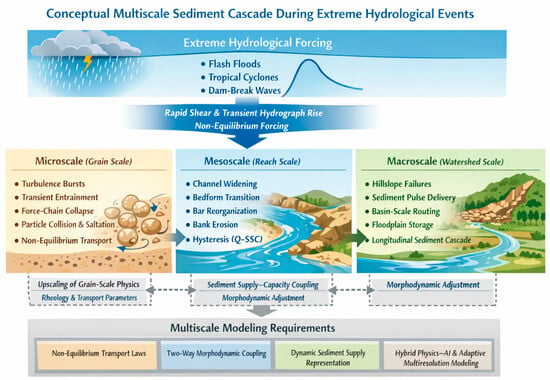
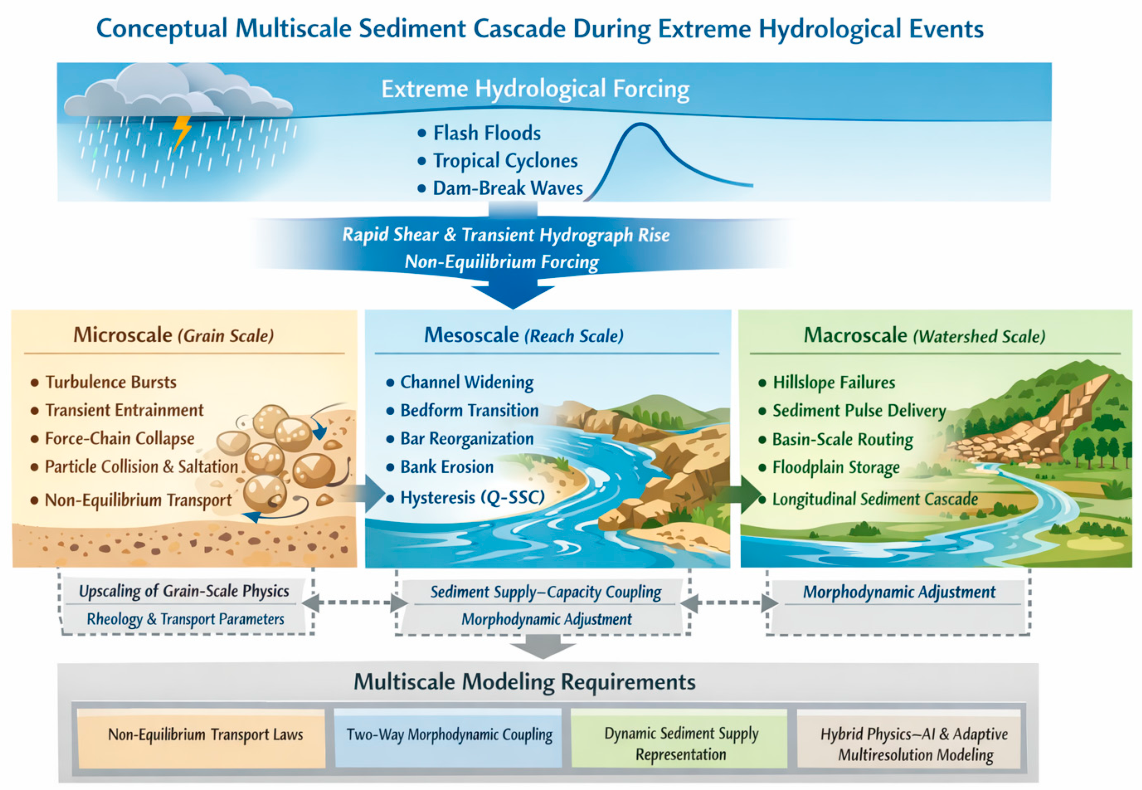
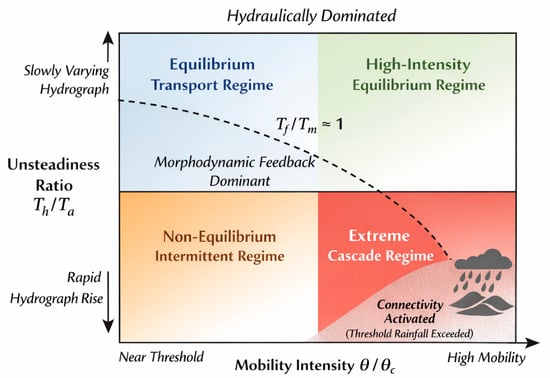
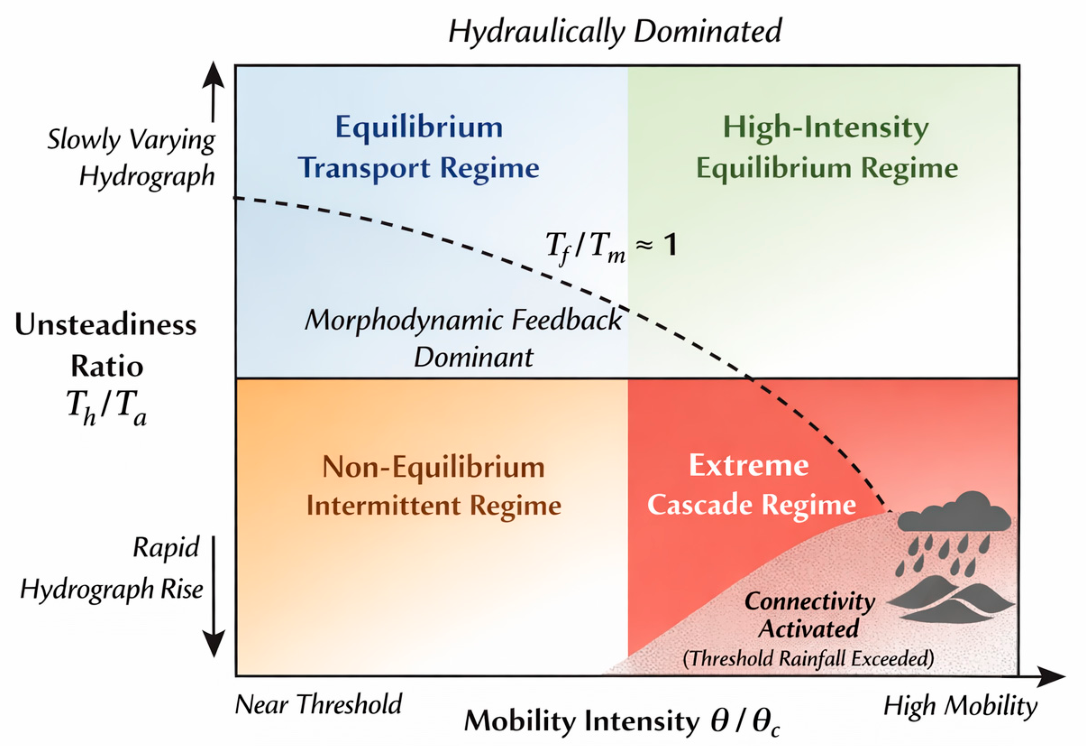

Disclaimer/Publisher’s Note: The statements, opinions and data contained in all publications are solely those of the individual author(s) and contributor(s) and not of MDPI and/or the editor(s). MDPI and/or the editor(s) disclaim responsibility for any injury to people or property resulting from any ideas, methods, instructions or products referred to in the content. |
© 2026 by the authors. Licensee MDPI, Basel, Switzerland. This article is an open access article distributed under the terms and conditions of the Creative Commons Attribution (CC BY) license.