Reservoir Inflow Risk-Window Early Warning Informed by Monitoring and Routing-Decay Modeling


Abstract
1. Introduction
2. Materials and Methods
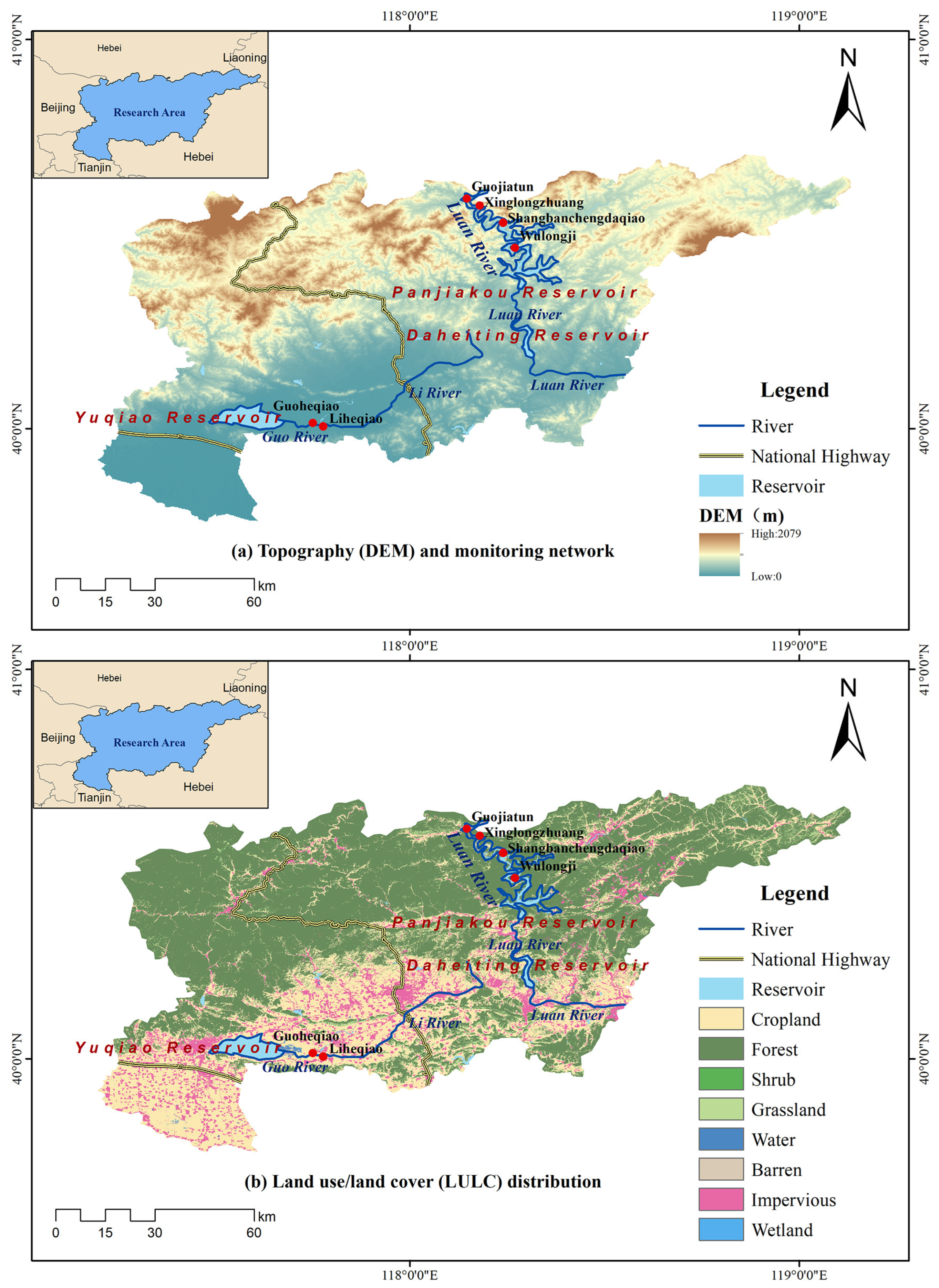
2.1. Study Area and Data
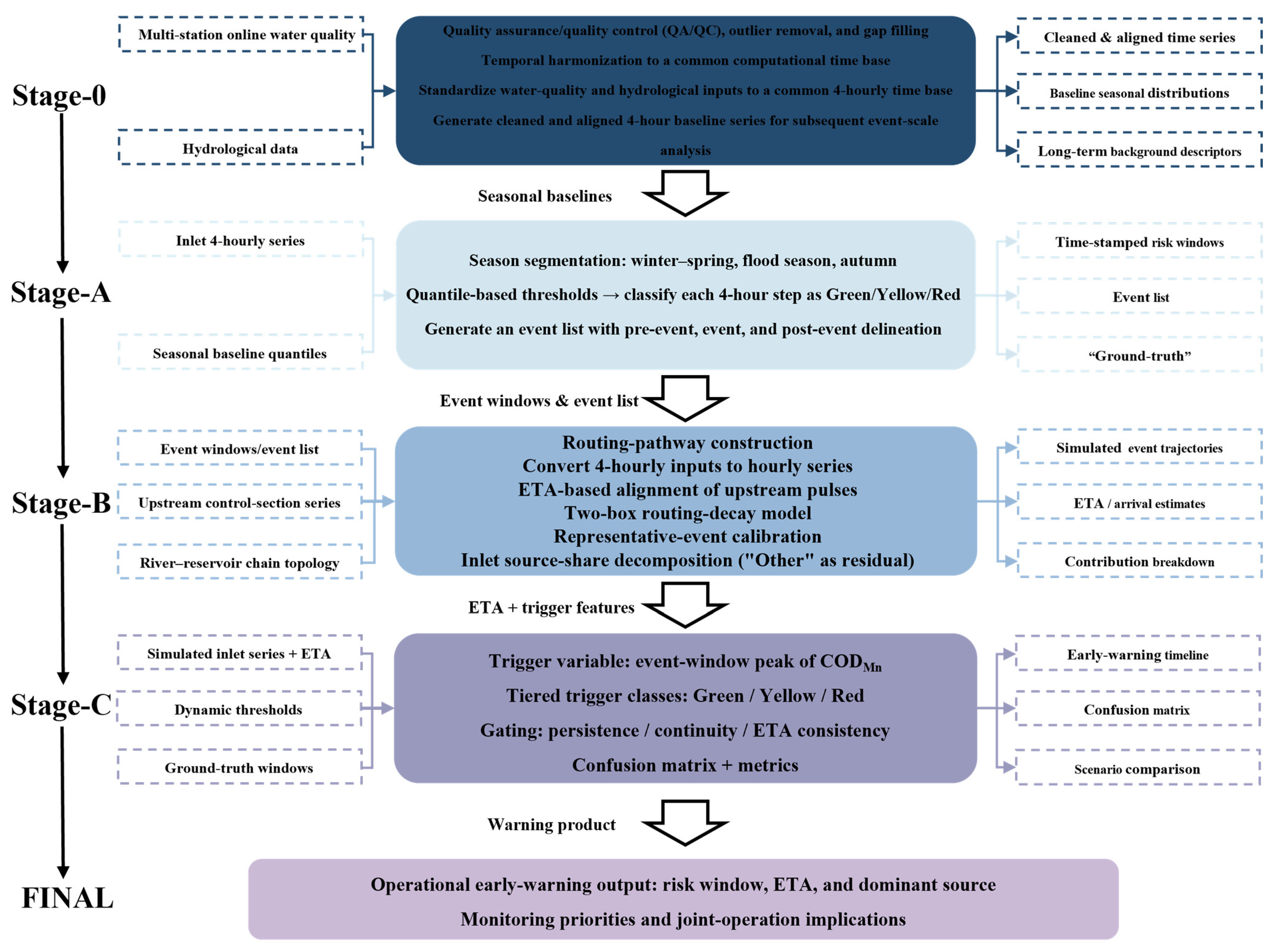
2.2. Research Framework, Data Preprocessing, and Dynamic-Threshold System
2.3. Integrated Event-Scale Workflow for Event Identification, Routing-Decay, and Trigger-Based Classification (Stages A–C)
2.3.1. Overview of the Integrated Event-Scale Workflow
2.3.2. Event Identification and Delineation of Risk Windows (Stage A)
2.3.3. Two-Box Routing-Decay Model and Source Decomposition of Event Loads (Stage B)
2.3.4. Risk Trigger, Three-Class Classification, and Performance Evaluation (Stage C)
3. Results
3.1. Long-Term Evolution of Inflow Water Quality and Seasonal Risk Background
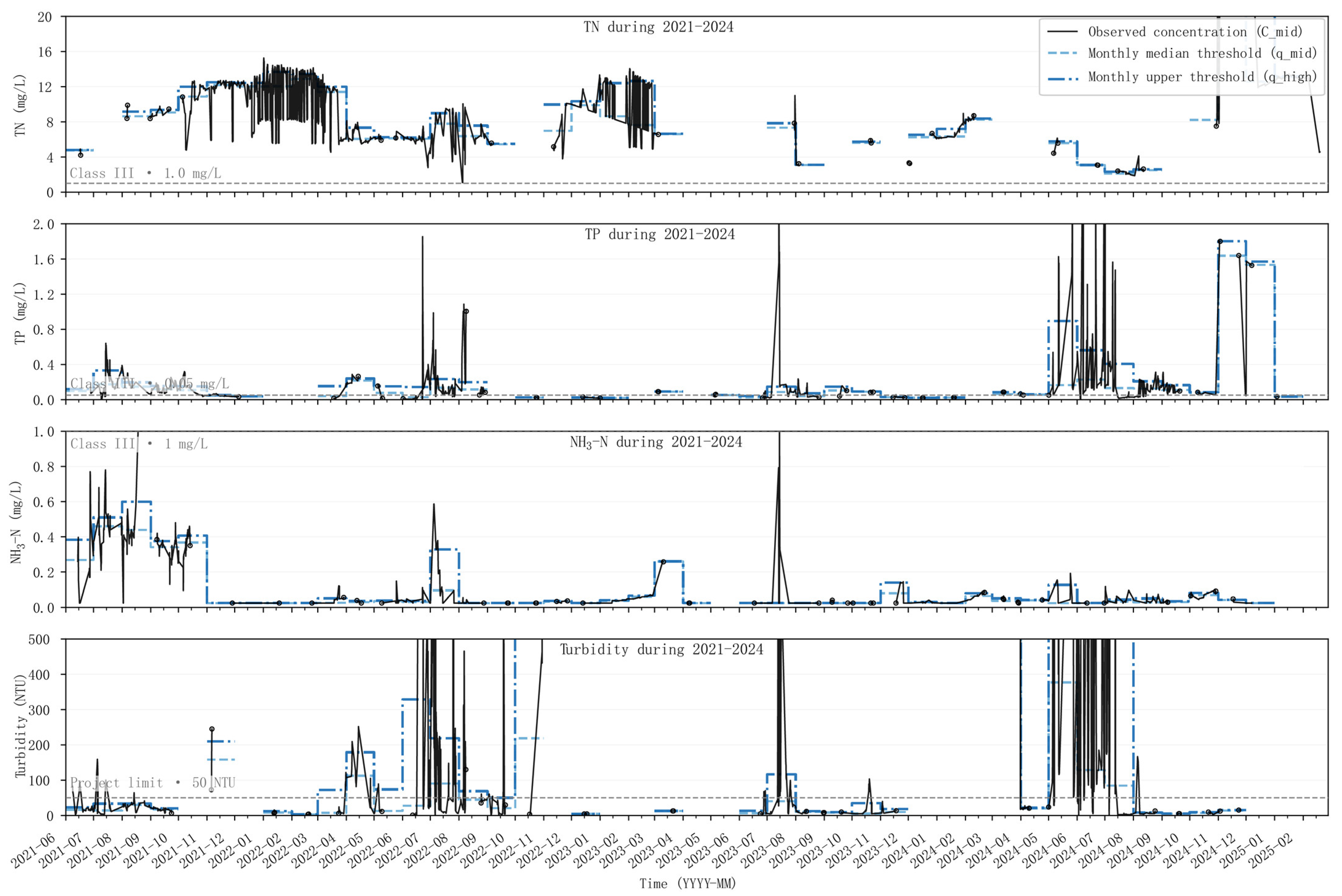
3.1.1. Long-Term Multi-Indicator Evolution and Overview of Risk Exposure at the Inlet
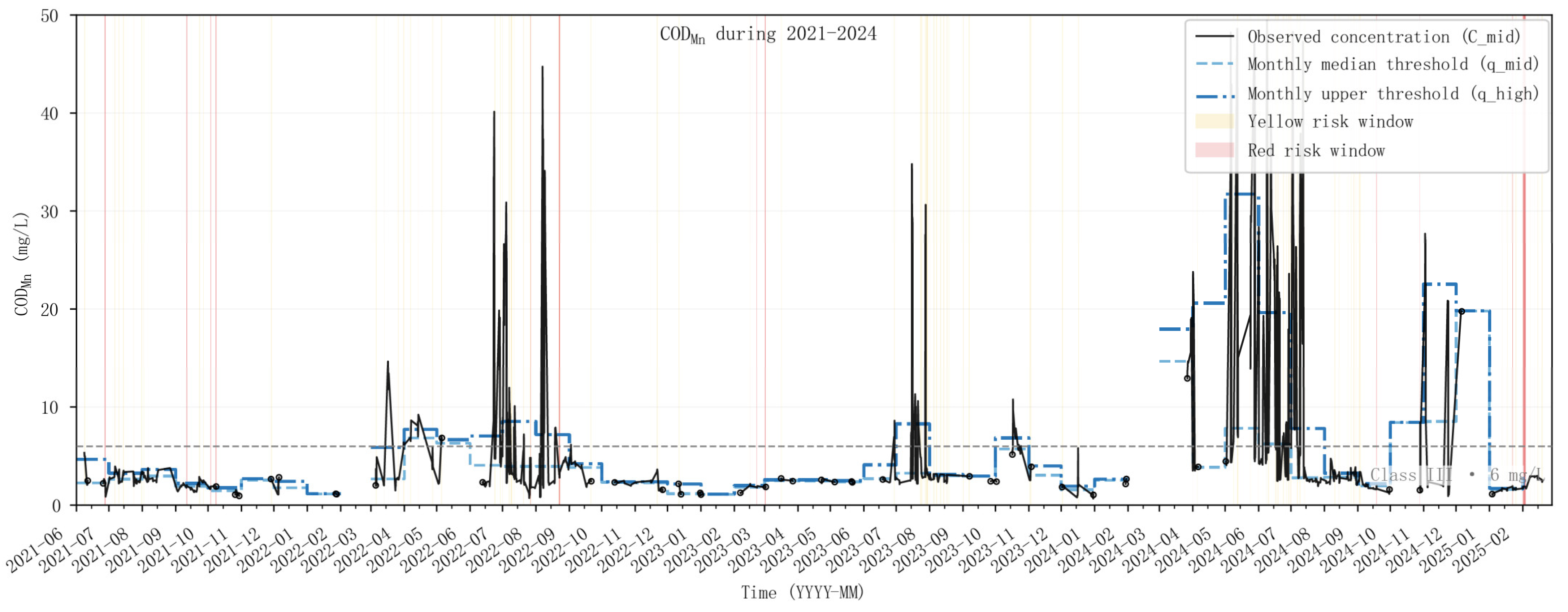
3.1.2. Seasonal Patterns and Year-to-Year Variation in CODMn Risk Windows During 2021–2024
3.2. Seasonal Risk Windows and Typical Red/Yellow Event Processes
3.2.1. Overview of Typical Red/Yellow Events
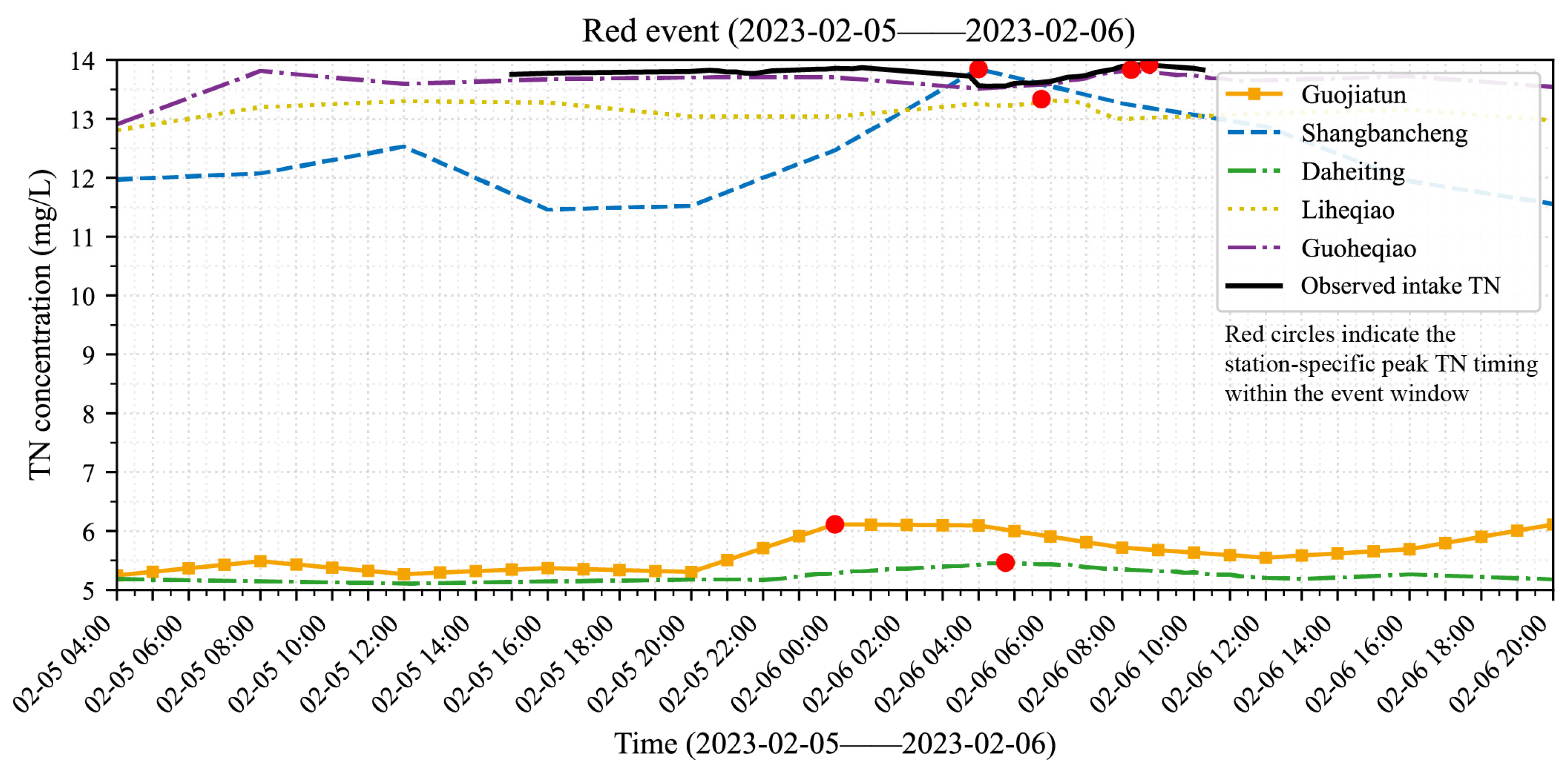
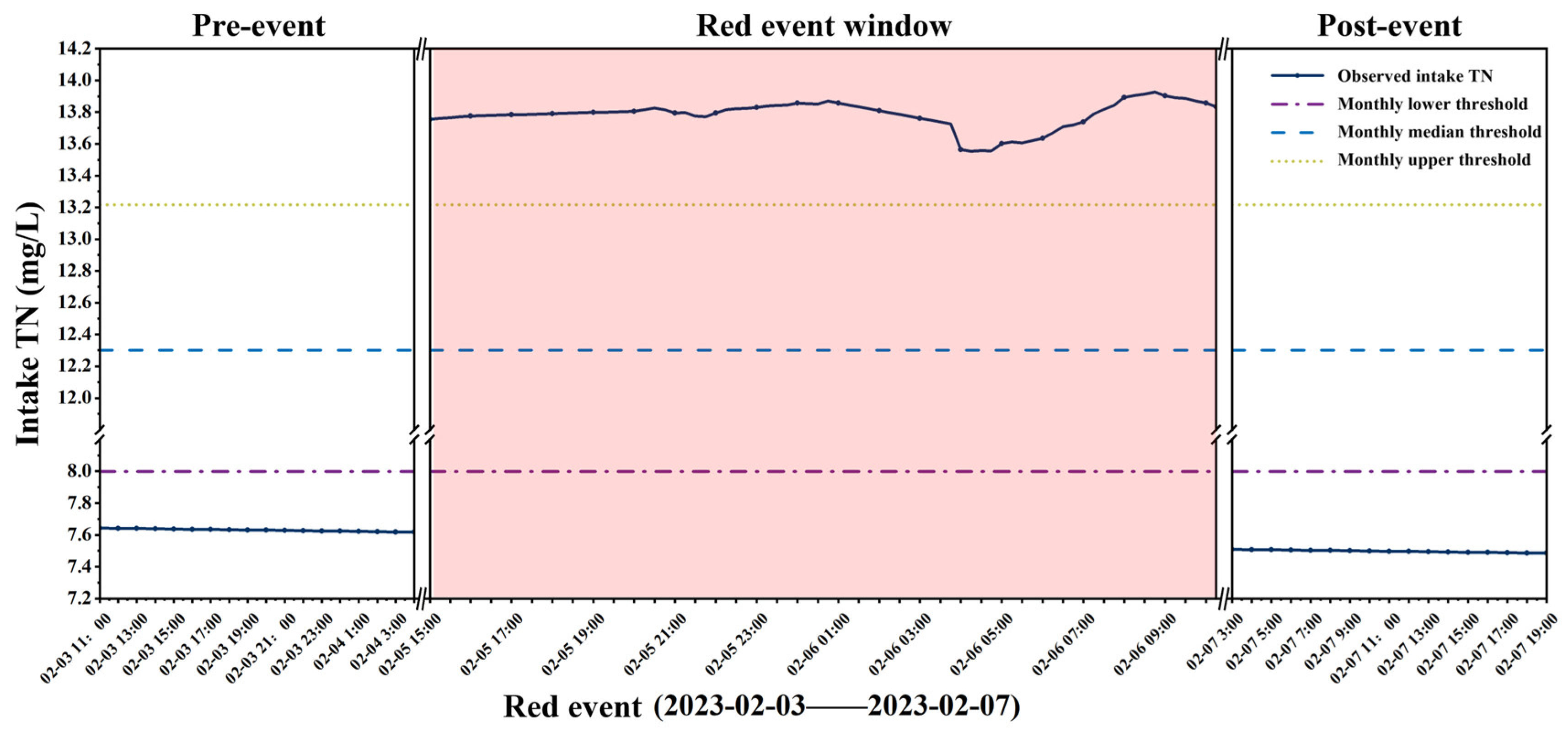
3.2.2. Process Characteristics of the Typical Red Event
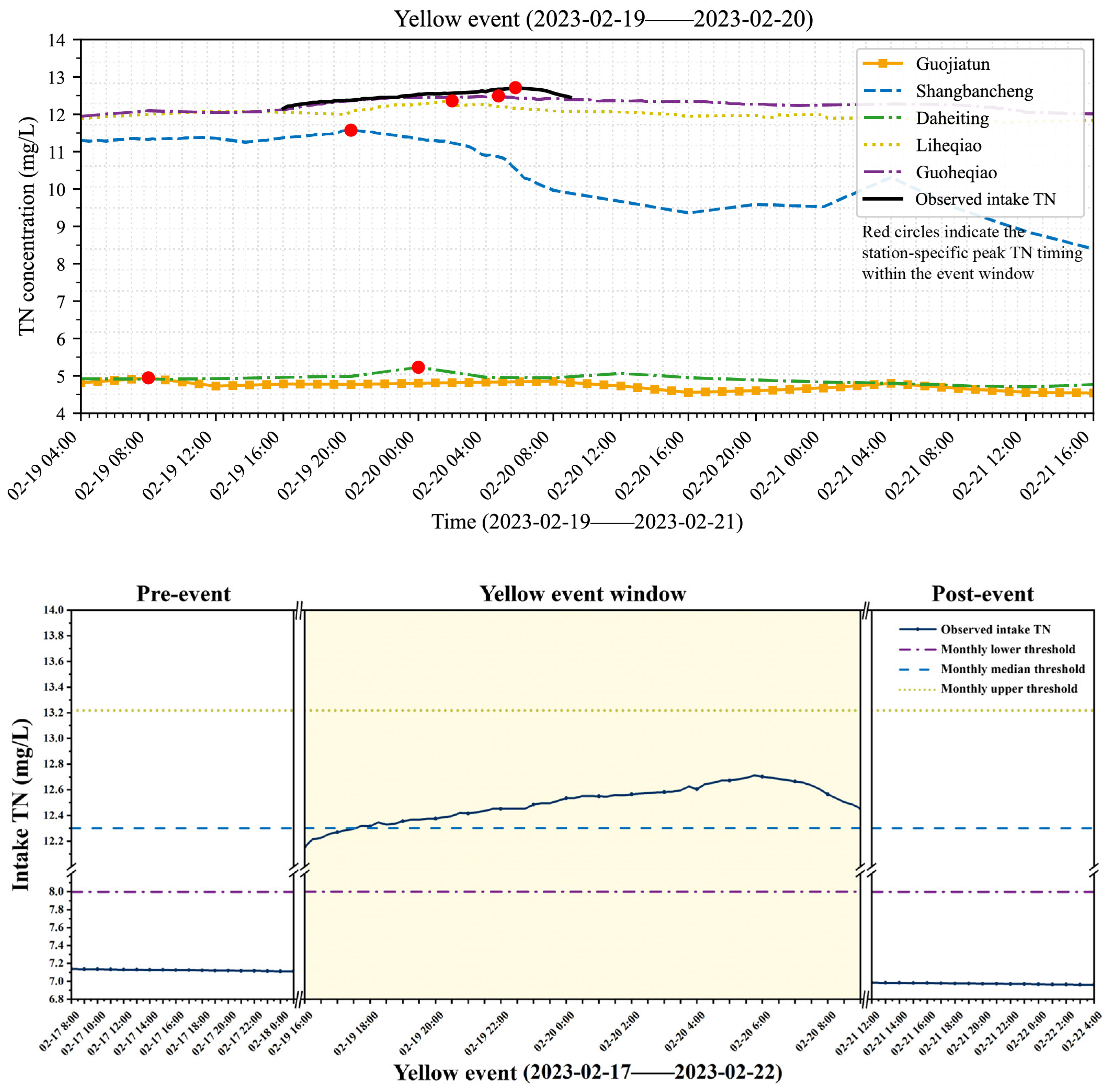
3.2.3. Process Characteristics of the Typical Yellow Event
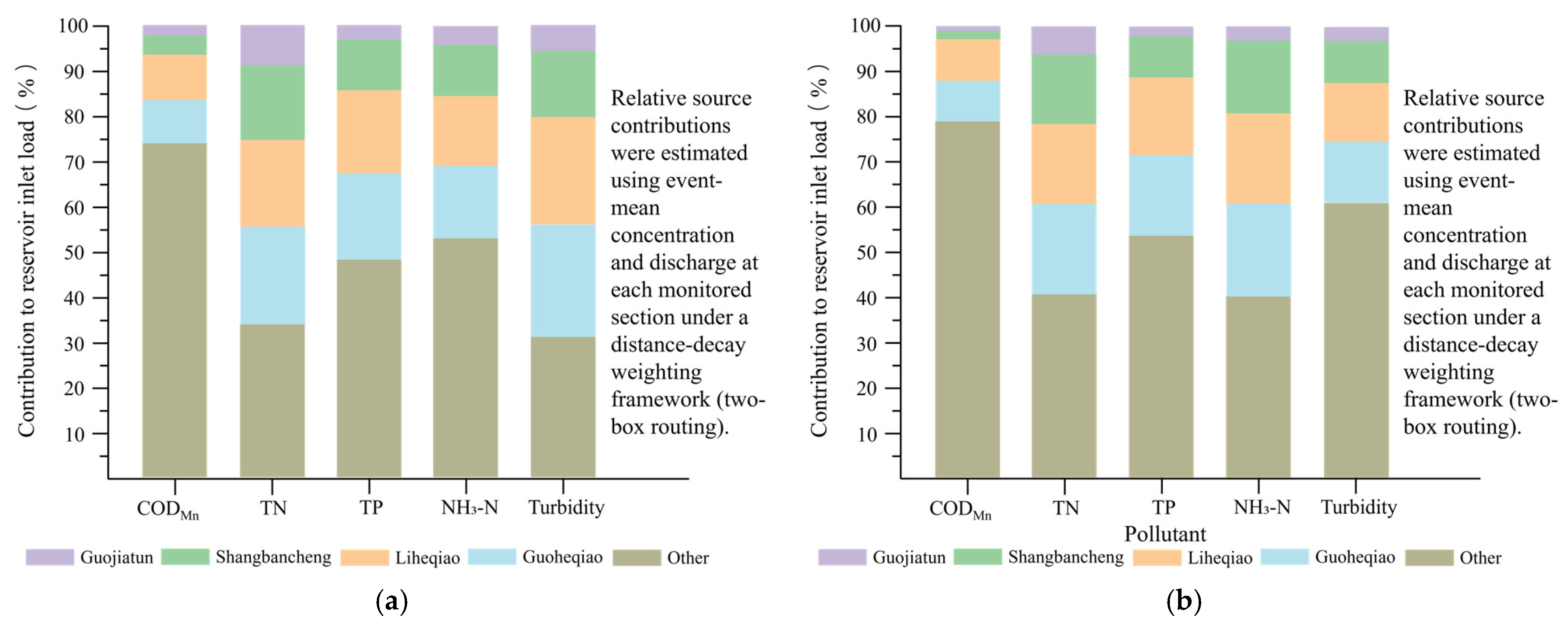
3.3. Upstream-to-Inlet Routing-Decay and Relative Source Contribution Analysis During Typical Events
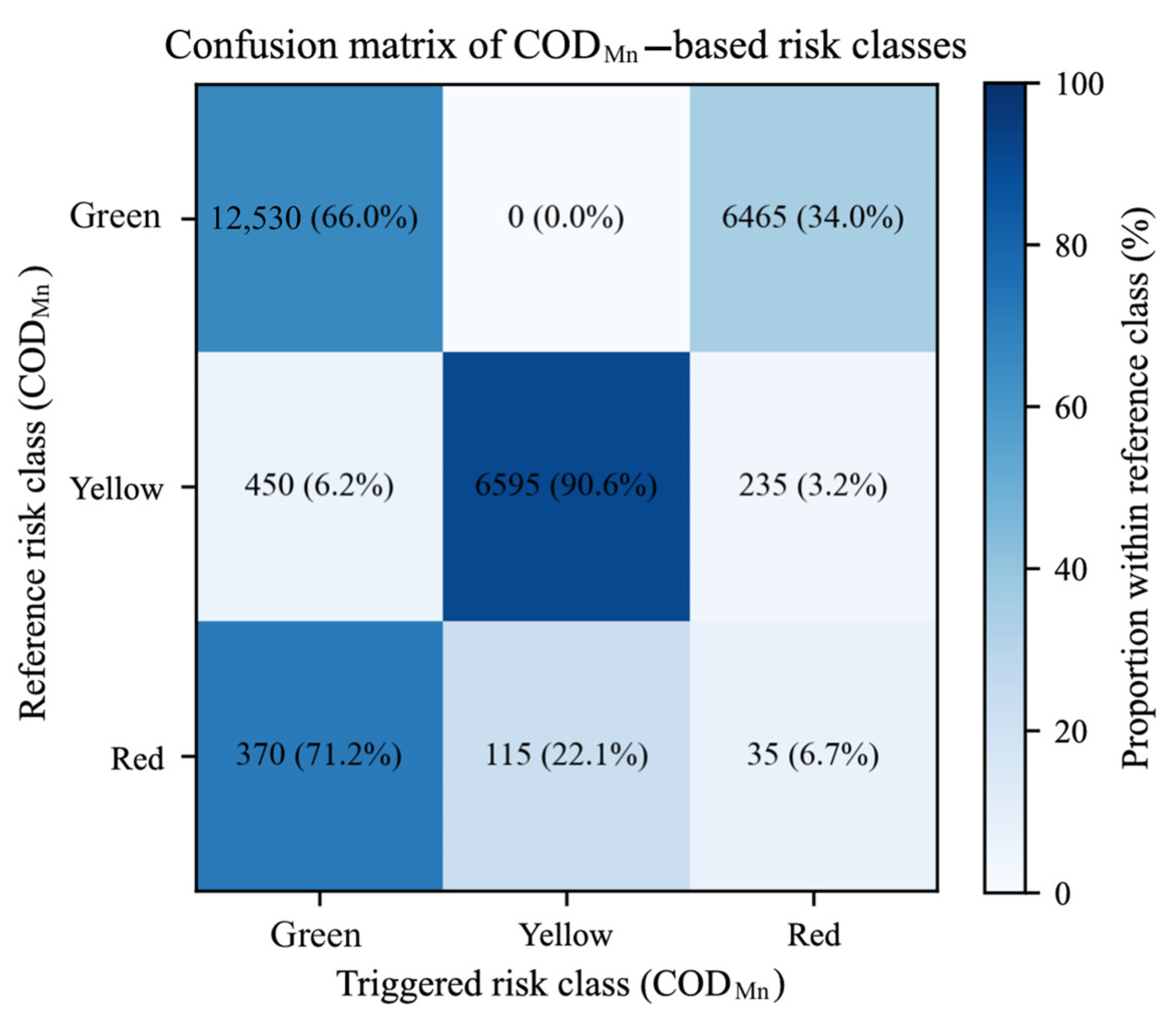
3.4. Performance Evaluation of the Three-Class Risk Trigger
4. Discussion
4.1. Methodological Advantages and Application Potential
4.2. Model Assumptions and Uncertainty
4.3. Management Implications and Future Research Directions
5. Conclusions
Author Contributions
Funding
Data Availability Statement
Conflicts of Interest
References
- Delpla, I.; Bouchard, C.; Dorea, C.; Rodriguez, M.J. Assessment of rain event effects on source water quality degradation and subsequent water treatment operations. Sci. Total Environ. 2023, 866, 161085. [Google Scholar] [CrossRef]
- Li, W.; Chen, X.; Xu, S.; Wang, T.; Han, D.; Xiao, Y. Effects of storm runoff on the spatial–temporal variation and stratified water quality in Biliuhe Reservoir, a drinking water reservoir. Environ. Sci. Pollut. Res. 2024, 31, 19556–19574. [Google Scholar] [CrossRef]
- Qin, G.; Liu, J.; Xu, S.; Sun, Y. Pollution source apportionment and water quality risk evaluation of a drinking water reservoir during flood seasons. Int. J. Environ. Res. Public Health 2021, 18, 1873. [Google Scholar] [CrossRef]
- Qiu, J.; Shen, Z.; Leng, G.; Wei, G. Synergistic effect of drought and rainfall events of different patterns on watershed systems. Sci. Rep. 2021, 11, 18957. [Google Scholar] [CrossRef]
- Si, F.; Huang, T.; Li, N.; Li, K.; Wen, G.; Li, Y.; Zhang, H. Effects of flood discharge on the water quality of a drinking water reservoir in China–Characteristics and management strategies. J. Environ. Manag. 2022, 314, 115072. [Google Scholar] [CrossRef] [PubMed]
- Wang, C.; Zhang, H.; Xin, X.; Li, J.; Jia, H.; Wen, L.; Yin, W. Water level–driven agricultural nonpoint source pollution dominated the ammonia variation in China’s second largest reservoir. Environ. Res. 2022, 215, 114367. [Google Scholar] [CrossRef] [PubMed]
- Liu, J.; Wang, P.; Jiang, D.; Nan, J.; Zhu, W. An integrated data-driven framework for surface water quality anomaly detection and early warning. J. Clean. Prod. 2020, 251, 119145. [Google Scholar] [CrossRef]
- Nong, X.; Zeng, J.; Chen, L.; Wei, J.; Zhang, Y. A novel water quality risk assessment framework for reservoir water bodies coupling key parameter selection and dynamic warning threshold determination. Sci. Rep. 2025, 15, 14377. [Google Scholar] [CrossRef]
- Yu, R.; Zhang, C. Early warning of water quality degradation: A copula-based Bayesian network model for highly efficient water quality risk assessment. J. Environ. Manag. 2021, 292, 112749. [Google Scholar] [CrossRef] [PubMed]
- Costa, M.E.L.; Carvalho, D.J.; Koide, S. Assessment of pollutants from diffuse pollution through the correlation between rainfall and runoff characteristics using EMC and first flush analysis. Water 2021, 13, 2552. [Google Scholar] [CrossRef]
- Regier, P.J.; González-Pinzón, R.; Van Horn, D.J.; Reale, J.K.; Nichols, J.; Khandewal, A. Water quality impacts of urban and non-urban arid-land runoff on the Rio Grande. Sci. Total Environ. 2020, 729, 138443. [Google Scholar] [CrossRef]
- Ding, X.; Zhu, Q.; Zhai, A.; Liu, L. Water quality safety prediction model for drinking water source areas in Three Gorges Reservoir and its application. Ecol. Indic. 2019, 101, 734–741. [Google Scholar] [CrossRef]
- Guan, G.; Wang, Y.; Yang, L.; Yue, J.; Li, Q.; Lin, J.; Liu, Q. Water-quality assessment and pollution-risk early-warning system based on web crawler technology and LSTM. Int. J. Environ. Res. Public Health 2022, 19, 11818. [Google Scholar] [CrossRef]
- Zhang, X.; Huang, T.; Li, K.; Zhang, H.; Wang, Q.; Wang, Y.; Wang, C. Effects of storm events on nutrient characteristics in a stratified drinking water reservoir: Behavior, transmission pathways and management strategy. Environ. Res. 2024, 261, 119762. [Google Scholar] [CrossRef]
- Zhou, Y.; Liu, M.; Zhou, L.; Jang, K.-S.; Xu, H.; Shi, K.; Zhu, G.; Liu, M.; Deng, J.; Zhang, Y. Rainstorm events shift the molecular composition and export of dissolved organic matter in a large drinking water reservoir in China: High frequency buoys and field observations. Water Res. 2020, 187, 116471. [Google Scholar] [CrossRef] [PubMed]
- Luvhimbi, N.; Tshitangano, T.; Mabunda, J.; Olaniyi, F.; Edokpayi, J. Water quality assessment and evaluation of human health risk of drinking water from source to point of use at Thulamela municipality, Limpopo Province. Sci. Rep. 2022, 12, 6059. [Google Scholar] [CrossRef] [PubMed]
- Nawaz, R.; Nasim, I.; Irfan, A.; Islam, A.; Naeem, A.; Ghani, N.; Irshad, M.A.; Latif, M.; Nisa, B.U.; Ullah, R. Water quality index and human health risk assessment of drinking water in selected urban areas of a Mega City. Toxics 2023, 11, 577. [Google Scholar] [CrossRef]
- Ning, H.; Jiang, W.; Sheng, Y.; Wang, K.; Chen, S.; Zhang, Z.; Liu, F. Comprehensive evaluation of nitrogen contamination in water ecosystems of the Miyun reservoir watershed, northern China: Distribution, source apportionment and risk assessment. Environ. Geochem. Health 2024, 46, 278. [Google Scholar] [CrossRef] [PubMed]
- Zhang, Y.; Hou, J.; Zhou, R.; Lu, J.; Xia, J.; Wu, J.; You, G.; Yang, Z.; Miao, L. Multivariable integrated risk and spatiotemporal characteristics assessment for water quality using comprehensive risk index in Jiangsu section of the south-to-north water diversion project, China. Environ. Geochem. Health 2025, 47, 1–17. [Google Scholar] [CrossRef]
- de Lucena Barbosa, J.E.; dos Santos Severiano, J.; Cavalcante, H.; de Lucena-Silva, D.; Mendes, C.F.; Barbosa, V.V.; dos Santos Silva, R.D.; de Oliveira, D.A.; Molozzi, J. Impacts of inter-basin water transfer on the water quality of receiving reservoirs in a tropical semi-arid region. Hydrobiologia 2021, 848, 651–673. [Google Scholar] [CrossRef]
- Sun, S.; Zhou, X.; Liu, H.; Jiang, Y.; Zhou, H.; Zhang, C.; Fu, G. Unraveling the effect of inter-basin water transfer on reducing water scarcity and its inequality in China. Water Res. 2021, 194, 116931. [Google Scholar] [CrossRef]
- Woo, S.-Y.; Kim, S.-J.; Lee, J.-W.; Kim, S.-H.; Kim, Y.-W. Evaluating the impact of interbasin water transfer on water quality in the recipient river basin with SWAT. Sci. Total Environ. 2021, 776, 145984. [Google Scholar] [CrossRef] [PubMed]
- Zhao, P.; Li, Z.; Zhang, R.; Pan, J.; Liu, Y. Does water diversion project deteriorate the water quality of reservoir and downstream? A case-study in Danjiangkou reservoir. Glob. Ecol. Conserv. 2020, 24, e01235. [Google Scholar] [CrossRef]
- Chen, Q.; Chen, Y.; Lin, Y.; Zhang, J.; Ni, J.; Xia, J.; Xiao, L.; Feng, T.; Ma, H. Does a hydropower reservoir cascade really harm downstream nutrient regimes. Sci. Bull. 2024, 69, 661–670. [Google Scholar] [CrossRef]
- Xu, Z.; Cai, X.; Yin, X.; Su, M.; Wu, Y.; Yang, Z. Is water shortage risk decreased at the expense of deteriorating water quality in a large water supply reservoir? Water Res. 2019, 165, 114984. [Google Scholar] [CrossRef]
- Zhang, Q.; Zhang, J.; Wang, H.; Zhai, T.; Liu, L.; Li, G.; Xu, Z. Spatial patterns in water quality and source apportionment in a typical cascade development river southwestern China using PMF modeling and multivariate statistical techniques. Chemosphere 2023, 311, 137139. [Google Scholar] [CrossRef]
- Zhou, Z.-z.; Huang, T.-l.; Ma, W.-x.; Li, Y.; Zeng, K. Impacts of water quality variation and rainfall runoff on Jinpen Reservoir, in Northwest China. Water Sci. Eng. 2015, 8, 301–308. [Google Scholar] [CrossRef]
- Zhao, B.; Zeng, Q.; Wang, J.; Jiang, Y.; Liu, H.; Yan, L.; Yang, Z.; Yang, Q.; Zhang, F.; Tang, J. Impact of cascade reservoirs on nutrients transported downstream and regulation method based on hydraulic retention time. Water Res. 2024, 252, 121187. [Google Scholar] [CrossRef] [PubMed]
- Khorsandi, M.; Ashofteh, P.-S.; Singh, V.P. Development of a multi-objective reservoir operation model for water quality-quantity management. J. Contam. Hydrol. 2024, 265, 104385. [Google Scholar] [CrossRef]
- Zhang, M.; Zhang, Z.; Wang, X.; Liao, Z.; Wang, L. The use of attention-enhanced CNN-LSTM models for multi-indicator and time-series predictions of surface water quality. Water Resour. Manag. 2024, 38, 6103–6119. [Google Scholar] [CrossRef]
- Ding, X.; Dong, X.; Hou, B.; Fan, G.; Zhang, X. Visual platform for water quality prediction and pre-warning of drinking water source area in the Three Gorges Reservoir Area. J. Clean. Prod. 2021, 309, 127398. [Google Scholar] [CrossRef]
- Li, Y.; Hou, R. The trend and causes of eutrophication in the Yuqiao Reservoir. Water Resour. Hydropower Eng. 2001, 32, 61–63. (In Chinese) [Google Scholar] [CrossRef]
- Chen, R.; Ju, M.; Chu, C.; Jing, W.; Wang, Y. Identification and quantification of physicochemical parameters influencing chlorophyll-a concentrations through combined principal component analysis and factor analysis: A case study of the Yuqiao Reservoir in China. Sustainability 2018, 10, 936. [Google Scholar] [CrossRef]
- GB 3838-2002; Environmental Quality Standards for Surface Water. Ministry of Ecology and Environment of the People’s Republic of China: Beijing, China, 2002.
- Mamun, M.; Kim, J.Y.; An, K.-G. Multivariate statistical analysis of water quality and trophic state in an artificial dam reservoir. Water 2021, 13, 186. [Google Scholar] [CrossRef]
- Jiang, Y.; Bao, X.; Huang, Z.; Chen, Y.; Wu, X.; Li, X.; Wu, X.; Hu, Y. Identification of pollutant delivery processes during different storm events and hydrological years in a semi-arid mountainous reservoir basin. Sci. Total Environ. 2023, 883, 163606. [Google Scholar] [CrossRef] [PubMed]
- Treilles, R.; Gasperi, J.; Tramoy, R.; Dris, R.; Gallard, A.; Partibane, C.; Tassin, B. Microplastic and microfiber fluxes in the Seine River: Flood events versus dry periods. Sci. Total Environ. 2022, 805, 150123. [Google Scholar] [CrossRef]
- Shin, J.-K.; Park, Y.; Kim, N.-Y.; Hwang, S.-J. Downstream transport of geosmin based on harmful cyanobacterial outbreak upstream in a reservoir cascade. Int. J. Environ. Res. Public Health 2022, 19, 9294. [Google Scholar] [CrossRef]
- Wang, G.; Li, J.; Sun, W.; Xue, B.; Liu, T. Non-point source pollution risks in a drinking water protection zone based on remote sensing data embedded within a nutrient budget model. Water Res. 2019, 157, 238–246. [Google Scholar] [CrossRef] [PubMed]
- Rosi, A.; Segoni, S.; Canavesi, V.; Monni, A.; Gallucci, A.; Casagli, N. Definition of 3D rainfall thresholds to increase operative landslide early warning system performances. Landslides 2021, 18, 1045–1057. [Google Scholar] [CrossRef]
- Sättele, M.; Bründl, M.; Straub, D. Reliability and effectiveness of early warning systems for natural hazards: Concept and application to debris flow warning. Reliab. Eng. Syst. Saf. 2015, 142, 192–202. [Google Scholar] [CrossRef]
- Wang, Y.; Engel, B.A.; Huang, P.; Peng, H.; Zhang, X.; Cheng, M.; Zhang, W. Accurately early warning to water quality pollutant risk by mobile model system with optimization technology. J. Environ. Manag. 2018, 208, 122–133. [Google Scholar] [CrossRef] [PubMed]
- Arad, J.; Housh, M.; Perelman, L.; Ostfeld, A. A dynamic thresholds scheme for contaminant event detection in water distribution systems. Water Res. 2013, 47, 1899–1908. [Google Scholar] [CrossRef] [PubMed]





| Item | Definition or Rule Used in This Study |
|---|---|
| Risk classes | Green, yellow, and red represent low-, moderate-, and high-risk states, respectively. |
| Trigger thresholds | Green: C_mid < q_low; yellow: q_mid ≤ C_mid < q_high; red: C_mid ≥ q_high. |
| Transition interval | q_low < C_mid < q_mid is treated as a non-trigger transition interval rather than as a formal warning class. |
| Event window | A risk window is delineated when elevated CODMn conditions persist across consecutive time steps and satisfy continuity criteria. |
| Short-dropout merging | Brief interruptions within an otherwise continuous elevated period are merged to avoid artificial fragmentation of one event. |
| Event stages | Each event is divided into pre-event, event period, and post-event stages, representing antecedent accumulation, peak exposure, and recession/attenuation. |
| ETA consistency | Upstream peaks are aligned with the inlet event window using the estimated time of arrival (ETA) constraint. |
| Gate condition | If persistence, continuity, or ETA consistency requirements are not satisfied, the trigger output is kept as green. |
| Short-sample seasons | Seasons with markedly short sample lengths are retained only for qualitative reference and excluded from cross-year quantitative comparison. |
| Year | Season | Total Hours | Green Window Proportion (%) | Yellow Window Proportion (%) | Red Window Proportion (%) |
|---|---|---|---|---|---|
| 2021 | Summer | 1735 | 52.2 | 26.2 | 21.6 |
| 2021 | Autumn | 1040 | 78.8 | 21.2 | 0 |
| 2021 | Winter | 215 | 58.1 | 0 | 41.9 |
| 2022 | Spring | 890 | 29.8 | 50 | 20.2 |
| 2022 | Summer | 3595 | 35.3 | 20.7 | 43.9 |
| 2022 | Autumn | 635 | 32.3 | 25.2 | 42.5 |
| 2022 | Winter | 285 | 61.4 | 31.6 | 7 |
| 2023 | Spring | 375 | 92 | 8 | 0 |
| 2023 | Summer | 2165 | 28.2 | 48 | 23.8 |
| 2023 | Autumn | 685 | 0 | 42.3 | 57.7 |
| 2023 | Winter | 375 | 32 | 38.7 | 29.3 |
| 2024 | Spring | 955 | 12.6 | 27.7 | 59.7 |
| 2024 | Summer | 3370 | 30.6 | 31.3 | 38.1 |
| 2024 | Autumn | 1045 | 50.7 | 15.3 | 34 |
| 2024 | Winter | 835 | 17.4 | 38.3 | 44.3 |
Disclaimer/Publisher’s Note: The statements, opinions and data contained in all publications are solely those of the individual author(s) and contributor(s) and not of MDPI and/or the editor(s). MDPI and/or the editor(s) disclaim responsibility for any injury to people or property resulting from any ideas, methods, instructions or products referred to in the content. |
© 2026 by the authors. Licensee MDPI, Basel, Switzerland. This article is an open access article distributed under the terms and conditions of the Creative Commons Attribution (CC BY) license.
Share and Cite
Wang, B.; Mo, J.; Wang, E.; Li, Z.; Gong, Y. Reservoir Inflow Risk-Window Early Warning Informed by Monitoring and Routing-Decay Modeling. Water 2026, 18, 1005. https://doi.org/10.3390/w18091005
Wang B, Mo J, Wang E, Li Z, Gong Y. Reservoir Inflow Risk-Window Early Warning Informed by Monitoring and Routing-Decay Modeling. Water. 2026; 18(9):1005. https://doi.org/10.3390/w18091005
Chicago/Turabian StyleWang, Boming, Junfeng Mo, Ersong Wang, Zuolun Li, and Yongwei Gong. 2026. "Reservoir Inflow Risk-Window Early Warning Informed by Monitoring and Routing-Decay Modeling" Water 18, no. 9: 1005. https://doi.org/10.3390/w18091005
APA StyleWang, B., Mo, J., Wang, E., Li, Z., & Gong, Y. (2026). Reservoir Inflow Risk-Window Early Warning Informed by Monitoring and Routing-Decay Modeling. Water, 18(9), 1005. https://doi.org/10.3390/w18091005