Article

Failure Mechanism of Sudden Rock Landslide Under the Coupling Effect of Hydrological and Geological Conditions: A Case Study of the Wanshuitian Landslide, China

1
Hubei Key Laboratory of Disaster Prevention and Mitigation, China Three Gorges University, Yichang 443002, China
2
College of Civil and Architecture, China Three Gorges University, Yichang 443002, China
3
Institute of Exploration Technology, Chinese Academy of Geological Sciences, Chengdu 611734, China
4
Technical Center for Geological Hazard Prevention and Control, Chinese Academy of Geological Sciences, Chengdu 611734, China
5
College of Water Conservancy and Environment, China Three Gorges University, Yichang 433002, China
*
Authors to whom correspondence should be addressed.
Water 2026, 18(9), 1001; https://doi.org/10.3390/w18091001
Submission received: 20 November 2025 / Revised: 23 January 2026 / Accepted: 28 January 2026 / Published: 23 April 2026
(This article belongs to the Special Issue Water-Related Landslide Hazard Process and Its Triggering Events)

Abstract

At around 8:40 a.m. on 17 July 2024, the Wanshuitian landslide in the Three Gorges Reservoir Area (TGRA) experienced a deformation failure characterized by thrust load-caused deformations and high-speed sliding. Using geological surveys and unmanned aerial vehicle (UAV) photography, this study divided the Wanshuitian landslide area into five zones: sliding initiation (A1), secondary disintegration (A2), main accumulation (B1), right falling (B2), and left falling (B3) zones. Through monitoring data analysis and GeoStudio-based numerical simulations, this study revealed the mechanisms behind the landslide failure mode characterized by slope sliding approximately along the strike of the rock formation under the coupling effect of hydrological and geological conditions. The results indicate that factors inducing the landslide failure include the geomorphic feature of alternating grooves and ridges, the lithologic assemblage characterized by interbeds of soft and hard rocks, the slope structure with well-developed joints, and the sustained heavy rains in the preceding period. In the Wanshuitian landslide area, mudstone valleys are prone to accumulate rainwater, which can infiltrate directly into the weak interlayers of rock masses and soften the rock masses. Multi-peak rain events with a short time interval serve as a critical factor in groundwater recharge. Within 17 days preceding its failure, the Wanshuitian landslide experienced a superimposed process of heavy and secondary rain events with a short interval (four days). Rainwater from the first heavy rain event failed to completely discharge during the short interval, while the secondary rain event also caused rainwater accumulation. These led to a continuous rise in the groundwater table, a constant decrease in the shear strength of the slope, and ultimately the landslide instability. Since the landslide sliding in the dip direction of the rock formation was impeded, the main sliding direction of the landslide formed an angle of 88° with this direction. This led to a unique failure mode characterized by slope sliding approximately along the strike of the rock formation. Based on these findings, this study proposed characteristics for the early identification of the failure of similar landslides, aiming to provide a robust scientific basis for the monitoring, early warning, and prevention and control of the failure of similar landslides.

1. Introduction

Landslides are a relatively common type of geological hazard, occurring extensively worldwide. The formation of landslides depends on numerous factors, which are closely related to local terrain, geological structure, lithology, and meteorological and hydrological conditions, as well as geophysical processes. Landslides may be initiated by a range of factors, encompassing rainfall [1,2], reservoir water levels [3,4,5], flood events [6,7], the melting of ice [8], seismic activities [9,10], and human-induced engineering operations [11,12]. In certain instances, they result from the combined influence of these factors [13,14].
The lithology of strata is one of the key factors influencing landslide occurrence [15,16]. The Jurassic strata in Zigui County within the TGRA typically exhibit interbedded sandstone and mudstone masses, with rockslides frequently occurring. Rockslides alter the strength and structures of rock masses due to the presence of sandstone and mudstone interbeds. Over time, under the influence of external factors like reservoir water and rain, the sandstone–mudstone contact zones become argillic, accompanied by fracture penetration. These changes significantly reduce slope stability, ultimately leading to catastrophic landslides [17]. Typical landslides, including Qianjiangping [18,19], Shanshucao [20], Kamenziwan [21], Majiagou [22], and Xiaoyantou, severely threaten the safe operation of the Three Gorges Dam, the life and property safety of residents in the reservoir area, and the local socioeconomic development [23].
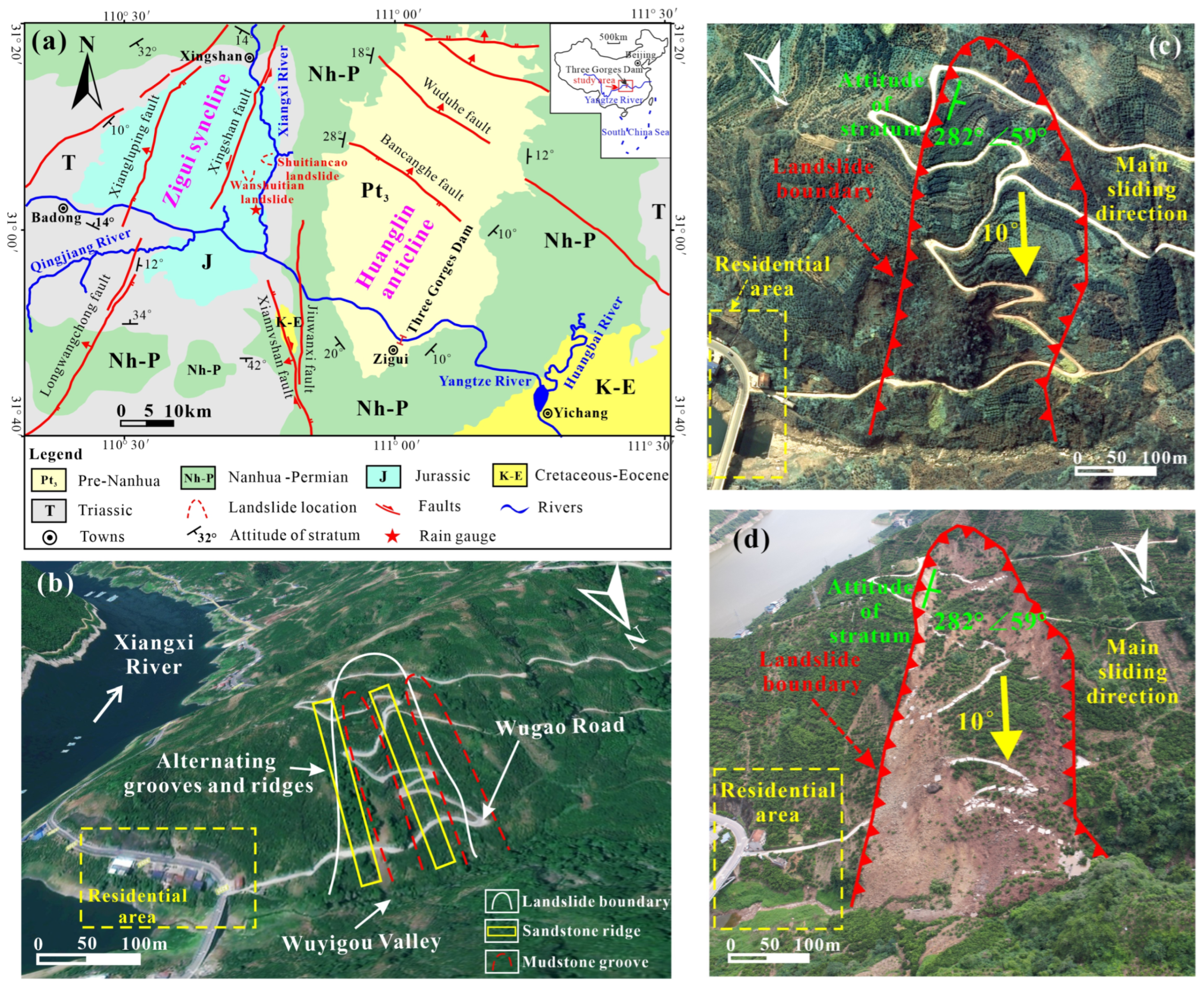
At around 8:40 a.m. on 17 July 2024, the Wanshuitian landslide occurred in No. 1 Team of Jiajiadian Village, Guizhou Town, Zigui County, Yichang City, Hubei Province. The slope slid down to a gully, destroying the Wugao Road, a 1200 m long village high road, and 60 mu (mu: 0.0667 hectares) of citrus orchards, resulting in direct economic losses estimated at CNY 4.84 million (Figure 1c,d). Fortunately, on the failure of the landslide, a villager noticed the surface uplift of the Wugao Road and promptly alerted four other villagers working in the dangerous area, preventing casualties. The failure of this type of landslide is characterized by high concealment, strong suddenness, and considerable hazard. Therefore, investigating its causal mechanism, failure mode, and characteristics for early identification holds great practical significance for developing measures to predict and prevent landslide hazards. Previous researchers have delved into the failure mechanism and movement process of the Wanshuitian landslide. The field survey and rain data analysis suggest that the landslide failure was primarily caused by the abnormal cumulative rainfall in the seven days preceding the failure [24]. Analysis of the interferometric synthetic aperture radar (InSAR) data revealed a maximum deformation rate of 29.63 mm/yr in the two months prior to the failure. In addition, the movement process leading to the landslide instability was reconstructed using numerical modeling [25]. However, there has been limited research on the hydrological response characteristics of the Wanshuitian landslide under heavy rainfall conditions.
Rainfall is one of the most significant factors triggering landslides worldwide [26,27], as it pushes slopes toward instability by increasing pore water pressure and consequently reducing the effective strength of slope materials [28,29]. Specifically, rainfall characteristics (such as intensity, duration, and antecedent precipitation) influence landslide deformation [30,31]. This study collected and analyzed rainfall monitoring data in the landslide area, revealing two distinctive rainfall events occurring 17 days prior to the landslide. The first rainfall event took place from July 3rd to 4th, with a cumulative precipitation of 142.8 mm. The second event occurred from July 9th to 15th, with a cumulative precipitation of 111 mm. The two rainfall events were separated by only 4 days. This “heavy rainfall–short interval–secondary rainfall” superposition pattern is relatively rare, and the coupling effect of these consecutive heavy rainfall events may have triggered the landslide.
Moreover, the micro-geomorphology also influenced the failure mechanism of the landslides [32,33]. The Wanshuitian landslide area exhibits complex geological conditions, characterized by the geomorphic feature of alternating grooves and ridges, a lithologic assemblage comprising interbeds of soft and hard rocks, and a slope structure with well-developed joints. These characteristics jointly form the geological foundation of the landslide. The field survey indicates that the Wanshuitian landslide exhibits a distinctive pattern of sliding approximately along the strike of the rock formation, resulting in a unique failure mode featuring a significant angle between the sliding direction (10°) and the dip direction (282°) of the rock formation. Such failure mode is highly concealed and difficult to detect promptly. Therefore, further investigations are necessary to explore the failure mechanism and sliding pattern of the Wanshuitian landslide under the coupling effect of hydrological and geological conditions.
This study presents a comprehensive analysis of the general characteristics and movement process of the Wanshuitian landslide by integrating geological surveys, UAV photography, monitoring data analysis, and numerical modeling. Using the GeoStudio simulation software, this study constructed the seepage and displacement field model for the landslide. Accordingly, this study simulated changes in the seepage within the landslide and the dynamic evolution of the slope stability under varying sustained heavy rain conditions. Furthermore, this study elucidated the relationship between short-term rain and effective rainfall, and its significant impact on slope stability. Furthermore, this study explored the failure mechanism of the Wanshuitian landslide under the coupling effect of hydrological and geological conditions, as well as its unique pattern of sliding approximately along the strike of the rock formation, presenting several new insights into the landslide. Additionally, this study proposed specific characteristics for the early identification of the failure of similar landslides, aiming to provide a solid scientific basis for their monitoring, early warning, and prevention and control.

2. Case Study: Wanshuitian Landslide

2.1. Geological Setting

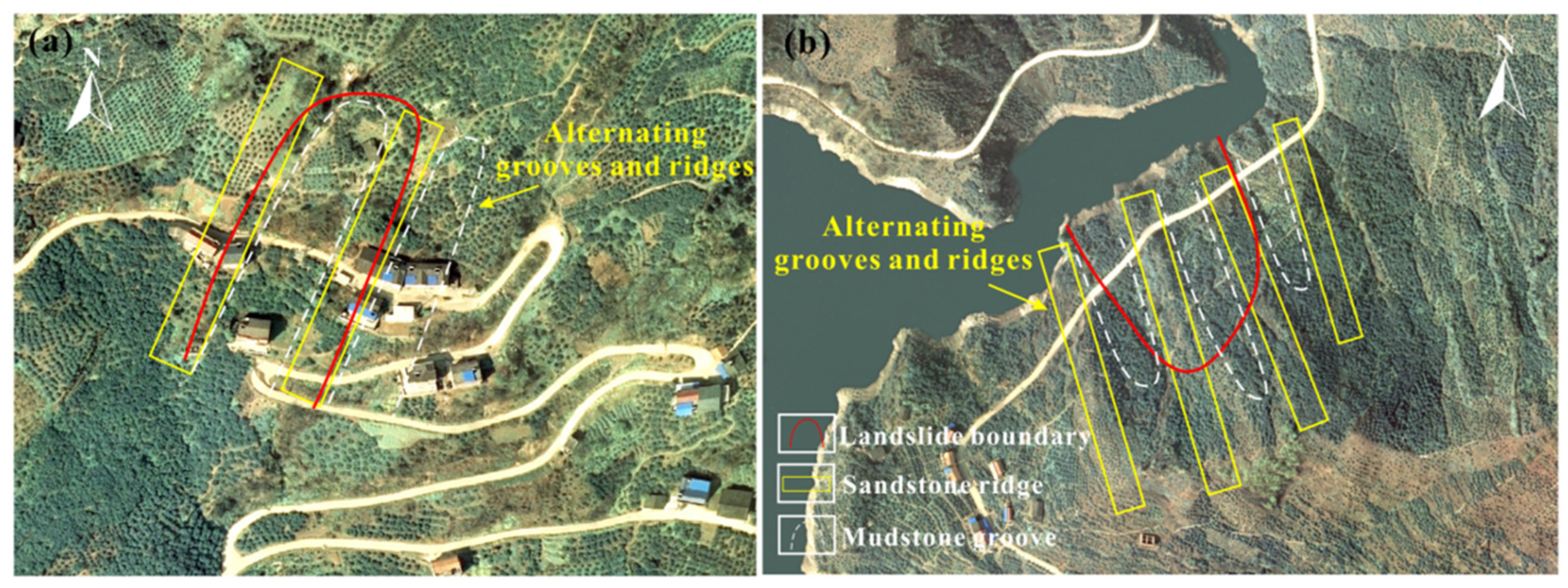
The Wanshuitian landslide is situated in Jiajiadian Village, Guizhou Town, Zigui County, Yichang City, Hubei Province. Primary structures in the landslide area include the Zigui syncline, the NE-trending Xingshan fault zone, and the Xiannvshan fault zone in southeastern Zigui County (Figure 1a). The surface of the slope is covered by Quaternary landslide deposits (Q4del), with thickness exhibiting significant spatial variability: the deposits are thinner on both sides of the ridge, while they are noticeably thicker in the central area. The material is composed of grayish-brown clay interspersed with gravel, with particle sizes ranging from 2 to 15 cm, and an overall thickness of about 3 to 5 m. Strata exposed in the landslide area are dominated by the Middle Jurassic Qianfoya Formation (J2q), which consists predominantly of interbeds consisting of purplish-red mudstones and grayish-yellow to grayish-green sandstones and exhibits an attitude of 282°∠59° (Table 1). The slope top and bottom show elevations of 380 m and 177 m, respectively, indicating a relative height difference of 203 m. The slope of the landslide exhibits an aspect of 10°, a gradient of 25° (maximum: 32°), and a concave and convex shape in the upper and lower part, respectively (Figure 1c,d). Additionally, there exists a strong correlation between geomorphic features and lithologies. The siltstone outcrop areas occur as ridges, with the mudstone outcrop areas as troughs, leading to the formation of the geomorphic feature of alternating grooves and ridges (Figure 1b).

2.2. Failure Process

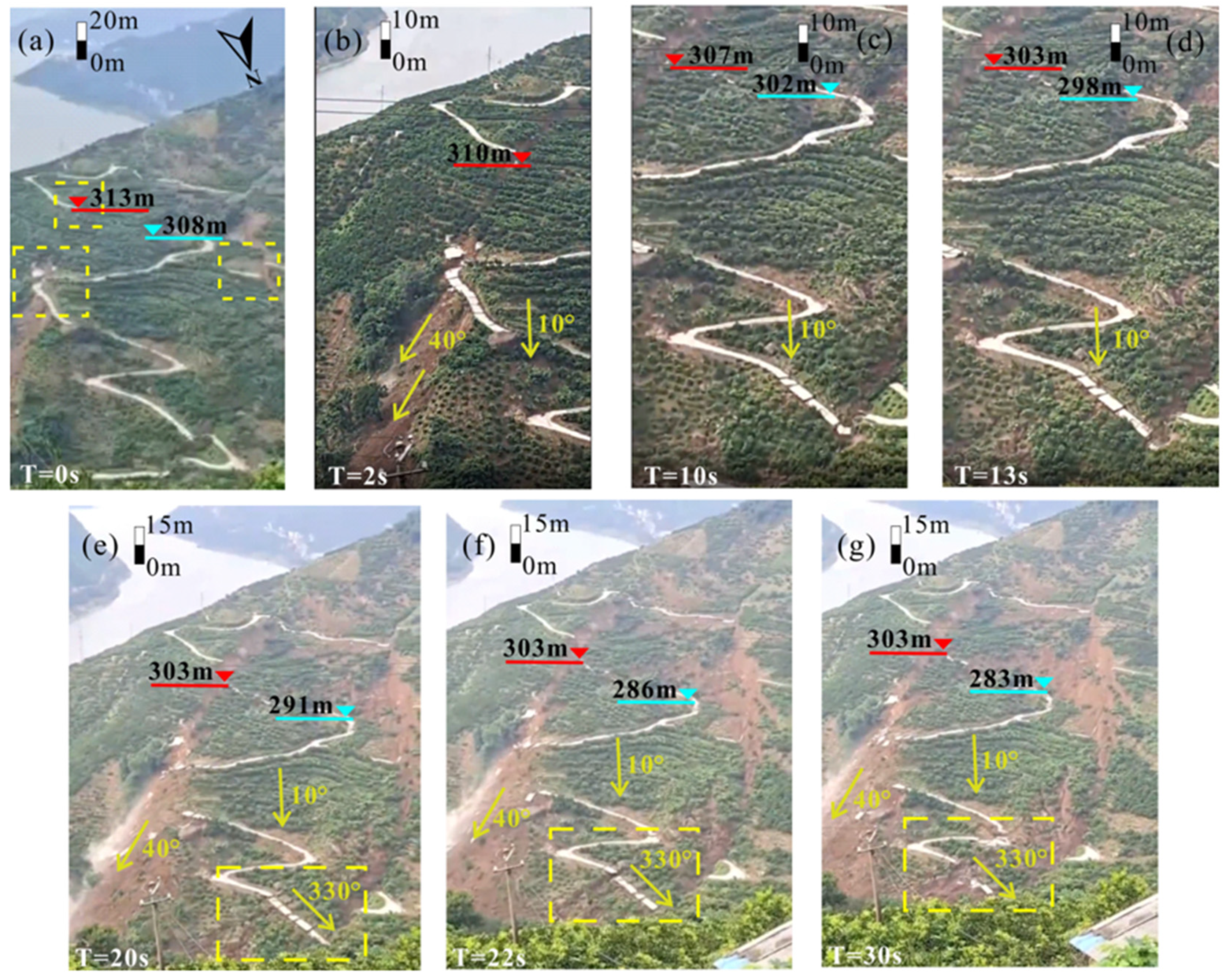
Figure 2 shows images from the video showing the failure process of the Wanshuitian landslide recorded by a local villager using a mobile phone. With road panels located in the rear and middle parts of the landslide area as marker points, the displacement of the landslide was estimated based on the elevation changes in these panels. With the known sliding time and distance, the average velocity of the sliding mass during sliding can be calculated using Equation (1) based on the relationship of displacement, velocity, and time, as described using Newton’s laws [34]:
V = h i + 1 h i tsin α
where i is the current moment, i + 1 is the next moment, t is the time interval between the two moments, hi is the elevation of a marker point at moment i, hi+1 is the elevation of a marker point at moment i + 1, and V is the average velocity from moment i to i + 1. The hi and hi+1 values can be obtained by tracking the positions of marker points from moments i to i + 1. In addition, α is the average dip angle of the sliding surface, estimated at 30° based on the average slope.
Based on the escape experience of the villagers and the video recorded on site (Figure 2), it can be inferred that the Wanshuitian landslide underwent two sliding stages: overall sliding and secondary disintegration.
(1) The overall sliding stage: Since the landslide had become unstable by the time the villager took the video, the destabilization time was adjusted to be 10 s earlier. The overall sliding of the landslide lasted for approximately 23 s. The slope body at the rear tended to stabilize as it slid to an elevation of 303 m. Based on the dislocation distance of the road panel on the right side of the rear (indicated by a red marker), the overall sliding distance of the landslide was estimated at about 20 m. The average sliding velocity during this stage was approximately 869 mm/s.
(2) The secondary disintegration stage: This stage lasted for 17 s. During this stage, the slope body at the rear of the landslide almost ceased sliding, while the rear wall in the middle to rear part of the landslide (near the elevation of 303 m) was fully penetrated, leading to secondary disintegration. Except for the slope body at the rear, the whole landslide continued to slide downward toward the gully in the lower part, eventually leading to the formation of an accumulation area with elevations ranging from 250 m to 180 m. Based on the dislocation distance of the road panel in the middle part of the rear (indicated by a blue marker), the sliding distance during the secondary disintegration was determined at approximately 30 m. The average sliding velocity was about 1760 mm/s, significantly exceeding that during the overall sliding stage. This is primarily due to the concave slope shape in the upper part and convex shape in the lower part. Specifically, the abrupt increase in slope gradient significantly enhanced the efficiency of conversion from potential to kinetic energy. Concurrently, the fragmentation of the sliding mass led to the dynamic weakening of the frictional coefficient. Their coupling effect sharply increased the sliding velocity of the sliding mass.
(3) Movement direction: The Wanshuitian landslide exhibited a geomorphic feature of alternating grooves and ridges before failure. Therefore, after the landslide failure, materials from the slope body exhibited a sliding direction of primarily 10° predominantly while also falling in directions of 40° and 330°.
(4) Average sliding velocity: Personnel in the field observed that the process from the macroscopic deformation to the overall sliding deformation of the landslide lasted for approximately 40 s, with a final sliding distance of about 50 m. Therefore, the average sliding velocity of the landslide was calculated at approximately 1250 mm/s. Based on the classification and grading criteria for geological disasters [35], the Wanshuitian landslide was categorized as a high-speed landslide.

2.3. Macroscopic Deformation Characteristics

The Wanshuitian landslide exhibits a tongue-like planar view, with a primary sliding direction of approximately 10°. This landslide has a broader front but a slightly narrower rear, with left and right sides bounded by boundaries between steep and gentle terrains and an average width of around 130 m. The sliding mass showed a longitudinal extent of approximately 375 m, an area of about 4.87 × 10⁴ m2, and an average thickness of about 20 m, resulting in a total volume of approximately 80 × 104 m3.
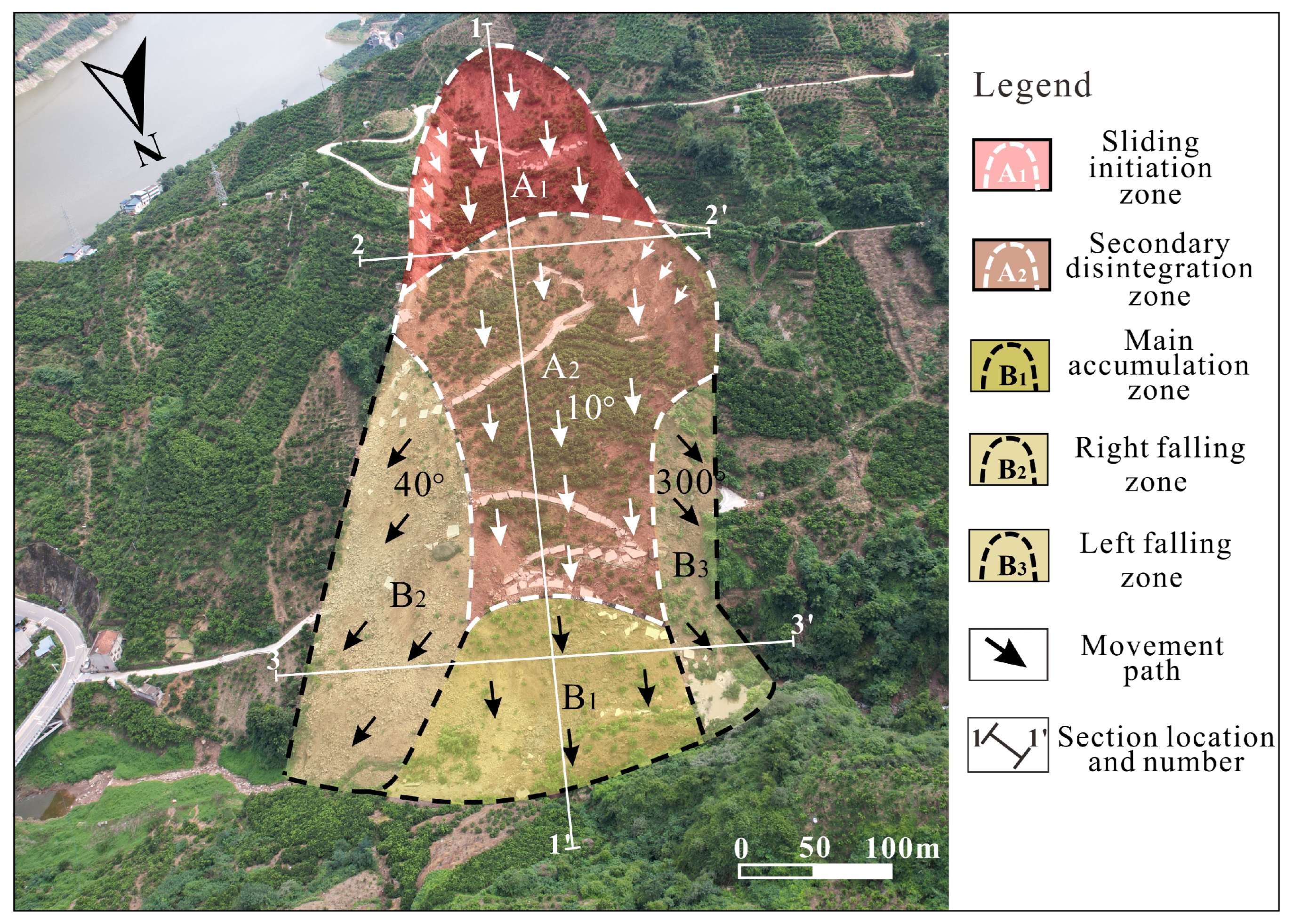
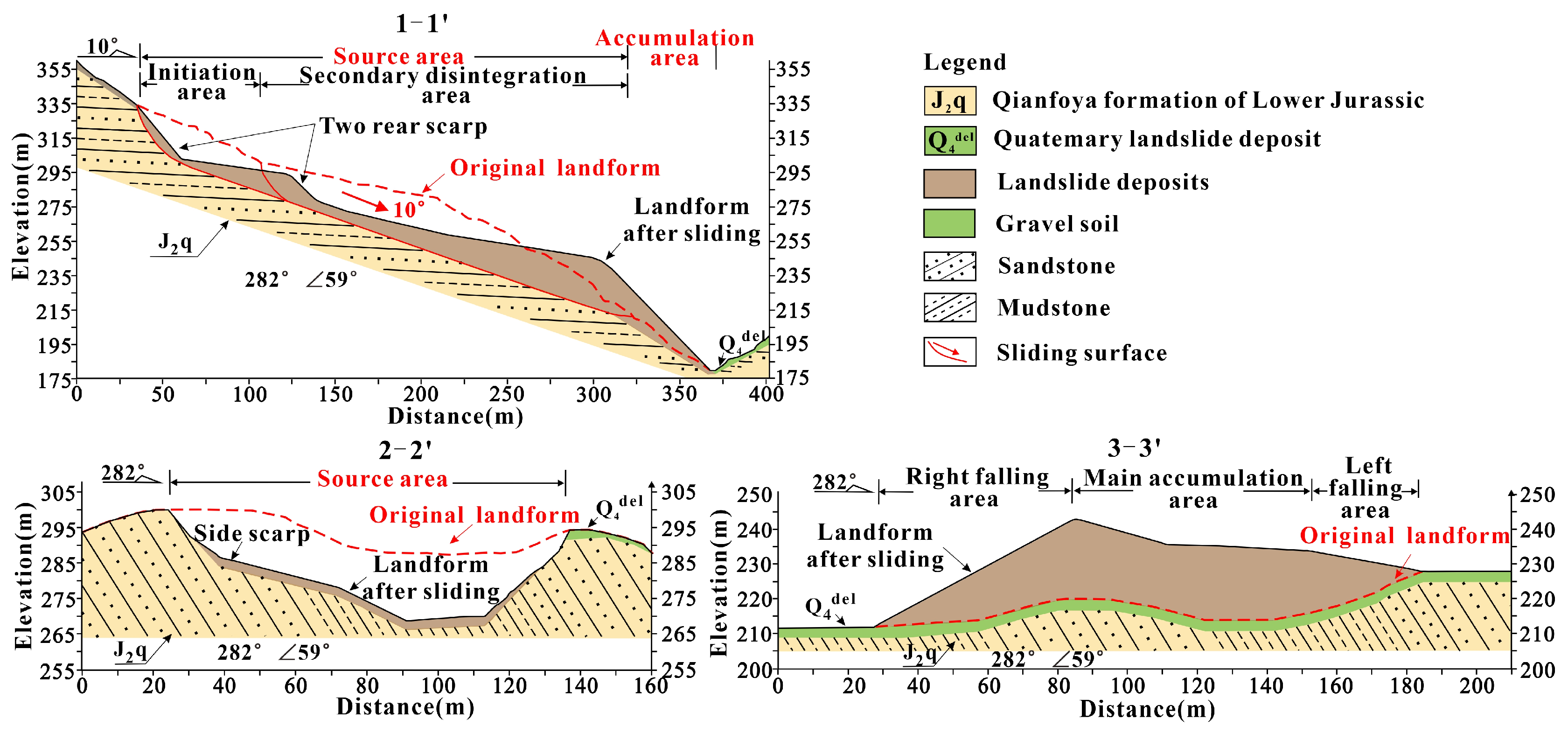
The front and rear of the landslide have elevations of 180 m and 335 m, respectively, indicating a relative height difference of 155 m. The landslide displays a concave morphology in the upper part (slope: 15° to 25°) and a convex one in the lower part (slope: 30° to 35°), with an average slope of about 25°. Based on this morphology and its variations, the Wanshuitian landslide areas can be divided into the source (A) and accumulation (B) zones. Figure 3 shows the zoning characteristics and movement path of the Wanshuitian landslide, while Figure 4 illustrates the engineering geological profiles of the landslide. The various zones are described as follows.

2.3.1. Source Zone (Zone A)

Based on its dynamic characteristics (Figure 3), the source zone (zone A) can be subdivided into two zones longitudinally: sliding initiation (A1) and secondary disintegration (A2).
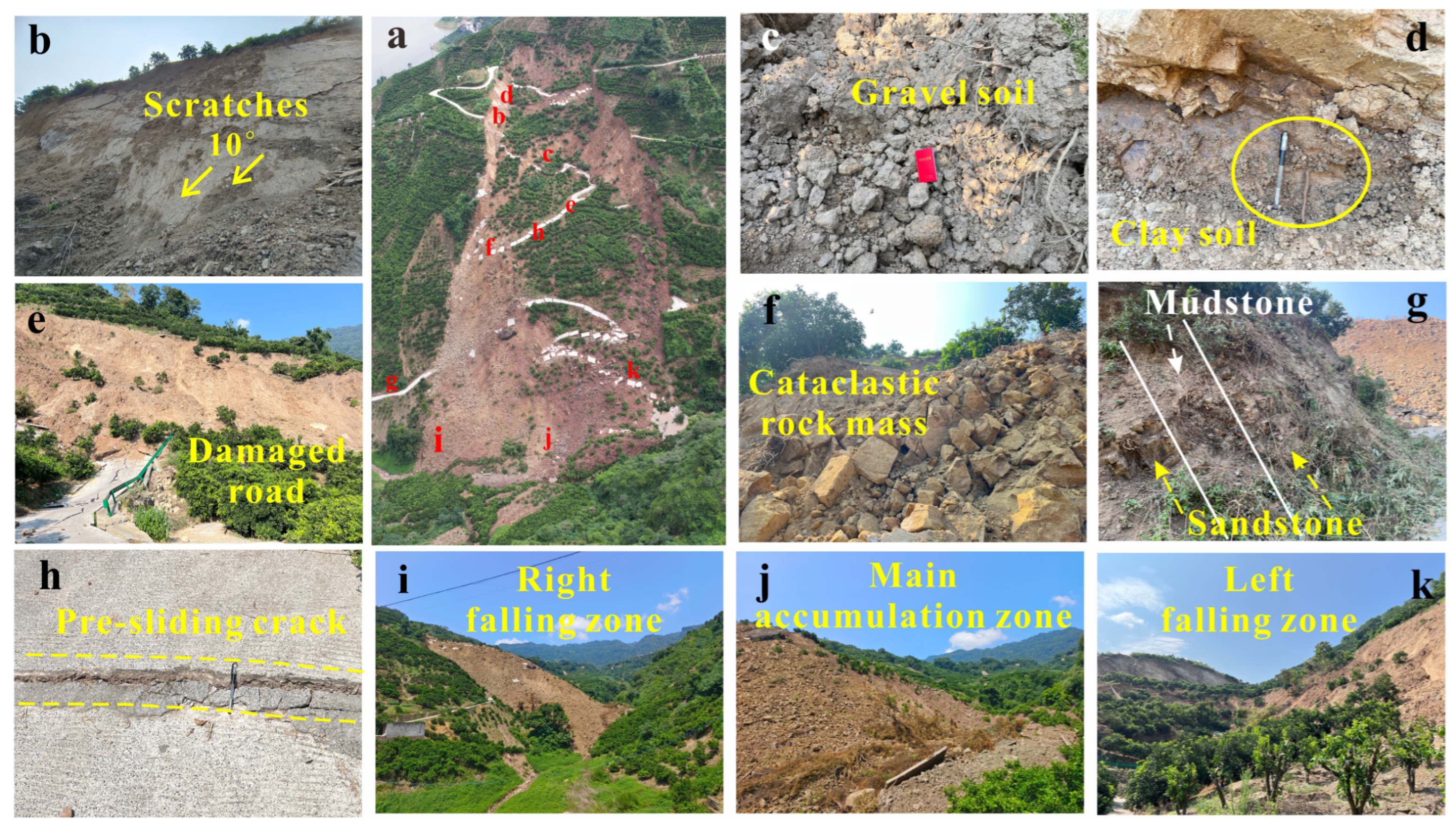
(1) Sliding initiation zone (A1): This zone refers to the upper part of the source zone. It appeared to be a short tongue in the planar view, covering an area of approximately 0.93 × 10⁴ m2, which accounted for 38% and 19% of source zone A and the entire landslide, respectively, and a residual volume after the landslide failure of approximately 9.3 × 10⁴ m3. After the landslide failure, a fan-shaped rear wall with a length of about 50 m, a width of about 80 m, and a height difference of about 30 m formed in the rear of zone A1. Meanwhile, a rectangular bedrock sidewall with lengths ranging from 15 m to 20 m and height differences from about 10 m to 15 m formed on the right side of zone A1 (Figure 5a). The bedrock sidewall showed distinct sliding-induced scratches in the direction of 10° (Figure 5b). The bedrock layer on the right wall was covered with clayey soils, which are approximately 1 cm to 2 cm thick and can be rolled into strips (Figure 5d). The surface of the accumulation body exhibited substantial soils and vegetation from the original slope body. The main materials of the landslide body are gravel soil (Figure 5c) and cataclastic rock mass (Figure 5f). The bedrock has an interbedded structure of sandstone and mudstone (Figure 5g).
(2) Secondary disintegration zone (A2): This zone represents the lower part of source zone A. It displayed a trapezoidal shape in the planar view, covering an area of approximately 1.54 × 10⁴ m2, which accounted for 62% and 30% of the source zone and the entire landslide, respectively, and a residual volume after the landslide failure of approximately 15.4 × 10⁴ m3. A fan-shaped rear wall with a length of about 30 m, a width of about 80 m, and a height difference of about 15 m formed in the rear of this zone. This rear wall showed the same strike as that in zone A1. Significant sliding-induced scratches were observed on the wall surface in the lower part of the left wall. These scratches had a strike of about 10°, aligning with the sliding direction of the landslide. Dislocation sections of the road panels were visible on the right side (Figure 5e). In contrast, the road panels on the left remained relatively intact, showing pre-sliding fractures with widths ranging from about 8 cm to 10 cm (Figure 5h). This signals deformations of the slope body before sliding. The existing fractures on the slope body served as favorable pathways for rain to infiltrate into the slope.

2.3.2. Accumulation Zone (Zone B)

The accumulation zone (B) in the lower part of the slope body can be subdivided into the main accumulation (B1), right falling (B2), and left falling (B3) zones based on the varying movement directions of slope materials.
(1) Main accumulation zone (B1): This zone is in the middle part of the accumulation zone. It exhibited a rectangular shape in the planar view, covering an area of approximately 0.95 × 10⁴ m2, which represented 50% and 25% of accumulation zone B and the entire landslide, respectively. The accumulation body in this zone displayed a rectangular cross section, with the highest point being about 25 m higher than the original terrain line. Moreover, this accumulation body exhibited an average thickness of about 20 m, an overall volume of about 1.9 × 10⁴ m3, and a movement direction of 10°. The landslide slid downward into the gully. Impeded by the opposite mountain, the deposits accumulated and bulged at the gully and eventually ceased moving. The upper portion of the accumulation body retained a significant amount of vegetation, while the lower portion was largely devoid of vegetation. Primary deposits included gravelly soils and broken rocks (Figure 5j).
(2) Right falling zone (B2): This zone is situated in the right part of the accumulation zone. It exhibited a banded shape in the planar view, covering an area of approximately 0.9 × 10⁴ m2, which represented 40% and 20% of accumulation zone B and the entire landslide, respectively. The accumulation body in this zone displayed a triangular cross section, with the highest point being about 25 m higher than the original terrain line. Moreover, this accumulation body exhibited an overall volume of about 9 × 10⁴ m3, with a falling direction of 40°. The primary deposits in zone B2 included isolated boulders, widespread gravels, and rock detritus (Figure 5i), exhibiting a reverse grain size order characterized by coarse-grained and fine-grained materials concentrated in the upper and lower parts, respectively. Additionally, there was minimal vegetation in zone B2, indicating that materials in this zone underwent complete disintegration at high speeds.
(3) Left falling zone (B3): This zone is located in the left part of accumulation zone B. It exhibited a banded shape in the planar view, covering an area of approximately 0.2 × 10⁴ m2, which represented 10% and 5% of accumulation zone B and the entire landslide, respectively. The accumulation body in this zone displayed a triangular cross section, with the highest point being about 15 m higher than the original terrain line. Moreover, this accumulation body exhibited an overall volume of about 1.4 × 10⁴ m3 and a falling direction of 300°. The deposits in the accumulation body blocked the gully, leading to local water accumulation (Figure 5k). Compared to zone B2, zone B3 showed a relatively gentle slope at the junction between the steep and gentle terrains, resulting in relatively slow movement of slope materials. Therefore, the accumulation body in zone B3 still retained large quantities of soils and orange trees from the original slope body.

2.4. Processes of Rain

The landslide area is characterized by a continental monsoon climate with four distinct seasons, an annual average temperature of 17.6 °C, and an average humidity of 73%. The average annual rainfall is 1245 mm, distributed over approximately 134 days. Notably, the flood season, which spans from June to August, accounts for 68 days of rainfall, representing 50.75% of the total annual rainfall days, while the rainfall during this period constitutes 69% to 77% of the annual total. This region experiences relatively high rainfall intensity and magnitude.
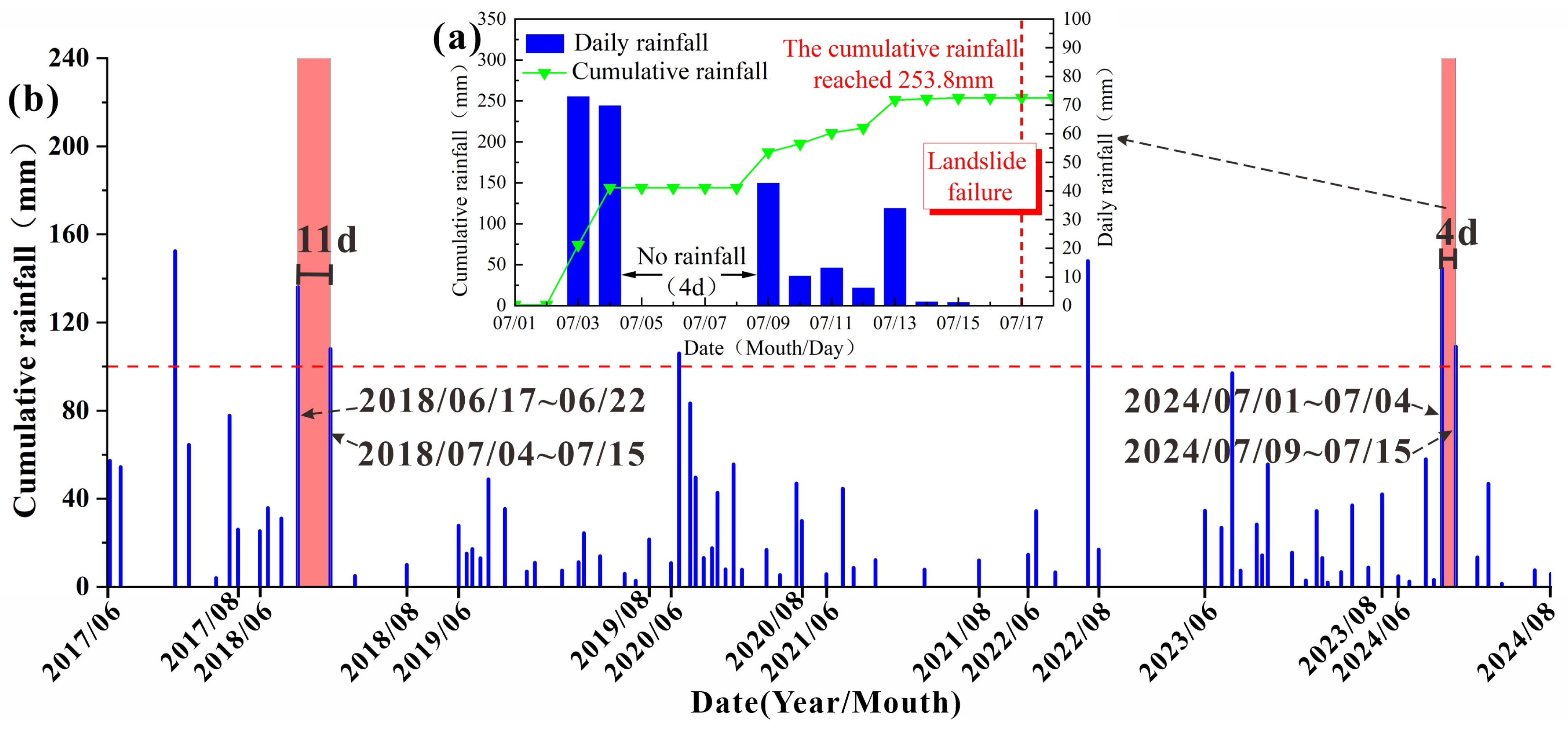
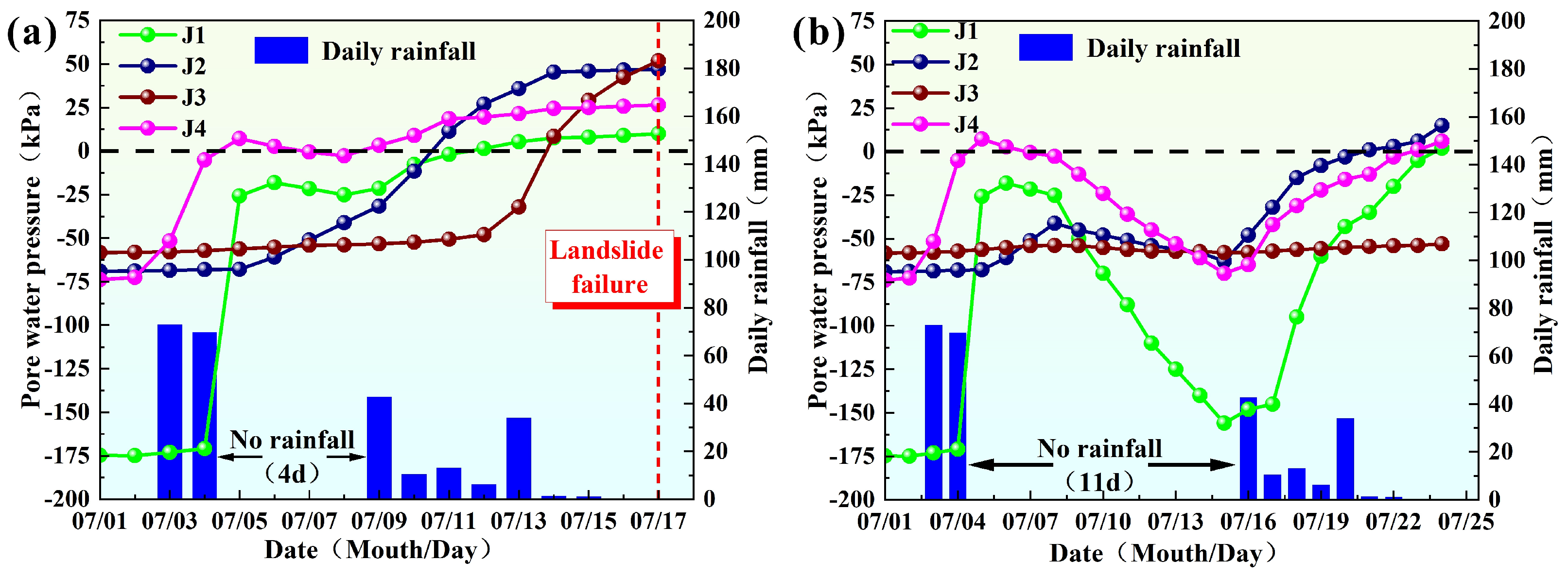
The Wanshuitian landslide failed during the flood season in 2024. Since 1 July 2024, the landslide area has experienced two sustained heavy rain events. The first one lasted two days from July 3 to July 4, with daily rainfalls of 73 mm and 69.8 mm, respectively. The second event lasted seven days from July 9 to July 15, with daily rainfalls of 42.5 mm on July 9 and 34 mm on July 13. From July 1 to July 17, the cumulative rainfall in the landslide area reached 253.8 mm (Figure 6a).
Statistics of the cumulative rainfalls of sustained rains in the Wanshuitian landslide area from June to August from 2018 to 2024 (Figure 6b) reveal that the landslide area experienced 81 sustained rain events over the past seven years. Notably, two processes of rain in the landslide area in June 2018 and July 2024 exhibited high intensity, with cumulative rainfalls of two adjacent rain events exceeding 100 mm. Compared to the rain process in June 2018, that in July 2024 exhibited cumulative rainfalls of individual rain events exceeding 100 mm and a shorter time interval between two rain events. Attributable to the lag effect of rains, the slope was affected by the subsequent rain event before the end of its response to the preceding one. Compared to other rain processes, that in July 2024 effectively sustained the slope’s response, enabling the slope to receive more effective rain and thus exerting more severe impacts on the stability of the Wanshuitian landslide.

3. Numerical Simulations

3.1. Objectives of GeoStudio-Based Numerical Simulations

The Wanshuitian landslide experienced a relatively rare process of rain before its failure. With time as a key variable, this study constructed the seepage and displacement fields of the landslide using GeoStudio software [36]. Accordingly, this study calculated the changes in the internal seepage and slope stability of the landslide under conditions of heavy rains with varying durations [37]. Furthermore, this study explored the lag effect of heavy rains at different time intervals on the slope under identical cumulative rainfall, aiming to reveal whether timely and adequate rainfall can significantly affect slope stability. Ultimately, this study identified the causal mechanism of the failure of the Wanshuitian landslide.

3.2. Numerical Modeling

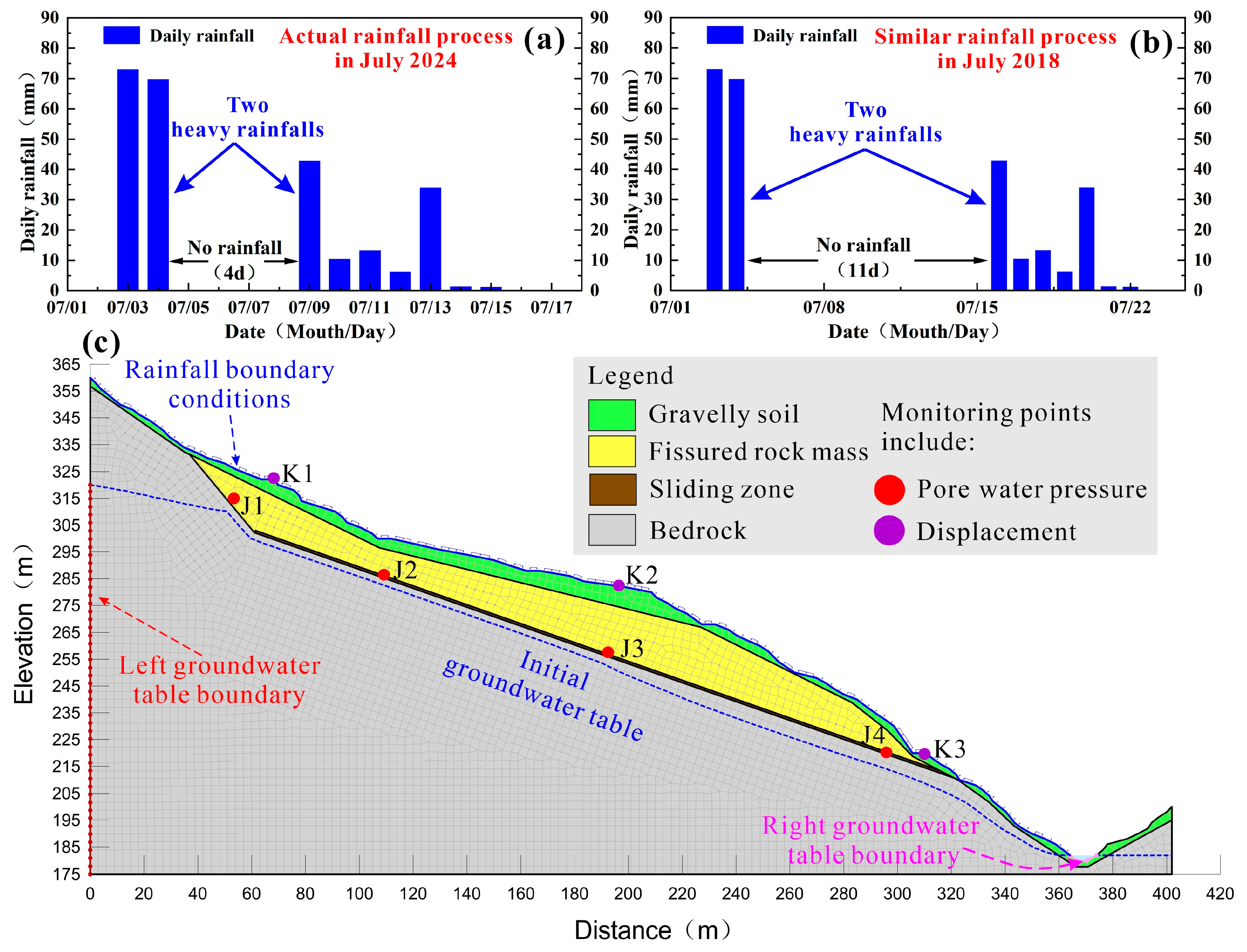
Using the method for calculating seepage fields described in the theory on unsaturated soil strength based on the Van Genuchten model [38], this study derived the movement patterns of water in unsaturated media using the empirical Van Genuchten equation for the fitting. Given the engineering geological characteristics of the Wanshuitian landslide, this study constructed a numerical model for the landslide, with section 1-1′ as the calculation section. The numerical model consisted of 38,630 nodes and 37,747 grids (Figure 7). The physical and mechanical parameters of rock and soil masses in the Wanshuitian landslide (Table 2) were primarily determined through engineering geological analogy. Specifically, these parameters were derived based on geotechnical and in situ tests of the Shuitiancao landslide located 2 km away from the Wanshuitian landslide. Based on on-site seepage tests conducted on the Shuitiancao landslide, the permeability coefficient of its cover layer was measured to be 2–3 m/d; combined with numerical simulation results, the model parameters for the Wanshuitian landslide were comprehensively determined. The groundwater level was initially assessed via field investigations, where lithological differences between the rubbly clay layer and gravelly soil were identified to locate the aquifer. Subsequently, a coupled numerical simulation inversion method was used to comprehensively determine the groundwater level that is close to the actual conditions. Additionally, four pore water pressure monitoring points (J1-J4) and three displacement monitoring points (K1-K3) were arranged along the slope (Figure 7c).
The numerical model was verified using the method for displacement inversion analysis in engineering geology. Existing research results indicate that the InSAR-derived maximum deformation rate was 29.63 mm/yr prior to the failure of the Wanshuitian landslide. The numerical simulation results under actual rain conditions from 2022 to 2023 showed that the deformation rate at the same location was 31.29 mm/yr before the failure of the landslide. This result is relatively consistent with the InSAR-derived data, confirming the effectiveness of the numerical model utilized in this study.
The Wanshuitian landslide failed on 17 July 2024. The rain gauge monitoring data from the adjacent Baimatan landslide indicate that before its failure, the Wanshuitian landslide experienced two sustained heavy rain events with cumulative rainfalls both exceeding 100 mm and an interval of four days. In contrast, a similar sustained process of heavy rains occurred during the flood season in 2018 (Figure 7b), with an interval of 11 days between two heavy rain events. However, no landslide failure occurred after this rain process. To explore the lag effect of two heavy rain events with different time intervals on the landslide slope of the Wanshuitian in order to further analyze the causal mechanisms behind the landslide failure, this study simulated rain events with the same cumulative rainfall but varying time intervals. Specifically, with actual rainfalls over the 17 days from July 1 to July 17 as the boundary conditions, this study developed two scenarios of sustained rains with time intervals of 4 days (Figure 7a) and 11 days (Figure 7b) for comparative analysis.

3.3. Numerical Simulation Results and Analysis

3.3.1. Seepage Characteristics

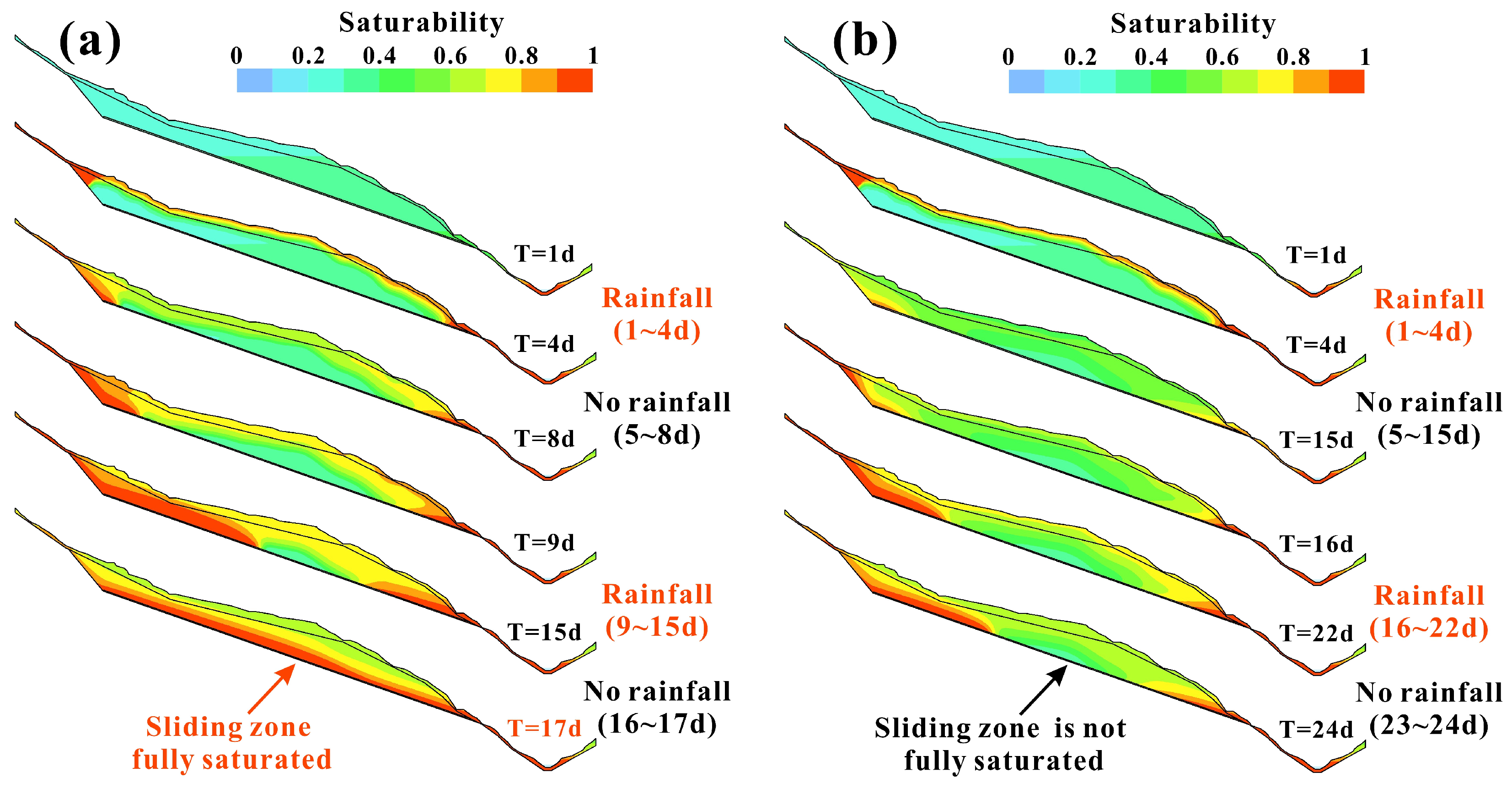
By calculating the transient seepage using the SEEP/W module [39], this study derived the changes in saturation and pore water pressure within the slope prior to landslide failure under different rain conditions (Figure 8 and Figure 9). The results are as follows:
(1)
Condition 1
From days 0 to 4, the slope experienced the first sustained heavy rain event. Rainwater infiltrated the slope from the slope surface and the rear structural plane. The front and rear parts of the slope responded more rapidly, as substantiated by the rising pore water pressures at monitoring points J1 and J4. On day 4, the rock and soil masses on the slope surface became saturated, with rainwater accumulating in the rear and front of the slope. From days 5 to 8, despite the absence of rain, the earlier rainwater accumulated within the slope, followed by infiltration into the slope. As a result, the water content in the slope gradually increased, with rainwater progressively infiltrating into the middle part of the sliding mass. During this period, the pore water pressures at monitoring points J1 and J4 gradually stabilized, showing a slight downward trend, that at J2 in the middle-rear part of the sliding zone gradually increased, and no significant change was observed at monitoring point J3 in the middle part of the sliding zone. On day 8, the water content in the slope rose significantly, accompanied by increased saturation in the rear and front of the slope.
From days 9 to 15, the slope experienced the second sustained heavy rain event. Similarly, rainwater continued to infiltrate into the slope, leading to a continuous increase in slope saturation. Rainwater continued to infiltrate along the slope surface and the rear structural plane, accumulating in the sliding zone to recharge groundwater. Consequently, the pore water pressures at monitoring points J1, J2, J3, and J4 all increased.
On day 15, groundwater tables in the front and rear of the slope increased, causing the front and middle-rear parts of the sliding zone to be largely saturated. From days 16 to 17, despite the absence of rain, seepage within the slope continued to expand towards the middle part, leading to a gradual increase in the saturation of the sliding zone. Notably, the pore water pressure at monitoring point J3 increased significantly. On day 17, the elevated groundwater table in the middle part of the slope rendered the entire sliding zone saturated with water. On this day, the pore water pressures at four monitoring points exhibited significant increases, with a maximum pore water pressure of 51.8 kPa observed at monitoring point J3 and the highest pressure increment of 184.8 kPa identified at monitoring point J1.
(2)
Condition 2
From days 0 to 4, the slope experienced the first sustained heavy rain event. During this period, the response of the slope to rain mirrored that under condition 1, with pore water pressures at monitoring points J1 and J4 rising early. On day 4, rainwater accumulated in the rear and front of the slope, rendering the rock and soil masses on the slope surface saturated with water. From days 5 to 15, despite the absence of rain, the earlier rainwater accumulating within the slope continued to infiltrate into the slope. Meanwhile, due to the internal seepage, rainwater transitioned into groundwater and then discharged. After three days of stabilization, monitoring points J1 and J4 saw a sharp decline in the pore water pressure. On day 15, the water content in the rock and soil masses decreased significantly.
From days 16 to 22, the slope underwent the second sustained heavy rain event, leading to a continuous increase in slope saturation. Rainwater continued to infiltrate along the slope surface and the rear structural plane, reaching the sliding zone and recharging the groundwater. The pore water pressure at monitoring points J1, J3, and J4 increased, while no significant change was observed in the pore water pressure at monitoring point J2. On day 22, the elevated groundwater tables in the front and rear of the slope rendered the front and rear parts of the sliding zone saturated with water locally. From days 23 to 24, despite the absence of rain, seepage within the slope continued to expand. On day 24, the front and rear parts of the sliding zone showed increased saturation, whereas its middle part remained unsaturated. The highest pore water pressure of 15 kPa was observed at monitoring point J2, while the maximum pressure increment of 176.8 kPa was discovered at monitoring point J1.
In summary, the changes in saturation and pore water pressure within the slope under two rainfall conditions indicate that the slope responded more significantly to condition 1 in the case of the same cumulative rainfalls. Under this condition, the interior of the slope was prone to reach saturation, leading to a higher increasing amplitude of pore water pressure. The sliding zone of the landslide gradually transitioned from a natural state to a saturated state. This resulted in the softening and reduced shear strength of the sliding zone, ultimately triggering landslide failure.

3.3.2. Landslide Stability

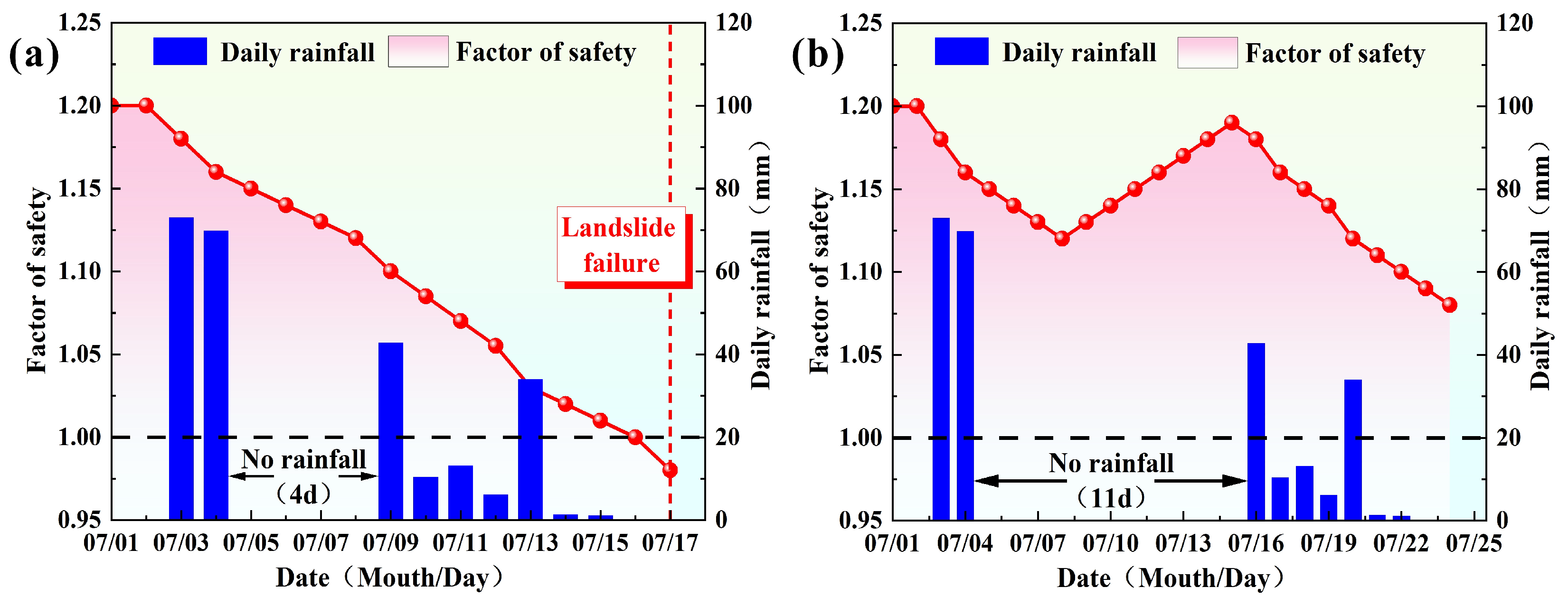
Based on the seepage analysis using the SEEP/W module, the obtained seepage model was imported into the SLOPE module [40] to calculate the changes in the factor of safety (FOS) of the landslide at each time step (Figure 10). The results are as follows:
(1)
Condition 1
The two sustained heavy rain events with an interval of four days generally reduced the FOS of the landslide from 1.2 to 0.98. During the first sustained heavy rain event (days 0 to 4), the FOS of the landslide decreased continuously from 1.2 to 1.16, with the landslide remaining stable by day 4. Within four days after the heavy rain ceased (days 5 to 8), the continued infiltration of rainwater continued to produce a negative impact on the landslide stability, with the FOS decreasing from 1.16 to 1.12 and the landslide becoming roughly stable by day 8. During the second sustained heavy rain event (days 9 to 15), the FOS of the landslide decreased from 1.12 to 1.01, with the landslide becoming less stable by day 15. Within two days after the second heavy rain event ceased (days 16 to 17), the FOS further declined from 1.01 to 0.98 due to the lag effect of rain, with the landslide becoming unstable by day 17. The heavy rain-induced water saturation of the slope, the softening effect of the sliding zone, and the dead load of the slope jointly led to the reduced shear strength of the sliding zone, ultimately causing the overall failure of the landslide.
(2)
Condition 2
The two sustained heavy rain events with an interval of 11 days generally reduced the FOS of the landslide from 1.2 to 1.08. During the first sustained heavy rain event (days 0 to 4), the FOS of the landslide decreased continuously from 1.2 to 1.16, with the landslide remaining stable by day 4. Within 11 days following the cessation of the first rain event (days 5 to 15), the FOS of the landslide decreased initially and then increased, exhibiting a fluctuating trend. Specifically, the FOS decreased from 1.16 to 1.12 during days 5 to 8 and then increased from 1.12 to 1.19 during days 8 to 15. Within the 11-day interval, the originally stable landslide became roughly stable and ultimately regained its stability. During the second sustained heavy rain event (days 15 to 22), the FOS of the landslide decreased from 1.19 to 1.1, rendering the landslide to be roughly stable by day 22. Within two days after the second rainfall ceased (days 22 to 24), the FOS further declined from 1.1 to 1.08 due to the lag effect of rain, with the landslide becoming roughly stable by day 24.
In summary, changes in the slope stability under the two conditions reveal that the two sustained heavy rain events with a four-day interval exerted more significant impacts on the slope stability under the same cumulative rainfall.

3.3.3. Landslide Deformations

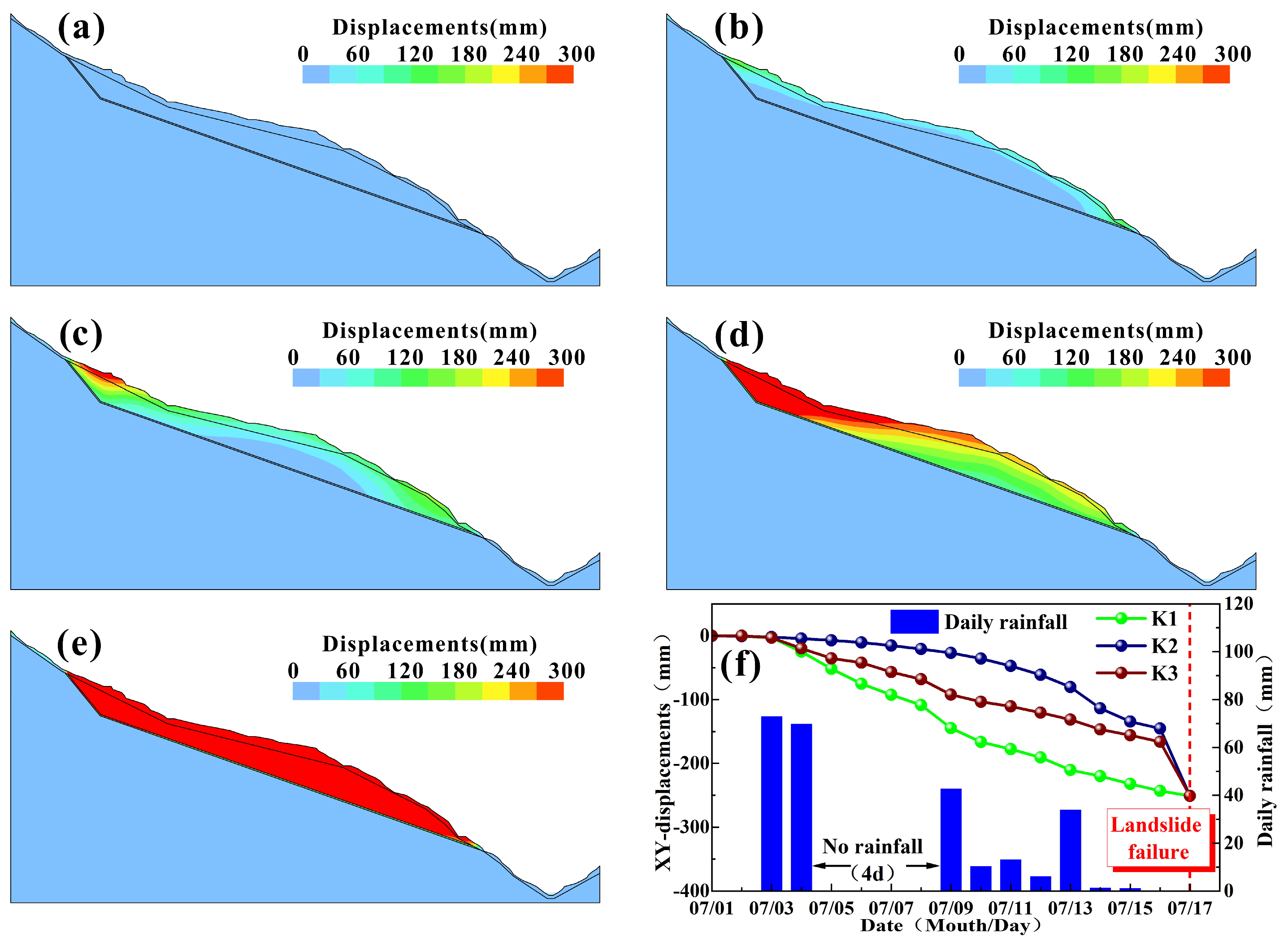
To explore the causal mechanism of failure of the Wanshuitian landslide, the results under condition 1, derived using the SEEP/W module, were imported into the SIGMA/W module to analyze the changes in the displacement of the slope and data on the displacement at monitoring points K1 to K3 (Figure 11). This simulation presented the combined response process prior to the landslide failure.
Figure 11a illustrates the initial state of the landslide. After the first sustained heavy rain event (days 0 to 4), the slope exhibited increased surface displacement and pronounced deformations in the rear and front (Figure 11b), as evidenced by the significant changes in the displacement observed at monitoring points K1 and K3. From days 5 to 8, despite the absence of rain, slope deformation continued to intensify, especially in the rear. Within these four days, the displacement at monitoring point K1 increased rapidly (Figure 11c). During the second sustained heavy rain event (days 9 to 15), the deformation range of the slope gradually expanded, with the most significant deformation observed in the rear. The displacement at monitoring point K1 increased substantially, while that at monitoring points K2 and K3 exhibited a small increasing amplitude (Figure 11d). Within the following two days (days 16 to 17) after the cessation of rain, the deformation expanded in the rear, connecting the deformation zone in the front. As a result, the local deformations transitioned to overall deformation. On day 17, the displacement at monitoring points K2 and K3 increased sharply, with the landslide exhibiting thrust load-caused deformations and abrupt sliding (Figure 11e).
Overall, under the influence of the two sustained heavy rain events with a four-day interval, the sliding zone of the landslide gradually became saturated with water. Ultimately, the entire sliding zone became saturated with water and softened from a natural state, leading to a decrease in its shear strength and ultimately the landslide failure. The landslide evolved from local deformations to overall deformation, characterized by thrust load-induced deformations and abrupt sliding. The numerical simulation results are consistent with the actual process. Under the same cumulative rainfall, the two sustained heavy rain processes with varying time intervals between two rain events exerted varying lag effects on the slope. The process with a shorter time interval between two rain events led to more effective rainfall on the slope, thereby exerting a more significant impact on slope stability.

4. Landslide Failure Causative Factors

4.1. Lithologic Assemblage Comprising Interbeds of Soft and Hard Rocks

Rocks underlying the Wanshuitian landslide are sandstone and mudstone interbeds in the Middle Jurassic Qianfoya Formation (J2q), with a thin layer of loose deposits on their top. This suggests a lithologic assemblage comprising alternating soft and hard rocks. The sandstone layers are relatively thick, while the mudstone layers are comparatively thin. The mudstones occur as weak interlayers, susceptible to weathering. Furthermore, these rocks are prone to softening upon exposure to water due to their high proportion of hydrophilic minerals. Both weathering and softening will lead to a rapid decline in their physical and mechanical strengths [41]. Moreover, the mudstones serve as relatively impermeable layers due to their low permeability. Accordingly, after infiltrating into the ground, rainwater discharges parallel to bedding along the mudstone layers. The failure of timely drainage will cause a stagnant groundwater table in the layers. Under the influence of stress from surrounding rocks and prolonged soaking in groundwater, the mudstone layers gradually disintegrate and become argillic, with reduced physical and mechanical properties and shear strength. The lithologic assemblage comprising alternating soft and hard rocks creates favorable geological conditions for the failure of the Wanshuitian landslide, emerging as a controlling factor in the landslide failure.

4.2. Geomorphic Feature of Alternating Grooves and Ridges

The Wanshuitian landslide exhibits an average slope of 25° and a maximum slope of 32°, presenting a shape concave in the upper part and convex in the lower part. Laterally, the landslide area shows the geomorphic feature of alternating siltstone ridges and mudstone valleys. Specifically, the sandstone outcrop areas occur as ridges, and the mudstone outcrop areas occur as valleys, exhibiting alternating grooves and ridges. Rainwater tends to accumulate and then infiltrate into the valleys, creating favorable topographic and geomorphic conditions for landslide failure.

4.3. Slope Structure with Well-Developed Joints

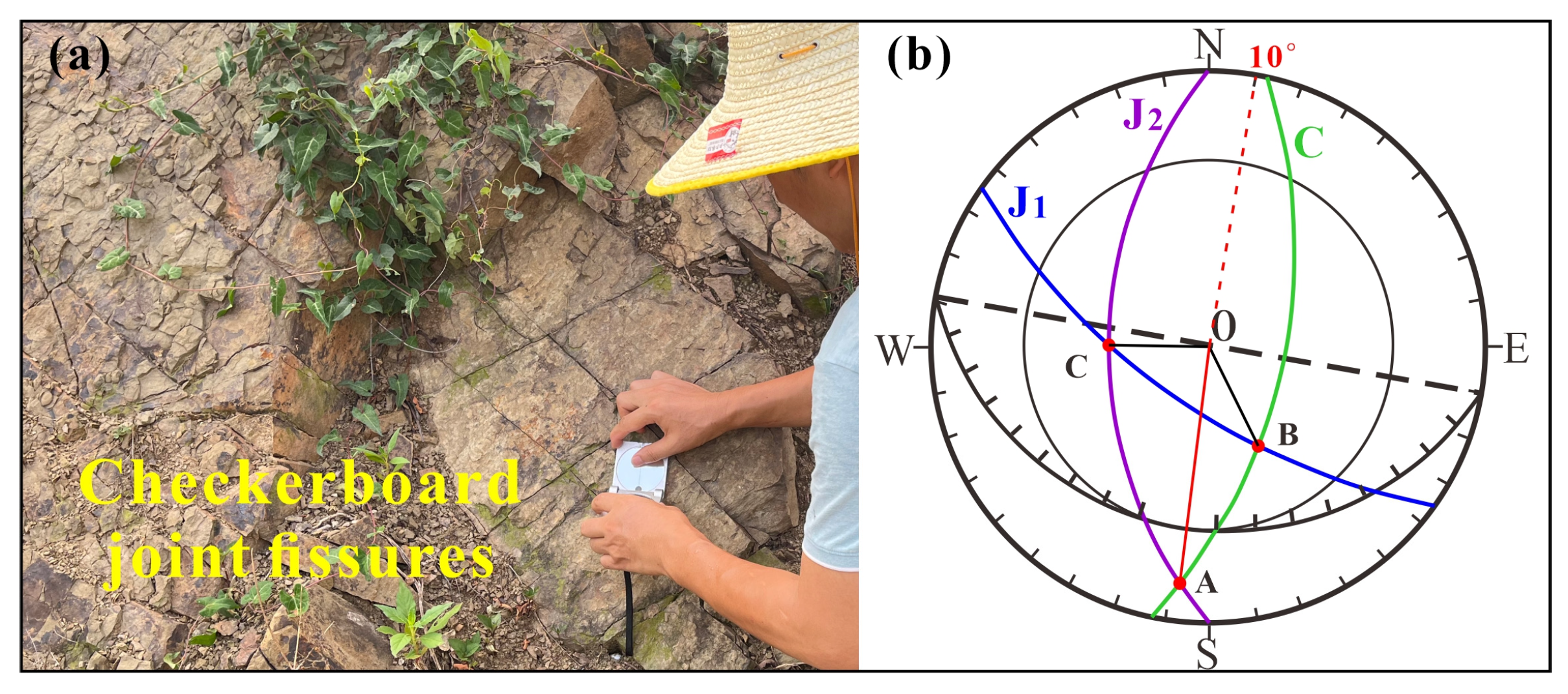
The density of fractures in a rocky slope and their combination with bedding planes dictate the slope stability [42]. Field surveys reveal the presence of checkerboard-like joints on the bedding planes of rock masses in the Wanshuitian landslide (Figure 12a). Specifically, the rock masses primarily exhibit two groups of dominant joints: J1 (attitude: 35°∠65°) and J2 (attitude: 95°∠45°). Meanwhile, the slope attitude measures 10°∠25°. Using stereographic projection (Figure 12b), this study analyzed the impact of the intersection lines of structural plane combinations on the landslide stability. The results indicate that the C-J2 structural plane combination shows the most significant impact on the stability of the Wanshuitian landslide, followed by the C-J1 and J1-J2 combinations sequentially. In the Wanshuitian landslide area, rock masses show well-developed joints and fractures. Cutting two groups of tensile fractures and weak layers destroys the integrity and intactness of the original rock masses, with the landslide mass cut into cubic blocks. This process promotes the weathering of the rock masses and enhances their permeability, providing pathways for rainwater infiltration. Meanwhile, wedges formed by rock masses on the slope due to the cutting of the three structural plane combinations (i.e., C-J1, C-J2, and J1-J2) are identified as unstable structures. Among them, C-J2 governs the failure of the Wanshuitian landslide. All of these factors provide favorable boundary conditions for the landslide failure.

4.4. Timely and Sufficient Rainfall to Recharge Groundwater

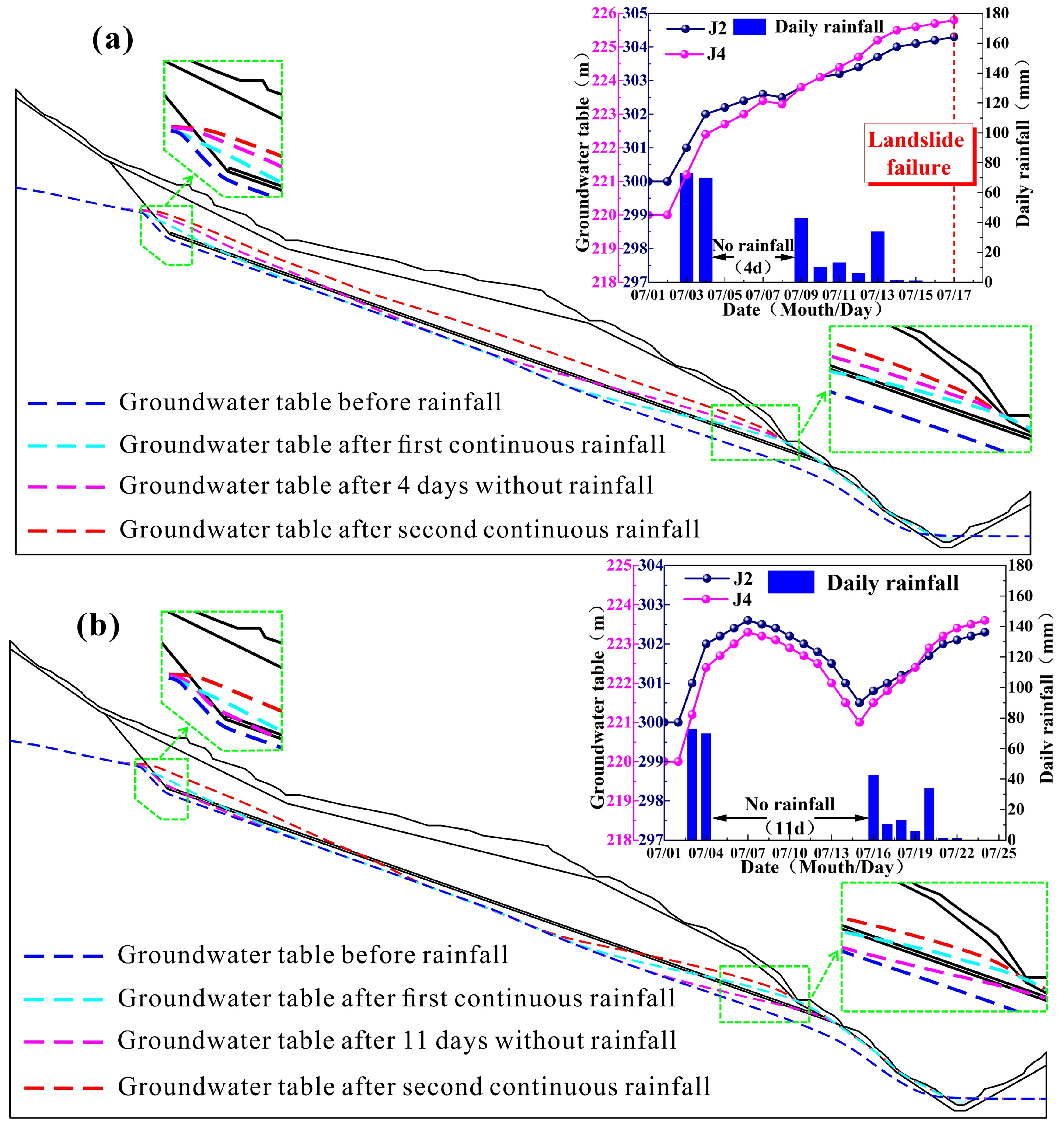
The analysis of rainfall monitoring data and numerical simulation results reveals distinct variation patterns of the groundwater table under the two rain conditions. In the case of two sustained heavy rain events with a four-day interval, the groundwater table generally kept rising. Following the first sustained heavy rain event, the groundwater table increased gradually. The rainwater infiltrating into the slope failed to discharge promptly due to the lag effect of rain, resulting in continuous seepage within the slope [43]. Two days after the cessation of the second sustained heavy rain event, the landslide failed (Figure 13a).
In contrast, in the case of two sustained heavy rain events with an 11-day interval, the groundwater table increased initially and then decreased, exhibiting a fluctuating trend. After the second sustained heavy rain event, the final groundwater table aligned closely with that observed during the first sustained heavy rain event, with the absence of landslide failure (Figure 13b).
Overall, in the case of two sustained heavy rain events with a shorter interval, the second heavy rain event allowed for timely groundwater recharge just as the groundwater table would be stable and even began to decrease after the first heavy rain event. This led to a continuous increase in the groundwater table. Accordingly, the groundwater tables in the front and rear of the landslide mass both rose, and the groundwater in both parts was connected, rendering the entire sliding zone saturated with water and softened. This process further intensified the landslide failure. The exceptionally rare heavy rain process promptly recharged the groundwater table, making it surpass the historical peak. The timely recharge of groundwater is identified as a primary factor inducing landslide failure.

5. Discussion

5.1. Multi-Peak Rain Events with a Short Time Interval

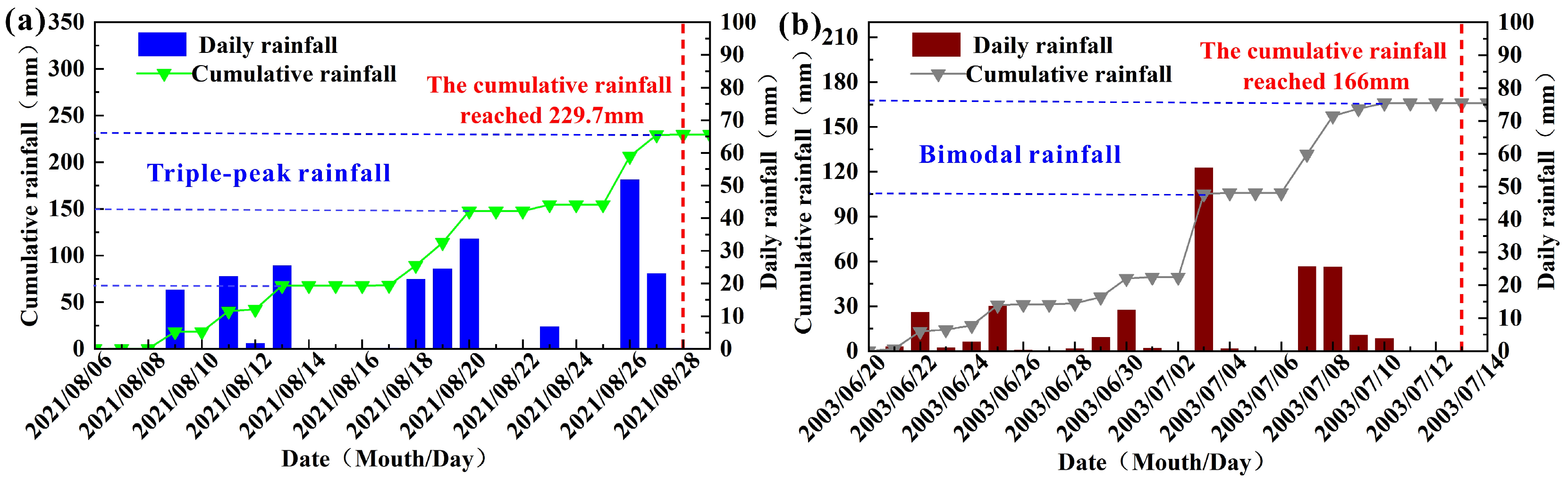
A comparison of previous cases of landslide failure in the TGRA reveals that the Xiaoyantou and Qianjiangping landslides also experienced similar superimposed rainfall processes consisting of heavy and secondary rain events with a short interval on 28 August 2021 and 13 July 2003, respectively (Figure 14). Following the initial heavy rain event, the previous rainwater infiltrating into the slopes failed to discharge completely in a short rainless period. The continuous rainwater accumulation during the second rain event led to a continuous decrease in the shear strength of the slopes, ultimately triggering landslide instability. Therefore, the coupling effect of multi-peak rain events with a short time interval might have dominated the instability processes of both landslides.

5.2. Landslide Failure Mode Characterized by Slope Sliding Approximately Along the Strike of Rock Formations

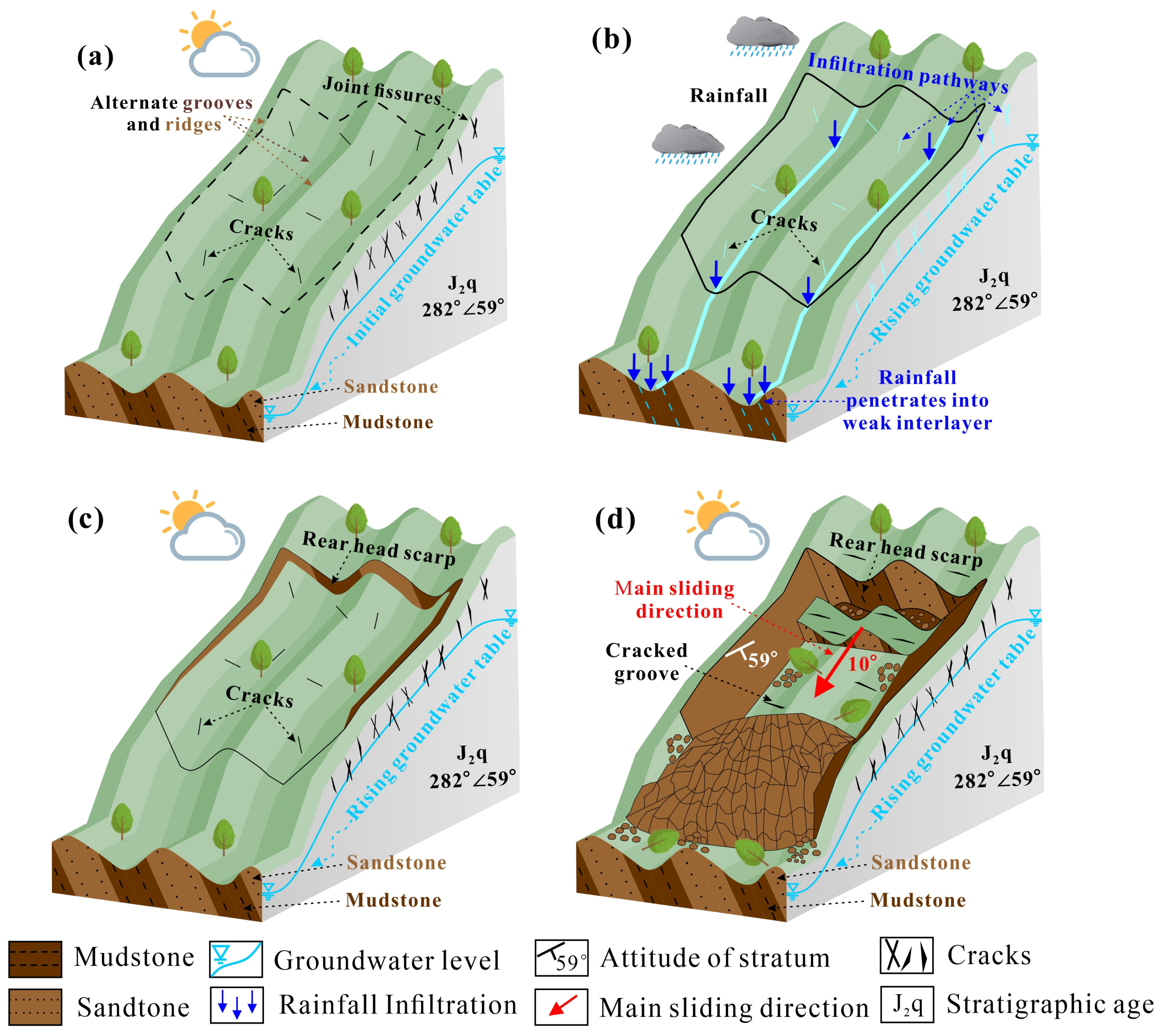
A comprehensive analysis of the geological conditions, slope structure, the rain process, and groundwater table changes associated with the Wanshuitian landslide, as well as of the numerical simulation results, reveals that the Wanshuitian landslide exhibits a failure mode characterized by slope sliding approximately along the strike of the rock formation (Figure 15). The evolutionary stages of the failure mode are described as follows:
(1) Initial state (Figure 15a): The landslide mass occurred as a dip slope. Its lithologic assemblage comprised interbeds of soft mudstones and hard sandstones, and it had a geomorphic feature of alternating grooves and ridges. The upper part of the landslide mass exhibited well-developed rock joints, providing effective pathways for rainwater infiltration. In contrast, its lower part showed high integrity, a relatively complete structure, and low water permeability. Under the cutting between dominant joints and weak interlayers, the boundaries of the landslide gradually formed.
(2) Rainfall infiltration (Figure 15b): The well-developed joints in the upper part of the landslide mass provided effective channels for rainwater infiltration. The mudstone valleys tended to accumulate rainwater, allowing it to infiltrate directly into the weak interlayers.
(3) Rapid activation of the landslide (Figure 15c): Early rainwater continuously infiltrated along rock joints and weak interlayers, accumulating at the relatively intact bedrock zone. Consequently, the groundwater table within the slope increased. This process further softened rock masses, leading to the formation of a potential sliding surface. After rock masses on the sliding surface were saturated with water and softened, their shear strength decreased, leading to the rapid activation of the landslide mass.
(4) Post-failure state (Figure 15d): The primary sliding direction of the sliding mass (10°) formed an angle of 88° with the dip direction of the rock formation (282°), suggesting the characteristic of sliding approximately along the strike of the rock formation. The landslide failure results in smooth side and rear walls, with sliding-induced scratches visible on the wall surfaces. The complete disintegration of deposited rock masses reflects the characteristics of high-speed movement.
A slope is subjected to the attitudes of rock formations. In the case of the failure of a bedding rockslide, the sliding mass typically slides in the dip direction of rock formations along the sliding surface under the action of gravity if it is not impeded in the front. However, field surveys indicate that the slopes of the Kamenziwan [44], Xiaoyantou, and Wanshuitian landslides slid along free faces due to the sliding resistance in the dip directions of rock formations. The angle between the sliding direction and the dip direction of the rock formation is defined as the apparent sliding angle, which exceeds 65° for the abovementioned landslides. Notably, the Wanshuitian landslide exhibited an apparent sliding angle of up to 88° (Table 3). For this landslide, the primary sliding direction was roughly consistent with the strike of the rock formation, resulting in a unique failure mode characterized by slope sliding approximately along the strike of the rock formation.

5.3. Characteristics for Early Identification of Landslide Failure

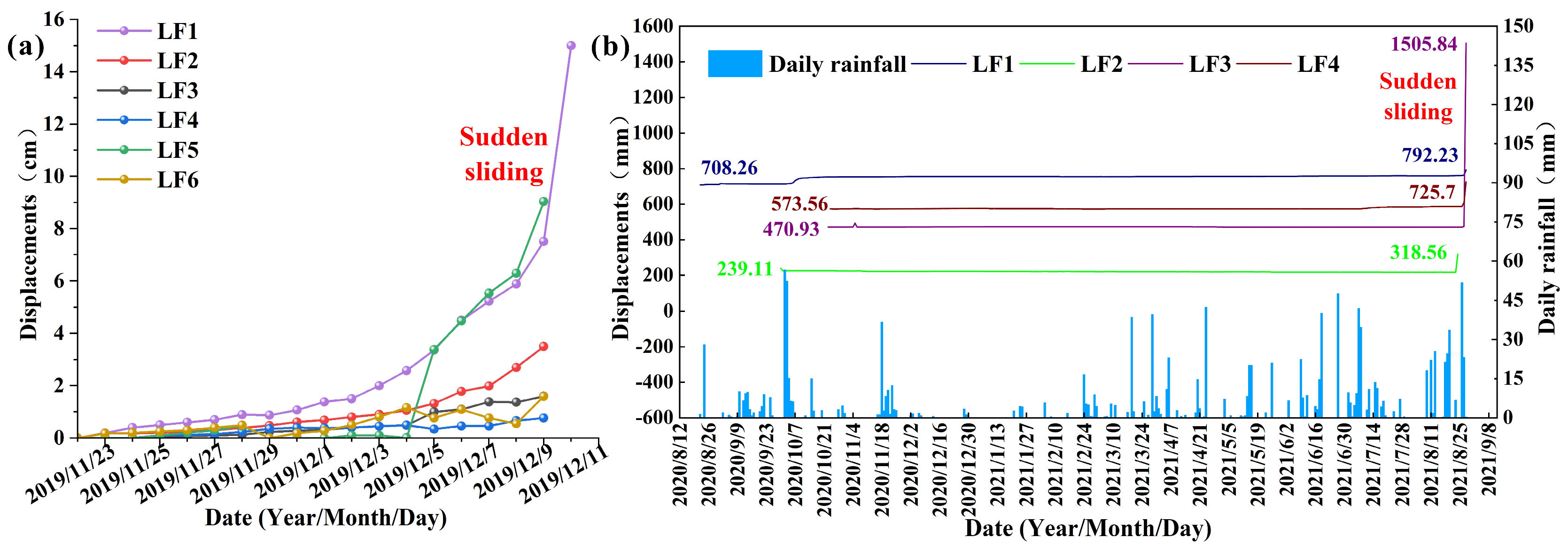
The slope hosting the Wanshuitian landslide is a counter-tilt slope relative to the Xiangxi River, demonstrating relatively high stability [45]. However, the valley occurring on the north side of the slope creates a favorable free face for the landslide, causing the slope to slide approximately along the strike of the rock formation. This characteristic can also be observed in the Kamenziwan and Xiaoyantou landslides. These landslides are highly concealed. A comparison of the failure processes and monitoring data of the Wanshuitian (Figure 11f), Kamenziwan, and Xiaoyantou (Figure 16) landslides reveals that the failure of these landslides featuring high suddenness, resulting in significant hazards and substantial challenges in early warning.
This study conducted a comparative analysis of the geological conditions of the three typical landslides in terms of formation lithologies, slope structures, topographic features, dominant joints, sliding resistance conditions, and free face conditions [46,47]. Accordingly, it summarized the characteristics for the early identification of the failure of bedding rockslides that slide approximately along the strike of rock formations, providing valuable insights for the early identification of similar geologic hazards. These characteristics include (1) lithologic assemblage comprising interbeds of soft and hard rocks; (2) a dip slope; (3) geomorphic feature of alternating grooves and ridges (Figure 17); (4) dominant joints; (5) the sliding resistance in the dip direction of the rock formation; and (6) free face approximately along the strike of the rock formation.

6. Conclusions

Using field surveys and numerical simulations, this study constructed the seepage and displacement field model of the Wanshuitian landslide based on the analytical results of the general characteristics and movement process of the landslide. Accordingly, it simulated the combined response process of the slope to rains prior to the landslide failure. In combination with the geological conditions of the landslide area, this study proposes the unique failure mechanism characterized by slope sliding approximately along the strike of the rock formation and summarizes the characteristics for the early identification of landslide failure. The findings lead to the following conclusions:
(1) The Wanshuitian landslide represents a thrust load-caused high-speed rockslide, characterized by strong suddenness of failure. Based on its movement characteristics, the landslide area can be divided into five zones: sliding initiation (A1), secondary disintegration (A2), main accumulation (B1), right falling (B2), and left falling (B3) zones.
(2) The failure of the Wanshuitian landslide was subjected to the coupling effect of hydrological and geological conditions. Significant contributors to the failure of the landslide include the geomorphic feature of alternating grooves and ridges, the lithologic assemblage comprising interbeds of soft and hard rocks, the slope structure with well-developed joints, and sustained heavy rains in the preceding period. The mudstone valleys are prone to accumulate rainwater due to their terrain characteristics, allowing rainwater to directly infiltrate into the weak interlayers, leading to rock softening.
(3) Timely groundwater recharge by multi-peak rains with short time intervals serves as a critical factor inducing the landslide failure. Within 17 days prior to the landslide failure, two sustained heavy rain events occurred at an interval of merely four days, with cumulative rainfalls of 144.6 mm from July 1 to 4 and 109.2 mm from July 9 to 15. This superimposed rain process is characterized by high rainfall and a short time interval, leading to a continuous increase in the groundwater table, which exceeded the historical peak. As a result, landslide failure occurred.
(4) Landslides like Wanshuitian, Kamenziwan, and Xiaoyantou exemplify the unique failure mode characterized by slope sliding approximately along the strike of the rock formation. Their failure features high concealment and strong suddenness. The dip rocky slopes with interbeds of soft and hard rocks typically show the geomorphic feature of alternating grooves and ridges. It is necessary to consider potential geologic hazards for these slopes in the case of sliding resistance in the dip direction of the rock formation and the presence of a free face approximately along the strike of the rock formation.
In this study, joint fractures in the fractured rock mass are treated as equivalent hydraulic pores. While this simplification of the complex fracture network facilitates numerical simulations to a certain degree, it fails to fully capture the intricate hydraulic characteristics of the rock mass. In future research, we will conduct a comprehensive analysis of the study area’s overall water resources, regional hydrological systems, and aquifers and develop more sophisticated hydraulic models for fractured rock masses. These models will fully account for fracture geometric morphology, nonlinear hydraulic properties, and 3D fracture network connectivity to accurately simulate water migration and pore water pressure variations during rainfall infiltration, thereby enhancing model reliability and applicability.

Author Contributions

Conceptualization, L.C., Q.Z. and S.L.; Methodology, M.D. and L.C.; Software, P.S. and L.C.; Validation, Y.L. and X.Z.; Formal analysis, B.W. and S.L.; Investigation, P.S., M.D. and Y.L.; Data curation, L.C. and B.W.; Writing – original draft, P.S.; Writing – review & editing, M.D., B.W., Q.Z. and S.L.; Visualization, X.Z.; Project administration, Q.Z.; Funding acquisition, M.D. All authors have read and agreed to the published version of the manuscript.

Funding

This study was funded by the National Natural Science Foundation of China (grant No. 42172303).

Data Availability Statement

The original contributions presented in this study are included in the article. Further inquiries can be directed to the corresponding authors.

Acknowledgments

The authors would like to extend their gratitude to the editor and anonymous referees of this manuscript for their suggestions and comments, which have contributed significantly to its improvement.

Conflicts of Interest

The authors declare that they have no known competing financial interests or personal relationships that could have appeared to influence the work reported in this study.

References

  1. Li, Y.M.; Ma, C.; Wang, Y.J. Landslides and debris flows caused by an extreme rainstorm on July 21 2012 in mountains near Beijing, China. Bull. Eng. Geol. Environ. 2019, 78, 1265–1280. [Google Scholar] [CrossRef]
  2. Bhandari, B.P.; Dhakal, S. Compositional analysis and phase relations of soil mass from the active landslides of Babai River watershed, Siwalik Zone of Nepal. Eng. Geol. 2020, 278, 105851. [Google Scholar] [CrossRef]
  3. Tang, H.M.; Wasowski, J.; Juang, C.H. Geohazards in the three Gorges Reservoir Area, China—Lessons learned from decades of research. Eng. Geol. 2019, 261, 105267. [Google Scholar] [CrossRef]
  4. Zhang, F.L.; Xu, Q.; Deng, M.L.; Chen, L.; Zhu, X.; Dai, Z.W.; Li, J. Multi-timescale responses of ancient rock landslides to reservoir fluctuations and precipitation: A comparative study. Eng. Geol. 2025, 358, 108420. [Google Scholar] [CrossRef]
  5. Wang, B.; Zuo, Q.J.; Deng, M.L.; Yi, Q.L.; Liu, L.C.; Liu, Y. Deformation Characteristics and Chain Mechanism of the Tanjiahe Landslide in the Three Gorges Reservoir Area Under the Synergistic Effect of Rainfall, Reservoir Water, and Groundwater. Rock Mech. Rock Eng. 2025, 58, 5235–5254. [Google Scholar] [CrossRef]
  6. Bhardwaj, A.; Wasson, R.J.; Ziegler, A.D.; Chow, W.T.L.; Sundriyal, Y.P. Characteristics of rain-induced landslides in the Indian Himalaya: A case study of the Mandakini Catchment during the 2013 flood. Geomorphology 2019, 330, 100–115. [Google Scholar] [CrossRef]
  7. Bezak, N.; Jež, J.; Sodnik, J.; Auflič, M.J.; Mikoš, M. An extreme May 2018 debris flood case study in northern Slovenia: Analysis, modelling, and mitigation. Landslides 2020, 17, 2373–2383. [Google Scholar] [CrossRef]
  8. Kotlyakov, V.M.; Rototaeva, O.V.; Nosenko, G.A. The September 2002 Kolka glacier catastrophe in North Ossetia, Russian Federation: Evidence and analysis. Mt. Res. Dev. 2004, 24, 78–83. [Google Scholar] [CrossRef]
  9. Yin, Y.; Zheng, W.; Li, X.; Sun, P.; Li, B. Catastrophic landslides associated with the M8.0 Wenchuan earthquake. Bull. Eng. Geol. Environ. 2011, 70, 15–32. [Google Scholar] [CrossRef]
  10. Shrestha, S.; Kang, T.S. Assessment of seismically-induced landslide susceptibility after the 2015 Gorkha earthquake, Nepal. Bull. Eng. Geol. Environ. 2019, 78, 1829–1842. [Google Scholar] [CrossRef]
  11. Zhang, F.Y.; Liu, G.; Chen, W.W.; Liang, S.Y.; Chen, R.S.; Han, W.F. Human-induced landslide on a high cut slope: A case of repeated failures due to multi-excavation. J. Rock Mech. Geotech. Eng. 2012, 4, 367–374. [Google Scholar] [CrossRef]
  12. Ma, P.H.; Peng, J.B.; Wang, Q.Y.; Zhuang, J.Q.; Zhang, F.Y. The mechanisms of a loess landslide triggered by diversion-based irrigation: A case study of the South Jingyang Platform, China. Bull. Eng. Geol. Environ. 2019, 78, 4945–4963. [Google Scholar] [CrossRef]
  13. Fan, X.M.; Xu, Q.; Scaringi, G.; Dai, L.; Li, W.L.; Dong, X.J.; Zhu, X.; Pei, X.J.; Dai, K.; Havenith, H.B. Failure mechanism and kinematics of the deadly June 24 2017 Xinmo landslide, Maoxian, Sichuan, China. Landslides 2017, 14, 2129–2146. [Google Scholar] [CrossRef]
  14. Yu, H.B.; Li, C.D.; Zhou, J.Q.; Chen, W.Q.; Long, J.J.; Wang, X.T.; Peng, T. Recent rainfall- and excavation-induced bedding rockslide occurring on October 22 2018 along the Jian-En expressway, Hubei, China. Landslides 2020, 17, 2619–2629. [Google Scholar] [CrossRef]
  15. Deng, M.L.; Huang, X.H.; Yi, Q.L.; Liu, Y.L.; Yi, W.; Huang, H.F. Fifteen-year professional monitoring and deformation mechanism analysis of a large ancient landslide in the Three Gorges Reservoir Area, China. Bull. Eng. Geol. Environ. 2023, 82, 243. [Google Scholar] [CrossRef]
  16. Wang, B.; Zuo, Q.J.; Deng, M.L.; Yi, Q.L.; Ruan, D.; Liang, Z.K. Study on the deformation mechanism of chair-like bedding rock landslides under the coupling effect of geological and hydrological factors. Eng. Geol. 2025, 344, 107832. [Google Scholar] [CrossRef]
  17. Qin, Y.G.; Yang, G.L.; Liu, B.Y.; Xu, J.X. Study on deformation and failure mechanism of low-dip red bed slope with soft-hard interbedded structure: A case study of Chishui, China. Nat. Hazards 2024, 120, 10539–10557. [Google Scholar] [CrossRef]
  18. Jian, W.X.; Xu, Q.; Yang, H.F.; Wang, F.W. Mechanism and failure process of Qianjiangping landslide in the Three Gorges Reservoir, China. Environ. Earth Sci. 2014, 72, 2999–3013. [Google Scholar] [CrossRef]
  19. Yin, Y.P.; Huang, B.L.; Chen, X.T.; Liu, G.N.; Wang, S.C. Numerical analysis on wave generated by the Qianjiangping landslide in Three Gorges Reservoir, China. Landslides 2015, 12, 355–364. [Google Scholar] [CrossRef]
  20. Xu, G.L.; Li, W.N.; Yu, Z.; Ma, X.H.; Yu, Z.Z. The 2 September 2014 Shanshucao landslide, Three Gorges Reservoir, China. Landslides 2015, 12, 1169–1178. [Google Scholar] [CrossRef]
  21. Li, B.; Tang, H.M.; Gong, W.P.; Cheng, Z.; Li, T.Z.; Wang, L. Numerical study of the runout behavior of the Kamenziwan landslide in the Three Gorges Reservoir region, China. Landslides 2022, 19, 963–976. [Google Scholar] [CrossRef]
  22. Ma, J.W.; Tang, H.M.; Hu, X.L.; Bobet, A.; Zhang, M.; Zhu, T.W.; Song, Y.J.; Ez Eldin, M.A.M. Identification of causal factors for the Majiagou landslide using modern data mining methods. Landslides 2017, 14, 311–322. [Google Scholar] [CrossRef]
  23. Huang, D.; Luo, S.L.; Zhong, Z.; Gu, D.M.; Song, Y.X.; Tomás, R. Analysis and modeling of the combined effects of hydrological factors on a reservoir bank slope in the three Gorges Reservoir area, China. Eng. Geol. 2020, 279, 105858. [Google Scholar] [CrossRef]
  24. Ding, Y.; Xia, Z.Y.; Rao, Y.K.; Chen, H.L.; Gan, W.Q. Preliminary analysis of Wuyigou landslide on 17 July 2024 in Zigui County, Hubei Province, China. Landslides 2025, 22, 261–266. [Google Scholar] [CrossRef]
  25. Dou, J.; Xing, K.; Lu, Z.W.; Peng, B.; Peng, Y.G.; Guo, F. Comprehensive analysis of July 17, 2024, heavy rainfall-induced landslide at Zigui County in the Three Gorges Reservoir Area, China. Landslides 2024, 22, 957–965. [Google Scholar] [CrossRef]
  26. Sato, T.; Shuin, Y. Estimation of extreme daily rainfall probabilities: A case study in Kyushu Region, Japan. Forests 2023, 14, 147. [Google Scholar] [CrossRef]
  27. Zêzere, J.L.; Vaz, T.; Pereira, S.; Oliveira, S.C.; Marques, R.; Garcia, R.A.C. Rainfall thresholds for landslide activity in Portugal: A state of the art. Environ. Earth Sci. 2015, 73, 2917–2936. [Google Scholar] [CrossRef]
  28. Eshraghian, A.; Martin, C.D.; Morgenstern, N.R. Movement triggers and mechanisms of two earth slides in the Thompson River Valley, British Columbia, Canada. Can. Geotech. J. 2008, 45, 1189–1209. [Google Scholar] [CrossRef]
  29. Mammoliti, E.; Fronzi, D.; Palpacelli, S.; Biagiola, N.; Tazioli, A. Assessment of urban landslide groundwater characteristics and origin using artificial tracers, hydro-chemical andstable isotope approaches. Environ. Earth Sci. 2023, 82, 211. [Google Scholar] [CrossRef]
  30. Wang, H.L.; Jiang, Z.H.; Xu, W.Y.; Wang, R.B.; Xie, W.C. Physical model test on deformation and failure mechanism of deposit landslide under gradient rainfall. Bull. Eng. Geol. Environ. 2022, 81, 66. [Google Scholar] [CrossRef]
  31. Zhou, Z.; Shen, J.H.; Li, Y.; Duan, W.F.; Yang, R.C.; Shu, J.C.; Li, H.W.; Tao, S.Y.; Zheng, S.Z. Mechanism of colluvial landslide induction by rainfall and slope construction: A case study. J. Mt. Sci. 2021, 18, 1013–1033. [Google Scholar] [CrossRef]
  32. Yi, X.Y.; Feng, W.K.; Bai, H.L.; Shen, H.; Li, H.B. Catastrophic landslide triggered by persistent rainfall in Sichuan, China: August 21, 2020, Zhonghaicun Landslide. Landslides 2021, 18, 2907–2921. [Google Scholar] [CrossRef]
  33. Zhou, J.; Tang, M.G.; Zhang, Q.F.; Li, C.R.; Jiang, Y.S. Comparison study of active landslides in four giant cascade hydropower station reservoir areas on the Jinsha River, China. Geomorphology 2025, 491, 110033. [Google Scholar] [CrossRef]
  34. Huang, B.L.; Yin, Y.P.; Liu, G.N.; Wang, S.C.; Chen, X.T.; Huo, Z.T. Analysis of waves generated by Gongjiafang landslide in Wu Gorge, three Gorges reservoir, on November 23, 2008. Landslides 2012, 9, 395–405. [Google Scholar] [CrossRef]
  35. Hungr, O.; Leroueil, S.; Picarelli, L. The Varnes classification of landslide types, an update. Landslides 2014, 11, 167–194. [Google Scholar] [CrossRef]
  36. Bui, X.N.; Nguyen, H.; Choi, Y.; Nguyen-Thoi, T.; Zhou, J.; Dou, J. Prediction of slope failure in open-pit mines using a novel hybrid artificial intelligence model based on decision tree and evolution algorithm. Sci. Rep. 2020, 10, 9939. [Google Scholar] [CrossRef] [PubMed]
  37. Cheng, Y.M.; Lansivaara, T.; Wei, W.B. Two-dimensional slope stability analysis by limit equilibrium and strength reduction methods. Comput. Geotech. 2007, 34, 137–150. [Google Scholar] [CrossRef]
  38. Bračko, T.; Žlender, B.; Jelušič, P. Implementation of Climate Change Effects on Slope Stability Analysis. Appl. Sci. 2022, 12, 8171. [Google Scholar] [CrossRef]
  39. Wen, H.J.; Xiao, J.F.; Wang, X.F.; Xiang, X.K.; Zhou, X.Z. Analysis of Soil–Water Characteristics and Stability Evolution of Rainfall-Induced Landslide: A Case of the Siwan Village Landslide. Forests 2023, 14, 808. [Google Scholar] [CrossRef]
  40. Li, P.J.; Li, Q.; Feng, Q.S.; Huang, Z.G.; Gan, X.; Ding, H.B.; Xu, C.J. Multi-Source Monitoring and Numerical Simulation Deformation on Highway Steep Slopes Under Rainfall Effects. Buildings 2024, 14, 3473. [Google Scholar] [CrossRef]
  41. Liu, J.; Xu, Q.; Wang, S.; Subramanian, S.S.; Wang, L.; Qi, X. Formation and chemo-mechanical characteristics of weak clay interlayers between alternative mudstone and sandstone sequence of gently inclined landslides in Nanjiang, SW China. Bull. Eng. Geol. Environ. 2020, 79, 4701–4715. [Google Scholar] [CrossRef]
  42. Doug, S.; Andrea, W. A critical review of rock slope failure mechanisms: The importance of structural geology. J. Struct. Geol. 2015, 74, 1–23. [Google Scholar] [CrossRef]
  43. Ma, T.H.; Li, C.J.; Lu, Z.M.; Bao, Q.Y. Rainfall intensity–duration thresholds for the initiation of landslides in Zhejiang Province, China. Geomorphology 2015, 245, 193–206. [Google Scholar] [CrossRef]
  44. Yin, Y.P.; Huang, B.L.; Zhang, Q.; Yan, G.Q.; Dai, Z.W. Research on recently occurred reservoir-induced Kamenziwan rockslide in Three Gorges Reservoir, China. Landslides 2020, 17, 1935–1949. [Google Scholar] [CrossRef]
  45. Li, M.L.; Cheng, J.L. The starting mechanism study on rainfall-induced sloop loose source in strong earthquake area. Natural Hazards 2022, 114, 1685–1707. [Google Scholar] [CrossRef]
  46. Xu, Q.; Fan, X.M.; Huang, R.Q.; Yin, Y.P.; Hou, S.S.; Dong, X.J.; Tang, M.G. A catastrophic rockslide-debris flow in Wulong, Chongqing, China in 2009: Background, characterization, and causes. Landslides 2010, 7, 75–87. [Google Scholar] [CrossRef]
  47. Tang, H.M.; Zou, Z.X.; Xiong, C.R.; Wu, Y.P.; Hu, X.L.; Wang, L.Q.; Lu, S.; Criss, R.E.; Li, C.D. An evolution model of large consequent bedding rockslides, with particular reference to the Jiweishan rockslide in Southwest China. Eng. Geol. 2015, 186, 17–27. [Google Scholar] [CrossRef]
Figure 1. UAV images before and after the failure of the Wanshuitian landslide, and the regional geological setting of the landslide. (a) Location and regional geological setting of the Wanshuitian landslide; (b) geomorphic map of the Wanshuitian landslide, characterized by alternating grooves and ridges; (c) UAV image before the landslide (14 June 2017); (d) UAV image after the landslide (17 July 2024).
Water 18 01001 g001
Figure 2. Instantaneous images of the Wanshuitian landslide failure from a video recorded by a villager at 8:40 a.m. on 17 July 2024. (a) Instantaneous images at 0 s; (b) Instantaneous images at 2 s; (c) Instantaneous images at 10 s; (d) Instantaneous images at 13 s; (e) Instantaneous images at 20 s; (f) Instantaneous images at 22 s; (g) Instantaneous images at 30 s.
Water 18 01001 g002
Figure 3. Zones and movement path of the Wanshuitian landslide.
Water 18 01001 g003
Figure 4. Engineering geological profiles of the Wanshuitian landslide.
Water 18 01001 g004
Figure 5. Field photos showing the deformation characteristics of the Wanshuitian landslide. (a) Full view of the landslide. The red letters in the figure indicate the positions of subfigures (bk); (b) sliding-induced scratches on the right wall; (c) gravel soil; (d) a layer of clayey soil, which can be rolled into strips; (e) damaged road; (f) cataclastic rock mass; (g) sandstone and mudstone interbed; (h) pre-sliding fractures on the road panels; (i) accumulations in the right falling zone; (j) accumulations in the main accumulation zone; (k) accumulations in the left falling zone.
Water 18 01001 g005
Figure 6. Data on rains in the Wanshuitian landslide area (derived from the rainfall monitoring data of the Baimatan landslide, which is located approximately 800 m away from the Wanshuitian landslide). (a) Daily and cumulative rainfalls over the 17 days preceding the failure of the Wanshuitian landslide. (b) Cumulative rainfalls of sustained heavy rain events during the flood season (June to August) from 2018 to 2024, with the spacing between bars indicating the time interval between two sustained heavy rain events.
Water 18 01001 g006
Figure 7. Numerical model of the Wanshuitian landslide and different rain conditions. (a) Time interval between two sustained heavy rain events: four days (condition 1); (b) time interval between two sustained heavy rain events: 11 days (condition 2); (c) numerical model of the Wanshuitian landslide.
Water 18 01001 g007
Figure 8. Seepage process of the Wanshuitian landslide. (a) Changes in slope saturation under condition 1; (b) changes in slope saturation under condition 2.
Water 18 01001 g008
Figure 9. Changes in pore water pressure at monitoring points J1 to J4 in the Wanshuitian landslide under two conditions. (a) changes in pore water pressure under condition 1; (b) changes in pore water pressure under condition 2.
Water 18 01001 g009
Figure 10. Changes in the FOS of the Wanshuitian landslide under two conditions. (a) FOS changes under condition 1; (b) FOS changes under condition 2.
Water 18 01001 g010
Figure 11. Changes in the displacement of the Wanshuitian landslide at varying times. (a) July 1; (b) July 4; (c) July 8; (d) July 15; (e) July 17; (f) monitoring data of displacement at monitoring points K1 to K3.
Water 18 01001 g011
Figure 12. Rock mass-hosted joints and stereographic projection of the Wanshuitian landslide. (a) Checkerboard-like joints in the rock masses of the Wanshuitian landslide; (b) stereographic projection of structural planes in the Wanshuitian landslide. Note: the red dashed line denotes the sliding direction of the landslide.
Water 18 01001 g012
Figure 13. Changes in groundwater table in the Wanshuitian landslide under two rainfall conditions. (a) Changes in groundwater table under rainfall condition 1; (b) changes in groundwater table under rainfall condition 2.
Water 18 01001 g013
Figure 14. Multi-peak rains with short time intervals in previous cases of landslide failure. (a) Rain process before the failure of the Xiaoyantou landslide; (b) rainfall process before the failure of the Qianjiangping landslide.
Water 18 01001 g014
Figure 15. Schematics showing the evolutionary process of the Wanshuitian landslide. (a) Initial state; (b) rainfall infiltration; (c) rapid activation of the landslide; (d) post-failure state of the landslide, characterized by slope sliding approximately along the strike of the rock formation.
Water 18 01001 g015
Figure 16. Displacement monitoring curves with abrupt changes in previous cases of landslide failure. (a) Displacement monitoring curve before failure of the Kamenziwan landslide; (b) displacement monitoring curve before failure of the Xiaoyantou landslide.
Water 18 01001 g016
Figure 17. Pre-failure UAV images from previous failure cases of landslides (14 June 2017). (a) Geomorphic feature of alternating grooves and ridges before the failure of the Xiaoyantou landslide; (b) geomorphic feature of alternating grooves and ridges before the failure of the Kamenziwan landslide.
Water 18 01001 g017
Table 1. Geotechnical structure and slope structures in the Wanshuitian landslide area.
Geotechnical structureCategoryMaterial compositionThicknessStratigraphic age
Coating layerGravel soil3~5 mQ4del
Fractured rock massInterbedded sandstone and mudstone15~20 mJ2q
BedrockJ2q
Slope structureAttitude of stratumMain sliding directionAverage slopeRelative elevation
282°∠59°10°25°203 m
Table 2. Physical and mechanical parameters of rock and soil masses in the Wanshuitian landslide.
ZoneVolumetric Weight (γ/kN·m−3)Cohesion (c/kPa)Angle of Internal Friction (φ/°)Saturated Volumetric Water Content (W/%)Permeability Coefficient (K/m/d)Poisson’s Ratio μModulus of Elasticity E
(MPa)
Gravelly soils20.6333227.63.70.3517.8
Fractured rocks221203522.32.90.320
Sliding zone21.41921160.050.2912.9
Intact bedrock24.310803810.0010.161180
Table 3. Failure mode of typical landslides characterized by slope sliding approximately along the strike of the rock formation.
Landslide NameDateVolumeDip Direction of the Rock FormationSliding DirectionApparent Sliding Angle
Kamenziwan
landslide
10 December 201942 × 104 m345°340°65°
Xiaoyantou
landslide
28 August 20214 × 104 m3280°210°70°
Wanshuitian
landslide
17 July 202480 × 104 m3282°10°88°
Disclaimer/Publisher’s Note: The statements, opinions and data contained in all publications are solely those of the individual author(s) and contributor(s) and not of MDPI and/or the editor(s). MDPI and/or the editor(s) disclaim responsibility for any injury to people or property resulting from any ideas, methods, instructions or products referred to in the content.