Article

Influence of Riparian Vegetation on River Morphodynamics: A Numerical Modeling Framework

by
Ricardo Gutiérrez
*,
Alejandro Mendoza
* and
Moisés Berezowsky
Instituto de Ingeniería, Universidad Nacional Autónoma de México, Mexico City 04510, Mexico
*
Authors to whom correspondence should be addressed.
Water 2026, 18(7), 883; https://doi.org/10.3390/w18070883
Submission received: 24 February 2026 / Revised: 31 March 2026 / Accepted: 4 April 2026 / Published: 7 April 2026
(This article belongs to the Section Hydraulics and Hydrodynamics)

Abstract

Riparian vegetation plays an important role in the morphological evolution of rivers; here, an alternative numerical methodology for modeling river morphodynamics influenced by vegetation is presented. The approach integrates a vegetation growth and flow-resistance submodule coupled with the TELEMAC–MASCARET system. Vegetation is represented at the patch scale, and its hydraulic effect is incorporated through an additional drag force in the momentum equation, while stem obstruction is accounted for using the porosity formulation in TELEMAC-2D. Vegetation dynamics consider water depth variability, interspecific competition, and nutrient availability. The model is applied to a braided river reach in southeastern Mexico. The results indicate that riparian vegetation promotes more organized flow paths, enhances bar development, and plays a significant role in modulating bar stability. These findings highlight the importance of explicitly representing flow–sediment–vegetation feedback in river hydro-morphological modeling.

1. Introduction

Riparian vegetation is impervious in rivers worldwide, and its presence not only alters the hydraulic characteristics of flow but also modulates deposition and erosion processes; furthermore, vegetation adds resistance and acts as a barrier to flow in proportion to its size. For instance, plant growth holds up bars and islands through deposition, a positive feedback condition for more vegetation development [1,2]. Additionally, vegetation can modulate the development of meanders by reducing riverbank erosion and modifying secondary flow. In this way, riparian vegetation also impacts river morphodynamics, reorganizing the channel and riverplain characteristics [2,3,4].
A number of studies have focused on including vegetation in morpho-hydraulic models as static elements parameterized by equivalent bed roughness, drag, or friction [5,6,7,8,9,10,11,12,13]; however, the use of friction coefficients only reflects the flow resistance of vegetation on the riverbed [14] but does not represent the effects of emergent canopy [15] since in such cases the flow through canopy is not fully turbulent, which is a necessary criterion for applying the Manning equation [16].
Furthermore, the drag approach typically considers the influence of the canopy at the local scale (isolated elements), with a higher computational cost, or at the patch scale using stem density, which can overestimate flow resistance. For example, De Doncker et al. [17] estimated the temporal variation in Manning coefficients for two vegetated rivers. They found a value of n = 0.04 s m−1/3 without vegetation and a value of n = 0.4 s m−1/3 when plants were present.
The experimental results reported by Ben Meftah et al. [18] showed a patch effect through a regular array of rigid and emergent cylinders. Their study suggests that transversal flow velocity in the interface between the non-vegetated and the canopy area can be estimated by a log-law; nevertheless, the experimental setup did not consider flow-induced plant deformations. Furthermore, works such as those of Luhar & Nepf and Nepf [19,20] had focused on linking the flow-vegetation interaction from individual scale to patch and river reach scales.
These works point out the importance of considering the non-uniform spatial distribution of the canopy and the reconfiguration effect in the characterization of flow resistance. Therefore, the use of simple rough parameterizations, such as stiff cylinders with constant drag or friction coefficients, can lead to biased estimations.
Alternative methods have been developed to deal with the impact of different stages of the vegetation life cycle on flow (e.g., [21,22,23,24,25,26,27,28,29]). Typically, these models are either based on rigid and isolated elements or are parameterized based on vegetation biomass to account for the impact at the patch scale. Nonetheless, approaches that use single elements and neglect the patch effect of plants, or the difficulty of representing bed roughness based on biomass, may limit the scope of their application.
For instance, the model presented by Nicholas et al. [22,23] considers two categories of grid cells for numerical modeling: active riverbed (permanently inundated) and floodplain (sometimes or never inundated). Riverbed cells are converted into floodplain cells, with higher roughness (due to vegetation growth), when the maximum water depth over a specified time exceeds a given threshold. Perucca et al. [24] adopted three models of biomass distribution for modulating riverbank erodibility: one based on water table fluctuations, another considering the extinguishing effect of vegetation due to floods, and a third one that combines both effects with the sedimentation effect. However, the model is based on a linear solution for meander migration [30], which assumes a constant channel width.
Similarly, Toda et al. [29] introduced a model considering an initial biomass and a diffusion equation for modeling vegetation growth; the destruction of vegetation is considered through a threshold of shear strength corresponding to flushing (scour depth). However, the diffusion equation needs several parameters to represent vegetation expansion or reduction.
On the other hand, the RIPVEG model [25,26,27,28] not only considers vegetation cover on the floodplain but also incorporates root reinforcement for riverbanks; additionally, the model employs a logistic sigmoid equation that considers physical traits such as age and lifespan to simulate the growth and mortality of plants. The RIPVEG model approach does not require biomass data, which usually is not available due to the variety of species and uncertainties in its estimation, but its main disadvantage is that it only represents one species of vegetation in each node of the computational mesh.
Although advancements in numerical modeling of river morphodynamics influenced by riparian vegetation have been progressive in recent years, improvements are still required to more accurately represent the complex physical processes associated with riverine vegetation and its interaction with the flow.
This paper presents an alternative approach to address the interaction between riparian vegetation, flow and riverbed morphology. The model developed here, called ATYS, integrates the model DRIPVEM [31,32] for plant development with the TELEMAC-2D and SISYPHE modules for the flow and riverbed morphology of the TELEMAC-MASCARET modeling system, with the aim of explicitly accounting for both the life cycle and distribution of vegetation, as well as the dynamical response of plants caused by changes in water depth and nutrients availability.
In addition, the model considers the effect on the flow of vegetation driven by the reconfiguration of stems to calculate drag force [33] and bulk drag coefficients [34]. Here, two simulation scenarios were defined, one without vegetation and another with vegetation, aiming to contrast both the variation in flow and bed evolution patterns. The results on planform morphological evolution are contrasted with the historical development of bars in a river located in the southeast of Mexico.

2. Materials and Methods

The Saint-Venant equations are a set of conservation laws forming a hyperbolic system that describes the flow in shallow water conditions. TELEMAC-2D (v8p3) solves the Saint-Venant equations in their non-conservative form [35]:
h t + U · h + h · U = S h
u t + U · u = g H x + S x + 1 h · h · v t · u
v t + U · v = g H y + S y + 1 h · h · v t · v
where h is flow depth (m); U = u , v is the vector of the depth-averaged flow velocity with components u and v in the x - and y -directions (m), respectively; g is the gravitational acceleration (m s−2); v t is the eddy viscosity (m2 s−1); H is the water surface elevation (m); t is the time (s); and S h , S x and S y are the source or sink terms in the conservation of mass (m s−1) and momentum equations (m s−2).
The module SISYPHE (v8p3) simulates riverbed adjustments using the Exner equation with a sediment transport equation (e.g., Meyer-Peter and Müller) to calculate bed evolution:
Z b t = 1 1 λ · Q b
where λ is the porosity of the bed material, Z b is the bed elevation (m), and Q b = Q b x , Q b y is the vector of volumetric sediment transport rate per unit width without pores, with components Q b x and Q b y in the x - and y -directions (m2 s−1), respectively.

2.1. Vegetation Dynamics

The vegetation development model is based on the work of Asaeda & Rashid and Asaeda et al. [31,32]. Here, three submodules were adopted: TREE, HERB and NUTRIENTS. The TREE submodule estimates the spatial distribution, growth, and density of trees and their physiological traits based on allometric relationships (power functions), which depend on tree age. The HERB submodule calculates the biomass of herbaceous plants, also using allometric relationships. The NUTRIENT submodule simulates the concentration of nitrogen in sediments. The description of the equations of the previous processes can be found in Asaeda & Rashid and Asaeda et al. [31,32]. Additionally, the vegetation model considers the wet and dry seasons.
During the wet season, recruitment (seedling survival) of plants takes place, while during the dry season, the decomposition process of dead plant tissues occurs, which releases nitrogen into the substrate. Moreover, remaining vegetation uptakes the accumulated nitrogen in soil (both from decomposition and atmospheric fallout) to support growth in the following season.
Additionally, a reduction in vegetation density is considered through a self-thinning function that models the loss of plants due to competition for nutrients and by using a flushing function to account for the reduction in density due to hydraulic erosion.
The interspecific competition is evaluated by adding restricted factors to limit the growth of arbor and herbaceous plants [31,32]. In the case of tree development, the recruitment (TRECRU) is modeled using the following equation:
T R E C R U = 0.25 0.25 + d 50 2 350 350 + H B T R D E N 0
where d 50 is the mean grain size diameter (mm), H B is the herb biomass (g m−2), and TRDEN0 is the initial density of trees (m−2). If there is more than one sediment particle size, the size with the highest concentration in the riverbed is considered in Equation (5).
Additionally, the competition between trees is taken into account through a self-thinning function (see Equation (6)), where tree density decreases with age owing to competition among individuals [31,32].
T H I N = T R A G E 2
where THIN is the self-thinning coefficient, and TRAGE is the tree age (years). It multiplies the previous tree density to calculate the current loss of tree density.
Regarding herbs, this kind of plant adapts to existing conditions and has nitrogen restrictions [36]. Thus, the maximum herb biomass, f N (Equation (7)), is a function of T N [31,32], where T N (g kg−1) is the total nitrogen concentration in the substrate.
f N = T N 2 0.16 + T N 2.5
The restricted herb biomass, f s [31,32], limited by the presence of trees (which provide shade), is given by
f s = 1 0.6 L b C r 0.6
where L b is the leaf biomass (g m−2) of trees, and C r is the area of the tree crown (m2), considering that the canopy is a perfect circle.
For the sake of simplicity, the influence of the sediment grain size in herb biomass was neglected; thus, the computation of maximum herbaceous biomass H B (g m−2) considers the combined effect of T N and shade as follows:
H B = H B m a x f N f s
where H B m a x is the maximum herb biomass (g m−2) without restrictions.
Nutrient availability is not a limiting factor that restricts the growth of arbor vegetation; trees can grow even if the substrate is not rich in nutrients. The main limiting factors for tree development are the flow conditions [32]. On the other hand, the development of herbs highly depends on nutrients in the soil [31], particularly nitrogen.
Some studies (e.g., [37,38]) suggest that plant development in coastal sand dunes is controlled by nitrogen availability rather than the amount of phosphorus. Furthermore, floodplain soils are relatively rich in phosphorus [31,37]. In riverine environments, such as new sediment bars, vegetative succession mostly depends on the enrichment of nitrogen by pioneering plant species as the new sediment deposits are deficient in nitrogen [39]. That is the main reason for using nitrogen as the limiting factor for plant growth.

2.2. Flow Resistance

Riparian vegetation is commonly modeled considering the stem (from small herb to larger trees) as a vertical cylinder, a suitable parameterization in rivers where flow velocity is low enough not to induce deformations in the stem. In order to consider the stem bending and predict the regime transition, Sharpe et al. [33] formulated a new drag coefficient, C d χ :
C d χ = C d ϕ y χ
where C d is the drag coefficient for a cylinder with diameter D (m), χ is an exponent that limits the regime in which vegetation is rigid, and ϕ y is a dimensionless parameter.
ϕ y = 1 C y 1 / 2           i f   ϕ y 1 i f   ϕ y > 1
C y = ρ C d Z v e g U 2 H v e g 2 E I v e g
where C y is the Cauchy number, ρ is the water density (kg m−3), U is the magnitude of velocity (m s−1), H v e g is the total height of the tree stem (m), E I v e g is a reference rigidity (N m2), and Z v e g is the projected first moment of the tree area (m3):
Z v e g = 0 H v e g h d A v e g
where d A v e g is the change in the tree frontal area measured from the tree base.
Instead of simulating individual elements due to high computational costs, the vegetation patch approach was adopted here. The drag coefficient of an array of cylinders can be different when the combined effect of individual elements is considered; furthermore, the bulk drag coefficient can decrease as the density in the patch increases [40], or it can increase if a sheltering effect is produced [34]. In their work, Busari and Li [34] proposed a regression equation for drag coefficients fitted from experimental data obtained in a laboratory flume with arrays of semi-rigid cable tile blades partially submerged:
C d ¯ = C d f ζ y g ζ x
f ζ y = 1 β e K ζ y / b v e g R e γ F r ϑ 1
g ζ x = 1 + α e Μ ζ x / b v e g R e δ F r ϑ 2
where C d ¯ is the bulk drag coefficient for herbs, while C d is the same parameter utilized in Equation (10). The parameters ζ x and ζ y are the center-to-center distance between stems in the x - and y -directions (m), b v e g is the width of the stem (m), and R e and F r are the Reynolds and Froude numbers, respectively.
The remaining parameters were obtained by a multiple regression model [34], and their values are
β = 2.4831 ,   α = 2830 , K = 0.1256 ,   Μ = 0.1223 , γ = 0.1490 ,   δ = 0.9288 ,   ϑ 1 = 0.0150 ,   ϑ 2 = 0.0350

2.3. Numerical Modeling

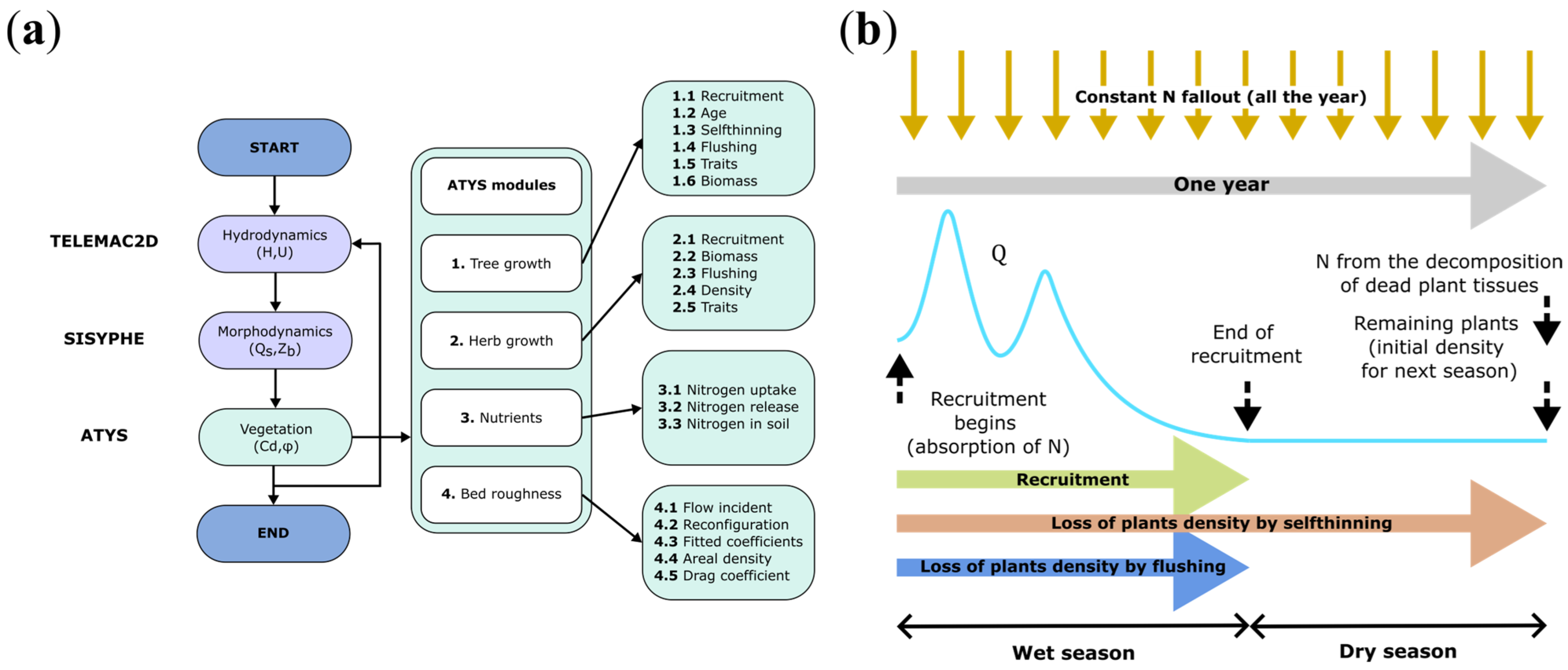
Figure 1a illustrates the modeling sequence and highlights the key processes of ATYS. First, TELEMAC-2D solves the flow hydrodynamics (the water depth, h , and the depth-averaged velocity vector, U ), where the drag produced by vegetation is incorporated. Second, SISYPHE calculates the sediment transport rate, Q b , and updates the bed elevation, Z b . Finally, ATYS calculates the drag coefficients (the maximum value between trees and herbs) and estimates the area occupied by vegetation stems, φ (see Figure 1a), to model the obstruction. Figure 1b illustrates a schematic representation of annual vegetation dynamics, where wet and dry seasons are considered. During the rainy (wet) season, recruitment occurs, while plant density decreases due to competition (self-thinning) and hydraulic erosion. During the dry season, recruitment ceases, and nitrogen released from decomposing plant biomass becomes available to surviving vegetation, together with a constant atmospheric nitrogen supply. Seasonal processes are implicitly represented in the model; thus, Figure 1b provides a simplified depiction of vegetation–flow interactions.
To simplify the proposed model, a set of considerations was made. For instance, the hydrodynamical variables, bed evolution and vegetation development, are solved separately due to their different time scales. Furthermore, the drag forces in Equation (18) were incorporated into the momentum equation as sink terms generated by the interaction of the flow with the vegetation ( S x and S y in Equations (2) and (3))
S x = 1 2 MAX C d , C d ¯ δ u 2 ;   S y = 1 2 MAX C d , C d ¯ δ v 2
where the M A X ( ) function returns the largest drag coefficient between herbs and trees; C d = C d χ n D / A ; δ is a constant for dimensional homogeneity (m−1); and n / A is the areal density of vegetation, with number of stems, n , per area, A (m2), occupied by plants.
Obstructions caused by vegetation stems were taken into account using the porosity approach in the TELEMAC-2D code [41]. The porosity allows for the modeling of obstacles too small to be represented in the mesh, for instance, individual stems of vegetation. The porosity acts as a continuous property representing the ratio of free and obstructed area in a mesh element of the domain [35].
To address the reduction in vegetation density (death of plants) due to variations in water depth in vegetated areas, a specified time in which a node is flooded (1 month) over a given threshold depth was established (0.1 m); the decay of density (m−2) or biomass (g m−2) is modeled using the logistic relationship [42] expressed in Equation (19). Additionally, an effective area for each node in the computational mesh (the surface available for vegetation growth) was assumed. This effective area is defined as the sum of one-third of the areas of the neighboring mesh elements surrounding a central node and is represented by an equivalent square with the same area as the patch. The decay of biomass is modeled by the following equation:
y = Y 1 + exp 10 T f l o o d T m a x 0.5 1
where y is the magnitude of a plant’s characteristics (e.g., biomass, density), Y is the value of this characteristic at the current time, T f l o o d (s) is the duration of the flood in a node, and T m a x (s) is the maximum time allowed before a plant dies because of anoxia. In this way, the influence of water depth variations on vegetation can be evaluated even if ATYS is uncoupled from the hydrodynamics.

2.4. Study Case

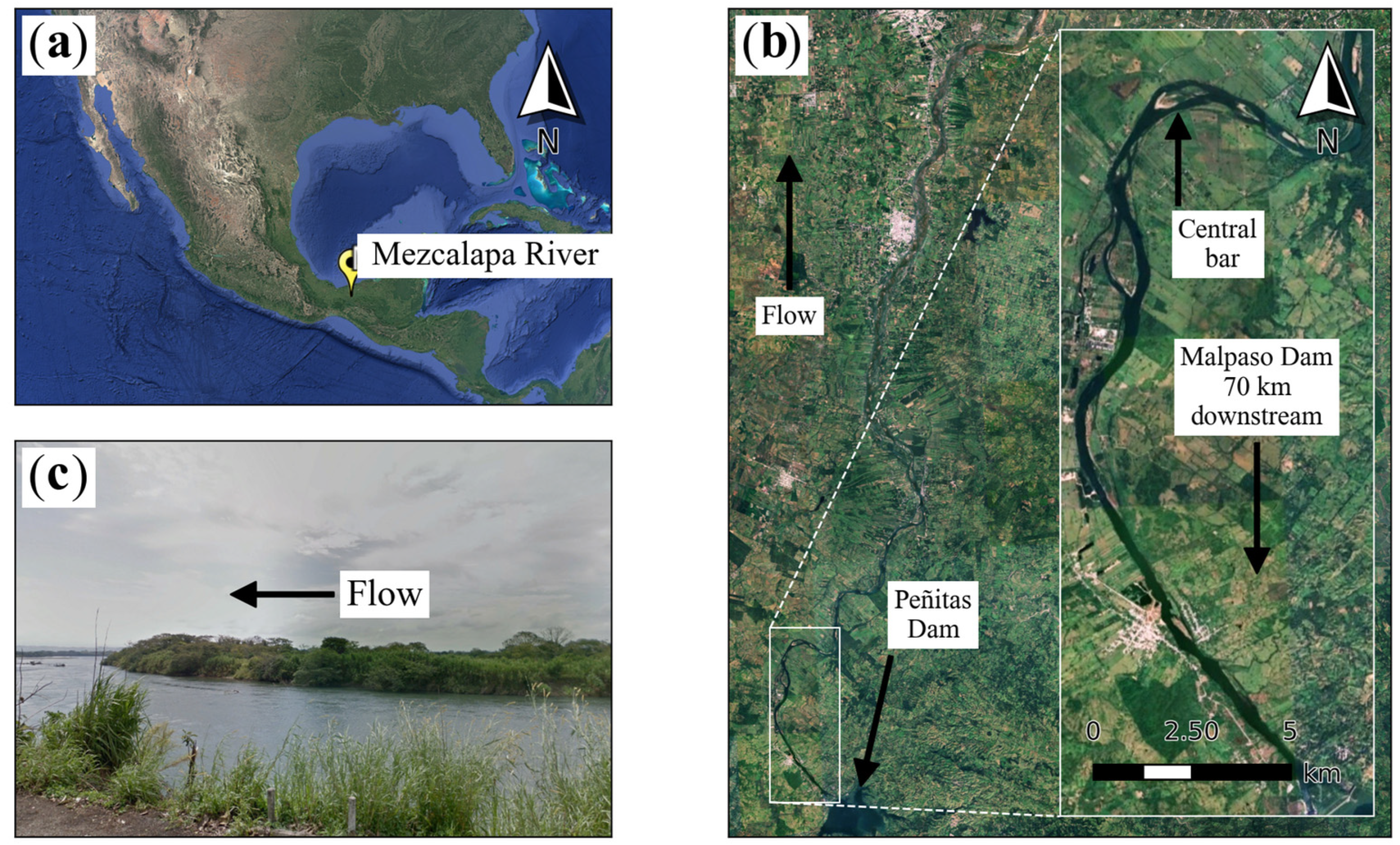
The Mezcalapa River is a perennial stream located in the southwest of Mexico (Figure 2a) that flows through a low plain (Figure 2b). The river shows channel width variations and multiple bars (Figure 2c); additionally, the river planform exhibits several meanders, and the river can be defined as braided (the discharge/slope and the stream-power/grain-size indexes [43] were used). The riverbed has a mean slope of 0.0005, a Manning roughness coefficient of n = 0.035 s m−1/3 (estimated through field measurements), and width-to-deep ratios ranging from 20.35 in the upstream region to 235 in the downstream region.
This river belongs to a fluvial system currently regulated by four dams constructed during the period 1958–1987. Prior to the commissioning of the first dam, Nezahualcoyotl (1958–1966), the maximum recorded discharge was 8140 m3 s−1, with a mean daily discharge of 715 m3 s−1 (a standard deviation of 762 m3 s−1). The behavior of the river has been modified by the change in the flow regime (suppression of peak discharge and limited low-flow conditions) driven by the upstream dams; a consequence is a reduction in braiding intensity (e.g., [44]).
After the commissioning of the last dam, Peñitas (built between 1979 and 1987), the maximum discharge decreased to 3299 m3 s−1 (1987–2011), with a mean daily discharge of 621 m3 s−1 (a standard deviation of 326 m3 s−1). The regulation introduced by the system of dams significantly altered the hydrological regime of the Mezcalapa River (downstream of the last dam), reducing the sediment supply and consequently affecting the river’s morphological characteristics. Regarding the sediments, the riverbed is composed of sand with grain diameters ranging between 0.28 and 1.9 mm.
The bars in the river support a variety of plant species (Figure 2c). The riparian vegetation is characterized by tree species such as Ficus sp., Inga vera, Muntiga calabura and Salix humboldtiana, where Salix is the most frequent tree species in the river. Regarding herb species, Typha domingensis, Thalia geniculate, Cladium jamaicense and Phragmites australis can be found in bars and floodplains [45].
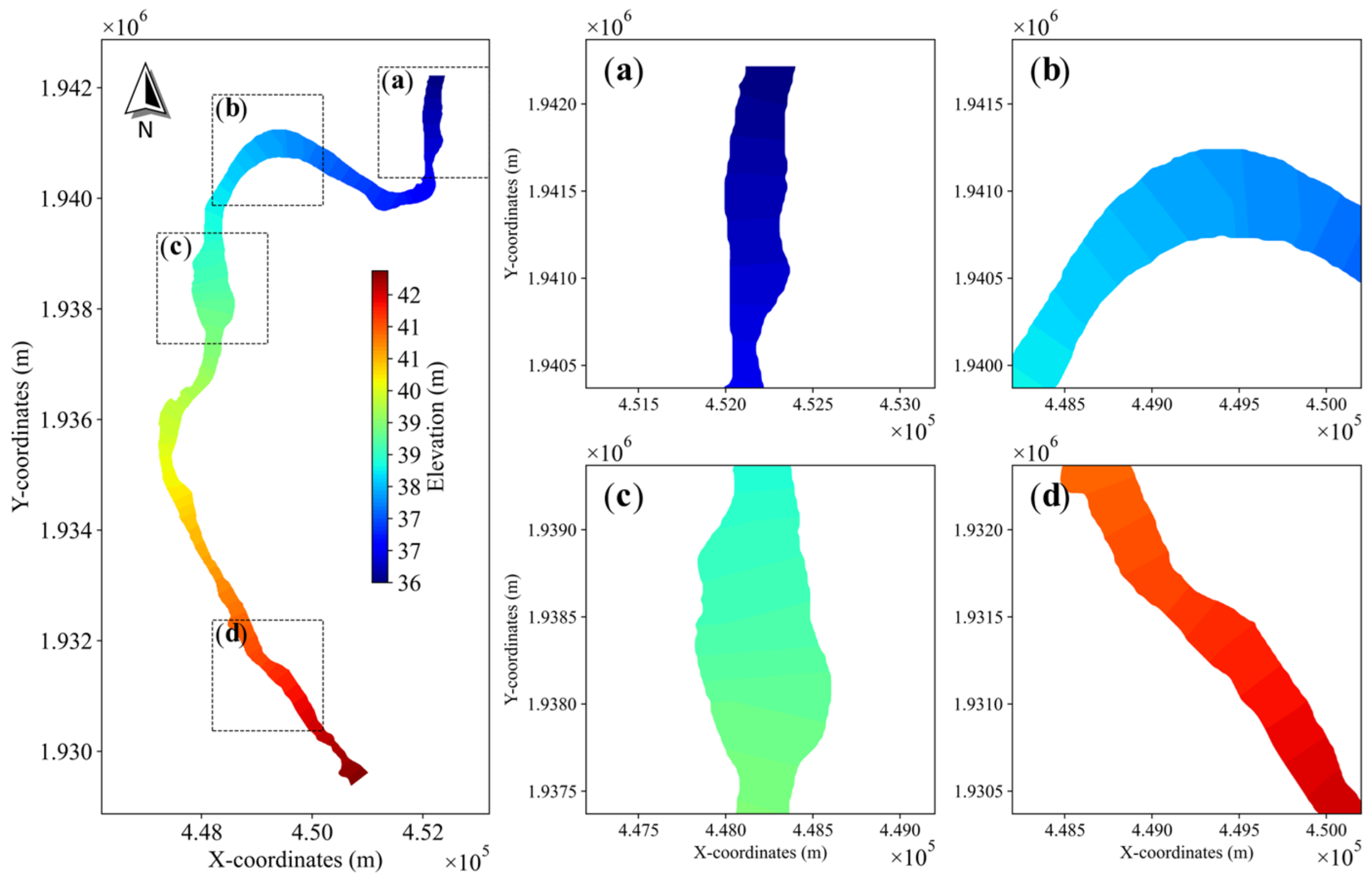
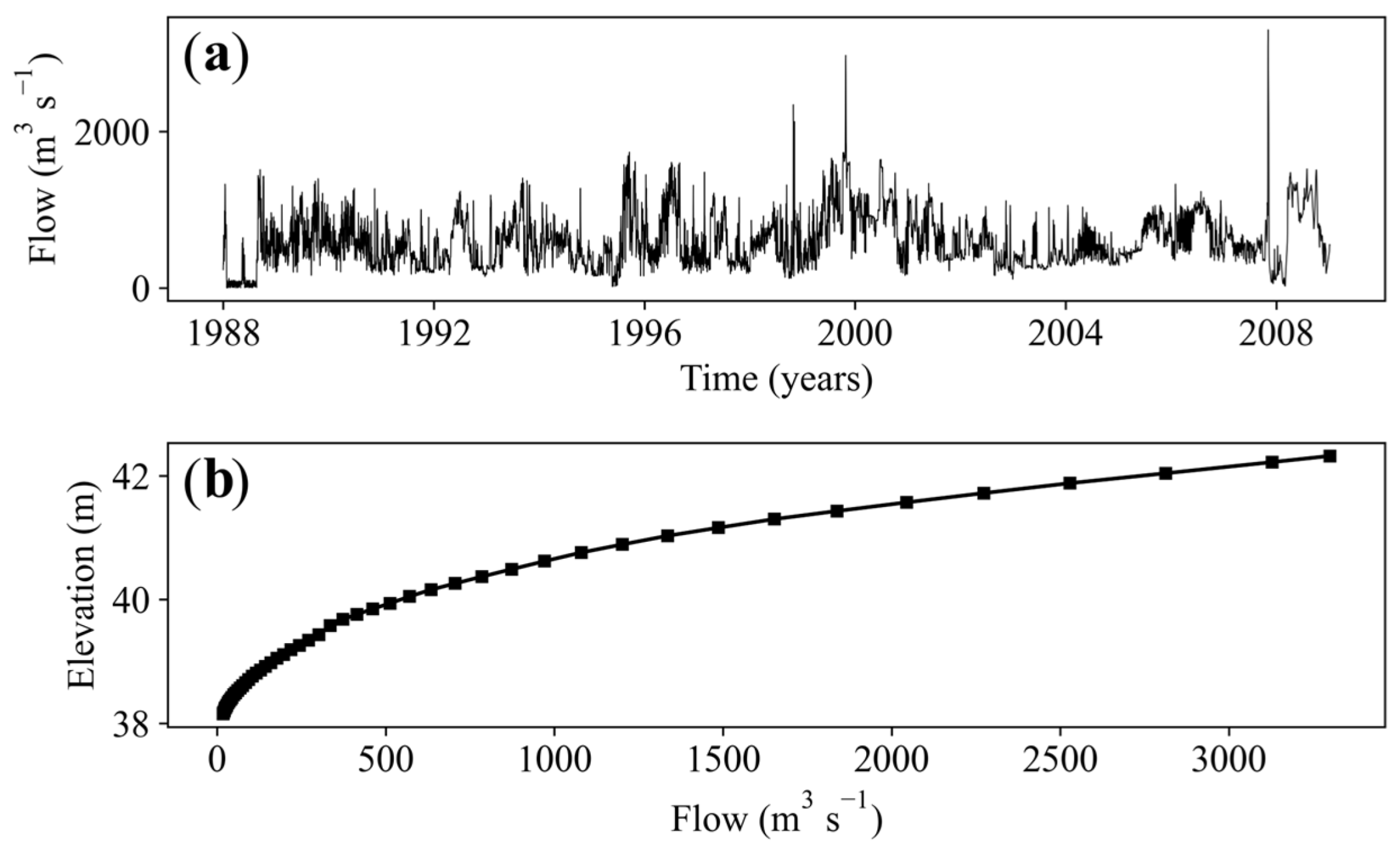
For this study, an 18 km river reach downstream of the Peñitas Dam (Figure 2b) was selected for the application of the ATYS model; the domain is shown in Figure 3. The simulations were carried out using a numerical mesh composed of 88,500 triangular elements, with 20 m per side on average, with a bed slope of 0.0011 (the mean slope of the reach). A hydrograph of mean daily discharges (Figure 4a) (1987–2008) was used as the upstream boundary condition; note that it does not show a typical wet/dry flow regime observed in natural rivers since this reach is regulated by the upstream system of dams. A stage–discharge curve calculated under steady flow conditions for normal water depth was established as the downstream boundary condition (Figure 4b).
In order to simulate the bed morphology, three representative grain size diameters were used: d15 = 0.032 mm, d50 = 0.063 mm and d85 = 1.4 mm. The simulations were conducted using a morphological factor, MF = 2, which is applied by SISYPHE to the Exner equation (Equation (4)) to accelerate bed evolution. This is valid given the different time scales of the hydraulic and riverbed evolution processes; also, a zero-sediment inflow discharge was established as the upstream boundary condition for sediments due to retention in the upstream dams. Simulations were conducted using a time step of 2 s for hydrodynamics, 20 s for morphodynamics, and 1 month for vegetation; the latter following Asaeda & Rashid and Asaeda et al.’s [31,32] approach.
Information from diverse sources was collected due to the absence of site-specific data for the vegetation (e.g., height, stem diameter and density). Data for Salix humboldtiana [46,47], Salix spp. [48] and Phragmites australis [31,32] were used in the simulations.
Phragmites australis (common reed) and Typha latifolia are two macrophytes commonly present in wetlands, and both grow through rhizomatous propagation; this is the reason for employing the common reed information. Both vegetation areal density and age started at zero with the aim of analyzing their development pattern. The data for the nitrogen concentration in the soil was taken from Jarquín-Sánchez et al. [49].
With the aim of comparing the effect of vegetation on the morphological development of bed evolution and bar growth, two scenarios were simulated. The first scenario was simulated without vegetation, and the second one considered the presence of vegetation. Bed topography of 2012 and satellite imagery covering the period 1986–2003 (the Landsat 7 satellite failed after this period) were used for validation, considering the number, location and dynamics of bars developed by the proposed model.

3. Results

3.1. Mezcalapa Riverbed Morphology Assessment

For the period analyzed (1986–2003) with satellite imagery data, five years were absent (1987, 1988, 1989, 1991, and 1993), and 13 images were available. Indices such as the Normalized Difference Vegetation Index (NDVI) and different band compositions, including NRG (Near-Infrared Red Green) and SNR (Shortwave-Infrared Near-Infrared Red), were utilized to classify soil cover using GIS (Geographic Information System) tools. Four different types of soil cover were considered: water, bare soil in bars, vegetation in bars, and margins. Margins were defined as bars covered with vegetation that at some point in time were joined with riverbanks after their initial formation.
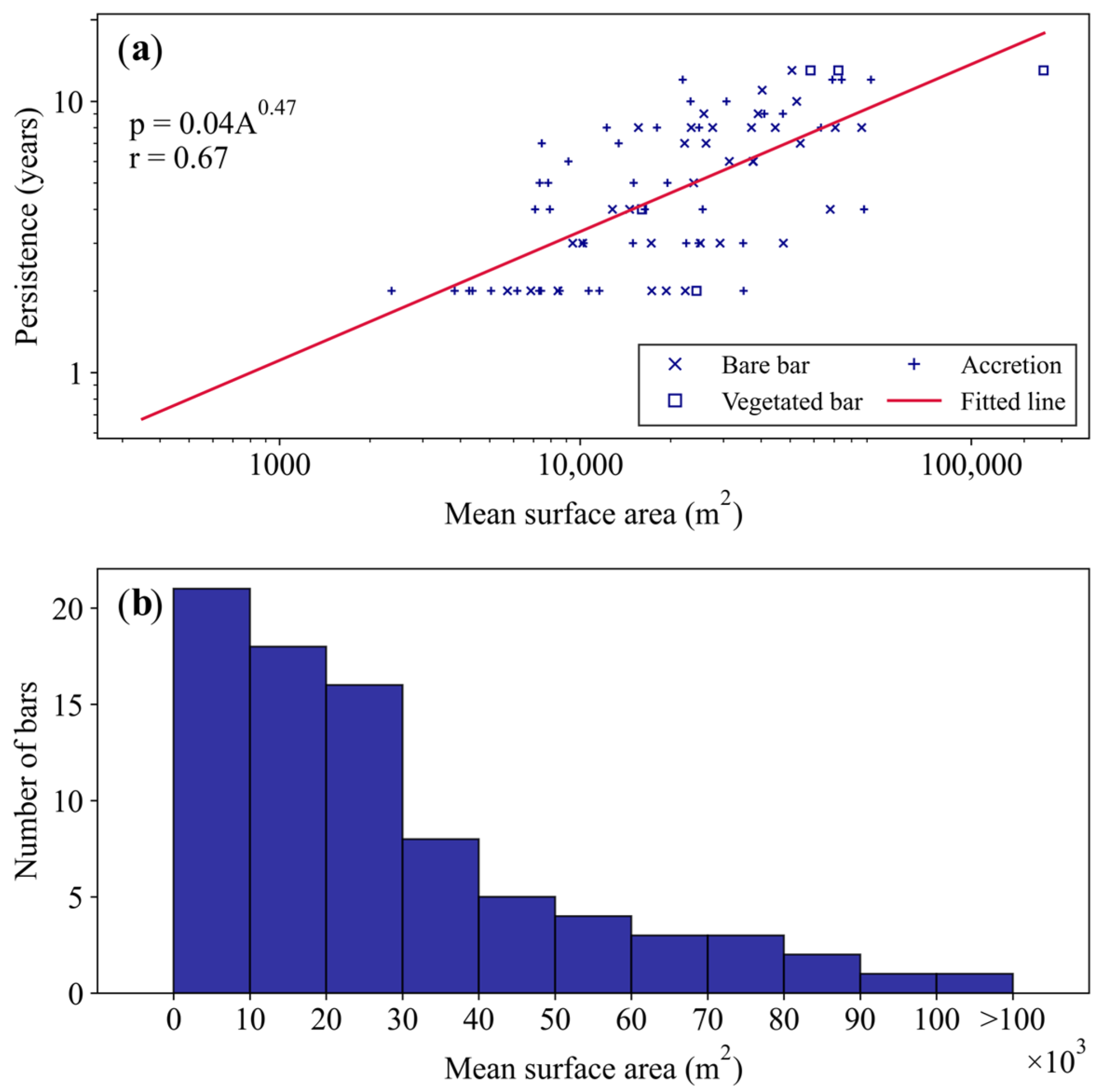
According to the satellite imagery analysis, 82 bars were identified in the reach. The analysis suggests that their persistence (the lasting time a bar appeared during the period) is related to their surface area. Larger bars tend to remain for larger periods (Figure 5a); this trend can be approximated with a power-law (with a correlation of 0.67), also depicted in Figure 5. In addition, Figure 5b shows the number of bars (frequency) as a function of mean surface area.
It is shown that the larger the area of a bar is, the more persistent it is. Although the area of a bar is an important factor that contributes to its persistence, the presence of vegetation also supplies additional stability in time. For instance, the margins (aggradation), whose behavior shows that they required less area to be stable during the study period.

3.2. Numerical Simulation

3.2.1. Vegetation Development

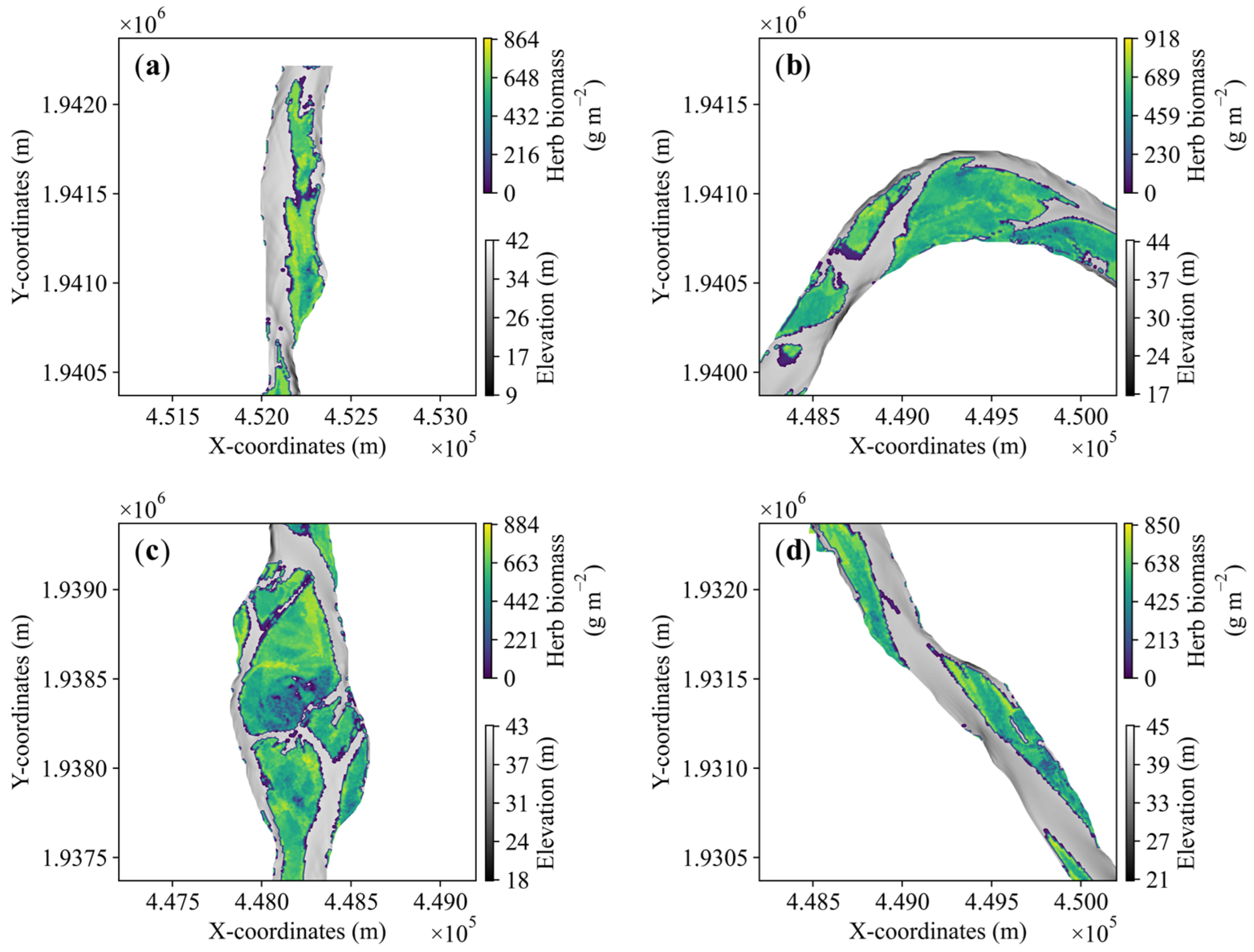
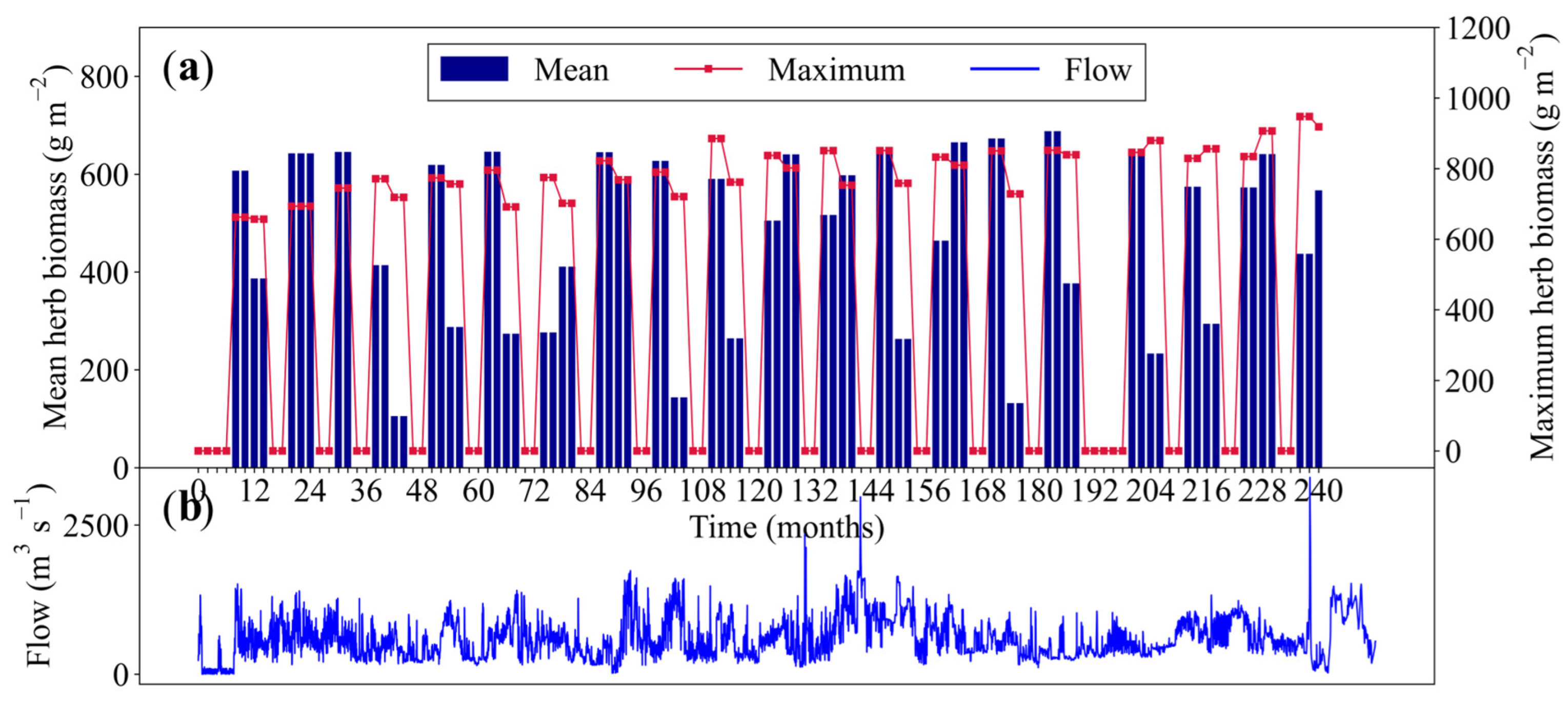
Figure 6a shows the evolution of the mean and maximum herb biomass over the 20-year simulated period. It highlights temporal variations in biomass where one of the main drivers is flow fluctuation (Figure 6b); for instance, the peak values of mean biomass are observed in months 32, 64, 86, and 148, with the highest value in month 164 and the lowest values in months 44, 104 and 176, which were observed after high flows. The effect of flooding is illustrated in Figure 7, which shows that reed populations grow mainly in elevated areas, where they are less affected by flushing.
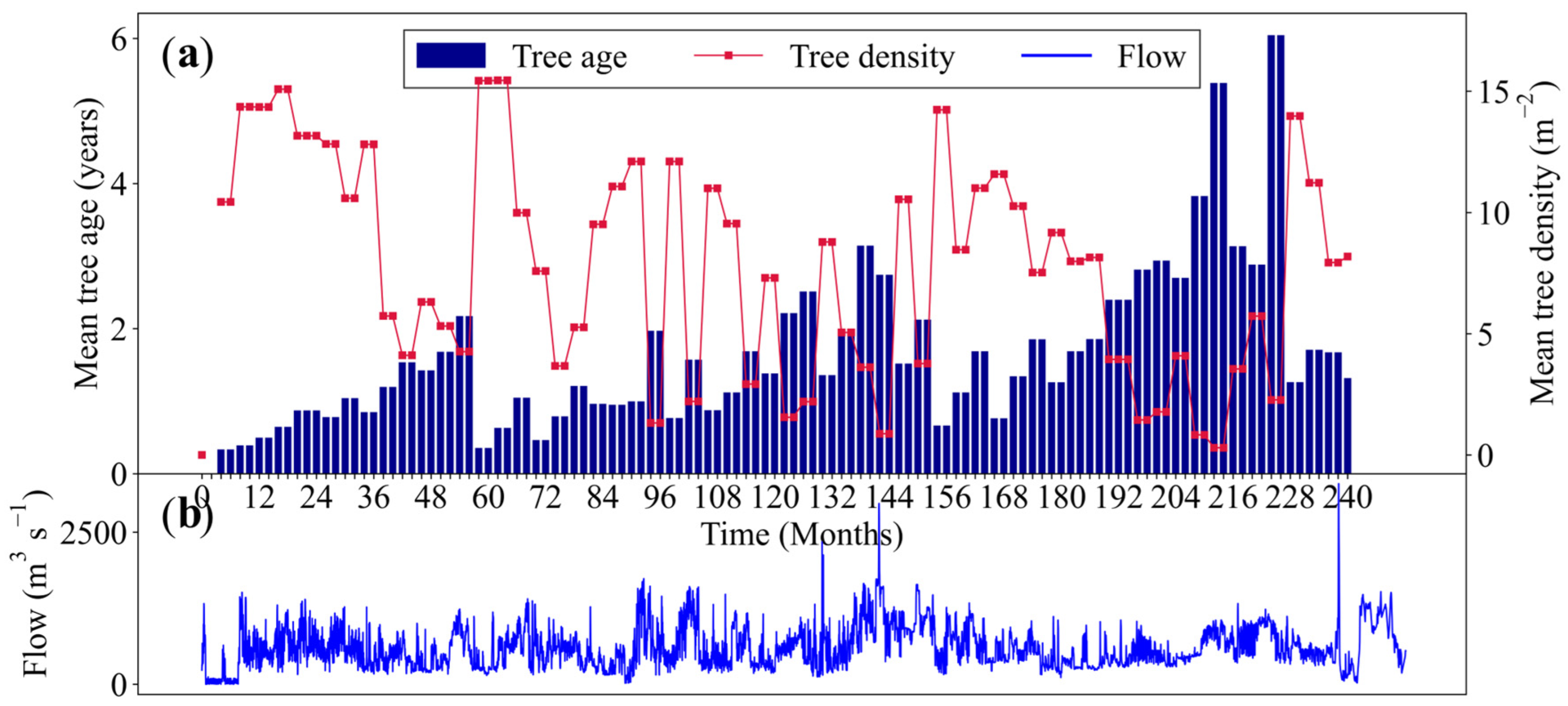
Concerning tree development, Figure 8 illustrates the variation in tree density and age over time, considering sprouts passing from saplings to maturity, according to their age. The mean tree age increases during the first 56 months, rising from 0.16 to 2.1 years. However, it decreases afterwards, dropping to 0.35 years. This behavior continues over the following months, although a substantial rise occurs starting in month 168, when the mean age rises from 0.76 to 6.0 years by month 224. The maximum simulated tree age was 19.6 years. In addition, Figure 8 shows that the mean tree density decreases as the mean age increases. This is according to the inverse relationship between age and density used in the model.

3.2.2. Vegetation Effect on Flow Patterns

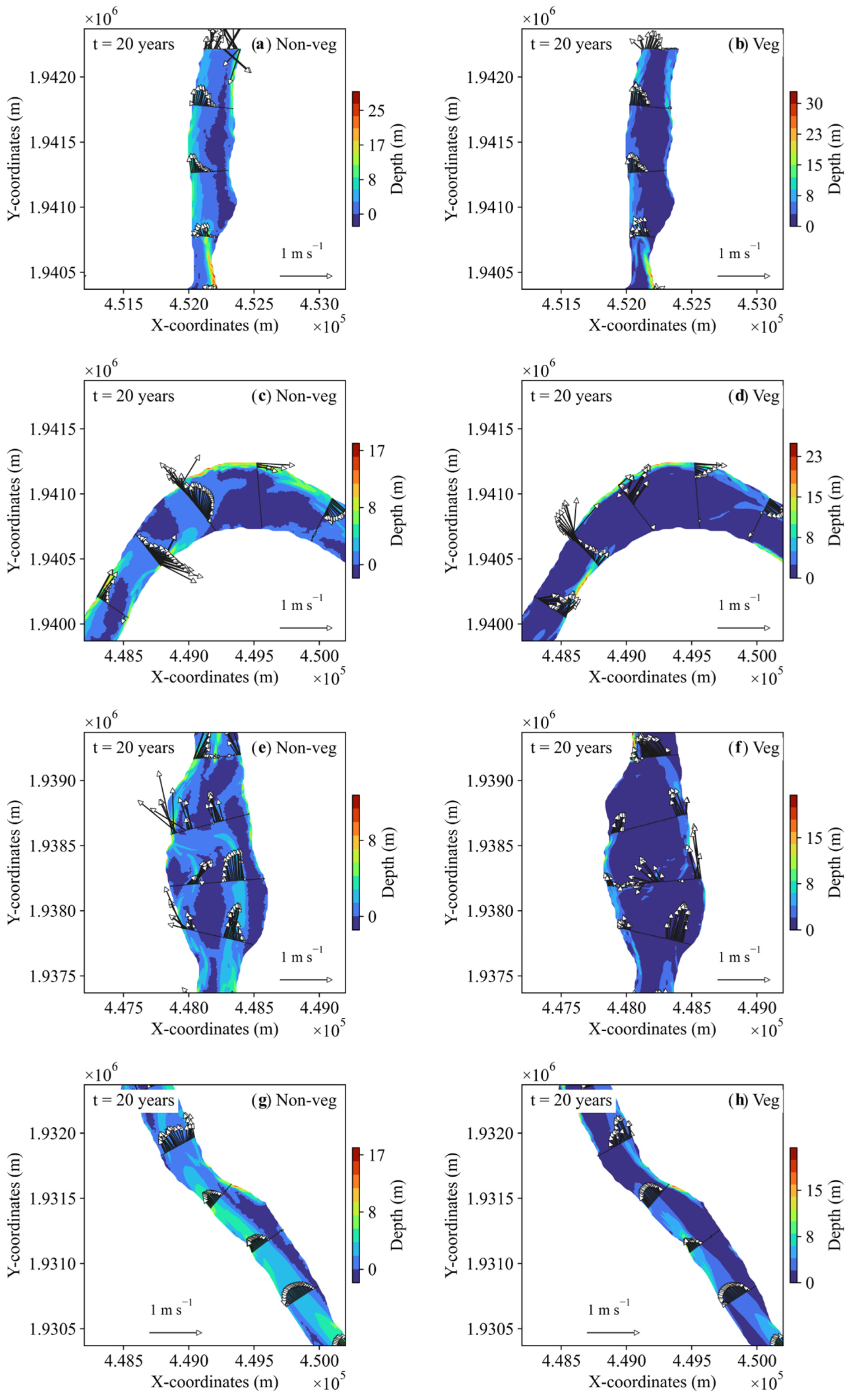
Figure 9 shows the spatial variation in water depth and velocity vectors through cross-sections along the reach, considering the vegetated and non-vegetated scenarios. Figure 9a,c,e,g correspond to a non-vegetated scenario, while Figure 9b,d,f,h show the water depth computed by TELEMAC-2D coupled with the ATYS model. Differences in the flow patterns and the velocity magnitudes can be observed.
In the scenario without vegetation, the velocity field displays a swinging pattern (Figure 9e) around bars (vegetated areas in Figure 7). In the vegetated scenario, velocities are concentrated in definite paths that increase their magnitude. It means that vegetation enhances conditions for homogeneous flows.
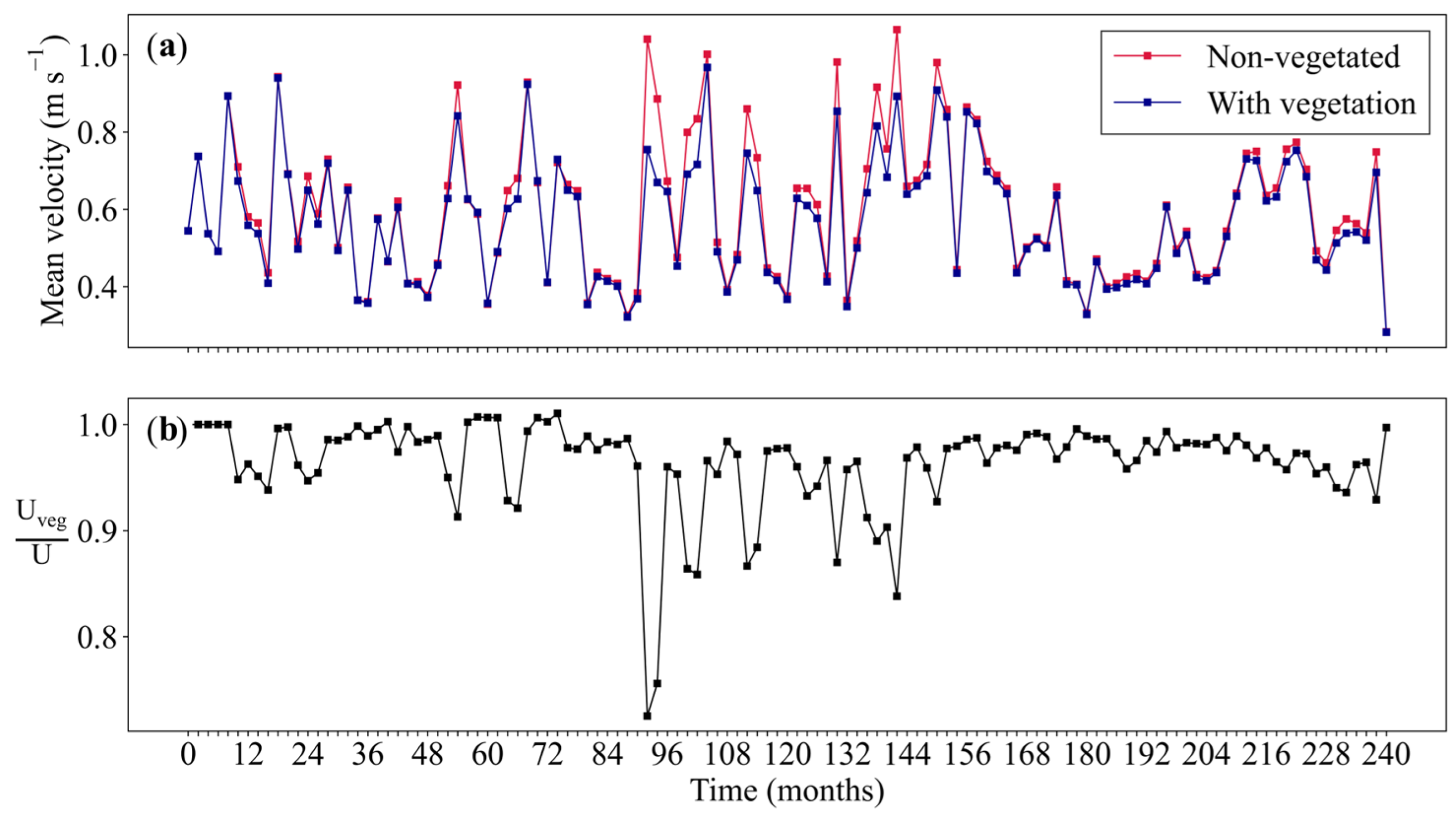
The differences previously mentioned are appreciated in Figure 10, which compares the mean velocity magnitude in the simulation domain over time. Mean velocity varies throughout the simulation in both scenarios (Figure 10a); however, vegetation reduces these variations compared with the first one, and a decreasing trend in mean velocity can be observed. The absolute differences between velocities in each month range from 0.001 to 0.39 m s−1. Scaled velocities are shown in Figure 10b; the maximum difference is in month 74 with +0.0076 m s−1 (1.06%), and the minimum difference occurred in month 92 with −0.28 m s−1 (−27.48%).

3.2.3. Erosion and Deposition Processes

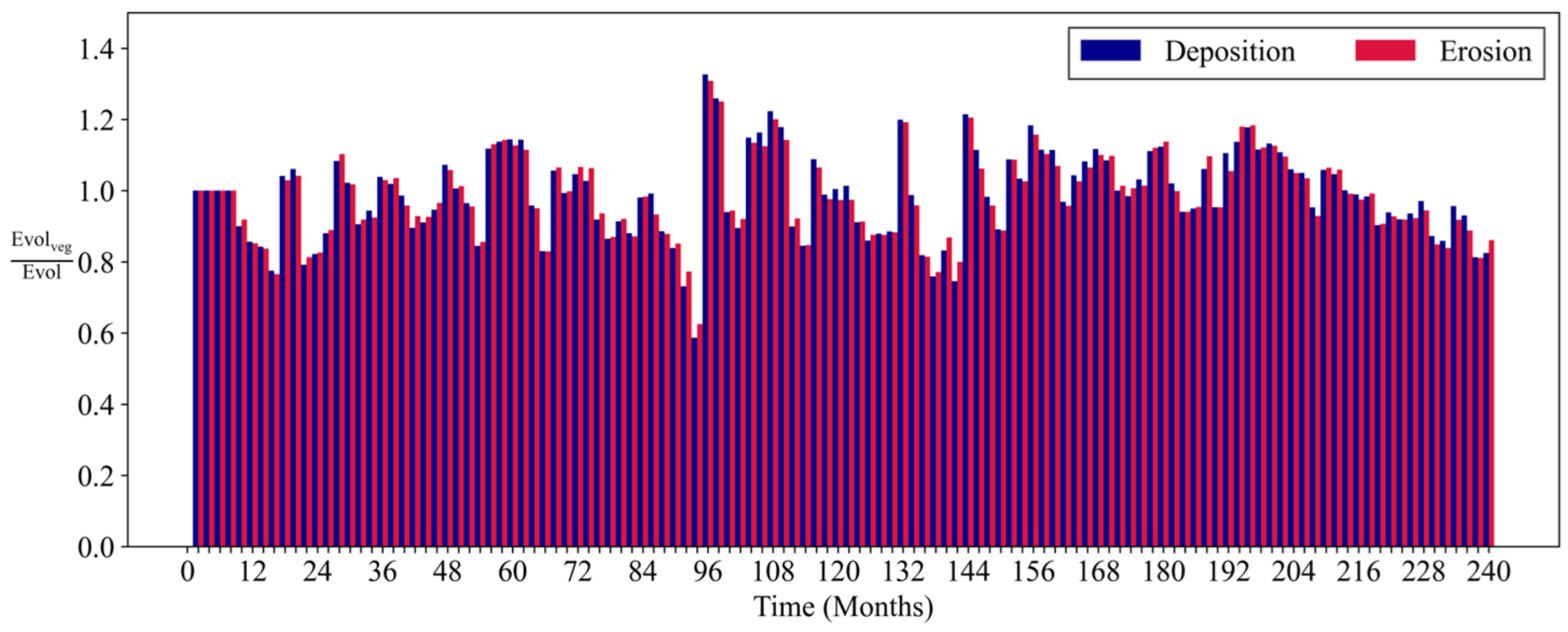
The bed evolution of the simulations is illustrated in the bar chart in Figure 11. This figure displays the difference between mean erosion and mean deposition across the reach; they are scaled by the data of the non-vegetated scenario. The maximum reductions in mean erosion and mean deposition are approximately 37.49% (−0.15 m) and 41.33% (−0.16 m), respectively, in month 94, and the maximum increment is 30.86% (0.05 m) for erosion and 14.91% (0.05 m) for deposition, both in month 96.
In addition, regarding the total evolution in the domain, the differences in bed elevation between the initial and last time step for non-vegetated and vegetated scenarios are −1.64 × 10⁴ and −1.69 × 10⁴ m, respectively, which indicates that vegetation slightly promotes erosion in certain areas of the domain during the simulation.
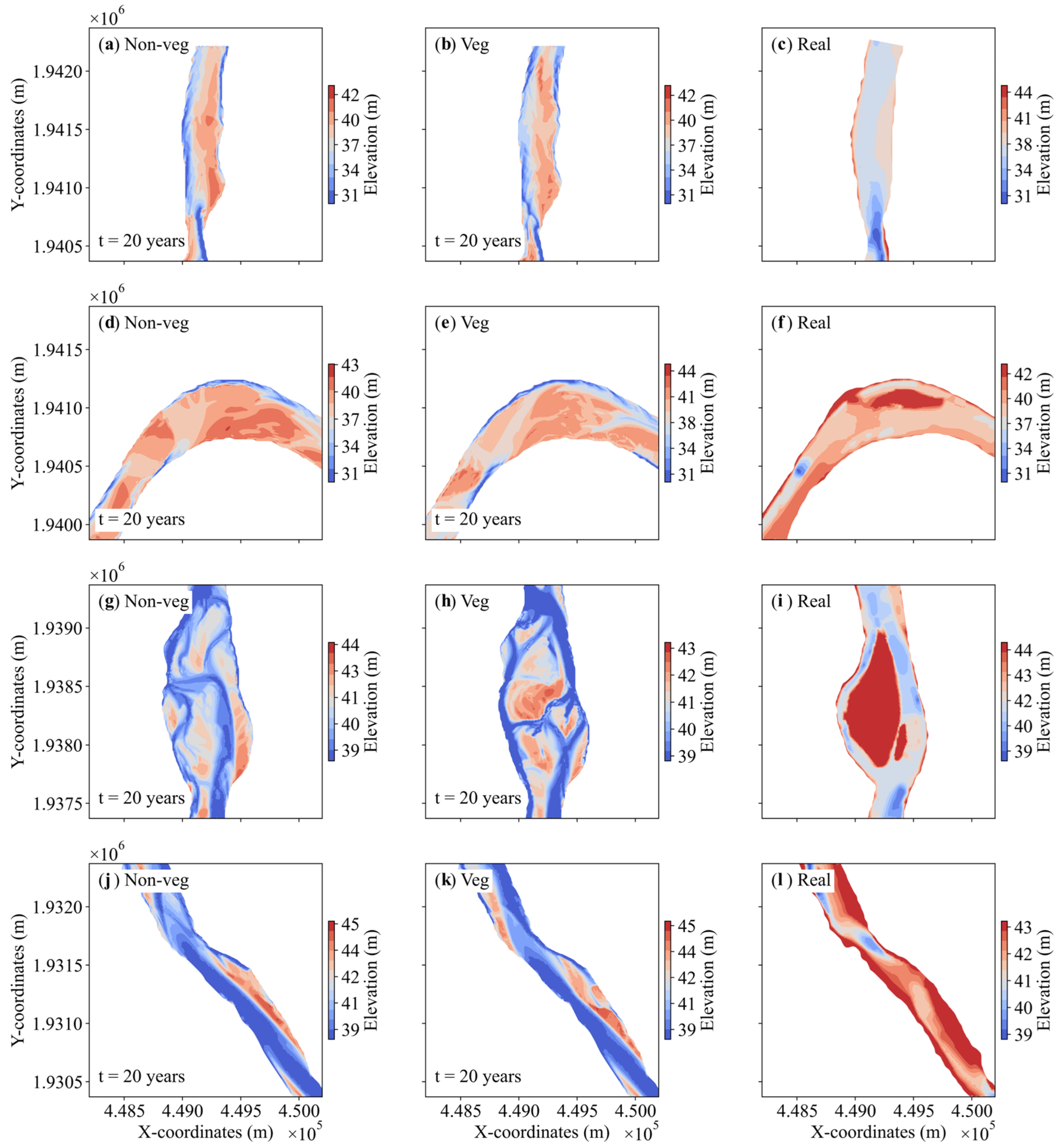
When the bed configuration of the simulated scenarios (vegetated and non-vegetated) and the actual river are compared (Figure 12), the bed in the non-vegetated scenario (Figure 12a,d,g,j) is more irregular, while in the vegetated scenario (Figure 12b,e,h,k), bed forms in the bed are clearly visible, such as well-defined bars. In the bend of Figure 12e, a bar is located at the outer bank, and another one has developed upstream at the inner bank. In Figure 12j,k, an alternate bar configuration is developed.
The simulated bed with vegetation (Figure 12b,h,k) shows agreement with the measurements (Figure 12c,i,l); for example, bars tend to develop in similar locations observed in the field, although their shape is not identical. Moreover, tendencies are reproduced well enough in Figure 12b and c with the growth of forced bars generated by the curvature of the river and in Figure 12k with the growth of alternate bars (Figure 12l).

4. Discussion

According to the results, riparian vegetation has a significant impact on both flow patterns and riverbed morphology. Contrasting the flow patterns developed by the vegetated and non-vegetated scenarios, Figure 9 reveals well-defined flow paths for the first case; in contrast, these patterns are more dispersed in the scenario without vegetation.
Furthermore, a larger velocity magnitude is observed in the vegetated scenario, suggesting that vegetation patches not only promote a change in flow direction but also in magnitude, driven by the concentration of flow in non-vegetated regions of the river; such conditions may enhance the development of secondary currents when the concentrated flow is curved, for instance, when the flow surrounds bars, adding complexity to the development of the riverbed.
This change in the flow alters both the sediment transport rate and its direction. In meandering rivers, the erosion–deposition patterns in the bed and banks are highly influenced by secondary flow [5], which in turn is intensified by the addition of vegetation [50]. The secondary flow creates a process where the momentum transfer in the vertical direction can interact with the stems of vegetation, which contributes to the dispersion of sediments [51,52,53]. This process controls the distribution and amount of nutrients [2,51], which are necessary for both growth and the lateral expansion of vegetation.
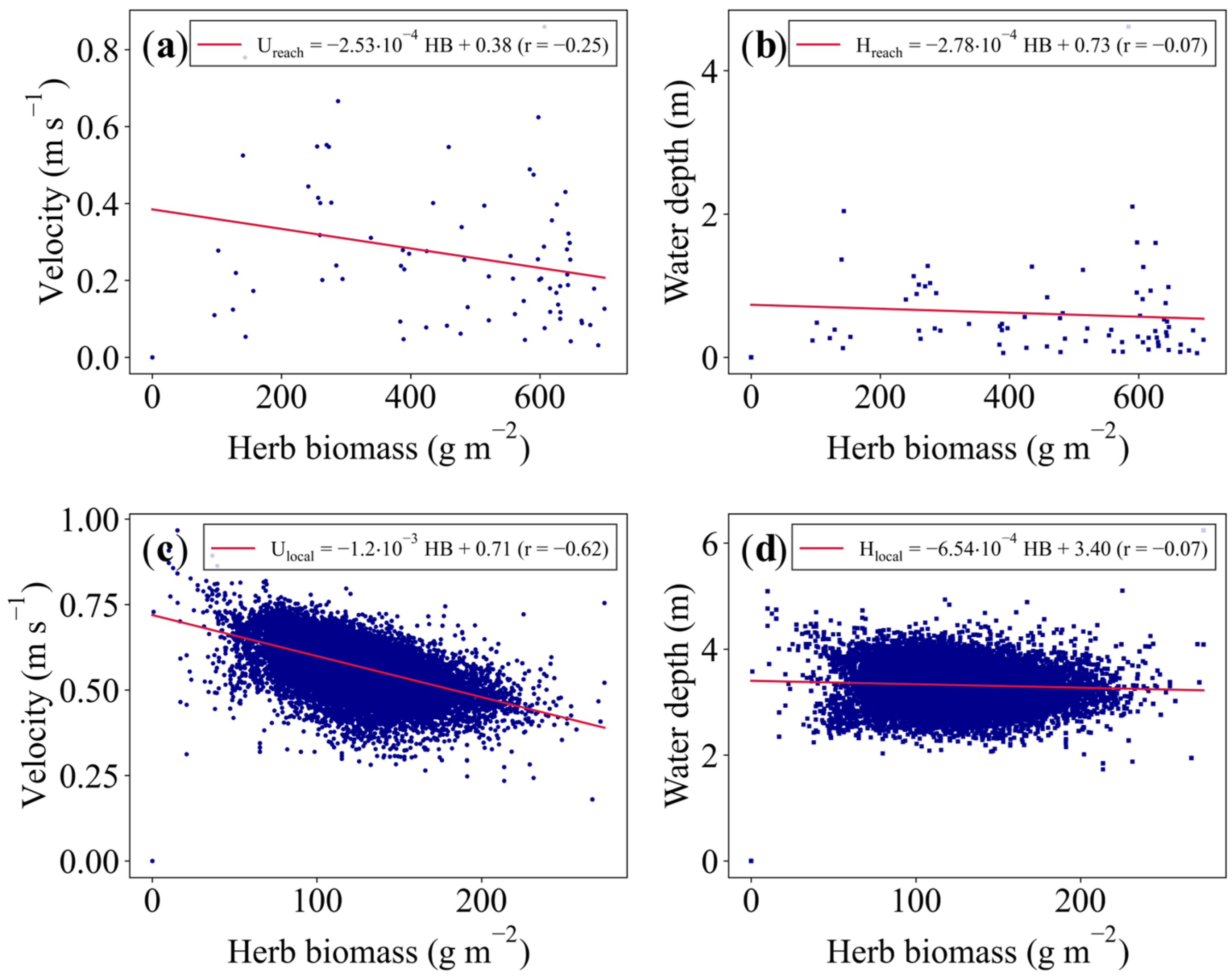
The results show that the mean velocity magnitude at the reach scale (in time throughout the domain) has a weak relationship with mean herb biomass (r = −0.25); this is shown in Figure 13a, where a linear regression fit was plotted. Conversely, herb biomass is not related to water depth (Figure 13b); this is suggested by the regression coefficient calculated: r = −0.07. These results consider only the nodes of the computational mesh, with herb and water depth higher than 0.1 m.
When the mean herb biomass is compared with velocity magnitude at the local or patch scale (each node of the computational mesh during time), the correlation coefficient shows even better agreement (Figure 13c), but in the case of water depth, the correlation is the same: −0.07 (Figure 13d). This means that, according to the simulations, the velocity is more strongly influenced by vegetation at the local scale than at the reach scale, whereas water depth has no relationship with herb biomass.
The flow–bed interaction in rivers with erodible banks can form meanders, where centrifugal forces generate deposition at the inner bends and scour in the outer ones, while in straight rivers with non-erodible banks, an instability mechanism produces a perturbed configuration in which disturbances can occur on a mega-scale, originating bars [54]. The outcomes of the simulation performed herein suggest that bar development is improved by the presence of plants in the river; for instance, when vegetation is present (Figure 12k), the bottom exhibits a well-defined pool–riffle sequence in the straight part of the reach. Furthermore, in the bend of Figure 12h, the oscillating pattern is reduced by vegetation, enhancing bottom stability. Therefore, not only does the interaction between flow and sediment determine the shape of the channel, but vegetation also modulates the morphological processes.
With vegetation, the sedimentation is higher; this shows that vegetation can enhance the deposition in bars, which in turn promotes scour in zones of flow surrounding the bars. In fact, the secondary flow induced by curvature enhances the development of bars, which are stabilized by the effect of gravity, sediment transport [55], and flow resistance supplied by riparian vegetation.
Plant growth contributes to holding bars through deposition, representing a positive feedback mechanism for more plant development [2]. Thus, vegetation can rework rivers and their floodplain characteristics [2,3]. Flow variability by itself produces changes in the bed configuration, as shown in Figure 11; however, vegetation modulates the magnitude of erosion and deposition, as shown by the ratios between vegetated and non-vegetated areas in Figure 11. At least in this study, the flow discharge has an important effect in modifying the riverbed morphology at the reach scale, whereas vegetation has an important effect at the local scale. Flow characteristics and plant traits, such as stem density and patch area, can determine the result of vegetation influencing the river structure [52].
The comparison between real and simulated bed development shows reasonable agreement in their morphological characteristics; notwithstanding, some reaches of the river (in the simulations) show different bar and bed development, as shown in Figure 12d,e,g,h. The ATYS model could not reproduce the bar observed in Figure 12f. The simulated reach needs enough time to achieve a stable configuration; in this study, only a 20-year period was simulated. Furthermore, in the satellite imagery analysis, it was found that the larger the surface area is, the more stable the bar is. In the vegetated scenario, multiple deposits developed during the simulations; also, compared with the other ones, the bar in Figure 12i is the largest one in the reach. Third, the historical flow discharges used in simulations are regulated by the Peñitas Dam, which implies that the natural fluctuation in flow prior to the construction of the dam was not considered. Finally, a zero-sediment income was set at the inlet boundary, which resembles the sediment retention in the dam. In both conditions, flow regime homogenization and sediment retention may have limited the development of bars during the simulation.

5. Conclusions

The literature review performed here indicates that the most recent approaches, while focused on improving our understanding of the interactions between vegetation, hydrodynamics, and morphodynamics, typically model the flow–vegetation interplay either by representing vegetation as rigid stems or by increasing the local bed roughness [56,57,58,59].
A comprehensive framework for modeling river morphodynamics influenced by riparian vegetation has been proposed herein to assess the effect of the plant life cycle on riverbed morphology using plant biomass. Other studies support the use of dynamic plant biomass to represent the increased flow resistance associated with the presence of vegetation (e.g., [56,57,58,60]).
In the ATYS model proposed here, the vegetation is represented as a dynamic patch capable of lateral expansion, which reflects its broad effect beyond just the local scale [3]. The effect of vegetation patches is incorporated into the momentum equation through a drag term, while their physical obstruction is accounted for using the porosity function in TELEMAC-2D. This approach aligns with methodologies adopted in previous studies [12,13,61,62,63,64]. This framework is focused on the flow–vegetation interaction; however, an effect that was not considered is the interaction of vegetation with the underlying soil, specifically, the reinforcement of banks by the roots of riparian vegetation, which is considered for future developments of ATYS.
The model was tested in an 18 km long reach of the Mezcalapa River located downstream of the Peñitas Dam in the southwest of Mexico. Thus, the interactions between flow, riverbed, and vegetation were evaluated. The results illustrate that bed evolution patterns are primarily influenced by flow variations at the reach scale, while vegetation tends to influence morphological changes at the local scale. However, a notable relationship between the increased herb biomass and the reduced velocities at the reach scale is observed. Overall, alterations in flow and sediment transport affect vegetation, which in turn modifies both erosion and deposition patterns, creating a positive feedback cycle that amplifies these disturbances [1,2].
The outcomes indicate that vegetation significantly influences flow structures by increasing flow resistance; furthermore, vegetation patches contribute to concentrating the flow in regular paths and affect not only the direction but also the magnitude of velocity, which in turn has an important effect on erosion and deposition rates at the local scale. Moreover, the proposed approach reproduces most of the observed tendencies in the river reach well enough, suggesting the significant role of vegetation in modulating the instability of bars.
Furthermore, when obstructions such as vegetation stems are present, changes in velocity gradients, increased shear stresses and alterations in secondary flow are observed [59,65]. Deposition is enhanced around vegetation patches, while reduced sedimentation takes place in the main channel [64]. These results highlight not only the importance of modeling vegetation dynamics at the patch scale using drag force and porosity approaches but also the importance of accounting for stem bending since incorporating flexible vegetation improves the accurate estimation of flow characteristics [65,66].
Although alternative approaches that use Manning’s roughness coefficients to represent vegetation have been proposed, these methods have some limitations. The use of overestimated roughness coefficients to parameterize vegetation patches often fails to accurately capture vegetation-induced drag: this misrepresents the effects of emergent plants and inadequately reflects the downstream boundary conditions. Furthermore, this can lead to overestimated sediment transport due to elevated local bed shear stresses [6,12,15].
The ATYS model provides a framework for the numerical modeling of vegetation dynamics and their influence on hydrodynamics and sediment transport. Since the model does not require the solution of differential equations, its implementation does not noticeably increase computational costs. Finally, at this stage, the model offers a qualitative solution to addressing river morphodynamics influenced by riparian vegetation, but it is necessary to validate ATYS’s performance with field data, especially the data associated with herb and tree growth.

Author Contributions

Conceptualization, methodology, software, validation, formal analysis and writing—original draft preparation, R.G.; writing—review and editing, A.M. and M.B.; supervision, A.M. All authors have read and agreed to the published version of the manuscript.

Funding

This research was funded by Secretaría de Ciencias, Humanidades, Tecnología e Innovación (SECIHTI), grant number 817144. The computing resources were funded by Dirección General de Cómputo y de Tecnologías de Información y Comunicación (DGTIC, UNAM), grant numbers LANDCAD-UNAM-DGTIC-389 and LANCAD-UNAM-DGTIC-366.

Data Availability Statement

The original contributions presented in this study are included in the article. Further inquiries can be directed to the corresponding authors.

Acknowledgments

Special thanks to Takashi Asaeda for his valuable guidance in understanding the bases of the DRIPVEM model and to Rafael Ibarra for his corrections to the paper.

Conflicts of Interest

The authors declare no conflicts of interest.

Abbreviations

The following abbreviations are used in this manuscript:
NDVINormalized Difference Vegetation Index
NRGNear-Infrared, Red, Green
SNRShortwave-Infrared, Near-Infrared, Red
GISGeographic Information System

References

  1. Henriques, M.; McVicar, T.R.; Holland, K.L.; Daly, E. Riparian Vegetation and Geomorphological Interactions in Anabranching Rivers: A Global Review. Ecohydrology 2022, 15, e2370. [Google Scholar] [CrossRef]
  2. Tal, M.; Paola, C. Effects of Vegetation on Channel Morphodynamics: Results and Insights from Laboratory Experiments. Earth Surf. Process. Landf. 2010, 35, 1014–1028. [Google Scholar] [CrossRef]
  3. Temmerman, S.; Bouma, T.J.; Van de Koppel, J.; Van der Wal, D.; De Vries, M.B.; Herman, P.M.J. Vegetation Causes Channel Erosion in a Tidal Landscape. Geology 2007, 35, 631–634. [Google Scholar] [CrossRef]
  4. Weisscher, S.A.H.; Shimizu, Y.; Kleinhans, M.G. Upstream Perturbation and Floodplain Formation Effects on Chute-cutoff-dominated Meandering River Pattern and Dynamics. Earth Surf. Process. Landf. 2019, 44, 2156–2169. [Google Scholar] [CrossRef] [PubMed]
  5. Azarisamani, A.; Keshavarzi, A.; Hamidifar, H.; Javan, M. Effect of Rigid Vegetation on Velocity Distribution and Bed Topography in a Meandering River with a Sloping Bank. Arab. J. Sci. Eng. 2020, 45, 8633–8653. [Google Scholar] [CrossRef]
  6. Bywater-Reyes, S.; Diehl, R.M.; Wilcox, A.C. The Influence of a Vegetated Bar on Channel-Bend Flow Dynamics. Earth Surf. Dynam. 2018, 6, 487–503. [Google Scholar] [CrossRef]
  7. Crosato, A.; Saleh, M.S. Numerical Study on the Effects of Floodplain Vegetation on River Planform Style. Earth Surf. Process. Landf. 2011, 36, 711–720. [Google Scholar] [CrossRef]
  8. Dworak, F.E.; Schwartz, J.S. Use of a 3D Hydrodynamic Model in an Incised Urban Channel with Woody Bank Vegetation to Evaluate Pool-Riffle Maintenance: Implications for Stream Restoration Design. In World Environmental and Water Resources Congress 2007; American Society of Civil Engineers: Tampa, FL, USA, 2007; pp. 1–11. [Google Scholar] [CrossRef]
  9. Forzieri, G.; Moser, G.; Vivoni, E.R.; Castelli, F.; Canovaro, F. Riparian Vegetation Mapping for Hydraulic Roughness Estimation Using Very High Resolution Remote Sensing Data Fusion. J. Hydraul. Eng. 2010, 136, 855–867. [Google Scholar] [CrossRef]
  10. Iwasaki, T.; Shimizu, Y.; Kimura, I. Numerical Simulation of Bar and Bank Erosion in a Vegetated Floodplain: A Case Study in the Otofuke River. Adv. Water Resour. 2016, 93, 118–134. [Google Scholar] [CrossRef]
  11. Kang, T.; Kimura, I.; Shimizu, Y. Responses of Bed Morphology to Vegetation Growth and Flood Discharge at a Sharp River Bend. Water 2018, 10, 223. [Google Scholar] [CrossRef]
  12. Sun, X.; Shiono, K.; Rameshwaran, P.; Chandler, J.H. Modelling Vegetation Effects in Irregular Meandering River. J. Hydraul. Res. 2010, 48, 775–783. [Google Scholar] [CrossRef]
  13. Toda, Y.; Ikeda, S.; Kumagai, K.; Asano, T. Effects of Flood Flow on Flood Plain Soil and Riparian Vegetation in a Gravel River. J. Hydraul. Eng. 2005, 131, 950–960. [Google Scholar] [CrossRef]
  14. Yang, Z.; Li, D.; Huai, W.; Liu, J. A New Method to Estimate Flow Conveyance in a Compound Channel with Vegetated Floodplains Based on Energy Balance. J. Hydrol. 2019, 575, 921–929. [Google Scholar] [CrossRef]
  15. Jadhav, R.S.; Buchberger, S.G. Effects of Vegetation on Flow through Free Water Surface Wetlands. Ecol. Eng. 1995, 5, 481–496. [Google Scholar] [CrossRef]
  16. Kadlec, R.H. Overland Flow in Wetlands: Vegetation Resistance. J. Hydraul. Eng. 1990, 116, 691–706. [Google Scholar] [CrossRef]
  17. De Doncker, L.; Troch, P.; Verhoeven, R.; Bal, K.; Meire, P.; Quintelier, J. Determination of the Manning Roughness Coefficient Influenced by Vegetation in the River Aa and Biebrza River. Environ. Fluid Mech. 2009, 9, 549–567. [Google Scholar] [CrossRef]
  18. Ben Meftah, M.; Mossa, M. Partially Obstructed Channel: Contraction Ratio Effect on the Flow Hydrodynamic Structure and Prediction of the Transversal Mean Velocity Profile. J. Hydrol. 2016, 542, 87–100. [Google Scholar] [CrossRef]
  19. Luhar, M.; Nepf, H.M. From the Blade Scale to the Reach Scale: A Characterization of Aquatic Vegetative Drag. Adv. Water Resour. 2013, 51, 305–316. [Google Scholar] [CrossRef]
  20. Nepf, H.M. Hydrodynamics of Vegetated Channels. J. Hydraul. Res. 2012, 50, 262–279. [Google Scholar] [CrossRef]
  21. Baptist, M.J.; Penning, W.E.; Duel, H.; Smits, A.J.M.; Geerling, G.W.; Van der Lee, G.E.M.; Van Alphen, J.S.L. Assessment of The Effects of Cyclic Floodplain Rejuvenation on Flood Levels and Biodiversity Along The Rhine River. River Res. Appl. 2004, 20, 285–297. [Google Scholar] [CrossRef]
  22. Nicholas, A.P. Modelling the Continuum of River Channel Patterns: Modelling the River Continuum. Earth Surf. Process. Landf. 2013, 38, 1187–1196. [Google Scholar] [CrossRef]
  23. Nicholas, A.P.; Ashworth, P.J.; Sambrook Smith, G.H.; Sandbach, S.D. Numerical Simulation of Bar and Island Morphodynamics in Anabranching Megarivers. J. Geophys. Res. Earth Surf. 2013, 118, 2019–2044. [Google Scholar] [CrossRef]
  24. Perucca, E.; Camporeale, C.; Ridolfi, L. Significance of the Riparian Vegetation Dynamics on Meandering River Morphodynamics: Meandering Rivers and Riparian Vegetation. Water Resour. Res. 2007, 43, W03430. [Google Scholar] [CrossRef]
  25. Rousseau, Y.Y.; Van de Wiel, M.J.; Biron, P.M. Integration of a Geotechnical Model within a Morphodynamic Model to Investigate River Meandering Processes. In River Flow 2014; Schleiss, A., de Cesare, G., Franca, M., Pfister, M., Eds.; CRC Press: Boca Raton, FL, USA, 2014; pp. 1127–1133. [Google Scholar] [CrossRef]
  26. Rousseau, Y.Y.; Van de Wiel, M.J.; Biron, P.M. Implementation of Geotechnical and Vegetation Modules in TELEMAC to Simulate the Dynamics of Vegetated Alluvial Floodplains. In 21st TELEMAC-MASCARET User Conference; Bertrand, O., Coulet, C., Eds.; Artelia Eau & Environnement: Genoble, France, 2014; pp. 169–177. [Google Scholar]
  27. Rousseau, Y.Y.; Biron, P.M.; Van de Wiel, M.J. Sensitivity of Simulated Flow Fields and Bathymetries in Meandering Channels to the Choice of a Morphodynamic Model: Sensitivity of Simulated Flow and Bathymetries to Morphodynamic Model. Earth Surf. Process. Landf. 2016, 41, 1169–1184. [Google Scholar] [CrossRef]
  28. Rousseau, Y.Y.; Van de Wiel, M.J.; Biron, P.M. Simulating Bank Erosion over an Extended Natural Sinuous River Reach Using a Universal Slope Stability Algorithm Coupled with a Morphodynamic Model. Geomorphology 2017, 295, 690–704. [Google Scholar] [CrossRef]
  29. Toda, Y.; Zhou, Y.; Sakai, N. Modeling of Riparian Vegetation Dynamics and Its Application to Sand-Bed River. J. Hydro-Environ. Res. 2020, 30, 3–13. [Google Scholar] [CrossRef]
  30. Zolezzi, G.; Seminara, G. Downstream and Upstream Influence in River Meandering. Part 1. General Theory and Application to Overdeepening. J. Fluid Mech. 2001, 438, 183–211. [Google Scholar] [CrossRef]
  31. Asaeda, T.; Rashid, M.H. Modelling of Nutrient Dynamics and Vegetation Succession in Midstream Sediment Bars of a Regulated River. Int. J. River Basin Manag. 2014, 12, 123–133. [Google Scholar] [CrossRef]
  32. Asaeda, T.; Rashid, M.H.; Abu Bakar, R. Dynamic Modelling of Soil Nitrogen Budget and Vegetation Colonization in Sediment Bars of a Regulated River: DYNAMIC MODELLING OF VEGETATION SUCCESSION. River Res. Appl. 2015, 31, 470–484. [Google Scholar] [CrossRef]
  33. Sharpe, R.; Brooks, A.; Yu, B.; Olley, J.; Kemp, J. Drag Forces on Subtropical Trees with Sclerophyllous Foliage Towed through Stillwater. J. Hydraul. Eng. 2021, 147, 04021039. [Google Scholar] [CrossRef]
  34. Busari, A.O.; Li, C.W. Bulk Drag of a Regular Array of Emergent Blade-Type Vegetation Stems under Gradually Varied Flow. J. Hydro-Environ. Res. 2016, 12, 59–69. [Google Scholar] [CrossRef]
  35. Hervouet, J.-M. Hydrodynamics of Free Surface Flows: Modelling with the Finite Element Method; Wiley: Chichester, UK; Hoboken, NJ, USA, 2007. [Google Scholar]
  36. Asaeda, T.; Baniya, M.B.; Rashid, M.H. Effect of floods on the growth of Phragmites japonica on the sediment bar of regulated rivers: A modelling approach. Int. J. River Basin Manag. 2011, 9, 211–220. [Google Scholar] [CrossRef]
  37. Kachi, N.; Hirose, T. Limiting Nutrients for Plant Growth in Coastal Sand Dune Soils. J. Ecol. 1983, 71, 937–944. [Google Scholar] [CrossRef]
  38. Lammerts, E.J.; Grootjans, A.P. Nutrient Deficiency in Dune Slack Pioneer Vegetation: A Review. J. Coast. Conserv. 1997, 3, 87–94. [Google Scholar] [CrossRef][Green Version]
  39. Asaeda, T.; Rashid, M.H.; Ohta, K. Nitrogen fixation by Pueraria lobata as a nitrogen source in the midstream sediment bar of a river: Nitrogen Fixation by Pueraria Lobata in Sediment Bar. Ecohydrology 2016, 9, 995–1005. [Google Scholar] [CrossRef]
  40. Nepf, H.M. Drag, Turbulence, and Diffusion in Flow through Emergent Vegetation. Water Resour. Res. 1999, 35, 479–489. [Google Scholar] [CrossRef]
  41. EDF-R&D. Open TELEMAC-MASCARET. 2022. Available online: https://www.opentelemac.org (accessed on 7 October 2022).
  42. Birch, C. A New Generalized Logistic Sigmoid Growth Equation Compared with the Richards Growth Equation. Ann. Bot. 1999, 83, 713–723. [Google Scholar] [CrossRef]
  43. Latrubesse, E.M. Patterns of Anabranching Channels: The Ultimate End-Member Adjustment of Mega Rivers. Geomorphology 2008, 101, 130–145. [Google Scholar] [CrossRef]
  44. Louche, B.; Rüther, N.; Schartwäder, K. Temporal variation of braided intensity and morphodynamic changes in a regu-lated braided river using 2D modeling and satellite images. River Res. Appl. 2024, 40, 708–724. [Google Scholar] [CrossRef]
  45. CONABIO; Government of the Tabasco State. The biodiversity in Tabasco. In Study of Status; CONABIO: Mexico City, Mexico, 2019; Volume 1. (In Spanish) [Google Scholar]
  46. Dezzotti, A.; Sbrancia, R.E.; Attis Beltrán, H.; Velásquez, A.; Mortoro, A. Historical, social and ecological aspects related to Salix Humboldtiana in the riparian valley of the Agrio River, in the argentinian Patagonia. Cienc. Investig. For. 2020, 26, 45–68. (In Spanish) [Google Scholar] [CrossRef]
  47. Pinilla, J.C.; Chung, P.; Navarrete, M. The Chilean Willow (Salix Humboldtiana Willd) in the Biobío Region and Its Potential Use in Forest Plantations; Technical Report 202; Forestry Institute: Santiago, Chile, 2015; Available online: https://bibliotecadigital.infor.cl/bitstream/handle/20.500.12220/20998/31531.pdf?sequence=1&isAllowed=y (accessed on 25 March 2025). (In Spanish)
  48. Kim, J.G.; Nam, J.M.; Han, M.H. Implication of Self-Thinning in Salix Communities on Riverine Wetland Restoration. J. Ecol. Environ. 2007, 3, 251–265. [Google Scholar] [CrossRef]
  49. Jarquín-Sánchez, A.; Salgado-García, S.; Palma-López, D.J.; Camacho-Chiu, W.; Guerrero-Peña, A. Analysis of Total Nitrogen in Tropical Soils with Near-Infrared Spectroscopy (NIRS) and Chemometrics. Agrociencia 2011, 45, 653–662. [Google Scholar]
  50. Dehsorkhi, E.N.; Afzalimehr, H.; Singh, V.P. Effect of Bed Forms and Vegetated Banks on Velocity Distributions and Turbulent Flow Structure. J. Hydrol. Eng. 2011, 16, 495–507. [Google Scholar] [CrossRef]
  51. Bouma, T.J.; Van Duren, L.A.; Temmerman, S.; Claverie, T.; Blanco-Garcia, A.; Ysebaert, T.; Herman, P.M. Spatial Flow and Sedimentation Patterns within Patches of Epibenthic Structures: Combining Field, Flume and Modelling Experiments. Cont. Shelf Res. 2007, 27, 1020–1045. [Google Scholar] [CrossRef]
  52. Neary, V.S.; Constantinescu, S.G.; Bennett, S.J.; Diplas, P. Effects of Vegetation on Turbulence, Sediment Transport, and Stream Morphology. J. Hydraul. Eng. 2012, 138, 765–776. [Google Scholar] [CrossRef]
  53. Nepf, H.M.; Koch, E.W.K. Vertical Secondary Flows in Submersed Plant-like Arrays. Limnol. Oceanogr. 1999, 44, 1072–1080. [Google Scholar] [CrossRef]
  54. Colombini, M.; Seminara, G.; Tubino, M. Finite-Amplitude Alternate Bars. J. Fluid Mech. 1987, 181, 213–232. [Google Scholar] [CrossRef]
  55. Federici, B.; Seminara, G. On the Convective Nature of Bar Instability. J. Fluid Mech. 2003, 487, 125–145. [Google Scholar] [CrossRef]
  56. Caponi, F.; Vetsch, D.F.; Siviglia, A. A model study of the combined effect of above and below ground plant traits on the ecomorphodynamics of gravel bars. Sci. Rep. 2020, 10, 17062. [Google Scholar] [CrossRef]
  57. Caponi, F.; Vetsch, D.F.; Vanzo, D. BASEveg: A python package to model riparian vegetation dynamics coupled with river morphodynamics. SoftwareX 2023, 22, 101361. [Google Scholar] [CrossRef]
  58. Cunico, I.; Bertoldi, W.; Caponi, F.; Dijkstra, H.A.; Siviglia, A. River Ecomorphodynamic Models Exhibit Features of Nonlinear Dynamics and Chaos. Geophys. Res. Lett. 2024, 51, e2023GL107951. [Google Scholar] [CrossRef]
  59. Kumar, P.; Kumar, A.; Sharma, A. Numerical modeling of turbulent flow interactions with vegetation in channels with fixed beds. Model. Earth Sys. Environ. 2024, 10, 4337–4360. [Google Scholar] [CrossRef]
  60. Zhu, K.-H.; Zeng, J.; Ge, Z.-M.; Zuo, Y.; Li, S.-H.; Zhao, L.-H.; Han, Y.; Cheng, H.-F.; Xin, P. A model coupling ecological and hydrodynamic processes for simulating the biogeomorphology of a coastal salt marsh. Ecol. Model. 2024, 493, 110758. [Google Scholar] [CrossRef]
  61. Jourdain, C.; Claude, N.; Tassi, P.; Cordier, F.; Antoine, G. Morphodynamics of Alternate Bars in the Presence of Riparian Vegetation. Earth Surf. Process. Landf. 2020, 45, 1100–1122. [Google Scholar] [CrossRef]
  62. Zhao, F.; Huai, W. Hydrodynamics of Discontinuous Rigid Submerged Vegetation Patches in Open-Channel Flow. J. Hydro-environ. Res. 2016, 12, 148–160. [Google Scholar] [CrossRef]
  63. Li, W.; Liu, B.; Hu, P. Fast Modeling of Vegetated Flow and Sediment Transport Over Mobile Beds Using Shallow Water Equations With Anisotropic Porosity. Water Resour. Res. 2023, 59, e2021WR031896. [Google Scholar] [CrossRef]
  64. Xiang, H.; Zhang, Z.; Ji, C.; Xu, D.; Chen, X.; Tang, L.; Wang, Y. Numerical Simulations of Impact River Morphology Evolution Mechanism Under the Influence of Floodplain Vegetation. Fluids 2024, 9, 243. [Google Scholar] [CrossRef]
  65. Majumder, T.; Biswal, S.K. Numerical Modeling of Free Surface Flow over Partially Flexible Vegetation under Different Submergence Variation. Water Resour. 2025, 52, 1217–1229. [Google Scholar] [CrossRef]
  66. Alsina, V.S.; Cherian, R.M. Numerical investigation on the effect of flexible vegetation in open-channel flow incorporating FSI. ISH J. Hyd. Eng. 2024, 30, 34–46. [Google Scholar] [CrossRef]
Figure 1. Schematic structure of the integration of the ATYS model in the TELEMAC system: (a) flow chart of calculation sequence; (b) vegetation growth model (based on DRIPVEM).
Water 18 00883 g001
Figure 2. Images of the study site: (a) location of the Mezcalapa River in Mexico (Google Earth), (b) a vegetated midstream bar located at the lowest part downstream of the reach (Google Earth), (c) a composite Landsat 8 image of the study area.
Water 18 00883 g002
Figure 3. Computational domain used in the simulations: (a) part upstream de outlet, (b) part with the most curvature, (c) widest part of the reach, (d) part downstream the Peñitas Dam.
Water 18 00883 g003
Figure 4. Boundary conditions used in the simulations: (a) hydrograph of mean daily discharges; (b) stage–discharge curve.
Water 18 00883 g004
Figure 5. Comparison between mean area of the bars in the Mezcalapa River with their (a) persistence and (b) frequency. p is persistence (years), and A is the mean surface area (m2).
Water 18 00883 g005
Figure 6. Monthly variation of herb biomass simulated in the study reach: (a) mean, (b) maximum.
Water 18 00883 g006
Figure 7. Herb biomass and bed elevation in the reach after a 20-year simulation in: (a) part upstream the outlet, (b) part with the most curvature, (c) widest part of the reach, (d) part downstream the Peñitas Dam.
Water 18 00883 g007
Figure 8. Monthly variation of tree traits: (a) mean age, (b) mean density.
Water 18 00883 g008
Figure 9. Velocity vector field along the reach after a 20-year simulation: (a,c,e,g) non-vegetated scenario; (b,d,f,h) vegetated scenario.
Water 18 00883 g009
Figure 10. Variation of velocity in the domain during a 20-year simulation: (a) mean velocity of vegetated and non-vegetated scenarios, (b) ratio between velocity with vegetation (Uveg) and without vegetation (U).
Water 18 00883 g010
Figure 11. Ratio of mean bed evolution of scenarios with vegetation (Evolveg) and without vegetation (Evol) for the 20-year period of simulation.
Water 18 00883 g011
Figure 12. Difference in bed elevation between simulated scenarios and real data: (a,d,g,j) non-vegetated, (b,e,h,k) vegetated, (c,f,i,l) topography of 2012.
Water 18 00883 g012
Figure 13. Relationship between flow variables and vegetation: (a,c) mean herb biomass and mean velocity at local and reach scales, respectively; (b,d) mean herb biomass and mean water depth at local and reach scales, respectively.
Water 18 00883 g013
Disclaimer/Publisher’s Note: The statements, opinions and data contained in all publications are solely those of the individual author(s) and contributor(s) and not of MDPI and/or the editor(s). MDPI and/or the editor(s) disclaim responsibility for any injury to people or property resulting from any ideas, methods, instructions or products referred to in the content.