Review

Rainfall-Induced Landslide Prediction Models, Part I: Empirical–Statistical and Physically Based Causative Thresholds


1
Department of Building and Real Estate, Faculty of Construction and Environment, The Hong Kong Polytechnic University, Hung Hom, Kowloon, Hong Kong SAR, China
2
Structural Engineering Department, Faculty of Engineering, Mansoura University, Mansoura 35516, Egypt
3
Department of Architecture and Building Science, College of Architecture and Planning, King Saud University, Riyadh 11362, Saudi Arabia
*
Authors to whom correspondence should be addressed.
Water 2025, 17(22), 3273; https://doi.org/10.3390/w17223273
Submission received: 19 October 2025 / Revised: 9 November 2025 / Accepted: 14 November 2025 / Published: 16 November 2025

Abstract

Introduction and Problem Statement: Landslides represent a significant geological hazard worldwide. One of the primary triggers for these landslides is rainfall, which is becoming more intense as a result of climate change. The available literature has produced extensive research. However, this largely overlooks the use of mixed methodologies. Furthermore, a comprehensive review combining empirical, physically based, deterministic, and phenomenological models is still rare. Objective and Method: This study (Part I of a two-part review) addresses this gap by employing a mixed review that integrates quantitative scientometric analysis with a qualitative systematic review. The primary objective of Part I is to deliver a critical assessment, focusing on empirical and physically based causative threshold models. Main Results and Validation: Macroscopically, our analysis reveals that antecedent rainfall is a more robust indicator than classical intensity–duration (I-D) thresholds, though the latter remains widely used due to its simplicity. Physically based models provide a critical bridge when geotechnical data is scarce, correlating rainfall with internal slope responses like displacement. At a microscopic level, hybrid artificial intelligence (AI) models consistently demonstrate superior predictive accuracy by capturing complex, nonlinear relationships missed by simpler models. These findings are validated through a systematic evaluation of performance metrics across the reviewed literature. Main Conclusions and Significance: We conclude that while empirical thresholds offer operational simplicity, the future of accurate prediction lies in sophisticated hybrid AI models trained on extensive monitoring data. This review synthesizes fragmented knowledge into a unified framework, providing a clear roadmap for model selection.

1. Introduction

“A landslide is the movement of a mass of rock, earth, or debris down a slope [1].” These events, which naturally occur in hilly regions and contribute to landscape evolution, are initiated when slope materials cannot resist the stresses from a variety of triggering factors. As a prevalent global hazard, they cause significant human and economic losses [2]. To quantify this impact, historic severity is highlighted by Froude and Petley [3], who reported that non-seismic landslides caused approximately 55,997 fatalities in 4862 incidents globally between 2004 and 2016. Figure 1a illustrates this global distribution, revealing a pronounced concentration of landslides in some regions (i.e., Asia), which underscores specific regional vulnerabilities. This long-term trend is consistent with the World Health Organization estimates of over 18,000 deaths from 1998 to 2017 (accessed 6 November 2025).
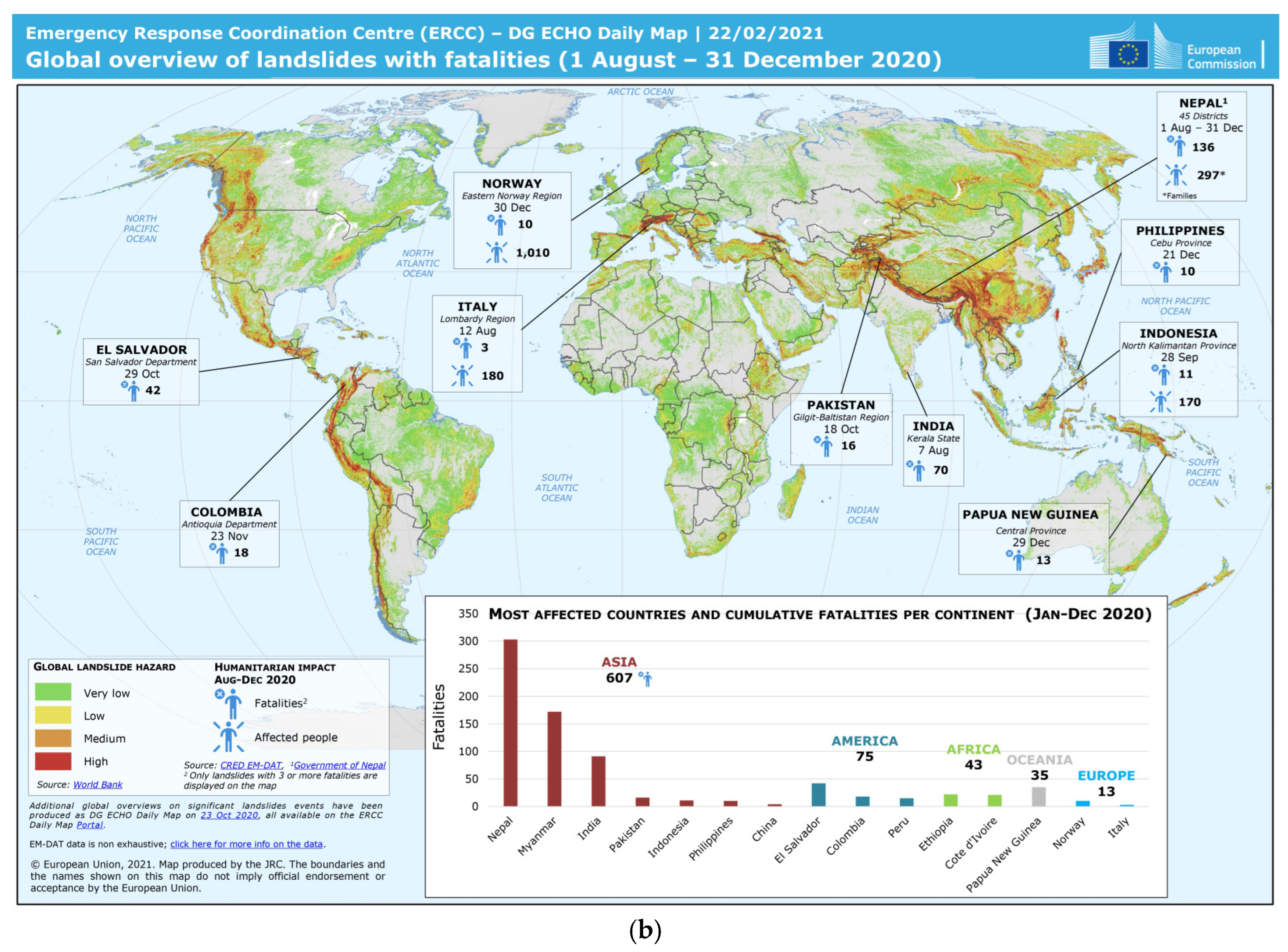
Beyond this historical context, the threat remains current, as demonstrated by a recent world map from the European Commission’s Directorate-General for European Civil Protection and Humanitarian Aid Operations (2022) detailing fatal landslide events from August to December 2020 (Figure 1b). The impact is not uniformly distributed, with regions like China experiencing disproportionately high losses; since 2000, the country has averaged about 600 landslide-related deaths annually, accounting for nearly 25% of its natural disaster mortality [4]. The persistent consequences, including extensive human casualties, destruction of critical infrastructure, and substantial economic losses [5], underscore the urgent need for reducing such catastrophic risk.
To systematically understand and mitigate this risk, it is essential to classify these events. Hungr et al. [6] extended the Varnes system and classified landslides into 32 distinct types based on material composition (such as rock, debris, or soil) and movement mechanisms (such as falls, topples, slides, and flows). This classification offers a more comprehensive framework for understanding different landslide mechanisms. These landslides can be triggered by various factors, including earthquakes, volcanic activity, floods, and intense rainfall. Among these triggers, rainfall is the most common cause of slope instability globally. Increasingly severe rainstorms, driven by climate change, are contributing to a higher frequency of catastrophic landslides [7,8].
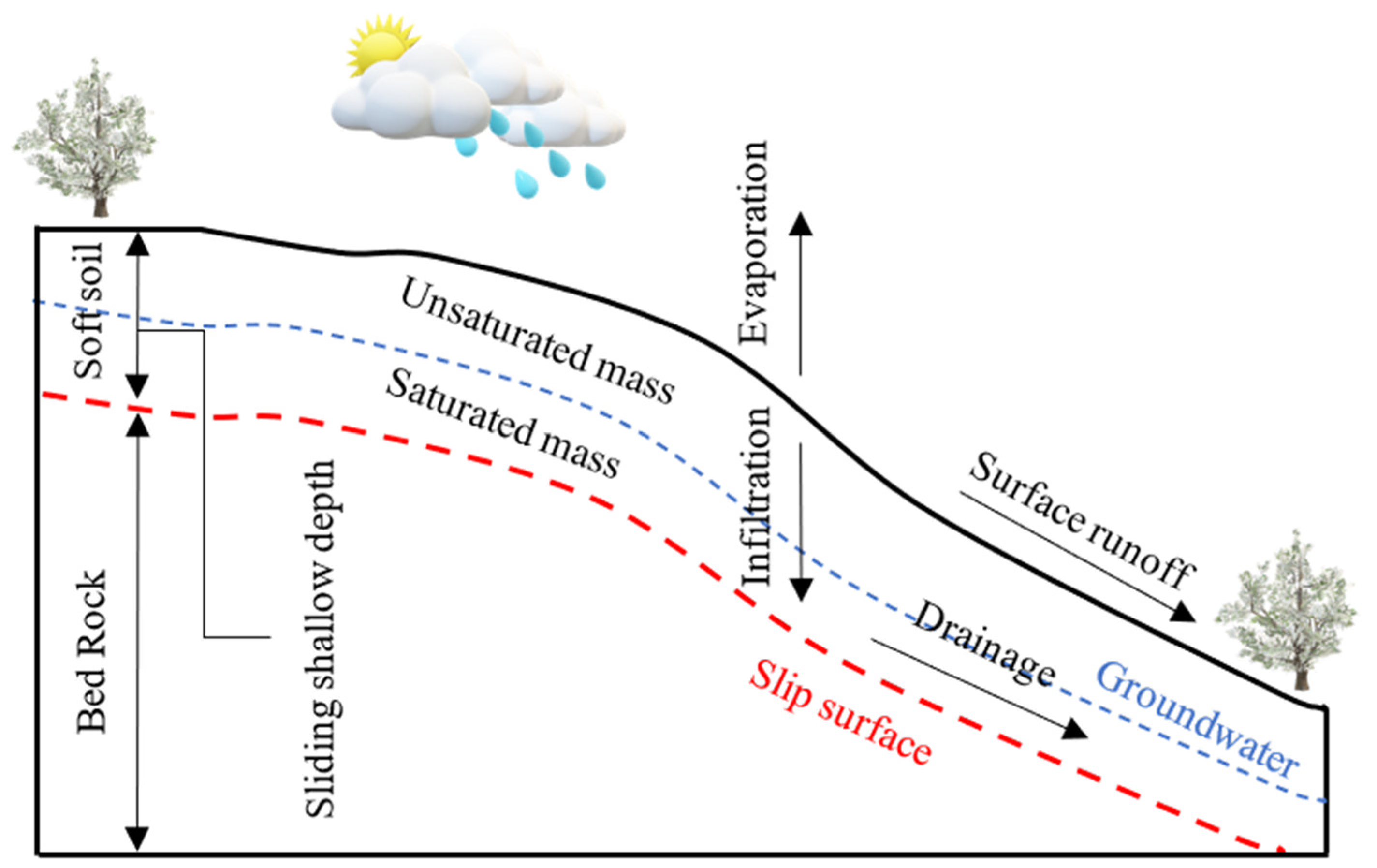
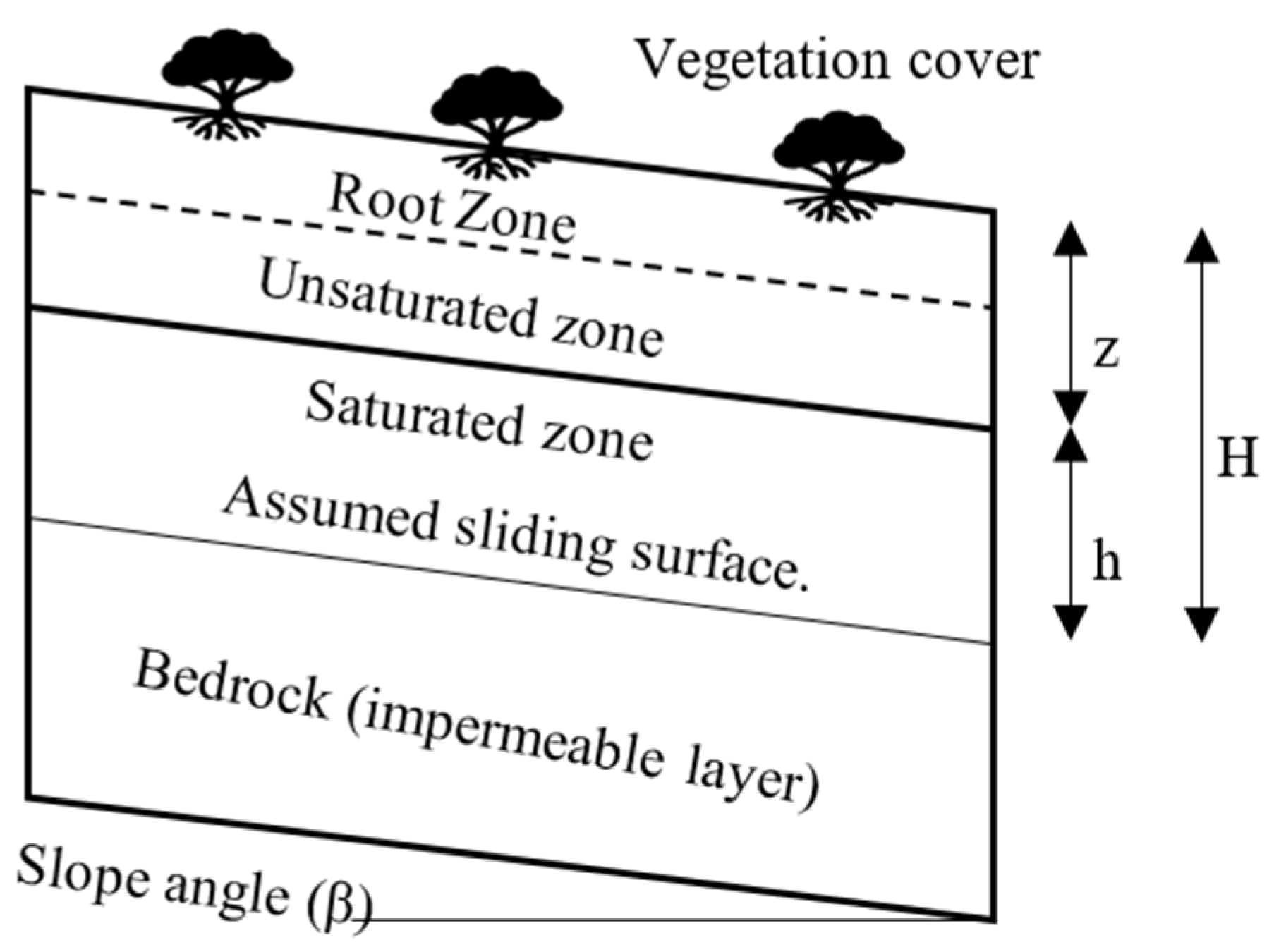
With that in mind, for the purpose of this review, the focus is narrowed to rainfall-induced landslides due to their high frequency and destructive potential. Figure 2 visualizes a schematic view of the shallow rainfall-induced landslides. These landslides are typically shallow, with slip surfaces running parallel to the slope surface [9,10]. According to Caine [11], the depth of shallow landslides is generally less than 2 to 3 m, as mentioned by other studies [12,13,14]. The failure mechanism of these landslides involves the movement of soil or debris near the surface, and is characterized by their rapid onset and intensity [15].
To reduce these hazards, mitigation techniques such as stabilizing piles, soil nailing, drainage systems, and other strategies are crucial, particularly when the slope is exposed to unforeseen triggers like heavy rainfall [16]. However, such mitigation strategies should be prioritized and optimized to achieve both practicability, cost, and safety. A key prerequisite for such optimized mitigation is accurate prediction. In recent years, there has been an increased focus on leveraging landslide prediction models as a promising strategy to reduce risks. These models are vital for identifying prone areas and providing timely alerts, thereby minimizing impacts and facilitating the development of early warning systems [17,18].
Consequently, a diverse suite of prediction models has been developed, ranging from simple thresholds to advanced numerical simulation and deterministic models. The available literature offers extensive efforts to review these models, as outlined in Table 1. However, a critical analysis of this existing body of reviews reveals significant gaps. It is seen that many of the available reviews focus on a single methodology, and scientometric analysis has been infrequently applied in this context. Additionally, this knowledge (Table 1) is found to be fragmented, and the literature could be enriched by providing a comprehensive review to synthesize this fragmented knowledge into a unified framework, providing a clear roadmap for model selection.
Therefore, this paper aims to systematically bridge a critical gap in the current literature by conducting a comprehensive review of prediction models for rainfall-induced landslides. It is guided by the following overarching research questions: (a) What are the fundamental strengths and limitations of the predominant model types used in landslide prediction? (b) How can the accuracy and reliability of these models be evaluated and compared? (c) What future research directions are essential for advancing the field towards more robust and operational prediction systems? To answer these questions, this study utilizes a mixed-methods approach, integrating quantitative (scientometric) and qualitative (systematic) analyses. Scientometric mapping will objectively identify dominant research trends and collaborations, while the systematic review will provide a critical, in-depth evaluation of model methodologies and reported accuracies. Furthermore, a bibliometric analysis will be employed to assess and compare the documented performance of various statistical, AI, and probabilistic models identified in the literature. This integrated methodology ensures a holistic and evidence-based assessment of the landslide prediction landscape.
This review paper represents the first of two parts, concentrating on empirical–statistical thresholds and physically based causative models. The second part, which addresses deterministic models and landslide susceptibility assessments, has already been published [19]. Together, these two parties offer a complete overview of the different approaches for predicting rainfall-induced landslides. This two-part review explores the evolution of different approaches, starting with a macroscopic perspective based on input parameters and initial conditions, followed by a microscopic examination of alternative analysis models for the same method. The structure of this research is as follows: Section 2 outlines the research methodology; Section 3 highlights the scientometric analysis; Section 4 focuses on the systematic analysis, which is divided into two subsections—(1) empirical–statistical thresholds, and (2) physically based causative thresholds; Section 5 provides the discussion; Section 6 states the conclusions; and Section 7 proposes future work. The remaining sections summarize the notations and abbreviations and list the references.
Table 1. Available review articles for landslide prediction techniques.
StudyContent
Zhang et al. [12] *Geotechnical and hydrological concepts related to rainfall-triggered landslides
Chae et al. [20] *Landslide susceptibility, modeling of runout, monitoring, and early warning systems
Segoni et al. [21] *Rainfall-based landslide thresholds
Merghadi et al. [22] *Application of machine learning algorithms for assessing landslide susceptibility
Shano et al. [23] *Overview of various prediction methods, emphasizing statistical models
Yanbin et al. [24] *Use of machine learning techniques in landslide susceptibility analysis
Zou & Zheng [25] **Scientometric review, limited physical prediction models, and case studies
Huang et al. [26] ***Landslide susceptibility models based on Geographic Information System (GIS) data
Petrucci [27] *Analysis of the main causes behind landslide-related fatalities
Vung et al. [28] *Exploration of challenges, opportunities, and future research directions for rainfall-induced landslides
Ebrahim et al. [19] *Deterministic and susceptibility-based landslide prediction models
Ebrahim et al. [29] *Time series-based prediction models for landslides
Note: * Refers to systematic reviews; ** Scientometric analysis; *** Bibliometric approach.

2. Methodology of the Study

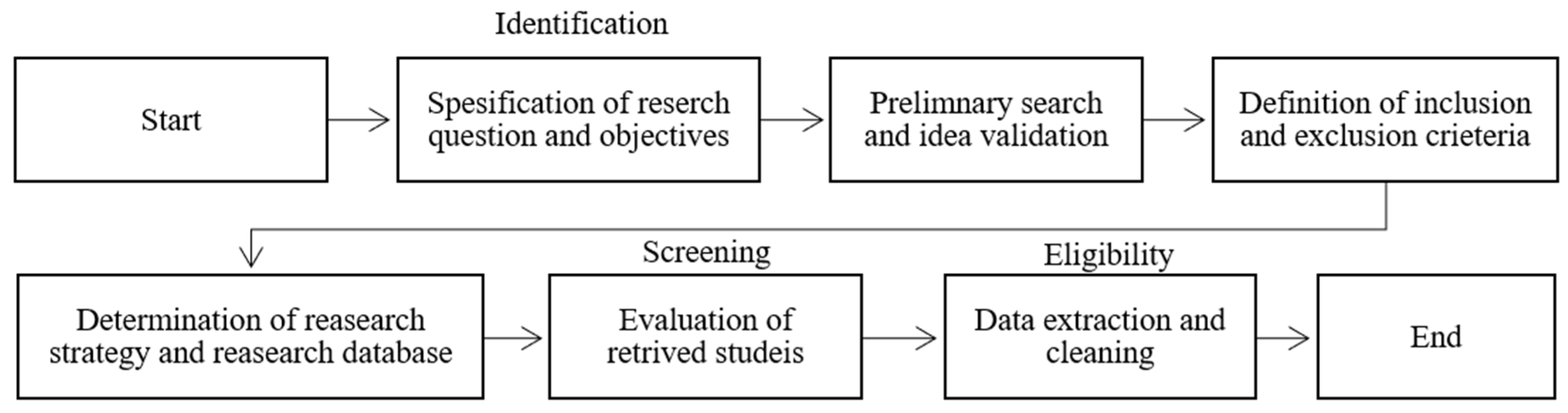
This study employs a mixed-methods approach combining quantitative scientometric analysis and qualitative systematic review to address the complex, interdisciplinary nature of landslide predictions. The systematic review provides a detailed critical analysis of specific models, while the scientometric analysis objectively maps research landscapes and emerging trends through data-driven techniques. The integrated approach yields complementary insights: the scientometric analysis reveals predominant patterns across the research domain, while the systematic review investigates how and why these patterns emerge. This dual perspective enables both macroscopic overview and microscopic analysis, following established practices in complex field reviews [30,31,32]. The methodological framework is illustrated in Figure 3 and Figure 4, which detail the systematic review and scientometric analysis procedures, respectively. The following subsections provide comprehensive descriptions of each methodological phase.

2.1. Search Strategy Design

Landslides can be classified based on various factors, such as geology, engineering, environmental science, ecology, meteorology, atmospheric science, geochemistry, geophysics, physical science, and water resources [25]. Additionally, as highlighted in the keyword mapping by Zou and Zheng and Ebrahim et al. [25,33], landslides are associated with a wide range of keywords. Therefore, the research h process begins with the identification of relevant studies on landslides, guided by the authors’ perspectives. This section outlines the use of keywords, search databases, and inclusion and exclusion criteria to filter the collected papers. The subsequent screening methodology follows the PRISMA framework in Section 5.

2.2. Database Selection and Search Execution

To ensure robust retrieval of relevant articles, the search was conducted across two premier bibliographic databases: Scopus and Web of Science. These platforms were selected for their extensive coverage of the peer-reviewed literature and their compatibility with scientometric analysis tools like VOSviewer (version 1.6.20). Google Scholar was utilized as a supplementary source for the snowballing process to identify additional studies not indexed in the primary databases. The core search was performed using the “landslide prediction” keyword to comprehensively target the relevant literature.

2.3. Screening and Eligibility Criteria

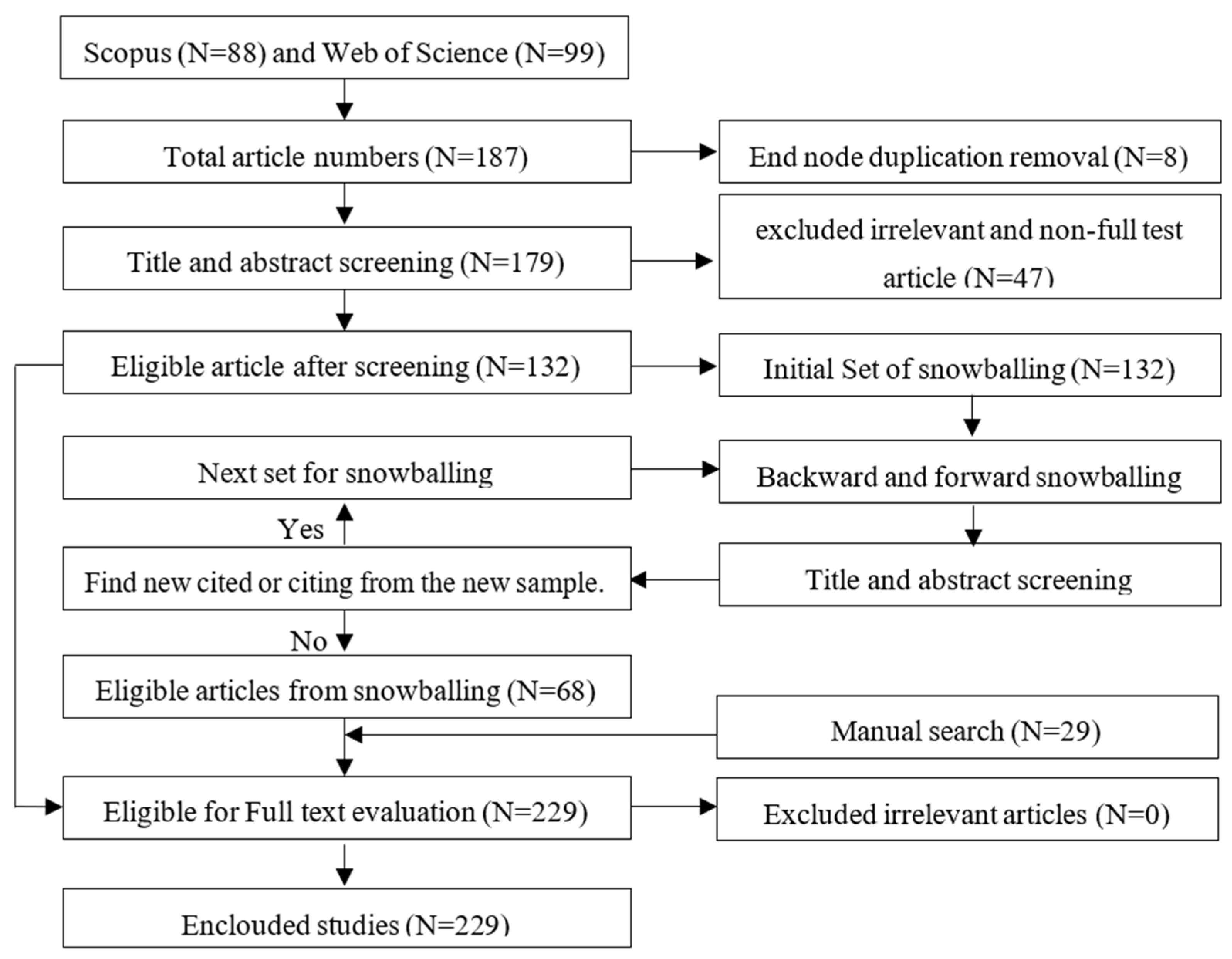
The retrieved studies were filtered using explicit inclusion and exclusion criteria to ensure the review’s focus and quality. The inclusion criteria were as follows: (1) studies primarily focused on landslide prediction with the aim outlined in Section 1; (2) publications from the year 2000 up to 2024; (3) articles published in peer-reviewed journals; (4) document types limited to research articles and review papers; and (5) availability of the final publication version. The exclusion criteria comprised (1) non-English publications, due to their minority within the relevant literature and limitations in translation resources; (2) studies with unavailable full text; (3) manuscripts from subject areas unrelated to engineering; and (4) publications from non-journal sources (e.g., conference proceedings, books). The application of this screening process is detailed in the PRISMA flow diagram (Figure 5).

2.4. Screening and Assessment of Collected Articles

The initial searches in Scopus and Web of Science yielded 88 and 99 articles, respectively. After removing 8 duplicate articles, 179 unique records remained for screening. The relatively low number of duplicates can be attributed to the different indexing criteria between Web of Science and Scopus databases, as well as the broad range of related keywords in this field. The systematic review and meta-analysis (PRISMA) procedure [34] was then applied to evaluate the collected articles (see Figure 5). This screening process led to the exclusion of 47 papers due to irrelevance or unavailability of full texts. After full-text evaluation of the remaining articles, 132 articles met the inclusion criteria.
Subsequently, backward and forward snowballing approaches [35] were employed to identify additional studies not captured by the database searches. The 132 included papers served as the starting set for these snowballing strategies. Backward snowballing involved examining reference lists of included papers, while forward snowballing identified new publications that cited these papers. This iterative process continued until no new relevant documents emerged, resulting in the discovery of 68 additional articles. Furthermore, 29 papers were included through manual searches during the full-text review phase, bringing the final total to 229 articles included in this study. The complete screening and evaluation process is summarized in Figure 5.

2.5. Limitations of the Methodology

While this mixed-methods approach provides comprehensive insights into landslide prediction research, several methodological limitations should be acknowledged: (a) The selected keywords, while informed by previous studies, may not fully capture the entire spectrum of the landslide prediction literature. Some relevant studies might use alternative terminology or focus on specific sub-domains not adequately represented by our search terms.
(b) The reliance on major indexed databases (Scopus and Web of Science), while necessary for scientometric analysis, potentially excludes relevant studies from non-indexed journals, conference proceedings, and regional publications. Furthermore, the review exclusively includes English-language publications due to practical translation constraints, which may overlook valuable research published in other languages.
(c) The scientometric analysis depends on the algorithmic capabilities of VOSviewer, which may occasionally struggle with author disambiguation and capturing the nuanced, interdisciplinary terminology characteristic of landslide prediction research. Additionally, the manual classification of 229 studies into specific model categories was beyond this study’s scope due to resource and time constraints, representing a valuable direction for future systematic annotation efforts.

3. Scientometric Analysis

This section provides a detailed analysis of the selected studies. The scientometric analysis was initiated following the completion of the screening process to examine relationships among authors, keywords, publications, and countries within specific research domains. This analysis was performed using the open-source VOSviewer software tool [36], a widely recognized visualization application employed in this study to analyze the results. The primary objective of the scientometric analysis is to ensure that the findings are meaningful and relevant for inclusion in the systematic review. A total of 229 manuscripts, identified through snowballing and manual searches, were analyzed using VOSviewer software.

3.1. The Trend in Annual Publications for Landslide Prediction

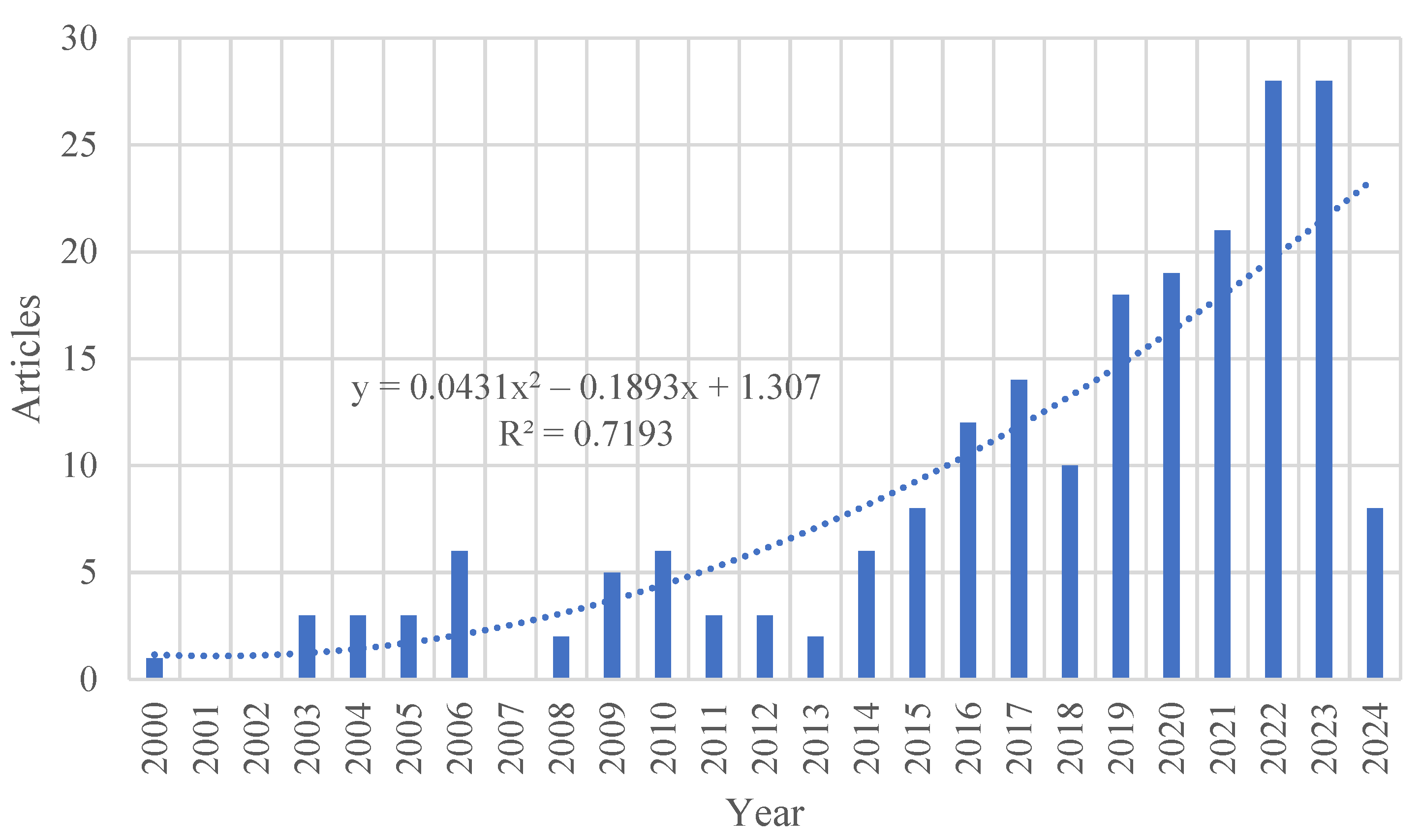
Figure 6 illustrates the annual publication trend in landslide prediction research, revealing distinct phases of activity. The period from 2000 to 2014 was characterized by a low, steady output of approximately three articles per year. A significant and sustained surge began around 2015, with annual publications rising sharply from 8 to a peak of 28 by 2023. This notable increase is not merely correlational; it can be causally linked to two key drivers: (1) the widespread adoption of advanced machine learning techniques, which provided new capabilities for analyzing complex geospatial and triggering data, and (2) growing research into the impacts of climate change, particularly the influence of more frequent and intense rainfall events on slope stability. The apparent decline to eight publications in 2024 is an artifact of the literature collection cutoff date for this analysis and does not reflect a genuine decrease in research interest. As this study’s literature search was concluded during this year, many relevant articles from 2024 were likely still in the publication pipeline or not yet indexed in the selected databases.

3.2. Leading Journals in Landslide Prediction Contributions

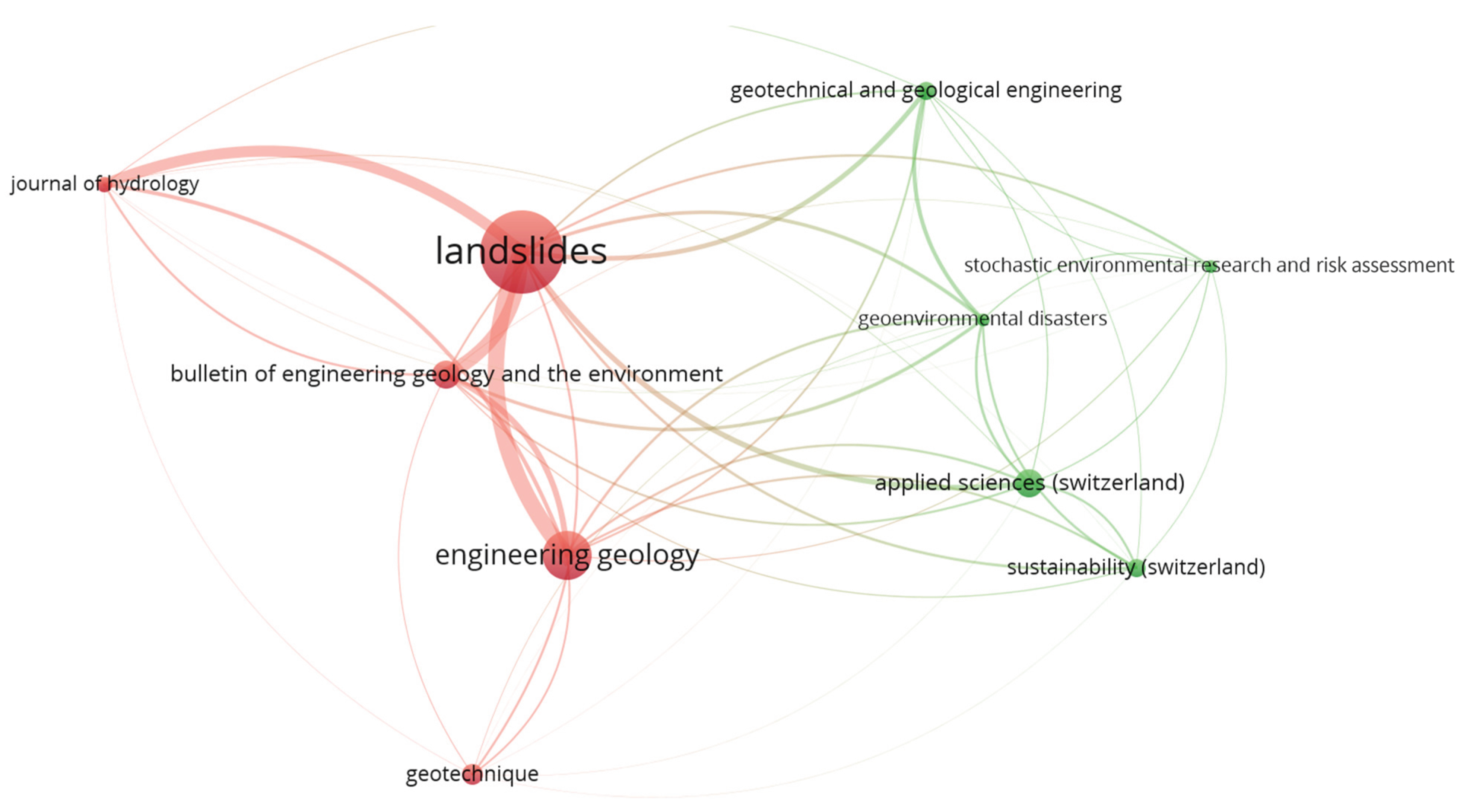
VOSviewer software was utilized to identify the leading journals in landslide prediction research, with the results presented in Table 2. This analysis provides valuable guidance for researchers seeking reputable publication venues in this field. Two thresholds were established for the VOSviewer analysis: a minimum of five papers per journal and a minimum of ten citations per journal. The analysis was conducted using “sources” as the unit of analysis and employed “bibliographic coupling” as the analysis method. From an initial pool of 86 journals, 10 met the established criteria (Figure 7). It should be noted that there are no universally established standards for these threshold values [25]. In Figure 7, the node sizes reflect the journals’ relative influence based on publication volume, while the connecting lines represent citation relationships between journals, with total link strength indicating the intensity of these connections [36]. Table 2 reveals that “Landslides” emerges as the dominant journal in this field, with the highest number of publications (32 articles) and citations (4195), establishing it as one of the most influential publication venues for landslide prediction research.

3.3. Active Nations in Landslide Prediction

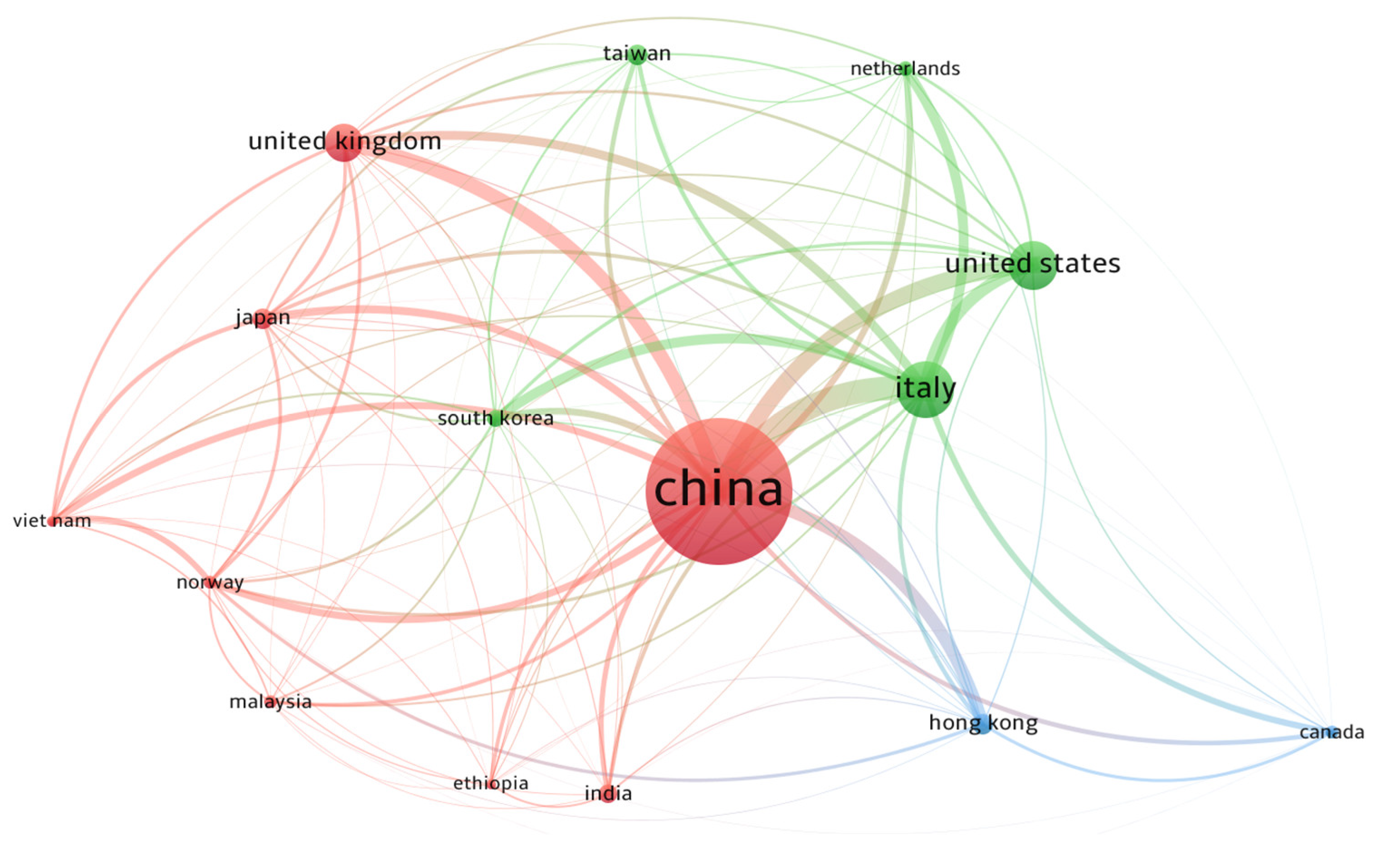
Understanding scientific collaboration networks in any field of study facilitates the identification of leading scientists, laboratories, organizations, authors, and nations, thereby greatly enhancing academic cooperation. In this analysis, the previously mentioned thresholds were applied using “countries” as the unit of analysis and “bibliographic coupling” as the analysis type. From a total of 44 countries analyzed, 15 met the established criteria. The node size in Figure 8 represents each country’s influence in the field, weighted by publication volume. China and Italy emerged as the most prolific contributors worldwide, with 77 and 31 publications, respectively, indicating their dominant research output in landslide prediction. Table 3 further details the top five countries contributing to landslide prediction research. This analysis of national collaboration networks benefits both academic and industrial practitioners seeking innovative landslide solutions by highlighting the geographic centers of research investment and expertise in this field.

3.4. Article Co-Citation Analysis in Landslide Prediction

The total number of citations a publication receives reflects its contribution to the field. Accordingly, this section highlights the most cited publications in landslide prediction research. Since these publications demonstrate limited bibliographic coupling, the top 10 cited articles were selected directly from the Scopus and Web of Science databases (Table 4). These influential works span from 2000 to 2024, representing key developments in the field over nearly a quarter-century. To address the inherent advantage older research possesses in accumulating citations compared to more recent work, this study employed a normalized citation measure. The citation count for each article was normalized by dividing by the average number of citations for all articles published in that year [36], thereby providing a more equitable assessment of research impact across different publication periods.
Table 4. Top 10 cited articles according to normalized citations (NS).
AuthorArticleJournalCitationNS
Merghadi et al. [22]Machine learning methods for landslide susceptibility studies: A comparative overview of algorithm performanceEarth-Science Reviews6038.20
Soga et al. [37]Trends in large-deformation analysis of landslide mass movements with particular emphasis on the material point methodGéotechnique3835.80
Froude & Petley [3] Global fatal landslide occurrence from 2004 to 2016Natural Hazards and Earth System Sciences11645.62
Ebrahim et al. [33]Recent Phenomenal and Investigational Subsurface Landslide Monitoring Techniques: A Mixed ReviewRemote Sensing74.90
Hungr et al. [6]The Varnes classification of landslide types, an updateLandslides22744.32
Ikram et al. [38]A novel swarm intelligence: cuckoo optimization algorithm (COA) and SailFish optimizer (SFO) in landslide susceptibility assessmentStochastic Environmental Research and Risk Assessment374.16
Zhang et al. [39]Application of an enhanced BP neural network model with water cycle algorithm on landslide predictionStochastic Environmental Research and Risk Assessment1403.50
Mondini et al. [40]Deep learning forecast of rainfall-induced shallow landslidesNature communications313.49
Chae et al. [20]Landslide prediction, monitoring and early warning: a concise review of state-of-the-artGeosciences Journal2673.03
Long et al. [41]A multi-feature fusion transfer learning method for displacement prediction of rainfall reservoir-induced landslide with step-like deformation characteristicsEngineering Geology472.94

3.5. Keyword Co-Occurrence Mapping in Landslide Prediction

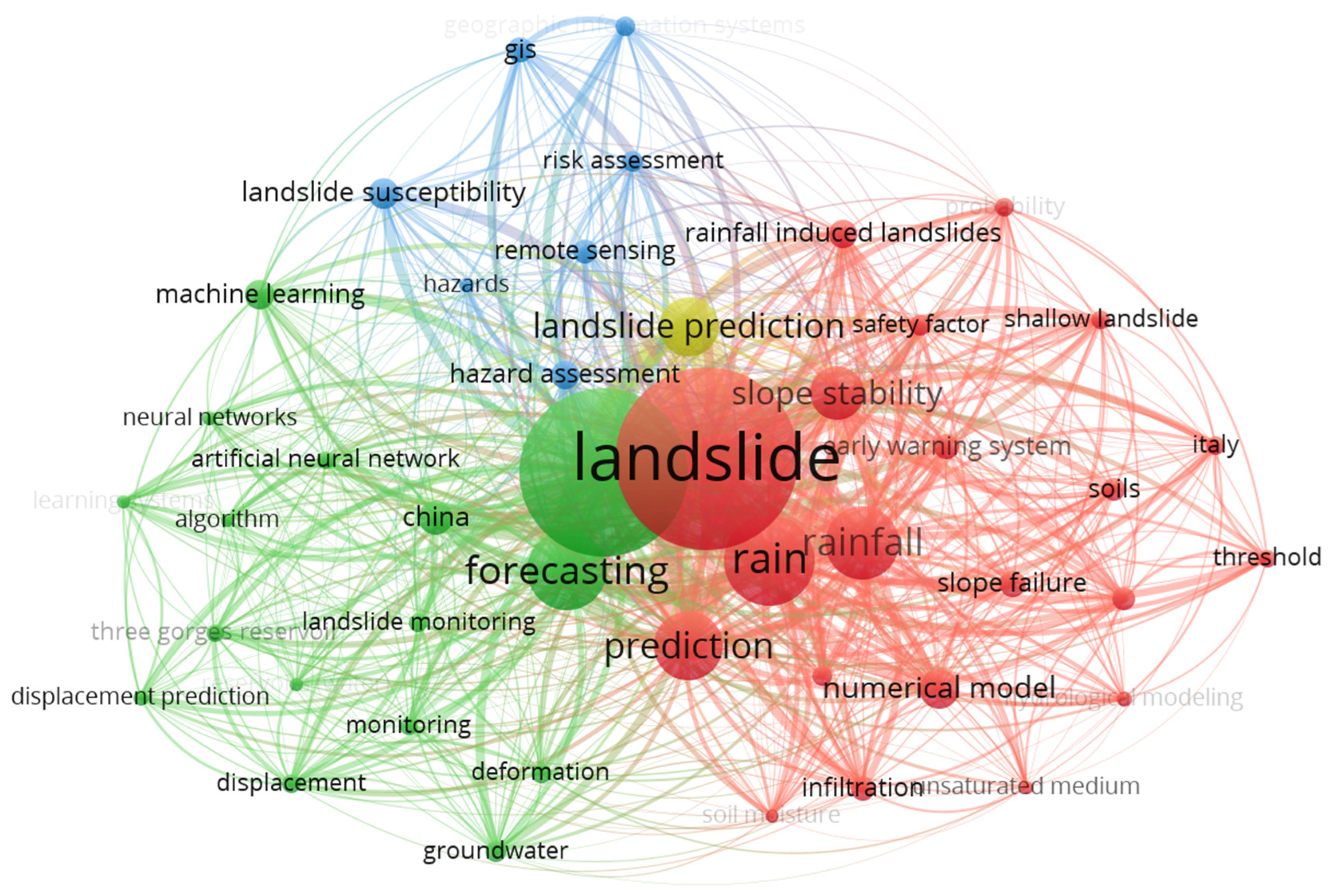
VOSviewer software was used to identify the most frequently used keywords by selecting “co-occurrence” as the analysis type and “all keywords” as the unit of analysis. For this study, a keyword was required to have a minimum of ten occurrences. Out of 1785 total keywords, 45 met this threshold, as visualized in Figure 9. The size of each node is proportional to the keyword’s frequency, with “landslide” and “landslides” appearing as the most dominant terms. The analysis reveals three distinct thematic clusters: a blue cluster associated with landslide susceptibility mapping, a red cluster focused on physical models, and a green cluster centered on physically based thresholds. This keyword mapping elucidates the primary research streams within the field, demonstrating that current work converges on susceptibility assessment, mechanistic modeling, and threshold determination. This objective, data-driven clustering helps researchers identify core topics and select effective keywords to enhance the discoverability of their future publications, complementing the more subjective conclusions derived from narrative and systematic evaluations [42].

4. Systematic Review

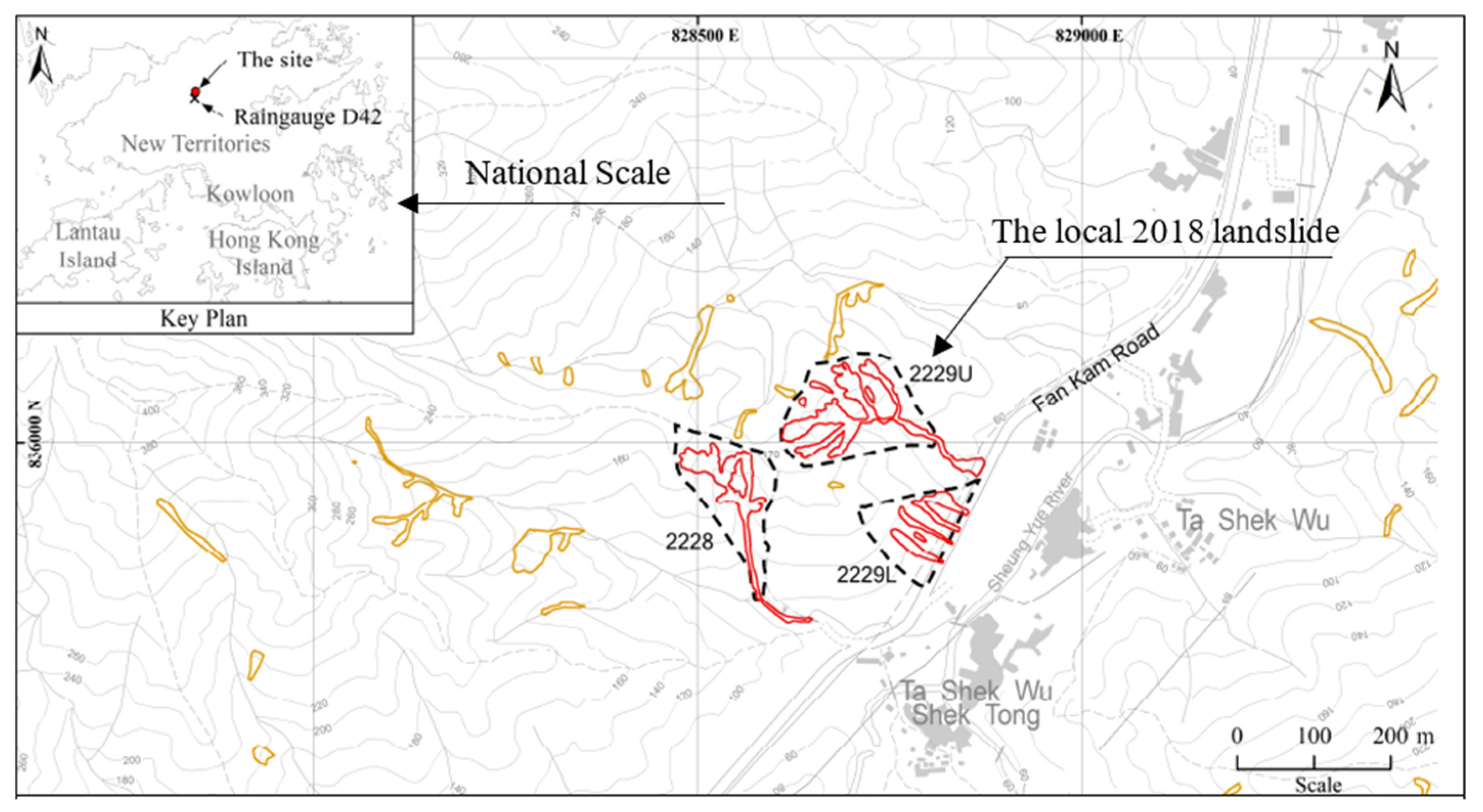
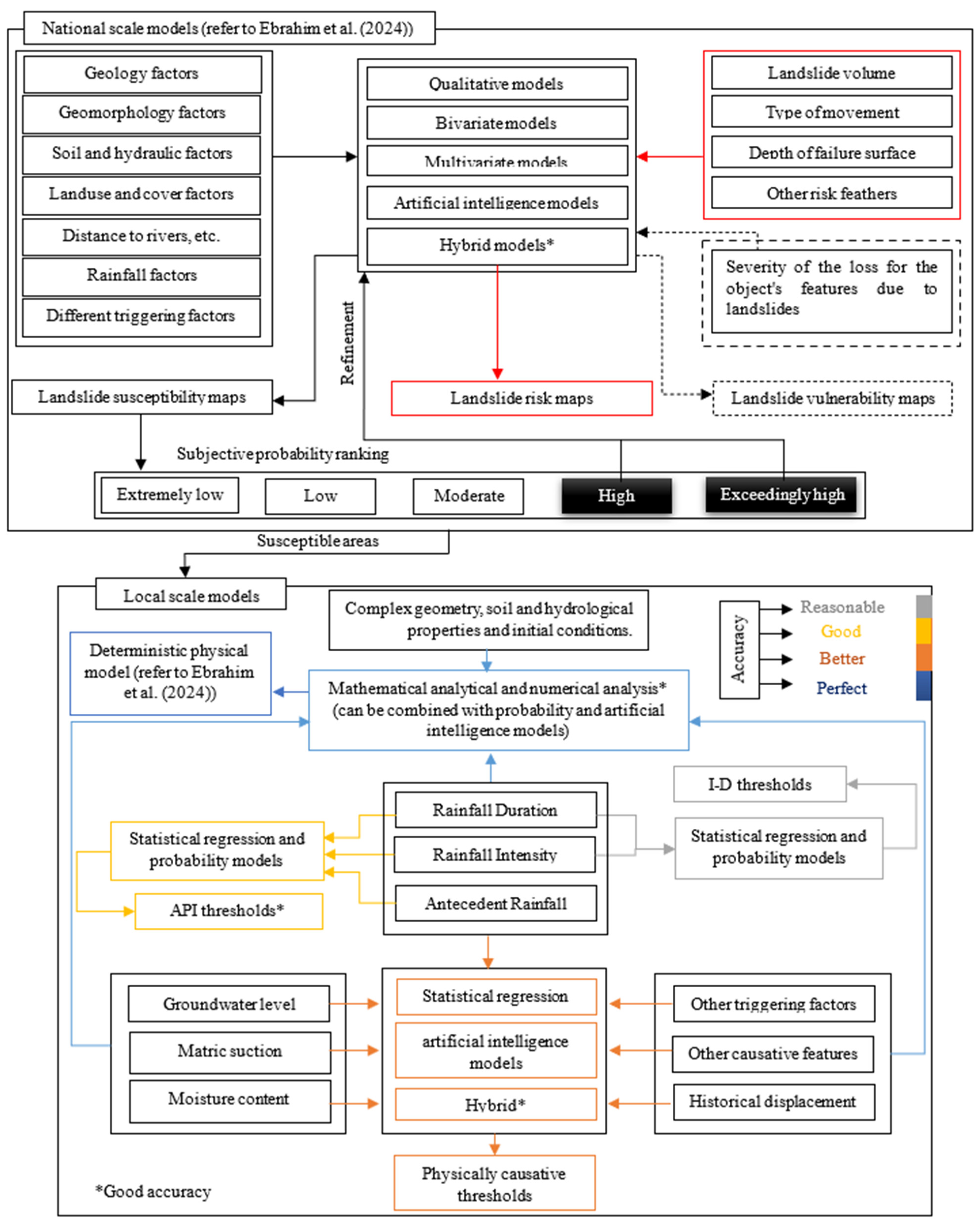
This section provides a comprehensive review of landslide prediction techniques. These techniques can be classified according to two primary criteria: (1) the scale of the investigated case study, and (2) the accessibility of inventory data. Landslide events can be examined from either local or national perspectives. The classification by scale is addressed by Oguz et al. [43], who categorized landslides into local and national scales. For clarification, Figure 10 presents a national map of Hong Kong alongside a specific local landslide from 2018. For local-scale analysis, empirical–statistical thresholds, triggering-physical thresholds, and physical–deterministic models can be implemented based on data availability and required prediction accuracy. Conversely, landslide susceptibility, risk, and vulnerability maps are typically utilized at the national scale. Figure 11 summarizes the complete review process based on this classification framework. This figure will be discussed in detail across both parts of this study: Part I (this manuscript) and the published Part II [19]. All figures and comparative analyses presented herein were developed by the authors to synthesize trends and findings from the literature. While based on previously published research, each appropriately cited in the text, direct attribution of all sources within figures is impractical due to the substantial number of studies included. Readers are referred to the relevant textual citations for detailed references.

4.1. Empirical–Statistical I-D Thresholds

4.1.1. Intensity–Duration Thresholds

Understanding the causal factors that trigger landslides is fundamental to effective hazard assessment. Among these factors, rainfall is the most prevalent and widely studied trigger. Historically, landslides have demonstrated a strong correlation with rainfall patterns, where slope failures frequently correspond to specific hydro-meteorological conditions. This relationship has led researchers to increasingly employ empirical rainfall thresholds for landslide prediction [11,45,46,47]. These thresholds are crucial for predicting potential landslides and form a core component of many landslide early warning systems. They are typically derived by analyzing historical data on rainfall intensity (I) and duration (D) for specific regions, beyond which landslide initiation becomes probable [48,49]. In other words, as illustrated by Guzzetti et al. [50], “Rainfall thresholds are defined by a minimum amount of rainfall that, when exceeded, can trigger landslides. With that in mind, several statistical approaches have been developed to define these thresholds. Early and site-specific formulations include the regression-based Equation (1) proposed by Caine [11] and Equation (2) by Hong et al. [45]. To enhance generalizability, Peruccacci et al. [51] proposed a more universal formulation (Equation (3)) for landslide-prone areas using the innovative CTRL-T methodology [47]. The CTRL-T framework represents an advanced approach for the automated extraction of rainfall data [52], thereby improving the precision and objectivity of threshold determinations. Building on these concepts, Ering and Babu [53] developed Intensity–Duration (I-D) thresholds using the Forecasting of Landslides Induced by Rainfall (FLaIR) model. A key advantage of the FLaIR model is its ability to process varied rainfall inputs through a gamma-type transfer function, denoted as Ξ(t) (Equation (4)).
I = 14.82 D 0.39
I = 15.58 D 0.52
E = ( ε ± Δ ε ) D ( ξ ± Δ ξ )
Ξ ( t ) = t ν 1 exp t T / T ν Γ ( ν )
where E represents the rainfall event, ϵ is the scaling parameter, and ζ is the shape parameter, which defines the intercept and slope of the power law curve, respectively. Additionally, Δϵ and Δζ denote the uncertainties associated with these two parameters. υ denotes the dimensionless parameter, and T denotes the temporal scale.
Figure 12 demonstrates a critical limitation of intensity–duration (I-D) thresholds: while they can achieve high predictive accuracy, their operational effectiveness is substantially constrained by a significant rate of false positive alarms [49,54,55]. This limitation arises from the fundamental principle of the I-D method, which establishes a fixed critical rainfall intensity for a given duration, beyond which landslides are predicted. However, this binary approach often fails to account for complex antecedent conditions, such as variable soil moisture and regional hydrological characteristics, leading to warnings being triggered by rainfall events that meet the I-D criteria but simplify actual slope failures.

4.1.2. Antecedent Rainfall Thresholds

To address the limitations of conventional I-D thresholds, researchers have developed more sophisticated causal thresholds that account for the physical processes linking rainfall to slope failure. Rainfall influences landslide occurrence through multiple interconnected mechanisms, including increased ground saturation, elevated soil weight, rising groundwater levels, soil erosion, and reduced effective stress, all of which collectively diminish the slope safety factor [56]. When analyzing rainfall-induced landslides, antecedent rainfall plays a crucial role in preconditioning slopes for failure [54]. This factor helps incorporate other causative elements that contribute to landslide initiation [46,54,55,56]. The hydrological processes involved, including infiltration, storage, and evaporation, are primarily governed by the temporal dynamics of porewater pressure changes in subsurface soils [55]. However, the critical duration of antecedent rainfall that optimally predicts landslide occurrence remains uncertain [56]. To operationalize these concepts, Lee et al. [46] proposed the Antecedent Precipitation Index (API), quantified in Equations (5)–(7). Concurrently, Huang et al. [13] developed an alternative approach that integrates both maximum hourly rainfall intensity with cumulative current rainfall and precipitation from the preceding six days.
A P I 30 = 115 + 1.2 × 10 12 N 10.6
E 3 = 0.726 A P I 30 + 295.0
E 3 = 0.726 A P I 30 + 194.3
where API30 is the 30-day antecedent precipitation index, N is the number of rainy days within the 30 days concerned, and E3 is the cumulative 3-day rainfall. Equation (6) is for a major landslide, and Equation (7) is for a medium landslide.
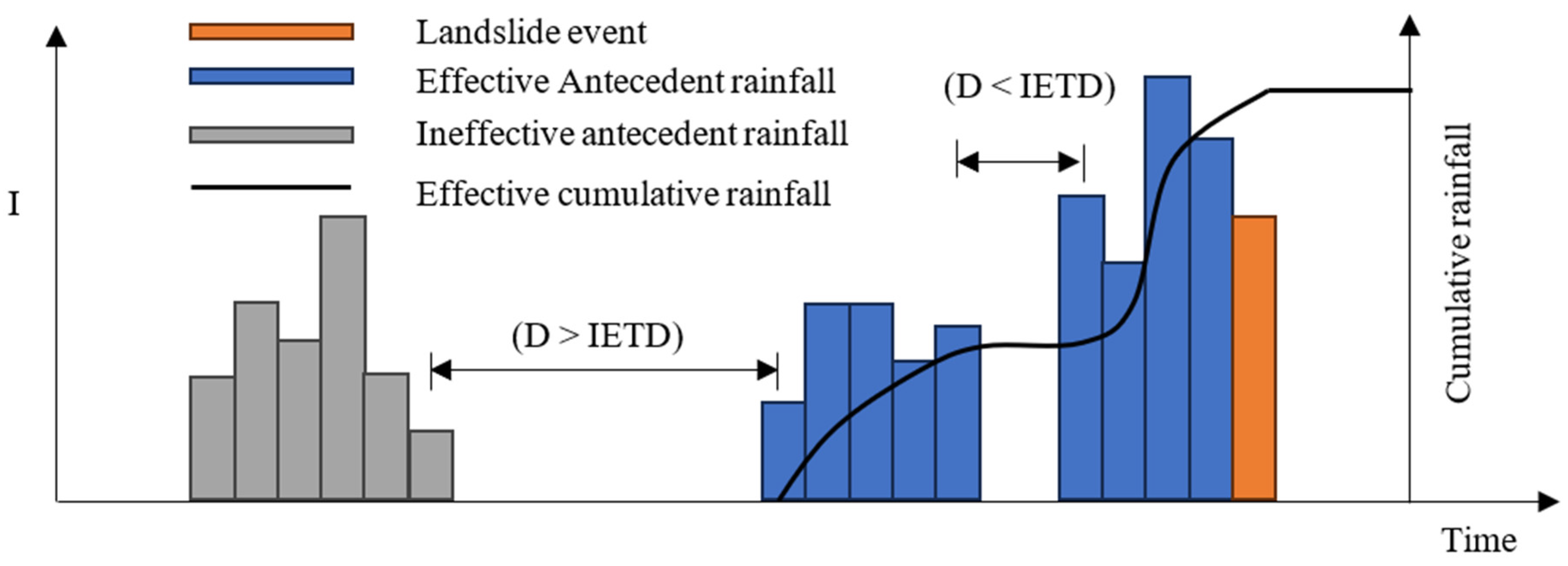
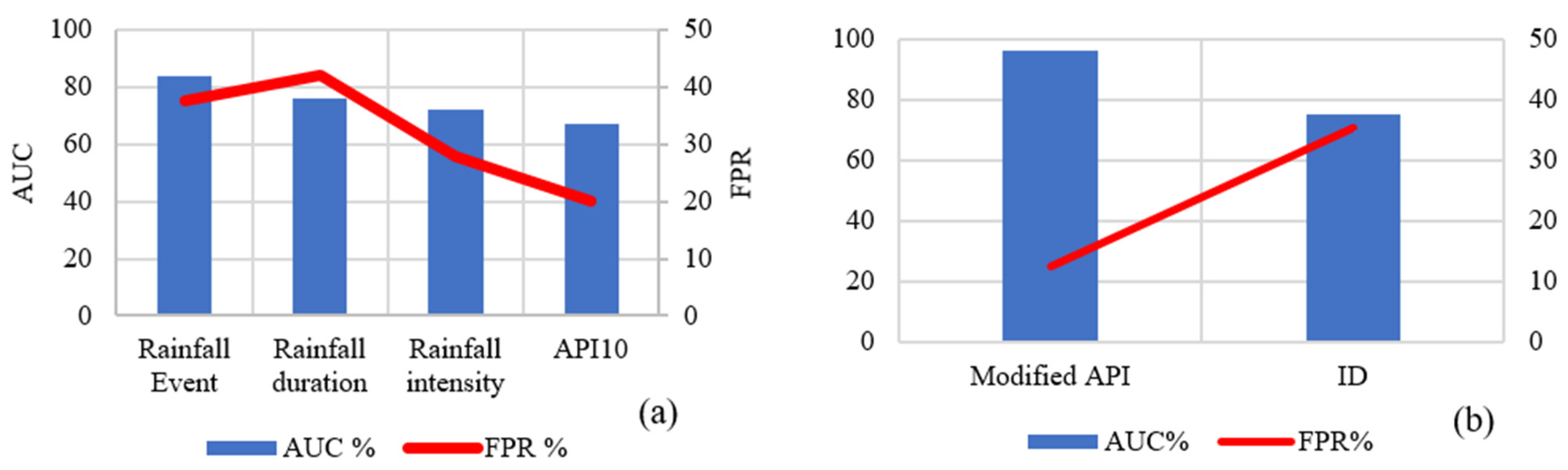
To enhance the analysis of antecedent rainfall, Hong et al. [54] applied inter-event time definitions (IETDs), the time interval separating distinct rainfall events, and determined that a 12 h IETD yielded the highest predictive accuracy, as visualized in Figure 13. Rather than relying on a single duration, Chhorn et al. [56] proposed that a combination of multiple antecedent periods improves forecast precision, identifying a specific combination of 1 h, 15 h, and 19 days that achieved a 58.5% probability of landslide occurrence. Concurrently, Uwihirwe et al. [55] employed a Bayesian probabilistic approach, finding that the most accurate model (AUC = 0.669) integrated rainfall from the event day with that of the preceding 10 days (Figure 14a). Further advancing the methodology, Zhao et al. [57] developed a modified API that accounts for variations in evaporation and maximum soil moisture capacity. This refined threshold demonstrated superior performance over the general I-D form proposed by Brunetti et al. [58] (Figure 14b). Supporting the value of extended antecedent periods, Aryastana et al. [59] concluded that a 30-day cumulative rainfall window could enhance traditional thresholds, achieving over 90% accuracy.

4.1.3. I-D Thresholds Prediction Accuracy

The accuracy of any landslide prediction model is contingent upon several factors, including data availability, rainfall parameters, and site-specific characteristics. Uwihirwe et al. [55] employed a Bayesian probabilistic approach, maximum true skill statistic, and minimum radial distance to evaluate various rainfall-triggering thresholds. As shown in Figure 14a, while rainfall event-based analysis achieved the highest accuracy (AUC), it was accompanied by a high false positive rate (FPR). In contrast, incorporating the simple causative antecedent rainfall index (API10) significantly reduced the FPR. Similarly, Zhao et al. [57] demonstrated that a modified API outperforms conventional I-D models (Figure 14b). Collectively, these findings indicate that accounting for slope response through antecedent moisture dynamics enhances model accuracy compared to relying solely on rainfall data. Recent studies have increasingly adopted such trigger thresholds for landslide causation [13,46,54,56,60]. While these methods are straightforward and consider antecedent rainfall as a primary causative factor, further improvements in prediction accuracy require the integration of additional causative features, which will be explored in Section 5.2, “Physically Based Causative Thresholds”.

4.2. Physically Based Causative Thresholds and Prediction

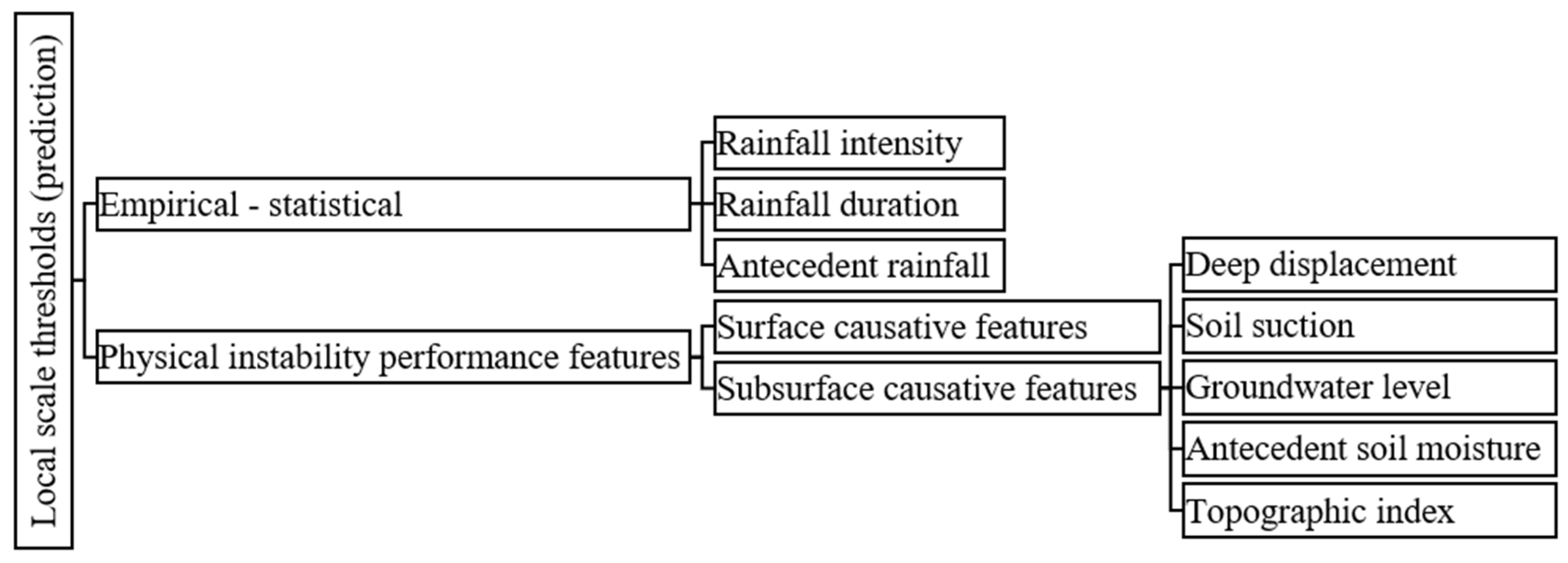
A landslide occurring during a rainfall period where total precipitation reaches its peak defines the critical duration. However, if a landslide occurs when cumulative antecedent rainfall is not at its maximum, the failure is likely attributable to non-rainfall factors [56]. This highlights that the term physically based causative refers to an approach that integrates rainfall as the primary triggering factor with secondary indicators of slope instability to enhance prediction pacity and topography, explain why rainfall alone cannot deterministically predict landslides [49,54]. By complementing rainfall with physical precursors such as soil moisture content [57,61,62], topographic thresholds [63], displacement patterns [64], soil suction [65], and groundwater levels [66], models achieve more robust accuracy with lower false positive rates. Therefore, this section is organized according to the classification framework in Figure 15 to systematically review these integrated applications and provide a more holistic understanding of landslide dynamics.

4.2.1. Displacement Instability Performance and Prediction

Landslide displacement prediction follows a systematic framework comprising four fundamental processes: (1) data inventory and input parameter identification, (2) model selection, (3) data preparation involving sampling and decomposition techniques, and (4) model evaluation. This methodological workflow, illustrated in Figure 16, structures the subsequent detailed discussion of each component.
1.
Data inventory and input model parameters
When sufficient monitoring data are available, various mathematical approaches can effectively predict landslides with reasonable accuracy. Comprehensive site investigations, real-time monitoring, and laboratory tests provide critical early warning indicators. For instance, significant pore-pressure variations often precede substantial slope movements, serving as reliable precursors. However, the effectiveness of these methods depends heavily on both the precision of geotechnical data interpretation and the strategic selection of monitoring locations. Given that characterizing geotechnical and hydrological properties requires extensive effort and offers limited generalization capabilities [67], displacement monitoring presents a practical alternative to overcome these limitations [68]. Multiple researchers have employed continuously monitored displacement data using diverse technologies, including GPS [39,67,68,69,70,71,72], GNSS [73], optical fiber [74], and fiber Bragg grating [75]. The Three Gorges region along China’s Yangtze River represents one of the most extensively studied areas, where landslides are triggered by rainfall and reservoir level fluctuations [39,41,68,69,70,71,72,74,76,77,78,79,80,81,82]. Beyond historical displacement data, prediction models incorporate the various causative factors summarized in Table 5. These encompass rainfall parameters (up to 75 features) [73], antecedent and rolling rainfall with intensity and effective rainfall metrics [78], groundwater level indicators (up to 10 variables) [73], climate features [83], reservoir water level parameters (current value, antecedent change rate, average value, etc.) [39,72], and porewater pressure [64,84]. Figure 17 provides a schematic overview integrating these variables.
2.
Model selection
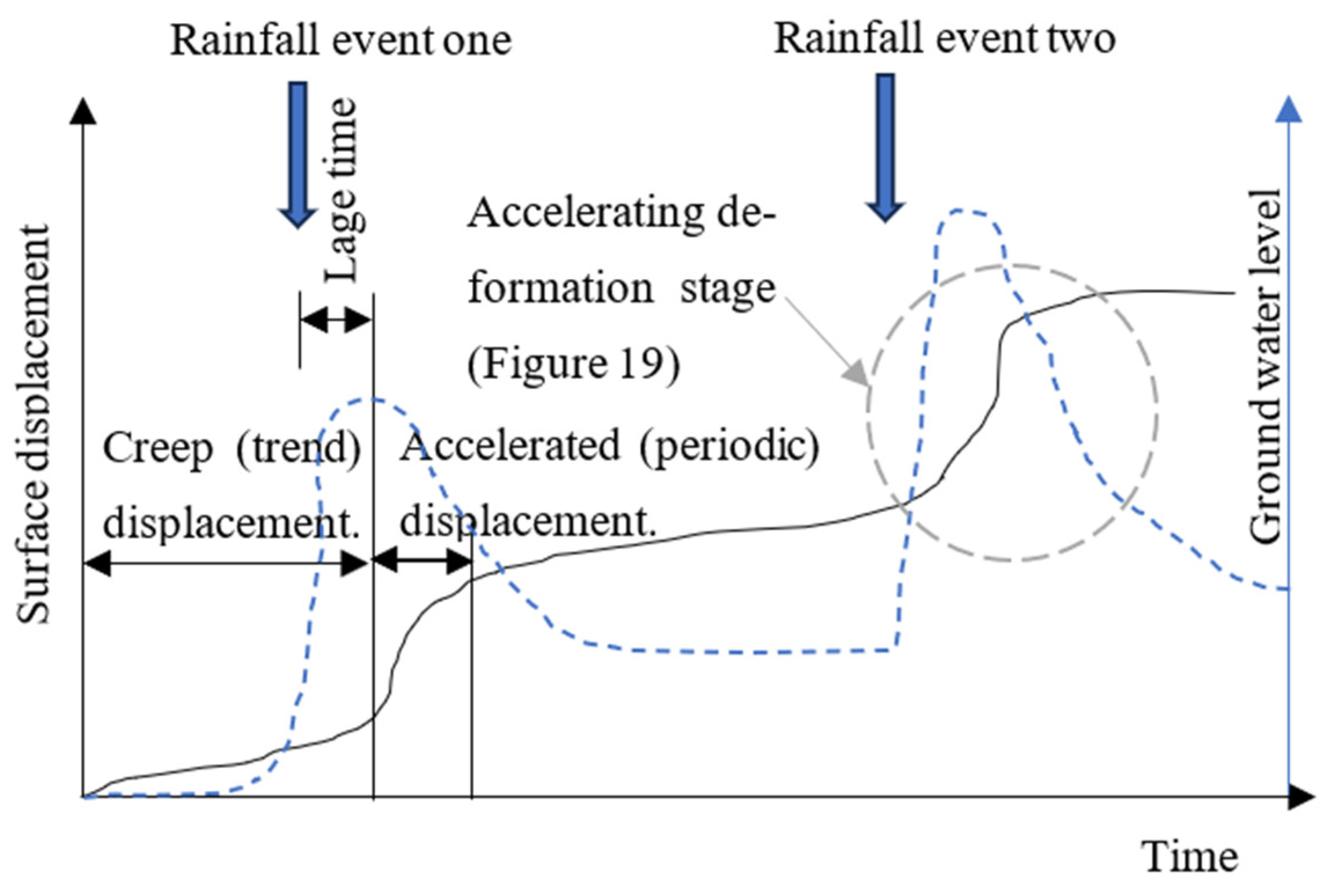
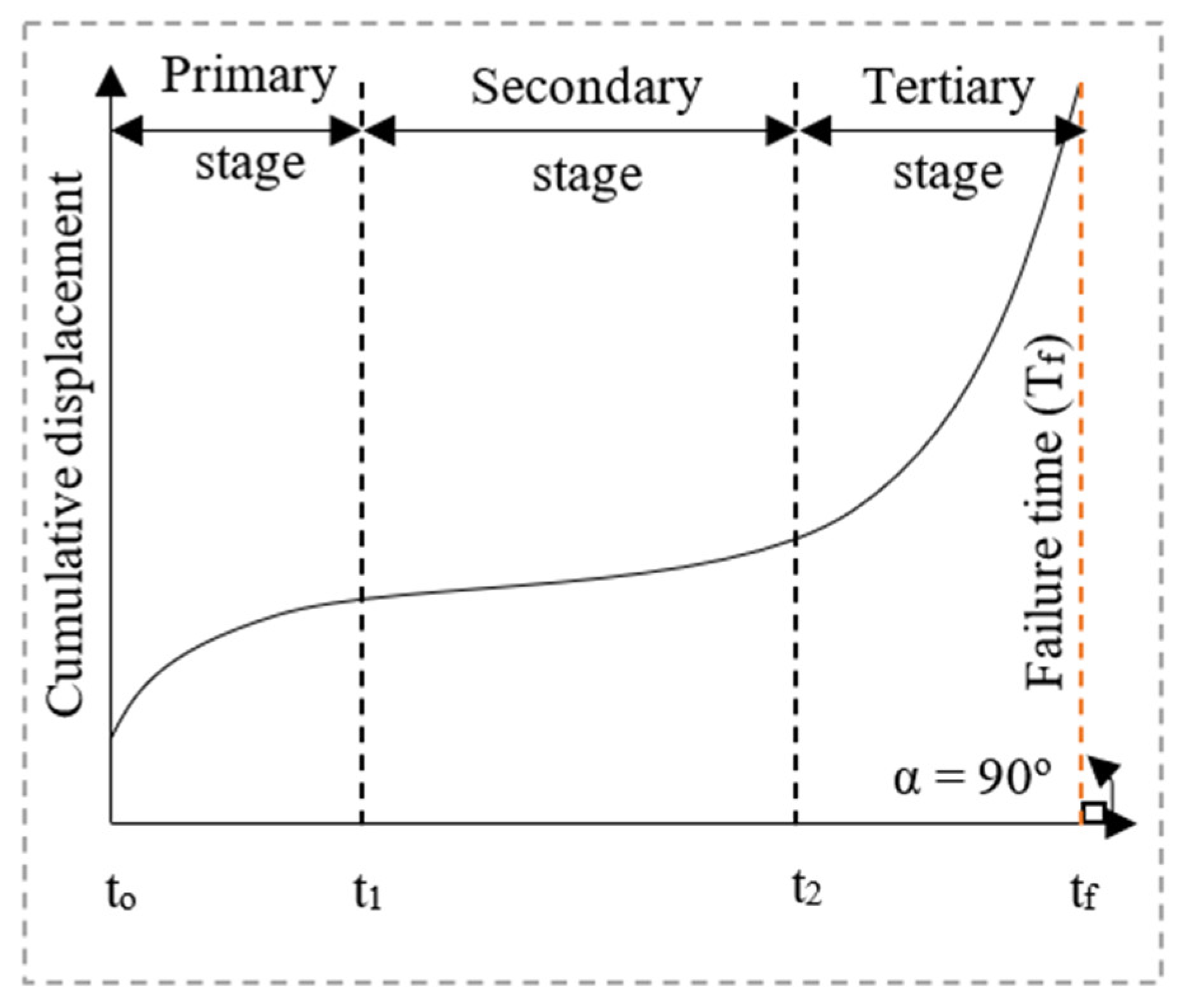
Regression analysis has been widely adopted in landslide prediction due to its advantages of not requiring prior information to establish functions, its straightforward interpretability, and its capacity to estimate input variable contributions [85]. For instance, Bednarczyk [64] used linear regression to correlate displacement magnitude with cumulative rainfall and pore pressure, while Chen et al. [86] applied it to examine the relationships between rainfall, reservoir levels, and displacement; however, such linear approaches often fall short because the relationships are inherently complex and nonlinear, primarily due to a variable time lag—ranging from six months to six days [86] (Figure 18)—between peak triggering events and peak slope response. This complexity is exemplified by Abolmasov et al. [87], who found a low correlation (R2 = 0.145) when relating displacement to river level, even while accounting for time-lag and acceleration concepts (Figure 19). Consequently, more sophisticated regression techniques have been explored, such as the hyperbolic relationships used by Sasahara [84] to reasonably predict shear strain and displacement from pore water pressure, though this was demonstrated only on a uniform laboratory soil model, unlike complex natural slopes. Advancing beyond these methods, Li et al. [70] developed a novel Short-Term Forecasting of Landslides (STFL) model that achieved high accuracy (R2 > 0.99) in predicting failure time (Equation (8), Figure 19) by utilizing displacement parameters in the tertiary stage (when the tangential angle exceeds 79°) and solving for unknowns with the Levenberg–Marquardt algorithm.
S = P 1 ( P 2 P 3 t 1 ) / ( P 0 t )
where P0, P1, P2, and P3 are the simulated parameters, t denotes time, and S denotes displacement.
Landslide deformation thresholds are highly site-specific and vary significantly between different landslides, making universal displacement thresholds unreliable for general application. To address this limitation, Shentu et al. [75] proposed using the direction angle of displacement as an alert criterion instead of absolute displacement values. However, this method presents its own challenges, as the tangential angle of the displacement curve becomes sensitive to changes in the scale of either the displacement or time axes. Consequently, Li et al. [70] recommended utilizing the displacement rate as a more robust indicator. Despite these methodological challenges, researchers continue to pursue displacement-based prediction methods aimed at forecasting slope behavior before actual failure, with the ultimate goal of establishing reliable displacement thresholds for early warning systems.
The advancement of intelligent algorithms has led to the increasing application of nonlinear models in landslide displacement prediction. Furthermore, investigating triggering factors enhances dataset quality, reduces randomness, and decreases computational demands [74]. Consequently, linear or empirical equations prove inadequate for simulating dynamic, nonlinear, and asymmetrical data [68,69]. Intelligent models provide an effective approach for managing such complex dynamic relationships. AI techniques can be categorized into regression [67], classification (supervised) [88], and clustering (unsupervised) methods [77,89]. Supervised learning techniques have become predominant in recent research [33]. Intelligent regression models can predict displacement [68], groundwater levels, and matric suction [65]. These models can be integrated with physical approaches to enhance performance [90], reduce uncertainty [79], and address missing data issues [89]. Classification models have been utilized for landslide susceptibility mapping [88], while artificial regression models have been primarily applied to regional-scale analyses, similarly to physical models and empirical–statistical thresholds. Concurrently, classification methods and landslide susceptibility mapping (LSM) have been mainly employed for large catchment areas to inform land-use planning [91]. This study first discusses regression intelligence models (Part I), while LSM is addressed in the published Part II (refer to Ebrahim et al. [19]). Figure 20 illustrates recently adopted methods for displacement prediction.
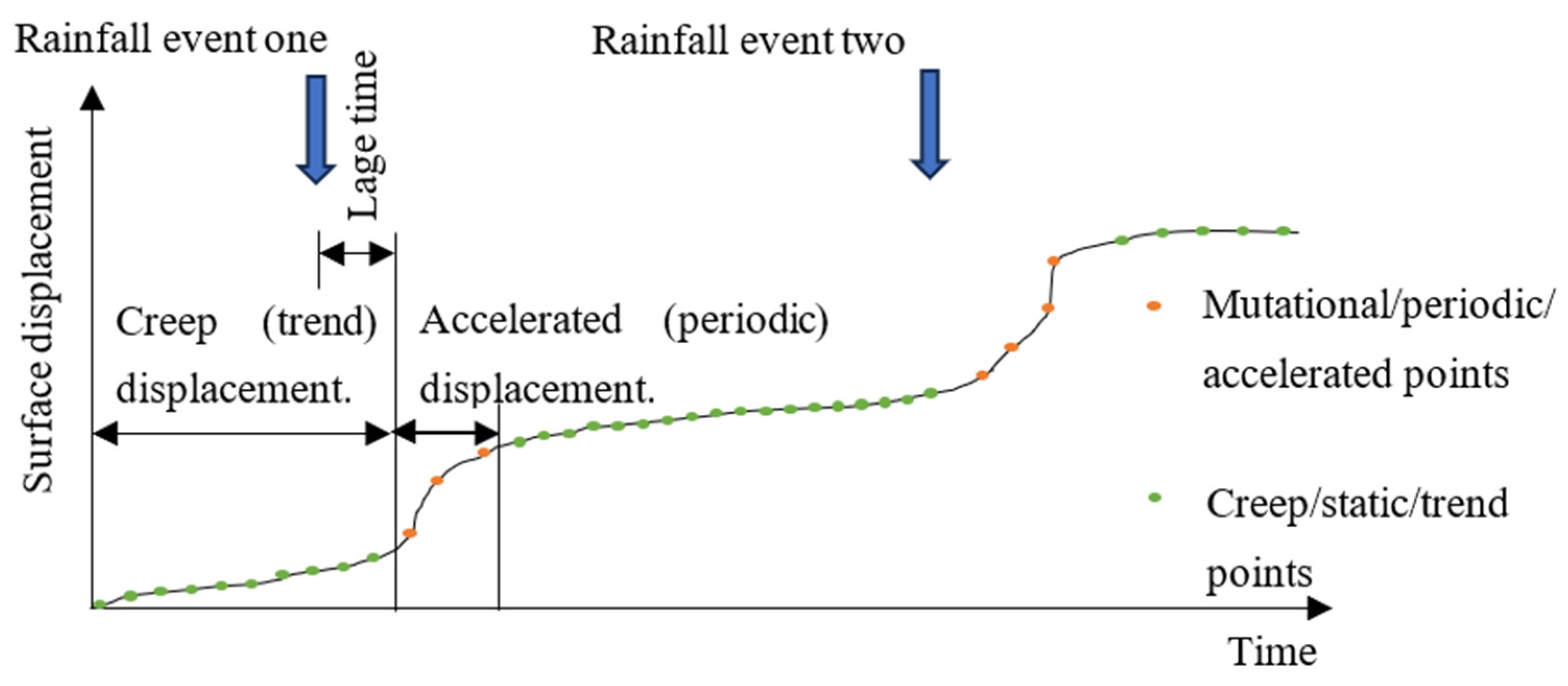
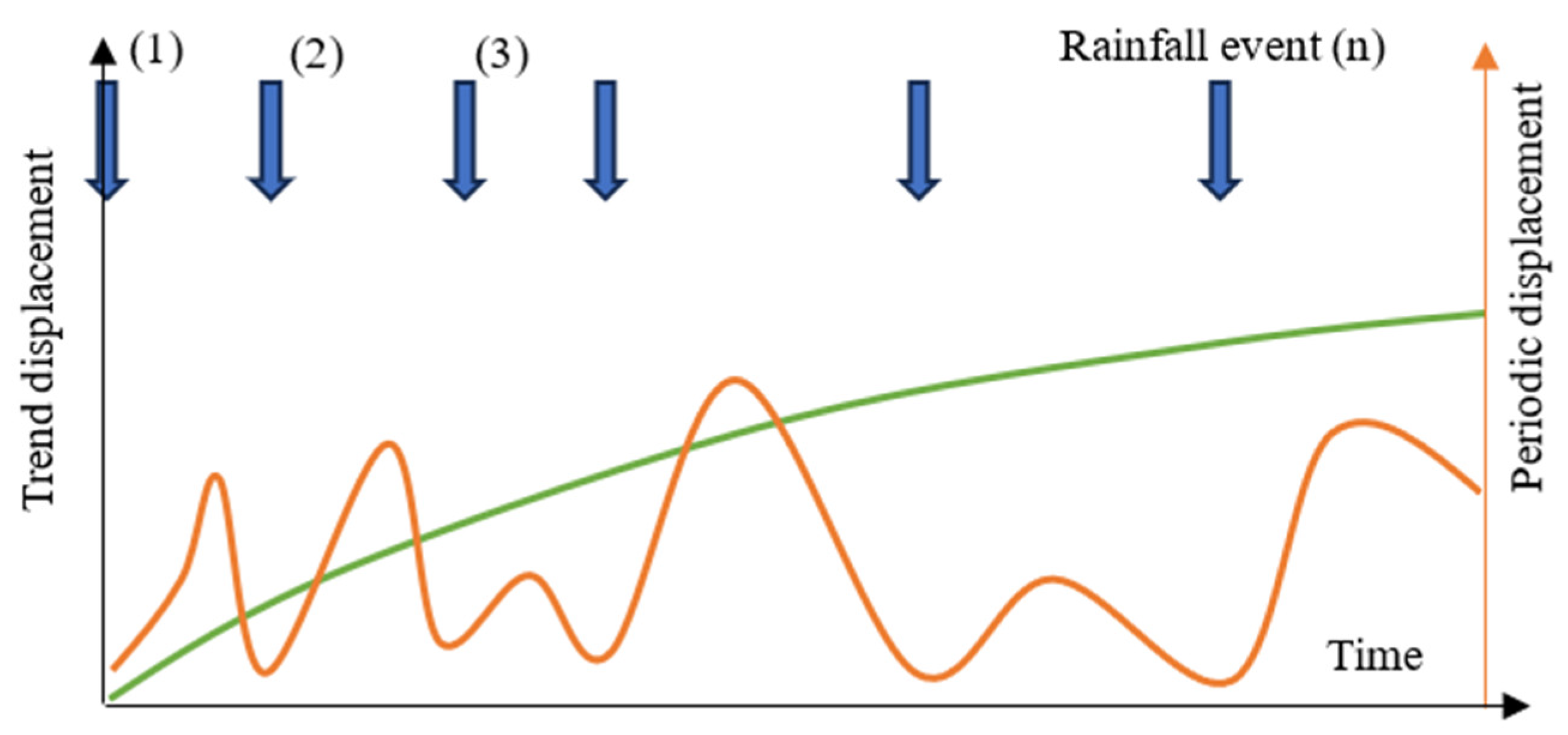
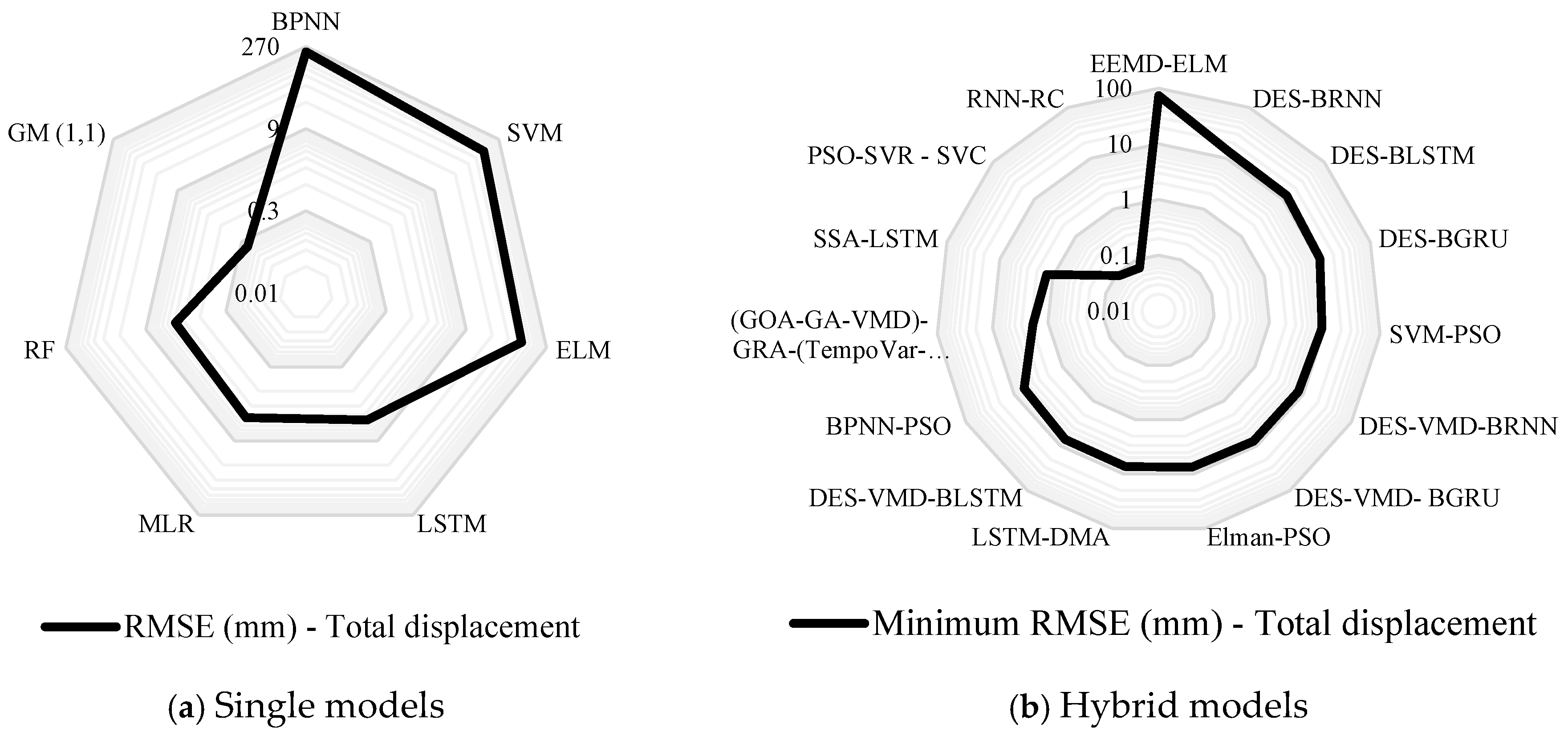
Various single AI models have been implemented, including ANN (BPNN) [78,89,92], RNN [69], ELM [69,76], GM(1,1) [69], SVM [76], RF [73,83], and MLR [83]. However, these individual models may require enhancement due to the dynamic nature of landslides and their influencing factors [68,69,70,80]. For instance, landslide displacement can be categorized into trend and periodic components, as depicted in Figure 21. The trend component primarily relates to the creep effect, influenced by lithology, structure, and stress state, while the periodic component corresponds to random factors, such as rainfall, reservoir level fluctuations, and groundwater variations. Predicting sudden displacement changes has attracted significant attention due to its critical implications [77]. Traditional models like ANN and SVM demonstrate limited accuracy in predicting such behavior because the volume of anomalous displacement points is substantially smaller than trend points. Additionally, periodic points consistently exhibit delayed responses to triggering factors (Figure 22). Therefore, Gao et al. [80] and Li et al. [70] recommend employing multi-data-driven models to address these complex behaviors.
To overcome the limitations of single models, researchers have developed various hybrid approaches including EEMD–ELM [68], LSTM-DMA [79], GM-ENN [80], KGM, MKGW, and WMKGM [70], WCA-BPNN [39], SSA-LSTM [93], EEMD-RNN, EEMD-GRU, EEMD-LSTM, EEMD-SVM, EMD-LSTM, and EEMD-ELM [67], ELM-RS-SVR [82], SVM-(MSI, BA, GWO, DA, WOA, GOA, SSA)-CEEMD [71], SVC-PSO-SVR [74], DES-VMD-(BLSTM, BGRU, BRNN), DES-(BLSTM, BGRU, BRNN) [72], and (GOA-GA-VMD)-GRA-(TempoVar-Transformer) [94]. Hybrid models integrate the advantages of multiple approaches to overcome the limitations inherent in single-model frameworks.
3.
Model decomposition and data preparation
Cumulative displacement can be decomposed into creep and accelerated components (Figure 22) using various analytical techniques, including high-pass (HP) filter analysis [39], double moving average (DMA), and single moving average (SMA) models [79]. Additional decomposition methods comprise empirical mode decomposition (EMD) [67], ensemble empirical mode decomposition (EEMD) [68], EEMD with kurtosis criterion [67], and complete ensemble empirical mode decomposition (CEEMD) [71]. The CEEMD method offers an advantage over EMD and EEMD by effectively handling residual terms that exhibit an initial decrease followed by an increase. For state classification, a support vector classifier (SVC) can distinguish between creep and acceleration phases [74]. Alternative approaches include DES-BDNN [72] and K-means clustering [77], which divide total displacement into stationary and mutational points. Variational mode decomposition (VMD) may also be employed to isolate displacement components, with optimization through the GroupWise coupling algorithm [94]. The final cumulative predicted displacement is obtained by superimposing results from both trend and periodic models. Notably, periodic displacement prediction utilizes factors such as rainfall, reservoir level, groundwater level, and prior periodic displacement data, while trend displacement is forecast using historical cumulative displacement records [67].
4.
Training and testing data split ratio
The ratio between training and testing datasets significantly influences prediction accuracy in landslide displacement modeling. Krkač et al. [73] evaluated various split ratios and determined that testing ratios up to 4% yield acceptable results (Figure 23). In another study, Krkač et al. [83] implemented 49 folds with a 98% training and 2% testing ratio. Wang et al. [72] developed a novel approach using Variational Mode Decomposition (VMD) and interpolation to reduce nonlinear displacement complexity and expand training data quantity, respectively. Most studies referenced in Table 5 partitioned monitoring data according to specific time periods or fixed measurement counts. For comparative analysis, when ratios are unspecified, we recommend calculating and rounding to approximately 5%. Common sampling ratios include 70%:30% [39,65,69,71,78,80,94] and 80%:20% [68,76,77,79,90,93], with additional configurations of 85%:15% [67,74], 90%:10% [70,82], 60%:40% [84], and 50%:50% [92] also being implemented across various studies.
5.
Missing data and training data shortage
Monitoring surface displacement involves complex challenges, including device failure, data noise, and signal loss, which often result in reduced forecast accuracy [75]. Furthermore, automated monitoring equipment operating in outdoor environments faces inevitable issues such as hardware deterioration, aging components, power supply interruptions, and other factors that contribute to incomplete datasets [81]. To address these limitations, researchers have employed various strategies, including removing incomplete data segments when developing complex intelligence models [89]; working with limited datasets [75]; applying statistical methods to fill missing data series [70,81]; and implementing fusion transfer learning approaches [41].
de Souza and Ebecken [89] combined artificial neural networks with statistical methods (correlation analysis and principal component analysis) and clustering techniques (K-means and Dendrogram) to reconstruct missing rainfall data, finding that PCA combined with correlation analysis and ANN yielded optimal results. Shentu et al. [75] utilized limited sample data with a novel multivariate gray model (Feedback Optimizing Background Grey Model FOBGM (1, N)) to predict deep displacement, demonstrating superior accuracy compared to GM (1,1), GM (1, N), OGM (1, N), and BPNN models. However, this study was conducted under controlled laboratory conditions and did not account for real-world complexities, while the use of small-sample datasets remains suboptimal [81].
Alternative approaches include the mean-based low-rank autoregressive tensor completion (MLATC) method for time series prediction of landslide displacement, specifically designed to address missing data in monitoring processes [81]. Li et al. [70] implemented cubic spline interpolation for data gap filling, Savitzky–Golay filters for noise reduction, and t-tests for outlier removal. A particularly innovative methodology was proposed by Long et al. [41], based on the premise that landslides in similar geographical and geological settings exhibit comparable deformation patterns despite magnitude variations. Their multi-feature fusion transfer learning (MFTL) approach incorporates data from neighboring locations with similar displacement characteristics to create robust training datasets, providing an effective solution for limited data scenarios. This framework considered influencing factors such as rainfall and reservoir level fluctuations to predict both mutation and creep displacements, with additional refinement for mutation displacement prediction through the integration of non-uniform weight error (NWE) with MFTL to enhance accuracy.
6.
Regression performance evaluation
Model accuracy in displacement prediction is commonly assessed using the coefficient of determination (R2) and root mean squared error (RMSE), supplemented by additional metrics including mean absolute error (MAE) and mean squared error (MSE). These evaluation parameters are calculated using Equations (9)–(12) [95]. For error-based metrics (RMSE, MAE, MSE), values approaching zero indicate superior predictive accuracy, while higher values reflect poorer model performance. In contrast, R2 values closer to 1.0 represent a better model fit. The standard deviation ratio (SDR) provides another validation measure, where values nearest to zero signify the highest accuracy [96]. Pearson correlation coefficient (PRC) values range from −1 to +1, with +1 indicating perfect positive correlation and −1 representing perfect negative correlation [97].
R 2 = 1 i = 1 N X i Y i 2 / i = 1 N Y i Y ¯ 2
R M S E = 1 N i = 1 N X i Y i 2
M A E = 1 N i = 1 N X i Y i
M S E = R M S E 2
where Yi is the specific value of the ith real data, Y ¯ is the average value of the real data, and Xi is the specific value of the ith predicted data.
7.
Displacement models’ prediction accuracy
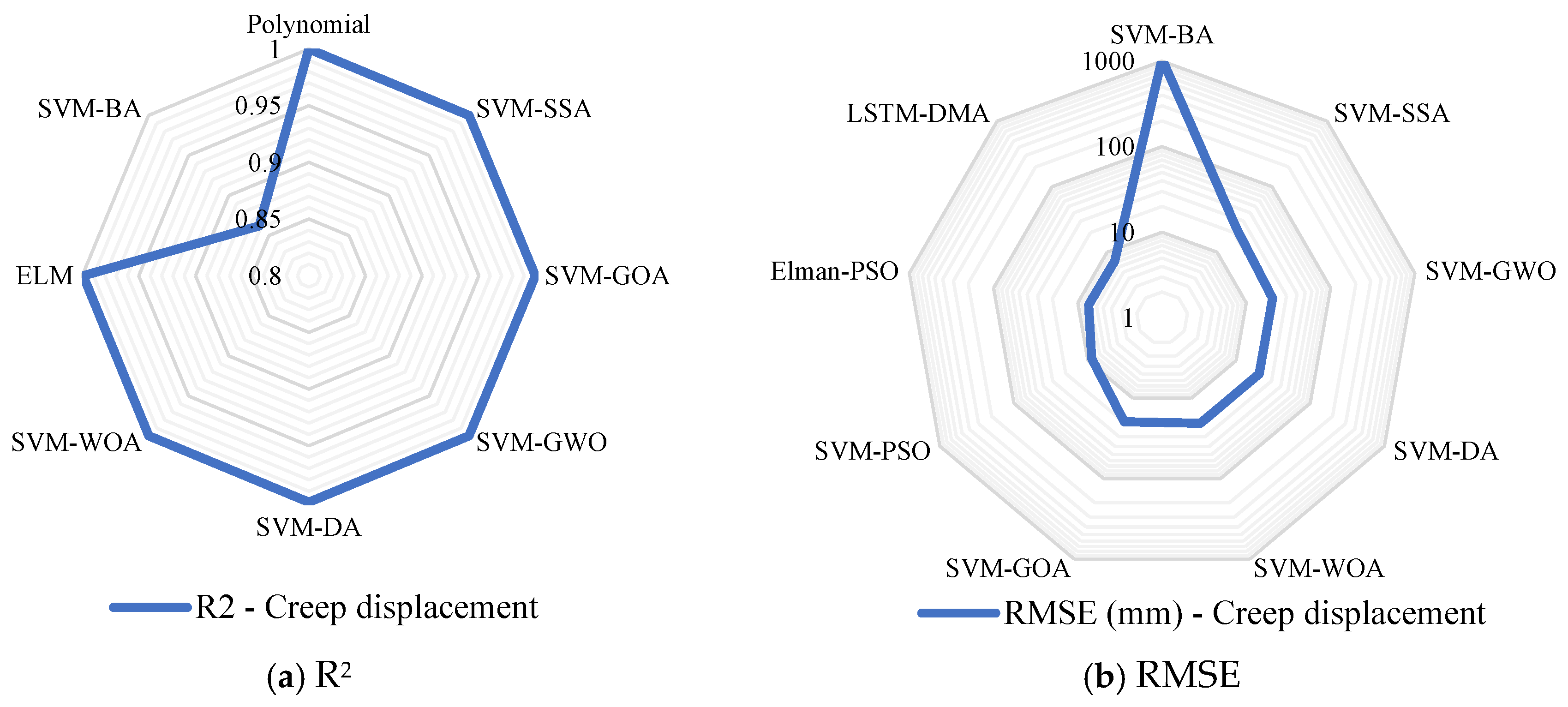
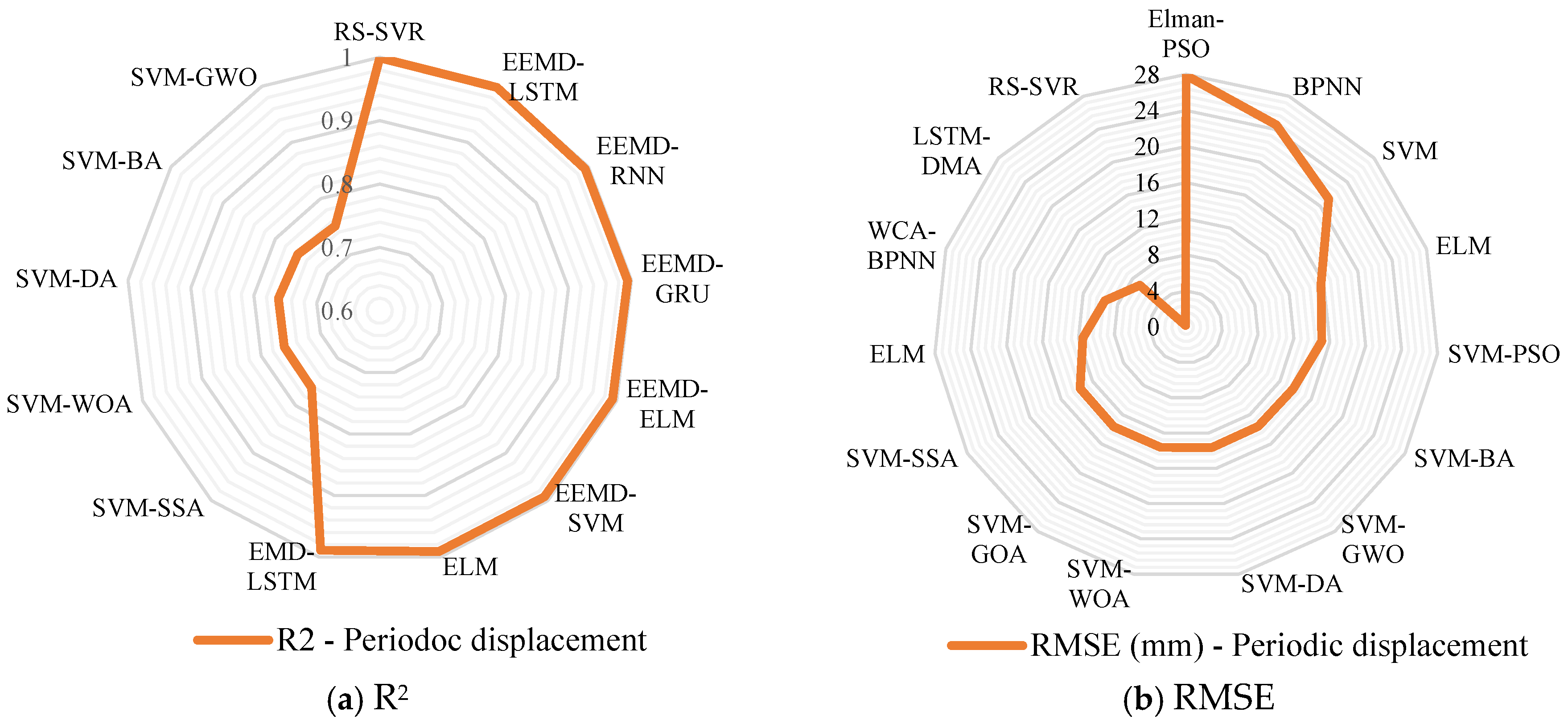
The performance of prediction models depends not only on algorithmic sophistication but also on the underlying controlling factors. While physical models benefit from established theoretical relationships between input and output parameters, statistical and intelligent models derive their effectiveness from several critical factors: strong dependency relationships, dataset quality, sampling ratios, and inventory data accuracy. Table 5 provides a comprehensive comparison of these models, evaluating both final accuracy and overall performance, with Figure 24, Figure 25 and Figure 26 specifically highlighting models demonstrating superior results.
No universally superior model exists across all scenarios. Optimal prediction depends on a thorough investigation of influencing features and careful consideration of actual initial conditions, which can substantially enhance accuracy (Figure 21) [74,98]. Consequently, removing outdated or irrelevant features can improve model performance [76]. While studies indicate that BPNN [78] and MLR [83] provide reasonable accuracy, these simpler models often fail to capture dynamic nonlinear relationships, particularly when datasets closely represent physical mechanisms [78,83]. Marrapu et al. [90] demonstrated that ANNs trained on extensive datasets achieve higher accuracy than those using limited data, though models require refinement when datasets lack critical information [39].
Understanding physical behavior and initial conditions remains essential for appropriate model selection. For instance, Wang et al. [82] improved model suitability by categorizing displacement into trend and periodic components. When evaluating model accuracy independently of dataset characteristics and sampling ratios (Figure 24, Figure 25 and Figure 26), GM(1,1) achieved the minimum RMSE among single models for total displacement, while PSO-SVR-SVC recorded the minimum RMSE among hybrid models. For creep displacement, simple polynomial regression achieved the maximum R2, while the LSTM-DMA hybrid model recorded the minimum RMSE. Regarding periodic displacement, RS-SVR achieved both maximum R2 and minimum RMSE.
Generally, trend displacement can be accurately predicted using simple polynomial regression [39,82], gray models [80], or single models like ELM [82] and DES [72]. However, periodic displacement exhibits complex nonlinear behavior [70,80] that requires hybrid model analysis, such as RS-SVR, for short-term acceleration effect prediction.
Table 5. AI models for predicting landslide displacement (modified after Ebrahim et al. [29]).
StudyKey FeaturesModel with the Best AccuracySampling Ratio (Training: Testing)Model Performance: (R2) 1, RMSE (mm) 2, MAPE% 3, MSE (mm2) 4, Minimum Error% 5, Maximum Error % 6, MAE (mm) 7, MAPE (mm) 8
(Neaupane and Achet [92]; Yao et al. [69]; Cao et al. [76]; Liu et al. [78]; Krkač et al. [73]; Krkač et al. [83]; Li et al. [70]; Yang et al. [93])
-
Trend features: Time series cumulative displacement.
-
Periodic features: Antecedent, rolling, and current data for rainfall, reservoir level, and groundwater level.
-
Infiltration and evaporation data to estimate effective rainfall.
CreepPeriodicDecomposition
-
Varied sampling ratio (refer to Section 4.2.1)
-
70%:30% and 80%:20% are widely adopted
Creep displacementPeriodic displacement
BPNN-0.891 1
ELM-0.984 1
RF-0.998 1
2.56 2
MLR-3.06 2
KGM-0.9998 1
RNN-RC 0.07 2
0.04 3
BPNN-PSO-38.4 4
SSA-LSTM-0.965 1
1.307 2
(Lian et al. [68]; Gao et al. [80]; Xing et al. [79]; Niu et al. [67]; Zhang et al. [39]; Zhang et al. [71]; Han et al. [74]; Wang et al. [82]; Wang et al. [72]; Ye et al. [94])PSO-SVRSVC0.08827 2
0.02105 8
DESVMD-BLSTMDES-BDNN0.983 1
7.224 2
GM (1,1)ENN-0.2 59.73 6
ELMRS-SVR-0.9991 10.9991 1
0.1993 2
PolynomialWCA-BPNNHigh Pass (HP) filter>0.99140.60 3
9.47 2
LSTM-DMADMA7.28 2
6.02 7
6.92 2
5.7 3
EEMD-ELMEEMD74.00 22.3944 3
PolynomialEEMD-LSTMEEMD and the kurtosis criterion1 10.998 1
0.25 3
SVM-SSACEEMD0.9998 1
22.766 4
0.762 1
13.589 2
GRA-TempoVar-TransformerGOA-GA-VMD1.86 2
4.85 7
Note: The numbers in the table correspond to the following performance metrics: 1: R2, 2: RMSE (mm), 3: MAPE (%), 4: MSE (mm2), 5: Minimum Error (%), 6: Maximum Error (%), 7: MAE (mm), 8: MAPE (mm).

4.2.2. Matric Suction and Groundwater Prediction

AI models provide effective solutions for predicting complex internal causative factors such as soil matric suction (SMS) and groundwater levels due to their ability to handle nonlinear relationships. Davar et al. [65] developed a hybrid intelligence model for predicting SMS, a key indicator of soil shear strength, that integrates extensive physical soil property datasets and evaluates three optimization algorithms: Bayesian Regularization Backpropagation (BR-BP), Particle Swarm Optimization (PSO), and Butterfly Optimization Algorithm (BOA). This approach addresses common ANN limitations, including slow learning rates and poor generalization. Utilizing comprehensive field monitoring and laboratory data encompassing soil depth, volumetric soil moisture content (VSMC), air temperature, rainfall, soil temperature, and suction measurements, the study determined that PSO-ANN achieved optimal performance.
Similarly, groundwater level fluctuations, closely associated with landslide triggers, exhibit complex behavior influenced by rainfall and reservoir level variations with temporal delays. Cao et al. [66] applied a Genetic Algorithm-Support Vector Machine (GA-SVM) hybrid model to capture nonlinear interactions between intrinsic and extrinsic factors, incorporating multiple features, including antecedent and current rainfall and reservoir levels. The results demonstrated GA-SVM’s superiority over BPNN, while both multi-feature models outperformed single-feature GA-SVM. Liu et al. [99] implemented a regression tree model using rainfall, soil moisture content, and water level parameters to predict groundwater level changes, accounting for factors such as surface runoff, vegetation, climate conditions, and soil structure. This approach surpassed ANN, SVM, ELM, and Gaussian Process Regression (GPR) with an RMSE of 0.0812. Ng et al. [100] introduced a novel multivariate long short-term memory (M-LSTM) model that simultaneously utilizes spatial and temporal pore water pressure (PWP) data from multiple measurement locations. However, such geotechnical models remain constrained by data scarcity, whereas displacement prediction benefits from more readily available surface monitoring data.

4.2.3. Moisture Content and Topographic Thresholds

Soil moisture content significantly enhances landslide prediction accuracy when integrated with rainfall analysis. Zhao et al. [57] employed a Bayesian probabilistic approach combining antecedent soil moisture content—calculated using the SHETRAN (Système Hydrologique Européen TRANsport) model—with recent rainfall data. Their analysis incorporated rainfall events, antecedent soil wetness, rainfall duration, cumulative precipitation, and landslide occurrences, demonstrating that probabilistic thresholds outperform conventional I-D thresholds.
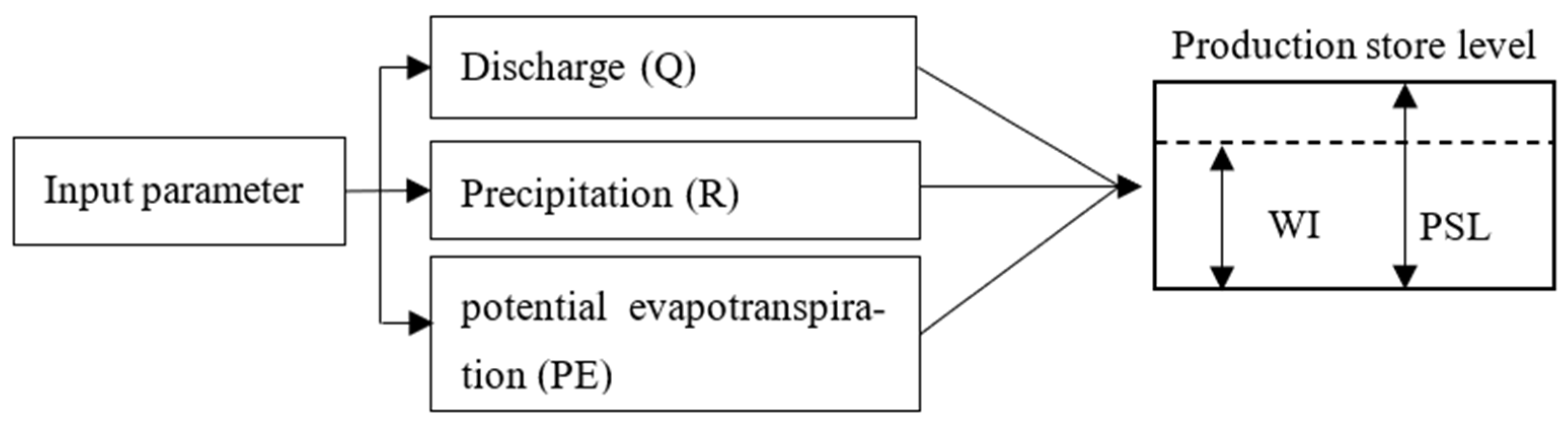
De Luca and Versace [61] developed the Generalized FLaIR Model (GFM), applicable to both shallow and deep-seated landslides, which accounts for initial soil moisture conditions dependent on antecedent rainfall. The model offers multiple configurable thresholds (Equations (13) and (14)) and utilizes a lumped conceptual hydrological approach (Equation (15)) where production storage level (PSL) is calibrated using evaporation and discharge data to track wetness increase throughout rainfall events [62]. Adapted from the GR4J model [101] (Figure 27), the R-PSL threshold provides superior performance for long-duration rainfall compared to I-D thresholds, while short-duration events require alternative parameters, such as hourly rainfall data [62].
Y ( t ) = t     M t I ( T ) Ξ ( t     T ) d T
Y c r ( t ) = R * ( D t     d ) / D + f [ R * ( D t     d ) ] / d
R = a * P S L + b
where Y is a mobility function, I is rainfall intensity, Ξ represents a filter function that can take different mathematical expressions, t is time, T is defined on the interval [t − M; t], M is the process’s temporal memory, and R*D is cumulative rainfall filtered on D and d durations and evaluated at the instants (t − d) and t, respectively.
Soil saturation dynamics are illustrated in Figure 28, where soil thickness above bedrock (H) comprises unsaturated (z) and saturated (h) zones [102]. When cumulative rainfall exceeds unsaturated zone capacity, saturated zone depth increases until complete soil saturation occurs [103]. Saturated thickness can be quantified using Equation (16) [104], while topographic influences are captured through Kirkby’s wetness index [105] (Equation (17)), enabling derived thresholds (Equations (18) and (19)) [63].
The topographic wetness index (TWI) correlates with soil moisture during wet conditions [106] and utilizes digital elevation models (DEMs) to represent surface soil spatial distribution [63,102,104]. High-resolution DEMs reduce slope geometry uncertainties [107], though accurate soil thickness remains essential for instability analysis [63,102,103,104,106,108]. Unlike TWI, the soil wetness index (SWI) incorporates dynamic rainfall conditions [109] and serves as a crucial landslide predictor [110]. SHETRAN’s finite difference hydrological model simulates soil moisture responses using three-dimensional grids, incorporating meteorological data (evapotranspiration, precipitation), topographic properties (TWI), land cover, and soil types [111]. SWI calculations utilize preceding-day rainfall data averaged across meteorological stations, with threshold exceedance triggering wet soil classification in warning zones [110].
h ( t ) = H Z ( t ) F R C A T I ln W tan β
T W I = ln ( W / tan β )
tan β C γ t g H   cos 2   β + tan ϕ   lower   thresholds
tan β < C γ t g H   cos 2   β + 1 γ w γ t tan ϕ upper   thresholds
where h(t) denotes the saturated water height at time t, H represents the soil thickness, W is the unit width collecting area, tanβ is the surface slope, and ATI refers to the average topographic index in the catchment. FRC is a model coefficient obtained through the flow recession records. C denotes the cohesion, g represents the gravitational acceleration, γt is the bulk density of the soil, γw is the density of water, H is the soil thickness measured vertically, β is the gradient of the hill slope, and φ is the angle of the soil’s effective friction.

5. Discussion

5.1. Synthesis of Findings and Comparative Analysis of Model Approaches

This mixed-methods review was guided by the overarching question of how different landslide prediction models compare in their principles, applications, and accuracy. The findings reveal a clear trade-off between model simplicity and mechanistic sophistication, directly addressing our research inquiries as follows: (a) Empirical-statistical thresholds operate on the premise that rainfall is the most critical causative factor for landslide occurrence [54]. This assumption provides advantages in scenarios where topographic, geotechnical, and hydraulic data are limited [53]. Due to their operational simplicity and minimal instrumentation requirements, these models are preferred for early warning systems (EWS) [61]. They offer a practical alternative to physically based models, which require extensive data monitoring, collection, and calibration, making the latter seldom used in operational EWS [62]. However, empirical-statistical thresholds face constraints. Their application is typically limited to specific case studies [13], and they struggle to provide accurate rainfall thresholds when historical landslide and rainfall data are sparse [48,112]. Although these models can achieve high accuracy in certain conditions, their forecasting reliability is often compromised by substantial false positive alarm rates [54,55]. (b) Physically based causative thresholds are constructed under the assumption that relationships between landslides and controlling factors remain relatively constant over time [73]. These models inherently assume that past events will recur without significant changes and that sudden failure mechanisms, such as strain-softening along sliding surfaces, will not occur. Since sudden failures are rarely captured in training datasets, these models cannot predict such events [71,79]. Additionally, they often neglect random triggers like wind and vehicle loads due to insufficient monitoring data [82]. Further limitations include prediction accuracy dependence on temporal resolution, with better performance achieved through smaller prediction steps [80]. Regression-based approaches are generally constrained to smaller areas due to their reliance on field monitoring data, unlike landslide susceptibility maps, which can cover broader regions. These models frequently focus on single parameters such as displacement or groundwater levels while overlooking spatial variations in land cover, soil composition, topography, and geotechnical attributes. Most are also restricted to historical training data, limiting their capacity for real-time prediction and adaptation to sudden changes [99]. Despite these limitations, physically based models offer advantages. AI implementations can analyze multiple causative factors using existing monitoring data, providing extended warning periods compared to theoretical models and superior accuracy to empirical–statistical thresholds. Furthermore, they represent a cost-effective alternative to comprehensive geotechnical investigations.

5.2. Consolidating Fragmented Knowledge

The mixed-review methodology proved essential for this holistic assessment, with the dual perspective culminating in the integrated framework presented in Figure 29. This framework delineates a structured progression from national-scale to local-scale modeling approaches, reflecting a hierarchical decision-making process where input parameters guide model selection as follows: (a) At the national scale, factors including geology, geomorphology, soil properties, and triggering elements such as rainfall facilitate the generation of landslide susceptibility maps (refer to Part II; [19]). These maps form the foundation for risk assessments employing multivariate models, AI techniques, and hybrid approaches, enabling the precise identification of high-risk areas and their potential impacts on infrastructure and human safety. (b) Transitioning to local scales, the framework incorporates more detailed models accounting for complex geometrical, hydrological, and soil conditions. Deterministic physical models simulate intricate landslide processes using site-specific conditions [19], while statistical regression, AI, and probabilistic models complement these analyses by predicting initiation based on slope responses, including displacement, groundwater levels, matric suction, and moisture content. Combined with I-D thresholds, these approaches enable increasingly accurate landslide forecasting.
A particularly innovative aspect of Figure 29 lies in its synthesis of fragmented knowledge into an effective visualization that systematically illustrates the interconnections between different modeling approaches. This framework integrates statistical regression, AI, and physical methods within a unified hybrid modeling paradigm. Such integration is crucial for enhancing predictive accuracy in complex rainfall-induced landslide scenarios, where single-method approaches often prove inadequate. Complementing this, the color-coded accuracy assessment (ranging from reasonable to perfect) provides an immediate evaluation of model reliability based on specific input parameters, establishing a multi-tiered framework that enables robust predictive capabilities that are adaptable from national-scale susceptibility mapping to site-specific risk assessment.
While this review provides a comprehensive synthesis, several limitations, as outlined in Section 2.5, should be acknowledged. The reliance on major databases, specific keywords, and English-language publications may have omitted some relevant studies. Furthermore, the vast number of studies precluded a manual, quantitative meta-analysis of accuracy by model type. This remains a significant gap and a critical recommendation for future work.

6. Conclusions

This study has demonstrated the value of a mixed-methods framework, integrating scientometric and systematic analyses, to provide a holistic and critical assessment of the landslide prediction research landscape. The dual-pronged approach allowed for both a macroscopic mapping of global research trends and a microscopic evaluation of model methodologies, offering a more complete picture than either method could alone.
The primary insight from this synthesis is the clear evolution and necessary trade-offs in prediction modeling. The field is advancing from simple, data-scarce empirical thresholds (I-D, API) towards complex, physically informed models, with hybrid AI architectures emerging as the new frontier for achieving high-fidelity predictions. These hybrid models represent a paradigm shift, effectively addressing the nonlinear and decomposed nature of landslide behavior, particularly for critical periodic displacement.
However, this review also conclusively shows that no universal model exists. The choice between empirical, physical, or hybrid approaches is fundamentally dictated by the specific application’s scale, the availability of data, and the required accuracy. Empirical models remain the pragmatic choice for regional early-warning systems, while physically based and hybrid models are indispensable for site-specific assessments.
Ultimately, this study underscores that the path toward more reliable landslide prediction lies not in seeking a single perfect model, but in the contextual application of a hierarchical modeling strategy, as visualized in Figure 29. Future progress hinges on building richer, multi-parameter datasets and developing more adaptable models that can bridge the critical gap between data-driven predictions and geotechnical reality. This review provides a structured framework and a clear identification of research gaps (Table 6) to guide these essential future endeavors.

7. Future Directions and Recommendations

This review has identified that while significant progress has been made, the development of next-generation landslide prediction models demands focused efforts on two critical fronts. First, feature selection must be guided by a deeper understanding of site-specific initial conditions, and second, model architecture must be suited to the complexity of the feature relationships. Despite advancements in statistical modeling, such as hybrid AI models, there are still some gaps that need to be addressed, as outlined in Table 6.

Author Contributions

Conceptualization, K.E. and T.Z.; methodology, K.E. and T.Z.; formal analysis, K.E., T.Z., S.M.M.H.G. and G.A.; investigation, K.E. and T.Z.; resources, T.Z.; data curation, K.E., S.M.M.H.G., T.Z. and G.A.; writing—original draft preparation, K.E.; writing—review and editing, S.M.M.H.G., T.Z. and G.A.; supervision, T.Z. All authors have read and agreed to the published version of the manuscript.

Funding

This research received no external funding.

Data Availability Statement

The original contributions presented in this study are included in the article. Further inquiries can be directed to the corresponding authors.

Acknowledgments

The authors gratefully acknowledge the Innovation and Technology Support Programme (ITSP) [Grant No. ITS/033/20FP], Hong Kong SAR. The authors would like to thank the Head of the Geotechnical Engineering Office, the Government of the Hong Kong SAR, for permission to use Figure 10. The authors gratefully acknowledge the funding provided by the Hong Kong Polytechnic University. The authors gratefully acknowledge the support of the Ongoing Research Funding Program (ORF-2025-899), King Saud University, Riyadh, Saudi Arabia. During the preparation of this work, the author(s) used [DeepSeek (Latest version, last update: June 2024), Grammarly (V.1.2.185.1737), GPT-4 (Latest version, last update: 14-04-2025), and Copilot] (version 1.25051.120.0) to [rephrase, check grammar and spelling]. After using this tool/service, the author(s) reviewed and edited the content as needed and take(s) full responsibility for the content of the publication.

Conflicts of Interest

The authors declare no conflicts of interest.

Notation and Abbreviations

Notation
DRainfall durationεScaling parameter
IRainfall intensityζShape parameter
ENRainfall event, υDimensionless parameter
APINAntecedent precipitation indexYiValue of real data
NNumber of rainy daysXiValue of predicted data
RaAntecedent rainfallCCohesion
RoRolling rainfallϕInternal friction angle
RCumulative rainfallQDischarge
PEPotential evaporationgGravitational acceleration
SDisplacementγwThe unit weight of water
Ξ (t)Gamma-type transfer functionγtWet unit weight
ttimeHThickness above the bedrock layer
TTemporal scale/Time intervalszUnsaturated thickness
MTemporal memory hSaturated thickness
Abbreviations
EWSEarly warning systemsGRUGated recurrent unit
FLaIRForecasting of Landslides Induced by RainfallBRNNBayesian recurrent neural network
GFMGeneralized FLaIR modelBLSTMBayesian long short-term memory network
IETDsInter-event time definitionsBGRUBayesian gated recurrent unit network
SMSSoil matric suctionBDNNBayesian deep neural networks
VSMCVolumetric soil moisture content EMDEmpirical mode decomposition
PSLProduction storage levelEEMDEnsemble empirical mode decomposition
WIWetness increase CEEMDComplete ensemble empirical mode decomposition
TWITopographic Witness Index DMADouble moving average
SWISoil wetness indexSMASingle moving average
SHETRANSystème Hydrologique Européen TRANsportDESDouble exponential smoothing
AUCThe area under the ROC curveVMDVariational mode decomposition
ROCReceiver operating characteristicKGMKernel-based gray model
FPRFalse positive rateMKGMMulti-kernel gray model
R2Coefficient of determination WMKGMWeighted multi-kernel gray model
RMSERoot mean square errorWCAWater cycle algorithm
MSEMean square errorMSIMultiple Swarm intelligence
MAEMean absolute errorBABat algorithm
SDRStandard deviation ratioGWOGray wolf optimization
PRCPearson-R correlationDADragonfly optimization algorithm
GMGray modelWOAWhale optimization algorithm
MLRMultilinear regressionGOAGrasshopper optimization algorithm
ANNArtificial neural networksSSASparrow search algorithm
BPNNBackpropagation neural networksPCAPrincipal component analysis
SVMSupport vector mechanismFOBGMFeedback optimization background gray model
RFRandom forest modelMLATCMean-based low-rank autoregressive tensor completion
SVCSupport vector classifierMFTLMulti-fusion transfer learning
SVRSupport vector regressionNWENon-uniform weight error
RSRandom SearchBR-BPBayesian regularization backpropagation
RNNRecurrent neural networksBOAButterfly Optimization Algorithm
ENNEvolutionary neural networkGAGenetic algorism
ELMExtreme learning machine GPRGaussian process regression
LSTMLong short-term memoryGRAGray correlation analysis
GAGenetic algorithm

References

  1. Cruden, D.M. A simple definition of a landslide. Bull. Int. Assoc. Eng. Geol. 1991, 43, 27–29. [Google Scholar] [CrossRef]
  2. Chae, B.G.; Wu, Y.H.; Liu, K.F.; Choi, J.; Park, H.J. Simulation of debris-flow runout near a construction site in Korea. Appl. Sci. 2020, 10, 6079. [Google Scholar] [CrossRef]
  3. Froude, M.J.; Petley, D.N. Global fatal landslide occurrence from 2004 to 2016. Nat. Hazards Earth Syst. Sci. 2018, 18, 2161–2181. [Google Scholar] [CrossRef]
  4. Lin, Q.; Steger, S.; Pittore, M.; Zhang, J.; Wang, L.; Jiang, T.; Wang, Y. Evaluation of potential changes in landslide susceptibility and landslide occurrence frequency in China under climate change. Sci. Total Environ. 2022, 850, 158049. [Google Scholar] [CrossRef]
  5. Roman Quintero, D.C.; Marino, P.; Abdullah, A.; Santonastaso, G.F.; Greco, R. Large-scale assessment of rainfall-induced landslide hazard based on hydrometeorological information: Application to Partenio Massif (Italy). Nat. Hazards Earth Syst. Sci. 2025, 25, 2679–2698. [Google Scholar] [CrossRef]
  6. Hungr, O.; Leroueil, S.; Picarelli, L. The Varnes classification of landslide types, an update. Landslides 2014, 11, 167–194. [Google Scholar] [CrossRef]
  7. Wu, L.; Huang, R.; Li, X. Hydro-Mechanical Analysis of Rainfall-Induced Landslides; Springer: Singapore, 2020; pp. 1–235. [Google Scholar] [CrossRef]
  8. Harsa, H.; Anistia, M.H.; Mulsandi, A.; Suprihadi, B.; Kurniawan, R.; Habibie, M.N.; Hutapea, T.D.; Swarinoto, Y.S.; Makmur, E.E.S.; Fitria, W.; et al. Machine learning and artificial intelligence models development in rainfall-induced landslide prediction. IAES Int. J. Artif. Intell. 2023, 12, 262. [Google Scholar] [CrossRef]
  9. Das, P.; Patwa, D.; Bharat, T.V. Influencing factors on the simulation of rainfall-induced landslide prediction based on case study. Bull. Eng. Geol. Environ. 2022, 81, 194. [Google Scholar] [CrossRef]
  10. Thang, N.V.; Wakai, A.; Sato, G.; Viet, T.T.; Kitamura, N. Simple Method for Shallow Landslide Prediction Based on Wide-Area Terrain Analysis Incorporated with Surface and Subsurface Flows. Nat. Hazards Rev. 2022, 23, 04022028. [Google Scholar] [CrossRef]
  11. Caine, N. The rainfall intensity-duration control of shallow landslides and debris flows. Geogr. Ann. Ser. A Phys. Geogr. 1980, 62, 23–27. [Google Scholar] [CrossRef]
  12. Zhang, L.L.; Zhang, J.; Zhang, L.M.; Tang, W.H. Stability analysis of rainfall-induced slope failure: A review. Proc. Inst. Civ. Eng.-Geotech. Eng. 2011, 164, 299–316. [Google Scholar] [CrossRef]
  13. Huang, J.; Ju, N.P.; Liao, Y.J.; Liu, D.D. Determination of rainfall thresholds for shallow landslides by a probabilistic and empirical method. Nat. Hazards Earth Syst. Sci. 2015, 15, 2715–2723. [Google Scholar] [CrossRef]
  14. Liu, X.; Wang, Y.; Koo, R.C.; Kwan, J.S. Development of a slope digital twin for predicting temporal variation of rainfall-induced slope instability using past slope performance records and monitoring data. Eng. Geol. 2022, 308, 106825. [Google Scholar] [CrossRef]
  15. Formetta, G.; Capparelli, G. Quantifying the three-dimensional effects of anisotropic soil horizons on hillslope hydrology and stability. J. Hydrol. 2019, 570, 329–342. [Google Scholar] [CrossRef]
  16. Huang, Y.; He, Z. Rainfall-oriented resilient design for slope system: Resilience-enhancing strategies. Soils Found. 2023, 63, 101297. [Google Scholar] [CrossRef]
  17. Liang, W.L.; Uchida, T. Performance and topographic preferences of dynamic and steady models for shallow landslide prediction in a small catchment. Landslides 2022, 19, 51–66. [Google Scholar] [CrossRef]
  18. Ma, J.; Tang, H.; Hu, X.; Bobet, A.; Zhang, M.; Zhu, T.; Song, Y.; Ez Eldin, M.A.M. Identification of causal factors for the Majiagou landslide using modern data mining methods. Landslides 2017, 14, 311–322. [Google Scholar] [CrossRef]
  19. Ebrahim, K.M.P.; Gomaa, S.M.M.H.; Zayed, T.; Alfalah, G. Rainfall-induced landslide prediction models, part ii: Deterministic physical and phenomenologically models. Bull. Eng. Geol. Environ. 2024, 83, 85. [Google Scholar] [CrossRef]
  20. Chae, B.G.; Park, H.J.; Catani, F.; Simoni, A.; Berti, M. Landslide prediction, monitoring and early warning: A concise review of state-of-the-art. Geosci. J. 2017, 21, 1033–1070. [Google Scholar] [CrossRef]
  21. Segoni, S.; Piciullo, L.; Gariano, S.L. A review of the recent literature on rainfall thresholds for landslide occurrence. Landslides 2018, 15, 1483–1501. [Google Scholar] [CrossRef]
  22. Merghadi, A.; Yunus, A.P.; Dou, J.; Whiteley, J.; ThaiPham, B.; Bui, D.T.; Avtar, R.; Abderrahmane, B. Machine learning methods for landslide susceptibility studies: A comparative overview of algorithm performance. Earth-Sci. Rev. 2020, 207, 103225. [Google Scholar] [CrossRef]
  23. Shano, L.; Raghuvanshi, T.K.; Meten, M. Landslide susceptibility evaluation and hazard zonation techniques–a review. Geoenviron. Disasters 2020, 7, 18. [Google Scholar] [CrossRef]
  24. Ma, Y.; Li, H.; Wang, L.; Zhang, W.; Zhu, Z.; Yang, H.; Wang, L.; Yuan, X. Machine learning algorithms and techniques for landslide susceptibility investigation: A literature review. Tumu Yu Huanjing Gongcheng Xuebao/J. Civ. Environ. Eng. 2022, 44, 53–67. [Google Scholar] [CrossRef]
  25. Zou, Y.; Zheng, C. A Scientometric analysis of predicting methods for identifying the environmental risks caused by landslides. Appl. Sci. 2022, 12, 4333. [Google Scholar] [CrossRef]
  26. Huang, J.; Wu, X.; Ling, S.; Li, X.; Wu, Y.; Peng, L.; He, Z. A bibliometric and content analysis of research trends on GIS-based landslide susceptibility from 2001 to 2020. Environ. Sci. Pollut. Res. 2022, 29, 86954–86993. [Google Scholar] [CrossRef]
  27. Petrucci, O. Landslide fatality occurrence: A systematic review of research published between January 2010 and March 2022. Sustainability 2022, 14, 9346. [Google Scholar] [CrossRef]
  28. Vung, D.V.; Tran, T.V.; Ha, N.D.; Duong, N.H. Advancements, Challenges, and Future Directions in Rainfall-Induced Landslide Prediction: A Comprehensive Review. J. Eng. Technol. Sci. 2023, 55, 466–477. [Google Scholar] [CrossRef]
  29. Ebrahim, K.M.P.; Fares, A.; Faris, N.; Zayed, T. Exploring time series models for landslide prediction: A literature review. Geoenviron. Disasters 2024, 11, 25. [Google Scholar] [CrossRef]
  30. Yin, X.; Liu, H.; Chen, Y.; Al-Hussein, M. Building information modelling for off-site construction: Review and future directions. Autom. Constr. 2019, 101, 72–91. [Google Scholar] [CrossRef]
  31. Wuni, I.Y.; Shen, G.Q. Critical success factors for modular integrated construction projects: A review. Build. Res. Inf. 2020, 48, 763–784. [Google Scholar] [CrossRef]
  32. Abdelkader, E.M.; Al-Sakkaf, A.; Ebrahim, K.; Elkabalawy, M. Maintenance Budget Allocation Models of Existing Bridge Structures: Systematic Literature and Scientometric Reviews of the Last Three Decades. Infrastructures 2025, 10, 252. [Google Scholar] [CrossRef]
  33. Ebrahim, K.M.P.; Gomaa, S.M.M.H.; Zayed, T.; Alfalah, G. Recent Phenomenal and Investigational Subsurface Landslide Monitoring Techniques: A Mixed Review. Remote Sens. 2024, 16, 385. [Google Scholar] [CrossRef]
  34. Moher, D.; Liberati, A.; Tetzlaff, J.; Altman, D.G.; PRISMA Group. Preferred reporting items for systematic reviews and meta-analyses: The PRISMA statement. J. Clin. Epidemiol. 2009, 62, 1006–1012. [Google Scholar] [CrossRef] [PubMed]
  35. Wohlin, C. Guidelines for snowballing in systematic literature studies and a replication in software engineering. In Proceedings of the 18th International Conference on Evaluation and Assessment in Software, London, UK, 13–14 May 2014; pp. 1–10. [Google Scholar] [CrossRef]
  36. Van Eck, N.; Waltman, L. Software survey: VOSviewer, a computer program for bibliometric mapping. Scientometrics 2010, 84, 523–538. [Google Scholar] [CrossRef]
  37. Soga, K.; Alonso, E.; Yerro, A.; Kumar, K.; Bandara, S. Trends in large-deformation analysis of landslide mass movements with particular emphasis on the material point method. Géotechnique 2016, 66, 248–273. [Google Scholar] [CrossRef]
  38. Ikram, R.M.A.; Dehrashid, A.A.; Zhang, B.; Le, B.N.; Moayedi, H. A novel swarm intelligence: Cuckoo optimization algorithm (COA) and SailFish optimizer (SFO) in landslide susceptibility assessment. Stoch. Environ. Res. Risk Assess. 2023, 37, 1717–1743. [Google Scholar] [CrossRef]
  39. Zhang, Y.G.; Tang, J.; Liao, R.P.; Zhang, M.F.; Zhang, Y.; Wang, X.M.; Su, Z.Y. Application of an enhanced BP neural network model with water cycle algorithm on landslide prediction. Stoch. Environ. Res. Risk Assess. 2021, 35, 1273–1291. [Google Scholar] [CrossRef]
  40. Mondini, A.C.; Guzzetti, F.; Melillo, M. Deep learning forecast of rainfall-induced shallow landslides. Nat. Commun. 2023, 14, 2466. [Google Scholar] [CrossRef]
  41. Long, J.; Li, C.; Liu, Y.; Feng, P.; Zuo, Q. A multi-feature fusion transfer learning method for displacement prediction of rainfall reservoir-induced landslide with step-like deformation characteristics. Eng. Geol. 2022, 297, 106494. [Google Scholar] [CrossRef]
  42. Hussein, M.; Zayed, T. Crane operations and planning in modular integrated construction: Mixed review of literature. Autom. Constr. 2021, 122, 103466. [Google Scholar] [CrossRef]
  43. Oguz, E.A.; Depina, I.; Thakur, V. Effects of soil heterogeneity on susceptibility of shallow landslides. Landslides 2022, 19, 67–83. [Google Scholar] [CrossRef]
  44. AECOM Asia Company Limited. Detailed Study of the 29 August 2018 Landslides on the Natural Hillside Above Fan Kam Road, Pat Heung; Geotechnical Engineering Office: Hong Kong SAR, China, 2019; Volume 363, p. 11. [Google Scholar]
  45. Hong, Y.; Adler, R.; Huffman, G. Evaluation of the potential of NASA multi-satellite precipitation analysis in global landslide hazard assessment. Geophys. Res. Lett. 2006, 33, L22402. [Google Scholar] [CrossRef]
  46. Lee, M.L.; Ng, K.Y.; Huang, Y.F.; Li, W.C. Rainfall-induced landslides in Hulu Kelang area, Malaysia. Nat. Hazards 2014, 70, 353–375. [Google Scholar] [CrossRef]
  47. Gariano, S.L.; Sarkar, R.; Dikshit, A.; Dorji, K.; Brunetti, M.T.; Peruccacci, S.; Melillo, M. Automatic calculation of rainfall thresholds for landslide occurrence in Chukha Dzongkhag, Bhutan. Bull. Eng. Geol. Environ. 2019, 78, 4325–4332. [Google Scholar] [CrossRef]
  48. Wu, Y.M.; Lan, H.X.; Gao, X.; Li, L.P.; Yang, Z.H. A simplified physically based coupled rainfall threshold model for triggering landslides. Eng. Geol. 2015, 195, 63–69. [Google Scholar] [CrossRef]
  49. Zhao, B.; Dai, Q.; Han, D.; Dai, H.; Mao, J.; Zhuo, L. Probabilistic thresholds for landslides warning by integrating soil moisture conditions with rainfall thresholds. J. Hydrol. 2019, 574, 276–287. [Google Scholar] [CrossRef]
  50. Guzzetti, F.; Melillo, M.; Mondini, A.C. Landslide predictions through combined rainfall threshold models. Landslides 2024, 22, 137–147. [Google Scholar] [CrossRef]
  51. Peruccacci, S.; Brunetti, M.T.; Gariano, S.L.; Melillo, M.; Rossi, M.; Guzzetti, F. Rainfall thresholds for possible landslide occurrence in Italy. Geomorphology 2017, 290, 39–57. [Google Scholar] [CrossRef]
  52. Melillo, M.; Brunetti, M.T.; Peruccacci, S.; Gariano, S.L.; Roccati, A.; Guzzetti, F. A tool for the automatic calculation of rainfall thresholds for landslide occurrence. Environ. Model. Softw. 2018, 105, 230–243. [Google Scholar] [CrossRef]
  53. Ering, P.; Babu, G.S. Characterization of critical rainfall for slopes prone to rainfall-induced landslides. Nat. Hazards Rev. 2020, 21, 06020003. [Google Scholar] [CrossRef]
  54. Hong, M.; Kim, J.; Jeong, S. Rainfall intensity-duration thresholds for landslide prediction in South Korea by considering the effects of antecedent rainfall. Landslides 2018, 15, 523–534. [Google Scholar] [CrossRef]
  55. Uwihirwe, J.; Hrachowitz, M.; Bogaard, T.A. Landslide precipitation thresholds in Rwanda. Landslides 2020, 17, 2469–2481. [Google Scholar] [CrossRef]
  56. Chhorn, C.; Yune, C.Y.; Kim, G.; Lee, S.W. Study for assessment of rainfall duration inducing landslides. Proc. Inst. Civ. Eng. Munic. Eng. 2016, 169, 100–108. [Google Scholar] [CrossRef]
  57. Zhao, B.; Dai, Q.; Han, D.; Dai, H.; Mao, J.; Zhuo, L.; Rong, G. Estimation of soil moisture using modified antecedent precipitation index with application in landslide predictions. Landslides 2019, 16, 2381–2393. [Google Scholar] [CrossRef]
  58. Brunetti, M.T.; Peruccacci, S.; Rossi, M.; Luciani, S.; Valigi, D.; Guzzetti, F. Rainfall thresholds for the possible occurrence of landslides in Italy. Nat. Hazards Earth Syst. Sci. 2010, 10, 447–458. [Google Scholar] [CrossRef]
  59. Aryastana, P.; Dewi, L.; Wahyuni, P.I. A study of rainfall thresholds for landslides in Badung Regency using satellite-derived rainfall grid datasets. Int. J. Adv. Appl. Sci. 2024, 13, 197–208. [Google Scholar] [CrossRef]
  60. Bogaard, T.A.; Greco, R. Hydrological perspectives on precipitation intensity-duration thresholds for a landslide initiation: Proposing hydro-meteorological thresholds. Nat. Hazards Earth Syst. Sci. 2018, 18, 31–39. [Google Scholar] [CrossRef]
  61. De Luca, D.L.; Versace, P. A comprehensive framework for empirical modeling of landslides induced by rainfall: The Generalized FLaIR Model (GFM). Landslides 2017, 14, 1009–1030. [Google Scholar] [CrossRef]
  62. Bezak, N.; Jemec Auflič, M.; Mikoš, M. Application of hydrological modelling for temporal prediction of rainfall-induced shallow landslides. Landslides 2019, 16, 1273–1283. [Google Scholar] [CrossRef]
  63. Ho, J.Y.; Lee, K.T.; Chang, T.C.; Wang, Z.Y.; Liao, Y.H. Influences of spatial distribution of soil thickness on shallow landslide prediction. Eng. Geol. 2012, 124, 38–46. [Google Scholar] [CrossRef]
  64. Bednarczyk, Z. Identification of flysch landslide triggers using conventional and ‘nearly real-time monitoring methods–An example from the Carpathian Mountains, Poland. Eng. Geol. 2018, 244, 41–56. [Google Scholar] [CrossRef]
  65. Davar, S.; Nobahar, M.; Khan, M.S.; Amini, F. The development of PSO-ANN and BOA-ANN models for predicting matric suction in expansive clay soil. Mathematics 2022, 10, 2825. [Google Scholar] [CrossRef]
  66. Cao, Y.; Yin, K.; Zhou, C.; Ahmed, B. Establishment of landslide groundwater level prediction model based on GA-SVM and influencing factor analysis. Sensors 2020, 20, 845. [Google Scholar] [CrossRef] [PubMed]
  67. Niu, X.; Ma, J.; Wang, Y.; Zhang, J.; Chen, H.; Tang, H. A novel decomposition-ensemble learning model based on ensemble empirical mode decomposition and recurrent neural network for landslide displacement prediction. Appl. Sci. 2021, 11, 4684. [Google Scholar] [CrossRef]
  68. Lian, C.; Zeng, Z.; Yao, W.; Tang, H. Extreme learning machine for the displacement prediction of landslide under rainfall and reservoir level. Stoch. Environ. Res. Risk Assess. 2014, 28, 1957–1972. [Google Scholar] [CrossRef]
  69. Yao, W.; Zeng, Z.; Lian, C.; Tang, H. Training enhanced reservoir computing predictor for landslide displacement. Eng. Geol. 2015, 188, 101–109. [Google Scholar] [CrossRef]
  70. Li, Z.; Cheng, P.; Zheng, J. Prediction of time to slope failure based on a new model. Bull. Eng. Geol. Environ. 2021, 80, 5279–5291. [Google Scholar] [CrossRef]
  71. Zhang, J.; Tang, H.; Tannant, D.D.; Lin, C.; Xia, D.; Wang, Y.; Wang, Q. A novel model for landslide displacement prediction based on EDR selection and multi-swarm intelligence optimization algorithm. Sensors 2021, 21, 8352. [Google Scholar] [CrossRef]
  72. Wang, H.; Long, G.; Shao, P.; Lv, Y.; Gan, F.; Liao, J. A DES-BDNN based probabilistic forecasting approach for step-like landslide displacement. J. Clean. Prod. 2023, 394, 136281. [Google Scholar] [CrossRef]
  73. Krkač, M.; Špoljarić, D.; Bernat, S.; Arbanas, S.M. Method for prediction of landslide movements based on random forests. Landslides 2017, 14, 947–960. [Google Scholar] [CrossRef]
  74. Han, H.; Shi, B.; Zhang, L. Prediction of landslide sharp increase displacement by SVM with considering hysteresis of groundwater change. Eng. Geol. 2021, 280, 105876. [Google Scholar] [CrossRef]
  75. Shentu, N.; Yang, J.; Li, Q.; Qiu, G.; Wang, F. Research on the Landslide Prediction Based on the Dual Mutual-Inductance Deep Displacement 3D Measuring Sensor. Appl. Sci. 2022, 13, 213. [Google Scholar] [CrossRef]
  76. Cao, Y.; Yin, K.; Alexander, D.E.; Zhou, C. Using an extreme learning machine to predict the displacement of step-like landslides in relation to controlling factors. Landslides 2016, 13, 725–736. [Google Scholar] [CrossRef]
  77. Lian, C.; Chen, C.P.; Zeng, Z.; Yao, W.; Tang, H. Prediction intervals for landslide displacement based on switched neural networks. IEEE Trans. Reliab. 2016, 65, 1483–1495. [Google Scholar] [CrossRef]
  78. Liu, Y.; Liu, D.; Qin, Z.; Liu, F.; Liu, L. Rainfall data feature extraction and its verification in displacement prediction of Baishuihe landslide in China. Bull. Eng. Geol. Environ. 2016, 75, 897–907. [Google Scholar] [CrossRef]
  79. Xing, Y.; Yue, J.; Chen, C. Interval estimation of landslide displacement prediction based on time series decomposition and long short-term memory network. IEEE Access 2019, 8, 3187–3196. [Google Scholar] [CrossRef]
  80. Gao, W.; Dai, S.; Chen, X. Landslide prediction based on a combination intelligent method using the GM and ENN: Two cases of landslides in the Three Gorges Reservoir, China. Landslides 2020, 17, 111–126. [Google Scholar] [CrossRef]
  81. Wang, C.; Zhao, Y. Time Series Prediction Model of Landslide Displacement Using Mean-Based Low-Rank Autoregressive Tensor Completion. Appl. Sci. 2023, 13, 5214. [Google Scholar] [CrossRef]
  82. Wang, R.; Zhang, K.; Wang, W.; Meng, Y.; Yang, L.; Huang, H. Hydrodynamic landslide displacement prediction using combined extreme learning machine and random search support vector regression model. Eur. J. Environ. Civ. Eng. 2023, 27, 2345–2357. [Google Scholar] [CrossRef]
  83. Krkač, M.; Bernat Gazibara, S.; Arbanas, Ž.; Sečanj, M.; Mihalić Arbanas, S. A comparative study of random forests and multiple linear regression in the prediction of landslide velocity. Landslides 2020, 17, 2515–2531. [Google Scholar] [CrossRef]
  84. Sasahara, K. Prediction of the shear deformation of a sandy model slope generated by rainfall based on the monitoring of the shear strain and the pore pressure in the slope. Eng. Geol. 2017, 224, 75–86. [Google Scholar] [CrossRef]
  85. Zhang, W.; Goh, A.T.; Zhang, Y. Multivariate adaptive regression splines application for multivariate geotechnical problems with big data. Geotech. Geol. Eng. 2016, 34, 193–204. [Google Scholar] [CrossRef]
  86. Chen, G.; Zhang, G.; Lu, S.; Wang, X. An attempt to quantify the lag time of hydrodynamic action based on the long-term monitoring of a typical landslide, Three Gorges, China. Math. Probl. Eng. 2018, 2018, 5958436. [Google Scholar] [CrossRef]
  87. Abolmasov, B.; Milenković, S.; Marjanović, M.; Đurić, U.; Jelisavac, B. A geotechnical model of the Umka landslide with reference to landslides in weathered Neogene marls in Serbia. Landslides 2015, 12, 689–702. [Google Scholar] [CrossRef]
  88. Tengtrairat, N.; Woo, W.L.; Parathai, P.; Aryupong, C.; Jitsangiam, P.; Rinchumphu, D. Automated landslide-risk prediction using web gis and machine learning models. Sensors 2021, 21, 4620. [Google Scholar] [CrossRef]
  89. de Souza, F.T.; Ebecken, N.F. A data based model to predict landslide induced by rainfall in Rio de Janeiro city. Geotech. Geol. Eng. 2012, 30, 85–94. [Google Scholar] [CrossRef]
  90. Marrapu, B.M.; Kukunuri, A.; Jakka, R.S. Improvement in prediction of slope stability relative importance factors using ANN. Geotech. Geol. Eng. 2021, 39, 5879–5894. [Google Scholar] [CrossRef]
  91. Oh, H.J.; Lee, S. Shallow landslide susceptibility modeling using the data mining models artificial neural network and boosted tree. Appl. Sci. 2017, 7, 1000. [Google Scholar] [CrossRef]
  92. Neaupane, K.M.; Achet, S.H. Use of backpropagation neural network for landslide monitoring: A case study in the higher Himalaya. Eng. Geol. 2004, 74, 213–226. [Google Scholar] [CrossRef]
  93. Yang, S.; Jin, A.; Nie, W.; Liu, C.; Li, Y. Research on SSA-LSTM-based slope monitoring and early warning model. Sustainability 2022, 14, 10246. [Google Scholar] [CrossRef]
  94. Ye, S.; Liu, Y.; Xie, K.; Wen, C.; Tian, H.-L.; He, J.-B.; Zhang, W. Study on Landslide Displacement Prediction Considering Inducement under Composite Model Optimization. Electronics 2024, 13, 1271. [Google Scholar] [CrossRef]
  95. Willmott, C.J.; Matsuura, K. Advantages of the mean absolute error (MAE) over the root mean square error (RMSE) in assessing average model performance. Clim. Res. 2005, 30, 79–82. [Google Scholar] [CrossRef]
  96. Bland, J.M.; Altman, D.G. Statistics notes: Measurement error. Br. Med. J. 1996, 313, 41–42. [Google Scholar] [CrossRef]
  97. Cohen, E.R. An introduction to error analysis: The study of uncertainties in physical measurements. Meas. Sci. Technol. 1998, 9, 022. [Google Scholar] [CrossRef]
  98. Dal Seno, N.; Evangelista, D.; Piccolomini, E.; Berti, M. Comparative analysis of conventional and machine learning techniques for rainfall threshold evaluation under complex geological conditions. Landslides 2024, 21, 2893–2911. [Google Scholar] [CrossRef]
  99. Liu, Q.; Jian, W.; Nie, W. Rainstorm-induced landslides early warning system in mountainous cities based on groundwater level change fast prediction. Sustain. Cities Soc. 2021, 69, 102817. [Google Scholar] [CrossRef]
  100. Ng, C.W.W.; Usman, M.; Guo, H. Spatiotemporal pore-water pressure prediction using multi-input long short-term memory. Eng. Geol. 2023, 322, 107194. [Google Scholar] [CrossRef]
  101. Perrin, C.; Michel, C.; Andréassian, V. Improvement of a parsimonious model for streamflow simulation. J. Hydrol. 2003, 279, 275–289. [Google Scholar] [CrossRef]
  102. Lee, K.T.; Ho, J.Y. Prediction of landslide occurrence based on slope-instability analysis and hydrological model simulation. J. Hydrol. 2009, 375, 489–497. [Google Scholar] [CrossRef]
  103. Cho, S.E. Prediction of shallow landslide by surficial stability analysis considering rainfall infiltration. Eng. Geol. 2017, 231, 126–138. [Google Scholar] [CrossRef]
  104. Ho, J.Y.; Lee, K.T. Performance evaluation of a physically based model for shallow landslide prediction. Landslides 2017, 14, 961–980. [Google Scholar] [CrossRef]
  105. Kirkby, M.J. Hydrograph Modeling Strategies. Process Phys. Hum. Geogr. 1975, 69–90. Available online: https://cir.nii.ac.jp/crid/1573668924582225152 (accessed on 6 November 2025).
  106. Wang, S.; Zhang, K.; van Beek, L.P.; Tian, X.; Bogaard, T.A. Physically-based landslide prediction over a large region: Scaling low-resolution hydrological model results for high-resolution slope stability assessment. Environ. Model. Softw. 2020, 124, 104607. [Google Scholar] [CrossRef]
  107. Valentino, R.; Meisina, C.; Montrasio, L.; Losi, G.L.; Zizioli, D. Predictive power evaluation of a physically based model for shallow landslides in the area of Oltrepò Pavese, Northern Italy. Geotech. Geol. Eng. 2014, 32, 783–805. [Google Scholar] [CrossRef]
  108. Wang, L.; Yan, E.; Wang, Y.; Huang, S.; Liu, Y. Load-Unload Response Characteristics and Prediction of Reservoir Landslides. Electron. J. Geotech. Eng. 2016, 21, 5599–5608. [Google Scholar]
  109. Rodrigues Neto, J.M.D.S.; Bhandary, N.P.; Fujita, Y. An Analytical Study on Soil Water Index (SWI), Landslide Prediction and Other Related Factors Using XRAIN Data during the July 2018 Heavy Rain Disasters in Hiroshima, Japan. Geotechnics 2023, 3, 686–699. [Google Scholar] [CrossRef]
  110. Zhao, B.; Dai, Q.; Han, D.; Zhang, J.; Zhuo, L.; Berti, M. Application of hydrological model simulations in landslide predictions. Landslides 2020, 17, 877–891. [Google Scholar] [CrossRef]
  111. Birkinshaw, S.J.; Ewen, J. Nitrogen transformation component for SHETRAN catchment nitrate transport modelling. J. Hydrol. 2000, 230, 1–17. [Google Scholar] [CrossRef]
  112. Pagano, L.; Picarelli, L.; Rianna, G.; Urciuoli, G. A simple numerical procedure for timely prediction of precipitation-induced landslides in unsaturated pyroclastic soils. Landslides 2010, 7, 273–289. [Google Scholar] [CrossRef]
  113. Ebrahim, K.; Taiwo, R.; Zayed, T. OWHK: Operational volumetric water content forecasting model for shallow rainfall-induced landslides in Hong Kong. Eng. Geol. 2025, 355, 108228. [Google Scholar] [CrossRef]
  114. Ebrahim, K.; Abdelkader, E.M.; Zayed, T.; Meguid, M.A. A deep learning-based model for endorsing predictive accuracies of landslide prediction: Insights into soil moisture dynamics. Geoenviron. Disasters 2025, 12, 36. [Google Scholar] [CrossRef]
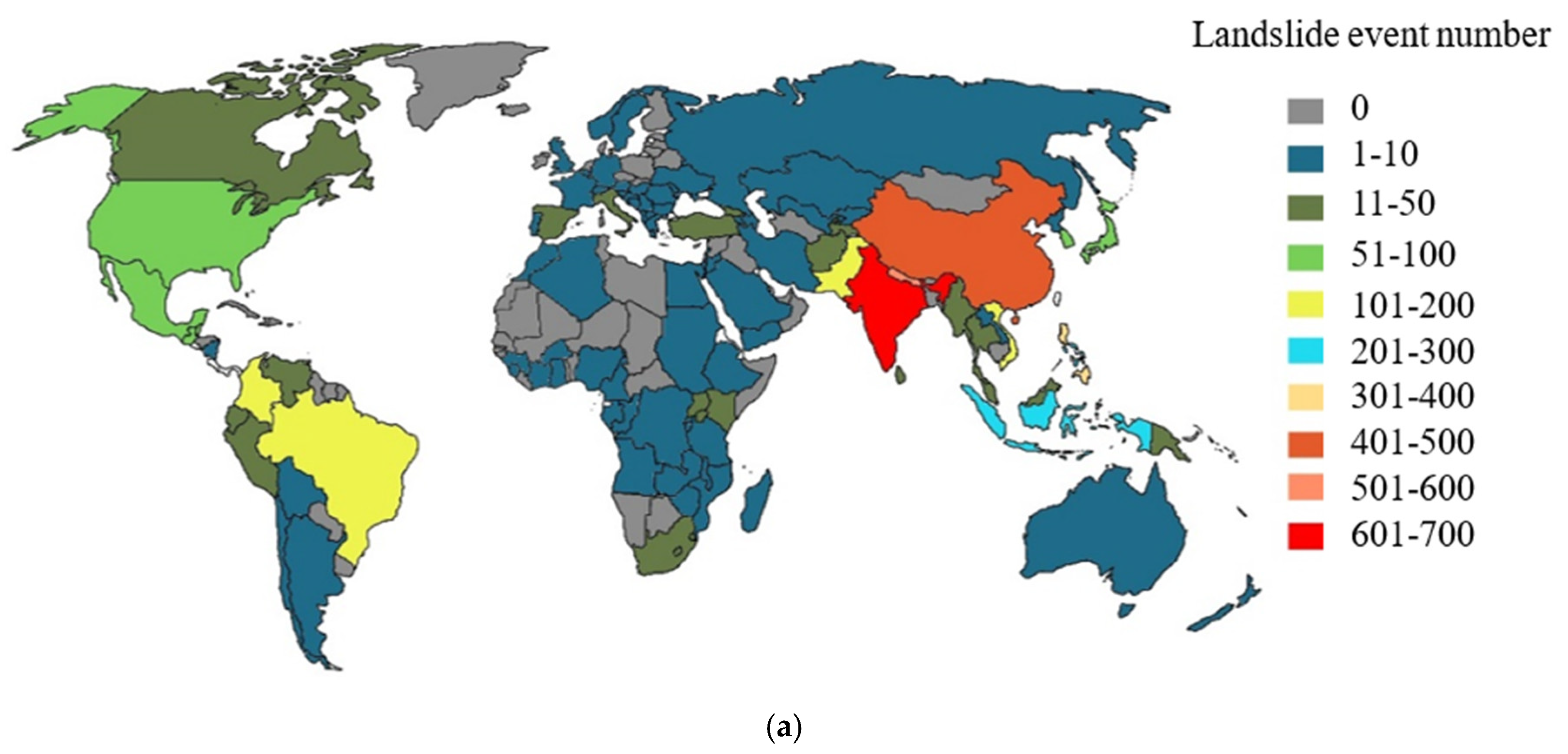
Figure 1. Global overview of the landslide occurrences with fatalities. (a) Fatal non-seismic landslides by country for the period 2004–2016, reproduced from Froude and Petley [3]. (b) Global fatalities from landslides between 1 August and 31 December 2020, reproduced from the European Commission’s Directorate-General for European Civil Protection and Humanitarian Aid Operations (2022). Available online: https://reliefweb.int/map/world/global-overview-landslides-fatalities-1-august-31-december-2020 (accessed on 6 November 2025).
Water 17 03273 g001aWater 17 03273 g001b
Figure 2. Schematic representation of shallow rainfall-induced landslides. (Refer to Hungr et al. [6] for more information regarding different classifications of landslides.)
Water 17 03273 g002
Figure 3. Methodological flow for a systematic review.
Water 17 03273 g003
Figure 4. Methodological flow for scientometric analysis.
Water 17 03273 g004
Figure 5. Screening and selecting flow diagram: PRISMA.
Water 17 03273 g005
Figure 6. The total number of articles per year related to landslide prediction. The trend line is fitted with a second-degree polynomial. The regression equation is provided, where x represents the coded publication year (e.g., 23 for 2023) and y represents the annual number of articles.
Water 17 03273 g006
Figure 7. The top journals contributing to the field of landslide prediction.
Water 17 03273 g007
Figure 8. Top countries publishing in landslide prediction.
Water 17 03273 g008
Figure 9. Keyword mapping in landslide prediction weighted by occurrence.
Water 17 03273 g009
Figure 10. The 29 August 2018 landslides, above Fan Kam Road, Pat Heung, Hong Kong [44] (courtesy of Geotechnical Engineering Office HKSAR; used with permission).
Water 17 03273 g010
Figure 11. Classification framework for landslide prediction models, showing the focus of this study. The models marked with ** are addressed in the previously published Part II [19].
Water 17 03273 g011
Figure 12. Intensity–Duration (I-D) rainfall thresholds.
Water 17 03273 g012
Figure 13. Rainfall pattern with effective cumulative rainfall for different non-rainfall periods (D).
Water 17 03273 g013
Figure 14. Predictive performance of rainfall thresholds: a comparison of accuracy (AUC) and false positive rate (FPR): (a) various triggering features; (b) a modified API versus ID model.
Water 17 03273 g014
Figure 15. Threshold classification for landslide prediction.
Water 17 03273 g015
Figure 16. Landslide displacement prediction process.
Water 17 03273 g016
Figure 17. Systematic approach to landslide displacement prediction.
Water 17 03273 g017
Figure 18. The relationship among rainfall events, surface displacement, and groundwater level with time.
Water 17 03273 g018
Figure 19. Accelerated deformation stage.
Water 17 03273 g019
Figure 20. Overview of AI methodologies for landslide displacement prediction.
Water 17 03273 g020
Figure 21. Mutational and creep displacement points.
Water 17 03273 g021
Figure 22. Trend and periodic displacement change according to a rainfall event (the legend for this figure is depicted in Figure 21).
Water 17 03273 g022
Figure 23. Absolute error values versus different sampling ratios.
Water 17 03273 g023
Figure 24. Comparison between different models’ accuracy according to RMSE.
Water 17 03273 g024
Figure 25. Comparison between different creep models’ accuracy.
Water 17 03273 g025
Figure 26. Comparison between different periodic models’ accuracy.
Water 17 03273 g026
Figure 27. GR4J model.
Water 17 03273 g027
Figure 28. The coupled hydrological-slope instability model.
Water 17 03273 g028
Figure 29. Graphical summary for landslide prediction strategies [19].
Water 17 03273 g029
Table 2. The top journals contributing to landslide prediction research: Ranked by document and citation counts (No.).
No.SourceDocuments (No.)Citations (No.)Total Strength Link
1Landslides3241951190
2Engineering Geology191414733
3Bulletin of Engineering Geology and the Environment11317625
4Applied Sciences (Switzerland)11178354
5Géotechnique86117142
6Geotechnical and Geological engineering7173330
7Sustainability (Switzerland)776253
8Journal of Hydrology61456396
9Geoenvironmental disaster5404405
10stochastic environmental research and risk assessment5290172
Table 3. The top five prominent and publishing countries relevant to landslide prediction.
CountryDocumentsCitationsTotal Link Strength
China7738967348
Italy3050075622
United States2651462963
United Kingdom2062992623
Japan1123512098
Table 6. Identified research gaps and corresponding recommendations.
GapRecommendations
High false-positive rates in I-D thresholds due to two primary oversights: (1) the influence of infiltration capacity and subsurface hydrology, and (2) the role of slope-specific properties (e.g., geometry, geotechnical parameters).1. Conduct field experiments to quantitatively establish the relationship between rainfall, evaporation, infiltration, and surface runoff.
2. Perform sensitivity analyses to identify the dominant physical parameters, enabling the development of refined I-D thresholds that retain simplicity while improving accuracy.
Over-reliance on surface displacement data in physically based models, which fails to capture sudden failure mechanisms driven by subsurface processes (e.g., deep-seated displacement, tilting, suction stress, groundwater fluctuations).Develop and deploy comprehensive subsurface monitoring systems to create high-resolution datasets. These datasets should be used to train hybrid AI models capable of predicting complex, nonlinear landslide mechanisms and precursor signals of sudden failure [113,114].
Inadequate consideration of practical field constraints, including data loss from sensor failure in harsh environments and limitations imposed by telecommunication data rates.Implement robust data validation and gap-filling techniques. Furthermore, conduct sensitivity analysis to optimize the trade-off between data transmission rates, model complexity, and prediction reliability under realistic operational constraints.
Disclaimer/Publisher’s Note: The statements, opinions and data contained in all publications are solely those of the individual author(s) and contributor(s) and not of MDPI and/or the editor(s). MDPI and/or the editor(s) disclaim responsibility for any injury to people or property resulting from any ideas, methods, instructions or products referred to in the content.