

You are currently viewing a new version of our website. To view the old version click .

Water, Volume 17, Issue 1

January-1 2025 - 133 articles

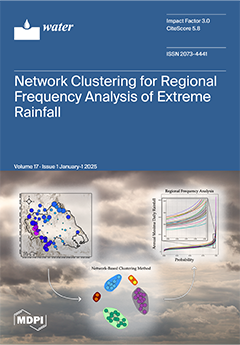
Cover Story: This study addresses uncertainty in Regional Frequency Analysis (RFA) by proposing a method to identify statistically homogeneous regions. Annual maxima daily records from 55 meteorological stations and several covariates are used in an iterative clustering process based on network theory. The stations are linked by their co-occurrence frequency to create the network, and communities are formed by maximizing modularity. RFA is applied to these communities using L-moment theory, with quantile uncertainty assessed via parametric bootstrapping. The results show that network-based clustering ensures homogeneous regions, as demonstrated in Thessaly’s complex terrain. View this paper
  • Issues are regarded as officially published after their release is announced to the table of contents alert mailing list .
  • You may sign up for email alerts to receive table of contents of newly released issues.
  • PDF is the official format for papers published in both, html and pdf forms. To view the papers in pdf format, click on the "PDF Full-text" link, and use the free Adobe Reader to open them.

Articles (133)

  • Article
  • Open Access
2,167 Views
13 Pages

6 January 2025

This study estimated the economic value of international fisheries observer programs for Korean distant water fisheries using the contingent valuation method (CVM). The model included economic factors, socio-demographic variables, and proxy variables...

  • Article
  • Open Access
3 Citations
1,723 Views
18 Pages

Non-Point Source Pollution Risk Assessment in Karst Basins: Integrating Source–Sink Landscape Theory and Soil Erosion Modeling

  • Senhua Hu,
  • Yongqiong Yang,
  • Jingan Chen,
  • Wei Yu,
  • Xia Huang,
  • Jia Lu,
  • Yun He,
  • Yeyu Zhang,
  • Haiquan Yang and
  • Xiaorong Xu

6 January 2025

Non-point source pollution poses a significant threat to global water security, and risk assessment and key source area (CSA) identification are critical for its management. While source–sink landscape models are widely used for non-point sourc...

  • Article
  • Open Access
3 Citations
2,084 Views
13 Pages

6 January 2025

Using allelochemicals produced by submerged plants to inhibit algal growth is an environmentally friendly approach to controlling harmful algal blooms in eutrophic lakes. This study aimed to evaluate the inhibition of cyanobacterial growth by alleloc...

  • Article
  • Open Access
2 Citations
3,335 Views
14 Pages

Comparative Analysis of Volumetric Mass Transfer Coefficients for Oxygen Uptake and Desorption with Nanobubbles

  • Laura Arias-Torres,
  • Javier Silva,
  • Rodrigo Ortiz,
  • Carlos Carlesi and
  • Germán Aroca

6 January 2025

The volumetric mass transfer coefficients (kLa) of oxygen during sorption and desorption were analyzed using nanobubbles (NBs) of air and pure oxygen under various experimental conditions. The results showed that oxygen NBs achieved an increase in di...

  • Article
  • Open Access
1,477 Views
15 Pages

6 January 2025

Sustainable Development Goal 6.1 calls for the development of technologies to improve water quality for human consumption to ensure that there is clean drinking water for everyone by 2030. This study aims to contribute to the goal by synthesizing Ce/...

  • Article
  • Open Access
2 Citations
3,976 Views
26 Pages

A Methodology Based on Random Forest to Estimate Precipitation Return Periods: A Comparative Analysis with Probability Density Functions in Arequipa, Peru

  • Johan Anco-Valdivia,
  • Sebastián Valencia-Félix,
  • Alain Jorge Espinoza Vigil,
  • Guido Anco,
  • Julian Booker,
  • Julio Juarez-Quispe and
  • Erick Rojas-Chura

6 January 2025

Precipitation within specific return periods plays a crucial role in the design of hydraulic infrastructure for water management. Traditional analytical approaches involve collecting annual maximum precipitation data from a station followed by the ap...

  • Article
  • Open Access
3 Citations
2,605 Views
12 Pages

5 January 2025

The ubiquitous presence of phenolic compounds in effluents poses a risk to aquatic organisms and human health. This study investigates the responses of the emerging algal-bacterial granular sludge process in treating phenolic wastewater. The results...

  • Article
  • Open Access
2,163 Views
30 Pages

A Versatile Workflow for Building 3D Hydrogeological Models Combining Subsurface and Groundwater Flow Modelling: A Case Study from Southern Sardinia (Italy)

  • Simone Zana,
  • Gabriele Macchi Ceccarani,
  • Fabio Canova,
  • Vera Federica Rizzi,
  • Simone Simone,
  • Matteo Maino,
  • Daniele D’Emilio,
  • Antonello Micaglio and
  • Guido Bonfedi

5 January 2025

This research project aims to develop a basin-scaled 3D hydrogeological model by using Petrel E&P (Petrel 2021©) as the basis for a numerical groundwater flow model developed with “ModelMuse”. A relevant aspect of the project is...

  • Article
  • Open Access
1 Citations
1,537 Views
21 Pages

Soil–Plant Carbon Pool Variations Subjected to Agricultural Drainage in Xingkai Lake Wetlands

  • Wei Wang,
  • Lianxi Sheng,
  • Xiaofei Yu,
  • Jingyao Zhang,
  • Pengcheng Su and
  • Yuanchun Zou

5 January 2025

This study examines the responses of soil organic carbon (SOC) pools and their components to agricultural water drainage in paddy fields, with a focus on the wetland–paddy field ecotone of Xingkai Lake, a transboundary lake shared by China and...

  • Article
  • Open Access
3 Citations
1,636 Views
26 Pages

4 January 2025

Sand mining significantly impacts heavy metal pollution in aquatic ecosystems. However, uncertainties in measured heavy metal concentrations in sediments caused by sand mining activities are unavoidable. To address this, a fuzzy potential ecological...

of 14

Get Alerted

Add your email address to receive forthcoming issues of this journal.

XFacebookLinkedIn
Water - ISSN 2073-4441