


Abstract
Brake dust (BD) generated by vehicle braking systems, including those of cars and trains, contains various Potentially Toxic Elements (PTEs) that may pose risks to human health and the environment, particularly in soils where it accumulates. This study aims to evaluate differences in the chemical composition of BD emitted by road and railway transport, to analyze its deposition mechanisms in soil, and to estimate the associated carcinogenic (CR) and non-carcinogenic (HQ) risks from ingestion and dermal exposure. Two sites were selected: one adjacent to a busy roadway and the other near a railway line. At both locations, soil-sampling transects were established perpendicular to the emission sources at distances of 3, 6, 15, 25, and 45 m. Elemental concentration analyses were integrated with magnetic measurements, which are selective for magnetic iron oxide particles. The results confirm elevated concentrations of several metals at both sites. Both elemental and magnetic data reveal a clear deposition gradient, with the highest accumulation within 15 m of the source, followed by a gradual stabilization up to 45 m. However, the railway site exhibited significantly higher concentrations than the road site, highlighting the relevance of non-exhaust emissions (NEEs) from railway traffic, which remain poorly investigated. While HQ was non-significant, CR associated with Pb-, Ni-, and As-rich BD exceeded acceptable threshold values, particularly for ingestion exposure at the railway site. These results highlight the significance of NEEs from rail traffic in terms of soil contamination and risk assessment.
1. Introduction
In urban contexts, vehicular traffic is a significant source of air pollution, primarily due to fuel combustion, and brake and tire wear [1].
Exhaust emissions (EEs) result from fuel oxidation and lubricant volatilization during the combustion process. In contrast, non-exhaust emissions (NEEs) are generated by brake and tire wear, road dust resuspension, and rail transport (including trains, trams, and underground trains) [2]. Among NEEs, the abrasion of braking systems produces ultrafine, fine, and coarse particles (BD): it is estimated that 21% of total PM10 emissions from traffic in urban environments originate from brake wear particles [3].
BD contains high concentrations of Potentially Toxic Elements (PTEs), including Fe, Pb, Cu, Zn, Sb, Sn, Al, Mg, Si, Cr, Ti, K, W, Ni, Zr, Ba, S, C, P, F, Mn, and Bi, which can have serious adverse effects on the health of living organisms [4]. NEEs are expected to increase in the future due to vehicle electrification, which makes cars heavier and requires more braking effort. Furthermore, there is currently no specific legislation to limit BD emissions from transport [5].
In 1992, the EU introduced Euro standards for EEs, starting with Euro 1 (140 mg/km for diesel vehicles) and gradually reducing the limits up to Euro 6. For NEEs, however, no specific standards for monitoring and reducing emissions have been defined. Only with Regulation (EU) 2024/1257, known as Euro 7 and adopted on 24 April 2024, was the objective of limiting pollutant emissions from brakes introduced (EU Regulation 2024/1257) [6].
A type of BD that generates effects like those of vehicular traffic, but has been much less studied, comes from train braking systems, particularly when trains enter railway stations, where braking phases are concentrated. Only a few studies have analyzed BD emissions from trains in open urban environments and examined the characteristics of particles generated by railway components [7].
Most research on rolling stock traffic has focused on stagnant or quasi-stagnant areas, mainly subways and railway tunnels, or inside the vehicles themselves [8]. Studies on BD have primarily concentrated on the physical characteristics and atmospheric dispersion of particles through laboratory experiments (pin-on-disc tests and brake dynamometers) [7,8,9,10,11,12]. However, understanding the fate of these particles in real-world conditions is equally crucial and has been largely neglected. This lack of attention is problematic, as BD represents a significant environmental threat: once released into the atmosphere, particles of varying densities and aerodynamic diameters undergo deposition processes that determine their accumulation in soil. As a natural reservoir of contaminants and a key component for maintaining biodiversity and ecosystem services, soil is an essential but still poorly studied compartment regarding BD contamination, and information on the chemical composition of these particles remains fragmented.
Urban areas frequently face soil contamination from traffic-related heavy metals like Pb, Zn, Cd, and Cu [13]. Soil contamination from rail transport has received poor attention in the literature, but some studies indicated elevated levels of PTEs such as Fe, Mn, Sb, Sn, Cr, Ni, Pb, Cd, and V in soils adjacent to railway tracks, often impacting nearby crops [14,15,16,17]. These concentrations can reach extreme levels, as seen in Croatia, where Sb and Sn values were found to be 87 and 33 times higher than European limits [14], respectively, while other studies have documented Pb concentrations up to 50 µg·g−1 in the railway surrounding topsoil [16].
Monitoring soil contamination by PTEs is essential, as these elements are persistent, accumulate in food chains, and may migrate through soils toward groundwater [18]. In urban environments, BD represents a major source of NEEs, leading to the accumulation of PTE-enriched particles in surface soils along roads and railway corridors. Human exposure to PTEs in BD may occur not only through inhalation of resuspended particles but also through ingestion of BD-contaminated soils and dermal contact, exposure pathways that are particularly relevant for chronic, low-dose scenarios and vulnerable populations. These routes have been associated with adverse health outcomes, including cardiovascular and respiratory diseases, neurotoxicity, and increased carcinogenic (CR) and non-carcinogenic (HQ) risks, depending on elemental composition and bioavailability [19]. Despite this, health risks due to BD ingestion and dermal exposure remain less explored than the inhalation risk [20].
While road-traffic BD has been widely investigated, emissions from railway braking systems and their accumulation in adjacent soils are still poorly characterized. Consequently, this study aims to compare the chemical composition of BD derived from vehicular and rail traffic and to characterize its spatial deposition gradient in soils. Two soil-sampling transects were established: one along the Terni–Orte railway line and one near a high-traffic urban road adjacent to a roundabout. At both sites, soil samples were collected at distances of 3, 6, 15, 25, and 45 m from the emission sources for elemental and magnetic susceptibility analyses, to identify contamination levels, deposition patterns, and associated potential health risks.
2. Materials and Methods
2.1. Sampling Sites and Procedure
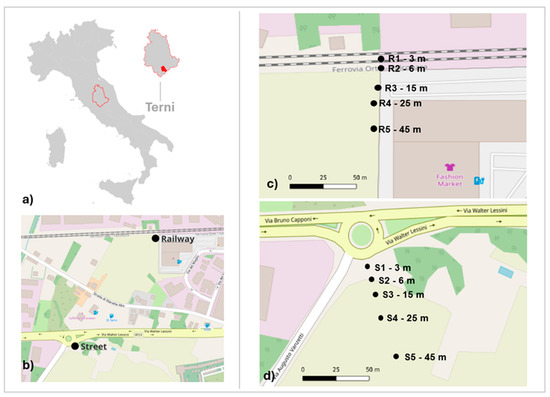
This study was conducted in Terni (42°34′ N; 12°39′ E), a city in central Italy, located in the southern part of the Umbria region (Figure 1a). The city lies within an intramountainous depression, extending across a broad plain surrounded by the Umbria–Marche Apennines and the Lazio Sub-Apennines. The municipal area covers 211.90 km2 and has approximately 106,000 inhabitants. Furthermore, the peculiar geomorphology of the Terni basin limits air circulation and the dispersion of atmospheric pollutants, especially during the frequent episodes of atmospheric stability in winter [21].
Figure 1.
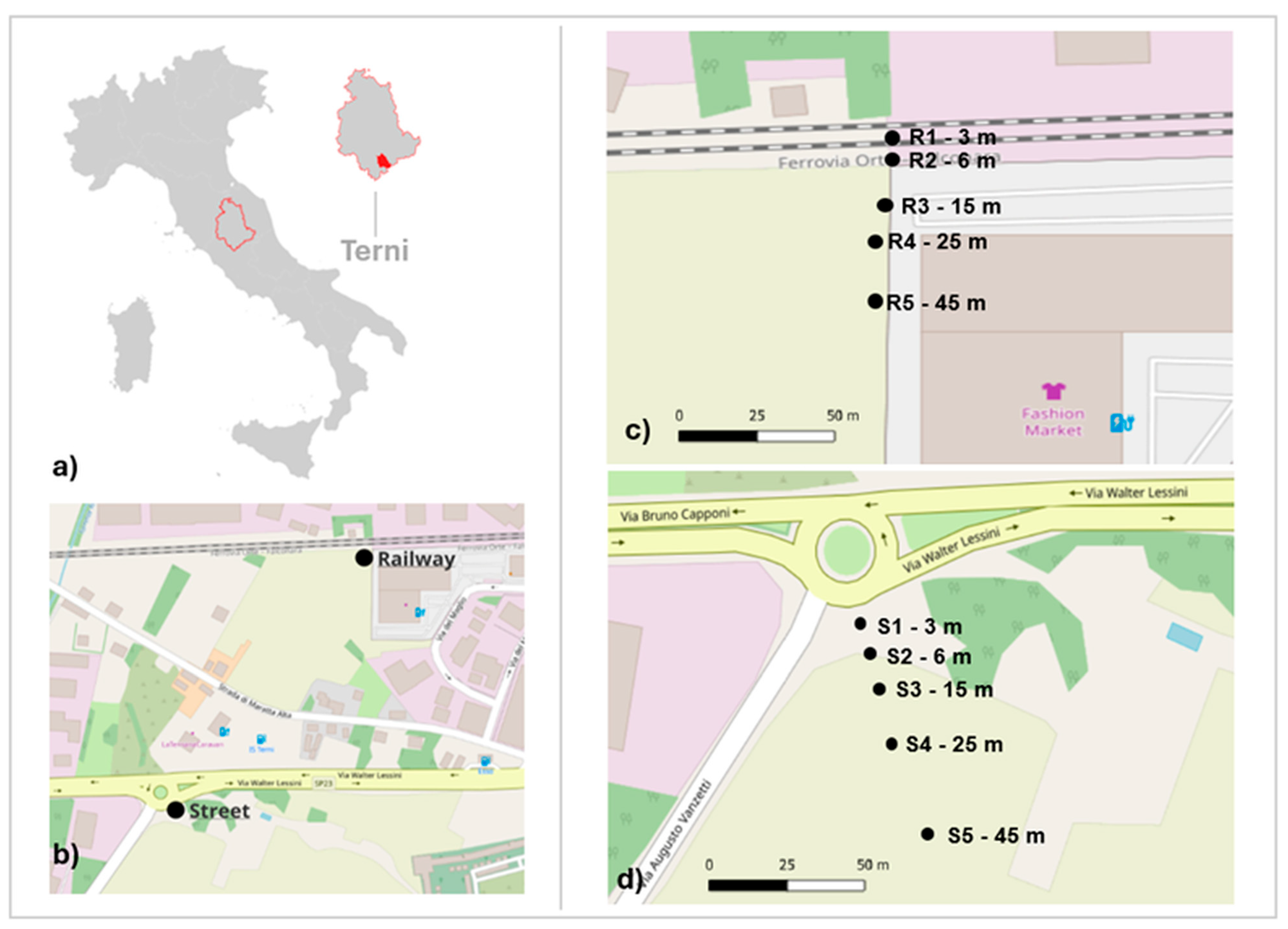
Maps of the sites: (a) geographic location of the study area; (b) map of the sampling sites; (c) map of the railway transect; (d) map of the street transect (QGIS 3.40.3-Bratislava).
To observe the differences between these two emission sources (vehicular and rail traffic) and to evaluate and compare the BD deposition gradient, two sites were selected: one near the Terni-Orte railway line, adjacent to the railway station (site R), and one near a busy street with heavy traffic, close to a roundabout (site S) (Figure 1b).
At both sites, sampling was carried out orthogonally to the emission source, selecting five sampling points located 3, 6, 15, 25, and 45 m from the emission sources to observe the BD deposition gradient. Both transects are oriented southwards, allowing a direct comparison of deposition patterns under similar meteorological conditions.
The first transect, consisting of five points (R1, R2, R3, R4, and R5), was conducted in a field near the tracks, adjacent to Terni station, specifically at the location where trains brake before entering the station (Figure 1c). Approximately 150 trains pass through Terni station daily, including regional and high-speed services. The station also handles cargo trains due to the presence of steelwork.
The second transect (S1, S2, S3, S4, and S5) was carried out close to a roundabout, along a high-traffic street (Figure 1d), and was located at an approximate straight-line distance of 500 m from the railway transect (Figure 1b). For each sampling site, three aliquots were collected within a 30 cm radius and subsequently pooled to obtain a single composite sample before homogenization.
2.2. Elemental Analysis
For elemental analysis, each soil sample was sieved using a mesh size of ≤2 mm, oven-dried (Binder Drying oven, model FED 056, Merck, Darmstadt, Germany) at 70 °C for 24 h, and homogenized using a ball mill (Powteq Micro Ball Mill GT300, Beijing Grinder Instrument Co., Ltd., Beijing, China) at 800 RPM for 20 min. Approximately 50 mg (three replicates) was weighed from each homogenized sample using an analytical balance with a sensitivity of 0.01 mg (Gibertini, model E45S/3, Novate Milanese (MI), Italy). The aliquots were subjected to chemical fractionation [22] to separate the soluble fraction from the insoluble one. This procedure provides useful information on the bioaccessibility of PTEs.
Each aliquot was extracted in 10 mL of deionized H2O (Arioso Water Purification System, Fulltech Instruments S.R.L., Rome, Italy) in a rotating shaker (Rotary laboratory shaker EW-07650 Series, Direct Industry Connect, Marseille, France) at 80 RPM for one hour. Subsequently, the samples were filtered using a vacuum pump (KNF Laboport® solid PTFE vacuum pump, Freiburg, Germany) on cellulose nitrate filters (NC filter; pore size 0.22 µm, Merck Millipore Ltd., Billerica, MA, USA).
To obtain the insoluble fraction, the filter was then subjected to microwave-assisted acid digestion (Milestone Ethos Plus, Portland, OR, USA) using 2 mL of HNO3 (65%, RPE, Ultrapure Carlo Erba, Rome, Italy) and 1 mL of H2O2 (30%, Suprapur, Merck, Darmstadt, Germany) in a 2:1 ratio, according to the standard method EN 14902:2005 for the elemental analysis of PM [23]. After digestion, the resulting solution was diluted to a final volume of 50 mL and filtered using cellulose nitrate syringe filters (NC filter; pore size 0.45 μm, Merck Millipore Ltd., Billerica, MA, USA).
The elemental concentrations of Ba, Bi, Cr, Cu, Fe, Mn, Mo, Ni, Pb, Sb, Sn, V, and Zn were quantified in both soluble and insoluble fractions using Inductively Coupled Plasma Mass Spectrometry with quadrupole mass detection (ICP-MS; PlasmaQuant MS Q, Analitik Jena, Jena, Germany), equipped with a glass pneumatic nebulizer (Analitik Jena, Jena, Germany). The limit of detection (LOD) for each element was set as the mean plus three times the standard deviation (SD) of six replicate blank determinations. The analytical performances of the procedure were evaluated by applying the procedure to the National Institute of Standards and Technology (NIST) Standard Reference Material® 1648a—Urban Particulate Matter (NIST1648a); (Supplementary Materials, Table S3). Recovery percentages (R%) were higher than 85% for all the elements except Cr (R% = 41%), and the percent relative standard deviation was lower than 15% for all the elements. It is worth noting that Cr concentrations may be underestimated due to the lower recovery values observed.
2.3. Statistical Analysis
To assess the presence of statistically significant differences between the two transects at each sampling point (3, 6, 15, 25, and 45 m), Student’s t-test (p < 0.05) was applied. As the data derive from analytical replicates (random error), a normal distribution was assumed. The same statistical approach was applied to magnetic susceptibility data to evaluate potential statistically significant differences between the two transects as a function of sampling distance (Supplementary Materials, Tables S4 and S5).
To investigate spatial deposition patterns, monotonic relationships between elemental concentrations and distance from the emission source were explored using Spearman’s rank correlation coefficient (ρ). Concentration data were log-transformed before correlation analysis to account for non-linear decay trends and heteroscedasticity.
All statistical analyses were performed separately for each element and for each transect and considered exploratory due to the limited sample size. Results were interpreted in a comparative and trend-based framework rather than as definitive inferential outcomes (Supplementary Materials, Table S6).
2.4. Magnetic Susceptibility Analysis
Magnetic minerals, such as iron oxides (e.g., magnetite and hematite) can be easily detected using magnetic measurements. Magnetic fractions, enriched in trace metals (e.g., Zn, Cd, Pb, Cu, Cr, Sb, and Ba), derive mainly from vehicle brake wear and combustion processes.
The evaluation of magnetic properties enables the characterization of the magnetic component present in the analyzed samples, thanks to the method’s selectivity for magnetic iron oxide particles.
Among the magnetic measurements, magnetic susceptibility (χ) is one of the most commonly determined parameters, indicating the ability of a material to become magnetized under the influence of a magnetic field, and is a proxy of the concentration of magnetic particles [24].
In the present study, soil samples from both transects were subjected to magnetic susceptibility analysis. The analyses were conducted by the Institute of Geophysics and Volcanology (INGV) at the Palaeomagnetism Laboratory. The soil samples were oven-dried at 40 °C and placed in standard 8 cm3 palaeomagnetic plastic cubes for analysis.
The mass magnetic susceptibility (χ) was determined using an Agico KLY5 meter (AGICO s.r.o., Brno, Czech Republic) by applying a magnetic field of 400 A/m at 1220 Hz. The magnetic susceptibility was calculated as the average of five measurements.
2.5. Health Risk Assessment
Health risks associated with exposure to PTEs in BD-contaminated soils were evaluated by estimating CR and HQ through ingestion and dermal contact pathways. These exposure routes are particularly relevant for BD particles deposited in soils, which represent a long-term reservoir of contaminants and a potential source of chronic, low-dose human exposure, especially in urban contexts. In contrast to previous studies focused on inhalation exposure to PTEs in PM10 [22], inhalation risk was not evaluated due to a lack of site-specific airborne size distribution and resuspension parameters. The risk assessment to ingestion and dermal exposure followed guidelines from the U.S. Environmental Protection Agency (U.S. EPA) for contaminated soils [25,26,27,28]. Risk calculations were performed using standard exposure parameters recommended by the U.S. EPA. Element-specific reference doses (RfDs) and cancer slope factors (CSFs) were obtained from the Integrated Risk Information System (IRIS). Currently, no harmonized European methodology is available for the quantitative assessment of CR and HQ through soil ingestion and dermal exposure pathways. Existing European guidelines mainly rely on concentration-based screening values and are not designed to estimate pathway-specific health risks. Therefore, both carcinogenic and non-carcinogenic risks in this study were assessed using the U.S. EPA human health risk assessment, which provides a transparent and quantitative approach supported by established toxicity parameters and is widely adopted in the European scientific literature for comparative and exploratory risk assessments.
The average daily dose via soil ingestion (ADDing, mg·kg−1·day−1) was calculated as follows:
where C is the concentration of the element in soil (mg·kg−1); IRing is the soil ingestion rate (mg·day−1); EF is the exposure frequency (days·year−1); ED is the exposure duration (years); CF is the unit conversion factor (10−6·kg·mg−1); BW is body weight (kg); and AT is the averaging time (days), equal to ED × 365 for HQ and 70 × 365 for CR.
The average daily dose via dermal contact (ADDderm, mg·kg−1·day−1) was estimated as follows:
where SA is the exposed skin surface area (cm2), AF is the soil adherence factor (mg·cm−2), ABS is the dermal absorption factor (dimensionless), and the remaining parameters are as defined above. The exposure parameters and reference values used for both pathways are reported in the Supplementary Materials (Tables S1 and S2).
CR represents the incremental probability of developing cancer over a lifetime due to exposure to carcinogenic PTEs and was calculated as follows:
where ADD refers to either ADDing or ADDderm, and CSF is the cancer slope factor ((mg·kg−1·day−1)−1) provided by the U.S. EPA.
In this study, CR was assessed only for As, Ni, and Pb, as these elements are classified as carcinogenic or potentially carcinogenic to humans according to U.S. EPA criteria. The total carcinogenic risk (TCR) at each sampling distance was calculated as the sum of the individual CR values for the selected PTEs and both exposure routes:
According to U.S. EPA guidelines, CR values between 1 × 10⁻⁶ and 1 × 10⁻⁴ indicate a potential carcinogenic risk, while values exceeding 1 × 10⁻⁴ represent an unacceptable risk level.
HQ was evaluated using the hazard quotient (HQ), defined as the ratio between the estimated exposure dose and the reference dose:
where RfD is the reference dose (mg·kg−1·day−1) for ingestion or dermal exposure. In this study, HQ was assessed for B, Ba, Be, Co, Cu, Mn, and Zn, selected based on their prevalence in BD and potential for chronic toxicity. The hazard index (HI), representing the cumulative non-carcinogenic risk, was calculated as the sum of HQs for all considered elements and both exposure pathways:
An HI value < 1 indicates no significant non-carcinogenic risk, whereas HI > 1 suggests potential adverse health effects.
3. Results and Discussion
3.1. Elemental Content
The results of the elemental chemical analyses refer to total concentrations, including both the soluble and insoluble fractions. Solubility percentages are very low for all analyzed elements, indicating that most of the elements are present in the insoluble fraction and are therefore poorly bioaccessible (Table 1 and Table 2).
Table 1.
Elemental concentrations (µg·g−1) in soils from all sampling points (S1–S5) along the street transect; values in brackets in italics indicate the standard deviation of the three analytical replicates.
Table 2.
Elemental concentrations (µg·g−1) in soils from all sampling points (R1–R5) along the railway transect; values in brackets in italics indicate the standard deviation of the three analytical replicates. The asterisk (*) indicates values significantly higher (p < 0.05; one-sample t-test) than the CSC.
The tables also report the Contamination Threshold Concentrations (CSCs) for green/residential land use, expressed in µg·g−1, as defined by Legislative Decree 152/2006, specifically Part IV, Title V, which regulates the remediation of contaminated sites, and framed within the broader European context outlined by Directive (EU) 2025/2360 on soil health [29,30].
Although the comparison is based on a limited number of sites, which may not fully capture the spatial variability of BD deposition in different urban configurations, the results of this study indicate the importance of rail traffic as a source of NEEs. Indeed, the chemical characterization carried out on soil samples revealed environmentally relevant concentrations of Ba, Bi, Cr, Cu, Fe, Mn, Mo, Ni, Pb, Sb, Sn, V, and Zn at both sampling sites (Table 1 and Table 2). However, site R shows significantly higher concentrations for all elements compared to site S (Student’s t-test, p < 0.05; Supplementary Materials, Table S4), with differences particularly consistent for key elements such as Fe, Mn, Cr, Pb, Zn, Cu, and Ba (Table 2). It is worth noting that some elements exceed the CSC value at points R1 (Cu, Pb, Sn, Cr, and Zn) and R2 (Cr and Sn), while only Sn approaches the CSC value at the S1 site. These results highlight the impact that railway traffic can have on the contamination of urban soils, emphasizing the need for adequate monitoring plans. In this context, previous studies have shown that the chemical analysis of road dust samples collected directly from urban streets and motorways revealed elevated concentrations of metals associated with NEEs [31]. PTEs such as Cu, Pb, Cr, Fe, and Ba were consistently enriched relative to low-traffic control sites. Similarly, it has been reported that average concentrations of heavy metals in urban road dust are generally higher than local geochemical background values, with mean concentrations of 109 µg·g−1 for Cr, 150 µg·g−1 for Cu, 239 µg·g−1 for Pb, 656 µg·g−1 for Zn, and 57 µg·g−1 for Ni [32], comparable with the concentrations measured in this study.
For most of the elements reported in the tables, a clear deposition gradient is observed, with concentrations decreasing sharply within the first 15 m from the emission source and then tending to stabilize between 15 and 45 m. Spearman correlation analysis indicated clear negative relationships between elemental concentrations and distance from the emission source for both transects (Supplementary Materials, Table S6). Along the street transect, most elements showed very strong monotonic decreases with distance (ρ up to −0.99), indicating progressive dilution away from the road. Along the railway transect, similarly strong negative correlations were observed for many elements (ρ ≈ −0.53 to −0.98), with particularly steep gradients for brake-wear-related elements such as Cr and Sb, and indicating pronounced near-source accumulation.
This trend is consistent with previous findings showing that Fe and Al particles exhibit a more rapid decrease in concentration between 10 and 36 m than in the 36–120 m range [33].
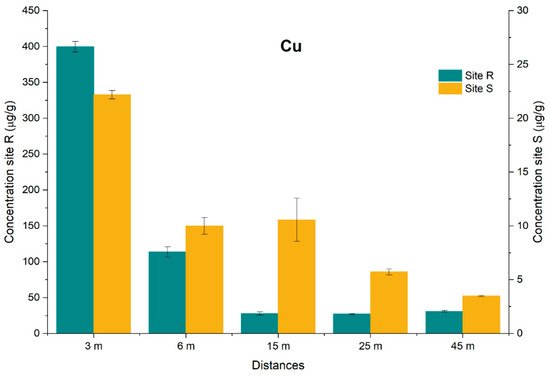
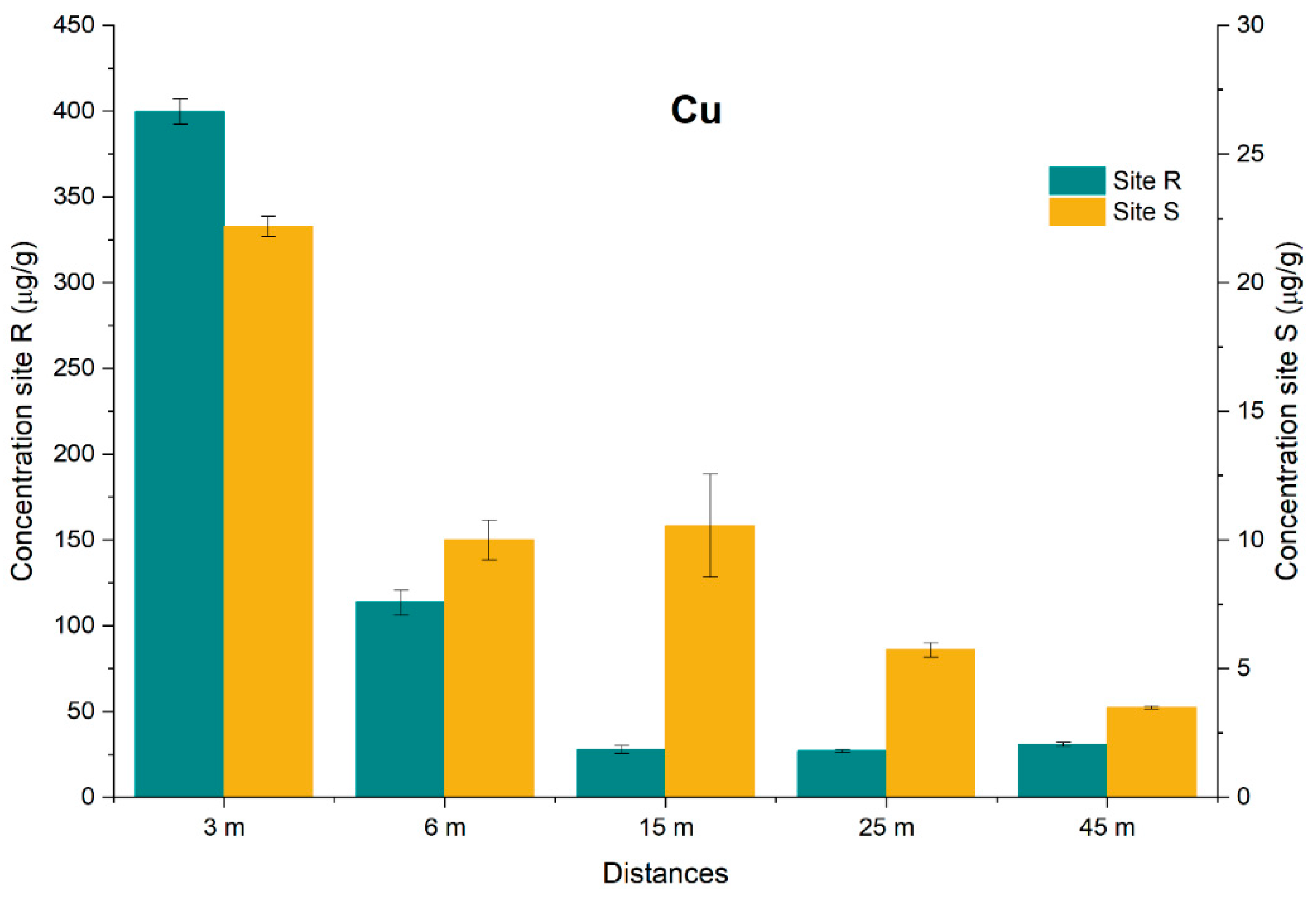
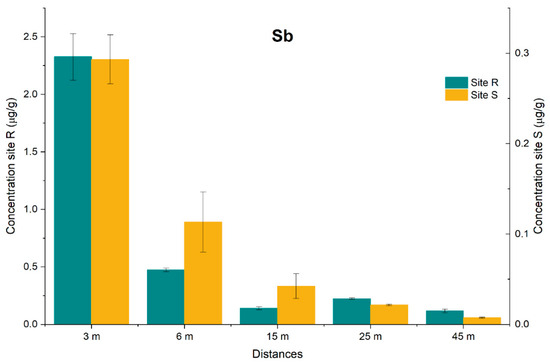
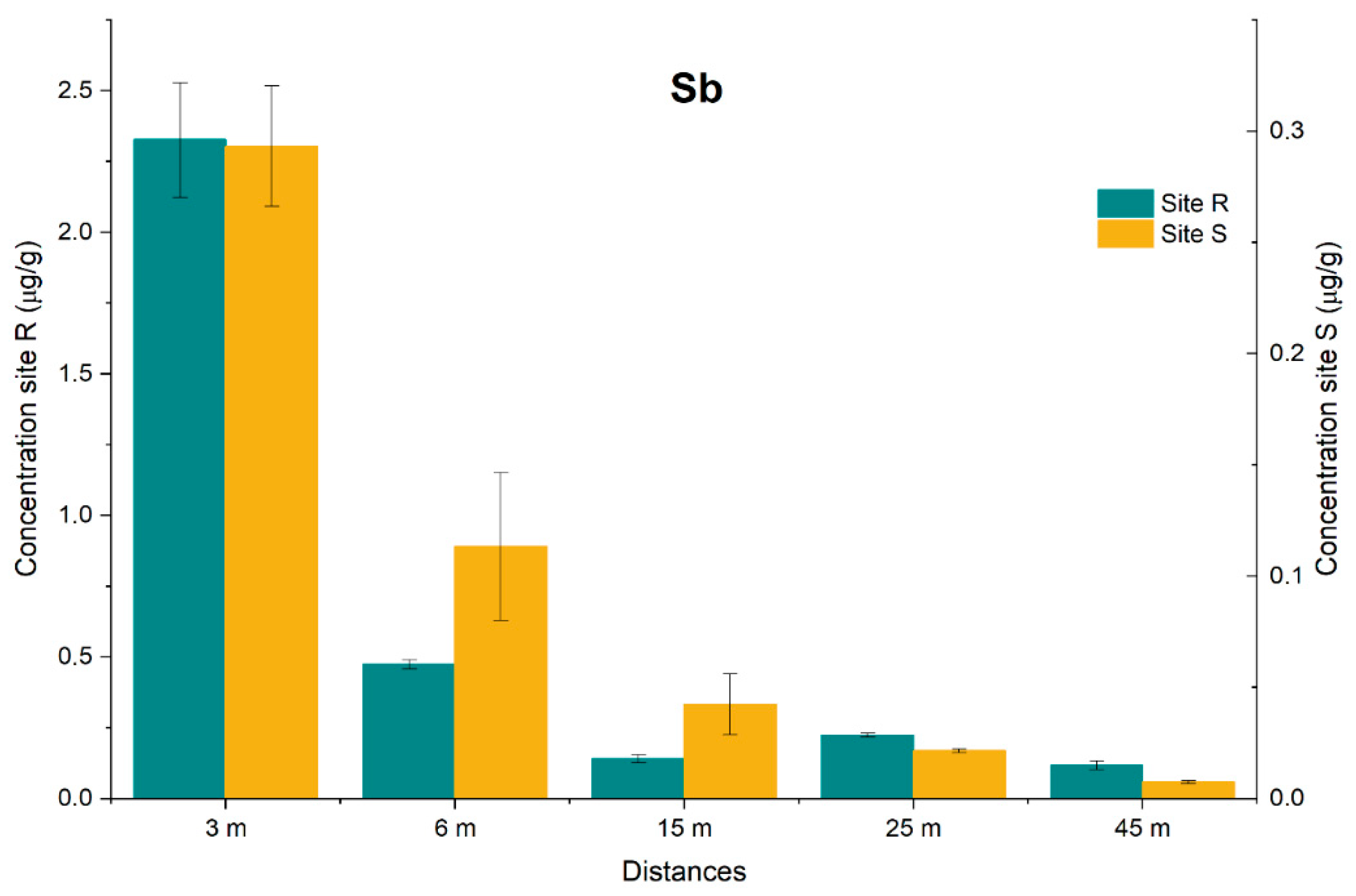
The following graphs show the concentrations of Cu and Sb, which are commonly used tracers of NEEs. As shown, the Cu and Sb concentrations at point R1 are significantly (p < 0.05) higher (Cu: 400 µg·g−1 ± 8; Sb: 2.3 µg·g−1 ± 0.2) compared to the first point (S1) of site S (Cu: 22.2 µg·g−1 ± 0.4; Sb: 0.29 µg·g−1 ± 0.03) (Figure 2 and Figure 3), again confirming increased deposition likely resulting from train braking operations.
Figure 2.
The total Cu concentration at site R (primary y-axis) and at site S (secondary y-axis) is shown for each point along the transect (x-axis). The values indicate the sum of the soluble and insoluble fractions.
Figure 3.
The total Sb concentration at site R (primary y-axis) and at site S (secondary y-axis) is shown for each point along the transect (x-axis). The values indicate the sum of the soluble and insoluble fractions.
These results complement the findings of previous atmospheric studies conducted in the urban context of Terni, which have emphasized the environmental relevance and health implications of BD associated with rail traffic. For instance, the CR and HQ related to exposure to PTEs in atmospheric PM10 were evaluated in a previous study, revealing that the contribution of train BD is significantly higher at sites adjacent to the Terni-Orte railway line compared to urban sites characterized by busy roads [20]. Similarly, the spatial distribution of atmospheric PM10 was analyzed using three oxidative potential (OP) assays (OPAA, OPDTT, and OPDCFH) across 23 urban and industrial sites. This study highlighted that values from the ascorbic acid assay (OPAA), which is particularly sensitive to transition metals from NEEs, are higher at sites close to the Terni-Orte railway station with respect to sites with high vehicular traffic [21].
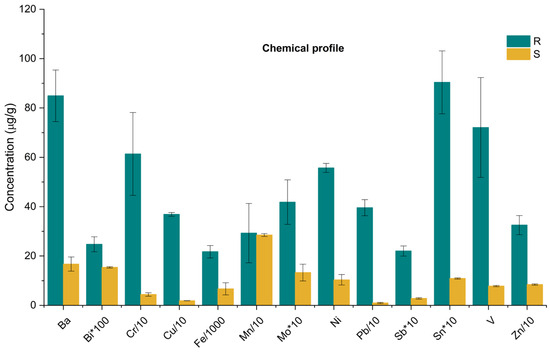
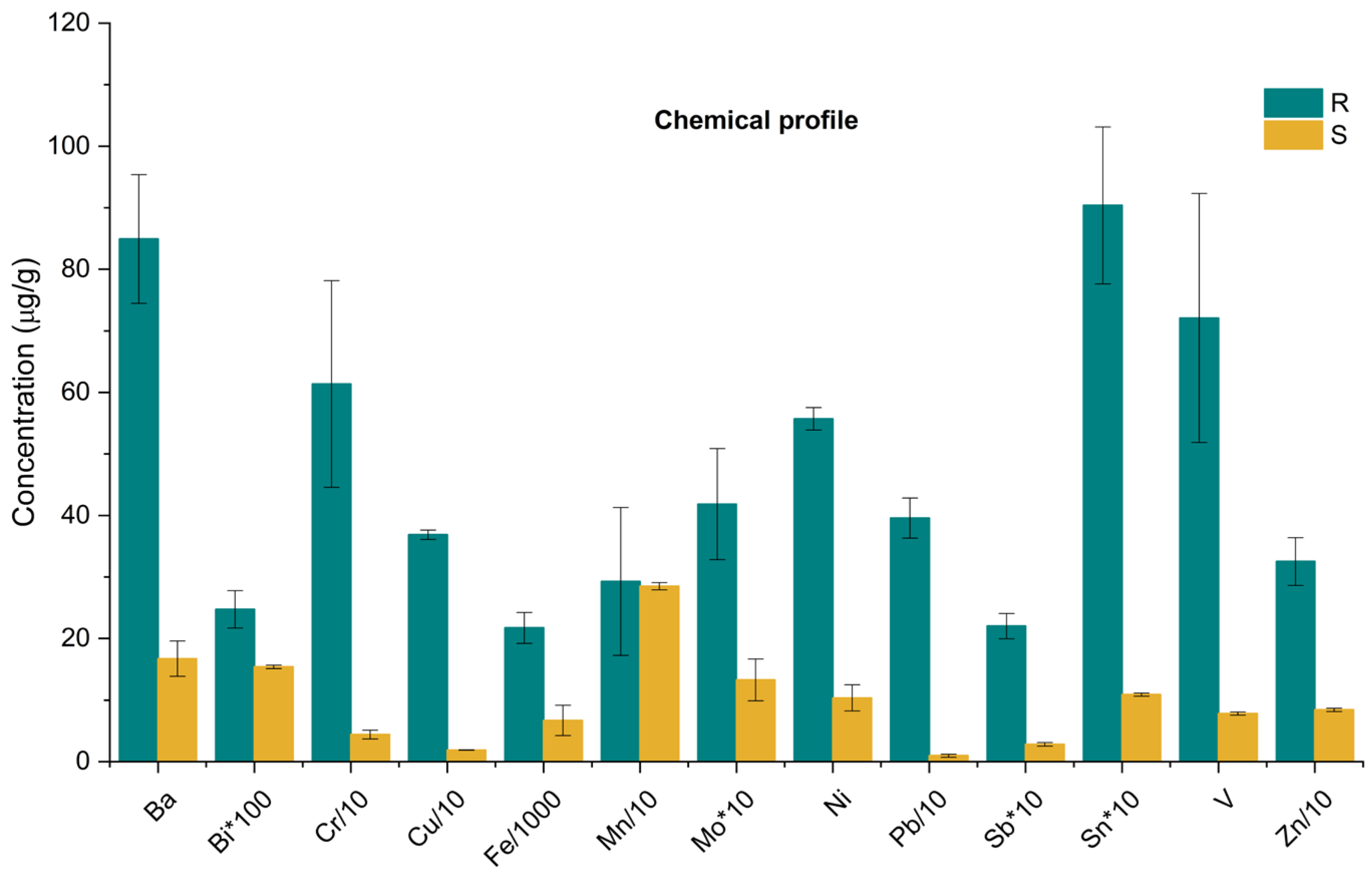
Figure 4 shows the chemical composition of the two emission sources. Reported values were calculated as the difference between concentrations measured at the closest (3 m) and the most distant (45 m) sampling points to represent the net contribution of each source. The associated standard deviations were calculated through error propagation, assuming independent measurement uncertainties. For each reported element, the concentrations were divided or multiplied by a specific factor, as indicated on the x-axis, to align them on the same y-axis scale. Although both emission sources share the same characteristic elements, their chemical profiles show clear disparities. Specifically, Pb, Cu, and Cr concentrations are markedly more abundant in the R chemical profile compared to the S profile. The differences between the two profiles can be attributed to the distinct compositions of the brake pads used in trains and cars, which employ different metallic materials depending on braking requirements and operating conditions.
Figure 4.
Chemical profiles at the two sites. Elemental concentrations were divided or multiplied by a specific factor, as indicated on the x-axis.
Rail traffic represents a complex source of particles and heavy metals; these particles vary in size and composition and often contain high concentrations of PTEs, including Fe, Cu, Zn, Mn, Ni, Cr, Sb, Sn, Co, Al, Ba, Mo, and Cd [11,12,34,35,36,37,38]. There are two main types of brake pads used for railway vehicles: organic and sintered (metal-based) [10,37]. Organic pads contain moderate amounts of Fe, Cu, Sb, Zn, Al, and Cr and are mainly used in regional trains. Sintered pads contain high amounts of Cu, Fe, Cr, Sb, Zn, Ti, and Ba and are usually employed in high-speed trains.
In cars, three main types of brake pads are used: asbestos-free organic (NAO), low-metallic (LM), and semi-metallic (SM) [36]. The use of NAO brake pads releases particles mainly composed of iron (35–45%, mainly coming from disk abrasion [38]), followed by Mg, Al, Si, S, K, Ca, Ti, Cu, Zn, Sn, and Ba, whereas LM pads release particles with higher concentrations of Fe (around 60%), followed by Mg, Si, Ca, Cu, Zn, Sn, and Mo [36].
3.2. Magnetic Susceptibility
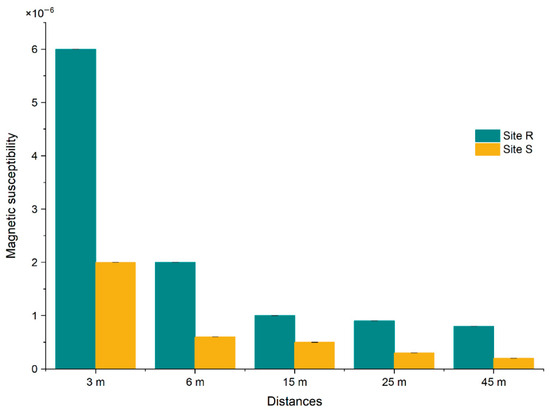
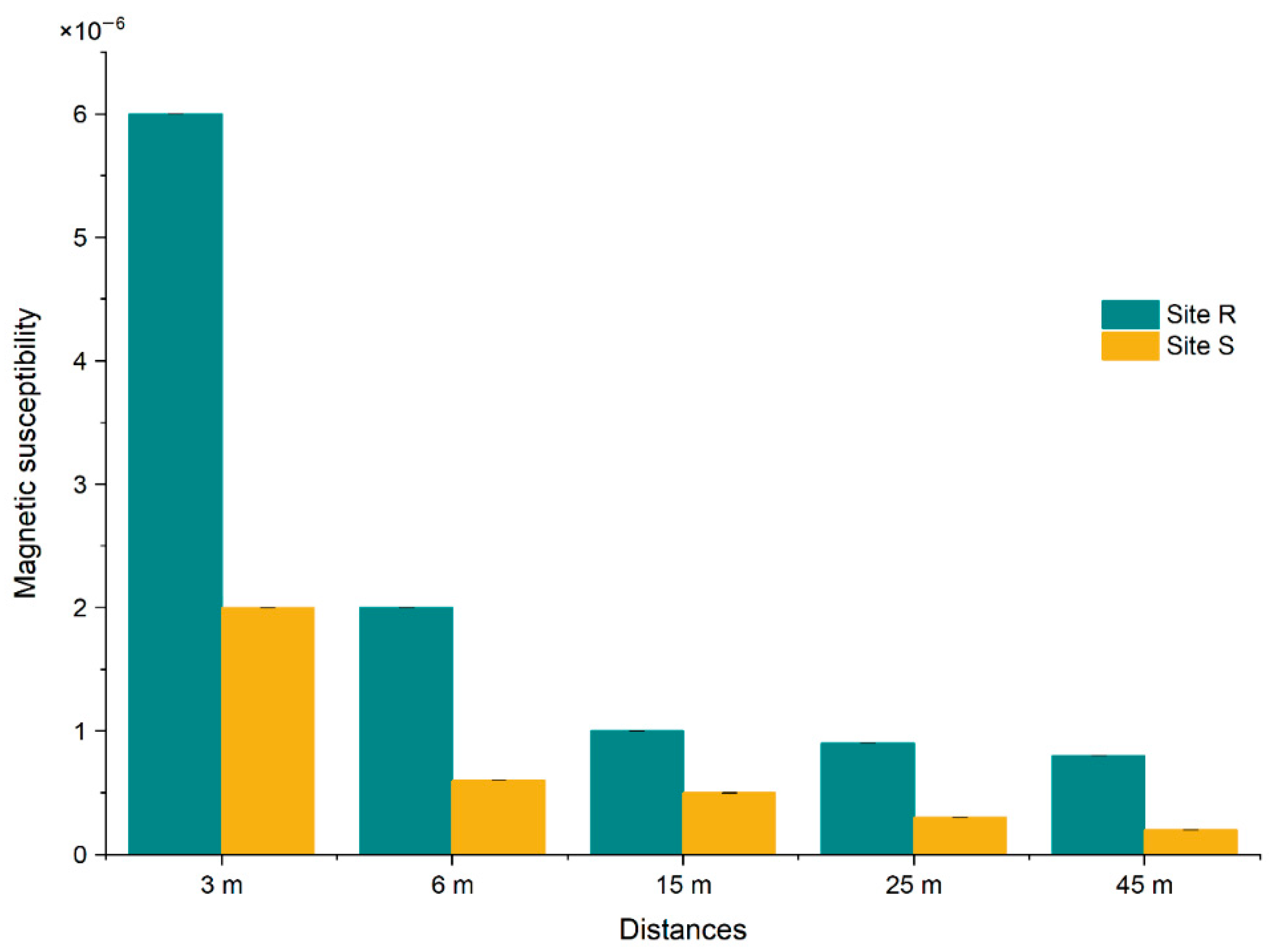
Soil samples from site R show higher magnetic susceptibility values than those from site S (Figure 5) at all sampling distances (Student’s t-test, p < 0.05; Supplementary Materials, Table S5). These results indicate a greater concentration of magnetic particles at site R.
Figure 5.
Comparison of magnetic susceptibility values (y-axis) and transect distances (x-axis) for both sites. Magnetic susceptibility is expressed in m3·kg−1 units.
The particles generated by braking friction typically contain magnetite (Fe3O4), an iron oxide capable of inducing oxidative stress in human lung cells and known for its high toxicity to living organisms [11]. Notably, particles originating from rail traffic appear to be more toxic than those from road traffic.
In a comparative study, the ability of particles collected in a metro station and along an urban road to induce DNA damage and oxidative stress was evaluated, showing that BD generated by rail systems is significantly more harmful: up to eight times more genotoxic and four times more likely to cause oxidative stress [39].
This highlights a serious risk to respiratory and cardiovascular health, particularly due to the presence of Fe in the form of hematite (Fe2O3) and magnetite (Fe3O4) [39].
Similarly to the elemental analysis, magnetic susceptibility shows a marked decrease between the first (3 m) and the third (15 m) sampling points, followed by a more gradual decrease up to 45 m, highlighting the progressive dispersion and dilution of magnetic particles in the soil. The more pronounced gradient at site R may primarily reflect the dominant contribution of magnetic particles generated by railway traffic, unlike site S, where the background shows greater influence. In Rome, it was previously found that χ values decrease to a magnetic background level 20–30 m away from high-traffic roads [40].
3.3. Carcinogenic and Non-Carcinogenic Risks
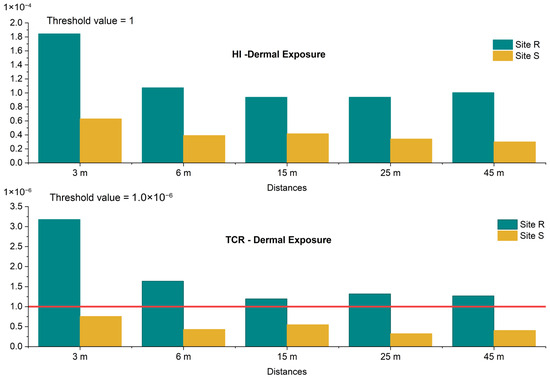
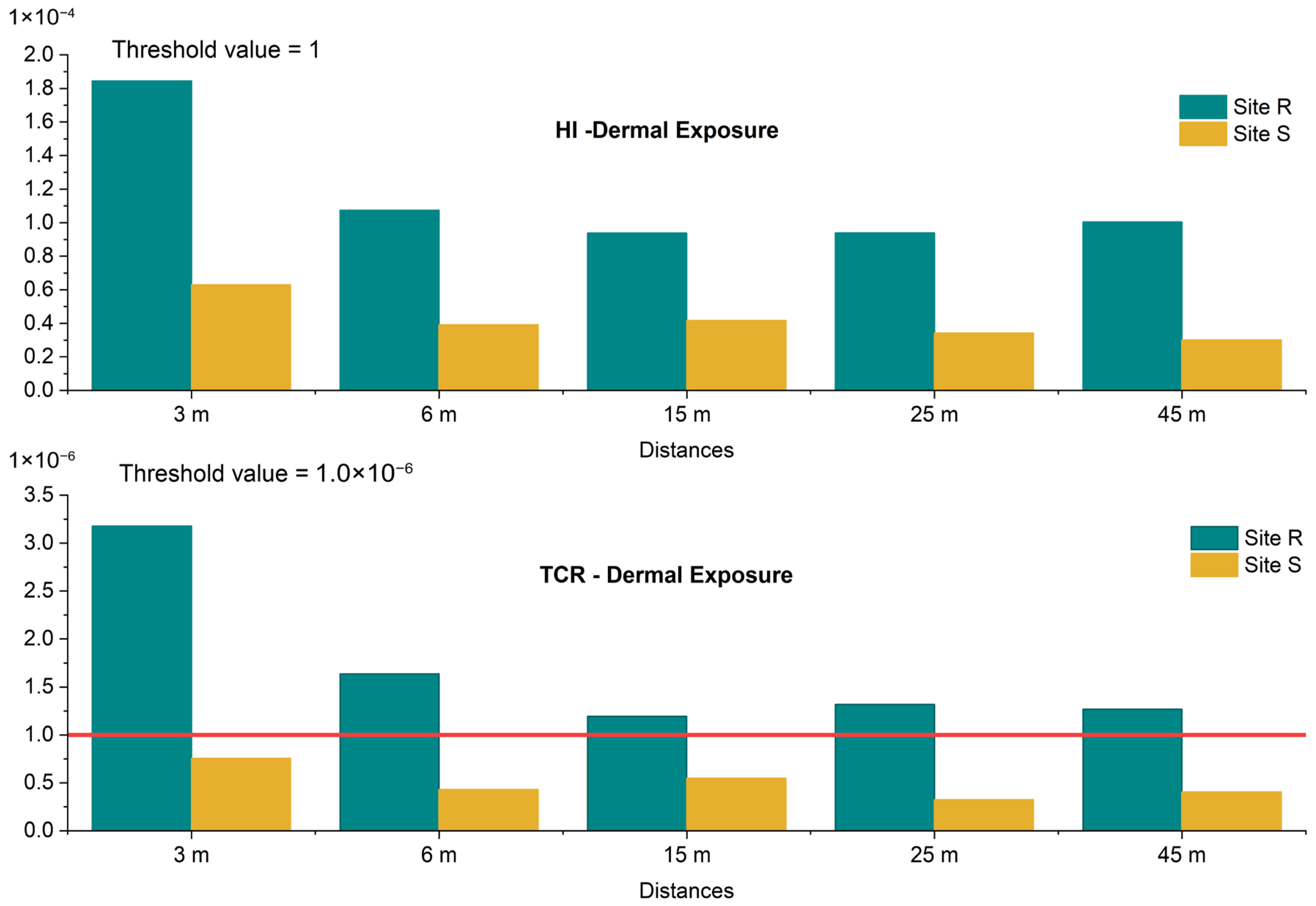
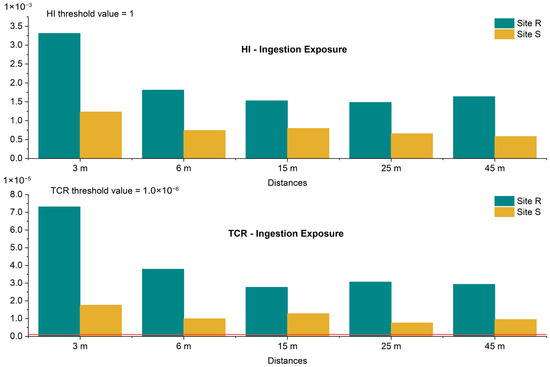
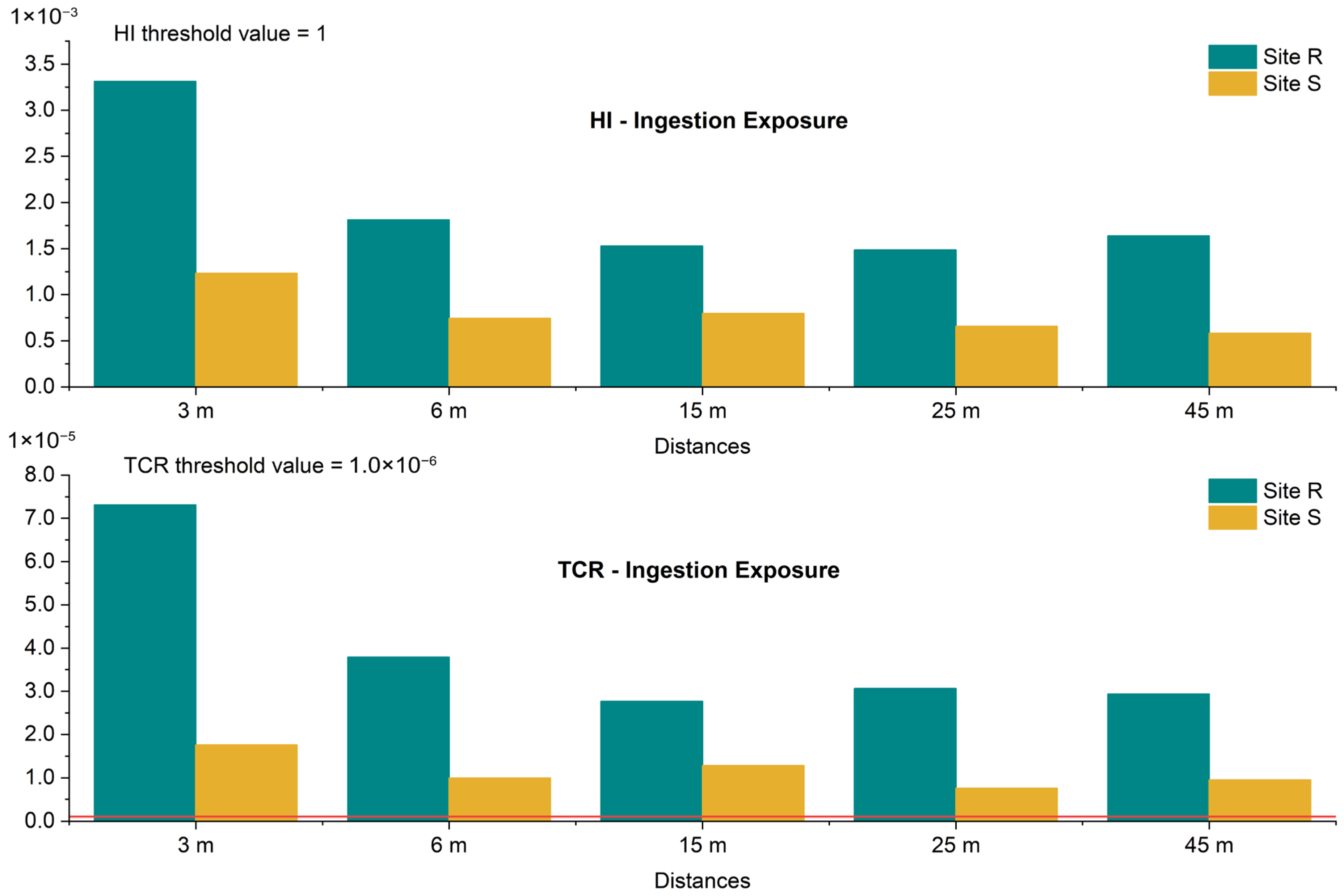
The assessment of CR and HQ associated with dermal and ingestion exposure to BD-contaminated soils highlights clear differences between exposure pathways, distances from emission sources, and NEE typologies (Table 3 and Table 4; Figure 6 and Figure 7). Overall, non-carcinogenic risk remained well below the threshold value of concern (HI < 1) for both exposure routes at all distances, whereas carcinogenic risk frequently exceeded the lower acceptable limit (10−6), particularly for ingestion exposure and at site R.
Table 3.
Dermal exposure-related carcinogenic (CR) and non-carcinogenic (HQ) risk values for PTEs in BD-contaminated soils at sites S and R, at different distances from the emission source. Individual element contributions are reported together with total carcinogenic risk (TCR) and cumulative non-carcinogenic risk (HI).
Table 4.
Ingestion exposure-related carcinogenic (CR) and non-carcinogenic (HQ) risk values for PTEs in BD-contaminated soils at sites S and R, at different distances from the emission source. Individual element contributions are reported together with total carcinogenic risk (TCR) and cumulative non-carcinogenic risk (HI).
Figure 6.
Hazard index (HI) and total carcinogenic risk (TCR) for dermal exposure at sites R and S at different distances (3, 6, 15, 25, and 45 m). The reference line indicates the regulatory threshold for carcinogenic risk associated with dermal exposure (TCR = 1.0 × 10⁻⁶).
Figure 7.
Hazard index (HI) and total carcinogenic risk (TCR) for ingestion exposure at sites R and S at different distances (3, 6, 15, 25, and 45 m). The reference line indicates the regulatory threshold for carcinogenic risk associated with ingestion exposure (TCR = 1.0 × 10⁻⁶).
For dermal exposure, TCR at site S ranged from 7.5 × 10⁻⁷ at 3 m to 4.0 × 10⁻⁷ at 45 m, remaining below the U.S. EPA acceptable threshold value. In contrast, site R showed consistently higher dermal TCR values, with a maximum of 3.2 × 10⁻⁶ at 3 m and values remaining slightly above 10−6 even at 45 m. These results indicate a potential CR limited to the railway site, mainly driven by Ni, with secondary contributions from As, while Pb played a negligible role. The decrease in TCR with distance from the track confirms the localized nature of BD deposition and the strong influence of braking intensity near the railway line.
Dermal non-carcinogenic risk was low at both sites, with HI values ranging from 3.5 × 10⁻⁵ to 7.5 × 10⁻⁵ at site S and from 1.2 × 10⁻⁴ to 2.1 × 10⁻⁴ at site R. Although higher HQ contributions were associated with Co and Mn, the cumulative HI remained several orders of magnitude below unity, indicating that adverse non-carcinogenic effects via dermal contact are unlikely under current exposure conditions.
A markedly different pattern emerged for ingestion exposure, which systematically produced higher risk estimates than dermal contact. At site S, ingestion TCR values ranged from 8 × 10⁻⁶ to 2 × 10⁻⁵, exceeding the 10−6 threshold at all distances, while remaining within the tolerable risk range (<10−4). At site R, ingestion TCR values were one order of magnitude higher, peaking at 7 × 10⁻⁵ at 3 m and remaining above 3 × 10⁻⁵ even at 45 m. As observed for dermal exposure, Ni was the dominant contributor to carcinogenic risk, followed by As, confirming ingestion as the most critical exposure pathway for PTEs in BD-contaminated soils.
Non-carcinogenic risk from ingestion exposure followed the same spatial and site-dependent trends. HI values at site S ranged between 7 × 10⁻⁴ and 2 × 10⁻³, while site R showed higher values (2 × 10⁻³–4 × 10⁻³), again dominated by Co and Mn. Despite being higher than dermal HI, these values remained well below the non-carcinogenic risk threshold value, suggesting no immediate concern for chronic toxic effects.
The consistently higher CR and HQ values observed at the railway site reflect the spatial concentration and frequency of braking events, which promote the accumulation of PTEs in BD deposited on adjacent soils. The finding that ingestion carcinogenic risk exceeded acceptable limits not only at the railway site but also along the street transect is particularly relevant in areas characterized by agricultural land use. Overall, the results show that NEEs, and particularly BD from rail traffic, represent a non-negligible source of soil contamination and associated health risk. While non-carcinogenic risk remained consistently below critical threshold values for both dermal and ingestion exposure, carcinogenic risk exceeded the lower acceptable limit, especially in proximity to the railway line and for the ingestion pathway. The strong decrease in risk with distance confirms the localized nature of BD deposition; however, the persistence of elevated carcinogenic risk values beyond the immediate emission zone highlights the role of soils as long-term reservoirs of PTEs from non-exhaust traffic NEEs. These findings indicate that exposure pathways other than inhalation can significantly contribute to human health risk and should be systematically included in assessments of BD emissions.
4. Conclusions
Most published studies to date have focused on the contribution of road traffic, often neglecting emissions originating from rail transport. The present study seeks to highlight that railway traffic may significantly contribute to urban pollutant loads, potentially exceeding the impact of road-based sources in urban environments. Despite its preliminary nature and being restricted to a comparison of only two sites, our study suggests that rail-related emissions warrant closer scrutiny in urban air quality management strategies. This study shows that rail traffic may represent a significant and often underestimated source of NEEs, contributing to higher concentrations of PTEs in BD deposited onto adjacent soils compared to heavy road traffic. The railway site exhibited elevated levels of key tracers such as Fe, Mn, Cr, Pb, Zn, Cu, and Ba, reflecting the intensive use of sintered metallic brake pads in trains relative to pads commonly used in vehicles. Elemental analyses combined with magnetic susceptibility measurements revealed well-defined deposition gradients, with maximum accumulation occurring within 15 m of the emission source and stabilization beyond this distance, particularly pronounced at the railway site. These results confirm magnetic susceptibility as a rapid, cost-effective proxy for assessing BD deposition and associated contamination.
Despite the limited spatial dispersion of BD, health risk assessment indicates that BD from NEEs, especially from railway braking systems, can lead to elevated carcinogenic risk in nearby soils through dermal and ingestion exposure pathways. While non-carcinogenic risk remains below levels of concern under current conditions, carcinogenic risk, mainly driven by Ni and As, exceeds acceptable threshold values, particularly near the railway line and for ingestion-related exposure. This highlights the role of soil as a long-term reservoir of contaminants and underscores the importance of considering chronic, soil-mediated exposure routes in addition to inhalation.
Overall, these findings emphasize the need to broaden current air-quality and risk-assessment frameworks beyond EEs and respirable particles, integrating non-exhaust sources, soil contamination, and long-term exposure pathways. Systematic monitoring and targeted mitigation strategies for railway-related BD emissions are therefore essential to adequately protect human health in urban and peri-urban environments. Further research should focus on long-term PTE accumulation, bioavailability, transfer to plants and groundwater, and the influence of brake pad materials and meteorological conditions on BD dispersion and environmental fate.
Supplementary Materials
The following supporting information can be downloaded at https://www.mdpi.com/article/10.3390/atmos17010114/s1, Table S1: Exposure parameters and reference values used for the calculation of carcinogenic and non-carcinogenic dermal risk (U.S. EPA); Table S2: Exposure parameters and reference values used for the calculation of carcinogenic and non-carcinogenic ingestion risk (U.S. EPA). Table S3: Elemental concentrations (sum of extracted and residual fractions) measured in the Standard Reference Material NIST 1648a. Recovery percentages (R%) relative to certified values and percent relative standard deviation (%RSD) calculated from six replicate measurements are reported. Table S4: p-values obtained from Student’s t-tests comparing elemental concentrations between sites S and R at each sampling point (S1–R1, S2–R2, etc.). Table S5: p-values obtained from Student’s t-tests comparing magnetic susceptibility values between sites S and R at each sampling point (S1–R1, S2–R2, etc.). Table S6: Spearman’s rank correlation coefficients (ρ) between log-transformed elemental concentrations and distance from the emission source for the S and R transects.
Author Contributions
Conceptualization, E.D.M., L.M., A.W. and S.C.; data acquisition, E.D.M., A.Z. and L.S.; data curation, E.D.M. and L.M.; writing—original draft preparation, E.D.M. and L.M.; writing—review and editing, L.M., A.W., A.C. and S.C.; supervision, L.M., A.C., A.M.P. and S.C. All authors have read and agreed to the published version of the manuscript.
Funding
This manuscript was produced as part of the Ph.D. program in Environmental and Evolutionary Biology, 38° Cycle, curriculum Ecology, at the Department of Environmental Biology, as part of the Ph.D. project entitled “Effects of mycoremediation on element mobility in contaminated soils”, in the context of the research project funded by National Recovery and Resilience Plan (NRRP), Mission 4 Component 2 Investment 1.4—Call for tender No. 3138 of 16 December 2021, rectified by Decree n.3175 of 18 December 2021 of Italian Ministry of University and Research funded by the European Union—NextGenerationEU; Award Number: Project code CN_00000033, Concession Decree No. 1034 of 17 June 2022 adopted by the Italian Ministry of University and Research, CUP B83C22002950007, Project title “National Biodiversity Future Center—NBFC”. The magnetic analyses were funded within the Project “Pianeta Dinamico” (Ministry of University and Research), research line 2023–2025 “CHIOMA”. LS work is within the PhD agreement between INGV and the University of Tor Vergata, Rome.
Institutional Review Board Statement
Not applicable.
Informed Consent Statement
Not applicable.
Data Availability Statement
The original contributions presented in this study are included in this article/its Supplementary Materials. Further inquiries can be directed to the corresponding author.
Conflicts of Interest
The authors declare no conflicts of interest.
References
- Bessagnet, B.; Allemand, N.; Putaud, J.P.; Couvidat, F.; André, J.M.; Simpson, D.; Pisoni, E.; Murphy, B.N.; Thunis, P. Emissions of carbonaceous particulate matter and ultrafine particles from vehicles—A scientific review in a cross-cutting context of air pollution and climate change. Appl. Sci. 2022, 12, 3623. [Google Scholar] [CrossRef] [Scilit]
- Abbasi, S.; Jansson, A.; Sellgren, U.; Olofsson, U. Particle emissions from rail traffic: A literature review. Crit. Rev. Environ. Sci. Technol. 2013, 43, 2511–2544. [Google Scholar] [CrossRef] [Scilit]
- Niemann, H.; Winner, H.; Asbach, C.; Kaminski, H.; Frentz, G.; Milczarek, R. Influence of disc temperature on ultrafine, fine, and coarse particle emissions of passenger car disc brakes with organic and inorganic pad binder materials. Atmosphere 2020, 11, 1060. [Google Scholar] [CrossRef] [Scilit]
- Vaccarella, E.; Lucchesi, V.; Canepari, S.; Massimi, L.; Bellini, R.; Porretta, D.; Mastrantonio, V. An in vivo assessment revealed multiple toxic effects of brake dust on the urban mosquito Aedes albopictus. Sci. Total Environ. 2025, 991, 179937. [Google Scholar] [CrossRef] [Scilit]
- Forest, V.; Pourchez, J. Biological effects of brake wear particles in mammalian models: A systematic review. Sci. Total Environ. 2023, 905, 167266. [Google Scholar] [CrossRef] [Scilit] [PubMed]
- European Union. Regulation (EU) 2024/1257 of the European Parliament and of the Council. Official Journal of the European Union. 2024. Available online: https://eur-lex.europa.eu/eli/reg/2024/1257/oj (accessed on 20 November 2025).
- Abbasi, S.; Jansson, A.; Olander, L.; Olofsson, U.; Sellgren, U. A pin-on-disc study of the rate of airborne wear particle emissions from railway braking materials. Wear 2012, 284–285, 18–29. [Google Scholar] [CrossRef] [Scilit]
- De Falco, G.; Russo, G.; Ferrara, S.; De Soccio, V.; D’Anna, A. Sustainable design of low-emission brake pads for railway vehicles: Experimental characterization. Atmos. Environ. X 2023, 18, 100215. [Google Scholar] [CrossRef] [Scilit]
- Neukirchen, C.; Saraji-Bozorgzad, M.R.; Mäder, M.; Mudan, A.P.; Czasch, P.; Becker, J.; Di Bucchianico, S.; Trapp, C.; Zimemann, R.; Adam, T. Comprehensive elemental and physical characterization of vehicle brake wear emissions from two different brake pads following the global technical regulation methodology. J. Hazard. Mater. 2025, 482, 136609. [Google Scholar] [CrossRef] [Scilit]
- Zhang, P.; Zhang, L.; Wei, D.; Wu, P.; Cao, J.; Shijia, C.; Qu, X. A high-performance copper-based brake pad for high-speed railway trains and its surface substance evolution and wear mechanism at high temperature. Wear 2020, 444–445, 203182. [Google Scholar] [CrossRef] [Scilit]
- Namgung, H.G.; Kim, J.B.; Woo, S.H.; Park, S.; Kim, M.; Kim, M.S.; Bae, G.N.; Park, D.; Kwon, S.B. Generation of nanoparticles from friction between railway brake disks and pads. Environ. Sci. Technol. 2016, 50, 3453–3461. [Google Scholar] [CrossRef] [Scilit]
- Abbasi, S.; Wahlström, J.; Olander, L.; Larsson, C.; Olofsson, U.; Sellgren, U. A study of airborne wear particles generated from organic railway brake pads and brake discs. Wear 2011, 273, 93–99. [Google Scholar] [CrossRef] [Scilit]
- Alloway, B.J. Sources of heavy metals and metalloids in soils. In Heavy Metals in Soils: Trace Metals and Metalloids in Soils and Their Bioavailability; Alloway, B.J., Ed.; Springer: Dordrecht, The Netherlands, 2013; pp. 11–50. [Google Scholar] [CrossRef] [Scilit]
- Stančić, Z.; Fiket, Ž.; Vuger, A. Tin and antimony as soil pollutants along railway lines—A case study from north-western Croatia. Environments 2022, 9, 10. [Google Scholar] [CrossRef] [Scilit]
- You, A.; Tang, J.; Shu, J.; Xiao, Y.; Ai, Y.; Liu, X.; Chen, Z. The impacts of soil properties and heavy metals on soil microbial communities in the artificial soils on railway rock-cut slopes. J. Soils Sediments 2023, 23, 1820–1831. [Google Scholar] [CrossRef] [Scilit]
- Vaiškūnaitė, R.; Jasiūnienė, V. The analysis of heavy metal pollutants emitted by railway transport. Transport 2020, 35, 213–223. [Google Scholar] [CrossRef] [Scilit]
- Safadoust, A.; Khaleghi, S.; Kolahchi, Z. Environmental risks of heavy metals in railway soils: Challenges to ecosystem management. Sci. Total Environ. 2025, 974, 179217. [Google Scholar] [CrossRef] [Scilit]
- Binner, H.; Sullivan, T.; Jansen, M.A.K.; McNamara, M.E. Metals in urban soils of Europe: A systematic review. Sci. Total Environ. 2023, 854, 158734. [Google Scholar] [CrossRef] [Scilit]
- Okorie, A.; Entwistle, J.; Dean, J.R. Estimation of daily intake of potentially toxic elements from urban street dust and the role of oral bioaccessibility testing. Chemosphere 2012, 86, 460–467. [Google Scholar] [CrossRef] [Scilit] [PubMed]
- Massimi, L.; Pietrantonio, E.; Astolfi, M.L.; Canepari, S. Innovative experimental approach for spatial mapping of source-specific risk contributions of potentially toxic trace elements in PM10. Chemosphere 2022, 307, 135871. [Google Scholar] [CrossRef] [Scilit] [PubMed]
- Massimi, L.; Ristorini, M.; Simonetti, G.; Frezzini, M.A.; Astolfi, M.L.; Canepari, S. Spatial mapping and size distribution of oxidative potential of particulate matter released by spatially disaggregated sources. Environ. Pollut. 2020, 266, 115271. [Google Scholar] [CrossRef] [Scilit]
- Canepari, S.; Cardarelli, E.; Giuliano, A.; Pietrodangelo, A. Determination of metals, metalloids and non-volatile ions in airborne particulate matter by a new two-step sequential leaching procedure: Part A: Experimental design and optimisation. Talanta 2006, 69, 581–587. [Google Scholar] [CrossRef] [Scilit]
- EN 14902:2005; Ambient Air Quality—Standard Method for the Measurement of Pb, Cd, As and Ni in the PM10 Fraction of Suspended Particulate Matter. CEN: Brussels, Belgium, 2005.
- Winkler, A.; Contardo, T.; Vannini, A.; Sorbo, S.; Basile, A.; Loppi, S. Magnetic emissions from brake wear are the major source of airborne particulate matter bioaccumulated by lichens exposed in Milan (Italy). Appl. Sci. 2020, 10, 2073. [Google Scholar] [CrossRef] [Scilit]
- U.S. Environmental Protection Agency. Risk Assessment Guidance for Superfund Volume I: Human Health Evaluation Manual (Part F, Supplemental Guidance for Inhalation Risk Assessment); Office of Superfund Remediation and Technology Innovation: Washington, DC, USA, 2009.
- U.S. Environmental Protection Agency. Risk Assessment Guidance for Superfund: Human Health Evaluation Manual: Part E, Supplemental Guidance for Dermal Risk Assessment; U.S. EPA: Wash-ington, DC, USA, 2011.
- U.S. Environmental Protection Agency. User’s Guide/Technical Background Document for U.S. EPA Region 9’s Regional Screening Levels (RSL) Tables; U.S. EPA: Washington, DC, USA, 2015.
- U.S. Environmental Protection Agency. Risk Assessment Guidance for Superfund: Human Health Evaluation Manual: Part F, Supplemental Guidance for Inhalation Risk Assessment; U.S. EPA: Wash-ington, DC, USA, 2011.
- European Union. Directive (EU) 2025/2360 of the European Parliament and of the Council on soil health. Official Journal of the European Union. 2025. Available online: https://eur-lex.europa.eu/eli/dir/2025/2360/oj (accessed on 10 December 2025).
- Italian Republic. Legislative Decree No. 152 of 3 April 2006 (Part IV, Title V). Gazzetta Ufficiale della Repubblica Italiana. 2006. Available online: https://www.normattiva.it/uri-res/N2Ls?urn:nir:stato:decreto.legislativo:2006-04-03;152 (accessed on 10 December 2025).
- Adamiec, E.; Jarosz-Krzemińska, E.; Wieszała, R. Heavy metals from non-exhaust vehicle emissions in urban and motorway road dusts. Environ. Monit. Assess. 2016, 188, 369. [Google Scholar] [CrossRef] [Scilit]
- Wei, B.; Yang, L. A review of heavy metal contaminations in urban soils, urban road dusts and agricultural soils from China. Microchem. J. 2010, 94, 99–107. [Google Scholar] [CrossRef] [Scilit]
- Lorenzo, R.; Kaegi, R.; Gehrig, R.; Grobéty, B. Particle emissions of a railway line determined by detailed single particle analysis. Atmos. Environ. 2006, 40, 7831–7841. [Google Scholar] [CrossRef] [Scilit]
- Loxham, M.; Nieuwenhuijsen, M.J. Health effects of particulate matter air pollution in underground railway systems—A critical review of the evidence. Part. Fibre Toxicol. 2019, 16, 12. [Google Scholar] [CrossRef] [Scilit]
- Smith, J.D.; Barratt, B.M.; Fuller, G.W.; Kelly, F.J.; Loxham, M.; Nicolosi, E.; Priestman, M.; Tremper, A.H.; Green, D.C. PM2.5 on the London Underground. Environ. Int. 2020, 134, 105188. [Google Scholar] [CrossRef] [Scilit] [PubMed]
- Woo, S.H.; Jang, H.; Na, M.Y.; Chang, H.J.; Lee, S. Characterization of brake particles emitted from non-asbestos organic and low-metallic brake pads under normal and harsh braking conditions. Atmos. Environ. 2022, 278, 119089. [Google Scholar] [CrossRef] [Scilit]
- Sawczuk, W. Analytical model coefficient of friction (COF) of rail disc brake on the basis of multi-phase stationary tests. Eksploat. I Niezawodn. 2018, 20, 57–67. [Google Scholar] [CrossRef] [Scilit]
- Kukutschová, J.; Filip, P. Review of brake wear emissions. In Non-Exhaust Emissions; Elsevier: Amsterdam, The Netherlands, 2018; pp. 123–146. [Google Scholar] [CrossRef] [Scilit]
- Karlsson, H.L.; Nilsson, L.; Möller, L. Subway particles are more genotoxic than street particles and induce oxidative stress in cultured human lung cells. Chem. Res. Toxicol. 2005, 18, 19–23. [Google Scholar] [CrossRef] [Scilit]
- Szönyi, M.; Sagnotti, L.; Hirt, A.M. A refined biomonitoring study of airborne particulate matter pollution in Rome, with magnetic measurements on Quercus ilex tree leaves. Geophys. J. Int. 2008, 173, 127–141. [Google Scholar] [CrossRef] [Scilit]

Disclaimer/Publisher’s Note: The statements, opinions and data contained in all publications are solely those of the individual author(s) and contributor(s) and not of MDPI and/or the editor(s). MDPI and/or the editor(s) disclaim responsibility for any injury to people or property resulting from any ideas, methods, instructions or products referred to in the content. |
© 2026 by the authors. Licensee MDPI, Basel, Switzerland. This article is an open access article distributed under the terms and conditions of the Creative Commons Attribution (CC BY) license.