Article

Analysis of Air Pollution in the Orontes River Basin in the Context of the Armed Conflict in Syria (2019–2024) Using Remote Sensing Data and Geoinformation Technologies

A.O. Kovalevsky Institute of Biology of the Southern Seas of RAS, Sevastopol 299011, Russia
*
Author to whom correspondence should be addressed.
Atmosphere 2026, 17(1), 115; https://doi.org/10.3390/atmos17010115
Submission received: 17 November 2025 / Revised: 7 January 2026 / Accepted: 16 January 2026 / Published: 22 January 2026
(This article belongs to the Special Issue Study of Air Pollution Based on Remote Sensing (2nd Edition))

Abstract

Rapid urbanization and anthropogenic activities have led to a significant deterioration of air quality, adversely affecting human health and ecosystems. The study of transboundary river basins, where air pollution is exacerbated by political and socio-economic factors, is of particular relevance. This paper presents the results of an analysis of the spatiotemporal distribution of pollutants (Aerosol Index (AI), Methane (CH4), Carbon Monoxide (CO), Formaldehyde (HCHO), Nitrogen Dioxide (NO2), Ozone (O3), Sulfur Dioxide (SO2)) in the ambient air within the Orontes River basin across Lebanon, Syria, and Turkey for the period 2019–2024. The research is based on satellite monitoring data (Copernicus Sentinel-5P), processed using the Google Earth Engine (GEE) cloud-based platform and GIS technologies (ArcGIS 10.8). The dynamics of population density (LandScan) and the impact of military operations in Syria on air quality were additionally analyzed using media content analysis. The results showed that the highest concentrations of pollutants were recorded in Syria, which is associated with the destruction of infrastructure, military operations, and unregulated emissions. The main sources of pollution were: explosions, fires, and destruction during the conflict (aerosols, CO, NO2, SO2); methane (CH4) leaks from damaged oil and gas facilities; the use of low-quality fuels and waste burning. Atmospheric circulation contributed to the eastward transport of pollutants, minimizing their spread into Lebanon. Population density dynamics are related to changes in concentrations of pollutants (e.g., nitrogen dioxide). The results of the study highlight the need for international cooperation to monitor and reduce air pollution in transboundary regions, especially in the context of armed conflicts. The obtained data can be used to develop measures to improve the environmental situation and protect public health.

1. Introduction

Rapid urbanization has led to severe air pollution [1], and environmental degradation has become a significant factor affecting human health [2,3]. As human morbidity and mortality increase, partly due to atmospheric pollution [2,4], clean air is considered a fundamental prerequisite for human health and well-being [4]. Analyzing the spatiotemporal differentiation of pollutant fields allows for the assessment of air pollution distribution patterns and provides baseline data for rational environmental management [5].
There are two main types of air pollution sources: anthropogenic activities (transportation, heating, industry, etc.) and natural phenomena such as wildfires, volcanic activity, and others [3,6]. Substances that are the most common air pollutants include particulate matter, carbon dioxide and nitrogen dioxide, carbon monoxide and nitric oxide, hydrocarbons, aldehydes, radioactive substances, heavy metals, sulfur dioxide, ozone, etc. [3]. Commonly measured air pollutants include sulfur dioxide (SO2), nitrogen dioxide, ozone, carbon monoxide, and particulate matter (PM2.5 and PM10) [5]. Long-term exposure to air pollution poses a serious threat to human health and even leads to an increased risk of premature death [7,8].
Rivers and river basins play a crucial role in human life, serving as key natural spaces where humans and nature coexist [9]. Therefore, analyzing air pollution in river basins is highly relevant and is being studied in various regions using different methods. For instance, a study [2], aimed at identifying the relationship between air pollution and public health in 110 cities of the Yangtze River Economic Belt from 2010 to 2018, revealed a significant spatial correlation between public health status and air pollution levels across all cities in the region [2]. Furthermore, the study [2] developed a spatial econometric model to analyze the impact of air pollution, economic development, and other factors on public health. In Africa, an in-depth analysis of anthropogenic transformation and air pollution was conducted within the Fatala River Basin, located in the Republic of Guinea. The analysis showed that anthropogenic transformation of the Fatala River Basin has a relatively minor impact on air quality, while circulation processes of air mass transport significantly influence the distribution of pollutant fields [10]. In China, it was found that for every 10 billion yuan allocated to ecological compensation in the Yangtze River Delta region, the average annual carbon emissions decrease by approximately 0.26%; this corresponds to an annual total reduction in carbon emissions of about 8.3 million tons [11]. In the Arve River Valley in the French Alps, it was identified that air pollution is particularly severe in winter under stable atmospheric conditions, and the distribution of air pollution was analyzed according to the contribution of emissions from different parts of the valley [12]. Biao et al. [1] conducted research demonstrating how urbanization exerts an overwhelming impact on air pollution in the Yangtze River Delta.
The use of remote sensing data and geographic information systems (GIS) enables a more accurate and objective determination of the extent and level of air pollution [13]—precisely locating the sources of pollutants and tracking these areas for air quality monitoring [14,15,16]. An assessment of atmospheric pollutant concentrations based on modern geoinformation research methods, utilizing Sentinel-5 satellite imagery, the Google Earth Engine (GEE) cloud computing platform, and ArcGIS 10.8 software, was conducted for the river basins of the Western Bulganak, Alma, Kacha, Belbek, and Chernaya on the northwestern slope of the Crimean Mountains as part of a study [6]. In Colfax, Louisiana, a study was conducted using integrated geographic information systems to gather qualitative and quantitative information on human exposure and health impacts [17]. The analysis and interpretation of territory and its associated air pollution levels were studied in Malaysia using GIS for haze monitoring visualization [18].
The Middle East is one of the most complex, heterogeneous, and conflict-prone zones in the modern world. A historical and political obstacle to the region’s unification remains the diverse ethno-confessional and ethno-political contradictions, which are transboundary in nature and capable of shifting the balance of power in the region [19]. It is worth noting that pollution is also significantly influenced by the Syrian armed conflict (Russian Foreign Minister S.V. Lavrov, during a press conference in Moscow on 29 October 2012, used the term “internal armed conflict in Syria”) [20]. The civil war in Syria, which began in 2011 as part of the broader “Arab Spring” uprisings, has evolved into one of the most protracted and destructive conflicts in modern history [21].
At the same time, it is important to note that the Middle East is one of the most water-scarce regions in the world. This is precisely why water issues, among other factors, influence relations between countries. The Orontes River is the only permanent watercourse in Western Asia, located north of the Arabian Peninsula, at the eastern end of the Mediterranean Sea. Air pollution can have negative consequences for both human health and the ecosystem as a whole. Accordingly, this study is of great importance for assessing the environmental situation in the Orontes River basin. It is worth noting that an analysis of air pollution in the Orontes River basin has not been conducted before. This basin is one of the least studied transboundary water basins in the Middle East [22]. The river originates in Lebanon, flows through Syria and Turkey, and discharges into the Mediterranean Sea on the southern coast of Turkey. It is the main source of drinking water for the cities of Homs and Hama, as well as water required for industrial activities and irrigation of large agricultural areas [23].
The aim of the study is to analyze air pollution based on indicators such as Aerosol Index, Methane, Carbon Monoxide, Formaldehyde, Nitrogen Dioxide, Ozone, and Sulfur Dioxide in the Orontes River basin across Lebanon, Syria, and Turkey using Sentinel-5 satellite imagery to assess air quality, as well as to analyze the dynamics of population density in the Orontes River basin from 2019 to 2024 in the context of the impact of the Syrian armed conflict.
The first section analyzes the negative consequences of air pollution globally and in transboundary basins in particular, and formulates the research objective, study area, and its physico-geographical characteristics. The second section provides a historical background on the development of the Orontes River basin, describes the datasets used in the study, and presents the research methodology and methods. The third section presents the research results, their analysis, and the visualization of the obtained new scientific data. The fourth section discusses the results, and the fifth section provides conclusions based on the findings of the study.

2. Materials and Methods

2.1. Study Area

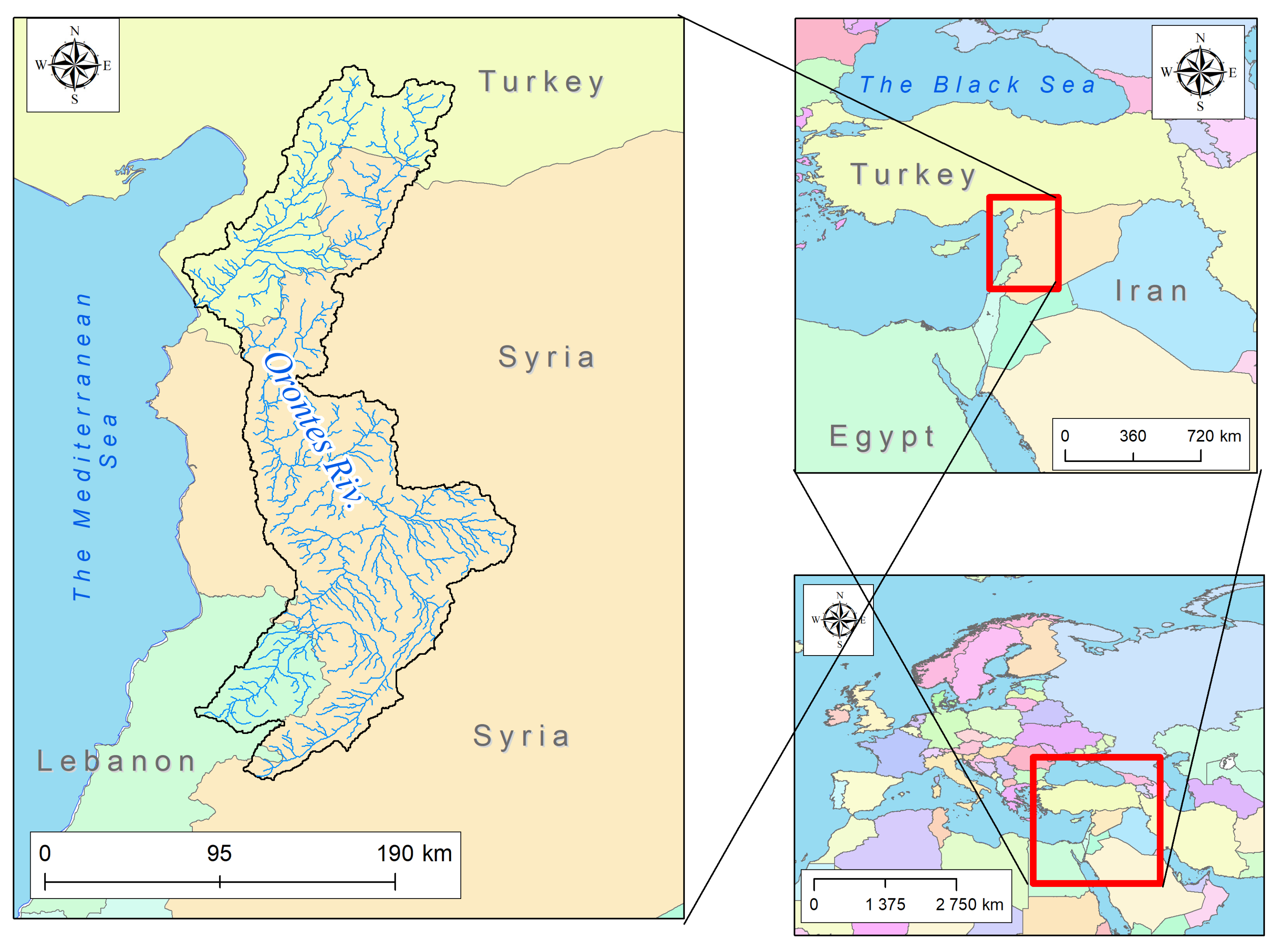
Geographically, the study area corresponds to the Orontes River basin. The river is identified by various toponyms: Aassi River, ‘Āş River, Asi River, Assi River, Nahr al-‘Āş, Nahr al-‘Āşī, Nahr el-Aassi, Nahr el-Assi, Nahr al-Asi, Nehir Oronte, and Oronte River. The Orontes River basin is located in Western Asia, north of the Arabian Peninsula [24], at the eastern terminus of the Mediterranean Sea (Figure 1).
The literature lacks consistent data on the exact area of the Orontes River catchment basin. The reported total area and its distribution among countries (in percentages) vary significantly among different researchers. The following values are cited for the basin’s area: 21,660 km2 [25], 24,660 km2 [26], and 26,530 km2 [27]. The distribution is generally estimated as follows: 2016 km2 (approx. 8%) lies within Lebanon [25,26,27], between 67% (17,881 km2) [27] and 70% is in Syria [25,26], and between 23% [25,26] and 25% (6633 km2) is in Turkey [27].
According to [28], the length of the Orontes River is 571 km, with an average water discharge of about 80 m3/s. Currently, the river is used to irrigate approximately 6% of the irrigated land in Lebanon, 36% in Turkey, and 58% in Syria, totaling an estimated 350,000 hectares. In Lebanon’s Bekaa Valley, irrigation supports field and fruit crops. The Muhafazat Idlib and the Al-Ghab valley in Syria receive the largest share of irrigation. In Turkey, the Yarseli and Karamanalı dams are key infrastructure.
Presently, the use of the Orontes River in Lebanon is limited to small-scale agriculture, fish farms, and tourism. Within the Syrian part of the basin, both groundwater and surface water are intensively exploited for irrigation. In Turkey, dozens of new water resource development projects have been planned and implemented in recent years for the Turkish portion of the basin. These projects aim to regulate the flow of the river and its tributaries for irrigation and flood protection, as well as to supply water for domestic needs and hydropower generation [27].

2.2. Historical Background

The Syrian Civil War refers to the mass unrest and upheaval in Syria directed against President Bashar al-Assad and aimed at ending the rule of the Ba’ath Party, which escalated into an armed confrontation in the fall of 2011 [29]. In May 2011, as one of the initial attempts to resolve the conflict, the US and EU imposed sanctions on Syria (including an arms export ban, asset freezes, and travel bans for Syrian government officials) [30]. This led to a sharp shift in the situation, with terrorists infiltrating Syrian territory and forming groups. Thus emerged and gained strength the so-called “Islamic State”—an organization banned in Russia and designated as terrorist [31].
The Syrian Civil War represents a continuous internal multilateral armed conflict between government forces and militants of the Syrian opposition. A third party to the conflict also exists: the Kurds, who are fighting both government troops and opposition militants. Mercenaries from various countries worldwide participate on the side of the opposition [32], while members of the Lebanese organization “Hezbollah” and Iraqi militants fight on the government’s side [33].
The war in Syria has impacted global politics due to the involvement of over 20 foreign states participating in ground and air operations. These include Iran, Russia, the US, and Turkey, not including limited contingents from the UK, China, France, and others. A distinctive feature of the conflict has been the unprecedented scale of participation by non-state actors (in the form of irregular formations): government forces (loyalists), rebel militants, supporters of “holy war of Muslims against infidels” (“jihad”), and Kurds. Hundreds of militia representatives, recruited from locals and foreigners, fought against each other. Among their ranks were Islamists, anarchists, secular right and left radicals, Palestinians, and Shiites from Lebanon, Iraq, Afghanistan, Pakistan, and Arab countries of the Persian Gulf [34,35,36].
Due to the devastation caused by years of civil war and Western sanctions, Syria has faced a complex economic situation in recent years. In 2021, agriculture was severely hit by the worst drought in 70 years. There is a shortage of water for the population, livestock, and irrigation. Livestock numbers have decreased by up to 60%. In some areas, crop production has fallen by 90% compared to 2020. As a result, the food security situation has worsened for 12.4 million Syrians [37]. Constant Turkish shelling, drought, water and food shortages, and lack of electricity contribute to increasing internal and external migration [37,38].
The fragmentation of Syria following the attempted overthrow of Bashar al-Assad has opened a new era of geopolitical complexity and instability. The Middle East remains one of the most complex, heterogeneous, and conflict-prone zones in the modern world [21].

2.3. Data and Research Methodology

Data on the concentrations of various atmospheric pollutants were sourced from the European Space Agency’s datasets obtained from the Copernicus Sentinel-5 Precursor mission. The use of this satellite imagery data is detailed in numerous studies and has been tested in various regions worldwide [39,40,41,42,43]. To streamline the data acquisition process from Copernicus Sentinel-5P (simplifying the processing of NetCDF files), the cloud-based Google Earth Engine (GEE) platform was used to calculate monthly and annual average concentrations of nitrogen dioxide, sulfur dioxide, formaldehyde, methane, carbon monoxide, ozone, and the aerosol index within the Orontes River basin.
GEE is a cloud platform for analyzing and processing large-scale geospatial data using Google’s computational infrastructure. It provides a powerful and flexible environment for working with a wide range of remote sensing, satellite, and other geospatial datasets, including Sentinel-5P data. A key advantage of using GEE for geospatial analysis is its ability to efficiently and rapidly process and analyze vast volumes of data without the need for expensive computational hardware or software. GEE also offers a collaborative environment, allowing users to share data, code, and analysis results.
The “Sentinel-5P L3” collection was used to assess pollutant concentrations (e.g., for nitrogen dioxide: ee.ImageCollection (“COPERNICUS/S5P/OFFL/L3_NO2”)). Various filtering methods (to obtain annual and monthly averages) and data processing techniques (clipping to the study area boundaries) were applied to the collection, followed by analysis of the resulting pollutant value rasters. The obtained data were subsequently saved using Google Drive. Geographic map visualization was performed using the ArcGIS 10.8 software suite, chosen for its superior capabilities in data visualization.
Air pollution in the Orontes River basin across Lebanon, Syria, and Turkey was analyzed based on the concentrations of nitrogen dioxide (NO2), sulfur dioxide (SO2), formaldehyde (HCHO), methane (CH4), carbon monoxide (CO), ozone (O3), and the aerosol index (AI) [26].
Aerosol Index (AI): A useful and accurate method for detecting ultraviolet-absorbing aerosols, such as soot and dust [44,45]. Aerosols affect both atmospheric radiation and air quality. Particulate matter with an aerodynamic diameter less than 2.5 µm (PM2.5) can carry toxic and harmful substances across countries and geographical boundaries [45]. Anthropogenic sources of primary particles include industrial processes and fuel combustion [46]. The nature of industrial particles varies, but combustion particles are typically dominated by black carbon or heavy organic materials like polycyclic aromatic hydrocarbons [47].
Methane: An important component of the Earth system’s biogeochemical processes [48]. Like carbon dioxide, methane is a potent greenhouse gas; per molecule, its thermal absorption cross-section is 20–25 times greater than that of CO2 [48]. Methane has both anthropogenic and natural sources. Over 90% of global anthropogenic methane emissions come from three sectors: agriculture (40%, including livestock, manure management, and rice production); fossil fuels (35%, including leaks from natural gas and oil systems and coal mines); and waste (20%, from landfills and wastewater) [49].
Carbon Monoxide: The most abundant carbon-containing atmospheric component after CO2 and CH4 [50]. CO has an atmospheric lifetime of about three months and is widely used as an indicator of global atmospheric pollution and transport [51]. Emitted CO can influence atmospheric composition by affecting hydroxyl radical (OH•) levels and other important trace gases like CO2, O3, and CH4 [52]. Satellite remote sensing provides accurate regional CO emission data with global coverage on a continuous and repetitive basis, overcoming limitations of ground measurements and chemical transport models (CTMs) [53].
Formaldehyde: Plays a key role in atmospheric chemistry [54] and is a major precursor to photochemical pollution [55]. Long-term exposure to high HCHO concentrations can cause respiratory diseases, memory loss, and nervous system disorders [56]. Sources are both anthropogenic (mainly energy consumption, chemical plant production, and vehicle emissions) and natural (e.g., vegetation). HCHO is listed among the 187 hazardous air pollutants by the U.S. EPA and is classified as a human carcinogen by the WHO [57]. Remote sensing is an effective method for analyzing and monitoring regional atmospheric HCHO [58].
Nitrogen Dioxide: An important atmospheric trace gas [59,60]. Natural sources include lightning, microbiological processes, and oceanic/soil emissions [61,62]. Anthropogenic sources are primarily fossil fuel and biomass combustion [63,64]. As a precursor to ozone, acid rain, and secondary inorganic particles [65,66], NO2 plays a crucial role in tropospheric and stratospheric chemistry [67]. High near-surface NO2 concentrations harm human health and crop growth [68]. Satellite and ground-based observations are the main methods for studying NO2 concentrations [69]. Studies link atmospheric nitrogen deposition from emissions to water quality degradation; for example, precipitation accounts for about 25% of the nitrate load in the Chesapeake Bay [70,71].
Ozone: A tropospheric residual gas significantly impacting climate and air quality [51,72]. It is an important greenhouse gas, a secondary air pollutant, and harmful to human health and terrestrial ecosystems [73,74,75,76]. Recognized as the third most important greenhouse gas contributing to global warming [77].
Sulfur Dioxide: An inorganic compound formed from the combustion of sulfur-containing fossil fuels (S + O2 → SO2) [78]. It is a colorless, pungent, choking, and irritating substance common in urban atmospheres [79,80]. In the presence of water vapor, SO2 converts to sulfuric acid (H2SO4), leading to acid rain, thus making it an acidifying gas [81]. SO2 emissions are highly harmful, driving ongoing research [82]. While most emissions do not cause immediate harm, they have long-term effects on human health [82].
Additionally, it is worth noting that the TROPOMI device on the Sentinel-5P satellite does not measure the concentration of gas near the earth, but the total number of its molecules in the entire vertical thickness of the atmosphere—in the so-called “atmospheric column”. Each pixel of its data contains information about the total gas content in the air column from the surface to space under this area.
The assessment of atmospheric pollution, considering the influence of the pollutants discussed above, was conducted using the Complex Index of Atmospheric Pollution (CIAP). This index accounts for multiple pollutants and is calculated based on annual average concentrations, thus characterizing the level of long-term air pollution.
The Complex Index of Atmospheric Pollution (CIAP), which considers *n* pollutants, is calculated using the following formula [6]:
C I A P = ( i = 1 n q i F   i ) c
where: i is the pollutant; qᵢ is the annual average concentration of the pollutant; Fᵢ is the corresponding maximum permissible daily average concentration; c is a constant determined by the hazard class of the pollutant: c = 1.7 (Hazard Class I); c = 1.3 (Hazard Class II); c = 1.0 (Hazard Class III); c = 0.9 (Hazard Class IV); n is the number of pollutants considered.
Hazard Class is an indicator characterizing the degree of danger to humans of substances polluting the atmospheric air. Substances are divided into the following hazard classes: Class I: Extremely hazardous; Class II: Highly hazardous; Class III: Moderately hazardous; Class IV: Slightly hazardous.
CIAP calculated using Formula (1) indicates the level of air pollution corresponding to the actually observed concentrations of pollutants in the atmosphere. In other words, it shows how many times the total level of air pollution exceeds the permissible value for the considered set of impurities as a whole.
According to existing assessment methods, the level of air pollution can be categorized as follows: Low: CIAP < 5; Elevated: 5 ≤ CIAP < 7; High: 7 ≤ CIAP < 14; Very High: CIAP ≥ 14.
To identify the primary directions of air mass and pollutant transport, an analysis of wind patterns over the study area was conducted. Wind data at 10 m height were obtained from the ERA5-Land reanalysis database of the European Centre for Medium-Range Weather Forecasts (ECMWF), with a spatial resolution of 0.1° and a temporal resolution of 1 h. Data for the period 2016–2024 were analyzed. Wind direction (in degrees relative to north) and speed (in m/s) were computed for each hour, defining hourly wind events. These events were classified into 16 compass directions, and the most frequent wind direction was determined for each spatial point. Average wind speed was calculated by averaging wind speed values for each point over the entire analysis period. All computations were performed using the R programming language with the tidyverse and ncdf4 packages (Appendix A).
Data on population numbers were obtained from the LandScan database, a global dataset developed by the Oak Ridge National Laboratory (ORNL) in the United States. It provides detailed information on population distribution worldwide. LandScan data are updated annually and are used for various purposes, including demographic trend analysis, urban planning, emergency management, and environmental research [83,84,85].
The raw data for analyzing population density dynamics were sourced from the official LandScan project website [86] for the period 2000–2023. These data were imported into the QGIS software suite. Information on the average and maximum population density within the Orontes River basin was derived using the “Zonal Statistics” toolset in QGIS 3.44. The spatial resolution of the data is 1 km2/pixel.
Additionally, to identify the influence of air pollution and its triggering events, an analysis of information sources, particularly mass media, was conducted. The use of media sources in scientific research, especially when studying complex and dynamic phenomena such as military conflicts, represents a significant, though critically approached, methodological practice. Media analysis is often employed as a supplementary information source [87,88,89,90], combined with core methodologies. In the context of analyzing atmospheric air pollution caused by military actions in Syria, materials published in the media can serve as a unique data source for reconstructing event chronologies, establishing the geographical localization of combat operations, and obtaining information on the types of weapons used. This information, aggregated from various news agencies, reports, and documentary sources, provides a necessary foundation for identifying periods of intensive pollutant emissions and developing spatial models of pollution dispersion. Although media sources may be subject to subjective interpretation and are not always highly accurate, their systematic analysis, combined with scientific research results, satellite monitoring data, and other objective methods, can significantly enhance and enrich the understanding of the environmental consequences of military actions. Thus, the judicious use of news materials, treated as an additional information source, allows not only for the verification of event dynamics but also for establishing cause-and-effect relationships between specific military operations and atmospheric impacts, contributing to a more comprehensive and objective understanding of air pollution resulting from armed conflict. The study employed content analysis methods, statistical techniques, and internet-based search and analytical services to identify quantitative characteristics and semantic content (themes, context, semantic constructs) of information flows [90].

3. Results and Discussion

Air pollution typically originates from various sources such as industrial waste, vehicle emissions, coal-fired power plants, and agricultural activities [91]. In the Orontes River basin in Syria, this list is expanded to include military actions and their consequences. The armed conflict in Syria has had a significant and multifaceted impact on air pollution in the Orontes River basin (Table A1, Table A2 and Table A3). The conflict has created a range of conditions that have contributed to both increased pollutant emissions and reduced capacity for their control and regulation. Below are the results of the assessment of concentrations of the studied pollutants in the Orontes River basin across the three countries from 2019 to 2024 in the context of the armed conflict in Syria.

3.1. Spatiotemporal Analysis of the Studied Pollutants in the Ambient Air Within the Orontes River Basin Across Three Countries (Lebanon, Syria, and Turkey)

3.1.1. Aerosol Index

The distribution of Aerosol Index (AI) values across the Orontes River basin in the three countries (Syria, Turkey, Lebanon) shows similar patterns. In Lebanon, AI values ranged from −1.51 in 2020 to 0.23 in 2022; in Syria, from −1.6 in 2020 to 1.0 in 2022; and in Turkey, AI values varied from −1.7 in 2020 to 0.3 in 2022 (see Appendix A).
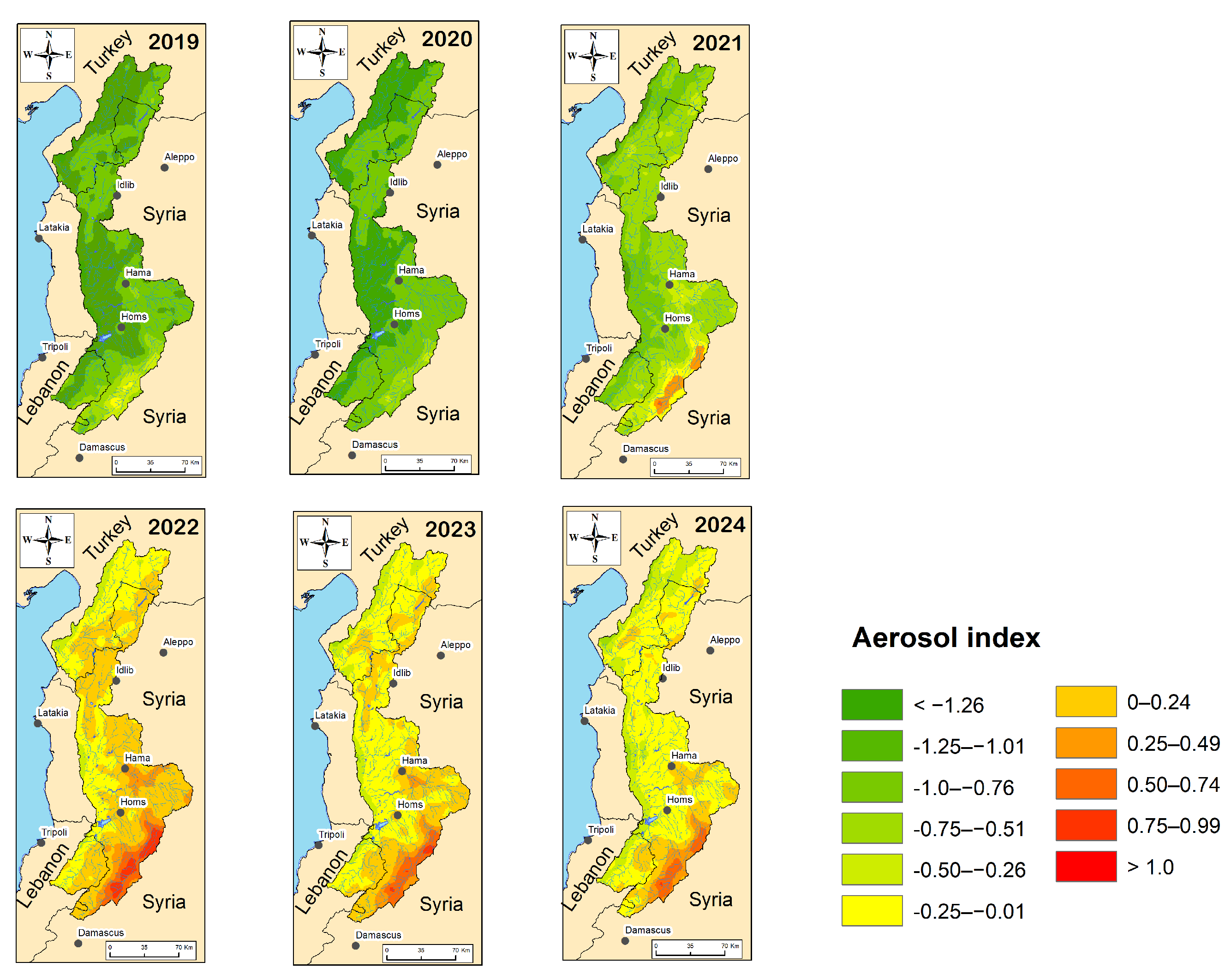
The spatial distribution of the Aerosol Index (AI) across the Orontes River basin is shown in Figure 2. The highest AI values are observed in the southeastern part of the basin (Syrian territory). The maximum AI value across the entire basin was recorded in 2022, reaching 0.23 in Lebanon, 1.0 in Syria, and 0.3 in Turkey.
Between 2019 and 2021, low AI values predominated, indicating a relatively clean atmosphere with minimal aerosol content. The lowest values were recorded in 2019 and 2020, when most of the region exhibited values below −1.0. However, in 2021, southern Syria showed an increase in AI to 0–0.74, indicating rising aerosol concentrations in this area.
A sharp deterioration occurred in 2022, when significant portions of the basin, particularly southern Syria and Lebanon, showed high AI values, exceeding 1.0 in some areas. In 2023, pollution levels decreased, as evidenced by the return of predominantly low AI values. However, in 2024, the index again increased, especially in the southern part of the region, where values reached up to 0.74. Although pollution levels during this period were lower than in 2022, the trend toward deteriorating air quality persists.
The highest AI values during the entire analysis period were recorded in 2022, with peaks in the southeastern part of the basin (Syria): up to 1.0 in Syria, 0.23 in Lebanon, and 0.3 in Turkey.
From the perspective of military actions, the increase in AI values was driven by bombings, shelling, and other combat activities, which caused the destruction of buildings and infrastructure. This generated large volumes of dust, debris, and other particulate matter that became airborne and increased the Aerosol Index. The maximum AI value in the basin was observed in 2022, but significant spatial heterogeneity is evident: values in the Syrian part of the basin were four times higher than in Lebanon and three times higher than in Turkey.
Military events impacting this indicator included shelling and airstrikes in Syria. For example, in February 2022, an attack occurred in eastern Homs; in May 2022, Israeli Air Force strikes targeted a Syrian military facility in Masyaf, Hama governorate, etc. The highest number of attacks occurred in the areas of Hama and Homs cities. Additionally, in 2022, strong sandstorms affected Middle Eastern countries for two months, with the storm in Syria resulting in at least ten fatalities [92].

3.1.2. Methane

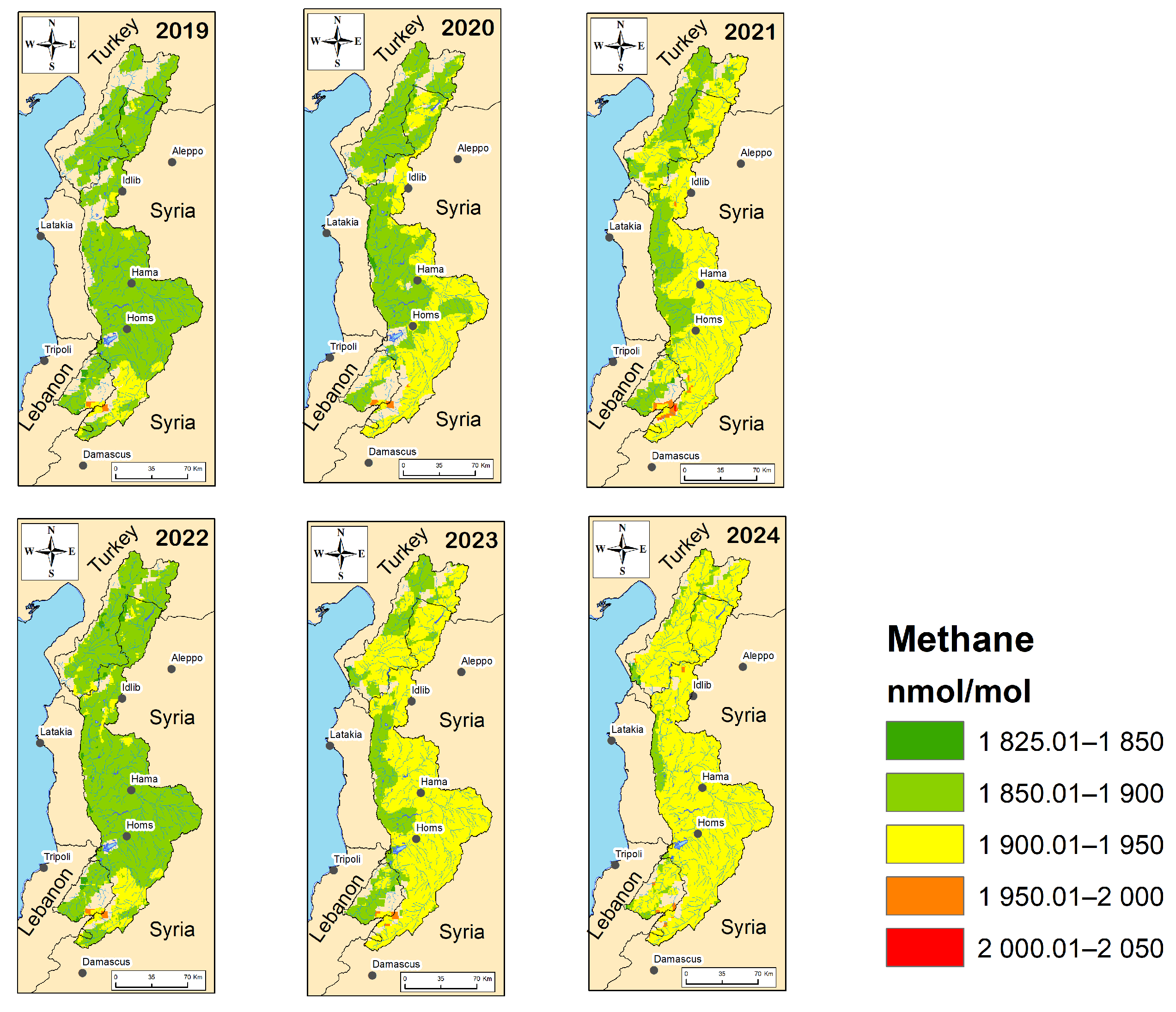
Methane is a potent greenhouse gas released into the atmosphere through leaks from natural gas and oil extraction and distribution systems, coal mines, and landfills. The level of methane within the Orontes River basin across the three countries remained relatively stable. In Lebanon, its values ranged from 1829.1 nmol/mol in 2019 to 1993.4 nmol/mol in 2020; in Syria, from 1836.0 nmol/mol, reaching a maximum of 2006.3 nmol/mol; and in Turkey, from 1824.9 nmol/mol to 1965.5 nmol/mol. The maximum CH4 concentration within the basin was detected in Lebanon in 2020 (1993.4 nmol/mol), in Syria in 2021 (2006.3 nmol/mol), and in Turkey in 2024 (1958.4 nmol/mol). The study region is characterized by a uniform increase in CH4 concentration across the entire territory (Figure 3).
Analysis of cartographic data revealed significant changes in methane concentrations in the atmosphere within the Orontes River basin. The period from 2019 to 2021 was characterized by relatively low methane concentrations (1827–1900 ppb), limited spatial variability, and the absence of pronounced local maxima, indicating a balance between emission and destruction processes of methane. From 2022 to 2024, a clear negative trend was observed: in 2022, a steady increase in methane concentrations began, reaching 1900–1950 ppb, with zones of elevated levels forming in the southern and central regions, and the first local anomalies appearing. In 2023–2024, methane concentrations continued to increase, with areas exceeding 1950 nmol/mol and isolated hotspots with extreme values up to 2050 nmol/mol, accompanied by enhanced spatial heterogeneity in distribution. Key features of the changes include an overall increasing trend of approximately 7% over five years.

3.1.3. Carbon Monoxide

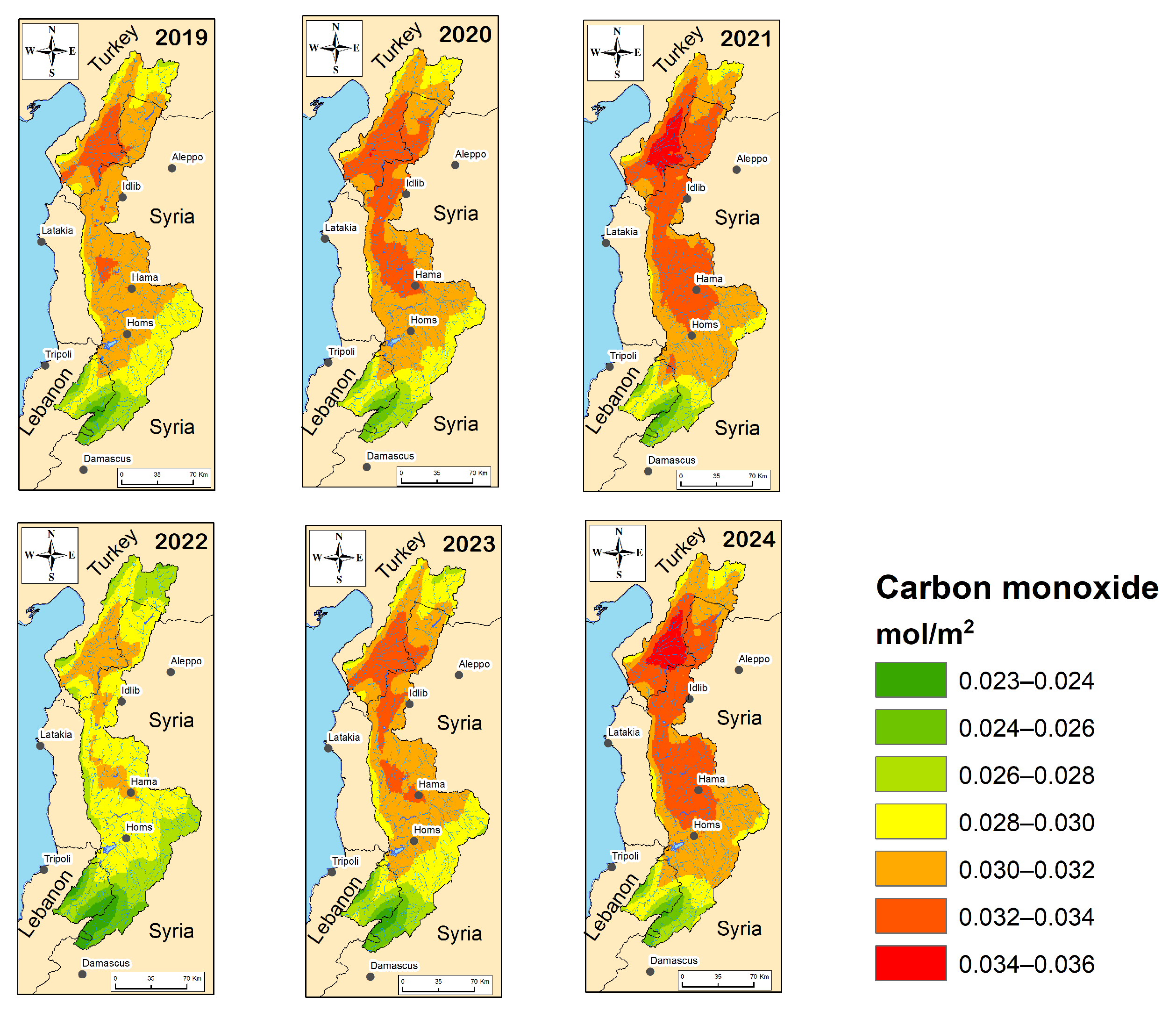
Figure 4 presents the spatial distribution of carbon monoxide concentration in the air in the Orontes River basin for the period 2018–2024. In Lebanon, Syria, and Turkey within the basin, carbon monoxide concentrations remained low from 2019 to 2024, ranging from 0.021 to 0.032 mol/m2 in Lebanon, 0.021 to 0.035 mol/m2 in Syria, and 0.025 to 0.035 mol/m2 in Turkey. The highest carbon monoxide concentrations were observed in Turkey, with peak values in 2021 and 2024 (Figure 4).
The spatiotemporal dynamics of carbon monoxide concentrations in the Eastern Mediterranean from 2019 to 2024 are characterized by cyclical changes, reflecting the influence of anthropogenic and military factors. During the period of intense pollution from 2019 to 2021, persistently high CO concentrations were observed in the range of 0.03–0.036 mol/m2, with clearly defined zones of maximum pollution, including the urban agglomerations of Aleppo, Idlib, and Hama, industrial centers, and transport corridors. The main sources of emissions were industrial enterprises, vehicular transport, infrastructure destruction due to military actions, and residential fuel combustion.
In 2022, a transitional period was noted, during which average CO concentrations decreased by 15–20%, the area of zones with maximum values reduced, and the situation improved in the southern and western regions. These changes are associated with reduced industrial activity, changes in transport flows, and a temporary decrease in the intensity of military operations. However, in 2023–2024, a resumption of the negative trend was observed: CO concentrations again rose to the levels of 2019–2021, new pollution hotspots formed with local maxima up to 0.036 mol/m2, and particularly pronounced deterioration was noted in the northern industrial regions and major urban centers.
Key findings highlight the cyclical dynamics of CO pollution in the region, where the main influencing factors are anthropogenic activity (approximately 80–85% of emissions), the military-political situation, and economic fluctuations. The most vulnerable territories are large cities, industrial zones, and areas of active combat.
Explosions of ammunition often cause fires in buildings, forests, agricultural lands, and industrial facilities. CO is a product of incomplete combustion of organic materials, so large-scale fires lead to its release into the atmosphere. During conflicts, parties may intentionally set fire to objects or territories, which also results in CO emissions.
Forest fires broke out in several Middle Eastern countries in October 2020 amid abnormal heat unusual for that time of year. Forest fires in Turkey in 2020 and 2021 were among the most devastating in the country’s history. For example, the largest fire in the south of Hatay was extinguished over 93 h with the work of over a thousand rescuers. Syria was also severely affected during this period. In total, about 240,000 hectares of forest burned, primarily in Latakia and the central province of Homs. In 2020, 187 forest fires were recorded in Syria, which had large-scale consequences and were organized as part of terrorist acts. Olive groves and valuable tree species were burned [93,94,95]. In 2024, about 20 forest fires occurred in Turkey [96].

3.1.4. Formaldehyde

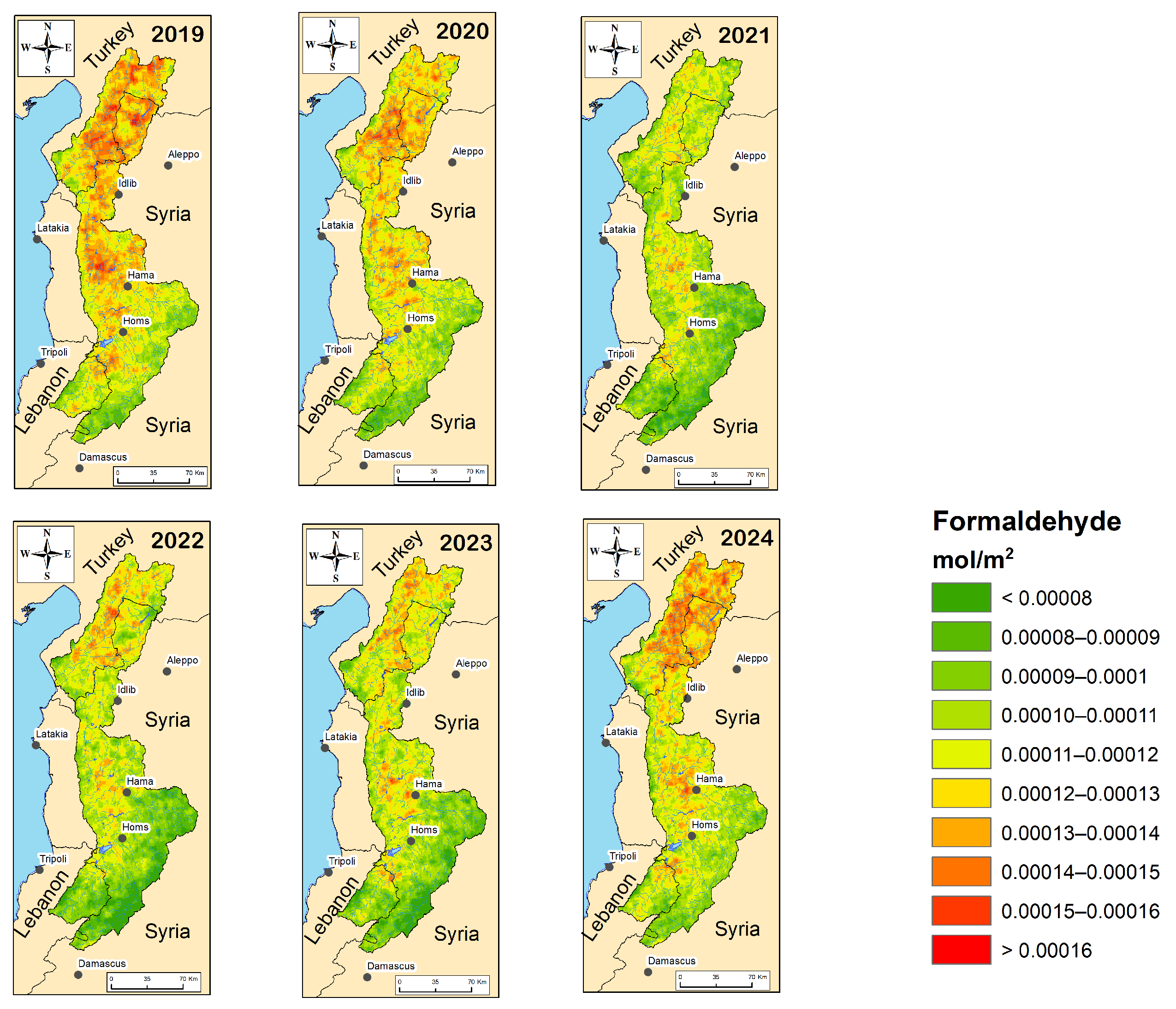
Formaldehyde is one of the main sources of photochemical pollution. Anthropogenic sources of HCHO primarily include energy consumption, production at chemical plants, and vehicle emissions. In the ambient air within the Orontes River basin, HCHO levels exhibited significant fluctuations across the three countries: in Lebanon, ranging from 95 μmol/m2 to 144 μmol/m2; in Syria, from 59 μmol/m2 to 146 μmol/m2; and in Turkey, from 68 μmol/m2 to 160 μmol/m2 (Figure 5).
The spatiotemporal dynamics of formaldehyde from 2019 to 2024 are characterized by significant concentration fluctuations. During the period of elevated concentrations from 2019 to 2021, a consistently high background level of formaldehyde was recorded in the range of 0.00012–0.00016 mol/m2, with clearly defined zones of maximum pollution, including the urban agglomerations of Aleppo and Idlib, industrial centers, and major transport arteries. In 2022, air quality improved: formaldehyde concentrations decreased by 20–25%, and areas with background values (≤0.00011 mol/m2) expanded, particularly in southern regions. However, in 2023–2024, the negative trend resumed: formaldehyde concentrations again reached levels observed in 2019–2021, new pollution hotspots formed with local maxima up to 0.00016 mol/m2, and particularly pronounced deterioration was noted in northern industrial regions, major transport hubs, and zones of active combat.
The maximum HCHO value was observed in 2018 in Syria and Turkey, and in Lebanon in 2023. However, a significant difference in values is evident: the highest levels were in Syria, followed by Turkey, and the lowest in Lebanon. Events influencing this include a series of shelling attacks by militants on settlements near Hama, which damaged a thermal power plant, as well as shelling of settlements in Tell al-Makthal (Idlib province), Hamdaniya (Hama), and intense fighting in Hama province [92].

3.1.5. Nitrogen Dioxide

The primary anthropogenic sources of nitrogen dioxide include the combustion of fossil fuels, production of nitric acid, welding, explosives, gasoline and metal refining, among others.
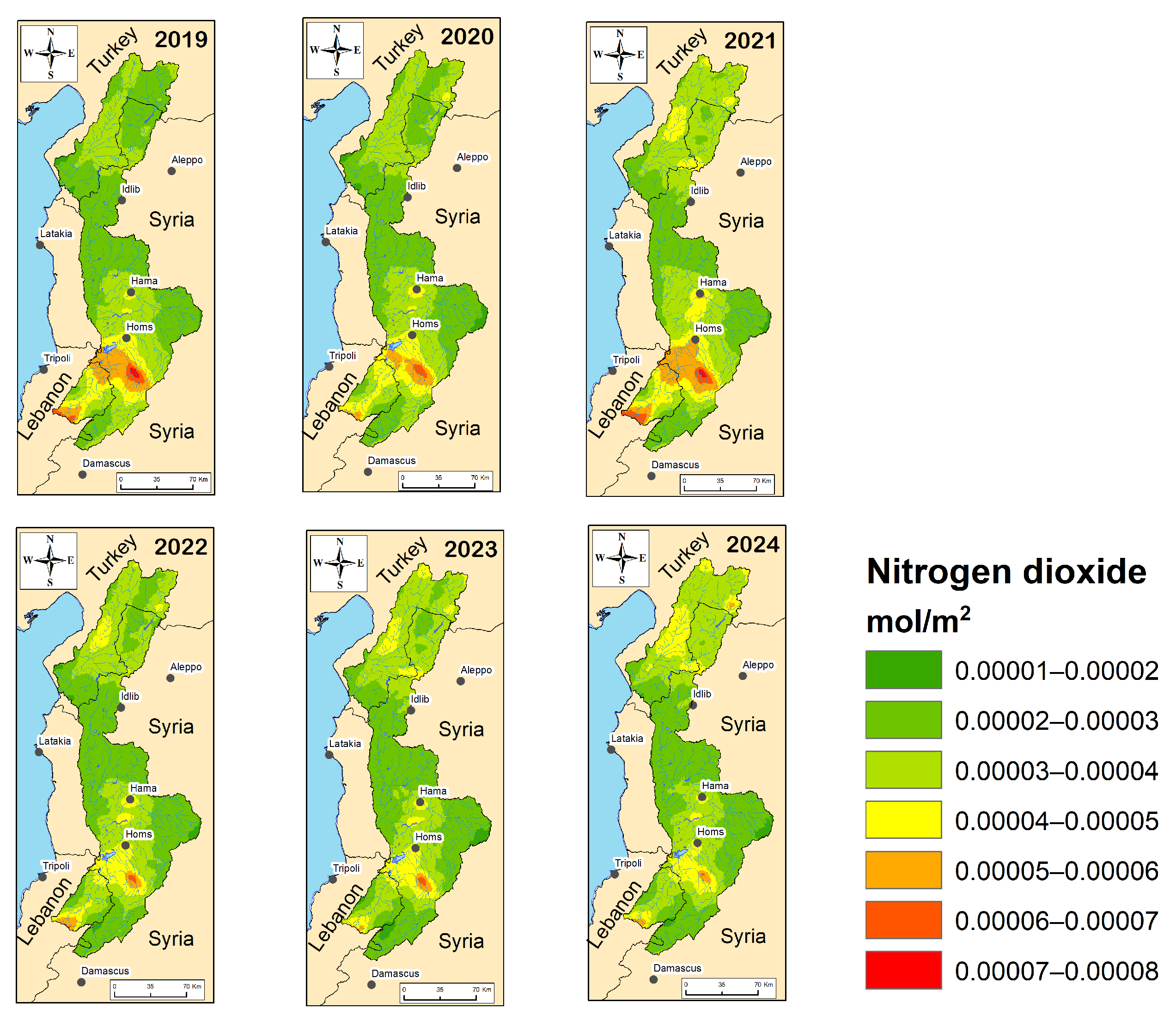
Figure 6 clearly shows a significant increase in nitrogen dioxide concentrations along the Syria-Lebanon border, as well as in the southeastern part of the basin within Lebanon. NO2 concentrations ranged from 16 µmol/m2 to 70 µmol/m2 in Lebanon, from 17 µmol/m2 to 74 µmol/m2 in Syria, and from 18 µmol/m2 to 55 µmol/m2 in Turkey. The maximum pollution in this area is caused by a combination of several factors: military activities, heavy traffic, uncontrolled use of energy sources, adverse meteorological conditions, lack of emission reduction measures, and uncontrolled waste burning.
The presented maps illustrate the spatial distribution of NO2 concentrations across southern Turkey, Lebanon, and western Syria for the period 2019–2024. During 2019–2021, nitrogen dioxide concentrations mostly remained low—up to 0.00004 mol/m2 over most of the region. The exception was the southern part of Lebanon, where localized hotspots of elevated pollution up to 0.00006 mol/m2 were recorded, associated with intense urbanization, industrial activity, and traffic in that area.
In 2022–2023, a downward trend in NO2 concentrations was observed, characterized by an expansion of zones with minimal values down to 0.00002 mol/m2, indicating an improvement in air quality. This was due to reduced anthropogenic activity amid economic or social factors, as well as favorable meteorological conditions that facilitated pollutant dispersion.
However, in 2024, a sharp increase in nitrogen dioxide concentrations was recorded, especially in southern Lebanon and adjacent areas of Syria, where zones with concentrations up to 0.00008 mol/m2 appeared, indicating significant air pollution. Military equipment (tanks, armored personnel carriers, trucks, etc.) and vehicles used by both military and civilians primarily run on diesel fuel. Internal combustion engines emit NO2 into the atmosphere, especially during incomplete fuel combustion. Furthermore, explosions of ammunition and subsequent fires in buildings, industrial facilities, and other areas contribute to additional nitrogen dioxide emissions.

3.1.6. Ozone

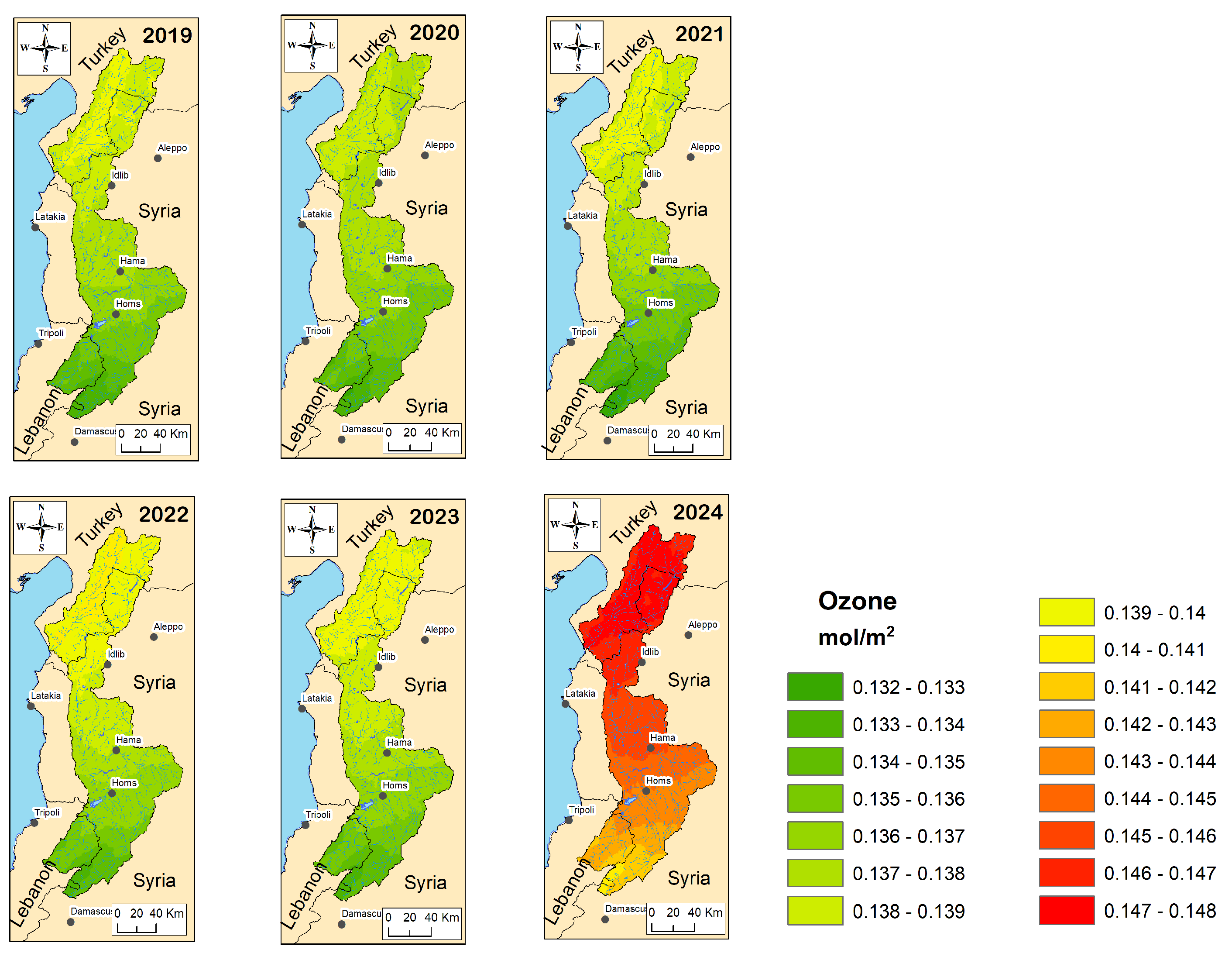
Figure 7 shows the spatial distribution of ozone concentrations over southern Turkey, Lebanon, and western Syria for the period from 2019 to 2024. Ozone concentrations remained relatively stable within the following ranges: 126–129 mmol/m2 in Lebanon, 133–140 mmol/m2 in Syria, and 130–148 mmol/m2 in Turkey. The maximum O3 concentration values were recorded in 2024 in all three countries. Overall, the values varied only slightly. During the 2019–2021 period, ozone levels in the region remained relatively low to moderate, fluctuating approximately between 0.132 and 0.14 mol/m2. In 2022 and 2023, a gradual increase in ozone concentrations was observed, especially in the northern and central parts of the region, where values reached between 0.139 and 0.14 mol/m2. A sharp increase in ozone concentrations was recorded in 2024, predominantly in the northern and central parts of the region, with levels ranging from 0.142 to 0.148 mol/m2. Since 2024, the highest levels of ozone pollution in the Orontes River Basin have been observed in Syria and Turkey (Figure 7).

3.1.7. Sulfur Dioxide

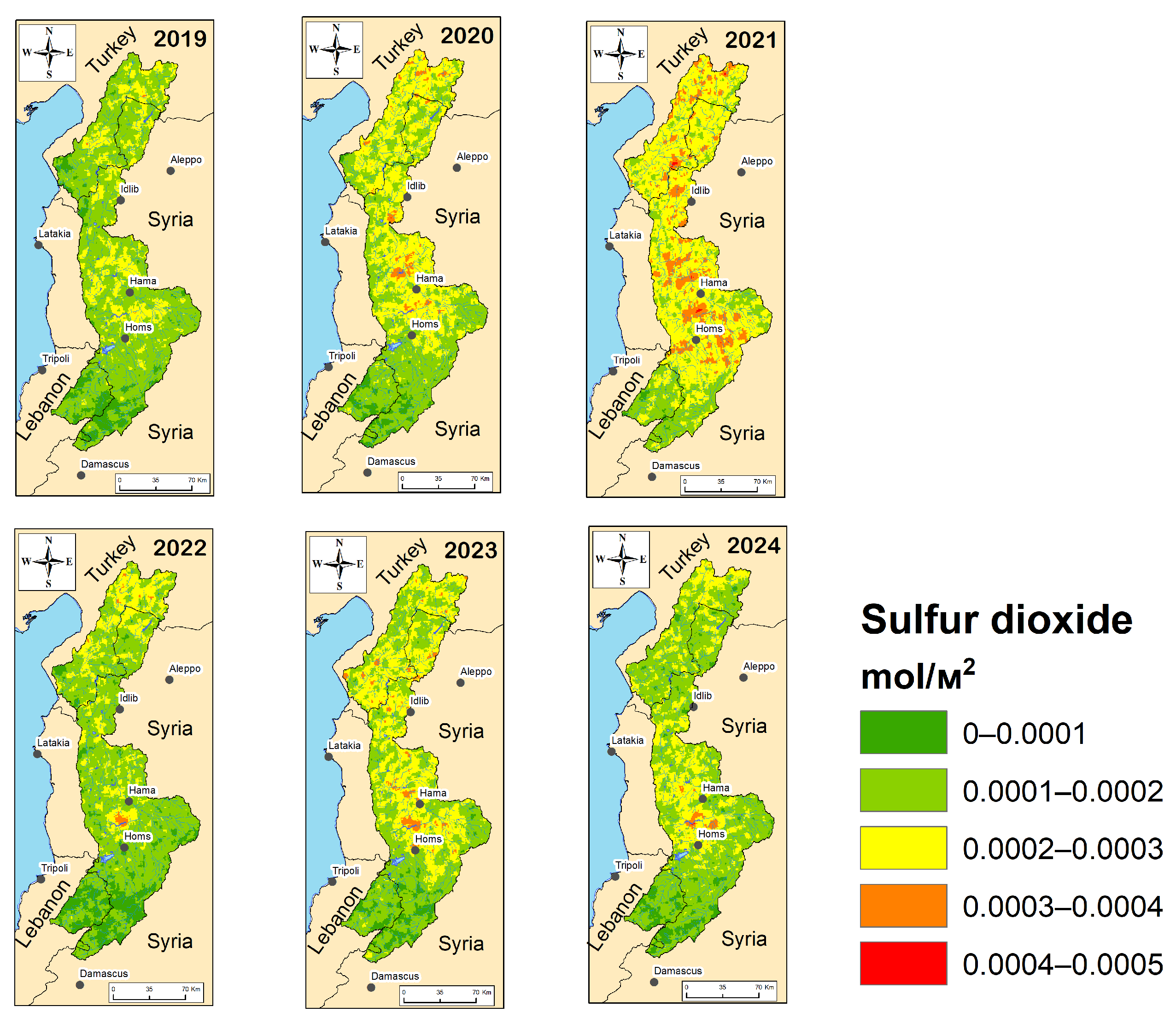
The spatial distribution of sulfur dioxide concentrations in southern Turkey, Lebanon, and western Syria from 2019 to 2024 is shown in Figure 8. SO2 concentrations exhibited significant fluctuations: ranging from 0 to 322 µmol/m2 in Lebanon, from 0 to 442 µmol/m2 in Syria, and from 25 to 433 µmol/m2 in Turkey. In 2018–2019, Syria experienced numerous air and artillery strikes, including air raids in Idlib and northern Hama, shelling of the settlements Tell al-Maktal (Idlib province) and Hamdaniya (Hama), as well as intense fighting in the Hama province [96].
From 2019 to 2023, sulfur dioxide concentrations mostly remained low, not exceeding 0.0003 mol/m2. However, in 2024, a sharp increase in SO2 concentrations was recorded in southern Lebanon and adjacent areas of Syria, resulting in the emergence of a zone with maximum values up to 0.0005 mol/m2.
Analysis of air pollution data in the Orontes River basin across Lebanon, Syria, and Turkey revealed substantial fluctuations in concentrations of various pollutants during the 2019–2024 period, with variations depending on country and year. Significant amplitude changes in sulfur dioxide concentrations were noted in all three countries.
An important limitation of the study based on satellite data of column content is that these indicators do not directly reflect the concentration of pollutants at the level of human respiration. Satellite measurements integrate data over the entire thickness of the atmosphere and are therefore more sensitive to high-altitude transport and the general regional background than to local surface emissions in the immediate vicinity of the population. Therefore, direct extrapolation of the obtained spatial patterns to health risks at specific points (for example, in parks or on city streets) should be carried out with caution. Our findings should be interpreted primarily as an assessment of regional atmospheric pressure and the effectiveness of emission control measures, rather than as a direct measurement of personal impact.

3.1.8. The Complex Index of Atmospheric Pollution (CIAP)

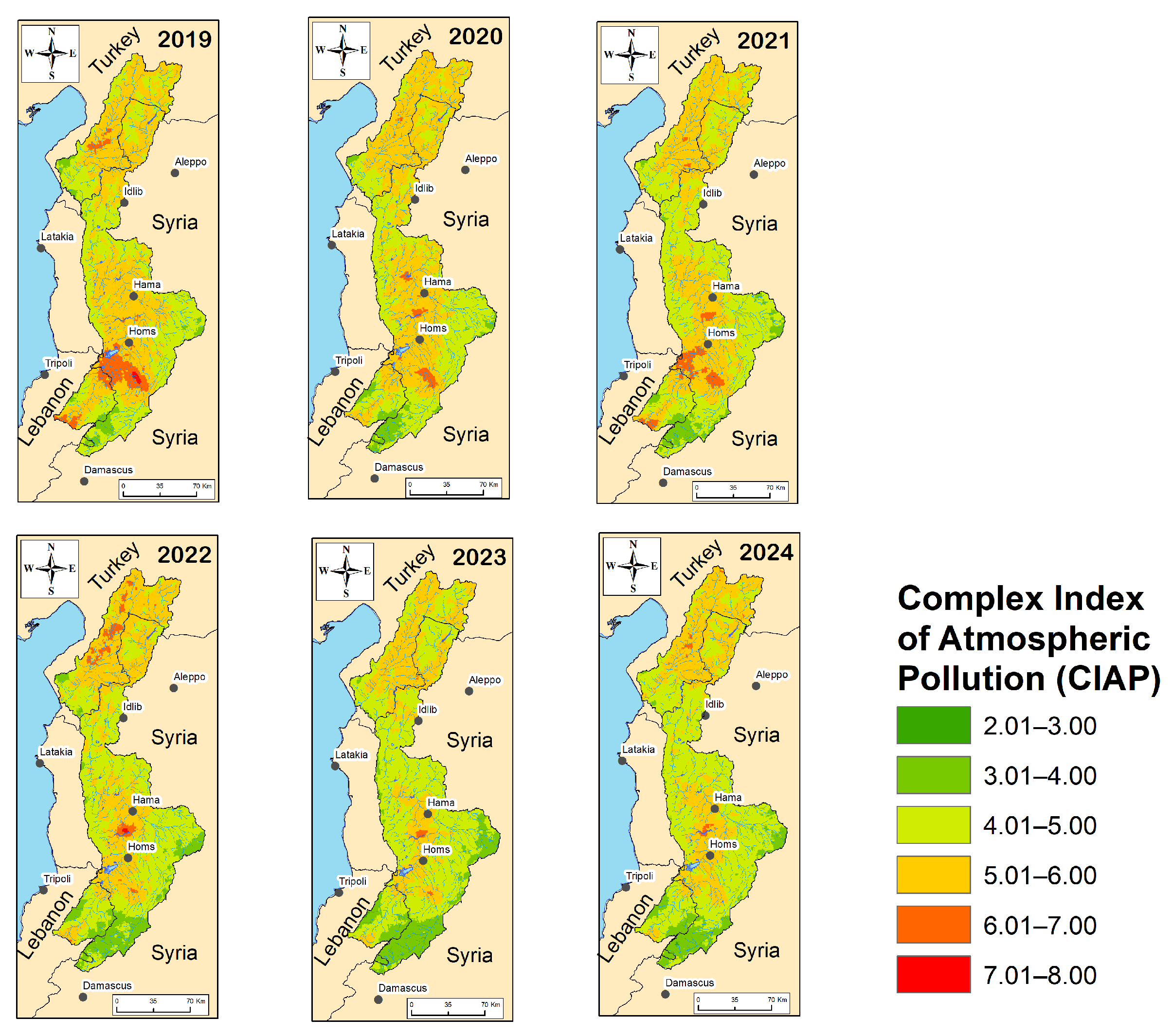
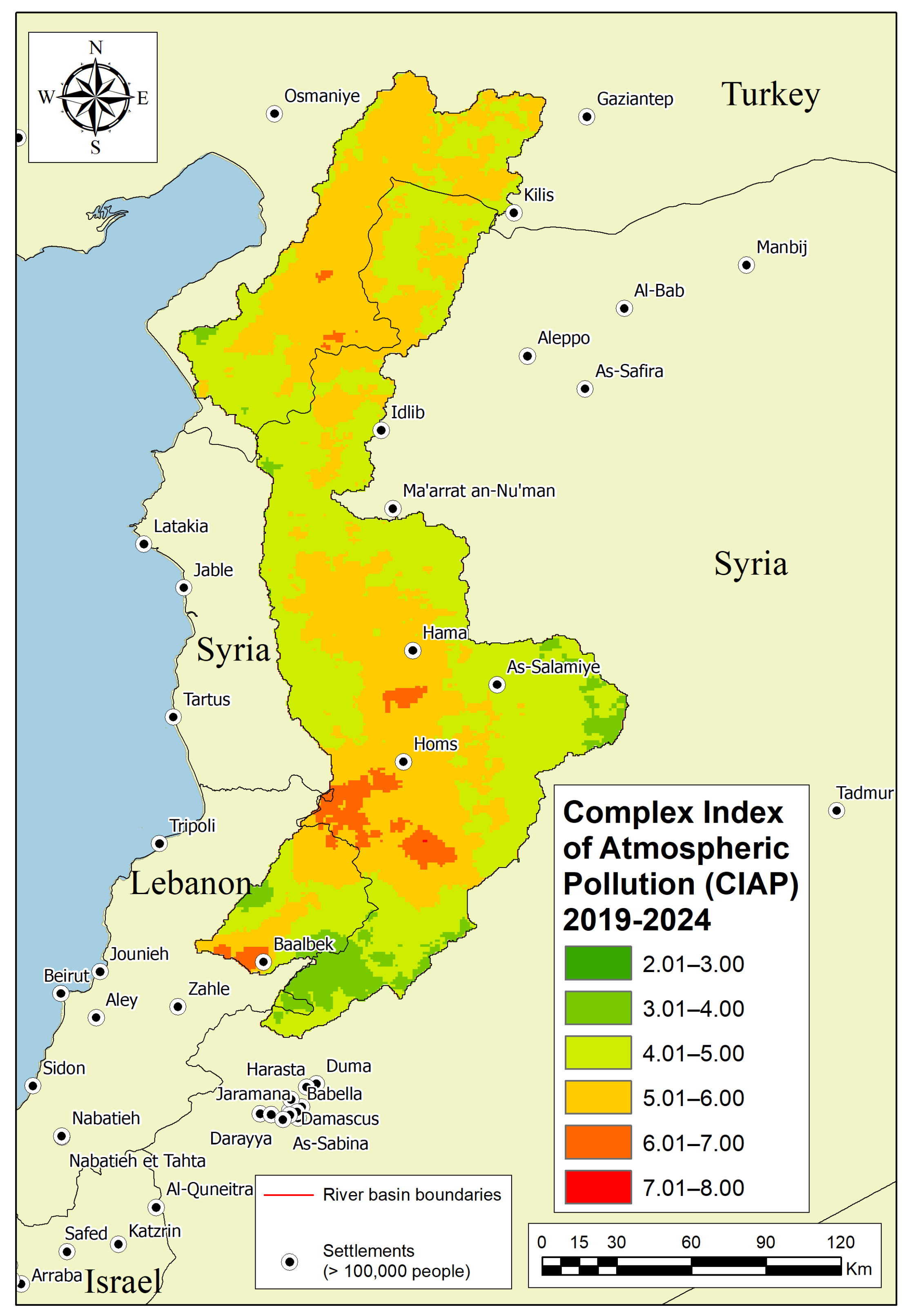
In the Turkish part of the basin, CIAP values vary between 4 and 6, with small areas of lower values (less than 4) in the eastern part of the study area and values exceeding 7 near the border with Syria (Figure 9 and Figure 10). The Syrian territory of the basin shows the greatest amplitude of CIAP values (3 to 8). Areas with the highest CIAP values are associated with the high-altitude regions of the Lebanon Mountain Range and the Anti-Lebanon Mountains. The southern and eastern parts of the basin in Syria are characterized by low air pollution levels according to CIAP. In Lebanon, air pollution levels in CIAP units range from 3 to 7. More than half of the Lebanese territory of the basin has elevated air pollution levels. The dynamics of CIAP in the Orontes River basin from 2019 to 2024 demonstrate pronounced spatiotemporal changes driven by both natural and anthropogenic factors.
The spatial distribution of CIAP for each year across the basin shows that in 2019, the highest pollution index values, reaching 7–8, were localized in the southern parts of the basin, particularly near the city of Damascus (Syria) and adjacent territories of Lebanon (Figure 9). The northern and central parts of the basin are characterized by lower index values, predominantly in the range of 3–5, reflecting relatively lower anthropogenic pressure. In 2020 and 2021, there was a trend towards a slight decrease in maximum index values in the southern regions, but an area of elevated pollution remained, covering the suburbs of Damascus and southern territories of Syria. At the same time, a moderate increase in the index was recorded in the central part of the basin. In 2022, a further expansion of zones with an index of 5–6 was observed in the central and southern regions, while maximum pollution values slightly decreased, indicating partial stabilization of atmospheric conditions. In 2023, a noticeable improvement in air quality occurred in the southern part of the basin, expressed by a decrease in the index to the range of 4–5 and a reduction in the area of high pollution zones. By 2024, the improving trend continued, with a significant part of the basin, especially in the central and northern regions, characterized by CIAP values within the range 3–4.
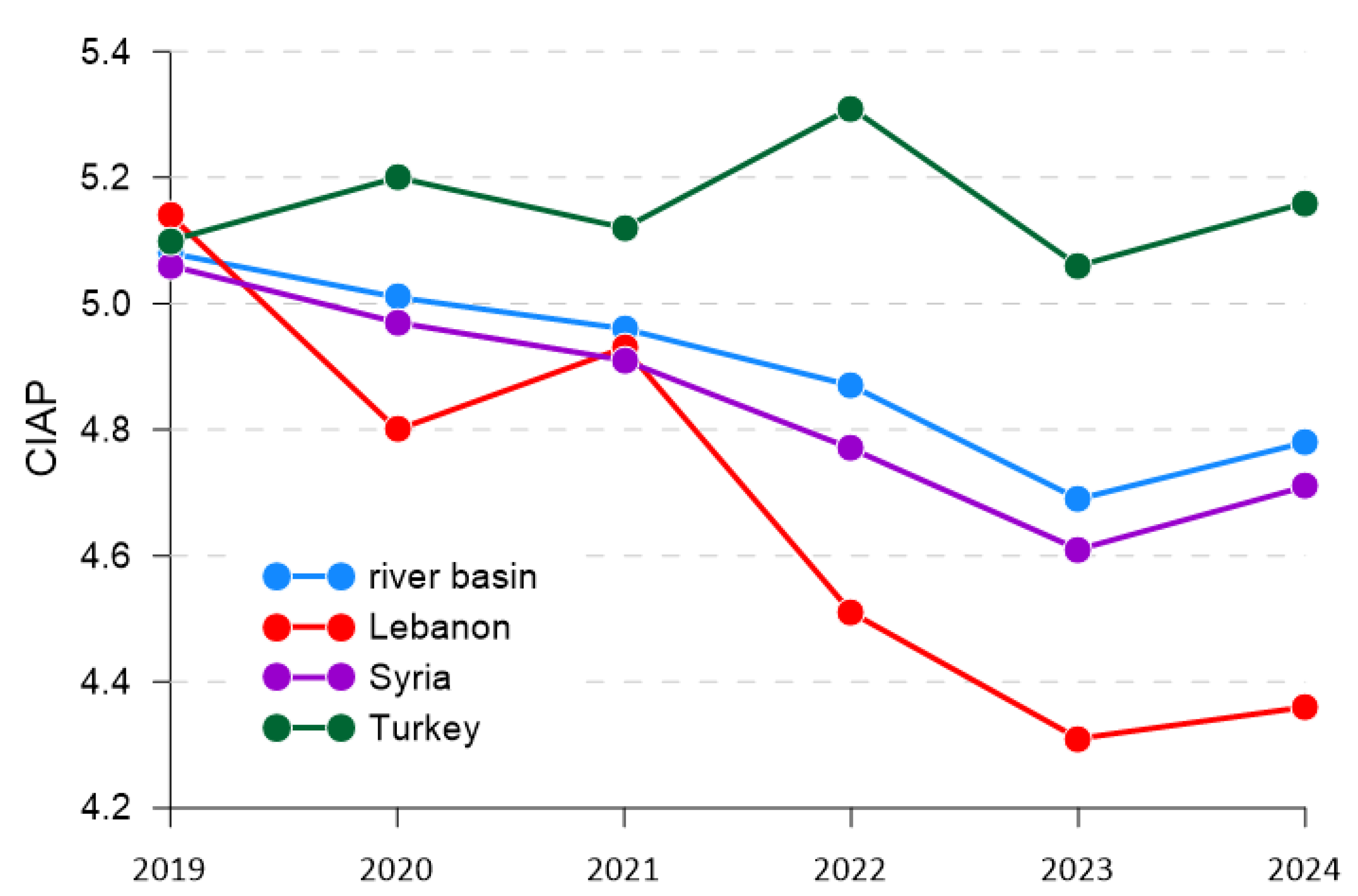
Averaged CIAP values for the entire basin and for the territories of Lebanon and Syria show a tendency towards decreasing index values from 2019 to 2024 (Figure 11), particularly pronounced for Lebanese territory. Over the period 2019–2024, the CIAP value for the entire Orontes River basin decreased by 6%, for Syrian territory by 7%, and for Lebanese territory by 15%. In the Turkish part of the basin, CIAP remained almost unchanged but at an elevated level of air pollution (average value over 6 years is 5.16).
Despite the overall downward trend in CIAP values, local hotspots with elevated index values persist near large cities and transport hubs, requiring continued monitoring and implementation of comprehensive measures to reduce air pollution.
Figure 10 presents the spatial distribution of CIAP in the Orontes River basin for the period 2019–2024. The highest CIAP values are concentrated in the southern part of the basin, particularly in areas adjacent to large settlements and industrial centers, indicating localized hotspots of intense air pollution.
Figure 11 demonstrates the interannual dynamic series of averaged CIAP values across the entire basin, as well as for the three countries within its territory: Lebanon, Syria, and Turkey. As can be seen from Figure 11, CIAP remains approximately at the same level in the Turkish part of the Orontes River basin, decreases slightly in the Syrian part, and decreases significantly in the Lebanese part.
Country-specific analysis reveals that Turkey exhibits the highest CIAP values throughout the entire period, with relatively stable indicators and minor fluctuations. This reflects a persistently high anthropogenic load associated with industrial production and transportation. Lebanon shows the most noticeable decline in CIAP from 2019 to 2023, attributed to reduced pollutant emissions due to economic or social changes, as well as pollution control measures. However, a slight increase in the index is observed in 2024, warranting additional attention. Syria demonstrates a moderate decrease in CIAP, with values intermediate between those of Lebanon and Turkey, resulting from changes in industrial activity and the level of urbanization in the region.
Thus, the spatial and temporal distribution of CIAP in the Orontes River basin reflects the complex interaction of natural and anthropogenic factors. The obtained results emphasize the necessity for coordinated transboundary efforts in monitoring and reducing atmospheric air pollution to improve the ecological situation in the basin and ensure public health.

3.2. Influence of Atmospheric Circulation on the Spatiotemporal Distribution of Pollutant Fields in the Ambient Air Within the Orontes River Basin

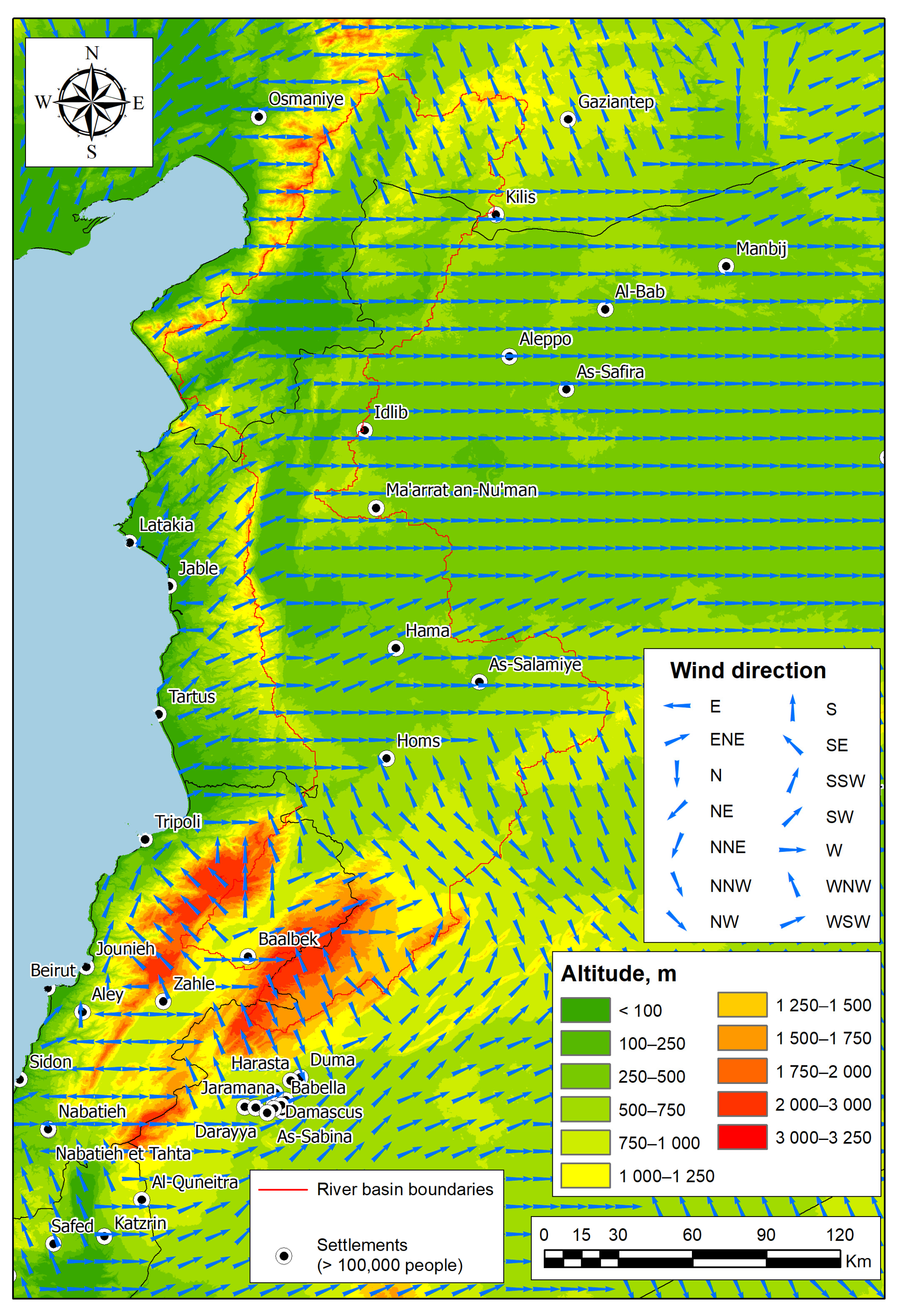
Orographic features, along with prevailing wind directions (Figure 10), influence the transport of air pollutants. The following characteristics can be distinguished within the Orontes River basin. Western winds (from the Mediterranean Sea) prevail year-round on the plateaus. In the southern regions of the Orontes River basin, air masses encounter obstacles in the form of the Lebanon Mountain Range and the Anti-Lebanon Mountains, causing the air masses to deflect northeastward and southeastward. The results presented in Section 2.1 showed the highest concentrations of pollutants (most of those studied) in Syria due to the military conflict in this country. The prevailing westerly transport of air masses prevents the spread of pollutants westward, i.e., into Lebanese territory. This area of the Orontes River basin shows the lowest values for all indicators.
The highest nitrogen dioxide concentrations in the air are associated with the high-altitude area (Bekaa Valley) of the Orontes River basin, where redistribution of air masses occurs between two mountain ranges. At the same time, the distribution of other pollutants shows the lowest concentrations in this area, except for the aerosol index. The highest aerosol index values throughout all observation years are found on the eastern slopes of the Anti-Lebanon Mountains, where air masses, after crossing the mountain ridge, descend in a southeastern direction. High concentrations of formaldehyde (HCHO) and carbon monoxide are associated with the Amik Plain (Antioch) in Turkey, where westerly winds prevail due to the proximity to the coast.
Figure 12 shows the prevailing wind directions in the vicinity of the Orontes River basin for the period 2019–2024, as well as the terrain relief with elevation zones highlighted.
Analysis of the data indicates that eastern and east-northeastern winds (E, ENE) dominate in the northern and central parts of the basin, moving predominantly from east to west. In the southern part of the territory, particularly in mountainous areas with elevations exceeding 1500 m, wind directions are more diverse, with a noticeable presence of northeastern and southeastern flows.
Mountain ranges, such as the areas around Baalbek and further south, significantly influence local wind patterns, causing deviations and turbulence in airflow. Winds passing through mountain ridges can intensify in narrow passages and gorges, promoting more intense pollutant transport in these zones. The prevailing eastern wind directions are crucial for understanding transboundary pollutant transport in the Orontes River Basin. Winds blowing from east to west can carry polluted air from territories of Turkey and Syria toward Lebanon, which must be considered when assessing pollution sources and developing joint measures to improve air quality.
Furthermore, the terrain and wind directions influence the distribution of pollutants in the atmosphere, contributing to the formation of localized pollution hotspots in lowlands and valleys where air masses may stagnate. Thus, the prevailing eastern and east-northeastern winds, combined with the complex mountainous topography, significantly influence the dynamics of pollutant transport in the Orontes Basin.
In this area, the main adverse meteorological conditions are also droughts and rising temperatures. They indirectly affect all indicators. In this study, we analyzed only the effect of air mass transfer in Section 3.2. The detailed effect of neutral meteorological factors is a retrospective of further research.

3.3. Relationship Between Population Density and Air Pollutants in the Orontes River Basin Across Lebanon, Syria, and Turkey

As part of the study, the average population density in the portions of the Orontes River basin within Lebanon, Syria, and Turkey was analyzed for the period from 2019 to 2023 (Table 1). Data for 2024 was not yet available at the time of writing this article.
The maximum value of the average population density in the Orontes River basin within Lebanon was recorded in 2019 at 108.5 thousand persons/km2, while the minimum was in 2021 at 64.9 thousand persons/km2. In Syria, the average population density reached its maximum in 2023, estimated at 190.1 thousand persons/km2, which exceeds Lebanon’s data—160.1 thousand persons/km2 was the minimum average density in 2019. In Turkey, the maximum value was 156.9 thousand persons/km2 in 2023, and the minimum was 153.2 thousand persons/km2 in 2019.
The observation period spans five years, which is insufficient for conducting a correlation analysis with statistical significance evaluation; however, graphical methods allow tracking the dynamics of the studied pollutants across the three countries.
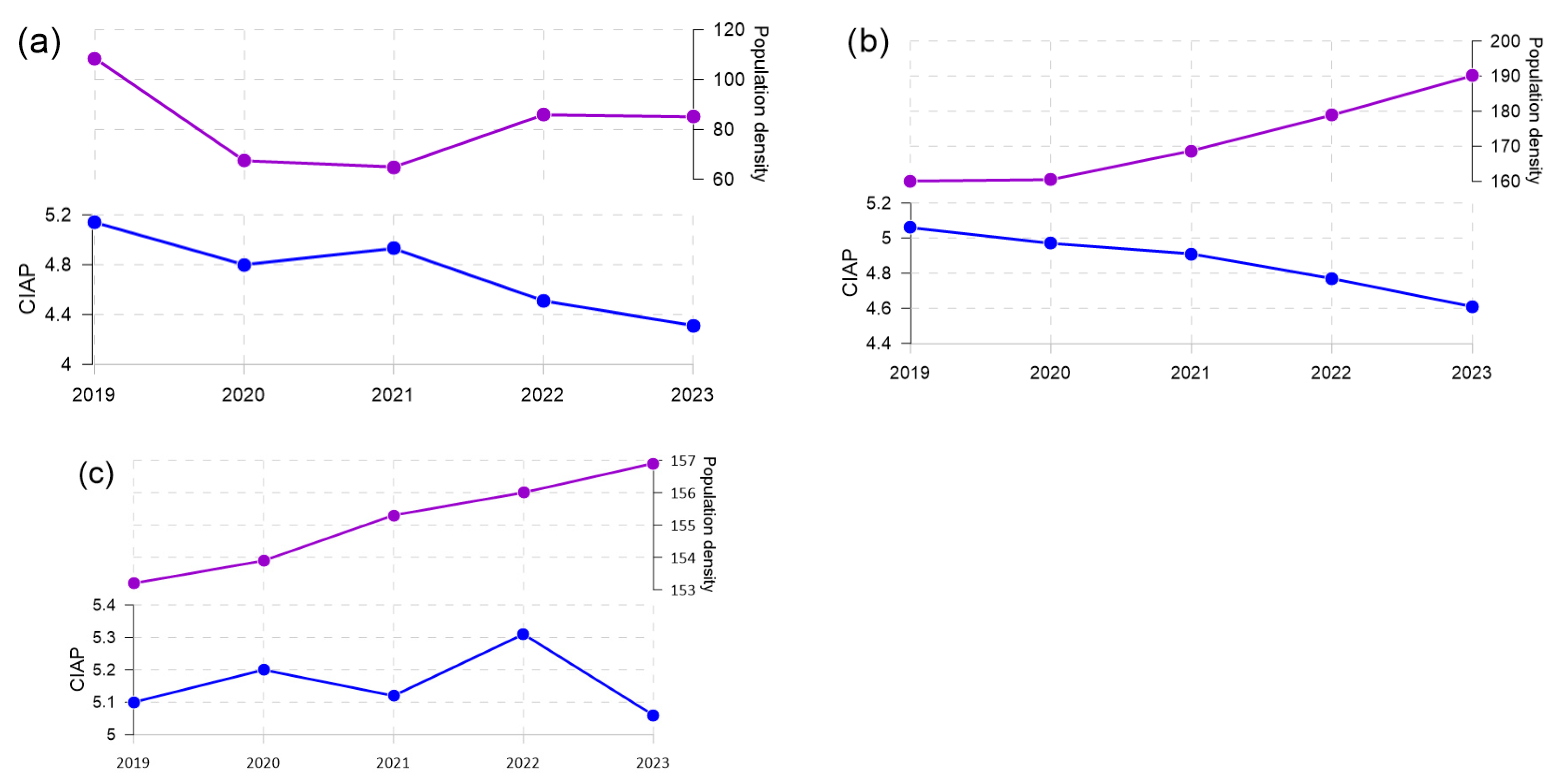
From 2019 to 2023, Lebanon experienced a significant reduction in population density. CIAP showed a similar trend due to the negative dynamics of concentrations of pollutants included in the CIAP calculation formula (formaldehyde, sulfur dioxide, nitrogen dioxide, carbon monoxide) (Figure 13a).
In contrast to Lebanon, the average population density in Syria increased from 2019 to 2023 (Figure 13b). Despite the population growth, the CIAP value decreased during this period. The declining trend in CIAP was driven by reduced levels of formaldehyde, nitrogen dioxide, and sulfur dioxide in the air over Syria.
In Turkey, the average population density slightly increased from 2019 and fluctuated around 155 thousand persons/km2. The CIAP values remained largely unchanged over the study period, despite minor interannual variability (Figure 13c). The interannual trends of pollutants used for CIAP calculation in Turkey did not show a clearly defined pattern.
Figure 13 presents the dynamics of population density and CIAP in the Orontes River basin over the period 2019–2023.
In Lebanon, the population density in the basin decreased from 2019 to 2021 and then stabilized at approximately 80 persons/km2. Meanwhile, CIAP consistently decreased throughout the period, indicating a reduction in air pollution. In Syria, there was a steady increase in population density from 160 to nearly 190 persons/km2. Simultaneously, CIAP demonstrated a declining trend, though less pronounced than in Lebanon. In the Turkish part of the basin, population density gradually increased from 153 to 157 persons/km2. CIAP fluctuated, showing a slight overall decrease by 2023. Thus, the three countries within the Orontes River basin exhibit different population density dynamics, while all cases show either a decrease or stabilization of CIAP. This indicates that despite population growth in Syria and Turkey, air pollution levels did not increase proportionally.
Areas of the Orontes River basin in Lebanon, Turkey, and Syria showed an increase in ozone (O3) concentrations, which, in addition to its greenhouse effect, adversely affects public health by causing respiratory diseases [95]. It is also important to note the rise in sulfur dioxide (SO2) levels in Turkey, which leads to serious health consequences and premature mortality [95]. The presented results provide valuable insights for understanding the relationships between anthropogenic activities and environmental conditions.

4. Conclusions

Using satellite imagery from Sentinel-5, the air quality in the Orontes River basin across Lebanon, Syria, and Turkey was assessed for the period 2019–2024. Leveraging the LandScan database, a powerful tool for estimating and analyzing population density within river basins and other spatial formations, the relationship between population density dynamics and air pollutant concentrations was examined.
Air pollution analysis was conducted based on the following indicators: aerosol index, methane, carbon monoxide, formaldehyde, nitrogen dioxide, ozone, and sulfur dioxide (The maximum air pollution in the Orontes River basin is observed in Syria (AI, CH4, HCHO, O3). Next, in terms of the number of maximum pollution indicators, is Turkey (CO, SO2), with Lebanon closing the list with a single maximum indicator (NO2). The spatio-temporal dynamics of the comprehensive atmospheric pollution index in the Orontes River basin from 2019 to 2024 demonstrate a gradual decline in pollution levels accompanied by shifts in its concentration zones, reflecting the complex interplay of natural conditions and anthropogenic factors on air quality in the region.
Military operations in Syria have had a highly negative impact on air quality in the Orontes River basin, causing a significant increase in emissions of various pollutants. AI, CH4, CO, HCHO, and NO2 are the most vulnerable pollutants to the effects of military actions, with their atmospheric concentrations rising substantially during the conflict due to a wide range of direct and indirect factors associated with military activities and their consequences. The civil war in Syria led to the widespread destruction of oil refineries, gas storage facilities, and pipelines, resulting in leaks and uncontrolled fossil fuel burning (leading to atmospheric emissions of SO2, NO2, CH4), as well as particulate matter. Power plants were destroyed, causing disruptions in energy supply. In response, there was an increase in the use of diesel generators, which also boosted emissions of SO2, NO2, and particulates. The destruction of factories and industrial facilities resulted in uncontrolled releases of harmful substances into the atmosphere. The active use of military equipment, including tanks, armored vehicles, and automobiles, led to additional NO2 and particulate emissions. Explosions of ammunition also affect the amount of toxic substances released into the air. Military actions and other factors increased the number of forest fires, which release large quantities of pollutants into the atmosphere.
Analysis of population density dynamics and pollutant concentrations across the three countries in the Orontes River basin revealed a synchronous increase in ozone levels in Syria, which, in addition to its greenhouse effect, has an adverse impact on public health, causing respiratory diseases. In conclusion, combating air pollution is a key task for protecting human health, the environment, and sustainable development. Accurate air quality monitoring and data analysis are essential for developing effective control measures, though the coverage of monitoring networks and data accuracy may have limitations. To overcome these challenges, comprehensive approaches are needed, including technological innovations, policy development, public education, and international cooperation. At the same time, continuous research is necessary to adapt to changing conditions and emerging issues. The destruction of infrastructure, lack of oversight, violation of environmental standards, and humanitarian crisis collectively created conditions for severe atmospheric pollution. Restoring air quality in the region will be a complex and long-term endeavor requiring significant efforts and resources.

Author Contributions

Conceptualization, V.T. and R.G.; methodology, V.T. and A.N.; software, V.T. and A.K.; validation, A.N., V.T. and C.N.P.; formal analysis, A.N. and V.T.; investigation, A.N. and V.T.; resources, V.T.; data curation, V.T.; writing—original draft preparation, A.N., V.T., E.V., R.G., T.G., A.D., C.N.P. and A.K.; writing—review and editing, A.N., V.T., E.V., R.G., T.G., A.D., C.N.P. and A.K.; visualization, V.T. and E.V.; supervision, V.T. and R.G.; project administration, V.T. All authors have read and agreed to the published version of the manuscript.

Funding

This work was carried out within the framework of IBSS state research assignment «Studying the features of the functioning and dynamics of subtropical and tropical coastal ecosystems under the climate change and anthropogenic load using remote sensing, cloud information processing, and machine learning to create a scientific basis for their rational use » (No. 124030100030-0).

Institutional Review Board Statement

Not applicable.

Informed Consent Statement

Not applicable.

Data Availability Statement

The data presented in this study are available on request from the corresponding author.

Conflicts of Interest

The authors declare no conflicts of interest. The funders had no role in the design of the study; in the collection, analyses, or interpretation of data; in the writing of the manuscript; or in the decision to publish the results.

Appendix A

Script for Calculating the Most Frequent Wind Directions (for R Studio 2023.06.1)

library(“ncdf4”)
library(“tidyverse”)
library(“lubridate”)
#Set your working directory with nc files
setwd(“put_the_path_to_your_directory”)
# Get all NetCDF files from the directory
u_wind_nc_files = list.files(pattern = “^u-wind.*\\.nc$”, full.names = T)
v_wind_nc_files = list.files(pattern = “^v-wind.*\\.nc$”, full.names = T)
# Get vectors of longitudes and latitudes to iterate through
u_nc_file = nc_open(u_wind_nc_files [1])
lon_vec = as.vector(ncvar_get(u_nc_file, “longitude”))
lat_vec = as.vector(ncvar_get(u_nc_file, “latitude”))
# Close and remove file from memory
nc_close(u_nc_file)
rm(u_nc_file)
# Function for calculating wind direction (from where wind blows) in
# trigonometric coordinate system
wind_dir = function(u,v){
 (270-atan2(u,v)*180/pi)%%360
}
# Function for giving a name for wind by its direction. It gets dataframe (it must
# contain column wdir), analyzes wdir column, and writes wind name (N, NNE, SW etc.)
# into column dir_names. Returns modified dataframe
wind_dir_name = function(df) {
 keys = c(“E”, “ENE”, “NE”, “NNE”, “N”, “NNW”, “NW”, “WNW”, “W”, “WSW”, “SW”, “SSW”, “S”, “SSE”, “SE”, “ESE”, “E”)
 min_degree = c(0, 11.25, 33.75, 56.25, 78.75, 101.25, 123.75, 146.25, 168.75,
         191.25, 213.75, 236.25, 258.75, 281.25, 303.75, 336.25, 348.75)
 max_degree = c(11.25, 33.75, 56.25, 78.75, 101.25, 123.75, 146.25, 168.75, 191.25,
         213.75, 236.25, 258.75, 281.25, 303.75, 336.25, 348.75, 360.1)
 dir_names_vec = apply(df, MARGIN = 1, FUN = function(X) {
  keys[as.numeric(X[“wdir”]) < max_degree & as.numeric(X[“wdir”]) >= min_degree]
 })
 df$dir_name = dir_names_vec
 return(df)
}
output_df <- data.frame(matrix(ncol = 0, nrow = 0))
for (lon_id in 1:2) {
 print(paste0(“Longitude E: “, lon_vec[lon_id]))
 lon_df = as_tibble(matrix(nrow = 0, ncol = 0))
 for (i in 1:length(u_wind_nc_files)) {
  u_file = nc_open(u_wind_nc_files[i])
  v_file = nc_open(v_wind_nc_files[i])
  print(paste0(u_wind_nc_files[i]))
  time_vec = as.vector(ncvar_get(u_file, “valid_time”))
  u_arr = ncvar_get(u_file, “u10”)[lon_id, , ]
  v_arr = ncvar_get(v_file, “v10”)[lon_id, , ]
  month_df = expand.grid(
   lon = lon_vec[lon_id],
   lat = as.vector(lat_vec),
   time = as_datetime(time_vec, tz = “UTC”)) |>
   as_tibble() |>
   mutate(year = year(time),
       month = month(time),
       u = as.vector(u_arr),
       v = as.vector(v_arr)) |>
   select(lon, lat, year, month, u, v) |>
   filter(!is.na(u))
  lon_df = bind_rows(lon_df, month_df)
  nc_close(u_file)
  nc_close(v_file)
  rm(u_file, v_file, month_df, u_arr, v_arr)
 }
 lon_df = lon_df |>
  dplyr::mutate(wspd = sqrt((u^2) + (v^2))) |>
  dplyr::mutate(wdir = wind_dir(u, v)) |>
  wind_dir_name()
 print(“data frame complete”) # Execution report
 # Analyze wind directions
 # Most common directions for every month
 dir_months_df = lon_df |>
  dplyr::group_by(lon, lat, month) |>
  dplyr::mutate(most_common_direction = dir_name |>
          table() |>
          sort() |>
          names() |>
          tail(1))|>
  dplyr::filter(row_number() == 1)|>
  dplyr::select(lon, lat, month, most_common_direction)|>
  pivot_wider(
   id_cols = c (lon, lat),
   names_from = month,
   names_prefix = “dir_mon_”,
   values_from = most_common_direction
  ) |>
  ungroup()
 # Most common directions for every year
 dir_years_df = lon_df |>
  dplyr::group_by(lon, lat, year) |>
  dplyr::mutate(most_common_direction = dir_name |>
          table() |>
          sort() |>
          names() |>
          tail(1))|>
  dplyr::filter(row_number() == 1)|>
  dplyr::select(lon, lat, year, most_common_direction) |>
  pivot_wider(
   id_cols = c(lon, lat),
   names_from = year,
   names_prefix = “dir_”,
   values_from = most_common_direction
  ) |>
  ungroup()
 # Most common wind direction for all the period
 dir_all_df = lon_df |>
  dplyr::group_by(lon, lat) |>
  dplyr::mutate(most_common_direction = dir_name |>
          table() |>
          sort() |>
          names() |>
          tail(1)) |>
  dplyr::filter(row_number() == 1)|>
  dplyr::select(lon, lat, most_common_direction) |>
  ungroup()
 print(“wind dirs calculated”) # Execution report
 # Analyze wind speed
 # Mean wind speed for every month
 wspd_month_df = lon_df |>
  dplyr::group_by(lon, lat, month) |>
  dplyr::mutate(wspd_mean = mean(wspd)) |>
  dplyr::filter(row_number() == 1) |>
  dplyr::select(lon, lat, month, wspd_mean) |>
  pivot_wider(
   id_cols = c(lon, lat),
   names_from = month,
   names_prefix = “mean_spd_mon_”,
   values_from = wspd_mean
  ) |>
  ungroup()
 # Mean wind speed for every year
 wspd_years_df = lon_df |>
  dplyr::group_by(lon, lat, year) |>
  dplyr::mutate(wspd_mean = mean(wspd)) |>
  dplyr::filter(row_number() == 1) |>
  dplyr::select(lon, lat, year, wspd_mean) |>
  pivot_wider(
   id_cols = c(lon, lat),
   names_from = year,
   names_prefix = “mean_spd_”,
   values_from = wspd_mean
  ) |>
  ungroup()
 # Mean wind speed for all the period
 wspd_all_df = lon_df |>
  dplyr::group_by(lon, lat) |>
  dplyr::mutate(wspd_mean = mean(wspd)) |>
  dplyr::filter(row_number() == 1)|>
  dplyr::select(lon, lat, wspd_mean) |>
  ungroup()
 # Put it all together into a single dataframe for the longitude
 lon_summary_df = dir_months_df |>
  bind_cols(dir_years_df |> dplyr::select(!c(lon, lat))) |>
  bind_cols(dir_all_df |> dplyr::select(!c(lon, lat))) |>
  bind_cols(wspd_month_df |> dplyr::select(!c(lon, lat))) |>
  bind_cols(wspd_years_df |> dplyr::select(!c(lon, lat))) |>
  bind_cols(wspd_all_df |> dplyr::select(!c(lon, lat)))
 print(“lon_summary_df: all added”) # Execution report
 output_df = rbind(output_df, lon_summary_df)
 print(“output_df: point added”)
 print(tail(output_df))
}
write.csv(output_df, “wind_16_directions_and_speed.csv”) # write an output file
Table A1. Annual average, median, standard deviation, minimum, maximum, amplitude of atmospheric compound concentrations in the Orontes River basin across the territory. Lebanon.
PollutantsYearMeanMedianStandard DeviationMinimumMaximumAmplitude
Aerosol index2019−0.94−0.930.16−1.28−0.510.77
2020−1.18−1.170.16−1.51−0.770.74
2021−0.67−0.630.16−1.06−0.380.68
20220.010.030.14−0.330.230.56
2023−0.05−0.020.13−0.40.190.59
2024−0.12−0.090.15−0.520.100.62
Methane
(nmol/mol)
20191884.91884.622.01829.11959.6130.5
20201898.71896.719.91860.01993.4133.4
20211902.51898.923.91836.41990.8154.4
20221893.61895.011.71849.01927.178.2
20231890.61893.418.71839.11968.5129.4
20241910.11910.515.31840.81971.4130.7
Carbon monoxide
(mmol/m2)
20192728223318
20202828224328
20212828224328
20222626221297
20232727223308
20242828224328
Formaldehyde
(µmol/m2)
2019113112127014474
2020108108127314269
20219998136813669
20229797116513065
2023102102146414783
2024109110135914687
Nitrogen dioxide
(µmol/m2)
201943449247046
202038398235432
2021454510247046
202236369186143
202333348165135
202434347185537
Ozone
(mmol/m2)
201913513511331363
202013513511331363
202113413411321363
202213513511341373
202313513511341373
202414214311411443
Sulfur dioxide
(µmol/m2)
20191181163721224203
20201321304032247215
20211701734355322266
20229810035−21213234
202312612637−4235239
202412012036−5241246
Table A2. Annual average, median, standard deviation, minimum, maximum, amplitude of atmospheric compound concentrations in the Orontes River basin across the territory. Syria.
PollutantsYearMeanMedianStandard DeviationMinimumMaximumAmplitude
Aerosol index2019−0.9−1.00.2−1.3−0.11.3
2020−1.1−1.20.2−1.6−0.41.2
2021−0.6−0.60.2−1.20.31.5
20220.10.10.2−0.41.01.4
20230.00.00.2−0.50.81.4
2024−0.04−0.080.22−0.600.771.37
Methane
(nmol/mol)
20191875.01875.811.31836.01904.968.9
20201897.51900.216.91817.51993.4175.9
20211907.71908.514.51831.22006.3175.0
20221903.11905.612.41840.11944.9104.9
20231910.41913.111.91837.71968.5130.8
20241923.31926.612.21850.71968.0117.3
Carbon monoxide
(mmol/m2)
20193031223339
202031312243410
202131322243410
202228292213110
202330312223311
202431322243511
Formaldehyde
(µmol/m2)
2019120122147716589
2020116117136915384
2021105105136414581
2022104105155714589
2023107108145715497
2024115114137815981
Nitrogen dioxide
(µmol/m2)
201932299197758
202031298176851
202133319187456
202230297186546
202330287176952
202430296186143
Ozone
(mmol/m2)
201913713711331396
202013613711331386
202113613621321397
202213713721331407
202313713711331406
202414514521401477
Sulfur dioxide
(µmol/m2)
2019167169440308308
20201971975337401364
20212432425263442379
2022154153486393387
20231921935819394375
202417917850−25418443
Table A3. Annual average, median, standard deviation, minimum, maximum, amplitude of atmospheric compound concentrations in the Orontes River basin across the territory. Turkey.
PollutantsYearMeanMedianStandard DeviationMinimumMaximumAmplitude
Aerosol index2019−1.0−1.00.1−1.3−0.70.6
2020−1.3−1.30.1−1.7−0.90.7
2021−0.7−0.70.2−1.2−0.30.9
2022−0.1−0.10.1−0.50.30.8
2023−0.1−0.10.1−0.60.20.8
2024−0.21−0.200.15−0.650.130.79
Methane
(nmol/mol)
20191887.91889.713.11824.91965.5140.6
20201886.51887.910.71834.81931.196.3
20211897.71898.511.41826.71947.4120.7
20221894.61894.711.61819.71944.9125.3
20231901.2190312.31764.81942177.3
20241913.71916.216.61725.51958.4233.0
Carbon monoxide
(mmol/m2)
20193131226337
20203131227347
20213232228357
20222929225327
20233131227337
20243232228357
Formaldehyde
(µmol/m2)
2019130131138416682
2020124125127815779
2021111111116914172
2022119119127215381
2023119120136815183
2024127130147316289
Nitrogen dioxide
(µmol/m2)
201930305184224
202031325184527
202134356205030
202232336194627
202334356204727
202436376195535
Ozone
(mmol/m2)
201913913901381392
202013813801371392
202113913901381401
202214014001391401
202313913901391402
202414714701461481
Sulfur dioxide
(µmol/m2)
20191741754439322283
20202202194339371332
20212552554496433337
20221911924825340315
20232132114449392343
20241831814329324295

References

  1. Sun, B.; Fang, C.; Liao, X.; Guo, X.; Liu, Z. The relationship between urbanization and air pollution affected by intercity factor mobility: A case of the Yangtze River Delta region. Environ. Impact Assess. Rev. 2023, 100, 107092. [Google Scholar] [CrossRef]
  2. Yang, T.; Zhou, K.; Ding, T. Air pollution impacts on public health: Evidence from 110 cities in Yangtze River Economic Belt of China. Sci. Total. Environ. 2022, 851, 158125. [Google Scholar] [CrossRef] [PubMed]
  3. Nikolova, M.; Zheleva, I.; Filipova, M. Statistic Study of Gaseous Air Contamination in the City of Svishtov, Bulgaria. J. Phys. Conf. Ser. 2023, 2675, 012006. [Google Scholar] [CrossRef]
  4. Juginović, A.; Vuković, M.; Aranza, I.; Biloš, V. Health impacts of air pollution exposure from 1990 to 2019 in 43 European countries. Sci. Rep. 2021, 11, 22516. [Google Scholar] [CrossRef]
  5. Hu, M.; Wang, Y.; Wang, S.; Jiao, M.; Huang, G.; Xia, B. Spatial-temporal heterogeneity of air pollution and its relationship with meteorological factors in the Pearl River Delta, China. Atmos. Environ. 2021, 254, 118415. [Google Scholar] [CrossRef]
  6. Tabunschik, V.; Gorbunov, R.; Gorbunova, T. Unveiling Air Pollution in Crimean Mountain Rivers: Analysis of Sentinel-5 Satellite Images Using Google Earth Engine (GEE). Remote Sens. 2023, 15, 3364. [Google Scholar] [CrossRef]
  7. Quadros, F.D.; Snellen, M.; Dedoussi, I.C. Regional sensitivities of air quality and human health impacts to aviation emissions. Environ. Res. Lett. 2020, 15, 105013. [Google Scholar] [CrossRef]
  8. Heft-Neal, S.; Burney, J.; Bendavid, E.; Burke, M. Robust relationship between air quality and infant mortality in Africa. Nature 2018, 559, 254–258. [Google Scholar] [CrossRef] [PubMed]
  9. Zhao, Q.G.; Huang, G.Q.; Ma, Y.Q. The Ecological Environment Conditions and Construction of an Ecological Civilization in China. Available online: https://cdn.sciengine.com/doi/10.5846/stxb201410081968 (accessed on 20 September 2025).
  10. Tabunschik, V.; Gorbunov, R.; Bratanov, N.; Gorbunova, T.; Mirzoeva, N.; Voytsekhovskaya, V. Fatala River Basin (Republic of Guinea, Africa): Analysis of Current State, Air Pollution, and Anthropogenic Impact Using Geoinformatics Methods and Remote Sensing Data. Sustainability 2023, 15, 15798. [Google Scholar] [CrossRef]
  11. Wang, J.; Wang, L. Study on the efficiency of air pollution control and responsibility allocation in the Yangtze River Delta region in China from the perspective of ecological compensation. J. Clean. Prod. 2023, 423, 138700. [Google Scholar] [CrossRef]
  12. Quimbayo-Duarte, J.; Chemel, C.; Staquet, C.; Troude, F.; Arduini, G. Drivers of severe air pollution events in a deep valley during wintertime: A case study from the Arve river valley, France. Atmos. Environ. 2021, 247, 118030. [Google Scholar] [CrossRef]
  13. Pior, M.-Y.; Osman, O. Air Pollution Assessment Applying GIS Integrated System. J. East. Asia Soc. Transp. Stud. 1997, 2, 2071–2081. [Google Scholar]
  14. Song, S.-J. A GIS Based Approach to Spatio-Temporal Analysis of Urban Air Quality in Chengdu Plain. Int. Arch. Photogramm. Remote Sens. Spatial Inf. Sci. 2008, 37, 1447–1450. Available online: https://www.researchgate.net/publication/228802382_A_GIS_Based_Approach_to_Spatio-Temporal_Analysis_of_Urban_Air_Quality_in_Chengdu_Plain (accessed on 20 September 2025).
  15. Yerramilli, A.; Dodla, V.B.R.; Yerramilli, S. Air Pollution, Modeling and GIS based Decision Support Systems for Air Quality Risk Assessment. In Advanced Air Pollution; Earth and Planetary Sciences, Oceanography and Atmospheric Sciences; Nejadkoorki, F., Ed.; IntecOpen: Rijeka, Croatia, 2011; ISBN 978-953-307-511-2. [Google Scholar]
  16. Longley, P.A.; Goodchild, M.F.; Maguire, D.J.; Rhind, D.W. Geographic Information Systems and Science; John Wiley & Sons: New York, NY, USA, 2001; pp. 27–58. [Google Scholar]
  17. Richmond-Bryant, J.; Odera, M.; Subra, W.; Vallee, B.; Tucker, C.; Oliver, C.; Wilson, A.; Tran, J.; Kelley, B.; Cramer, J.A.; et al. A community-integrated geographic information system study of air pollution exposure impacts in Colfax, LA. Local Environ. 2022, 27, 728–746. [Google Scholar] [CrossRef] [PubMed]
  18. Ya’Acob, N.; Azize, A.; Adnan, N.M.; Yusof, A.L.; Sarnin, S.S. Haze monitoring based on air pollution index (API) and geographic information system (GIS). In Proceedings of the 2016 IEEE Conference on Systems, Process and Control (ICSPC), Malacca, Malaysia, 16–18 December 2016; pp. 7–11. [Google Scholar] [CrossRef]
  19. Kaberova, E.B. Priority directions of the Russian Federation’s foreign policy in the Middle East//Legal and socio-economic aspects of the defense of the Fatherland. In Proceedings of the Scientific and Practical Conference, Moscow, Russia, 19 February 2016; International Law Institute: Moscow, Russia, 2016; pp. 124–129. [Google Scholar]
  20. Matveev, I.A. Syria in Conflict; Kuznetsov, V.A., Ed.; Institute of Oriental Studies of the Russian Academy of Sciences(IV RAS): Moscow, Russia, 2020; 496p. [Google Scholar]
  21. Youvan, D. The Fragmentation of Syria: Geopolitical Implications and the Resurgence of Extremism. Available online: https://www.researchgate.net/publication/386573182_The_Fragmentation_of_Syria_Geopolitical_Implications_and_the_Resurgence_of_Extremism (accessed on 20 September 2025).
  22. Conker, A.; Hussein, H. Hydropolitics and issue-linkage along the Orontes River Basin: An analysis of the Lebanon–Syria and Syria–Turkey hydropolitical relations. Int. Environ. Agreem. Politi-Law. Econ. 2019, 20, 103–121. [Google Scholar] [CrossRef]
  23. Khouri, L.; Al-Mufti, M.B. Assessment of surface water quality using statistical analysis methods: Orontes River (Case study). Baghdad Sci. J. 2022, 19, 0981–0989. [Google Scholar] [CrossRef]
  24. Tabunshchik, V.A.; Nikiforova, A.A.; Lineva, N.P.; Mirzoeva, N.Y.; Cherny, G.S.; Kerimov, I.A.; Makhmudova, L.S.; Gagaeva, Z.S.; Andronchik, Y.O. Land cover dynamics in the basin El-Asi river (Oronte) in 2017–2022. Biodivers. Sustain. Dev. 2023, 8, 40–55. [Google Scholar]
  25. Kloosterman, F.H.; Vermooten, J.S.A. Dutch-Syrian Water Cooperation: Development of a Numerical Groundwater Flow Model for the Larger Orontes Basin: Final Report; TNO Built Environment and Geosciences: Dordrecht, The Netherlands, 2008. [Google Scholar]
  26. Irrigation in the Middle East Region in Figures; Frenken, K., Ed.; Food and Agriculture Organization of the United Nations (FAO): Rome, Italy, 2009; 401p, Available online: https://www.fao.org/4/i0936e/i0936e00.pdf (accessed on 20 September 2025).
  27. Orontes River Basin. In Inventory of Shared Water Resources in Western Asia; United Nations Economic and Social Commission for Western Asia, Bundesanstalt für Geowissenschaften und Rohstoffe, Eds.; ESCWA: Beirut, Lebanon, 2013; Chapter 7; Available online: https://waterinventory.org/sites/waterinventory.org/files/chapters/Chapter-07-Orontes-River-Basin-web_1.pdf (accessed on 17 November 2023).
  28. El-Asi (Orontes). In Dictionary of Geographical Names of Foreign Countries; F.N. Krasovsky Central Research Institute of Geodesy, Aerial Photography and Cartography, L.I., Anenberg, G.G., Arutyunova, K.T., Boyko, V.S., Buzykina, N.V., Vinogradova, S.S., Gavrilova, E.V., Gorovaya, L.G., Ivanov, I.P., et al., Eds.; Nedra: Moscow, Russia, 1986; p. 448. [Google Scholar]
  29. Chernyshev, K.E. The civil war in Syria: The causes of the war and ways to solve the crisis. In Science and Education: Problems and Development Trends: Proceedings of the International Scientific and Practical Conference: In 3 Parts, Ufa, Republic of Bashkortostan, 20–21 December 2013; Iskuzhin, T.S., Idelbaev, M.K., Kabakovich, G.A., Zainullina, G.S., Tukhvatullin, T.A., Abakacheva, M.B., Nigmatullin, O.B., Eds.; Autonomous Non-commercial Organization “Research Center for Information and Legal Technologies”: Ufa, Republic of Bashkortostan, 2013; pp. 340–342. [Google Scholar]
  30. The Number of Refugees from Syria has Reached a Critical Point. Available online: http://hronika.info/mir/ (accessed on 7 February 2025).
  31. Mikryukov, V.O. International protection of victims of armed conflicts (analysis of the conflict in the Syrian Arab Republic). In Legal and Socio-Economic Aspects of the Protection of the Fatherland: Proceedings of the Scientific and Practical Conference, Moscow, Russia, 19 February 2016; Mikryukov, V.O., Popov, I.A., Eds.; International Law Institute: Moscow, Russia, 2016; pp. 130–136. [Google Scholar]
  32. BBC. Available online: http://www.bbc.co.uk/russian/rolling_news/2013/04/130427_rn_syria_foreign_mercenary (accessed on 20 September 2025).
  33. Online News Publication. Available online: http://lenta.ru/news/2013/05/27/iraqis/ (accessed on 20 September 2025).
  34. Ismael, T.Y.; Ismael, J.S. The Legacy of Islam: Past and present. In Government and Politics of the Contemporary Middle East; Routledge: London, UK, 2023; pp. 57–96. Available online: https://www.taylorfrancis.com/chapters/edit/10.4324/9781003198093-4/legacy-islam-tareq-ismael-jacqueline-ismael (accessed on 20 September 2025).
  35. Phillips, C. The international system and the Syrian civil war. Int. Relat. 2022, 36, 358–381. [Google Scholar] [CrossRef]
  36. Nwokoye, A.N. The military and diplomatic intervention of regional and global powers in the Syrian war and the failure to restore peace and security in the Middle East. NG J. Soc. Dev. 2023, 11, 71–83. [Google Scholar]
  37. For Peace in the Middle East, Neighbors Need to Come to an Agreement Plotnikov Nikolai Dmitrievich Articles by the Staff of the Institute of Economics of the Russian Academy of Sciences. Available online: https://www.ivran.ru/articles?artid=210168 (accessed on 20 September 2025).
  38. Information Agency. Available online: http://ria.ru/arab_riot/20130916/963359396 (accessed on 20 September 2025).
  39. Tabunshchik, V.; Nikiforova, A.; Lineva, N.; Drygval, P.; Gorbunov, R.; Gorbunova, T.; Kerimov, I.; Pham, C.N.; Bratanov, N.; Kiseleva, M. The Dynamics of Air Pollution in the Southwestern Part of the Caspian Sea Basin (Based on the Analysis of Sentinel-5 Satellite Data Utilizing the Google Earth Engine Cloud-Computing Platform). Atmosphere 2024, 15, 1371. [Google Scholar] [CrossRef]
  40. Theys, N.; Hedelt, P.; De Smedt, I.; Lerot, C.; Yu, H.; Vlietinck, J.; Pedergnana, M.; Arellano, S.; Galle, B.; Fernandez, D.; et al. Global monitoring of volcanic SO2 degassing with unprecedented resolution from TROPOMI onboard Sentinel-5 Precursor. Sci. Rep. 2019, 9, 2643. [Google Scholar] [CrossRef]
  41. Hasan, M.; Ahmed, A. Evaluation and Mapping the Atmospheric Air Quality of Coastal Area in Bangladesh Using Remote Sensing and GIS Techniques. Dhaka Univ. J. Earth Environ. Sci. 2023, 11, 53–64. [Google Scholar] [CrossRef]
  42. Borsdorff, T.; Reynoso, A.G.; Maldonado, G.; Mar-Morales, B.; Stremme, W.; Grutter, M.; Landgraf, J. Monitoring CO emissions of the metropolis Mexico City using TROPOMI CO observations. Atmos. Meas. Tech. 2020, 20, 15761–15774. [Google Scholar] [CrossRef]
  43. Garajeh, M.K.; Laneve, G.; Rezaei, H.; Sadeghnejad, M.; Mohamadzadeh, N.; Salmani, B. Monitoring Trends of CO, NO2, SO2, and O3 Pollutants Using Time-Series Sentinel-5 Images Based on Google Earth Engine. Pollutants 2023, 3, 255–279. [Google Scholar] [CrossRef]
  44. Singh, S.; Avtar, R.; Jain, A.; Alsulamy, S.; Ouda, M.M.; Kharrazi, A. Identifying Micro-Level Pollution Hotspots Using Sentinel-5P for the Spatial Analysis of Air Quality Degradation in the National Capital Region, India. Sustainability 2025, 17, 2241. [Google Scholar] [CrossRef]
  45. Jahanbakhsh, A.S.; Rezaei Banafsheh, M.; Khorshiddoust, A.M.; Farahmand, H. Spatio-Temporal Distribution of Seasonal Dust in East and Southeast Iran Based on Station and Remote Sensing Data. J. Geogr. Plan. 2024, 28, 119–130. [Google Scholar] [CrossRef]
  46. Paasonen, P.; Kupiainen, K.; Klimont, Z.; Visschedijk, A.; Denier van der Gon, H.A.; Amann, M. Continental anthropogenic primary particle number emissions. Atmos. Chem. Phys. 2016, 16, 6823–6840. [Google Scholar] [CrossRef]
  47. Xiang, Y.; Ye, Y.; Peng, C.; Teng, M.; Zhou, Z. Seasonal variations for combined effects of landscape metrics on land surface temperature (LST) and aerosol optical depth (AOD). Ecol. Indic. 2022, 138, 108810. [Google Scholar] [CrossRef]
  48. Eliseev, A.V. Global methane cycle: An overview. Fundam. Appl. Climatol. 2018, 1, 52–70. [Google Scholar] [CrossRef]
  49. Available online: https://www.ccacoalition.org/ru/short-lived-climate-pollutants/methane#:~:text=%D0%9E%D1%81%D0%BD%D0%BE%D0%B2%D0%BD%D1%8B%D0%BC%D0%B8%20%D1%81%D0%B5%D0%BA%D1%82%D0%BE%D1%80%D0%B0%D0%BC%D0%B8%20%D0%B2%D1%8B%D0%B1%D1%80%D0%BE%D1%81%D0%BE%D0%B2%20%D0%BC%D0%B5%D1%82%D0%B0%D0%BD%D0%B0%20%D1%8F%D0%B2%D0%BB%D1%8F%D1%8E%D1%82%D1%81%D1%8F,%D0%B0%20%D1%82%D0%B0%D0%BA%D0%B6%D0%B5%20%D0%B8%D0%B7%20%D1%83%D0%B3%D0%BE%D0%BB%D1%8C%D0%BD%D1%8B%D1%85%20%D1%88%D0%B0%D1%85%D1%82 (accessed on 20 September 2025).
  50. Guo, Z.-L.; Bian, X.-L.; DU, Y.-B.; Zhang, W.-C.; Yao, D.-D.; Yang, H.-P. Recent advances in integrated carbon dioxide capture and methanation technology. J. Fuel Chem. Technol. 2023, 51, 293–302. [Google Scholar] [CrossRef]
  51. Liu, C.; He, C.; Wang, Y.; He, G.; Liu, N.; Miao, S.; Wang, H.; Lu, X.; Fan, S. Characteristics and mechanism of a persistent ozone pollution event in Pearl River Delta induced by typhoon and subtropical high. Atmos. Environ. 2023, 310, 119964. [Google Scholar] [CrossRef]
  52. Lu, X.; Liu, L.; Chen, D.; Zhang, X.; Liu, X.; Zhang, Y. Dry deposition of NO2 over China inferred from OMI columnar NO2 and atmospheric chemistry transport model. Atmos. Environ. 2017, 169, 238–249. [Google Scholar] [CrossRef]
  53. Dong, J.; Zhang, X.; Zhan, N. Satellite-based estimates of high-resolution CO concentrations at ground level in the Yangtze River Economic Belt of China. Atmos. Environ. 2023, 312, 120018. [Google Scholar] [CrossRef]
  54. Xu, Y.; Su, W.; Hu, Q.; Zhang, C.; Javed, Z.; Tian, Y.; Hou, H.; Liu, C. Unexpected HCHO transnational transport: Influence on the temporal and spatial distribution of HCHO in Tibet from 2013 to 2021 based on satellite. npj Clim. Atmos. Sci. 2024, 7, 102. [Google Scholar] [CrossRef]
  55. Huang, C.; Ju, T.; Geng, T.; Fan, J.; Peng, S.; Xia, X.; Niu, X. Spatial and temporal distribution of HCHO and its pollution sources based on satellite remote sensing: A case study of the Yangtze River Economic Belt. Environ. Res. Commun. 2023, 5, 075014. [Google Scholar] [CrossRef]
  56. Jiang, H.; Zhao, W. Harm and pollution status of indoor formaldehyde Guangdong. Chem. Ind. 2016, 43, 189–201. [Google Scholar]
  57. World Health Organization. WHO Guidelines for Indoor Air Quality: Selected Pollutants; World Health Organization, Regional Office for Europe: Copenhagen, Denmark, 2010. [Google Scholar]
  58. Liu, T.; Lin, Y.; Chen, J.; Chen, G.; Yang, C.; Xu, L.; Li, M.; Fan, X.; Zhang, F.; Hong, Y. Pollution mechanisms and photochemical effects of atmospheric HCHO in a coastal city of southeast China. Sci. Total. Environ. 2022, 859, 160210. [Google Scholar] [CrossRef] [PubMed]
  59. Shen, L.; Wang, H.; Lü, S.; Li, L.; Yuan, J.; Zhang, X.; Tian, X.; Tang, Q. Observation of aerosol size distribution and new particle formation at a coastal city in the Yangtze River Delta, China. Sci. Total. Environ. 2016, 565, 1175–1184. [Google Scholar] [CrossRef]
  60. Walters, W.W.; Simonini, D.S.; Michalski, G. Nitrogen isotope exchange between NO and NO2 and its implications for δ15N variations in tropospheric NOx and atmospheric nitrate. Geophys. Res. Lett. 2016, 43, 440–448. [Google Scholar] [CrossRef]
  61. Richter, A.; Burrows, J.P.; Nüß, H.; Granier, C.; Niemeier, U. Increase in tropospheric nitrogen dioxide over China observed from space. Nature 2005, 437, 129–132. [Google Scholar] [CrossRef]
  62. Lin, J.-T. Satellite constraint for emissions of nitrogen oxides from anthropogenic, lightning and soil sources over East China on a high-resolution grid. Atmos. Meas. Tech. 2012, 12, 2881–2898. [Google Scholar] [CrossRef]
  63. Jaeglé, L.; Steinberger, L.; Martin, R.V.; Chance, K. Global partitioning of NOx sources using satellite observations: Relative roles of fossil fuel combustion, biomass burning and soil emissions. Faraday Discuss. 2005, 130, 407–423. [Google Scholar] [CrossRef] [PubMed]
  64. Zhao, B.; Liou, K.-N.; Gu, Y.; Li, Q.; Jiang, J.H.; Su, H.; He, C.; Tseng, H.-L.R.; Wang, S.; Liu, R.; et al. Enhanced PM2.5 pollution in China due to aerosol-cloud interactions. Sci. Rep. 2017, 7, 4453. [Google Scholar] [CrossRef]
  65. Lee, Y.-W.; Gulari, E. Improved performance of NOx reduction by H2 and CO over a Pd/Al2O3 catalyst at low temperatures under lean-burn conditions. Catal. Commun. 2004, 5, 499–503. [Google Scholar] [CrossRef]
  66. Pandey, S.K.; Tripathi, B.; Mishra, V.; Prajapati, S. Size fractionated speciation of nitrate and sulfate aerosols in a sub-tropical industrial environment. Chemosphere 2006, 63, 49–57. [Google Scholar] [CrossRef] [PubMed]
  67. Yao, L.; Ning, L. Study on spatial-temporal variations in total NO2 column amounts over China using SCIAMACHY data. Res. Environ. Sci. 2012, 25, 419–424. [Google Scholar]
  68. Heickelen, J. Atmospheric Chemistry; RSC (Royal Society of Chemistry) Publishing: Cambridge, UK, 1976. [Google Scholar]
  69. Ai, J.; Sun, Y.; Zheng, F.; Ni, C.; Gui, K.; Zhang, X.; Jiang, W.; Liao, T. The spatial temporal variation and factor analysis of the tropospheric NO2 columns in the Sichuan Basin from 2005 to 2016. Atmos. Pollut. Res. 2018, 9, 1157–1166. [Google Scholar] [CrossRef]
  70. Russell, K.M.; Galloway, J.N.; Macko, S.A.; Moody, J.L.; Scudlark, J.R. Sources of nitrogen in wet deposition to the Chesapeake Bay region. Atmos. Environ. 1998, 32, 2453–2465. [Google Scholar] [CrossRef]
  71. Wetherbee, G.; Wieczorek, M.; Robertson, D.; Saad, D.; Novick, J.; Mast, M.A. Estimating urban air pollution contribution to South Platte River nitrogen loads with National Atmospheric Deposition Program data and SPARROW model. J. Environ. Manag. 2022, 301, 113861. [Google Scholar] [CrossRef]
  72. Zeng, G.; Pyle, J.A.; Young, P.J. Impact of climate change on tropospheric ozone and its global budgets. Atmos. Meas. Tech. 2008, 8, 369–387. [Google Scholar] [CrossRef]
  73. Feng, Z.; De Marco, A.; Anav, A.; Gualtieri, M.; Sicard, P.; Tian, H.; Fornasier, F.; Tao, F.; Guo, A.; Paoletti, E. Economic losses due to ozone impacts on human health, forest productivity and crop yield across China. Environ. Int. 2019, 131, 104966. [Google Scholar] [CrossRef]
  74. Sicard, P.; Augustaitis, A.; Belyazid, S.; Calfapietra, C.; de Marco, A.; Fenn, M.; Bytnerowicz, A.; Grulke, N.; He, S.; Matyssek, R.; et al. Global topics and novel approaches in the study of air pollution, climate change and forest ecosystems. Environ. Pollut. 2016, 213, 977–987. [Google Scholar] [CrossRef]
  75. Stocker, T.; Qin, D.; Plattner, G.; Tignor, M.; Allen, S.; Boschung, J.; Nauels, A.; Xia, Y.; Bex, B.; Midgley, B. IPCC, 2013: Climate Change 2013: The Physical Science Basis—Contribution of Working Group I to the Fifth Assessment Report of the Intergovernmental Panelon Climate Change; Cambridge University Press: Cambridge, UK, 2013. [Google Scholar]
  76. He, Z.; He, Y.; Fan, G.; Li, Z.; Liang, Z.; Fang, H.; Zeng, Z.-C. Ozone Pollution and Its Response to Nitrogen Dioxide Change from a Dense Ground-Based Network in the Yangtze River Delta: Implications for Ozone Abatement in Urban Agglomeration. Atmosphere 2022, 13, 1450. [Google Scholar] [CrossRef]
  77. IPCC; IP. Climate Change 2013: The Assessment Reports of the Intergovernmental Panel on Climate Change; IPCC, Stocker, T.F., Qin, D., Plattner, G.-K., Tignor, M.M.B., Allen, S.K., Boschung, J., Nauels, A., Xia, Y., Bex, V., et al., Eds.; Cambridge University Press: Cambridge, UK, 2013; p. 1552. [Google Scholar]
  78. Mirza, A.; Kazmi, J.; Shirazi, S.A. Spatio-Periodic Monitoring and Analysis of Atmospheric Sulphur Dioxide (So2) in the Metropolitan Areas of Lahore-Pakistan. Available online: https://www.researchgate.net/publication/262000847_SPATIO-PERIODIC_MONITORING_AND_ANALYSIS_OF_ATMOSPHERIC_SULPHUR_DIOXIDE_SO2_IN_THE_METROPOLITAN_AREAS_OF_LAHORE_-PAKISTAN (accessed on 20 September 2025).
  79. Rădulescu, C. Emisii poluante. In Metode Pentru Reducerea Acestora; Editura Bibliotheca: Târgovişte, Romania, 2008. [Google Scholar]
  80. Oprea, D.M. The distribution over time and space of sulphur dioxide and influence on organic farming. Case study: The area of Slatina Town. Sci. Pap. Ser. Manag. Econ. Eng. Agric. Rural. Dev. 2013, 13, 263–268. [Google Scholar]
  81. Popescu, M.; Popescu, M. Ecologie Aplicată; Editura Matrix Rom: Bucureşti, Romania, 2000. [Google Scholar]
  82. Hou, X.; Cheng, B.; Xia, Z.; Zhou, H.; Shen, Q.; Lu, Y.; Nazemi, E.; Zhang, G. Investigating the Relationship between Economic Growth, Institutional Environment and Sulphur Dioxide Emissions. Sustainability 2023, 15, 4678. [Google Scholar] [CrossRef]
  83. Lebakula, V.; Sims, K.; Reith, A.; Rose, A.; McKee, J.; Coleman, P.; Kaufman, J.; Urban, M.; Jochem, C.; Whitlock, C.; et al. LandScan Global 30 Arcsecond Annual Global Gridded Population Datasets from 2000 to 2022. Sci. Data 2025, 12, 495. [Google Scholar] [CrossRef]
  84. Láng-Ritter, J.; Keskinen, M.; Tenkanen, H. Global gridded population datasets systematically underrepresent rural population. Nat. Commun. 2025, 16, 2170. [Google Scholar] [CrossRef]
  85. Hu, S.; Guo, G.; Zhang, J.; Khan, M.N.; Xu, S.; Yang, F.; Schwandt, B.W.; Hu, Z.; Zou, J. Advanced porous MOF materials and technologies for high-efficiency ppm-level toxic gas separation. Mater. Sci. Eng. R Rep. 2024, 161, 100874. [Google Scholar] [CrossRef]
  86. LandScan Project. Available online: https://landscan.ornl.gov (accessed on 20 September 2025).
  87. Bagrov, N.V.; Shvets, A.B.; Samulev, A.A. Geographical imagology: Birth certificate. In Culture of the Peoples of the Black Sea Region; 2001; pp. 187–194. Available online: https://nasplib.isofts.kiev.ua/items/ae3aebda-9274-4a8b-a252-26e842cebdf8 (accessed on 20 September 2025).
  88. Gribok, M.V.; Tikunov, V.S. Geoinformation System as a Tool for Developing a Strategy for Federal Television Broadcasting (Using the Example of the Rossiya TV Channel). In Geography and Natural Resources; 2011; pp. 131–140. Available online: https://elibrary.ru/item.asp?id=17097241 (accessed on 20 September 2025).
  89. Volkhin, D.A. Geographical study of the role of coastal territories in the structure of the information image of Crimea. Sci. Notes V.I. Vernadsky Crime. Fed. Univ. Geogr. Geol. 2016, 2, 13–23. [Google Scholar]
  90. Volkhin, D.A. Crimea in the focus of information interaction between the states of the Black Sea region. Geopolit. Ecogeodyn. Reg. 2018, 4, 40–46. [Google Scholar]
  91. Gongjun, W.; Dongmei, W. The importance and challenges of air pollution control. E3S Web Conf. 2024, 520, 02003. [Google Scholar] [CrossRef]
  92. Available online: https://anna-news.info/category/siriya/ (accessed on 20 September 2025).
  93. Available online: https://sputnik.by/20211022/v-sirii-kaznili-24-podzhigateley-lesov-1057375253.html (accessed on 20 September 2025).
  94. Available online: https://tass.ru/obschestvo/11888731 (accessed on 20 September 2025).
  95. Available online: https://mk-turkey.ru/life/2021/03/01/futbolnyh-polej.html (accessed on 20 September 2025).
  96. Available online: https://iz.ru/1744447/2024-08-18/v-turtcii-zaderzhali-semerykh-podozrevaemykh-v-lesnykh-podzhogov (accessed on 20 September 2025).
Figure 1. Geographical location and absolute elevations in the Orontes River basin.
Atmosphere 17 00115 g001
Figure 2. Spatial distribution of the Aerosol Index in the Orontes River Basin for the period 2019–2024.
Atmosphere 17 00115 g002
Figure 3. Spatial distribution of methane (CH4) concentration in the air in the Orontes River basin for the period 2019–2024.
Atmosphere 17 00115 g003
Figure 4. Spatial distribution of carbon monoxide concentration in the air in the Orontes River basin for the period 2019–2024.
Atmosphere 17 00115 g004
Figure 5. Spatial distribution of formaldehyde (HCHO) concentration in the air over the Orontes River basin for the period 2019–2024.
Atmosphere 17 00115 g005
Figure 6. Spatial distribution of nitrogen dioxide concentration in the air in the Orontes River basin for the period 2019–2024.
Atmosphere 17 00115 g006
Figure 7. Spatial distribution of ozone concentration in the air in the Orontes River basin for the period 2019–2024.
Atmosphere 17 00115 g007
Figure 8. Spatial distribution of sulfur dioxide concentration in the air in the Orontes River basin for the period 2019–2024.
Atmosphere 17 00115 g008
Figure 9. Dynamics of the comprehensive atmospheric pollution index values in the Orontes River basin in 2019–2024.
Atmosphere 17 00115 g009
Figure 10. Spatial distribution of CIAP in the Orontes River basin for the period 2019–2024.
Atmosphere 17 00115 g010
Figure 11. Interannual variation of the averaged CIAP over the entire Orontes River basin and within the three countries (Lebanon, Syria, Turkey).
Atmosphere 17 00115 g011
Figure 12. Predominant wind directions in the vicinity of the Orontes River basin during 2019–2024.
Atmosphere 17 00115 g012
Figure 13. Dynamics of population density and CIAP in the Orontes River basin in Lebanon (a), Syria (b), and Turkey (c).
Atmosphere 17 00115 g013
Table 1. Average population density in the Orontes River basin in Syria, Turkey, and Lebanon.
CountryPopulation Density, Thousand People/km2
20192020202120222023
Lebanon108.567.464.985.985.1
Syria160.1160.5168.7178.9190.1
Turkey153.2153.9155.3156.0156.9
Disclaimer/Publisher’s Note: The statements, opinions and data contained in all publications are solely those of the individual author(s) and contributor(s) and not of MDPI and/or the editor(s). MDPI and/or the editor(s) disclaim responsibility for any injury to people or property resulting from any ideas, methods, instructions or products referred to in the content.