


Abstract
Background: Cymbidium goeringii, one of China’s traditional and valuable orchids, possesses significant ornamental and economic value. However, it is relatively sensitive to low temperature and other abiotic stresses, which severely restrict its application in landscaping and industrial development. WRKY transcription factors play important roles in plant responses to abiotic stresses, yet related research in C. goeringii remains limited. Methods: In this study, based on transcriptome data of C. goeringii under four different stresses, we identified and cloned the WRKY transcription factor gene CgWRKY53. Through bioinformatics analysis, quantitative real-time PCR, and heterologous transformation in Arabidopsis thaliana, we systematically investigated its structural characteristics, expression patterns, and function under cold stress. Results: The full-length CDS of CgWRKY53 is 1080 bp, encoding a protein of 359 amino acids with a molecular weight of 39.95 kDa. Group III subfamily of the WRKY family, possessing the conserved WRKYGQK domain and a C2HC-type zinc finger motif. CgWRKY53 is expressed in roots, pseudobulbs, leaves, and flowers of C. goeringii, with the highest expression observed in flowers. Under cold, heat, waterlogging, and ABA treatments, CgWRKY53 displayed significant changes in expression, with the most pronounced response occurring under cold stress, where its expression was significantly upregulated. Homozygous transgenic A. thaliana lines overexpressing CgWRKY53 exhibited dwarfed stature, with smaller and deformed leaves and notably shorter roots compared to wild-type plants. The overexpression lines also showed cold-sensitive phenotypes under low-temperature stress, and the expression of several cold-responsive genes was suppressed, suggesting that CgWRKY53 may act as a negative regulator in the response to cold stress. Conclusions: These results identify CgWRKY53 as a negative regulator of cold stress response in C. goeringii. This study provides important genetic resources and theoretical foundations for molecular breeding of stress-resistant orchids.
1. Introduction
WRKY transcription factors (TFs) participate in multiple processes, including plant hormone signal transduction and MPK signalling cascades, playing a widespread role in plant growth and development, as well as stress response processes [1]. The WRKY family exhibits distinctive structural features, characterised by a highly conserved N-terminal domain—the WRKYGQK heptapeptide sequence. Its C-terminal region additionally contains a metal-chelating zinc finger structure, classified as either the C2H2 type (C-X4-5-C-X22-23-HXH) or the C2-HC type (C-X7-C-X23-HXC) [2]. WRKY transcription factors specifically bind to W-box cis-elements via the conserved WRKYGQK heptapeptide and zinc finger domains, directly regulating cold response genes such as COR, CBF, and RD29A. They are confirmed as core switches in cold signalling networks in model plants like A. thaliana and Oryza sativa [3]. Based on the number of WRKY domains and the type of zinc finger structure, WRKY transcription factor family members can be classified into three subfamilies: Group I, Group II, and Group III. Group I contains two WRKY domains and one C2H2-type zinc finger structure; Group II contains one WRKY domain and one C2H2-type zinc finger structure ending with an HXC motif; Group III contains one WRKY domain and one C2HC-type zinc finger structure. In addition, Group II is divided into five subgroups, IIa, IIb, IIc, IId, and IIe, based on sequence similarity [4]. Group III contains only one WRKY domain and is characterised by a C2HC zinc finger. Previous studies have demonstrated that Group III members can finely regulate plant stress adaptation through multiple mechanisms, including modulating the ABA signalling pathway, influencing antioxidant systems, or participating in biotic stress responses. The transcription factors IgWRKY50 and IgWRKY32, isolated from Iris germanica, act as positive regulators of the ABA signalling pathway. They significantly enhance drought tolerance in transgenic Arabidopsis and partially improve its antioxidant system [5]. In O. sativa subsp. indica, OsWRKY45 forms a transcription activation complex by interacting with the Mediator subunit OsMED16, recruiting RNA polymerase II to synergistically activate the expression of diterpene phytotoxin synthesis genes, thereby positively regulating rice blast disease resistance [6]. The OsWRKY71 transcription factor isolated from O. sativa positively regulates cold responses. Its expression is rapidly induced by cold stress, and its heterologous expression enhances antioxidant enzyme activity and upregulates key genes in the CBF pathway in A. thaliana, thereby improving plant cold tolerance [7]. The GhWRKY21 transcription factor cloned from Gossypium hirsutum negatively mediates drought stress responses by finely regulating the expression of GhHAB, a key gene in the ABA signalling pathway. It significantly enhances cotton’s drought tolerance and its capacity for osmotic regulation [8].
However, research on the WRKY family in orchids remains largely unexplored: only DoWRKY2 has been cloned, and its cold response function remains uncharacterized. There is no evidence regarding the presence of Group III members in C. goeringii, their regulatory direction (activation or repression), or their cross-talk mechanisms with ABA signaling. Song Mei, belonging to the C. goeringii category, is a perennial herb with a cultivation history spanning over two centuries. Flowers bloom singly at the stem apex, featuring three outer petals that are rounded and compact, resembling plum blossoms. The petals have a thick texture, with thin, slightly curled, inward-tucked edges, predominantly displaying a light green base colour. Under varying light conditions, the flower colour may change to deep green, emerald green, or yellowish-green [9]. This study utilized the cold-sensitive cultivar Song Mei as material. Based on 4 °C transcriptome data, the significantly differentially expressed Group III subfamily gene CgWRKY53 was identified. Through cloning, expression profiling analysis, heterologous expression in A. thaliana, and low-temperature phenotype characterization, the functional differentiation of this gene was systematically elucidated.
2. Materials and Methods
2.1. Plant Materials and Treatments
The Song Mei plants used in this experiment were obtained from the Institute of Horticulture, Zhejiang Academy of Agricultural Sciences (Hangzhou, China). They were cultivated in well-aerated, water-retentive humus, under natural light conditions, at a temperature of 23 °C and a humidity of approximately 75%, with good ventilation. The planting containers were about 30 cm in height. For tissue-specific expression analysis, healthy two-year-old Song Mei plants were selected, and samples were collected from roots, pseudobulbs, mature leaves, flowers, and different floral organs (sepals, petals, labellum, and column). For each tissue type, samples from three individual plants were collected as biological replicates. All samples were immediately frozen in liquid nitrogen after collection and stored at −80 °C for later use. For stress-induced expression analysis, several pots of robust, disease- and pest-free, two-year-old plants (three plants per pot) were selected and subjected to four types of abiotic stress treatments: low temperature (4 °C), high temperature (42 °C), waterlogging, and ABA treatment. For ABA treatment, plants were sprayed uniformly with 100 μM abscisic acid (ABA) solution (prepared by dissolving 264.32 μg ABA powder in 1000 mL water, followed by filtration sterilization) until runoff. Control plants were not treated with ABA. For all treatments, 50 mg of young leaves were sampled at 0, 2, 6, 12, 24, and 48 h post-treatment and used for subsequent RNA extraction and expression analysis. A total of three biological replicates were established for each treatment, with each replicate consisting of pooled leaf samples from three individual plants.
All transgenic plants used in this study were wild-type (WT) A. thaliana grown in a growth chamber at 23 °C, with a light intensity of 8000 Lx, 70% humidity, 16 h of light, and 8 h of darkness. The relative humidity in the chamber was maintained at 70%, and the temperature at 23 °C. After approximately 35 days of growth, siliques and inflorescences were removed to prepare for genetic transformation. T3 generation transgenic overexpression plants were subjected to cold treatment at 4 °C; at various time points during the stress treatment, samples from three plants were collected, cut into 2 cm segments, and stored in an ultra-low-temperature freezer.
2.2. WRKY Gene Clone
WRKY gene sequences were retrieved from the PlantTFDB database. Using leaves from the Song Mei spring orchid as material, total RNA was extracted using the kit was purchased from Vazyme, Nanjing, China. The first-strand cDNA was synthesised in a 20 µL system using reverse transcriptase. To prepare for PCR, the cDNA solution was diluted to a concentration that ensured optimal amplification efficiency. Using the CgWRKY gene sequence, specific primers for CgWRKY53 were designed with Oligo6 (Table 1). These primers were employed for high-fidelity amplification and cloning of the full-length CgWRKY gene under the following conditions: 94 °C for 3 min; 32 cycles (98 °C for 10 s, 56 °C for 15 s, 72 °C for 30 s); followed by 5 min at 72 °C. Following amplification, the PCR products were resolved on a 1.5% agarose gel and subsequently purified. The purified fragment was subcloned into the pEASY-blunt vector and transformed into Escherichia coli for propagation. Following sequence verification of positive clones, the full-length CgWRKY53 coding region was obtained and employed as the foundation for subsequent genetic construct development.
Table 1.
Subcellular localization prediction of protein coded by CgWRKY53.
2.3. Preparation of the PBI121-CgWRKY53 Vector and Its Introduction into Arabidopsis
The PBI121 plasmid containing the 35S promoter was subjected to double digestion with XbaI/SmaI, XbaI/SnaBI, and SmaI/SnaBI. The CgWRKYs fragment and the linearised PBI121 fragment were recovered separately. Following ligation and transformation, the correct strains were selected for testing. The correctly sequenced PBI121-CgWRKYs construct was verified by restriction enzyme digestion. To generate transgenic lines A. thaliana plants were transformed via the floral dip procedure. Following seed collection, transformants were identified by germinating the seeds on selective MS medium. After 24 h of dark incubation, the resistance of the screened plants was evaluated until T3 transgenic plants were obtained.
2.4. Low-Temperature Treatment of T3-Generation Transgenic Material
WT Col-0 and T3-generation transgenic inbred lines were cultured for 35 days in an artificial climate chamber at 23 °C with a light intensity of 8000 Lx. Plants were transferred to a low-temperature incubator maintained at 4 °C under dark conditions and 70% humidity for cold stress. Leaf samples were collected at 0 h, 2 h, 6 h, 12 h, 24 h, and 48 h post-transplant. Following excision, plant tissues were immediately frozen in liquid nitrogen and kept at −80 °C until use. Light and low-temperature signaling pathways interact; light exposure can influence cold response gene expression, potentially confounding the assessment of cold-specific responses [10]. To eliminate this interference and accurately evaluate the response of CgWRKY53 to cold stress, we performed low-temperature treatments under dark conditions [11]. For ABA treatment, C. goeringii plants were sprayed with 100 μM ABA (in 0.1% ethanol) or solvent control; leaves were collected at 0–48 h (three replicates). In Arabidopsis assays, seeds were germinated on 0–2 μM ABA medium (germination at 7 d), and 4-d-old seedlings were transferred to 0 or 2 μM ABA medium for root measurement at 10 d. All experiments had three biological replicates.
2.5. Analysis by Real-Time Quantitative PCR
RT-qPCR experiments were performed using TB Green Premix Ex Taq (Takara, Kusatsu, Japan) on a qRT-PCR instrument, and each qRT-PCR reaction was carried out in a final volume of 10 µL. The reaction mixture consisted of 5 µL of 2× TB Green Premix Ex Taq, 0.2 µL of 50× ROX Reference Dye, 0.2 µL of each gene-specific primer (forward and reverse), 1 µL of diluted cDNA, and 3.4 µL of nuclease-free ddH2O. Thermal cycling conditions were set as follows: an initial denaturation at 95 °C for 3 min, followed by 40 amplification cycles comprising 95 °C for 3 s and 60 °C for 30 s. The C. goeringii 18S rRNA gene served as the endogenous reference for normalization. Relative expression levels were calculated using the 2−ΔΔCt method. Each experiment was performed with three independent biological replicates, each including three technical replicates. All primer sequences employed for qRT-PCR are provided in Table 1.
2.6. Data Analysis
On the NCBI online platform, sequence alignment of CgWRKY genes was performed using Blastx or Blastp (https://blast.ncbi.nlm.nih.gov/Blast.cgi, accessed on 4 February 2026) to analyze whether the sequences contained complete open reading frames and conserved domains. The online tool ProtParam (https://web.expasy.org/protparam/, accessed on 2 February 2026) was employed to predict biochemical characteristics of the WRKY protein from C. goeringii, which encompassed the protein’s molecular mass and isoelectric point, instability coefficient, hydrophilicity coefficient, and amino acid composition. Secondary structure prediction of CgWRKY proteins was performed using SOPMA online website (https://npsa.lyon.inserm.fr/cgi-bin/npsa_automat.pl?page=/NPSA/npsa_sopma.html, accessed on 1 February 2026) Subcellular localization prediction was conducted via the WOLF PSORT online tool (http://www.genscript.com/psort/wolf_psort.html, accessed on 1 February 2026), while conserved domain prediction utilized SMART (http://smart.emblheidelberg.de/, accessed on 27 January 2026). WebLogo 3 (for constructing sequence tags) was employed for online analysis. Homologous sequence alignment and phylogenetic analysis were performed using DNAMAN9.0 and MEGA7.0 software, respectively. The amino acid sequences for AtWRKY and OsWRKY proteins were retrieved from the TAIR9.0 database (http://www.Arabidopsis.org/index.jsp, accessed on 4 February 2026) and the Plant Transcription Factor Database (http://planttfdb.cbi.pku.edu.cn/, accessed on 1 February 2026). Sequences of WRKY proteins from Arabidopsis, rice, and tobacco within the WRKY gene family were categorized. Using MEGA 7.0 software and the NJ method with a Bootstrap value of 1000, phylogenetic trees were constructed for CgWRKYs, AtWRKYs, OsWRKYs, and NtWRKYs [12]. Using Kinase Phos (http://kinasephos.mbc.nctu.edu.tw/, accessed on 1 February 2026) revealed that the protein encoded.
3. Results
3.1. Molecular Cloning and Structural Characterization of CgWRKY53 in C. goeringii
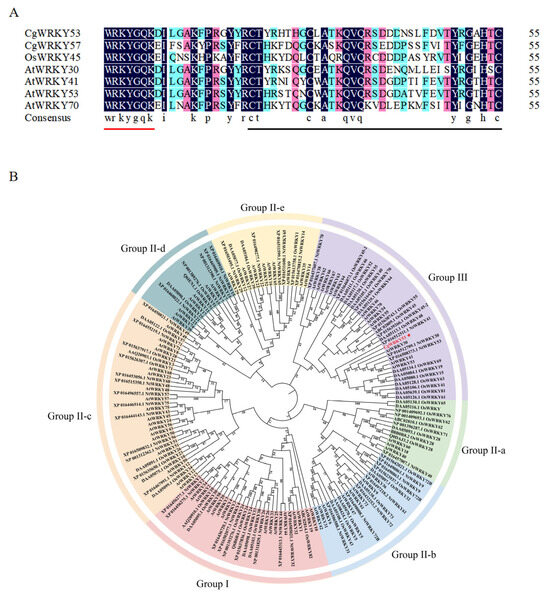
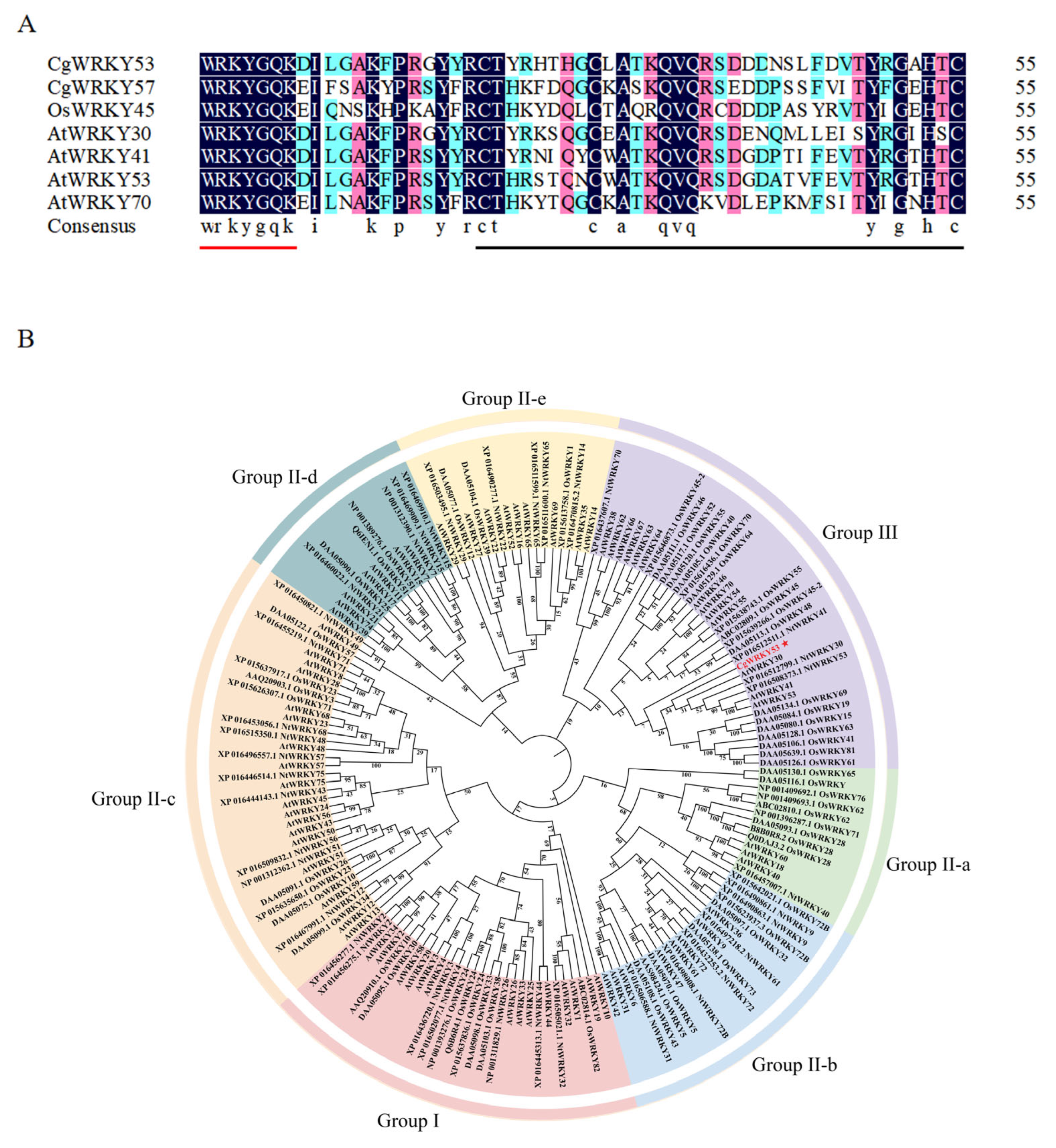
Based on the differential expression profile of the 4 °C low-temperature transcriptome, this study identified a WRKY unigene that was significantly upregulated. Prediction of its open reading frame (ORF) and annotation of conserved domains both classified it as belonging to the Group III subfamily. Using cDNA from young leaves of the Song Mei plum cultivar as a template, high-fidelity PCR amplification was performed with gene-specific primers. Agarose gel electrophoresis revealed a single band corresponding to the expected size. The target fragment was cloned into the pEASY-Blunt vector and transformed into E. coli. Positive clones were selected for bidirectional sequencing. Results revealed that the CgWRKY53 open reading frame spans 1080 bp and is 100% identical to the original transcriptome contig. Using Blastp and DNAMAN software, we performed amino acid homology comparisons between the known CgWRKY57 from C. goeringii, the CgWRKY53 protein from C. goeringii, and WRKY proteins from Arabidopsis and rice (Figure 1A). In line with previous classification criteria for WRKY proteins, analysis confirmed that the CgWRKY53 gene product exhibits the conserved WRKYGQK domain as well as a zinc finger structure characteristic of the WRKY family, which together place it unequivocally within the Group III subfamily.
Figure 1.
Evolutionary analysis of WRKY domains in C. goeringii, O. sativa, and A. thaliana using sequence alignment and phylogenetic tree construction. (A) Alignment of conserved WRKY domain amino acid sequences from C. goeringii, O. sativa, and A. thaliana. Red line: Marks the highly conserved WRKYGQK heptapeptide, the hallmark motif of the WRKY transcription factor family. Black line: Indicates the conserved cysteine (C) and histidine (H) residues of the C2HC-type zinc finger motif, a defining feature of the Group III subfamily; (B) Phylogenetic analysis of CgWRKY53. The evolutionary tree was generated using MEGA 7.0 software based on the neighbor-joining (NJ) algorithm with 1000 bootstrap replicates. Based on topological structure, the tree was partitioned into seven distinct clades, designated as Groups I, IIA–E, and III. Note: C. goeringii: CgWRKYs; A. thaliana: AtWRKYs; O. sativa: OsWRKYs; Nicotiana tabacum: NtWRKYs, XP: WRKY registration number of N. tabacum.
To further investigate the phylogenetic evolution of CgWRKY proteins and their relationships with other species, WRKY gene sequences from Arabidopsis, rice, and tobacco were retrieved from the PlantTFDB database. The WRKY sequences were categorized, and a phylogenetic tree was constructed for CgWRKYs, AtWRKYs, OsWRKYs, and NtWRKYs using MEGA 7.0 (Figure 1B), with 1000 bootstrap replicates. The results showed that WRKY proteins belonging to the same group clustered together. CgWRKY53 clustered with Group III WRKY proteins, exhibiting the closest phylogenetic relationship to AtWRKY53 and AtWRKY70. Beyond illustrating evolutionary relationships among family members, the phylogenetic tree also offered indirect evidence for potential functional conservation. Members of the WRKY family exhibiting analogous functions tended to occupy neighboring branches. For example, AtWRKY50 and AtWRKY51 in Group IIc clustered on the same branch, both playing synergistic roles in inhibiting seed germination and resisting oxidative stress [13]; AtWRKY33 and AtWRKY25 are phylogenetically closest on the tree, both inducing camalexin synthesis during resistance to Botrytis cinerea and maintaining high colinearity due to selective pressure [14]. This clustering pattern further suggests that CgWRKY53 may play a similar role in plant stress responses or developmental regulation.
After obtaining the full-length sequence of CgWRKY53, its encoded product was systematically characterized using online tools and local software. When predicting protein hydrophobicity, a negative total average hydrophobicity value indicates a hydrophilic protein, with greater negative values corresponding to stronger hydrophilicity [15]. Proteins with an instability index below 40 were predicted as stable, while those above 40 were predicted as unstable [16]. Physicochemical analysis indicates that CgWRKY53 has an instability index below 40, confirming its stability. Based on the transmembrane helix region prediction results for CgWRKY proteins (Figure S1A), CgWRKY53 is entirely located outside the membrane with no transmembrane domains. Subcellular localization prediction analysis using the WOLF PSORT online tool (Table 1) indicates the highest predicted value (8.40) for nuclear localization of CgWRKY53, suggesting the protein may ultimately localize to the nucleus. Protein phosphorylation site prediction using Kinase Phos revealed that the protein encoded by the CgWRKY53 gene contains 14 serine, threonine, and tyrosine phosphorylation sites. Serine phosphorylation sites were the most abundant in CgWRKY proteins, with CgWRKY53 possessing seven serine phosphorylation sites. This suggests that CgWRKY53 protein activity may be regulated by phosphorylation. SignalP 4.1 analysis of the CgWRKY53 protein from C. goeringii revealed no signal peptide (Figure S1B), indicating that CgWRKY53 is not a secreted protein. Secondary structure prediction of CgWRKY proteins using SOPMA software (Figure S1C) revealed that CgWRKY53 comprises 61.00% random coil, 24.79% α-helix, 9.75% extended chain, and 4.46% β-sheet structures.
3.2. Tissue-Specific Expression of CgWRKY53 Within Specific Tissues and Following Abiotic
Stress Conditions
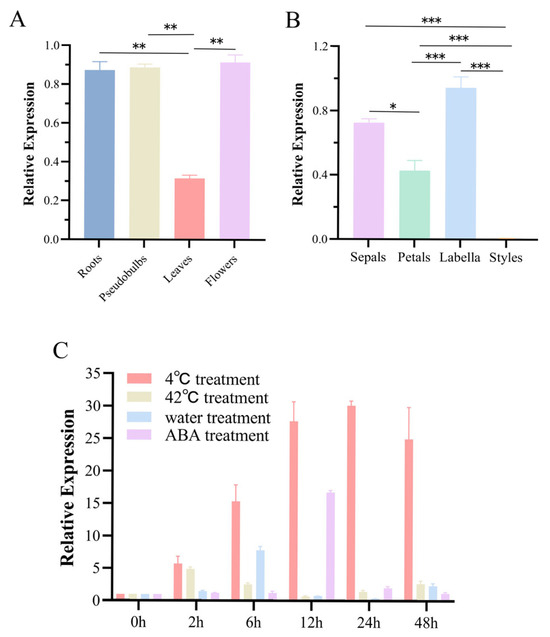
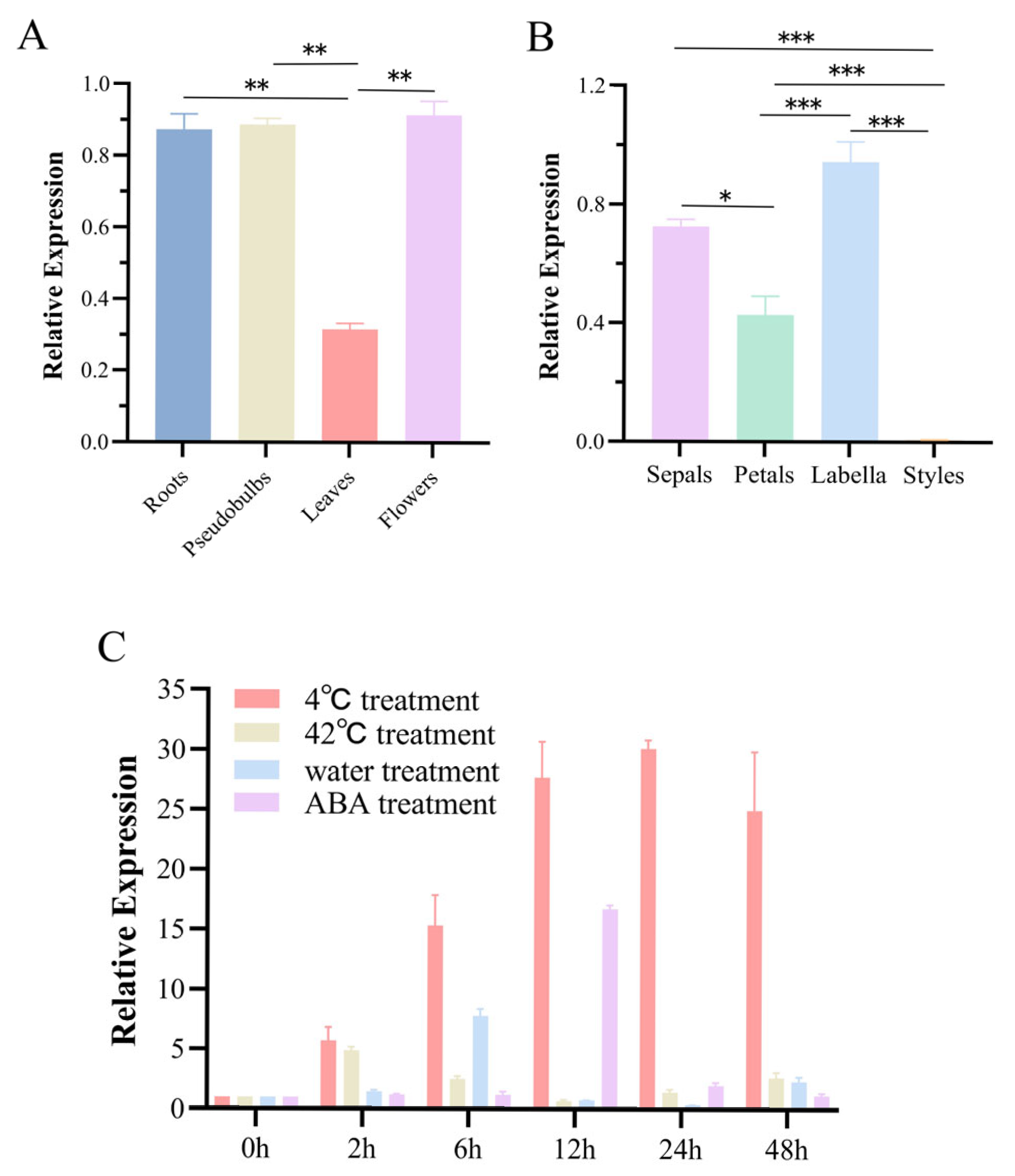
To explore the possible functions of CgWRKY53 across four distinct tissue types, cDNA templates were selected from C. goeringii roots, pseudobulbs, leaves, and flowers. Following reverse transcription, quantitative analysis of CgWRKY53 gene expression was performed using qRT-PCR. Expression levels of this gene were also detected in different floral organs (sepals, petals, labella, and styles) of C. goeringii. Results revealed that CgWRKY53 exhibited the highest relative expression in flowers and pseudobulbs, moderate expression in roots, and significantly lower expression in leaves, demonstrating distinct tissue specificity (Figure 2A). As an energy storage and water-regulation organ in orchids, the marked accumulation of CgWRKY53 transcripts within pseudobulbs points to a possible function in energy metabolism and stress adaptation. Analysis of expression levels across floral organs revealed that CgWRKY53 expression in the labellum was approximately 1.7-fold higher than in sepals, 2.1-fold higher than in petals, and 3.5-fold higher than in the gynostemium, thus exhibiting a significantly higher relative expression level in the labellum compared to the sepals, petals, and column (p < 0.05), forming a gradient distribution of “labellum > sepal > petal > column” (Figure 2B).
Figure 2.
Expression Analysis of CgWRKY53 in different tissues, organs, and under stress conditions. (A) Expression patterns of CgWRKY53 in different tissues; (B) Expression patterns of CgWRKY53 in different floral organs; (C) Expression patterns of CgWRKY53 under 4 °C, 42 °C, water immersion, and ABA treatments. Data are means ± SD of three biological replicates. (*: p < 0.05; **: p < 0.01; ***: p < 0.001).
To investigate the differential expression of CgWRKY under conditions of chilling (4 °C), heat stress (42 °C), root waterlogging, and ABA supplementation, we selected cDNA from C. goeringii leaves as templates. Using the expression level at 0 h as the control, we first subjected the orchid to low-temperature treatment at 4 °C to analyze the gene’s response to cold stress. Results indicated that under cold stress, the relative expression of CgWRKY53 progressively increased, peaking at 24 h post-treatment at 30.12-fold relative to the control. At 48 h, relative expression slightly decreased but remained elevated compared to the control. This suggests cold positively regulates CgWRKY53 expression in leaves. Following exposure of leaves to 42 °C high-temperature stress, CgWRKY53 expression rapidly increased at the onset of stress, peaking at 2 h post-treatment with a relative expression level 4.90 times higher than the control. Expression decreased at 12 h, then gradually increased thereafter, exhibiting an overall expression pattern of “upregulation–downregulation–upregulation.”
To simulate waterlogging stress, the roots were placed in standing water. The relative expression changes in the gene are shown in Figure 3, Figure 4 and Figure 5. Compared to the control, the relative expression of CgWRKY53 showed no significant difference at 2 h post-treatment. It rapidly peaked at 6 h, reaching 7.79 times the control level, followed by downregulation. Relative expression then gradually increased again at 48 h, exhibiting an overall expression pattern of “upregulation–downregulation–upregulation.”
Figure 3.
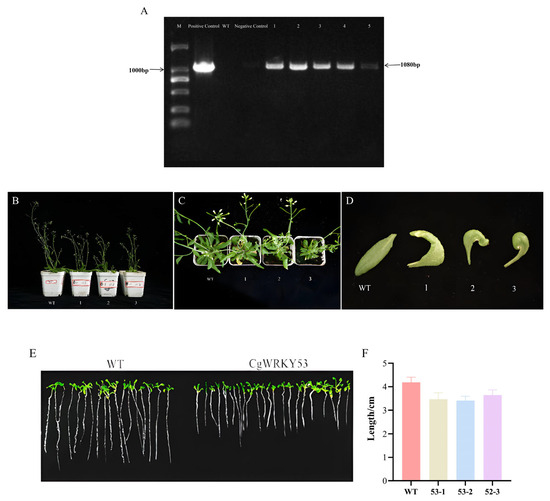
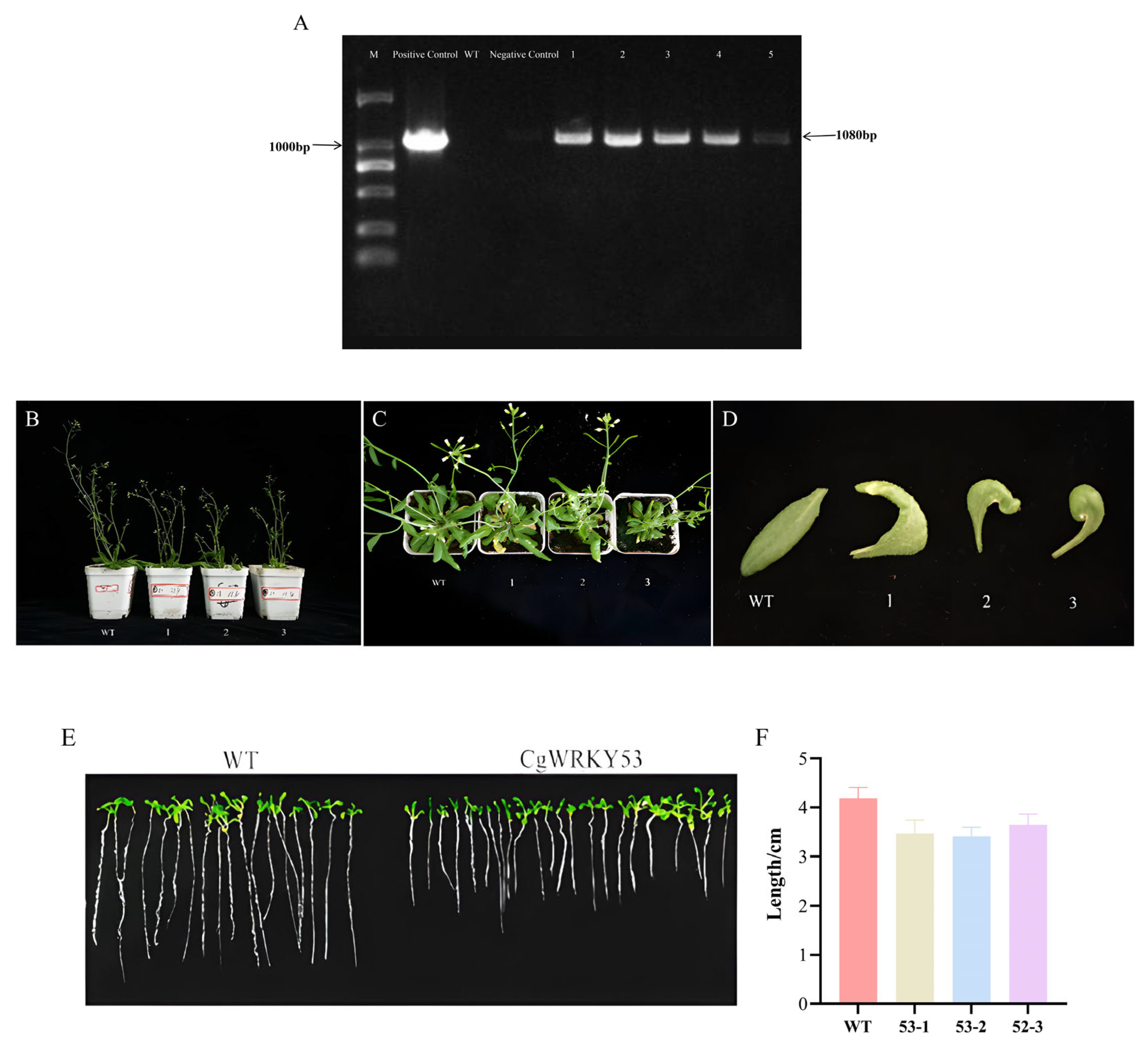
PCR confirmation and analysis of morphological traits in T3 transgenic plants overexpressing CgWRKY53. (A) PCR detection of CgWRKY53 in transgenic lines overexpressing the gene; (B) Side profile of CgWRKY53-overexpressing transgenic individuals and white transgenic plants; (C) Aerial view of CgWRKY53-overexpressing transgenic lines and white genetically modified plants; (D) Leaves of CgWRKY53-overexpressing transgenic plants; (E,F) Root length measurements of CgWRKY53-overexpressing transgenic plants. Note: WT denotes WT Arabidopsis.
Figure 4.
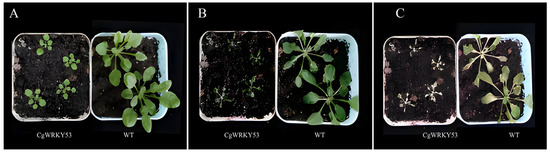
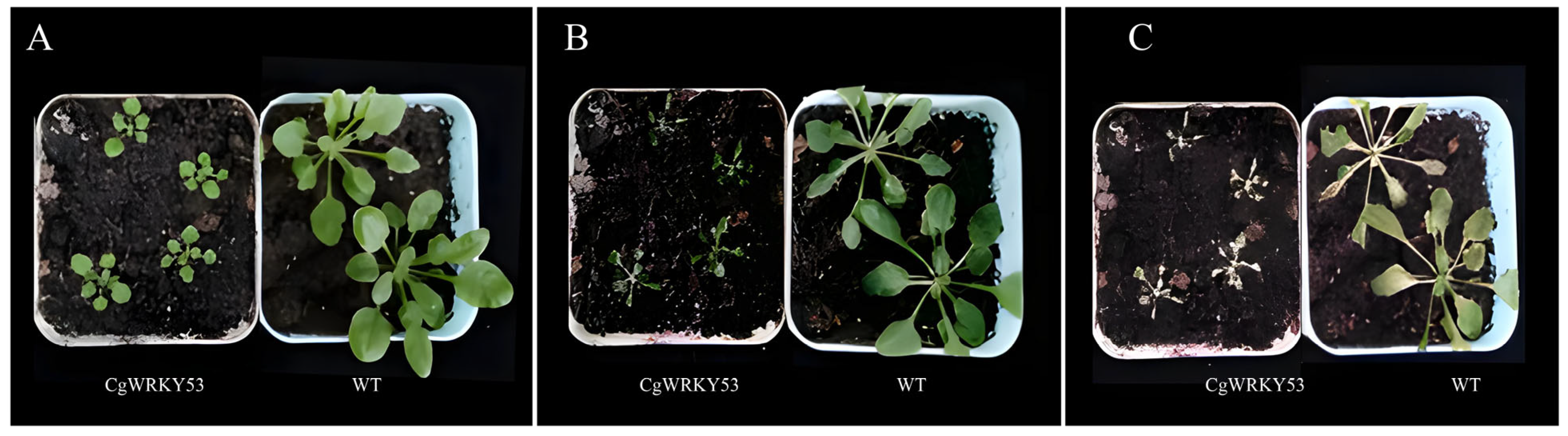
Effects of low-temperature stress on transgenic Arabidopsis phenotypes. (A) Phenotype after 0 days of low-temperature treatment; (B) Phenotype after 6 days of low-temperature treatment; (C) Phenotype after 10 days of low-temperature treatment. Note: WT denotes wild-type Arabidopsis.
Figure 5.
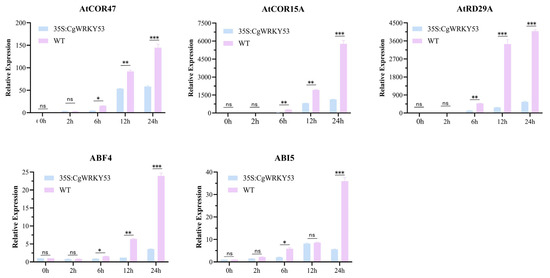
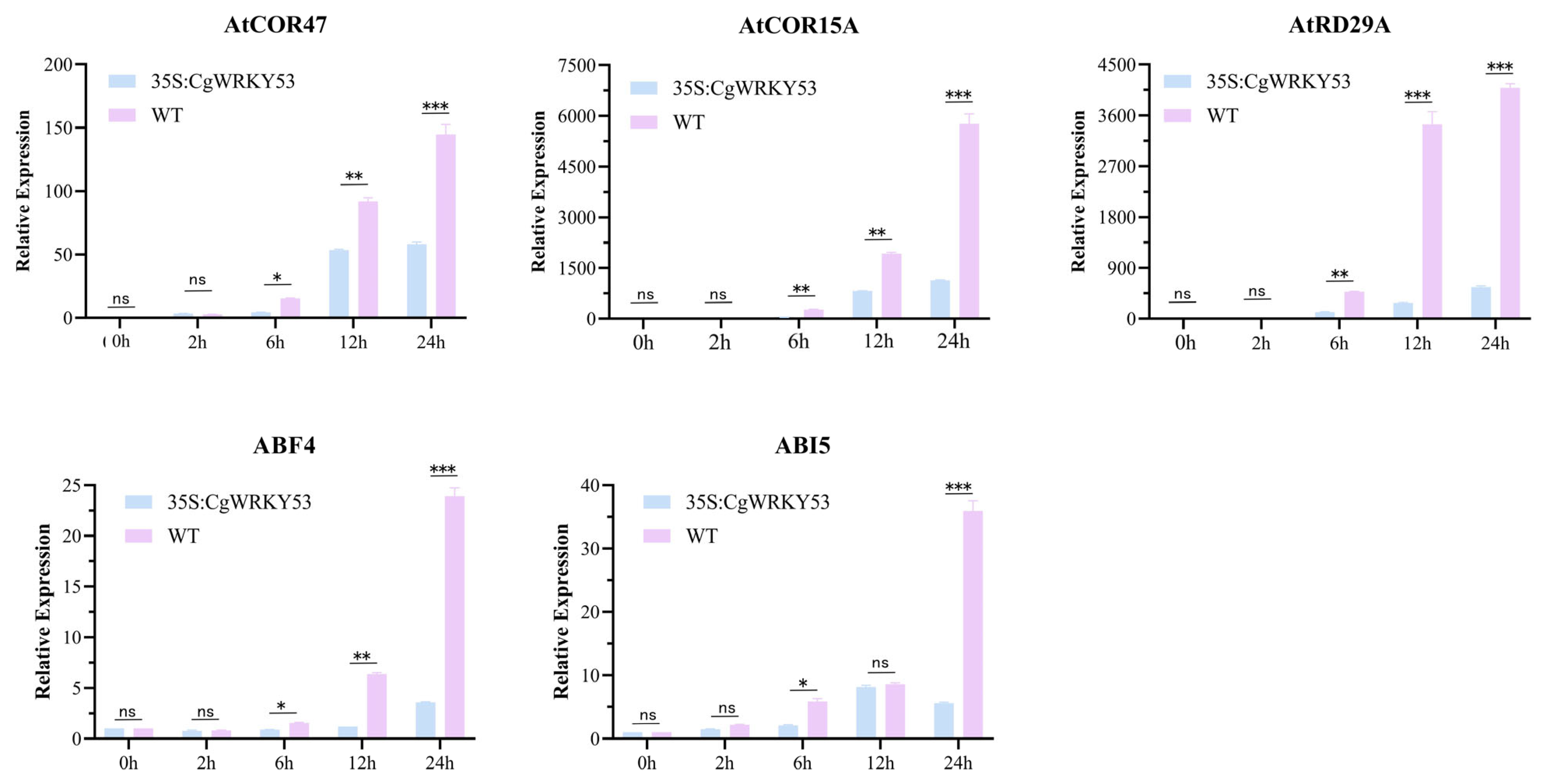
Analysis of AtCOR47, AtCOR15A, AtRD29A, ABF4, and ABI5 gene expression in WT and CgWRKY53 transgenic plants under low-temperature stress. Data are means ± SD of three biological replicates (*: p < 0.05; **: p < 0.01; ***: p < 0.001; ns: not significant).
Plant hormones such as ABA play crucial roles in regulating plant growth and development and in signaling networks that respond to biotic and abiotic stresses. This study applied 100 μM ABA to leaves via overhead spraying until dripping to assess how WRKY genes respond to externally applied ABA. The relative transcript level of CgWRKY53 showed no significant trend in the early treatment phase (<6 h). Relative expression peaked at 12 h post-treatment, reaching 16.71-fold higher than the control, with no significant trend thereafter (Figure 2C). These results indicate that CgWRKY53 exhibits a significant response to low-temperature stress and a strong response to ABA stress. We acknowledge that qRT-PCR data were normalized to 18S rRNA; while this is a commonly used reference gene in orchid studies, we recognize that stress-induced fluctuations may introduce variability. We sincerely urge readers to interpret these findings with this limitation in mind.
3.3. Identification and Phenotypic Observation of Transgenic Plants with Overexpression
PCR detection was performed using the 35S forward primer and CgWRKY53 reverse primer, with DNA from T3 transgenic and WT plants, as well as the PBI121-CgWRKY53 plasmid and water as templates. Results showed that the target product was not amplified from WT DNA, whereas the target product was readily obtained from T3 transgenic genomic DNA. These results confirm the successful integration of CgWRKY53 into the wild-type genome (Figure 3A). At seven days post-germination, WT seedlings were transferred to soil-filled pots and maintained in a controlled-environment growth chamber. Phenotypic evaluation of transgenic lines was performed after an additional 30 days of cultivation. Compared with WT, plants overexpressing CgWRKY53 exhibited delayed growth and development, dwarfism, reduced overall leaf size, and curled, deformed leaf shape (Figure 3B). Among these, Line 1 exhibited minor leaf deformation, Line 2 showed partial leaf reduction with severe deformation, and Line 3 demonstrated overall leaf reduction (Figure 3D). Additionally, transgenic plants exhibited premature stem elongation and flowering, indicating that CgWRKY53 suppressed vegetative growth. Seeds harvested from CgWRKY53-overexpressing lines and WT plants were plated on MS solid medium to initiate germination for subsequent root length analysis, with root length recorded after 14 days. Results showed that both transgenic and WT roots exceeded 30 mm in length. However, the root elongation in the CgWRKY53 transgenic homozygous line was significantly shorter than that of WT, with no significant difference in root morphology between the two (Figure 3E,F). This indicates that CgWRKY53 inhibits both shoot vegetative growth and root development in plants.
3.4. Expression Analysis of CgWRKY53 Transgenic Plants Under Low-Temperature Stress
To further investigate the role of CgWRKY53 in cold stress regulation, transgenic CgWRKY and WT Arabidopsis cultured for approximately 21 days were subjected to 4 °C cold stress. After 6 days of 4 °C treatment, all treated plants exhibited varying degrees of wilting. Compared with WT, leaves of CgWRKY53 Transgenic plants exhibited slight curling. After 10 days at 4 °C, the leaves of both CgWRKY53-transgenic and WT plants turned yellow and dried, with partial plant death observed. Collectively, these results indicate that CgWRKY53-transgenic plants exhibit lower cold tolerance than WT (Figure 4A–C). Although quantitative physiological metrics (electrolyte leakage, MDA content, ROS accumulation, Fv/Fm) were not assessed in this study, the suppression of cold-responsive marker genes (AtCOR47, AtCOR15A, AtRD29A) and ABA signaling components (ABF4, ABI5) provides molecular-level evidence supporting the negative regulatory role of CgWRKY53. This finding is consistent with recent advances in WRKY functional studies. In Anoectochilus roxburghii (Orchidaceae), ArWRKY57 and ArWRKY70—both Group III WRKY proteins phylogenetically related to CgWRKY53—form a heterocomplex and directly regulate ArLEA5 transcription by binding to W-box elements in its promoter, as validated by yeast two-hybrid (Y2H), bimolecular fluorescence complementation (BiFC), and yeast one-hybrid (Y1H) assays [17]. This provides the first direct evidence of WRKY-mediated transcriptional regulation in orchids. Furthermore, studies on AtWRKY53, the closest Arabidopsis homolog of CgWRKY53, have revealed that WRKY53 forms protein complexes with antioxidant enzymes, creating a feedback regulatory loop that fine-tunes reactive oxygen species homeostasis [18], and directly binds to the AtABI3 promoter to regulate ABA signaling [19]. The convergence of these findings from orchids and model plants provides strong indirect support for our conclusion.
To investigate whether the expression levels of stress-related genes associated with cold stress change, real-time quantitative PCR was used to detect downstream gene expression. Although CgWRKY53 is activated at the transcriptional level under cold stress, its overexpression resulted in significantly lower induction levels of cold response marker genes (AtCOR47, AtCOR15A, AtRD29A) compared to the WT. At the same time, activation of ABA signaling components (ABF4, ABI5) was also delayed (Figure 5). These results indicate that CgWRKY53 acts as a negative regulator of cold tolerance, simultaneously suppressing both the ICE–CBF–COR pathway and the ABA-dependent cold signaling pathway. The reduced induction of AtCOR47, AtCOR15A, and AtRD29A in CgWRKY53-overexpressing lines provides a molecular explanation for the observed cold-sensitive phenotype, as these genes are well-established effectors of cold acclimation. Furthermore, the expression level of the ABF4 gene showed no significant difference within 12 h of cold treatment in plants overexpressing CgWRKY53, whereas ABF4 expression accelerated in response to cold stress in the WT, indicating that CgWRKY53 overexpression slows the speed of ABF4’s response to cold stress (Figure 5). This suggests that CgWRKY53 can reduce plant adaptation to low temperatures by inhibiting downstream cold response pathways.
Collectively, these findings suggest that CgWRKY53 exhibits strong sensitivity to cold treatment, rendering plants more vulnerable to low temperatures. Overexpression of CgWRKY53 enhances ABA’s inhibitory effect on seed germination and root development while exacerbating plant damage under low temperatures, suggesting its potential role in regulating plant sensitivity to stress.
4. Discussion
C. goeringii is a plant appreciated for its decorative characteristics, though its appearance can be negatively affected by exposure to abiotic stressors. Extensive research has established that WRKY transcription factors govern multiple aspects of the plant life cycle, from organogenesis to stress signaling, and members of this family have been characterized in various plant lineages [14]. However, existing reports on C. goeringii remain scarce. In this study, we identified a CgWRKY protein. By aligning its conserved WRKY domain with corresponding structures from functionally characterized proteins and constructing a phylogenetic tree, we analyzed its structural characteristics. Analysis results indicate that sequence conservation within the WRKY domain is a universal and prominent attribute of WRKY transcription factors. Many researchers have pointed out that this domain is crucial for the function of CgWRKY genes [20]. The core of this domain is the WRKYGQK sequence, and its variant forms (e.g., WRKYGKK, WSKYEQK, and WRKYSEK) have been identified in multiple species [21]. For instance, WRKYGKK is present in maize, rice, soybean, and Arabidopsis, whereas WKKYGQK is present in barley and common bean. WSKYEQK and WRKYSEK have also been found in diverse plant species [22,23]. Although variant forms of the WRKYGQK sequence have been identified across diverse plant species, the core sequence of the CgWRKY domain remains highly conserved, with no mutations, indicating minimal evolutionary changes in its amino acid sequence. Significant differences exist in the zinc finger structures of different WRKY proteins. Researchers classified WRKY transcription factors into three subfamilies based on variations in their zinc finger sequence structures and lengths. Phylogenetic analysis was conducted by constructing a phylogenetic tree. The results indicate that CgWRKY53 clusters with Group III WRKY proteins, showing the closest phylogenetic relationship to AtWRKY53 and AtWRKY70. Thus, CgWRKY53 belongs to Group III, possessing the characteristic C2HC zinc finger structure typical of this group. Similar to SlWRKY52 from Group III in tomato, which enhances drought tolerance by regulating antioxidant enzyme activity and stomatal closure through an ABA-dependent pathway [24]. Although these evolutionary relationships suggest potential functional similarities, phylogenetic proximity alone does not establish functional equivalence; direct experimental evidence, such as the heterologous expression and downstream gene expression analysis provided in this study, is essential for functional characterization.
The WRKY transcription factor family plays a broad and important role in plant growth and development, and gene expression patterns provide important clues for functional studies. WRKY members that are strongly upregulated in specific plant samples often participate in controlling the differentiation and growth of those structures. Therefore, overexpression of WRKY transcription factors frequently leads to diverse growth and development phenotypes in transgenic plants. For example, overexpression of AtWRKY75 results in earlier flowering and increased plant height, while RNAi-silenced lines exhibit delayed flowering [25]. In this study, we cloned a WRKY gene, designated as CgWRKY53, which shows significantly high expression in floral organs. In addition, overexpression of CmWRKY10 enhances drought tolerance in chrysanthemum, and this mechanism is related to the ABA pathway [26]. However, overexpression of GhWRKY17 in cotton accelerates leaf senescence and reduces drought tolerance, acting as a repressor of drought tolerance resistance [25]. Ectopic expression of AtWRKY57 in Arabidopsis delays flowering, while its heterologous expression in rice enhances drought tolerance [27]. The same gene, AtWRKY57, exhibits dual functions in developmental regulation and stress response in different species. Evidence from these investigations implies that the functional effects of different WRKY transcription factors are significantly differentiated: they can either promote or inhibit specific developmental processes, and the same gene may display pleiotropic phenotypes in different genetic backgrounds. In this study, we cloned a WRKY gene, designated as CgWRKY53, which shows significantly high expression in floral organs.
In this research, transgenic Arabidopsis overexpressing CgWRKY53 exhibited a unique combination of phenotypes: plant dwarfism, reduced and curled leaves, premature bolting and flowering, along with significantly shortened root length. This dwarfing trait resembles that of GhWRKY34 [28], but CgWRKY53’s premature flowering contrasts with GhWRKY34’s delayed flowering and aligns with AtWRKY75’s promotion of flowering [29]. Notably, the negative regulatory effect of CgWRKY53 on cold tolerance is consistent with the characteristics of OsWRKY7. Research indicates that OsWRKY7, as a key negative regulator of cold stress response in rice seedlings, exhibits a cold-sensitive phenotype in its overexpression lines, while knockout mutants show significantly enhanced cold tolerance [30]. This finding corroborates the results of this study, in which CgWRKY53 overexpression increased cold sensitivity in spring orchids, while gene silencing enhanced cold tolerance. This indicates that overexpression of the CgWRKY53 gene contributes to the positive regulation of plant senescence. As one of the most expansive families of transcriptional regulators in the plant kingdom, WRKY proteins serve as core regulators of integrating multiple environmental signals and coordinating plant responses to stress. Numerous studies have demonstrated that WRKY genes exhibit diverse expression patterns and regulatory mechanisms under various stress conditions. AtWRKY25 in Arabidopsis is rapidly induced by high temperature, reaching peak expression within 2 h before gradually declining [31]; AtWRKY22 is significantly upregulated after 6 h of waterlogging stress, enhancing water stress resistance by regulating downstream genes such as MYB15 and PUB24 [32]; and CsWRKY2 responds to drought and cold stress in camellia, with its expression significantly increasing when ABA content rises [33]. Furthermore, DoWRKY5 in Dendrobium catenatum is co-induced by cold stress and ABA, exhibiting time-dependent dynamic expression patterns [34]. These studies indicate that WRKY genes integrate multiple abiotic stress signals to regulate diverse stress responses in plants, yet exhibit significant differences in expression dynamics and functional effects among different genes. Within this work, the expression pattern of CgWRKY53 following exposure to four stress treatment conditions shares both commonalities and unique features with the aforementioned reports. Under cold stress, CgWRKY53 peaked at 24 h (30.12-fold induction), resembling the rapid induction pattern of AtWRKY25 under high temperature, but with a delayed response time. Under high-temperature stress, CgWRKY53 exhibited an “up-down-up” oscillatory pattern, differing from AtWRKY25’s single-peak response; water stress induced significant expression at 6 and 12 h, aligning with AtWRKY22’s response timing; and ABA treatment reached a peak at 12 h (16.71-fold), consistent with the ABA response characteristics of CsWRKY2 and DoWRKY5. However, unlike CsWRKY46’s positive regulation of cold tolerance [35], CgWRKY53 overexpression paradoxically reduced plant cold tolerance, exhibiting a “high-expression–low-tolerance” phenotypic contradiction. As mentioned earlier, this negative regulatory pattern is not unique within the WRKY family. In O. sativa, OsWRKY45 acts as a negative regulator, and its overexpression increases sensitivity to low-temperature stress [36,37]. Similarly, OsWRKY53 negatively regulates rice blast resistance, cold stress tolerance, and salt stress tolerance. Its knockout mutant enhances cold tolerance during the heading stage by suppressing gibberellin content in anthers [38,39]. These studies indicate that members within the same WRKY family or even subfamily may finely regulate the intensity of plant responses to stress through antagonistic mechanisms, and a single WRKY gene may perform diametrically opposed functions under different stresses or developmental stages. In this study, CgWRKY53 exhibits high expression under low temperatures, yet its overexpression reduces cold tolerance in plants—a pattern highly similar to the negative regulation observed in AtWRKY70/54. Phylogenetic analysis indicates CgWRKY53 shares the closest evolutionary relationship with AtWRKY53 and AtWRKY70. Besseau et al. generated AtWRKY54-AtWRKY70 double mutants by knocking out both AtWRKY54 and AtWRKY70, observing premature leaf senescence in these plants. This finding indicates that both genes participate in the negative regulation of leaf senescence [13], further supporting the possibility that CgWRKY53 functions as a negative regulator in stress responses. Although direct mechanistic validation—such as electrophoretic mobility shift assay (EMSA) or chromatin immunoprecipitation (ChIP)—was not performed in this study, recent advances provide robust indirect support for DNA binding. The conserved WRKYGQK domain and C2HC zinc finger of CgWRKY53 (Figure 1A) are hallmarks of DNA-binding WRKY proteins. Most importantly, a study in A. roxburghii (Orchidaceae) by Jiang et al. (2025) demonstrated that ArWRKY57 and ArWRKY70—both Group III WRKY proteins phylogenetically related to CgWRKY53—directly regulate ArLEA5 transcription by binding to W-box elements in its promoter, as validated by Y1H assays [17]. This provides the first direct evidence of WRKY-mediated transcriptional regulation in orchids and strongly supports the plausibility that CgWRKY53 operates through a similar DNA-binding mechanism. Additionally, Xu et al. (2026) demonstrated that AtWRKY53 directly binds to the W-box in the promoter of AtABI3 [19], and the delayed activation of ABF4 and ABI5 in our CgWRKY53-overexpressing lines (Figure 5) is fully consistent with this established role. While the present study demonstrates that CgWRKY53 overexpression suppresses cold-responsive gene expression and reduces cold tolerance in Arabidopsis, we acknowledge that these conclusions are based solely on heterologous overexpression and that direct DNA-binding evidence is currently lacking. Native validation in C. goeringii through virus-induced gene silencing (VIGS) or gene editing is essential to exclude species-specific effects and confirm its endogenous role. Stable transformation of Cymbidium species remains technically challenging, with recent advances achieving transformation efficiencies around 18.66% in C. goeringii [40]; however, optimization of a VIGS protocol for C. goeringii has been prioritized in our future research plan to enable direct functional analysis in the native species. VIGS has been successfully applied in related orchid species such as Phalaenopsis for functional gene analysis providing a promising technical reference for future studies in C. goeringii [41].
Low-temperature stress is one of the primary environmental factors limiting plant growth, development, and geographic distribution. As a significant abiotic stressor, it induces phase transitions in cell membranes and bursts of reactive oxygen species, leading to osmotic imbalance and disruption of electrochemical gradients. This inhibits photosynthesis and reproductive growth, resulting in severe declines in plant yield and quality [42]. However, WRKY transcription factors exhibit significant functional differentiation, acting both as facilitators that increase cold tolerance and functioning to reduces to limit excessive cold responses. Regarding positive regulation, cucumber CsWRKY46 is rapidly triggered upon exposure to low temperature, and its ectopic expression dramatically enhances freezing tolerance in engineered Arabidopsis lines by activating the expression of cold response genes such as RD29A and COR47 through an ABA-dependent pathway [35]. In wheat, TaWRKY19 is induced by multiple stresses, and its overexpression significantly enhances the cold tolerance of transgenic Arabidopsis by activating the expression of cold response genes such as DREB2A, RD29A, RD29B, and Cor6.6, demonstrating positive regulation against freezing stress [43]. Notably, however, increasing evidence indicates that certain WRKY family members negatively regulate cold response gene expression to prevent plant overreaction. Guo et al. (2024) identified a 60-bp InDel mutation in the WRKY34 promoter region through comparative genomic analysis of wild and cultivated tomatoes, resulting in significantly reduced SlWRKY34 expression in cultivated tomatoes. Further validation of SlWRKY34 function using CRISPR/Cas9 gene editing and overexpression techniques, combined with RNA-seq and ChIP-seq-based downstream target gene screening, ultimately confirmed that SlWRKY34 negatively regulates tomato cold tolerance by interfering with the CBF cold response core pathway at both transcriptional and translational levels [44]. Additionally, Zou et al. (2010) demonstrated, using promoter-GUS fusion and qRT-PCR, that AtWRKY34 is specifically expressed in mature pollen and is cold-inducible. Functional validation using T-DNA insertion mutants and overexpression lines showed that AtWRKY34 deficiency enhances pollen cold tolerance, while overexpression induces cold sensitivity and sterility. qRT-PCR analysis confirmed that WRKY34 negatively regulates cold stress responses in mature pollen by blocking the ICE1-CBF-COR cold response core pathway through suppression of CBF transcription factor and its downstream COR gene expression [45]. These studies indicate that high expression of WRKY genes under cold stress does not necessarily equate to positive regulation. Some members may avoid energy expenditure from excessive defense responses by suppressing core cold response pathways or disrupting redox balance. In this study, CgWRKY53 showed strong induction at 4 °C, resembling the cold response patterns of negative regulators such as SlWRKY34 and AtWRKY34, characterized by rapid early induction. Transgenic Arabidopsis overexpressing CgWRKY53 showed yellowing and wilting leaves after 10 days of cold treatment, with partial plant death and significantly reduced cold tolerance compared to WT plants. Further downstream gene analysis revealed that CgWRKY53 overexpression resulted in significantly lower upregulation of key cold signal pathway genes AtCOR47, AtCOR15A, and AtRD29A, and of ABA response genes ABF4 and ABI5, compared to WT plants. Moreover, the response speed of ABF4 to low temperatures was slowed. Li et al. (2013) constructed single and double mutants of WRKY54 and WRKY70, revealing that the WRKY54/WRKY70 double mutant exhibited enhanced tolerance to osmotic stress. Further validation through stomatal aperture measurements and water loss rate experiments confirmed that AtWRKY54 and AtWRKY70, both belonging to the WRKY subfamily III, negatively regulate plant tolerance to osmotic stress—including cold-related osmotic stress—by inhibiting stomatal closure [13]. These findings, together with our own data, support a broader view of Group III WRKYs as negative regulators in stress responses. In the present study, we observed a clear distinction between the cold-induced expression of CgWRKY53 and its functional role as a negative regulator: although CgWRKY53 is transcriptionally activated by low temperature, its overexpression suppresses both the ICE–CBF–COR pathway (as evidenced by reduced COR gene induction) and ABA-dependent cold signaling (as evidenced by delayed ABF4/ABI5 activation). This dual suppression positions CgWRKY53 as a feedback regulator that fine-tunes cold acclimation by attenuating multiple downstream pathways. This suggests that CgWRKY53 may likewise function as a Group III subfamily-specific negative regulator, finely modulating the adaptive response intensity of Song Mei to low-temperature stress by either directly binding to W-box elements within the regulatory sequences of target cold-responsive genes or forming inhibitory complexes with other transcription factors to block activation of the ICE1-CBF-COR pathway.
5. Conclusions
This study cloned the CgWRKY53 gene from the spring orchid Song Mei, which belongs to subgroup III within the WRKY family transcription factor family. Bioinformatics analysis revealed that the CgWRKY53 protein contains a typical WRKYGQK domain and a C2HC-type zinc finger structure. It exhibits the closest phylogenetic relationship with Arabidopsis AtWRKY53 and AtWRKY70, suggesting potentially similar biological functions. Tissue expression analysis revealed that CgWRKY53 is expressed in all tissues of C. goeringii, with the highest expression in flowers, demonstrating distinct tissue specificity. Homozygous T3 generation A. thaliana lines overexpressing CgWRKY53 were obtained via the Agrobacterium-mediated floral dip transformation method. The phenotypic functions of these lines under various stress conditions were subsequently investigated. The data presented here pave the way for a deeper dissection of the molecular mechanisms by which CgWRKY53 regulates the growth, development, and stress adaptation in C. goeringii. Simultaneously, this work provides important genetic resources and theoretical underpinnings for the molecular breeding of stress-resistant orchids.
Supplementary Materials
The following supporting information can be downloaded at: https://www.mdpi.com/article/10.3390/genes17040376/s1, Table S1. Primers used for CgWRKY53 gene cloning and qRT-PCR analysis in C. goeringii; Figure S1: Bioinformatic analysis of CgWRKY53 protein structure.
Author Contributions
D.M., X.J. and L.W. performed the research and collected data. D.M. analyzed the data, wrote the manuscript and revised the manuscript. F.H. conceived and designed this study. All authors have read and agreed to the published version of the manuscript.
Funding
This work was funded by the Postgraduate Research & Practice Innovation Program of Jiangsu Province (KYCX21_0928). The funding for this program comes from provincial-level special funds for graduate education allocated by the Jiangsu Provincial Department of Finance, and the Jiangsu Provincial Department of Education is responsible for project approval, management, and oversight.
Institutional Review Board Statement
Not applicable.
Informed Consent Statement
Not applicable.
Data Availability Statement
The following information was supplied regarding data availability: Raw data are available in the Supplementary Materials.
Conflicts of Interest
The authors declare that the research was conducted in the absence of any commercial or financial relationships that could be construed as a potential conflict of interest.
References
- Zhang, X.; Liu, W.; Yin, Y.; Zheng, J.; Li, J.; Tan, X.; Wu, L. WRKY transcription factors participate in abiotic stress responses mediated by sugar metabolism. Front. Plant Sci. 2025, 16, 1646357. [Google Scholar] [CrossRef] [Scilit] [PubMed]
- Guo, H.; Zhang, Y.; Wang, Z.; Lin, L.; Cui, M.; Long, Y.; Xing, Z. Genome-Wide Identification of WRKY Transcription Factors in the Asteranae. Plants 2019, 8, 393. [Google Scholar] [CrossRef] [Scilit] [PubMed]
- Chen, S.; Liao, N.; Bi, H.; Xu, L.; Wang, Y.; Mao, B.; Zhang, X.; Cui, F.; Ma, Y.; Liu, L. RsWRKY49 promotes cold tolerance via activating the expression of RsCBF2 and RsNR2 in radish (Raphanus sativus L.). Plant J. 2025, 122, e70256. [Google Scholar] [CrossRef] [Scilit] [PubMed]
- Zhang, Y.; Wang, L. The WRKY transcription factor superfamily: Its origin in eukaryotes and expansion in plants. BMC Evol. Biol. 2005, 5, 1. [Google Scholar] [CrossRef] [Scilit]
- Zhang, J.; Huang, D.; Zhao, X.; Zhang, M.; Wang, Q.; Hou, X.; Di, D.; Su, B.; Wang, S.; Sun, P. Drought-responsive WRKY transcription factor genes IgWRKY50 and IgWRKY32 from Iris germanica enhance drought resistance in transgenic Arabidopsis. Front. Plant Sci. 2022, 13, 983600. [Google Scholar] [CrossRef] [Scilit]
- Wu, Y.; Fu, Y.; Zhu, Z.; Hu, Q.; Sheng, F.; Du, X. The Mediator Subunit OsMED16 Interacts with the WRKY Transcription Factor OsWRKY45 to Enhance Rice Resistance Against Magnaporthe oryzae. Rice 2024, 17, 23. [Google Scholar] [CrossRef] [Scilit]
- Feng, P.; Shi, J.; Zhang, T.; Zhong, Y.; Zhang, L.; Yu, G.; Zhang, T.; Zhu, X.; Xing, Y.; Yin, W.; et al. Zebra leaf 15, a receptor-like protein kinase involved in moderate low temperature signaling pathway in rice. Rice 2019, 12, 83. [Google Scholar] [CrossRef] [Scilit]
- Khoso, M.A.; Hussain, A.; Ritonga, F.N.; Ali, Q.; Channa, M.M.; Alshegaihi, R.M.; Meng, Q.; Ali, M.; Zaman, W.; Brohi, R.D.; et al. WRKY transcription factors (TFs): Molecular switches to regulate drought, temperature, and salinity stresses in plants. Front. Plant Sci. 2022, 13, 1039329. [Google Scholar] [CrossRef] [Scilit]
- Liu, H.; Wang, L.; Jing, X.; Chen, Y.; Hu, F. Functional analysis of CgWRKY57 from Cymbidium goeringii in ABA response. PeerJ 2021, 9, e10982. [Google Scholar] [CrossRef] [Scilit]
- Yang, F.; Zhu, G.; Wei, Y.; Gao, J.; Liang, G.; Peng, L.; Lu, C.; Jin, J. Low-temperature-induced changes in the transcriptome reveal a major role of CgSVP genes in regulating flowering of Cymbidium goeringii. BMC Genom. 2019, 20, 53. [Google Scholar] [CrossRef] [Scilit]
- Prerostova, S.; Černý, M.; Dobrev, P.I.; Motyka, V.; Hluskova, L.; Zupkova, B.; Gaudinova, A.; Knirsch, V.; Janda, T.; Brzobohatý, B.; et al. Light Regulates the Cytokinin-Dependent Cold Stress Responses in Arabidopsis. Front. Plant Sci. 2020, 11, 608711. [Google Scholar] [CrossRef] [Scilit]
- Kumar, S.; Stecher, G.; Tamura, K. MEGA7: Molecular Evolutionary Genetics Analysis Version 7.0 for Bigger Datasets. Mol. Biol. Evol. 2016, 33, 1870–1874. [Google Scholar] [CrossRef] [Scilit] [PubMed]
- Besseau, S.; Li, J.; Palva, E.T. WRKY54 and WRKY70 co-operate as negative regulators of leaf senescence in Arabidopsis thaliana. J. Exp. Bot. 2012, 63, 2667–2679. [Google Scholar] [CrossRef] [Scilit] [PubMed]
- Mao, G.; Meng, X.; Liu, Y.; Zheng, Z.; Chen, Z.; Zhang, S. Phosphorylation of a WRKY transcription factor by two pathogen-responsive MAPKs drives phytoalexin biosynthesis in Arabidopsis. Plant Cell 2011, 23, 1639–1653. [Google Scholar] [CrossRef] [Scilit] [PubMed]
- Midlovets, K.; Volkova, N.; Peka, M. Bioinformatic Analysis of WNT Family Proteins. Bioinform. Biol. Insights 2025, 19, 11779322251353347. [Google Scholar] [CrossRef] [Scilit]
- Guruprasad, K.; Reddy, B.V.; Pandit, M.W. Correlation between stability of a protein and its dipeptide composition: A novel approach for predicting in vivo stability of a protein from its primary sequence. Protein Eng. 1990, 4, 155–161. [Google Scholar] [CrossRef] [Scilit]
- Jiang, W.; Lv, A.; Huang, Y.; Shao, Q.; Lu, C.; Sun, J.; Zhao, C. The ArWRKY57-ArWRKY70-ArLEA5 module: Key regulators of drought tolerance in Anoectochilus roxburghii. Int. J. Biol. Macromol. 2025, 328, 147596. [Google Scholar] [CrossRef] [Scilit]
- Andrade Galan, A.G.; Doll, J.; Faiß, N.; Weber, P.; Zentgraf, U. Complex Formation between the Transcription Factor WRKY53 and Antioxidative Enzymes Leads to Reciprocal Inhibition. Antioxidants 2024, 13, 315. [Google Scholar] [CrossRef] [Scilit]
- Xu, K.; Liu, S.; Yu, J.; Yan, R.; Liu, Z.; Yuan, H.; Zhang, N.; Zhang, N.; Lan, X.; Yukawa, Y.; et al. AtR8 ncRNA mediates salt tolerance by regulating AtWRKY53-AtABI3 modules and reactive oxygen species homeostasis in Arabidopsis. Plant Cell Physiol. 2026. [Google Scholar] [CrossRef] [Scilit]
- Huang, S.; Gao, Y.; Liu, J.; Peng, X.; Niu, X.; Fei, Z.; Cao, S.; Liu, Y. Genome-wide analysis of WRKY transcription factors in Solanum lycopersicum. Mol. Genet. Genom. 2012, 287, 495–513. [Google Scholar] [CrossRef] [Scilit]
- Mohanta, T.K.; Park, Y.H.; Bae, H. Novel Genomic and Evolutionary Insight of WRKY Transcription Factors in Plant Lineage. Sci. Rep. 2016, 6, 37309. [Google Scholar] [CrossRef] [Scilit]
- Li, M.; Che, X.; Liang, Q.; Li, K.; Xiang, G.; Liu, X.; Zhao, Y.; Wei, F.; Yang, S.; Liu, G. Genome-wide identification and characterization of WRKYs family involved in responses to Cylindrocarpon destructans in Panax notoginseng. BMC Genom. 2025, 26, 104. [Google Scholar] [CrossRef] [Scilit] [PubMed]
- Zhou, Y.; Wang, Y.; Gao, T.; Cao, Y.; Yao, Y.; Zhao, Y.; Wang, Z. Characteristics and Expression Profiles of Identified WRKY Genes in Barley Landraces Under Cold Stress. Int. J. Mol. Sci. 2025, 26, 6948. [Google Scholar] [CrossRef] [Scilit] [PubMed]
- Jia, C.; Wang, J.; Guo, B.; Li, X.; Yang, T.; Yang, H.; Li, N.; Wang, B.; Yu, Q. A group III WRKY transcription factor, SlWRKY52, positively regulates drought tolerance in tomato. Environ. Exp. Bot. 2023, 215, 105513. [Google Scholar] [CrossRef] [Scilit]
- Gu, L.; Ma, Q.; Zhang, C.; Wang, C.; Wei, H.; Wang, H.; Yu, S. The Cotton GhWRKY91 Transcription Factor Mediates Leaf Senescence and Responses to Drought Stress in Transgenic Arabidopsis thaliana. Front. Plant Sci. 2019, 10, 1352. [Google Scholar] [CrossRef] [Scilit]
- Jaffar, M.A.; Song, A.; Faheem, M.; Chen, S.; Jiang, J.; Liu, C.; Fan, Q.; Chen, F. Involvement of CmWRKY10 in Drought Tolerance of Chrysanthemum through the ABA-Signaling Pathway. Int. J. Mol. Sci. 2016, 17, 693. [Google Scholar] [CrossRef] [Scilit]
- Jiang, Y.; Qiu, Y.; Hu, Y.; Yu, D. Heterologous Expression of AtWRKY57 Confers Drought Tolerance in Oryza sativa. Front. Plant Sci. 2016, 7, 145. [Google Scholar] [CrossRef] [Scilit]
- Zhou, L.; Wang, N.N.; Gong, S.Y.; Lu, R.; Li, Y.; Li, X.B. Overexpression of a cotton (Gossypium hirsutum) WRKY gene, GhWRKY34, in Arabidopsis enhances salt-tolerance of the transgenic plants. Plant Physiol. Biochem. 2015, 96, 311–320. [Google Scholar] [CrossRef] [Scilit]
- Zhang, L.; Chen, L.; Yu, D. Transcription Factor WRKY75 Interacts with DELLA Proteins to Affect Flowering. Plant Physiol. 2018, 176, 790–803. [Google Scholar] [CrossRef] [Scilit]
- Xu, R.; Zhao, R.; Jiang, Y.; Zhang, H.; Li, L.; Wang, S.; Wang, H.; Gao, Y.; Wang, Q.; Tian, X.; et al. The OsWRKY7-OsVQ3 module regulates seedling-stage cold tolerance in rice. Plant J. 2025, 124, e70605. [Google Scholar] [CrossRef] [Scilit]
- Li, S.; Fu, Q.; Huang, W.; Yu, D. Functional analysis of an Arabidopsis transcription factor WRKY25 in heat stress. Plant Cell Rep. 2009, 28, 683–693. [Google Scholar] [CrossRef] [Scilit] [PubMed]
- Hsu, F.C.; Chou, M.Y.; Chou, S.J.; Li, Y.R.; Peng, H.P.; Shih, M.C. Submergence confers immunity mediated by the WRKY22 transcription factor in Arabidopsis. Plant Cell 2013, 25, 2699–2713. [Google Scholar] [CrossRef] [Scilit] [PubMed]
- Wang, Y.; Shu, Z.; Wang, W.; Jiang, X.; Li, D.; Pan, J.; Li, X. CsWRKY2, a novel WRKY gene from Camellia sinensis, is involved in cold and drought stress responses. Biol. Plant. 2016, 60, 443–451. [Google Scholar] [CrossRef] [Scilit]
- Chen, J.; Zhang, Y.; Zhang, M.; Zhang, Z.; Liu, Y.; Duan, X.; Tao, Z.; Jiang, W. Study on the Molecular Mechanism of Arbuscular Mycorrhizal Symbiosis Regulating Polysaccharide Synthesis in Dendrobium officinale. Int. J. Mol. Sci. 2025, 26, 9298. [Google Scholar] [CrossRef] [Scilit]
- Zhang, Y.; Yu, H.; Yang, X.; Li, Q.; Ling, J.; Wang, H.; Gu, X.; Huang, S.; Jiang, W. CsWRKY46, a WRKY transcription factor from cucumber, confers cold resistance in transgenic-plant by regulating a set of cold-stress responsive genes in an ABA-dependent manner. Plant Physiol. Biochem. 2016, 108, 478–487. [Google Scholar] [CrossRef] [Scilit]
- Yokotani, N.; Sato, Y.; Tanabe, S.; Chujo, T.; Shimizu, T.; Okada, K.; Yamane, H.; Shimono, M.; Sugano, S.; Takatsuji, H.; et al. WRKY76 is a rice transcriptional repressor playing opposite roles in blast disease resistance and cold stress tolerance. J. Exp. Bot. 2013, 64, 5085–5097. [Google Scholar] [CrossRef] [Scilit]
- Li, J.; Chen, Y.; Zhang, R.; Wang, R.; Wu, B.; Zhang, H.; Xiao, G. OsWRKY70 Plays Opposite Roles in Blast Resistance and Cold Stress Tolerance in Rice. Rice 2024, 17, 61. [Google Scholar] [CrossRef] [Scilit]
- Tang, J.; Tian, X.; Mei, E.; He, M.; Gao, J.; Yu, J.; Xu, M.; Liu, J.; Song, L.; Li, X.; et al. WRKY53 negatively regulates rice cold tolerance at the booting stage by fine-tuning anther gibberellin levels. Plant Cell 2022, 34, 4495–4515. [Google Scholar] [CrossRef] [Scilit]
- Yu, J.; Zhu, C.; Xuan, W.; An, H.; Tian, Y.; Wang, B.; Chi, W.; Chen, G.; Ge, Y.; Li, J.; et al. Genome-wide association studies identify OsWRKY53 as a key regulator of salt tolerance in rice. Nat. Commun. 2023, 14, 3550. [Google Scholar] [CrossRef] [Scilit]
- Zhou, Y.; Yang, Y.; He, S.; Xing, X.; Qu, Y.; Xu, Y. Highly Efficient Agrobacterium-mediated Stable Transformation of Cymbidium goeringii. HortScience 2025, 60, 1026–1031. [Google Scholar] [CrossRef] [Scilit]
- Hsu, H.F.; Hsiao, T.C.; Hsu, W.H.; Liu, C.M.; Shen, Y.H.; Yang, C.H. OAGL6 and PaSEP1/3 cooperate in SP and L complexes of P code model to specify perianth identity in Phalaenopsis orchids. Plant Cell Physiol. 2026, 67, 67–81. [Google Scholar] [CrossRef] [Scilit]
- Ding, Y.; Shi, Y.; Yang, S. Advances and challenges in uncovering cold tolerance regulatory mechanisms in plants. New Phytol. 2019, 222, 1690–1704. [Google Scholar] [CrossRef] [Scilit]
- Niu, C.F.; Wei, W.; Zhou, Q.Y.; Tian, A.G.; Hao, Y.J.; Zhang, W.K.; Ma, B.; Lin, Q.; Zhang, Z.B.; Zhang, J.S.; et al. Wheat WRKY genes TaWRKY2 and TaWRKY19 regulate abiotic stress tolerance in transgenic Arabidopsis plants. Plant Cell Environ. 2012, 35, 1156–1170. [Google Scholar] [CrossRef] [Scilit]
- Guo, M.; Yang, F.; Zhu, L.; Wang, L.; Li, Z.; Qi, Z.; Fotopoulos, V.; Yu, J.; Zhou, J. Loss of cold tolerance is conferred by absence of the WRKY34 promoter fragment during tomato evolution. Nat. Commun. 2024, 15, 6667. [Google Scholar] [CrossRef] [Scilit]
- Zou, C.; Jiang, W.; Yu, D. Male gametophyte-specific WRKY34 transcription factor mediates cold sensitivity of mature pollen in Arabidopsis. J. Exp. Bot. 2010, 61, 3901–3914. [Google Scholar] [CrossRef] [Scilit]

Disclaimer/Publisher’s Note: The statements, opinions and data contained in all publications are solely those of the individual author(s) and contributor(s) and not of MDPI and/or the editor(s). MDPI and/or the editor(s) disclaim responsibility for any injury to people or property resulting from any ideas, methods, instructions or products referred to in the content. |
© 2026 by the authors. Licensee MDPI, Basel, Switzerland. This article is an open access article distributed under the terms and conditions of the Creative Commons Attribution (CC BY) license.