You are currently viewing a new version of our website. To view the old version click .

Genes, Volume 15, Issue 11

November 2024 - 141 articles

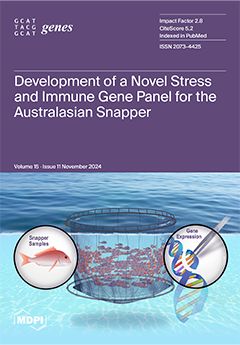
Cover Story: Snapper (Chrysophrys auratus), an important teleost in New Zealand, is a potential new aquaculture species, yet research on immune and stress responses is limited. We exposed snapper to increasing or decreasing temperatures and then explored genes in fin, head kidney and liver tissues. We analysed temperature-sensitive and temperature-tolerant fish. Expression analyses of candidate stress genes via NanoString Technologies Inc. showed that 20 of 25 genes significantly changed, demonstrating the significant impact of temperature on stress and immune responses. Further, 10 key gene biomarkers can predict genotypes tolerant to extreme temperatures. This novel NanoString method can rapidly monitor stress in snapper. Applications can provide insights into stress resilience of wild stocks and inform the selection of aquaculture grow-out locations. View this paper
  • Issues are regarded as officially published after their release is announced to the table of contents alert mailing list .
  • You may sign up for email alerts to receive table of contents of newly released issues.
  • PDF is the official format for papers published in both, html and pdf forms. To view the papers in pdf format, click on the "PDF Full-text" link, and use the free Adobe Reader to open them.

Articles (141)

  • Review
  • Open Access
9 Citations
6,071 Views
11 Pages

Application of CRISPR/Cas9 Technology in Rice Germplasm Innovation and Genetic Improvement

  • Jijin Chen,
  • Zhening Miao,
  • Deyan Kong,
  • Anning Zhang,
  • Feiming Wang,
  • Guolan Liu,
  • Xinqiao Yu,
  • Lijun Luo and
  • Yi Liu

20 November 2024

Improving the efficiency of germplasm innovation has always been the aim of rice breeders. Traditional hybrid breeding methods for variety selection rarely meet the practical needs of rice production. The emergence of genome-editing technologies, suc...

  • Article
  • Open Access
3 Citations
1,371 Views
10 Pages

MIR27A rs895819 CC Genotype Severely Reduces miR-27a Plasma Expression Levels

  • Georgia Ragia,
  • Myria Pallikarou,
  • Chrysoula Michou and
  • Vangelis G. Manolopoulos

20 November 2024

Background/Objectives: MIR27A rs895819 polymorphism has emerged as a potential additional pharmacogenomic marker of fluoropyrimidine response. Current evidence on its potential effect on miR-27a expression, which represses DPD activity, leading...

  • Case Report
  • Open Access
2 Citations
1,624 Views
10 Pages

Multiple Osteochondritis Dissecans as Main Manifestation of Multiple Epiphyseal Dysplasia Caused by a Novel Cartilage Oligomeric Matrix Protein Pathogenic Variant: A Clinical Report

  • Antonio Mazzotti,
  • Elena Artioli,
  • Evelise Brizola,
  • Alice Moroni,
  • Morena Tremosini,
  • Alessia Di Cecco,
  • Salvatore Gallone,
  • Cesare Faldini,
  • Luca Sangiorgi and
  • Maria Gnoli

20 November 2024

Background: Multiple epiphyseal dysplasia (MED) is a clinically and genetically heterogeneous group of skeletal diseases characterized by epiphyseal abnormalities associated with mild short stature. The clinical variability is wide, and the first cli...

  • Review
  • Open Access
10 Citations
9,983 Views
18 Pages

20 November 2024

Background/Objectives: Antisense oligonucleotide (ASO)-mediated exon-skipping is an effective approach to restore the disrupted reading frame of the dystrophin gene for the treatment of Duchenne muscular dystrophy (DMD). Currently, four FDA-approved...

  • Article
  • Open Access
4 Citations
1,858 Views
20 Pages

Characterization and Phylogenetic Analysis of the First Complete Chloroplast Genome of Shizhenia pinguicula (Orchidaceae: Orchideae)

  • Yuan Chen,
  • Yanlin Zhao,
  • Quan Yan,
  • Wei Wu,
  • Qingqing Lin,
  • Guoqiang Chen,
  • Yanfang Zheng,
  • Mingqing Huang,
  • Shiming Fan and
  • Yanxiang Lin

20 November 2024

Background: Genomic analysis is crucial for better understanding the evolutionary history of species and for their conservation. Shizhenia pinguicula is a rare medicinal plant endemic to China. However, the complete chloroplast genome of this species...

  • Article
  • Open Access
1 Citations
2,128 Views
14 Pages

Prognostic Relevance of Copy Number Losses in Ovarian Cancer

  • Andrea Jemma,
  • Alessandra Ardizzoia,
  • Serena Redaelli,
  • Angela Bentivegna,
  • Marialuisa Lavitrano and
  • Donatella Conconi

19 November 2024

Background/Objectives: Aneuploidy is a prevalent cancer feature that occurs in many solid tumors. For example, high-grade serous ovarian cancer shows a high level of copy number alterations and genomic rearrangements. This makes genomic variants appe...

  • Article
  • Open Access
2 Citations
1,476 Views
14 Pages

19 November 2024

Background: Calgranulin B (S100A9) was found to be strongly associated with milk protein percentage in dairy cattle in our previous genome-wide association study. Methods: SNPs in S100A9 were identified via pooled sequencing, and genotyping of 1054 c...

  • Article
  • Open Access
2 Citations
1,634 Views
24 Pages

19 November 2024

The SNP variation in sockeye salmon across the Asian part of its range was studied in 23 samples from 16 lake–river systems of the West Pacific Coast to improve understanding of genetic adaptation in response to spawning watersheds conditions....

  • Article
  • Open Access
2 Citations
1,618 Views
17 Pages

Comparative Chloroplast Genome Study of Zingiber in China Sheds Light on Plastome Characterization and Phylogenetic Relationships

  • Maoqin Xia,
  • Dongzhu Jiang,
  • Wuqin Xu,
  • Xia Liu,
  • Shanshan Zhu,
  • Haitao Xing,
  • Wenlin Zhang,
  • Yong Zou and
  • Hong-Lei Li

19 November 2024

Background: Zingiber Mill., a morphologically diverse herbaceous perennial genus of Zingiberaceae, is distributed mainly in tropical to warm-temperate Asia. In China, species of Zingiber have crucial medicinal, edible, and horticultural values; howev...

  • Case Report
  • Open Access
2,160 Views
12 Pages

Small Complex Rearrangement in HINT1-Related Axonal Neuropathy

  • Alessandra Tessa,
  • Mariapaola Schifino,
  • Eliana Salvo,
  • Rosanna Trovato,
  • Luca Cesana,
  • Silvia Frosini,
  • Rosa Pasquariello,
  • Giada Sgherri,
  • Roberta Battini and
  • Maria Clara Bonaglia
  • + 2 authors

19 November 2024

Background: Autosomal recessive inherited pathogenetic variants in the histidine triad nucleotide-binding protein 1 (HINT1) gene are responsible for an axonal Charcot-Marie-Tooth neuropathy associated with neuromyotonia, a phenomenon resulting from p...

of 15

Get Alerted

Add your email address to receive forthcoming issues of this journal.

XFacebookLinkedIn
Genes - ISSN 2073-4425