

You are currently viewing a new version of our website. To view the old version click .

Cells, Volume 13, Issue 21

November-1 2024 - 75 articles

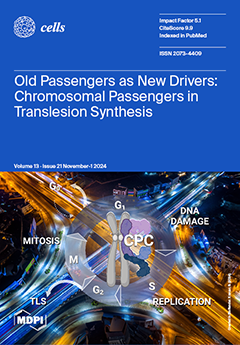
Cover Story: Besides being part of the chromosomal passenger complex (CPC), recent findings suggest additional roles for Survivin in the DNA damage response, further contributing to therapy resistance. Ionizing radiation leads to increased expression of Survivin and its accumulation in heterochromatic nuclear foci. Survivin depletion not only results in impaired repair capacity and unphysiological genome replication via mitotic DNA synthesis, but also reduces replication fork speed in the S phase. Here, the CPC member INCENP mediates the interaction with the processivity factor PCNA, and Aurora B kinase liberates Pol η by phosphorylating its interaction partner POLDIP2 to resume the replication of damaged sites by translesion synthesis. Thus, we assigned a direct function to the CPC in the transition from stalled replication forks to translesion synthesis. View this paper
  • Issues are regarded as officially published after their release is announced to the table of contents alert mailing list .
  • You may sign up for email alerts to receive table of contents of newly released issues.
  • PDF is the official format for papers published in both, html and pdf forms. To view the papers in pdf format, click on the "PDF Full-text" link, and use the free Adobe Reader to open them.

Articles (75)

  • Article
  • Open Access
2 Citations
1,911 Views
16 Pages

A Necessary Role for Cyclin D2 Induction During Colon Cancer Progression Mediated by L1

  • Arka Saha,
  • Nancy Gavert,
  • Thomas Brabletz and
  • Avri Ben-Ze’ev

2 November 2024

The cell adhesion molecule L1CAM (L1), mainly known for its function in brain cells, is a Wnt/β-catenin signaling target gene in colorectal cancer (CRC) cells, where it promotes invasion and liver metastasis. We interrogated which genes are expr...

  • Article
  • Open Access
3 Citations
1,853 Views
17 Pages

Functional Adaptation in the Brain Habenulo–Mesencephalic Pathway During Cannabinoid Withdrawal

  • Sonia Aroni,
  • Claudia Sagheddu,
  • Marco Pistis and
  • Anna Lisa Muntoni

1 November 2024

The mesolimbic reward system originating from dopamine neurons in the ventral tegmental area (VTA) of the midbrain shows a profound reduction in function during cannabinoid withdrawal. This condition may underlie aversive states that lead to compulsi...

  • Article
  • Open Access
2 Citations
2,206 Views
24 Pages

Sonic Hedgehog Is an Early Oligodendrocyte Marker During Remyelination

  • Mariagiovanna Russo,
  • Amina Zahaf,
  • Abdelmoumen Kassoussi,
  • Ariane Sharif,
  • Hélène Faure,
  • Elisabeth Traiffort and
  • Martial Ruat

1 November 2024

Failure of myelin regeneration by oligodendrocytes contributes to progressive decline in many neurological diseases. Here, using in vitro and in vivo rodent models, functional blockade, and mouse brain demyelination, we demonstrate that Sonic hedgeho...

  • Article
  • Open Access
3 Citations
3,293 Views
23 Pages

Hypoxia-Induced Mitochondrial ROS and Function in Pulmonary Arterial Endothelial Cells

  • Harrison Wang,
  • Teng-Yao Song,
  • Jorge Reyes-García and
  • Yong-Xiao Wang

1 November 2024

Pulmonary artery endothelial cells (PAECs) are a major contributor to hypoxic pulmonary hypertension (PH) due to the possible roles of reactive oxygen species (ROS). However, the molecular mechanisms and functional roles of ROS in PAECs are not well...

  • Review
  • Open Access
6 Citations
4,115 Views
40 Pages

31 October 2024

The optimal repair of rigid mineralized tissues, such as bone, in cases of fracture, surgical resection, or prosthetic placement, is a complex process often necessitating the use of bone graft materials. Autogenous bone from the patient is generally...

  • Article
  • Open Access
2 Citations
1,512 Views
22 Pages

Host Genetics Background Affects Intestinal Cancer Development Associated with High-Fat Diet-Induced Obesity and Type 2 Diabetes

  • Aya Ghnaim,
  • Kareem Midlej,
  • Osayd Zohud,
  • Sama Karram,
  • Arne Schaefer,
  • Yael Houri-Haddad,
  • Iqbal M. Lone and
  • Fuad A. Iraqi

31 October 2024

Background: Obesity and type 2 diabetes (T2D) promote inflammation, increasing the risk of colorectal cancer (CRC). High-fat diet (HFD)-induced obesity is key to these diseases through biological mechanisms. This study examined the impact of genetic...

  • Article
  • Open Access
1 Citations
1,942 Views
15 Pages

31 October 2024

Urothelial carcinoma (UC) is prevalent, especially in elderly males. The high rate of recurrence, treatment regime, and follow-up monitoring make UC a global health and economic burden. Arsenic is a ubiquitous toxicant that can be found in drinking w...

  • Article
  • Open Access
1 Citations
1,864 Views
24 Pages

Old Passengers as New Drivers: Chromosomal Passenger Proteins Engage in Translesion Synthesis

  • Katharina Falke,
  • Elisabeth Schröder,
  • Stefanie Mosel,
  • Cansu N. Yürük,
  • Sophie Feldmann,
  • Désirée Gül,
  • Paul Stahl,
  • Roland H. Stauber and
  • Shirley K. Knauer

31 October 2024

Survivin is known for its dual biological role in apoptosis inhibition and mitotic progression. In addition to its being part of the chromosomal passenger complex (CPC), recent findings suggest additional roles for Survivin in the DNA damage response...

  • Article
  • Open Access
1,617 Views
18 Pages

31 October 2024

ALDH1A3 is a marker for mesenchymal glioblastomas characterized by a greater degree of aggressiveness compared to other major subtypes. ADH1A3 has been implicated in the regulation of stemness and radioresistance mediated by glioblastoma stem cells....

  • Article
  • Open Access
3 Citations
2,864 Views
20 Pages

Expression Profiling Identified TRPM7 and HER2 as Potential Targets for the Combined Treatment of Cancer Cells

  • Miyuki Egawa,
  • Eva Schmücker,
  • Christian Grimm,
  • Thomas Gudermann and
  • Vladimir Chubanov

31 October 2024

TRPM7 is a divalent cation-permeable channel that is highly active in cancer cells. The pharmacological inhibitors of TRPM7 have been shown to suppress the proliferation of tumor cells, highlighting TRPM7 as a new anticancer drug target. However, the...

of 8

Get Alerted

Add your email address to receive forthcoming issues of this journal.

XFacebookLinkedIn
Cells - ISSN 2073-4409