


Abstract
Effective weed control is essential for sustainable and safe rice production, particularly under the long-term and widespread use of chemical herbicides. Oilseed rape (Brassica napus L.) is one of the most important oil crops worldwide, and the oilseed rape–rice rotation system is widely practiced in China. It has been reported to exhibit strong allelopathy on various plants, but the feasibility of using its straw incorporation for weed control in transplanted rice fields remains unclear. In this study, a natural weed management strategy based on shallow tillage of oilseed rape straw (ORS) was evaluated through laboratory bioassays, greenhouse experiments, and field trials. The results indicated that soil decomposition liquids (SDLs) of ORS exhibited strong dose- and decomposition time-dependent allelopathic effects on seven paddy weed species, while rice showed markedly lower sensitivity. ORS incorporated at 700–1100 g/m2 generally exhibited high integrated allelopathic inhibition (in lab) and population control effects (in greenhouse) on paddy weeds, especially Leptochloa chinensis (L.) Nees, Cyperus iria L., and Cyperus difformis L. Among the growth parameters of ORS allelopathic stress, root growth was the most sensitive indicator, followed by shoot growth and seed germination. Greenhouse experiments displayed variety-dependent impact on the transplanted rice seedlings, with Xiushui134 and Yongyou1540 showing relatively high tolerance. Field trials revealed that ORS incorporation at 1100 g/m2 for 10 d achieved a satisfactory control of population (77.7–84.9%) and fresh weight (80.7–95.6%) across Gramineae, Cyperaceae and Broadleaf weeds, without adverse impact on the growth of transplanted rice seedlings (Yongyou1540). This treatment also significantly promoted theoretical grain yield by 13.4–19.4%. Overall, shallow tillage of oilseed rape straw provides a feasible and environmentally friendly weed control strategy for transplanted rice systems.
1. Introduction
Rice (Oryza sativa L.) is cultivated worldwide and is a staple food for half of the global population [1]. Its yield and grain quality are directly related to food security and social stability. However, weeds constitute one of the most critical limiting factors constraining rice productivity in paddy fields [2,3]. Weeds possess multiple biological characteristics, including strong adaptability, high seed-yielding capacity, and diverse transmission modes, which confer strong competitive advantages over crops such as nutrients, water, light, and carbon dioxide [4]. Therefore, weed infestation seriously affects crop growth and reduces both yield and product quality [5]. It has been reported that weeds can reduce crop productivity by 34% on average, far more than the losses caused by animal pests (18%) and pathogens (16%) [6]. In China, more than 200 weed species, including Poaceae, Broadleaf, and Cyperaceae weeds, infest over 15 million hectares of rice fields, resulting in an annual loss of approximately 10 million tons of rice with a loss rate of around 15% [7]. With the world population increasing and available resources decreasing, effective weed management has become both increasingly important and highly challenging.
Chemical weed control is considered the most feasible way for weed management, due to the acute labor shortages during the peak agricultural period, particularly planting, weeding, and harvesting [8]. In 2023, global herbicide usage reached 2 million tons, while the trade of pesticide reached approximately USD 44 billion [9]. However, the long-term, widespread, and repetitive use of herbicides has led to a rapid increase in herbicide-resistant weeds over the past decade [10]. Currently, 273 weed species, including 156 dicots and 117 monocots, across 102 crops in 75 countries have developed resistance to 168 different herbicides “https://www.weedscience.org/Home.aspx (accessed on 4 March 2026)” [11], wherein the resistant weed species in rice fields have also increased sharply in the past 30 years. Nearly 80 weed biotypes globally and 51 in China have developed resistance. It is reported that Echinochloa crus-galli has developed resistance to 14 commonly used herbicides, with the resistance to chloroquine reaching 718.48-fold [12]. Recent surveys have shown that various weeds, such as E. crus-galli, Leptochloa chinensis (L.), Cyperus difformis L., Scirpus juncoides, Echinochloa caudate, Monochoria korsakowii Regel & Maack, and Potamogeton disinctus, have developed resistance to major herbicides used in rice fields [13,14,15,16,17,18,19,20,21]. In addition, Cyperus iria L. has also developed resistant populations to ALS (acetolactate synthetase) inhibitors, such as pyrazosulfuron-ethyl, halosulfuron-methyl, and penoxsulam [11]. Moreover, the use of herbicides has caused serious negative effects on the environment, surrounding wildlife, and farmers’ health [22]. The widespread application of herbicides in both agricultural and non-agricultural fields has resulted in detectable residues in various environmental matrices across different countries in a broad range of concentrations [23,24], triggering global concern [25]. Therefore, there is an urgent need to develop effective, environmentally safe, and sustainable non-chemical weed management strategies for rice cropping systems.
Oilseed rape (Brassica napus L.) is one of the most important oil crops in the world. In 2024, oilseed rape production reached 16.8 million tons in China [26]. Based on the oilseed rape straw coefficient of 2.87 [27], the annual production of oilseed rape straw (ORS) has exceeded 48 million tons, indicating an abundant biomass resource. Currently, ORS utilization mainly involves five pathways, including fertilization, fuel, feed, substrate, and industrial raw material use. Among them, fertilization is by far the dominated pathway, including both direct and indirect return to the field [28]. Therefore, rational utilization of crop straw through field incorporation has become an important research topic in sustainable and ecological agriculture.
ORS return to the field has traditionally been studied as a nutrient input because it contains appreciable amounts of nitrogen, phosphorus, and potassium [29]. The use of ORS mulching to control weeds has attracted increasing attention in recent years. It has been reported that ORS mulching is safe for rice cultivation and can effectively suppress various weeds, including L. chinensis, Ludwigia prostrata Roxb., Ammannia auriculata Willd., and C. difformis, in both direct-seeded and transplanted rice fields due to the gravity suppression and shading of weeds by straw [30,31]. However, straw mulching often leads to the accumulation of straw in piles, which can hinder water and fertilizer distribution during irrigation and application, resulting in uneven growth and poor uniformity among rice plants [32]. In addition, the presence of rice seedlings makes the straw mulching operation inconvenient in transplanted rice fields. Although ORS incorporation by shallow tillage is actually a common agricultural practice, the suppressive effects on paddy weeds, as well as the underlying mechanisms, have not yet been systematically investigated. Therefore, clarifying the mechanisms of ORS return in paddy weed management is of great significance for expanding its fertilization utilization and promoting green rice production.
Allelopathy is defined as the direct or indirect effects of one plant on another mediated by chemical compounds released into the environment [33]. Allelopathy provides an alternative and sustainable approach to weed management and can be applied alone or combined into an integrated weed management strategy (IWMS) to enhance control efficiency [34,35,36]. Previous lab studies indicated that oilseed rape has high allelopathic inhibitory potency on various weeds [37]. Water extracts from different organs of oilseed rape (roots, stems, leaves, and flowers) significantly inhibited seed germination and seedling growth of several weed species, including Phalaris minor Retz, Convolvulus arvensis L., and Sorghum halepense (L.) Pers [38]. Asaduzzaman et al. found that four oilseed rape varieties gave an inhibitory rate of over 70% on the root length of Lolium rigidum Gaud [39]. A similar result was found for the water extract of oilseed rape plants suppressing L. chinensis, E. crus-galli, and E. prostrata by Wang et al. [40]. In addition, the water extracts of oilseed rape leaves and stems have inhibitory effects on the seed germination and root growth of Digitaria sanguinalis, Amaranthus retroflexus L., and E. prostrata [41]. Li et al. found that the water extract (0.1 g/mL) of oilseed rape plants had a seed germination inhibition rate of 95% on L. chinensis [42]. However, allelopathic compounds from oilseed rape may also pose potential risks to crop growth. For example, the water extract of ORS has an inhibition rate of 72.29% on the root length of Hypericum monogynum L. [43] and an inhibition rate of 28% on the seed germination of soybean [44]. Inhibitory effects of oilseed rape extracts on seed germination and early seedling growth have also been reported in crops such as mung beans and rice [45], while exhibiting a ‘low-promotion and high-inhibition’ effect on Sorghum bicolor L. and Helianthus annuus (L.) [46,47]. These studies suggest strong allelopathic potential, yet the integrated allelopathic effects under soil incorporation conditions remain unclear. In particular, the contribution of straw decomposition processes to weed suppression in transplanted rice fields has received little experimental attention.
To overcome the limitations of straw mulching in transplanted rice fields and to better utilize the allelopathic potential, this study evaluated a soil-based weed control strategy based on shallow incorporation of ORS. The allelopathic effects of soil decomposition liquids were first assessed on seven major paddy weeds and rice under laboratory conditions, followed by greenhouse and field experiments to determine weed control efficacy, crop safety, and yield responses in transplanted rice systems.
2. Materials and Methods
2.1. Chemicals and Reagents
Agar powder (ash ≤ 1.5%, gel strength 700–900 g/cm2) and Hoagland’s basal salt mixture were purchased from Macklin (Shanghai, China). Calcium nitrate tetrahydrate (Ca(NO3)2•4H2O, purity ≥ 98.5%) and sodium hypochlorite aqueous solution were purchased from Sinopharm Chemical Reagent Co., Ltd. (Shanghai, China). Ultrapure water was generated using a water purification system (Pall Corporation, New York, NY, USA). Hoagland’s basal salt mixture (1.260 g) and calcium nitrate tetrahydrate (0.945 g) were dissolved in 1 L of ultrapure water to prepare Hoagland’s solution for plant cultivation.
2.2. Rice and Weeds
Seven major paddy weed species, including barnyard grass (Echinochloa crus-galli (L.) P. Beauv.), long-awned barnyardgrass (Echinochloa caudata Roshev.), Chinese sprangletop (Leptochloa chinensis (L.) Nees), common crabgrass (Digitaria sanguinalis (L.) Scop.), ecliptae herba (Eclipta prostrata (L.) L.), smallflower umbrella sedge (Cyperus difformis L.), and ricefield flatsedge (Cyperus iria L.), as well as rice (Oryza sativa L.) varieties ‘Hanyou73’ (HY73), ‘Zhongzu53’ (ZZ53), ‘Xiushui134’ (XS134), and ‘Yongyou1540’ (YY1540), were used in the present study. Detailed information on the species is provided in (Supplementary Information (SI) Table S1). All seeds were sun-dried and stored at room temperature prior to use.
2.3. Straw and Soil Materials
Oilseed rape (cv. ‘Zheda 630’) straw was harvested from a field in Zhuji, Zhejiang Province, China, in April 2022. After sun-drying, the straw was pulverized into 1–2 cm-long fragments by a mower (Jinghua Shengshi Hardware Machinery Co., Ltd., Jinhua, China) and then used for the subsequent study. Prior to use, herbicide residues commonly used in oilseed rape fields were screened and quantified to evaluate and exclude the potential influence on the test weeds.
Topsoil (0–15 cm) for rice potting was collected from a rice paddy in Hangzhou, China. Prior to use, the soil was air-dried and sieved through a 2 mm mesh. The soil texture was classified as clay loam, with a pH of 5.3 and an organic content of 37.8 g/kg, consisting of 46.6% sand (2.0 mm ≥ particle diameter (D) ≥ 0.02 mm), 29.0% silt (0.02 mm ≥ D ≥ 0.002 mm), and 24.4% clay (D < 0.002 mm). The soil used in this study was not separately analyzed for herbicide residues.
2.4. Preparation of Soil Decomposition Liquids of ORS
Soil decomposition liquids (SDLs) of ORS were obtained by mixing different amounts of ORS into a soil–water system, followed by incubation for different durations. Briefly, a rectangular plastic box (24(L) × 17(w) × 7.5(h) cm) was prefilled with 1 kg of soil, and 1.2 L of ultrapure water was added to maintain an approximately 1 cm water layer on the soil surface. The mixture was then pre-incubated at 25 ± 1 °C for 14 d to restore the activity of microorganisms. Subsequently, ORS was added to the soil–water system at rates of 12.24, 28.56, or 44.88 g/box (corresponding to 300, 700, or 1100 g/m2, i.e., 3, 7, or 11 T/ha, respectively). After thorough manual mixing, the mixture was incubated again and then sampled at 5, 10, or 15 d by centrifugation on a DL-5-B (Shanghai Anting Scientific Instrument Co., Ltd., Shanghai, China) at 4000 r/min (to get rid of solid phase) and then filtration using a 0.22 μm one-off membrane (to get rid of microorganisms) to obtain SDLs of ORS. Different ORS treatments were designated using a code combining the capital letter ‘P’ with numbers indicating decomposition duration and ORS dose. For example, the treatment with 300 g/m2 ORS decomposition in soil for 5 d was coded as ‘P5-300’, where ‘P’ denotes ‘plowing into soil’, ‘5’ indicates ‘a 5-day decomposition period’, and ‘300’ represents ‘300 g/m2 ORS’. Soil liquid obtained from the soil–water system without ORS was used as the control. Each treatment was conducted in triplicate.
2.5. Allelopathic Effects of SDLs on Paddy Weeds and Rice
The allelopathic effects of SDLs on seven paddy weed species and rice (cv. ‘HY73’) were evaluated using two complementary bioassays: a filter-paper seed germination assay and an agar-based seedling growth assay [48,49].
2.5.1. Seeds Germination Assay
Plant seeds were surface disinfected by soaking in 2% (v/v) sodium hypochlorite solution for 10 min, followed by five rinses with sterile distilled water. Fifty seeds were placed on two layers of filter paper in a Petri dish (9 cm diameter). Initially, 5 mL of SDLs or other aqueous test solution was added to the Petri dish. The SDLs and other aqueous test solutions used in this assay were sterilized before application. Petri dishes with disinfected seeds were placed in a RXZ plant growth chamber (Ningbo Jiangnan Instrument Factory, Ningbo, China) and cultivated for 7 d under a light/dark cycle of 12 h (30 ± 1 °C)/12 h (25 ± 1 °C). During the cultivation, Petri dishes were observed daily, and an equal volume of extract was added as needed to prevent drying out of the seeds. The number of germinated seeds was recorded daily. Distilled water was set as the control. Each treatment was conducted in triplicate.
2.5.2. Seedling Growth Assay
Briefly, agar powder was dissolved in SDL (or aqueous dilution of ORS extracts) to obtain 0.6% (m/m) agar solutions. The agar solutions were sterilized at 121 °C for 20 min in a TE2000S autoclave (Sanyo Electric Co., Ltd., Moriguchi, Japan) and then divided into glass plant tissue culture bottles (ϕ30 × 120 mm) to cool, forming a 4 cm-thick agar medium per bottle. Plant seeds at the germination stage were placed on the surface of the agar medium (10 plant seeds per bottle). The bottles were incubated in a RXZ plant growth chamber under a light/dark cycle of 12 h (30 ± 1 °C)/12 h (25 ± 1 °C). Shoot length (SL) and root length (RL) of seedlings were measured at 3 d after incubation. Distilled water was set as the control. Each treatment was conducted in triplicate.
The germination rate (GR), germination energy (GE), germination index (GI), inhibition rate (I), allelopathic response index (ARI), and integrated allelopathic effect (IAE) were calculated according to the following Equations (1)–(6), as described by Williamson and Richardson [50]. Prior to use, the potential herbicide residues in ORS were screened by high resolution high-performance-liquid-chromatography tandem mass spectrometry (HR-HPLC-MS) to avoid interference from herbicides.
wherein G7—the number of seeds germinated after 7 d incubation,
N—the total number of seeds in each Petri dish used in the test,
G3—the number of seeds germinated after three days of incubation,
Gt—the total number of germinated seeds on day t,
Tt—day of germination,
CK—control,
Tr—treatment,
ARIGR—allelopathic response index of germination rate,
ARIGE—allelopathic response index of germination energy,
ARIGI—allelopathic response index of germination index,
ARISL—allelopathic response index of shoot length,
ARIRL—allelopathic response index of root length.
2.6. Sensitivity of Rice Seedlings to SDL at Different Growth Stages
Rice seedlings were pre-cultivated using an agar method until they reached approximately 2 cm in height and were then transferred to hydroponic culture using Hoagland’s solution. When rice seedlings reached the needle stage, one-leaf stage, or three-leaf stage, they were transferred to glass plant tissue culture bottles (68 × 90 mm (ϕ × h), without a lid) prefilled with 40 mL Hoagland’s solution and 40 mL SDL generated from P15-1100 treatment, with 10 rice seedlings per bottle. After 5 d of incubation, the plant height (PH), RL, and dry weight (DW) of the rice seedlings were measured. Rice seedlings cultivated with 40 mL Hoagland’s solution and 40 mL BSL were set as the control. In this assay, SDL was mixed at 1:1 with Hoagland’s solution to maintain adequate nutrient supply for rice seedlings under hydroponic culture conditions. Each treatment was conducted in triplicate. The cultivation was carried out in a XT5408-CC artificial climate chamber (Xutemp, Hangzhou, China) under a light/dark cycle of 12 h (30 ± 1 °C)/12 h (25 ± 1 °C) and a relative humidity of 50–90%.
2.7. Greenhouse Test
Greenhouse tests were conducted to evaluate the weed control efficacy of ORS incorporation against five paddy weed species (E. crus-galli, L. chinensis, D. sanguinalis, C. iria, and E. prostrata), as well as its safety for transplanted rice seedlings of four rice varieties. The experiments were performed in a greenhouse at the Zijingang campus of Zhejiang University (30°30′ N, 120°08′ E, Hangzhou, China), with a temperature range of 20–30 °C, a humidity range of 47–85%, and natural light during the test period.
Rectangular plastic boxes (24(L) × 17(w) × 7.5(h) cm) were filled with 1 kg of freshly collected paddy soil (air-dried, D ≤ 2 mm). Then, 1.2 L of tap water and 12.5 g, 29.2 g, or 45.8 g of ORS (300 g/m2, 700 g/m2, or 1100 g/m2, respectively) were added and thoroughly mixed. The boxes were then placed at room temperature for 5, 10, or 15 d. Subsequently, pre-cultivated rice seedlings at the three-leaf stage were transplanted into each box (5 clumps per box and 2 seedlings per clump). During the rice cultivation period after transplantation, water was replenished daily to maintain a 1 cm water layer during the first 5 days after transplanting (dat) and a 2 cm water layer from 6 dat. Urea was sprayed at a rate of 0.45 g per box (i.e., 108 kg/ha) at 20 dat. The PH of rice at 7, 14, 21, and 28 dat, tiller number (TN) at 14, 21, and 28 dat, and DW of the whole plant at 28 dat were investigated.
For the straw incorporation tests against weeds, the experimental protocol was identical to the rice test, except that 100 weed seeds per box (one species per box) were sown simultaneously with ORS incorporation, and no rice seedlings were transplanted. The control effects on plant population (Ipp), plant height (Iph), and fresh weight (Ifw) of weeds were investigated at 28 dat after sowing. Each treatment was conducted in triplicate, and soil–water mixture without ORS was set as the control.
2.8. Field Trials
Field trials were conducted from May to October 2024 in a transplanted rice paddy in Tonglu County, Zhejiang Province, China (119.425000° E, 29.898294° N), to evaluate the weed control efficacy of ORS pre-incorporated into soil at different doses (300, 700, and 1100 g/m2) 10 d before rice transplanting, as well as its effects on rice growth and yield. Soil without ORS served as the control. Each plot covered 20 m2 and was separated by independent field ridges, with its own irrigation water inlet and drainage outlet to prevent water exchange among plots. ORS, together with 150 kg/ha of urea and 375 kg/ha of compound fertilizer, was evenly spread to the paddy field, which had been pre-irrigated to maintain a 0.5–1.0 cm water layer, and then plowed by a Zongshen 1WGFQD2.2-35 micro tiller (Chongqing, China). Fertilizers were applied uniformly across all plots. Ten days after ORS incorporation, the pre-cultured rice seedlings (cv. ‘Yongyou 1540’) at the three-leaf stage were manually transplanted at a spacing of 25 cm × 20 cm (200,000 clumps per hectare) with four seedlings per clump. Visual inspections were conducted on the phytotoxicity of rice seedlings at 7, 14, and 20 dat. The PH and TN of rice were surveyed at 35 dat. The plant population and fresh weight (aboveground parts) of surviving weeds, including Poaceae, Cyperaceae, and Broadleaf weeds, were surveyed at 20 and/or 35 dat. These data were used to calculate the Ipp, TIpp, Ifw (35 dat), and TIfw (35 dat). Before rice harvest, the effective panicle number per unit area, grains per panicle, seed setting rate, thousand-grain weight, and theoretical yield of rice were investigated. A five-point sampling method was applied for the above surveys, with 0.25 m2 assessed per sampling point. Each treatment was conducted in triplicate. During the entire experimental period, except for not applying herbicides, all other field management, such as water and fertilizer management were consistent with conventional rice cultivation measures.
2.9. Statistical Analysis
Data were presented as mean ± standard deviation (SD) from three repetitions for each treatment. The comparison between two treatments was performed using an unpaired independent sample t-test, and one-way analysis of variance (ANOVA), followed by Tukey’s post hoc test, was conducted for multi-group comparisons, with p < 0.05 indicating statistical significance. All statistical analyses were carried out using Microsoft Excel™ 2019 or GraphPad Prism 10 (GraphPad Software, 10.1).
3. Results
3.1. The Allelopathic Effects of SDLs on Weeds and Rice
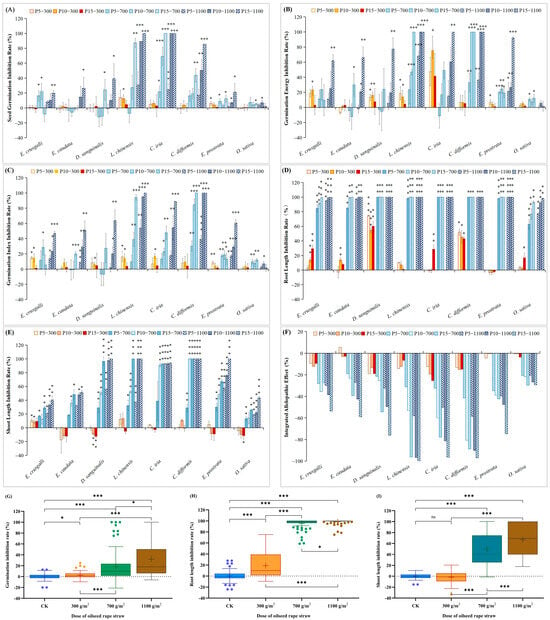
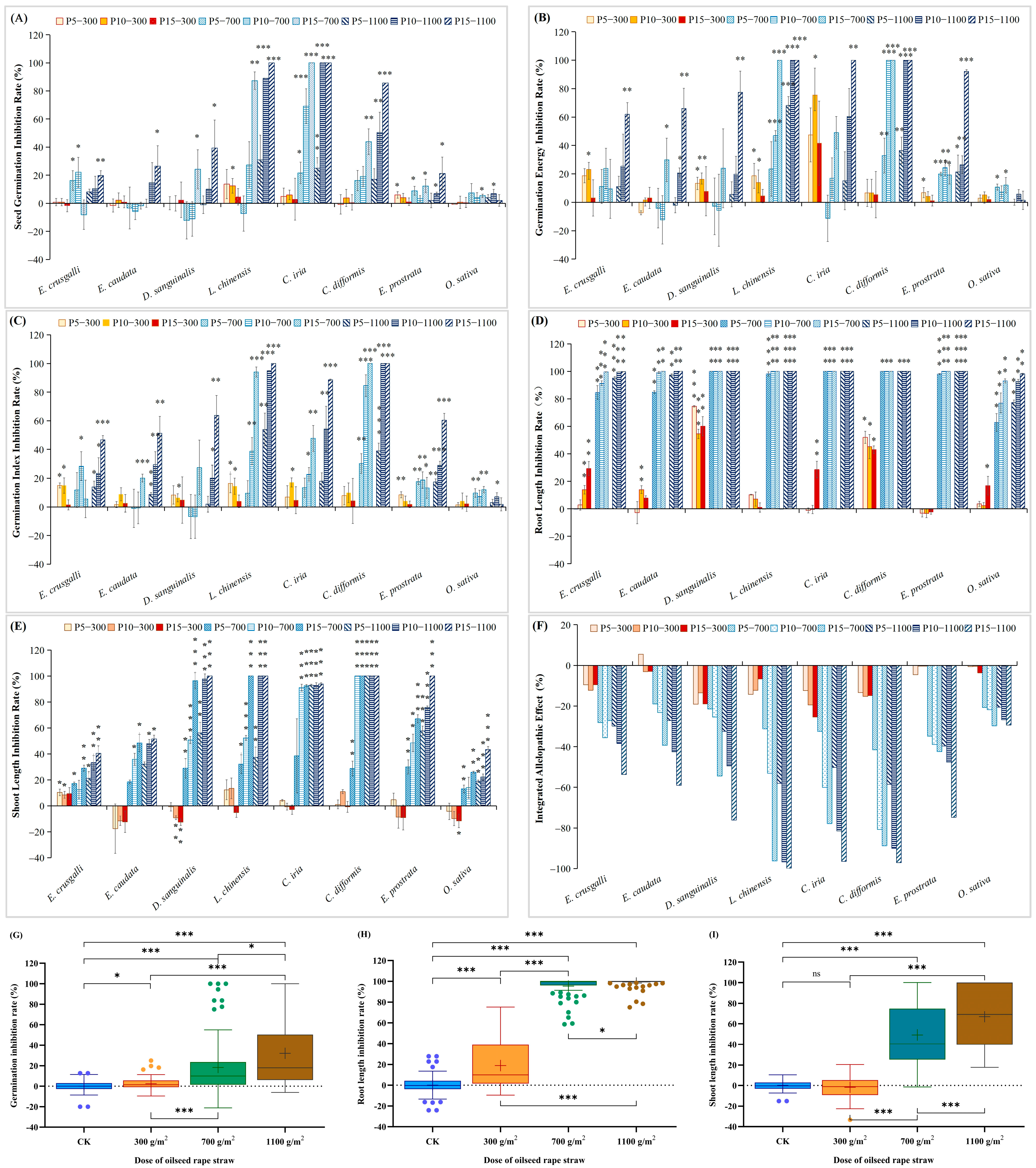
SDLs exhibited pronounced, dose- and time-dependent allelopathic effects on paddy weeds, while rice showed markedly lower sensitivity (Figure 1 and Figure S1).
Figure 1.
The allelopathic effects of decomposition liquids of ORS on weeds and rice. (A) Inhibition in seed germination, (B) inhibition in germination energy, (C) inhibition in germination index, (D) inhibition in root length, (E) inhibition in shoot length, (F) integrated allelopathic effect, (G) inhibitory effects of ORS with different doses on the global seed germination of all species (n = 72), (H) inhibitory effects of ORS with different doses) on the global root length of all species (n = 72), and (I) inhibitory effects of ORS with different doses on the global shoot length of all species (n = 72). Asterisks (*), (**), and (***) indicate significant difference at p < 0.05, p < 0.01, and p < 0.001 (compared with control) using one-way ANOVA, respectively.
As shown in Figure 1A, SDLs from treatments P15-700, P10-1100, and P15-1100 generated strong inhibitory effects on GR of L. chinensis and C. iria, with inhibition rates ranging from 87.3% to 100% (p < 0.01, L. chinensis) and reaching 100% for C. iria (p < 0.001). In addition, SDLs from treatments P10-700 and P15-1100 significantly suppressed seed germination of C. iria (69.2% inhibition, p = 0.015) and C. difformis (85.7% inhibition, p < 0.001), respectively. By contrast, SDLs from other treatments showed relatively low inhibitory effects (inhibition rates ≤ 50%) or even slight boosting effects (with a maximum promotion rate of 12.1% (p = 0.047), D. sanguinalis, from treatment P5-700) on seed germination of the seven weeds. The impact of SDLs on GE (Figure 1B) and GI (Figure 1C) was generally consistent with that on GR, but the inhibition was more pronounced in the P15-1100 treatment across all seven weed species. In contrast, rice seed germination was only slightly affected by SDLs, with inhibition rates not exceeding 7.5% for GR (p = 0.132), 12.1% for GE (p = 0.022), and 12.1% for GI (p = 0.001), indicating a much lower sensitivity of rice compared with weeds (Figure 1A–C).
As shown in Figure 1D, except for SDLs from 300 g/m2 ORS, which showed a relatively weak inhibitory (occasionally slight promoting) effect on RL of weeds, SDLs derived from the other two ORS doses generated a strong inhibitory effect. Specifically, RL inhibition rates exceeded 84.6% (p < 0.001) for E. crus-galli and E. caudata, and reached 98–100% (p < 0.001) for D. sanguinalis, L. chinensis, C. iria, C. difformis, and E. prostrata. For rice, SDLs derived from 300 g/m2 ORS caused only minor inhibition of RL, with inhibition rates not exceeding 16.9%. However, SDLs from 700 and 1100 g/m2 ORS induced strong decomposition time-dependent inhibition on RL, with inhibition rates rising from 62.8% to 93.1% for 700 g/m2 treatment and from 77.2% to 98.2% for 1100 g/m2 treatment as decomposition time increased from 5 to 15 d.
At the ORS dose of 300 g/m2, SDLs exerted slight promotive or inhibitory effects on SL, whereas SDLs derived from 700 and 1100 g/m2 ORS consistently produced suppressive effects (Figure 1E). Among the tested weeds, C. difformis was the most sensitive to SDLs, followed by C. iria, L. chinensis, and D. sanguinalis. Correspondingly, SL inhibition rates reached 100%, 91.0–92.5%, 52.4–100%, and 50.7–100% in treatments P10-700 and P15-700, and 100%, 92.7–93.8%, 37.4–100%, and 56.2–100% in treatments P5-1100, P10-1100, and P15-1100, respectively. Additionally, SDLs from 300 g/m2 ORS slightly promoted rice shoot growth, with a maximum promotion rate of 11.6% (p < 0.001), while SDLs from 700 and 1100 g/m2 ORS exerted opposite effects with a maximum inhibition rate of 43.3% (p < 0.001).
From the perspective of the IAE (Figure 1F), 300 g/m2 treatments showed weak inhibitory effects on the seven weeds, with a maximum IAE of −19.1% (D. sanguinalis), and even generated a slight promotive effect on E. caudata in treatment P5-300. In contrast, under the 700 and 1100 g/m2 ORS treatments, IAE generally increased as decomposition time increased. Among all treatments, P15-1100 exhibited the strongest inhibitory effects on the seven weed species, with IAEs of −53.7%, −59.1%, −76.1%, −100.0%, −96.5%, −97.1%, and −74.7% for E. crus-galli, E. caudata, D. sanguinalis, L. chinensis, C. iria, C. difformis, and E. prostrata, respectively. The IAEs of the seven weeds under treatment P10-1100 were close to or lower than −50%, showing a highly similar result to the treatment P15-700. For rice, the IAE was higher than −30%. In summary, SDLs exhibited integrated allelopathic inhibitory effects on the eight tested species, with the strongest effects on L. chinensis, C. iria, and C. difformis, and the weakest effect on rice.
The inhibitory effects of different ORS doses, regardless of decomposition time, on the overall seed germination (Figure 1G) and seedling growth (Figure 1H,I) across all species were further compared. Except for the 300 g/m2 dose treatments, which had no significant inhibition on SL, other higher-dose treatments showed significant inhibition on GR, RL, and SL, with significant differences among doses. The results indicated that 700–1100 g/m2 ORS had a significant inhibitory effect on seed germination and seedling growth of the tested species in most cases. Detailed dose- and time-dependent differences are presented in Figure S2.
3.2. Sensitivity of Different Varieties of Rice Seedlings at Different Growth Stages to SDLs
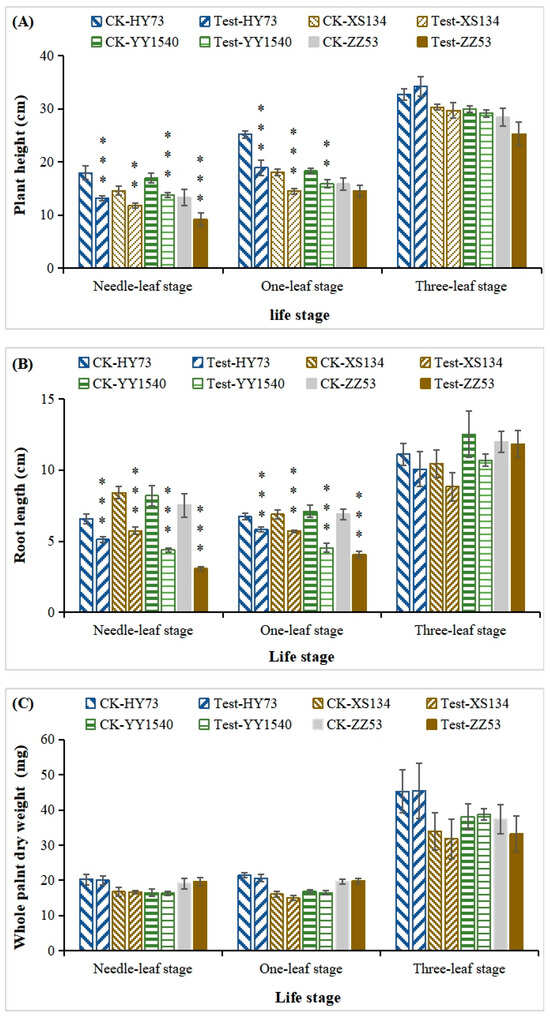
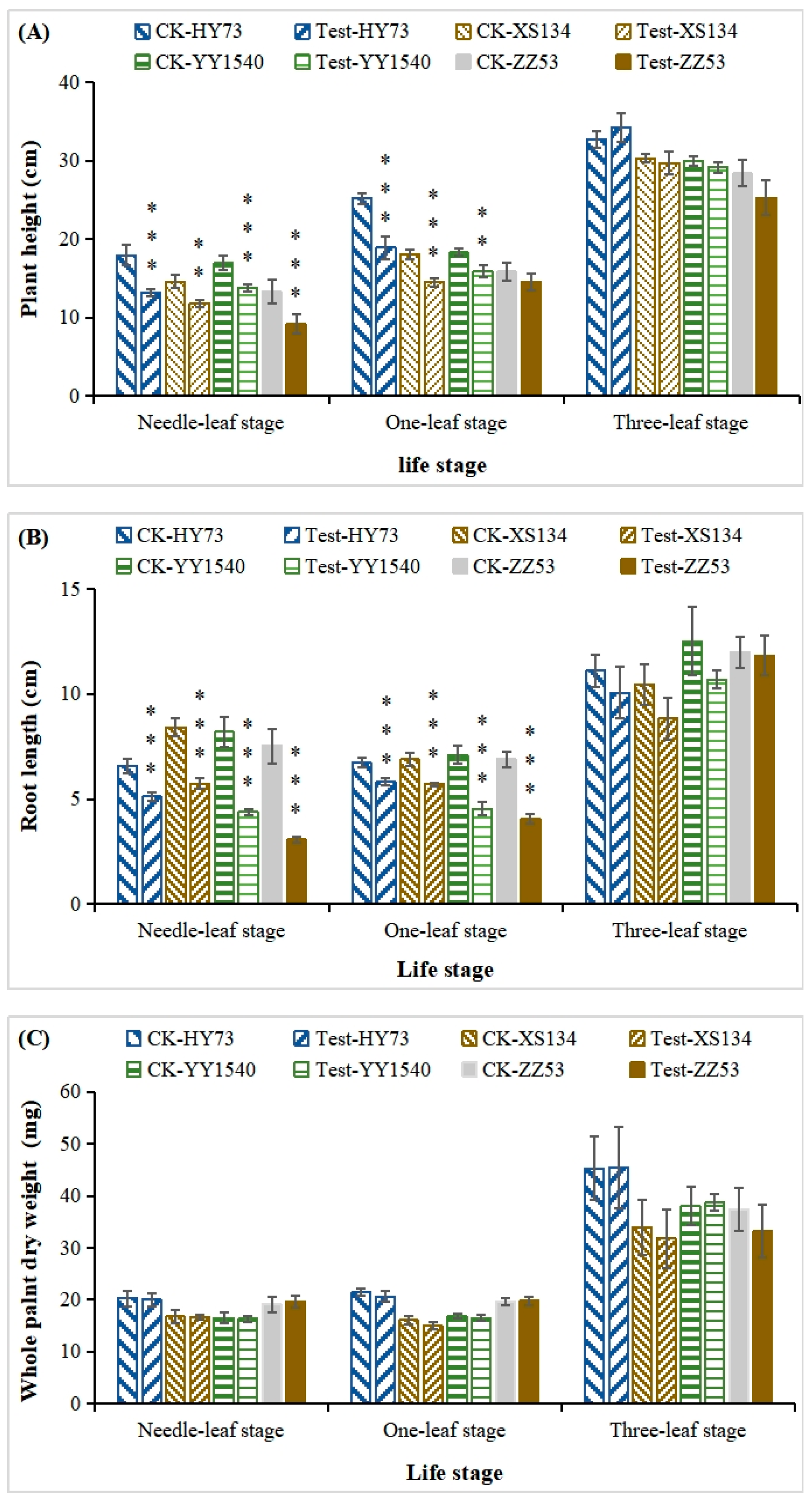
To further assess the safety of SDLs for rice cultivation, the sensitivity of four rice varieties (HY73, XS134, YY1540, and ZZ53) to SDL derived from the P15-1100 treatment was evaluated at three seedling growth stages (Figure 2). At the needle-leaf and one-leaf stages, SDL significantly (p < 0.01) suppressed both PH and RL of rice seedlings in all four varieties, except for PH at the one-leaf stage of variety ZZ53 (p = 0.137). Upon reaching the three-leaf stage, these inhibitory effects remarkably reduced or even disappeared (p > 0.05). Although significant inter-varietal differences in PH and RL were observed at the needle-leaf and one-leaf stages, these differences almost disappeared at the three-leaf stage (Figure S3). No significant effects were observed on DW (whole plant) at any of the growth stages.
Figure 2.
Sensitivity of different varieties of rice seedlings at different growth stages to SDL from P15-1100 treatment. (A–C) HY73--rice c.v. Hangyou73, XS134--rice c.v. Xiushui 134, YY1540--rice c.v. Yongyou1540, and ZZ53--rice c.v. Zhongzu 53. Asterisks (**), and (***) indicate significant difference at p < 0.01, and p < 0.001 (compared with control), respectively.
3.3. Greenhouse Test
3.3.1. Inhibitory Effect of ORS on Weeds
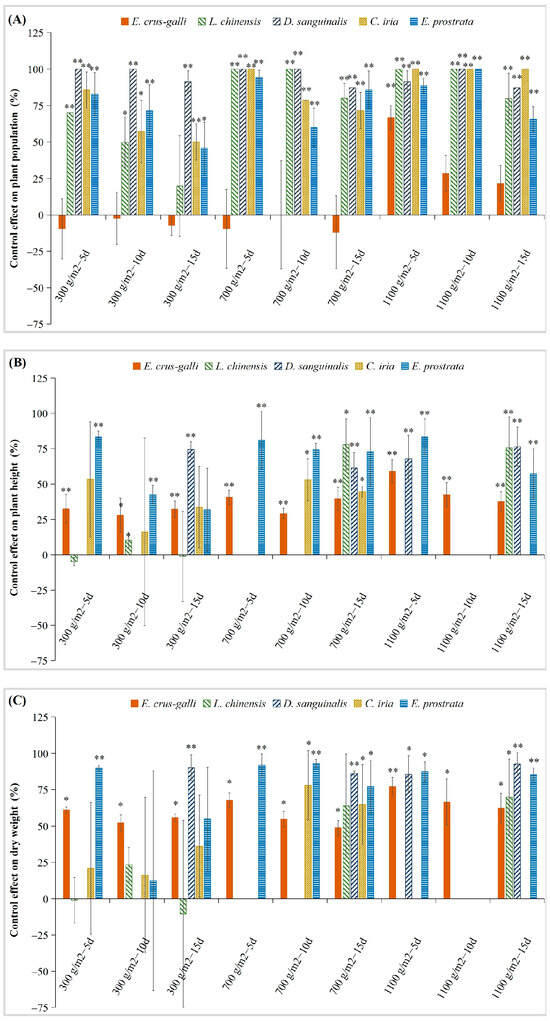
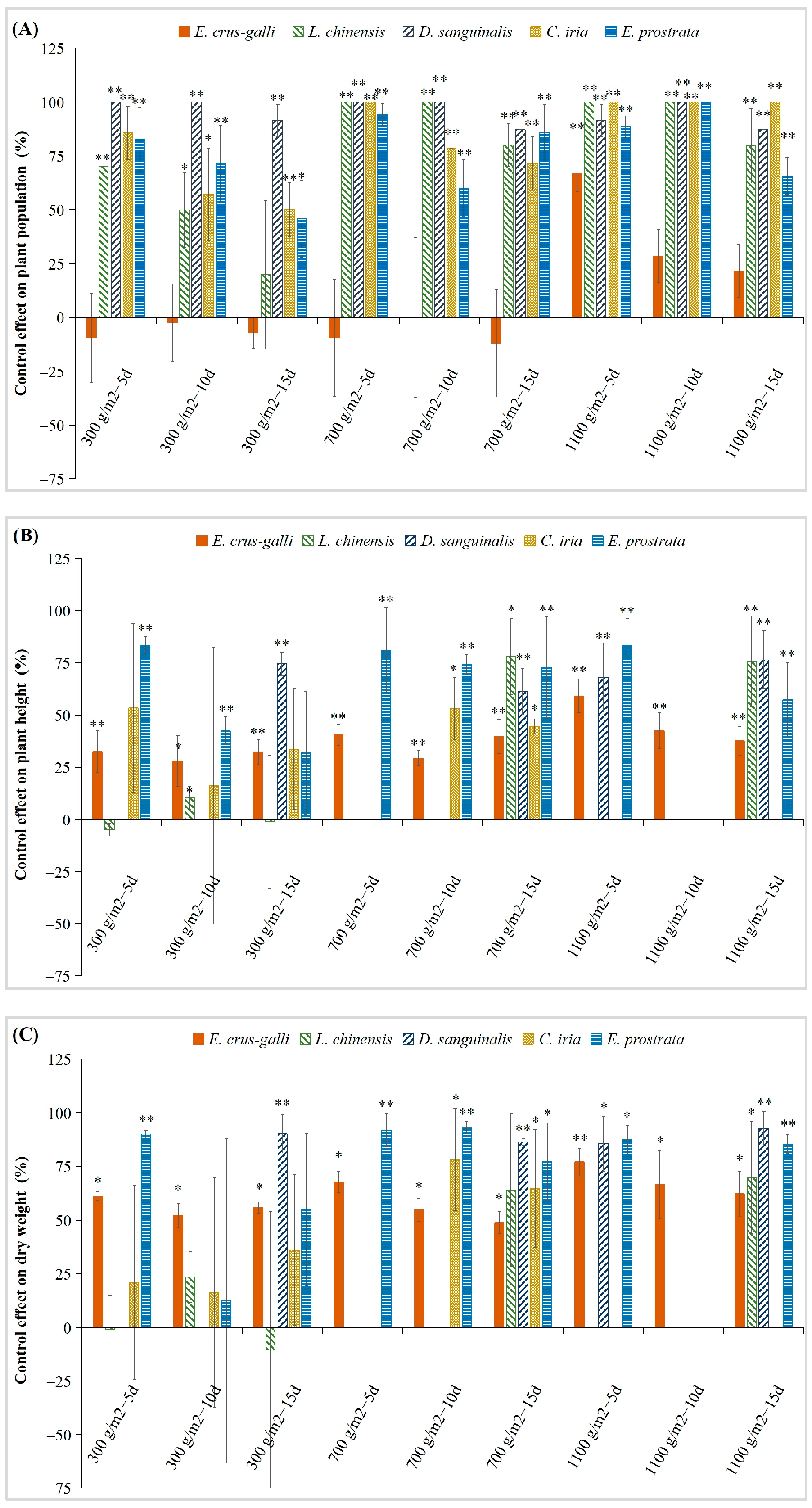
The inhibitory effects of ORS incorporation by shallow tillage on five paddy weed species are presented in Figure 3 and Table S2. ORS at 300 and 700 g/m2 slightly promoted the plant population of E. crus-galli, with a maximum promotion rate of 11.9%, while 1100 g/m2 ORS inhibited its population, with the inhibition weakening from 66.6% to 21.4% as decomposition time increased from 5 to 15 d. In addition to 1100 g/m2 ORS, 300 and 700 g/m2 ORS also repressed the PH and DW of E. crus-galli. These results indicated that ORS at 300 and 700 g/m2 promoted the emergence of E. crus-galli but suppressed the PH and DW of emerged seedlings, while 1100 g/m2 ORS inhibited emergence, PH, and DW. For D. sanguinalis, plant population, PH, and DW were strongly reduced across all treatments, with reductions of 87.1–100%, 61.4–76.5%, and 86.3–92.6%, respectively. For L. chinensis, C. iria, and E. prostrata, the Ipp (control effect on plant population), Iph (control effect on PH), and Idw (control effect on DW) under 300 g/m2 ORS were generally lower than those under 700 and 1100 g/m2 ORS. The Ipp of the above three weeds approached 100% under treatments P5-700 and P10-1100. Moreover, in most cases, 700–1100 g/m2 ORS reduced the PH and DW of the three weed species after emergence, with Iph and Idw ranging from 44.5% to 83.4% and from 64.0% to 93.1%, respectively. Detailed inter-dose differences within each species and inter-species differences at the same ORS dose for Ipp, Iph, and Idw are shown in Figure S4.
Figure 3.
Control effect of ORS plowed in soil on plant population (A), plant height (B), and dry weight (C) of 5 typical paddy weeds in greenhouse. In (B,C), the control effect on plant height and dry weight of weeds was not calculated when the control effect on plant population was 100%. Asterisks (*), (**) indicate significant difference at p < 0.05, p < 0.01 (compared with control), respectively.
3.3.2. Safety Evaluation of ORS Incorporation on Transplanted Rice Seedlings
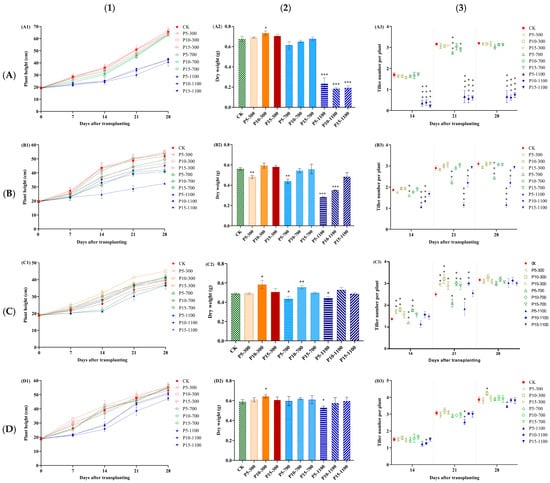
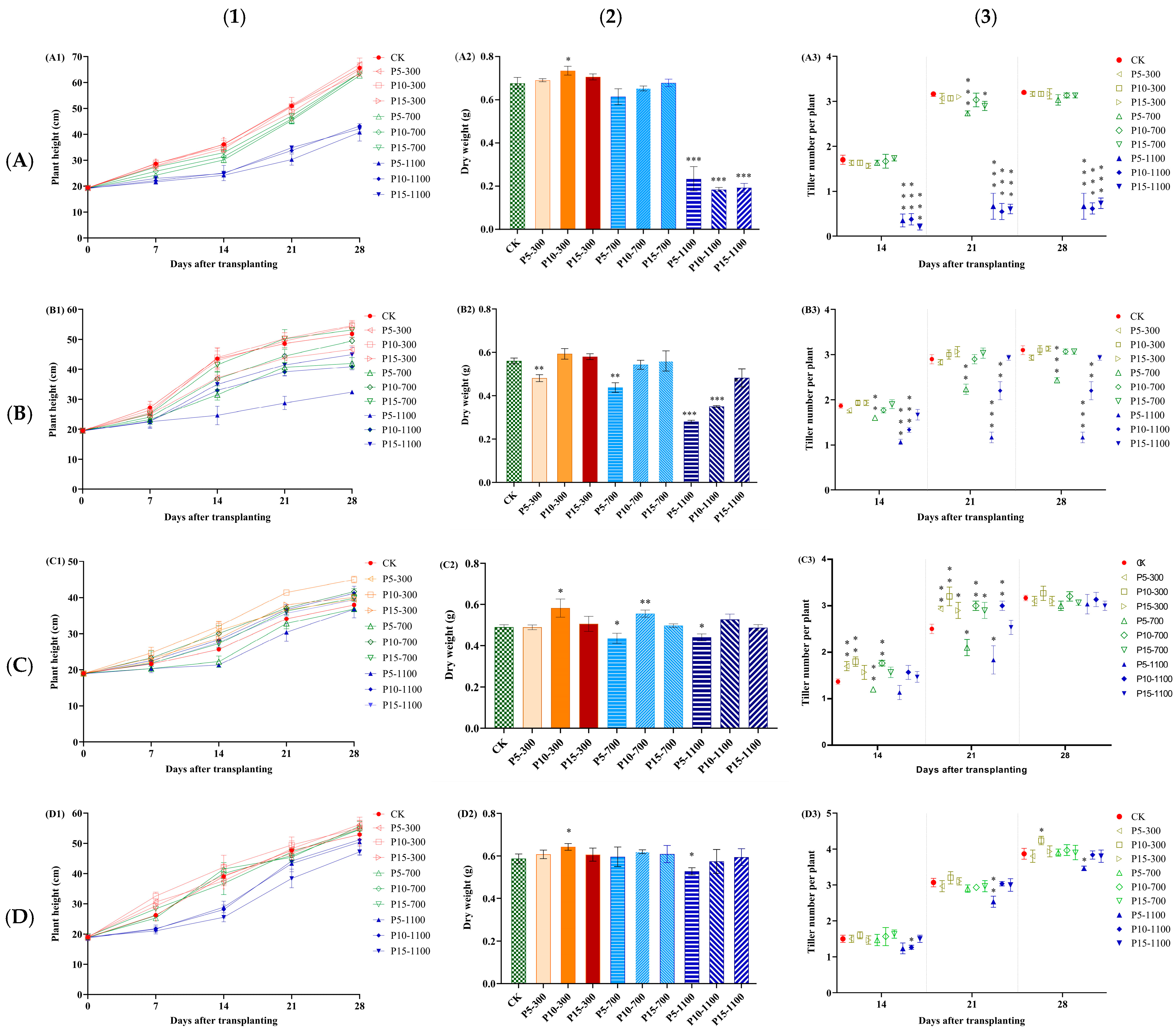
Four rice varieties were evaluated, and their sensitivities to ORS differed in terms of PH, DW, and TN (Figure 4). ORS at 300 and 700 g/m2 showed weak suppression or slight promotion on PH. However, under the 1100 g/m2 ORS treatments, severe stunting was observed in all four rice varieties within 14 dat. HY73 and ZZ53 were still strongly inhibited at 28 dat, with inhibition rates of 34.1–37.9% (p < 0.001) and 13.3–37.4% (p < 0.05), respectively (Figure 4A1,B1). By contrast, stunting in XS134 and YY1540 was rapidly alleviated, and the PH largely recovered at 28 dat, with a maximum inhibition rate of 10.8% (p > 0.05) (Figure 4C1,D1).
Figure 4.
Influence of ORS incorporation by plowing on different varieties of rice seedlings by greenhouse test. Lines (A–D) represent the rice varieties of HY73, Zhongzu 53, Xiushui 134, and Yongyou1540, respectively. Columns (1–3) mean plant height, dry weight (28 dat), and tiller number of rice seedlings, respectively. Data are displayed as mean ± SD. Asterisks (*), (**), and (***) indicate significant difference at p < 0.05, p < 0.01, and p < 0.001 (compared with control) using one-way ANOVA, respectively.
For HY73, ORS at 300 and 700 g/m2 did not significantly affect DW, whereas 1100 g/m2 ORS strongly reduced DW, with inhibition rates of 65.4–72.8% (p < 0.001) (Figure 4A2). For ZZ53, in addition to 1100 g/m2 ORS, both 300 and 700 g/m2 ORS significantly reduced DW under the 5-day decomposition treatment (P5) (Figure 4B2). By comparison, DW of XS134 and YY1540 was only weakly affected across the three ORS doses. Significant DW inhibition was only found in P5-700 (11.1%, p = 0.027) and P5-1100 (10.1%, p = 0.014) for XS134, and P5-1100 (10.2%, p = 0.020) for YY1540. In contrast, slight increases in DW were observed under some treatments, including P10-300 for both varieties and P10-700 for XS134 (Figure 4C2,D2).
For HY73, ORS at 300 and 700 g/m2 did not significantly affect TN during 14–28 dat, whereas 1100 g/m2 ORS caused a pronounced reduction (77.1–87.7%, p < 0.001) (Figure 4A3). For ZZ53, TN was strongly inhibited under P5-1100, and notable inhibition was also observed under P5-700 and P10-1100 within 28 dat, while the P15-1100 treatment showed little or no significant effect on TN (Figure 4B3). The TN response of XS134 to ORS incorporation was more variable across treatments. Several treatments, including P5-300, P10-300, P15-300, P10-700, P15-700, and P10-1100, increased TN during 14–21 dat, whereas P5-700 and P5-1100 caused transient TN inhibition during the same period. By 28 dat, TN recovered and did not differ significantly from the control (Figure 4C3). Among the four varieties, the TN of YY1540 was least affected. Significant inhibition was observed only under P5-1100 at 14 dat, and P10-1100 at 21 dat and 28 dat (p < 0.05) (Figure 4D3).
Overall, ORS incorporation at 300–700 g/m2 showed acceptable safety for transplanted rice seedlings, whereas 1100 g/m2 ORS caused severe but variety-dependent growth inhibition, particularly at early growth stages.
3.4. Field Trials
3.4.1. Safety Evaluation of ORS Incorporation in Transplanted Rice Fields
Rice plants grew normally in all plots, with no visible phytotoxic symptoms observed at 7, 14, 20 (Figure S5), and 35 dat. There were no significant differences in PH and TN at 35 dat compared with the control (Table S3). Before harvest, rice yield and its components were investigated. The results showed that ORS at 300, 700, and 1100 g/m2 had no adverse effects on effective panicle number per unit area, seed setting rate, or 1000-grain weight, but increased the grain number per panicle by 10.2–12.5% (p < 0.05). ORS incorporation also greatly increased the theoretical grain yield by 88.7–128.5 kg/666.7 m2 (13.4–19.4%, p < 0.05) compared with the control (662.5 kg/666.7 m2), with no significant differences among ORS dose treatments (Table 1 and Figure S6).
Table 1.
Effect of ORS incorporation on rice yield and its contributing factors.
3.4.2. Weed Control Efficacy of ORS Incorporation in Transplanted Rice Fields
As shown in Table 2, ORS incorporation exhibited satisfactory weed control efficacy in transplanting rice fields. At 20 dat, the Ipp of 300 and 700 g/m2 ORS exceeded 75.0% control efficacy on Gramineae weeds, Cyperaceae weeds, and Broadleaf weeds, with TIpp also above 75%. At 35 dat, the Ipp on Gramineae weeds was well maintained above 80% regardless of the ORS dose. However, for Cyperaceae and Broadleaf weeds, the Ipp values declined with the decreasing ORS dose. The highest ORS dose (1100 g/m2) achieved Ipp values of 77.3% for Cyperaceae weeds, 84.9% for Broadleaf weeds, and a TIpp of 84.6%, whereas these values declined to 72.8%, 27.8%, and 38.3%, respectively, at 300 g/m2. Regarding the Ifw at 35 dat, high efficacy (90.7–99.6%) was observed for Gramineae weeds across all ORS doses. In contrast, Ifw for Cyperaceae and Broadleaf weeds was dose-dependent, increasing from 46.2% to 80.7% and from 51.8% to 95.6%, respectively, as ORS increased from 300 g/m2 to 1100 g/m2. Overall, ORS incorporation provided stable and high control efficacy against Gramineae weeds, while its effects on Cyperaceae and Broadleaf weeds were dose-dependent.
Table 2.
Control effect of ORS incorporation on weeds in transplanting rice field.
4. Discussion
More than 2000 plant species across 39 families have been reported to exhibit allelopathic effects [51]. Allelopathy can be utilized to achieve sustainable weed management either by using allelochemicals as natural herbicides or through allelopathic interactions. Although allelopathy is not a solution for all weed-related problems in the field, it may significantly help in reducing weed populations. Brassicaceae species, including oilseed rape, have been reported to possess allelopathic potential [2]. The middle-lower reaches of the Yangtze River represent major production areas for oilseed rape and rice, where oilseed rape–rice rotation is widely practiced. Moreover, this rotation system is also the most important crop planting system across Asia [52,53]. In this context, incorporation of ORS into succeeding rice cultivation may have potential as a supplementary approach for paddy weed management in oilseed rape–rice rotation systems. Therefore, clarifying the allelopathic effects of ORS on paddy weeds is important for evaluating its possible role in sustainable cropping systems.
Recent studies have shown that utilizing the gravity suppression and shading of ORS mulching suppresses various weeds in direct-seeding and mechanical transplanting rice fields and significantly promotes grain yield [30,31,54]. Straw mulching-based weed control meets the requirements of light and simplified cultivation. However, straw mulching has many limitations in weed control in transplanted rice fields [32], which can be overcome by tilling straw into the soil. Therefore, this study aims to explore the feasibility of weed control in transplanted rice fields by shallow incorporation of ORS.
The present results indicated that the decomposition liquids of ORS pre-plowed into soil for 10–15 d at 700–1100 g/m2 generated strong integrated allelopathic inhibition on seven common paddy weeds, especially L. chinensis, C.iria, and C. difformis (Figure 1), indicating a strong allelopathic inhibition for paddy weeds control, which was verified by greenhouse tests (Figure 3) and field trials (Table 2). Among growth parameters, plant root was the most sensitive indicator of ORS stress, followed by shoot growth and seed germination. At the above doses of ORS, the inhibition rates of RL for all seven weeds exceeded 80% (p < 0.01) (Figure 1D), while GR for most weeds were below 40%, except for the three highly sensitive weed species (Figure 1A). Previous studies have shown that the plant root system is generally the most sensitive organ to environmental stresses [55], which is crucial for plant survival and performs a wide range of functions, such as water and nutrient acquisition, structural support, and sensing of rapidly changing soil environment. Because roots are directly exposed to soil allelochemicals, root growth inhibition may represent a primary and decisive phytotoxic response to allelopathic stress [56]. Therefore, suppressing root growth may be an important reason that the allelopathic stress of ORS represses weed growth. Similarly, the RL of D. sanguinalis, E. hispidula, P. oleracea, A. retroflexus, and E. prostrata. was decreased by 125.0 g/L root aqueous extract of oilseed rape [41]. These findings are consistent with previous observations.
ORS incorporation also affected the growth of rice seedlings, mainly during root and shoot development (Figure 1E,F and Figure 2A,B). These results suggest that, from an allelopathic perspective, ORS incorporation is safer for transplanted rice than for direct-seeded rice.
Greenhouse test showed that ORS incorporation led to variety-dependent reductions in PH, DW, and TN of rice seedlings within 28 dat (Figure 4). Similar effects have been reported for rice varieties ‘F-You 498’ [57], ‘Yixiangyou 2115’, and ‘Deyou 4727’ in previous field trials [58,59]. Given that the effects of ORS on rice seedlings at the three-leaf stage were minimal across varieties (Figure 2), the observed variety-dependent growth reductions are more likely attributable to transient changes in the soil environment during ORS decomposition, such as pH, electrical conductivity, and dissolved oxygen levels [60], rather than to direct allelopathic effects. Therefore, the present results suggest that rice response to ORS incorporation was affected not only by the incorporation amount but also by the varietal sensitivity and the seedling growth stage.
Field trial results indicated that ORS incorporation caused no observable adverse effects on rice seedlings ‘YY1540’ within 35 dat, which is widely cultivated locally, but instead significantly increased panicle grain number and grain yield at maturity (Table 1). This yield enhancement is likely associated with improvements in soil physical and chemical properties following ORS decomposition, including increased soil porosity, dissolved oxygen availability, and nutrient supply, which improve rice growth in the middle and later stages [60]. However, further field trials are needed to confirm the general applicability of these findings across different rice varieties. Straw return has been shown to improve soil nutrient supply and nutrient use efficiency, and long-term field evidence indicates that continuous straw return can partially substitute for specific chemical fertilizers under appropriate management [61,62]. And the present study was designed to evaluate weed suppression and rice safety rather than the fertilization value of ORS. Therefore, based on the current data, we cannot conclude whether ORS incorporation can be considered an additional form of organic fertilization sufficient. This issue would require dedicated experiments involving fertilizer reduction treatments and nutrient balance analysis. In field trials, weed control efficacy was evaluated at the functional group level rather than at the species level, because many weeds were at early seedling stages when species-specific morphological traits were not fully distinguishable. Future studies incorporating species-level identification or molecular tools may further refine the assessment of weed-specific responses.
5. Conclusions
This study demonstrates that shallow incorporation of oilseed rape straw represents an effective and agronomically feasible strategy for weed management in transplanted rice fields. Pre-incorporation of ORS at 700–1100 g/m2 in soil for 10–15 d could effectively suppress various paddy weeds, particularly L. chinensis, C. iria, and C. difformis, primarily by inhibiting seed germination and seedling growth, especially root growth. Although ORS incorporation caused transient growth inhibition in rice seedlings during early developmental stages, its effects were strongly variety-dependent and diminished as rice plants developed. Under field conditions, ORS incorporation showed no observable phytotoxic effects on transplanted rice and significantly increased grain yield, indicating acceptable crop safety and agronomic benefits. In addition, the feasibility of ORS incorporation for weed control in direct-seeded rice fields still needs to be evaluated. Overall, ORS incorporation offers a promising, environmentally friendly integrated weed management in the oilseed rape–rice rotation system, with the potential to reduce reliance on herbicides while improving grain yield. Further studies are warranted to optimize application practices across more rice varieties and to evaluate long-term field performance under diverse agroecological conditions.
Supplementary Materials
The following supporting information can be downloaded at: https://www.mdpi.com/article/10.3390/agronomy16090876/s1, Figure S1: The allelopathic effects of soil decomposition liquids of ORS on seed germination and seedling growth of weeds and rice; Figure S2: Comparison of inhibitory effects of soil decomposition liquids of ORS with the same doses (regardless of decomposition time) or the same decomposition time (regardless of dose) on GR, RL, and SL of all/each species; Figure S3: The inter-varietal differences in inhibitory effects of SDL on plant height (A) and root length (B) at different rice seedling stages; Figure S4: The inter-dose differences and inter-species differences in control effects on plant population, plant height, and dry weight of weeds by greenhouse test; Figure S5: Growth status of the transplanting rice seedlings (20 dat) with different ORS incorporation doses; Figure S6: Effect of different ORS incorporation doses on grain yield and its contributing factors; Table S1: Main information of the test species; Table S2: Effect of ORS incorporation on the plant number, plant height, and dry weight of 5 typical paddy weeds in greenhouse; Table S3: Effect of ORS incorporation on transplanting rice seedling (35 dat).
Author Contributions
Conceptualization, J.Z., M.W. and W.G.; methodology, S.Y.; validation, Q.C. and S.Y.; formal analysis, Q.C. and S.Y.; investigation, Q.C., S.Y., R.Y. and S.L.; resources, J.Z. and W.G.; data curation, Q.C., S.Y. and R.Y.; writing—original draft, S.Y., R.Y., J.Z. and S.L.; writing—review and editing, Q.C., M.W. and W.G.; visualization, Q.C.; supervision, J.Z., M.W. and W.G.; project administration, S.L.; funding acquisition, W.G. All authors have read and agreed to the published version of the manuscript.
Funding
This work was supported by the National Natural Science Foundation of China (32072433) and the Innovation and Development Special Fund for the West Hangzhou Science and Technology Innovation Corridor.
Data Availability Statement
The original contributions presented in this study are included in the article/Supplementary Materials. Further inquiries can be directed to the corresponding authors.
Conflicts of Interest
The authors declare no competing financial interests.
References
- Wang, W.; Mauleon, R.; Hu, Z.; Chebotarov, D.; Tai, S.; Wu, Z.; Li, M.; Zheng, T.; Fuentes, R.R.; Zhang, F.; et al. Genomic variation in 3,010 diverse accessions of Asian cultivated rice. Nature 2018, 557, 43–49. [Google Scholar] [CrossRef] [Scilit]
- Asaduzzaman, M.; Pratley, J.E.; Luckett, D.; Lemerle, D.; Wu, H. Weed management in canola (Brassica napus L): A review of current constraints and future strategies for Australia. Arch. Agron. Soil Sci. 2020, 66, 427–444. [Google Scholar] [CrossRef] [Scilit]
- Maimunah, M.A.; Kautsar, V.; Bimantara, P.O.; Kimani, S.M.; Torita, R.; Tawaraya, K.; Murayama, H.; Utami, S.N.H.; Purwanto, B.H.; Cheng, W. Weeding frequencies decreased rice-weed competition and increased rice N uptake in organic paddy field. Agronomy 2021, 11, 1904. [Google Scholar] [CrossRef] [Scilit]
- Kamath, R.; Balachandra, M.; Vardhan, A.; Maheshwari, U. Classification of paddy crop and weeds using semantic segmentation. Cogent Eng. 2022, 9, 2018791. [Google Scholar] [CrossRef] [Scilit]
- Qiang, S. (Ed.) Weed Science, 2nd ed.; China Agriculture Press: Beijing, China, 2009; pp. 2–3. [Google Scholar]
- Oerke, E.C. Crop losses to pests. J. Agric. Sci. 2006, 144, 31–43. [Google Scholar] [CrossRef] [Scilit]
- Feng, J.; Shen, Y.; Yuan, X.; Mao, H.; Dong, F.; Yuan, S. Existing problems in the use of paddy herbicides and their corresponding countermeasures in China. Agrochemicals 2017, 56, 6–10. [Google Scholar] [CrossRef]
- Rashid, M.H.; Alam, M.M.; Rao, A.N.; Ladha, J.K. Comparative efficacy of pretilachlor and hand weeding in managing weeds and improving the productivity and net income of wet-seeded rice in Bangladesh. Field Crops Res. 2012, 128, 17–26. [Google Scholar] [CrossRef] [Scilit]
- Food and Agriculture Organization Statistical Database. Available online: https://www.fao.org/faostat/en/#data/EP (accessed on 4 March 2026).
- Zhu, J.; Wang, J.; DiTommaso, A.; Zhang, C.; Zheng, G.; Liang, W.; Islam, F.; Yang, C.; Chen, X.; Zhou, W. Weed research status, challenges, and opportunities in China. Crop Prot. 2020, 134, 104449. [Google Scholar] [CrossRef] [Scilit]
- International Herbicide-Resistant Weed Database. Available online: https://www.weedscience.org/Home.aspx (accessed on 4 March 2026).
- Ma, G.; Bai, L.; Liu, D.; Liu, X.; Yu, L. Resistance of Echinochloa crusgalli (L.) Beauv. to quinclorac in the rice growing region of the middle and lower reaches of Yangtze River in China. Chin. J. Rice Sci. 2013, 27, 184–190. [Google Scholar] [CrossRef]
- Wen, M.; Zhou, X.; Liu, J.; Zhou, Y.; Mo, B.; Zhu, Z. Resistance of Leptochloa chinensis (L) Nees. to cyhalofop-butyl in rice field of direct seeding and resistance biochemical mechanism research. J. South. Agric. 2017, 48, 647–652. [Google Scholar] [CrossRef]
- Dong, L.; Gao, Y.; Fang, J.; Chen, G. Research progress on the herbicide-resistance of weeds in rice fields in China. Plant Prot. 2018, 44, 69–76. [Google Scholar] [CrossRef]
- Yang, H.; Wang, L.; Wu, L.; Peng, Q.; Li, Z.; Deng, X.; Zhou, X.; Bai, L. Herbicide resistance of Chinese sprangletop [Leptochloa chinensis (L.) Nees] in rice fields: A review. Chin. J. Pestic. Sci. 2019, 21, 772–779. [Google Scholar] [CrossRef]
- Wu, X.; Wang, F.; Cao, Q. Resistance of Leptochloa chinensis populations to cyhalofop-butyl in rice fields of eastern China. Chin. J. Pestic. Sci. 2019, 21, 285–290. [Google Scholar] [CrossRef]
- Jiang, M.; Wang, Y.; Li, W.; Li, Q.; Zhang, J.; Liao, M.; Zhao, N.; Cao, H. Investigating resistance levels to cyhalofop-butyl and mechanisms involved in Chinese sprangletop (Leptochloa chinensis L.) from Anhui Province, China. Pestic. Biochem. Physiol. 2022, 186, 105165. [Google Scholar] [CrossRef] [Scilit]
- Yuan, G.; Tian, Z.; Gao, Y.; Shen, G. Resistance status of Leptochloa chinensis to three acetyl-CoA carboxylase (ACCase) inhibitors in rice fields in Shanghai and involved ACCase gene mutations. Chin. J. Pestic. Sci. 2022, 24, 492–500. [Google Scholar] [CrossRef]
- Ju, B.; Liu, M.; Fang, Y.; Liu, L.; Pan, L. First report on resistance to HPPD herbicides mediated by nontarget-site mechanisms in the grass Leptochloa chinensis. J. Agric. Food Chem. 2023, 71, 17669–17677. [Google Scholar] [CrossRef] [Scilit]
- Deng, W.; Li, Y.; Yao, S.; Wu, J.; Zhu, A.; Yang, Q.; Yuan, S. Current status of cyhalofop-butyl and metamifop resistance and diversity of the ACCase gene mutations in Chinese sprangletop (Leptochloa chinensis) from China. Pestic. Biochem. Physiol. 2023, 197, 105648. [Google Scholar] [CrossRef] [Scilit]
- Han, Y.; Meng, Z.; Wu, J.; Zhang, Y.; Zhou, F. Resistance of Chinese sprangletop Leptochloa chinensis to cyhalofop-butyl and metamifop in rice fields in Anhui Province and its possible molecular mechanism. J. Plant Prot. 2023, 50, 1089–1095. [Google Scholar] [CrossRef]
- Islam, A.K.M.M.; Nasir, M.; Akter Mou, M.; Yeasmin, S.; Islam, M.S.; Ahmed, S.; Anwar, M.P.; Hadifa, A.; Baazeem, A.; Iqbal, M.A.; et al. Preliminary reports on comparative weed competitiveness of Bangladeshi monsoon and winter rice varieties under puddled transplanted conditions. Sustainability 2021, 13, 5091. [Google Scholar] [CrossRef] [Scilit]
- Garcia-Delgado, C.; Barba-Vicente, V.; Marin-Benito, J.M.; Mariano-Igual, J.; Sanchez-Martin, M.J.; Rodriguez-Cruz, M.S. Influence of different agricultural management practices on soil microbial community over dissipation time of two herbicides. Sci. Total Environ. 2019, 646, 1478–1488. [Google Scholar] [CrossRef] [Scilit]
- Yang, Y.; Chen, T.; Liu, X.; Wang, S.; Wang, K.; Xiao, R.; Chen, X.; Zhang, T. Ecological risk assessment and environment carrying capacity of soil pesticide residues in vegetable ecosystem in the Three Gorges Reservoir Area. J. Hazard. Mater. 2022, 435, 128987. [Google Scholar] [CrossRef] [Scilit]
- Hu, M.; Hou, N.; Li, Y.; Liu, Y.; Zhang, H.; Zeng, D.; Tan, H. The effect of microplastics on behaviors of chiral imidazolinone herbicides in the aquatic environment: Residue, degradation and distribution. J. Hazard. Mater. 2021, 418, 126176. [Google Scholar] [CrossRef] [Scilit]
- National Bureau of Statistics of China. Available online: https://www.stats.gov.cn/sj/ndsj/2025/indexch.htm (accessed on 4 March 2026).
- Zhang, X.; Wang, Z.; Canmuyou; Bai, H.; Tana. Analysis of yield and current comprehensive utilization of crop straws in China. J. China Agric. Univ. 2021, 26, 30–41. [Google Scholar] [CrossRef]
- Sun, Y.; Li, X.; Hu, X.; Xu, X.; Yang, W.; Sun, R.; Xue, Y.; Xu, Z. Situation, utilization and development suggestions of oilseed rape straw resources in China. Chin. J. Oil Crop Sci. 2025, 47, 1–8. [Google Scholar] [CrossRef]
- Song, D.; Hou, S.; Wang, X.; Liang, G.; Zhou, W. Nutrient resource quantity of crop straw and its potential of substituting. J. Plant Nutr. Fertil. 2018, 24, 1–21. [Google Scholar] [CrossRef]
- Zhu, J.; Liang, W.; Yang, S.; Wang, H.; Shi, C.; Wang, S.; Zhou, W.; Lu, Q.; Islam, F.; Xu, W.; et al. Safety of oilseed rape straw mulch of different lengths to rice and its suppressive effects on weeds. Agronomy 2020, 10, 201. [Google Scholar] [CrossRef] [Scilit]
- Yang, S.; Chen, C.; Yang, Y.; Teng, L.; Liu, J.; Gui, W.; Zhu, J.; Zhou, W.; Westbrook, A.S.; DiTommaso, A. Differential responses of weeds and rice to shading stress from oilseed rape straw mulch. Crop Prot. 2025, 189, 107038. [Google Scholar] [CrossRef] [Scilit]
- Jiang, X.; Zheng, J.; Yuan, Y. A new model of saving rice cultivation--wide-narrow row no-tillage mulch. Sichuan Agric. Sci. Technol. 2004, 4, 14. [Google Scholar] [CrossRef]
- Rice, E.L. Allelopathy, 2nd ed.; Academic Press: Orlando, FL, USA, 1984; pp. 292–293. [Google Scholar]
- Begum, K.; Shammi, M.; Hasan, N.; Asaduzzaman, M.; Appiah, K.S.; Fujii, Y. Potential allelopathic candidates for land use and possible sustainable weed management in South Asian ecosystem. Sustainability 2019, 11, 2649. [Google Scholar] [CrossRef] [Scilit]
- Scavo, A.; Mauromicale, G. Integrated weed management in herbaceous field crops. Agronomy 2020, 10, 466. [Google Scholar] [CrossRef] [Scilit]
- Scavo, A.; Mauromicale, G. Crop allelopathy for sustainable weed management in agroecosystems: Knowing the present with a view to the future. Agronomy 2021, 11, 2104. [Google Scholar] [CrossRef] [Scilit]
- Cheema, Z.A.; Farooq, M.; Khaliq, A. Application of allelopathy in crop production: Success Story from Pakistan. In Allelopathy: Current Trends and Future Applications; Springer: Berlin/Heidelberg, Germany, 2013; pp. 113–144. [Google Scholar] [CrossRef] [Scilit]
- Aliki, H.M.; Reade, J.P.H.; Back, M.A. Effects of concentrations of Brassica napus (L.) water extracts on the germination and growth of weed species. Allelopath. J. 2014, 34, 287–298. Available online: https://hau.repository.guildhe.ac.uk/id/eprint/17128 (accessed on 22 April 2026).
- Asaduzzaman, M.; An, M.; Pratley, J.E.; Luckett, D.J.; Lemerle, D. Canola (Brassica napus) germplasm shows variable allelopathic effects against annual ryegrass (Lolium rigidum). Plant Soil 2014, 380, 47–56. [Google Scholar] [CrossRef] [Scilit]
- Wang, J. Study on the Technology of Controling the Predominant Weeds Chinese Sprangletop (Leptochloa chinensis (L.) Nees) and Barnyard Grass (Echinochloa crusgalli (L.) Beauv) in Derect-Seeding Rice Field. Master’s Thesis, Nanjing Agricultural University, Nanjing, China, 2009. [Google Scholar] [CrossRef]
- Li, S.; Lu, X.; Cheng, F.; Ma, Y.; Zheng, S.; Kan, H.; Chen, M.; Liu, X.; Xu, D.; Wang, W. Allelopathic effect of Brassica napus straw on the seed germination and seedling growth of five weeds. J. Weed Sci. 2020, 38, 33–42. [Google Scholar] [CrossRef]
- Li, R.; Chen, G.; Zhang, Y.; Liu, Q.; Zhang, K.; Dong, L. Influences of oilseed rape and wheat aquatic straw extract on Leptochloa chinensis seed germination and seedling growth, and the application potential. Jiangsu J. Agric. Sci. 2018, 34, 293–298. [Google Scholar] [CrossRef]
- Jenfaoui, H.; Chaabane, H.; Hada, Z.; Sen, U.; Sassi, K.; Rezgui, S.; Ozyigit, I.I.; Souissi, T. Inhibitory effects of allelopathic crops on seedling growth of weed Hypericum triquetrifolium Turra. Allelopath. J. 2019, 48, 203–216. [Google Scholar] [CrossRef] [Scilit]
- Sheldon, K.; Purdom, S.; Shekoofa, A.; Steckel, L.; Sykes, V. Allelopathic impact of cover crop species on soybean and goosegrass seedling germination and early growth. Agriculture 2021, 11, 965. [Google Scholar] [CrossRef] [Scilit]
- Mehmood, A.; Naeem, M.; Khalid, F.; Saeed, Y.; Abbas, T.; Jabran, K.; Sarwar, M.A.; Tanveer, A.; Javaid, M.M. Identification of phytotoxins in different plant parts of Brassica napus and their influence on mung bean. Environ. Sci. Pollut. Res. 2018, 25, 18071–18080. [Google Scholar] [CrossRef] [Scilit]
- Zhu, J.; Zhao, W.; Li, R.; Guo, D.; Li, H.; Wang, Y.; Mei, W.; Peng, S. Identification and characterization of chalcone isomerase genes involved in flavonoid production in Dracaena cambodiana. Front. Plant Sci. 2021, 12, 616396. [Google Scholar] [CrossRef] [Scilit]
- Gao, Y.; Li, R.; Chang, J.; Li, Y.; Li, H.P. Allelopathy of rape on seed germination and seedling growth of three crops. Chin. J. Appl. Ecol. 2020, 31, 4153–4160. [Google Scholar] [CrossRef]
- Dai, Z.; Wang, J.; Ma, X.; Sun, J.; Tang, F. Laboratory and field evaluation of the phytotoxic activity of Sapindus mukorossi Gaertn pulp extract and identification of a phytotoxic substance. Molecules 2021, 26, 1318. [Google Scholar] [CrossRef] [Scilit] [PubMed]
- Padu, K.; Khanduri, V.P.; Singh, B.; Rawat, D.; Riyal, M.K.; Kumar, K.S. Phytotoxicity of common weeds on germination, seedling growth, NPK uptake and chlorophyll content of four hill crops of Garhwal Himalaya. J. Agric. Food Res. 2023, 12, 100539. [Google Scholar] [CrossRef] [Scilit]
- Williamson, G.; Richardson, D. Bioassays for allelopathy: Measuring treatment responses with independent controls. J. Chem. Ecol. 1988, 14, 181–187. [Google Scholar] [CrossRef] [Scilit]
- Li, Z.; Amist, N.; Bai, L. Allelopathy in sustainable weeds management. Allelopath. J. 2019, 48, 109–138. [Google Scholar] [CrossRef] [Scilit]
- Buresh, R.J.; Pampolino, M.F.; Witt, C. Field-specific potassium and phosphorus balances and fertilizer requirements for irrigated rice-based cropping systems. Plant Soil 2010, 335, 35–64. [Google Scholar] [CrossRef] [Scilit]
- Timsina, J.; Connor, D. Productivity and management of rice-wheat cropping systems: Issues and challenges. Field Crops Res. 2001, 69, 93–132. [Google Scholar] [CrossRef] [Scilit]
- Zhang, W.; Fang, H.; Wang, H.; Yu, S. Effect of oilseed rape straw mulching on weed control and yield increase in direct-seeding rice field. Bull. Agric. Sci. Technol. 2022, 4, 107–109. [Google Scholar] [CrossRef]
- Yuan, B.; Li, S.; Xiong, T.; Zhang, T. Cytogenetic and genotoxic effects of Ipomoea cairica (L.) Sweet leaf aqueous extract on root growth of Allium cepa var. agrogarum (L.). Allelopath. J. 2019, 46, 205–214. [Google Scholar] [CrossRef] [Scilit]
- Huang, C.; Xu, L.; Sun, J.; Zhang, Z.; Fu, M.; Teng, H.; Yi, K. Allelochemical p-hydroxybenzoic acid inhibits root growth via regulating ROS accumulation in cucumber (Cucumis sativus L.). J. Integr. Agric. 2020, 19, 518–527. [Google Scholar] [CrossRef] [Scilit]
- Wei, Y.; Wang, X.; Zhao, X.; Jiang, F.; Hu, Y.; Hu, Y. Effects of oilseed rape straw returning on the growth of rice root and tillers. J. Yunnan Univ. 2018, 40, 609–618. [Google Scholar] [CrossRef]
- Chen, X.; Huang, J.; Ren, P.; Zou, Q.; Tao, S. Effects of rape straw returning to field on early-stage seedling growth of different rice varieties. J. Anhui Agric. Sci. 2017, 45, 20–24. [Google Scholar] [CrossRef]
- Chen, X.; Lan, K.; Luo, X.; Tao, S.; Huang, J. Effect of oilseed residue incorporation on rice agronomic traits and several enzyme activities. Southwest China J. Agric. Sci. 2020, 33, 53–57. [Google Scholar] [CrossRef]
- Huang, J.; Wang, X.; Wang, H.; Ren, P.; Tao, S. Effect of rape residue incorporation on the growth of rice seedlings and soil properties. Southwest China J. Agric. Sci. 2016, 29, 1908–1912. [Google Scholar] [CrossRef]
- Wang, K.; Ren, T.; Cong, R.; Lu, Z.; Li, X.; Lu, J. Reduction of chemical phosphate fertilizer application in a rice-rapeseed cropping system through continuous straw return. Field Crops Res. 2024, 312, 109399. [Google Scholar] [CrossRef] [Scilit]
- Fang, Y.; Ren, T.; Zhang, S.; Liu, Y.; Liao, S.; Li, X.; Cong, R.; Lu, J. Rotation with oilseed rape as the winter crop enhances rice yield and improves soil indigenous nutrient supply. Soil Tillage Res. 2021, 212, 105065. [Google Scholar] [CrossRef] [Scilit]

Disclaimer/Publisher’s Note: The statements, opinions and data contained in all publications are solely those of the individual author(s) and contributor(s) and not of MDPI and/or the editor(s). MDPI and/or the editor(s) disclaim responsibility for any injury to people or property resulting from any ideas, methods, instructions or products referred to in the content. |
© 2026 by the authors. Licensee MDPI, Basel, Switzerland. This article is an open access article distributed under the terms and conditions of the Creative Commons Attribution (CC BY) license.