


Abstract
Pistachio acreage is increasing noticeably in Spain. However, water management in these plantations still remains a challenge due to the fact that irrigation in new production regions is still not well defined. In this context, the current study aimed to assess the impact of two contrasting irrigation doses on the water relations, yield, and nut quality of pistachio trees (cv. Kerman) in La Seca (central Spain) over five years. Specifically, the high irrigation treatment (H) received 50% more water than the control (C). Soil moisture, stem water potential (Ψs), gas exchange parameters, growth, yield, and nut quality traits were monitored. During summer, a slight decline in Ψs was observed, with trees from the C treatment exhibiting the most negative values, indicating a slight dehydration. The dry weight of split nuts, with greater marketing value, was higher in H compared to C over the five-year study period. In general, the nutritional composition of the nuts did not differ between treatments. These results provide useful information for the establishment of a suitable irrigation strategy for pistachio cv. Kerman in central Spain and other regions with similar weather conditions.
1. Introduction
Pistachio (Pistacia vera L.) is a dioecious species native to western Asia and widely grown in the Mediterranean. The top world producers are the United States, Iran and Turkey, but pistachio is becoming an interesting alternative to traditional crops in other countries, mainly in southern Europe, due to uncertainty about the future economic support of the European Union to traditional crops (olives and grapes) and the low fertility of soils [1]. In Spain, for instance, pistachio acreage was almost negligible in 1990, while it is currently around 83,786 ha [2]. In certain regions, such as Castilla y León (central Spain), without restrictions for pistachio cultivation in terms of winter chill and water availability, pistachio acreage is steadily increasing [3].
Since pistachio is a drought tolerant species, it has become a strategic alternative for diversifying crops in inland regions with semiarid climate, characterized by relatively cold winters and dry and hot summers [4]. However, growers face important challenges, such as achieving a better knowledge of cultivars and rootstocks and optimizing agricultural practices, especially irrigation strategies [5]. The region of Castilla y León has 2206 ha devoted to pistachio, of which 54% is under irrigation [2], being the fourth largest Spanish region in terms of pistachio acreage. As a consequence, water availability and crop irrigation must be balanced to maximize yield while avoiding water resource overexploitation [6]. Despite the fact that pistachio is adapted to tolerate certain drought levels [7,8], supplementary irrigation significantly enhances yield and nut quality, especially when applied at certain growth stages such as kernel filling [9,10]. Therefore, irrigation amounts must be tailored to the region to cover pistachio water requirements and obtain profitable and sustainable yields [11,12,13].
In this context, understanding the physiological and agronomic response of pistachio trees to different irrigation levels is a priority in those regions where it is expanding. The combination of monitoring technologies (soil water sensors and pressure chambers, among others) with predictive models based on crop evapotranspiration (ETc) allows for the optimization of irrigation scheduling, particularly in localized systems. Therefore, evaluating physiological variables, such as midday stem water potential (Ψs) and yield components (including the proportion of open and blank nuts), under different irrigation strategies provides useful information to aid growers in managing irrigation, thus maximizing water use efficiency without compromising the sustainability of this crop [14]. In this context, the aim of the current study was to assess the impact of two irrigation strategies on the water relations, yield, and nut quality of adult pistachio trees (cv. Kerman) in central Spain, a region in which this crop is increasingly expanding.
2. Materials and Methods
2.1. Description of the Study Site and Experimental Design
The experiment was conducted over 5 years (2021 to 2025) in a commercial pistachio orchard located in La Seca, Valladolid, Spain (41°26′ N, 4°43′ W, 757 m elevation). The climate at the site is continental Mediterranean, with an annual mean temperature of 12.7 °C and an annual rainfall and reference evapotranspiration (ETo) of 317 mm and 1079 mm, respectively (averages for 2009–2025). Precipitation is mostly distributed between September and June, with a dry period between July and August. Soil is sandy loam (63% sand, 12% clay) and slightly acidic (pH = 6.0), with a very low organic matter content (0.35%) and low electrical conductivity (2.4 mS m−1).
In the studied orchard, pistachio trees (Pistacia vera L., cv. Kerman) were planted in 2013 at 7 × 6 m spacings (238 trees ha−1). Trees were grafted on University of California at Berkeley 1 (UCB-1) rootstock.
The irrigation requirements of pistachio trees were calculated following Allen et al. [15]. Daily reference evapotranspiration (ETo) was computed from weather variables collected at the nearest agrometeorological station and was multiplied by a crop coefficient (Kc) adapted to each growth stage period [16] and a correction factor (Kr) of 0.5–0.6 for the considering tree spacings and canopy size [17]. Thus, crop evapotranspiration (ETc) was obtained.
The experiment consisted of two irrigation strategies differing in the total amount of water applied to the trees and causing a progressive deficit irrigation over the years. The orchard was irrigated from May to October following the criteria of the farmer. The irrigation system was divided into two sectors controlled by an automatic programmer. The installation had two drip irrigation pipes buried at 50 cm depth on either side of the tree rows, located at 1.2 m from the axis of the trunk. These pipes had a diameter of 20 mm and a distance of 1 m between emitters, each with a flow rate of 2 L h−1.
A total of 270 trees were used in this study. The experiment was laid out in a completely randomized design, with three replicates per treatment, each covering about 1890 m2. Each replicate consisted of three adjacent rows with 15 trees per row. In each of these experimental units, the 13 central trees of the middle row, hereafter “inner trees”, were used for measurements, and the remaining 32 acted as guard trees.
In summary, the treatments were a control (C) and a treatment in which approximately 50% more water than C was applied (H). Specifically, during 2021, when pistachio trees were rather young, the C treatment covered 100% of the estimated ETc after subtracting the effective rainfall, while the H treatment supplied almost 150% of ETc. In 2022, C supplied 67% of the ETc, while H covered 100% of the crop water requirements. In 2023, C covered 52% of the ETc, and H covered 77% of ETc. Finally, in 2024 and 2025, C covered 22–25% of the ETc, and H covered about 35% of ETc. Rainfall, ETo, ETc, and irrigation amounts for each treatment and year are displayed in Table 1.
Table 1.
Reference evapotranspiration (ETo), crop evapotranspiration (ETc), effective rainfall, and irrigation amounts applied to each treatment (C: control, H: high-dose) over the 2021 to 2025 growing seasons (April to October) in a pistachio orchard located in La Seca (Valladolid, Spain).
2.2. Measurements
Weather variables (including maximum and minimum temperature, relative humidity, rainfall, and ETo, among others) were collected from the nearest observatory (VA103—Rueda, at 25 km) managed by the InfoRiego service of the Castilla y León Government (https://www.inforiego.org/opencms/opencms/info_meteo/index.html, accessed on 24 November 2025).
Due to equipment and workforce constraints, vegetative growth, yield, and nut quality variables were assessed in the five years of the study (from 2021 to 2025), while soil water content and tree physiological variables were only assessed from 2023 to 2025.
In 2023, before the beginning of the irrigation season, a set of SMT-100 sensors (TRUEBNER GmbH, Neustadt, Germany) were installed in each treatment. Each set comprised three sensors inserted at 20, 40, and 60 cm depth that recorded soil water content at 30-min intervals, using the manufacturer’s calibration for mineral soils.
In the 2023–2025 growing seasons, from May to October, tree water status was monitored by measuring midday stem water potential (Ψs) and gas exchange parameters in 12 trees per treatment (4 trees per replicate). A pressure chamber (Mod. 3000, Soil Moisture Equipment Co., Santa Barbara, CA, USA) was used to assess Ψs fortnightly in leaves that were previously sealed with plastic-coated aluminum bags for 2 h. Leaves were collected from inside the canopy, close to the trunk or the main scaffolds. A piece of blotting paper was placed above the petiole cut-off to facilitate Ψs readings, since this reduces the difficulties caused by the turpentine exudation, and the end point of the measurement can be determined [11]. On the same trees used for Ψs measurements, stomatal conductance (gs) and net photosynthesis rate (Pn) were determined using a portable gas analyzer (LI-COR 6800, LI-COR Inc., Lincoln, NE, USA). These leaf gas exchange parameters were determined every two weeks on 12 attached, young, fully expanded leaves per treatment (1 per experimental tree and 4 trees per replicate), which were placed in a 9 cm2 leaf cuvette at mid-morning time (around 10:00 GMT). In addition, every two weeks, leaf osmotic potential at full turgor (Ψos) was determined in 7 trees per treatment, using excised leaves with their petioles placed in distilled water overnight to reach full saturation. Then, leaves were frozen in liquid nitrogen (−196 °C) and stored at −30 °C. After thawing, Ψos was measured using a vapor pressure osmometer (Wescor, Logan, UT, USA), following Gucci et al. [18].
In November, trunk cross-sectional area (TCSA) was calculated from circumference measurements using a measuring tape on 30 trees per treatment (10 trees per replicate) at 15 cm below the height where the branches intersect with the trunk. Canopy height and diameter were measured in July on the same trees where TCSA measurements were conducted, and canopy volume was calculated assuming an ellipsoid of revolution canopy shape.
At harvest, yield was measured in 12 representative trees per treatment (4 per replicate). The yield components measured were dry weight of fruits per tree and number of pistachio nuts in an ounce (28.35 g). On a sample of 100 fruits per tree, the fruit dry weight (DW) and the percentages of split, non-split, and blank nuts were estimated. The weight per hectare of each of these nut categories was calculated. To assess the cumulative yield, the data from 2021 to 2025 were concatenated, and the dry weight of nuts per tree and the percentages of split, non-split, and blank nuts were determined for the trees within each irrigation treatment.
Regarding nut quality traits, the composition of pistachio nuts (fat, carbohydrates, proteins, iron, fiber, calcium, phosphorus, magnesium, sodium, zinc, and selenium contents) was analyzed. A summary of the methods used is provided elsewhere [19]. Briefly, the fat content was extracted using the Ankom sealed-bag system and petroleum ether, while the fiber was determined using the enzymatic–gravimetric method by sequential enzymatic digestion with α-amylase, protease, and amyloglucosidase. In addition, the protein content was determined following Nielsen [20]. The carbohydrate content was computed as 100 minus the sum of the other major components (ash, humidity, protein and fat), where ash and humidity contents were measured using gravimetric methods. Carbon, calcium, magnesium, phosphorus, sodium, iron, zinc, and selenium were quantified, after digesting the samples, using an inductively coupled plasma–optical emission spectrometer (Varian 720-ES, Agilent Technologies, Santa Clara, CA, USA) [19].
2.3. Statistical Analysis
Data normality and homoscedasticity were checked using the Shapiro-Wilk and Bartlett tests, respectively. The effect of the irrigation treatment on the measured parameters was assessed on a yearly basis through Student’s t test using Statgraphics 19 (Statgraphics Technologies, The Plains, VA, USA). A two-way ANOVA was used to assess the effects of irrigation treatment and year (and their interaction) on pistachio nut yield and quality traits.
3. Results
3.1. Weather Variables, Irrigation Water Applied and Soil Water Content
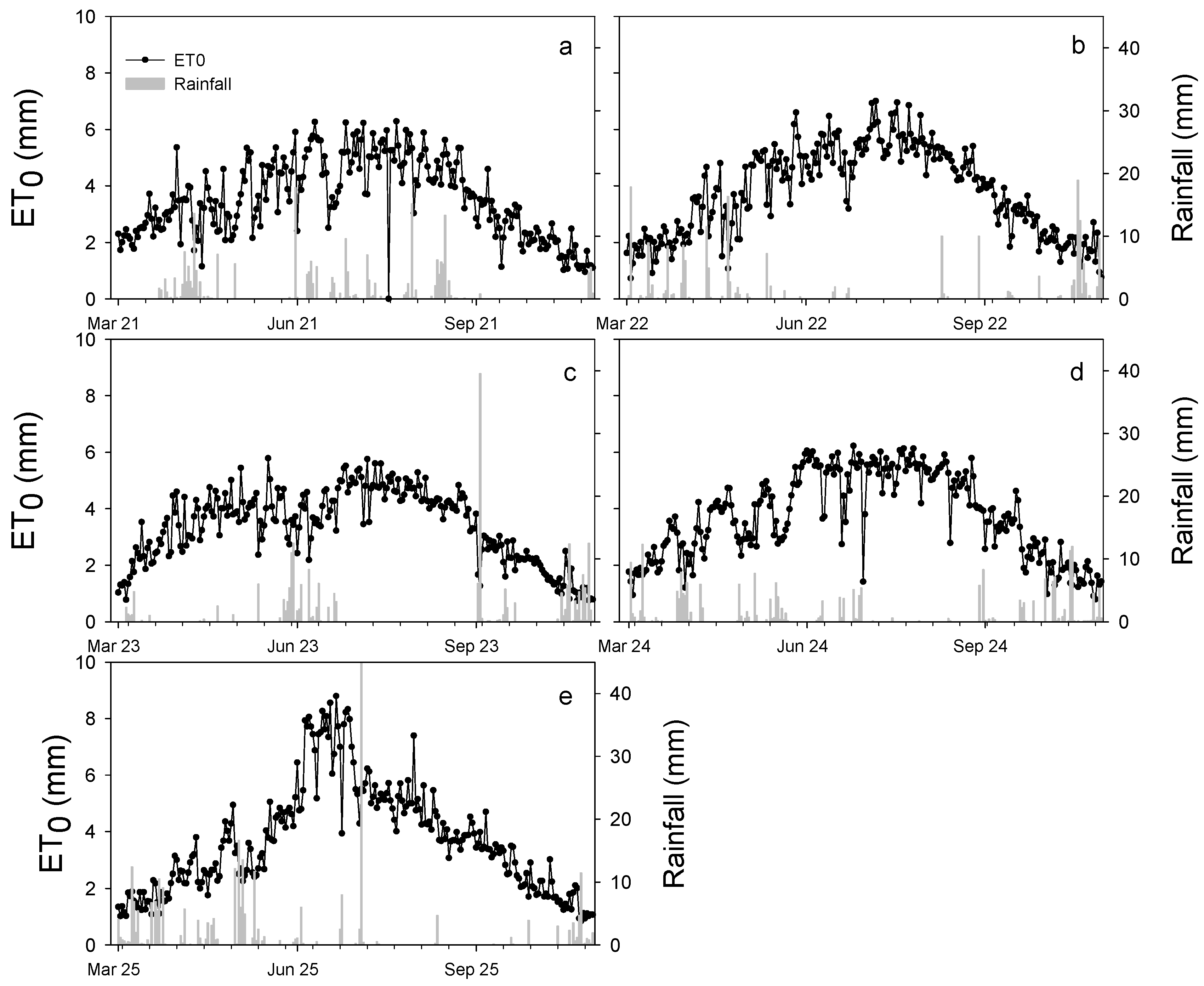
During the study period from 2021 to 2025, ETo over the growing season ranged from 753 mm to 869 mm, while ETc varied between 297 mm and 488 mm (Table 1). The temporal dynamics of ETo and rainfall over the growing season differed among years (Figure 1). In 2021, rainfall was evenly distributed over the season and daily ETo reached maximum values close to 6 mm (Figure 1a), whereas dry periods were observed in the rest of the experimental seasons, usually in July and August, such as in 2022, 2023, and 2024 (Figure 1b–d). In 2025, daily ETo surpassed 8 mm at the beginning of July, but after a single rainfall event of approximately 40 mm, ETo values declined sharply (Figure 1e).
Figure 1.
Evolution of daily reference evapotranspiration (ETo) and rainfall recorded at the agrometeorological station of Rueda (https://www.inforiego.org/opencms/opencms/info_meteo/construir/index.html, accessed on 24 November 2025) during the 2021 and 2025 (a–e) growing seasons (from March to October).
As reported in Table 1, irrigation amounts were high (67–147% of ETc minus effective rainfall, depending on the treatment and season) in the first two seasons of the experiment, but they were progressively reduced to cause a water deficit in the pistachio trees, being just 22–25% ETc and 33–37% ETc in the C and H treatments, respectively, during the last two seasons of the experiment (Table 1). Annual irrigation doses varied between 875 and 2331 m3 ha−1 in the C treatment and between 1312 and 3623 m3 ha−1 in the H treatment (Table 1).
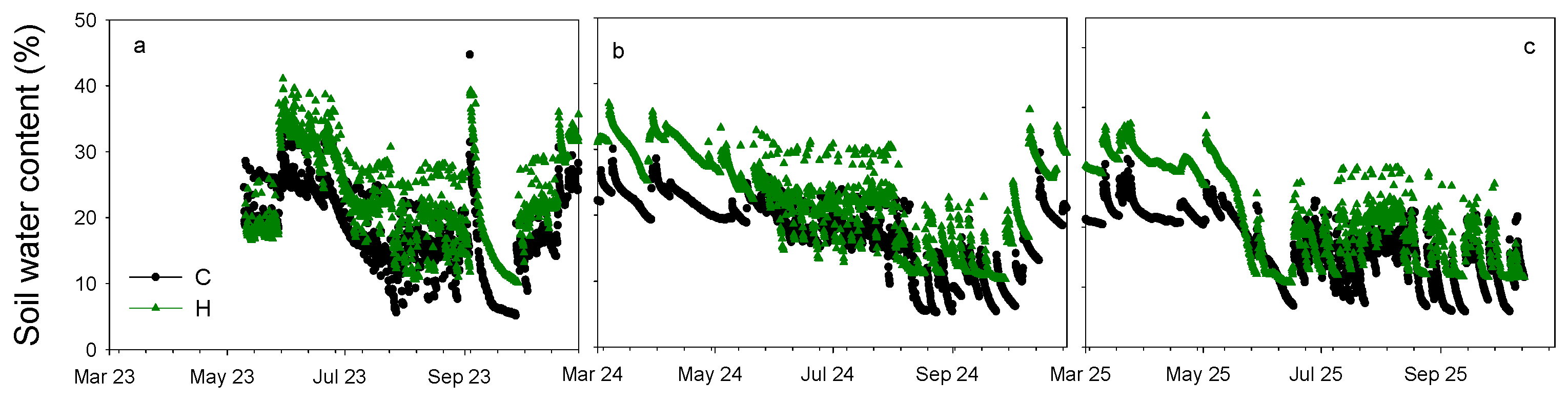
Soil water content responded to irrigation, rainfall, and water uptake by pistachio trees (Figure 2). Water content in the soil profile (20–60 cm depth) followed a similar temporal pattern in both treatments but differed in the magnitude of the values (Figure 2). Irrigation events spiked soil water content in both treatments. In 2023, the C treatment had a slightly higher soil water content than the H treatment at the beginning of June, but once irrigation started, the soil water content in the H treatment remained higher than that of the C treatment until the end of the season (Figure 2a). In 2024 and 2025, soil water content in the H treatment was higher than that in the C treatment throughout the growing season, but differences were more marked at the beginning of both seasons (Figure 2b,c).
Figure 2.
Evolution of soil water content at 20–60 cm depth in a pistachio orchard under two irrigation treatments (C = control, H = high-dose) during the experimental seasons of (a) 2023, (b) 2024, and (c) 2025.
3.2. Stem Water Potential and Gas Exchange Parameters of Pistachio Trees Subjected to Two Irrigation Treatments
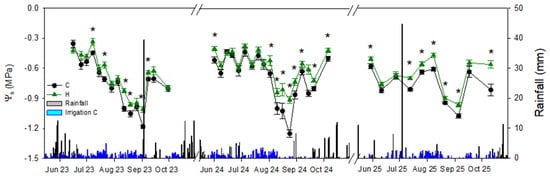
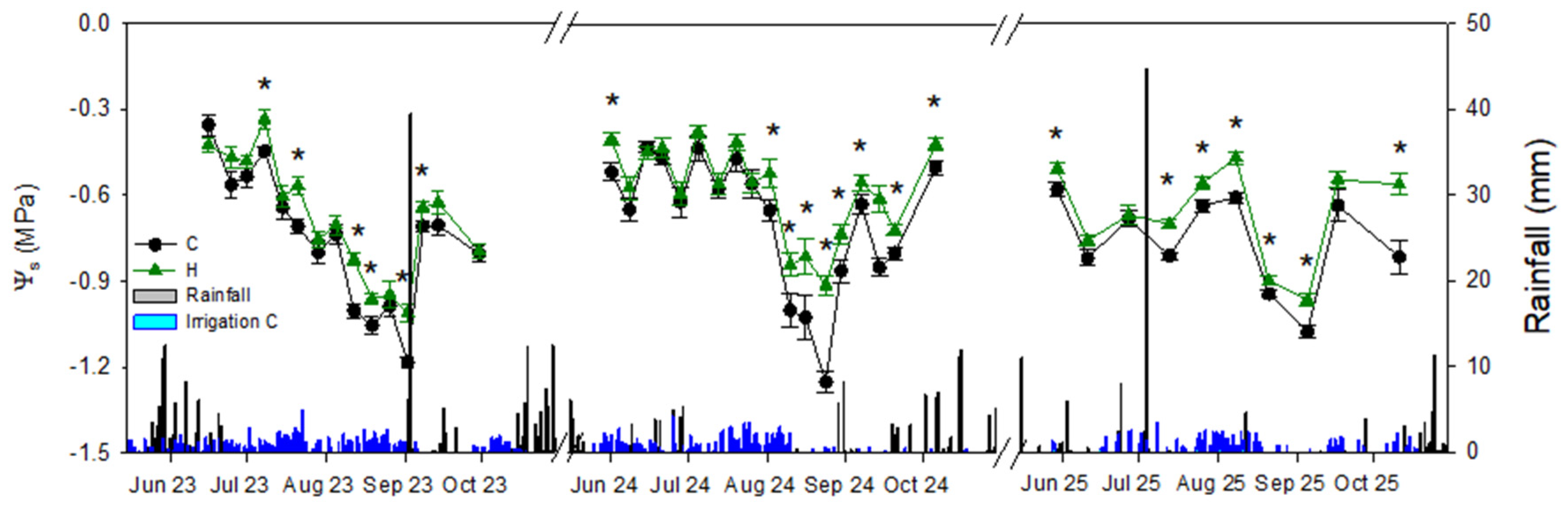
The seasonal dynamics of Ψs reflected those of soil water content (Figure 3). The Ψs values decreased progressively over the growing season and recovered in September, showing a similar trend in both treatments (Figure 3). However, significant differences between treatments were detected in almost all measurement dates, with the Ψs values from the H treatment being less negative than those from the C treatment (Figure 3). The most negative Ψs values were always detected in the C treatment by the end of August (−1.2 MPa in 2023 and 2024), while Ψs in trees from the H treatment did not go below −1.0 MPa in any of the growing seasons studied (Figure 3).
Figure 3.
Evolution of stem water potential at midday (Ψs) of pistachio trees subjected to two irrigation treatments during the 2023, 2024, and 2025 growing seasons. Rainfall and irrigation amounts are also shown. Asterisks indicate significant differences between treatments on a given date, according to Student’s test (p < 0.05). C = control, H = high-dose.
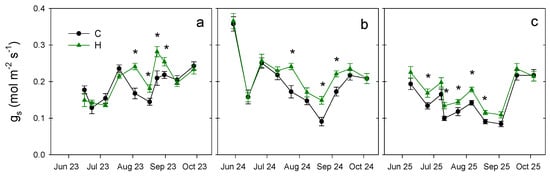
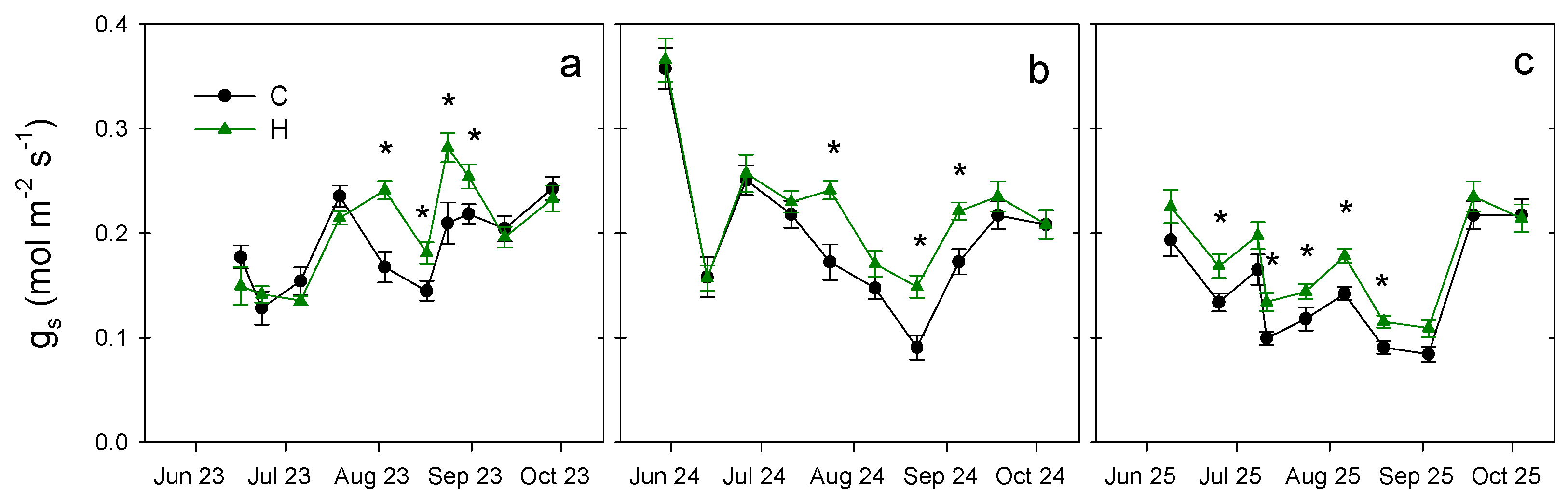
In contrast to Ψs, gs values were less affected by irrigation (Figure 4). In 2023, gs values lower than 0.1 mol m−2 s−1 were not observed on any given date or treatment, and differences between treatments were only detected in August and early September, with the values from the H treatment (0.22–0.26 mol m−2 s−1) being greater than those from the C treatment (approximately, 0.15 mol m−2 s−1) (Figure 4a). In 2024, a trend towards a decrease in gs over the growing season was observed, and the values were significantly higher in the H treatment than in the C treatment in August (0.18 vs. 0.12 mol m−2 s−1) and early September (0.22 vs. 0.17 mol m−2 s−1) (Figure 4b). Finally, in 2025, significantly greater gs values were observed in the H treatment from late June to mid-August (Figure 4c).
Figure 4.
Evolution of stomatal conductance (gs) of pistachio trees subjected to two irrigation treatments during the 2023 (a), 2024 (b), and 2025 (c) growing seasons. Asterisks indicate significant differences between treatments on a given date, according to Student’s test (p < 0.05). C = control, H = high-dose.
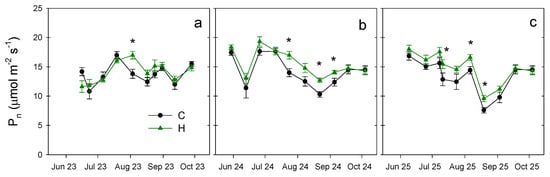
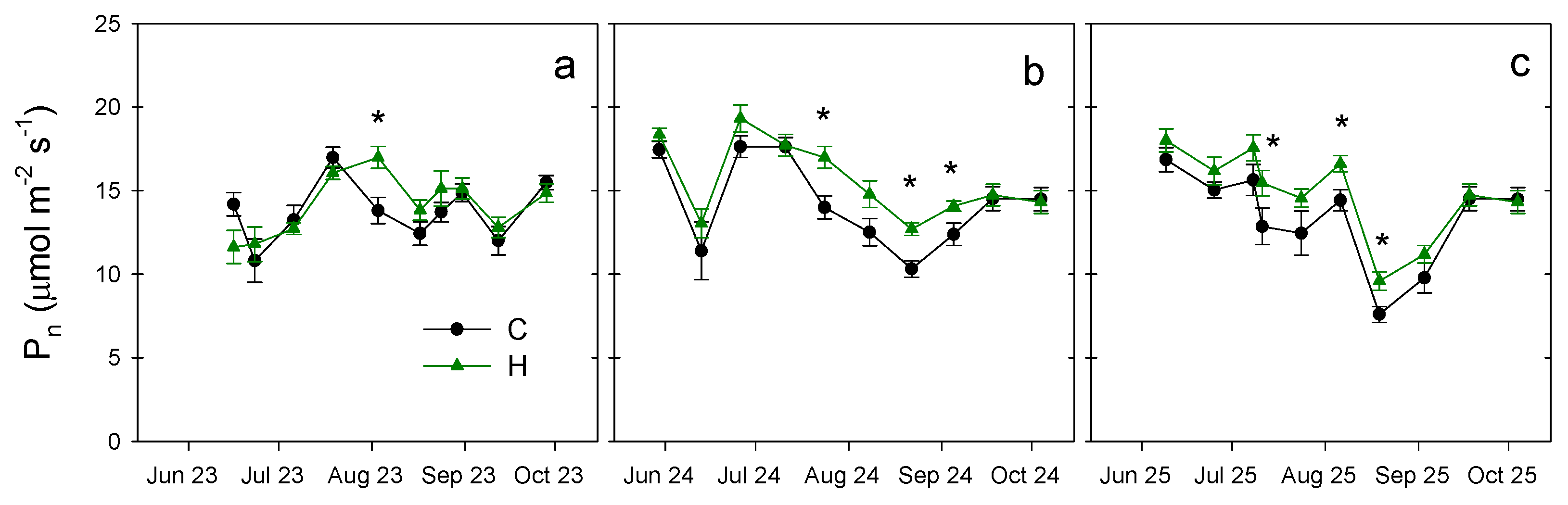
The Pn values were similar between treatments in 2023, where a significant difference was only detected at the beginning of August (17 μmol m−2 s−1 for the H treatment against 0.13 μmol m−2 s−1 for the C treatment, Figure 5a). In 2024, Pn was significantly greater in the H treatment on three dates, one in July and two in late August (approximately 0.04 μmol m−2 s−1 of difference between treatments, Figure 5b). Finally, in 2025, Pn values were very similar between treatments, despite significantly greater values in the H treatment on specific dates in July and August (Figure 5c).
Figure 5.
Evolution of net photosynthesis rate (Pn) of pistachio trees subjected to two irrigation treatments during the 2023 (a), 2024 (b), and 2025 (c) growing seasons. Asterisks indicate significant differences between treatments on a given date, according to Student’s test (p < 0.05). C = control, H = high-dose.
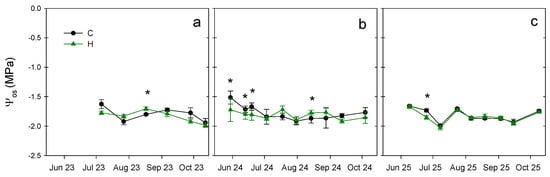
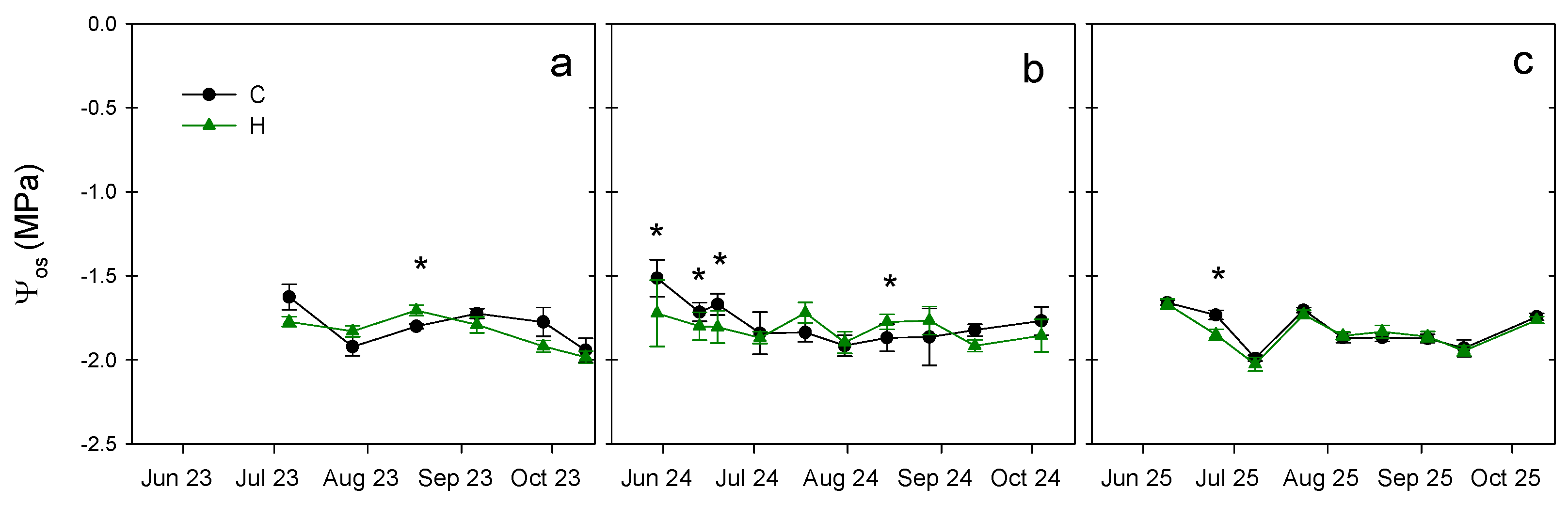
In general, no differences between treatments were detected in Ψos, except for specific dates in each growing season (Figure 6).
Figure 6.
Evolution of leaf osmotic potential at full turgor (Ψos) of pistachio trees subjected to two irrigation treatments during the 2023 (a), 2024 (b), and 2025 (c) growing seasons. Asterisks indicate significant differences between treatments on a given date, according to Student’s test (p < 0.05). C = control, H = high-dose.
3.3. Vegetative Growth and Yield of Pistachio Trees Subjected to Two Irrigation Treatments
Pistachio trees were similar in size at the beginning of the experiment, but significant increases in TCSA under the H treatment were detected from the third year onwards (Table 2). Canopy volume responded later, and significant differences between treatments were only detected on the fourth and fifth years of differential irrigation (Table 2). By the end of the experiment, trees under the H treatment had a 15.6% greater TCSA and a 22.4% greater canopy volume than trees under the C treatment.
Table 2.
Trunk cross-sectional area (TCSA) and canopy volume (mean ± standard error) of pistachio trees under control (C) and high-dose (H) irrigation treatments in an orchard located in central Spain during the study period (2021–2025). Different letters in the row indicate significant differences between treatments on a given year, according to Student’s test (p < 0.05).
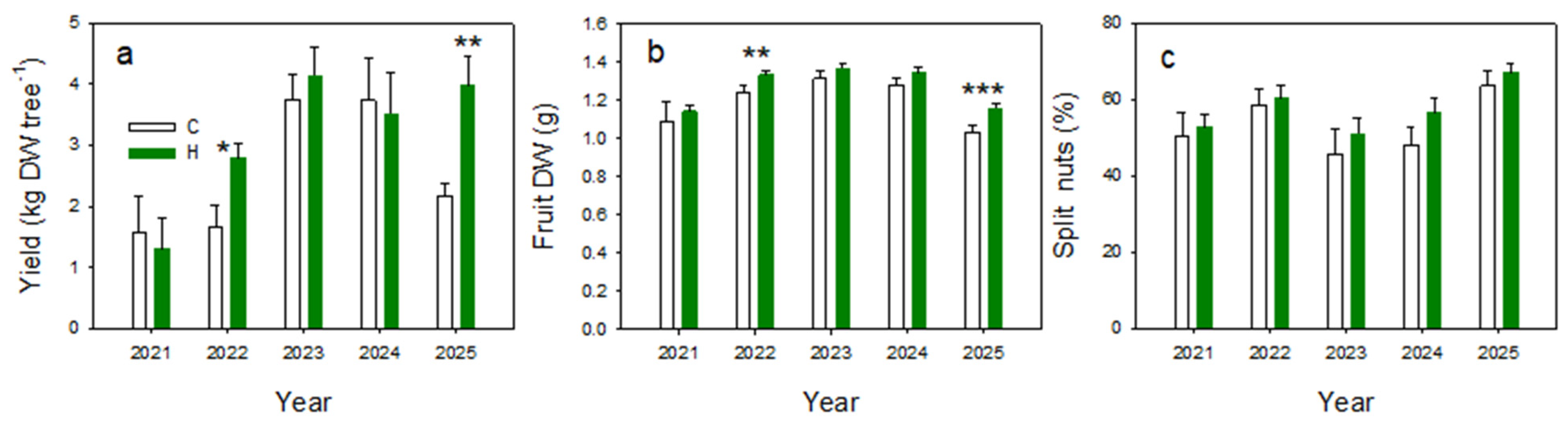
In terms of dry weight, yield did not significantly differ between irrigation treatments, but this outcome depended on the analyzed year, with a trend towards higher yields when using the H treatment (16.7% difference; Table 3, Figure 7a). In contrast, fruit dry weight was significantly greater when using the H treatment, although this variable depended on the year (Table 3, Figure 7b). As a consequence, the number of nuts per ounce was 6% greater with C than with H (Table 3). The percentage of split, non-split, and blank nuts did not differ between treatments, but it did among years (Table 3, Figure 7c). Finally, the dry weight of each nut category depended on the year, except for blank nuts; moreover, the dry weight of split nuts was significantly greater with the H treatment, 36% difference between treatments (Table 3). The interaction between irrigation treatment and year was not significant for the variables considered in this study (Table 3), suggesting a consistency in the response of pistachio yield components over the experimental period.
Table 3.
Pistachio yield traits over the experimental period (2021–2025; mean ± standard error) from trees under control (C) and high-dose (H) irrigation treatments in an orchard located in central Spain. The significance of treatment, year, and their interaction is shown: ns = not significant, * p < 0.05, ** p < 0.01, and *** p < 0.001.
Figure 7.
Evolution of dry weight (DW) of fruits per tree (a), fruit DW (b), and percentage of split nuts (c) with two irrigation treatments (C = control, H = high-dose) in La Seca orchard during the experimental period (2021–2025). Asterisks indicate significant differences between treatments according to Student’s test (* = p < 0.05, ** = p < 0.01, *** = p < 0.001).
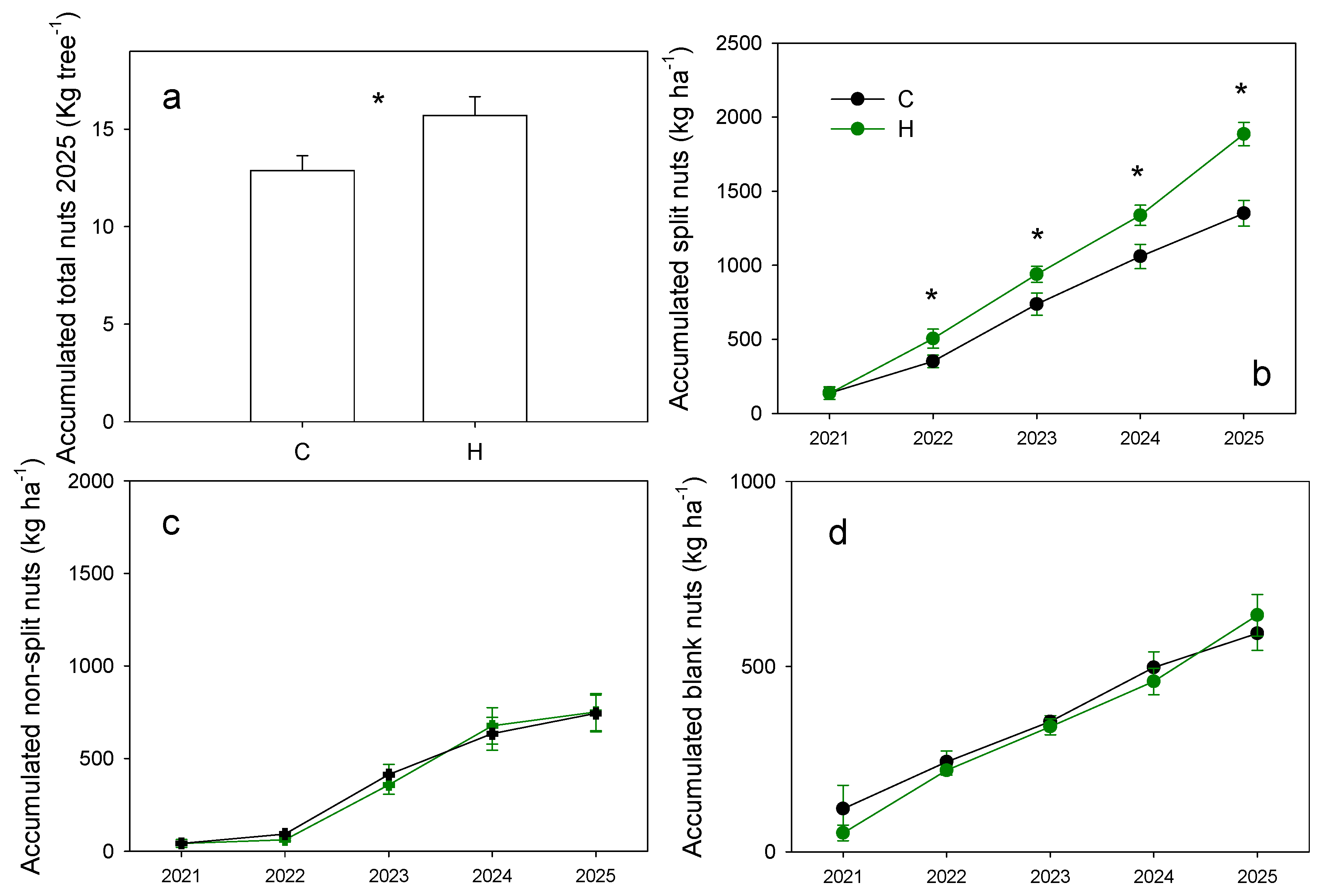
In terms of accumulated yield, a significantly greater mass of nuts per tree was observed in H when compared with the C treatment (Figure 8a). Interestingly, this difference was caused by a progressive and consistent increase in split nuts from 2022 to 2025 (Figure 8b), while the amounts of non-split and blank nuts remained similar between treatments (Figure 8c,d).
Figure 8.
Accumulated yield (a) and dry weight of split (b), non-split (c) and blank nuts (d) with two irrigation treatments (C = control, H = high-dose) in La Seca orchard during the experimental period (2021–2025). Asterisks indicate significant differences between treatments according to Student’s test (p < 0.05).
3.4. Quality Traits of Pistachio Nuts Under Two Irrigation Treatments
Overall, the contents of iron, magnesium, and selenium were significantly greater in nuts from the C treatment than in those from the H treatment (Table 4), with differences between treatments of 8%, 9%, and 19.8% for iron, magnesium, and selenium, respectively.
Table 4.
Pistachio nut quality traits over the experimental period (2021–2025; mean ± standard error) from trees under control (C) and high-dose (H) irrigation treatments in an orchard located in central Spain. Different letters in the row indicate significant differences between treatments for a given trait, according to the ANOVA test (p < 0.05). The significance of treatment, year, and their interaction is shown: ns = not significant, * p < 0.05, ** p < 0.01, and *** p < 0.001.
However, most of the nut quality traits considered in this study—including calcium, ash, phosphorus, carbohydrates, iron, humidity, zinc, and fiber— differed significantly among years (Table 4). Finally, the contents of phosphorus, humidity, magnesium, and fiber were affected by the interaction between irrigation treatment and year, suggesting that the response of these particular traits to irrigation depends on the environmental conditions of the year.
4. Discussion
This work evaluated the response of pistachio trees (cv. Kerman) to two irrigation doses in a Spanish region in which this crop is increasingly being planted, thus providing useful information for growers in this particular region and those with similar environmental conditions. The water amounts applied in the current study were similar to those used by Gijón et al. [11] in their deficit-irrigated treatments in another Spanish region and to those applied by Marino et al. [14] as a supplementary form of irrigation in Sicily (Italy), but they were much lower than those employed by Goldhamer and Beede [9] in California and Kanber et al. [21] in Turkey. As expected, the pistachio yields obtained in the current work were similar to those previously reported for other regions in which supplemental or sustained deficit irrigation strategies had been implemented [11,14] but lower than those reported when higher irrigation amounts had been applied [9,12].
In the current study, soil water reserves were sufficient to support pistachio flowering and growth at the beginning of the season. Spiegel-Roy et al. [22] reported that 54–163 mm of annual precipitation was enough for pistachio trees to differentiate sufficient flower buds and obtain appreciable yields. In the current experiment, abundant rainfall was recorded at the beginning of the growing season, within the range suggested by Spiegel-Roy et al. [22]. This explains the absence of differences in gas exchange parameters between treatments during the first months of the growing season. As evaporative demand increased over the season, Ψs, gs and Pn decreased. In contrast to previous reports in semi-arid regions [12,14], Ψs did not decrease under −1.5 MPa in any of the treatments, but a reduction in gas exchange was observed anyway. Interestingly, a slower decrease was observed in trees under the H treatment compared to those under the C treatment, highlighting the lower level of stress in H trees. Moreover, Ψs was effective in detecting differences between treatments, in agreement with previous reports [11,12] but contradicting other works that suggested other physiological indicators, such as gs and Ψos [14,23].
The fact that soil water content, Ψs and gs values decreased over the season with the two irrigation treatments suggested that the water amounts applied were not sufficient to prevent the occurrence of a water deficit during the study period, in spite of the higher dose applied in the H treatment. In all of the treatments, Ψs was not below −1.5 MPa, which is the threshold for the onset of stress [12,24]. Nevertheless, trees from the C treatment were closer to this threshold than those from the H treatment. In addition, gas exchange parameters reflected slight differences between treatments on given dates, suggesting that trees suffered from different levels of water stress as a function of the treatment. It must be noted that the pistachio trees in the current experiment were grafted on UCB-1 rootstock, which has been reported to have a high degree of resistance to drought when compared to other rootstocks, leading to a high capacity for water uptake [13]. It must also be highlighted that UCB-1 is more productive under irrigation conditions than other rootstocks [25].
Tree size, measured using trunk cross-sectional area and canopy volume, was significantly higher in H trees when compared to C trees after the fourth year of treatment application, as expected from previous studies in pistachio that indicate that vegetative growth depends on tree water status [12]. In our experiment, the distinctive amounts of water applied were enough to produce significant differences in vegetative growth between treatments, likely due to carry-over effects from year to year. Previous studies have reported leaf accumulation of soluble carbohydrates in an Iranian pistachio cultivar (‘Badami’) in response to severe water stress [26]. Osmotic adjustment is an important mechanism that enables plants to maintain cell turgor and play a central role in drought tolerance [27], although the levels of water stress attained in the current study did not trigger a consistent osmotic adjustment, and decreases in Ψos were only detected on a few days during the experiment.
Pistachio production involves an unusual number of yield components, including nut weight, nut load, harvestability, shell splitting, nut blanking, and kernel abortion, so interpreting the effects of water stress on the yield of marketable product in pistachio is relatively complex [9]. In the current work, augmenting the irrigation dose did not significantly increase pistachio yield on a year-by-year basis (only in 2022 and 2025 in our study), likely because of the mechanism of alternate bearing in this species [28], which in combination with the low yields attained in this study might have masked some differences between treatments. As previously reported, the average 80% floral bud drop during the on-year evidences the magnitude of the reduction in crop load that cannot be compensated for by a higher fruit set [29]. However, in the long term, cumulative yield was significantly increased in the H treatment, suggesting positive carry-over effects associated with higher irrigation doses. Pistachio has been suggested to be an alternate bearing species, as fruit production fluctuates between “on-years” of high yields and “off-years” of low yields [25]. For the cultivar Kerman, the alternate bearing index ranges between 0.67 and 0.76 [30], with 0 corresponding to no alternate bearing behavior and 1 representing strict alternate bearing behavior. Moreover, pistachio yield can vary considerably among trees, due to their age, environmental factors, and genetic dissimilarity among trees [31].
When a deficit irrigation was applied (2023 to 2025), yield increased with the total amount of water supplied to pistachio trees. In absolute magnitudes, when irrigation plus effective rainfall was below 300 mm per growing season, a drop in total yield was detected. This finding agrees with the threshold of 250 mm reported by Gijón et al. [11]. This response of yield to water, or water production function, is linear (namely, yield is positively correlated with increasing water amounts) in row crops [32] but curvilinear in fruit trees [33,34], suggesting that there are developmental periods during which water stress is not detrimental to yield [6,35].
Except for two seasons (2022 and 2025), increasing irrigation did not translate into higher fruit weights, confirming previous findings [11,14,36]. This suggests that irrigation increased yield by increasing the number of nuts, as suggested by a significantly greater number of bunches in trees from the H treatment from the second year of this experiment onward.
In summary, the average yield (in dry weight) of pistachio was 21.7% greater with the H than with the C treatment, but this derived from a 50% increase in irrigation amounts (on average for the five growing seasons, the C treatment used 153 mm year−1 versus 229 mm year−1 in the H treatment), which led to similar water productivities between treatments.
Few pistachio quality traits were affected by irrigation dose in the current study. Among them, the splitting percentage was significantly higher with the H treatment. Irrigation management has been reported to enhance shell splitting in pistachio [14,37]. However, previous reports on the effects of irrigation on the split nut percentage are contradictory, as, for instance, Goldhamer et al. [36] reported dramatic increases in split nuts with irrigation, while Marino et al. [14] found 25% increases under rainfed conditions. Goldhamer and Beede [9] reported reductions in split nut percentage as a consequence of water stress in stage III of fruit growth, while other studies proved that mild water stress during stage I increased the percentage of split nuts [38,39]. Additionally, several authors have reported no effects of irrigation on the split nut percentage [11,12]. In the current study, significantly higher amounts of split nuts were observed with the H treatment in two of the studied seasons, but when relativized to the total yield, differences between treatments were reduced, as reported by Memmi et al. [12].
The irrigation treatments applied in the current study did not affect the mineral composition of pistachios, except for the Fe, Mg, and Se contents, which were greater in those nuts coming from the C treatment, i.e., the one with the lowest dose of water. Previous studies reported significant differences in pistachio mineral composition between well-irrigated and deficit-irrigated trees [40], but in elements different from the three observed in the current work. For instance, they reported that deficit irrigation increased Ca and Na contents in pistachio [40], but this could not be confirmed in the current work despite a trend towards the accumulation of these two elements in nuts from the C treatment.
5. Conclusions
The current study confirmed that irrigation amounts affect the total nut and split nut yields of pistachio. The increase in split nuts is mainly related to the increase in total yield, since the percentages of split, non-split, and blank nuts were similar in both treatments. However, the effects of differential irrigation on yield were not evidenced until the third year of treatment. In contrast to previous studies, Ψs was more sensitive than gs in detecting differences in tree water status between irrigation treatments. No significant variations in nut mineral composition were detected as a function of the amount of water applied. Overall, the current study provides relevant information for managing the irrigation of pistachio trees in a cold-winter region of central Spain.
Author Contributions
Conceptualization, S.Á.; methodology, L.N., H.M. and S.Á.; validation, J.M.M.-A. and S.Á.; formal analysis, L.N., J.M.M.-A. and S.Á.; investigation, L.N., H.M. and S.Á.; resources, S.Á.; data curation, J.M.M.-A. and S.Á.; writing—original draft preparation, J.M.M.-A. and S.Á.; writing—review and editing, J.M.M.-A. and S.Á.; funding acquisition, S.Á. All authors have read and agreed to the published version of the manuscript.
Funding
This research was funded by the Ministerio de Ciencia, Innovación y Universidades, grant number PRE2021-098641, and the Ministerio de Ciencia e Innovación, grant number RYC2021-033890. This study was co-financed by FEADER funds and Junta de Castilla y León (Spain).
Data Availability Statement
The raw data supporting the conclusions of this article will be made available by the authors on request.
Conflicts of Interest
The authors declare no conflicts of interest. The funders had no role in the design of the study; in the collection, analyses, or interpretation of data; in the writing of the manuscript; or in the decision to publish the results.
Abbreviations
The following abbreviations are used in this manuscript:
| ETc | Crop evapotranspiration |
| Ψs | Midday stem water potential |
| ETo | Reference evapotranspiration |
| gs | Stomatal conductance |
| Pn | Net photosynthesis rate |
| WUEi | Intrinsic water use efficiency |
| Ψos | Leaf osmotic potential at full turgor |
| Kc | Crop coefficient |
| Kr | Conversion factor for considering tree spacings and growth stage |
| C | Control treatment |
| H | High-dose water treatment |
| TCSA | Trunk cross-sectional area |
| DW | Dry weight |
References
- Gijón, M.C.; Gimenez, C.; Pérez-López, D.; Guerrero, J.; Couceiro, J.F.; Moriana, A. Rootstock influences the response of pistachio (Pistacia vera L. cv. Kerman) to water stress and rehydration. Sci. Hortic. 2010, 125, 666–671. [Google Scholar] [CrossRef] [Scilit]
- MAPA. Encuesta de Superficies y Rendimientos de Cultivos (ESYRCE). Año 2024; Ministerio de Agricultura, Pesca y Alimentación. Gobierno de España: Madrid, Spain, 2024; pp. 27–37. Available online: https://www.mapa.gob.es/es/estadistica/temas/estadisticas-agrarias/agricultura/esyrce/ (accessed on 29 January 2026).
- Barajas, E.; Álvarez, S.; Fernández, E.; Vélez, S.; Rubio, J.A.; Martín, H. Sentinel-2 satellite imagery for agronomic and quality variability assessment of pistachio (Pistacia vera L.). Sustainability 2020, 12, 8437. [Google Scholar] [CrossRef] [Scilit]
- Núñez, L.; Martín, H.; Mirás-Avalos, J.M.; Álvarez, S. Pistachio phenology and yield in a cold-winter region of Spain: The status of the cultivation and performance of three cultivars. Horticulturae 2024, 10, 1235. [Google Scholar] [CrossRef] [Scilit]
- Martínez-Burgos, E.; Fariña-Flores, D.; Guerrero-Villaseñor, J.; Martínez-Peña, R.; Mérida-García, M.R. Tendencias y conceptos básicos de la poda del pistachero en España. Vida Rural 2025, 562, 38–44. [Google Scholar]
- Fereres, E.; Soriano, M.A. Deficit irrigation for reducing agricultural water use. J. Exp. Bot. 2007, 58, 147–159. [Google Scholar] [CrossRef] [Scilit]
- Behboudian, M.H.; Walker, R.R.; Törökfalvy, E. Effects of water stress and salinity on photosynthesis of pistachio. Sci. Hortic. 1986, 29, 251–261. [Google Scholar] [CrossRef] [Scilit]
- Rieger, M. Offsetting effects of reduced root hydraulic conductivity and osmotic adjustment following drought. Tree Physiol. 1995, 15, 379–385. [Google Scholar] [CrossRef] [Scilit]
- Goldhamer, D.; Beede, R. Regulated deficit irrigation effects on yield, nut quality and water-use efficiency of mature pistachio trees. J. Hortic. Sci. Biotechnol. 2004, 79, 538–545. [Google Scholar] [CrossRef] [Scilit]
- Guerrero, J.; Moriana, A.; Pérez-López, D.; Couceiro, J.F.; Olmedilla, N.; Gijón, M.C. Regulated deficit irrigation and the recovery of water relations in pistachio trees. Tree Physiol. 2006, 26, 87–92. [Google Scholar] [CrossRef] [Scilit]
- Gijón, M.C.; Guerrero, J.; Couceiro, J.F.; Moriana, A. Deficit irrigation without reducing yield or nut splitting in pistachio (Pistacia vera cv Kerman on Pistacia terebinthus L.). Agric. Water Manag. 2009, 96, 12–22. [Google Scholar] [CrossRef] [Scilit]
- Memmi, H.; Gijón, M.C.; Couceiro, J.F.; Pérez-López, D. Water stress thresholds for regulated deficit irrigation in pistachio trees: Rootstock influence and effects on yield quality. Agric. Water Manag. 2016, 164, 58–72. [Google Scholar] [CrossRef] [Scilit]
- Moriana, A.; Memmi, H.; Centeno, A.; Martín-Palomo, M.J.; Corell, M.; Torrecillas, A.; Pérez-López, D. Influence of rootstock on pistachio (Pistacia vera L. cv Kerman) water relations. Agric. Water Manag. 2018, 202, 263–270. [Google Scholar] [CrossRef] [Scilit]
- Marino, G.; Di Martino, S.; Amico Roxas, A.; Caruso, T.; Ferguson, L.; Barone, E.; Marra, F.P. Sustainability of pistachio production (Pistacia vera L.) under supplemental irrigation in a Mediterranean climate. Sci. Hortic. 2018, 241, 260–266. [Google Scholar] [CrossRef] [Scilit]
- Allen, R.G.; Pereira, L.S.; Raes, D.; Smith, M. Crop Evapotranspiration—Guidelines for Computing Crop Water Requirements; Irrigation and Drainage Nº 56; FAO: Rome, Italy, 1998; p. 300. [Google Scholar]
- Memmi, H.; Couceiro, J.F.; Gijón, C.; Pérez-López, D. Impacts of water stress, environment and rootstock on the diurnal behaviour of stem water potential and leaf conductance in pistachio (Pistacia vera L.). Span. J. Agric. Res. 2016, 14, 0804. [Google Scholar] [CrossRef] [Scilit]
- Fereres, E.; Goldhamer, D.A. Deciduous fruit and nut trees. In Irrigation of Agricultural Crops; Stewart, B.A., Nielsen, D.R., Eds.; American Society of Agronomy Monograph: Madison, WI, USA, 1990; pp. 987–1017. [Google Scholar]
- Gucci, R.; Xiloyannis, C.; Flore, J.A. Gas exchange parameters, water relations and carbohydrate partitioning in leaves of field-grown Prunus domestica following fruit removal. Physiol. Plant. 1991, 83, 497–505. [Google Scholar] [CrossRef] [Scilit]
- Martínez-Peña, R.; Castillo, S.; Vélez, S.; Álvarez, S. HSI and ML for non-destructive pistachio quality assessment: Influence of location and irrigation on nutrient and fat composition. Food Control 2026, 184, 112011. [Google Scholar] [CrossRef] [Scilit]
- Nielsen, S.S. Food Analysis Laboratory Manual; Food Science Texts Series; Springe: Boston, MA, USA, 2010. [Google Scholar]
- Kanber, R.; Yazar, A.; Önder, S.; Köskal, H. Irrigation response of pistachio (Pistacia vera L.). Irrig. Sci. 1993, 14, 7–14. [Google Scholar] [CrossRef] [Scilit]
- Spiegel-Roy, P.; Mazigh, D.; Evenari, M. Responses of pistachio to low soil moisture condition. J. Am. Soc. Hortic. Sci. 1977, 102, 470–473. [Google Scholar] [CrossRef] [Scilit]
- Pour, A.T.; Sepaskhah, A.R.; Maftoun, M. Plant water relations and seedling growth of three pistachio cultivars as influenced by irrigation frequency and applied potassium. J. Plant Nutr. 2005, 28, 1413–1425. [Google Scholar] [CrossRef] [Scilit]
- Shackel, K.; Stevenson, M.; Teranishi, R.; Goldhamer, D.A.; Ferguson, L. Stress strategy on deep vs. shallow soils: Second year report. In Annual Report. Crop Year 1993–1994; California Pistachio Industry: Fresno, CA, USA, 1994; pp. 114–117. [Google Scholar]
- Ferguson, L.; Reyes, H.; Sanden, B.; Grattan, S.; Epstein, L.; Krueger, B. Pistachio rootstocks. In Pistachio Production Manual; Ferguson, L., Ed.; Center of Fruit and Nut Research and Information: Davis, CA, USA, 2005; pp. 67–73. [Google Scholar]
- Gholampoor, M.; Osku, M.; Jahanifard, M.; Sarikhani, S.; Aliiaeifard, S.; Sadehi-Majad, R.; Roozban, M.R. Exploring drought adaptation strategies in pistachios thorough morpho-physiological analysis under deficit irrigation. Sci. Rep. 2026, 16, 1105. [Google Scholar] [CrossRef] [Scilit]
- Álvarez, S.; Gómez-Bellot, M.J.; Acosta-Motos, J.R.; Sánchez-Blanco, M.J. Application of deficit irrigation in Phillyrea angustifolia for landscaping purposes. Agric. Water Manag. 2019, 218, 193–202. [Google Scholar] [CrossRef] [Scilit]
- Khezri, M.; Heerema, R.; Brar, G.; Ferguson, L. Alternate bearing in pistachio (Pistavia vera L.): A review. Trees Struct. Funct. 2020, 34, 855–868. [Google Scholar] [CrossRef] [Scilit]
- Kallsen, C.E. Temperature-related variables associated with yield of ‘Kerman’ pistachio in the San Joaquin Valley of Caifornia. HortScience 2017, 52, 598–605. [Google Scholar] [CrossRef] [Scilit]
- Kallsen, C.E.; Parfitt, D.E.; Holtz, B. Early differences in the intensity of alternate bearing among selected pistachio genotypes. HortScience 2007, 42, 1740–1743. [Google Scholar] [CrossRef] [Scilit]
- Rosenstock, T.D.; Rosa, U.A.; Plant, R.E.; Brown, P.H. A reevaluation of alternate bearing in pistachio. Sci. Hortic. 2010, 124, 149–152. [Google Scholar] [CrossRef] [Scilit]
- Vaux, H.J.; Pruitt, W.O. Crop-water production functions. In Advances in Irrigation; Hillel, D., Ed.; Academic Press: New York, NY, USA, 1983; Volume 2, pp. 61–97. [Google Scholar]
- Moriana, A.; Orgaz, F.; Fereres, E.; Pastor, M. Yield responses of a mature olive orchard to water deficits. J. Am. Soc. Hort. Sci. 2003, 128, 425–431. [Google Scholar] [CrossRef] [Scilit]
- Mirás-Avalos, J.M.; González-Dugo, V.; García-Tejero, I.F.; López-Urrea, R.; Intrigliolo, D.S.; Egea, G. Quantitative analysis of almond yield response to irrigation regimes in Mediterranean Spain. Agric. Water Manag. 2023, 279, 108208. [Google Scholar] [CrossRef] [Scilit]
- Behboudian, M.H.; Mills, T.M. Deficit irrigation in deciduous orchards. In Horticultural Reviews; John Wiley & Sons, Inc.: Hoboken, NJ, USA, 1997; Volume 21, pp. 105–131. [Google Scholar] [CrossRef] [Scilit]
- Goldhamer, D.A.; Kjelgren, R.; Williams, L.; Beede, R. Water use requirements of pistachio trees and response to water stress. In Proceedings of the National Symposium on Advances in Evapotranspiration, Chicago, IL, USA, 16–17 December 1985; pp. 216–223. [Google Scholar]
- Goldhamer, D.A.; Phene, B.C.; Beede, R.; Sherlin, L.; Mahan, S.; Rose, D. Effects of sustained deficit irrigation on pistachio tree performance. In Annual Report. Crop Year 1986–1987; California Pistachio Industry: Fresno, CA, USA, 1987; pp. 61–66. [Google Scholar]
- Doster, M.A.; Michailides, T.J. The relationship between date of hull splitting and decay of pistachio nuts by Aspergillus species. Plant Dis. 1995, 79, 766–769. [Google Scholar] [CrossRef] [Scilit]
- Goldhamer, D.A. Tree water requirements and regulated deficit irrigation. In Pistachio Production Manual, 4th ed.; Ferguson, L., Ed.; Fruit and Nut Research Information Center, University of California: Davis, CA, USA, 2005; pp. 103–116. [Google Scholar]
- Noguera-Artiaga, L.; Sánchez-Bravo, P.; Hernández, F.; Burgos-Hernández, A.; Pérez-López, D.; Carbonell-Barrachina, A.A. Influence of regulated deficit irrigation and rootstock on the functional, nutritional and sensory quality of pistachio nuts. Sci. Hortic. 2020, 261, 108994. [Google Scholar] [CrossRef] [Scilit]

Disclaimer/Publisher’s Note: The statements, opinions and data contained in all publications are solely those of the individual author(s) and contributor(s) and not of MDPI and/or the editor(s). MDPI and/or the editor(s) disclaim responsibility for any injury to people or property resulting from any ideas, methods, instructions or products referred to in the content. |
© 2026 by the authors. Licensee MDPI, Basel, Switzerland. This article is an open access article distributed under the terms and conditions of the Creative Commons Attribution (CC BY) license.